Cambridge A Level English - Language AS and A Level (from 2014) 9093 — 2020 Oct/Nov Paper 3 · Variant 1
9093/31/O/N/20 · 50 marks · ≈56 min
The question paper and its mark scheme, free to read here and free to download. This is Cambridge’s own paper, exactly as it was sat.
Question paper8 pages

Mark scheme6 pages
Answers below. Sit the paper first if you are practising.
Paper as text
Question paper, page 1
Cambridge International AS & A Level DC (SLM) 203207 © UCLES 2020 [Turn over This document has 8 pages. Blank pages are indicated. * 6 0 2 5 4 5 1 8 5 5 * ENGLISH LANGUAGE 9093/31 Paper 3 Text Analysis October/November 2020 2 hours 15 minutes You must answer on the enclosed answer booklet. You will need: Answer booklet (enclosed) INSTRUCTIONS ● Answer two questions. ● Follow the instructions on the front cover of the answer booklet. If you need additional answer paper, ask the invigilator for a continuation booklet. ● You are reminded of the need for good English and clear presentation in your answers. INFORMATION ● The total mark for this paper is 50. ● The number of marks for each question or part question is shown in brackets [ ].
Question paper, page 2
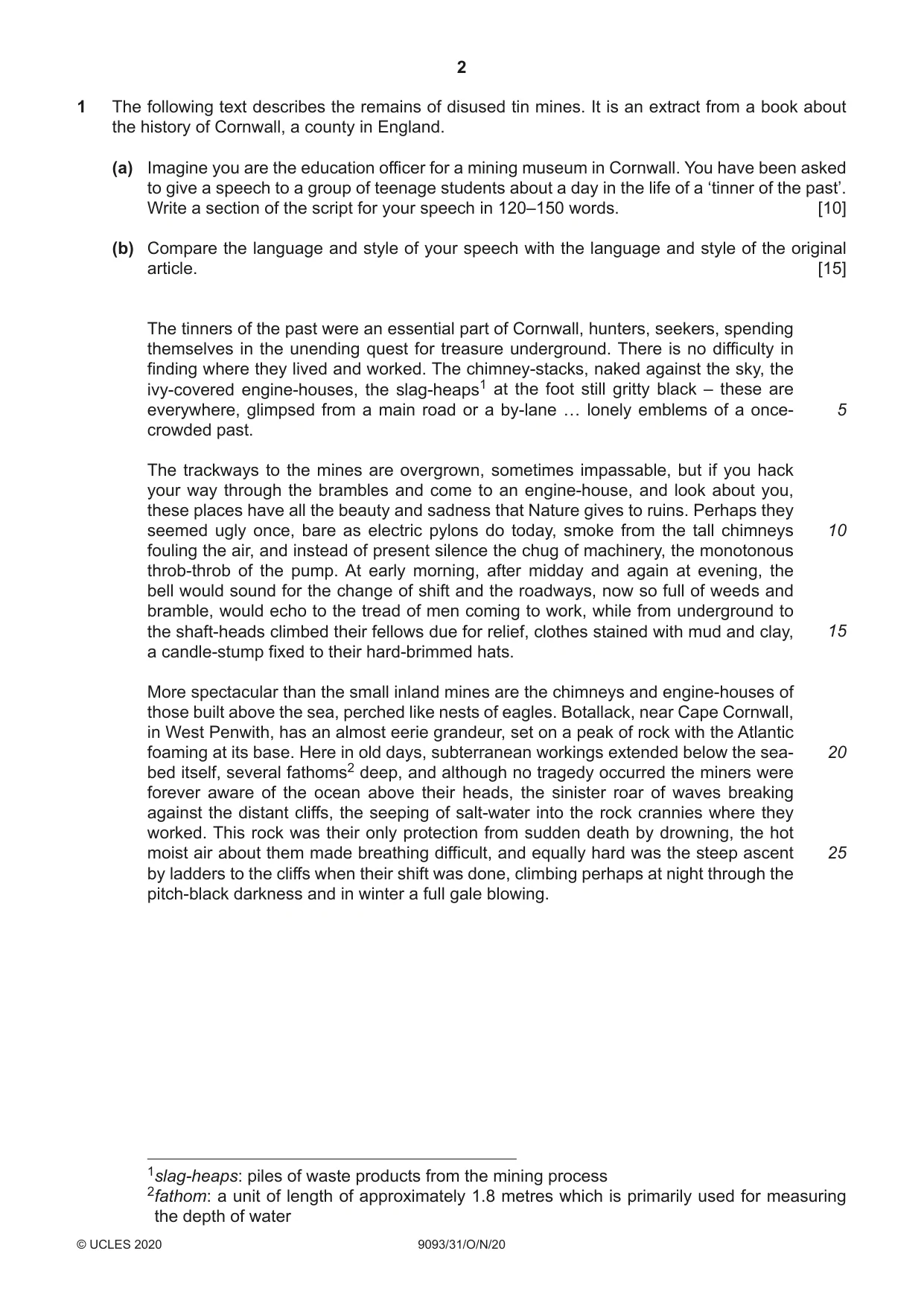
2 9093/31/O/N/20 © UCLES 2020 1 The following text describes the remains of disused tin mines. It is an extract from a book about the history of Cornwall, a county in England. (a) Imagine you are the education officer for a mining museum in Cornwall. You have been asked to give a speech to a group of teenage students about a day in the life of a ‘tinner of the past’. Write a section of the script for your speech in 120–150 words. [10] (b) Compare the language and style of your speech with the language and style of the original article. [15] The tinners of the past were an essential part of Cornwall, hunters, seekers, spending themselves in the unending quest for treasure underground. There is no difficulty in finding where they lived and worked. The chimney-stacks, naked against the sky, the ivy-covered engine-houses, the slag-heaps1 at the foot still gritty black – these are everywhere, glimpsed from a main road or a by-lane … lonely emblems of a once- crowded past. The trackways to the mines are overgrown, sometimes impassable, but if you hack your way through the brambles and come to an engine-house, and look about you, these places have all the beauty and sadness that Nature gives to ruins. Perhaps they seemed ugly once, bare as electric pylons do today, smoke from the tall chimneys fouling the air, and instead of present silence the chug of machinery, the monotonous throb-throb of the pump. At early morning, after midday and again at evening, the bell would sound for the change of shift and the roadways, now so full of weeds and bramble, would echo to the tread of men coming to work, while from underground to the shaft-heads climbed their fellows due for relief, clothes stained with mud and clay, a candle-stump fixed to their hard-brimmed hats. More spectacular than the small inland mines are the chimneys and engine-houses of those built above the sea, perched like nests of eagles. Botallack, near Cape Cornwall, in West Penwith, has an almost eerie grandeur, set on a peak of rock with the Atlantic foaming at its base. Here in old days, subterranean workings extended below the sea- bed itself, several fathoms2 deep, and although no tragedy occurred the miners were forever aware of the ocean above their heads, the sinister roar of waves breaking against the distant cliffs, the seeping of salt-water into the rock crannies where they worked. This rock was their only protection from sudden death by drowning, the hot moist air about them made breathing difficult, and equally hard was the steep ascent by ladders to the cliffs when their shift was done, climbing perhaps at night through the pitch-black darkness and in winter a full gale blowing. 1slag-heaps: piles of waste products from the mining process 2 fathom: a unit of length of approximately 1.8 metres which is primarily used for measuring the depth of water 5 10 15 20 25
Question paper, page 3
3 9093/31/O/N/20 © UCLES 2020 [Turn over BLANK PAGE
Question paper, page 4
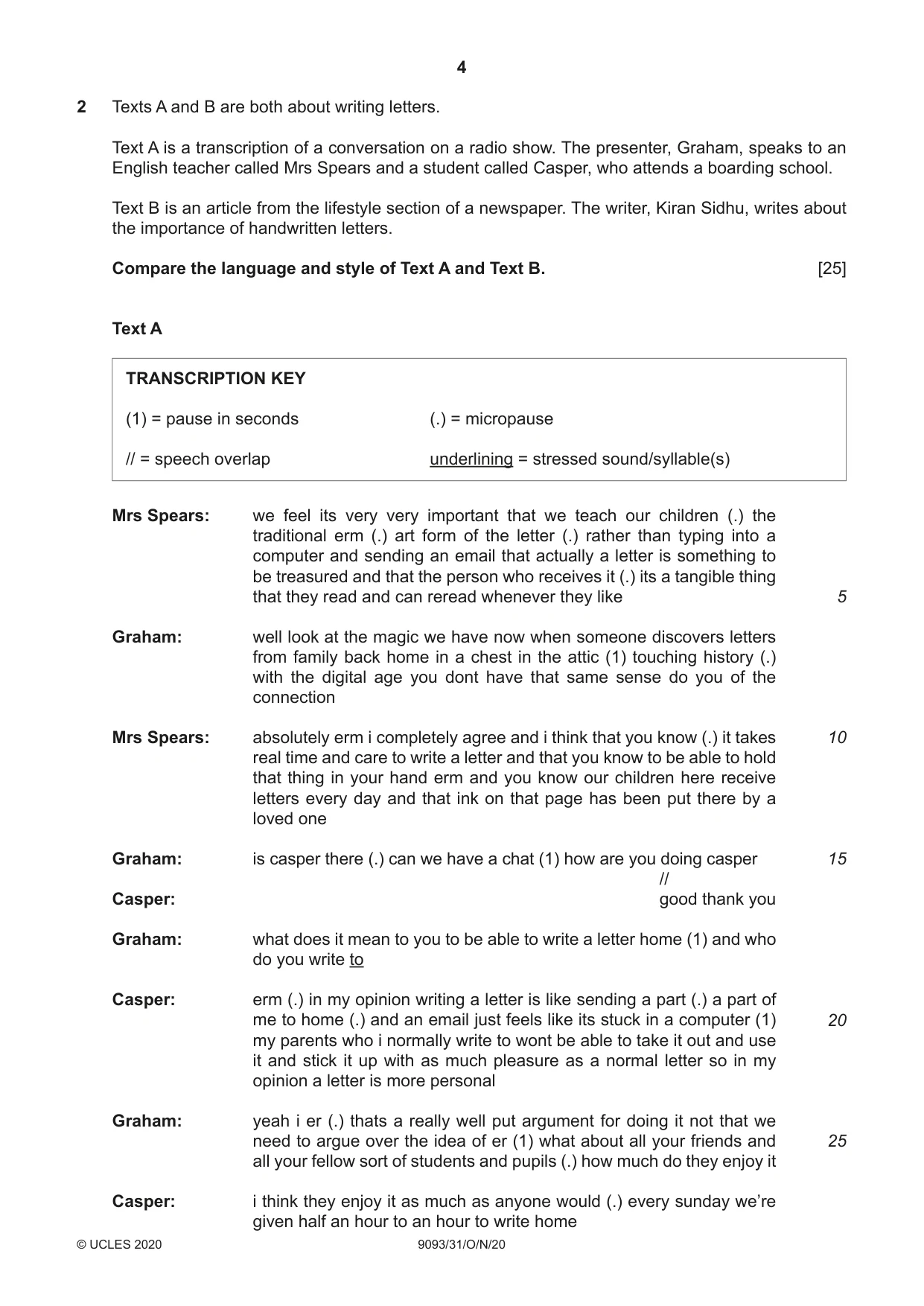
4 9093/31/O/N/20 © UCLES 2020 2 Texts A and B are both about writing letters. Text A is a transcription of a conversation on a radio show. The presenter, Graham, speaks to an English teacher called Mrs Spears and a student called Casper, who attends a boarding school. Text B is an article from the lifestyle section of a newspaper. The writer, Kiran Sidhu, writes about the importance of handwritten letters. Compare the language and style of Text A and Text B. [25] Text A TRANSCRIPTION KEY (1) = pause in seconds (.) = micropause // = speech overlap underlining = stressed sound/syllable(s) Mrs Spears: we feel its very very important that we teach our children (.) the traditional erm (.) art form of the letter (.) rather than typing into a computer and sending an email that actually a letter is something to be treasured and that the person who receives it (.) its a tangible thing that they read and can reread whenever they like Graham: well look at the magic we have now when someone discovers letters from family back home in a chest in the attic (1) touching history (.) with the digital age you dont have that same sense do you of the connection Mrs Spears: absolutely erm i completely agree and i think that you know (.) it takes real time and care to write a letter and that you know to be able to hold that thing in your hand erm and you know our children here receive letters every day and that ink on that page has been put there by a loved one Graham: is casper there (.) can we have a chat (1) how are you doing casper // Casper: good thank you Graham: what does it mean to you to be able to write a letter home (1) and who do you write to Casper: erm (.) in my opinion writing a letter is like sending a part (.) a part of me to home (.) and an email just feels like its stuck in a computer (1) my parents who i normally write to wont be able to take it out and use it and stick it up with as much pleasure as a normal letter so in my opinion a letter is more personal Graham: yeah i er (.) thats a really well put argument for doing it not that we need to argue over the idea of er (1) what about all your friends and all your fellow sort of students and pupils (.) how much do they enjoy it Casper: i think they enjoy it as much as anyone would (.) every sunday we’re given half an hour to an hour to write home 5 10 15 20 25
Question paper, page 5
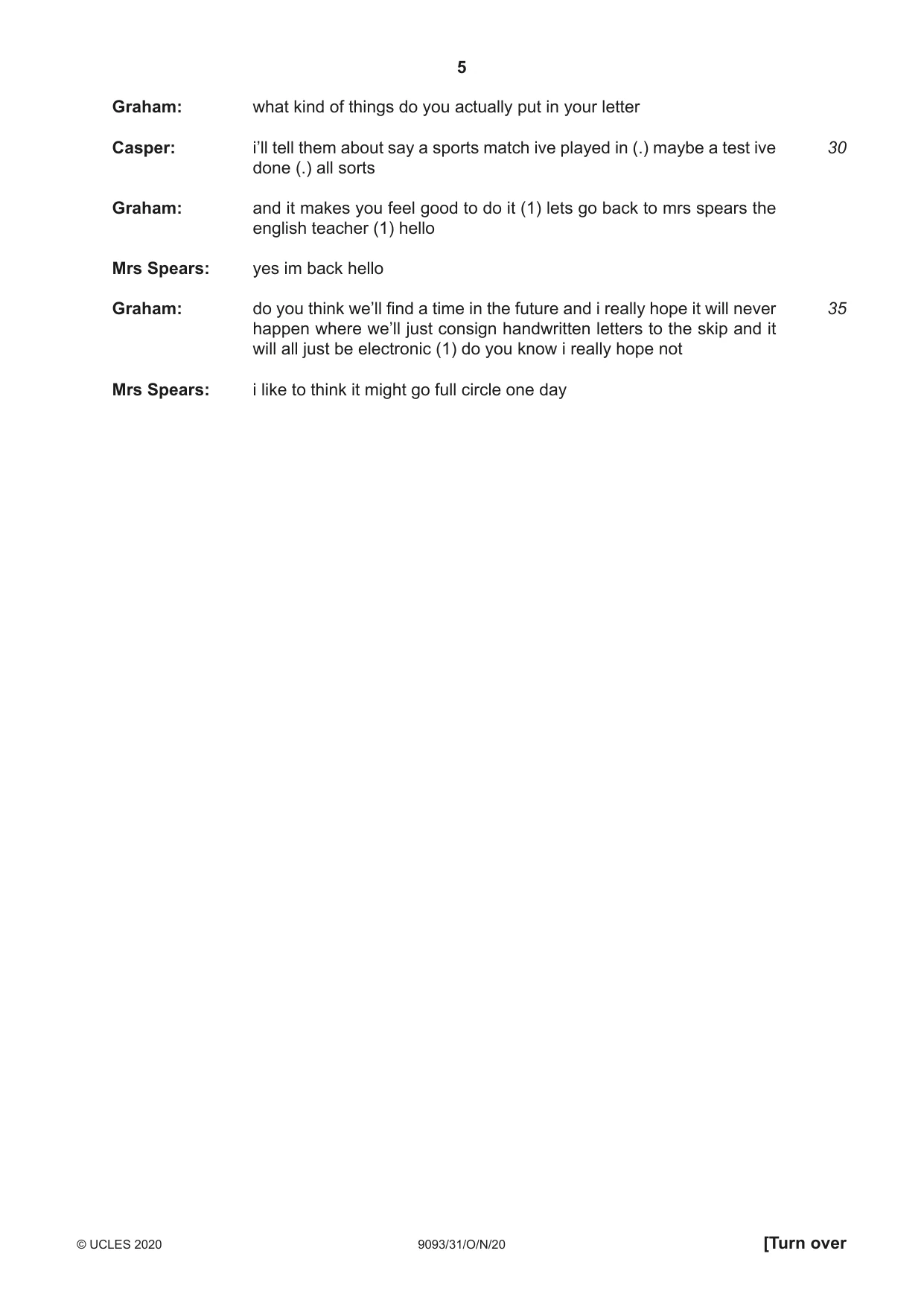
5 9093/31/O/N/20 © UCLES 2020 [Turn over Graham: what kind of things do you actually put in your letter Casper: i’ll tell them about say a sports match ive played in (.) maybe a test ive done (.) all sorts Graham: and it makes you feel good to do it (1) lets go back to mrs spears the english teacher (1) hello Mrs Spears: yes im back hello Graham: do you think we’ll find a time in the future and i really hope it will never happen where we’ll just consign handwritten letters to the skip and it will all just be electronic (1) do you know i really hope not Mrs Spears: i like to think it might go full circle one day 30 35
Question paper, page 6
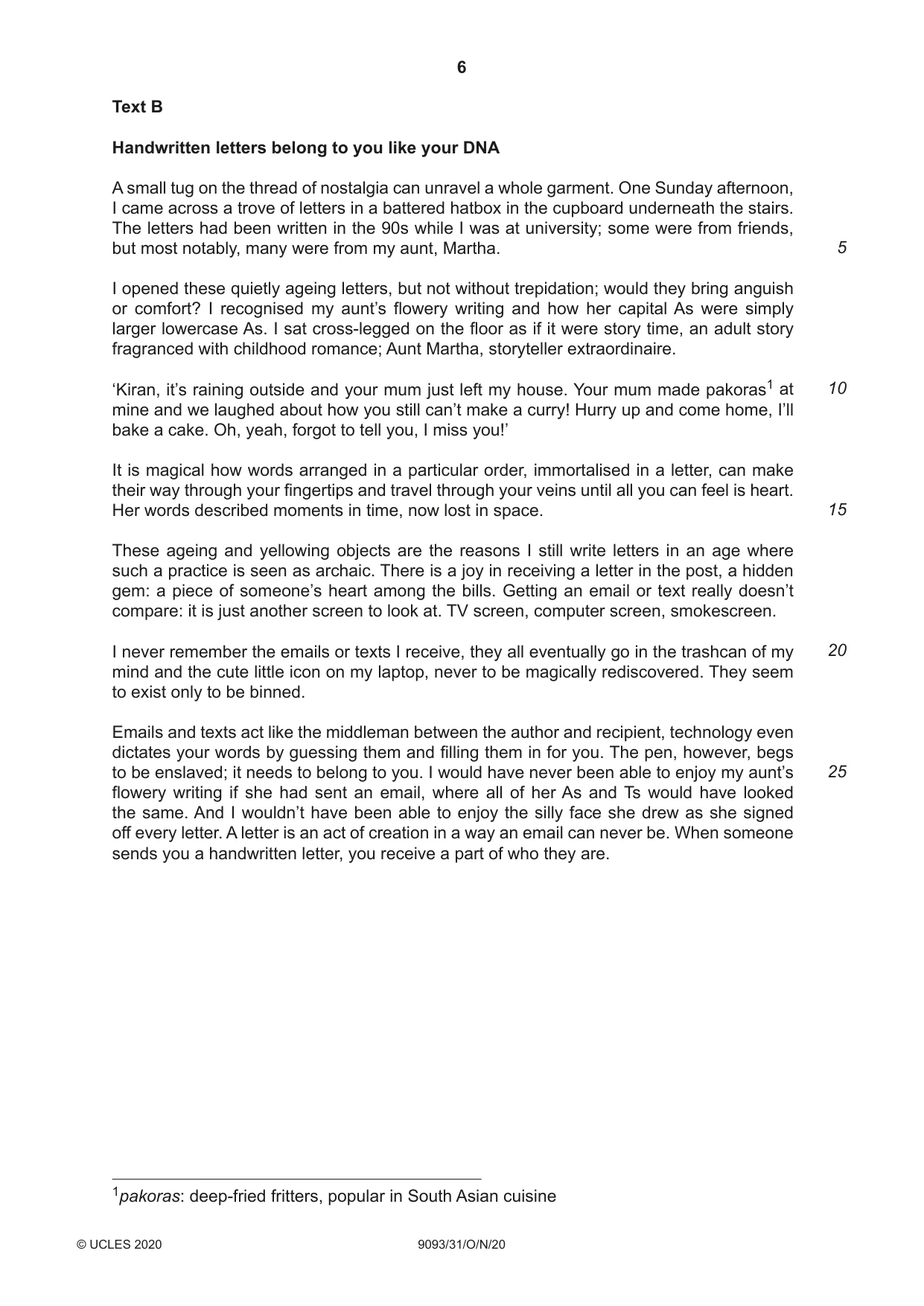
6 9093/31/O/N/20 © UCLES 2020 Text B Handwritten letters belong to you like your DNA A small tug on the thread of nostalgia can unravel a whole garment. One Sunday afternoon, I came across a trove of letters in a battered hatbox in the cupboard underneath the stairs. The letters had been written in the 90s while I was at university; some were from friends, but most notably, many were from my aunt, Martha. I opened these quietly ageing letters, but not without trepidation; would they bring anguish or comfort? I recognised my aunt’s flowery writing and how her capital As were simply larger lowercase As. I sat cross-legged on the floor as if it were story time, an adult story fragranced with childhood romance; Aunt Martha, storyteller extraordinaire. ‘Kiran, it’s raining outside and your mum just left my house. Your mum made pakoras1 at mine and we laughed about how you still can’t make a curry! Hurry up and come home, I’ll bake a cake. Oh, yeah, forgot to tell you, I miss you!’ It is magical how words arranged in a particular order, immortalised in a letter, can make their way through your fingertips and travel through your veins until all you can feel is heart. Her words described moments in time, now lost in space. These ageing and yellowing objects are the reasons I still write letters in an age where such a practice is seen as archaic. There is a joy in receiving a letter in the post, a hidden gem: a piece of someone’s heart among the bills. Getting an email or text really doesn’t compare: it is just another screen to look at. TV screen, computer screen, smokescreen. I never remember the emails or texts I receive, they all eventually go in the trashcan of my mind and the cute little icon on my laptop, never to be magically rediscovered. They seem to exist only to be binned. Emails and texts act like the middleman between the author and recipient, technology even dictates your words by guessing them and filling them in for you. The pen, however, begs to be enslaved; it needs to belong to you. I would have never been able to enjoy my aunt’s flowery writing if she had sent an email, where all of her As and Ts would have looked the same. And I wouldn’t have been able to enjoy the silly face she drew as she signed off every letter. A letter is an act of creation in a way an email can never be. When someone sends you a handwritten letter, you receive a part of who they are. 1pakoras: deep-fried fritters, popular in South Asian cuisine 5 10 15 20 25
Question paper, page 7
7 9093/31/O/N/20 © UCLES 2020 BLANK PAGE
Question paper, page 8
8 9093/31/O/N/20 © UCLES 2020 Permission to reproduce items where third-party owned material protected by copyright is included has been sought and cleared where possible. Every reasonable effort has been made by the publisher (UCLES) to trace copyright holders, but if any items requiring clearance have unwittingly been included, the publisher will be pleased to make amends at the earliest possible opportunity. To avoid the issue of disclosure of answer-related information to candidates, all copyright acknowledgements are reproduced online in the Cambridge Assessment International Education Copyright Acknowledgements Booklet. This is produced for each series of examinations and is freely available to download at www.cambridgeinternational.org after the live examination series. Cambridge Assessment International Education is part of the Cambridge Assessment Group. Cambridge Assessment is the brand name of the University of Cambridge Local Examinations Syndicate (UCLES), which itself is a department of the University of Cambridge. BLANK PAGE
Mark scheme, page 1
This document consists of 6 printed pages. © UCLES 2020 [Turn over Cambridge International A Level ENGLISH LANGUAGE 9093/31 Paper 3 Text Analysis October/November 2020 MARK SCHEME Maximum Mark: 50 Published This mark scheme is published as an aid to teachers and candidates, to indicate the requirements of the examination. It shows the basis on which Examiners were instructed to award marks. It does not indicate the details of the discussions that took place at an Examiners’ meeting before marking began, which would have considered the acceptability of alternative answers. Mark schemes should be read in conjunction with the question paper and the Principal Examiner Report for Teachers. Cambridge International will not enter into discussions about these mark schemes. Cambridge International is publishing the mark schemes for the October/November 2020 series for most Cambridge IGCSE™, Cambridge International A and AS Level and Cambridge Pre-U components, and some Cambridge O Level components.
Mark scheme, page 2
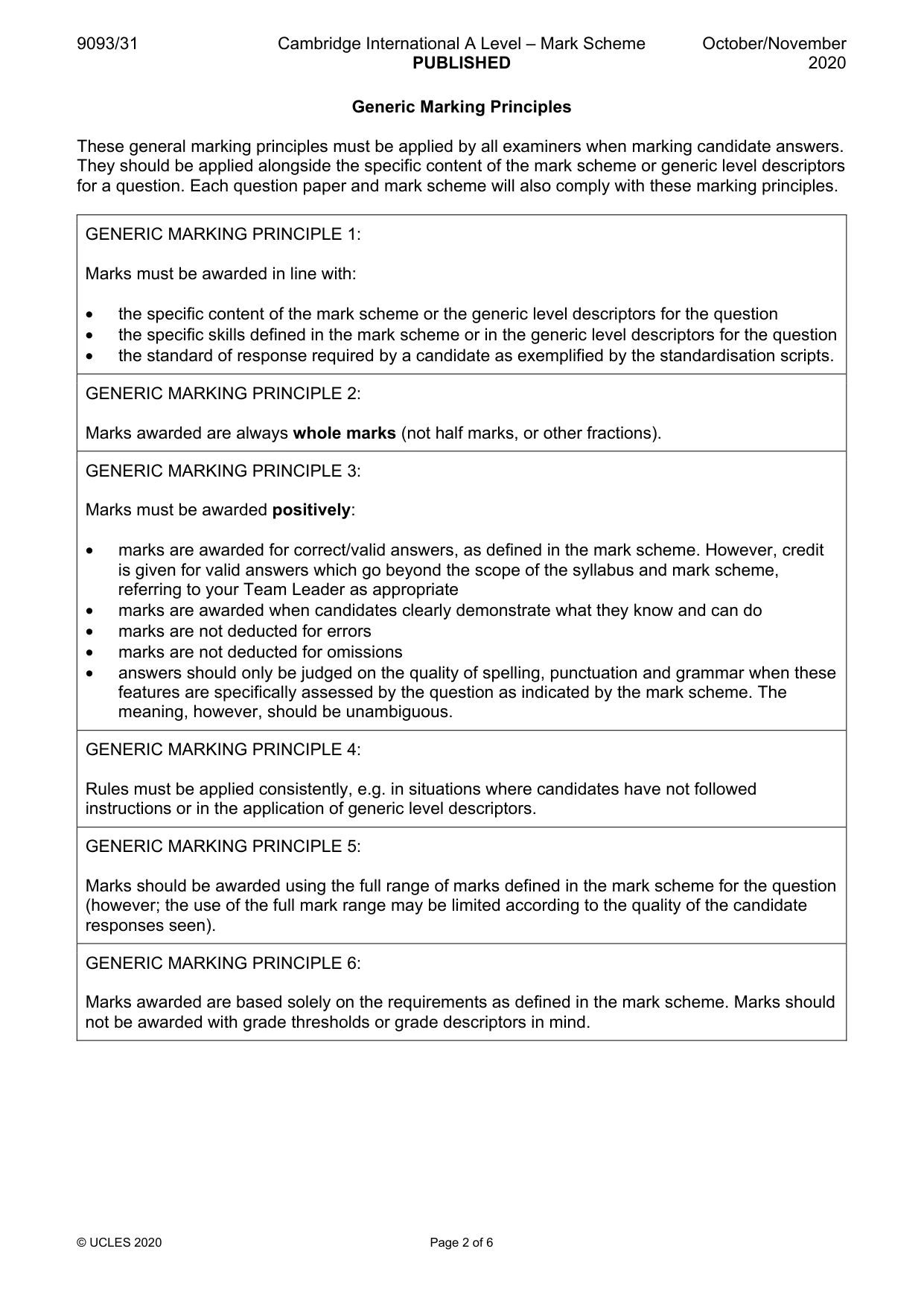
9093/31 Cambridge International A Level – Mark Scheme PUBLISHED October/November 2020 © UCLES 2020 Page 2 of 6 Generic Marking Principles These general marking principles must be applied by all examiners when marking candidate answers. They should be applied alongside the specific content of the mark scheme or generic level descriptors for a question. Each question paper and mark scheme will also comply with these marking principles. GENERIC MARKING PRINCIPLE 1: Marks must be awarded in line with: • the specific content of the mark scheme or the generic level descriptors for the question • the specific skills defined in the mark scheme or in the generic level descriptors for the question • the standard of response required by a candidate as exemplified by the standardisation scripts. GENERIC MARKING PRINCIPLE 2: Marks awarded are always whole marks (not half marks, or other fractions). GENERIC MARKING PRINCIPLE 3: Marks must be awarded positively: • marks are awarded for correct/valid answers, as defined in the mark scheme. However, credit is given for valid answers which go beyond the scope of the syllabus and mark scheme, referring to your Team Leader as appropriate • marks are awarded when candidates clearly demonstrate what they know and can do • marks are not deducted for errors • marks are not deducted for omissions • answers should only be judged on the quality of spelling, punctuation and grammar when these features are specifically assessed by the question as indicated by the mark scheme. The meaning, however, should be unambiguous. GENERIC MARKING PRINCIPLE 4: Rules must be applied consistently, e.g. in situations where candidates have not followed instructions or in the application of generic level descriptors. GENERIC MARKING PRINCIPLE 5: Marks should be awarded using the full range of marks defined in the mark scheme for the question (however; the use of the full mark range may be limited according to the quality of the candidate responses seen). GENERIC MARKING PRINCIPLE 6: Marks awarded are based solely on the requirements as defined in the mark scheme. Marks should not be awarded with grade thresholds or grade descriptors in mind.
Mark scheme, page 3
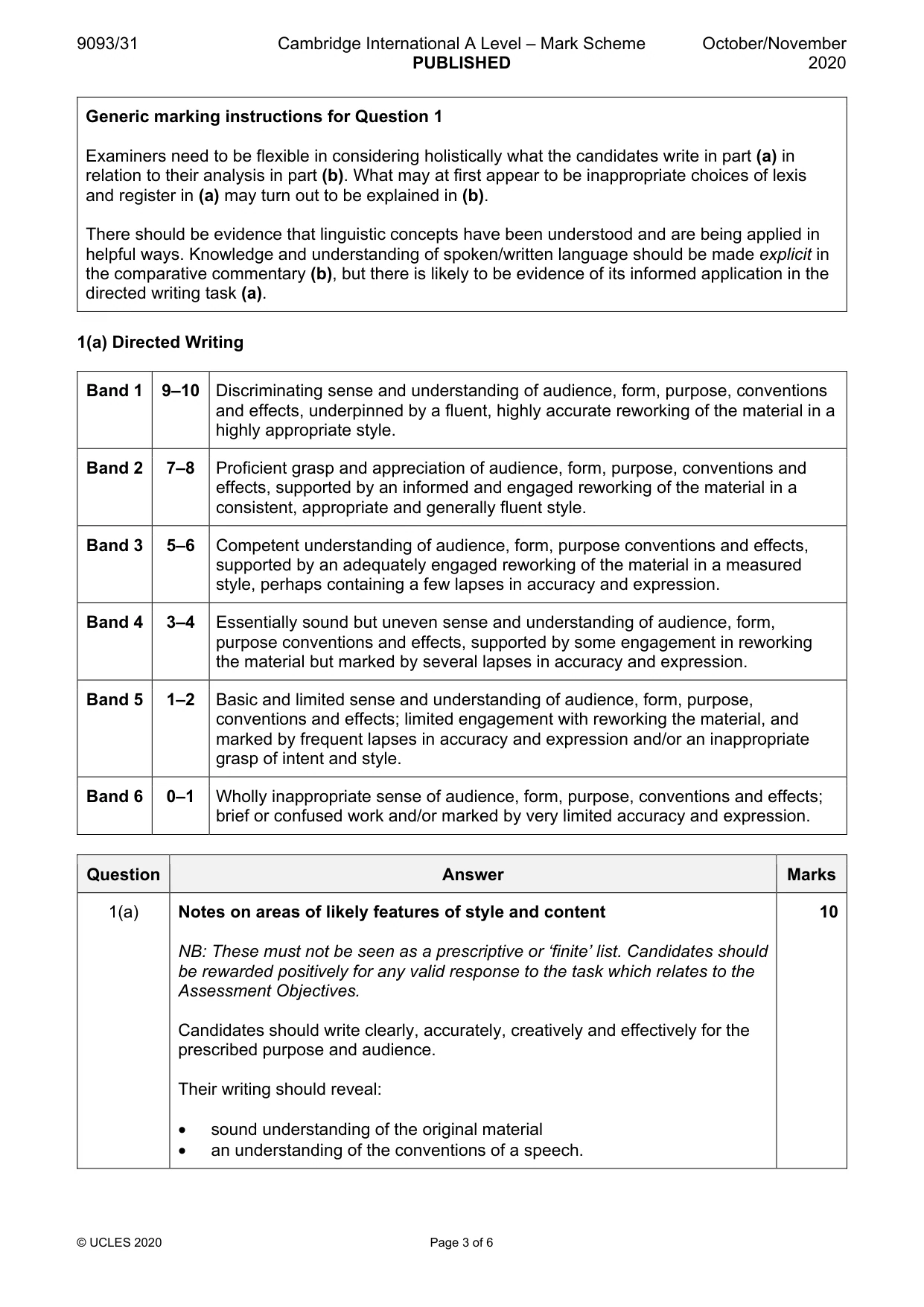
9093/31 Cambridge International A Level – Mark Scheme PUBLISHED October/November 2020 © UCLES 2020 Page 3 of 6 Generic marking instructions for Question 1 Examiners need to be flexible in considering holistically what the candidates write in part (a) in relation to their analysis in part (b). What may at first appear to be inappropriate choices of lexis and register in (a) may turn out to be explained in (b). There should be evidence that linguistic concepts have been understood and are being applied in helpful ways. Knowledge and understanding of spoken/written language should be made explicit in the comparative commentary (b), but there is likely to be evidence of its informed application in the directed writing task (a). 1(a) Directed Writing Band 1 9–10 Discriminating sense and understanding of audience, form, purpose, conventions and effects, underpinned by a fluent, highly accurate reworking of the material in a highly appropriate style. Band 2 7–8 Proficient grasp and appreciation of audience, form, purpose, conventions and effects, supported by an informed and engaged reworking of the material in a consistent, appropriate and generally fluent style. Band 3 5–6 Competent understanding of audience, form, purpose conventions and effects, supported by an adequately engaged reworking of the material in a measured style, perhaps containing a few lapses in accuracy and expression. Band 4 3–4 Essentially sound but uneven sense and understanding of audience, form, purpose conventions and effects, supported by some engagement in reworking the material but marked by several lapses in accuracy and expression. Band 5 1–2 Basic and limited sense and understanding of audience, form, purpose, conventions and effects; limited engagement with reworking the material, and marked by frequent lapses in accuracy and expression and/or an inappropriate grasp of intent and style. Band 6 0–1 Wholly inappropriate sense of audience, form, purpose, conventions and effects; brief or confused work and/or marked by very limited accuracy and expression. Question Answer Marks 1(a) Notes on areas of likely features of style and content NB: These must not be seen as a prescriptive or ‘finite’ list. Candidates should be rewarded positively for any valid response to the task which relates to the Assessment Objectives. Candidates should write clearly, accurately, creatively and effectively for the prescribed purpose and audience. Their writing should reveal: • sound understanding of the original material • an understanding of the conventions of a speech. 10
Mark scheme, page 4
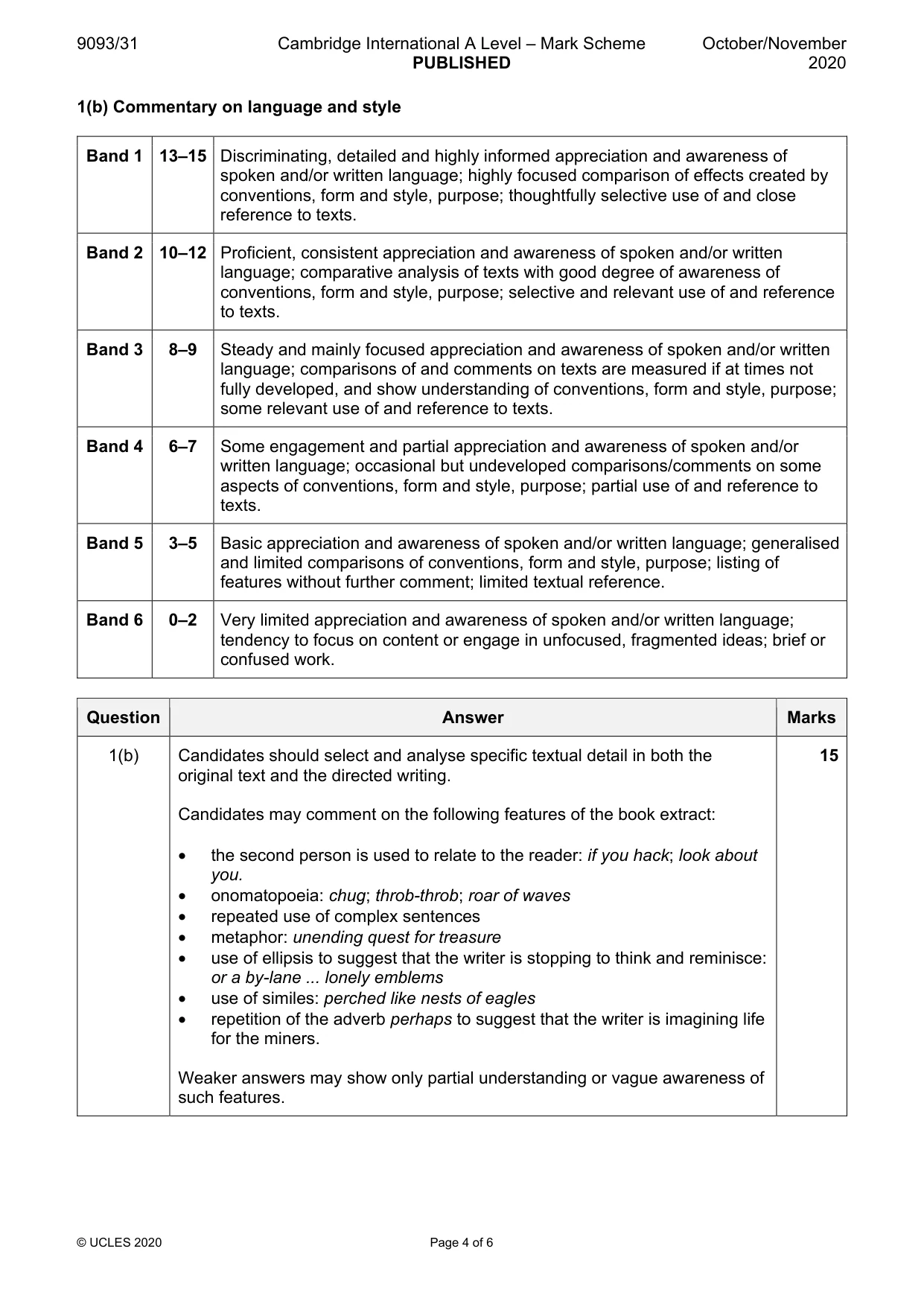
9093/31 Cambridge International A Level – Mark Scheme PUBLISHED October/November 2020 © UCLES 2020 Page 4 of 6 1(b) Commentary on language and style Band 1 13–15 Discriminating, detailed and highly informed appreciation and awareness of spoken and/or written language; highly focused comparison of effects created by conventions, form and style, purpose; thoughtfully selective use of and close reference to texts. Band 2 10–12 Proficient, consistent appreciation and awareness of spoken and/or written language; comparative analysis of texts with good degree of awareness of conventions, form and style, purpose; selective and relevant use of and reference to texts. Band 3 8–9 Steady and mainly focused appreciation and awareness of spoken and/or written language; comparisons of and comments on texts are measured if at times not fully developed, and show understanding of conventions, form and style, purpose; some relevant use of and reference to texts. Band 4 6–7 Some engagement and partial appreciation and awareness of spoken and/or written language; occasional but undeveloped comparisons/comments on some aspects of conventions, form and style, purpose; partial use of and reference to texts. Band 5 3–5 Basic appreciation and awareness of spoken and/or written language; generalised and limited comparisons of conventions, form and style, purpose; listing of features without further comment; limited textual reference. Band 6 0–2 Very limited appreciation and awareness of spoken and/or written language; tendency to focus on content or engage in unfocused, fragmented ideas; brief or confused work. Question Answer Marks 1(b) Candidates should select and analyse specific textual detail in both the original text and the directed writing. Candidates may comment on the following features of the book extract: • the second person is used to relate to the reader: if you hack; look about you. • onomatopoeia: chug; throb-throb; roar of waves • repeated use of complex sentences • metaphor: unending quest for treasure • use of ellipsis to suggest that the writer is stopping to think and reminisce: or a by-lane ... lonely emblems • use of similes: perched like nests of eagles • repetition of the adverb perhaps to suggest that the writer is imagining life for the miners. Weaker answers may show only partial understanding or vague awareness of such features. 15
Mark scheme, page 5
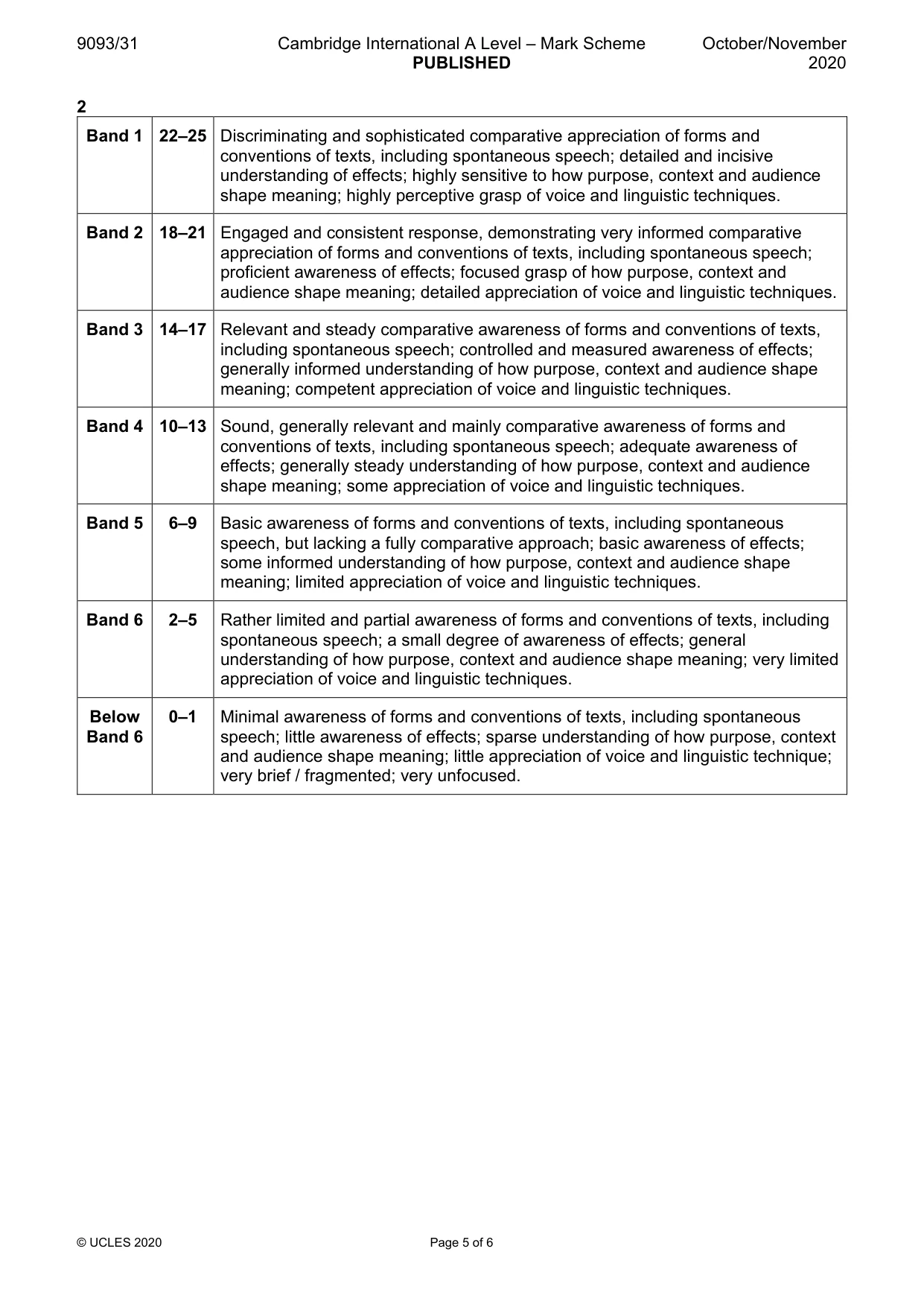
9093/31 Cambridge International A Level – Mark Scheme PUBLISHED October/November 2020 © UCLES 2020 Page 5 of 6 2 Band 1 22–25 Discriminating and sophisticated comparative appreciation of forms and conventions of texts, including spontaneous speech; detailed and incisive understanding of effects; highly sensitive to how purpose, context and audience shape meaning; highly perceptive grasp of voice and linguistic techniques. Band 2 18–21 Engaged and consistent response, demonstrating very informed comparative appreciation of forms and conventions of texts, including spontaneous speech; proficient awareness of effects; focused grasp of how purpose, context and audience shape meaning; detailed appreciation of voice and linguistic techniques. Band 3 14–17 Relevant and steady comparative awareness of forms and conventions of texts, including spontaneous speech; controlled and measured awareness of effects; generally informed understanding of how purpose, context and audience shape meaning; competent appreciation of voice and linguistic techniques. Band 4 10–13 Sound, generally relevant and mainly comparative awareness of forms and conventions of texts, including spontaneous speech; adequate awareness of effects; generally steady understanding of how purpose, context and audience shape meaning; some appreciation of voice and linguistic techniques. Band 5 6–9 Basic awareness of forms and conventions of texts, including spontaneous speech, but lacking a fully comparative approach; basic awareness of effects; some informed understanding of how purpose, context and audience shape meaning; limited appreciation of voice and linguistic techniques. Band 6 2–5 Rather limited and partial awareness of forms and conventions of texts, including spontaneous speech; a small degree of awareness of effects; general understanding of how purpose, context and audience shape meaning; very limited appreciation of voice and linguistic techniques. Below Band 6 0–1 Minimal awareness of forms and conventions of texts, including spontaneous speech; little awareness of effects; sparse understanding of how purpose, context and audience shape meaning; little appreciation of voice and linguistic technique; very brief / fragmented; very unfocused.
Mark scheme, page 6
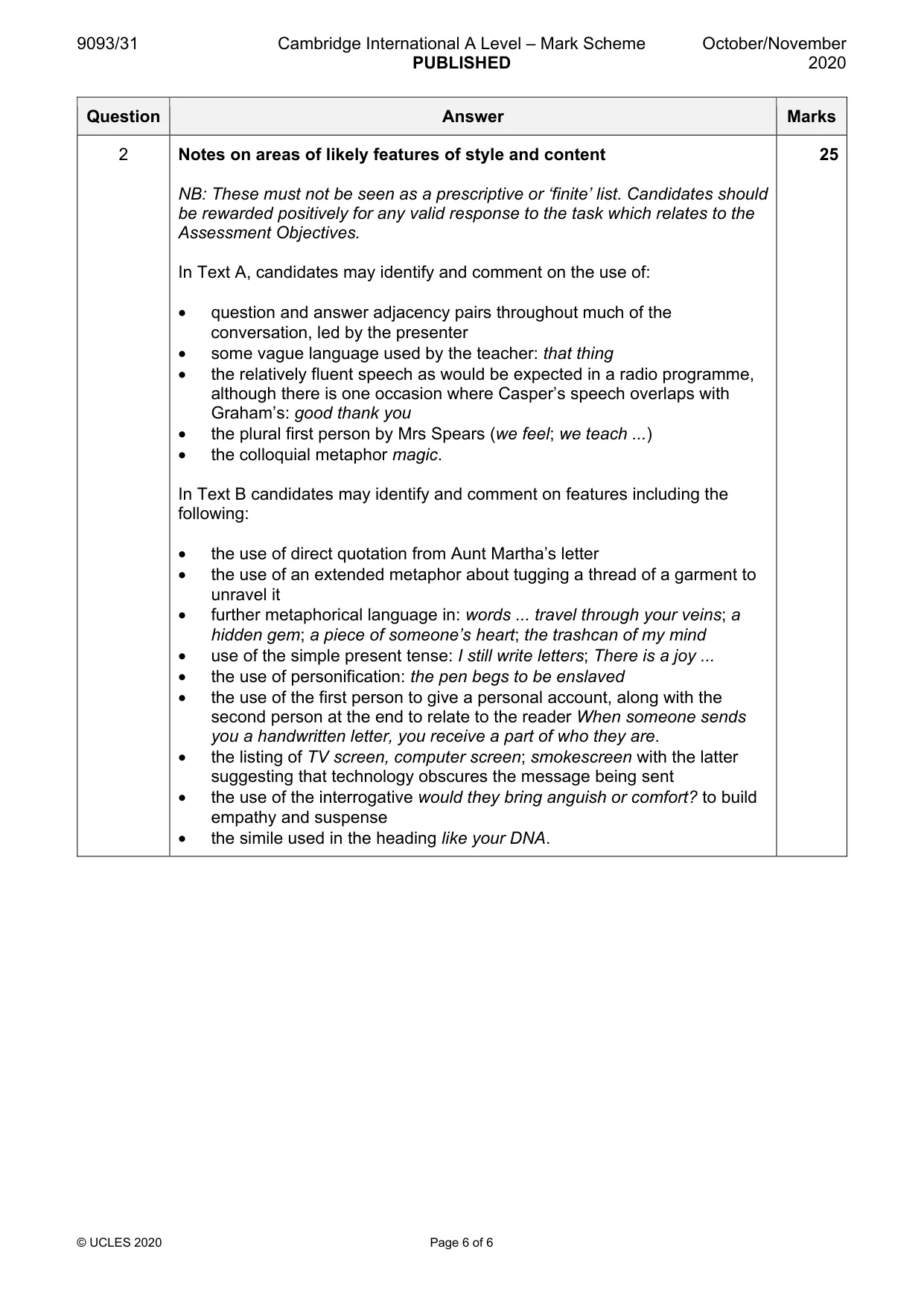
9093/31 Cambridge International A Level – Mark Scheme PUBLISHED October/November 2020 © UCLES 2020 Page 6 of 6 Question Answer Marks 2 Notes on areas of likely features of style and content NB: These must not be seen as a prescriptive or ‘finite’ list. Candidates should be rewarded positively for any valid response to the task which relates to the Assessment Objectives. In Text A, candidates may identify and comment on the use of: • question and answer adjacency pairs throughout much of the conversation, led by the presenter • some vague language used by the teacher: that thing • the relatively fluent speech as would be expected in a radio programme, although there is one occasion where Casper’s speech overlaps with Graham’s: good thank you • the plural first person by Mrs Spears (we feel; we teach ...) • the colloquial metaphor magic. In Text B candidates may identify and comment on features including the following: • the use of direct quotation from Aunt Martha’s letter • the use of an extended metaphor about tugging a thread of a garment to unravel it • further metaphorical language in: words ... travel through your veins; a hidden gem; a piece of someone’s heart; the trashcan of my mind • use of the simple present tense: I still write letters; There is a joy ... • the use of personification: the pen begs to be enslaved • the use of the first person to give a personal account, along with the second person at the end to relate to the reader When someone sends you a handwritten letter, you receive a part of who they are. • the listing of TV screen, computer screen; smokescreen with the latter suggesting that technology obscures the message being sent • the use of the interrogative would they bring anguish or comfort? to build empathy and suspense • the simile used in the heading like your DNA. 25
What you needed in this session
Cambridge’s own grade thresholds for 2020 Oct/Nov, Paper 3 · Variant 1. A higher threshold means an easier paper — the bar moves with how the cohort did.