Cambridge A Level English - Language AS and A Level (from 2014) 9093 — 2019 Oct/Nov Paper 3 · Variant 2
9093/32/O/N/19 · 50 marks · ≈56 min
The question paper and its mark scheme, free to read here and free to download. This is Cambridge’s own paper, exactly as it was sat.
Question paper8 pages


Mark scheme6 pages
Answers below. Sit the paper first if you are practising.
Paper as text
Question paper, page 1
This document consists of 4 printed pages, 4 blank pages and 1 Insert. DC (SC) 162665/2 © UCLES 2019 [Turn over Cambridge Assessment International Education Cambridge International Advanced Subsidiary and Advanced Level * 7 1 5 5 1 5 3 8 2 2 * ENGLISH LANGUAGE 9093/32 Paper 3 Text Analysis October/November 2019 2 hours 15 minutes No Additional Materials are required. READ THESE INSTRUCTIONS FIRST An answer booklet is provided inside this question paper. You should follow the instructions on the front cover of the answer booklet. If you need additional answer paper, ask the invigilator for a continuation booklet. Answer two questions. You should spend about 15 minutes reading the passages and questions before you start writing your answers. You are reminded of the need for good English and clear presentation in your answers. The number of marks is given in brackets [ ] at the end of each question or part question. Both questions carry equal marks.
Question paper, page 2
2 9093/32/O/N/19 © UCLES 2019 1 The following text is a guide to birdwatching taken from the website of an international organisation dedicated to conserving nature. (a) Imagine that you have been asked to present a speech in a formal debate at your school or college about whether birdwatching is a worthwhile hobby. Write the opening 120–150 words of your speech in which you introduce your main arguments about birdwatching. [10] (b) Compare the language and style of your speech with the language and style of the webpage. [15] You don't have to be an expert to be a birder. Get started today! Are you curious about birding but don’t know how to get involved? Do you have a child who’s interested in birds and wants to learn more? Here are four easy steps you can take to get started in birding: 1. Get some binoculars. First borrow, and then buy, a pair. If you are intent on buying your own ’nocs, you should investigate and test them out first. Look for binoculars that are waterproof, focus easily, and have at least 8× magnification and a 30 to 42 mm front lens (which dictates the light gathering capability). 2. Get a bird guide. And look through it before you go out for the first time. Don’t try to memorize all the birds – learn about bird families (swallows, raptors, warblers, flycatchers, herons, etc) to narrow your search down when you are out and about and birds are flying by. 3. Take a walk. Once you’re at your local nature centre or bird store (or on their websites), there will probably be local bird walks posted. Go on one, go on many. Go at different times of the year to different places. 4. Use the internet. When you’re ready to strike out on your own, first scour the internet for great places to see lots of birds. Find a spot close by that is appropriate for the time of year and go! There are also a plethora of birding apps out there. When there, take your time – walk slowly, quietly, look and LISTEN for birds (that will usually be your first hint they are there). Soon you will be out at dawn to greet them as they wake to refuel. You will be pulling on rumpled clothes and stumbling out into the darkness to catch the dawn’s chorus of bird songs, and you will be delighted at the sight of some of the same birds as last year, the year before that, or 10 years ago, as if it was your first glimpse. Your heart will skip a beat when you hear that first ‘zu zu zu ZEE’ of a Black-throated Blue Warbler, take in the cacophony of hoots, grunts and whistles that spill out of a Yellow-breasted Chat, or see the glowing orange throat of the Blackburnian Warbler, of which Scott Weidensaul, the poet laureate of nature and birding, once said, ‘It’s a wonder it doesn’t set the tree afire.’ That’s it! Are you still at your computer? Why? Grab your ’nocs and go! 5 10 15 20 25 30
Question paper, page 3
3 9093/32/O/N/19 © UCLES 2019 [Turn over BLANK PAGE
Question paper, page 4
4 9093/32/O/N/19 © UCLES 2019 2 Texts A and B are both about producing artistic portraits of people. Text A consists of two extracts from a textbook entitled ‘An Introduction to Painting Portraits’, written by Rosalind Cuthbert. Text B is a transcript of part of a televised demonstration in which professional illustrator, Nick Sharratt, shows an audience of teenagers how to draw a face. Nick’s model, Richard, is sitting on the stage. There are also two presenters, Michelle and Ricky, who interact with Nick and the audience. Compare the language and style of Text A and Text B. [25] Text A The Ears These are set at some distance from the other features, on the side of the head. This distance is often over- or underestimated. Careful measurement from ear to outer corner of eye should clear up any problems. The ear springs from the head partly over the jawbone’s joint with the skull (check this by feeling your own ear and jaw) and is most fully visible in a profile view. The ear is an uneven spiralling form of flesh and cartilage designed to channel sound deep into the brain. Ears can be as lovely as shells or as grotesque as cauliflowers. From behind we can see how the ear grows out of the skull on a broadening conical base of cartilage and from the front we see it dramatically foreshortened in most cases. It is useful to make a special study of drawing ears before you try to paint them, as they are quite complicated. Ask a friend to sit while you draw his or her ear from the side, then from the front and back, and also from above and below. In this way you will gain a three-dimensional understanding of the forms and an appreciation of how dramatically they change depending on your viewpoint. Do contour drawings and tonal drawings before working in colours. The Hands Hands can be so eloquent in a portrait, giving insight into the sitter’s character and providing the painter with endless possibilities for expressive power. First of all, let us look at the shape and proportions of a hand. It is broader and flatter than the wrist from which it springs. The palm is squarish, the thumb connecting low down toward the wrist. The fingers are jointed by three rows of knuckles, the first row being along the top of each palm. Each row of knuckles is shorter than the last and the fingers also taper to focus the sense of touch. I particularly love the geometry of the hand, which seems so perfectly designed. I love the way the length of the back of the hand equals the length of the first two finger-bones, a beautiful proportional relationship. 5 10 15 20 25
Question paper, page 5
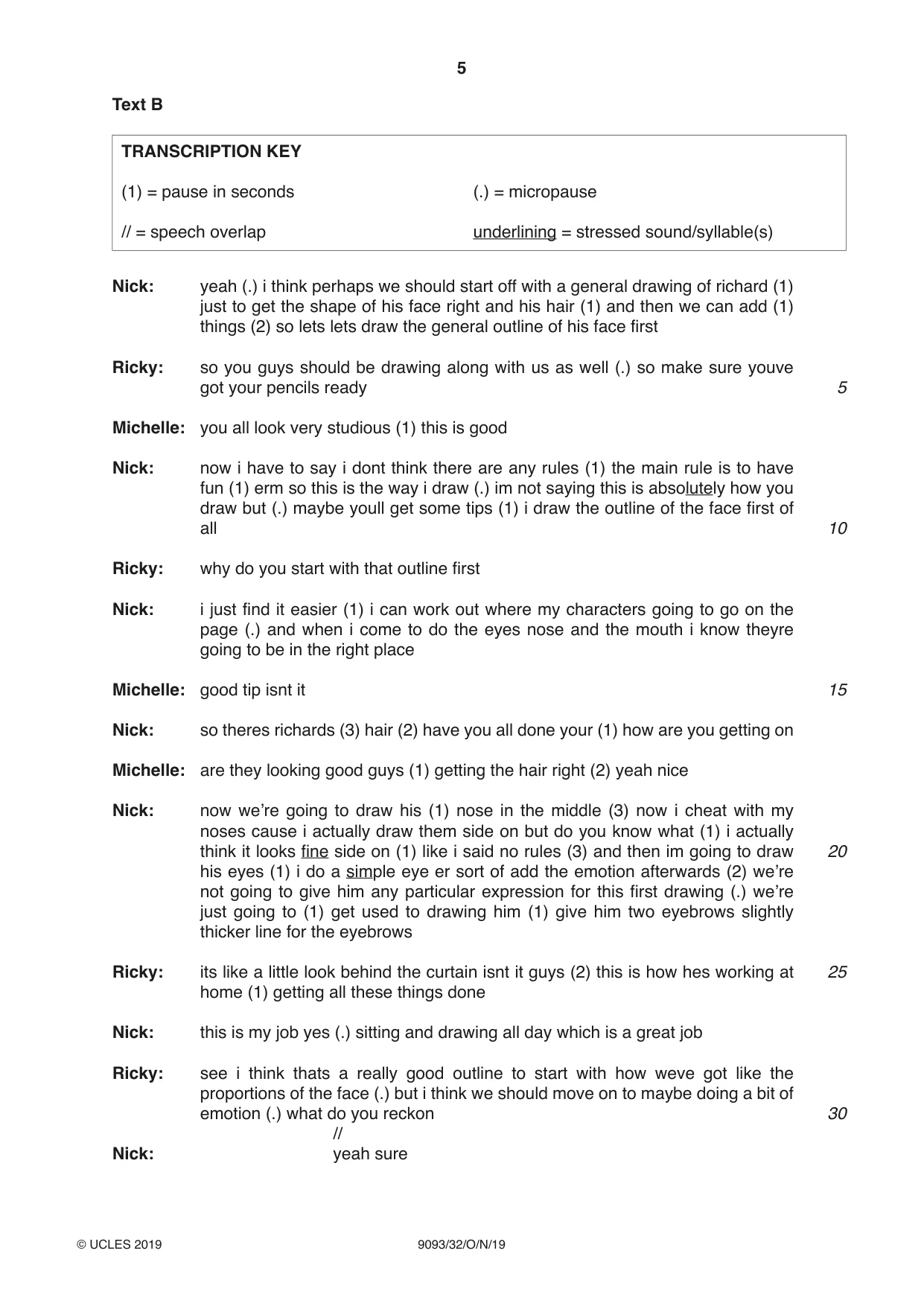
5 9093/32/O/N/19 © UCLES 2019 Text B Nick: yeah (.) i think perhaps we should start off with a general drawing of richard (1) just to get the shape of his face right and his hair (1) and then we can add (1) things (2) so lets lets draw the general outline of his face first Ricky: so you guys should be drawing along with us as well (.) so make sure youve got your pencils ready Michelle: you all look very studious (1) this is good Nick: now i have to say i dont think there are any rules (1) the main rule is to have fun (1) erm so this is the way i draw (.) im not saying this is absolutely how you draw but (.) maybe youll get some tips (1) i draw the outline of the face first of all Ricky: why do you start with that outline first Nick: i just find it easier (1) i can work out where my characters going to go on the page (.) and when i come to do the eyes nose and the mouth i know theyre going to be in the right place Michelle: good tip isnt it Nick: so theres richards (3) hair (2) have you all done your (1) how are you getting on Michelle: are they looking good guys (1) getting the hair right (2) yeah nice Nick: now we’re going to draw his (1) nose in the middle (3) now i cheat with my noses cause i actually draw them side on but do you know what (1) i actually think it looks fine side on (1) like i said no rules (3) and then im going to draw his eyes (1) i do a simple eye er sort of add the emotion afterwards (2) we’re not going to give him any particular expression for this first drawing (.) we’re just going to (1) get used to drawing him (1) give him two eyebrows slightly thicker line for the eyebrows Ricky: its like a little look behind the curtain isnt it guys (2) this is how hes working at home (1) getting all these things done Nick: this is my job yes (.) sitting and drawing all day which is a great job Ricky: see i think thats a really good outline to start with how weve got like the proportions of the face (.) but i think we should move on to maybe doing a bit of emotion (.) what do you reckon // Nick: yeah sure TRANSCRIPTION KEY (1) = pause in seconds (.) = micropause // = speech overlap underlining = stressed sound/syllable(s) 5 10 15 20 25 30
Question paper, page 6
6 9093/32/O/N/19 © UCLES 2019 BLANK PAGE
Question paper, page 7
7 9093/32/O/N/19 © UCLES 2019 BLANK PAGE
Question paper, page 8
8 9093/32/O/N/19 © UCLES 2019 Permission to reproduce items where third-party owned material protected by copyright is included has been sought and cleared where possible. Every reasonable effort has been made by the publisher (UCLES) to trace copyright holders, but if any items requiring clearance have unwittingly been included, the publisher will be pleased to make amends at the earliest possible opportunity. To avoid the issue of disclosure of answer-related information to candidates, all copyright acknowledgements are reproduced online in the Cambridge Assessment International Education Copyright Acknowledgements Booklet. This is produced for each series of examinations and is freely available to download at www.cambridgeinternational.org after the live examination series. Cambridge Assessment International Education is part of the Cambridge Assessment Group. Cambridge Assessment is the brand name of the University of Cambridge Local Examinations Syndicate (UCLES), which itself is a department of the University of Cambridge. BLANK PAGE
Mark scheme, page 1
This document consists of 6 printed pages. © UCLES 2019 [Turn over Cambridge Assessment International Education Cambridge International Advanced Level ENGLISH LANGUAGE 9093/32 Paper 3 Text Analysis October/November 2019 MARK SCHEME Maximum Mark: 50 Published This mark scheme is published as an aid to teachers and candidates, to indicate the requirements of the examination. It shows the basis on which Examiners were instructed to award marks. It does not indicate the details of the discussions that took place at an Examiners’ meeting before marking began, which would have considered the acceptability of alternative answers. Mark schemes should be read in conjunction with the question paper and the Principal Examiner Report for Teachers. Cambridge International will not enter into discussions about these mark schemes. Cambridge International is publishing the mark schemes for the October/November 2019 series for most Cambridge IGCSE™, Cambridge International A and AS Level components and some Cambridge O Level components.
Mark scheme, page 2
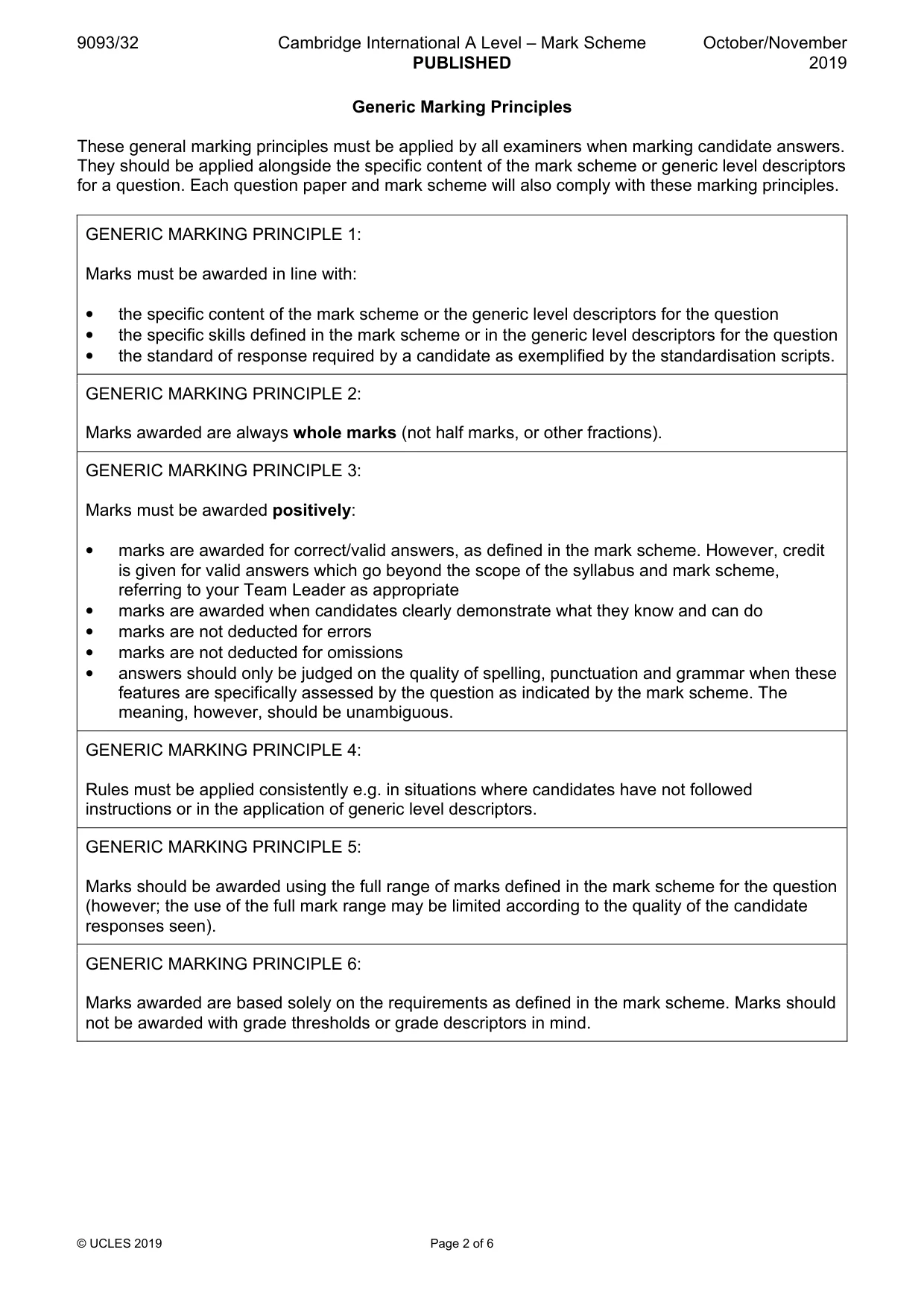
9093/32 Cambridge International A Level – Mark Scheme PUBLISHED October/November 2019 © UCLES 2019 Page 2 of 6 Generic Marking Principles These general marking principles must be applied by all examiners when marking candidate answers. They should be applied alongside the specific content of the mark scheme or generic level descriptors for a question. Each question paper and mark scheme will also comply with these marking principles. GENERIC MARKING PRINCIPLE 1: Marks must be awarded in line with: • the specific content of the mark scheme or the generic level descriptors for the question • the specific skills defined in the mark scheme or in the generic level descriptors for the question • the standard of response required by a candidate as exemplified by the standardisation scripts. GENERIC MARKING PRINCIPLE 2: Marks awarded are always whole marks (not half marks, or other fractions). GENERIC MARKING PRINCIPLE 3: Marks must be awarded positively: • marks are awarded for correct/valid answers, as defined in the mark scheme. However, credit is given for valid answers which go beyond the scope of the syllabus and mark scheme, referring to your Team Leader as appropriate • marks are awarded when candidates clearly demonstrate what they know and can do • marks are not deducted for errors • marks are not deducted for omissions • answers should only be judged on the quality of spelling, punctuation and grammar when these features are specifically assessed by the question as indicated by the mark scheme. The meaning, however, should be unambiguous. GENERIC MARKING PRINCIPLE 4: Rules must be applied consistently e.g. in situations where candidates have not followed instructions or in the application of generic level descriptors. GENERIC MARKING PRINCIPLE 5: Marks should be awarded using the full range of marks defined in the mark scheme for the question (however; the use of the full mark range may be limited according to the quality of the candidate responses seen). GENERIC MARKING PRINCIPLE 6: Marks awarded are based solely on the requirements as defined in the mark scheme. Marks should not be awarded with grade thresholds or grade descriptors in mind.
Mark scheme, page 3
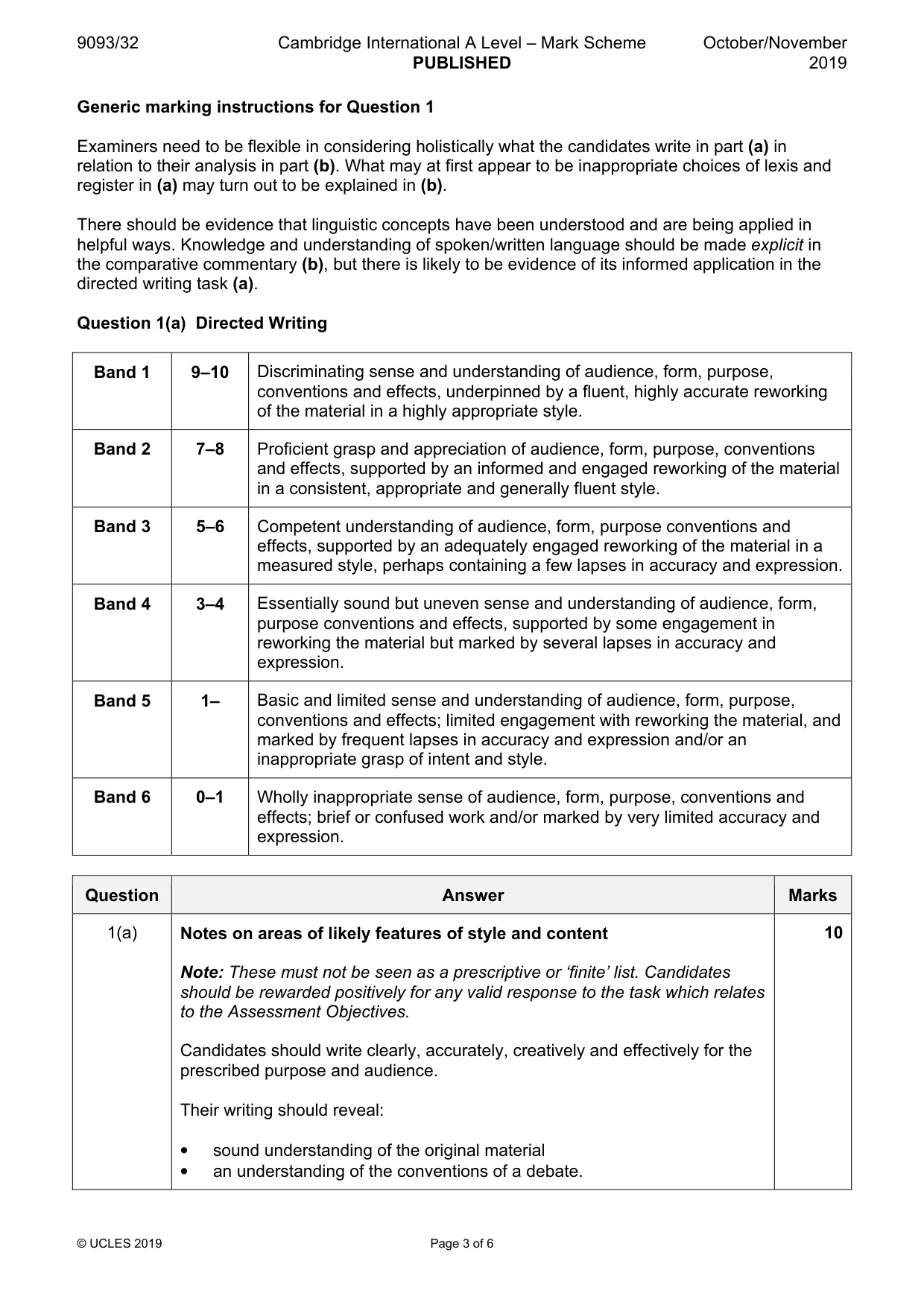
9093/32 Cambridge International A Level – Mark Scheme PUBLISHED October/November 2019 © UCLES 2019 Page 3 of 6 Generic marking instructions for Question 1 Examiners need to be flexible in considering holistically what the candidates write in part (a) in relation to their analysis in part (b). What may at first appear to be inappropriate choices of lexis and register in (a) may turn out to be explained in (b). There should be evidence that linguistic concepts have been understood and are being applied in helpful ways. Knowledge and understanding of spoken/written language should be made explicit in the comparative commentary (b), but there is likely to be evidence of its informed application in the directed writing task (a). Question 1(a) Directed Writing Band 1 9–10 Discriminating sense and understanding of audience, form, purpose, conventions and effects, underpinned by a fluent, highly accurate reworking of the material in a highly appropriate style. Band 2 7–8 Proficient grasp and appreciation of audience, form, purpose, conventions and effects, supported by an informed and engaged reworking of the material in a consistent, appropriate and generally fluent style. Band 3 5–6 Competent understanding of audience, form, purpose conventions and effects, supported by an adequately engaged reworking of the material in a measured style, perhaps containing a few lapses in accuracy and expression. Band 4 3–4 Essentially sound but uneven sense and understanding of audience, form, purpose conventions and effects, supported by some engagement in reworking the material but marked by several lapses in accuracy and expression. Band 5 1– Basic and limited sense and understanding of audience, form, purpose, conventions and effects; limited engagement with reworking the material, and marked by frequent lapses in accuracy and expression and/or an inappropriate grasp of intent and style. Band 6 0–1 Wholly inappropriate sense of audience, form, purpose, conventions and effects; brief or confused work and/or marked by very limited accuracy and expression. Question Answer Marks 1(a) Notes on areas of likely features of style and content Note: These must not be seen as a prescriptive or ‘finite’ list. Candidates should be rewarded positively for any valid response to the task which relates to the Assessment Objectives. Candidates should write clearly, accurately, creatively and effectively for the prescribed purpose and audience. Their writing should reveal: • sound understanding of the original material • an understanding of the conventions of a debate. 10
Mark scheme, page 4
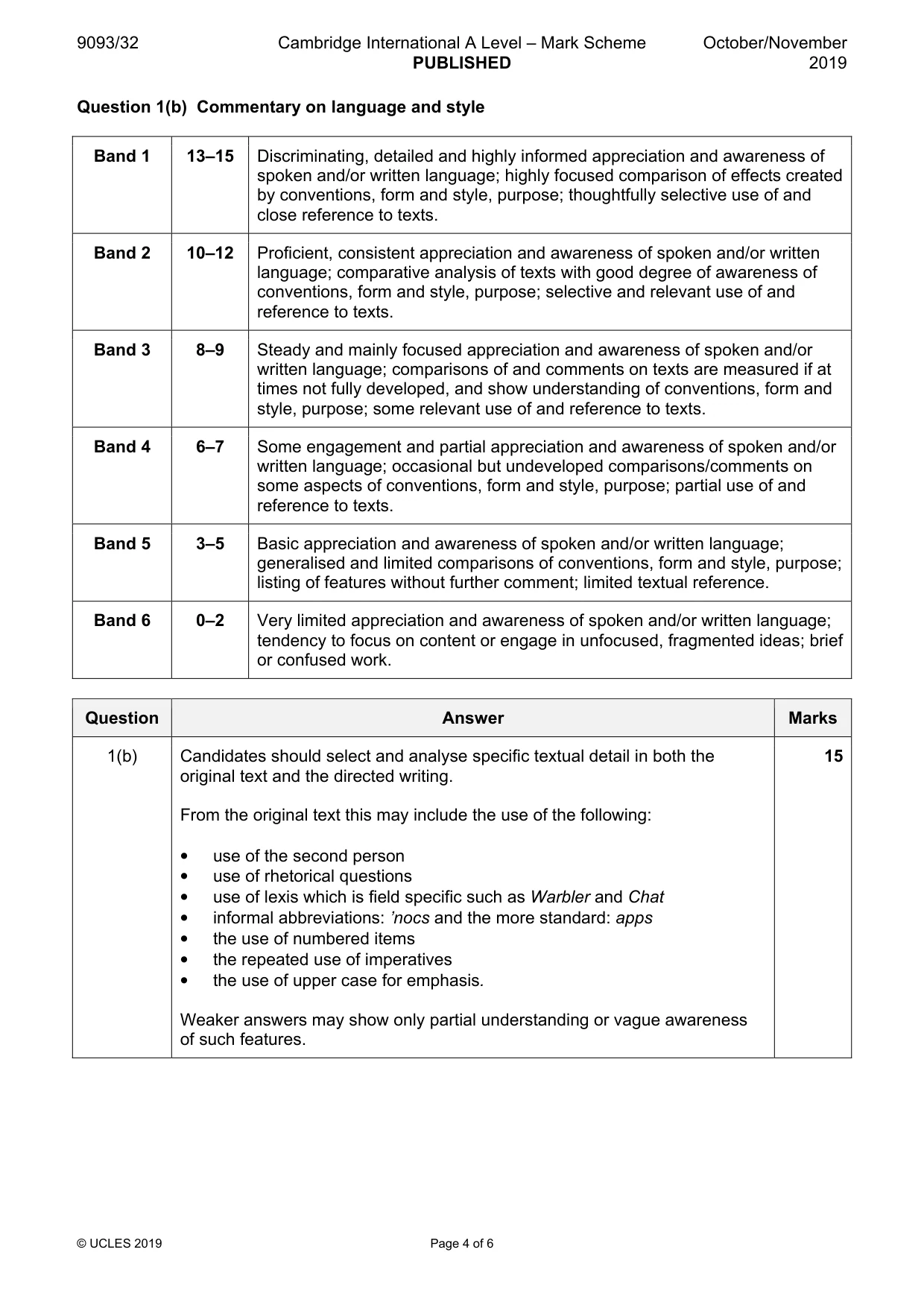
9093/32 Cambridge International A Level – Mark Scheme PUBLISHED October/November 2019 © UCLES 2019 Page 4 of 6 Question 1(b) Commentary on language and style Band 1 13–15 Discriminating, detailed and highly informed appreciation and awareness of spoken and/or written language; highly focused comparison of effects created by conventions, form and style, purpose; thoughtfully selective use of and close reference to texts. Band 2 10–12 Proficient, consistent appreciation and awareness of spoken and/or written language; comparative analysis of texts with good degree of awareness of conventions, form and style, purpose; selective and relevant use of and reference to texts. Band 3 8–9 Steady and mainly focused appreciation and awareness of spoken and/or written language; comparisons of and comments on texts are measured if at times not fully developed, and show understanding of conventions, form and style, purpose; some relevant use of and reference to texts. Band 4 6–7 Some engagement and partial appreciation and awareness of spoken and/or written language; occasional but undeveloped comparisons/comments on some aspects of conventions, form and style, purpose; partial use of and reference to texts. Band 5 3–5 Basic appreciation and awareness of spoken and/or written language; generalised and limited comparisons of conventions, form and style, purpose; listing of features without further comment; limited textual reference. Band 6 0–2 Very limited appreciation and awareness of spoken and/or written language; tendency to focus on content or engage in unfocused, fragmented ideas; brief or confused work. Question Answer Marks 1(b) Candidates should select and analyse specific textual detail in both the original text and the directed writing. From the original text this may include the use of the following: • use of the second person • use of rhetorical questions • use of lexis which is field specific such as Warbler and Chat • informal abbreviations: ’nocs and the more standard: apps • the use of numbered items • the repeated use of imperatives • the use of upper case for emphasis. Weaker answers may show only partial understanding or vague awareness of such features. 15
Mark scheme, page 5
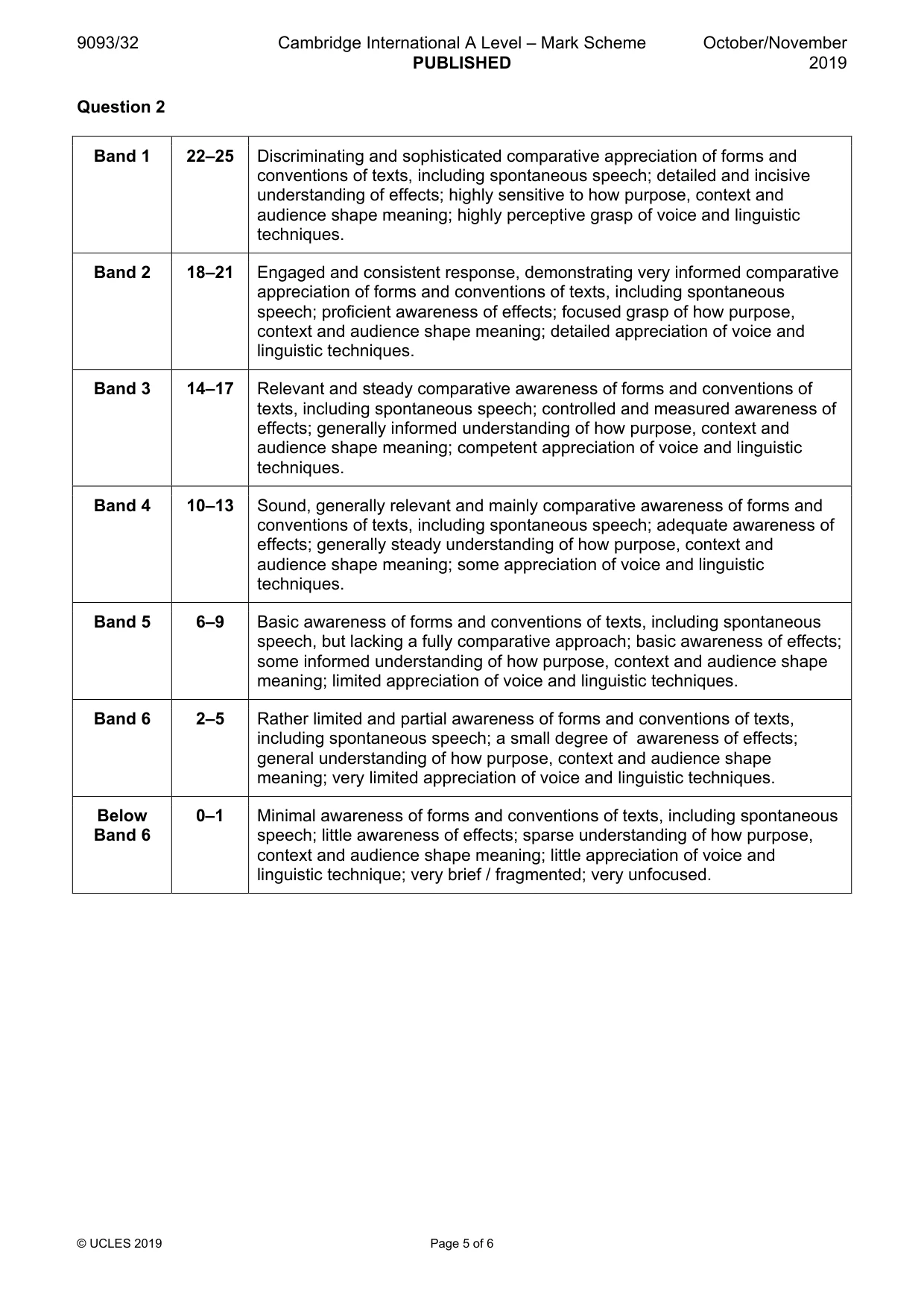
9093/32 Cambridge International A Level – Mark Scheme PUBLISHED October/November 2019 © UCLES 2019 Page 5 of 6 Question 2 Band 1 22–25 Discriminating and sophisticated comparative appreciation of forms and conventions of texts, including spontaneous speech; detailed and incisive understanding of effects; highly sensitive to how purpose, context and audience shape meaning; highly perceptive grasp of voice and linguistic techniques. Band 2 18–21 Engaged and consistent response, demonstrating very informed comparative appreciation of forms and conventions of texts, including spontaneous speech; proficient awareness of effects; focused grasp of how purpose, context and audience shape meaning; detailed appreciation of voice and linguistic techniques. Band 3 14–17 Relevant and steady comparative awareness of forms and conventions of texts, including spontaneous speech; controlled and measured awareness of effects; generally informed understanding of how purpose, context and audience shape meaning; competent appreciation of voice and linguistic techniques. Band 4 10–13 Sound, generally relevant and mainly comparative awareness of forms and conventions of texts, including spontaneous speech; adequate awareness of effects; generally steady understanding of how purpose, context and audience shape meaning; some appreciation of voice and linguistic techniques. Band 5 6–9 Basic awareness of forms and conventions of texts, including spontaneous speech, but lacking a fully comparative approach; basic awareness of effects; some informed understanding of how purpose, context and audience shape meaning; limited appreciation of voice and linguistic techniques. Band 6 2–5 Rather limited and partial awareness of forms and conventions of texts, including spontaneous speech; a small degree of awareness of effects; general understanding of how purpose, context and audience shape meaning; very limited appreciation of voice and linguistic techniques. Below Band 6 0–1 Minimal awareness of forms and conventions of texts, including spontaneous speech; little awareness of effects; sparse understanding of how purpose, context and audience shape meaning; little appreciation of voice and linguistic technique; very brief / fragmented; very unfocused.
Mark scheme, page 6
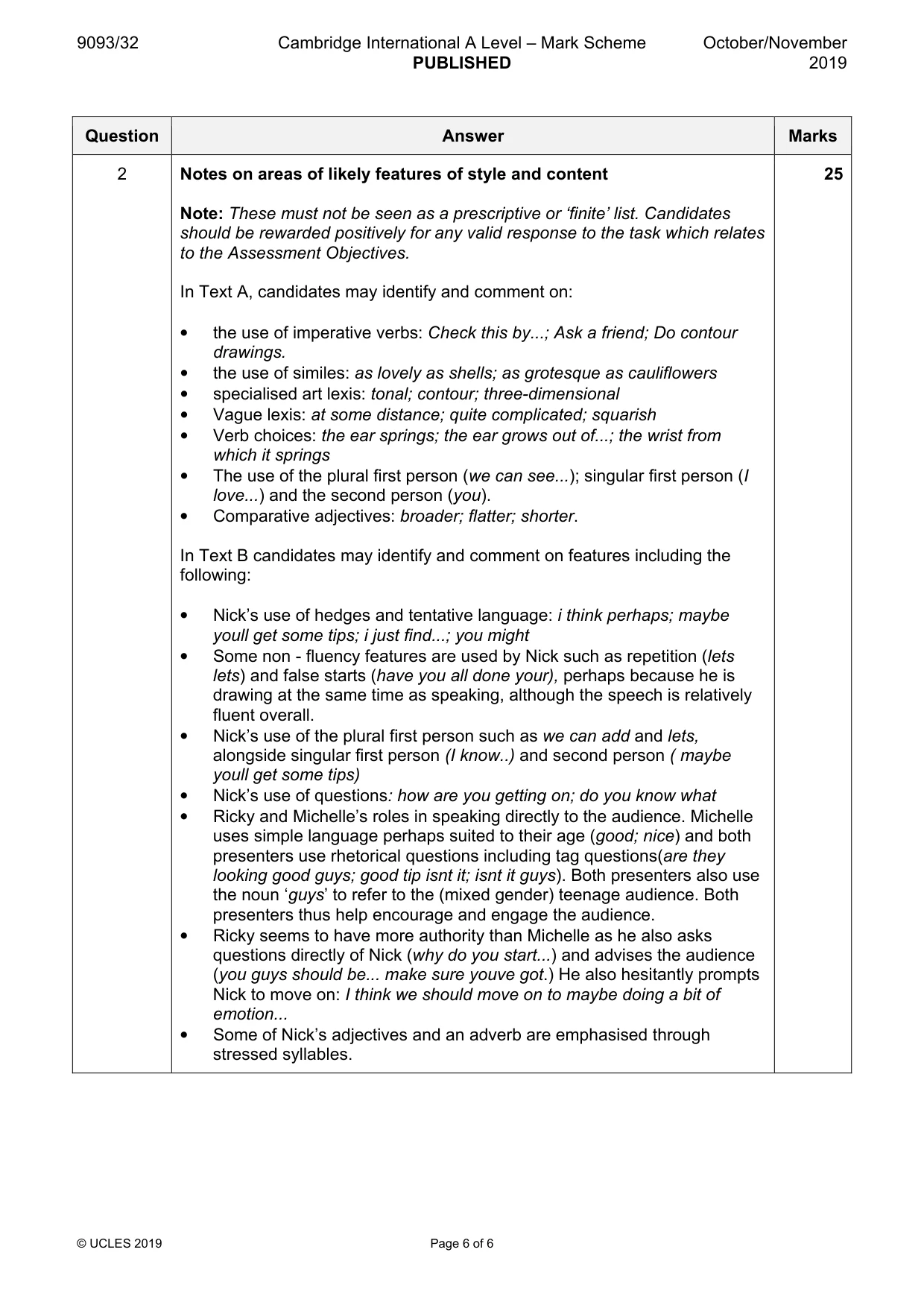
9093/32 Cambridge International A Level – Mark Scheme PUBLISHED October/November 2019 © UCLES 2019 Page 6 of 6 Question Answer Marks 2 Notes on areas of likely features of style and content Note: These must not be seen as a prescriptive or ‘finite’ list. Candidates should be rewarded positively for any valid response to the task which relates to the Assessment Objectives. In Text A, candidates may identify and comment on: • the use of imperative verbs: Check this by...; Ask a friend; Do contour drawings. • the use of similes: as lovely as shells; as grotesque as cauliflowers • specialised art lexis: tonal; contour; three-dimensional • Vague lexis: at some distance; quite complicated; squarish • Verb choices: the ear springs; the ear grows out of...; the wrist from which it springs • The use of the plural first person (we can see...); singular first person (I love...) and the second person (you). • Comparative adjectives: broader; flatter; shorter. In Text B candidates may identify and comment on features including the following: • Nick’s use of hedges and tentative language: i think perhaps; maybe youll get some tips; i just find...; you might • Some non - fluency features are used by Nick such as repetition (lets lets) and false starts (have you all done your), perhaps because he is drawing at the same time as speaking, although the speech is relatively fluent overall. • Nick’s use of the plural first person such as we can add and lets, alongside singular first person (I know..) and second person ( maybe youll get some tips) • Nick’s use of questions: how are you getting on; do you know what • Ricky and Michelle’s roles in speaking directly to the audience. Michelle uses simple language perhaps suited to their age (good; nice) and both presenters use rhetorical questions including tag questions(are they looking good guys; good tip isnt it; isnt it guys). Both presenters also use the noun ‘guys’ to refer to the (mixed gender) teenage audience. Both presenters thus help encourage and engage the audience. • Ricky seems to have more authority than Michelle as he also asks questions directly of Nick (why do you start...) and advises the audience (you guys should be... make sure youve got.) He also hesitantly prompts Nick to move on: I think we should move on to maybe doing a bit of emotion... • Some of Nick’s adjectives and an adverb are emphasised through stressed syllables. 25
What you needed in this session
Cambridge’s own grade thresholds for 2019 Oct/Nov, Paper 3 · Variant 2. A higher threshold means an easier paper — the bar moves with how the cohort did.