Cambridge A Level English - Language AS and A Level (from 2014) 9093 — 2019 Oct/Nov Paper 3 · Variant 3
9093/33/O/N/19 · 50 marks · ≈56 min
The question paper and its mark scheme, free to read here and free to download. This is Cambridge’s own paper, exactly as it was sat.
Question paper8 pages



Mark scheme7 pages
Answers below. Sit the paper first if you are practising.
Paper as text
Question paper, page 1
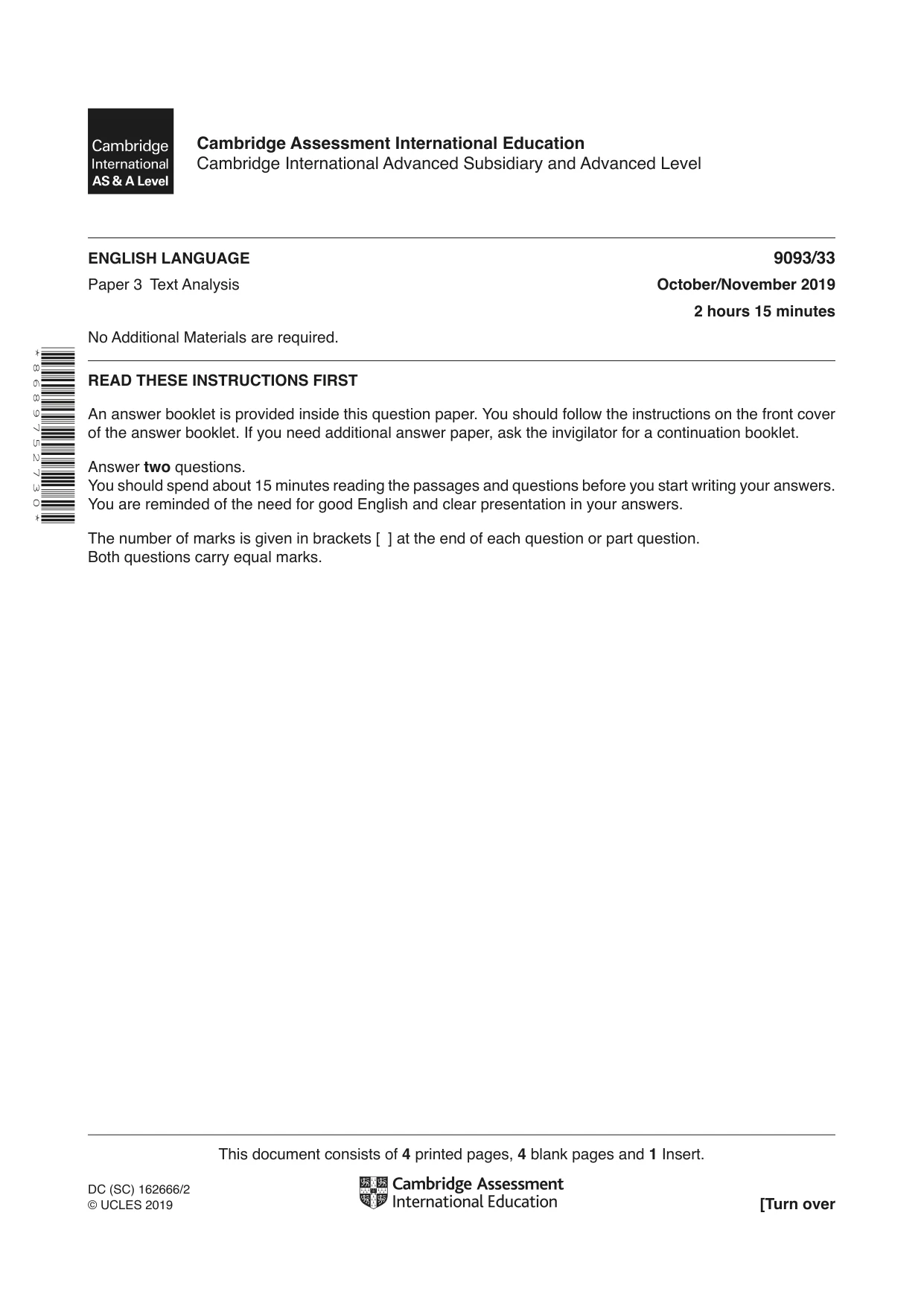
This document consists of 4 printed pages, 4 blank pages and 1 Insert. DC (SC) 162666/2 © UCLES 2019 [Turn over Cambridge Assessment International Education Cambridge International Advanced Subsidiary and Advanced Level * 8 6 8 9 7 5 2 7 3 0 * ENGLISH LANGUAGE 9093/33 Paper 3 Text Analysis October/November 2019 2 hours 15 minutes No Additional Materials are required. READ THESE INSTRUCTIONS FIRST An answer booklet is provided inside this question paper. You should follow the instructions on the front cover of the answer booklet. If you need additional answer paper, ask the invigilator for a continuation booklet. Answer two questions. You should spend about 15 minutes reading the passages and questions before you start writing your answers. You are reminded of the need for good English and clear presentation in your answers. The number of marks is given in brackets [ ] at the end of each question or part question. Both questions carry equal marks.
Question paper, page 2
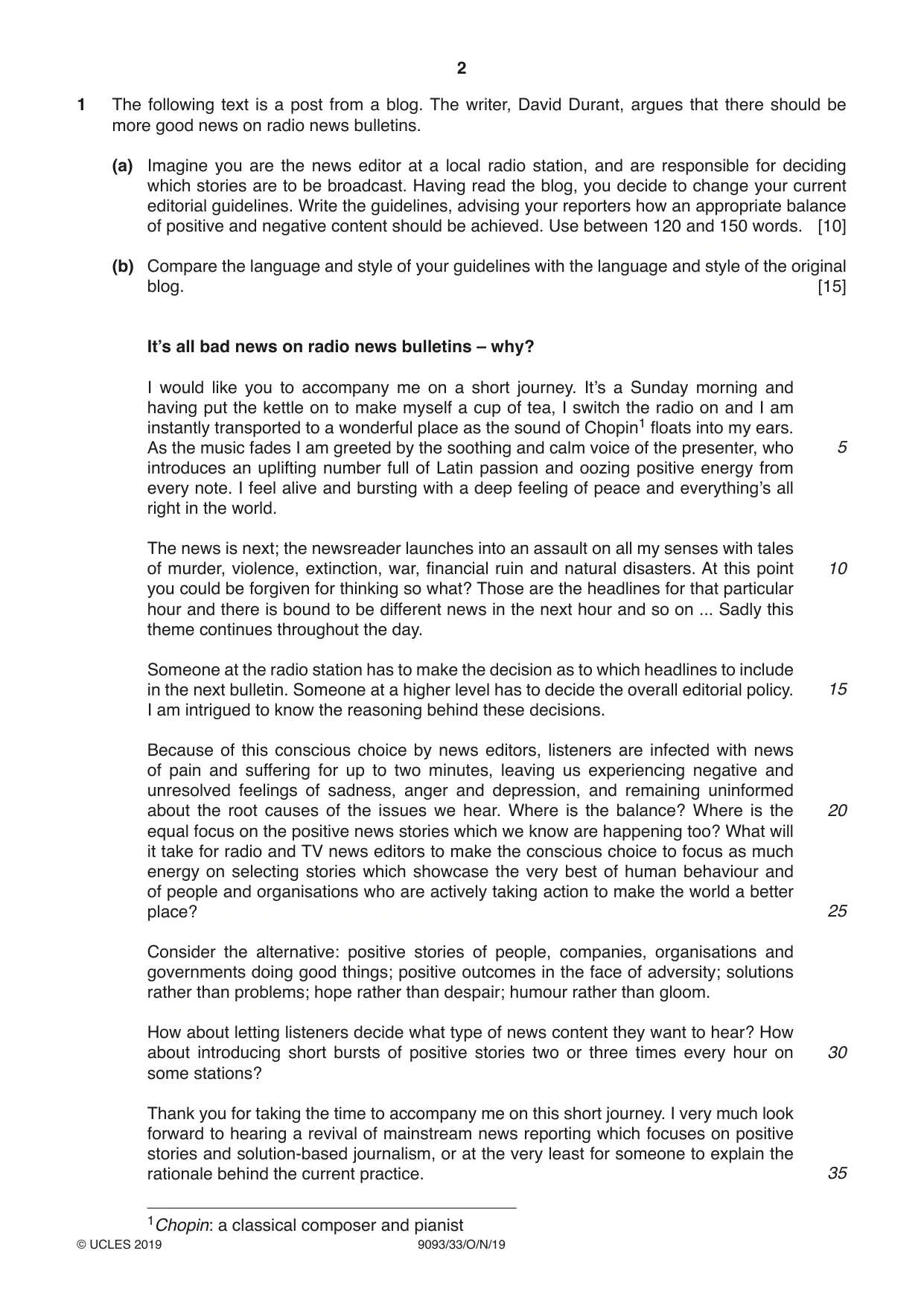
2 9093/33/O/N/19 © UCLES 2019 1 The following text is a post from a blog. The writer, David Durant, argues that there should be more good news on radio news bulletins. (a) Imagine you are the news editor at a local radio station, and are responsible for deciding which stories are to be broadcast. Having read the blog, you decide to change your current editorial guidelines. Write the guidelines, advising your reporters how an appropriate balance of positive and negative content should be achieved. Use between 120 and 150 words. [10] (b) Compare the language and style of your guidelines with the language and style of the original blog. [15] It’s all bad news on radio news bulletins – why? I would like you to accompany me on a short journey. It’s a Sunday morning and having put the kettle on to make myself a cup of tea, I switch the radio on and I am instantly transported to a wonderful place as the sound of Chopin1 floats into my ears. As the music fades I am greeted by the soothing and calm voice of the presenter, who introduces an uplifting number full of Latin passion and oozing positive energy from every note. I feel alive and bursting with a deep feeling of peace and everything’s all right in the world. The news is next; the newsreader launches into an assault on all my senses with tales of murder, violence, extinction, war, financial ruin and natural disasters. At this point you could be forgiven for thinking so what? Those are the headlines for that particular hour and there is bound to be different news in the next hour and so on ... Sadly this theme continues throughout the day. Someone at the radio station has to make the decision as to which headlines to include in the next bulletin. Someone at a higher level has to decide the overall editorial policy. I am intrigued to know the reasoning behind these decisions. Because of this conscious choice by news editors, listeners are infected with news of pain and suffering for up to two minutes, leaving us experiencing negative and unresolved feelings of sadness, anger and depression, and remaining uninformed about the root causes of the issues we hear. Where is the balance? Where is the equal focus on the positive news stories which we know are happening too? What will it take for radio and TV news editors to make the conscious choice to focus as much energy on selecting stories which showcase the very best of human behaviour and of people and organisations who are actively taking action to make the world a better place? Consider the alternative: positive stories of people, companies, organisations and governments doing good things; positive outcomes in the face of adversity; solutions rather than problems; hope rather than despair; humour rather than gloom. How about letting listeners decide what type of news content they want to hear? How about introducing short bursts of positive stories two or three times every hour on some stations? Thank you for taking the time to accompany me on this short journey. I very much look forward to hearing a revival of mainstream news reporting which focuses on positive stories and solution-based journalism, or at the very least for someone to explain the rationale behind the current practice. 1Chopin: a classical composer and pianist 5 10 15 20 25 30 35
Question paper, page 3
3 9093/33/O/N/19 © UCLES 2019 [Turn over BLANK PAGE
Question paper, page 4
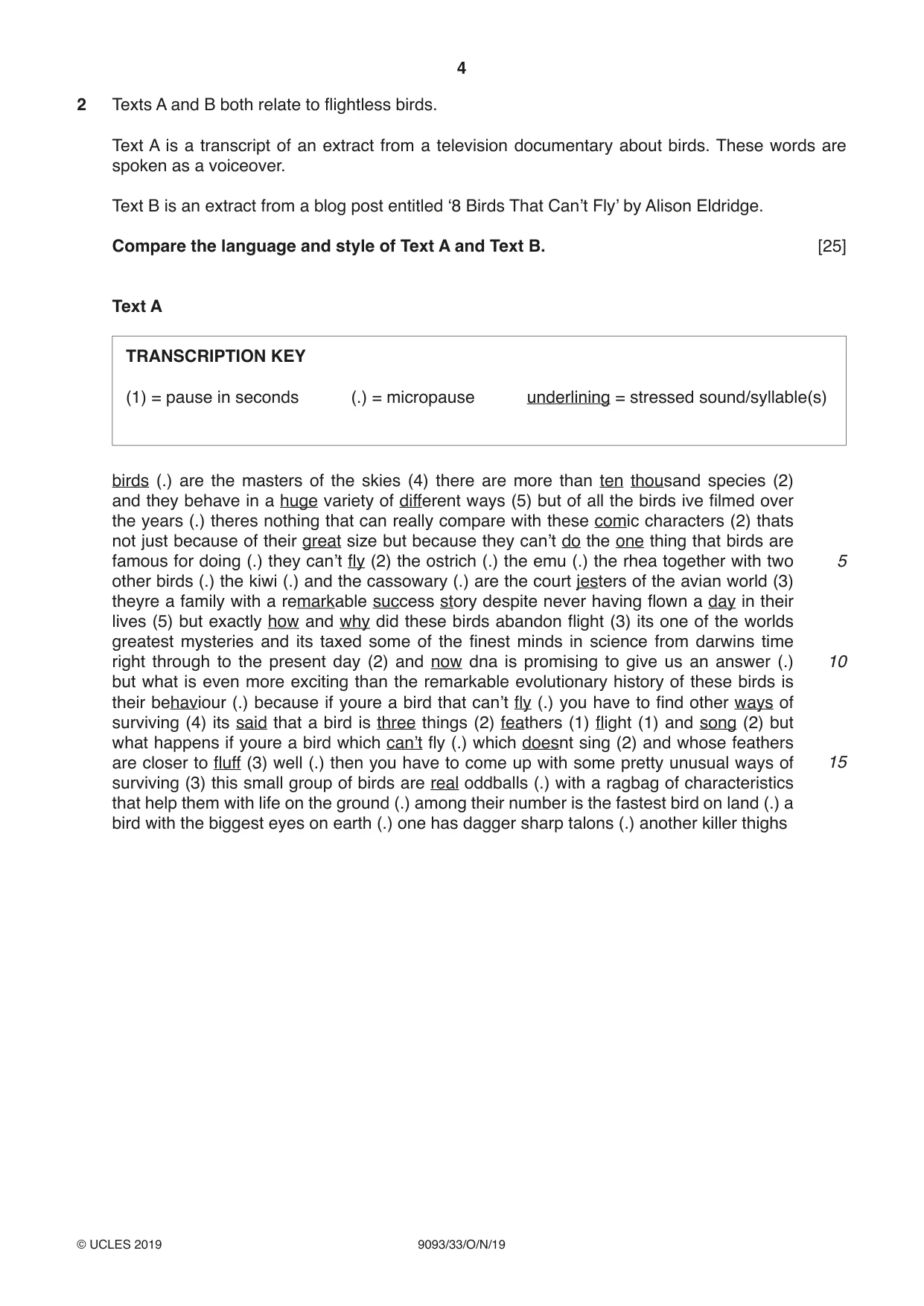
4 9093/33/O/N/19 © UCLES 2019 2 Texts A and B both relate to flightless birds. Text A is a transcript of an extract from a television documentary about birds. These words are spoken as a voiceover. Text B is an extract from a blog post entitled ‘8 Birds That Can’t Fly’ by Alison Eldridge. Compare the language and style of Text A and Text B. [25] Text A TRANSCRIPTION KEY (1) = pause in seconds (.) = micropause underlining = stressed sound/syllable(s) birds (.) are the masters of the skies (4) there are more than ten thousand species (2) and they behave in a huge variety of different ways (5) but of all the birds ive filmed over the years (.) theres nothing that can really compare with these comic characters (2) thats not just because of their great size but because they can’t do the one thing that birds are famous for doing (.) they can’t fly (2) the ostrich (.) the emu (.) the rhea together with two other birds (.) the kiwi (.) and the cassowary (.) are the court jesters of the avian world (3) theyre a family with a remarkable success story despite never having flown a day in their lives (5) but exactly how and why did these birds abandon flight (3) its one of the worlds greatest mysteries and its taxed some of the finest minds in science from darwins time right through to the present day (2) and now dna is promising to give us an answer (.) but what is even more exciting than the remarkable evolutionary history of these birds is their behaviour (.) because if youre a bird that can’t fly (.) you have to find other ways of surviving (4) its said that a bird is three things (2) feathers (1) flight (1) and song (2) but what happens if youre a bird which can’t fly (.) which doesnt sing (2) and whose feathers are closer to fluff (3) well (.) then you have to come up with some pretty unusual ways of surviving (3) this small group of birds are real oddballs (.) with a ragbag of characteristics that help them with life on the ground (.) among their number is the fastest bird on land (.) a bird with the biggest eyes on earth (.) one has dagger sharp talons (.) another killer thighs 5 10 15
Question paper, page 5
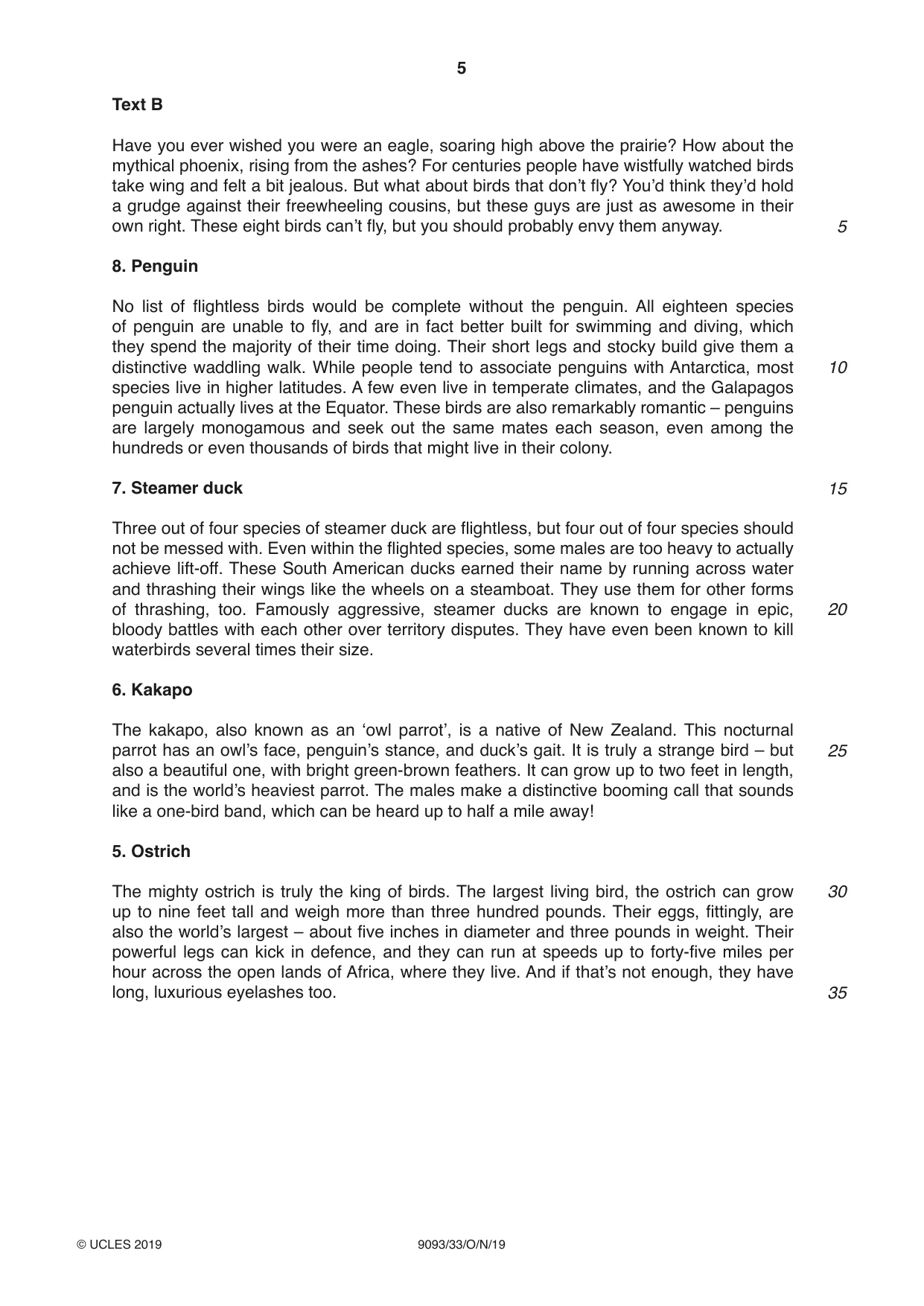
5 9093/33/O/N/19 © UCLES 2019 Text B Have you ever wished you were an eagle, soaring high above the prairie? How about the mythical phoenix, rising from the ashes? For centuries people have wistfully watched birds take wing and felt a bit jealous. But what about birds that don’t fly? You’d think they’d hold a grudge against their freewheeling cousins, but these guys are just as awesome in their own right. These eight birds can’t fly, but you should probably envy them anyway. 8. Penguin No list of flightless birds would be complete without the penguin. All eighteen species of penguin are unable to fly, and are in fact better built for swimming and diving, which they spend the majority of their time doing. Their short legs and stocky build give them a distinctive waddling walk. While people tend to associate penguins with Antarctica, most species live in higher latitudes. A few even live in temperate climates, and the Galapagos penguin actually lives at the Equator. These birds are also remarkably romantic – penguins are largely monogamous and seek out the same mates each season, even among the hundreds or even thousands of birds that might live in their colony. 7. Steamer duck Three out of four species of steamer duck are flightless, but four out of four species should not be messed with. Even within the flighted species, some males are too heavy to actually achieve lift-off. These South American ducks earned their name by running across water and thrashing their wings like the wheels on a steamboat. They use them for other forms of thrashing, too. Famously aggressive, steamer ducks are known to engage in epic, bloody battles with each other over territory disputes. They have even been known to kill waterbirds several times their size. 6. Kakapo The kakapo, also known as an ‘owl parrot’, is a native of New Zealand. This nocturnal parrot has an owl’s face, penguin’s stance, and duck’s gait. It is truly a strange bird – but also a beautiful one, with bright green-brown feathers. It can grow up to two feet in length, and is the world’s heaviest parrot. The males make a distinctive booming call that sounds like a one-bird band, which can be heard up to half a mile away! 5. Ostrich The mighty ostrich is truly the king of birds. The largest living bird, the ostrich can grow up to nine feet tall and weigh more than three hundred pounds. Their eggs, fittingly, are also the world’s largest – about five inches in diameter and three pounds in weight. Their powerful legs can kick in defence, and they can run at speeds up to forty-five miles per hour across the open lands of Africa, where they live. And if that’s not enough, they have long, luxurious eyelashes too. 5 10 15 20 25 30 35
Question paper, page 6
6 9093/33/O/N/19 © UCLES 2019 BLANK PAGE
Question paper, page 7
7 9093/33/O/N/19 © UCLES 2019 BLANK PAGE
Question paper, page 8
8 9093/33/O/N/19 © UCLES 2019 Permission to reproduce items where third-party owned material protected by copyright is included has been sought and cleared where possible. Every reasonable effort has been made by the publisher (UCLES) to trace copyright holders, but if any items requiring clearance have unwittingly been included, the publisher will be pleased to make amends at the earliest possible opportunity. To avoid the issue of disclosure of answer-related information to candidates, all copyright acknowledgements are reproduced online in the Cambridge Assessment International Education Copyright Acknowledgements Booklet. This is produced for each series of examinations and is freely available to download at www.cambridgeinternational.org after the live examination series. Cambridge Assessment International Education is part of the Cambridge Assessment Group. Cambridge Assessment is the brand name of the University of Cambridge Local Examinations Syndicate (UCLES), which itself is a department of the University of Cambridge. BLANK PAGE
Mark scheme, page 1
This document consists of 7 printed pages. © UCLES 2019 [Turn over Cambridge Assessment International Education Cambridge International Advanced Level ENGLISH LANGUAGE 9093/33 Paper 3 Text Analysis October/November 2019 MARK SCHEME Maximum Mark: 50 Published This mark scheme is published as an aid to teachers and candidates, to indicate the requirements of the examination. It shows the basis on which Examiners were instructed to award marks. It does not indicate the details of the discussions that took place at an Examiners’ meeting before marking began, which would have considered the acceptability of alternative answers. Mark schemes should be read in conjunction with the question paper and the Principal Examiner Report for Teachers. Cambridge International will not enter into discussions about these mark schemes. Cambridge International is publishing the mark schemes for the October/November 2019 series for most Cambridge IGCSE™, Cambridge International A and AS Level components and some Cambridge O Level components.
Mark scheme, page 2
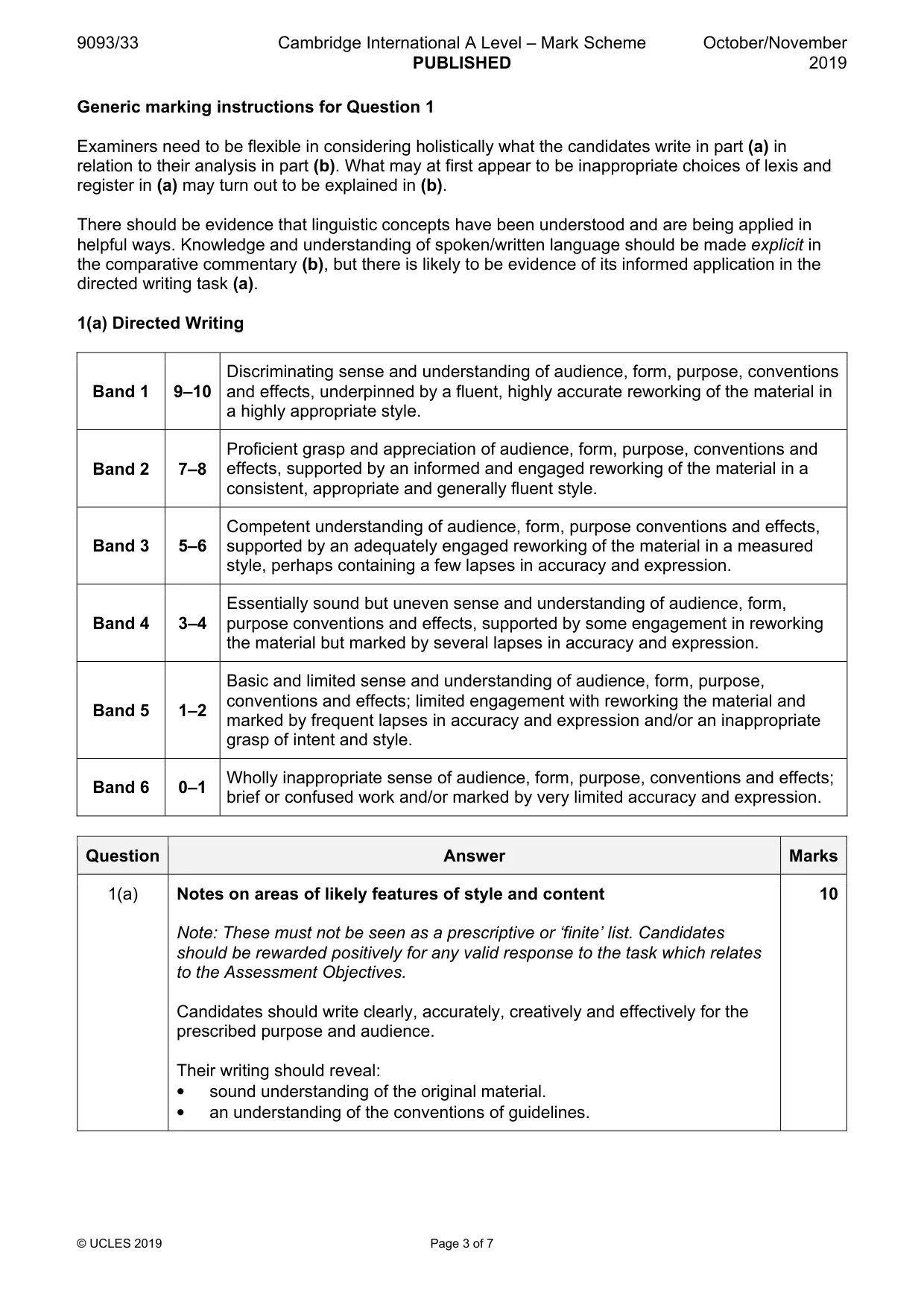
9093/33 Cambridge International A Level – Mark Scheme PUBLISHED October/November 2019 © UCLES 2019 Page 2 of 7 Generic Marking Principles These general marking principles must be applied by all examiners when marking candidate answers. They should be applied alongside the specific content of the mark scheme or generic level descriptors for a question. Each question paper and mark scheme will also comply with these marking principles. GENERIC MARKING PRINCIPLE 1: Marks must be awarded in line with: • the specific content of the mark scheme or the generic level descriptors for the question • the specific skills defined in the mark scheme or in the generic level descriptors for the question • the standard of response required by a candidate as exemplified by the standardisation scripts. GENERIC MARKING PRINCIPLE 2: Marks awarded are always whole marks (not half marks, or other fractions). GENERIC MARKING PRINCIPLE 3: Marks must be awarded positively: • marks are awarded for correct/valid answers, as defined in the mark scheme. However, credit is given for valid answers which go beyond the scope of the syllabus and mark scheme, referring to your Team Leader as appropriate • marks are awarded when candidates clearly demonstrate what they know and can do • marks are not deducted for errors • marks are not deducted for omissions • answers should only be judged on the quality of spelling, punctuation and grammar when these features are specifically assessed by the question as indicated by the mark scheme. The meaning, however, should be unambiguous. GENERIC MARKING PRINCIPLE 4: Rules must be applied consistently e.g. in situations where candidates have not followed instructions or in the application of generic level descriptors. GENERIC MARKING PRINCIPLE 5: Marks should be awarded using the full range of marks defined in the mark scheme for the question (however; the use of the full mark range may be limited according to the quality of the candidate responses seen). GENERIC MARKING PRINCIPLE 6: Marks awarded are based solely on the requirements as defined in the mark scheme. Marks should not be awarded with grade thresholds or grade descriptors in mind.
Mark scheme, page 3
9093/33 Cambridge International A Level – Mark Scheme PUBLISHED October/November 2019 © UCLES 2019 Page 3 of 7 Generic marking instructions for Question 1 Examiners need to be flexible in considering holistically what the candidates write in part (a) in relation to their analysis in part (b). What may at first appear to be inappropriate choices of lexis and register in (a) may turn out to be explained in (b). There should be evidence that linguistic concepts have been understood and are being applied in helpful ways. Knowledge and understanding of spoken/written language should be made explicit in the comparative commentary (b), but there is likely to be evidence of its informed application in the directed writing task (a). 1(a) Directed Writing Band 1 9–10 Discriminating sense and understanding of audience, form, purpose, conventions and effects, underpinned by a fluent, highly accurate reworking of the material in a highly appropriate style. Band 2 7–8 Proficient grasp and appreciation of audience, form, purpose, conventions and effects, supported by an informed and engaged reworking of the material in a consistent, appropriate and generally fluent style. Band 3 5–6 Competent understanding of audience, form, purpose conventions and effects, supported by an adequately engaged reworking of the material in a measured style, perhaps containing a few lapses in accuracy and expression. Band 4 3–4 Essentially sound but uneven sense and understanding of audience, form, purpose conventions and effects, supported by some engagement in reworking the material but marked by several lapses in accuracy and expression. Band 5 1–2 Basic and limited sense and understanding of audience, form, purpose, conventions and effects; limited engagement with reworking the material and marked by frequent lapses in accuracy and expression and/or an inappropriate grasp of intent and style. Band 6 0–1 Wholly inappropriate sense of audience, form, purpose, conventions and effects; brief or confused work and/or marked by very limited accuracy and expression. Question Answer Marks 1(a) Notes on areas of likely features of style and content Note: These must not be seen as a prescriptive or ‘finite’ list. Candidates should be rewarded positively for any valid response to the task which relates to the Assessment Objectives. Candidates should write clearly, accurately, creatively and effectively for the prescribed purpose and audience. Their writing should reveal: • sound understanding of the original material. • an understanding of the conventions of guidelines. 10
Mark scheme, page 4
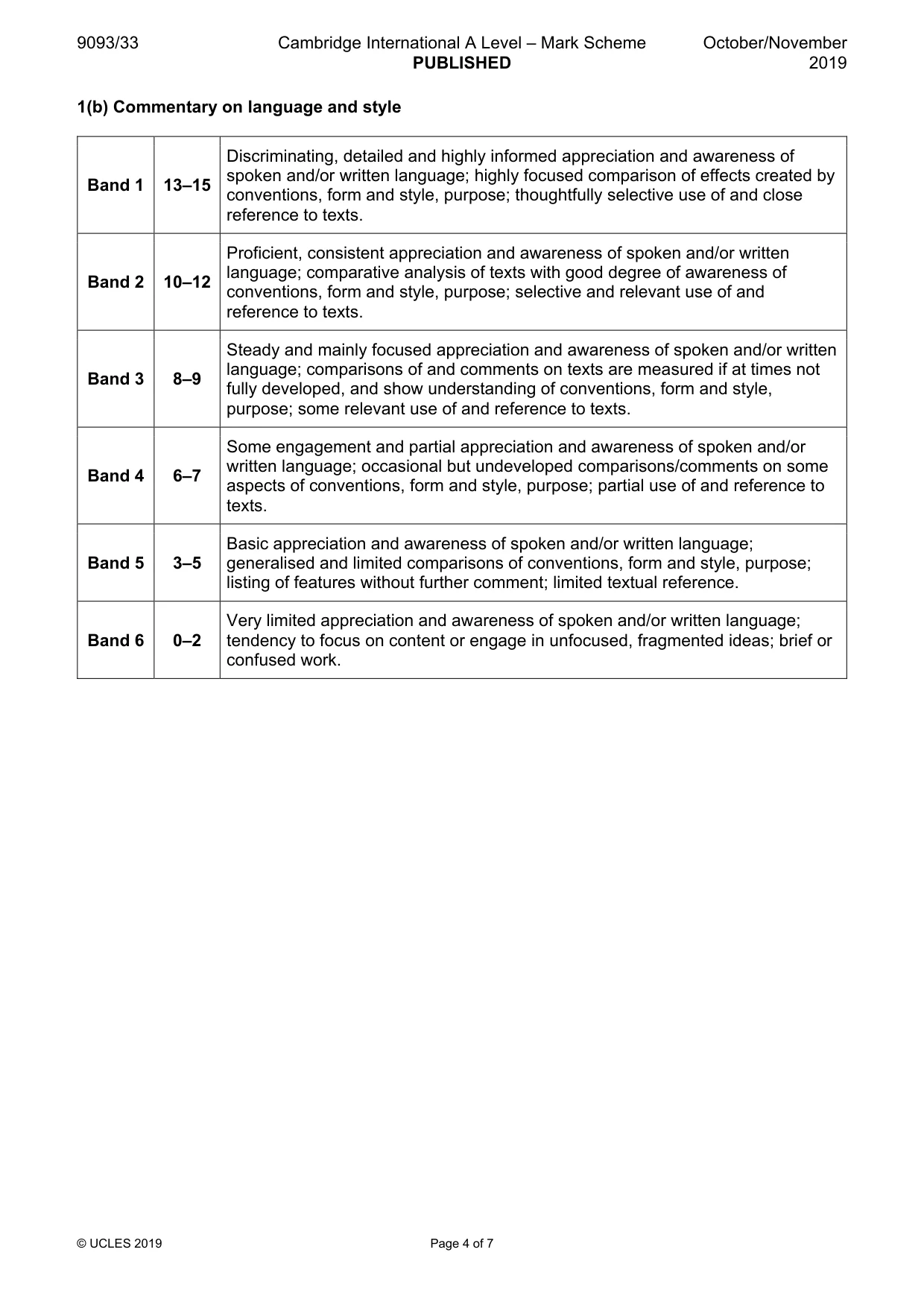
9093/33 Cambridge International A Level – Mark Scheme PUBLISHED October/November 2019 © UCLES 2019 Page 4 of 7 1(b) Commentary on language and style Band 1 13–15 Discriminating, detailed and highly informed appreciation and awareness of spoken and/or written language; highly focused comparison of effects created by conventions, form and style, purpose; thoughtfully selective use of and close reference to texts. Band 2 10–12 Proficient, consistent appreciation and awareness of spoken and/or written language; comparative analysis of texts with good degree of awareness of conventions, form and style, purpose; selective and relevant use of and reference to texts. Band 3 8–9 Steady and mainly focused appreciation and awareness of spoken and/or written language; comparisons of and comments on texts are measured if at times not fully developed, and show understanding of conventions, form and style, purpose; some relevant use of and reference to texts. Band 4 6–7 Some engagement and partial appreciation and awareness of spoken and/or written language; occasional but undeveloped comparisons/comments on some aspects of conventions, form and style, purpose; partial use of and reference to texts. Band 5 3–5 Basic appreciation and awareness of spoken and/or written language; generalised and limited comparisons of conventions, form and style, purpose; listing of features without further comment; limited textual reference. Band 6 0–2 Very limited appreciation and awareness of spoken and/or written language; tendency to focus on content or engage in unfocused, fragmented ideas; brief or confused work.
Mark scheme, page 5
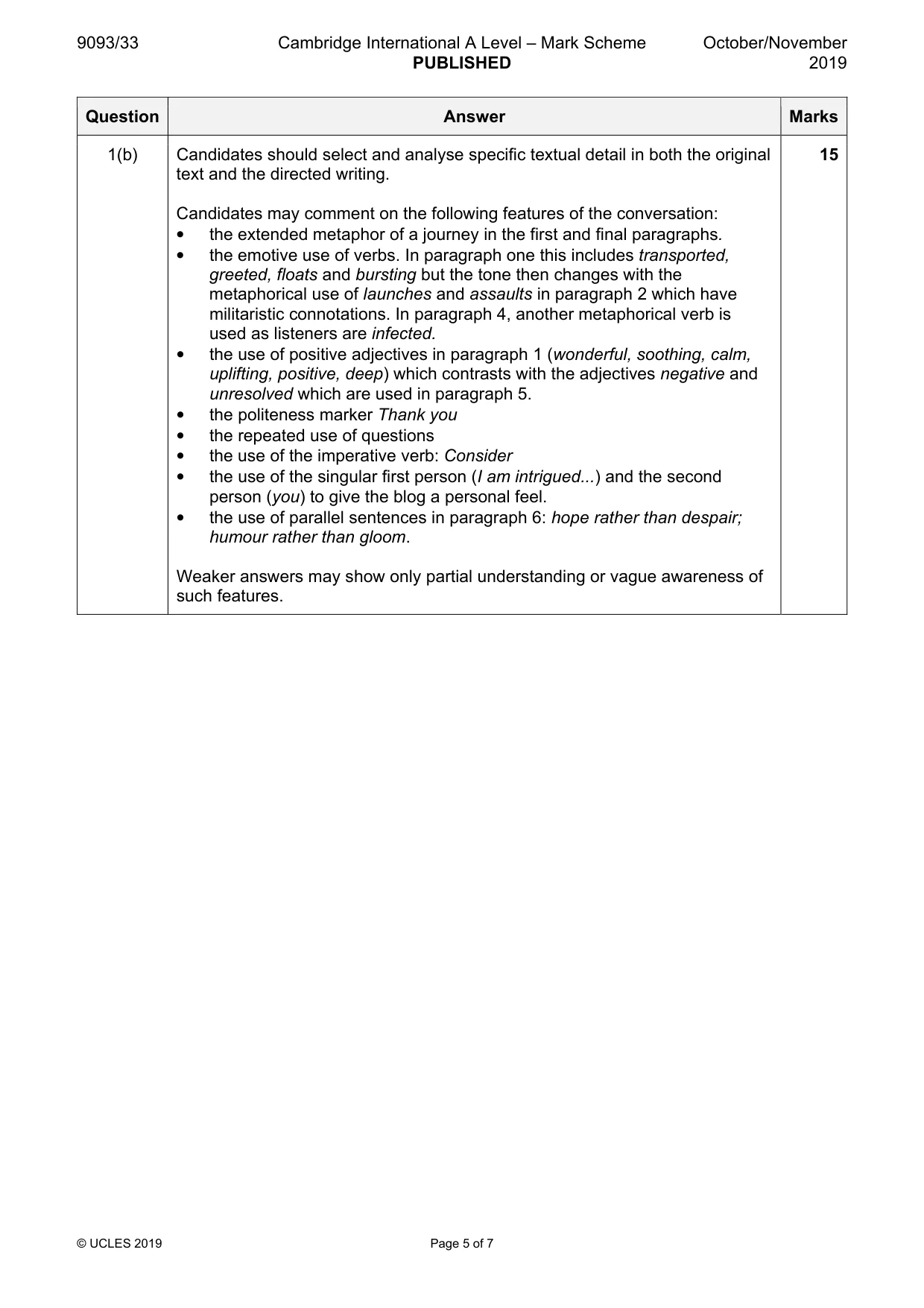
9093/33 Cambridge International A Level – Mark Scheme PUBLISHED October/November 2019 © UCLES 2019 Page 5 of 7 Question Answer Marks 1(b) Candidates should select and analyse specific textual detail in both the original text and the directed writing. Candidates may comment on the following features of the conversation: • the extended metaphor of a journey in the first and final paragraphs. • the emotive use of verbs. In paragraph one this includes transported, greeted, floats and bursting but the tone then changes with the metaphorical use of launches and assaults in paragraph 2 which have militaristic connotations. In paragraph 4, another metaphorical verb is used as listeners are infected. • the use of positive adjectives in paragraph 1 (wonderful, soothing, calm, uplifting, positive, deep) which contrasts with the adjectives negative and unresolved which are used in paragraph 5. • the politeness marker Thank you • the repeated use of questions • the use of the imperative verb: Consider • the use of the singular first person (I am intrigued...) and the second person (you) to give the blog a personal feel. • the use of parallel sentences in paragraph 6: hope rather than despair; humour rather than gloom. Weaker answers may show only partial understanding or vague awareness of such features. 15
Mark scheme, page 6
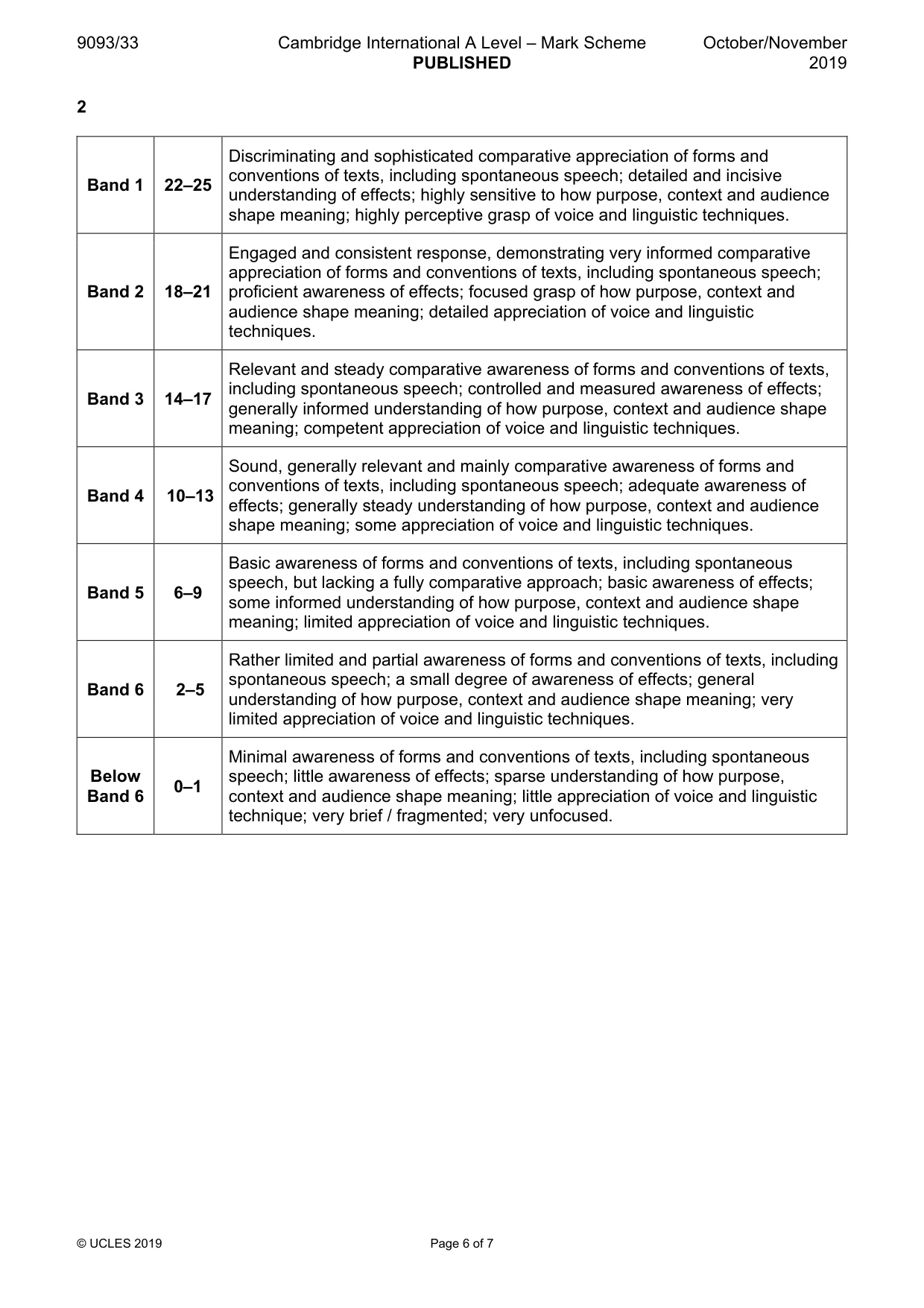
9093/33 Cambridge International A Level – Mark Scheme PUBLISHED October/November 2019 © UCLES 2019 Page 6 of 7 2 Band 1 22–25 Discriminating and sophisticated comparative appreciation of forms and conventions of texts, including spontaneous speech; detailed and incisive understanding of effects; highly sensitive to how purpose, context and audience shape meaning; highly perceptive grasp of voice and linguistic techniques. Band 2 18–21 Engaged and consistent response, demonstrating very informed comparative appreciation of forms and conventions of texts, including spontaneous speech; proficient awareness of effects; focused grasp of how purpose, context and audience shape meaning; detailed appreciation of voice and linguistic techniques. Band 3 14–17 Relevant and steady comparative awareness of forms and conventions of texts, including spontaneous speech; controlled and measured awareness of effects; generally informed understanding of how purpose, context and audience shape meaning; competent appreciation of voice and linguistic techniques. Band 4 10–13 Sound, generally relevant and mainly comparative awareness of forms and conventions of texts, including spontaneous speech; adequate awareness of effects; generally steady understanding of how purpose, context and audience shape meaning; some appreciation of voice and linguistic techniques. Band 5 6–9 Basic awareness of forms and conventions of texts, including spontaneous speech, but lacking a fully comparative approach; basic awareness of effects; some informed understanding of how purpose, context and audience shape meaning; limited appreciation of voice and linguistic techniques. Band 6 2–5 Rather limited and partial awareness of forms and conventions of texts, including spontaneous speech; a small degree of awareness of effects; general understanding of how purpose, context and audience shape meaning; very limited appreciation of voice and linguistic techniques. Below Band 6 0–1 Minimal awareness of forms and conventions of texts, including spontaneous speech; little awareness of effects; sparse understanding of how purpose, context and audience shape meaning; little appreciation of voice and linguistic technique; very brief / fragmented; very unfocused.
Mark scheme, page 7
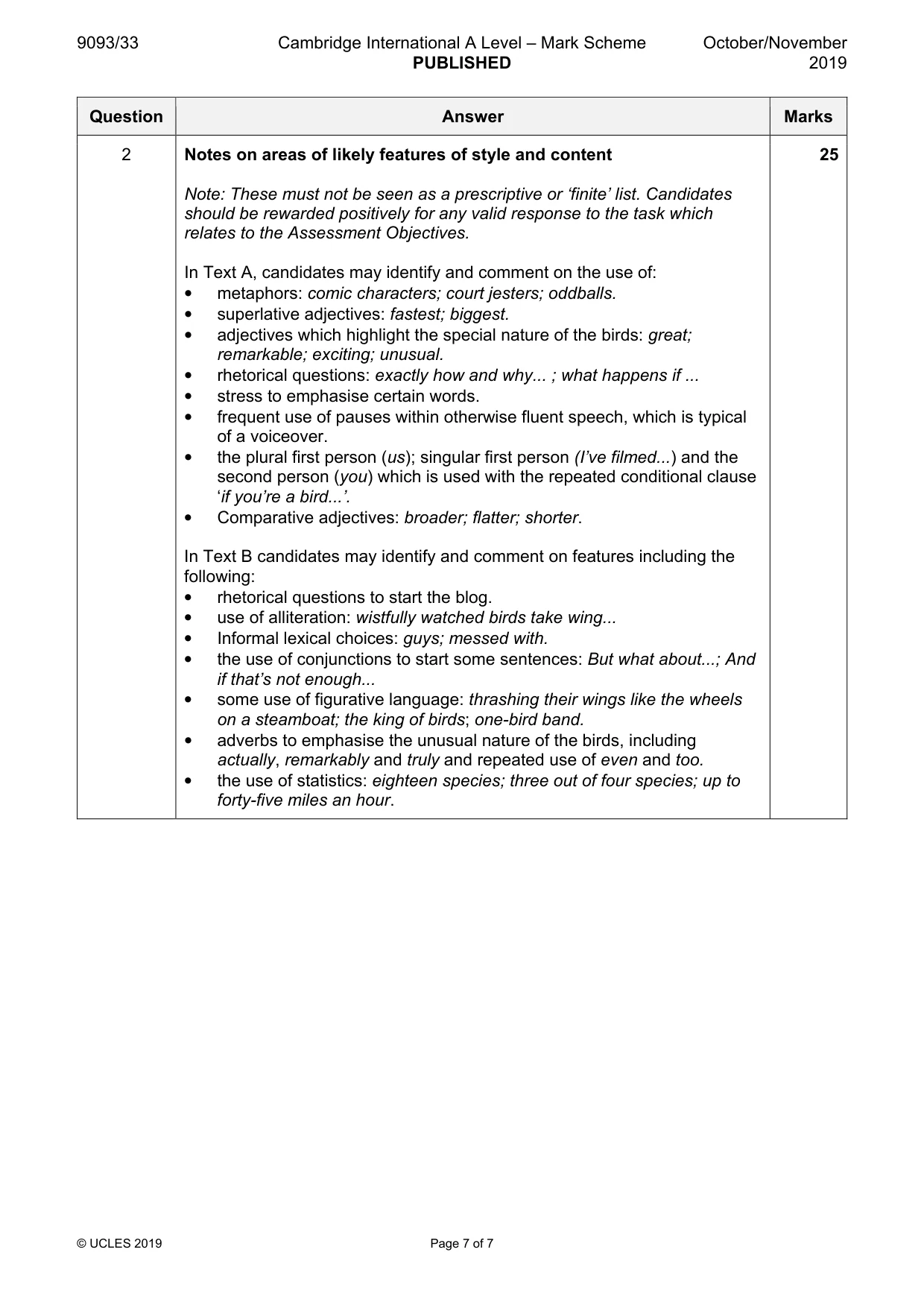
9093/33 Cambridge International A Level – Mark Scheme PUBLISHED October/November 2019 © UCLES 2019 Page 7 of 7 Question Answer Marks 2 Notes on areas of likely features of style and content Note: These must not be seen as a prescriptive or ‘finite’ list. Candidates should be rewarded positively for any valid response to the task which relates to the Assessment Objectives. In Text A, candidates may identify and comment on the use of: • metaphors: comic characters; court jesters; oddballs. • superlative adjectives: fastest; biggest. • adjectives which highlight the special nature of the birds: great; remarkable; exciting; unusual. • rhetorical questions: exactly how and why... ; what happens if ... • stress to emphasise certain words. • frequent use of pauses within otherwise fluent speech, which is typical of a voiceover. • the plural first person (us); singular first person (I’ve filmed...) and the second person (you) which is used with the repeated conditional clause ‘if you’re a bird...’. • Comparative adjectives: broader; flatter; shorter. In Text B candidates may identify and comment on features including the following: • rhetorical questions to start the blog. • use of alliteration: wistfully watched birds take wing... • Informal lexical choices: guys; messed with. • the use of conjunctions to start some sentences: But what about...; And if that’s not enough... • some use of figurative language: thrashing their wings like the wheels on a steamboat; the king of birds; one-bird band. • adverbs to emphasise the unusual nature of the birds, including actually, remarkably and truly and repeated use of even and too. • the use of statistics: eighteen species; three out of four species; up to forty-five miles an hour. 25
What you needed in this session
Cambridge’s own grade thresholds for 2019 Oct/Nov, Paper 3 · Variant 3. A higher threshold means an easier paper — the bar moves with how the cohort did.