Cambridge A Level English - Language AS and A Level (from 2014) 9093 — 2019 May/June Paper 3 · Variant 2
9093/32/M/J/19 · 50 marks · ≈56 min
The question paper and its mark scheme, free to read here and free to download. This is Cambridge’s own paper, exactly as it was sat.
Question paper8 pages



Mark scheme8 pages
Answers below. Sit the paper first if you are practising.
Paper as text
Question paper, page 1
This document consists of 4 printed pages, 4 blank pages and 1 Insert. DC (LT) 162668/2 © UCLES 2019 [Turn over Cambridge Assessment International Education Cambridge International Advanced Subsidiary and Advanced Level * 4 5 9 3 5 0 1 7 3 4 * ENGLISH LANGUAGE 9093/32 Paper 3 Text Analysis May/June 2019 2 hours 15 minutes No Additional Materials are required. READ THESE INSTRUCTIONS FIRST An answer booklet is provided inside this question paper. You should follow the instructions on the front cover of the answer booklet. If you need additional answer paper, ask the invigilator for a continuation booklet. Answer two questions. You should spend about 15 minutes reading the passages and questions before you start writing your answers. You are reminded of the need for good English and clear presentation in your answers. The number of marks is given in brackets [ ] at the end of each question or part question. Both questions carry equal marks.
Question paper, page 2
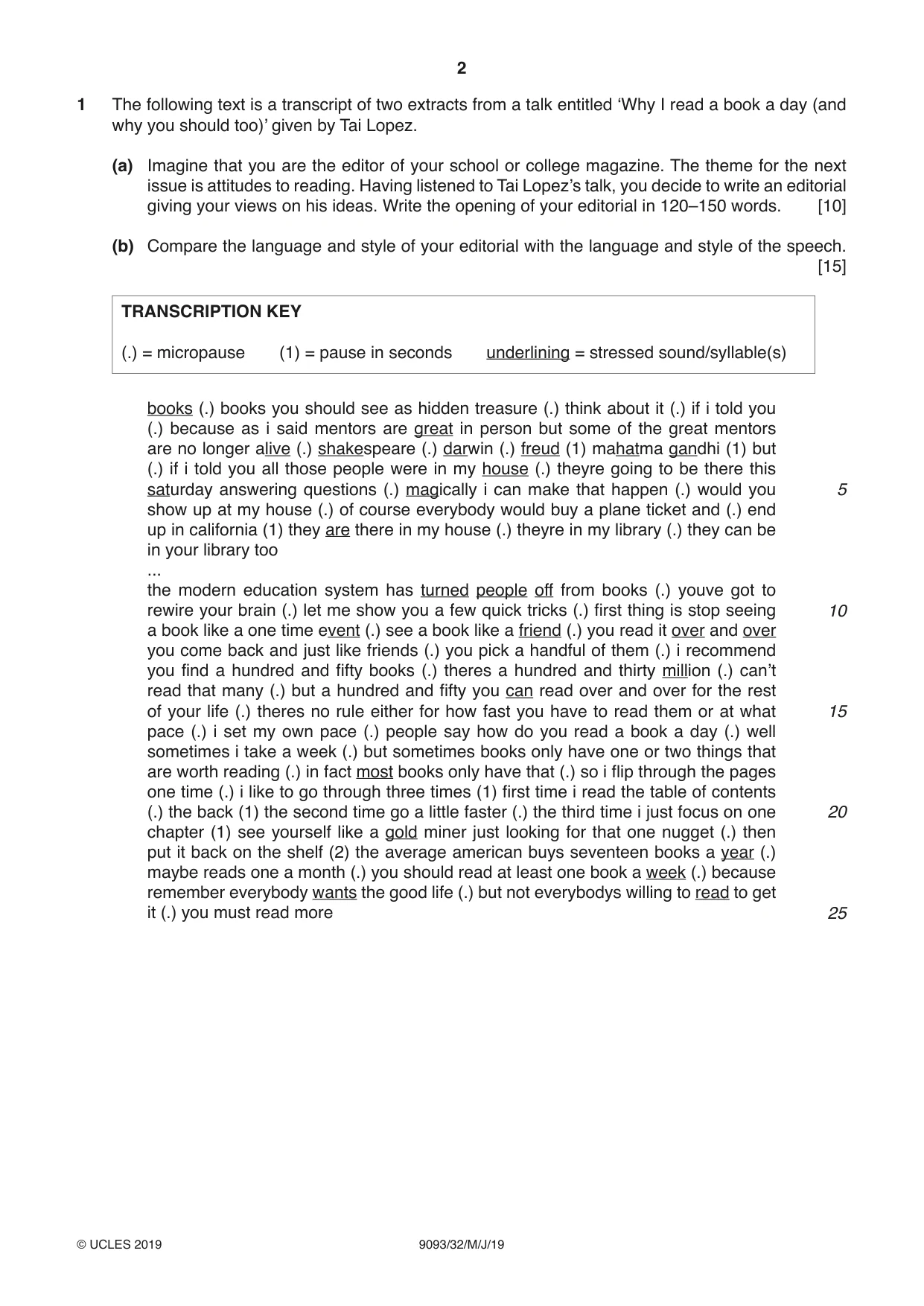
2 9093/32/M/J/19 © UCLES 2019 1 The following text is a transcript of two extracts from a talk entitled ‘Why I read a book a day (and why you should too)’ given by Tai Lopez. (a) Imagine that you are the editor of your school or college magazine. The theme for the next issue is attitudes to reading. Having listened to Tai Lopez’s talk, you decide to write an editorial giving your views on his ideas. Write the opening of your editorial in 120–150 words. [10] (b) Compare the language and style of your editorial with the language and style of the speech. [15] TRANSCRIPTION KEY (.) = micropause (1) = pause in seconds underlining = stressed sound/syllable(s) books (.) books you should see as hidden treasure (.) think about it (.) if i told you (.) because as i said mentors are great in person but some of the great mentors are no longer alive (.) shakespeare (.) darwin (.) freud (1) mahatma gandhi (1) but (.) if i told you all those people were in my house (.) theyre going to be there this saturday answering questions (.) magically i can make that happen (.) would you show up at my house (.) of course everybody would buy a plane ticket and (.) end up in california (1) they are there in my house (.) theyre in my library (.) they can be in your library too ... the modern education system has turned people off from books (.) youve got to rewire your brain (.) let me show you a few quick tricks (.) first thing is stop seeing a book like a one time event (.) see a book like a friend (.) you read it over and over you come back and just like friends (.) you pick a handful of them (.) i recommend you find a hundred and fifty books (.) theres a hundred and thirty million (.) can’t read that many (.) but a hundred and fifty you can read over and over for the rest of your life (.) theres no rule either for how fast you have to read them or at what pace (.) i set my own pace (.) people say how do you read a book a day (.) well sometimes i take a week (.) but sometimes books only have one or two things that are worth reading (.) in fact most books only have that (.) so i flip through the pages one time (.) i like to go through three times (1) first time i read the table of contents (.) the back (1) the second time go a little faster (.) the third time i just focus on one chapter (1) see yourself like a gold miner just looking for that one nugget (.) then put it back on the shelf (2) the average american buys seventeen books a year (.) maybe reads one a month (.) you should read at least one book a week (.) because remember everybody wants the good life (.) but not everybodys willing to read to get it (.) you must read more 5 10 15 20 25
Question paper, page 3
3 9093/32/M/J/19 © UCLES 2019 [Turn over BLANK PAGE
Question paper, page 4
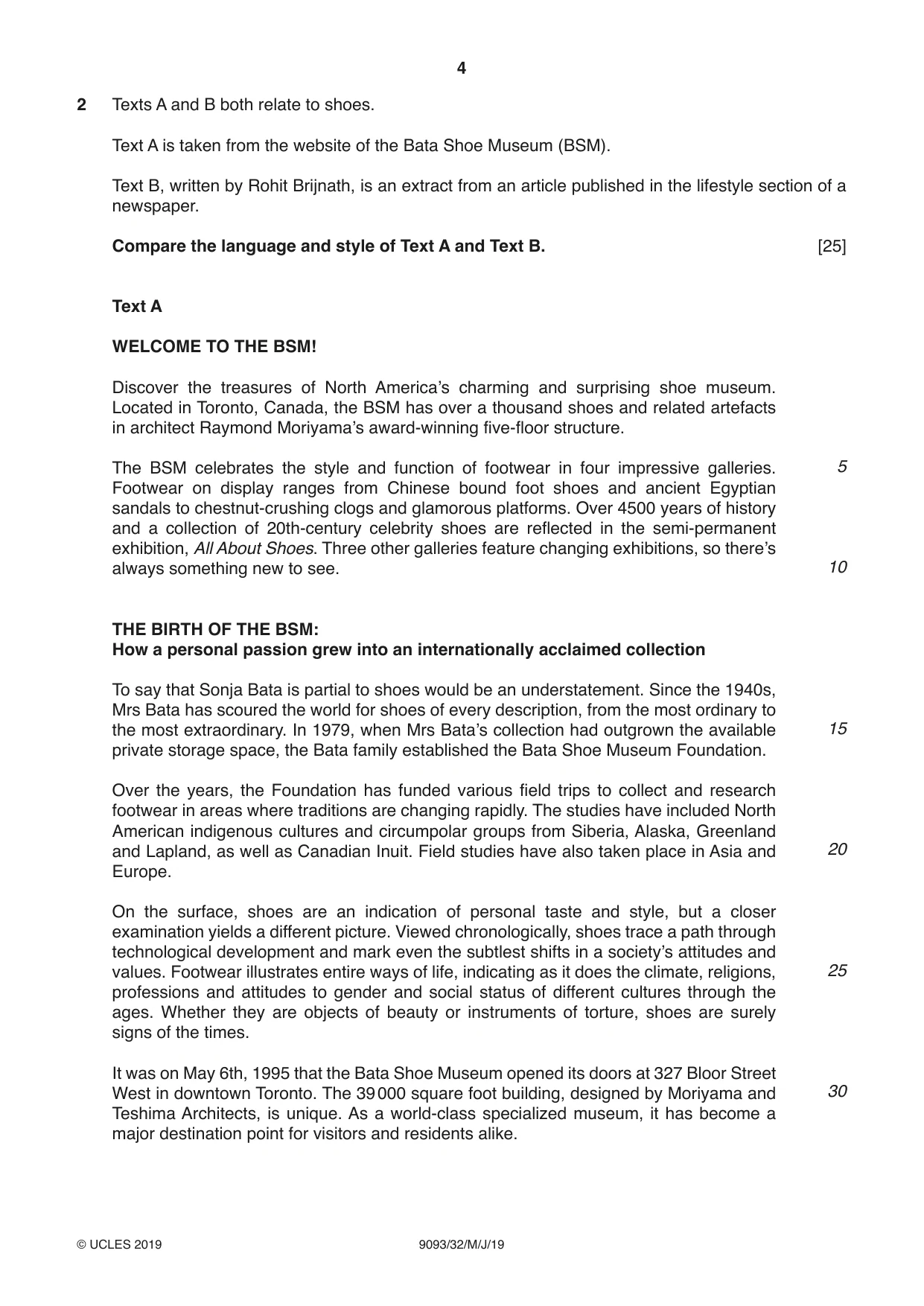
4 9093/32/M/J/19 © UCLES 2019 2 Texts A and B both relate to shoes. Text A is taken from the website of the Bata Shoe Museum (BSM). Text B, written by Rohit Brijnath, is an extract from an article published in the lifestyle section of a newspaper. Compare the language and style of Text A and Text B. [25] Text A WELCOME TO THE BSM! Discover the treasures of North America’s charming and surprising shoe museum. Located in Toronto, Canada, the BSM has over a thousand shoes and related artefacts in architect Raymond Moriyama’s award-winning five-floor structure. The BSM celebrates the style and function of footwear in four impressive galleries. Footwear on display ranges from Chinese bound foot shoes and ancient Egyptian sandals to chestnut-crushing clogs and glamorous platforms. Over 4500 years of history and a collection of 20th-century celebrity shoes are reflected in the semi-permanent exhibition, All About Shoes. Three other galleries feature changing exhibitions, so there’s always something new to see. THE BIRTH OF THE BSM: How a personal passion grew into an internationally acclaimed collection To say that Sonja Bata is partial to shoes would be an understatement. Since the 1940s, Mrs Bata has scoured the world for shoes of every description, from the most ordinary to the most extraordinary. In 1979, when Mrs Bata’s collection had outgrown the available private storage space, the Bata family established the Bata Shoe Museum Foundation. Over the years, the Foundation has funded various field trips to collect and research footwear in areas where traditions are changing rapidly. The studies have included North American indigenous cultures and circumpolar groups from Siberia, Alaska, Greenland and Lapland, as well as Canadian Inuit. Field studies have also taken place in Asia and Europe. On the surface, shoes are an indication of personal taste and style, but a closer examination yields a different picture. Viewed chronologically, shoes trace a path through technological development and mark even the subtlest shifts in a society’s attitudes and values. Footwear illustrates entire ways of life, indicating as it does the climate, religions, professions and attitudes to gender and social status of different cultures through the ages. Whether they are objects of beauty or instruments of torture, shoes are surely signs of the times. It was on May 6th, 1995 that the Bata Shoe Museum opened its doors at 327 Bloor Street West in downtown Toronto. The 39 000 square foot building, designed by Moriyama and Teshima Architects, is unique. As a world-class specialized museum, it has become a major destination point for visitors and residents alike. 5 10 15 20 25 30
Question paper, page 5
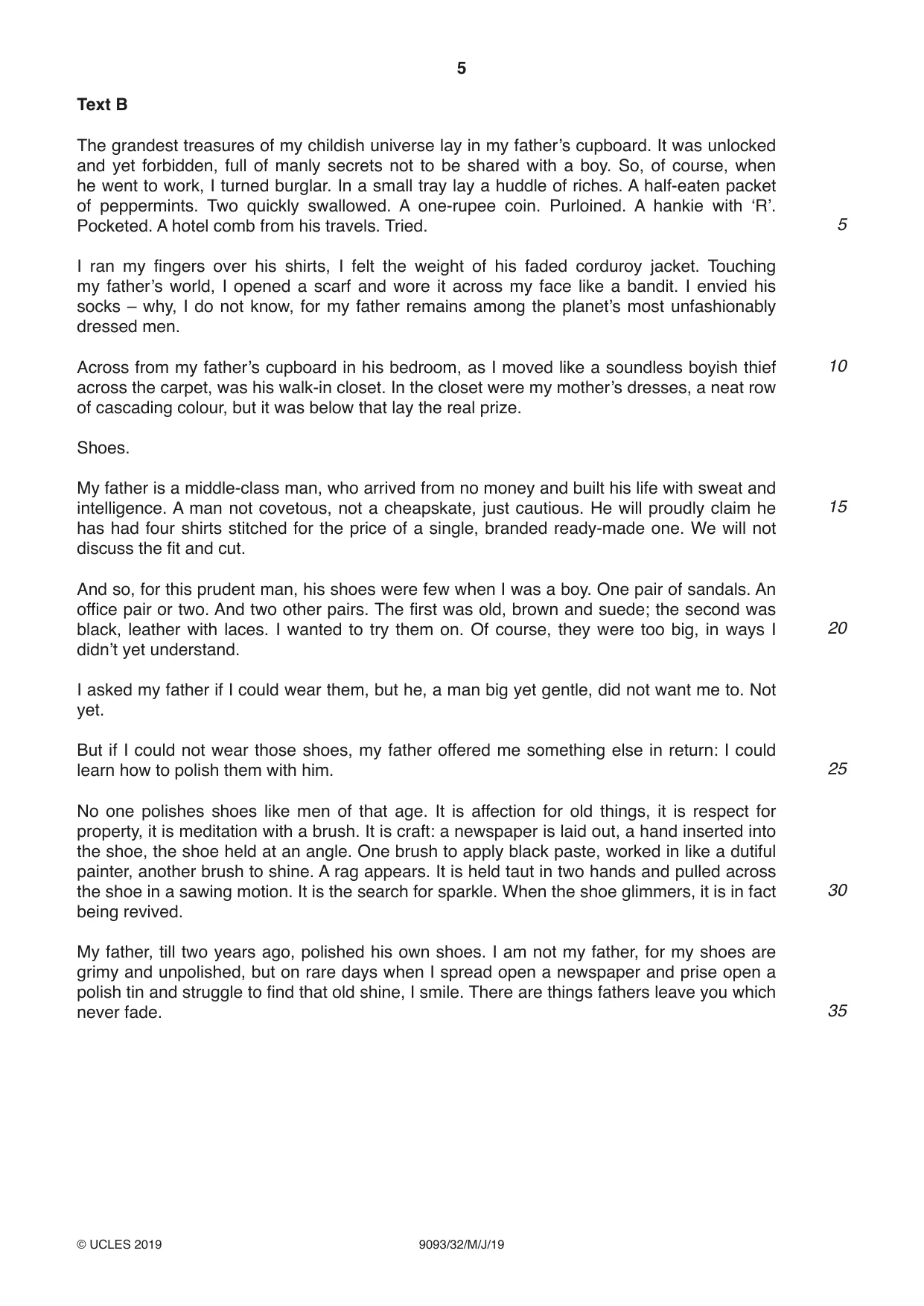
5 9093/32/M/J/19 © UCLES 2019 Text B The grandest treasures of my childish universe lay in my father’s cupboard. It was unlocked and yet forbidden, full of manly secrets not to be shared with a boy. So, of course, when he went to work, I turned burglar. In a small tray lay a huddle of riches. A half-eaten packet of peppermints. Two quickly swallowed. A one-rupee coin. Purloined. A hankie with ‘R’. Pocketed. A hotel comb from his travels. Tried. I ran my fingers over his shirts, I felt the weight of his faded corduroy jacket. Touching my father’s world, I opened a scarf and wore it across my face like a bandit. I envied his socks – why, I do not know, for my father remains among the planet’s most unfashionably dressed men. Across from my father’s cupboard in his bedroom, as I moved like a soundless boyish thief across the carpet, was his walk-in closet. In the closet were my mother’s dresses, a neat row of cascading colour, but it was below that lay the real prize. Shoes. My father is a middle-class man, who arrived from no money and built his life with sweat and intelligence. A man not covetous, not a cheapskate, just cautious. He will proudly claim he has had four shirts stitched for the price of a single, branded ready-made one. We will not discuss the fit and cut. And so, for this prudent man, his shoes were few when I was a boy. One pair of sandals. An office pair or two. And two other pairs. The first was old, brown and suede; the second was black, leather with laces. I wanted to try them on. Of course, they were too big, in ways I didn’t yet understand. I asked my father if I could wear them, but he, a man big yet gentle, did not want me to. Not yet. But if I could not wear those shoes, my father offered me something else in return: I could learn how to polish them with him. No one polishes shoes like men of that age. It is affection for old things, it is respect for property, it is meditation with a brush. It is craft: a newspaper is laid out, a hand inserted into the shoe, the shoe held at an angle. One brush to apply black paste, worked in like a dutiful painter, another brush to shine. A rag appears. It is held taut in two hands and pulled across the shoe in a sawing motion. It is the search for sparkle. When the shoe glimmers, it is in fact being revived. My father, till two years ago, polished his own shoes. I am not my father, for my shoes are grimy and unpolished, but on rare days when I spread open a newspaper and prise open a polish tin and struggle to find that old shine, I smile. There are things fathers leave you which never fade. 5 10 15 20 25 30 35
Question paper, page 6
6 9093/32/M/J/19 © UCLES 2019 BLANK PAGE
Question paper, page 7
7 9093/32/M/J/19 © UCLES 2019 BLANK PAGE
Question paper, page 8
8 9093/32/M/J/19 © UCLES 2019 BLANK PAGE Permission to reproduce items where third-party owned material protected by copyright is included has been sought and cleared where possible. Every reasonable effort has been made by the publisher (UCLES) to trace copyright holders, but if any items requiring clearance have unwittingly been included, the publisher will be pleased to make amends at the earliest possible opportunity. To avoid the issue of disclosure of answer-related information to candidates, all copyright acknowledgements are reproduced online in the Cambridge Assessment International Education Copyright Acknowledgements Booklet. This is produced for each series of examinations and is freely available to download at www.cambridgeinternational.org after the live examination series. Cambridge Assessment International Education is part of the Cambridge Assessment Group. Cambridge Assessment is the brand name of the University of Cambridge Local Examinations Syndicate (UCLES), which itself is a department of the University of Cambridge.
Mark scheme, page 1
This document consists of 8 printed pages. © UCLES 2019 [Turn over Cambridge Assessment International Education Cambridge International Advanced Level ENGLISH LANGUAGE 9093/32 Paper 3 Text Analysis May/June 2019 MARK SCHEME Maximum Mark: 50 Published This mark scheme is published as an aid to teachers and candidates, to indicate the requirements of the examination. It shows the basis on which Examiners were instructed to award marks. It does not indicate the details of the discussions that took place at an Examiners’ meeting before marking began, which would have considered the acceptability of alternative answers. Mark schemes should be read in conjunction with the question paper and the Principal Examiner Report for Teachers. Cambridge International will not enter into discussions about these mark schemes. Cambridge International is publishing the mark schemes for the May/June 2019 series for most Cambridge IGCSE™, Cambridge International A and AS Level and Cambridge Pre-U components, and some Cambridge O Level components.
Mark scheme, page 2
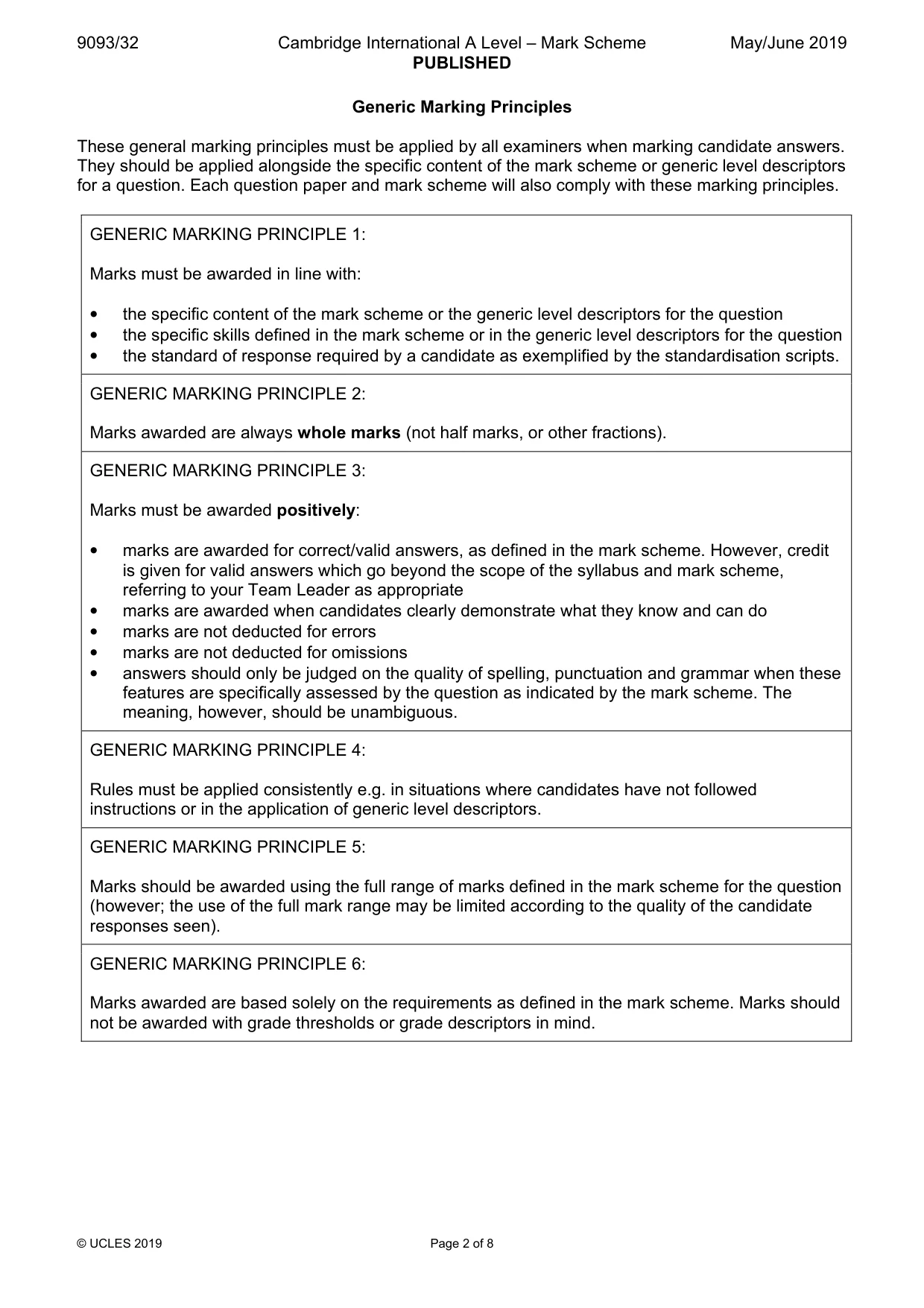
9093/32 Cambridge International A Level – Mark Scheme PUBLISHED May/June 2019 © UCLES 2019 Page 2 of 8 Generic Marking Principles These general marking principles must be applied by all examiners when marking candidate answers. They should be applied alongside the specific content of the mark scheme or generic level descriptors for a question. Each question paper and mark scheme will also comply with these marking principles. GENERIC MARKING PRINCIPLE 1: Marks must be awarded in line with: • the specific content of the mark scheme or the generic level descriptors for the question • the specific skills defined in the mark scheme or in the generic level descriptors for the question • the standard of response required by a candidate as exemplified by the standardisation scripts. GENERIC MARKING PRINCIPLE 2: Marks awarded are always whole marks (not half marks, or other fractions). GENERIC MARKING PRINCIPLE 3: Marks must be awarded positively: • marks are awarded for correct/valid answers, as defined in the mark scheme. However, credit is given for valid answers which go beyond the scope of the syllabus and mark scheme, referring to your Team Leader as appropriate • marks are awarded when candidates clearly demonstrate what they know and can do • marks are not deducted for errors • marks are not deducted for omissions • answers should only be judged on the quality of spelling, punctuation and grammar when these features are specifically assessed by the question as indicated by the mark scheme. The meaning, however, should be unambiguous. GENERIC MARKING PRINCIPLE 4: Rules must be applied consistently e.g. in situations where candidates have not followed instructions or in the application of generic level descriptors. GENERIC MARKING PRINCIPLE 5: Marks should be awarded using the full range of marks defined in the mark scheme for the question (however; the use of the full mark range may be limited according to the quality of the candidate responses seen). GENERIC MARKING PRINCIPLE 6: Marks awarded are based solely on the requirements as defined in the mark scheme. Marks should not be awarded with grade thresholds or grade descriptors in mind.
Mark scheme, page 3
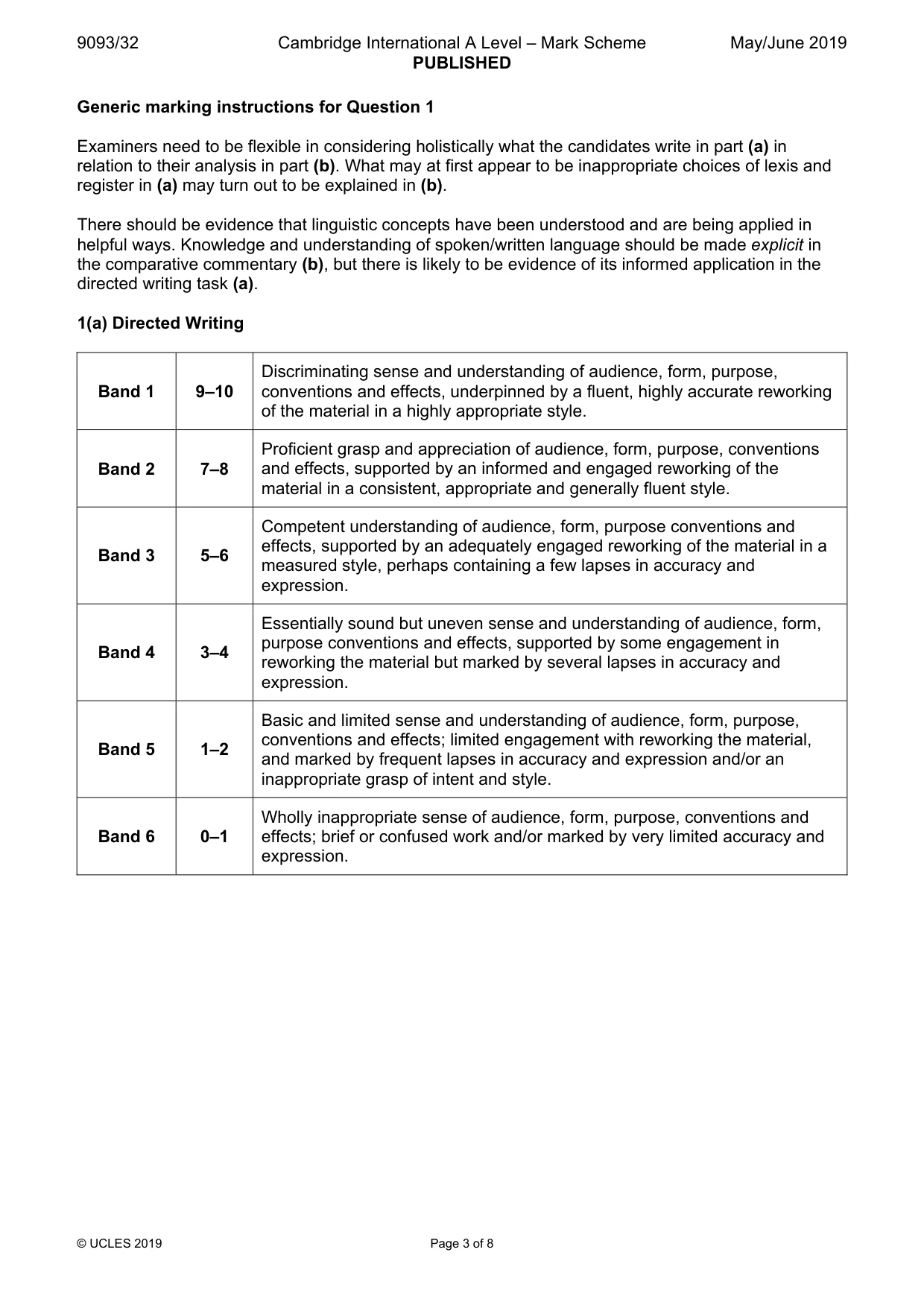
9093/32 Cambridge International A Level – Mark Scheme PUBLISHED May/June 2019 © UCLES 2019 Page 3 of 8 Generic marking instructions for Question 1 Examiners need to be flexible in considering holistically what the candidates write in part (a) in relation to their analysis in part (b). What may at first appear to be inappropriate choices of lexis and register in (a) may turn out to be explained in (b). There should be evidence that linguistic concepts have been understood and are being applied in helpful ways. Knowledge and understanding of spoken/written language should be made explicit in the comparative commentary (b), but there is likely to be evidence of its informed application in the directed writing task (a). 1(a) Directed Writing Band 1 9–10 Discriminating sense and understanding of audience, form, purpose, conventions and effects, underpinned by a fluent, highly accurate reworking of the material in a highly appropriate style. Band 2 7–8 Proficient grasp and appreciation of audience, form, purpose, conventions and effects, supported by an informed and engaged reworking of the material in a consistent, appropriate and generally fluent style. Band 3 5–6 Competent understanding of audience, form, purpose conventions and effects, supported by an adequately engaged reworking of the material in a measured style, perhaps containing a few lapses in accuracy and expression. Band 4 3–4 Essentially sound but uneven sense and understanding of audience, form, purpose conventions and effects, supported by some engagement in reworking the material but marked by several lapses in accuracy and expression. Band 5 1–2 Basic and limited sense and understanding of audience, form, purpose, conventions and effects; limited engagement with reworking the material, and marked by frequent lapses in accuracy and expression and/or an inappropriate grasp of intent and style. Band 6 0–1 Wholly inappropriate sense of audience, form, purpose, conventions and effects; brief or confused work and/or marked by very limited accuracy and expression.
Mark scheme, page 4
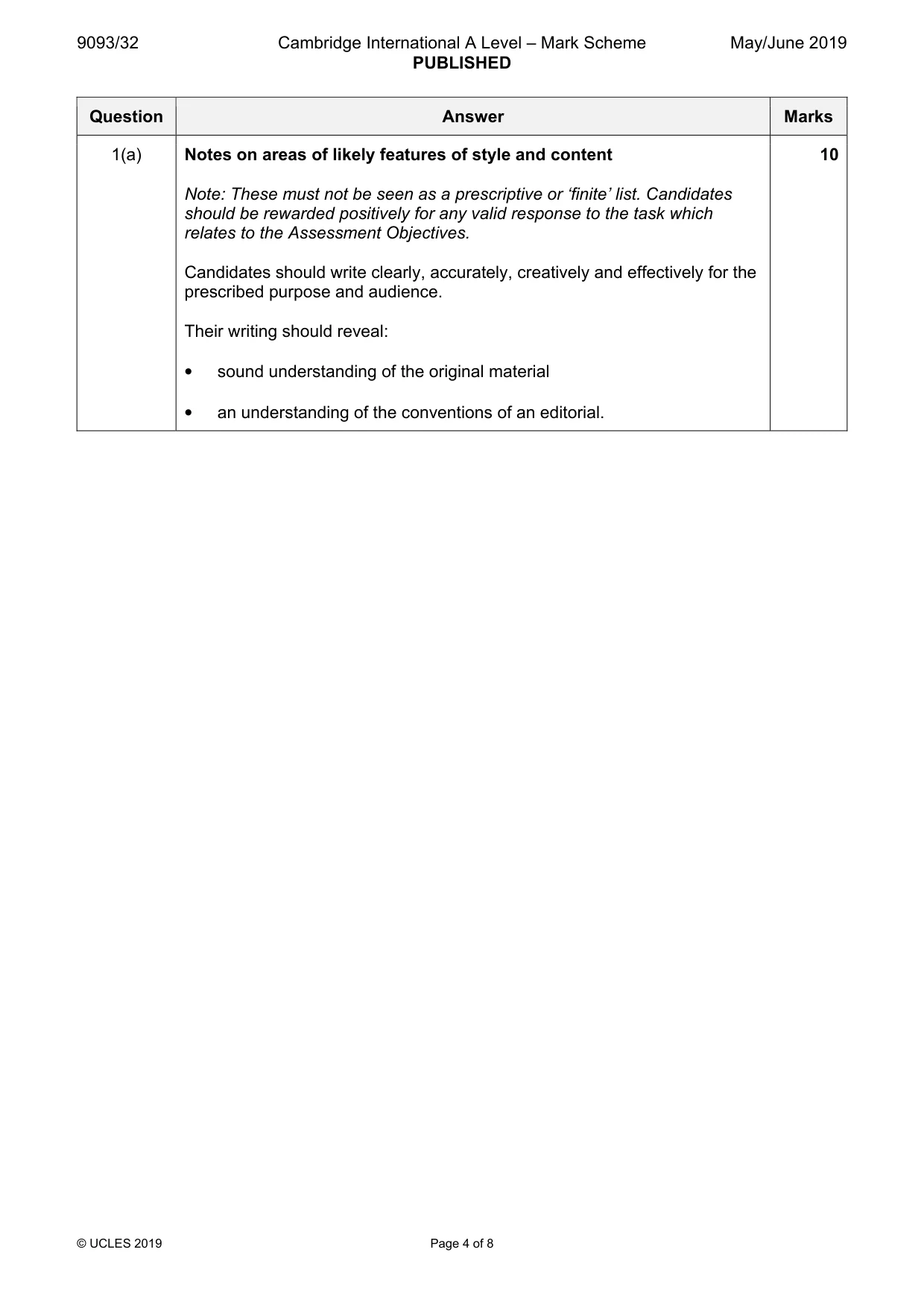
9093/32 Cambridge International A Level – Mark Scheme PUBLISHED May/June 2019 © UCLES 2019 Page 4 of 8 Question Answer Marks 1(a) Notes on areas of likely features of style and content Note: These must not be seen as a prescriptive or ‘finite’ list. Candidates should be rewarded positively for any valid response to the task which relates to the Assessment Objectives. Candidates should write clearly, accurately, creatively and effectively for the prescribed purpose and audience. Their writing should reveal: • sound understanding of the original material • an understanding of the conventions of an editorial. 10
Mark scheme, page 5
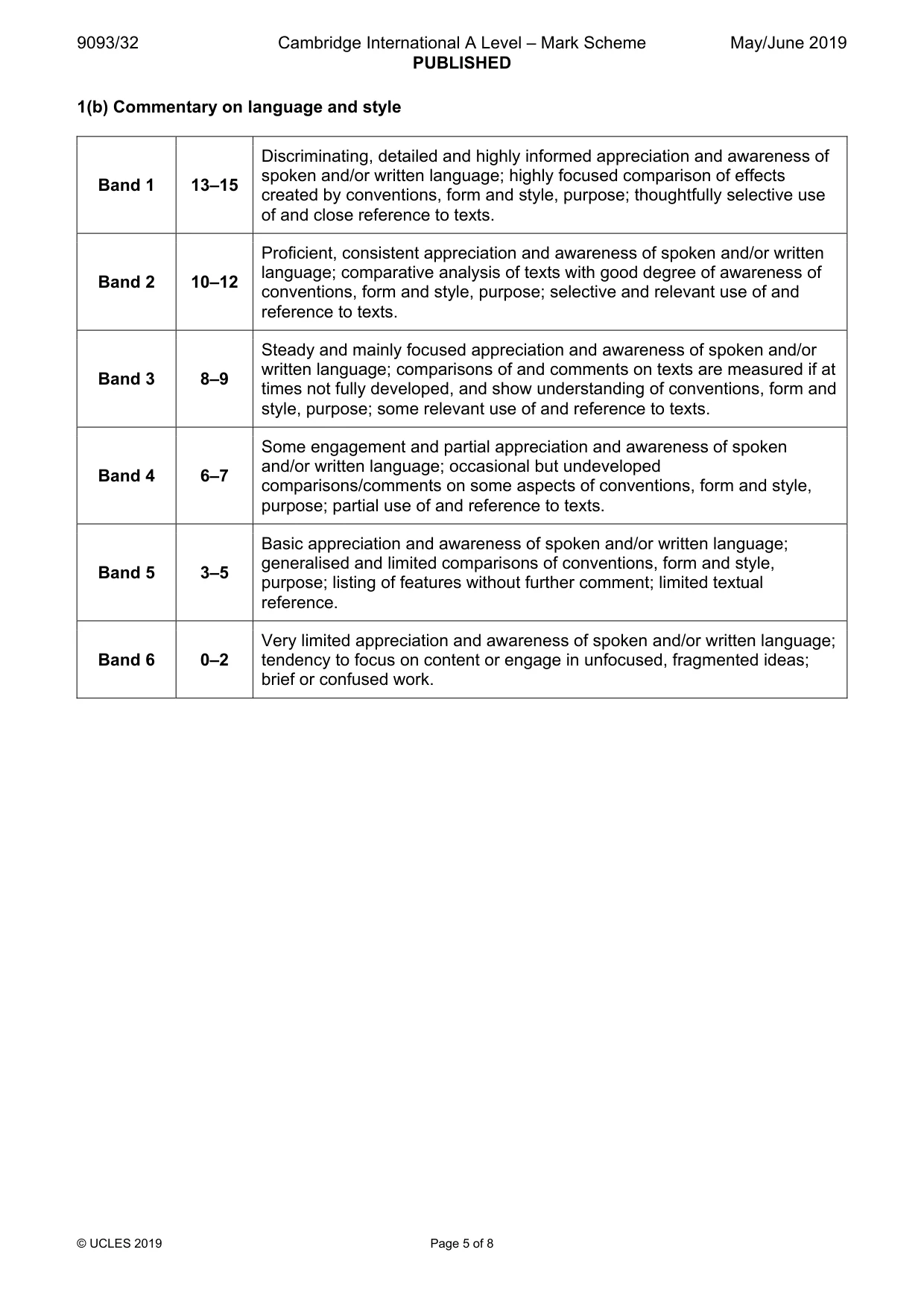
9093/32 Cambridge International A Level – Mark Scheme PUBLISHED May/June 2019 © UCLES 2019 Page 5 of 8 1(b) Commentary on language and style Band 1 13–15 Discriminating, detailed and highly informed appreciation and awareness of spoken and/or written language; highly focused comparison of effects created by conventions, form and style, purpose; thoughtfully selective use of and close reference to texts. Band 2 10–12 Proficient, consistent appreciation and awareness of spoken and/or written language; comparative analysis of texts with good degree of awareness of conventions, form and style, purpose; selective and relevant use of and reference to texts. Band 3 8–9 Steady and mainly focused appreciation and awareness of spoken and/or written language; comparisons of and comments on texts are measured if at times not fully developed, and show understanding of conventions, form and style, purpose; some relevant use of and reference to texts. Band 4 6–7 Some engagement and partial appreciation and awareness of spoken and/or written language; occasional but undeveloped comparisons/comments on some aspects of conventions, form and style, purpose; partial use of and reference to texts. Band 5 3–5 Basic appreciation and awareness of spoken and/or written language; generalised and limited comparisons of conventions, form and style, purpose; listing of features without further comment; limited textual reference. Band 6 0–2 Very limited appreciation and awareness of spoken and/or written language; tendency to focus on content or engage in unfocused, fragmented ideas; brief or confused work.
Mark scheme, page 6
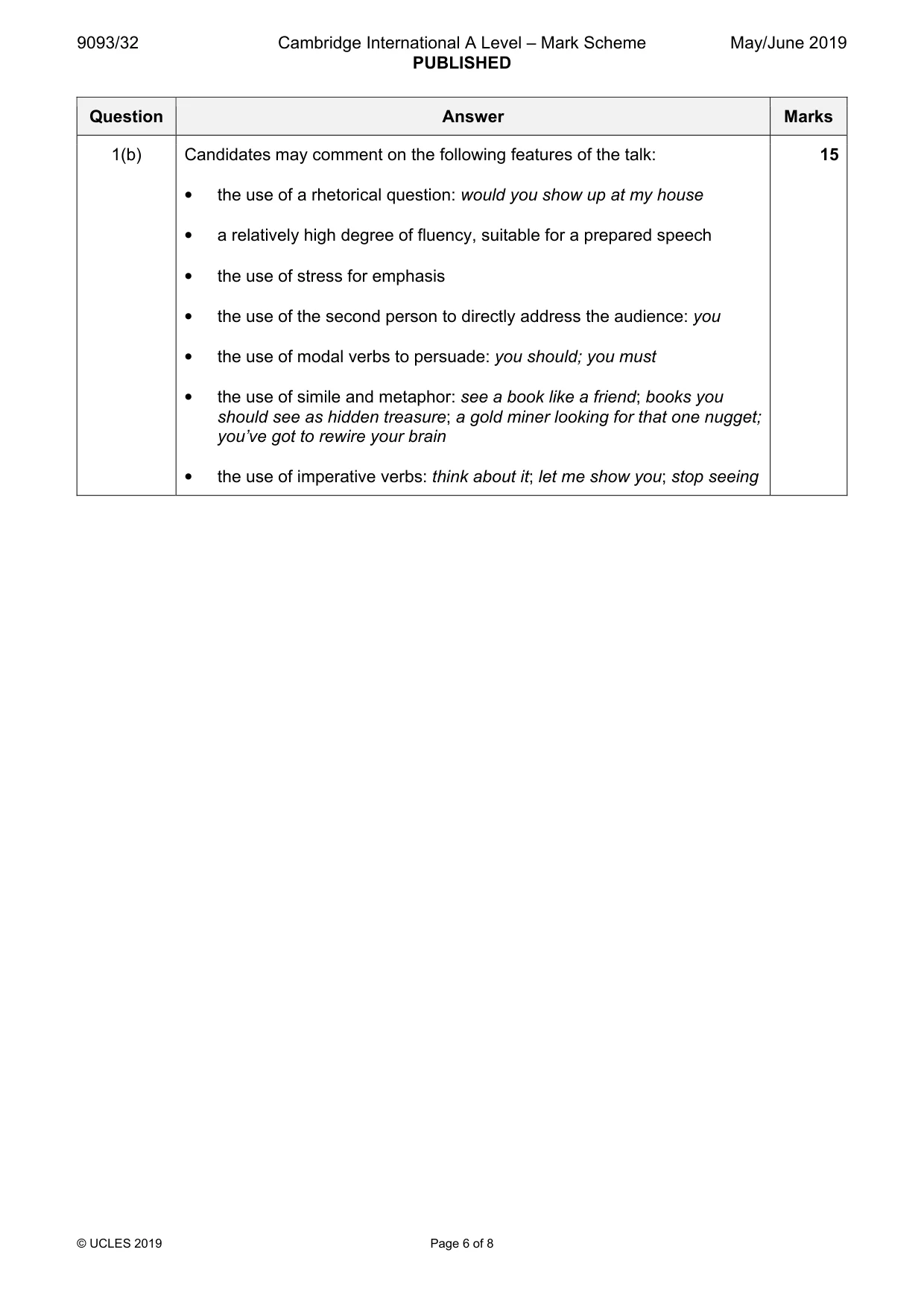
9093/32 Cambridge International A Level – Mark Scheme PUBLISHED May/June 2019 © UCLES 2019 Page 6 of 8 Question Answer Marks 1(b) Candidates may comment on the following features of the talk: • the use of a rhetorical question: would you show up at my house • a relatively high degree of fluency, suitable for a prepared speech • the use of stress for emphasis • the use of the second person to directly address the audience: you • the use of modal verbs to persuade: you should; you must • the use of simile and metaphor: see a book like a friend; books you should see as hidden treasure; a gold miner looking for that one nugget; you’ve got to rewire your brain • the use of imperative verbs: think about it; let me show you; stop seeing 15
Mark scheme, page 7
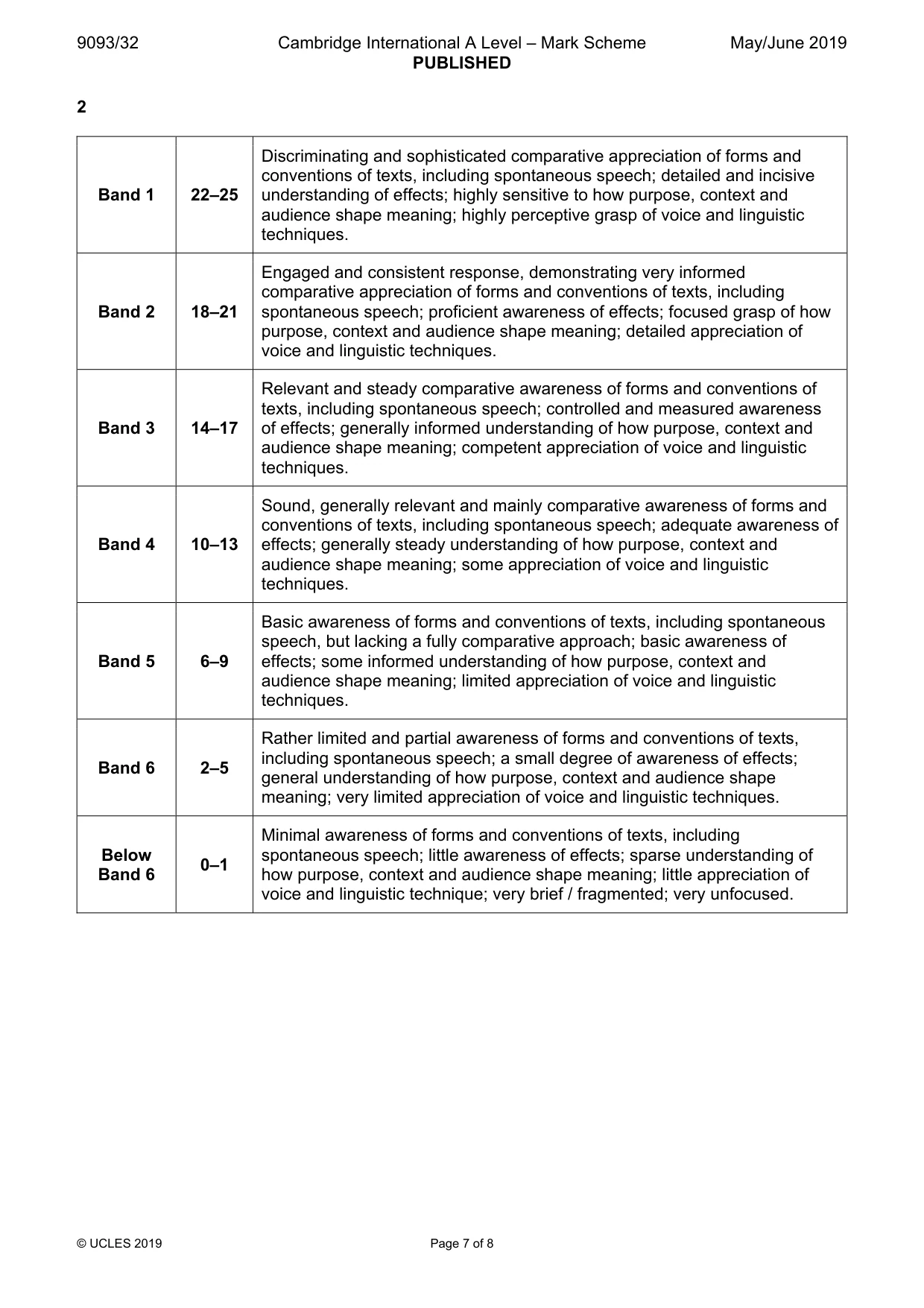
9093/32 Cambridge International A Level – Mark Scheme PUBLISHED May/June 2019 © UCLES 2019 Page 7 of 8 2 Band 1 22–25 Discriminating and sophisticated comparative appreciation of forms and conventions of texts, including spontaneous speech; detailed and incisive understanding of effects; highly sensitive to how purpose, context and audience shape meaning; highly perceptive grasp of voice and linguistic techniques. Band 2 18–21 Engaged and consistent response, demonstrating very informed comparative appreciation of forms and conventions of texts, including spontaneous speech; proficient awareness of effects; focused grasp of how purpose, context and audience shape meaning; detailed appreciation of voice and linguistic techniques. Band 3 14–17 Relevant and steady comparative awareness of forms and conventions of texts, including spontaneous speech; controlled and measured awareness of effects; generally informed understanding of how purpose, context and audience shape meaning; competent appreciation of voice and linguistic techniques. Band 4 10–13 Sound, generally relevant and mainly comparative awareness of forms and conventions of texts, including spontaneous speech; adequate awareness of effects; generally steady understanding of how purpose, context and audience shape meaning; some appreciation of voice and linguistic techniques. Band 5 6–9 Basic awareness of forms and conventions of texts, including spontaneous speech, but lacking a fully comparative approach; basic awareness of effects; some informed understanding of how purpose, context and audience shape meaning; limited appreciation of voice and linguistic techniques. Band 6 2–5 Rather limited and partial awareness of forms and conventions of texts, including spontaneous speech; a small degree of awareness of effects; general understanding of how purpose, context and audience shape meaning; very limited appreciation of voice and linguistic techniques. Below Band 6 0–1 Minimal awareness of forms and conventions of texts, including spontaneous speech; little awareness of effects; sparse understanding of how purpose, context and audience shape meaning; little appreciation of voice and linguistic technique; very brief / fragmented; very unfocused.
Mark scheme, page 8
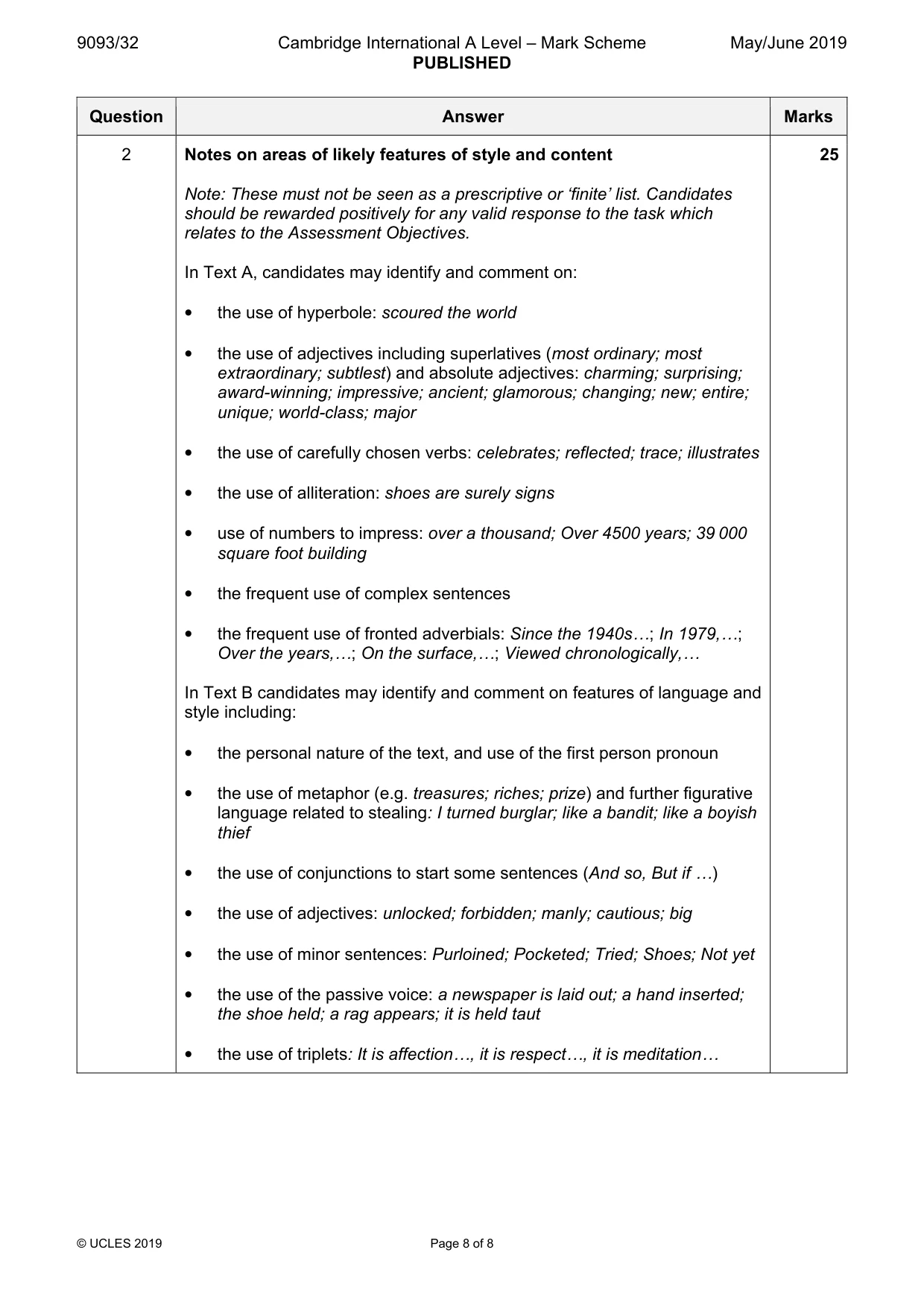
9093/32 Cambridge International A Level – Mark Scheme PUBLISHED May/June 2019 © UCLES 2019 Page 8 of 8 Question Answer Marks 2 Notes on areas of likely features of style and content Note: These must not be seen as a prescriptive or ‘finite’ list. Candidates should be rewarded positively for any valid response to the task which relates to the Assessment Objectives. In Text A, candidates may identify and comment on: • the use of hyperbole: scoured the world • the use of adjectives including superlatives (most ordinary; most extraordinary; subtlest) and absolute adjectives: charming; surprising; award-winning; impressive; ancient; glamorous; changing; new; entire; unique; world-class; major • the use of carefully chosen verbs: celebrates; reflected; trace; illustrates • the use of alliteration: shoes are surely signs • use of numbers to impress: over a thousand; Over 4500 years; 39 000 square foot building • the frequent use of complex sentences • the frequent use of fronted adverbials: Since the 1940s«; In 1979,«; Over the years,«; On the surface,«; Viewed chronologically,« In Text B candidates may identify and comment on features of language and style including: • the personal nature of the text, and use of the first person pronoun • the use of metaphor (e.g. treasures; riches; prize) and further figurative language related to stealing: I turned burglar; like a bandit; like a boyish thief • the use of conjunctions to start some sentences (And so, But if «) • the use of adjectives: unlocked; forbidden; manly; cautious; big • the use of minor sentences: Purloined; Pocketed; Tried; Shoes; Not yet • the use of the passive voice: a newspaper is laid out; a hand inserted; the shoe held; a rag appears; it is held taut • the use of triplets: It is affection«, it is respect«, it is meditation« 25
What you needed in this session
Cambridge’s own grade thresholds for 2019 May/June, Paper 3 · Variant 2. A higher threshold means an easier paper — the bar moves with how the cohort did.