Cambridge A Level English - Language AS and A Level (from 2014) 9093 — 2019 May/June Paper 3 · Variant 1
9093/31/M/J/19 · 50 marks · ≈56 min
The question paper and its mark scheme, free to read here and free to download. This is Cambridge’s own paper, exactly as it was sat.
Question paper8 pages




Mark scheme8 pages
Answers below. Sit the paper first if you are practising.
Paper as text
Question paper, page 1
This document consists of 5 printed pages, 3 blank pages and 1 Insert. DC (LT) 162669/1 © UCLES 2019 [Turn over Cambridge Assessment International Education Cambridge International Advanced Subsidiary and Advanced Level * 8 1 5 6 8 0 5 4 4 4 * ENGLISH LANGUAGE 9093/31 Paper 3 Text Analysis May/June 2019 2 hours 15 minutes No Additional Materials are required. READ THESE INSTRUCTIONS FIRST An answer booklet is provided inside this question paper. You should follow the instructions on the front cover of the answer booklet. If you need additional answer paper, ask the invigilator for a continuation booklet. Answer two questions. You should spend about 15 minutes reading the passages and questions before you start writing your answers. You are reminded of the need for good English and clear presentation in your answers. The number of marks is given in brackets [ ] at the end of each question or part question. Both questions carry equal marks.
Question paper, page 2
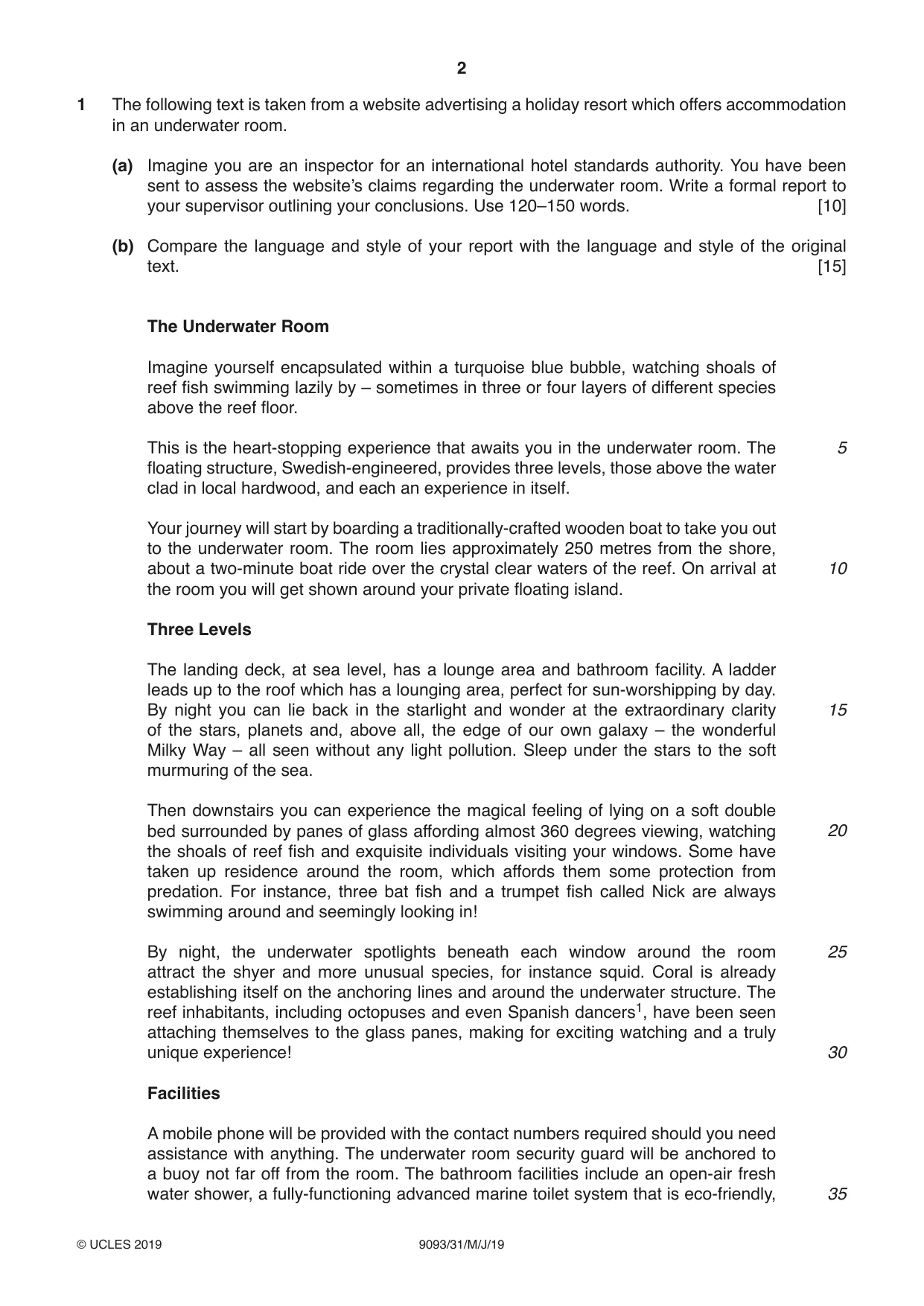
2 9093/31/M/J/19 © UCLES 2019 1 The following text is taken from a website advertising a holiday resort which offers accommodation in an underwater room. (a) Imagine you are an inspector for an international hotel standards authority. You have been sent to assess the website’s claims regarding the underwater room. Write a formal report to your supervisor outlining your conclusions. Use 120–150 words. [10] (b) Compare the language and style of your report with the language and style of the original text. [15] The Underwater Room Imagine yourself encapsulated within a turquoise blue bubble, watching shoals of reef fish swimming lazily by – sometimes in three or four layers of different species above the reef floor. This is the heart-stopping experience that awaits you in the underwater room. The floating structure, Swedish-engineered, provides three levels, those above the water clad in local hardwood, and each an experience in itself. Your journey will start by boarding a traditionally-crafted wooden boat to take you out to the underwater room. The room lies approximately 250 metres from the shore, about a two-minute boat ride over the crystal clear waters of the reef. On arrival at the room you will get shown around your private floating island. Three Levels The landing deck, at sea level, has a lounge area and bathroom facility. A ladder leads up to the roof which has a lounging area, perfect for sun-worshipping by day. By night you can lie back in the starlight and wonder at the extraordinary clarity of the stars, planets and, above all, the edge of our own galaxy – the wonderful Milky Way – all seen without any light pollution. Sleep under the stars to the soft murmuring of the sea. Then downstairs you can experience the magical feeling of lying on a soft double bed surrounded by panes of glass affording almost 360 degrees viewing, watching the shoals of reef fish and exquisite individuals visiting your windows. Some have taken up residence around the room, which affords them some protection from predation. For instance, three bat fish and a trumpet fish called Nick are always swimming around and seemingly looking in! By night, the underwater spotlights beneath each window around the room attract the shyer and more unusual species, for instance squid. Coral is already establishing itself on the anchoring lines and around the underwater structure. The reef inhabitants, including octopuses and even Spanish dancers1, have been seen attaching themselves to the glass panes, making for exciting watching and a truly unique experience! Facilities A mobile phone will be provided with the contact numbers required should you need assistance with anything. The underwater room security guard will be anchored to a buoy not far off from the room. The bathroom facilities include an open-air fresh water shower, a fully-functioning advanced marine toilet system that is eco-friendly, 5 10 15 20 25 30 35
Question paper, page 3
3 9093/31/M/J/19 © UCLES 2019 [Turn over and a small hand-wash basin. We will provide all necessary environmentally friendly, biodegradable shower products. A fully-stocked bar fridge is there for your convenience. 1Spanish dancers: large, colourful sea slugs
Question paper, page 4
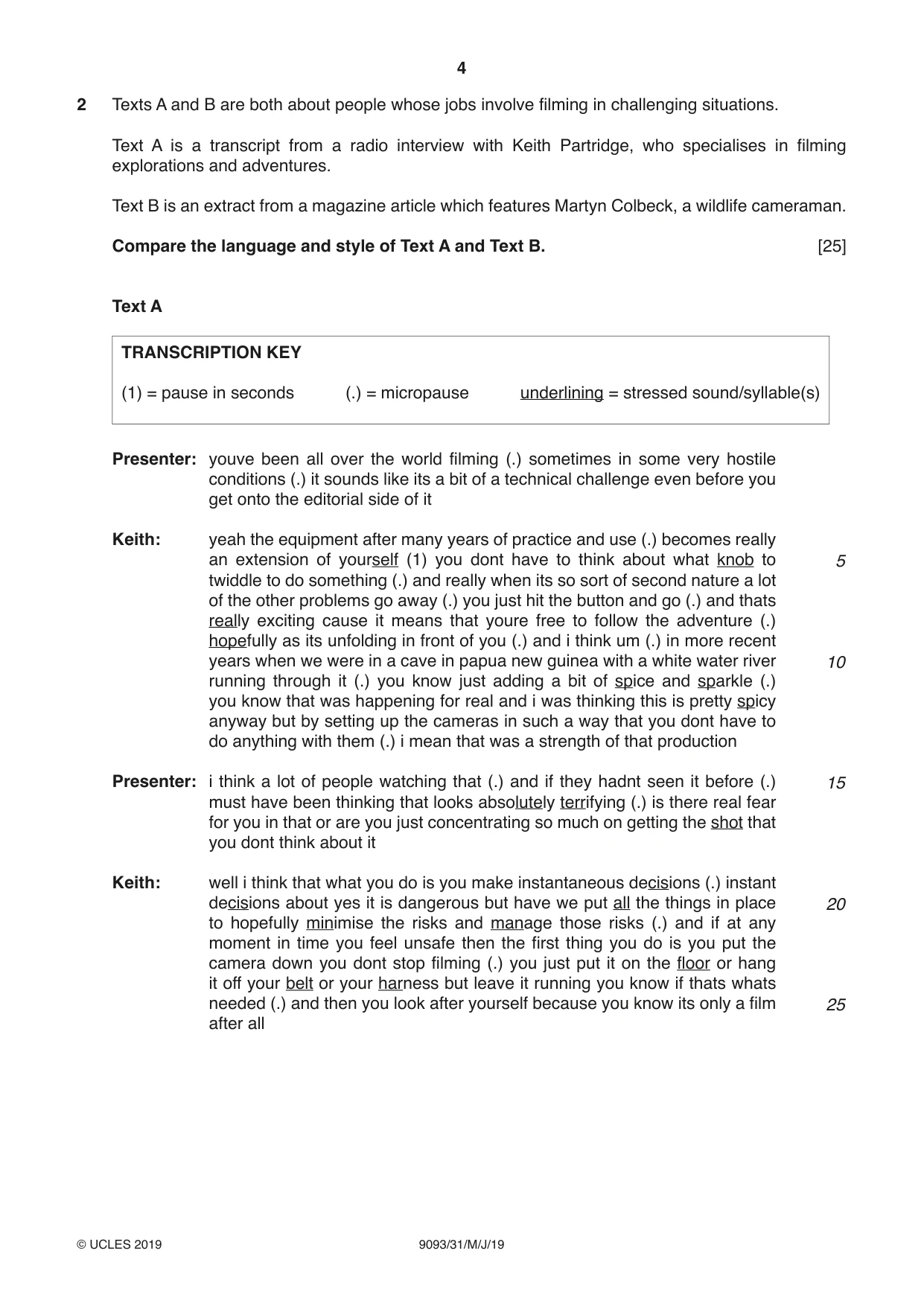
4 9093/31/M/J/19 © UCLES 2019 2 Texts A and B are both about people whose jobs involve filming in challenging situations. Text A is a transcript from a radio interview with Keith Partridge, who specialises in filming explorations and adventures. Text B is an extract from a magazine article which features Martyn Colbeck, a wildlife cameraman. Compare the language and style of Text A and Text B. [25] Text A TRANSCRIPTION KEY (1) = pause in seconds (.) = micropause underlining = stressed sound/syllable(s) Presenter: youve been all over the world filming (.) sometimes in some very hostile conditions (.) it sounds like its a bit of a technical challenge even before you get onto the editorial side of it Keith: yeah the equipment after many years of practice and use (.) becomes really an extension of yourself (1) you dont have to think about what knob to twiddle to do something (.) and really when its so sort of second nature a lot of the other problems go away (.) you just hit the button and go (.) and thats really exciting cause it means that youre free to follow the adventure (.) hopefully as its unfolding in front of you (.) and i think um (.) in more recent years when we were in a cave in papua new guinea with a white water river running through it (.) you know just adding a bit of spice and sparkle (.) you know that was happening for real and i was thinking this is pretty spicy anyway but by setting up the cameras in such a way that you dont have to do anything with them (.) i mean that was a strength of that production Presenter: i think a lot of people watching that (.) and if they hadnt seen it before (.) must have been thinking that looks absolutely terrifying (.) is there real fear for you in that or are you just concentrating so much on getting the shot that you dont think about it Keith: well i think that what you do is you make instantaneous decisions (.) instant decisions about yes it is dangerous but have we put all the things in place to hopefully minimise the risks and manage those risks (.) and if at any moment in time you feel unsafe then the first thing you do is you put the camera down you dont stop filming (.) you just put it on the floor or hang it off your belt or your harness but leave it running you know if thats whats needed (.) and then you look after yourself because you know its only a film after all 5 10 15 20 25
Question paper, page 5
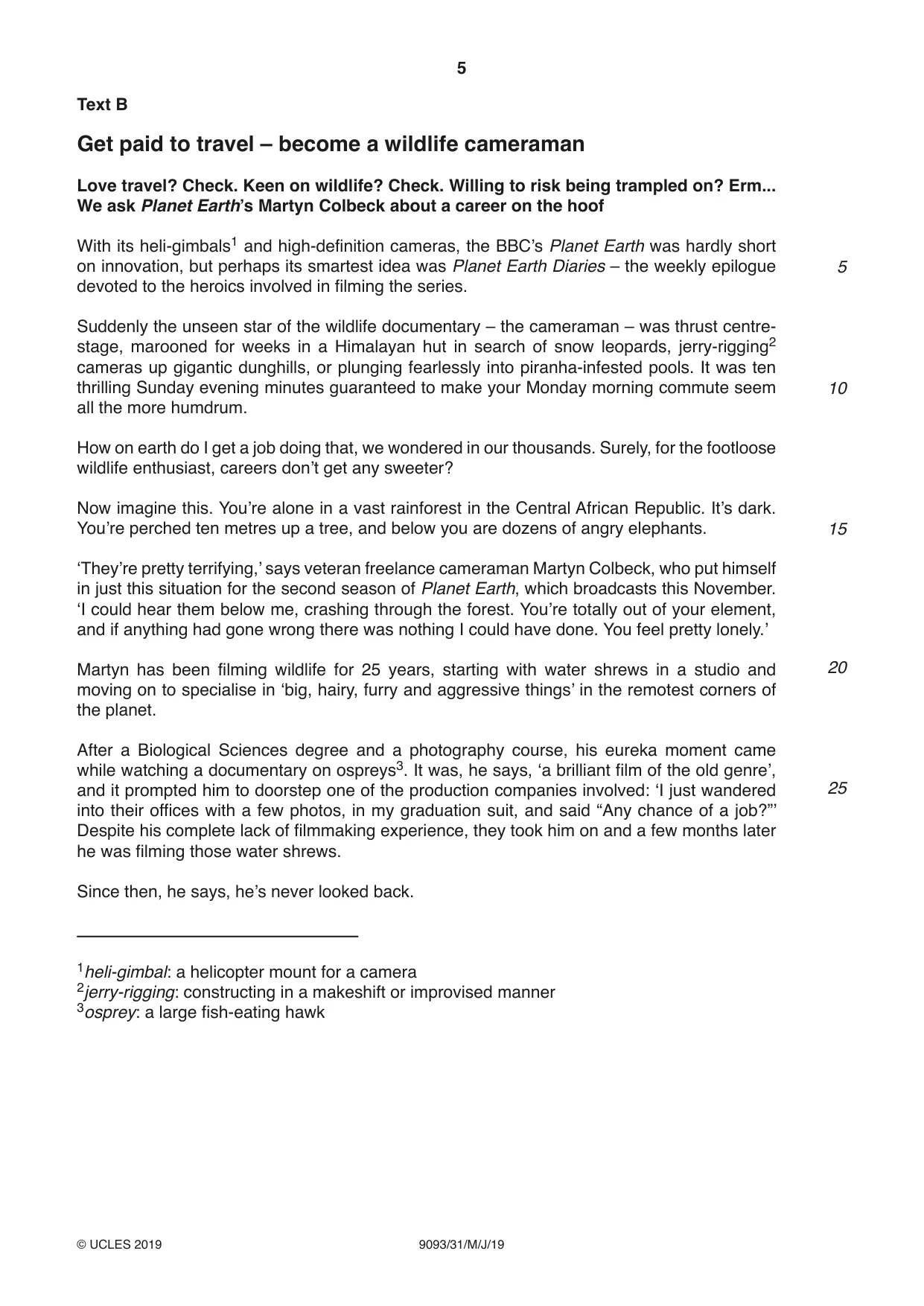
5 9093/31/M/J/19 © UCLES 2019 Text B Get paid to travel – become a wildlife cameraman Love travel? Check. Keen on wildlife? Check. Willing to risk being trampled on? Erm... We ask Planet Earth’s Martyn Colbeck about a career on the hoof With its heli-gimbals1 and high-definition cameras, the BBC’s Planet Earth was hardly short on innovation, but perhaps its smartest idea was Planet Earth Diaries – the weekly epilogue devoted to the heroics involved in filming the series. Suddenly the unseen star of the wildlife documentary – the cameraman – was thrust centre- stage, marooned for weeks in a Himalayan hut in search of snow leopards, jerry-rigging2 cameras up gigantic dunghills, or plunging fearlessly into piranha-infested pools. It was ten thrilling Sunday evening minutes guaranteed to make your Monday morning commute seem all the more humdrum. How on earth do I get a job doing that, we wondered in our thousands. Surely, for the footloose wildlife enthusiast, careers don’t get any sweeter? Now imagine this. You’re alone in a vast rainforest in the Central African Republic. It’s dark. You’re perched ten metres up a tree, and below you are dozens of angry elephants. ‘They’re pretty terrifying,’ says veteran freelance cameraman Martyn Colbeck, who put himself in just this situation for the second season of Planet Earth, which broadcasts this November. ‘I could hear them below me, crashing through the forest. You’re totally out of your element, and if anything had gone wrong there was nothing I could have done. You feel pretty lonely.’ Martyn has been filming wildlife for 25 years, starting with water shrews in a studio and moving on to specialise in ‘big, hairy, furry and aggressive things’ in the remotest corners of the planet. After a Biological Sciences degree and a photography course, his eureka moment came while watching a documentary on ospreys3. It was, he says, ‘a brilliant film of the old genre’, and it prompted him to doorstep one of the production companies involved: ‘I just wandered into their offices with a few photos, in my graduation suit, and said “Any chance of a job?”’ Despite his complete lack of filmmaking experience, they took him on and a few months later he was filming those water shrews. Since then, he says, he’s never looked back. 1heli-gimbal: a helicopter mount for a camera 2jerry-rigging: constructing in a makeshift or improvised manner 3osprey: a large fish-eating hawk 5 10 15 20 25
Question paper, page 6
6 9093/31/M/J/19 © UCLES 2019 BLANK PAGE
Question paper, page 7
7 9093/31/M/J/19 © UCLES 2019 BLANK PAGE
Question paper, page 8
8 9093/31/M/J/19 © UCLES 2019 BLANK PAGE Permission to reproduce items where third-party owned material protected by copyright is included has been sought and cleared where possible. Every reasonable effort has been made by the publisher (UCLES) to trace copyright holders, but if any items requiring clearance have unwittingly been included, the publisher will be pleased to make amends at the earliest possible opportunity. To avoid the issue of disclosure of answer-related information to candidates, all copyright acknowledgements are reproduced online in the Cambridge Assessment International Education Copyright Acknowledgements Booklet. This is produced for each series of examinations and is freely available to download at www.cambridgeinternational.org after the live examination series. Cambridge Assessment International Education is part of the Cambridge Assessment Group. Cambridge Assessment is the brand name of the University of Cambridge Local Examinations Syndicate (UCLES), which itself is a department of the University of Cambridge.
Mark scheme, page 1
This document consists of 8 printed pages. © UCLES 2019 [Turn over Cambridge Assessment International Education Cambridge International Advanced Level ENGLISH LANGUAGE 9093/31 Paper 3 Text Analysis May/June 2019 MARK SCHEME Maximum Mark: 50 Published This mark scheme is published as an aid to teachers and candidates, to indicate the requirements of the examination. It shows the basis on which Examiners were instructed to award marks. It does not indicate the details of the discussions that took place at an Examiners’ meeting before marking began, which would have considered the acceptability of alternative answers. Mark schemes should be read in conjunction with the question paper and the Principal Examiner Report for Teachers. Cambridge International will not enter into discussions about these mark schemes. Cambridge International is publishing the mark schemes for the May/June 2019 series for most Cambridge IGCSE™, Cambridge International A and AS Level and Cambridge Pre-U components, and some Cambridge O Level components.
Mark scheme, page 2
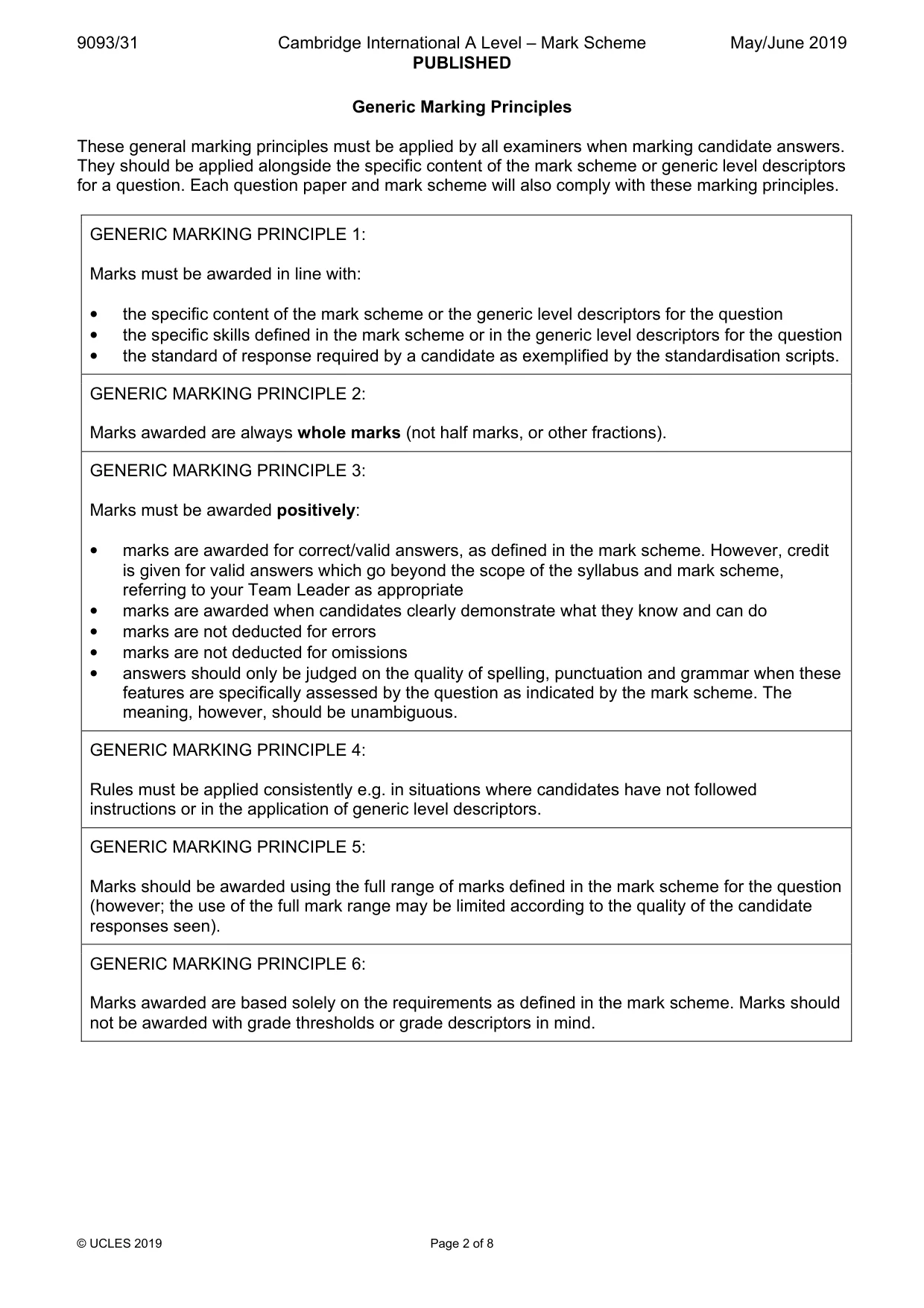
9093/31 Cambridge International A Level – Mark Scheme PUBLISHED May/June 2019 © UCLES 2019 Page 2 of 8 Generic Marking Principles These general marking principles must be applied by all examiners when marking candidate answers. They should be applied alongside the specific content of the mark scheme or generic level descriptors for a question. Each question paper and mark scheme will also comply with these marking principles. GENERIC MARKING PRINCIPLE 1: Marks must be awarded in line with: • the specific content of the mark scheme or the generic level descriptors for the question • the specific skills defined in the mark scheme or in the generic level descriptors for the question • the standard of response required by a candidate as exemplified by the standardisation scripts. GENERIC MARKING PRINCIPLE 2: Marks awarded are always whole marks (not half marks, or other fractions). GENERIC MARKING PRINCIPLE 3: Marks must be awarded positively: • marks are awarded for correct/valid answers, as defined in the mark scheme. However, credit is given for valid answers which go beyond the scope of the syllabus and mark scheme, referring to your Team Leader as appropriate • marks are awarded when candidates clearly demonstrate what they know and can do • marks are not deducted for errors • marks are not deducted for omissions • answers should only be judged on the quality of spelling, punctuation and grammar when these features are specifically assessed by the question as indicated by the mark scheme. The meaning, however, should be unambiguous. GENERIC MARKING PRINCIPLE 4: Rules must be applied consistently e.g. in situations where candidates have not followed instructions or in the application of generic level descriptors. GENERIC MARKING PRINCIPLE 5: Marks should be awarded using the full range of marks defined in the mark scheme for the question (however; the use of the full mark range may be limited according to the quality of the candidate responses seen). GENERIC MARKING PRINCIPLE 6: Marks awarded are based solely on the requirements as defined in the mark scheme. Marks should not be awarded with grade thresholds or grade descriptors in mind.
Mark scheme, page 3
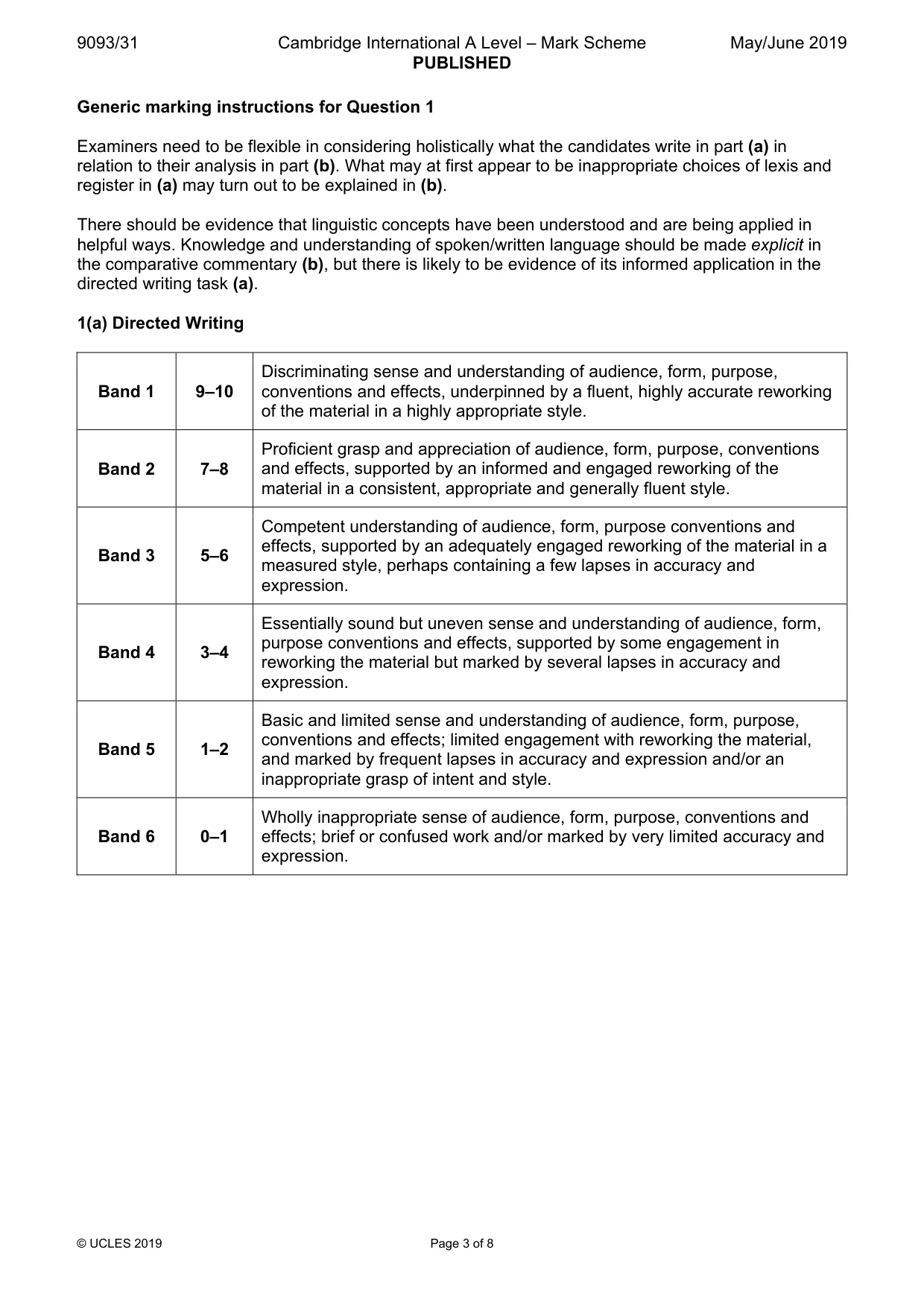
9093/31 Cambridge International A Level – Mark Scheme PUBLISHED May/June 2019 © UCLES 2019 Page 3 of 8 Generic marking instructions for Question 1 Examiners need to be flexible in considering holistically what the candidates write in part (a) in relation to their analysis in part (b). What may at first appear to be inappropriate choices of lexis and register in (a) may turn out to be explained in (b). There should be evidence that linguistic concepts have been understood and are being applied in helpful ways. Knowledge and understanding of spoken/written language should be made explicit in the comparative commentary (b), but there is likely to be evidence of its informed application in the directed writing task (a). 1(a) Directed Writing Band 1 9–10 Discriminating sense and understanding of audience, form, purpose, conventions and effects, underpinned by a fluent, highly accurate reworking of the material in a highly appropriate style. Band 2 7–8 Proficient grasp and appreciation of audience, form, purpose, conventions and effects, supported by an informed and engaged reworking of the material in a consistent, appropriate and generally fluent style. Band 3 5–6 Competent understanding of audience, form, purpose conventions and effects, supported by an adequately engaged reworking of the material in a measured style, perhaps containing a few lapses in accuracy and expression. Band 4 3–4 Essentially sound but uneven sense and understanding of audience, form, purpose conventions and effects, supported by some engagement in reworking the material but marked by several lapses in accuracy and expression. Band 5 1–2 Basic and limited sense and understanding of audience, form, purpose, conventions and effects; limited engagement with reworking the material, and marked by frequent lapses in accuracy and expression and/or an inappropriate grasp of intent and style. Band 6 0–1 Wholly inappropriate sense of audience, form, purpose, conventions and effects; brief or confused work and/or marked by very limited accuracy and expression.
Mark scheme, page 4
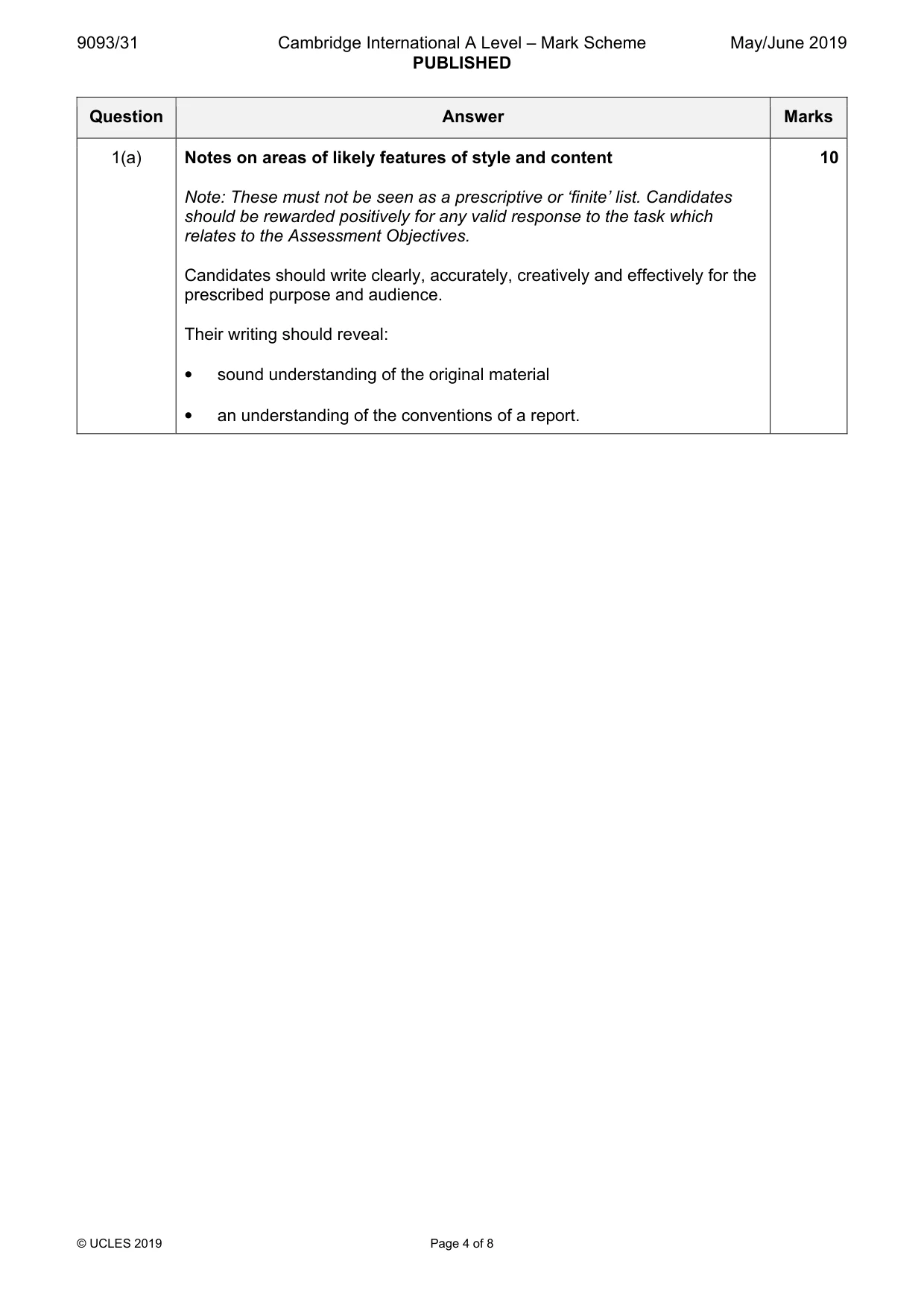
9093/31 Cambridge International A Level – Mark Scheme PUBLISHED May/June 2019 © UCLES 2019 Page 4 of 8 Question Answer Marks 1(a) Notes on areas of likely features of style and content Note: These must not be seen as a prescriptive or ‘finite’ list. Candidates should be rewarded positively for any valid response to the task which relates to the Assessment Objectives. Candidates should write clearly, accurately, creatively and effectively for the prescribed purpose and audience. Their writing should reveal: • sound understanding of the original material • an understanding of the conventions of a report. 10
Mark scheme, page 5
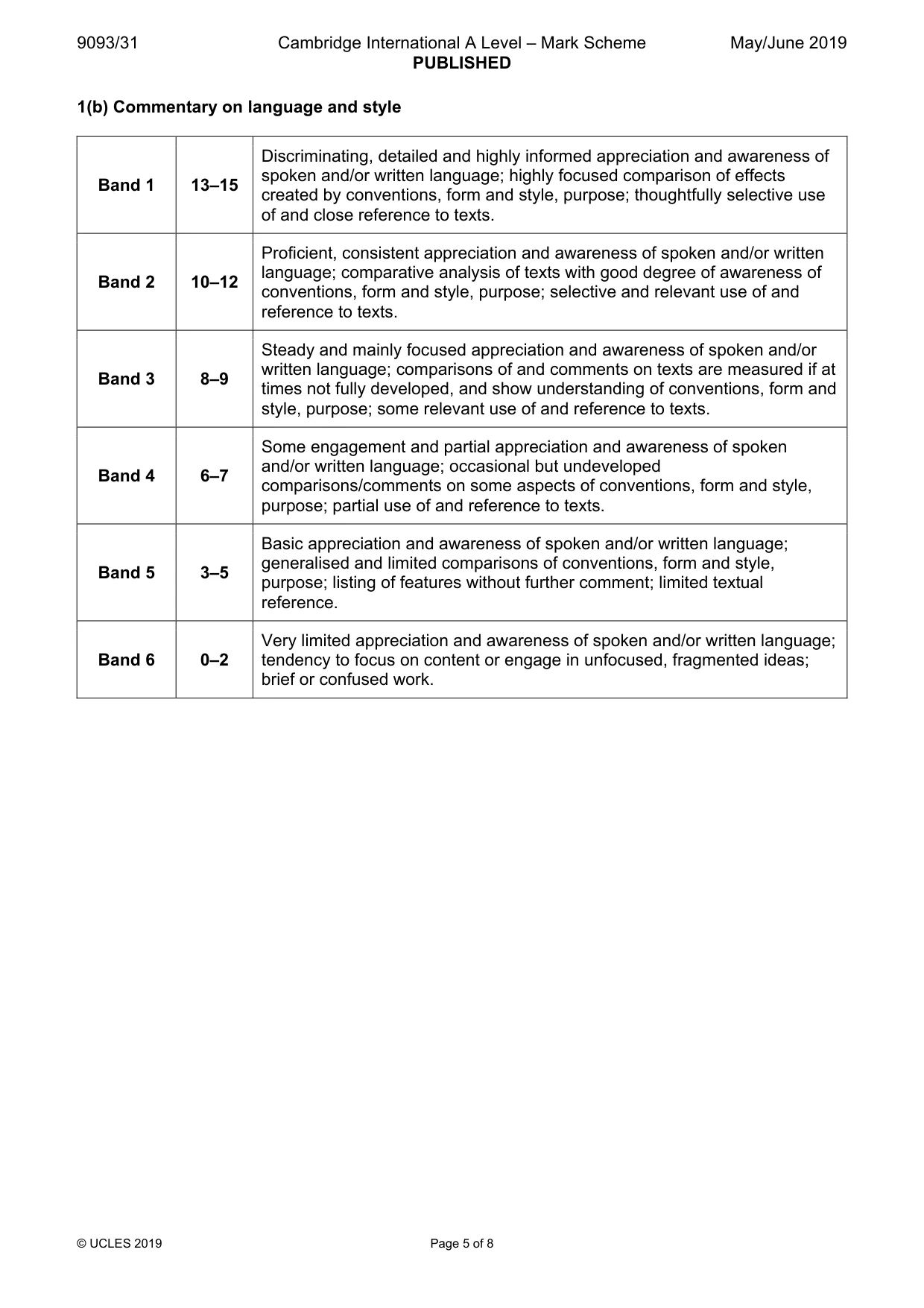
9093/31 Cambridge International A Level – Mark Scheme PUBLISHED May/June 2019 © UCLES 2019 Page 5 of 8 1(b) Commentary on language and style Band 1 13–15 Discriminating, detailed and highly informed appreciation and awareness of spoken and/or written language; highly focused comparison of effects created by conventions, form and style, purpose; thoughtfully selective use of and close reference to texts. Band 2 10–12 Proficient, consistent appreciation and awareness of spoken and/or written language; comparative analysis of texts with good degree of awareness of conventions, form and style, purpose; selective and relevant use of and reference to texts. Band 3 8–9 Steady and mainly focused appreciation and awareness of spoken and/or written language; comparisons of and comments on texts are measured if at times not fully developed, and show understanding of conventions, form and style, purpose; some relevant use of and reference to texts. Band 4 6–7 Some engagement and partial appreciation and awareness of spoken and/or written language; occasional but undeveloped comparisons/comments on some aspects of conventions, form and style, purpose; partial use of and reference to texts. Band 5 3–5 Basic appreciation and awareness of spoken and/or written language; generalised and limited comparisons of conventions, form and style, purpose; listing of features without further comment; limited textual reference. Band 6 0–2 Very limited appreciation and awareness of spoken and/or written language; tendency to focus on content or engage in unfocused, fragmented ideas; brief or confused work.
Mark scheme, page 6
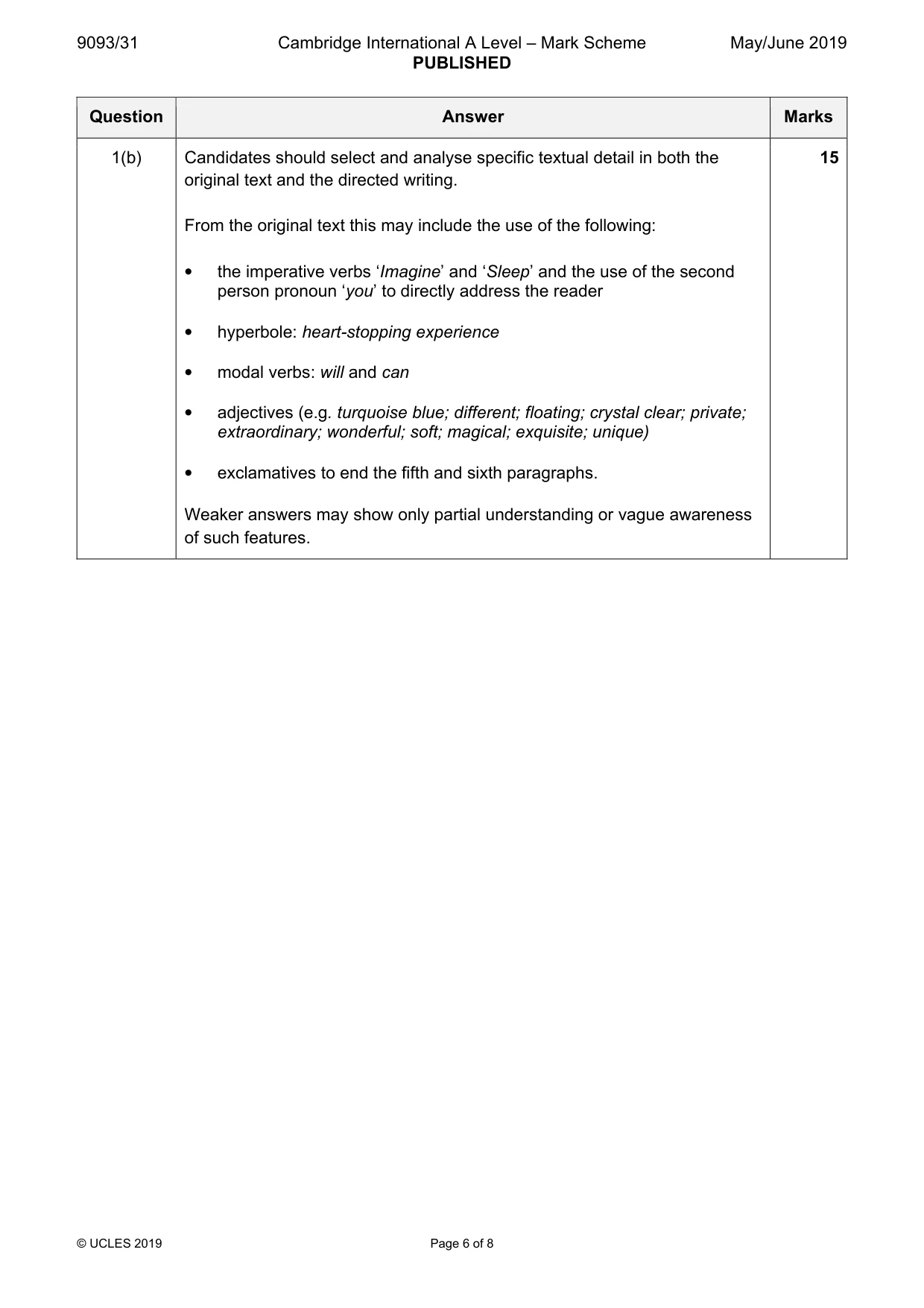
9093/31 Cambridge International A Level – Mark Scheme PUBLISHED May/June 2019 © UCLES 2019 Page 6 of 8 Question Answer Marks 1(b) Candidates should select and analyse specific textual detail in both the original text and the directed writing. From the original text this may include the use of the following: • the imperative verbs ‘Imagine’ and ‘Sleep’ and the use of the second person pronoun ‘you’ to directly address the reader • hyperbole: heart-stopping experience • modal verbs: will and can • adjectives (e.g. turquoise blue; different; floating; crystal clear; private; extraordinary; wonderful; soft; magical; exquisite; unique) • exclamatives to end the fifth and sixth paragraphs. Weaker answers may show only partial understanding or vague awareness of such features. 15
Mark scheme, page 7
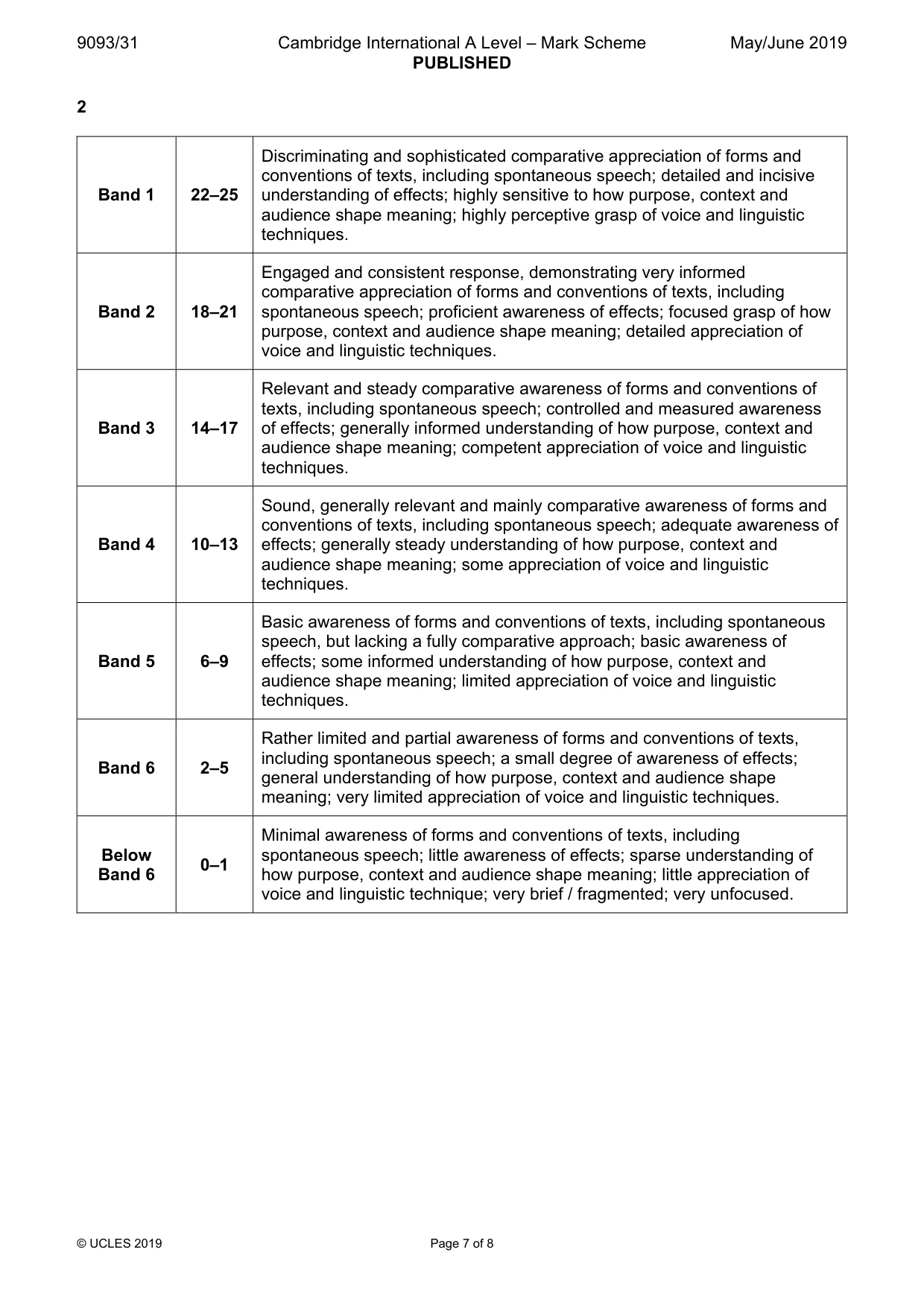
9093/31 Cambridge International A Level – Mark Scheme PUBLISHED May/June 2019 © UCLES 2019 Page 7 of 8 2 Band 1 22–25 Discriminating and sophisticated comparative appreciation of forms and conventions of texts, including spontaneous speech; detailed and incisive understanding of effects; highly sensitive to how purpose, context and audience shape meaning; highly perceptive grasp of voice and linguistic techniques. Band 2 18–21 Engaged and consistent response, demonstrating very informed comparative appreciation of forms and conventions of texts, including spontaneous speech; proficient awareness of effects; focused grasp of how purpose, context and audience shape meaning; detailed appreciation of voice and linguistic techniques. Band 3 14–17 Relevant and steady comparative awareness of forms and conventions of texts, including spontaneous speech; controlled and measured awareness of effects; generally informed understanding of how purpose, context and audience shape meaning; competent appreciation of voice and linguistic techniques. Band 4 10–13 Sound, generally relevant and mainly comparative awareness of forms and conventions of texts, including spontaneous speech; adequate awareness of effects; generally steady understanding of how purpose, context and audience shape meaning; some appreciation of voice and linguistic techniques. Band 5 6–9 Basic awareness of forms and conventions of texts, including spontaneous speech, but lacking a fully comparative approach; basic awareness of effects; some informed understanding of how purpose, context and audience shape meaning; limited appreciation of voice and linguistic techniques. Band 6 2–5 Rather limited and partial awareness of forms and conventions of texts, including spontaneous speech; a small degree of awareness of effects; general understanding of how purpose, context and audience shape meaning; very limited appreciation of voice and linguistic techniques. Below Band 6 0–1 Minimal awareness of forms and conventions of texts, including spontaneous speech; little awareness of effects; sparse understanding of how purpose, context and audience shape meaning; little appreciation of voice and linguistic technique; very brief / fragmented; very unfocused.
Mark scheme, page 8
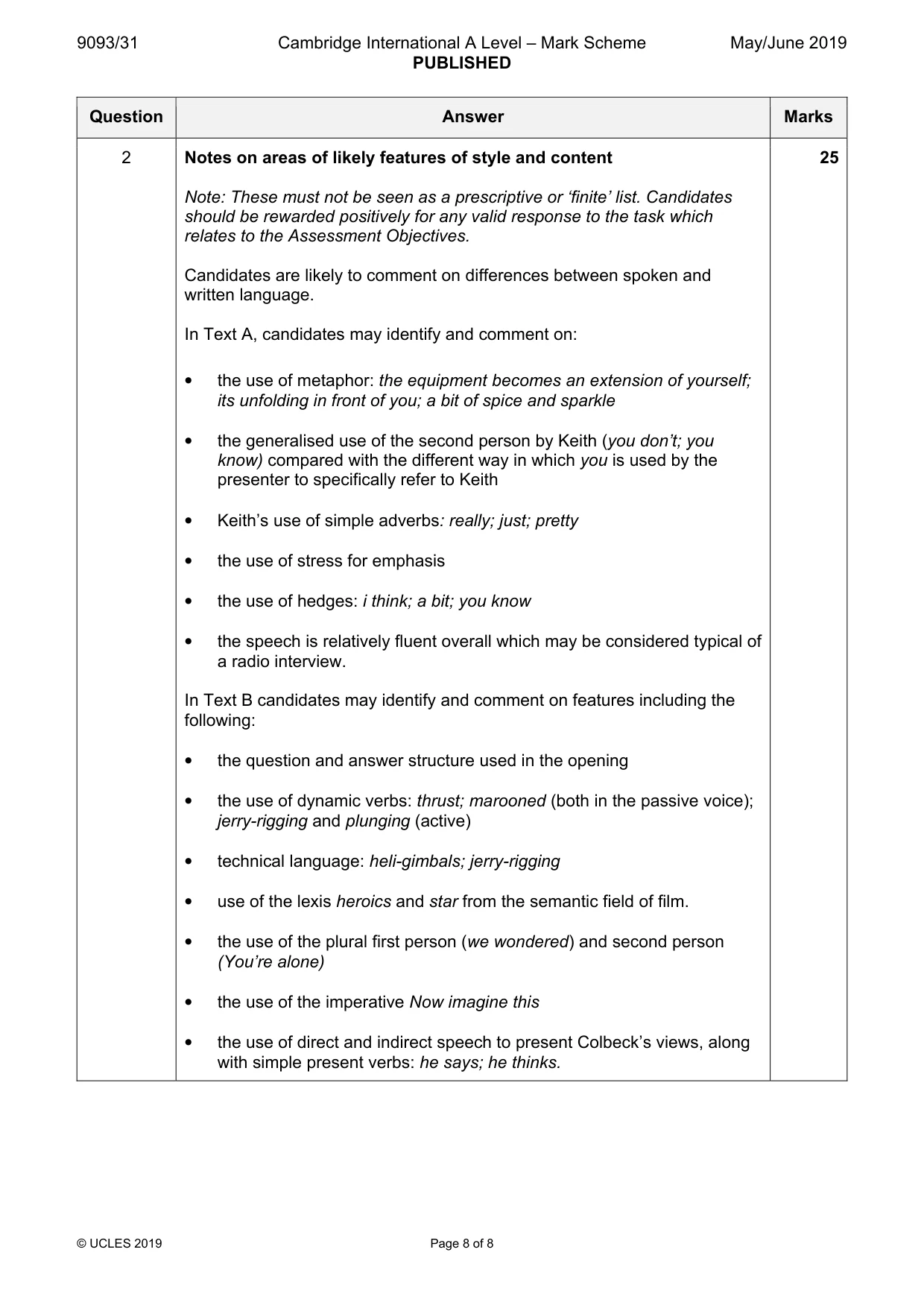
9093/31 Cambridge International A Level – Mark Scheme PUBLISHED May/June 2019 © UCLES 2019 Page 8 of 8 Question Answer Marks 2 Notes on areas of likely features of style and content Note: These must not be seen as a prescriptive or ‘finite’ list. Candidates should be rewarded positively for any valid response to the task which relates to the Assessment Objectives. Candidates are likely to comment on differences between spoken and written language. In Text A, candidates may identify and comment on: • the use of metaphor: the equipment becomes an extension of yourself; its unfolding in front of you; a bit of spice and sparkle • the generalised use of the second person by Keith (you don’t; you know) compared with the different way in which you is used by the presenter to specifically refer to Keith • Keith’s use of simple adverbs: really; just; pretty • the use of stress for emphasis • the use of hedges: i think; a bit; you know • the speech is relatively fluent overall which may be considered typical of a radio interview. In Text B candidates may identify and comment on features including the following: • the question and answer structure used in the opening • the use of dynamic verbs: thrust; marooned (both in the passive voice); jerry-rigging and plunging (active) • technical language: heli-gimbals; jerry-rigging • use of the lexis heroics and star from the semantic field of film. • the use of the plural first person (we wondered) and second person (You’re alone) • the use of the imperative Now imagine this • the use of direct and indirect speech to present Colbeck’s views, along with simple present verbs: he says; he thinks. 25
What you needed in this session
Cambridge’s own grade thresholds for 2019 May/June, Paper 3 · Variant 1. A higher threshold means an easier paper — the bar moves with how the cohort did.