Cambridge A Level English - Language AS and A Level (from 2014) 9093 — 2018 Oct/Nov Paper 3 · Variant 2
9093/32/O/N/18 · 50 marks · ≈56 min
The question paper and its mark scheme, free to read here and free to download. This is Cambridge’s own paper, exactly as it was sat.
Question paper8 pages


Mark scheme7 pages
Answers below. Sit the paper first if you are practising.
Paper as text
Question paper, page 1
This document consists of 4 printed pages, 4 blank pages and 1 Insert. DC (SCD (JB)) 146610/2 © UCLES 2018 [Turn over Cambridge International Examinations Cambridge International Advanced Subsidiary and Advanced Level * 8 8 3 2 0 1 3 4 6 1 * ENGLISH LANGUAGE 9093/32 Paper 3 Text Analysis October/November 2018 2 hours 15 minutes No Additional Materials are required. READ THESE INSTRUCTIONS FIRST An answer booklet is provided inside this question paper. You should follow the instructions on the front cover of the answer booklet. If you need additional answer paper, ask the invigilator for a continuation booklet. Answer two questions. You should spend about 15 minutes reading the passages and questions before you start writing your answers. You are reminded of the need for good English and clear presentation in your answers. The number of marks is given in brackets [ ] at the end of each question or part question. Both questions carry equal marks.
Question paper, page 2
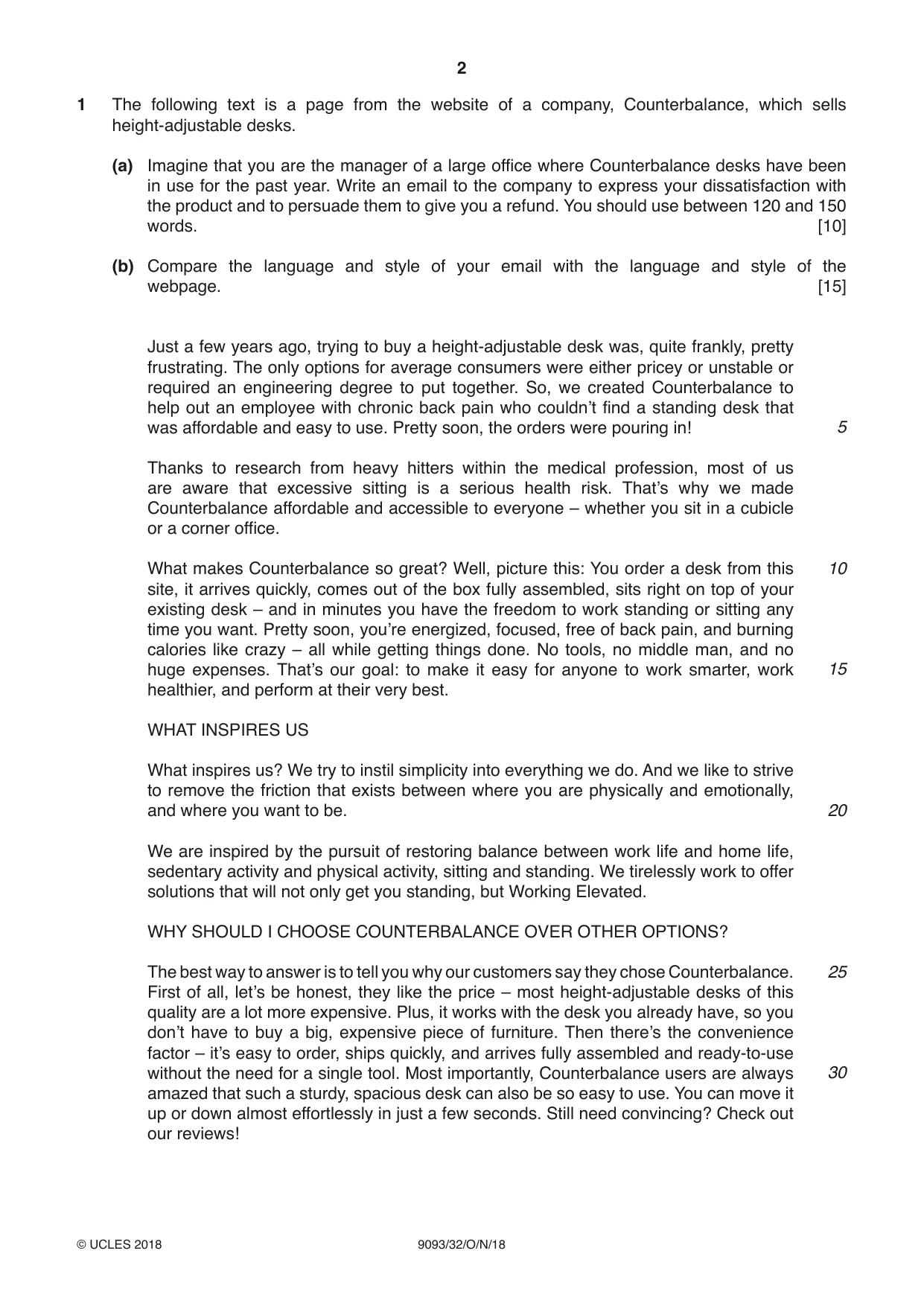
2 9093/32/O/N/18 © UCLES 2018 1 The following text is a page from the website of a company, Counterbalance, which sells height-adjustable desks. (a) Imagine that you are the manager of a large office where Counterbalance desks have been in use for the past year. Write an email to the company to express your dissatisfaction with the product and to persuade them to give you a refund. You should use between 120 and 150 words. [10] (b) Compare the language and style of your email with the language and style of the webpage. [15] Just a few years ago, trying to buy a height-adjustable desk was, quite frankly, pretty frustrating. The only options for average consumers were either pricey or unstable or required an engineering degree to put together. So, we created Counterbalance to help out an employee with chronic back pain who couldn’t find a standing desk that was affordable and easy to use. Pretty soon, the orders were pouring in! Thanks to research from heavy hitters within the medical profession, most of us are aware that excessive sitting is a serious health risk. That’s why we made Counterbalance affordable and accessible to everyone – whether you sit in a cubicle or a corner office. What makes Counterbalance so great? Well, picture this: You order a desk from this site, it arrives quickly, comes out of the box fully assembled, sits right on top of your existing desk – and in minutes you have the freedom to work standing or sitting any time you want. Pretty soon, you’re energized, focused, free of back pain, and burning calories like crazy – all while getting things done. No tools, no middle man, and no huge expenses. That’s our goal: to make it easy for anyone to work smarter, work healthier, and perform at their very best. WHAT INSPIRES US What inspires us? We try to instil simplicity into everything we do. And we like to strive to remove the friction that exists between where you are physically and emotionally, and where you want to be. We are inspired by the pursuit of restoring balance between work life and home life, sedentary activity and physical activity, sitting and standing. We tirelessly work to offer solutions that will not only get you standing, but Working Elevated. WHY SHOULD I CHOOSE COUNTERBALANCE OVER OTHER OPTIONS? The best way to answer is to tell you why our customers say they chose Counterbalance. First of all, let’s be honest, they like the price – most height-adjustable desks of this quality are a lot more expensive. Plus, it works with the desk you already have, so you don’t have to buy a big, expensive piece of furniture. Then there’s the convenience factor – it’s easy to order, ships quickly, and arrives fully assembled and ready-to-use without the need for a single tool. Most importantly, Counterbalance users are always amazed that such a sturdy, spacious desk can also be so easy to use. You can move it up or down almost effortlessly in just a few seconds. Still need convincing? Check out our reviews! 5 10 15 20 25 30
Question paper, page 3
3 9093/32/O/N/18 © UCLES 2018 [Turn over BLANK PAGE
Question paper, page 4
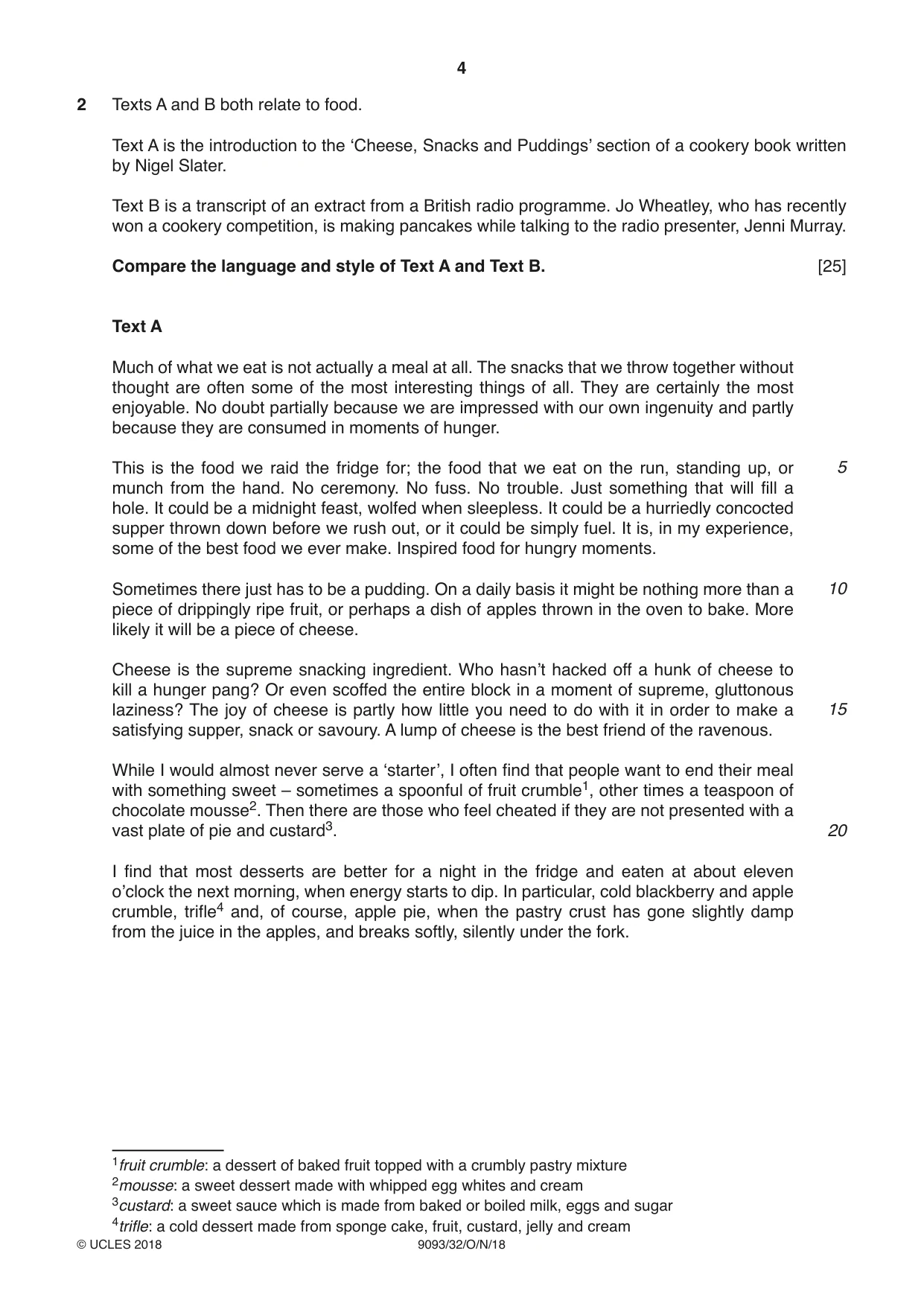
4 9093/32/O/N/18 © UCLES 2018 2 Texts A and B both relate to food. Text A is the introduction to the ‘Cheese, Snacks and Puddings’ section of a cookery book written by Nigel Slater. Text B is a transcript of an extract from a British radio programme. Jo Wheatley, who has recently won a cookery competition, is making pancakes while talking to the radio presenter, Jenni Murray. Compare the language and style of Text A and Text B. [25] Text A Much of what we eat is not actually a meal at all. The snacks that we throw together without thought are often some of the most interesting things of all. They are certainly the most enjoyable. No doubt partially because we are impressed with our own ingenuity and partly because they are consumed in moments of hunger. 5 10 15 20 This is the food we raid the fridge for; the food that we eat on the run, standing up, or munch from the hand. No ceremony. No fuss. No trouble. Just something that will fill a hole. It could be a midnight feast, wolfed when sleepless. It could be a hurriedly concocted supper thrown down before we rush out, or it could be simply fuel. It is, in my experience, some of the best food we ever make. Inspired food for hungry moments. Sometimes there just has to be a pudding. On a daily basis it might be nothing more than a piece of drippingly ripe fruit, or perhaps a dish of apples thrown in the oven to bake. More likely it will be a piece of cheese. Cheese is the supreme snacking ingredient. Who hasn’t hacked off a hunk of cheese to kill a hunger pang? Or even scoffed the entire block in a moment of supreme, gluttonous laziness? The joy of cheese is partly how little you need to do with it in order to make a satisfying supper, snack or savoury. A lump of cheese is the best friend of the ravenous. While I would almost never serve a ‘starter’, I often find that people want to end their meal with something sweet – sometimes a spoonful of fruit crumble1, other times a teaspoon of chocolate mousse2. Then there are those who feel cheated if they are not presented with a vast plate of pie and custard3. I find that most desserts are better for a night in the fridge and eaten at about eleven o’clock the next morning, when energy starts to dip. In particular, cold blackberry and apple crumble, trifle4 and, of course, apple pie, when the pastry crust has gone slightly damp from the juice in the apples, and breaks softly, silently under the fork. 1fruit crumble: a dessert of baked fruit topped with a crumbly pastry mixture 2mousse: a sweet dessert made with whipped egg whites and cream 3custard: a sweet sauce which is made from baked or boiled milk, eggs and sugar 4trifle: a cold dessert made from sponge cake, fruit, custard, jelly and cream
Question paper, page 5
5 9093/32/O/N/18 © UCLES 2018 Text B Jenni: jo (.) how did you become so fond (.) of baking Jo: hi jenni (.) i used to bake with my gran from a little girl (.) from about three years old (.) she used to erm (1) my nans a really good pastry maker and she’d used to sort of turn a bucket upside down and i’d stand (.) on there and she’d give me the off cuts (.) jar of jam (.) and she’d make these wonderful apple pies and i’d just you know make jam tarts with her (.) sort of i used to go there every weekend so (1) thats where it all started really 5 10 15 20 25 30 Jenni: now this morning (.) weve got things started (.) its american pancakes (.) so whats in the mix Jo: erm ive just whisked up some egg whites (.) basically i use a cup (.) a cup of flour cup of whole milk (1) and three eggs and i separate the eggs which i just literally do it through my hands which i know its a bit messy (.) so you dont get any shell in the bowl Jenni: what do you mean you let it go through your fingers // Jo: just let it go through your fingers (.) the whites (.) so you separate them into the bowl and then youve got the egg yolk in your hand and pop that into erm pop that into er into the other bowl (.) i whisk up the egg whites (.) mix the rest together and a knob of butter just to get (.) enrich it a little bit (.) a pinch of salt and thats it basically Jenni: why did you separate the eggs (.) cos if youre making a french pancake (1) you dont do that you just put the whole egg in (.) whats the difference Jo: you want to get some body into (.) american pancakes are rich and fluffy so by mixing the egg whites you get a lighter pancake and higher rise on them Jenni: thats sizzling quite nicely isnt it // Jo: it is (1) im just going to Jenni: what is the fat that youve got in there (.) is that butter Jo: ive got um some oil just some (.) sunflower oil (.) some groundnut oil (.) some flavourless oil and then ive added some butter as well for flavour (.) because butter erm butter burns (.) quite quickly but erm it gives a really good flavour so if you add a little bit of oil with it it stops it from burning and keeps it from browning too much (.) so you get the really good flavour plus you know so it doesnt burn as well Jenni: so youre doing it in a flat frying pan Jo: a heavy based one yeah TRANSCRIPTION KEY (1) = pause in seconds (.) = micro-pause // = speech overlap underlining = stressed sound/syllable(s)
Question paper, page 6
6 9093/32/O/N/18 © UCLES 2018 BLANK PAGE
Question paper, page 7
7 9093/32/O/N/18 © UCLES 2018 BLANK PAGE
Question paper, page 8
8 9093/32/O/N/18 © UCLES 2018 Permission to reproduce items where third-party owned material protected by copyright is included has been sought and cleared where possible. Every reasonable effort has been made by the publisher (UCLES) to trace copyright holders, but if any items requiring clearance have unwittingly been included, the publisher will be pleased to make amends at the earliest possible opportunity. To avoid the issue of disclosure of answer-related information to candidates, all copyright acknowledgements are reproduced online in the Cambridge International Examinations Copyright Acknowledgements Booklet. This is produced for each series of examinations and is freely available to download at www.cie.org.uk after the live examination series. Cambridge International Examinations is part of the Cambridge Assessment Group. Cambridge Assessment is the brand name of University of Cambridge Local Examinations Syndicate (UCLES), which is itself a department of the University of Cambridge. BLANK PAGE
Mark scheme, page 1
This document consists of 7 printed pages. © UCLES 2018 [Turn over Cambridge Assessment International Education Cambridge International Advanced Level ENGLISH LANGUAGE 9093/32 Paper 3 Text Analysis October/November 2018 MARK SCHEME Maximum Mark: 50 Published This mark scheme is published as an aid to teachers and candidates, to indicate the requirements of the examination. It shows the basis on which Examiners were instructed to award marks. It does not indicate the details of the discussions that took place at an Examiners’ meeting before marking began, which would have considered the acceptability of alternative answers. Mark schemes should be read in conjunction with the question paper and the Principal Examiner Report for Teachers. Cambridge International will not enter into discussions about these mark schemes. Cambridge International is publishing the mark schemes for the October/November 2018 series for most Cambridge IGCSE™, Cambridge International A and AS Level components and some Cambridge O Level components.
Mark scheme, page 2
9093/32 Cambridge International A Level – Mark Scheme PUBLISHED October/November 2018 © UCLES 2018 Page 2 of 7 Generic Marking Principles These general marking principles must be applied by all examiners when marking candidate answers. They should be applied alongside the specific content of the mark scheme or generic level descriptors for a question. Each question paper and mark scheme will also comply with these marking principles. GENERIC MARKING PRINCIPLE 1: Marks must be awarded in line with: • the specific content of the mark scheme or the generic level descriptors for the question • the specific skills defined in the mark scheme or in the generic level descriptors for the question • the standard of response required by a candidate as exemplified by the standardisation scripts. GENERIC MARKING PRINCIPLE 2: Marks awarded are always whole marks (not half marks, or other fractions). GENERIC MARKING PRINCIPLE 3: Marks must be awarded positively: • marks are awarded for correct/valid answers, as defined in the mark scheme. However, credit is given for valid answers which go beyond the scope of the syllabus and mark scheme, referring to your Team Leader as appropriate • marks are awarded when candidates clearly demonstrate what they know and can do • marks are not deducted for errors • marks are not deducted for omissions • answers should only be judged on the quality of spelling, punctuation and grammar when these features are specifically assessed by the question as indicated by the mark scheme. The meaning, however, should be unambiguous. GENERIC MARKING PRINCIPLE 4: Rules must be applied consistently e.g. in situations where candidates have not followed instructions or in the application of generic level descriptors. GENERIC MARKING PRINCIPLE 5: Marks should be awarded using the full range of marks defined in the mark scheme for the question (however; the use of the full mark range may be limited according to the quality of the candidate responses seen). GENERIC MARKING PRINCIPLE 6: Marks awarded are based solely on the requirements as defined in the mark scheme. Marks should not be awarded with grade thresholds or grade descriptors in mind.
Mark scheme, page 3
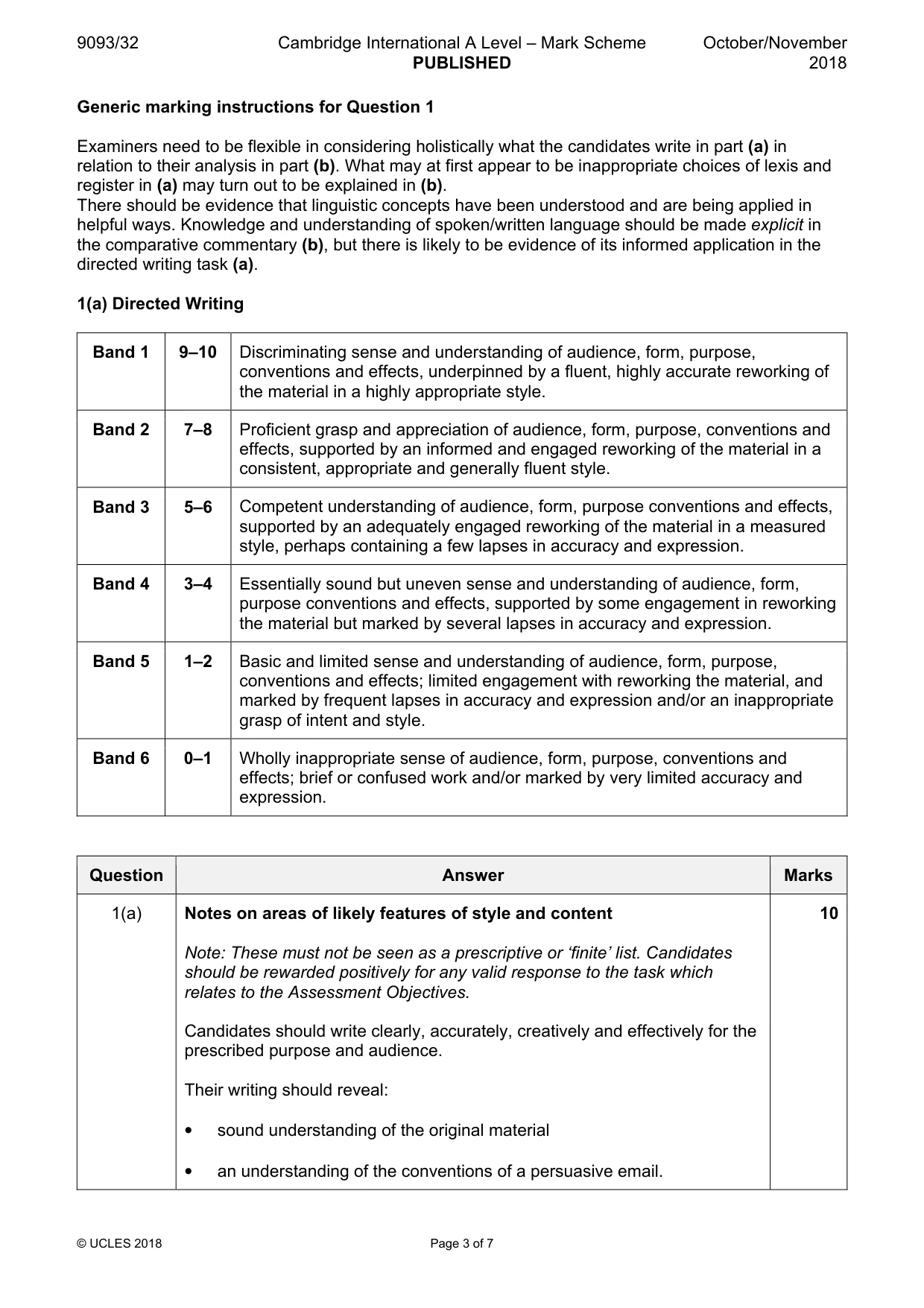
9093/32 Cambridge International A Level – Mark Scheme PUBLISHED October/November 2018 © UCLES 2018 Page 3 of 7 Generic marking instructions for Question 1 Examiners need to be flexible in considering holistically what the candidates write in part (a) in relation to their analysis in part (b). What may at first appear to be inappropriate choices of lexis and register in (a) may turn out to be explained in (b). There should be evidence that linguistic concepts have been understood and are being applied in helpful ways. Knowledge and understanding of spoken/written language should be made explicit in the comparative commentary (b), but there is likely to be evidence of its informed application in the directed writing task (a). 1(a) Directed Writing Band 1 9–10 Discriminating sense and understanding of audience, form, purpose, conventions and effects, underpinned by a fluent, highly accurate reworking of the material in a highly appropriate style. Band 2 7–8 Proficient grasp and appreciation of audience, form, purpose, conventions and effects, supported by an informed and engaged reworking of the material in a consistent, appropriate and generally fluent style. Band 3 5–6 Competent understanding of audience, form, purpose conventions and effects, supported by an adequately engaged reworking of the material in a measured style, perhaps containing a few lapses in accuracy and expression. Band 4 3–4 Essentially sound but uneven sense and understanding of audience, form, purpose conventions and effects, supported by some engagement in reworking the material but marked by several lapses in accuracy and expression. Band 5 1–2 Basic and limited sense and understanding of audience, form, purpose, conventions and effects; limited engagement with reworking the material, and marked by frequent lapses in accuracy and expression and/or an inappropriate grasp of intent and style. Band 6 0–1 Wholly inappropriate sense of audience, form, purpose, conventions and effects; brief or confused work and/or marked by very limited accuracy and expression. Question Answer Marks 1(a) Notes on areas of likely features of style and content Note: These must not be seen as a prescriptive or ‘finite’ list. Candidates should be rewarded positively for any valid response to the task which relates to the Assessment Objectives. Candidates should write clearly, accurately, creatively and effectively for the prescribed purpose and audience. Their writing should reveal: • sound understanding of the original material • an understanding of the conventions of a persuasive email. 10
Mark scheme, page 4
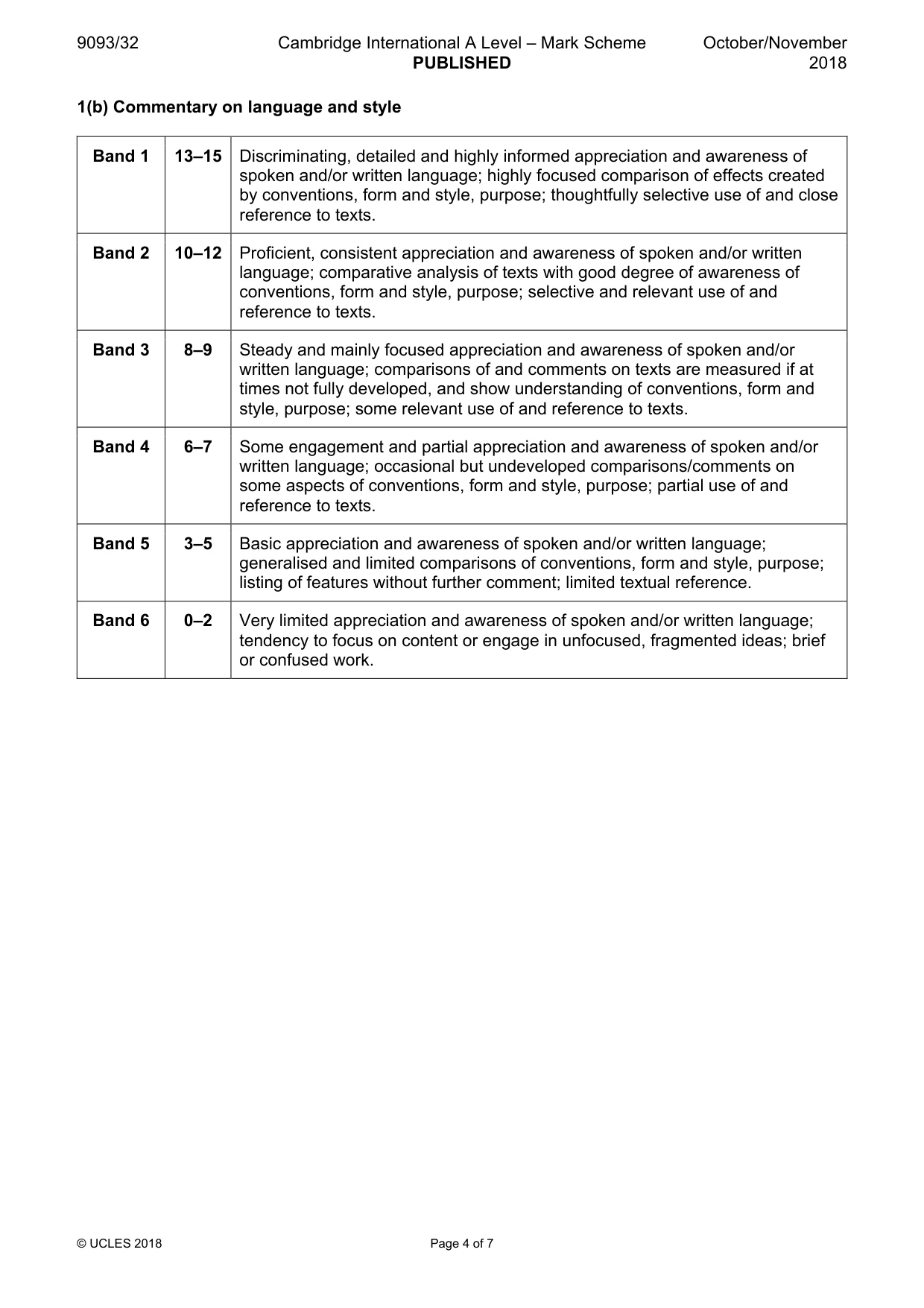
9093/32 Cambridge International A Level – Mark Scheme PUBLISHED October/November 2018 © UCLES 2018 Page 4 of 7 1(b) Commentary on language and style Band 1 13–15 Discriminating, detailed and highly informed appreciation and awareness of spoken and/or written language; highly focused comparison of effects created by conventions, form and style, purpose; thoughtfully selective use of and close reference to texts. Band 2 10–12 Proficient, consistent appreciation and awareness of spoken and/or written language; comparative analysis of texts with good degree of awareness of conventions, form and style, purpose; selective and relevant use of and reference to texts. Band 3 8–9 Steady and mainly focused appreciation and awareness of spoken and/or written language; comparisons of and comments on texts are measured if at times not fully developed, and show understanding of conventions, form and style, purpose; some relevant use of and reference to texts. Band 4 6–7 Some engagement and partial appreciation and awareness of spoken and/or written language; occasional but undeveloped comparisons/comments on some aspects of conventions, form and style, purpose; partial use of and reference to texts. Band 5 3–5 Basic appreciation and awareness of spoken and/or written language; generalised and limited comparisons of conventions, form and style, purpose; listing of features without further comment; limited textual reference. Band 6 0–2 Very limited appreciation and awareness of spoken and/or written language; tendency to focus on content or engage in unfocused, fragmented ideas; brief or confused work.
Mark scheme, page 5
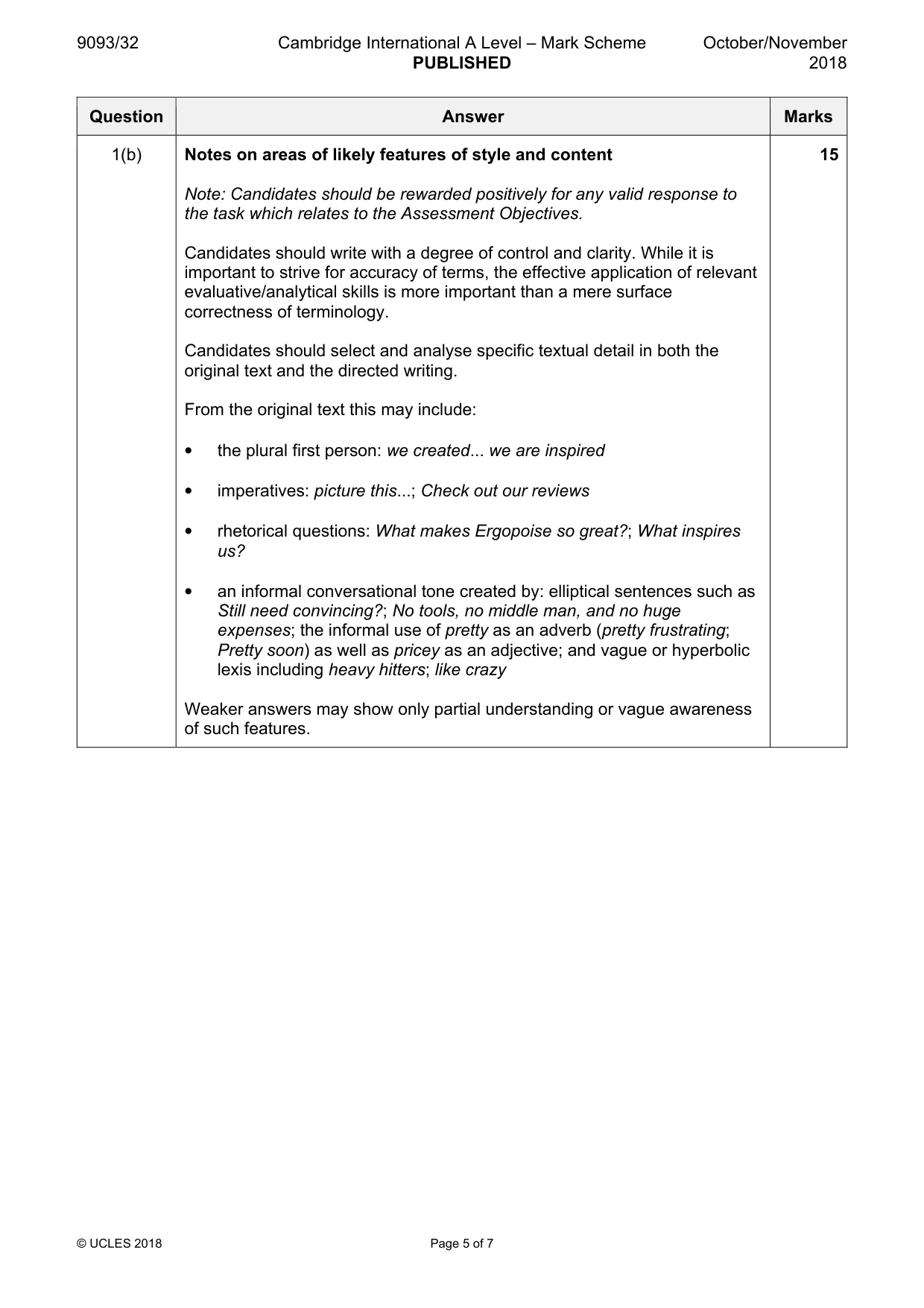
9093/32 Cambridge International A Level – Mark Scheme PUBLISHED October/November 2018 © UCLES 2018 Page 5 of 7 Question Answer Marks 1(b) Notes on areas of likely features of style and content Note: Candidates should be rewarded positively for any valid response to the task which relates to the Assessment Objectives. Candidates should write with a degree of control and clarity. While it is important to strive for accuracy of terms, the effective application of relevant evaluative/analytical skills is more important than a mere surface correctness of terminology. Candidates should select and analyse specific textual detail in both the original text and the directed writing. From the original text this may include: • the plural first person: we created... we are inspired • imperatives: picture this...; Check out our reviews • rhetorical questions: What makes Ergopoise so great?; What inspires us? • an informal conversational tone created by: elliptical sentences such as Still need convincing?; No tools, no middle man, and no huge expenses; the informal use of pretty as an adverb (pretty frustrating; Pretty soon) as well as pricey as an adjective; and vague or hyperbolic lexis including heavy hitters; like crazy Weaker answers may show only partial understanding or vague awareness of such features. 15
Mark scheme, page 6
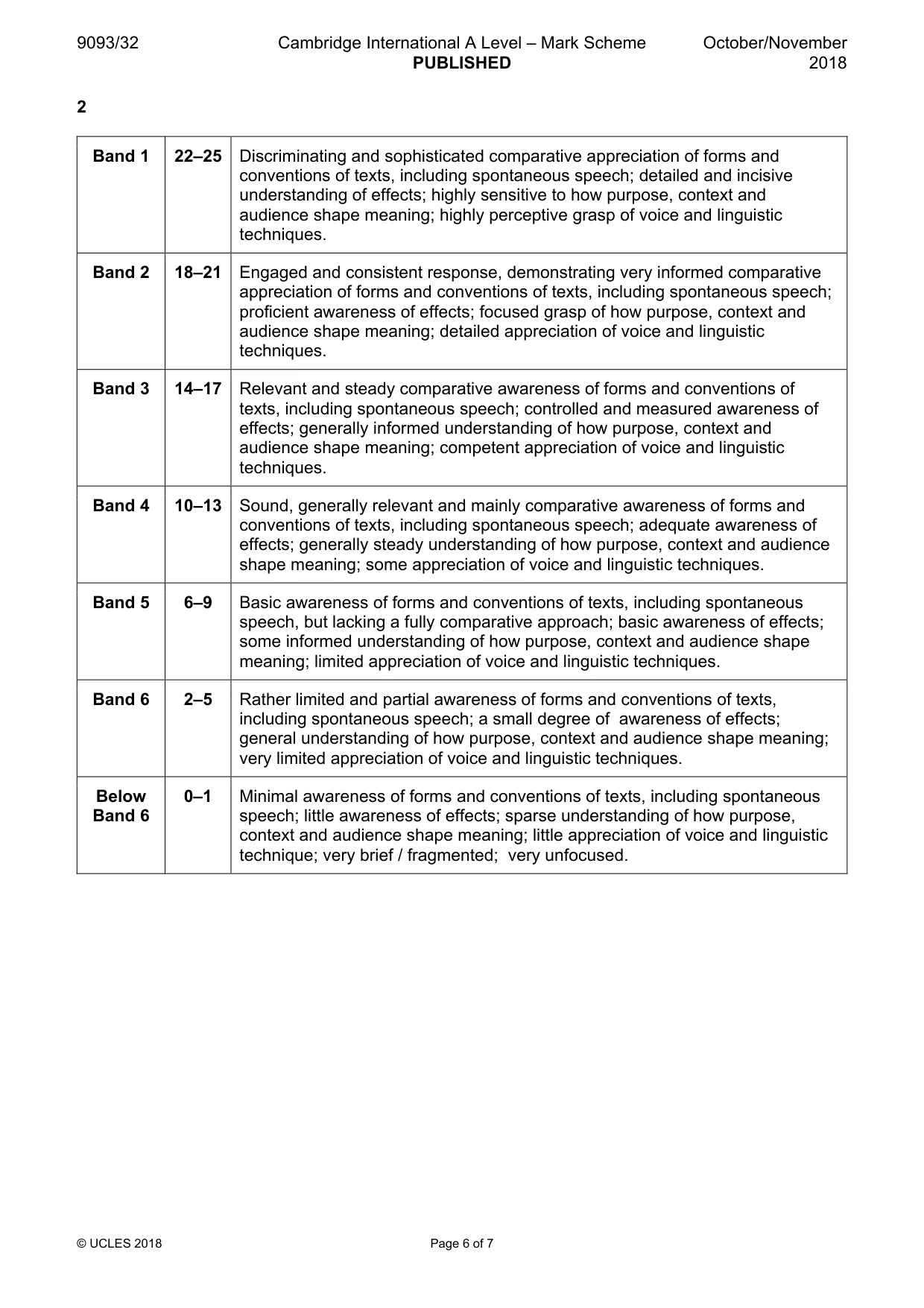
9093/32 Cambridge International A Level – Mark Scheme PUBLISHED October/November 2018 © UCLES 2018 Page 6 of 7 2 Band 1 22–25 Discriminating and sophisticated comparative appreciation of forms and conventions of texts, including spontaneous speech; detailed and incisive understanding of effects; highly sensitive to how purpose, context and audience shape meaning; highly perceptive grasp of voice and linguistic techniques. Band 2 18–21 Engaged and consistent response, demonstrating very informed comparative appreciation of forms and conventions of texts, including spontaneous speech; proficient awareness of effects; focused grasp of how purpose, context and audience shape meaning; detailed appreciation of voice and linguistic techniques. Band 3 14–17 Relevant and steady comparative awareness of forms and conventions of texts, including spontaneous speech; controlled and measured awareness of effects; generally informed understanding of how purpose, context and audience shape meaning; competent appreciation of voice and linguistic techniques. Band 4 10–13 Sound, generally relevant and mainly comparative awareness of forms and conventions of texts, including spontaneous speech; adequate awareness of effects; generally steady understanding of how purpose, context and audience shape meaning; some appreciation of voice and linguistic techniques. Band 5 6–9 Basic awareness of forms and conventions of texts, including spontaneous speech, but lacking a fully comparative approach; basic awareness of effects; some informed understanding of how purpose, context and audience shape meaning; limited appreciation of voice and linguistic techniques. Band 6 2–5 Rather limited and partial awareness of forms and conventions of texts, including spontaneous speech; a small degree of awareness of effects; general understanding of how purpose, context and audience shape meaning; very limited appreciation of voice and linguistic techniques. Below Band 6 0–1 Minimal awareness of forms and conventions of texts, including spontaneous speech; little awareness of effects; sparse understanding of how purpose, context and audience shape meaning; little appreciation of voice and linguistic technique; very brief / fragmented; very unfocused.
Mark scheme, page 7
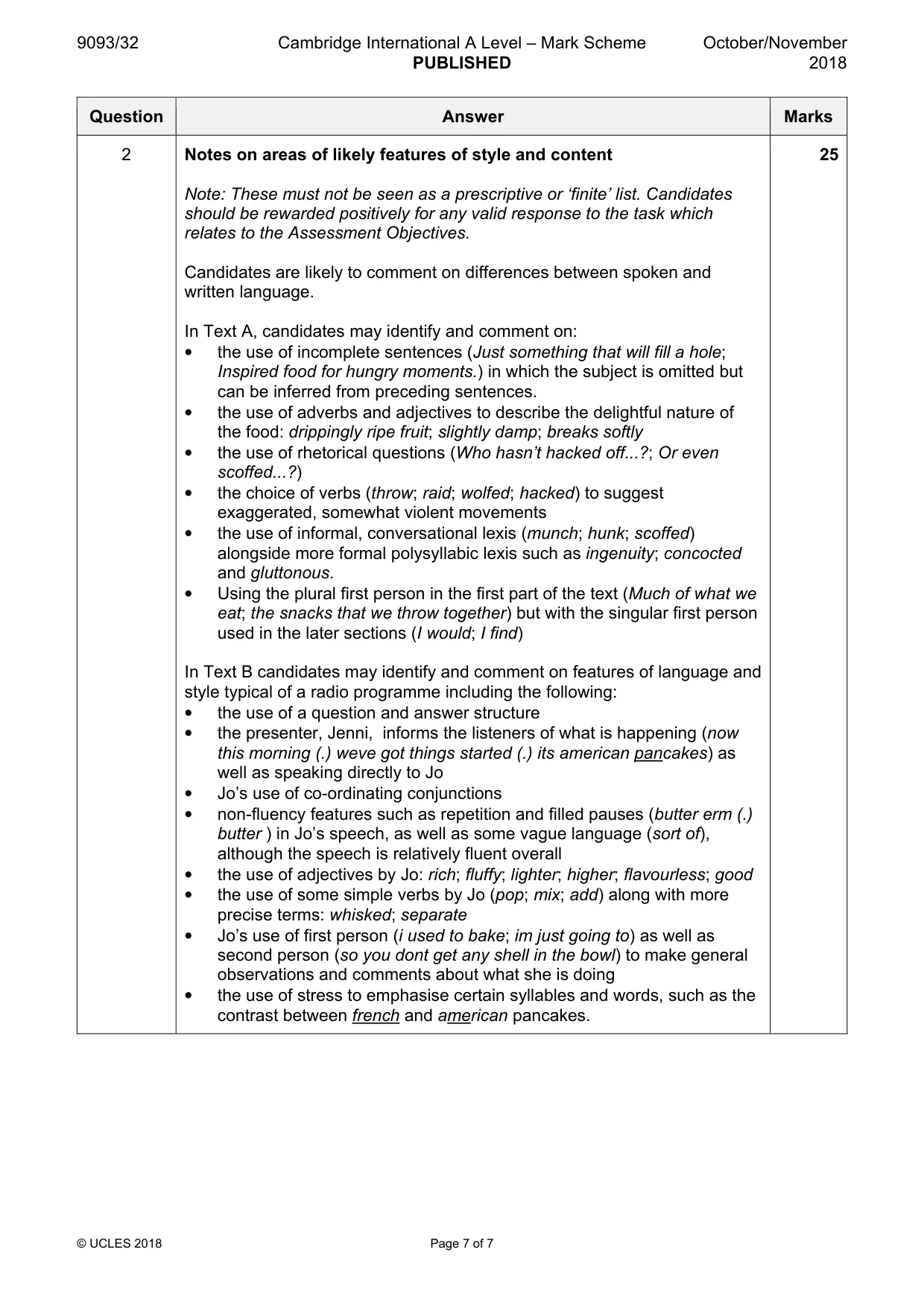
9093/32 Cambridge International A Level – Mark Scheme PUBLISHED October/November 2018 © UCLES 2018 Page 7 of 7 Question Answer Marks 2 Notes on areas of likely features of style and content Note: These must not be seen as a prescriptive or ‘finite’ list. Candidates should be rewarded positively for any valid response to the task which relates to the Assessment Objectives. Candidates are likely to comment on differences between spoken and written language. In Text A, candidates may identify and comment on: • the use of incomplete sentences (Just something that will fill a hole; Inspired food for hungry moments.) in which the subject is omitted but can be inferred from preceding sentences. • the use of adverbs and adjectives to describe the delightful nature of the food: drippingly ripe fruit; slightly damp; breaks softly • the use of rhetorical questions (Who hasn’t hacked off...?; Or even scoffed...?) • the choice of verbs (throw; raid; wolfed; hacked) to suggest exaggerated, somewhat violent movements • the use of informal, conversational lexis (munch; hunk; scoffed) alongside more formal polysyllabic lexis such as ingenuity; concocted and gluttonous. • Using the plural first person in the first part of the text (Much of what we eat; the snacks that we throw together) but with the singular first person used in the later sections (I would; I find) In Text B candidates may identify and comment on features of language and style typical of a radio programme including the following: • the use of a question and answer structure • the presenter, Jenni, informs the listeners of what is happening (now this morning (.) weve got things started (.) its american pancakes) as well as speaking directly to Jo • Jo’s use of co-ordinating conjunctions • non-fluency features such as repetition and filled pauses (butter erm (.) butter ) in Jo’s speech, as well as some vague language (sort of), although the speech is relatively fluent overall • the use of adjectives by Jo: rich; fluffy; lighter; higher; flavourless; good • the use of some simple verbs by Jo (pop; mix; add) along with more precise terms: whisked; separate • Jo’s use of first person (i used to bake; im just going to) as well as second person (so you dont get any shell in the bowl) to make general observations and comments about what she is doing • the use of stress to emphasise certain syllables and words, such as the contrast between french and american pancakes. 25
What you needed in this session
Cambridge’s own grade thresholds for 2018 Oct/Nov, Paper 3 · Variant 2. A higher threshold means an easier paper — the bar moves with how the cohort did.