Cambridge A Level English - Language AS and A Level (from 2014) 9093 — 2018 Oct/Nov Paper 3 · Variant 3
9093/33/O/N/18 · 50 marks · ≈56 min
The question paper and its mark scheme, free to read here and free to download. This is Cambridge’s own paper, exactly as it was sat.
Question paper8 pages
Mark scheme7 pages
Answers below. Sit the paper first if you are practising.
Paper as text
Question paper, page 1
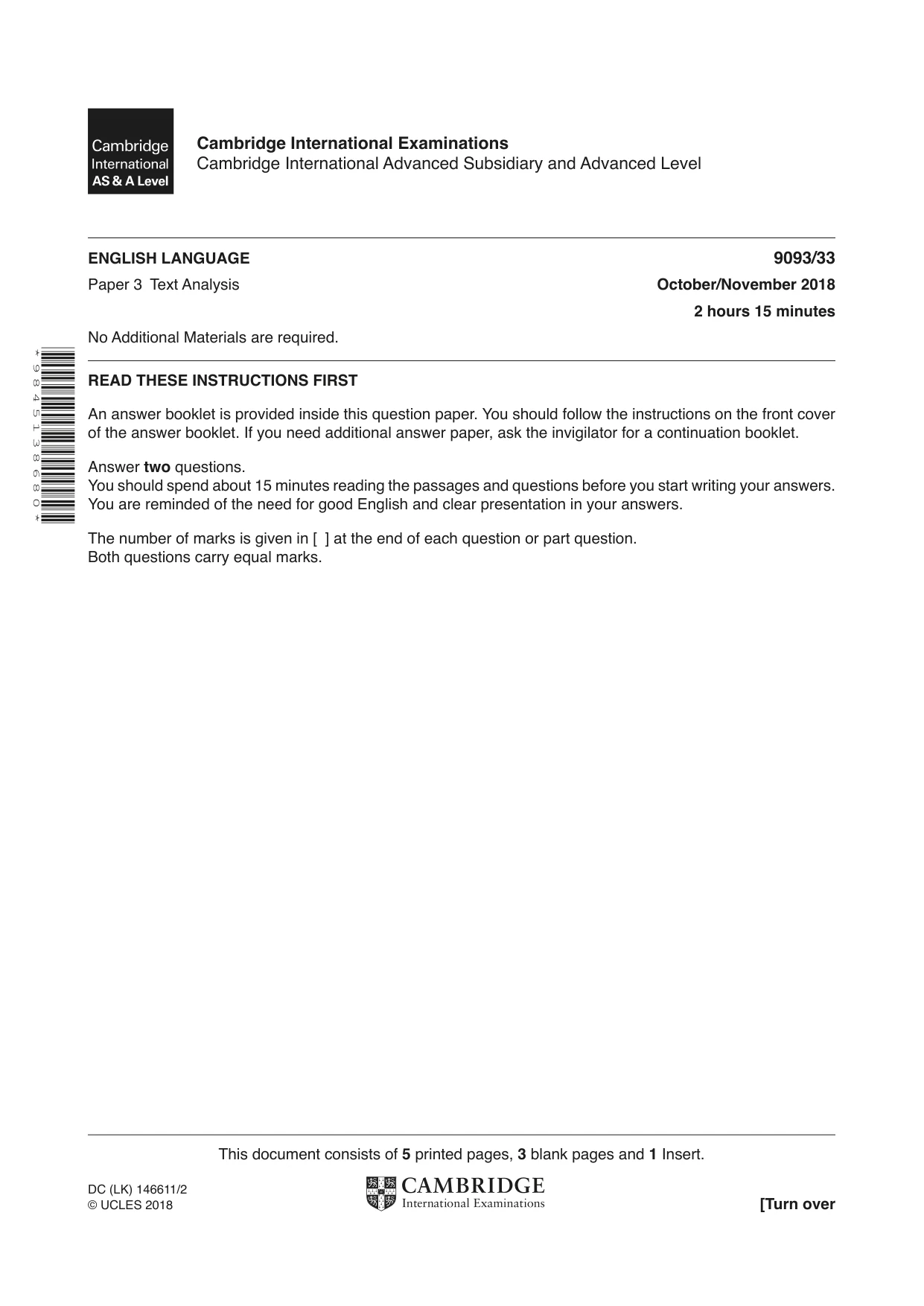
* 9 8 4 5 1 3 8 6 8 0 * This document consists of 5 printed pages, 3 blank pages and 1 Insert. DC (LK) 146611/2 © UCLES 2018 [Turn over Cambridge International Examinations Cambridge International Advanced Subsidiary and Advanced Level ENGLISH LANGUAGE 9093/33 Paper 3 Text Analysis October/November 2018 2 hours 15 minutes No Additional Materials are required. READ THESE INSTRUCTIONS FIRST An answer booklet is provided inside this question paper. You should follow the instructions on the front cover of the answer booklet. If you need additional answer paper, ask the invigilator for a continuation booklet. Answer two questions. You should spend about 15 minutes reading the passages and questions before you start writing your answers. You are reminded of the need for good English and clear presentation in your answers. The number of marks is given in [ ] at the end of each question or part question. Both questions carry equal marks.
Question paper, page 2
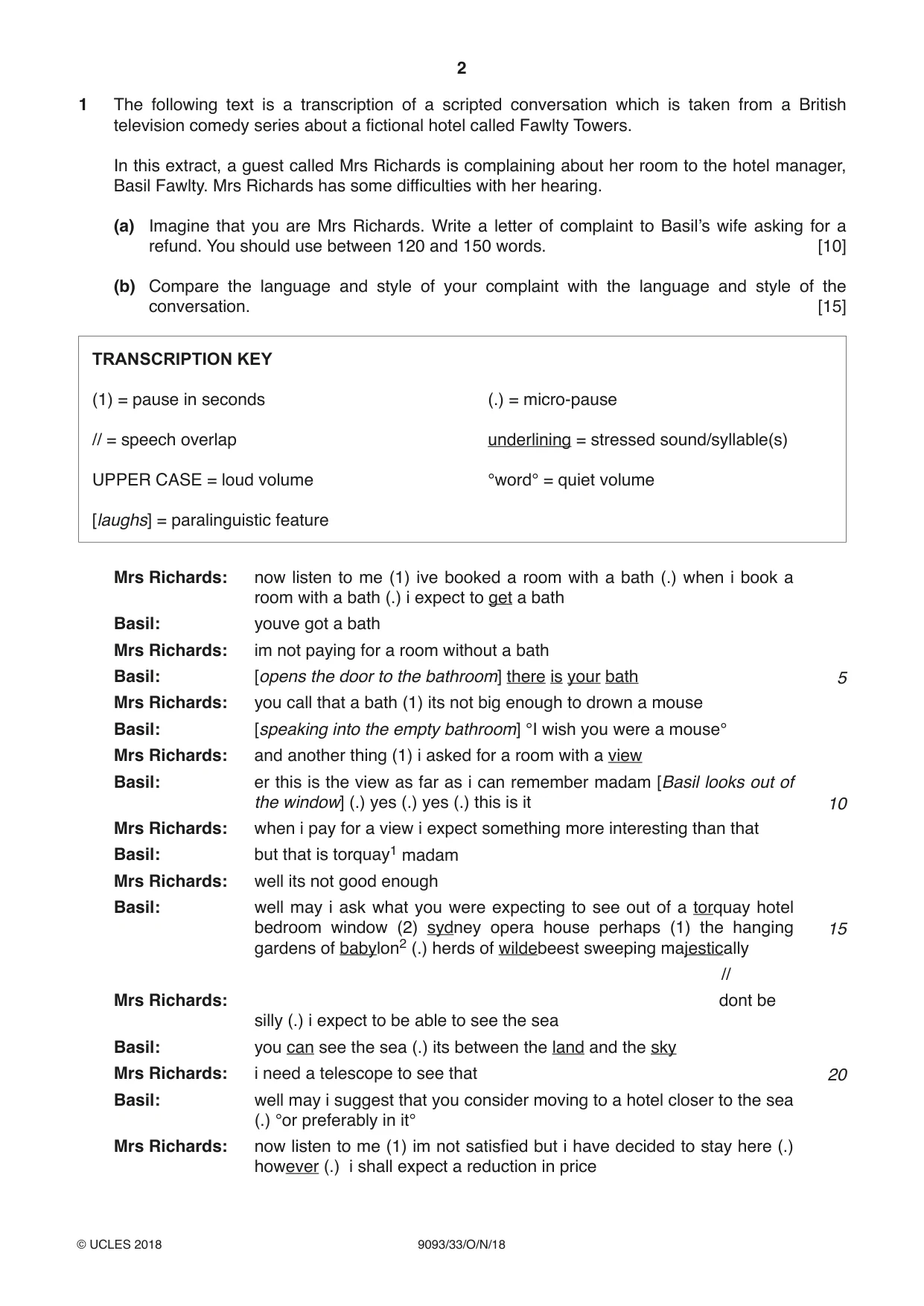
2 9093/33/O/N/18 © UCLES 2018 1 The following text is a transcription of a scripted conversation which is taken from a British television comedy series about a fictional hotel called Fawlty Towers. In this extract, a guest called Mrs Richards is complaining about her room to the hotel manager, Basil Fawlty. Mrs Richards has some difficulties with her hearing. (a) Imagine that you are Mrs Richards. Write a letter of complaint to Basil’s wife asking for a refund. You should use between 120 and 150 words. [10] (b) Compare the language and style of your complaint with the language and style of the conversation. [15] TRANSCRIPTION KEY (1) = pause in seconds (.) = micro-pause // = speech overlap underlining = stressed sound/syllable(s) UPPER CASE = loud volume °word° = quiet volume [laughs] = paralinguistic feature Mrs Richards: now listen to me (1) ive booked a room with a bath (.) when i book a room with a bath (.) i expect to get a bath Basil: youve got a bath Mrs Richards: im not paying for a room without a bath Basil: [opens the door to the bathroom] there is your bath Mrs Richards: you call that a bath (1) its not big enough to drown a mouse Basil: [speaking into the empty bathroom] °I wish you were a mouse° Mrs Richards: and another thing (1) i asked for a room with a view Basil: er this is the view as far as i can remember madam [Basil looks out of the window] (.) yes (.) yes (.) this is it Mrs Richards: when i pay for a view i expect something more interesting than that Basil: but that is torquay1 madam Mrs Richards: well its not good enough Basil: well may i ask what you were expecting to see out of a torquay hotel bedroom window (2) sydney opera house perhaps (1) the hanging gardens of babylon2 (.) herds of wildebeest sweeping majestically // Mrs Richards: dont be silly (.) i expect to be able to see the sea Basil: you can see the sea (.) its between the land and the sky Mrs Richards: i need a telescope to see that Basil: well may i suggest that you consider moving to a hotel closer to the sea (.) °or preferably in it° Mrs Richards: now listen to me (1) im not satisfied but i have decided to stay here (.) however (.) i shall expect a reduction in price 5 10 15 20
Question paper, page 3
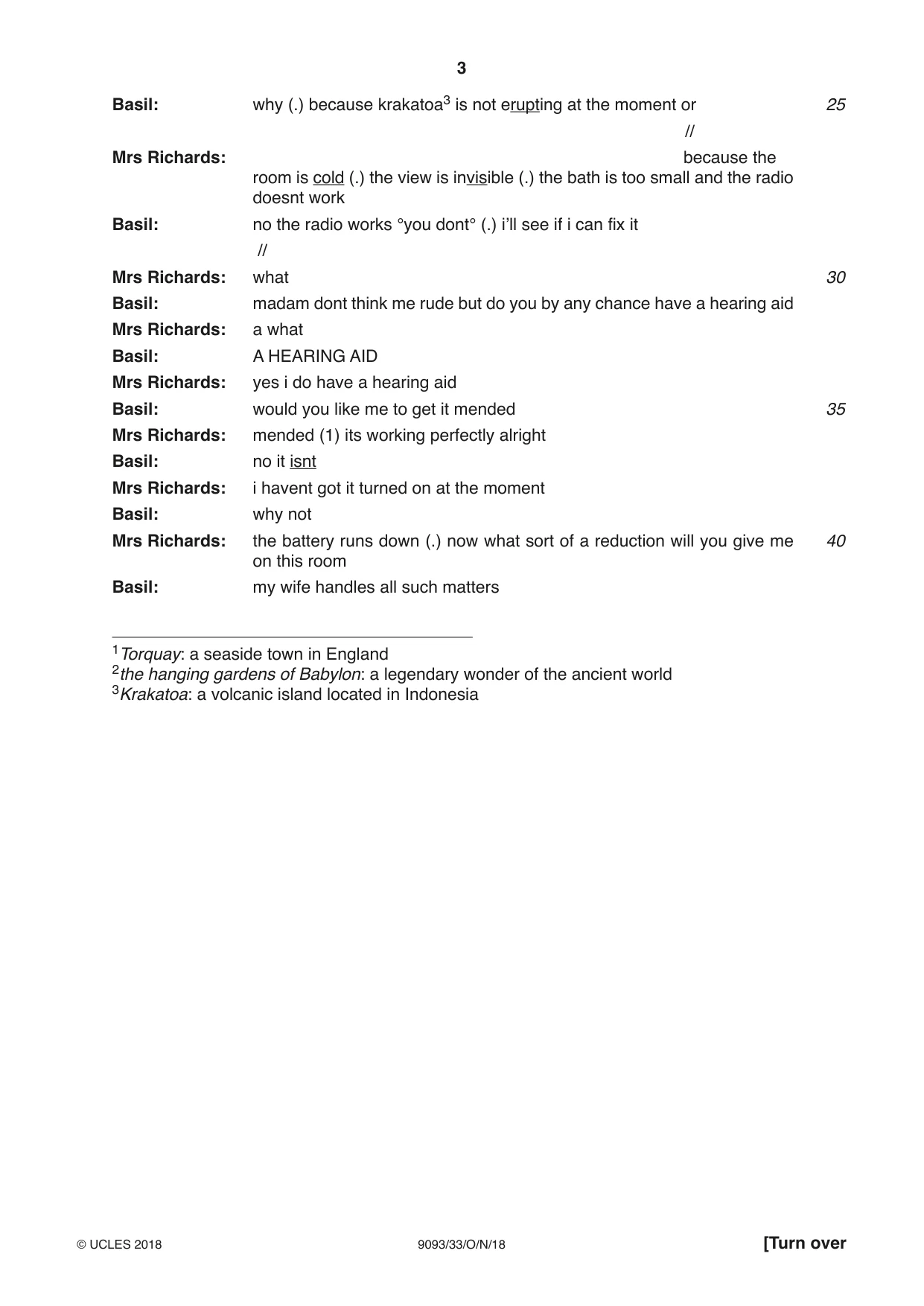
3 9093/33/O/N/18 © UCLES 2018 [Turn over Basil: why (.) because krakatoa3 is not erupting at the moment or // Mrs Richards: because the room is cold (.) the view is invisible (.) the bath is too small and the radio doesnt work Basil: no the radio works °you dont° (.) i’ll see if i can fix it // Mrs Richards: what Basil: madam dont think me rude but do you by any chance have a hearing aid Mrs Richards: a what Basil: A HEARING AID Mrs Richards: yes i do have a hearing aid Basil: would you like me to get it mended Mrs Richards: mended (1) its working perfectly alright Basil: no it isnt Mrs Richards: i havent got it turned on at the moment Basil: why not Mrs Richards: the battery runs down (.) now what sort of a reduction will you give me on this room Basil: my wife handles all such matters 1Torquay: a seaside town in England 2the hanging gardens of Babylon: a legendary wonder of the ancient world 3Krakatoa: a volcanic island located in Indonesia 25 30 35 40
Question paper, page 4
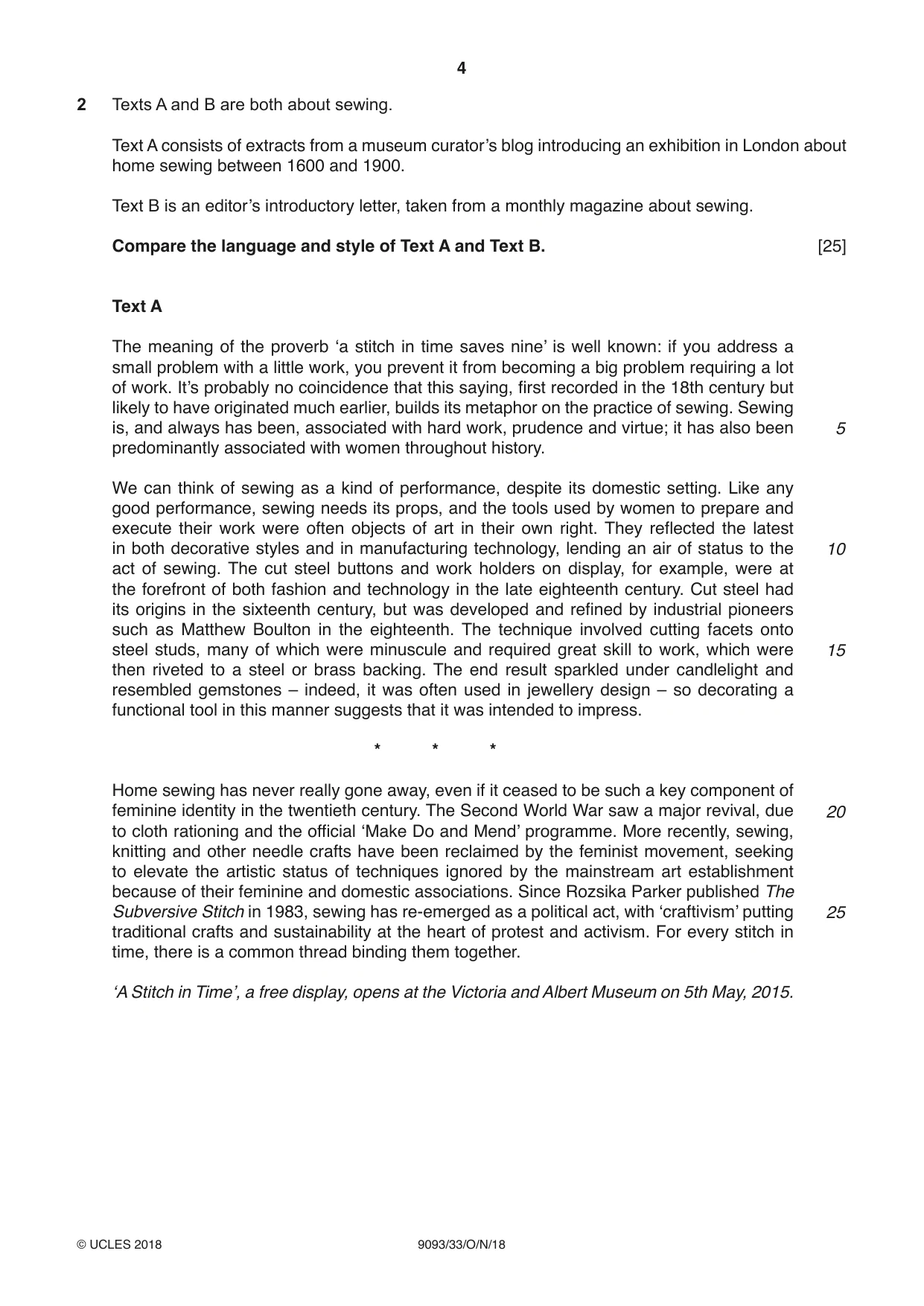
4 9093/33/O/N/18 © UCLES 2018 2 Texts A and B are both about sewing. Text A consists of extracts from a museum curator’s blog introducing an exhibition in London about home sewing between 1600 and 1900. Text B is an editor’s introductory letter, taken from a monthly magazine about sewing. Compare the language and style of Text A and Text B. [25] Text A The meaning of the proverb ‘a stitch in time saves nine’ is well known: if you address a small problem with a little work, you prevent it from becoming a big problem requiring a lot of work. It’s probably no coincidence that this saying, first recorded in the 18th century but likely to have originated much earlier, builds its metaphor on the practice of sewing. Sewing is, and always has been, associated with hard work, prudence and virtue; it has also been predominantly associated with women throughout history. We can think of sewing as a kind of performance, despite its domestic setting. Like any good performance, sewing needs its props, and the tools used by women to prepare and execute their work were often objects of art in their own right. They reflected the latest in both decorative styles and in manufacturing technology, lending an air of status to the act of sewing. The cut steel buttons and work holders on display, for example, were at the forefront of both fashion and technology in the late eighteenth century. Cut steel had its origins in the sixteenth century, but was developed and refined by industrial pioneers such as Matthew Boulton in the eighteenth. The technique involved cutting facets onto steel studs, many of which were minuscule and required great skill to work, which were then riveted to a steel or brass backing. The end result sparkled under candlelight and resembled gemstones – indeed, it was often used in jewellery design – so decorating a functional tool in this manner suggests that it was intended to impress. * * * Home sewing has never really gone away, even if it ceased to be such a key component of feminine identity in the twentieth century. The Second World War saw a major revival, due to cloth rationing and the official ‘Make Do and Mend’ programme. More recently, sewing, knitting and other needle crafts have been reclaimed by the feminist movement, seeking to elevate the artistic status of techniques ignored by the mainstream art establishment because of their feminine and domestic associations. Since Rozsika Parker published The Subversive Stitch in 1983, sewing has re-emerged as a political act, with ‘craftivism’ putting traditional crafts and sustainability at the heart of protest and activism. For every stitch in time, there is a common thread binding them together. ‘A Stitch in Time’, a free display, opens at the Victoria and Albert Museum on 5th May, 2015. 5 10 15 20 25
Question paper, page 5
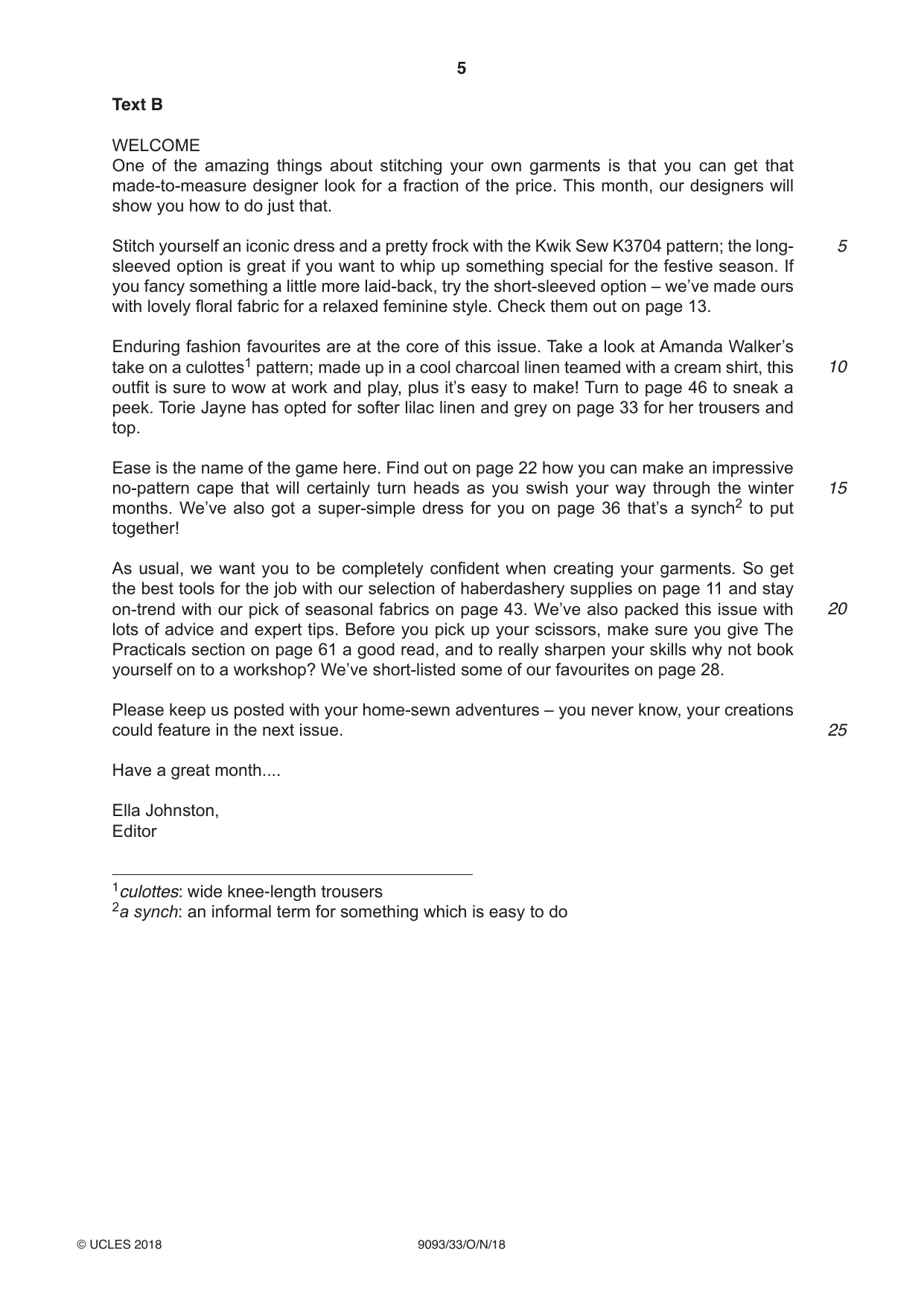
5 9093/33/O/N/18 © UCLES 2018 Text B WELCOME One of the amazing things about stitching your own garments is that you can get that made-to-measure designer look for a fraction of the price. This month, our designers will show you how to do just that. Stitch yourself an iconic dress and a pretty frock with the Kwik Sew K3704 pattern; the long- sleeved option is great if you want to whip up something special for the festive season. If you fancy something a little more laid-back, try the short-sleeved option – we’ve made ours with lovely floral fabric for a relaxed feminine style. Check them out on page 13. Enduring fashion favourites are at the core of this issue. Take a look at Amanda Walker’s take on a culottes1 pattern; made up in a cool charcoal linen teamed with a cream shirt, this outfit is sure to wow at work and play, plus it’s easy to make! Turn to page 46 to sneak a peek. Torie Jayne has opted for softer lilac linen and grey on page 33 for her trousers and top. Ease is the name of the game here. Find out on page 22 how you can make an impressive no-pattern cape that will certainly turn heads as you swish your way through the winter months. We’ve also got a super-simple dress for you on page 36 that’s a synch2 to put together! As usual, we want you to be completely confident when creating your garments. So get the best tools for the job with our selection of haberdashery supplies on page 11 and stay on-trend with our pick of seasonal fabrics on page 43. We’ve also packed this issue with lots of advice and expert tips. Before you pick up your scissors, make sure you give The Practicals section on page 61 a good read, and to really sharpen your skills why not book yourself on to a workshop? We’ve short-listed some of our favourites on page 28. Please keep us posted with your home-sewn adventures – you never know, your creations could feature in the next issue. Have a great month… Ella Johnston, Editor 1culottes: wide knee-length trousers 2a synch: an informal term for something which is easy to do 5 10 15 20 25
Question paper, page 6
6 9093/33/O/N/18 © UCLES 2018 BLANK PAGE
Question paper, page 7
7 9093/33/O/N/18 © UCLES 2018 BLANK PAGE
Question paper, page 8
8 9093/33/O/N/18 © UCLES 2018 Permission to reproduce items where third-party owned material protected by copyright is included has been sought and cleared where possible. Every reasonable effort has been made by the publisher (UCLES) to trace copyright holders, but if any items requiring clearance have unwittingly been included, the publisher will be pleased to make amends at the earliest possible opportunity. To avoid the issue of disclosure of answer-related information to candidates, all copyright acknowledgements are reproduced online in the Cambridge International Examinations Copyright Acknowledgements Booklet. This is produced for each series of examinations and is freely available to download at www.cie.org.uk after the live examination series. Cambridge International Examinations is part of the Cambridge Assessment Group. Cambridge Assessment is the brand name of University of Cambridge Local Examinations Syndicate (UCLES), which is itself a department of the University of Cambridge. BLANK PAGE
Mark scheme, page 1
This document consists of 7 printed pages. © UCLES 2018 [Turn over Cambridge Assessment International Education Cambridge International Advanced Level ENGLISH LANGUAGE 9093/33 Paper 3 Text Analysis October/November 2018 MARK SCHEME Maximum Mark: 50 Published This mark scheme is published as an aid to teachers and candidates, to indicate the requirements of the examination. It shows the basis on which Examiners were instructed to award marks. It does not indicate the details of the discussions that took place at an Examiners’ meeting before marking began, which would have considered the acceptability of alternative answers. Mark schemes should be read in conjunction with the question paper and the Principal Examiner Report for Teachers. Cambridge International will not enter into discussions about these mark schemes. Cambridge International is publishing the mark schemes for the October/November 2018 series for most Cambridge IGCSE™, Cambridge International A and AS Level components and some Cambridge O Level components.
Mark scheme, page 2
9093/33 Cambridge International A Level – Mark Scheme PUBLISHED October/November 2018 © UCLES 2018 Page 2 of 7 Generic Marking Principles These general marking principles must be applied by all examiners when marking candidate answers. They should be applied alongside the specific content of the mark scheme or generic level descriptors for a question. Each question paper and mark scheme will also comply with these marking principles. GENERIC MARKING PRINCIPLE 1: Marks must be awarded in line with: • the specific content of the mark scheme or the generic level descriptors for the question • the specific skills defined in the mark scheme or in the generic level descriptors for the question • the standard of response required by a candidate as exemplified by the standardisation scripts. GENERIC MARKING PRINCIPLE 2: Marks awarded are always whole marks (not half marks, or other fractions). GENERIC MARKING PRINCIPLE 3: Marks must be awarded positively: • marks are awarded for correct/valid answers, as defined in the mark scheme. However, credit is given for valid answers which go beyond the scope of the syllabus and mark scheme, referring to your Team Leader as appropriate • marks are awarded when candidates clearly demonstrate what they know and can do • marks are not deducted for errors • marks are not deducted for omissions • answers should only be judged on the quality of spelling, punctuation and grammar when these features are specifically assessed by the question as indicated by the mark scheme. The meaning, however, should be unambiguous. GENERIC MARKING PRINCIPLE 4: Rules must be applied consistently e.g. in situations where candidates have not followed instructions or in the application of generic level descriptors. GENERIC MARKING PRINCIPLE 5: Marks should be awarded using the full range of marks defined in the mark scheme for the question (however; the use of the full mark range may be limited according to the quality of the candidate responses seen). GENERIC MARKING PRINCIPLE 6: Marks awarded are based solely on the requirements as defined in the mark scheme. Marks should not be awarded with grade thresholds or grade descriptors in mind.
Mark scheme, page 3
9093/33 Cambridge International A Level – Mark Scheme PUBLISHED October/November 2018 © UCLES 2018 Page 3 of 7 Generic marking instructions for Question 1 Examiners need to be flexible in considering holistically what the candidates write in part (a) in relation to their analysis in part (b). What may at first appear to be inappropriate choices of lexis and register in (a) may turn out to be explained in (b). There should be evidence that linguistic concepts have been understood and are being applied in helpful ways. Knowledge and understanding of spoken/written language should be made explicit in the comparative commentary (b), but there is likely to be evidence of its informed application in the directed writing task (a). 1(a) Directed Writing Band 1 9–10 Discriminating sense and understanding of audience, form, purpose, conventions and effects, underpinned by a fluent, highly accurate reworking of the material in a highly appropriate style. Band 2 7–8 Proficient grasp and appreciation of audience, form, purpose, conventions and effects, supported by an informed and engaged reworking of the material in a consistent, appropriate and generally fluent style. Band 3 5–6 Competent understanding of audience, form, purpose conventions and effects, supported by an adequately engaged reworking of the material in a measured style, perhaps containing a few lapses in accuracy and expression. Band 4 3–4 Essentially sound but uneven sense and understanding of audience, form, purpose conventions and effects, supported by some engagement in reworking the material but marked by several lapses in accuracy and expression. Band 5 1–2 Basic and limited sense and understanding of audience, form, purpose, conventions and effects; limited engagement with reworking the material, and marked by frequent lapses in accuracy and expression and/or an inappropriate grasp of intent and style. Band 6 0–1 Wholly inappropriate sense of audience, form, purpose, conventions and effects; brief or confused work and/or marked by very limited accuracy and expression. Question Answer Marks 1(a) Notes on areas of likely features of style and content Note: These must not be seen as a prescriptive or ‘finite’ list. Candidates should be rewarded positively for any valid response to the task which relates to the Assessment Objectives. Candidates should write clearly, accurately, creatively and effectively for the prescribed purpose and audience. Their writing should reveal: • sound understanding of the original material • an understanding of the conventions and style of a letter of complaint. 10
Mark scheme, page 4
9093/33 Cambridge International A Level – Mark Scheme PUBLISHED October/November 2018 © UCLES 2018 Page 4 of 7 1(b) Commentary on language and style Band 1 13–15 Discriminating, detailed and highly informed appreciation and awareness of spoken and/or written language; highly focused comparison of effects created by conventions, form and style, purpose; thoughtfully selective use of and close reference to texts. Band 2 10–12 Proficient, consistent appreciation and awareness of spoken and/or written language; comparative analysis of texts with good degree of awareness of conventions, form and style, purpose; selective and relevant use of and reference to texts. Band 3 8–9 Steady and mainly focused appreciation and awareness of spoken and/or written language; comparisons of and comments on texts are measured if at times not fully developed, and show understanding of conventions, form and style, purpose; some relevant use of and reference to texts. Band 4 6–7 Some engagement and partial appreciation and awareness of spoken and/or written language; occasional but undeveloped comparisons/comments on some aspects of conventions, form and style, purpose; partial use of and reference to texts. Band 5 3–5 Basic appreciation and awareness of spoken and/or written language; generalised and limited comparisons of conventions, form and style, purpose; listing of features without further comment; limited textual reference. Band 6 0–2 Very limited appreciation and awareness of spoken and/or written language; tendency to focus on content or engage in unfocused, fragmented ideas; brief or confused work.
Mark scheme, page 5
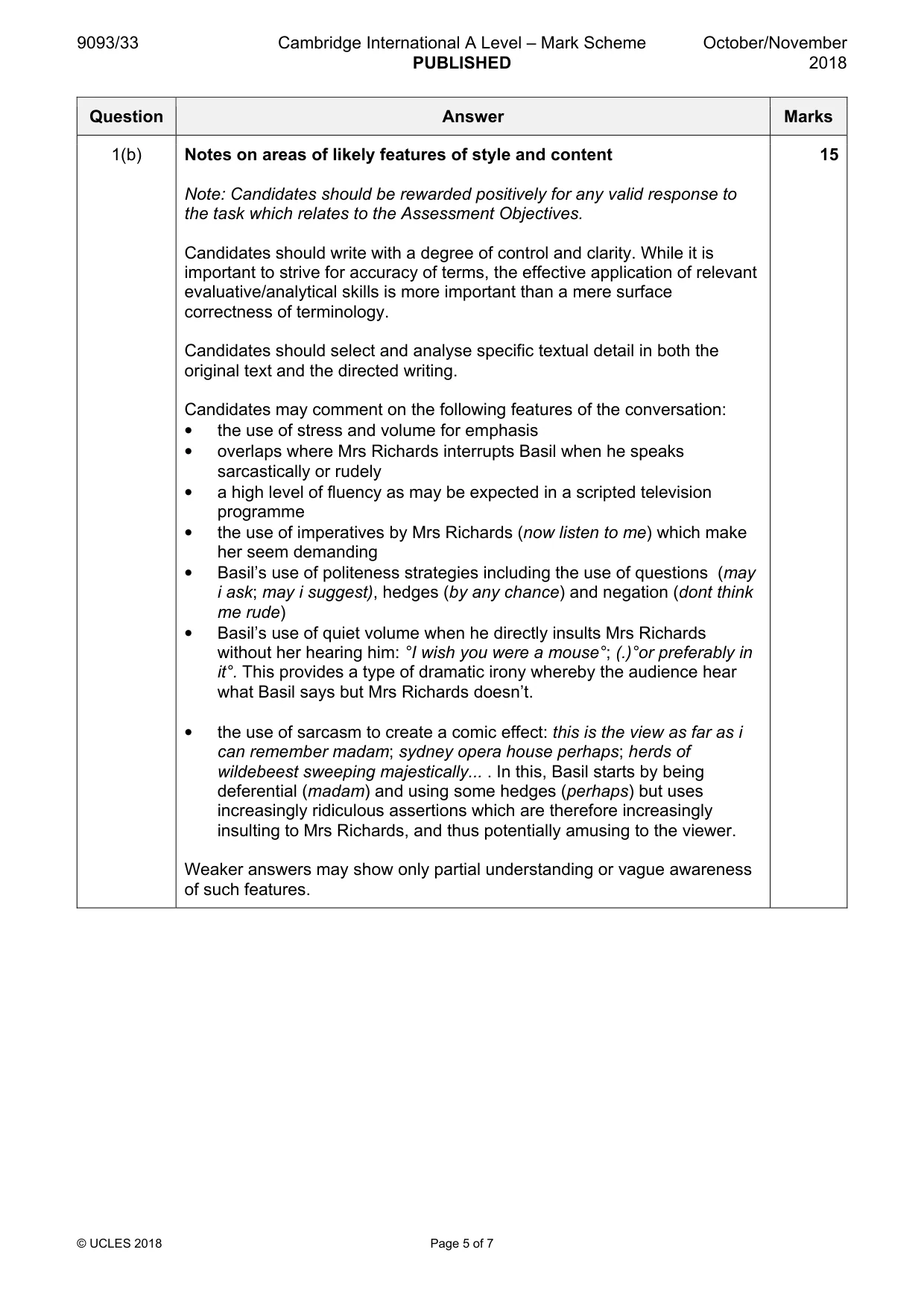
9093/33 Cambridge International A Level – Mark Scheme PUBLISHED October/November 2018 © UCLES 2018 Page 5 of 7 Question Answer Marks 1(b) Notes on areas of likely features of style and content Note: Candidates should be rewarded positively for any valid response to the task which relates to the Assessment Objectives. Candidates should write with a degree of control and clarity. While it is important to strive for accuracy of terms, the effective application of relevant evaluative/analytical skills is more important than a mere surface correctness of terminology. Candidates should select and analyse specific textual detail in both the original text and the directed writing. Candidates may comment on the following features of the conversation: • the use of stress and volume for emphasis • overlaps where Mrs Richards interrupts Basil when he speaks sarcastically or rudely • a high level of fluency as may be expected in a scripted television programme • the use of imperatives by Mrs Richards (now listen to me) which make her seem demanding • Basil’s use of politeness strategies including the use of questions (may i ask; may i suggest), hedges (by any chance) and negation (dont think me rude) • Basil’s use of quiet volume when he directly insults Mrs Richards without her hearing him: °I wish you were a mouse°; (.)°or preferably in it°. This provides a type of dramatic irony whereby the audience hear what Basil says but Mrs Richards doesn’t. • the use of sarcasm to create a comic effect: this is the view as far as i can remember madam; sydney opera house perhaps; herds of wildebeest sweeping majestically... . In this, Basil starts by being deferential (madam) and using some hedges (perhaps) but uses increasingly ridiculous assertions which are therefore increasingly insulting to Mrs Richards, and thus potentially amusing to the viewer. Weaker answers may show only partial understanding or vague awareness of such features. 15
Mark scheme, page 6
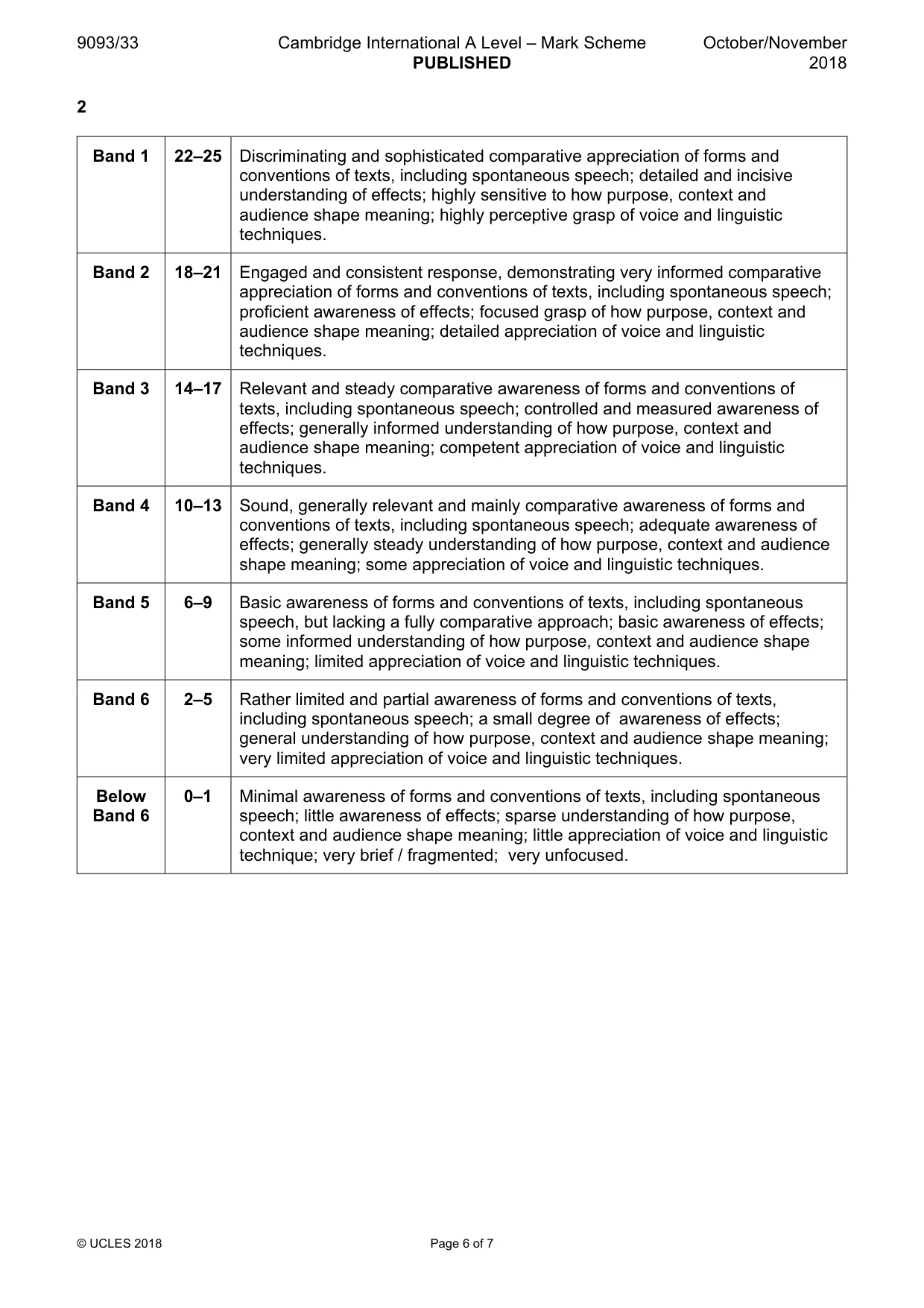
9093/33 Cambridge International A Level – Mark Scheme PUBLISHED October/November 2018 © UCLES 2018 Page 6 of 7 2 Band 1 22–25 Discriminating and sophisticated comparative appreciation of forms and conventions of texts, including spontaneous speech; detailed and incisive understanding of effects; highly sensitive to how purpose, context and audience shape meaning; highly perceptive grasp of voice and linguistic techniques. Band 2 18–21 Engaged and consistent response, demonstrating very informed comparative appreciation of forms and conventions of texts, including spontaneous speech; proficient awareness of effects; focused grasp of how purpose, context and audience shape meaning; detailed appreciation of voice and linguistic techniques. Band 3 14–17 Relevant and steady comparative awareness of forms and conventions of texts, including spontaneous speech; controlled and measured awareness of effects; generally informed understanding of how purpose, context and audience shape meaning; competent appreciation of voice and linguistic techniques. Band 4 10–13 Sound, generally relevant and mainly comparative awareness of forms and conventions of texts, including spontaneous speech; adequate awareness of effects; generally steady understanding of how purpose, context and audience shape meaning; some appreciation of voice and linguistic techniques. Band 5 6–9 Basic awareness of forms and conventions of texts, including spontaneous speech, but lacking a fully comparative approach; basic awareness of effects; some informed understanding of how purpose, context and audience shape meaning; limited appreciation of voice and linguistic techniques. Band 6 2–5 Rather limited and partial awareness of forms and conventions of texts, including spontaneous speech; a small degree of awareness of effects; general understanding of how purpose, context and audience shape meaning; very limited appreciation of voice and linguistic techniques. Below Band 6 0–1 Minimal awareness of forms and conventions of texts, including spontaneous speech; little awareness of effects; sparse understanding of how purpose, context and audience shape meaning; little appreciation of voice and linguistic technique; very brief / fragmented; very unfocused.
Mark scheme, page 7
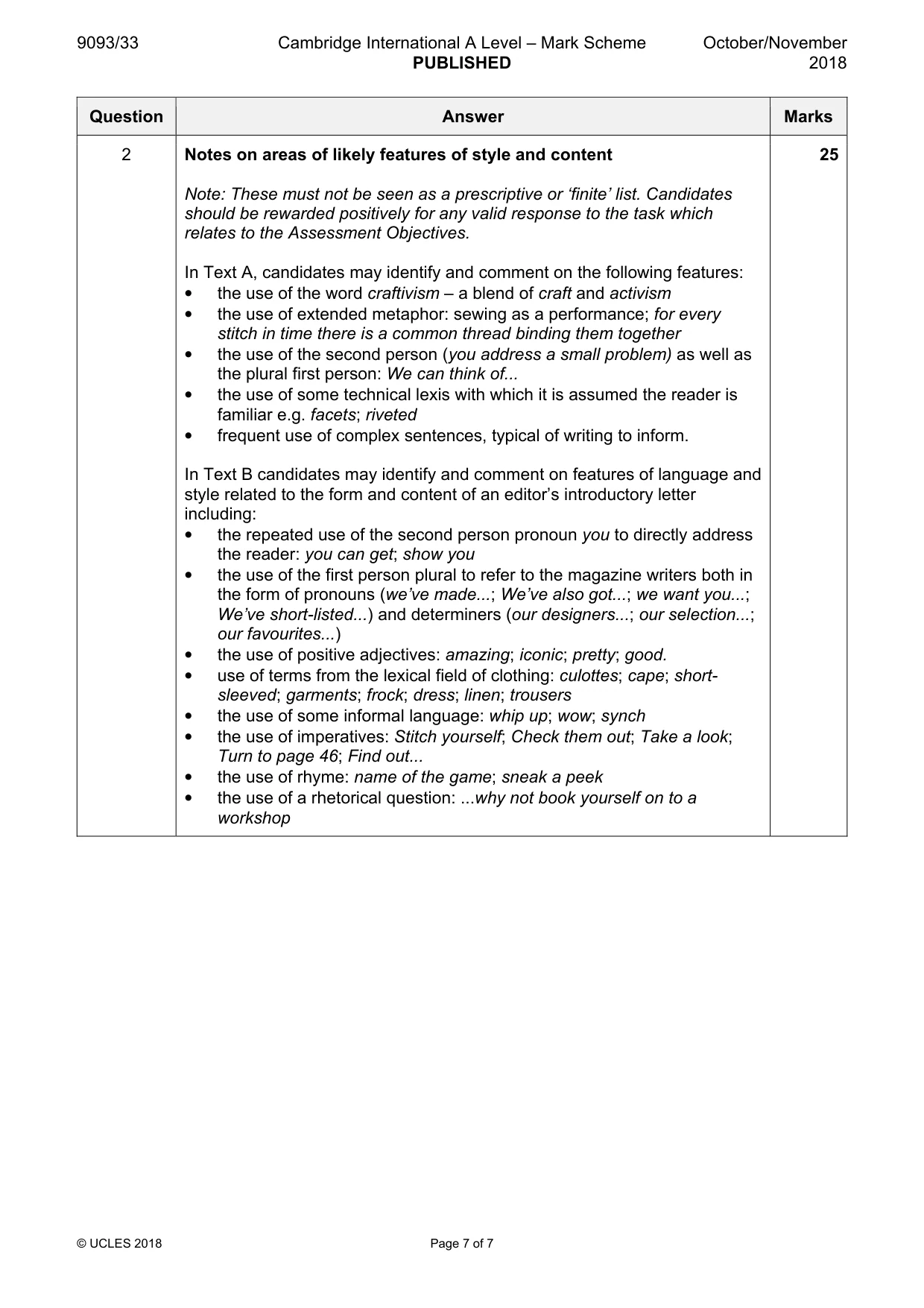
9093/33 Cambridge International A Level – Mark Scheme PUBLISHED October/November 2018 © UCLES 2018 Page 7 of 7 Question Answer Marks 2 Notes on areas of likely features of style and content Note: These must not be seen as a prescriptive or ‘finite’ list. Candidates should be rewarded positively for any valid response to the task which relates to the Assessment Objectives. In Text A, candidates may identify and comment on the following features: • the use of the word craftivism – a blend of craft and activism • the use of extended metaphor: sewing as a performance; for every stitch in time there is a common thread binding them together • the use of the second person (you address a small problem) as well as the plural first person: We can think of... • the use of some technical lexis with which it is assumed the reader is familiar e.g. facets; riveted • frequent use of complex sentences, typical of writing to inform. In Text B candidates may identify and comment on features of language and style related to the form and content of an editor’s introductory letter including: • the repeated use of the second person pronoun you to directly address the reader: you can get; show you • the use of the first person plural to refer to the magazine writers both in the form of pronouns (we’ve made...; We’ve also got...; we want you...; We’ve short-listed...) and determiners (our designers...; our selection...; our favourites...) • the use of positive adjectives: amazing; iconic; pretty; good. • use of terms from the lexical field of clothing: culottes; cape; short- sleeved; garments; frock; dress; linen; trousers • the use of some informal language: whip up; wow; synch • the use of imperatives: Stitch yourself; Check them out; Take a look; Turn to page 46; Find out... • the use of rhyme: name of the game; sneak a peek • the use of a rhetorical question: ...why not book yourself on to a workshop 25
What you needed in this session
Cambridge’s own grade thresholds for 2018 Oct/Nov, Paper 3 · Variant 3. A higher threshold means an easier paper — the bar moves with how the cohort did.