Cambridge A Level English - Language AS and A Level (from 2014) 9093 — 2017 Oct/Nov Paper 3 · Variant 2
9093/32/O/N/17 · 50 marks · ≈56 min
The question paper and its mark scheme, free to read here and free to download. This is Cambridge’s own paper, exactly as it was sat.
Question paper8 pages


Mark scheme5 pages
Answers below. Sit the paper first if you are practising.
Paper as text
Question paper, page 1
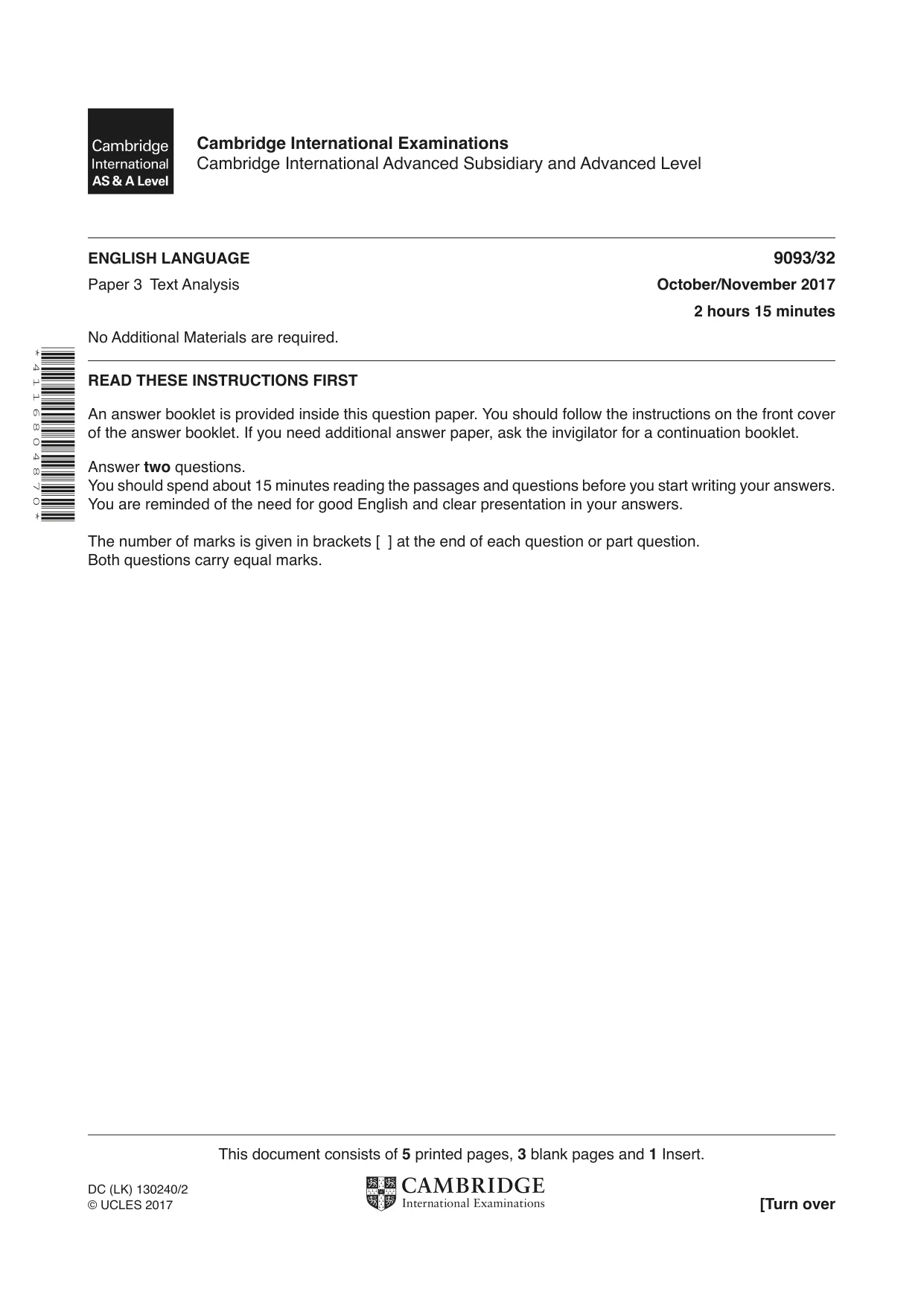
This document consists of 5 printed pages, 3 blank pages and 1 Insert. DC (LK) 130240/2 © UCLES 2017 [Turn over Cambridge International Examinations Cambridge International Advanced Subsidiary and Advanced Level * 4 1 1 6 8 0 4 8 7 0 * ENGLISH LANGUAGE 9093/32 Paper 3 Text Analysis October/November 2017 2 hours 15 minutes No Additional Materials are required. READ THESE INSTRUCTIONS FIRST An answer booklet is provided inside this question paper. You should follow the instructions on the front cover of the answer booklet. If you need additional answer paper, ask the invigilator for a continuation booklet. Answer two questions. You should spend about 15 minutes reading the passages and questions before you start writing your answers. You are reminded of the need for good English and clear presentation in your answers. The number of marks is given in brackets [ ] at the end of each question or part question. Both questions carry equal marks.
Question paper, page 2
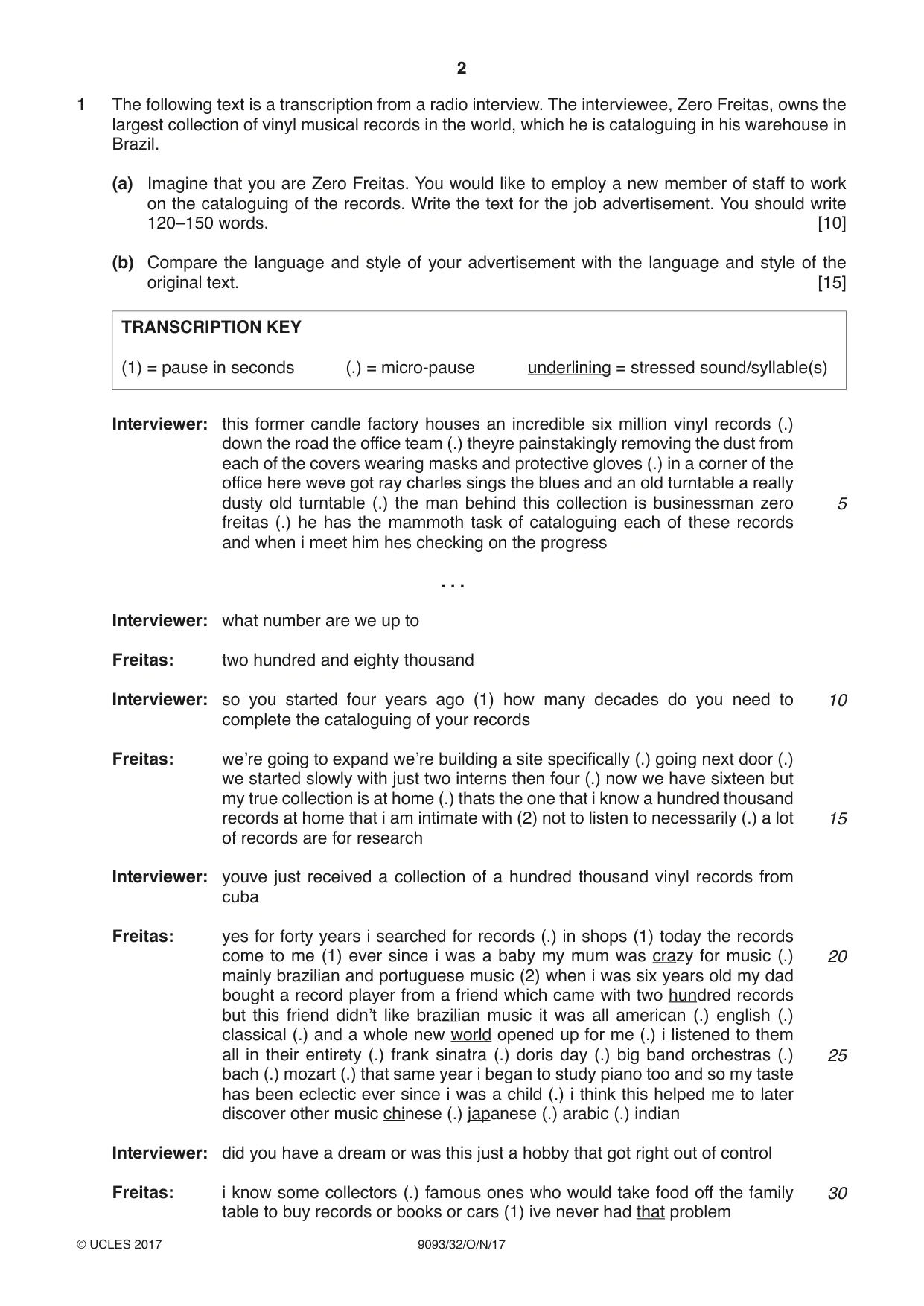
2 9093/32/O/N/17 © UCLES 2017 1 The following text is a transcription from a radio interview. The interviewee, Zero Freitas, owns the largest collection of vinyl musical records in the world, which he is cataloguing in his warehouse in Brazil. (a) Imagine that you are Zero Freitas. You would like to employ a new member of staff to work on the cataloguing of the records. Write the text for the job advertisement. You should write 120–150 words. [10] (b) Compare the language and style of your advertisement with the language and style of the original text. [15] TRANSCRIPTION KEY (1) = pause in seconds (.) = micro-pause underlining = stressed sound/syllable(s) Interviewer: this former candle factory houses an incredible six million vinyl records (.) down the road the office team (.) theyre painstakingly removing the dust from each of the covers wearing masks and protective gloves (.) in a corner of the office here weve got ray charles sings the blues and an old turntable a really dusty old turntable (.) the man behind this collection is businessman zero freitas (.) he has the mammoth task of cataloguing each of these records and when i meet him hes checking on the progress . . . Interviewer: what number are we up to Freitas: two hundred and eighty thousand Interviewer: so you started four years ago (1) how many decades do you need to complete the cataloguing of your records Freitas: we’re going to expand we’re building a site specifically (.) going next door (.) we started slowly with just two interns then four (.) now we have sixteen but my true collection is at home (.) thats the one that i know a hundred thousand records at home that i am intimate with (2) not to listen to necessarily (.) a lot of records are for research Interviewer: youve just received a collection of a hundred thousand vinyl records from cuba Freitas: yes for forty years i searched for records (.) in shops (1) today the records come to me (1) ever since i was a baby my mum was crazy for music (.) mainly brazilian and portuguese music (2) when i was six years old my dad bought a record player from a friend which came with two hundred records but this friend didn’t like brazilian music it was all american (.) english (.) classical (.) and a whole new world opened up for me (.) i listened to them all in their entirety (.) frank sinatra (.) doris day (.) big band orchestras (.) bach (.) mozart (.) that same year i began to study piano too and so my taste has been eclectic ever since i was a child (.) i think this helped me to later discover other music chinese (.) japanese (.) arabic (.) indian Interviewer: did you have a dream or was this just a hobby that got right out of control Freitas: i know some collectors (.) famous ones who would take food off the family table to buy records or books or cars (1) ive never had that problem 5 10 15 20 25 30
Question paper, page 3
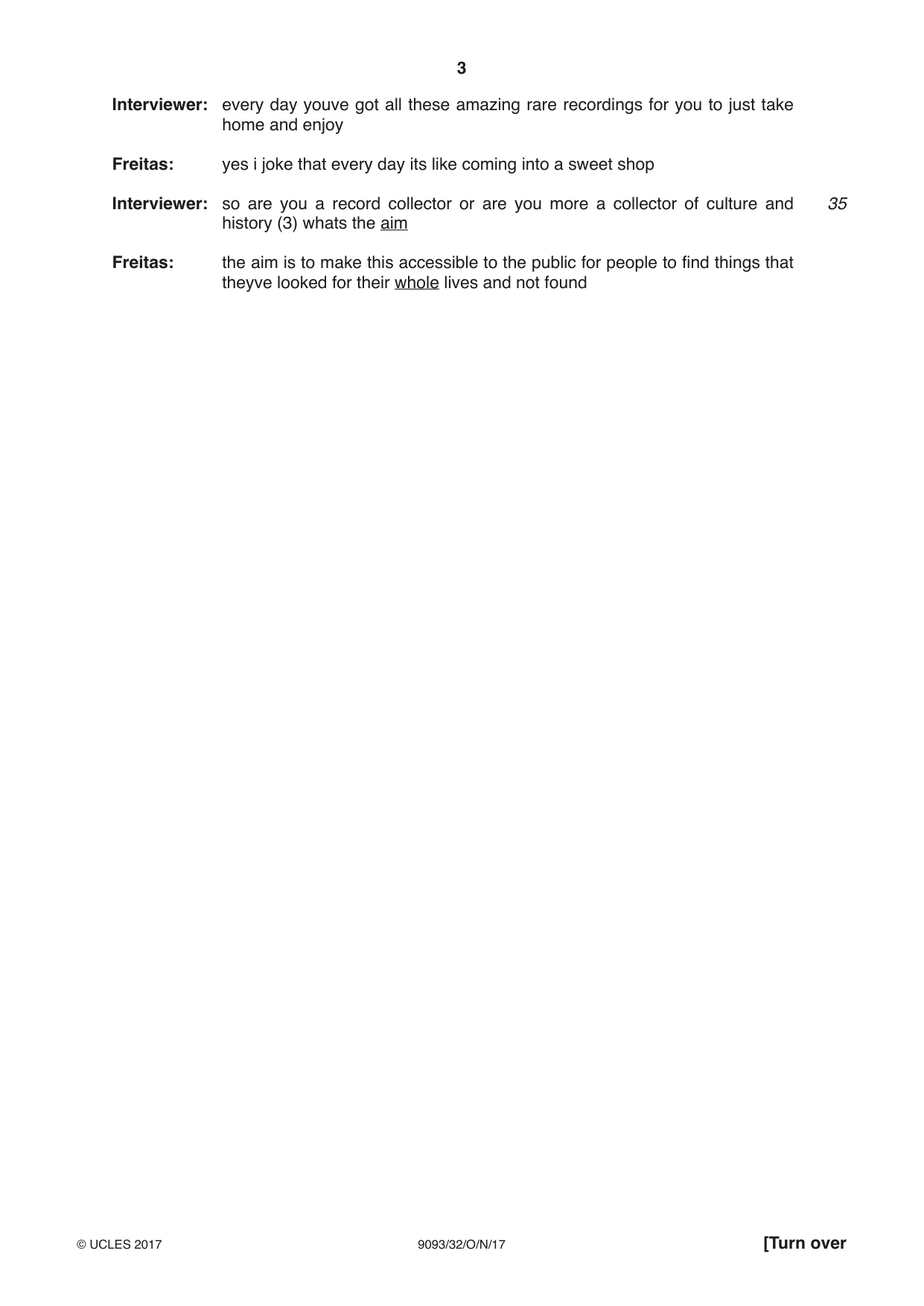
3 9093/32/O/N/17 © UCLES 2017 [Turn over Interviewer: every day youve got all these amazing rare recordings for you to just take home and enjoy Freitas: yes i joke that every day its like coming into a sweet shop Interviewer: so are you a record collector or are you more a collector of culture and history (3) whats the aim Freitas: the aim is to make this accessible to the public for people to find things that theyve looked for their whole lives and not found 35
Question paper, page 4
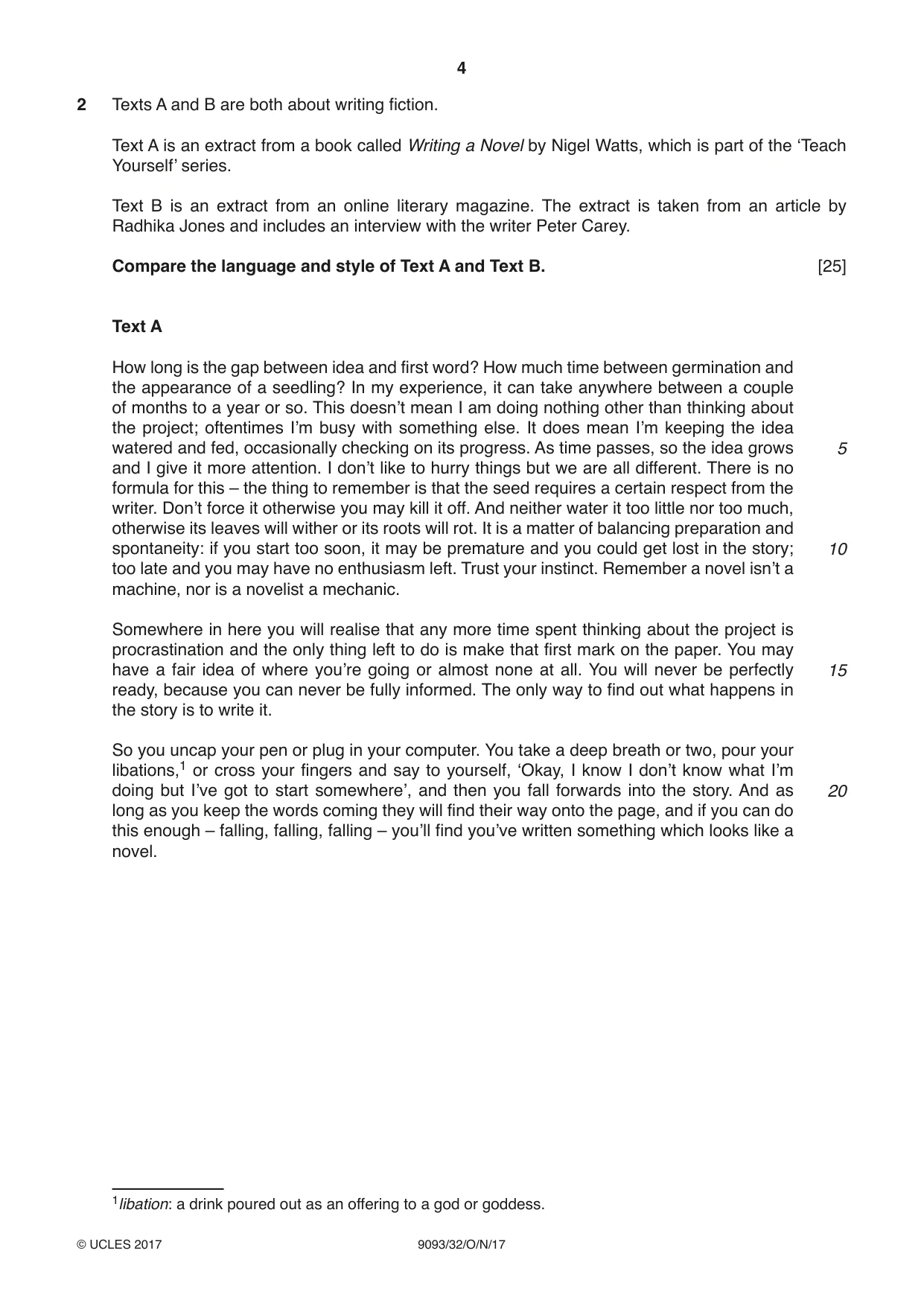
4 9093/32/O/N/17 © UCLES 2017 2 Texts A and B are both about writing fiction. Text A is an extract from a book called Writing a Novel by Nigel Watts, which is part of the ‘Teach Yourself’ series. Text B is an extract from an online literary magazine. The extract is taken from an article by Radhika Jones and includes an interview with the writer Peter Carey. Compare the language and style of Text A and Text B. [25] Text A How long is the gap between idea and first word? How much time between germination and the appearance of a seedling? In my experience, it can take anywhere between a couple of months to a year or so. This doesn’t mean I am doing nothing other than thinking about the project; oftentimes I’m busy with something else. It does mean I’m keeping the idea watered and fed, occasionally checking on its progress. As time passes, so the idea grows and I give it more attention. I don’t like to hurry things but we are all different. There is no formula for this – the thing to remember is that the seed requires a certain respect from the writer. Don’t force it otherwise you may kill it off. And neither water it too little nor too much, otherwise its leaves will wither or its roots will rot. It is a matter of balancing preparation and spontaneity: if you start too soon, it may be premature and you could get lost in the story; too late and you may have no enthusiasm left. Trust your instinct. Remember a novel isn’t a machine, nor is a novelist a mechanic. Somewhere in here you will realise that any more time spent thinking about the project is procrastination and the only thing left to do is make that first mark on the paper. You may have a fair idea of where you’re going or almost none at all. You will never be perfectly ready, because you can never be fully informed. The only way to find out what happens in the story is to write it. So you uncap your pen or plug in your computer. You take a deep breath or two, pour your libations,1 or cross your fingers and say to yourself, ‘Okay, I know I don’t know what I’m doing but I’ve got to start somewhere’, and then you fall forwards into the story. And as long as you keep the words coming they will find their way onto the page, and if you can do this enough – falling, falling, falling – you’ll find you’ve written something which looks like a novel. 1libation: a drink poured out as an offering to a god or goddess. 5 10 15 20
Question paper, page 5
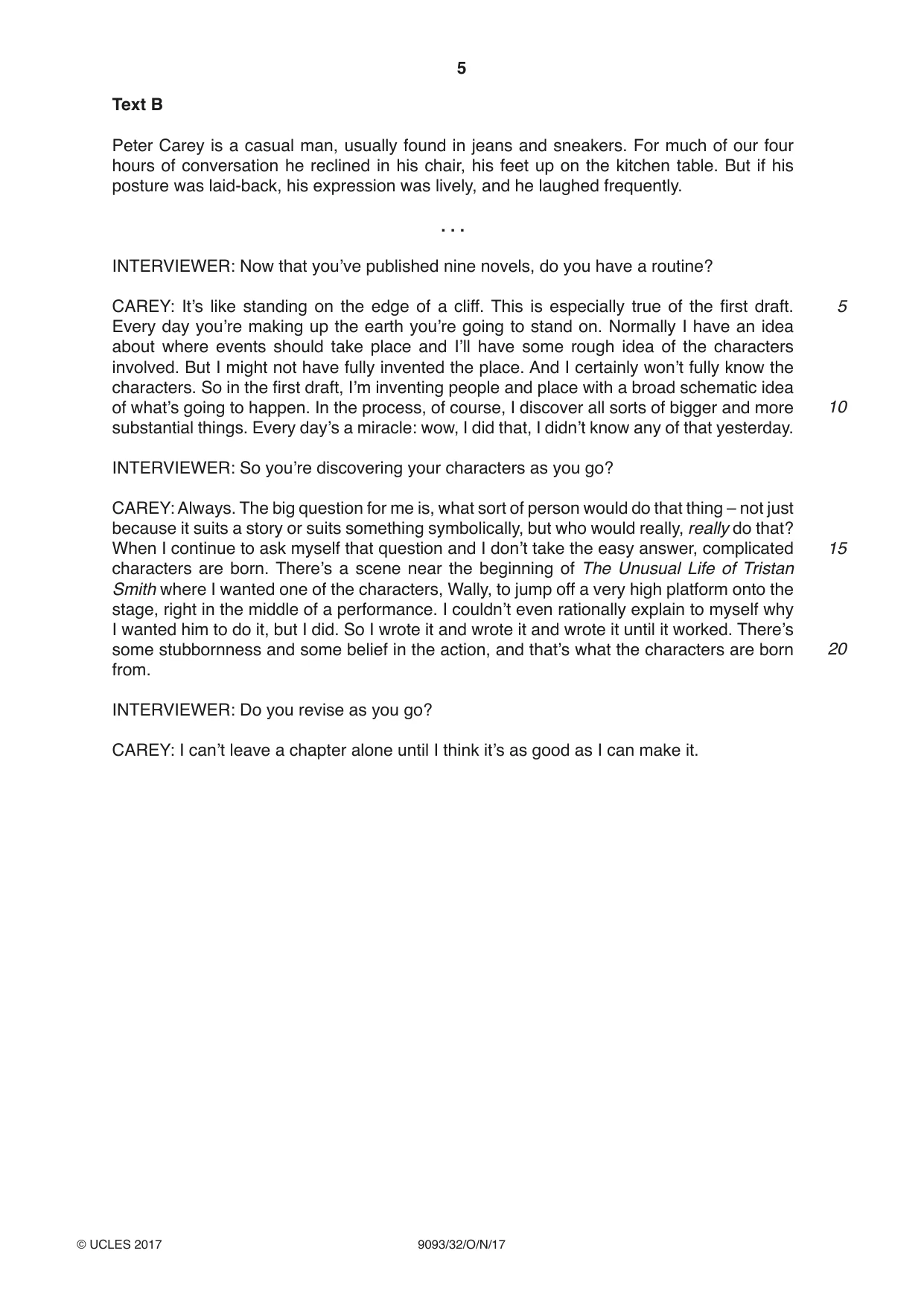
5 9093/32/O/N/17 © UCLES 2017 Text B Peter Carey is a casual man, usually found in jeans and sneakers. For much of our four hours of conversation he reclined in his chair, his feet up on the kitchen table. But if his posture was laid-back, his expression was lively, and he laughed frequently. . . . INTERVIEWER: Now that you’ve published nine novels, do you have a routine? CAREY: It’s like standing on the edge of a cliff. This is especially true of the first draft. Every day you’re making up the earth you’re going to stand on. Normally I have an idea about where events should take place and I’ll have some rough idea of the characters involved. But I might not have fully invented the place. And I certainly won’t fully know the characters. So in the first draft, I’m inventing people and place with a broad schematic idea of what’s going to happen. In the process, of course, I discover all sorts of bigger and more substantial things. Every day’s a miracle: wow, I did that, I didn’t know any of that yesterday. INTERVIEWER: So you’re discovering your characters as you go? CAREY: Always. The big question for me is, what sort of person would do that thing – not just because it suits a story or suits something symbolically, but who would really, really do that? When I continue to ask myself that question and I don’t take the easy answer, complicated characters are born. There’s a scene near the beginning of The Unusual Life of Tristan Smith where I wanted one of the characters, Wally, to jump off a very high platform onto the stage, right in the middle of a performance. I couldn’t even rationally explain to myself why I wanted him to do it, but I did. So I wrote it and wrote it and wrote it until it worked. There’s some stubbornness and some belief in the action, and that’s what the characters are born from. INTERVIEWER: Do you revise as you go? CAREY: I can’t leave a chapter alone until I think it’s as good as I can make it. 5 10 15 20
Question paper, page 6
6 9093/32/O/N/17 © UCLES 2017 BLANK PAGE
Question paper, page 7
7 9093/32/O/N/17 © UCLES 2017 BLANK PAGE
Question paper, page 8
8 9093/32/O/N/17 © UCLES 2017 Permission to reproduce items where third-party owned material protected by copyright is included has been sought and cleared where possible. Every reasonable effort has been made by the publisher (UCLES) to trace copyright holders, but if any items requiring clearance have unwittingly been included, the publisher will be pleased to make amends at the earliest possible opportunity. To avoid the issue of disclosure of answer-related information to candidates, all copyright acknowledgements are reproduced online in the Cambridge International Examinations Copyright Acknowledgements Booklet. This is produced for each series of examinations and is freely available to download at www.cie.org.uk after the live examination series. Cambridge International Examinations is part of the Cambridge Assessment Group. Cambridge Assessment is the brand name of University of Cambridge Local Examinations Syndicate (UCLES), which is itself a department of the University of Cambridge. BLANK PAGE
Mark scheme, page 1
® IGCSE is a registered trademark. This document consists of 5 printed pages. © UCLES 2017 [Turn over Cambridge Assessment International Education Cambridge International Advanced Level ENGLISH LANGUAGE 9093/32 Paper 3 Text Analysis October/November 2017 MARK SCHEME Maximum Mark: 50 Published This mark scheme is published as an aid to teachers and candidates, to indicate the requirements of the examination. It shows the basis on which Examiners were instructed to award marks. It does not indicate the details of the discussions that took place at an Examiners’ meeting before marking began, which would have considered the acceptability of alternative answers. Mark schemes should be read in conjunction with the question paper and the Principal Examiner Report for Teachers. Cambridge International will not enter into discussions about these mark schemes. Cambridge International is publishing the mark schemes for the October/November 2017 series for most Cambridge IGCSE®, Cambridge International A and AS Level components and some Cambridge O Level components.
Mark scheme, page 2
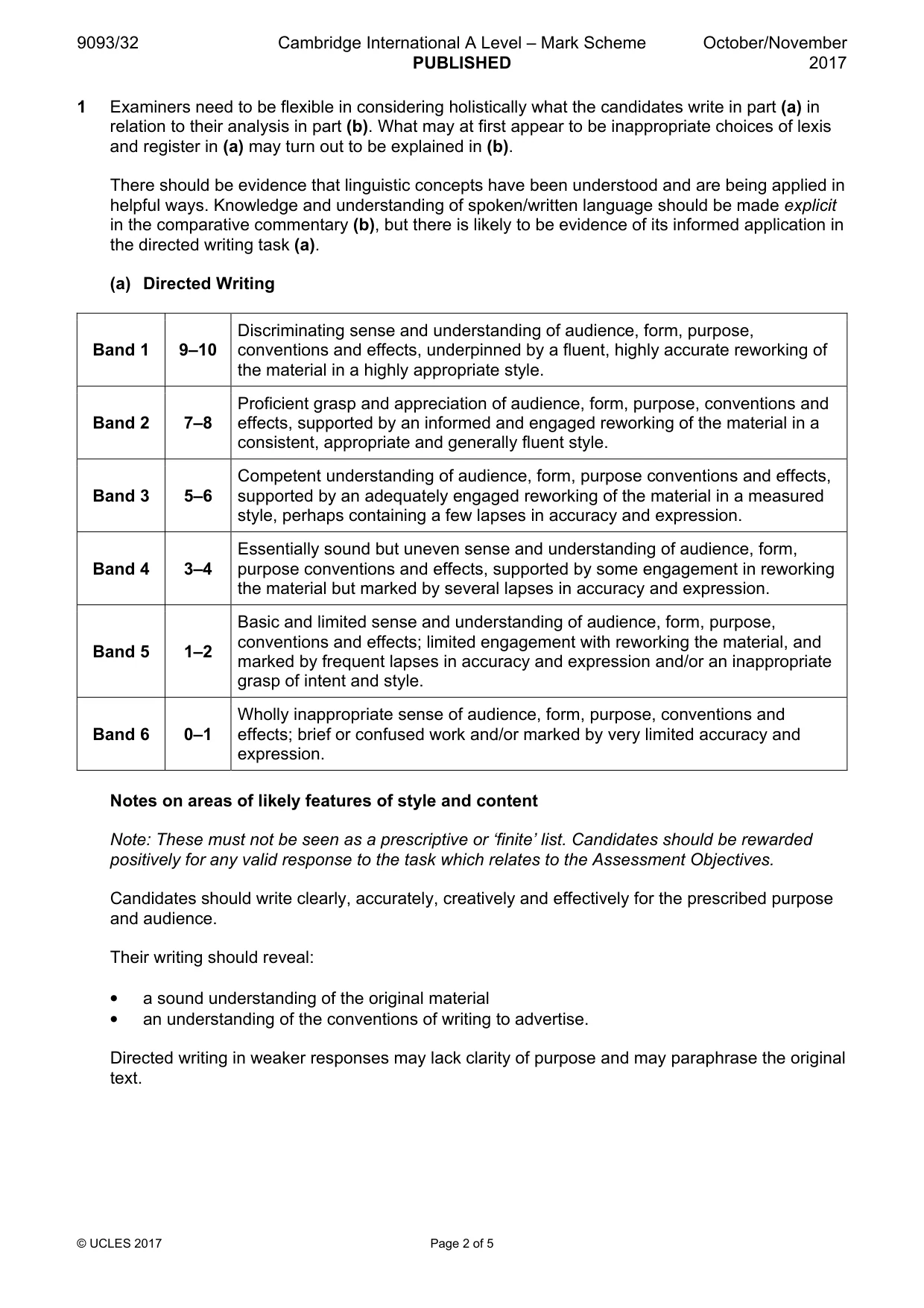
9093/32 Cambridge International A Level – Mark Scheme PUBLISHED October/November 2017 © UCLES 2017 Page 2 of 5 1 Examiners need to be flexible in considering holistically what the candidates write in part (a) in relation to their analysis in part (b). What may at first appear to be inappropriate choices of lexis and register in (a) may turn out to be explained in (b). There should be evidence that linguistic concepts have been understood and are being applied in helpful ways. Knowledge and understanding of spoken/written language should be made explicit in the comparative commentary (b), but there is likely to be evidence of its informed application in the directed writing task (a). (a) Directed Writing Band 1 9–10 Discriminating sense and understanding of audience, form, purpose, conventions and effects, underpinned by a fluent, highly accurate reworking of the material in a highly appropriate style. Band 2 7–8 Proficient grasp and appreciation of audience, form, purpose, conventions and effects, supported by an informed and engaged reworking of the material in a consistent, appropriate and generally fluent style. Band 3 5–6 Competent understanding of audience, form, purpose conventions and effects, supported by an adequately engaged reworking of the material in a measured style, perhaps containing a few lapses in accuracy and expression. Band 4 3–4 Essentially sound but uneven sense and understanding of audience, form, purpose conventions and effects, supported by some engagement in reworking the material but marked by several lapses in accuracy and expression. Band 5 1–2 Basic and limited sense and understanding of audience, form, purpose, conventions and effects; limited engagement with reworking the material, and marked by frequent lapses in accuracy and expression and/or an inappropriate grasp of intent and style. Band 6 0–1 Wholly inappropriate sense of audience, form, purpose, conventions and effects; brief or confused work and/or marked by very limited accuracy and expression. Notes on areas of likely features of style and content Note: These must not be seen as a prescriptive or ‘finite’ list. Candidates should be rewarded positively for any valid response to the task which relates to the Assessment Objectives. Candidates should write clearly, accurately, creatively and effectively for the prescribed purpose and audience. Their writing should reveal: • a sound understanding of the original material • an understanding of the conventions of writing to advertise. Directed writing in weaker responses may lack clarity of purpose and may paraphrase the original text.
Mark scheme, page 3
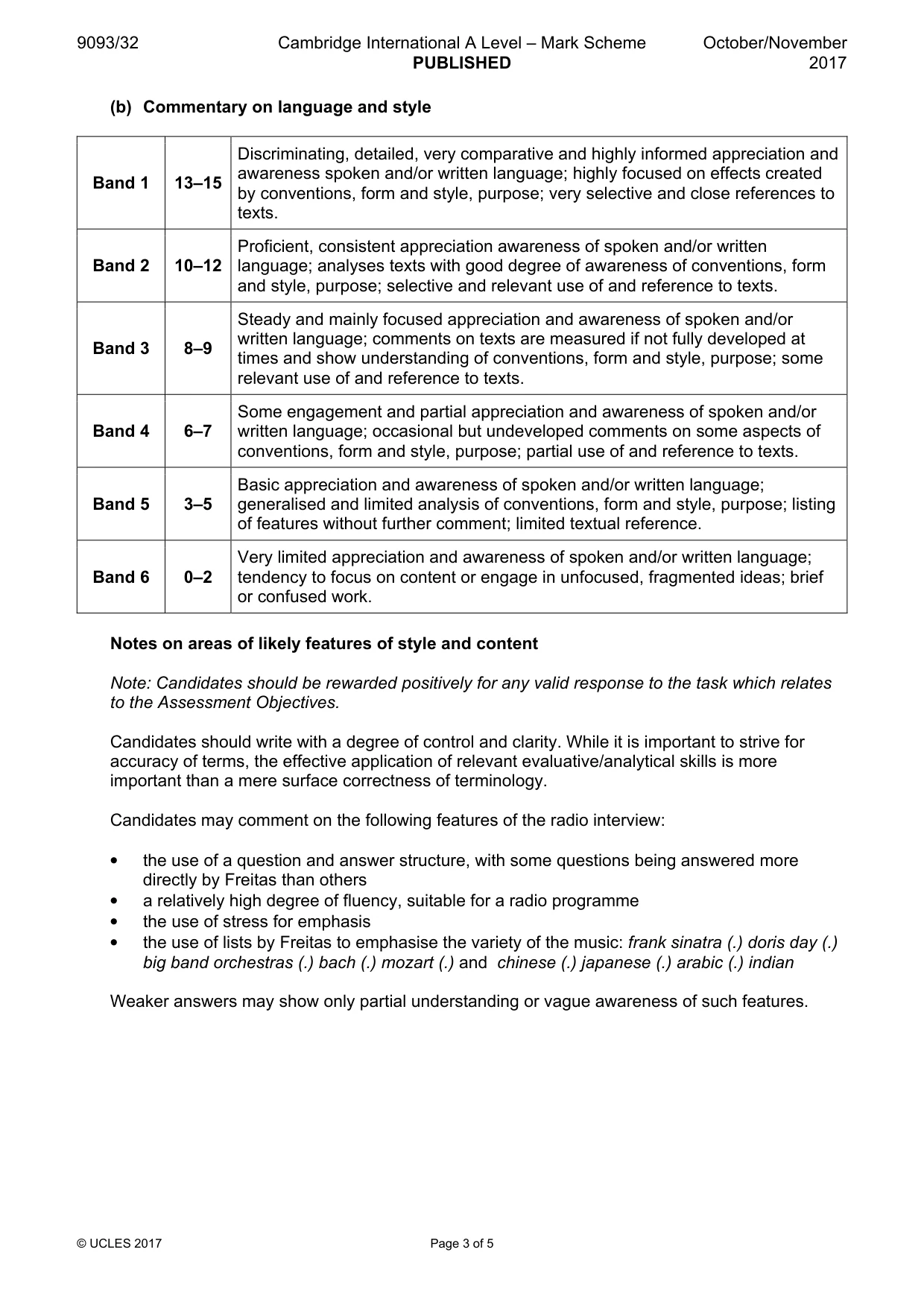
9093/32 Cambridge International A Level – Mark Scheme PUBLISHED October/November 2017 © UCLES 2017 Page 3 of 5 (b) Commentary on language and style Band 1 13–15 Discriminating, detailed, very comparative and highly informed appreciation and awareness spoken and/or written language; highly focused on effects created by conventions, form and style, purpose; very selective and close references to texts. Band 2 10–12 Proficient, consistent appreciation awareness of spoken and/or written language; analyses texts with good degree of awareness of conventions, form and style, purpose; selective and relevant use of and reference to texts. Band 3 8–9 Steady and mainly focused appreciation and awareness of spoken and/or written language; comments on texts are measured if not fully developed at times and show understanding of conventions, form and style, purpose; some relevant use of and reference to texts. Band 4 6–7 Some engagement and partial appreciation and awareness of spoken and/or written language; occasional but undeveloped comments on some aspects of conventions, form and style, purpose; partial use of and reference to texts. Band 5 3–5 Basic appreciation and awareness of spoken and/or written language; generalised and limited analysis of conventions, form and style, purpose; listing of features without further comment; limited textual reference. Band 6 0–2 Very limited appreciation and awareness of spoken and/or written language; tendency to focus on content or engage in unfocused, fragmented ideas; brief or confused work. Notes on areas of likely features of style and content Note: Candidates should be rewarded positively for any valid response to the task which relates to the Assessment Objectives. Candidates should write with a degree of control and clarity. While it is important to strive for accuracy of terms, the effective application of relevant evaluative/analytical skills is more important than a mere surface correctness of terminology. Candidates may comment on the following features of the radio interview: • the use of a question and answer structure, with some questions being answered more directly by Freitas than others • a relatively high degree of fluency, suitable for a radio programme • the use of stress for emphasis • the use of lists by Freitas to emphasise the variety of the music: frank sinatra (.) doris day (.) big band orchestras (.) bach (.) mozart (.) and chinese (.) japanese (.) arabic (.) indian Weaker answers may show only partial understanding or vague awareness of such features.
Mark scheme, page 4
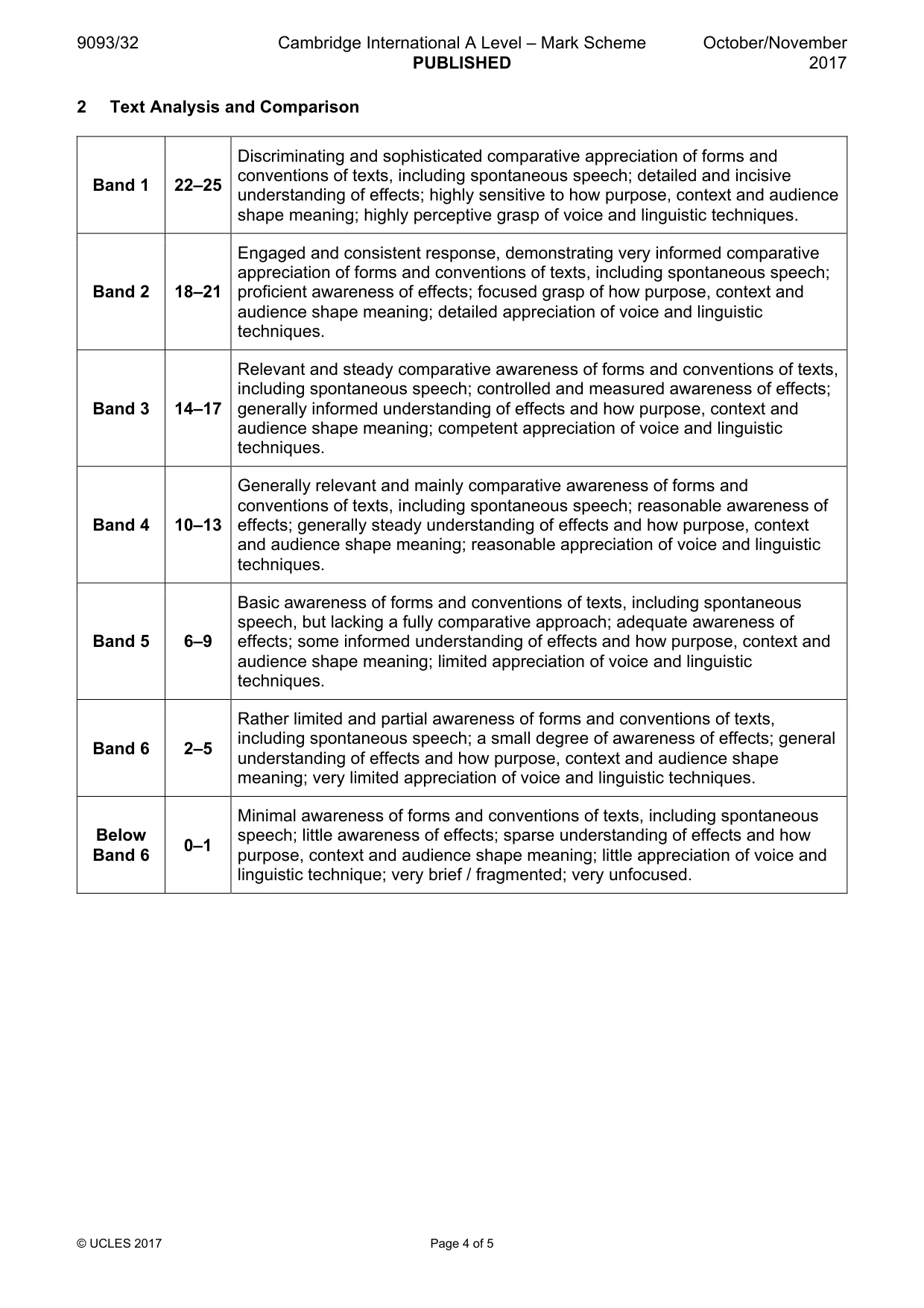
9093/32 Cambridge International A Level – Mark Scheme PUBLISHED October/November 2017 © UCLES 2017 Page 4 of 5 2 Text Analysis and Comparison Band 1 22–25 Discriminating and sophisticated comparative appreciation of forms and conventions of texts, including spontaneous speech; detailed and incisive understanding of effects; highly sensitive to how purpose, context and audience shape meaning; highly perceptive grasp of voice and linguistic techniques. Band 2 18–21 Engaged and consistent response, demonstrating very informed comparative appreciation of forms and conventions of texts, including spontaneous speech; proficient awareness of effects; focused grasp of how purpose, context and audience shape meaning; detailed appreciation of voice and linguistic techniques. Band 3 14–17 Relevant and steady comparative awareness of forms and conventions of texts, including spontaneous speech; controlled and measured awareness of effects; generally informed understanding of effects and how purpose, context and audience shape meaning; competent appreciation of voice and linguistic techniques. Band 4 10–13 Generally relevant and mainly comparative awareness of forms and conventions of texts, including spontaneous speech; reasonable awareness of effects; generally steady understanding of effects and how purpose, context and audience shape meaning; reasonable appreciation of voice and linguistic techniques. Band 5 6–9 Basic awareness of forms and conventions of texts, including spontaneous speech, but lacking a fully comparative approach; adequate awareness of effects; some informed understanding of effects and how purpose, context and audience shape meaning; limited appreciation of voice and linguistic techniques. Band 6 2–5 Rather limited and partial awareness of forms and conventions of texts, including spontaneous speech; a small degree of awareness of effects; general understanding of effects and how purpose, context and audience shape meaning; very limited appreciation of voice and linguistic techniques. Below Band 6 0–1 Minimal awareness of forms and conventions of texts, including spontaneous speech; little awareness of effects; sparse understanding of effects and how purpose, context and audience shape meaning; little appreciation of voice and linguistic technique; very brief / fragmented; very unfocused.
Mark scheme, page 5
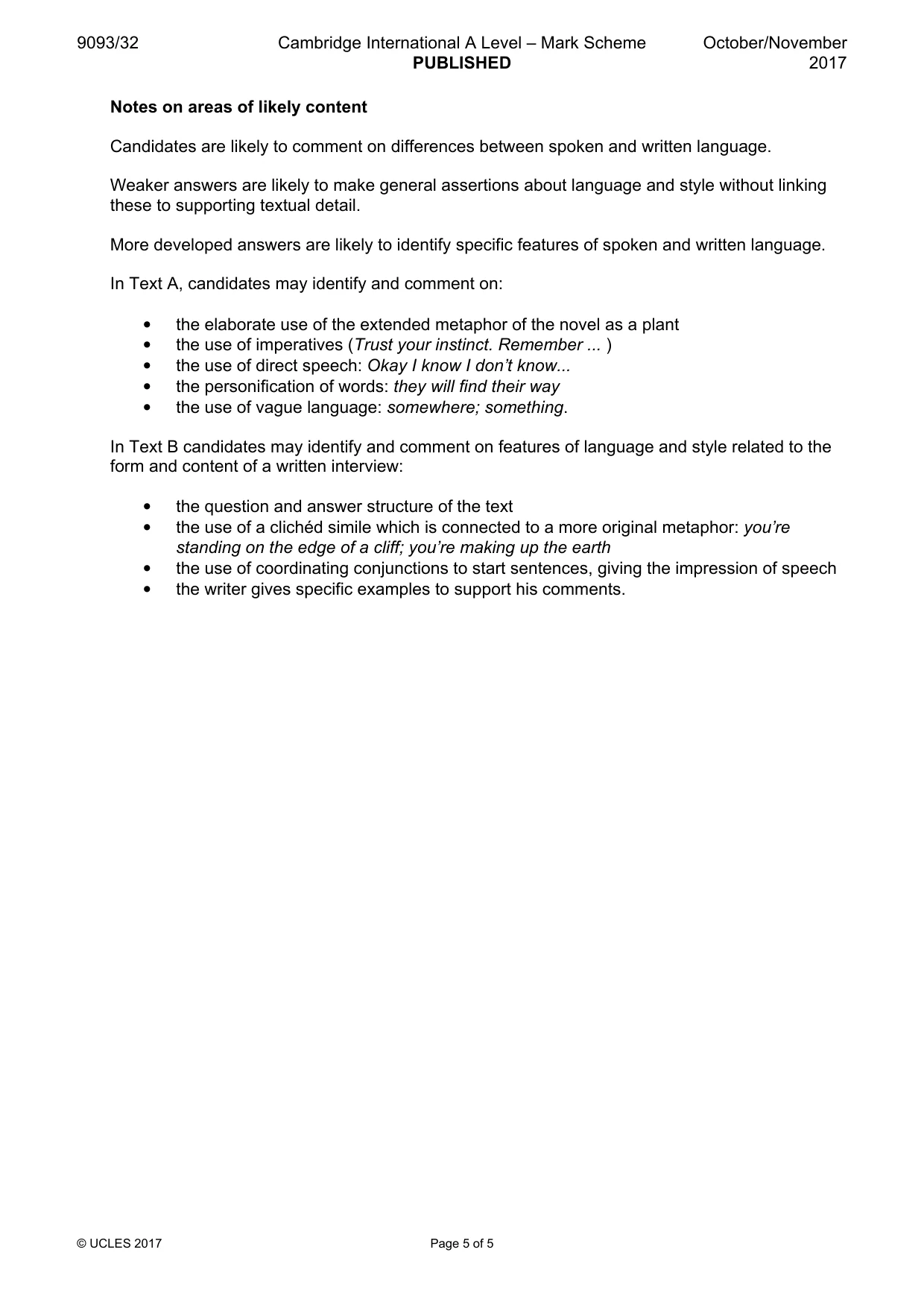
9093/32 Cambridge International A Level – Mark Scheme PUBLISHED October/November 2017 © UCLES 2017 Page 5 of 5 Notes on areas of likely content Candidates are likely to comment on differences between spoken and written language. Weaker answers are likely to make general assertions about language and style without linking these to supporting textual detail. More developed answers are likely to identify specific features of spoken and written language. In Text A, candidates may identify and comment on: • the elaborate use of the extended metaphor of the novel as a plant • the use of imperatives (Trust your instinct. Remember ... ) • the use of direct speech: Okay I know I don’t know... • the personification of words: they will find their way • the use of vague language: somewhere; something. In Text B candidates may identify and comment on features of language and style related to the form and content of a written interview: • the question and answer structure of the text • the use of a clichéd simile which is connected to a more original metaphor: you’re standing on the edge of a cliff; you’re making up the earth • the use of coordinating conjunctions to start sentences, giving the impression of speech • the writer gives specific examples to support his comments.
What you needed in this session
Cambridge’s own grade thresholds for 2017 Oct/Nov, Paper 3 · Variant 2. A higher threshold means an easier paper — the bar moves with how the cohort did.