Cambridge A Level English - Language AS and A Level (from 2014) 9093 — 2017 Oct/Nov Paper 3 · Variant 3
9093/33/O/N/17 · 50 marks · ≈56 min
The question paper and its mark scheme, free to read here and free to download. This is Cambridge’s own paper, exactly as it was sat.
Question paper4 pages
Mark scheme5 pages
Answers below. Sit the paper first if you are practising.
Paper as text
Question paper, page 1
This document consists of 4 printed pages and 1 Insert. DC (LK) 130239/1 © UCLES 2017 [Turn over Cambridge International Examinations Cambridge International Advanced Subsidiary and Advanced Level * 9 0 4 7 9 0 8 0 7 9 * ENGLISH LANGUAGE 9093/33 Paper 3 Text Analysis October/November 2017 2 hours 15 minutes No Additional Materials are required. READ THESE INSTRUCTIONS FIRST An answer booklet is provided inside this question paper. You should follow the instructions on the front cover of the answer booklet. If you need additional answer paper, ask the invigilator for a continuation booklet. Answer two questions. You should spend about 15 minutes reading the passages and questions before you start writing your answers. You are reminded of the need for good English and clear presentation in your answers. The number of marks is given in [ ] at the end of each question or part question. Both questions carry equal marks.
Question paper, page 2
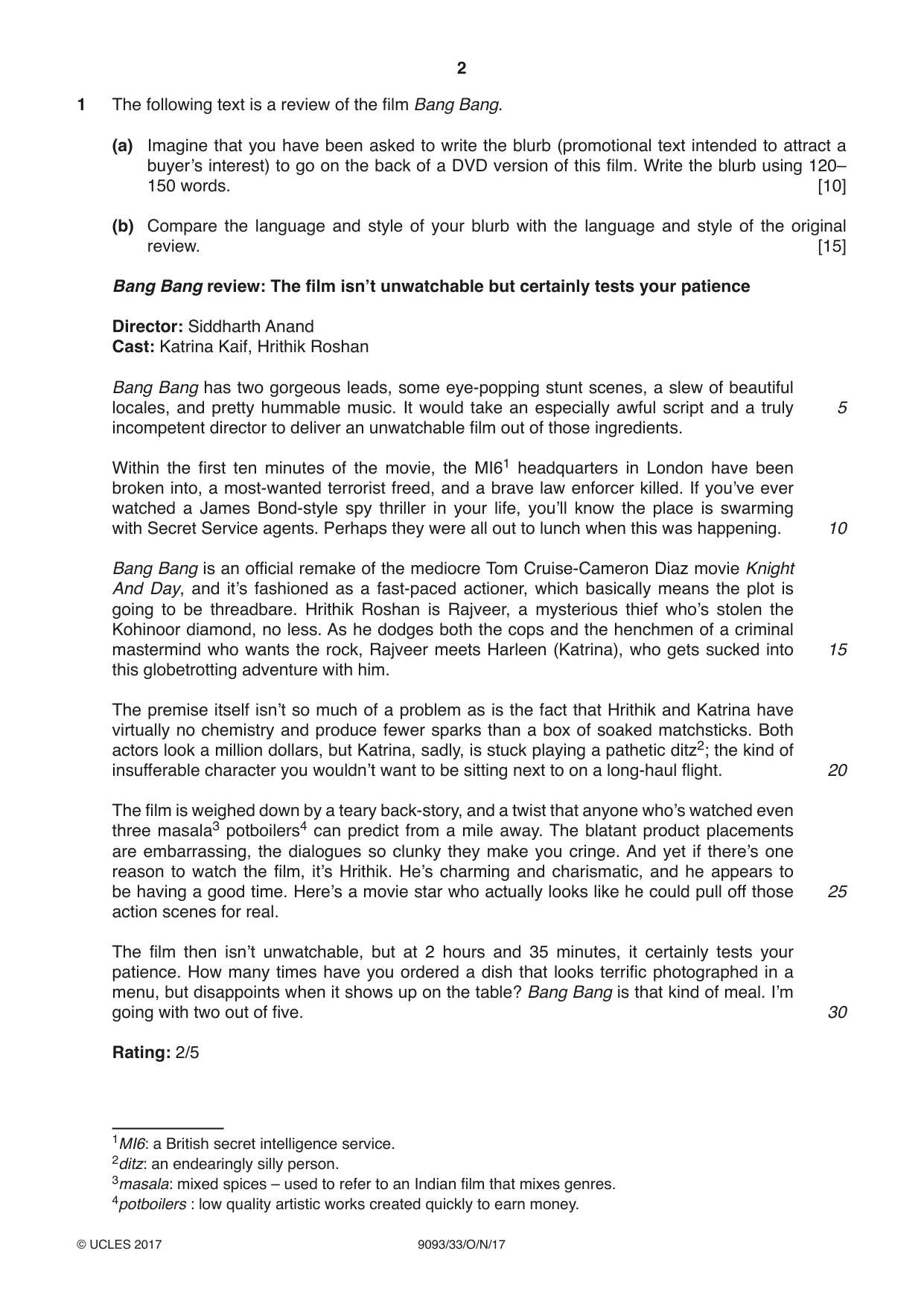
2 9093/33/O/N/17 © UCLES 2017 1 The following text is a review of the film Bang Bang. (a) Imagine that you have been asked to write the blurb (promotional text intended to attract a buyer’s interest) to go on the back of a DVD version of this film. Write the blurb using 120– 150 words. [10] (b) Compare the language and style of your blurb with the language and style of the original review. [15] Bang Bang review: The film isn’t unwatchable but certainly tests your patience Director: Siddharth Anand Cast: Katrina Kaif, Hrithik Roshan Bang Bang has two gorgeous leads, some eye-popping stunt scenes, a slew of beautiful locales, and pretty hummable music. It would take an especially awful script and a truly incompetent director to deliver an unwatchable film out of those ingredients. Within the first ten minutes of the movie, the MI61 headquarters in London have been broken into, a most-wanted terrorist freed, and a brave law enforcer killed. If you’ve ever watched a James Bond-style spy thriller in your life, you’ll know the place is swarming with Secret Service agents. Perhaps they were all out to lunch when this was happening. Bang Bang is an official remake of the mediocre Tom Cruise-Cameron Diaz movie Knight And Day, and it’s fashioned as a fast-paced actioner, which basically means the plot is going to be threadbare. Hrithik Roshan is Rajveer, a mysterious thief who’s stolen the Kohinoor diamond, no less. As he dodges both the cops and the henchmen of a criminal mastermind who wants the rock, Rajveer meets Harleen (Katrina), who gets sucked into this globetrotting adventure with him. The premise itself isn’t so much of a problem as is the fact that Hrithik and Katrina have virtually no chemistry and produce fewer sparks than a box of soaked matchsticks. Both actors look a million dollars, but Katrina, sadly, is stuck playing a pathetic ditz2; the kind of insufferable character you wouldn’t want to be sitting next to on a long-haul flight. The film is weighed down by a teary back-story, and a twist that anyone who’s watched even three masala3 potboilers4 can predict from a mile away. The blatant product placements are embarrassing, the dialogues so clunky they make you cringe. And yet if there’s one reason to watch the film, it’s Hrithik. He’s charming and charismatic, and he appears to be having a good time. Here’s a movie star who actually looks like he could pull off those action scenes for real. The film then isn’t unwatchable, but at 2 hours and 35 minutes, it certainly tests your patience. How many times have you ordered a dish that looks terrific photographed in a menu, but disappoints when it shows up on the table? Bang Bang is that kind of meal. I’m going with two out of five. Rating: 2/5 1MI6: a British secret intelligence service. 2ditz: an endearingly silly person. 3masala: mixed spices – used to refer to an Indian film that mixes genres. 4potboilers : low quality artistic works created quickly to earn money. 5 10 15 20 25 30
Question paper, page 3
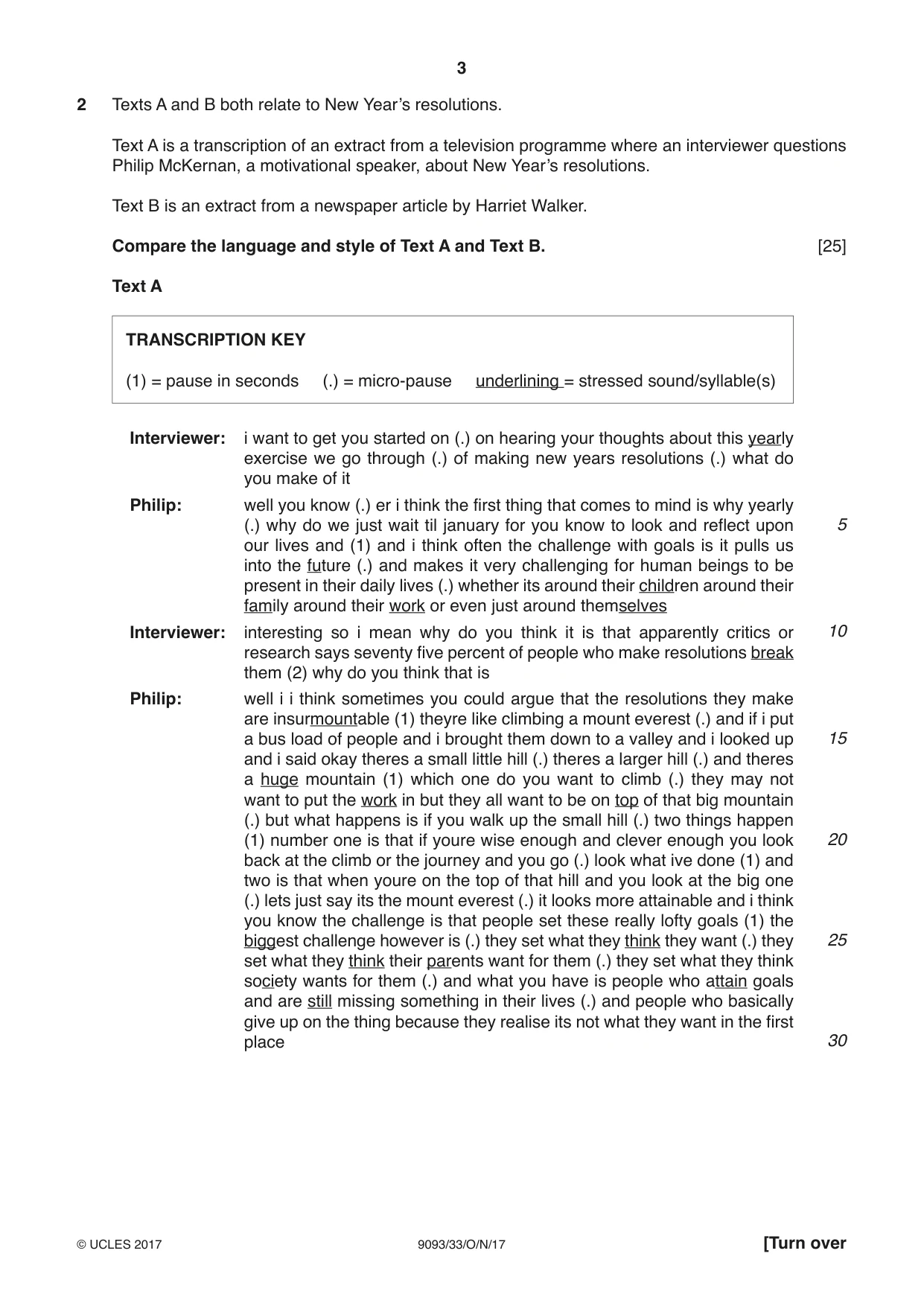
3 9093/33/O/N/17 © UCLES 2017 [Turn over 2 Texts A and B both relate to New Year’s resolutions. Text A is a transcription of an extract from a television programme where an interviewer questions Philip McKernan, a motivational speaker, about New Year’s resolutions. Text B is an extract from a newspaper article by Harriet Walker. Compare the language and style of Text A and Text B. [25] Text A TRANSCRIPTION KEY (1) = pause in seconds (.) = micro-pause underlining = stressed sound/syllable(s) Interviewer: i want to get you started on (.) on hearing your thoughts about this yearly exercise we go through (.) of making new years resolutions (.) what do you make of it Philip: well you know (.) er i think the first thing that comes to mind is why yearly (.) why do we just wait til january for you know to look and reflect upon our lives and (1) and i think often the challenge with goals is it pulls us into the future (.) and makes it very challenging for human beings to be present in their daily lives (.) whether its around their children around their family around their work or even just around themselves Interviewer: interesting so i mean why do you think it is that apparently critics or research says seventy five percent of people who make resolutions break them (2) why do you think that is Philip: well i i think sometimes you could argue that the resolutions they make are insurmountable (1) theyre like climbing a mount everest (.) and if i put a bus load of people and i brought them down to a valley and i looked up and i said okay theres a small little hill (.) theres a larger hill (.) and theres a huge mountain (1) which one do you want to climb (.) they may not want to put the work in but they all want to be on top of that big mountain (.) but what happens is if you walk up the small hill (.) two things happen (1) number one is that if youre wise enough and clever enough you look back at the climb or the journey and you go (.) look what ive done (1) and two is that when youre on the top of that hill and you look at the big one (.) lets just say its the mount everest (.) it looks more attainable and i think you know the challenge is that people set these really lofty goals (1) the biggest challenge however is (.) they set what they think they want (.) they set what they think their parents want for them (.) they set what they think society wants for them (.) and what you have is people who attain goals and are still missing something in their lives (.) and people who basically give up on the thing because they realise its not what they want in the first place 5 10 15 20 25 30
Question paper, page 4
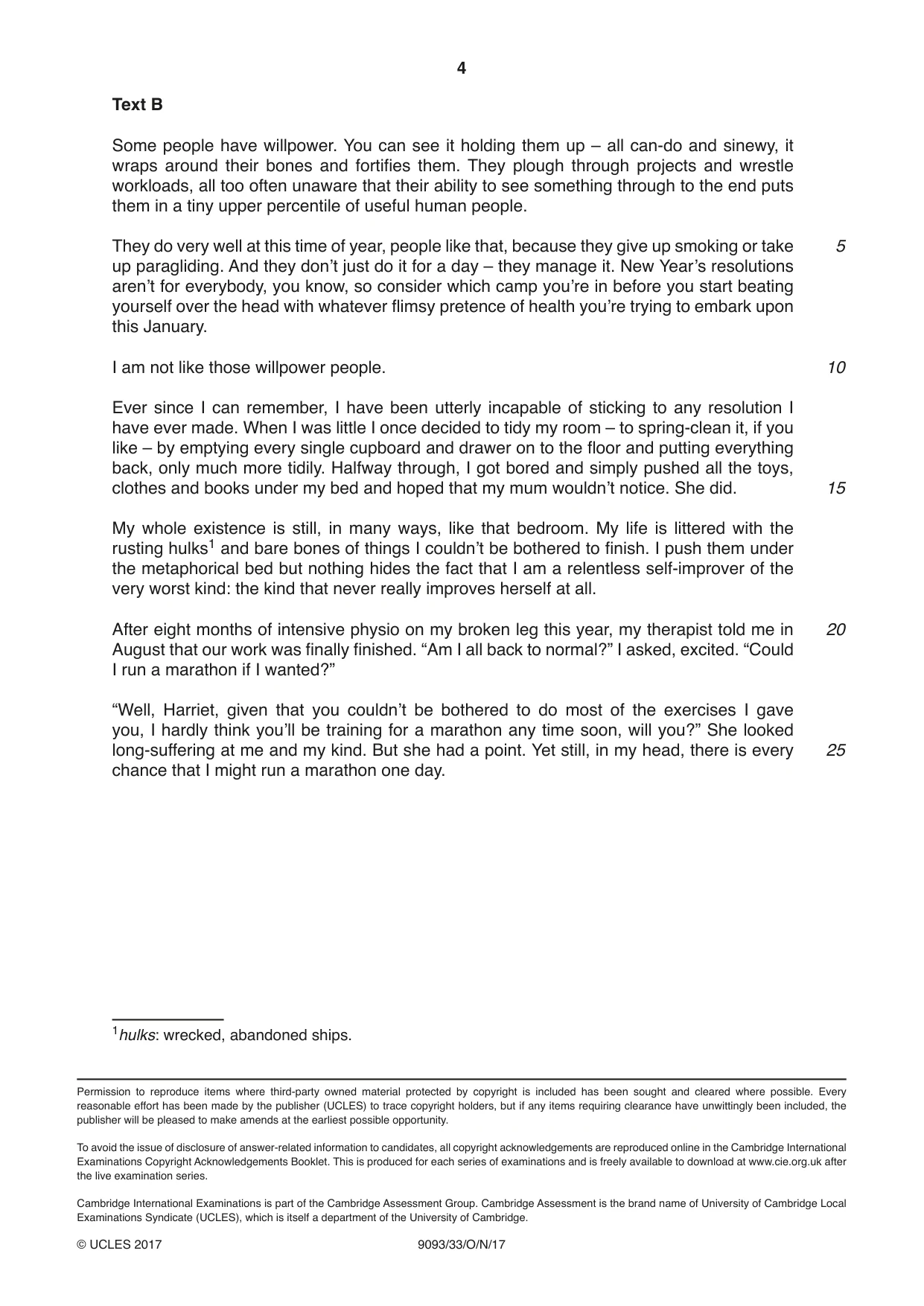
4 9093/33/O/N/17 © UCLES 2017 Text B Some people have willpower. You can see it holding them up – all can-do and sinewy, it wraps around their bones and fortifies them. They plough through projects and wrestle workloads, all too often unaware that their ability to see something through to the end puts them in a tiny upper percentile of useful human people. They do very well at this time of year, people like that, because they give up smoking or take up paragliding. And they don’t just do it for a day – they manage it. New Year’s resolutions aren’t for everybody, you know, so consider which camp you’re in before you start beating yourself over the head with whatever flimsy pretence of health you’re trying to embark upon this January. I am not like those willpower people. Ever since I can remember, I have been utterly incapable of sticking to any resolution I have ever made. When I was little I once decided to tidy my room – to spring-clean it, if you like – by emptying every single cupboard and drawer on to the floor and putting everything back, only much more tidily. Halfway through, I got bored and simply pushed all the toys, clothes and books under my bed and hoped that my mum wouldn’t notice. She did. My whole existence is still, in many ways, like that bedroom. My life is littered with the rusting hulks1 and bare bones of things I couldn’t be bothered to finish. I push them under the metaphorical bed but nothing hides the fact that I am a relentless self-improver of the very worst kind: the kind that never really improves herself at all. After eight months of intensive physio on my broken leg this year, my therapist told me in August that our work was finally finished. “Am I all back to normal?” I asked, excited. “Could I run a marathon if I wanted?” “Well, Harriet, given that you couldn’t be bothered to do most of the exercises I gave you, I hardly think you’ll be training for a marathon any time soon, will you?” She looked long-suffering at me and my kind. But she had a point. Yet still, in my head, there is every chance that I might run a marathon one day. 1hulks: wrecked, abandoned ships. 5 10 15 20 25 Permission to reproduce items where third-party owned material protected by copyright is included has been sought and cleared where possible. Every reasonable effort has been made by the publisher (UCLES) to trace copyright holders, but if any items requiring clearance have unwittingly been included, the publisher will be pleased to make amends at the earliest possible opportunity. To avoid the issue of disclosure of answer-related information to candidates, all copyright acknowledgements are reproduced online in the Cambridge International Examinations Copyright Acknowledgements Booklet. This is produced for each series of examinations and is freely available to download at www.cie.org.uk after the live examination series. Cambridge International Examinations is part of the Cambridge Assessment Group. Cambridge Assessment is the brand name of University of Cambridge Local Examinations Syndicate (UCLES), which is itself a department of the University of Cambridge.
Mark scheme, page 1
® IGCSE is a registered trademark. This document consists of 5 printed pages. © UCLES 2017 [Turn over Cambridge Assessment International Education Cambridge International Advanced Level ENGLISH LANGUAGE 9093/33 Paper 3 Text Analysis October/November 2017 MARK SCHEME Maximum Mark: 50 Published This mark scheme is published as an aid to teachers and candidates, to indicate the requirements of the examination. It shows the basis on which Examiners were instructed to award marks. It does not indicate the details of the discussions that took place at an Examiners’ meeting before marking began, which would have considered the acceptability of alternative answers. Mark schemes should be read in conjunction with the question paper and the Principal Examiner Report for Teachers. Cambridge International will not enter into discussions about these mark schemes. Cambridge International is publishing the mark schemes for the October/November 2017 series for most Cambridge IGCSE®, Cambridge International A and AS Level components and some Cambridge O Level components.
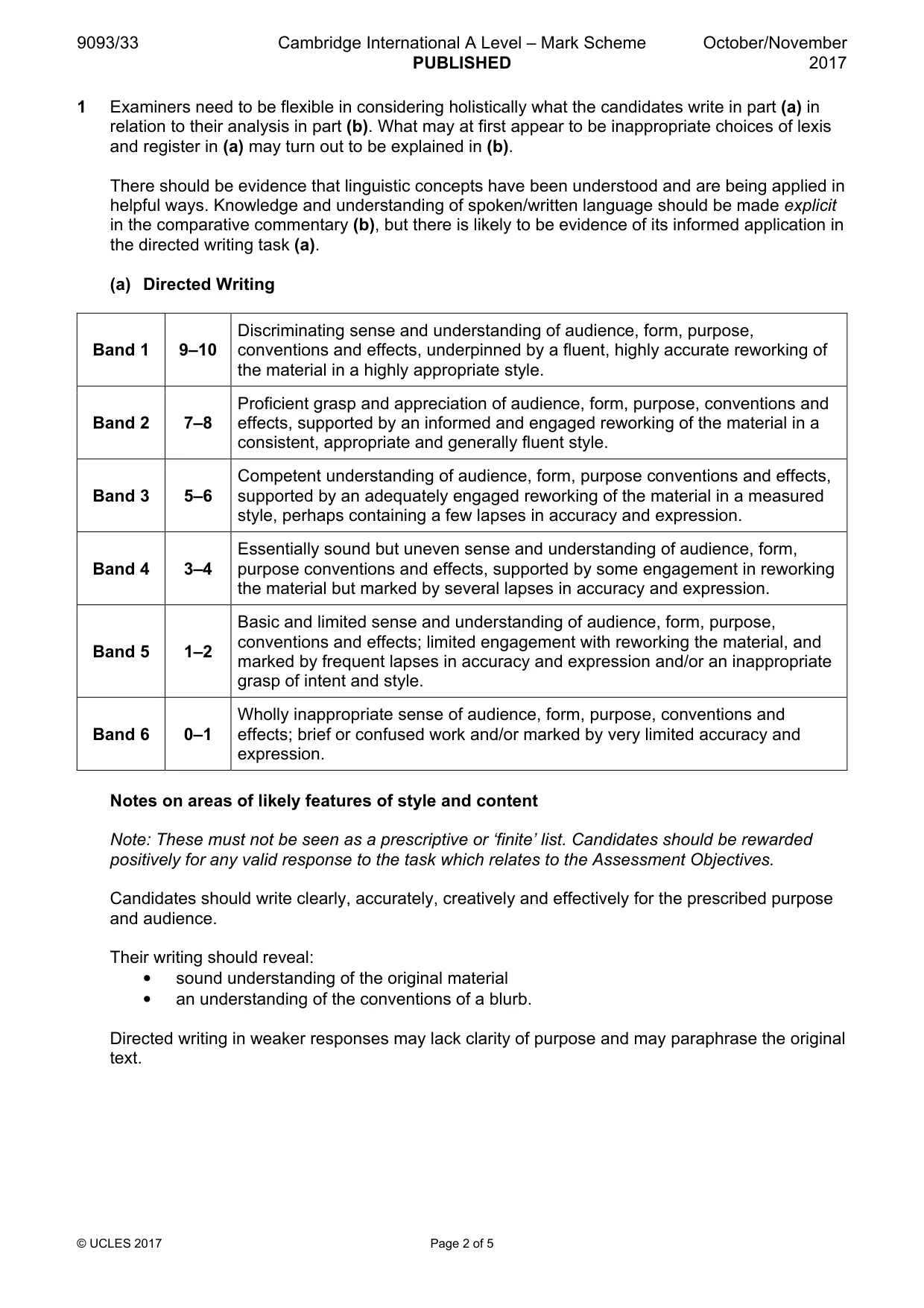
Mark scheme, page 2
9093/33 Cambridge International A Level – Mark Scheme PUBLISHED October/November 2017 © UCLES 2017 Page 2 of 5 1 Examiners need to be flexible in considering holistically what the candidates write in part (a) in relation to their analysis in part (b). What may at first appear to be inappropriate choices of lexis and register in (a) may turn out to be explained in (b). There should be evidence that linguistic concepts have been understood and are being applied in helpful ways. Knowledge and understanding of spoken/written language should be made explicit in the comparative commentary (b), but there is likely to be evidence of its informed application in the directed writing task (a). (a) Directed Writing Band 1 9–10 Discriminating sense and understanding of audience, form, purpose, conventions and effects, underpinned by a fluent, highly accurate reworking of the material in a highly appropriate style. Band 2 7–8 Proficient grasp and appreciation of audience, form, purpose, conventions and effects, supported by an informed and engaged reworking of the material in a consistent, appropriate and generally fluent style. Band 3 5–6 Competent understanding of audience, form, purpose conventions and effects, supported by an adequately engaged reworking of the material in a measured style, perhaps containing a few lapses in accuracy and expression. Band 4 3–4 Essentially sound but uneven sense and understanding of audience, form, purpose conventions and effects, supported by some engagement in reworking the material but marked by several lapses in accuracy and expression. Band 5 1–2 Basic and limited sense and understanding of audience, form, purpose, conventions and effects; limited engagement with reworking the material, and marked by frequent lapses in accuracy and expression and/or an inappropriate grasp of intent and style. Band 6 0–1 Wholly inappropriate sense of audience, form, purpose, conventions and effects; brief or confused work and/or marked by very limited accuracy and expression. Notes on areas of likely features of style and content Note: These must not be seen as a prescriptive or ‘finite’ list. Candidates should be rewarded positively for any valid response to the task which relates to the Assessment Objectives. Candidates should write clearly, accurately, creatively and effectively for the prescribed purpose and audience. Their writing should reveal: • sound understanding of the original material • an understanding of the conventions of a blurb. Directed writing in weaker responses may lack clarity of purpose and may paraphrase the original text.
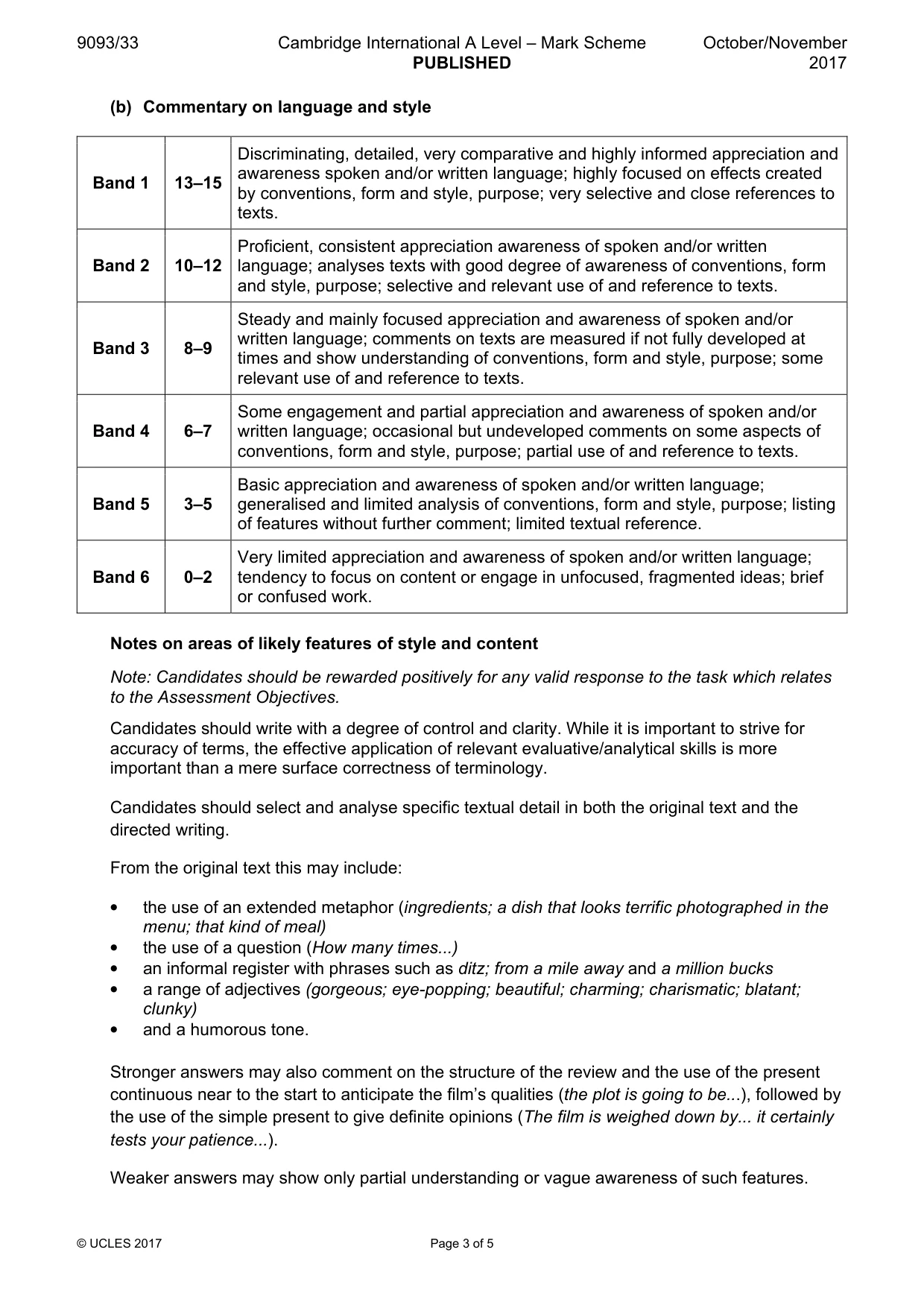
Mark scheme, page 3
9093/33 Cambridge International A Level – Mark Scheme PUBLISHED October/November 2017 © UCLES 2017 Page 3 of 5 (b) Commentary on language and style Band 1 13–15 Discriminating, detailed, very comparative and highly informed appreciation and awareness spoken and/or written language; highly focused on effects created by conventions, form and style, purpose; very selective and close references to texts. Band 2 10–12 Proficient, consistent appreciation awareness of spoken and/or written language; analyses texts with good degree of awareness of conventions, form and style, purpose; selective and relevant use of and reference to texts. Band 3 8–9 Steady and mainly focused appreciation and awareness of spoken and/or written language; comments on texts are measured if not fully developed at times and show understanding of conventions, form and style, purpose; some relevant use of and reference to texts. Band 4 6–7 Some engagement and partial appreciation and awareness of spoken and/or written language; occasional but undeveloped comments on some aspects of conventions, form and style, purpose; partial use of and reference to texts. Band 5 3–5 Basic appreciation and awareness of spoken and/or written language; generalised and limited analysis of conventions, form and style, purpose; listing of features without further comment; limited textual reference. Band 6 0–2 Very limited appreciation and awareness of spoken and/or written language; tendency to focus on content or engage in unfocused, fragmented ideas; brief or confused work. Notes on areas of likely features of style and content Note: Candidates should be rewarded positively for any valid response to the task which relates to the Assessment Objectives. Candidates should write with a degree of control and clarity. While it is important to strive for accuracy of terms, the effective application of relevant evaluative/analytical skills is more important than a mere surface correctness of terminology. Candidates should select and analyse specific textual detail in both the original text and the directed writing. From the original text this may include: • the use of an extended metaphor (ingredients; a dish that looks terrific photographed in the menu; that kind of meal) • the use of a question (How many times...) • an informal register with phrases such as ditz; from a mile away and a million bucks • a range of adjectives (gorgeous; eye-popping; beautiful; charming; charismatic; blatant; clunky) • and a humorous tone. Stronger answers may also comment on the structure of the review and the use of the present continuous near to the start to anticipate the film’s qualities (the plot is going to be...), followed by the use of the simple present to give definite opinions (The film is weighed down by... it certainly tests your patience...). Weaker answers may show only partial understanding or vague awareness of such features.
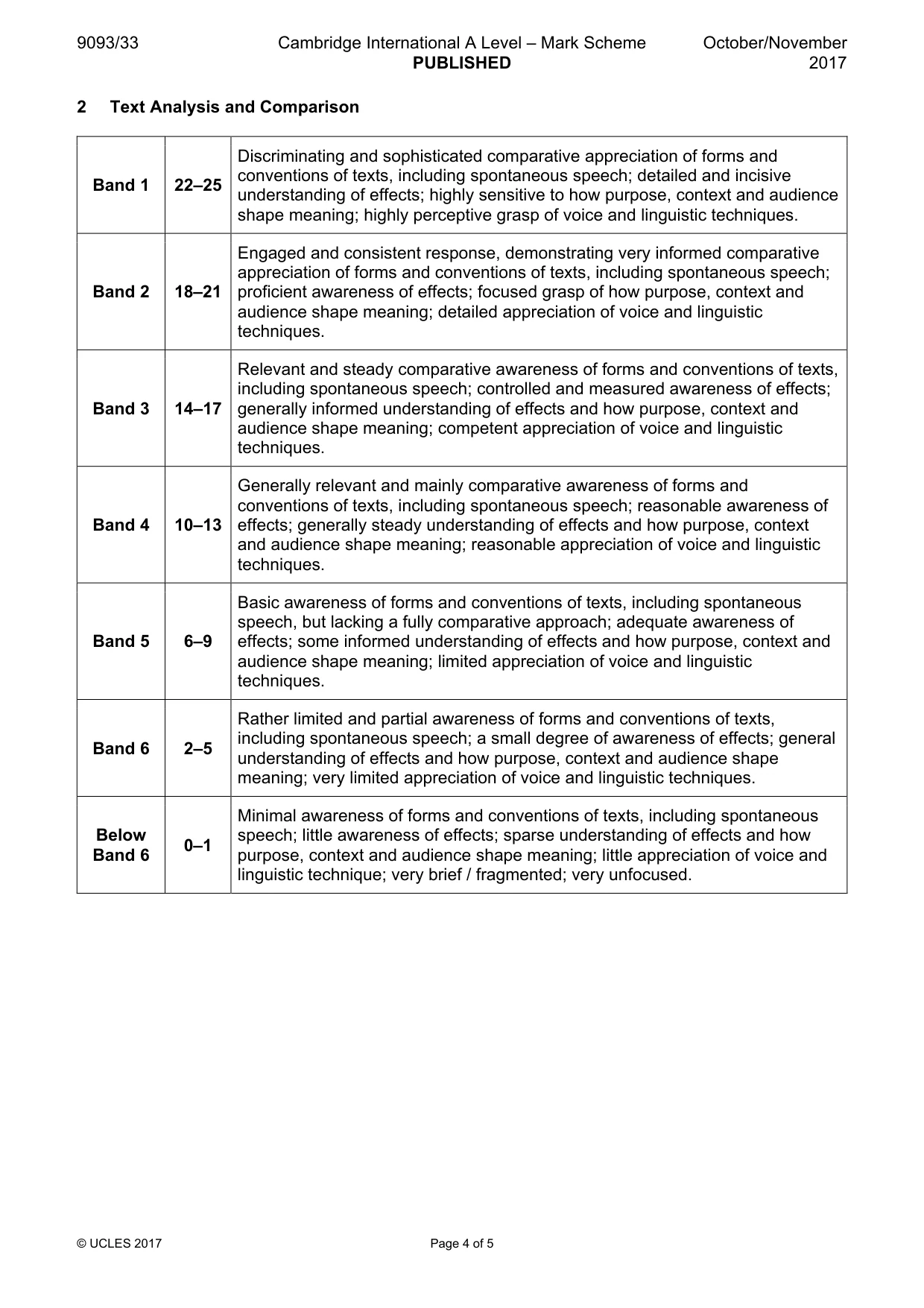
Mark scheme, page 4
9093/33 Cambridge International A Level – Mark Scheme PUBLISHED October/November 2017 © UCLES 2017 Page 4 of 5 2 Text Analysis and Comparison Band 1 22–25 Discriminating and sophisticated comparative appreciation of forms and conventions of texts, including spontaneous speech; detailed and incisive understanding of effects; highly sensitive to how purpose, context and audience shape meaning; highly perceptive grasp of voice and linguistic techniques. Band 2 18–21 Engaged and consistent response, demonstrating very informed comparative appreciation of forms and conventions of texts, including spontaneous speech; proficient awareness of effects; focused grasp of how purpose, context and audience shape meaning; detailed appreciation of voice and linguistic techniques. Band 3 14–17 Relevant and steady comparative awareness of forms and conventions of texts, including spontaneous speech; controlled and measured awareness of effects; generally informed understanding of effects and how purpose, context and audience shape meaning; competent appreciation of voice and linguistic techniques. Band 4 10–13 Generally relevant and mainly comparative awareness of forms and conventions of texts, including spontaneous speech; reasonable awareness of effects; generally steady understanding of effects and how purpose, context and audience shape meaning; reasonable appreciation of voice and linguistic techniques. Band 5 6–9 Basic awareness of forms and conventions of texts, including spontaneous speech, but lacking a fully comparative approach; adequate awareness of effects; some informed understanding of effects and how purpose, context and audience shape meaning; limited appreciation of voice and linguistic techniques. Band 6 2–5 Rather limited and partial awareness of forms and conventions of texts, including spontaneous speech; a small degree of awareness of effects; general understanding of effects and how purpose, context and audience shape meaning; very limited appreciation of voice and linguistic techniques. Below Band 6 0–1 Minimal awareness of forms and conventions of texts, including spontaneous speech; little awareness of effects; sparse understanding of effects and how purpose, context and audience shape meaning; little appreciation of voice and linguistic technique; very brief / fragmented; very unfocused.
Mark scheme, page 5
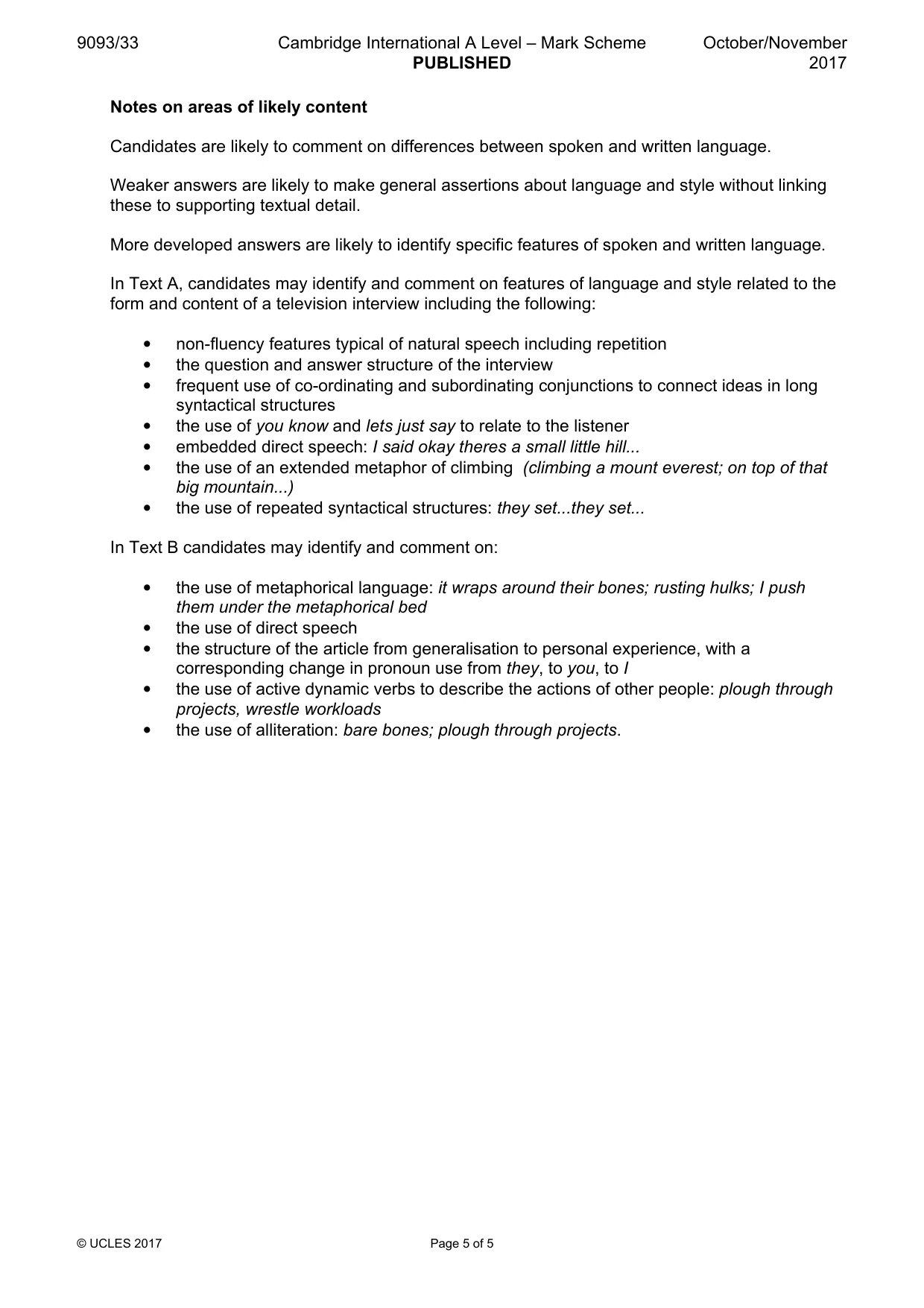
9093/33 Cambridge International A Level – Mark Scheme PUBLISHED October/November 2017 © UCLES 2017 Page 5 of 5 Notes on areas of likely content Candidates are likely to comment on differences between spoken and written language. Weaker answers are likely to make general assertions about language and style without linking these to supporting textual detail. More developed answers are likely to identify specific features of spoken and written language. In Text A, candidates may identify and comment on features of language and style related to the form and content of a television interview including the following: • non-fluency features typical of natural speech including repetition • the question and answer structure of the interview • frequent use of co-ordinating and subordinating conjunctions to connect ideas in long syntactical structures • the use of you know and lets just say to relate to the listener • embedded direct speech: I said okay theres a small little hill... • the use of an extended metaphor of climbing (climbing a mount everest; on top of that big mountain...) • the use of repeated syntactical structures: they set...they set... In Text B candidates may identify and comment on: • the use of metaphorical language: it wraps around their bones; rusting hulks; I push them under the metaphorical bed • the use of direct speech • the structure of the article from generalisation to personal experience, with a corresponding change in pronoun use from they, to you, to I • the use of active dynamic verbs to describe the actions of other people: plough through projects, wrestle workloads • the use of alliteration: bare bones; plough through projects.
What you needed in this session
Cambridge’s own grade thresholds for 2017 Oct/Nov, Paper 3 · Variant 3. A higher threshold means an easier paper — the bar moves with how the cohort did.