Cambridge A Level English - Language AS and A Level (from 2014) 9093 — 2017 May/June Paper 3 · Variant 2
9093/32/M/J/17 · 50 marks · ≈56 min
The question paper and its mark scheme, free to read here and free to download. This is Cambridge’s own paper, exactly as it was sat.
Question paper8 pages




Mark scheme5 pages
Answers below. Sit the paper first if you are practising.
Paper as text
Question paper, page 1
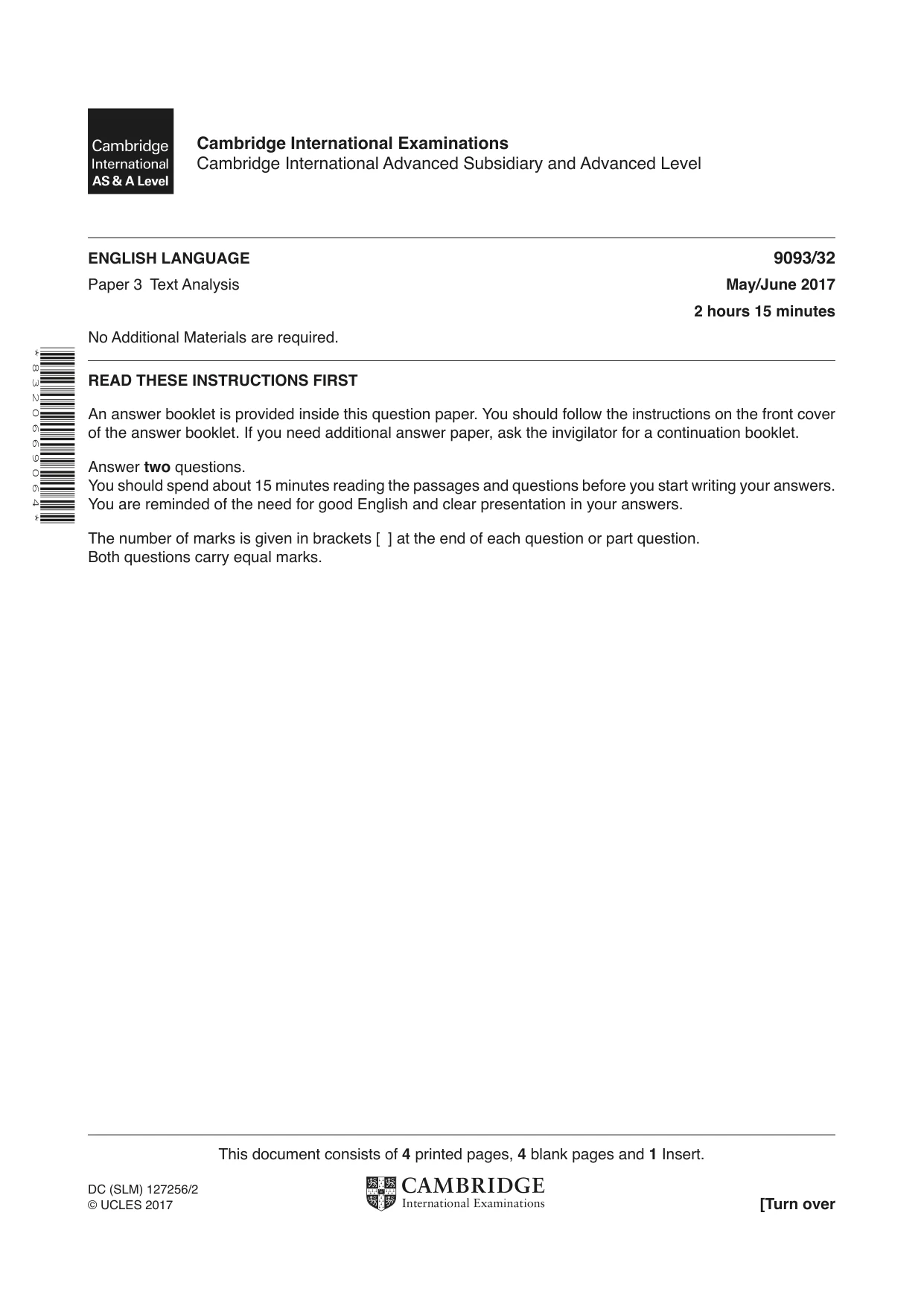
* 8 3 2 0 6 6 9 0 6 4 * This document consists of 4 printed pages, 4 blank pages and 1 Insert. DC (SLM) 127256/2 © UCLES 2017 [Turn over Cambridge International Examinations Cambridge International Advanced Subsidiary and Advanced Level ENGLISH LANGUAGE 9093/32 Paper 3 Text Analysis May/June 2017 2 hours 15 minutes No Additional Materials are required. READ THESE INSTRUCTIONS FIRST An answer booklet is provided inside this question paper. You should follow the instructions on the front cover of the answer booklet. If you need additional answer paper, ask the invigilator for a continuation booklet. Answer two questions. You should spend about 15 minutes reading the passages and questions before you start writing your answers. You are reminded of the need for good English and clear presentation in your answers. The number of marks is given in brackets [ ] at the end of each question or part question. Both questions carry equal marks.
Question paper, page 2
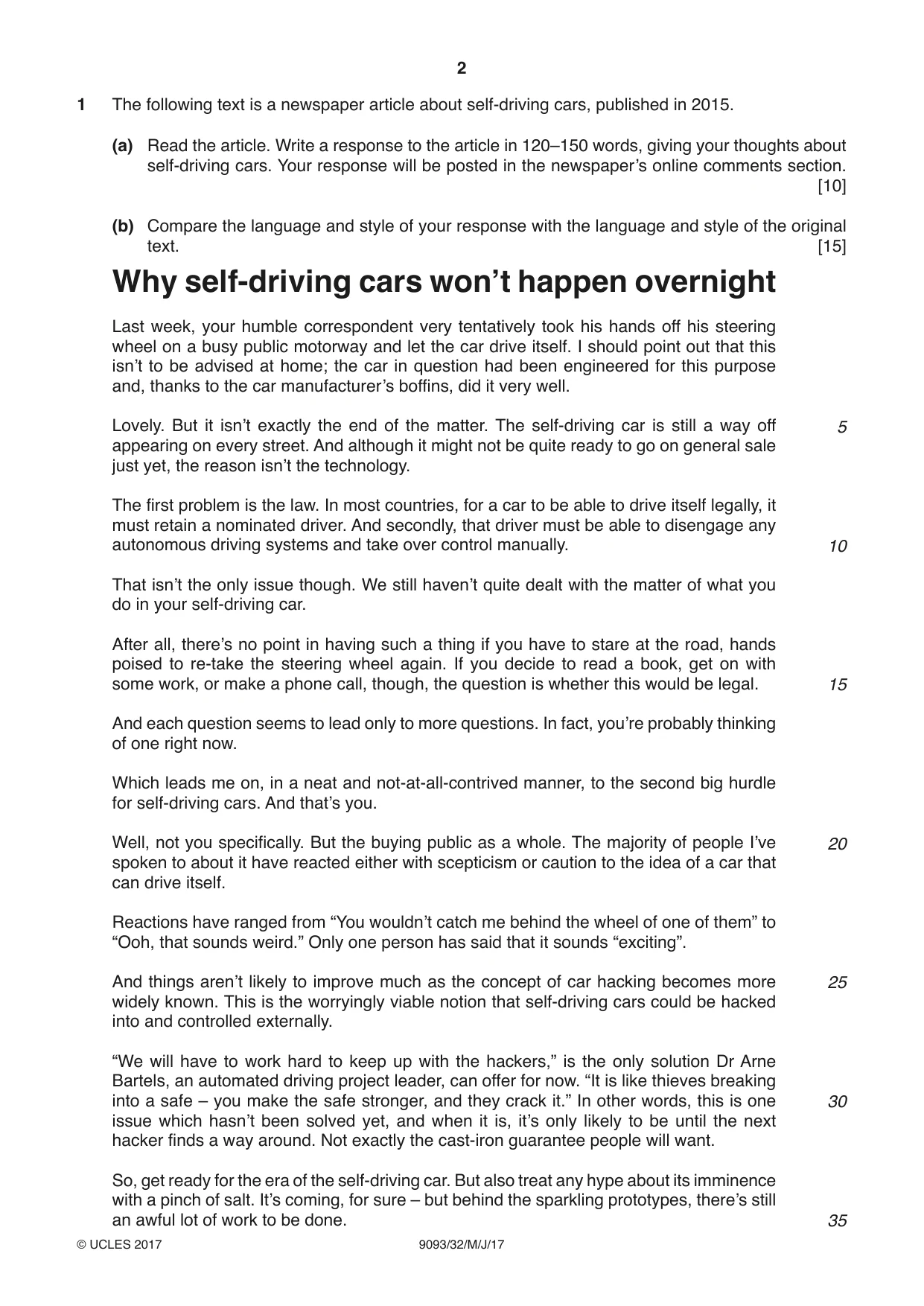
2 9093/32/M/J/17 © UCLES 2017 1 The following text is a newspaper article about self-driving cars, published in 2015. (a) Read the article. Write a response to the article in 120–150 words, giving your thoughts about self-driving cars. Your response will be posted in the newspaper’s online comments section. [10] (b) Compare the language and style of your response with the language and style of the original text. [15] Why self-driving cars won’t happen overnight Last week, your humble correspondent very tentatively took his hands off his steering wheel on a busy public motorway and let the car drive itself. I should point out that this isn’t to be advised at home; the car in question had been engineered for this purpose and, thanks to the car manufacturer’s boffins, did it very well. Lovely. But it isn’t exactly the end of the matter. The self-driving car is still a way off appearing on every street. And although it might not be quite ready to go on general sale just yet, the reason isn’t the technology. The first problem is the law. In most countries, for a car to be able to drive itself legally, it must retain a nominated driver. And secondly, that driver must be able to disengage any autonomous driving systems and take over control manually. That isn’t the only issue though. We still haven’t quite dealt with the matter of what you do in your self-driving car. After all, there’s no point in having such a thing if you have to stare at the road, hands poised to re-take the steering wheel again. If you decide to read a book, get on with some work, or make a phone call, though, the question is whether this would be legal. And each question seems to lead only to more questions. In fact, you’re probably thinking of one right now. Which leads me on, in a neat and not-at-all-contrived manner, to the second big hurdle for self-driving cars. And that’s you. Well, not you specifically. But the buying public as a whole. The majority of people I’ve spoken to about it have reacted either with scepticism or caution to the idea of a car that can drive itself. Reactions have ranged from “You wouldn’t catch me behind the wheel of one of them” to “Ooh, that sounds weird.” Only one person has said that it sounds “exciting”. And things aren’t likely to improve much as the concept of car hacking becomes more widely known. This is the worryingly viable notion that self-driving cars could be hacked into and controlled externally. “We will have to work hard to keep up with the hackers,” is the only solution Dr Arne Bartels, an automated driving project leader, can offer for now. “It is like thieves breaking into a safe – you make the safe stronger, and they crack it.” In other words, this is one issue which hasn’t been solved yet, and when it is, it’s only likely to be until the next hacker finds a way around. Not exactly the cast-iron guarantee people will want. So, get ready for the era of the self-driving car. But also treat any hype about its imminence with a pinch of salt. It’s coming, for sure – but behind the sparkling prototypes, there’s still an awful lot of work to be done. 5 10 15 20 25 30 35
Question paper, page 3
3 9093/32/M/J/17 © UCLES 2017 [Turn over BLANK PAGE
Question paper, page 4
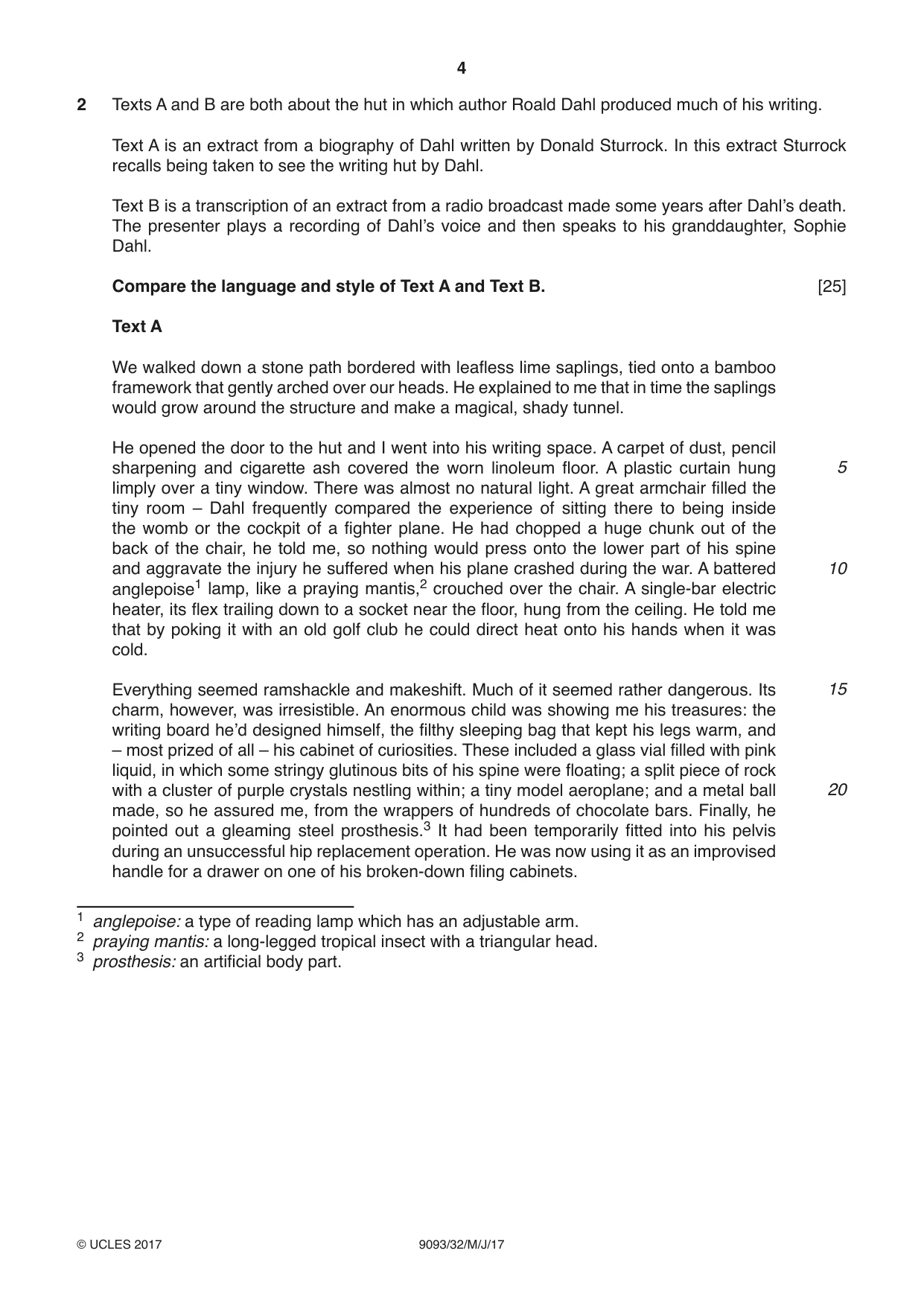
4 9093/32/M/J/17 © UCLES 2017 2 Texts A and B are both about the hut in which author Roald Dahl produced much of his writing. Text A is an extract from a biography of Dahl written by Donald Sturrock. In this extract Sturrock recalls being taken to see the writing hut by Dahl. Text B is a transcription of an extract from a radio broadcast made some years after Dahl’s death. The presenter plays a recording of Dahl’s voice and then speaks to his granddaughter, Sophie Dahl. Compare the language and style of Text A and Text B. [25] Text A We walked down a stone path bordered with leafless lime saplings, tied onto a bamboo framework that gently arched over our heads. He explained to me that in time the saplings would grow around the structure and make a magical, shady tunnel. He opened the door to the hut and I went into his writing space. A carpet of dust, pencil sharpening and cigarette ash covered the worn linoleum floor. A plastic curtain hung limply over a tiny window. There was almost no natural light. A great armchair filled the tiny room – Dahl frequently compared the experience of sitting there to being inside the womb or the cockpit of a fighter plane. He had chopped a huge chunk out of the back of the chair, he told me, so nothing would press onto the lower part of his spine and aggravate the injury he suffered when his plane crashed during the war. A battered anglepoise1 lamp, like a praying mantis,2 crouched over the chair. A single-bar electric heater, its flex trailing down to a socket near the floor, hung from the ceiling. He told me that by poking it with an old golf club he could direct heat onto his hands when it was cold. Everything seemed ramshackle and makeshift. Much of it seemed rather dangerous. Its charm, however, was irresistible. An enormous child was showing me his treasures: the writing board he’d designed himself, the filthy sleeping bag that kept his legs warm, and – most prized of all – his cabinet of curiosities. These included a glass vial filled with pink liquid, in which some stringy glutinous bits of his spine were floating; a split piece of rock with a cluster of purple crystals nestling within; a tiny model aeroplane; and a metal ball made, so he assured me, from the wrappers of hundreds of chocolate bars. Finally, he pointed out a gleaming steel prosthesis.3 It had been temporarily fitted into his pelvis during an unsuccessful hip replacement operation. He was now using it as an improvised handle for a drawer on one of his broken-down filing cabinets. 1 anglepoise: a type of reading lamp which has an adjustable arm. 2 praying mantis: a long-legged tropical insect with a triangular head. 3 prosthesis: an artificial body part. 5 10 15 20
Question paper, page 5
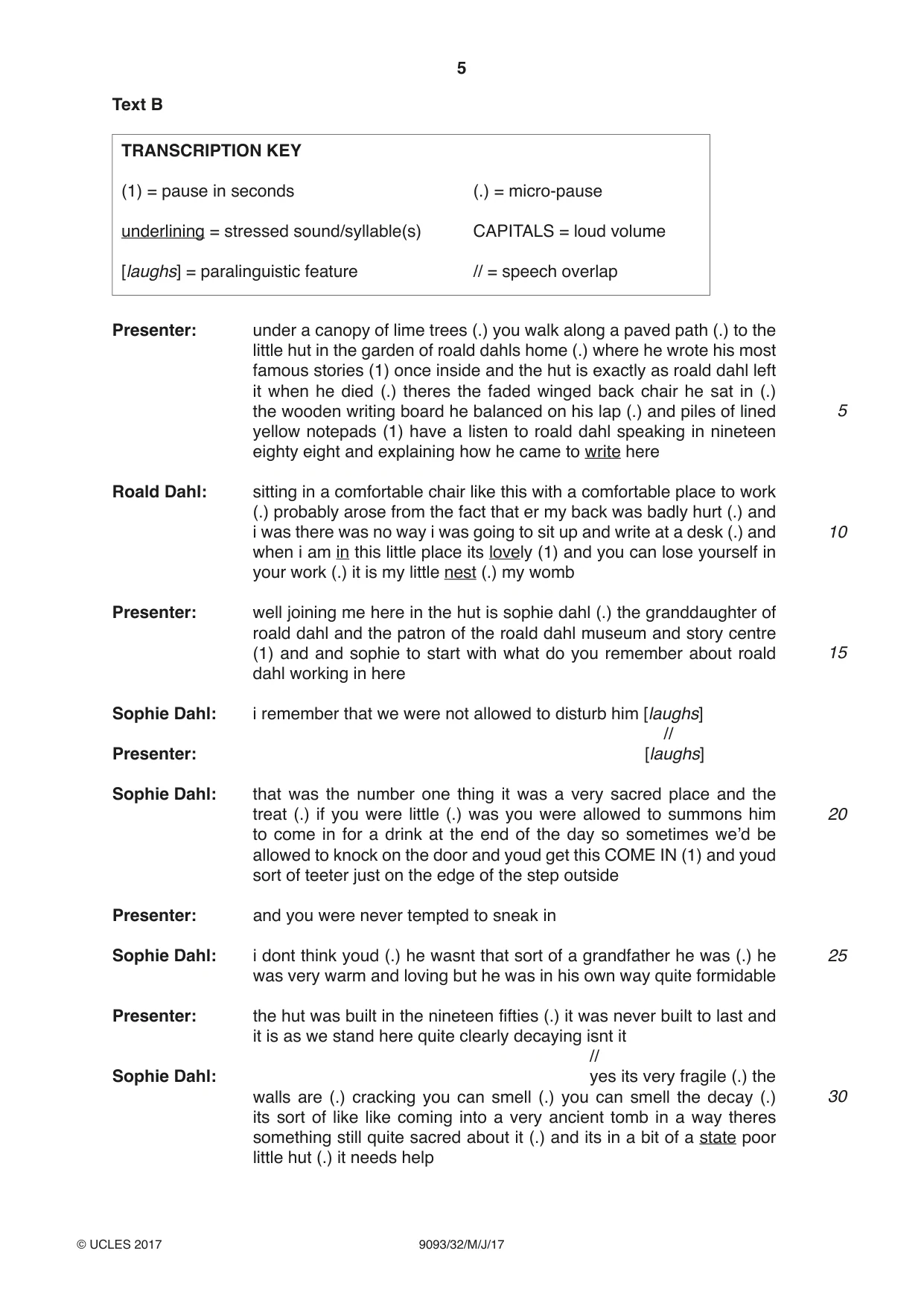
5 9093/32/M/J/17 © UCLES 2017 Text B TRANSCRIPTION KEY (1) = pause in seconds (.) = micro-pause underlining = stressed sound/syllable(s) CAPITALS = loud volume [laughs] = paralinguistic feature // = speech overlap Presenter: under a canopy of lime trees (.) you walk along a paved path (.) to the little hut in the garden of roald dahls home (.) where he wrote his most famous stories (1) once inside and the hut is exactly as roald dahl left it when he died (.) theres the faded winged back chair he sat in (.) the wooden writing board he balanced on his lap (.) and piles of lined yellow notepads (1) have a listen to roald dahl speaking in nineteen eighty eight and explaining how he came to write here Roald Dahl: sitting in a comfortable chair like this with a comfortable place to work (.) probably arose from the fact that er my back was badly hurt (.) and i was there was no way i was going to sit up and write at a desk (.) and when i am in this little place its lovely (1) and you can lose yourself in your work (.) it is my little nest (.) my womb Presenter: well joining me here in the hut is sophie dahl (.) the granddaughter of roald dahl and the patron of the roald dahl museum and story centre (1) and and sophie to start with what do you remember about roald dahl working in here Sophie Dahl: i remember that we were not allowed to disturb him [laughs] // Presenter: [laughs] Sophie Dahl: that was the number one thing it was a very sacred place and the treat (.) if you were little (.) was you were allowed to summons him to come in for a drink at the end of the day so sometimes we’d be allowed to knock on the door and youd get this COME IN (1) and youd sort of teeter just on the edge of the step outside Presenter: and you were never tempted to sneak in Sophie Dahl: i dont think youd (.) he wasnt that sort of a grandfather he was (.) he was very warm and loving but he was in his own way quite formidable Presenter: the hut was built in the nineteen fifties (.) it was never built to last and it is as we stand here quite clearly decaying isnt it // Sophie Dahl: yes its very fragile (.) the walls are (.) cracking you can smell (.) you can smell the decay (.) its sort of like like coming into a very ancient tomb in a way theres something still quite sacred about it (.) and its in a bit of a state poor little hut (.) it needs help 5 10 15 20 25 30
Question paper, page 6
6 9093/32/M/J/17 © UCLES 2017 BLANK PAGE
Question paper, page 7
7 9093/32/M/J/17 © UCLES 2017 BLANK PAGE
Question paper, page 8
8 9093/32/M/J/17 © UCLES 2017 Permission to reproduce items where third-party owned material protected by copyright is included has been sought and cleared where possible. Every reasonable effort has been made by the publisher (UCLES) to trace copyright holders, but if any items requiring clearance have unwittingly been included, the publisher will be pleased to make amends at the earliest possible opportunity. To avoid the issue of disclosure of answer-related information to candidates, all copyright acknowledgements are reproduced online in the Cambridge International Examinations Copyright Acknowledgements Booklet. This is produced for each series of examinations and is freely available to download at www.cie.org.uk after the live examination series. Cambridge International Examinations is part of the Cambridge Assessment Group. Cambridge Assessment is the brand name of University of Cambridge Local Examinations Syndicate (UCLES), which is itself a department of the University of Cambridge. BLANK PAGE
Mark scheme, page 1
® IGCSE is a registered trademark. This document consists of 5 printed pages. © UCLES 2017 [Turn over Cambridge International Examinations Cambridge International Advanced Subsidiary and Advanced Level ENGLISH LANGUAGE 9093/32 Paper 3 Text Analysis May/June 2017 MARK SCHEME Maximum Mark: 50 Published This mark scheme is published as an aid to teachers and candidates, to indicate the requirements of the examination. It shows the basis on which Examiners were instructed to award marks. It does not indicate the details of the discussions that took place at an Examiners’ meeting before marking began, which would have considered the acceptability of alternative answers. Mark schemes should be read in conjunction with the question paper and the Principal Examiner Report for Teachers. Cambridge will not enter into discussions about these mark schemes. Cambridge is publishing the mark schemes for the May/June 2017 series for most Cambridge IGCSE®, Cambridge International A and AS Level and Cambridge Pre-U components, and some Cambridge O Level components.
Mark scheme, page 2
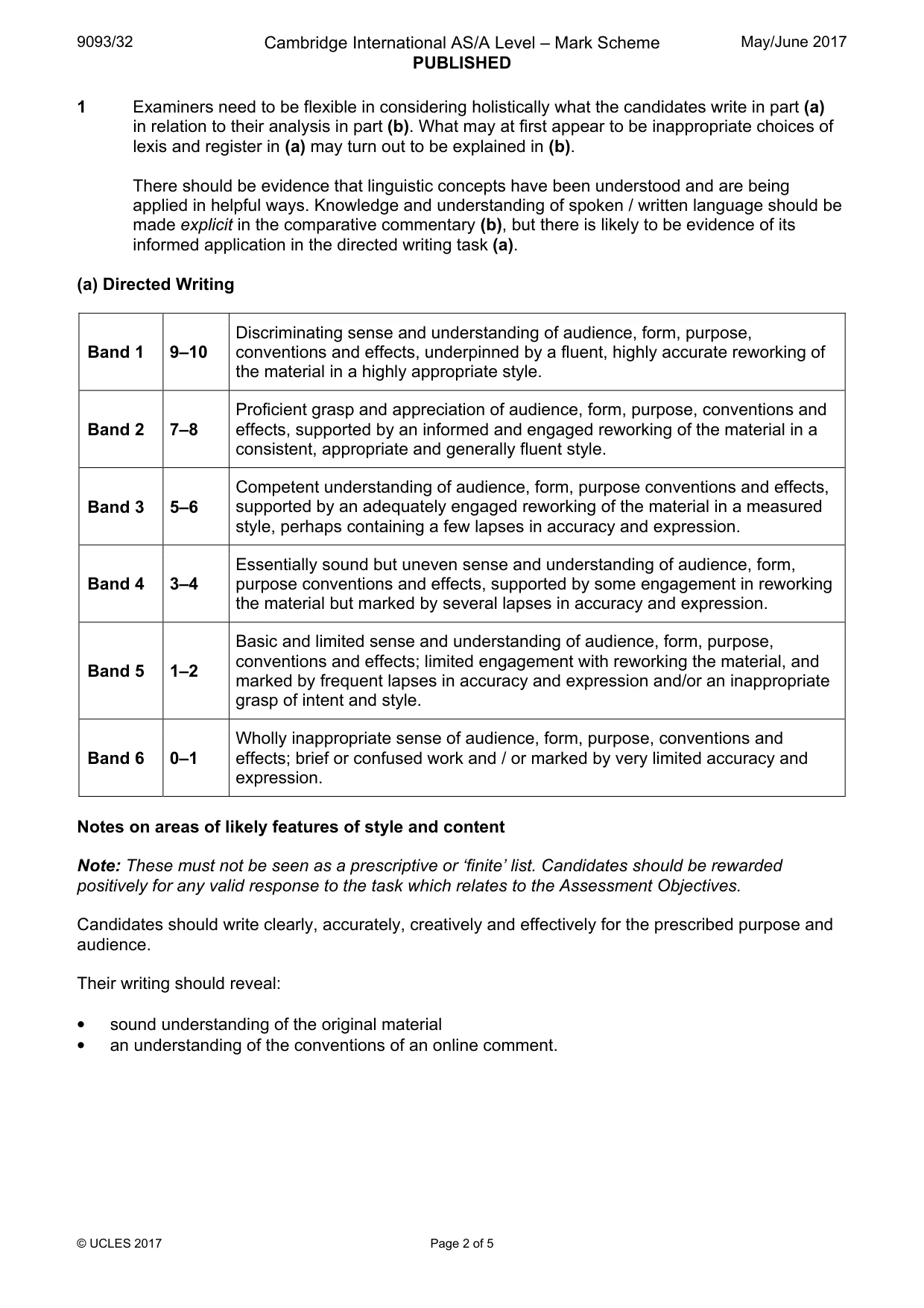
9093/32 Cambridge International AS/A Level – Mark Scheme PUBLISHED May/June 2017 © UCLES 2017 Page 2 of 5 1 Examiners need to be flexible in considering holistically what the candidates write in part (a) in relation to their analysis in part (b). What may at first appear to be inappropriate choices of lexis and register in (a) may turn out to be explained in (b). There should be evidence that linguistic concepts have been understood and are being applied in helpful ways. Knowledge and understanding of spoken / written language should be made explicit in the comparative commentary (b), but there is likely to be evidence of its informed application in the directed writing task (a). (a) Directed Writing Band 1 9–10 Discriminating sense and understanding of audience, form, purpose, conventions and effects, underpinned by a fluent, highly accurate reworking of the material in a highly appropriate style. Band 2 7–8 Proficient grasp and appreciation of audience, form, purpose, conventions and effects, supported by an informed and engaged reworking of the material in a consistent, appropriate and generally fluent style. Band 3 5–6 Competent understanding of audience, form, purpose conventions and effects, supported by an adequately engaged reworking of the material in a measured style, perhaps containing a few lapses in accuracy and expression. Band 4 3–4 Essentially sound but uneven sense and understanding of audience, form, purpose conventions and effects, supported by some engagement in reworking the material but marked by several lapses in accuracy and expression. Band 5 1–2 Basic and limited sense and understanding of audience, form, purpose, conventions and effects; limited engagement with reworking the material, and marked by frequent lapses in accuracy and expression and/or an inappropriate grasp of intent and style. Band 6 0–1 Wholly inappropriate sense of audience, form, purpose, conventions and effects; brief or confused work and / or marked by very limited accuracy and expression. Notes on areas of likely features of style and content Note: These must not be seen as a prescriptive or ‘finite’ list. Candidates should be rewarded positively for any valid response to the task which relates to the Assessment Objectives. Candidates should write clearly, accurately, creatively and effectively for the prescribed purpose and audience. Their writing should reveal: • sound understanding of the original material • an understanding of the conventions of an online comment.
Mark scheme, page 3
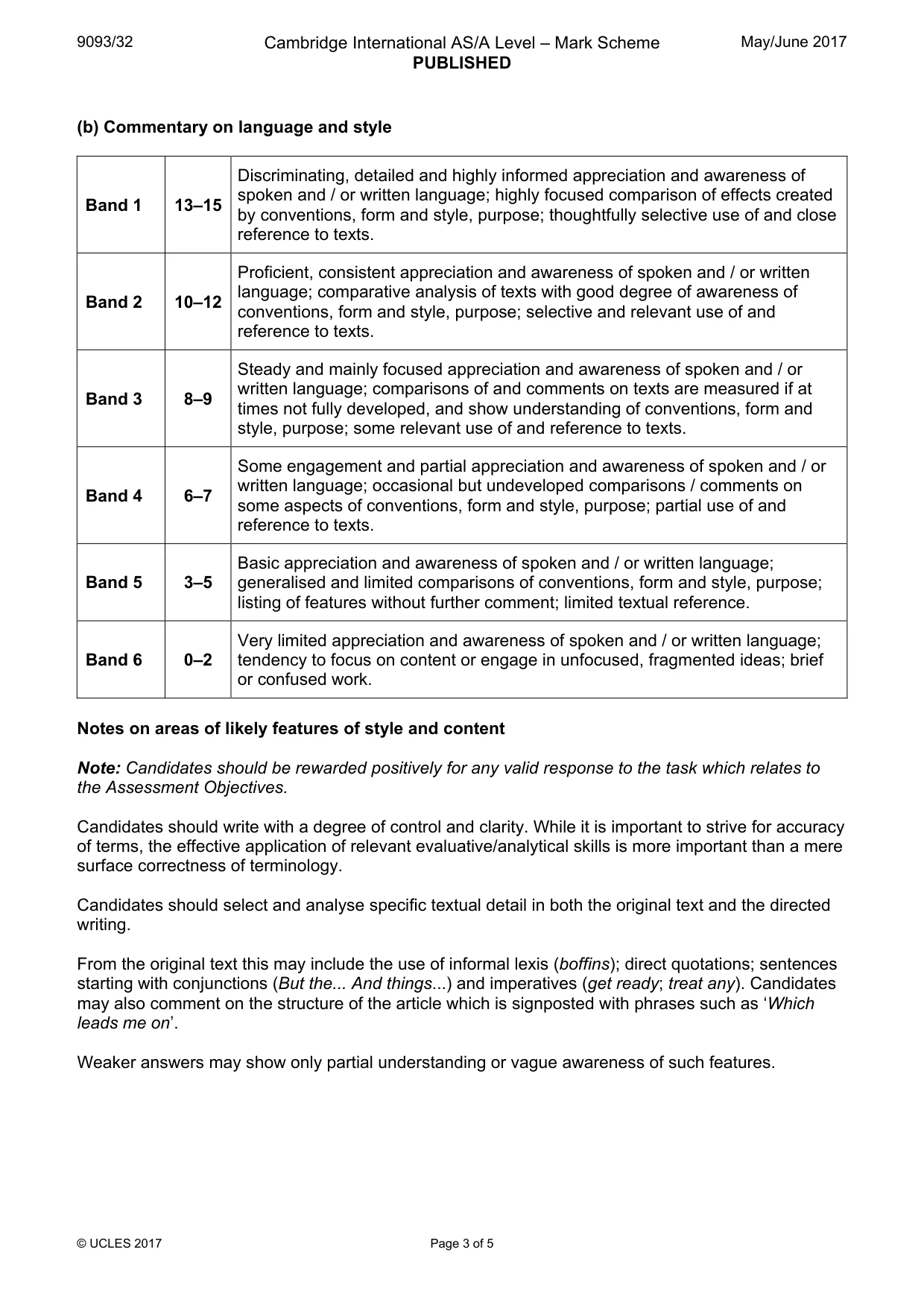
9093/32 Cambridge International AS/A Level – Mark Scheme PUBLISHED May/June 2017 © UCLES 2017 Page 3 of 5 (b) Commentary on language and style Band 1 13–15 Discriminating, detailed and highly informed appreciation and awareness of spoken and / or written language; highly focused comparison of effects created by conventions, form and style, purpose; thoughtfully selective use of and close reference to texts. Band 2 10–12 Proficient, consistent appreciation and awareness of spoken and / or written language; comparative analysis of texts with good degree of awareness of conventions, form and style, purpose; selective and relevant use of and reference to texts. Band 3 8–9 Steady and mainly focused appreciation and awareness of spoken and / or written language; comparisons of and comments on texts are measured if at times not fully developed, and show understanding of conventions, form and style, purpose; some relevant use of and reference to texts. Band 4 6–7 Some engagement and partial appreciation and awareness of spoken and / or written language; occasional but undeveloped comparisons / comments on some aspects of conventions, form and style, purpose; partial use of and reference to texts. Band 5 3–5 Basic appreciation and awareness of spoken and / or written language; generalised and limited comparisons of conventions, form and style, purpose; listing of features without further comment; limited textual reference. Band 6 0–2 Very limited appreciation and awareness of spoken and / or written language; tendency to focus on content or engage in unfocused, fragmented ideas; brief or confused work. Notes on areas of likely features of style and content Note: Candidates should be rewarded positively for any valid response to the task which relates to the Assessment Objectives. Candidates should write with a degree of control and clarity. While it is important to strive for accuracy of terms, the effective application of relevant evaluative/analytical skills is more important than a mere surface correctness of terminology. Candidates should select and analyse specific textual detail in both the original text and the directed writing. From the original text this may include the use of informal lexis (boffins); direct quotations; sentences starting with conjunctions (But the... And things...) and imperatives (get ready; treat any). Candidates may also comment on the structure of the article which is signposted with phrases such as ‘Which leads me on’. Weaker answers may show only partial understanding or vague awareness of such features.
Mark scheme, page 4
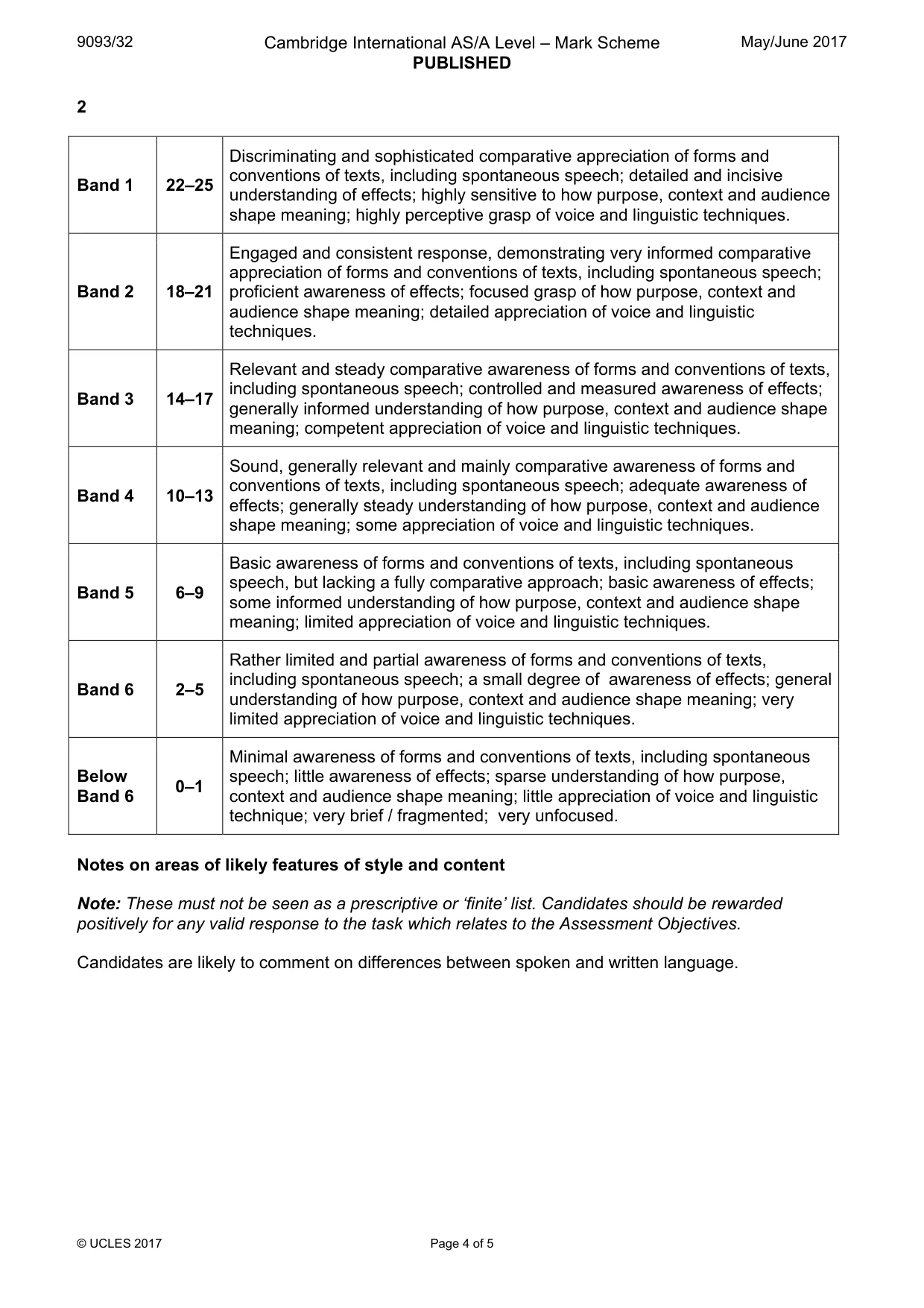
9093/32 Cambridge International AS/A Level – Mark Scheme PUBLISHED May/June 2017 © UCLES 2017 Page 4 of 5 2 Band 1 22–25 Discriminating and sophisticated comparative appreciation of forms and conventions of texts, including spontaneous speech; detailed and incisive understanding of effects; highly sensitive to how purpose, context and audience shape meaning; highly perceptive grasp of voice and linguistic techniques. Band 2 18–21 Engaged and consistent response, demonstrating very informed comparative appreciation of forms and conventions of texts, including spontaneous speech; proficient awareness of effects; focused grasp of how purpose, context and audience shape meaning; detailed appreciation of voice and linguistic techniques. Band 3 14–17 Relevant and steady comparative awareness of forms and conventions of texts, including spontaneous speech; controlled and measured awareness of effects; generally informed understanding of how purpose, context and audience shape meaning; competent appreciation of voice and linguistic techniques. Band 4 10–13 Sound, generally relevant and mainly comparative awareness of forms and conventions of texts, including spontaneous speech; adequate awareness of effects; generally steady understanding of how purpose, context and audience shape meaning; some appreciation of voice and linguistic techniques. Band 5 6–9 Basic awareness of forms and conventions of texts, including spontaneous speech, but lacking a fully comparative approach; basic awareness of effects; some informed understanding of how purpose, context and audience shape meaning; limited appreciation of voice and linguistic techniques. Band 6 2–5 Rather limited and partial awareness of forms and conventions of texts, including spontaneous speech; a small degree of awareness of effects; general understanding of how purpose, context and audience shape meaning; very limited appreciation of voice and linguistic techniques. Below Band 6 0–1 Minimal awareness of forms and conventions of texts, including spontaneous speech; little awareness of effects; sparse understanding of how purpose, context and audience shape meaning; little appreciation of voice and linguistic technique; very brief / fragmented; very unfocused. Notes on areas of likely features of style and content Note: These must not be seen as a prescriptive or ‘finite’ list. Candidates should be rewarded positively for any valid response to the task which relates to the Assessment Objectives. Candidates are likely to comment on differences between spoken and written language.
Mark scheme, page 5
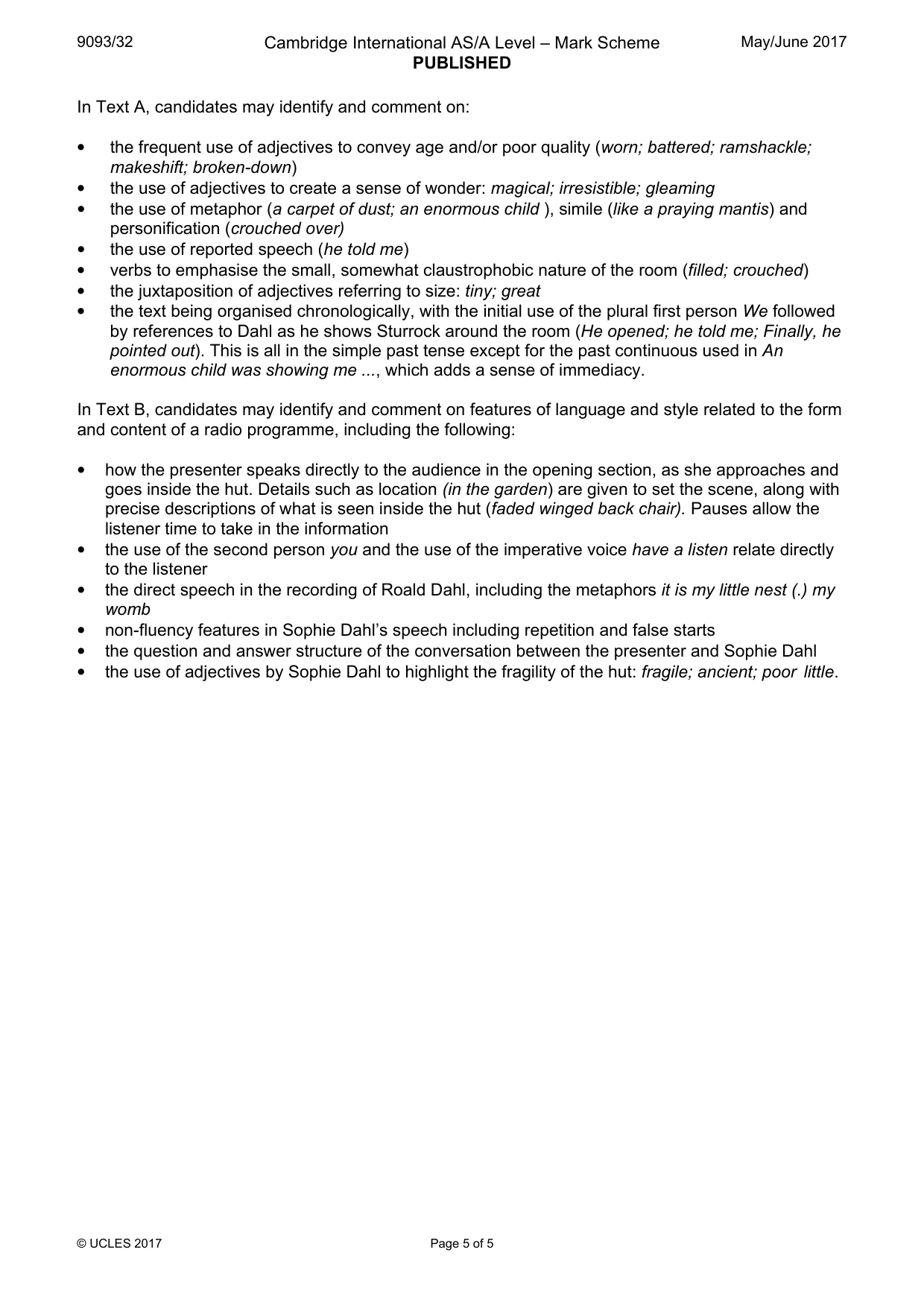
9093/32 Cambridge International AS/A Level – Mark Scheme PUBLISHED May/June 2017 © UCLES 2017 Page 5 of 5 In Text A, candidates may identify and comment on: • the frequent use of adjectives to convey age and/or poor quality (worn; battered; ramshackle; makeshift; broken-down) • the use of adjectives to create a sense of wonder: magical; irresistible; gleaming • the use of metaphor (a carpet of dust; an enormous child ), simile (like a praying mantis) and personification (crouched over) • the use of reported speech (he told me) • verbs to emphasise the small, somewhat claustrophobic nature of the room (filled; crouched) • the juxtaposition of adjectives referring to size: tiny; great • the text being organised chronologically, with the initial use of the plural first person We followed by references to Dahl as he shows Sturrock around the room (He opened; he told me; Finally, he pointed out). This is all in the simple past tense except for the past continuous used in An enormous child was showing me ..., which adds a sense of immediacy. In Text B, candidates may identify and comment on features of language and style related to the form and content of a radio programme, including the following: • how the presenter speaks directly to the audience in the opening section, as she approaches and goes inside the hut. Details such as location (in the garden) are given to set the scene, along with precise descriptions of what is seen inside the hut (faded winged back chair). Pauses allow the listener time to take in the information • the use of the second person you and the use of the imperative voice have a listen relate directly to the listener • the direct speech in the recording of Roald Dahl, including the metaphors it is my little nest (.) my womb • non-fluency features in Sophie Dahl’s speech including repetition and false starts • the question and answer structure of the conversation between the presenter and Sophie Dahl • the use of adjectives by Sophie Dahl to highlight the fragility of the hut: fragile; ancient; poor little.
What you needed in this session
Cambridge’s own grade thresholds for 2017 May/June, Paper 3 · Variant 2. A higher threshold means an easier paper — the bar moves with how the cohort did.