Cambridge A Level English - Language AS and A Level (from 2014) 9093 — 2017 May/June Paper 3 · Variant 1
9093/31/M/J/17 · 50 marks · ≈56 min
The question paper and its mark scheme, free to read here and free to download. This is Cambridge’s own paper, exactly as it was sat.
Question paper8 pages


Mark scheme5 pages
Answers below. Sit the paper first if you are practising.
Paper as text
Question paper, page 1
This document consists of 5 printed pages, 3 blank pages and 1 Insert. DC (ST) 127255/2 © UCLES 2017 [Turn over Cambridge International Examinations Cambridge International Advanced Subsidiary and Advanced Level * 4 3 0 0 6 0 7 0 9 4 * ENGLISH LANGUAGE 9093/31 Paper 3 Text Analysis May/June 2017 2 hours 15 minutes No Additional Materials are required. READ THESE INSTRUCTIONS FIRST An answer booklet is provided inside this question paper. You should follow the instructions on the front cover of the answer booklet. If you need additional answer paper, ask the invigilator for a continuation booklet. Answer two questions. You should spend about 15 minutes reading the passages and questions before you start writing your answers. You are reminded of the need for good English and clear presentation in your answers. The number of marks is given in brackets [ ] at the end of each question or part question. Both questions carry equal marks.
Question paper, page 2
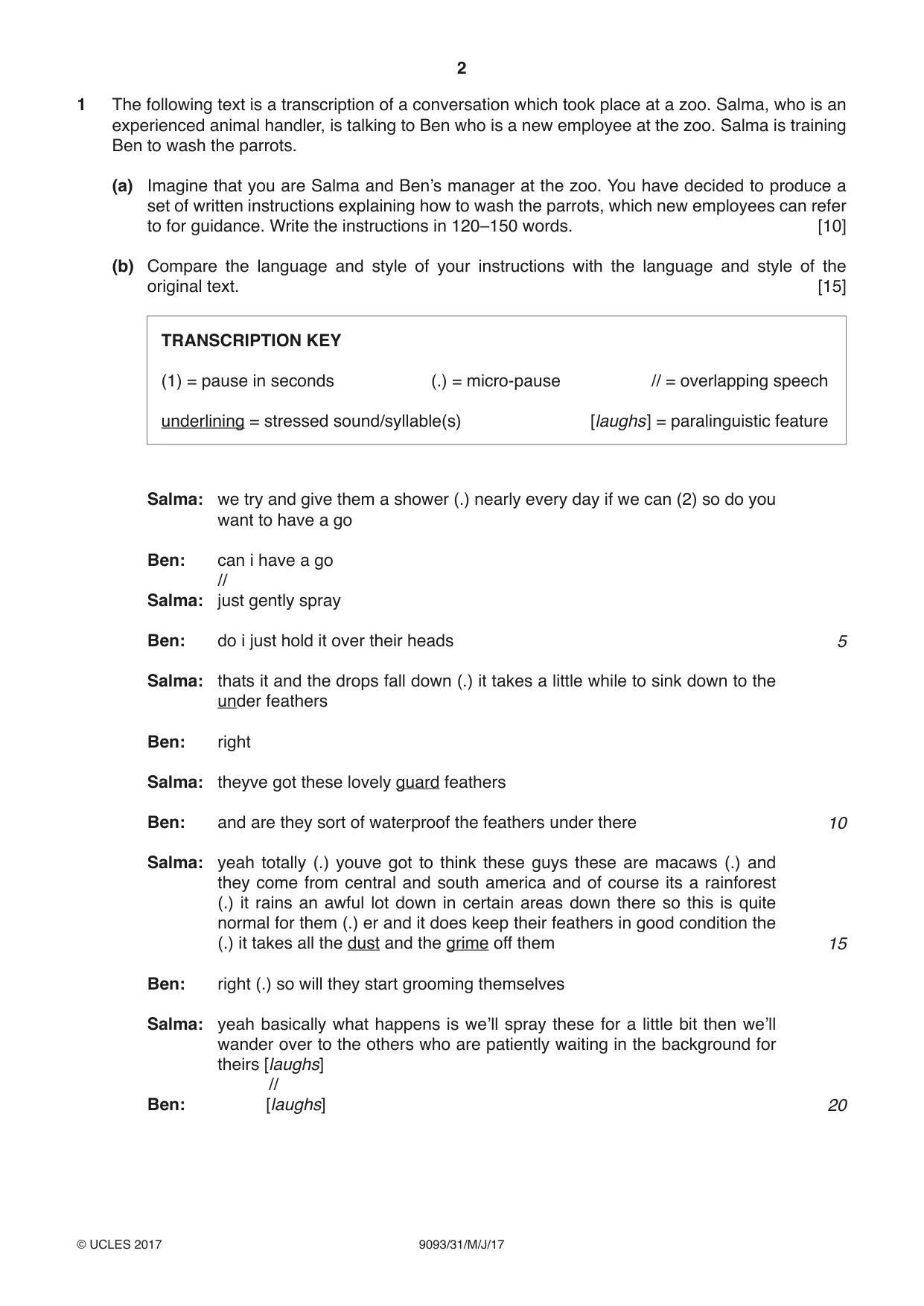
2 9093/31/M/J/17 © UCLES 2017 1 The following text is a transcription of a conversation which took place at a zoo. Salma, who is an experienced animal handler, is talking to Ben who is a new employee at the zoo. Salma is training Ben to wash the parrots. (a) Imagine that you are Salma and Ben’s manager at the zoo. You have decided to produce a set of written instructions explaining how to wash the parrots, which new employees can refer to for guidance. Write the instructions in 120–150 words. [10] (b) Compare the language and style of your instructions with the language and style of the original text. [15] TRANSCRIPTION KEY (1) = pause in seconds (.) = micro-pause // = overlapping speech underlining = stressed sound/syllable(s) [laughs ] = paralinguistic feature Salma: we try and give them a shower (.) nearly every day if we can (2) so do you want to have a go Ben: can i have a go // Salma: just gently spray Ben: do i just hold it over their heads Salma: thats it and the drops fall down (.) it takes a little while to sink down to the under feathers Ben: right Salma: theyve got these lovely guard feathers Ben: and are they sort of waterproof the feathers under there Salma: yeah totally (.) youve got to think these guys these are macaws (.) and they come from central and south america and of course its a rainforest (.) it rains an awful lot down in certain areas down there so this is quite normal for them (.) er and it does keep their feathers in good condition the (.) it takes all the dust and the grime off them Ben: right (.) so will they start grooming themselves Salma: yeah basically what happens is we’ll spray these for a little bit then we’ll wander over to the others who are patiently waiting in the background for theirs [laughs] // Ben: [laughs] 5 10 15 20
Question paper, page 3
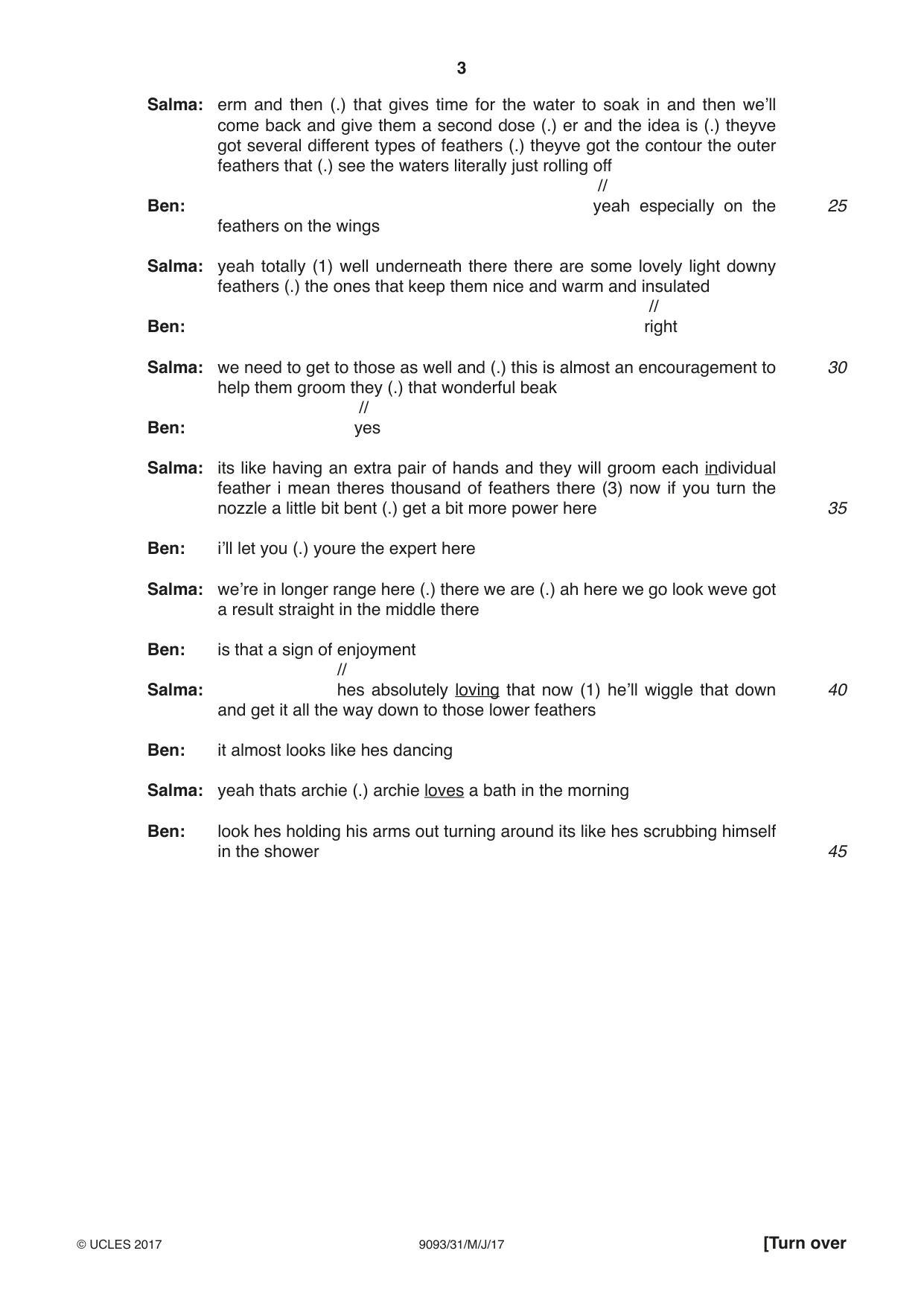
3 9093/31/M/J/17 © UCLES 2017 [Turn over Salma: erm and then (.) that gives time for the water to soak in and then we’ll come back and give them a second dose (.) er and the idea is (.) theyve got several different types of feathers (.) theyve got the contour the outer feathers that (.) see the waters literally just rolling off // Ben: yeah especially on the feathers on the wings Salma: yeah totally (1) well underneath there there are some lovely light downy feathers (.) the ones that keep them nice and warm and insulated // Ben: right Salma: we need to get to those as well and (.) this is almost an encouragement to help them groom they (.) that wonderful beak // Ben: yes Salma: its like having an extra pair of hands and they will groom each individual feather i mean theres thousand of feathers there (3) now if you turn the nozzle a little bit bent (.) get a bit more power here Ben: i’ll let you (.) youre the expert here Salma: we’re in longer range here (.) there we are (.) ah here we go look weve got a result straight in the middle there Ben: is that a sign of enjoyment // Salma: hes absolutely loving that now (1) he’ll wiggle that down and get it all the way down to those lower feathers Ben: it almost looks like hes dancing Salma: yeah thats archie (.) archie loves a bath in the morning Ben: look hes holding his arms out turning around its like hes scrubbing himself in the shower 25 30 35 40 45
Question paper, page 4
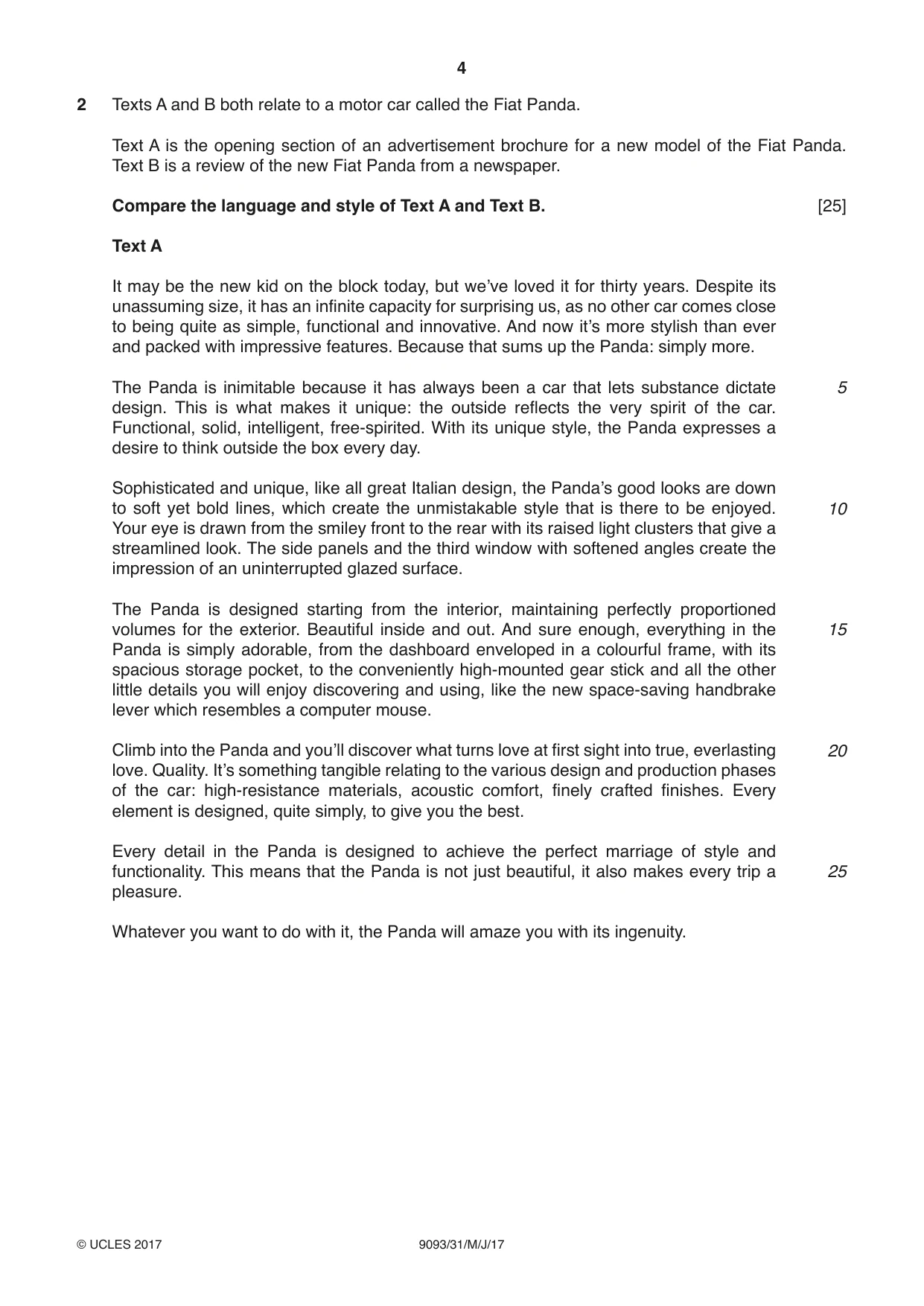
4 9093/31/M/J/17 © UCLES 2017 2 Texts A and B both relate to a motor car called the Fiat Panda. Text A is the opening section of an advertisement brochure for a new model of the Fiat Panda. Text B is a review of the new Fiat Panda from a newspaper. Compare the language and style of Text A and Text B. [25] Text A It may be the new kid on the block today, but we’ve loved it for thirty years. Despite its unassuming size, it has an infinite capacity for surprising us, as no other car comes close to being quite as simple, functional and innovative. And now it’s more stylish than ever and packed with impressive features. Because that sums up the Panda: simply more. The Panda is inimitable because it has always been a car that lets substance dictate design. This is what makes it unique: the outside reflects the very spirit of the car. Functional, solid, intelligent, free-spirited. With its unique style, the Panda expresses a desire to think outside the box every day. Sophisticated and unique, like all great Italian design, the Panda’s good looks are down to soft yet bold lines, which create the unmistakable style that is there to be enjoyed. Your eye is drawn from the smiley front to the rear with its raised light clusters that give a streamlined look. The side panels and the third window with softened angles create the impression of an uninterrupted glazed surface. The Panda is designed starting from the interior, maintaining perfectly proportioned volumes for the exterior. Beautiful inside and out. And sure enough, everything in the Panda is simply adorable, from the dashboard enveloped in a colourful frame, with its spacious storage pocket, to the conveniently high-mounted gear stick and all the other little details you will enjoy discovering and using, like the new space-saving handbrake lever which resembles a computer mouse. Climb into the Panda and you’ll discover what turns love at first sight into true, everlasting love. Quality. It’s something tangible relating to the various design and production phases of the car: high-resistance materials, acoustic comfort, finely crafted finishes. Every element is designed, quite simply, to give you the best. Every detail in the Panda is designed to achieve the perfect marriage of style and functionality. This means that the Panda is not just beautiful, it also makes every trip a pleasure. Whatever you want to do with it, the Panda will amaze you with its ingenuity. 5 10 15 20 25
Question paper, page 5
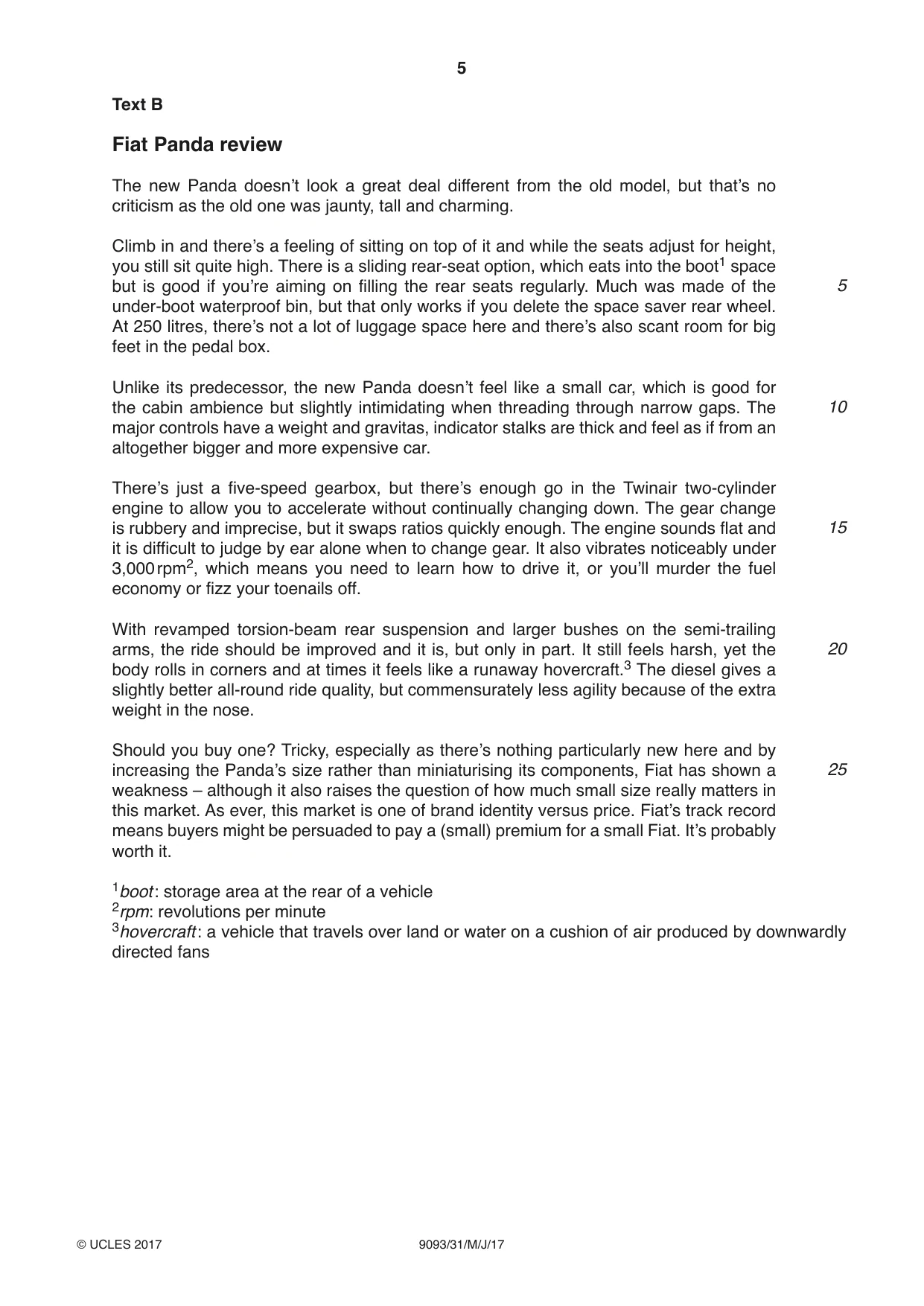
5 9093/31/M/J/17 © UCLES 2017 Text B Fiat Panda review The new Panda doesn’t look a great deal different from the old model, but that’s no criticism as the old one was jaunty, tall and charming. Climb in and there’s a feeling of sitting on top of it and while the seats adjust for height, you still sit quite high. There is a sliding rear-seat option, which eats into the boot1 space but is good if you’re aiming on filling the rear seats regularly. Much was made of the under-boot waterproof bin, but that only works if you delete the space saver rear wheel. At 250 litres, there’s not a lot of luggage space here and there’s also scant room for big feet in the pedal box. Unlike its predecessor, the new Panda doesn’t feel like a small car, which is good for the cabin ambience but slightly intimidating when threading through narrow gaps. The major controls have a weight and gravitas, indicator stalks are thick and feel as if from an altogether bigger and more expensive car. There’s just a five-speed gearbox, but there’s enough go in the Twinair two-cylinder engine to allow you to accelerate without continually changing down. The gear change is rubbery and imprecise, but it swaps ratios quickly enough. The engine sounds flat and it is difficult to judge by ear alone when to change gear. It also vibrates noticeably under 3,000 rpm2, which means you need to learn how to drive it, or you’ll murder the fuel economy or fizz your toenails off. With revamped torsion-beam rear suspension and larger bushes on the semi-trailing arms, the ride should be improved and it is, but only in part. It still feels harsh, yet the body rolls in corners and at times it feels like a runaway hovercraft.3 The diesel gives a slightly better all-round ride quality, but commensurately less agility because of the extra weight in the nose. Should you buy one? Tricky, especially as there’s nothing particularly new here and by increasing the Panda’s size rather than miniaturising its components, Fiat has shown a weakness – although it also raises the question of how much small size really matters in this market. As ever, this market is one of brand identity versus price. Fiat’s track record means buyers might be persuaded to pay a (small) premium for a small Fiat. It’s probably worth it. 1boot : storage area at the rear of a vehicle 2rpm: revolutions per minute 3hovercraft : a vehicle that travels over land or water on a cushion of air produced by downwardly directed fans 5 10 15 20 25
Question paper, page 6
6 9093/31/M/J/17 © UCLES 2017 BLANK PAGE
Question paper, page 7
7 9093/31/M/J/17 © UCLES 2017 BLANK PAGE
Question paper, page 8
8 9093/31/M/J/17 © UCLES 2017 Permission to reproduce items where third-party owned material protected by copyright is included has been sought and cleared where possible. Every reasonable effort has been made by the publisher (UCLES) to trace copyright holders, but if any items requiring clearance have unwittingly been included, the publisher will be pleased to make amends at the earliest possible opportunity. To avoid the issue of disclosure of answer-related information to candidates, all copyright acknowledgements are reproduced online in the Cambridge International Examinations Copyright Acknowledgements Booklet. This is produced for each series of examinations and is freely available to download at www.cie.org.uk after the live examination series. Cambridge International Examinations is part of the Cambridge Assessment Group. Cambridge Assessment is the brand name of University of Cambridge Local Examinations Syndicate (UCLES), which is itself a department of the University of Cambridge. BLANK PAGE
Mark scheme, page 1
® IGCSE is a registered trademark. This document consists of 5 printed pages. © UCLES 2017 [Turn over Cambridge International Examinations Cambridge International Advanced Level ENGLISH LANGUAGE 9093/31 Paper 3 Text Analysis May/June 2017 MARK SCHEME Maximum Mark: 50 Published This mark scheme is published as an aid to teachers and candidates, to indicate the requirements of the examination. It shows the basis on which Examiners were instructed to award marks. It does not indicate the details of the discussions that took place at an Examiners’ meeting before marking began, which would have considered the acceptability of alternative answers. Mark schemes should be read in conjunction with the question paper and the Principal Examiner Report for Teachers. Cambridge will not enter into discussions about these mark schemes. Cambridge is publishing the mark schemes for the May/June 2017 series for most Cambridge IGCSE®, Cambridge International A and AS Level and Cambridge Pre-U components, and some Cambridge O Level components.
Mark scheme, page 2
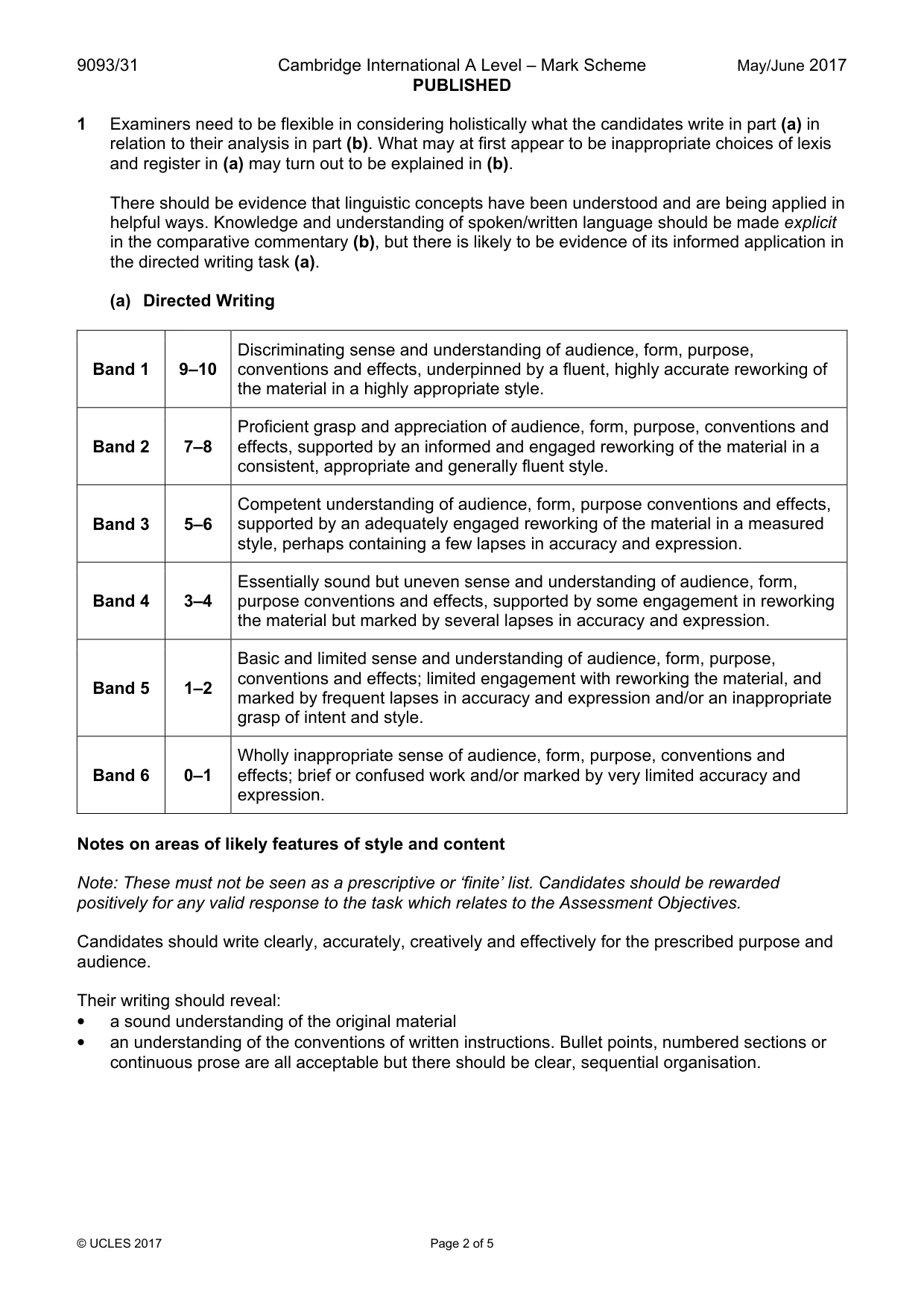
9093/31 Cambridge International A Level – Mark Scheme PUBLISHED May/June 2017 © UCLES 2017 Page 2 of 5 1 Examiners need to be flexible in considering holistically what the candidates write in part (a) in relation to their analysis in part (b). What may at first appear to be inappropriate choices of lexis and register in (a) may turn out to be explained in (b). There should be evidence that linguistic concepts have been understood and are being applied in helpful ways. Knowledge and understanding of spoken/written language should be made explicit in the comparative commentary (b), but there is likely to be evidence of its informed application in the directed writing task (a). (a) Directed Writing Band 1 9–10 Discriminating sense and understanding of audience, form, purpose, conventions and effects, underpinned by a fluent, highly accurate reworking of the material in a highly appropriate style. Band 2 7–8 Proficient grasp and appreciation of audience, form, purpose, conventions and effects, supported by an informed and engaged reworking of the material in a consistent, appropriate and generally fluent style. Band 3 5–6 Competent understanding of audience, form, purpose conventions and effects, supported by an adequately engaged reworking of the material in a measured style, perhaps containing a few lapses in accuracy and expression. Band 4 3–4 Essentially sound but uneven sense and understanding of audience, form, purpose conventions and effects, supported by some engagement in reworking the material but marked by several lapses in accuracy and expression. Band 5 1–2 Basic and limited sense and understanding of audience, form, purpose, conventions and effects; limited engagement with reworking the material, and marked by frequent lapses in accuracy and expression and/or an inappropriate grasp of intent and style. Band 6 0–1 Wholly inappropriate sense of audience, form, purpose, conventions and effects; brief or confused work and/or marked by very limited accuracy and expression. Notes on areas of likely features of style and content Note: These must not be seen as a prescriptive or ‘finite’ list. Candidates should be rewarded positively for any valid response to the task which relates to the Assessment Objectives. Candidates should write clearly, accurately, creatively and effectively for the prescribed purpose and audience. Their writing should reveal: • a sound understanding of the original material • an understanding of the conventions of written instructions. Bullet points, numbered sections or continuous prose are all acceptable but there should be clear, sequential organisation.
Mark scheme, page 3
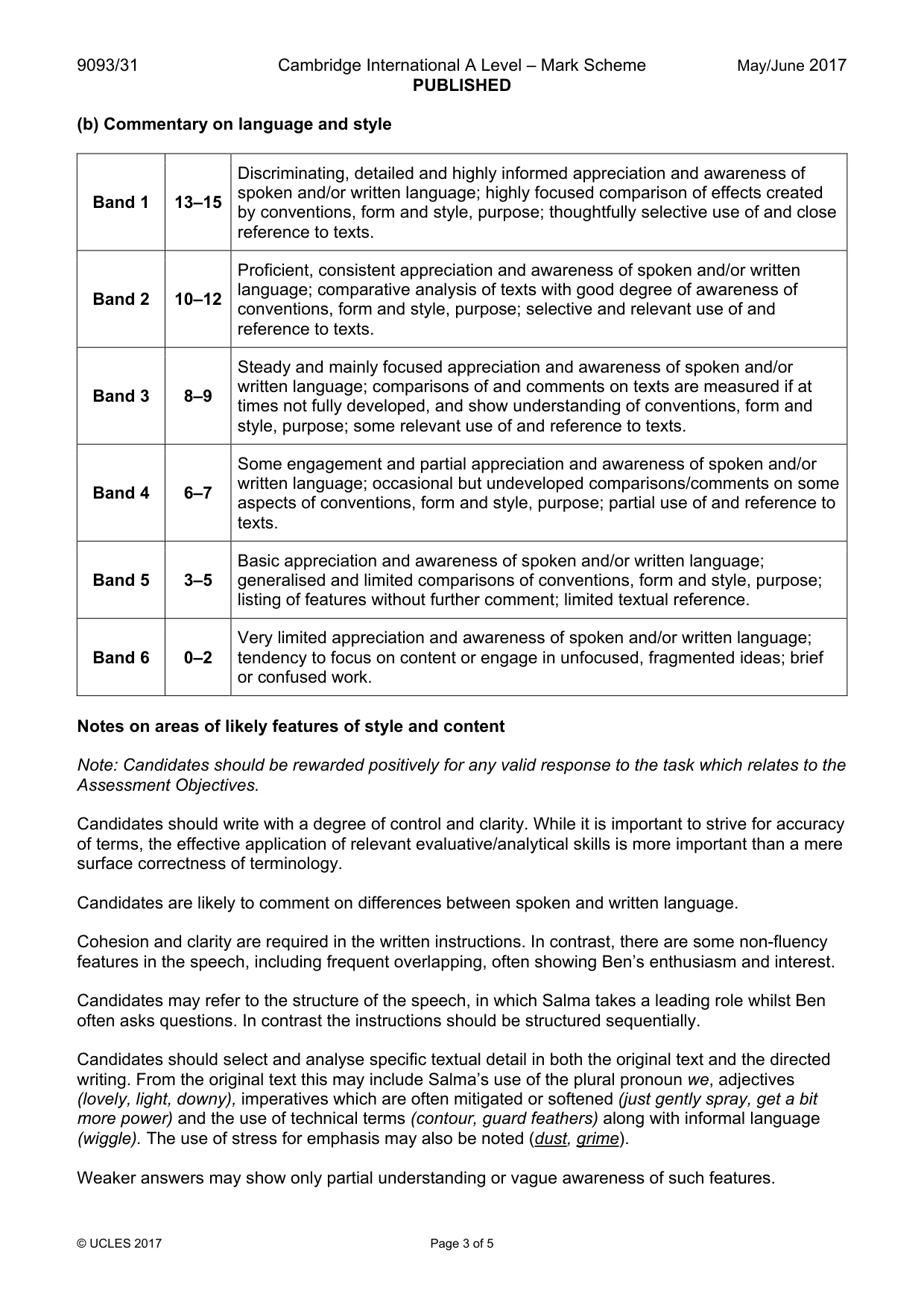
9093/31 Cambridge International A Level – Mark Scheme PUBLISHED May/June 2017 © UCLES 2017 Page 3 of 5 (b) Commentary on language and style Band 1 13–15 Discriminating, detailed and highly informed appreciation and awareness of spoken and/or written language; highly focused comparison of effects created by conventions, form and style, purpose; thoughtfully selective use of and close reference to texts. Band 2 10–12 Proficient, consistent appreciation and awareness of spoken and/or written language; comparative analysis of texts with good degree of awareness of conventions, form and style, purpose; selective and relevant use of and reference to texts. Band 3 8–9 Steady and mainly focused appreciation and awareness of spoken and/or written language; comparisons of and comments on texts are measured if at times not fully developed, and show understanding of conventions, form and style, purpose; some relevant use of and reference to texts. Band 4 6–7 Some engagement and partial appreciation and awareness of spoken and/or written language; occasional but undeveloped comparisons/comments on some aspects of conventions, form and style, purpose; partial use of and reference to texts. Band 5 3–5 Basic appreciation and awareness of spoken and/or written language; generalised and limited comparisons of conventions, form and style, purpose; listing of features without further comment; limited textual reference. Band 6 0–2 Very limited appreciation and awareness of spoken and/or written language; tendency to focus on content or engage in unfocused, fragmented ideas; brief or confused work. Notes on areas of likely features of style and content Note: Candidates should be rewarded positively for any valid response to the task which relates to the Assessment Objectives. Candidates should write with a degree of control and clarity. While it is important to strive for accuracy of terms, the effective application of relevant evaluative/analytical skills is more important than a mere surface correctness of terminology. Candidates are likely to comment on differences between spoken and written language. Cohesion and clarity are required in the written instructions. In contrast, there are some non-fluency features in the speech, including frequent overlapping, often showing Ben’s enthusiasm and interest. Candidates may refer to the structure of the speech, in which Salma takes a leading role whilst Ben often asks questions. In contrast the instructions should be structured sequentially. Candidates should select and analyse specific textual detail in both the original text and the directed writing. From the original text this may include Salma’s use of the plural pronoun we, adjectives (lovely, light, downy), imperatives which are often mitigated or softened (just gently spray, get a bit more power) and the use of technical terms (contour, guard feathers) along with informal language (wiggle). The use of stress for emphasis may also be noted (dust, grime). Weaker answers may show only partial understanding or vague awareness of such features.
Mark scheme, page 4
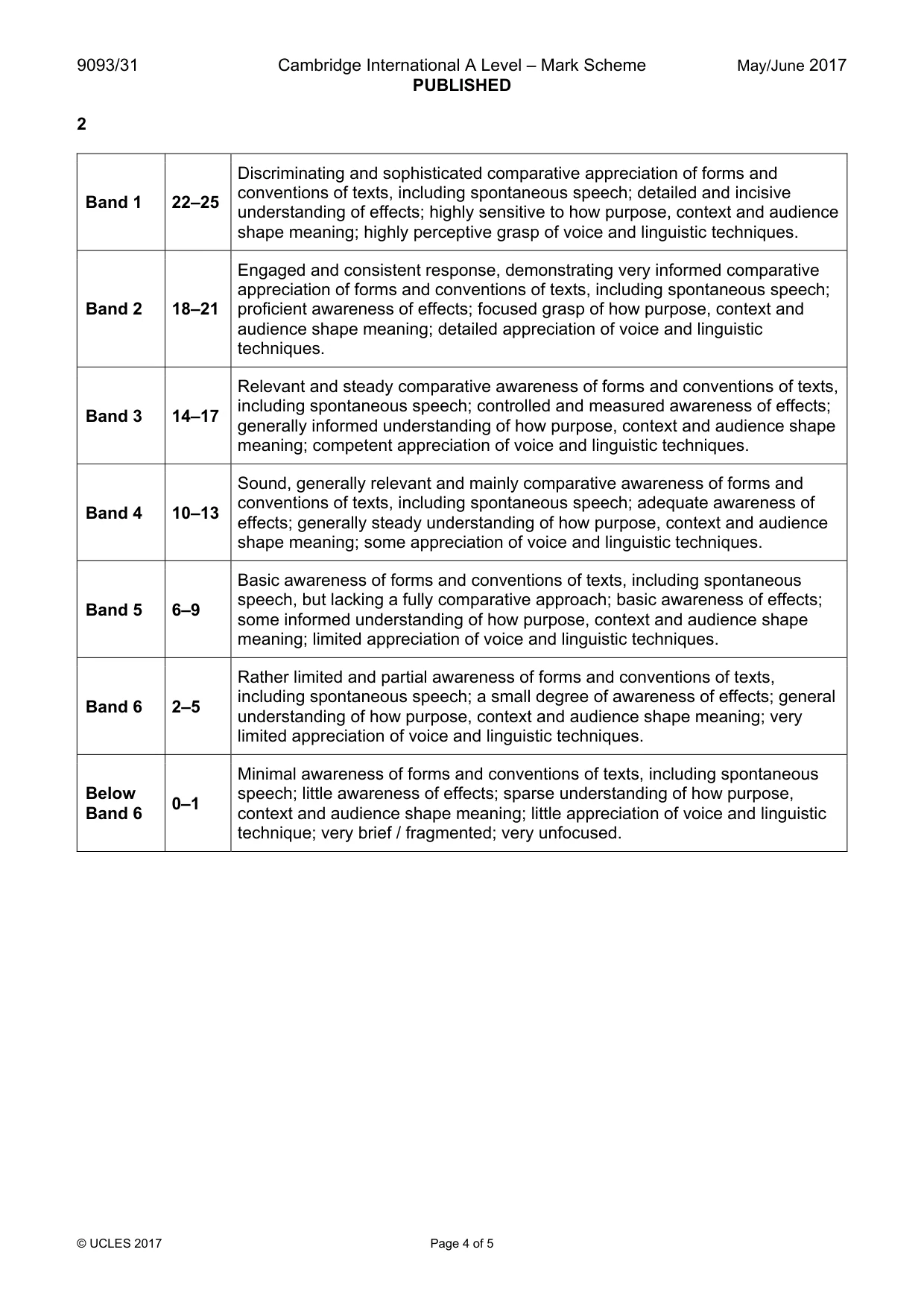
9093/31 Cambridge International A Level – Mark Scheme PUBLISHED May/June 2017 © UCLES 2017 Page 4 of 5 2 Band 1 22–25 Discriminating and sophisticated comparative appreciation of forms and conventions of texts, including spontaneous speech; detailed and incisive understanding of effects; highly sensitive to how purpose, context and audience shape meaning; highly perceptive grasp of voice and linguistic techniques. Band 2 18–21 Engaged and consistent response, demonstrating very informed comparative appreciation of forms and conventions of texts, including spontaneous speech; proficient awareness of effects; focused grasp of how purpose, context and audience shape meaning; detailed appreciation of voice and linguistic techniques. Band 3 14–17 Relevant and steady comparative awareness of forms and conventions of texts, including spontaneous speech; controlled and measured awareness of effects; generally informed understanding of how purpose, context and audience shape meaning; competent appreciation of voice and linguistic techniques. Band 4 10–13 Sound, generally relevant and mainly comparative awareness of forms and conventions of texts, including spontaneous speech; adequate awareness of effects; generally steady understanding of how purpose, context and audience shape meaning; some appreciation of voice and linguistic techniques. Band 5 6–9 Basic awareness of forms and conventions of texts, including spontaneous speech, but lacking a fully comparative approach; basic awareness of effects; some informed understanding of how purpose, context and audience shape meaning; limited appreciation of voice and linguistic techniques. Band 6 2–5 Rather limited and partial awareness of forms and conventions of texts, including spontaneous speech; a small degree of awareness of effects; general understanding of how purpose, context and audience shape meaning; very limited appreciation of voice and linguistic techniques. Below Band 6 0–1 Minimal awareness of forms and conventions of texts, including spontaneous speech; little awareness of effects; sparse understanding of how purpose, context and audience shape meaning; little appreciation of voice and linguistic technique; very brief / fragmented; very unfocused.
Mark scheme, page 5
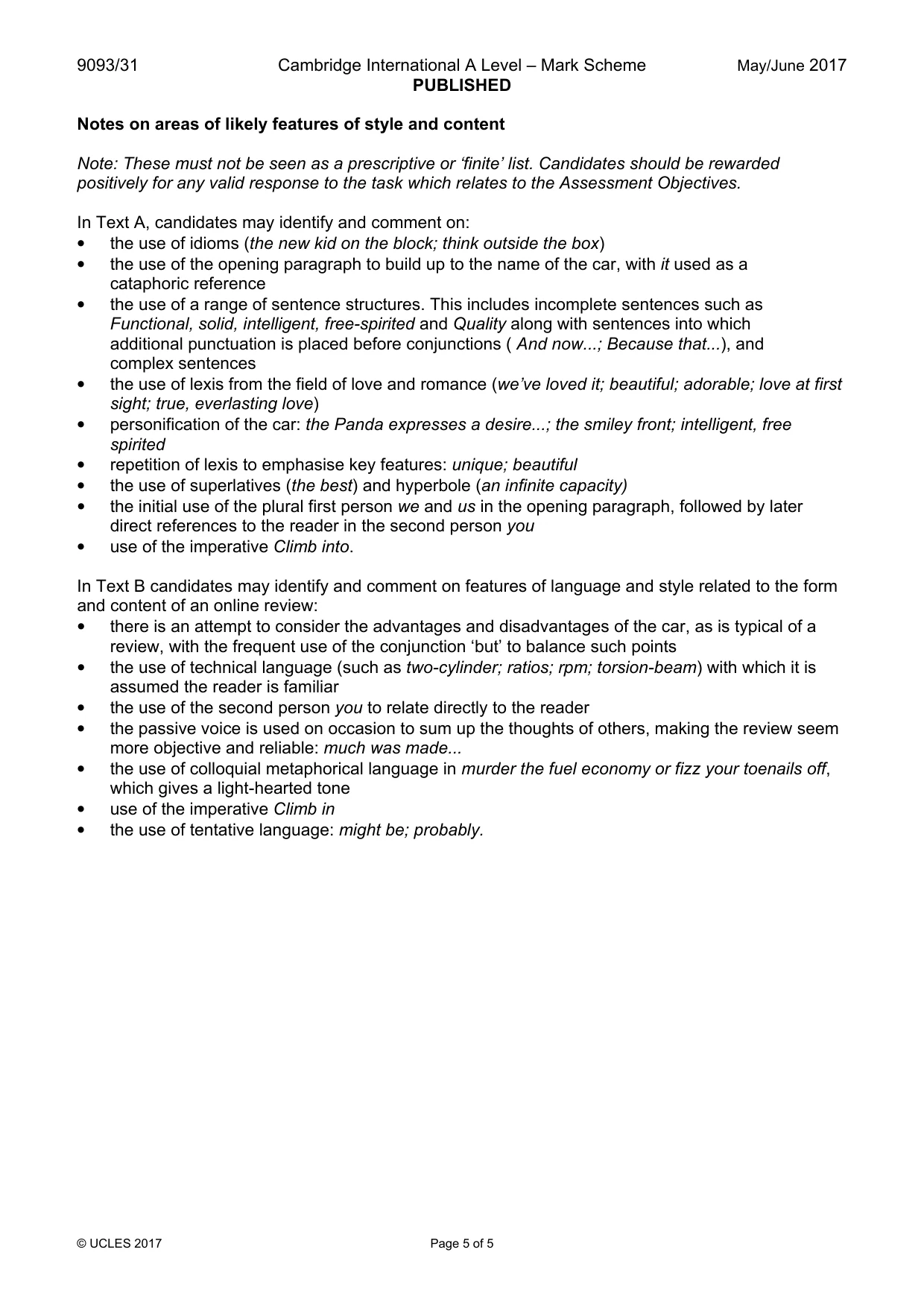
9093/31 Cambridge International A Level – Mark Scheme PUBLISHED May/June 2017 © UCLES 2017 Page 5 of 5 Notes on areas of likely features of style and content Note: These must not be seen as a prescriptive or ‘finite’ list. Candidates should be rewarded positively for any valid response to the task which relates to the Assessment Objectives. In Text A, candidates may identify and comment on: • the use of idioms (the new kid on the block; think outside the box) • the use of the opening paragraph to build up to the name of the car, with it used as a cataphoric reference • the use of a range of sentence structures. This includes incomplete sentences such as Functional, solid, intelligent, free-spirited and Quality along with sentences into which additional punctuation is placed before conjunctions ( And now...; Because that...), and complex sentences • the use of lexis from the field of love and romance (we’ve loved it; beautiful; adorable; love at first sight; true, everlasting love) • personification of the car: the Panda expresses a desire...; the smiley front; intelligent, free spirited • repetition of lexis to emphasise key features: unique; beautiful • the use of superlatives (the best) and hyperbole (an infinite capacity) • the initial use of the plural first person we and us in the opening paragraph, followed by later direct references to the reader in the second person you • use of the imperative Climb into. In Text B candidates may identify and comment on features of language and style related to the form and content of an online review: • there is an attempt to consider the advantages and disadvantages of the car, as is typical of a review, with the frequent use of the conjunction ‘but’ to balance such points • the use of technical language (such as two-cylinder; ratios; rpm; torsion-beam) with which it is assumed the reader is familiar • the use of the second person you to relate directly to the reader • the passive voice is used on occasion to sum up the thoughts of others, making the review seem more objective and reliable: much was made... • the use of colloquial metaphorical language in murder the fuel economy or fizz your toenails off, which gives a light-hearted tone • use of the imperative Climb in • the use of tentative language: might be; probably.
What you needed in this session
Cambridge’s own grade thresholds for 2017 May/June, Paper 3 · Variant 1. A higher threshold means an easier paper — the bar moves with how the cohort did.