Cambridge A Level English - Language AS and A Level (from 2014) 9093 — 2016 Oct/Nov Paper 3 · Variant 2
9093/32/O/N/16 · 50 marks · ≈56 min
The question paper and its mark scheme, free to read here and free to download. This is Cambridge’s own paper, exactly as it was sat.
Question paper8 pages


Mark scheme5 pages
Answers below. Sit the paper first if you are practising.
Paper as text
Question paper, page 1
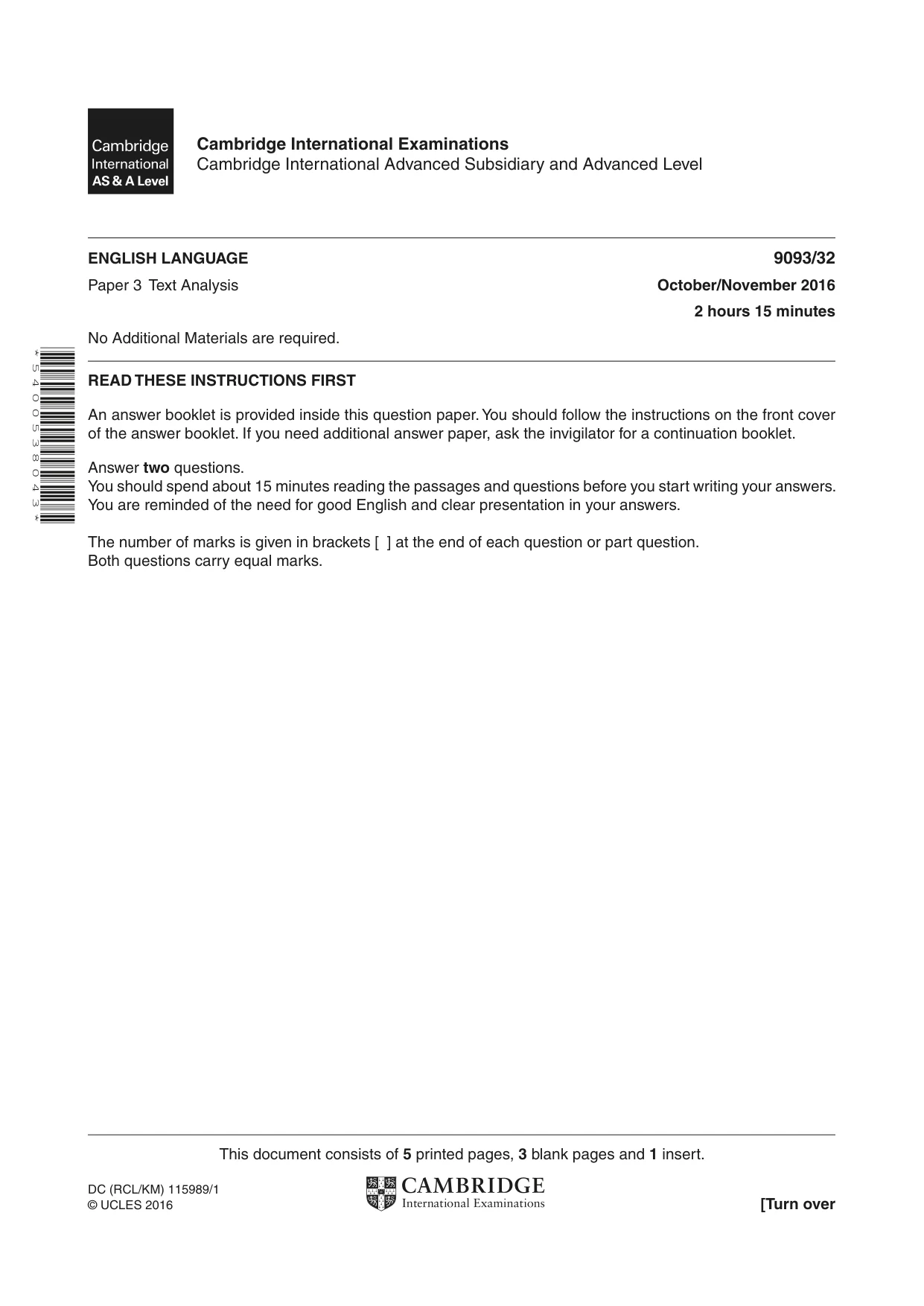
This document consists of 5 printed pages, 3 blank pages and 1 insert. DC (RCL/KM) 115989/1 © UCLES 2016 [Turn over Cambridge International Examinations Cambridge International Advanced Subsidiary and Advanced Level * 5 4 0 0 5 3 8 0 4 3 * ENGLISH LANGUAGE 9093/32 Paper 3 Text Analysis October/November 2016 2 hours 15 minutes No Additional Materials are required. READ THESE INSTRUCTIONS FIRST An answer booklet is provided inside this question paper. You should follow the instructions on the front cover of the answer booklet. If you need additional answer paper, ask the invigilator for a continuation booklet. Answer two questions. You should spend about 15 minutes reading the passages and questions before you start writing your answers. You are reminded of the need for good English and clear presentation in your answers. The number of marks is given in brackets [ ] at the end of each question or part question. Both questions carry equal marks.
Question paper, page 2
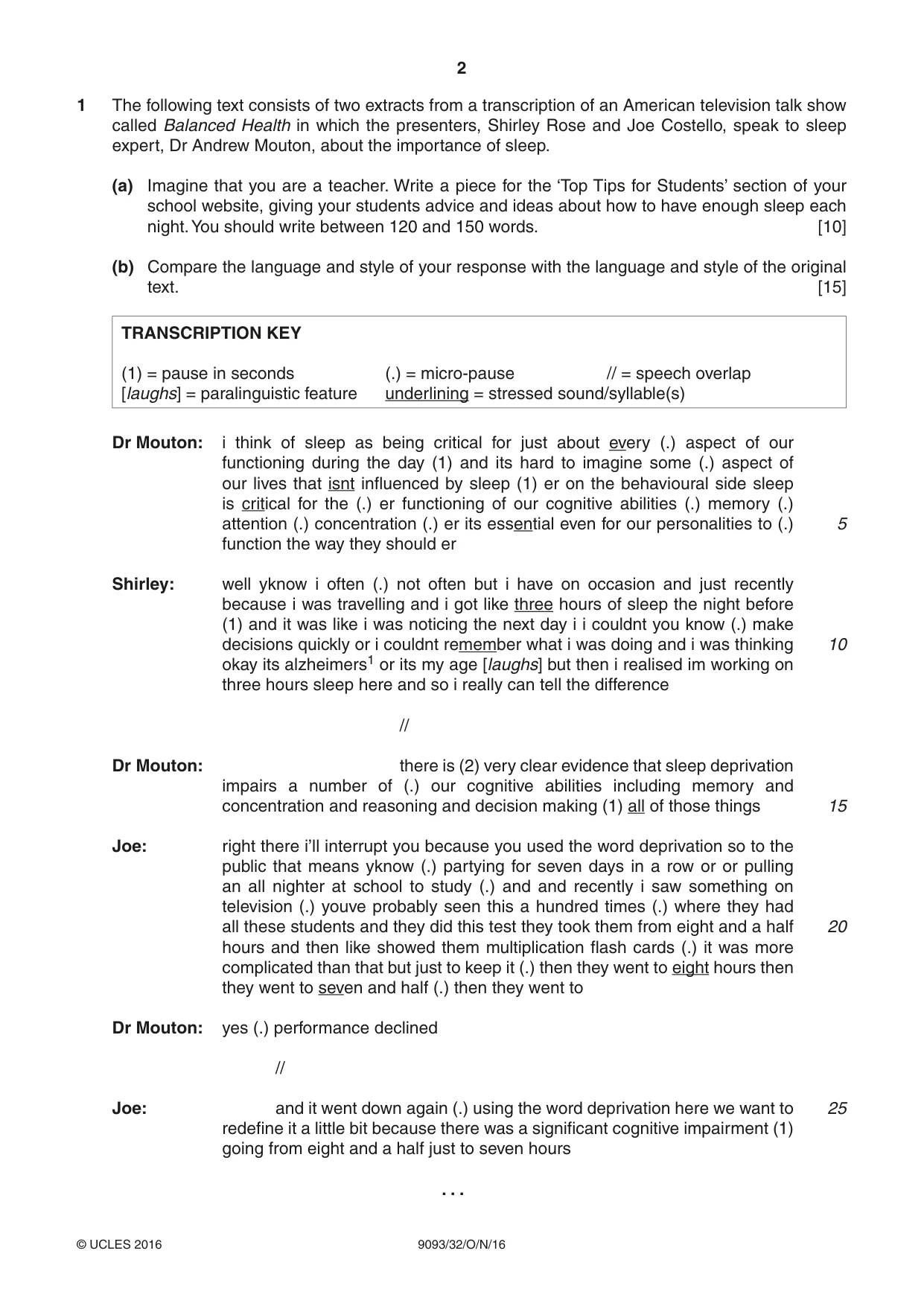
2 9093/32/O/N/16 © UCLES 2016 1 The following text consists of two extracts from a transcription of an American television talk show called Balanced Health in which the presenters, Shirley Rose and Joe Costello, speak to sleep expert, Dr Andrew Mouton, about the importance of sleep. (a) Imagine that you are a teacher. Write a piece for the ‘Top Tips for Students’ section of your school website, giving your students advice and ideas about how to have enough sleep each night. You should write between 120 and 150 words. [10] (b) Compare the language and style of your response with the language and style of the original text. [15] TRANSCRIPTION KEY (1) = pause in seconds (.) = micro-pause // = speech overlap [laughs] = paralinguistic feature underlining = stressed sound/syllable(s) Dr Mouton: i think of sleep as being critical for just about every (.) aspect of our functioning during the day (1) and its hard to imagine some (.) aspect of our lives that isnt influenced by sleep (1) er on the behavioural side sleep is critical for the (.) er functioning of our cognitive abilities (.) memory (.) attention (.) concentration (.) er its essential even for our personalities to (.) function the way they should er Shirley: well yknow i often (.) not often but i have on occasion and just recently because i was travelling and i got like three hours of sleep the night before (1) and it was like i was noticing the next day i i couldnt you know (.) make decisions quickly or i couldnt remember what i was doing and i was thinking okay its alzheimers1 or its my age [laughs] but then i realised im working on three hours sleep here and so i really can tell the difference // Dr Mouton: there is (2) very clear evidence that sleep deprivation impairs a number of (.) our cognitive abilities including memory and concentration and reasoning and decision making (1) all of those things Joe: right there i’ll interrupt you because you used the word deprivation so to the public that means yknow (.) partying for seven days in a row or or pulling an all nighter at school to study (.) and and recently i saw something on television (.) youve probably seen this a hundred times (.) where they had all these students and they did this test they took them from eight and a half hours and then like showed them multiplication flash cards (.) it was more complicated than that but just to keep it (.) then they went to eight hours then they went to seven and half (.) then they went to Dr Mouton: yes (.) performance declined // Joe: and it went down again (.) using the word deprivation here we want to redefine it a little bit because there was a significant cognitive impairment (1) going from eight and a half just to seven hours . . . 5 10 15 20 25
Question paper, page 3
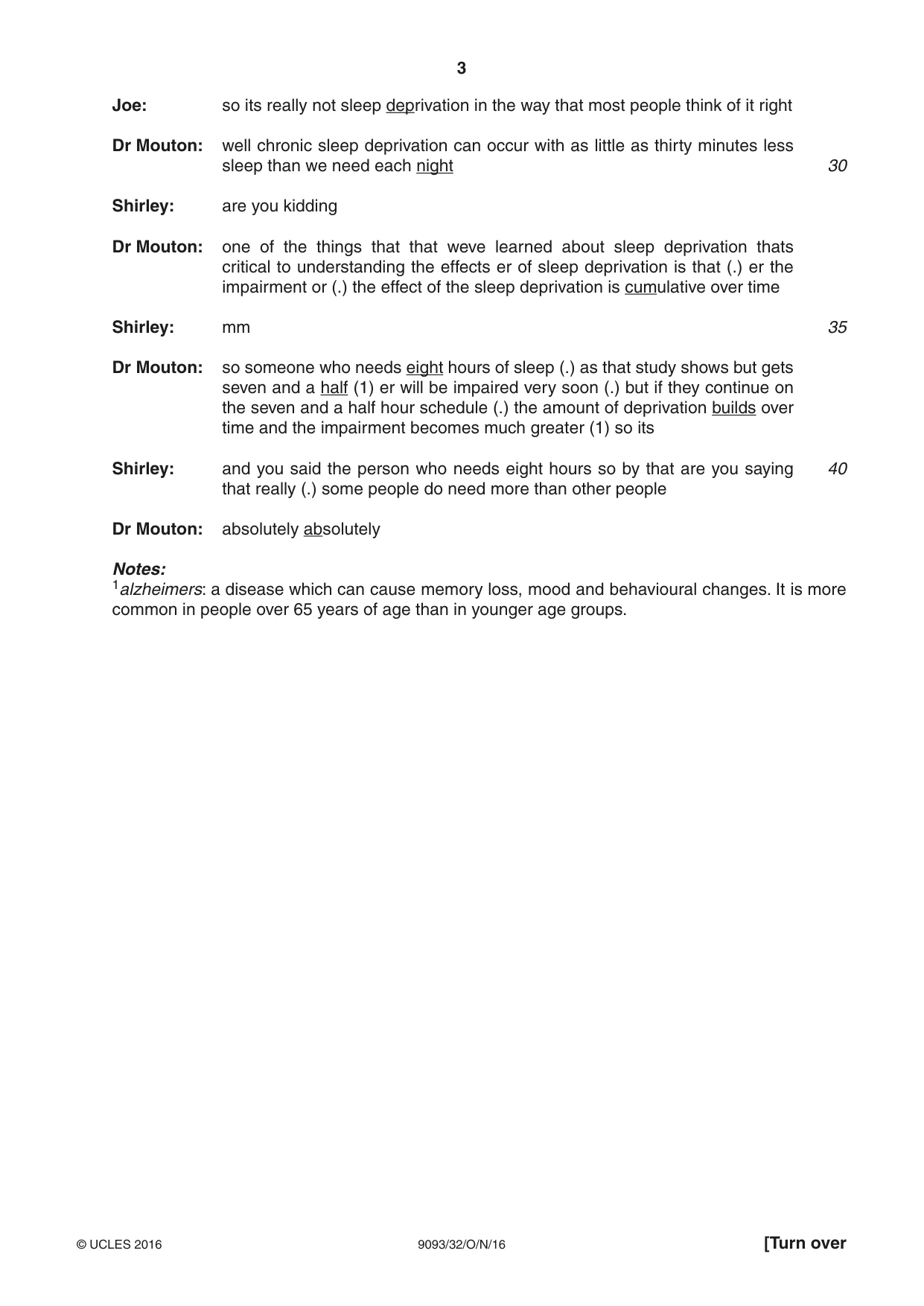
3 9093/32/O/N/16 © UCLES 2016 [Turn over Joe: so its really not sleep deprivation in the way that most people think of it right Dr Mouton: well chronic sleep deprivation can occur with as little as thirty minutes less sleep than we need each night Shirley: are you kidding Dr Mouton: one of the things that that weve learned about sleep deprivation thats critical to understanding the effects er of sleep deprivation is that (.) er the impairment or (.) the effect of the sleep deprivation is cumulative over time Shirley: mm Dr Mouton: so someone who needs eight hours of sleep (.) as that study shows but gets seven and a half (1) er will be impaired very soon (.) but if they continue on the seven and a half hour schedule (.) the amount of deprivation builds over time and the impairment becomes much greater (1) so its Shirley: and you said the person who needs eight hours so by that are you saying that really (.) some people do need more than other people Dr Mouton: absolutely absolutely Notes: 1alzheimers: a disease which can cause memory loss, mood and behavioural changes. It is more common in people over 65 years of age than in younger age groups. 30 35 40
Question paper, page 4
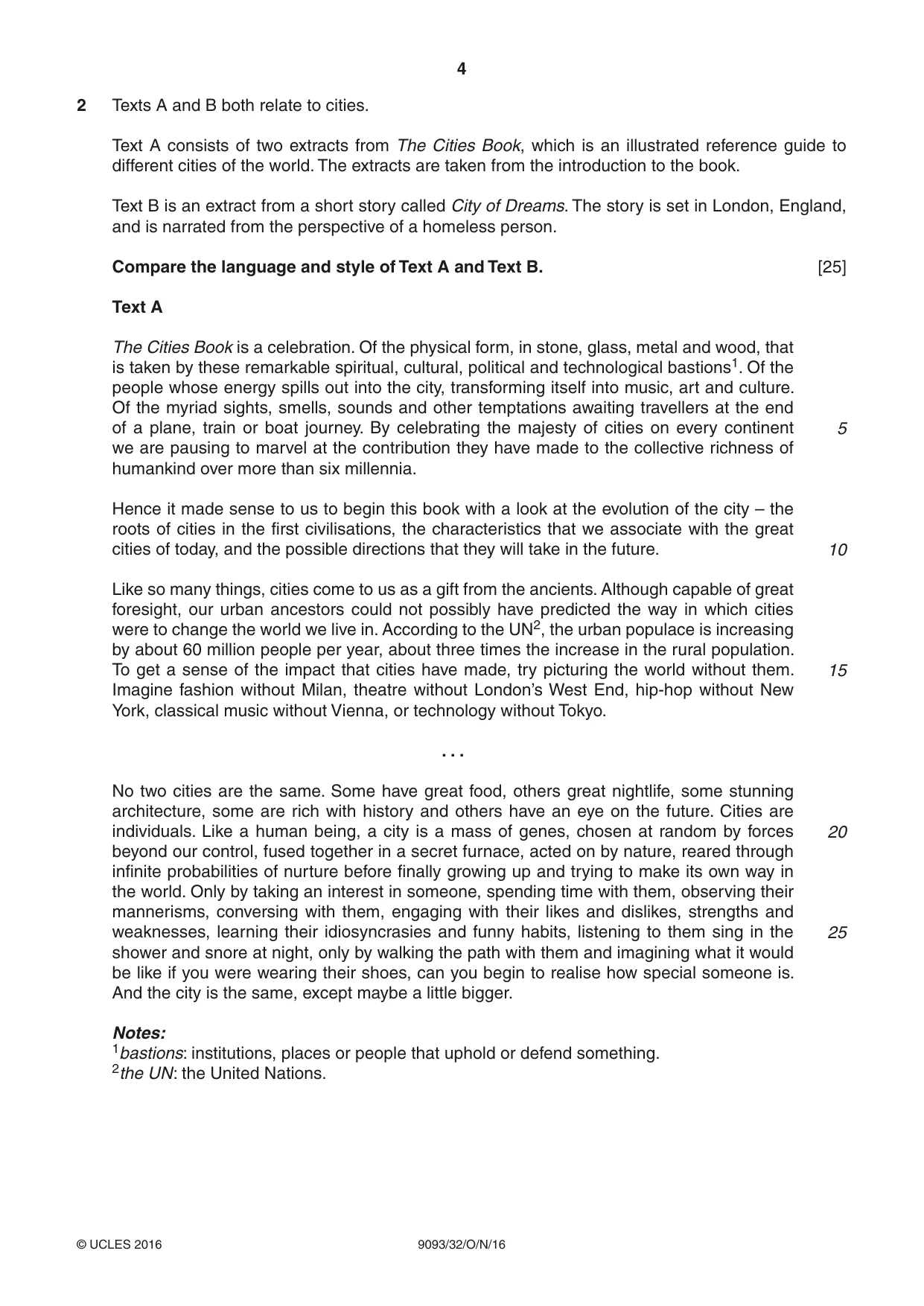
4 9093/32/O/N/16 © UCLES 2016 2 Texts A and B both relate to cities. Text A consists of two extracts from The Cities Book, which is an illustrated reference guide to different cities of the world. The extracts are taken from the introduction to the book. Text B is an extract from a short story called City of Dreams. The story is set in London, England, and is narrated from the perspective of a homeless person. Compare the language and style of Text A and Text B. [25] Text A The Cities Book is a celebration. Of the physical form, in stone, glass, metal and wood, that is taken by these remarkable spiritual, cultural, political and technological bastions1. Of the people whose energy spills out into the city, transforming itself into music, art and culture. Of the myriad sights, smells, sounds and other temptations awaiting travellers at the end of a plane, train or boat journey. By celebrating the majesty of cities on every continent we are pausing to marvel at the contribution they have made to the collective richness of humankind over more than six millennia. Hence it made sense to us to begin this book with a look at the evolution of the city – the roots of cities in the first civilisations, the characteristics that we associate with the great cities of today, and the possible directions that they will take in the future. Like so many things, cities come to us as a gift from the ancients. Although capable of great foresight, our urban ancestors could not possibly have predicted the way in which cities were to change the world we live in. According to the UN2, the urban populace is increasing by about 60 million people per year, about three times the increase in the rural population. To get a sense of the impact that cities have made, try picturing the world without them. Imagine fashion without Milan, theatre without London’s West End, hip-hop without New York, classical music without Vienna, or technology without Tokyo. . . . No two cities are the same. Some have great food, others great nightlife, some stunning architecture, some are rich with history and others have an eye on the future. Cities are individuals. Like a human being, a city is a mass of genes, chosen at random by forces beyond our control, fused together in a secret furnace, acted on by nature, reared through infinite probabilities of nurture before finally growing up and trying to make its own way in the world. Only by taking an interest in someone, spending time with them, observing their mannerisms, conversing with them, engaging with their likes and dislikes, strengths and weaknesses, learning their idiosyncrasies and funny habits, listening to them sing in the shower and snore at night, only by walking the path with them and imagining what it would be like if you were wearing their shoes, can you begin to realise how special someone is. And the city is the same, except maybe a little bigger. Notes: 1bastions: institutions, places or people that uphold or defend something. 2the UN : the United Nations. 5 10 15 20 25
Question paper, page 5
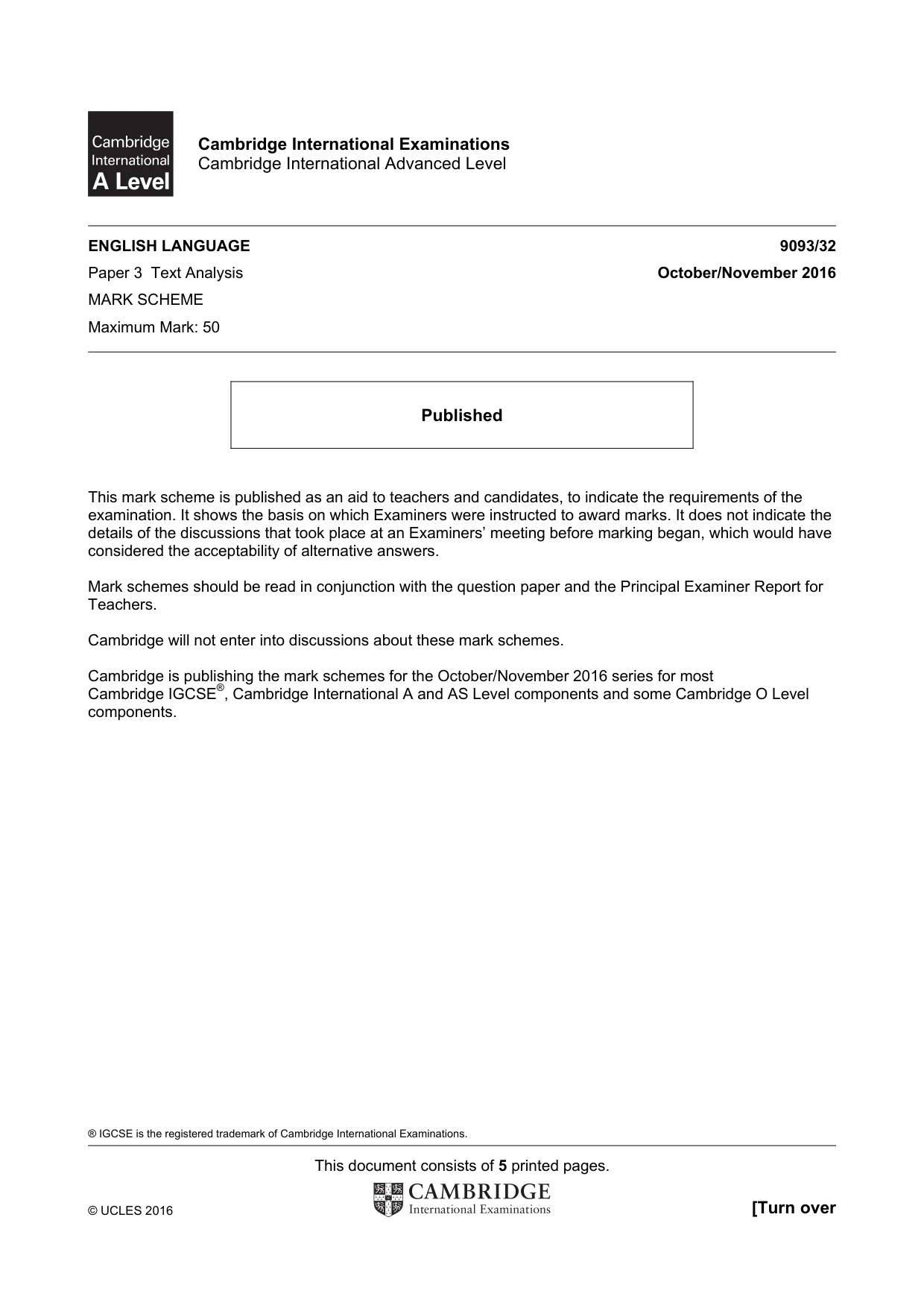
5 9093/32/O/N/16 © UCLES 2016 Text B The sun stains the sky red and a thousand birds open swollen throats to welcome in another day. I lie still and feel the grass warm beneath me and listen to the insects drone drunkenly among the flower-heads. The ground beneath me seems to seethe with a life more ferocious still than that of the metropolis as it awakens around me. Yet little by little the city takes the ascendant once more, stifling nature’s voluptuous undertow with its stenches and its sounds, and it’s then that I get to my feet and head back to my usual place. There’s a mad onslaught of people, arms bare, faces feverish, already exhausted by the effort of getting from A to B. Checking their watches, they curse under their breath and move faster, even faster, suffocating beneath skins choked with sweat and fumes. Anxious puppets hurling themselves along parched pavements, their eyes are haunted by the hours to come, by everything that needs to be pressed into them, all that must be extracted from them. An eternal calculation of sums that never quite add up, and never can, buzzes in their brains. Me? I push crumbs into my mouth and then lean back to let the sun beat down on my eyelids. A wash of orange floods my brain, as bright as the ice lollies I used to eat when… when was that? I grasp at the memory, almost against my will, but it’s gone, leaving nothing behind but a blood-sugar rush of vain longing. Confused, heat-filled, I feel myself begin to slide into sleep. The world will carry on without me. I have nothing to give it anyway. I live outside of time, you see, in a frozen world where the past and the future are mere words, as insubstantial as a flash of spring rain. I doze on and off until the lights in the shops begin to go down and others fizz into life, washing the city in blue neon. People disappear and reappear like stars winking in the sky. Some look sad and alone, their course through the city aimless and haphazard, others shriek and leap with wild inebriation, bunched together like pack animals. From time to time lovers walk by too, arms entwined, faces congealed in expressions of happiness whose end is inscribed within them from the start. 5 10 15 20 25
Question paper, page 6
6 9093/32/O/N/16 © UCLES 2016 BLANK PAGE
Question paper, page 7
7 9093/32/O/N/16 © UCLES 2016 BLANK PAGE
Question paper, page 8
8 9093/32/O/N/16 © UCLES 2016 BLANK PAGE Permission to reproduce items where third-party owned material protected by copyright is included has been sought and cleared where possible. Every reasonable effort has been made by the publisher (UCLES) to trace copyright holders, but if any items requiring clearance have unwittingly been included, the publisher will be pleased to make amends at the earliest possible opportunity. To avoid the issue of disclosure of answer-related information to candidates, all copyright acknowledgements are reproduced online in the Cambridge International Examinations Copyright Acknowledgements Booklet. This is produced for each series of examinations and is freely available to download at www.cie.org.uk after the live examination series. Cambridge International Examinations is part of the Cambridge Assessment Group. Cambridge Assessment is the brand name of University of Cambridge Local Examinations Syndicate (UCLES), which is itself a department of the University of Cambridge.
Mark scheme, page 1
® IGCSE is the registered trademark of Cambridge International Examinations. This document consists of 5 printed pages. © UCLES 2016 [Turn over Cambridge International Examinations Cambridge International Advanced Level ENGLISH LANGUAGE 9093/32 Paper 3 Text Analysis October/November 2016 MARK SCHEME Maximum Mark: 50 Published This mark scheme is published as an aid to teachers and candidates, to indicate the requirements of the examination. It shows the basis on which Examiners were instructed to award marks. It does not indicate the details of the discussions that took place at an Examiners’ meeting before marking began, which would have considered the acceptability of alternative answers. Mark schemes should be read in conjunction with the question paper and the Principal Examiner Report for Teachers. Cambridge will not enter into discussions about these mark schemes. Cambridge is publishing the mark schemes for the October/November 2016 series for most Cambridge IGCSE®, Cambridge International A and AS Level components and some Cambridge O Level components.
Mark scheme, page 2
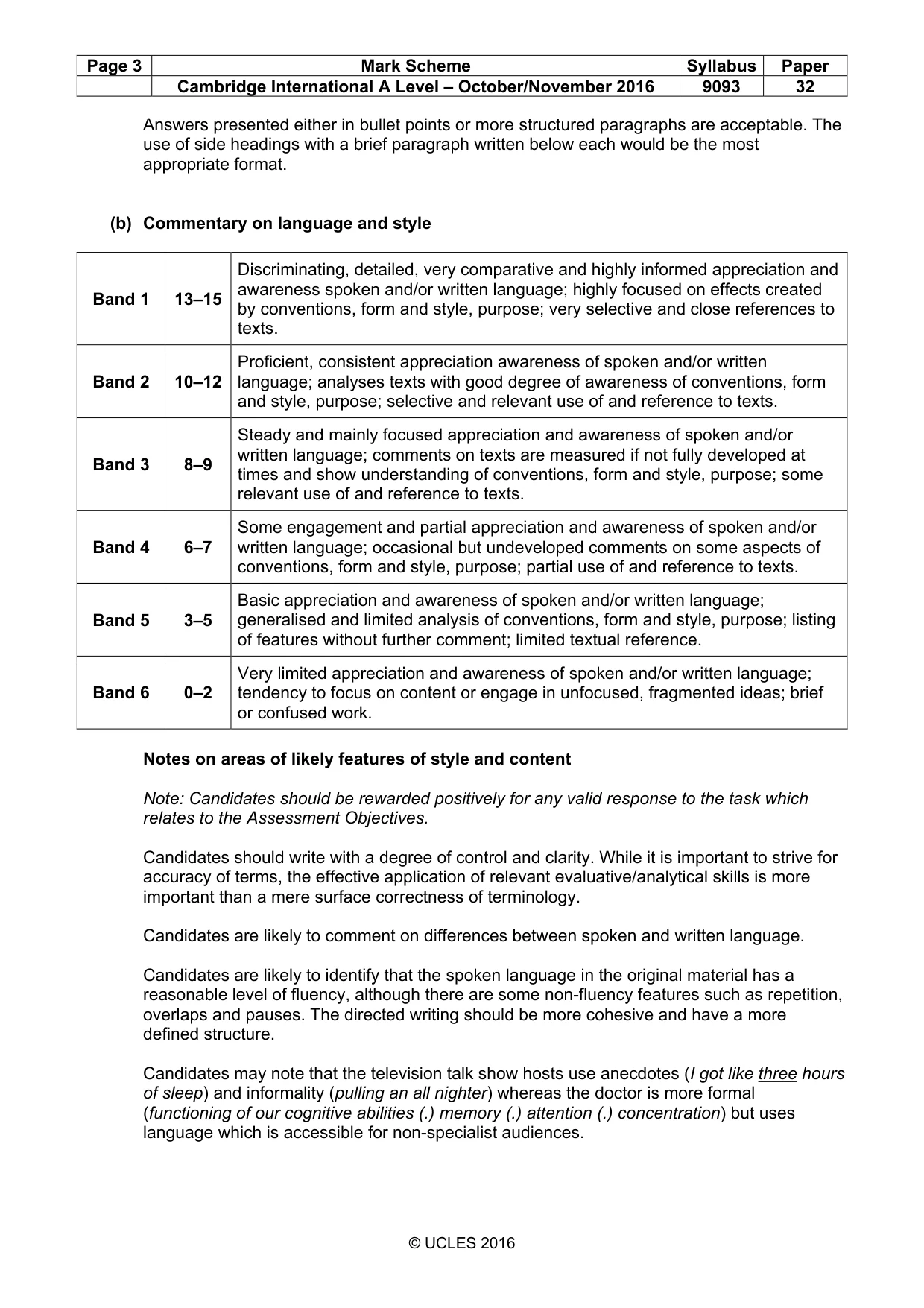
Page 2 Mark Scheme Syllabus Paper Cambridge International A Level – October/November 2016 9093 32 © UCLES 2016 1 Examiners need to be flexible in considering holistically what the candidates write in part (a) in relation to their analysis in part (b). What may at first appear to be inappropriate choices of lexis and register in (a) may turn out to be explained in (b). There should be evidence that linguistic concepts have been understood and are being applied in helpful ways. Knowledge and understanding of spoken/written language should be made explicit in the comparative commentary (b), but there is likely to be evidence of its informed application in the directed writing task (a). (a) Directed Writing Band 1 9–10 Discriminating sense and understanding of audience, form, purpose, conventions and effects, underpinned by a fluent, highly accurate reworking of the material in a highly appropriate style. Band 2 7–8 Proficient grasp and appreciation of audience, form, purpose, conventions and effects, supported by an informed and engaged reworking of the material in a consistent, appropriate and generally fluent style. Band 3 5–6 Competent understanding of audience, form, purpose conventions and effects, supported by an adequately engaged reworking of the material in a measured style, perhaps containing a few lapses in accuracy and expression. Band 4 3–4 Essentially sound but uneven sense and understanding of audience, form, purpose conventions and effects, supported by some engagement in reworking the material but marked by several lapses in accuracy and expression. Band 5 1–2 Basic and limited sense and understanding of audience, form, purpose, conventions and effects; limited engagement with reworking the material, and marked by frequent lapses in accuracy and expression and/or an inappropriate grasp of intent and style. Band 6 0–1 Wholly inappropriate sense of audience, form, purpose, conventions and effects; brief or confused work and/or marked by very limited accuracy and expression. Notes on areas of likely features of style and content Note: These must not be seen as a prescriptive or ‘finite’ list. Candidates should be rewarded positively for any valid response to the task which relates to the Assessment Objectives. Candidates should write clearly, accurately, creatively and effectively for the prescribed purpose and audience. Their writing should reveal: • sound understanding of the original material • understanding of the style of online advice, giving suitable references to the original material. Stronger answers may include a range of strategies to express the views given – for instance, facts, opinions, references to the words of experts, and/or persuasive devices such as rhetorical questions. They are likely to include references to a specific school context. Weaker answers may paraphrase points made in the original material with little development of these and little awareness of audience and purpose.
Mark scheme, page 3
Page 3 Mark Scheme Syllabus Paper Cambridge International A Level – October/November 2016 9093 32 © UCLES 2016 Answers presented either in bullet points or more structured paragraphs are acceptable. The use of side headings with a brief paragraph written below each would be the most appropriate format. (b) Commentary on language and style Band 1 13–15 Discriminating, detailed, very comparative and highly informed appreciation and awareness spoken and/or written language; highly focused on effects created by conventions, form and style, purpose; very selective and close references to texts. Band 2 10–12 Proficient, consistent appreciation awareness of spoken and/or written language; analyses texts with good degree of awareness of conventions, form and style, purpose; selective and relevant use of and reference to texts. Band 3 8–9 Steady and mainly focused appreciation and awareness of spoken and/or written language; comments on texts are measured if not fully developed at times and show understanding of conventions, form and style, purpose; some relevant use of and reference to texts. Band 4 6–7 Some engagement and partial appreciation and awareness of spoken and/or written language; occasional but undeveloped comments on some aspects of conventions, form and style, purpose; partial use of and reference to texts. Band 5 3–5 Basic appreciation and awareness of spoken and/or written language; generalised and limited analysis of conventions, form and style, purpose; listing of features without further comment; limited textual reference. Band 6 0–2 Very limited appreciation and awareness of spoken and/or written language; tendency to focus on content or engage in unfocused, fragmented ideas; brief or confused work. Notes on areas of likely features of style and content Note: Candidates should be rewarded positively for any valid response to the task which relates to the Assessment Objectives. Candidates should write with a degree of control and clarity. While it is important to strive for accuracy of terms, the effective application of relevant evaluative/analytical skills is more important than a mere surface correctness of terminology. Candidates are likely to comment on differences between spoken and written language. Candidates are likely to identify that the spoken language in the original material has a reasonable level of fluency, although there are some non-fluency features such as repetition, overlaps and pauses. The directed writing should be more cohesive and have a more defined structure. Candidates may note that the television talk show hosts use anecdotes (I got like three hours of sleep) and informality (pulling an all nighter) whereas the doctor is more formal (functioning of our cognitive abilities (.) memory (.) attention (.) concentration) but uses language which is accessible for non-specialist audiences.
Mark scheme, page 4
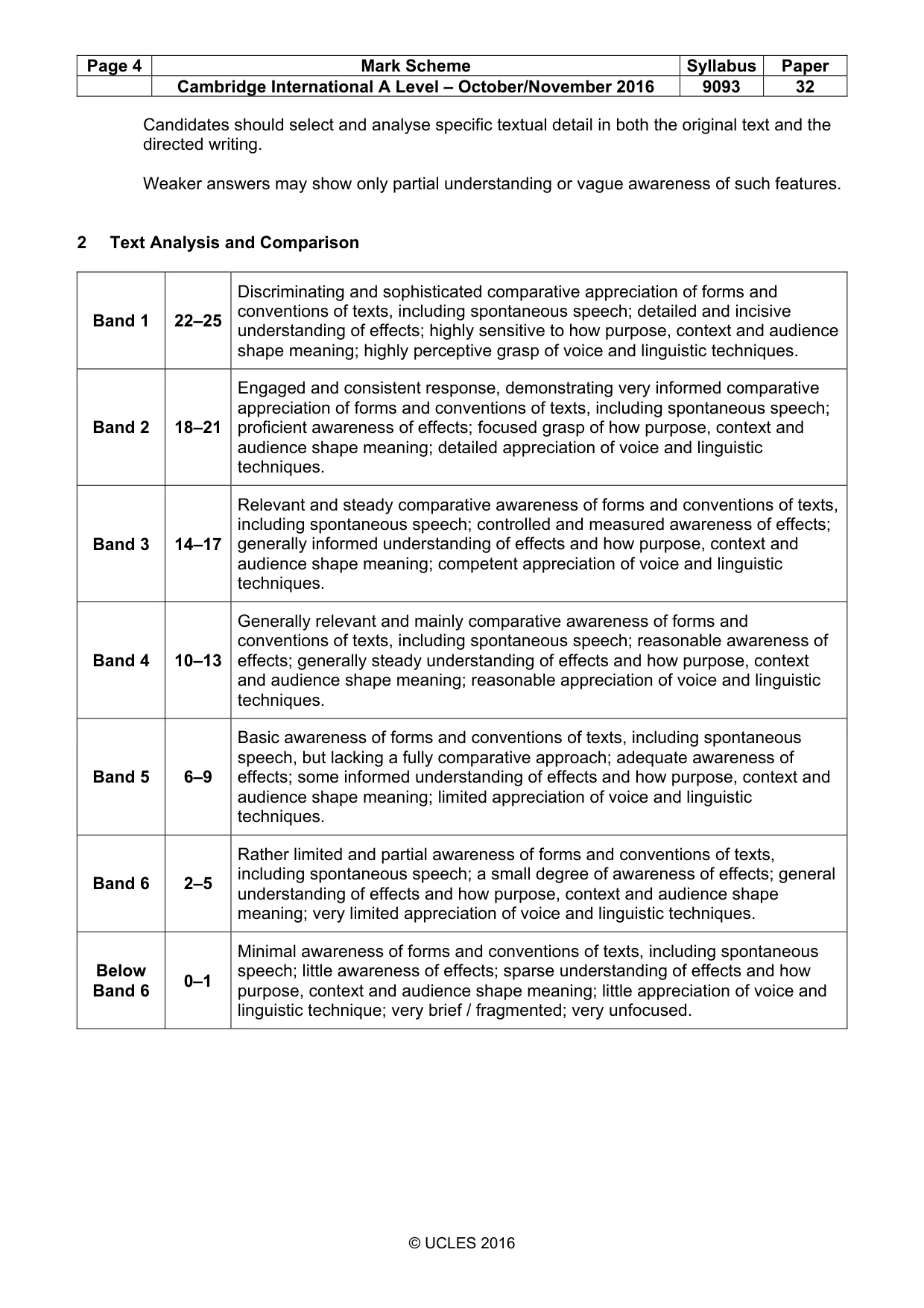
Page 4 Mark Scheme Syllabus Paper Cambridge International A Level – October/November 2016 9093 32 © UCLES 2016 Candidates should select and analyse specific textual detail in both the original text and the directed writing. Weaker answers may show only partial understanding or vague awareness of such features. 2 Text Analysis and Comparison Band 1 22–25 Discriminating and sophisticated comparative appreciation of forms and conventions of texts, including spontaneous speech; detailed and incisive understanding of effects; highly sensitive to how purpose, context and audience shape meaning; highly perceptive grasp of voice and linguistic techniques. Band 2 18–21 Engaged and consistent response, demonstrating very informed comparative appreciation of forms and conventions of texts, including spontaneous speech; proficient awareness of effects; focused grasp of how purpose, context and audience shape meaning; detailed appreciation of voice and linguistic techniques. Band 3 14–17 Relevant and steady comparative awareness of forms and conventions of texts, including spontaneous speech; controlled and measured awareness of effects; generally informed understanding of effects and how purpose, context and audience shape meaning; competent appreciation of voice and linguistic techniques. Band 4 10–13 Generally relevant and mainly comparative awareness of forms and conventions of texts, including spontaneous speech; reasonable awareness of effects; generally steady understanding of effects and how purpose, context and audience shape meaning; reasonable appreciation of voice and linguistic techniques. Band 5 6–9 Basic awareness of forms and conventions of texts, including spontaneous speech, but lacking a fully comparative approach; adequate awareness of effects; some informed understanding of effects and how purpose, context and audience shape meaning; limited appreciation of voice and linguistic techniques. Band 6 2–5 Rather limited and partial awareness of forms and conventions of texts, including spontaneous speech; a small degree of awareness of effects; general understanding of effects and how purpose, context and audience shape meaning; very limited appreciation of voice and linguistic techniques. Below Band 6 0–1 Minimal awareness of forms and conventions of texts, including spontaneous speech; little awareness of effects; sparse understanding of effects and how purpose, context and audience shape meaning; little appreciation of voice and linguistic technique; very brief / fragmented; very unfocused.
Mark scheme, page 5
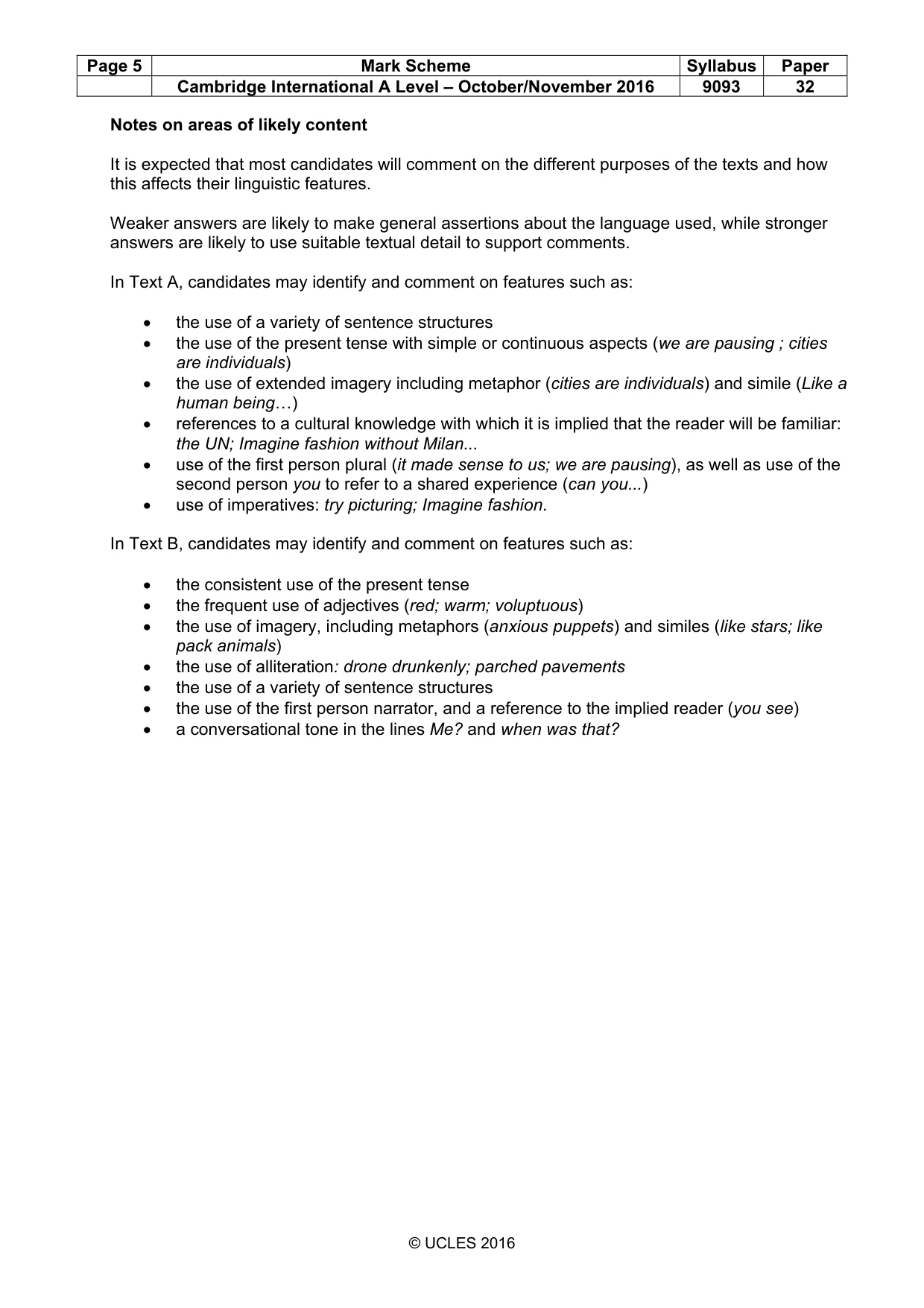
Page 5 Mark Scheme Syllabus Paper Cambridge International A Level – October/November 2016 9093 32 © UCLES 2016 Notes on areas of likely content It is expected that most candidates will comment on the different purposes of the texts and how this affects their linguistic features. Weaker answers are likely to make general assertions about the language used, while stronger answers are likely to use suitable textual detail to support comments. In Text A, candidates may identify and comment on features such as: • the use of a variety of sentence structures • the use of the present tense with simple or continuous aspects (we are pausing ; cities are individuals) • the use of extended imagery including metaphor (cities are individuals) and simile (Like a human being…) • references to a cultural knowledge with which it is implied that the reader will be familiar: the UN; Imagine fashion without Milan... • use of the first person plural (it made sense to us; we are pausing), as well as use of the second person you to refer to a shared experience (can you...) • use of imperatives: try picturing; Imagine fashion. In Text B, candidates may identify and comment on features such as: • the consistent use of the present tense • the frequent use of adjectives (red; warm; voluptuous) • the use of imagery, including metaphors (anxious puppets) and similes (like stars; like pack animals) • the use of alliteration: drone drunkenly; parched pavements • the use of a variety of sentence structures • the use of the first person narrator, and a reference to the implied reader (you see) • a conversational tone in the lines Me? and when was that?
What you needed in this session
Cambridge’s own grade thresholds for 2016 Oct/Nov, Paper 3 · Variant 2. A higher threshold means an easier paper — the bar moves with how the cohort did.