Cambridge A Level English - Language AS and A Level (from 2014) 9093 — 2016 Oct/Nov Paper 3 · Variant 3
9093/33/O/N/16 · 50 marks · ≈56 min
The question paper and its mark scheme, free to read here and free to download. This is Cambridge’s own paper, exactly as it was sat.
Question paper4 pages
Mark scheme5 pages
Answers below. Sit the paper first if you are practising.
Paper as text
Question paper, page 1
This document consists of 4 printed pages and 1 insert. DC (RCL (JDA)) 115506/2 © UCLES 2016 [Turn over Cambridge International Examinations Cambridge International Advanced Subsidiary and Advanced Level * 0 7 0 7 9 9 3 3 4 5 * ENGLISH LANGUAGE 9093/33 Paper 3 Text Analysis October/November 2016 2 hours 15 minutes No Additional Materials are required. READ THESE INSTRUCTIONS FIRST An answer booklet is provided inside this question paper. You should follow the instructions on the front cover of the answer booklet. If you need additional answer paper, ask the invigilator for a continuation booklet. Answer two questions. You should spend about 15 minutes reading the passages and questions before you start writing your answers. You are reminded of the need for good English and clear presentation in your answers. The number of marks is given in [ ] at the end of each question or part question. Both questions carry equal marks.
Question paper, page 2
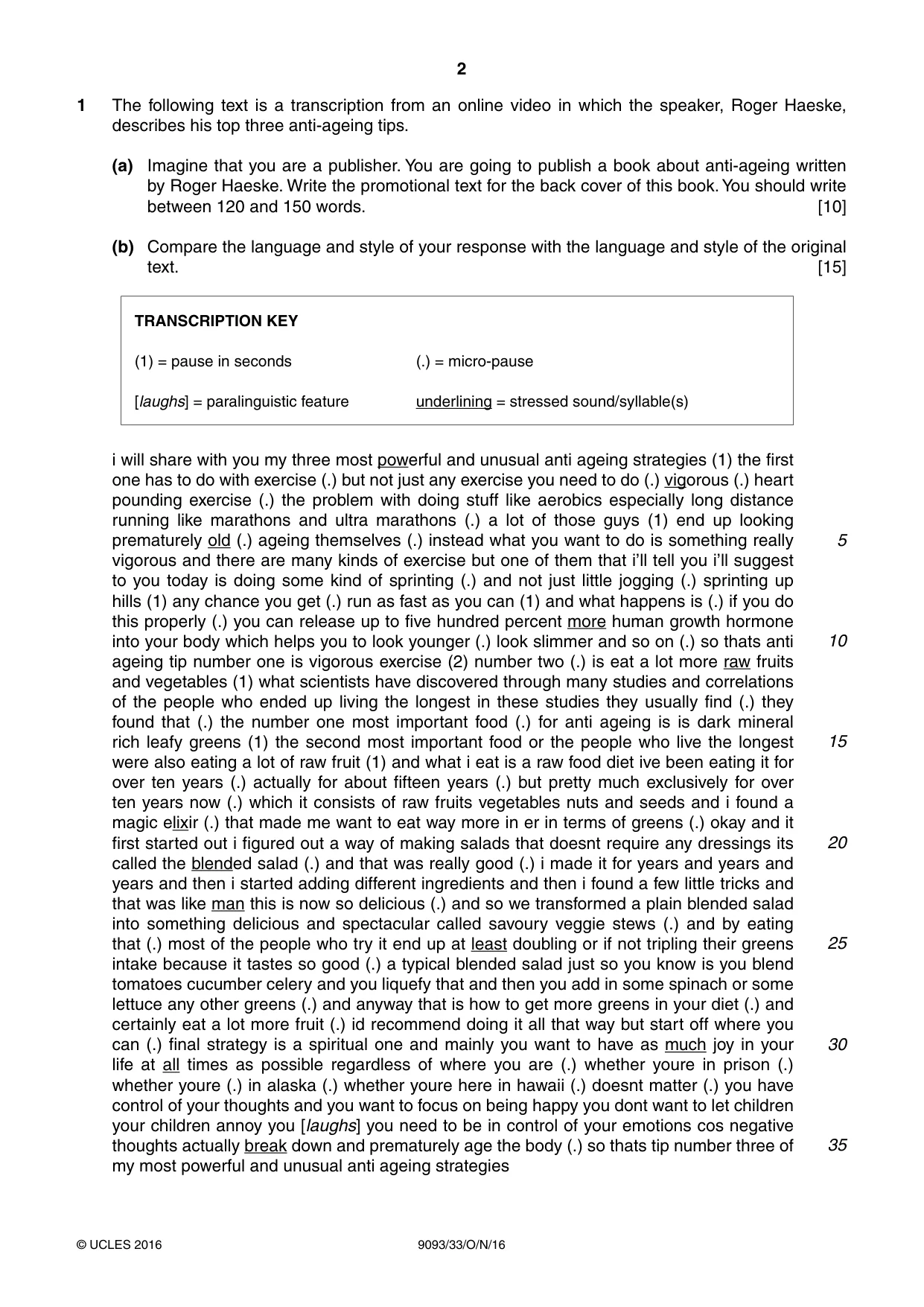
2 9093/33/O/N/16 © UCLES 2016 1 The following text is a transcription from an online video in which the speaker, Roger Haeske, describes his top three anti-ageing tips. (a) Imagine that you are a publisher. You are going to publish a book about anti-ageing written by Roger Haeske. Write the promotional text for the back cover of this book. You should write between 120 and 150 words. [10] (b) Compare the language and style of your response with the language and style of the original text. [15] TRANSCRIPTION KEY (1) = pause in seconds (.) = micro-pause [laughs] = paralinguistic feature underlining = stressed sound/syllable(s) i will share with you my three most powerful and unusual anti ageing strategies (1) the first one has to do with exercise (.) but not just any exercise you need to do (.) vigorous (.) heart pounding exercise (.) the problem with doing stuff like aerobics especially long distance running like marathons and ultra marathons (.) a lot of those guys (1) end up looking prematurely old (.) ageing themselves (.) instead what you want to do is something really vigorous and there are many kinds of exercise but one of them that i’ll tell you i’ll suggest to you today is doing some kind of sprinting (.) and not just little jogging (.) sprinting up hills (1) any chance you get (.) run as fast as you can (1) and what happens is (.) if you do this properly (.) you can release up to five hundred percent more human growth hormone into your body which helps you to look younger (.) look slimmer and so on (.) so thats anti ageing tip number one is vigorous exercise (2) number two (.) is eat a lot more raw fruits and vegetables (1) what scientists have discovered through many studies and correlations of the people who ended up living the longest in these studies they usually find (.) they found that (.) the number one most important food (.) for anti ageing is is dark mineral rich leafy greens (1) the second most important food or the people who live the longest were also eating a lot of raw fruit (1) and what i eat is a raw food diet ive been eating it for over ten years (.) actually for about fifteen years (.) but pretty much exclusively for over ten years now (.) which it consists of raw fruits vegetables nuts and seeds and i found a magic elixir (.) that made me want to eat way more in er in terms of greens (.) okay and it first started out i figured out a way of making salads that doesnt require any dressings its called the blended salad (.) and that was really good (.) i made it for years and years and years and then i started adding different ingredients and then i found a few little tricks and that was like man this is now so delicious (.) and so we transformed a plain blended salad into something delicious and spectacular called savoury veggie stews (.) and by eating that (.) most of the people who try it end up at least doubling or if not tripling their greens intake because it tastes so good (.) a typical blended salad just so you know is you blend tomatoes cucumber celery and you liquefy that and then you add in some spinach or some lettuce any other greens (.) and anyway that is how to get more greens in your diet (.) and certainly eat a lot more fruit (.) id recommend doing it all that way but start off where you can (.) final strategy is a spiritual one and mainly you want to have as much joy in your life at all times as possible regardless of where you are (.) whether youre in prison (.) whether youre (.) in alaska (.) whether youre here in hawaii (.) doesnt matter (.) you have control of your thoughts and you want to focus on being happy you dont want to let children your children annoy you [laughs] you need to be in control of your emotions cos negative thoughts actually break down and prematurely age the body (.) so thats tip number three of my most powerful and unusual anti ageing strategies 5 10 15 20 25 30 35
Question paper, page 3
3 9093/33/O/N/16 © UCLES 2016 [Turn over 2 Texts A and B both relate to sleep. Text A is an article from a website called Geekosystem. Text B is an extract from a chapter called The Science of Sleep which is taken from an academic textbook. Compare the language and style of Text A and Text B. [25] Text A Scientists Finally Understand Why We Need Sleep, And It’s Because Of Our Dirty Minds Humans need sleep; everybody knows that without it, we get cranky, a bit loopy, and then we die. Unfortunately, science has been a little iffy about it; though we understood the negative effects associated with lack of sleep, no one really knew why those things happened. Now, we’re finally getting some insight into what sleep does for our bodies. For the first time ever, scientists at the University of Rochester have found one of the reasons our brain needs sleep to survive. Turns out, when we sleep, our brain takes that time to clean out the build-up of brain junk we accumulate during our waking hours. Sleep is pretty much necessary for our body’s mental street-cleaners to come out and do their work. When cells do their daily cell-type work, they produce waste product. The rest of the body has this waste cleared out by the lymphatic system, but the brain is disconnected from that, so it needs another way to wipe out the waste. The brain has its own garbage men, carried on the waves of cerebrospinal fluid, who surf the leftovers straight down to your liver for elimination. As it turns out, the brain’s garbage men move twice as fast when you’re sleeping, because your neurons shrink by half, making the fluid channels wider. “This study shows that the brain has different functional states when asleep and when awake,” said U of R researcher Maiken Nedergaard. “In fact, the restorative nature of sleep appears to be the result of the active clearance of the by-products of neural activity that accumulate during wakefulness.” So get lots of rest, or else your brain’s spinal-fluid surfing street cleaners can’t get their gig done right. 5 10 15 20
Question paper, page 4
4 9093/33/O/N/16 © UCLES 2016 Text B Theories on the purpose of sleep Historically it has been assumed that sleep must serve some universal essential purpose. However, emerging evidence suggests that this is not necessarily the case. Instead, sleep has evolved multiple functions to cope with the increasing sophistication of the nervous system and the ever-increasing volume of sensory information that must be processed in complex species. Numerous theories regarding specific sleep functions have been proposed, but none is well established (Siegel 2005). Energy conservation appears to be an important sleep function for many animals as this serves to optimize the timing and duration of behaviour and therefore prevents unnecessary activity at inopportune times. Nervous system recuperation and restoration is another important consideration – that sleep somehow reverses wake- related change in brain function that may otherwise cause damage, such as depletion of energy stores and neuronal death. The role for sleep in neurogenesis1, thermoregulation2 and the regulation of emotion is also being investigated. In humans, the ‘information-processing’ theories have been most studied so far. Sleep has a role in the reinforcement of learning and consolidation of memory, with distinct roles for NREM 3 and REM 4 sleep. Some research supports the formation of new brain connections during sleep whilst other research suggests that they are removed during sleep, thereby retaining important information and discarding non-essential information (Crick and Mitchison 1983; Meerlo et al 2009). Studies have suggested that memories are replayed, modified, stabilized and enhanced during sleep, although there is disagreement about whether NREM, REM or both are required and to what extent they are involved (Stickgold 2005, 2006). Such research gives us reason to believe that there may be some truth in the concept of ‘sleeping on a problem’ and the saying ‘sleep on it’. Whereas slow-wave sleep is most closely associated with sleep’s restorative effects, REM sleep is thought to play an important role in development because it is maximal in the young. Other data suggests that REM sleep may have a role in facilitating entry into the wake state following NREM sleep. One of the more fascinating aspects of REM sleep is its relationship to dreaming. Whilst dreaming can occur in the other stages of sleep, it most often happens during REM. Notes: 1 Neurogenesis : the growth and development of cells called neurons. 2 Thermoregulation : the process by which a human or other organism maintains an internal body temperature within certain boundaries. 3 NREM: a stage of sleep involving non-rapid eye movement. 4 REM: a stage of sleep involving rapid eye movement. 5 10 15 20 25 30 Permission to reproduce items where third-party owned material protected by copyright is included has been sought and cleared where possible. Every reasonable effort has been made by the publisher (UCLES) to trace copyright holders, but if any items requiring clearance have unwittingly been included, the publisher will be pleased to make amends at the earliest possible opportunity. To avoid the issue of disclosure of answer-related information to candidates, all copyright acknowledgements are reproduced online in the Cambridge International Examinations Copyright Acknowledgements Booklet. This is produced for each series of examinations and is freely available to download at www.cie.org.uk after the live examination series. Cambridge International Examinations is part of the Cambridge Assessment Group. Cambridge Assessment is the brand name of University of Cambridge Local Examinations Syndicate (UCLES), which is itself a department of the University of Cambridge.
Mark scheme, page 1
® IGCSE is the registered trademark of Cambridge International Examinations. This document consists of 5 printed pages. © UCLES 2016 [Turn over Cambridge International Examinations Cambridge International Advanced Level ENGLISH LANGUAGE 9093/33 Paper 3 Text Analysis October/November 2016 MARK SCHEME Maximum Mark: 50 Published This mark scheme is published as an aid to teachers and candidates, to indicate the requirements of the examination. It shows the basis on which Examiners were instructed to award marks. It does not indicate the details of the discussions that took place at an Examiners’ meeting before marking began, which would have considered the acceptability of alternative answers. Mark schemes should be read in conjunction with the question paper and the Principal Examiner Report for Teachers. Cambridge will not enter into discussions about these mark schemes. Cambridge is publishing the mark schemes for the October/November 2016 series for most Cambridge IGCSE®, Cambridge International A and AS Level components and some Cambridge O Level components.
Mark scheme, page 2
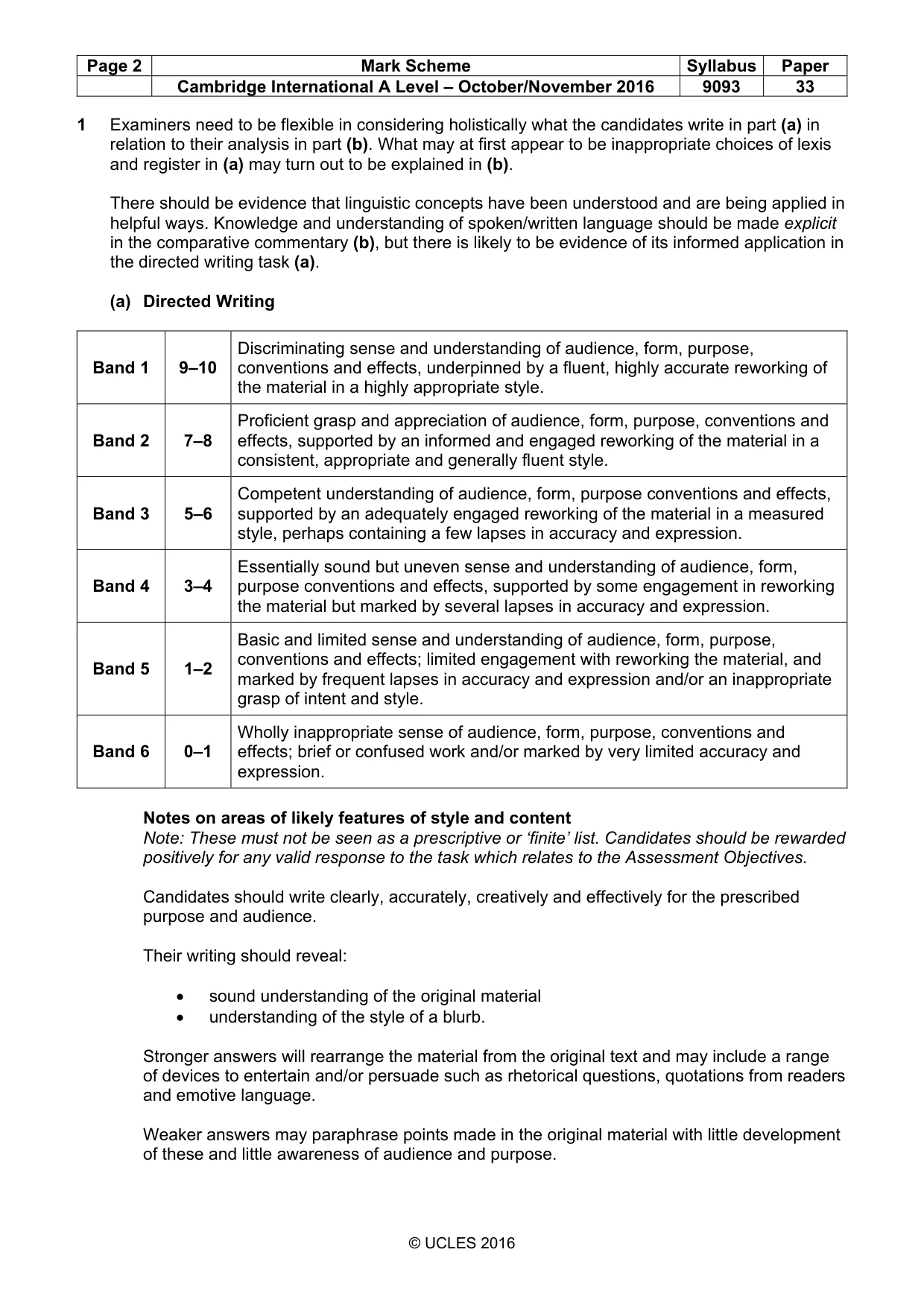
Page 2 Mark Scheme Syllabus Paper Cambridge International A Level – October/November 2016 9093 33 © UCLES 2016 1 Examiners need to be flexible in considering holistically what the candidates write in part (a) in relation to their analysis in part (b). What may at first appear to be inappropriate choices of lexis and register in (a) may turn out to be explained in (b). There should be evidence that linguistic concepts have been understood and are being applied in helpful ways. Knowledge and understanding of spoken/written language should be made explicit in the comparative commentary (b), but there is likely to be evidence of its informed application in the directed writing task (a). (a) Directed Writing Band 1 9–10 Discriminating sense and understanding of audience, form, purpose, conventions and effects, underpinned by a fluent, highly accurate reworking of the material in a highly appropriate style. Band 2 7–8 Proficient grasp and appreciation of audience, form, purpose, conventions and effects, supported by an informed and engaged reworking of the material in a consistent, appropriate and generally fluent style. Band 3 5–6 Competent understanding of audience, form, purpose conventions and effects, supported by an adequately engaged reworking of the material in a measured style, perhaps containing a few lapses in accuracy and expression. Band 4 3–4 Essentially sound but uneven sense and understanding of audience, form, purpose conventions and effects, supported by some engagement in reworking the material but marked by several lapses in accuracy and expression. Band 5 1–2 Basic and limited sense and understanding of audience, form, purpose, conventions and effects; limited engagement with reworking the material, and marked by frequent lapses in accuracy and expression and/or an inappropriate grasp of intent and style. Band 6 0–1 Wholly inappropriate sense of audience, form, purpose, conventions and effects; brief or confused work and/or marked by very limited accuracy and expression. Notes on areas of likely features of style and content Note: These must not be seen as a prescriptive or ‘finite’ list. Candidates should be rewarded positively for any valid response to the task which relates to the Assessment Objectives. Candidates should write clearly, accurately, creatively and effectively for the prescribed purpose and audience. Their writing should reveal: • sound understanding of the original material • understanding of the style of a blurb. Stronger answers will rearrange the material from the original text and may include a range of devices to entertain and/or persuade such as rhetorical questions, quotations from readers and emotive language. Weaker answers may paraphrase points made in the original material with little development of these and little awareness of audience and purpose.
Mark scheme, page 3
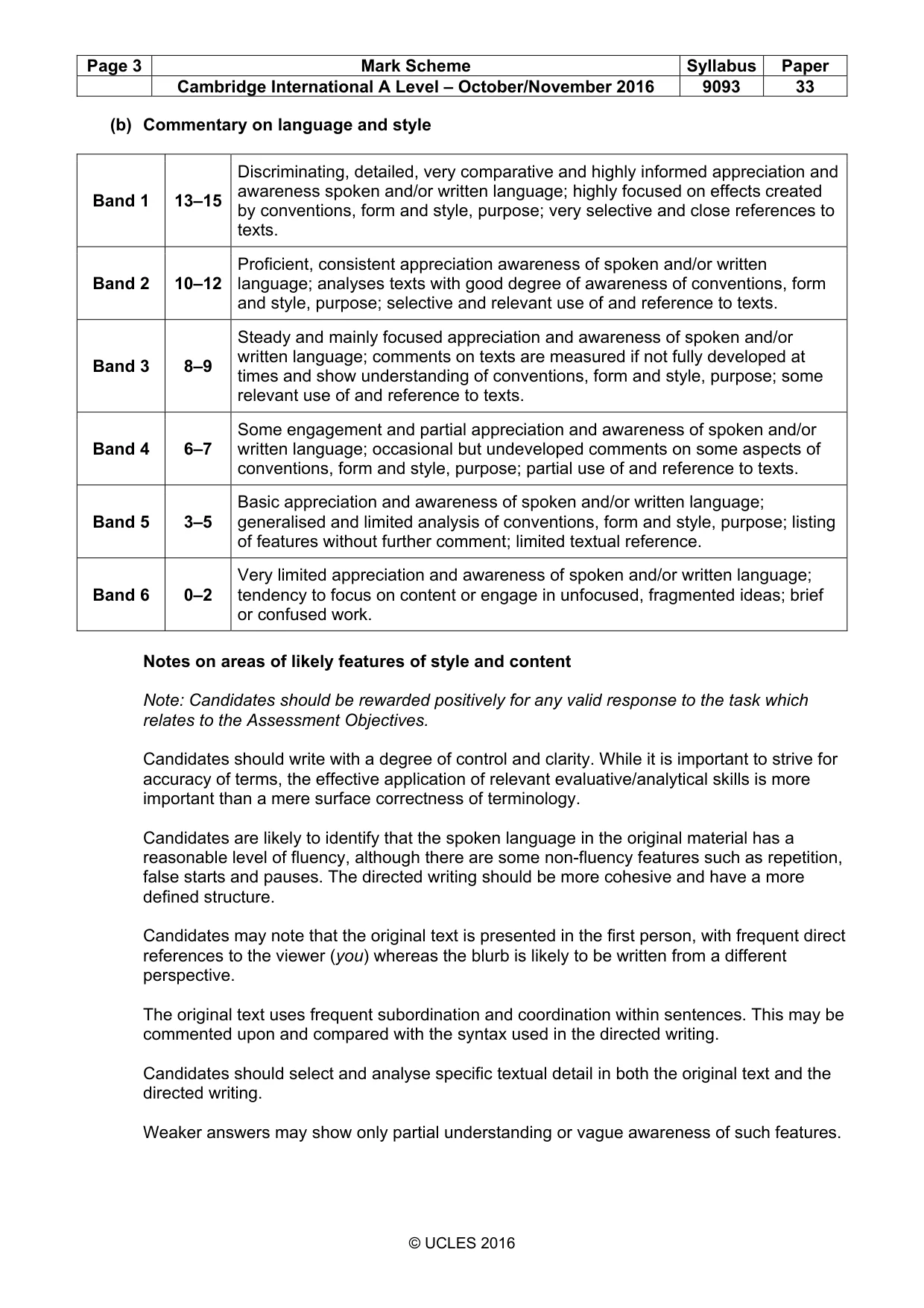
Page 3 Mark Scheme Syllabus Paper Cambridge International A Level – October/November 2016 9093 33 © UCLES 2016 (b) Commentary on language and style Band 1 13–15 Discriminating, detailed, very comparative and highly informed appreciation and awareness spoken and/or written language; highly focused on effects created by conventions, form and style, purpose; very selective and close references to texts. Band 2 10–12 Proficient, consistent appreciation awareness of spoken and/or written language; analyses texts with good degree of awareness of conventions, form and style, purpose; selective and relevant use of and reference to texts. Band 3 8–9 Steady and mainly focused appreciation and awareness of spoken and/or written language; comments on texts are measured if not fully developed at times and show understanding of conventions, form and style, purpose; some relevant use of and reference to texts. Band 4 6–7 Some engagement and partial appreciation and awareness of spoken and/or written language; occasional but undeveloped comments on some aspects of conventions, form and style, purpose; partial use of and reference to texts. Band 5 3–5 Basic appreciation and awareness of spoken and/or written language; generalised and limited analysis of conventions, form and style, purpose; listing of features without further comment; limited textual reference. Band 6 0–2 Very limited appreciation and awareness of spoken and/or written language; tendency to focus on content or engage in unfocused, fragmented ideas; brief or confused work. Notes on areas of likely features of style and content Note: Candidates should be rewarded positively for any valid response to the task which relates to the Assessment Objectives. Candidates should write with a degree of control and clarity. While it is important to strive for accuracy of terms, the effective application of relevant evaluative/analytical skills is more important than a mere surface correctness of terminology. Candidates are likely to identify that the spoken language in the original material has a reasonable level of fluency, although there are some non-fluency features such as repetition, false starts and pauses. The directed writing should be more cohesive and have a more defined structure. Candidates may note that the original text is presented in the first person, with frequent direct references to the viewer (you) whereas the blurb is likely to be written from a different perspective. The original text uses frequent subordination and coordination within sentences. This may be commented upon and compared with the syntax used in the directed writing. Candidates should select and analyse specific textual detail in both the original text and the directed writing. Weaker answers may show only partial understanding or vague awareness of such features.
Mark scheme, page 4
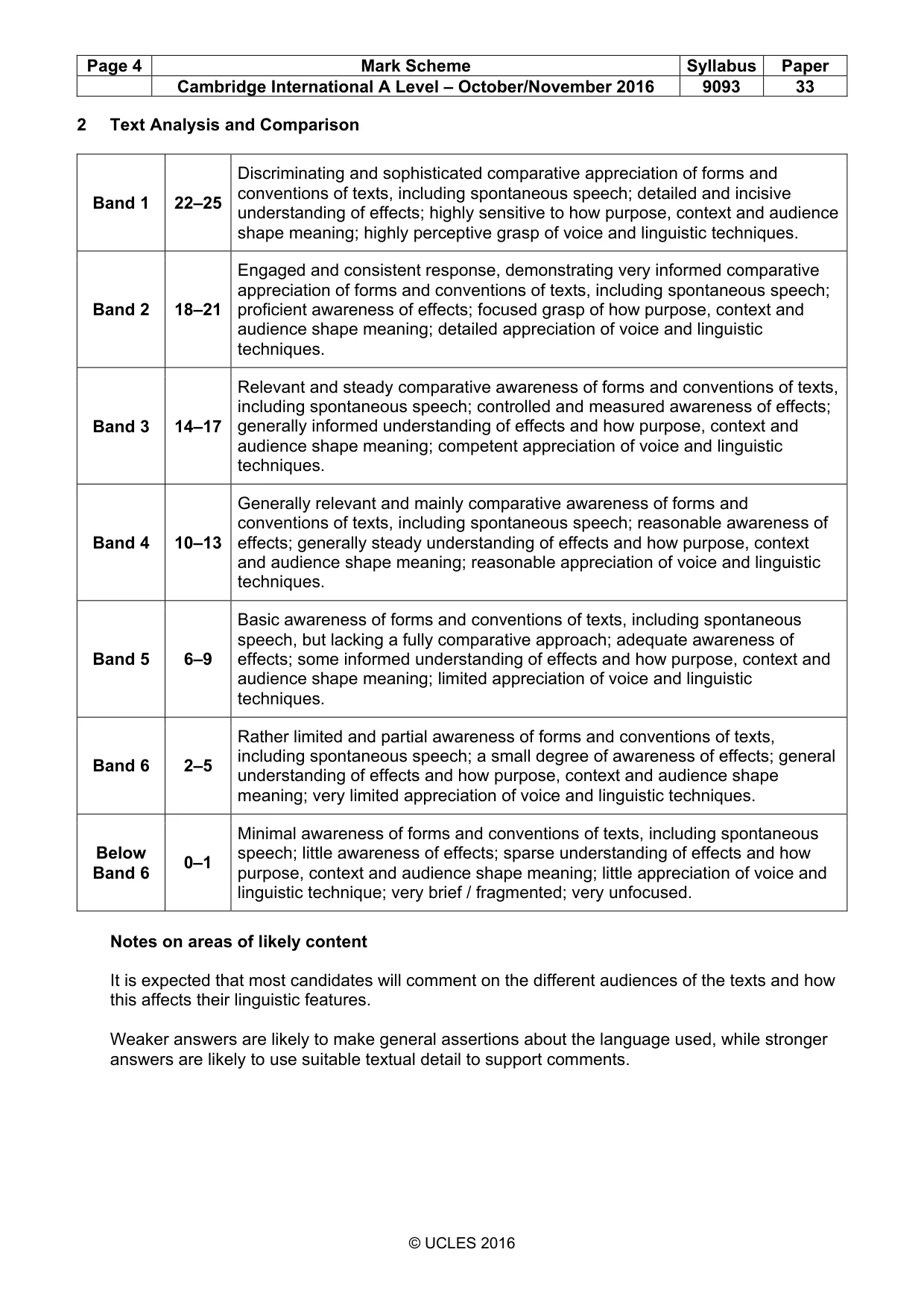
Page 4 Mark Scheme Syllabus Paper Cambridge International A Level – October/November 2016 9093 33 © UCLES 2016 2 Text Analysis and Comparison Band 1 22–25 Discriminating and sophisticated comparative appreciation of forms and conventions of texts, including spontaneous speech; detailed and incisive understanding of effects; highly sensitive to how purpose, context and audience shape meaning; highly perceptive grasp of voice and linguistic techniques. Band 2 18–21 Engaged and consistent response, demonstrating very informed comparative appreciation of forms and conventions of texts, including spontaneous speech; proficient awareness of effects; focused grasp of how purpose, context and audience shape meaning; detailed appreciation of voice and linguistic techniques. Band 3 14–17 Relevant and steady comparative awareness of forms and conventions of texts, including spontaneous speech; controlled and measured awareness of effects; generally informed understanding of effects and how purpose, context and audience shape meaning; competent appreciation of voice and linguistic techniques. Band 4 10–13 Generally relevant and mainly comparative awareness of forms and conventions of texts, including spontaneous speech; reasonable awareness of effects; generally steady understanding of effects and how purpose, context and audience shape meaning; reasonable appreciation of voice and linguistic techniques. Band 5 6–9 Basic awareness of forms and conventions of texts, including spontaneous speech, but lacking a fully comparative approach; adequate awareness of effects; some informed understanding of effects and how purpose, context and audience shape meaning; limited appreciation of voice and linguistic techniques. Band 6 2–5 Rather limited and partial awareness of forms and conventions of texts, including spontaneous speech; a small degree of awareness of effects; general understanding of effects and how purpose, context and audience shape meaning; very limited appreciation of voice and linguistic techniques. Below Band 6 0–1 Minimal awareness of forms and conventions of texts, including spontaneous speech; little awareness of effects; sparse understanding of effects and how purpose, context and audience shape meaning; little appreciation of voice and linguistic technique; very brief / fragmented; very unfocused. Notes on areas of likely content It is expected that most candidates will comment on the different audiences of the texts and how this affects their linguistic features. Weaker answers are likely to make general assertions about the language used, while stronger answers are likely to use suitable textual detail to support comments.
Mark scheme, page 5
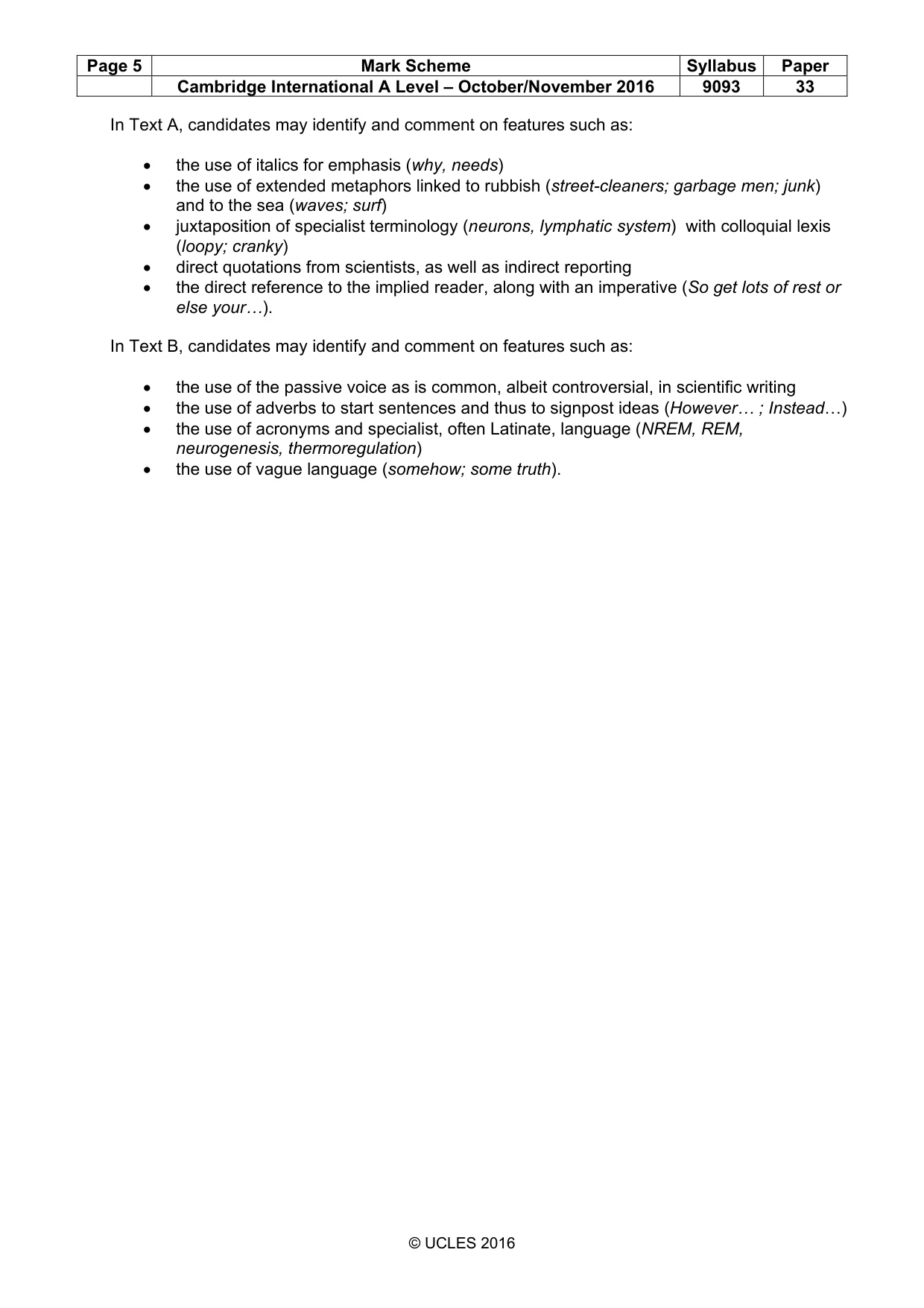
Page 5 Mark Scheme Syllabus Paper Cambridge International A Level – October/November 2016 9093 33 © UCLES 2016 In Text A, candidates may identify and comment on features such as: • the use of italics for emphasis (why, needs) • the use of extended metaphors linked to rubbish (street-cleaners; garbage men; junk) and to the sea (waves; surf) • juxtaposition of specialist terminology (neurons, lymphatic system) with colloquial lexis (loopy; cranky) • direct quotations from scientists, as well as indirect reporting • the direct reference to the implied reader, along with an imperative (So get lots of rest or else your…). In Text B, candidates may identify and comment on features such as: • the use of the passive voice as is common, albeit controversial, in scientific writing • the use of adverbs to start sentences and thus to signpost ideas (However… ; Instead…) • the use of acronyms and specialist, often Latinate, language (NREM, REM, neurogenesis, thermoregulation) • the use of vague language (somehow; some truth).
What you needed in this session
Cambridge’s own grade thresholds for 2016 Oct/Nov, Paper 3 · Variant 3. A higher threshold means an easier paper — the bar moves with how the cohort did.