Cambridge A Level English - Language AS and A Level (from 2014) 9093 — 2016 May/June Paper 3 · Variant 2
9093/32/M/J/16 · 50 marks · ≈56 min
The question paper and its mark scheme, free to read here and free to download. This is Cambridge’s own paper, exactly as it was sat.
Question paper8 pages


Mark scheme5 pages
Answers below. Sit the paper first if you are practising.
Paper as text
Question paper, page 1
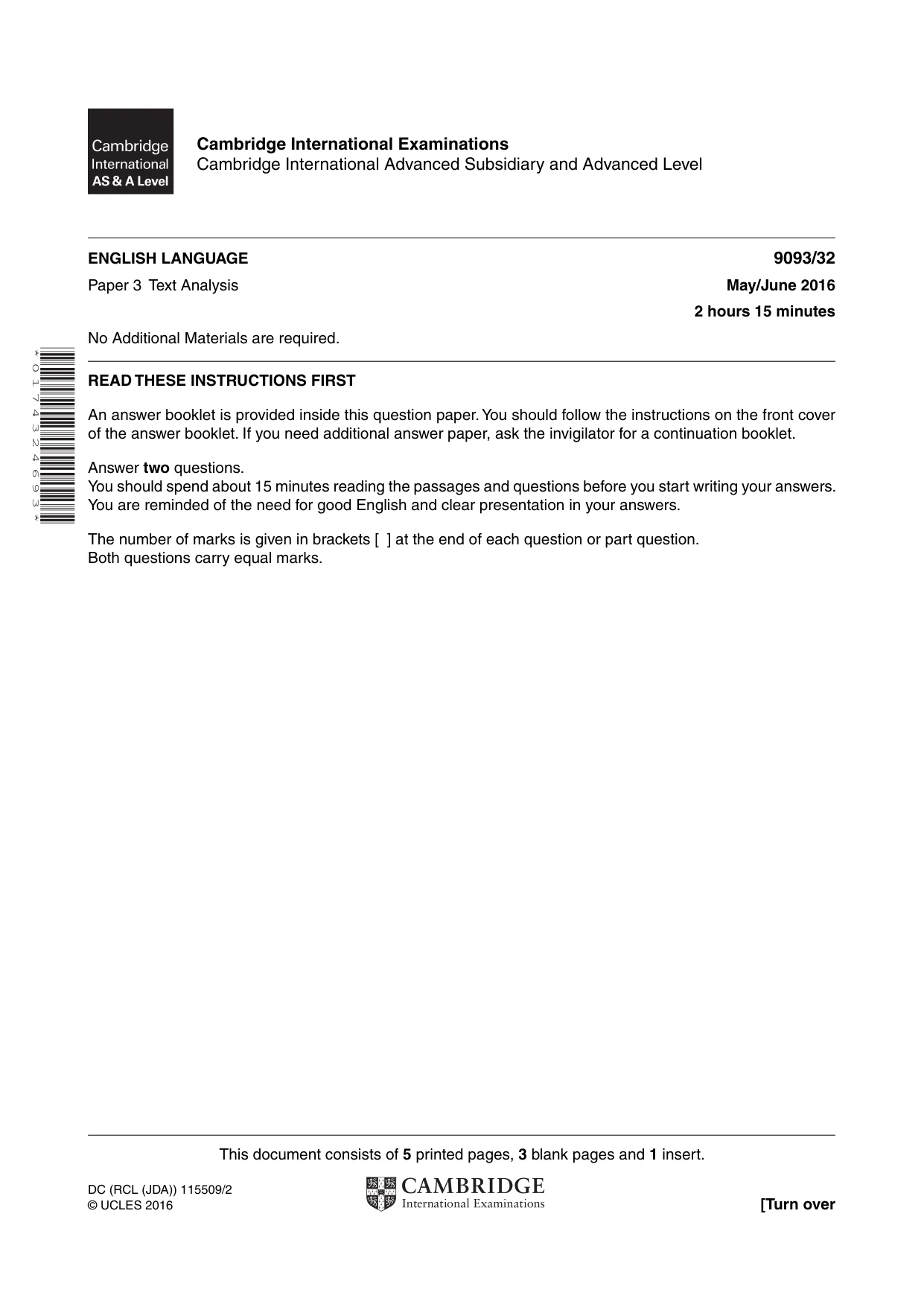
This document consists of 5 printed pages, 3 blank pages and 1 insert. DC (RCL (JDA)) 115509/2 © UCLES 2016 [Turn over Cambridge International Examinations Cambridge International Advanced Subsidiary and Advanced Level * 0 1 7 4 3 2 4 6 9 3 * ENGLISH LANGUAGE 9093/32 Paper 3 Text Analysis May/June 2016 2 hours 15 minutes No Additional Materials are required. READ THESE INSTRUCTIONS FIRST An answer booklet is provided inside this question paper. You should follow the instructions on the front cover of the answer booklet. If you need additional answer paper, ask the invigilator for a continuation booklet. Answer two questions. You should spend about 15 minutes reading the passages and questions before you start writing your answers. You are reminded of the need for good English and clear presentation in your answers. The number of marks is given in brackets [ ] at the end of each question or part question. Both questions carry equal marks.
Question paper, page 2
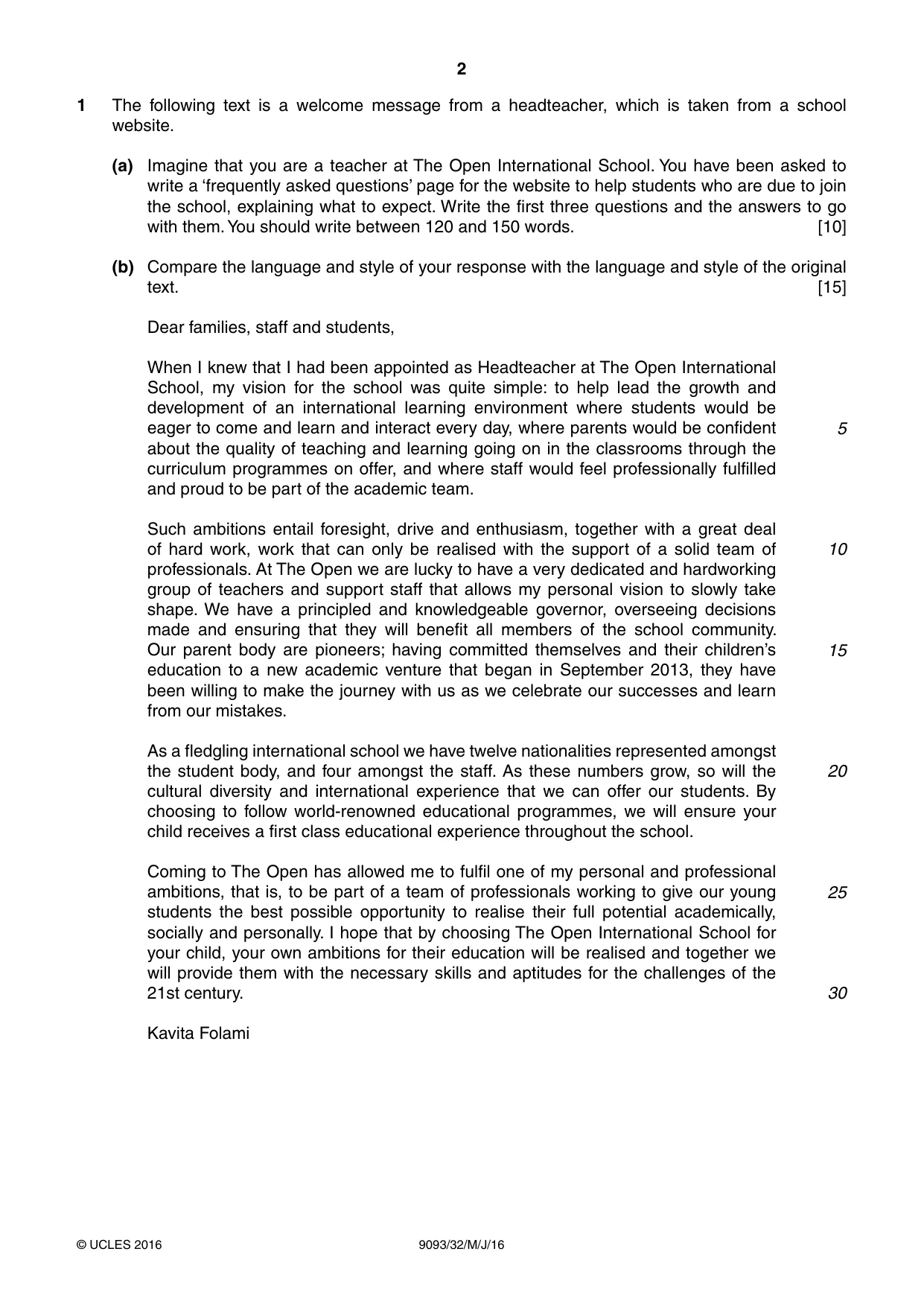
2 9093/32/M/J/16 © UCLES 2016 1 The following text is a welcome message from a headteacher, which is taken from a school website. (a) Imagine that you are a teacher at The Open International School. You have been asked to write a ‘frequently asked questions’ page for the website to help students who are due to join the school, explaining what to expect. Write the first three questions and the answers to go with them. You should write between 120 and 150 words. [10] (b) Compare the language and style of your response with the language and style of the original text. [15] Dear families, staff and students, When I knew that I had been appointed as Headteacher at The Open International School, my vision for the school was quite simple: to help lead the growth and development of an international learning environment where students would be eager to come and learn and interact every day, where parents would be confident about the quality of teaching and learning going on in the classrooms through the curriculum programmes on offer, and where staff would feel professionally fulfilled and proud to be part of the academic team. Such ambitions entail foresight, drive and enthusiasm, together with a great deal of hard work, work that can only be realised with the support of a solid team of professionals. At The Open we are lucky to have a very dedicated and hardworking group of teachers and support staff that allows my personal vision to slowly take shape. We have a principled and knowledgeable governor, overseeing decisions made and ensuring that they will benefit all members of the school community. Our parent body are pioneers; having committed themselves and their children’s education to a new academic venture that began in September 2013, they have been willing to make the journey with us as we celebrate our successes and learn from our mistakes. As a fledgling international school we have twelve nationalities represented amongst the student body, and four amongst the staff. As these numbers grow, so will the cultural diversity and international experience that we can offer our students. By choosing to follow world-renowned educational programmes, we will ensure your child receives a first class educational experience throughout the school. Coming to The Open has allowed me to fulfil one of my personal and professional ambitions, that is, to be part of a team of professionals working to give our young students the best possible opportunity to realise their full potential academically, socially and personally. I hope that by choosing The Open International School for your child, your own ambitions for their education will be realised and together we will provide them with the necessary skills and aptitudes for the challenges of the 21st century. Kavita Folami 5 10 15 20 25 30
Question paper, page 3
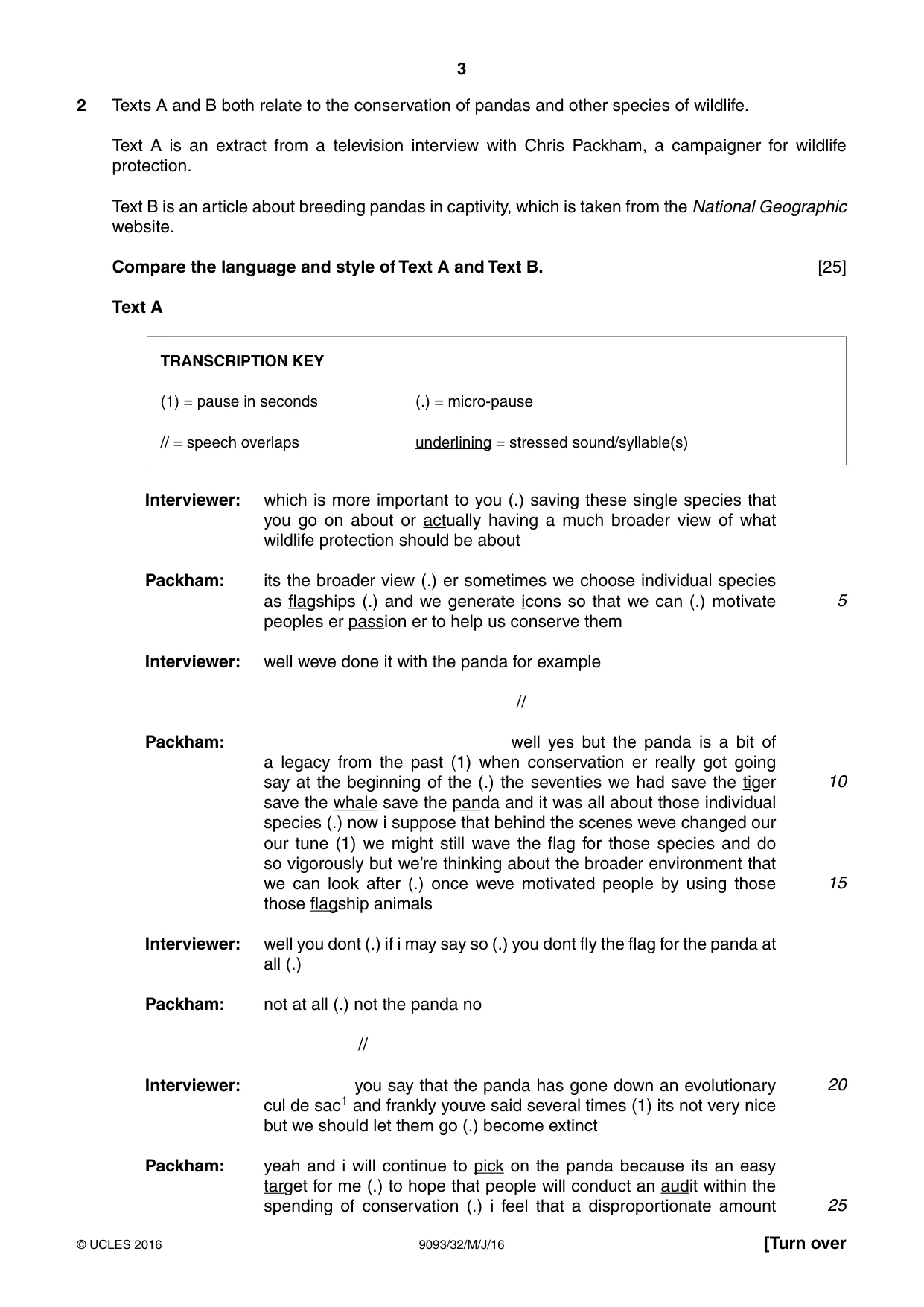
3 9093/32/M/J/16 © UCLES 2016 [Turn over 2 Texts A and B both relate to the conservation of pandas and other species of wildlife. Text A is an extract from a television interview with Chris Packham, a campaigner for wildlife protection. Text B is an article about breeding pandas in captivity, which is taken from the National Geographic website. Compare the language and style of Text A and Text B. [25] Text A TRANSCRIPTION KEY (1) = pause in seconds (.) = micro-pause // = speech overlaps underlining = stressed sound/syllable(s) Interviewer: which is more important to you (.) saving these single species that you go on about or actually having a much broader view of what wildlife protection should be about Packham: its the broader view (.) er sometimes we choose individual species as flagships (.) and we generate icons so that we can (.) motivate peoples er passion er to help us conserve them Interviewer: well weve done it with the panda for example // Packham: well yes but the panda is a bit of a legacy from the past (1) when conservation er really got going say at the beginning of the (.) the seventies we had save the tiger save the whale save the panda and it was all about those individual species (.) now i suppose that behind the scenes weve changed our our tune (1) we might still wave the flag for those species and do so vigorously but we’re thinking about the broader environment that we can look after (.) once weve motivated people by using those those flagship animals Interviewer: well you dont (.) if i may say so (.) you dont fly the flag for the panda at all (.) Packham: not at all (.) not the panda no // Interviewer: you say that the panda has gone down an evolutionary cul de sac1 and frankly youve said several times (1) its not very nice but we should let them go (.) become extinct Packham: yeah and i will continue to pick on the panda because its an easy target for me (.) to hope that people will conduct an audit within the spending of conservation (.) i feel that a disproportionate amount 5 10 15 20 25
Question paper, page 4
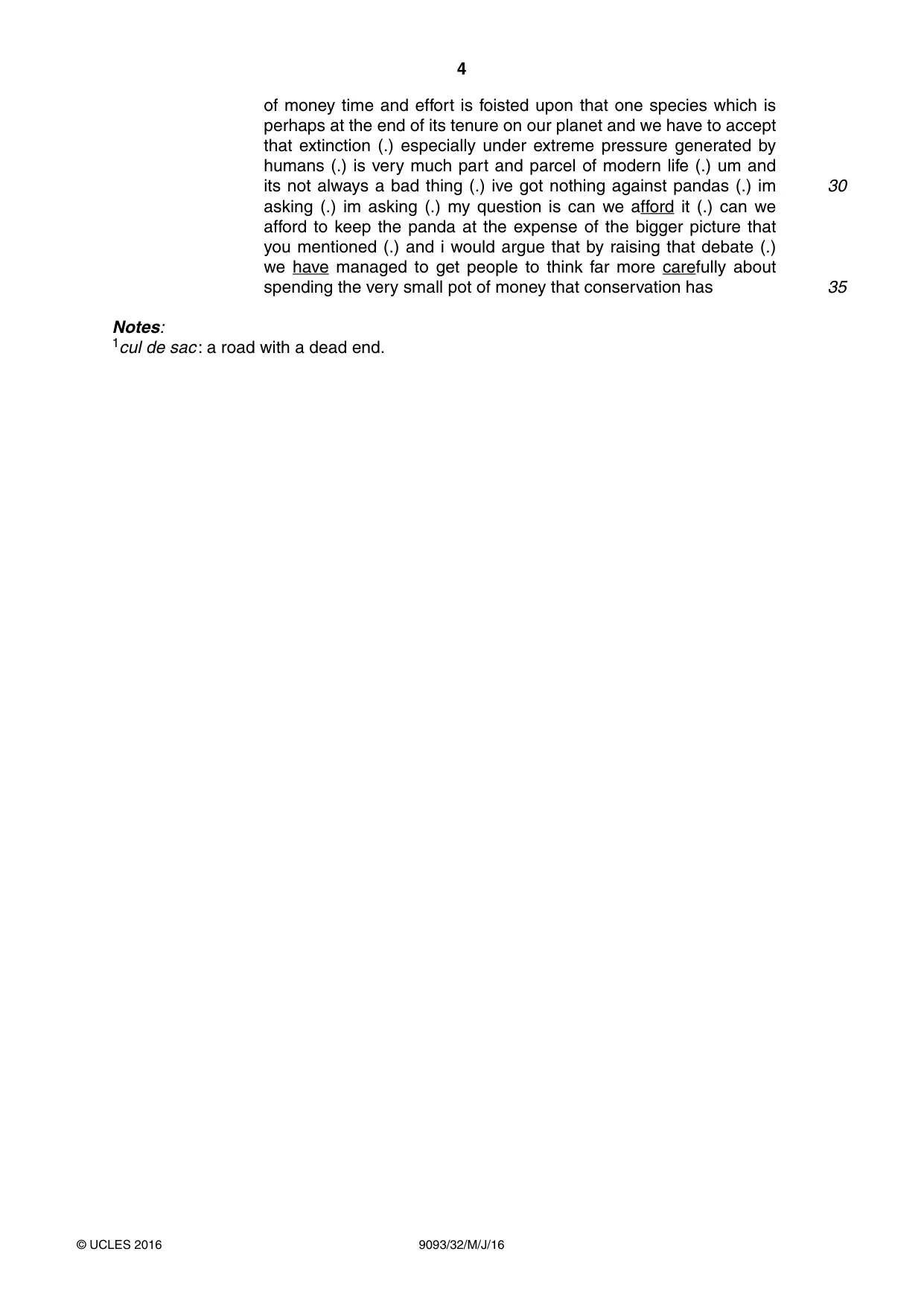
4 9093/32/M/J/16 © UCLES 2016 of money time and effort is foisted upon that one species which is perhaps at the end of its tenure on our planet and we have to accept that extinction (.) especially under extreme pressure generated by humans (.) is very much part and parcel of modern life (.) um and its not always a bad thing (.) ive got nothing against pandas (.) im asking (.) im asking (.) my question is can we afford it (.) can we afford to keep the panda at the expense of the bigger picture that you mentioned (.) and i would argue that by raising that debate (.) we have managed to get people to think far more carefully about spending the very small pot of money that conservation has Notes: 1cul de sac : a road with a dead end. 30 35
Question paper, page 5
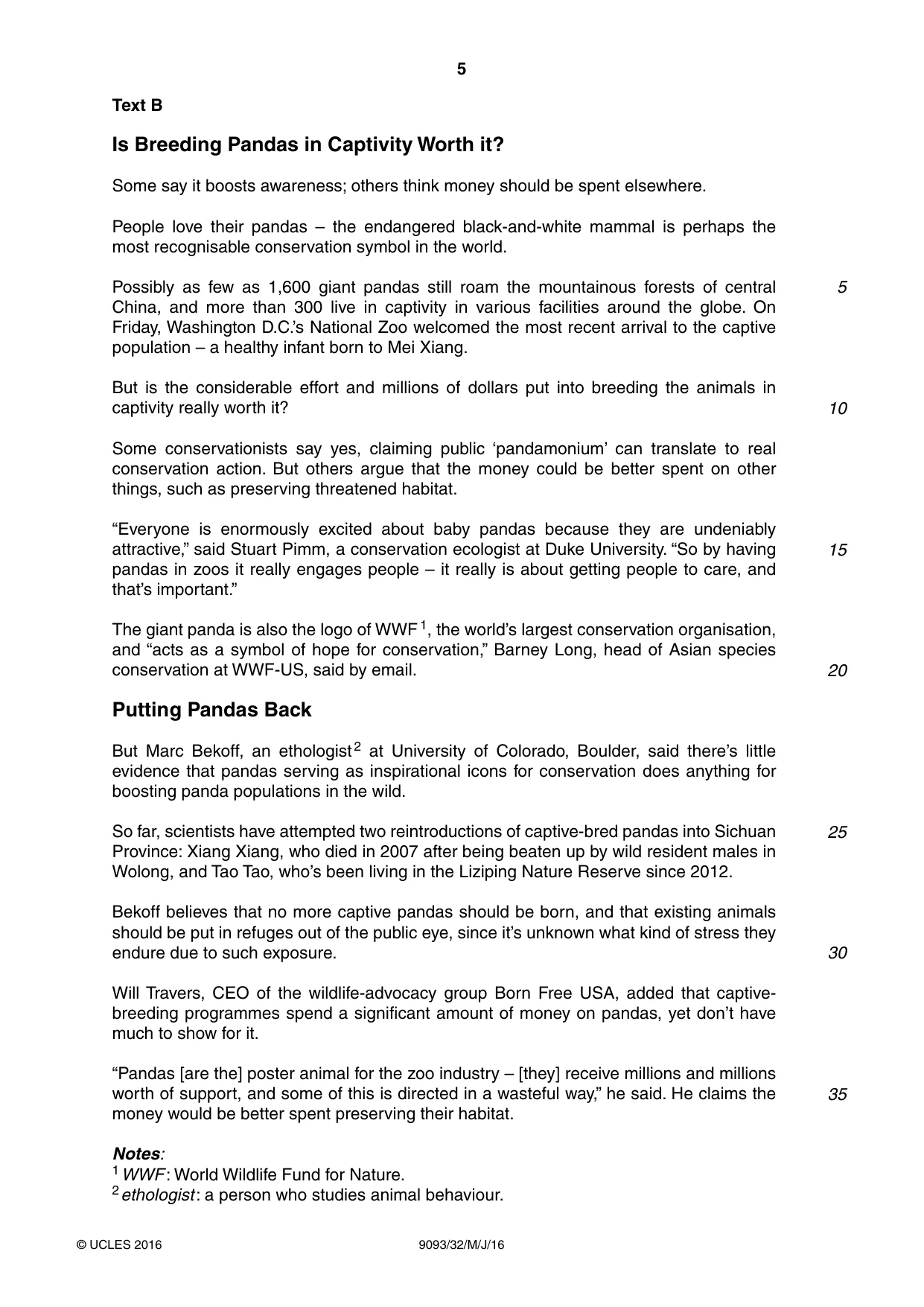
5 9093/32/M/J/16 © UCLES 2016 Text B Is Breeding Pandas in Captivity Worth it? Some say it boosts awareness; others think money should be spent elsewhere. People love their pandas – the endangered black-and-white mammal is perhaps the most recognisable conservation symbol in the world. Possibly as few as 1,600 giant pandas still roam the mountainous forests of central China, and more than 300 live in captivity in various facilities around the globe. On Friday, Washington D.C.’s National Zoo welcomed the most recent arrival to the captive population – a healthy infant born to Mei Xiang. But is the considerable effort and millions of dollars put into breeding the animals in captivity really worth it? Some conservationists say yes, claiming public ‘pandamonium’ can translate to real conservation action. But others argue that the money could be better spent on other things, such as preserving threatened habitat. “Everyone is enormously excited about baby pandas because they are undeniably attractive,” said Stuart Pimm, a conservation ecologist at Duke University. “So by having pandas in zoos it really engages people – it really is about getting people to care, and that’s important.” The giant panda is also the logo of WWF 1, the world’s largest conservation organisation, and “acts as a symbol of hope for conservation,” Barney Long, head of Asian species conservation at WWF-US, said by email. Putting Pandas Back But Marc Bekoff, an ethologist 2 at University of Colorado, Boulder, said there’s little evidence that pandas serving as inspirational icons for conservation does anything for boosting panda populations in the wild. So far, scientists have attempted two reintroductions of captive-bred pandas into Sichuan Province: Xiang Xiang, who died in 2007 after being beaten up by wild resident males in Wolong, and Tao Tao, who’s been living in the Liziping Nature Reserve since 2012. Bekoff believes that no more captive pandas should be born, and that existing animals should be put in refuges out of the public eye, since it’s unknown what kind of stress they endure due to such exposure. Will Travers, CEO of the wildlife-advocacy group Born Free USA, added that captive- breeding programmes spend a significant amount of money on pandas, yet don’t have much to show for it. “Pandas [are the] poster animal for the zoo industry – [they] receive millions and millions worth of support, and some of this is directed in a wasteful way,” he said. He claims the money would be better spent preserving their habitat. Notes: 1 WWF : World Wildlife Fund for Nature. 2 ethologist : a person who studies animal behaviour. 5 10 15 20 25 30 35
Question paper, page 6
6 9093/32/M/J/16 © UCLES 2016 BLANK PAGE
Question paper, page 7
7 9093/32/M/J/16 © UCLES 2016 BLANK PAGE
Question paper, page 8
8 9093/32/M/J/16 © UCLES 2016 BLANK PAGE Permission to reproduce items where third-party owned material protected by copyright is included has been sought and cleared where possible. Every reasonable effort has been made by the publisher (UCLES) to trace copyright holders, but if any items requiring clearance have unwittingly been included, the publisher will be pleased to make amends at the earliest possible opportunity. To avoid the issue of disclosure of answer-related information to candidates, all copyright acknowledgements are reproduced online in the Cambridge International Examinations Copyright Acknowledgements Booklet. This is produced for each series of examinations and is freely available to download at www.cie.org.uk after the live examination series. Cambridge International Examinations is part of the Cambridge Assessment Group. Cambridge Assessment is the brand name of University of Cambridge Local Examinations Syndicate (UCLES), which is itself a department of the University of Cambridge.
Mark scheme, page 1
® IGCSE is the registered trademark of Cambridge International Examinations. This document consists of 5 printed pages. © UCLES 2016 [Turn over Cambridge International Examinations Cambridge International Advanced Level ENGLISH LANGUAGE 9093/32 Paper 3 Text Analysis May/June 2016 MARK SCHEME Maximum Mark: 50 Published This mark scheme is published as an aid to teachers and candidates, to indicate the requirements of the examination. It shows the basis on which Examiners were instructed to award marks. It does not indicate the details of the discussions that took place at an Examiners’ meeting before marking began, which would have considered the acceptability of alternative answers. Mark schemes should be read in conjunction with the question paper and the Principal Examiner Report for Teachers. Cambridge will not enter into discussions about these mark schemes. Cambridge is publishing the mark schemes for the May/June 2016 series for most Cambridge IGCSE®, Cambridge International A and AS Level components and some Cambridge O Level components.
Mark scheme, page 2
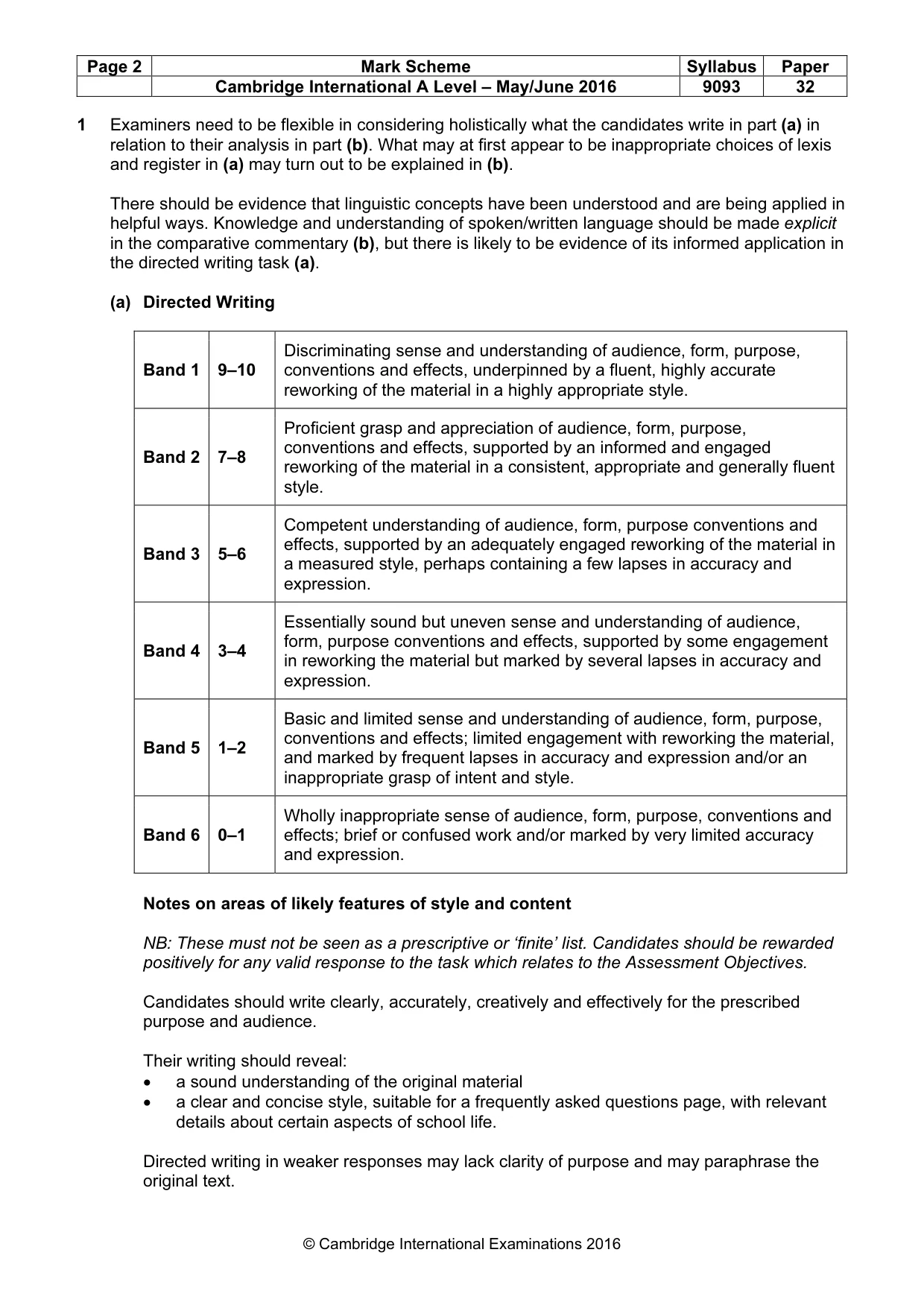
Page 2 Mark Scheme Syllabus Paper Cambridge International A Level – May/June 2016 9093 32 © Cambridge International Examinations 2016 1 Examiners need to be flexible in considering holistically what the candidates write in part (a) in relation to their analysis in part (b). What may at first appear to be inappropriate choices of lexis and register in (a) may turn out to be explained in (b). There should be evidence that linguistic concepts have been understood and are being applied in helpful ways. Knowledge and understanding of spoken/written language should be made explicit in the comparative commentary (b), but there is likely to be evidence of its informed application in the directed writing task (a). (a) Directed Writing Band 1 9–10 Discriminating sense and understanding of audience, form, purpose, conventions and effects, underpinned by a fluent, highly accurate reworking of the material in a highly appropriate style. Band 2 7–8 Proficient grasp and appreciation of audience, form, purpose, conventions and effects, supported by an informed and engaged reworking of the material in a consistent, appropriate and generally fluent style. Band 3 5–6 Competent understanding of audience, form, purpose conventions and effects, supported by an adequately engaged reworking of the material in a measured style, perhaps containing a few lapses in accuracy and expression. Band 4 3–4 Essentially sound but uneven sense and understanding of audience, form, purpose conventions and effects, supported by some engagement in reworking the material but marked by several lapses in accuracy and expression. Band 5 1–2 Basic and limited sense and understanding of audience, form, purpose, conventions and effects; limited engagement with reworking the material, and marked by frequent lapses in accuracy and expression and/or an inappropriate grasp of intent and style. Band 6 0–1 Wholly inappropriate sense of audience, form, purpose, conventions and effects; brief or confused work and/or marked by very limited accuracy and expression. Notes on areas of likely features of style and content NB: These must not be seen as a prescriptive or ‘finite’ list. Candidates should be rewarded positively for any valid response to the task which relates to the Assessment Objectives. Candidates should write clearly, accurately, creatively and effectively for the prescribed purpose and audience. Their writing should reveal: • a sound understanding of the original material • a clear and concise style, suitable for a frequently asked questions page, with relevant details about certain aspects of school life. Directed writing in weaker responses may lack clarity of purpose and may paraphrase the original text.
Mark scheme, page 3
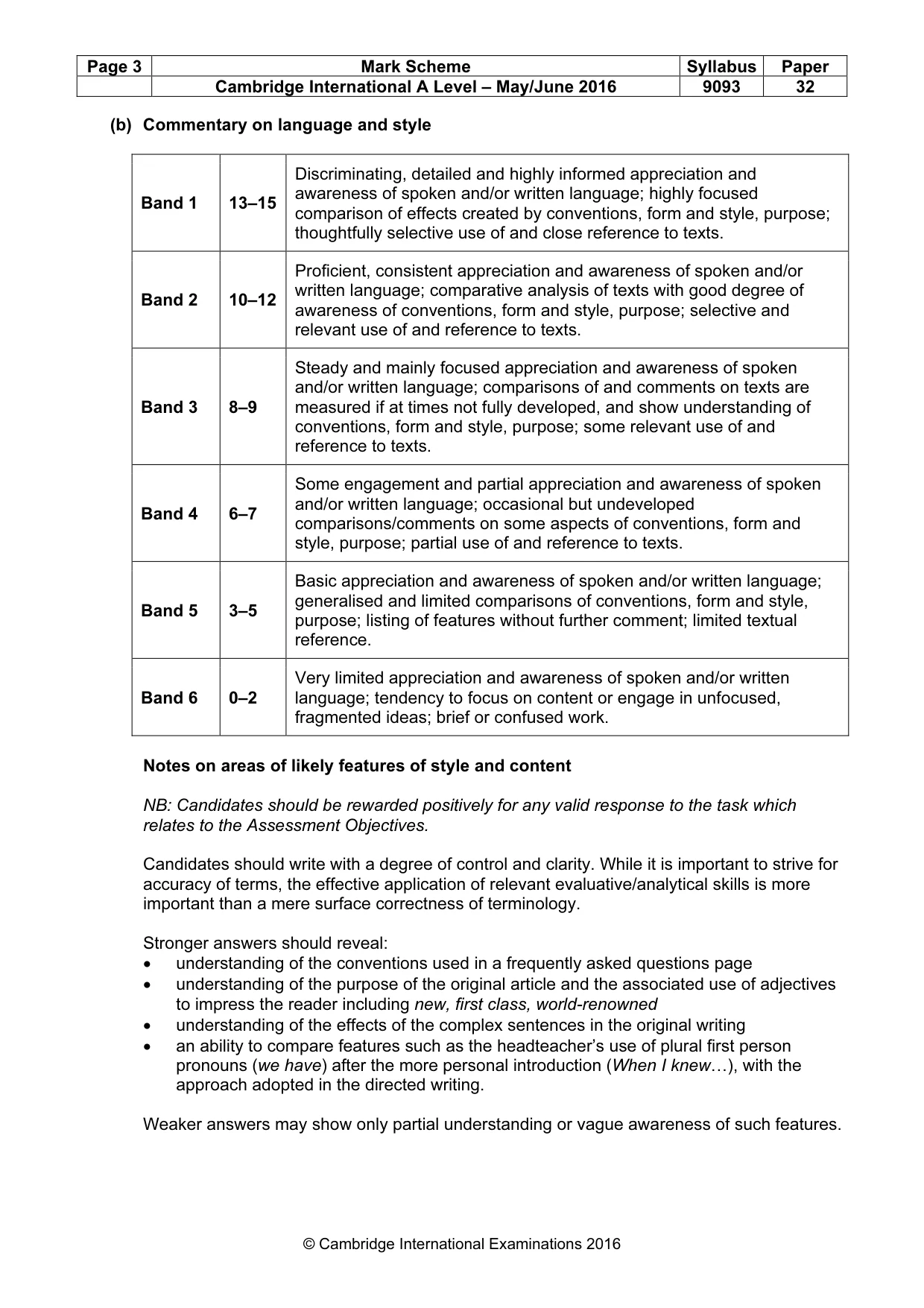
Page 3 Mark Scheme Syllabus Paper Cambridge International A Level – May/June 2016 9093 32 © Cambridge International Examinations 2016 (b) Commentary on language and style Band 1 13–15 Discriminating, detailed and highly informed appreciation and awareness of spoken and/or written language; highly focused comparison of effects created by conventions, form and style, purpose; thoughtfully selective use of and close reference to texts. Band 2 10–12 Proficient, consistent appreciation and awareness of spoken and/or written language; comparative analysis of texts with good degree of awareness of conventions, form and style, purpose; selective and relevant use of and reference to texts. Band 3 8–9 Steady and mainly focused appreciation and awareness of spoken and/or written language; comparisons of and comments on texts are measured if at times not fully developed, and show understanding of conventions, form and style, purpose; some relevant use of and reference to texts. Band 4 6–7 Some engagement and partial appreciation and awareness of spoken and/or written language; occasional but undeveloped comparisons/comments on some aspects of conventions, form and style, purpose; partial use of and reference to texts. Band 5 3–5 Basic appreciation and awareness of spoken and/or written language; generalised and limited comparisons of conventions, form and style, purpose; listing of features without further comment; limited textual reference. Band 6 0–2 Very limited appreciation and awareness of spoken and/or written language; tendency to focus on content or engage in unfocused, fragmented ideas; brief or confused work. Notes on areas of likely features of style and content NB: Candidates should be rewarded positively for any valid response to the task which relates to the Assessment Objectives. Candidates should write with a degree of control and clarity. While it is important to strive for accuracy of terms, the effective application of relevant evaluative/analytical skills is more important than a mere surface correctness of terminology. Stronger answers should reveal: • understanding of the conventions used in a frequently asked questions page • understanding of the purpose of the original article and the associated use of adjectives to impress the reader including new, first class, world-renowned • understanding of the effects of the complex sentences in the original writing • an ability to compare features such as the headteacher’s use of plural first person pronouns (we have) after the more personal introduction (When I knew…), with the approach adopted in the directed writing. Weaker answers may show only partial understanding or vague awareness of such features.
Mark scheme, page 4
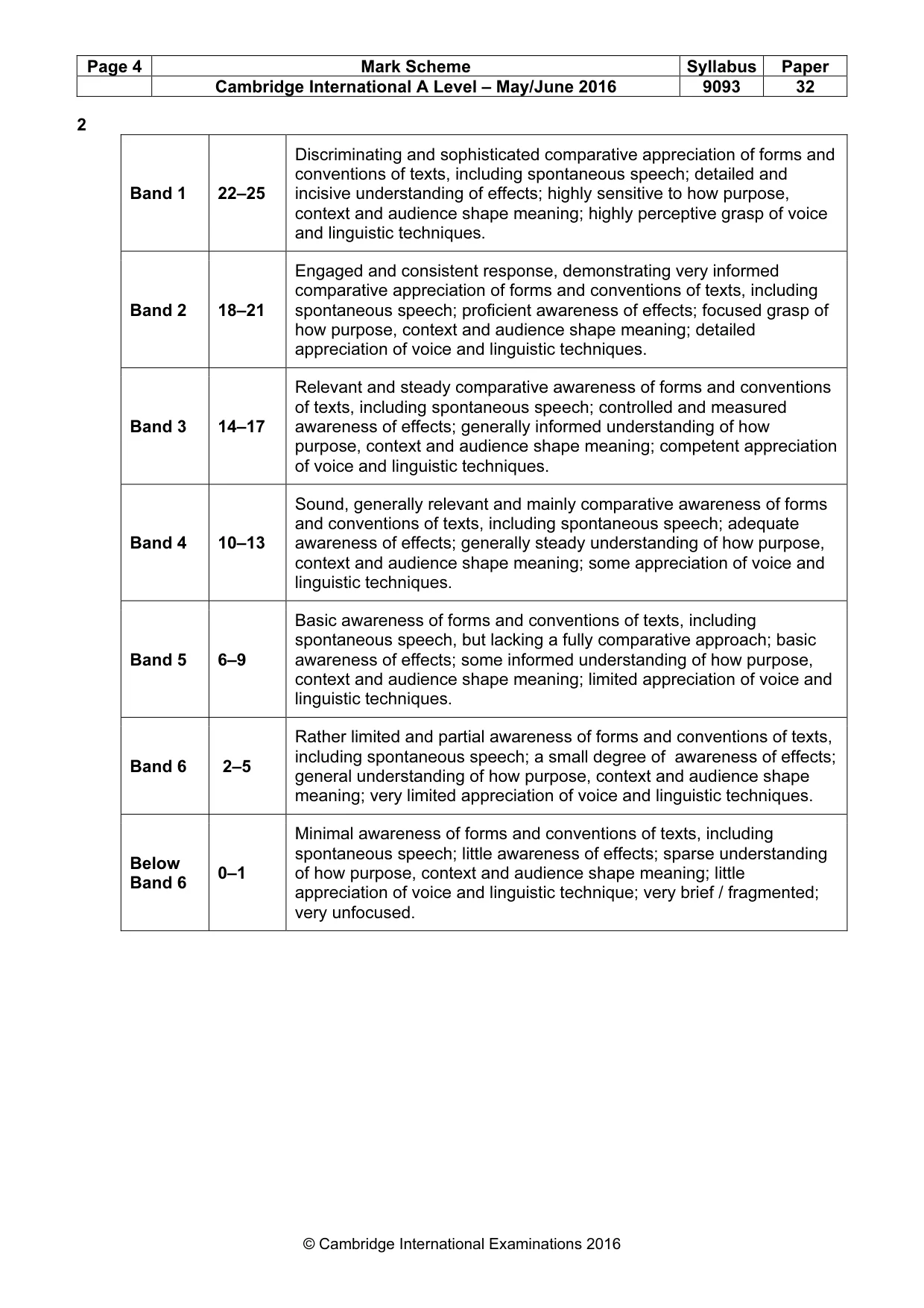
Page 4 Mark Scheme Syllabus Paper Cambridge International A Level – May/June 2016 9093 32 © Cambridge International Examinations 2016 2 Band 1 22–25 Discriminating and sophisticated comparative appreciation of forms and conventions of texts, including spontaneous speech; detailed and incisive understanding of effects; highly sensitive to how purpose, context and audience shape meaning; highly perceptive grasp of voice and linguistic techniques. Band 2 18–21 Engaged and consistent response, demonstrating very informed comparative appreciation of forms and conventions of texts, including spontaneous speech; proficient awareness of effects; focused grasp of how purpose, context and audience shape meaning; detailed appreciation of voice and linguistic techniques. Band 3 14–17 Relevant and steady comparative awareness of forms and conventions of texts, including spontaneous speech; controlled and measured awareness of effects; generally informed understanding of how purpose, context and audience shape meaning; competent appreciation of voice and linguistic techniques. Band 4 10–13 Sound, generally relevant and mainly comparative awareness of forms and conventions of texts, including spontaneous speech; adequate awareness of effects; generally steady understanding of how purpose, context and audience shape meaning; some appreciation of voice and linguistic techniques. Band 5 6–9 Basic awareness of forms and conventions of texts, including spontaneous speech, but lacking a fully comparative approach; basic awareness of effects; some informed understanding of how purpose, context and audience shape meaning; limited appreciation of voice and linguistic techniques. Band 6 2–5 Rather limited and partial awareness of forms and conventions of texts, including spontaneous speech; a small degree of awareness of effects; general understanding of how purpose, context and audience shape meaning; very limited appreciation of voice and linguistic techniques. Below Band 6 0–1 Minimal awareness of forms and conventions of texts, including spontaneous speech; little awareness of effects; sparse understanding of how purpose, context and audience shape meaning; little appreciation of voice and linguistic technique; very brief / fragmented; very unfocused.
Mark scheme, page 5
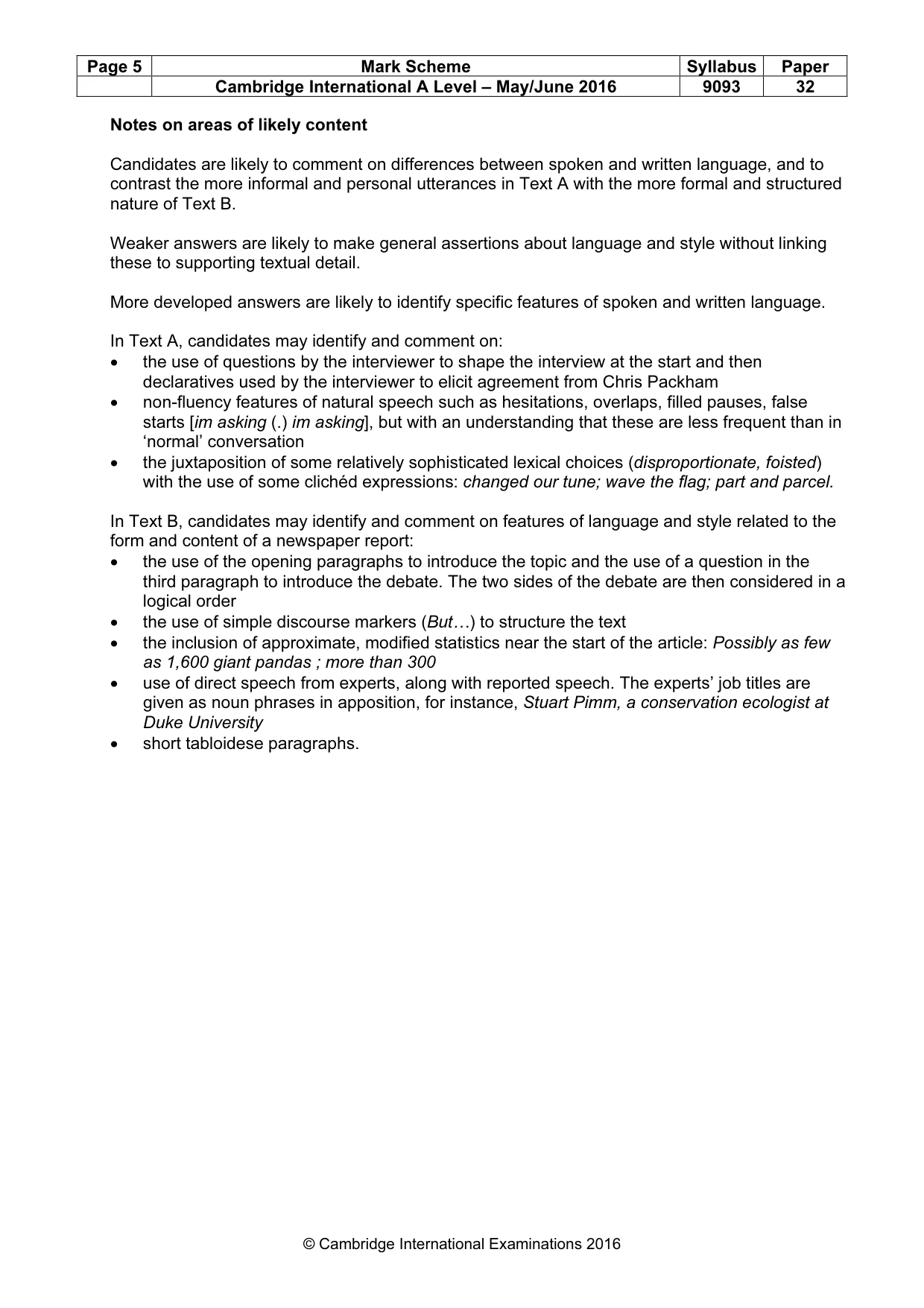
Page 5 Mark Scheme Syllabus Paper Cambridge International A Level – May/June 2016 9093 32 © Cambridge International Examinations 2016 Notes on areas of likely content Candidates are likely to comment on differences between spoken and written language, and to contrast the more informal and personal utterances in Text A with the more formal and structured nature of Text B. Weaker answers are likely to make general assertions about language and style without linking these to supporting textual detail. More developed answers are likely to identify specific features of spoken and written language. In Text A, candidates may identify and comment on: • the use of questions by the interviewer to shape the interview at the start and then declaratives used by the interviewer to elicit agreement from Chris Packham • non-fluency features of natural speech such as hesitations, overlaps, filled pauses, false starts [im asking (.) im asking], but with an understanding that these are less frequent than in ‘normal’ conversation • the juxtaposition of some relatively sophisticated lexical choices (disproportionate, foisted) with the use of some clichéd expressions: changed our tune; wave the flag; part and parcel. In Text B, candidates may identify and comment on features of language and style related to the form and content of a newspaper report: • the use of the opening paragraphs to introduce the topic and the use of a question in the third paragraph to introduce the debate. The two sides of the debate are then considered in a logical order • the use of simple discourse markers (But…) to structure the text • the inclusion of approximate, modified statistics near the start of the article: Possibly as few as 1,600 giant pandas ; more than 300 • use of direct speech from experts, along with reported speech. The experts’ job titles are given as noun phrases in apposition, for instance, Stuart Pimm, a conservation ecologist at Duke University • short tabloidese paragraphs.
What you needed in this session
Cambridge’s own grade thresholds for 2016 May/June, Paper 3 · Variant 2. A higher threshold means an easier paper — the bar moves with how the cohort did.