Cambridge A Level English - Language AS and A Level (from 2014) 9093 — 2016 May/June Paper 3 · Variant 1
9093/31/M/J/16 · 50 marks · ≈56 min
The question paper and its mark scheme, free to read here and free to download. This is Cambridge’s own paper, exactly as it was sat.
Question paper4 pages
Mark scheme5 pages
Answers below. Sit the paper first if you are practising.
Paper as text
Question paper, page 1
This document consists of 4 printed pages and 1 insert. DC (RCL (JDA)) 115508/2 © UCLES 2016 [Turn over Cambridge International Examinations Cambridge International Advanced Subsidiary and Advanced Level * 1 6 4 6 2 3 6 0 5 9 * ENGLISH LANGUAGE 9093/31 Paper 3 Text Analysis May/June 2016 2 hours 15 minutes No Additional Materials are required. READ THESE INSTRUCTIONS FIRST An answer booklet is provided inside this question paper. You should follow the instructions on the front cover of the answer booklet. If you need additional answer paper, ask the invigilator for a continuation booklet. Answer two questions. You should spend about 15 minutes reading the passages and questions before you start writing your answers. You are reminded of the need for good English and clear presentation in your answers. The number of marks is given in brackets [ ] at the end of each question or part question. Both questions carry equal marks.
Question paper, page 2
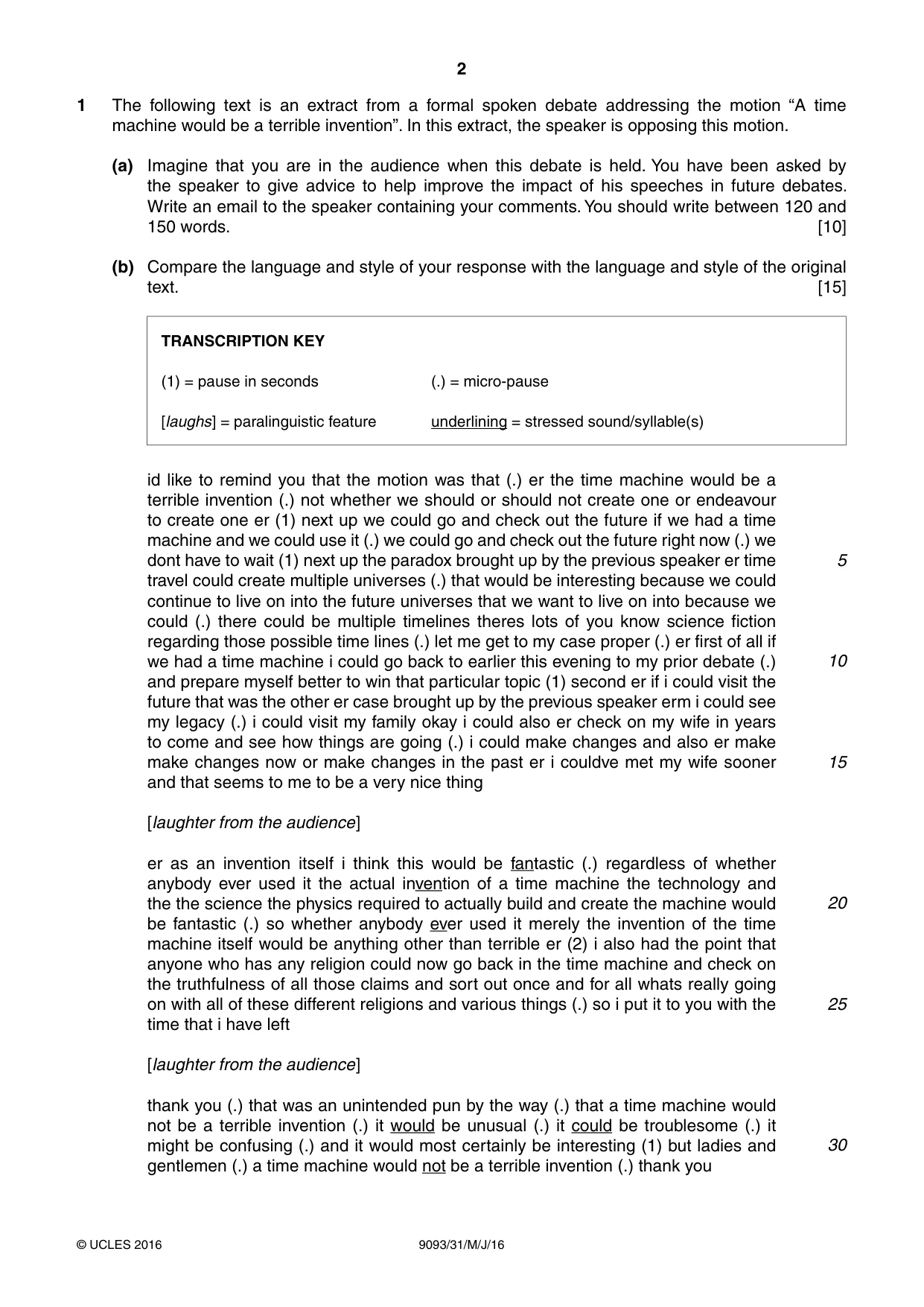
2 9093/31/M/J/16 © UCLES 2016 1 The following text is an extract from a formal spoken debate addressing the motion “A time machine would be a terrible invention”. In this extract, the speaker is opposing this motion. (a) Imagine that you are in the audience when this debate is held. You have been asked by the speaker to give advice to help improve the impact of his speeches in future debates. Write an email to the speaker containing your comments. You should write between 120 and 150 words. [10] (b) Compare the language and style of your response with the language and style of the original text. [15] TRANSCRIPTION KEY (1) = pause in seconds (.) = micro-pause [laughs ] = paralinguistic feature underlining = stressed sound/syllable(s) id like to remind you that the motion was that (.) er the time machine would be a terrible invention (.) not whether we should or should not create one or endeavour to create one er (1) next up we could go and check out the future if we had a time machine and we could use it (.) we could go and check out the future right now (.) we dont have to wait (1) next up the paradox brought up by the previous speaker er time travel could create multiple universes (.) that would be interesting because we could continue to live on into the future universes that we want to live on into because we could (.) there could be multiple timelines theres lots of you know science fiction regarding those possible time lines (.) let me get to my case proper (.) er first of all if we had a time machine i could go back to earlier this evening to my prior debate (.) and prepare myself better to win that particular topic (1) second er if i could visit the future that was the other er case brought up by the previous speaker erm i could see my legacy (.) i could visit my family okay i could also er check on my wife in years to come and see how things are going (.) i could make changes and also er make make changes now or make changes in the past er i couldve met my wife sooner and that seems to me to be a very nice thing [laughter from the audience ] er as an invention itself i think this would be fantastic (.) regardless of whether anybody ever used it the actual invention of a time machine the technology and the the science the physics required to actually build and create the machine would be fantastic (.) so whether anybody ever used it merely the invention of the time machine itself would be anything other than terrible er (2) i also had the point that anyone who has any religion could now go back in the time machine and check on the truthfulness of all those claims and sort out once and for all whats really going on with all of these different religions and various things (.) so i put it to you with the time that i have left [laughter from the audience ] thank you (.) that was an unintended pun by the way (.) that a time machine would not be a terrible invention (.) it would be unusual (.) it could be troublesome (.) it might be confusing (.) and it would most certainly be interesting (1) but ladies and gentlemen (.) a time machine would not be a terrible invention (.) thank you 5 10 15 20 25 30
Question paper, page 3
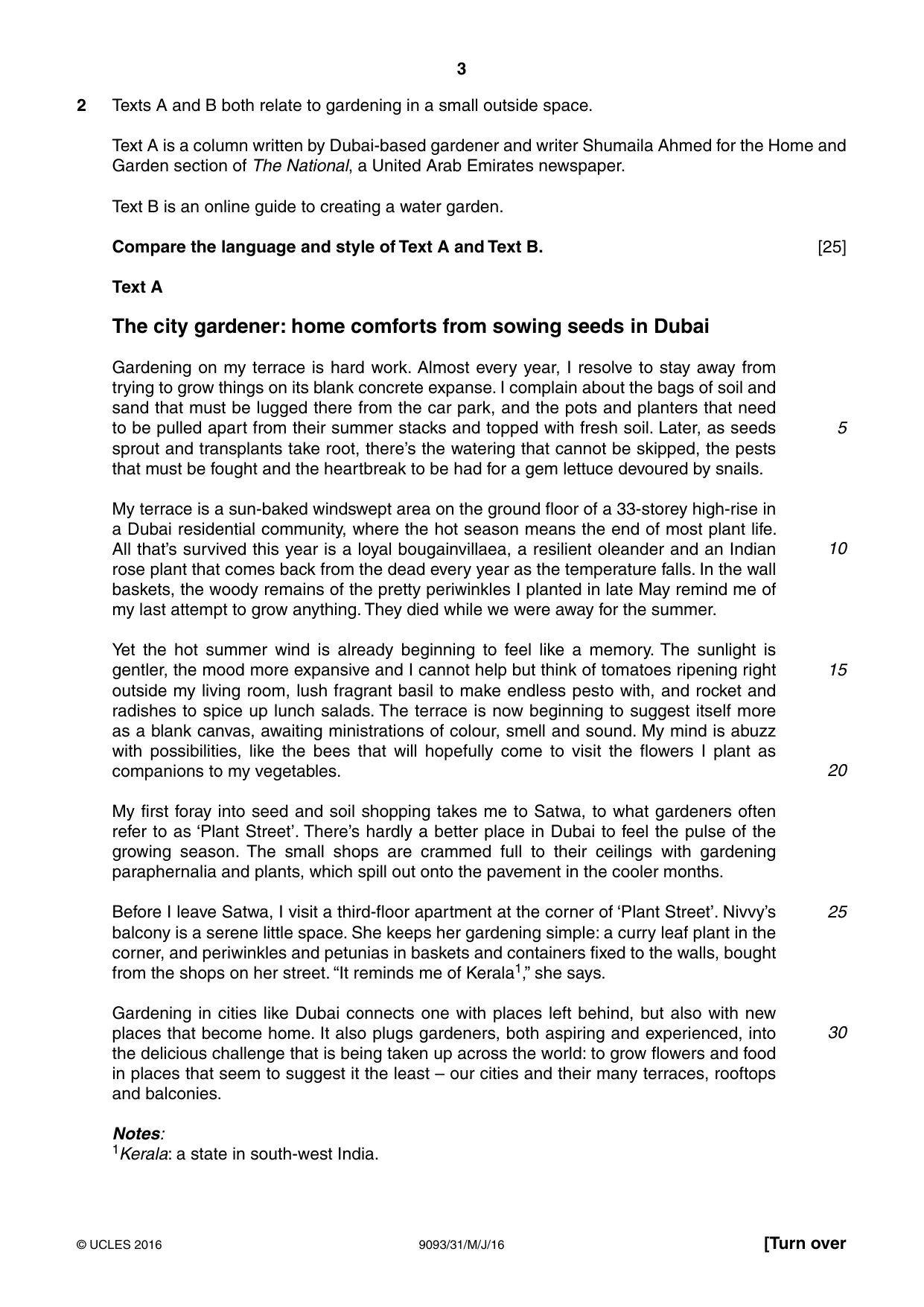
3 9093/31/M/J/16 © UCLES 2016 [Turn over 2 Texts A and B both relate to gardening in a small outside space. Text A is a column written by Dubai-based gardener and writer Shumaila Ahmed for the Home and Garden section of The National, a United Arab Emirates newspaper. Text B is an online guide to creating a water garden. Compare the language and style of Text A and Text B. [25] Text A The city gardener: home comforts from sowing seeds in Dubai Gardening on my terrace is hard work. Almost every year, I resolve to stay away from trying to grow things on its blank concrete expanse. I complain about the bags of soil and sand that must be lugged there from the car park, and the pots and planters that need to be pulled apart from their summer stacks and topped with fresh soil. Later, as seeds sprout and transplants take root, there’s the watering that cannot be skipped, the pests that must be fought and the heartbreak to be had for a gem lettuce devoured by snails. My terrace is a sun-baked windswept area on the ground floor of a 33-storey high-rise in a Dubai residential community, where the hot season means the end of most plant life. All that’s survived this year is a loyal bougainvillaea, a resilient oleander and an Indian rose plant that comes back from the dead every year as the temperature falls. In the wall baskets, the woody remains of the pretty periwinkles I planted in late May remind me of my last attempt to grow anything. They died while we were away for the summer. Yet the hot summer wind is already beginning to feel like a memory. The sunlight is gentler, the mood more expansive and I cannot help but think of tomatoes ripening right outside my living room, lush fragrant basil to make endless pesto with, and rocket and radishes to spice up lunch salads. The terrace is now beginning to suggest itself more as a blank canvas, awaiting ministrations of colour, smell and sound. My mind is abuzz with possibilities, like the bees that will hopefully come to visit the flowers I plant as companions to my vegetables. My first foray into seed and soil shopping takes me to Satwa, to what gardeners often refer to as ‘Plant Street’. There’s hardly a better place in Dubai to feel the pulse of the growing season. The small shops are crammed full to their ceilings with gardening paraphernalia and plants, which spill out onto the pavement in the cooler months. Before I leave Satwa, I visit a third-floor apartment at the corner of ‘Plant Street’. Nivvy’s balcony is a serene little space. She keeps her gardening simple: a curry leaf plant in the corner, and periwinkles and petunias in baskets and containers fixed to the walls, bought from the shops on her street. “It reminds me of Kerala1,” she says. Gardening in cities like Dubai connects one with places left behind, but also with new places that become home. It also plugs gardeners, both aspiring and experienced, into the delicious challenge that is being taken up across the world: to grow flowers and food in places that seem to suggest it the least – our cities and their many terraces, rooftops and balconies. Notes: 1Kerala: a state in south-west India. 5 10 15 20 25 30
Question paper, page 4
4 9093/31/M/J/16 © UCLES 2016 Text B Making your own container water garden Do you love the idea of a pond, but don’t have an actual yard to place one in? Top up the water in your container every couple of days depending on the rate of evaporation – if you are using city tap water, let it sit first for 48 hours to allow the chlorine to evaporate, or pick up special tablets at the nursery to remove the chlorine. Permission to reproduce items where third-party owned material protected by copyright is included has been sought and cleared where possible. Every reasonable effort has been made by the publisher (UCLES) to trace copyright holders, but if any items requiring clearance have unwittingly been included, the publisher will be pleased to make amends at the earliest possible opportunity. To avoid the issue of disclosure of answer-related information to candidates, all copyright acknowledgements are reproduced online in the Cambridge International Examinations Copyright Acknowledgements Booklet. This is produced for each series of examinations and is freely available to download at www.cie.org.uk after the live examination series. Cambridge International Examinations is part of the Cambridge Assessment Group. Cambridge Assessment is the brand name of University of Cambridge Local Examinations Syndicate (UCLES), which is itself a department of the University of Cambridge. Content removed due to copyright restrictions.
Mark scheme, page 1
® IGCSE is the registered trademark of Cambridge International Examinations. This document consists of 5 printed pages. © UCLES 2016 [Turn over Cambridge International Examinations Cambridge International Advanced Level ENGLISH LANGUAGE 9093/31 Paper 3 Text Analysis May/June 2016 MARK SCHEME Maximum Mark: 50 Published This mark scheme is published as an aid to teachers and candidates, to indicate the requirements of the examination. It shows the basis on which Examiners were instructed to award marks. It does not indicate the details of the discussions that took place at an Examiners’ meeting before marking began, which would have considered the acceptability of alternative answers. Mark schemes should be read in conjunction with the question paper and the Principal Examiner Report for Teachers. Cambridge will not enter into discussions about these mark schemes. Cambridge is publishing the mark schemes for the May/June 2016 series for most Cambridge IGCSE®, Cambridge International A and AS Level components and some Cambridge O Level components.
Mark scheme, page 2
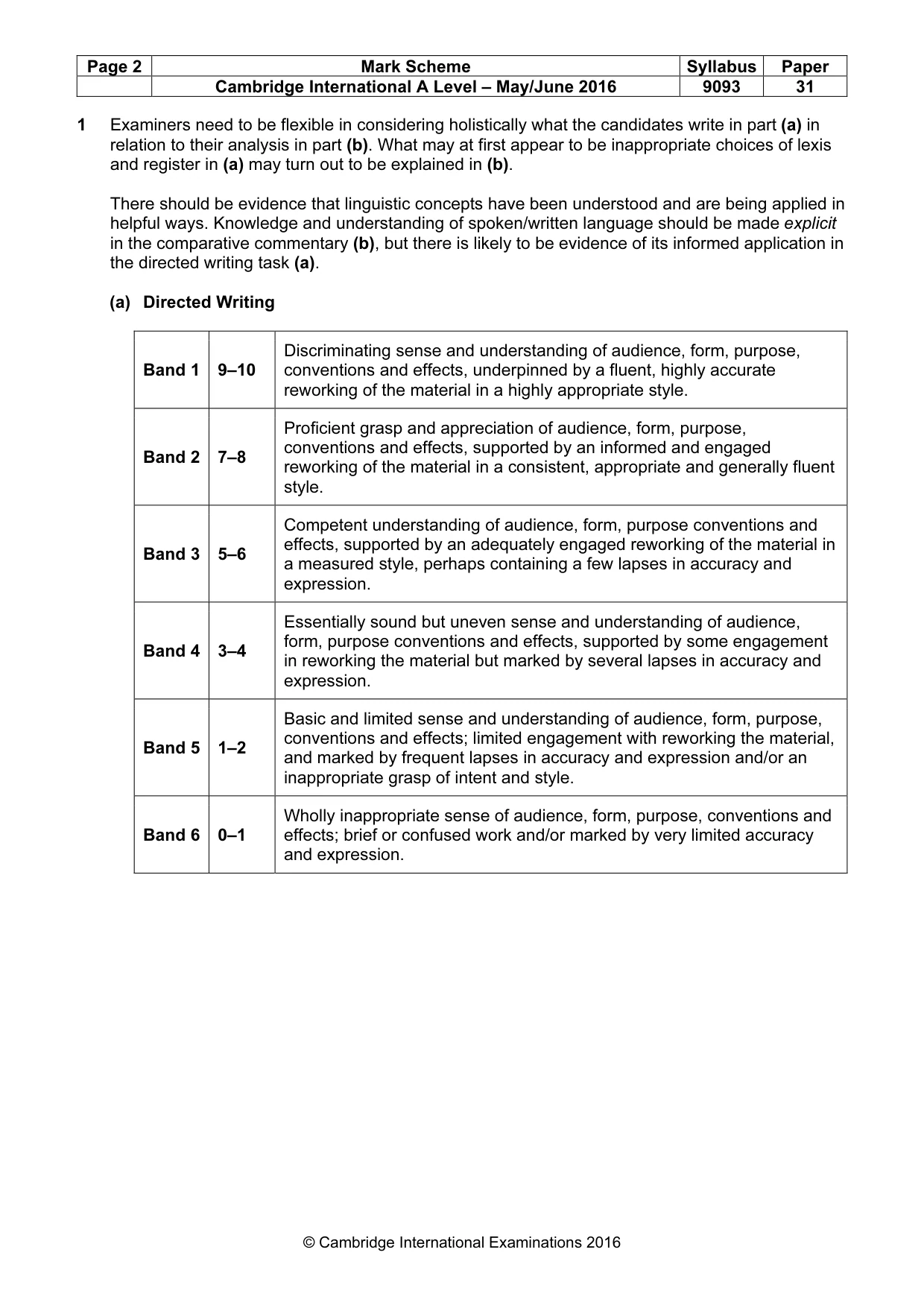
Page 2 Mark Scheme Syllabus Paper Cambridge International A Level – May/June 2016 9093 31 © Cambridge International Examinations 2016 1 Examiners need to be flexible in considering holistically what the candidates write in part (a) in relation to their analysis in part (b). What may at first appear to be inappropriate choices of lexis and register in (a) may turn out to be explained in (b). There should be evidence that linguistic concepts have been understood and are being applied in helpful ways. Knowledge and understanding of spoken/written language should be made explicit in the comparative commentary (b), but there is likely to be evidence of its informed application in the directed writing task (a). (a) Directed Writing Band 1 9–10 Discriminating sense and understanding of audience, form, purpose, conventions and effects, underpinned by a fluent, highly accurate reworking of the material in a highly appropriate style. Band 2 7–8 Proficient grasp and appreciation of audience, form, purpose, conventions and effects, supported by an informed and engaged reworking of the material in a consistent, appropriate and generally fluent style. Band 3 5–6 Competent understanding of audience, form, purpose conventions and effects, supported by an adequately engaged reworking of the material in a measured style, perhaps containing a few lapses in accuracy and expression. Band 4 3–4 Essentially sound but uneven sense and understanding of audience, form, purpose conventions and effects, supported by some engagement in reworking the material but marked by several lapses in accuracy and expression. Band 5 1–2 Basic and limited sense and understanding of audience, form, purpose, conventions and effects; limited engagement with reworking the material, and marked by frequent lapses in accuracy and expression and/or an inappropriate grasp of intent and style. Band 6 0–1 Wholly inappropriate sense of audience, form, purpose, conventions and effects; brief or confused work and/or marked by very limited accuracy and expression.
Mark scheme, page 3
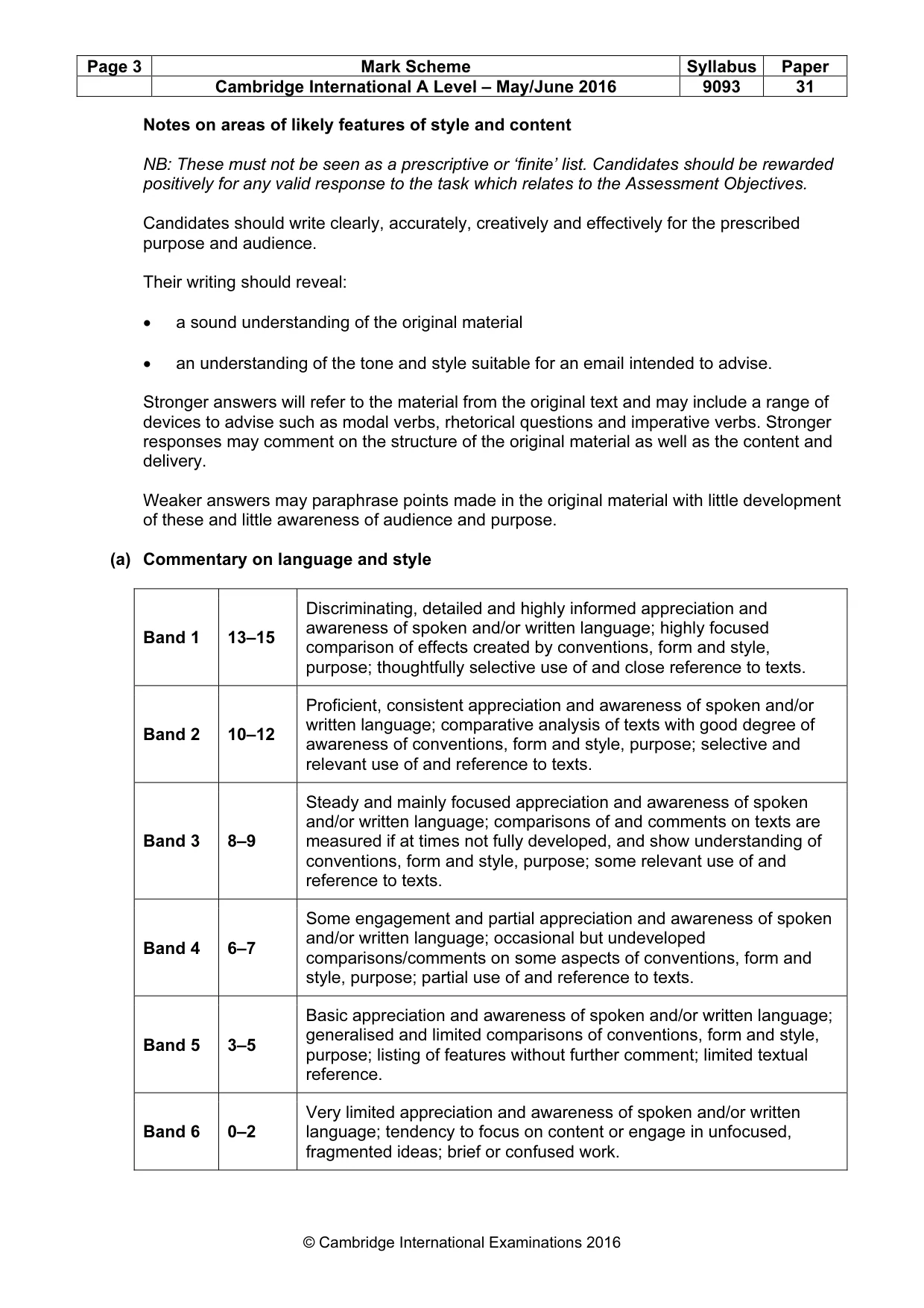
Page 3 Mark Scheme Syllabus Paper Cambridge International A Level – May/June 2016 9093 31 © Cambridge International Examinations 2016 Notes on areas of likely features of style and content NB: These must not be seen as a prescriptive or ‘finite’ list. Candidates should be rewarded positively for any valid response to the task which relates to the Assessment Objectives. Candidates should write clearly, accurately, creatively and effectively for the prescribed purpose and audience. Their writing should reveal: • a sound understanding of the original material • an understanding of the tone and style suitable for an email intended to advise. Stronger answers will refer to the material from the original text and may include a range of devices to advise such as modal verbs, rhetorical questions and imperative verbs. Stronger responses may comment on the structure of the original material as well as the content and delivery. Weaker answers may paraphrase points made in the original material with little development of these and little awareness of audience and purpose. (a) Commentary on language and style Band 1 13–15 Discriminating, detailed and highly informed appreciation and awareness of spoken and/or written language; highly focused comparison of effects created by conventions, form and style, purpose; thoughtfully selective use of and close reference to texts. Band 2 10–12 Proficient, consistent appreciation and awareness of spoken and/or written language; comparative analysis of texts with good degree of awareness of conventions, form and style, purpose; selective and relevant use of and reference to texts. Band 3 8–9 Steady and mainly focused appreciation and awareness of spoken and/or written language; comparisons of and comments on texts are measured if at times not fully developed, and show understanding of conventions, form and style, purpose; some relevant use of and reference to texts. Band 4 6–7 Some engagement and partial appreciation and awareness of spoken and/or written language; occasional but undeveloped comparisons/comments on some aspects of conventions, form and style, purpose; partial use of and reference to texts. Band 5 3–5 Basic appreciation and awareness of spoken and/or written language; generalised and limited comparisons of conventions, form and style, purpose; listing of features without further comment; limited textual reference. Band 6 0–2 Very limited appreciation and awareness of spoken and/or written language; tendency to focus on content or engage in unfocused, fragmented ideas; brief or confused work.
Mark scheme, page 4
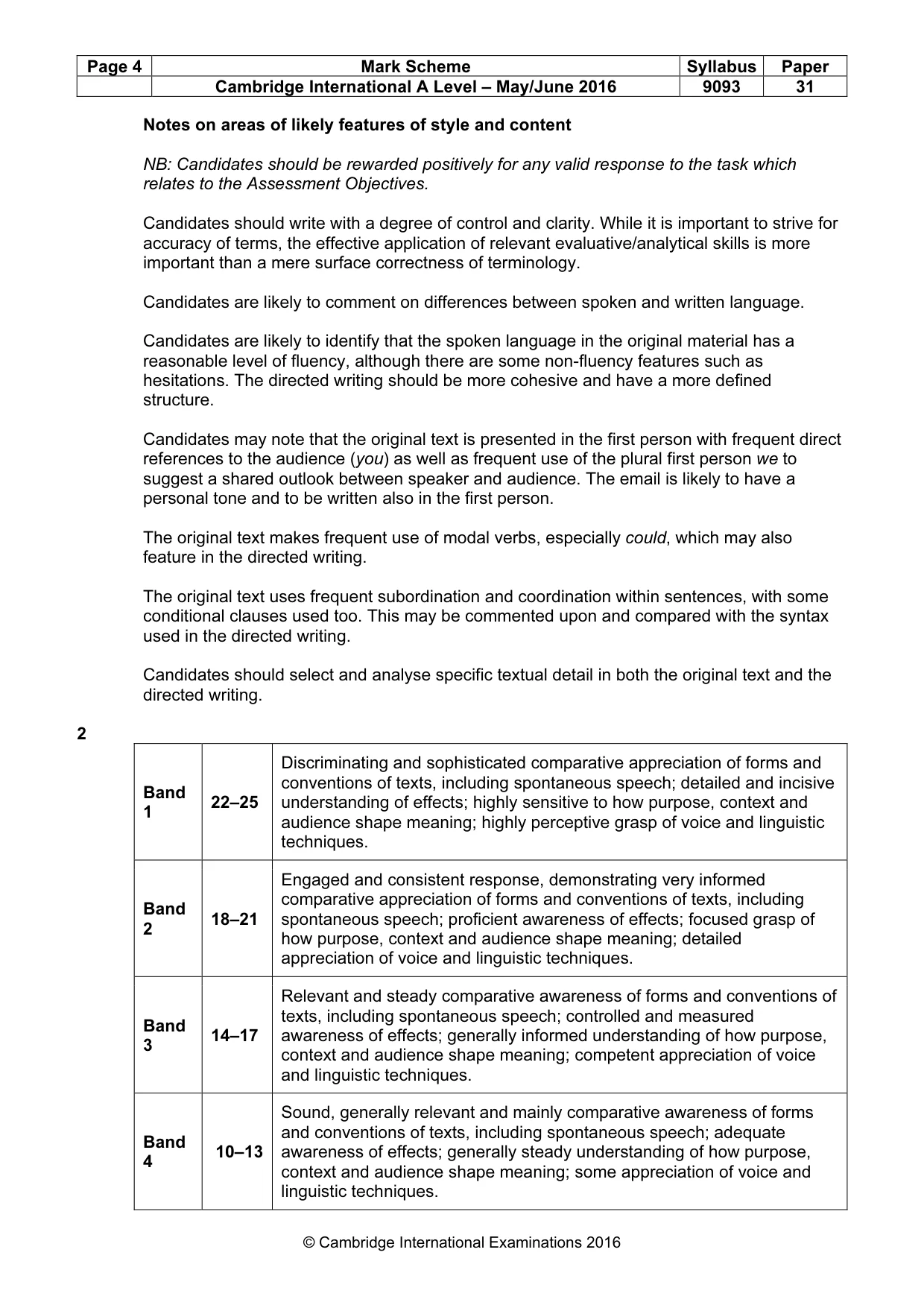
Page 4 Mark Scheme Syllabus Paper Cambridge International A Level – May/June 2016 9093 31 © Cambridge International Examinations 2016 Notes on areas of likely features of style and content NB: Candidates should be rewarded positively for any valid response to the task which relates to the Assessment Objectives. Candidates should write with a degree of control and clarity. While it is important to strive for accuracy of terms, the effective application of relevant evaluative/analytical skills is more important than a mere surface correctness of terminology. Candidates are likely to comment on differences between spoken and written language. Candidates are likely to identify that the spoken language in the original material has a reasonable level of fluency, although there are some non-fluency features such as hesitations. The directed writing should be more cohesive and have a more defined structure. Candidates may note that the original text is presented in the first person with frequent direct references to the audience (you) as well as frequent use of the plural first person we to suggest a shared outlook between speaker and audience. The email is likely to have a personal tone and to be written also in the first person. The original text makes frequent use of modal verbs, especially could, which may also feature in the directed writing. The original text uses frequent subordination and coordination within sentences, with some conditional clauses used too. This may be commented upon and compared with the syntax used in the directed writing. Candidates should select and analyse specific textual detail in both the original text and the directed writing. 2 Band 1 22–25 Discriminating and sophisticated comparative appreciation of forms and conventions of texts, including spontaneous speech; detailed and incisive understanding of effects; highly sensitive to how purpose, context and audience shape meaning; highly perceptive grasp of voice and linguistic techniques. Band 2 18–21 Engaged and consistent response, demonstrating very informed comparative appreciation of forms and conventions of texts, including spontaneous speech; proficient awareness of effects; focused grasp of how purpose, context and audience shape meaning; detailed appreciation of voice and linguistic techniques. Band 3 14–17 Relevant and steady comparative awareness of forms and conventions of texts, including spontaneous speech; controlled and measured awareness of effects; generally informed understanding of how purpose, context and audience shape meaning; competent appreciation of voice and linguistic techniques. Band 4 10–13 Sound, generally relevant and mainly comparative awareness of forms and conventions of texts, including spontaneous speech; adequate awareness of effects; generally steady understanding of how purpose, context and audience shape meaning; some appreciation of voice and linguistic techniques.
Mark scheme, page 5
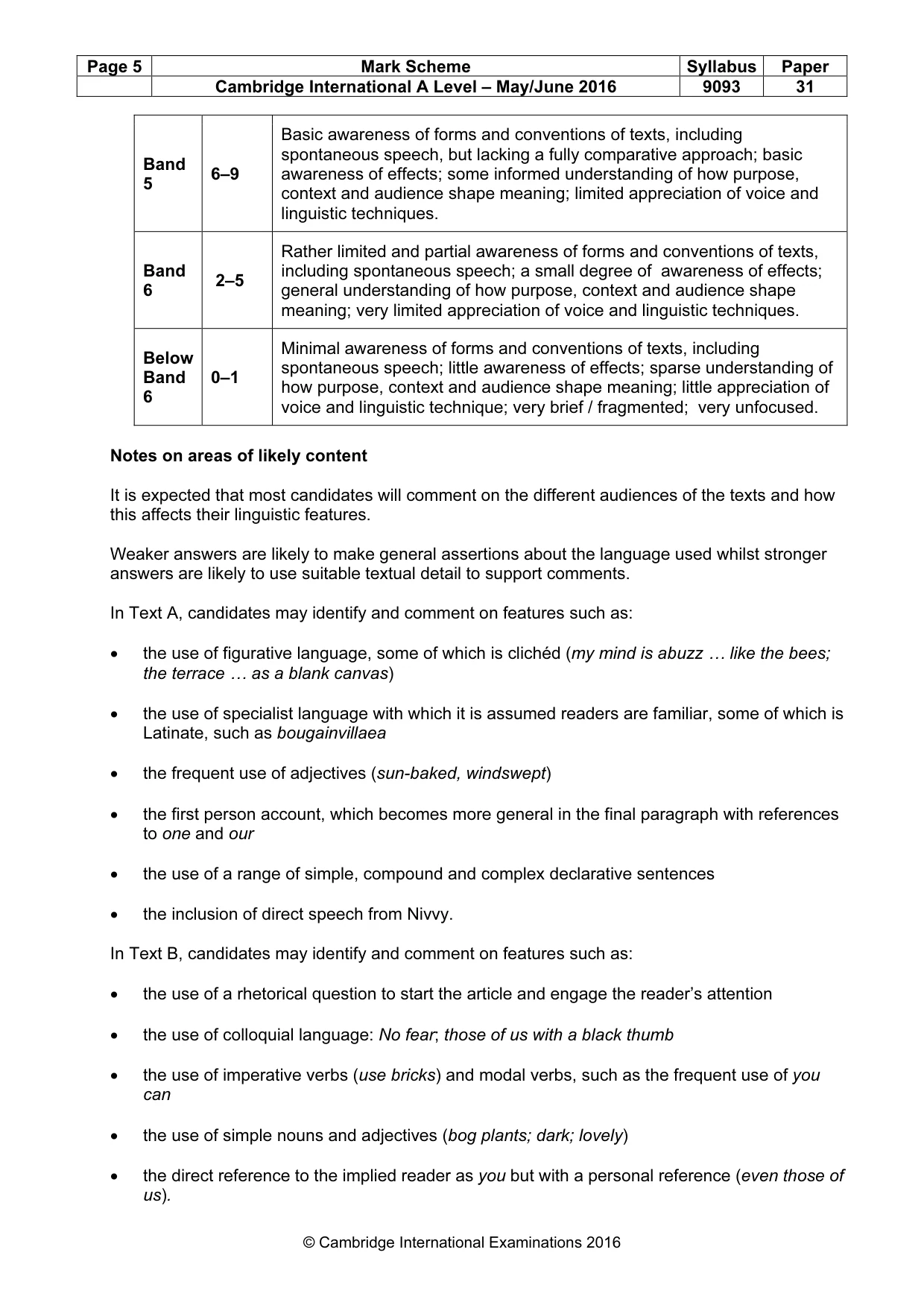
Page 5 Mark Scheme Syllabus Paper Cambridge International A Level – May/June 2016 9093 31 © Cambridge International Examinations 2016 Band 5 6–9 Basic awareness of forms and conventions of texts, including spontaneous speech, but lacking a fully comparative approach; basic awareness of effects; some informed understanding of how purpose, context and audience shape meaning; limited appreciation of voice and linguistic techniques. Band 6 2–5 Rather limited and partial awareness of forms and conventions of texts, including spontaneous speech; a small degree of awareness of effects; general understanding of how purpose, context and audience shape meaning; very limited appreciation of voice and linguistic techniques. Below Band 6 0–1 Minimal awareness of forms and conventions of texts, including spontaneous speech; little awareness of effects; sparse understanding of how purpose, context and audience shape meaning; little appreciation of voice and linguistic technique; very brief / fragmented; very unfocused. Notes on areas of likely content It is expected that most candidates will comment on the different audiences of the texts and how this affects their linguistic features. Weaker answers are likely to make general assertions about the language used whilst stronger answers are likely to use suitable textual detail to support comments. In Text A, candidates may identify and comment on features such as: • the use of figurative language, some of which is clichéd (my mind is abuzz … like the bees; the terrace … as a blank canvas) • the use of specialist language with which it is assumed readers are familiar, some of which is Latinate, such as bougainvillaea • the frequent use of adjectives (sun-baked, windswept) • the first person account, which becomes more general in the final paragraph with references to one and our • the use of a range of simple, compound and complex declarative sentences • the inclusion of direct speech from Nivvy. In Text B, candidates may identify and comment on features such as: • the use of a rhetorical question to start the article and engage the reader’s attention • the use of colloquial language: No fear; those of us with a black thumb • the use of imperative verbs (use bricks) and modal verbs, such as the frequent use of you can • the use of simple nouns and adjectives (bog plants; dark; lovely) • the direct reference to the implied reader as you but with a personal reference (even those of us).
What you needed in this session
Cambridge’s own grade thresholds for 2016 May/June, Paper 3 · Variant 1. A higher threshold means an easier paper — the bar moves with how the cohort did.