Cambridge A Level English - Language AS and A Level (from 2014) 9093 — 2015 May/June Paper 3 · Variant 2
9093/32/M/J/15 · 50 marks · ≈56 min
The question paper and its mark scheme, free to read here and free to download. This is Cambridge’s own paper, exactly as it was sat.
Question paper4 pages
Mark scheme3 pages
Answers below. Sit the paper first if you are practising.
Paper as text
Question paper, page 1
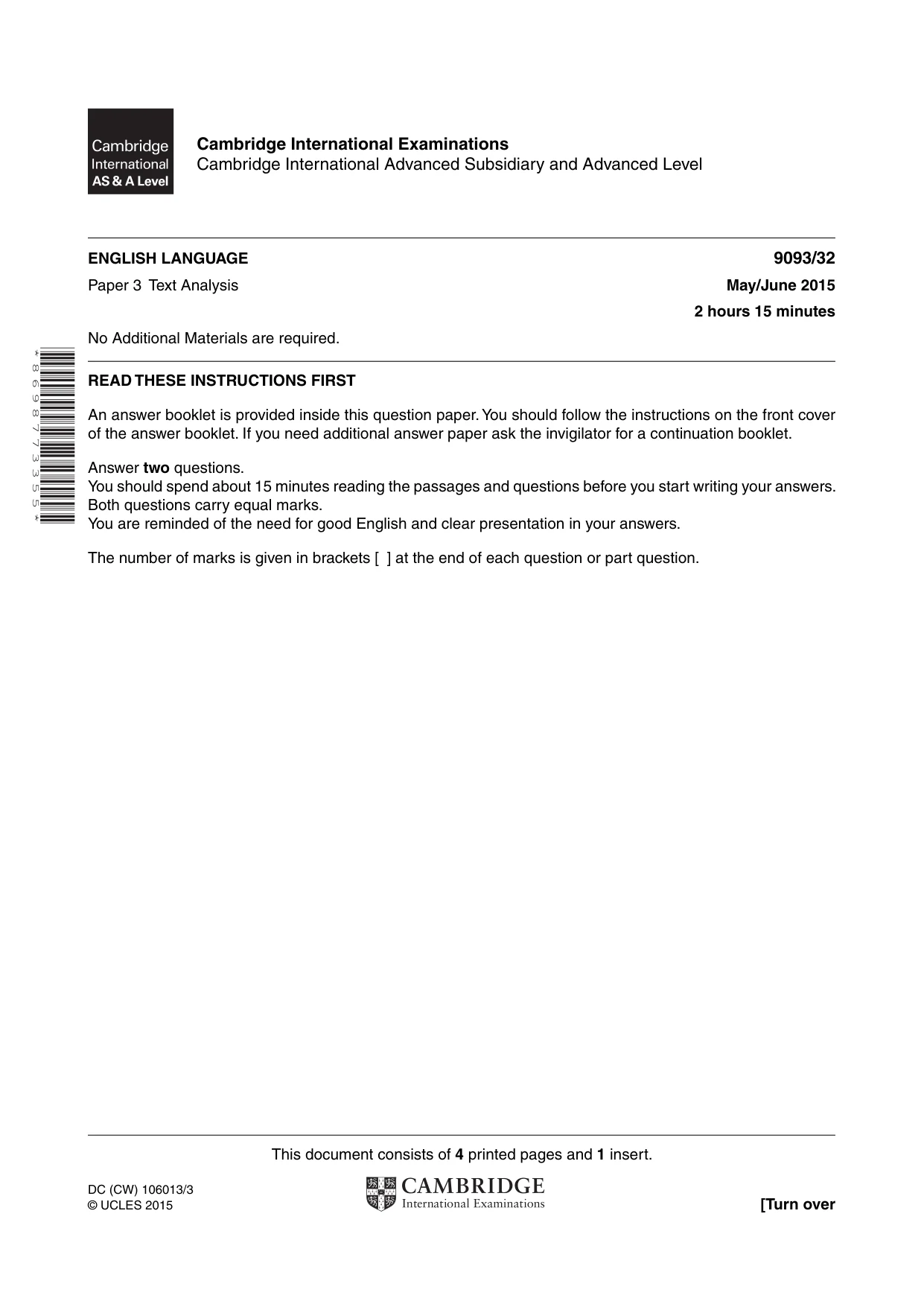
This document consists of 4 printed pages and 1 insert. DC (CW) 106013/3 © UCLES 2015 [Turn over Cambridge International Examinations Cambridge International Advanced Subsidiary and Advanced Level * 8 6 9 8 7 7 3 3 5 5 * ENGLISH LANGUAGE 9093/32 Paper 3 Text Analysis May/June 2015 2 hours 15 minutes No Additional Materials are required. READ THESE INSTRUCTIONS FIRST An answer booklet is provided inside this question paper. You should follow the instructions on the front cover of the answer booklet. If you need additional answer paper ask the invigilator for a continuation booklet. Answer two questions. You should spend about 15 minutes reading the passages and questions before you start writing your answers. Both questions carry equal marks. You are reminded of the need for good English and clear presentation in your answers. The number of marks is given in brackets [ ] at the end of each question or part question.
Question paper, page 2
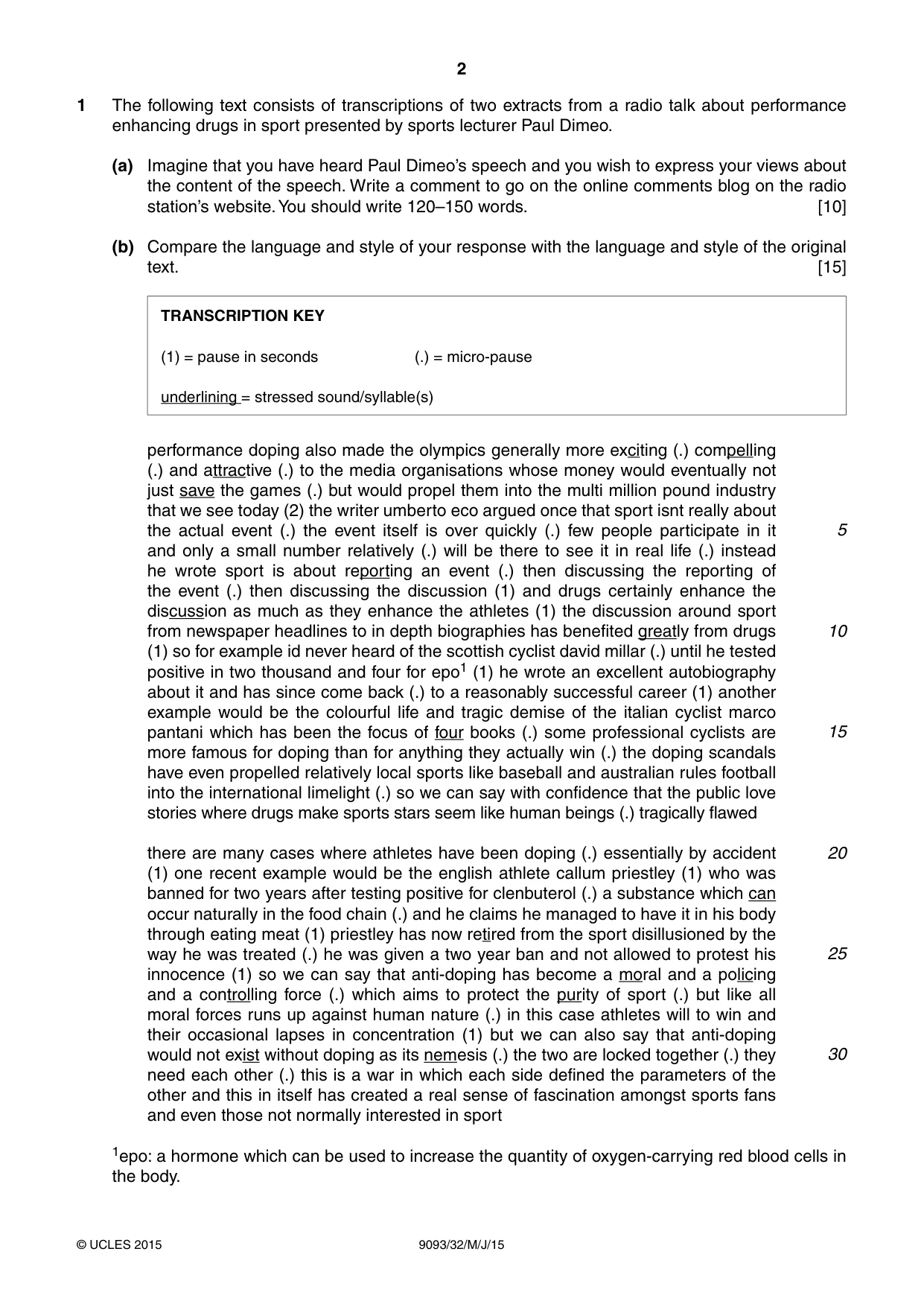
2 9093/32/M/J/15 © UCLES 2015 1 The following text consists of transcriptions of two extracts from a radio talk about performance enhancing drugs in sport presented by sports lecturer Paul Dimeo. (a) Imagine that you have heard Paul Dimeo’s speech and you wish to express your views about the content of the speech. Write a comment to go on the online comments blog on the radio station’s website. You should write 120–150 words. [10] (b) Compare the language and style of your response with the language and style of the original text. [15] TRANSCRIPTION KEY (1) = pause in seconds (.) = micro-pause underlining = stressed sound/syllable(s) performance doping also made the olympics generally more exciting (.) compelling (.) and attractive (.) to the media organisations whose money would eventually not just save the games (.) but would propel them into the multi million pound industry that we see today (2) the writer umberto eco argued once that sport isnt really about the actual event (.) the event itself is over quickly (.) few people participate in it and only a small number relatively (.) will be there to see it in real life (.) instead he wrote sport is about reporting an event (.) then discussing the reporting of the event (.) then discussing the discussion (1) and drugs certainly enhance the discussion as much as they enhance the athletes (1) the discussion around sport from newspaper headlines to in depth biographies has benefited greatly from drugs (1) so for example id never heard of the scottish cyclist david millar (.) until he tested positive in two thousand and four for epo1 (1) he wrote an excellent autobiography about it and has since come back (.) to a reasonably successful career (1) another example would be the colourful life and tragic demise of the italian cyclist marco pantani which has been the focus of four books (.) some professional cyclists are more famous for doping than for anything they actually win (.) the doping scandals have even propelled relatively local sports like baseball and australian rules football into the international limelight (.) so we can say with confidence that the public love stories where drugs make sports stars seem like human beings (.) tragically flawed there are many cases where athletes have been doping (.) essentially by accident (1) one recent example would be the english athlete callum priestley (1) who was banned for two years after testing positive for clenbuterol (.) a substance which can occur naturally in the food chain (.) and he claims he managed to have it in his body through eating meat (1) priestley has now retired from the sport disillusioned by the way he was treated (.) he was given a two year ban and not allowed to protest his innocence (1) so we can say that anti-doping has become a moral and a policing and a controlling force (.) which aims to protect the purity of sport (.) but like all moral forces runs up against human nature (.) in this case athletes will to win and their occasional lapses in concentration (1) but we can also say that anti-doping would not exist without doping as its nemesis (.) the two are locked together (.) they need each other (.) this is a war in which each side defined the parameters of the other and this in itself has created a real sense of fascination amongst sports fans and even those not normally interested in sport 1epo: a hormone which can be used to increase the quantity of oxygen-carrying red blood cells in the body. 5 10 15 20 25 30
Question paper, page 3
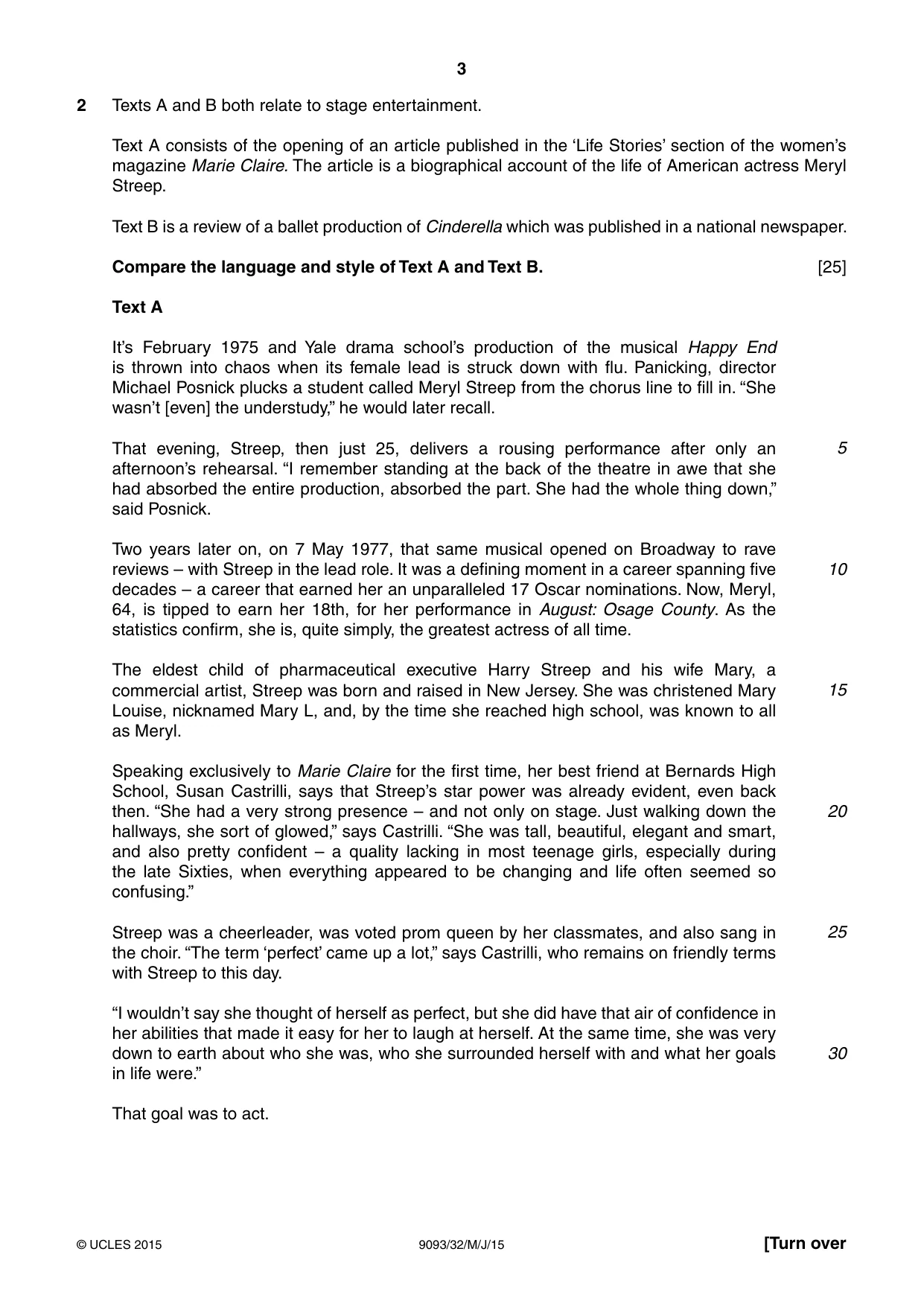
3 9093/32/M/J/15 © UCLES 2015 [Turn over 2 Texts A and B both relate to stage entertainment. Text A consists of the opening of an article published in the ‘Life Stories’ section of the women’s magazine Marie Claire. The article is a biographical account of the life of American actress Meryl Streep. Text B is a review of a ballet production of Cinderella which was published in a national newspaper. Compare the language and style of Text A and Text B. [25] Text A It’s February 1975 and Yale drama school’s production of the musical Happy End is thrown into chaos when its female lead is struck down with flu. Panicking, director Michael Posnick plucks a student called Meryl Streep from the chorus line to fill in. “She wasn’t [even] the understudy,” he would later recall. That evening, Streep, then just 25, delivers a rousing performance after only an afternoon’s rehearsal. “I remember standing at the back of the theatre in awe that she had absorbed the entire production, absorbed the part. She had the whole thing down,” said Posnick. Two years later on, on 7 May 1977, that same musical opened on Broadway to rave reviews – with Streep in the lead role. It was a defining moment in a career spanning five decades – a career that earned her an unparalleled 17 Oscar nominations. Now, Meryl, 64, is tipped to earn her 18th, for her performance in August: Osage County. As the statistics confirm, she is, quite simply, the greatest actress of all time. The eldest child of pharmaceutical executive Harry Streep and his wife Mary, a commercial artist, Streep was born and raised in New Jersey. She was christened Mary Louise, nicknamed Mary L, and, by the time she reached high school, was known to all as Meryl. Speaking exclusively to Marie Claire for the first time, her best friend at Bernards High School, Susan Castrilli, says that Streep’s star power was already evident, even back then. “She had a very strong presence – and not only on stage. Just walking down the hallways, she sort of glowed,” says Castrilli. “She was tall, beautiful, elegant and smart, and also pretty confident – a quality lacking in most teenage girls, especially during the late Sixties, when everything appeared to be changing and life often seemed so confusing.” Streep was a cheerleader, was voted prom queen by her classmates, and also sang in the choir. “The term ‘perfect’ came up a lot,” says Castrilli, who remains on friendly terms with Streep to this day. “I wouldn’t say she thought of herself as perfect, but she did have that air of confidence in her abilities that made it easy for her to laugh at herself. At the same time, she was very down to earth about who she was, who she surrounded herself with and what her goals in life were.” That goal was to act. 5 10 15 20 25 30
Question paper, page 4
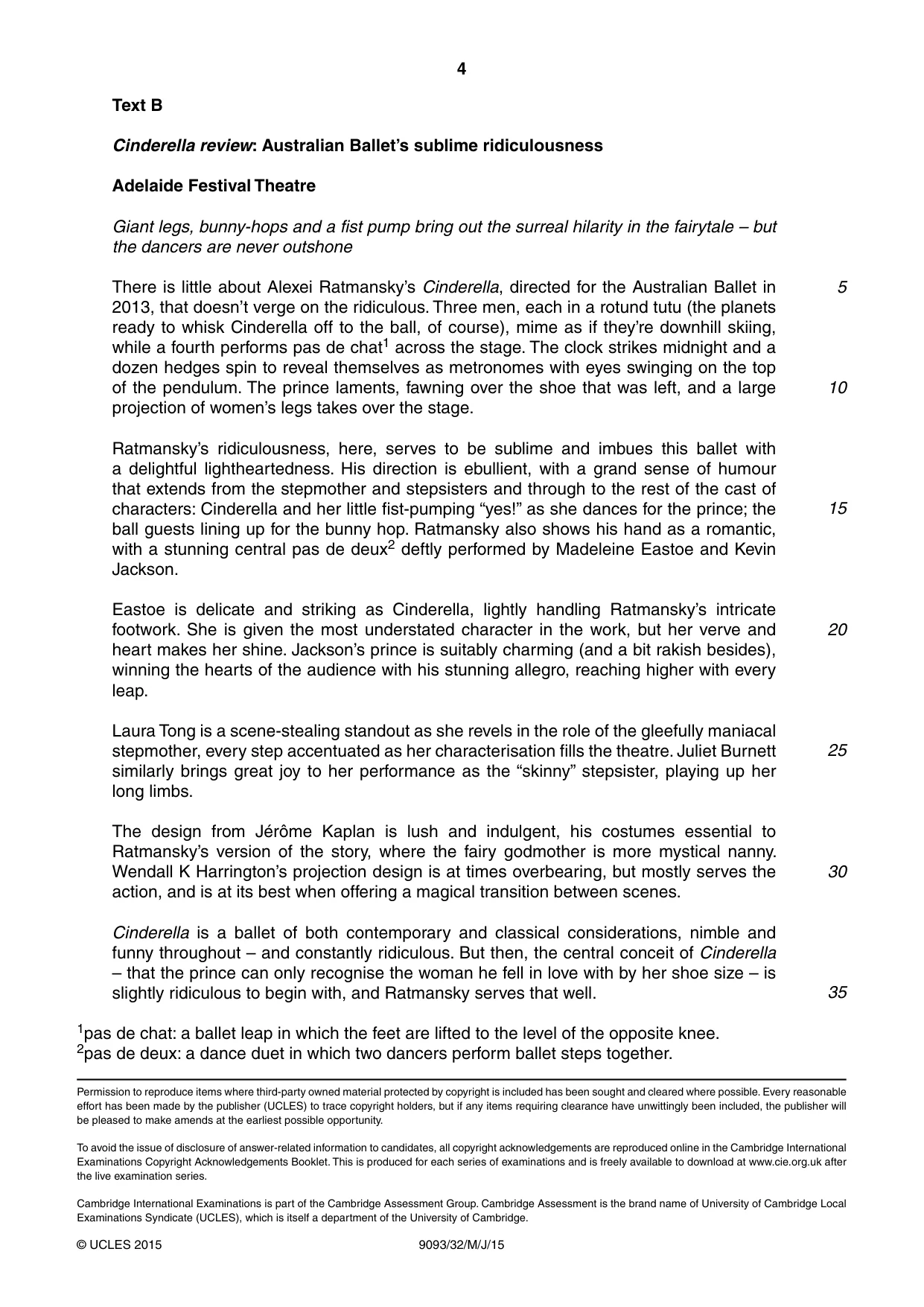
4 9093/32/M/J/15 © UCLES 2015 Text B Cinderella review: Australian Ballet’s sublime ridiculousness Adelaide Festival Theatre Giant legs, bunny-hops and a fist pump bring out the surreal hilarity in the fairytale – but the dancers are never outshone There is little about Alexei Ratmansky’s Cinderella, directed for the Australian Ballet in 2013, that doesn’t verge on the ridiculous. Three men, each in a rotund tutu (the planets ready to whisk Cinderella off to the ball, of course), mime as if they’re downhill skiing, while a fourth performs pas de chat1 across the stage. The clock strikes midnight and a dozen hedges spin to reveal themselves as metronomes with eyes swinging on the top of the pendulum. The prince laments, fawning over the shoe that was left, and a large projection of women’s legs takes over the stage. Ratmansky’s ridiculousness, here, serves to be sublime and imbues this ballet with a delightful lightheartedness. His direction is ebullient, with a grand sense of humour that extends from the stepmother and stepsisters and through to the rest of the cast of characters: Cinderella and her little fist-pumping “yes!” as she dances for the prince; the ball guests lining up for the bunny hop. Ratmansky also shows his hand as a romantic, with a stunning central pas de deux2 deftly performed by Madeleine Eastoe and Kevin Jackson. Eastoe is delicate and striking as Cinderella, lightly handling Ratmansky’s intricate footwork. She is given the most understated character in the work, but her verve and heart makes her shine. Jackson’s prince is suitably charming (and a bit rakish besides), winning the hearts of the audience with his stunning allegro, reaching higher with every leap. Laura Tong is a scene-stealing standout as she revels in the role of the gleefully maniacal stepmother, every step accentuated as her characterisation fills the theatre. Juliet Burnett similarly brings great joy to her performance as the “skinny” stepsister, playing up her long limbs. The design from Jérôme Kaplan is lush and indulgent, his costumes essential to Ratmansky’s version of the story, where the fairy godmother is more mystical nanny. Wendall K Harrington’s projection design is at times overbearing, but mostly serves the action, and is at its best when offering a magical transition between scenes. Cinderella is a ballet of both contemporary and classical considerations, nimble and funny throughout – and constantly ridiculous. But then, the central conceit of Cinderella – that the prince can only recognise the woman he fell in love with by her shoe size – is slightly ridiculous to begin with, and Ratmansky serves that well. 1pas de chat: a ballet leap in which the feet are lifted to the level of the opposite knee. 2pas de deux: a dance duet in which two dancers perform ballet steps together. Permission to reproduce items where third-party owned material protected by copyright is included has been sought and cleared where possible. Every reasonable effort has been made by the publisher (UCLES) to trace copyright holders, but if any items requiring clearance have unwittingly been included, the publisher will be pleased to make amends at the earliest possible opportunity. To avoid the issue of disclosure of answer-related information to candidates, all copyright acknowledgements are reproduced online in the Cambridge International Examinations Copyright Acknowledgements Booklet. This is produced for each series of examinations and is freely available to download at www.cie.org.uk after the live examination series. Cambridge International Examinations is part of the Cambridge Assessment Group. Cambridge Assessment is the brand name of University of Cambridge Local Examinations Syndicate (UCLES), which is itself a department of the University of Cambridge. 5 10 15 20 25 30 35
Mark scheme, page 1
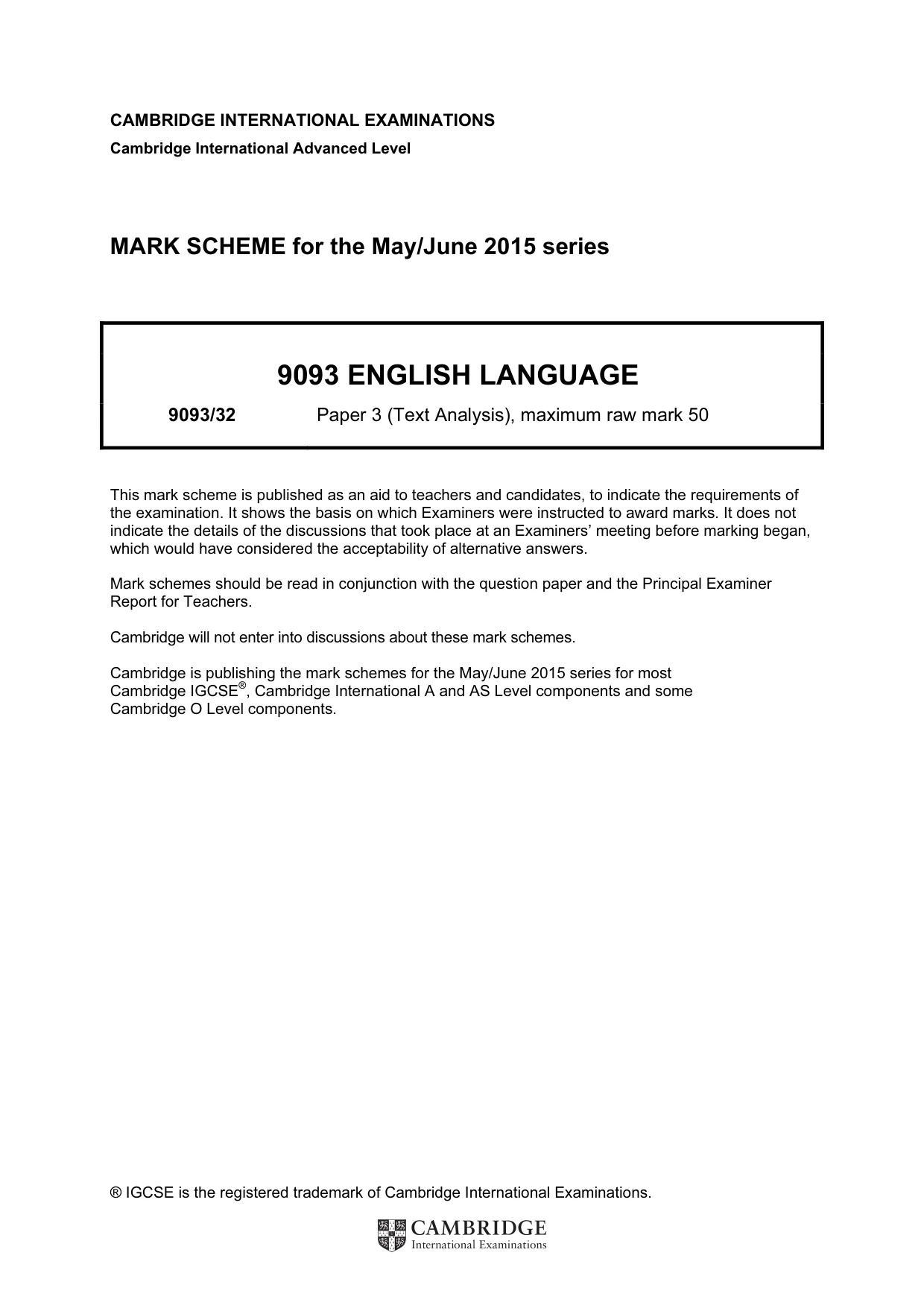
® IGCSE is the registered trademark of Cambridge International Examinations. CAMBRIDGE INTERNATIONAL EXAMINATIONS Cambridge International Advanced Level MARK SCHEME for the May/June 2015 series 9093 ENGLISH LANGUAGE 9093/32 Paper 3 (Text Analysis), maximum raw mark 50 This mark scheme is published as an aid to teachers and candidates, to indicate the requirements of the examination. It shows the basis on which Examiners were instructed to award marks. It does not indicate the details of the discussions that took place at an Examiners’ meeting before marking began, which would have considered the acceptability of alternative answers. Mark schemes should be read in conjunction with the question paper and the Principal Examiner Report for Teachers. Cambridge will not enter into discussions about these mark schemes. Cambridge is publishing the mark schemes for the May/June 2015 series for most Cambridge IGCSE®, Cambridge International A and AS Level components and some Cambridge O Level components.
Mark scheme, page 2
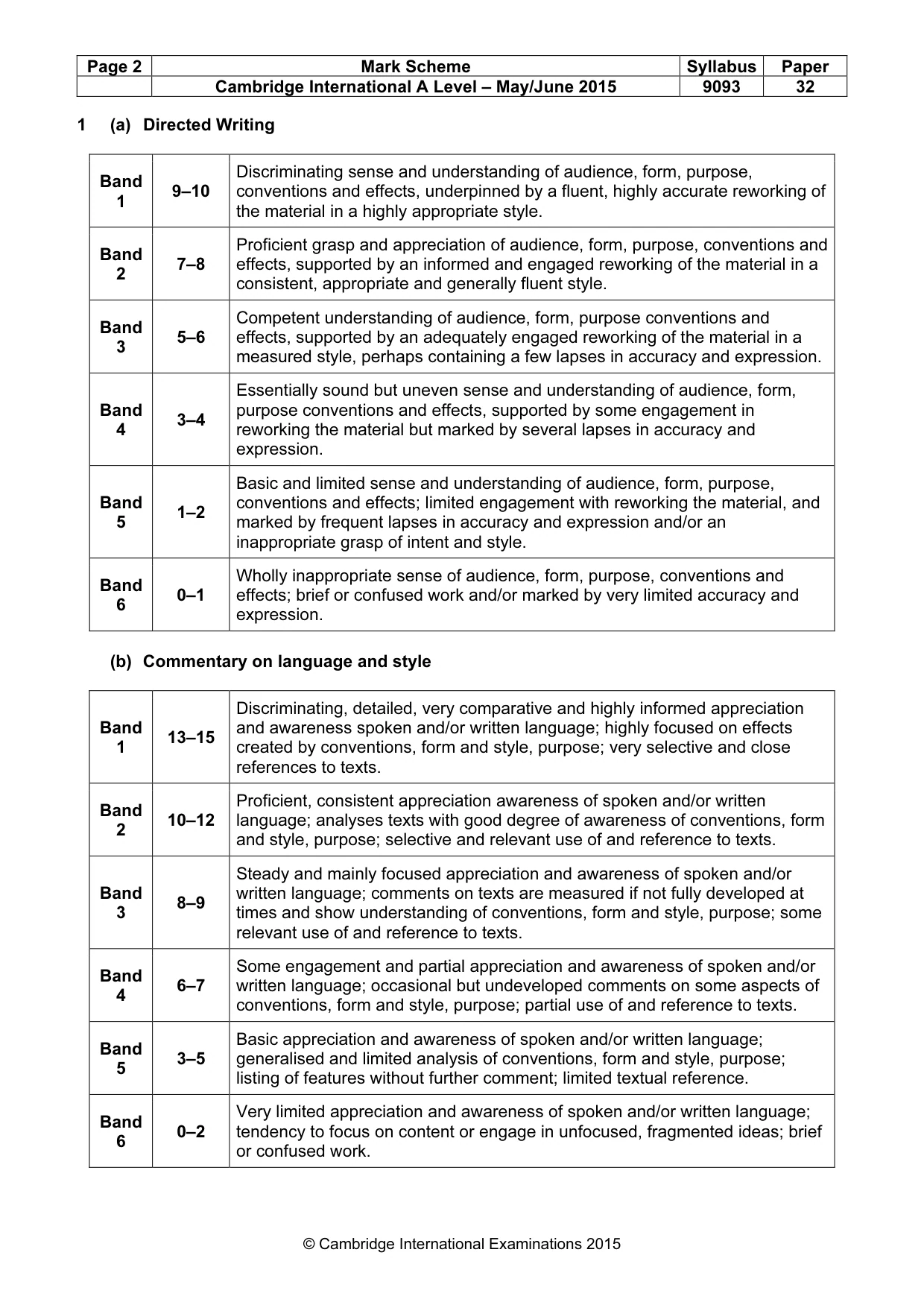
Page 2 Mark Scheme Syllabus Paper Cambridge International A Level – May/June 2015 9093 32 © Cambridge International Examinations 2015 1 (a) Directed Writing Band 1 9–10 Discriminating sense and understanding of audience, form, purpose, conventions and effects, underpinned by a fluent, highly accurate reworking of the material in a highly appropriate style. Band 2 7–8 Proficient grasp and appreciation of audience, form, purpose, conventions and effects, supported by an informed and engaged reworking of the material in a consistent, appropriate and generally fluent style. Band 3 5–6 Competent understanding of audience, form, purpose conventions and effects, supported by an adequately engaged reworking of the material in a measured style, perhaps containing a few lapses in accuracy and expression. Band 4 3–4 Essentially sound but uneven sense and understanding of audience, form, purpose conventions and effects, supported by some engagement in reworking the material but marked by several lapses in accuracy and expression. Band 5 1–2 Basic and limited sense and understanding of audience, form, purpose, conventions and effects; limited engagement with reworking the material, and marked by frequent lapses in accuracy and expression and/or an inappropriate grasp of intent and style. Band 6 0–1 Wholly inappropriate sense of audience, form, purpose, conventions and effects; brief or confused work and/or marked by very limited accuracy and expression. (b) Commentary on language and style Band 1 13–15 Discriminating, detailed, very comparative and highly informed appreciation and awareness spoken and/or written language; highly focused on effects created by conventions, form and style, purpose; very selective and close references to texts. Band 2 10–12 Proficient, consistent appreciation awareness of spoken and/or written language; analyses texts with good degree of awareness of conventions, form and style, purpose; selective and relevant use of and reference to texts. Band 3 8–9 Steady and mainly focused appreciation and awareness of spoken and/or written language; comments on texts are measured if not fully developed at times and show understanding of conventions, form and style, purpose; some relevant use of and reference to texts. Band 4 6–7 Some engagement and partial appreciation and awareness of spoken and/or written language; occasional but undeveloped comments on some aspects of conventions, form and style, purpose; partial use of and reference to texts. Band 5 3–5 Basic appreciation and awareness of spoken and/or written language; generalised and limited analysis of conventions, form and style, purpose; listing of features without further comment; limited textual reference. Band 6 0–2 Very limited appreciation and awareness of spoken and/or written language; tendency to focus on content or engage in unfocused, fragmented ideas; brief or confused work.
Mark scheme, page 3
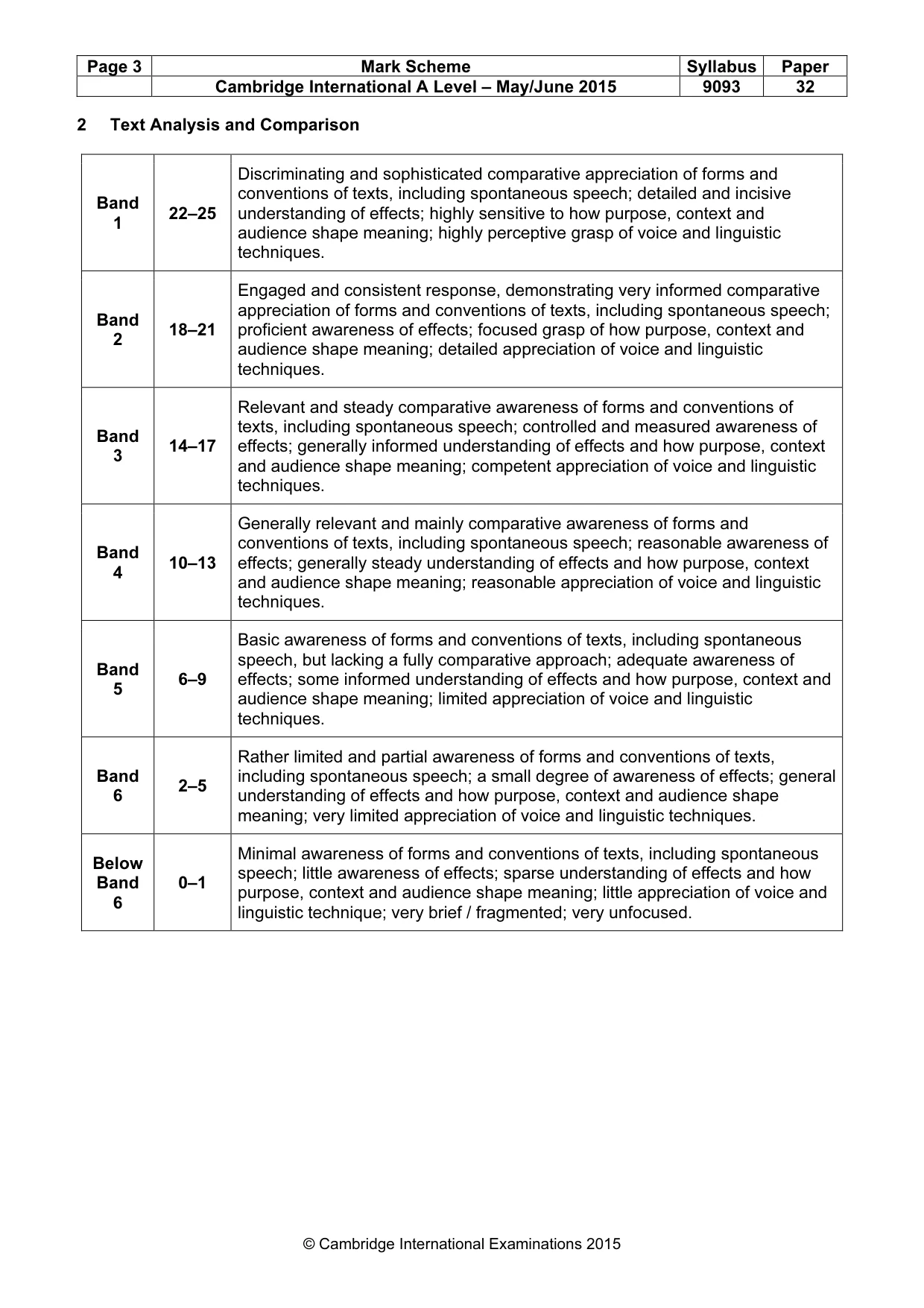
Page 3 Mark Scheme Syllabus Paper Cambridge International A Level – May/June 2015 9093 32 © Cambridge International Examinations 2015 2 Text Analysis and Comparison Band 1 22–25 Discriminating and sophisticated comparative appreciation of forms and conventions of texts, including spontaneous speech; detailed and incisive understanding of effects; highly sensitive to how purpose, context and audience shape meaning; highly perceptive grasp of voice and linguistic techniques. Band 2 18–21 Engaged and consistent response, demonstrating very informed comparative appreciation of forms and conventions of texts, including spontaneous speech; proficient awareness of effects; focused grasp of how purpose, context and audience shape meaning; detailed appreciation of voice and linguistic techniques. Band 3 14–17 Relevant and steady comparative awareness of forms and conventions of texts, including spontaneous speech; controlled and measured awareness of effects; generally informed understanding of effects and how purpose, context and audience shape meaning; competent appreciation of voice and linguistic techniques. Band 4 10–13 Generally relevant and mainly comparative awareness of forms and conventions of texts, including spontaneous speech; reasonable awareness of effects; generally steady understanding of effects and how purpose, context and audience shape meaning; reasonable appreciation of voice and linguistic techniques. Band 5 6–9 Basic awareness of forms and conventions of texts, including spontaneous speech, but lacking a fully comparative approach; adequate awareness of effects; some informed understanding of effects and how purpose, context and audience shape meaning; limited appreciation of voice and linguistic techniques. Band 6 2–5 Rather limited and partial awareness of forms and conventions of texts, including spontaneous speech; a small degree of awareness of effects; general understanding of effects and how purpose, context and audience shape meaning; very limited appreciation of voice and linguistic techniques. Below Band 6 0–1 Minimal awareness of forms and conventions of texts, including spontaneous speech; little awareness of effects; sparse understanding of effects and how purpose, context and audience shape meaning; little appreciation of voice and linguistic technique; very brief / fragmented; very unfocused.
What you needed in this session
Cambridge’s own grade thresholds for 2015 May/June, Paper 3 · Variant 2. A higher threshold means an easier paper — the bar moves with how the cohort did.