Cambridge A Level English - Language AS and A Level (from 2014) 9093 — 2015 May/June Paper 3 · Variant 1
9093/31/M/J/15 · 50 marks · ≈56 min
The question paper and its mark scheme, free to read here and free to download. This is Cambridge’s own paper, exactly as it was sat.
Question paper8 pages


Mark scheme3 pages
Answers below. Sit the paper first if you are practising.
Paper as text
Question paper, page 1
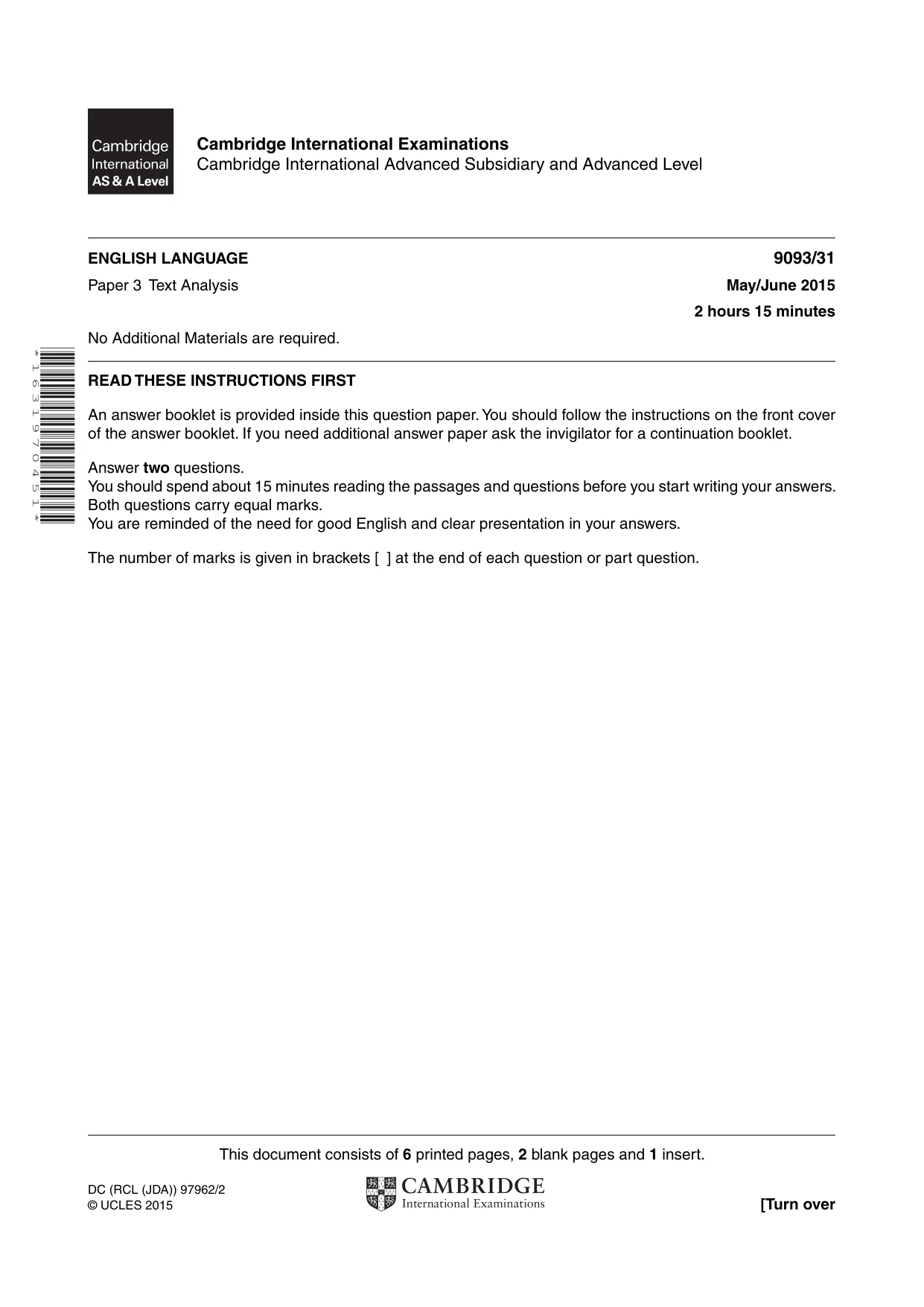
This document consists of 6 printed pages, 2 blank pages and 1 insert. DC (RCL (JDA)) 97962/2 © UCLES 2015 [Turn over Cambridge International Examinations Cambridge International Advanced Subsidiary and Advanced Level * 1 6 3 1 9 7 0 4 5 1 * ENGLISH LANGUAGE 9093/31 Paper 3 Text Analysis May/June 2015 2 hours 15 minutes No Additional Materials are required. READ THESE INSTRUCTIONS FIRST An answer booklet is provided inside this question paper. You should follow the instructions on the front cover of the answer booklet. If you need additional answer paper ask the invigilator for a continuation booklet. Answer two questions. You should spend about 15 minutes reading the passages and questions before you start writing your answers. Both questions carry equal marks. You are reminded of the need for good English and clear presentation in your answers. The number of marks is given in brackets [ ] at the end of each question or part question.
Question paper, page 2
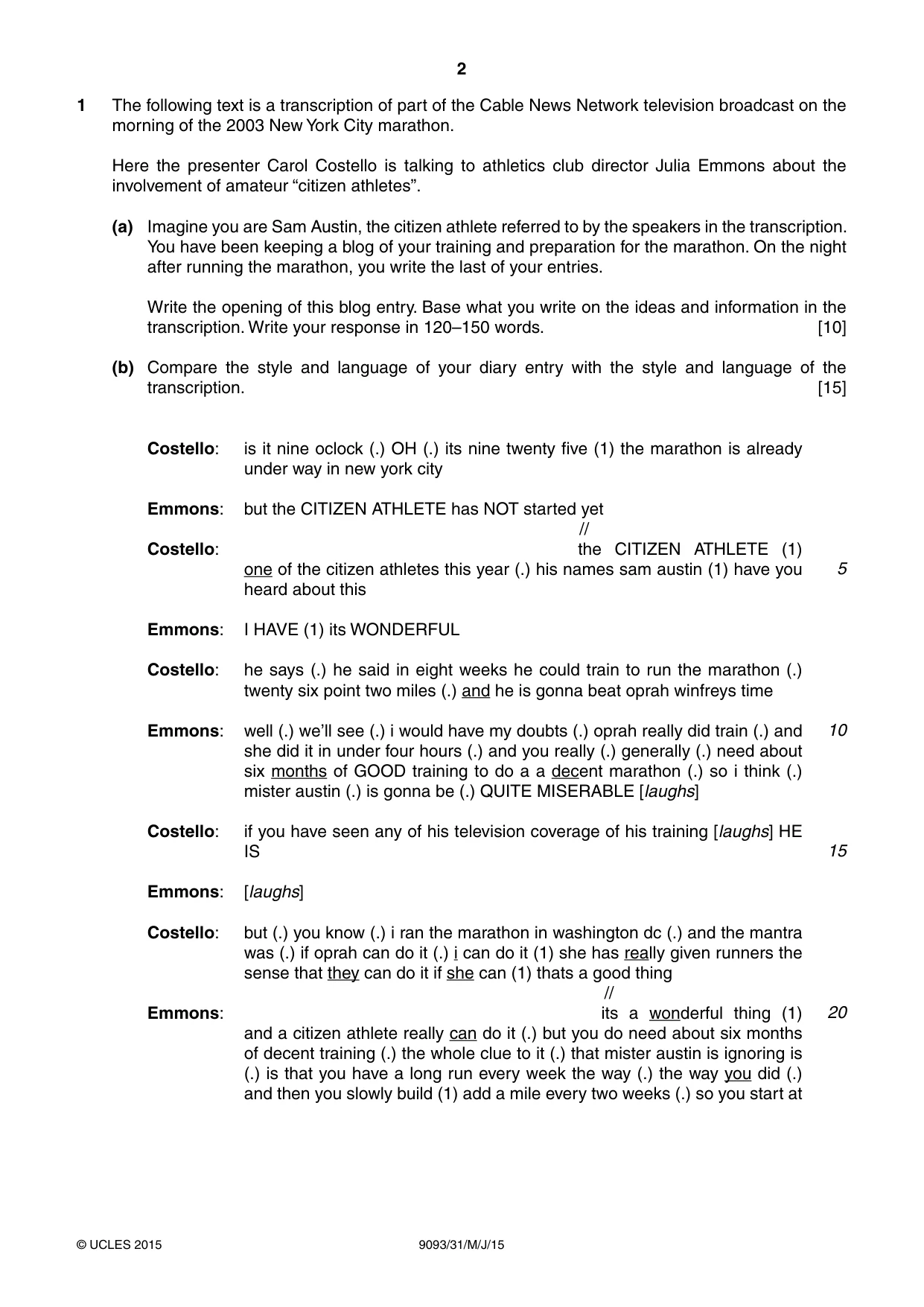
2 9093/31/M/J/15 © UCLES 2015 1 The following text is a transcription of part of the Cable News Network television broadcast on the morning of the 2003 New York City marathon. Here the presenter Carol Costello is talking to athletics club director Julia Emmons about the involvement of amateur “citizen athletes”. (a) Imagine you are Sam Austin, the citizen athlete referred to by the speakers in the transcription. You have been keeping a blog of your training and preparation for the marathon. On the night after running the marathon, you write the last of your entries. Write the opening of this blog entry. Base what you write on the ideas and information in the transcription. Write your response in 120–150 words. [10] (b) Compare the style and language of your diary entry with the style and language of the transcription. [15] Costello: is it nine oclock (.) OH (.) its nine twenty five (1) the marathon is already under way in new york city Emmons: but the CITIZEN ATHLETE has NOT started yet // Costello: the CITIZEN ATHLETE (1) one of the citizen athletes this year (.) his names sam austin (1) have you heard about this Emmons: I HAVE (1) its WONDERFUL Costello: he says (.) he said in eight weeks he could train to run the marathon (.) twenty six point two miles (.) and he is gonna beat oprah winfreys time Emmons: well (.) we’ll see (.) i would have my doubts (.) oprah really did train (.) and she did it in under four hours (.) and you really (.) generally (.) need about six months of GOOD training to do a a decent marathon (.) so i think (.) mister austin (.) is gonna be (.) QUITE MISERABLE [laughs] Costello: if you have seen any of his television coverage of his training [laughs] HE IS Emmons: [laughs] Costello: but (.) you know (.) i ran the marathon in washington dc (.) and the mantra was (.) if oprah can do it (.) i can do it (1) she has really given runners the sense that they can do it if she can (1) thats a good thing // Emmons: its a wonderful thing (1) and a citizen athlete really can do it (.) but you do need about six months of decent training (.) the whole clue to it (.) that mister austin is ignoring is (.) is that you have a long run every week the way (.) the way you did (.) and then you slowly build (1) add a mile every two weeks (.) so you start at 5 10 15 20
Question paper, page 3
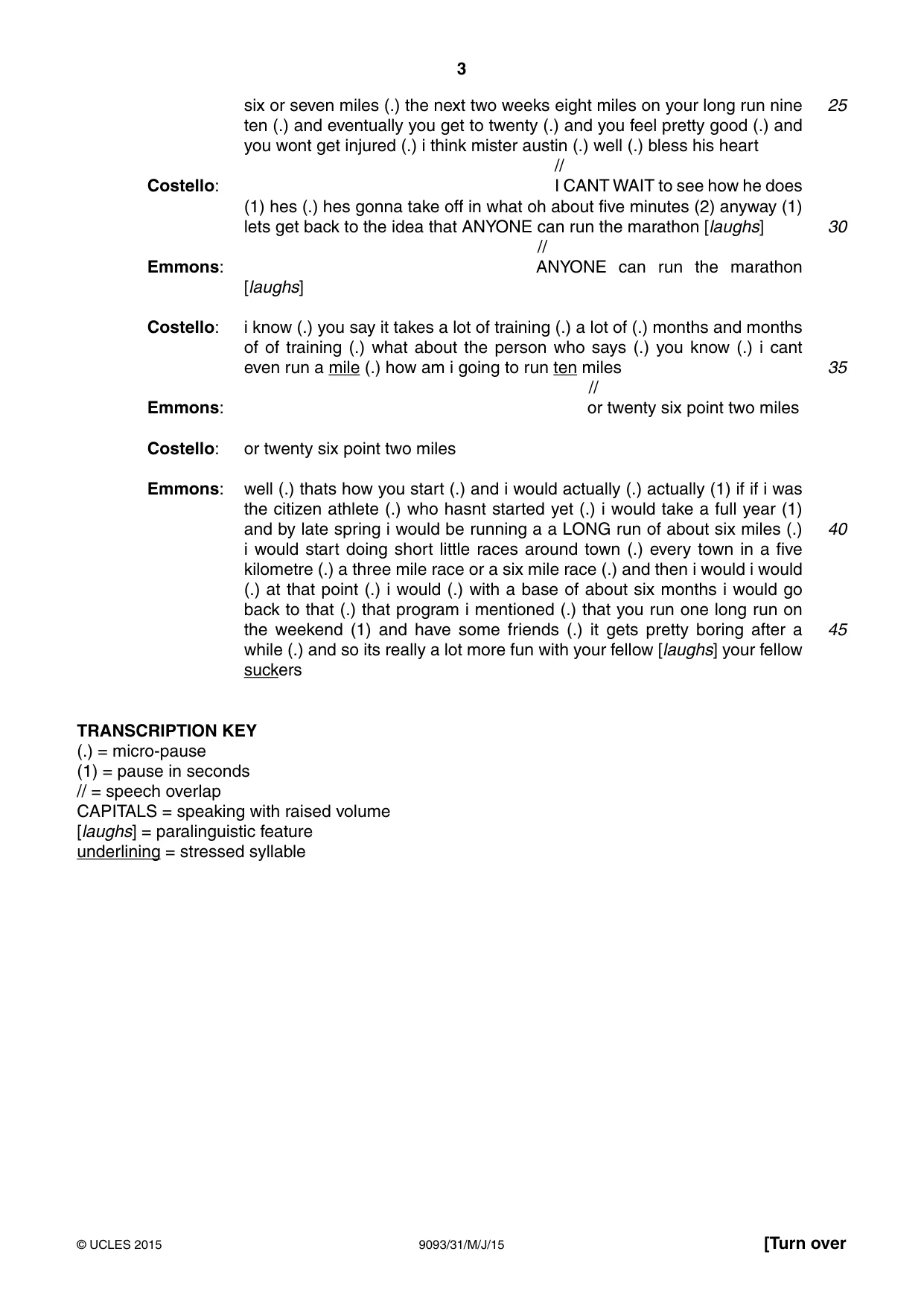
3 9093/31/M/J/15 © UCLES 2015 [Turn over six or seven miles (.) the next two weeks eight miles on your long run nine ten (.) and eventually you get to twenty (.) and you feel pretty good (.) and you wont get injured (.) i think mister austin (.) well (.) bless his heart // Costello: I CANT WAIT to see how he does (1) hes (.) hes gonna take off in what oh about five minutes (2) anyway (1) lets get back to the idea that ANYONE can run the marathon [laughs] // Emmons: ANYONE can run the marathon [laughs] Costello: i know (.) you say it takes a lot of training (.) a lot of (.) months and months of of training (.) what about the person who says (.) you know (.) i cant even run a mile (.) how am i going to run ten miles // Emmons: or twenty six point two miles Costello: or twenty six point two miles Emmons: well (.) thats how you start (.) and i would actually (.) actually (1) if if i was the citizen athlete (.) who hasnt started yet (.) i would take a full year (1) and by late spring i would be running a a LONG run of about six miles (.) i would start doing short little races around town (.) every town in a five kilometre (.) a three mile race or a six mile race (.) and then i would i would (.) at that point (.) i would (.) with a base of about six months i would go back to that (.) that program i mentioned (.) that you run one long run on the weekend (1) and have some friends (.) it gets pretty boring after a while (.) and so its really a lot more fun with your fellow [laughs] your fellow suckers TRANSCRIPTION KEY (.) = micro-pause (1) = pause in seconds // = speech overlap CAPITALS = speaking with raised volume [laughs] = paralinguistic feature underlining = stressed syllable 25 30 35 40 45
Question paper, page 4
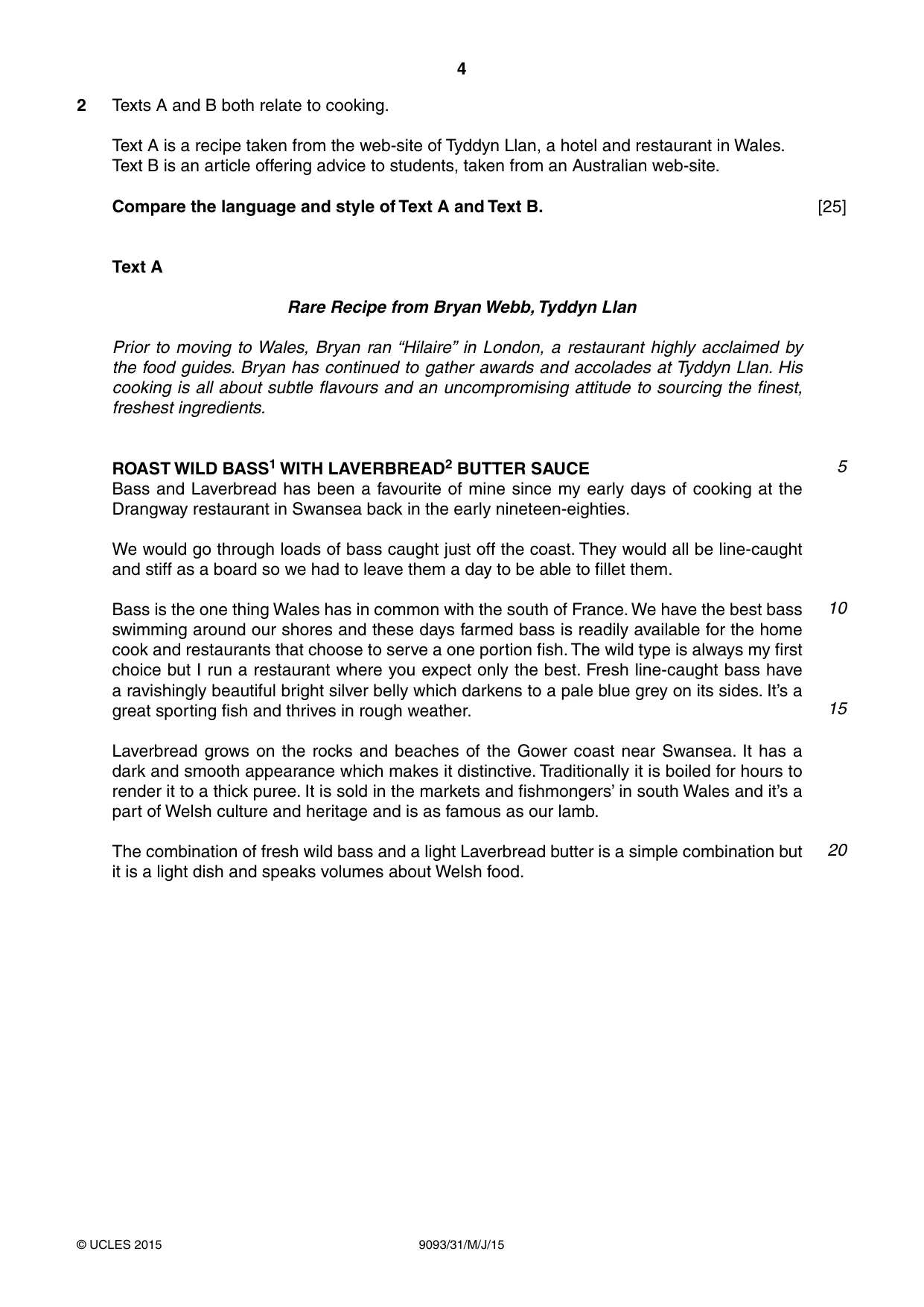
4 9093/31/M/J/15 © UCLES 2015 2 Texts A and B both relate to cooking. Text A is a recipe taken from the web-site of Tyddyn Llan, a hotel and restaurant in Wales. Text B is an article offering advice to students, taken from an Australian web-site. Compare the language and style of Text A and Text B. [25] Text A Rare Recipe from Bryan Webb, Tyddyn Llan Prior to moving to Wales, Bryan ran “Hilaire” in London, a restaurant highly acclaimed by the food guides. Bryan has continued to gather awards and accolades at Tyddyn Llan. His cooking is all about subtle flavours and an uncompromising attitude to sourcing the finest, freshest ingredients. ROAST WILD BASS1 WITH LAVERBREAD2 BUTTER SAUCE Bass and Laverbread has been a favourite of mine since my early days of cooking at the Drangway restaurant in Swansea back in the early nineteen-eighties. We would go through loads of bass caught just off the coast. They would all be line-caught and stiff as a board so we had to leave them a day to be able to fillet them. Bass is the one thing Wales has in common with the south of France. We have the best bass swimming around our shores and these days farmed bass is readily available for the home cook and restaurants that choose to serve a one portion fish. The wild type is always my first choice but I run a restaurant where you expect only the best. Fresh line-caught bass have a ravishingly beautiful bright silver belly which darkens to a pale blue grey on its sides. It’s a great sporting fish and thrives in rough weather. Laverbread grows on the rocks and beaches of the Gower coast near Swansea. It has a dark and smooth appearance which makes it distinctive. Traditionally it is boiled for hours to render it to a thick puree. It is sold in the markets and fishmongers’ in south Wales and it’s a part of Welsh culture and heritage and is as famous as our lamb. The combination of fresh wild bass and a light Laverbread butter is a simple combination but it is a light dish and speaks volumes about Welsh food. 5 10 15 20
Question paper, page 5
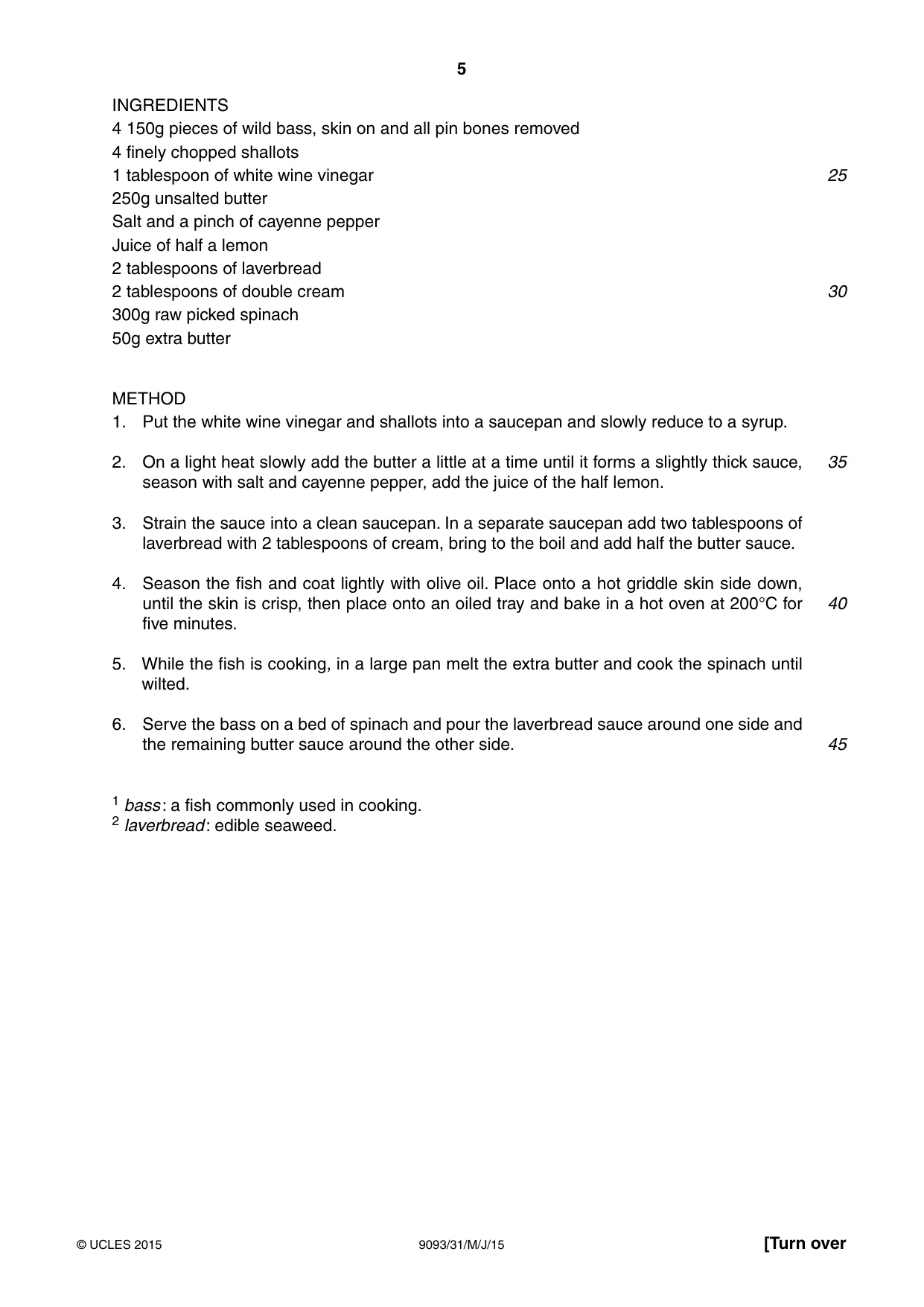
5 9093/31/M/J/15 © UCLES 2015 [Turn over INGREDIENTS 4 150g pieces of wild bass, skin on and all pin bones removed 4 finely chopped shallots 1 tablespoon of white wine vinegar 250g unsalted butter Salt and a pinch of cayenne pepper Juice of half a lemon 2 tablespoons of laverbread 2 tablespoons of double cream 300g raw picked spinach 50g extra butter METHOD 1. Put the white wine vinegar and shallots into a saucepan and slowly reduce to a syrup. 2. On a light heat slowly add the butter a little at a time until it forms a slightly thick sauce, season with salt and cayenne pepper, add the juice of the half lemon. 3. Strain the sauce into a clean saucepan. In a separate saucepan add two tablespoons of laverbread with 2 tablespoons of cream, bring to the boil and add half the butter sauce. 4. Season the fish and coat lightly with olive oil. Place onto a hot griddle skin side down, until the skin is crisp, then place onto an oiled tray and bake in a hot oven at 200°C for five minutes. 5. While the fish is cooking, in a large pan melt the extra butter and cook the spinach until wilted. 6. Serve the bass on a bed of spinach and pour the laverbread sauce around one side and the remaining butter sauce around the other side. 1 bass : a fish commonly used in cooking. 2 laverbread : edible seaweed. 25 30 35 40 45
Question paper, page 6
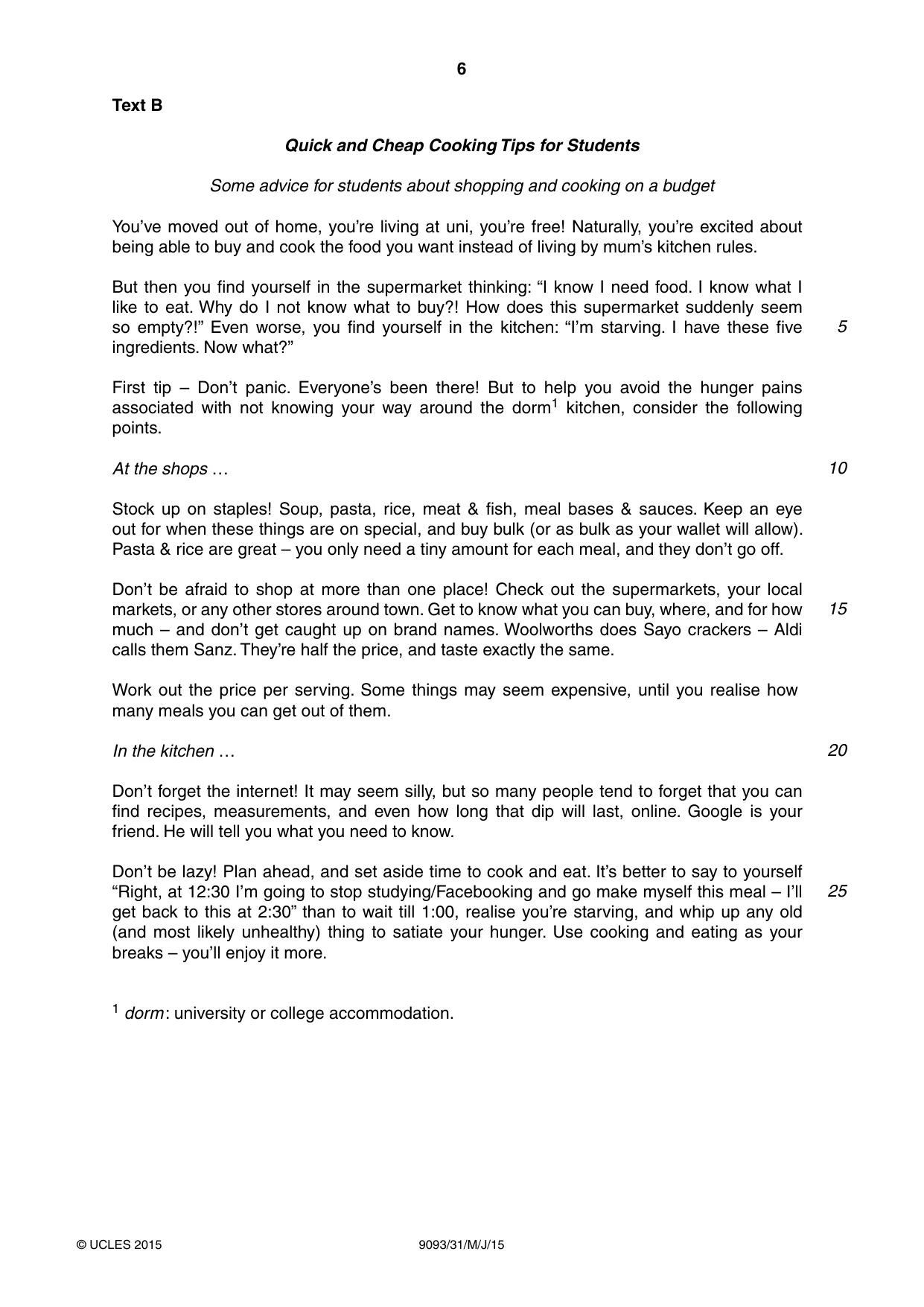
6 9093/31/M/J/15 © UCLES 2015 Text B Quick and Cheap Cooking Tips for Students Some advice for students about shopping and cooking on a budget You’ve moved out of home, you’re living at uni, you’re free! Naturally, you’re excited about being able to buy and cook the food you want instead of living by mum’s kitchen rules. But then you find yourself in the supermarket thinking: “I know I need food. I know what I like to eat. Why do I not know what to buy?! How does this supermarket suddenly seem so empty?!” Even worse, you find yourself in the kitchen: “I’m starving. I have these five ingredients. Now what?” First tip – Don’t panic. Everyone’s been there! But to help you avoid the hunger pains associated with not knowing your way around the dorm1 kitchen, consider the following points. At the shops … Stock up on staples! Soup, pasta, rice, meat & fish, meal bases & sauces. Keep an eye out for when these things are on special, and buy bulk (or as bulk as your wallet will allow). Pasta & rice are great – you only need a tiny amount for each meal, and they don’t go off. Don’t be afraid to shop at more than one place! Check out the supermarkets, your local markets, or any other stores around town. Get to know what you can buy, where, and for how much – and don’t get caught up on brand names. Woolworths does Sayo crackers – Aldi calls them Sanz. They’re half the price, and taste exactly the same. Work out the price per serving. Some things may seem expensive, until you realise how many meals you can get out of them. In the kitchen … Don’t forget the internet! It may seem silly, but so many people tend to forget that you can find recipes, measurements, and even how long that dip will last, online. Google is your friend. He will tell you what you need to know. Don’t be lazy! Plan ahead, and set aside time to cook and eat. It’s better to say to yourself “Right, at 12:30 I’m going to stop studying/Facebooking and go make myself this meal – I’ll get back to this at 2:30” than to wait till 1:00, realise you’re starving, and whip up any old (and most likely unhealthy) thing to satiate your hunger. Use cooking and eating as your breaks – you’ll enjoy it more. 1 dorm : university or college accommodation. 5 10 15 20 25
Question paper, page 7
7 9093/31/M/J/15 © UCLES 2015 BLANK PAGE
Question paper, page 8
8 9093/31/M/J/15 © UCLES 2015 BLANK PAGE Permission to reproduce items where third-party owned material protected by copyright is included has been sought and cleared where possible. Every reasonable effort has been made by the publisher (UCLES) to trace copyright holders, but if any items requiring clearance have unwittingly been included, the publisher will be pleased to make amends at the earliest possible opportunity. To avoid the issue of disclosure of answer-related information to candidates, all copyright acknowledgements are reproduced online in the Cambridge International Examinations Copyright Acknowledgements Booklet. This is produced for each series of examinations and is freely available to download at www.cie.org.uk after the live examination series. Cambridge International Examinations is part of the Cambridge Assessment Group. Cambridge Assessment is the brand name of University of Cambridge Local Examinations Syndicate (UCLES), which is itself a department of the University of Cambridge.
Mark scheme, page 1
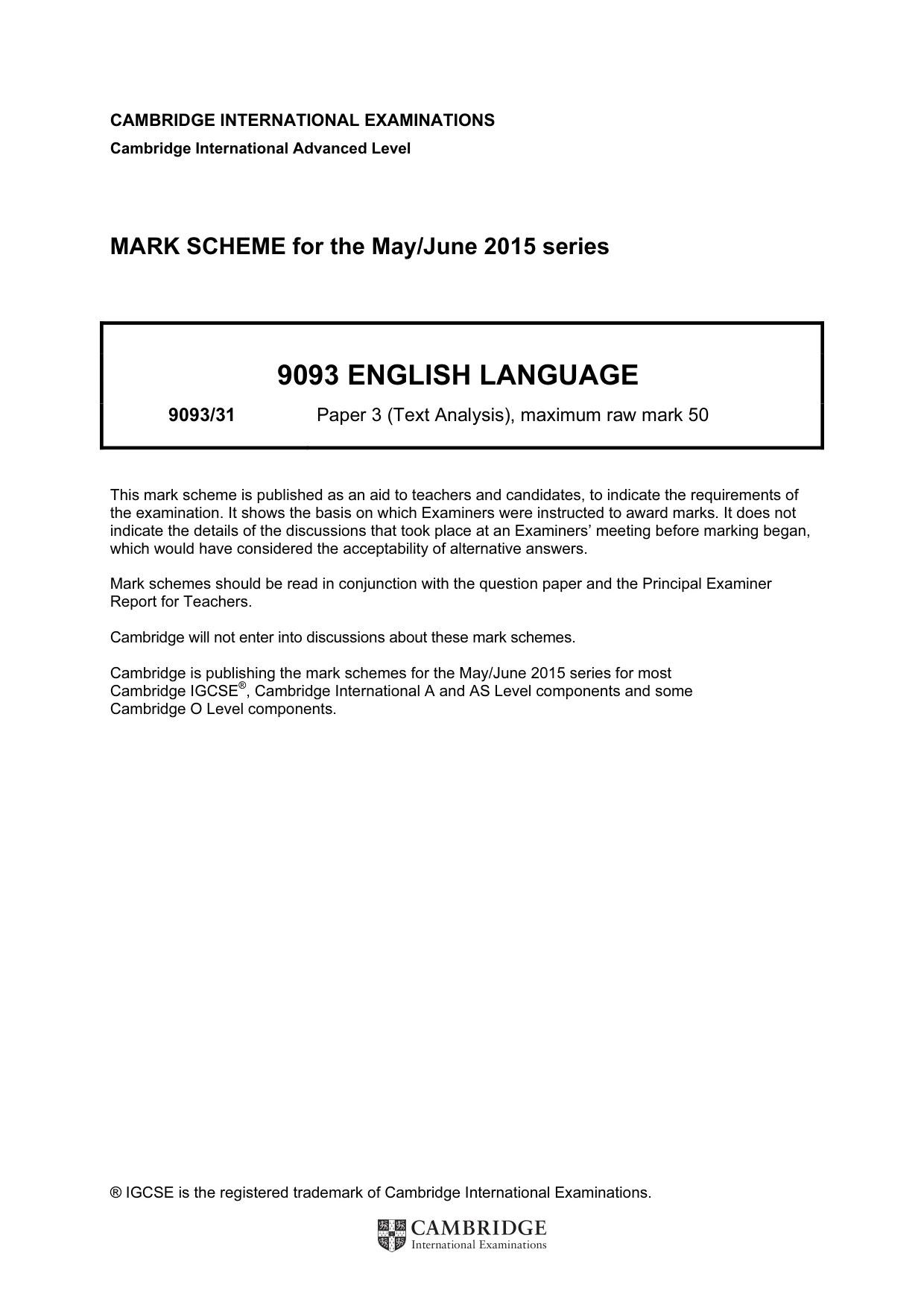
® IGCSE is the registered trademark of Cambridge International Examinations. CAMBRIDGE INTERNATIONAL EXAMINATIONS Cambridge International Advanced Level MARK SCHEME for the May/June 2015 series 9093 ENGLISH LANGUAGE 9093/31 Paper 3 (Text Analysis), maximum raw mark 50 This mark scheme is published as an aid to teachers and candidates, to indicate the requirements of the examination. It shows the basis on which Examiners were instructed to award marks. It does not indicate the details of the discussions that took place at an Examiners’ meeting before marking began, which would have considered the acceptability of alternative answers. Mark schemes should be read in conjunction with the question paper and the Principal Examiner Report for Teachers. Cambridge will not enter into discussions about these mark schemes. Cambridge is publishing the mark schemes for the May/June 2015 series for most Cambridge IGCSE®, Cambridge International A and AS Level components and some Cambridge O Level components.
Mark scheme, page 2
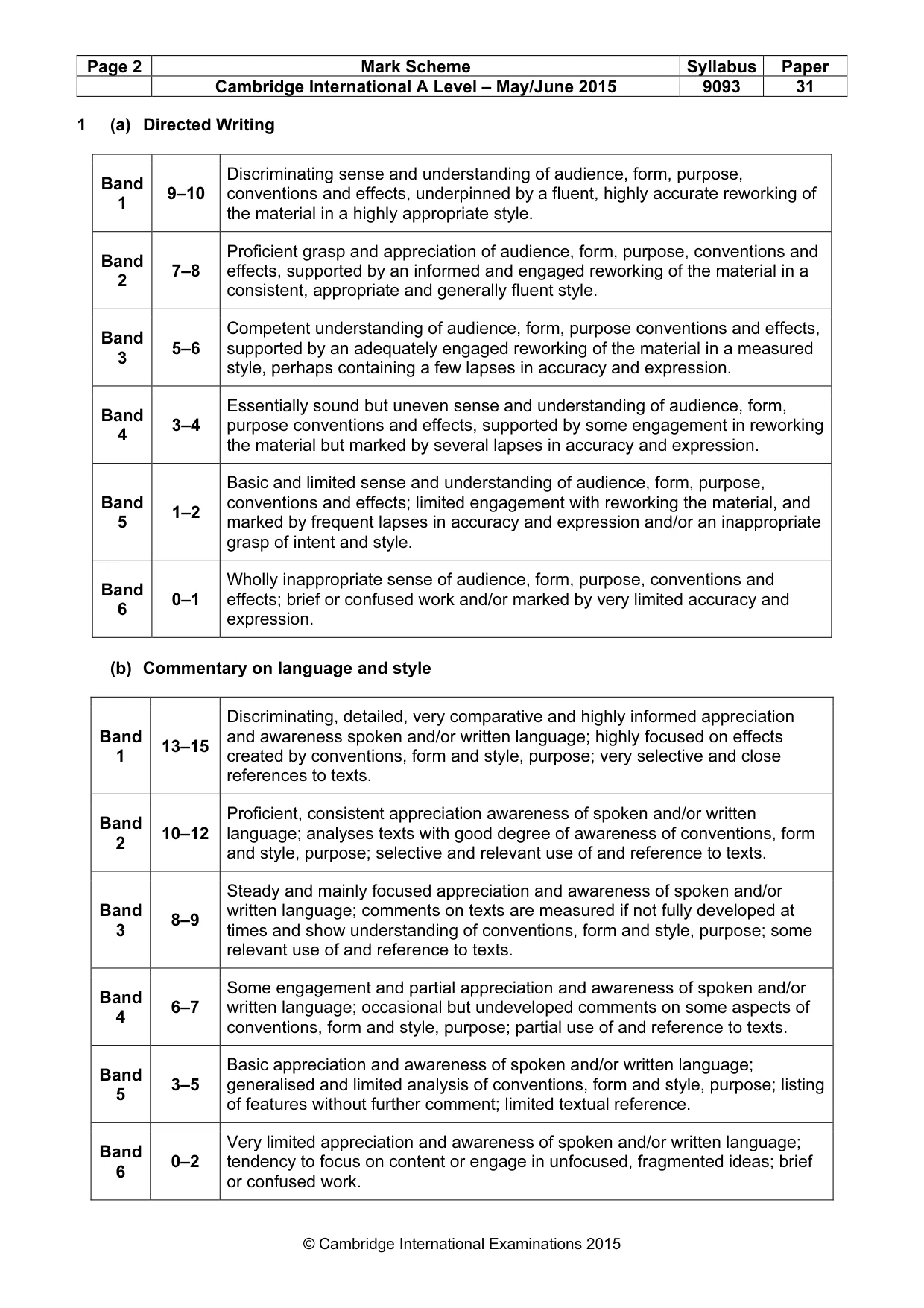
Page 2 Mark Scheme Syllabus Paper Cambridge International A Level – May/June 2015 9093 31 © Cambridge International Examinations 2015 1 (a) Directed Writing Band 1 9–10 Discriminating sense and understanding of audience, form, purpose, conventions and effects, underpinned by a fluent, highly accurate reworking of the material in a highly appropriate style. Band 2 7–8 Proficient grasp and appreciation of audience, form, purpose, conventions and effects, supported by an informed and engaged reworking of the material in a consistent, appropriate and generally fluent style. Band 3 5–6 Competent understanding of audience, form, purpose conventions and effects, supported by an adequately engaged reworking of the material in a measured style, perhaps containing a few lapses in accuracy and expression. Band 4 3–4 Essentially sound but uneven sense and understanding of audience, form, purpose conventions and effects, supported by some engagement in reworking the material but marked by several lapses in accuracy and expression. Band 5 1–2 Basic and limited sense and understanding of audience, form, purpose, conventions and effects; limited engagement with reworking the material, and marked by frequent lapses in accuracy and expression and/or an inappropriate grasp of intent and style. Band 6 0–1 Wholly inappropriate sense of audience, form, purpose, conventions and effects; brief or confused work and/or marked by very limited accuracy and expression. (b) Commentary on language and style Band 1 13–15 Discriminating, detailed, very comparative and highly informed appreciation and awareness spoken and/or written language; highly focused on effects created by conventions, form and style, purpose; very selective and close references to texts. Band 2 10–12 Proficient, consistent appreciation awareness of spoken and/or written language; analyses texts with good degree of awareness of conventions, form and style, purpose; selective and relevant use of and reference to texts. Band 3 8–9 Steady and mainly focused appreciation and awareness of spoken and/or written language; comments on texts are measured if not fully developed at times and show understanding of conventions, form and style, purpose; some relevant use of and reference to texts. Band 4 6–7 Some engagement and partial appreciation and awareness of spoken and/or written language; occasional but undeveloped comments on some aspects of conventions, form and style, purpose; partial use of and reference to texts. Band 5 3–5 Basic appreciation and awareness of spoken and/or written language; generalised and limited analysis of conventions, form and style, purpose; listing of features without further comment; limited textual reference. Band 6 0–2 Very limited appreciation and awareness of spoken and/or written language; tendency to focus on content or engage in unfocused, fragmented ideas; brief or confused work.
Mark scheme, page 3
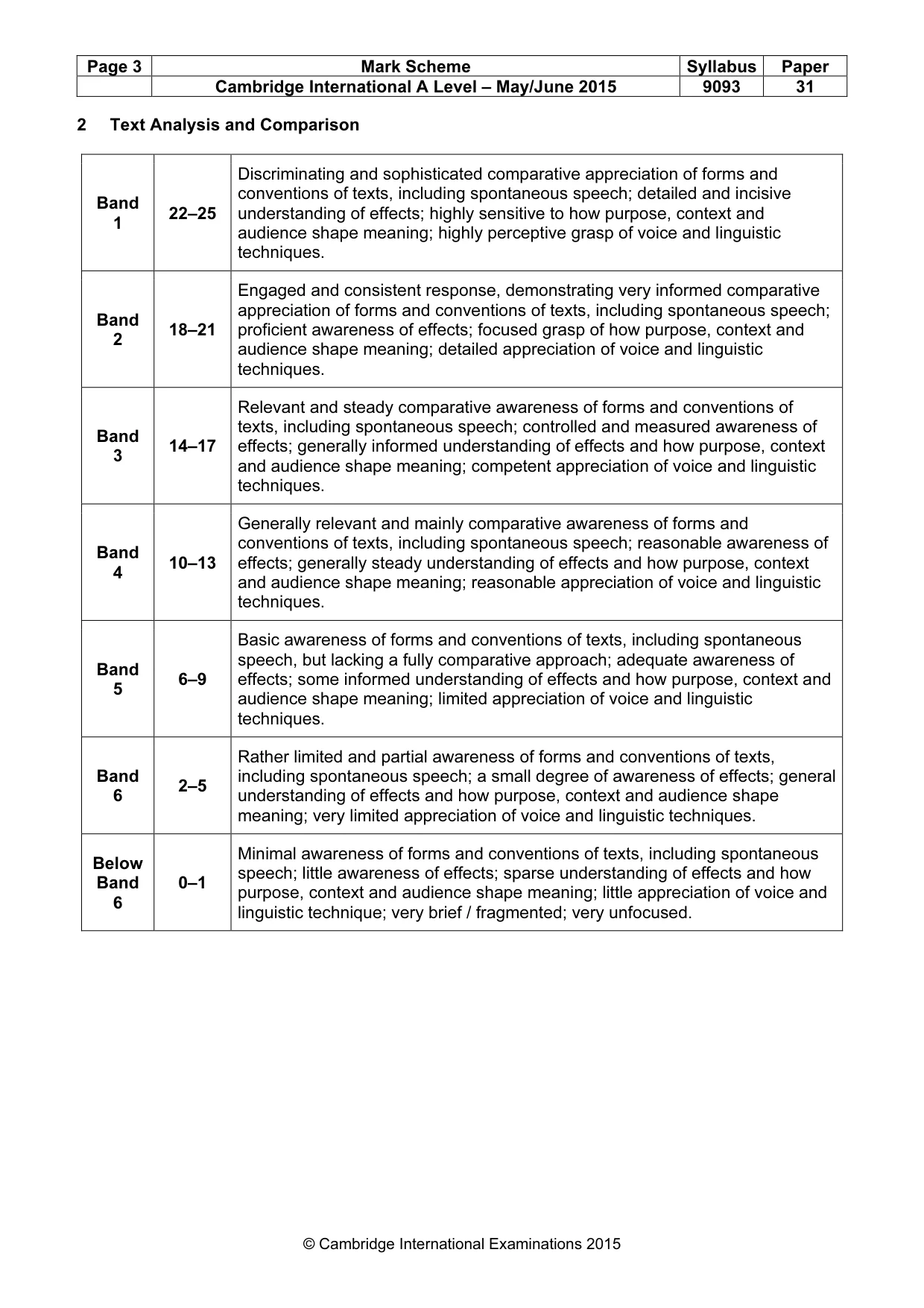
Page 3 Mark Scheme Syllabus Paper Cambridge International A Level – May/June 2015 9093 31 © Cambridge International Examinations 2015 2 Text Analysis and Comparison Band 1 22–25 Discriminating and sophisticated comparative appreciation of forms and conventions of texts, including spontaneous speech; detailed and incisive understanding of effects; highly sensitive to how purpose, context and audience shape meaning; highly perceptive grasp of voice and linguistic techniques. Band 2 18–21 Engaged and consistent response, demonstrating very informed comparative appreciation of forms and conventions of texts, including spontaneous speech; proficient awareness of effects; focused grasp of how purpose, context and audience shape meaning; detailed appreciation of voice and linguistic techniques. Band 3 14–17 Relevant and steady comparative awareness of forms and conventions of texts, including spontaneous speech; controlled and measured awareness of effects; generally informed understanding of effects and how purpose, context and audience shape meaning; competent appreciation of voice and linguistic techniques. Band 4 10–13 Generally relevant and mainly comparative awareness of forms and conventions of texts, including spontaneous speech; reasonable awareness of effects; generally steady understanding of effects and how purpose, context and audience shape meaning; reasonable appreciation of voice and linguistic techniques. Band 5 6–9 Basic awareness of forms and conventions of texts, including spontaneous speech, but lacking a fully comparative approach; adequate awareness of effects; some informed understanding of effects and how purpose, context and audience shape meaning; limited appreciation of voice and linguistic techniques. Band 6 2–5 Rather limited and partial awareness of forms and conventions of texts, including spontaneous speech; a small degree of awareness of effects; general understanding of effects and how purpose, context and audience shape meaning; very limited appreciation of voice and linguistic techniques. Below Band 6 0–1 Minimal awareness of forms and conventions of texts, including spontaneous speech; little awareness of effects; sparse understanding of effects and how purpose, context and audience shape meaning; little appreciation of voice and linguistic technique; very brief / fragmented; very unfocused.
What you needed in this session
Cambridge’s own grade thresholds for 2015 May/June, Paper 3 · Variant 1. A higher threshold means an easier paper — the bar moves with how the cohort did.