Cambridge A Level English - Language and Literature (AS Level only, from 2016) 8695 — 2021 May/June Paper 2 · Variant 2
8695/22/M/J/21 · 50 marks · ≈56 min
The question paper and its mark scheme, free to read here and free to download. This is Cambridge’s own paper, exactly as it was sat.
Question paper24 pages
Mark scheme13 pages
Answers below. Sit the paper first if you are practising.
Paper as text
Question paper, page 1
This document has 24 pages. Any blank pages are indicated. * 7 1 4 7 8 6 3 1 4 2 * Cambridge International AS Level LANGUAGE AND LITERATURE IN ENGLISH 8695/22 Paper 2 Drama, Poetry and Prose May/June 2021 2 hours You must answer on the enclosed answer booklet. You will need: Answer booklet (enclosed) INSTRUCTIONS ● Answer two questions in total, each from a different section. ● Follow the instructions on the front cover of the answer booklet. If you need additional answer paper, ask the invigilator for a continuation booklet. ● Dictionaries are not allowed. INFORMATION ● The total mark for this paper is 50. ● The number of marks for each question or part question is shown in brackets [ ]. DC (RCL (DF)) 201331/4 © UCLES 2021 [Turn over
Question paper, page 2
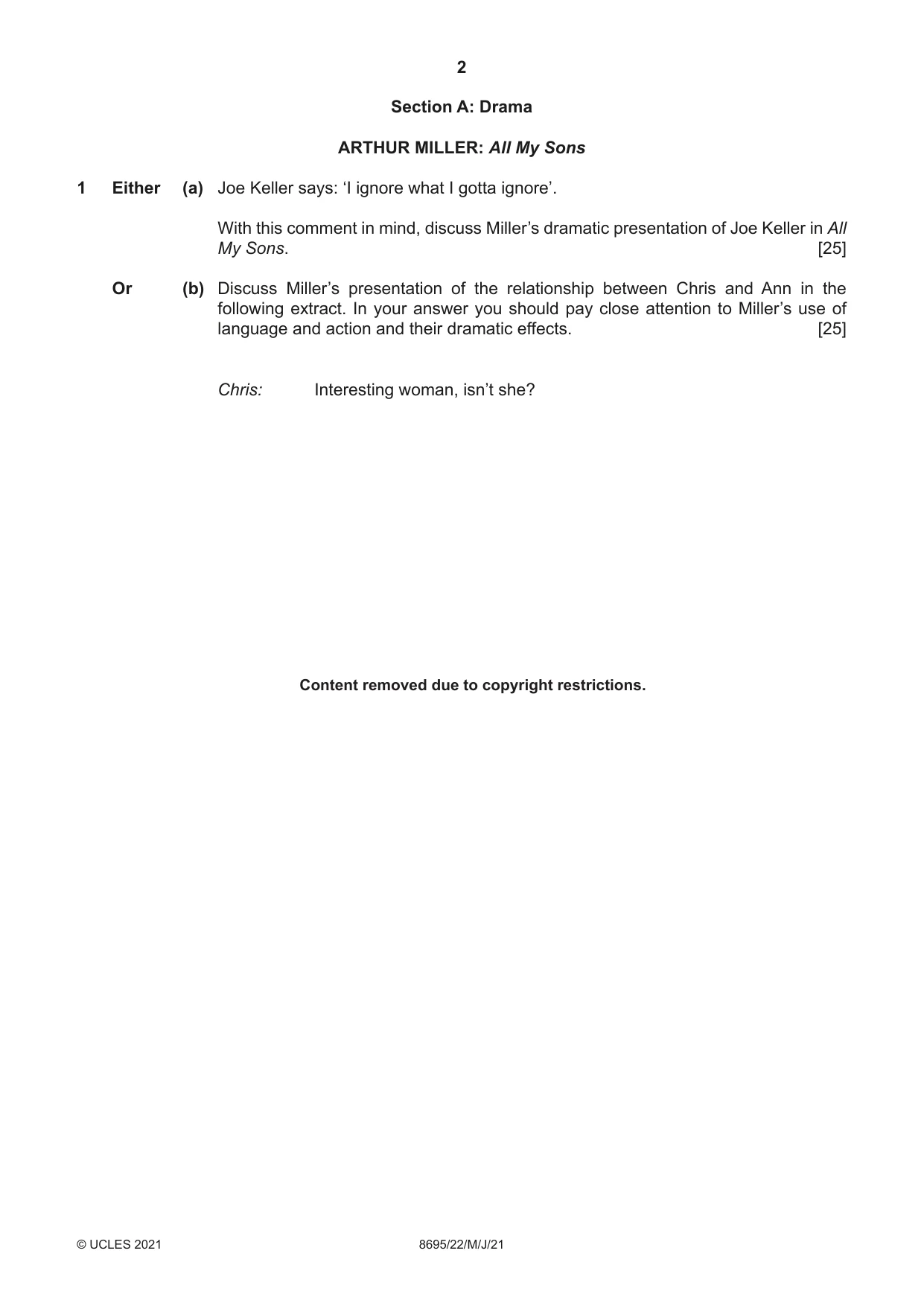
2 8695/22/M/J/21 © UCLES 2021 Section A: Drama ARTHUR MILLER: All My Sons 1 Either (a) Joe Keller says: ‘I ignore what I gotta ignore’. With this comment in mind, discuss Miller’s dramatic presentation of Joe Keller in All My Sons. [25] Or (b) Discuss Miller’s presentation of the relationship between Chris and Ann in the following extract. In your answer you should pay close attention to Miller’s use of language and action and their dramatic effects. [25] Chris: Interesting woman, isn’t she? Content removed due to copyright restrictions.
Question paper, page 3
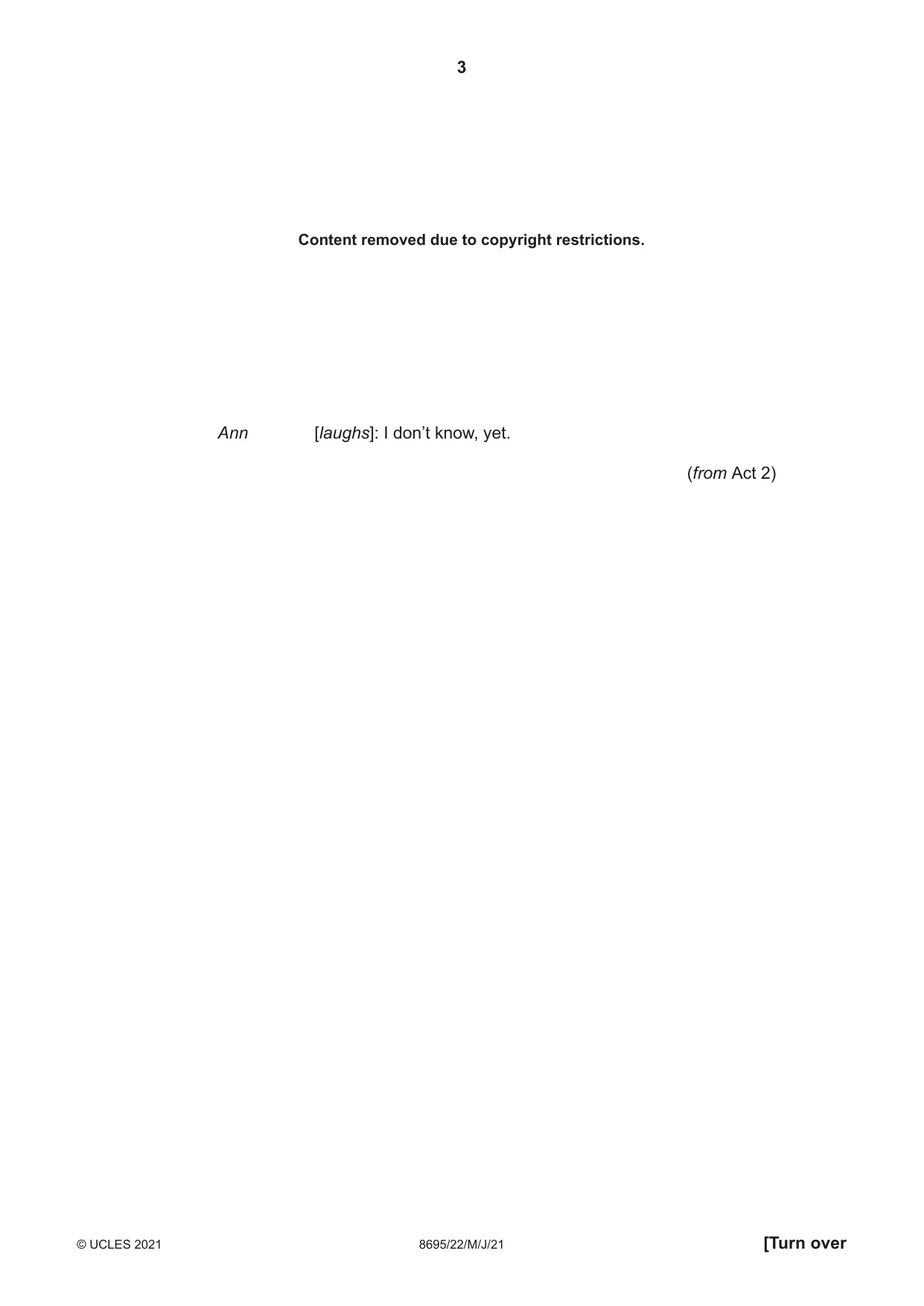
3 8695/22/M/J/21 © UCLES 2021 [Turn over Ann [laughs]: I don’t know, yet. (from Act 2) Content removed due to copyright restrictions.
Question paper, page 4
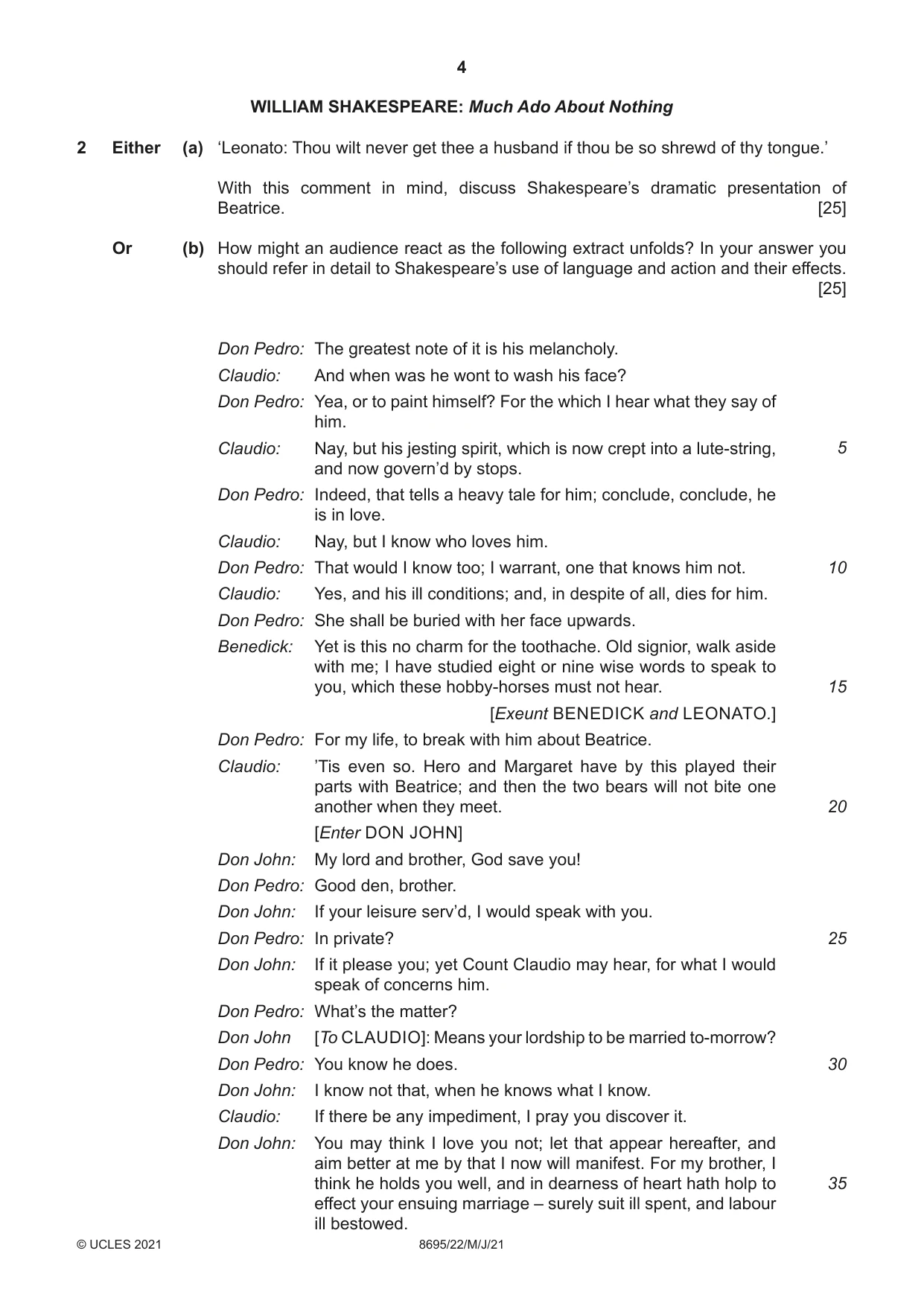
4 8695/22/M/J/21 © UCLES 2021 WILLIAM SHAKESPEARE: Much Ado About Nothing 2 Either (a) ‘Leonato: Thou wilt never get thee a husband if thou be so shrewd of thy tongue.’ With this comment in mind, discuss Shakespeare’s dramatic presentation of Beatrice. [25] Or (b) How might an audience react as the following extract unfolds? In your answer you should refer in detail to Shakespeare’s use of language and action and their effects. [25] Don Pedro: The greatest note of it is his melancholy. Claudio: And when was he wont to wash his face? Don Pedro: Yea, or to paint himself? For the which I hear what they say of him. Claudio: Nay, but his jesting spirit, which is now crept into a lute-string, and now govern’d by stops. Don Pedro: Indeed, that tells a heavy tale for him; conclude, conclude, he is in love. Claudio: Nay, but I know who loves him. Don Pedro: That would I know too; I warrant, one that knows him not. Claudio: Yes, and his ill conditions; and, in despite of all, dies for him. Don Pedro: She shall be buried with her face upwards. Benedick: Yet is this no charm for the toothache. Old signior, walk aside with me; I have studied eight or nine wise words to speak to you, which these hobby-horses must not hear. [Exeunt BENEDICK and LEONATO.] Don Pedro: For my life, to break with him about Beatrice. Claudio: ’Tis even so. Hero and Margaret have by this played their parts with Beatrice; and then the two bears will not bite one another when they meet. [Enter DON JOHN] Don John: My lord and brother, God save you! Don Pedro: Good den, brother. Don John: If your leisure serv’d, I would speak with you. Don Pedro: In private? Don John: If it please you; yet Count Claudio may hear, for what I would speak of concerns him. Don Pedro: What’s the matter? Don John [To CLAUDIO]: Means your lordship to be married to-morrow? Don Pedro: You know he does. Don John: I know not that, when he knows what I know. Claudio: If there be any impediment, I pray you discover it. Don John: You may think I love you not; let that appear hereafter, and aim better at me by that I now will manifest. For my brother, I think he holds you well, and in dearness of heart hath holp to effect your ensuing marriage – surely suit ill spent, and labour ill bestowed. 5 10 15 20 25 30 35
Question paper, page 5
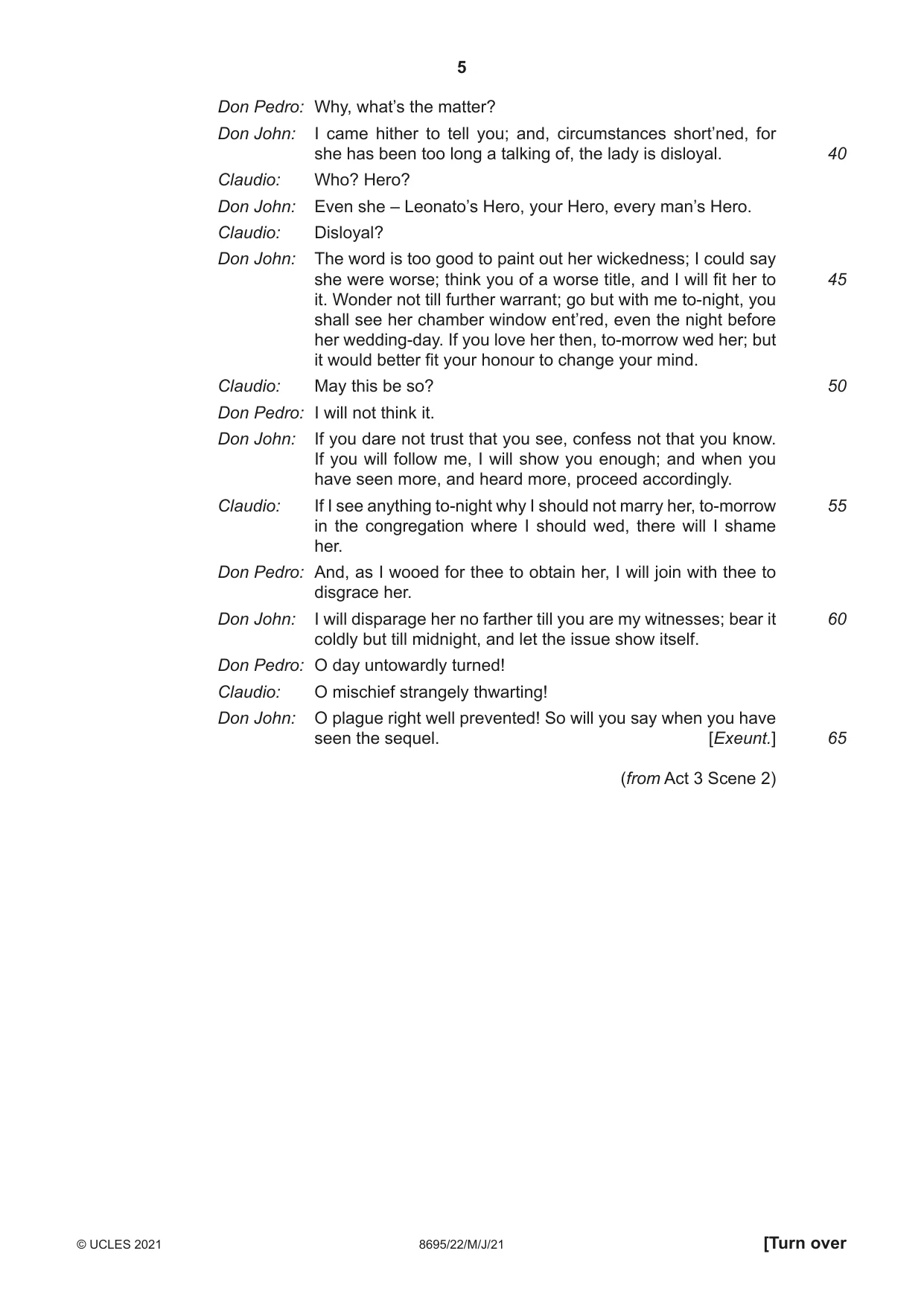
5 8695/22/M/J/21 © UCLES 2021 [Turn over Don Pedro: Why, what’s the matter? Don John: I came hither to tell you; and, circumstances short’ned, for she has been too long a talking of, the lady is disloyal. Claudio: Who? Hero? Don John: Even she – Leonato’s Hero, your Hero, every man’s Hero. Claudio: Disloyal? Don John: The word is too good to paint out her wickedness; I could say she were worse; think you of a worse title, and I will fit her to it. Wonder not till further warrant; go but with me to-night, you shall see her chamber window ent’red, even the night before her wedding-day. If you love her then, to-morrow wed her; but it would better fit your honour to change your mind. Claudio: May this be so? Don Pedro: I will not think it. Don John: If you dare not trust that you see, confess not that you know. If you will follow me, I will show you enough; and when you have seen more, and heard more, proceed accordingly. Claudio: If I see anything to-night why I should not marry her, to-morrow in the congregation where I should wed, there will I shame her. Don Pedro: And, as I wooed for thee to obtain her, I will join with thee to disgrace her. Don John: I will disparage her no farther till you are my witnesses; bear it coldly but till midnight, and let the issue show itself. Don Pedro: O day untowardly turned! Claudio: O mischief strangely thwarting! Don John: O plague right well prevented! So will you say when you have seen the sequel. [Exeunt.] (from Act 3 Scene 2) 40 45 50 55 60 65
Question paper, page 6
6 8695/22/M/J/21 © UCLES 2021 WOLE SOYINKA: The Trials of Brother Jero and Jero’s Metamorphosis 3 Either (a) Discuss some of the ways Soyinka presents different characters’ desire for money. [25] Or (b) How does Soyinka shape an audience’s response to Jero in the following extract from Jero’s Metamorphosis? You should pay close attention to his dramatic methods and their effects in your answer. [25] [BROTHER JERO’s office. It is no longer his rent-troubled shack of The Trials but a modest white-washed room, quite comfortable. Content removed due to copyright restrictions.
Question paper, page 7
7 8695/22/M/J/21 © UCLES 2021 [Turn over Jero: I have but little gifts, Sister Rebecca, but I make the most of them. (from Jero’s Metamorphosis, Scene 1) Content removed due to copyright restrictions.
Question paper, page 8
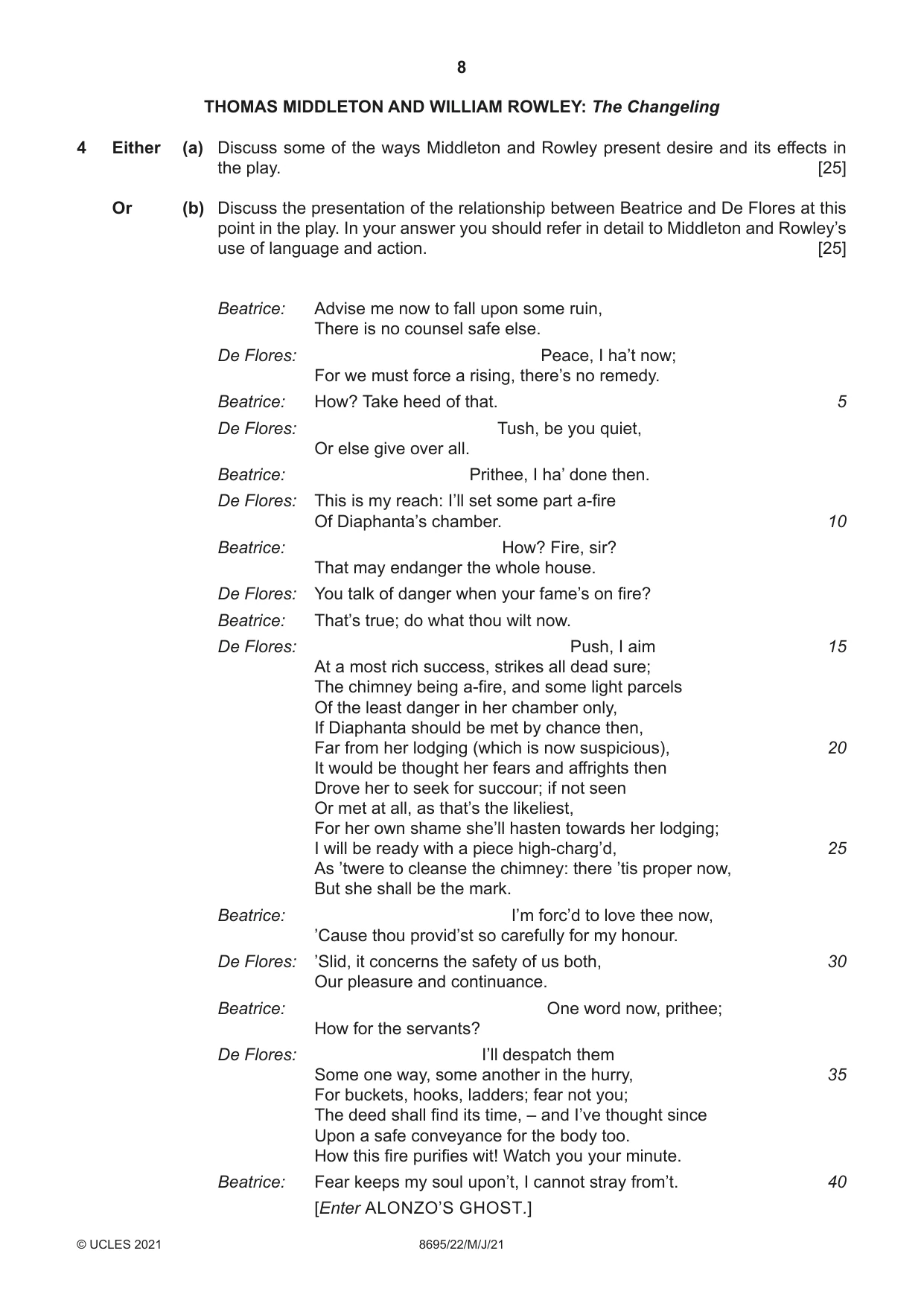
8 8695/22/M/J/21 © UCLES 2021 THOMAS MIDDLETON AND WILLIAM ROWLEY: The Changeling 4 Either (a) Discuss some of the ways Middleton and Rowley present desire and its effects in the play. [25] Or (b) Discuss the presentation of the relationship between Beatrice and De Flores at this point in the play. In your answer you should refer in detail to Middleton and Rowley’s use of language and action. [25] Beatrice: Advise me now to fall upon some ruin, There is no counsel safe else. De Flores: Peace, I ha’t now; For we must force a rising, there’s no remedy. Beatrice: How? Take heed of that. De Flores: Tush, be you quiet, Or else give over all. Beatrice: Prithee, I ha’ done then. De Flores: This is my reach: I’ll set some part a-fire Of Diaphanta’s chamber. Beatrice: How? Fire, sir? That may endanger the whole house. De Flores: You talk of danger when your fame’s on fire? Beatrice: That’s true; do what thou wilt now. De Flores: Push, I aim At a most rich success, strikes all dead sure; The chimney being a-fire, and some light parcels Of the least danger in her chamber only, If Diaphanta should be met by chance then, Far from her lodging (which is now suspicious), It would be thought her fears and affrights then Drove her to seek for succour; if not seen Or met at all, as that’s the likeliest, For her own shame she’ll hasten towards her lodging; I will be ready with a piece high-charg’d, As ’twere to cleanse the chimney: there ’tis proper now, But she shall be the mark. Beatrice: I’m forc’d to love thee now, ’Cause thou provid’st so carefully for my honour. De Flores: ’Slid, it concerns the safety of us both, Our pleasure and continuance. Beatrice: One word now, prithee; How for the servants? De Flores: I’ll despatch them Some one way, some another in the hurry, For buckets, hooks, ladders; fear not you; The deed shall find its time, – and I’ve thought since Upon a safe conveyance for the body too. How this fire purifies wit! Watch you your minute. Beatrice: Fear keeps my soul upon’t, I cannot stray from’t. [Enter ALONZO’S GHOST.] 5 10 15 20 25 30 35 40
Question paper, page 9
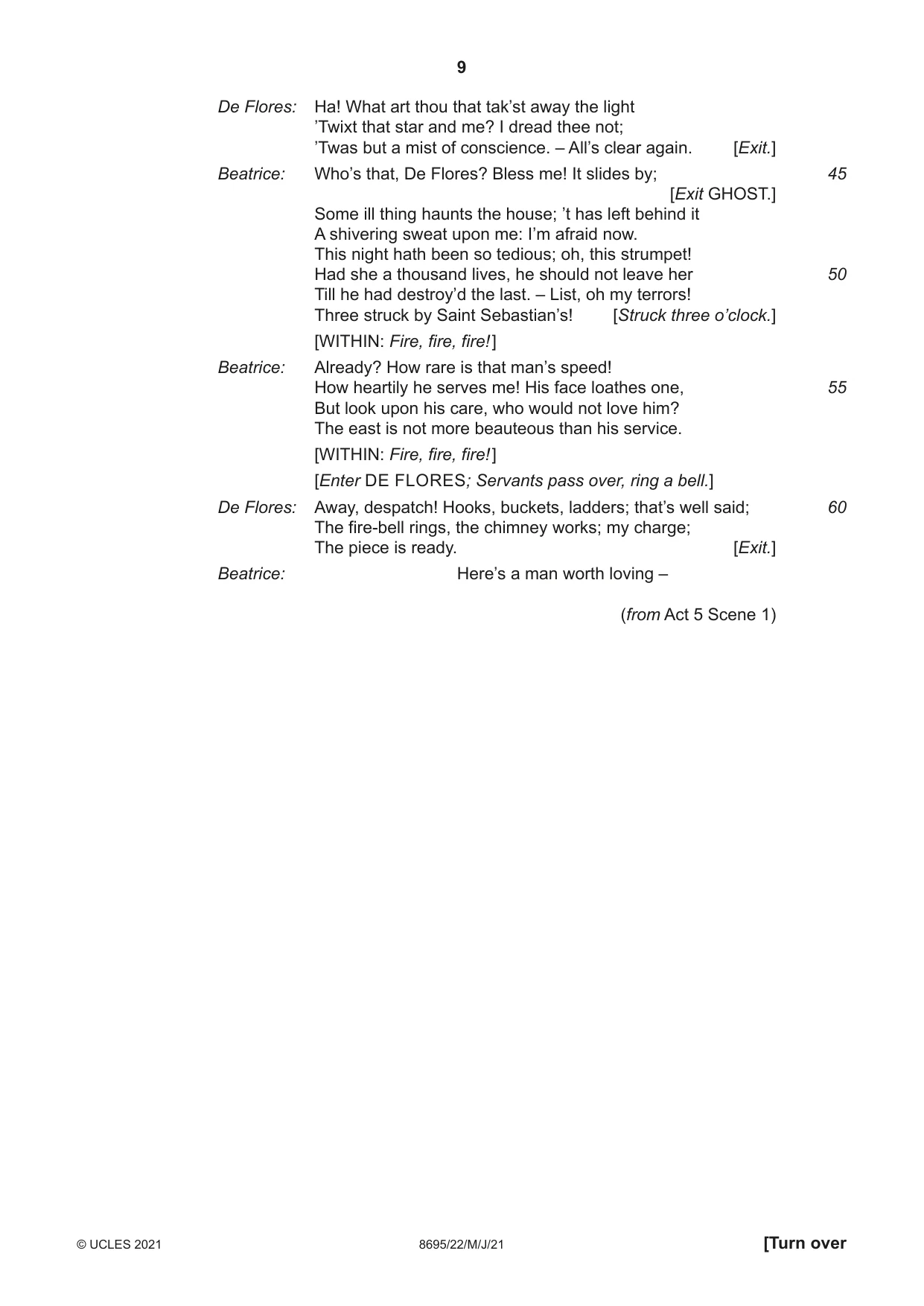
9 8695/22/M/J/21 © UCLES 2021 [Turn over De Flores: Ha! What art thou that tak’st away the light ’Twixt that star and me? I dread thee not; ’Twas but a mist of conscience. – All’s clear again. [Exit.] Beatrice: Who’s that, De Flores? Bless me! It slides by; [Exit GHOST.] Some ill thing haunts the house; ’t has left behind it A shivering sweat upon me: I’m afraid now. This night hath been so tedious; oh, this strumpet! Had she a thousand lives, he should not leave her Till he had destroy’d the last. – List, oh my terrors! Three struck by Saint Sebastian’s! [Struck three o’clock.] [WITHIN: Fire, fire, fire! ] Beatrice: Already? How rare is that man’s speed! How heartily he serves me! His face loathes one, But look upon his care, who would not love him? The east is not more beauteous than his service. [WITHIN: Fire, fire, fire! ] [Enter DE FLORES; Servants pass over, ring a bell.] De Flores: Away, despatch! Hooks, buckets, ladders; that’s well said; The fire-bell rings, the chimney works; my charge; The piece is ready. [Exit.] Beatrice: Here’s a man worth loving – (from Act 5 Scene 1) 45 50 55 60
Question paper, page 10
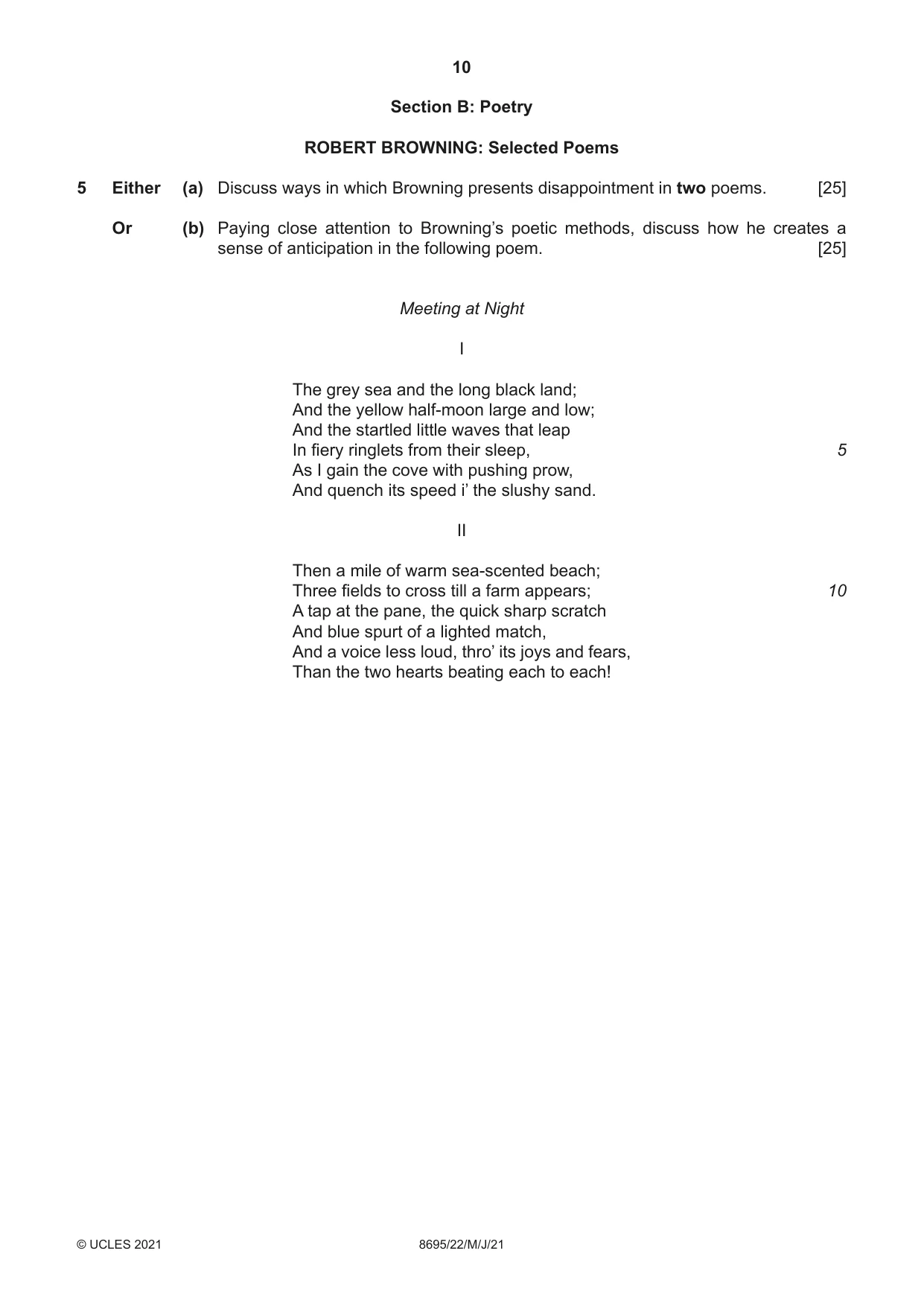
10 8695/22/M/J/21 © UCLES 2021 Section B: Poetry ROBERT BROWNING: Selected Poems 5 Either (a) Discuss ways in which Browning presents disappointment in two poems. [25] Or (b) Paying close attention to Browning’s poetic methods, discuss how he creates a sense of anticipation in the following poem. [25] Meeting at Night I The grey sea and the long black land; And the yellow half-moon large and low; And the startled little waves that leap In fiery ringlets from their sleep, As I gain the cove with pushing prow, And quench its speed i’ the slushy sand. II Then a mile of warm sea-scented beach; Three fields to cross till a farm appears; A tap at the pane, the quick sharp scratch And blue spurt of a lighted match, And a voice less loud, thro’ its joys and fears, Than the two hearts beating each to each! 5 10
Question paper, page 11
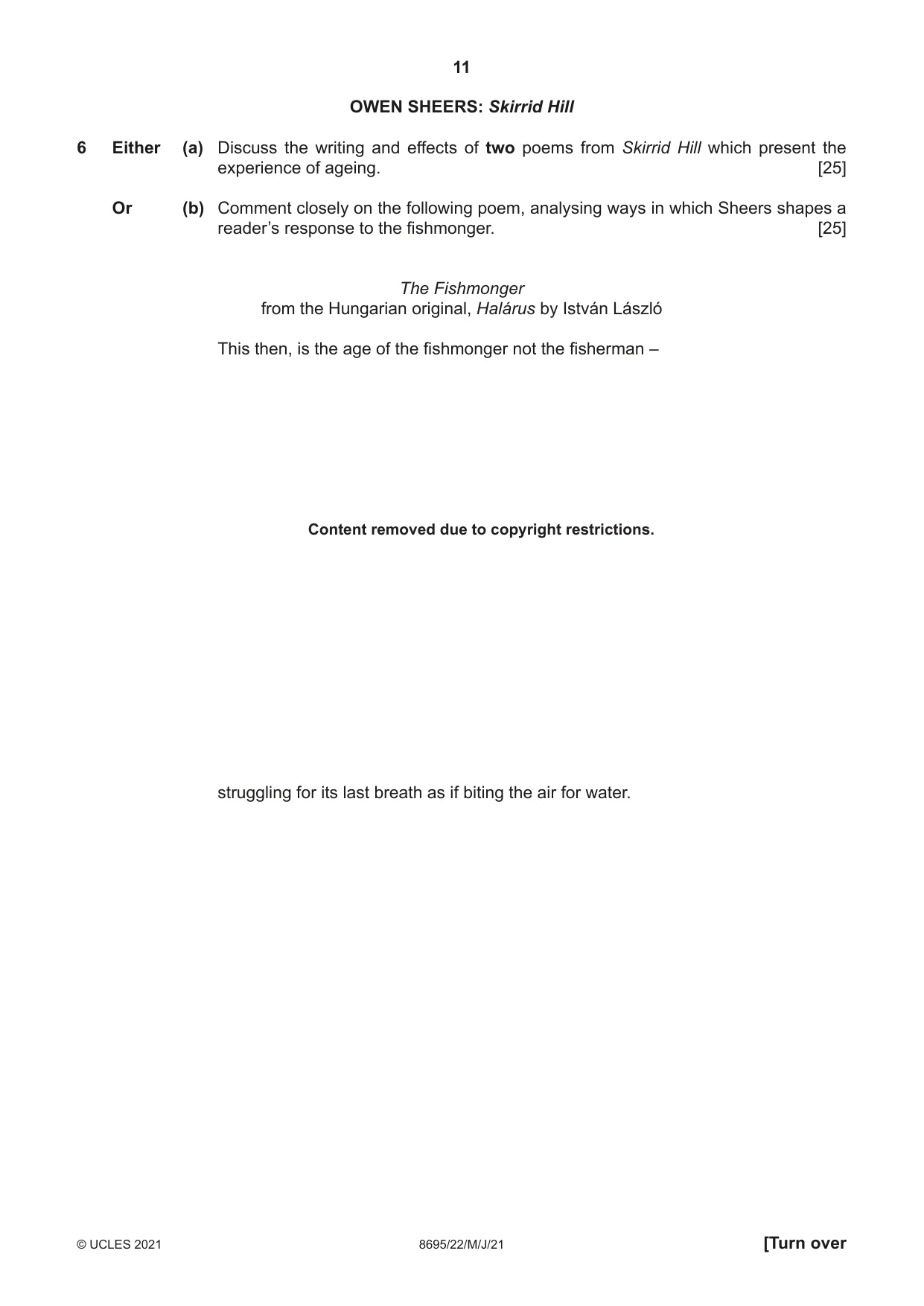
11 8695/22/M/J/21 © UCLES 2021 [Turn over OWEN SHEERS: Skirrid Hill 6 Either (a) Discuss the writing and effects of two poems from Skirrid Hill which present the experience of ageing. [25] Or (b) Comment closely on the following poem, analysing ways in which Sheers shapes a reader’s response to the fishmonger. [25] The Fishmonger from the Hungarian original, Halárus by István László This then, is the age of the fishmonger not the fisherman – struggling for its last breath as if biting the air for water. Content removed due to copyright restrictions.
Question paper, page 12
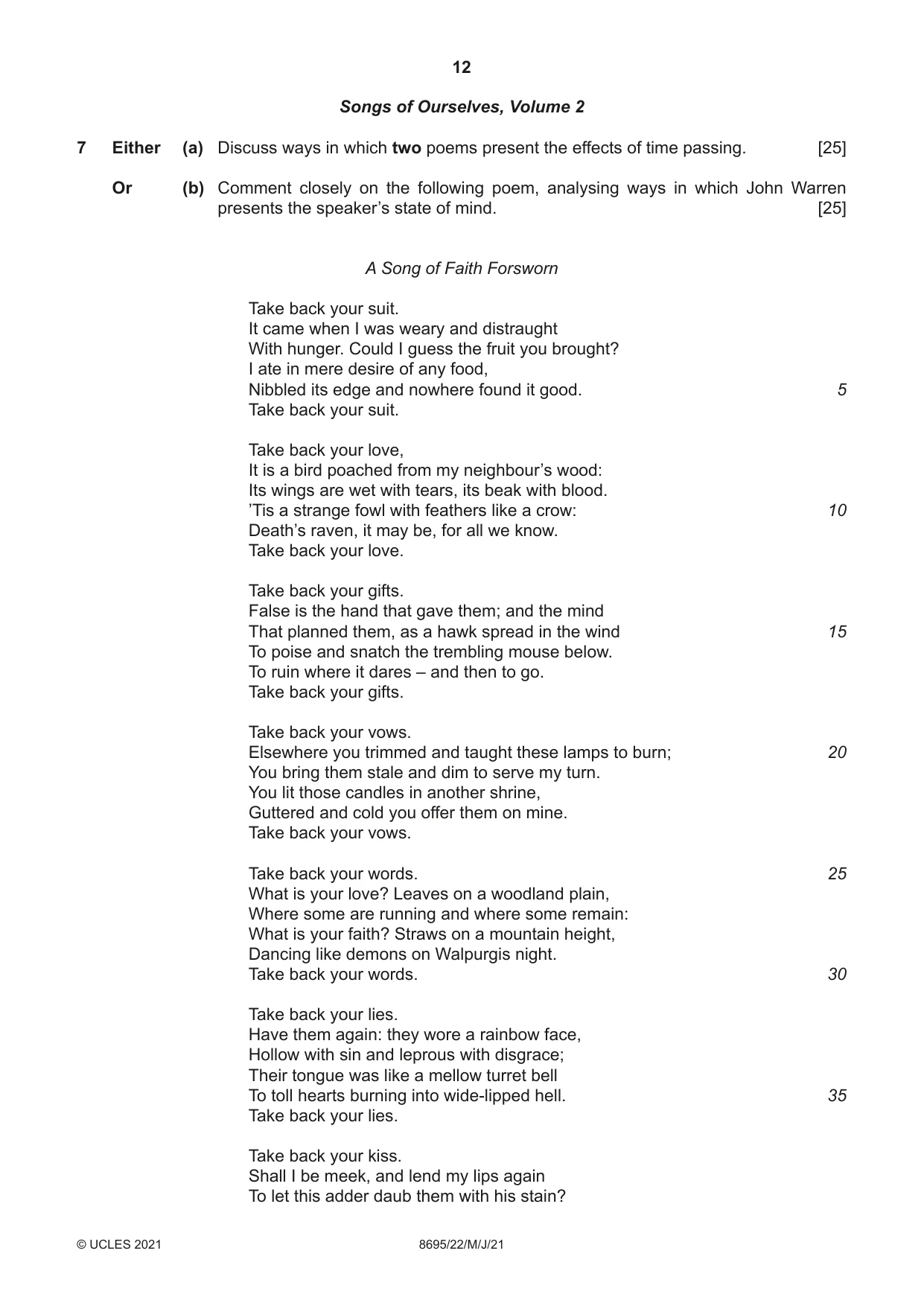
12 8695/22/M/J/21 © UCLES 2021 Songs of Ourselves, Volume 2 7 Either (a) Discuss ways in which two poems present the effects of time passing. [25] Or (b) Comment closely on the following poem, analysing ways in which John Warren presents the speaker’s state of mind. [25] A Song of Faith Forsworn Take back your suit. It came when I was weary and distraught With hunger. Could I guess the fruit you brought? I ate in mere desire of any food, Nibbled its edge and nowhere found it good. Take back your suit. Take back your love, It is a bird poached from my neighbour’s wood: Its wings are wet with tears, its beak with blood. ’Tis a strange fowl with feathers like a crow: Death’s raven, it may be, for all we know. Take back your love. Take back your gifts. False is the hand that gave them; and the mind That planned them, as a hawk spread in the wind To poise and snatch the trembling mouse below. To ruin where it dares – and then to go. Take back your gifts. Take back your vows. Elsewhere you trimmed and taught these lamps to burn; You bring them stale and dim to serve my turn. You lit those candles in another shrine, Guttered and cold you offer them on mine. Take back your vows. Take back your words. What is your love? Leaves on a woodland plain, Where some are running and where some remain: What is your faith? Straws on a mountain height, Dancing like demons on Walpurgis night. Take back your words. Take back your lies. Have them again: they wore a rainbow face, Hollow with sin and leprous with disgrace; Their tongue was like a mellow turret bell To toll hearts burning into wide-lipped hell. Take back your lies. Take back your kiss. Shall I be meek, and lend my lips again To let this adder daub them with his stain? 5 10 15 20 25 30 35
Question paper, page 13
13 8695/22/M/J/21 © UCLES 2021 [Turn over Shall I turn cheek to answer, when I hate? You kiss like Judas in the garden gate! Take back your kiss. Take back delight, A paper boat launched on a heaving pool To please a child, and folded by a fool; The wild elms roared: it sailed – a yard or more. Out went our ship but never came to shore. Take back delight. Take back your wreath. Has it done service on a fairer brow? Fresh, was it folded round her bosom snow? Her cast-off weed my breast will never wear: Your word is ‘love me.’ My reply ‘despair!’ Take back your wreath. (John Warren, Lord De Tabley) 40 45 50
Question paper, page 14
14 8695/22/M/J/21 © UCLES 2021 GILLIAN CLARKE: Selected Poems 8 Either (a) Compare ways in which Clarke presents the importance of memories in two poems. [25] Or (b) Discuss Clarke’s presentation of the sick child in the following poem. In your answer you should pay close attention to poetic methods and effects. [25] White Roses Outside the green velvet sitting room white roses bloom after rain. They hold water and sunlight like cups of fine white china. Within the boy who sleeps in my care in the big chair the cold bloom opens at terrible speed and the splinter of ice moves in his blood as he stirs in the chair. Remembering me he smiles politely, gritting his teeth in silence on pain’s red blaze. A stick man in the ashes, his fires die back. He is spars and springs. He can talk again, gather his cat to his bones. She springs with a small cry in her throat, kneading with diamond paws his dry as tinder flesh. The least spark of pain will burn him like straw. The sun carelessly shines after rain. The cat tracks thrushes in sweet dark soil. And without concern the rose outlives the child. 5 10 15 20
Question paper, page 15
15 8695/22/M/J/21 © UCLES 2021 [Turn over BLANK PAGE TURN OVER FOR SECTION C.
Question paper, page 16
16 8695/22/M/J/21 © UCLES 2021 Section C: Prose E M FORSTER: Howards End 9 Either (a) Discuss Forster’s presentation of Jacky Bast and her role in the novel. [25] Or (b) Comment closely on the presentation of Charles and Tibby in the following passage. [25] Honest and hearty was Charles’s dislike, and the past spread itself out very clearly before him; hatred is a skilful compositor. Content removed due to copyright restrictions.
Question paper, page 17
17 8695/22/M/J/21 © UCLES 2021 [Turn over And Tibby found himself alone. (from Chapter 39)
Question paper, page 18
18 8695/22/M/J/21 © UCLES 2021 ANDREA LEVY: Small Island 10 Either (a) Gilbert tells the American soldiers that ‘England is my Mother Country’ and ‘I’m British’. In the light of Gilbert’s comments, discuss Levy’s presentation of identity in the novel. [25] Or (b) Comment closely on Levy’s presentation of Hortense and Queenie in the following passage. [25] I ceased all movement – not even my heart dared a beat. Content removed due to copyright restrictions.
Question paper, page 19
19 8695/22/M/J/21 © UCLES 2021 [Turn over ‘I’m sorry but I don’t understand what you’re saying.’ (from Chapter 22) Content removed due to copyright restrictions.
Question paper, page 20
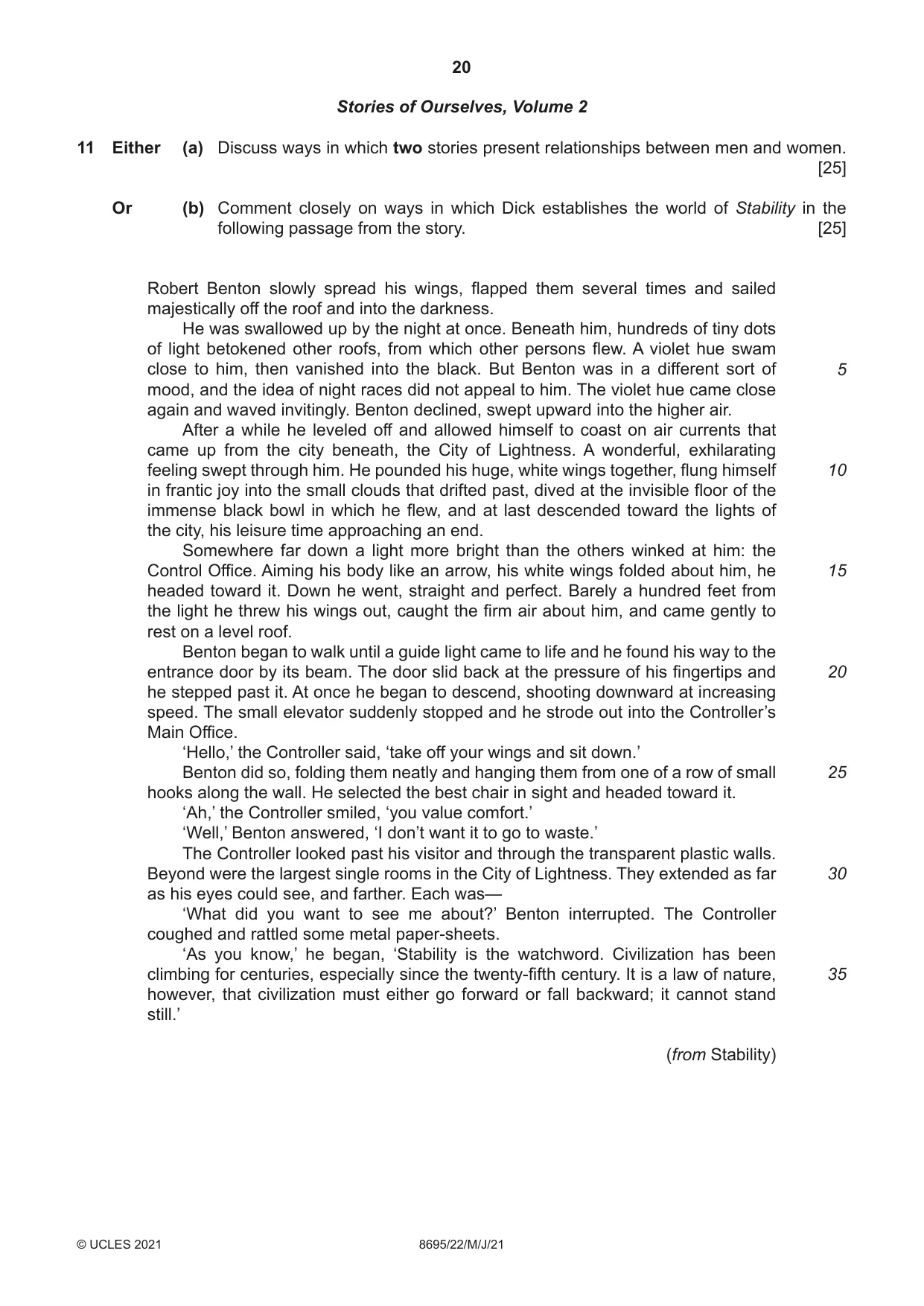
20 8695/22/M/J/21 © UCLES 2021 Stories of Ourselves, Volume 2 11 Either (a) Discuss ways in which two stories present relationships between men and women. [25] Or (b) Comment closely on ways in which Dick establishes the world of Stability in the following passage from the story. [25] Robert Benton slowly spread his wings, flapped them several times and sailed majestically off the roof and into the darkness. He was swallowed up by the night at once. Beneath him, hundreds of tiny dots of light betokened other roofs, from which other persons flew. A violet hue swam close to him, then vanished into the black. But Benton was in a different sort of mood, and the idea of night races did not appeal to him. The violet hue came close again and waved invitingly. Benton declined, swept upward into the higher air. After a while he leveled off and allowed himself to coast on air currents that came up from the city beneath, the City of Lightness. A wonderful, exhilarating feeling swept through him. He pounded his huge, white wings together, flung himself in frantic joy into the small clouds that drifted past, dived at the invisible floor of the immense black bowl in which he flew, and at last descended toward the lights of the city, his leisure time approaching an end. Somewhere far down a light more bright than the others winked at him: the Control Office. Aiming his body like an arrow, his white wings folded about him, he headed toward it. Down he went, straight and perfect. Barely a hundred feet from the light he threw his wings out, caught the firm air about him, and came gently to rest on a level roof. Benton began to walk until a guide light came to life and he found his way to the entrance door by its beam. The door slid back at the pressure of his fingertips and he stepped past it. At once he began to descend, shooting downward at increasing speed. The small elevator suddenly stopped and he strode out into the Controller’s Main Office. ‘Hello,’ the Controller said, ‘take off your wings and sit down.’ Benton did so, folding them neatly and hanging them from one of a row of small hooks along the wall. He selected the best chair in sight and headed toward it. ‘Ah,’ the Controller smiled, ‘you value comfort.’ ‘Well,’ Benton answered, ‘I don’t want it to go to waste.’ The Controller looked past his visitor and through the transparent plastic walls. Beyond were the largest single rooms in the City of Lightness. They extended as far as his eyes could see, and farther. Each was— ‘What did you want to see me about?’ Benton interrupted. The Controller coughed and rattled some metal paper-sheets. ‘As you know,’ he began, ‘Stability is the watchword. Civilization has been climbing for centuries, especially since the twenty-fifth century. It is a law of nature, however, that civilization must either go forward or fall backward; it cannot stand still.’ (from Stability) 5 10 15 20 25 30 35
Question paper, page 21
21 8695/22/M/J/21 © UCLES 2021 [Turn over BLANK PAGE TURN OVER FOR QUESTION 12.
Question paper, page 22
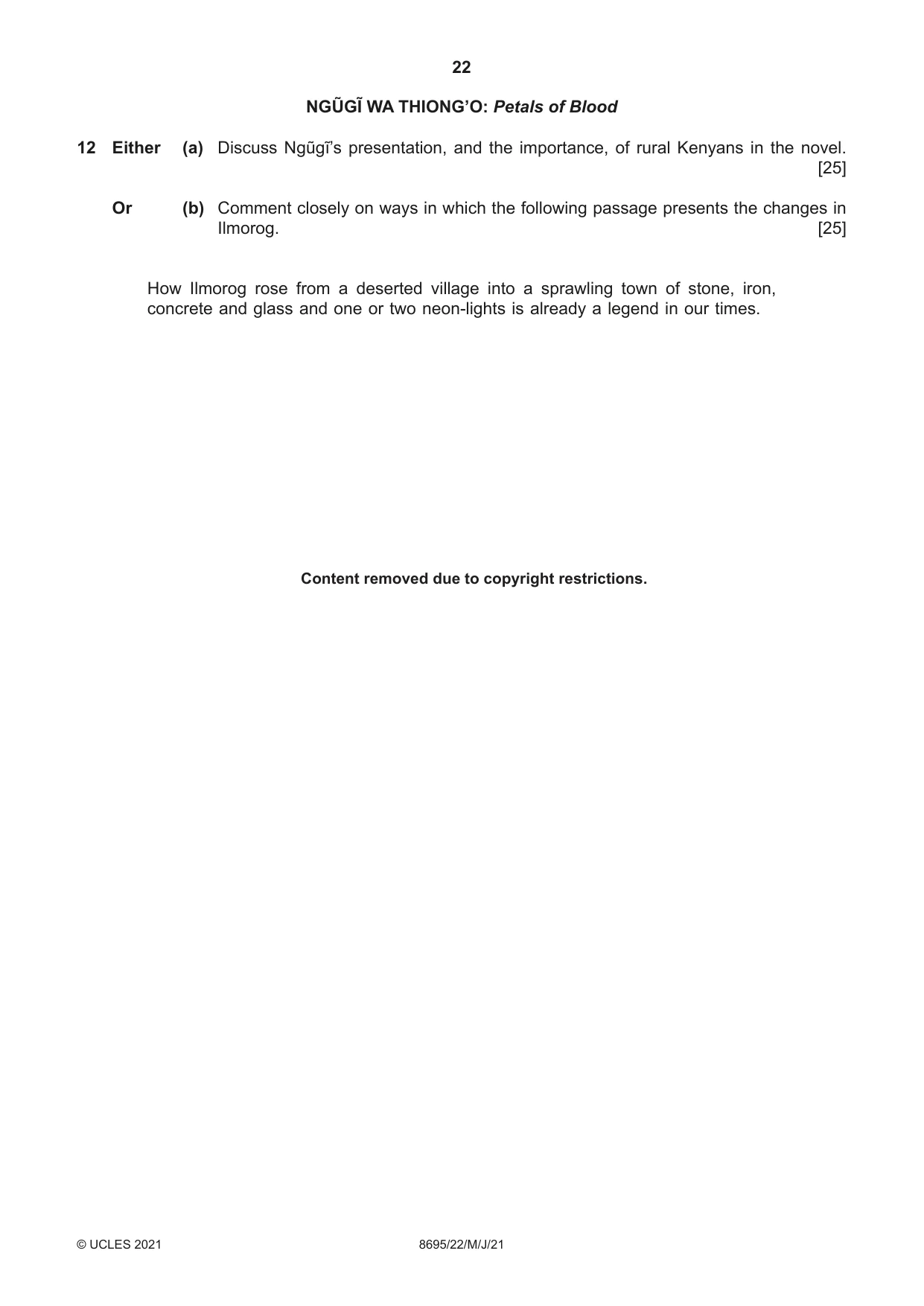
22 8695/22/M/J/21 © UCLES 2021 NGŨGĨ WA THIONG’O: Petals of Blood 12 Either (a) Discuss Ngũgĩ’s presentation, and the importance, of rural Kenyans in the novel. [25] Or (b) Comment closely on ways in which the following passage presents the changes in Ilmorog. [25] How Ilmorog rose from a deserted village into a sprawling town of stone, iron, concrete and glass and one or two neon-lights is already a legend in our times. Content removed due to copyright restrictions.
Question paper, page 23
23 8695/22/M/J/21 © UCLES 2021 Wa – thii – ku (from Chapter 11) Content removed due to copyright restrictions.
Question paper, page 24
24 8695/22/M/J/21 © UCLES 2021 Permission to reproduce items where third-party owned material protected by copyright is included has been sought and cleared where possible Every reasonable effort has been made by the publisher (UCLES) to trace copyright holders but if any items requiring clearance have unwittingly been included the publisher will be pleased to make amends at the earliest possible opportunity To avoid the issue of disclosure of answer-related information to candidates all copyright acknowledgements are reproduced online in the Cambridge Assessment nternational Education Copyright Acknowledgements Booklet This is produced for each series of examinations and is freely available to download at www cambridgeinternational org after the live examination series Cambridge Assessment nternational Education is part of the Cambridge Assessment Group Cambridge Assessment is the brand name of the University of Cambridge Local Examinations Syndicate (UCLES) which itself is a department of the University of Cambridge BLANK PAGE
Mark scheme, page 1
This document consists of 13 printed pages. © UCLES 2021 [Turn over Cambridge International AS Level LANGUAGE AND LITERATURE IN ENGLISH 8695/22 Paper 2 Writing May/June 2021 MARK SCHEME Maximum Mark: 50 Published This mark scheme is published as an aid to teachers and candidates, to indicate the requirements of the examination. It shows the basis on which Examiners were instructed to award marks. It does not indicate the details of the discussions that took place at an Examiners’ meeting before marking began, which would have considered the acceptability of alternative answers. Mark schemes should be read in conjunction with the question paper and the Principal Examiner Report for Teachers. Cambridge International will not enter into discussions about these mark schemes. Cambridge International is publishing the mark schemes for the May/June 2021 series for most Cambridge IGCSE™, Cambridge International A and AS Level components and some Cambridge O Level components.
Mark scheme, page 2
8695/22 Cambridge International AS Level – Mark Scheme PUBLISHED May/June 2021 © UCLES 2021 Page 2 of 13 Generic Marking Principles These general marking principles must be applied by all examiners when marking candidate answers. They should be applied alongside the specific content of the mark scheme or generic level descriptors for a question. Each question paper and mark scheme will also comply with these marking principles. GENERIC MARKING PRINCIPLE 1: Marks must be awarded in line with: • the specific content of the mark scheme or the generic level descriptors for the question • the specific skills defined in the mark scheme or in the generic level descriptors for the question • the standard of response required by a candidate as exemplified by the standardisation scripts. GENERIC MARKING PRINCIPLE 2: Marks awarded are always whole marks (not half marks, or other fractions). GENERIC MARKING PRINCIPLE 3: Marks must be awarded positively: • marks are awarded for correct/valid answers, as defined in the mark scheme. However, credit is given for valid answers which go beyond the scope of the syllabus and mark scheme, referring to your Team Leader as appropriate • marks are awarded when candidates clearly demonstrate what they know and can do • marks are not deducted for errors • marks are not deducted for omissions • answers should only be judged on the quality of spelling, punctuation and grammar when these features are specifically assessed by the question as indicated by the mark scheme. The meaning, however, should be unambiguous. GENERIC MARKING PRINCIPLE 4: Rules must be applied consistently, e.g. in situations where candidates have not followed instructions or in the application of generic level descriptors. GENERIC MARKING PRINCIPLE 5: Marks should be awarded using the full range of marks defined in the mark scheme for the question (however; the use of the full mark range may be limited according to the quality of the candidate responses seen). GENERIC MARKING PRINCIPLE 6: Marks awarded are based solely on the requirements as defined in the mark scheme. Marks should not be awarded with grade thresholds or grade descriptors in mind.
Mark scheme, page 3
8695/22 Cambridge International AS Level – Mark Scheme PUBLISHED May/June 2021 © UCLES 2021 Page 3 of 13 English & Media subject specific general marking principles (To be read in conjunction with the Generic Marking Principles (and requiring further guidance on how to place marks within levels)) Components using level descriptors: • We use level descriptors as a guide to broad understanding of the qualities normally expected of, or typical of, work in a level. • Level descriptors are a means of general guidance, and should not be interpreted as hurdle statements. • Where indicative content notes are supplied for a question, these are not a prescription of required content, and must not be treated as such. Alternative correct points and unexpected answers in candidates’ scripts must be given marks that fairly reflect the knowledge and skills demonstrated. • While we may have legitimate expectations as to the ground most answers may occupy, we must at all times be prepared to meet candidates on their chosen ground, provided it is relevant ground (e.g. clearly related to and derived from a relevant passage/text and meeting the mark scheme requirements for the question). Components using point-based marking: Point marking is often used to reward knowledge, understanding and application of skills. We give credit where the candidate’s answer shows relevant knowledge, understanding and application of skills in answering the question. We do not give credit where the answer shows confusion. From this it follows that we: a DO credit answers which are worded differently from the mark scheme if they clearly convey the same meaning (unless the mark scheme requires a specific term). b DO credit alternative answers/examples which are not written in the mark scheme if they are correct. c DO credit answers where candidates give more than one correct answer in one prompt/numbered/scaffolded space where extended writing is required rather than list-type answers. For example, questions that require n reasons (e.g. State two reasons…). d DO NOT credit answers simply for using a ‘key term’ unless that is all that is required. (Check for evidence it is understood and not used wrongly.). e DO NOT credit answers which are obviously self-contradicting or trying to cover all possibilities. f DO NOT give further credit for what is effectively repetition of a correct point already credited unless the language itself is being tested. This applies equally to ‘mirror statements’ (i.e. polluted/not polluted). g DO NOT require spellings to be correct, unless this is part of the test. However spellings of syllabus terms must allow for clear and unambiguous separation from other syllabus terms with which they may be confused (e.g. Corrasion/Corrosion).
Mark scheme, page 4
8695/22 Cambridge International AS Level – Mark Scheme PUBLISHED May/June 2021 © UCLES 2021 Page 4 of 13 Literature in English specific marking instructions Using the mark levels Use the generic mark scheme levels to find the mark. Place the answer in a level first. Look for the ‘best fit’ of the answer into a level. An answer needs to show evidence of most but not necessarily ALL of the qualities described in a level, in order to be placed in that level. Then award a mark for the relative position of the answer within the level. Candidates may address the question in many different ways. There is no one required answer or approach and do not penalise answers for leaving out a particular focus. Reward what is there, showing what you are rewarding in your comments. Consider all strands and weigh up the performance as a whole in placing the answer in a level, then show that you have done so in the summative comment. Each answer is marked out of 25, in accordance with the general marking criteria. Assessment objectives All assessment objectives are equally weighted, and all are considered in assessing each essay. Each level in the marking criteria is divided into strands corresponding to the assessment objectives – AO1: Knowledge and understanding (K/U), AO2: Analysis (AN), AO3: Personal response (P), AO4: Communication (C). AO1 Knowledge and understanding Respond with understanding to literary texts in a variety of forms, from different cultures; with an appreciation of relevant contexts that illuminate readings of the texts. AO2 Analysis Analyse ways in which writers’ choices of language, form and structure shape meanings and effects. AO3 Personal response Produce informed independent opinions and interpretations of literary texts. AO4 Communication Communicate a relevant, structured and supported response appropriate to literary study.
Mark scheme, page 5
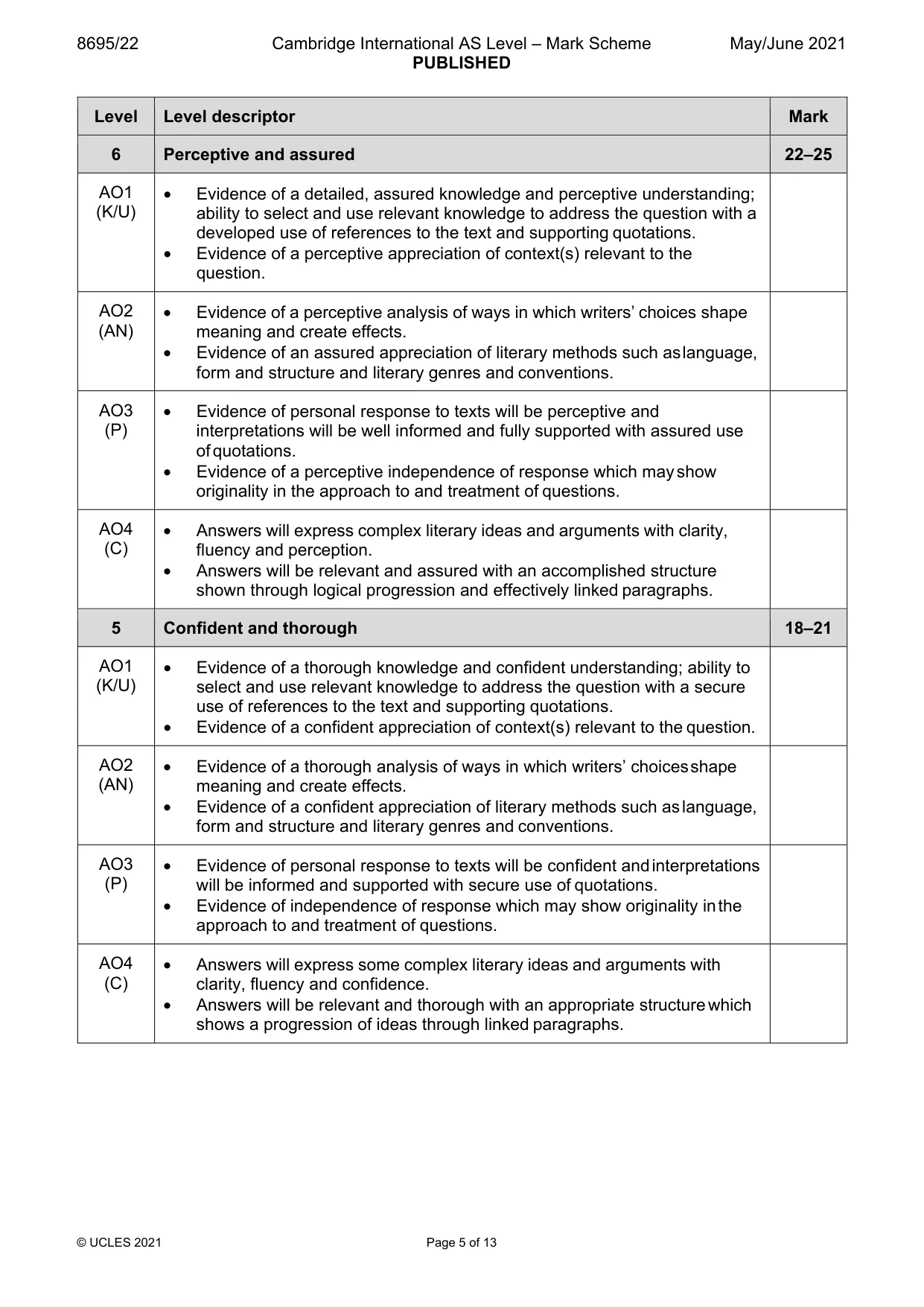
8695/22 Cambridge International AS Level – Mark Scheme PUBLISHED May/June 2021 © UCLES 2021 Page 5 of 13 Level Level descriptor Mark 6 Perceptive and assured 22–25 AO1 (K/U) • Evidence of a detailed, assured knowledge and perceptive understanding; ability to select and use relevant knowledge to address the question with a developed use of references to the text and supporting quotations. • Evidence of a perceptive appreciation of context(s) relevant to the question. AO2 (AN) • Evidence of a perceptive analysis of ways in which writers’ choices shape meaning and create effects. • Evidence of an assured appreciation of literary methods such as language, form and structure and literary genres and conventions. AO3 (P) • Evidence of personal response to texts will be perceptive and interpretations will be well informed and fully supported with assured use of quotations. • Evidence of a perceptive independence of response which may show originality in the approach to and treatment of questions. AO4 (C) • Answers will express complex literary ideas and arguments with clarity, fluency and perception. • Answers will be relevant and assured with an accomplished structure shown through logical progression and effectively linked paragraphs. 5 Confident and thorough 18–21 AO1 (K/U) • Evidence of a thorough knowledge and confident understanding; ability to select and use relevant knowledge to address the question with a secure use of references to the text and supporting quotations. • Evidence of a confident appreciation of context(s) relevant to the question. AO2 (AN) • Evidence of a thorough analysis of ways in which writers’ choices shape meaning and create effects. • Evidence of a confident appreciation of literary methods such as language, form and structure and literary genres and conventions. AO3 (P) • Evidence of personal response to texts will be confident and interpretations will be informed and supported with secure use of quotations. • Evidence of independence of response which may show originality in the approach to and treatment of questions. AO4 (C) • Answers will express some complex literary ideas and arguments with clarity, fluency and confidence. • Answers will be relevant and thorough with an appropriate structure which shows a progression of ideas through linked paragraphs.
Mark scheme, page 6
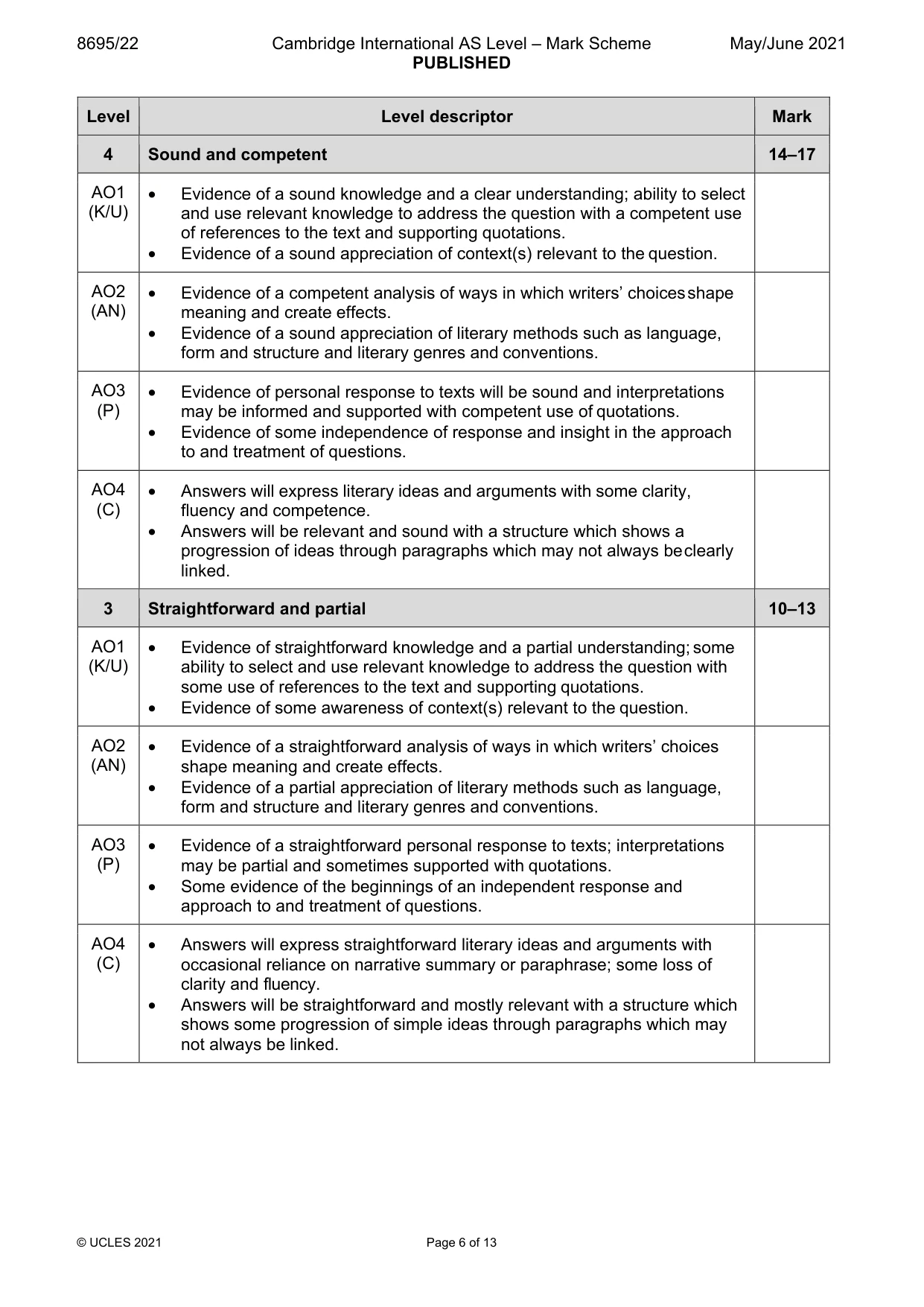
8695/22 Cambridge International AS Level – Mark Scheme PUBLISHED May/June 2021 © UCLES 2021 Page 6 of 13 Level Level descriptor Mark 4 Sound and competent 14–17 AO1 (K/U) • Evidence of a sound knowledge and a clear understanding; ability to select and use relevant knowledge to address the question with a competent use of references to the text and supporting quotations. • Evidence of a sound appreciation of context(s) relevant to the question. AO2 (AN) • Evidence of a competent analysis of ways in which writers’ choices shape meaning and create effects. • Evidence of a sound appreciation of literary methods such as language, form and structure and literary genres and conventions. AO3 (P) • Evidence of personal response to texts will be sound and interpretations may be informed and supported with competent use of quotations. • Evidence of some independence of response and insight in the approach to and treatment of questions. AO4 (C) • Answers will express literary ideas and arguments with some clarity, fluency and competence. • Answers will be relevant and sound with a structure which shows a progression of ideas through paragraphs which may not always be clearly linked. 3 Straightforward and partial 10–13 AO1 (K/U) • Evidence of straightforward knowledge and a partial understanding; some ability to select and use relevant knowledge to address the question with some use of references to the text and supporting quotations. • Evidence of some awareness of context(s) relevant to the question. AO2 (AN) • Evidence of a straightforward analysis of ways in which writers’ choices shape meaning and create effects. • Evidence of a partial appreciation of literary methods such as language, form and structure and literary genres and conventions. AO3 (P) • Evidence of a straightforward personal response to texts; interpretations may be partial and sometimes supported with quotations. • Some evidence of the beginnings of an independent response and approach to and treatment of questions. AO4 (C) • Answers will express straightforward literary ideas and arguments with occasional reliance on narrative summary or paraphrase; some loss of clarity and fluency. • Answers will be straightforward and mostly relevant with a structure which shows some progression of simple ideas through paragraphs which may not always be linked.
Mark scheme, page 7
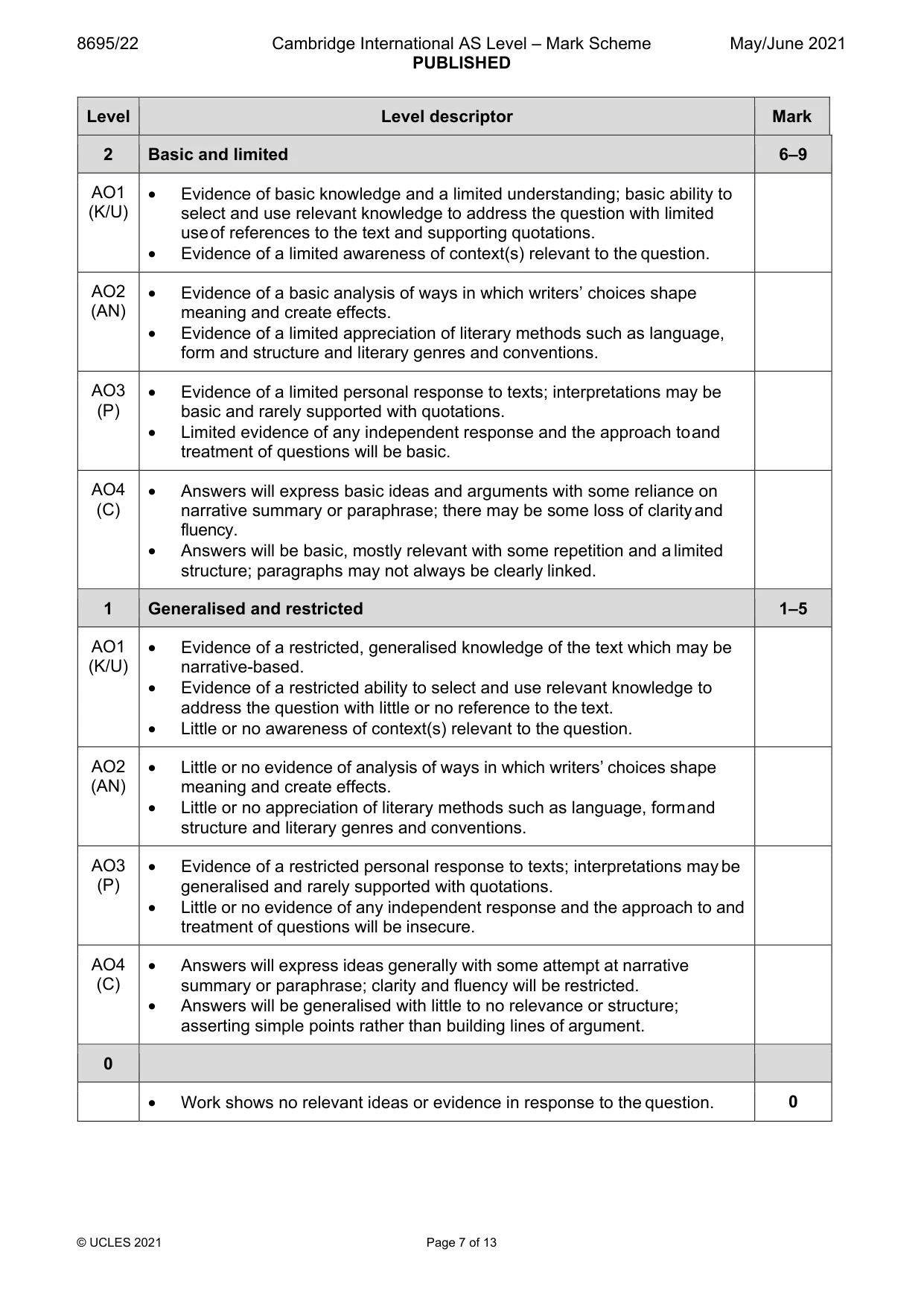
8695/22 Cambridge International AS Level – Mark Scheme PUBLISHED May/June 2021 © UCLES 2021 Page 7 of 13 Level Level descriptor Mark 2 Basic and limited 6–9 AO1 (K/U) • Evidence of basic knowledge and a limited understanding; basic ability to select and use relevant knowledge to address the question with limited use of references to the text and supporting quotations. • Evidence of a limited awareness of context(s) relevant to the question. AO2 (AN) • Evidence of a basic analysis of ways in which writers’ choices shape meaning and create effects. • Evidence of a limited appreciation of literary methods such as language, form and structure and literary genres and conventions. AO3 (P) • Evidence of a limited personal response to texts; interpretations may be basic and rarely supported with quotations. • Limited evidence of any independent response and the approach to and treatment of questions will be basic. AO4 (C) • Answers will express basic ideas and arguments with some reliance on narrative summary or paraphrase; there may be some loss of clarity and fluency. • Answers will be basic, mostly relevant with some repetition and a limited structure; paragraphs may not always be clearly linked. 1 Generalised and restricted 1–5 AO1 (K/U) • Evidence of a restricted, generalised knowledge of the text which may be narrative-based. • Evidence of a restricted ability to select and use relevant knowledge to address the question with little or no reference to the text. • Little or no awareness of context(s) relevant to the question. AO2 (AN) • Little or no evidence of analysis of ways in which writers’ choices shape meaning and create effects. • Little or no appreciation of literary methods such as language, form and structure and literary genres and conventions. AO3 (P) • Evidence of a restricted personal response to texts; interpretations may be generalised and rarely supported with quotations. • Little or no evidence of any independent response and the approach to and treatment of questions will be insecure. AO4 (C) • Answers will express ideas generally with some attempt at narrative summary or paraphrase; clarity and fluency will be restricted. • Answers will be generalised with little to no relevance or structure; asserting simple points rather than building lines of argument. 0 • Work shows no relevant ideas or evidence in response to the question. 0
Mark scheme, page 8
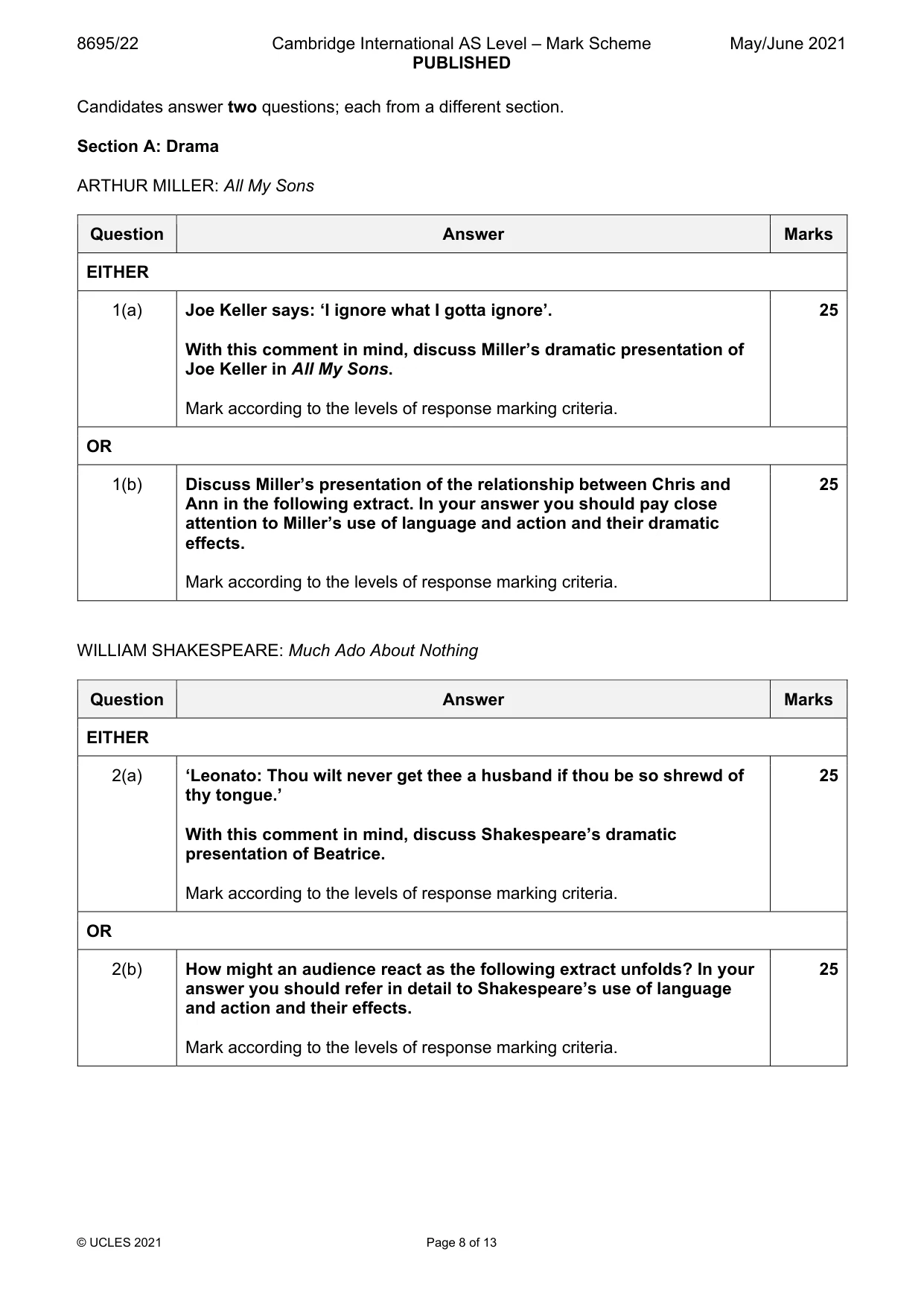
8695/22 Cambridge International AS Level – Mark Scheme PUBLISHED May/June 2021 © UCLES 2021 Page 8 of 13 Candidates answer two questions; each from a different section. Section A: Drama ARTHUR MILLER: All My Sons Question Answer Marks EITHER 1(a) Joe Keller says: ‘I ignore what I gotta ignore’. With this comment in mind, discuss Miller’s dramatic presentation of Joe Keller in All My Sons. Mark according to the levels of response marking criteria. 25 OR 1(b) Discuss Miller’s presentation of the relationship between Chris and Ann in the following extract. In your answer you should pay close attention to Miller’s use of language and action and their dramatic effects. Mark according to the levels of response marking criteria. 25 WILLIAM SHAKESPEARE: Much Ado About Nothing Question Answer Marks EITHER 2(a) ‘Leonato: Thou wilt never get thee a husband if thou be so shrewd of thy tongue.’ With this comment in mind, discuss Shakespeare’s dramatic presentation of Beatrice. Mark according to the levels of response marking criteria. 25 OR 2(b) How might an audience react as the following extract unfolds? In your answer you should refer in detail to Shakespeare’s use of language and action and their effects. Mark according to the levels of response marking criteria. 25
Mark scheme, page 9
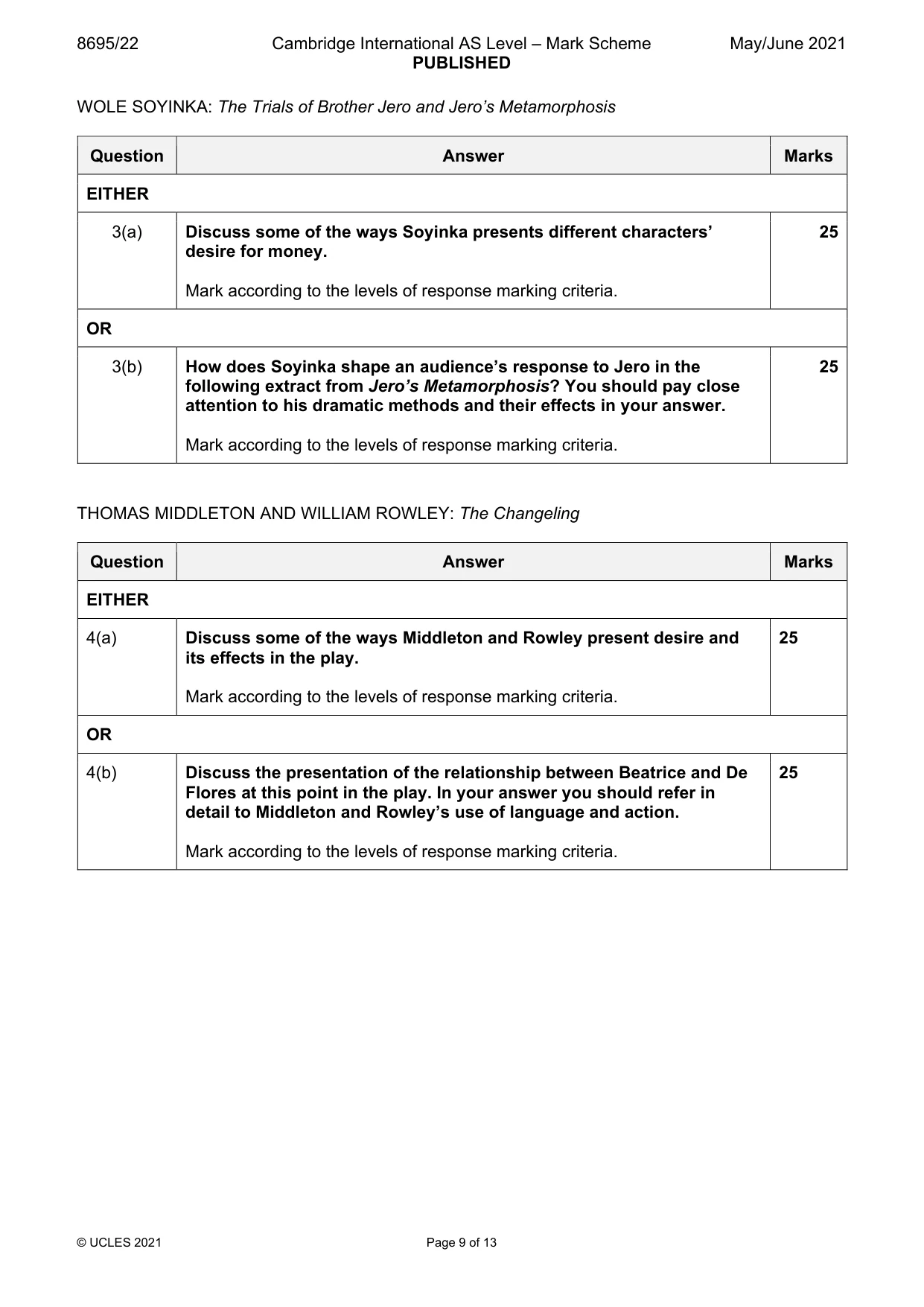
8695/22 Cambridge International AS Level – Mark Scheme PUBLISHED May/June 2021 © UCLES 2021 Page 9 of 13 WOLE SOYINKA: The Trials of Brother Jero and Jero’s Metamorphosis Question Answer Marks EITHER 3(a) Discuss some of the ways Soyinka presents different characters’ desire for money. Mark according to the levels of response marking criteria. 25 OR 3(b) How does Soyinka shape an audience’s response to Jero in the following extract from Jero’s Metamorphosis? You should pay close attention to his dramatic methods and their effects in your answer. Mark according to the levels of response marking criteria. 25 THOMAS MIDDLETON AND WILLIAM ROWLEY: The Changeling Question Answer Marks EITHER 4(a) Discuss some of the ways Middleton and Rowley present desire and its effects in the play. Mark according to the levels of response marking criteria. 25 OR 4(b) Discuss the presentation of the relationship between Beatrice and De Flores at this point in the play. In your answer you should refer in detail to Middleton and Rowley’s use of language and action. Mark according to the levels of response marking criteria. 25
Mark scheme, page 10
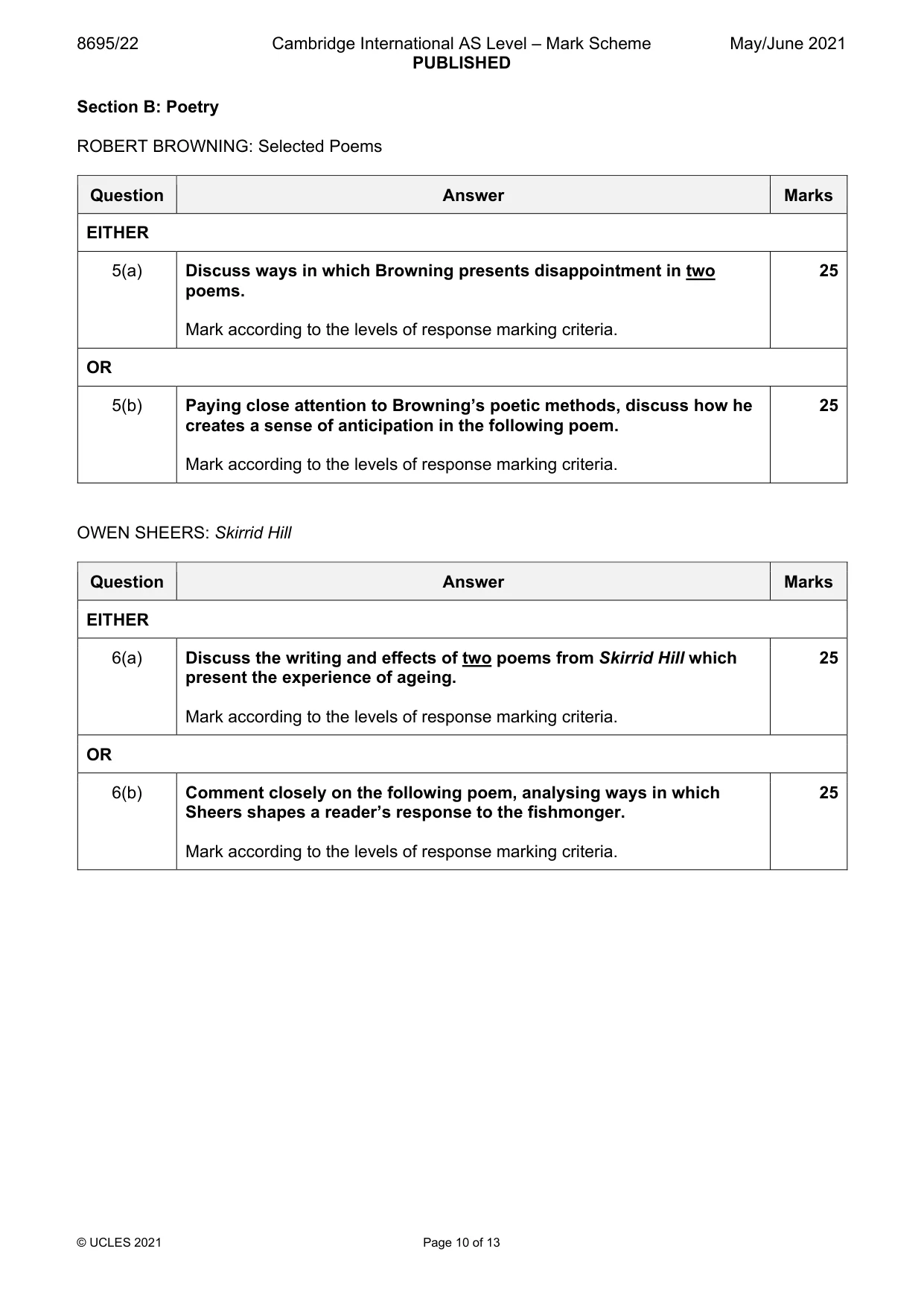
8695/22 Cambridge International AS Level – Mark Scheme PUBLISHED May/June 2021 © UCLES 2021 Page 10 of 13 Section B: Poetry ROBERT BROWNING: Selected Poems Question Answer Marks EITHER 5(a) Discuss ways in which Browning presents disappointment in two poems. Mark according to the levels of response marking criteria. 25 OR 5(b) Paying close attention to Browning’s poetic methods, discuss how he creates a sense of anticipation in the following poem. Mark according to the levels of response marking criteria. 25 OWEN SHEERS: Skirrid Hill Question Answer Marks EITHER 6(a) Discuss the writing and effects of two poems from Skirrid Hill which present the experience of ageing. Mark according to the levels of response marking criteria. 25 OR 6(b) Comment closely on the following poem, analysing ways in which Sheers shapes a reader’s response to the fishmonger. Mark according to the levels of response marking criteria. 25
Mark scheme, page 11
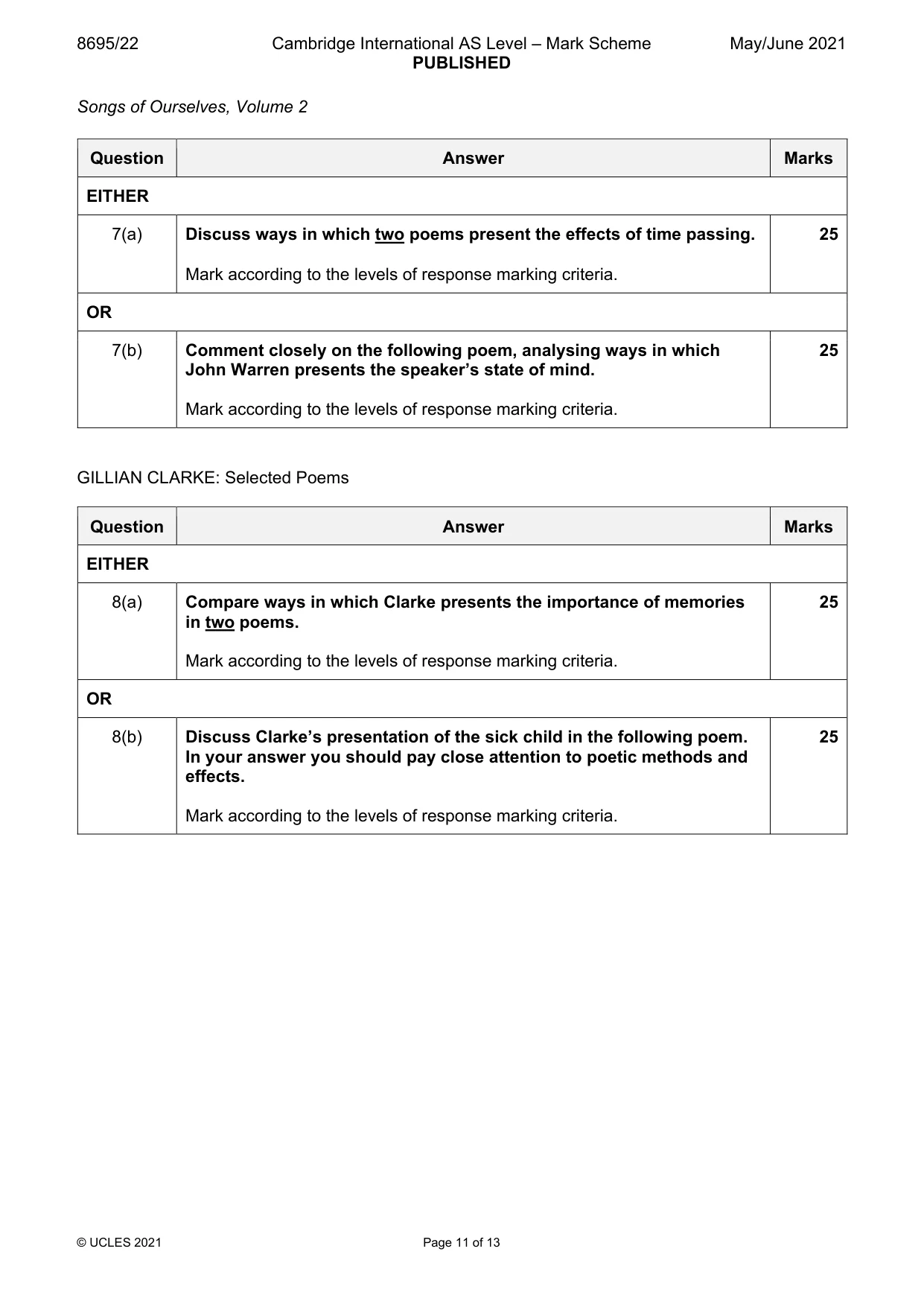
8695/22 Cambridge International AS Level – Mark Scheme PUBLISHED May/June 2021 © UCLES 2021 Page 11 of 13 Songs of Ourselves, Volume 2 Question Answer Marks EITHER 7(a) Discuss ways in which two poems present the effects of time passing. Mark according to the levels of response marking criteria. 25 OR 7(b) Comment closely on the following poem, analysing ways in which John Warren presents the speaker’s state of mind. Mark according to the levels of response marking criteria. 25 GILLIAN CLARKE: Selected Poems Question Answer Marks EITHER 8(a) Compare ways in which Clarke presents the importance of memories in two poems. Mark according to the levels of response marking criteria. 25 OR 8(b) Discuss Clarke’s presentation of the sick child in the following poem. In your answer you should pay close attention to poetic methods and effects. Mark according to the levels of response marking criteria. 25
Mark scheme, page 12
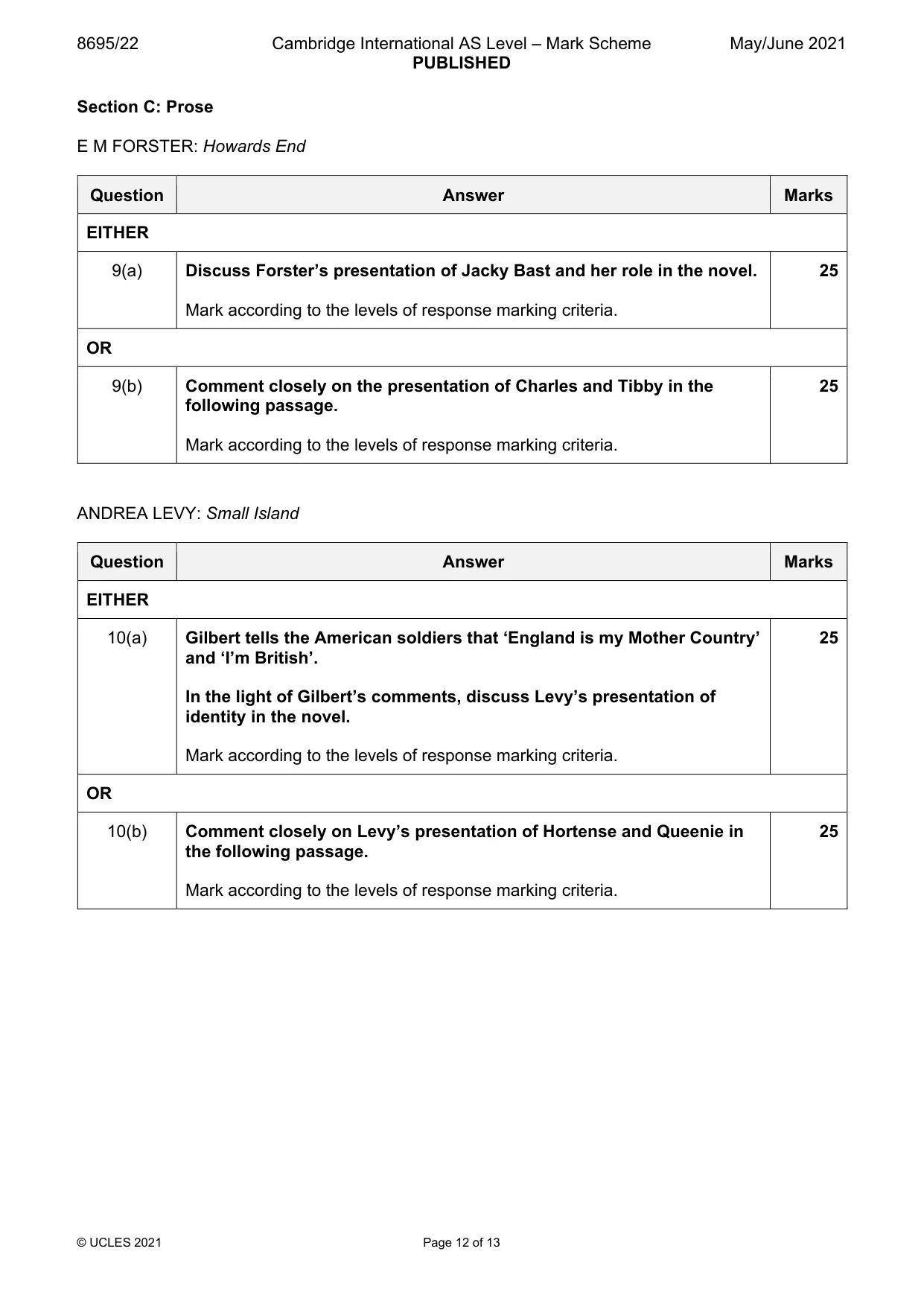
8695/22 Cambridge International AS Level – Mark Scheme PUBLISHED May/June 2021 © UCLES 2021 Page 12 of 13 Section C: Prose E M FORSTER: Howards End Question Answer Marks EITHER 9(a) Discuss Forster’s presentation of Jacky Bast and her role in the novel. Mark according to the levels of response marking criteria. 25 OR 9(b) Comment closely on the presentation of Charles and Tibby in the following passage. Mark according to the levels of response marking criteria. 25 ANDREA LEVY: Small Island Question Answer Marks EITHER 10(a) Gilbert tells the American soldiers that ‘England is my Mother Country’ and ‘I’m British’. In the light of Gilbert’s comments, discuss Levy’s presentation of identity in the novel. Mark according to the levels of response marking criteria. 25 OR 10(b) Comment closely on Levy’s presentation of Hortense and Queenie in the following passage. Mark according to the levels of response marking criteria. 25
Mark scheme, page 13
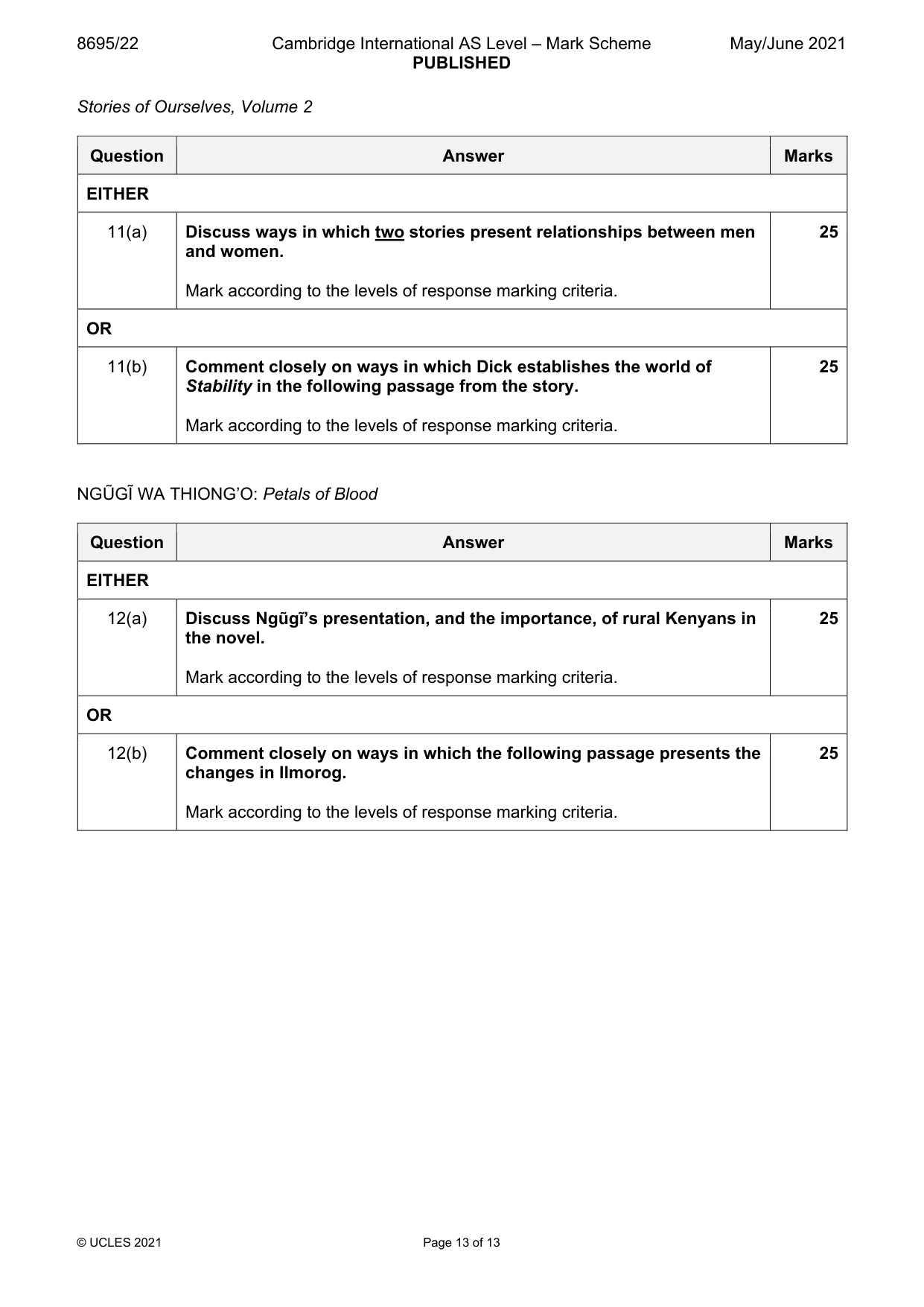
8695/22 Cambridge International AS Level – Mark Scheme PUBLISHED May/June 2021 © UCLES 2021 Page 13 of 13 Stories of Ourselves, Volume 2 Question Answer Marks EITHER 11(a) Discuss ways in which two stories present relationships between men and women. Mark according to the levels of response marking criteria. 25 OR 11(b) Comment closely on ways in which Dick establishes the world of Stability in the following passage from the story. Mark according to the levels of response marking criteria. 25 NGŨGĨ WA THIONG’O: Petals of Blood Question Answer Marks EITHER 12(a) Discuss Ngũgĩ’s presentation, and the importance, of rural Kenyans in the novel. Mark according to the levels of response marking criteria. 25 OR 12(b) Comment closely on ways in which the following passage presents the changes in Ilmorog. Mark according to the levels of response marking criteria. 25
What you needed in this session
Cambridge’s own grade thresholds for 2021 May/June, Paper 2 · Variant 2. A higher threshold means an easier paper — the bar moves with how the cohort did.