Cambridge A Level English - Language and Literature (AS Level only, from 2016) 8695 — 2021 May/June Paper 2 · Variant 1
8695/21/M/J/21 · 50 marks · ≈56 min
The question paper and its mark scheme, free to read here and free to download. This is Cambridge’s own paper, exactly as it was sat.
Question paper24 pages



Mark scheme13 pages
Answers below. Sit the paper first if you are practising.
Paper as text
Question paper, page 1
This document has 24 pages. Any blank pages are indicated. DC (RCL (DF)) 201366/4 © UCLES 2021 [Turn over * 5 9 2 3 7 0 4 7 1 6 * Cambridge International AS Level LANGUAGE AND LITERATURE IN ENGLISH 8695/21 Paper 2 Drama, Poetry and Prose May/June 2021 2 hours You must answer on the enclosed answer booklet. You will need: Answer booklet (enclosed) INSTRUCTIONS ● Answer two questions in total, each from a different section. ● Follow the instructions on the front cover of the answer booklet. If you need additional answer paper, ask the invigilator for a continuation booklet. ● Dictionaries are not allowed. INFORMATION ● The total mark for this paper is 50. ● The number of marks for each question or part question is shown in brackets [ ].
Question paper, page 2
2 8695/21/M/J/21 © UCLES 2021 Section A: Drama ARTHUR MILLER: All My Sons 1 Either (a) Discuss Miller’s presentation of different attitudes to wealth in All My Sons. [25] Or (b) Discuss Miller’s presentation of the relationship between Ann and Kate Keller (Mother) in the following extract. In your answer you should pay close attention to the language and dramatic effects. [25] Ann [to MOTHER]: Don’t let them bulldoze you. Content removed due to copyright restrictions.
Question paper, page 3
3 8695/21/M/J/21 © UCLES 2021 [Turn over Mother: I have to have some tea. (from Act 1) Content removed due to copyright restrictions.
Question paper, page 4
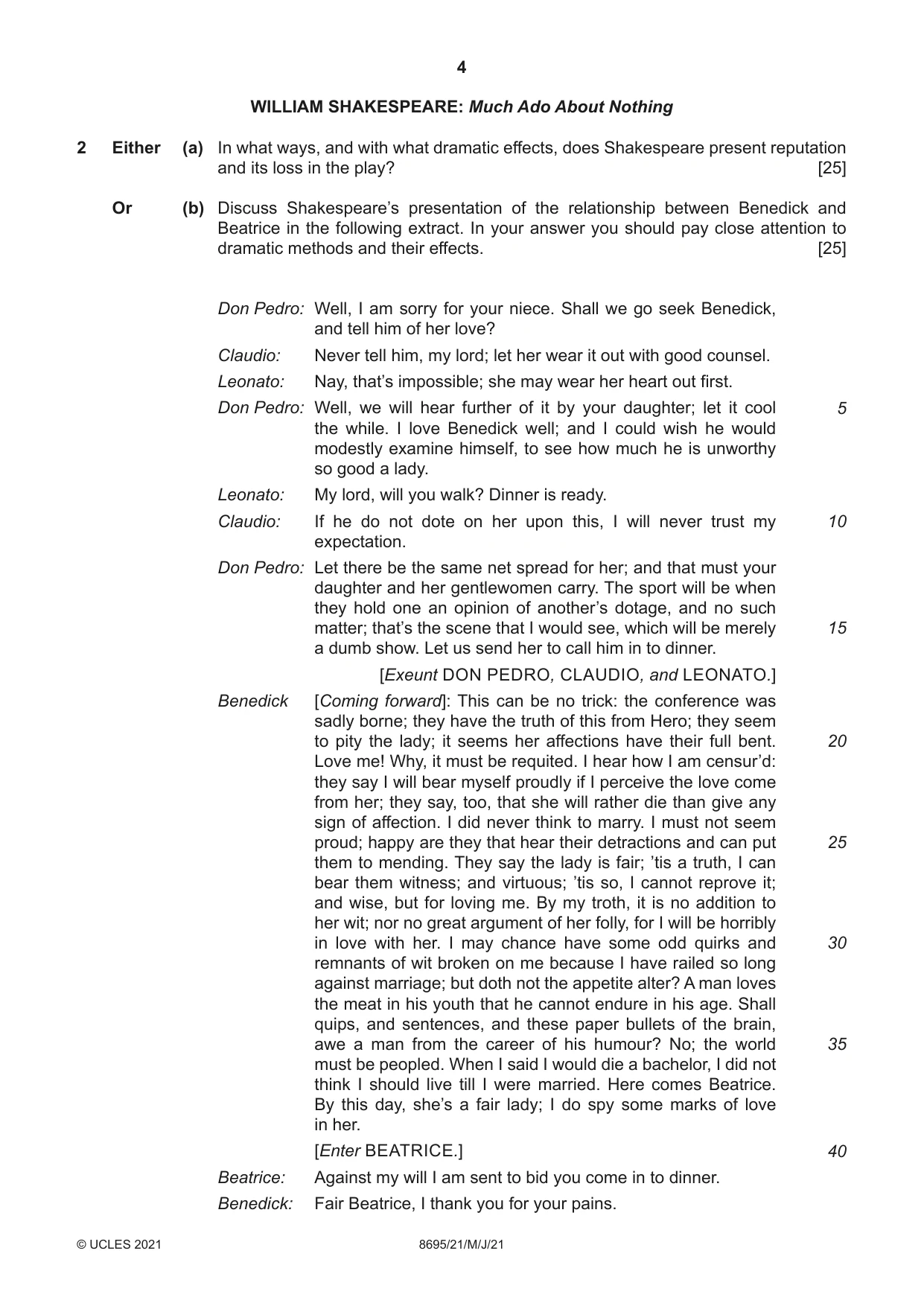
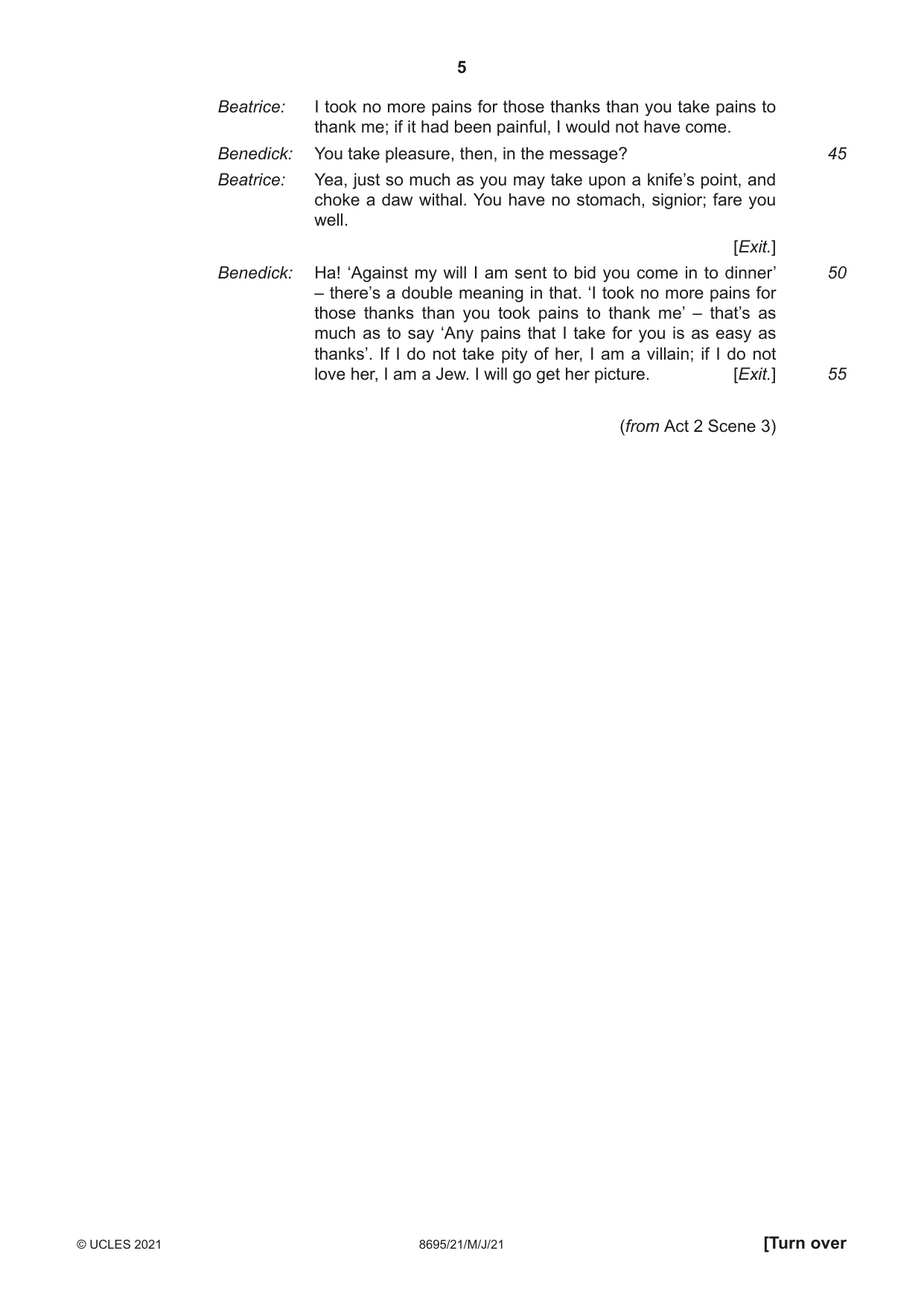
4 8695/21/M/J/21 © UCLES 2021 WILLIAM SHAKESPEARE: Much Ado About Nothing 2 Either (a) In what ways, and with what dramatic effects, does Shakespeare present reputation and its loss in the play? [25] Or (b) Discuss Shakespeare’s presentation of the relationship between Benedick and Beatrice in the following extract. In your answer you should pay close attention to dramatic methods and their effects. [25] Don Pedro: Well, I am sorry for your niece. Shall we go seek Benedick, and tell him of her love? Claudio: Never tell him, my lord; let her wear it out with good counsel. Leonato: Nay, that’s impossible; she may wear her heart out first. Don Pedro: Well, we will hear further of it by your daughter; let it cool the while. I love Benedick well; and I could wish he would modestly examine himself, to see how much he is unworthy so good a lady. Leonato: My lord, will you walk? Dinner is ready. Claudio: If he do not dote on her upon this, I will never trust my expectation. Don Pedro: Let there be the same net spread for her; and that must your daughter and her gentlewomen carry. The sport will be when they hold one an opinion of another’s dotage, and no such matter; that’s the scene that I would see, which will be merely a dumb show. Let us send her to call him in to dinner. [Exeunt DON PEDRO, CLAUDIO, and LEONATO.] Benedick [Coming forward]: This can be no trick: the conference was sadly borne; they have the truth of this from Hero; they seem to pity the lady; it seems her affections have their full bent. Love me! Why, it must be requited. I hear how I am censur’d: they say I will bear myself proudly if I perceive the love come from her; they say, too, that she will rather die than give any sign of affection. I did never think to marry. I must not seem proud; happy are they that hear their detractions and can put them to mending. They say the lady is fair; ’tis a truth, I can bear them witness; and virtuous; ’tis so, I cannot reprove it; and wise, but for loving me. By my troth, it is no addition to her wit; nor no great argument of her folly, for I will be horribly in love with her. I may chance have some odd quirks and remnants of wit broken on me because I have railed so long against marriage; but doth not the appetite alter? A man loves the meat in his youth that he cannot endure in his age. Shall quips, and sentences, and these paper bullets of the brain, awe a man from the career of his humour? No; the world must be peopled. When I said I would die a bachelor, I did not think I should live till I were married. Here comes Beatrice. By this day, she’s a fair lady; I do spy some marks of love in her. [Enter BEATRICE.] Beatrice: Against my will I am sent to bid you come in to dinner. Benedick: Fair Beatrice, I thank you for your pains. 5 10 15 20 25 30 35 40
Question paper, page 5
5 8695/21/M/J/21 © UCLES 2021 [Turn over Beatrice: I took no more pains for those thanks than you take pains to thank me; if it had been painful, I would not have come. Benedick: You take pleasure, then, in the message? Beatrice: Yea, just so much as you may take upon a knife’s point, and choke a daw withal. You have no stomach, signior; fare you well. [Exit.] Benedick: Ha! ‘Against my will I am sent to bid you come in to dinner’ – there’s a double meaning in that. ‘I took no more pains for those thanks than you took pains to thank me’ – that’s as much as to say ‘Any pains that I take for you is as easy as thanks’. If I do not take pity of her, I am a villain; if I do not love her, I am a Jew. I will go get her picture. [Exit.] (from Act 2 Scene 3) 45 50 55
Question paper, page 6
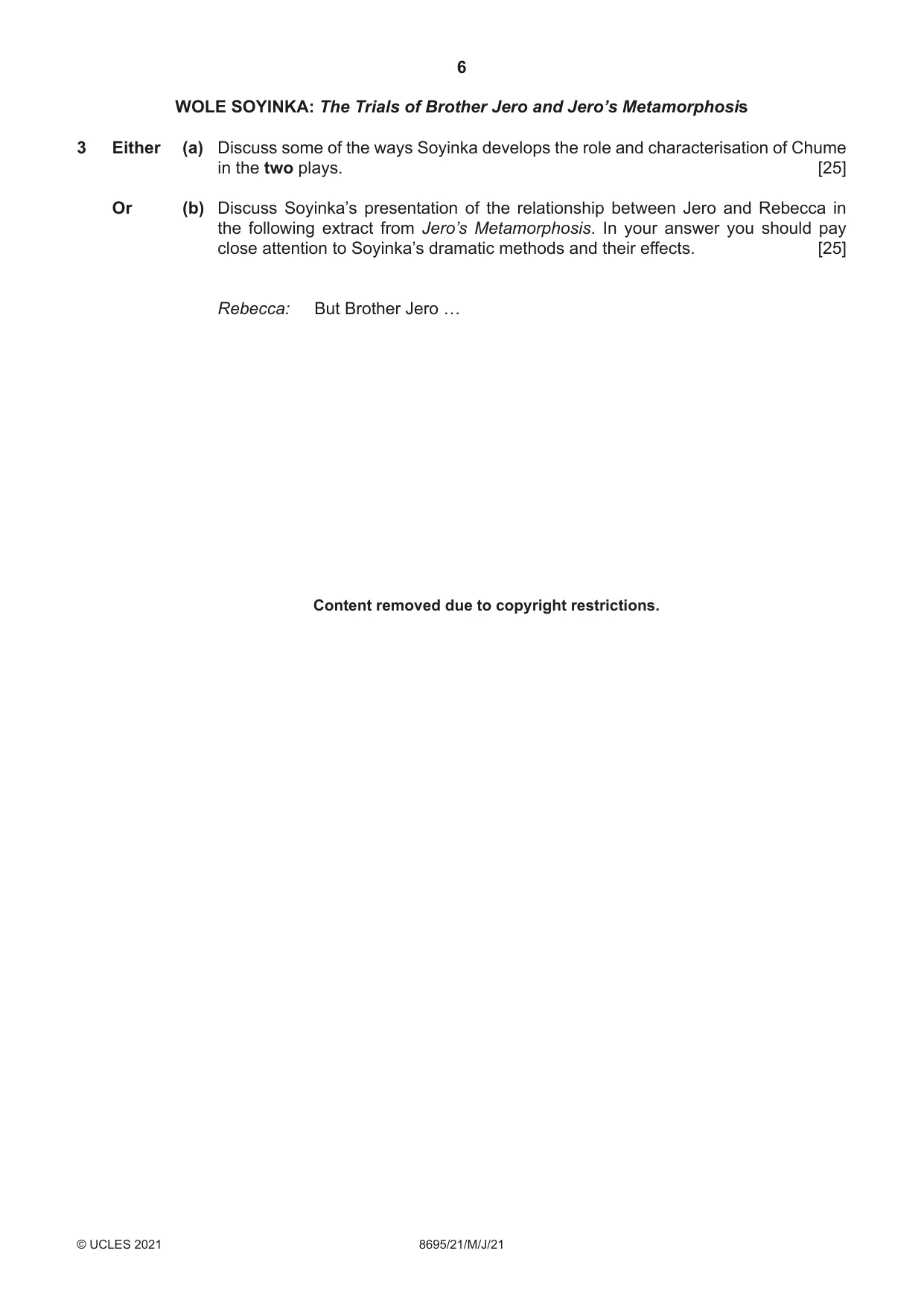
6 8695/21/M/J/21 © UCLES 2021 WOLE SOYINKA: The Trials of Brother Jero and Jero’s Metamorphosis 3 Either (a) Discuss some of the ways Soyinka develops the role and characterisation of Chume in the two plays. [25] Or (b) Discuss Soyinka’s presentation of the relationship between Jero and Rebecca in the following extract from Jero’s Metamorphosis. In your answer you should pay close attention to Soyinka’s dramatic methods and their effects. [25] Rebecca: But Brother Jero … Content removed due to copyright restrictions.
Question paper, page 7
7 8695/21/M/J/21 © UCLES 2021 [Turn over The woman’s condition obviously uplifts him for he moves off with even jauntier step and a light adjustment to his chasuble.] (from Jero’s Metamorphosis, Scene 1) Content removed due to copyright restrictions.
Question paper, page 8
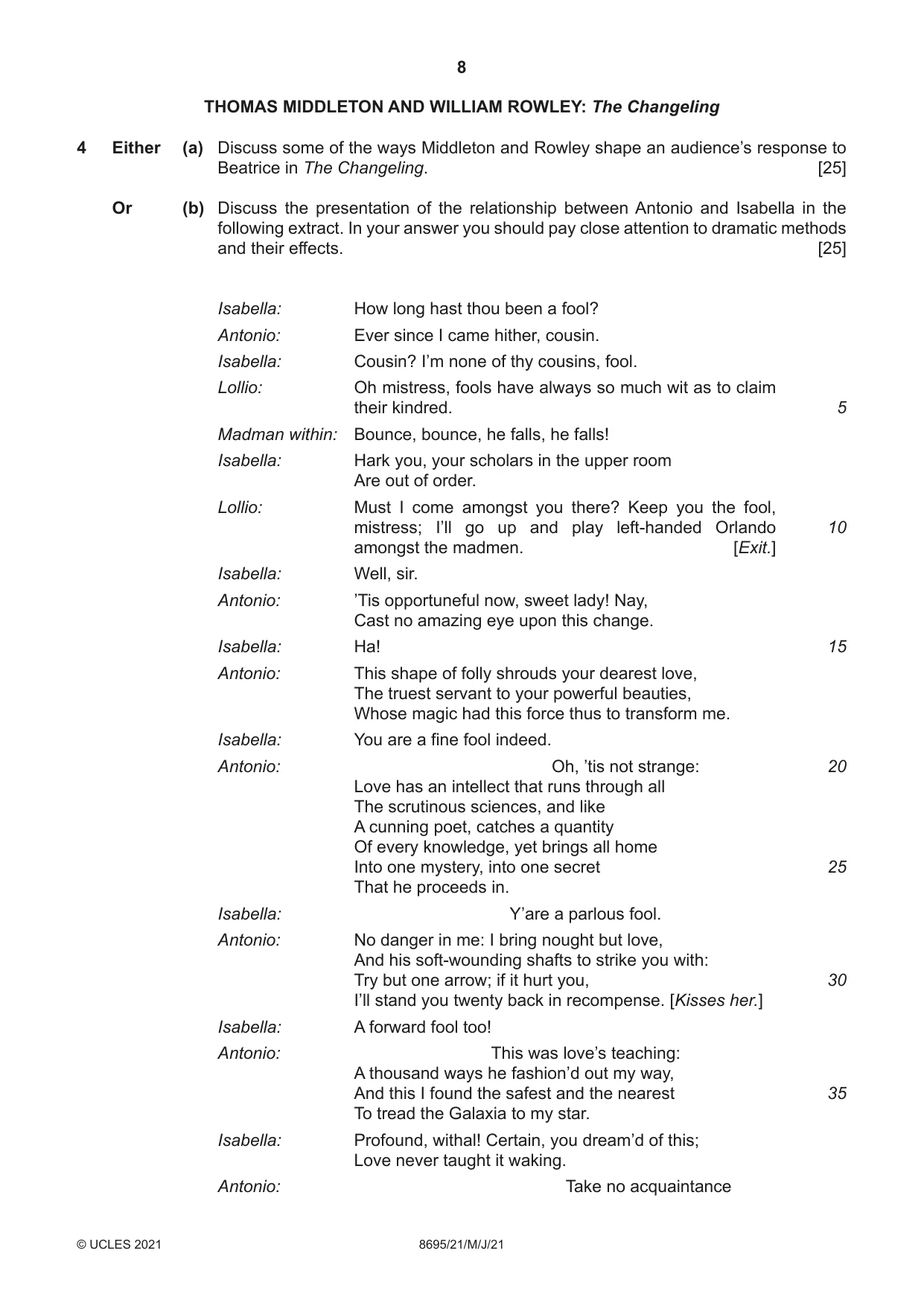
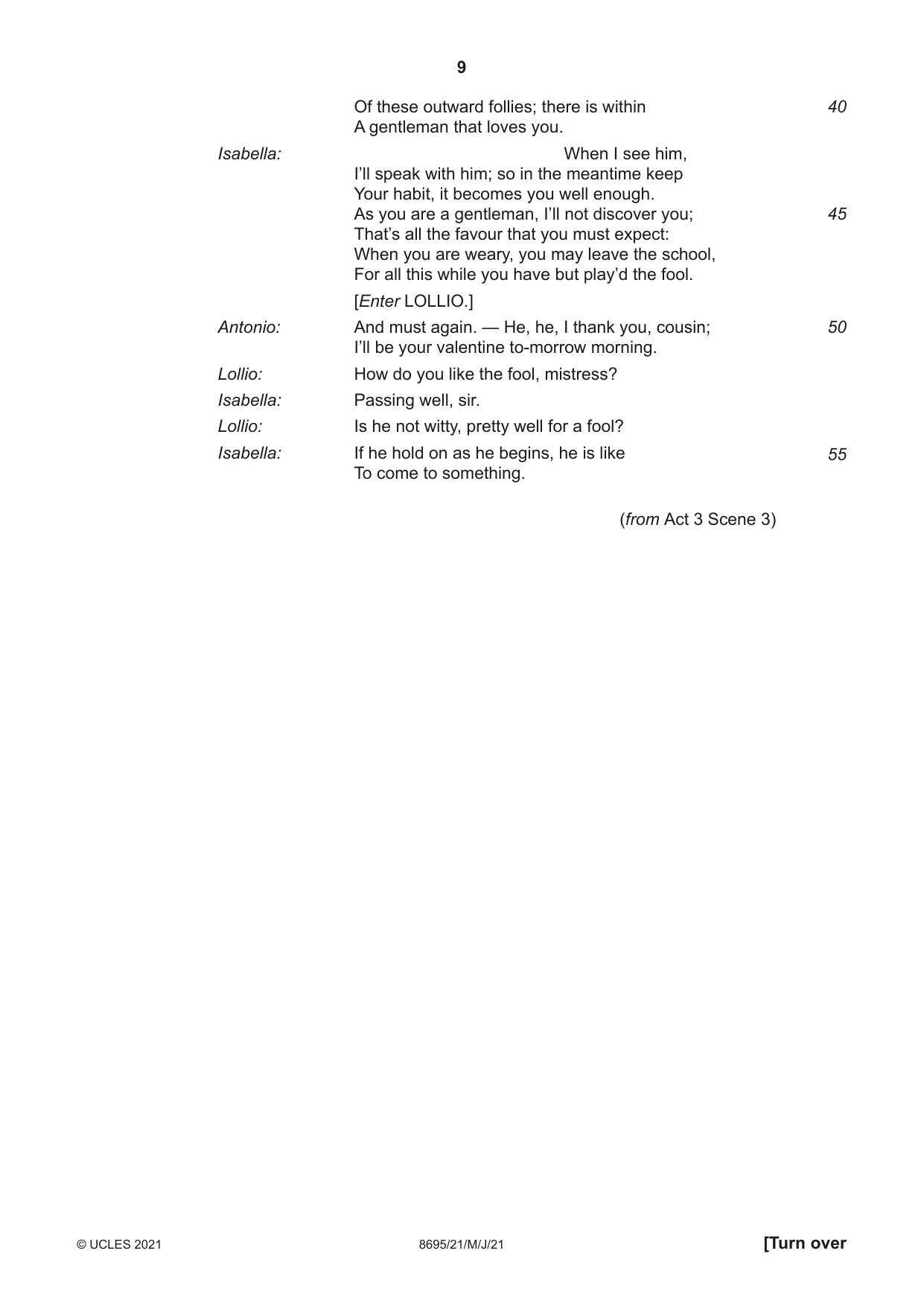
8 8695/21/M/J/21 © UCLES 2021 THOMAS MIDDLETON AND WILLIAM ROWLEY: The Changeling 4 Either (a) Discuss some of the ways Middleton and Rowley shape an audience’s response to Beatrice in The Changeling. [25] Or (b) Discuss the presentation of the relationship between Antonio and Isabella in the following extract. In your answer you should pay close attention to dramatic methods and their effects. [25] Isabella: How long hast thou been a fool? Antonio: Ever since I came hither, cousin. Isabella: Cousin? I’m none of thy cousins, fool. Lollio: Oh mistress, fools have always so much wit as to claim their kindred. Madman within: Bounce, bounce, he falls, he falls! Isabella: Hark you, your scholars in the upper room Are out of order. Lollio: Must I come amongst you there? Keep you the fool, mistress; I’ll go up and play left-handed Orlando amongst the madmen. [Exit.] Isabella: Well, sir. Antonio: ’Tis opportuneful now, sweet lady! Nay, Cast no amazing eye upon this change. Isabella: Ha! Antonio: This shape of folly shrouds your dearest love, The truest servant to your powerful beauties, Whose magic had this force thus to transform me. Isabella: You are a fine fool indeed. Antonio: Oh, ’tis not strange: Love has an intellect that runs through all The scrutinous sciences, and like A cunning poet, catches a quantity Of every knowledge, yet brings all home Into one mystery, into one secret That he proceeds in. Isabella: Y’are a parlous fool. Antonio: No danger in me: I bring nought but love, And his soft-wounding shafts to strike you with: Try but one arrow; if it hurt you, I’ll stand you twenty back in recompense. [Kisses her.] Isabella: A forward fool too! Antonio: This was love’s teaching: A thousand ways he fashion’d out my way, And this I found the safest and the nearest To tread the Galaxia to my star. Isabella: Profound, withal! Certain, you dream’d of this; Love never taught it waking. Antonio: Take no acquaintance 5 10 15 20 25 30 35
Question paper, page 9
9 8695/21/M/J/21 © UCLES 2021 [Turn over Of these outward follies; there is within A gentleman that loves you. Isabella: When I see him, I’ll speak with him; so in the meantime keep Your habit, it becomes you well enough. As you are a gentleman, I’ll not discover you; That’s all the favour that you must expect: When you are weary, you may leave the school, For all this while you have but play’d the fool. [Enter LOLLIO.] Antonio: And must again. — He, he, I thank you, cousin; I’ll be your valentine to-morrow morning. Lollio: How do you like the fool, mistress? Isabella: Passing well, sir. Lollio: Is he not witty, pretty well for a fool? Isabella: If he hold on as he begins, he is like To come to something. (from Act 3 Scene 3) 40 45 50 55
Question paper, page 10
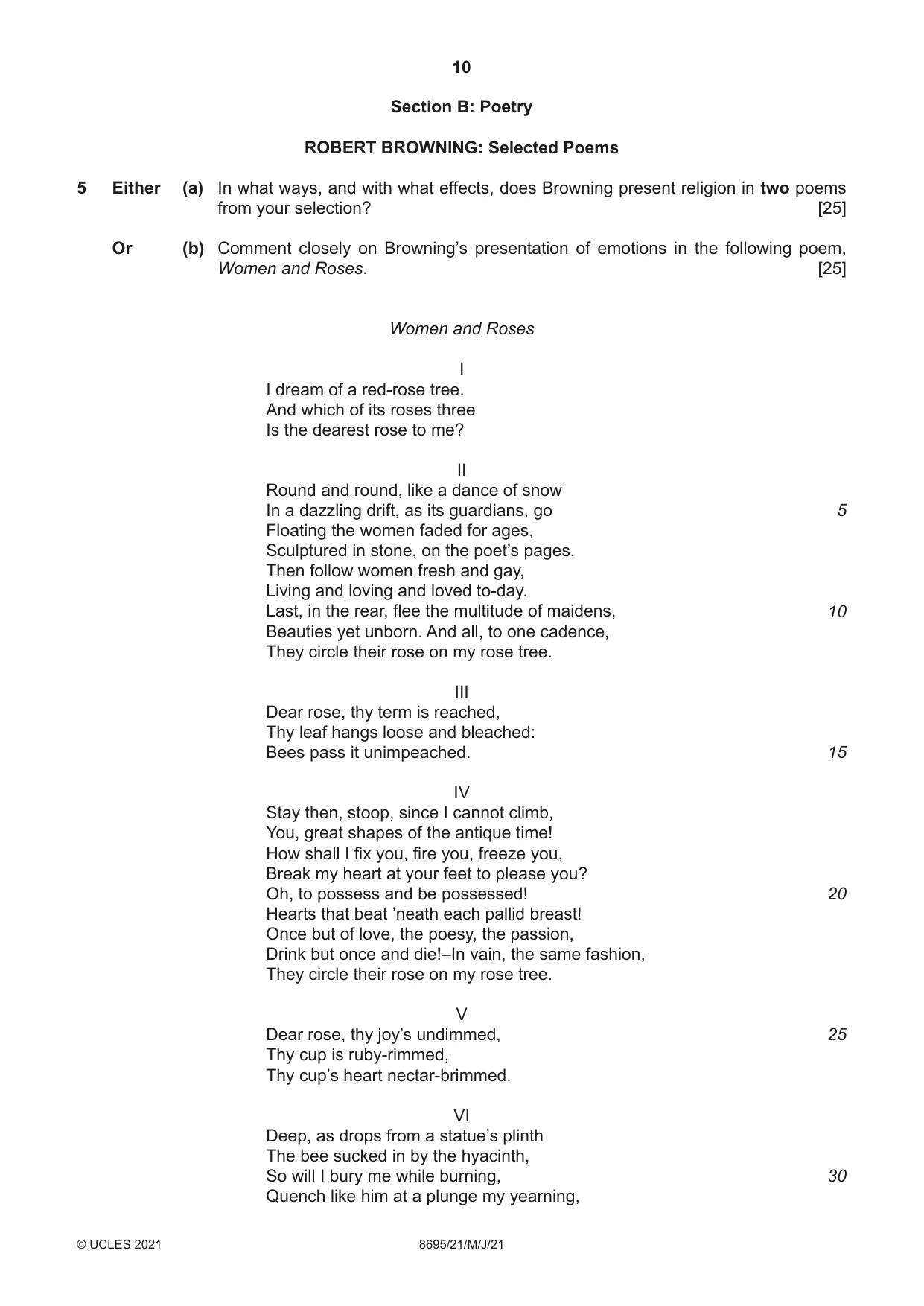
10 8695/21/M/J/21 © UCLES 2021 Section B: Poetry ROBERT BROWNING: Selected Poems 5 Either (a) In what ways, and with what effects, does Browning present religion in two poems from your selection? [25] Or (b) Comment closely on Browning’s presentation of emotions in the following poem, Women and Roses. [25] Women and Roses I I dream of a red-rose tree. And which of its roses three Is the dearest rose to me? II Round and round, like a dance of snow In a dazzling drift, as its guardians, go Floating the women faded for ages, Sculptured in stone, on the poet’s pages. Then follow women fresh and gay, Living and loving and loved to-day. Last, in the rear, flee the multitude of maidens, Beauties yet unborn. And all, to one cadence, They circle their rose on my rose tree. III Dear rose, thy term is reached, Thy leaf hangs loose and bleached: Bees pass it unimpeached. IV Stay then, stoop, since I cannot climb, You, great shapes of the antique time! How shall I fix you, fire you, freeze you, Break my heart at your feet to please you? Oh, to possess and be possessed! Hearts that beat ’neath each pallid breast! Once but of love, the poesy, the passion, Drink but once and die!–In vain, the same fashion, They circle their rose on my rose tree. V Dear rose, thy joy’s undimmed, Thy cup is ruby-rimmed, Thy cup’s heart nectar-brimmed. VI Deep, as drops from a statue’s plinth The bee sucked in by the hyacinth, So will I bury me while burning, Quench like him at a plunge my yearning, 5 10 15 20 25 30
Question paper, page 11
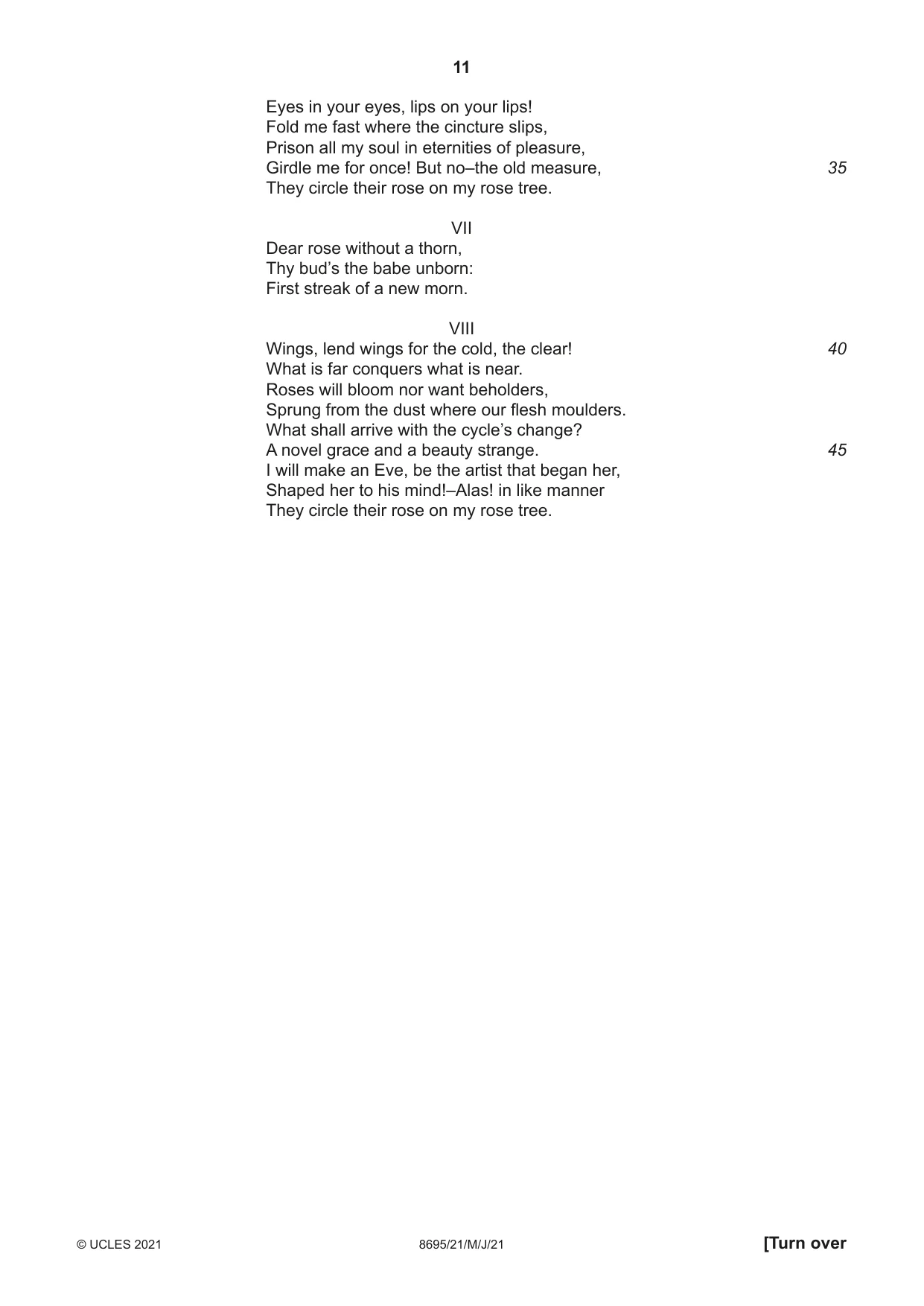
11 8695/21/M/J/21 © UCLES 2021 [Turn over Eyes in your eyes, lips on your lips! Fold me fast where the cincture slips, Prison all my soul in eternities of pleasure, Girdle me for once! But no–the old measure, They circle their rose on my rose tree. VII Dear rose without a thorn, Thy bud’s the babe unborn: First streak of a new morn. VIII Wings, lend wings for the cold, the clear! What is far conquers what is near. Roses will bloom nor want beholders, Sprung from the dust where our flesh moulders. What shall arrive with the cycle’s change? A novel grace and a beauty strange. I will make an Eve, be the artist that began her, Shaped her to his mind!–Alas! in like manner They circle their rose on my rose tree. 35 40 45
Question paper, page 12
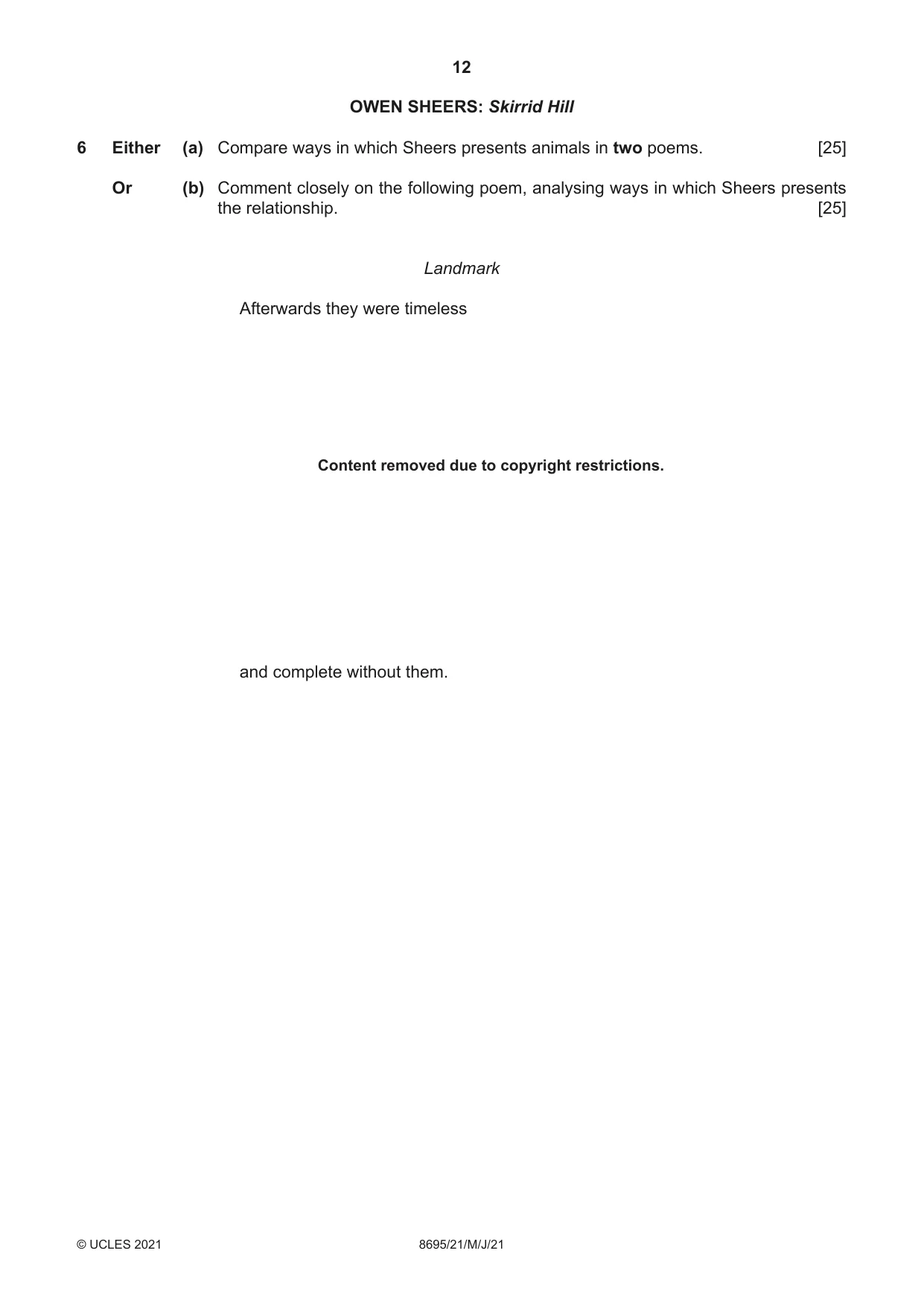
12 8695/21/M/J/21 © UCLES 2021 OWEN SHEERS: Skirrid Hill 6 Either (a) Compare ways in which Sheers presents animals in two poems. [25] Or (b) Comment closely on the following poem, analysing ways in which Sheers presents the relationship. [25] Landmark Afterwards they were timeless and complete without them. Content removed due to copyright restrictions.
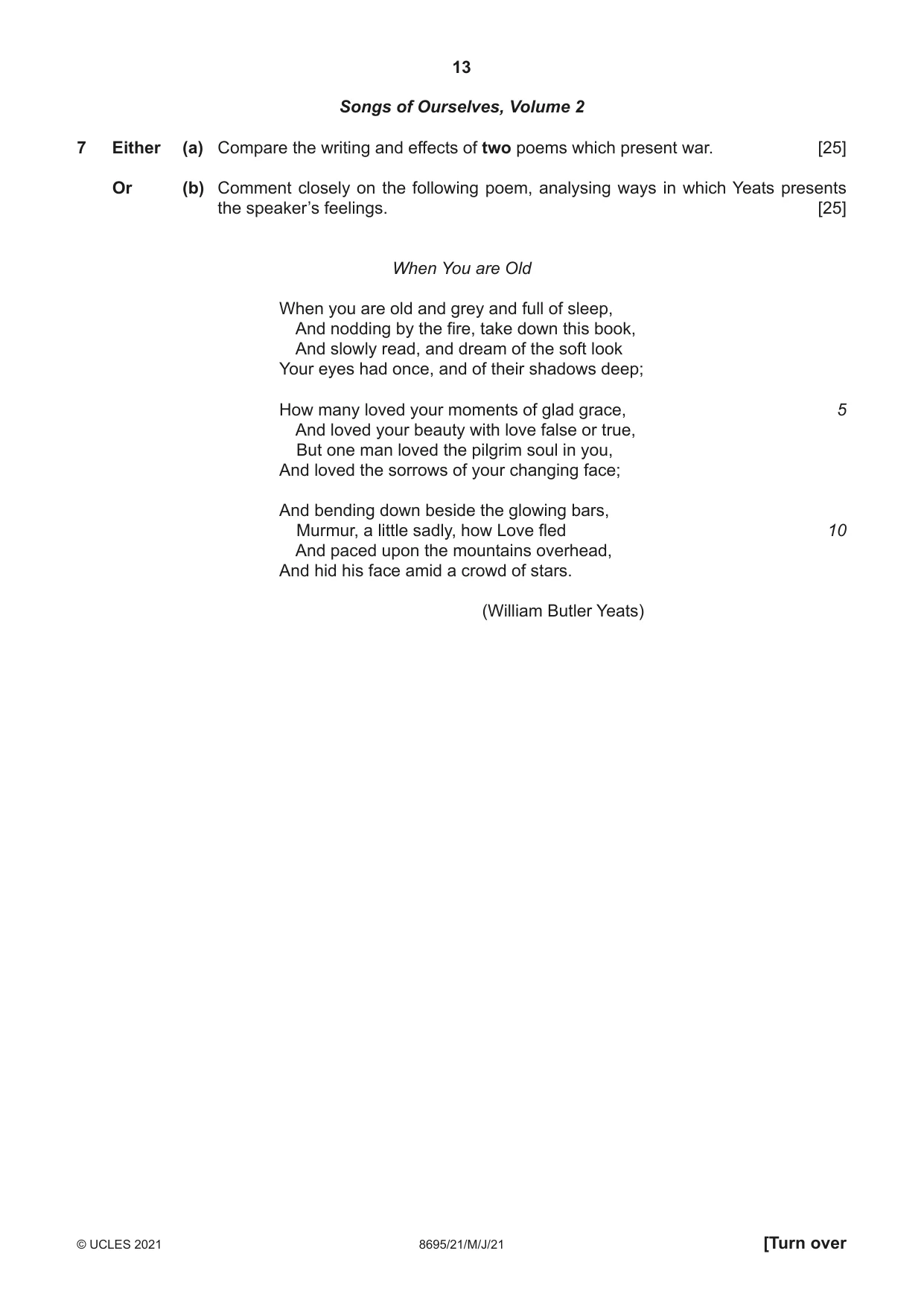
Question paper, page 13
13 8695/21/M/J/21 © UCLES 2021 [Turn over Songs of Ourselves, Volume 2 7 Either (a) Compare the writing and effects of two poems which present war. [25] Or (b) Comment closely on the following poem, analysing ways in which Yeats presents the speaker’s feelings. [25] When You are Old When you are old and grey and full of sleep, And nodding by the fire, take down this book, And slowly read, and dream of the soft look Your eyes had once, and of their shadows deep; How many loved your moments of glad grace, And loved your beauty with love false or true, But one man loved the pilgrim soul in you, And loved the sorrows of your changing face; And bending down beside the glowing bars, Murmur, a little sadly, how Love fled And paced upon the mountains overhead, And hid his face amid a crowd of stars. (William Butler Yeats) 5 10
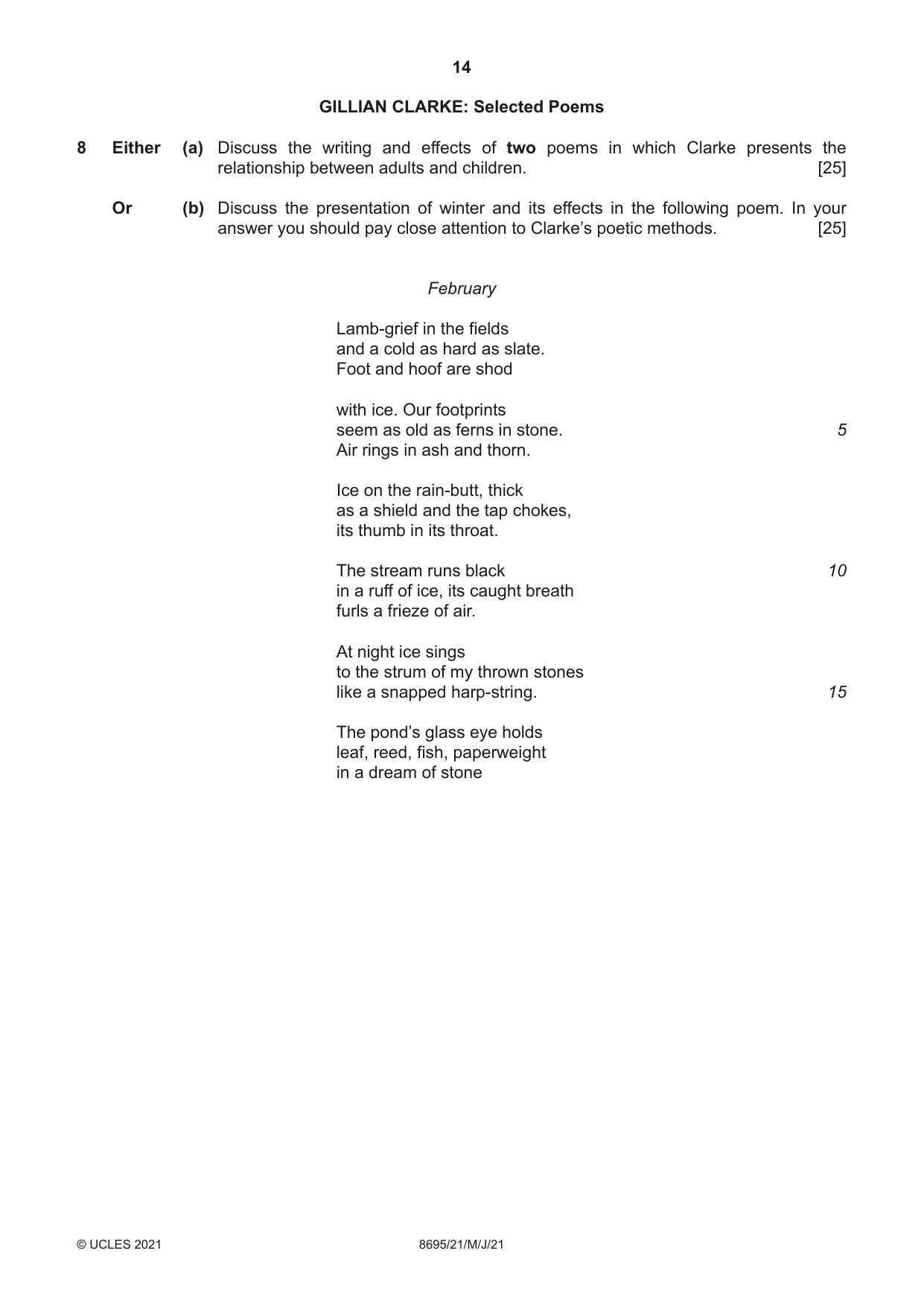
Question paper, page 14
14 8695/21/M/J/21 © UCLES 2021 GILLIAN CLARKE: Selected Poems 8 Either (a) Discuss the writing and effects of two poems in which Clarke presents the relationship between adults and children. [25] Or (b) Discuss the presentation of winter and its effects in the following poem. In your answer you should pay close attention to Clarke’s poetic methods. [25] February Lamb-grief in the fields and a cold as hard as slate. Foot and hoof are shod with ice. Our footprints seem as old as ferns in stone. Air rings in ash and thorn. Ice on the rain-butt, thick as a shield and the tap chokes, its thumb in its throat. The stream runs black in a ruff of ice, its caught breath furls a frieze of air. At night ice sings to the strum of my thrown stones like a snapped harp-string. The pond’s glass eye holds leaf, reed, fish, paperweight in a dream of stone 5 10 15
Question paper, page 15
15 8695/21/M/J/21 © UCLES 2021 [Turn over TURN OVER FOR SECTION C.
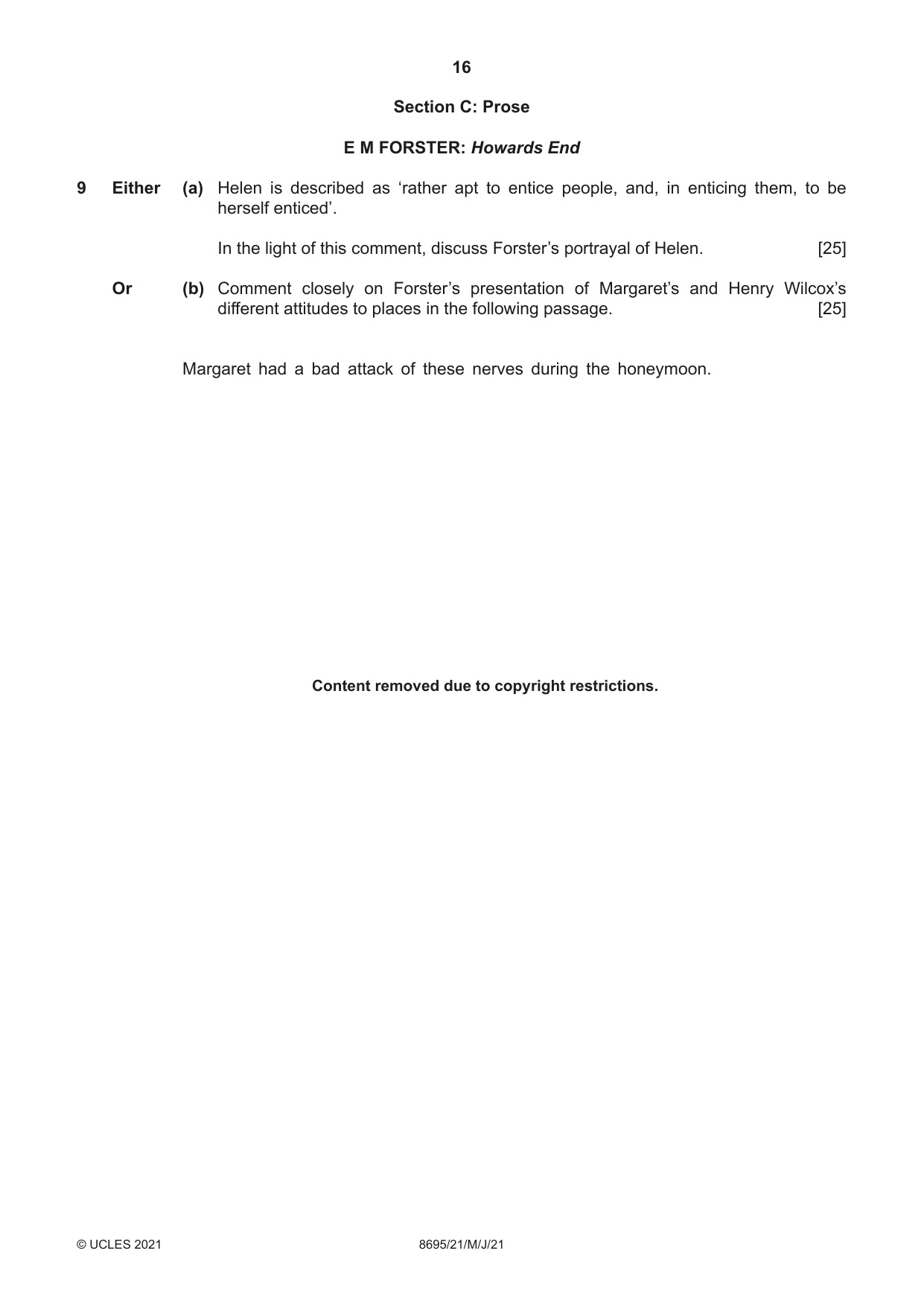
Question paper, page 16
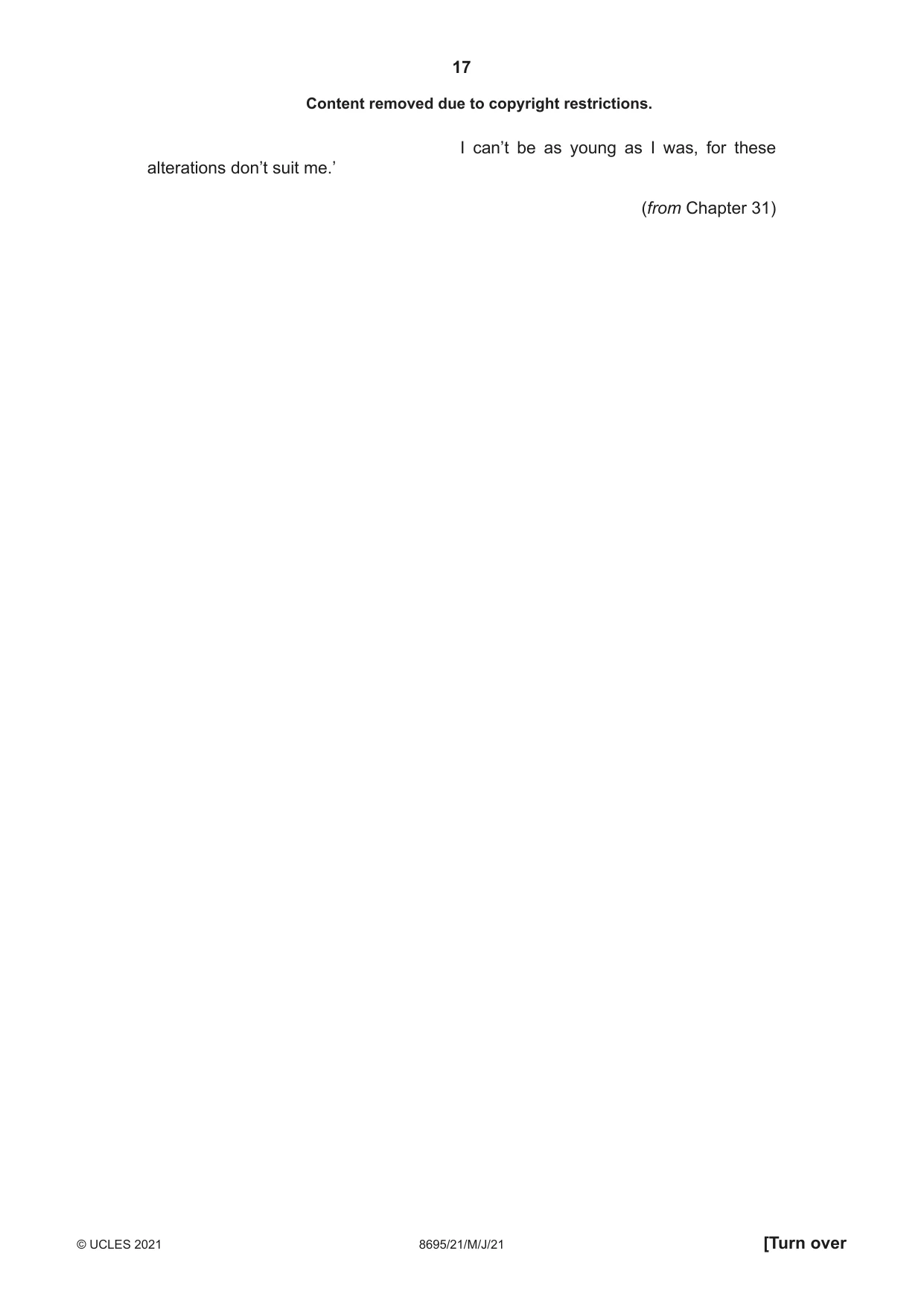
16 8695/21/M/J/21 © UCLES 2021 Section C: Prose E M FORSTER: Howards End 9 Either (a) Helen is described as ‘rather apt to entice people, and, in enticing them, to be herself enticed’. In the light of this comment, discuss Forster’s portrayal of Helen. [25] Or (b) Comment closely on Forster’s presentation of Margaret’s and Henry Wilcox’s different attitudes to places in the following passage. [25] Margaret had a bad attack of these nerves during the honeymoon. Content removed due to copyright restrictions.
Question paper, page 17
17 8695/21/M/J/21 © UCLES 2021 [Turn over I can’t be as young as I was, for these alterations don’t suit me.’ (from Chapter 31) Content removed due to copyright restrictions.
Question paper, page 18
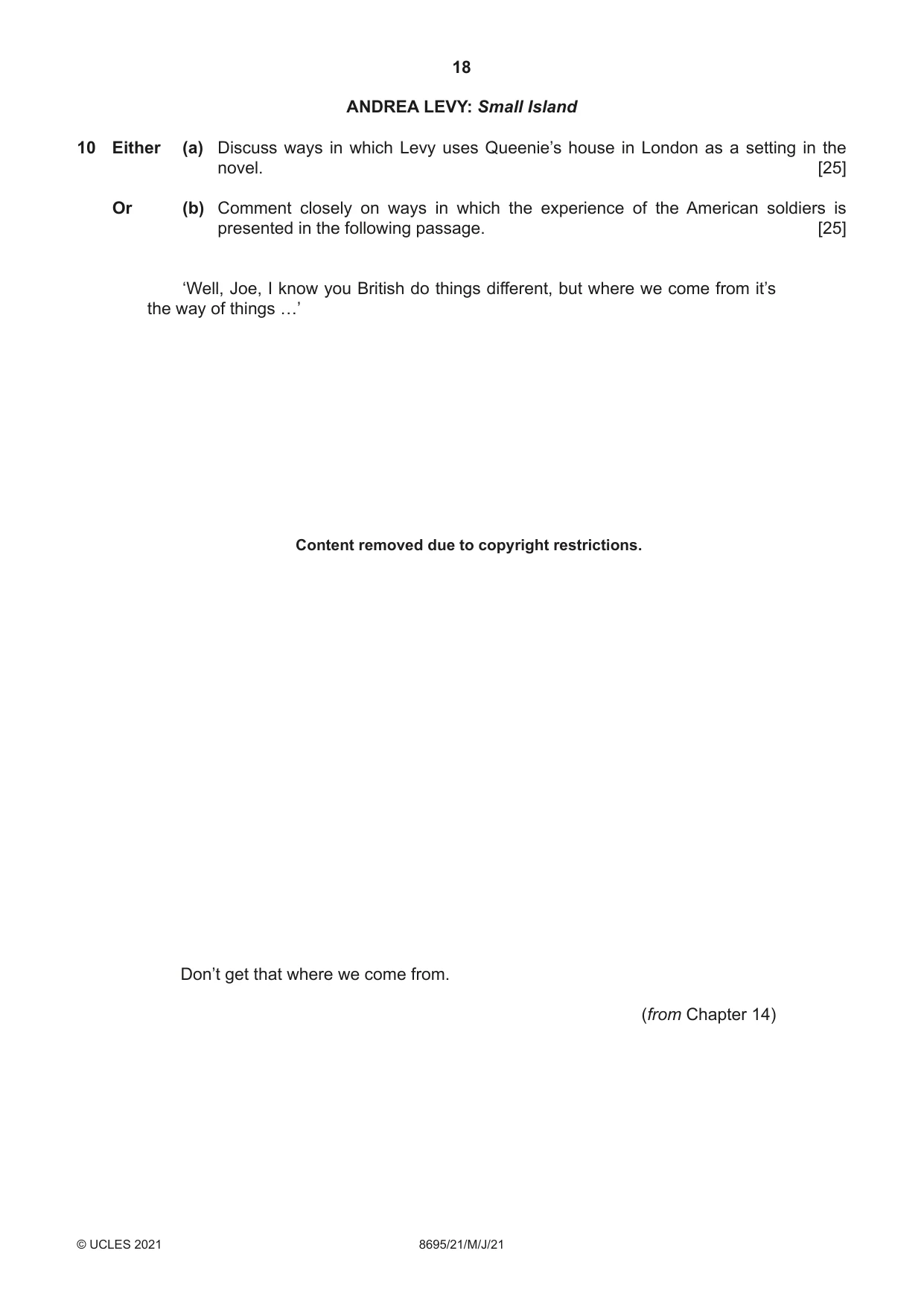
18 8695/21/M/J/21 © UCLES 2021 ANDREA LEVY: Small Island 10 Either (a) Discuss ways in which Levy uses Queenie’s house in London as a setting in the novel. [25] Or (b) Comment closely on ways in which the experience of the American soldiers is presented in the following passage. [25] ‘Well, Joe, I know you British do things different, but where we come from it’s the way of things …’ Don’t get that where we come from. (from Chapter 14) Content removed due to copyright restrictions.
Question paper, page 19
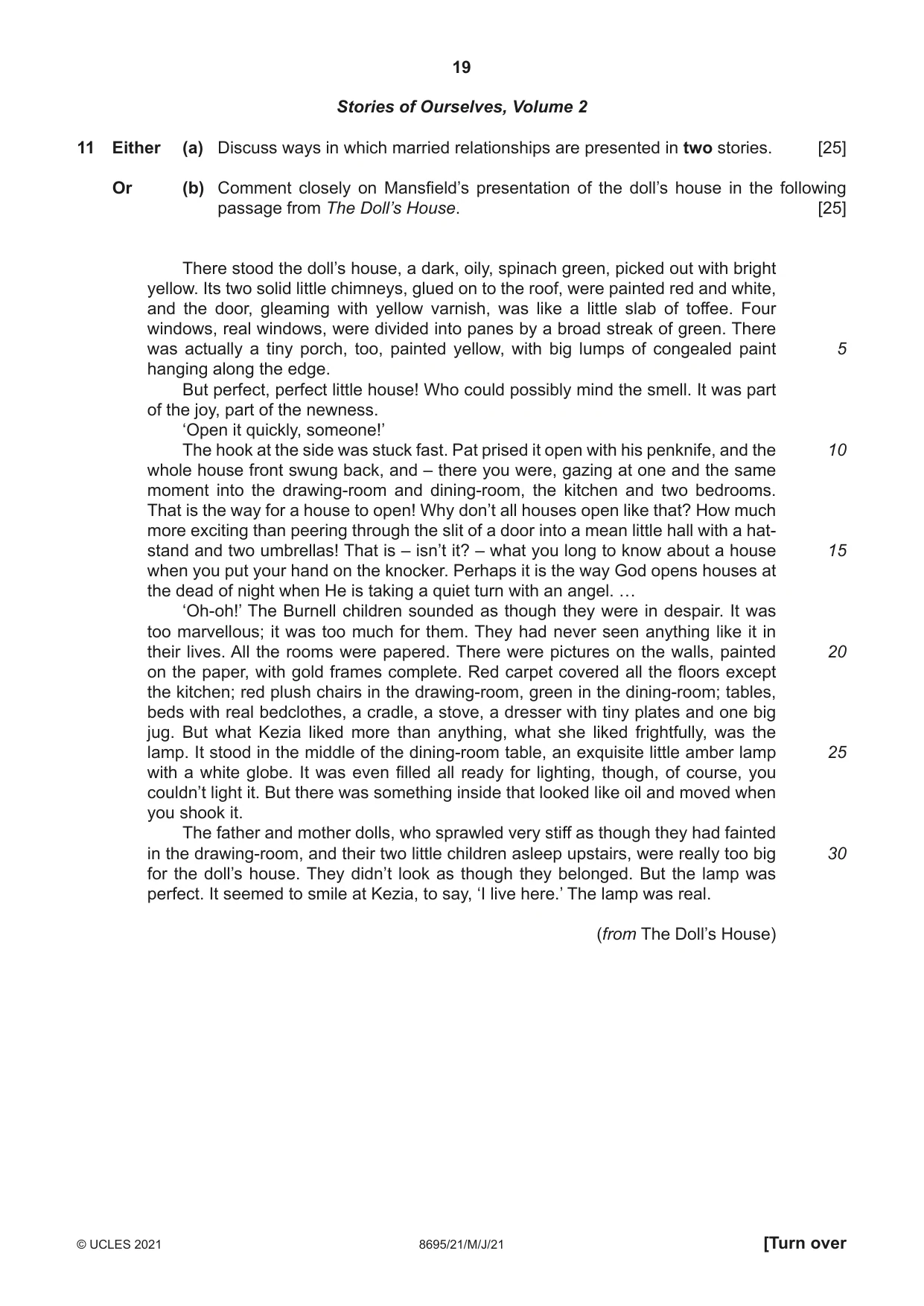
19 8695/21/M/J/21 © UCLES 2021 [Turn over Stories of Ourselves, Volume 2 11 Either (a) Discuss ways in which married relationships are presented in two stories. [25] Or (b) Comment closely on Mansfield’s presentation of the doll’s house in the following passage from The Doll’s House. [25] There stood the doll’s house, a dark, oily, spinach green, picked out with bright yellow. Its two solid little chimneys, glued on to the roof, were painted red and white, and the door, gleaming with yellow varnish, was like a little slab of toffee. Four windows, real windows, were divided into panes by a broad streak of green. There was actually a tiny porch, too, painted yellow, with big lumps of congealed paint hanging along the edge. But perfect, perfect little house! Who could possibly mind the smell. It was part of the joy, part of the newness. ‘Open it quickly, someone!’ The hook at the side was stuck fast. Pat prised it open with his penknife, and the whole house front swung back, and – there you were, gazing at one and the same moment into the drawing-room and dining-room, the kitchen and two bedrooms. That is the way for a house to open! Why don’t all houses open like that? How much more exciting than peering through the slit of a door into a mean little hall with a hat- stand and two umbrellas! That is – isn’t it? – what you long to know about a house when you put your hand on the knocker. Perhaps it is the way God opens houses at the dead of night when He is taking a quiet turn with an angel. … ‘Oh-oh!’ The Burnell children sounded as though they were in despair. It was too marvellous; it was too much for them. They had never seen anything like it in their lives. All the rooms were papered. There were pictures on the walls, painted on the paper, with gold frames complete. Red carpet covered all the floors except the kitchen; red plush chairs in the drawing-room, green in the dining-room; tables, beds with real bedclothes, a cradle, a stove, a dresser with tiny plates and one big jug. But what Kezia liked more than anything, what she liked frightfully, was the lamp. It stood in the middle of the dining-room table, an exquisite little amber lamp with a white globe. It was even filled all ready for lighting, though, of course, you couldn’t light it. But there was something inside that looked like oil and moved when you shook it. The father and mother dolls, who sprawled very stiff as though they had fainted in the drawing-room, and their two little children asleep upstairs, were really too big for the doll’s house. They didn’t look as though they belonged. But the lamp was perfect. It seemed to smile at Kezia, to say, ‘I live here.’ The lamp was real. (from The Doll’s House) 5 10 15 20 25 30
Question paper, page 20
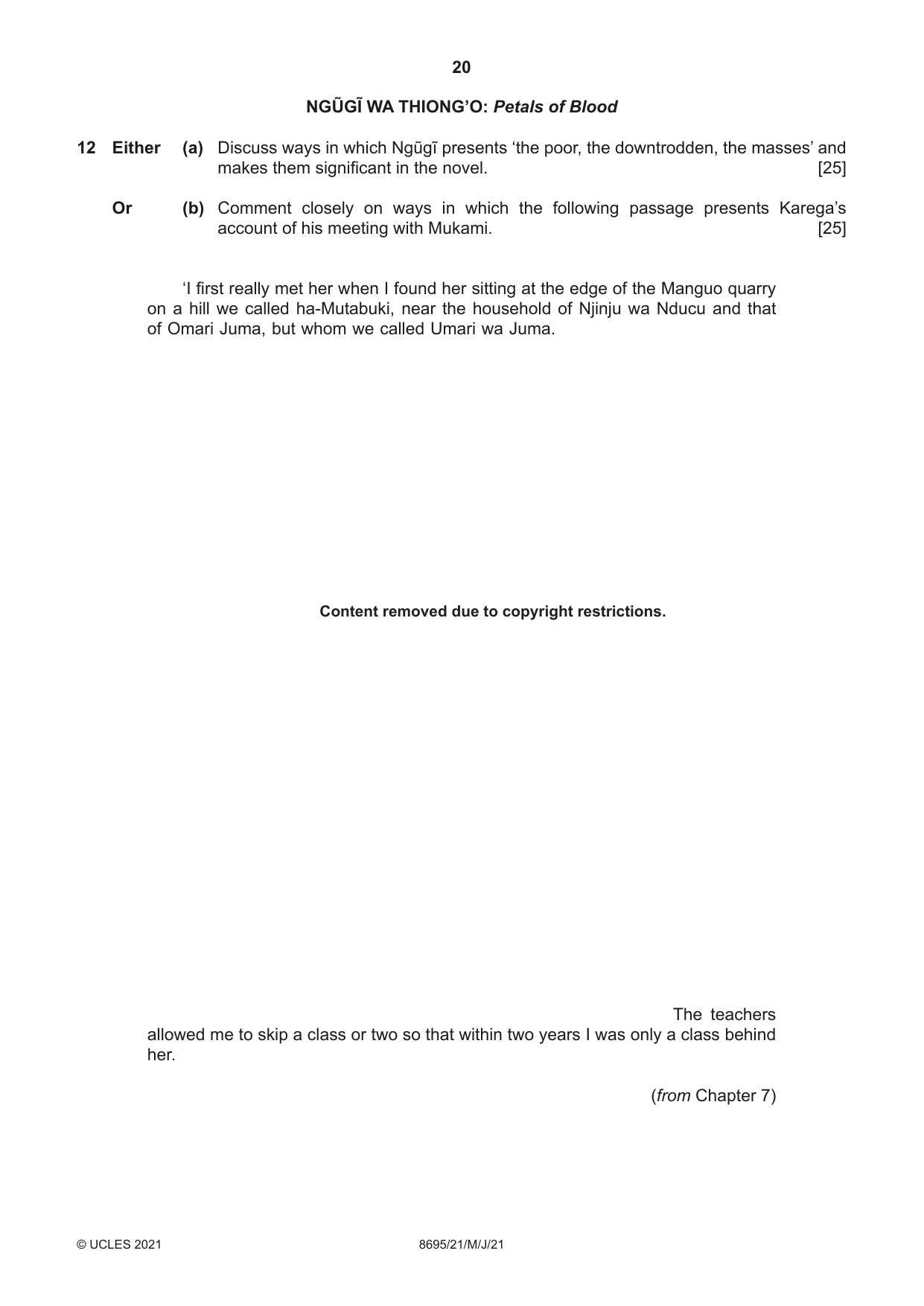
20 8695/21/M/J/21 © UCLES 2021 NGŨGĨ WA THIONG’O: Petals of Blood 12 Either (a) Discuss ways in which Ngũgĩ presents ‘the poor, the downtrodden, the masses’ and makes them significant in the novel. [25] Or (b) Comment closely on ways in which the following passage presents Karega’s account of his meeting with Mukami. [25] ‘I first really met her when I found her sitting at the edge of the Manguo quarry on a hill we called ha-Mutabuki, near the household of Njinju wa Nducu and that of Omari Juma, but whom we called Umari wa Juma. The teachers allowed me to skip a class or two so that within two years I was only a class behind her. (from Chapter 7) Content removed due to copyright restrictions.
Question paper, page 21
21 8695/21/M/J/21 © UCLES 2021 BLANK PAGE
Question paper, page 22
22 8695/21/M/J/21 © UCLES 2021 BLANK PAGE
Question paper, page 23
23 8695/21/M/J/21 © UCLES 2021 BLANK PAGE
Question paper, page 24
24 8695/21/M/J/21 © UCLES 2021 Permission to reproduce items where third-party owned material protected by copyright is included has been sought and cleared where possible Every reasonable effort has been made by the publisher (UCLES) to trace copyright holders but if any items requiring clearance have unwittingly been included the publisher will be pleased to make amends at the earliest possible opportunity To avoid the issue of disclosure of answer-related information to candidates all copyright acknowledgements are reproduced online in the Cambridge Assessment nternational Education Copyright Acknowledgements Booklet This is produced for each series of examinations and is freely available to download at www cambridgeinternational org after the live examination series Cambridge Assessment nternational Education is part of the Cambridge Assessment Group Cambridge Assessment is the brand name of the University of Cambridge Local Examinations Syndicate (UCLES) which itself is a department of the University of Cambridge BLANK PAGE
Mark scheme, page 1
This document consists of 13 printed pages. © UCLES 2021 [Turn over Cambridge International AS & A Level LANGUAGE AND LITERATURE IN ENGLISH 8695/21 Paper 2 Writing May/June 2021 MARK SCHEME Maximum Mark: 50 Published This mark scheme is published as an aid to teachers and candidates, to indicate the requirements of the examination. It shows the basis on which Examiners were instructed to award marks. It does not indicate the details of the discussions that took place at an Examiners’ meeting before marking began, which would have considered the acceptability of alternative answers. Mark schemes should be read in conjunction with the question paper and the Principal Examiner Report for Teachers. Cambridge International will not enter into discussions about these mark schemes. Cambridge International is publishing the mark schemes for the May/June 2021 series for most Cambridge IGCSE™, Cambridge International A and AS Level components and some Cambridge O Level components.
Mark scheme, page 2
8695/21 Cambridge International AS & A Level – Mark Scheme PUBLISHED May/June 2021 © UCLES 2021 Page 2 of 13 Generic Marking Principles These general marking principles must be applied by all examiners when marking candidate answers. They should be applied alongside the specific content of the mark scheme or generic level descriptors for a question. Each question paper and mark scheme will also comply with these marking principles. GENERIC MARKING PRINCIPLE 1: Marks must be awarded in line with: • the specific content of the mark scheme or the generic level descriptors for the question • the specific skills defined in the mark scheme or in the generic level descriptors for the question • the standard of response required by a candidate as exemplified by the standardisation scripts. GENERIC MARKING PRINCIPLE 2: Marks awarded are always whole marks (not half marks, or other fractions). GENERIC MARKING PRINCIPLE 3: Marks must be awarded positively: • marks are awarded for correct/valid answers, as defined in the mark scheme. However, credit is given for valid answers which go beyond the scope of the syllabus and mark scheme, referring to your Team Leader as appropriate • marks are awarded when candidates clearly demonstrate what they know and can do • marks are not deducted for errors • marks are not deducted for omissions • answers should only be judged on the quality of spelling, punctuation and grammar when these features are specifically assessed by the question as indicated by the mark scheme. The meaning, however, should be unambiguous. GENERIC MARKING PRINCIPLE 4: Rules must be applied consistently, e.g. in situations where candidates have not followed instructions or in the application of generic level descriptors. GENERIC MARKING PRINCIPLE 5: Marks should be awarded using the full range of marks defined in the mark scheme for the question (however; the use of the full mark range may be limited according to the quality of the candidate responses seen). GENERIC MARKING PRINCIPLE 6: Marks awarded are based solely on the requirements as defined in the mark scheme. Marks should not be awarded with grade thresholds or grade descriptors in mind.
Mark scheme, page 3
8695/21 Cambridge International AS & A Level – Mark Scheme PUBLISHED May/June 2021 © UCLES 2021 Page 3 of 13 English & Media subject specific general marking principles (To be read in conjunction with the Generic Marking Principles (and requiring further guidance on how to place marks within levels)) Components using level descriptors: • We use level descriptors as a guide to broad understanding of the qualities normally expected of, or typical of, work in a level. • Level descriptors are a means of general guidance, and should not be interpreted as hurdle statements. • Where indicative content notes are supplied for a question, these are not a prescription of required content, and must not be treated as such. Alternative correct points and unexpected answers in candidates’ scripts must be given marks that fairly reflect the knowledge and skills demonstrated. • While we may have legitimate expectations as to the ground most answers may occupy, we must at all times be prepared to meet candidates on their chosen ground, provided it is relevant ground (e.g. clearly related to and derived from a relevant passage/text and meeting the mark scheme requirements for the question). Components using point-based marking: Point marking is often used to reward knowledge, understanding and application of skills. We give credit where the candidate’s answer shows relevant knowledge, understanding and application of skills in answering the question. We do not give credit where the answer shows confusion. From this it follows that we: a DO credit answers which are worded differently from the mark scheme if they clearly convey the same meaning (unless the mark scheme requires a specific term). b DO credit alternative answers/examples which are not written in the mark scheme if they are correct. c DO credit answers where candidates give more than one correct answer in one prompt/numbered/scaffolded space where extended writing is required rather than list-type answers. For example, questions that require n reasons (e.g. State two reasons…). d DO NOT credit answers simply for using a ‘key term’ unless that is all that is required. (Check for evidence it is understood and not used wrongly.). e DO NOT credit answers which are obviously self-contradicting or trying to cover all possibilities. f DO NOT give further credit for what is effectively repetition of a correct point already credited unless the language itself is being tested. This applies equally to ‘mirror statements’ (i.e. polluted/not polluted). g DO NOT require spellings to be correct, unless this is part of the test. However spellings of syllabus terms must allow for clear and unambiguous separation from other syllabus terms with which they may be confused (e.g. Corrasion/Corrosion).
Mark scheme, page 4
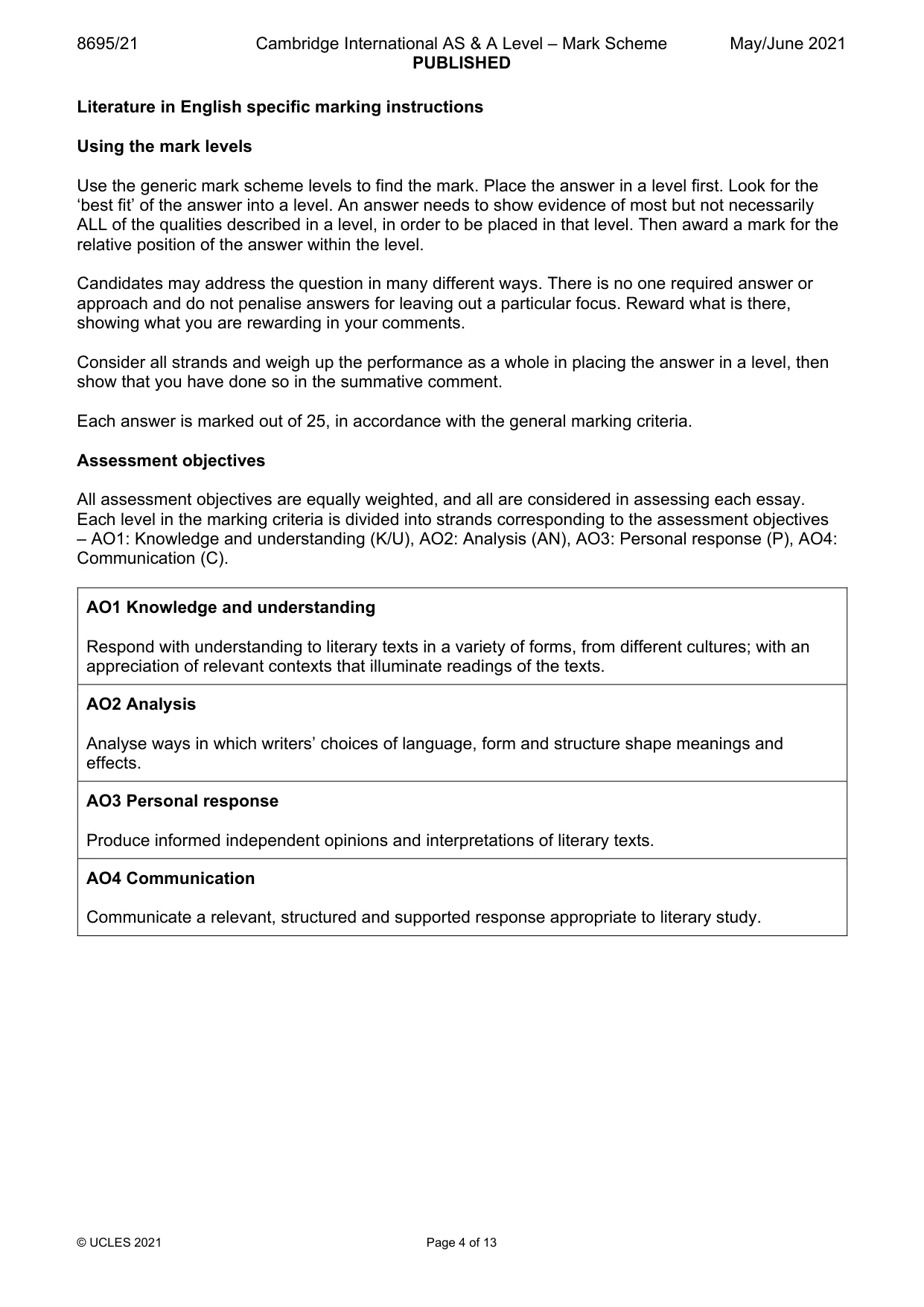
8695/21 Cambridge International AS & A Level – Mark Scheme PUBLISHED May/June 2021 © UCLES 2021 Page 4 of 13 Literature in English specific marking instructions Using the mark levels Use the generic mark scheme levels to find the mark. Place the answer in a level first. Look for the ‘best fit’ of the answer into a level. An answer needs to show evidence of most but not necessarily ALL of the qualities described in a level, in order to be placed in that level. Then award a mark for the relative position of the answer within the level. Candidates may address the question in many different ways. There is no one required answer or approach and do not penalise answers for leaving out a particular focus. Reward what is there, showing what you are rewarding in your comments. Consider all strands and weigh up the performance as a whole in placing the answer in a level, then show that you have done so in the summative comment. Each answer is marked out of 25, in accordance with the general marking criteria. Assessment objectives All assessment objectives are equally weighted, and all are considered in assessing each essay. Each level in the marking criteria is divided into strands corresponding to the assessment objectives – AO1: Knowledge and understanding (K/U), AO2: Analysis (AN), AO3: Personal response (P), AO4: Communication (C). AO1 Knowledge and understanding Respond with understanding to literary texts in a variety of forms, from different cultures; with an appreciation of relevant contexts that illuminate readings of the texts. AO2 Analysis Analyse ways in which writers’ choices of language, form and structure shape meanings and effects. AO3 Personal response Produce informed independent opinions and interpretations of literary texts. AO4 Communication Communicate a relevant, structured and supported response appropriate to literary study.
Mark scheme, page 5
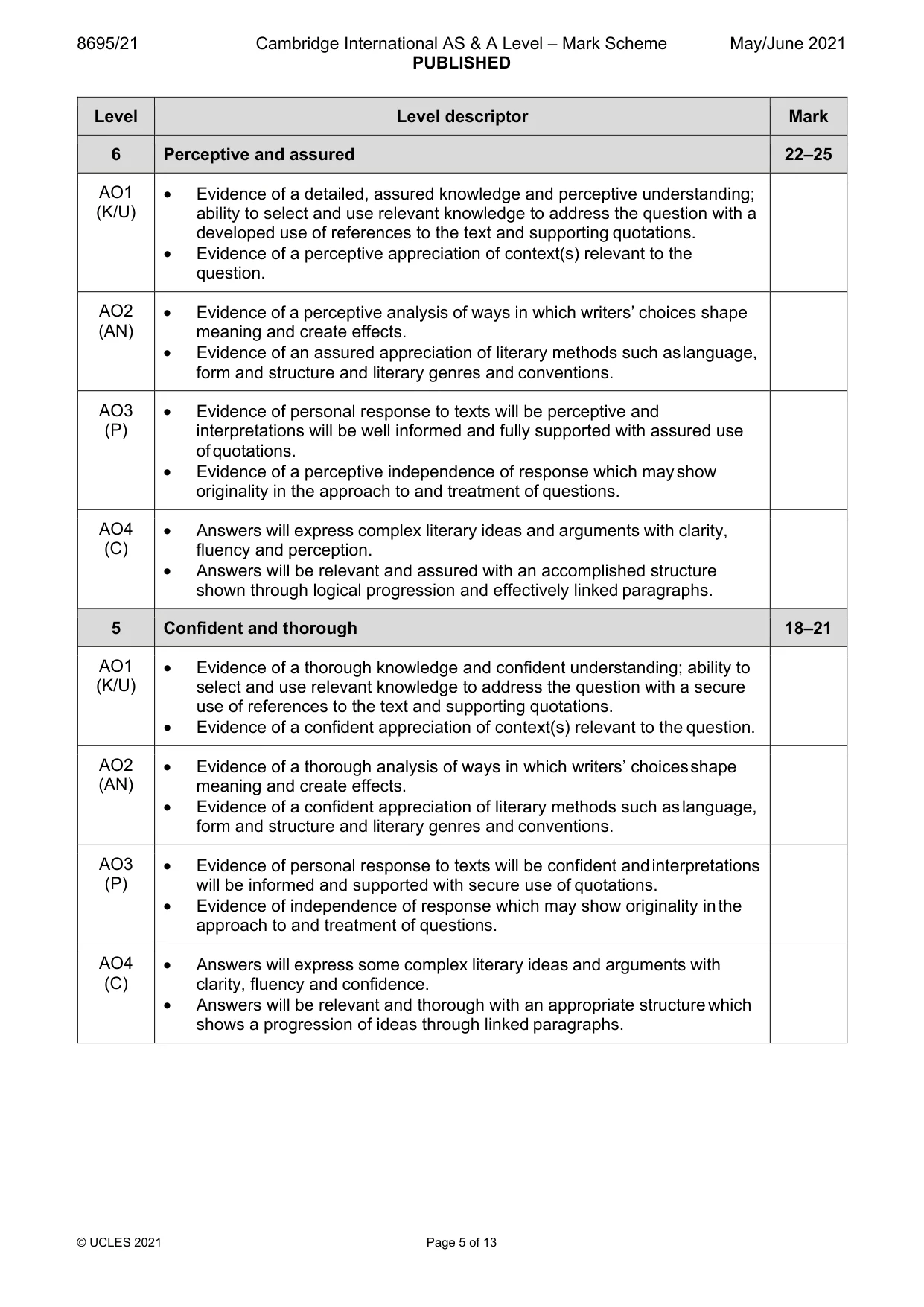
8695/21 Cambridge International AS & A Level – Mark Scheme PUBLISHED May/June 2021 © UCLES 2021 Page 5 of 13 Level Level descriptor Mark 6 Perceptive and assured 22–25 AO1 (K/U) • Evidence of a detailed, assured knowledge and perceptive understanding; ability to select and use relevant knowledge to address the question with a developed use of references to the text and supporting quotations. • Evidence of a perceptive appreciation of context(s) relevant to the question. AO2 (AN) • Evidence of a perceptive analysis of ways in which writers’ choices shape meaning and create effects. • Evidence of an assured appreciation of literary methods such as language, form and structure and literary genres and conventions. AO3 (P) • Evidence of personal response to texts will be perceptive and interpretations will be well informed and fully supported with assured use of quotations. • Evidence of a perceptive independence of response which may show originality in the approach to and treatment of questions. AO4 (C) • Answers will express complex literary ideas and arguments with clarity, fluency and perception. • Answers will be relevant and assured with an accomplished structure shown through logical progression and effectively linked paragraphs. 5 Confident and thorough 18–21 AO1 (K/U) • Evidence of a thorough knowledge and confident understanding; ability to select and use relevant knowledge to address the question with a secure use of references to the text and supporting quotations. • Evidence of a confident appreciation of context(s) relevant to the question. AO2 (AN) • Evidence of a thorough analysis of ways in which writers’ choices shape meaning and create effects. • Evidence of a confident appreciation of literary methods such as language, form and structure and literary genres and conventions. AO3 (P) • Evidence of personal response to texts will be confident and interpretations will be informed and supported with secure use of quotations. • Evidence of independence of response which may show originality in the approach to and treatment of questions. AO4 (C) • Answers will express some complex literary ideas and arguments with clarity, fluency and confidence. • Answers will be relevant and thorough with an appropriate structure which shows a progression of ideas through linked paragraphs.
Mark scheme, page 6
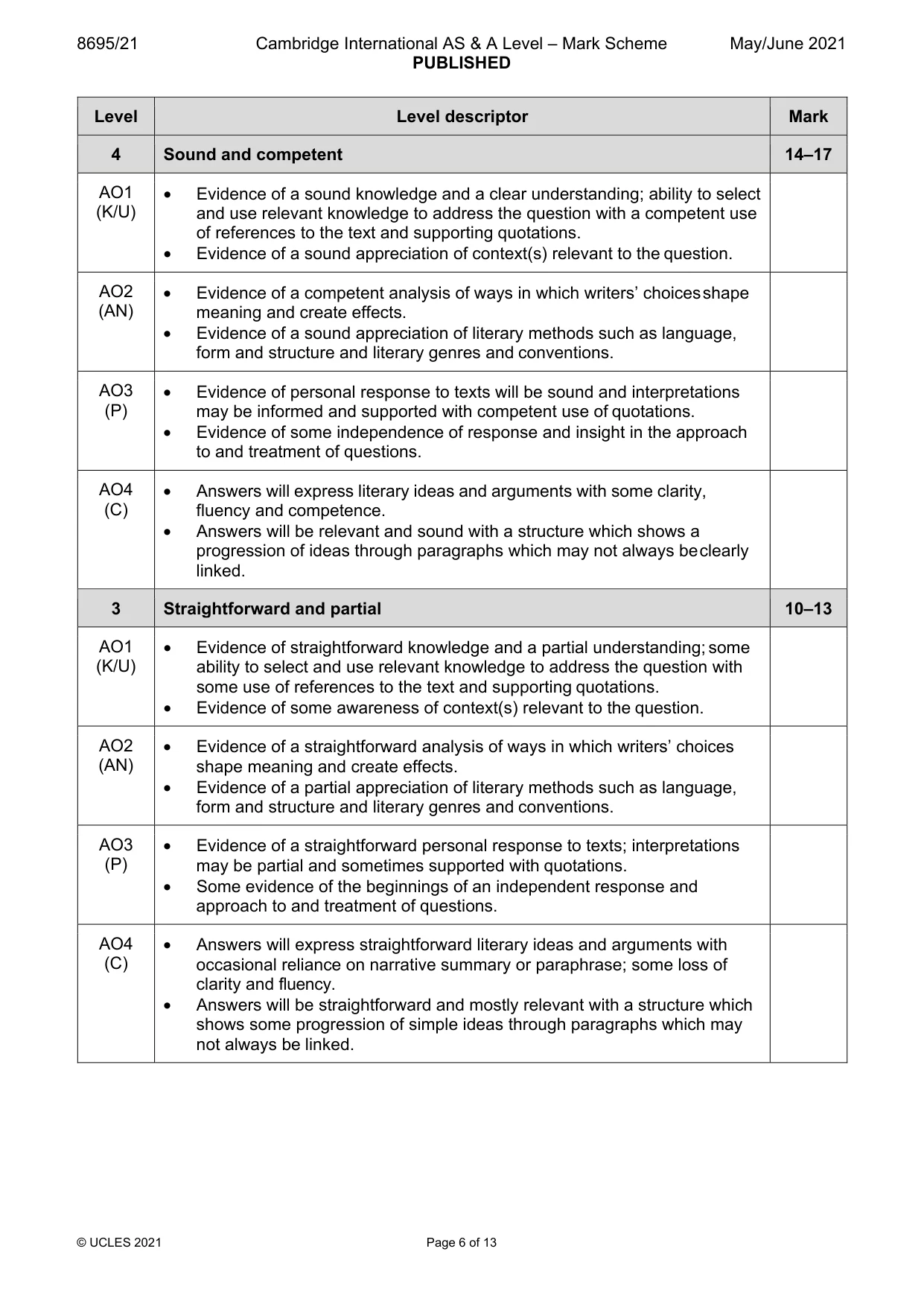
8695/21 Cambridge International AS & A Level – Mark Scheme PUBLISHED May/June 2021 © UCLES 2021 Page 6 of 13 Level Level descriptor Mark 4 Sound and competent 14–17 AO1 (K/U) • Evidence of a sound knowledge and a clear understanding; ability to select and use relevant knowledge to address the question with a competent use of references to the text and supporting quotations. • Evidence of a sound appreciation of context(s) relevant to the question. AO2 (AN) • Evidence of a competent analysis of ways in which writers’ choices shape meaning and create effects. • Evidence of a sound appreciation of literary methods such as language, form and structure and literary genres and conventions. AO3 (P) • Evidence of personal response to texts will be sound and interpretations may be informed and supported with competent use of quotations. • Evidence of some independence of response and insight in the approach to and treatment of questions. AO4 (C) • Answers will express literary ideas and arguments with some clarity, fluency and competence. • Answers will be relevant and sound with a structure which shows a progression of ideas through paragraphs which may not always be clearly linked. 3 Straightforward and partial 10–13 AO1 (K/U) • Evidence of straightforward knowledge and a partial understanding; some ability to select and use relevant knowledge to address the question with some use of references to the text and supporting quotations. • Evidence of some awareness of context(s) relevant to the question. AO2 (AN) • Evidence of a straightforward analysis of ways in which writers’ choices shape meaning and create effects. • Evidence of a partial appreciation of literary methods such as language, form and structure and literary genres and conventions. AO3 (P) • Evidence of a straightforward personal response to texts; interpretations may be partial and sometimes supported with quotations. • Some evidence of the beginnings of an independent response and approach to and treatment of questions. AO4 (C) • Answers will express straightforward literary ideas and arguments with occasional reliance on narrative summary or paraphrase; some loss of clarity and fluency. • Answers will be straightforward and mostly relevant with a structure which shows some progression of simple ideas through paragraphs which may not always be linked.
Mark scheme, page 7
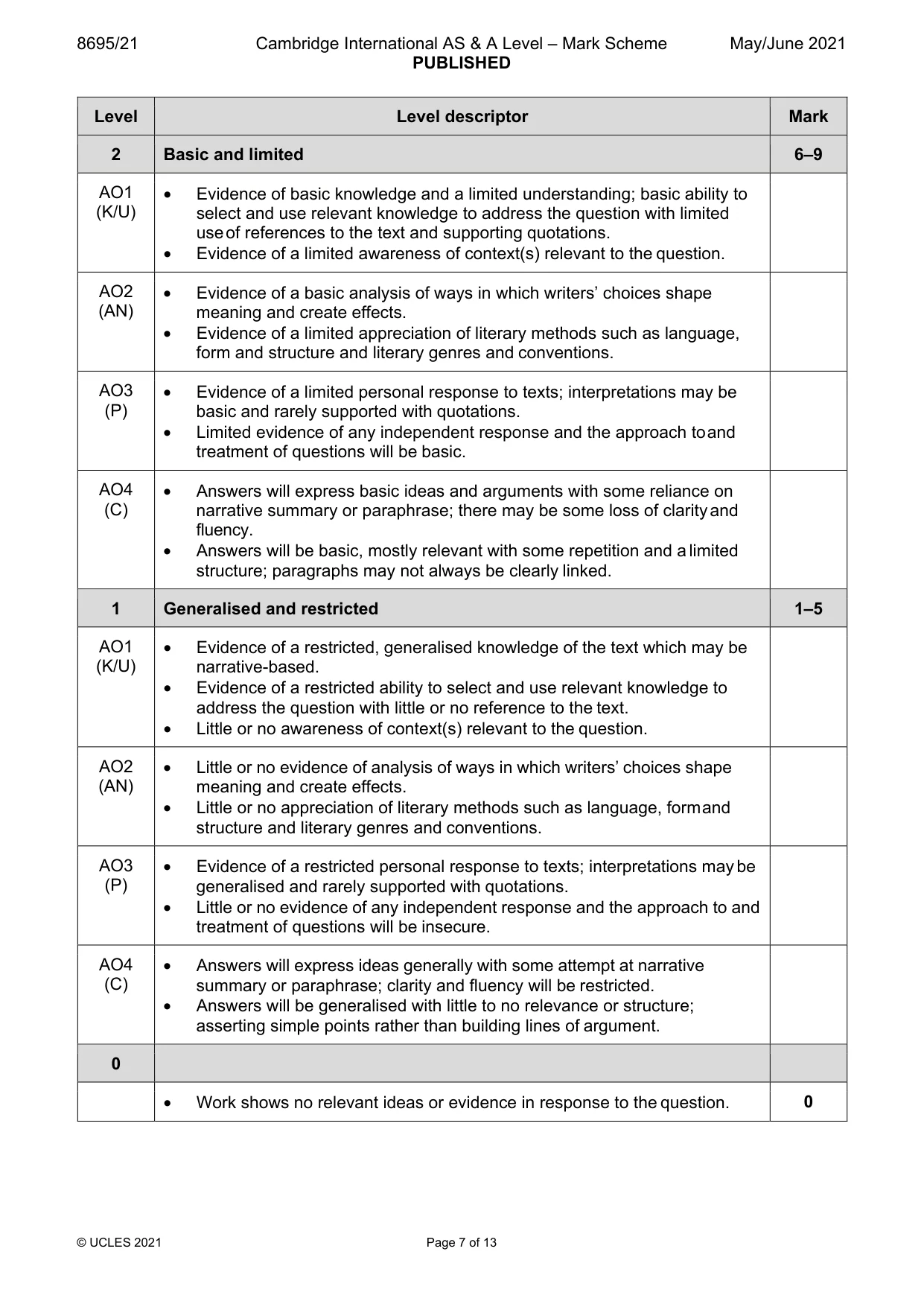
8695/21 Cambridge International AS & A Level – Mark Scheme PUBLISHED May/June 2021 © UCLES 2021 Page 7 of 13 Level Level descriptor Mark 2 Basic and limited 6–9 AO1 (K/U) • Evidence of basic knowledge and a limited understanding; basic ability to select and use relevant knowledge to address the question with limited use of references to the text and supporting quotations. • Evidence of a limited awareness of context(s) relevant to the question. AO2 (AN) • Evidence of a basic analysis of ways in which writers’ choices shape meaning and create effects. • Evidence of a limited appreciation of literary methods such as language, form and structure and literary genres and conventions. AO3 (P) • Evidence of a limited personal response to texts; interpretations may be basic and rarely supported with quotations. • Limited evidence of any independent response and the approach to and treatment of questions will be basic. AO4 (C) • Answers will express basic ideas and arguments with some reliance on narrative summary or paraphrase; there may be some loss of clarity and fluency. • Answers will be basic, mostly relevant with some repetition and a limited structure; paragraphs may not always be clearly linked. 1 Generalised and restricted 1–5 AO1 (K/U) • Evidence of a restricted, generalised knowledge of the text which may be narrative-based. • Evidence of a restricted ability to select and use relevant knowledge to address the question with little or no reference to the text. • Little or no awareness of context(s) relevant to the question. AO2 (AN) • Little or no evidence of analysis of ways in which writers’ choices shape meaning and create effects. • Little or no appreciation of literary methods such as language, form and structure and literary genres and conventions. AO3 (P) • Evidence of a restricted personal response to texts; interpretations may be generalised and rarely supported with quotations. • Little or no evidence of any independent response and the approach to and treatment of questions will be insecure. AO4 (C) • Answers will express ideas generally with some attempt at narrative summary or paraphrase; clarity and fluency will be restricted. • Answers will be generalised with little to no relevance or structure; asserting simple points rather than building lines of argument. 0 • Work shows no relevant ideas or evidence in response to the question. 0
Mark scheme, page 8
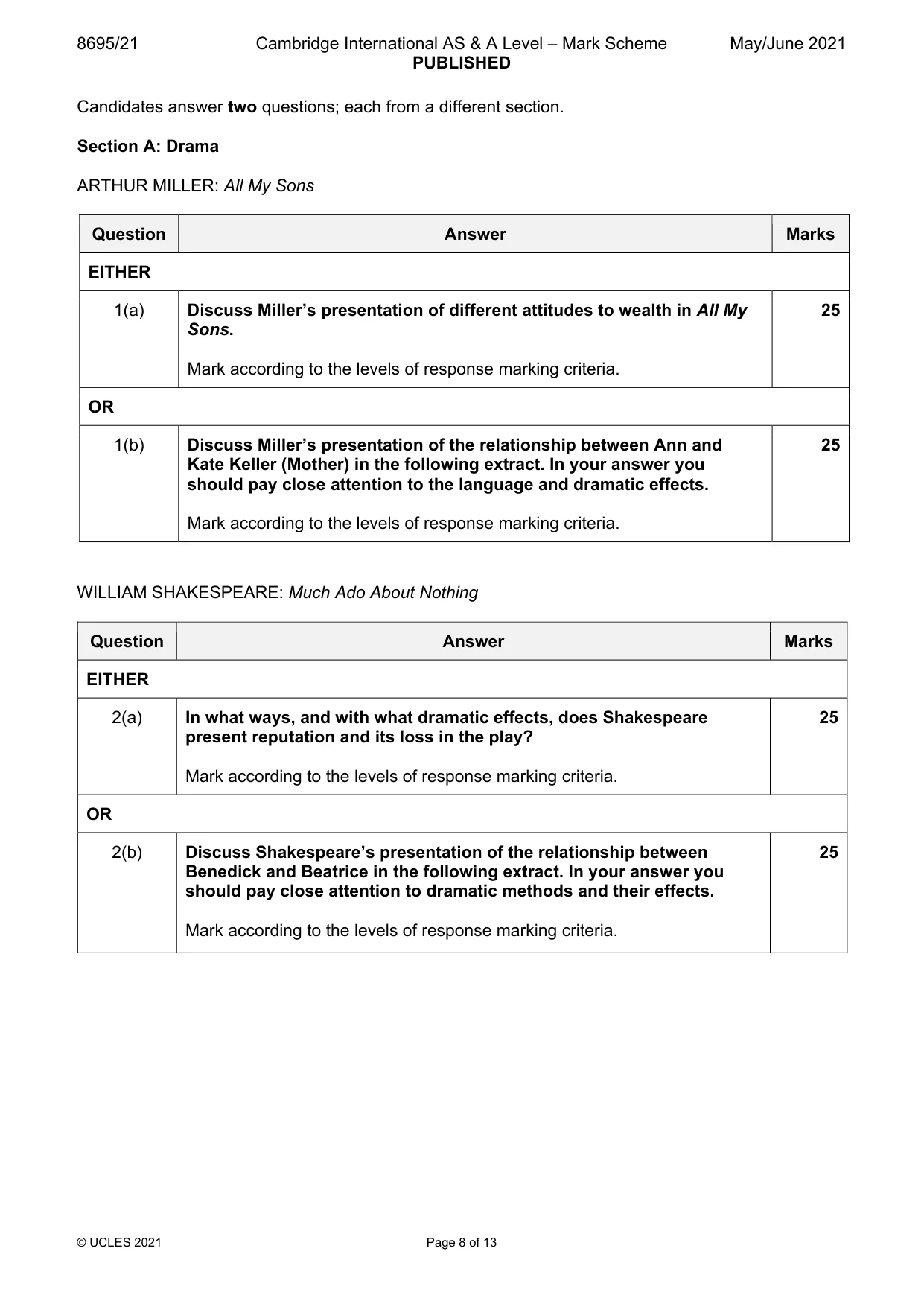
8695/21 Cambridge International AS & A Level – Mark Scheme PUBLISHED May/June 2021 © UCLES 2021 Page 8 of 13 Candidates answer two questions; each from a different section. Section A: Drama ARTHUR MILLER: All My Sons Question Answer Marks EITHER 1(a) Discuss Miller’s presentation of different attitudes to wealth in All My Sons. Mark according to the levels of response marking criteria. 25 OR 1(b) Discuss Miller’s presentation of the relationship between Ann and Kate Keller (Mother) in the following extract. In your answer you should pay close attention to the language and dramatic effects. Mark according to the levels of response marking criteria. 25 WILLIAM SHAKESPEARE: Much Ado About Nothing Question Answer Marks EITHER 2(a) In what ways, and with what dramatic effects, does Shakespeare present reputation and its loss in the play? Mark according to the levels of response marking criteria. 25 OR 2(b) Discuss Shakespeare’s presentation of the relationship between Benedick and Beatrice in the following extract. In your answer you should pay close attention to dramatic methods and their effects. Mark according to the levels of response marking criteria. 25
Mark scheme, page 9
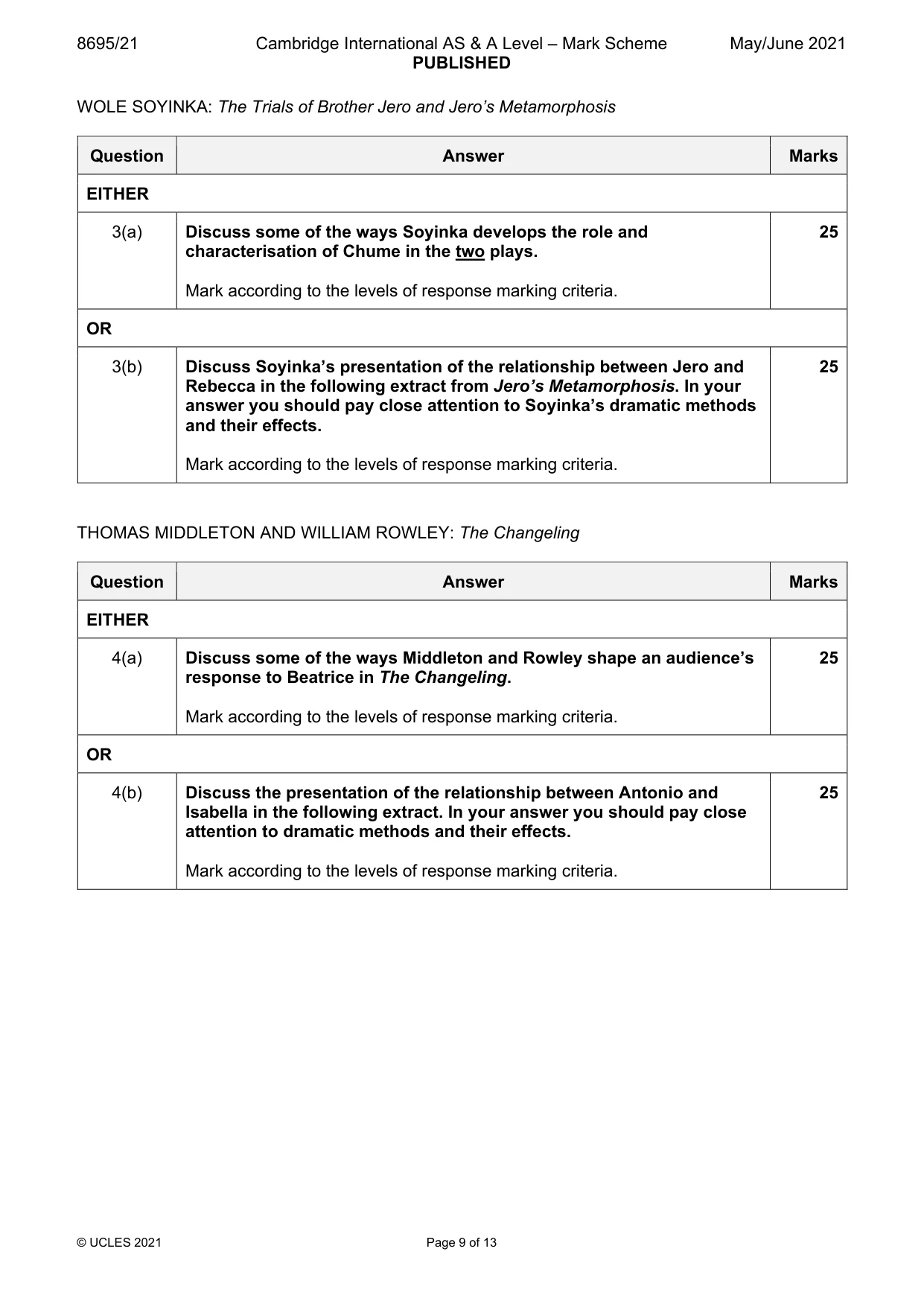
8695/21 Cambridge International AS & A Level – Mark Scheme PUBLISHED May/June 2021 © UCLES 2021 Page 9 of 13 WOLE SOYINKA: The Trials of Brother Jero and Jero’s Metamorphosis Question Answer Marks EITHER 3(a) Discuss some of the ways Soyinka develops the role and characterisation of Chume in the two plays. Mark according to the levels of response marking criteria. 25 OR 3(b) Discuss Soyinka’s presentation of the relationship between Jero and Rebecca in the following extract from Jero’s Metamorphosis. In your answer you should pay close attention to Soyinka’s dramatic methods and their effects. Mark according to the levels of response marking criteria. 25 THOMAS MIDDLETON AND WILLIAM ROWLEY: The Changeling Question Answer Marks EITHER 4(a) Discuss some of the ways Middleton and Rowley shape an audience’s response to Beatrice in The Changeling. Mark according to the levels of response marking criteria. 25 OR 4(b) Discuss the presentation of the relationship between Antonio and Isabella in the following extract. In your answer you should pay close attention to dramatic methods and their effects. Mark according to the levels of response marking criteria. 25
Mark scheme, page 10
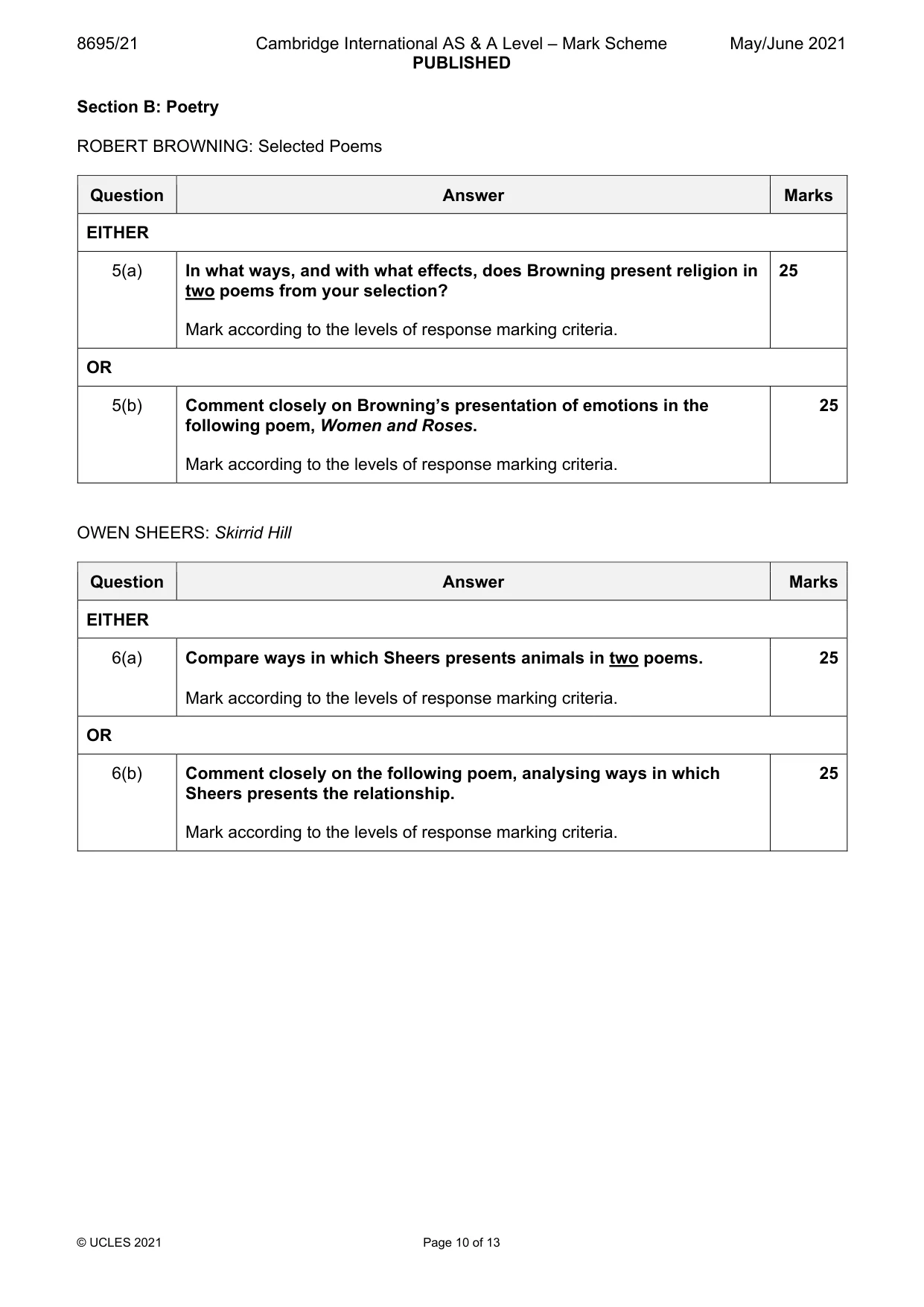
8695/21 Cambridge International AS & A Level – Mark Scheme PUBLISHED May/June 2021 © UCLES 2021 Page 10 of 13 Section B: Poetry ROBERT BROWNING: Selected Poems Question Answer Marks EITHER 5(a) In what ways, and with what effects, does Browning present religion in two poems from your selection? Mark according to the levels of response marking criteria. 25 OR 5(b) Comment closely on Browning’s presentation of emotions in the following poem, Women and Roses. Mark according to the levels of response marking criteria. 25 OWEN SHEERS: Skirrid Hill Question Answer Marks EITHER 6(a) Compare ways in which Sheers presents animals in two poems. Mark according to the levels of response marking criteria. 25 OR 6(b) Comment closely on the following poem, analysing ways in which Sheers presents the relationship. Mark according to the levels of response marking criteria. 25
Mark scheme, page 11
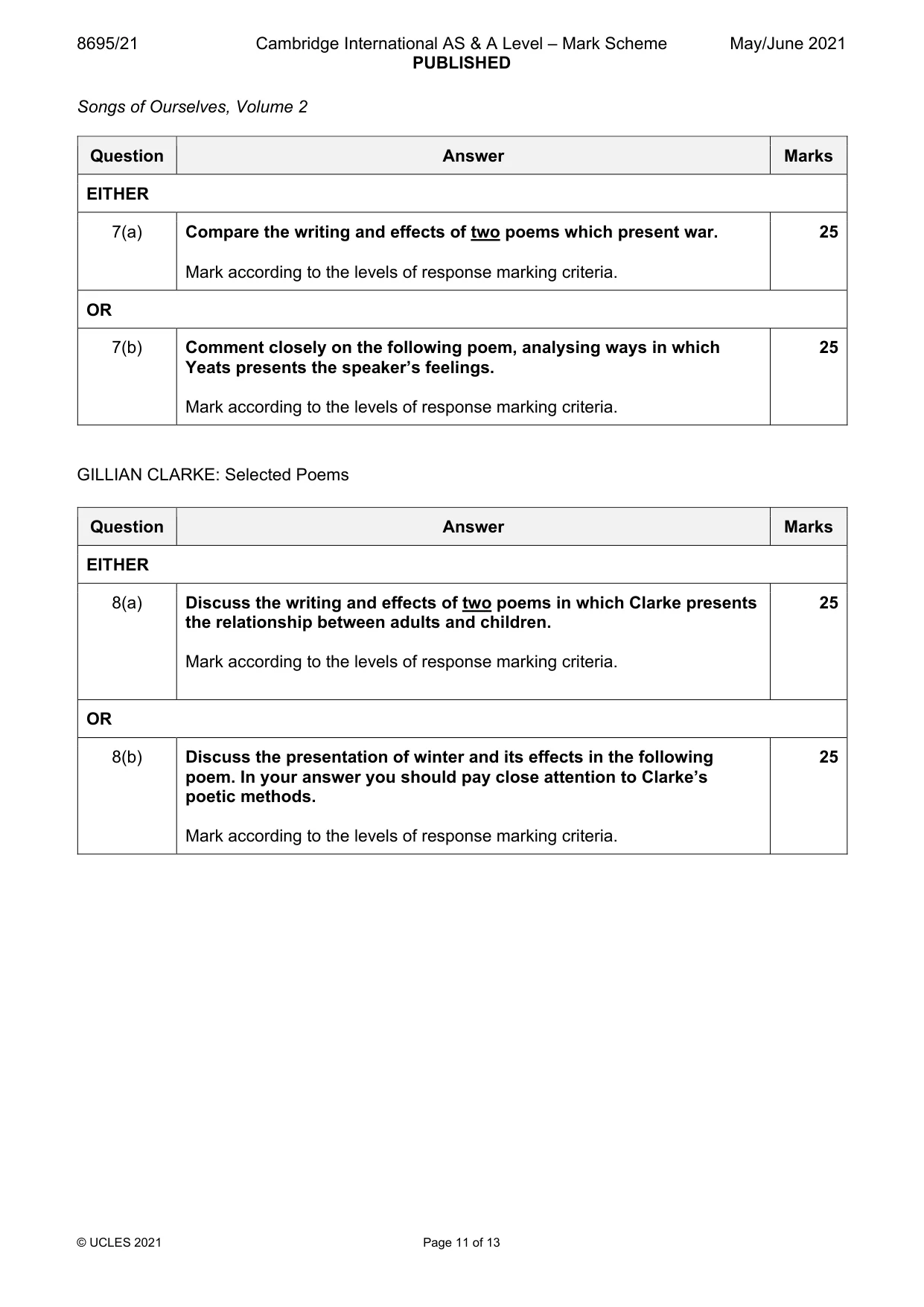
8695/21 Cambridge International AS & A Level – Mark Scheme PUBLISHED May/June 2021 © UCLES 2021 Page 11 of 13 Songs of Ourselves, Volume 2 Question Answer Marks EITHER 7(a) Compare the writing and effects of two poems which present war. Mark according to the levels of response marking criteria. 25 OR 7(b) Comment closely on the following poem, analysing ways in which Yeats presents the speaker’s feelings. Mark according to the levels of response marking criteria. 25 GILLIAN CLARKE: Selected Poems Question Answer Marks EITHER 8(a) Discuss the writing and effects of two poems in which Clarke presents the relationship between adults and children. Mark according to the levels of response marking criteria. 25 OR 8(b) Discuss the presentation of winter and its effects in the following poem. In your answer you should pay close attention to Clarke’s poetic methods. Mark according to the levels of response marking criteria. 25
Mark scheme, page 12
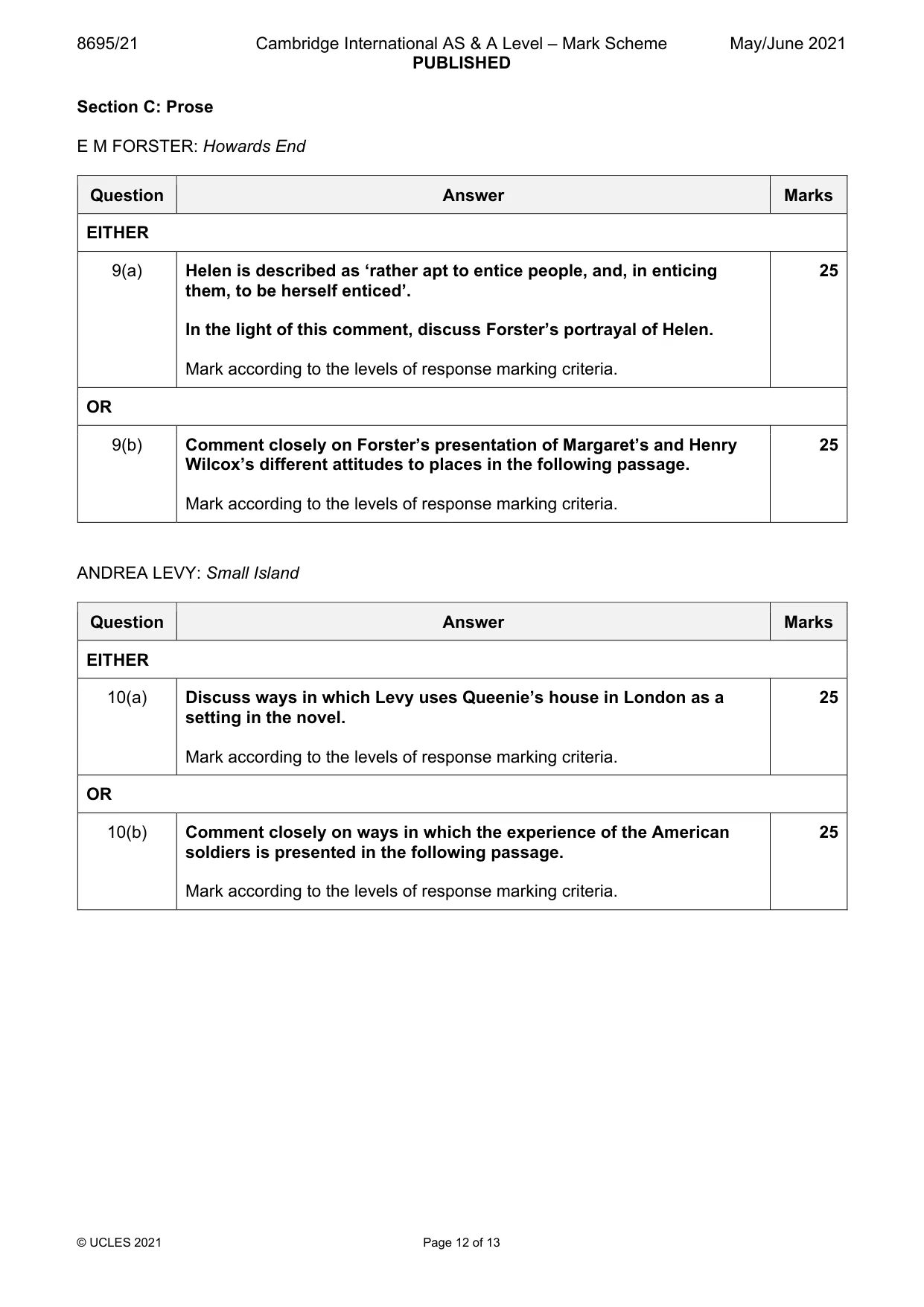
8695/21 Cambridge International AS & A Level – Mark Scheme PUBLISHED May/June 2021 © UCLES 2021 Page 12 of 13 Section C: Prose E M FORSTER: Howards End Question Answer Marks EITHER 9(a) Helen is described as ‘rather apt to entice people, and, in enticing them, to be herself enticed’. In the light of this comment, discuss Forster’s portrayal of Helen. Mark according to the levels of response marking criteria. 25 OR 9(b) Comment closely on Forster’s presentation of Margaret’s and Henry Wilcox’s different attitudes to places in the following passage. Mark according to the levels of response marking criteria. 25 ANDREA LEVY: Small Island Question Answer Marks EITHER 10(a) Discuss ways in which Levy uses Queenie’s house in London as a setting in the novel. Mark according to the levels of response marking criteria. 25 OR 10(b) Comment closely on ways in which the experience of the American soldiers is presented in the following passage. Mark according to the levels of response marking criteria. 25
Mark scheme, page 13
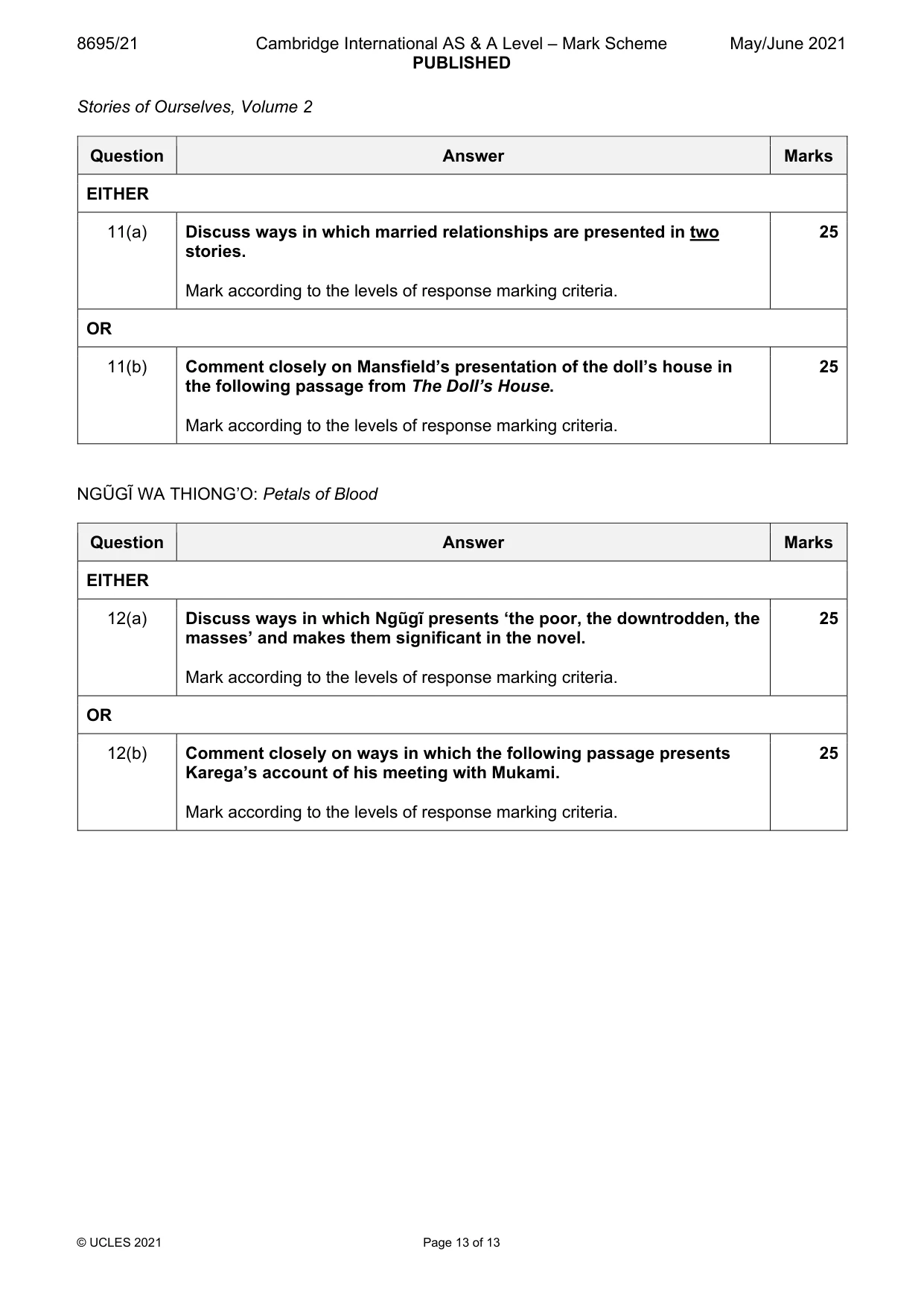
8695/21 Cambridge International AS & A Level – Mark Scheme PUBLISHED May/June 2021 © UCLES 2021 Page 13 of 13 Stories of Ourselves, Volume 2 Question Answer Marks EITHER 11(a) Discuss ways in which married relationships are presented in two stories. Mark according to the levels of response marking criteria. 25 OR 11(b) Comment closely on Mansfield’s presentation of the doll’s house in the following passage from The Doll’s House. Mark according to the levels of response marking criteria. 25 NGŨGĨ WA THIONG’O: Petals of Blood Question Answer Marks EITHER 12(a) Discuss ways in which Ngũgĩ presents ‘the poor, the downtrodden, the masses’ and makes them significant in the novel. Mark according to the levels of response marking criteria. 25 OR 12(b) Comment closely on ways in which the following passage presents Karega’s account of his meeting with Mukami. Mark according to the levels of response marking criteria. 25
What you needed in this session
Cambridge’s own grade thresholds for 2021 May/June, Paper 2 · Variant 1. A higher threshold means an easier paper — the bar moves with how the cohort did.