Cambridge A Level English - Language and Literature (AS Level only, from 2016) 8695 — 2011 May/June Paper 9 · Variant 3
8695/93/M/J/11 · 50 marks · ≈56 min
The question paper and its mark scheme, free to read here and free to download. This is Cambridge’s own paper, exactly as it was sat.
Question paper20 pages



Mark scheme5 pages
Answers below. Sit the paper first if you are practising.
Paper as text
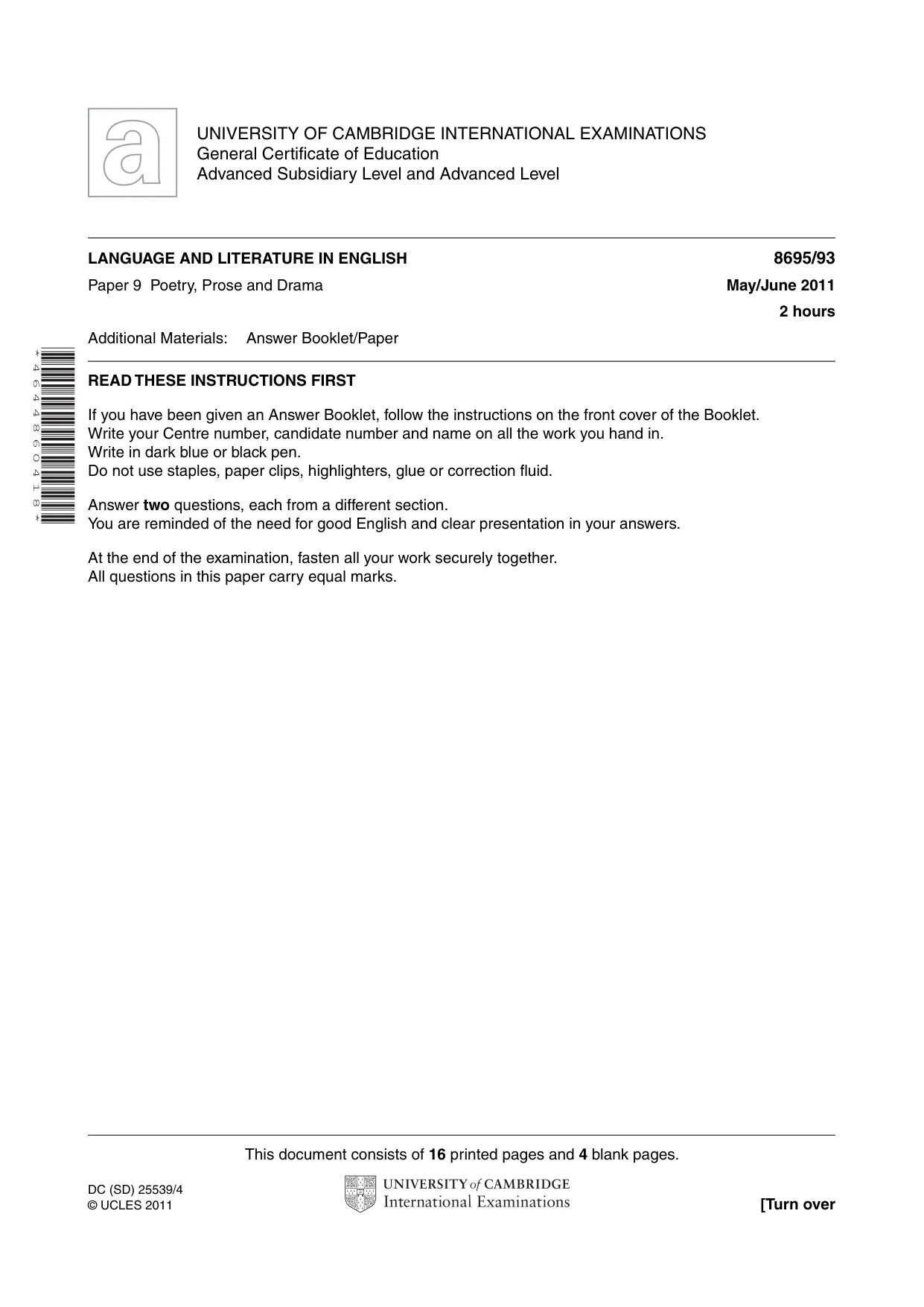
Question paper, page 1
This document consists of 16 printed pages and 4 blank pages. DC (SD) 25539/4 © UCLES 2011 [Turn over UNIVERSITY OF CAMBRIDGE INTERNATIONAL EXAMINATIONS General Certificate of Education Advanced Subsidiary Level and Advanced Level * 4 6 4 4 8 6 0 4 1 8 * LANGUAGE AND LITERATURE IN ENGLISH 8695/93 Paper 9 Poetry, Prose and Drama May/June 2011 2 hours Additional Materials: Answer Booklet/Paper READ THESE INSTRUCTIONS FIRST If you have been given an Answer Booklet, follow the instructions on the front cover of the Booklet. Write your Centre number, candidate number and name on all the work you hand in. Write in dark blue or black pen. Do not use staples, paper clips, highlighters, glue or correction fluid. Answer two questions, each from a different section. You are reminded of the need for good English and clear presentation in your answers. At the end of the examination, fasten all your work securely together. All questions in this paper carry equal marks.
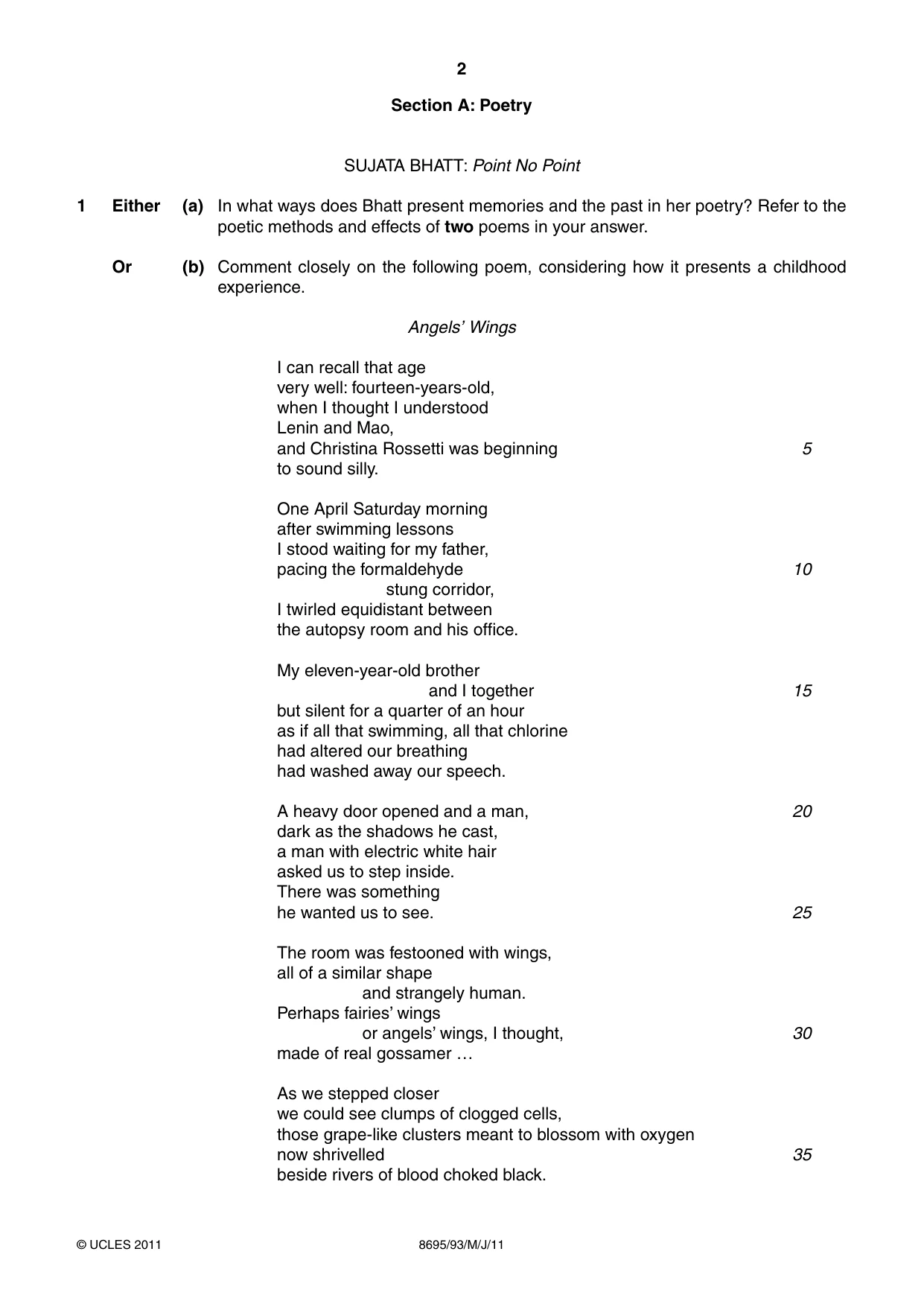
Question paper, page 2
2 8695/93/M/J/11 © UCLES 2011 Section A: Poetry SUJATA BHATT: Point No Point 1 Either (a) In what ways does Bhatt present memories and the past in her poetry? Refer to the poetic methods and effects of two poems in your answer. Or (b) Comment closely on the following poem, considering how it presents a childhood experience. Angels’ Wings I can recall that age very well: fourteen-years-old, when I thought I understood Lenin and Mao, and Christina Rossetti was beginning 5 to sound silly. One April Saturday morning after swimming lessons I stood waiting for my father, pacing the formaldehyde 10 stung corridor, I twirled equidistant between the autopsy room and his office. My eleven-year-old brother and I together 15 but silent for a quarter of an hour as if all that swimming, all that chlorine had altered our breathing had washed away our speech. A heavy door opened and a man, 20 dark as the shadows he cast, a man with electric white hair asked us to step inside. There was something he wanted us to see. 25 The room was festooned with wings, all of a similar shape and strangely human. Perhaps fairies’ wings or angels’ wings, I thought, 30 made of real gossamer … As we stepped closer we could see clumps of clogged cells, those grape-like clusters meant to blossom with oxygen now shrivelled 35 beside rivers of blood choked black.
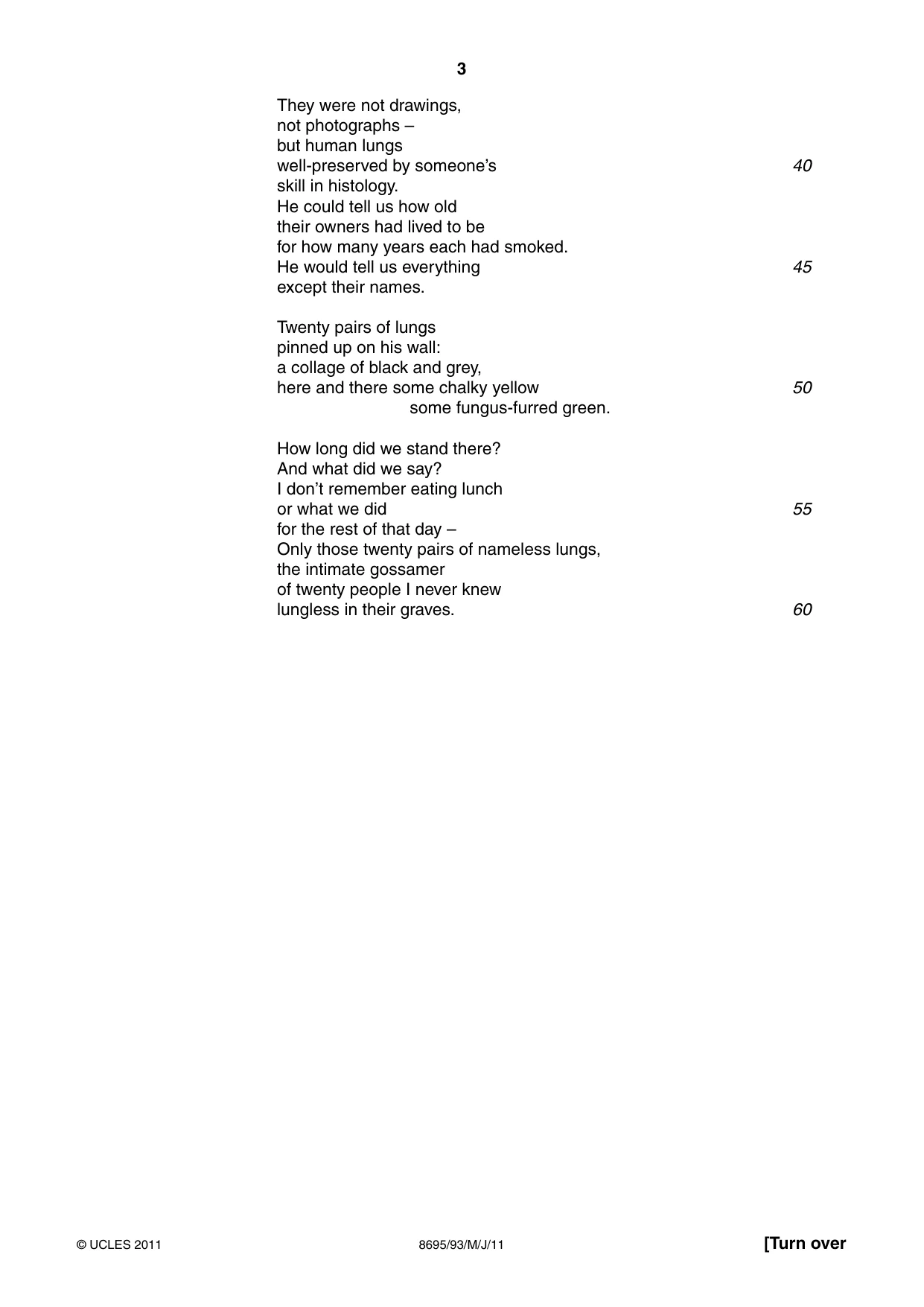
Question paper, page 3
3 8695/93/M/J/11 © UCLES 2011 [Turn over They were not drawings, not photographs – but human lungs well-preserved by someone’s 40 skill in histology. He could tell us how old their owners had lived to be for how many years each had smoked. He would tell us everything 45 except their names. Twenty pairs of lungs pinned up on his wall: a collage of black and grey, here and there some chalky yellow 50 some fungus-furred green. How long did we stand there? And what did we say? I don’t remember eating lunch or what we did 55 for the rest of that day – Only those twenty pairs of nameless lungs, the intimate gossamer of twenty people I never knew lungless in their graves. 60
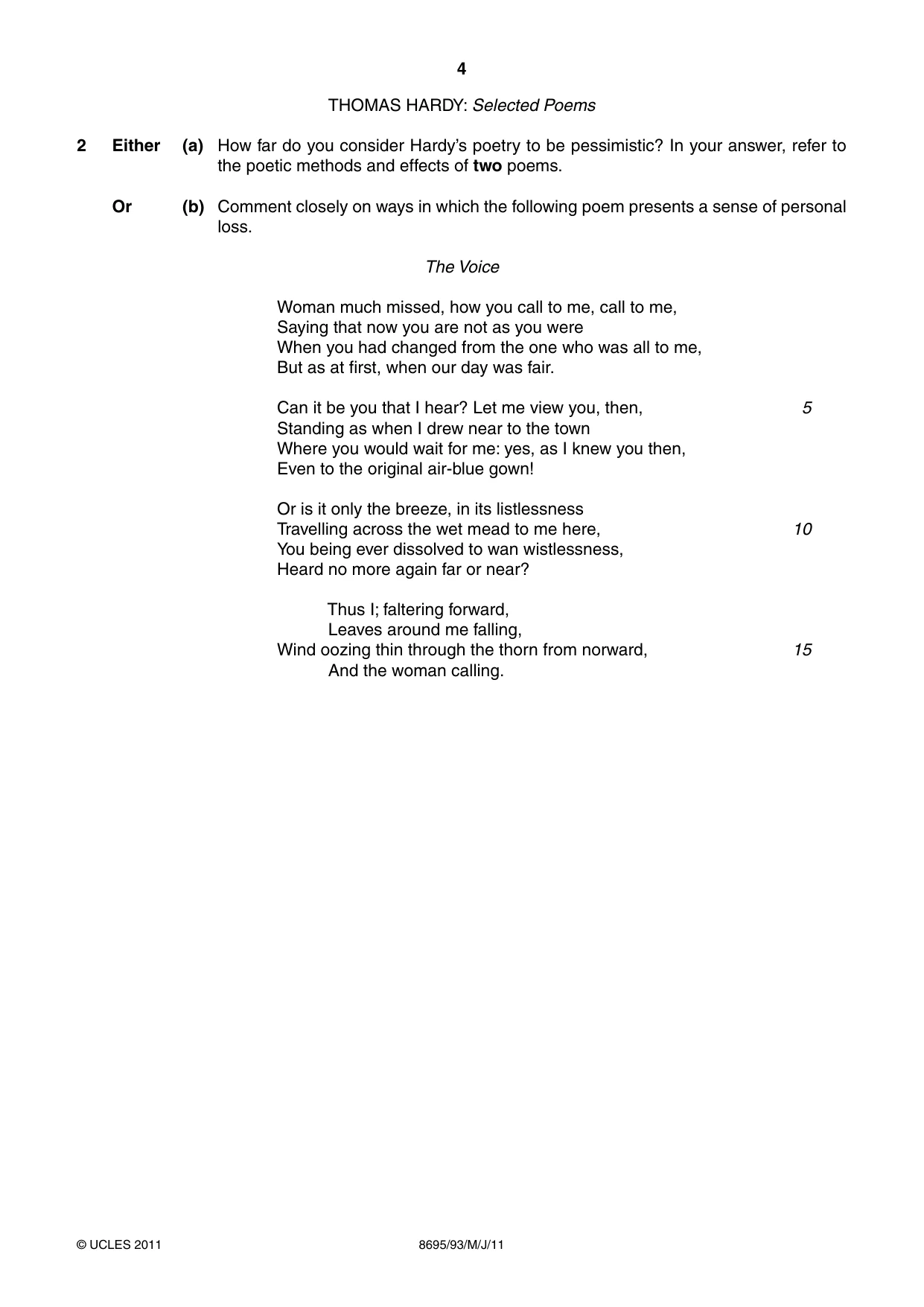
Question paper, page 4
4 8695/93/M/J/11 © UCLES 2011 THOMAS HARDY: Selected Poems 2 Either (a) How far do you consider Hardy’s poetry to be pessimistic? In your answer, refer to the poetic methods and effects of two poems. Or (b) Comment closely on ways in which the following poem presents a sense of personal loss. The Voice Woman much missed, how you call to me, call to me, Saying that now you are not as you were When you had changed from the one who was all to me, But as at first, when our day was fair. Can it be you that I hear? Let me view you, then, 5 Standing as when I drew near to the town Where you would wait for me: yes, as I knew you then, Even to the original air-blue gown! Or is it only the breeze, in its listlessness Travelling across the wet mead to me here, 10 You being ever dissolved to wan wistlessness, Heard no more again far or near? Thus I; faltering forward, Leaves around me falling, Wind oozing thin through the thorn from norward, 15 And the woman calling.
Question paper, page 5
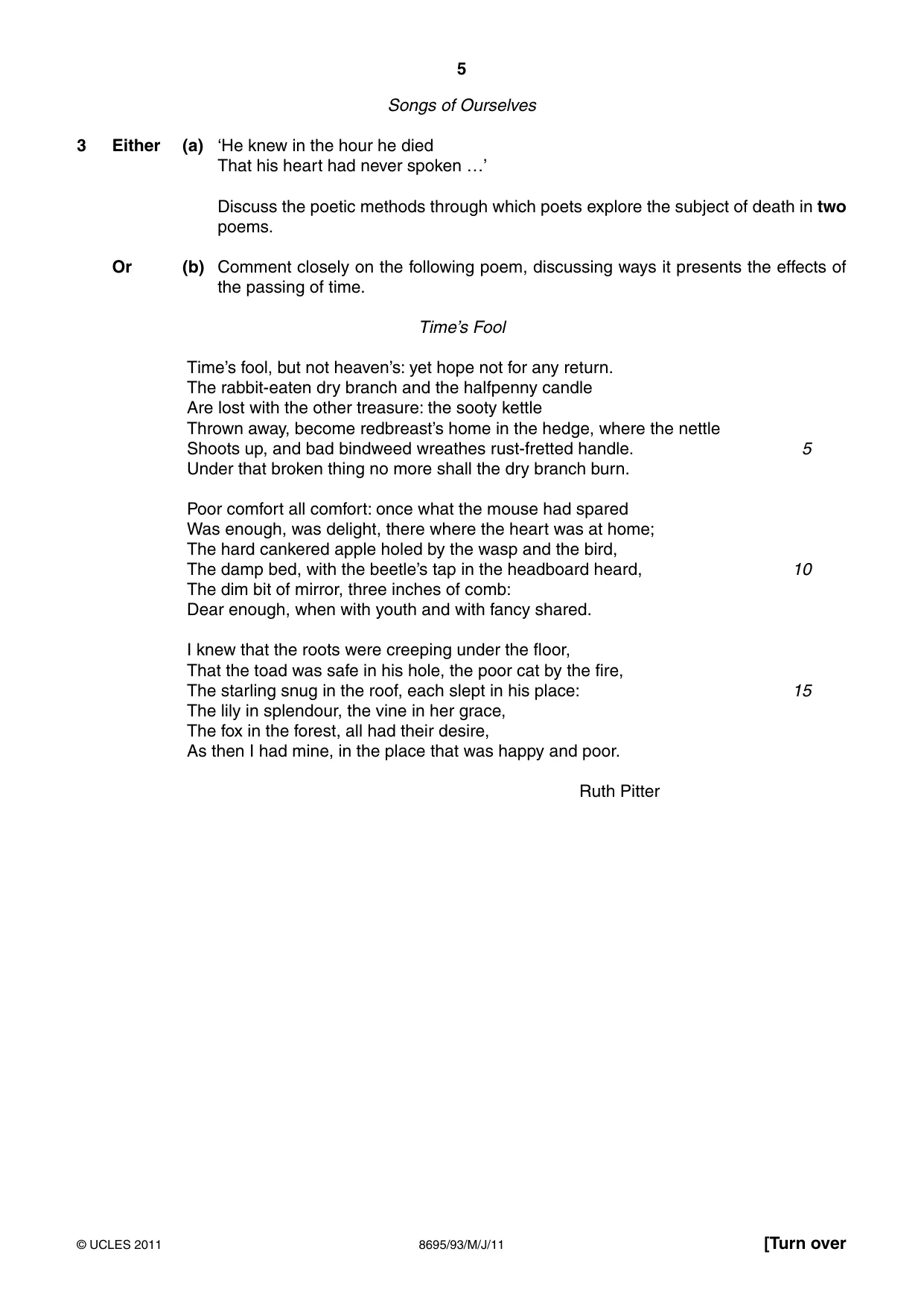
5 8695/93/M/J/11 © UCLES 2011 [Turn over Songs of Ourselves 3 Either (a) ‘He knew in the hour he died That his heart had never spoken …’ Discuss the poetic methods through which poets explore the subject of death in two poems. Or (b) Comment closely on the following poem, discussing ways it presents the effects of the passing of time. Time’s Fool Time’s fool, but not heaven’s: yet hope not for any return. The rabbit-eaten dry branch and the halfpenny candle Are lost with the other treasure: the sooty kettle Thrown away, become redbreast’s home in the hedge, where the nettle Shoots up, and bad bindweed wreathes rust-fretted handle. 5 Under that broken thing no more shall the dry branch burn. Poor comfort all comfort: once what the mouse had spared Was enough, was delight, there where the heart was at home; The hard cankered apple holed by the wasp and the bird, The damp bed, with the beetle’s tap in the headboard heard, 10 The dim bit of mirror, three inches of comb: Dear enough, when with youth and with fancy shared. I knew that the roots were creeping under the floor, That the toad was safe in his hole, the poor cat by the fire, The starling snug in the roof, each slept in his place: 15 The lily in splendour, the vine in her grace, The fox in the forest, all had their desire, As then I had mine, in the place that was happy and poor. Ruth Pitter
Question paper, page 6
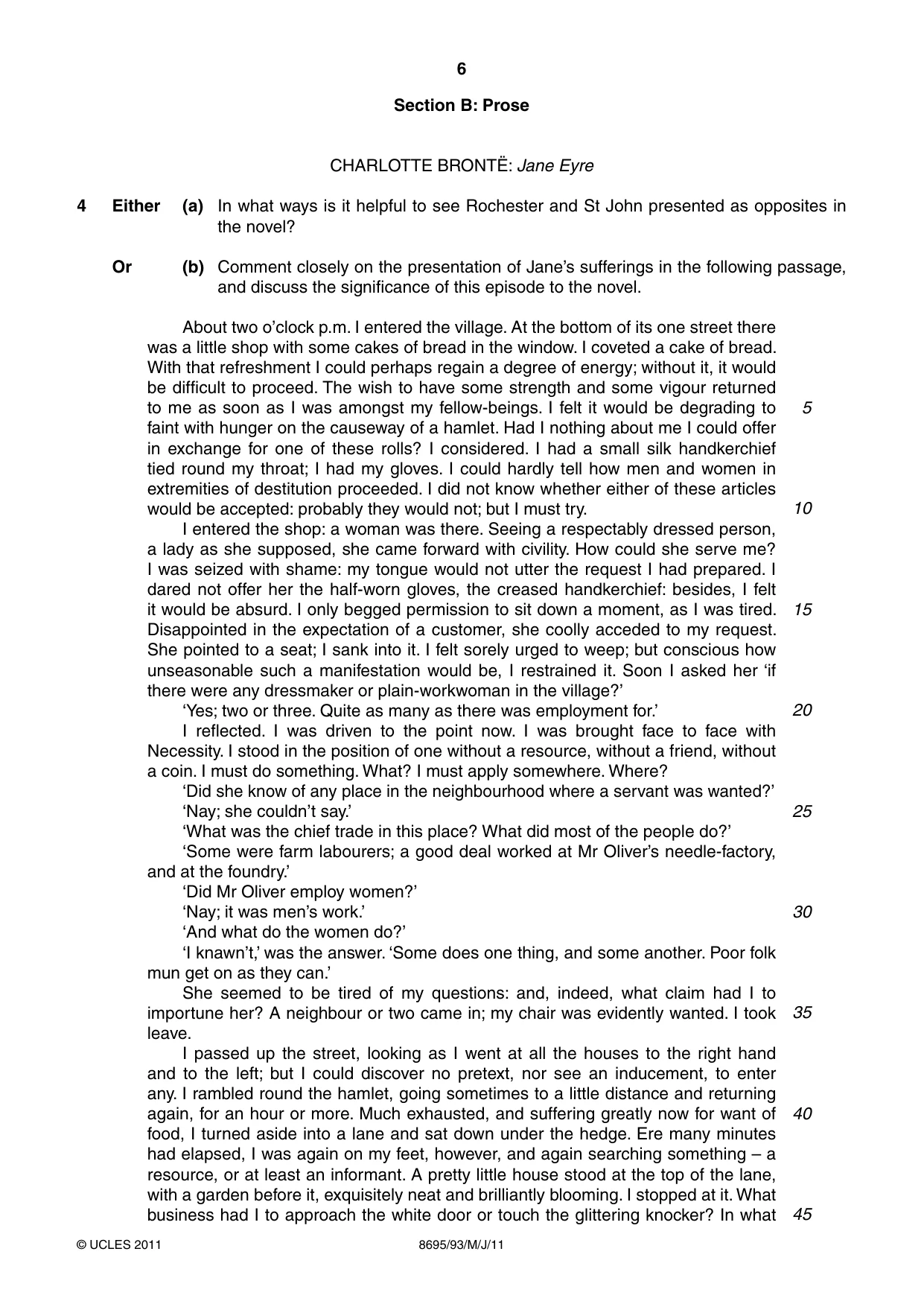
6 8695/93/M/J/11 © UCLES 2011 Section B: Prose CHARLOTTE BRONTË: Jane Eyre 4 Either (a) In what ways is it helpful to see Rochester and St John presented as opposites in the novel? Or (b) Comment closely on the presentation of Jane’s sufferings in the following passage, and discuss the significance of this episode to the novel. About two o’clock p.m. I entered the village. At the bottom of its one street there was a little shop with some cakes of bread in the window. I coveted a cake of bread. With that refreshment I could perhaps regain a degree of energy; without it, it would be difficult to proceed. The wish to have some strength and some vigour returned to me as soon as I was amongst my fellow-beings. I felt it would be degrading to faint with hunger on the causeway of a hamlet. Had I nothing about me I could offer in exchange for one of these rolls? I considered. I had a small silk handkerchief tied round my throat; I had my gloves. I could hardly tell how men and women in extremities of destitution proceeded. I did not know whether either of these articles would be accepted: probably they would not; but I must try. I entered the shop: a woman was there. Seeing a respectably dressed person, a lady as she supposed, she came forward with civility. How could she serve me? I was seized with shame: my tongue would not utter the request I had prepared. I dared not offer her the half-worn gloves, the creased handkerchief: besides, I felt it would be absurd. I only begged permission to sit down a moment, as I was tired. Disappointed in the expectation of a customer, she coolly acceded to my request. She pointed to a seat; I sank into it. I felt sorely urged to weep; but conscious how unseasonable such a manifestation would be, I restrained it. Soon I asked her ‘if there were any dressmaker or plain-workwoman in the village?’ ‘Yes; two or three. Quite as many as there was employment for.’ I reflected. I was driven to the point now. I was brought face to face with Necessity. I stood in the position of one without a resource, without a friend, without a coin. I must do something. What? I must apply somewhere. Where? ‘Did she know of any place in the neighbourhood where a servant was wanted?’ ‘Nay; she couldn’t say.’ ‘What was the chief trade in this place? What did most of the people do?’ ‘Some were farm labourers; a good deal worked at Mr Oliver’s needle-factory, and at the foundry.’ ‘Did Mr Oliver employ women?’ ‘Nay; it was men’s work.’ ‘And what do the women do?’ ‘I knawn’t,’ was the answer. ‘Some does one thing, and some another. Poor folk mun get on as they can.’ She seemed to be tired of my questions: and, indeed, what claim had I to importune her? A neighbour or two came in; my chair was evidently wanted. I took leave. I passed up the street, looking as I went at all the houses to the right hand and to the left; but I could discover no pretext, nor see an inducement, to enter any. I rambled round the hamlet, going sometimes to a little distance and returning again, for an hour or more. Much exhausted, and suffering greatly now for want of food, I turned aside into a lane and sat down under the hedge. Ere many minutes had elapsed, I was again on my feet, however, and again searching something – a resource, or at least an informant. A pretty little house stood at the top of the lane, with a garden before it, exquisitely neat and brilliantly blooming. I stopped at it. What business had I to approach the white door or touch the glittering knocker? In what 5 10 15 20 25 30 35 40 45
Question paper, page 7
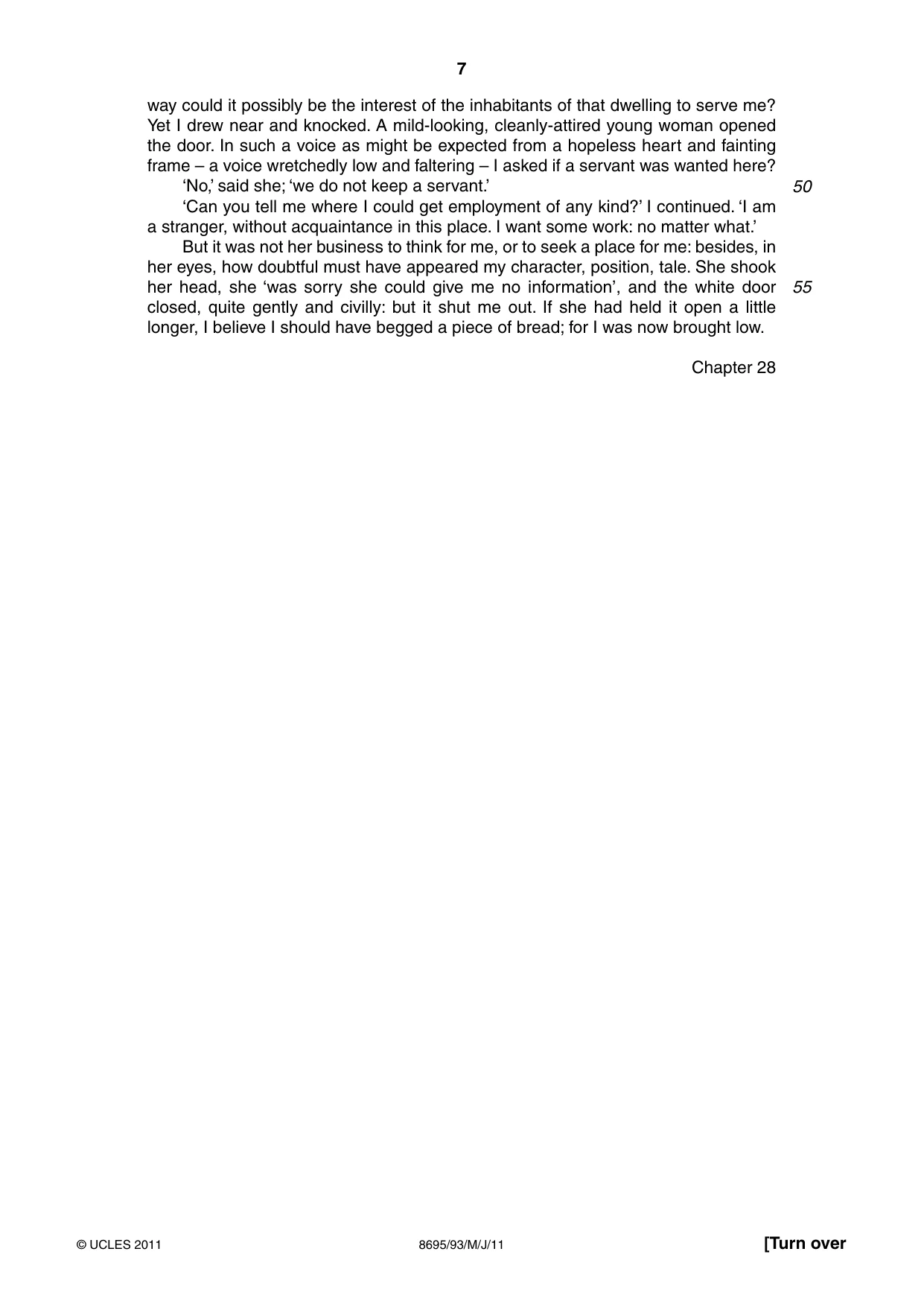
7 8695/93/M/J/11 © UCLES 2011 [Turn over way could it possibly be the interest of the inhabitants of that dwelling to serve me? Yet I drew near and knocked. A mild-looking, cleanly-attired young woman opened the door. In such a voice as might be expected from a hopeless heart and fainting frame – a voice wretchedly low and faltering – I asked if a servant was wanted here? ‘No,’ said she; ‘we do not keep a servant.’ ‘Can you tell me where I could get employment of any kind?’ I continued. ‘I am a stranger, without acquaintance in this place. I want some work: no matter what.’ But it was not her business to think for me, or to seek a place for me: besides, in her eyes, how doubtful must have appeared my character, position, tale. She shook her head, she ‘was sorry she could give me no information’, and the white door closed, quite gently and civilly: but it shut me out. If she had held it open a little longer, I believe I should have begged a piece of bread; for I was now brought low. Chapter 28 50 55
Question paper, page 8
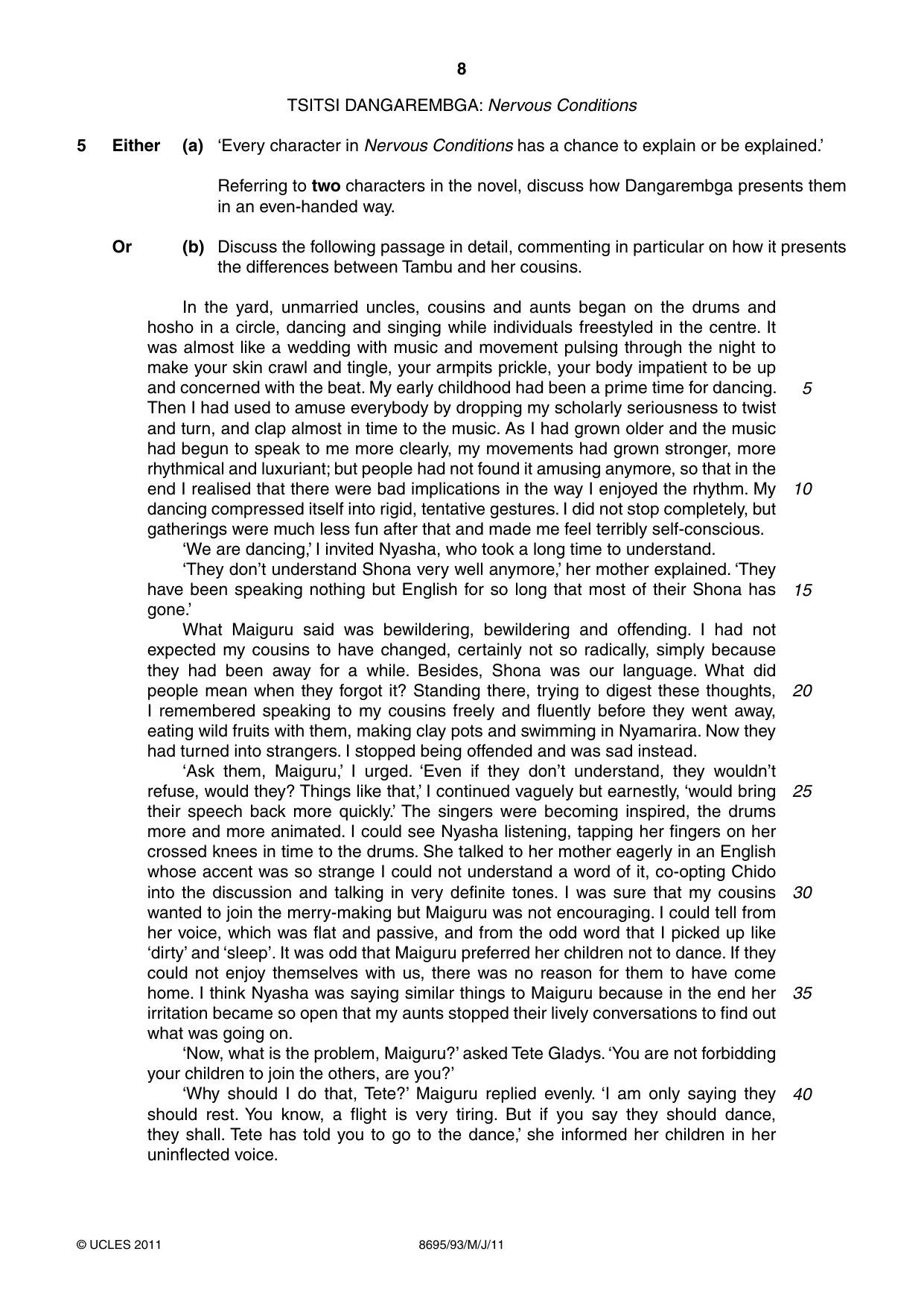
8 8695/93/M/J/11 © UCLES 2011 TSITSI DANGAREMBGA: Nervous Conditions 5 Either (a) ‘Every character in Nervous Conditions has a chance to explain or be explained.’ Referring to two characters in the novel, discuss how Dangarembga presents them in an even-handed way. Or (b) Discuss the following passage in detail, commenting in particular on how it presents the differences between Tambu and her cousins. In the yard, unmarried uncles, cousins and aunts began on the drums and hosho in a circle, dancing and singing while individuals freestyled in the centre. It was almost like a wedding with music and movement pulsing through the night to make your skin crawl and tingle, your armpits prickle, your body impatient to be up and concerned with the beat. My early childhood had been a prime time for dancing. Then I had used to amuse everybody by dropping my scholarly seriousness to twist and turn, and clap almost in time to the music. As I had grown older and the music had begun to speak to me more clearly, my movements had grown stronger, more rhythmical and luxuriant; but people had not found it amusing anymore, so that in the end I realised that there were bad implications in the way I enjoyed the rhythm. My dancing compressed itself into rigid, tentative gestures. I did not stop completely, but gatherings were much less fun after that and made me feel terribly self-conscious. ‘We are dancing,’ I invited Nyasha, who took a long time to understand. ‘They don’t understand Shona very well anymore,’ her mother explained. ‘They have been speaking nothing but English for so long that most of their Shona has gone.’ What Maiguru said was bewildering, bewildering and offending. I had not expected my cousins to have changed, certainly not so radically, simply because they had been away for a while. Besides, Shona was our language. What did people mean when they forgot it? Standing there, trying to digest these thoughts, I remembered speaking to my cousins freely and fluently before they went away, eating wild fruits with them, making clay pots and swimming in Nyamarira. Now they had turned into strangers. I stopped being offended and was sad instead. ‘Ask them, Maiguru,’ I urged. ‘Even if they don’t understand, they wouldn’t refuse, would they? Things like that,’ I continued vaguely but earnestly, ‘would bring their speech back more quickly.’ The singers were becoming inspired, the drums more and more animated. I could see Nyasha listening, tapping her fingers on her crossed knees in time to the drums. She talked to her mother eagerly in an English whose accent was so strange I could not understand a word of it, co-opting Chido into the discussion and talking in very definite tones. I was sure that my cousins wanted to join the merry-making but Maiguru was not encouraging. I could tell from her voice, which was flat and passive, and from the odd word that I picked up like ‘dirty’ and ‘sleep’. It was odd that Maiguru preferred her children not to dance. If they could not enjoy themselves with us, there was no reason for them to have come home. I think Nyasha was saying similar things to Maiguru because in the end her irritation became so open that my aunts stopped their lively conversations to find out what was going on. ‘Now, what is the problem, Maiguru?’ asked Tete Gladys. ‘You are not forbidding your children to join the others, are you?’ ‘Why should I do that, Tete?’ Maiguru replied evenly. ‘I am only saying they should rest. You know, a flight is very tiring. But if you say they should dance, they shall. Tete has told you to go to the dance,’ she informed her children in her uninflected voice. 5 10 15 20 25 30 35 40
Question paper, page 9
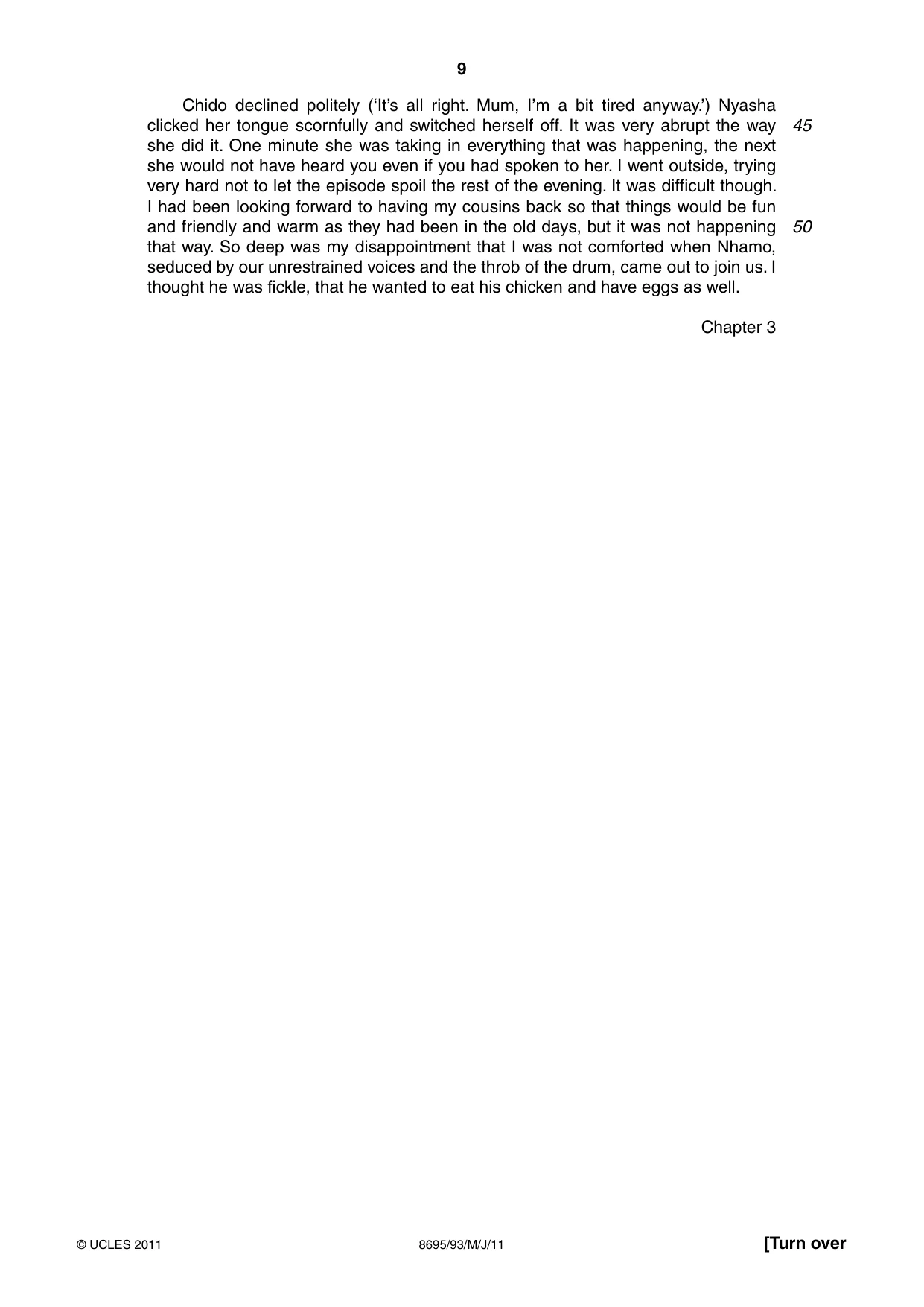
9 8695/93/M/J/11 © UCLES 2011 [Turn over Chido declined politely (‘It’s all right. Mum, I’m a bit tired anyway.’) Nyasha clicked her tongue scornfully and switched herself off. It was very abrupt the way she did it. One minute she was taking in everything that was happening, the next she would not have heard you even if you had spoken to her. I went outside, trying very hard not to let the episode spoil the rest of the evening. It was difficult though. I had been looking forward to having my cousins back so that things would be fun and friendly and warm as they had been in the old days, but it was not happening that way. So deep was my disappointment that I was not comforted when Nhamo, seduced by our unrestrained voices and the throb of the drum, came out to join us. I thought he was fickle, that he wanted to eat his chicken and have eggs as well. Chapter 3 45 50
Question paper, page 10
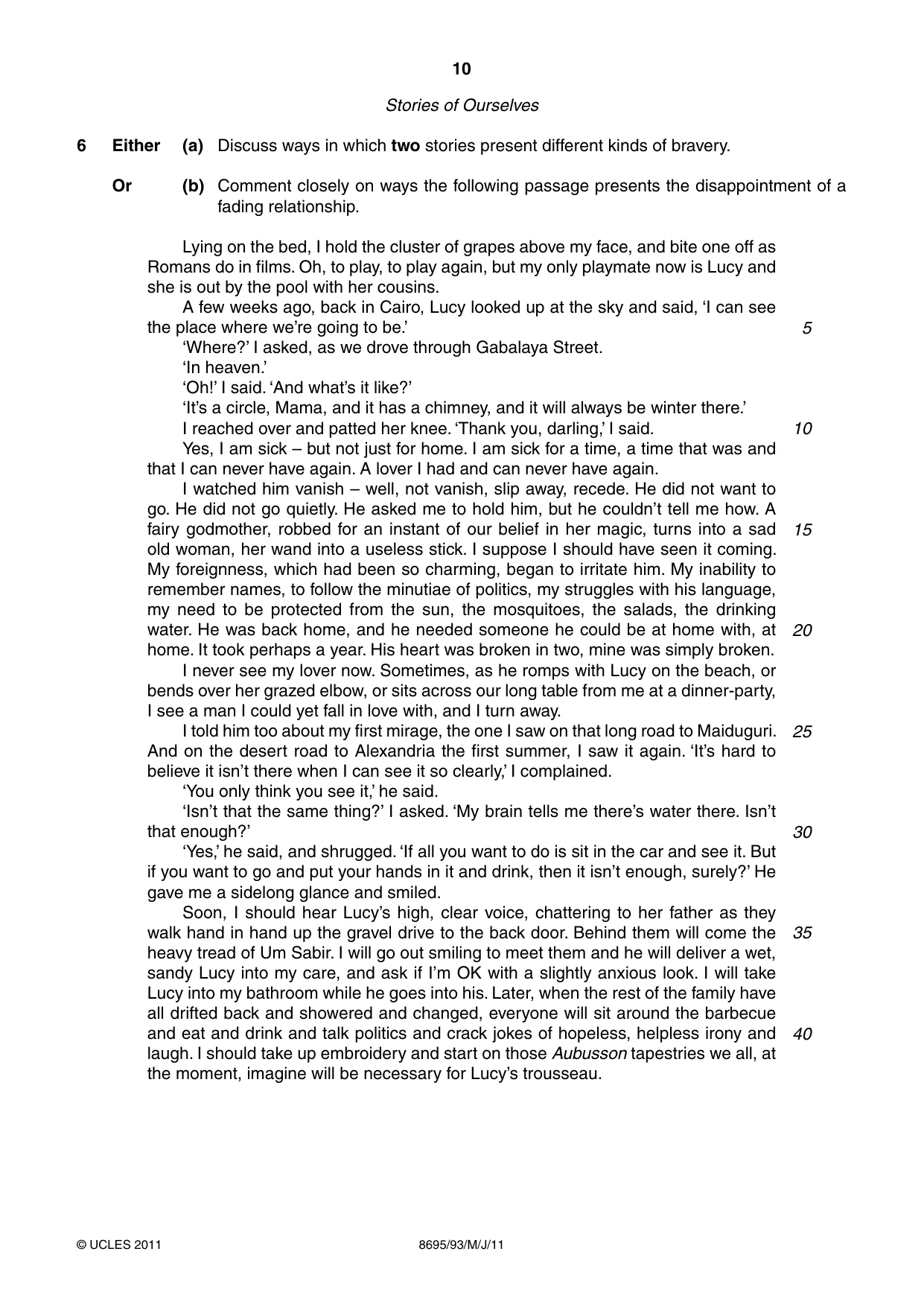
10 8695/93/M/J/11 © UCLES 2011 Stories of Ourselves 6 Either (a) Discuss ways in which two stories present different kinds of bravery. Or (b) Comment closely on ways the following passage presents the disappointment of a fading relationship. Lying on the bed, I hold the cluster of grapes above my face, and bite one off as Romans do in films. Oh, to play, to play again, but my only playmate now is Lucy and she is out by the pool with her cousins. A few weeks ago, back in Cairo, Lucy looked up at the sky and said, ‘I can see the place where we’re going to be.’ ‘Where?’ I asked, as we drove through Gabalaya Street. ‘In heaven.’ ‘Oh!’ I said. ‘And what’s it like?’ ‘It’s a circle, Mama, and it has a chimney, and it will always be winter there.’ I reached over and patted her knee. ‘Thank you, darling,’ I said. Yes, I am sick – but not just for home. I am sick for a time, a time that was and that I can never have again. A lover I had and can never have again. I watched him vanish – well, not vanish, slip away, recede. He did not want to go. He did not go quietly. He asked me to hold him, but he couldn’t tell me how. A fairy godmother, robbed for an instant of our belief in her magic, turns into a sad old woman, her wand into a useless stick. I suppose I should have seen it coming. My foreignness, which had been so charming, began to irritate him. My inability to remember names, to follow the minutiae of politics, my struggles with his language, my need to be protected from the sun, the mosquitoes, the salads, the drinking water. He was back home, and he needed someone he could be at home with, at home. It took perhaps a year. His heart was broken in two, mine was simply broken. I never see my lover now. Sometimes, as he romps with Lucy on the beach, or bends over her grazed elbow, or sits across our long table from me at a dinner-party, I see a man I could yet fall in love with, and I turn away. I told him too about my first mirage, the one I saw on that long road to Maiduguri. And on the desert road to Alexandria the first summer, I saw it again. ‘It’s hard to believe it isn’t there when I can see it so clearly,’ I complained. ‘You only think you see it,’ he said. ‘Isn’t that the same thing?’ I asked. ‘My brain tells me there’s water there. Isn’t that enough?’ ‘Yes,’ he said, and shrugged. ‘If all you want to do is sit in the car and see it. But if you want to go and put your hands in it and drink, then it isn’t enough, surely?’ He gave me a sidelong glance and smiled. Soon, I should hear Lucy’s high, clear voice, chattering to her father as they walk hand in hand up the gravel drive to the back door. Behind them will come the heavy tread of Um Sabir. I will go out smiling to meet them and he will deliver a wet, sandy Lucy into my care, and ask if I’m OK with a slightly anxious look. I will take Lucy into my bathroom while he goes into his. Later, when the rest of the family have all drifted back and showered and changed, everyone will sit around the barbecue and eat and drink and talk politics and crack jokes of hopeless, helpless irony and laugh. I should take up embroidery and start on those Aubusson tapestries we all, at the moment, imagine will be necessary for Lucy’s trousseau. 5 10 15 20 25 30 35 40
Question paper, page 11
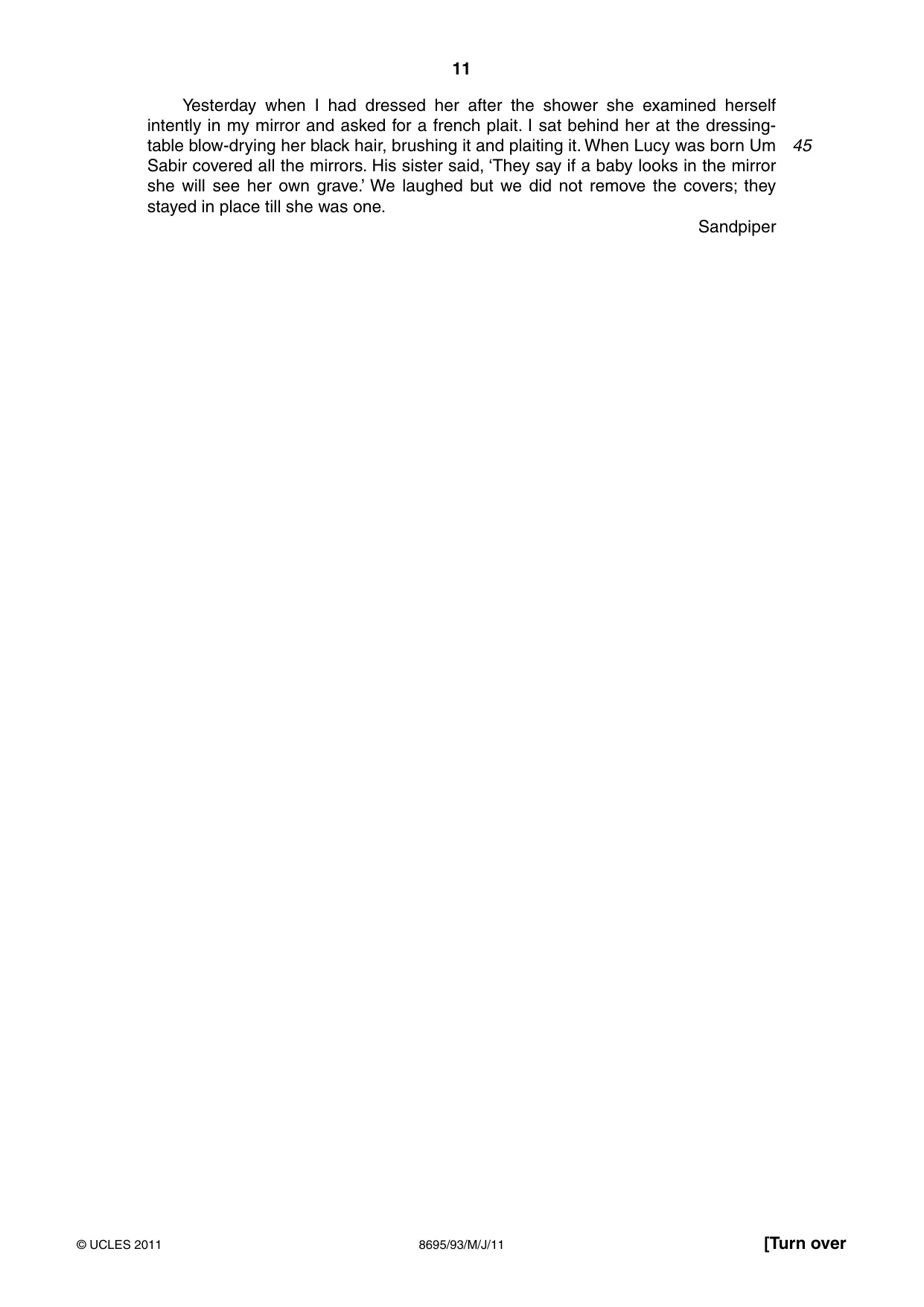
11 8695/93/M/J/11 © UCLES 2011 [Turn over Yesterday when I had dressed her after the shower she examined herself intently in my mirror and asked for a french plait. I sat behind her at the dressing- table blow-drying her black hair, brushing it and plaiting it. When Lucy was born Um Sabir covered all the mirrors. His sister said, ‘They say if a baby looks in the mirror she will see her own grave.’ We laughed but we did not remove the covers; they stayed in place till she was one. Sandpiper 45
Question paper, page 12
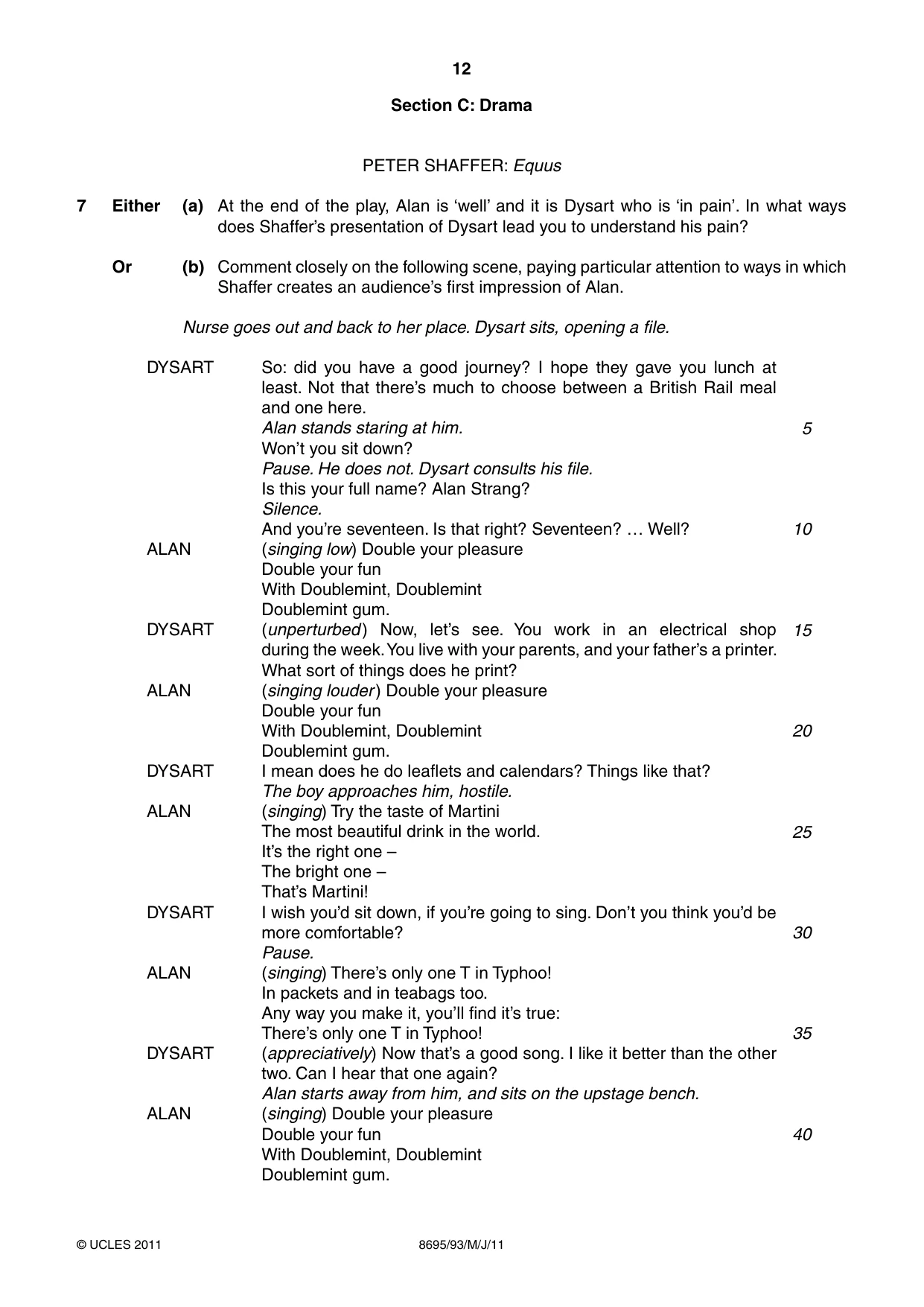
12 8695/93/M/J/11 © UCLES 2011 Section C: Drama PETER SHAFFER: Equus 7 Either (a) At the end of the play, Alan is ‘well’ and it is Dysart who is ‘in pain’. In what ways does Shaffer’s presentation of Dysart lead you to understand his pain? Or (b) Comment closely on the following scene, paying particular attention to ways in which Shaffer creates an audience’s first impression of Alan. Nurse goes out and back to her place. Dysart sits, opening a file. DYSART So: did you have a good journey? I hope they gave you lunch at least. Not that there’s much to choose between a British Rail meal and one here. Alan stands staring at him. Won’t you sit down? Pause. He does not. Dysart consults his file. Is this your full name? Alan Strang? Silence. And you’re seventeen. Is that right? Seventeen? … Well? ALAN (singing low) Double your pleasure Double your fun With Doublemint, Doublemint Doublemint gum. DYSART (unperturbed ) Now, let’s see. You work in an electrical shop during the week. You live with your parents, and your father’s a printer. What sort of things does he print? ALAN (singing louder ) Double your pleasure Double your fun With Doublemint, Doublemint Doublemint gum. DYSART I mean does he do leaflets and calendars? Things like that? The boy approaches him, hostile. ALAN (singing) Try the taste of Martini The most beautiful drink in the world. It’s the right one – The bright one – That’s Martini! DYSART I wish you’d sit down, if you’re going to sing. Don’t you think you’d be more comfortable? Pause. ALAN (singing) There’s only one T in Typhoo! In packets and in teabags too. Any way you make it, you’ll find it’s true: There’s only one T in Typhoo! DYSART (appreciatively) Now that’s a good song. I like it better than the other two. Can I hear that one again? Alan starts away from him, and sits on the upstage bench. ALAN (singing) Double your pleasure Double your fun With Doublemint, Doublemint Doublemint gum. 5 10 15 20 25 30 35 40
Question paper, page 13
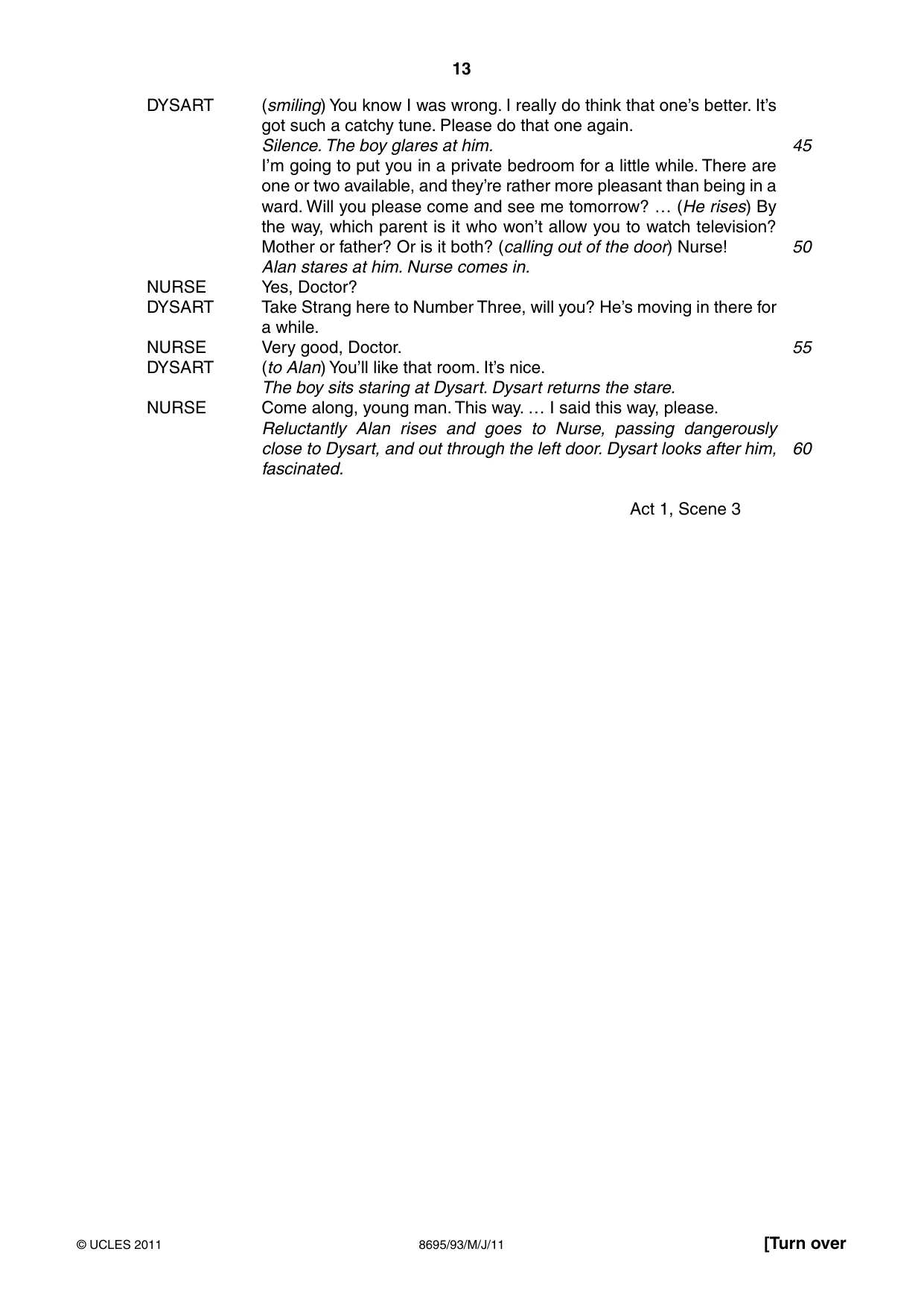
13 8695/93/M/J/11 © UCLES 2011 [Turn over DYSART (smiling) You know I was wrong. I really do think that one’s better. It’s got such a catchy tune. Please do that one again. Silence. The boy glares at him. I’m going to put you in a private bedroom for a little while. There are one or two available, and they’re rather more pleasant than being in a ward. Will you please come and see me tomorrow? … (He rises) By the way, which parent is it who won’t allow you to watch television? Mother or father? Or is it both? (calling out of the door) Nurse! Alan stares at him. Nurse comes in. NURSE Yes, Doctor? DYSART Take Strang here to Number Three, will you? He’s moving in there for a while. NURSE Very good, Doctor. DYSART (to Alan) You’ll like that room. It’s nice. The boy sits staring at Dysart. Dysart returns the stare. NURSE Come along, young man. This way. … I said this way, please. Reluctantly Alan rises and goes to Nurse, passing dangerously close to Dysart, and out through the left door. Dysart looks after him, fascinated. Act 1, Scene 3 45 50 55 60
Question paper, page 14
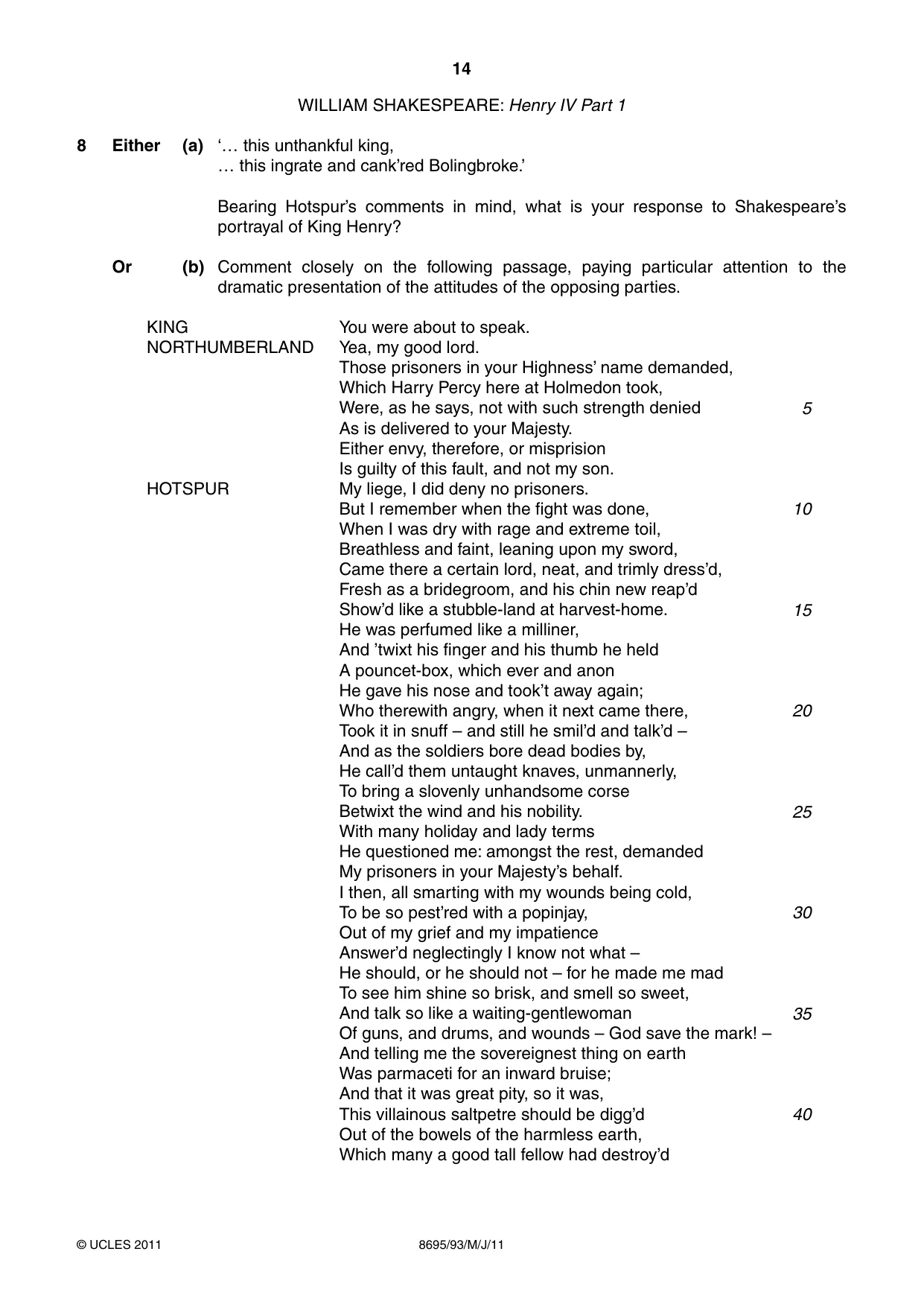
14 8695/93/M/J/11 © UCLES 2011 WILLIAM SHAKESPEARE: Henry IV Part 1 8 Either (a) ‘… this unthankful king, … this ingrate and cank’red Bolingbroke.’ Bearing Hotspur’s comments in mind, what is your response to Shakespeare’s portrayal of King Henry? Or (b) Comment closely on the following passage, paying particular attention to the dramatic presentation of the attitudes of the opposing parties. KING You were about to speak. NORTHUMBERLAND Yea, my good lord. Those prisoners in your Highness’ name demanded, Which Harry Percy here at Holmedon took, Were, as he says, not with such strength denied As is delivered to your Majesty. Either envy, therefore, or misprision Is guilty of this fault, and not my son. HOTSPUR My liege, I did deny no prisoners. But I remember when the fight was done, When I was dry with rage and extreme toil, Breathless and faint, leaning upon my sword, Came there a certain lord, neat, and trimly dress’d, Fresh as a bridegroom, and his chin new reap’d Show’d like a stubble-land at harvest-home. He was perfumed like a milliner, And ’twixt his finger and his thumb he held A pouncet-box, which ever and anon He gave his nose and took’t away again; Who therewith angry, when it next came there, Took it in snuff – and still he smil’d and talk’d – And as the soldiers bore dead bodies by, He call’d them untaught knaves, unmannerly, To bring a slovenly unhandsome corse Betwixt the wind and his nobility. With many holiday and lady terms He questioned me: amongst the rest, demanded My prisoners in your Majesty’s behalf. I then, all smarting with my wounds being cold, To be so pest’red with a popinjay, Out of my grief and my impatience Answer’d neglectingly I know not what – He should, or he should not – for he made me mad To see him shine so brisk, and smell so sweet, And talk so like a waiting-gentlewoman Of guns, and drums, and wounds – God save the mark! – And telling me the sovereignest thing on earth Was parmaceti for an inward bruise; And that it was great pity, so it was, This villainous saltpetre should be digg’d Out of the bowels of the harmless earth, Which many a good tall fellow had destroy’d 5 10 15 20 25 30 35 40
Question paper, page 15
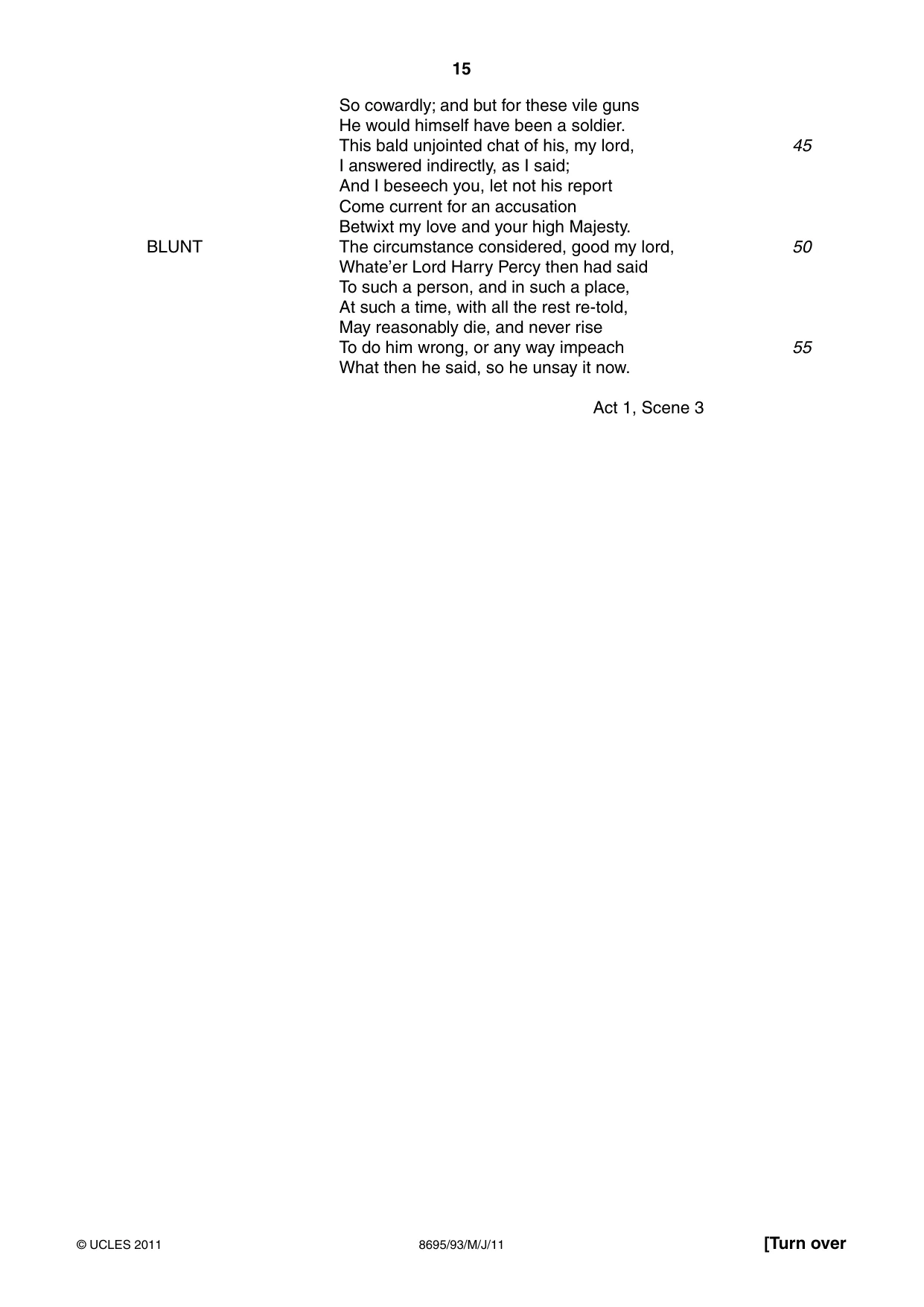
15 8695/93/M/J/11 © UCLES 2011 [Turn over So cowardly; and but for these vile guns He would himself have been a soldier. This bald unjointed chat of his, my lord, I answered indirectly, as I said; And I beseech you, let not his report Come current for an accusation Betwixt my love and your high Majesty. BLUNT The circumstance considered, good my lord, Whate’er Lord Harry Percy then had said To such a person, and in such a place, At such a time, with all the rest re-told, May reasonably die, and never rise To do him wrong, or any way impeach What then he said, so he unsay it now. Act 1, Scene 3 45 50 55
Question paper, page 16
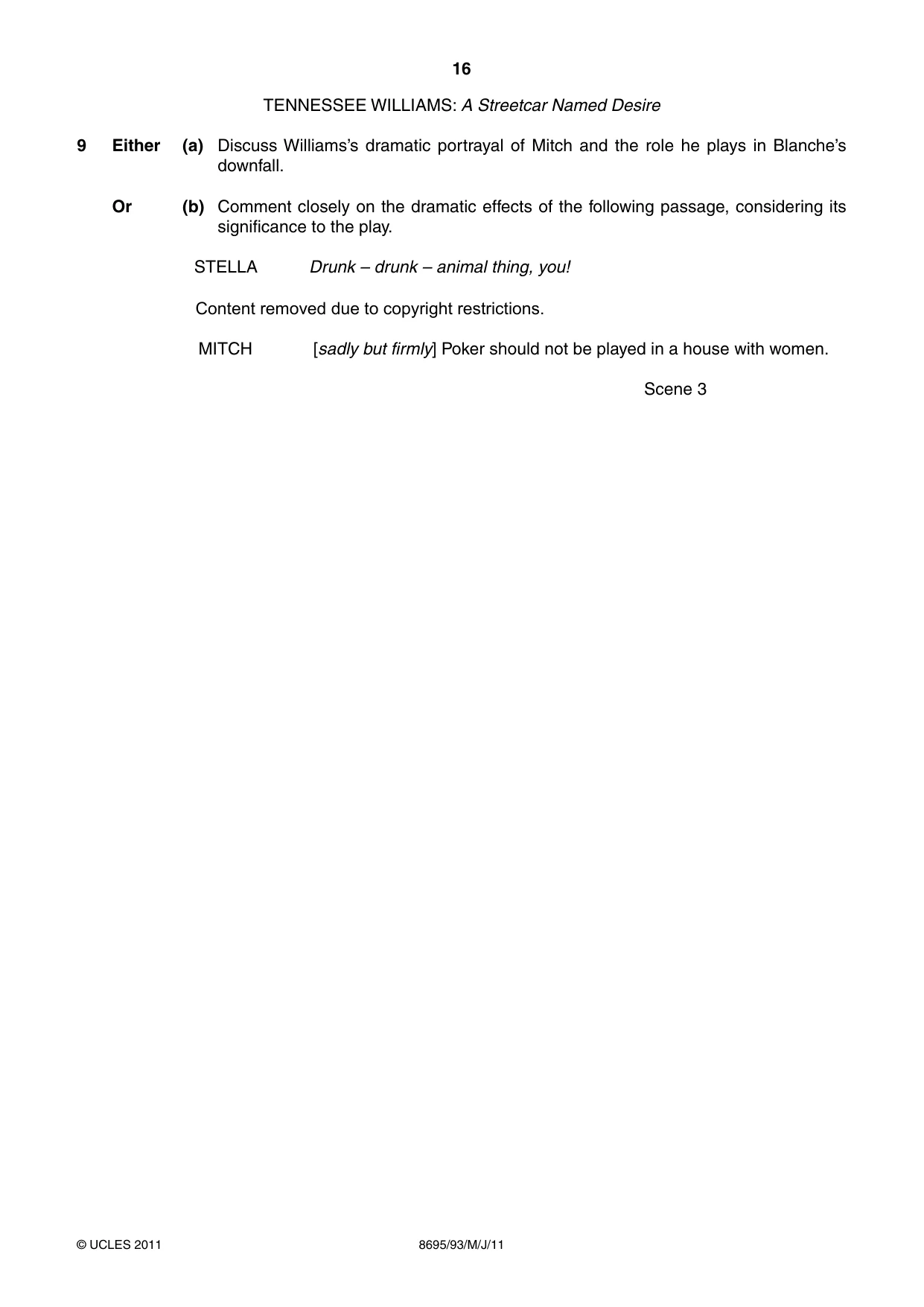
16 8695/93/M/J/11 © UCLES 2011 TENNESSEE WILLIAMS: A Streetcar Named Desire 9 Either (a) Discuss Williams’s dramatic portrayal of Mitch and the role he plays in Blanche’s downfall. Or (b) Comment closely on the dramatic effects of the following passage, considering its significance to the play. STELLA Drunk – drunk – animal thing, you! Content removed due to copyright restrictions. MITCH [sadly but firmly] Poker should not be played in a house with women. Scene 3
Question paper, page 17
17 8695/93/M/J/11 © UCLES 2011 BLANK PAGE
Question paper, page 18
18 8695/93/M/J/11 © UCLES 2011 BLANK PAGE
Question paper, page 19
19 8695/93/M/J/11 © UCLES 2011 BLANK PAGE
Question paper, page 20
20 8695/93/M/J/11 © UCLES 2011 Copyright Acknowledgements: Question 1b © Sujata Bhatt; ‘Angels’ Wings’; Point No Point; Carcanet Press; 1997. Question 3b © Ruth Pitter; ‘Time’s Fool’; Songs of Ourselves; Foundation Books; 2005. Question 5b © Tsitsi Dangarembga; Nervous Conditions; Ayesia Clarke Publishing; 2004. Question 6b © Ahdaf Soueif; ‘Sandpiper’; Stories of Ourselves; Cambridge University Press; 2008. Question 7b © Peter Shaffer; Equus; Penguin; 1997. Question 9b © Tennessee Williams; A Streetcar Named Desire; Penguin; 1983. Permission to reproduce items where third-party owned material protected by copyright is included has been sought and cleared where possible. Every reasonable effort has been made by the publisher (UCLES) to trace copyright holders, but if any items requiring clearance have unwittingly been included, the publisher will be pleased to make amends at the earliest possible opportunity. University of Cambridge International Examinations is part of the Cambridge Assessment Group. Cambridge Assessment is the brand name of University of Cambridge Local Examinations Syndicate (UCLES), which is itself a department of the University of Cambridge. BLANK PAGE
Mark scheme, page 1
UNIVERSITY OF CAMBRIDGE INTERNATIONAL EXAMINATIONS GCE Advanced Subsidiary Level and GCE Advanced Level MARK SCHEME for the May/June 2011 question paper for the guidance of teachers 8695 LANGUAGE AND LITERATURE IN ENGLISH 8695/93 Paper 9 (Poetry, Prose and Drama), maximum raw mark 50 This mark scheme is published as an aid to teachers and candidates, to indicate the requirements of the examination. It shows the basis on which Examiners were instructed to award marks. It does not indicate the details of the discussions that took place at an Examiners’ meeting before marking began, which would have considered the acceptability of alternative answers. Mark schemes must be read in conjunction with the question papers and the report on the examination. • Cambridge will not enter into discussions or correspondence in connection with these mark schemes. Cambridge is publishing the mark schemes for the May/June 2011 question papers for most IGCSE, GCE Advanced Level and Advanced Subsidiary Level syllabuses and some Ordinary Level syllabuses.
Mark scheme, page 2
Page 2 Mark Scheme: Teachers’ version Syllabus Paper GCE AS/A LEVEL – May/June 2011 8695 93 © University of Cambridge International Examinations 2011 Using the mark bands Place the answer in a band first. Look for the “best fit” of the answer into a band. An answer needs to show evidence of most but not necessarily ALL of the qualities described in a band, in order to be placed in that band. Then award a mark for the relative position of the answer within the band. Candidates may address the question in many different ways. Do not expect any particular focus or approach and do not penalise answers for leaving out a particular focus. Reward what is there, showing what you are rewarding, in your comments. Consider all strands and weigh up the performance as a whole in placing the answer in a band, then show that you have done so in the summative comment, e.g. Sound K of texts, some evidence of U but mostly narrative, occasional evidence of P, mainly clear C. Assessment Objectives: • Ability to respond to texts in the three main forms (Prose, Poetry and Drama) of different types and from different cultures; • Understanding of the ways in which writers’ choices of form, structure and language shape meanings; • Ability to produce informed independent opinions and judgements on literary texts; • Ability to communicate clearly the knowledge, understanding and insight appropriate to literary study. Each answer is marked out of 25, in accordance with the General Marking Criteria below. Each band is divided into strands corresponding to the Assessment Objectives – Knowledge, Understanding, Personal Response, Communication.
Mark scheme, page 3
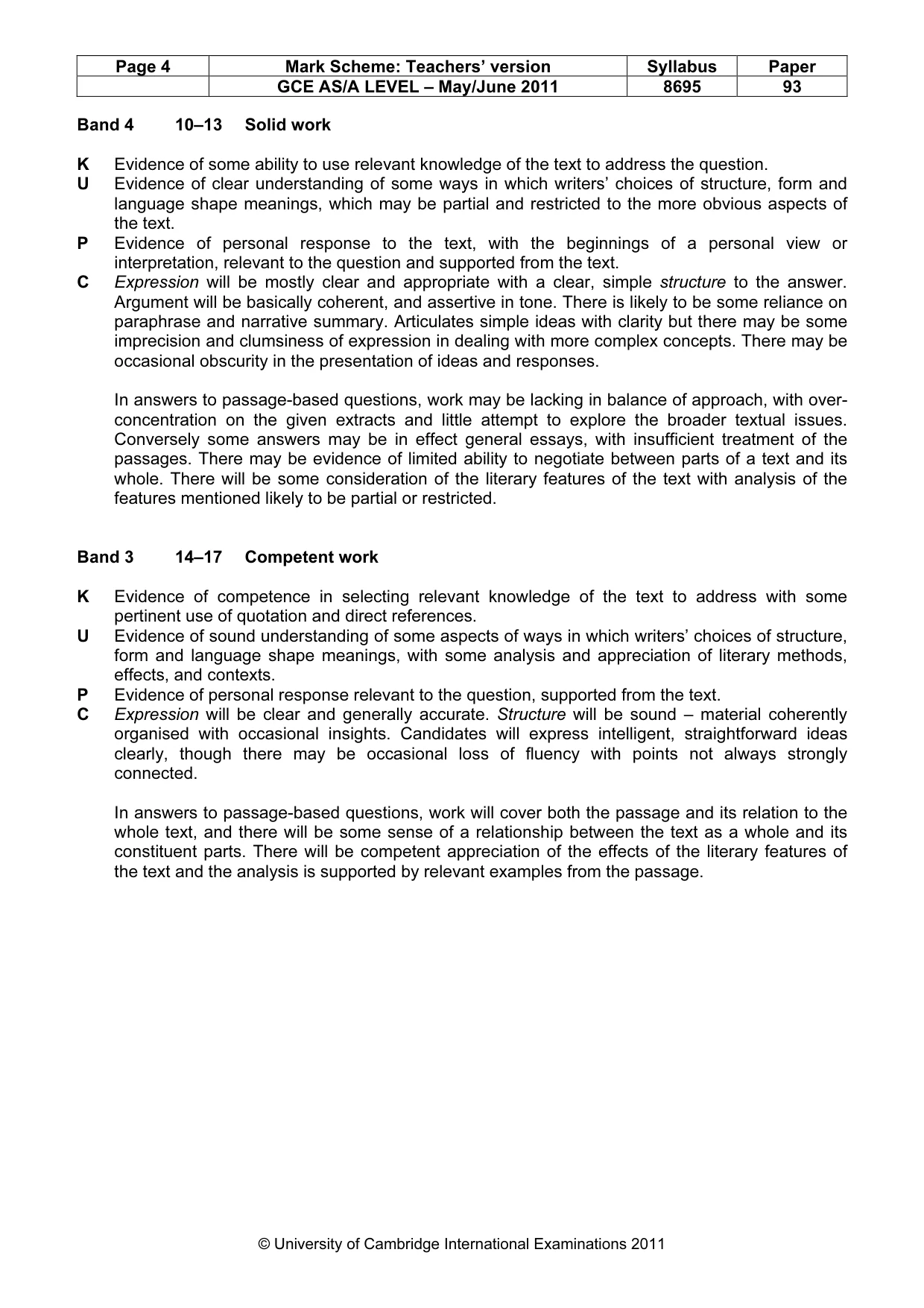
Page 3 Mark Scheme: Teachers’ version Syllabus Paper GCE AS/A LEVEL – May/June 2011 8695 93 © University of Cambridge International Examinations 2011 Band 6 0–5 K Evidence of some general knowledge of the text which may be narrative based and may contain errors, rarely relevant to the question and with little or no relevant quotation or selection from the text. U There may be little or no evidence of understanding of form, structure and language, with some appropriate points made in response to the question. These will be limited and tend to be restricted to plot and characters – the latter treated very much as “real” people. P There may be some signs of personal response, not developed into an argument and not fully supported from the text. C Communication will be insecure. Expression may be weak with some breakdown in communication. Structure may be lacking: answers are likely to be partial, undeveloped, narrative commentary in approach; with the assertion of simple points rather than progressive lines of argument. Answers to passage-based questions are likely to be seriously unbalanced, with an emphasis on narrative or paraphrase. Passages are likely to have been only partially understood and tentatively located contextually, with little coherent sense of the relationship between textual part and whole. There will be little or no mention or consideration of the literary features of the passage. Band 5 6–9 Work of a basic standard K Evidence of some limited ability to use knowledge of the text to address the question, with occasional use of supporting references or quotation. U Evidence of some limited understanding of ways in which writers’ choices of structure, form and language shape meanings. P Evidence of some personal response to the text but not fully supported. C Expression will be basically clear. There may be the occasional confused passage of writing. However, there will be no sustained loss of communication. There may be a simple structure to the answer with some evidence of an argument, which may lack coherence, with some repetition, assertion and relapse into narrative summary/paraphrase. There may be a tendency to drift from relevant discussion into material of tangential significance. In answers to passage-based questions there will be some evidence of understanding of how part relates to whole. Treatment of the given extracts may well be sketchy or overlong and undiscriminating. Comment on the wider textual issues is likely to be general. There may be a lack of balance between passage and whole text. There will be some limited consideration of the literary features of the text.
Mark scheme, page 4
Page 4 Mark Scheme: Teachers’ version Syllabus Paper GCE AS/A LEVEL – May/June 2011 8695 93 © University of Cambridge International Examinations 2011 Band 4 10–13 Solid work K Evidence of some ability to use relevant knowledge of the text to address the question. U Evidence of clear understanding of some ways in which writers’ choices of structure, form and language shape meanings, which may be partial and restricted to the more obvious aspects of the text. P Evidence of personal response to the text, with the beginnings of a personal view or interpretation, relevant to the question and supported from the text. C Expression will be mostly clear and appropriate with a clear, simple structure to the answer. Argument will be basically coherent, and assertive in tone. There is likely to be some reliance on paraphrase and narrative summary. Articulates simple ideas with clarity but there may be some imprecision and clumsiness of expression in dealing with more complex concepts. There may be occasional obscurity in the presentation of ideas and responses. In answers to passage-based questions, work may be lacking in balance of approach, with over- concentration on the given extracts and little attempt to explore the broader textual issues. Conversely some answers may be in effect general essays, with insufficient treatment of the passages. There may be evidence of limited ability to negotiate between parts of a text and its whole. There will be some consideration of the literary features of the text with analysis of the features mentioned likely to be partial or restricted. Band 3 14–17 Competent work K Evidence of competence in selecting relevant knowledge of the text to address with some pertinent use of quotation and direct references. U Evidence of sound understanding of some aspects of ways in which writers’ choices of structure, form and language shape meanings, with some analysis and appreciation of literary methods, effects, and contexts. P Evidence of personal response relevant to the question, supported from the text. C Expression will be clear and generally accurate. Structure will be sound – material coherently organised with occasional insights. Candidates will express intelligent, straightforward ideas clearly, though there may be occasional loss of fluency with points not always strongly connected. In answers to passage-based questions, work will cover both the passage and its relation to the whole text, and there will be some sense of a relationship between the text as a whole and its constituent parts. There will be competent appreciation of the effects of the literary features of the text and the analysis is supported by relevant examples from the passage.
Mark scheme, page 5
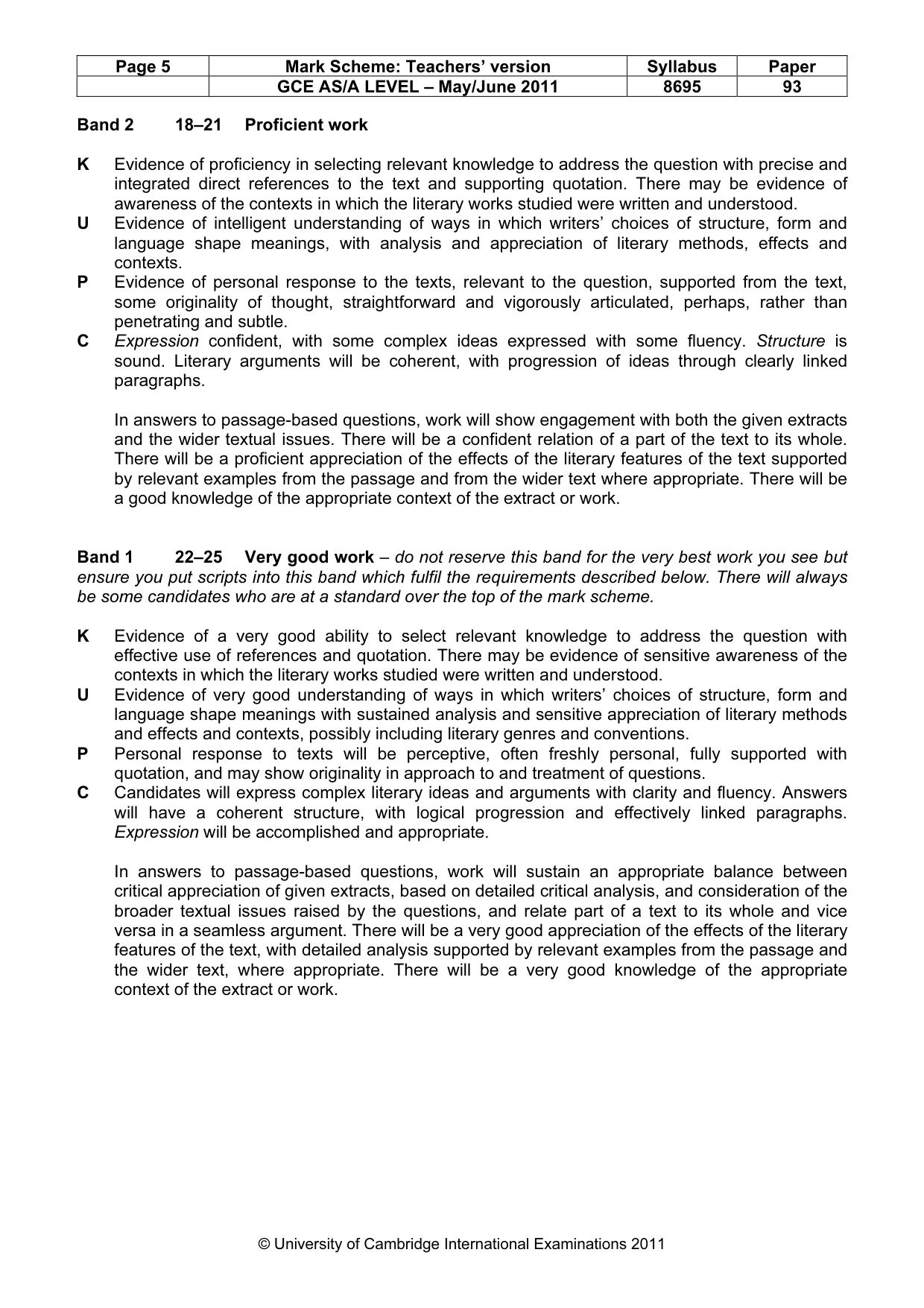
Page 5 Mark Scheme: Teachers’ version Syllabus Paper GCE AS/A LEVEL – May/June 2011 8695 93 © University of Cambridge International Examinations 2011 Band 2 18–21 Proficient work K Evidence of proficiency in selecting relevant knowledge to address the question with precise and integrated direct references to the text and supporting quotation. There may be evidence of awareness of the contexts in which the literary works studied were written and understood. U Evidence of intelligent understanding of ways in which writers’ choices of structure, form and language shape meanings, with analysis and appreciation of literary methods, effects and contexts. P Evidence of personal response to the texts, relevant to the question, supported from the text, some originality of thought, straightforward and vigorously articulated, perhaps, rather than penetrating and subtle. C Expression confident, with some complex ideas expressed with some fluency. Structure is sound. Literary arguments will be coherent, with progression of ideas through clearly linked paragraphs. In answers to passage-based questions, work will show engagement with both the given extracts and the wider textual issues. There will be a confident relation of a part of the text to its whole. There will be a proficient appreciation of the effects of the literary features of the text supported by relevant examples from the passage and from the wider text where appropriate. There will be a good knowledge of the appropriate context of the extract or work. Band 1 22–25 Very good work – do not reserve this band for the very best work you see but ensure you put scripts into this band which fulfil the requirements described below. There will always be some candidates who are at a standard over the top of the mark scheme. K Evidence of a very good ability to select relevant knowledge to address the question with effective use of references and quotation. There may be evidence of sensitive awareness of the contexts in which the literary works studied were written and understood. U Evidence of very good understanding of ways in which writers’ choices of structure, form and language shape meanings with sustained analysis and sensitive appreciation of literary methods and effects and contexts, possibly including literary genres and conventions. P Personal response to texts will be perceptive, often freshly personal, fully supported with quotation, and may show originality in approach to and treatment of questions. C Candidates will express complex literary ideas and arguments with clarity and fluency. Answers will have a coherent structure, with logical progression and effectively linked paragraphs. Expression will be accomplished and appropriate. In answers to passage-based questions, work will sustain an appropriate balance between critical appreciation of given extracts, based on detailed critical analysis, and consideration of the broader textual issues raised by the questions, and relate part of a text to its whole and vice versa in a seamless argument. There will be a very good appreciation of the effects of the literary features of the text, with detailed analysis supported by relevant examples from the passage and the wider text, where appropriate. There will be a very good knowledge of the appropriate context of the extract or work.
What you needed in this session
Cambridge’s own grade thresholds for 2011 May/June, Paper 9 · Variant 3. A higher threshold means an easier paper — the bar moves with how the cohort did.