Cambridge A Level English - Language and Literature (AS Level only, from 2016) 8695 — 2011 May/June Paper 9 · Variant 1
8695/91/M/J/11 · 50 marks · ≈56 min
The question paper and its mark scheme, free to read here and free to download. This is Cambridge’s own paper, exactly as it was sat.
Question paper20 pages




Mark scheme5 pages
Answers below. Sit the paper first if you are practising.
Paper as text
Question paper, page 1
This document consists of 15 printed pages and 5 blank pages. DC (SD) 25420/5 © UCLES 2011 [Turn over UNIVERSITY OF CAMBRIDGE INTERNATIONAL EXAMINATIONS General Certificate of Education Advanced Subsidiary Level and Advanced Level * 8 5 7 3 2 6 5 7 8 5 * LANGUAGE AND LITERATURE IN ENGLISH 8695/91 Paper 9 Poetry, Prose and Drama May/June 2011 2 hours Additional Materials: Answer Booklet/Paper READ THESE INSTRUCTIONS FIRST If you have been given an Answer Booklet, follow the instructions on the front cover of the Booklet. Write your Centre number, candidate number and name on all the work you hand in. Write in dark blue or black pen. Do not use staples, paper clips, highlighters, glue or correction fluid. Answer two questions, each from a different section. You are reminded of the need for good English and clear presentation in your answers. At the end of the examination, fasten all your work securely together. All questions in this paper carry equal marks.
Question paper, page 2
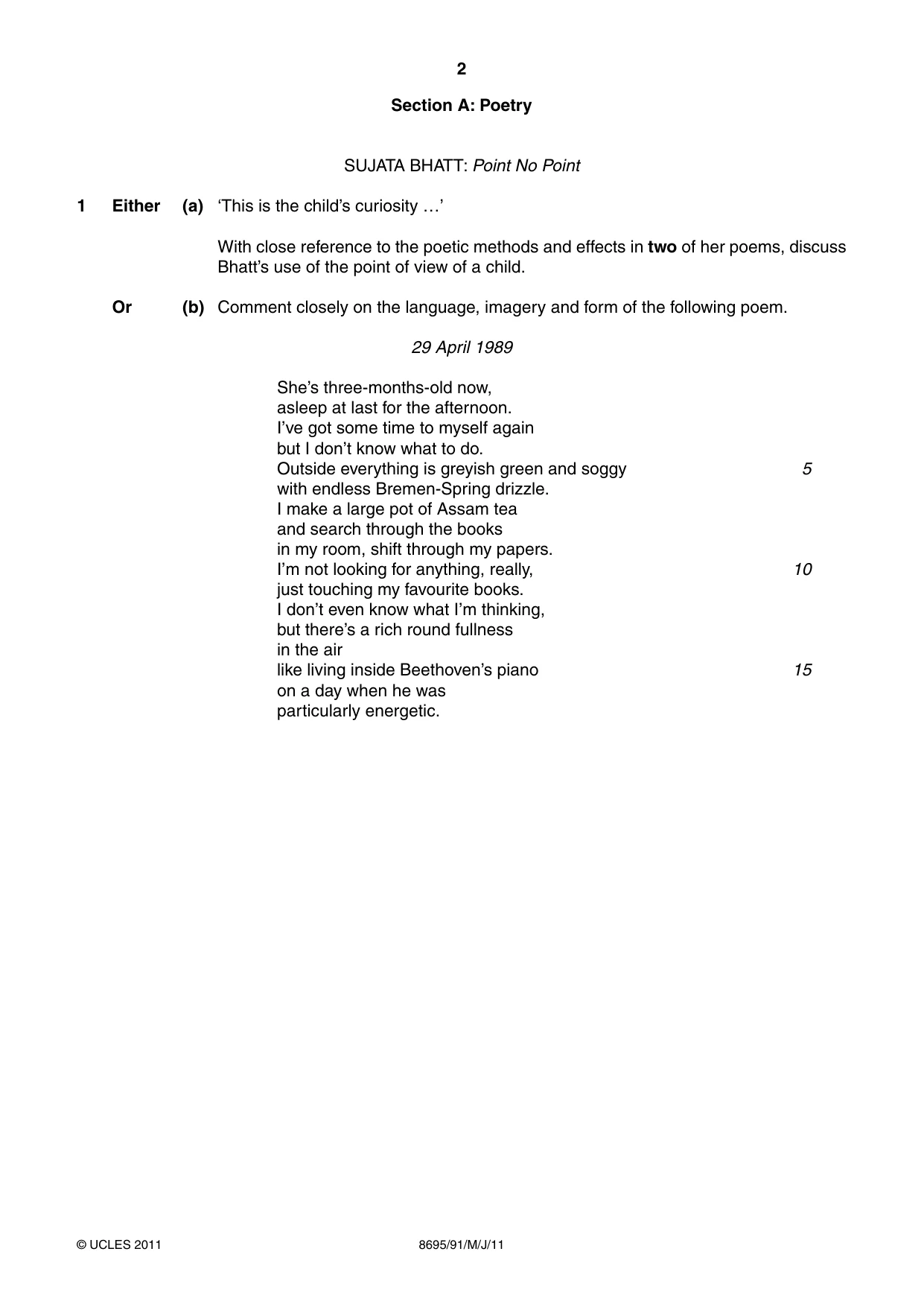
2 8695/91/M/J/11 © UCLES 2011 Section A: Poetry SUJATA BHATT: Point No Point 1 Either (a) ‘This is the child’s curiosity …’ With close reference to the poetic methods and effects in two of her poems, discuss Bhatt’s use of the point of view of a child. Or (b) Comment closely on the language, imagery and form of the following poem. 29 April 1989 She’s three-months-old now, asleep at last for the afternoon. I’ve got some time to myself again but I don’t know what to do. Outside everything is greyish green and soggy 5 with endless Bremen-Spring drizzle. I make a large pot of Assam tea and search through the books in my room, shift through my papers. I’m not looking for anything, really, 10 just touching my favourite books. I don’t even know what I’m thinking, but there’s a rich round fullness in the air like living inside Beethoven’s piano 15 on a day when he was particularly energetic.
Question paper, page 3
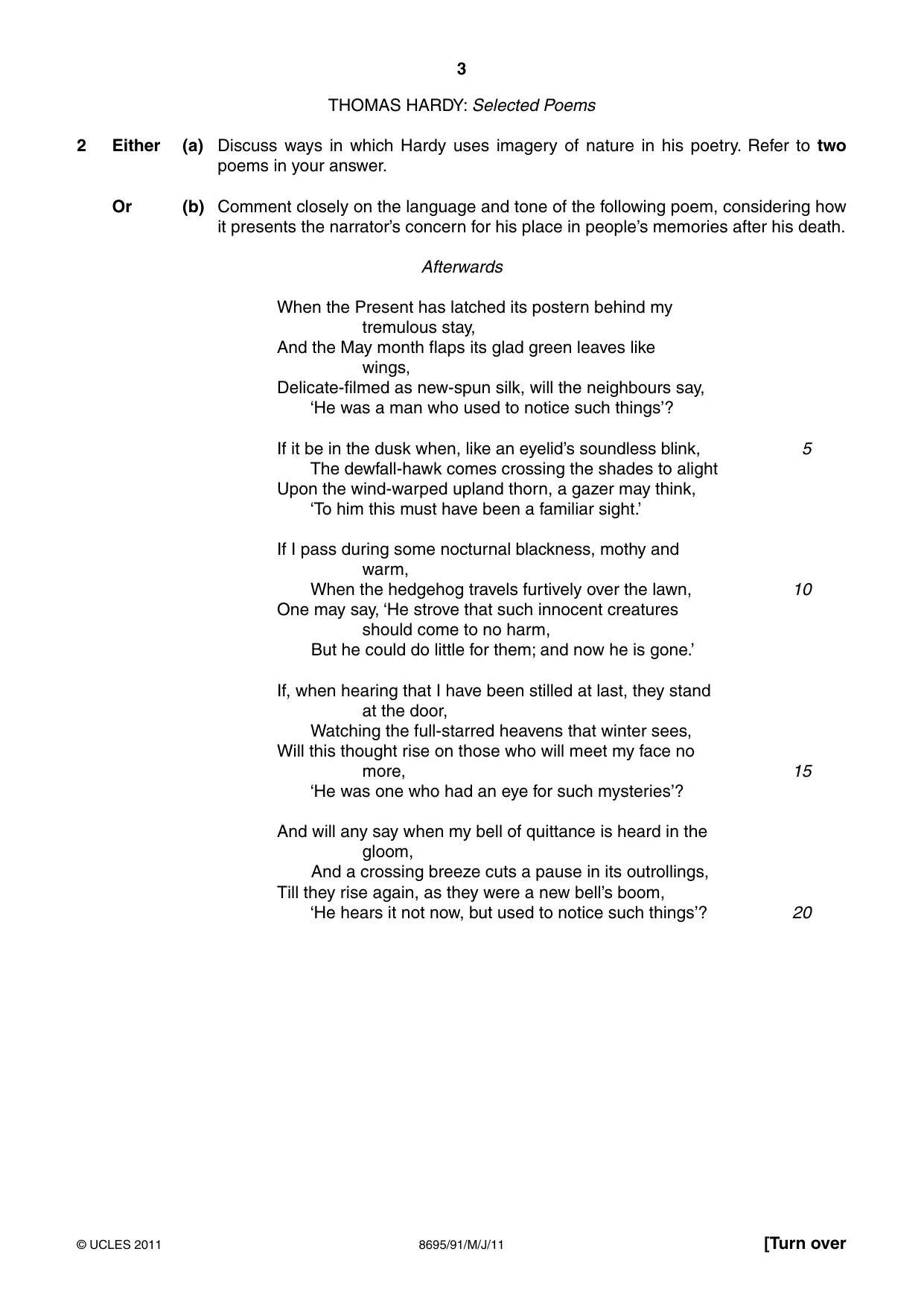
3 8695/91/M/J/11 © UCLES 2011 [Turn over THOMAS HARDY: Selected Poems 2 Either (a) Discuss ways in which Hardy uses imagery of nature in his poetry. Refer to two poems in your answer. Or (b) Comment closely on the language and tone of the following poem, considering how it presents the narrator’s concern for his place in people’s memories after his death. Afterwards When the Present has latched its postern behind my tremulous stay, And the May month flaps its glad green leaves like wings, Delicate-filmed as new-spun silk, will the neighbours say, ‘He was a man who used to notice such things’? If it be in the dusk when, like an eyelid’s soundless blink, 5 The dewfall-hawk comes crossing the shades to alight Upon the wind-warped upland thorn, a gazer may think, ‘To him this must have been a familiar sight.’ If I pass during some nocturnal blackness, mothy and warm, When the hedgehog travels furtively over the lawn, 10 One may say, ‘He strove that such innocent creatures should come to no harm, But he could do little for them; and now he is gone.’ If, when hearing that I have been stilled at last, they stand at the door, Watching the full-starred heavens that winter sees, Will this thought rise on those who will meet my face no more, 15 ‘He was one who had an eye for such mysteries’? And will any say when my bell of quittance is heard in the gloom, And a crossing breeze cuts a pause in its outrollings, Till they rise again, as they were a new bell’s boom, ‘He hears it not now, but used to notice such things’? 20
Question paper, page 4
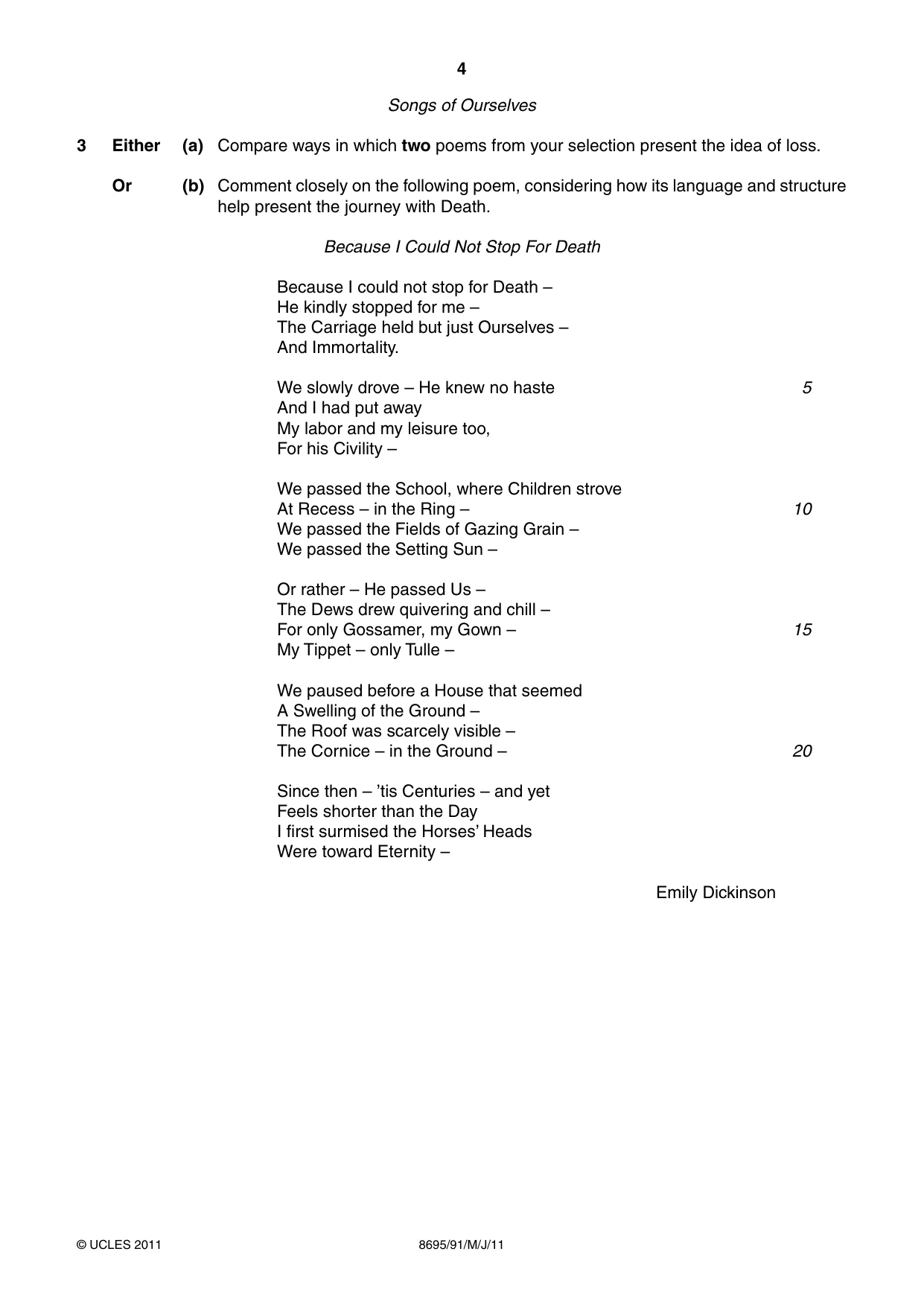
4 8695/91/M/J/11 © UCLES 2011 Songs of Ourselves 3 Either (a) Compare ways in which two poems from your selection present the idea of loss. Or (b) Comment closely on the following poem, considering how its language and structure help present the journey with Death. Because I Could Not Stop For Death Because I could not stop for Death – He kindly stopped for me – The Carriage held but just Ourselves – And Immortality. We slowly drove – He knew no haste 5 And I had put away My labor and my leisure too, For his Civility – We passed the School, where Children strove At Recess – in the Ring – 10 We passed the Fields of Gazing Grain – We passed the Setting Sun – Or rather – He passed Us – The Dews drew quivering and chill – For only Gossamer, my Gown – 15 My Tippet – only Tulle – We paused before a House that seemed A Swelling of the Ground – The Roof was scarcely visible – The Cornice – in the Ground – 20 Since then – ’tis Centuries – and yet Feels shorter than the Day I first surmised the Horses’ Heads Were toward Eternity – Emily Dickinson
Question paper, page 5
5 8695/91/M/J/11 © UCLES 2011 [Turn over BLANK PAGE Turn to page 6 for Question 4.
Question paper, page 6
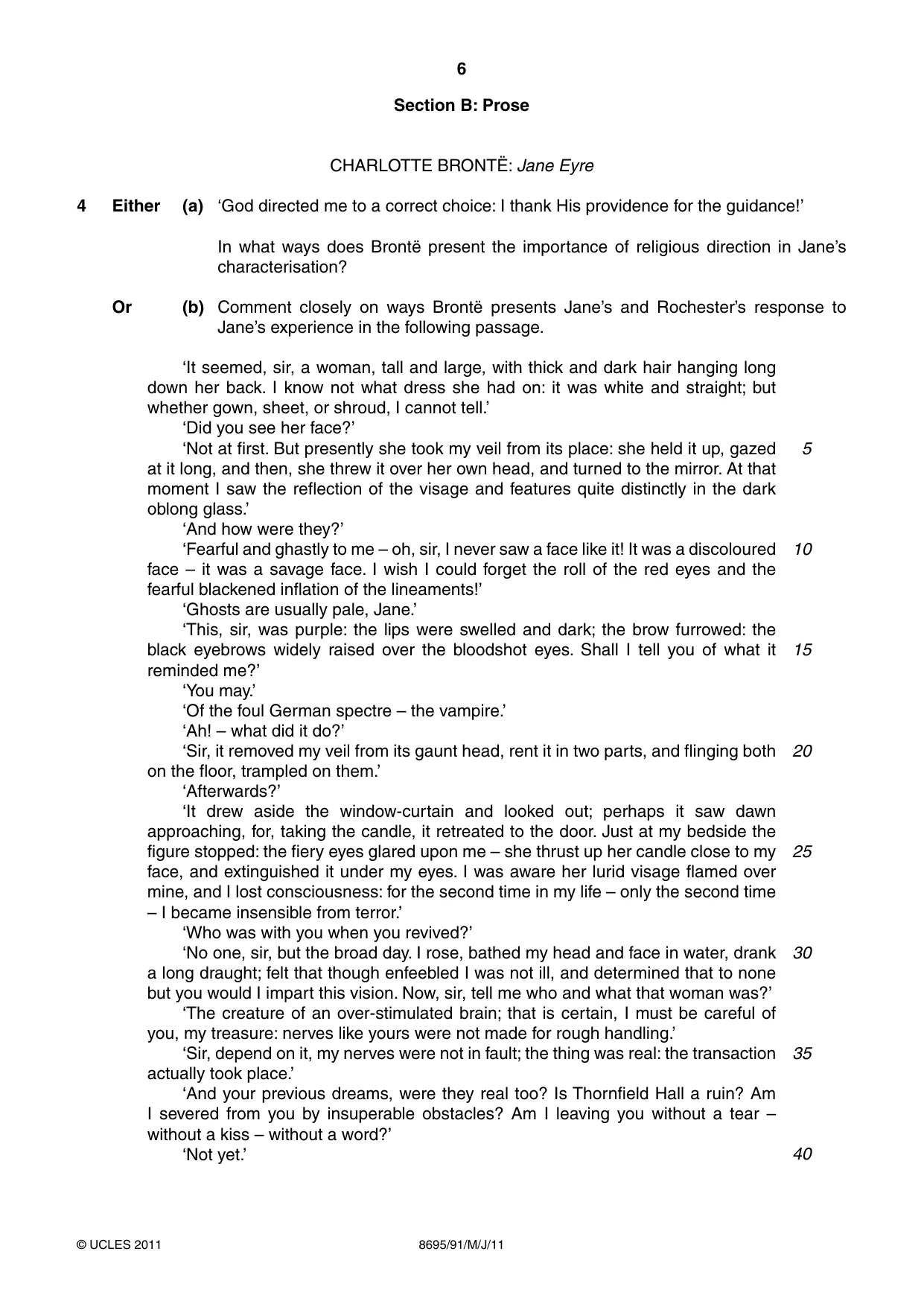
6 8695/91/M/J/11 © UCLES 2011 Section B: Prose CHARLOTTE BRONTË: Jane Eyre 4 Either (a) ‘God directed me to a correct choice: I thank His providence for the guidance!’ In what ways does Brontë present the importance of religious direction in Jane’s characterisation? Or (b) Comment closely on ways Brontë presents Jane’s and Rochester’s response to Jane’s experience in the following passage. ‘It seemed, sir, a woman, tall and large, with thick and dark hair hanging long down her back. I know not what dress she had on: it was white and straight; but whether gown, sheet, or shroud, I cannot tell.’ ‘Did you see her face?’ ‘Not at first. But presently she took my veil from its place: she held it up, gazed at it long, and then, she threw it over her own head, and turned to the mirror. At that moment I saw the reflection of the visage and features quite distinctly in the dark oblong glass.’ ‘And how were they?’ ‘Fearful and ghastly to me – oh, sir, I never saw a face like it! It was a discoloured face – it was a savage face. I wish I could forget the roll of the red eyes and the fearful blackened inflation of the lineaments!’ ‘Ghosts are usually pale, Jane.’ ‘This, sir, was purple: the lips were swelled and dark; the brow furrowed: the black eyebrows widely raised over the bloodshot eyes. Shall I tell you of what it reminded me?’ ‘You may.’ ‘Of the foul German spectre – the vampire.’ ‘Ah! – what did it do?’ ‘Sir, it removed my veil from its gaunt head, rent it in two parts, and flinging both on the floor, trampled on them.’ ‘Afterwards?’ ‘It drew aside the window-curtain and looked out; perhaps it saw dawn approaching, for, taking the candle, it retreated to the door. Just at my bedside the figure stopped: the fiery eyes glared upon me – she thrust up her candle close to my face, and extinguished it under my eyes. I was aware her lurid visage flamed over mine, and I lost consciousness: for the second time in my life – only the second time – I became insensible from terror.’ ‘Who was with you when you revived?’ ‘No one, sir, but the broad day. I rose, bathed my head and face in water, drank a long draught; felt that though enfeebled I was not ill, and determined that to none but you would I impart this vision. Now, sir, tell me who and what that woman was?’ ‘The creature of an over-stimulated brain; that is certain, I must be careful of you, my treasure: nerves like yours were not made for rough handling.’ ‘Sir, depend on it, my nerves were not in fault; the thing was real: the transaction actually took place.’ ‘And your previous dreams, were they real too? Is Thornfield Hall a ruin? Am I severed from you by insuperable obstacles? Am I leaving you without a tear – without a kiss – without a word?’ ‘Not yet.’ 5 10 15 20 25 30 35 40
Question paper, page 7
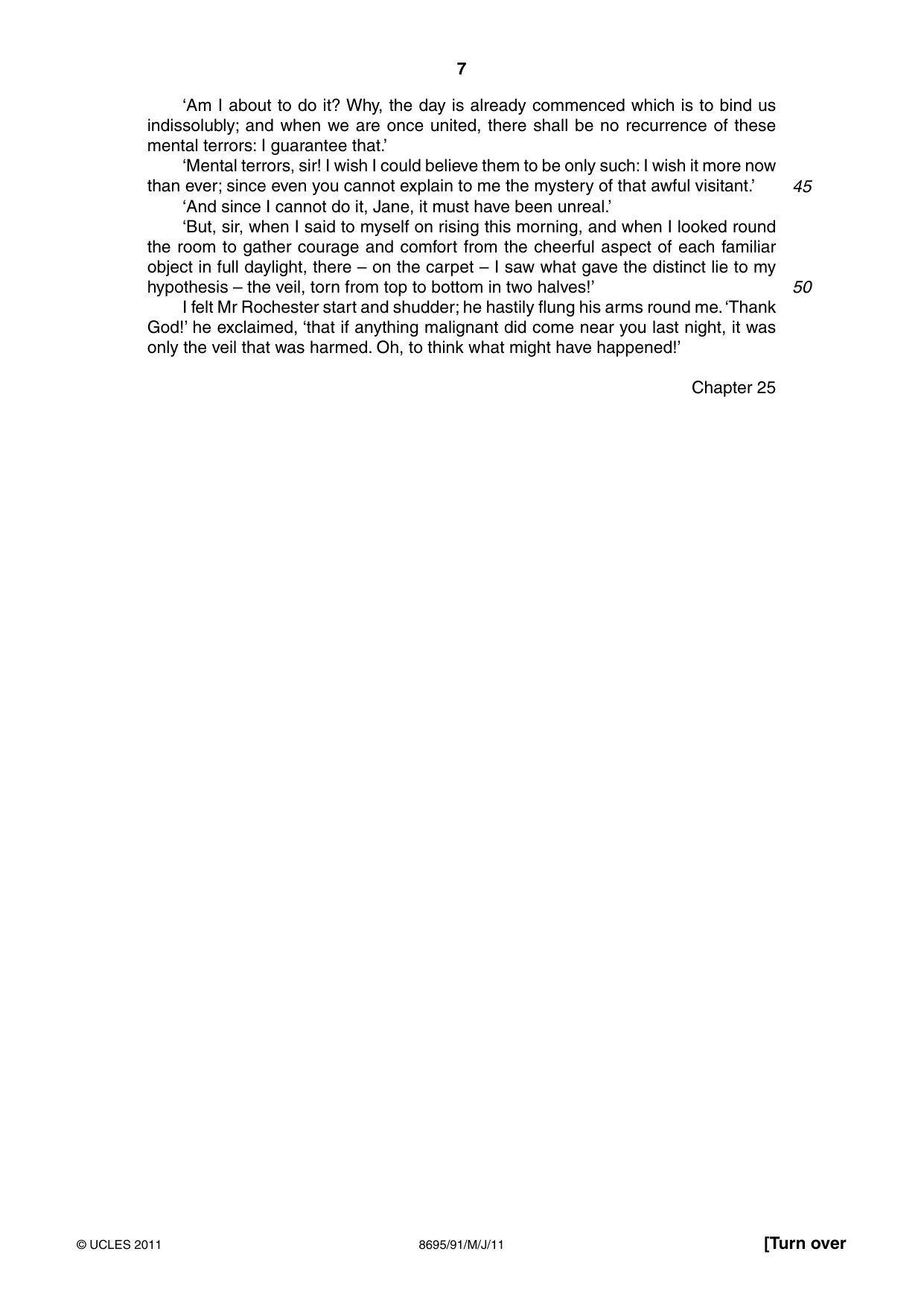
7 8695/91/M/J/11 © UCLES 2011 [Turn over ‘Am I about to do it? Why, the day is already commenced which is to bind us indissolubly; and when we are once united, there shall be no recurrence of these mental terrors: I guarantee that.’ ‘Mental terrors, sir! I wish I could believe them to be only such: I wish it more now than ever; since even you cannot explain to me the mystery of that awful visitant.’ ‘And since I cannot do it, Jane, it must have been unreal.’ ‘But, sir, when I said to myself on rising this morning, and when I looked round the room to gather courage and comfort from the cheerful aspect of each familiar object in full daylight, there – on the carpet – I saw what gave the distinct lie to my hypothesis – the veil, torn from top to bottom in two halves!’ I felt Mr Rochester start and shudder; he hastily flung his arms round me. ‘Thank God!’ he exclaimed, ‘that if anything malignant did come near you last night, it was only the veil that was harmed. Oh, to think what might have happened!’ Chapter 25 45 50
Question paper, page 8
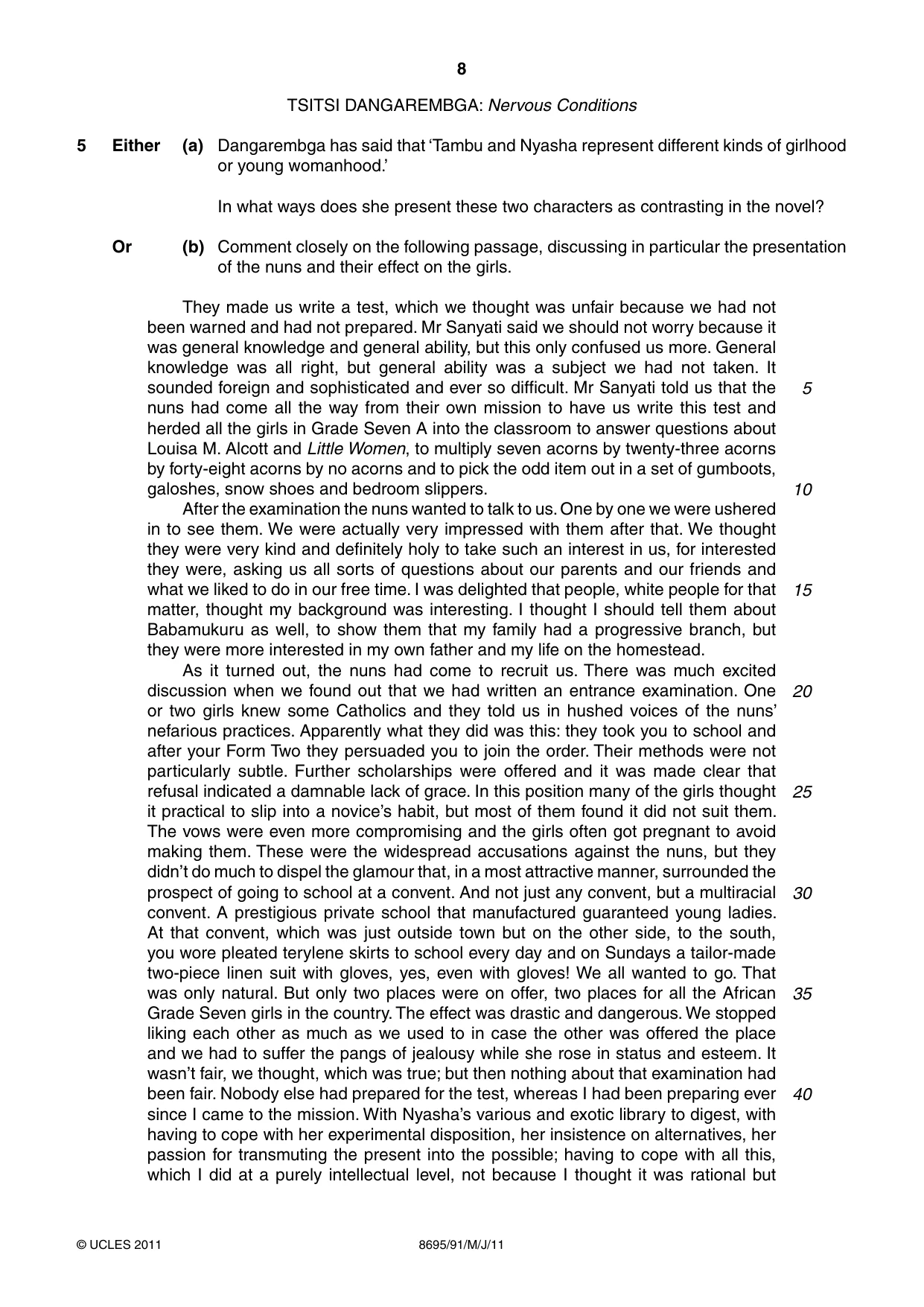
8 8695/91/M/J/11 © UCLES 2011 TSITSI DANGAREMBGA: Nervous Conditions 5 Either (a) Dangarembga has said that ‘Tambu and Nyasha represent different kinds of girlhood or young womanhood.’ In what ways does she present these two characters as contrasting in the novel? Or (b) Comment closely on the following passage, discussing in particular the presentation of the nuns and their effect on the girls. They made us write a test, which we thought was unfair because we had not been warned and had not prepared. Mr Sanyati said we should not worry because it was general knowledge and general ability, but this only confused us more. General knowledge was all right, but general ability was a subject we had not taken. It sounded foreign and sophisticated and ever so difficult. Mr Sanyati told us that the nuns had come all the way from their own mission to have us write this test and herded all the girls in Grade Seven A into the classroom to answer questions about Louisa M. Alcott and Little Women, to multiply seven acorns by twenty-three acorns by forty-eight acorns by no acorns and to pick the odd item out in a set of gumboots, galoshes, snow shoes and bedroom slippers. After the examination the nuns wanted to talk to us. One by one we were ushered in to see them. We were actually very impressed with them after that. We thought they were very kind and definitely holy to take such an interest in us, for interested they were, asking us all sorts of questions about our parents and our friends and what we liked to do in our free time. I was delighted that people, white people for that matter, thought my background was interesting. I thought I should tell them about Babamukuru as well, to show them that my family had a progressive branch, but they were more interested in my own father and my life on the homestead. As it turned out, the nuns had come to recruit us. There was much excited discussion when we found out that we had written an entrance examination. One or two girls knew some Catholics and they told us in hushed voices of the nuns’ nefarious practices. Apparently what they did was this: they took you to school and after your Form Two they persuaded you to join the order. Their methods were not particularly subtle. Further scholarships were offered and it was made clear that refusal indicated a damnable lack of grace. In this position many of the girls thought it practical to slip into a novice’s habit, but most of them found it did not suit them. The vows were even more compromising and the girls often got pregnant to avoid making them. These were the widespread accusations against the nuns, but they didn’t do much to dispel the glamour that, in a most attractive manner, surrounded the prospect of going to school at a convent. And not just any convent, but a multiracial convent. A prestigious private school that manufactured guaranteed young ladies. At that convent, which was just outside town but on the other side, to the south, you wore pleated terylene skirts to school every day and on Sundays a tailor-made two-piece linen suit with gloves, yes, even with gloves! We all wanted to go. That was only natural. But only two places were on offer, two places for all the African Grade Seven girls in the country. The effect was drastic and dangerous. We stopped liking each other as much as we used to in case the other was offered the place and we had to suffer the pangs of jealousy while she rose in status and esteem. It wasn’t fair, we thought, which was true; but then nothing about that examination had been fair. Nobody else had prepared for the test, whereas I had been preparing ever since I came to the mission. With Nyasha’s various and exotic library to digest, with having to cope with her experimental disposition, her insistence on alternatives, her passion for transmuting the present into the possible; having to cope with all this, which I did at a purely intellectual level, not because I thought it was rational but 5 10 15 20 25 30 35 40
Question paper, page 9
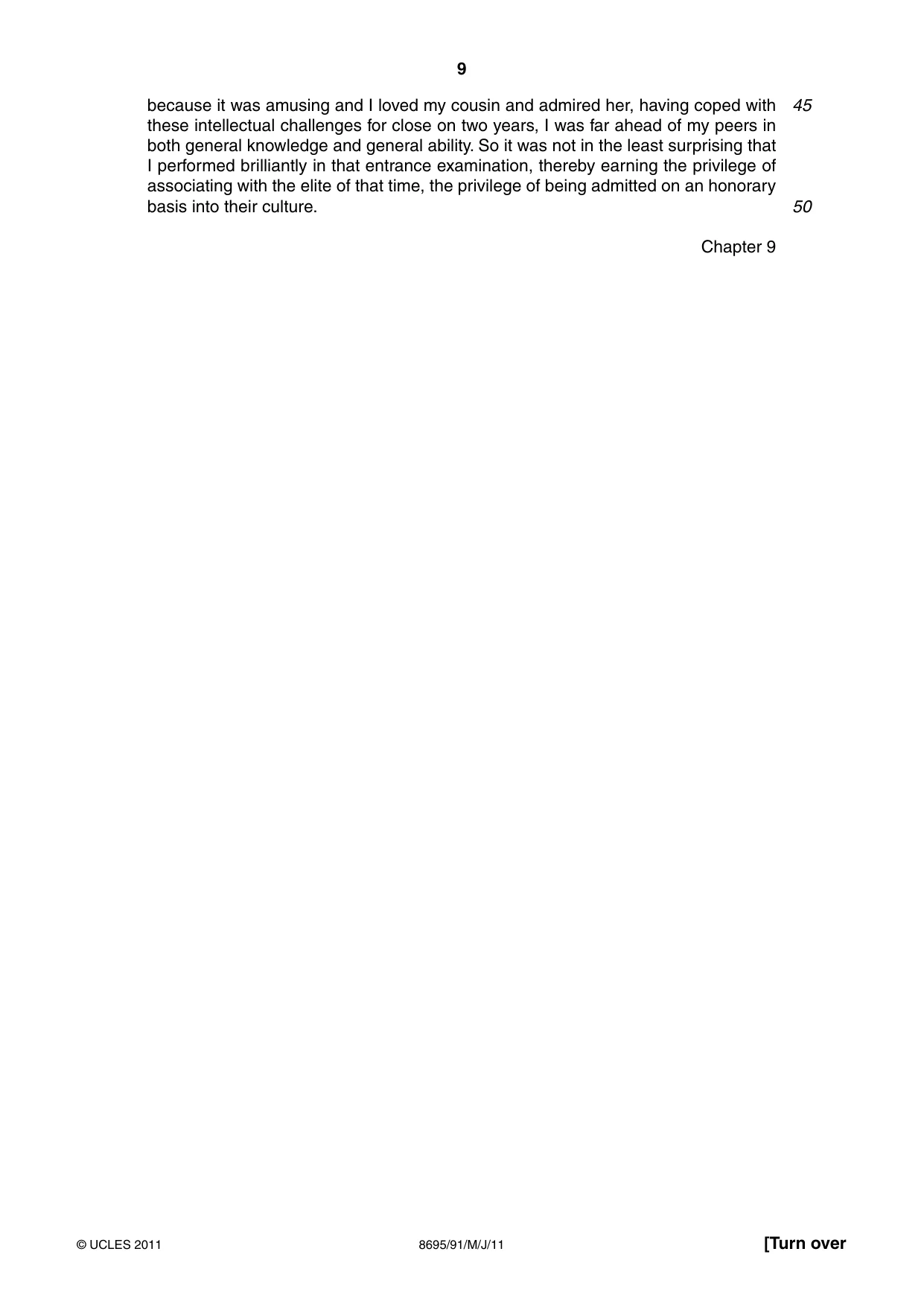
9 8695/91/M/J/11 © UCLES 2011 [Turn over because it was amusing and I loved my cousin and admired her, having coped with these intellectual challenges for close on two years, I was far ahead of my peers in both general knowledge and general ability. So it was not in the least surprising that I performed brilliantly in that entrance examination, thereby earning the privilege of associating with the elite of that time, the privilege of being admitted on an honorary basis into their culture. Chapter 9 45 50
Question paper, page 10
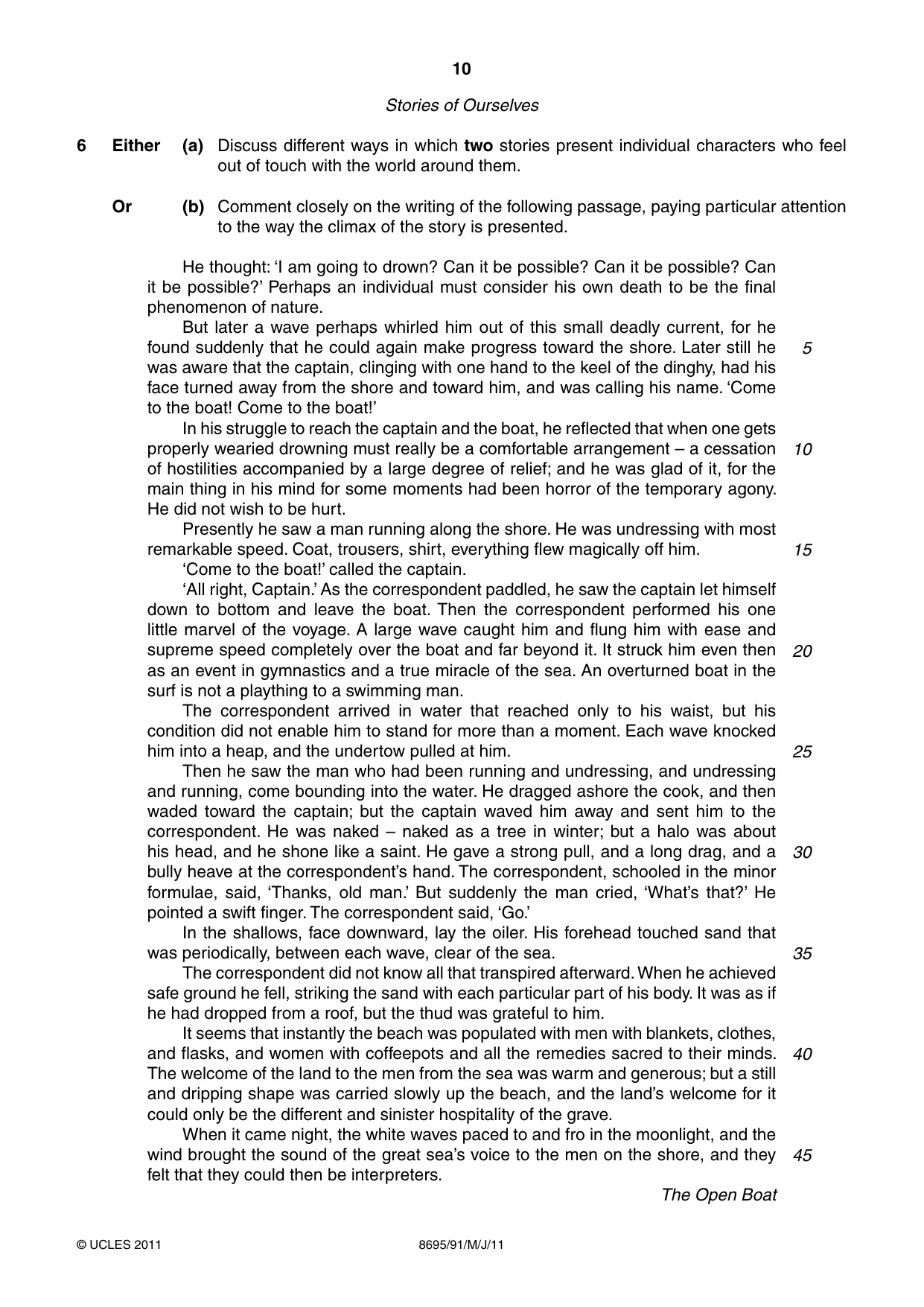
10 8695/91/M/J/11 © UCLES 2011 Stories of Ourselves 6 Either (a) Discuss different ways in which two stories present individual characters who feel out of touch with the world around them. Or (b) Comment closely on the writing of the following passage, paying particular attention to the way the climax of the story is presented. He thought: ‘I am going to drown? Can it be possible? Can it be possible? Can it be possible?’ Perhaps an individual must consider his own death to be the final phenomenon of nature. But later a wave perhaps whirled him out of this small deadly current, for he found suddenly that he could again make progress toward the shore. Later still he was aware that the captain, clinging with one hand to the keel of the dinghy, had his face turned away from the shore and toward him, and was calling his name. ‘Come to the boat! Come to the boat!’ In his struggle to reach the captain and the boat, he reflected that when one gets properly wearied drowning must really be a comfortable arrangement – a cessation of hostilities accompanied by a large degree of relief; and he was glad of it, for the main thing in his mind for some moments had been horror of the temporary agony. He did not wish to be hurt. Presently he saw a man running along the shore. He was undressing with most remarkable speed. Coat, trousers, shirt, everything flew magically off him. ‘Come to the boat!’ called the captain. ‘All right, Captain.’ As the correspondent paddled, he saw the captain let himself down to bottom and leave the boat. Then the correspondent performed his one little marvel of the voyage. A large wave caught him and flung him with ease and supreme speed completely over the boat and far beyond it. It struck him even then as an event in gymnastics and a true miracle of the sea. An overturned boat in the surf is not a plaything to a swimming man. The correspondent arrived in water that reached only to his waist, but his condition did not enable him to stand for more than a moment. Each wave knocked him into a heap, and the undertow pulled at him. Then he saw the man who had been running and undressing, and undressing and running, come bounding into the water. He dragged ashore the cook, and then waded toward the captain; but the captain waved him away and sent him to the correspondent. He was naked – naked as a tree in winter; but a halo was about his head, and he shone like a saint. He gave a strong pull, and a long drag, and a bully heave at the correspondent’s hand. The correspondent, schooled in the minor formulae, said, ‘Thanks, old man.’ But suddenly the man cried, ‘What’s that?’ He pointed a swift finger. The correspondent said, ‘Go.’ In the shallows, face downward, lay the oiler. His forehead touched sand that was periodically, between each wave, clear of the sea. The correspondent did not know all that transpired afterward. When he achieved safe ground he fell, striking the sand with each particular part of his body. It was as if he had dropped from a roof, but the thud was grateful to him. It seems that instantly the beach was populated with men with blankets, clothes, and flasks, and women with coffeepots and all the remedies sacred to their minds. The welcome of the land to the men from the sea was warm and generous; but a still and dripping shape was carried slowly up the beach, and the land’s welcome for it could only be the different and sinister hospitality of the grave. When it came night, the white waves paced to and fro in the moonlight, and the wind brought the sound of the great sea’s voice to the men on the shore, and they felt that they could then be interpreters. The Open Boat 5 10 15 20 25 30 35 40 45
Question paper, page 11
11 8695/91/M/J/11 © UCLES 2011 [Turn over BLANK PAGE Turn to Page 12 for Question 7.
Question paper, page 12
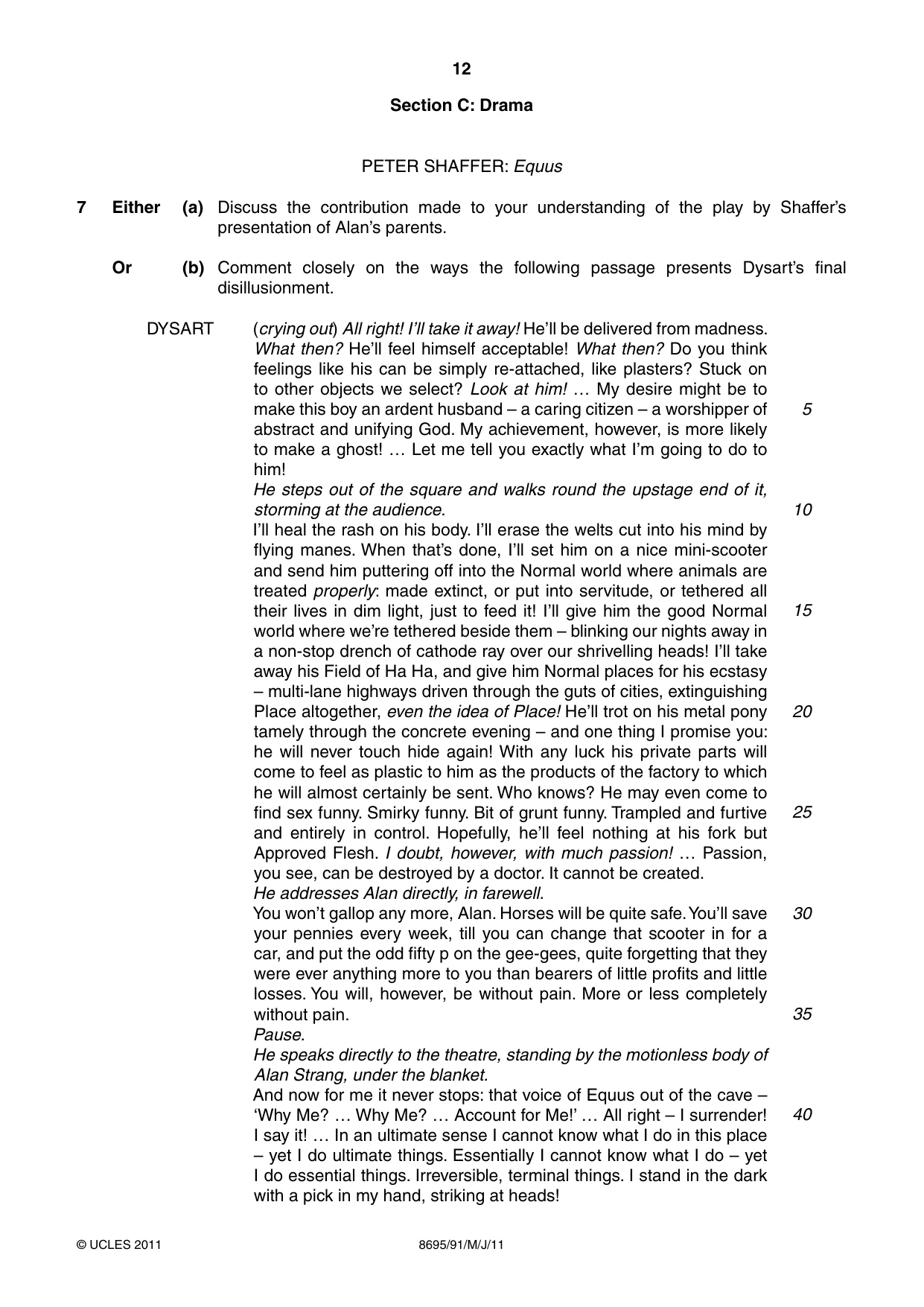
12 8695/91/M/J/11 © UCLES 2011 Section C: Drama PETER SHAFFER: Equus 7 Either (a) Discuss the contribution made to your understanding of the play by Shaffer’s presentation of Alan’s parents. Or (b) Comment closely on the ways the following passage presents Dysart’s final disillusionment. DYSART (crying out) All right! I’ll take it away! He’ll be delivered from madness. What then? He’ll feel himself acceptable! What then? Do you think feelings like his can be simply re-attached, like plasters? Stuck on to other objects we select? Look at him! … My desire might be to make this boy an ardent husband – a caring citizen – a worshipper of abstract and unifying God. My achievement, however, is more likely to make a ghost! … Let me tell you exactly what I’m going to do to him! He steps out of the square and walks round the upstage end of it, storming at the audience. I’ll heal the rash on his body. I’ll erase the welts cut into his mind by flying manes. When that’s done, I’ll set him on a nice mini-scooter and send him puttering off into the Normal world where animals are treated properly: made extinct, or put into servitude, or tethered all their lives in dim light, just to feed it! I’ll give him the good Normal world where we’re tethered beside them – blinking our nights away in a non-stop drench of cathode ray over our shrivelling heads! I’ll take away his Field of Ha Ha, and give him Normal places for his ecstasy – multi-lane highways driven through the guts of cities, extinguishing Place altogether, even the idea of Place! He’ll trot on his metal pony tamely through the concrete evening – and one thing I promise you: he will never touch hide again! With any luck his private parts will come to feel as plastic to him as the products of the factory to which he will almost certainly be sent. Who knows? He may even come to find sex funny. Smirky funny. Bit of grunt funny. Trampled and furtive and entirely in control. Hopefully, he’ll feel nothing at his fork but Approved Flesh. I doubt, however, with much passion! … Passion, you see, can be destroyed by a doctor. It cannot be created. He addresses Alan directly, in farewell. You won’t gallop any more, Alan. Horses will be quite safe. You’ll save your pennies every week, till you can change that scooter in for a car, and put the odd fifty p on the gee-gees, quite forgetting that they were ever anything more to you than bearers of little profits and little losses. You will, however, be without pain. More or less completely without pain. Pause. He speaks directly to the theatre, standing by the motionless body of Alan Strang, under the blanket. And now for me it never stops: that voice of Equus out of the cave – ‘Why Me? … Why Me? … Account for Me!’ … All right – I surrender! I say it! … In an ultimate sense I cannot know what I do in this place – yet I do ultimate things. Essentially I cannot know what I do – yet I do essential things. Irreversible, terminal things. I stand in the dark with a pick in my hand, striking at heads! 5 10 15 20 25 30 35 40
Question paper, page 13
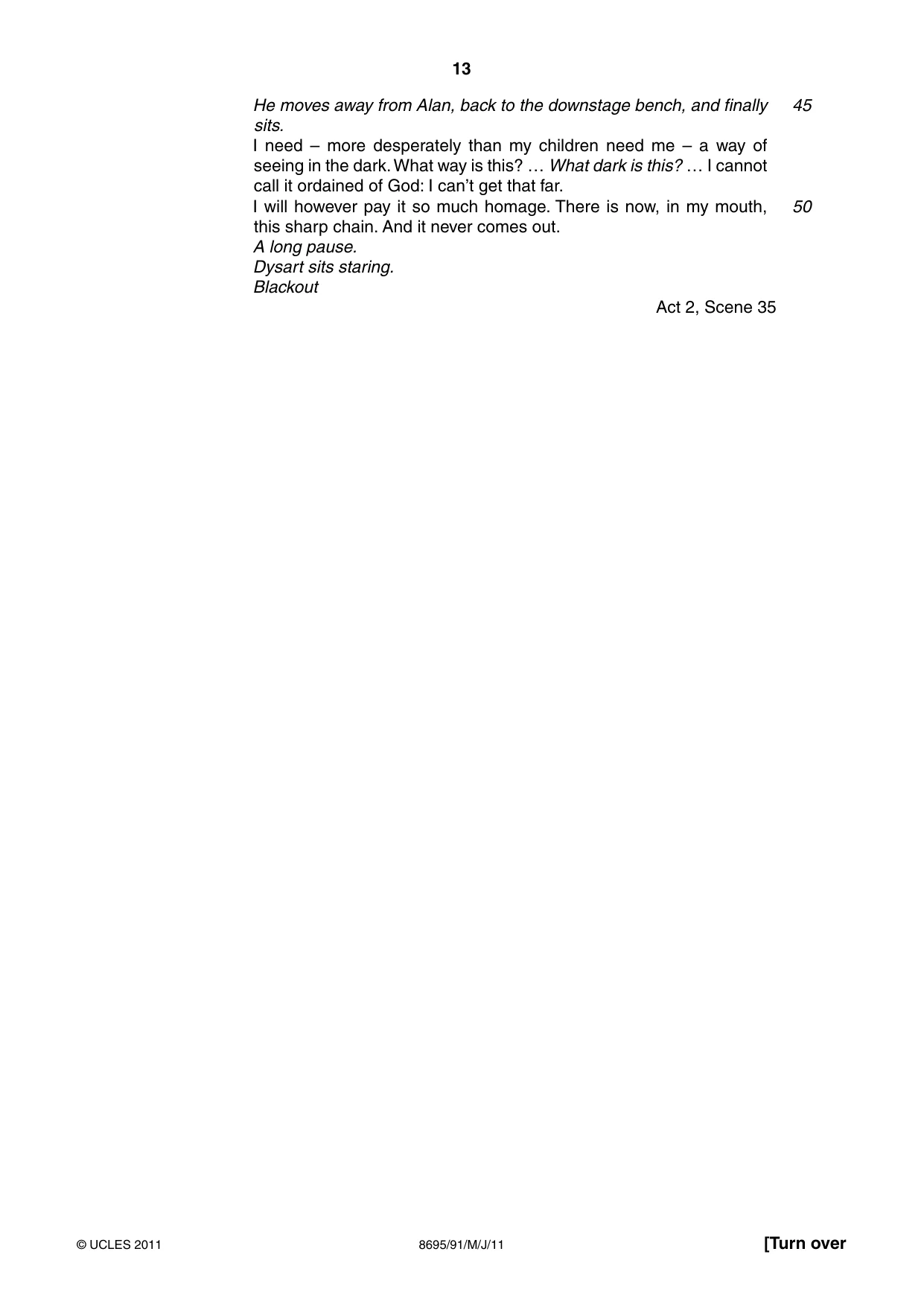
13 8695/91/M/J/11 © UCLES 2011 [Turn over He moves away from Alan, back to the downstage bench, and finally sits. I need – more desperately than my children need me – a way of seeing in the dark. What way is this? … What dark is this? … I cannot call it ordained of God: I can’t get that far. I will however pay it so much homage. There is now, in my mouth, this sharp chain. And it never comes out. A long pause. Dysart sits staring. Blackout Act 2, Scene 35 45 50
Question paper, page 14
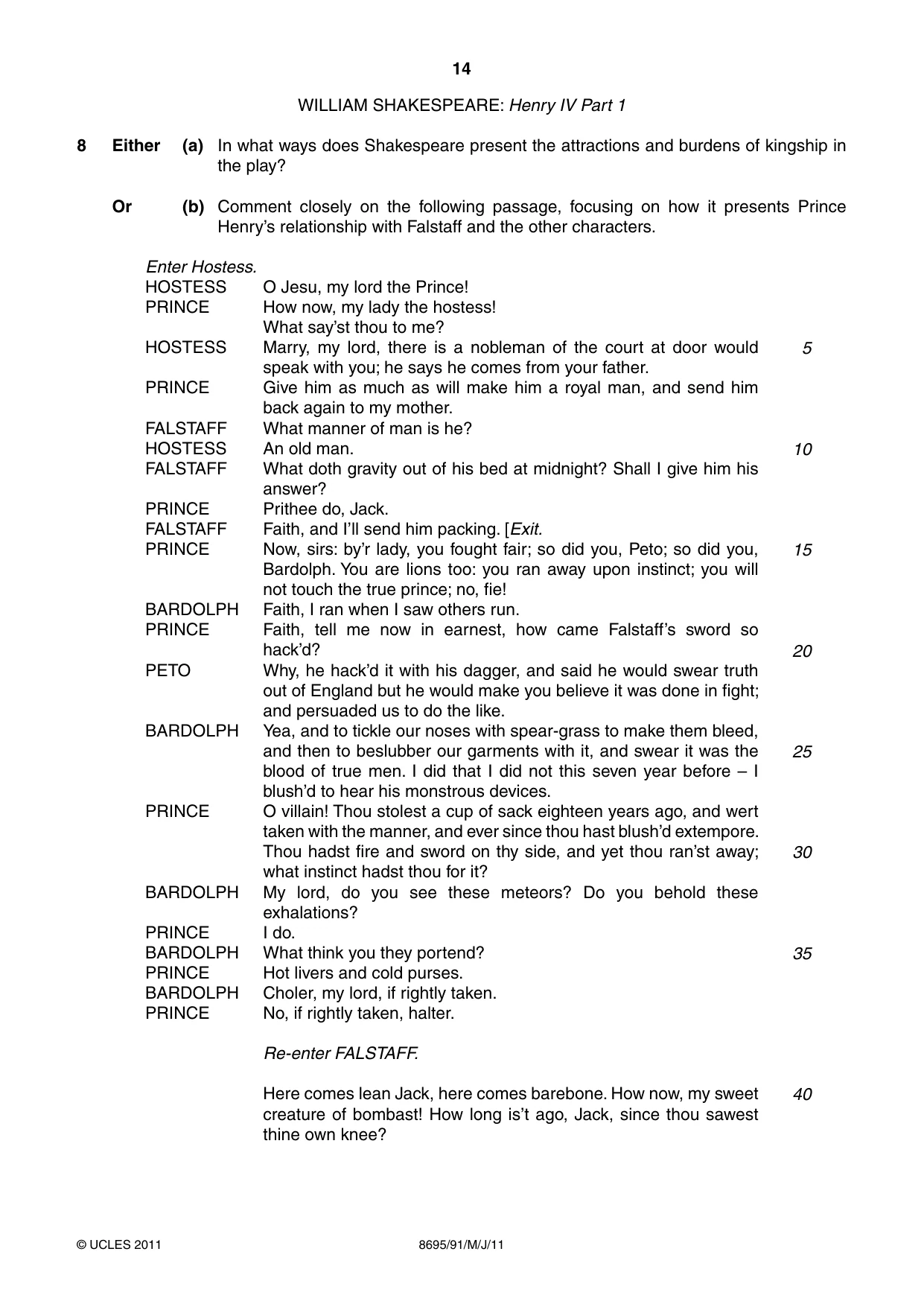
14 8695/91/M/J/11 © UCLES 2011 WILLIAM SHAKESPEARE: Henry IV Part 1 8 Either (a) In what ways does Shakespeare present the attractions and burdens of kingship in the play? Or (b) Comment closely on the following passage, focusing on how it presents Prince Henry’s relationship with Falstaff and the other characters. Enter Hostess. HOSTESS O Jesu, my lord the Prince! PRINCE How now, my lady the hostess! What say’st thou to me? HOSTESS Marry, my lord, there is a nobleman of the court at door would speak with you; he says he comes from your father. PRINCE Give him as much as will make him a royal man, and send him back again to my mother. FALSTAFF What manner of man is he? HOSTESS An old man. FALSTAFF What doth gravity out of his bed at midnight? Shall I give him his answer? PRINCE Prithee do, Jack. FALSTAFF Faith, and I’ll send him packing. [Exit. PRINCE Now, sirs: by’r lady, you fought fair; so did you, Peto; so did you, Bardolph. You are lions too: you ran away upon instinct; you will not touch the true prince; no, fie! BARDOLPH Faith, I ran when I saw others run. PRINCE Faith, tell me now in earnest, how came Falstaff’s sword so hack’d? PETO Why, he hack’d it with his dagger, and said he would swear truth out of England but he would make you believe it was done in fight; and persuaded us to do the like. BARDOLPH Yea, and to tickle our noses with spear-grass to make them bleed, and then to beslubber our garments with it, and swear it was the blood of true men. I did that I did not this seven year before – I blush’d to hear his monstrous devices. PRINCE O villain! Thou stolest a cup of sack eighteen years ago, and wert taken with the manner, and ever since thou hast blush’d extempore. Thou hadst fire and sword on thy side, and yet thou ran’st away; what instinct hadst thou for it? BARDOLPH My lord, do you see these meteors? Do you behold these exhalations? PRINCE I do. BARDOLPH What think you they portend? PRINCE Hot livers and cold purses. BARDOLPH Choler, my lord, if rightly taken. PRINCE No, if rightly taken, halter. Re-enter FALSTAFF. Here comes lean Jack, here comes barebone. How now, my sweet creature of bombast! How long is’t ago, Jack, since thou sawest thine own knee? 5 10 15 20 25 30 35 40
Question paper, page 15
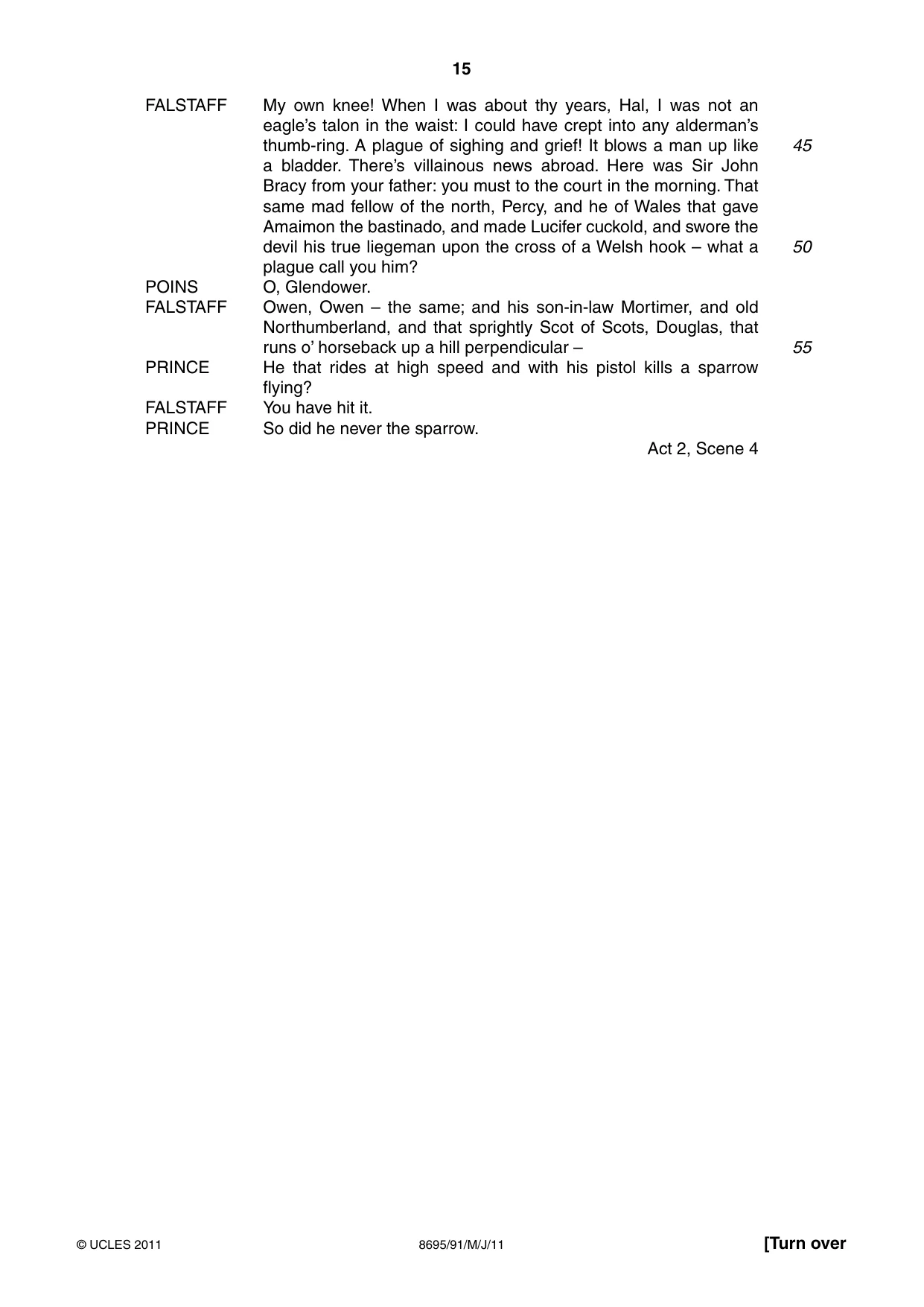
15 8695/91/M/J/11 © UCLES 2011 [Turn over FALSTAFF My own knee! When I was about thy years, Hal, I was not an eagle’s talon in the waist: I could have crept into any alderman’s thumb-ring. A plague of sighing and grief! It blows a man up like a bladder. There’s villainous news abroad. Here was Sir John Bracy from your father: you must to the court in the morning. That same mad fellow of the north, Percy, and he of Wales that gave Amaimon the bastinado, and made Lucifer cuckold, and swore the devil his true liegeman upon the cross of a Welsh hook – what a plague call you him? POINS O, Glendower. FALSTAFF Owen, Owen – the same; and his son-in-law Mortimer, and old Northumberland, and that sprightly Scot of Scots, Douglas, that runs o’ horseback up a hill perpendicular – PRINCE He that rides at high speed and with his pistol kills a sparrow flying? FALSTAFF You have hit it. PRINCE So did he never the sparrow. Act 2, Scene 4 45 50 55
Question paper, page 16
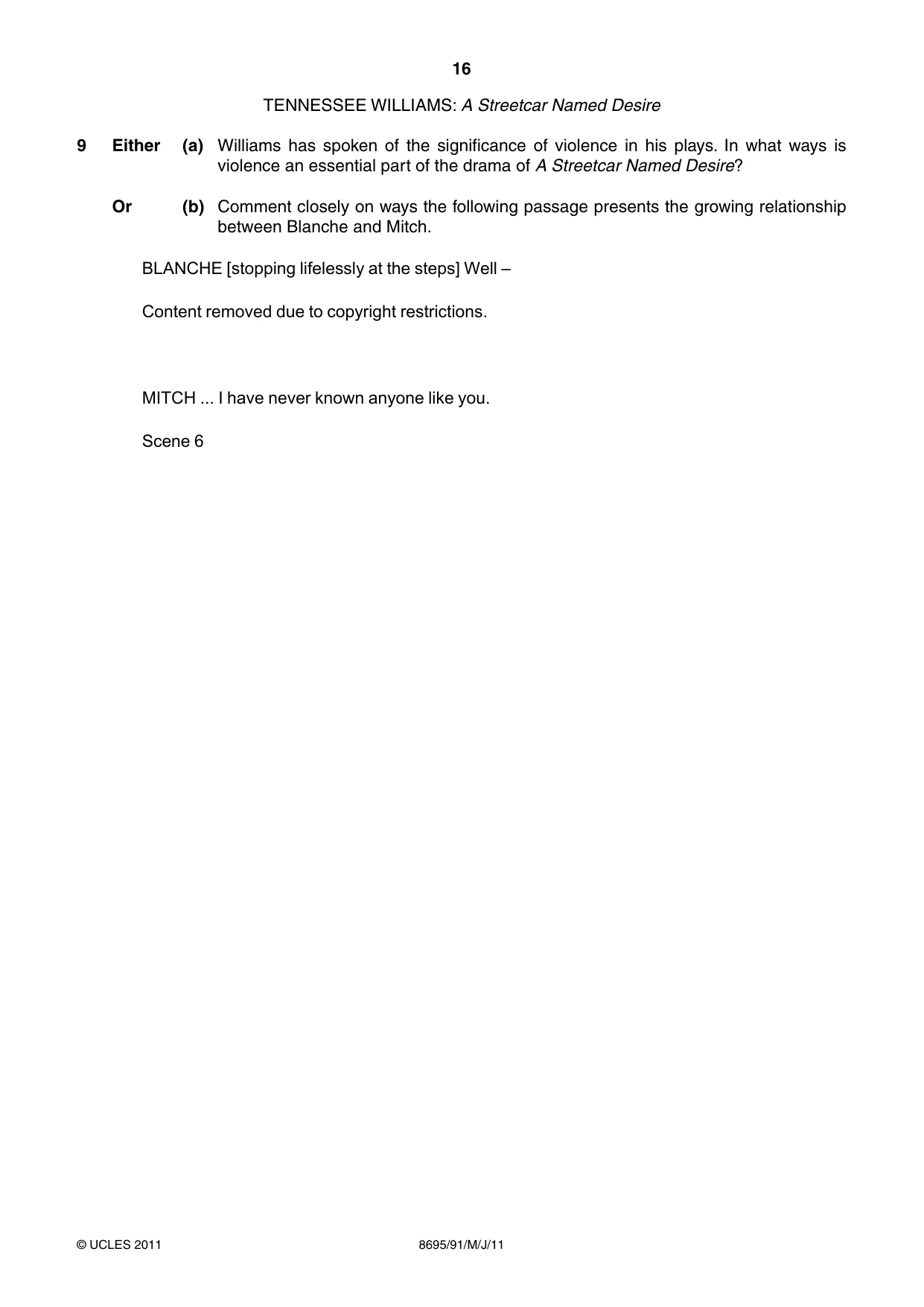
16 8695/91/M/J/11 © UCLES 2011 TENNESSEE WILLIAMS: A Streetcar Named Desire 9 Either (a) Williams has spoken of the significance of violence in his plays. In what ways is violence an essential part of the drama of A Streetcar Named Desire? Or (b) Comment closely on ways the following passage presents the growing relationship between Blanche and Mitch. BLANCHE [stopping lifelessly at the steps] Well – Content removed due to copyright restrictions. MITCH ... I have never known anyone like you. Scene 6
Question paper, page 18
18 8695/91/M/J/11 © UCLES 2011 BLANK PAGE
Question paper, page 19
19 8695/91/M/J/11 © UCLES 2011 BLANK PAGE
Question paper, page 20
20 8695/91/M/J/11 © UCLES 2011 Copyright Acknowledgements: Question 1 © Sujata Bhatt; ‘29 April 1989’, Point No Point ; Carcanet; 1997; Question 5 © Tsitsi Dangarembga; Nervous Conditions ; Ayebia Publishing; 2004; Question 7 © Peter Shaffer; Equus ; Longman; 1993; Question 9 © Tennessee Williams; A Streetcar Named Desire ; Penguin; 1983; Permission to reproduce items where third-party owned material protected by copyright is included has been sought and cleared where possible. Every reasonable effort has been made by the publisher (UCLES) to trace copyright holders, but if any items requiring clearance have unwittingly been included, the publisher will be pleased to make amends at the earliest possible opportunity. University of Cambridge International Examinations is part of the Cambridge Assessment Group. Cambridge Assessment is the brand name of University of Cambridge Local Examinations Syndicate (UCLES), which is itself a department of the University of Cambridge. BLANK PAGE
Mark scheme, page 1
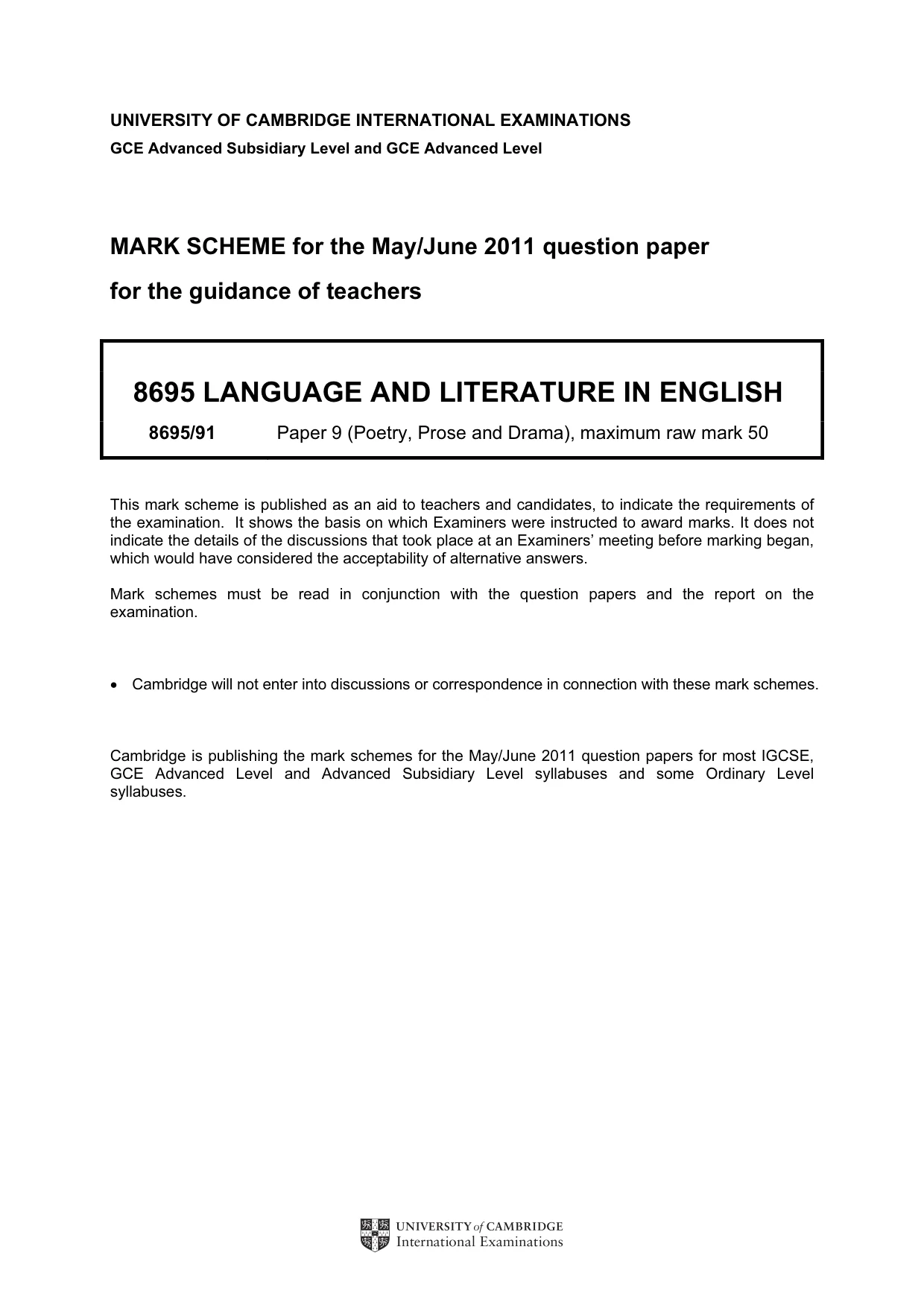
UNIVERSITY OF CAMBRIDGE INTERNATIONAL EXAMINATIONS GCE Advanced Subsidiary Level and GCE Advanced Level MARK SCHEME for the May/June 2011 question paper for the guidance of teachers 8695 LANGUAGE AND LITERATURE IN ENGLISH 8695/91 Paper 9 (Poetry, Prose and Drama), maximum raw mark 50 This mark scheme is published as an aid to teachers and candidates, to indicate the requirements of the examination. It shows the basis on which Examiners were instructed to award marks. It does not indicate the details of the discussions that took place at an Examiners’ meeting before marking began, which would have considered the acceptability of alternative answers. Mark schemes must be read in conjunction with the question papers and the report on the examination. • Cambridge will not enter into discussions or correspondence in connection with these mark schemes. Cambridge is publishing the mark schemes for the May/June 2011 question papers for most IGCSE, GCE Advanced Level and Advanced Subsidiary Level syllabuses and some Ordinary Level syllabuses.
Mark scheme, page 2
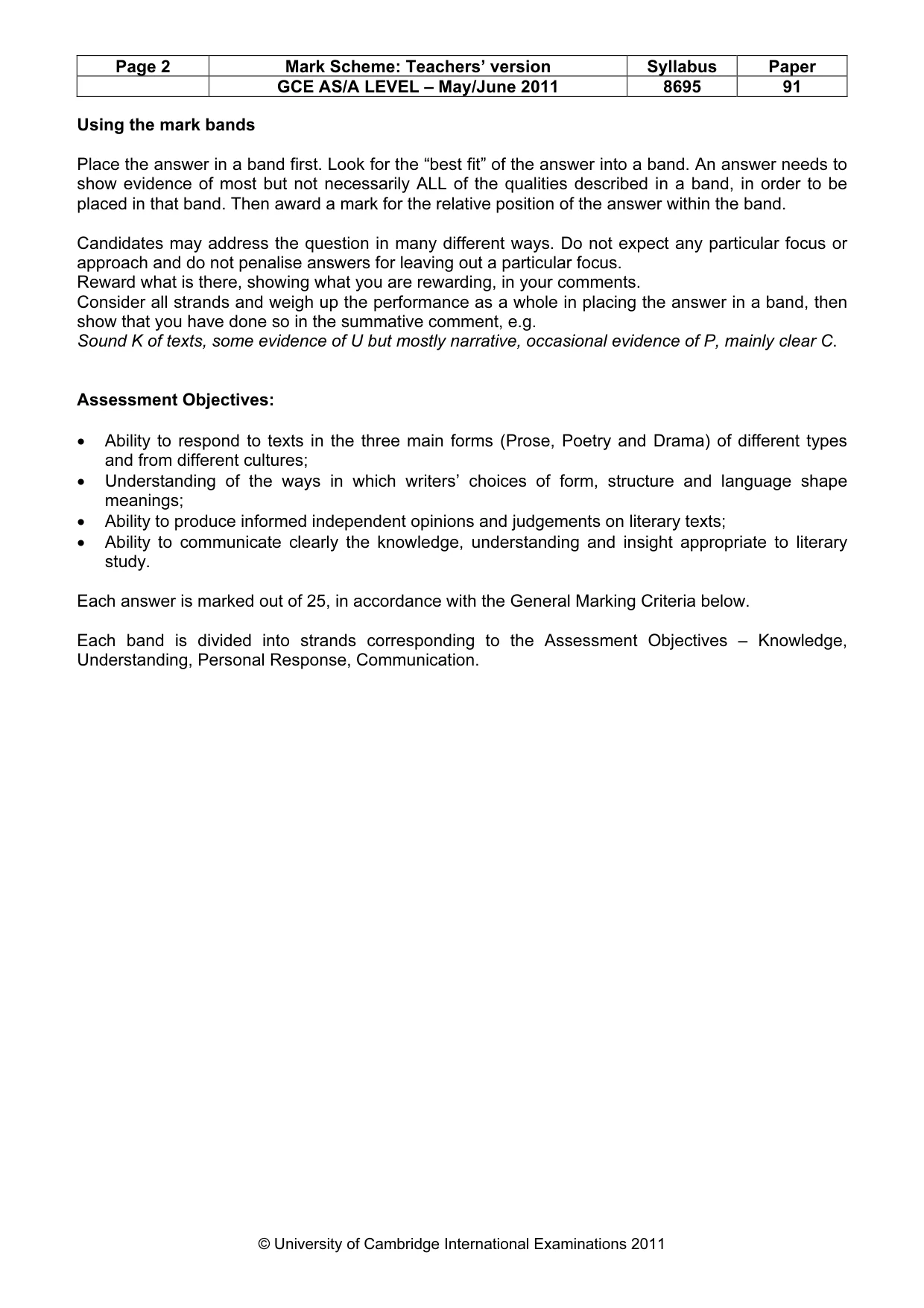
Page 2 Mark Scheme: Teachers’ version Syllabus Paper GCE AS/A LEVEL – May/June 2011 8695 91 © University of Cambridge International Examinations 2011 Using the mark bands Place the answer in a band first. Look for the “best fit” of the answer into a band. An answer needs to show evidence of most but not necessarily ALL of the qualities described in a band, in order to be placed in that band. Then award a mark for the relative position of the answer within the band. Candidates may address the question in many different ways. Do not expect any particular focus or approach and do not penalise answers for leaving out a particular focus. Reward what is there, showing what you are rewarding, in your comments. Consider all strands and weigh up the performance as a whole in placing the answer in a band, then show that you have done so in the summative comment, e.g. Sound K of texts, some evidence of U but mostly narrative, occasional evidence of P, mainly clear C. Assessment Objectives: • Ability to respond to texts in the three main forms (Prose, Poetry and Drama) of different types and from different cultures; • Understanding of the ways in which writers’ choices of form, structure and language shape meanings; • Ability to produce informed independent opinions and judgements on literary texts; • Ability to communicate clearly the knowledge, understanding and insight appropriate to literary study. Each answer is marked out of 25, in accordance with the General Marking Criteria below. Each band is divided into strands corresponding to the Assessment Objectives – Knowledge, Understanding, Personal Response, Communication.
Mark scheme, page 3
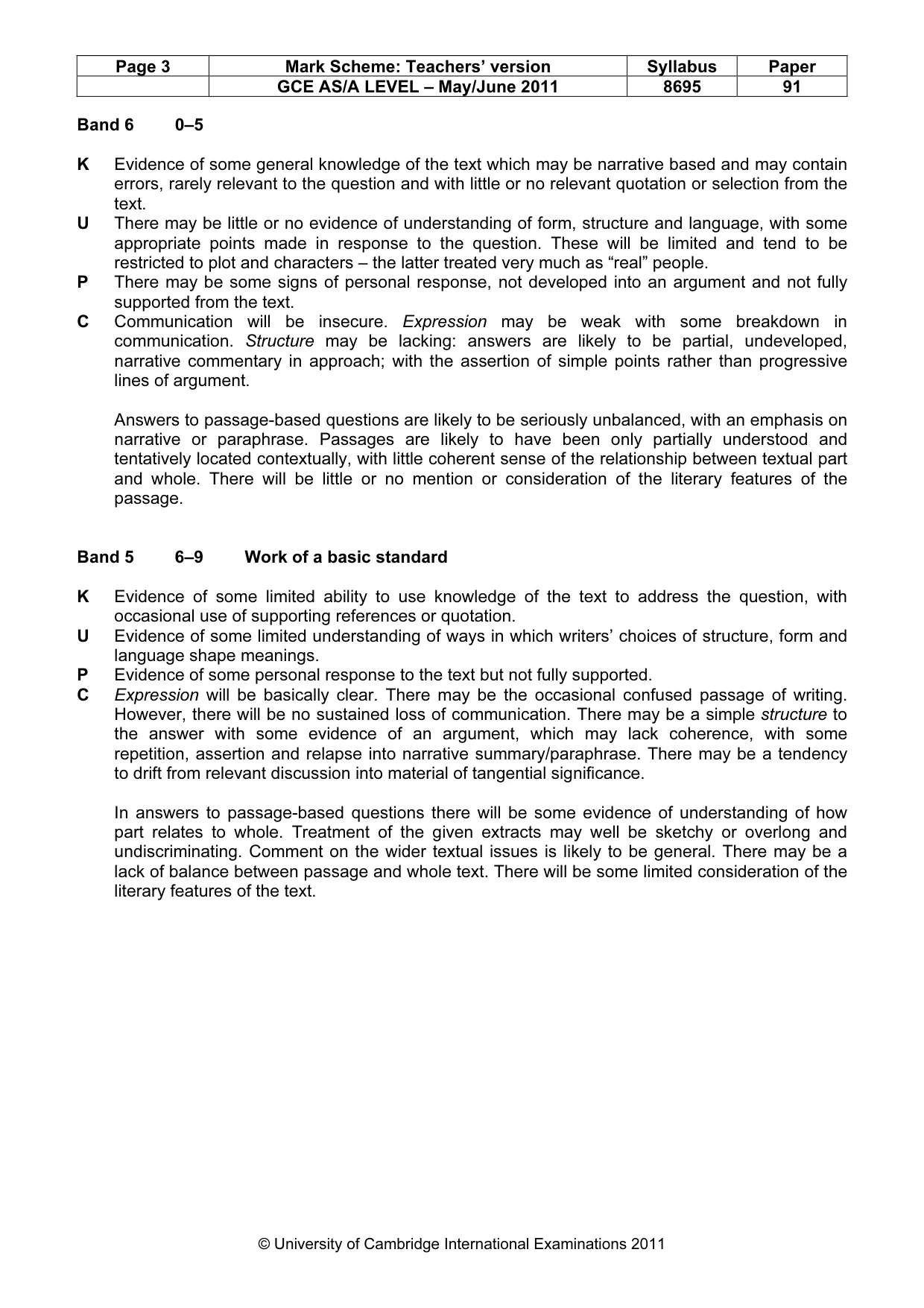
Page 3 Mark Scheme: Teachers’ version Syllabus Paper GCE AS/A LEVEL – May/June 2011 8695 91 © University of Cambridge International Examinations 2011 Band 6 0–5 K Evidence of some general knowledge of the text which may be narrative based and may contain errors, rarely relevant to the question and with little or no relevant quotation or selection from the text. U There may be little or no evidence of understanding of form, structure and language, with some appropriate points made in response to the question. These will be limited and tend to be restricted to plot and characters – the latter treated very much as “real” people. P There may be some signs of personal response, not developed into an argument and not fully supported from the text. C Communication will be insecure. Expression may be weak with some breakdown in communication. Structure may be lacking: answers are likely to be partial, undeveloped, narrative commentary in approach; with the assertion of simple points rather than progressive lines of argument. Answers to passage-based questions are likely to be seriously unbalanced, with an emphasis on narrative or paraphrase. Passages are likely to have been only partially understood and tentatively located contextually, with little coherent sense of the relationship between textual part and whole. There will be little or no mention or consideration of the literary features of the passage. Band 5 6–9 Work of a basic standard K Evidence of some limited ability to use knowledge of the text to address the question, with occasional use of supporting references or quotation. U Evidence of some limited understanding of ways in which writers’ choices of structure, form and language shape meanings. P Evidence of some personal response to the text but not fully supported. C Expression will be basically clear. There may be the occasional confused passage of writing. However, there will be no sustained loss of communication. There may be a simple structure to the answer with some evidence of an argument, which may lack coherence, with some repetition, assertion and relapse into narrative summary/paraphrase. There may be a tendency to drift from relevant discussion into material of tangential significance. In answers to passage-based questions there will be some evidence of understanding of how part relates to whole. Treatment of the given extracts may well be sketchy or overlong and undiscriminating. Comment on the wider textual issues is likely to be general. There may be a lack of balance between passage and whole text. There will be some limited consideration of the literary features of the text.
Mark scheme, page 4
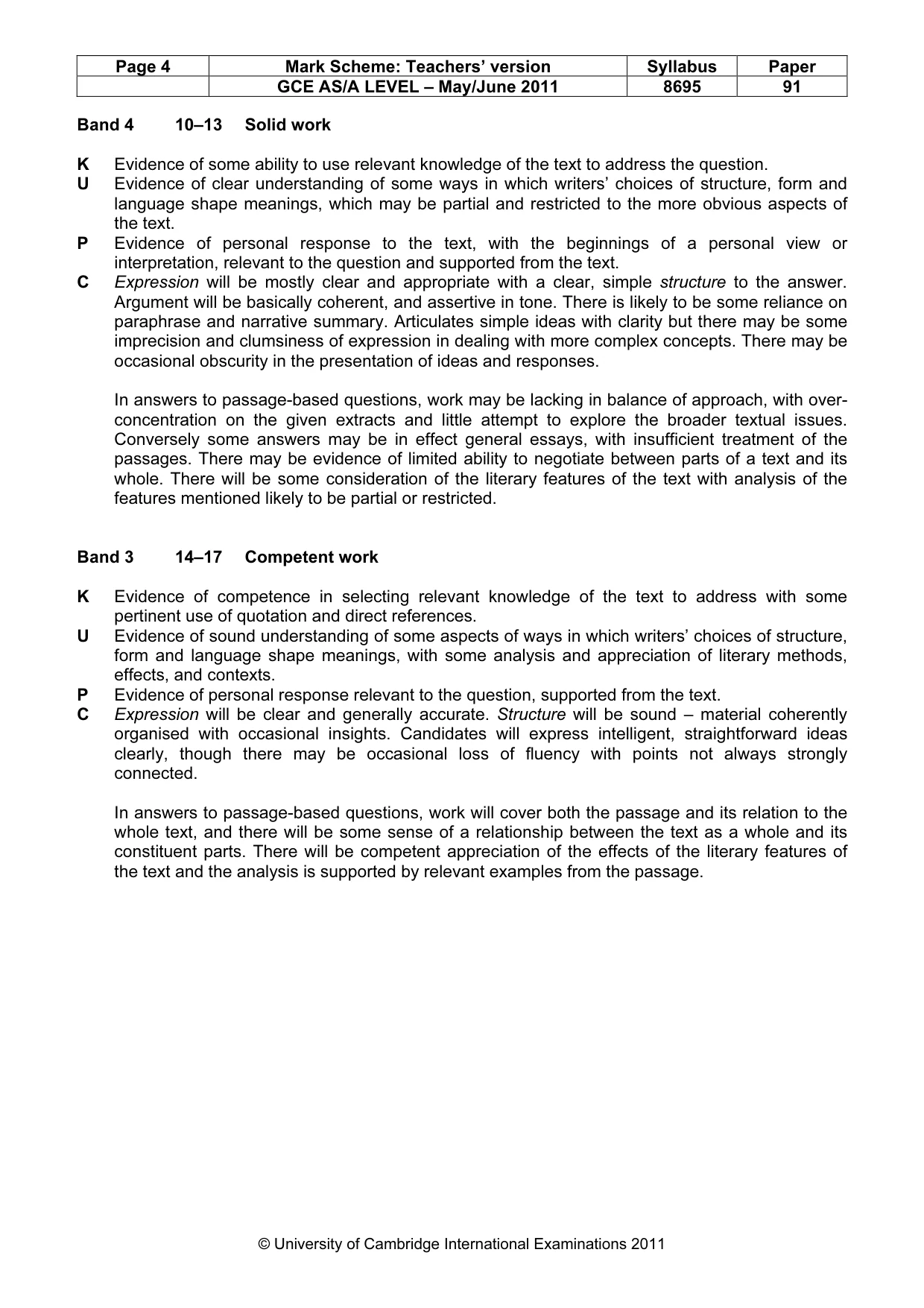
Page 4 Mark Scheme: Teachers’ version Syllabus Paper GCE AS/A LEVEL – May/June 2011 8695 91 © University of Cambridge International Examinations 2011 Band 4 10–13 Solid work K Evidence of some ability to use relevant knowledge of the text to address the question. U Evidence of clear understanding of some ways in which writers’ choices of structure, form and language shape meanings, which may be partial and restricted to the more obvious aspects of the text. P Evidence of personal response to the text, with the beginnings of a personal view or interpretation, relevant to the question and supported from the text. C Expression will be mostly clear and appropriate with a clear, simple structure to the answer. Argument will be basically coherent, and assertive in tone. There is likely to be some reliance on paraphrase and narrative summary. Articulates simple ideas with clarity but there may be some imprecision and clumsiness of expression in dealing with more complex concepts. There may be occasional obscurity in the presentation of ideas and responses. In answers to passage-based questions, work may be lacking in balance of approach, with over- concentration on the given extracts and little attempt to explore the broader textual issues. Conversely some answers may be in effect general essays, with insufficient treatment of the passages. There may be evidence of limited ability to negotiate between parts of a text and its whole. There will be some consideration of the literary features of the text with analysis of the features mentioned likely to be partial or restricted. Band 3 14–17 Competent work K Evidence of competence in selecting relevant knowledge of the text to address with some pertinent use of quotation and direct references. U Evidence of sound understanding of some aspects of ways in which writers’ choices of structure, form and language shape meanings, with some analysis and appreciation of literary methods, effects, and contexts. P Evidence of personal response relevant to the question, supported from the text. C Expression will be clear and generally accurate. Structure will be sound – material coherently organised with occasional insights. Candidates will express intelligent, straightforward ideas clearly, though there may be occasional loss of fluency with points not always strongly connected. In answers to passage-based questions, work will cover both the passage and its relation to the whole text, and there will be some sense of a relationship between the text as a whole and its constituent parts. There will be competent appreciation of the effects of the literary features of the text and the analysis is supported by relevant examples from the passage.
Mark scheme, page 5
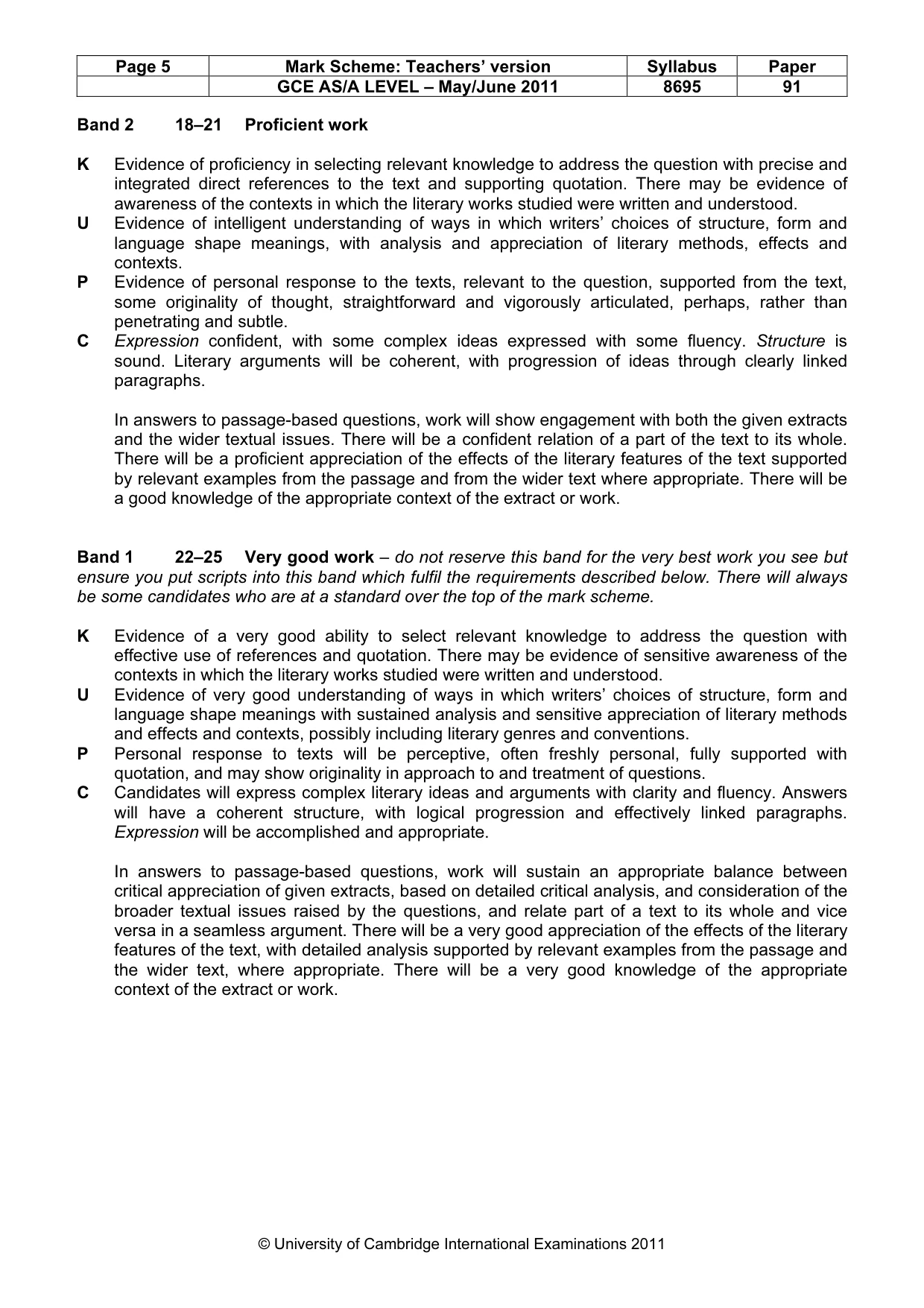
Page 5 Mark Scheme: Teachers’ version Syllabus Paper GCE AS/A LEVEL – May/June 2011 8695 91 © University of Cambridge International Examinations 2011 Band 2 18–21 Proficient work K Evidence of proficiency in selecting relevant knowledge to address the question with precise and integrated direct references to the text and supporting quotation. There may be evidence of awareness of the contexts in which the literary works studied were written and understood. U Evidence of intelligent understanding of ways in which writers’ choices of structure, form and language shape meanings, with analysis and appreciation of literary methods, effects and contexts. P Evidence of personal response to the texts, relevant to the question, supported from the text, some originality of thought, straightforward and vigorously articulated, perhaps, rather than penetrating and subtle. C Expression confident, with some complex ideas expressed with some fluency. Structure is sound. Literary arguments will be coherent, with progression of ideas through clearly linked paragraphs. In answers to passage-based questions, work will show engagement with both the given extracts and the wider textual issues. There will be a confident relation of a part of the text to its whole. There will be a proficient appreciation of the effects of the literary features of the text supported by relevant examples from the passage and from the wider text where appropriate. There will be a good knowledge of the appropriate context of the extract or work. Band 1 22–25 Very good work – do not reserve this band for the very best work you see but ensure you put scripts into this band which fulfil the requirements described below. There will always be some candidates who are at a standard over the top of the mark scheme. K Evidence of a very good ability to select relevant knowledge to address the question with effective use of references and quotation. There may be evidence of sensitive awareness of the contexts in which the literary works studied were written and understood. U Evidence of very good understanding of ways in which writers’ choices of structure, form and language shape meanings with sustained analysis and sensitive appreciation of literary methods and effects and contexts, possibly including literary genres and conventions. P Personal response to texts will be perceptive, often freshly personal, fully supported with quotation, and may show originality in approach to and treatment of questions. C Candidates will express complex literary ideas and arguments with clarity and fluency. Answers will have a coherent structure, with logical progression and effectively linked paragraphs. Expression will be accomplished and appropriate. In answers to passage-based questions, work will sustain an appropriate balance between critical appreciation of given extracts, based on detailed critical analysis, and consideration of the broader textual issues raised by the questions, and relate part of a text to its whole and vice versa in a seamless argument. There will be a very good appreciation of the effects of the literary features of the text, with detailed analysis supported by relevant examples from the passage and the wider text, where appropriate. There will be a very good knowledge of the appropriate context of the extract or work.
What you needed in this session
Cambridge’s own grade thresholds for 2011 May/June, Paper 9 · Variant 1. A higher threshold means an easier paper — the bar moves with how the cohort did.