Cambridge A Level English General Paper 8021 — 2023 Feb/March Paper 1 · Variant 2
8021/12/F/M/23 · 30 marks · ≈34 min
The question paper and its mark scheme, free to read here and free to download. This is Cambridge’s own paper, exactly as it was sat.
Question paper4 pages


Mark scheme17 pages
Answers below. Sit the paper first if you are practising.
Paper as text
Question paper, page 1
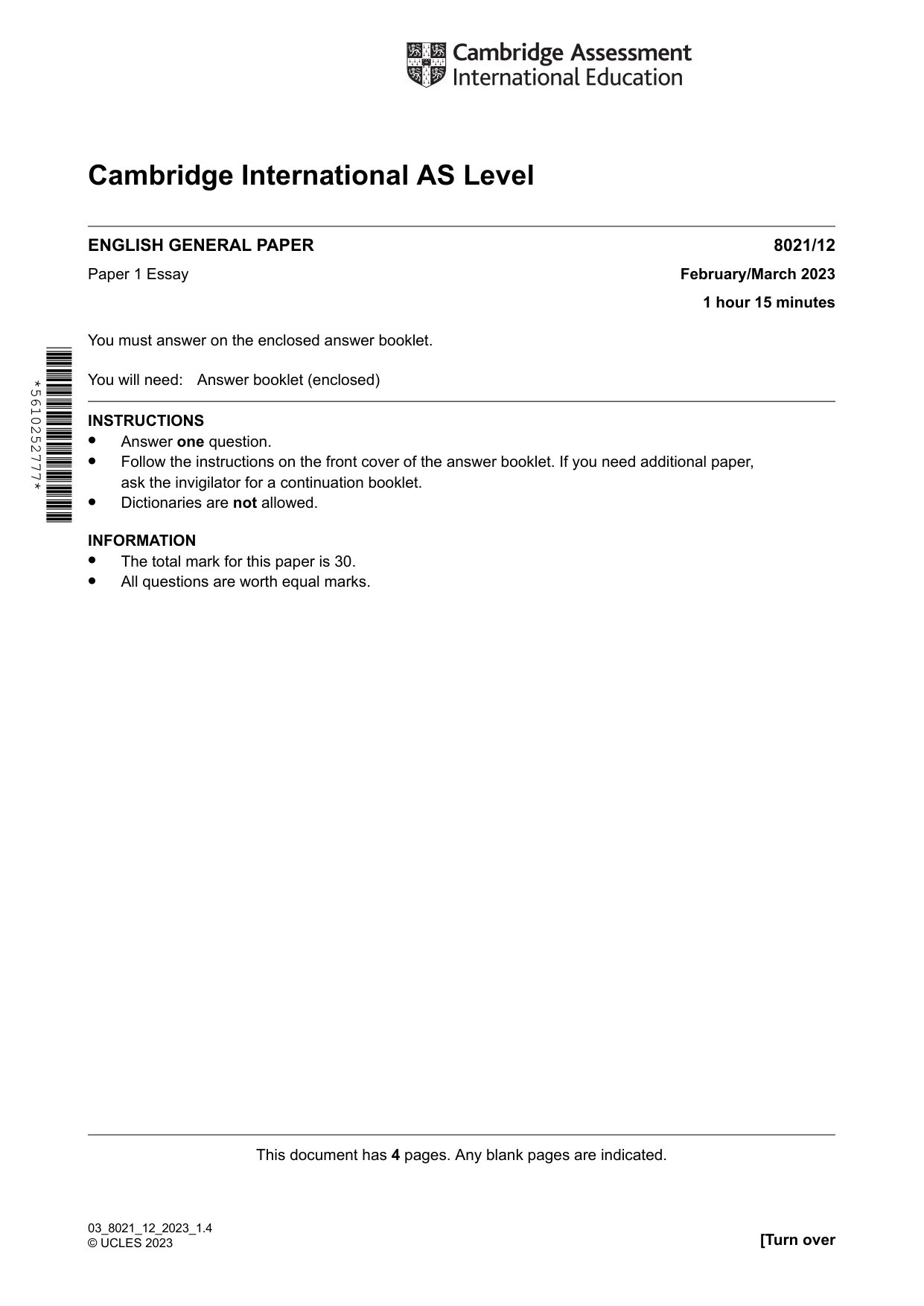
Cambridge International AS Level 8021/12 February/March 2023 1 hour 15 minutes ENGLISH GENERAL PAPER Paper 1 Essay You must answer on the enclosed answer booklet. You will need: Answer booklet (enclosed) INSTRUCTIONS • Answer one question. • Follow the instructions on the front cover of the answer booklet. If you need additional paper, ask the invigilator for a continuation booklet. • Dictionaries are not allowed. INFORMATION • The total mark for this paper is 30. • All questions are worth equal marks. This document has 4 pages. Any blank pages are indicated. [Turn over 03_8021_12_2023_1.4 © UCLES 2023 *5610252777*
Question paper, page 2
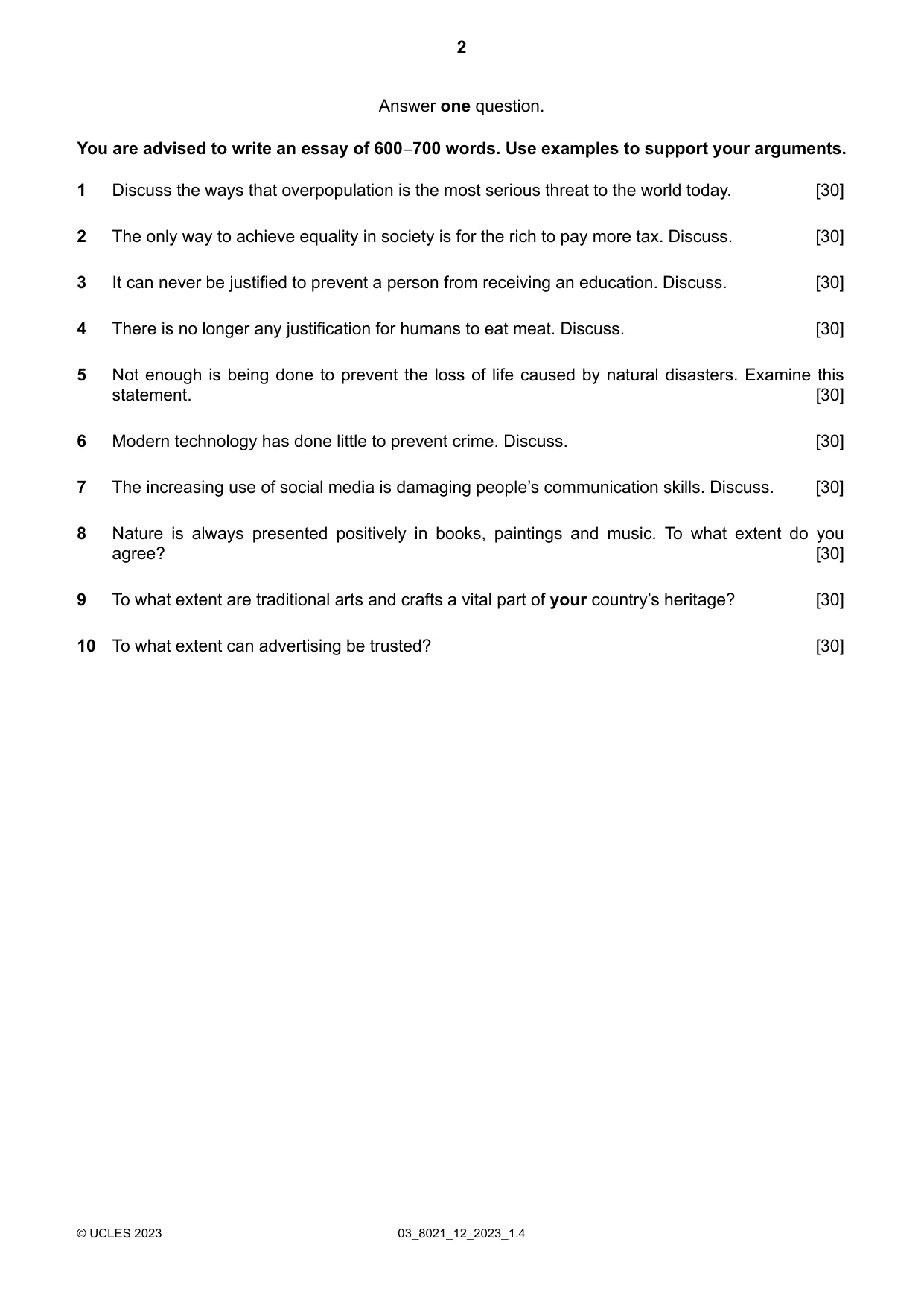
Answer one question. You are advised to write an essay of 600−700 words. Use examples to support your arguments. Discuss the ways that overpopulation is the most serious threat to the world today. [30] 1 The only way to achieve equality in society is for the rich to pay more tax. Discuss. [30] 2 It can never be justified to prevent a person from receiving an education. Discuss. [30] 3 There is no longer any justification for humans to eat meat. Discuss. [30] 4 Not enough is being done to prevent the loss of life caused by natural disasters. Examine this statement. [30] 5 Modern technology has done little to prevent crime. Discuss. [30] 6 The increasing use of social media is damaging people’s communication skills. Discuss. [30] 7 Nature is always presented positively in books, paintings and music. To what extent do you agree? [30] 8 To what extent are traditional arts and crafts a vital part of your country’s heritage? [30] 9 To what extent can advertising be trusted? [30] 10 03_8021_12_2023_1.4 © UCLES 2023 2
Question paper, page 3
BLANK PAGE 03_8021_12_2023_1.4 © UCLES 2023 3
Question paper, page 4
BLANK PAGE Permission to reproduce items where third-party owned material protected by copyright is included has been sought and cleared where possible. Every reasonable effort has been made by the publisher (UCLES) to trace copyright holders, but if any items requiring clearance have unwittingly been included, the publisher will be pleased to make amends at the earliest possible opportunity. To avoid the issue of disclosure of answer-related information to candidates, all copyright acknowledgements are reproduced online in the Cambridge Assessment International Education Copyright Acknowledgements Booklet. This is produced for each series of examinations and is freely available to download at www.cambridgeinternational.org after the live examination series. Cambridge Assessment International Education is part of Cambridge Assessment. Cambridge Assessment is the brand name of the University of Cambridge Local Examinations Syndicate (UCLES), which is a department of the University of Cambridge. 03_8021_12_2023_1.4 © UCLES 2023 4
Mark scheme, page 1
This document consists of 17 printed pages. © UCLES 2023 [Turn over Cambridge International AS Level ENGLISH GENERAL PAPER 8021/12 Paper 1 Essay February/March 2023 MARK SCHEME Maximum Mark: 30 Published This mark scheme is published as an aid to teachers and candidates, to indicate the requirements of the examination. It shows the basis on which Examiners were instructed to award marks. It does not indicate the details of the discussions that took place at an Examiners’ meeting before marking began, which would have considered the acceptability of alternative answers. Mark schemes should be read in conjunction with the question paper and the Principal Examiner Report for Teachers. Cambridge International will not enter into discussions about these mark schemes. Cambridge International is publishing the mark schemes for the February/March 2023 series for most Cambridge IGCSE™, Cambridge International A and AS Level components and some Cambridge O Level components.
Mark scheme, page 2
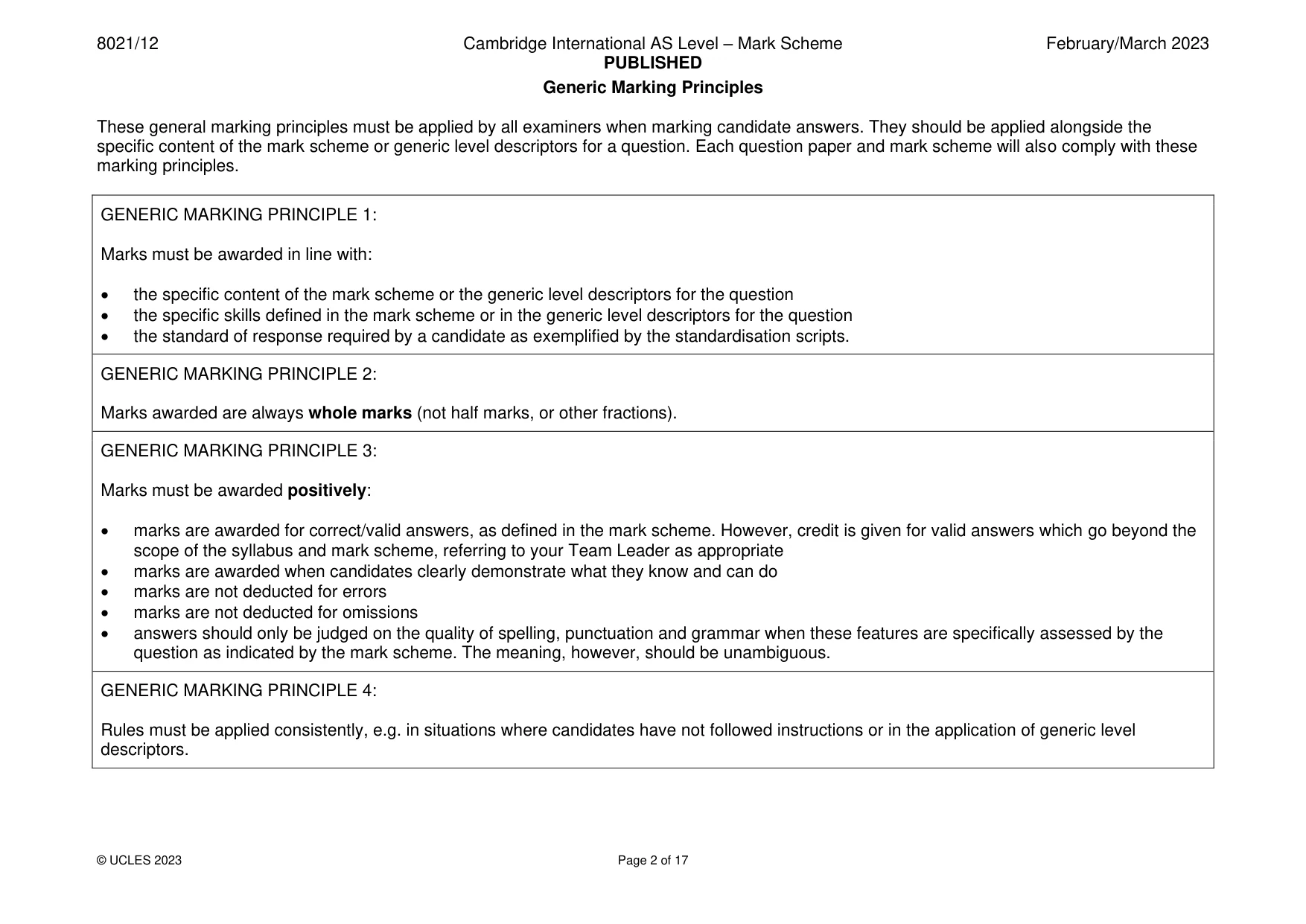
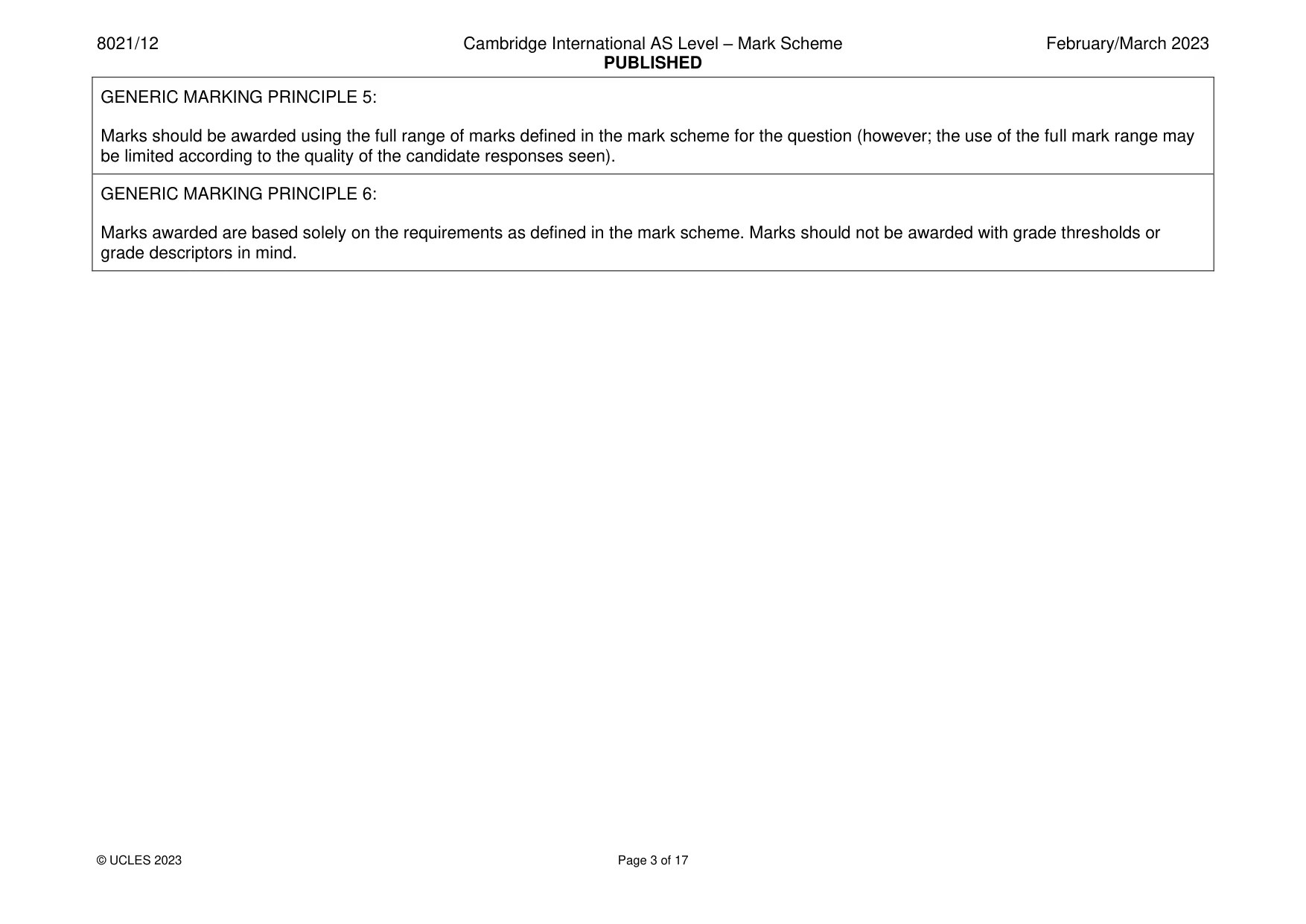
8021/12 Cambridge International AS Level – Mark Scheme PUBLISHED February/March 2023 © UCLES 2023 Page 2 of 17 Generic Marking Principles These general marking principles must be applied by all examiners when marking candidate answers. They should be applied alongside the specific content of the mark scheme or generic level descriptors for a question. Each question paper and mark scheme will also comply with these marking principles. GENERIC MARKING PRINCIPLE 1: Marks must be awarded in line with: • the specific content of the mark scheme or the generic level descriptors for the question • the specific skills defined in the mark scheme or in the generic level descriptors for the question • the standard of response required by a candidate as exemplified by the standardisation scripts. GENERIC MARKING PRINCIPLE 2: Marks awarded are always whole marks (not half marks, or other fractions). GENERIC MARKING PRINCIPLE 3: Marks must be awarded positively: • marks are awarded for correct/valid answers, as defined in the mark scheme. However, credit is given for valid answers which go beyond the scope of the syllabus and mark scheme, referring to your Team Leader as appropriate • marks are awarded when candidates clearly demonstrate what they know and can do • marks are not deducted for errors • marks are not deducted for omissions • answers should only be judged on the quality of spelling, punctuation and grammar when these features are specifically assessed by the question as indicated by the mark scheme. The meaning, however, should be unambiguous. GENERIC MARKING PRINCIPLE 4: Rules must be applied consistently, e.g. in situations where candidates have not followed instructions or in the application of generic level descriptors.
Mark scheme, page 3
8021/12 Cambridge International AS Level – Mark Scheme PUBLISHED February/March 2023 © UCLES 2023 Page 3 of 17 GENERIC MARKING PRINCIPLE 5: Marks should be awarded using the full range of marks defined in the mark scheme for the question (however; the use of the full mark range may be limited according to the quality of the candidate responses seen). GENERIC MARKING PRINCIPLE 6: Marks awarded are based solely on the requirements as defined in the mark scheme. Marks should not be awarded with grade thresholds or grade descriptors in mind.
Mark scheme, page 4
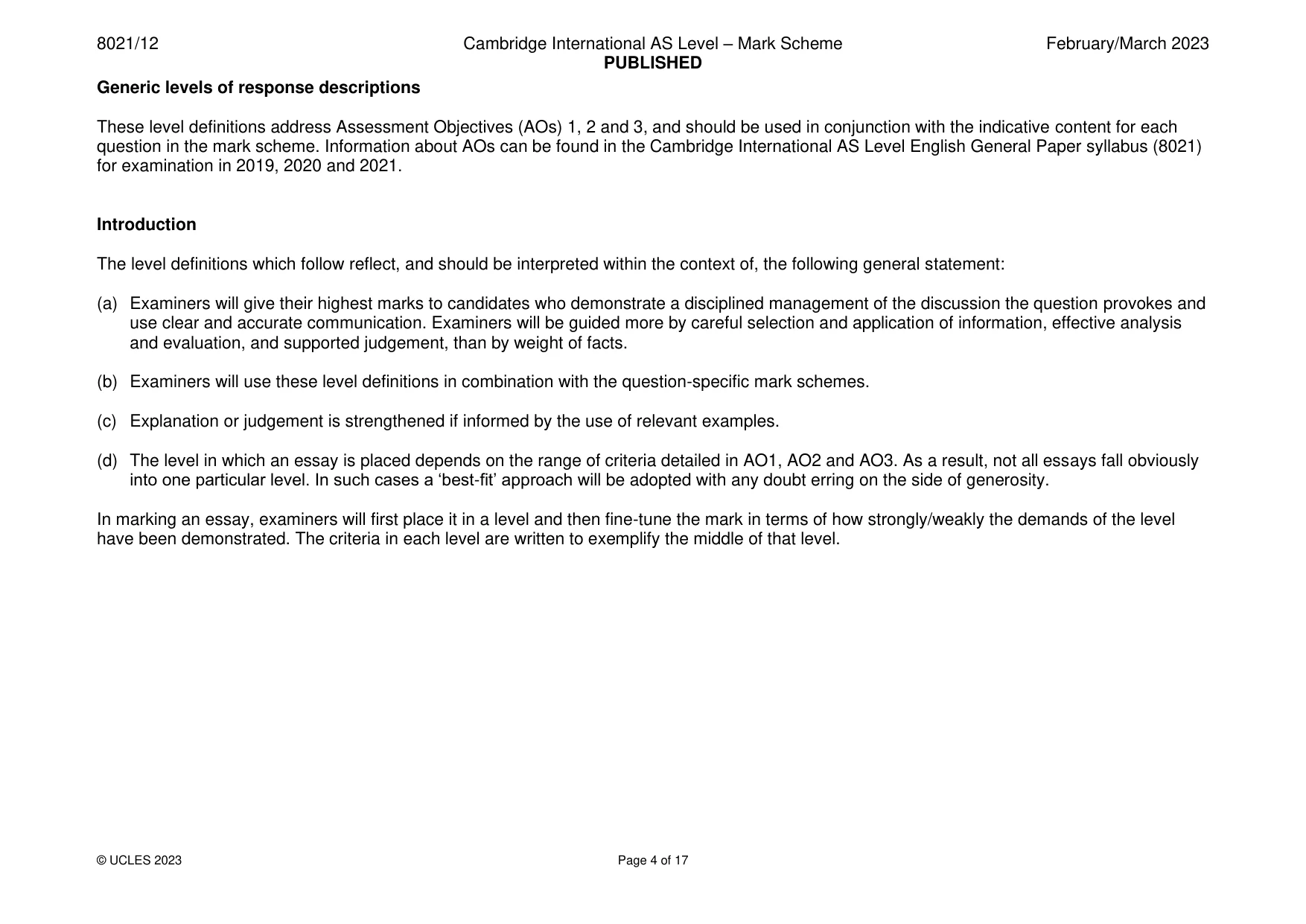
8021/12 Cambridge International AS Level – Mark Scheme PUBLISHED February/March 2023 © UCLES 2023 Page 4 of 17 Generic levels of response descriptions These level definitions address Assessment Objectives (AOs) 1, 2 and 3, and should be used in conjunction with the indicative content for each question in the mark scheme. Information about AOs can be found in the Cambridge International AS Level English General Paper syllabus (8021) for examination in 2019, 2020 and 2021. Introduction The level definitions which follow reflect, and should be interpreted within the context of, the following general statement: (a) Examiners will give their highest marks to candidates who demonstrate a disciplined management of the discussion the question provokes and use clear and accurate communication. Examiners will be guided more by careful selection and application of information, effective analysis and evaluation, and supported judgement, than by weight of facts. (b) Examiners will use these level definitions in combination with the question-specific mark schemes. (c) Explanation or judgement is strengthened if informed by the use of relevant examples. (d) The level in which an essay is placed depends on the range of criteria detailed in AO1, AO2 and AO3. As a result, not all essays fall obviously into one particular level. In such cases a ‘best-fit’ approach will be adopted with any doubt erring on the side of generosity. In marking an essay, examiners will first place it in a level and then fine-tune the mark in terms of how strongly/weakly the demands of the level have been demonstrated. The criteria in each level are written to exemplify the middle of that level.
Mark scheme, page 5
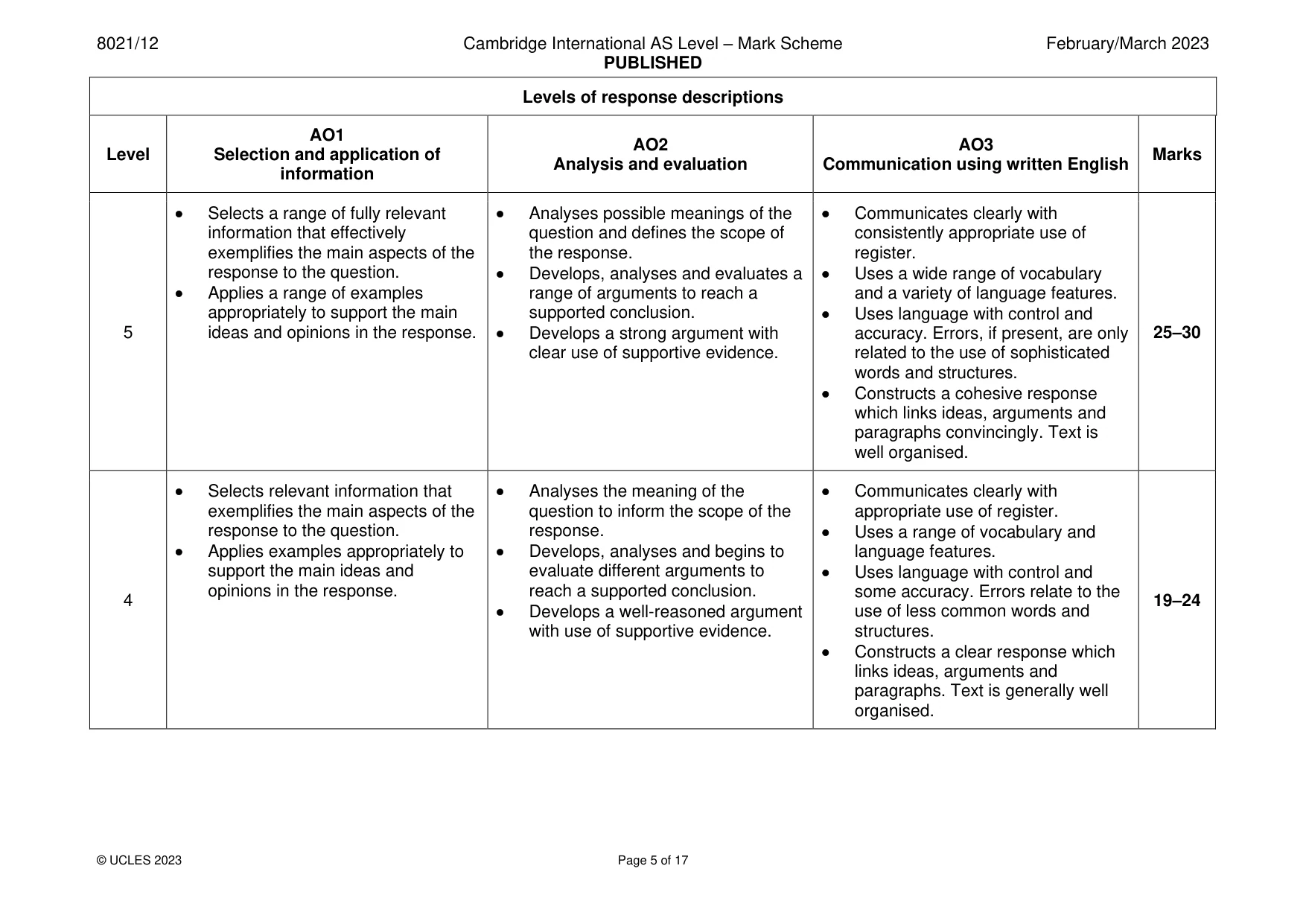
8021/12 Cambridge International AS Level – Mark Scheme PUBLISHED February/March 2023 © UCLES 2023 Page 5 of 17 Levels of response descriptions Level AO1 Selection and application of information AO2 Analysis and evaluation AO3 Communication using written English Marks 5 • Selects a range of fully relevant information that effectively exemplifies the main aspects of the response to the question. • Applies a range of examples appropriately to support the main ideas and opinions in the response. • Analyses possible meanings of the question and defines the scope of the response. • Develops, analyses and evaluates a range of arguments to reach a supported conclusion. • Develops a strong argument with clear use of supportive evidence. • Communicates clearly with consistently appropriate use of register. • Uses a wide range of vocabulary and a variety of language features. • Uses language with control and accuracy. Errors, if present, are only related to the use of sophisticated words and structures. • Constructs a cohesive response which links ideas, arguments and paragraphs convincingly. Text is well organised. 25–30 4 • Selects relevant information that exemplifies the main aspects of the response to the question. • Applies examples appropriately to support the main ideas and opinions in the response. • Analyses the meaning of the question to inform the scope of the response. • Develops, analyses and begins to evaluate different arguments to reach a supported conclusion. • Develops a well-reasoned argument with use of supportive evidence. • Communicates clearly with appropriate use of register. • Uses a range of vocabulary and language features. • Uses language with control and some accuracy. Errors relate to the use of less common words and structures. • Constructs a clear response which links ideas, arguments and paragraphs. Text is generally well organised. 19–24
Mark scheme, page 6
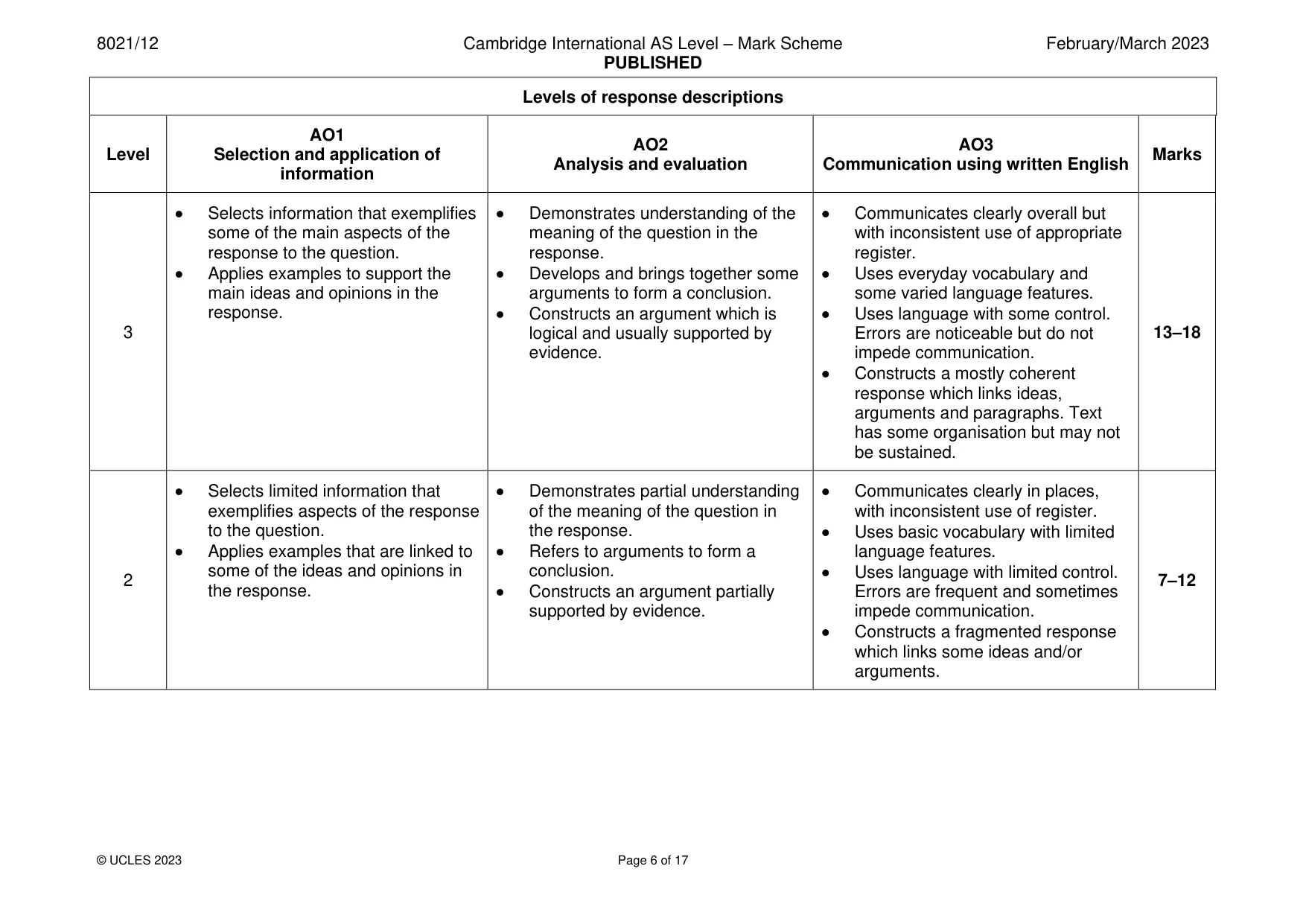
8021/12 Cambridge International AS Level – Mark Scheme PUBLISHED February/March 2023 © UCLES 2023 Page 6 of 17 Levels of response descriptions Level AO1 Selection and application of information AO2 Analysis and evaluation AO3 Communication using written English Marks 3 • Selects information that exemplifies some of the main aspects of the response to the question. • Applies examples to support the main ideas and opinions in the response. • Demonstrates understanding of the meaning of the question in the response. • Develops and brings together some arguments to form a conclusion. • Constructs an argument which is logical and usually supported by evidence. • Communicates clearly overall but with inconsistent use of appropriate register. • Uses everyday vocabulary and some varied language features. • Uses language with some control. Errors are noticeable but do not impede communication. • Constructs a mostly coherent response which links ideas, arguments and paragraphs. Text has some organisation but may not be sustained. 13–18 2 • Selects limited information that exemplifies aspects of the response to the question. • Applies examples that are linked to some of the ideas and opinions in the response. • Demonstrates partial understanding of the meaning of the question in the response. • Refers to arguments to form a conclusion. • Constructs an argument partially supported by evidence. • Communicates clearly in places, with inconsistent use of register. • Uses basic vocabulary with limited language features. • Uses language with limited control. Errors are frequent and sometimes impede communication. • Constructs a fragmented response which links some ideas and/or arguments. 7–12
Mark scheme, page 7
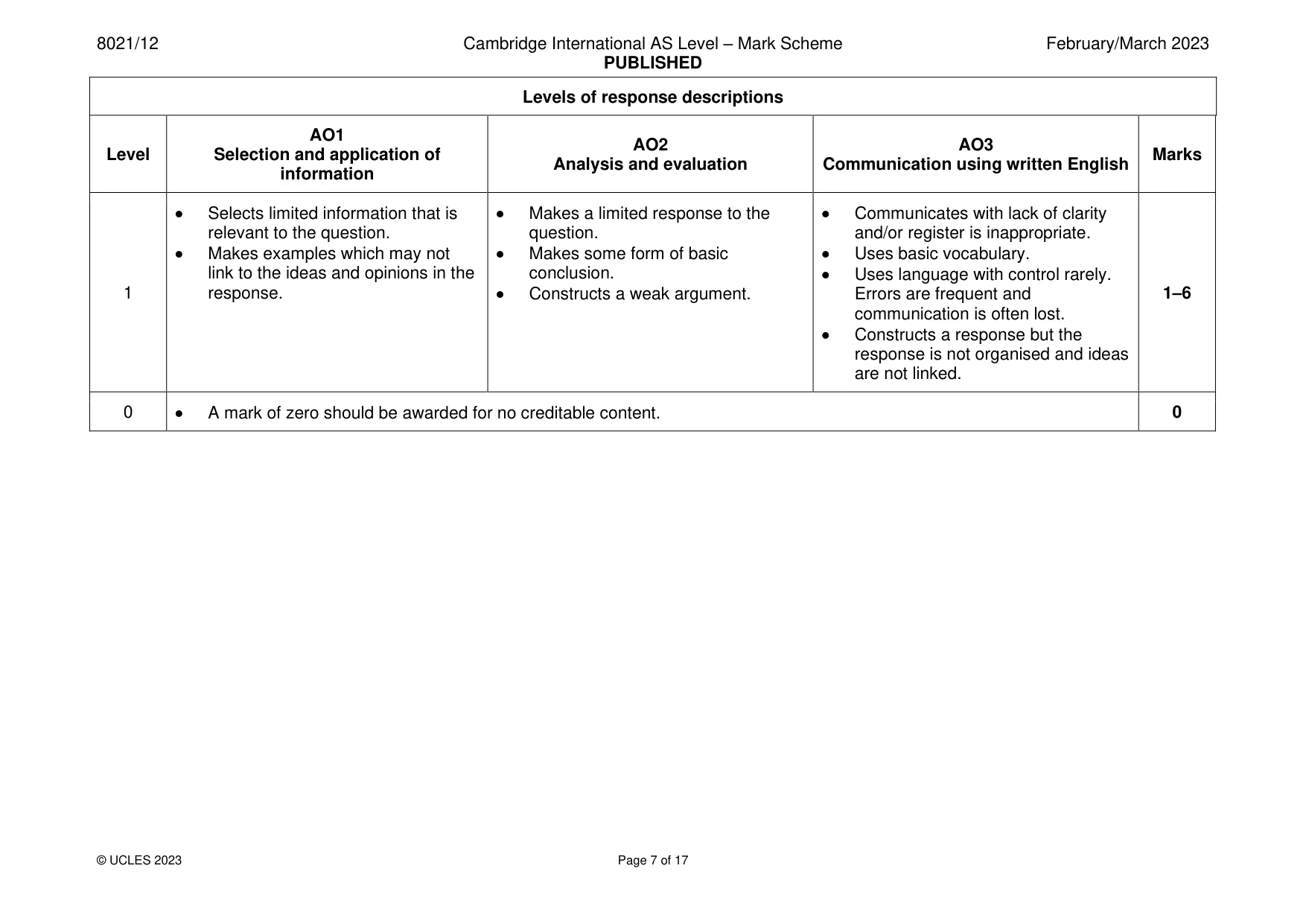
8021/12 Cambridge International AS Level – Mark Scheme PUBLISHED February/March 2023 © UCLES 2023 Page 7 of 17 Levels of response descriptions Level AO1 Selection and application of information AO2 Analysis and evaluation AO3 Communication using written English Marks 1 • Selects limited information that is relevant to the question. • Makes examples which may not link to the ideas and opinions in the response. • Makes a limited response to the question. • Makes some form of basic conclusion. • Constructs a weak argument. • Communicates with lack of clarity and/or register is inappropriate. • Uses basic vocabulary. • Uses language with control rarely. Errors are frequent and communication is often lost. • Constructs a response but the response is not organised and ideas are not linked. 1–6 0 • A mark of zero should be awarded for no creditable content. 0
Mark scheme, page 8
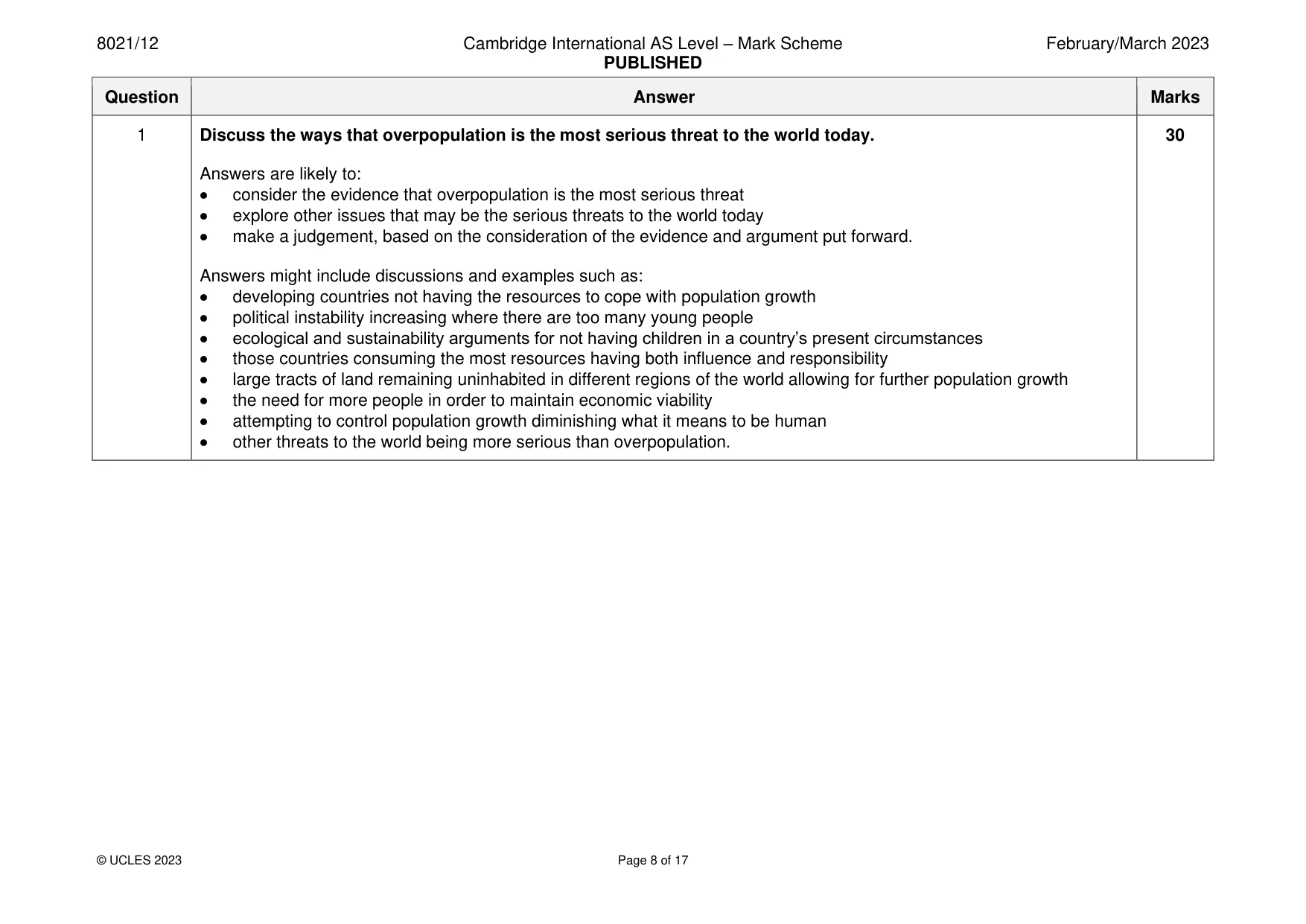
8021/12 Cambridge International AS Level – Mark Scheme PUBLISHED February/March 2023 © UCLES 2023 Page 8 of 17 Question Answer Marks 1 Discuss the ways that overpopulation is the most serious threat to the world today. Answers are likely to: • consider the evidence that overpopulation is the most serious threat • explore other issues that may be the serious threats to the world today • make a judgement, based on the consideration of the evidence and argument put forward. Answers might include discussions and examples such as: • developing countries not having the resources to cope with population growth • political instability increasing where there are too many young people • ecological and sustainability arguments for not having children in a country’s present circumstances • those countries consuming the most resources having both influence and responsibility • large tracts of land remaining uninhabited in different regions of the world allowing for further population growth • the need for more people in order to maintain economic viability • attempting to control population growth diminishing what it means to be human • other threats to the world being more serious than overpopulation. 30
Mark scheme, page 9
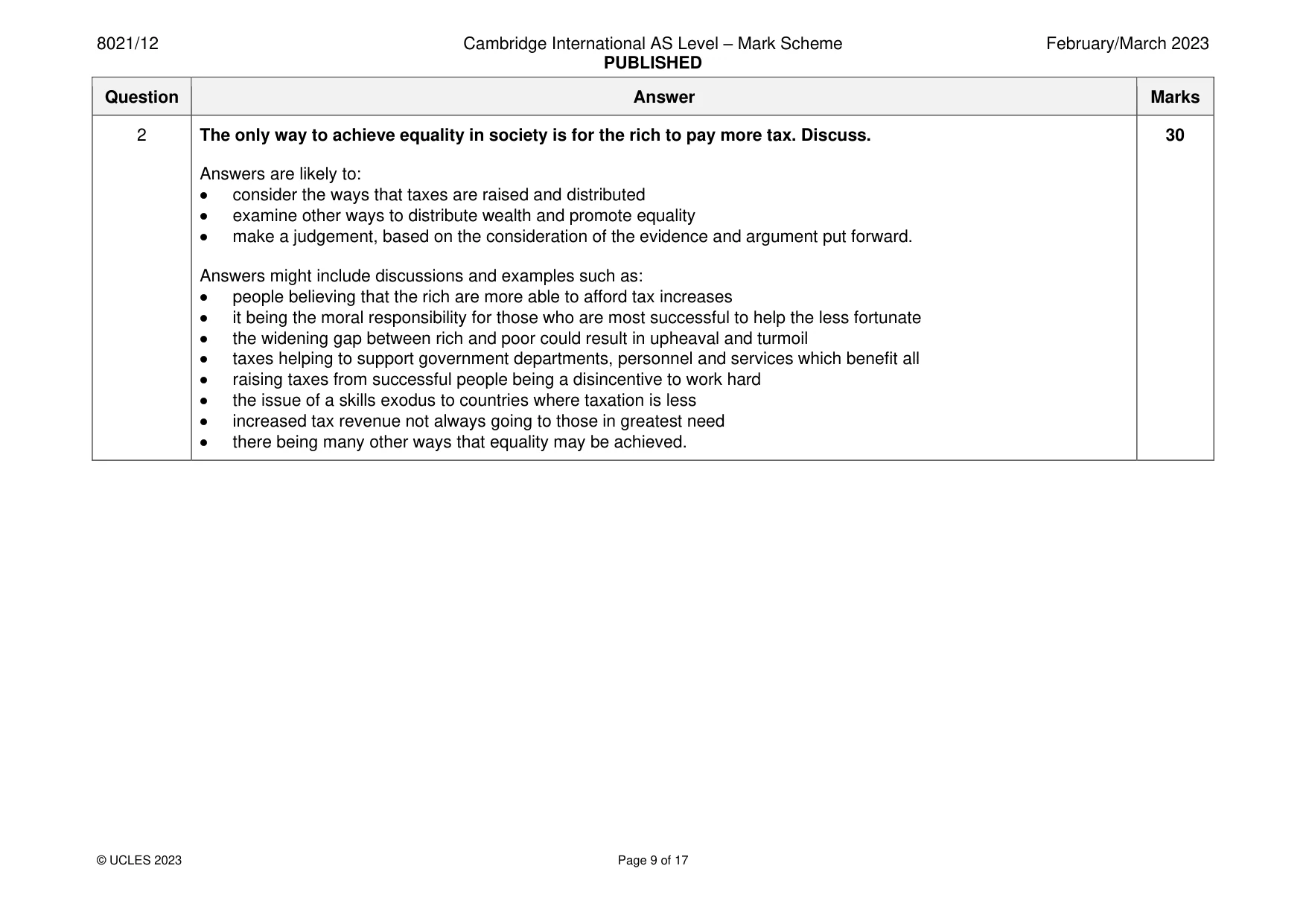
8021/12 Cambridge International AS Level – Mark Scheme PUBLISHED February/March 2023 © UCLES 2023 Page 9 of 17 Question Answer Marks 2 The only way to achieve equality in society is for the rich to pay more tax. Discuss. Answers are likely to: • consider the ways that taxes are raised and distributed • examine other ways to distribute wealth and promote equality • make a judgement, based on the consideration of the evidence and argument put forward. Answers might include discussions and examples such as: • people believing that the rich are more able to afford tax increases • it being the moral responsibility for those who are most successful to help the less fortunate • the widening gap between rich and poor could result in upheaval and turmoil • taxes helping to support government departments, personnel and services which benefit all • raising taxes from successful people being a disincentive to work hard • the issue of a skills exodus to countries where taxation is less • increased tax revenue not always going to those in greatest need • there being many other ways that equality may be achieved. 30
Mark scheme, page 10
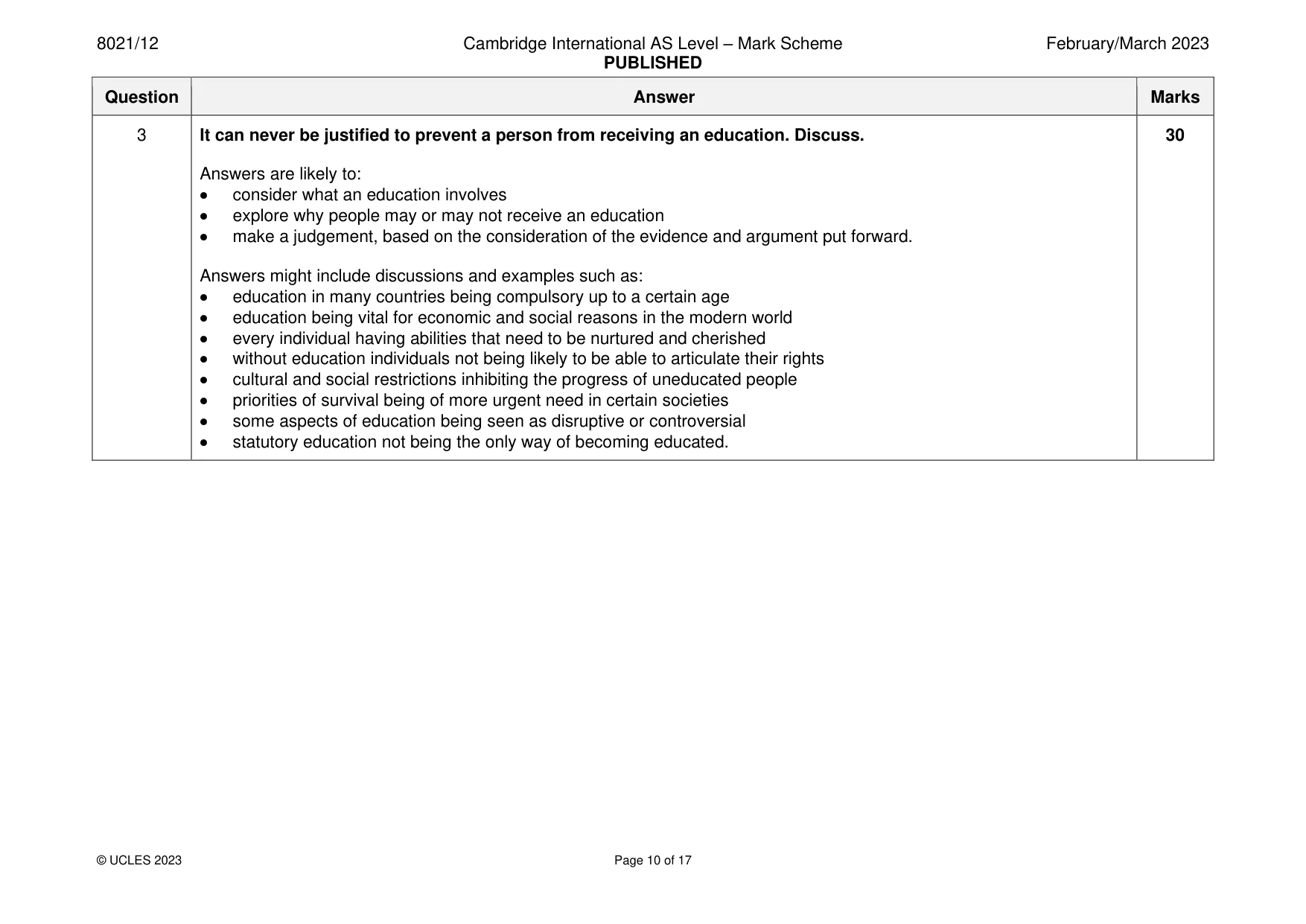
8021/12 Cambridge International AS Level – Mark Scheme PUBLISHED February/March 2023 © UCLES 2023 Page 10 of 17 Question Answer Marks 3 It can never be justified to prevent a person from receiving an education. Discuss. Answers are likely to: • consider what an education involves • explore why people may or may not receive an education • make a judgement, based on the consideration of the evidence and argument put forward. Answers might include discussions and examples such as: • education in many countries being compulsory up to a certain age • education being vital for economic and social reasons in the modern world • every individual having abilities that need to be nurtured and cherished • without education individuals not being likely to be able to articulate their rights • cultural and social restrictions inhibiting the progress of uneducated people • priorities of survival being of more urgent need in certain societies • some aspects of education being seen as disruptive or controversial • statutory education not being the only way of becoming educated. 30
Mark scheme, page 11
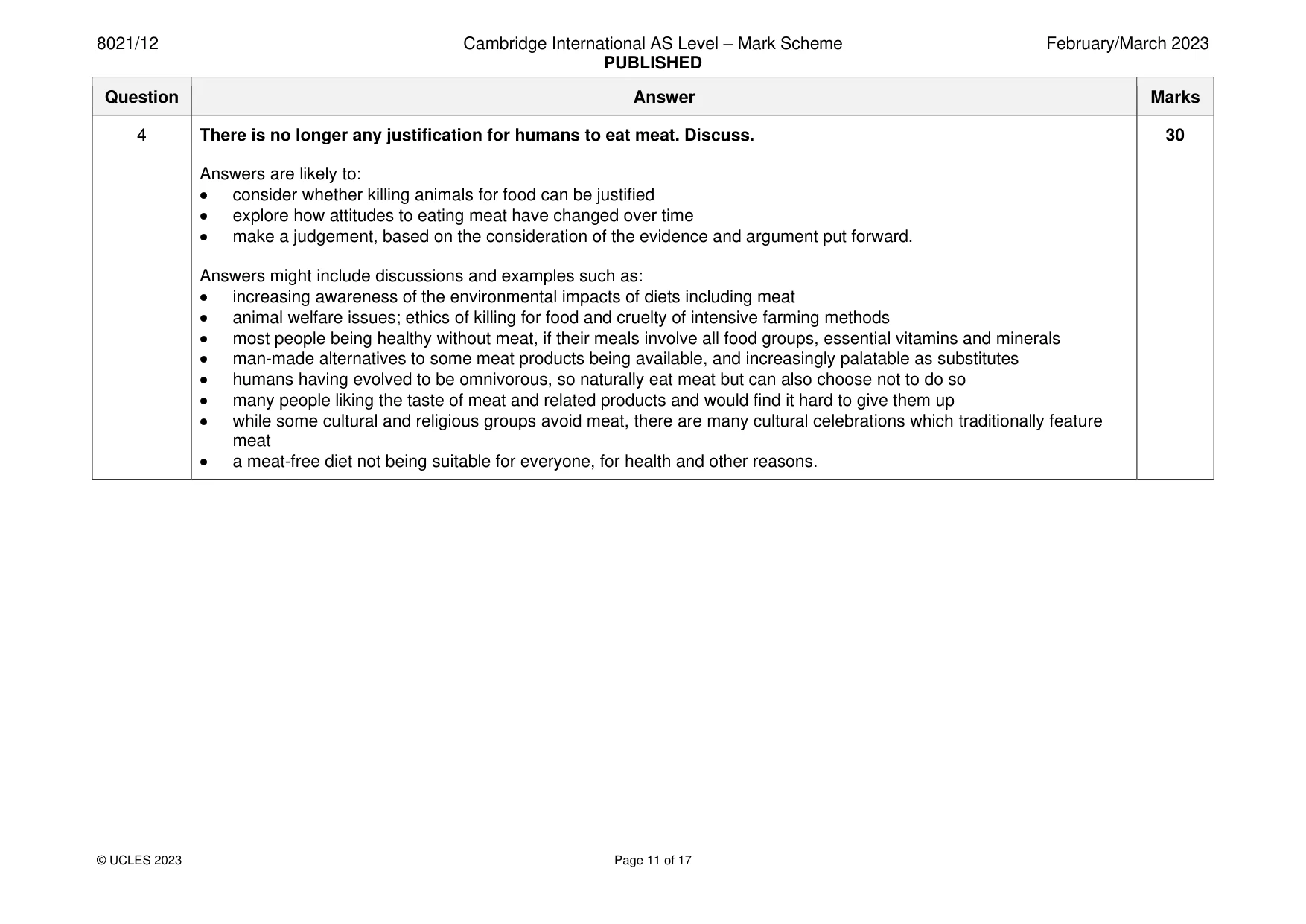
8021/12 Cambridge International AS Level – Mark Scheme PUBLISHED February/March 2023 © UCLES 2023 Page 11 of 17 Question Answer Marks 4 There is no longer any justification for humans to eat meat. Discuss. Answers are likely to: • consider whether killing animals for food can be justified • explore how attitudes to eating meat have changed over time • make a judgement, based on the consideration of the evidence and argument put forward. Answers might include discussions and examples such as: • increasing awareness of the environmental impacts of diets including meat • animal welfare issues; ethics of killing for food and cruelty of intensive farming methods • most people being healthy without meat, if their meals involve all food groups, essential vitamins and minerals • man-made alternatives to some meat products being available, and increasingly palatable as substitutes • humans having evolved to be omnivorous, so naturally eat meat but can also choose not to do so • many people liking the taste of meat and related products and would find it hard to give them up • while some cultural and religious groups avoid meat, there are many cultural celebrations which traditionally feature meat • a meat-free diet not being suitable for everyone, for health and other reasons. 30
Mark scheme, page 12
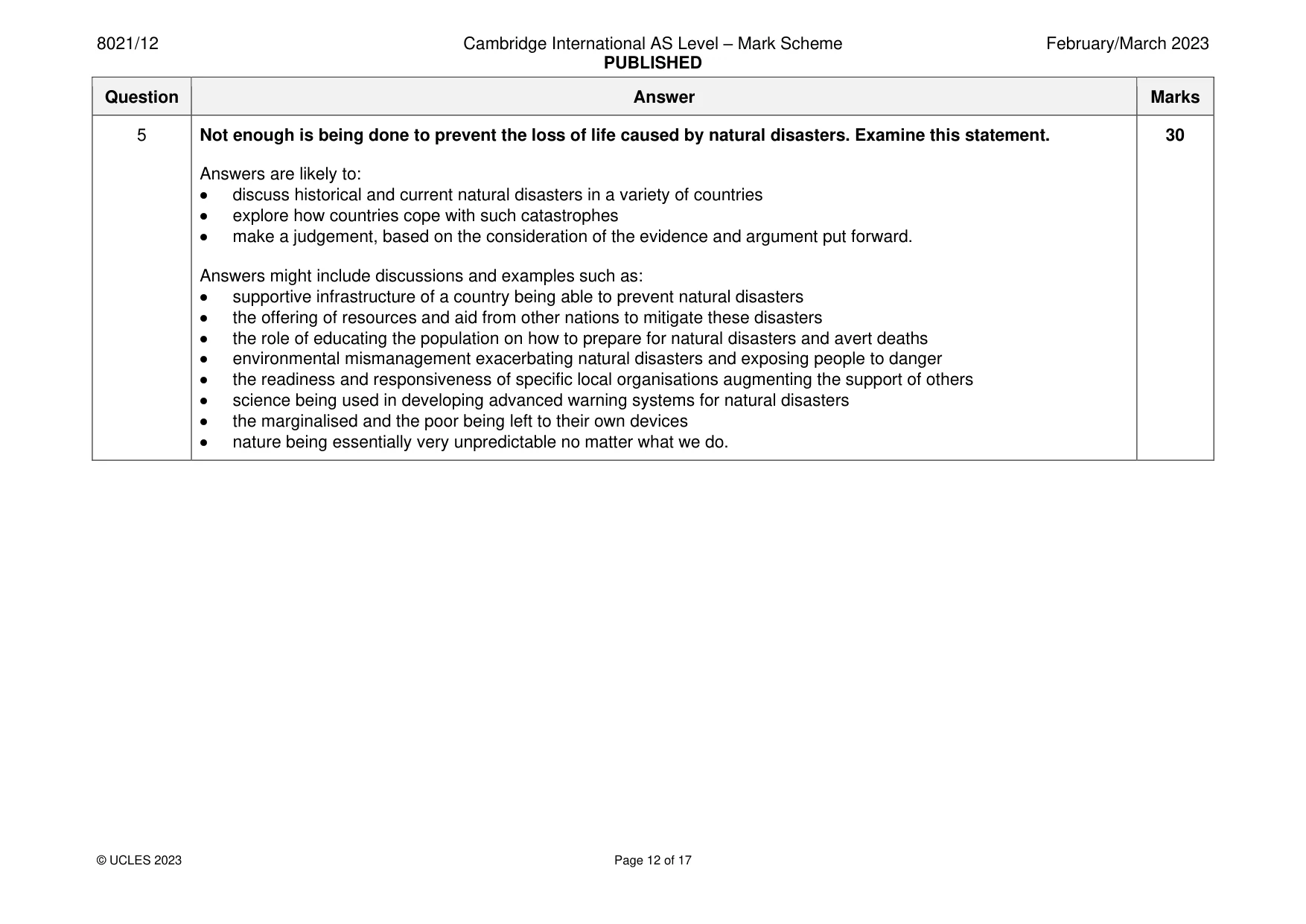
8021/12 Cambridge International AS Level – Mark Scheme PUBLISHED February/March 2023 © UCLES 2023 Page 12 of 17 Question Answer Marks 5 Not enough is being done to prevent the loss of life caused by natural disasters. Examine this statement. Answers are likely to: • discuss historical and current natural disasters in a variety of countries • explore how countries cope with such catastrophes • make a judgement, based on the consideration of the evidence and argument put forward. Answers might include discussions and examples such as: • supportive infrastructure of a country being able to prevent natural disasters • the offering of resources and aid from other nations to mitigate these disasters • the role of educating the population on how to prepare for natural disasters and avert deaths • environmental mismanagement exacerbating natural disasters and exposing people to danger • the readiness and responsiveness of specific local organisations augmenting the support of others • science being used in developing advanced warning systems for natural disasters • the marginalised and the poor being left to their own devices • nature being essentially very unpredictable no matter what we do. 30
Mark scheme, page 13
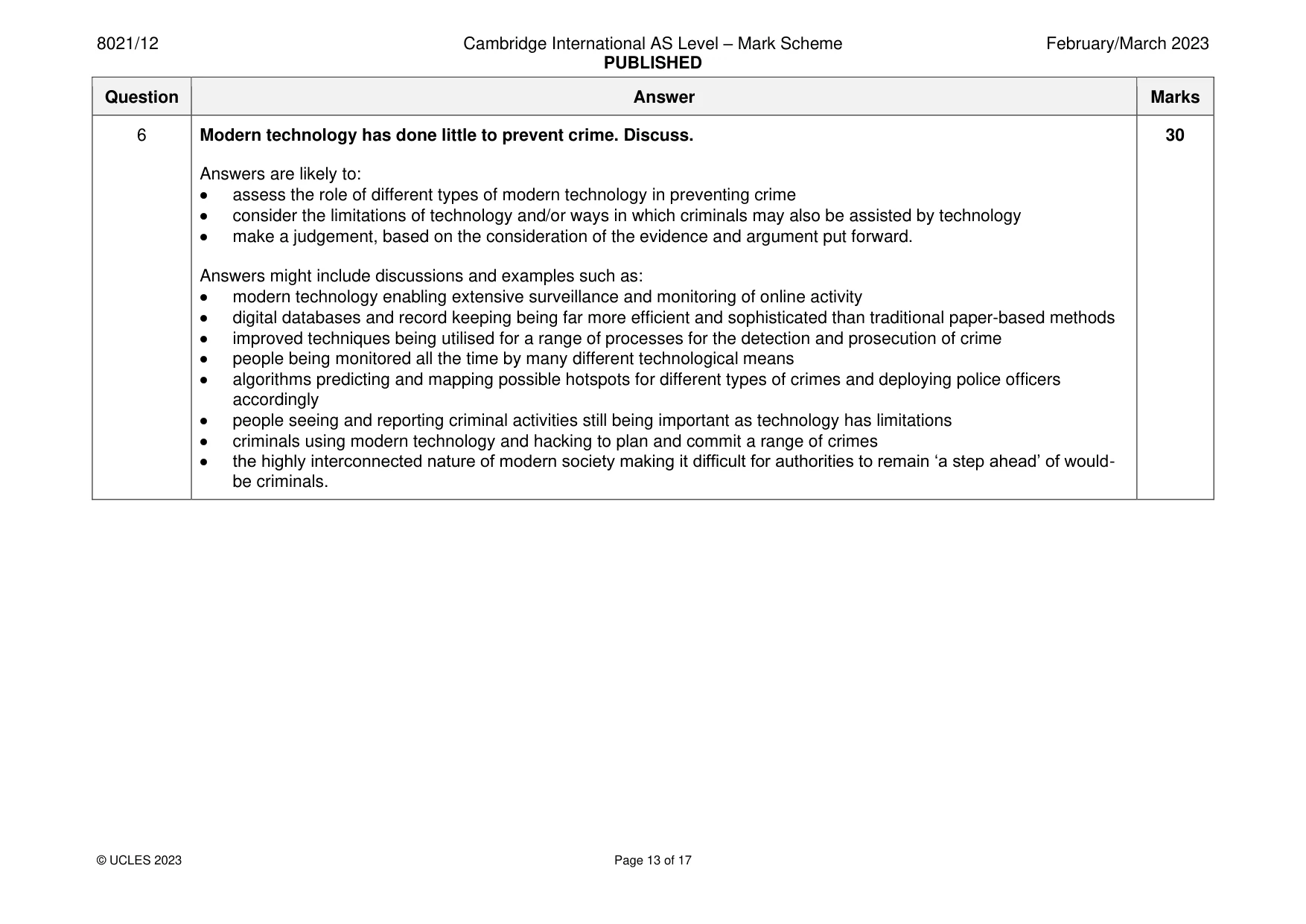
8021/12 Cambridge International AS Level – Mark Scheme PUBLISHED February/March 2023 © UCLES 2023 Page 13 of 17 Question Answer Marks 6 Modern technology has done little to prevent crime. Discuss. Answers are likely to: • assess the role of different types of modern technology in preventing crime • consider the limitations of technology and/or ways in which criminals may also be assisted by technology • make a judgement, based on the consideration of the evidence and argument put forward. Answers might include discussions and examples such as: • modern technology enabling extensive surveillance and monitoring of online activity • digital databases and record keeping being far more efficient and sophisticated than traditional paper-based methods • improved techniques being utilised for a range of processes for the detection and prosecution of crime • people being monitored all the time by many different technological means • algorithms predicting and mapping possible hotspots for different types of crimes and deploying police officers accordingly • people seeing and reporting criminal activities still being important as technology has limitations • criminals using modern technology and hacking to plan and commit a range of crimes • the highly interconnected nature of modern society making it difficult for authorities to remain ‘a step ahead’ of would- be criminals. 30
Mark scheme, page 14
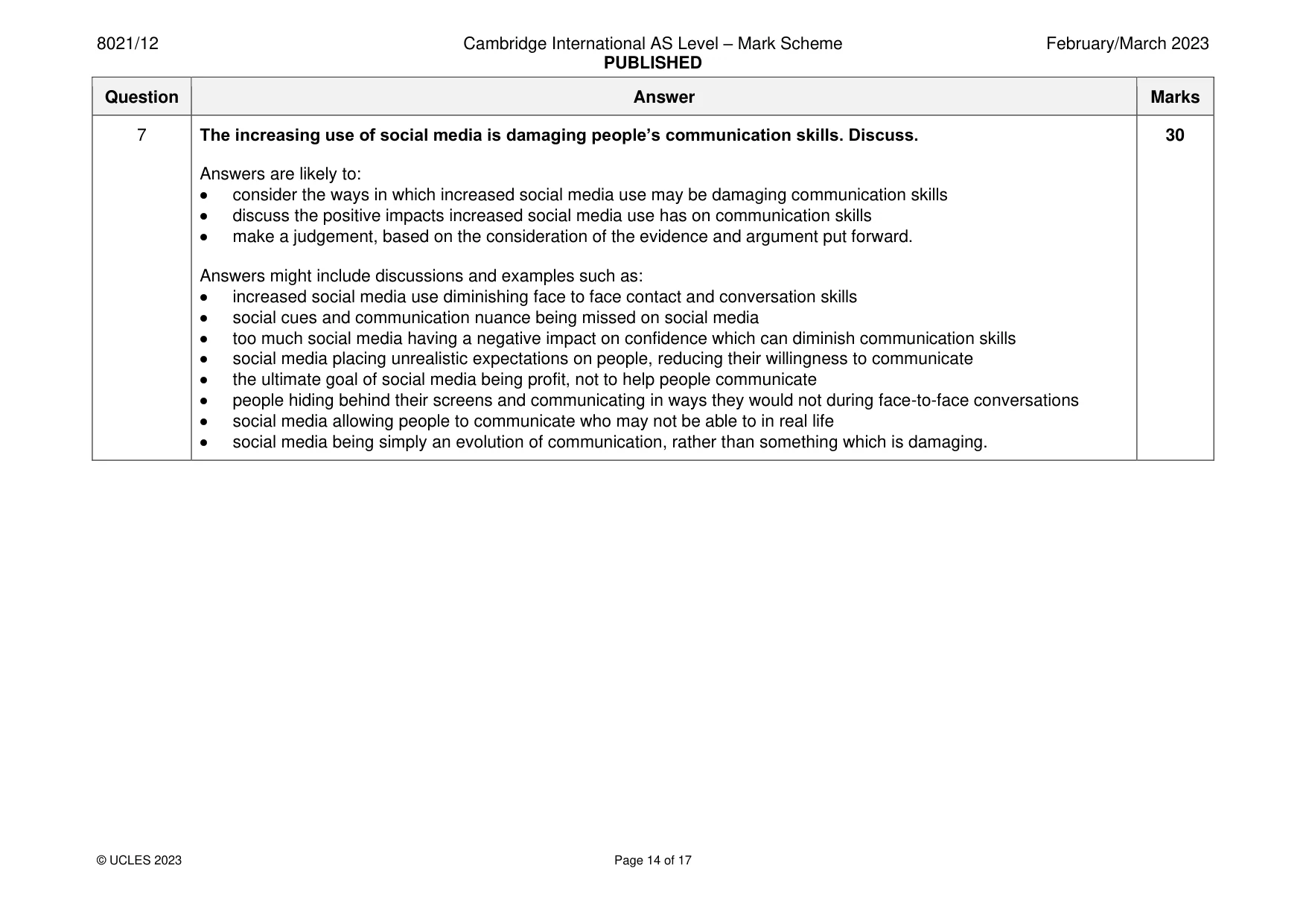
8021/12 Cambridge International AS Level – Mark Scheme PUBLISHED February/March 2023 © UCLES 2023 Page 14 of 17 Question Answer Marks 7 The increasing use of social media is damaging people’s communication skills. Discuss. Answers are likely to: • consider the ways in which increased social media use may be damaging communication skills • discuss the positive impacts increased social media use has on communication skills • make a judgement, based on the consideration of the evidence and argument put forward. Answers might include discussions and examples such as: • increased social media use diminishing face to face contact and conversation skills • social cues and communication nuance being missed on social media • too much social media having a negative impact on confidence which can diminish communication skills • social media placing unrealistic expectations on people, reducing their willingness to communicate • the ultimate goal of social media being profit, not to help people communicate • people hiding behind their screens and communicating in ways they would not during face-to-face conversations • social media allowing people to communicate who may not be able to in real life • social media being simply an evolution of communication, rather than something which is damaging. 30
Mark scheme, page 15
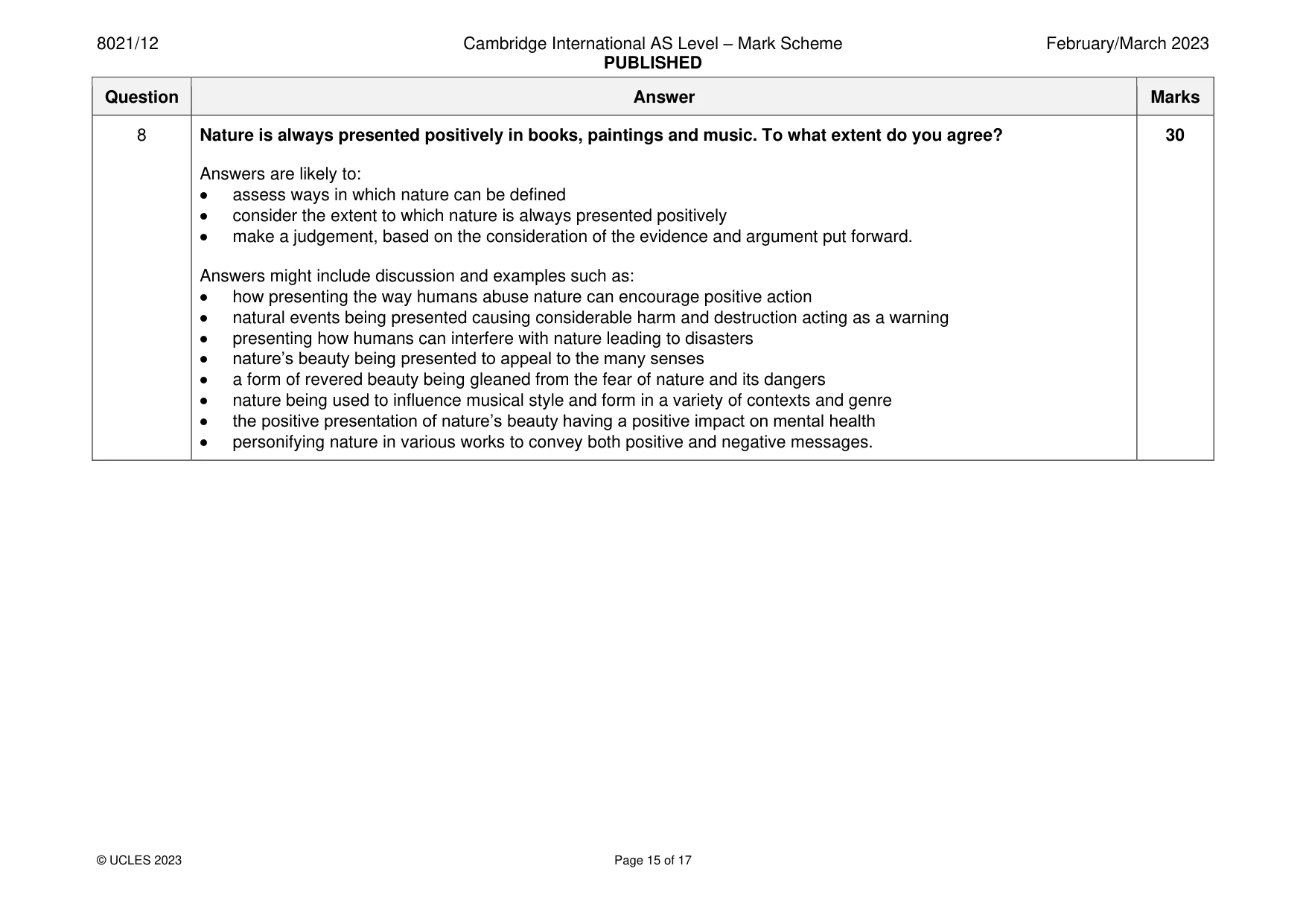
8021/12 Cambridge International AS Level – Mark Scheme PUBLISHED February/March 2023 © UCLES 2023 Page 15 of 17 Question Answer Marks 8 Nature is always presented positively in books, paintings and music. To what extent do you agree? Answers are likely to: • assess ways in which nature can be defined • consider the extent to which nature is always presented positively • make a judgement, based on the consideration of the evidence and argument put forward. Answers might include discussion and examples such as: • how presenting the way humans abuse nature can encourage positive action • natural events being presented causing considerable harm and destruction acting as a warning • presenting how humans can interfere with nature leading to disasters • nature’s beauty being presented to appeal to the many senses • a form of revered beauty being gleaned from the fear of nature and its dangers • nature being used to influence musical style and form in a variety of contexts and genre • the positive presentation of nature’s beauty having a positive impact on mental health • personifying nature in various works to convey both positive and negative messages. 30
Mark scheme, page 16
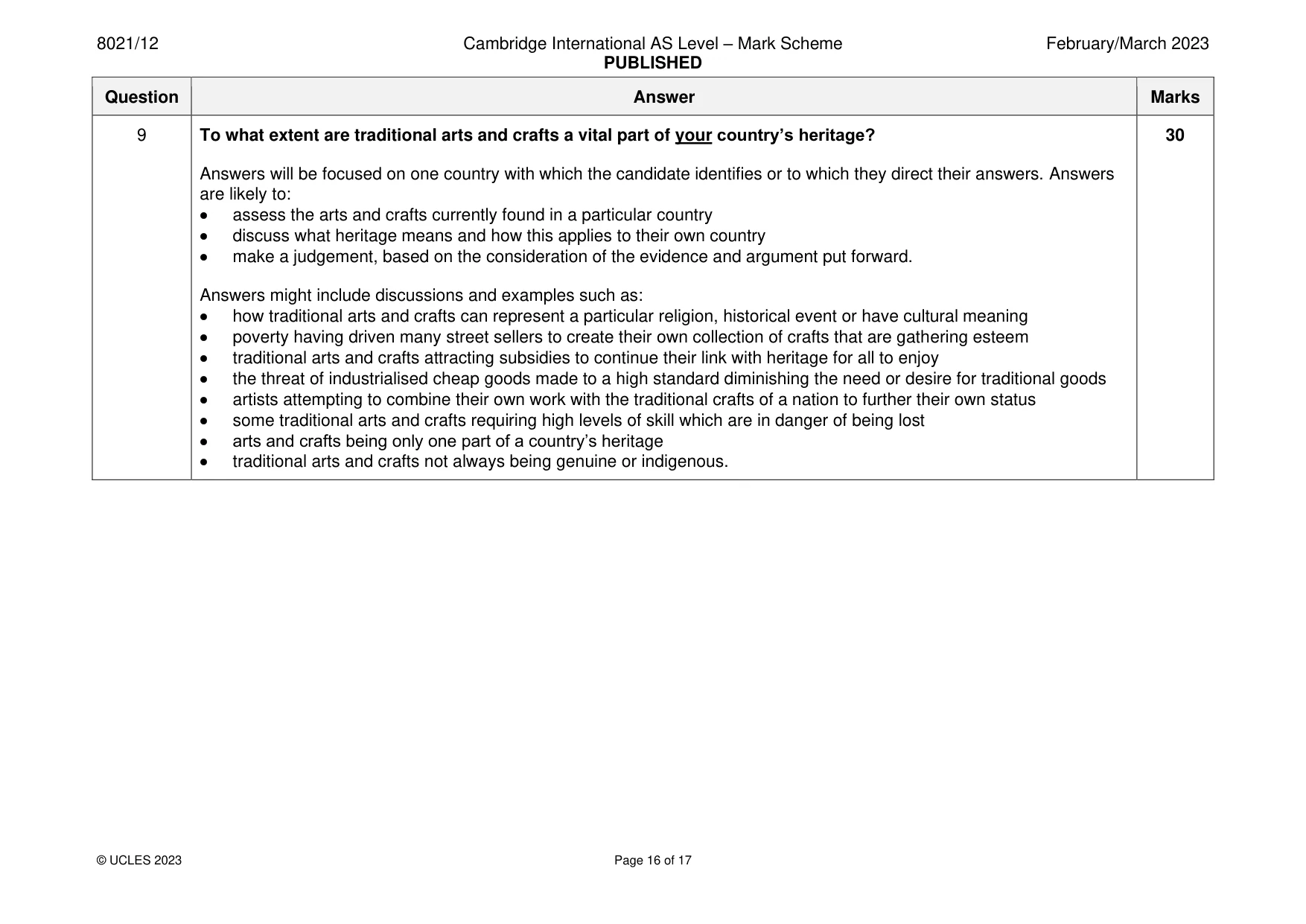
8021/12 Cambridge International AS Level – Mark Scheme PUBLISHED February/March 2023 © UCLES 2023 Page 16 of 17 Question Answer Marks 9 To what extent are traditional arts and crafts a vital part of your country’s heritage? Answers will be focused on one country with which the candidate identifies or to which they direct their answers. Answers are likely to: • assess the arts and crafts currently found in a particular country • discuss what heritage means and how this applies to their own country • make a judgement, based on the consideration of the evidence and argument put forward. Answers might include discussions and examples such as: • how traditional arts and crafts can represent a particular religion, historical event or have cultural meaning • poverty having driven many street sellers to create their own collection of crafts that are gathering esteem • traditional arts and crafts attracting subsidies to continue their link with heritage for all to enjoy • the threat of industrialised cheap goods made to a high standard diminishing the need or desire for traditional goods • artists attempting to combine their own work with the traditional crafts of a nation to further their own status • some traditional arts and crafts requiring high levels of skill which are in danger of being lost • arts and crafts being only one part of a country’s heritage • traditional arts and crafts not always being genuine or indigenous. 30
Mark scheme, page 17
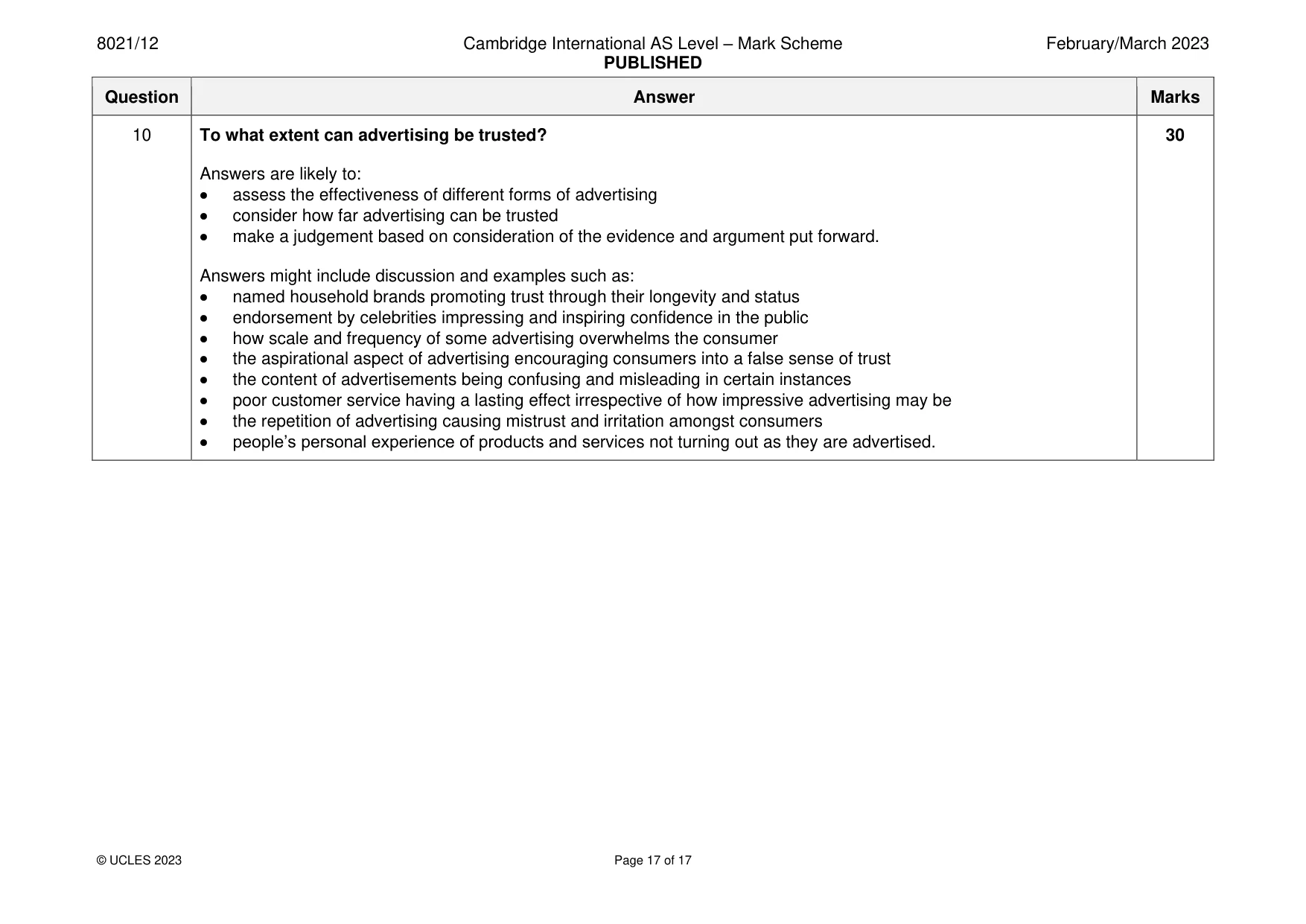
8021/12 Cambridge International AS Level – Mark Scheme PUBLISHED February/March 2023 © UCLES 2023 Page 17 of 17 Question Answer Marks 10 To what extent can advertising be trusted? Answers are likely to: • assess the effectiveness of different forms of advertising • consider how far advertising can be trusted • make a judgement based on consideration of the evidence and argument put forward. Answers might include discussion and examples such as: • named household brands promoting trust through their longevity and status • endorsement by celebrities impressing and inspiring confidence in the public • how scale and frequency of some advertising overwhelms the consumer • the aspirational aspect of advertising encouraging consumers into a false sense of trust • the content of advertisements being confusing and misleading in certain instances • poor customer service having a lasting effect irrespective of how impressive advertising may be • the repetition of advertising causing mistrust and irritation amongst consumers • people’s personal experience of products and services not turning out as they are advertised. 30
What you needed in this session
Cambridge’s own grade thresholds for 2023 Feb/March, Paper 1 · Variant 2. A higher threshold means an easier paper — the bar moves with how the cohort did.