Cambridge A Level English General Paper 8021 — 2025 May/June Paper 1 · Variant 1
8021/11/M/J/25 · 30 marks · 75 min
The question paper and its mark scheme, free to read here and free to download. This is Cambridge’s own paper, exactly as it was sat.
Question paper4 pages


Mark scheme15 pages
Answers below. Sit the paper first if you are practising.
Paper as text
Question paper, page 1
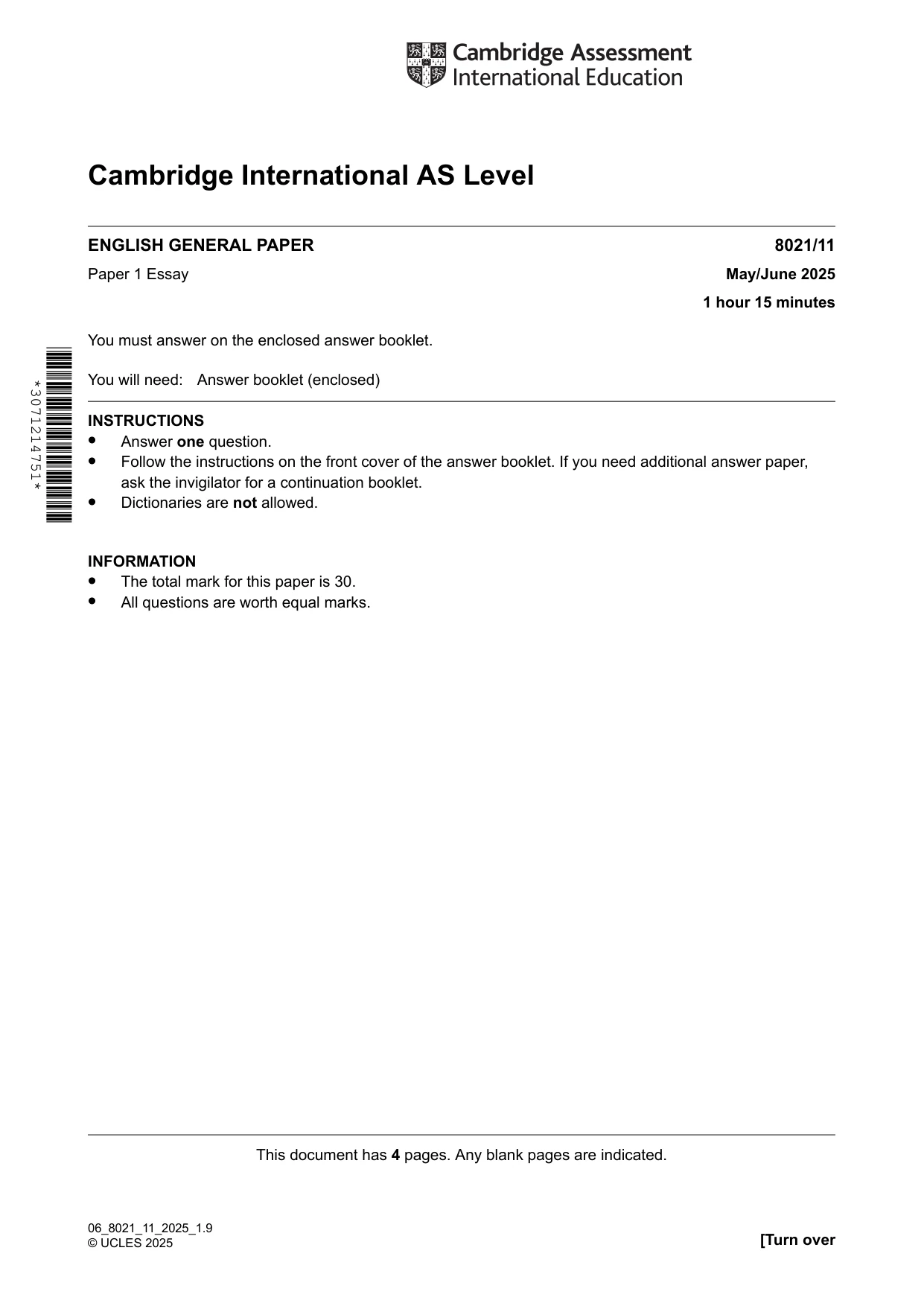
Cambridge International AS Level 8021/11 May/June 2025 1 hour 15 minutes ENGLISH GENERAL PAPER Paper 1 Essay You must answer on the enclosed answer booklet. You will need: Answer booklet (enclosed) INSTRUCTIONS • Answer one question. • Follow the instructions on the front cover of the answer booklet. If you need additional answer paper, ask the invigilator for a continuation booklet. • Dictionaries are not allowed. INFORMATION • The total mark for this paper is 30. • All questions are worth equal marks. This document has 4 pages. Any blank pages are indicated. [Turn over 06_8021_11_2025_1.9 © UCLES 2025 *3071214751*
Question paper, page 2
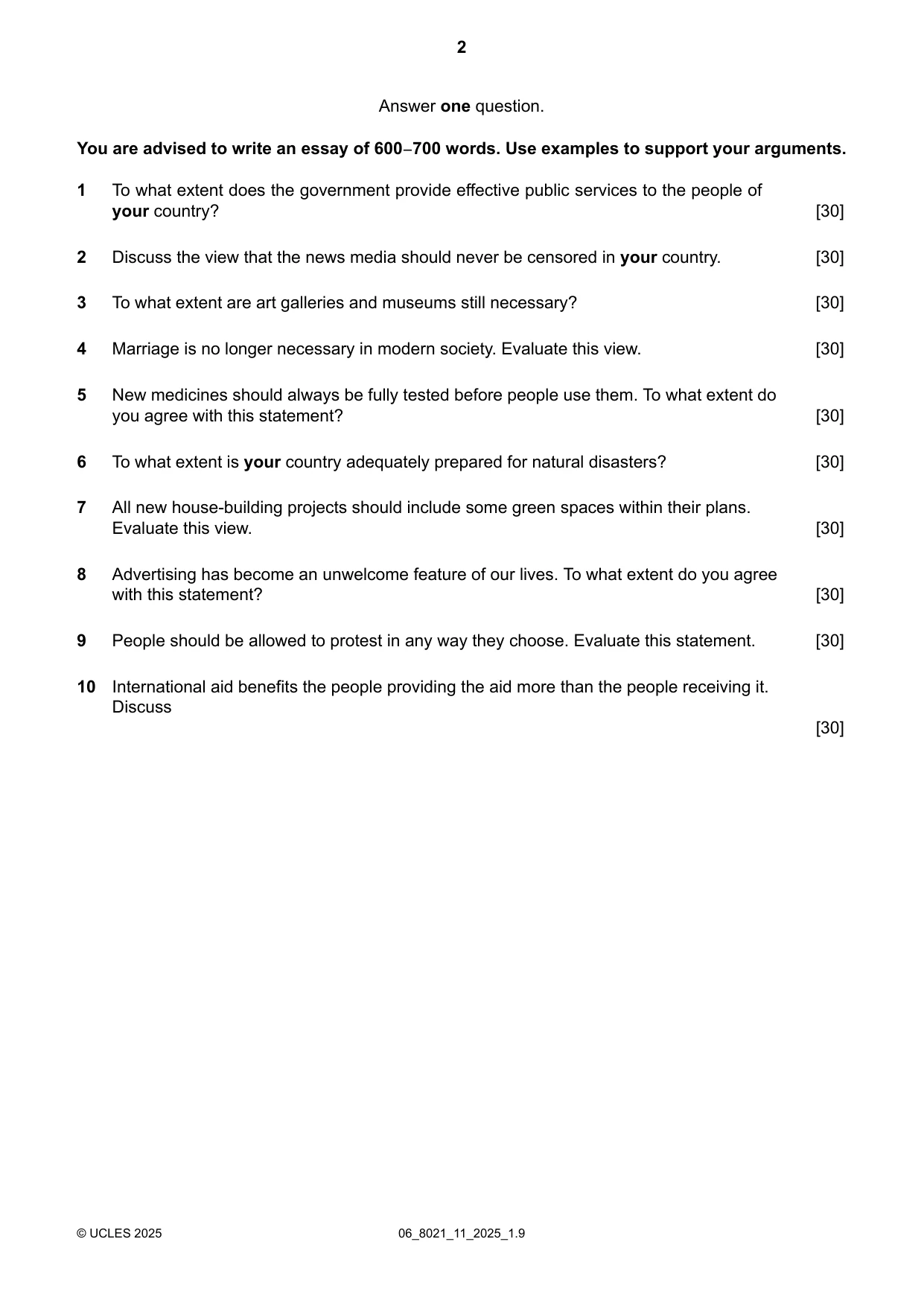
Answer one question. You are advised to write an essay of 600−700 words. Use examples to support your arguments. To what extent does the government provide effective public services to the people of your country? [30] 1 Discuss the view that the news media should never be censored in your country. [30] 2 To what extent are art galleries and museums still necessary? [30] 3 Marriage is no longer necessary in modern society. Evaluate this view. [30] 4 New medicines should always be fully tested before people use them. To what extent do you agree with this statement? [30] 5 To what extent is your country adequately prepared for natural disasters? [30] 6 All new house-building projects should include some green spaces within their plans. Evaluate this view. [30] 7 Advertising has become an unwelcome feature of our lives. To what extent do you agree with this statement? [30] 8 People should be allowed to protest in any way they choose. Evaluate this statement. [30] 9 International aid benefits the people providing the aid more than the people receiving it. Discuss [30] 10 06_8021_11_2025_1.9 © UCLES 2025 2
Question paper, page 3
BLANK PAGE 06_8021_11_2025_1.9 © UCLES 2025 3
Question paper, page 4
BLANK PAGE Permission to reproduce items where third-party owned material protected by copyright is included has been sought and cleared where possible. Every reasonable effort has been made by the publisher (UCLES) to trace copyright holders, but if any items requiring clearance have unwittingly been included, the publisher will be pleased to make amends at the earliest possible opportunity. To avoid the issue of disclosure of answer-related information to candidates, all copyright acknowledgements are reproduced online in the Cambridge Assessment International Education Copyright Acknowledgements Booklet. This is produced for each series of examinations and is freely available to download at www.cambridgeinternational.org after the live examination series. Cambridge Assessment International Education is part of Cambridge Assessment. Cambridge Assessment is the brand name of the University of Cambridge Local Examinations Syndicate (UCLES), which is a department of the University of Cambridge. 06_8021_11_2025_1.9 © UCLES 2025 4
Mark scheme, page 1
This document consists of 15 printed pages. © Cambridge University Press & Assessment 2025 [Turn over Cambridge International AS Level ENGLISH GENERAL PAPER 8021/11 Paper 1 Essay May/June 2025 MARK SCHEME Maximum Mark: 30 Published This mark scheme is published as an aid to teachers and candidates, to indicate the requirements of the examination. It shows the basis on which Examiners were instructed to award marks. It does not indicate the details of the discussions that took place at an Examiners’ meeting before marking began, which would have considered the acceptability of alternative answers. Mark schemes should be read in conjunction with the question paper and the Principal Examiner Report for Teachers. Cambridge International will not enter into discussions about these mark schemes. Cambridge International is publishing the mark schemes for the May/June 2025 series for most Cambridge IGCSE, Cambridge International A and AS Level components, and some Cambridge O Level components.
Mark scheme, page 2
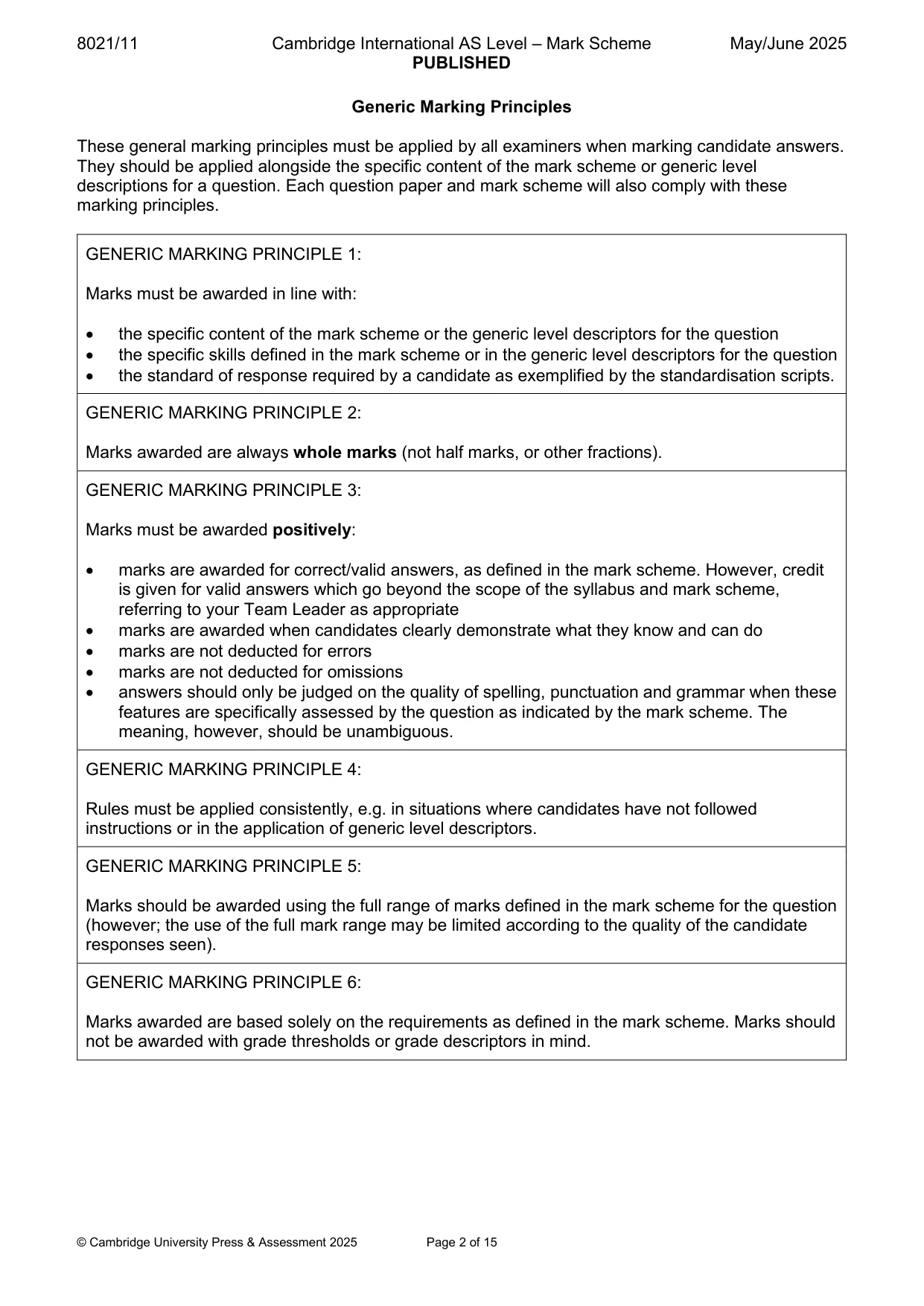
8021/11 Cambridge International AS Level – Mark Scheme PUBLISHED May/June 2025 © Cambridge University Press & Assessment 2025 Page 2 of 15 Generic Marking Principles These general marking principles must be applied by all examiners when marking candidate answers. They should be applied alongside the specific content of the mark scheme or generic level descriptions for a question. Each question paper and mark scheme will also comply with these marking principles. GENERIC MARKING PRINCIPLE 1: Marks must be awarded in line with: • the specific content of the mark scheme or the generic level descriptors for the question • the specific skills defined in the mark scheme or in the generic level descriptors for the question • the standard of response required by a candidate as exemplified by the standardisation scripts. GENERIC MARKING PRINCIPLE 2: Marks awarded are always whole marks (not half marks, or other fractions). GENERIC MARKING PRINCIPLE 3: Marks must be awarded positively: • marks are awarded for correct/valid answers, as defined in the mark scheme. However, credit is given for valid answers which go beyond the scope of the syllabus and mark scheme, referring to your Team Leader as appropriate • marks are awarded when candidates clearly demonstrate what they know and can do • marks are not deducted for errors • marks are not deducted for omissions • answers should only be judged on the quality of spelling, punctuation and grammar when these features are specifically assessed by the question as indicated by the mark scheme. The meaning, however, should be unambiguous. GENERIC MARKING PRINCIPLE 4: Rules must be applied consistently, e.g. in situations where candidates have not followed instructions or in the application of generic level descriptors. GENERIC MARKING PRINCIPLE 5: Marks should be awarded using the full range of marks defined in the mark scheme for the question (however; the use of the full mark range may be limited according to the quality of the candidate responses seen). GENERIC MARKING PRINCIPLE 6: Marks awarded are based solely on the requirements as defined in the mark scheme. Marks should not be awarded with grade thresholds or grade descriptors in mind.
Mark scheme, page 3
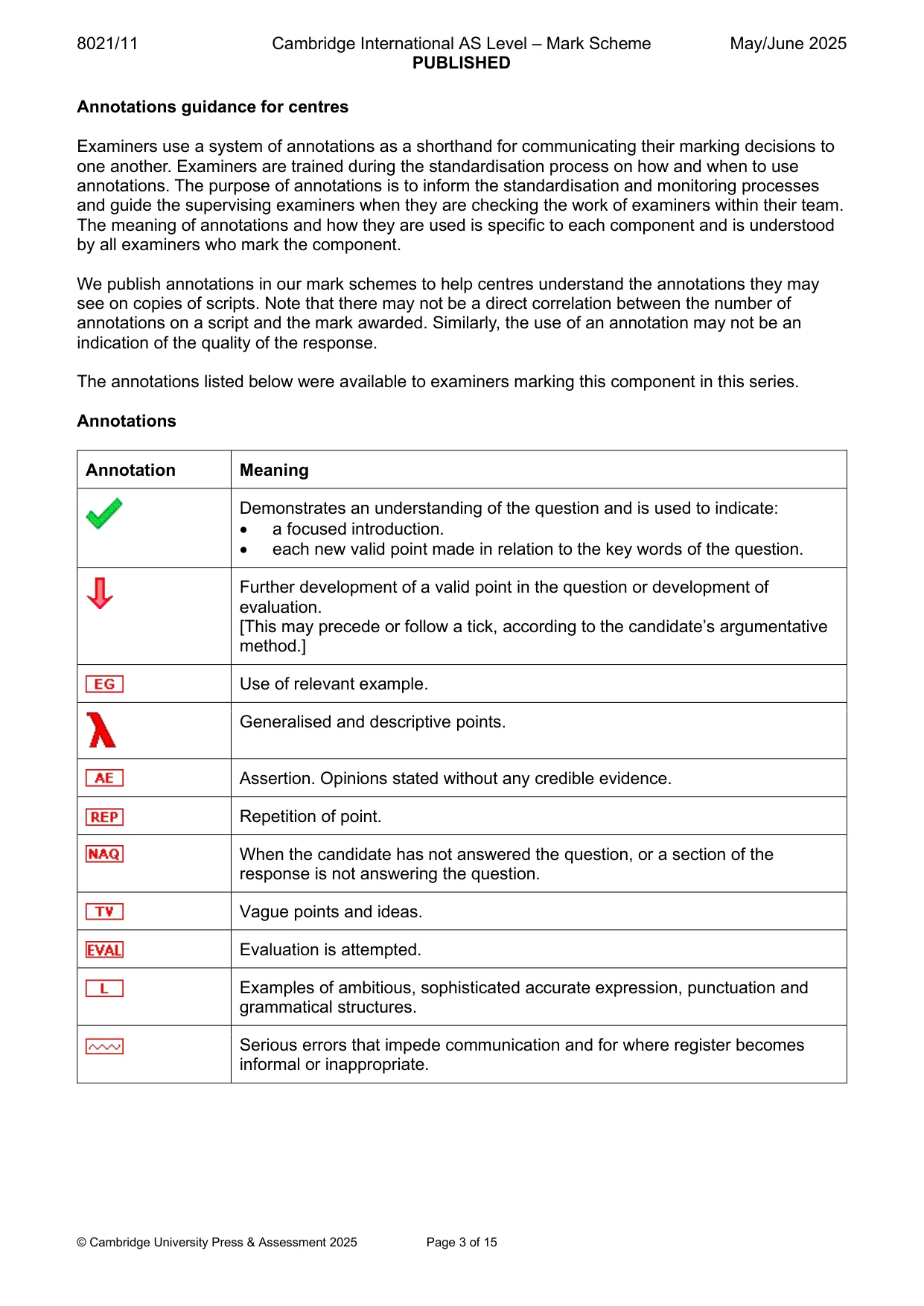
8021/11 Cambridge International AS Level – Mark Scheme PUBLISHED May/June 2025 © Cambridge University Press & Assessment 2025 Page 3 of 15 Annotations guidance for centres Examiners use a system of annotations as a shorthand for communicating their marking decisions to one another. Examiners are trained during the standardisation process on how and when to use annotations. The purpose of annotations is to inform the standardisation and monitoring processes and guide the supervising examiners when they are checking the work of examiners within their team. The meaning of annotations and how they are used is specific to each component and is understood by all examiners who mark the component. We publish annotations in our mark schemes to help centres understand the annotations they may see on copies of scripts. Note that there may not be a direct correlation between the number of annotations on a script and the mark awarded. Similarly, the use of an annotation may not be an indication of the quality of the response. The annotations listed below were available to examiners marking this component in this series. Annotations Annotation Meaning Demonstrates an understanding of the question and is used to indicate: • a focused introduction. • each new valid point made in relation to the key words of the question. Further development of a valid point in the question or development of evaluation. [This may precede or follow a tick, according to the candidate’s argumentative method.] Use of relevant example. Generalised and descriptive points. Assertion. Opinions stated without any credible evidence. Repetition of point. When the candidate has not answered the question, or a section of the response is not answering the question. Vague points and ideas. Evaluation is attempted. Examples of ambitious, sophisticated accurate expression, punctuation and grammatical structures. Serious errors that impede communication and for where register becomes informal or inappropriate.
Mark scheme, page 4
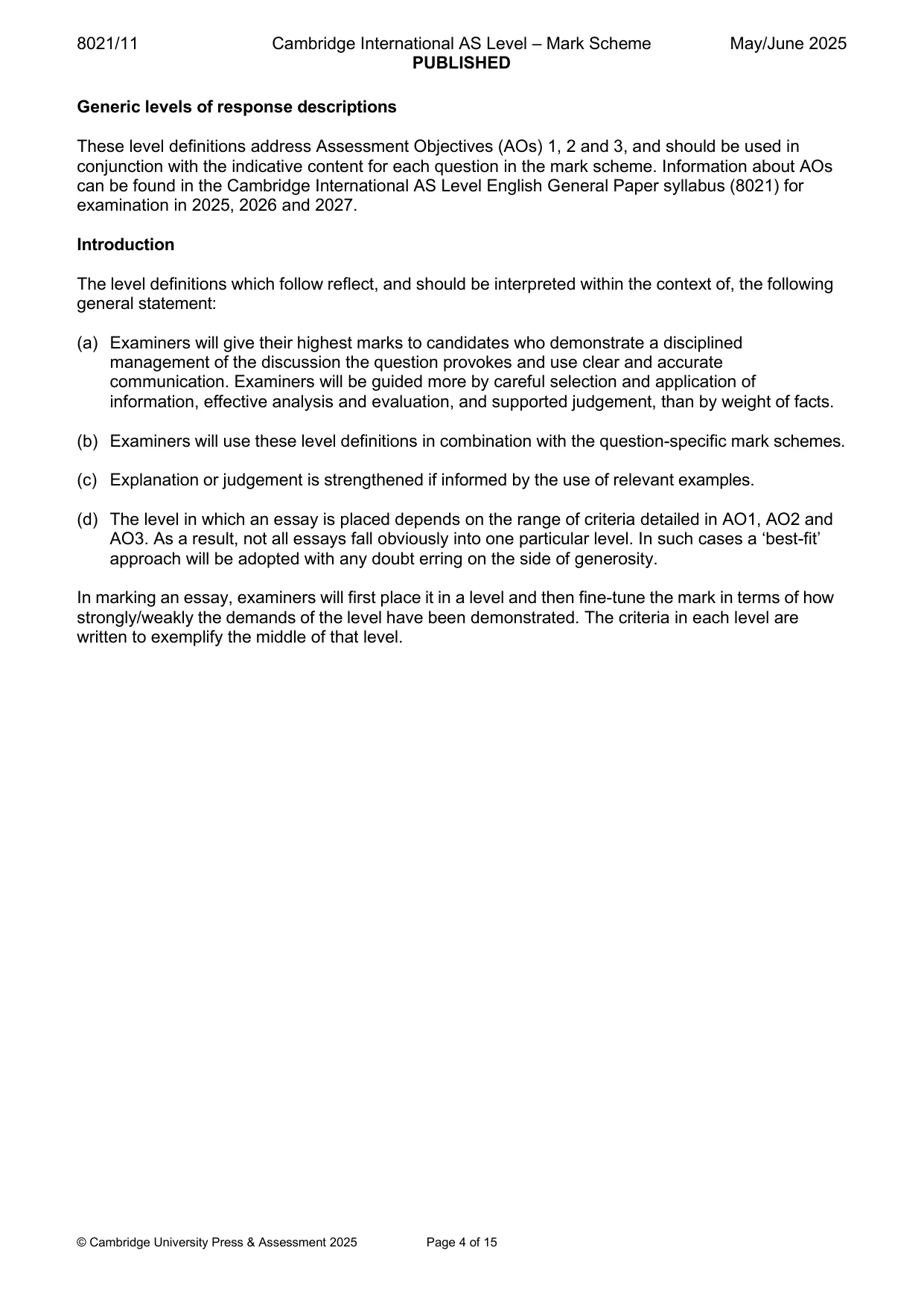
8021/11 Cambridge International AS Level – Mark Scheme PUBLISHED May/June 2025 © Cambridge University Press & Assessment 2025 Page 4 of 15 Generic levels of response descriptions These level definitions address Assessment Objectives (AOs) 1, 2 and 3, and should be used in conjunction with the indicative content for each question in the mark scheme. Information about AOs can be found in the Cambridge International AS Level English General Paper syllabus (8021) for examination in 2025, 2026 and 2027. Introduction The level definitions which follow reflect, and should be interpreted within the context of, the following general statement: (a) Examiners will give their highest marks to candidates who demonstrate a disciplined management of the discussion the question provokes and use clear and accurate communication. Examiners will be guided more by careful selection and application of information, effective analysis and evaluation, and supported judgement, than by weight of facts. (b) Examiners will use these level definitions in combination with the question-specific mark schemes. (c) Explanation or judgement is strengthened if informed by the use of relevant examples. (d) The level in which an essay is placed depends on the range of criteria detailed in AO1, AO2 and AO3. As a result, not all essays fall obviously into one particular level. In such cases a ‘best-fit’ approach will be adopted with any doubt erring on the side of generosity. In marking an essay, examiners will first place it in a level and then fine-tune the mark in terms of how strongly/weakly the demands of the level have been demonstrated. The criteria in each level are written to exemplify the middle of that level.
Mark scheme, page 5
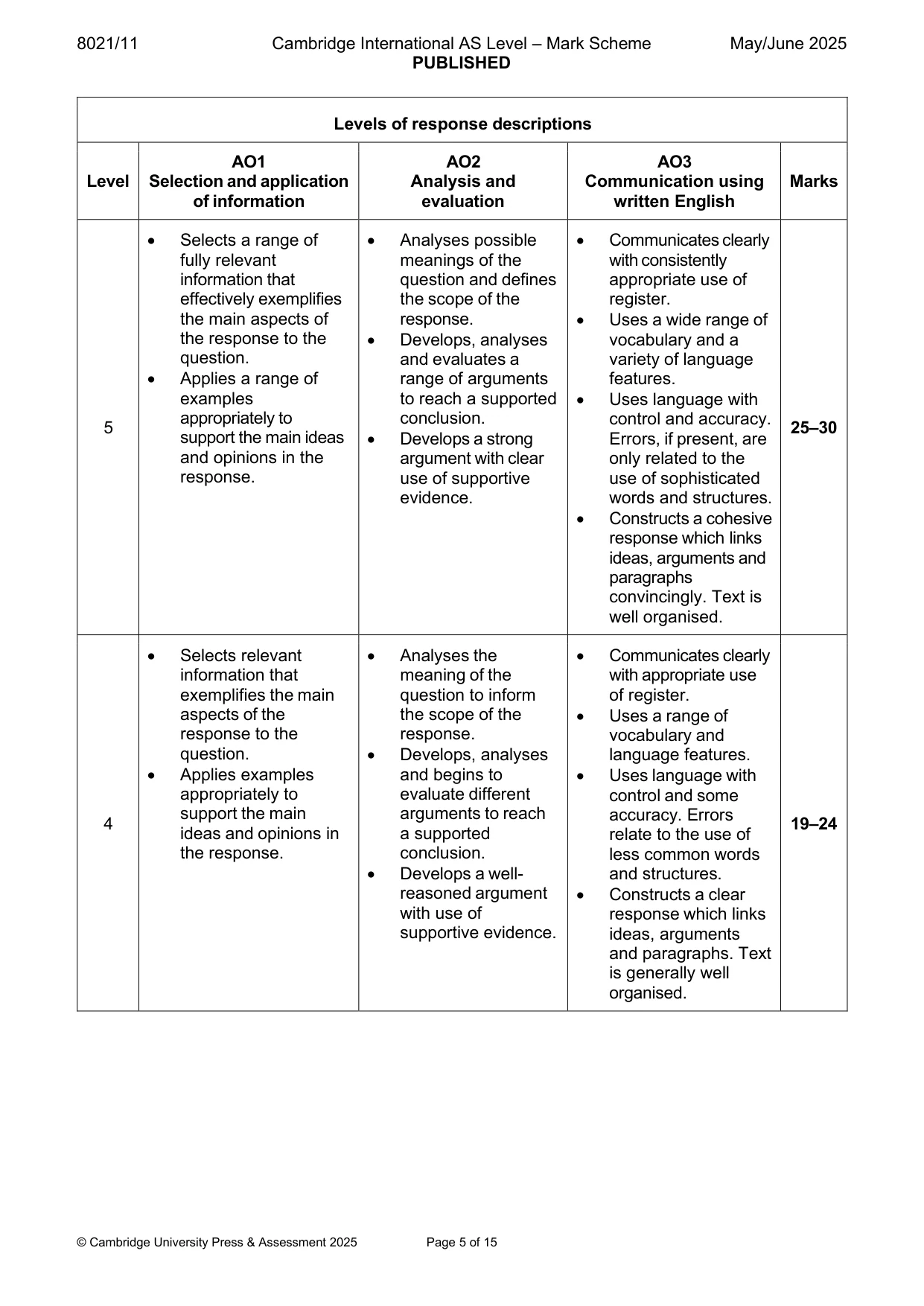
8021/11 Cambridge International AS Level – Mark Scheme PUBLISHED May/June 2025 © Cambridge University Press & Assessment 2025 Page 5 of 15 Levels of response descriptions Level AO1 Selection and application of information AO2 Analysis and evaluation AO3 Communication using written English Marks 5 • Selects a range of fully relevant information that effectively exemplifies the main aspects of the response to the question. • Applies a range of examples appropriately to support the main ideas and opinions in the response. • Analyses possible meanings of the question and defines the scope of the response. • Develops, analyses and evaluates a range of arguments to reach a supported conclusion. • Develops a strong argument with clear use of supportive evidence. • Communicates clearly with consistently appropriate use of register. • Uses a wide range of vocabulary and a variety of language features. • Uses language with control and accuracy. Errors, if present, are only related to the use of sophisticated words and structures. • Constructs a cohesive response which links ideas, arguments and paragraphs convincingly. Text is well organised. 25–30 4 • Selects relevant information that exemplifies the main aspects of the response to the question. • Applies examples appropriately to support the main ideas and opinions in the response. • Analyses the meaning of the question to inform the scope of the response. • Develops, analyses and begins to evaluate different arguments to reach a supported conclusion. • Develops a well- reasoned argument with use of supportive evidence. • Communicates clearly with appropriate use of register. • Uses a range of vocabulary and language features. • Uses language with control and some accuracy. Errors relate to the use of less common words and structures. • Constructs a clear response which links ideas, arguments and paragraphs. Text is generally well organised. 19–24
Mark scheme, page 6
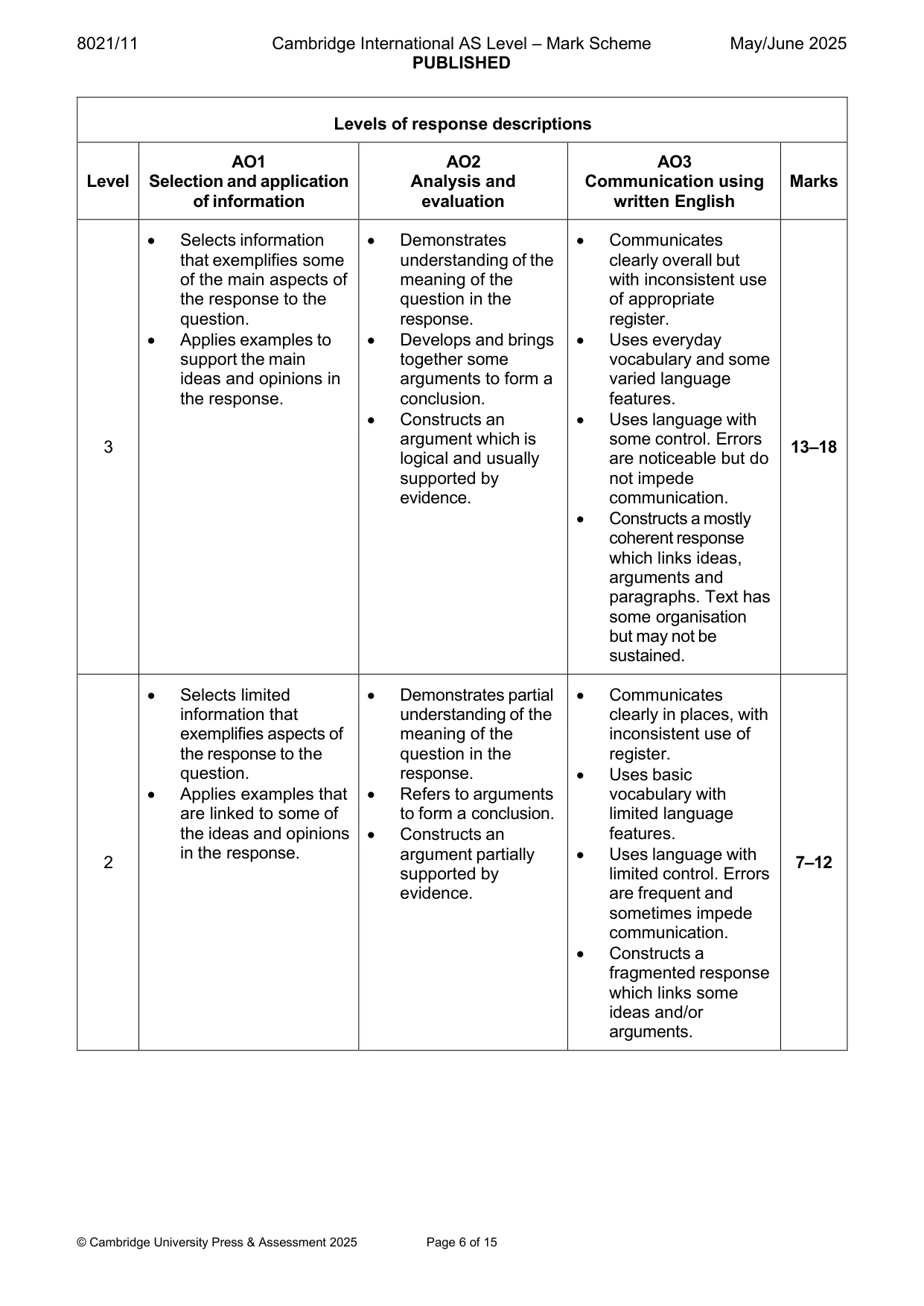
8021/11 Cambridge International AS Level – Mark Scheme PUBLISHED May/June 2025 © Cambridge University Press & Assessment 2025 Page 6 of 15 Levels of response descriptions Level AO1 Selection and application of information AO2 Analysis and evaluation AO3 Communication using written English Marks 3 • Selects information that exemplifies some of the main aspects of the response to the question. • Applies examples to support the main ideas and opinions in the response. • Demonstrates understanding of the meaning of the question in the response. • Develops and brings together some arguments to form a conclusion. • Constructs an argument which is logical and usually supported by evidence. • Communicates clearly overall but with inconsistent use of appropriate register. • Uses everyday vocabulary and some varied language features. • Uses language with some control. Errors are noticeable but do not impede communication. • Constructs a mostly coherent response which links ideas, arguments and paragraphs. Text has some organisation but may not be sustained. 13–18 2 • Selects limited information that exemplifies aspects of the response to the question. • Applies examples that are linked to some of the ideas and opinions in the response. • Demonstrates partial understanding of the meaning of the question in the response. • Refers to arguments to form a conclusion. • Constructs an argument partially supported by evidence. • Communicates clearly in places, with inconsistent use of register. • Uses basic vocabulary with limited language features. • Uses language with limited control. Errors are frequent and sometimes impede communication. • Constructs a fragmented response which links some ideas and/or arguments. 7–12
Mark scheme, page 7
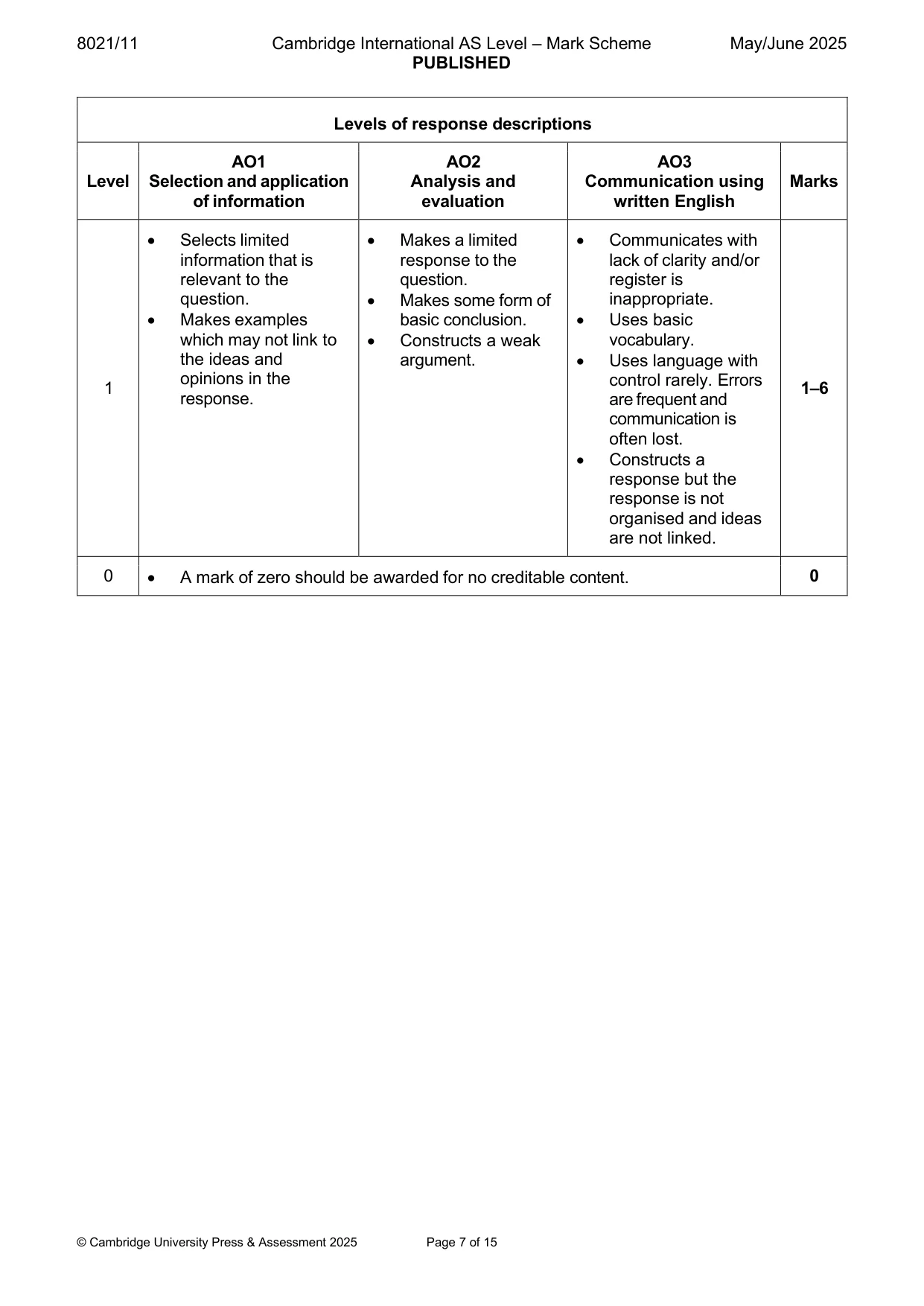
8021/11 Cambridge International AS Level – Mark Scheme PUBLISHED May/June 2025 © Cambridge University Press & Assessment 2025 Page 7 of 15 Levels of response descriptions Level AO1 Selection and application of information AO2 Analysis and evaluation AO3 Communication using written English Marks 1 • Selects limited information that is relevant to the question. • Makes examples which may not link to the ideas and opinions in the response. • Makes a limited response to the question. • Makes some form of basic conclusion. • Constructs a weak argument. • Communicates with lack of clarity and/or register is inappropriate. • Uses basic vocabulary. • Uses language with control rarely. Errors are frequent and communication is often lost. • Constructs a response but the response is not organised and ideas are not linked. 1–6 0 • A mark of zero should be awarded for no creditable content. 0
Mark scheme, page 8
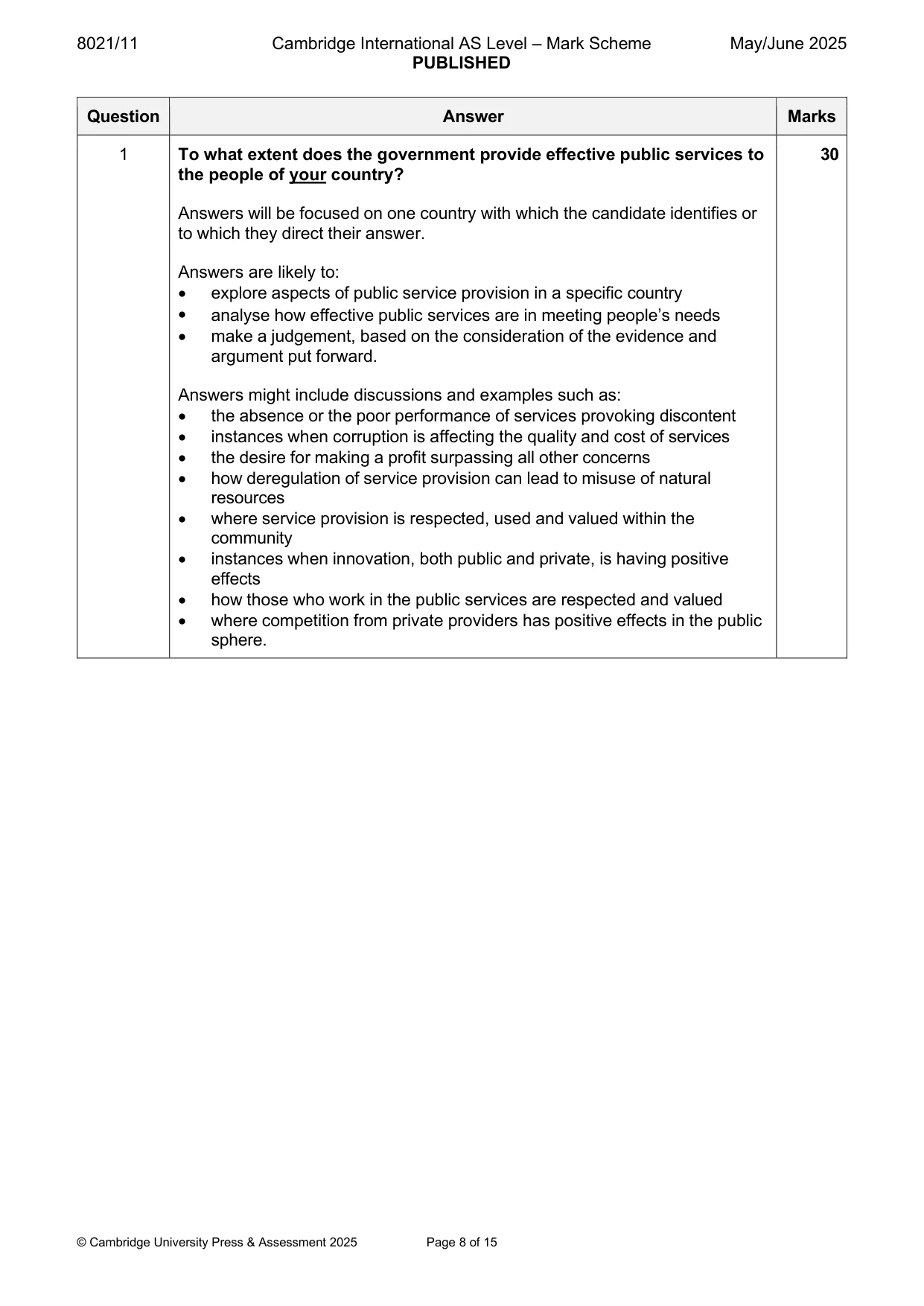
8021/11 Cambridge International AS Level – Mark Scheme PUBLISHED May/June 2025 © Cambridge University Press & Assessment 2025 Page 8 of 15 Question Answer Marks 1 To what extent does the government provide effective public services to the people of your country? Answers will be focused on one country with which the candidate identifies or to which they direct their answer. Answers are likely to: • explore aspects of public service provision in a specific country • analyse how effective public services are in meeting people’s needs • make a judgement, based on the consideration of the evidence and argument put forward. Answers might include discussions and examples such as: • the absence or the poor performance of services provoking discontent • instances when corruption is affecting the quality and cost of services • the desire for making a profit surpassing all other concerns • how deregulation of service provision can lead to misuse of natural resources • where service provision is respected, used and valued within the community • instances when innovation, both public and private, is having positive effects • how those who work in the public services are respected and valued • where competition from private providers has positive effects in the public sphere. 30
Mark scheme, page 9
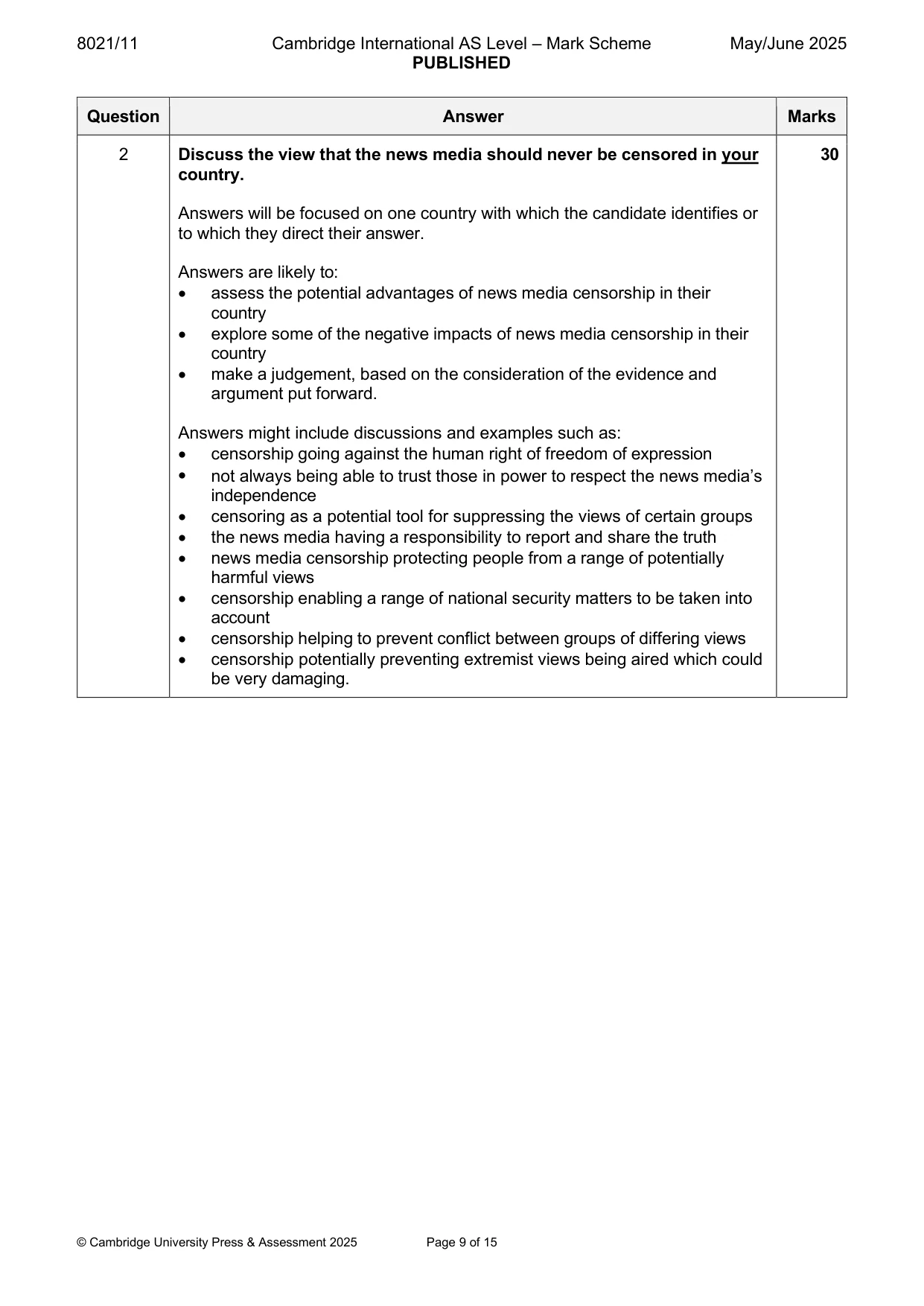
8021/11 Cambridge International AS Level – Mark Scheme PUBLISHED May/June 2025 © Cambridge University Press & Assessment 2025 Page 9 of 15 Question Answer Marks 2 Discuss the view that the news media should never be censored in your country. Answers will be focused on one country with which the candidate identifies or to which they direct their answer. Answers are likely to: • assess the potential advantages of news media censorship in their country • explore some of the negative impacts of news media censorship in their country • make a judgement, based on the consideration of the evidence and argument put forward. Answers might include discussions and examples such as: • censorship going against the human right of freedom of expression • not always being able to trust those in power to respect the news media’s independence • censoring as a potential tool for suppressing the views of certain groups • the news media having a responsibility to report and share the truth • news media censorship protecting people from a range of potentially harmful views • censorship enabling a range of national security matters to be taken into account • censorship helping to prevent conflict between groups of differing views • censorship potentially preventing extremist views being aired which could be very damaging. 30
Mark scheme, page 10
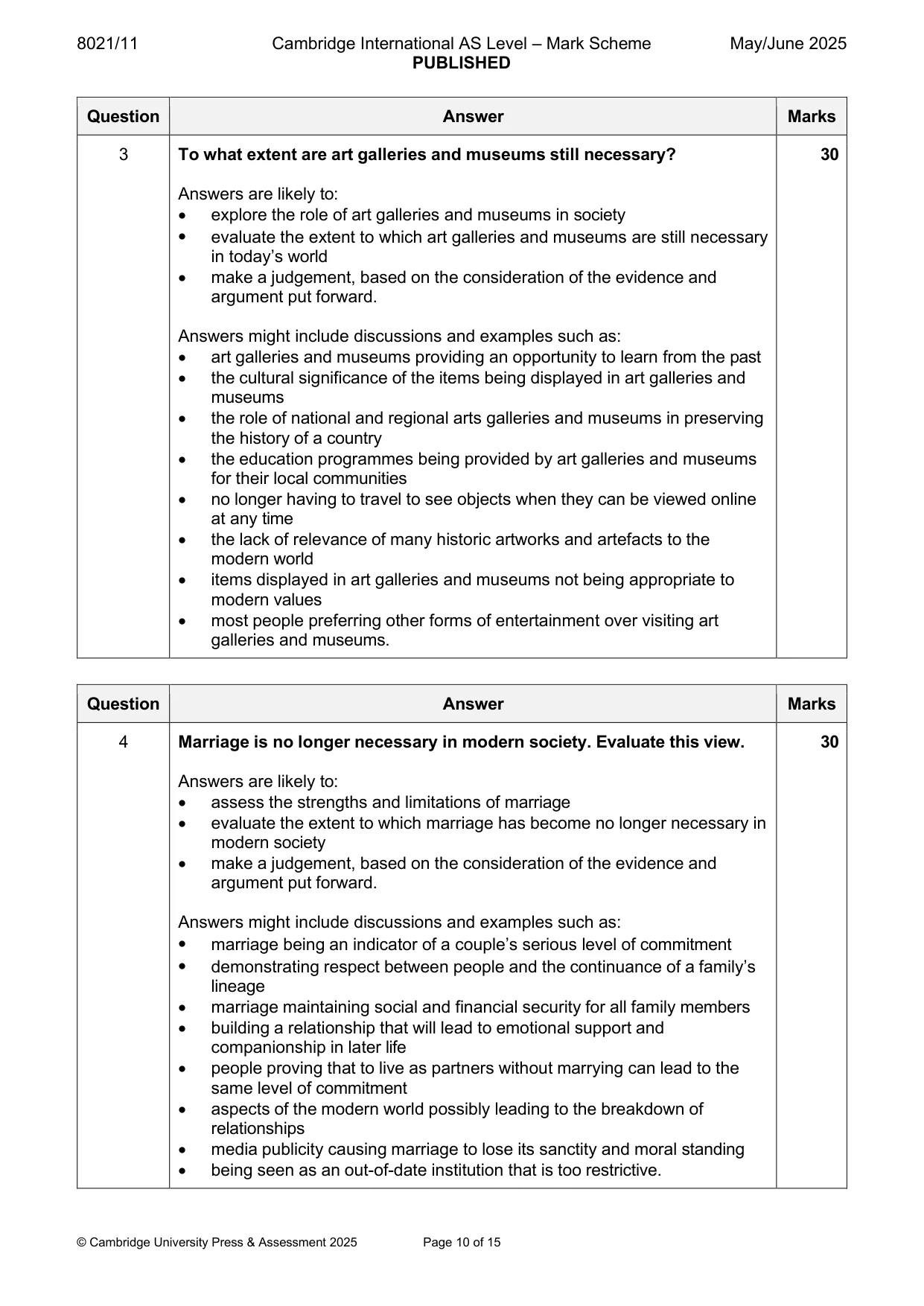
8021/11 Cambridge International AS Level – Mark Scheme PUBLISHED May/June 2025 © Cambridge University Press & Assessment 2025 Page 10 of 15 Question Answer Marks 3 To what extent are art galleries and museums still necessary? Answers are likely to: • explore the role of art galleries and museums in society • evaluate the extent to which art galleries and museums are still necessary in today’s world • make a judgement, based on the consideration of the evidence and argument put forward. Answers might include discussions and examples such as: • art galleries and museums providing an opportunity to learn from the past • the cultural significance of the items being displayed in art galleries and museums • the role of national and regional arts galleries and museums in preserving the history of a country • the education programmes being provided by art galleries and museums for their local communities • no longer having to travel to see objects when they can be viewed online at any time • the lack of relevance of many historic artworks and artefacts to the modern world • items displayed in art galleries and museums not being appropriate to modern values • most people preferring other forms of entertainment over visiting art galleries and museums. 30 Question Answer Marks 4 Marriage is no longer necessary in modern society. Evaluate this view. Answers are likely to: • assess the strengths and limitations of marriage • evaluate the extent to which marriage has become no longer necessary in modern society • make a judgement, based on the consideration of the evidence and argument put forward. Answers might include discussions and examples such as: • marriage being an indicator of a couple’s serious level of commitment • demonstrating respect between people and the continuance of a family’s lineage • marriage maintaining social and financial security for all family members • building a relationship that will lead to emotional support and companionship in later life • people proving that to live as partners without marrying can lead to the same level of commitment • aspects of the modern world possibly leading to the breakdown of relationships • media publicity causing marriage to lose its sanctity and moral standing • being seen as an out-of-date institution that is too restrictive. 30
Mark scheme, page 11
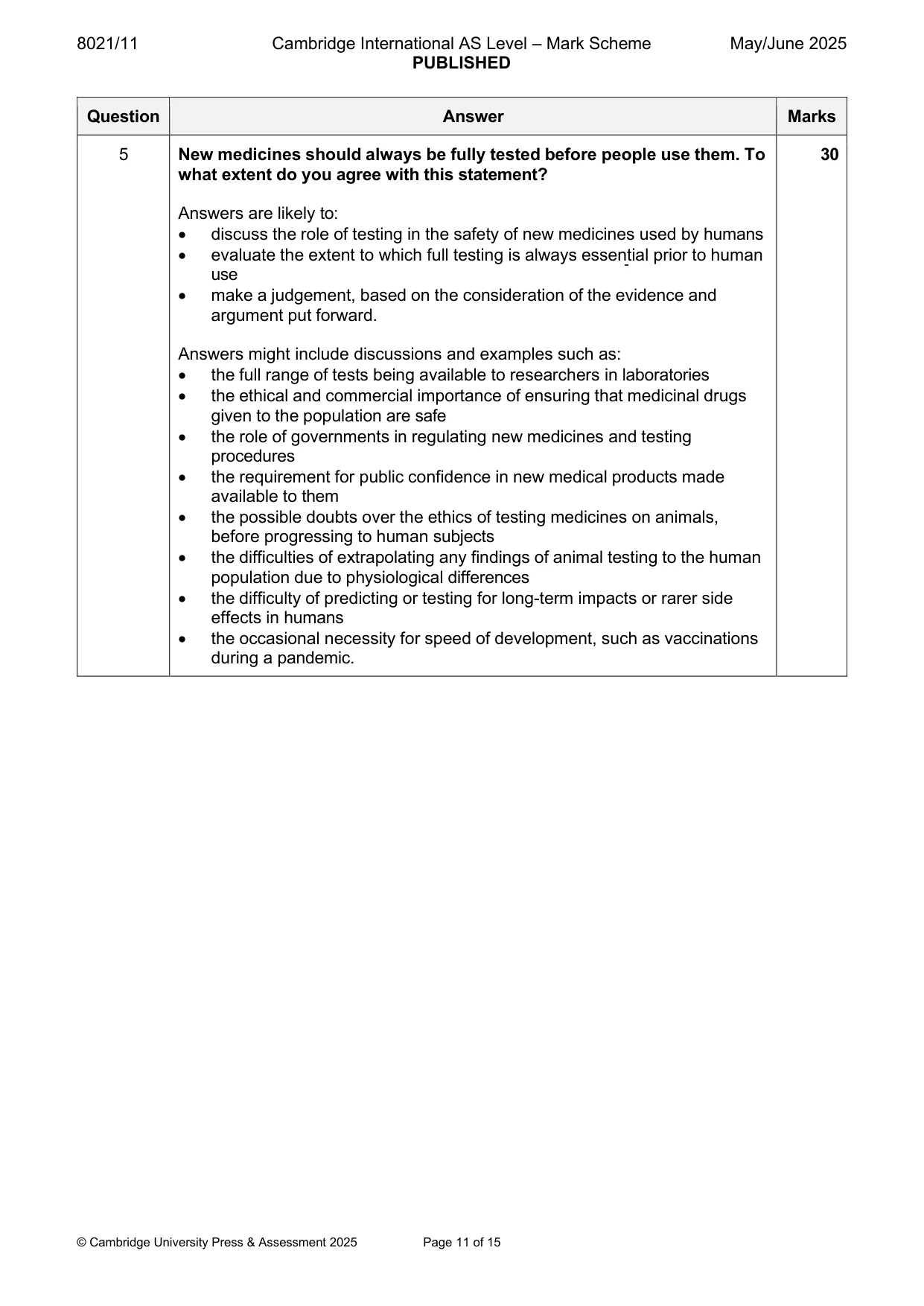
8021/11 Cambridge International AS Level – Mark Scheme PUBLISHED May/June 2025 © Cambridge University Press & Assessment 2025 Page 11 of 15 Question Answer Marks 5 New medicines should always be fully tested before people use them. To what extent do you agree with this statement? Answers are likely to: • discuss the role of testing in the safety of new medicines used by humans • evaluate the extent to which full testing is always essential prior to human use • make a judgement, based on the consideration of the evidence and argument put forward. Answers might include discussions and examples such as: • the full range of tests being available to researchers in laboratories • the ethical and commercial importance of ensuring that medicinal drugs given to the population are safe • the role of governments in regulating new medicines and testing procedures • the requirement for public confidence in new medical products made available to them • the possible doubts over the ethics of testing medicines on animals, before progressing to human subjects • the difficulties of extrapolating any findings of animal testing to the human population due to physiological differences • the difficulty of predicting or testing for long-term impacts or rarer side effects in humans • the occasional necessity for speed of development, such as vaccinations during a pandemic. 30
Mark scheme, page 12
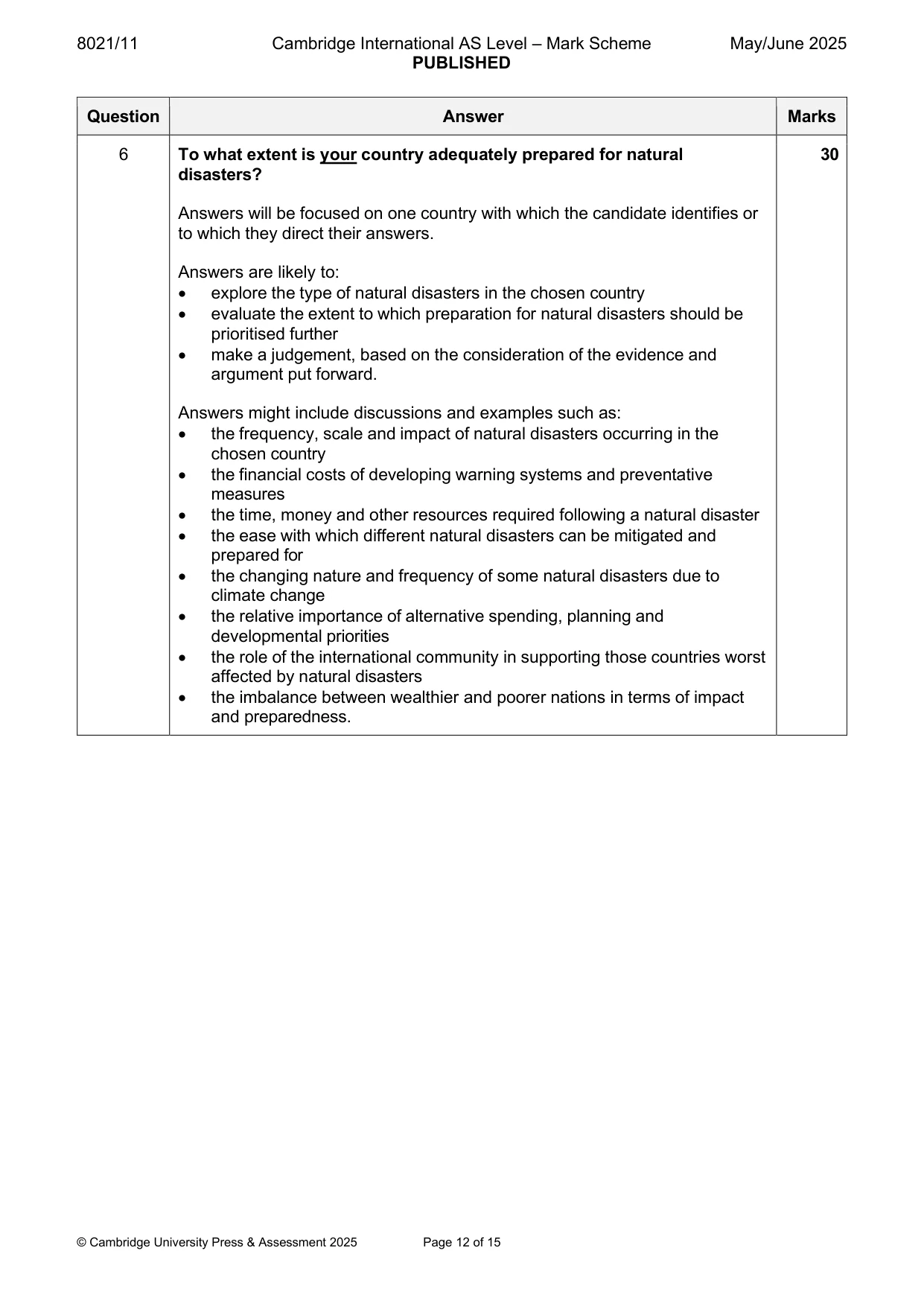
8021/11 Cambridge International AS Level – Mark Scheme PUBLISHED May/June 2025 © Cambridge University Press & Assessment 2025 Page 12 of 15 Question Answer Marks 6 To what extent is your country adequately prepared for natural disasters? Answers will be focused on one country with which the candidate identifies or to which they direct their answers. Answers are likely to: • explore the type of natural disasters in the chosen country • evaluate the extent to which preparation for natural disasters should be prioritised further • make a judgement, based on the consideration of the evidence and argument put forward. Answers might include discussions and examples such as: • the frequency, scale and impact of natural disasters occurring in the chosen country • the financial costs of developing warning systems and preventative measures • the time, money and other resources required following a natural disaster • the ease with which different natural disasters can be mitigated and prepared for • the changing nature and frequency of some natural disasters due to climate change • the relative importance of alternative spending, planning and developmental priorities • the role of the international community in supporting those countries worst affected by natural disasters • the imbalance between wealthier and poorer nations in terms of impact and preparedness. 30
Mark scheme, page 13
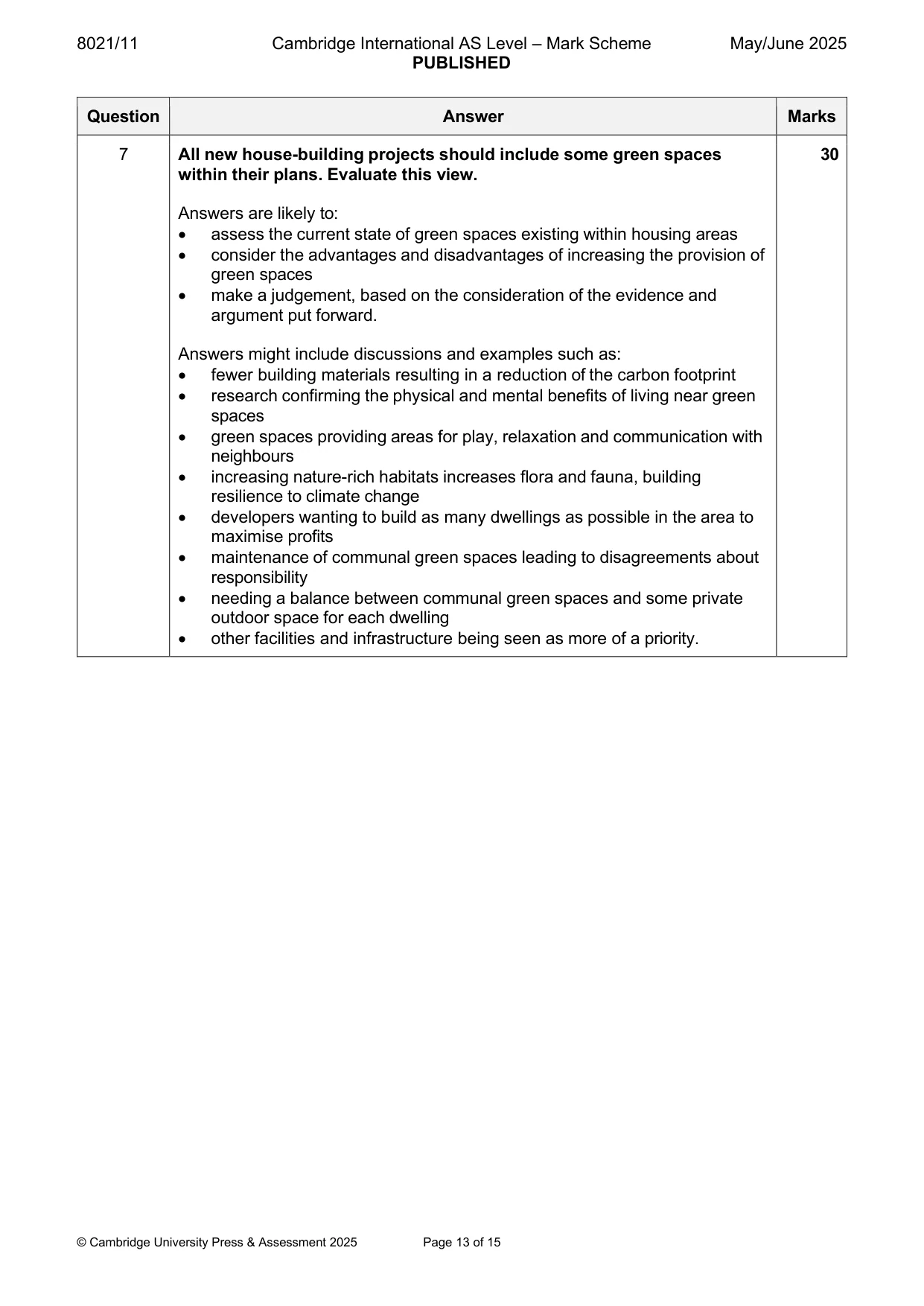
8021/11 Cambridge International AS Level – Mark Scheme PUBLISHED May/June 2025 © Cambridge University Press & Assessment 2025 Page 13 of 15 Question Answer Marks 7 All new house-building projects should include some green spaces within their plans. Evaluate this view. Answers are likely to: • assess the current state of green spaces existing within housing areas • consider the advantages and disadvantages of increasing the provision of green spaces • make a judgement, based on the consideration of the evidence and argument put forward. Answers might include discussions and examples such as: • fewer building materials resulting in a reduction of the carbon footprint • research confirming the physical and mental benefits of living near green spaces • green spaces providing areas for play, relaxation and communication with neighbours • increasing nature-rich habitats increases flora and fauna, building resilience to climate change • developers wanting to build as many dwellings as possible in the area to maximise profits • maintenance of communal green spaces leading to disagreements about responsibility • needing a balance between communal green spaces and some private outdoor space for each dwelling • other facilities and infrastructure being seen as more of a priority. 30
Mark scheme, page 14
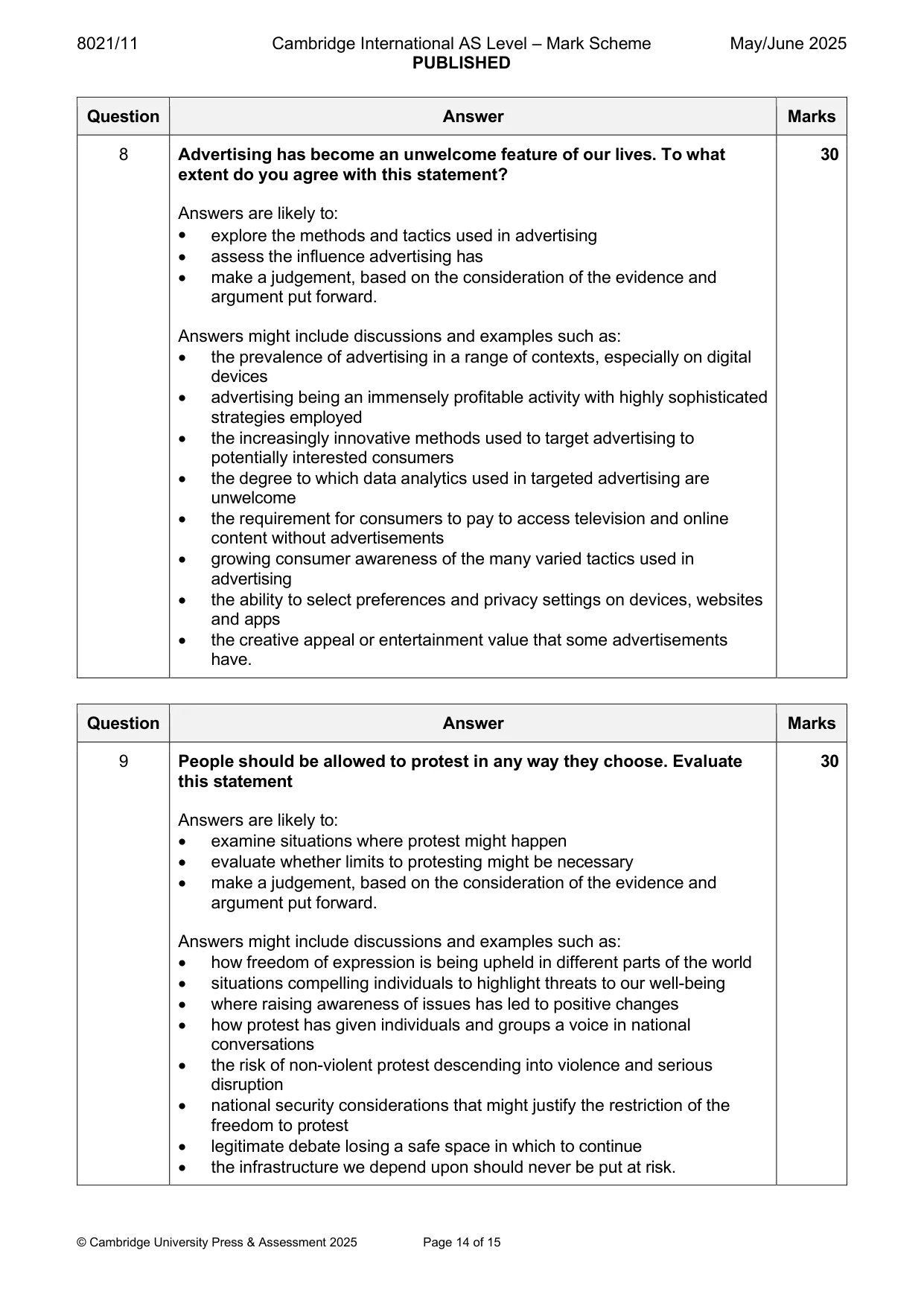
8021/11 Cambridge International AS Level – Mark Scheme PUBLISHED May/June 2025 © Cambridge University Press & Assessment 2025 Page 14 of 15 Question Answer Marks 8 Advertising has become an unwelcome feature of our lives. To what extent do you agree with this statement? Answers are likely to: • explore the methods and tactics used in advertising • assess the influence advertising has • make a judgement, based on the consideration of the evidence and argument put forward. Answers might include discussions and examples such as: • the prevalence of advertising in a range of contexts, especially on digital devices • advertising being an immensely profitable activity with highly sophisticated strategies employed • the increasingly innovative methods used to target advertising to potentially interested consumers • the degree to which data analytics used in targeted advertising are unwelcome • the requirement for consumers to pay to access television and online content without advertisements • growing consumer awareness of the many varied tactics used in advertising • the ability to select preferences and privacy settings on devices, websites and apps • the creative appeal or entertainment value that some advertisements have. 30 Question Answer Marks 9 People should be allowed to protest in any way they choose. Evaluate this statement Answers are likely to: • examine situations where protest might happen • evaluate whether limits to protesting might be necessary • make a judgement, based on the consideration of the evidence and argument put forward. Answers might include discussions and examples such as: • how freedom of expression is being upheld in different parts of the world • situations compelling individuals to highlight threats to our well-being • where raising awareness of issues has led to positive changes • how protest has given individuals and groups a voice in national conversations • the risk of non-violent protest descending into violence and serious disruption • national security considerations that might justify the restriction of the freedom to protest • legitimate debate losing a safe space in which to continue • the infrastructure we depend upon should never be put at risk. 30
Mark scheme, page 15
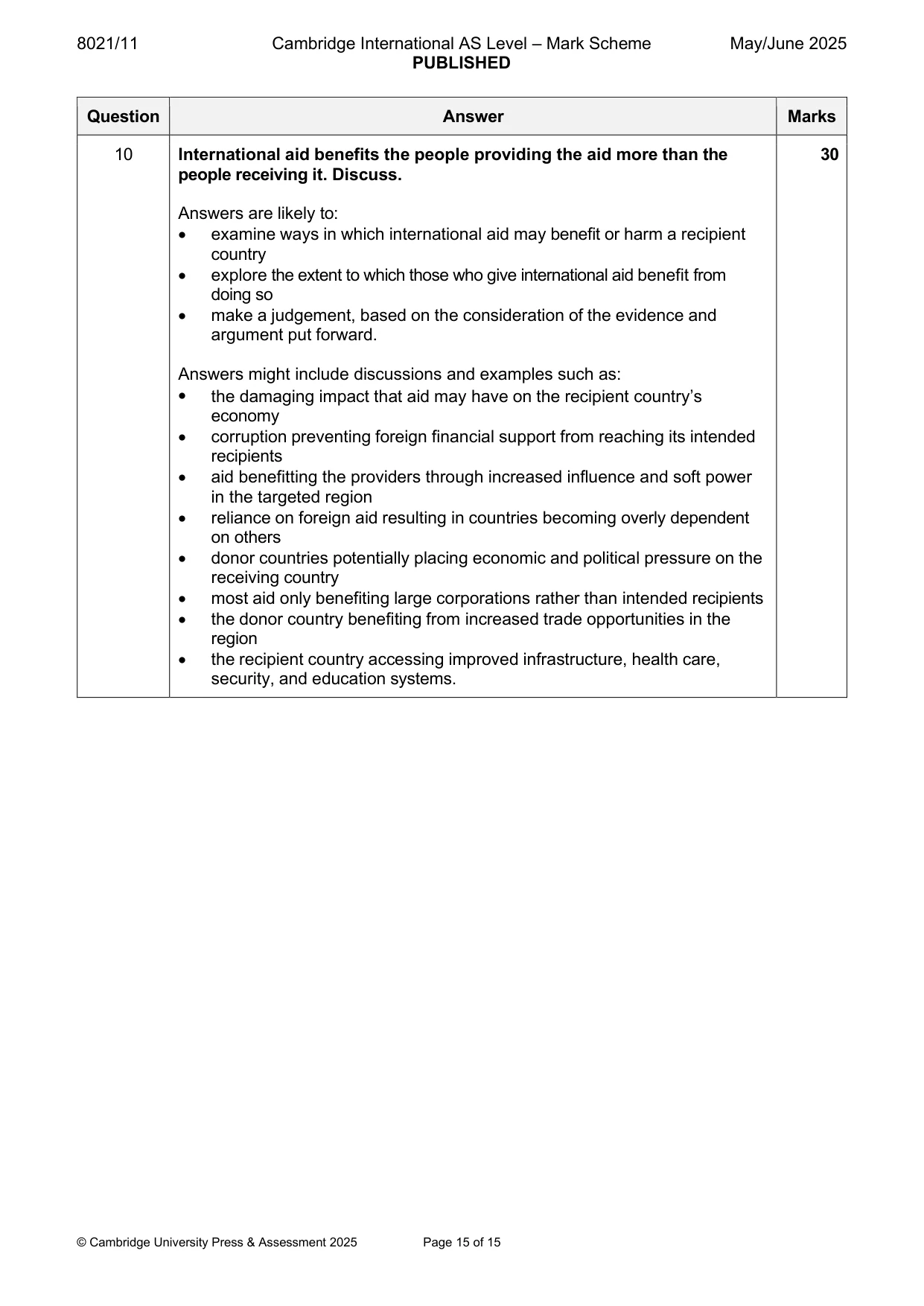
8021/11 Cambridge International AS Level – Mark Scheme PUBLISHED May/June 2025 © Cambridge University Press & Assessment 2025 Page 15 of 15 Question Answer Marks 10 International aid benefits the people providing the aid more than the people receiving it. Discuss. Answers are likely to: • examine ways in which international aid may benefit or harm a recipient country • explore the extent to which those who give international aid benefit from doing so • make a judgement, based on the consideration of the evidence and argument put forward. Answers might include discussions and examples such as: • the damaging impact that aid may have on the recipient country’s economy • corruption preventing foreign financial support from reaching its intended recipients • aid benefitting the providers through increased influence and soft power in the targeted region • reliance on foreign aid resulting in countries becoming overly dependent on others • donor countries potentially placing economic and political pressure on the receiving country • most aid only benefiting large corporations rather than intended recipients • the donor country benefiting from increased trade opportunities in the region • the recipient country accessing improved infrastructure, health care, security, and education systems. 30
What you needed in this session
Cambridge’s own grade thresholds for 2025 May/June, Paper 1 · Variant 1. A higher threshold means an easier paper — the bar moves with how the cohort did.