Cambridge A Level English General Paper 8021 — 2024 Oct/Nov Paper 1 · Variant 1
8021/11/O/N/24 · 30 marks · ≈34 min
The question paper and its mark scheme, free to read here and free to download. This is Cambridge’s own paper, exactly as it was sat.
Question paper4 pages


Mark scheme11 pages
Answers below. Sit the paper first if you are practising.
Paper as text
Question paper, page 1
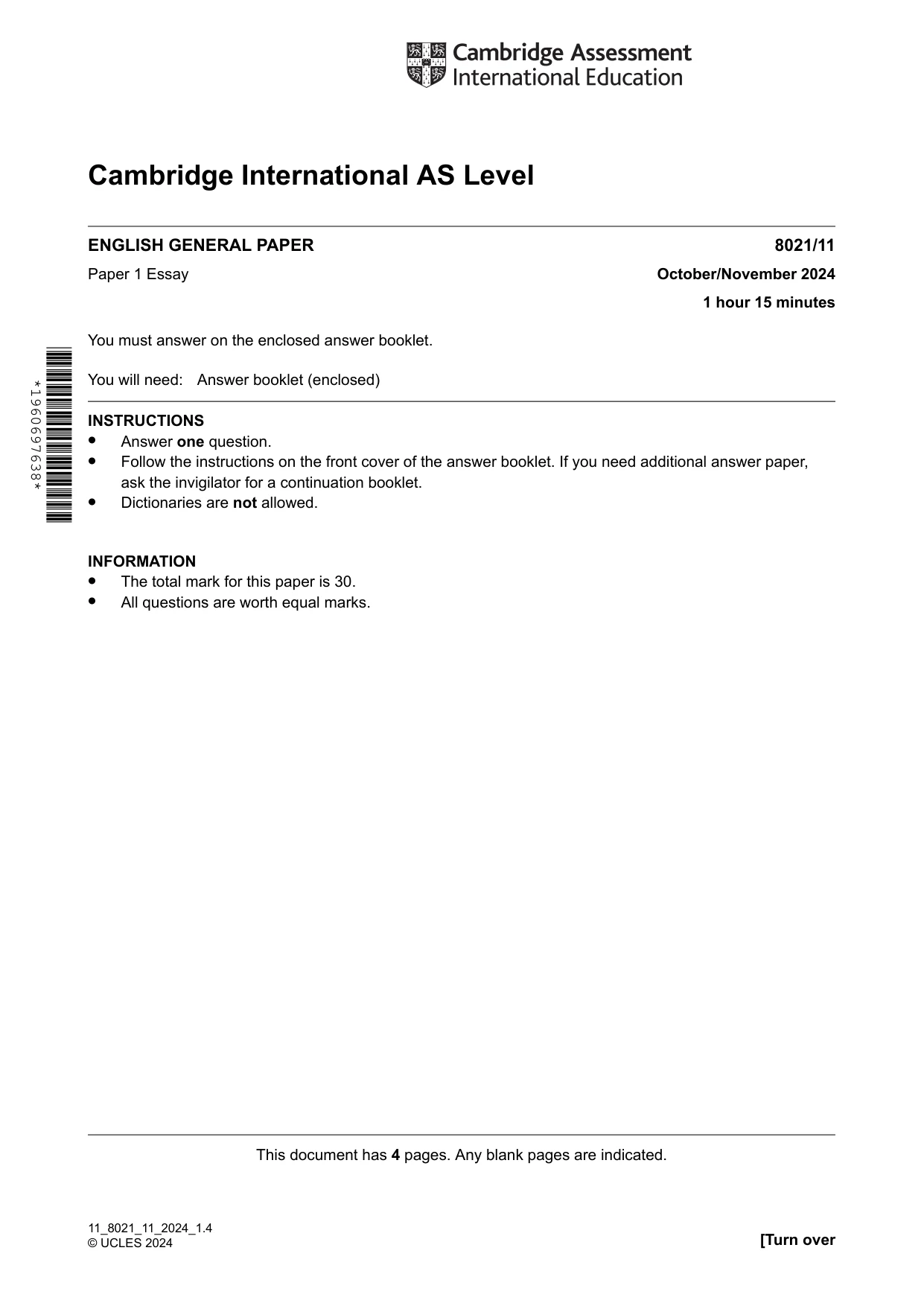
Cambridge International AS Level 8021/11 October/November 2024 1 hour 15 minutes ENGLISH GENERAL PAPER Paper 1 Essay You must answer on the enclosed answer booklet. You will need: Answer booklet (enclosed) INSTRUCTIONS • Answer one question. • Follow the instructions on the front cover of the answer booklet. If you need additional answer paper, ask the invigilator for a continuation booklet. • Dictionaries are not allowed. INFORMATION • The total mark for this paper is 30. • All questions are worth equal marks. This document has 4 pages. Any blank pages are indicated. [Turn over 11_8021_11_2024_1.4 © UCLES 2024 *1960697638*
Question paper, page 2
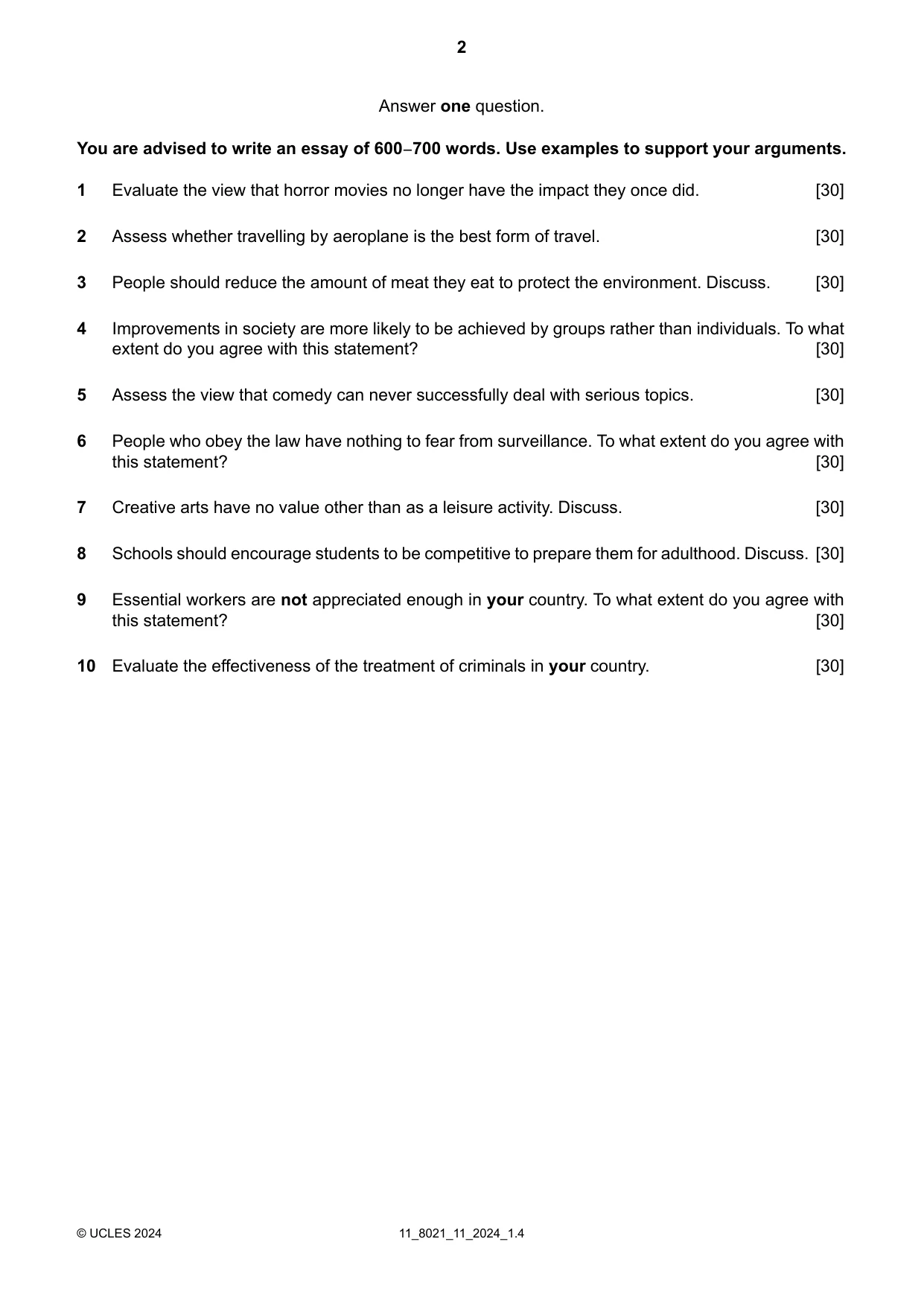
Answer one question. You are advised to write an essay of 600−700 words. Use examples to support your arguments. Evaluate the view that horror movies no longer have the impact they once did. [30] 1 Assess whether travelling by aeroplane is the best form of travel. [30] 2 People should reduce the amount of meat they eat to protect the environment. Discuss. [30] 3 Improvements in society are more likely to be achieved by groups rather than individuals. To what extent do you agree with this statement? [30] 4 Assess the view that comedy can never successfully deal with serious topics. [30] 5 People who obey the law have nothing to fear from surveillance. To what extent do you agree with this statement? [30] 6 Creative arts have no value other than as a leisure activity. Discuss. [30] 7 Schools should encourage students to be competitive to prepare them for adulthood. Discuss. [30] 8 Essential workers are not appreciated enough in your country. To what extent do you agree with this statement? [30] 9 Evaluate the effectiveness of the treatment of criminals in your country. [30] 10 11_8021_11_2024_1.4 © UCLES 2024 2
Question paper, page 3
BLANK PAGE 11_8021_11_2024_1.4 © UCLES 2024 3
Question paper, page 4
BLANK PAGE Permission to reproduce items where third-party owned material protected by copyright is included has been sought and cleared where possible. Every reasonable effort has been made by the publisher (UCLES) to trace copyright holders, but if any items requiring clearance have unwittingly been included, the publisher will be pleased to make amends at the earliest possible opportunity. To avoid the issue of disclosure of answer-related information to candidates, all copyright acknowledgements are reproduced online in the Cambridge Assessment International Education Copyright Acknowledgements Booklet. This is produced for each series of examinations and is freely available to download at www.cambridgeinternational.org after the live examination series. Cambridge Assessment International Education is part of Cambridge Assessment. Cambridge Assessment is the brand name of the University of Cambridge Local Examinations Syndicate (UCLES), which is a department of the University of Cambridge. 11_8021_11_2024_1.4 © UCLES 2024 4
Mark scheme, page 1
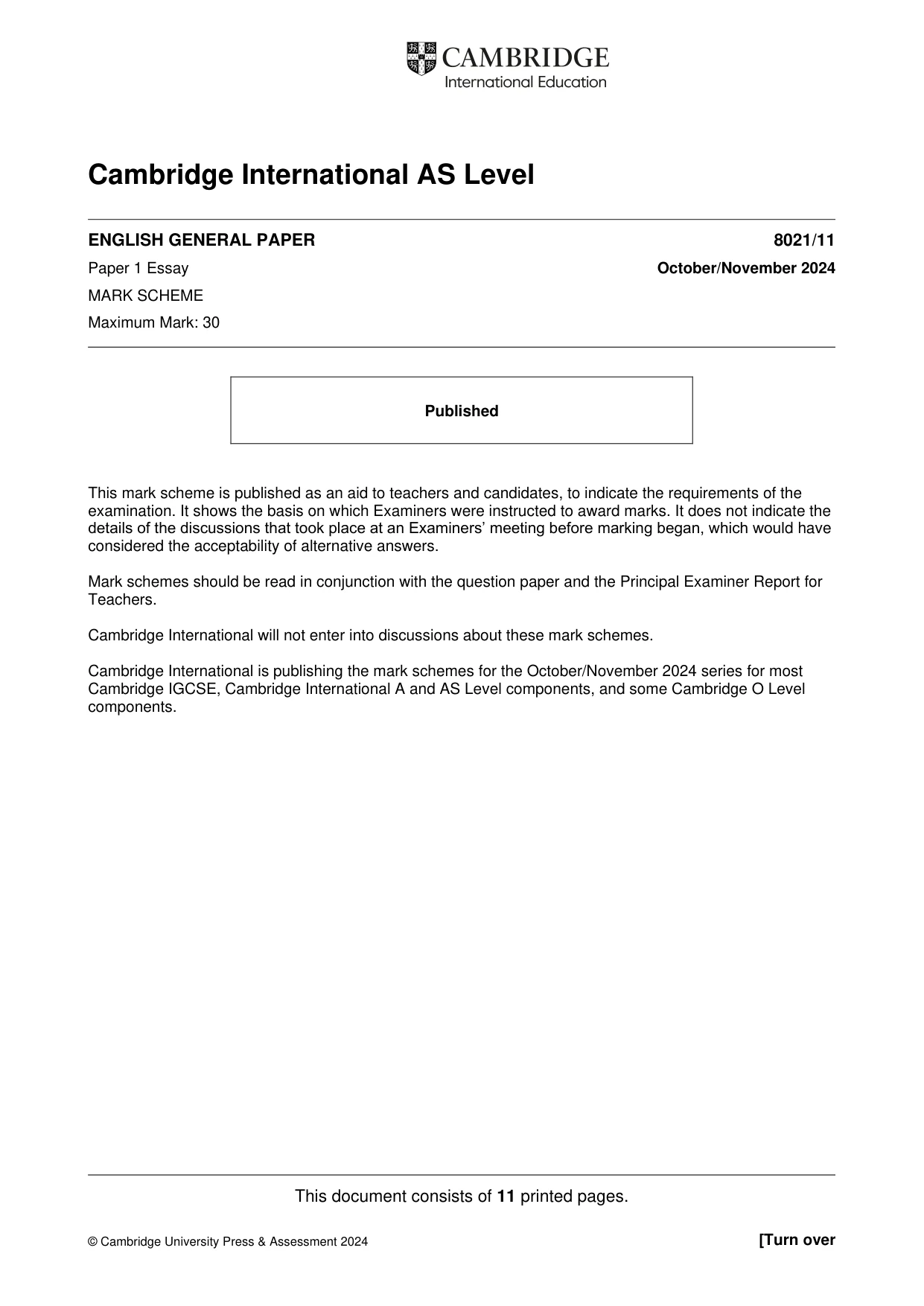
This document consists of 11 printed pages. © Cambridge University Press & Assessment 2024 [Turn over Cambridge International AS Level ENGLISH GENERAL PAPER 8021/11 Paper 1 Essay October/November 2024 MARK SCHEME Maximum Mark: 30 Published This mark scheme is published as an aid to teachers and candidates, to indicate the requirements of the examination. It shows the basis on which Examiners were instructed to award marks. It does not indicate the details of the discussions that took place at an Examiners’ meeting before marking began, which would have considered the acceptability of alternative answers. Mark schemes should be read in conjunction with the question paper and the Principal Examiner Report for Teachers. Cambridge International will not enter into discussions about these mark schemes. Cambridge International is publishing the mark schemes for the October/November 2024 series for most Cambridge IGCSE, Cambridge International A and AS Level components, and some Cambridge O Level components.
Mark scheme, page 2
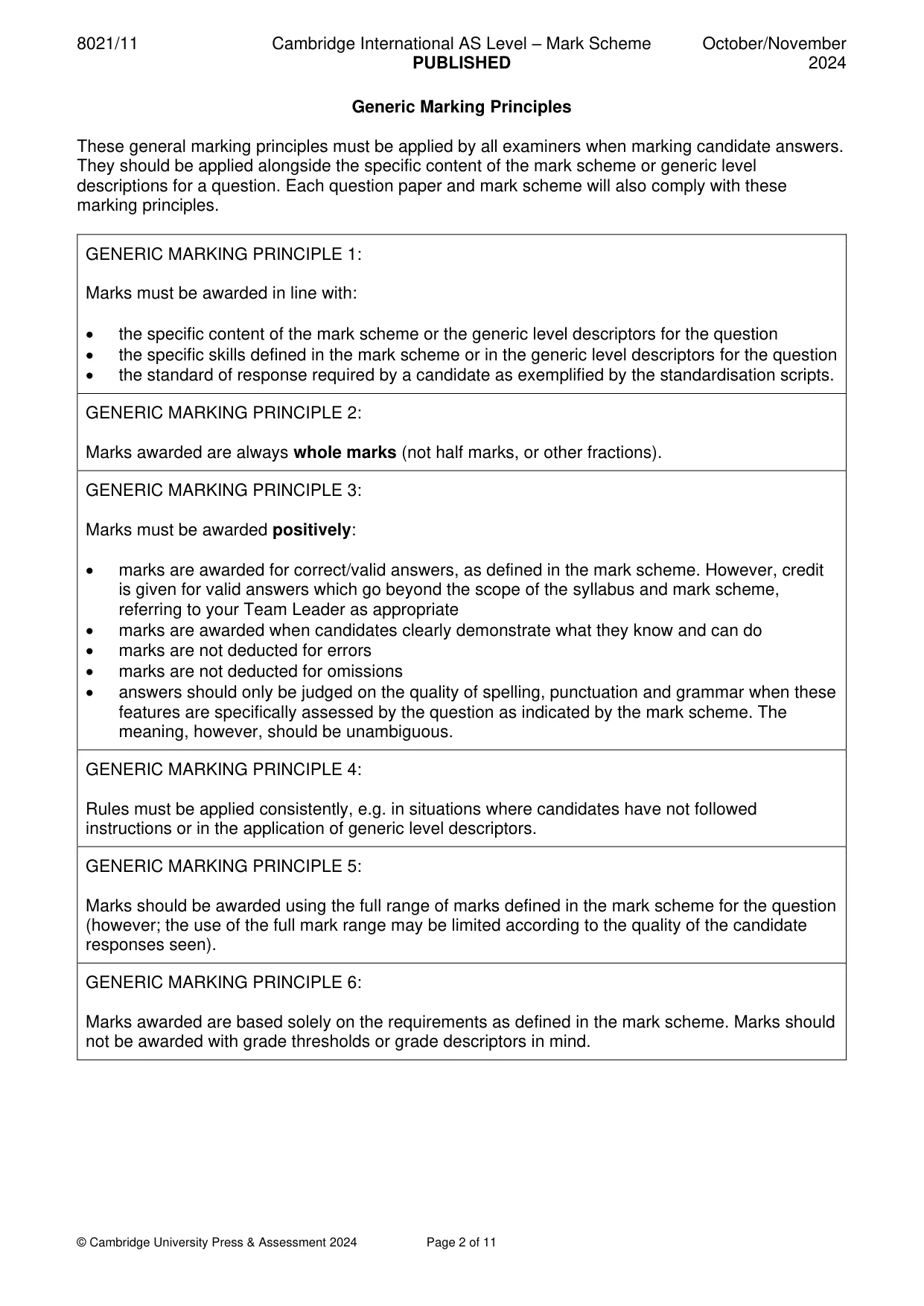
8021/11 Cambridge International AS Level – Mark Scheme PUBLISHED October/November 2024 © Cambridge University Press & Assessment 2024 Page 2 of 11 Generic Marking Principles These general marking principles must be applied by all examiners when marking candidate answers. They should be applied alongside the specific content of the mark scheme or generic level descriptions for a question. Each question paper and mark scheme will also comply with these marking principles. GENERIC MARKING PRINCIPLE 1: Marks must be awarded in line with: • the specific content of the mark scheme or the generic level descriptors for the question • the specific skills defined in the mark scheme or in the generic level descriptors for the question • the standard of response required by a candidate as exemplified by the standardisation scripts. GENERIC MARKING PRINCIPLE 2: Marks awarded are always whole marks (not half marks, or other fractions). GENERIC MARKING PRINCIPLE 3: Marks must be awarded positively: • marks are awarded for correct/valid answers, as defined in the mark scheme. However, credit is given for valid answers which go beyond the scope of the syllabus and mark scheme, referring to your Team Leader as appropriate • marks are awarded when candidates clearly demonstrate what they know and can do • marks are not deducted for errors • marks are not deducted for omissions • answers should only be judged on the quality of spelling, punctuation and grammar when these features are specifically assessed by the question as indicated by the mark scheme. The meaning, however, should be unambiguous. GENERIC MARKING PRINCIPLE 4: Rules must be applied consistently, e.g. in situations where candidates have not followed instructions or in the application of generic level descriptors. GENERIC MARKING PRINCIPLE 5: Marks should be awarded using the full range of marks defined in the mark scheme for the question (however; the use of the full mark range may be limited according to the quality of the candidate responses seen). GENERIC MARKING PRINCIPLE 6: Marks awarded are based solely on the requirements as defined in the mark scheme. Marks should not be awarded with grade thresholds or grade descriptors in mind.
Mark scheme, page 3
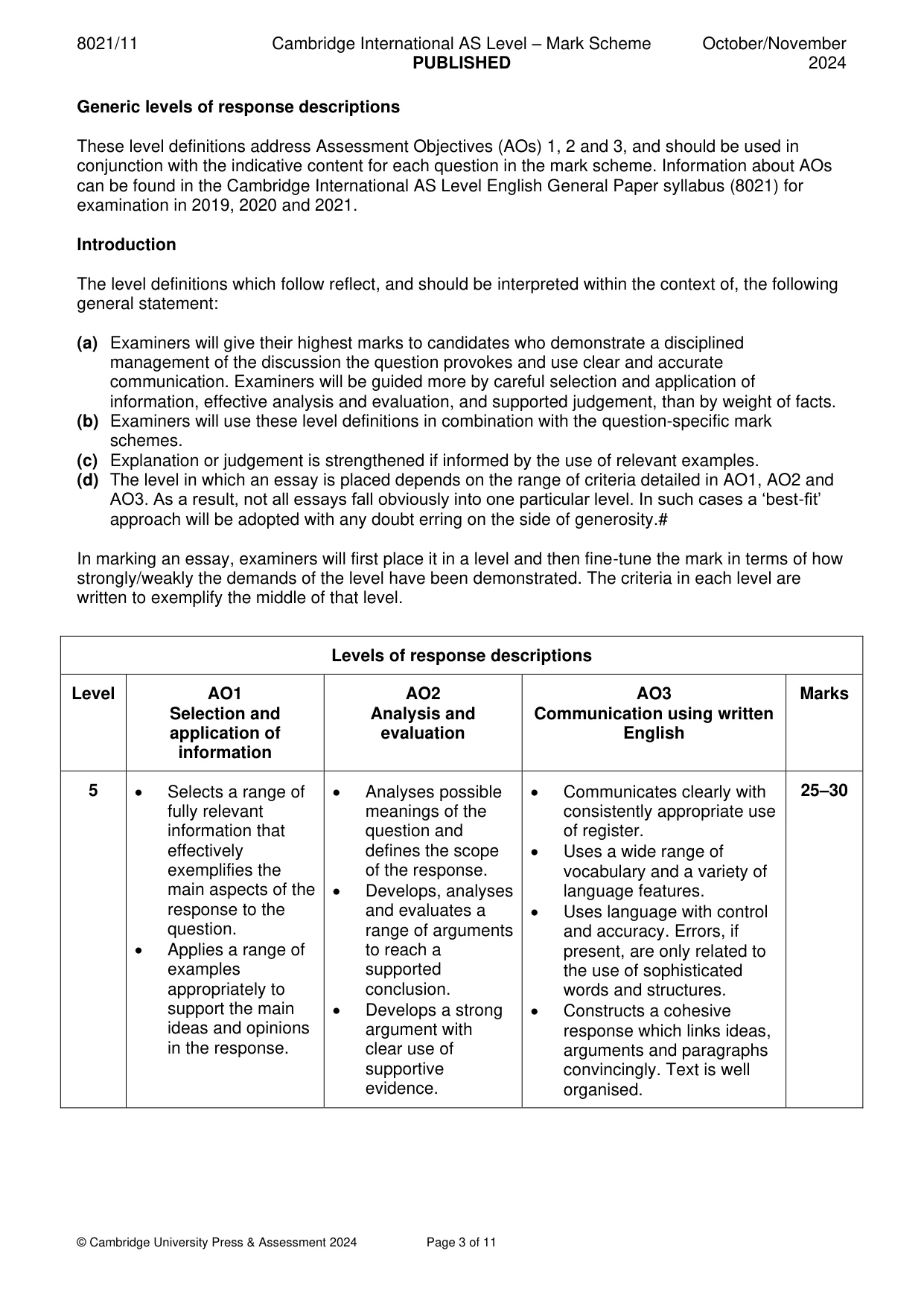
8021/11 Cambridge International AS Level – Mark Scheme PUBLISHED October/November 2024 © Cambridge University Press & Assessment 2024 Page 3 of 11 Generic levels of response descriptions These level definitions address Assessment Objectives (AOs) 1, 2 and 3, and should be used in conjunction with the indicative content for each question in the mark scheme. Information about AOs can be found in the Cambridge International AS Level English General Paper syllabus (8021) for examination in 2019, 2020 and 2021. Introduction The level definitions which follow reflect, and should be interpreted within the context of, the following general statement: (a) Examiners will give their highest marks to candidates who demonstrate a disciplined management of the discussion the question provokes and use clear and accurate communication. Examiners will be guided more by careful selection and application of information, effective analysis and evaluation, and supported judgement, than by weight of facts. (b) Examiners will use these level definitions in combination with the question-specific mark schemes. (c) Explanation or judgement is strengthened if informed by the use of relevant examples. (d) The level in which an essay is placed depends on the range of criteria detailed in AO1, AO2 and AO3. As a result, not all essays fall obviously into one particular level. In such cases a ‘best-fit’ approach will be adopted with any doubt erring on the side of generosity.# In marking an essay, examiners will first place it in a level and then fine-tune the mark in terms of how strongly/weakly the demands of the level have been demonstrated. The criteria in each level are written to exemplify the middle of that level. Levels of response descriptions Level AO1 Selection and application of information AO2 Analysis and evaluation AO3 Communication using written English Marks 5 • Selects a range of fully relevant information that effectively exemplifies the main aspects of the response to the question. • Applies a range of examples appropriately to support the main ideas and opinions in the response. • Analyses possible meanings of the question and defines the scope of the response. • Develops, analyses and evaluates a range of arguments to reach a supported conclusion. • Develops a strong argument with clear use of supportive evidence. • Communicates clearly with consistently appropriate use of register. • Uses a wide range of vocabulary and a variety of language features. • Uses language with control and accuracy. Errors, if present, are only related to the use of sophisticated words and structures. • Constructs a cohesive response which links ideas, arguments and paragraphs convincingly. Text is well organised. 25–30
Mark scheme, page 4
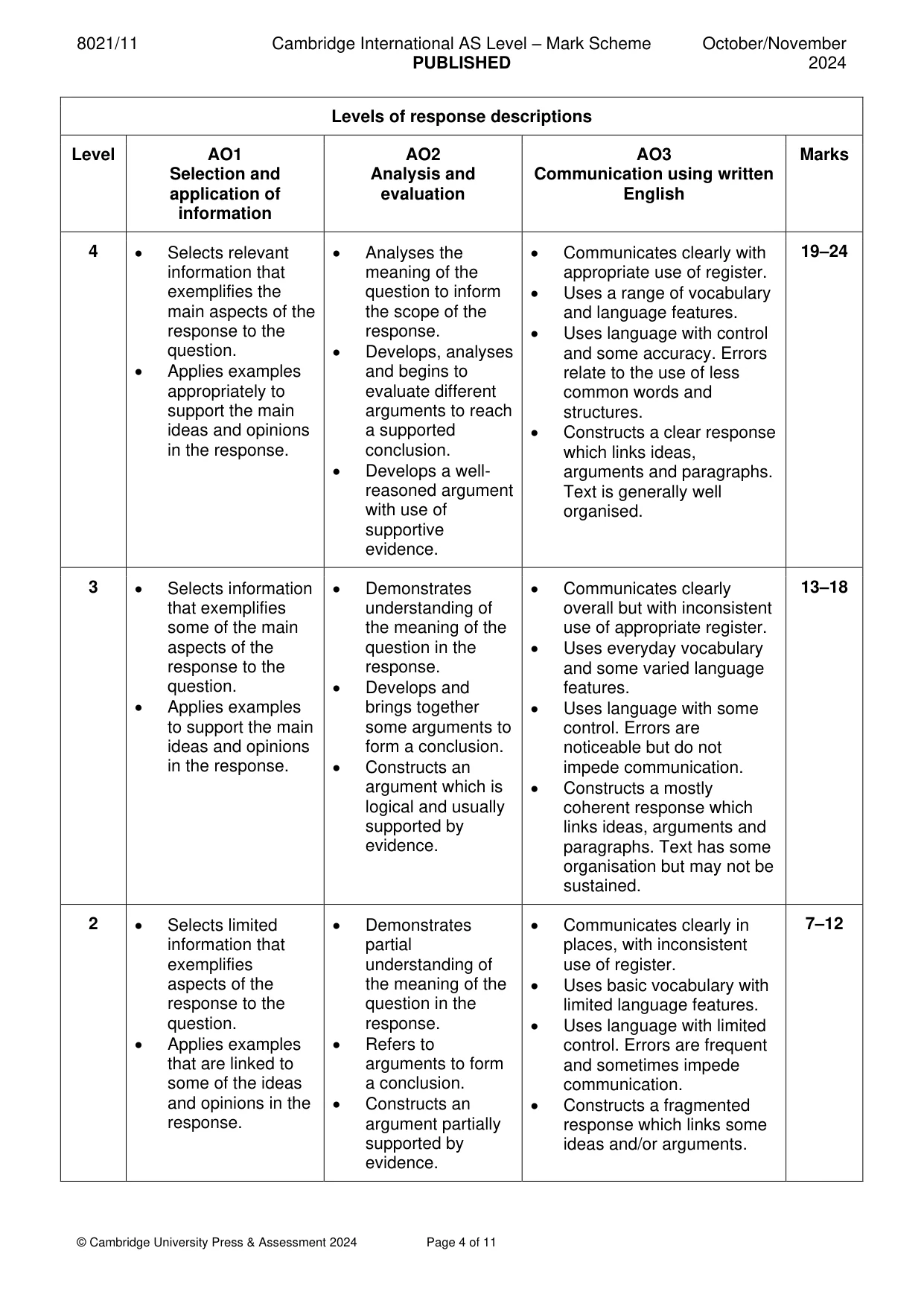
8021/11 Cambridge International AS Level – Mark Scheme PUBLISHED October/November 2024 © Cambridge University Press & Assessment 2024 Page 4 of 11 Levels of response descriptions Level AO1 Selection and application of information AO2 Analysis and evaluation AO3 Communication using written English Marks 4 • Selects relevant information that exemplifies the main aspects of the response to the question. • Applies examples appropriately to support the main ideas and opinions in the response. • Analyses the meaning of the question to inform the scope of the response. • Develops, analyses and begins to evaluate different arguments to reach a supported conclusion. • Develops a well- reasoned argument with use of supportive evidence. • Communicates clearly with appropriate use of register. • Uses a range of vocabulary and language features. • Uses language with control and some accuracy. Errors relate to the use of less common words and structures. • Constructs a clear response which links ideas, arguments and paragraphs. Text is generally well organised. 19–24 3 • Selects information that exemplifies some of the main aspects of the response to the question. • Applies examples to support the main ideas and opinions in the response. • Demonstrates understanding of the meaning of the question in the response. • Develops and brings together some arguments to form a conclusion. • Constructs an argument which is logical and usually supported by evidence. • Communicates clearly overall but with inconsistent use of appropriate register. • Uses everyday vocabulary and some varied language features. • Uses language with some control. Errors are noticeable but do not impede communication. • Constructs a mostly coherent response which links ideas, arguments and paragraphs. Text has some organisation but may not be sustained. 13–18 2 • Selects limited information that exemplifies aspects of the response to the question. • Applies examples that are linked to some of the ideas and opinions in the response. • Demonstrates partial understanding of the meaning of the question in the response. • Refers to arguments to form a conclusion. • Constructs an argument partially supported by evidence. • Communicates clearly in places, with inconsistent use of register. • Uses basic vocabulary with limited language features. • Uses language with limited control. Errors are frequent and sometimes impede communication. • Constructs a fragmented response which links some ideas and/or arguments. 7–12
Mark scheme, page 5
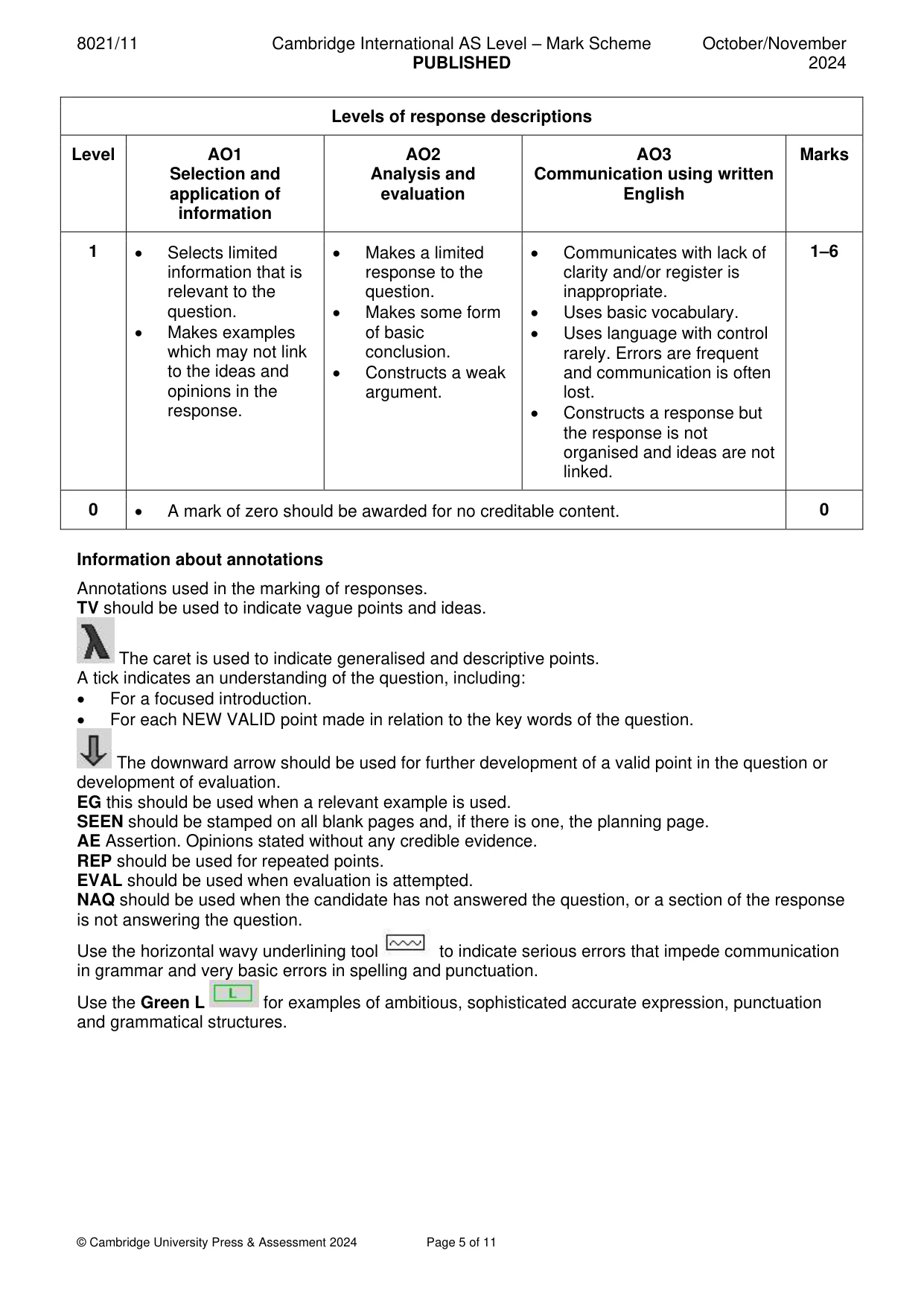
8021/11 Cambridge International AS Level – Mark Scheme PUBLISHED October/November 2024 © Cambridge University Press & Assessment 2024 Page 5 of 11 Levels of response descriptions Level AO1 Selection and application of information AO2 Analysis and evaluation AO3 Communication using written English Marks 1 • Selects limited information that is relevant to the question. • Makes examples which may not link to the ideas and opinions in the response. • Makes a limited response to the question. • Makes some form of basic conclusion. • Constructs a weak argument. • Communicates with lack of clarity and/or register is inappropriate. • Uses basic vocabulary. • Uses language with control rarely. Errors are frequent and communication is often lost. • Constructs a response but the response is not organised and ideas are not linked. 1–6 0 • A mark of zero should be awarded for no creditable content. 0 Information about annotations Annotations used in the marking of responses. TV should be used to indicate vague points and ideas. The caret is used to indicate generalised and descriptive points. A tick indicates an understanding of the question, including: • For a focused introduction. • For each NEW VALID point made in relation to the key words of the question. The downward arrow should be used for further development of a valid point in the question or development of evaluation. EG this should be used when a relevant example is used. SEEN should be stamped on all blank pages and, if there is one, the planning page. AE Assertion. Opinions stated without any credible evidence. REP should be used for repeated points. EVAL should be used when evaluation is attempted. NAQ should be used when the candidate has not answered the question, or a section of the response is not answering the question. Use the horizontal wavy underlining tool to indicate serious errors that impede communication in grammar and very basic errors in spelling and punctuation. Use the Green L for examples of ambitious, sophisticated accurate expression, punctuation and grammatical structures.
Mark scheme, page 6
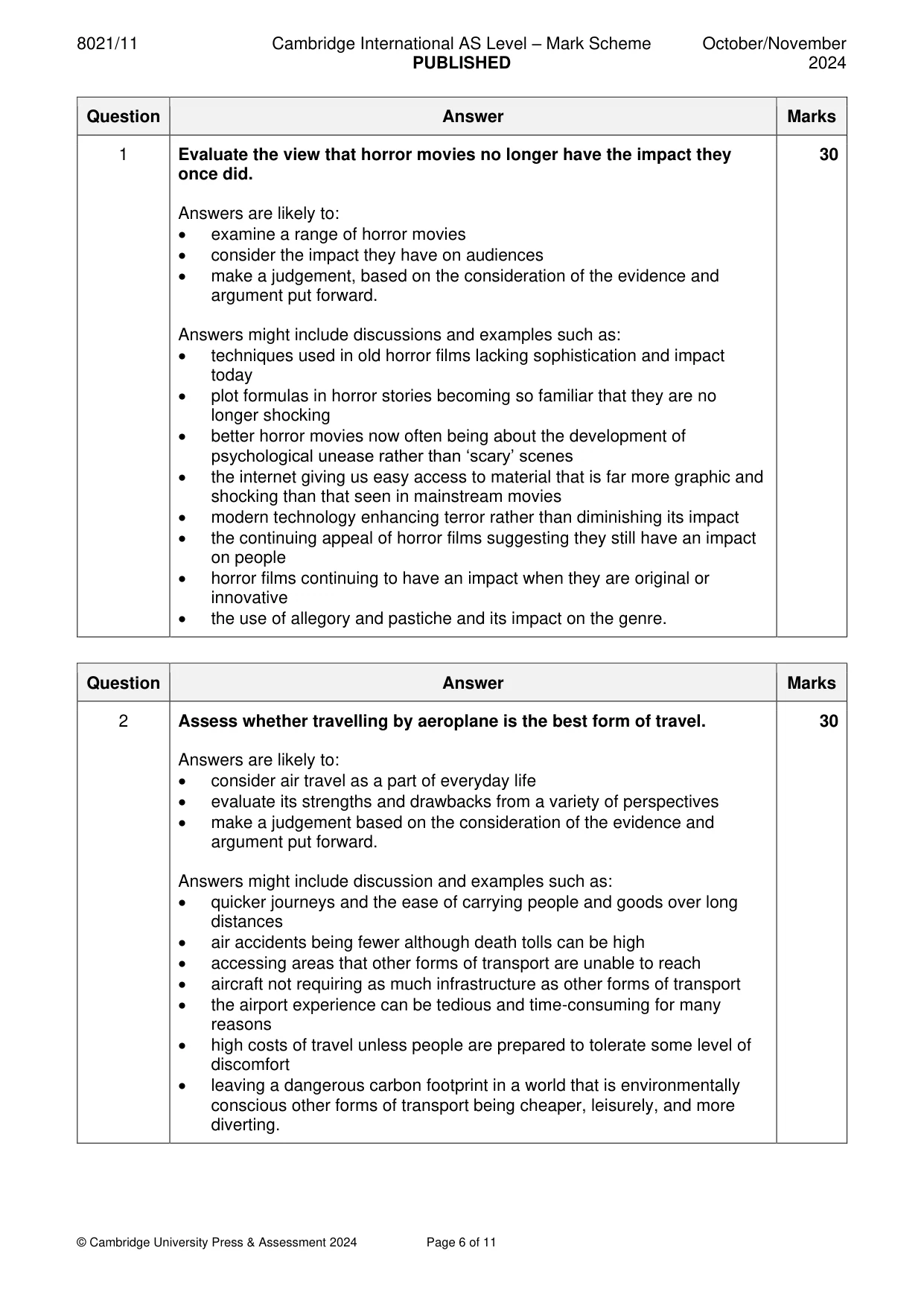
8021/11 Cambridge International AS Level – Mark Scheme PUBLISHED October/November 2024 © Cambridge University Press & Assessment 2024 Page 6 of 11 Question Answer Marks 1 Evaluate the view that horror movies no longer have the impact they once did. Answers are likely to: • examine a range of horror movies • consider the impact they have on audiences • make a judgement, based on the consideration of the evidence and argument put forward. Answers might include discussions and examples such as: • techniques used in old horror films lacking sophistication and impact today • plot formulas in horror stories becoming so familiar that they are no longer shocking • better horror movies now often being about the development of psychological unease rather than ‘scary’ scenes • the internet giving us easy access to material that is far more graphic and shocking than that seen in mainstream movies • modern technology enhancing terror rather than diminishing its impact • the continuing appeal of horror films suggesting they still have an impact on people • horror films continuing to have an impact when they are original or innovative • the use of allegory and pastiche and its impact on the genre. 30 Question Answer Marks 2 Assess whether travelling by aeroplane is the best form of travel. Answers are likely to: • consider air travel as a part of everyday life • evaluate its strengths and drawbacks from a variety of perspectives • make a judgement based on the consideration of the evidence and argument put forward. Answers might include discussion and examples such as: • quicker journeys and the ease of carrying people and goods over long distances • air accidents being fewer although death tolls can be high • accessing areas that other forms of transport are unable to reach • aircraft not requiring as much infrastructure as other forms of transport • the airport experience can be tedious and time-consuming for many reasons • high costs of travel unless people are prepared to tolerate some level of discomfort • leaving a dangerous carbon footprint in a world that is environmentally conscious other forms of transport being cheaper, leisurely, and more diverting. 30
Mark scheme, page 7
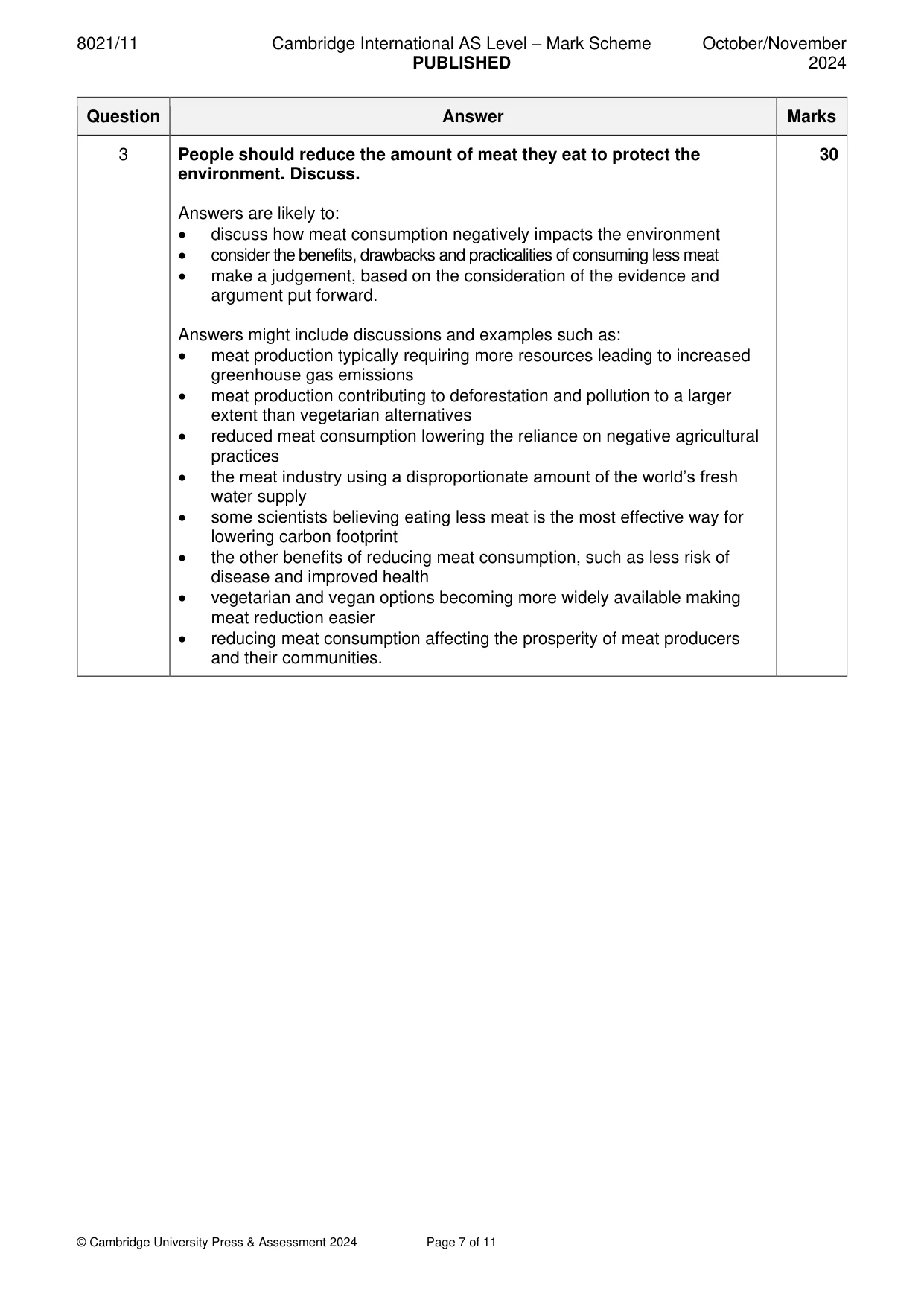
8021/11 Cambridge International AS Level – Mark Scheme PUBLISHED October/November 2024 © Cambridge University Press & Assessment 2024 Page 7 of 11 Question Answer Marks 3 People should reduce the amount of meat they eat to protect the environment. Discuss. Answers are likely to: • discuss how meat consumption negatively impacts the environment • consider the benefits, drawbacks and practicalities of consuming less meat • make a judgement, based on the consideration of the evidence and argument put forward. Answers might include discussions and examples such as: • meat production typically requiring more resources leading to increased greenhouse gas emissions • meat production contributing to deforestation and pollution to a larger extent than vegetarian alternatives • reduced meat consumption lowering the reliance on negative agricultural practices • the meat industry using a disproportionate amount of the world’s fresh water supply • some scientists believing eating less meat is the most effective way for lowering carbon footprint • the other benefits of reducing meat consumption, such as less risk of disease and improved health • vegetarian and vegan options becoming more widely available making meat reduction easier • reducing meat consumption affecting the prosperity of meat producers and their communities. 30
Mark scheme, page 8
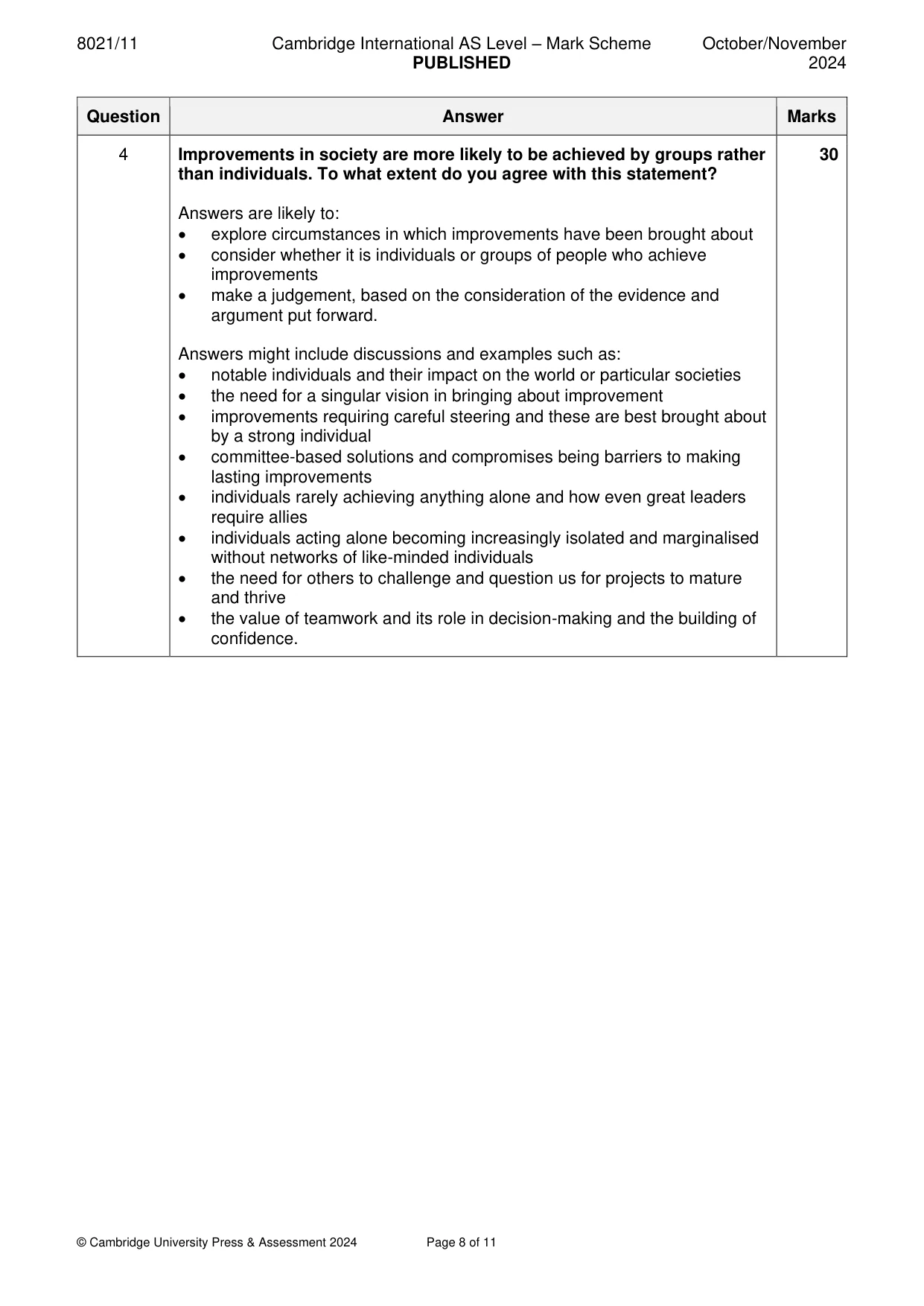
8021/11 Cambridge International AS Level – Mark Scheme PUBLISHED October/November 2024 © Cambridge University Press & Assessment 2024 Page 8 of 11 Question Answer Marks 4 Improvements in society are more likely to be achieved by groups rather than individuals. To what extent do you agree with this statement? Answers are likely to: • explore circumstances in which improvements have been brought about • consider whether it is individuals or groups of people who achieve improvements • make a judgement, based on the consideration of the evidence and argument put forward. Answers might include discussions and examples such as: • notable individuals and their impact on the world or particular societies • the need for a singular vision in bringing about improvement • improvements requiring careful steering and these are best brought about by a strong individual • committee-based solutions and compromises being barriers to making lasting improvements • individuals rarely achieving anything alone and how even great leaders require allies • individuals acting alone becoming increasingly isolated and marginalised without networks of like-minded individuals • the need for others to challenge and question us for projects to mature and thrive • the value of teamwork and its role in decision-making and the building of confidence. 30
Mark scheme, page 9
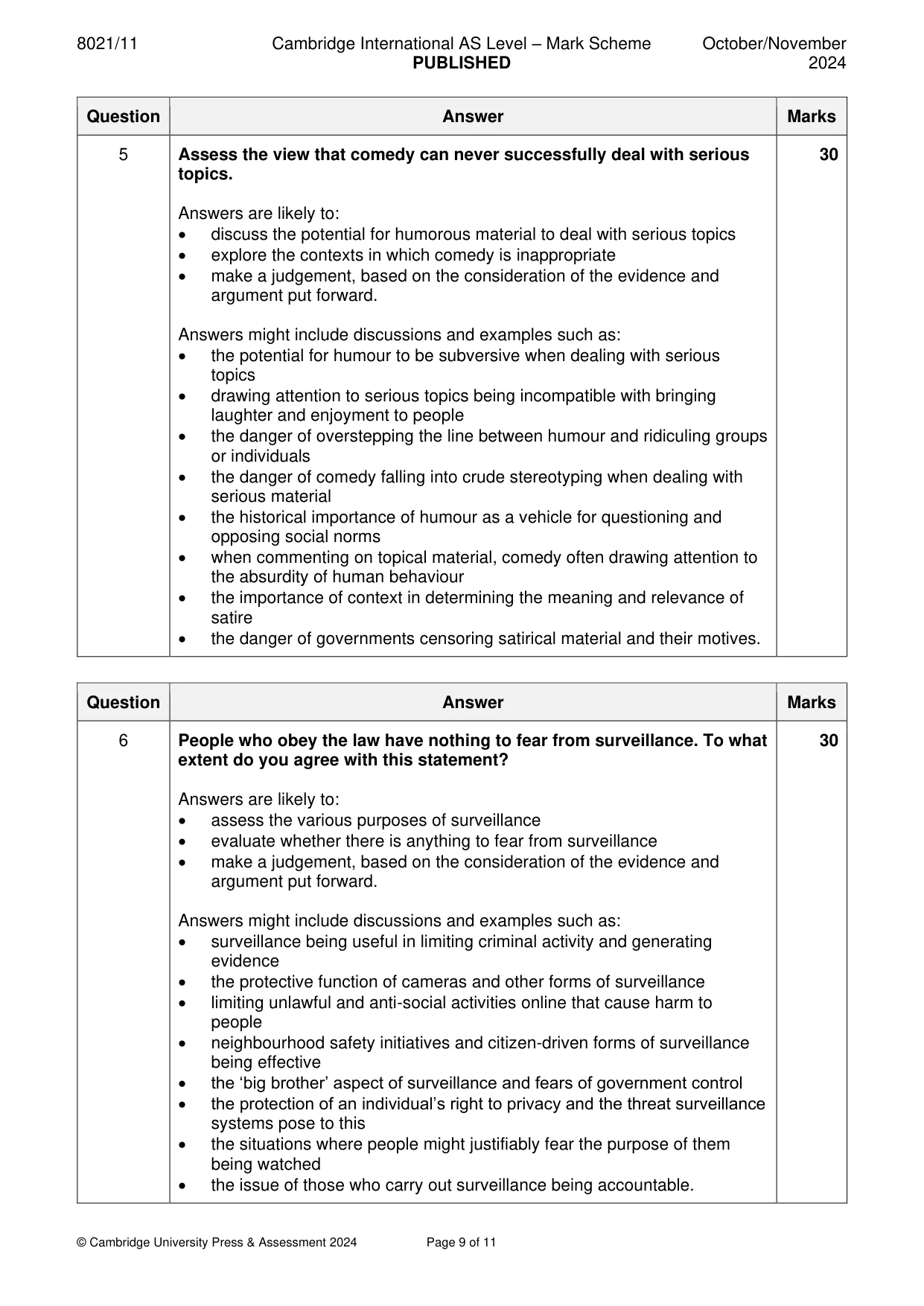
8021/11 Cambridge International AS Level – Mark Scheme PUBLISHED October/November 2024 © Cambridge University Press & Assessment 2024 Page 9 of 11 Question Answer Marks 5 Assess the view that comedy can never successfully deal with serious topics. Answers are likely to: • discuss the potential for humorous material to deal with serious topics • explore the contexts in which comedy is inappropriate • make a judgement, based on the consideration of the evidence and argument put forward. Answers might include discussions and examples such as: • the potential for humour to be subversive when dealing with serious topics • drawing attention to serious topics being incompatible with bringing laughter and enjoyment to people • the danger of overstepping the line between humour and ridiculing groups or individuals • the danger of comedy falling into crude stereotyping when dealing with serious material • the historical importance of humour as a vehicle for questioning and opposing social norms • when commenting on topical material, comedy often drawing attention to the absurdity of human behaviour • the importance of context in determining the meaning and relevance of satire • the danger of governments censoring satirical material and their motives. 30 Question Answer Marks 6 People who obey the law have nothing to fear from surveillance. To what extent do you agree with this statement? Answers are likely to: • assess the various purposes of surveillance • evaluate whether there is anything to fear from surveillance • make a judgement, based on the consideration of the evidence and argument put forward. Answers might include discussions and examples such as: • surveillance being useful in limiting criminal activity and generating evidence • the protective function of cameras and other forms of surveillance • limiting unlawful and anti-social activities online that cause harm to people • neighbourhood safety initiatives and citizen-driven forms of surveillance being effective • the ‘big brother’ aspect of surveillance and fears of government control • the protection of an individual’s right to privacy and the threat surveillance systems pose to this • the situations where people might justifiably fear the purpose of them being watched • the issue of those who carry out surveillance being accountable. 30
Mark scheme, page 10
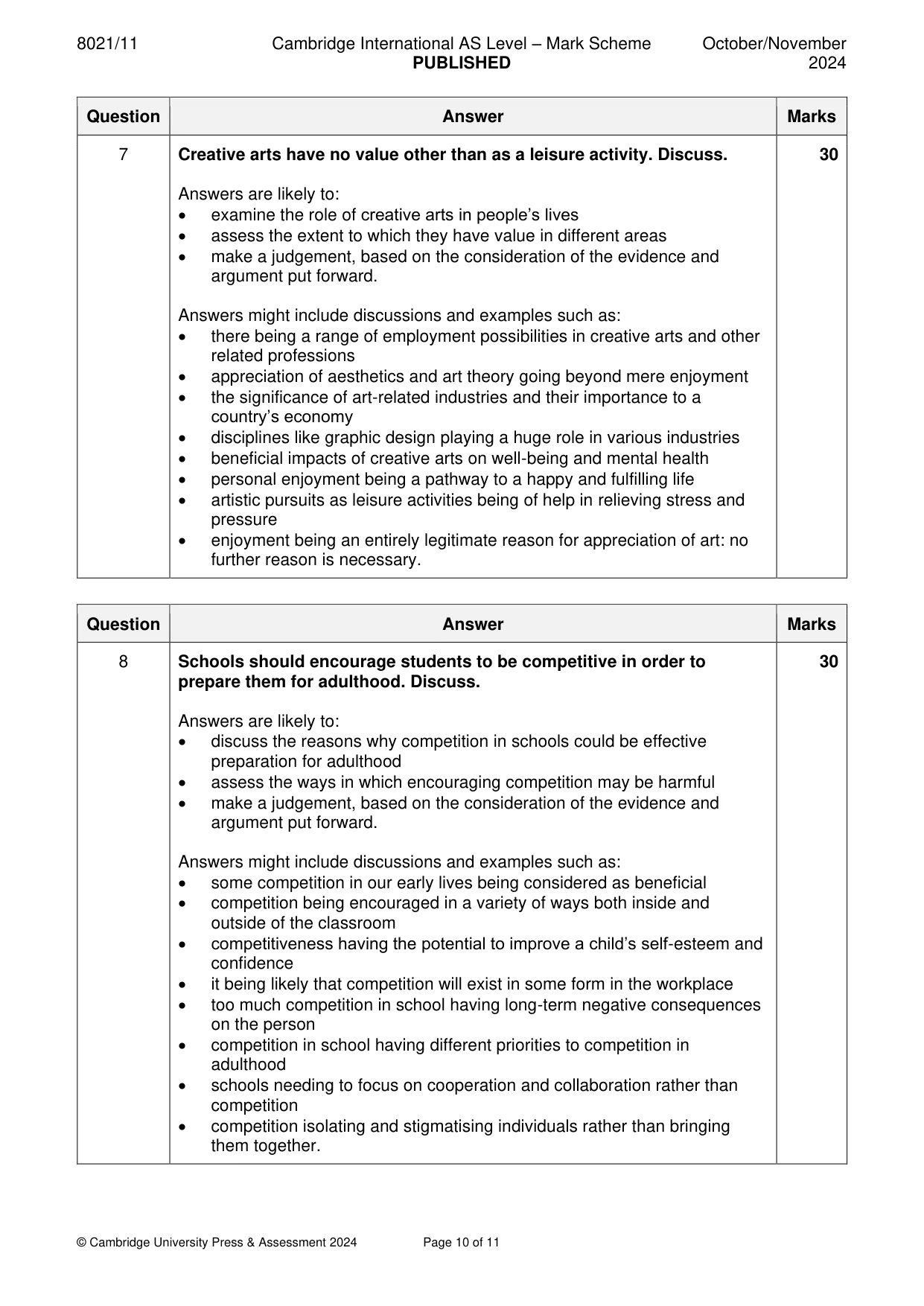
8021/11 Cambridge International AS Level – Mark Scheme PUBLISHED October/November 2024 © Cambridge University Press & Assessment 2024 Page 10 of 11 Question Answer Marks 7 Creative arts have no value other than as a leisure activity. Discuss. Answers are likely to: • examine the role of creative arts in people’s lives • assess the extent to which they have value in different areas • make a judgement, based on the consideration of the evidence and argument put forward. Answers might include discussions and examples such as: • there being a range of employment possibilities in creative arts and other related professions • appreciation of aesthetics and art theory going beyond mere enjoyment • the significance of art-related industries and their importance to a country’s economy • disciplines like graphic design playing a huge role in various industries • beneficial impacts of creative arts on well-being and mental health • personal enjoyment being a pathway to a happy and fulfilling life • artistic pursuits as leisure activities being of help in relieving stress and pressure • enjoyment being an entirely legitimate reason for appreciation of art: no further reason is necessary. 30 Question Answer Marks 8 Schools should encourage students to be competitive in order to prepare them for adulthood. Discuss. Answers are likely to: • discuss the reasons why competition in schools could be effective preparation for adulthood • assess the ways in which encouraging competition may be harmful • make a judgement, based on the consideration of the evidence and argument put forward. Answers might include discussions and examples such as: • some competition in our early lives being considered as beneficial • competition being encouraged in a variety of ways both inside and outside of the classroom • competitiveness having the potential to improve a child’s self-esteem and confidence • it being likely that competition will exist in some form in the workplace • too much competition in school having long-term negative consequences on the person • competition in school having different priorities to competition in adulthood • schools needing to focus on cooperation and collaboration rather than competition • competition isolating and stigmatising individuals rather than bringing them together. 30
Mark scheme, page 11
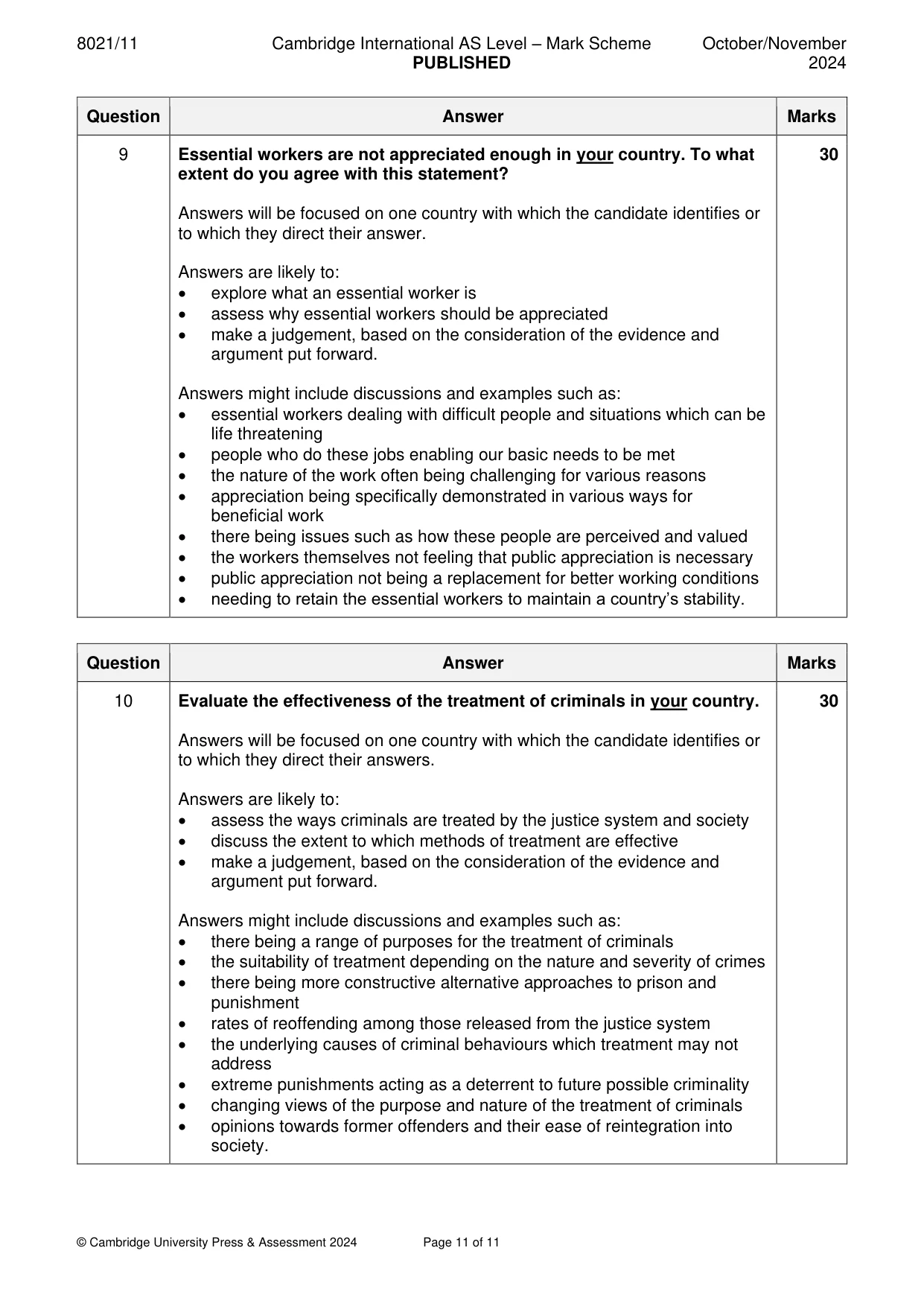
8021/11 Cambridge International AS Level – Mark Scheme PUBLISHED October/November 2024 © Cambridge University Press & Assessment 2024 Page 11 of 11 Question Answer Marks 9 Essential workers are not appreciated enough in your country. To what extent do you agree with this statement? Answers will be focused on one country with which the candidate identifies or to which they direct their answer. Answers are likely to: • explore what an essential worker is • assess why essential workers should be appreciated • make a judgement, based on the consideration of the evidence and argument put forward. Answers might include discussions and examples such as: • essential workers dealing with difficult people and situations which can be life threatening • people who do these jobs enabling our basic needs to be met • the nature of the work often being challenging for various reasons • appreciation being specifically demonstrated in various ways for beneficial work • there being issues such as how these people are perceived and valued • the workers themselves not feeling that public appreciation is necessary • public appreciation not being a replacement for better working conditions • needing to retain the essential workers to maintain a country’s stability. 30 Question Answer Marks 10 Evaluate the effectiveness of the treatment of criminals in your country. Answers will be focused on one country with which the candidate identifies or to which they direct their answers. Answers are likely to: • assess the ways criminals are treated by the justice system and society • discuss the extent to which methods of treatment are effective • make a judgement, based on the consideration of the evidence and argument put forward. Answers might include discussions and examples such as: • there being a range of purposes for the treatment of criminals • the suitability of treatment depending on the nature and severity of crimes • there being more constructive alternative approaches to prison and punishment • rates of reoffending among those released from the justice system • the underlying causes of criminal behaviours which treatment may not address • extreme punishments acting as a deterrent to future possible criminality • changing views of the purpose and nature of the treatment of criminals • opinions towards former offenders and their ease of reintegration into society. 30
What you needed in this session
Cambridge’s own grade thresholds for 2024 Oct/Nov, Paper 1 · Variant 1. A higher threshold means an easier paper — the bar moves with how the cohort did.