Cambridge A Level English General Paper 8021 — 2024 May/June Paper 1 · Variant 1
8021/11/M/J/24 · 30 marks · ≈34 min
The question paper and its mark scheme, free to read here and free to download. This is Cambridge’s own paper, exactly as it was sat.
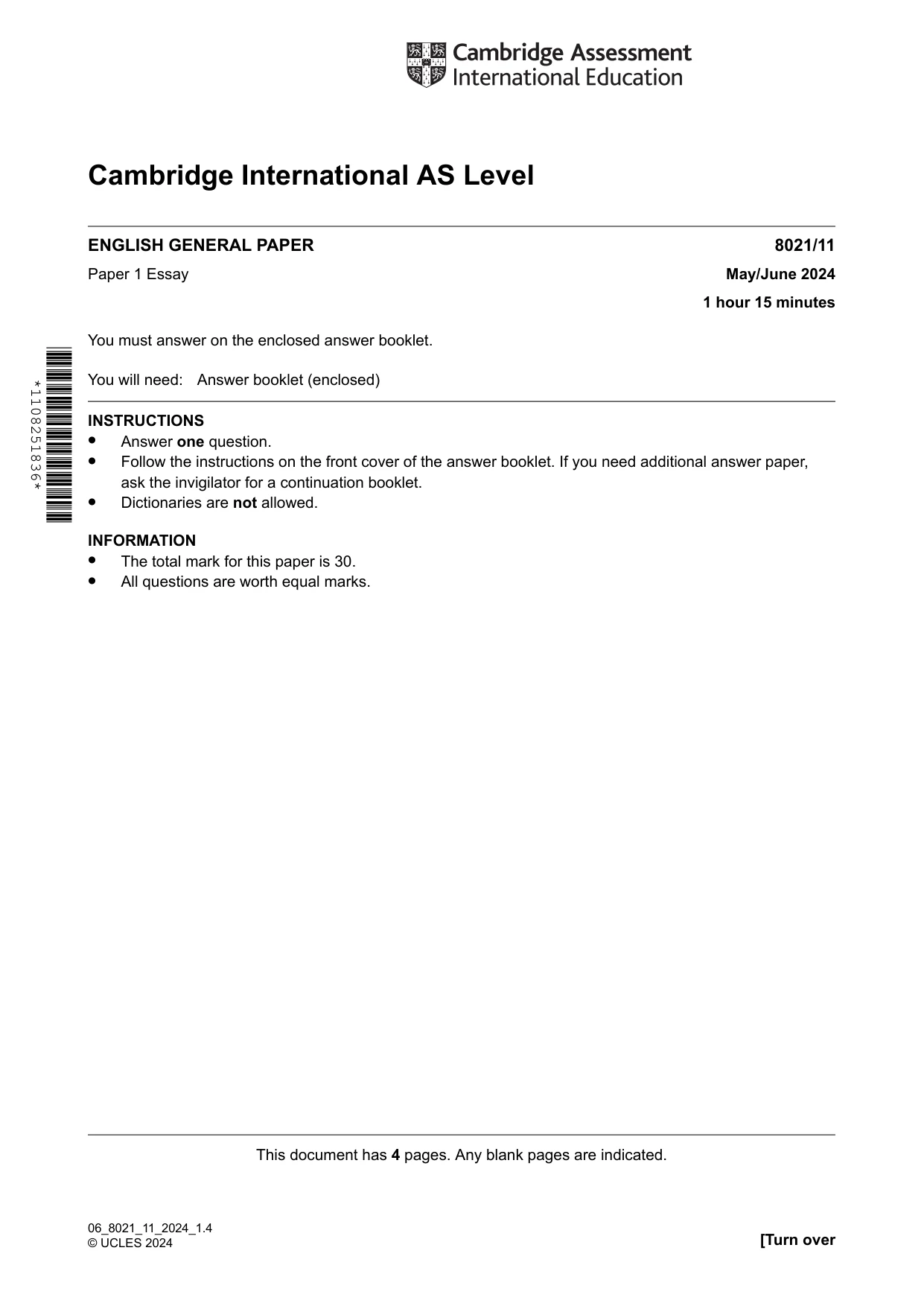
Question paper4 pages
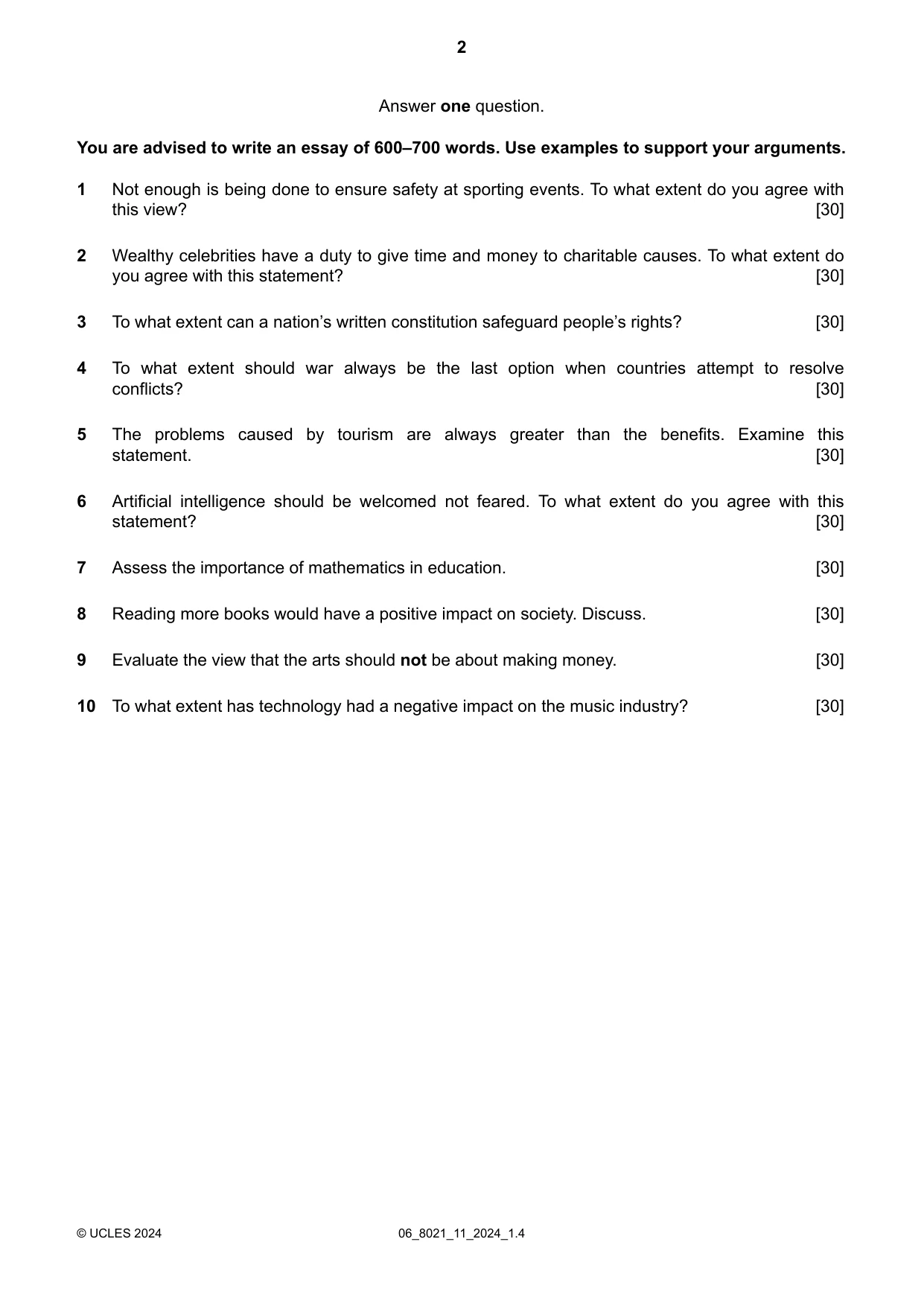


Mark scheme15 pages
Answers below. Sit the paper first if you are practising.
Paper as text
Question paper, page 1
Cambridge International AS Level 8021/11 May/June 2024 1 hour 15 minutes ENGLISH GENERAL PAPER Paper 1 Essay You must answer on the enclosed answer booklet. You will need: Answer booklet (enclosed) INSTRUCTIONS • Answer one question. • Follow the instructions on the front cover of the answer booklet. If you need additional answer paper, ask the invigilator for a continuation booklet. • Dictionaries are not allowed. INFORMATION • The total mark for this paper is 30. • All questions are worth equal marks. This document has 4 pages. Any blank pages are indicated. [Turn over 06_8021_11_2024_1.4 © UCLES 2024 *1108251836*
Question paper, page 2
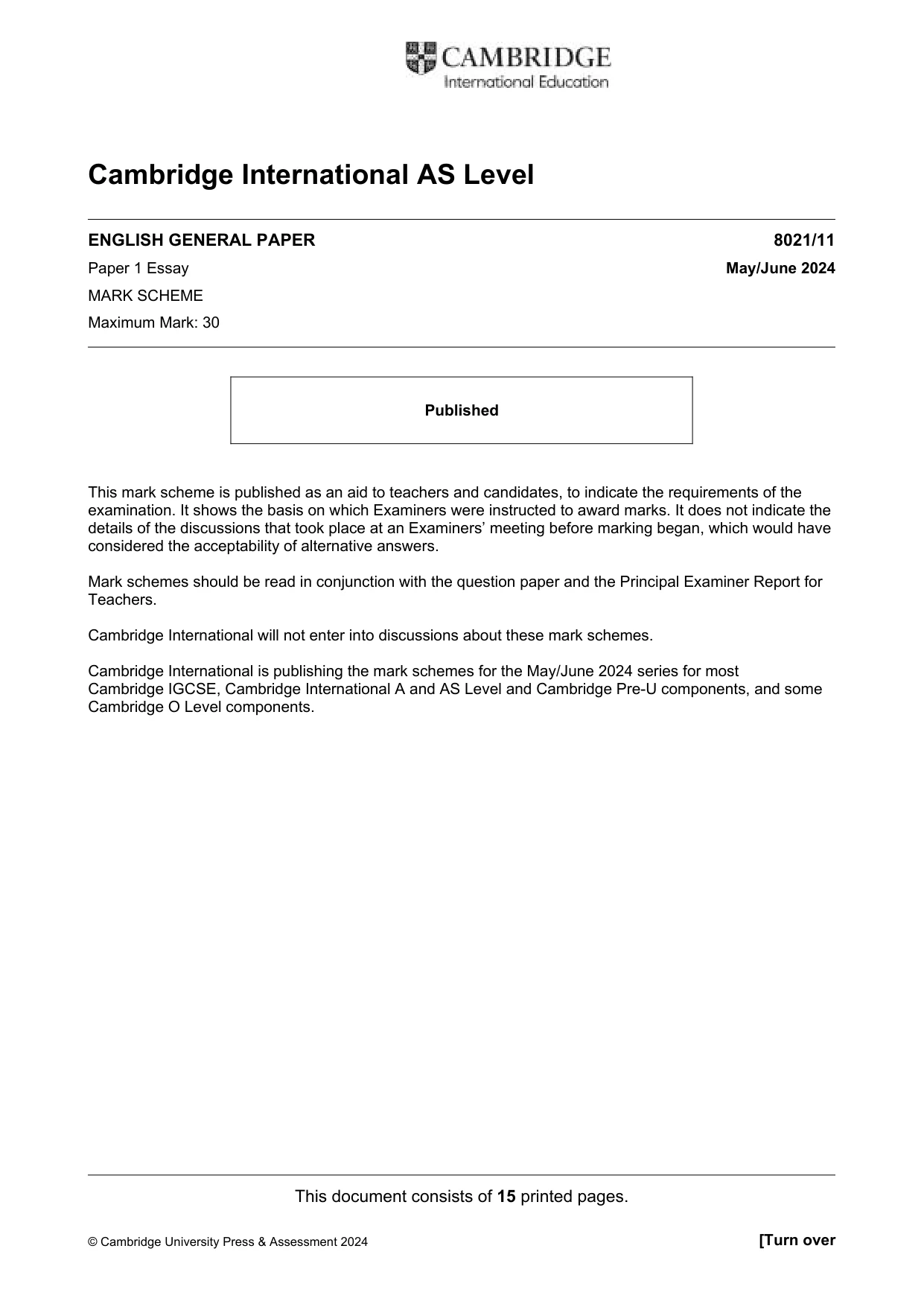
Answer one question. You are advised to write an essay of 600–700 words. Use examples to support your arguments. Not enough is being done to ensure safety at sporting events. To what extent do you agree with this view? [30] 1 Wealthy celebrities have a duty to give time and money to charitable causes. To what extent do you agree with this statement? [30] 2 To what extent can a nation’s written constitution safeguard people’s rights? [30] 3 To what extent should war always be the last option when countries attempt to resolve conflicts? [30] 4 The problems caused by tourism are always greater than the benefits. Examine this statement. [30] 5 Artificial intelligence should be welcomed not feared. To what extent do you agree with this statement? [30] 6 Assess the importance of mathematics in education. [30] 7 Reading more books would have a positive impact on society. Discuss. [30] 8 Evaluate the view that the arts should not be about making money. [30] 9 To what extent has technology had a negative impact on the music industry? [30] 10 06_8021_11_2024_1.4 © UCLES 2024 2
Question paper, page 3
BLANK PAGE 06_8021_11_2024_1.4 © UCLES 2024 3
Question paper, page 4
BLANK PAGE Permission to reproduce items where third-party owned material protected by copyright is included has been sought and cleared where possible. Every reasonable effort has been made by the publisher (UCLES) to trace copyright holders, but if any items requiring clearance have unwittingly been included, the publisher will be pleased to make amends at the earliest possible opportunity. To avoid the issue of disclosure of answer-related information to candidates, all copyright acknowledgements are reproduced online in the Cambridge Assessment International Education Copyright Acknowledgements Booklet. This is produced for each series of examinations and is freely available to download at www.cambridgeinternational.org after the live examination series. Cambridge Assessment International Education is part of Cambridge Assessment. Cambridge Assessment is the brand name of the University of Cambridge Local Examinations Syndicate (UCLES), which is a department of the University of Cambridge. 06_8021_11_2024_1.4 © UCLES 2024 4
Mark scheme, page 1
This document consists of 15 printed pages. © Cambridge University Press & Assessment 2024 [Turn over Cambridge International AS Level ENGLISH GENERAL PAPER 8021/11 Paper 1 Essay May/June 2024 MARK SCHEME Maximum Mark: 30 Published This mark scheme is published as an aid to teachers and candidates, to indicate the requirements of the examination. It shows the basis on which Examiners were instructed to award marks. It does not indicate the details of the discussions that took place at an Examiners’ meeting before marking began, which would have considered the acceptability of alternative answers. Mark schemes should be read in conjunction with the question paper and the Principal Examiner Report for Teachers. Cambridge International will not enter into discussions about these mark schemes. Cambridge International is publishing the mark schemes for the May/June 2024 series for most Cambridge IGCSE, Cambridge International A and AS Level and Cambridge Pre-U components, and some Cambridge O Level components.
Mark scheme, page 2
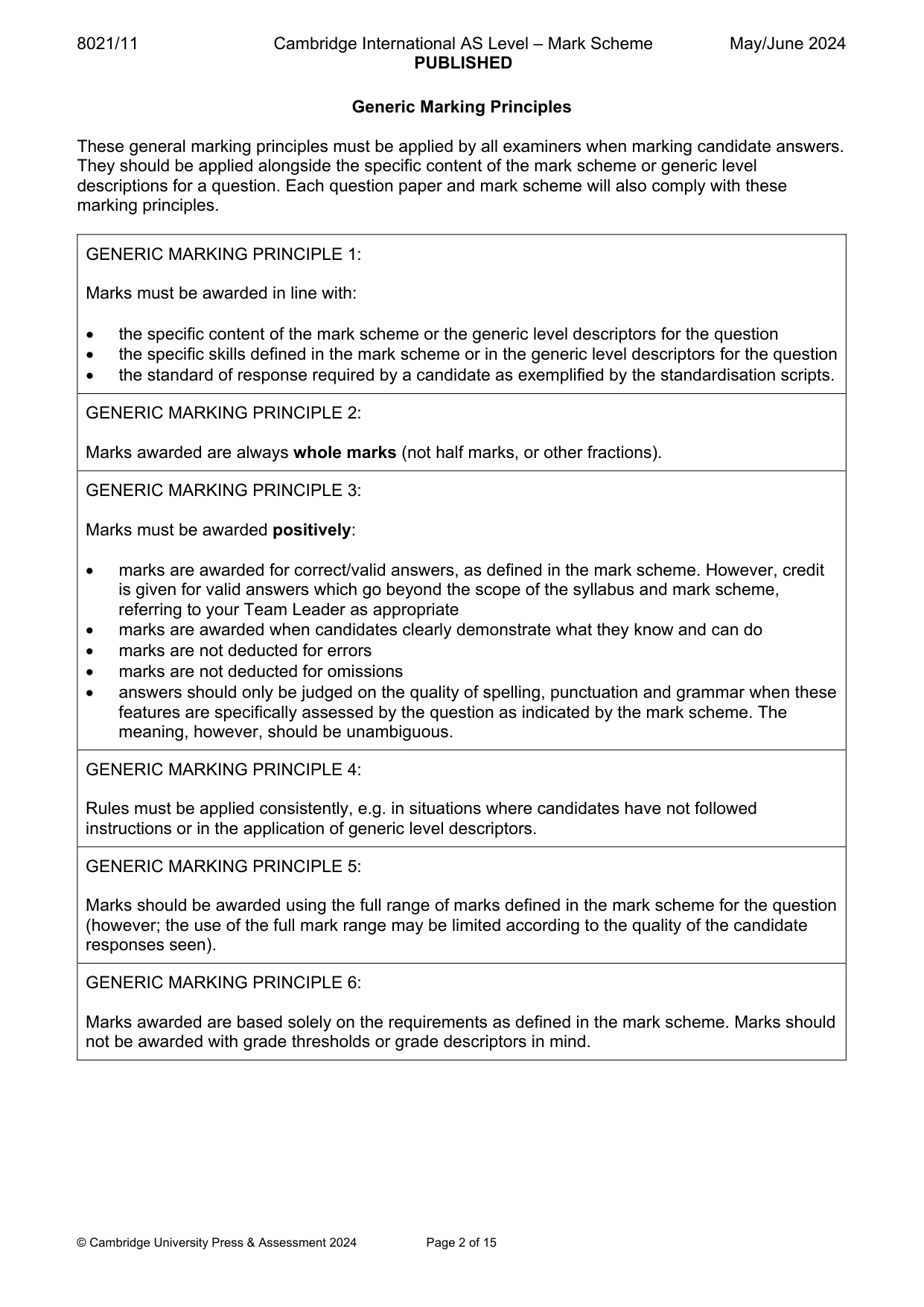
8021/11 Cambridge International AS Level – Mark Scheme PUBLISHED May/June 2024 © Cambridge University Press & Assessment 2024 Page 2 of 15 Generic Marking Principles These general marking principles must be applied by all examiners when marking candidate answers. They should be applied alongside the specific content of the mark scheme or generic level descriptions for a question. Each question paper and mark scheme will also comply with these marking principles. GENERIC MARKING PRINCIPLE 1: Marks must be awarded in line with: the specific content of the mark scheme or the generic level descriptors for the question the specific skills defined in the mark scheme or in the generic level descriptors for the question the standard of response required by a candidate as exemplified by the standardisation scripts. GENERIC MARKING PRINCIPLE 2: Marks awarded are always whole marks (not half marks, or other fractions). GENERIC MARKING PRINCIPLE 3: Marks must be awarded positively: marks are awarded for correct/valid answers, as defined in the mark scheme. However, credit is given for valid answers which go beyond the scope of the syllabus and mark scheme, referring to your Team Leader as appropriate marks are awarded when candidates clearly demonstrate what they know and can do marks are not deducted for errors marks are not deducted for omissions answers should only be judged on the quality of spelling, punctuation and grammar when these features are specifically assessed by the question as indicated by the mark scheme. The meaning, however, should be unambiguous. GENERIC MARKING PRINCIPLE 4: Rules must be applied consistently, e.g. in situations where candidates have not followed instructions or in the application of generic level descriptors. GENERIC MARKING PRINCIPLE 5: Marks should be awarded using the full range of marks defined in the mark scheme for the question (however; the use of the full mark range may be limited according to the quality of the candidate responses seen). GENERIC MARKING PRINCIPLE 6: Marks awarded are based solely on the requirements as defined in the mark scheme. Marks should not be awarded with grade thresholds or grade descriptors in mind.
Mark scheme, page 3
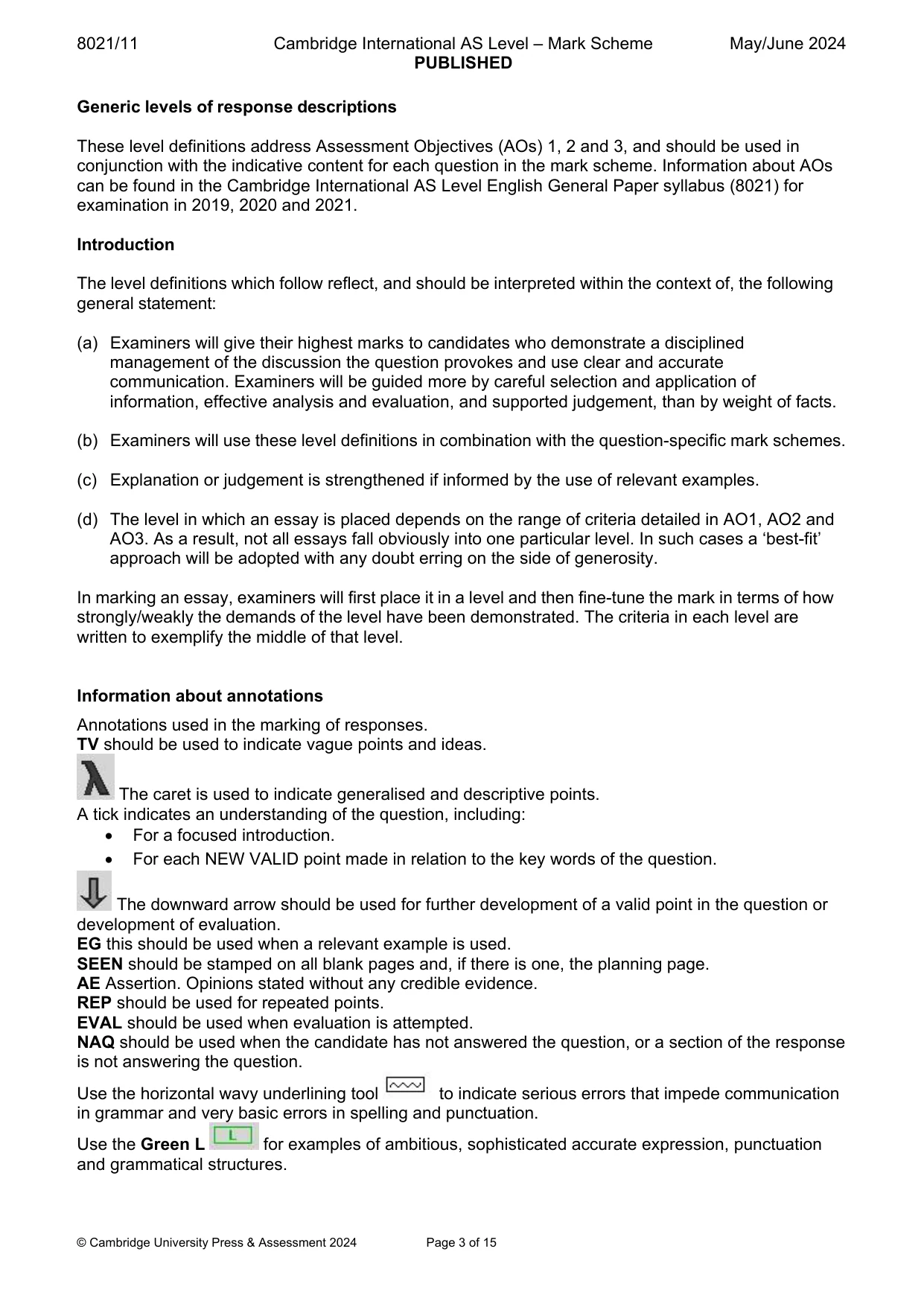
8021/11 Cambridge International AS Level – Mark Scheme PUBLISHED May/June 2024 © Cambridge University Press & Assessment 2024 Page 3 of 15 Generic levels of response descriptions These level definitions address Assessment Objectives (AOs) 1, 2 and 3, and should be used in conjunction with the indicative content for each question in the mark scheme. Information about AOs can be found in the Cambridge International AS Level English General Paper syllabus (8021) for examination in 2019, 2020 and 2021. Introduction The level definitions which follow reflect, and should be interpreted within the context of, the following general statement: (a) Examiners will give their highest marks to candidates who demonstrate a disciplined management of the discussion the question provokes and use clear and accurate communication. Examiners will be guided more by careful selection and application of information, effective analysis and evaluation, and supported judgement, than by weight of facts. (b) Examiners will use these level definitions in combination with the question-specific mark schemes. (c) Explanation or judgement is strengthened if informed by the use of relevant examples. (d) The level in which an essay is placed depends on the range of criteria detailed in AO1, AO2 and AO3. As a result, not all essays fall obviously into one particular level. In such cases a ‘best-fit’ approach will be adopted with any doubt erring on the side of generosity. In marking an essay, examiners will first place it in a level and then fine-tune the mark in terms of how strongly/weakly the demands of the level have been demonstrated. The criteria in each level are written to exemplify the middle of that level. Information about annotations Annotations used in the marking of responses. TV should be used to indicate vague points and ideas. The caret is used to indicate generalised and descriptive points. A tick indicates an understanding of the question, including: For a focused introduction. For each NEW VALID point made in relation to the key words of the question. The downward arrow should be used for further development of a valid point in the question or development of evaluation. EG this should be used when a relevant example is used. SEEN should be stamped on all blank pages and, if there is one, the planning page. AE Assertion. Opinions stated without any credible evidence. REP should be used for repeated points. EVAL should be used when evaluation is attempted. NAQ should be used when the candidate has not answered the question, or a section of the response is not answering the question. Use the horizontal wavy underlining tool to indicate serious errors that impede communication in grammar and very basic errors in spelling and punctuation. Use the Green L for examples of ambitious, sophisticated accurate expression, punctuation and grammatical structures.
Mark scheme, page 4
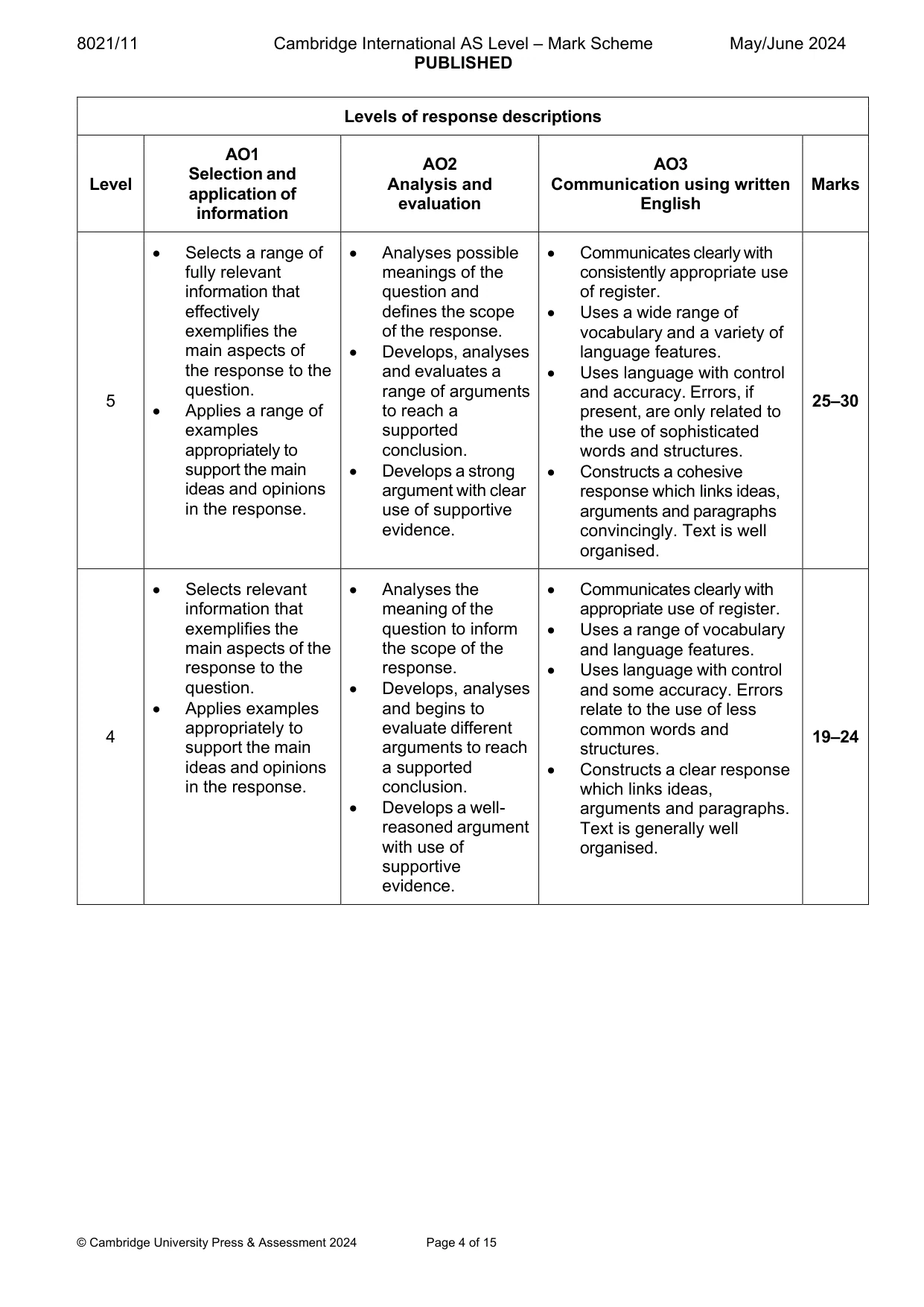
8021/11 Cambridge International AS Level – Mark Scheme PUBLISHED May/June 2024 © Cambridge University Press & Assessment 2024 Page 4 of 15 Levels of response descriptions Level AO1 Selection and application of information AO2 Analysis and evaluation AO3 Communication using written English Marks 5 Selects a range of fully relevant information that effectively exemplifies the main aspects of the response to the question. Applies a range of examples appropriately to support the main ideas and opinions in the response. Analyses possible meanings of the question and defines the scope of the response. Develops, analyses and evaluates a range of arguments to reach a supported conclusion. Develops a strong argument with clear use of supportive evidence. Communicates clearly with consistently appropriate use of register. Uses a wide range of vocabulary and a variety of language features. Uses language with control and accuracy. Errors, if present, are only related to the use of sophisticated words and structures. Constructs a cohesive response which links ideas, arguments and paragraphs convincingly. Text is well organised. 25–30 4 Selects relevant information that exemplifies the main aspects of the response to the question. Applies examples appropriately to support the main ideas and opinions in the response. Analyses the meaning of the question to inform the scope of the response. Develops, analyses and begins to evaluate different arguments to reach a supported conclusion. Develops a well- reasoned argument with use of supportive evidence. Communicates clearly with appropriate use of register. Uses a range of vocabulary and language features. Uses language with control and some accuracy. Errors relate to the use of less common words and structures. Constructs a clear response which links ideas, arguments and paragraphs. Text is generally well organised. 19–24
Mark scheme, page 5
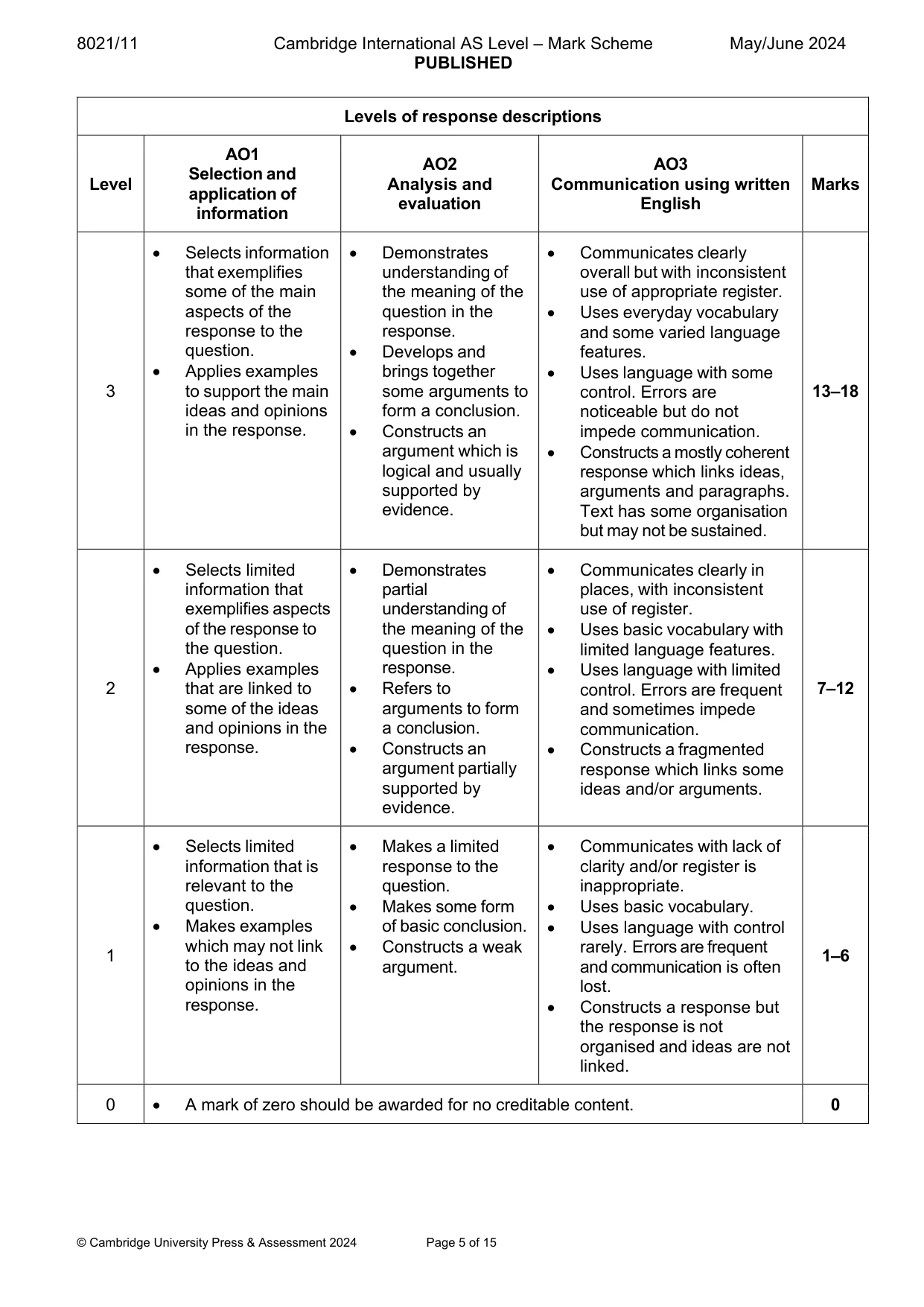
8021/11 Cambridge International AS Level – Mark Scheme PUBLISHED May/June 2024 © Cambridge University Press & Assessment 2024 Page 5 of 15 Levels of response descriptions Level AO1 Selection and application of information AO2 Analysis and evaluation AO3 Communication using written English Marks 3 Selects information that exemplifies some of the main aspects of the response to the question. Applies examples to support the main ideas and opinions in the response. Demonstrates understanding of the meaning of the question in the response. Develops and brings together some arguments to form a conclusion. Constructs an argument which is logical and usually supported by evidence. Communicates clearly overall but with inconsistent use of appropriate register. Uses everyday vocabulary and some varied language features. Uses language with some control. Errors are noticeable but do not impede communication. Constructs a mostly coherent response which links ideas, arguments and paragraphs. Text has some organisation but may not be sustained. 13–18 2 Selects limited information that exemplifies aspects of the response to the question. Applies examples that are linked to some of the ideas and opinions in the response. Demonstrates partial understanding of the meaning of the question in the response. Refers to arguments to form a conclusion. Constructs an argument partially supported by evidence. Communicates clearly in places, with inconsistent use of register. Uses basic vocabulary with limited language features. Uses language with limited control. Errors are frequent and sometimes impede communication. Constructs a fragmented response which links some ideas and/or arguments. 7–12 1 Selects limited information that is relevant to the question. Makes examples which may not link to the ideas and opinions in the response. Makes a limited response to the question. Makes some form of basic conclusion. Constructs a weak argument. Communicates with lack of clarity and/or register is inappropriate. Uses basic vocabulary. Uses language with control rarely. Errors are frequent and communication is often lost. Constructs a response but the response is not organised and ideas are not linked. 1–6 0 A mark of zero should be awarded for no creditable content. 0
Mark scheme, page 6
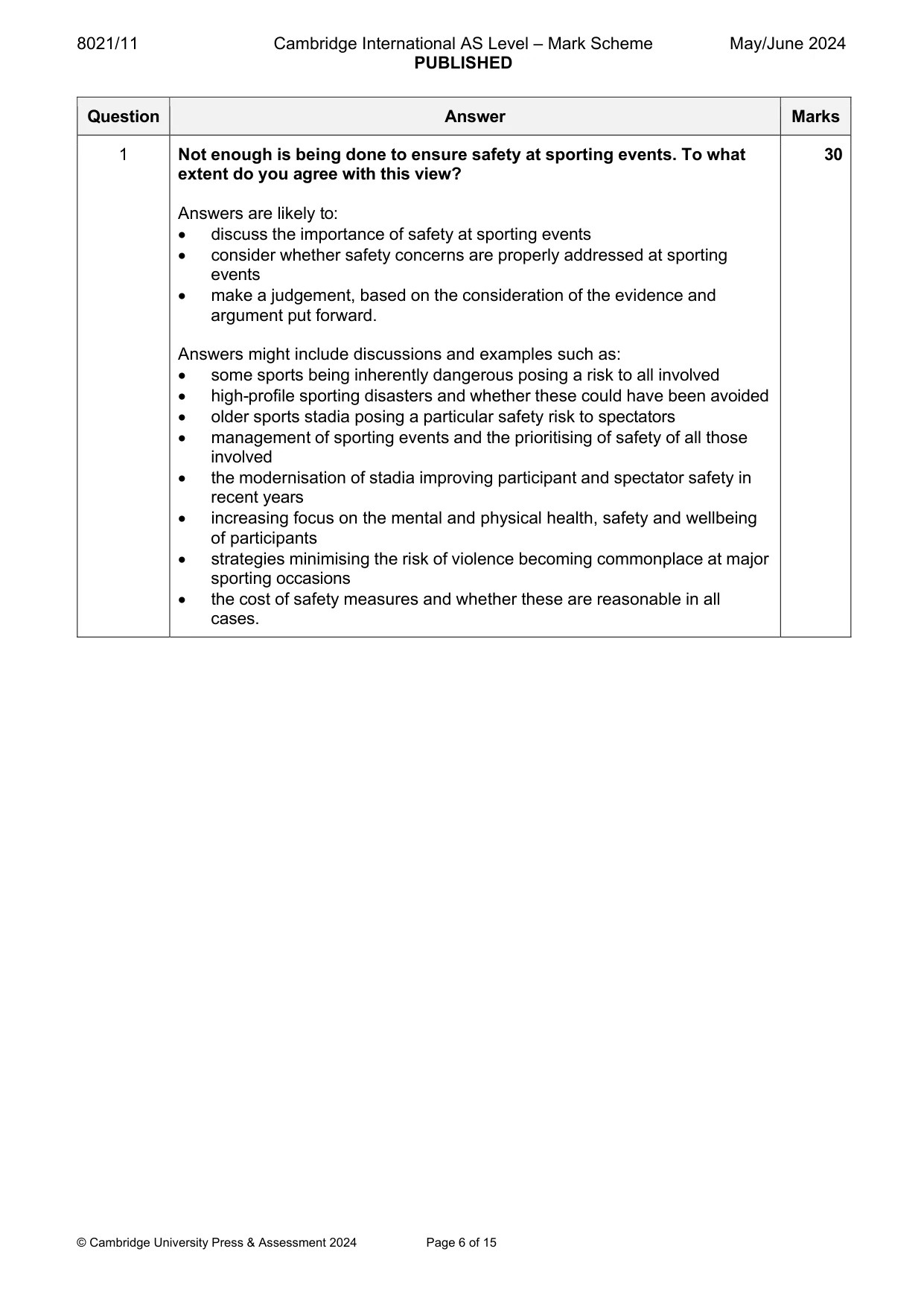
8021/11 Cambridge International AS Level – Mark Scheme PUBLISHED May/June 2024 © Cambridge University Press & Assessment 2024 Page 6 of 15 Question Answer Marks 1 Not enough is being done to ensure safety at sporting events. To what extent do you agree with this view? Answers are likely to: discuss the importance of safety at sporting events consider whether safety concerns are properly addressed at sporting events make a judgement, based on the consideration of the evidence and argument put forward. Answers might include discussions and examples such as: some sports being inherently dangerous posing a risk to all involved high-profile sporting disasters and whether these could have been avoided older sports stadia posing a particular safety risk to spectators management of sporting events and the prioritising of safety of all those involved the modernisation of stadia improving participant and spectator safety in recent years increasing focus on the mental and physical health, safety and wellbeing of participants strategies minimising the risk of violence becoming commonplace at major sporting occasions the cost of safety measures and whether these are reasonable in all cases. 30
Mark scheme, page 7
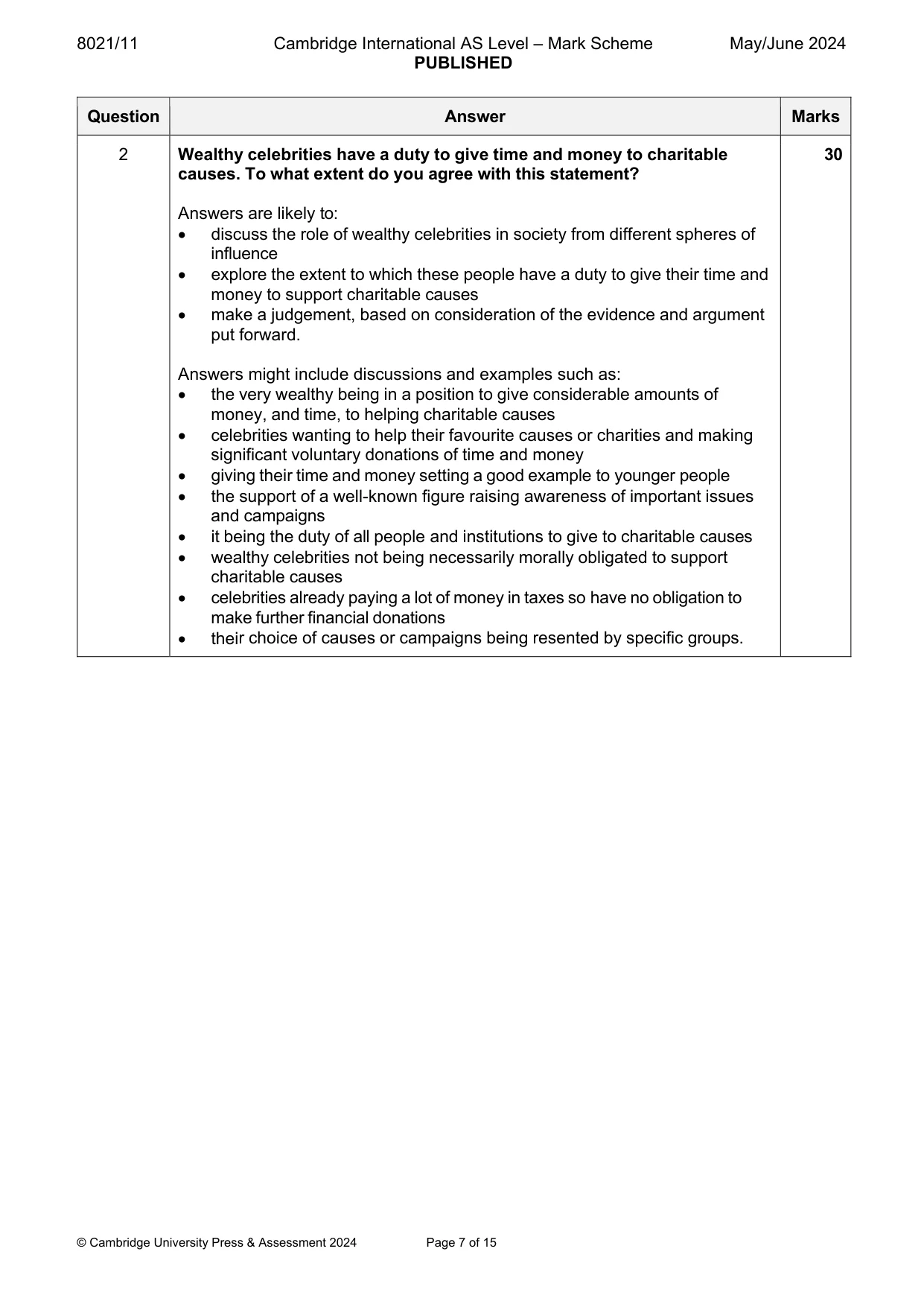
8021/11 Cambridge International AS Level – Mark Scheme PUBLISHED May/June 2024 © Cambridge University Press & Assessment 2024 Page 7 of 15 Question Answer Marks 2 Wealthy celebrities have a duty to give time and money to charitable causes. To what extent do you agree with this statement? Answers are likely to: discuss the role of wealthy celebrities in society from different spheres of influence explore the extent to which these people have a duty to give their time and money to support charitable causes make a judgement, based on consideration of the evidence and argument put forward. Answers might include discussions and examples such as: the very wealthy being in a position to give considerable amounts of money, and time, to helping charitable causes celebrities wanting to help their favourite causes or charities and making significant voluntary donations of time and money giving their time and money setting a good example to younger people the support of a well-known figure raising awareness of important issues and campaigns it being the duty of all people and institutions to give to charitable causes wealthy celebrities not being necessarily morally obligated to support charitable causes celebrities already paying a lot of money in taxes so have no obligation to make further financial donations their choice of causes or campaigns being resented by specific groups. 30
Mark scheme, page 8
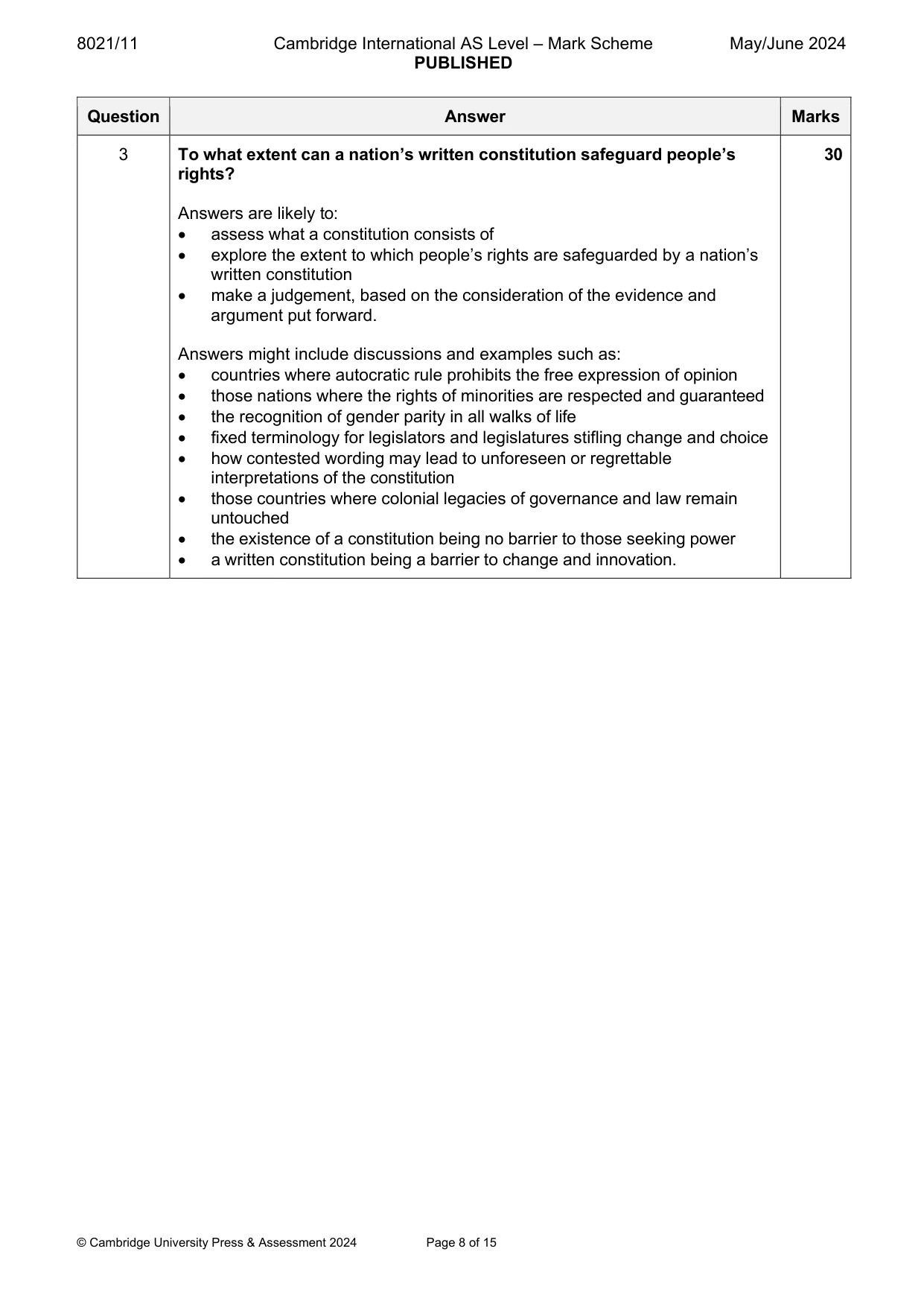
8021/11 Cambridge International AS Level – Mark Scheme PUBLISHED May/June 2024 © Cambridge University Press & Assessment 2024 Page 8 of 15 Question Answer Marks 3 To what extent can a nation’s written constitution safeguard people’s rights? Answers are likely to: assess what a constitution consists of explore the extent to which people’s rights are safeguarded by a nation’s written constitution make a judgement, based on the consideration of the evidence and argument put forward. Answers might include discussions and examples such as: countries where autocratic rule prohibits the free expression of opinion those nations where the rights of minorities are respected and guaranteed the recognition of gender parity in all walks of life fixed terminology for legislators and legislatures stifling change and choice how contested wording may lead to unforeseen or regrettable interpretations of the constitution those countries where colonial legacies of governance and law remain untouched the existence of a constitution being no barrier to those seeking power a written constitution being a barrier to change and innovation. 30
Mark scheme, page 9
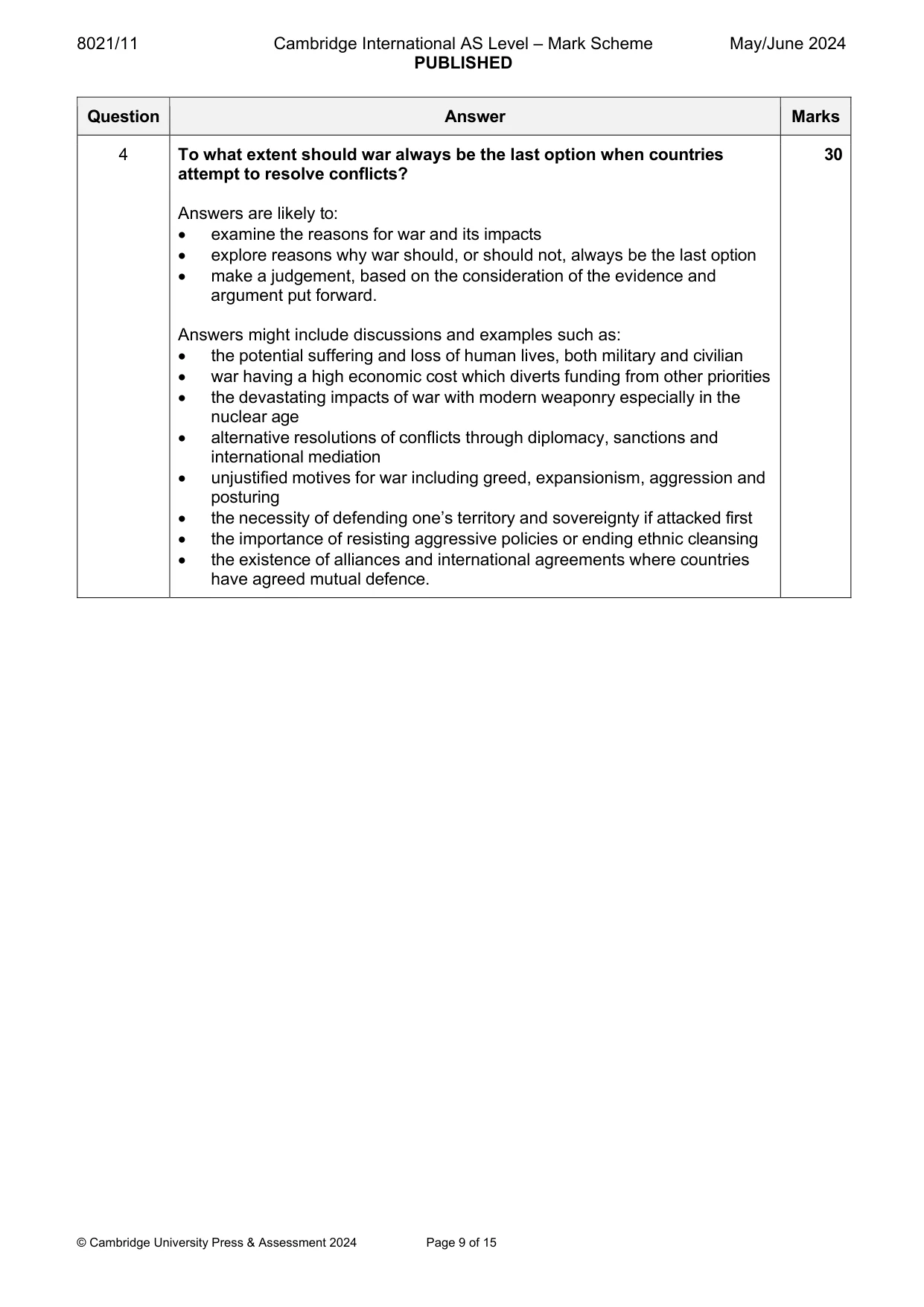
8021/11 Cambridge International AS Level – Mark Scheme PUBLISHED May/June 2024 © Cambridge University Press & Assessment 2024 Page 9 of 15 Question Answer Marks 4 To what extent should war always be the last option when countries attempt to resolve conflicts? Answers are likely to: examine the reasons for war and its impacts explore reasons why war should, or should not, always be the last option make a judgement, based on the consideration of the evidence and argument put forward. Answers might include discussions and examples such as: the potential suffering and loss of human lives, both military and civilian war having a high economic cost which diverts funding from other priorities the devastating impacts of war with modern weaponry especially in the nuclear age alternative resolutions of conflicts through diplomacy, sanctions and international mediation unjustified motives for war including greed, expansionism, aggression and posturing the necessity of defending one’s territory and sovereignty if attacked first the importance of resisting aggressive policies or ending ethnic cleansing the existence of alliances and international agreements where countries have agreed mutual defence. 30
Mark scheme, page 10
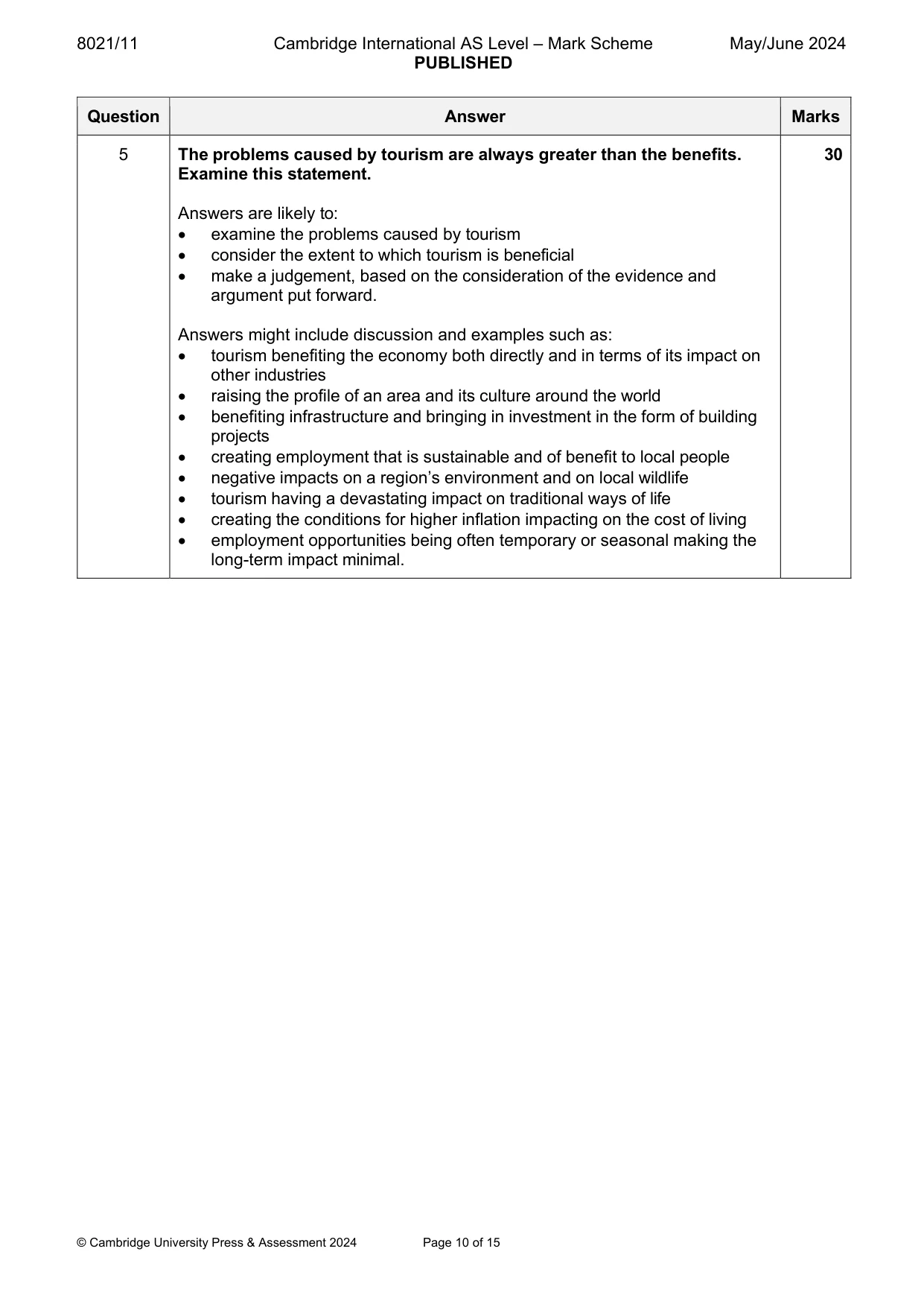
8021/11 Cambridge International AS Level – Mark Scheme PUBLISHED May/June 2024 © Cambridge University Press & Assessment 2024 Page 10 of 15 Question Answer Marks 5 The problems caused by tourism are always greater than the benefits. Examine this statement. Answers are likely to: examine the problems caused by tourism consider the extent to which tourism is beneficial make a judgement, based on the consideration of the evidence and argument put forward. Answers might include discussion and examples such as: tourism benefiting the economy both directly and in terms of its impact on other industries raising the profile of an area and its culture around the world benefiting infrastructure and bringing in investment in the form of building projects creating employment that is sustainable and of benefit to local people negative impacts on a region’s environment and on local wildlife tourism having a devastating impact on traditional ways of life creating the conditions for higher inflation impacting on the cost of living employment opportunities being often temporary or seasonal making the long-term impact minimal. 30
Mark scheme, page 11
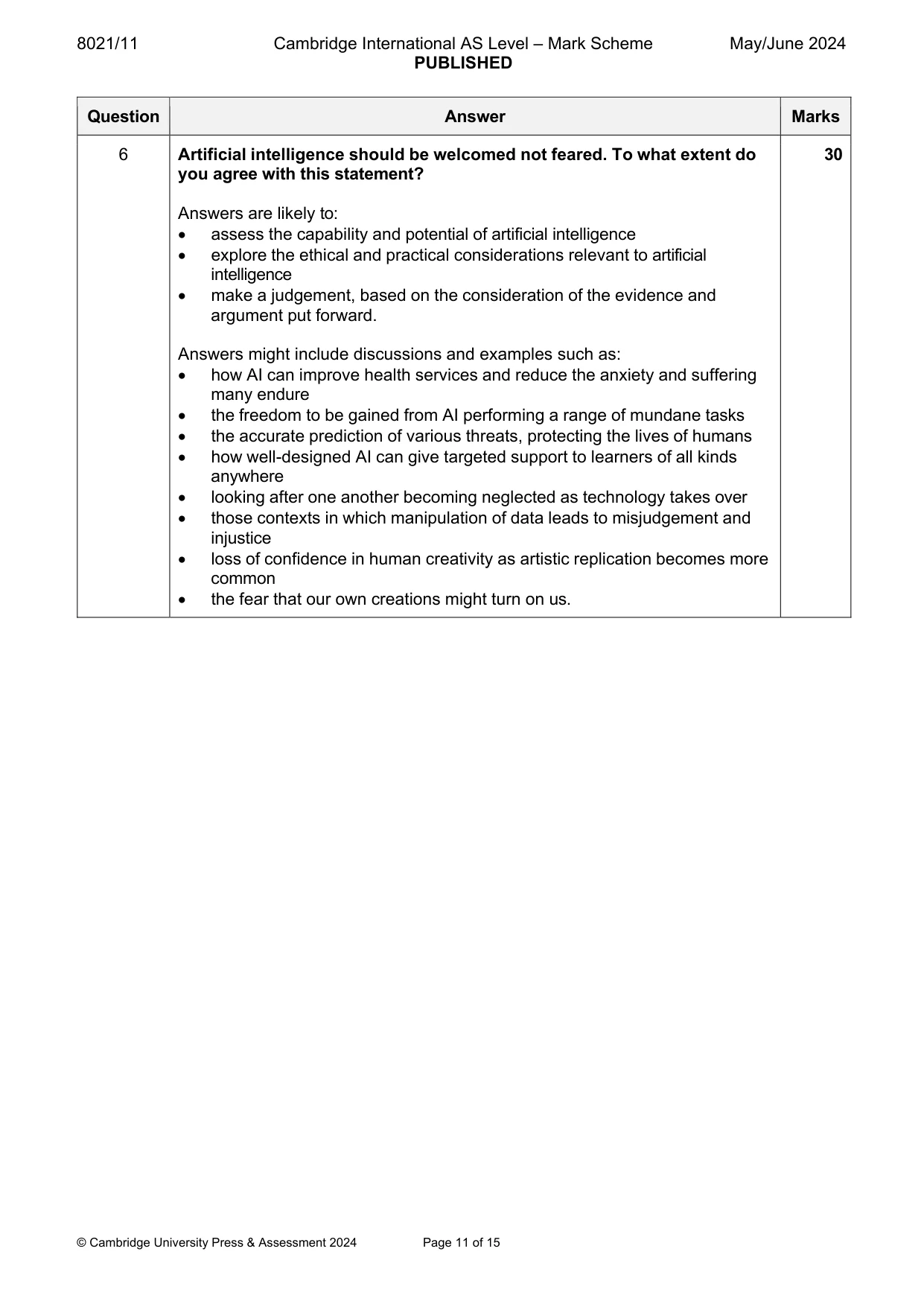
8021/11 Cambridge International AS Level – Mark Scheme PUBLISHED May/June 2024 © Cambridge University Press & Assessment 2024 Page 11 of 15 Question Answer Marks 6 Artificial intelligence should be welcomed not feared. To what extent do you agree with this statement? Answers are likely to: assess the capability and potential of artificial intelligence explore the ethical and practical considerations relevant to artificial intelligence make a judgement, based on the consideration of the evidence and argument put forward. Answers might include discussions and examples such as: how AI can improve health services and reduce the anxiety and suffering many endure the freedom to be gained from AI performing a range of mundane tasks the accurate prediction of various threats, protecting the lives of humans how well-designed AI can give targeted support to learners of all kinds anywhere looking after one another becoming neglected as technology takes over those contexts in which manipulation of data leads to misjudgement and injustice loss of confidence in human creativity as artistic replication becomes more common the fear that our own creations might turn on us. 30
Mark scheme, page 12
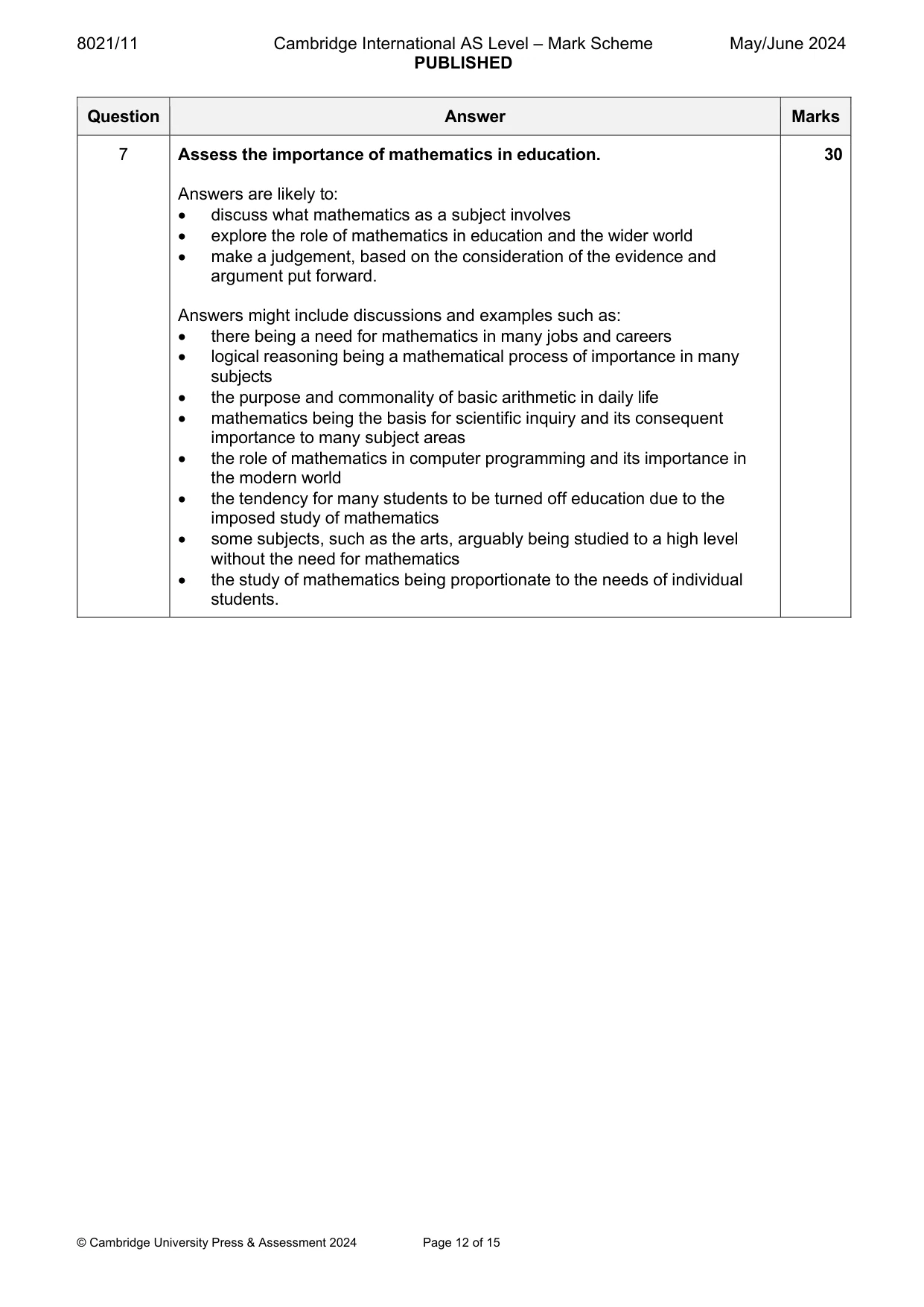
8021/11 Cambridge International AS Level – Mark Scheme PUBLISHED May/June 2024 © Cambridge University Press & Assessment 2024 Page 12 of 15 Question Answer Marks 7 Assess the importance of mathematics in education. Answers are likely to: discuss what mathematics as a subject involves explore the role of mathematics in education and the wider world make a judgement, based on the consideration of the evidence and argument put forward. Answers might include discussions and examples such as: there being a need for mathematics in many jobs and careers logical reasoning being a mathematical process of importance in many subjects the purpose and commonality of basic arithmetic in daily life mathematics being the basis for scientific inquiry and its consequent importance to many subject areas the role of mathematics in computer programming and its importance in the modern world the tendency for many students to be turned off education due to the imposed study of mathematics some subjects, such as the arts, arguably being studied to a high level without the need for mathematics the study of mathematics being proportionate to the needs of individual students. 30
Mark scheme, page 13
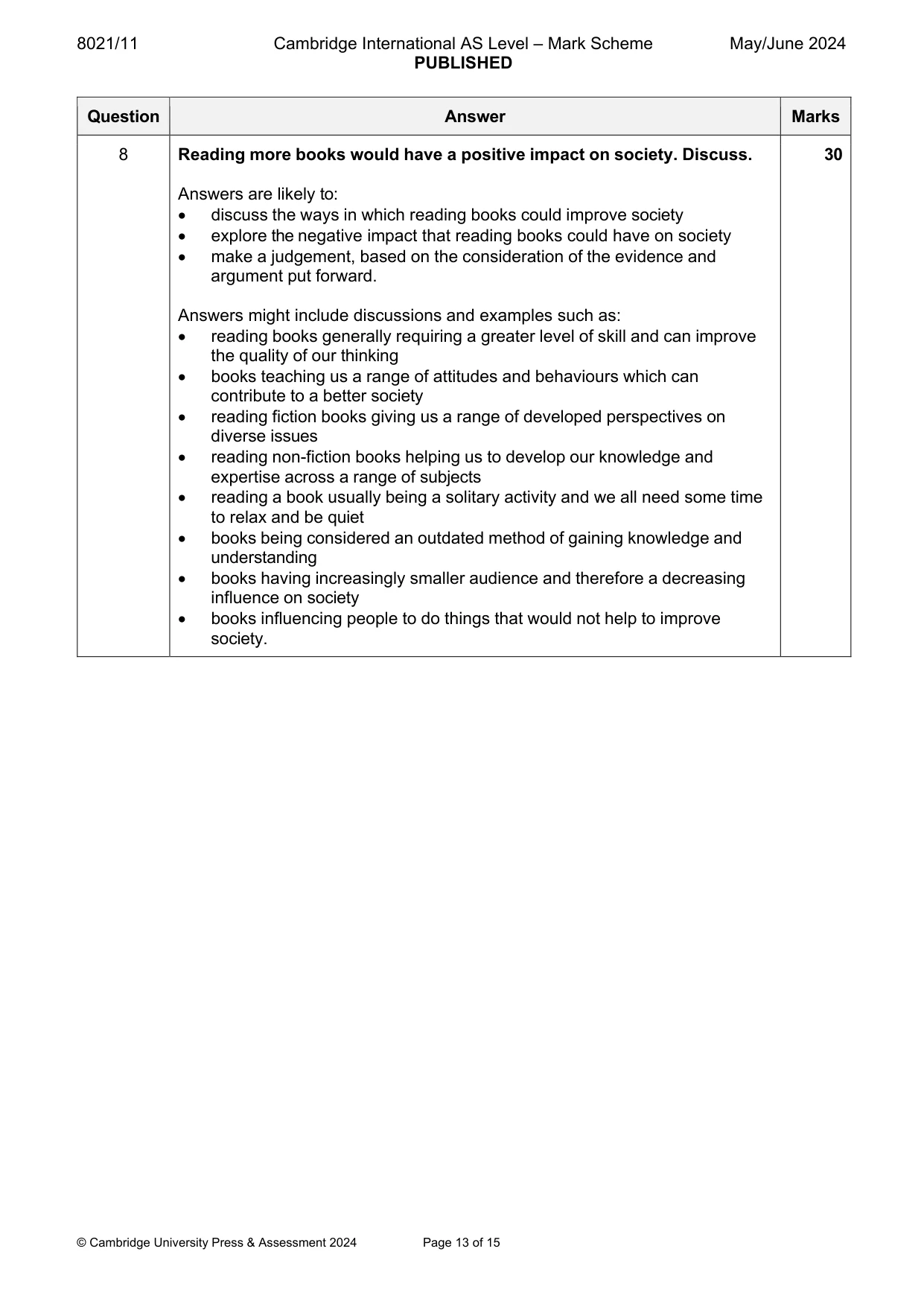
8021/11 Cambridge International AS Level – Mark Scheme PUBLISHED May/June 2024 © Cambridge University Press & Assessment 2024 Page 13 of 15 Question Answer Marks 8 Reading more books would have a positive impact on society. Discuss. Answers are likely to: discuss the ways in which reading books could improve society explore the negative impact that reading books could have on society make a judgement, based on the consideration of the evidence and argument put forward. Answers might include discussions and examples such as: reading books generally requiring a greater level of skill and can improve the quality of our thinking books teaching us a range of attitudes and behaviours which can contribute to a better society reading fiction books giving us a range of developed perspectives on diverse issues reading non-fiction books helping us to develop our knowledge and expertise across a range of subjects reading a book usually being a solitary activity and we all need some time to relax and be quiet books being considered an outdated method of gaining knowledge and understanding books having increasingly smaller audience and therefore a decreasing influence on society books influencing people to do things that would not help to improve society. 30
Mark scheme, page 14
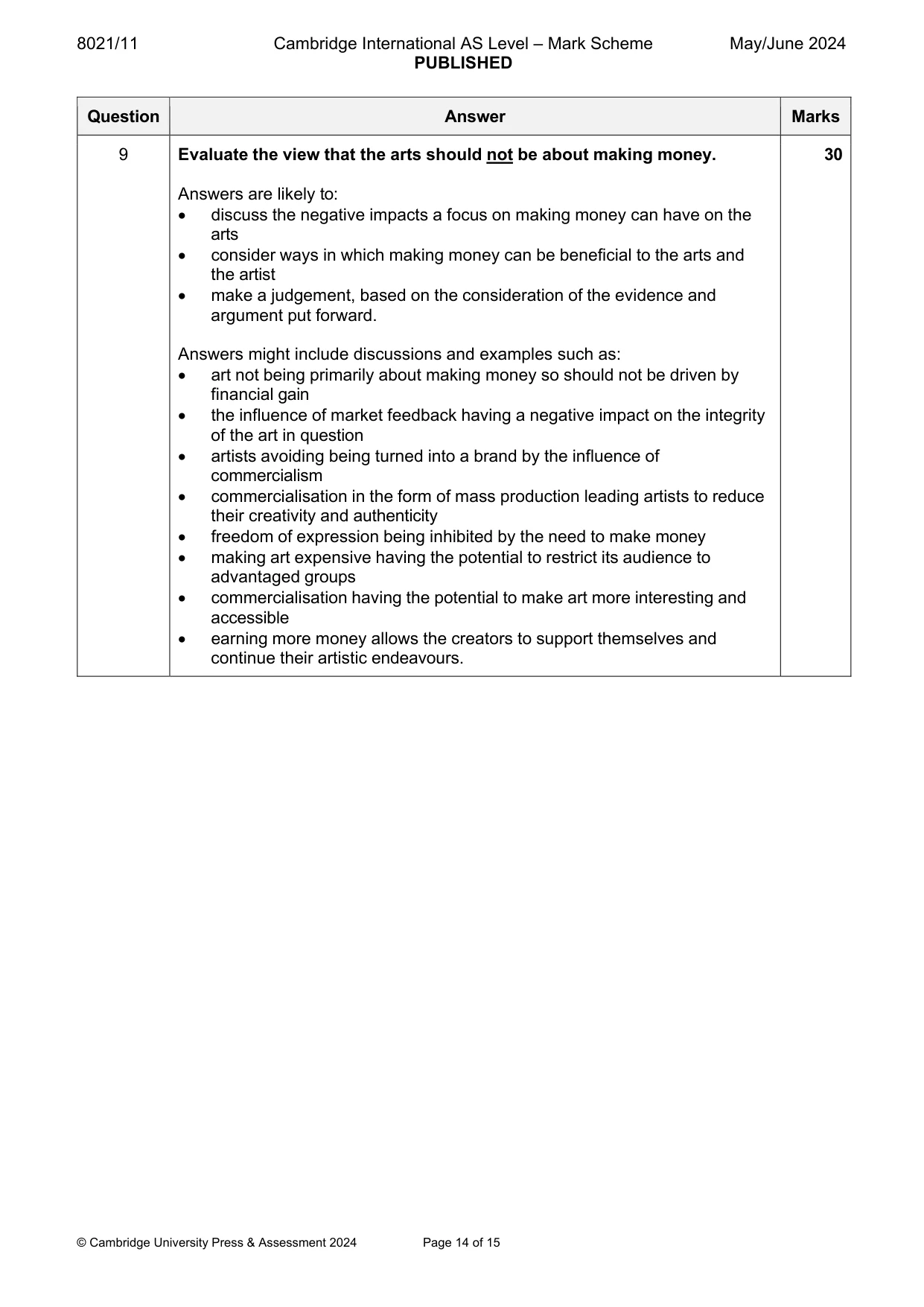
8021/11 Cambridge International AS Level – Mark Scheme PUBLISHED May/June 2024 © Cambridge University Press & Assessment 2024 Page 14 of 15 Question Answer Marks 9 Evaluate the view that the arts should not be about making money. Answers are likely to: discuss the negative impacts a focus on making money can have on the arts consider ways in which making money can be beneficial to the arts and the artist make a judgement, based on the consideration of the evidence and argument put forward. Answers might include discussions and examples such as: art not being primarily about making money so should not be driven by financial gain the influence of market feedback having a negative impact on the integrity of the art in question artists avoiding being turned into a brand by the influence of commercialism commercialisation in the form of mass production leading artists to reduce their creativity and authenticity freedom of expression being inhibited by the need to make money making art expensive having the potential to restrict its audience to advantaged groups commercialisation having the potential to make art more interesting and accessible earning more money allows the creators to support themselves and continue their artistic endeavours. 30
Mark scheme, page 15
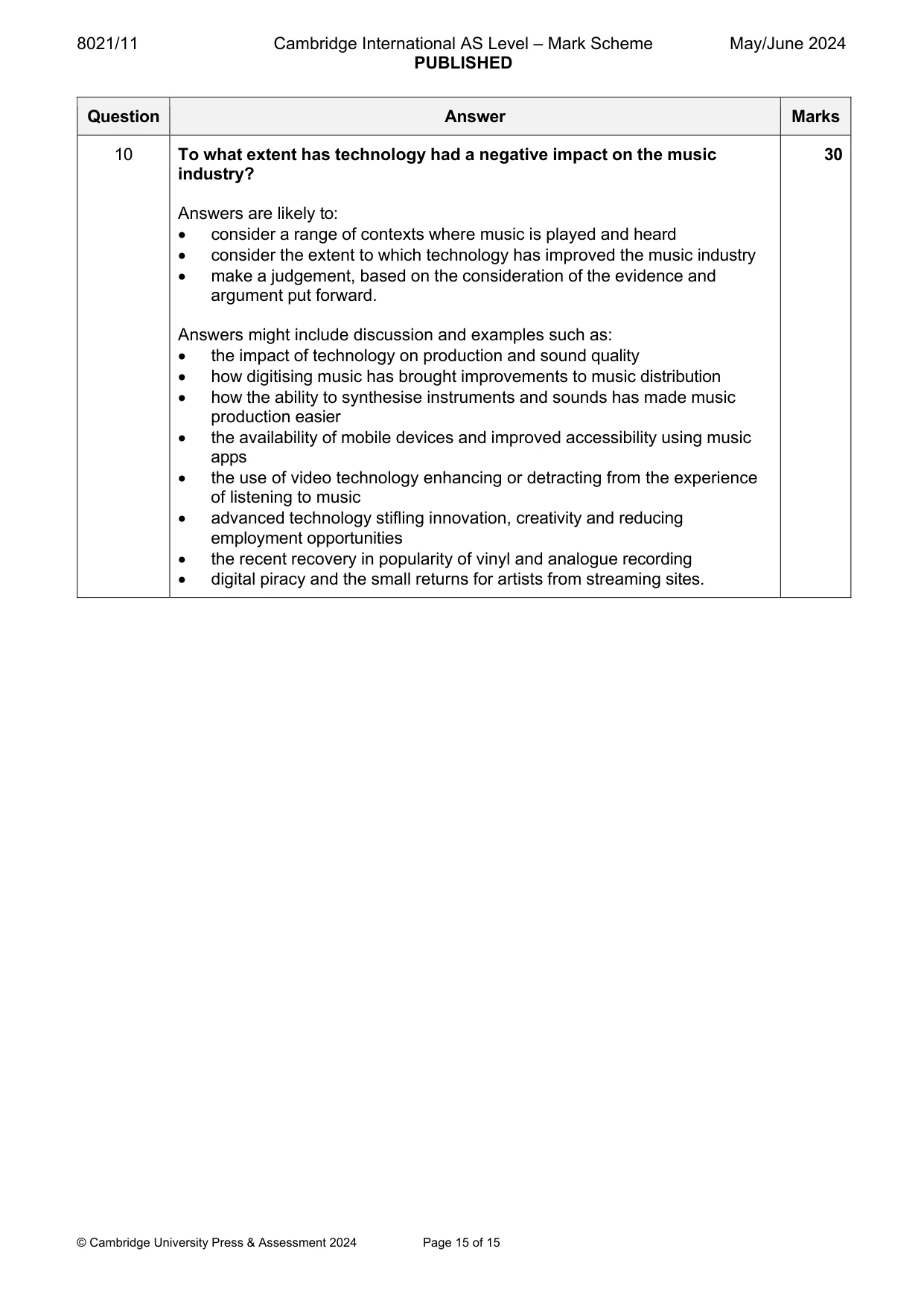
8021/11 Cambridge International AS Level – Mark Scheme PUBLISHED May/June 2024 © Cambridge University Press & Assessment 2024 Page 15 of 15 Question Answer Marks 10 To what extent has technology had a negative impact on the music industry? Answers are likely to: consider a range of contexts where music is played and heard consider the extent to which technology has improved the music industry make a judgement, based on the consideration of the evidence and argument put forward. Answers might include discussion and examples such as: the impact of technology on production and sound quality how digitising music has brought improvements to music distribution how the ability to synthesise instruments and sounds has made music production easier the availability of mobile devices and improved accessibility using music apps the use of video technology enhancing or detracting from the experience of listening to music advanced technology stifling innovation, creativity and reducing employment opportunities the recent recovery in popularity of vinyl and analogue recording digital piracy and the small returns for artists from streaming sites. 30
What you needed in this session
Cambridge’s own grade thresholds for 2024 May/June, Paper 1 · Variant 1. A higher threshold means an easier paper — the bar moves with how the cohort did.