Cambridge A Level English General Paper 8021 — 2021 Oct/Nov Paper 1 · Variant 2
8021/12/O/N/21 · 30 marks · ≈34 min
The question paper and its mark scheme, free to read here and free to download. This is Cambridge’s own paper, exactly as it was sat.
Question paper4 pages


Mark scheme16 pages
Answers below. Sit the paper first if you are practising.
Paper as text
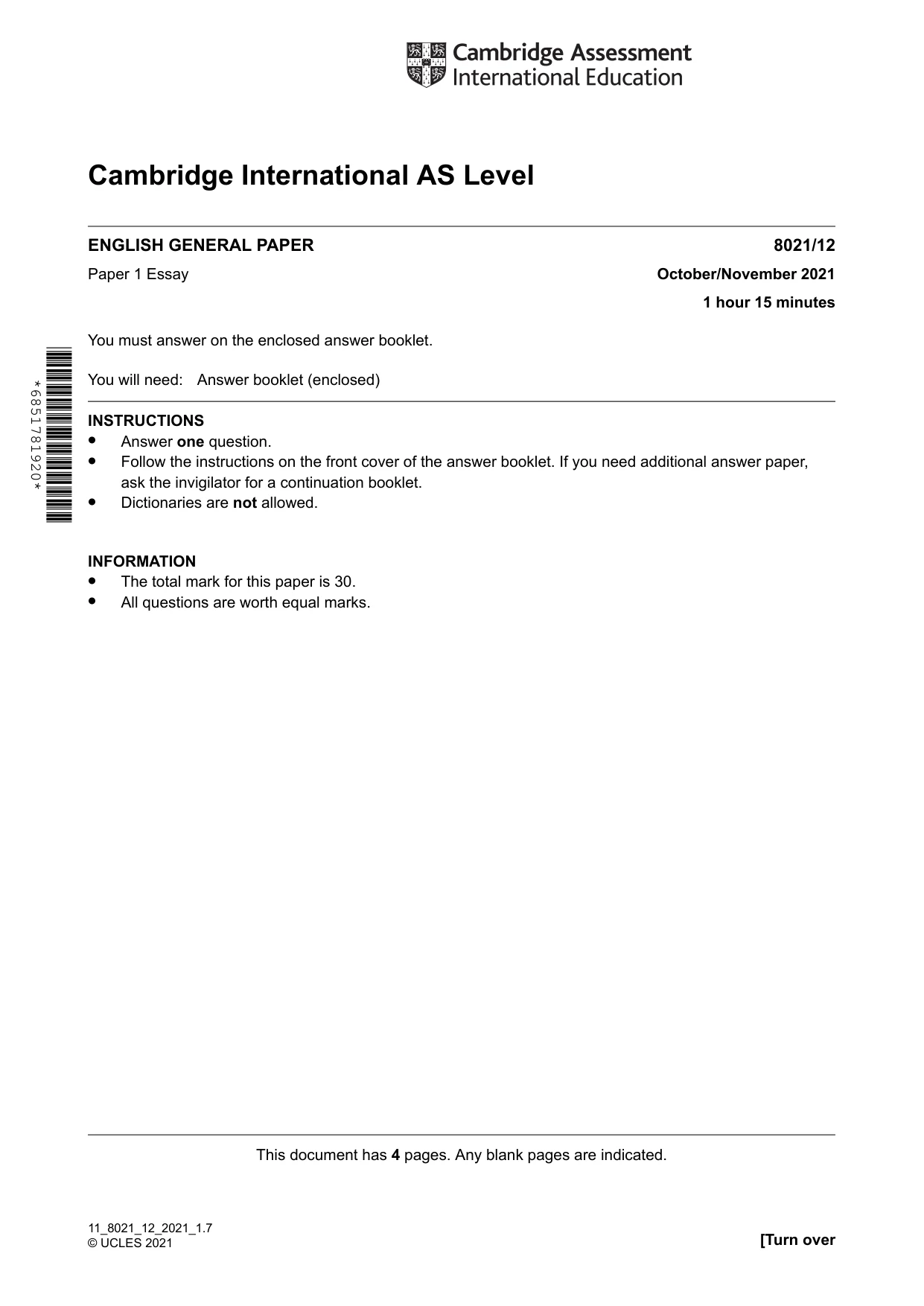
Question paper, page 1
Cambridge International AS Level 8021/12 October/November 2021 1 hour 15 minutes ENGLISH GENERAL PAPER Paper 1 Essay You must answer on the enclosed answer booklet. You will need: Answer booklet (enclosed) INSTRUCTIONS • Answer one question. • Follow the instructions on the front cover of the answer booklet. If you need additional answer paper, ask the invigilator for a continuation booklet. • Dictionaries are not allowed. INFORMATION • The total mark for this paper is 30. • All questions are worth equal marks. This document has 4 pages. Any blank pages are indicated. [Turn over 11_8021_12_2021_1.7 © UCLES 2021 *6851781920*
Question paper, page 2
BLANK PAGE 11_8021_12_2021_1.7 © UCLES 2021 2
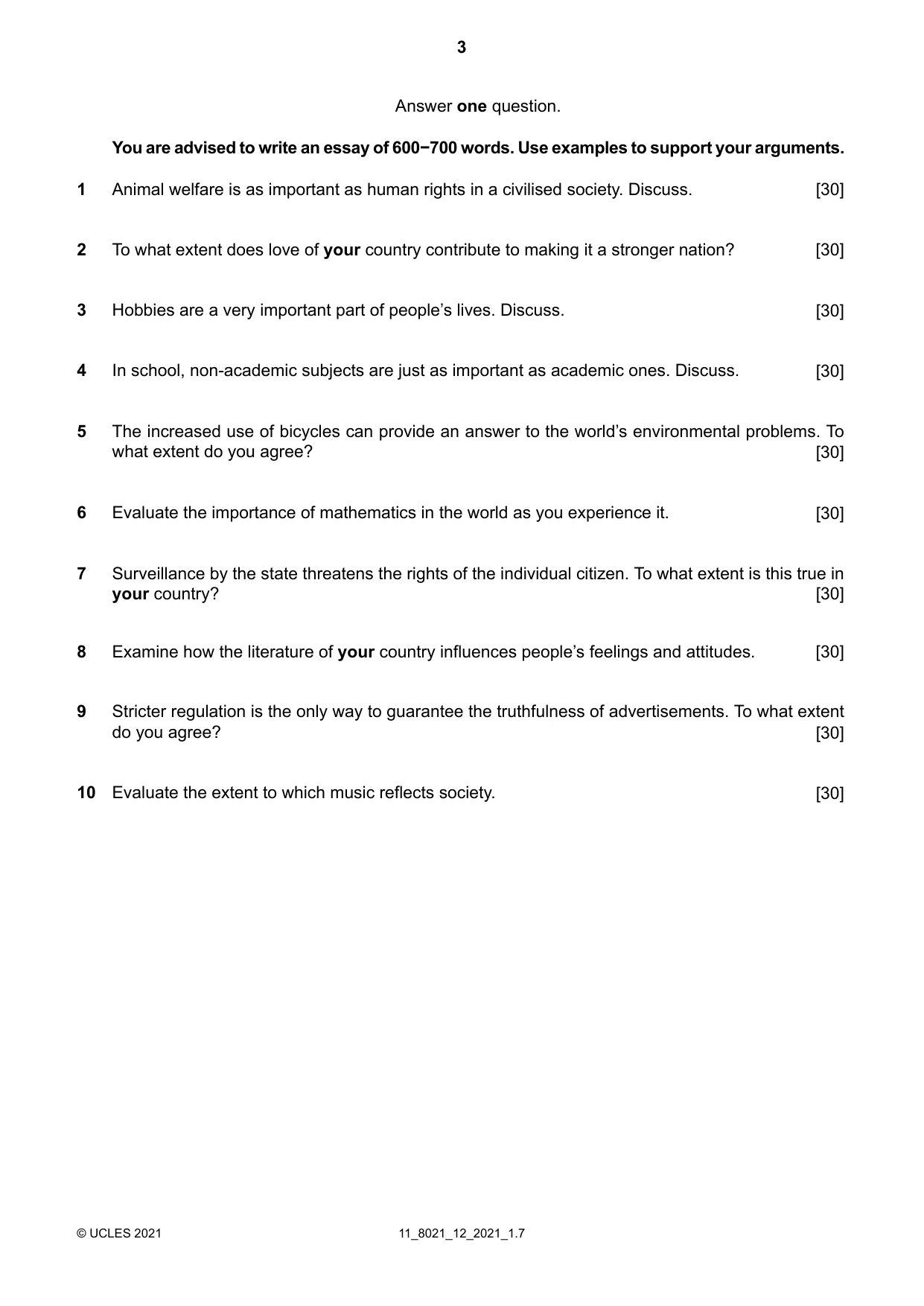
Question paper, page 3
Answer one question. You are advised to write an essay of 600−700 words. Use examples to support your arguments. Animal welfare is as important as human rights in a civilised society. Discuss. [30] 1 To what extent does love of your country contribute to making it a stronger nation? [30] 2 Hobbies are a very important part of people’s lives. Discuss. [30] 3 In school, non-academic subjects are just as important as academic ones. Discuss. [30] 4 The increased use of bicycles can provide an answer to the world’s environmental problems. To what extent do you agree? [30] 5 Evaluate the importance of mathematics in the world as you experience it. [30] 6 Surveillance by the state threatens the rights of the individual citizen. To what extent is this true in your country? [30] 7 Examine how the literature of your country influences people’s feelings and attitudes. [30] 8 Stricter regulation is the only way to guarantee the truthfulness of advertisements. To what extent do you agree? [30] 9 Evaluate the extent to which music reflects society. [30] 10 11_8021_12_2021_1.7 © UCLES 2021 3
Question paper, page 4
BLANK PAGE Permission to reproduce items where third-party owned material protected by copyright is included has been sought and cleared where possible. Every reasonable effort has been made by the publisher (UCLES) to trace copyright holders, but if any items requiring clearance have unwittingly been included, the publisher will be pleased to make amends at the earliest possible opportunity. To avoid the issue of disclosure of answer-related information to candidates, all copyright acknowledgements are reproduced online in the Cambridge Assessment International Education Copyright Acknowledgements Booklet. This is produced for each series of examinations and is freely available to download at www.cambridgeinternational.org after the live examination series. Cambridge Assessment International Education is part of Cambridge Assessment. Cambridge Assessment is the brand name of the University of Cambridge Local Examinations Syndicate (UCLES), which is a department of the University of Cambridge. 11_8021_12_2021_1.7 © UCLES 2021 4
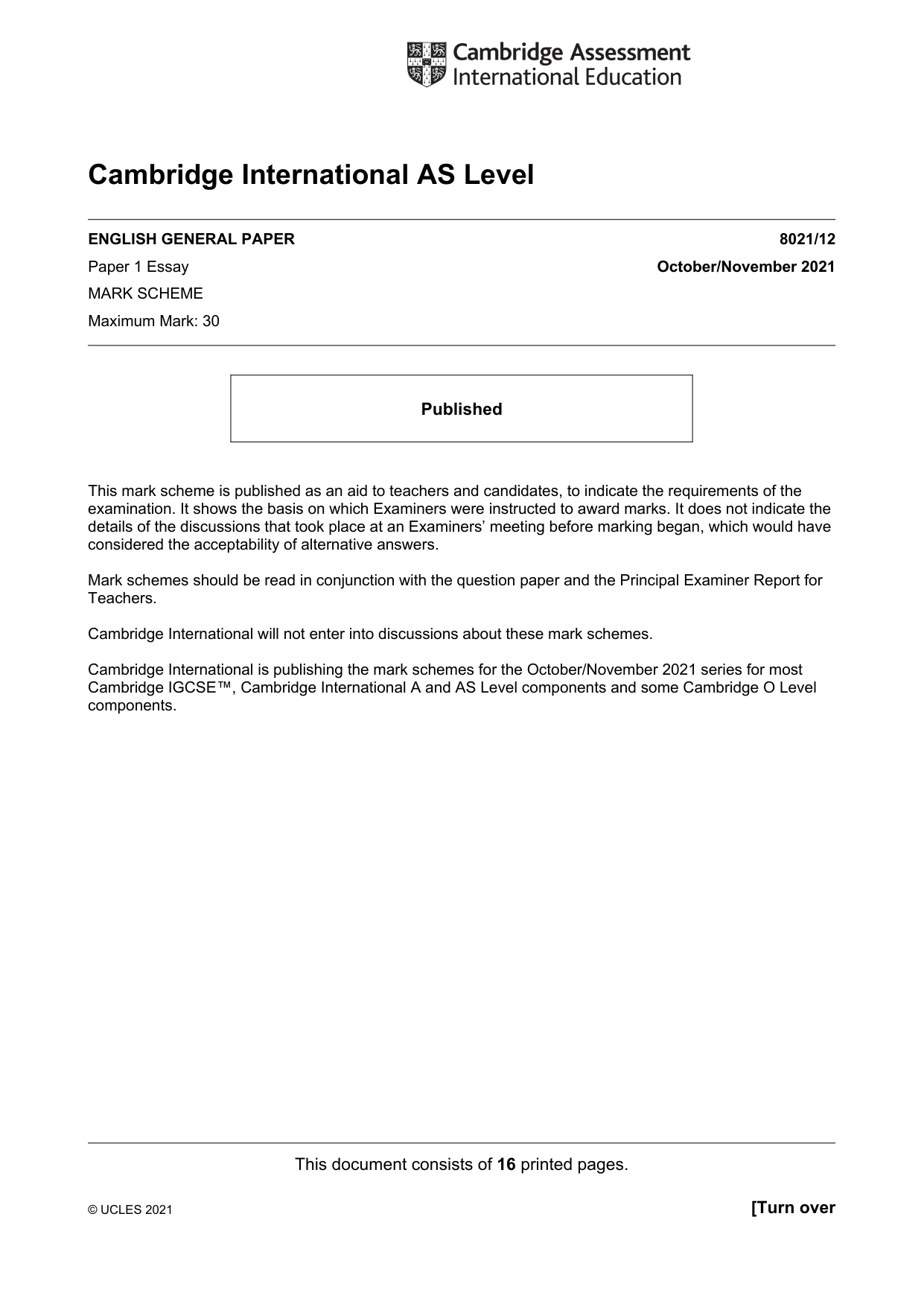
Mark scheme, page 1
This document consists of 16 printed pages. © UCLES 2021 [Turn over Cambridge International AS Level ENGLISH GENERAL PAPER 8021/12 Paper 1 Essay October/November 2021 MARK SCHEME Maximum Mark: 30 Published This mark scheme is published as an aid to teachers and candidates, to indicate the requirements of the examination. It shows the basis on which Examiners were instructed to award marks. It does not indicate the details of the discussions that took place at an Examiners’ meeting before marking began, which would have considered the acceptability of alternative answers. Mark schemes should be read in conjunction with the question paper and the Principal Examiner Report for Teachers. Cambridge International will not enter into discussions about these mark schemes. Cambridge International is publishing the mark schemes for the October/November 2021 series for most Cambridge IGCSE™, Cambridge International A and AS Level components and some Cambridge O Level components.
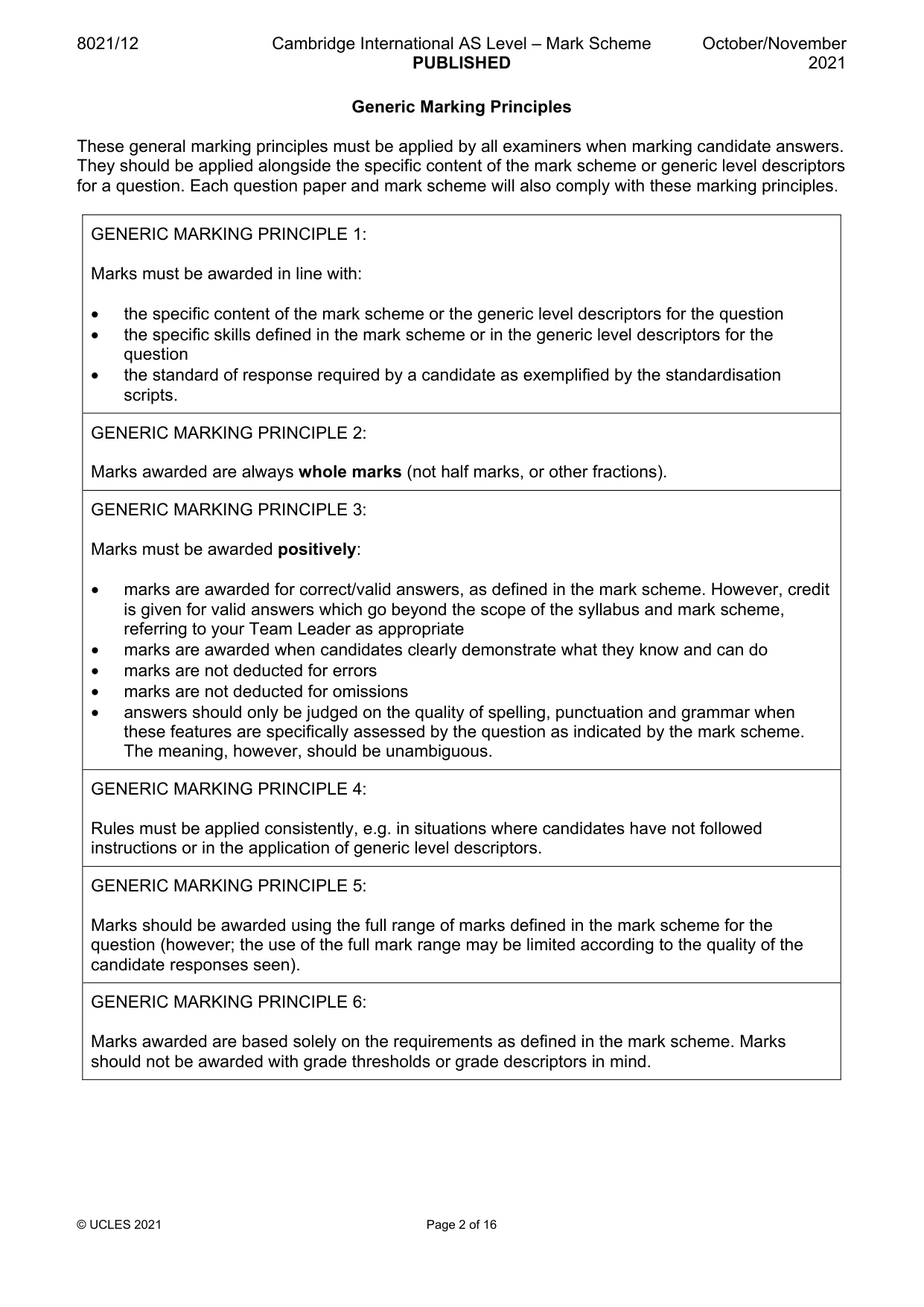
Mark scheme, page 2
8021/12 Cambridge International AS Level – Mark Scheme PUBLISHED October/November 2021 © UCLES 2021 Page 2 of 16 Generic Marking Principles These general marking principles must be applied by all examiners when marking candidate answers. They should be applied alongside the specific content of the mark scheme or generic level descriptors for a question. Each question paper and mark scheme will also comply with these marking principles. GENERIC MARKING PRINCIPLE 1: Marks must be awarded in line with: • the specific content of the mark scheme or the generic level descriptors for the question • the specific skills defined in the mark scheme or in the generic level descriptors for the question • the standard of response required by a candidate as exemplified by the standardisation scripts. GENERIC MARKING PRINCIPLE 2: Marks awarded are always whole marks (not half marks, or other fractions). GENERIC MARKING PRINCIPLE 3: Marks must be awarded positively: • marks are awarded for correct/valid answers, as defined in the mark scheme. However, credit is given for valid answers which go beyond the scope of the syllabus and mark scheme, referring to your Team Leader as appropriate • marks are awarded when candidates clearly demonstrate what they know and can do • marks are not deducted for errors • marks are not deducted for omissions • answers should only be judged on the quality of spelling, punctuation and grammar when these features are specifically assessed by the question as indicated by the mark scheme. The meaning, however, should be unambiguous. GENERIC MARKING PRINCIPLE 4: Rules must be applied consistently, e.g. in situations where candidates have not followed instructions or in the application of generic level descriptors. GENERIC MARKING PRINCIPLE 5: Marks should be awarded using the full range of marks defined in the mark scheme for the question (however; the use of the full mark range may be limited according to the quality of the candidate responses seen). GENERIC MARKING PRINCIPLE 6: Marks awarded are based solely on the requirements as defined in the mark scheme. Marks should not be awarded with grade thresholds or grade descriptors in mind.
Mark scheme, page 3
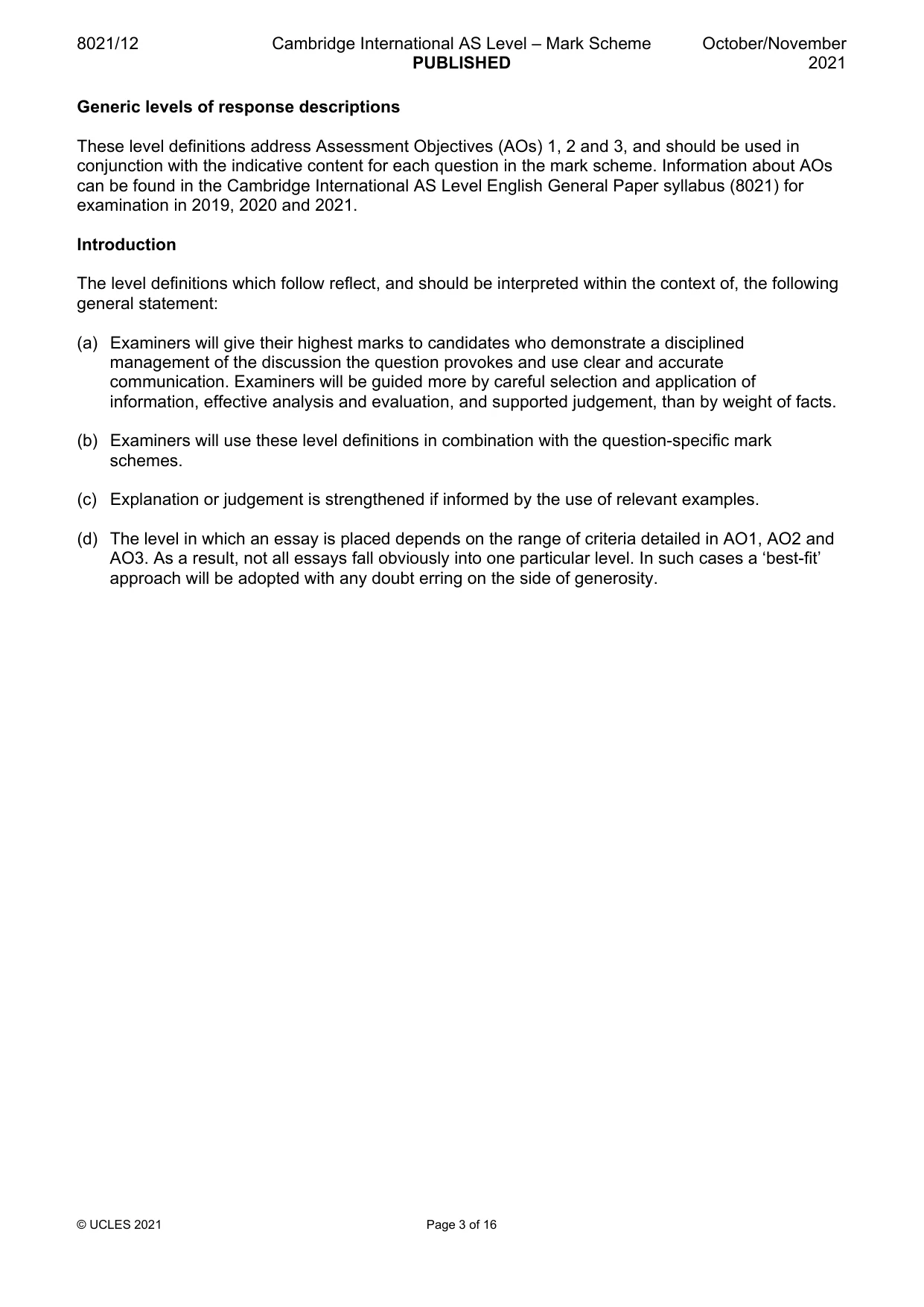
8021/12 Cambridge International AS Level – Mark Scheme PUBLISHED October/November 2021 © UCLES 2021 Page 3 of 16 Generic levels of response descriptions These level definitions address Assessment Objectives (AOs) 1, 2 and 3, and should be used in conjunction with the indicative content for each question in the mark scheme. Information about AOs can be found in the Cambridge International AS Level English General Paper syllabus (8021) for examination in 2019, 2020 and 2021. Introduction The level definitions which follow reflect, and should be interpreted within the context of, the following general statement: (a) Examiners will give their highest marks to candidates who demonstrate a disciplined management of the discussion the question provokes and use clear and accurate communication. Examiners will be guided more by careful selection and application of information, effective analysis and evaluation, and supported judgement, than by weight of facts. (b) Examiners will use these level definitions in combination with the question-specific mark schemes. (c) Explanation or judgement is strengthened if informed by the use of relevant examples. (d) The level in which an essay is placed depends on the range of criteria detailed in AO1, AO2 and AO3. As a result, not all essays fall obviously into one particular level. In such cases a ‘best-fit’ approach will be adopted with any doubt erring on the side of generosity.
Mark scheme, page 4
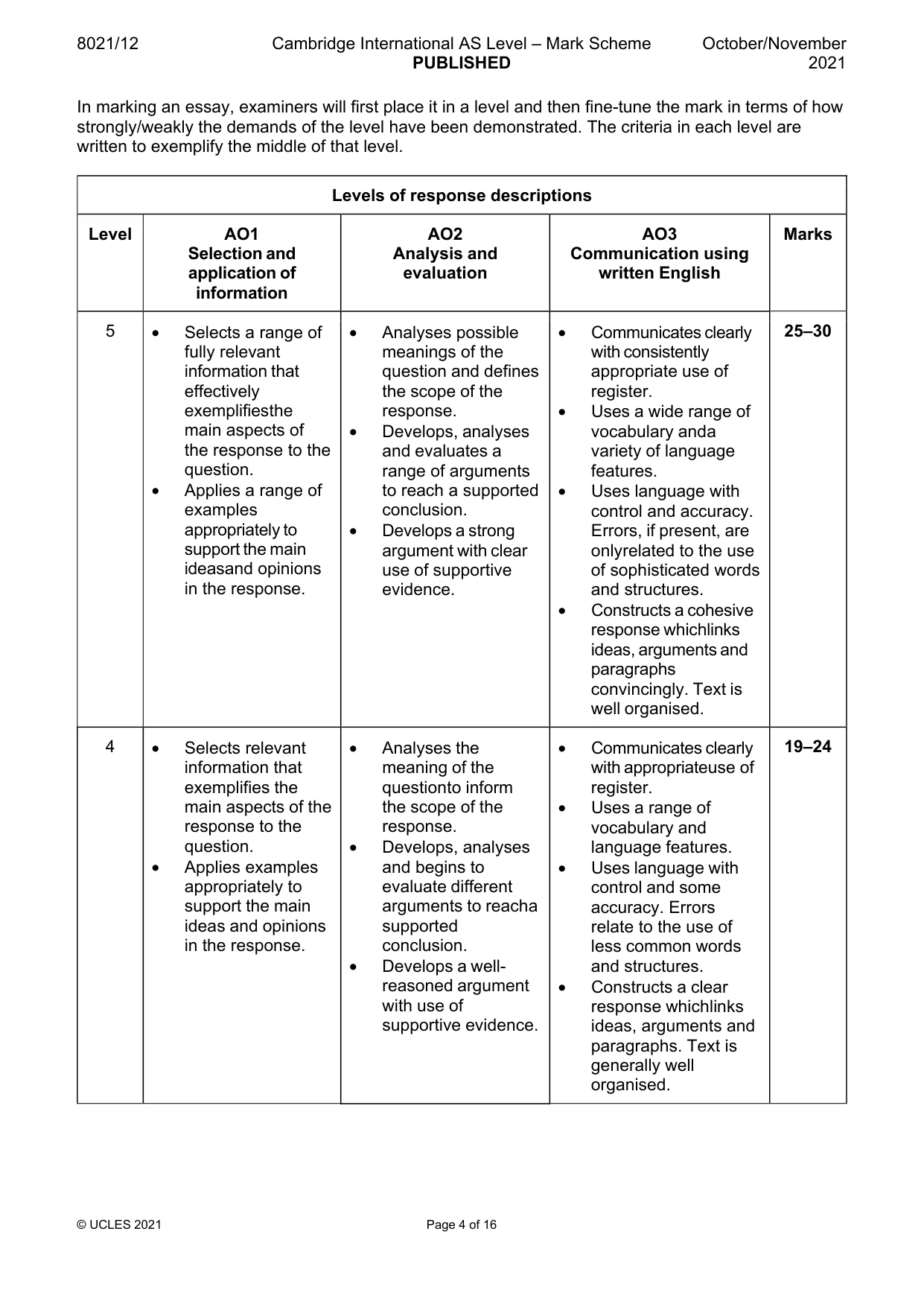
8021/12 Cambridge International AS Level – Mark Scheme PUBLISHED October/November 2021 © UCLES 2021 Page 4 of 16 In marking an essay, examiners will first place it in a level and then fine-tune the mark in terms of how strongly/weakly the demands of the level have been demonstrated. The criteria in each level are written to exemplify the middle of that level. Levels of response descriptions Level AO1 Selection and application of information AO2 Analysis and evaluation AO3 Communication using written English Marks 5 • Selects a range of fully relevant information that effectively exemplifies the main aspects of the response to the question. • Applies a range of examples appropriately to support the main ideas and opinions in the response. • Analyses possible meanings of the question and defines the scope of the response. • Develops, analyses and evaluates a range of arguments to reach a supported conclusion. • Develops a strong argument with clear use of supportive evidence. • Communicates clearly with consistently appropriate use of register. • Uses a wide range of vocabulary and a variety of language features. • Uses language with control and accuracy. Errors, if present, are only related to the use of sophisticated words and structures. • Constructs a cohesive response which links ideas, arguments and paragraphs convincingly. Text is well organised. 25–30 4 • Selects relevant information that exemplifies the main aspects of the response to the question. • Applies examples appropriately to support the main ideas and opinions in the response. • Analyses the meaning of the question to inform the scope of the response. • Develops, analyses and begins to evaluate different arguments to reach a supported conclusion. • Develops a well- reasoned argument with use of supportive evidence. • Communicates clearly with appropriate use of register. • Uses a range of vocabulary and language features. • Uses language with control and some accuracy. Errors relate to the use of less common words and structures. • Constructs a clear response which links ideas, arguments and paragraphs. Text is generally well organised. 19–24
Mark scheme, page 5
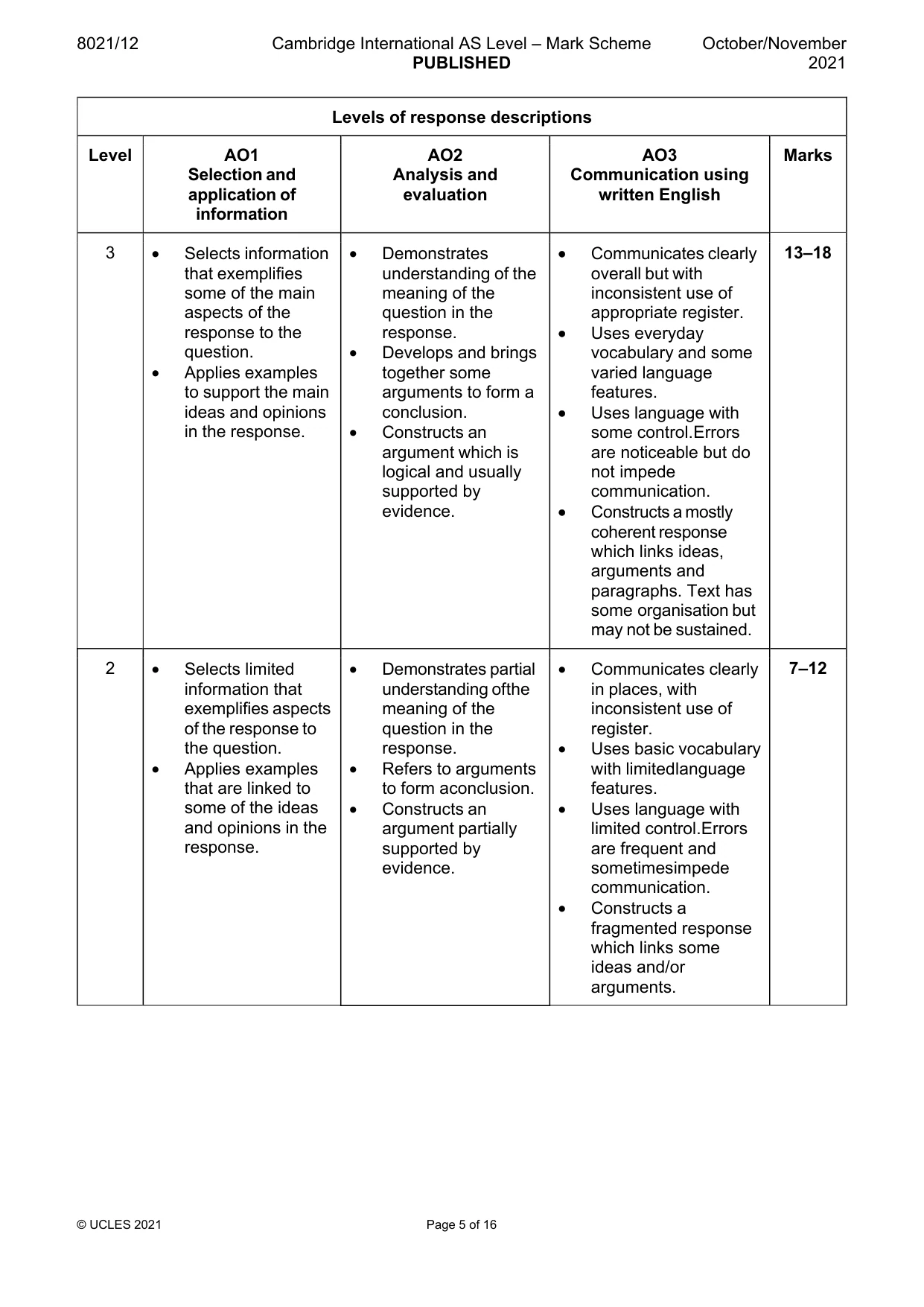
8021/12 Cambridge International AS Level – Mark Scheme PUBLISHED October/November 2021 © UCLES 2021 Page 5 of 16 Levels of response descriptions Level AO1 Selection and application of information AO2 Analysis and evaluation AO3 Communication using written English Marks 3 • Selects information that exemplifies some of the main aspects of the response to the question. • Applies examples to support the main ideas and opinions in the response. • Demonstrates understanding of the meaning of the question in the response. • Develops and brings together some arguments to form a conclusion. • Constructs an argument which is logical and usually supported by evidence. • Communicates clearly overall but with inconsistent use of appropriate register. • Uses everyday vocabulary and some varied language features. • Uses language with some control. Errors are noticeable but do not impede communication. • Constructs a mostly coherent response which links ideas, arguments and paragraphs. Text has some organisation but may not be sustained. 13–18 2 • Selects limited information that exemplifies aspects of the response to the question. • Applies examples that are linked to some of the ideas and opinions in the response. • Demonstrates partial understanding of the meaning of the question in the response. • Refers to arguments to form a conclusion. • Constructs an argument partially supported by evidence. • Communicates clearly in places, with inconsistent use of register. • Uses basic vocabulary with limited language features. • Uses language with limited control. Errors are frequent and sometimes impede communication. • Constructs a fragmented response which links some ideas and/or arguments. 7–12
Mark scheme, page 6
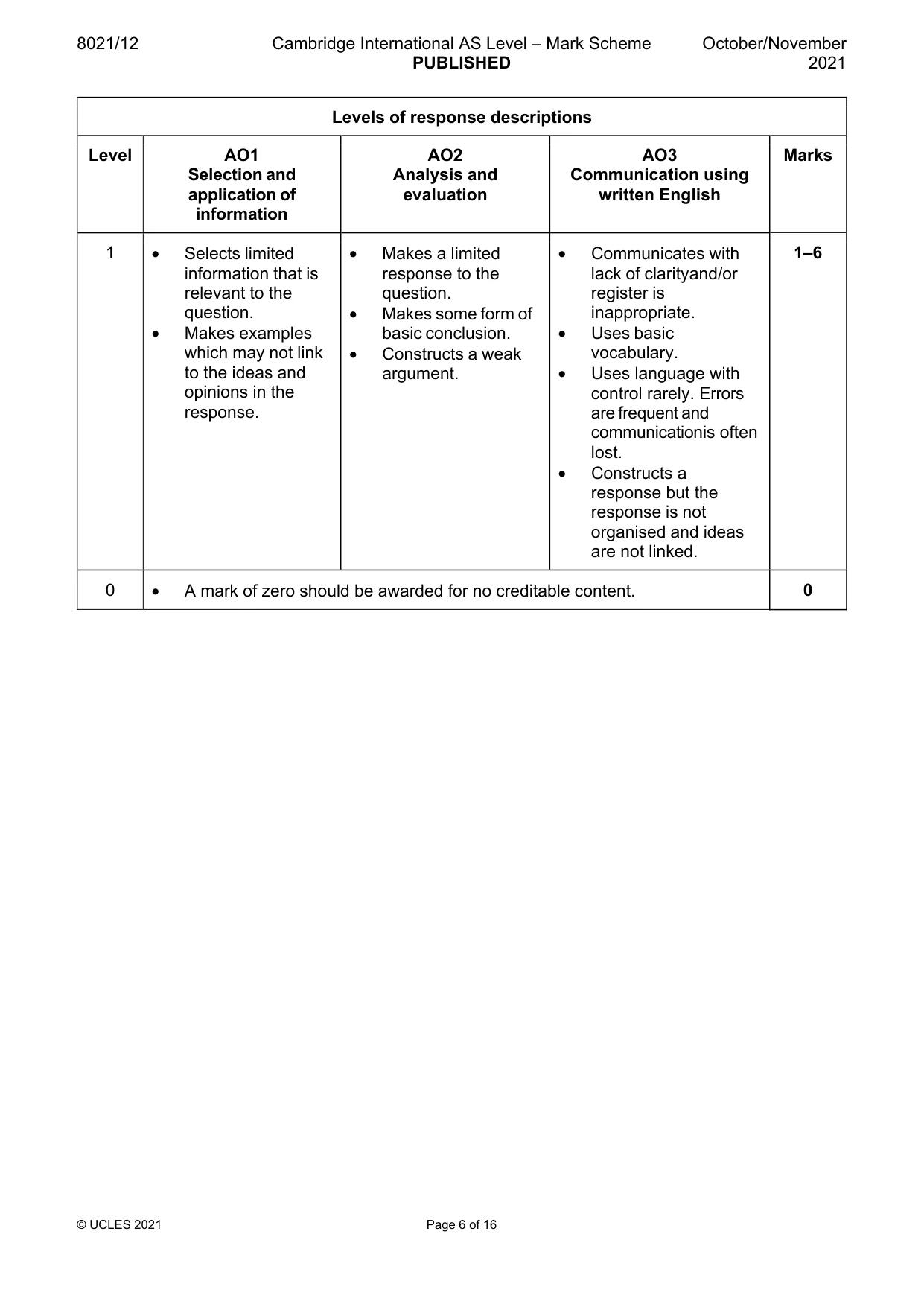
8021/12 Cambridge International AS Level – Mark Scheme PUBLISHED October/November 2021 © UCLES 2021 Page 6 of 16 Levels of response descriptions Level AO1 Selection and application of information AO2 Analysis and evaluation AO3 Communication using written English Marks 1 • Selects limited information that is relevant to the question. • Makes examples which may not link to the ideas and opinions in the response. • Makes a limited response to the question. • Makes some form of basic conclusion. • Constructs a weak argument. • Communicates with lack of clarity and/or register is inappropriate. • Uses basic vocabulary. • Uses language with control rarely. Errors are frequent and communication is often lost. • Constructs a response but the response is not organised and ideas are not linked. 1–6 0 • A mark of zero should be awarded for no creditable content. 0
Mark scheme, page 7
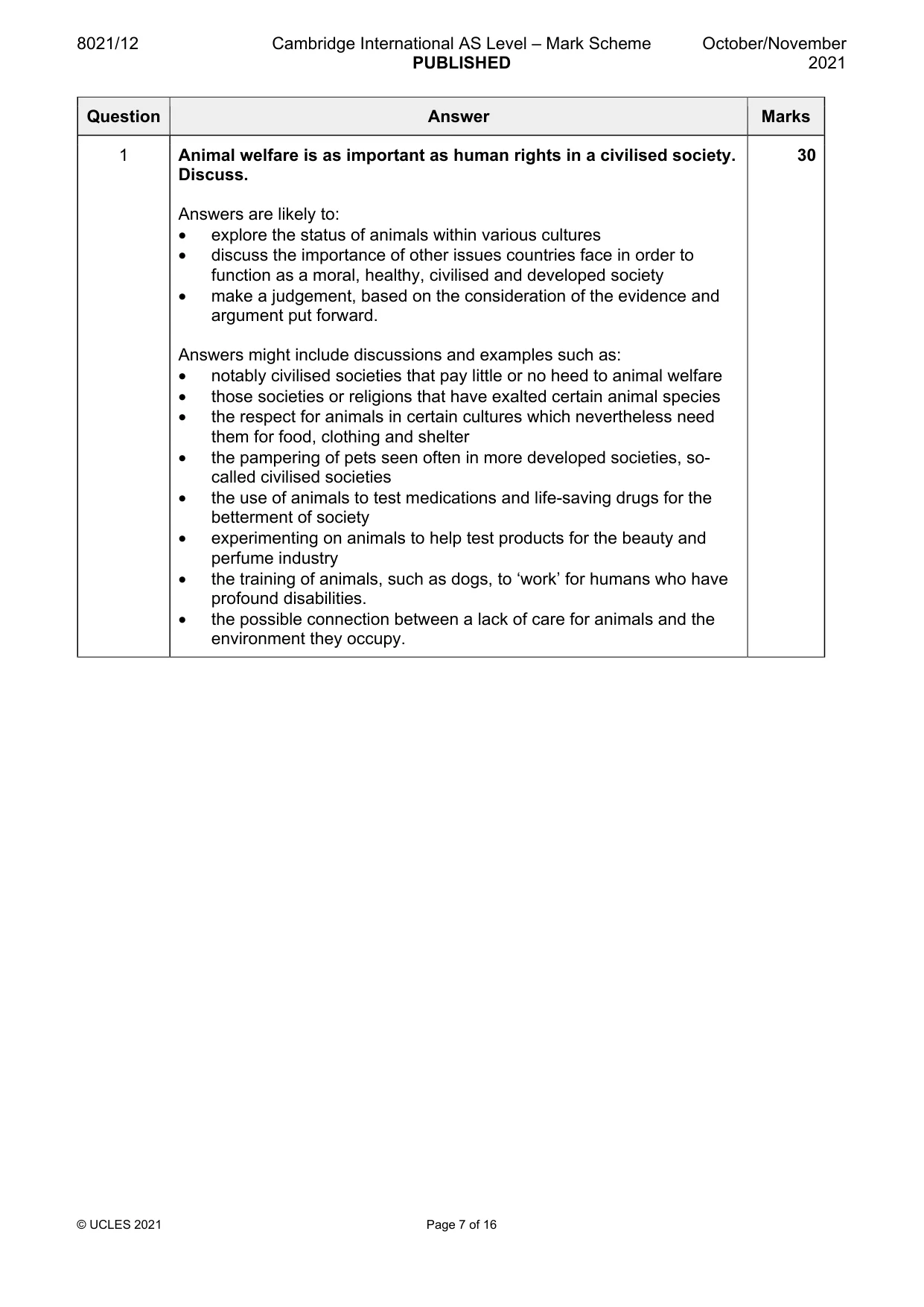
8021/12 Cambridge International AS Level – Mark Scheme PUBLISHED October/November 2021 © UCLES 2021 Page 7 of 16 Question Answer Marks 1 Animal welfare is as important as human rights in a civilised society. Discuss. Answers are likely to: • explore the status of animals within various cultures • discuss the importance of other issues countries face in order to function as a moral, healthy, civilised and developed society • make a judgement, based on the consideration of the evidence and argument put forward. Answers might include discussions and examples such as: • notably civilised societies that pay little or no heed to animal welfare • those societies or religions that have exalted certain animal species • the respect for animals in certain cultures which nevertheless need them for food, clothing and shelter • the pampering of pets seen often in more developed societies, so- called civilised societies • the use of animals to test medications and life-saving drugs for the betterment of society • experimenting on animals to help test products for the beauty and perfume industry • the training of animals, such as dogs, to ‘work’ for humans who have profound disabilities. • the possible connection between a lack of care for animals and the environment they occupy. 30
Mark scheme, page 8
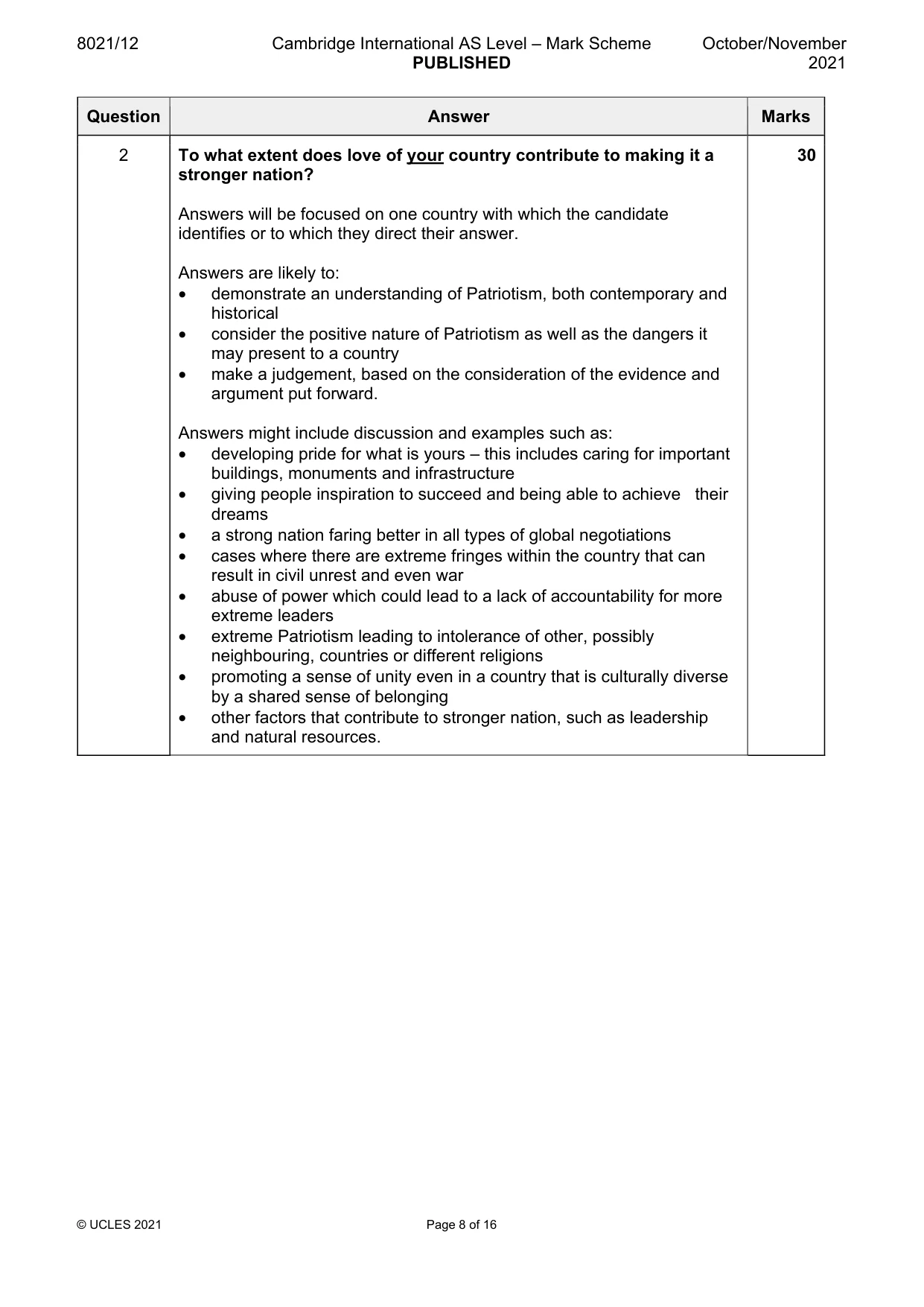
8021/12 Cambridge International AS Level – Mark Scheme PUBLISHED October/November 2021 © UCLES 2021 Page 8 of 16 Question Answer Marks 2 To what extent does love of your country contribute to making it a stronger nation? Answers will be focused on one country with which the candidate identifies or to which they direct their answer. Answers are likely to: • demonstrate an understanding of Patriotism, both contemporary and historical • consider the positive nature of Patriotism as well as the dangers it may present to a country • make a judgement, based on the consideration of the evidence and argument put forward. Answers might include discussion and examples such as: • developing pride for what is yours – this includes caring for important buildings, monuments and infrastructure • giving people inspiration to succeed and being able to achieve their dreams • a strong nation faring better in all types of global negotiations • cases where there are extreme fringes within the country that can result in civil unrest and even war • abuse of power which could lead to a lack of accountability for more extreme leaders • extreme Patriotism leading to intolerance of other, possibly neighbouring, countries or different religions • promoting a sense of unity even in a country that is culturally diverse by a shared sense of belonging • other factors that contribute to stronger nation, such as leadership and natural resources. 30
Mark scheme, page 9
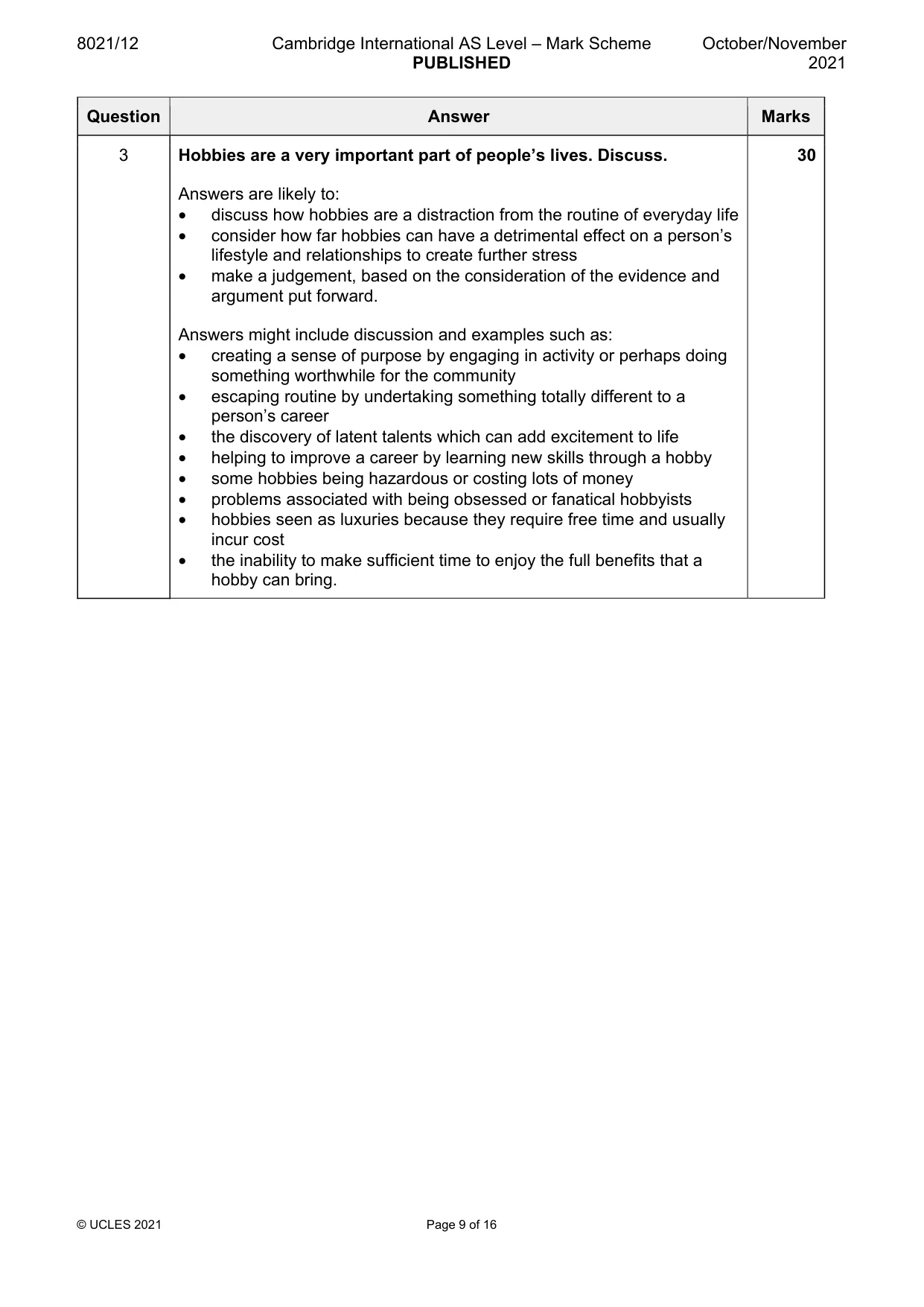
8021/12 Cambridge International AS Level – Mark Scheme PUBLISHED October/November 2021 © UCLES 2021 Page 9 of 16 Question Answer Marks 3 Hobbies are a very important part of people’s lives. Discuss. Answers are likely to: • discuss how hobbies are a distraction from the routine of everyday life • consider how far hobbies can have a detrimental effect on a person’s lifestyle and relationships to create further stress • make a judgement, based on the consideration of the evidence and argument put forward. Answers might include discussion and examples such as: • creating a sense of purpose by engaging in activity or perhaps doing something worthwhile for the community • escaping routine by undertaking something totally different to a person’s career • the discovery of latent talents which can add excitement to life • helping to improve a career by learning new skills through a hobby • some hobbies being hazardous or costing lots of money • problems associated with being obsessed or fanatical hobbyists • hobbies seen as luxuries because they require free time and usually incur cost • the inability to make sufficient time to enjoy the full benefits that a hobby can bring. 30
Mark scheme, page 10
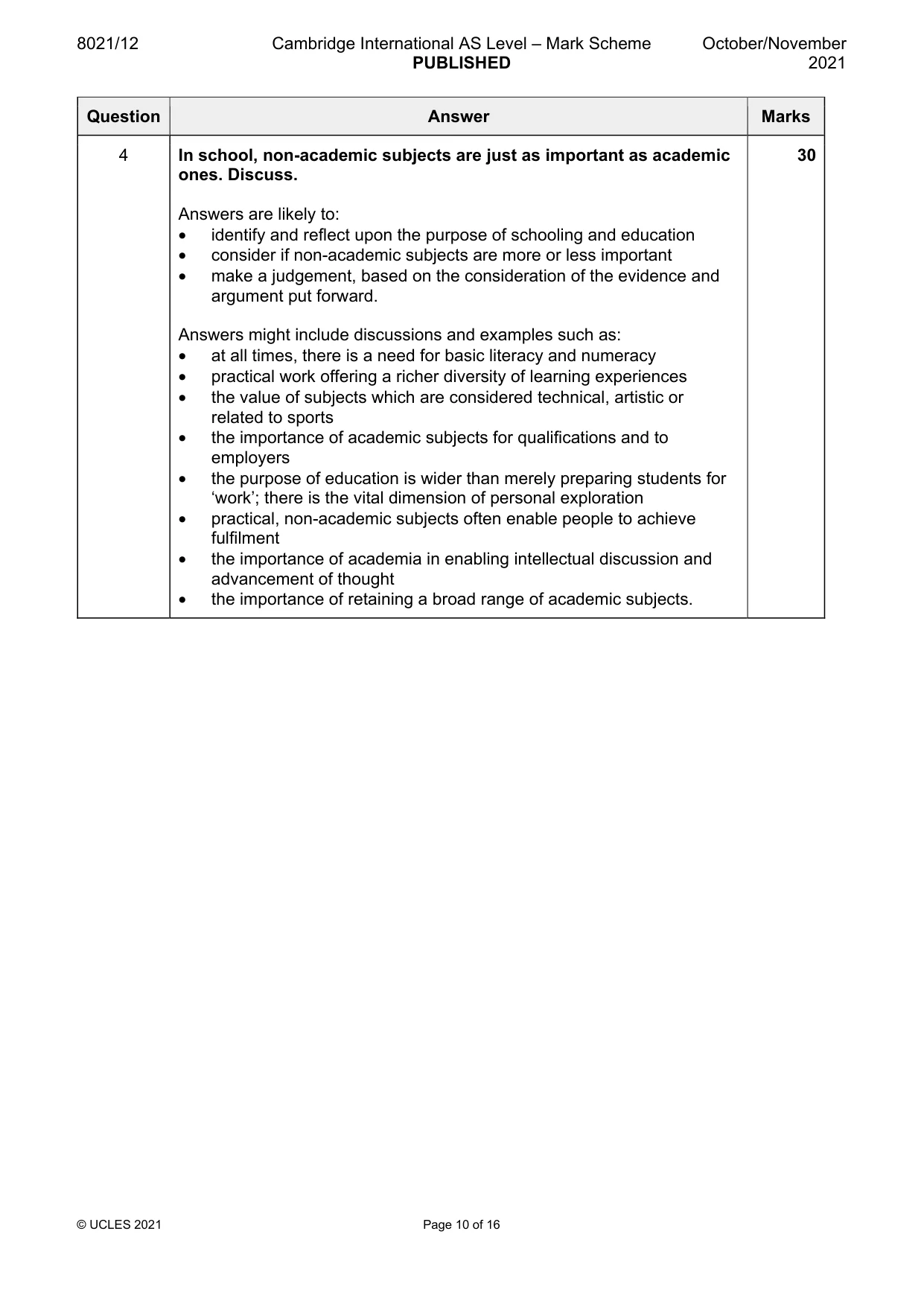
8021/12 Cambridge International AS Level – Mark Scheme PUBLISHED October/November 2021 © UCLES 2021 Page 10 of 16 Question Answer Marks 4 In school, non-academic subjects are just as important as academic ones. Discuss. Answers are likely to: • identify and reflect upon the purpose of schooling and education • consider if non-academic subjects are more or less important • make a judgement, based on the consideration of the evidence and argument put forward. Answers might include discussions and examples such as: • at all times, there is a need for basic literacy and numeracy • practical work offering a richer diversity of learning experiences • the value of subjects which are considered technical, artistic or related to sports • the importance of academic subjects for qualifications and to employers • the purpose of education is wider than merely preparing students for ‘work’; there is the vital dimension of personal exploration • practical, non-academic subjects often enable people to achieve fulfilment • the importance of academia in enabling intellectual discussion and advancement of thought • the importance of retaining a broad range of academic subjects. 30
Mark scheme, page 11
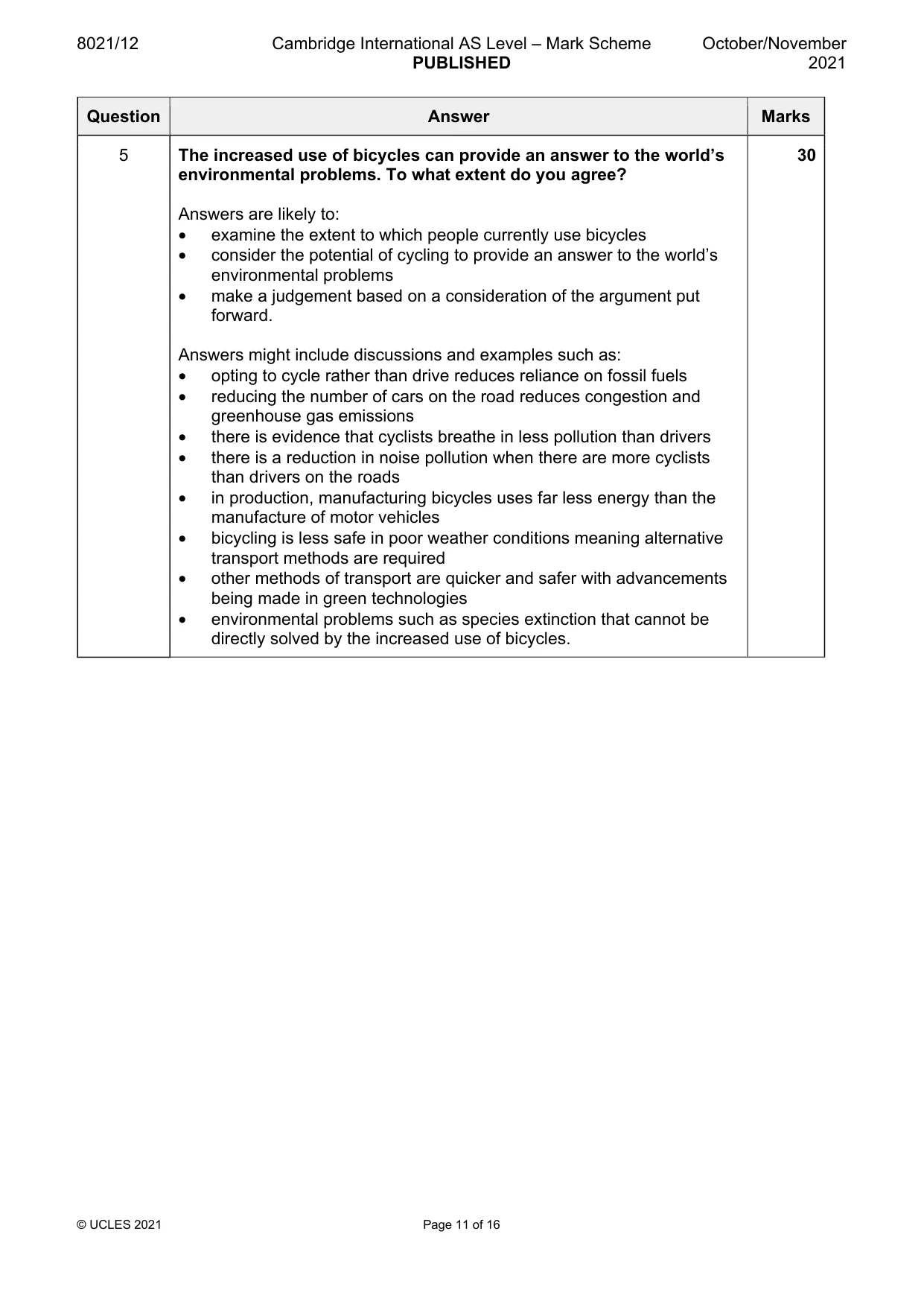
8021/12 Cambridge International AS Level – Mark Scheme PUBLISHED October/November 2021 © UCLES 2021 Page 11 of 16 Question Answer Marks 5 The increased use of bicycles can provide an answer to the world’s environmental problems. To what extent do you agree? Answers are likely to: • examine the extent to which people currently use bicycles • consider the potential of cycling to provide an answer to the world’s environmental problems • make a judgement based on a consideration of the argument put forward. Answers might include discussions and examples such as: • opting to cycle rather than drive reduces reliance on fossil fuels • reducing the number of cars on the road reduces congestion and greenhouse gas emissions • there is evidence that cyclists breathe in less pollution than drivers • there is a reduction in noise pollution when there are more cyclists than drivers on the roads • in production, manufacturing bicycles uses far less energy than the manufacture of motor vehicles • bicycling is less safe in poor weather conditions meaning alternative transport methods are required • other methods of transport are quicker and safer with advancements being made in green technologies • environmental problems such as species extinction that cannot be directly solved by the increased use of bicycles. 30
Mark scheme, page 12
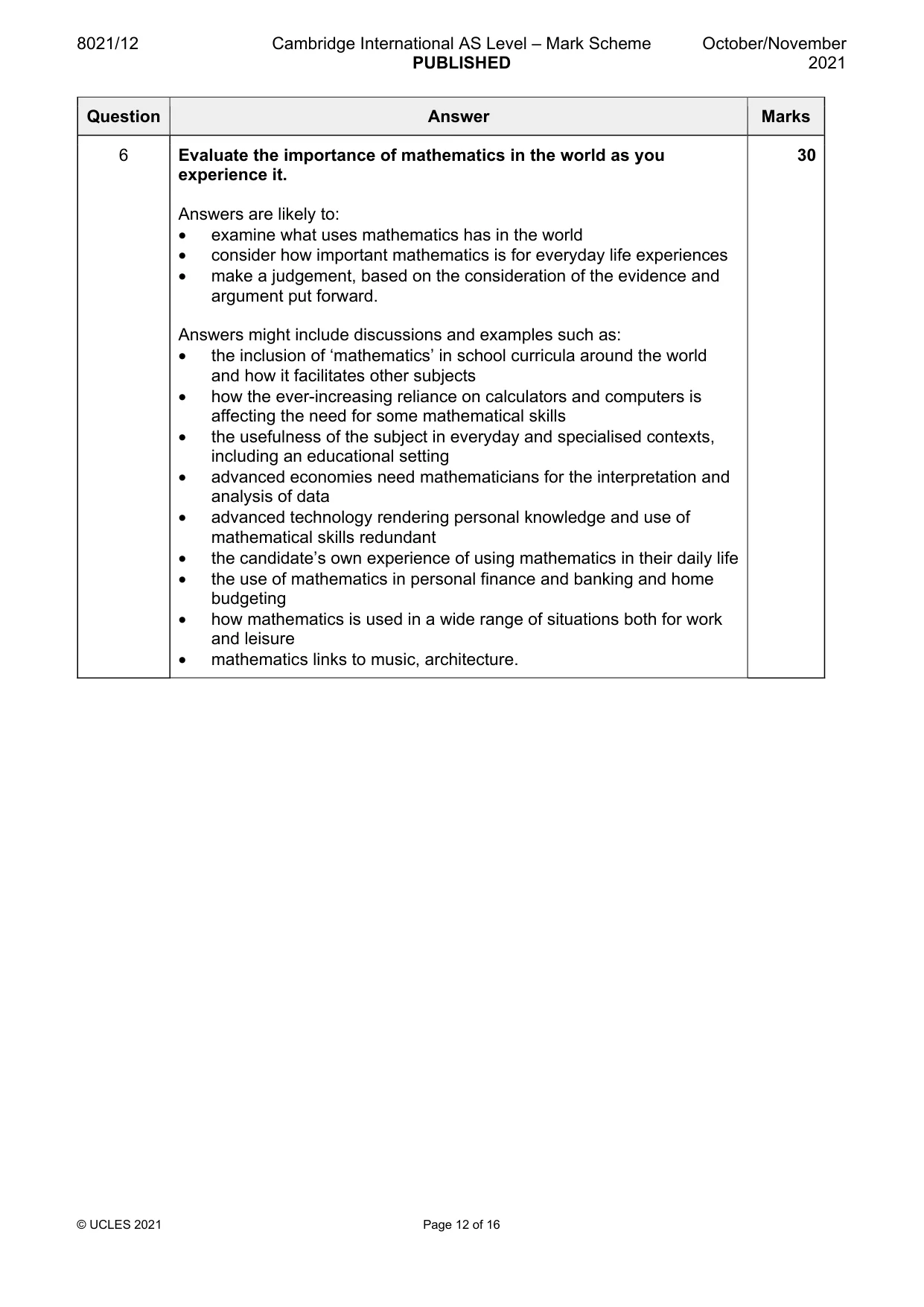
8021/12 Cambridge International AS Level – Mark Scheme PUBLISHED October/November 2021 © UCLES 2021 Page 12 of 16 Question Answer Marks 6 Evaluate the importance of mathematics in the world as you experience it. Answers are likely to: • examine what uses mathematics has in the world • consider how important mathematics is for everyday life experiences • make a judgement, based on the consideration of the evidence and argument put forward. Answers might include discussions and examples such as: • the inclusion of ‘mathematics’ in school curricula around the world and how it facilitates other subjects • how the ever-increasing reliance on calculators and computers is affecting the need for some mathematical skills • the usefulness of the subject in everyday and specialised contexts, including an educational setting • advanced economies need mathematicians for the interpretation and analysis of data • advanced technology rendering personal knowledge and use of mathematical skills redundant • the candidate’s own experience of using mathematics in their daily life • the use of mathematics in personal finance and banking and home budgeting • how mathematics is used in a wide range of situations both for work and leisure • mathematics links to music, architecture. 30
Mark scheme, page 13
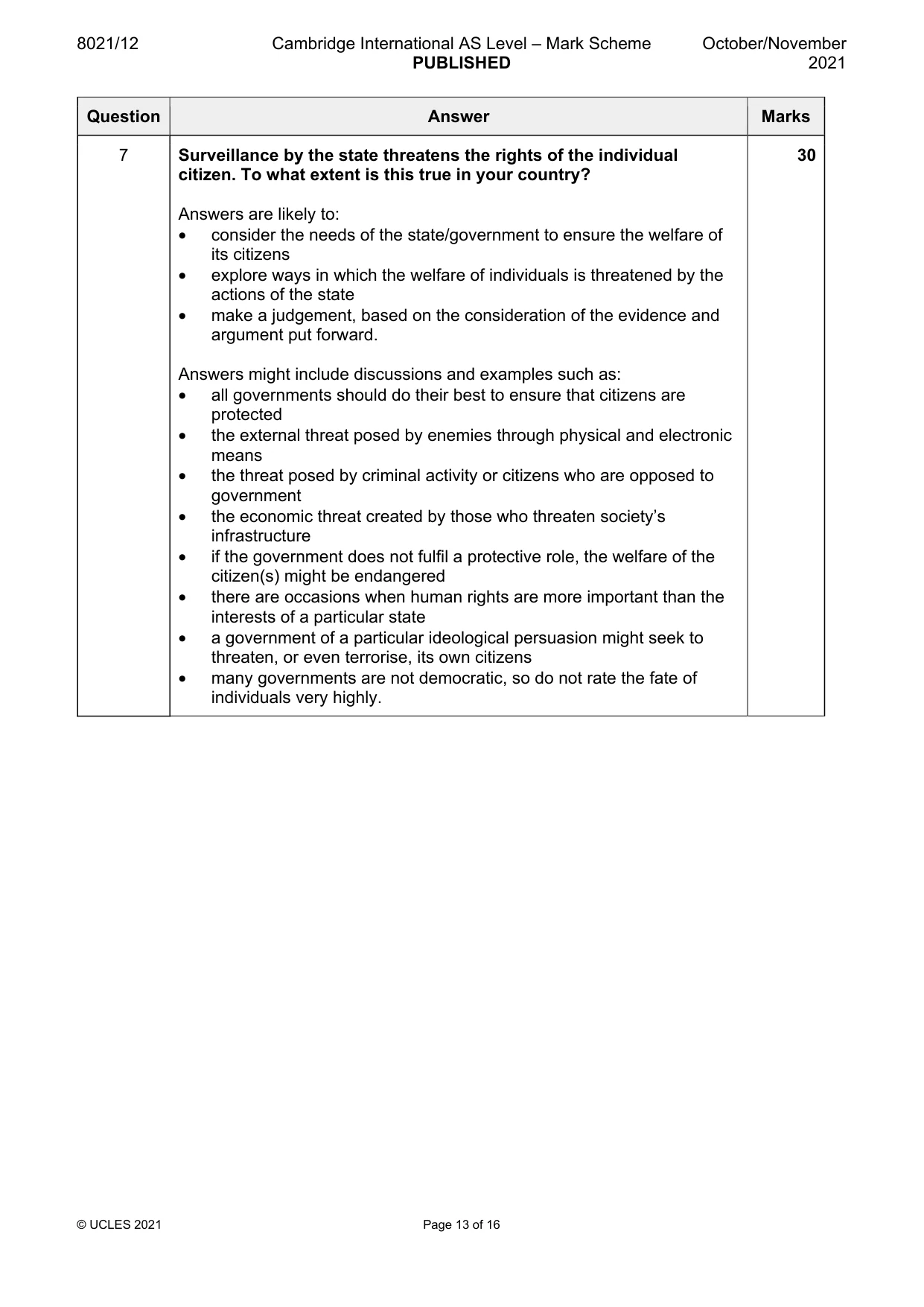
8021/12 Cambridge International AS Level – Mark Scheme PUBLISHED October/November 2021 © UCLES 2021 Page 13 of 16 Question Answer Marks 7 Surveillance by the state threatens the rights of the individual citizen. To what extent is this true in your country? Answers are likely to: • consider the needs of the state/government to ensure the welfare of its citizens • explore ways in which the welfare of individuals is threatened by the actions of the state • make a judgement, based on the consideration of the evidence and argument put forward. Answers might include discussions and examples such as: • all governments should do their best to ensure that citizens are protected • the external threat posed by enemies through physical and electronic means • the threat posed by criminal activity or citizens who are opposed to government • the economic threat created by those who threaten society’s infrastructure • if the government does not fulfil a protective role, the welfare of the citizen(s) might be endangered • there are occasions when human rights are more important than the interests of a particular state • a government of a particular ideological persuasion might seek to threaten, or even terrorise, its own citizens • many governments are not democratic, so do not rate the fate of individuals very highly. 30
Mark scheme, page 14
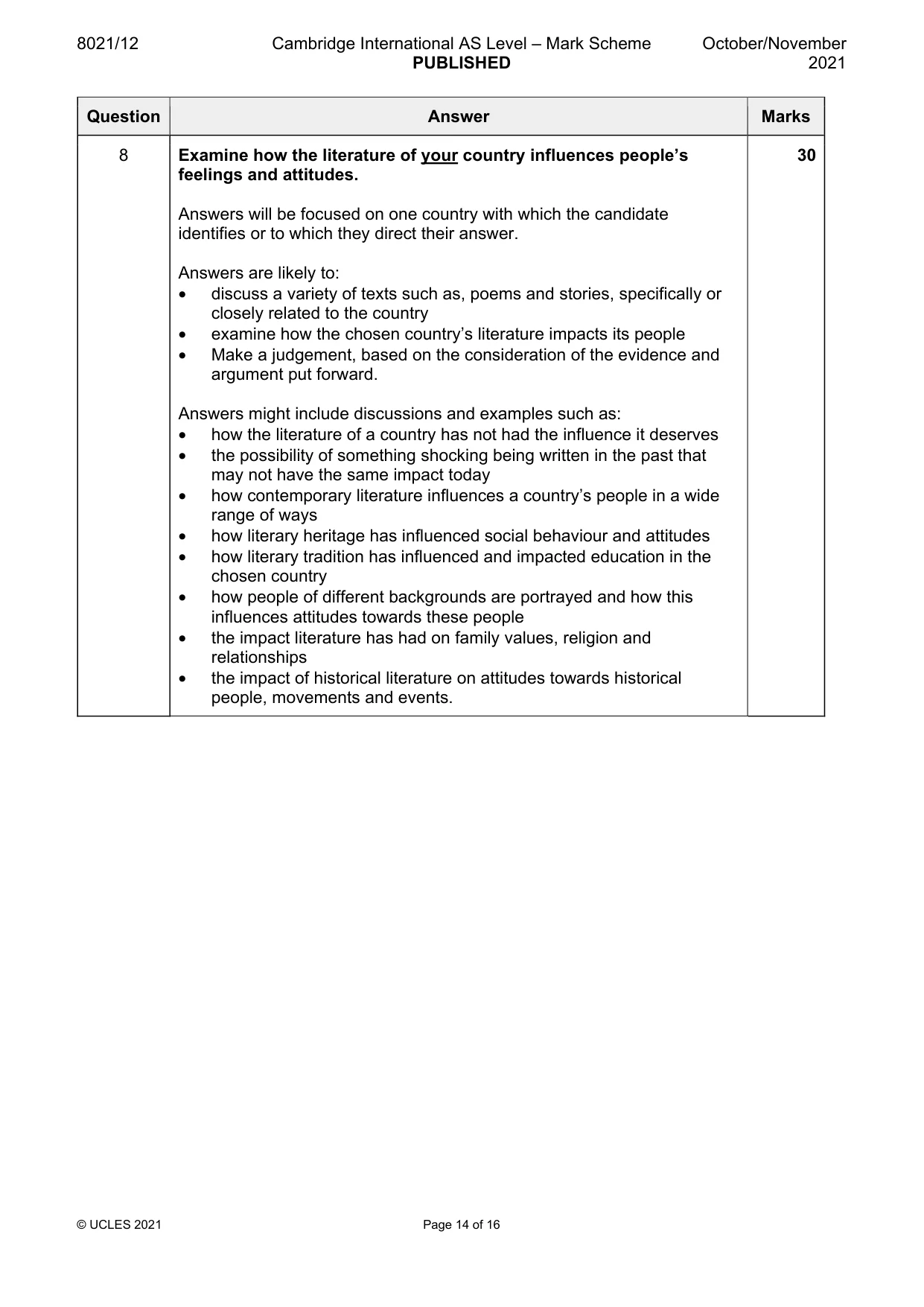
8021/12 Cambridge International AS Level – Mark Scheme PUBLISHED October/November 2021 © UCLES 2021 Page 14 of 16 Question Answer Marks 8 Examine how the literature of your country influences people’s feelings and attitudes. Answers will be focused on one country with which the candidate identifies or to which they direct their answer. Answers are likely to: • discuss a variety of texts such as, poems and stories, specifically or closely related to the country • examine how the chosen country’s literature impacts its people • Make a judgement, based on the consideration of the evidence and argument put forward. Answers might include discussions and examples such as: • how the literature of a country has not had the influence it deserves • the possibility of something shocking being written in the past that may not have the same impact today • how contemporary literature influences a country’s people in a wide range of ways • how literary heritage has influenced social behaviour and attitudes • how literary tradition has influenced and impacted education in the chosen country • how people of different backgrounds are portrayed and how this influences attitudes towards these people • the impact literature has had on family values, religion and relationships • the impact of historical literature on attitudes towards historical people, movements and events. 30
Mark scheme, page 15
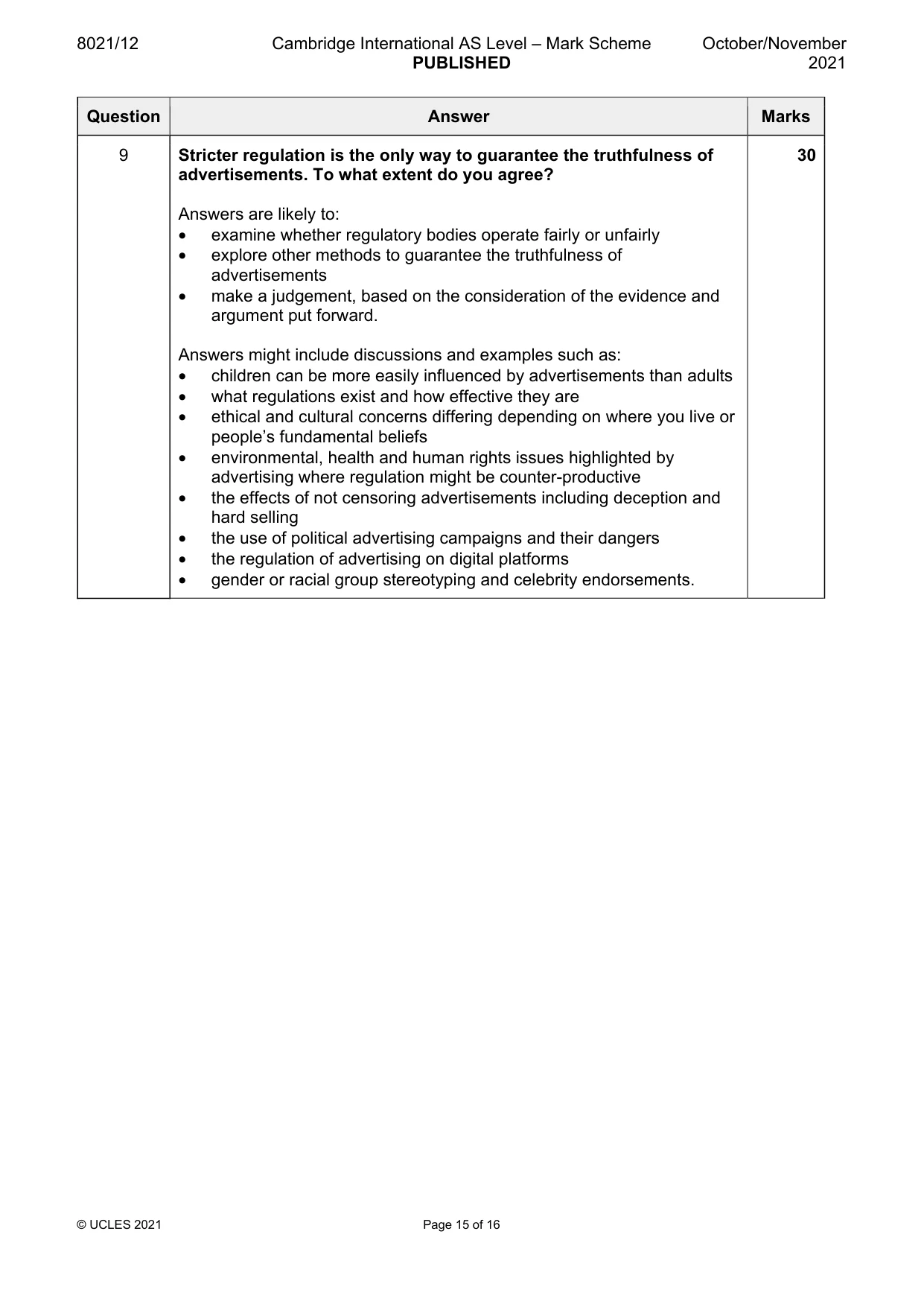
8021/12 Cambridge International AS Level – Mark Scheme PUBLISHED October/November 2021 © UCLES 2021 Page 15 of 16 Question Answer Marks 9 Stricter regulation is the only way to guarantee the truthfulness of advertisements. To what extent do you agree? Answers are likely to: • examine whether regulatory bodies operate fairly or unfairly • explore other methods to guarantee the truthfulness of advertisements • make a judgement, based on the consideration of the evidence and argument put forward. Answers might include discussions and examples such as: • children can be more easily influenced by advertisements than adults • what regulations exist and how effective they are • ethical and cultural concerns differing depending on where you live or people’s fundamental beliefs • environmental, health and human rights issues highlighted by advertising where regulation might be counter-productive • the effects of not censoring advertisements including deception and hard selling • the use of political advertising campaigns and their dangers • the regulation of advertising on digital platforms • gender or racial group stereotyping and celebrity endorsements. 30
Mark scheme, page 16
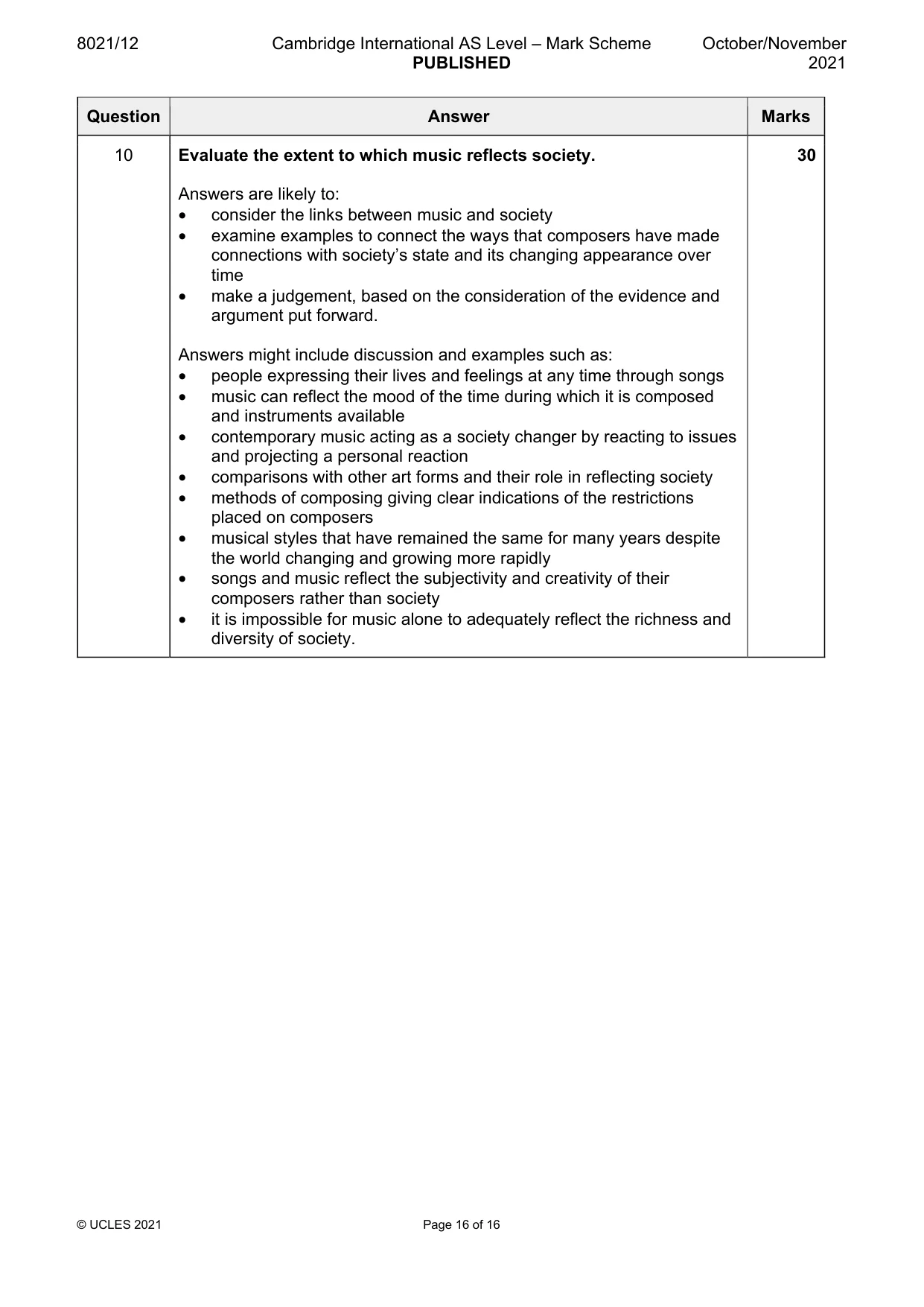
8021/12 Cambridge International AS Level – Mark Scheme PUBLISHED October/November 2021 © UCLES 2021 Page 16 of 16 Question Answer Marks 10 Evaluate the extent to which music reflects society. Answers are likely to: • consider the links between music and society • examine examples to connect the ways that composers have made connections with society’s state and its changing appearance over time • make a judgement, based on the consideration of the evidence and argument put forward. Answers might include discussion and examples such as: • people expressing their lives and feelings at any time through songs • music can reflect the mood of the time during which it is composed and instruments available • contemporary music acting as a society changer by reacting to issues and projecting a personal reaction • comparisons with other art forms and their role in reflecting society • methods of composing giving clear indications of the restrictions placed on composers • musical styles that have remained the same for many years despite the world changing and growing more rapidly • songs and music reflect the subjectivity and creativity of their composers rather than society • it is impossible for music alone to adequately reflect the richness and diversity of society. 30
What you needed in this session
Cambridge’s own grade thresholds for 2021 Oct/Nov, Paper 1 · Variant 2. A higher threshold means an easier paper — the bar moves with how the cohort did.