Cambridge A Level English General Paper 8021 — 2021 Oct/Nov Paper 1 · Variant 1
8021/11/O/N/21 · 30 marks · ≈34 min
The question paper and its mark scheme, free to read here and free to download. This is Cambridge’s own paper, exactly as it was sat.
Question paper4 pages


Mark scheme16 pages
Answers below. Sit the paper first if you are practising.
Paper as text
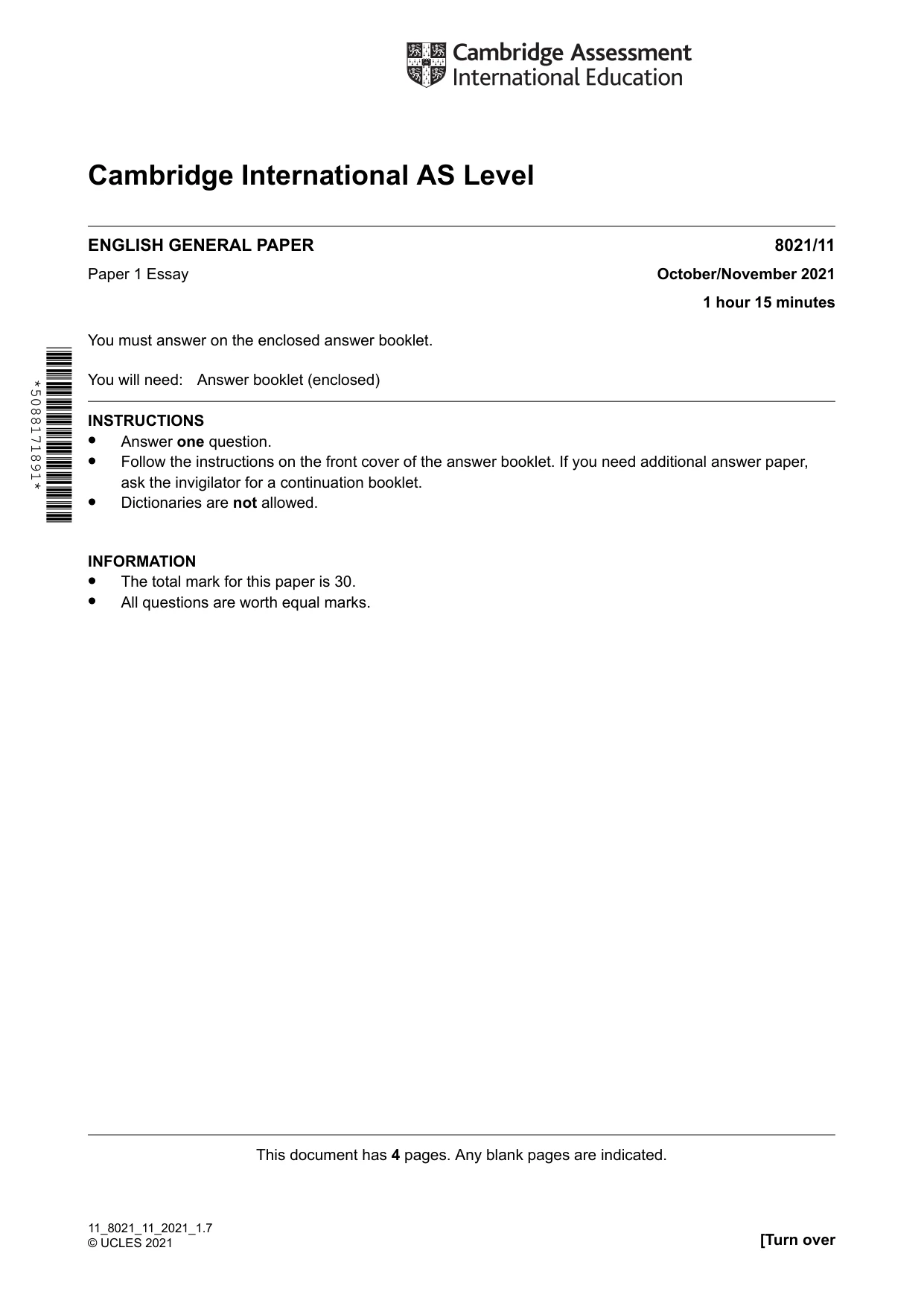
Question paper, page 1
Cambridge International AS Level 8021/11 October/November 2021 1 hour 15 minutes ENGLISH GENERAL PAPER Paper 1 Essay You must answer on the enclosed answer booklet. You will need: Answer booklet (enclosed) INSTRUCTIONS • Answer one question. • Follow the instructions on the front cover of the answer booklet. If you need additional answer paper, ask the invigilator for a continuation booklet. • Dictionaries are not allowed. INFORMATION • The total mark for this paper is 30. • All questions are worth equal marks. This document has 4 pages. Any blank pages are indicated. [Turn over 11_8021_11_2021_1.7 © UCLES 2021 *5088171891*
Question paper, page 2
BLANK PAGE 11_8021_11_2021_1.7 © UCLES 2021 2
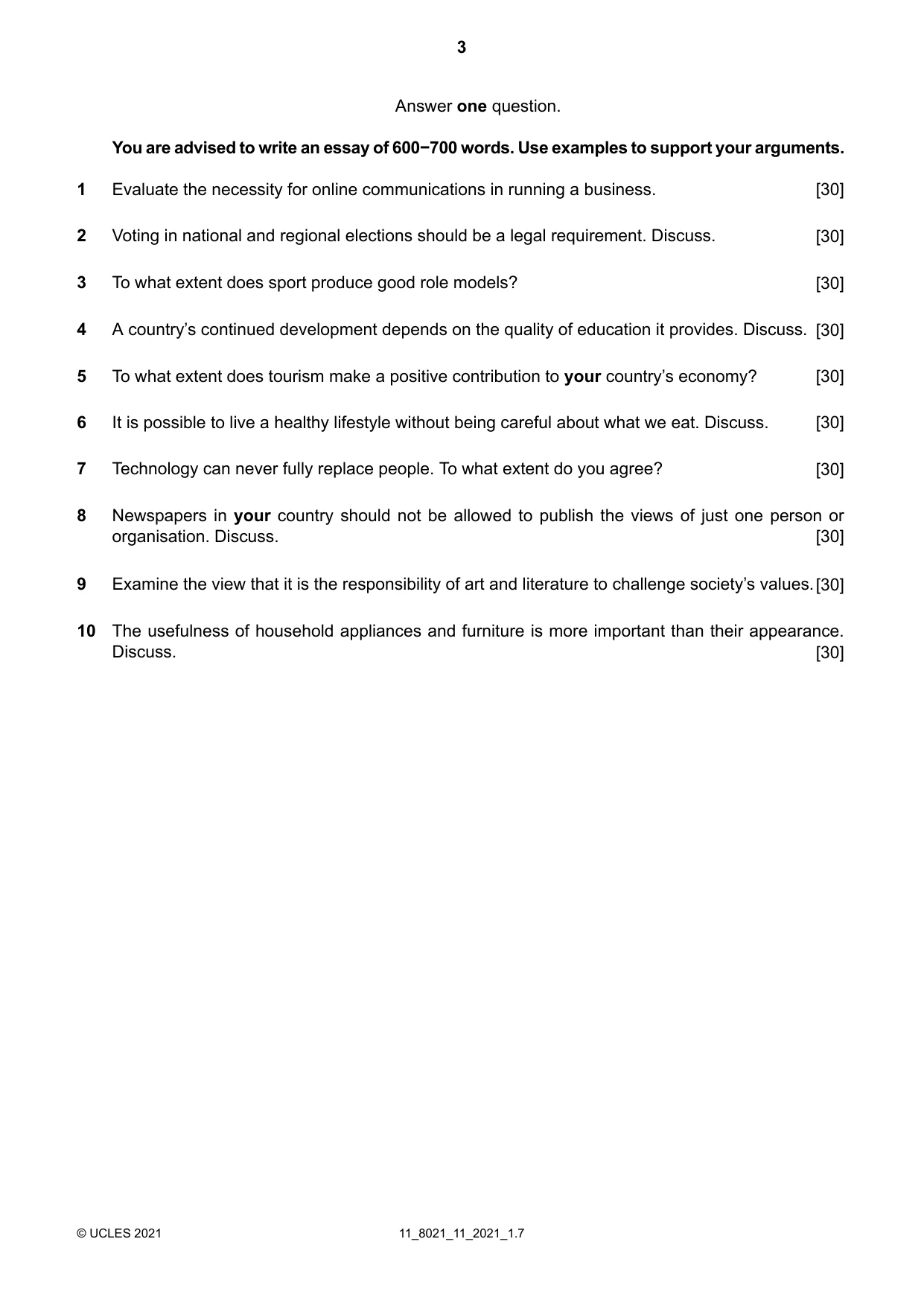
Question paper, page 3
Answer one question. You are advised to write an essay of 600−700 words. Use examples to support your arguments. Evaluate the necessity for online communications in running a business. [30] 1 Voting in national and regional elections should be a legal requirement. Discuss. [30] 2 To what extent does sport produce good role models? [30] 3 A country’s continued development depends on the quality of education it provides. Discuss. [30] 4 To what extent does tourism make a positive contribution to your country’s economy? [30] 5 It is possible to live a healthy lifestyle without being careful about what we eat. Discuss. [30] 6 Technology can never fully replace people. To what extent do you agree? [30] 7 Newspapers in your country should not be allowed to publish the views of just one person or organisation. Discuss. [30] 8 Examine the view that it is the responsibility of art and literature to challenge society’s values.[30] 9 The usefulness of household appliances and furniture is more important than their appearance. Discuss. [30] 10 11_8021_11_2021_1.7 © UCLES 2021 3
Question paper, page 4
BLANK PAGE Permission to reproduce items where third-party owned material protected by copyright is included has been sought and cleared where possible. Every reasonable effort has been made by the publisher (UCLES) to trace copyright holders, but if any items requiring clearance have unwittingly been included, the publisher will be pleased to make amends at the earliest possible opportunity. To avoid the issue of disclosure of answer-related information to candidates, all copyright acknowledgements are reproduced online in the Cambridge Assessment International Education Copyright Acknowledgements Booklet. This is produced for each series of examinations and is freely available to download at www.cambridgeinternational.org after the live examination series. Cambridge Assessment International Education is part of the Cambridge Assessment Group. Cambridge Assessment is the brand name of the University of Cambridge Local Examinations Syndicate (UCLES), which itself is a department of the University of Cambridge. 11_8021_11_2021_1.7 © UCLES 2021 4
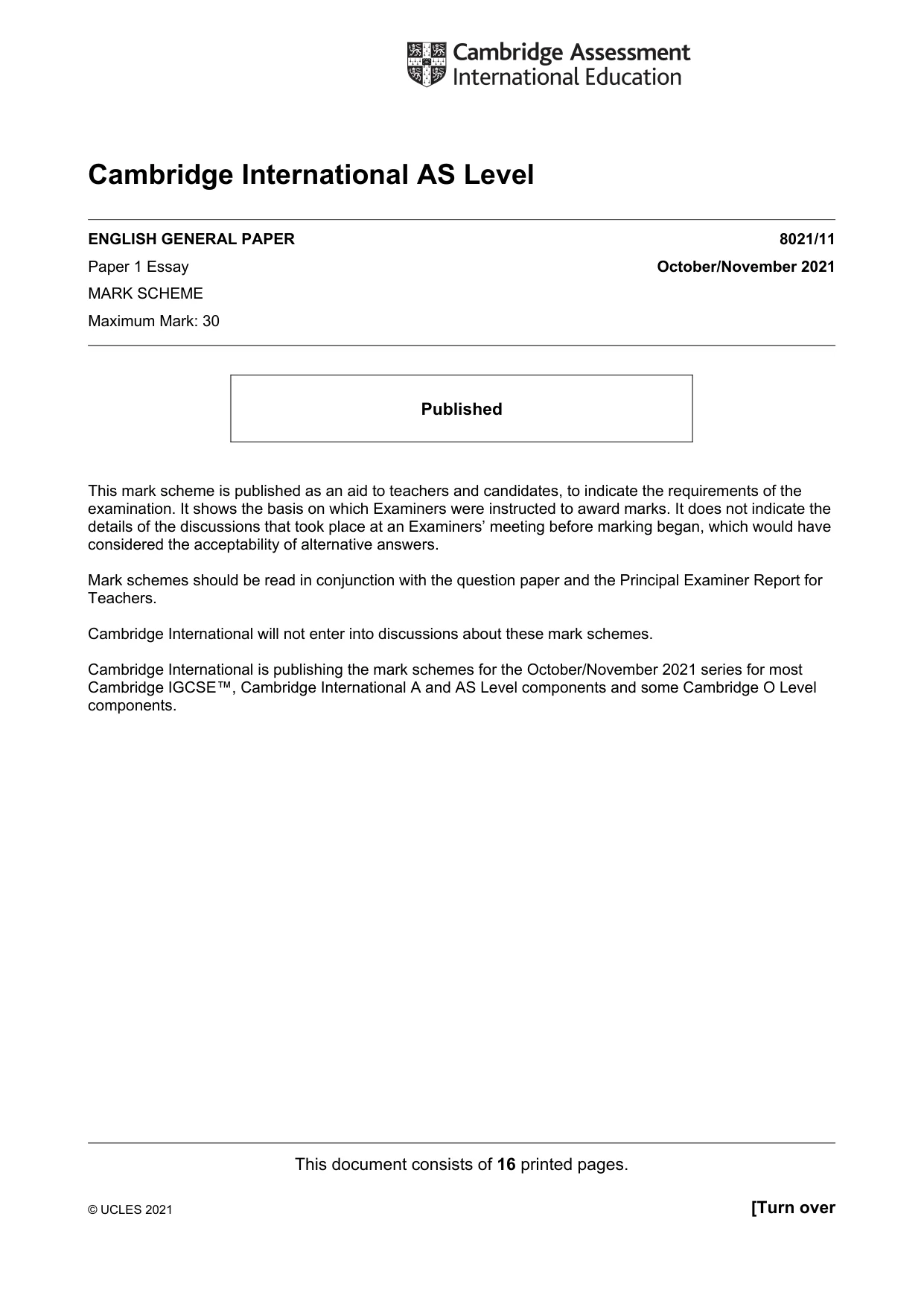
Mark scheme, page 1
This document consists of 16 printed pages. © UCLES 2021 [Turn over Cambridge International AS Level ENGLISH GENERAL PAPER 8021/11 Paper 1 Essay October/November 2021 MARK SCHEME Maximum Mark: 30 Published This mark scheme is published as an aid to teachers and candidates, to indicate the requirements of the examination. It shows the basis on which Examiners were instructed to award marks. It does not indicate the details of the discussions that took place at an Examiners’ meeting before marking began, which would have considered the acceptability of alternative answers. Mark schemes should be read in conjunction with the question paper and the Principal Examiner Report for Teachers. Cambridge International will not enter into discussions about these mark schemes. Cambridge International is publishing the mark schemes for the October/November 2021 series for most Cambridge IGCSE™, Cambridge International A and AS Level components and some Cambridge O Level components.
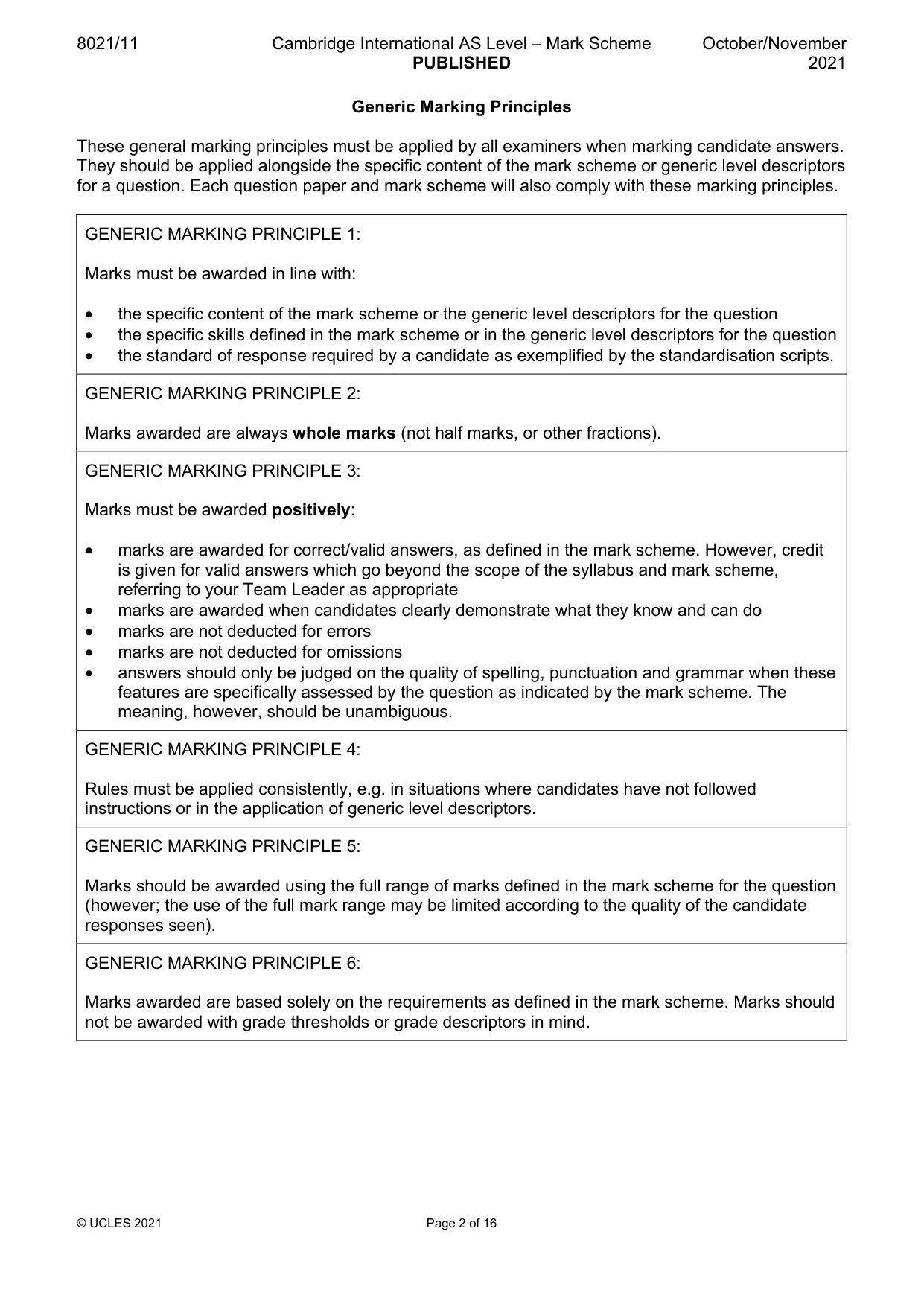
Mark scheme, page 2
8021/11 Cambridge International AS Level – Mark Scheme PUBLISHED October/November 2021 © UCLES 2021 Page 2 of 16 Generic Marking Principles These general marking principles must be applied by all examiners when marking candidate answers. They should be applied alongside the specific content of the mark scheme or generic level descriptors for a question. Each question paper and mark scheme will also comply with these marking principles. GENERIC MARKING PRINCIPLE 1: Marks must be awarded in line with: • the specific content of the mark scheme or the generic level descriptors for the question • the specific skills defined in the mark scheme or in the generic level descriptors for the question • the standard of response required by a candidate as exemplified by the standardisation scripts. GENERIC MARKING PRINCIPLE 2: Marks awarded are always whole marks (not half marks, or other fractions). GENERIC MARKING PRINCIPLE 3: Marks must be awarded positively: • marks are awarded for correct/valid answers, as defined in the mark scheme. However, credit is given for valid answers which go beyond the scope of the syllabus and mark scheme, referring to your Team Leader as appropriate • marks are awarded when candidates clearly demonstrate what they know and can do • marks are not deducted for errors • marks are not deducted for omissions • answers should only be judged on the quality of spelling, punctuation and grammar when these features are specifically assessed by the question as indicated by the mark scheme. The meaning, however, should be unambiguous. GENERIC MARKING PRINCIPLE 4: Rules must be applied consistently, e.g. in situations where candidates have not followed instructions or in the application of generic level descriptors. GENERIC MARKING PRINCIPLE 5: Marks should be awarded using the full range of marks defined in the mark scheme for the question (however; the use of the full mark range may be limited according to the quality of the candidate responses seen). GENERIC MARKING PRINCIPLE 6: Marks awarded are based solely on the requirements as defined in the mark scheme. Marks should not be awarded with grade thresholds or grade descriptors in mind.
Mark scheme, page 3
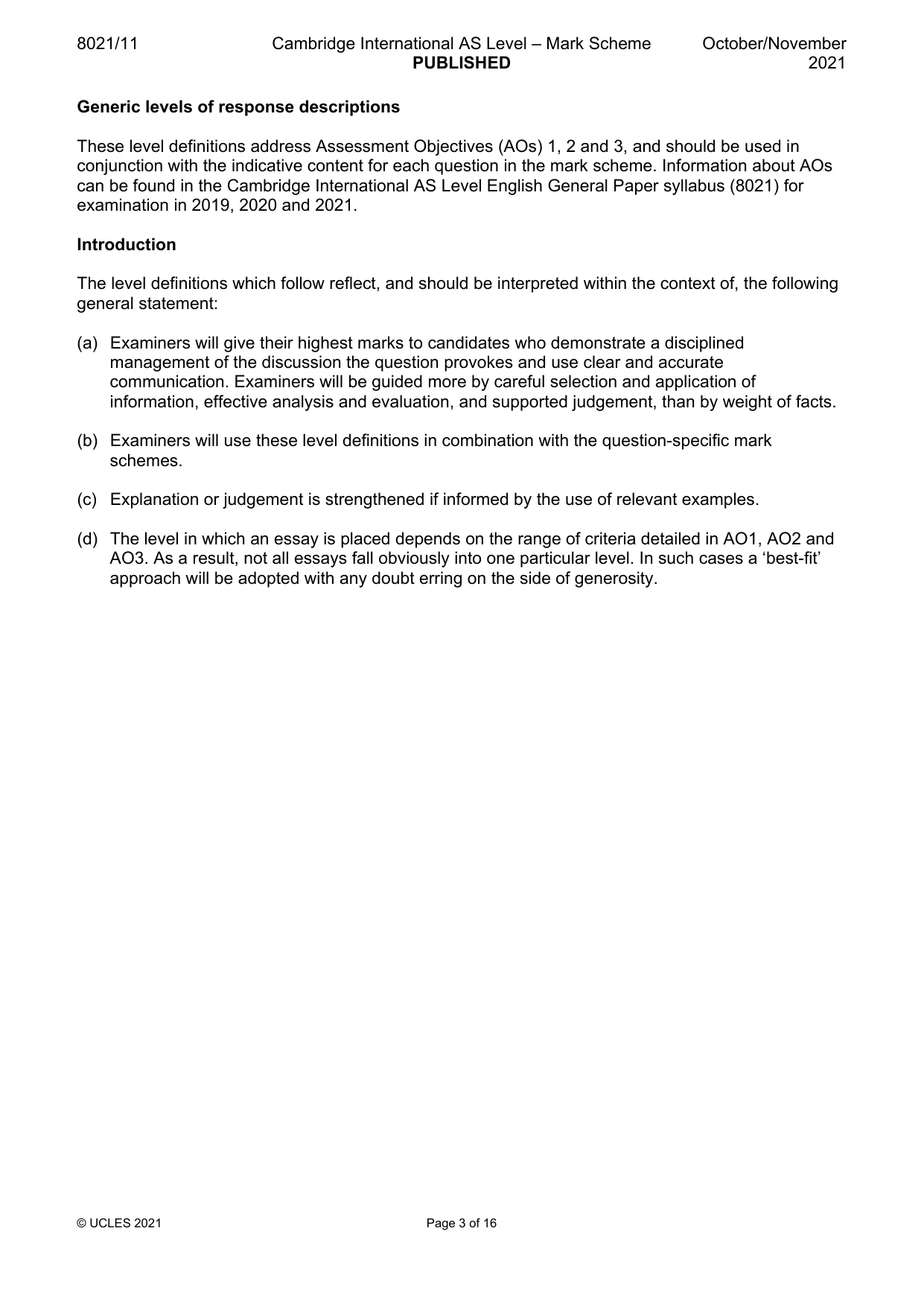
8021/11 Cambridge International AS Level – Mark Scheme PUBLISHED October/November 2021 © UCLES 2021 Page 3 of 16 Generic levels of response descriptions These level definitions address Assessment Objectives (AOs) 1, 2 and 3, and should be used in conjunction with the indicative content for each question in the mark scheme. Information about AOs can be found in the Cambridge International AS Level English General Paper syllabus (8021) for examination in 2019, 2020 and 2021. Introduction The level definitions which follow reflect, and should be interpreted within the context of, the following general statement: (a) Examiners will give their highest marks to candidates who demonstrate a disciplined management of the discussion the question provokes and use clear and accurate communication. Examiners will be guided more by careful selection and application of information, effective analysis and evaluation, and supported judgement, than by weight of facts. (b) Examiners will use these level definitions in combination with the question-specific mark schemes. (c) Explanation or judgement is strengthened if informed by the use of relevant examples. (d) The level in which an essay is placed depends on the range of criteria detailed in AO1, AO2 and AO3. As a result, not all essays fall obviously into one particular level. In such cases a ‘best-fit’ approach will be adopted with any doubt erring on the side of generosity.
Mark scheme, page 4
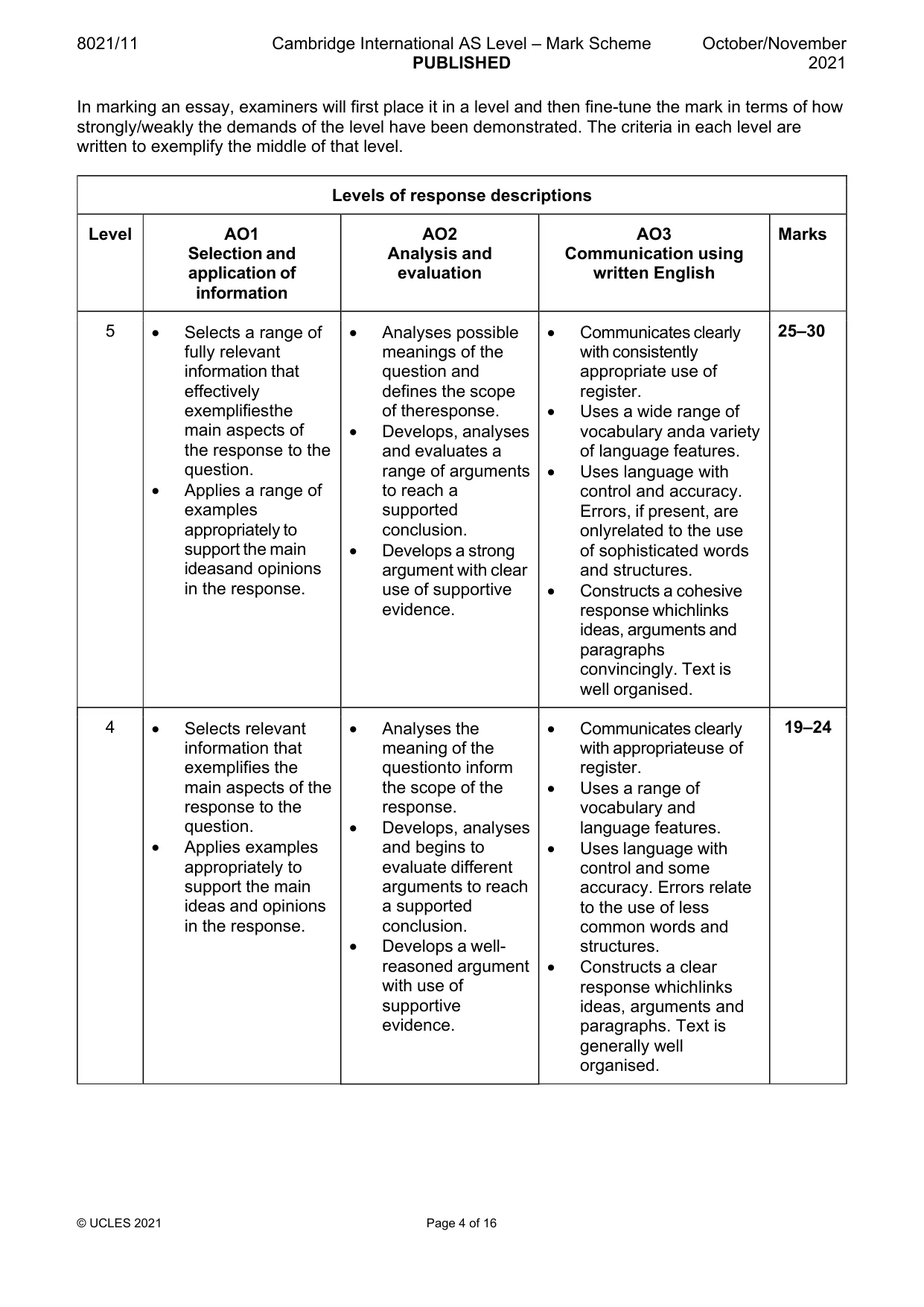
8021/11 Cambridge International AS Level – Mark Scheme PUBLISHED October/November 2021 © UCLES 2021 Page 4 of 16 In marking an essay, examiners will first place it in a level and then fine-tune the mark in terms of how strongly/weakly the demands of the level have been demonstrated. The criteria in each level are written to exemplify the middle of that level. Levels of response descriptions Level AO1 Selection and application of information AO2 Analysis and evaluation AO3 Communication using written English Marks 5 • Selects a range of fully relevant information that effectively exemplifies the main aspects of the response to the question. • Applies a range of examples appropriately to support the main ideas and opinions in the response. • Analyses possible meanings of the question and defines the scope of the response. • Develops, analyses and evaluates a range of arguments to reach a supported conclusion. • Develops a strong argument with clear use of supportive evidence. • Communicates clearly with consistently appropriate use of register. • Uses a wide range of vocabulary and a variety of language features. • Uses language with control and accuracy. Errors, if present, are only related to the use of sophisticated words and structures. • Constructs a cohesive response which links ideas, arguments and paragraphs convincingly. Text is well organised. 25–30 4 • Selects relevant information that exemplifies the main aspects of the response to the question. • Applies examples appropriately to support the main ideas and opinions in the response. • Analyses the meaning of the question to inform the scope of the response. • Develops, analyses and begins to evaluate different arguments to reach a supported conclusion. • Develops a well- reasoned argument with use of supportive evidence. • Communicates clearly with appropriate use of register. • Uses a range of vocabulary and language features. • Uses language with control and some accuracy. Errors relate to the use of less common words and structures. • Constructs a clear response which links ideas, arguments and paragraphs. Text is generally well organised. 19–24
Mark scheme, page 5
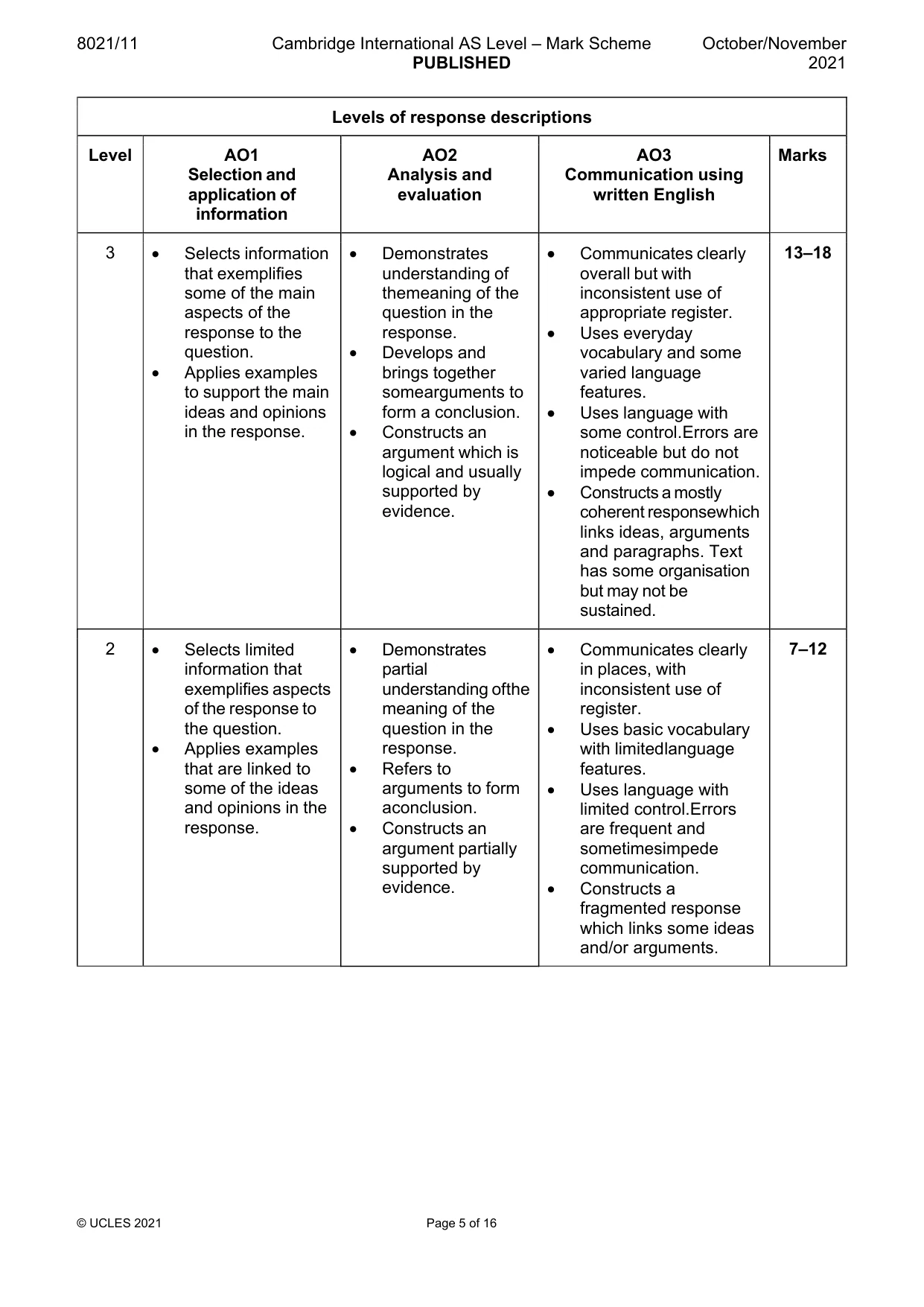
8021/11 Cambridge International AS Level – Mark Scheme PUBLISHED October/November 2021 © UCLES 2021 Page 5 of 16 Levels of response descriptions Level AO1 Selection and application of information AO2 Analysis and evaluation AO3 Communication using written English Marks 3 • Selects information that exemplifies some of the main aspects of the response to the question. • Applies examples to support the main ideas and opinions in the response. • Demonstrates understanding of the meaning of the question in the response. • Develops and brings together some arguments to form a conclusion. • Constructs an argument which is logical and usually supported by evidence. • Communicates clearly overall but with inconsistent use of appropriate register. • Uses everyday vocabulary and some varied language features. • Uses language with some control. Errors are noticeable but do not impede communication. • Constructs a mostly coherent response which links ideas, arguments and paragraphs. Text has some organisation but may not be sustained. 13–18 2 • Selects limited information that exemplifies aspects of the response to the question. • Applies examples that are linked to some of the ideas and opinions in the response. • Demonstrates partial understanding of the meaning of the question in the response. • Refers to arguments to form a conclusion. • Constructs an argument partially supported by evidence. • Communicates clearly in places, with inconsistent use of register. • Uses basic vocabulary with limited language features. • Uses language with limited control. Errors are frequent and sometimes impede communication. • Constructs a fragmented response which links some ideas and/or arguments. 7–12
Mark scheme, page 6
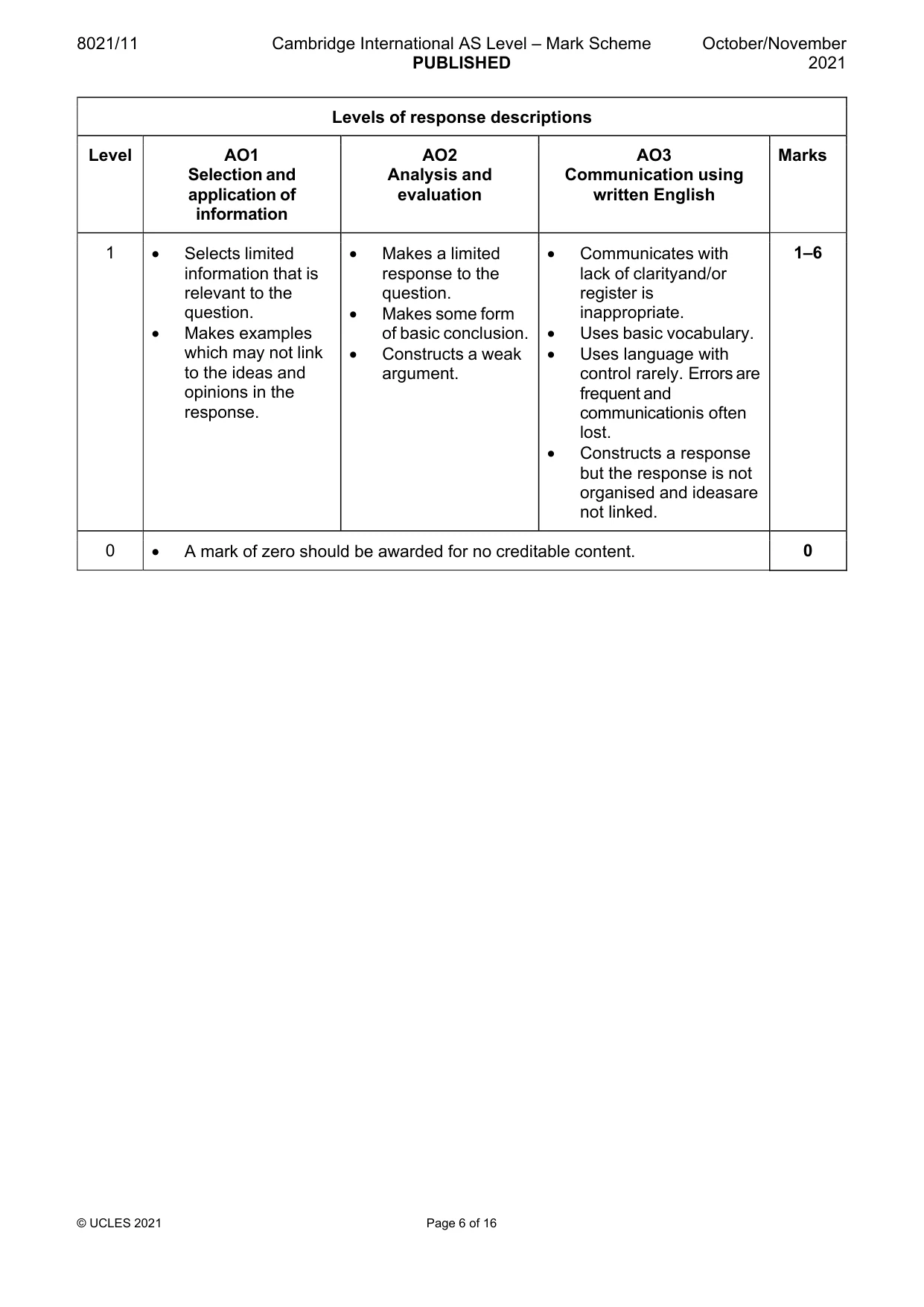
8021/11 Cambridge International AS Level – Mark Scheme PUBLISHED October/November 2021 © UCLES 2021 Page 6 of 16 Levels of response descriptions Level AO1 Selection and application of information AO2 Analysis and evaluation AO3 Communication using written English Marks 1 • Selects limited information that is relevant to the question. • Makes examples which may not link to the ideas and opinions in the response. • Makes a limited response to the question. • Makes some form of basic conclusion. • Constructs a weak argument. • Communicates with lack of clarity and/or register is inappropriate. • Uses basic vocabulary. • Uses language with control rarely. Errors are frequent and communication is often lost. • Constructs a response but the response is not organised and ideas are not linked. 1–6 0 • A mark of zero should be awarded for no creditable content. 0
Mark scheme, page 7
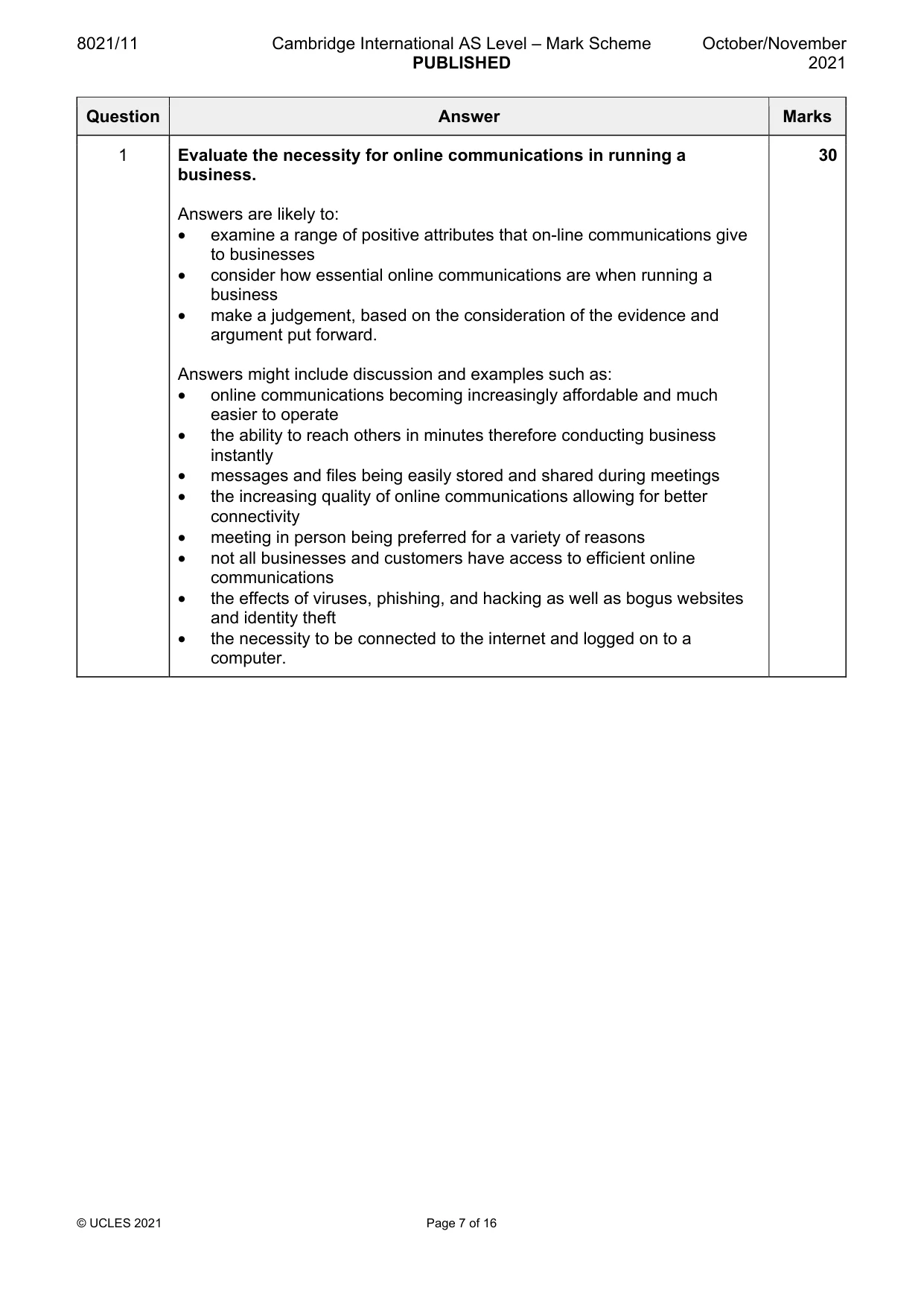
8021/11 Cambridge International AS Level – Mark Scheme PUBLISHED October/November 2021 © UCLES 2021 Page 7 of 16 Question Answer Marks 1 Evaluate the necessity for online communications in running a business. Answers are likely to: • examine a range of positive attributes that on-line communications give to businesses • consider how essential online communications are when running a business • make a judgement, based on the consideration of the evidence and argument put forward. Answers might include discussion and examples such as: • online communications becoming increasingly affordable and much easier to operate • the ability to reach others in minutes therefore conducting business instantly • messages and files being easily stored and shared during meetings • the increasing quality of online communications allowing for better connectivity • meeting in person being preferred for a variety of reasons • not all businesses and customers have access to efficient online communications • the effects of viruses, phishing, and hacking as well as bogus websites and identity theft • the necessity to be connected to the internet and logged on to a computer. 30
Mark scheme, page 8
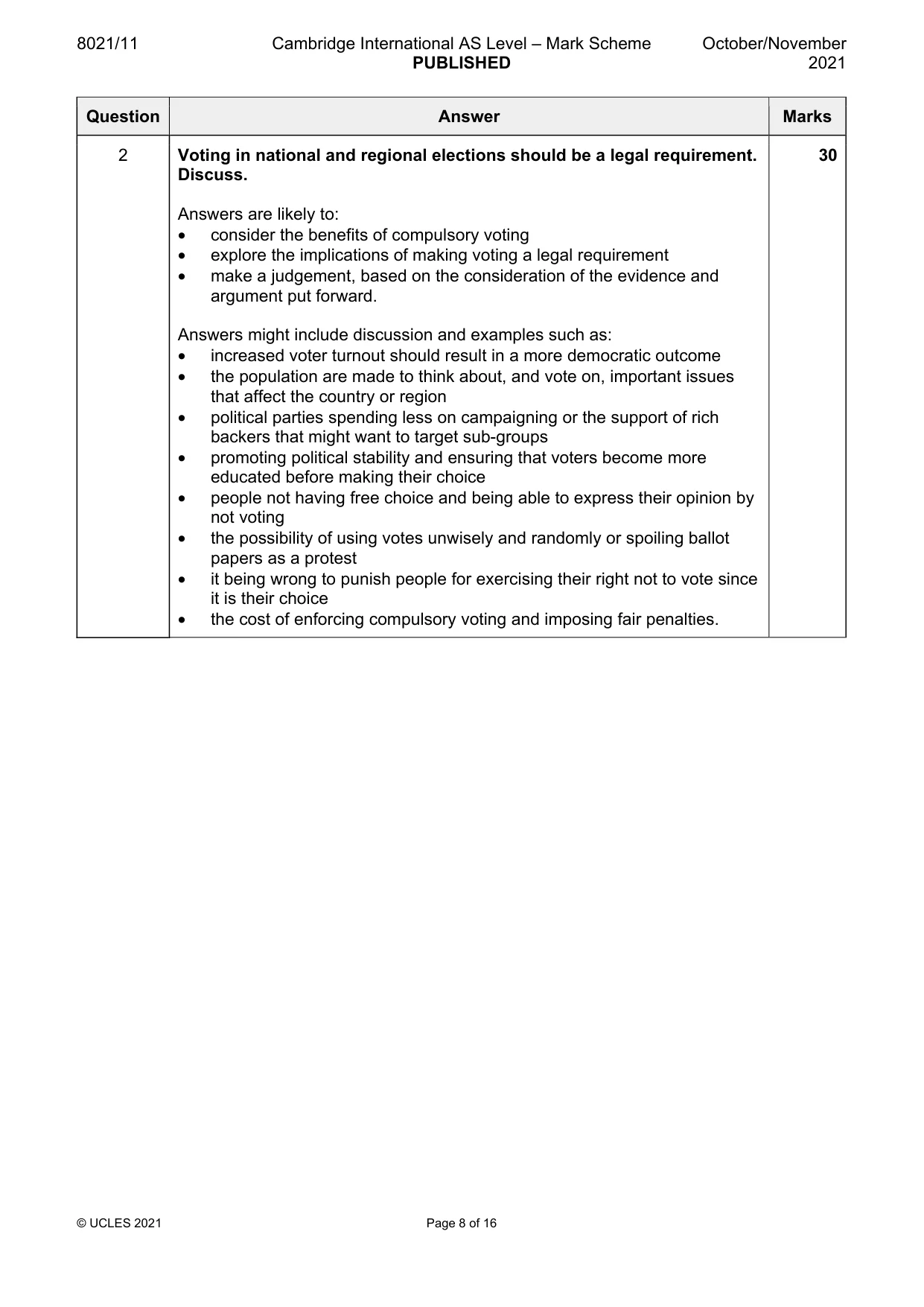
8021/11 Cambridge International AS Level – Mark Scheme PUBLISHED October/November 2021 © UCLES 2021 Page 8 of 16 Question Answer Marks 2 Voting in national and regional elections should be a legal requirement. Discuss. Answers are likely to: • consider the benefits of compulsory voting • explore the implications of making voting a legal requirement • make a judgement, based on the consideration of the evidence and argument put forward. Answers might include discussion and examples such as: • increased voter turnout should result in a more democratic outcome • the population are made to think about, and vote on, important issues that affect the country or region • political parties spending less on campaigning or the support of rich backers that might want to target sub-groups • promoting political stability and ensuring that voters become more educated before making their choice • people not having free choice and being able to express their opinion by not voting • the possibility of using votes unwisely and randomly or spoiling ballot papers as a protest • it being wrong to punish people for exercising their right not to vote since it is their choice • the cost of enforcing compulsory voting and imposing fair penalties. 30
Mark scheme, page 9
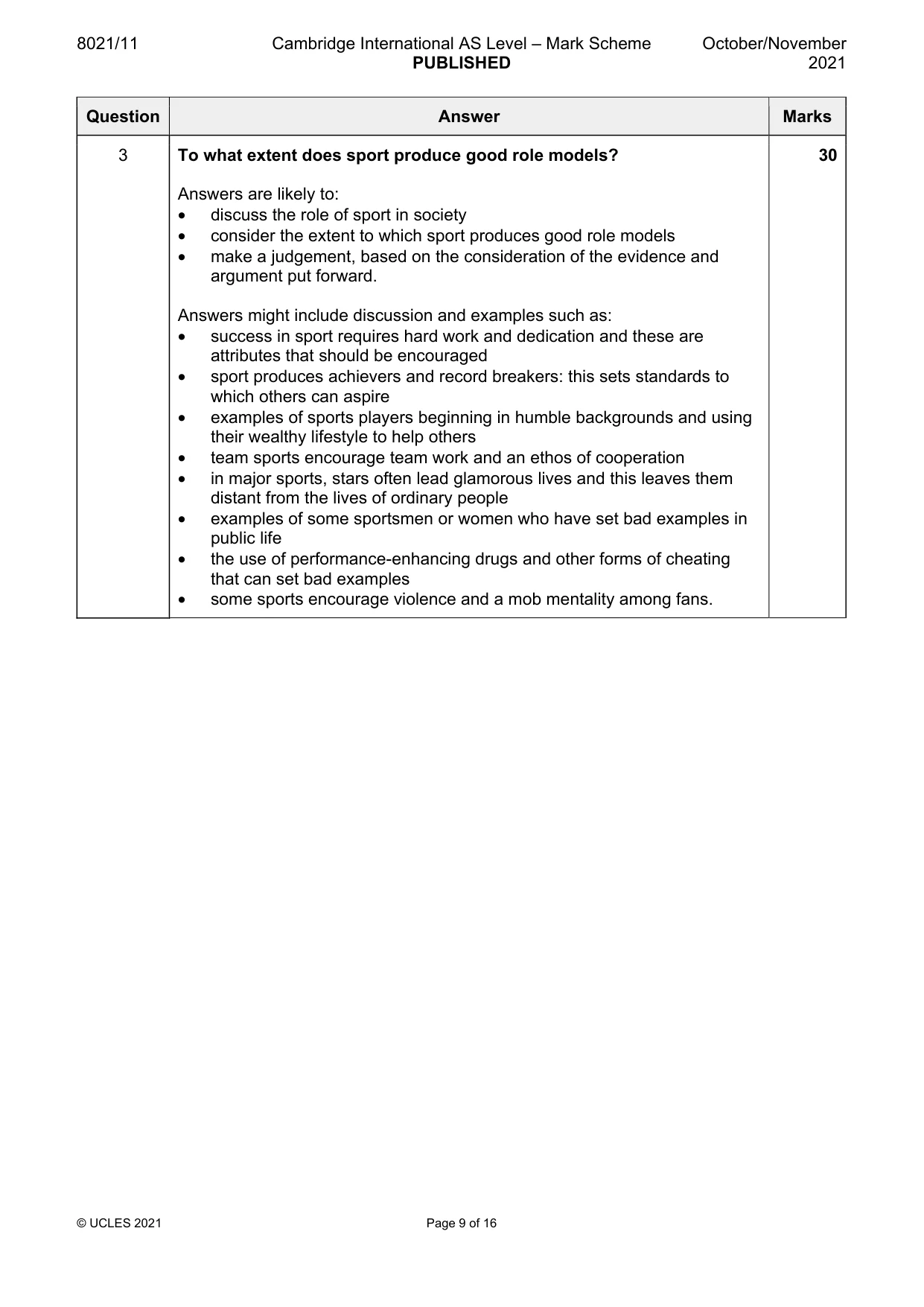
8021/11 Cambridge International AS Level – Mark Scheme PUBLISHED October/November 2021 © UCLES 2021 Page 9 of 16 Question Answer Marks 3 To what extent does sport produce good role models? Answers are likely to: • discuss the role of sport in society • consider the extent to which sport produces good role models • make a judgement, based on the consideration of the evidence and argument put forward. Answers might include discussion and examples such as: • success in sport requires hard work and dedication and these are attributes that should be encouraged • sport produces achievers and record breakers: this sets standards to which others can aspire • examples of sports players beginning in humble backgrounds and using their wealthy lifestyle to help others • team sports encourage team work and an ethos of cooperation • in major sports, stars often lead glamorous lives and this leaves them distant from the lives of ordinary people • examples of some sportsmen or women who have set bad examples in public life • the use of performance-enhancing drugs and other forms of cheating that can set bad examples • some sports encourage violence and a mob mentality among fans. 30
Mark scheme, page 10
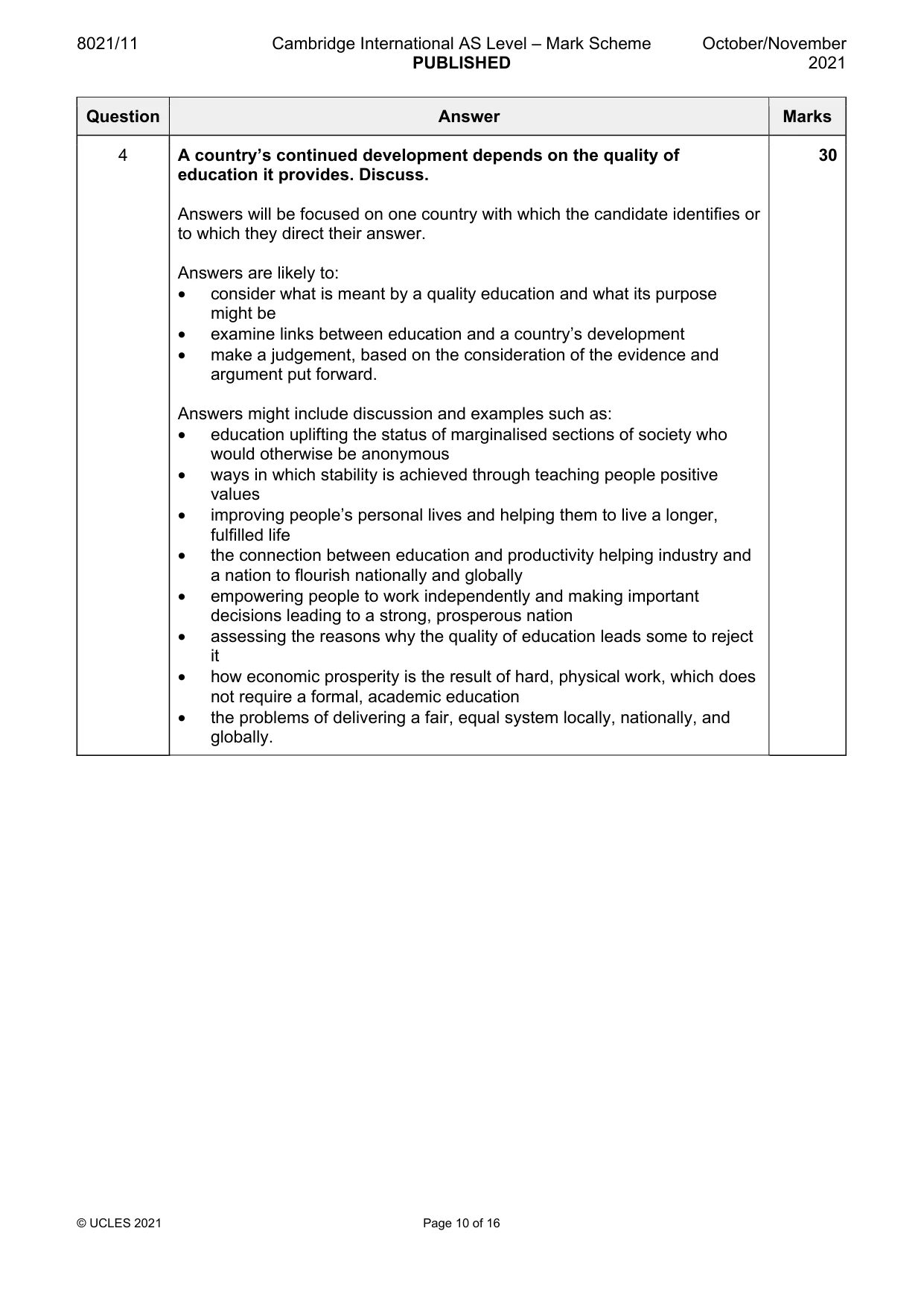
8021/11 Cambridge International AS Level – Mark Scheme PUBLISHED October/November 2021 © UCLES 2021 Page 10 of 16 Question Answer Marks 4 A country’s continued development depends on the quality of education it provides. Discuss. Answers will be focused on one country with which the candidate identifies or to which they direct their answer. Answers are likely to: • consider what is meant by a quality education and what its purpose might be • examine links between education and a country’s development • make a judgement, based on the consideration of the evidence and argument put forward. Answers might include discussion and examples such as: • education uplifting the status of marginalised sections of society who would otherwise be anonymous • ways in which stability is achieved through teaching people positive values • improving people’s personal lives and helping them to live a longer, fulfilled life • the connection between education and productivity helping industry and a nation to flourish nationally and globally • empowering people to work independently and making important decisions leading to a strong, prosperous nation • assessing the reasons why the quality of education leads some to reject it • how economic prosperity is the result of hard, physical work, which does not require a formal, academic education • the problems of delivering a fair, equal system locally, nationally, and globally. 30
Mark scheme, page 11
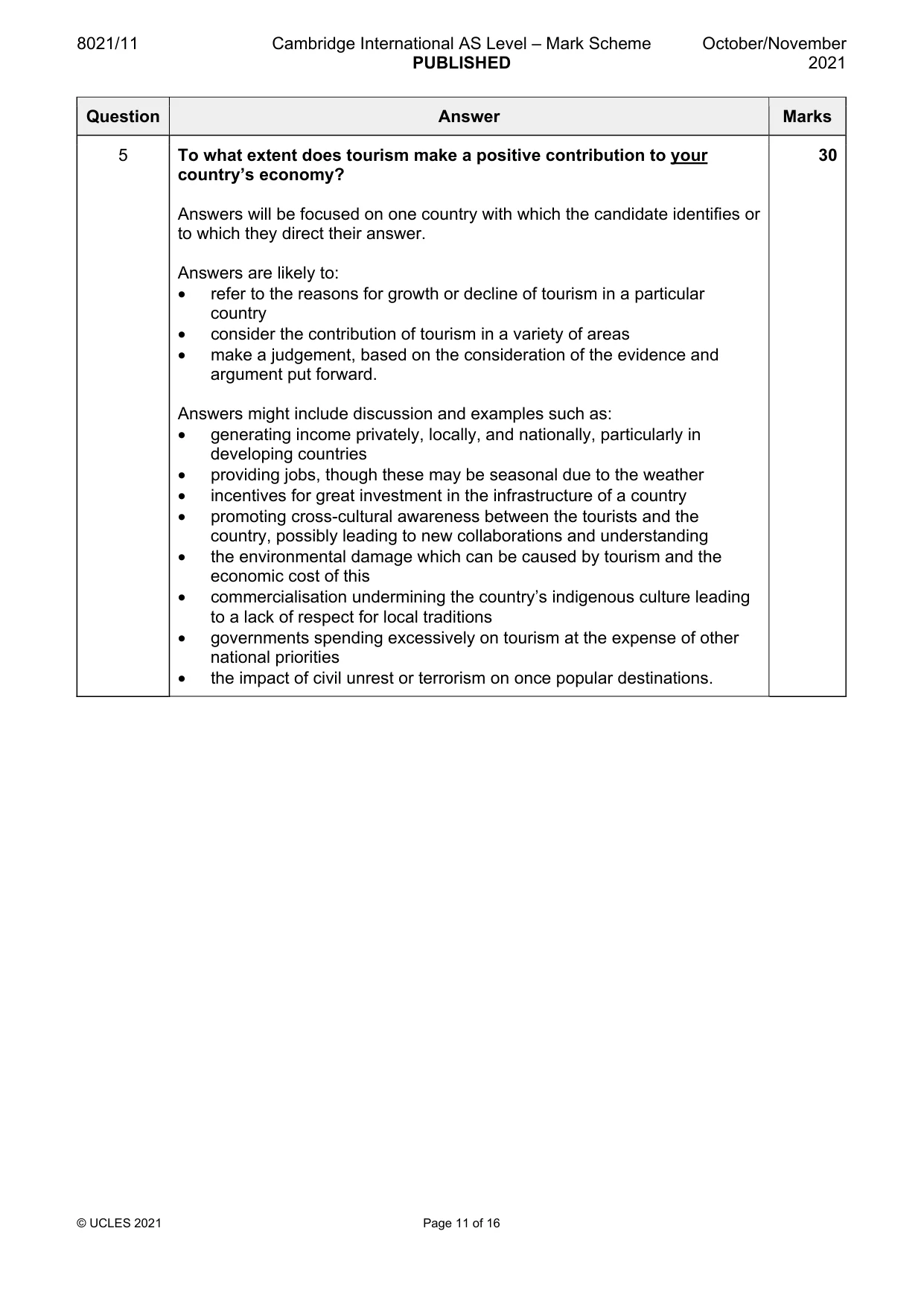
8021/11 Cambridge International AS Level – Mark Scheme PUBLISHED October/November 2021 © UCLES 2021 Page 11 of 16 Question Answer Marks 5 To what extent does tourism make a positive contribution to your country’s economy? Answers will be focused on one country with which the candidate identifies or to which they direct their answer. Answers are likely to: • refer to the reasons for growth or decline of tourism in a particular country • consider the contribution of tourism in a variety of areas • make a judgement, based on the consideration of the evidence and argument put forward. Answers might include discussion and examples such as: • generating income privately, locally, and nationally, particularly in developing countries • providing jobs, though these may be seasonal due to the weather • incentives for great investment in the infrastructure of a country • promoting cross-cultural awareness between the tourists and the country, possibly leading to new collaborations and understanding • the environmental damage which can be caused by tourism and the economic cost of this • commercialisation undermining the country’s indigenous culture leading to a lack of respect for local traditions • governments spending excessively on tourism at the expense of other national priorities • the impact of civil unrest or terrorism on once popular destinations. 30
Mark scheme, page 12
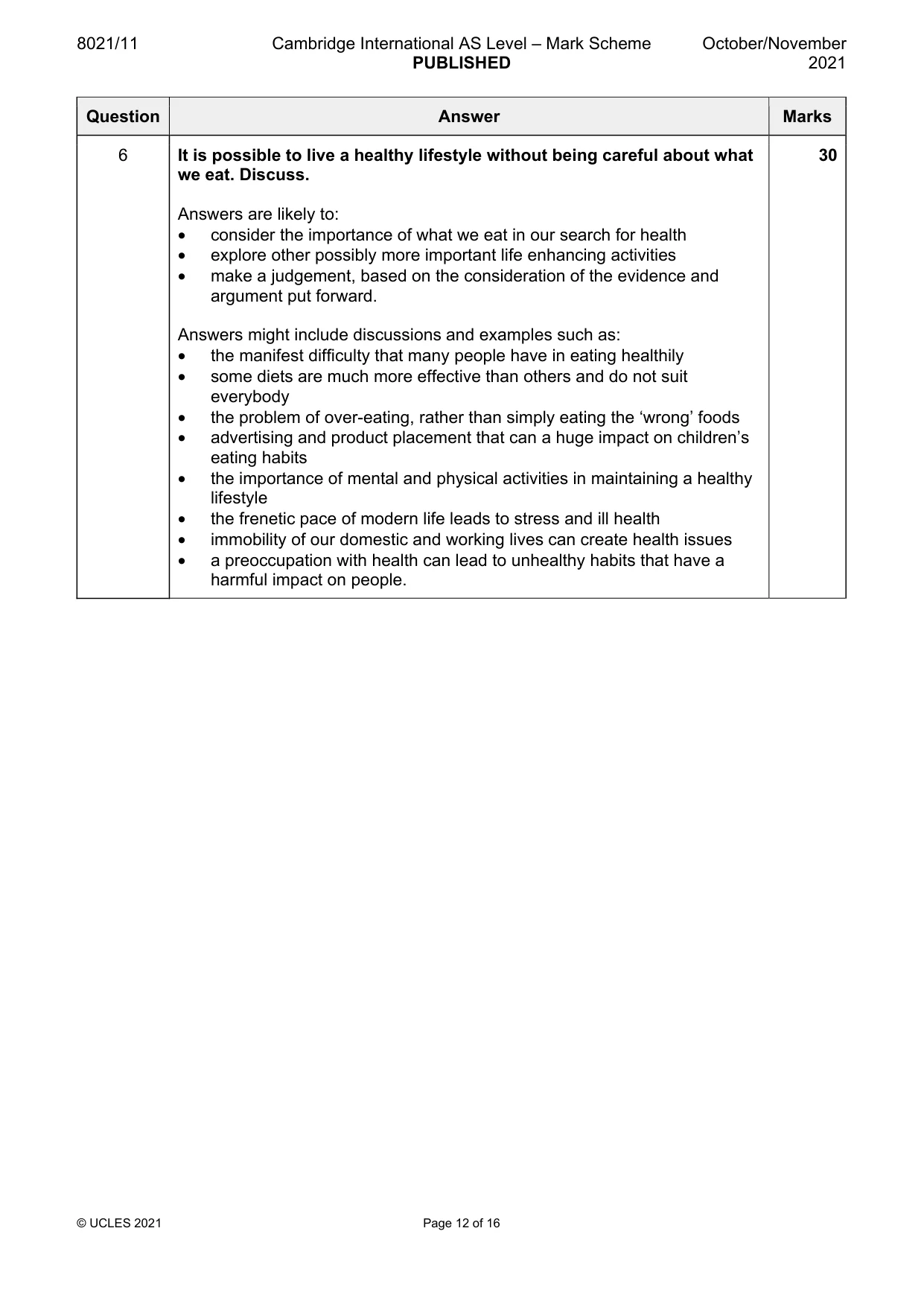
8021/11 Cambridge International AS Level – Mark Scheme PUBLISHED October/November 2021 © UCLES 2021 Page 12 of 16 Question Answer Marks 6 It is possible to live a healthy lifestyle without being careful about what we eat. Discuss. Answers are likely to: • consider the importance of what we eat in our search for health • explore other possibly more important life enhancing activities • make a judgement, based on the consideration of the evidence and argument put forward. Answers might include discussions and examples such as: • the manifest difficulty that many people have in eating healthily • some diets are much more effective than others and do not suit everybody • the problem of over-eating, rather than simply eating the ‘wrong’ foods • advertising and product placement that can a huge impact on children’s eating habits • the importance of mental and physical activities in maintaining a healthy lifestyle • the frenetic pace of modern life leads to stress and ill health • immobility of our domestic and working lives can create health issues • a preoccupation with health can lead to unhealthy habits that have a harmful impact on people. 30
Mark scheme, page 13
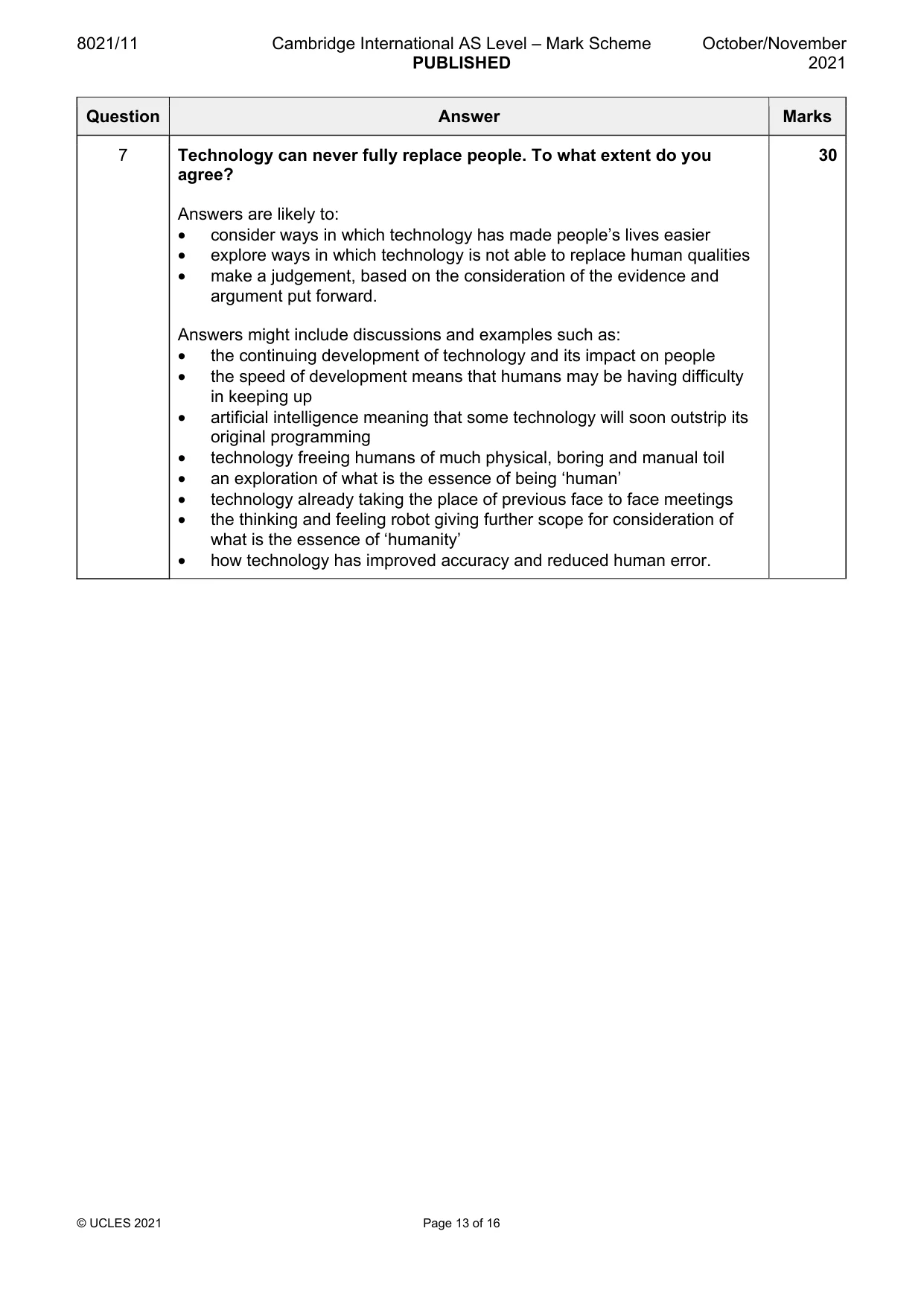
8021/11 Cambridge International AS Level – Mark Scheme PUBLISHED October/November 2021 © UCLES 2021 Page 13 of 16 Question Answer Marks 7 Technology can never fully replace people. To what extent do you agree? Answers are likely to: • consider ways in which technology has made people’s lives easier • explore ways in which technology is not able to replace human qualities • make a judgement, based on the consideration of the evidence and argument put forward. Answers might include discussions and examples such as: • the continuing development of technology and its impact on people • the speed of development means that humans may be having difficulty in keeping up • artificial intelligence meaning that some technology will soon outstrip its original programming • technology freeing humans of much physical, boring and manual toil • an exploration of what is the essence of being ‘human’ • technology already taking the place of previous face to face meetings • the thinking and feeling robot giving further scope for consideration of what is the essence of ‘humanity’ • how technology has improved accuracy and reduced human error. 30
Mark scheme, page 14
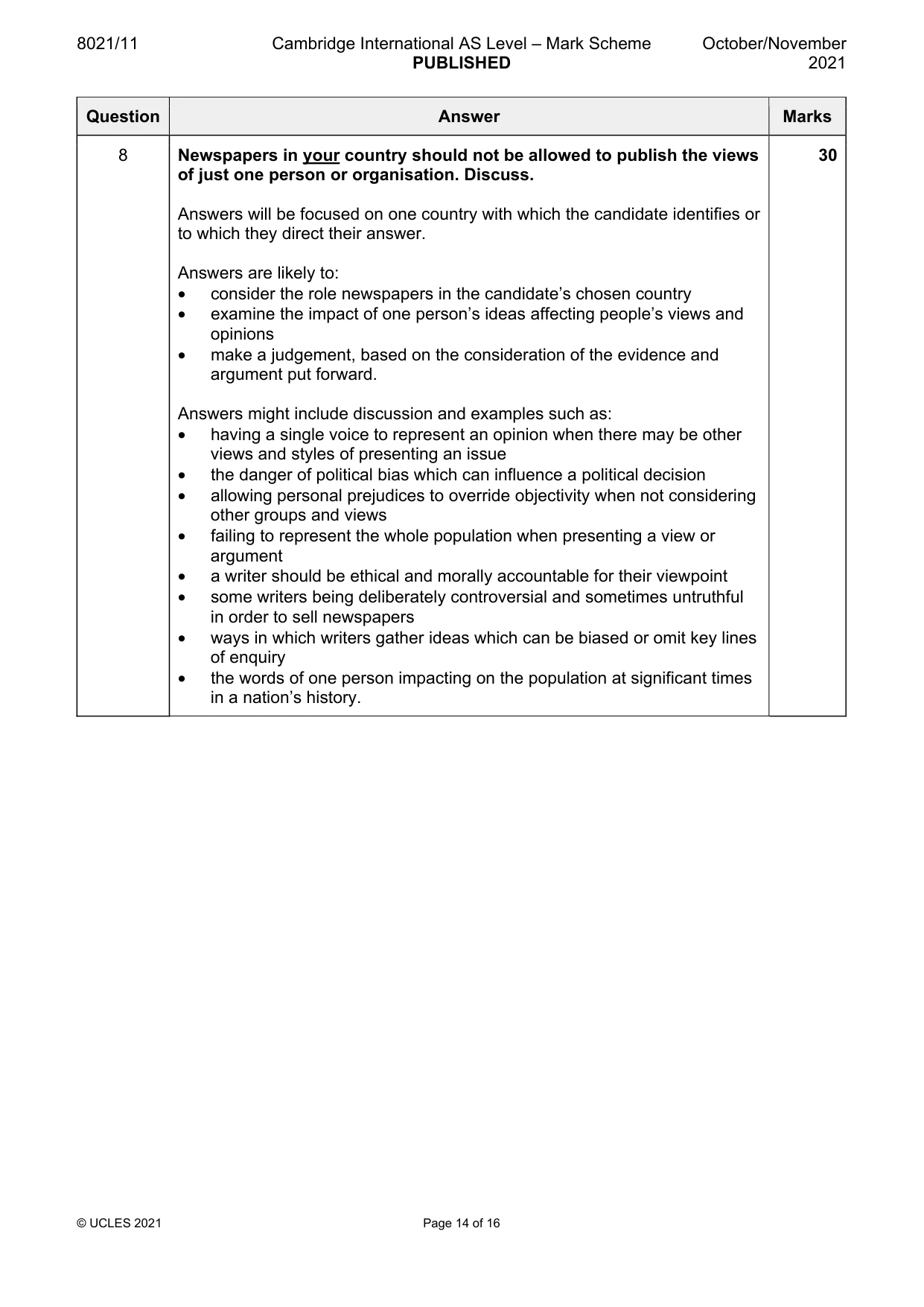
8021/11 Cambridge International AS Level – Mark Scheme PUBLISHED October/November 2021 © UCLES 2021 Page 14 of 16 Question Answer Marks 8 Newspapers in your country should not be allowed to publish the views of just one person or organisation. Discuss. Answers will be focused on one country with which the candidate identifies or to which they direct their answer. Answers are likely to: • consider the role newspapers in the candidate’s chosen country • examine the impact of one person’s ideas affecting people’s views and opinions • make a judgement, based on the consideration of the evidence and argument put forward. Answers might include discussion and examples such as: • having a single voice to represent an opinion when there may be other views and styles of presenting an issue • the danger of political bias which can influence a political decision • allowing personal prejudices to override objectivity when not considering other groups and views • failing to represent the whole population when presenting a view or argument • a writer should be ethical and morally accountable for their viewpoint • some writers being deliberately controversial and sometimes untruthful in order to sell newspapers • ways in which writers gather ideas which can be biased or omit key lines of enquiry • the words of one person impacting on the population at significant times in a nation’s history. 30
Mark scheme, page 15
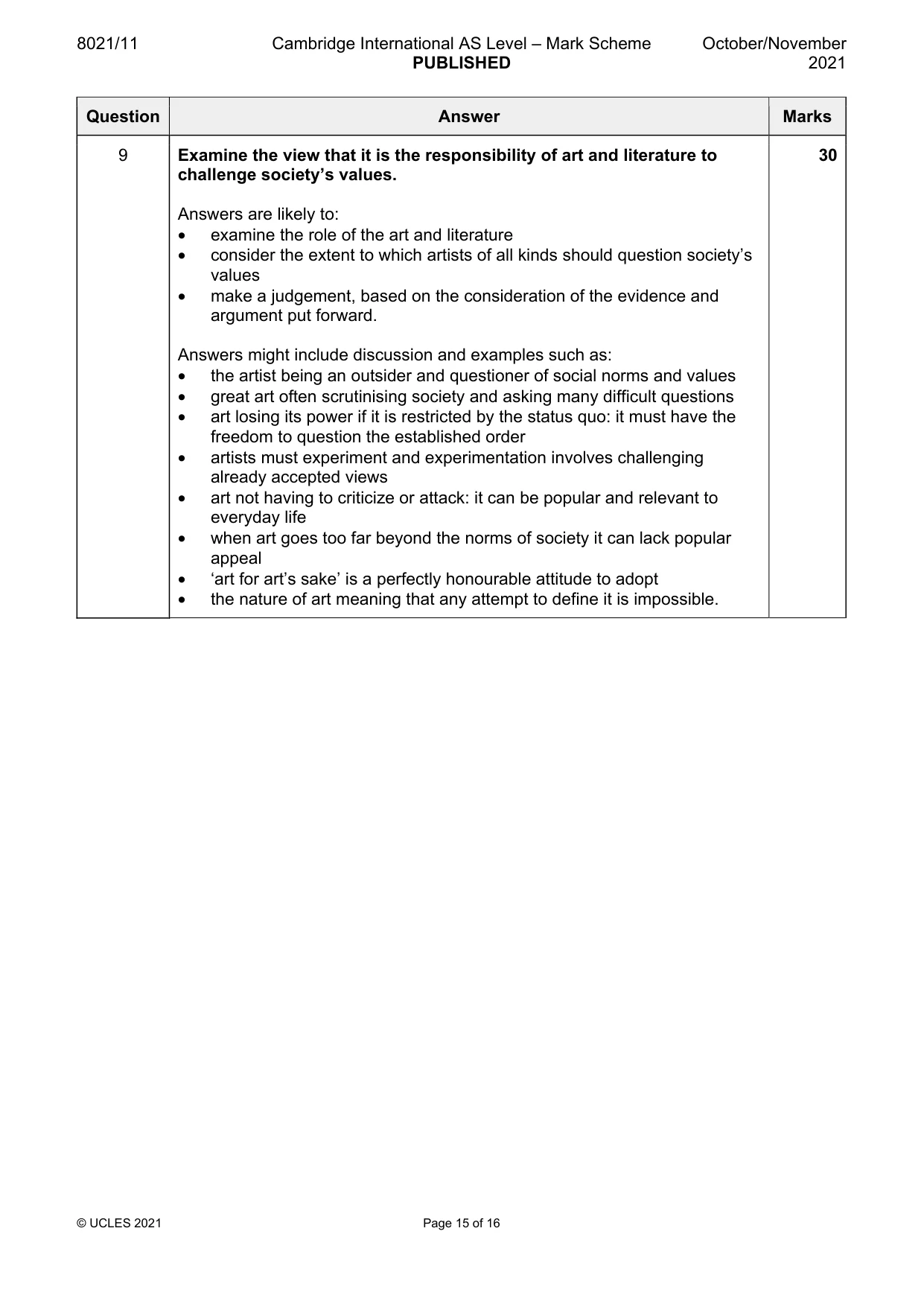
8021/11 Cambridge International AS Level – Mark Scheme PUBLISHED October/November 2021 © UCLES 2021 Page 15 of 16 Question Answer Marks 9 Examine the view that it is the responsibility of art and literature to challenge society’s values. Answers are likely to: • examine the role of the art and literature • consider the extent to which artists of all kinds should question society’s values • make a judgement, based on the consideration of the evidence and argument put forward. Answers might include discussion and examples such as: • the artist being an outsider and questioner of social norms and values • great art often scrutinising society and asking many difficult questions • art losing its power if it is restricted by the status quo: it must have the freedom to question the established order • artists must experiment and experimentation involves challenging already accepted views • art not having to criticize or attack: it can be popular and relevant to everyday life • when art goes too far beyond the norms of society it can lack popular appeal • ‘art for art’s sake’ is a perfectly honourable attitude to adopt • the nature of art meaning that any attempt to define it is impossible. 30
Mark scheme, page 16
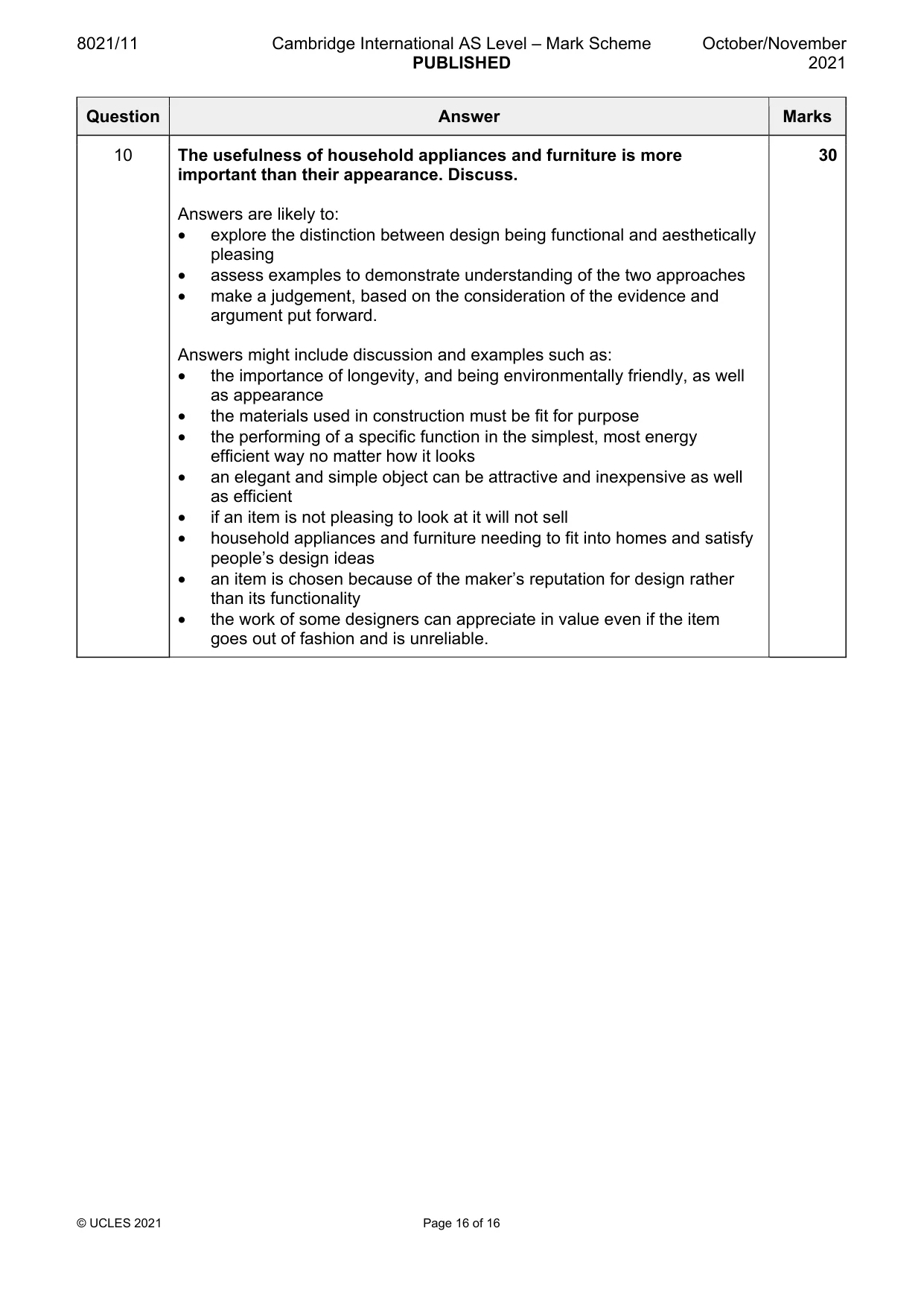
8021/11 Cambridge International AS Level – Mark Scheme PUBLISHED October/November 2021 © UCLES 2021 Page 16 of 16 Question Answer Marks 10 The usefulness of household appliances and furniture is more important than their appearance. Discuss. Answers are likely to: • explore the distinction between design being functional and aesthetically pleasing • assess examples to demonstrate understanding of the two approaches • make a judgement, based on the consideration of the evidence and argument put forward. Answers might include discussion and examples such as: • the importance of longevity, and being environmentally friendly, as well as appearance • the materials used in construction must be fit for purpose • the performing of a specific function in the simplest, most energy efficient way no matter how it looks • an elegant and simple object can be attractive and inexpensive as well as efficient • if an item is not pleasing to look at it will not sell • household appliances and furniture needing to fit into homes and satisfy people’s design ideas • an item is chosen because of the maker’s reputation for design rather than its functionality • the work of some designers can appreciate in value even if the item goes out of fashion and is unreliable. 30
What you needed in this session
Cambridge’s own grade thresholds for 2021 Oct/Nov, Paper 1 · Variant 1. A higher threshold means an easier paper — the bar moves with how the cohort did.