Cambridge A Level Economics 9708 — 2025 May/June Paper 4 · Variant 2
9708/42/M/J/25 · 5 questions · 60 marks · ≈68 min
The question paper and its mark scheme, free to read here and free to download. This is Cambridge’s own paper, exactly as it was sat.
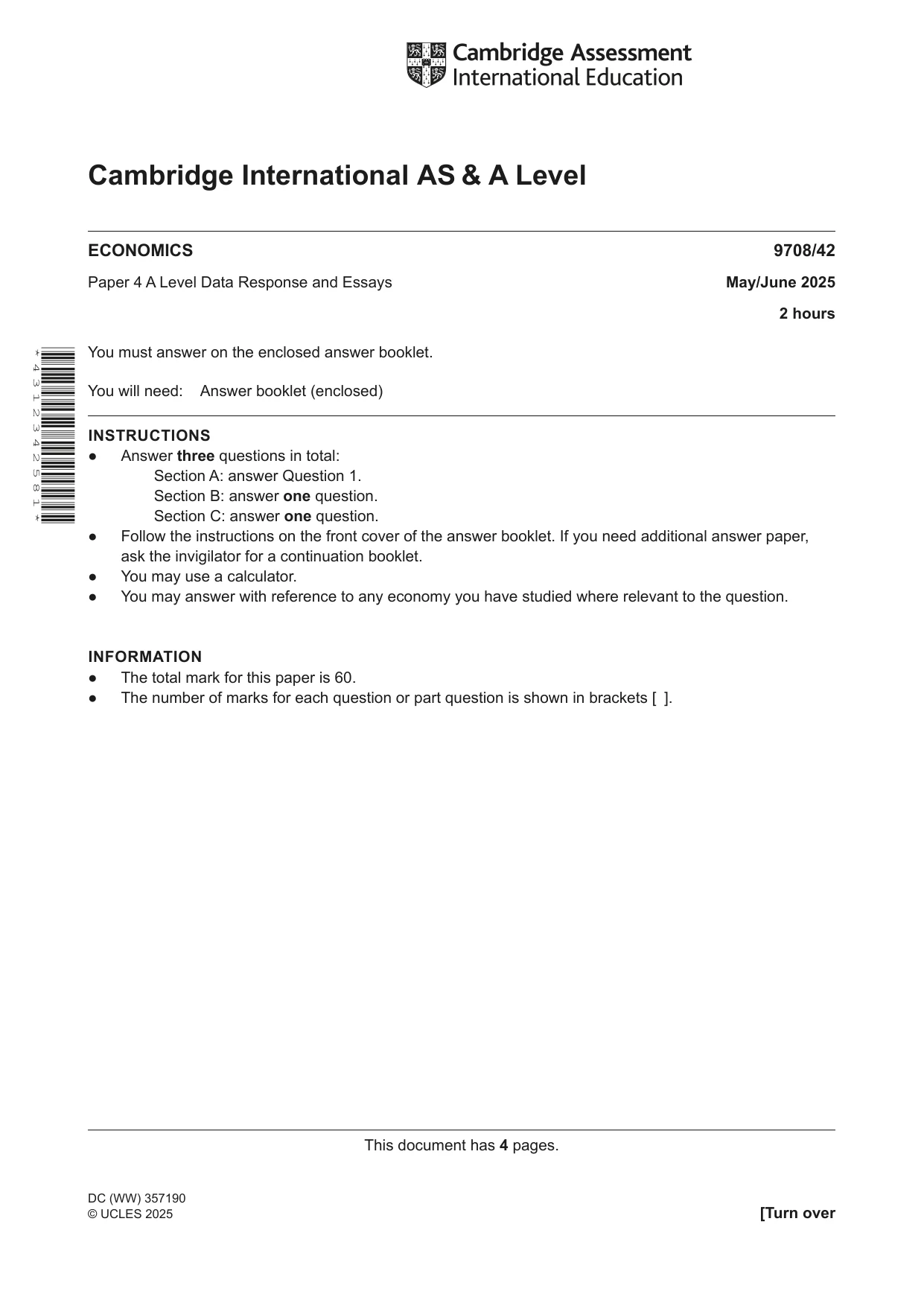
Question paper4 pages


Mark scheme18 pages
Answers below. Sit the paper first if you are practising.








Questions as text
Q1 · Global carbon emissions A key message of the 2021 World Climate Summit was that the use…
1 Global carbon emissions A key message of the 2021 World Climate Summit was that the use of coal must be phased out for the good of the planet. Content removed due to copyright restrictions. Content removed due to copyright restrictions. Instead, a mixture of renewable energies will be required to achieve zero-carbon Sources: The Sunday Times, 17 October 2021 The Times, 26 October and 24 November 2021 nsenergybusiness.com, 4 November 2021 (a) Define economic sustainability and give one example from the information of a change that can be used to illustrate it. [2] (b) Use the information to comment on the possible effects on the economies of the countries that refused to sign the carbon policy agreement. [4] (c) Discuss why the article says that ‘China is a country of contradictions’. [4] (d) With the help of a marginal social cost and benefit diagram discuss whether the continued use of coal to produce electricity makes the achievement of allocative efficiency less likely. [10]
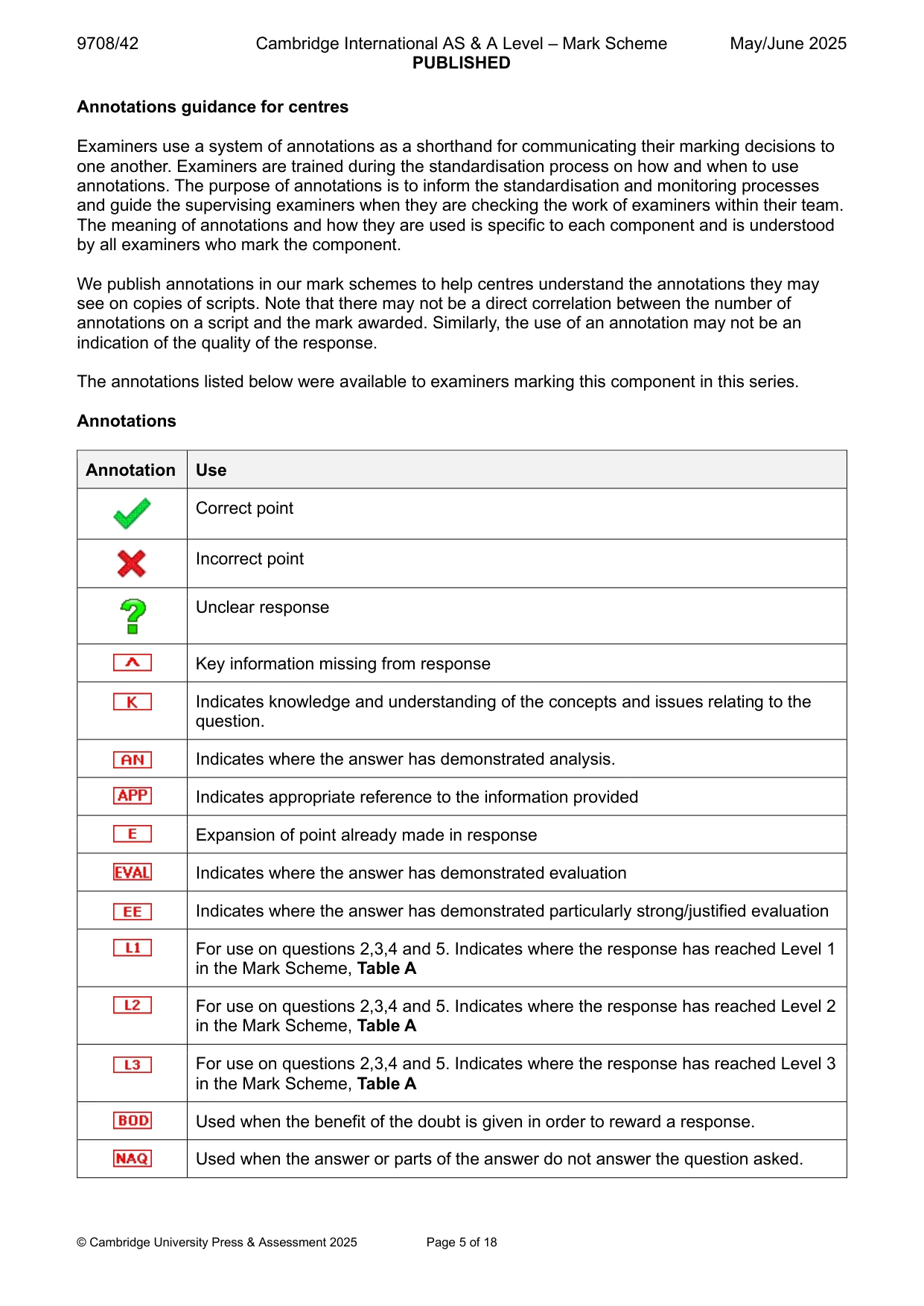
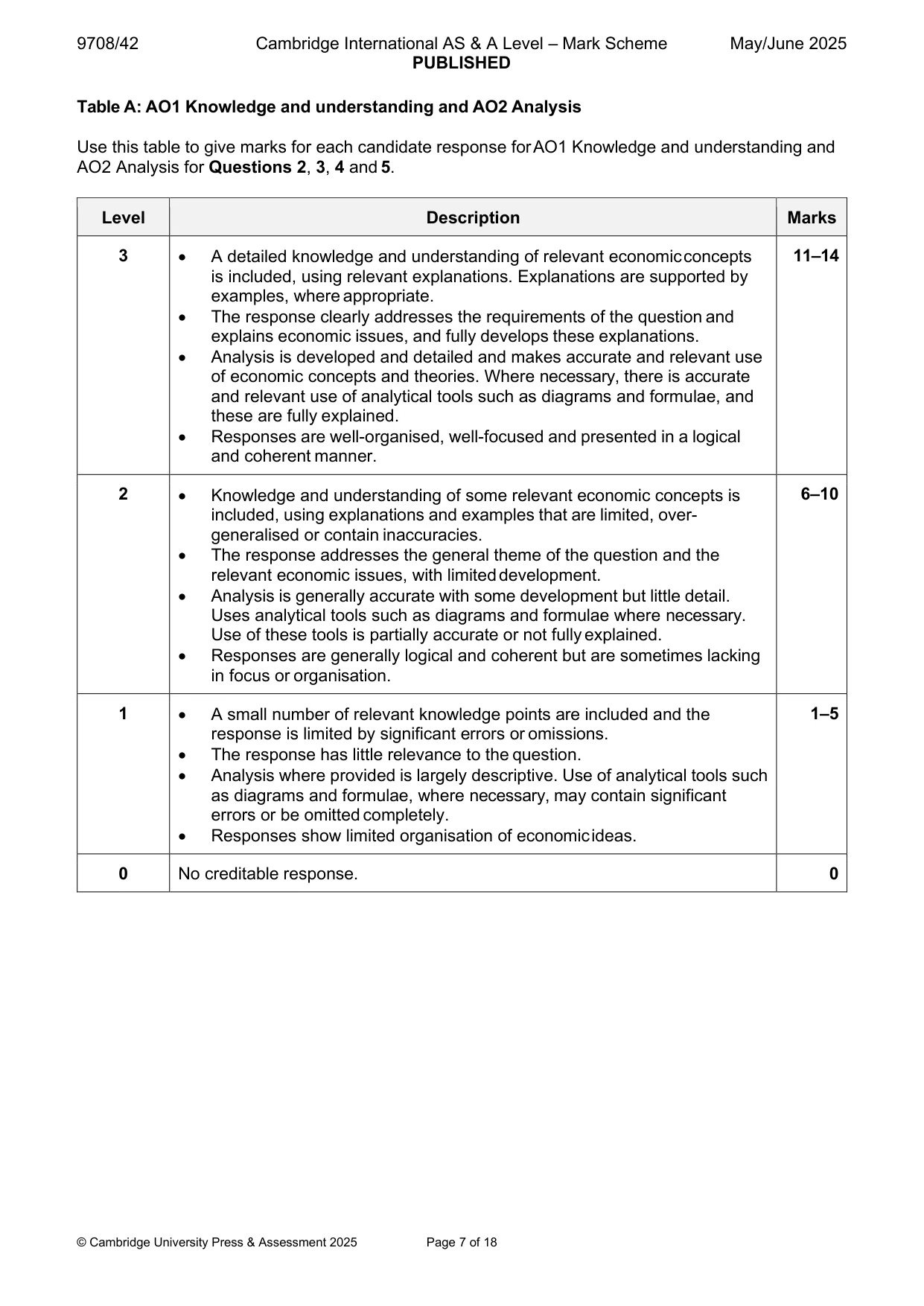
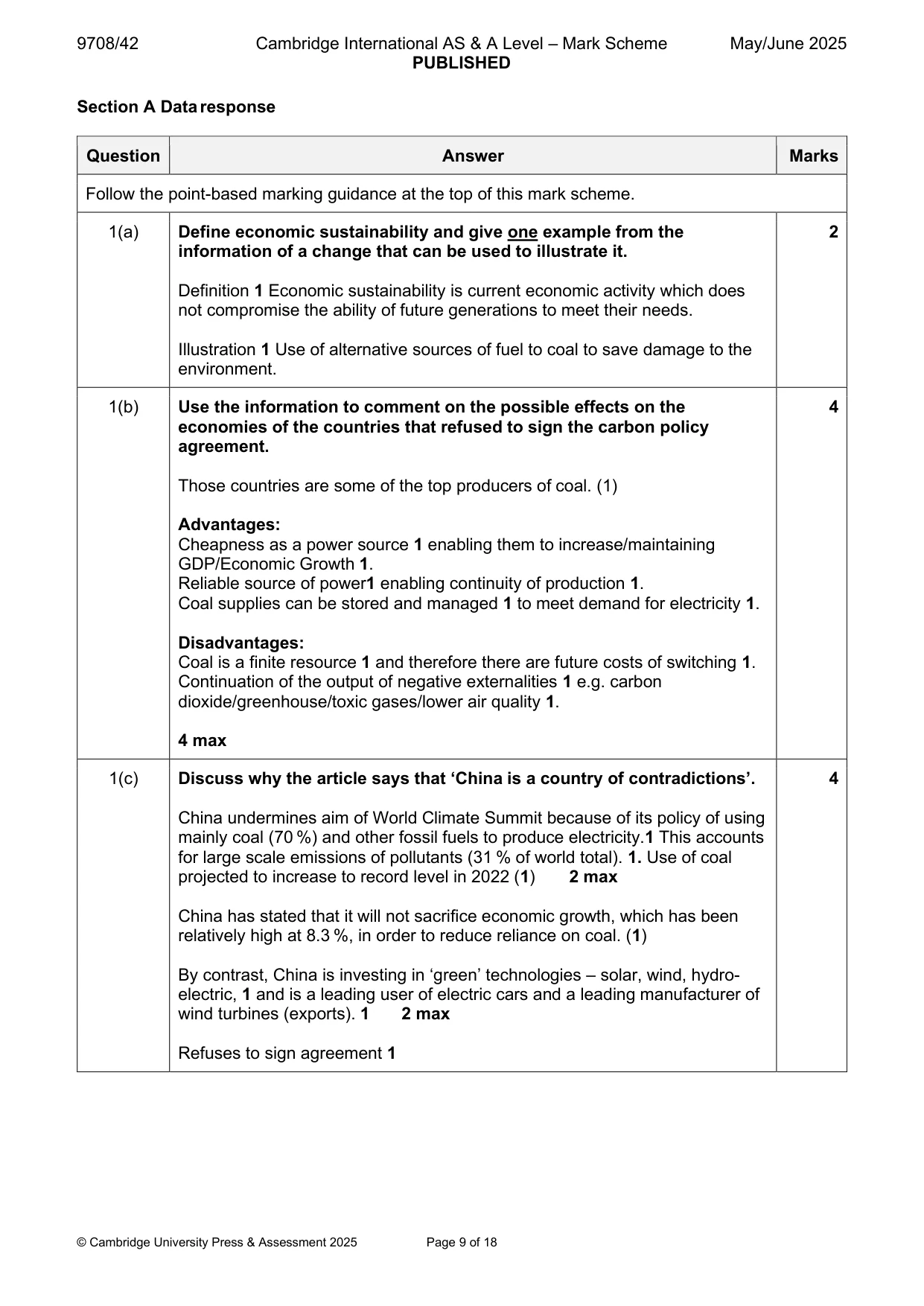
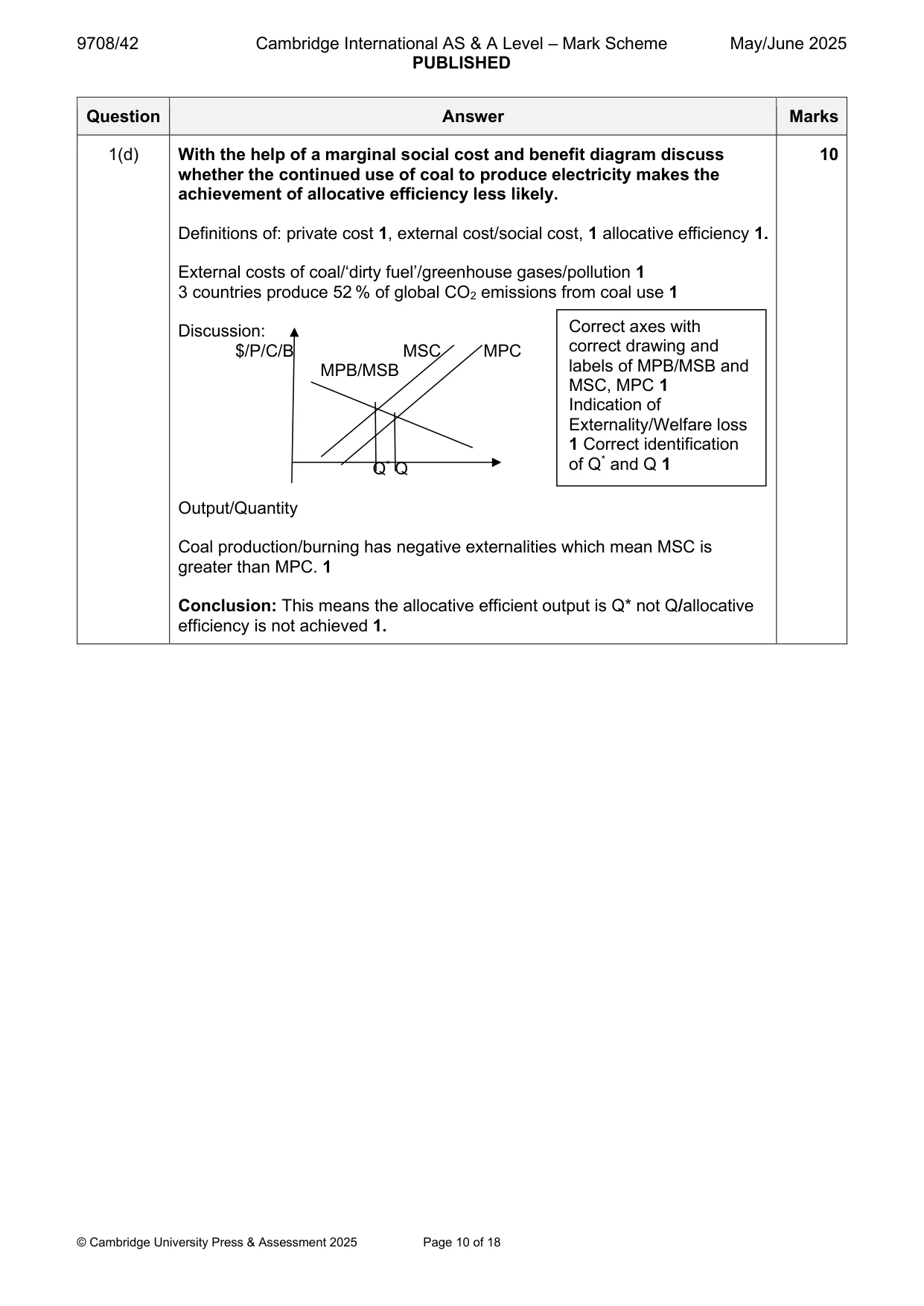
Mark scheme: Question Answer Marks Follow the point-based marking guidance at the top of this mark scheme. 1(a) Define economic sustainability and give one example from the 2 information of a change that can be used to illustrate it. Definition 1 Economic sustainability is current economic activity which does not compromise the ability of future generations to meet their needs. Illustration 1 Use of alternative sources of fuel to coal to save damage to the environment. 1(b) Use the information to comment on the possible effects on the 4 economies of the countries that refused to sign the carbon policy agreement. Those countries are some of the top producers of coal. (1) Advantages: Cheapness as a power source 1 enabling them to increase/maintaining GDP/Economic Growth 1. Reliable source of power1 enabling continuity of production 1. Coal supplies can be stored and managed 1 to meet demand for electricity 1. Disadvantages: Coal is a finite resource 1 and therefore there are future costs of switching 1. Continuation of the output of negative externalities 1 e.g. carbon dioxide/greenhouse/toxic gases/lower air quality 1. 4 max 1(c) Discuss why the article says that ‘China is a country of contradictions’. 4 China undermines aim of World Climate Summit because of its policy of using mainly coal (70 %) and other fossil fuels to produce electricity.1 This accounts for large scale emissions of pollutants (31 % of world total). 1. Use of coal projected to increase to record level in 2022 (1) 2 max China has stated that it will not sacrifice economic growth, which has been relatively high at 8.3 %, in order to reduce reliance on coal. (1) By contrast, China is investing in ‘green’ technologies – solar, wind, hydro- electric, 1 and is a leading user of electric cars and a leading manufacturer of wind turbines (exports). 1 2 max Refuses to sign agreement 1 1(d) With the help of a marginal social cost and benefit diagram discuss 10 whether the continued use of coal to produce electricity makes the achievement of allocative efficiency less likely. Definitions of: private cost 1, external cost/social cost, 1 allocative efficiency 1. External costs of coal/‘dirty fuel’/greenhouse gases/pollution 1 3 countries produce 52 % of global CO2 emissions from coal use 1 Correct axes with Discussion: correct drawing and $/P/C/B MSC MPC labels of MPB/MSB and MPB/MSB MSC, MPC 1 Indication of Externality/Welfare loss 1 Correct identification Q* Q of Q* and Q 1 Output/Quantity Coal production/burning has negative externalities which mean MSC is greater than MPC. 1 Conclusion: This means the allocative efficient output is Q* not Q/allocative efficiency is not achieved 1.
More questions on Private costs and benefits, externalities and social costs and benefits
Q2 · Monopolies restrict output to raise prices to exploit consumers
2 Monopolies restrict output to raise prices to exploit consumers. With the help of a diagram, assess the extent to which a government should intervene in monopoly markets. [20] OR
Mark scheme: 2 Monopolies restrict output to raise prices and exploit consumers. 20 With the help of a diagram, assess the extent to which a government should intervene in monopoly markets. Use Table A: AO1 Knowledge and understanding and AO2 Analysis and Table B: AO3 Evaluation to mark candidate responses to this question. AO1 and AO2 out of 14 marks. AO3 out of 6 marks. Indicative content Responses may include: AO1 Knowledge and understanding and AO2 Analysis • The key characteristics of a monopoly market structure should be identified. • The aim of profit maximization should be explained and an accurately labelled supporting diagram should be provided to illustrate this situation. • Analysis should be provided, based on a diagram, which shows the links between low output, high prices and allocative inefficiency. • Alternative government policies to reduce the power of monopolies should be explained. • Diagram(s) may be provided to illustrate monopoly equilibrium and/or the policy suggested. • Analysis of how alternative types of government intervention can be used to address some of the negative outcomes associated with monopoly firms. No monopoly diagram Max L2 8 marks. AO3 Evaluation Accept all valid responses. • A government can use taxation to reduce monopoly profits and control market power. However, this might reduce the incentive to invest by monopoly firms and lead to X inefficiency • Maximum pricing might be introduced to control high prices but this might lead to shortages and/or the operation of underground markets. • Some types of product/service can be described as natural monopolies, therefore any attempt to introduce more competition is simply likely to lead to more inefficient outcomes. • Direct government intervention by regulation/legislation might reduce a monopoly market share but this would also make it more difficult for a monopoly to benefit from economies of scale. Hence, costs and prices might subsequently rise. 2 • A conclusion should attempt to examine alternative types of government intervention to try and establish the extent to which governments should intervene in monopoly markets. Accept all valid responses. AO1 Knowledge and understanding and AO2 Analysis 14 AO3 Evaluation 6
Q3 · With the help of a diagram, assess whether the impact of an increase in labour…
3 With the help of a diagram, assess whether the impact of an increase in labour productivity on the wages and employment of a firm is likely to be greater in a perfectly competitive labour market than in an imperfectly competitive labour market. [20] Section C Answer one question. EITHER
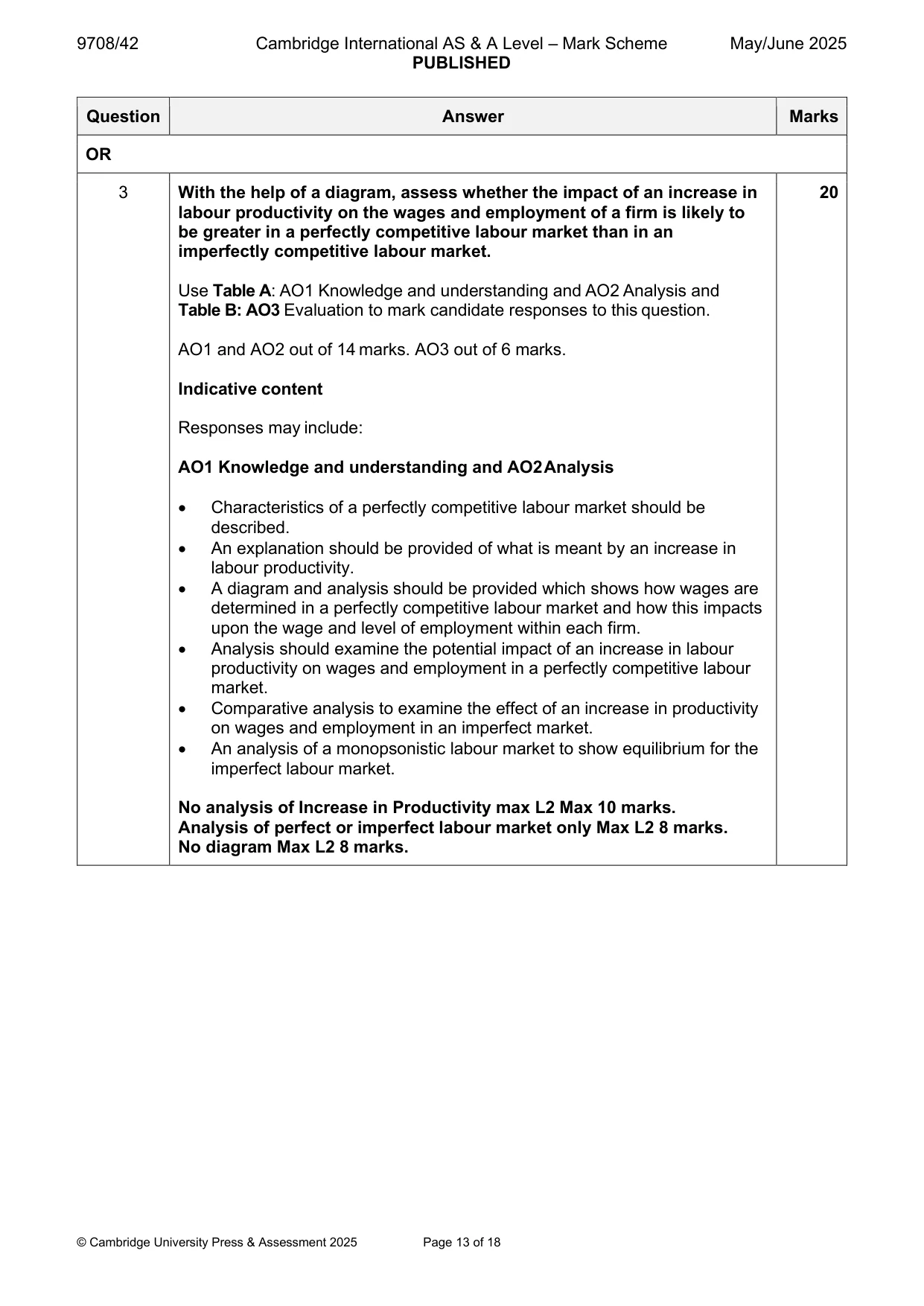
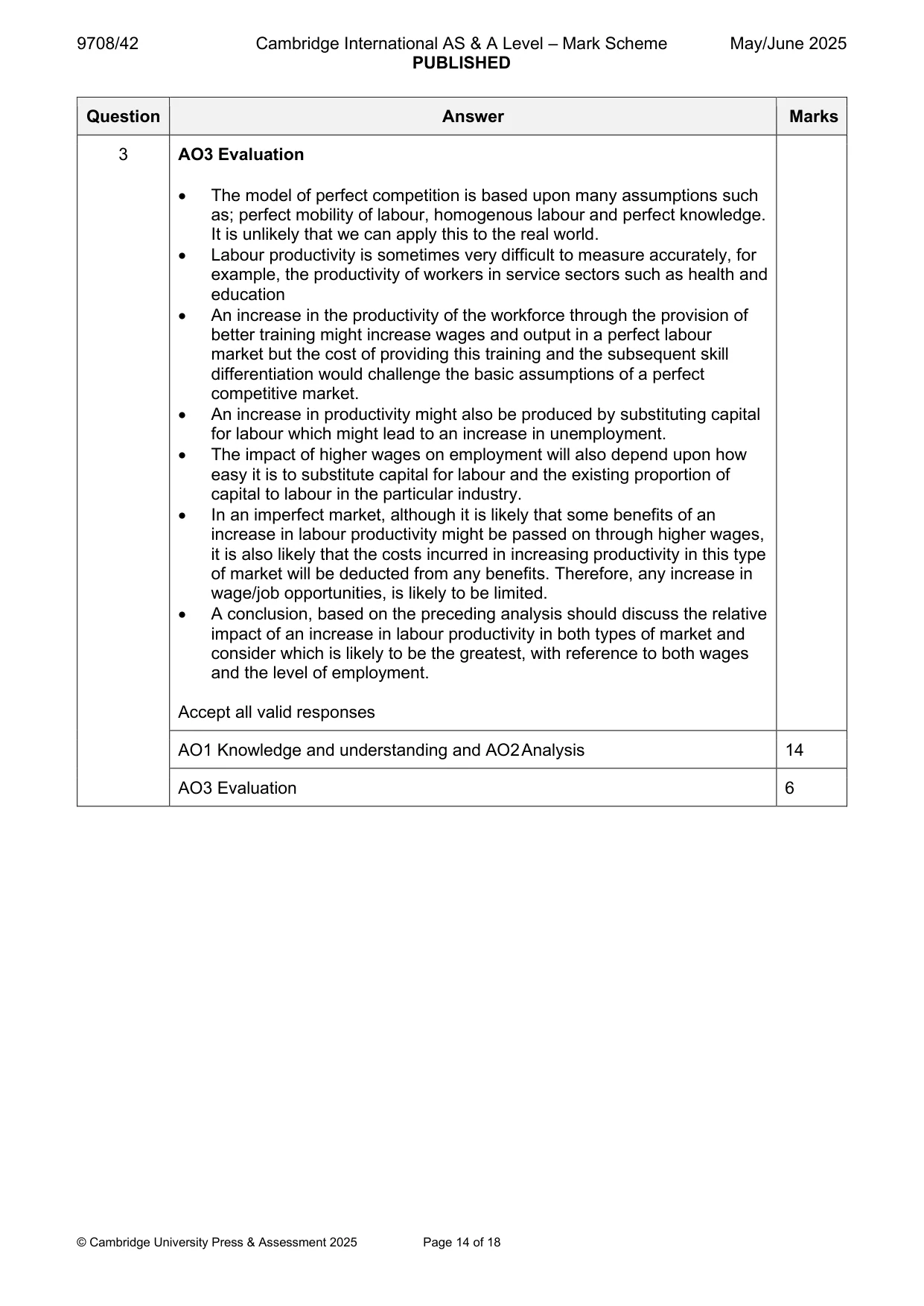
Mark scheme: 3 With the help of a diagram, assess whether the impact of an increase in 20 labour productivity on the wages and employment of a firm is likely to be greater in a perfectly competitive labour market than in an imperfectly competitive labour market. Use Table A: AO1 Knowledge and understanding and AO2 Analysis and Table B: AO3 Evaluation to mark candidate responses to this question. AO1 and AO2 out of 14 marks. AO3 out of 6 marks. Indicative content Responses may include: AO1 Knowledge and understanding and AO2 Analysis • Characteristics of a perfectly competitive labour market should be described. • An explanation should be provided of what is meant by an increase in labour productivity. • A diagram and analysis should be provided which shows how wages are determined in a perfectly competitive labour market and how this impacts upon the wage and level of employment within each firm. • Analysis should examine the potential impact of an increase in labour productivity on wages and employment in a perfectly competitive labour market. • Comparative analysis to examine the effect of an increase in productivity on wages and employment in an imperfect market. • An analysis of a monopsonistic labour market to show equilibrium for the imperfect labour market. No analysis of Increase in Productivity max L2 Max 10 marks. Analysis of perfect or imperfect labour market only Max L2 8 marks. No diagram Max L2 8 marks. 3 AO3 Evaluation • The model of perfect competition is based upon many assumptions such as; perfect mobility of labour, homogenous labour and perfect knowledge. It is unlikely that we can apply this to the real world. • Labour productivity is sometimes very difficult to measure accurately, for example, the productivity of workers in service sectors such as health and education • An increase in the productivity of the workforce through the provision of better training might increase wages and output in a perfect labour market but the cost of providing this training and the subsequent skill differentiation would challenge the basic assumptions of a perfect competitive market. • An increase in productivity might also be produced by substituting capital for labour which might lead to an increase in unemployment. • The impact of higher wages on employment will also depend upon how easy it is to substitute capital for labour and the existing proportion of capital to labour in the particular industry. • In an imperfect market, although it is likely that some benefits of an increase in labour productivity might be passed on through higher wages, it is also likely that the costs incurred in increasing productivity in this type of market will be deducted from any benefits. Therefore, any increase in wage/job opportunities, is likely to be limited. • A conclusion, based on the preceding analysis should discuss the relative impact of an increase in labour productivity in both types of market and consider which is likely to be the greatest, with reference to both wages and the level of employment. Accept all valid responses AO1 Knowledge and understanding and AO2 Analysis 14 AO3 Evaluation 6
More questions on Labour market forces and government intervention
Q4 · With the help of an injections and withdrawals graph, assess the impact of a decrease in…
4 With the help of an injections and withdrawals graph, assess the impact of a decrease in interest rates on the level of employment in an economy. [20] OR
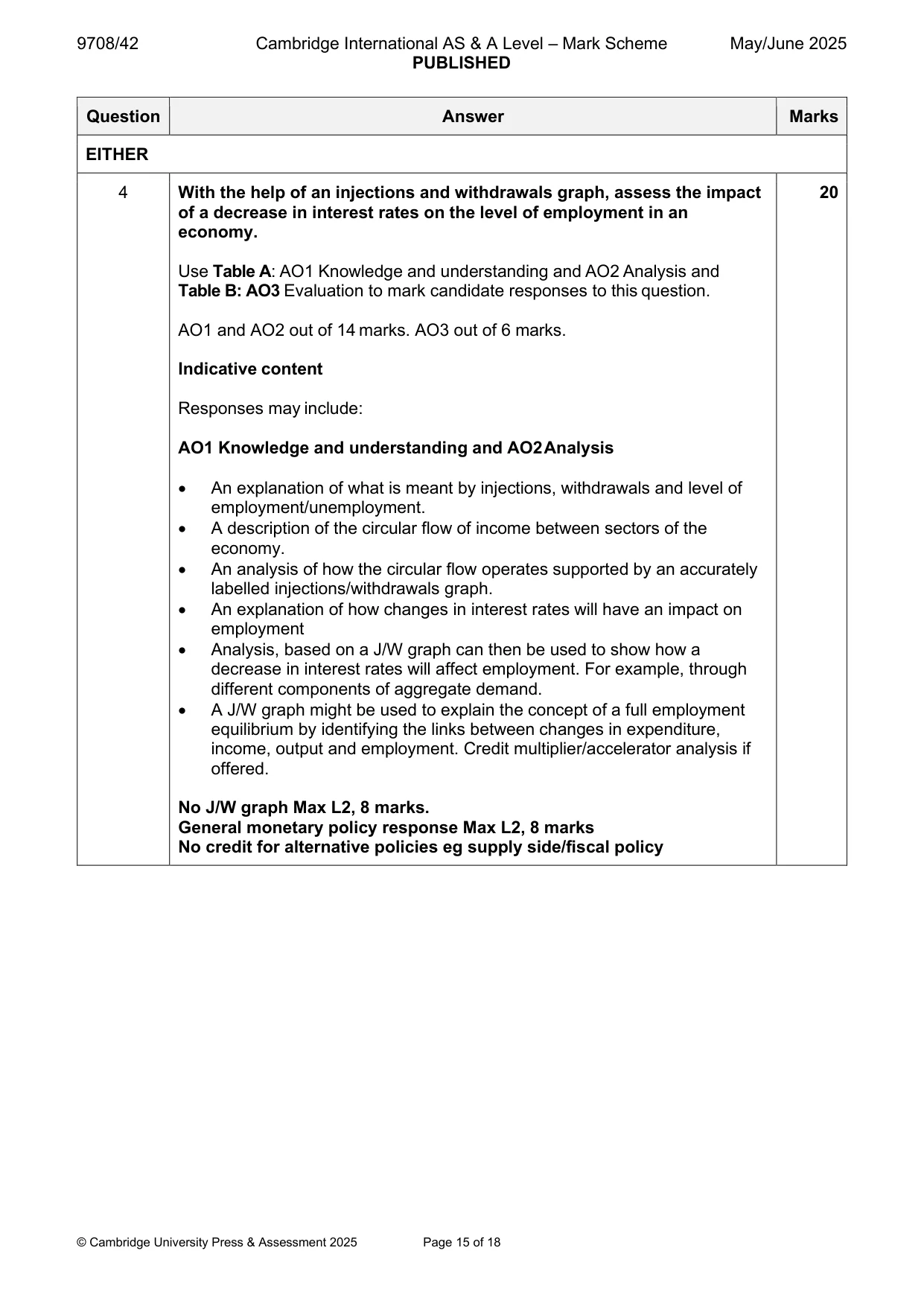
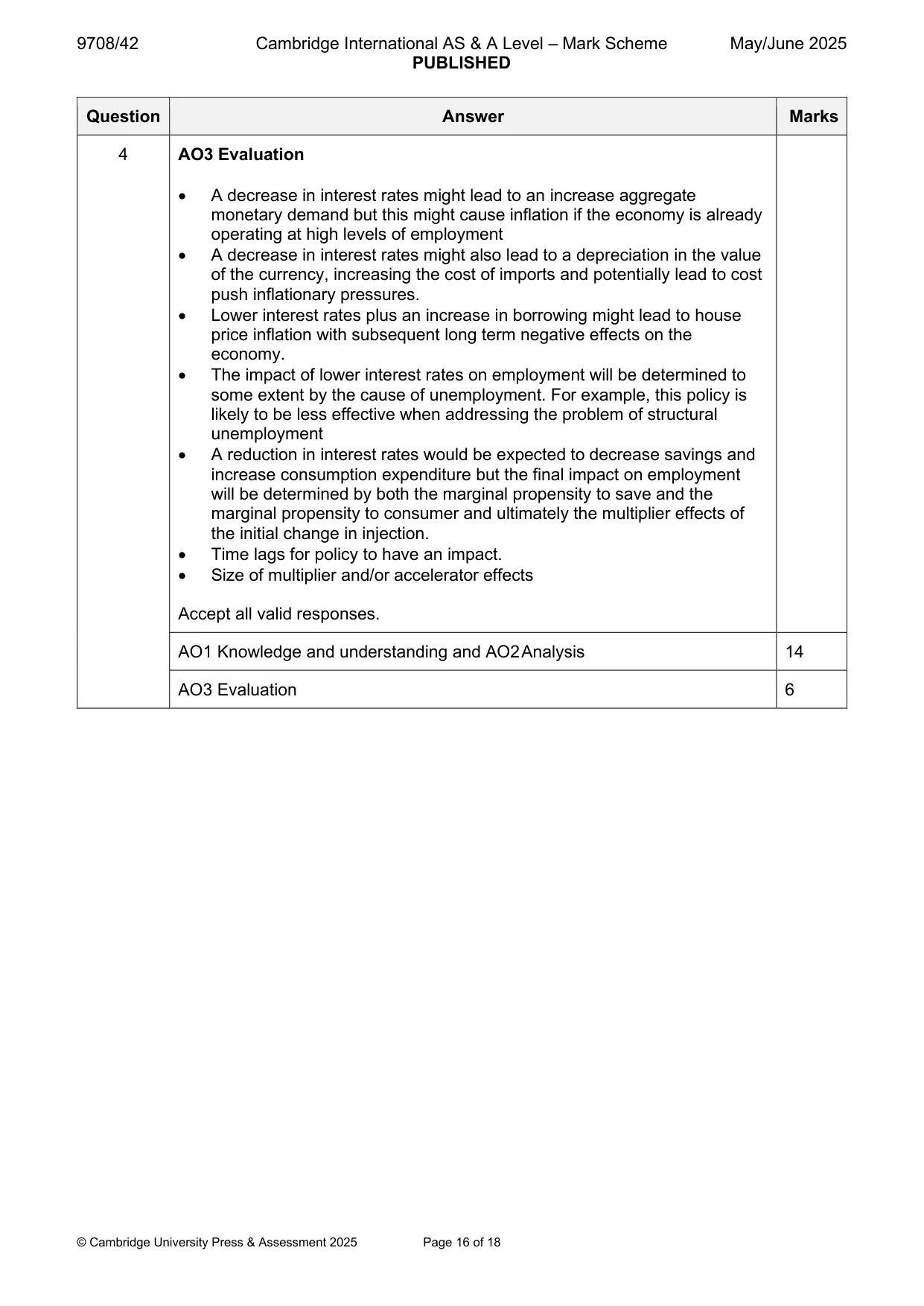
Mark scheme: 4 With the help of an injections and withdrawals graph, assess the impact 20 of a decrease in interest rates on the level of employment in an economy. Use Table A: AO1 Knowledge and understanding and AO2 Analysis and Table B: AO3 Evaluation to mark candidate responses to this question. AO1 and AO2 out of 14 marks. AO3 out of 6 marks. Indicative content Responses may include: AO1 Knowledge and understanding and AO2 Analysis • An explanation of what is meant by injections, withdrawals and level of employment/unemployment. • A description of the circular flow of income between sectors of the economy. • An analysis of how the circular flow operates supported by an accurately labelled injections/withdrawals graph. • An explanation of how changes in interest rates will have an impact on employment • Analysis, based on a J/W graph can then be used to show how a decrease in interest rates will affect employment. For example, through different components of aggregate demand. • A J/W graph might be used to explain the concept of a full employment equilibrium by identifying the links between changes in expenditure, income, output and employment. Credit multiplier/accelerator analysis if offered. No J/W graph Max L2, 8 marks. General monetary policy response Max L2, 8 marks No credit for alternative policies eg supply side/fiscal policy 4 AO3 Evaluation • A decrease in interest rates might lead to an increase aggregate monetary demand but this might cause inflation if the economy is already operating at high levels of employment • A decrease in interest rates might also lead to a depreciation in the value of the currency, increasing the cost of imports and potentially lead to cost push inflationary pressures. • Lower interest rates plus an increase in borrowing might lead to house price inflation with subsequent long term negative effects on the economy. • The impact of lower interest rates on employment will be determined to some extent by the cause of unemployment. For example, this policy is likely to be less effective when addressing the problem of structural unemployment • A reduction in interest rates would be expected to decrease savings and increase consumption expenditure but the final impact on employment will be determined by both the marginal propensity to save and the marginal propensity to consumer and ultimately the multiplier effects of the initial change in injection. • Time lags for policy to have an impact. • Size of multiplier and/or accelerator effects Accept all valid responses. AO1 Knowledge and understanding and AO2 Analysis 14 AO3 Evaluation 6
Q5 · Globalisation will have an equally beneficial effect on the standard of living in both…
5 Globalisation will have an equally beneficial effect on the standard of living in both high-income and low-income countries. Evaluate this statement. [20]
Mark scheme: 5 Globalisation will have an equally beneficial effect on the standard of 20 living in both high-income and low-income countries Evaluate this statement Use Table A: AO1 Knowledge and understanding and AO2 Analysis and Table B: AO3 Evaluation to mark candidate responses to this question. AO1 and AO2 out of 14 marks. AO3 out of 6 marks. Indicative content Responses may include: AO1 Knowledge and understanding and AO2 Analysis • Definition: globalisation promotes free trade, free movement of capital and labour and technology transfer. • Key characteristics of high-income/low-income countries. • High living standards are generally associated with high GDP per capita; advanced infrastructure; good housing, education and health; and low infant mortality rates. • An improvement in living standards is very closely linked with an improvement in economic performance. An improvement in economic performance is measured by increases in GDP per capita. • Analysis of the globalisation process through trade, technology transfer, FDI, comparative advantage, remittances should provide opportunities to create more real income and investment for both high-income and low- income countries. If only one level of income considered L2 MAX 10 5 AO3 Evaluation • The links between globalisation and changes in living standards are not clear. • Difficult to measure the standard of living. • Globalisation increases long distance transport which creates more negative externalities. But it is difficult to determine whether negative externalities have a disproportionate effect on the standard of living of low/high income countries. • It is not clear how the benefits of globalisation would be used by each type of economy. Some low-income countries might not use any gains to stimulate long term growth. For example, a failure to invest in infrastructure. This would not improve living standards in the long run. • Globalisation might lead to an increase in cheap imports from low-income economies which might lead to higher levels of unemployment in high- income economies and therefore reduce the standard of living. • A conclusion might attempt to form an overall judgement on the distribution of benefits to low/high income countries. Also, a judgement on whether globalisation will improve living standards in either type of economy in both the short term and long-term. Accept all valid responses. 4 AO1 Knowledge and understanding and AO2 Analysis 14 AO3 Evaluation 6
What was in this paper
The subtopics covered by these 5 questions, and how many questions each got. Open one in a new tab to see every Cambridge question on it.
What you needed in this session
Cambridge’s own grade thresholds for 2025 May/June, Paper 4 · Variant 2. A higher threshold means an easier paper — the bar moves with how the cohort did.