Cambridge A Level Economics 9708 — 2025 May/June Paper 4 · Variant 4
9708/44/M/J/25 · 4 questions · 60 marks · ≈68 min
The question paper and its mark scheme, free to read here and free to download. This is Cambridge’s own paper, exactly as it was sat.
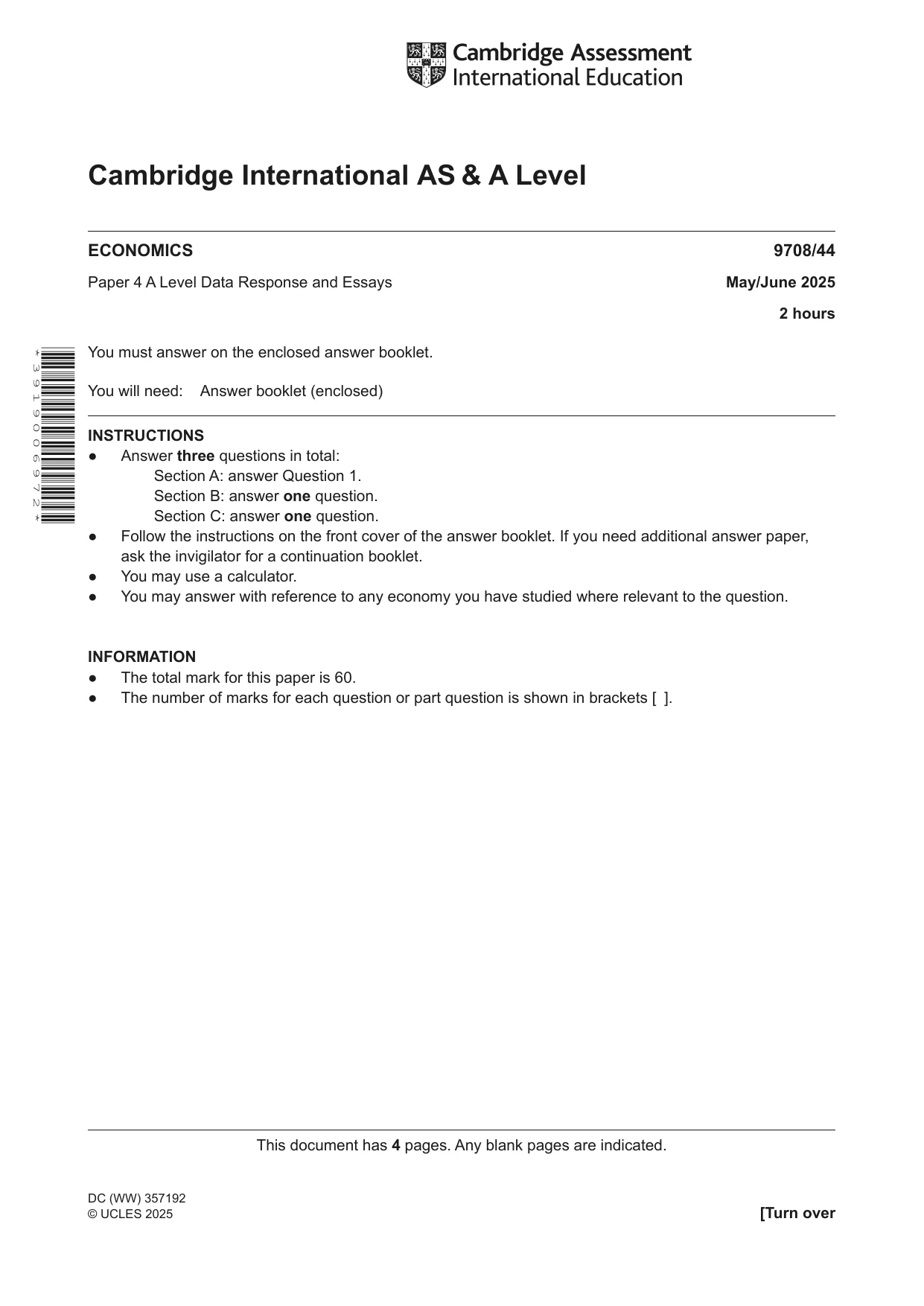
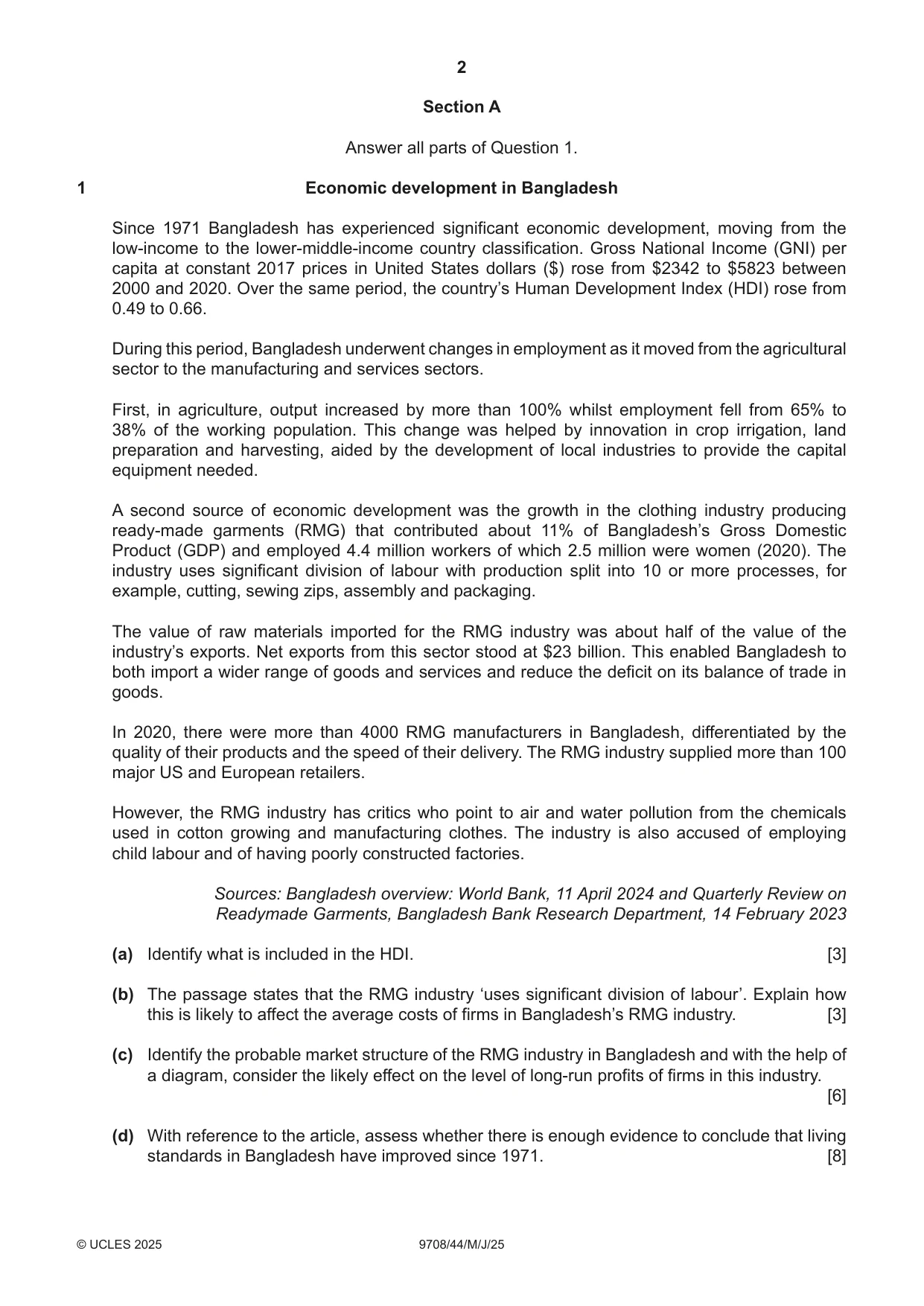
Question paper4 pages
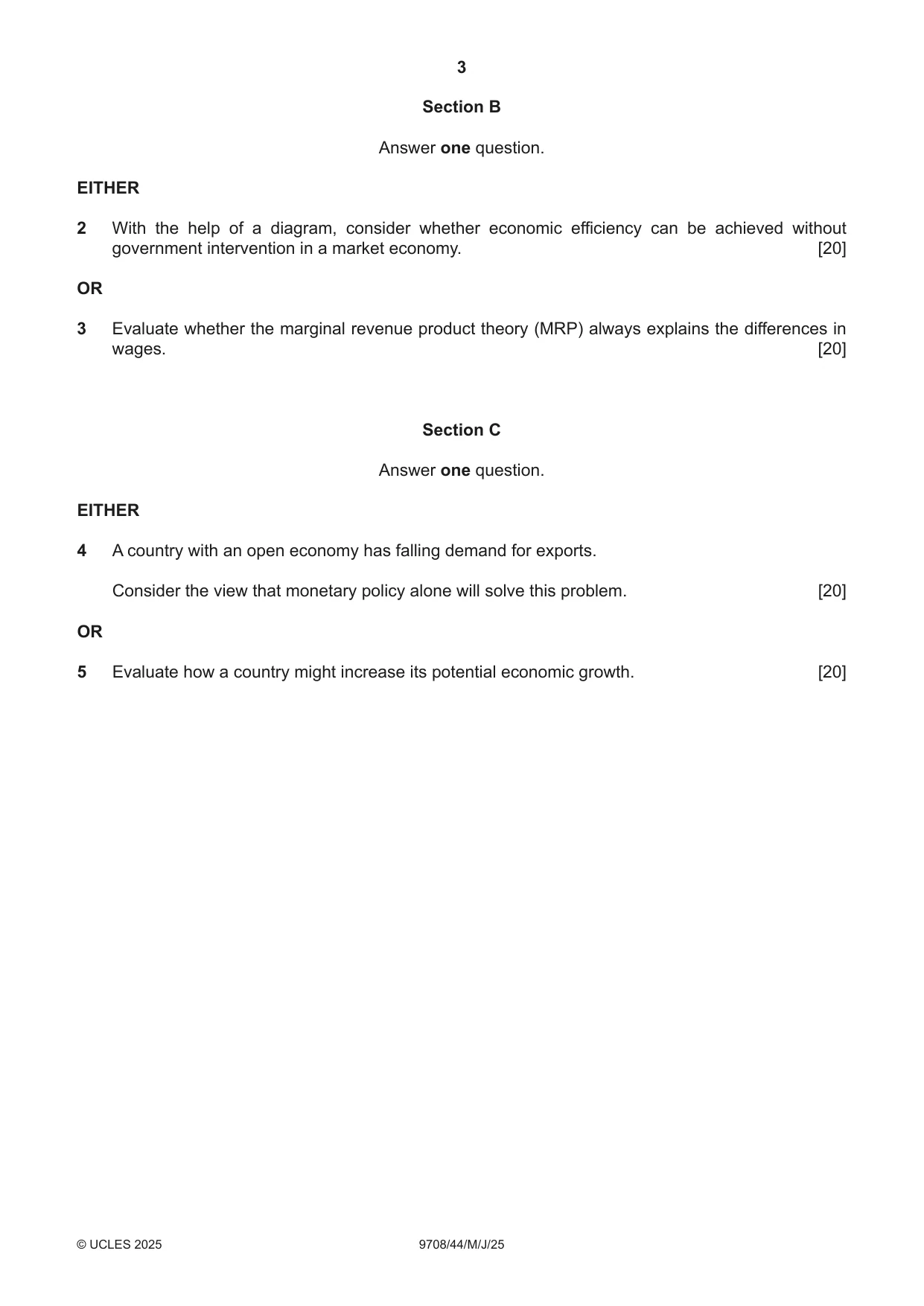

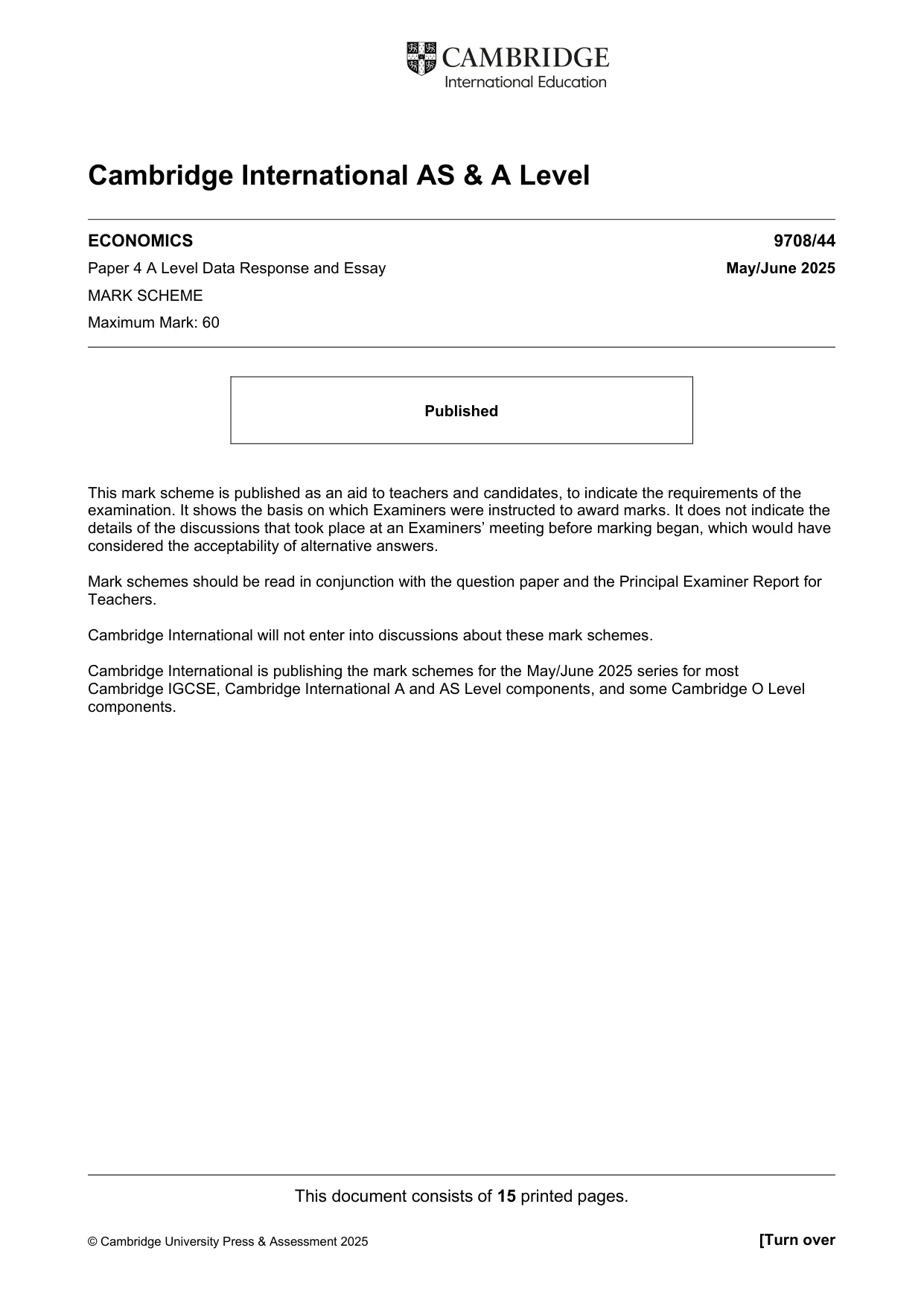
Mark scheme15 pages
Answers below. Sit the paper first if you are practising.



Questions as text
Q1 · Economic development in Bangladesh Since 1971 Bangladesh has experienced significant…
1 Economic development in Bangladesh Since 1971 Bangladesh has experienced significant economic development, moving from the low-income to the lower-middle-income country classification. Gross National Income (GNI) per capita at constant 2017 prices in United States dollars ($) rose from $2342 to $5823 between 2000 and 2020. Over the same period, the country’s Human Development Index (HDI) rose from 0.49 to 0.66. During this period, Bangladesh underwent changes in employment as it moved from the agricultural sector to the manufacturing and services sectors. First, in agriculture, output increased by more than 100% whilst employment fell from 65% to 38% of the working population. This change was helped by innovation in crop irrigation, land preparation and harvesting, aided by the development of local industries to provide the capital equipment needed. A second source of economic development was the growth in the clothing industry producing ready-made garments (RMG) that contributed about 11% of Bangladesh’s Gross Domestic Product (GDP) and employed 4.4 million workers of which 2.5 million were women (2020). The industry uses significant division of labour with production split into 10 or more processes, for example, cutting, sewing zips, assembly and packaging. The value of raw materials imported for the RMG industry was about half of the value of the industry’s exports. Net exports from this sector stood at $23 billion. This enabled Bangladesh to both import a wider range of goods and services and reduce the deficit on its balance of trade in goods. In 2020, there were more than 4000 RMG manufacturers in Bangladesh, differentiated by the quality of their products and the speed of their delivery. The RMG industry supplied more than 100 major US and European retailers. However, the RMG industry has critics who point to air and water pollution from the chemicals used in cotton growing and manufacturing clothes. The industry is also accused of employing child labour and of having poorly constructed factories. Sources: Bangladesh overview: World Bank, 11 April 2024 and Quarterly Review on Readymade Garments, Bangladesh Bank Research Department, 14 February 2023 (a) Identify what is included in the HDI. [3] (b) The passage states that the RMG industry ‘uses significant division of labour’. Explain how this is likely to affect the average costs of firms in Bangladesh’s RMG industry. [3] (c) Identify the probable market structure of the RMG industry in Bangladesh and with the help of a diagram, consider the likely effect on the level of long-run profits of firms in this industry. [6] (d) With reference to the article, assess whether there is enough evidence to conclude that living standards in Bangladesh have improved since 1971. [8]
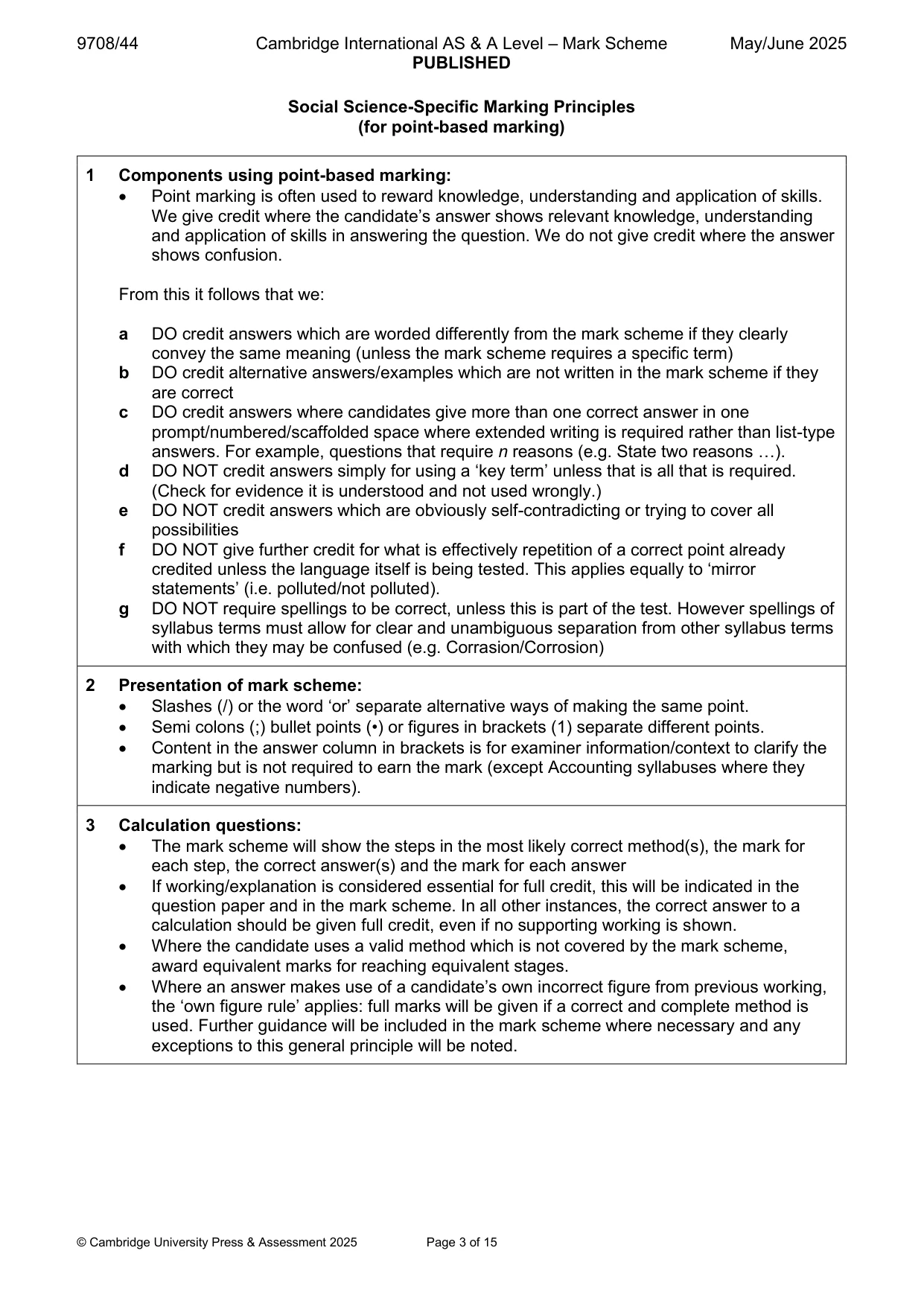
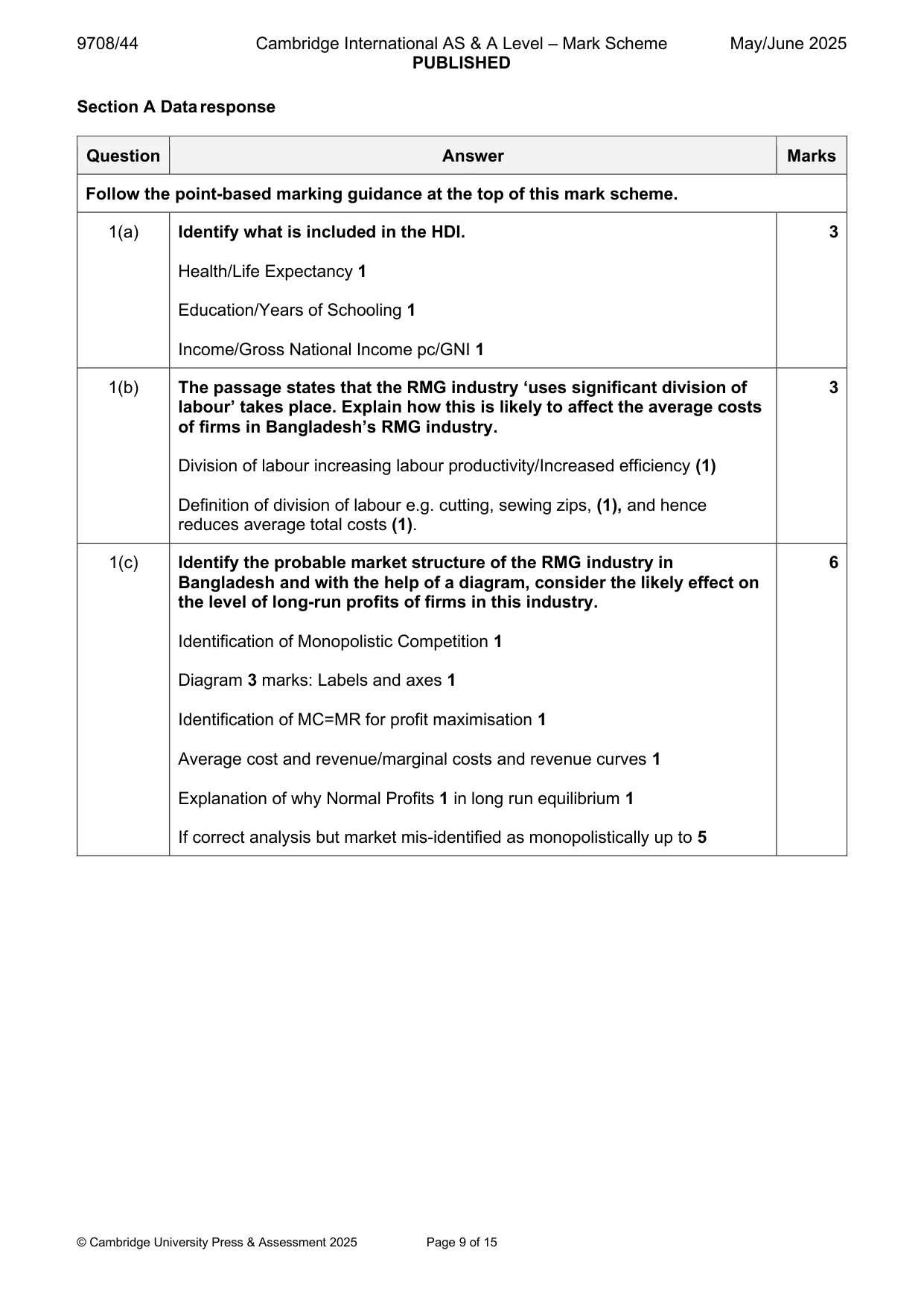
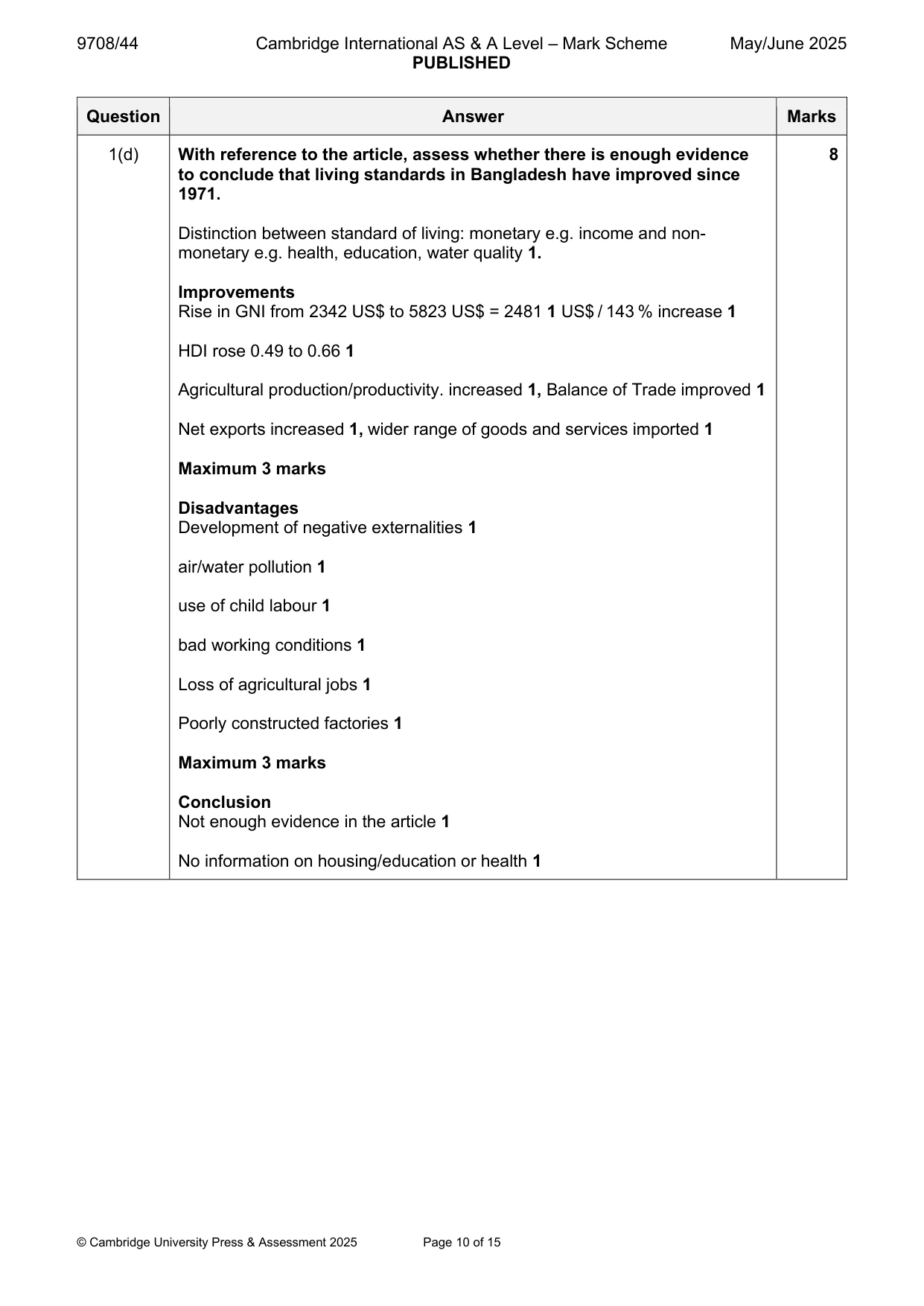
Mark scheme: Question Answer Marks Follow the point-based marking guidance at the top of this mark scheme. 1(a) Identify what is included in the HDI. 3 Health/Life Expectancy 1 Education/Years of Schooling 1 Income/Gross National Income pc/GNI 1 1(b) The passage states that the RMG industry ‘uses significant division of 3 labour’ takes place. Explain how this is likely to affect the average costs of firms in Bangladesh’s RMG industry. Division of labour increasing labour productivity/Increased efficiency (1) Definition of division of labour e.g. cutting, sewing zips, (1), and hence reduces average total costs (1). 1(c) Identify the probable market structure of the RMG industry in 6 Bangladesh and with the help of a diagram, consider the likely effect on the level of long-run profits of firms in this industry. Identification of Monopolistic Competition 1 Diagram 3 marks: Labels and axes 1 Identification of MC=MR for profit maximisation 1 Average cost and revenue/marginal costs and revenue curves 1 Explanation of why Normal Profits 1 in long run equilibrium 1 If correct analysis but market mis-identified as monopolistically up to 5 1(d) With reference to the article, assess whether there is enough evidence 8 to conclude that living standards in Bangladesh have improved since 1971. Distinction between standard of living: monetary e.g. income and non- monetary e.g. health, education, water quality 1. Improvements Rise in GNI from 2342 US$ to 5823 US$ = 2481 1 US$ / 143 % increase 1 HDI rose 0.49 to 0.66 1 Agricultural production/productivity. increased 1, Balance of Trade improved 1 Net exports increased 1, wider range of goods and services imported 1 Maximum 3 marks Disadvantages Development of negative externalities 1 air/water pollution 1 use of child labour 1 bad working conditions 1 Loss of agricultural jobs 1 Poorly constructed factories 1 Maximum 3 marks Conclusion Not enough evidence in the article 1 No information on housing/education or health 1
Q2 · With the help of a diagram, consider whether economic efficiency can be achieved without…
2 With the help of a diagram, consider whether economic efficiency can be achieved without government intervention in a market economy. [20] OR
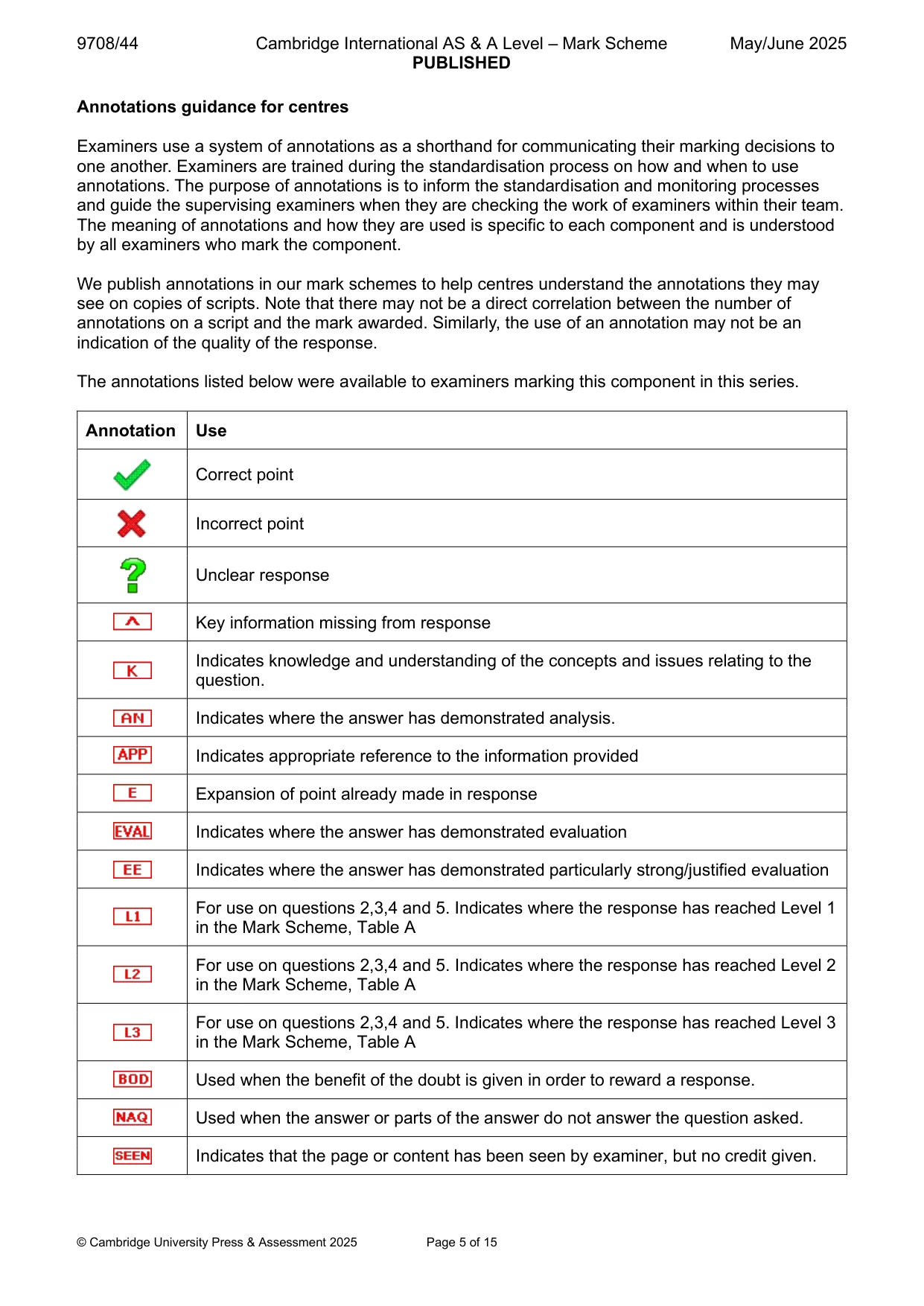
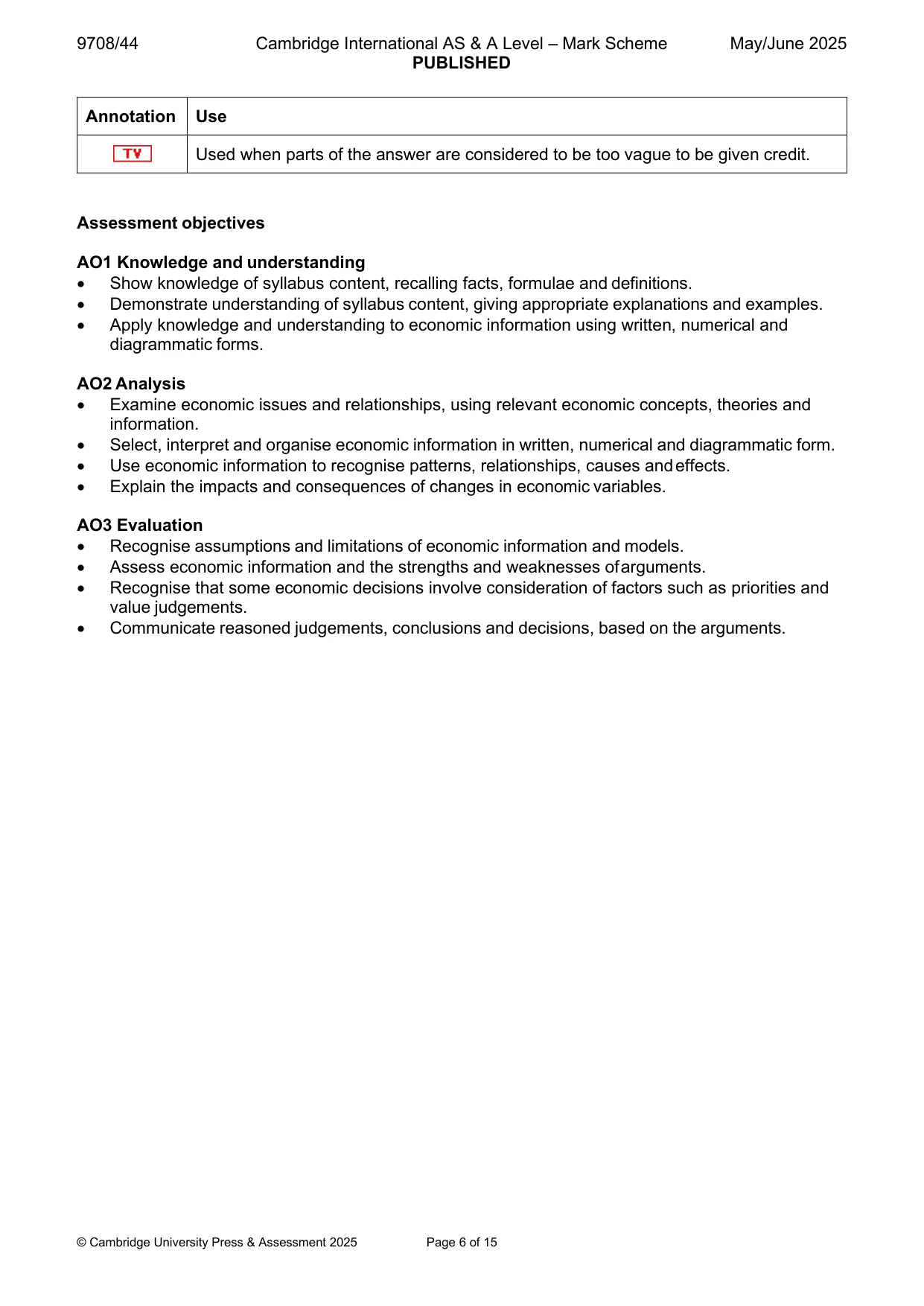
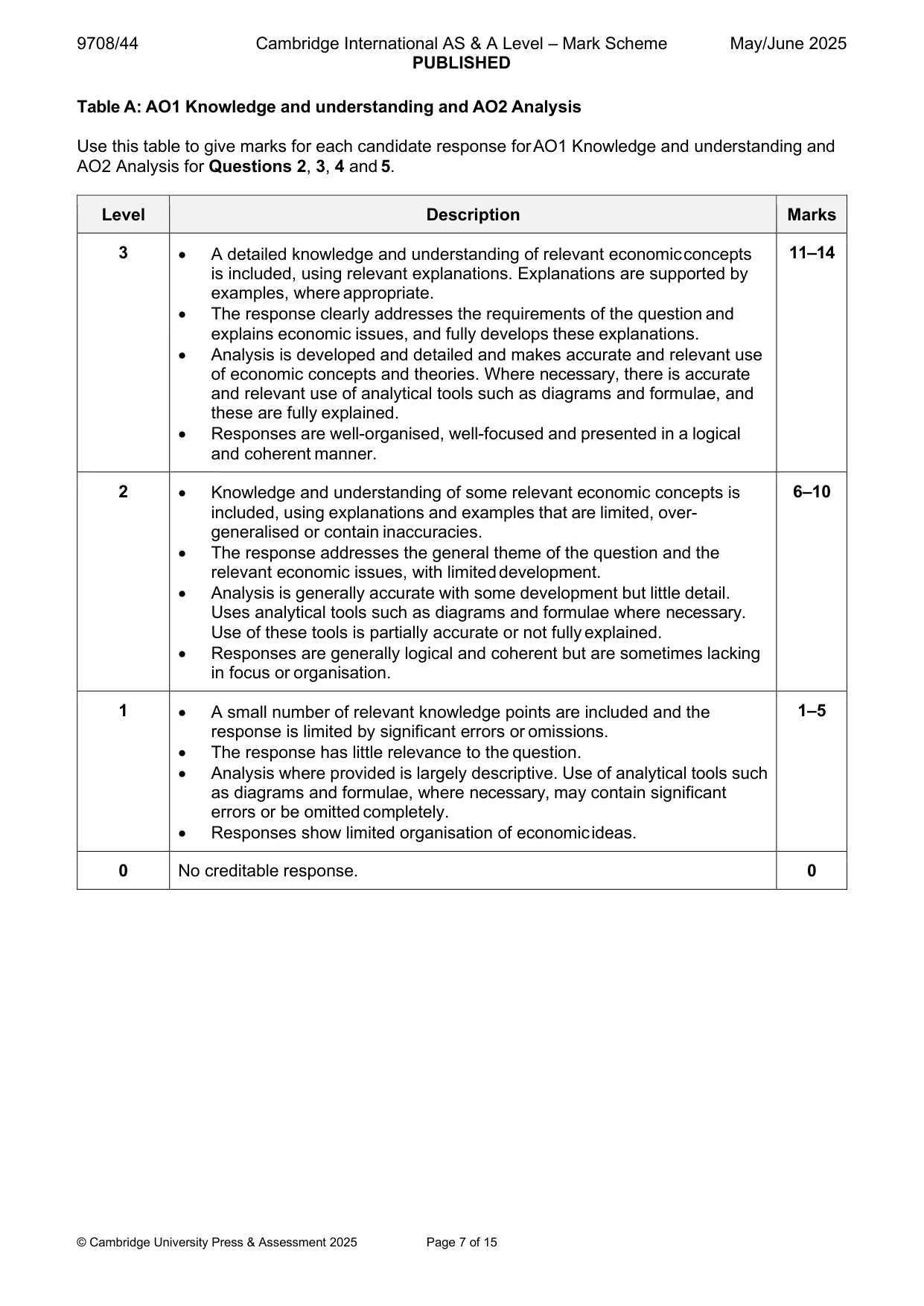
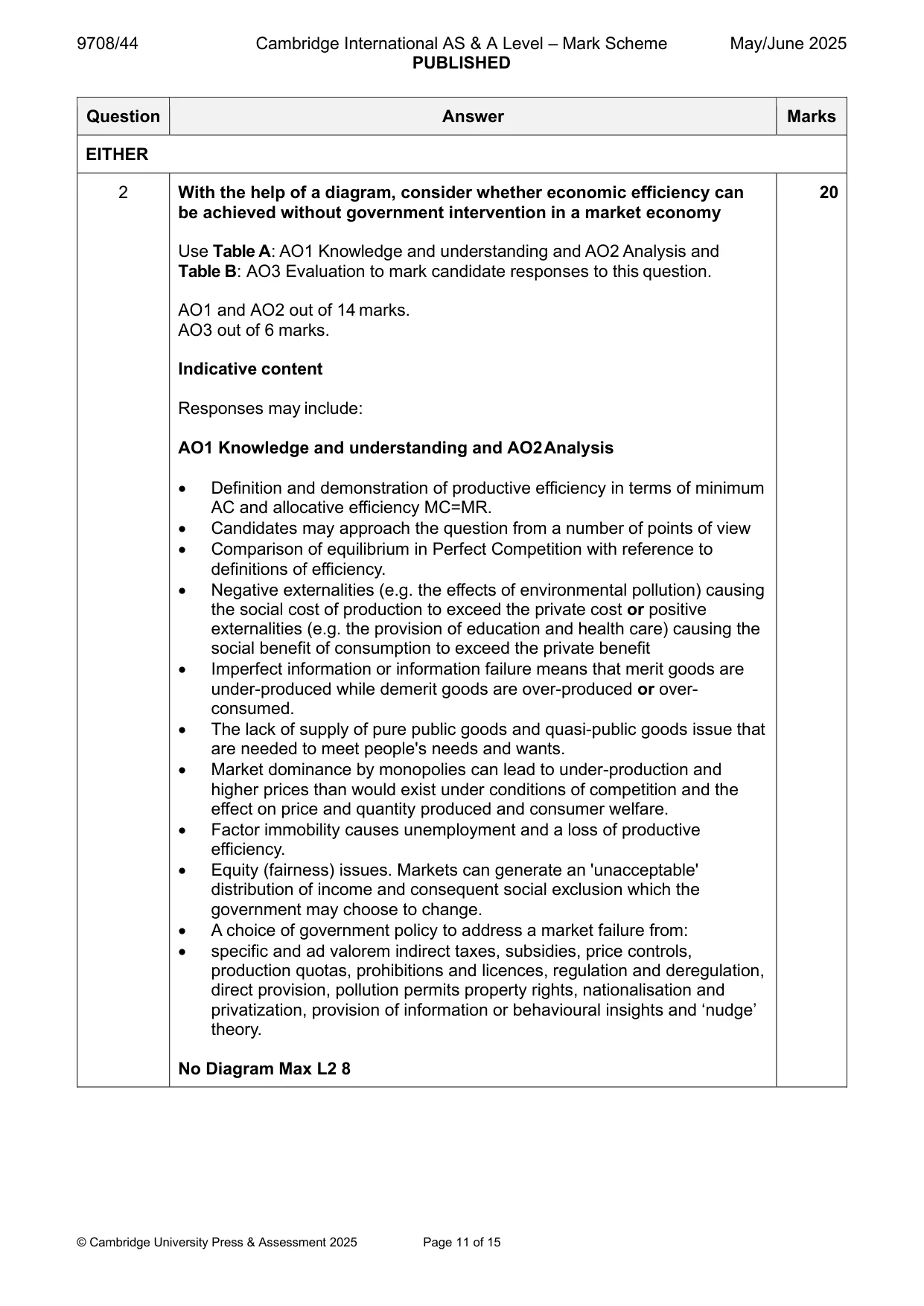
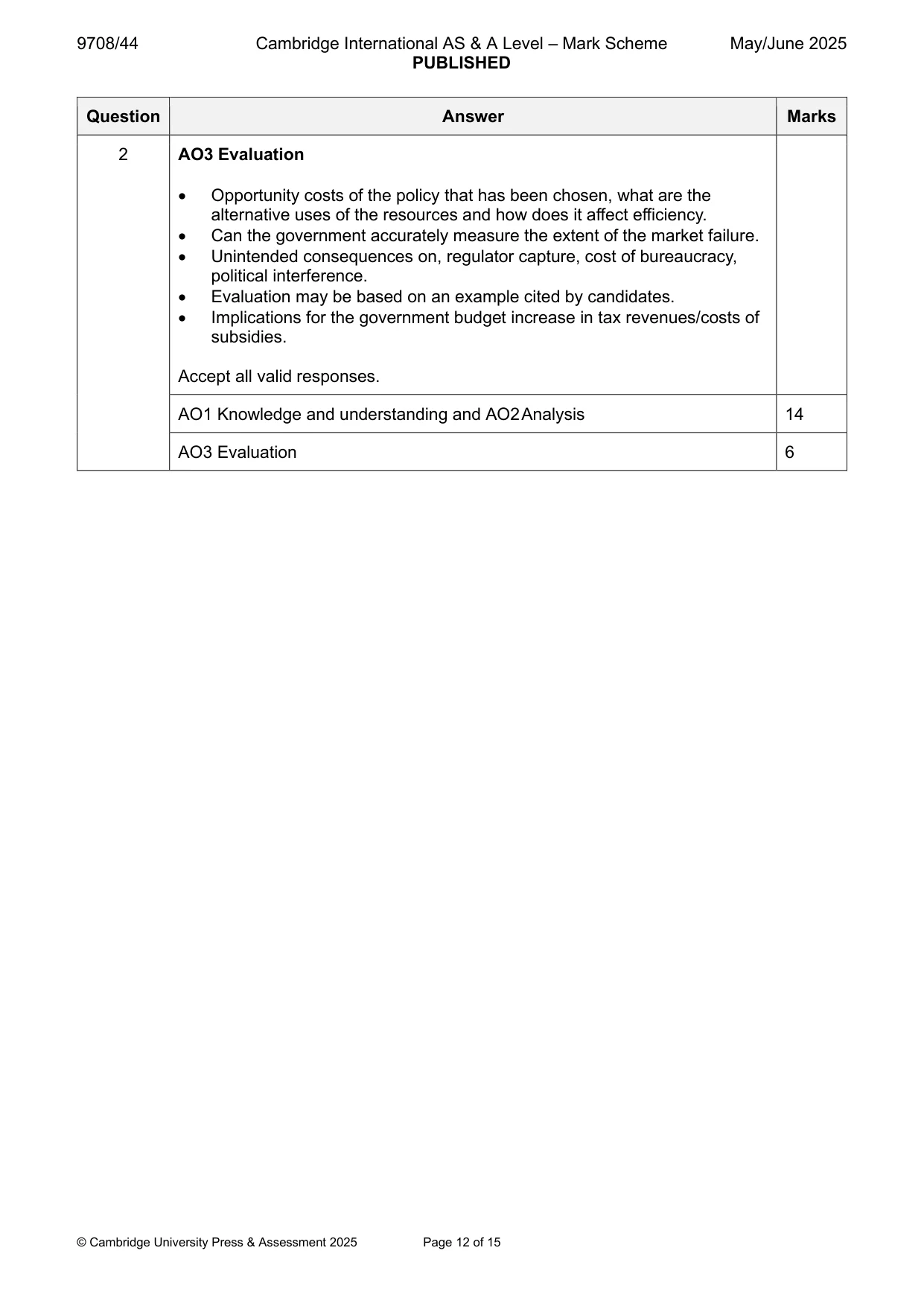
Mark scheme: 2 With the help of a diagram, consider whether economic efficiency can 20 be achieved without government intervention in a market economy Use Table A: AO1 Knowledge and understanding and AO2 Analysis and Table B: AO3 Evaluation to mark candidate responses to this question. AO1 and AO2 out of 14 marks. AO3 out of 6 marks. Indicative content Responses may include: AO1 Knowledge and understanding and AO2 Analysis • Definition and demonstration of productive efficiency in terms of minimum AC and allocative efficiency MC=MR. • Candidates may approach the question from a number of points of view • Comparison of equilibrium in Perfect Competition with reference to definitions of efficiency. • Negative externalities (e.g. the effects of environmental pollution) causing the social cost of production to exceed the private cost or positive externalities (e.g. the provision of education and health care) causing the social benefit of consumption to exceed the private benefit • Imperfect information or information failure means that merit goods are under-produced while demerit goods are over-produced or over- consumed. • The lack of supply of pure public goods and quasi-public goods issue that are needed to meet people's needs and wants. • Market dominance by monopolies can lead to under-production and higher prices than would exist under conditions of competition and the effect on price and quantity produced and consumer welfare. • Factor immobility causes unemployment and a loss of productive efficiency. • Equity (fairness) issues. Markets can generate an 'unacceptable' distribution of income and consequent social exclusion which the government may choose to change. • A choice of government policy to address a market failure from: • specific and ad valorem indirect taxes, subsidies, price controls, production quotas, prohibitions and licences, regulation and deregulation, direct provision, pollution permits property rights, nationalisation and privatization, provision of information or behavioural insights and ‘nudge’ theory. No Diagram Max L2 8 2 AO3 Evaluation • Opportunity costs of the policy that has been chosen, what are the alternative uses of the resources and how does it affect efficiency. • Can the government accurately measure the extent of the market failure. • Unintended consequences on, regulator capture, cost of bureaucracy, political interference. • Evaluation may be based on an example cited by candidates. • Implications for the government budget increase in tax revenues/costs of subsidies. Accept all valid responses. AO1 Knowledge and understanding and AO2 Analysis 14 AO3 Evaluation 6
Q3 · Evaluate whether the marginal revenue product theory (MRP) always explains the…
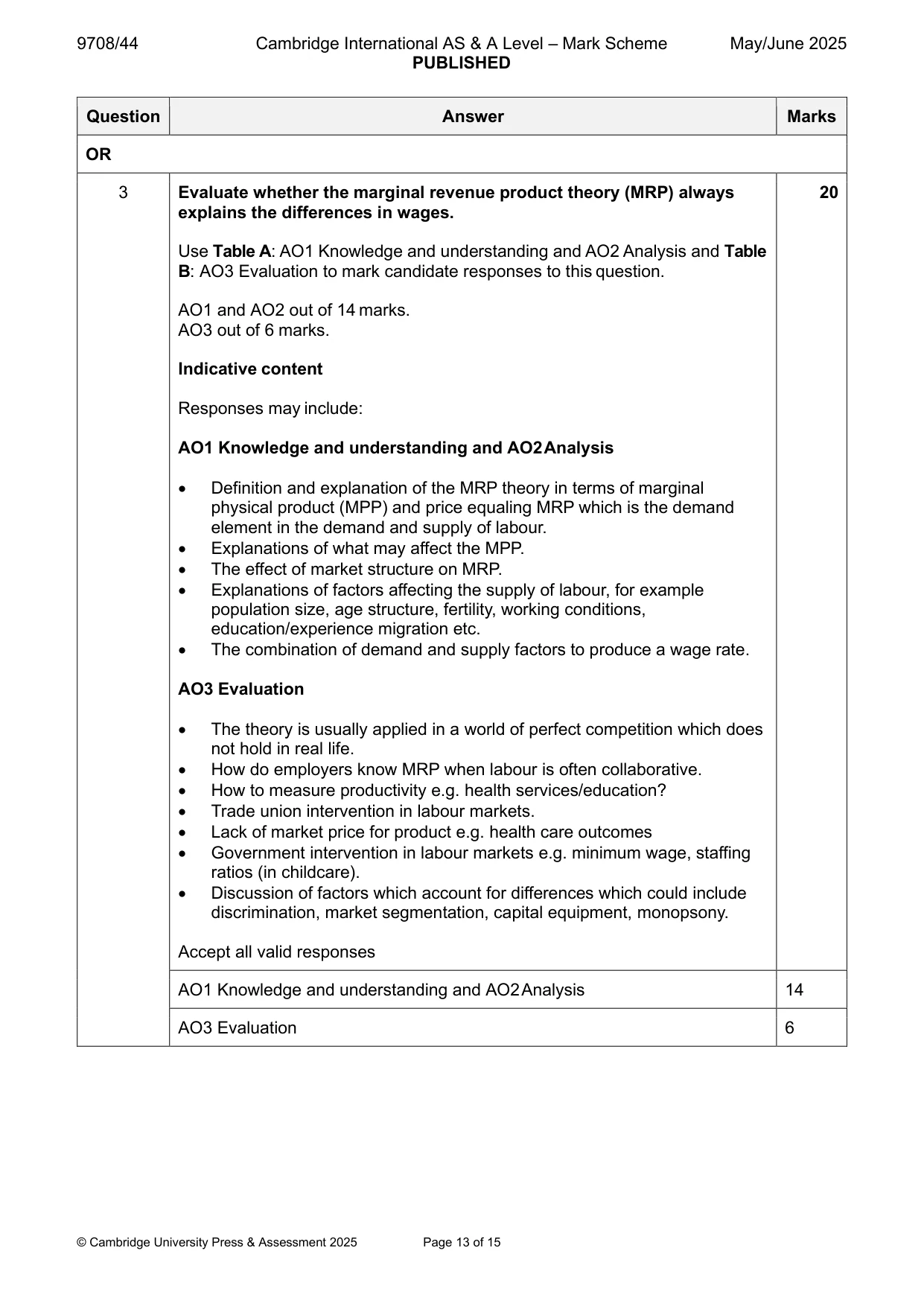
3 Evaluate whether the marginal revenue product theory (MRP) always explains the differences in wages. [20] Section C Answer one question. EITHER
Mark scheme: 3 Evaluate whether the marginal revenue product theory (MRP) always 20 explains the differences in wages. Use Table A: AO1 Knowledge and understanding and AO2 Analysis and Table B: AO3 Evaluation to mark candidate responses to this question. AO1 and AO2 out of 14 marks. AO3 out of 6 marks. Indicative content Responses may include: AO1 Knowledge and understanding and AO2 Analysis • Definition and explanation of the MRP theory in terms of marginal physical product (MPP) and price equaling MRP which is the demand element in the demand and supply of labour. • Explanations of what may affect the MPP. • The effect of market structure on MRP. • Explanations of factors affecting the supply of labour, for example population size, age structure, fertility, working conditions, education/experience migration etc. • The combination of demand and supply factors to produce a wage rate. AO3 Evaluation • The theory is usually applied in a world of perfect competition which does not hold in real life. • How do employers know MRP when labour is often collaborative. • How to measure productivity e.g. health services/education? • Trade union intervention in labour markets. • Lack of market price for product e.g. health care outcomes • Government intervention in labour markets e.g. minimum wage, staffing ratios (in childcare). • Discussion of factors which account for differences which could include discrimination, market segmentation, capital equipment, monopsony. Accept all valid responses AO1 Knowledge and understanding and AO2 Analysis 14 AO3 Evaluation 6
More questions on Labour market forces and government intervention
Q4 · A country with an open economy has falling demand for exports
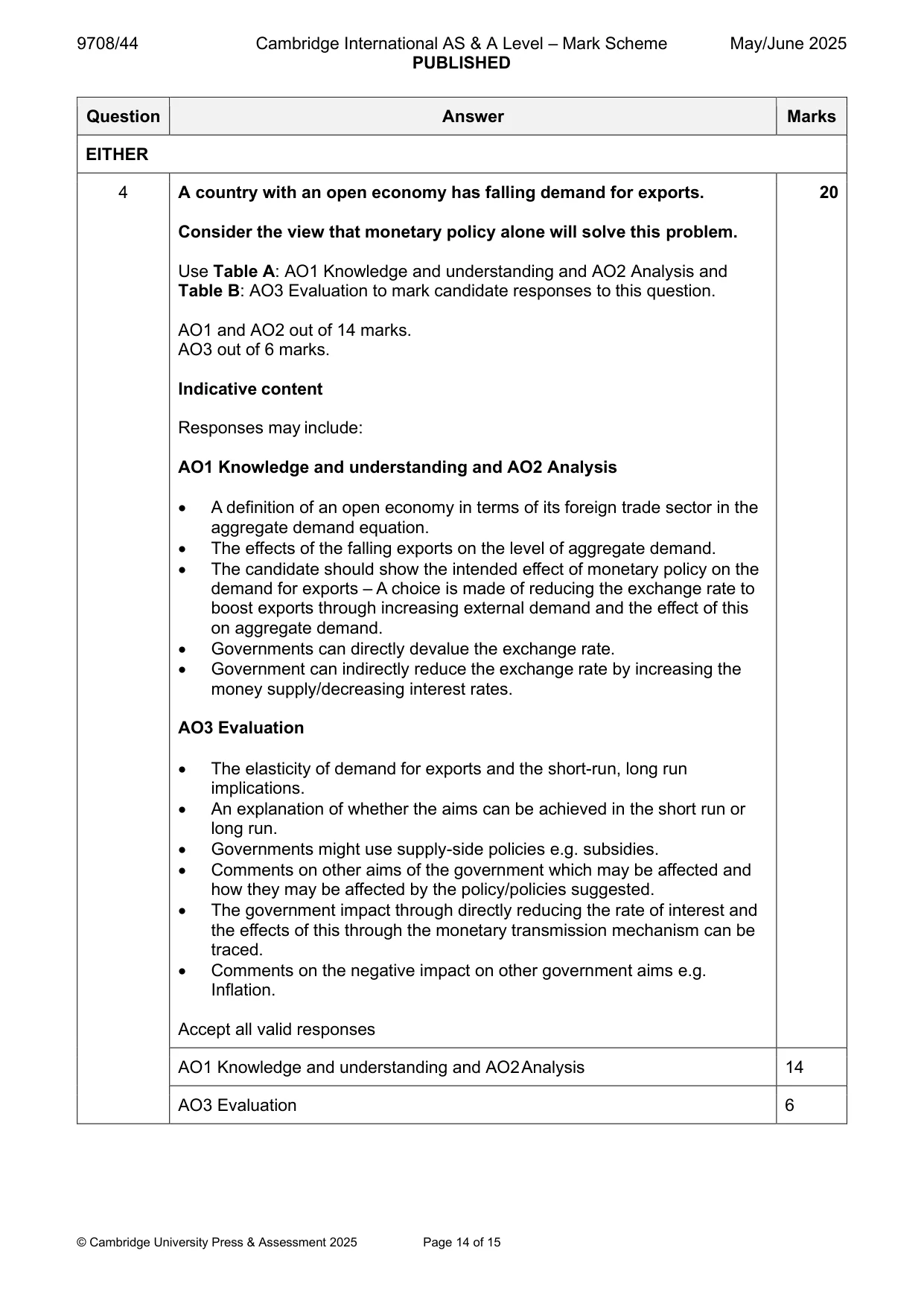
4 A country with an open economy has falling demand for exports. Consider the view that monetary policy alone will solve this problem. [20] OR
Mark scheme: 4 A country with an open economy has falling demand for exports. 20 Consider the view that monetary policy alone will solve this problem. Use Table A: AO1 Knowledge and understanding and AO2 Analysis and Table B: AO3 Evaluation to mark candidate responses to this question. AO1 and AO2 out of 14 marks. AO3 out of 6 marks. Indicative content Responses may include: AO1 Knowledge and understanding and AO2 Analysis • A definition of an open economy in terms of its foreign trade sector in the aggregate demand equation. • The effects of the falling exports on the level of aggregate demand. • The candidate should show the intended effect of monetary policy on the demand for exports – A choice is made of reducing the exchange rate to boost exports through increasing external demand and the effect of this on aggregate demand. • Governments can directly devalue the exchange rate. • Government can indirectly reduce the exchange rate by increasing the money supply/decreasing interest rates. AO3 Evaluation • The elasticity of demand for exports and the short-run, long run implications. • An explanation of whether the aims can be achieved in the short run or long run. • Governments might use supply-side policies e.g. subsidies. • Comments on other aims of the government which may be affected and how they may be affected by the policy/policies suggested. • The government impact through directly reducing the rate of interest and the effects of this through the monetary transmission mechanism can be traced. • Comments on the negative impact on other government aims e.g. Inflation. Accept all valid responses AO1 Knowledge and understanding and AO2 Analysis 14 AO3 Evaluation 6
More questions on Effectiveness of policy options to meet all macroeconomic objectives
What was in this paper
The subtopics covered by these 4 questions, and how many questions each got. Open one in a new tab to see every Cambridge question on it.
What you needed in this session
Cambridge’s own grade thresholds for 2025 May/June, Paper 4 · Variant 4. A higher threshold means an easier paper — the bar moves with how the cohort did.