Cambridge A Level Economics 9708 — 2024 Feb/March Paper 4 · Variant 2
9708/42/F/M/24 · 5 questions · 60 marks · ≈68 min
The question paper and its mark scheme, free to read here and free to download. This is Cambridge’s own paper, exactly as it was sat.
Question paper4 pages

Mark scheme17 pages
Answers below. Sit the paper first if you are practising.







Questions as text
Q1 · French electricity prices In 2022 the French government ordered a large electricity…
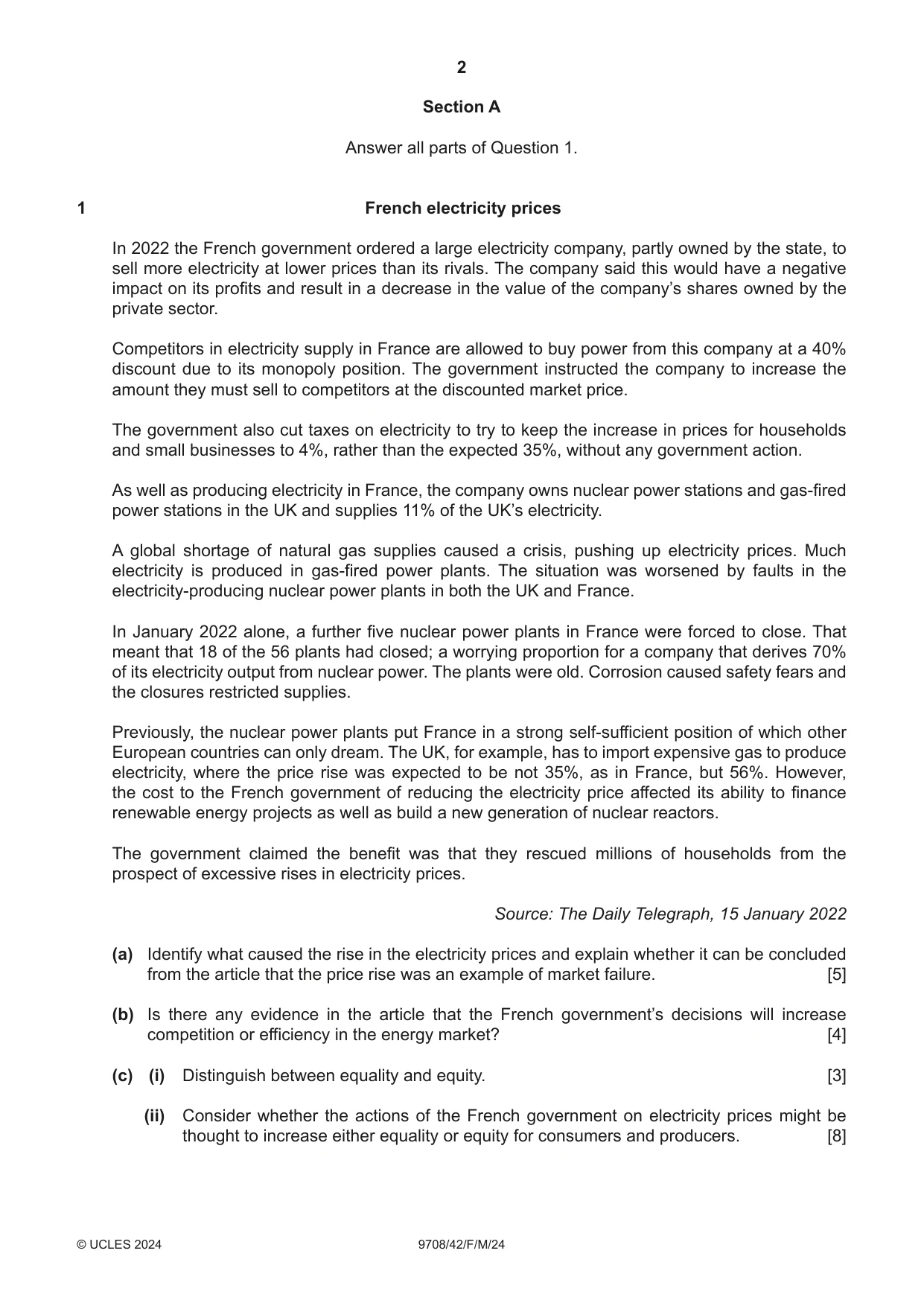
1 French electricity prices In 2022 the French government ordered a large electricity company, partly owned by the state, to sell more electricity at lower prices than its rivals. The company said this would have a negative impact on its profits and result in a decrease in the value of the company’s shares owned by the private sector. Competitors in electricity supply in France are allowed to buy power from this company at a 40% discount due to its monopoly position. The government instructed the company to increase the amount they must sell to competitors at the discounted market price. The government also cut taxes on electricity to try to keep the increase in prices for households and small businesses to 4%, rather than the expected 35%, without any government action. As well as producing electricity in France, the company owns nuclear power stations and gas-fired power stations in the UK and supplies 11% of the UK’s electricity. A global shortage of natural gas supplies caused a crisis, pushing up electricity prices. Much electricity is produced in gas-fired power plants. The situation was worsened by faults in the electricity-producing nuclear power plants in both the UK and France. In January 2022 alone, a further five nuclear power plants in France were forced to close. That meant that 18 of the 56 plants had closed; a worrying proportion for a company that derives 70% of its electricity output from nuclear power. The plants were old. Corrosion caused safety fears and the closures restricted supplies. Previously, the nuclear power plants put France in a strong self-sufficient position of which other European countries can only dream. The UK, for example, has to import expensive gas to produce electricity, where the price rise was expected to be not 35%, as in France, but 56%. However, the cost to the French government of reducing the electricity price affected its ability to finance renewable energy projects as well as build a new generation of nuclear reactors. The government claimed the benefit was that they rescued millions of households from the prospect of excessive rises in electricity prices. Source: The Daily Telegraph, 15 January 2022 (a) Identify what caused the rise in the electricity prices and explain whether it can be concluded from the article that the price rise was an example of market failure. [5] (b) Is there any evidence in the article that the French government’s decisions will increase competition or efficiency in the energy market? [4] (c) (i) Distinguish between equality and equity. [3] (ii) Consider whether the actions of the French government on electricity prices might be thought to increase either equality or equity for consumers and producers. [8]
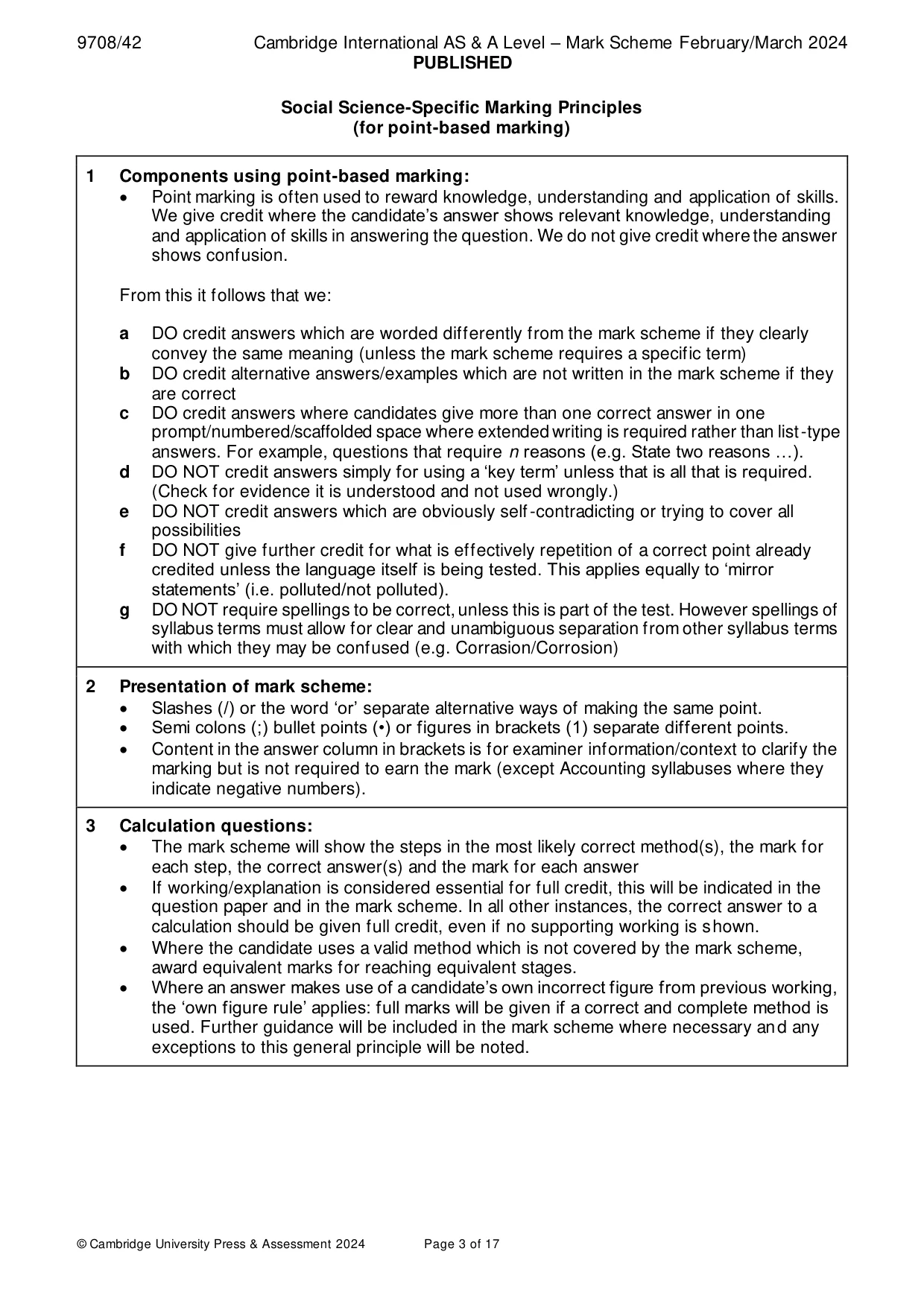
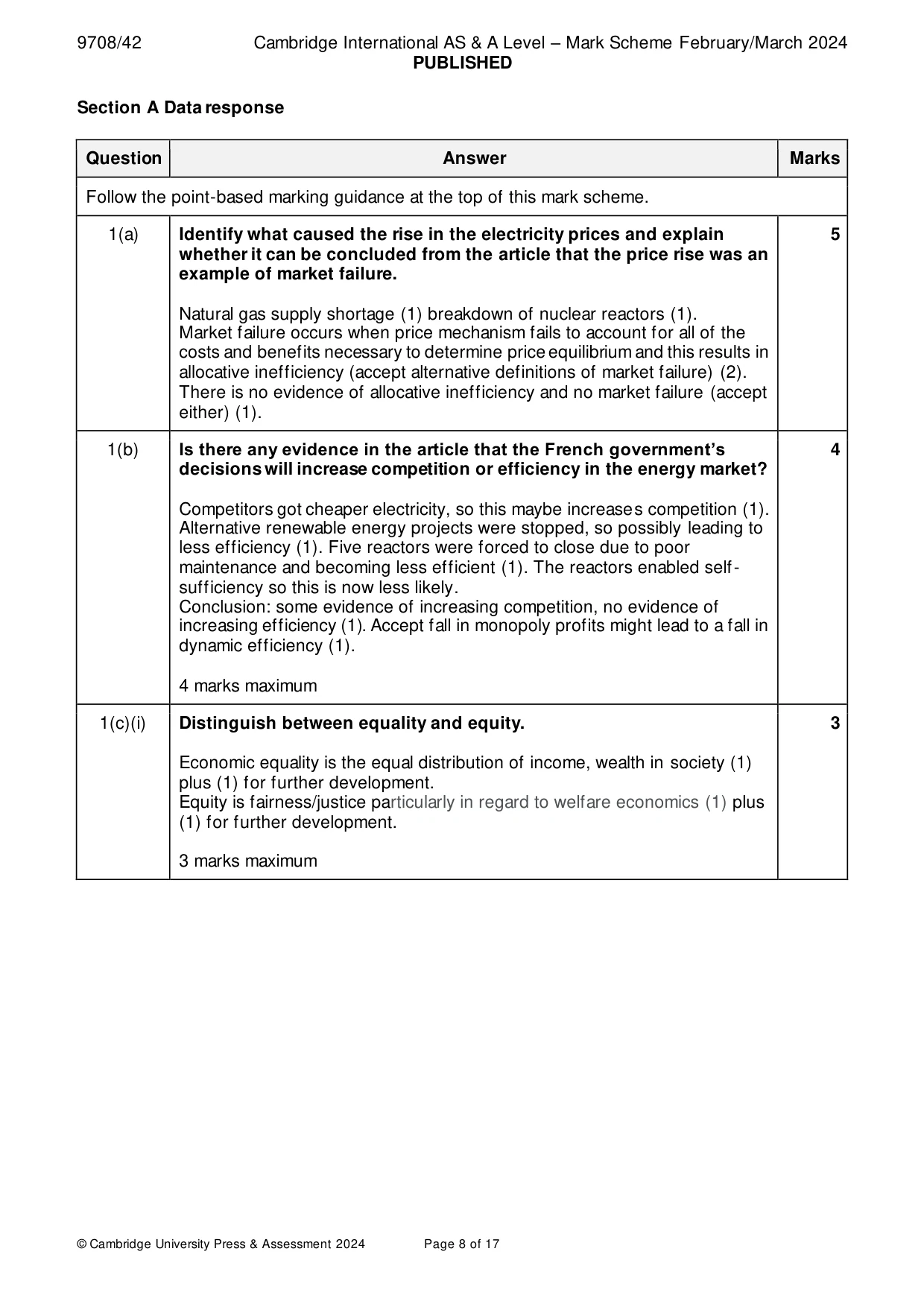
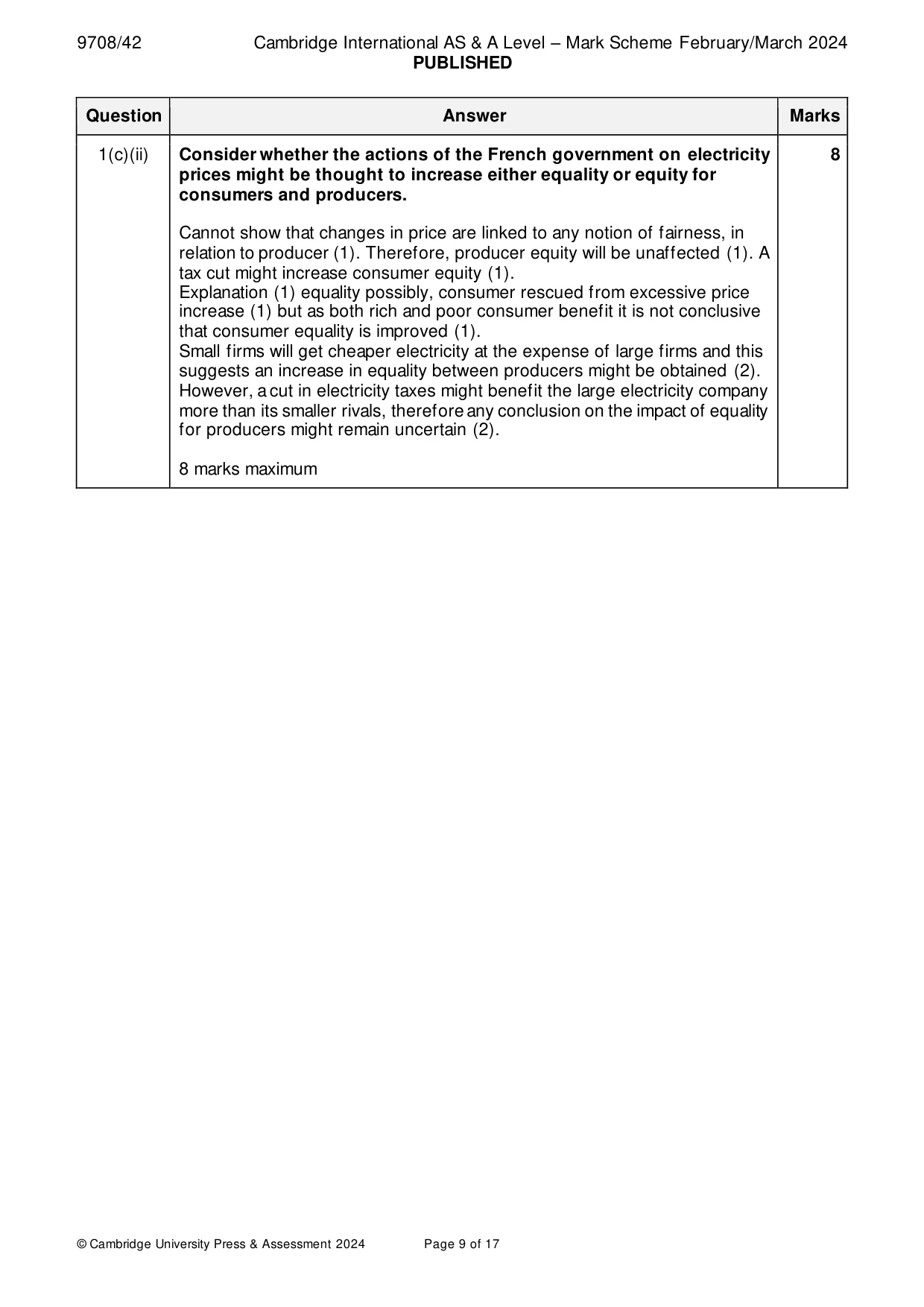
Mark scheme: Question Answer Marks Follow the point-based marking guidance at the top of this mark scheme. 1(a) Identify what caused the rise in the electricity prices and explain 5 whether it can be concluded from the article that the price rise was an example of market failure. Natural gas supply shortage (1) breakdown of nuclear reactors (1). Market failure occurs when price mechanism fails to account for all of the costs and benefits necessary to determine price equilibrium and this results in allocative inefficiency (accept alternative definitions of market failure) (2). There is no evidence of allocative inefficiency and no market failure (accept either) (1). 1(b) Is there any evidence in the article that the French government’s 4 decisions will increase competition or efficiency in the energy market? Competitors got cheaper electricity, so this maybe increases competition (1). Alternative renewable energy projects were stopped, so possibly leading to less efficiency (1). Five reactors were forced to close due to poor maintenance and becoming less efficient (1). The reactors enabled self- sufficiency so this is now less likely. Conclusion: some evidence of increasing competition, no evidence of increasing efficiency (1). Accept fall in monopoly profits might lead to a fall in dynamic efficiency (1). 4 marks maximum 1(c)(i) Distinguish between equality and equity. 3 Economic equality is the equal distribution of income, wealth in society (1) plus (1) for further development. Equity is fairness/justice particularly in regard to welfare economics (1) plus (1) for further development. 3 marks maximum 1(c)(ii) Consider whether the actions of the French government on electricity 8 prices might be thought to increase either equality or equity for consumers and producers. Cannot show that changes in price are linked to any notion of fairness, in relation to producer (1). Therefore, producer equity will be unaffected (1). A tax cut might increase consumer equity (1). Explanation (1) equality possibly, consumer rescued from excessive price increase (1) but as both rich and poor consumer benefit it is not conclusive that consumer equality is improved (1). Small firms will get cheaper electricity at the expense of large firms and this suggests an increase in equality between producers might be obtained (2). However, a cut in electricity taxes might benefit the large electricity company more than its smaller rivals, therefore any conclusion on the impact of equality for producers might remain uncertain (2). 8 marks maximum
More questions on Equity and redistribution of income and wealth
Q2 · With the help of a diagram, assess the effectiveness of a government’s intervention in…
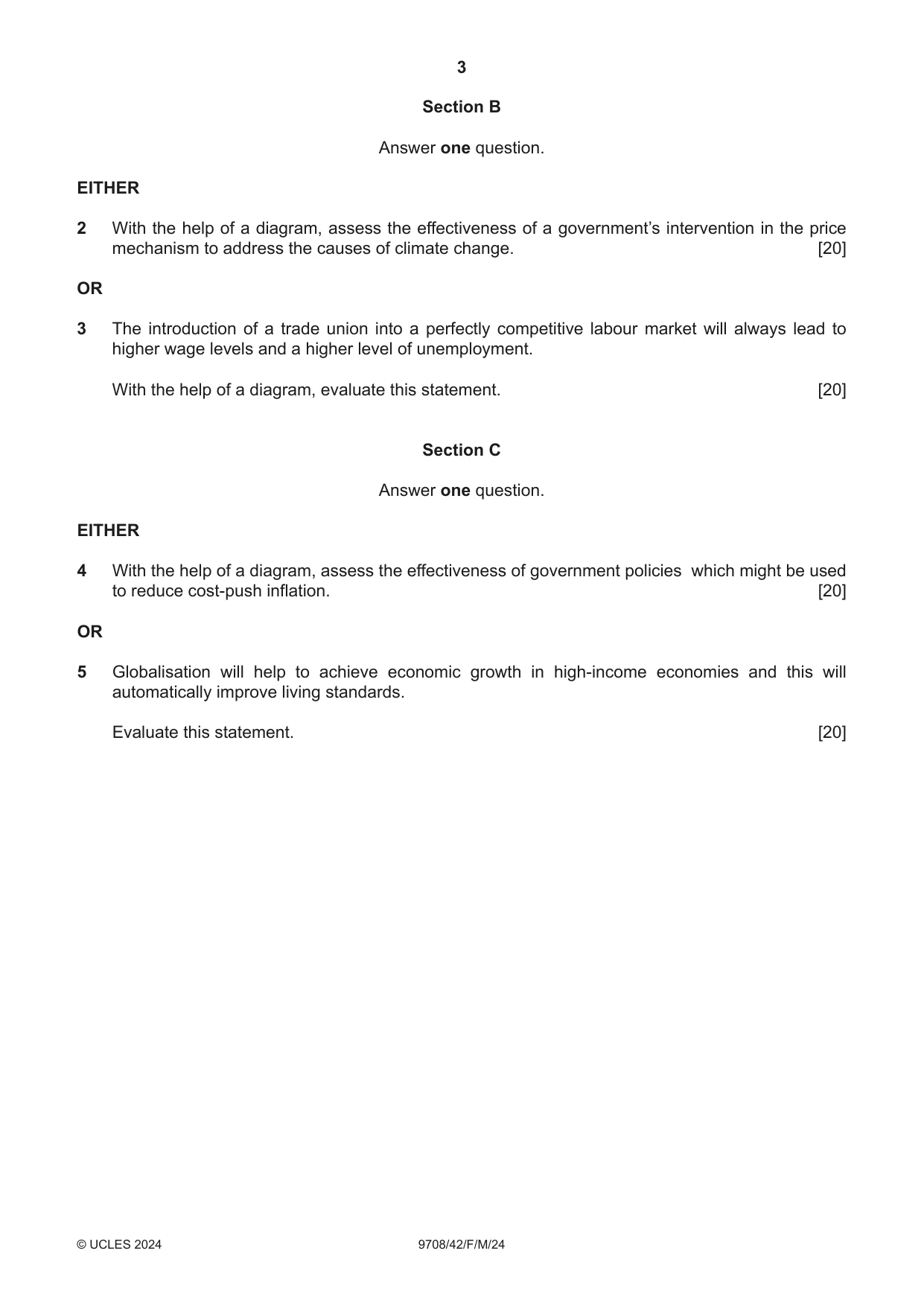
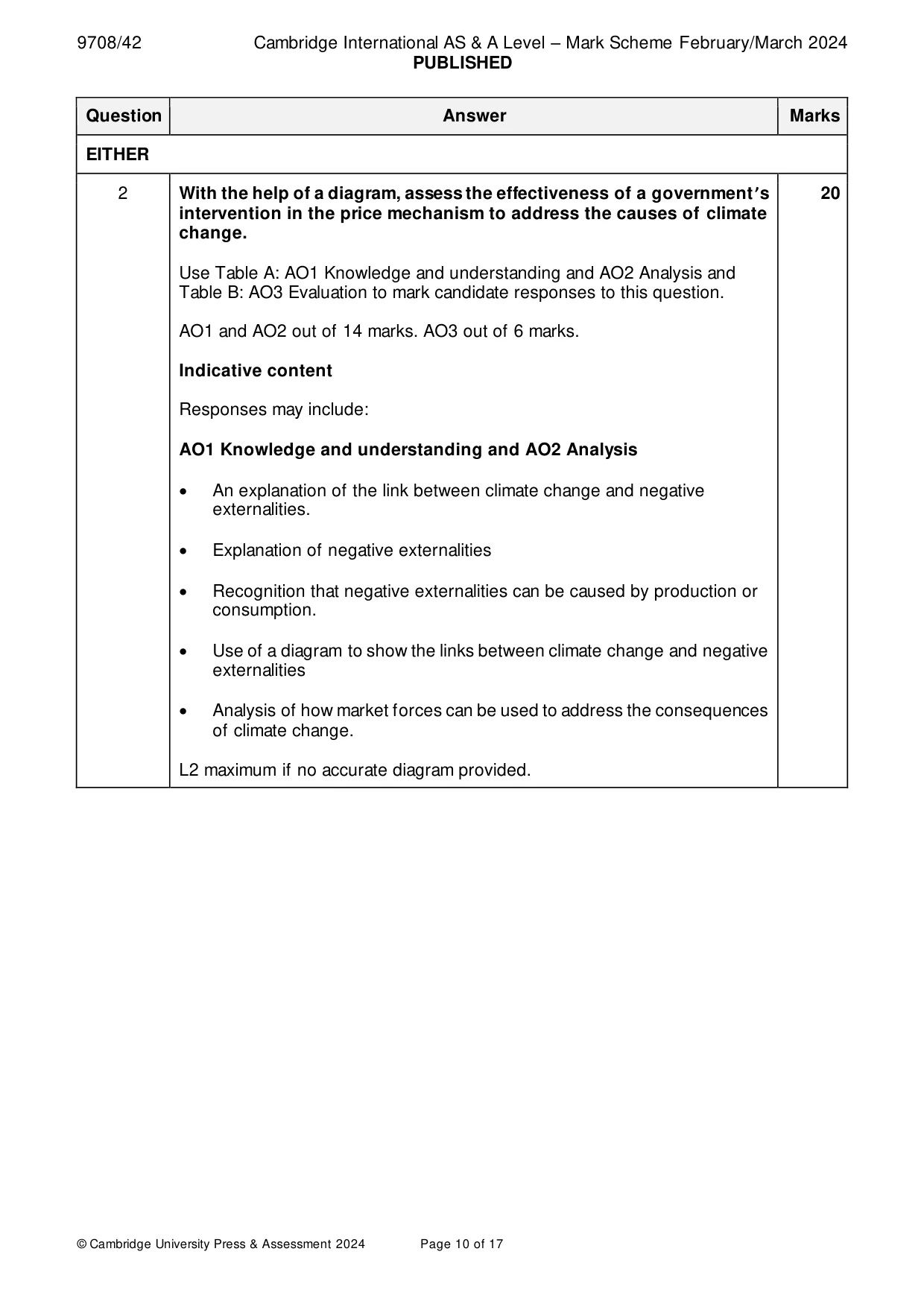
2 With the help of a diagram, assess the effectiveness of a government’s intervention in the price mechanism to address the causes of climate change. [20] OR
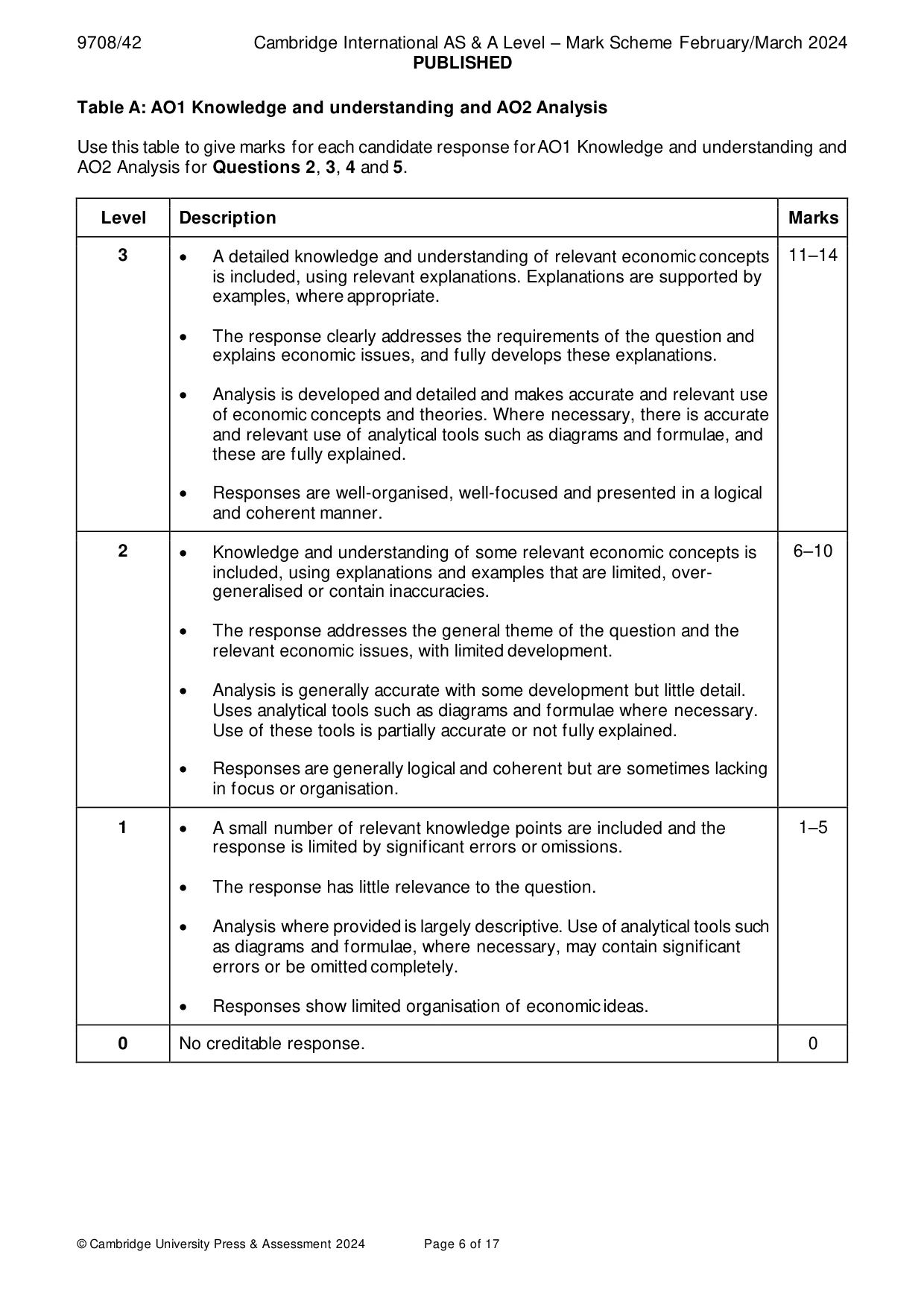
Mark scheme: 2 With the help of a diagram, assess the effectiveness of a government’s 20 intervention in the price mechanism to address the causes of climate change. Use Table A: AO1 Knowledge and understanding and AO2 Analysis and Table B: AO3 Evaluation to mark candidate responses to this question. AO1 and AO2 out of 14 marks. AO3 out of 6 marks. Indicative content Responses may include: AO1 Knowledge and understanding and AO2 Analysis • An explanation of the link between climate change and negative externalities. • Explanation of negative externalities • Recognition that negative externalities can be caused by production or consumption. • Use of a diagram to show the links between climate change and negative externalities • Analysis of how market forces can be used to address the consequences of climate change. L2 maximum if no accurate diagram provided. 2 AO3 Evaluation • The link between climate change on negative externalities is very difficult to accurately establish • It is also extremely difficult to measure negative externalities • The use of taxation to influence price and output is unlikely to remove all negative externalities because it is very difficult to measure the correct amount of taxation that should be applied. • The use of minimum prices to reduce negative externalities would only be partially effective and might have significant effects on firm’s profits and employment. • Alternatives to the use of the price mechanism might, in some circumstance, allow a government to achieve a more precise control of negative externalities. For example, through the use of a complete ban of consumption/production. • A conclusion should be attempted which examines the net benefits of each alternative i.e. through direct government intervention or through the use of market forces. Accept all valid responses. AO1 Knowledge and understanding and AO2 Analysis 14 AO3 Evaluation 6
Q3 · The introduction of a trade union into a perfectly competitive labour market will always…
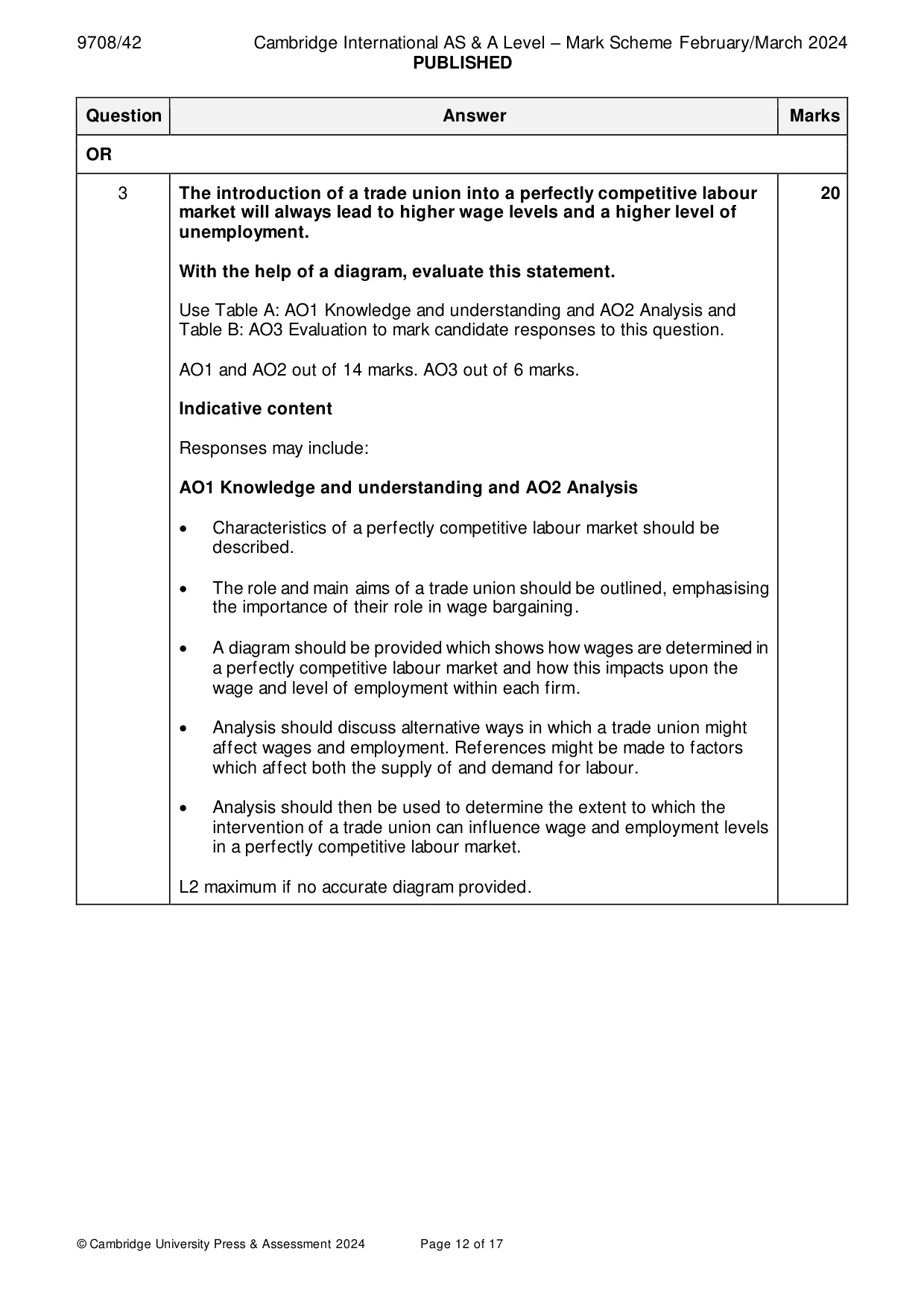
3 The introduction of a trade union into a perfectly competitive labour market will always lead to higher wage levels and a higher level of unemployment. With the help of a diagram, evaluate this statement. [20] Section C Answer one question. EITHER
Mark scheme: 3 The introduction of a trade union into a perfectly competitive labour 20 market will always lead to higher wage levels and a higher level of unemployment. With the help of a diagram, evaluate this statement. Use Table A: AO1 Knowledge and understanding and AO2 Analysis and Table B: AO3 Evaluation to mark candidate responses to this question. AO1 and AO2 out of 14 marks. AO3 out of 6 marks. Indicative content Responses may include: AO1 Knowledge and understanding and AO2 Analysis • Characteristics of a perfectly competitive labour market should be described. • The role and main aims of a trade union should be outlined, emphasising the importance of their role in wage bargaining. • A diagram should be provided which shows how wages are determined in a perfectly competitive labour market and how this impacts upon the wage and level of employment within each firm. • Analysis should discuss alternative ways in which a trade union might affect wages and employment. References might be made to factors which affect both the supply of and demand for labour. • Analysis should then be used to determine the extent to which the intervention of a trade union can influence wage and employment levels in a perfectly competitive labour market. L2 maximum if no accurate diagram provided. 3 AO3 Evaluation • In some cases, the introduction of trade unions might lead to an increase in the productivity of the workforce through the provision of better training. Although an increase in productivity might also be produced by substituting capital for labour which might lead to an increase in unemployment. • Trade unions might gain higher wages for labour but because this makes capital relatively cheaper, machines might be substituted for labour which will further reduce employment. • The impact of higher wages on employment will also depend upon how easy it is to substitute capital for labour and the existing proportion of capital to labour in the particular industry. • If trade unions manage to bargain for higher wages but the new wage is above the market equilibrium, there will be an excess supply of labour at the new wage leading to higher unemployment. The extent of this impact will be determined by the relative elasticities of supply of and demand for labour • A conclusion should attempt to address each element of the statement. The key word ‘always’ should be considered in the light of the preceding argument. Accept all valid responses. AO1 Knowledge and understanding and AO2 Analysis 14 AO3 Evaluation 6
More questions on Labour market forces and government intervention
Q4 · With the help of a diagram, assess the effectiveness of government policies which might…
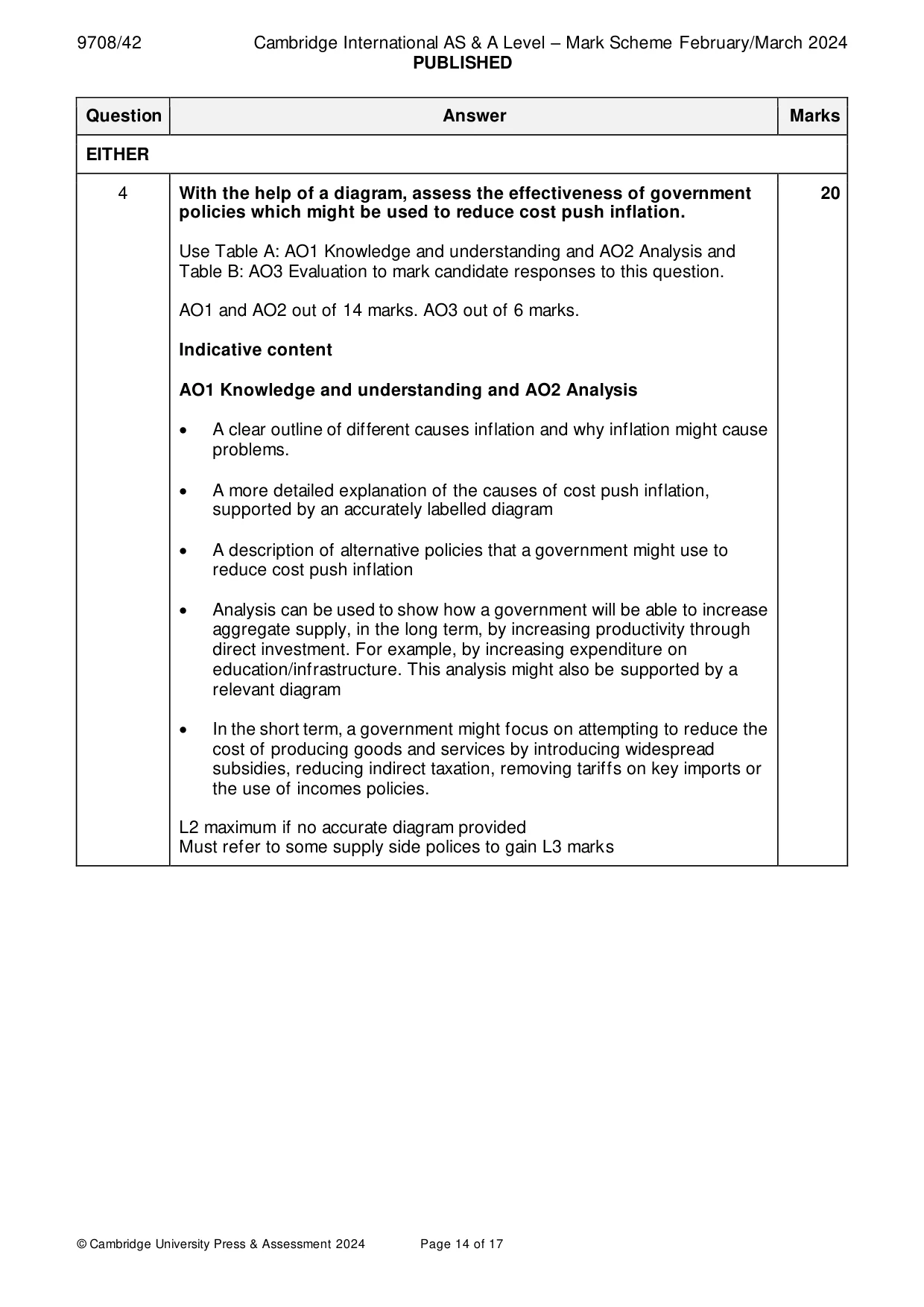
4 With the help of a diagram, assess the effectiveness of government policies which might be used to reduce cost-push inflation. [20] OR
Mark scheme: 4 With the help of a diagram, assess the effectiveness of government 20 policies which might be used to reduce cost push inflation. Use Table A: AO1 Knowledge and understanding and AO2 Analysis and Table B: AO3 Evaluation to mark candidate responses to this question. AO1 and AO2 out of 14 marks. AO3 out of 6 marks. Indicative content AO1 Knowledge and understanding and AO2 Analysis • A clear outline of different causes inflation and why inflation might cause problems. • A more detailed explanation of the causes of cost push inflation, supported by an accurately labelled diagram • A description of alternative policies that a government might use to reduce cost push inflation • Analysis can be used to show how a government will be able to increase aggregate supply, in the long term, by increasing productivity through direct investment. For example, by increasing expenditure on education/infrastructure. This analysis might also be supported by a relevant diagram • In the short term, a government might focus on attempting to reduce the cost of producing goods and services by introducing widespread subsidies, reducing indirect taxation, removing tariffs on key imports or the use of incomes policies. L2 maximum if no accurate diagram provided Must refer to some supply side polices to gain L3 marks 4 AO3 Evaluation • Increasing the use of subsidies and/or decreasing the use of indirect taxation is likely to have a negative effect on a government’s budget. For example, increasing the budget deficit and subsequently increasing the need for more government borrowing. • Removing tariffs is likely to have a negative effect on the incomes and output of domestic producers and possibly lead to an increase in unemployment • The introduction of incomes policies is likely to lead to opposition from trade Unions and the possibility of industrial disruption. • Long run supply-side policies are likely to focus on attempts to increase productivity. This frequently involves significant investment in new technology which will lead to a rise in unemployment in the short run • Other policies which might be used in the long run might include immediate investment in skills training and improving the quality of the infrastructure. Skills training is expensive and hence has a high initial opportunity cost. While the immediate effect of an increase in expenditure on improving the infrastructure is likely to increase aggregate demand and add to the inflationary pressure • A conclusion should attempt to assess the relative effectiveness of each type of policy approach and consider which approach is likely to be the most effective in the short run and then compare this with possible outcomes that might be achieved in the long run. Accept evaluation relating to demand side policies. AO1 Knowledge and understanding and AO2 Analysis 14 AO3 Evaluation 6
More questions on Effectiveness of policy options to meet all macroeconomic objectives
Q5 · Globalisation will help to achieve economic growth in high-income economies and this will…
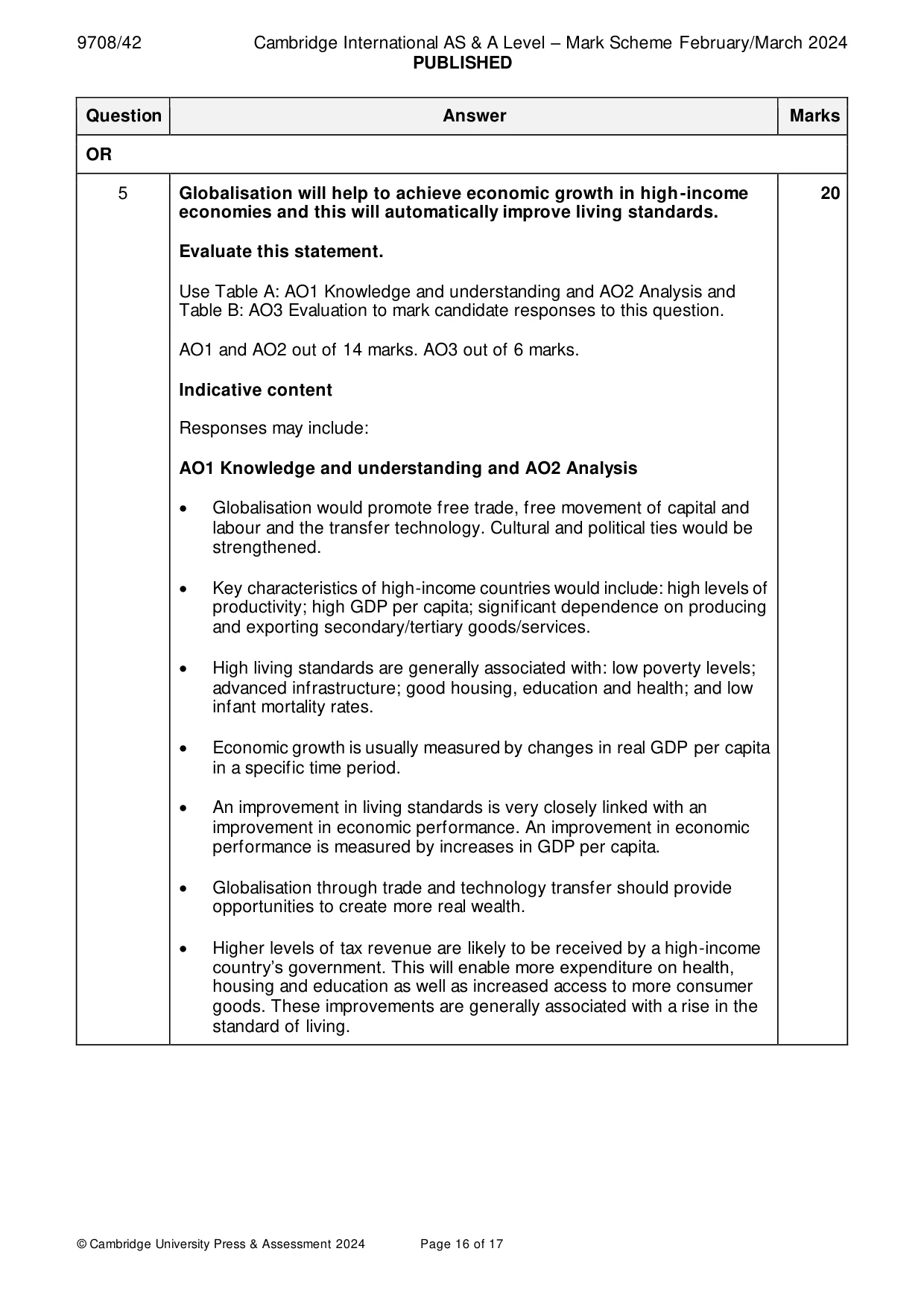
5 Globalisation will help to achieve economic growth in high-income economies and this will automatically improve living standards. Evaluate this statement. [20]
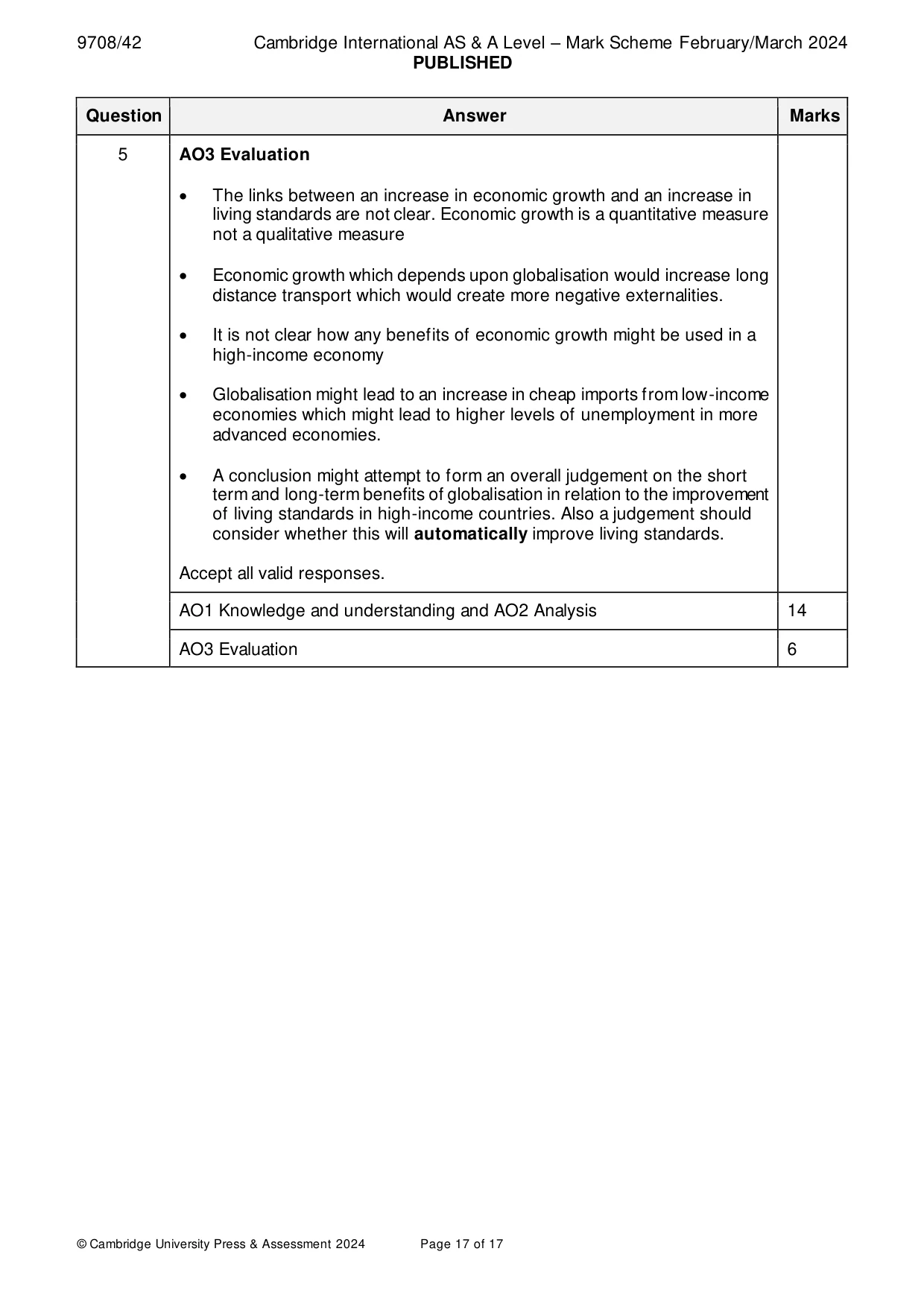
Mark scheme: 5 Globalisation will help to achieve economic growth in high-income 20 economies and this will automatically improve living standards. Evaluate this statement. Use Table A: AO1 Knowledge and understanding and AO2 Analysis and Table B: AO3 Evaluation to mark candidate responses to this question. AO1 and AO2 out of 14 marks. AO3 out of 6 marks. Indicative content Responses may include: AO1 Knowledge and understanding and AO2 Analysis • Globalisation would promote free trade, free movement of capital and labour and the transfer technology. Cultural and political ties would be strengthened. • Key characteristics of high-income countries would include: high levels of productivity; high GDP per capita; significant dependence on producing and exporting secondary/tertiary goods/services. • High living standards are generally associated with: low poverty levels; advanced infrastructure; good housing, education and health; and low infant mortality rates. • Economic growth is usually measured by changes in real GDP per capita in a specific time period. • An improvement in living standards is very closely linked with an improvement in economic performance. An improvement in economic performance is measured by increases in GDP per capita. • Globalisation through trade and technology transfer should provide opportunities to create more real wealth. • Higher levels of tax revenue are likely to be received by a high-income country’s government. This will enable more expenditure on health, housing and education as well as increased access to more consumer goods. These improvements are generally associated with a rise in the standard of living. 5 AO3 Evaluation • The links between an increase in economic growth and an increase in living standards are not clear. Economic growth is a quantitative measure not a qualitative measure • Economic growth which depends upon globalisation would increase long distance transport which would create more negative externalities. • It is not clear how any benefits of economic growth might be used in a high-income economy • Globalisation might lead to an increase in cheap imports from low-income economies which might lead to higher levels of unemployment in more advanced economies. • A conclusion might attempt to form an overall judgement on the short term and long-term benefits of globalisation in relation to the improvement of living standards in high-income countries. Also a judgement should consider whether this will automatically improve living standards. Accept all valid responses. AO1 Knowledge and understanding and AO2 Analysis 14 AO3 Evaluation 6
What was in this paper
The subtopics covered by these 5 questions, and how many questions each got. Open one in a new tab to see every Cambridge question on it.
What you needed in this session
Cambridge’s own grade thresholds for 2024 Feb/March, Paper 4 · Variant 2. A higher threshold means an easier paper — the bar moves with how the cohort did.