Cambridge A Level Economics 9708 — 2022 Oct/Nov Paper 4 · Variant 2
9708/42/O/N/22 · 7 questions · 70 marks · ≈79 min
The question paper and its mark scheme, free to read here and free to download. This is Cambridge’s own paper, exactly as it was sat.
Question paper4 pages
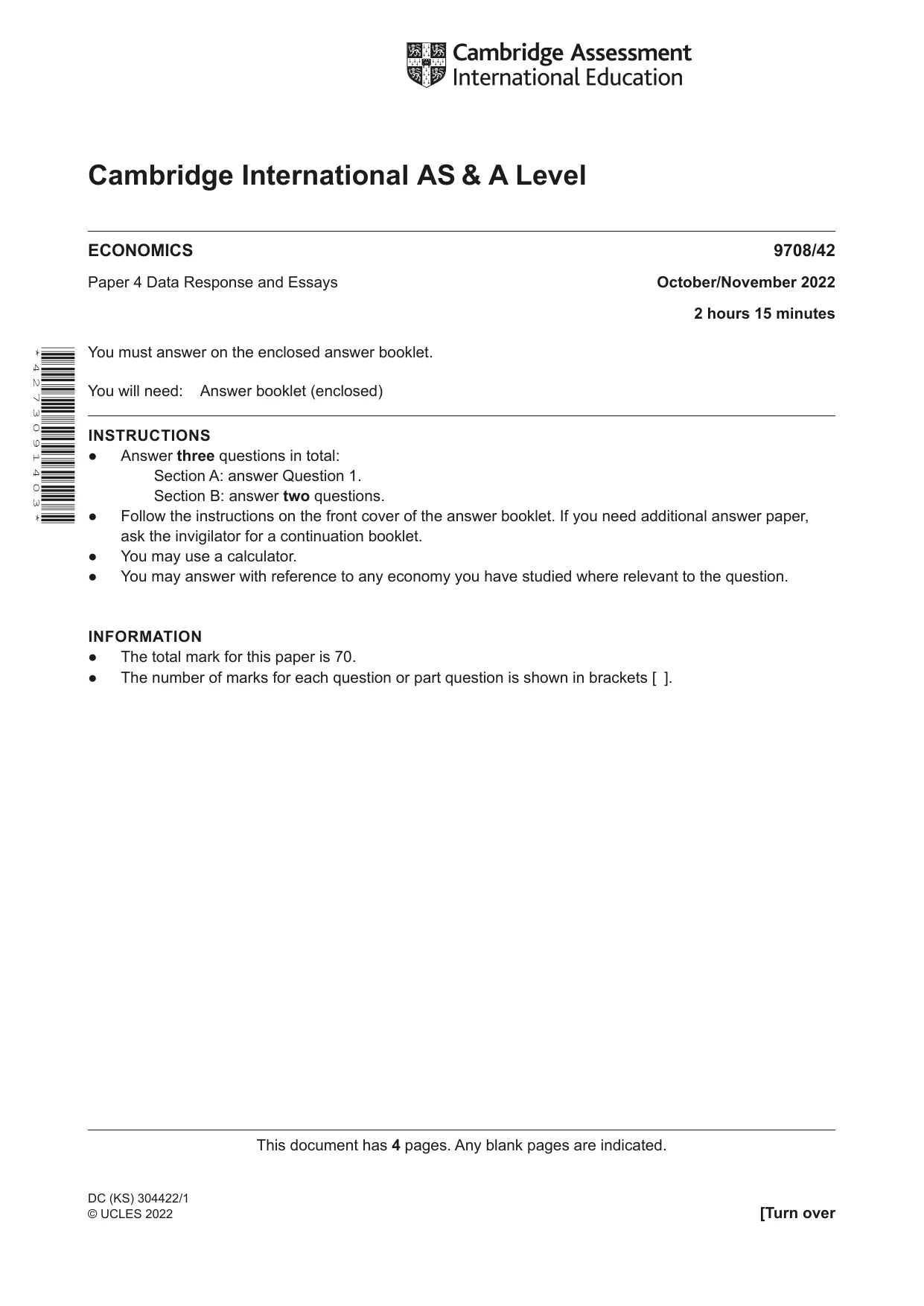
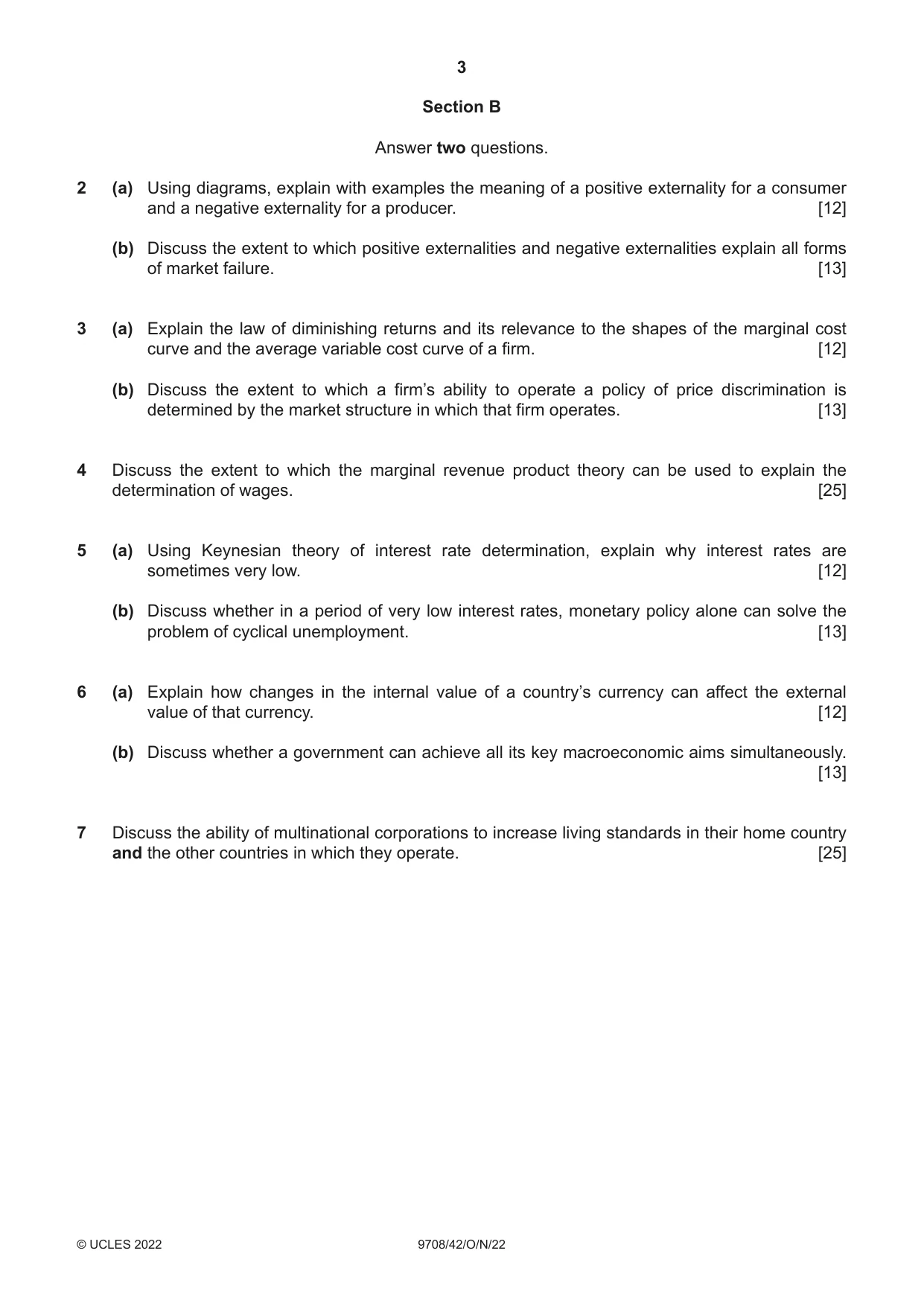

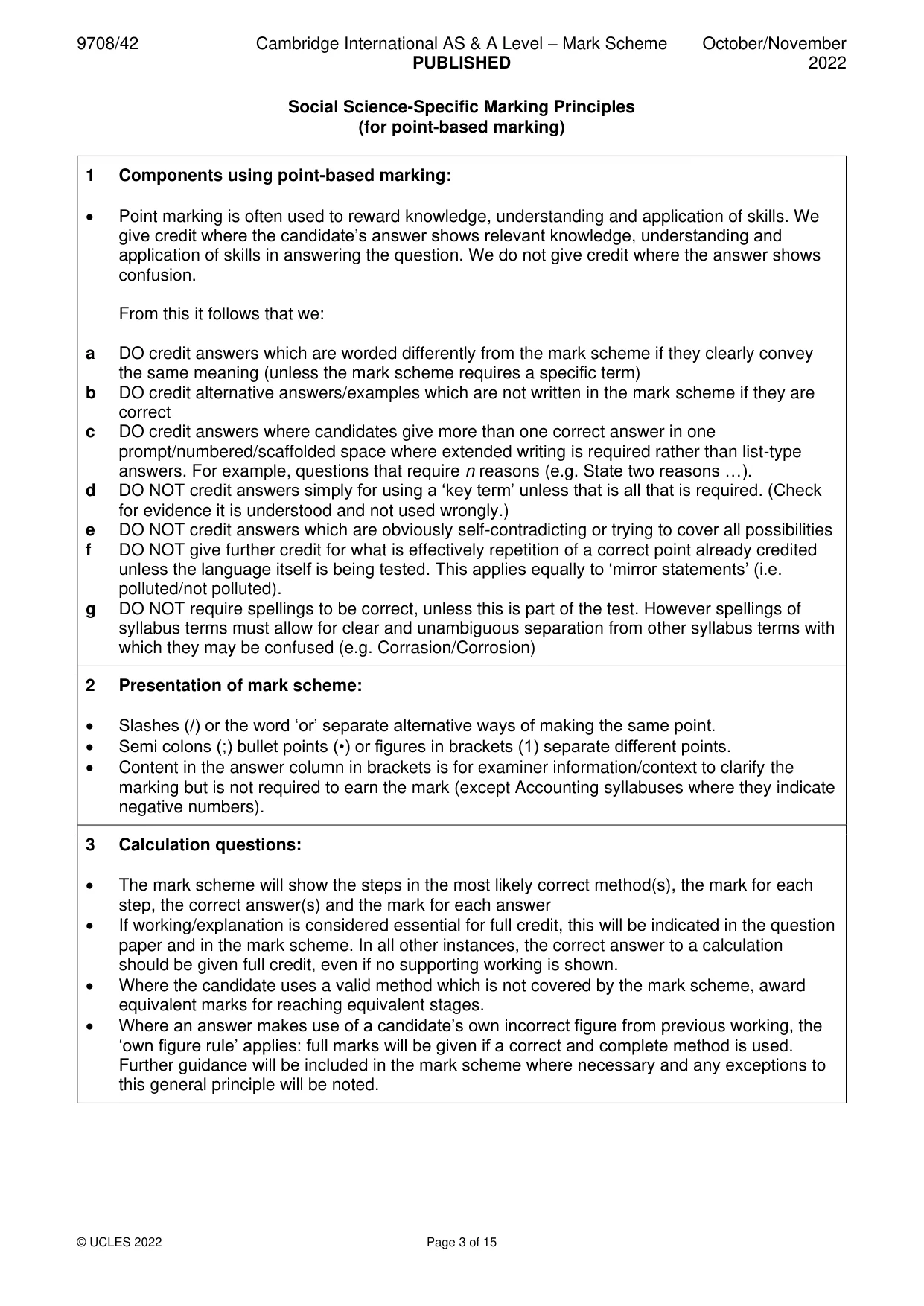
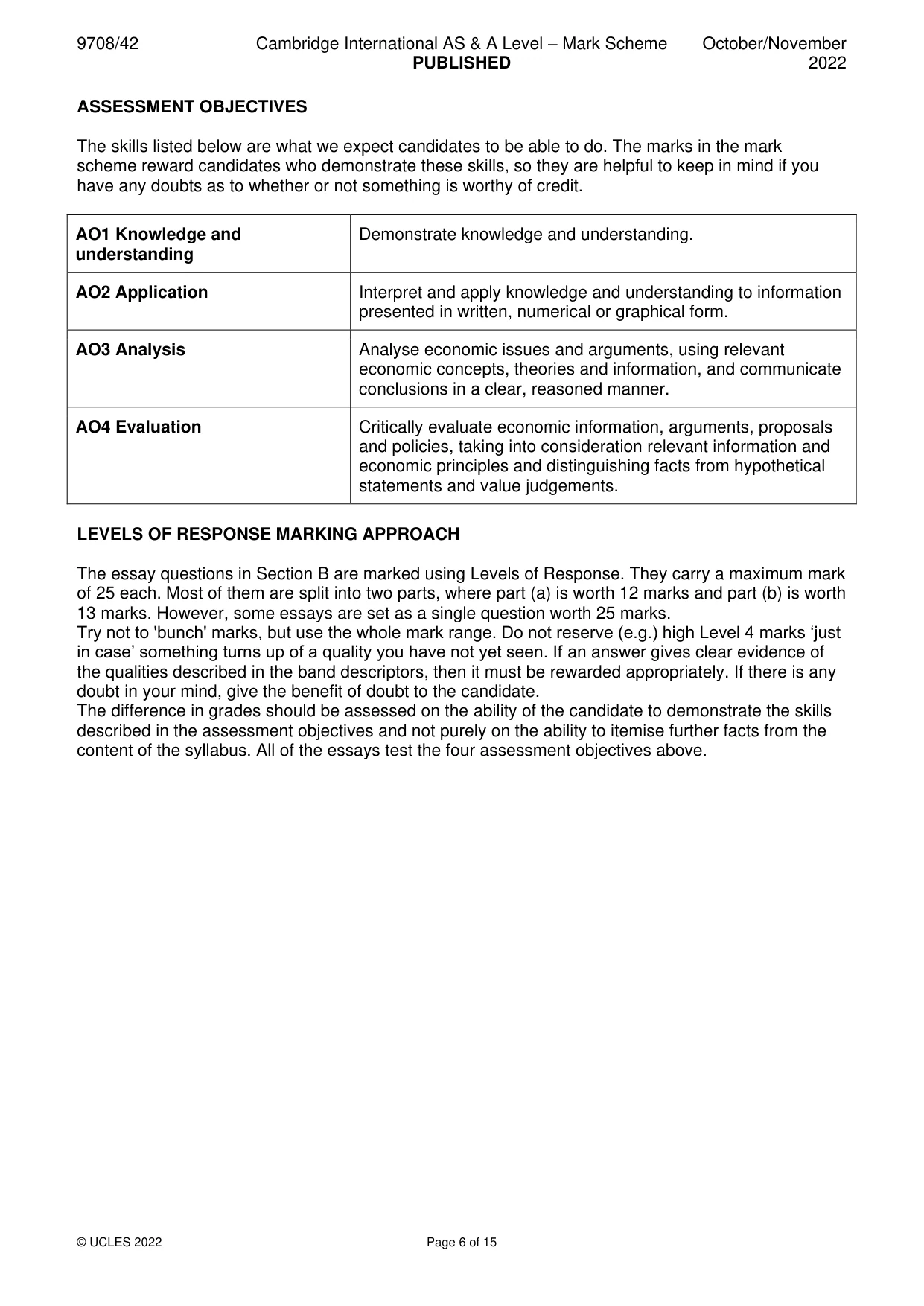
Mark scheme15 pages
Answers below. Sit the paper first if you are practising.






Questions as text
Q1 · An Opportunity for Guyana The International Monetary Fund (IMF) believed that Guyana, one…
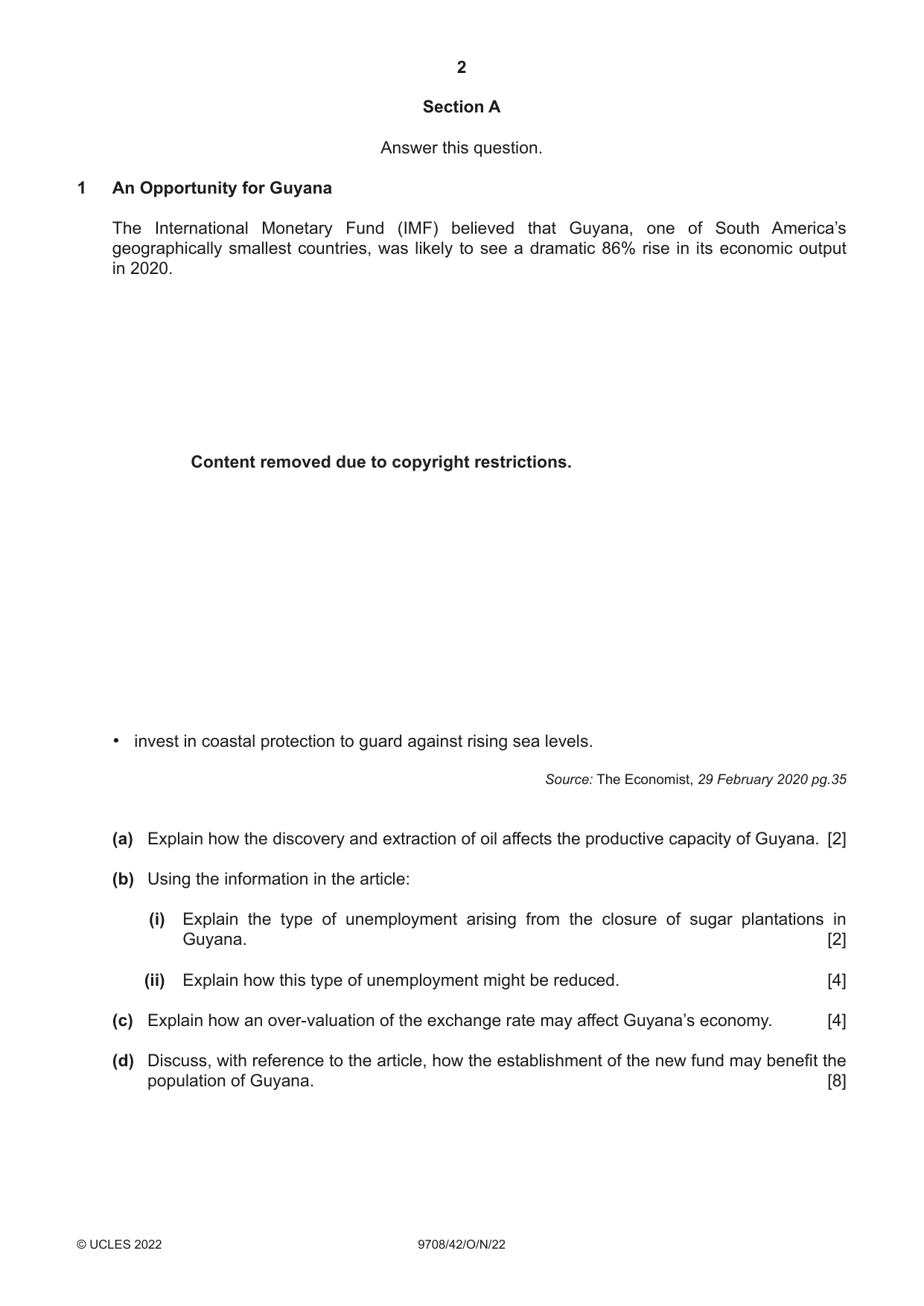
1 An Opportunity for Guyana The International Monetary Fund (IMF) believed that Guyana, one of South America’s geographically smallest countries, was likely to see a dramatic 86% rise in its economic output in 2020. Content removed due to copyright restrictions. • invest in coastal protection to guard against rising sea levels. Source: The Economist, 29 February 2020 pg.35 (a) Explain how the discovery and extraction of oil affects the productive capacity of Guyana. [2] (b) Using the information in the article: (i) Explain the type of unemployment arising from the closure of sugar plantations in Guyana. [2] (ii) Explain how this type of unemployment might be reduced. [4] (c) Explain how an over-valuation of the exchange rate may affect Guyana’s economy. [4] (d) Discuss, with reference to the article, how the establishment of the new fund may benefit the population of Guyana. [8]
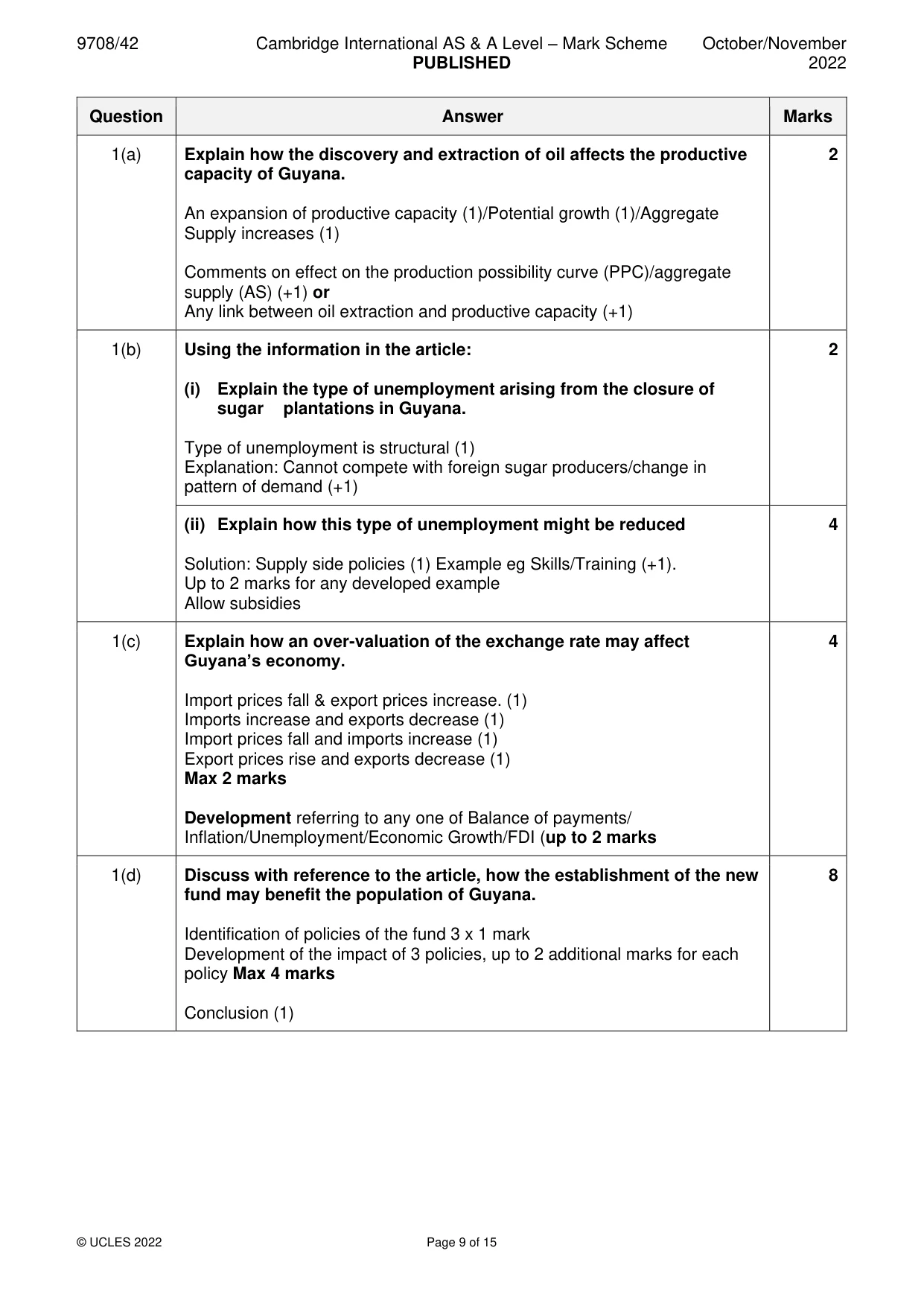
Mark scheme: Question Answer Marks 1(a) Explain how the discovery and extraction of oil affects the productive 2 capacity of Guyana. An expansion of productive capacity (1)/Potential growth (1)/Aggregate Supply increases (1) Comments on effect on the production possibility curve (PPC)/aggregate supply (AS) (+1) or Any link between oil extraction and productive capacity (+1) 1(b) Using the information in the article: 2 (i) Explain the type of unemployment arising from the closure of sugar plantations in Guyana. Type of unemployment is structural (1) Explanation: Cannot compete with foreign sugar producers/change in pattern of demand (+1) (ii) Explain how this type of unemployment might be reduced 4 Solution: Supply side policies (1) Example eg Skills/Training (+1). Up to 2 marks for any developed example Allow subsidies 1(c) Explain how an over-valuation of the exchange rate may affect 4 Guyana’s economy. Import prices fall & export prices increase. (1) Imports increase and exports decrease (1) Import prices fall and imports increase (1) Export prices rise and exports decrease (1) Max 2 marks Development referring to any one of Balance of payments/ Inflation/Unemployment/Economic Growth/FDI (up to 2 marks 1(d) Discuss with reference to the article, how the establishment of the new 8 fund may benefit the population of Guyana. Identification of policies of the fund 3 x 1 mark Development of the impact of 3 policies, up to 2 additional marks for each policy Max 4 marks Conclusion (1)
More questions on Effectiveness of policy options to meet all macroeconomic objectives
Q2 · Using diagrams, explain with examples the meaning of a positive externality for a…
2 (a) Using diagrams, explain with examples the meaning of a positive externality for a consumer and a negative externality for a producer. [12] (b) Discuss the extent to which positive externalities and negative externalities explain all forms of market failure. [13]
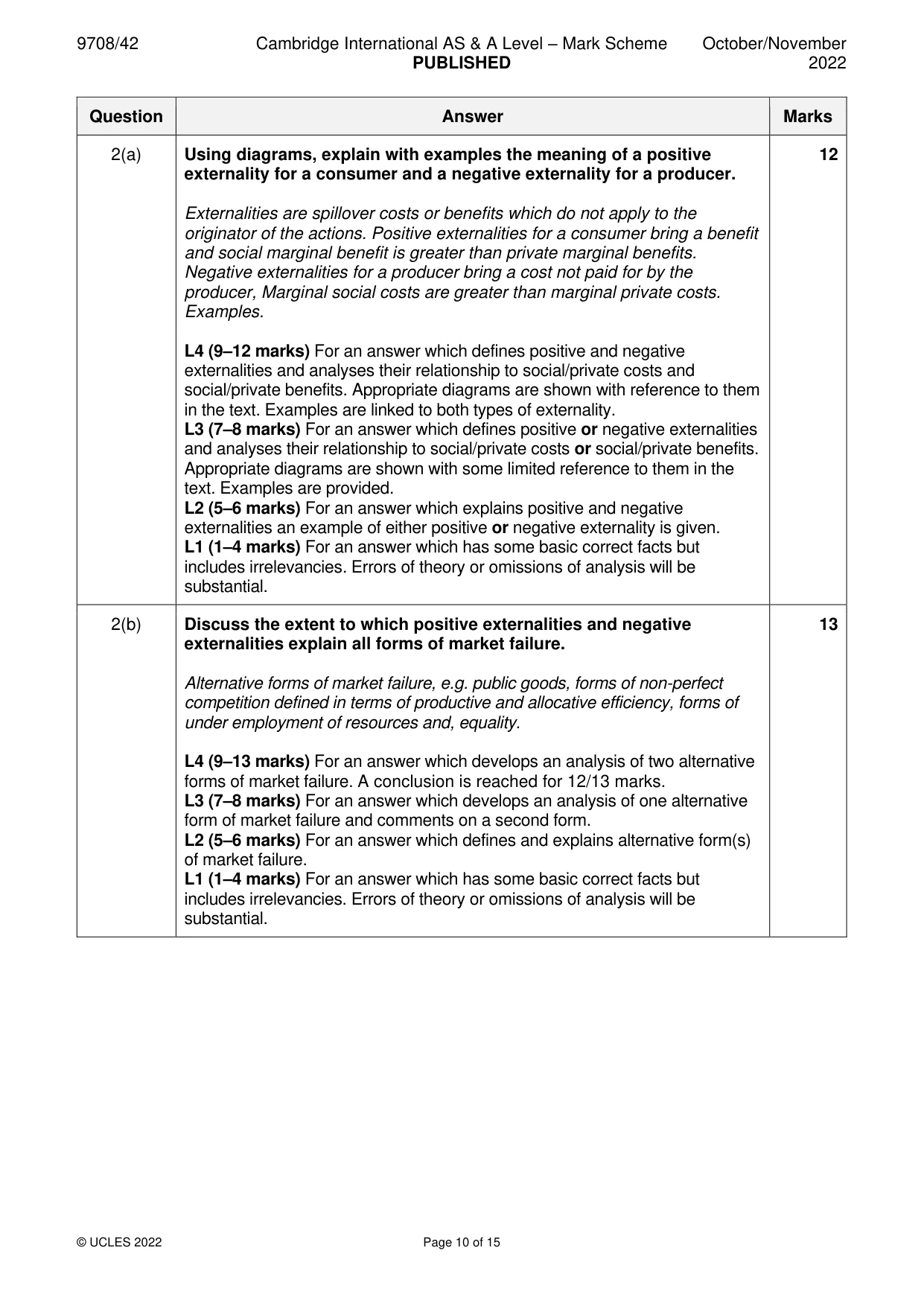
Mark scheme: 2(a) Using diagrams, explain with examples the meaning of a positive 12 externality for a consumer and a negative externality for a producer. Externalities are spillover costs or benefits which do not apply to the originator of the actions. Positive externalities for a consumer bring a benefit and social marginal benefit is greater than private marginal benefits. Negative externalities for a producer bring a cost not paid for by the producer, Marginal social costs are greater than marginal private costs. Examples. L4 (9–12 marks) For an answer which defines positive and negative externalities and analyses their relationship to social/private costs and social/private benefits. Appropriate diagrams are shown with reference to them in the text. Examples are linked to both types of externality. L3 (7–8 marks) For an answer which defines positive or negative externalities and analyses their relationship to social/private costs or social/private benefits. Appropriate diagrams are shown with some limited reference to them in the text. Examples are provided. L2 (5–6 marks) For an answer which explains positive and negative externalities an example of either positive or negative externality is given. L1 (1–4 marks) For an answer which has some basic correct facts but includes irrelevancies. Errors of theory or omissions of analysis will be substantial. 2(b) Discuss the extent to which positive externalities and negative 13 externalities explain all forms of market failure. Alternative forms of market failure, e.g. public goods, forms of non-perfect competition defined in terms of productive and allocative efficiency, forms of under employment of resources and, equality. L4 (9–13 marks) For an answer which develops an analysis of two alternative forms of market failure. A conclusion is reached for 12/13 marks. L3 (7–8 marks) For an answer which develops an analysis of one alternative form of market failure and comments on a second form. L2 (5–6 marks) For an answer which defines and explains alternative form(s) of market failure. L1 (1–4 marks) For an answer which has some basic correct facts but includes irrelevancies. Errors of theory or omissions of analysis will be substantial.
Q3 · Explain the law of diminishing returns and its relevance to the shapes of the marginal…
3 (a) Explain the law of diminishing returns and its relevance to the shapes of the marginal cost curve and the average variable cost curve of a firm. [12] (b) Discuss the extent to which a firm’s ability to operate a policy of price discrimination is determined by the market structure in which that firm operates. [13]
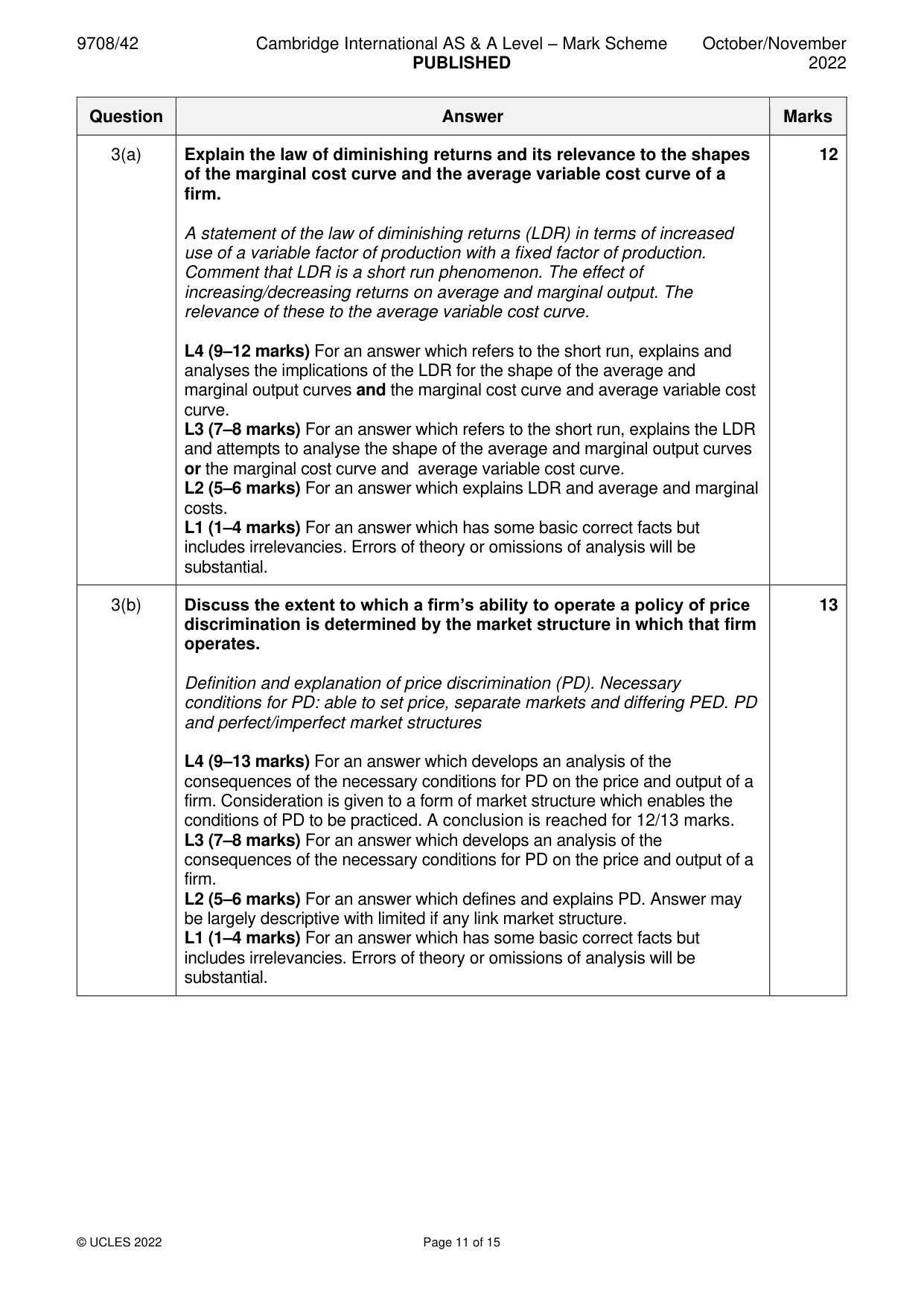
Mark scheme: 3(a) Explain the law of diminishing returns and its relevance to the shapes 12 of the marginal cost curve and the average variable cost curve of a firm. A statement of the law of diminishing returns (LDR) in terms of increased use of a variable factor of production with a fixed factor of production. Comment that LDR is a short run phenomenon. The effect of increasing/decreasing returns on average and marginal output. The relevance of these to the average variable cost curve. L4 (9–12 marks) For an answer which refers to the short run, explains and analyses the implications of the LDR for the shape of the average and marginal output curves and the marginal cost curve and average variable cost curve. L3 (7–8 marks) For an answer which refers to the short run, explains the LDR and attempts to analyse the shape of the average and marginal output curves or the marginal cost curve and average variable cost curve. L2 (5–6 marks) For an answer which explains LDR and average and marginal costs. L1 (1–4 marks) For an answer which has some basic correct facts but includes irrelevancies. Errors of theory or omissions of analysis will be substantial. 3(b) Discuss the extent to which a firm’s ability to operate a policy of price 13 discrimination is determined by the market structure in which that firm operates. Definition and explanation of price discrimination (PD). Necessary conditions for PD: able to set price, separate markets and differing PED. PD and perfect/imperfect market structures L4 (9–13 marks) For an answer which develops an analysis of the consequences of the necessary conditions for PD on the price and output of a firm. Consideration is given to a form of market structure which enables the conditions of PD to be practiced. A conclusion is reached for 12/13 marks. L3 (7–8 marks) For an answer which develops an analysis of the consequences of the necessary conditions for PD on the price and output of a firm. L2 (5–6 marks) For an answer which defines and explains PD. Answer may be largely descriptive with limited if any link market structure. L1 (1–4 marks) For an answer which has some basic correct facts but includes irrelevancies. Errors of theory or omissions of analysis will be substantial.
Q4 · Discuss the extent to which the marginal revenue product theory can be used to explain…
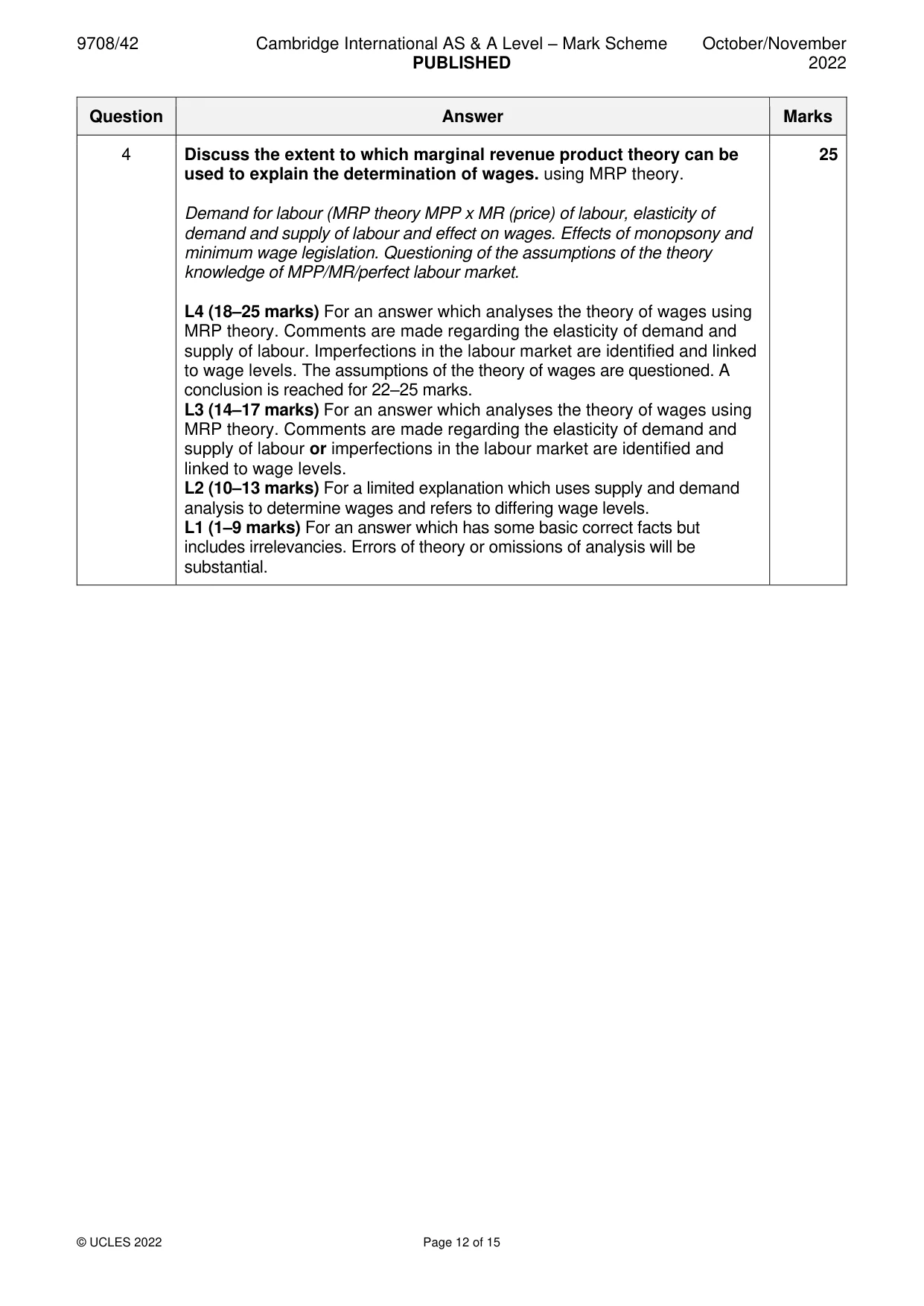
4 Discuss the extent to which the marginal revenue product theory can be used to explain the determination of wages. [25]
Mark scheme: 4 Discuss the extent to which marginal revenue product theory can be 25 used to explain the determination of wages. using MRP theory. Demand for labour (MRP theory MPP x MR (price) of labour, elasticity of demand and supply of labour and effect on wages. Effects of monopsony and minimum wage legislation. Questioning of the assumptions of the theory knowledge of MPP/MR/perfect labour market. L4 (18–25 marks) For an answer which analyses the theory of wages using MRP theory. Comments are made regarding the elasticity of demand and supply of labour. Imperfections in the labour market are identified and linked to wage levels. The assumptions of the theory of wages are questioned. A conclusion is reached for 22–25 marks. L3 (14–17 marks) For an answer which analyses the theory of wages using MRP theory. Comments are made regarding the elasticity of demand and supply of labour or imperfections in the labour market are identified and linked to wage levels. L2 (10–13 marks) For a limited explanation which uses supply and demand analysis to determine wages and refers to differing wage levels. L1 (1–9 marks) For an answer which has some basic correct facts but includes irrelevancies. Errors of theory or omissions of analysis will be substantial.
More questions on Labour market forces and government intervention
Q5 · Using Keynesian theory of interest rate determination, explain why interest rates are…
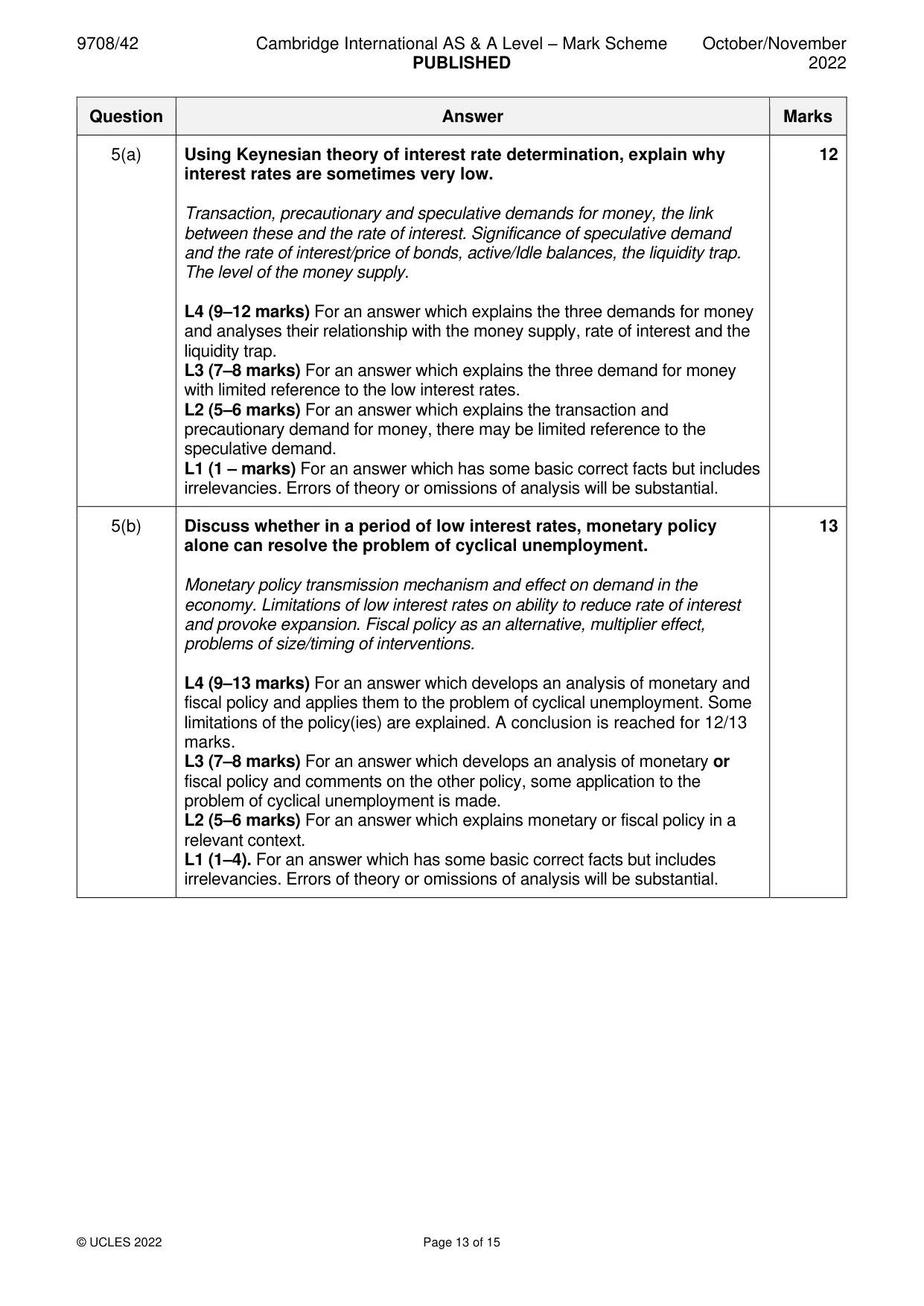
5 (a) Using Keynesian theory of interest rate determination, explain why interest rates are sometimes very low. [12] (b) Discuss whether in a period of very low interest rates, monetary policy alone can solve the problem of cyclical unemployment. [13]
Mark scheme: 5(a) Using Keynesian theory of interest rate determination, explain why 12 interest rates are sometimes very low. Transaction, precautionary and speculative demands for money, the link between these and the rate of interest. Significance of speculative demand and the rate of interest/price of bonds, active/Idle balances, the liquidity trap. The level of the money supply. L4 (9–12 marks) For an answer which explains the three demands for money and analyses their relationship with the money supply, rate of interest and the liquidity trap. L3 (7–8 marks) For an answer which explains the three demand for money with limited reference to the low interest rates. L2 (5–6 marks) For an answer which explains the transaction and precautionary demand for money, there may be limited reference to the speculative demand. L1 (1 – marks) For an answer which has some basic correct facts but includes irrelevancies. Errors of theory or omissions of analysis will be substantial. 5(b) Discuss whether in a period of low interest rates, monetary policy 13 alone can resolve the problem of cyclical unemployment. Monetary policy transmission mechanism and effect on demand in the economy. Limitations of low interest rates on ability to reduce rate of interest and provoke expansion. Fiscal policy as an alternative, multiplier effect, problems of size/timing of interventions. L4 (9–13 marks) For an answer which develops an analysis of monetary and fiscal policy and applies them to the problem of cyclical unemployment. Some limitations of the policy(ies) are explained. A conclusion is reached for 12/13 marks. L3 (7–8 marks) For an answer which develops an analysis of monetary or fiscal policy and comments on the other policy, some application to the problem of cyclical unemployment is made. L2 (5–6 marks) For an answer which explains monetary or fiscal policy in a relevant context. L1 (1–4). For an answer which has some basic correct facts but includes irrelevancies. Errors of theory or omissions of analysis will be substantial.
Q6 · Explain how changes in the internal value of a country’s currency can affect the external…
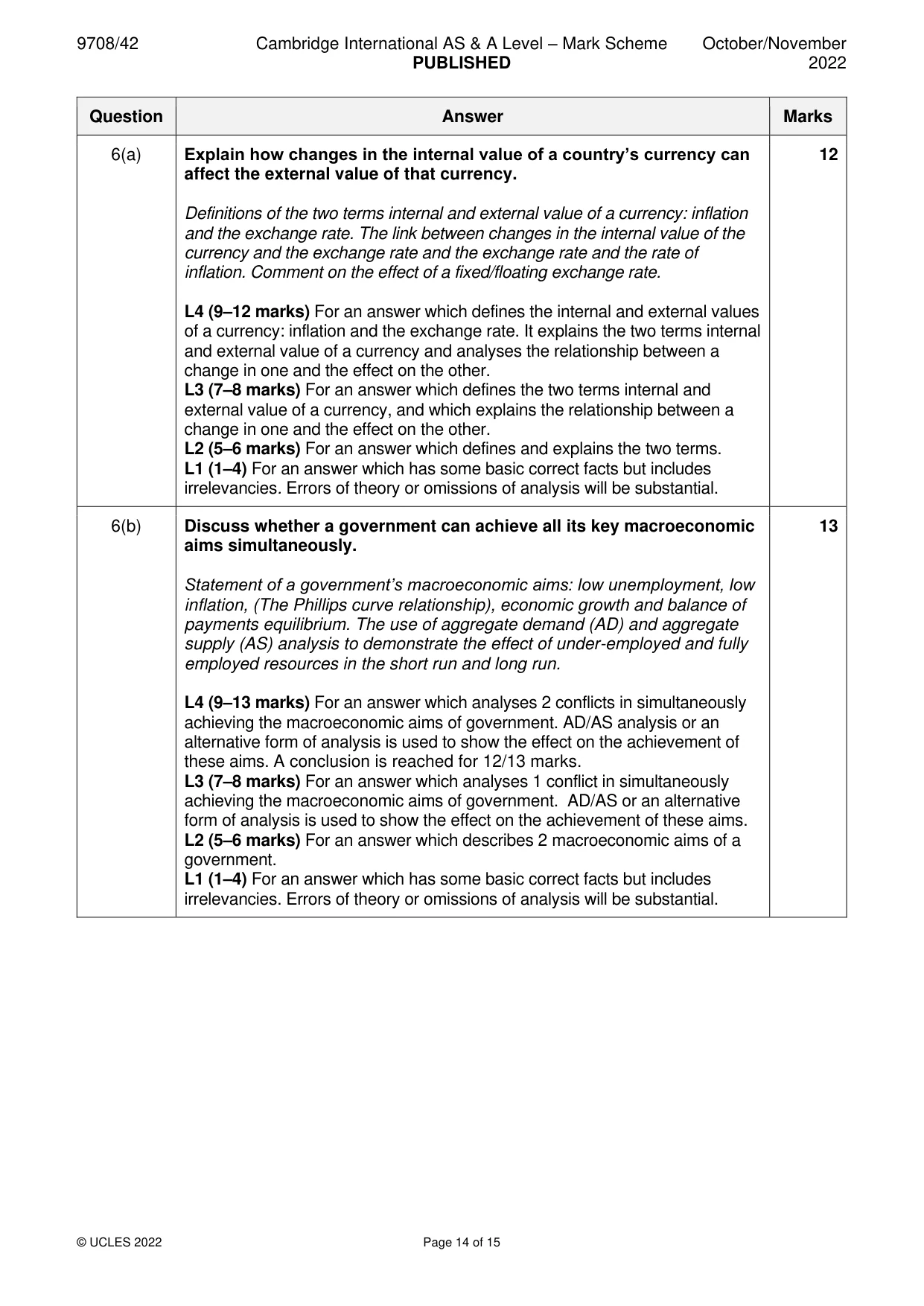
6 (a) Explain how changes in the internal value of a country’s currency can affect the external value of that currency. [12] (b) Discuss whether a government can achieve all its key macroeconomic aims simultaneously. [13]
Mark scheme: 6(a) Explain how changes in the internal value of a country’s currency can 12 affect the external value of that currency. Definitions of the two terms internal and external value of a currency: inflation and the exchange rate. The link between changes in the internal value of the currency and the exchange rate and the exchange rate and the rate of inflation. Comment on the effect of a fixed/floating exchange rate. L4 (9–12 marks) For an answer which defines the internal and external values of a currency: inflation and the exchange rate. It explains the two terms internal and external value of a currency and analyses the relationship between a change in one and the effect on the other. L3 (7–8 marks) For an answer which defines the two terms internal and external value of a currency, and which explains the relationship between a change in one and the effect on the other. L2 (5–6 marks) For an answer which defines and explains the two terms. L1 (1–4) For an answer which has some basic correct facts but includes irrelevancies. Errors of theory or omissions of analysis will be substantial. 6(b) Discuss whether a government can achieve all its key macroeconomic 13 aims simultaneously. Statement of a government’s macroeconomic aims: low unemployment, low inflation, (The Phillips curve relationship), economic growth and balance of payments equilibrium. The use of aggregate demand (AD) and aggregate supply (AS) analysis to demonstrate the effect of under-employed and fully employed resources in the short run and long run. L4 (9–13 marks) For an answer which analyses 2 conflicts in simultaneously achieving the macroeconomic aims of government. AD/AS analysis or an alternative form of analysis is used to show the effect on the achievement of these aims. A conclusion is reached for 12/13 marks. L3 (7–8 marks) For an answer which analyses 1 conflict in simultaneously achieving the macroeconomic aims of government. AD/AS or an alternative form of analysis is used to show the effect on the achievement of these aims. L2 (5–6 marks) For an answer which describes 2 macroeconomic aims of a government. L1 (1–4) For an answer which has some basic correct facts but includes irrelevancies. Errors of theory or omissions of analysis will be substantial.
More questions on Links between macroeconomic problems and their interrelatedness
Q7 · Discuss the ability of multinational corporations to increase living standards in their…
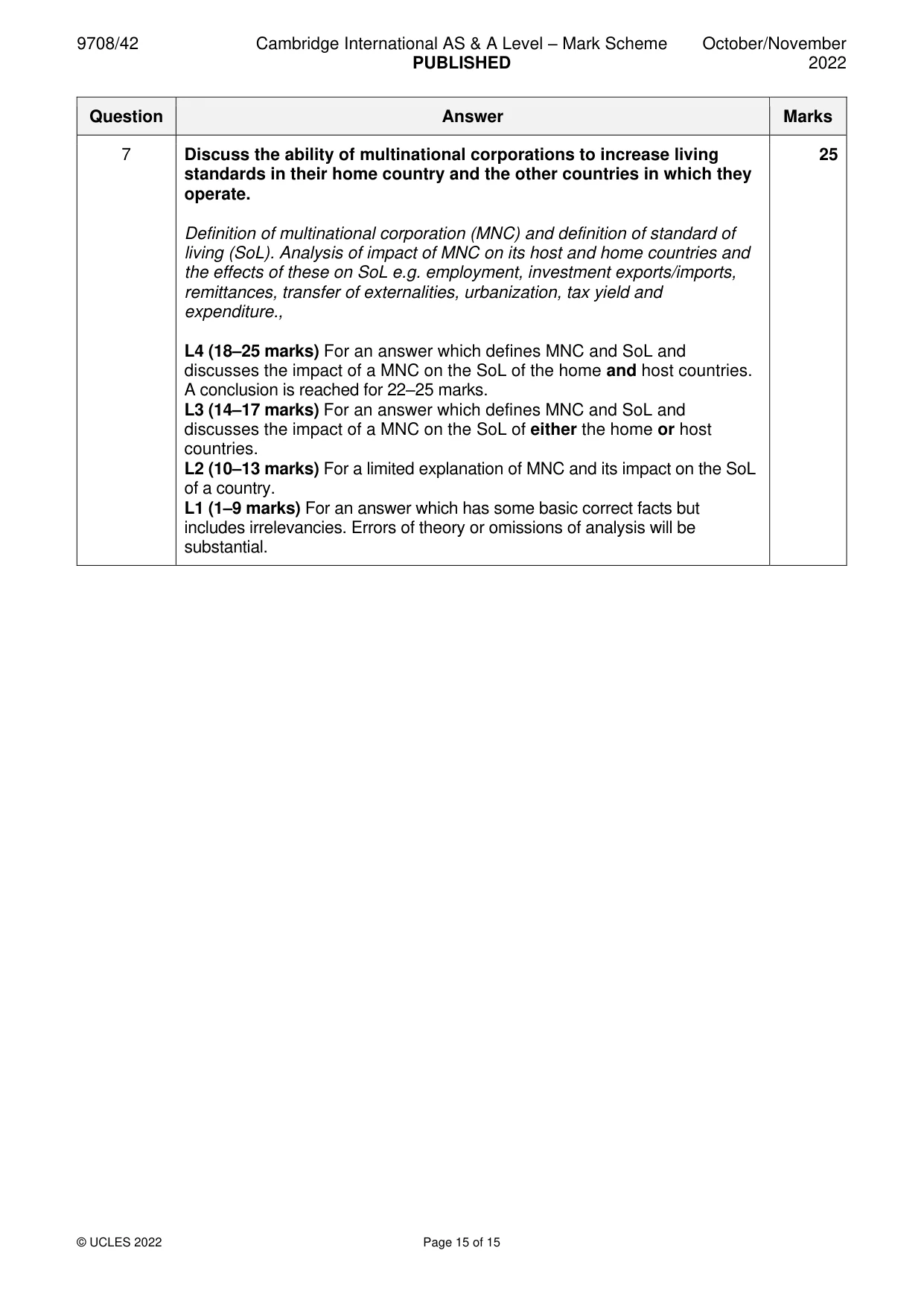
7 Discuss the ability of multinational corporations to increase living standards in their home country and the other countries in which they operate. [25]
Mark scheme: 7 Discuss the ability of multinational corporations to increase living 25 standards in their home country and the other countries in which they operate. Definition of multinational corporation (MNC) and definition of standard of living (SoL). Analysis of impact of MNC on its host and home countries and the effects of these on SoL e.g. employment, investment exports/imports, remittances, transfer of externalities, urbanization, tax yield and expenditure., L4 (18–25 marks) For an answer which defines MNC and SoL and discusses the impact of a MNC on the SoL of the home and host countries. A conclusion is reached for 22–25 marks. L3 (14–17 marks) For an answer which defines MNC and SoL and discusses the impact of a MNC on the SoL of either the home or host countries. L2 (10–13 marks) For a limited explanation of MNC and its impact on the SoL of a country. L1 (1–9 marks) For an answer which has some basic correct facts but includes irrelevancies. Errors of theory or omissions of analysis will be substantial.
What was in this paper
The subtopics covered by these 7 questions, and how many questions each got. Open one in a new tab to see every Cambridge question on it.
What you needed in this session
Cambridge’s own grade thresholds for 2022 Oct/Nov, Paper 4 · Variant 2. A higher threshold means an easier paper — the bar moves with how the cohort did.