Cambridge A Level Economics 9708 — 2016 Oct/Nov Paper 4 · Variant 2
9708/42/O/N/16 · 70 marks · ≈79 min
The question paper and its mark scheme, free to read here and free to download. This is Cambridge’s own paper, exactly as it was sat.
Question paper4 pages

Mark scheme8 pages
Answers below. Sit the paper first if you are practising.
Paper as text
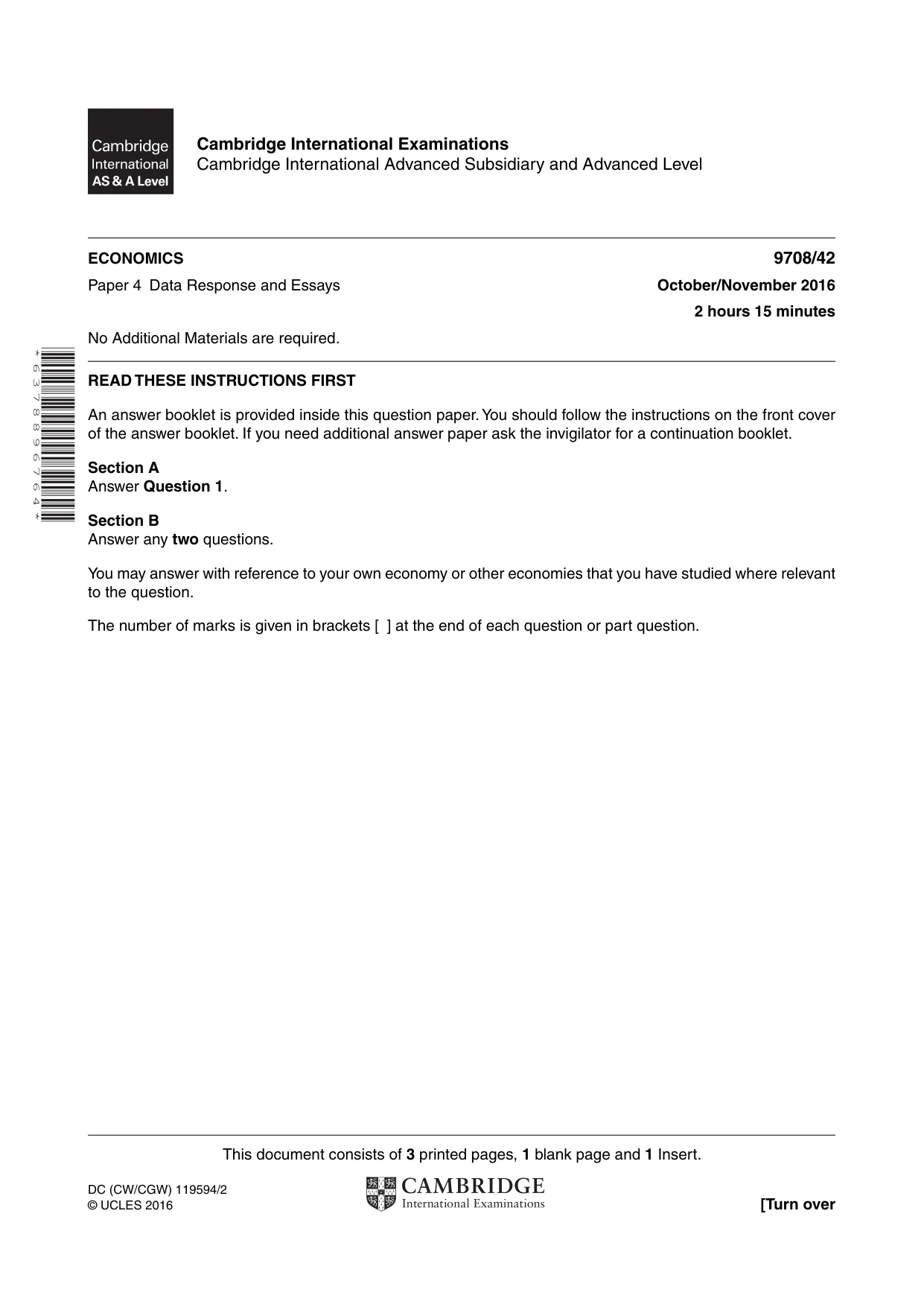
Question paper, page 1
This document consists of 3 printed pages, 1 blank page and 1 Insert. DC (CW/CGW) 119594/2 © UCLES 2016 [Turn over Cambridge International Examinations Cambridge International Advanced Subsidiary and Advanced Level * 6 3 7 8 8 9 6 7 6 4 * ECONOMICS 9708/42 Paper 4 Data Response and Essays October/November 2016 2 hours 15 minutes No Additional Materials are required. READ THESE INSTRUCTIONS FIRST An answer booklet is provided inside this question paper. You should follow the instructions on the front cover of the answer booklet. If you need additional answer paper ask the invigilator for a continuation booklet. Section A Answer Question 1. Section B Answer any two questions. You may answer with reference to your own economy or other economies that you have studied where relevant to the question. The number of marks is given in brackets [ ] at the end of each question or part question.
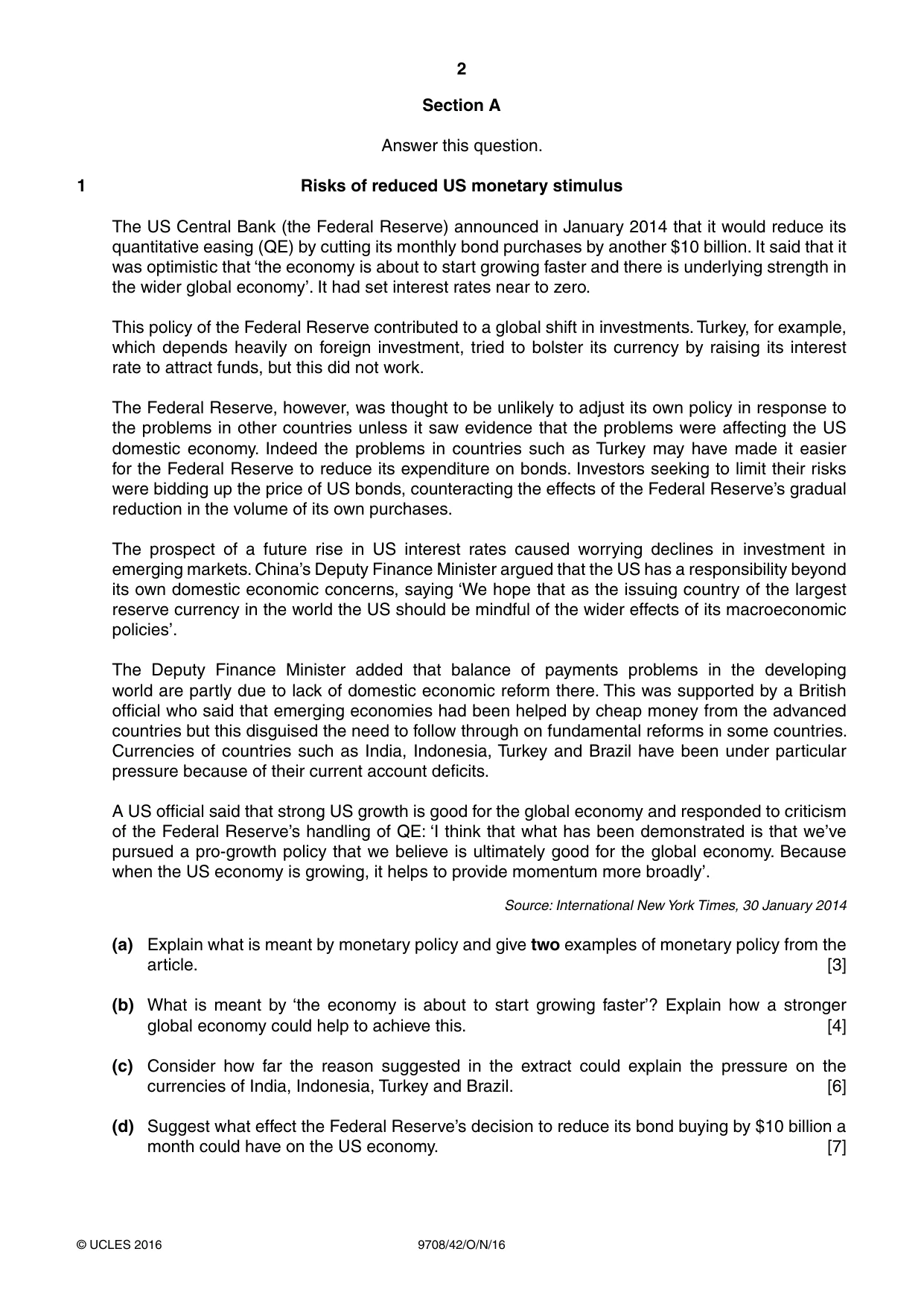
Question paper, page 2
2 9708/42/O/N/16 © UCLES 2016 Section A Answer this question. 1 Risks of reduced US monetary stimulus The US Central Bank (the Federal Reserve) announced in January 2014 that it would reduce its quantitative easing (QE) by cutting its monthly bond purchases by another $10 billion. It said that it was optimistic that ‘the economy is about to start growing faster and there is underlying strength in the wider global economy’. It had set interest rates near to zero. This policy of the Federal Reserve contributed to a global shift in investments. Turkey, for example, which depends heavily on foreign investment, tried to bolster its currency by raising its interest rate to attract funds, but this did not work. The Federal Reserve, however, was thought to be unlikely to adjust its own policy in response to the problems in other countries unless it saw evidence that the problems were affecting the US domestic economy. Indeed the problems in countries such as Turkey may have made it easier for the Federal Reserve to reduce its expenditure on bonds. Investors seeking to limit their risks were bidding up the price of US bonds, counteracting the effects of the Federal Reserve’s gradual reduction in the volume of its own purchases. The prospect of a future rise in US interest rates caused worrying declines in investment in emerging markets. China’s Deputy Finance Minister argued that the US has a responsibility beyond its own domestic economic concerns, saying ‘We hope that as the issuing country of the largest reserve currency in the world the US should be mindful of the wider effects of its macroeconomic policies’. The Deputy Finance Minister added that balance of payments problems in the developing world are partly due to lack of domestic economic reform there. This was supported by a British official who said that emerging economies had been helped by cheap money from the advanced countries but this disguised the need to follow through on fundamental reforms in some countries. Currencies of countries such as India, Indonesia, Turkey and Brazil have been under particular pressure because of their current account deficits. A US official said that strong US growth is good for the global economy and responded to criticism of the Federal Reserve’s handling of QE: ‘I think that what has been demonstrated is that we’ve pursued a pro-growth policy that we believe is ultimately good for the global economy. Because when the US economy is growing, it helps to provide momentum more broadly’. Source: International New York Times, 30 January 2014 (a) Explain what is meant by monetary policy and give two examples of monetary policy from the article. [3] (b) What is meant by ‘the economy is about to start growing faster’? Explain how a stronger global economy could help to achieve this. [4] (c) Consider how far the reason suggested in the extract could explain the pressure on the currencies of India, Indonesia, Turkey and Brazil. [6] (d) Suggest what effect the Federal Reserve’s decision to reduce its bond buying by $10 billion a month could have on the US economy. [7]
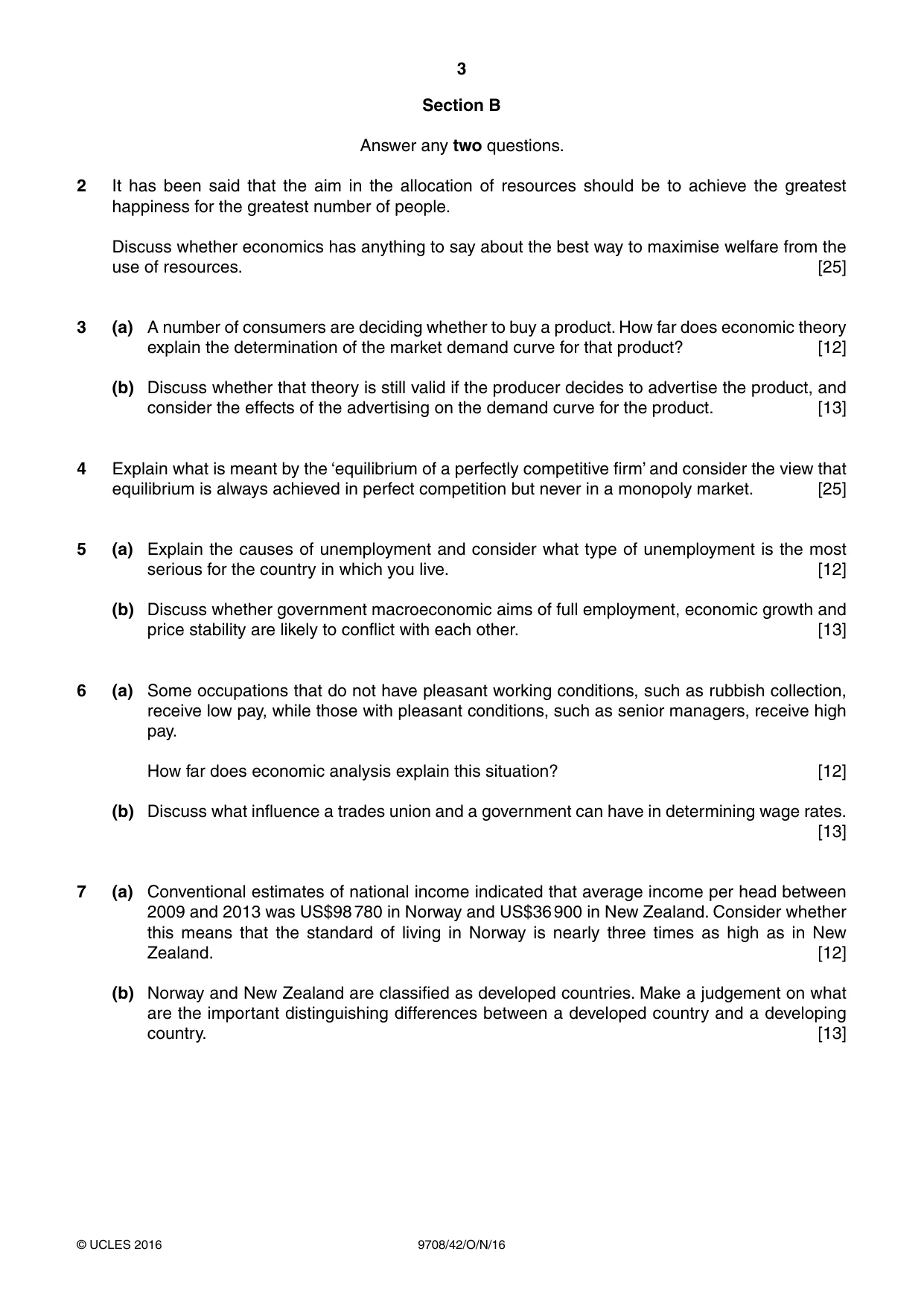
Question paper, page 3
3 9708/42/O/N/16 © UCLES 2016 Section B Answer any two questions. 2 It has been said that the aim in the allocation of resources should be to achieve the greatest happiness for the greatest number of people. Discuss whether economics has anything to say about the best way to maximise welfare from the use of resources. [25] 3 (a) A number of consumers are deciding whether to buy a product. How far does economic theory explain the determination of the market demand curve for that product? [12] (b) Discuss whether that theory is still valid if the producer decides to advertise the product, and consider the effects of the advertising on the demand curve for the product. [13] 4 Explain what is meant by the ‘equilibrium of a perfectly competitive firm’ and consider the view that equilibrium is always achieved in perfect competition but never in a monopoly market. [25] 5 (a) Explain the causes of unemployment and consider what type of unemployment is the most serious for the country in which you live. [12] (b) Discuss whether government macroeconomic aims of full employment, economic growth and price stability are likely to conflict with each other. [13] 6 (a) Some occupations that do not have pleasant working conditions, such as rubbish collection, receive low pay, while those with pleasant conditions, such as senior managers, receive high pay. How far does economic analysis explain this situation? [12] (b) Discuss what influence a trades union and a government can have in determining wage rates. [13] 7 (a) Conventional estimates of national income indicated that average income per head between 2009 and 2013 was US$98 780 in Norway and US$36 900 in New Zealand. Consider whether this means that the standard of living in Norway is nearly three times as high as in New Zealand. [12] (b) Norway and New Zealand are classified as developed countries. Make a judgement on what are the important distinguishing differences between a developed country and a developing country. [13]
Question paper, page 4
4 9708/42/O/N/16 © UCLES 2016 BLANK PAGE Permission to reproduce items where third-party owned material protected by copyright is included has been sought and cleared where possible. Every reasonable effort has been made by the publisher (UCLES) to trace copyright holders, but if any items requiring clearance have unwittingly been included, the publisher will be pleased to make amends at the earliest possible opportunity. To avoid the issue of disclosure of answer-related information to candidates, all copyright acknowledgements are reproduced online in the Cambridge International Examinations Copyright Acknowledgements Booklet. This is produced for each series of examinations and is freely available to download at www.cie.org.uk after the live examination series. Cambridge International Examinations is part of the Cambridge Assessment Group. Cambridge Assessment is the brand name of University of Cambridge Local Examinations Syndicate (UCLES), which is itself a department of the University of Cambridge.
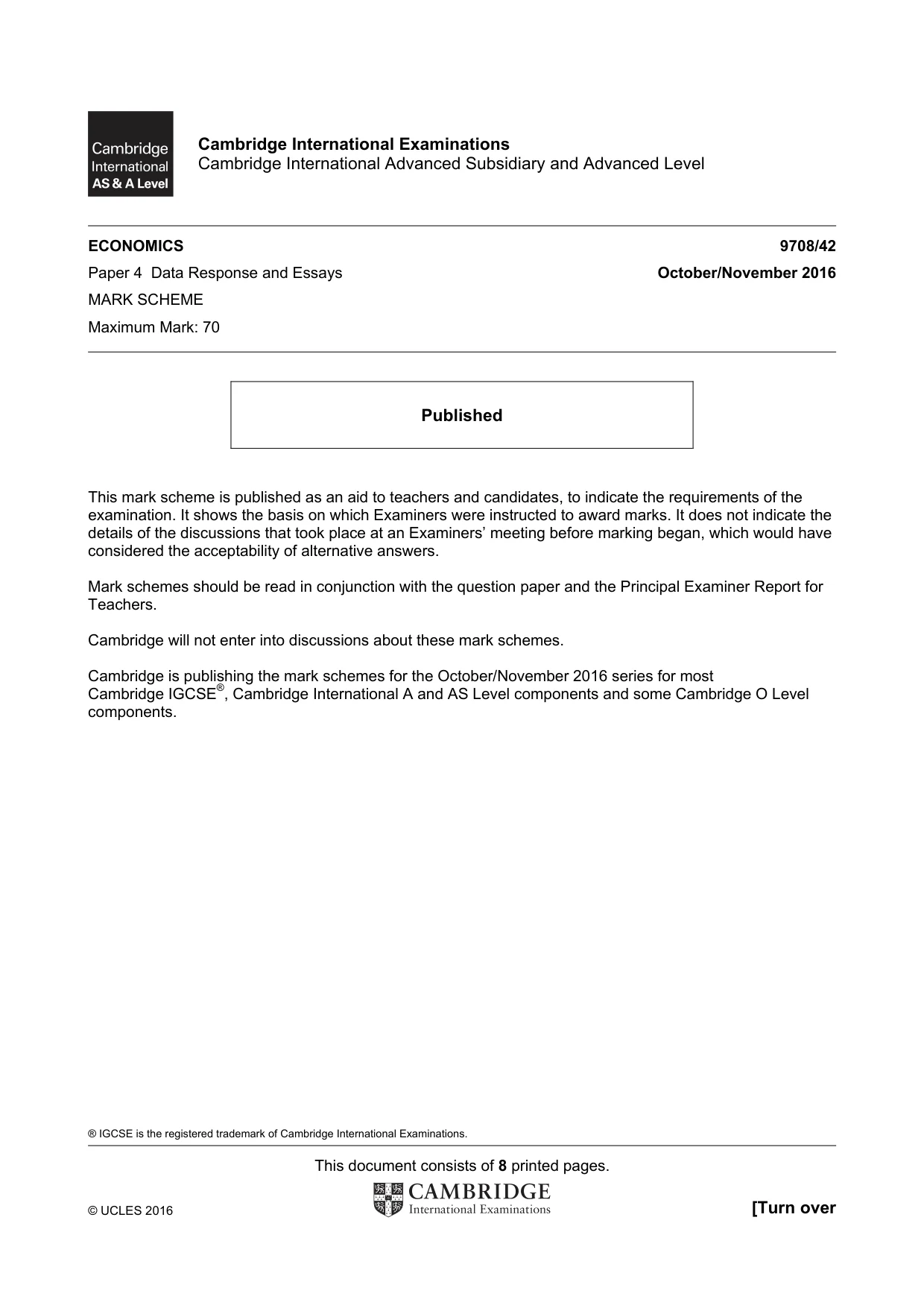
Mark scheme, page 1
® IGCSE is the registered trademark of Cambridge International Examinations. This document consists of 8 printed pages. © UCLES 2016 [Turn over Cambridge International Examinations Cambridge International Advanced Subsidiary and Advanced Level ECONOMICS 9708/42 Paper 4 Data Response and Essays October/November 2016 MARK SCHEME Maximum Mark: 70 Published This mark scheme is published as an aid to teachers and candidates, to indicate the requirements of the examination. It shows the basis on which Examiners were instructed to award marks. It does not indicate the details of the discussions that took place at an Examiners’ meeting before marking began, which would have considered the acceptability of alternative answers. Mark schemes should be read in conjunction with the question paper and the Principal Examiner Report for Teachers. Cambridge will not enter into discussions about these mark schemes. Cambridge is publishing the mark schemes for the October/November 2016 series for most Cambridge IGCSE®, Cambridge International A and AS Level components and some Cambridge O Level components.
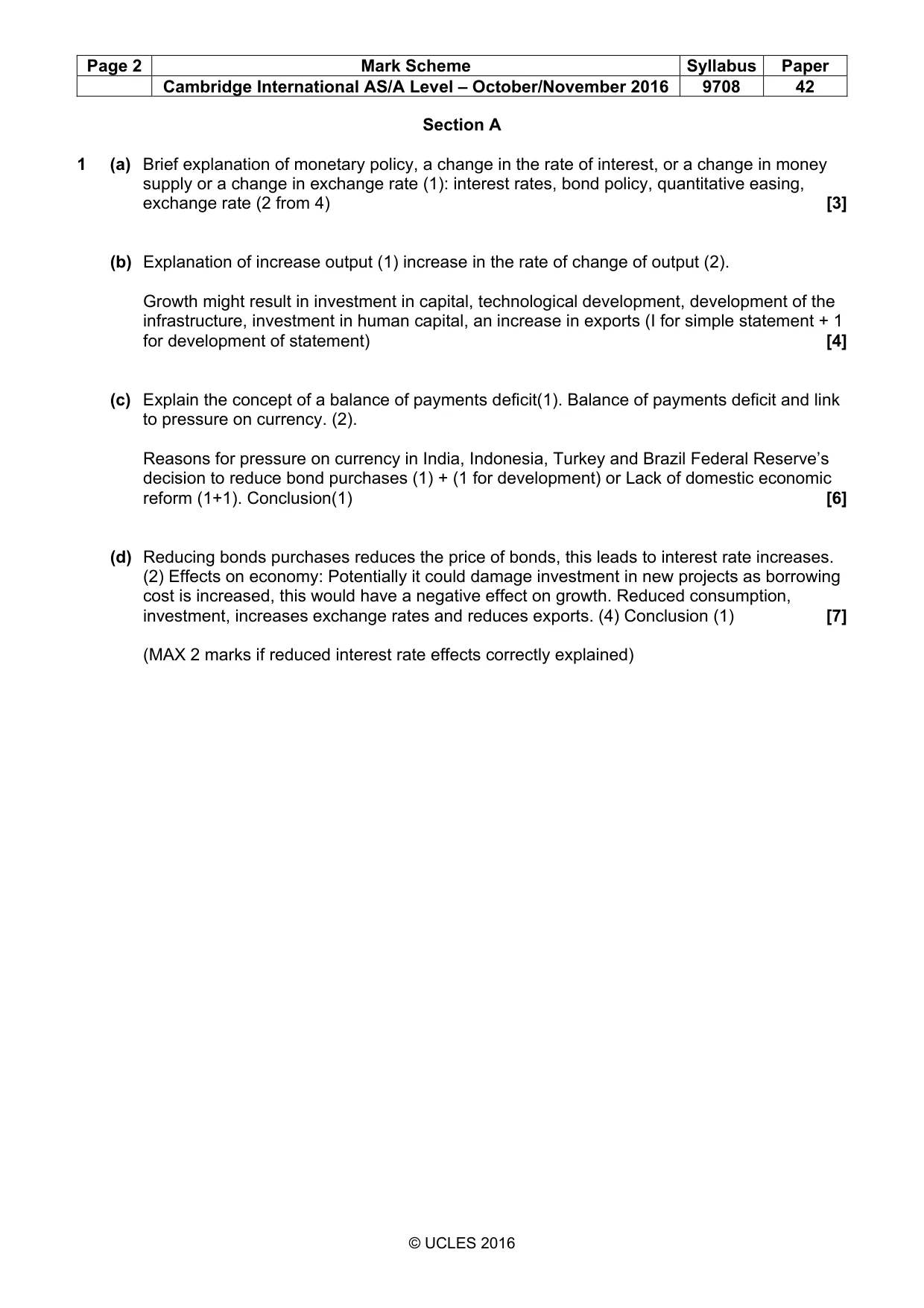
Mark scheme, page 2
Page 2 Mark Scheme Syllabus Paper Cambridge International AS/A Level – October/November 2016 9708 42 © UCLES 2016 Section A 1 (a) Brief explanation of monetary policy, a change in the rate of interest, or a change in money supply or a change in exchange rate (1): interest rates, bond policy, quantitative easing, exchange rate (2 from 4) [3] (b) Explanation of increase output (1) increase in the rate of change of output (2). Growth might result in investment in capital, technological development, development of the infrastructure, investment in human capital, an increase in exports (I for simple statement + 1 for development of statement) [4] (c) Explain the concept of a balance of payments deficit(1). Balance of payments deficit and link to pressure on currency. (2). Reasons for pressure on currency in India, Indonesia, Turkey and Brazil Federal Reserve’s decision to reduce bond purchases (1) + (1 for development) or Lack of domestic economic reform (1+1). Conclusion(1) [6] (d) Reducing bonds purchases reduces the price of bonds, this leads to interest rate increases. (2) Effects on economy: Potentially it could damage investment in new projects as borrowing cost is increased, this would have a negative effect on growth. Reduced consumption, investment, increases exchange rates and reduces exports. (4) Conclusion (1) [7] (MAX 2 marks if reduced interest rate effects correctly explained)
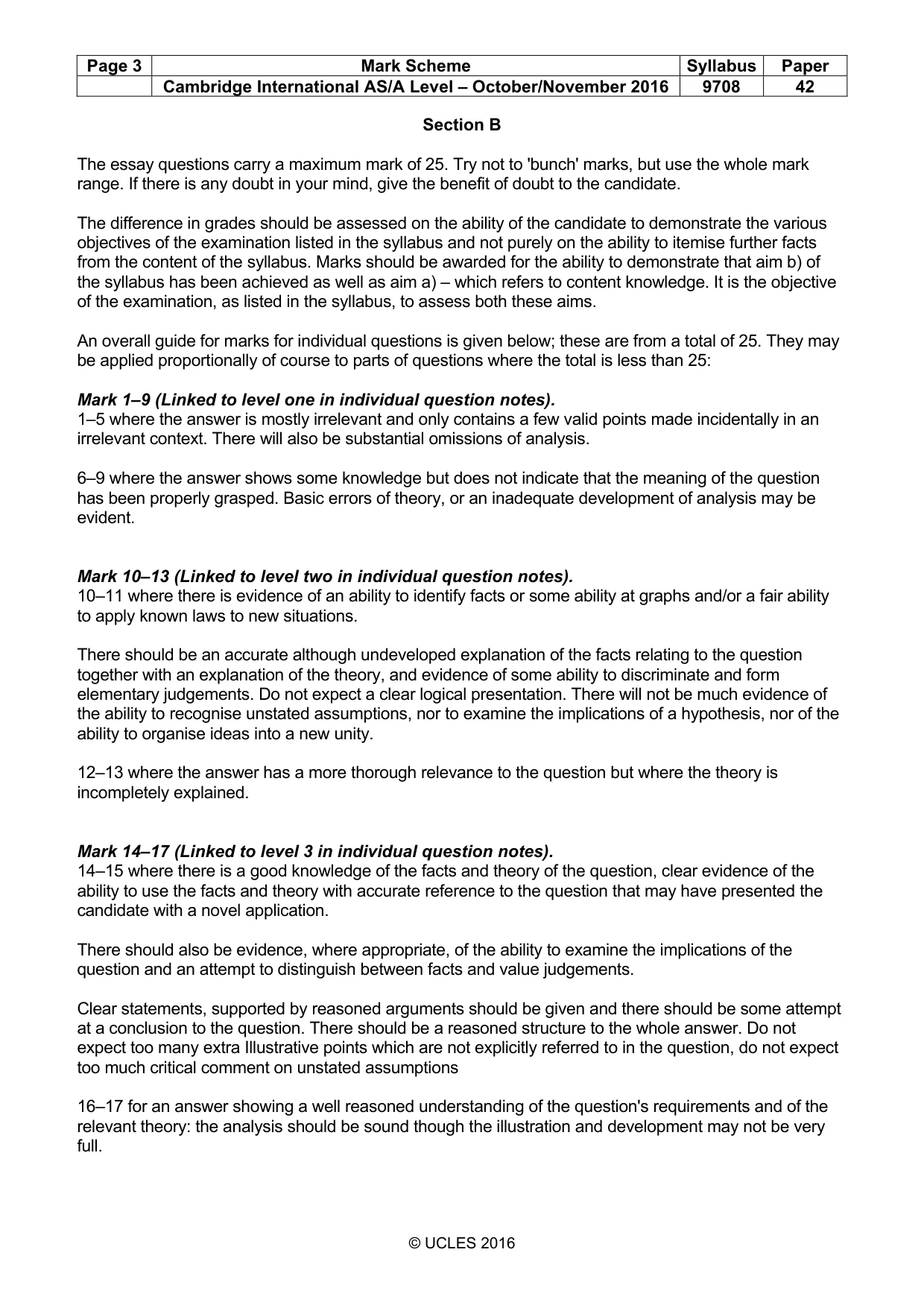
Mark scheme, page 3
Page 3 Mark Scheme Syllabus Paper Cambridge International AS/A Level – October/November 2016 9708 42 © UCLES 2016 Section B The essay questions carry a maximum mark of 25. Try not to 'bunch' marks, but use the whole mark range. If there is any doubt in your mind, give the benefit of doubt to the candidate. The difference in grades should be assessed on the ability of the candidate to demonstrate the various objectives of the examination listed in the syllabus and not purely on the ability to itemise further facts from the content of the syllabus. Marks should be awarded for the ability to demonstrate that aim b) of the syllabus has been achieved as well as aim a) – which refers to content knowledge. It is the objective of the examination, as listed in the syllabus, to assess both these aims. An overall guide for marks for individual questions is given below; these are from a total of 25. They may be applied proportionally of course to parts of questions where the total is less than 25: Mark 1–9 (Linked to level one in individual question notes). 1–5 where the answer is mostly irrelevant and only contains a few valid points made incidentally in an irrelevant context. There will also be substantial omissions of analysis. 6–9 where the answer shows some knowledge but does not indicate that the meaning of the question has been properly grasped. Basic errors of theory, or an inadequate development of analysis may be evident. Mark 10–13 (Linked to level two in individual question notes). 10–11 where there is evidence of an ability to identify facts or some ability at graphs and/or a fair ability to apply known laws to new situations. There should be an accurate although undeveloped explanation of the facts relating to the question together with an explanation of the theory, and evidence of some ability to discriminate and form elementary judgements. Do not expect a clear logical presentation. There will not be much evidence of the ability to recognise unstated assumptions, nor to examine the implications of a hypothesis, nor of the ability to organise ideas into a new unity. 12–13 where the answer has a more thorough relevance to the question but where the theory is incompletely explained. Mark 14–17 (Linked to level 3 in individual question notes). 14–15 where there is a good knowledge of the facts and theory of the question, clear evidence of the ability to use the facts and theory with accurate reference to the question that may have presented the candidate with a novel application. There should also be evidence, where appropriate, of the ability to examine the implications of the question and an attempt to distinguish between facts and value judgements. Clear statements, supported by reasoned arguments should be given and there should be some attempt at a conclusion to the question. There should be a reasoned structure to the whole answer. Do not expect too many extra Illustrative points which are not explicitly referred to in the question, do not expect too much critical comment on unstated assumptions 16–17 for an answer showing a well reasoned understanding of the question's requirements and of the relevant theory: the analysis should be sound though the illustration and development may not be very full.
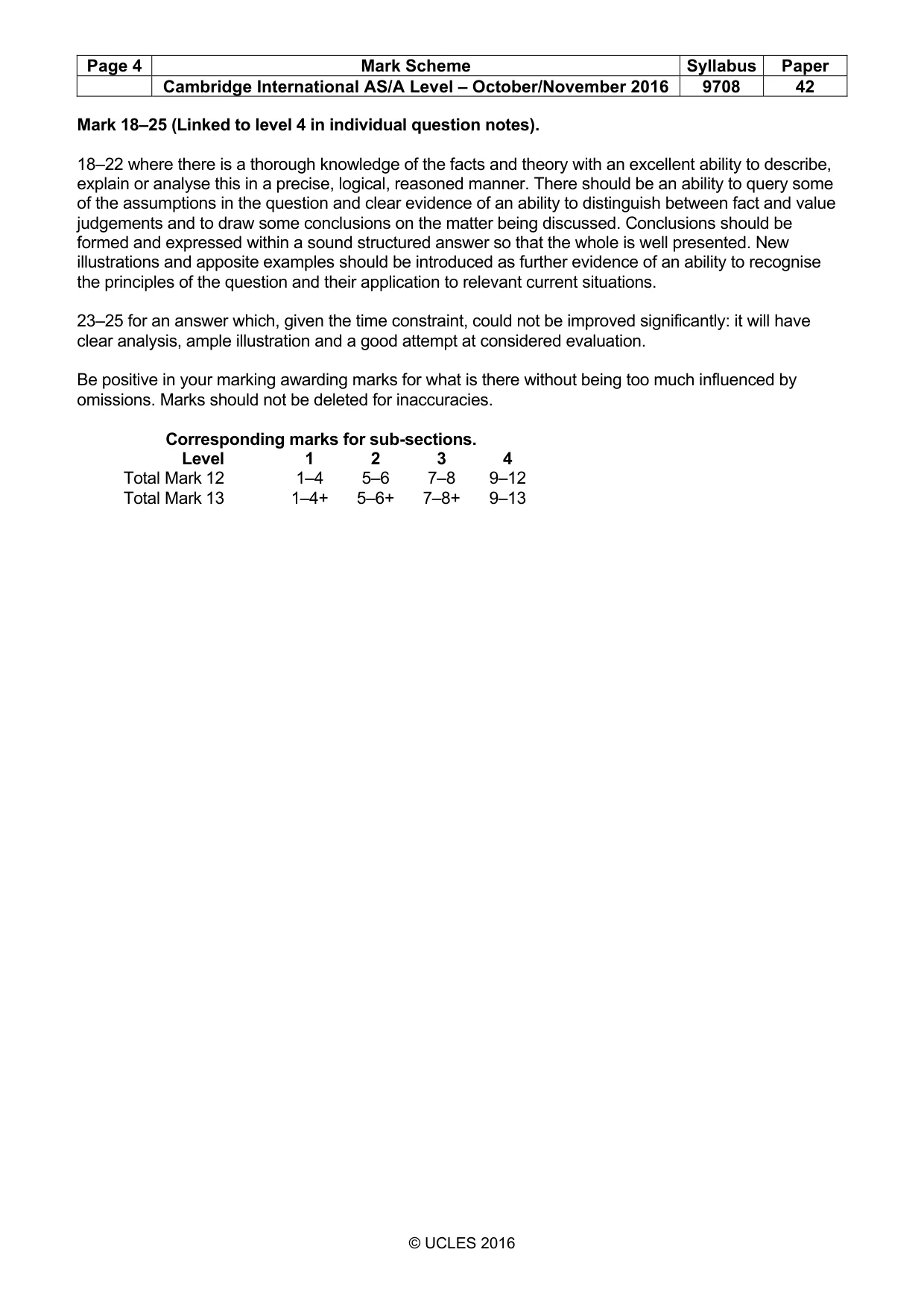
Mark scheme, page 4
Page 4 Mark Scheme Syllabus Paper Cambridge International AS/A Level – October/November 2016 9708 42 © UCLES 2016 Mark 18–25 (Linked to level 4 in individual question notes). 18–22 where there is a thorough knowledge of the facts and theory with an excellent ability to describe, explain or analyse this in a precise, logical, reasoned manner. There should be an ability to query some of the assumptions in the question and clear evidence of an ability to distinguish between fact and value judgements and to draw some conclusions on the matter being discussed. Conclusions should be formed and expressed within a sound structured answer so that the whole is well presented. New illustrations and apposite examples should be introduced as further evidence of an ability to recognise the principles of the question and their application to relevant current situations. 23–25 for an answer which, given the time constraint, could not be improved significantly: it will have clear analysis, ample illustration and a good attempt at considered evaluation. Be positive in your marking awarding marks for what is there without being too much influenced by omissions. Marks should not be deleted for inaccuracies. Corresponding marks for sub-sections. Level 1 2 3 4 Total Mark 12 1–4 5–6 7–8 9–12 Total Mark 13 1–4+ 5–6+ 7–8+ 9–13
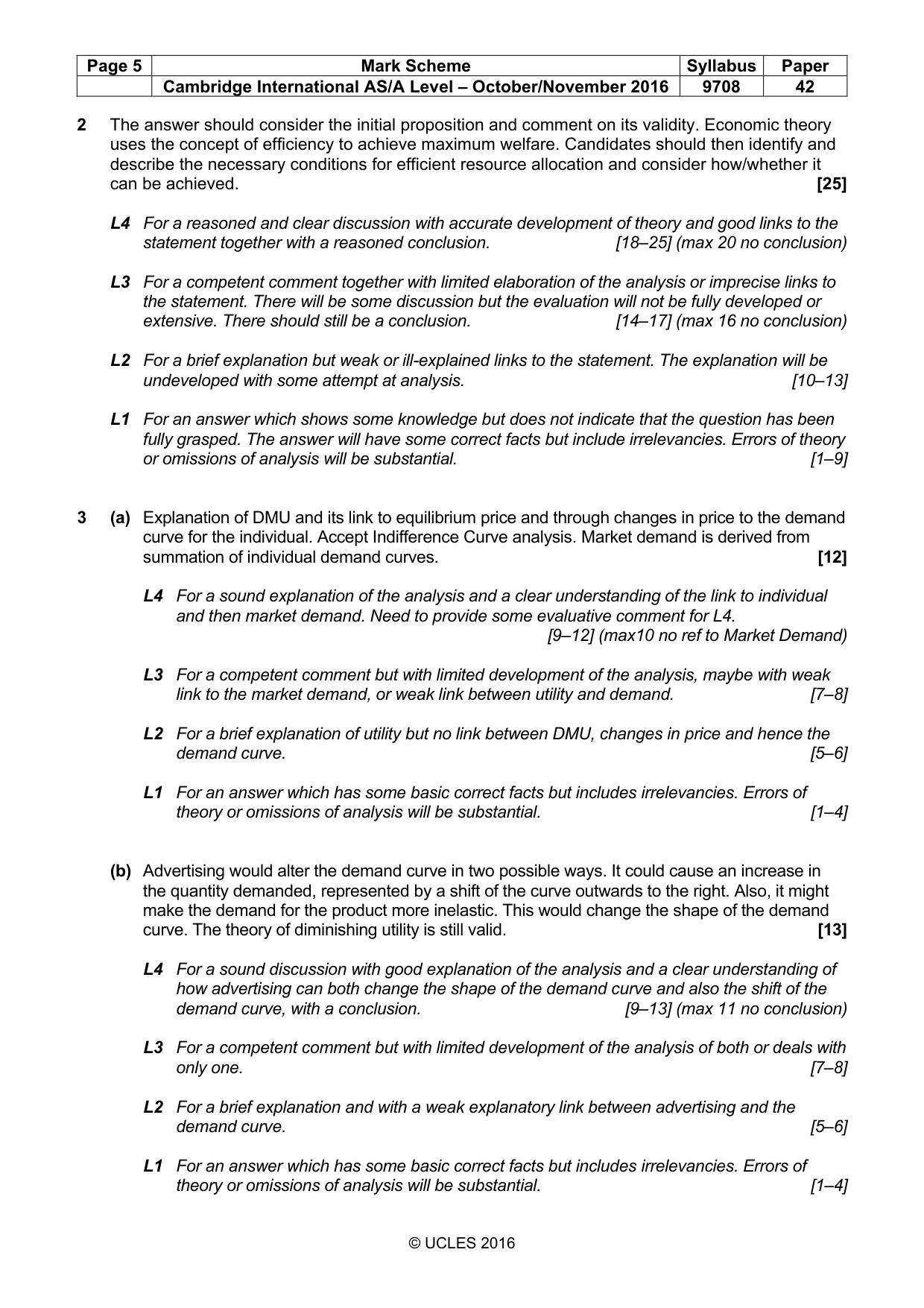
Mark scheme, page 5
Page 5 Mark Scheme Syllabus Paper Cambridge International AS/A Level – October/November 2016 9708 42 © UCLES 2016 2 The answer should consider the initial proposition and comment on its validity. Economic theory uses the concept of efficiency to achieve maximum welfare. Candidates should then identify and describe the necessary conditions for efficient resource allocation and consider how/whether it can be achieved. [25] L4 For a reasoned and clear discussion with accurate development of theory and good links to the statement together with a reasoned conclusion. [18–25] (max 20 no conclusion) L3 For a competent comment together with limited elaboration of the analysis or imprecise links to the statement. There will be some discussion but the evaluation will not be fully developed or extensive. There should still be a conclusion. [14–17] (max 16 no conclusion) L2 For a brief explanation but weak or ill-explained links to the statement. The explanation will be undeveloped with some attempt at analysis. [10–13] L1 For an answer which shows some knowledge but does not indicate that the question has been fully grasped. The answer will have some correct facts but include irrelevancies. Errors of theory or omissions of analysis will be substantial. [1–9] 3 (a) Explanation of DMU and its link to equilibrium price and through changes in price to the demand curve for the individual. Accept Indifference Curve analysis. Market demand is derived from summation of individual demand curves. [12] L4 For a sound explanation of the analysis and a clear understanding of the link to individual and then market demand. Need to provide some evaluative comment for L4. [9–12] (max10 no ref to Market Demand) L3 For a competent comment but with limited development of the analysis, maybe with weak link to the market demand, or weak link between utility and demand. [7–8] L2 For a brief explanation of utility but no link between DMU, changes in price and hence the demand curve. [5–6] L1 For an answer which has some basic correct facts but includes irrelevancies. Errors of theory or omissions of analysis will be substantial. [1–4] (b) Advertising would alter the demand curve in two possible ways. It could cause an increase in the quantity demanded, represented by a shift of the curve outwards to the right. Also, it might make the demand for the product more inelastic. This would change the shape of the demand curve. The theory of diminishing utility is still valid. [13] L4 For a sound discussion with good explanation of the analysis and a clear understanding of how advertising can both change the shape of the demand curve and also the shift of the demand curve, with a conclusion. [9–13] (max 11 no conclusion) L3 For a competent comment but with limited development of the analysis of both or deals with only one. [7–8] L2 For a brief explanation and with a weak explanatory link between advertising and the demand curve. [5–6] L1 For an answer which has some basic correct facts but includes irrelevancies. Errors of theory or omissions of analysis will be substantial. [1–4]
Mark scheme, page 6
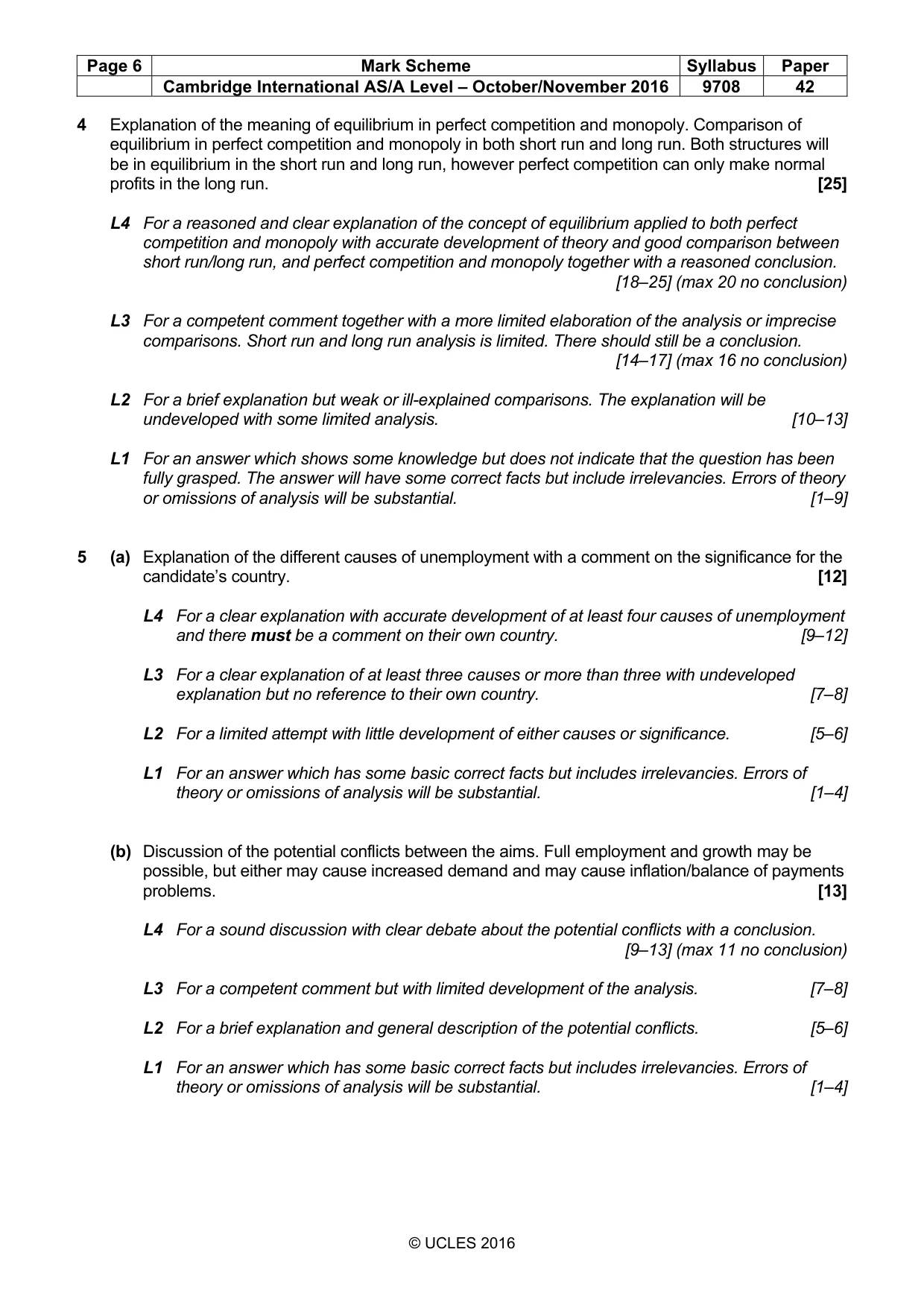
Page 6 Mark Scheme Syllabus Paper Cambridge International AS/A Level – October/November 2016 9708 42 © UCLES 2016 4 Explanation of the meaning of equilibrium in perfect competition and monopoly. Comparison of equilibrium in perfect competition and monopoly in both short run and long run. Both structures will be in equilibrium in the short run and long run, however perfect competition can only make normal profits in the long run. [25] L4 For a reasoned and clear explanation of the concept of equilibrium applied to both perfect competition and monopoly with accurate development of theory and good comparison between short run/long run, and perfect competition and monopoly together with a reasoned conclusion. [18–25] (max 20 no conclusion) L3 For a competent comment together with a more limited elaboration of the analysis or imprecise comparisons. Short run and long run analysis is limited. There should still be a conclusion. [14–17] (max 16 no conclusion) L2 For a brief explanation but weak or ill-explained comparisons. The explanation will be undeveloped with some limited analysis. [10–13] L1 For an answer which shows some knowledge but does not indicate that the question has been fully grasped. The answer will have some correct facts but include irrelevancies. Errors of theory or omissions of analysis will be substantial. [1–9] 5 (a) Explanation of the different causes of unemployment with a comment on the significance for the candidate’s country. [12] L4 For a clear explanation with accurate development of at least four causes of unemployment and there must be a comment on their own country. [9–12] L3 For a clear explanation of at least three causes or more than three with undeveloped explanation but no reference to their own country. [7–8] L2 For a limited attempt with little development of either causes or significance. [5–6] L1 For an answer which has some basic correct facts but includes irrelevancies. Errors of theory or omissions of analysis will be substantial. [1–4] (b) Discussion of the potential conflicts between the aims. Full employment and growth may be possible, but either may cause increased demand and may cause inflation/balance of payments problems. [13] L4 For a sound discussion with clear debate about the potential conflicts with a conclusion. [9–13] (max 11 no conclusion) L3 For a competent comment but with limited development of the analysis. [7–8] L2 For a brief explanation and general description of the potential conflicts. [5–6] L1 For an answer which has some basic correct facts but includes irrelevancies. Errors of theory or omissions of analysis will be substantial. [1–4]
Mark scheme, page 7
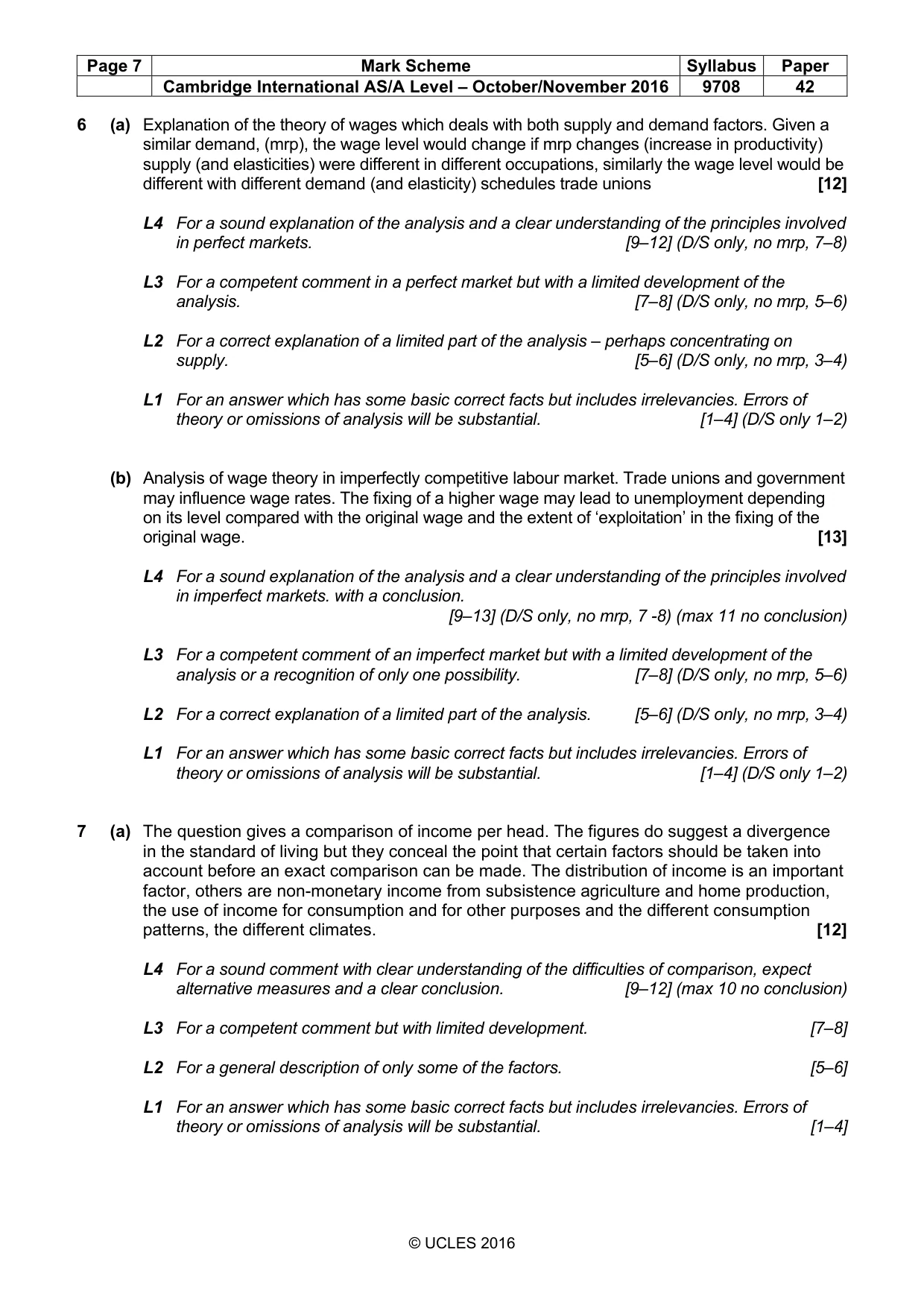
Page 7 Mark Scheme Syllabus Paper Cambridge International AS/A Level – October/November 2016 9708 42 © UCLES 2016 6 (a) Explanation of the theory of wages which deals with both supply and demand factors. Given a similar demand, (mrp), the wage level would change if mrp changes (increase in productivity) supply (and elasticities) were different in different occupations, similarly the wage level would be different with different demand (and elasticity) schedules trade unions [12] L4 For a sound explanation of the analysis and a clear understanding of the principles involved in perfect markets. [9–12] (D/S only, no mrp, 7–8) L3 For a competent comment in a perfect market but with a limited development of the analysis. [7–8] (D/S only, no mrp, 5–6) L2 For a correct explanation of a limited part of the analysis – perhaps concentrating on supply. [5–6] (D/S only, no mrp, 3–4) L1 For an answer which has some basic correct facts but includes irrelevancies. Errors of theory or omissions of analysis will be substantial. [1–4] (D/S only 1–2) (b) Analysis of wage theory in imperfectly competitive labour market. Trade unions and government may influence wage rates. The fixing of a higher wage may lead to unemployment depending on its level compared with the original wage and the extent of ‘exploitation’ in the fixing of the original wage. [13] L4 For a sound explanation of the analysis and a clear understanding of the principles involved in imperfect markets. with a conclusion. [9–13] (D/S only, no mrp, 7 -8) (max 11 no conclusion) L3 For a competent comment of an imperfect market but with a limited development of the analysis or a recognition of only one possibility. [7–8] (D/S only, no mrp, 5–6) L2 For a correct explanation of a limited part of the analysis. [5–6] (D/S only, no mrp, 3–4) L1 For an answer which has some basic correct facts but includes irrelevancies. Errors of theory or omissions of analysis will be substantial. [1–4] (D/S only 1–2) 7 (a) The question gives a comparison of income per head. The figures do suggest a divergence in the standard of living but they conceal the point that certain factors should be taken into account before an exact comparison can be made. The distribution of income is an important factor, others are non-monetary income from subsistence agriculture and home production, the use of income for consumption and for other purposes and the different consumption patterns, the different climates. [12] L4 For a sound comment with clear understanding of the difficulties of comparison, expect alternative measures and a clear conclusion. [9–12] (max 10 no conclusion) L3 For a competent comment but with limited development. [7–8] L2 For a general description of only some of the factors. [5–6] L1 For an answer which has some basic correct facts but includes irrelevancies. Errors of theory or omissions of analysis will be substantial. [1–4]
Mark scheme, page 8
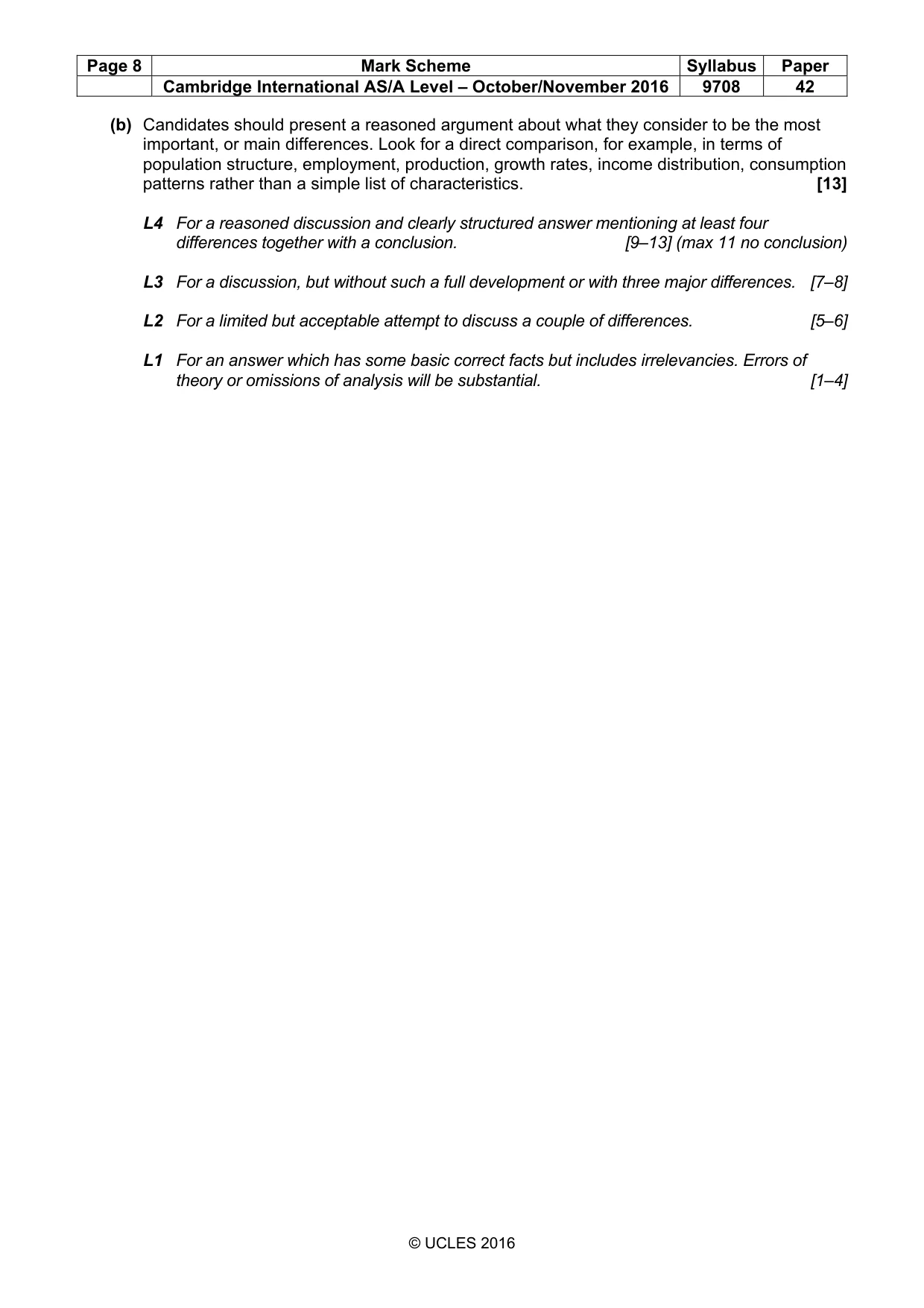
Page 8 Mark Scheme Syllabus Paper Cambridge International AS/A Level – October/November 2016 9708 42 © UCLES 2016 (b) Candidates should present a reasoned argument about what they consider to be the most important, or main differences. Look for a direct comparison, for example, in terms of population structure, employment, production, growth rates, income distribution, consumption patterns rather than a simple list of characteristics. [13] L4 For a reasoned discussion and clearly structured answer mentioning at least four differences together with a conclusion. [9–13] (max 11 no conclusion) L3 For a discussion, but without such a full development or with three major differences. [7–8] L2 For a limited but acceptable attempt to discuss a couple of differences. [5–6] L1 For an answer which has some basic correct facts but includes irrelevancies. Errors of theory or omissions of analysis will be substantial. [1–4]
What you needed in this session
Cambridge’s own grade thresholds for 2016 Oct/Nov, Paper 4 · Variant 2. A higher threshold means an easier paper — the bar moves with how the cohort did.