Cambridge A Level Economics 9708 — 2016 Oct/Nov Paper 4 · Variant 3
9708/43/O/N/16 · 70 marks · ≈79 min
The question paper and its mark scheme, free to read here and free to download. This is Cambridge’s own paper, exactly as it was sat.
Question paper4 pages
Mark scheme8 pages
Answers below. Sit the paper first if you are practising.
Paper as text
Question paper, page 1
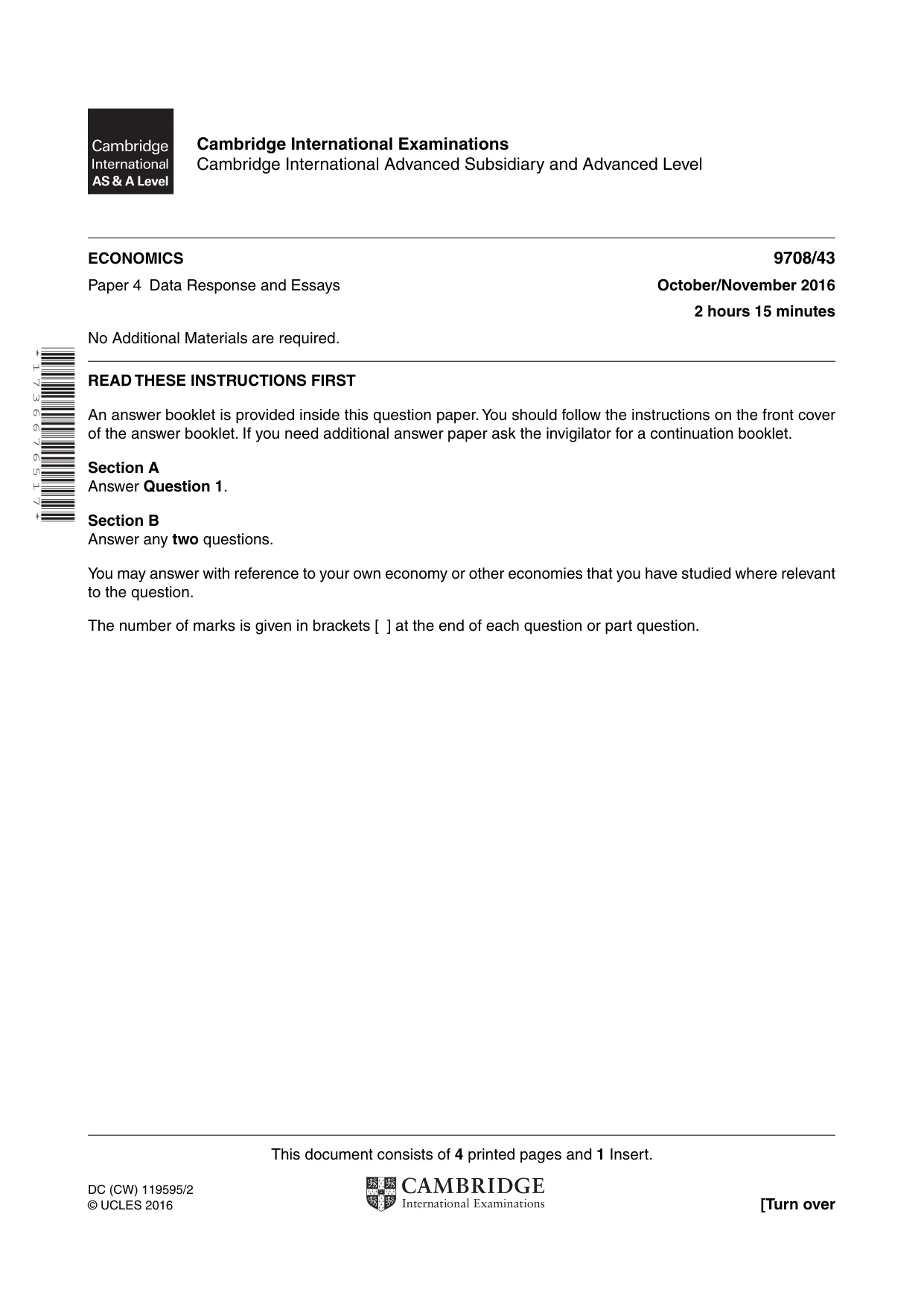
This document consists of 4 printed pages and 1 Insert. DC (CW) 119595/2 © UCLES 2016 [Turn over Cambridge International Examinations Cambridge International Advanced Subsidiary and Advanced Level * 1 7 3 6 6 7 6 5 1 7 * ECONOMICS 9708/43 Paper 4 Data Response and Essays October/November 2016 2 hours 15 minutes No Additional Materials are required. READ THESE INSTRUCTIONS FIRST An answer booklet is provided inside this question paper. You should follow the instructions on the front cover of the answer booklet. If you need additional answer paper ask the invigilator for a continuation booklet. Section A Answer Question 1. Section B Answer any two questions. You may answer with reference to your own economy or other economies that you have studied where relevant to the question. The number of marks is given in brackets [ ] at the end of each question or part question.
Question paper, page 2
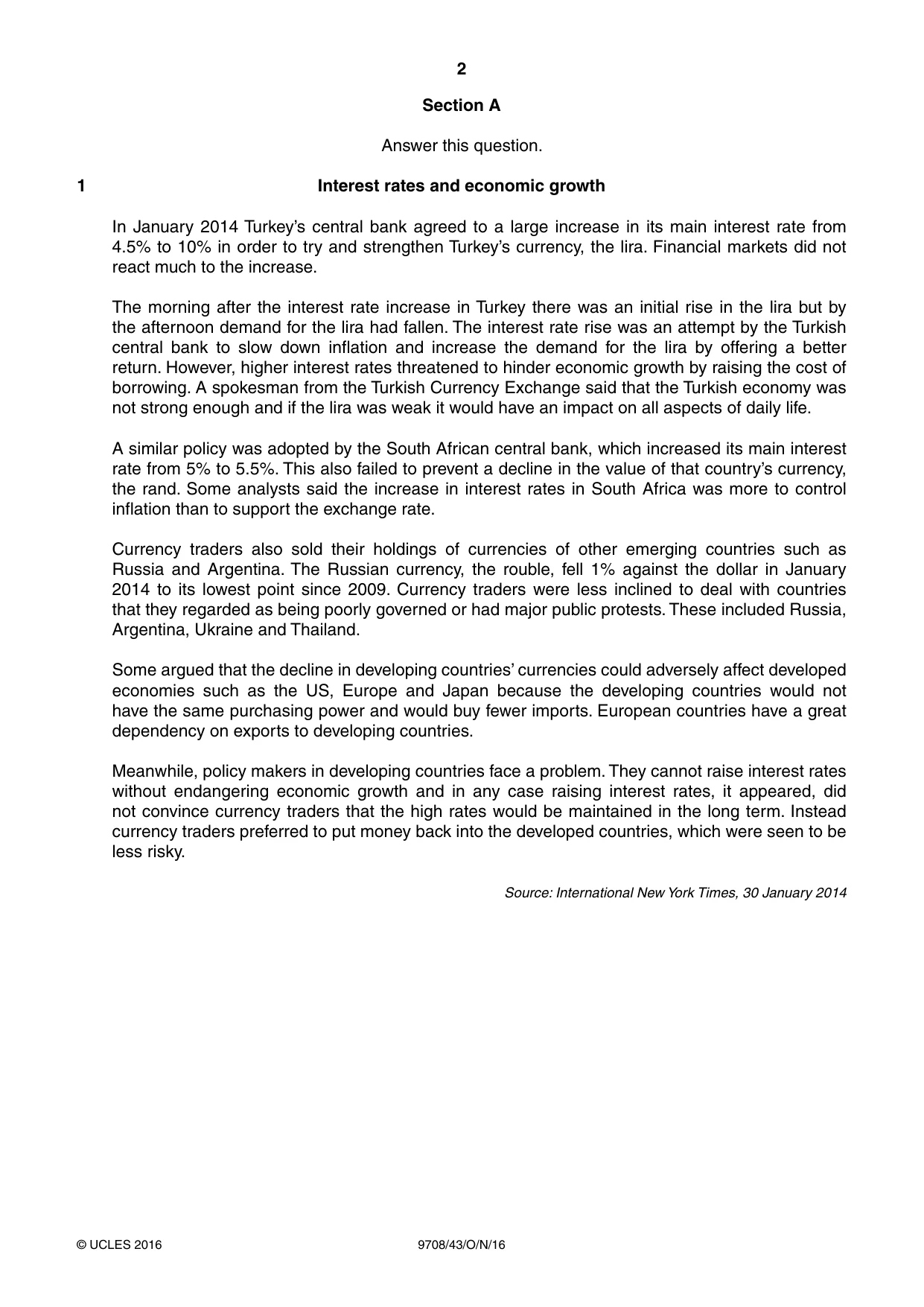
2 9708/43/O/N/16 © UCLES 2016 Section A Answer this question. 1 Interest rates and economic growth In January 2014 Turkey’s central bank agreed to a large increase in its main interest rate from 4.5% to 10% in order to try and strengthen Turkey’s currency, the lira. Financial markets did not react much to the increase. The morning after the interest rate increase in Turkey there was an initial rise in the lira but by the afternoon demand for the lira had fallen. The interest rate rise was an attempt by the Turkish central bank to slow down inflation and increase the demand for the lira by offering a better return. However, higher interest rates threatened to hinder economic growth by raising the cost of borrowing. A spokesman from the Turkish Currency Exchange said that the Turkish economy was not strong enough and if the lira was weak it would have an impact on all aspects of daily life. A similar policy was adopted by the South African central bank, which increased its main interest rate from 5% to 5.5%. This also failed to prevent a decline in the value of that country’s currency, the rand. Some analysts said the increase in interest rates in South Africa was more to control inflation than to support the exchange rate. Currency traders also sold their holdings of currencies of other emerging countries such as Russia and Argentina. The Russian currency, the rouble, fell 1% against the dollar in January 2014 to its lowest point since 2009. Currency traders were less inclined to deal with countries that they regarded as being poorly governed or had major public protests. These included Russia, Argentina, Ukraine and Thailand. Some argued that the decline in developing countries’ currencies could adversely affect developed economies such as the US, Europe and Japan because the developing countries would not have the same purchasing power and would buy fewer imports. European countries have a great dependency on exports to developing countries. Meanwhile, policy makers in developing countries face a problem. They cannot raise interest rates without endangering economic growth and in any case raising interest rates, it appeared, did not convince currency traders that the high rates would be maintained in the long term. Instead currency traders preferred to put money back into the developed countries, which were seen to be less risky. Source: International New York Times, 30 January 2014
Question paper, page 3
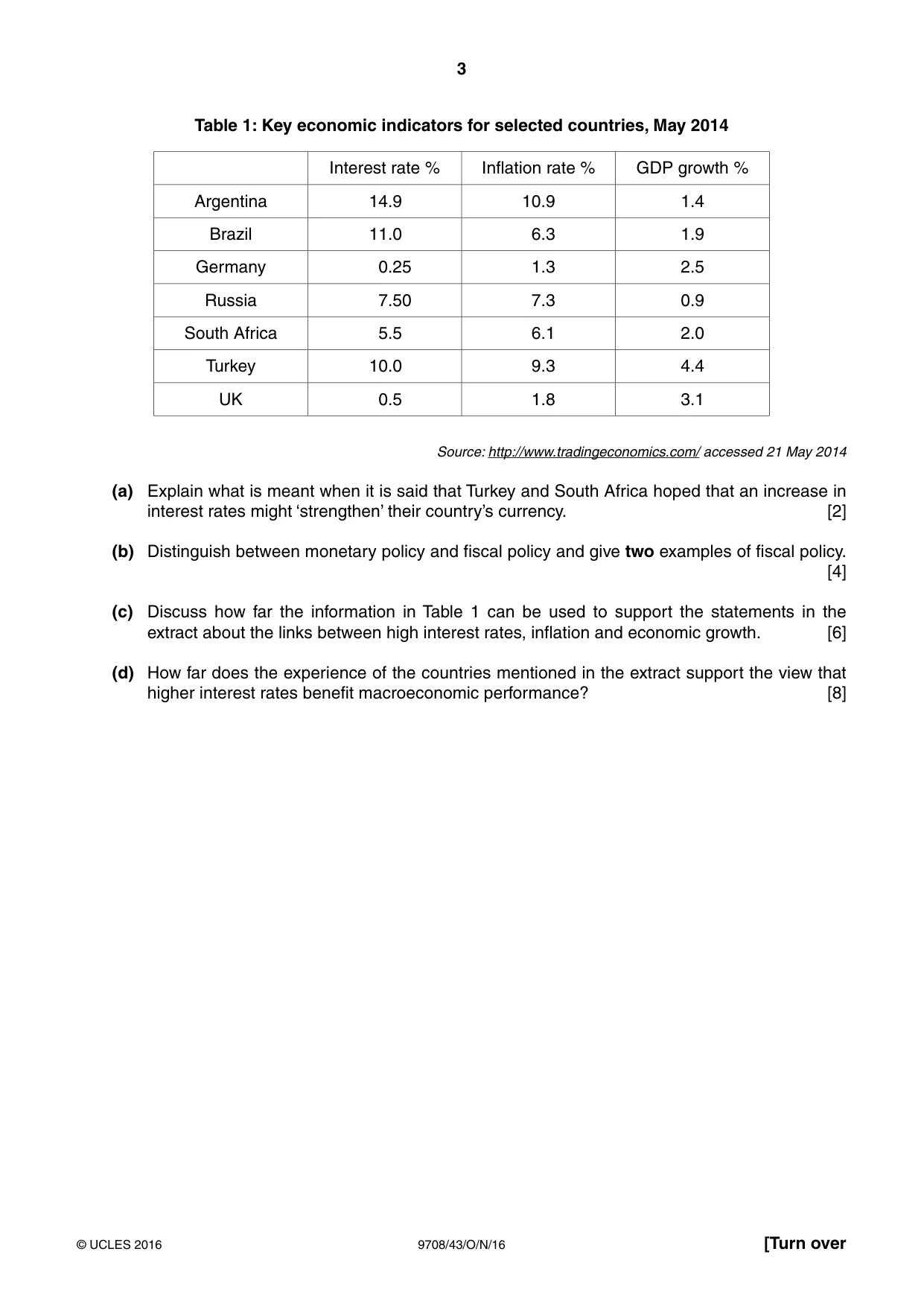
3 9708/43/O/N/16 © UCLES 2016 [Turn over Table 1: Key economic indicators for selected countries, May 2014 Interest rate % Inflation rate % GDP growth % Argentina 14.9 10.9 1.4 Brazil 11.0 6.3 1.9 Germany 0.25 1.3 2.5 Russia 7.50 7.3 0.9 South Africa 5.5 6.1 2.0 Turkey 10.0 9.3 4.4 UK 0.5 1.8 3.1 Source: http://www.tradingeconomics.com/ accessed 21 May 2014 (a) Explain what is meant when it is said that Turkey and South Africa hoped that an increase in interest rates might ‘strengthen’ their country’s currency. [2] (b) Distinguish between monetary policy and fiscal policy and give two examples of fiscal policy. [4] (c) Discuss how far the information in Table 1 can be used to support the statements in the extract about the links between high interest rates, inflation and economic growth. [6] (d) How far does the experience of the countries mentioned in the extract support the view that higher interest rates benefit macroeconomic performance? [8]
Question paper, page 4
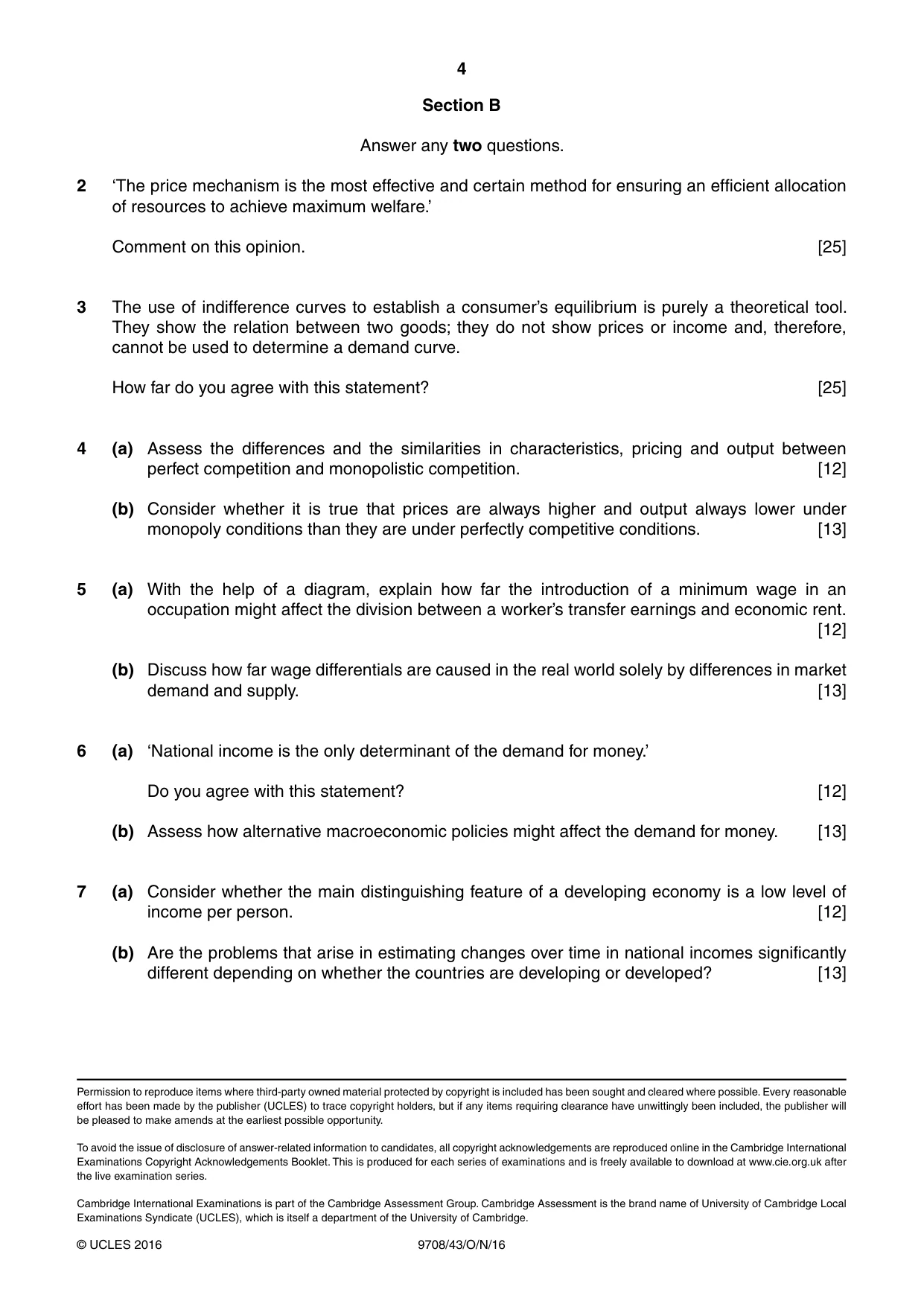
4 9708/43/O/N/16 © UCLES 2016 Section B Answer any two questions. 2 ‘The price mechanism is the most effective and certain method for ensuring an efficient allocation of resources to achieve maximum welfare.’ Comment on this opinion. [25] 3 The use of indifference curves to establish a consumer’s equilibrium is purely a theoretical tool. They show the relation between two goods; they do not show prices or income and, therefore, cannot be used to determine a demand curve. How far do you agree with this statement? [25] 4 (a) Assess the differences and the similarities in characteristics, pricing and output between perfect competition and monopolistic competition. [12] (b) Consider whether it is true that prices are always higher and output always lower under monopoly conditions than they are under perfectly competitive conditions. [13] 5 (a) With the help of a diagram, explain how far the introduction of a minimum wage in an occupation might affect the division between a worker’s transfer earnings and economic rent. [12] (b) Discuss how far wage differentials are caused in the real world solely by differences in market demand and supply. [13] 6 (a) ‘National income is the only determinant of the demand for money.’ Do you agree with this statement? [12] (b) Assess how alternative macroeconomic policies might affect the demand for money. [13] 7 (a) Consider whether the main distinguishing feature of a developing economy is a low level of income per person. [12] (b) Are the problems that arise in estimating changes over time in national incomes significantly different depending on whether the countries are developing or developed? [13] Permission to reproduce items where third-party owned material protected by copyright is included has been sought and cleared where possible. Every reasonable effort has been made by the publisher (UCLES) to trace copyright holders, but if any items requiring clearance have unwittingly been included, the publisher will be pleased to make amends at the earliest possible opportunity. To avoid the issue of disclosure of answer-related information to candidates, all copyright acknowledgements are reproduced online in the Cambridge International Examinations Copyright Acknowledgements Booklet. This is produced for each series of examinations and is freely available to download at www.cie.org.uk after the live examination series. Cambridge International Examinations is part of the Cambridge Assessment Group. Cambridge Assessment is the brand name of University of Cambridge Local Examinations Syndicate (UCLES), which is itself a department of the University of Cambridge.
Mark scheme, page 1
® IGCSE is the registered trademark of Cambridge International Examinations. This document consists of 8 printed pages. © UCLES 2016 [Turn over Cambridge International Examinations Cambridge International Advanced Subsidiary and Advanced Level ECONOMICS 9708/43 Paper 4 Data Response and Essays October/November 2016 MARK SCHEME Maximum Mark: 70 Published This mark scheme is published as an aid to teachers and candidates, to indicate the requirements of the examination. It shows the basis on which Examiners were instructed to award marks. It does not indicate the details of the discussions that took place at an Examiners’ meeting before marking began, which would have considered the acceptability of alternative answers. Mark schemes should be read in conjunction with the question paper and the Principal Examiner Report for Teachers. Cambridge will not enter into discussions about these mark schemes. Cambridge is publishing the mark schemes for the October/November 2016 series for most Cambridge IGCSE®, Cambridge International A and AS Level components and some Cambridge O Level components.
Mark scheme, page 2
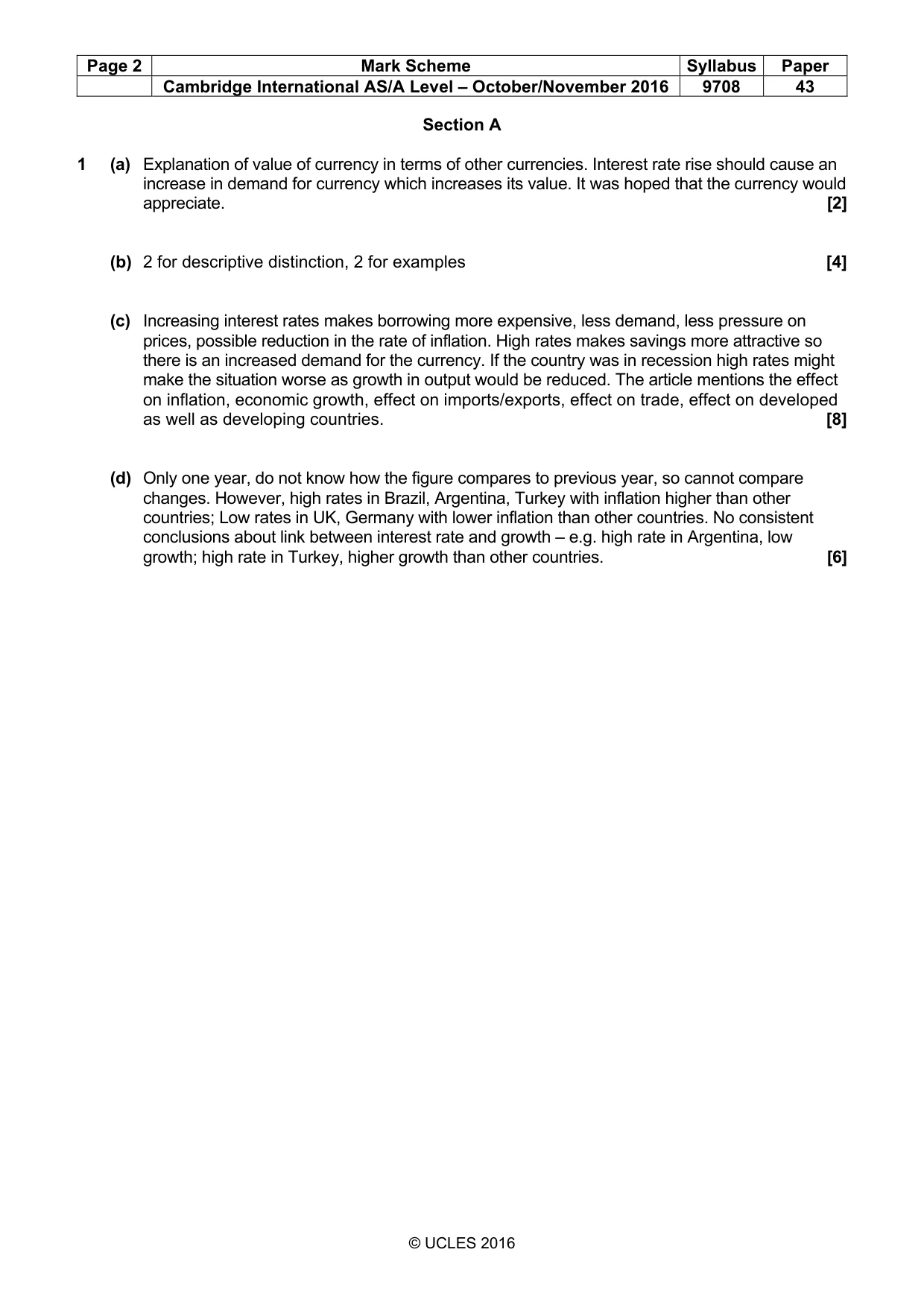
Page 2 Mark Scheme Syllabus Paper Cambridge International AS/A Level – October/November 2016 9708 43 © UCLES 2016 Section A 1 (a) Explanation of value of currency in terms of other currencies. Interest rate rise should cause an increase in demand for currency which increases its value. It was hoped that the currency would appreciate. [2] (b) 2 for descriptive distinction, 2 for examples [4] (c) Increasing interest rates makes borrowing more expensive, less demand, less pressure on prices, possible reduction in the rate of inflation. High rates makes savings more attractive so there is an increased demand for the currency. If the country was in recession high rates might make the situation worse as growth in output would be reduced. The article mentions the effect on inflation, economic growth, effect on imports/exports, effect on trade, effect on developed as well as developing countries. [8] (d) Only one year, do not know how the figure compares to previous year, so cannot compare changes. However, high rates in Brazil, Argentina, Turkey with inflation higher than other countries; Low rates in UK, Germany with lower inflation than other countries. No consistent conclusions about link between interest rate and growth – e.g. high rate in Argentina, low growth; high rate in Turkey, higher growth than other countries. [6]
Mark scheme, page 3
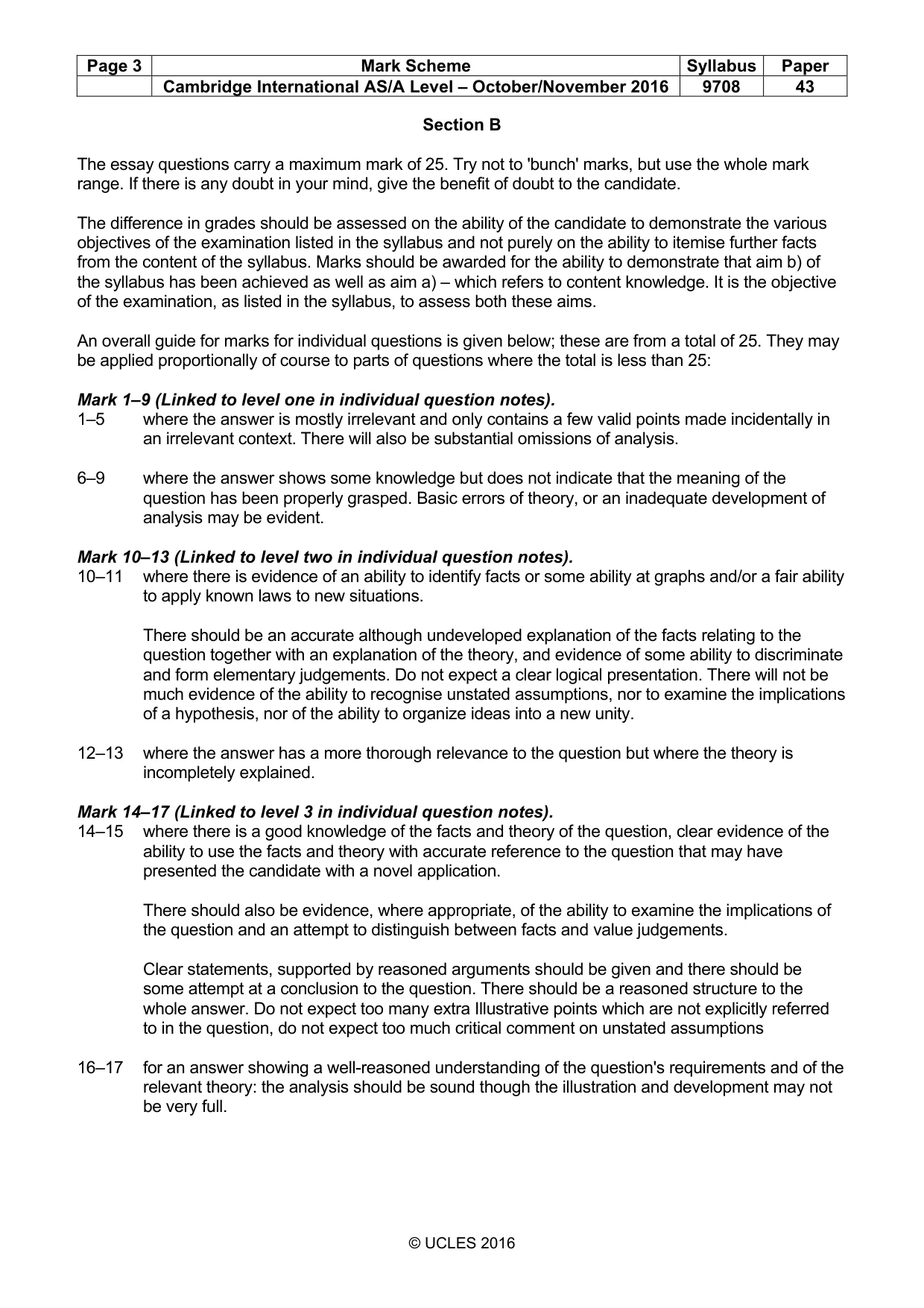
Page 3 Mark Scheme Syllabus Paper Cambridge International AS/A Level – October/November 2016 9708 43 © UCLES 2016 Section B The essay questions carry a maximum mark of 25. Try not to 'bunch' marks, but use the whole mark range. If there is any doubt in your mind, give the benefit of doubt to the candidate. The difference in grades should be assessed on the ability of the candidate to demonstrate the various objectives of the examination listed in the syllabus and not purely on the ability to itemise further facts from the content of the syllabus. Marks should be awarded for the ability to demonstrate that aim b) of the syllabus has been achieved as well as aim a) – which refers to content knowledge. It is the objective of the examination, as listed in the syllabus, to assess both these aims. An overall guide for marks for individual questions is given below; these are from a total of 25. They may be applied proportionally of course to parts of questions where the total is less than 25: Mark 1–9 (Linked to level one in individual question notes). 1–5 where the answer is mostly irrelevant and only contains a few valid points made incidentally in an irrelevant context. There will also be substantial omissions of analysis. 6–9 where the answer shows some knowledge but does not indicate that the meaning of the question has been properly grasped. Basic errors of theory, or an inadequate development of analysis may be evident. Mark 10–13 (Linked to level two in individual question notes). 10–11 where there is evidence of an ability to identify facts or some ability at graphs and/or a fair ability to apply known laws to new situations. There should be an accurate although undeveloped explanation of the facts relating to the question together with an explanation of the theory, and evidence of some ability to discriminate and form elementary judgements. Do not expect a clear logical presentation. There will not be much evidence of the ability to recognise unstated assumptions, nor to examine the implications of a hypothesis, nor of the ability to organize ideas into a new unity. 12–13 where the answer has a more thorough relevance to the question but where the theory is incompletely explained. Mark 14–17 (Linked to level 3 in individual question notes). 14–15 where there is a good knowledge of the facts and theory of the question, clear evidence of the ability to use the facts and theory with accurate reference to the question that may have presented the candidate with a novel application. There should also be evidence, where appropriate, of the ability to examine the implications of the question and an attempt to distinguish between facts and value judgements. Clear statements, supported by reasoned arguments should be given and there should be some attempt at a conclusion to the question. There should be a reasoned structure to the whole answer. Do not expect too many extra Illustrative points which are not explicitly referred to in the question, do not expect too much critical comment on unstated assumptions 16–17 for an answer showing a well-reasoned understanding of the question's requirements and of the relevant theory: the analysis should be sound though the illustration and development may not be very full.
Mark scheme, page 4
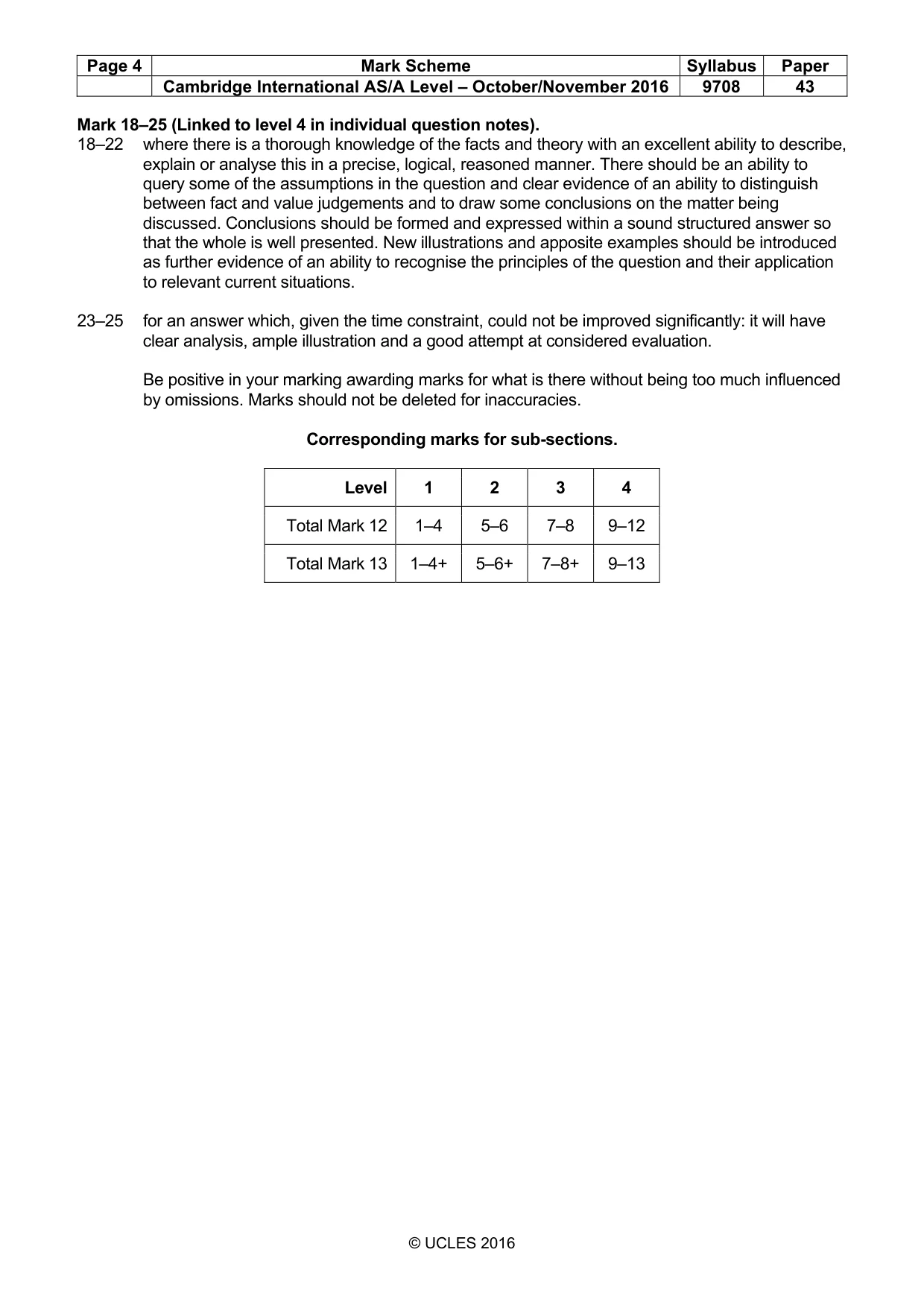
Page 4 Mark Scheme Syllabus Paper Cambridge International AS/A Level – October/November 2016 9708 43 © UCLES 2016 Mark 18–25 (Linked to level 4 in individual question notes). 18–22 where there is a thorough knowledge of the facts and theory with an excellent ability to describe, explain or analyse this in a precise, logical, reasoned manner. There should be an ability to query some of the assumptions in the question and clear evidence of an ability to distinguish between fact and value judgements and to draw some conclusions on the matter being discussed. Conclusions should be formed and expressed within a sound structured answer so that the whole is well presented. New illustrations and apposite examples should be introduced as further evidence of an ability to recognise the principles of the question and their application to relevant current situations. 23–25 for an answer which, given the time constraint, could not be improved significantly: it will have clear analysis, ample illustration and a good attempt at considered evaluation. Be positive in your marking awarding marks for what is there without being too much influenced by omissions. Marks should not be deleted for inaccuracies. Corresponding marks for sub-sections. Level 1 2 3 4 Total Mark 12 1–4 5–6 7–8 9–12 Total Mark 13 1–4+ 5–6+ 7–8+ 9–13
Mark scheme, page 5
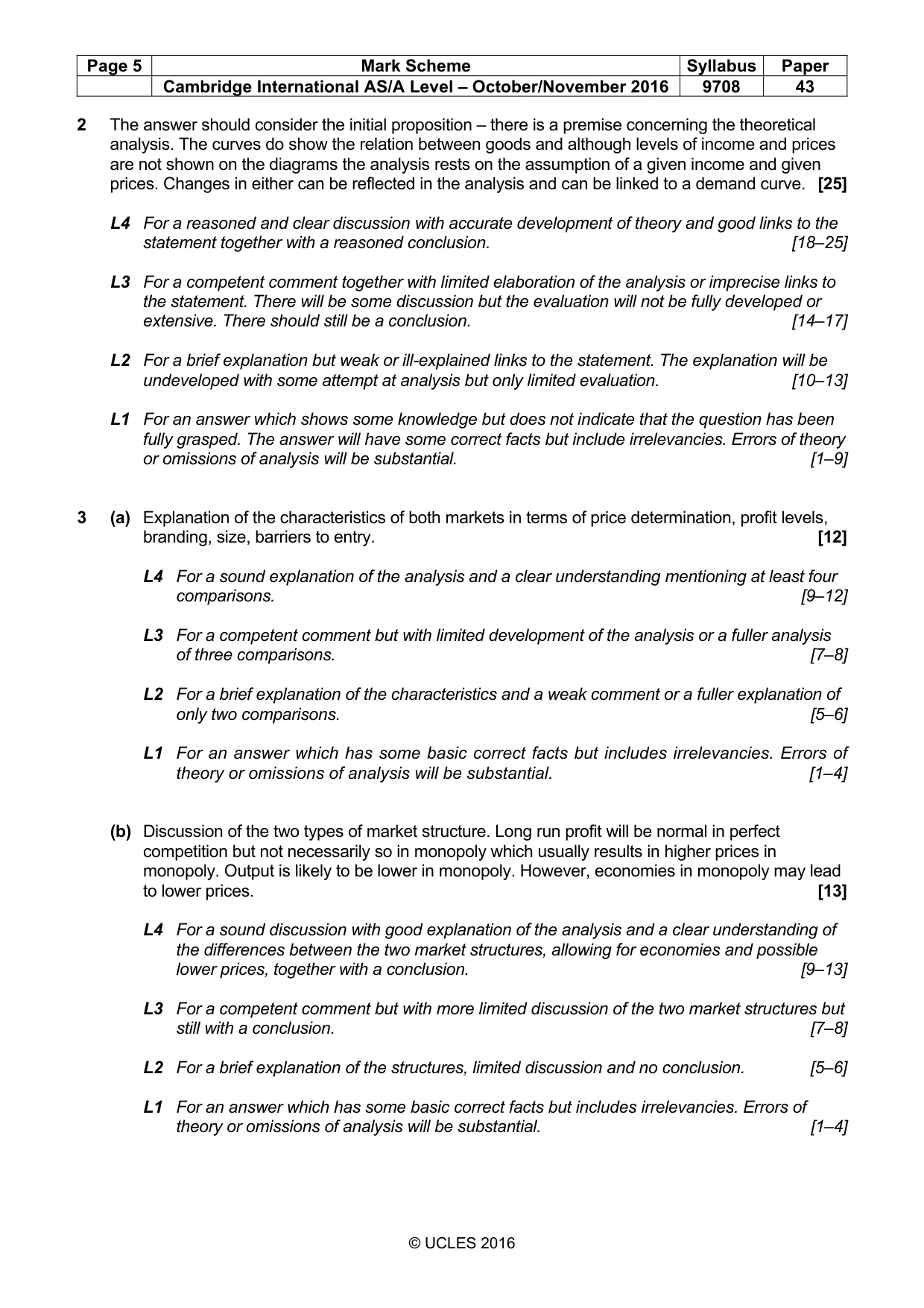
Page 5 Mark Scheme Syllabus Paper Cambridge International AS/A Level – October/November 2016 9708 43 © UCLES 2016 2 The answer should consider the initial proposition – there is a premise concerning the theoretical analysis. The curves do show the relation between goods and although levels of income and prices are not shown on the diagrams the analysis rests on the assumption of a given income and given prices. Changes in either can be reflected in the analysis and can be linked to a demand curve. [25] L4 For a reasoned and clear discussion with accurate development of theory and good links to the statement together with a reasoned conclusion. [18–25] L3 For a competent comment together with limited elaboration of the analysis or imprecise links to the statement. There will be some discussion but the evaluation will not be fully developed or extensive. There should still be a conclusion. [14–17] L2 For a brief explanation but weak or ill-explained links to the statement. The explanation will be undeveloped with some attempt at analysis but only limited evaluation. [10–13] L1 For an answer which shows some knowledge but does not indicate that the question has been fully grasped. The answer will have some correct facts but include irrelevancies. Errors of theory or omissions of analysis will be substantial. [1–9] 3 (a) Explanation of the characteristics of both markets in terms of price determination, profit levels, branding, size, barriers to entry. [12] L4 For a sound explanation of the analysis and a clear understanding mentioning at least four comparisons. [9–12] L3 For a competent comment but with limited development of the analysis or a fuller analysis of three comparisons. [7–8] L2 For a brief explanation of the characteristics and a weak comment or a fuller explanation of only two comparisons. [5–6] L1 For an answer which has some basic correct facts but includes irrelevancies. Errors of theory or omissions of analysis will be substantial. [1–4] (b) Discussion of the two types of market structure. Long run profit will be normal in perfect competition but not necessarily so in monopoly which usually results in higher prices in monopoly. Output is likely to be lower in monopoly. However, economies in monopoly may lead to lower prices. [13] L4 For a sound discussion with good explanation of the analysis and a clear understanding of the differences between the two market structures, allowing for economies and possible lower prices, together with a conclusion. [9–13] L3 For a competent comment but with more limited discussion of the two market structures but still with a conclusion. [7–8] L2 For a brief explanation of the structures, limited discussion and no conclusion. [5–6] L1 For an answer which has some basic correct facts but includes irrelevancies. Errors of theory or omissions of analysis will be substantial. [1–4]
Mark scheme, page 6
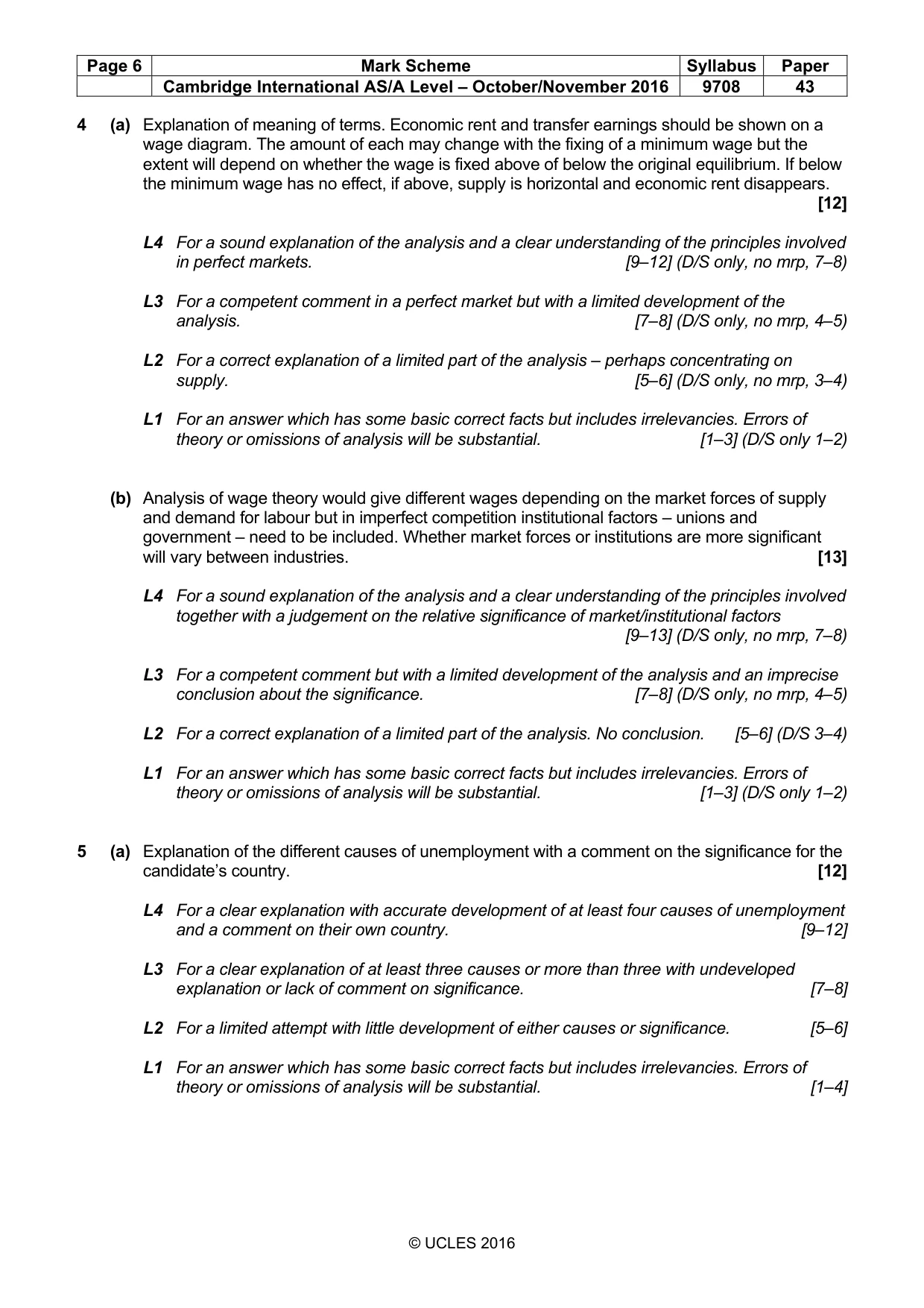
Page 6 Mark Scheme Syllabus Paper Cambridge International AS/A Level – October/November 2016 9708 43 © UCLES 2016 4 (a) Explanation of meaning of terms. Economic rent and transfer earnings should be shown on a wage diagram. The amount of each may change with the fixing of a minimum wage but the extent will depend on whether the wage is fixed above of below the original equilibrium. If below the minimum wage has no effect, if above, supply is horizontal and economic rent disappears. [12] L4 For a sound explanation of the analysis and a clear understanding of the principles involved in perfect markets. [9–12] (D/S only, no mrp, 7–8) L3 For a competent comment in a perfect market but with a limited development of the analysis. [7–8] (D/S only, no mrp, 4–5) L2 For a correct explanation of a limited part of the analysis – perhaps concentrating on supply. [5–6] (D/S only, no mrp, 3–4) L1 For an answer which has some basic correct facts but includes irrelevancies. Errors of theory or omissions of analysis will be substantial. [1–3] (D/S only 1–2) (b) Analysis of wage theory would give different wages depending on the market forces of supply and demand for labour but in imperfect competition institutional factors – unions and government – need to be included. Whether market forces or institutions are more significant will vary between industries. [13] L4 For a sound explanation of the analysis and a clear understanding of the principles involved together with a judgement on the relative significance of market/institutional factors [9–13] (D/S only, no mrp, 7–8) L3 For a competent comment but with a limited development of the analysis and an imprecise conclusion about the significance. [7–8] (D/S only, no mrp, 4–5) L2 For a correct explanation of a limited part of the analysis. No conclusion. [5–6] (D/S 3–4) L1 For an answer which has some basic correct facts but includes irrelevancies. Errors of theory or omissions of analysis will be substantial. [1–3] (D/S only 1–2) 5 (a) Explanation of the different causes of unemployment with a comment on the significance for the candidate’s country. [12] L4 For a clear explanation with accurate development of at least four causes of unemployment and a comment on their own country. [9–12] L3 For a clear explanation of at least three causes or more than three with undeveloped explanation or lack of comment on significance. [7–8] L2 For a limited attempt with little development of either causes or significance. [5–6] L1 For an answer which has some basic correct facts but includes irrelevancies. Errors of theory or omissions of analysis will be substantial. [1–4]
Mark scheme, page 7
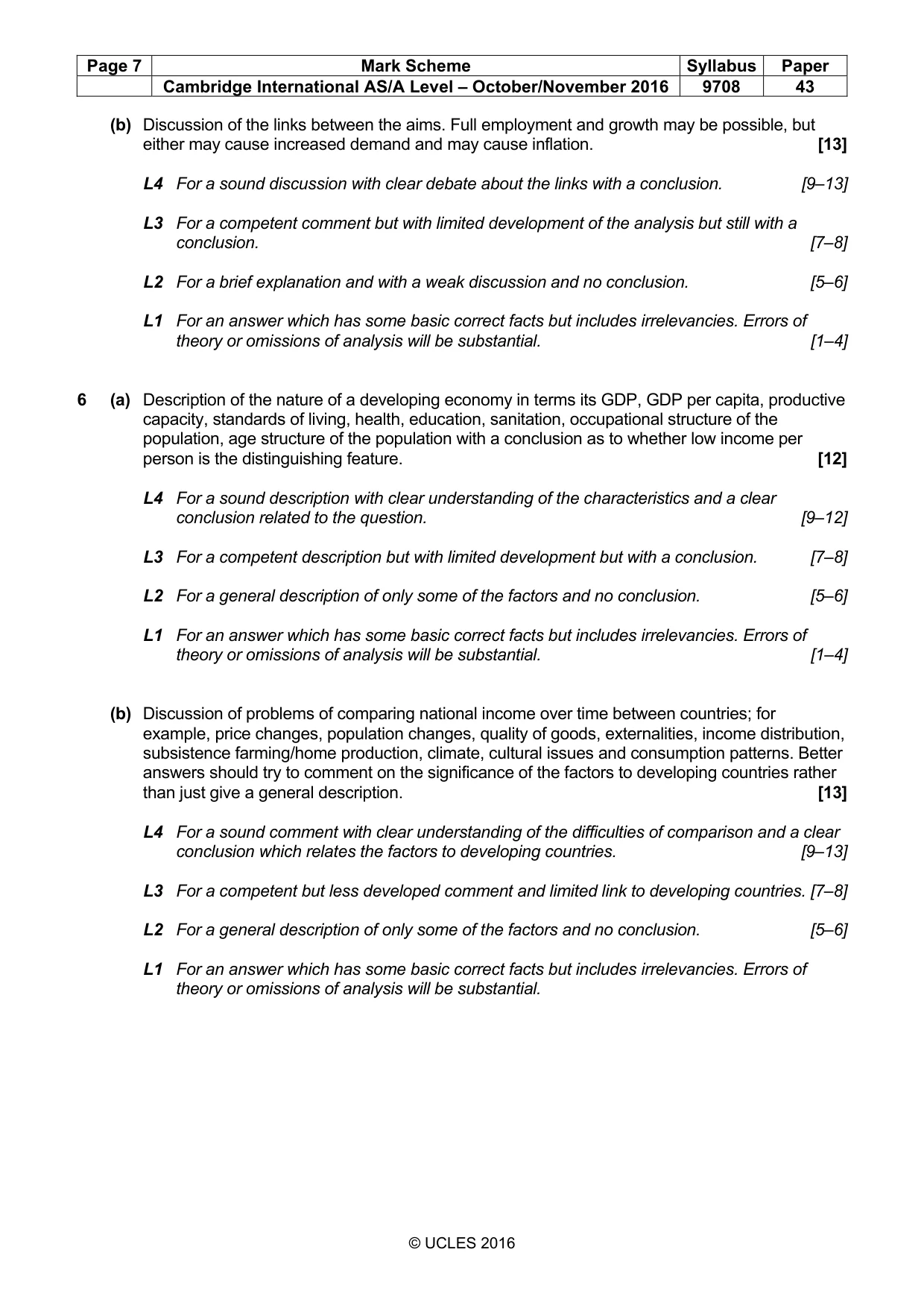
Page 7 Mark Scheme Syllabus Paper Cambridge International AS/A Level – October/November 2016 9708 43 © UCLES 2016 (b) Discussion of the links between the aims. Full employment and growth may be possible, but either may cause increased demand and may cause inflation. [13] L4 For a sound discussion with clear debate about the links with a conclusion. [9–13] L3 For a competent comment but with limited development of the analysis but still with a conclusion. [7–8] L2 For a brief explanation and with a weak discussion and no conclusion. [5–6] L1 For an answer which has some basic correct facts but includes irrelevancies. Errors of theory or omissions of analysis will be substantial. [1–4] 6 (a) Description of the nature of a developing economy in terms its GDP, GDP per capita, productive capacity, standards of living, health, education, sanitation, occupational structure of the population, age structure of the population with a conclusion as to whether low income per person is the distinguishing feature. [12] L4 For a sound description with clear understanding of the characteristics and a clear conclusion related to the question. [9–12] L3 For a competent description but with limited development but with a conclusion. [7–8] L2 For a general description of only some of the factors and no conclusion. [5–6] L1 For an answer which has some basic correct facts but includes irrelevancies. Errors of theory or omissions of analysis will be substantial. [1–4] (b) Discussion of problems of comparing national income over time between countries; for example, price changes, population changes, quality of goods, externalities, income distribution, subsistence farming/home production, climate, cultural issues and consumption patterns. Better answers should try to comment on the significance of the factors to developing countries rather than just give a general description. [13] L4 For a sound comment with clear understanding of the difficulties of comparison and a clear conclusion which relates the factors to developing countries. [9–13] L3 For a competent but less developed comment and limited link to developing countries. [7–8] L2 For a general description of only some of the factors and no conclusion. [5–6] L1 For an answer which has some basic correct facts but includes irrelevancies. Errors of theory or omissions of analysis will be substantial.
Mark scheme, page 8
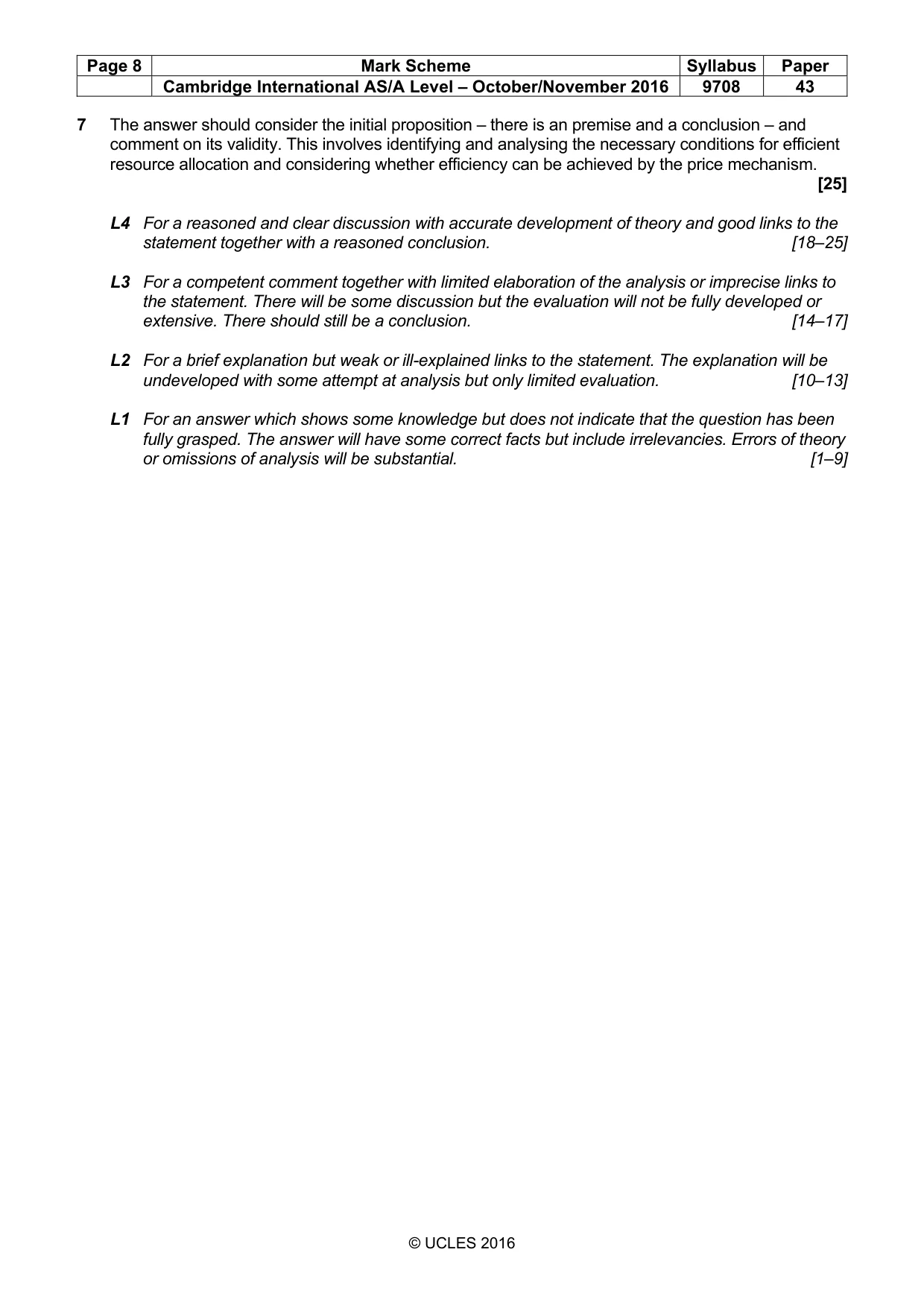
Page 8 Mark Scheme Syllabus Paper Cambridge International AS/A Level – October/November 2016 9708 43 © UCLES 2016 7 The answer should consider the initial proposition – there is an premise and a conclusion – and comment on its validity. This involves identifying and analysing the necessary conditions for efficient resource allocation and considering whether efficiency can be achieved by the price mechanism. [25] L4 For a reasoned and clear discussion with accurate development of theory and good links to the statement together with a reasoned conclusion. [18–25] L3 For a competent comment together with limited elaboration of the analysis or imprecise links to the statement. There will be some discussion but the evaluation will not be fully developed or extensive. There should still be a conclusion. [14–17] L2 For a brief explanation but weak or ill-explained links to the statement. The explanation will be undeveloped with some attempt at analysis but only limited evaluation. [10–13] L1 For an answer which shows some knowledge but does not indicate that the question has been fully grasped. The answer will have some correct facts but include irrelevancies. Errors of theory or omissions of analysis will be substantial. [1–9]
What you needed in this session
Cambridge’s own grade thresholds for 2016 Oct/Nov, Paper 4 · Variant 3. A higher threshold means an easier paper — the bar moves with how the cohort did.