Cambridge A Level Economics 9708 — 2016 May/June Paper 4 · Variant 2
9708/42/M/J/16 · 70 marks · ≈79 min
The question paper and its mark scheme, free to read here and free to download. This is Cambridge’s own paper, exactly as it was sat.
Question paper4 pages

Mark scheme10 pages
Answers below. Sit the paper first if you are practising.
Paper as text
Question paper, page 1
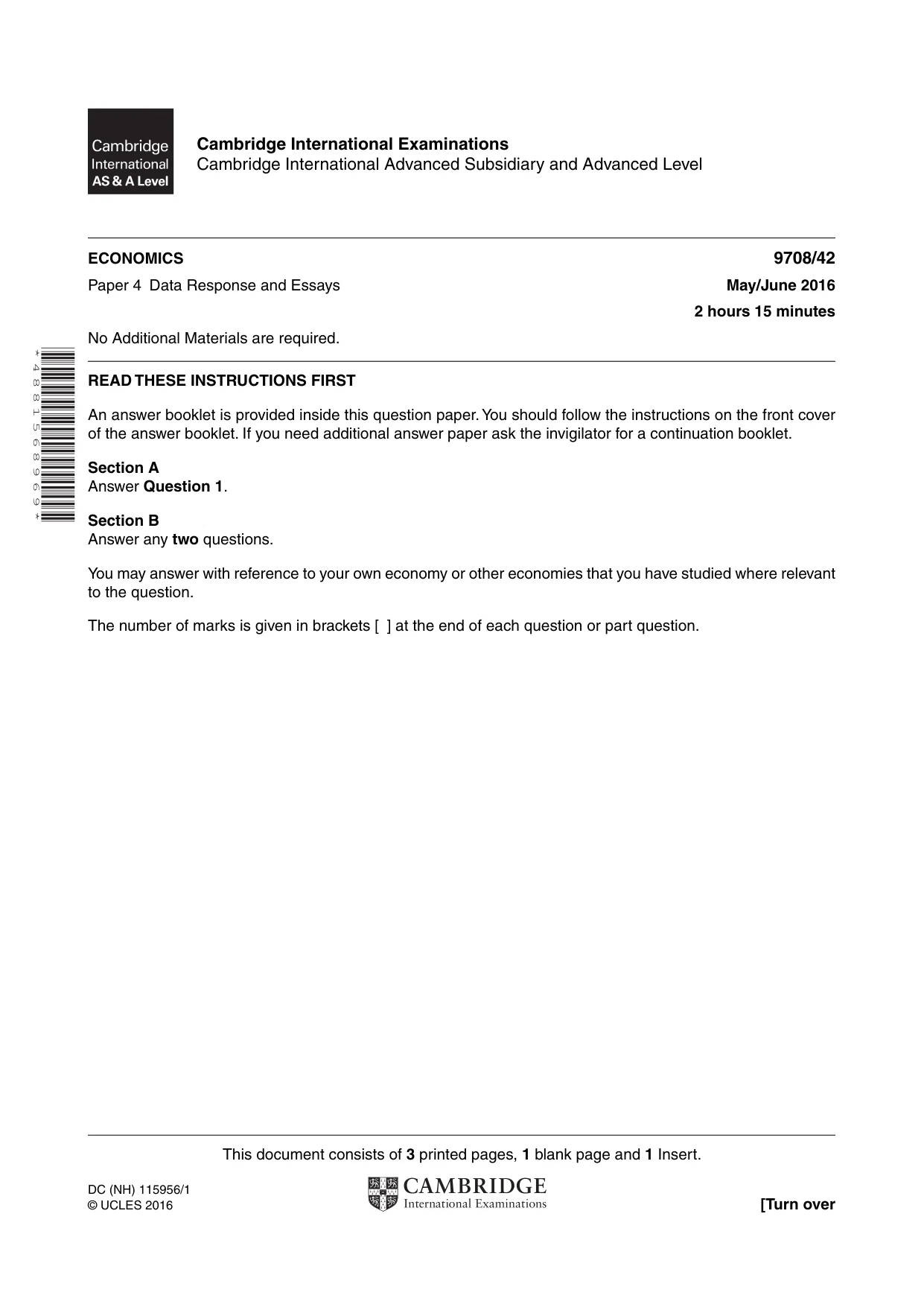
This document consists of 3 printed pages, 1 blank page and 1 Insert. DC (NH) 115956/1 © UCLES 2016 [Turn over * 4 8 8 1 5 6 8 9 6 9 * ECONOMICS 9708/42 Paper 4 Data Response and Essays May/June 2016 2 hours 15 minutes No Additional Materials are required. READ THESE INSTRUCTIONS FIRST An answer booklet is provided inside this question paper. You should follow the instructions on the front cover of the answer booklet. If you need additional answer paper ask the invigilator for a continuation booklet. Section A Answer Question 1. Section B Answer any two questions. You may answer with reference to your own economy or other economies that you have studied where relevant to the question. The number of marks is given in brackets [ ] at the end of each question or part question. Cambridge International Examinations Cambridge International Advanced Subsidiary and Advanced Level
Question paper, page 2
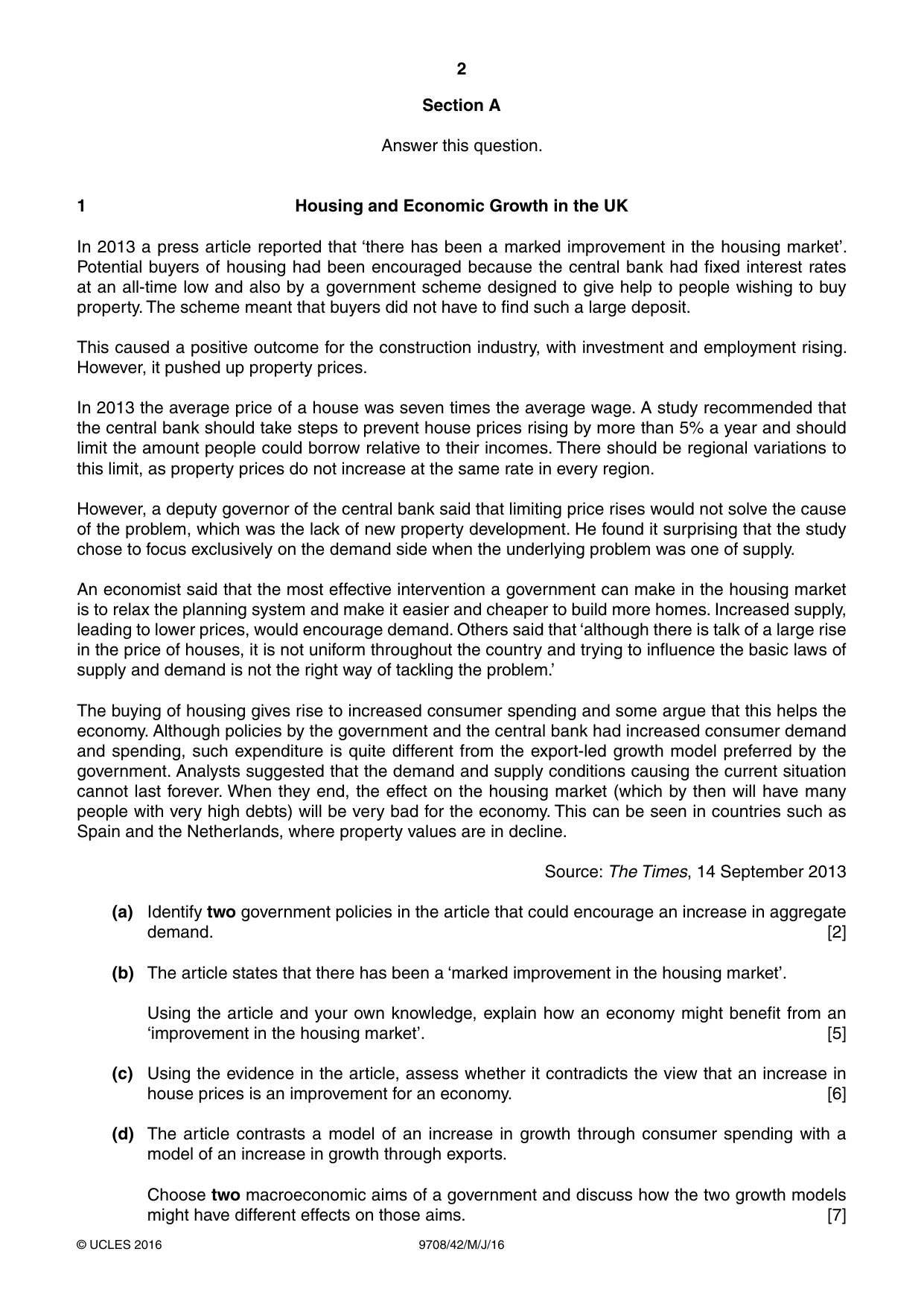
2 9708/42/M/J/16 © UCLES 2016 Section A Answer this question. 1 Housing and Economic Growth in the UK In 2013 a press article reported that ‘there has been a marked improvement in the housing market’. Potential buyers of housing had been encouraged because the central bank had fixed interest rates at an all-time low and also by a government scheme designed to give help to people wishing to buy property. The scheme meant that buyers did not have to find such a large deposit. This caused a positive outcome for the construction industry, with investment and employment rising. However, it pushed up property prices. In 2013 the average price of a house was seven times the average wage. A study recommended that the central bank should take steps to prevent house prices rising by more than 5% a year and should limit the amount people could borrow relative to their incomes. There should be regional variations to this limit, as property prices do not increase at the same rate in every region. However, a deputy governor of the central bank said that limiting price rises would not solve the cause of the problem, which was the lack of new property development. He found it surprising that the study chose to focus exclusively on the demand side when the underlying problem was one of supply. An economist said that the most effective intervention a government can make in the housing market is to relax the planning system and make it easier and cheaper to build more homes. Increased supply, leading to lower prices, would encourage demand. Others said that ‘although there is talk of a large rise in the price of houses, it is not uniform throughout the country and trying to influence the basic laws of supply and demand is not the right way of tackling the problem.’ The buying of housing gives rise to increased consumer spending and some argue that this helps the economy. Although policies by the government and the central bank had increased consumer demand and spending, such expenditure is quite different from the export-led growth model preferred by the government. Analysts suggested that the demand and supply conditions causing the current situation cannot last forever. When they end, the effect on the housing market (which by then will have many people with very high debts) will be very bad for the economy. This can be seen in countries such as Spain and the Netherlands, where property values are in decline. Source: The Times, 14 September 2013 (a) Identify two government policies in the article that could encourage an increase in aggregate demand. [2] (b) The article states that there has been a ‘marked improvement in the housing market’. Using the article and your own knowledge, explain how an economy might benefit from an ‘improvement in the housing market’. [5] (c) Using the evidence in the article, assess whether it contradicts the view that an increase in house prices is an improvement for an economy. [6] (d) The article contrasts a model of an increase in growth through consumer spending with a model of an increase in growth through exports. Choose two macroeconomic aims of a government and discuss how the two growth models might have different effects on those aims. [7]
Question paper, page 3
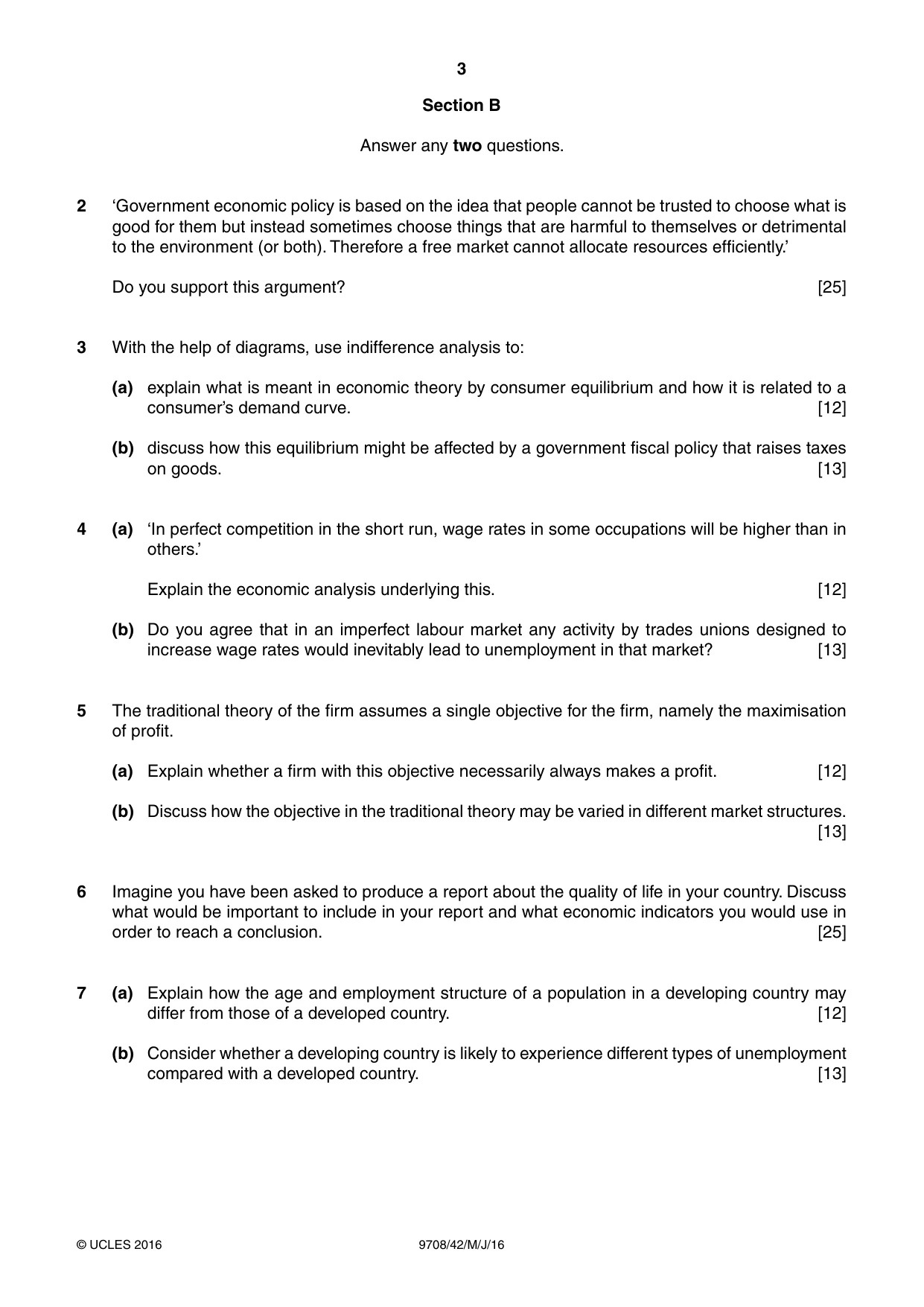
3 9708/42/M/J/16 © UCLES 2016 Section B Answer any two questions. 2 ‘Government economic policy is based on the idea that people cannot be trusted to choose what is good for them but instead sometimes choose things that are harmful to themselves or detrimental to the environment (or both). Therefore a free market cannot allocate resources efficiently.’ Do you support this argument? [25] 3 With the help of diagrams, use indifference analysis to: (a) explain what is meant in economic theory by consumer equilibrium and how it is related to a consumer’s demand curve. [12] (b) discuss how this equilibrium might be affected by a government fiscal policy that raises taxes on goods. [13] 4 (a) ‘In perfect competition in the short run, wage rates in some occupations will be higher than in others.’ Explain the economic analysis underlying this. [12] (b) Do you agree that in an imperfect labour market any activity by trades unions designed to increase wage rates would inevitably lead to unemployment in that market? [13] 5 The traditional theory of the firm assumes a single objective for the firm, namely the maximisation of profit. (a) Explain whether a firm with this objective necessarily always makes a profit. [12] (b) Discuss how the objective in the traditional theory may be varied in different market structures. [13] 6 Imagine you have been asked to produce a report about the quality of life in your country. Discuss what would be important to include in your report and what economic indicators you would use in order to reach a conclusion. [25] 7 (a) Explain how the age and employment structure of a population in a developing country may differ from those of a developed country. [12] (b) Consider whether a developing country is likely to experience different types of unemployment compared with a developed country. [13]
Question paper, page 4
4 9708/42/M/J/16 © UCLES 2016 BLANK PAGE Permission to reproduce items where third-party owned material protected by copyright is included has been sought and cleared where possible. Every reasonable effort has been made by the publisher (UCLES) to trace copyright holders, but if any items requiring clearance have unwittingly been included, the publisher will be pleased to make amends at the earliest possible opportunity. To avoid the issue of disclosure of answer-related information to candidates, all copyright acknowledgements are reproduced online in the Cambridge International Examinations Copyright Acknowledgements Booklet. This is produced for each series of examinations and is freely available to download at www.cie.org.uk after the live examination series. Cambridge International Examinations is part of the Cambridge Assessment Group. Cambridge Assessment is the brand name of University of Cambridge Local Examinations Syndicate (UCLES), which is itself a department of the University of Cambridge.
Mark scheme, page 1
© Cambridge International Examinations 2016 Cambridge International Examinations Cambridge International Advanced Subsidiary and Advanced Level ECONOMICS 9708/42 Paper 4 Data Response and Essays May/June 2016 MARK SCHEME Maximum Mark: 70 Published This mark scheme is published as an aid to teachers and candidates, to indicate the requirements of the examination. It shows the basis on which Examiners were instructed to award marks. It does not indicate the details of the discussions that took place at an Examiners’ meeting before marking began, which would have considered the acceptability of alternative answers. Mark schemes should be read in conjunction with the question paper and the Principal Examiner Report for Teachers. Cambridge will not enter into discussions about these mark schemes. Cambridge is publishing the mark schemes for the May/June 2016 series for most Cambridge IGCSE®, Cambridge International A and AS Level components and some Cambridge O Level components.
Mark scheme, page 2
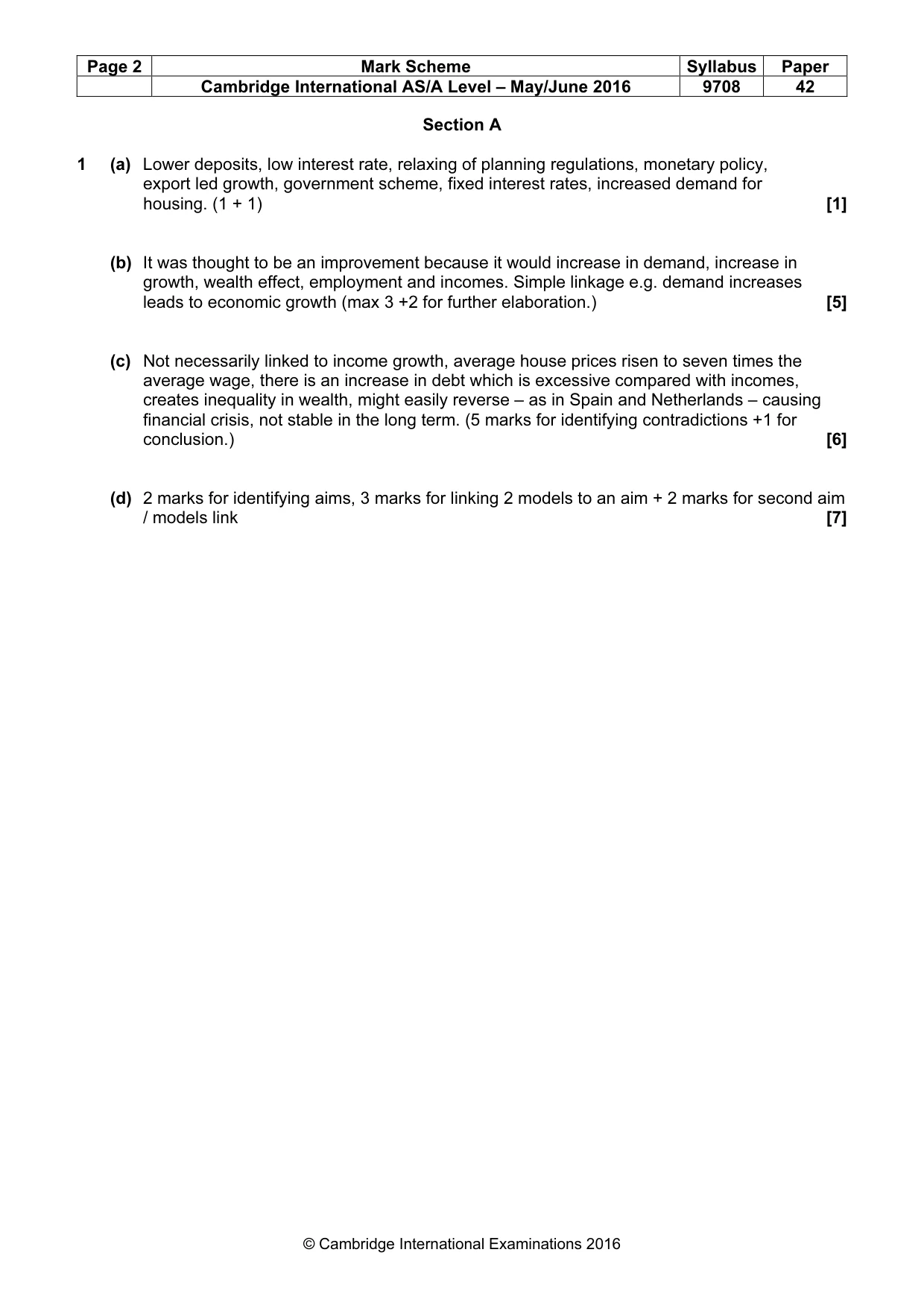
Page 2 Mark Scheme Syllabus Paper Cambridge International AS/A Level – May/June 2016 9708 42 © Cambridge International Examinations 2016 Section A 1 (a) Lower deposits, low interest rate, relaxing of planning regulations, monetary policy, export led growth, government scheme, fixed interest rates, increased demand for housing. (1 + 1) [1] (b) It was thought to be an improvement because it would increase in demand, increase in growth, wealth effect, employment and incomes. Simple linkage e.g. demand increases leads to economic growth (max 3 +2 for further elaboration.) [5] (c) Not necessarily linked to income growth, average house prices risen to seven times the average wage, there is an increase in debt which is excessive compared with incomes, creates inequality in wealth, might easily reverse – as in Spain and Netherlands – causing financial crisis, not stable in the long term. (5 marks for identifying contradictions +1 for conclusion.) [6] (d) 2 marks for identifying aims, 3 marks for linking 2 models to an aim + 2 marks for second aim / models link [7]
Mark scheme, page 3
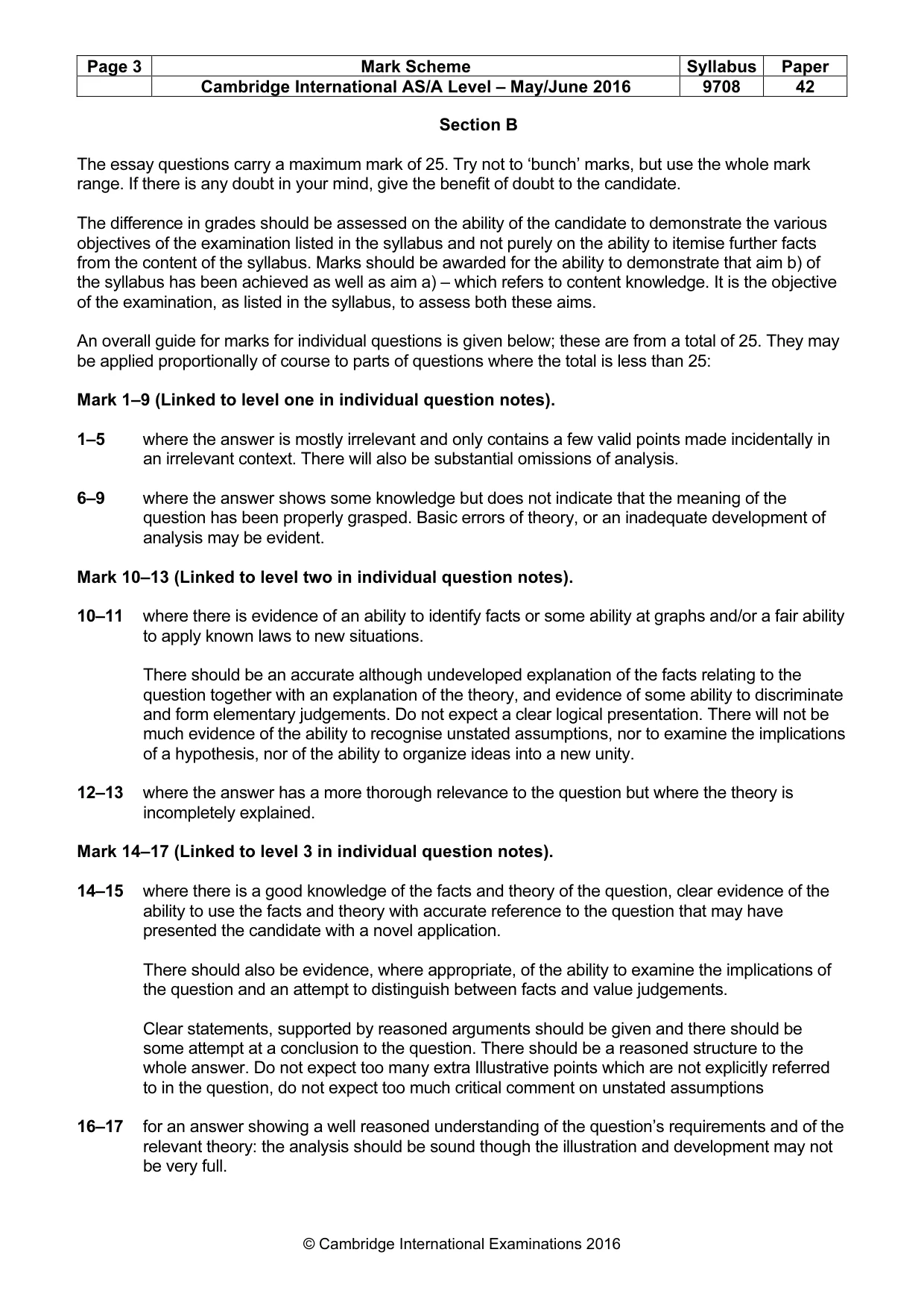
Page 3 Mark Scheme Syllabus Paper Cambridge International AS/A Level – May/June 2016 9708 42 © Cambridge International Examinations 2016 Section B The essay questions carry a maximum mark of 25. Try not to ‘bunch’ marks, but use the whole mark range. If there is any doubt in your mind, give the benefit of doubt to the candidate. The difference in grades should be assessed on the ability of the candidate to demonstrate the various objectives of the examination listed in the syllabus and not purely on the ability to itemise further facts from the content of the syllabus. Marks should be awarded for the ability to demonstrate that aim b) of the syllabus has been achieved as well as aim a) – which refers to content knowledge. It is the objective of the examination, as listed in the syllabus, to assess both these aims. An overall guide for marks for individual questions is given below; these are from a total of 25. They may be applied proportionally of course to parts of questions where the total is less than 25: Mark 1–9 (Linked to level one in individual question notes). 1–5 where the answer is mostly irrelevant and only contains a few valid points made incidentally in an irrelevant context. There will also be substantial omissions of analysis. 6–9 where the answer shows some knowledge but does not indicate that the meaning of the question has been properly grasped. Basic errors of theory, or an inadequate development of analysis may be evident. Mark 10–13 (Linked to level two in individual question notes). 10–11 where there is evidence of an ability to identify facts or some ability at graphs and/or a fair ability to apply known laws to new situations. There should be an accurate although undeveloped explanation of the facts relating to the question together with an explanation of the theory, and evidence of some ability to discriminate and form elementary judgements. Do not expect a clear logical presentation. There will not be much evidence of the ability to recognise unstated assumptions, nor to examine the implications of a hypothesis, nor of the ability to organize ideas into a new unity. 12–13 where the answer has a more thorough relevance to the question but where the theory is incompletely explained. Mark 14–17 (Linked to level 3 in individual question notes). 14–15 where there is a good knowledge of the facts and theory of the question, clear evidence of the ability to use the facts and theory with accurate reference to the question that may have presented the candidate with a novel application. There should also be evidence, where appropriate, of the ability to examine the implications of the question and an attempt to distinguish between facts and value judgements. Clear statements, supported by reasoned arguments should be given and there should be some attempt at a conclusion to the question. There should be a reasoned structure to the whole answer. Do not expect too many extra Illustrative points which are not explicitly referred to in the question, do not expect too much critical comment on unstated assumptions 16–17 for an answer showing a well reasoned understanding of the question’s requirements and of the relevant theory: the analysis should be sound though the illustration and development may not be very full.
Mark scheme, page 4
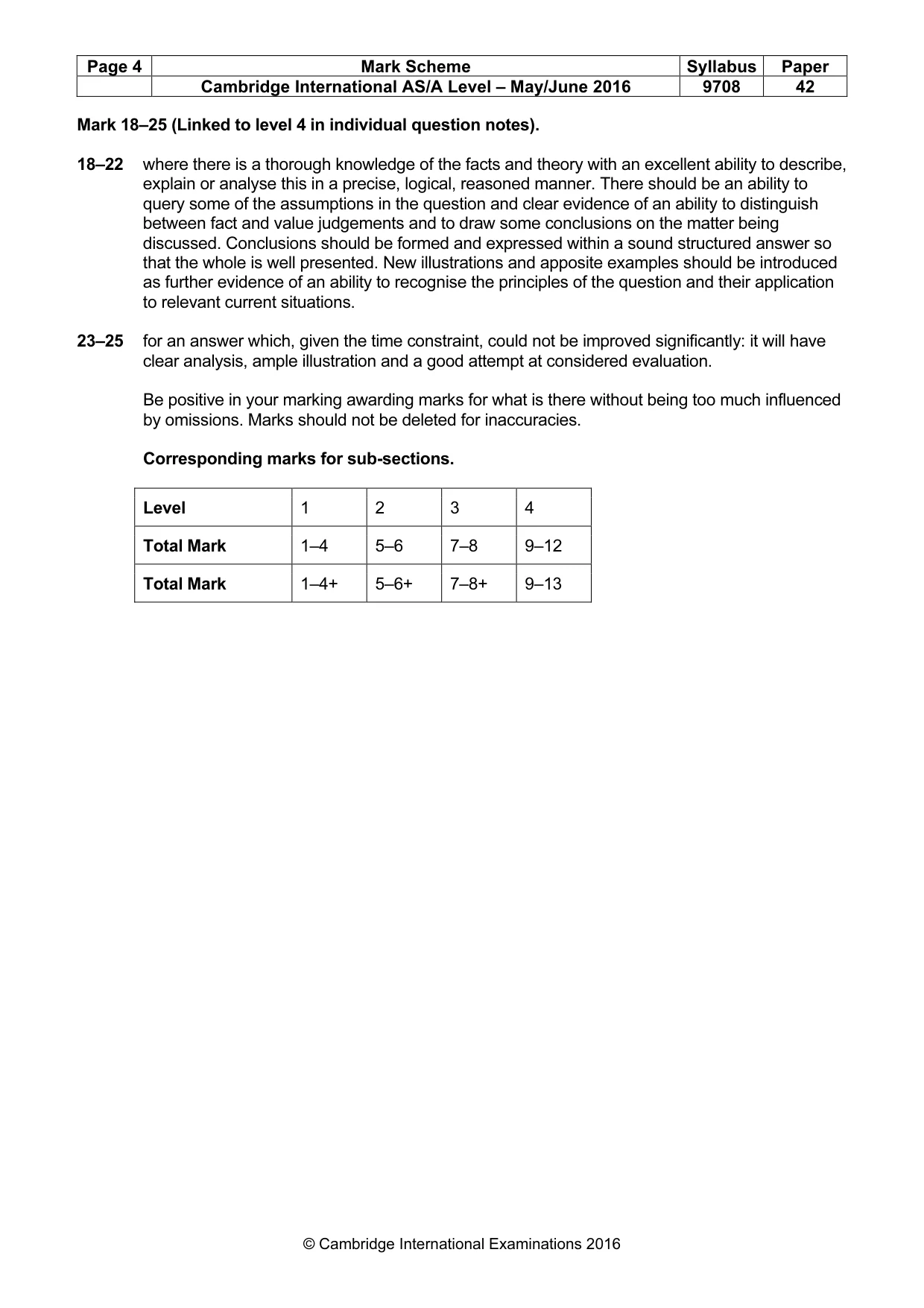
Page 4 Mark Scheme Syllabus Paper Cambridge International AS/A Level – May/June 2016 9708 42 © Cambridge International Examinations 2016 Mark 18–25 (Linked to level 4 in individual question notes). 18–22 where there is a thorough knowledge of the facts and theory with an excellent ability to describe, explain or analyse this in a precise, logical, reasoned manner. There should be an ability to query some of the assumptions in the question and clear evidence of an ability to distinguish between fact and value judgements and to draw some conclusions on the matter being discussed. Conclusions should be formed and expressed within a sound structured answer so that the whole is well presented. New illustrations and apposite examples should be introduced as further evidence of an ability to recognise the principles of the question and their application to relevant current situations. 23–25 for an answer which, given the time constraint, could not be improved significantly: it will have clear analysis, ample illustration and a good attempt at considered evaluation. Be positive in your marking awarding marks for what is there without being too much influenced by omissions. Marks should not be deleted for inaccuracies. Corresponding marks for sub-sections. Level 1 2 3 4 Total Mark 1–4 5–6 7–8 9–12 Total Mark 1–4+ 5–6+ 7–8+ 9–13
Mark scheme, page 5
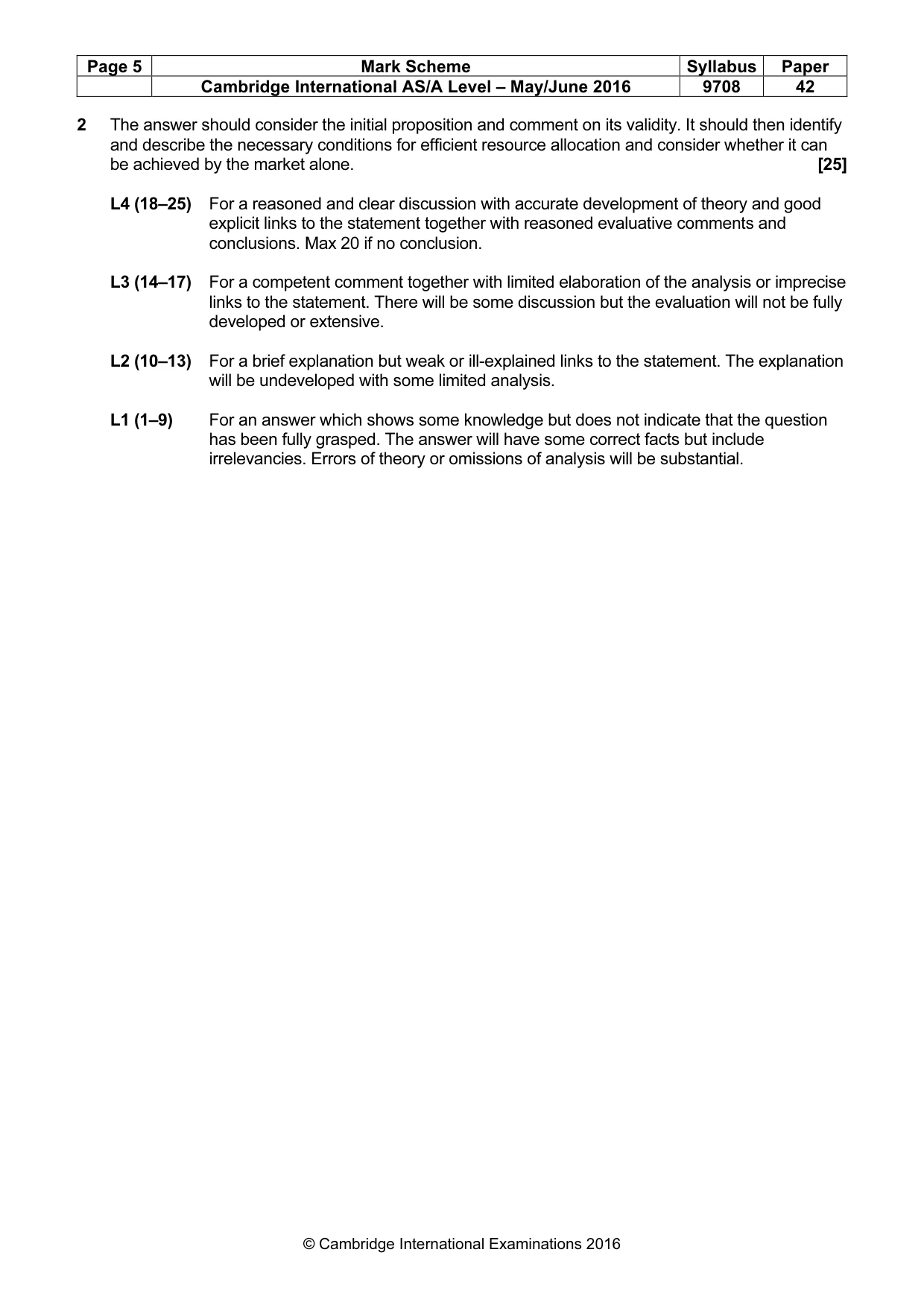
Page 5 Mark Scheme Syllabus Paper Cambridge International AS/A Level – May/June 2016 9708 42 © Cambridge International Examinations 2016 2 The answer should consider the initial proposition and comment on its validity. It should then identify and describe the necessary conditions for efficient resource allocation and consider whether it can be achieved by the market alone. [25] L4 (18–25) For a reasoned and clear discussion with accurate development of theory and good explicit links to the statement together with reasoned evaluative comments and conclusions. Max 20 if no conclusion. L3 (14–17) For a competent comment together with limited elaboration of the analysis or imprecise links to the statement. There will be some discussion but the evaluation will not be fully developed or extensive. L2 (10–13) For a brief explanation but weak or ill-explained links to the statement. The explanation will be undeveloped with some limited analysis. L1 (1–9) For an answer which shows some knowledge but does not indicate that the question has been fully grasped. The answer will have some correct facts but include irrelevancies. Errors of theory or omissions of analysis will be substantial.
Mark scheme, page 6
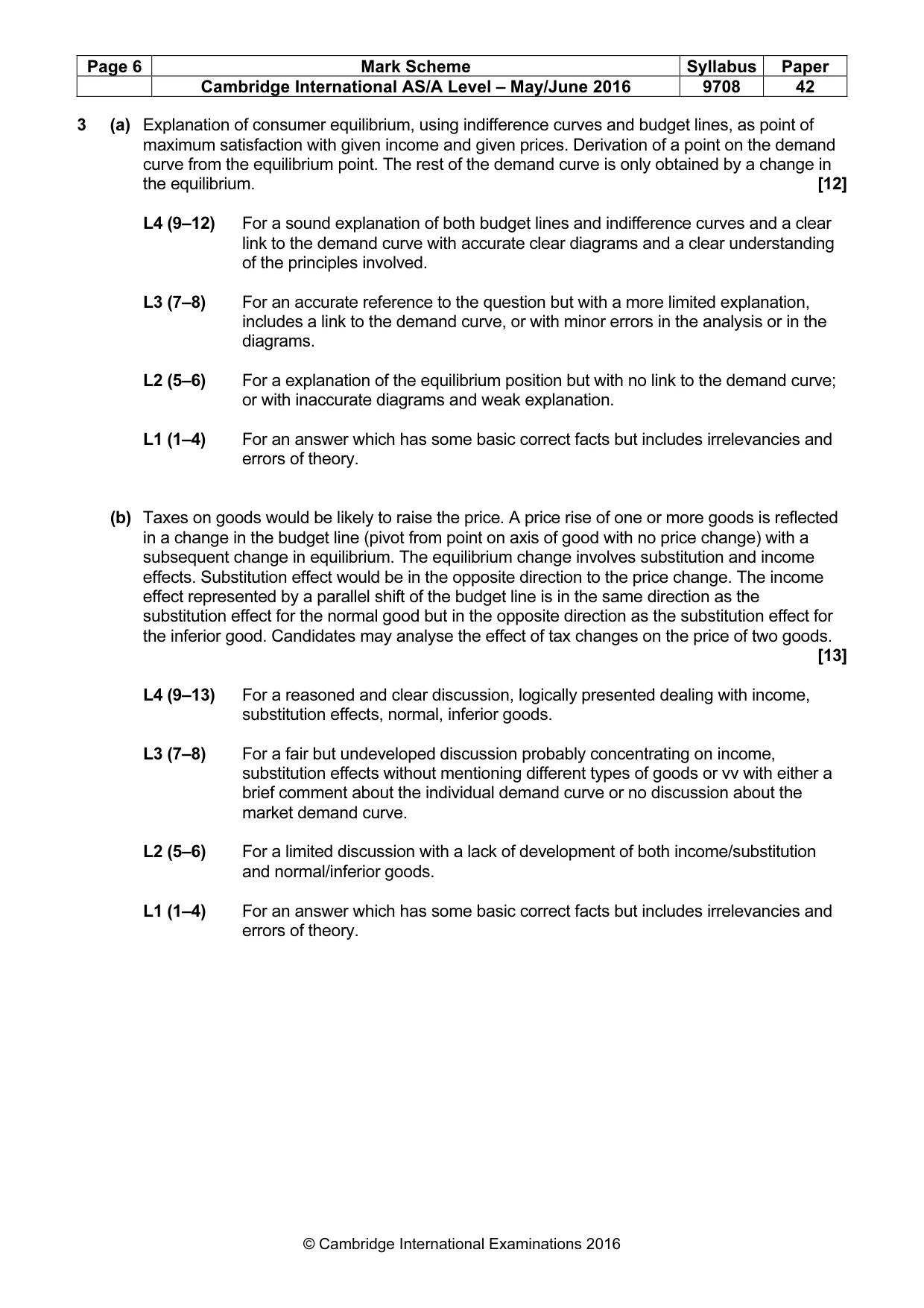
Page 6 Mark Scheme Syllabus Paper Cambridge International AS/A Level – May/June 2016 9708 42 © Cambridge International Examinations 2016 3 (a) Explanation of consumer equilibrium, using indifference curves and budget lines, as point of maximum satisfaction with given income and given prices. Derivation of a point on the demand curve from the equilibrium point. The rest of the demand curve is only obtained by a change in the equilibrium. [12] L4 (9–12) For a sound explanation of both budget lines and indifference curves and a clear link to the demand curve with accurate clear diagrams and a clear understanding of the principles involved. L3 (7–8) For an accurate reference to the question but with a more limited explanation, includes a link to the demand curve, or with minor errors in the analysis or in the diagrams. L2 (5–6) For a explanation of the equilibrium position but with no link to the demand curve; or with inaccurate diagrams and weak explanation. L1 (1–4) For an answer which has some basic correct facts but includes irrelevancies and errors of theory. (b) Taxes on goods would be likely to raise the price. A price rise of one or more goods is reflected in a change in the budget line (pivot from point on axis of good with no price change) with a subsequent change in equilibrium. The equilibrium change involves substitution and income effects. Substitution effect would be in the opposite direction to the price change. The income effect represented by a parallel shift of the budget line is in the same direction as the substitution effect for the normal good but in the opposite direction as the substitution effect for the inferior good. Candidates may analyse the effect of tax changes on the price of two goods. [13] L4 (9–13) For a reasoned and clear discussion, logically presented dealing with income, substitution effects, normal, inferior goods. L3 (7–8) For a fair but undeveloped discussion probably concentrating on income, substitution effects without mentioning different types of goods or vv with either a brief comment about the individual demand curve or no discussion about the market demand curve. L2 (5–6) For a limited discussion with a lack of development of both income/substitution and normal/inferior goods. L1 (1–4) For an answer which has some basic correct facts but includes irrelevancies and errors of theory.
Mark scheme, page 7
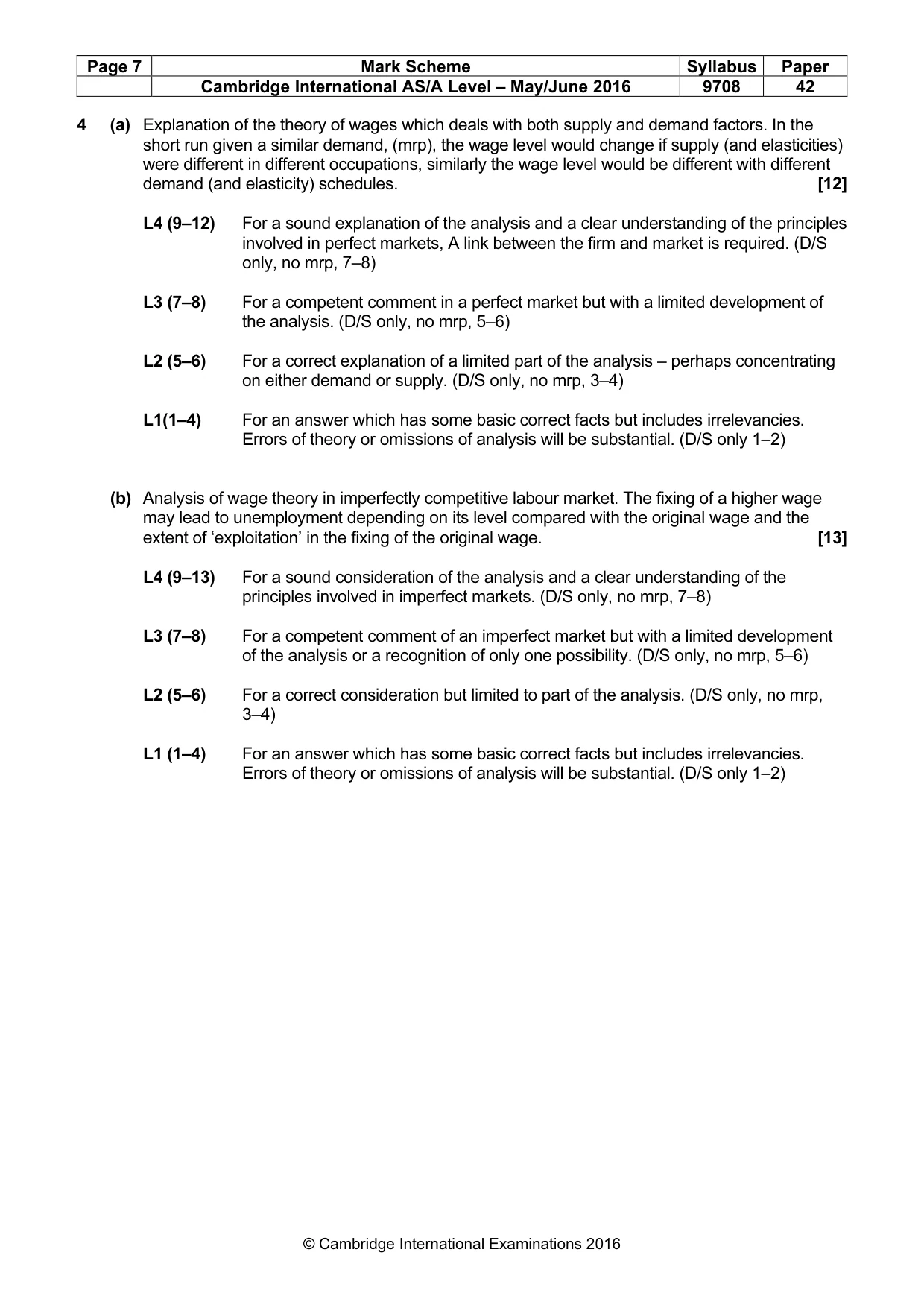
Page 7 Mark Scheme Syllabus Paper Cambridge International AS/A Level – May/June 2016 9708 42 © Cambridge International Examinations 2016 4 (a) Explanation of the theory of wages which deals with both supply and demand factors. In the short run given a similar demand, (mrp), the wage level would change if supply (and elasticities) were different in different occupations, similarly the wage level would be different with different demand (and elasticity) schedules. [12] L4 (9–12) For a sound explanation of the analysis and a clear understanding of the principles involved in perfect markets, A link between the firm and market is required. (D/S only, no mrp, 7–8) L3 (7–8) For a competent comment in a perfect market but with a limited development of the analysis. (D/S only, no mrp, 5–6) L2 (5–6) For a correct explanation of a limited part of the analysis – perhaps concentrating on either demand or supply. (D/S only, no mrp, 3–4) L1(1–4) For an answer which has some basic correct facts but includes irrelevancies. Errors of theory or omissions of analysis will be substantial. (D/S only 1–2) (b) Analysis of wage theory in imperfectly competitive labour market. The fixing of a higher wage may lead to unemployment depending on its level compared with the original wage and the extent of ‘exploitation’ in the fixing of the original wage. [13] L4 (9–13) For a sound consideration of the analysis and a clear understanding of the principles involved in imperfect markets. (D/S only, no mrp, 7–8) L3 (7–8) For a competent comment of an imperfect market but with a limited development of the analysis or a recognition of only one possibility. (D/S only, no mrp, 5–6) L2 (5–6) For a correct consideration but limited to part of the analysis. (D/S only, no mrp, 3–4) L1 (1–4) For an answer which has some basic correct facts but includes irrelevancies. Errors of theory or omissions of analysis will be substantial. (D/S only 1–2)
Mark scheme, page 8
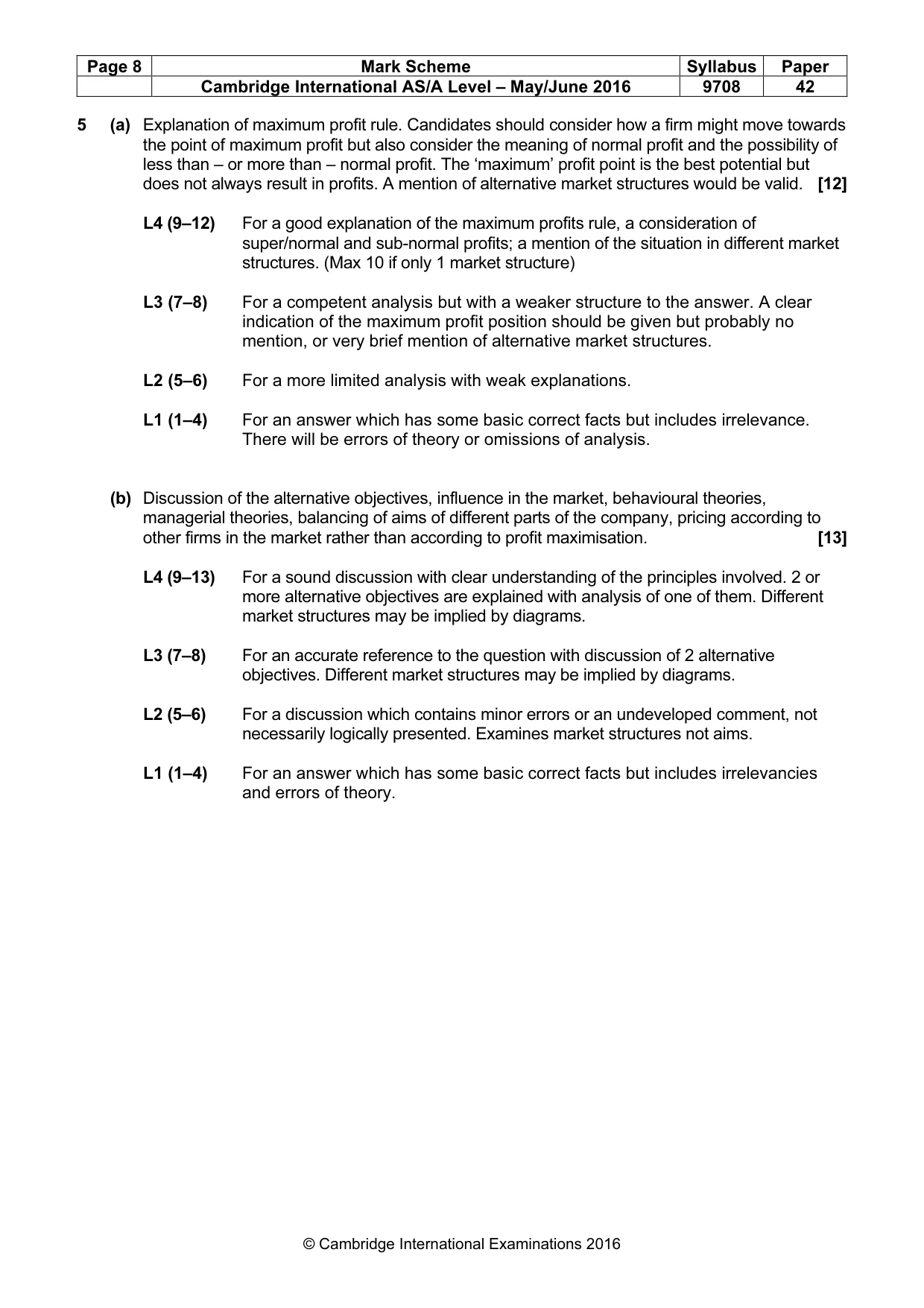
Page 8 Mark Scheme Syllabus Paper Cambridge International AS/A Level – May/June 2016 9708 42 © Cambridge International Examinations 2016 5 (a) Explanation of maximum profit rule. Candidates should consider how a firm might move towards the point of maximum profit but also consider the meaning of normal profit and the possibility of less than – or more than – normal profit. The ‘maximum’ profit point is the best potential but does not always result in profits. A mention of alternative market structures would be valid. [12] L4 (9–12) For a good explanation of the maximum profits rule, a consideration of super/normal and sub-normal profits; a mention of the situation in different market structures. (Max 10 if only 1 market structure) L3 (7–8) For a competent analysis but with a weaker structure to the answer. A clear indication of the maximum profit position should be given but probably no mention, or very brief mention of alternative market structures. L2 (5–6) For a more limited analysis with weak explanations. L1 (1–4) For an answer which has some basic correct facts but includes irrelevance. There will be errors of theory or omissions of analysis. (b) Discussion of the alternative objectives, influence in the market, behavioural theories, managerial theories, balancing of aims of different parts of the company, pricing according to other firms in the market rather than according to profit maximisation. [13] L4 (9–13) For a sound discussion with clear understanding of the principles involved. 2 or more alternative objectives are explained with analysis of one of them. Different market structures may be implied by diagrams. L3 (7–8) For an accurate reference to the question with discussion of 2 alternative objectives. Different market structures may be implied by diagrams. L2 (5–6) For a discussion which contains minor errors or an undeveloped comment, not necessarily logically presented. Examines market structures not aims. L1 (1–4) For an answer which has some basic correct facts but includes irrelevancies and errors of theory.
Mark scheme, page 9
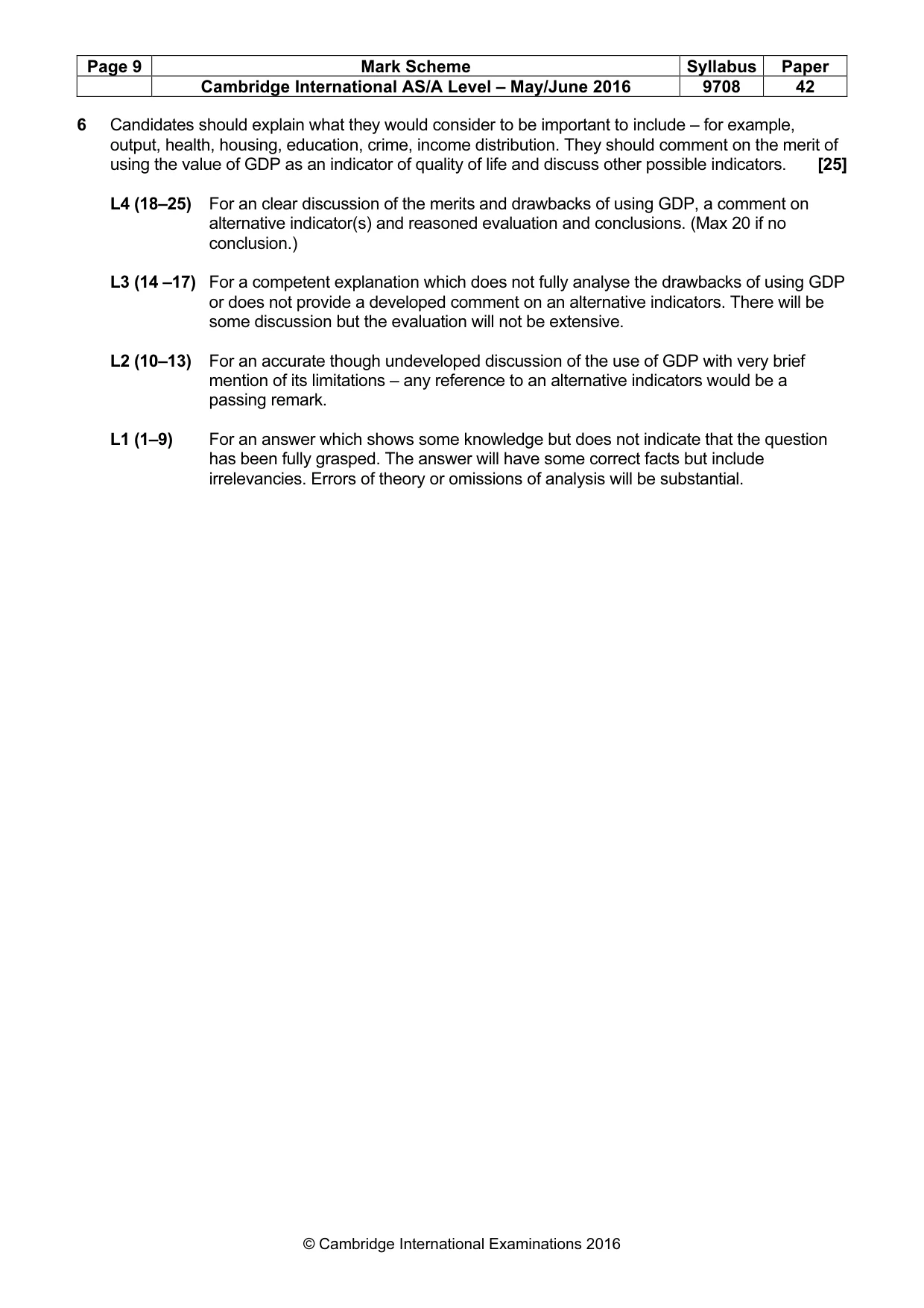
Page 9 Mark Scheme Syllabus Paper Cambridge International AS/A Level – May/June 2016 9708 42 © Cambridge International Examinations 2016 6 Candidates should explain what they would consider to be important to include – for example, output, health, housing, education, crime, income distribution. They should comment on the merit of using the value of GDP as an indicator of quality of life and discuss other possible indicators. [25] L4 (18–25) For an clear discussion of the merits and drawbacks of using GDP, a comment on alternative indicator(s) and reasoned evaluation and conclusions. (Max 20 if no conclusion.) L3 (14 –17) For a competent explanation which does not fully analyse the drawbacks of using GDP or does not provide a developed comment on an alternative indicators. There will be some discussion but the evaluation will not be extensive. L2 (10–13) For an accurate though undeveloped discussion of the use of GDP with very brief mention of its limitations – any reference to an alternative indicators would be a passing remark. L1 (1–9) For an answer which shows some knowledge but does not indicate that the question has been fully grasped. The answer will have some correct facts but include irrelevancies. Errors of theory or omissions of analysis will be substantial.
Mark scheme, page 10
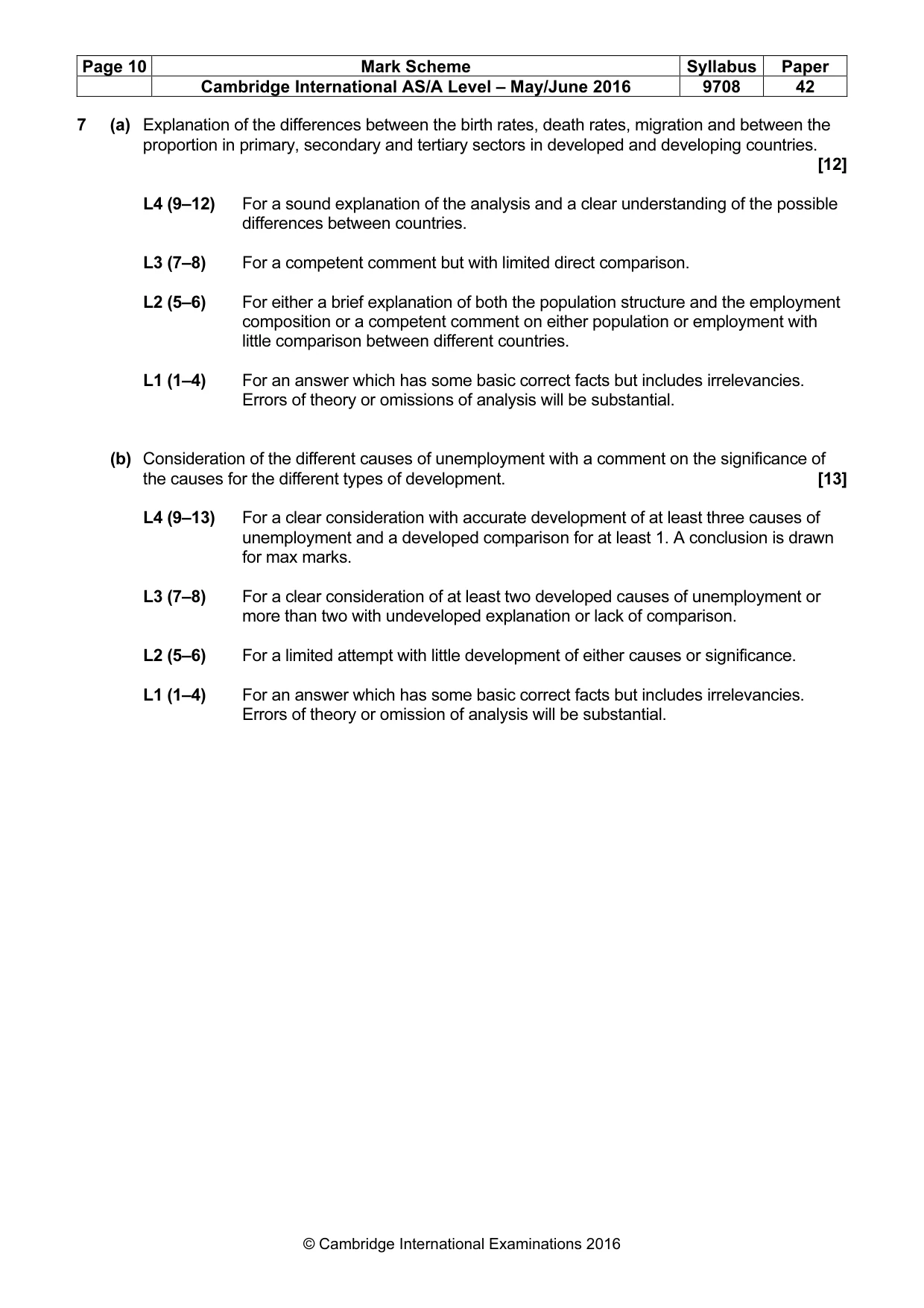
Page 10 Mark Scheme Syllabus Paper Cambridge International AS/A Level – May/June 2016 9708 42 © Cambridge International Examinations 2016 7 (a) Explanation of the differences between the birth rates, death rates, migration and between the proportion in primary, secondary and tertiary sectors in developed and developing countries. [12] L4 (9–12) For a sound explanation of the analysis and a clear understanding of the possible differences between countries. L3 (7–8) For a competent comment but with limited direct comparison. L2 (5–6) For either a brief explanation of both the population structure and the employment composition or a competent comment on either population or employment with little comparison between different countries. L1 (1–4) For an answer which has some basic correct facts but includes irrelevancies. Errors of theory or omissions of analysis will be substantial. (b) Consideration of the different causes of unemployment with a comment on the significance of the causes for the different types of development. [13] L4 (9–13) For a clear consideration with accurate development of at least three causes of unemployment and a developed comparison for at least 1. A conclusion is drawn for max marks. L3 (7–8) For a clear consideration of at least two developed causes of unemployment or more than two with undeveloped explanation or lack of comparison. L2 (5–6) For a limited attempt with little development of either causes or significance. L1 (1–4) For an answer which has some basic correct facts but includes irrelevancies. Errors of theory or omission of analysis will be substantial.
What you needed in this session
Cambridge’s own grade thresholds for 2016 May/June, Paper 4 · Variant 2. A higher threshold means an easier paper — the bar moves with how the cohort did.