Cambridge A Level Economics 9708 — 2016 May/June Paper 4 · Variant 3
9708/43/M/J/16 · 70 marks · ≈79 min
The question paper and its mark scheme, free to read here and free to download. This is Cambridge’s own paper, exactly as it was sat.
Question paper4 pages

Mark scheme10 pages
Answers below. Sit the paper first if you are practising.
Paper as text
Question paper, page 1
This document consists of 4 printed pages and 1 Insert. DC (CW) 115957/2 © UCLES 2016 [Turn over Cambridge International Examinations Cambridge International Advanced Subsidiary and Advanced Level * 7 6 6 7 3 1 9 2 3 4 * ECONOMICS 9708/43 Paper 4 Data Response and Essays May/June 2016 2 hours 15 minutes No Additional Materials are required. READ THESE INSTRUCTIONS FIRST An answer booklet is provided inside this question paper. You should follow the instructions on the front cover of the answer booklet. If you need additional answer paper ask the invigilator for a continuation booklet. Section A Answer Question 1. Section B Answer any two questions. You may answer with reference to your own economy or other economies that you have studied where relevant to the question. The number of marks is given in brackets [ ] at the end of each question or part question.
Question paper, page 2
2 9708/43/M/J/16 © UCLES 2016 Section A Answer this question. 1 Airport Expansion In 2014, a proposal by Heathrow Airport Authority (HAA) in London recommended building an extra runway at Heathrow, one of the world’s busiest airports. HAA acknowledged that it was an initial proposal that needed more detailed work. They claimed that, if built, the runway would deliver greater economic benefits and be a better option for economic growth for the UK than any other proposal for new airport capacity. HAA was not able to quantify the benefits with any precision but said they would range from £50 billion to £156 billion (US$84 billion to US$262 billion) with a ‘central estimate’ of over £100 billion (US$168 billion). The majority would benefit the wider economy by creating jobs, encouraging trade, boosting spending and improving public finances. The proposal would allow the airport to be connected to more emerging markets and enable 40 new destinations to be served directly, including some in India and China. Cargo volumes would double and UK competitiveness would increase. HAA added that more efficient vehicles, an increased proportion of passengers travelling by public transport and new aircraft technology would mean that the extra flights would not exceed the European Union pollution limits. In order to build the new runway, major motorways would need to be altered. Many homes would have to be demolished but the airport said they would pay the owners 25% above the property’s market value. When it was built, car drivers wishing to take passengers to the airport would have to pay a congestion charge. Those opposing the new runway said that thousands of people would be forced out of their homes and communities would be destroyed and, while waiting for a decision to be made, they would be unable to sell their homes. 240 000 people would suffer from airport noise. HAA said the runway would cost £15.6 billion (US$26.2 billion) to build, with the government paying £1.2 billion (US$2.1 billion) towards the motorway alterations. There were alternative proposals. The first was to build a completely new airport to the east of Heathrow. The second was to add another runway to an existing airport, Gatwick, to the south of Heathrow. HAA argued that a completely new airport would take much longer to build and be more expensive than an extra runway and would mean higher fares for passengers. The owners of Gatwick Airport insisted that the new runway at Heathrow was not in the best interest of passengers and that Gatwick would be better able to offer lower fares and connect to emerging markets with longer-range aircraft. They said that their plans were cheaper – £7.8 billion (US$13.1 billion) – and could be built quicker than the Heathrow option, with less disruption to motorways. Noise from another runway at Gatwick would also affect fewer people – 14 000, not 240 000. Sources: Heathrow Airport website, accessed 24 May 2014, and Evening Standard, 13 May 2014
Question paper, page 3
3 9708/43/M/J/16 © UCLES 2016 [Turn over (a) HAA said ‘the new runway would benefit the wider economy’. Explain why its claim might be justified. [4] (b) Explain why dropping off passengers could be classified as an externality and suggest one method of addressing this externality. [4] (c) Airport infrastructure is privately owned and makes money for its owners. Consider why in this case the government would pay £1.2 billion towards the cost of motorway alterations. [5] (d) Consider whether the information in the proposal by the HAA was mainly factual evidence or opinion and comment on whether you would support the proposal. [7] Section B Answer any two questions. 2 (a) Economists write about indifference analysis when studying consumer choice. Does this theory of consumer behaviour mean that a consumer is always indifferent when choosing between two products? [12] (b) Discuss whether the use of a demand curve and budget lines are similar in the way they represent what will happen if the price of a good falls. [13] 3 In 2014 an American multinational pharmaceutical drug developer and supplier made a bid to take over a Swedish-British multinational drug company, but the board of that company refused to accept the bid for its shares. (a) Consider whether increasing a company’s scale of production will always reduce its costs. [12] (b) Analyse what is meant by a contestable market and consider whether companies that supply drugs are likely to be in a contestable market. [13] 4 Some workers are paid a basic rate and then paid additional commission based on the number of products sold. In 2014, a European court ruled that a worker’s holiday pay should be based on total pay including commissions and not just on the basic rate. (a) Explain, according to economic analysis, the shape of a worker’s supply curve and suggest how this court judgement might affect the number of hours worked. [12] (b) Discuss whether a trades union can always increase the wage rate of its members without affecting the level of employment. [13]
Question paper, page 4
4 9708/43/M/J/16 © UCLES 2016 5 It was reported that India’s policymakers seem to be fighting a losing battle with inflation. Some economists linked the persistent rise in prices to the pace of economic growth. (a) Consider whether economic growth will always cause inflation. [12] (b) Assess how appropriate it is to use economic growth as an indicator of how a country’s standard of living compares with other countries. [13] 6 Equilibrium is a key concept in the study of economics. Explain what an equilibrium level of national income means and discuss the relative merits of policies a government might use to cause the equilibrium level to change in an open economy. [25] 7 Private sector developers have discovered potentially profitable supplies of gas and proposed a new method of extracting it that involves drilling in some areas of natural beauty. They say it is important that a country’s resources are used efficiently. Consider whether they might mean the same as economists when they talk about the efficient use of resources and whether it is possible in practice for private organisations to achieve such economic efficiency. [25] Permission to reproduce items where third-party owned material protected by copyright is included has been sought and cleared where possible. Every reasonable effort has been made by the publisher (UCLES) to trace copyright holders, but if any items requiring clearance have unwittingly been included, the publisher will be pleased to make amends at the earliest possible opportunity. To avoid the issue of disclosure of answer-related information to candidates, all copyright acknowledgements are reproduced online in the Cambridge International Examinations Copyright Acknowledgements Booklet. This is produced for each series of examinations and is freely available to download at www.cie.org.uk after the live examination series. Cambridge International Examinations is part of the Cambridge Assessment Group. Cambridge Assessment is the brand name of University of Cambridge Local Examinations Syndicate (UCLES), which is itself a department of the University of Cambridge.
Mark scheme, page 1
® IGCSE is the registered trademark of Cambridge International Examinations. This document consists of 10 printed pages. © UCLES 2016 [Turn over Cambridge International Examinations Cambridge International Advanced Subsidiary and Advanced Level ECONOMICS 9708/43 Paper 4 Data Response and Essays May/June 2016 MARK SCHEME Maximum Mark: 70 Published This mark scheme is published as an aid to teachers and candidates, to indicate the requirements of the examination. It shows the basis on which Examiners were instructed to award marks. It does not indicate the details of the discussions that took place at an Examiners’ meeting before marking began, which would have considered the acceptability of alternative answers. Mark schemes should be read in conjunction with the question paper and the Principal Examiner Report for Teachers. Cambridge will not enter into discussions about these mark schemes. Cambridge is publishing the mark schemes for the May/June 2016 series for most Cambridge IGCSE®, Cambridge International A and AS Level components and some Cambridge O Level components.
Mark scheme, page 2
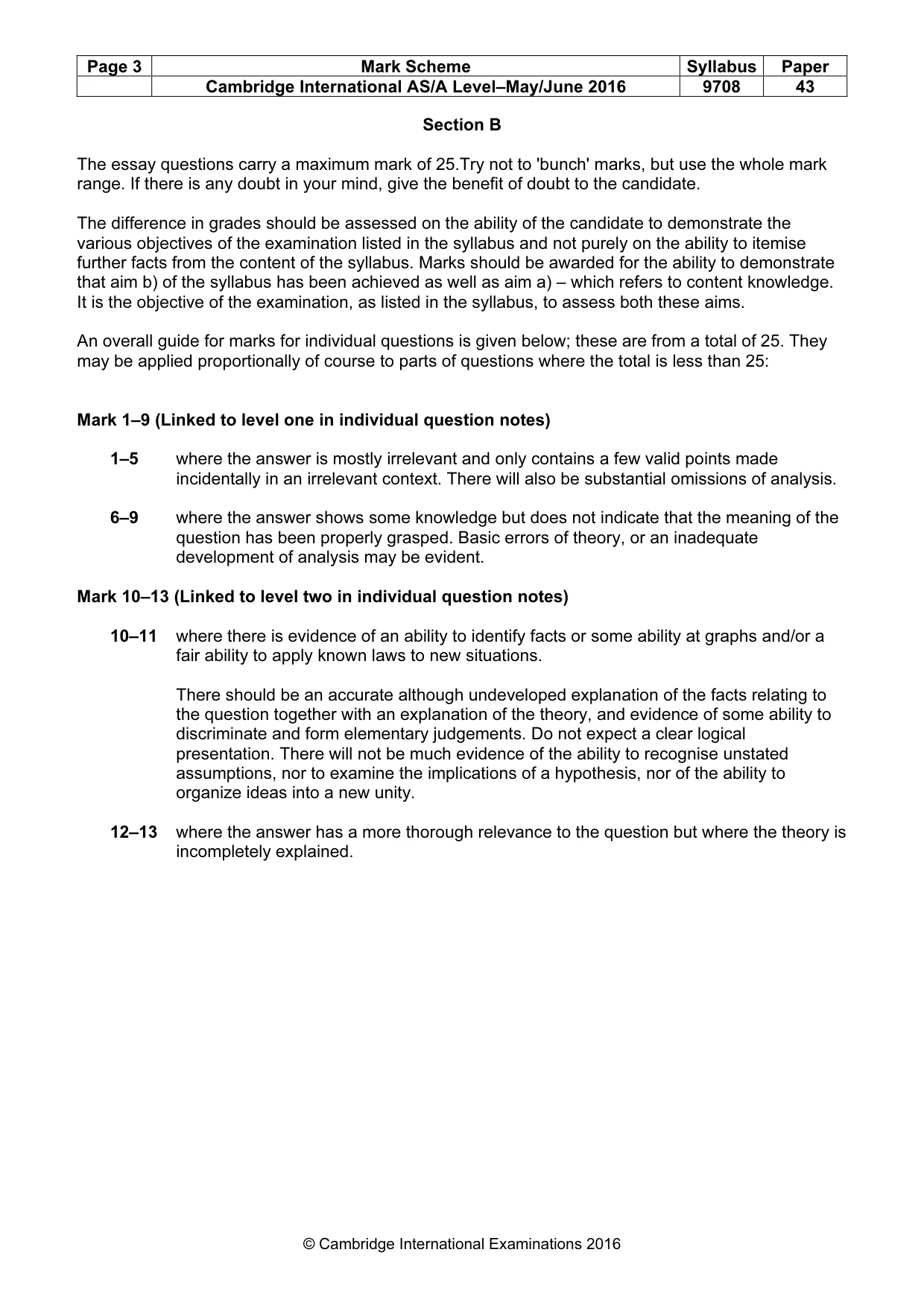
Page 2 Mark Scheme Syllabus Paper Cambridge International AS/A Level–May/June 2016 9708 43 © Cambridge International Examinations 2016 Section A 1 (a) The runway would benefit more than just those who use it. Development of idea of increased spending, trade, investment, jobs and how they might occur [4] (b) Definition 2 comment on examples 2 [4] (c) Motorway is used by people other than those who use airport, govt involved in large road projects–long term investment, general transport infrastructure, encouragement for economic growth, consideration of social factors. [5] (d) Opinion–no firm statistics, initial proposal, needs more information; range of monetary value of benefits uncertain and very wide; general statement about extent of wider benefits; presumption that many airport user would travel by public transport; vague statement about pollution being within EU limits; comments on value of benefit being greater than other options is not matched by the figures produced from one alternative; no published information of comparative fares between alternative projects; fact–they would pay compensation 25% above market rate for property; homes would be demolished–the actual number is debateable; there would be noise; more destinations would be served; cost would be lower than a completely new airport; conclusion. [7]
Mark scheme, page 3
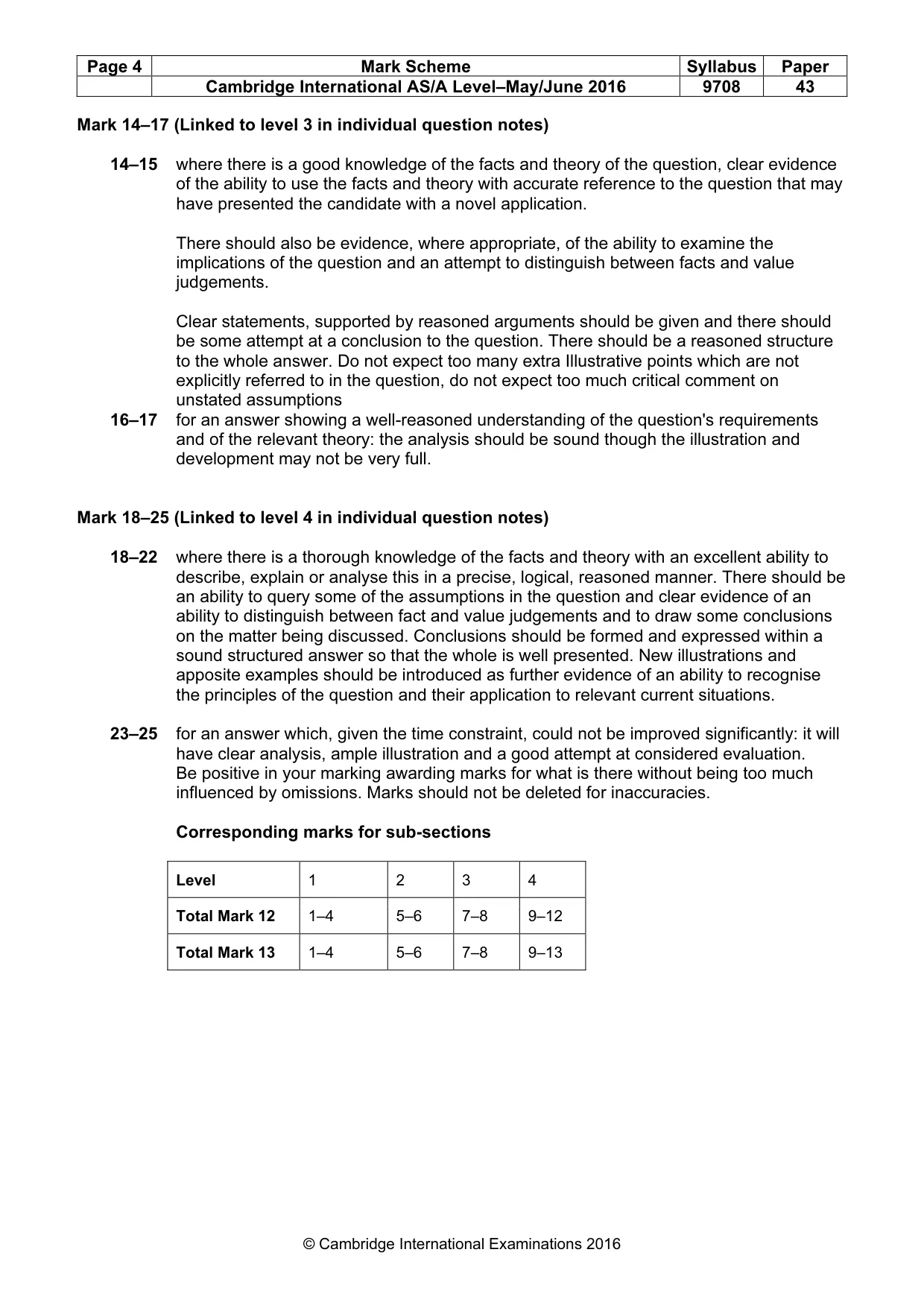
Page 3 Mark Scheme Syllabus Paper Cambridge International AS/A Level–May/June 2016 9708 43 © Cambridge International Examinations 2016 Section B The essay questions carry a maximum mark of 25.Try not to 'bunch' marks, but use the whole mark range. If there is any doubt in your mind, give the benefit of doubt to the candidate. The difference in grades should be assessed on the ability of the candidate to demonstrate the various objectives of the examination listed in the syllabus and not purely on the ability to itemise further facts from the content of the syllabus. Marks should be awarded for the ability to demonstrate that aim b) of the syllabus has been achieved as well as aim a) – which refers to content knowledge. It is the objective of the examination, as listed in the syllabus, to assess both these aims. An overall guide for marks for individual questions is given below; these are from a total of 25. They may be applied proportionally of course to parts of questions where the total is less than 25: Mark 1–9 (Linked to level one in individual question notes) 1–5 where the answer is mostly irrelevant and only contains a few valid points made incidentally in an irrelevant context. There will also be substantial omissions of analysis. 6–9 where the answer shows some knowledge but does not indicate that the meaning of the question has been properly grasped. Basic errors of theory, or an inadequate development of analysis may be evident. Mark 10–13 (Linked to level two in individual question notes) 10–11 where there is evidence of an ability to identify facts or some ability at graphs and/or a fair ability to apply known laws to new situations. There should be an accurate although undeveloped explanation of the facts relating to the question together with an explanation of the theory, and evidence of some ability to discriminate and form elementary judgements. Do not expect a clear logical presentation. There will not be much evidence of the ability to recognise unstated assumptions, nor to examine the implications of a hypothesis, nor of the ability to organize ideas into a new unity. 12–13 where the answer has a more thorough relevance to the question but where the theory is incompletely explained.
Mark scheme, page 4
Page 4 Mark Scheme Syllabus Paper Cambridge International AS/A Level–May/June 2016 9708 43 © Cambridge International Examinations 2016 Mark 14–17 (Linked to level 3 in individual question notes) 14–15 where there is a good knowledge of the facts and theory of the question, clear evidence of the ability to use the facts and theory with accurate reference to the question that may have presented the candidate with a novel application. There should also be evidence, where appropriate, of the ability to examine the implications of the question and an attempt to distinguish between facts and value judgements. Clear statements, supported by reasoned arguments should be given and there should be some attempt at a conclusion to the question. There should be a reasoned structure to the whole answer. Do not expect too many extra Illustrative points which are not explicitly referred to in the question, do not expect too much critical comment on unstated assumptions 16–17 for an answer showing a well-reasoned understanding of the question's requirements and of the relevant theory: the analysis should be sound though the illustration and development may not be very full. Mark 18–25 (Linked to level 4 in individual question notes) 18–22 where there is a thorough knowledge of the facts and theory with an excellent ability to describe, explain or analyse this in a precise, logical, reasoned manner. There should be an ability to query some of the assumptions in the question and clear evidence of an ability to distinguish between fact and value judgements and to draw some conclusions on the matter being discussed. Conclusions should be formed and expressed within a sound structured answer so that the whole is well presented. New illustrations and apposite examples should be introduced as further evidence of an ability to recognise the principles of the question and their application to relevant current situations. 23–25 for an answer which, given the time constraint, could not be improved significantly: it will have clear analysis, ample illustration and a good attempt at considered evaluation. Be positive in your marking awarding marks for what is there without being too much influenced by omissions. Marks should not be deleted for inaccuracies. Corresponding marks for sub-sections Level 1 2 3 4 Total Mark 12 1–4 5–6 7–8 9–12 Total Mark 13 1–4 5–6 7–8 9–13
Mark scheme, page 5
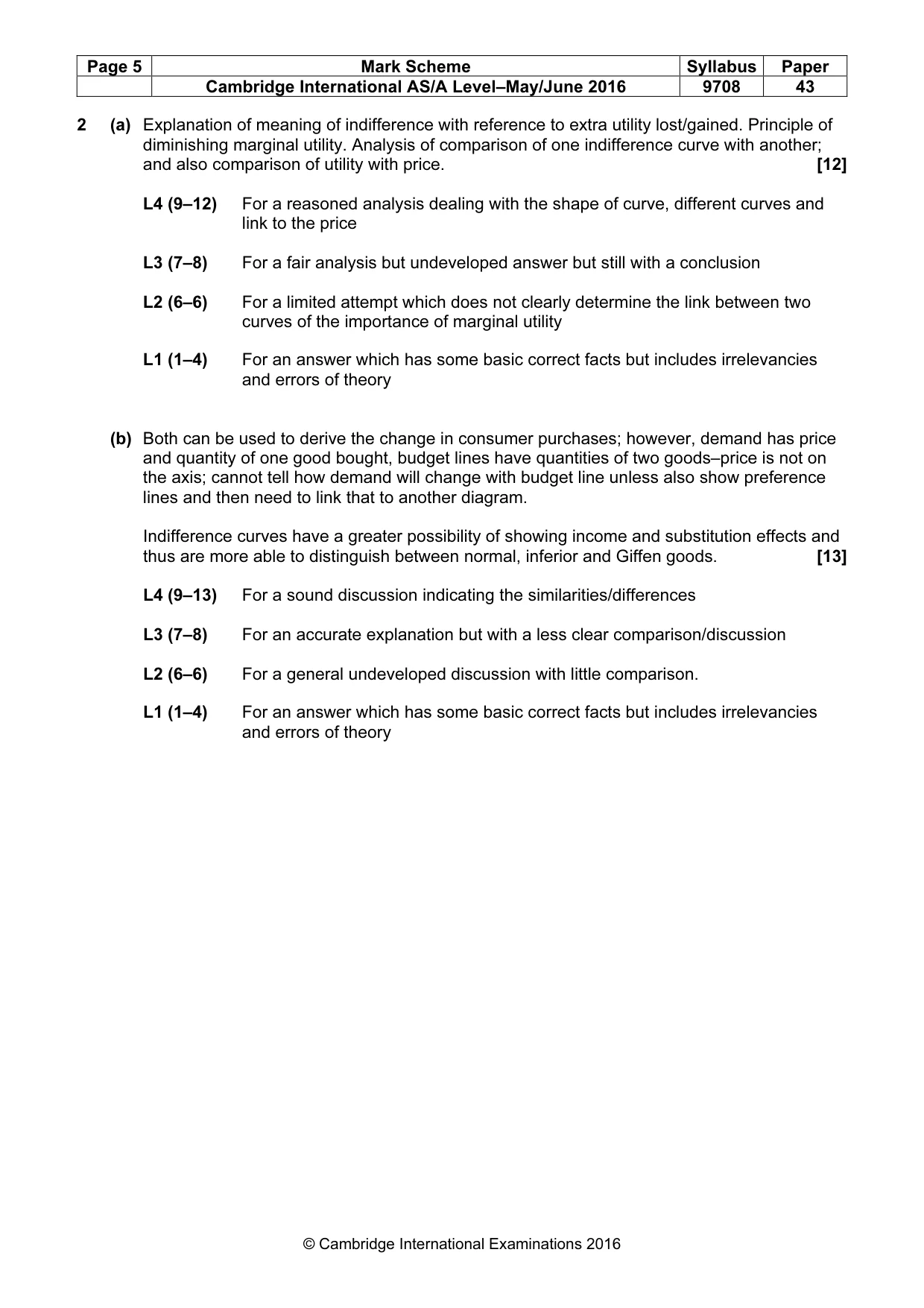
Page 5 Mark Scheme Syllabus Paper Cambridge International AS/A Level–May/June 2016 9708 43 © Cambridge International Examinations 2016 2 (a) Explanation of meaning of indifference with reference to extra utility lost/gained. Principle of diminishing marginal utility. Analysis of comparison of one indifference curve with another; and also comparison of utility with price. [12] L4 (9–12) For a reasoned analysis dealing with the shape of curve, different curves and link to the price L3 (7–8) For a fair analysis but undeveloped answer but still with a conclusion L2 (6–6) For a limited attempt which does not clearly determine the link between two curves of the importance of marginal utility L1 (1–4) For an answer which has some basic correct facts but includes irrelevancies and errors of theory (b) Both can be used to derive the change in consumer purchases; however, demand has price and quantity of one good bought, budget lines have quantities of two goods–price is not on the axis; cannot tell how demand will change with budget line unless also show preference lines and then need to link that to another diagram. Indifference curves have a greater possibility of showing income and substitution effects and thus are more able to distinguish between normal, inferior and Giffen goods. [13] L4 (9–13) For a sound discussion indicating the similarities/differences L3 (7–8) For an accurate explanation but with a less clear comparison/discussion L2 (6–6) For a general undeveloped discussion with little comparison. L1 (1–4) For an answer which has some basic correct facts but includes irrelevancies and errors of theory
Mark scheme, page 6
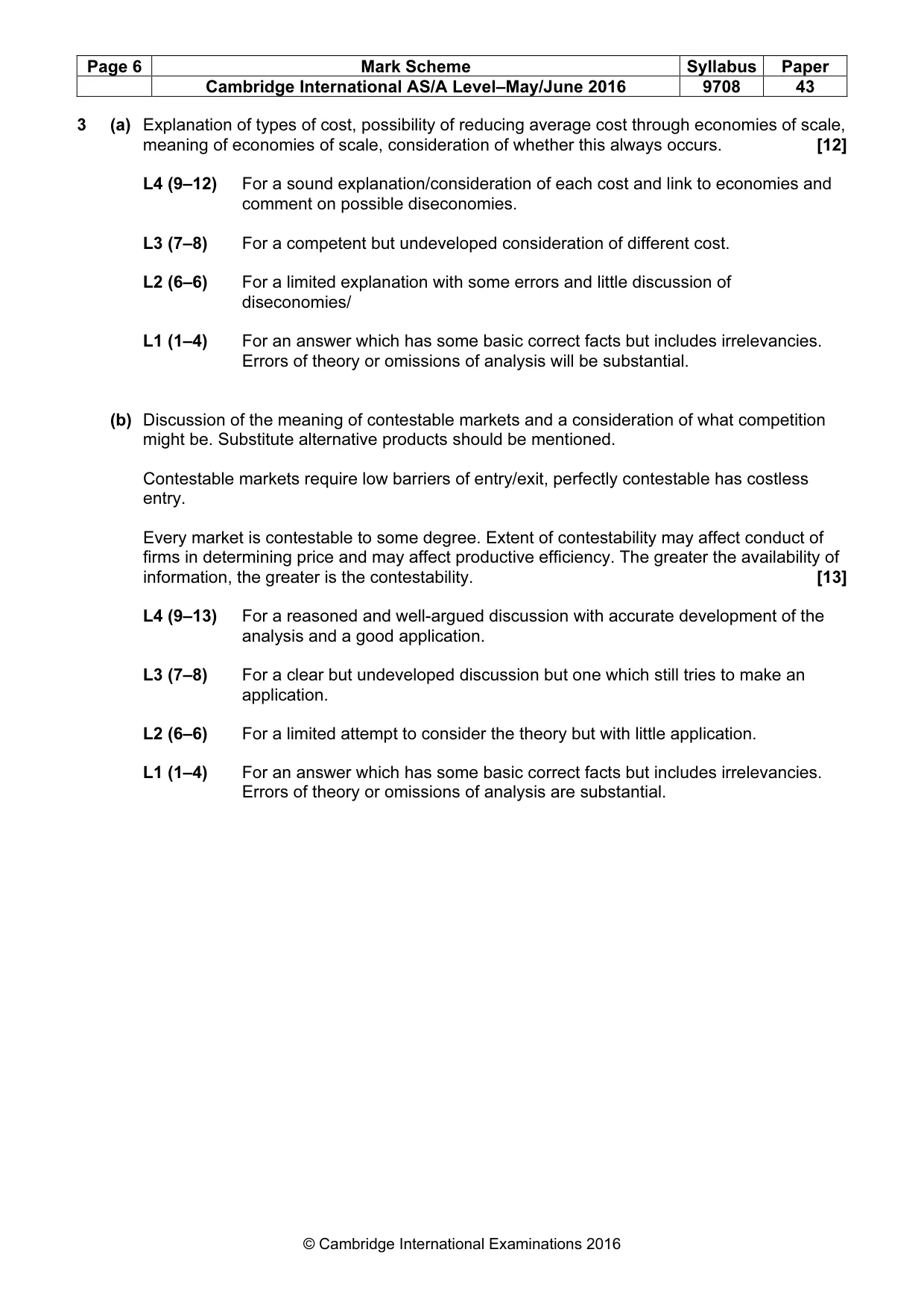
Page 6 Mark Scheme Syllabus Paper Cambridge International AS/A Level–May/June 2016 9708 43 © Cambridge International Examinations 2016 3 (a) Explanation of types of cost, possibility of reducing average cost through economies of scale, meaning of economies of scale, consideration of whether this always occurs. [12] L4 (9–12) For a sound explanation/consideration of each cost and link to economies and comment on possible diseconomies. L3 (7–8) For a competent but undeveloped consideration of different cost. L2 (6–6) For a limited explanation with some errors and little discussion of diseconomies/ L1 (1–4) For an answer which has some basic correct facts but includes irrelevancies. Errors of theory or omissions of analysis will be substantial. (b) Discussion of the meaning of contestable markets and a consideration of what competition might be. Substitute alternative products should be mentioned. Contestable markets require low barriers of entry/exit, perfectly contestable has costless entry. Every market is contestable to some degree. Extent of contestability may affect conduct of firms in determining price and may affect productive efficiency. The greater the availability of information, the greater is the contestability. [13] L4 (9–13) For a reasoned and well-argued discussion with accurate development of the analysis and a good application. L3 (7–8) For a clear but undeveloped discussion but one which still tries to make an application. L2 (6–6) For a limited attempt to consider the theory but with little application. L1 (1–4) For an answer which has some basic correct facts but includes irrelevancies. Errors of theory or omissions of analysis are substantial.
Mark scheme, page 7
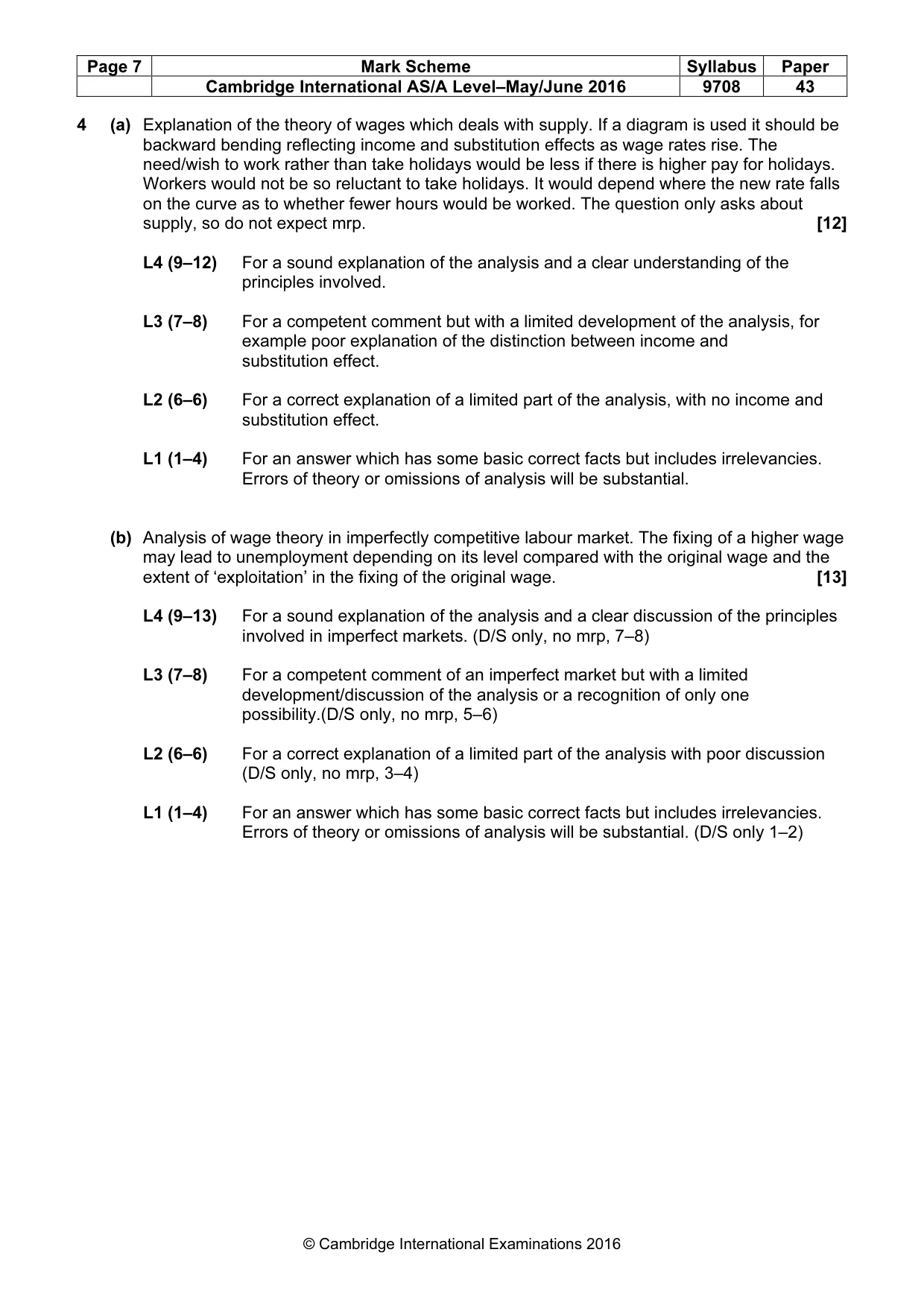
Page 7 Mark Scheme Syllabus Paper Cambridge International AS/A Level–May/June 2016 9708 43 © Cambridge International Examinations 2016 4 (a) Explanation of the theory of wages which deals with supply. If a diagram is used it should be backward bending reflecting income and substitution effects as wage rates rise. The need/wish to work rather than take holidays would be less if there is higher pay for holidays. Workers would not be so reluctant to take holidays. It would depend where the new rate falls on the curve as to whether fewer hours would be worked. The question only asks about supply, so do not expect mrp. [12] L4 (9–12) For a sound explanation of the analysis and a clear understanding of the principles involved. L3 (7–8) For a competent comment but with a limited development of the analysis, for example poor explanation of the distinction between income and substitution effect. L2 (6–6) For a correct explanation of a limited part of the analysis, with no income and substitution effect. L1 (1–4) For an answer which has some basic correct facts but includes irrelevancies. Errors of theory or omissions of analysis will be substantial. (b) Analysis of wage theory in imperfectly competitive labour market. The fixing of a higher wage may lead to unemployment depending on its level compared with the original wage and the extent of ‘exploitation’ in the fixing of the original wage. [13] L4 (9–13) For a sound explanation of the analysis and a clear discussion of the principles involved in imperfect markets. (D/S only, no mrp, 7–8) L3 (7–8) For a competent comment of an imperfect market but with a limited development/discussion of the analysis or a recognition of only one possibility.(D/S only, no mrp, 5–6) L2 (6–6) For a correct explanation of a limited part of the analysis with poor discussion (D/S only, no mrp, 3–4) L1 (1–4) For an answer which has some basic correct facts but includes irrelevancies. Errors of theory or omissions of analysis will be substantial. (D/S only 1–2)
Mark scheme, page 8
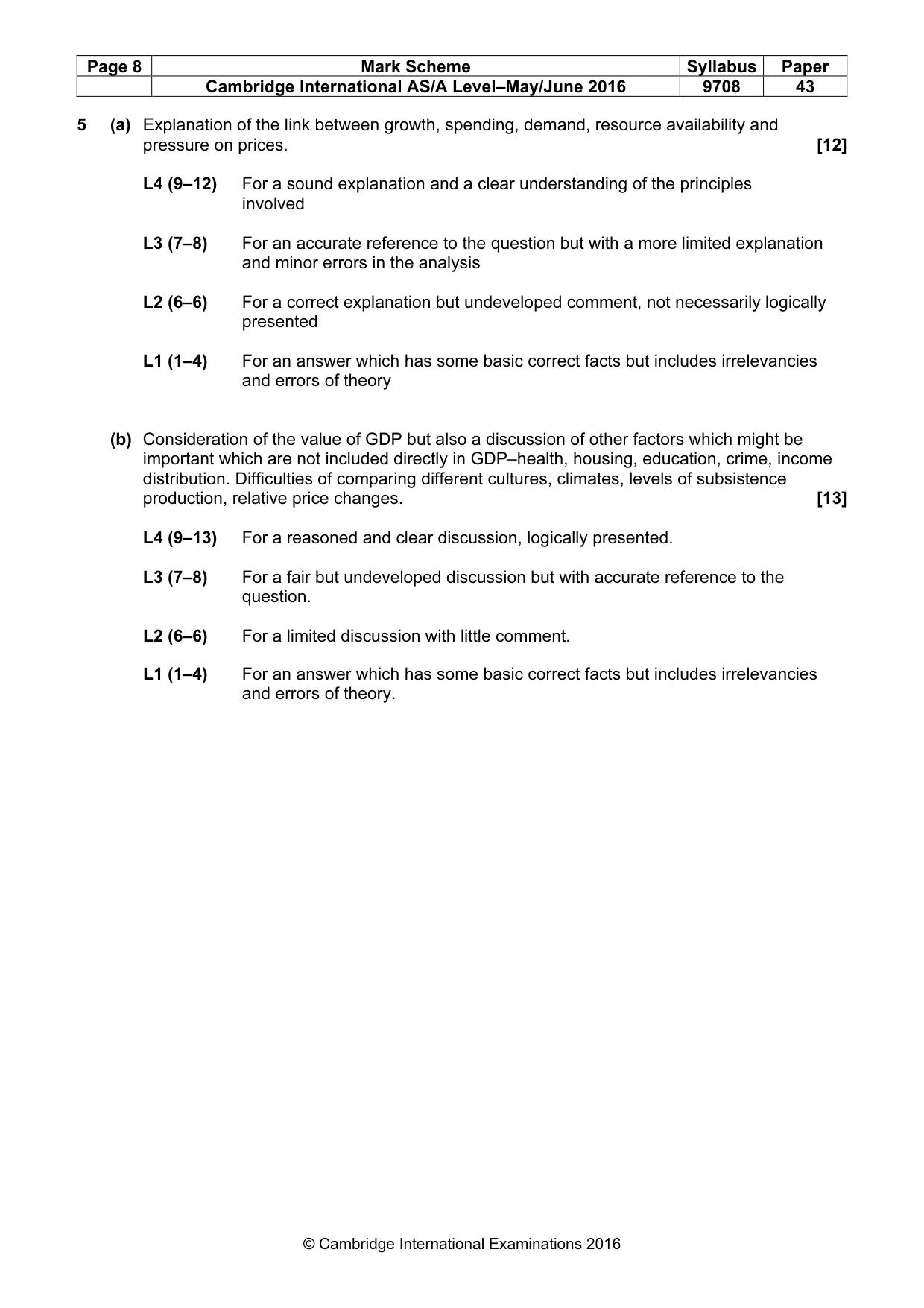
Page 8 Mark Scheme Syllabus Paper Cambridge International AS/A Level–May/June 2016 9708 43 © Cambridge International Examinations 2016 5 (a) Explanation of the link between growth, spending, demand, resource availability and pressure on prices. [12] L4 (9–12) For a sound explanation and a clear understanding of the principles involved L3 (7–8) For an accurate reference to the question but with a more limited explanation and minor errors in the analysis L2 (6–6) For a correct explanation but undeveloped comment, not necessarily logically presented L1 (1–4) For an answer which has some basic correct facts but includes irrelevancies and errors of theory (b) Consideration of the value of GDP but also a discussion of other factors which might be important which are not included directly in GDP–health, housing, education, crime, income distribution. Difficulties of comparing different cultures, climates, levels of subsistence production, relative price changes. [13] L4 (9–13) For a reasoned and clear discussion, logically presented. L3 (7–8) For a fair but undeveloped discussion but with accurate reference to the question. L2 (6–6) For a limited discussion with little comment. L1 (1–4) For an answer which has some basic correct facts but includes irrelevancies and errors of theory.
Mark scheme, page 9
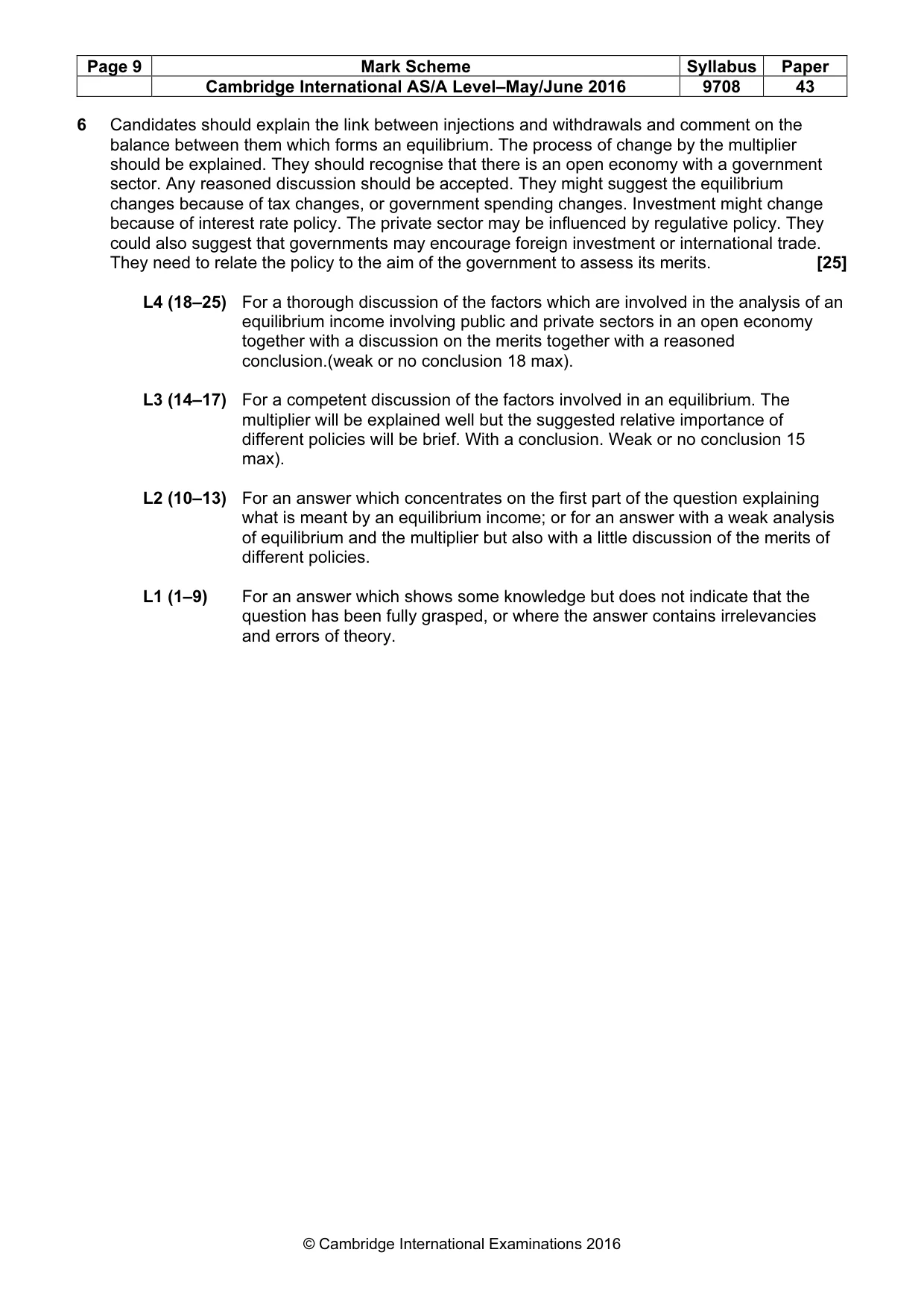
Page 9 Mark Scheme Syllabus Paper Cambridge International AS/A Level–May/June 2016 9708 43 © Cambridge International Examinations 2016 6 Candidates should explain the link between injections and withdrawals and comment on the balance between them which forms an equilibrium. The process of change by the multiplier should be explained. They should recognise that there is an open economy with a government sector. Any reasoned discussion should be accepted. They might suggest the equilibrium changes because of tax changes, or government spending changes. Investment might change because of interest rate policy. The private sector may be influenced by regulative policy. They could also suggest that governments may encourage foreign investment or international trade. They need to relate the policy to the aim of the government to assess its merits. [25] L4 (18–25) For a thorough discussion of the factors which are involved in the analysis of an equilibrium income involving public and private sectors in an open economy together with a discussion on the merits together with a reasoned conclusion.(weak or no conclusion 18 max). L3 (14–17) For a competent discussion of the factors involved in an equilibrium. The multiplier will be explained well but the suggested relative importance of different policies will be brief. With a conclusion. Weak or no conclusion 15 max). L2 (10–13) For an answer which concentrates on the first part of the question explaining what is meant by an equilibrium income; or for an answer with a weak analysis of equilibrium and the multiplier but also with a little discussion of the merits of different policies. L1 (1–9) For an answer which shows some knowledge but does not indicate that the question has been fully grasped, or where the answer contains irrelevancies and errors of theory.
Mark scheme, page 10
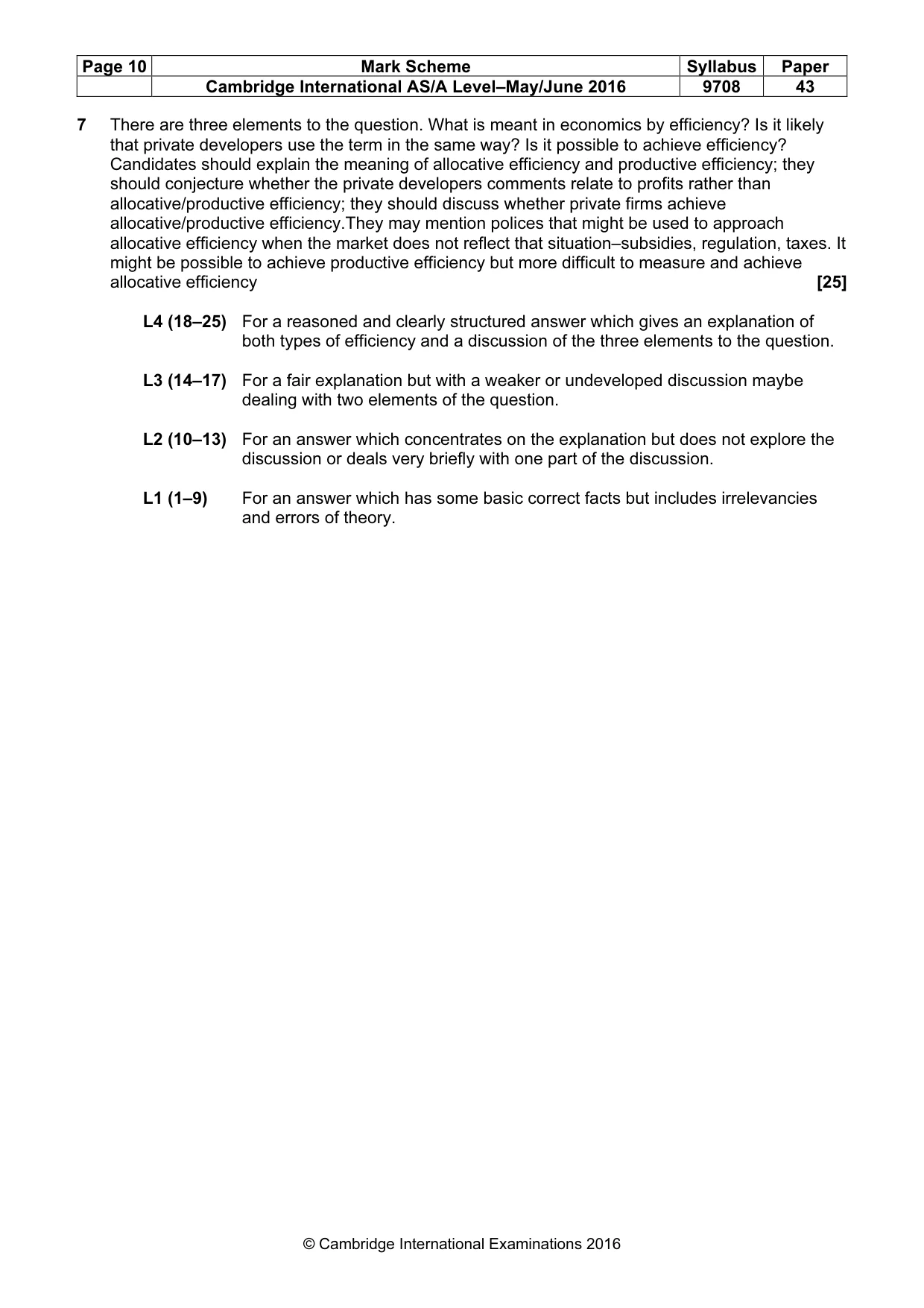
Page 10 Mark Scheme Syllabus Paper Cambridge International AS/A Level–May/June 2016 9708 43 © Cambridge International Examinations 2016 7 There are three elements to the question. What is meant in economics by efficiency? Is it likely that private developers use the term in the same way? Is it possible to achieve efficiency? Candidates should explain the meaning of allocative efficiency and productive efficiency; they should conjecture whether the private developers comments relate to profits rather than allocative/productive efficiency; they should discuss whether private firms achieve allocative/productive efficiency.They may mention polices that might be used to approach allocative efficiency when the market does not reflect that situation–subsidies, regulation, taxes. It might be possible to achieve productive efficiency but more difficult to measure and achieve allocative efficiency [25] L4 (18–25) For a reasoned and clearly structured answer which gives an explanation of both types of efficiency and a discussion of the three elements to the question. L3 (14–17) For a fair explanation but with a weaker or undeveloped discussion maybe dealing with two elements of the question. L2 (10–13) For an answer which concentrates on the explanation but does not explore the discussion or deals very briefly with one part of the discussion. L1 (1–9) For an answer which has some basic correct facts but includes irrelevancies and errors of theory.
What you needed in this session
Cambridge’s own grade thresholds for 2016 May/June, Paper 4 · Variant 3. A higher threshold means an easier paper — the bar moves with how the cohort did.