Cambridge A Level Economics 9708 — 2010 Oct/Nov Paper 2 · Variant 3
9708/23/O/N/10 · 40 marks · ≈45 min
The question paper and its mark scheme, free to read here and free to download. This is Cambridge’s own paper, exactly as it was sat.
Question paper4 pages
Mark scheme4 pages
Answers below. Sit the paper first if you are practising.
Paper as text
Question paper, page 1
This document consists of 3 printed pages and 1 blank page. DC (SM) 19273/5 © UCLES 2010 [Turn over UNIVERSITY OF CAMBRIDGE INTERNATIONAL EXAMINATIONS General Certificate of Education Advanced Subsidiary Level and Advanced Level READ THESE INSTRUCTIONS FIRST If you have been given an Answer Booklet, follow the instructions on the front cover of the Booklet. Write your Centre number, candidate number and name on all the work you hand in. Write in dark blue or black pen. You may use a soft pencil for any diagrams, graphs or rough working. Do not use staples, paper clips, highlighters, glue or correction fluid. Section A Answer this question. Brief answers only are required. Section B Answer any one question. You may answer with reference to your own economy or other economies that you have studied where relevant to the question. At the end of the examination, fasten all your work securely together. The number of marks is given in brackets [ ] at the end of each question or part question. * 7 6 1 6 7 1 1 0 4 6 * ECONOMICS 9708/23 Paper 2 Data Response and Essay (Core) October/November 2010 1 hour 30 minutes Additional Materials: Answer Booklet/Paper
Question paper, page 2
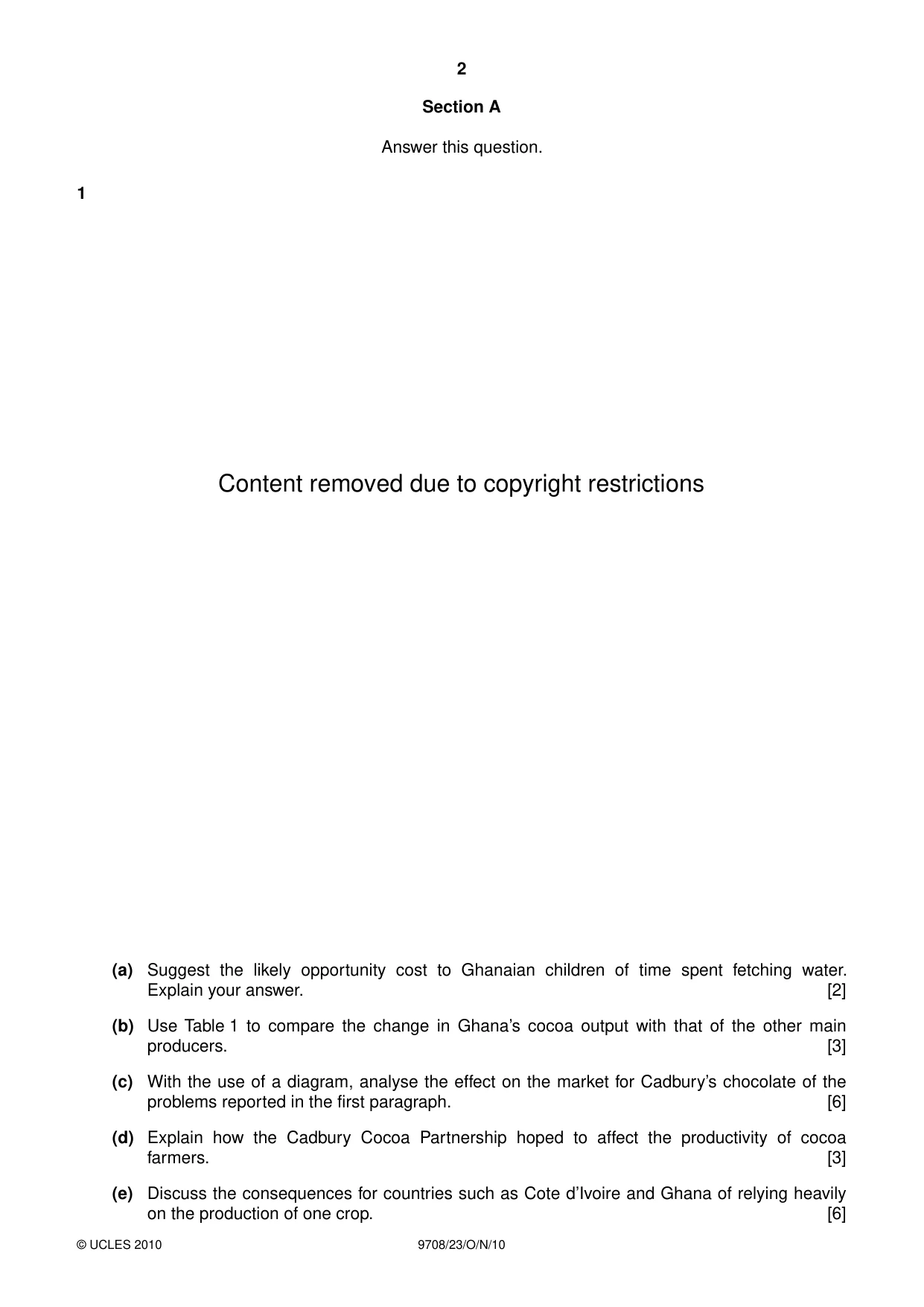
2 © UCLES 2010 9708/23/O/N/10 Section A Answer this question. 1 Ghanaian Cocoa and Cadbury’s Chocolate In January 2008 Cadbury Schweppes, one of the largest multi-national confectionery producers, was facing problems. The price of its raw materials had reached record levels and consumers were being given government health warnings about the link between eating chocolate and being overweight. Cocoa is one of the main ingredients in chocolate. Ghana provides Cadbury with 70% of its cocoa needs and Cadbury buys 10% of Ghana’s total cocoa output. In January 2008, Ghana’s cocoa sold at $2557 per tonne, 10% above the average world price. A study found that in 2008 the average production of a cocoa farmer in Ghana had dropped to 40% of potential yield and that the children of cocoa farmers did not want to work in the family business, where annual income was as little as $850. To improve matters Cadbury established the Cadbury Cocoa Partnership in 2008, providing $87m over ten years to help cocoa farmers. The purpose of the partnership was to show cocoa farmers how to use fertilisers and work together. It also hoped to introduce new crops by encouraging the growing of red peppers, mangoes and coconuts, which can grow alongside cocoa trees. As well as this, Cadbury ordered the construction of 850 wells, each of which will provide water for about 200 people. This should enable women and children to reduce the time spent fetching water. Table 1 World cocoa output showing the main producing countries Producer 2002/3 (000 tonnes) 2006/7 (000 tonnes) Cameroon 160 166 Cote d’Ivoire 1352 1229 Ghana 497 615 Indonesia 410 520 Nigeria 173 190 World 3169 3376 (a) Suggest the likely opportunity cost to Ghanaian children of time spent fetching water. Explain your answer. [2] (b) Use Table 1 to compare the change in Ghana’s cocoa output with that of the other main producers. [3] (c) With the use of a diagram, analyse the effect on the market for Cadbury’s chocolate of the problems reported in the first paragraph. [6] (d) Explain how the Cadbury Cocoa Partnership hoped to affect the productivity of cocoa farmers. [3] (e) Discuss the consequences for countries such as Cote d’Ivoire and Ghana of relying heavily on the production of one crop. [6] Content removed due to copyright restrictions
Question paper, page 3
3 9708/23/O/N/10 © UCLES 2010 Section B Answer one question. 2 (a) Explain the difficulties of carrying out a cost-benefit analysis. [8] (b) Discuss the economic consequences of externalities associated with production and consumption. [12] 3 (a) Explain why a low and stable rate of inflation may be beneficial to an economy. [8] (b) Discuss whether rapid inflation can be caused only by government actions. [12] 4 (a) Explain (i) the difference between trade creation and trade diversion, and (ii) the difference between expenditure-dampening and expenditure-switching trade policies. [8] (b) Discuss whether a balance of payments current account deficit necessarily indicates a weak economy. [12]
Question paper, page 4
4 9708/23/O/N/10 © UCLES 2010 BLANK PAGE Copyright Acknowledgements: Question 1 Text © Fair Enough ; 2 February 2008; The Economist. Question 1 Table © Quarterly Forecast of Product and Consumption 2012/13 ; International Cocoa Organisation. Permission to reproduce items where third-party owned material protected by copyright is included has been sought and cleared where possible. Every reasonable effort has been made by the publisher (UCLES) to trace copyright holders, but if any items requiring clearance have unwittingly been included, the publisher will be pleased to make amends at the earliest possible opportunity. University of Cambridge International Examinations is part of the Cambridge Assessment Group. Cambridge Assessment is the brand name of University of Cambridge Local Examinations Syndicate (UCLES), which is itself a department of the University of Cambridge.
Mark scheme, page 1
UNIVERSITY OF CAMBRIDGE INTERNATIONAL EXAMINATIONS GCE Advanced Subsidiary Level and GCE Advanced Level MARK SCHEME for the October/November 2010 question paper for the guidance of teachers 9708 ECONOMICS 9708/23 Paper 23 (Data Response and Essay (Core)), maximum raw mark 40 This mark scheme is published as an aid to teachers and candidates, to indicate the requirements of the examination. It shows the basis on which Examiners were instructed to award marks. It does not indicate the details of the discussions that took place at an Examiners’ meeting before marking began, which would have considered the acceptability of alternative answers. Mark schemes must be read in conjunction with the question papers and the report on the examination. • CIE will not enter into discussions or correspondence in connection with these mark schemes. CIE is publishing the mark schemes for the October/November 2010 question papers for most IGCSE, GCE Advanced Level and Advanced Subsidiary Level syllabuses and some Ordinary Level syllabuses.
Mark scheme, page 2
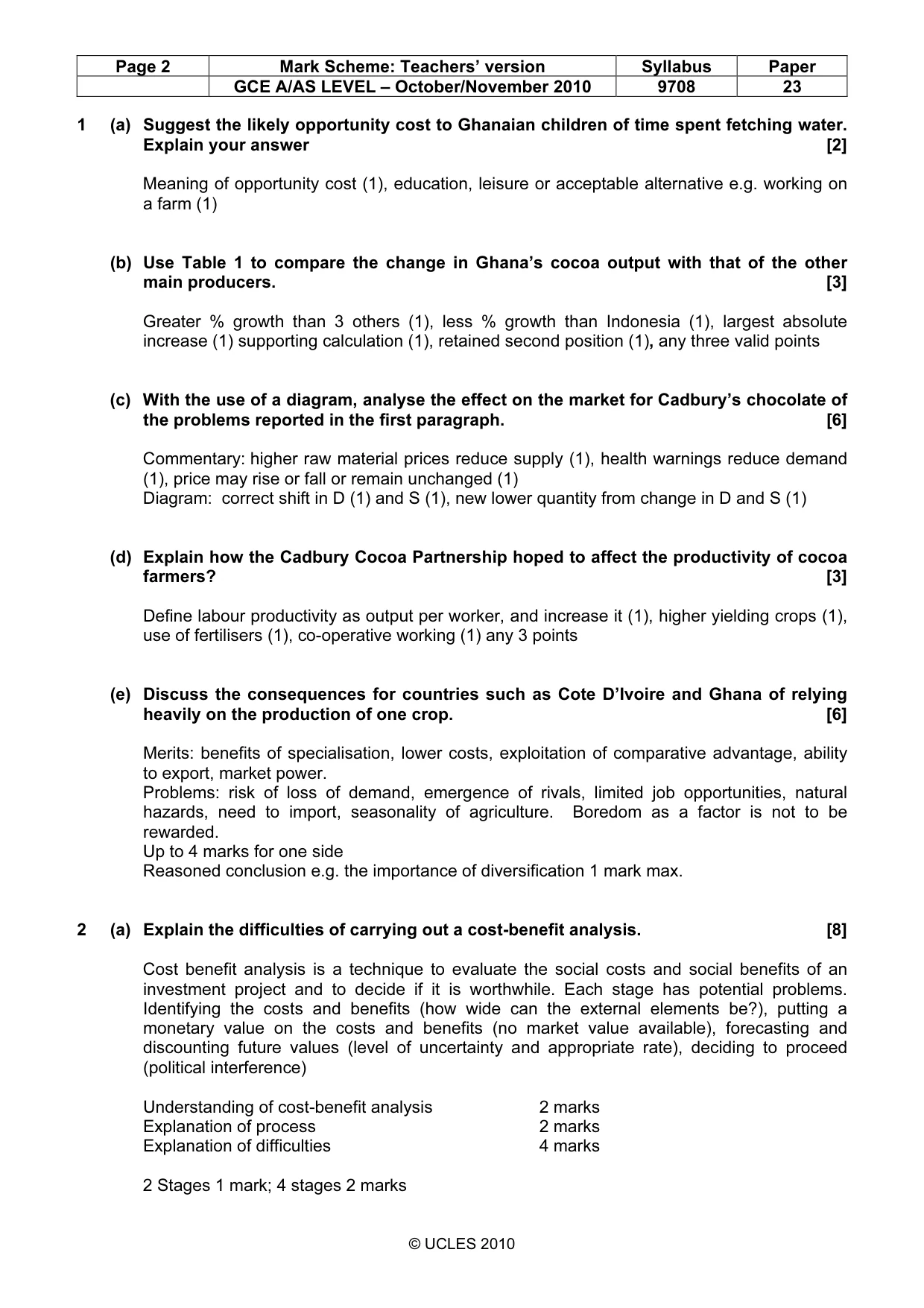
Page 2 Mark Scheme: Teachers’ version Syllabus Paper GCE A/AS LEVEL – October/November 2010 9708 23 © UCLES 2010 1 (a) Suggest the likely opportunity cost to Ghanaian children of time spent fetching water. Explain your answer [2] Meaning of opportunity cost (1), education, leisure or acceptable alternative e.g. working on a farm (1) (b) Use Table 1 to compare the change in Ghana’s cocoa output with that of the other main producers. [3] Greater % growth than 3 others (1), less % growth than Indonesia (1), largest absolute increase (1) supporting calculation (1), retained second position (1), any three valid points (c) With the use of a diagram, analyse the effect on the market for Cadbury’s chocolate of the problems reported in the first paragraph. [6] Commentary: higher raw material prices reduce supply (1), health warnings reduce demand (1), price may rise or fall or remain unchanged (1) Diagram: correct shift in D (1) and S (1), new lower quantity from change in D and S (1) (d) Explain how the Cadbury Cocoa Partnership hoped to affect the productivity of cocoa farmers? [3] Define labour productivity as output per worker, and increase it (1), higher yielding crops (1), use of fertilisers (1), co-operative working (1) any 3 points (e) Discuss the consequences for countries such as Cote D’Ivoire and Ghana of relying heavily on the production of one crop. [6] Merits: benefits of specialisation, lower costs, exploitation of comparative advantage, ability to export, market power. Problems: risk of loss of demand, emergence of rivals, limited job opportunities, natural hazards, need to import, seasonality of agriculture. Boredom as a factor is not to be rewarded. Up to 4 marks for one side Reasoned conclusion e.g. the importance of diversification 1 mark max. 2 (a) Explain the difficulties of carrying out a cost-benefit analysis. [8] Cost benefit analysis is a technique to evaluate the social costs and social benefits of an investment project and to decide if it is worthwhile. Each stage has potential problems. Identifying the costs and benefits (how wide can the external elements be?), putting a monetary value on the costs and benefits (no market value available), forecasting and discounting future values (level of uncertainty and appropriate rate), deciding to proceed (political interference) Understanding of cost-benefit analysis 2 marks Explanation of process 2 marks Explanation of difficulties 4 marks 2 Stages 1 mark; 4 stages 2 marks
Mark scheme, page 3
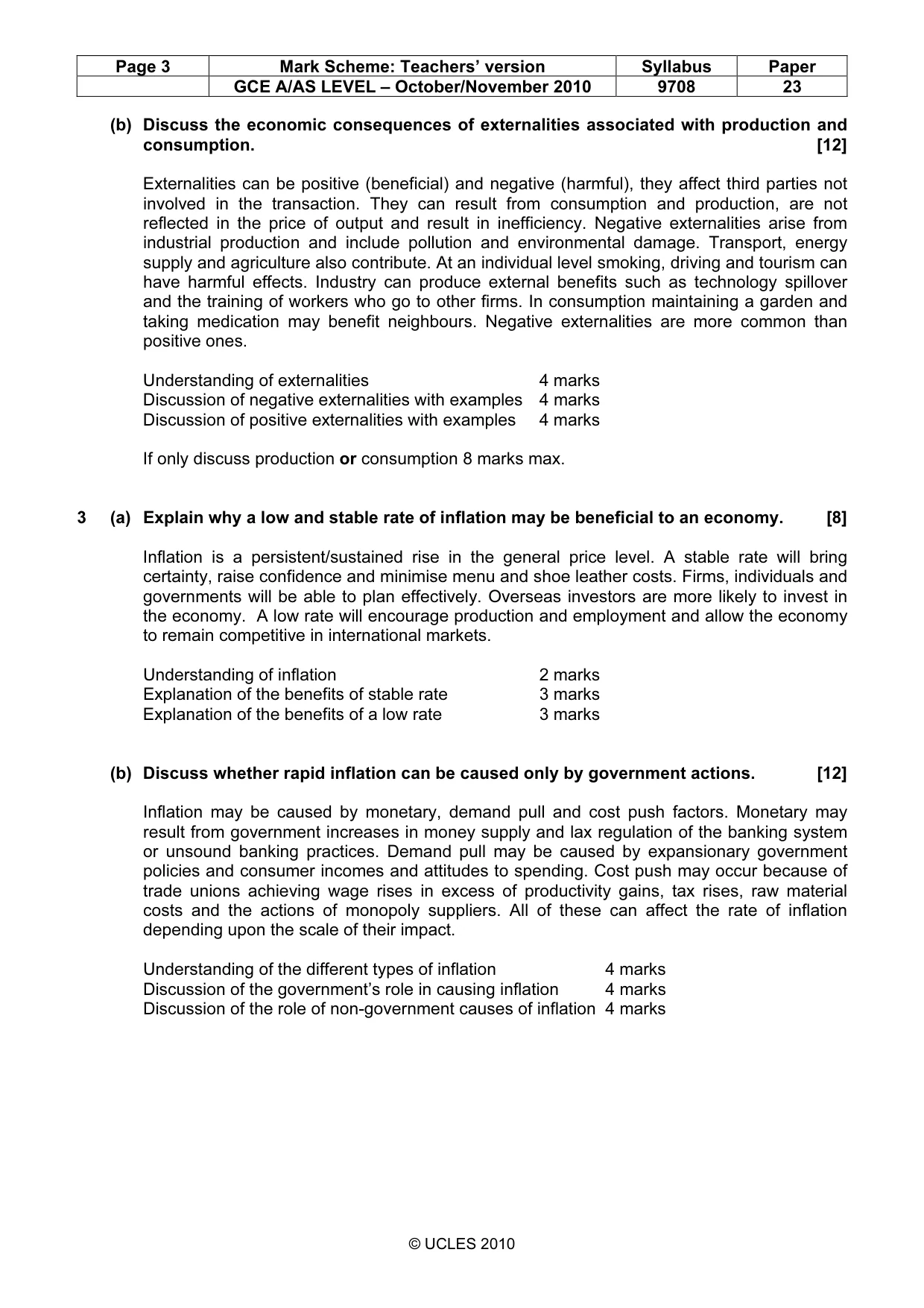
Page 3 Mark Scheme: Teachers’ version Syllabus Paper GCE A/AS LEVEL – October/November 2010 9708 23 © UCLES 2010 (b) Discuss the economic consequences of externalities associated with production and consumption. [12] Externalities can be positive (beneficial) and negative (harmful), they affect third parties not involved in the transaction. They can result from consumption and production, are not reflected in the price of output and result in inefficiency. Negative externalities arise from industrial production and include pollution and environmental damage. Transport, energy supply and agriculture also contribute. At an individual level smoking, driving and tourism can have harmful effects. Industry can produce external benefits such as technology spillover and the training of workers who go to other firms. In consumption maintaining a garden and taking medication may benefit neighbours. Negative externalities are more common than positive ones. Understanding of externalities 4 marks Discussion of negative externalities with examples 4 marks Discussion of positive externalities with examples 4 marks If only discuss production or consumption 8 marks max. 3 (a) Explain why a low and stable rate of inflation may be beneficial to an economy. [8] Inflation is a persistent/sustained rise in the general price level. A stable rate will bring certainty, raise confidence and minimise menu and shoe leather costs. Firms, individuals and governments will be able to plan effectively. Overseas investors are more likely to invest in the economy. A low rate will encourage production and employment and allow the economy to remain competitive in international markets. Understanding of inflation 2 marks Explanation of the benefits of stable rate 3 marks Explanation of the benefits of a low rate 3 marks (b) Discuss whether rapid inflation can be caused only by government actions. [12] Inflation may be caused by monetary, demand pull and cost push factors. Monetary may result from government increases in money supply and lax regulation of the banking system or unsound banking practices. Demand pull may be caused by expansionary government policies and consumer incomes and attitudes to spending. Cost push may occur because of trade unions achieving wage rises in excess of productivity gains, tax rises, raw material costs and the actions of monopoly suppliers. All of these can affect the rate of inflation depending upon the scale of their impact. Understanding of the different types of inflation 4 marks Discussion of the government’s role in causing inflation 4 marks Discussion of the role of non-government causes of inflation 4 marks
Mark scheme, page 4
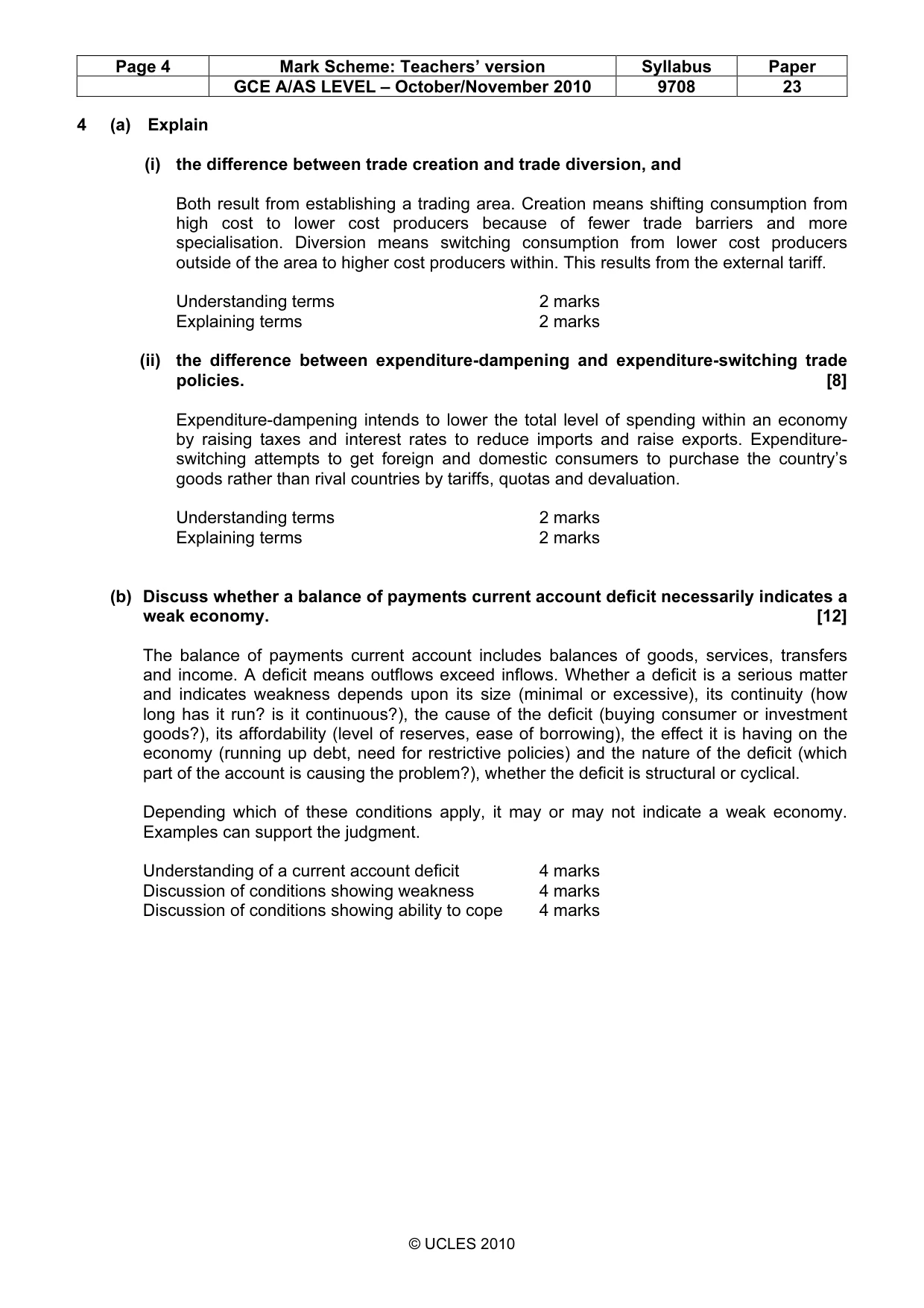
Page 4 Mark Scheme: Teachers’ version Syllabus Paper GCE A/AS LEVEL – October/November 2010 9708 23 © UCLES 2010 4 (a) Explain (i) the difference between trade creation and trade diversion, and Both result from establishing a trading area. Creation means shifting consumption from high cost to lower cost producers because of fewer trade barriers and more specialisation. Diversion means switching consumption from lower cost producers outside of the area to higher cost producers within. This results from the external tariff. Understanding terms 2 marks Explaining terms 2 marks (ii) the difference between expenditure-dampening and expenditure-switching trade policies. [8] Expenditure-dampening intends to lower the total level of spending within an economy by raising taxes and interest rates to reduce imports and raise exports. Expenditure- switching attempts to get foreign and domestic consumers to purchase the country’s goods rather than rival countries by tariffs, quotas and devaluation. Understanding terms 2 marks Explaining terms 2 marks (b) Discuss whether a balance of payments current account deficit necessarily indicates a weak economy. [12] The balance of payments current account includes balances of goods, services, transfers and income. A deficit means outflows exceed inflows. Whether a deficit is a serious matter and indicates weakness depends upon its size (minimal or excessive), its continuity (how long has it run? is it continuous?), the cause of the deficit (buying consumer or investment goods?), its affordability (level of reserves, ease of borrowing), the effect it is having on the economy (running up debt, need for restrictive policies) and the nature of the deficit (which part of the account is causing the problem?), whether the deficit is structural or cyclical. Depending which of these conditions apply, it may or may not indicate a weak economy. Examples can support the judgment. Understanding of a current account deficit 4 marks Discussion of conditions showing weakness 4 marks Discussion of conditions showing ability to cope 4 marks
What you needed in this session
Cambridge’s own grade thresholds for 2010 Oct/Nov, Paper 2 · Variant 3. A higher threshold means an easier paper — the bar moves with how the cohort did.