Cambridge A Level Economics 9708 — 2010 Oct/Nov Paper 2 · Variant 2
9708/22/O/N/10 · 40 marks · ≈45 min
The question paper and its mark scheme, free to read here and free to download. This is Cambridge’s own paper, exactly as it was sat.
Question paper4 pages
Mark scheme4 pages
Answers below. Sit the paper first if you are practising.
Paper as text
Question paper, page 1
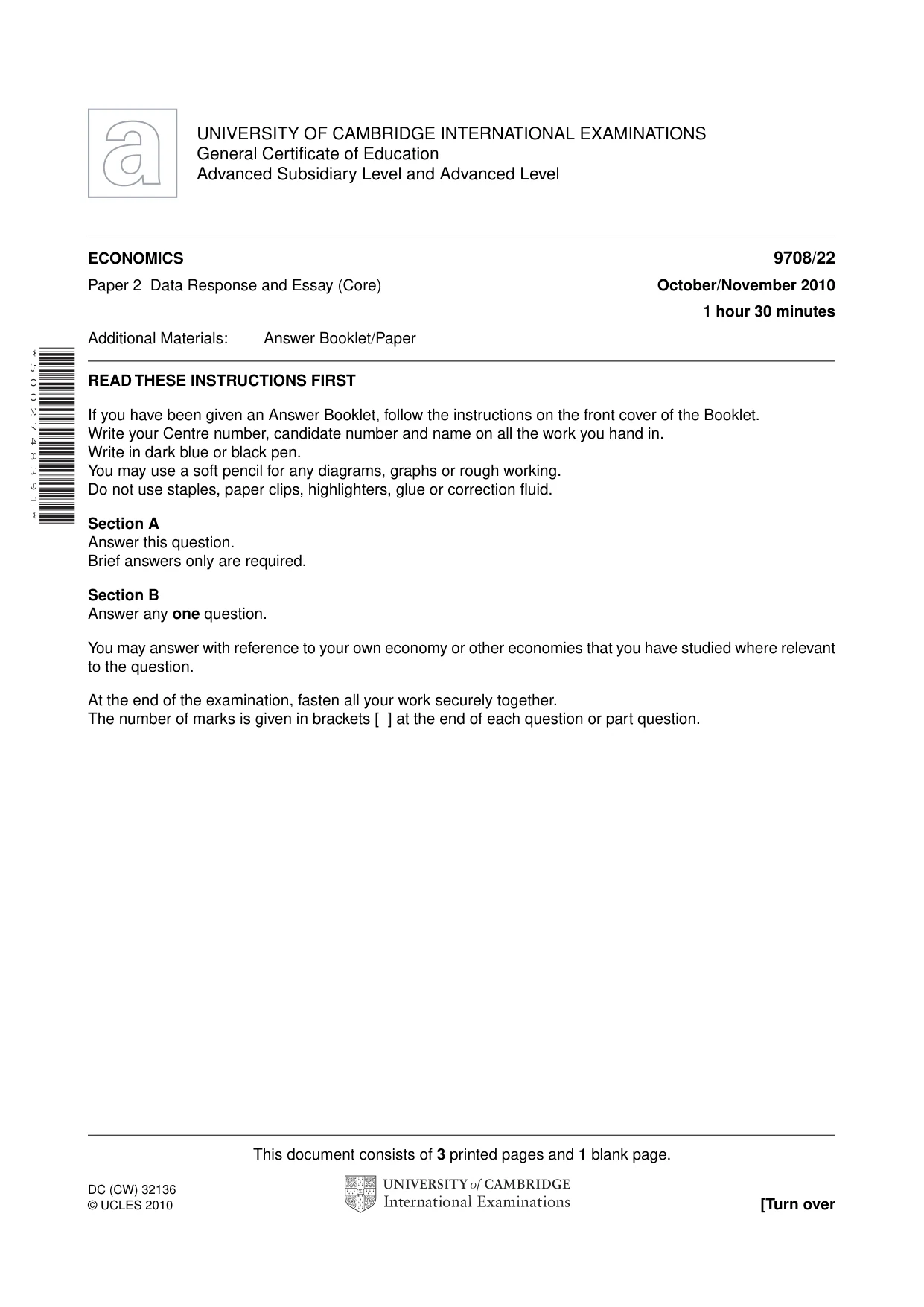
This document consists of 3 printed pages and 1 blank page. DC (CW) 32136 © UCLES 2010 [Turn over UNIVERSITY OF CAMBRIDGE INTERNATIONAL EXAMINATIONS General Certificate of Education Advanced Subsidiary Level and Advanced Level READ THESE INSTRUCTIONS FIRST If you have been given an Answer Booklet, follow the instructions on the front cover of the Booklet. Write your Centre number, candidate number and name on all the work you hand in. Write in dark blue or black pen. You may use a soft pencil for any diagrams, graphs or rough working. Do not use staples, paper clips, highlighters, glue or correction fluid. Section A Answer this question. Brief answers only are required. Section B Answer any one question. You may answer with reference to your own economy or other economies that you have studied where relevant to the question. At the end of the examination, fasten all your work securely together. The number of marks is given in brackets [ ] at the end of each question or part question. * 5 0 0 2 7 4 8 3 9 1 * ECONOMICS 9708/22 Paper 2 Data Response and Essay (Core) October/November 2010 1 hour 30 minutes Additional Materials: Answer Booklet/Paper
Question paper, page 2
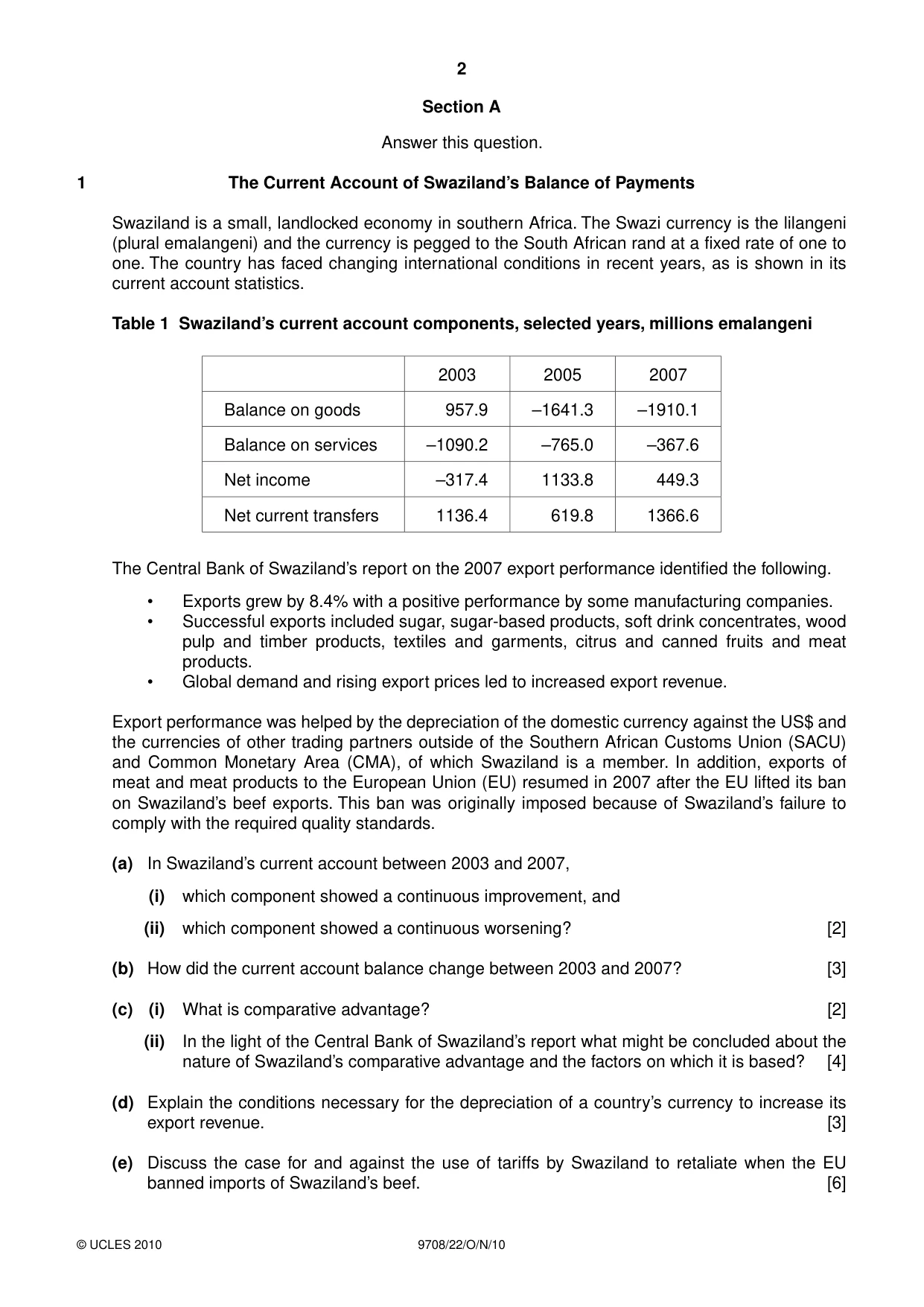
2 9708/22/O/N/10 © UCLES 2010 Section A Answer this question. 1 The Current Account of Swaziland’s Balance of Payments Swaziland is a small, landlocked economy in southern Africa. The Swazi currency is the lilangeni (plural emalangeni) and the currency is pegged to the South African rand at a fixed rate of one to one. The country has faced changing international conditions in recent years, as is shown in its current account statistics. Table 1 Swaziland’s current account components, selected years, millions emalangeni 2003 2005 2007 Balance on goods 957.9 –1641.3 –1910.1 Balance on services –1090.2 –765.0 –367.6 Net income –317.4 1133.8 449.3 Net current transfers 1136.4 619.8 1366.6 The Central Bank of Swaziland’s report on the 2007 export performance identified the following. • Exports grew by 8.4% with a positive performance by some manufacturing companies. • Successful exports included sugar, sugar-based products, soft drink concentrates, wood pulp and timber products, textiles and garments, citrus and canned fruits and meat products. • Global demand and rising export prices led to increased export revenue. Export performance was helped by the depreciation of the domestic currency against the US$ and the currencies of other trading partners outside of the Southern African Customs Union (SACU) and Common Monetary Area (CMA), of which Swaziland is a member. In addition, exports of meat and meat products to the European Union (EU) resumed in 2007 after the EU lifted its ban on Swaziland’s beef exports. This ban was originally imposed because of Swaziland’s failure to comply with the required quality standards. (a) In Swaziland’s current account between 2003 and 2007, (i) which component showed a continuous improvement, and (ii) which component showed a continuous worsening? [2] (b) How did the current account balance change between 2003 and 2007? [3] (c) (i) What is comparative advantage? [2] (ii) In the light of the Central Bank of Swaziland’s report what might be concluded about the nature of Swaziland’s comparative advantage and the factors on which it is based? [4] (d) Explain the conditions necessary for the depreciation of a country’s currency to increase its export revenue. [3] (e) Discuss the case for and against the use of tariffs by Swaziland to retaliate when the EU banned imports of Swaziland’s beef. [6]
Question paper, page 3
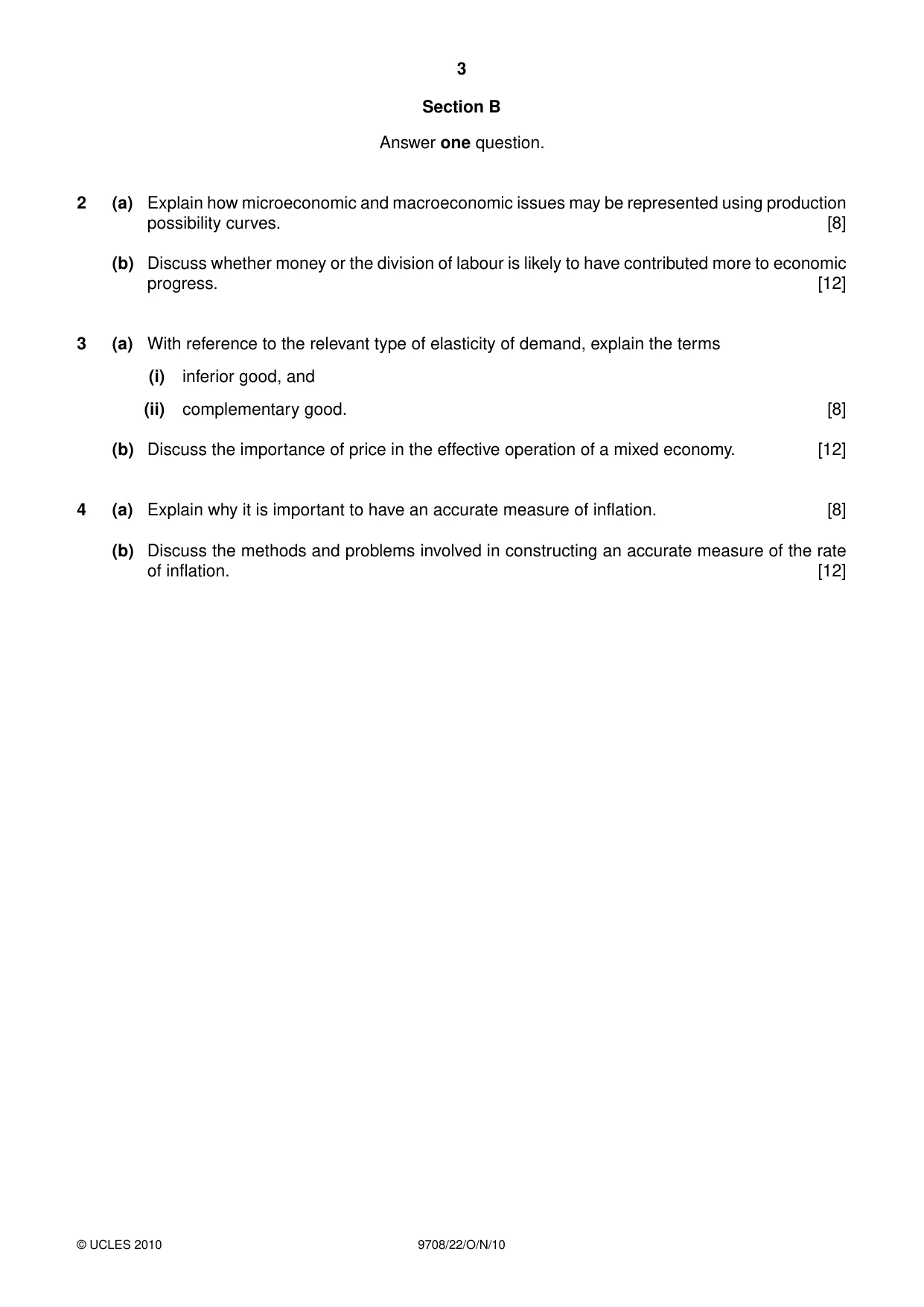
3 9708/22/O/N/10 © UCLES 2010 Section B Answer one question. 2 (a) Explain how microeconomic and macroeconomic issues may be represented using production possibility curves. [8] (b) Discuss whether money or the division of labour is likely to have contributed more to economic progress. [12] 3 (a) With reference to the relevant type of elasticity of demand, explain the terms (i) inferior good, and (ii) complementary good. [8] (b) Discuss the importance of price in the effective operation of a mixed economy. [12] 4 (a) Explain why it is important to have an accurate measure of inflation. [8] (b) Discuss the methods and problems involved in constructing an accurate measure of the rate of inflation. [12]
Question paper, page 4
4 9708/22/O/N/10 © UCLES 2010 BLANK PAGE Copyright Acknowledgements: Question 1 © Annual Report 2007/2008; Data from the Balance of Payments and Trade commentary; Central Bank of Swaziland. Permission to reproduce items where third-party owned material protected by copyright is included has been sought and cleared where possible. Every reasonable effort has been made by the publisher (UCLES) to trace copyright holders, but if any items requiring clearance have unwittingly been included, the publisher will be pleased to make amends at the earliest possible opportunity. University of Cambridge International Examinations is part of the Cambridge Assessment Group. Cambridge Assessment is the brand name of University of Cambridge Local Examinations Syndicate (UCLES), which is itself a department of the University of Cambridge.
Mark scheme, page 1
UNIVERSITY OF CAMBRIDGE INTERNATIONAL EXAMINATIONS GCE Advanced Subsidiary Level and GCE Advanced Level MARK SCHEME for the October/November 2010 question paper for the guidance of teachers 9708 ECONOMICS 9708/22 Paper 2 (Data Response and Essay – Core), maximum raw mark 40 This mark scheme is published as an aid to teachers and candidates, to indicate the requirements of the examination. It shows the basis on which Examiners were instructed to award marks. It does not indicate the details of the discussions that took place at an Examiners’ meeting before marking began, which would have considered the acceptability of alternative answers. Mark schemes must be read in conjunction with the question papers and the report on the examination. • CIE will not enter into discussions or correspondence in connection with these mark schemes. CIE is publishing the mark schemes for the October/November 2010 question papers for most IGCSE, GCE Advanced Level and Advanced Subsidiary Level syllabuses and some Ordinary Level syllabuses.
Mark scheme, page 2
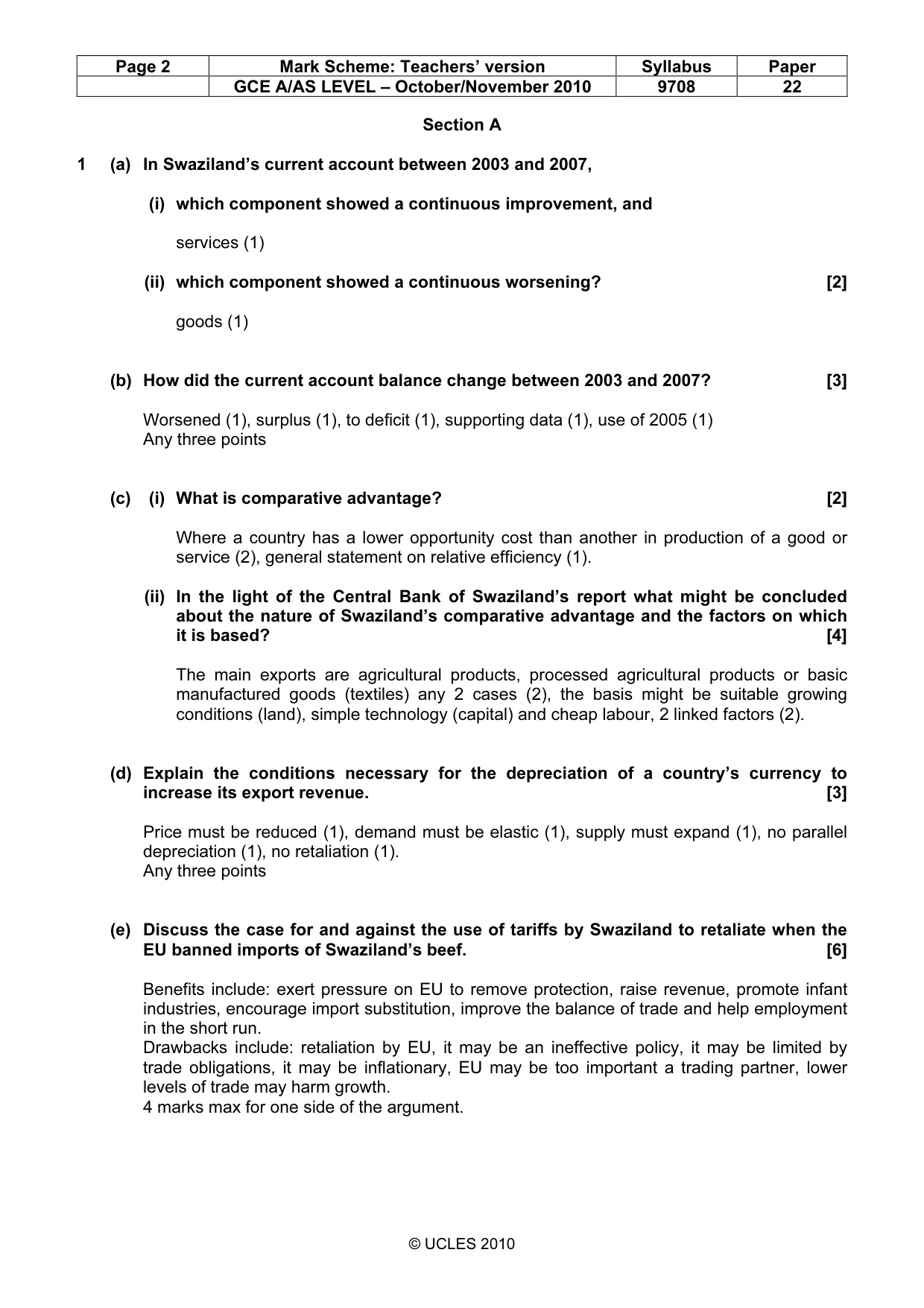
Page 2 Mark Scheme: Teachers’ version Syllabus Paper GCE A/AS LEVEL – October/November 2010 9708 22 © UCLES 2010 Section A 1 (a) In Swaziland’s current account between 2003 and 2007, (i) which component showed a continuous improvement, and services (1) (ii) which component showed a continuous worsening? [2] goods (1) (b) How did the current account balance change between 2003 and 2007? [3] Worsened (1), surplus (1), to deficit (1), supporting data (1), use of 2005 (1) Any three points (c) (i) What is comparative advantage? [2] Where a country has a lower opportunity cost than another in production of a good or service (2), general statement on relative efficiency (1). (ii) In the light of the Central Bank of Swaziland’s report what might be concluded about the nature of Swaziland’s comparative advantage and the factors on which it is based? [4] The main exports are agricultural products, processed agricultural products or basic manufactured goods (textiles) any 2 cases (2), the basis might be suitable growing conditions (land), simple technology (capital) and cheap labour, 2 linked factors (2). (d) Explain the conditions necessary for the depreciation of a country’s currency to increase its export revenue. [3] Price must be reduced (1), demand must be elastic (1), supply must expand (1), no parallel depreciation (1), no retaliation (1). Any three points (e) Discuss the case for and against the use of tariffs by Swaziland to retaliate when the EU banned imports of Swaziland’s beef. [6] Benefits include: exert pressure on EU to remove protection, raise revenue, promote infant industries, encourage import substitution, improve the balance of trade and help employment in the short run. Drawbacks include: retaliation by EU, it may be an ineffective policy, it may be limited by trade obligations, it may be inflationary, EU may be too important a trading partner, lower levels of trade may harm growth. 4 marks max for one side of the argument.
Mark scheme, page 3
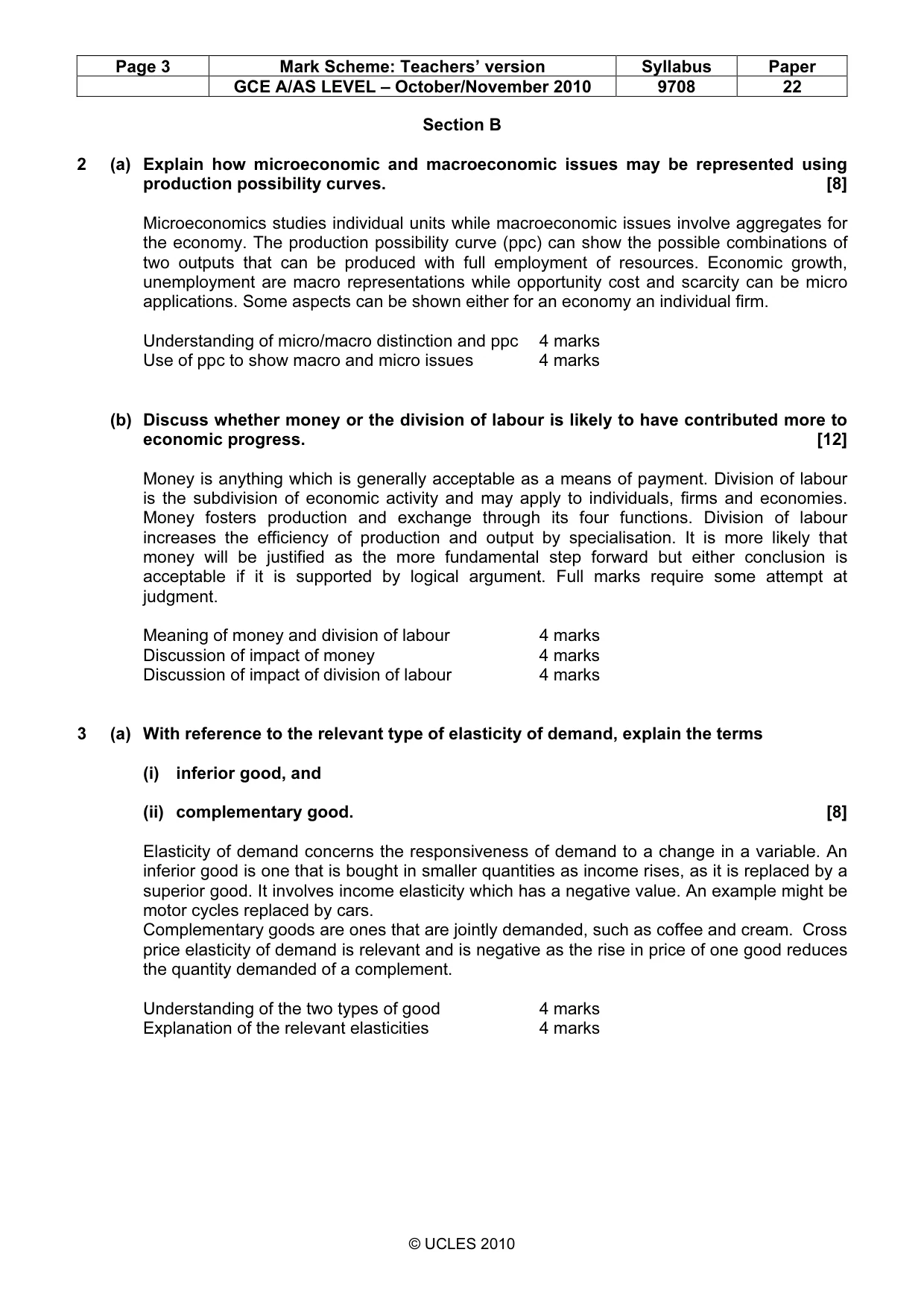
Page 3 Mark Scheme: Teachers’ version Syllabus Paper GCE A/AS LEVEL – October/November 2010 9708 22 © UCLES 2010 Section B 2 (a) Explain how microeconomic and macroeconomic issues may be represented using production possibility curves. [8] Microeconomics studies individual units while macroeconomic issues involve aggregates for the economy. The production possibility curve (ppc) can show the possible combinations of two outputs that can be produced with full employment of resources. Economic growth, unemployment are macro representations while opportunity cost and scarcity can be micro applications. Some aspects can be shown either for an economy an individual firm. Understanding of micro/macro distinction and ppc 4 marks Use of ppc to show macro and micro issues 4 marks (b) Discuss whether money or the division of labour is likely to have contributed more to economic progress. [12] Money is anything which is generally acceptable as a means of payment. Division of labour is the subdivision of economic activity and may apply to individuals, firms and economies. Money fosters production and exchange through its four functions. Division of labour increases the efficiency of production and output by specialisation. It is more likely that money will be justified as the more fundamental step forward but either conclusion is acceptable if it is supported by logical argument. Full marks require some attempt at judgment. Meaning of money and division of labour 4 marks Discussion of impact of money 4 marks Discussion of impact of division of labour 4 marks 3 (a) With reference to the relevant type of elasticity of demand, explain the terms (i) inferior good, and (ii) complementary good. [8] Elasticity of demand concerns the responsiveness of demand to a change in a variable. An inferior good is one that is bought in smaller quantities as income rises, as it is replaced by a superior good. It involves income elasticity which has a negative value. An example might be motor cycles replaced by cars. Complementary goods are ones that are jointly demanded, such as coffee and cream. Cross price elasticity of demand is relevant and is negative as the rise in price of one good reduces the quantity demanded of a complement. Understanding of the two types of good 4 marks Explanation of the relevant elasticities 4 marks
Mark scheme, page 4
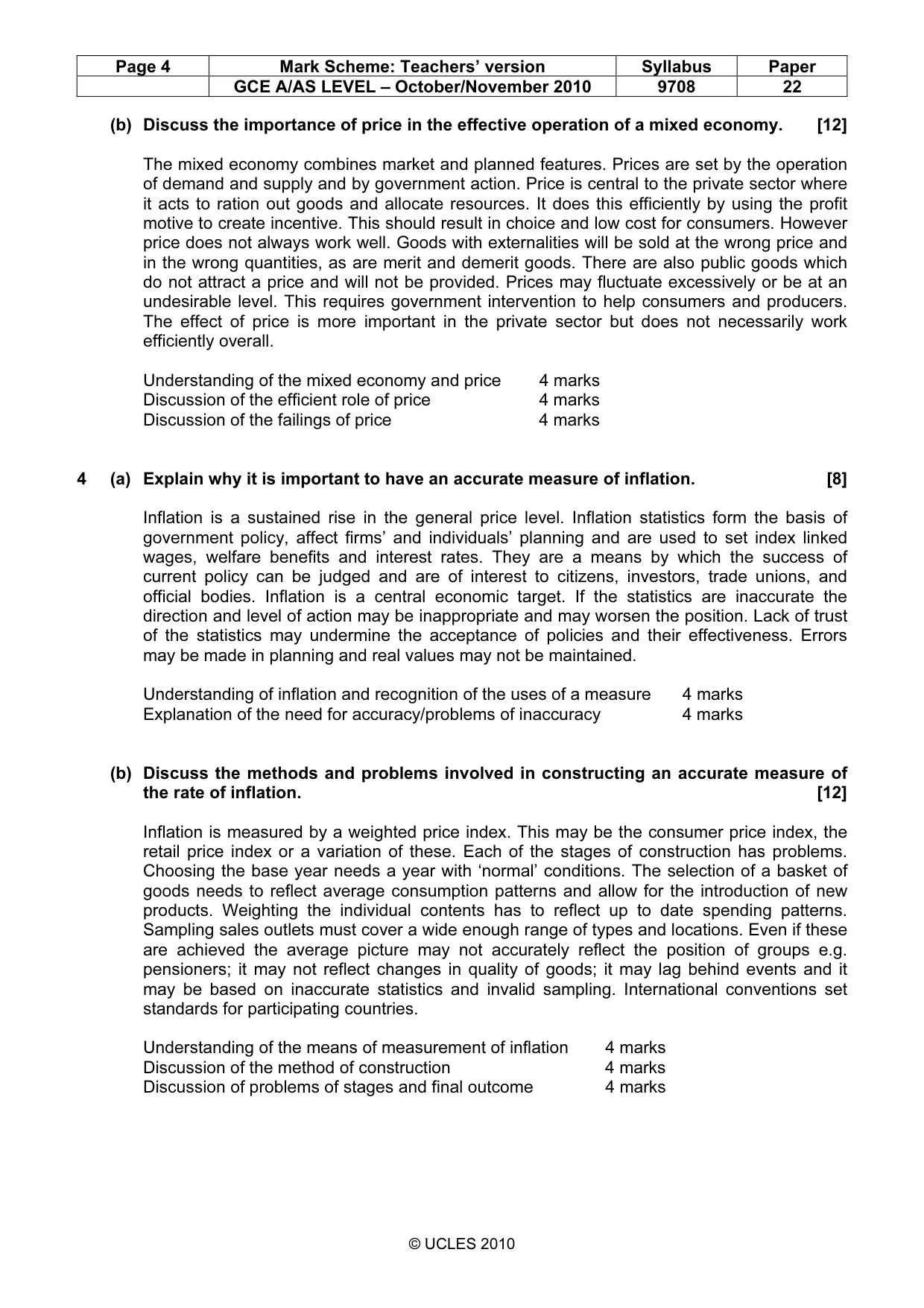
Page 4 Mark Scheme: Teachers’ version Syllabus Paper GCE A/AS LEVEL – October/November 2010 9708 22 © UCLES 2010 (b) Discuss the importance of price in the effective operation of a mixed economy. [12] The mixed economy combines market and planned features. Prices are set by the operation of demand and supply and by government action. Price is central to the private sector where it acts to ration out goods and allocate resources. It does this efficiently by using the profit motive to create incentive. This should result in choice and low cost for consumers. However price does not always work well. Goods with externalities will be sold at the wrong price and in the wrong quantities, as are merit and demerit goods. There are also public goods which do not attract a price and will not be provided. Prices may fluctuate excessively or be at an undesirable level. This requires government intervention to help consumers and producers. The effect of price is more important in the private sector but does not necessarily work efficiently overall. Understanding of the mixed economy and price 4 marks Discussion of the efficient role of price 4 marks Discussion of the failings of price 4 marks 4 (a) Explain why it is important to have an accurate measure of inflation. [8] Inflation is a sustained rise in the general price level. Inflation statistics form the basis of government policy, affect firms’ and individuals’ planning and are used to set index linked wages, welfare benefits and interest rates. They are a means by which the success of current policy can be judged and are of interest to citizens, investors, trade unions, and official bodies. Inflation is a central economic target. If the statistics are inaccurate the direction and level of action may be inappropriate and may worsen the position. Lack of trust of the statistics may undermine the acceptance of policies and their effectiveness. Errors may be made in planning and real values may not be maintained. Understanding of inflation and recognition of the uses of a measure 4 marks Explanation of the need for accuracy/problems of inaccuracy 4 marks (b) Discuss the methods and problems involved in constructing an accurate measure of the rate of inflation. [12] Inflation is measured by a weighted price index. This may be the consumer price index, the retail price index or a variation of these. Each of the stages of construction has problems. Choosing the base year needs a year with ‘normal’ conditions. The selection of a basket of goods needs to reflect average consumption patterns and allow for the introduction of new products. Weighting the individual contents has to reflect up to date spending patterns. Sampling sales outlets must cover a wide enough range of types and locations. Even if these are achieved the average picture may not accurately reflect the position of groups e.g. pensioners; it may not reflect changes in quality of goods; it may lag behind events and it may be based on inaccurate statistics and invalid sampling. International conventions set standards for participating countries. Understanding of the means of measurement of inflation 4 marks Discussion of the method of construction 4 marks Discussion of problems of stages and final outcome 4 marks
What you needed in this session
Cambridge’s own grade thresholds for 2010 Oct/Nov, Paper 2 · Variant 2. A higher threshold means an easier paper — the bar moves with how the cohort did.