Cambridge A Level Drama 9482 — 2025 Oct/Nov Paper 1 · Variant 3
9482/13/O/N/25 · 60 marks · 120 min
The question paper and its mark scheme, free to read here and free to download. This is Cambridge’s own paper, exactly as it was sat.
Question paper8 pages


Mark scheme30 pages
Answers below. Sit the paper first if you are practising.
Paper as text
Question paper, page 1
This document has 8 pages. Any blank pages are indicated. [Turn over Cambridge International AS & A Level DC (EV) 347369/3 © UCLES 2025 DRAMA 9482/13 Paper 1 October/November 2025 2 hours You must answer on the enclosed answer booklet. You will need: Answer booklet (enclosed) Candidates may take their set texts into the exam room, but these must not contain personal annotations, highlighting or underlining. INSTRUCTIONS ● Answer two questions in total: Section A: answer one question. Section B: answer one question. ● Follow the instructions on the front cover of the answer booklet. If you need additional answer paper, ask the invigilator for a continuation booklet. ● You may take your set texts into the exam room, but these must not contain personal annotations, highlighting or underlining. ● You may support your answers with sketches and diagrams, where appropriate. INFORMATION ● The total mark for this paper is 60. ● The number of marks for each question or part question is shown in brackets [ ]. * 8 4 9 9 9 8 6 1 3 3 *
Question paper, page 2
2 9482/13/O/N/25 © UCLES 2025 Section A Answer one question from this section. You should read the specified extract for your chosen text carefully before beginning your answer. Question 1 As You Like It – William Shakespeare Read the specified extract: From: Act 4, Scene 1, towards the top of page 83 ORLANDO: My fair Rosalind, I come within an hour of my promise. Up to and including: Act 4, Scene 1, towards the bottom of page 85 ROSALIND: By my life, she will do as I do. EITHER (a) As a designer, explain and justify how you would use set, lighting and sound to create an appropriate setting for the action of this scene. [30] OR (b) How would you direct the interaction between ROSALIND and ORLANDO in selected moments from the extract to create your intended effects for the audience? [30] Question 2 The Rivals – Richard Sheridan Read the specified extract: From: Act 3, Scene 2, bottom of page 27 FAULKLAND: They told me Julia would return directly … Up to and including: Act 3, Scene 2, end of scene, page 30 FAULKLAND: … shall make me curse my folly half the day and all the night. [Exit. EITHER (a) How would you direct selected moments from the extract to convey your interpretation of the relationship between FAULKLAND and JULIA? [30] OR (b) How would you perform the role of JULIA, at selected moments from the extract, to highlight her unhappiness caused by FAULKLAND’s behaviour towards her? [30]
Question paper, page 3
3 9482/13/O/N/25 © UCLES 2025 [Turn over Question 3 A View from the Bridge – Arthur Miller Read the specified extract: From: Act 1, towards the bottom of page 41 EDDIE, holding back a voice full of anger: Yeah, but he don’t have to go lookin’ for it, Beatrice. Up to and including: the ending of Act 1, page 46 … and EDDIE’s grin vanishes as he absorbs his look. EITHER (a) Explain how you would direct selected moments from the extract to create tension for the audience from the growing friction between EDDIE and the cousins. [30] OR (b) How would you perform the role of RODOLPHO in selected moments from the extract to convey your interpretation of his character? [30] Question 4 The Beatification of Area Boy – Wole Soyinka Read the specified extract: From: middle of page 17 MAMA PUT: Hey, not that one near my food-stall, you hear? Up to and including: bottom of page 21 MAMA PUT: … I suppose those oilmen will also earn medals? EITHER (a) How would you perform the role of MAMA PUT in selected moments from the extract to convey your interpretation of her character? [30] OR (b) How would you direct selected moments from the extract to create the sense of community that exists in the street market? [30]
Question paper, page 4
4 9482/13/O/N/25 © UCLES 2025 Question 5 Please note that there are two editions of this text with differing page numbers. Both sets of page numbers are referenced below. Small Island – Helen Edmundson Read the specified extract: From: Act 1, Scene 7, beginning of the scene, page 71 or page 74 The house in Earl’s Court. The sitting room looks dingy and neglected. Up to and including: Act 1, Scene 7, end of scene, page 76 or page 79 GILBERT: … it is the price of a ticket to England. EITHER (a) How would you perform the role of QUEENIE to demonstrate her attraction to MICHAEL in selected moments from the extract? [30] OR (a) How would you direct selected moments from the extract to reveal the complex feelings of GILBERT and HORTENSE towards each other and their future in England? [30]
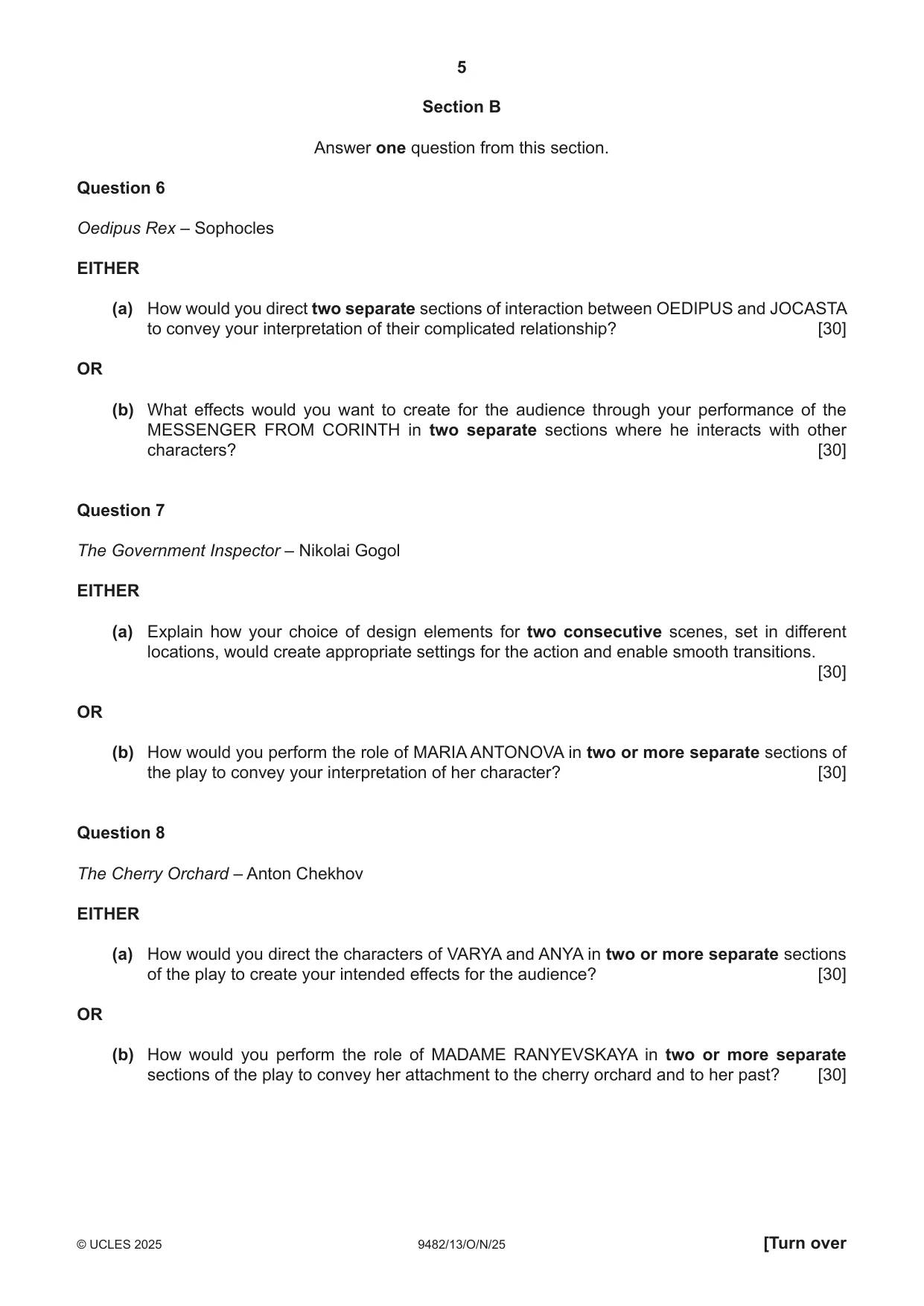
Question paper, page 5
5 9482/13/O/N/25 © UCLES 2025 [Turn over Section B Answer one question from this section. Question 6 Oedipus Rex – Sophocles EITHER (a) How would you direct two separate sections of interaction between OEDIPUS and JOCASTA to convey your interpretation of their complicated relationship? [30] OR (b) What effects would you want to create for the audience through your performance of the MESSENGER FROM CORINTH in two separate sections where he interacts with other characters? [30] Question 7 The Government Inspector – Nikolai Gogol EITHER (a) Explain how your choice of design elements for two consecutive scenes, set in different locations, would create appropriate settings for the action and enable smooth transitions. [30] OR (b) How would you perform the role of MARIA ANTONOVA in two or more separate sections of the play to convey your interpretation of her character? [30] Question 8 The Cherry Orchard – Anton Chekhov EITHER (a) How would you direct the characters of VARYA and ANYA in two or more separate sections of the play to create your intended effects for the audience? [30] OR (b) How would you perform the role of MADAME RANYEVSKAYA in two or more separate sections of the play to convey her attachment to the cherry orchard and to her past? [30]
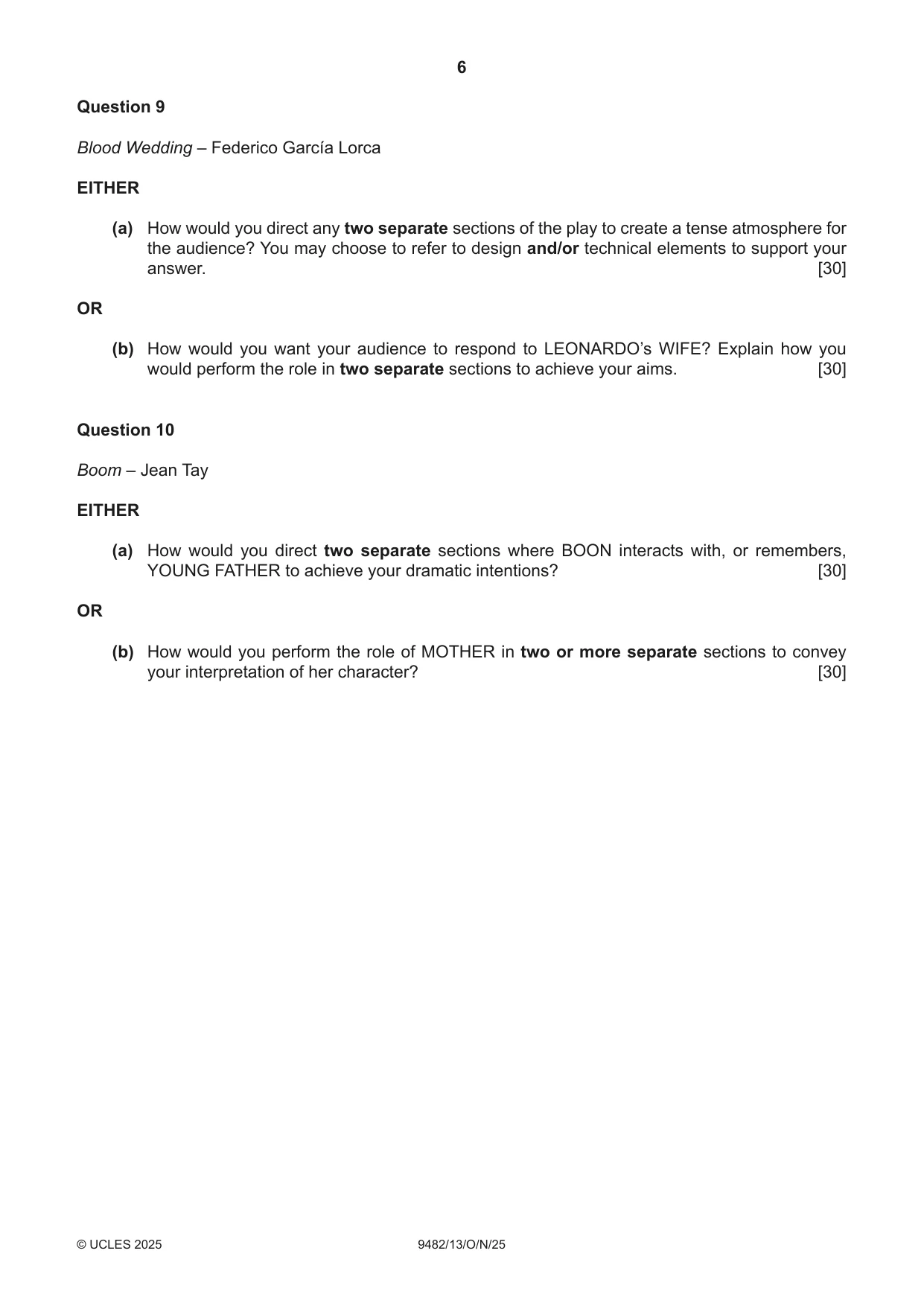
Question paper, page 6
6 9482/13/O/N/25 © UCLES 2025 Question 9 Blood Wedding – Federico García Lorca EITHER (a) How would you direct any two separate sections of the play to create a tense atmosphere for the audience? You may choose to refer to design and/or technical elements to support your answer. [30] OR (b) How would you want your audience to respond to LEONARDO’s WIFE? Explain how you would perform the role in two separate sections to achieve your aims. [30] Question 10 Boom – Jean Tay EITHER (a) How would you direct two separate sections where BOON interacts with, or remembers, YOUNG FATHER to achieve your dramatic intentions? [30] OR (b) How would you perform the role of MOTHER in two or more separate sections to convey your interpretation of her character? [30]
Question paper, page 7
7 9482/13/O/N/25 © UCLES 2025 BLANK PAGE
Question paper, page 8
8 9482/13/O/N/25 © UCLES 2025 Permission to reproduce items where third-party owned material protected by copyright is included has been sought and cleared where possible. Every reasonable effort has been made by the publisher (UCLES) to trace copyright holders, but if any items requiring clearance have unwittingly been included, the publisher will be pleased to make amends at the earliest possible opportunity. To avoid the issue of disclosure of answer-related information to candidates, all copyright acknowledgements are reproduced online in the Cambridge Assessment International Education Copyright Acknowledgements Booklet. This is produced for each series of examinations and is freely available to download at www.cambridgeinternational.org after the live examination series. Cambridge Assessment International Education is part of Cambridge Assessment. Cambridge Assessment is the brand name of the University of Cambridge Local Examinations Syndicate (UCLES), which is a department of the University of Cambridge. BLANK PAGE
Mark scheme, page 1
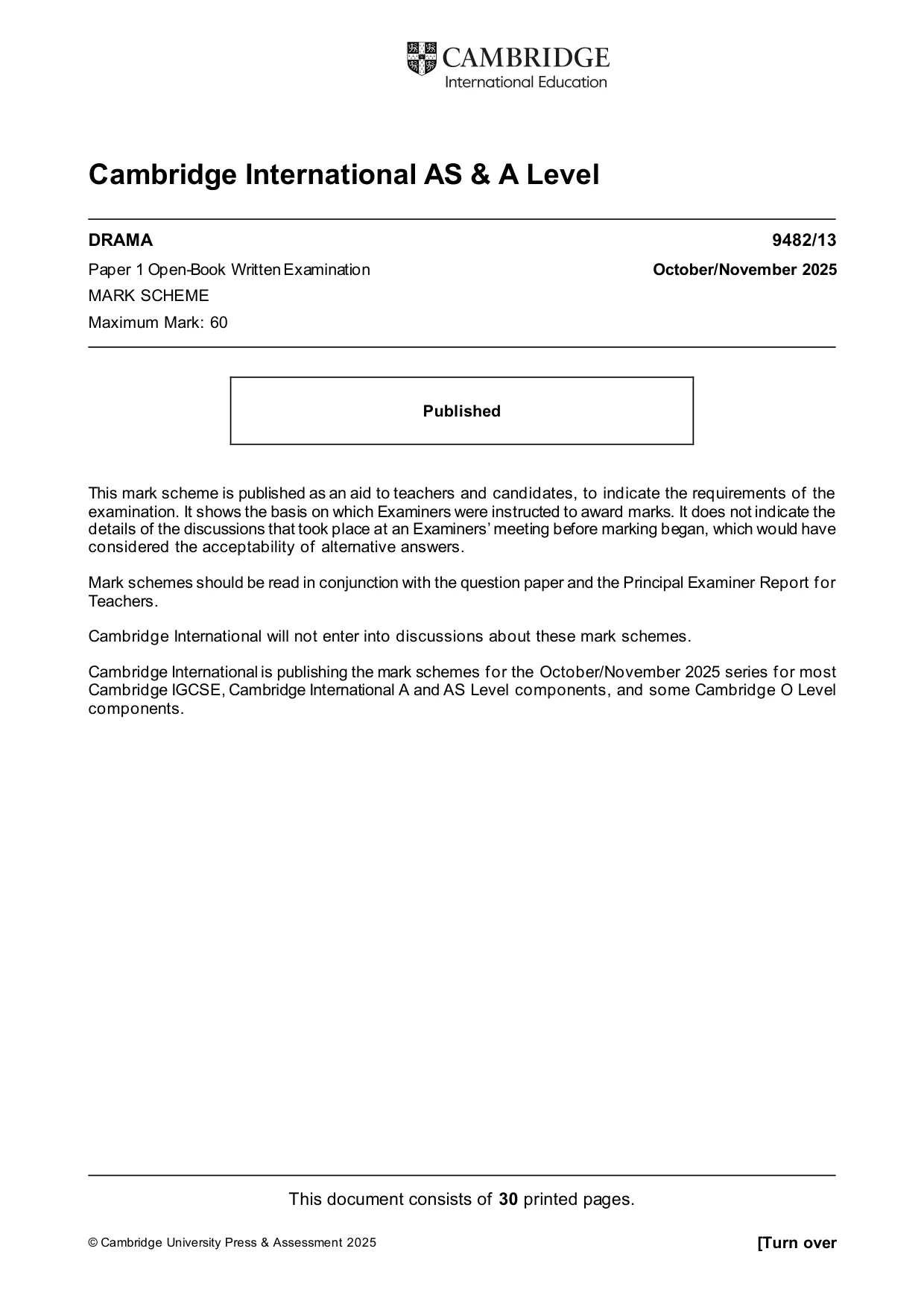
This document consists of 30 printed pages. © Cambridge University Press & Assessment 2025 [Turn over Cambridge International AS & A Level DRAMA 9482/13 Paper 1 Open-Book Written Examination October/November 2025 MARK SCHEME Maximum Mark: 60 Published This mark scheme is published as an aid to teachers and candidates, to indicate the requirements of the examination. It shows the basis on which Examiners were instructed to award marks. It does not indicate the details of the discussions that took place at an Examiners’ meeting before marking began, which would have considered the acceptability of alternative answers. Mark schemes should be read in conjunction with the question paper and the Principal Examiner Report for Teachers. Cambridge International will not enter into discussions about these mark schemes. Cambridge International is publishing the mark schemes for the October/November 2025 series for most Cambridge IGCSE, Cambridge International A and AS Level components, and some Cambridge O Level components.
Mark scheme, page 2
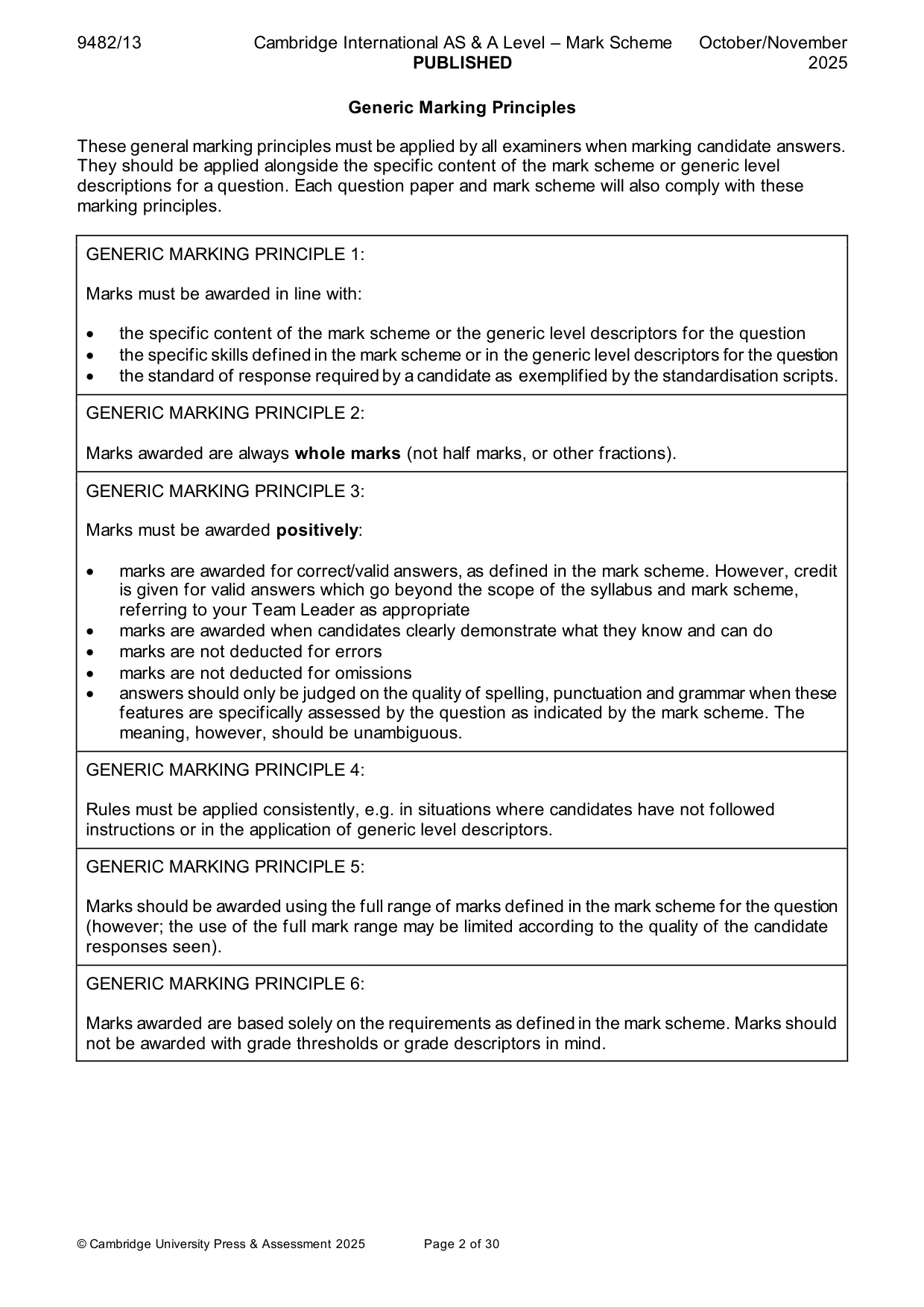
9482/13 Cambridge International AS & A Level – Mark Scheme PUBLISHED October/November 2025 © Cambridge University Press & Assessment 2025 Page 2 of 30 Generic Marking Principles These general marking principles must be applied by all examiners when marking candidate answers. They should be applied alongside the specific content of the mark scheme or generic level descriptions for a question. Each question paper and mark scheme will also comply with these marking principles. GENERIC MARKING PRINCIPLE 1: Marks must be awarded in line with: • the specific content of the mark scheme or the generic level descriptors for the question • the specific skills defined in the mark scheme or in the generic level descriptors for the question • the standard of response required by a candidate as exemplified by the standardisation scripts. GENERIC MARKING PRINCIPLE 2: Marks awarded are always whole marks (not half marks, or other fractions). GENERIC MARKING PRINCIPLE 3: Marks must be awarded positively: • marks are awarded for correct/valid answers, as defined in the mark scheme. However, credit is given for valid answers which go beyond the scope of the syllabus and mark scheme, referring to your Team Leader as appropriate • marks are awarded when candidates clearly demonstrate what they know and can do • marks are not deducted for errors • marks are not deducted for omissions • answers should only be judged on the quality of spelling, punctuation and grammar when these features are specifically assessed by the question as indicated by the mark scheme. The meaning, however, should be unambiguous. GENERIC MARKING PRINCIPLE 4: Rules must be applied consistently, e.g. in situations where candidates have not followed instructions or in the application of generic level descriptors. GENERIC MARKING PRINCIPLE 5: Marks should be awarded using the full range of marks defined in the mark scheme for the question (however; the use of the full mark range may be limited according to the quality of the candidate responses seen). GENERIC MARKING PRINCIPLE 6: Marks awarded are based solely on the requirements as defined in the mark scheme. Marks should not be awarded with grade thresholds or grade descriptors in mind.
Mark scheme, page 3
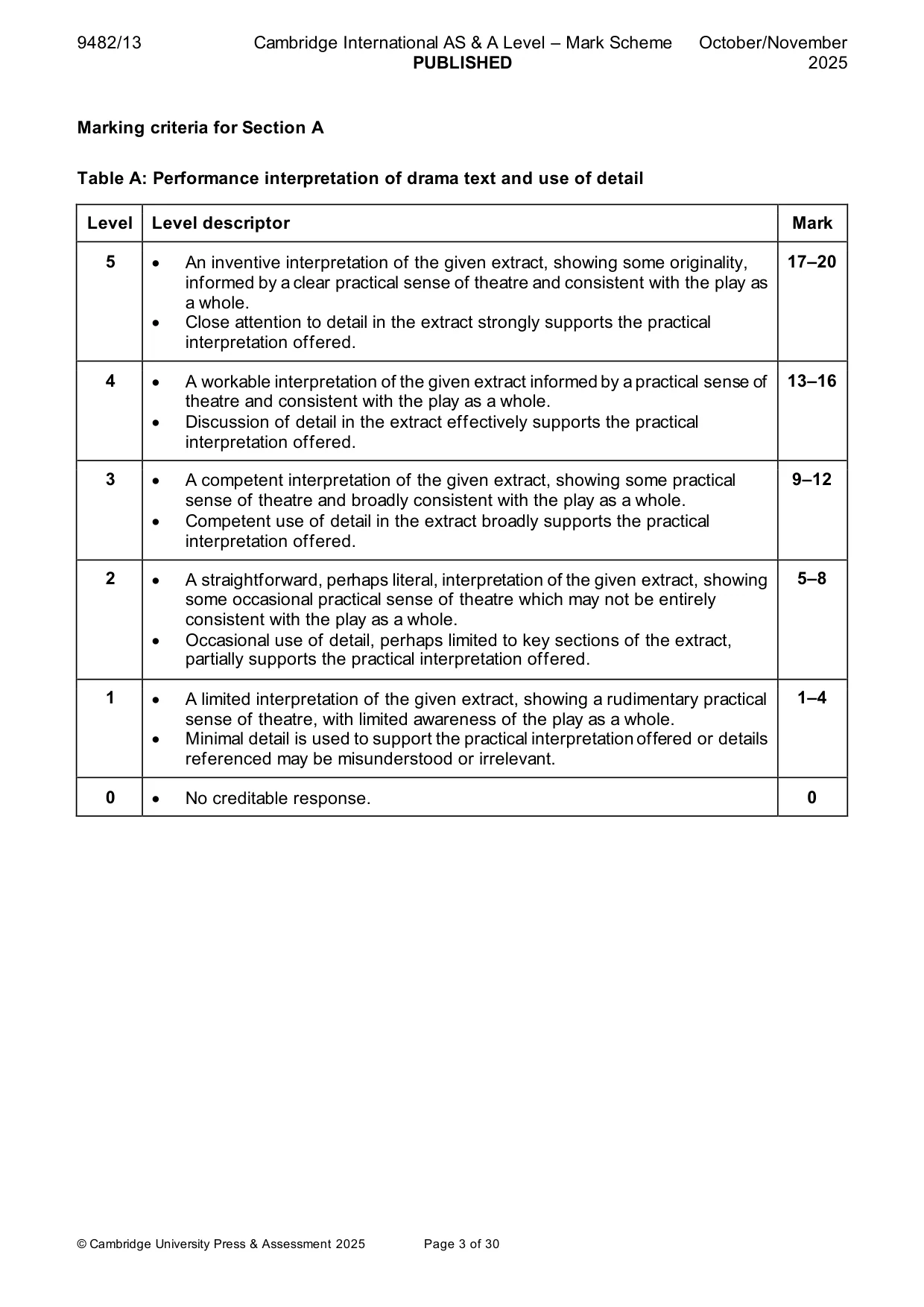
9482/13 Cambridge International AS & A Level – Mark Scheme PUBLISHED October/November 2025 © Cambridge University Press & Assessment 2025 Page 3 of 30 Marking criteria for Section A Table A: Performance interpretation of drama text and use of detail Level Level descriptor Mark 5 • An inventive interpretation of the given extract, showing some originality, informed by a clear practical sense of theatre and consistent with the play as a whole. • Close attention to detail in the extract strongly supports the practical interpretation offered. 17–20 4 • A workable interpretation of the given extract informed by a practical sense of theatre and consistent with the play as a whole. • Discussion of detail in the extract effectively supports the practical interpretation offered. 13–16 3 • A competent interpretation of the given extract, showing some practical sense of theatre and broadly consistent with the play as a whole. • Competent use of detail in the extract broadly supports the practical interpretation offered. 9–12 2 • A straightforward, perhaps literal, interpretation of the given extract, showing some occasional practical sense of theatre which may not be entirely consistent with the play as a whole. • Occasional use of detail, perhaps limited to key sections of the extract, partially supports the practical interpretation offered. 5–8 1 • A limited interpretation of the given extract, showing a rudimentary practical sense of theatre, with limited awareness of the play as a whole. • Minimal detail is used to support the practical interpretation offered or details referenced may be misunderstood or irrelevant. 1–4 0 • No creditable response. 0
Mark scheme, page 4
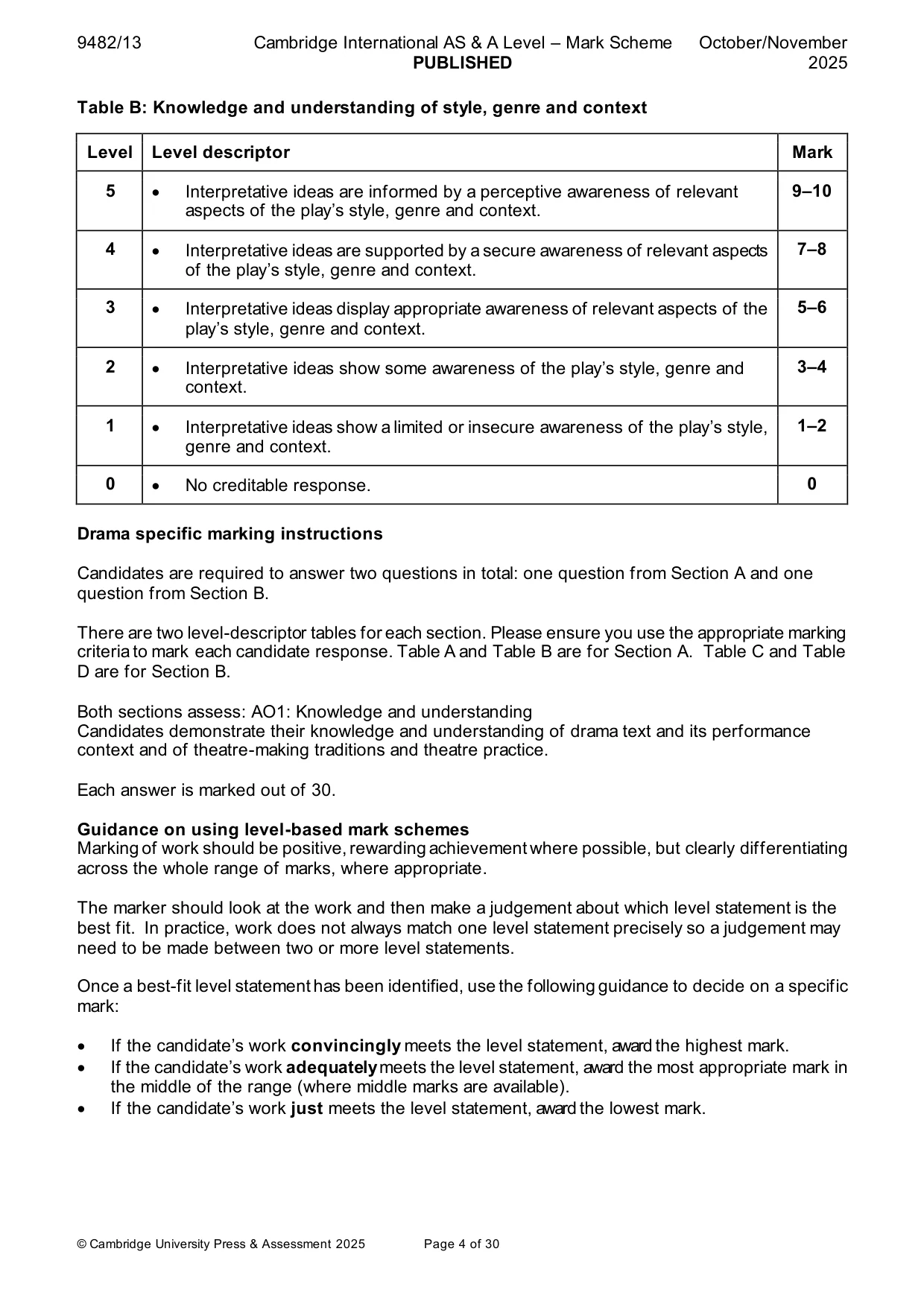
9482/13 Cambridge International AS & A Level – Mark Scheme PUBLISHED October/November 2025 © Cambridge University Press & Assessment 2025 Page 4 of 30 Table B: Knowledge and understanding of style, genre and context Level Level descriptor Mark 5 • Interpretative ideas are informed by a perceptive awareness of relevant aspects of the play’s style, genre and context. 9–10 4 • Interpretative ideas are supported by a secure awareness of relevant aspects of the play’s style, genre and context. 7–8 3 • Interpretative ideas display appropriate awareness of relevant aspects of the play’s style, genre and context. 5–6 2 • Interpretative ideas show some awareness of the play’s style, genre and context. 3–4 1 • Interpretative ideas show a limited or insecure awareness of the play’s style, genre and context. 1–2 0 • No creditable response. 0 Drama specific marking instructions Candidates are required to answer two questions in total: one question from Section A and one question from Section B. There are two level-descriptor tables for each section. Please ensure you use the appropriate marking criteria to mark each candidate response. Table A and Table B are for Section A. Table C and Table D are for Section B. Both sections assess: AO1: Knowledge and understanding Candidates demonstrate their knowledge and understanding of drama text and its performance context and of theatre-making traditions and theatre practice. Each answer is marked out of 30. Guidance on using level-based mark schemes Marking of work should be positive, rewarding achievement where possible, but clearly differentiating across the whole range of marks, where appropriate. The marker should look at the work and then make a judgement about which level statement is the best fit. In practice, work does not always match one level statement precisely so a judgement may need to be made between two or more level statements. Once a best-fit level statement has been identified, use the following guidance to decide on a specific mark: • If the candidate’s work convincingly meets the level statement, award the highest mark. • If the candidate’s work adequately meets the level statement, award the most appropriate mark in the middle of the range (where middle marks are available). • If the candidate’s work just meets the level statement, award the lowest mark.
Mark scheme, page 5
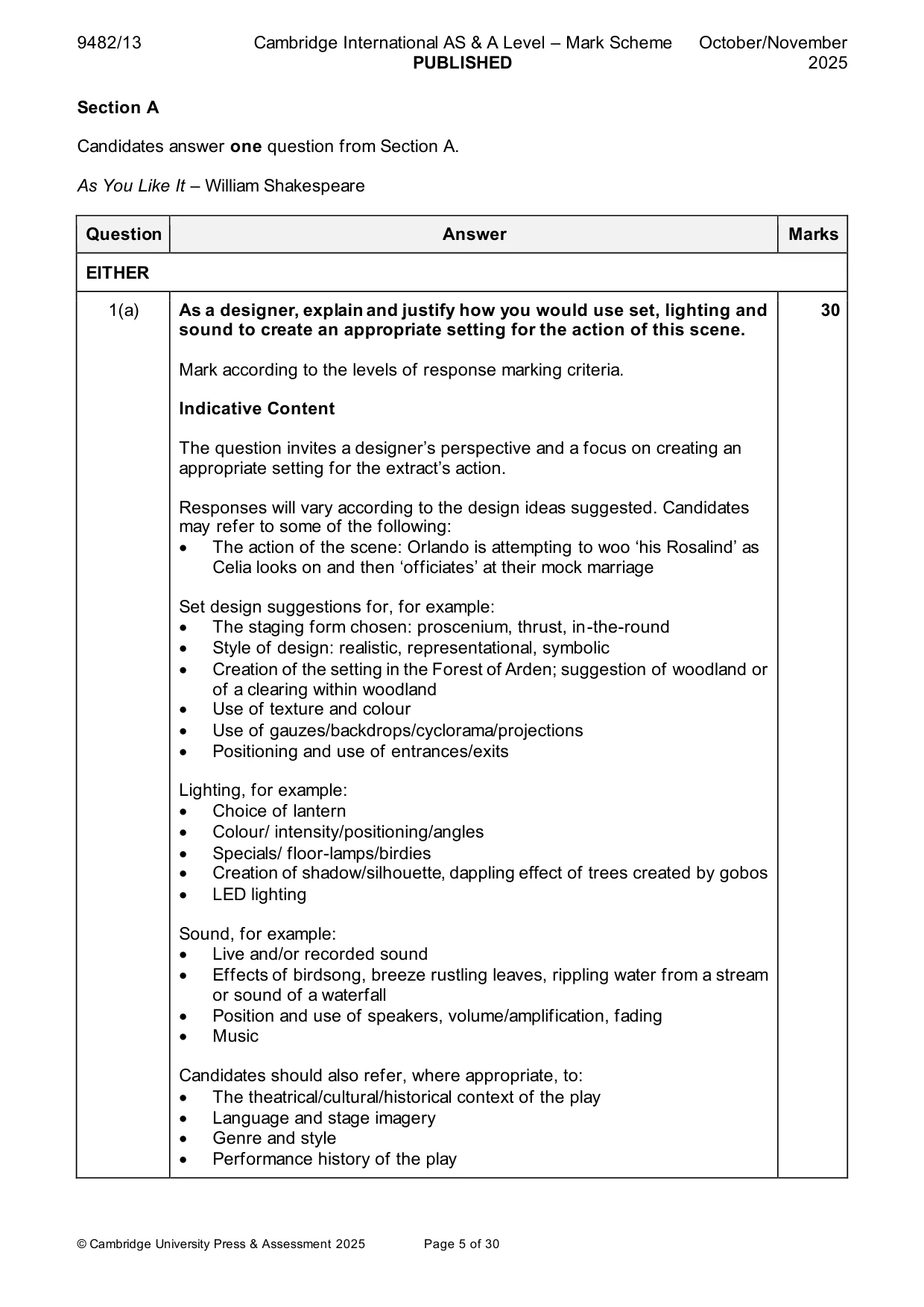
9482/13 Cambridge International AS & A Level – Mark Scheme PUBLISHED October/November 2025 © Cambridge University Press & Assessment 2025 Page 5 of 30 Section A Candidates answer one question from Section A. As You Like It – William Shakespeare Question Answer Marks EITHER 1(a) As a designer, explain and justify how you would use set, lighting and sound to create an appropriate setting for the action of this scene. Mark according to the levels of response marking criteria. Indicative Content The question invites a designer’s perspective and a focus on creating an appropriate setting for the extract’s action. Responses will vary according to the design ideas suggested. Candidates may refer to some of the following: • The action of the scene: Orlando is attempting to woo ‘his Rosalind’ as Celia looks on and then ‘officiates’ at their mock marriage Set design suggestions for, for example: • The staging form chosen: proscenium, thrust, in-the-round • Style of design: realistic, representational, symbolic • Creation of the setting in the Forest of Arden; suggestion of woodland or of a clearing within woodland • Use of texture and colour • Use of gauzes/backdrops/cyclorama/projections • Positioning and use of entrances/exits Lighting, for example: • Choice of lantern • Colour/ intensity/positioning/angles • Specials/ floor-lamps/birdies • Creation of shadow/silhouette, dappling effect of trees created by gobos • LED lighting Sound, for example: • Live and/or recorded sound • Effects of birdsong, breeze rustling leaves, rippling water from a stream or sound of a waterfall • Position and use of speakers, volume/amplification, fading • Music Candidates should also refer, where appropriate, to: • The theatrical/cultural/historical context of the play • Language and stage imagery • Genre and style • Performance history of the play 30
Mark scheme, page 6
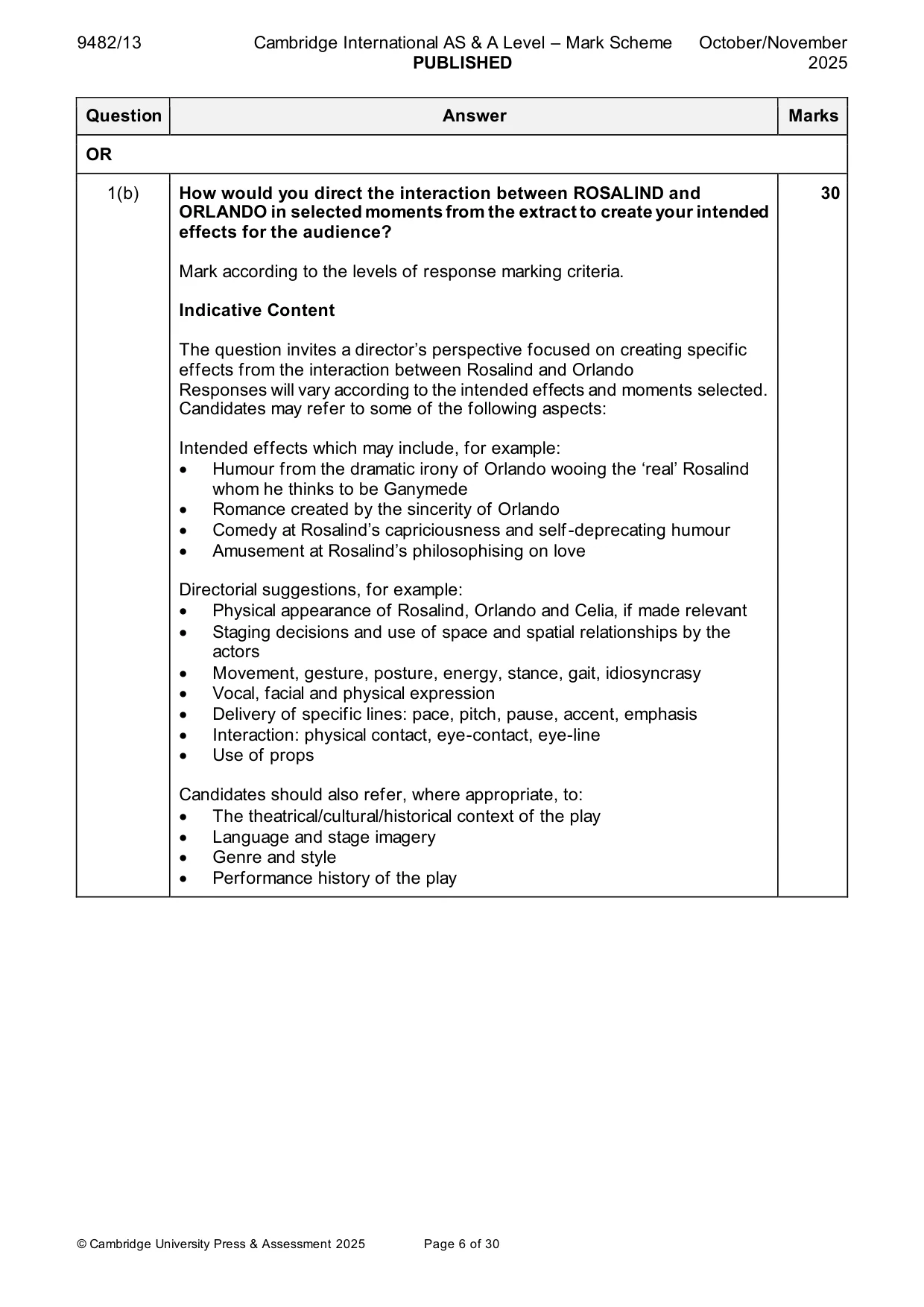
9482/13 Cambridge International AS & A Level – Mark Scheme PUBLISHED October/November 2025 © Cambridge University Press & Assessment 2025 Page 6 of 30 Question Answer Marks OR 1(b) How would you direct the interaction between ROSALIND and ORLANDO in selected moments from the extract to create your intended effects for the audience? Mark according to the levels of response marking criteria. Indicative Content The question invites a director’s perspective focused on creating specific effects from the interaction between Rosalind and Orlando Responses will vary according to the intended effects and moments selected. Candidates may refer to some of the following aspects: Intended effects which may include, for example: • Humour from the dramatic irony of Orlando wooing the ‘real’ Rosalind whom he thinks to be Ganymede • Romance created by the sincerity of Orlando • Comedy at Rosalind’s capriciousness and self-deprecating humour • Amusement at Rosalind’s philosophising on love Directorial suggestions, for example: • Physical appearance of Rosalind, Orlando and Celia, if made relevant • Staging decisions and use of space and spatial relationships by the actors • Movement, gesture, posture, energy, stance, gait, idiosyncrasy • Vocal, facial and physical expression • Delivery of specific lines: pace, pitch, pause, accent, emphasis • Interaction: physical contact, eye-contact, eye-line • Use of props Candidates should also refer, where appropriate, to: • The theatrical/cultural/historical context of the play • Language and stage imagery • Genre and style • Performance history of the play 30
Mark scheme, page 7
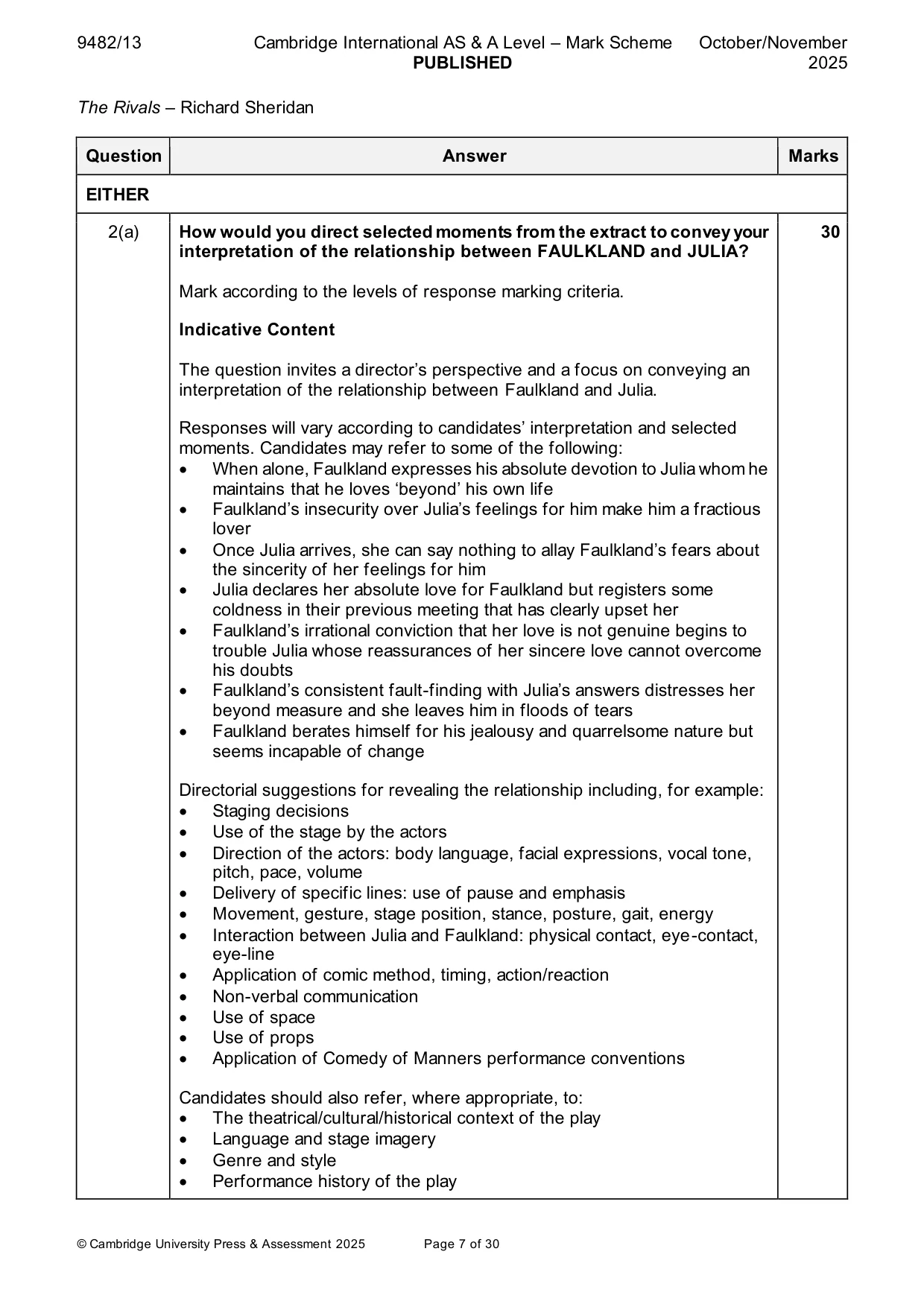
9482/13 Cambridge International AS & A Level – Mark Scheme PUBLISHED October/November 2025 © Cambridge University Press & Assessment 2025 Page 7 of 30 The Rivals – Richard Sheridan Question Answer Marks EITHER 2(a) How would you direct selected moments from the extract to convey your interpretation of the relationship between FAULKLAND and JULIA? Mark according to the levels of response marking criteria. Indicative Content The question invites a director’s perspective and a focus on conveying an interpretation of the relationship between Faulkland and Julia. Responses will vary according to candidates’ interpretation and selected moments. Candidates may refer to some of the following: • When alone, Faulkland expresses his absolute devotion to Julia whom he maintains that he loves ‘beyond’ his own life • Faulkland’s insecurity over Julia’s feelings for him make him a fractious lover • Once Julia arrives, she can say nothing to allay Faulkland’s fears about the sincerity of her feelings for him • Julia declares her absolute love for Faulkland but registers some coldness in their previous meeting that has clearly upset her • Faulkland’s irrational conviction that her love is not genuine begins to trouble Julia whose reassurances of her sincere love cannot overcome his doubts • Faulkland’s consistent fault-finding with Julia’s answers distresses her beyond measure and she leaves him in floods of tears • Faulkland berates himself for his jealousy and quarrelsome nature but seems incapable of change Directorial suggestions for revealing the relationship including, for example: • Staging decisions • Use of the stage by the actors • Direction of the actors: body language, facial expressions, vocal tone, pitch, pace, volume • Delivery of specific lines: use of pause and emphasis • Movement, gesture, stage position, stance, posture, gait, energy • Interaction between Julia and Faulkland: physical contact, eye-contact, eye-line • Application of comic method, timing, action/reaction • Non-verbal communication • Use of space • Use of props • Application of Comedy of Manners performance conventions Candidates should also refer, where appropriate, to: • The theatrical/cultural/historical context of the play • Language and stage imagery • Genre and style • Performance history of the play 30
Mark scheme, page 8
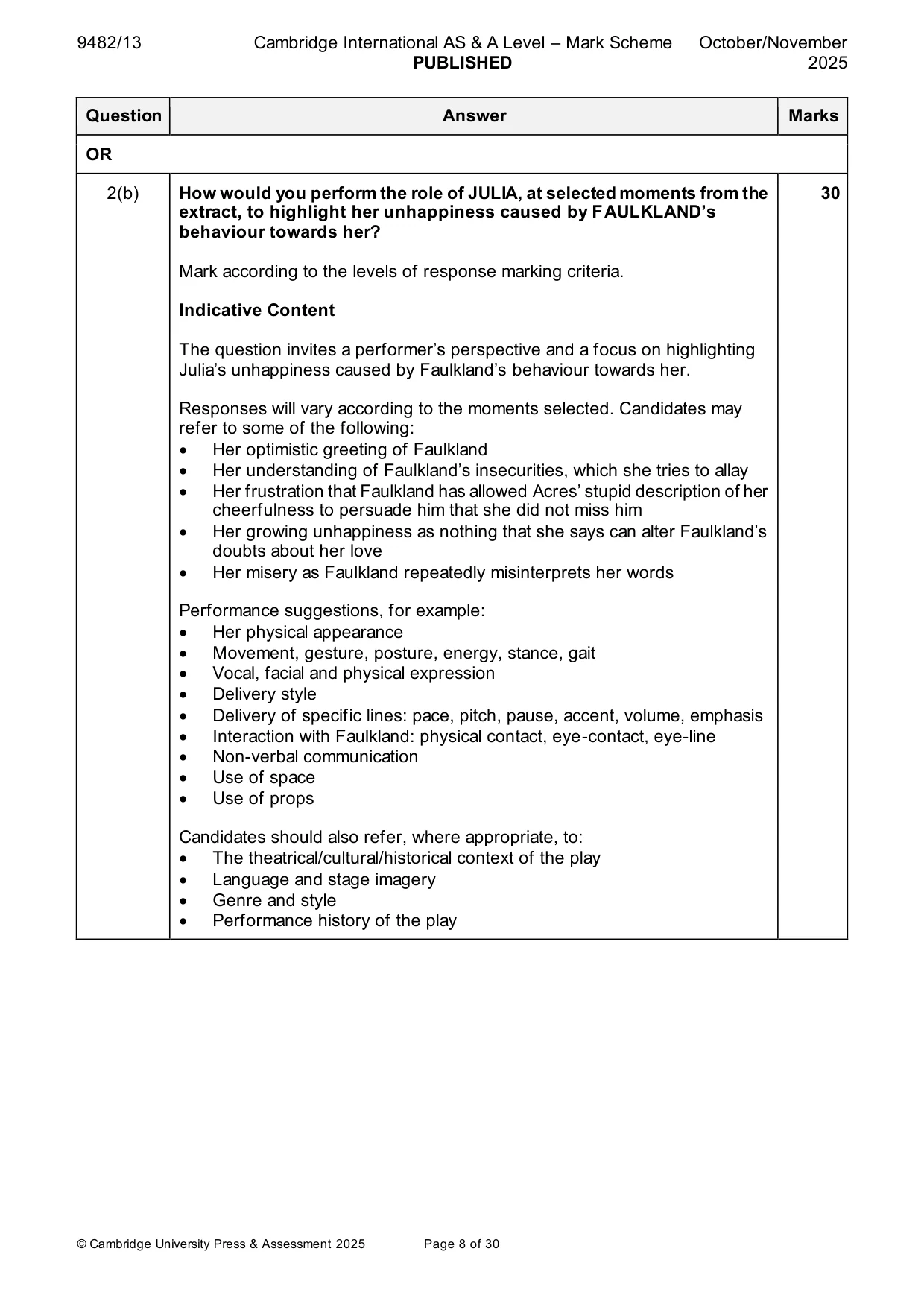
9482/13 Cambridge International AS & A Level – Mark Scheme PUBLISHED October/November 2025 © Cambridge University Press & Assessment 2025 Page 8 of 30 Question Answer Marks OR 2(b) How would you perform the role of JULIA, at selected moments from the extract, to highlight her unhappiness caused by FAULKLAND’s behaviour towards her? Mark according to the levels of response marking criteria. Indicative Content The question invites a performer’s perspective and a focus on highlighting Julia’s unhappiness caused by Faulkland’s behaviour towards her. Responses will vary according to the moments selected. Candidates may refer to some of the following: • Her optimistic greeting of Faulkland • Her understanding of Faulkland’s insecurities, which she tries to allay • Her frustration that Faulkland has allowed Acres’ stupid description of her cheerfulness to persuade him that she did not miss him • Her growing unhappiness as nothing that she says can alter Faulkland’s doubts about her love • Her misery as Faulkland repeatedly misinterprets her words Performance suggestions, for example: • Her physical appearance • Movement, gesture, posture, energy, stance, gait • Vocal, facial and physical expression • Delivery style • Delivery of specific lines: pace, pitch, pause, accent, volume, emphasis • Interaction with Faulkland: physical contact, eye-contact, eye-line • Non-verbal communication • Use of space • Use of props Candidates should also refer, where appropriate, to: • The theatrical/cultural/historical context of the play • Language and stage imagery • Genre and style • Performance history of the play 30
Mark scheme, page 9
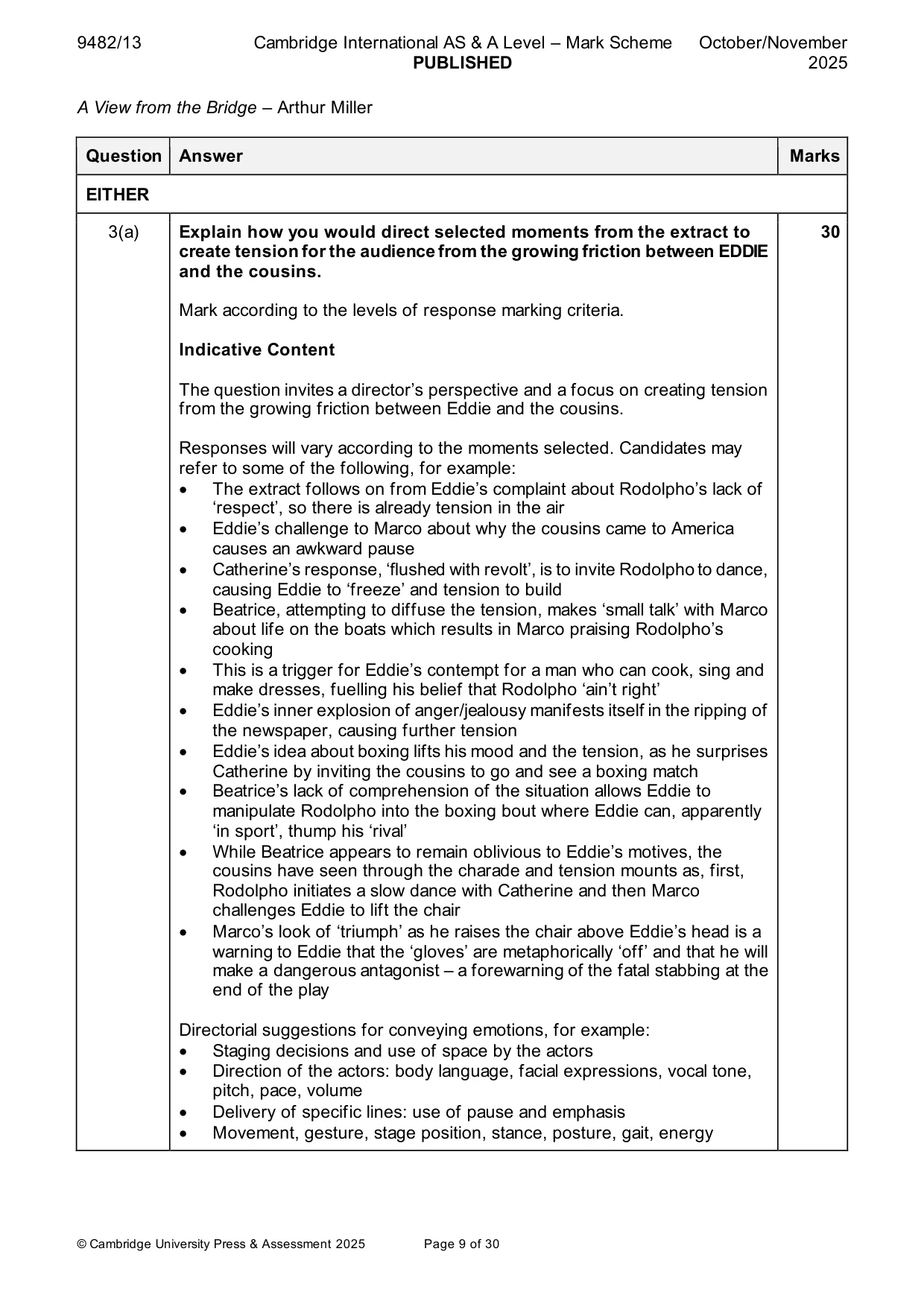
9482/13 Cambridge International AS & A Level – Mark Scheme PUBLISHED October/November 2025 © Cambridge University Press & Assessment 2025 Page 9 of 30 A View from the Bridge – Arthur Miller Question Answer Marks EITHER 3(a) Explain how you would direct selected moments from the extract to create tension for the audience from the growing friction between EDDIE and the cousins. Mark according to the levels of response marking criteria. Indicative Content The question invites a director’s perspective and a focus on creating tension from the growing friction between Eddie and the cousins. Responses will vary according to the moments selected. Candidates may refer to some of the following, for example: • The extract follows on from Eddie’s complaint about Rodolpho’s lack of ‘respect’, so there is already tension in the air • Eddie’s challenge to Marco about why the cousins came to America causes an awkward pause • Catherine’s response, ‘flushed with revolt’, is to invite Rodolpho to dance, causing Eddie to ‘freeze’ and tension to build • Beatrice, attempting to diffuse the tension, makes ‘small talk’ with Marco about life on the boats which results in Marco praising Rodolpho’s cooking • This is a trigger for Eddie’s contempt for a man who can cook, sing and make dresses, fuelling his belief that Rodolpho ‘ain’t right’ • Eddie’s inner explosion of anger/jealousy manifests itself in the ripping of the newspaper, causing further tension • Eddie’s idea about boxing lifts his mood and the tension, as he surprises Catherine by inviting the cousins to go and see a boxing match • Beatrice’s lack of comprehension of the situation allows Eddie to manipulate Rodolpho into the boxing bout where Eddie can, apparently ‘in sport’, thump his ‘rival’ • While Beatrice appears to remain oblivious to Eddie’s motives, the cousins have seen through the charade and tension mounts as, first, Rodolpho initiates a slow dance with Catherine and then Marco challenges Eddie to lift the chair • Marco’s look of ‘triumph’ as he raises the chair above Eddie’s head is a warning to Eddie that the ‘gloves’ are metaphorically ‘off’ and that he will make a dangerous antagonist – a forewarning of the fatal stabbing at the end of the play Directorial suggestions for conveying emotions, for example: • Staging decisions and use of space by the actors • Direction of the actors: body language, facial expressions, vocal tone, pitch, pace, volume • Delivery of specific lines: use of pause and emphasis • Movement, gesture, stage position, stance, posture, gait, energy 30
Mark scheme, page 10
9482/13 Cambridge International AS & A Level – Mark Scheme PUBLISHED October/November 2025 © Cambridge University Press & Assessment 2025 Page 10 of 30 Question Answer Marks 3(a) • Interaction: physical contact, eye-contact, eye-line • Non-verbal communication • Use of props Candidates should also refer, where appropriate, to: • The theatrical/cultural/historical context of the play • Language and stage imagery • Genre and style • Performance history of the play
Mark scheme, page 11
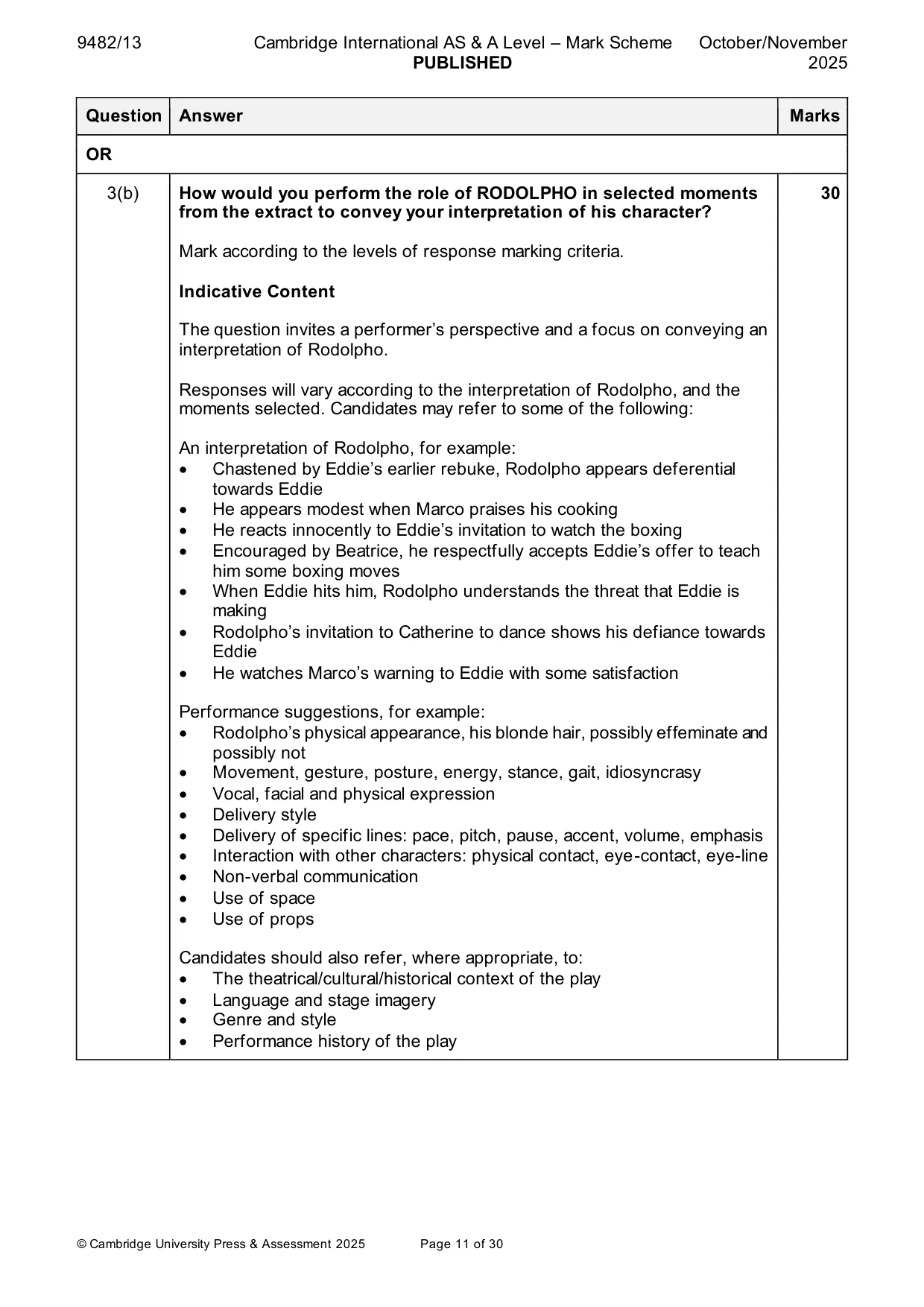
9482/13 Cambridge International AS & A Level – Mark Scheme PUBLISHED October/November 2025 © Cambridge University Press & Assessment 2025 Page 11 of 30 Question Answer Marks OR 3(b) How would you perform the role of RODOLPHO in selected moments from the extract to convey your interpretation of his character? Mark according to the levels of response marking criteria. Indicative Content The question invites a performer’s perspective and a focus on conveying an interpretation of Rodolpho. Responses will vary according to the interpretation of Rodolpho, and the moments selected. Candidates may refer to some of the following: An interpretation of Rodolpho, for example: • Chastened by Eddie’s earlier rebuke, Rodolpho appears deferential towards Eddie • He appears modest when Marco praises his cooking • He reacts innocently to Eddie’s invitation to watch the boxing • Encouraged by Beatrice, he respectfully accepts Eddie’s offer to teach him some boxing moves • When Eddie hits him, Rodolpho understands the threat that Eddie is making • Rodolpho’s invitation to Catherine to dance shows his defiance towards Eddie • He watches Marco’s warning to Eddie with some satisfaction Performance suggestions, for example: • Rodolpho’s physical appearance, his blonde hair, possibly effeminate and possibly not • Movement, gesture, posture, energy, stance, gait, idiosyncrasy • Vocal, facial and physical expression • Delivery style • Delivery of specific lines: pace, pitch, pause, accent, volume, emphasis • Interaction with other characters: physical contact, eye-contact, eye-line • Non-verbal communication • Use of space • Use of props Candidates should also refer, where appropriate, to: • The theatrical/cultural/historical context of the play • Language and stage imagery • Genre and style • Performance history of the play 30
Mark scheme, page 12
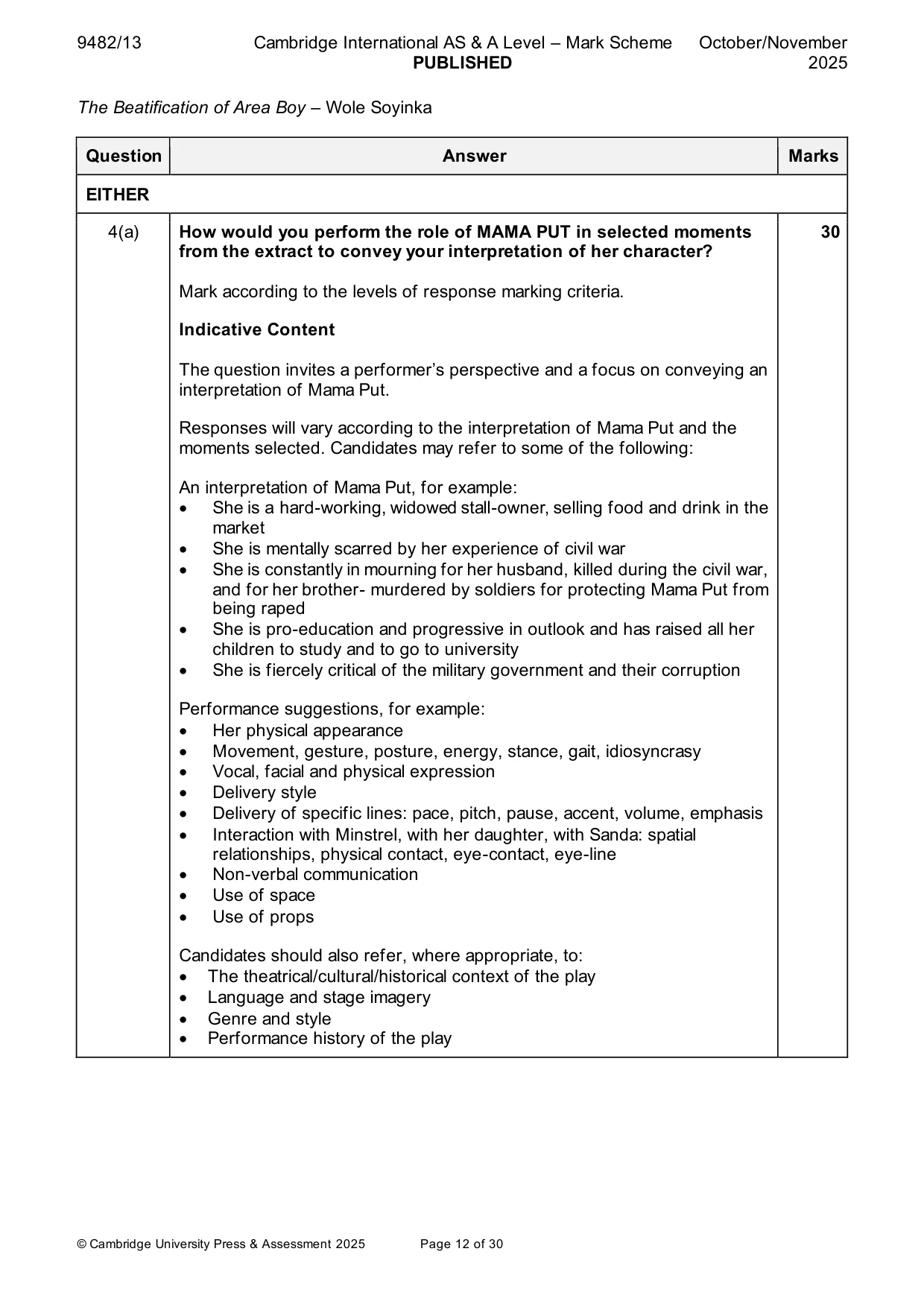
9482/13 Cambridge International AS & A Level – Mark Scheme PUBLISHED October/November 2025 © Cambridge University Press & Assessment 2025 Page 12 of 30 The Beatification of Area Boy – Wole Soyinka Question Answer Marks EITHER 4(a) How would you perform the role of MAMA PUT in selected moments from the extract to convey your interpretation of her character? Mark according to the levels of response marking criteria. Indicative Content The question invites a performer’s perspective and a focus on conveying an interpretation of Mama Put. Responses will vary according to the interpretation of Mama Put and the moments selected. Candidates may refer to some of the following: An interpretation of Mama Put, for example: • She is a hard-working, widowed stall-owner, selling food and drink in the market • She is mentally scarred by her experience of civil war • She is constantly in mourning for her husband, killed during the civil war, and for her brother- murdered by soldiers for protecting Mama Put from being raped • She is pro-education and progressive in outlook and has raised all her children to study and to go to university • She is fiercely critical of the military government and their corruption Performance suggestions, for example: • Her physical appearance • Movement, gesture, posture, energy, stance, gait, idiosyncrasy • Vocal, facial and physical expression • Delivery style • Delivery of specific lines: pace, pitch, pause, accent, volume, emphasis • Interaction with Minstrel, with her daughter, with Sanda: spatial relationships, physical contact, eye-contact, eye-line • Non-verbal communication • Use of space • Use of props Candidates should also refer, where appropriate, to: • The theatrical/cultural/historical context of the play • Language and stage imagery • Genre and style • Performance history of the play 30
Mark scheme, page 13
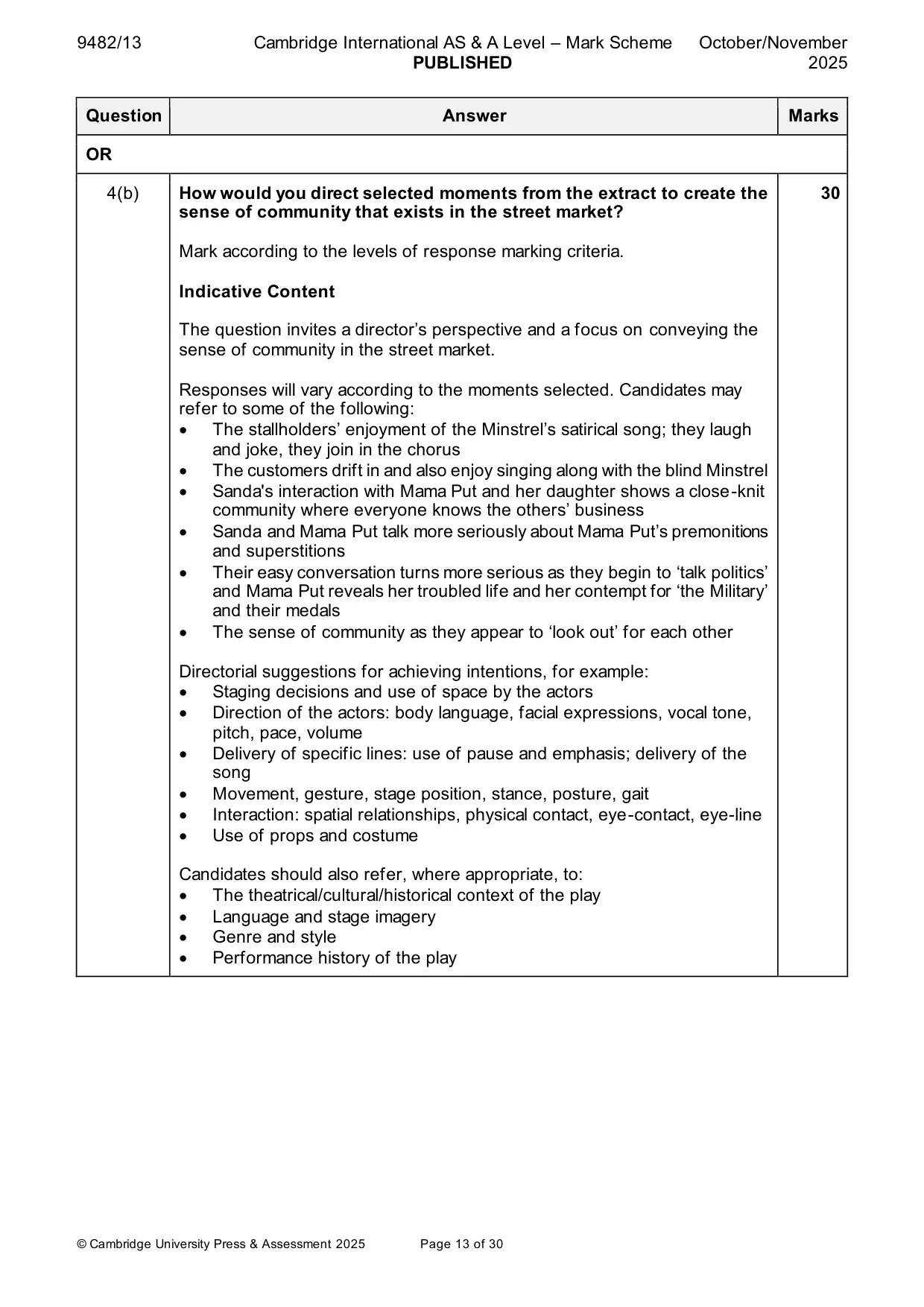
9482/13 Cambridge International AS & A Level – Mark Scheme PUBLISHED October/November 2025 © Cambridge University Press & Assessment 2025 Page 13 of 30 Question Answer Marks OR 4(b) How would you direct selected moments from the extract to create the sense of community that exists in the street market? Mark according to the levels of response marking criteria. Indicative Content The question invites a director’s perspective and a focus on conveying the sense of community in the street market. Responses will vary according to the moments selected. Candidates may refer to some of the following: • The stallholders’ enjoyment of the Minstrel’s satirical song; they laugh and joke, they join in the chorus • The customers drift in and also enjoy singing along with the blind Minstrel • Sanda's interaction with Mama Put and her daughter shows a close-knit community where everyone knows the others’ business • Sanda and Mama Put talk more seriously about Mama Put’s premonitions and superstitions • Their easy conversation turns more serious as they begin to ‘talk politics’ and Mama Put reveals her troubled life and her contempt for ‘the Military’ and their medals • The sense of community as they appear to ‘look out’ for each other Directorial suggestions for achieving intentions, for example: • Staging decisions and use of space by the actors • Direction of the actors: body language, facial expressions, vocal tone, pitch, pace, volume • Delivery of specific lines: use of pause and emphasis; delivery of the song • Movement, gesture, stage position, stance, posture, gait • Interaction: spatial relationships, physical contact, eye-contact, eye-line • Use of props and costume Candidates should also refer, where appropriate, to: • The theatrical/cultural/historical context of the play • Language and stage imagery • Genre and style • Performance history of the play 30
Mark scheme, page 14
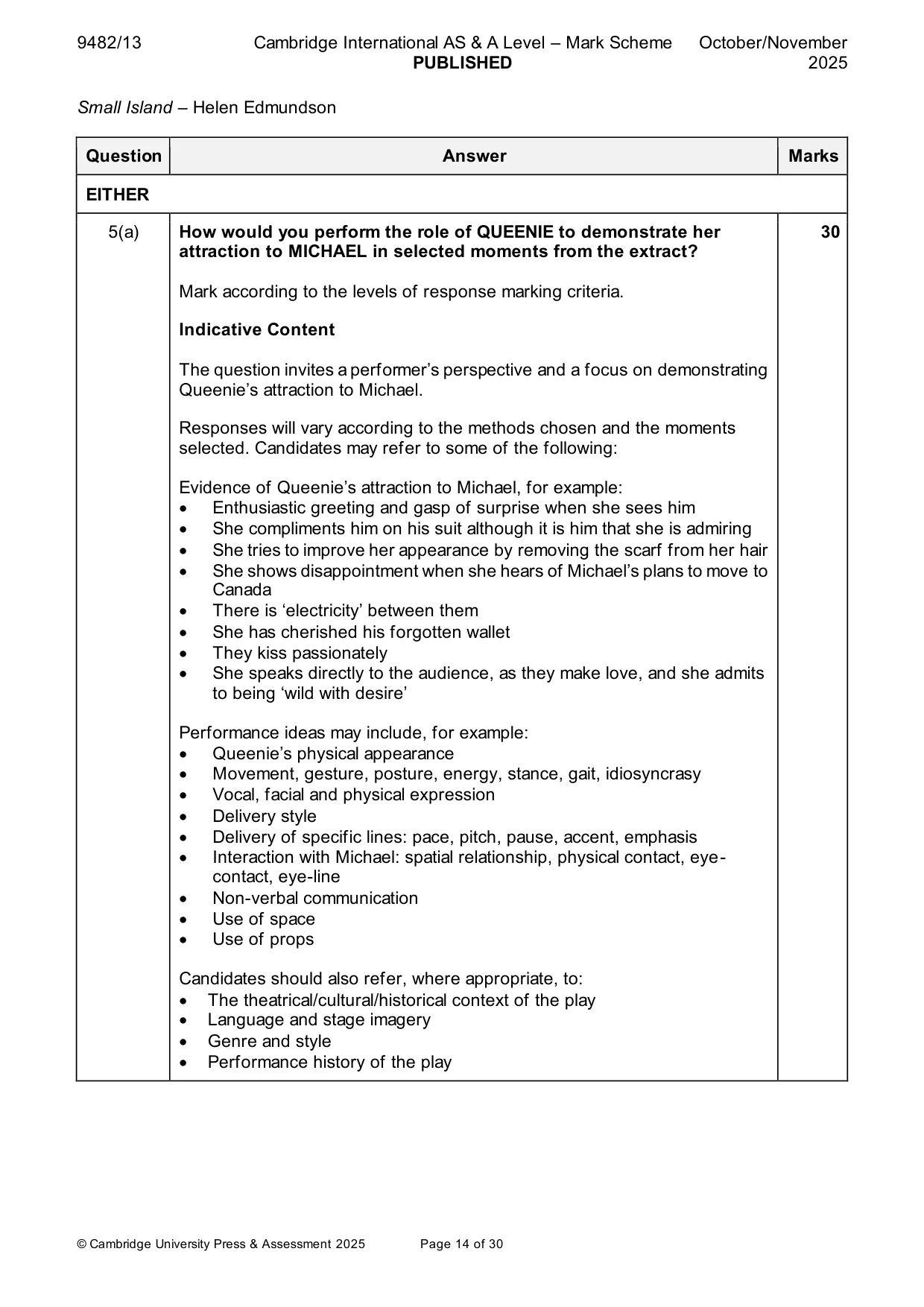
9482/13 Cambridge International AS & A Level – Mark Scheme PUBLISHED October/November 2025 © Cambridge University Press & Assessment 2025 Page 14 of 30 Small Island – Helen Edmundson Question Answer Marks EITHER 5(a) How would you perform the role of QUEENIE to demonstrate her attraction to MICHAEL in selected moments from the extract? Mark according to the levels of response marking criteria. Indicative Content The question invites a performer’s perspective and a focus on demonstrating Queenie’s attraction to Michael. Responses will vary according to the methods chosen and the moments selected. Candidates may refer to some of the following: Evidence of Queenie’s attraction to Michael, for example: • Enthusiastic greeting and gasp of surprise when she sees him • She compliments him on his suit although it is him that she is admiring • She tries to improve her appearance by removing the scarf from her hair • She shows disappointment when she hears of Michael’s plans to move to Canada • There is ‘electricity’ between them • She has cherished his forgotten wallet • They kiss passionately • She speaks directly to the audience, as they make love, and she admits to being ‘wild with desire’ Performance ideas may include, for example: • Queenie’s physical appearance • Movement, gesture, posture, energy, stance, gait, idiosyncrasy • Vocal, facial and physical expression • Delivery style • Delivery of specific lines: pace, pitch, pause, accent, emphasis • Interaction with Michael: spatial relationship, physical contact, eye- contact, eye-line • Non-verbal communication • Use of space • Use of props Candidates should also refer, where appropriate, to: • The theatrical/cultural/historical context of the play • Language and stage imagery • Genre and style • Performance history of the play 30
Mark scheme, page 15
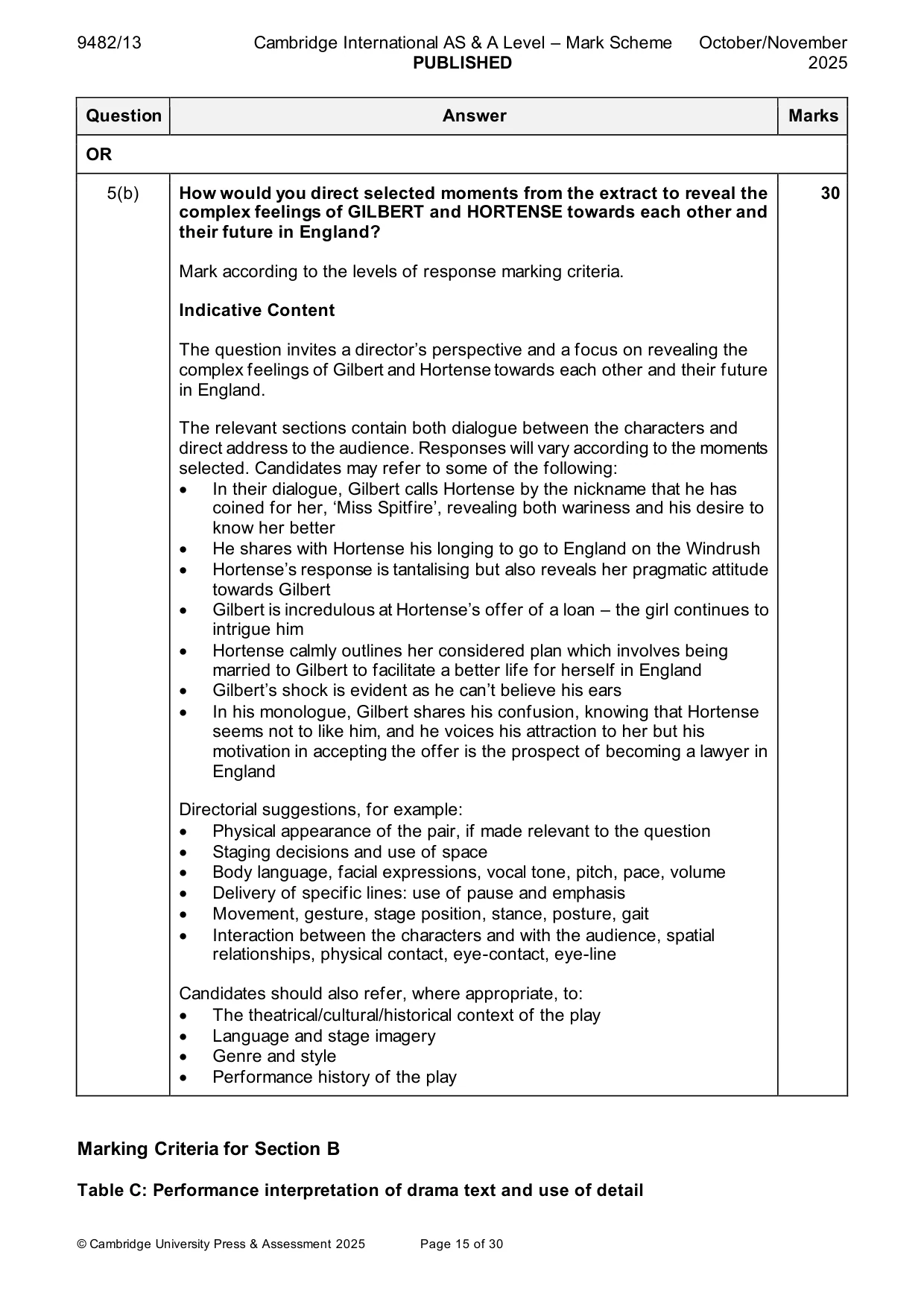
9482/13 Cambridge International AS & A Level – Mark Scheme PUBLISHED October/November 2025 © Cambridge University Press & Assessment 2025 Page 15 of 30 Question Answer Marks OR 5(b) How would you direct selected moments from the extract to reveal the complex feelings of GILBERT and HORTENSE towards each other and their future in England? Mark according to the levels of response marking criteria. Indicative Content The question invites a director’s perspective and a focus on revealing the complex feelings of Gilbert and Hortense towards each other and their future in England. The relevant sections contain both dialogue between the characters and direct address to the audience. Responses will vary according to the moments selected. Candidates may refer to some of the following: • In their dialogue, Gilbert calls Hortense by the nickname that he has coined for her, ‘Miss Spitfire’, revealing both wariness and his desire to know her better • He shares with Hortense his longing to go to England on the Windrush • Hortense’s response is tantalising but also reveals her pragmatic attitude towards Gilbert • Gilbert is incredulous at Hortense’s offer of a loan – the girl continues to intrigue him • Hortense calmly outlines her considered plan which involves being married to Gilbert to facilitate a better life for herself in England • Gilbert’s shock is evident as he can’t believe his ears • In his monologue, Gilbert shares his confusion, knowing that Hortense seems not to like him, and he voices his attraction to her but his motivation in accepting the offer is the prospect of becoming a lawyer in England Directorial suggestions, for example: • Physical appearance of the pair, if made relevant to the question • Staging decisions and use of space • Body language, facial expressions, vocal tone, pitch, pace, volume • Delivery of specific lines: use of pause and emphasis • Movement, gesture, stage position, stance, posture, gait • Interaction between the characters and with the audience, spatial relationships, physical contact, eye-contact, eye-line Candidates should also refer, where appropriate, to: • The theatrical/cultural/historical context of the play • Language and stage imagery • Genre and style • Performance history of the play 30 Marking Criteria for Section B Table C: Performance interpretation of drama text and use of detail
Mark scheme, page 16
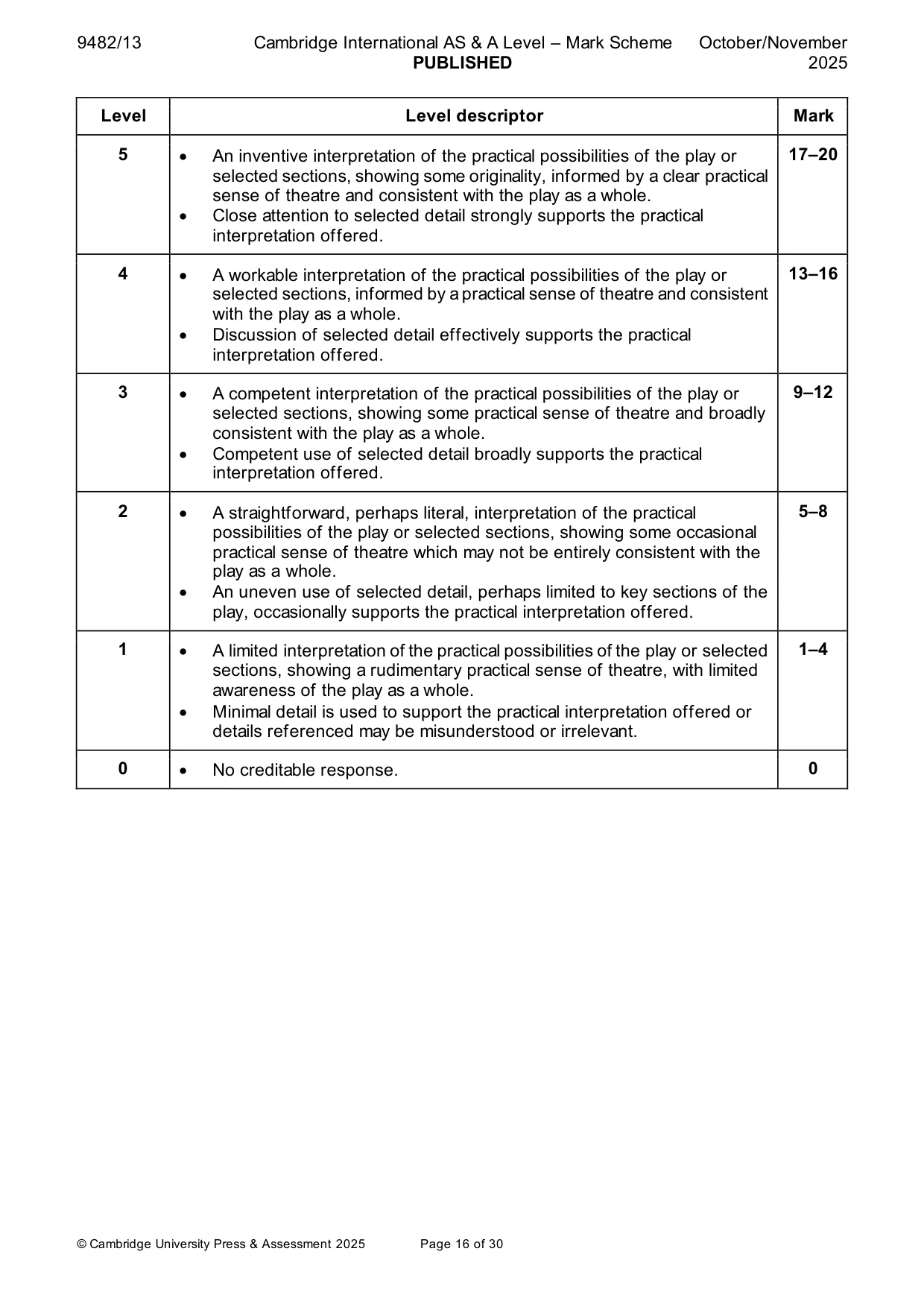
9482/13 Cambridge International AS & A Level – Mark Scheme PUBLISHED October/November 2025 © Cambridge University Press & Assessment 2025 Page 16 of 30 Level Level descriptor Mark 5 • An inventive interpretation of the practical possibilities of the play or selected sections, showing some originality, informed by a clear practical sense of theatre and consistent with the play as a whole. • Close attention to selected detail strongly supports the practical interpretation offered. 17–20 4 • A workable interpretation of the practical possibilities of the play or selected sections, informed by a practical sense of theatre and consistent with the play as a whole. • Discussion of selected detail effectively supports the practical interpretation offered. 13–16 3 • A competent interpretation of the practical possibilities of the play or selected sections, showing some practical sense of theatre and broadly consistent with the play as a whole. • Competent use of selected detail broadly supports the practical interpretation offered. 9–12 2 • A straightforward, perhaps literal, interpretation of the practical possibilities of the play or selected sections, showing some occasional practical sense of theatre which may not be entirely consistent with the play as a whole. • An uneven use of selected detail, perhaps limited to key sections of the play, occasionally supports the practical interpretation offered. 5–8 1 • A limited interpretation of the practical possibilities of the play or selected sections, showing a rudimentary practical sense of theatre, with limited awareness of the play as a whole. • Minimal detail is used to support the practical interpretation offered or details referenced may be misunderstood or irrelevant. 1–4 0 • No creditable response. 0
Mark scheme, page 17
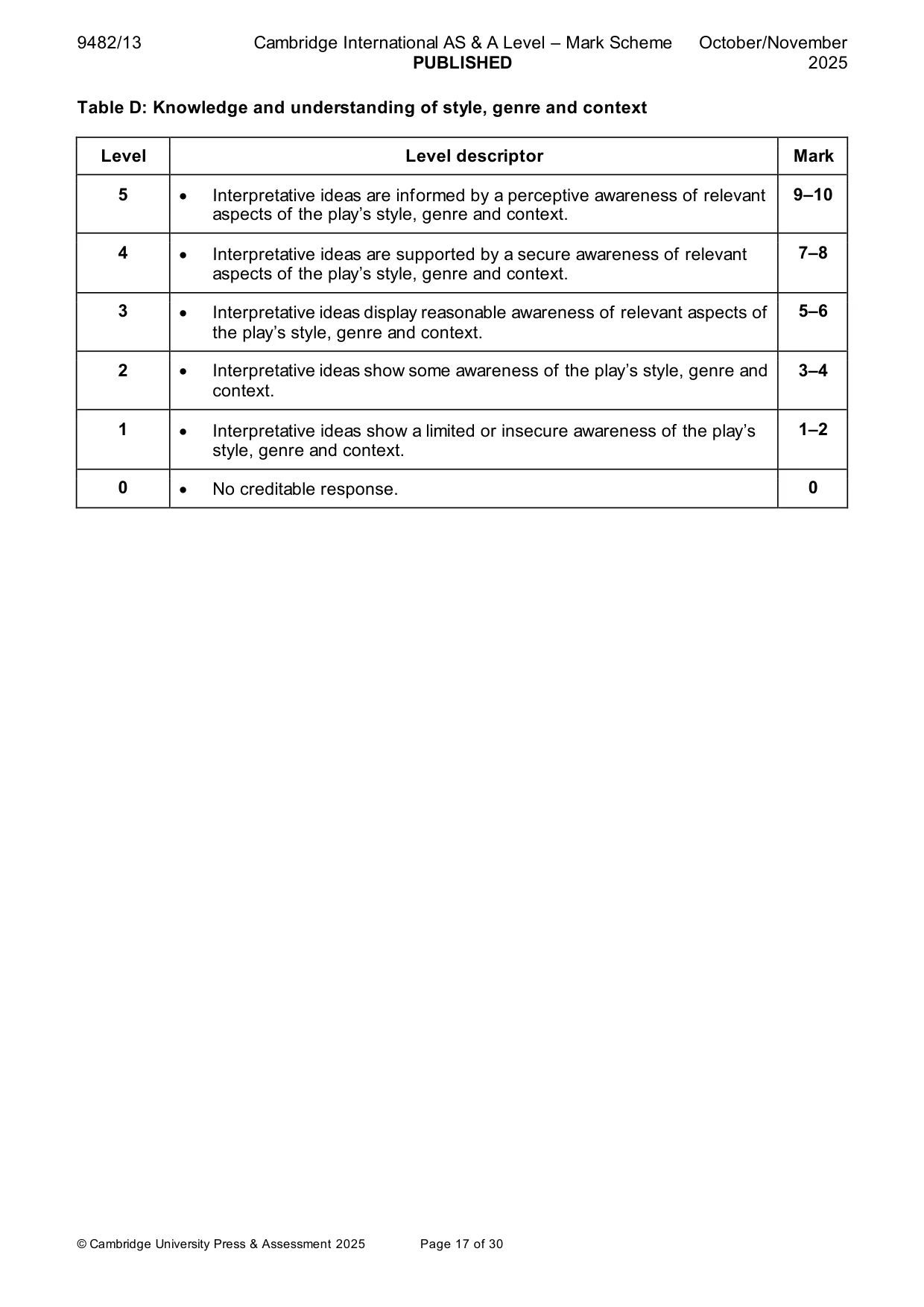
9482/13 Cambridge International AS & A Level – Mark Scheme PUBLISHED October/November 2025 © Cambridge University Press & Assessment 2025 Page 17 of 30 Table D: Knowledge and understanding of style, genre and context Level Level descriptor Mark 5 • Interpretative ideas are informed by a perceptive awareness of relevant aspects of the play’s style, genre and context. 9–10 4 • Interpretative ideas are supported by a secure awareness of relevant aspects of the play’s style, genre and context. 7–8 3 • Interpretative ideas display reasonable awareness of relevant aspects of the play’s style, genre and context. 5–6 2 • Interpretative ideas show some awareness of the play’s style, genre and context. 3–4 1 • Interpretative ideas show a limited or insecure awareness of the play’s style, genre and context. 1–2 0 • No creditable response. 0
Mark scheme, page 18
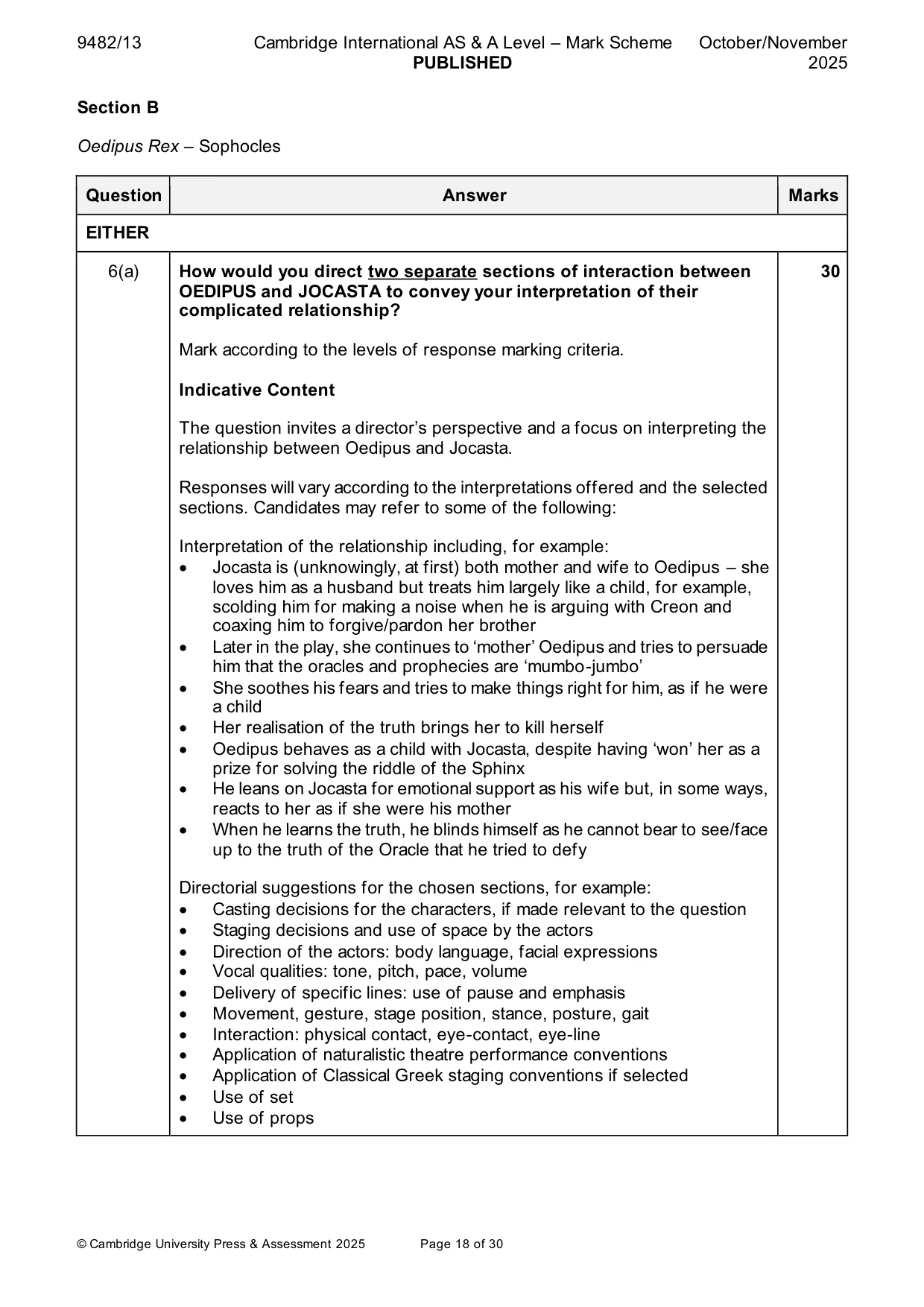
9482/13 Cambridge International AS & A Level – Mark Scheme PUBLISHED October/November 2025 © Cambridge University Press & Assessment 2025 Page 18 of 30 Section B Oedipus Rex – Sophocles Question Answer Marks EITHER 6(a) How would you direct two separate sections of interaction between OEDIPUS and JOCASTA to convey your interpretation of their complicated relationship? Mark according to the levels of response marking criteria. Indicative Content The question invites a director’s perspective and a focus on interpreting the relationship between Oedipus and Jocasta. Responses will vary according to the interpretations offered and the selected sections. Candidates may refer to some of the following: Interpretation of the relationship including, for example: • Jocasta is (unknowingly, at first) both mother and wife to Oedipus – she loves him as a husband but treats him largely like a child, for example, scolding him for making a noise when he is arguing with Creon and coaxing him to forgive/pardon her brother • Later in the play, she continues to ‘mother’ Oedipus and tries to persuade him that the oracles and prophecies are ‘mumbo-jumbo’ • She soothes his fears and tries to make things right for him, as if he were a child • Her realisation of the truth brings her to kill herself • Oedipus behaves as a child with Jocasta, despite having ‘won’ her as a prize for solving the riddle of the Sphinx • He leans on Jocasta for emotional support as his wife but, in some ways, reacts to her as if she were his mother • When he learns the truth, he blinds himself as he cannot bear to see/face up to the truth of the Oracle that he tried to defy Directorial suggestions for the chosen sections, for example: • Casting decisions for the characters, if made relevant to the question • Staging decisions and use of space by the actors • Direction of the actors: body language, facial expressions • Vocal qualities: tone, pitch, pace, volume • Delivery of specific lines: use of pause and emphasis • Movement, gesture, stage position, stance, posture, gait • Interaction: physical contact, eye-contact, eye-line • Application of naturalistic theatre performance conventions • Application of Classical Greek staging conventions if selected • Use of set • Use of props 30
Mark scheme, page 19
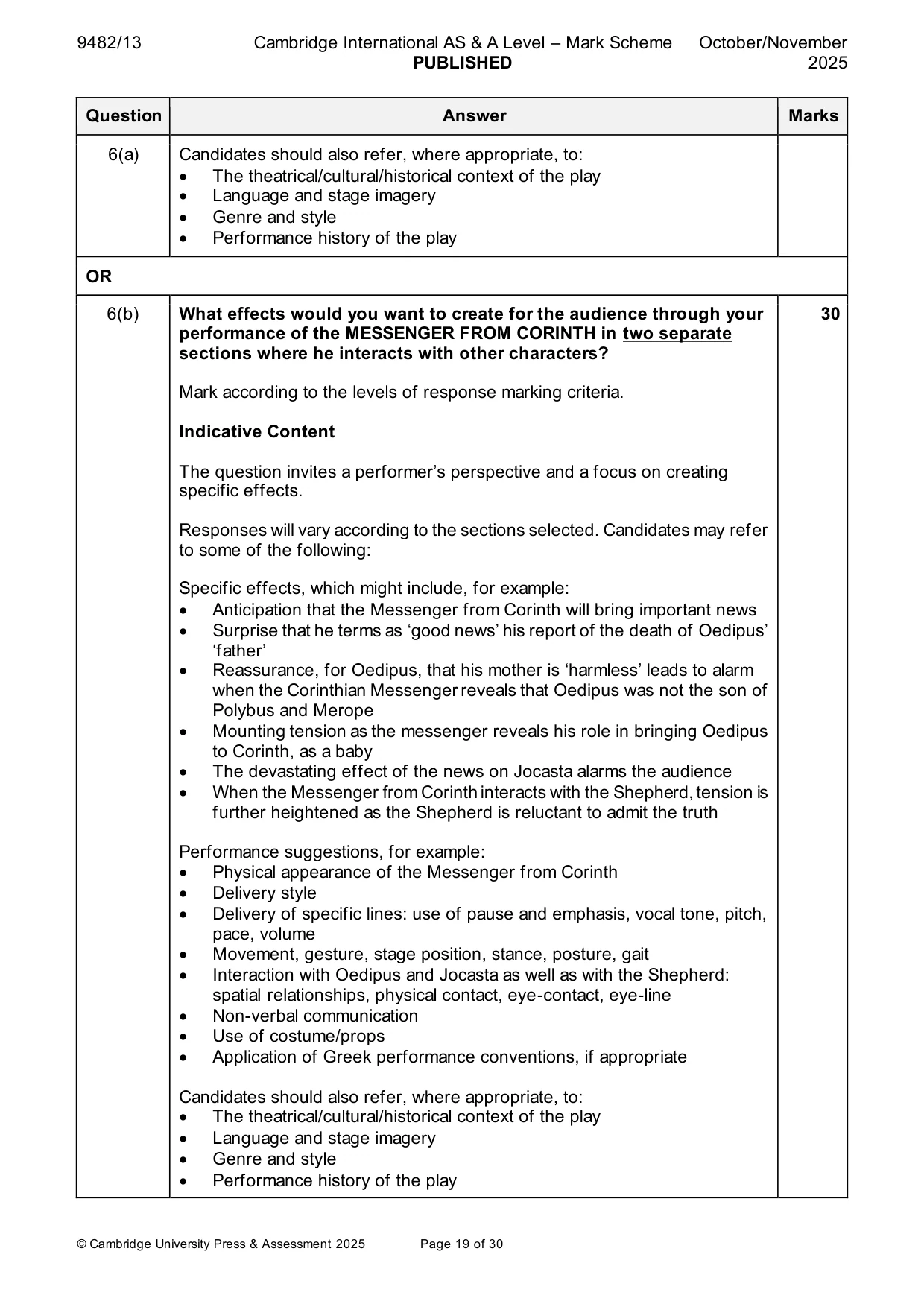
9482/13 Cambridge International AS & A Level – Mark Scheme PUBLISHED October/November 2025 © Cambridge University Press & Assessment 2025 Page 19 of 30 Question Answer Marks 6(a) Candidates should also refer, where appropriate, to: • The theatrical/cultural/historical context of the play • Language and stage imagery • Genre and style • Performance history of the play OR 6(b) What effects would you want to create for the audience through your performance of the MESSENGER FROM CORINTH in two separate sections where he interacts with other characters? Mark according to the levels of response marking criteria. Indicative Content The question invites a performer’s perspective and a focus on creating specific effects. Responses will vary according to the sections selected. Candidates may refer to some of the following: Specific effects, which might include, for example: • Anticipation that the Messenger from Corinth will bring important news • Surprise that he terms as ‘good news’ his report of the death of Oedipus’ ‘father’ • Reassurance, for Oedipus, that his mother is ‘harmless’ leads to alarm when the Corinthian Messenger reveals that Oedipus was not the son of Polybus and Merope • Mounting tension as the messenger reveals his role in bringing Oedipus to Corinth, as a baby • The devastating effect of the news on Jocasta alarms the audience • When the Messenger from Corinth interacts with the Shepherd, tension is further heightened as the Shepherd is reluctant to admit the truth Performance suggestions, for example: • Physical appearance of the Messenger from Corinth • Delivery style • Delivery of specific lines: use of pause and emphasis, vocal tone, pitch, pace, volume • Movement, gesture, stage position, stance, posture, gait • Interaction with Oedipus and Jocasta as well as with the Shepherd: spatial relationships, physical contact, eye-contact, eye-line • Non-verbal communication • Use of costume/props • Application of Greek performance conventions, if appropriate Candidates should also refer, where appropriate, to: • The theatrical/cultural/historical context of the play • Language and stage imagery • Genre and style • Performance history of the play 30
Mark scheme, page 20
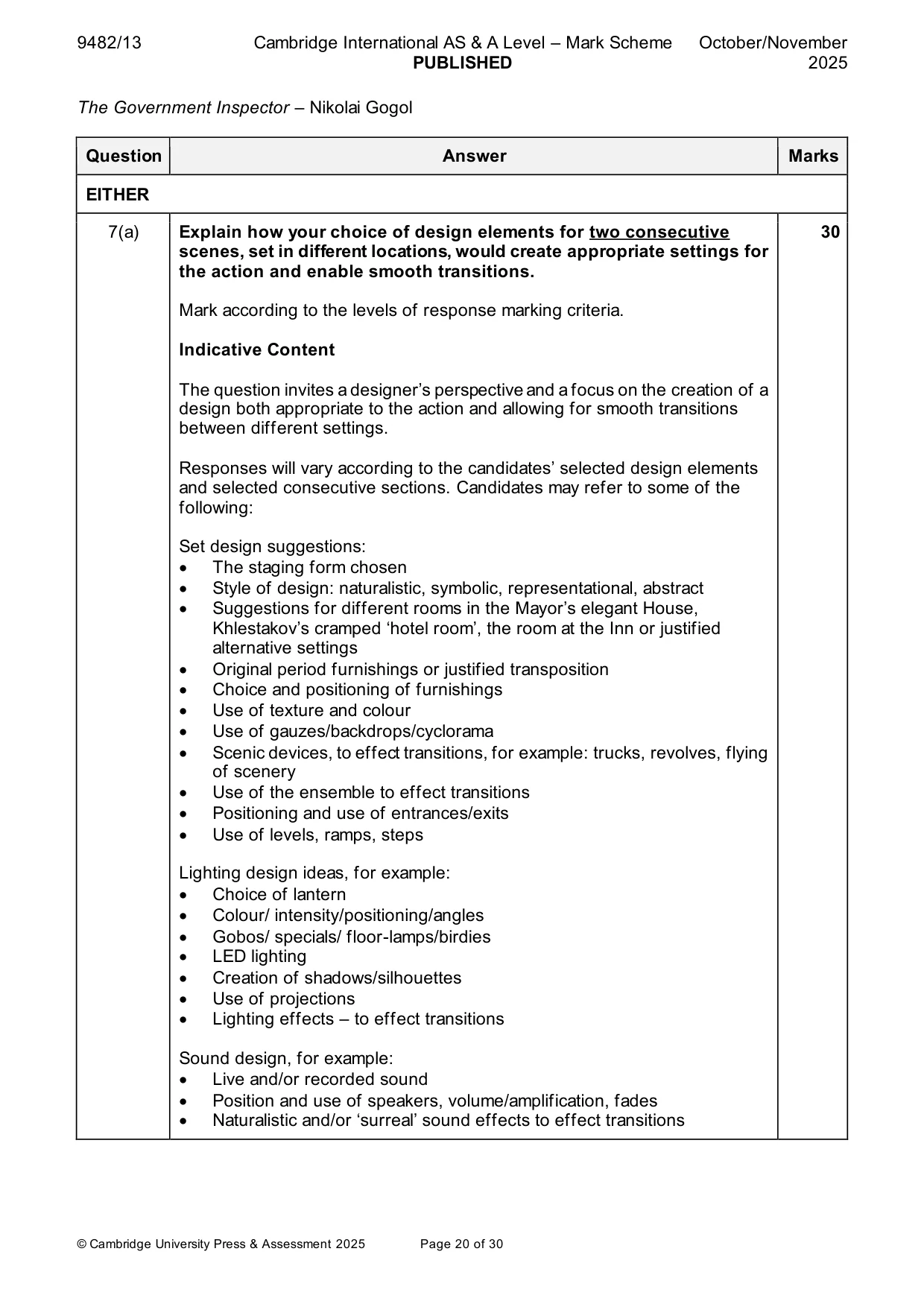
9482/13 Cambridge International AS & A Level – Mark Scheme PUBLISHED October/November 2025 © Cambridge University Press & Assessment 2025 Page 20 of 30 The Government Inspector – Nikolai Gogol Question Answer Marks EITHER 7(a) Explain how your choice of design elements for two consecutive scenes, set in different locations, would create appropriate settings for the action and enable smooth transitions. Mark according to the levels of response marking criteria. Indicative Content The question invites a designer’s perspective and a focus on the creation of a design both appropriate to the action and allowing for smooth transitions between different settings. Responses will vary according to the candidates’ selected design elements and selected consecutive sections. Candidates may refer to some of the following: Set design suggestions: • The staging form chosen • Style of design: naturalistic, symbolic, representational, abstract • Suggestions for different rooms in the Mayor’s elegant House, Khlestakov’s cramped ‘hotel room’, the room at the Inn or justified alternative settings • Original period furnishings or justified transposition • Choice and positioning of furnishings • Use of texture and colour • Use of gauzes/backdrops/cyclorama • Scenic devices, to effect transitions, for example: trucks, revolves, flying of scenery • Use of the ensemble to effect transitions • Positioning and use of entrances/exits • Use of levels, ramps, steps Lighting design ideas, for example: • Choice of lantern • Colour/ intensity/positioning/angles • Gobos/ specials/ floor-lamps/birdies • LED lighting • Creation of shadows/silhouettes • Use of projections • Lighting effects – to effect transitions Sound design, for example: • Live and/or recorded sound • Position and use of speakers, volume/amplification, fades • Naturalistic and/or ‘surreal’ sound effects to effect transitions 30
Mark scheme, page 21
9482/13 Cambridge International AS & A Level – Mark Scheme PUBLISHED October/November 2025 © Cambridge University Press & Assessment 2025 Page 21 of 30 Question Answer Marks 7(a) Candidates should also refer, where appropriate, to: • The theatrical/cultural/historical context of the play • Language and stage imagery • Genre and style • Performance history of the play
Mark scheme, page 22
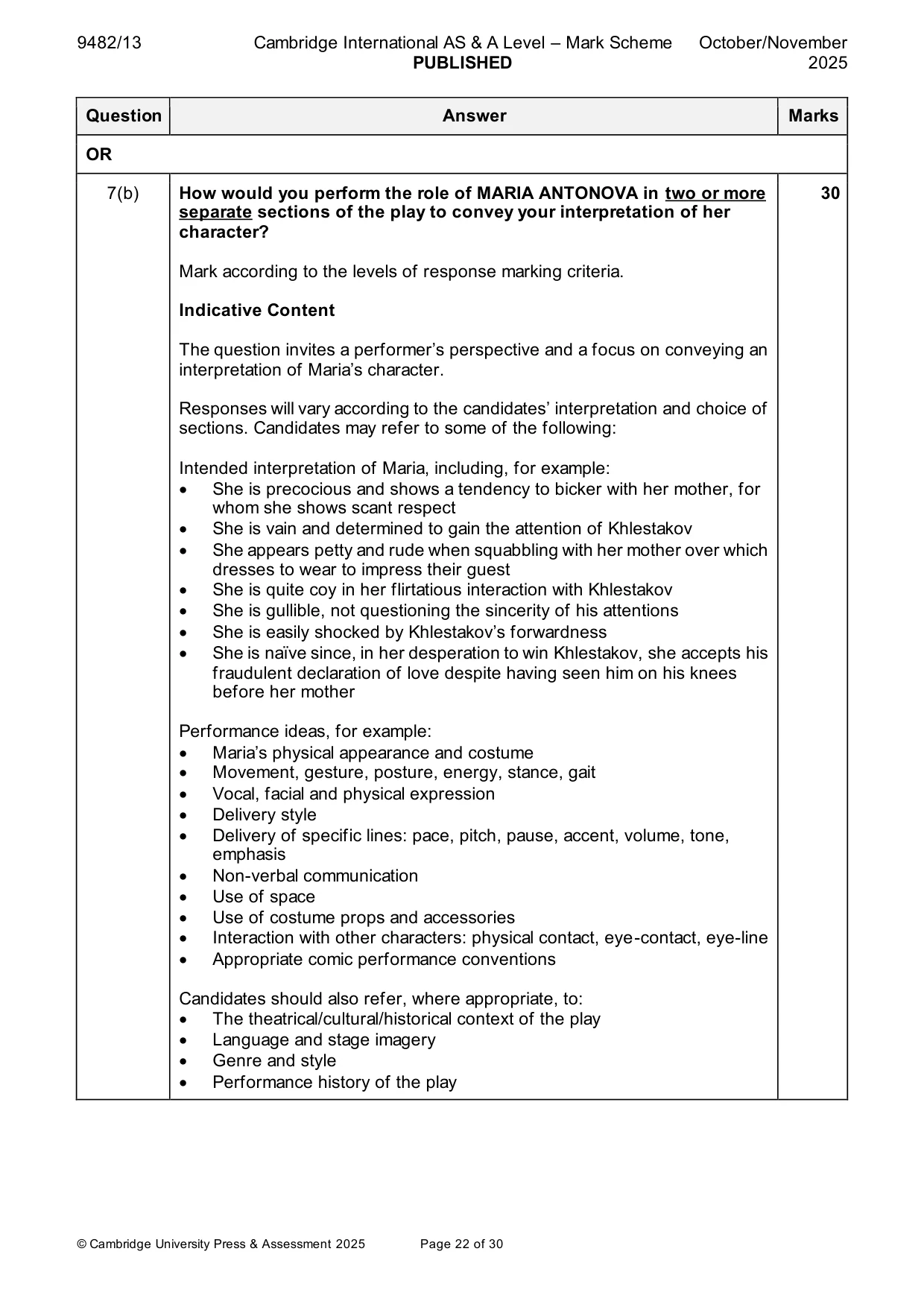
9482/13 Cambridge International AS & A Level – Mark Scheme PUBLISHED October/November 2025 © Cambridge University Press & Assessment 2025 Page 22 of 30 Question Answer Marks OR 7(b) How would you perform the role of MARIA ANTONOVA in two or more separate sections of the play to convey your interpretation of her character? Mark according to the levels of response marking criteria. Indicative Content The question invites a performer’s perspective and a focus on conveying an interpretation of Maria’s character. Responses will vary according to the candidates’ interpretation and choice of sections. Candidates may refer to some of the following: Intended interpretation of Maria, including, for example: • She is precocious and shows a tendency to bicker with her mother, for whom she shows scant respect • She is vain and determined to gain the attention of Khlestakov • She appears petty and rude when squabbling with her mother over which dresses to wear to impress their guest • She is quite coy in her flirtatious interaction with Khlestakov • She is gullible, not questioning the sincerity of his attentions • She is easily shocked by Khlestakov’s forwardness • She is naïve since, in her desperation to win Khlestakov, she accepts his fraudulent declaration of love despite having seen him on his knees before her mother Performance ideas, for example: • Maria’s physical appearance and costume • Movement, gesture, posture, energy, stance, gait • Vocal, facial and physical expression • Delivery style • Delivery of specific lines: pace, pitch, pause, accent, volume, tone, emphasis • Non-verbal communication • Use of space • Use of costume props and accessories • Interaction with other characters: physical contact, eye-contact, eye-line • Appropriate comic performance conventions Candidates should also refer, where appropriate, to: • The theatrical/cultural/historical context of the play • Language and stage imagery • Genre and style • Performance history of the play 30
Mark scheme, page 23
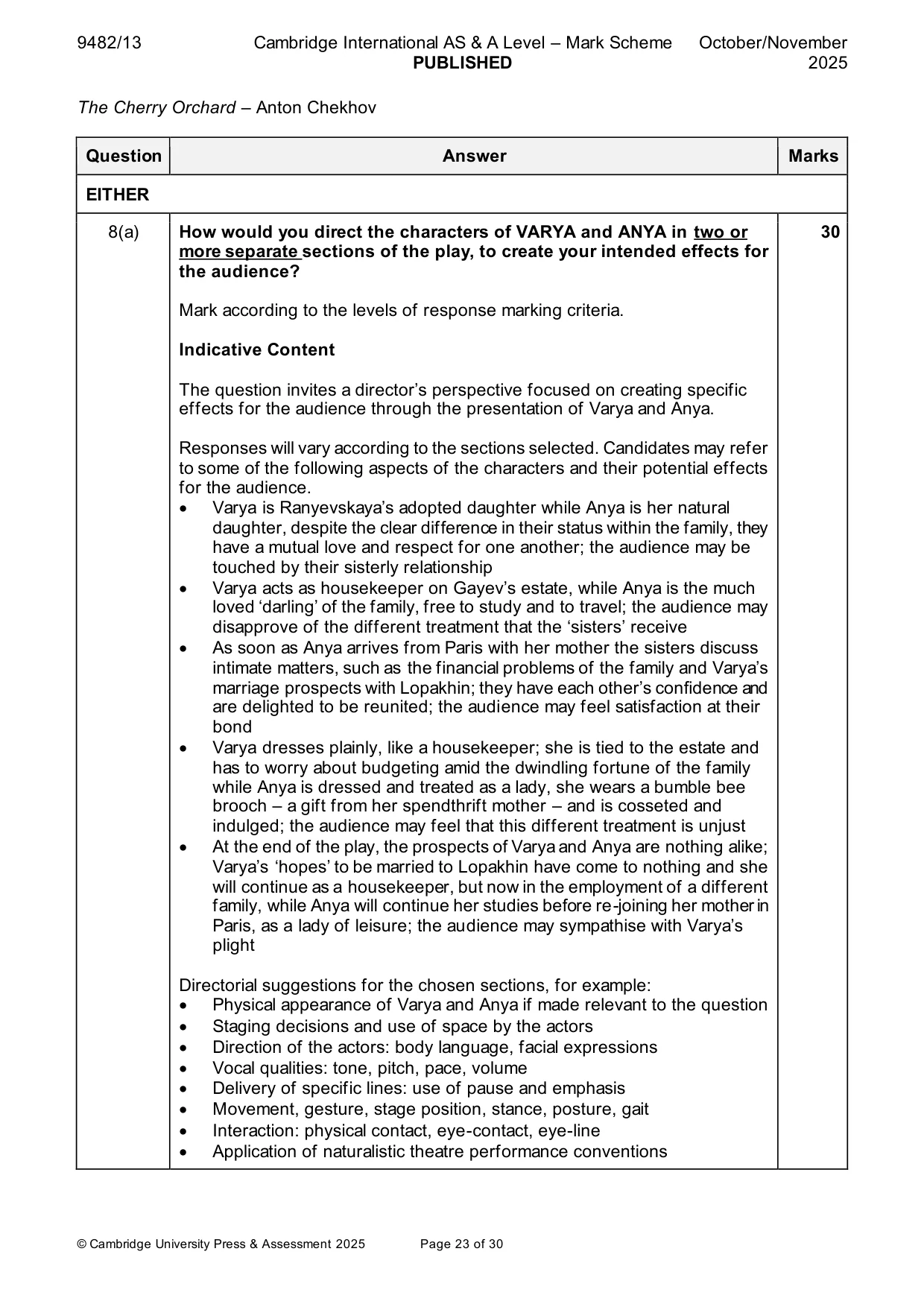
9482/13 Cambridge International AS & A Level – Mark Scheme PUBLISHED October/November 2025 © Cambridge University Press & Assessment 2025 Page 23 of 30 The Cherry Orchard – Anton Chekhov Question Answer Marks EITHER 8(a) How would you direct the characters of VARYA and ANYA in two or more separate sections of the play, to create your intended effects for the audience? Mark according to the levels of response marking criteria. Indicative Content The question invites a director’s perspective focused on creating specific effects for the audience through the presentation of Varya and Anya. Responses will vary according to the sections selected. Candidates may refer to some of the following aspects of the characters and their potential effects for the audience. • Varya is Ranyevskaya’s adopted daughter while Anya is her natural daughter, despite the clear difference in their status within the family, they have a mutual love and respect for one another; the audience may be touched by their sisterly relationship • Varya acts as housekeeper on Gayev’s estate, while Anya is the much loved ‘darling’ of the family, free to study and to travel; the audience may disapprove of the different treatment that the ‘sisters’ receive • As soon as Anya arrives from Paris with her mother the sisters discuss intimate matters, such as the financial problems of the family and Varya’s marriage prospects with Lopakhin; they have each other’s confidence and are delighted to be reunited; the audience may feel satisfaction at their bond • Varya dresses plainly, like a housekeeper; she is tied to the estate and has to worry about budgeting amid the dwindling fortune of the family while Anya is dressed and treated as a lady, she wears a bumble bee brooch – a gift from her spendthrift mother – and is cosseted and indulged; the audience may feel that this different treatment is unjust • At the end of the play, the prospects of Varya and Anya are nothing alike; Varya’s ‘hopes’ to be married to Lopakhin have come to nothing and she will continue as a housekeeper, but now in the employment of a different family, while Anya will continue her studies before re-joining her mother in Paris, as a lady of leisure; the audience may sympathise with Varya’s plight Directorial suggestions for the chosen sections, for example: • Physical appearance of Varya and Anya if made relevant to the question • Staging decisions and use of space by the actors • Direction of the actors: body language, facial expressions • Vocal qualities: tone, pitch, pace, volume • Delivery of specific lines: use of pause and emphasis • Movement, gesture, stage position, stance, posture, gait • Interaction: physical contact, eye-contact, eye-line • Application of naturalistic theatre performance conventions 30
Mark scheme, page 24
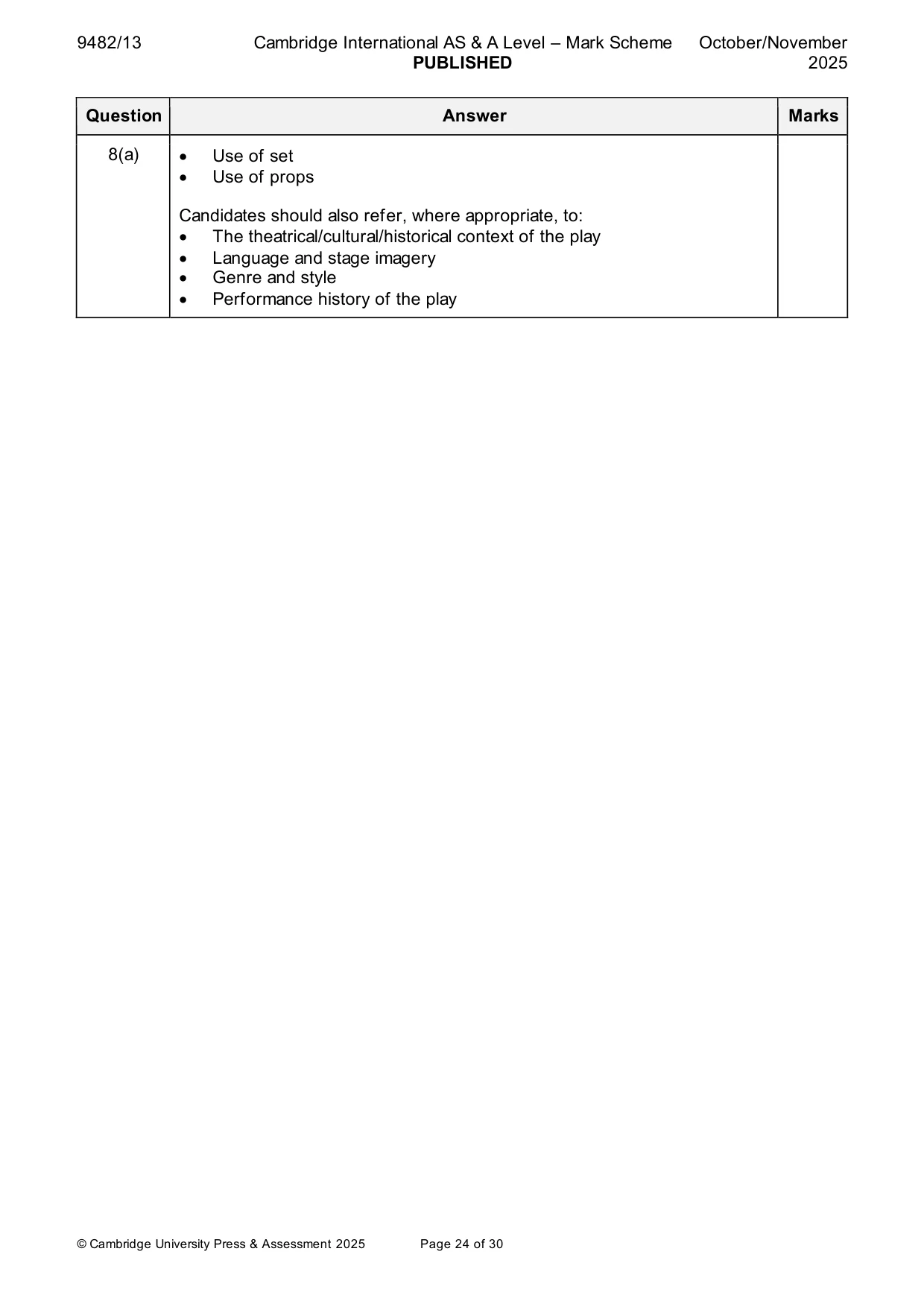
9482/13 Cambridge International AS & A Level – Mark Scheme PUBLISHED October/November 2025 © Cambridge University Press & Assessment 2025 Page 24 of 30 Question Answer Marks 8(a) • Use of set • Use of props Candidates should also refer, where appropriate, to: • The theatrical/cultural/historical context of the play • Language and stage imagery • Genre and style • Performance history of the play
Mark scheme, page 25
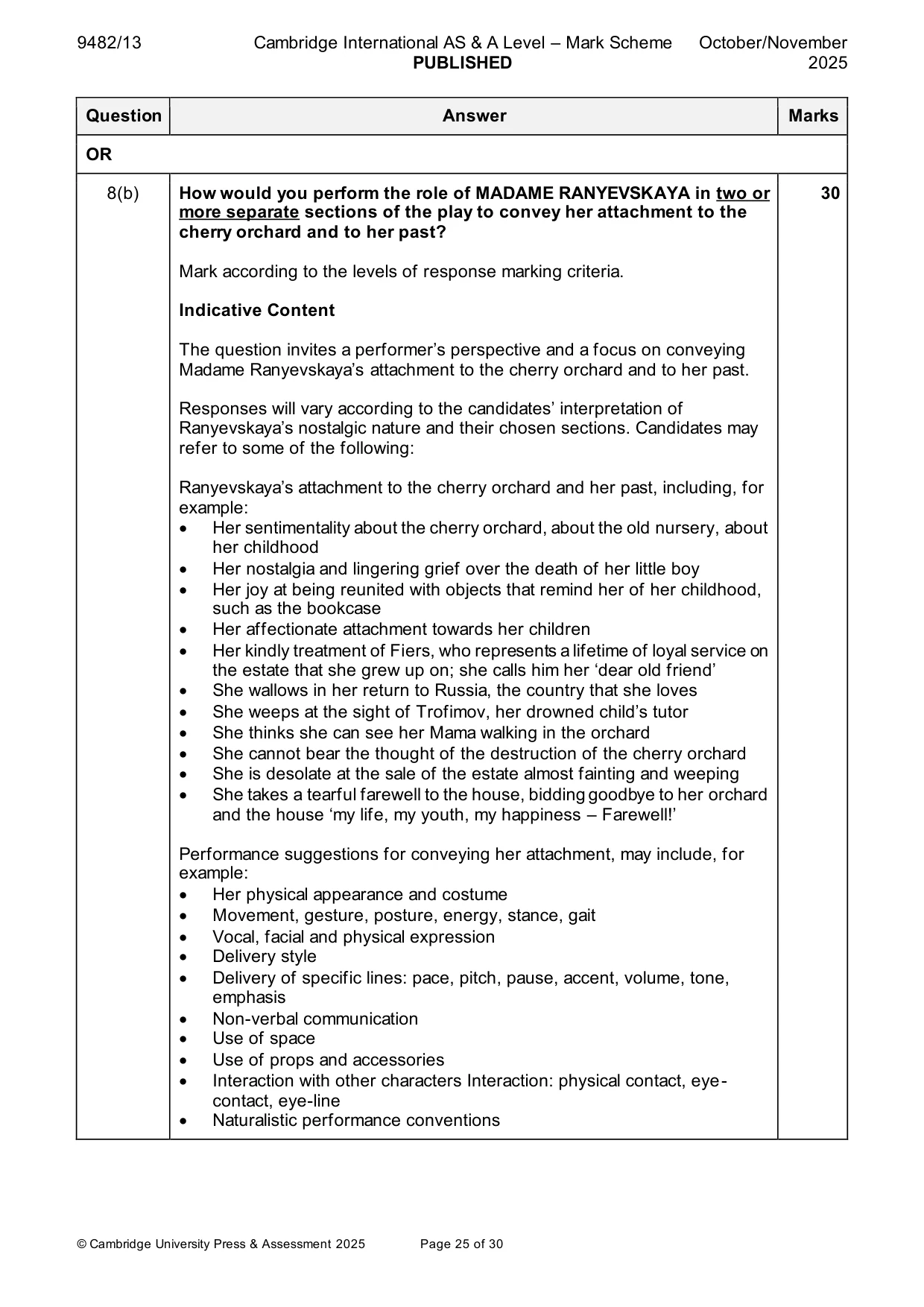
9482/13 Cambridge International AS & A Level – Mark Scheme PUBLISHED October/November 2025 © Cambridge University Press & Assessment 2025 Page 25 of 30 Question Answer Marks OR 8(b) How would you perform the role of MADAME RANYEVSKAYA in two or more separate sections of the play to convey her attachment to the cherry orchard and to her past? Mark according to the levels of response marking criteria. Indicative Content The question invites a performer’s perspective and a focus on conveying Madame Ranyevskaya’s attachment to the cherry orchard and to her past. Responses will vary according to the candidates’ interpretation of Ranyevskaya’s nostalgic nature and their chosen sections. Candidates may refer to some of the following: Ranyevskaya’s attachment to the cherry orchard and her past, including, for example: • Her sentimentality about the cherry orchard, about the old nursery, about her childhood • Her nostalgia and lingering grief over the death of her little boy • Her joy at being reunited with objects that remind her of her childhood, such as the bookcase • Her affectionate attachment towards her children • Her kindly treatment of Fiers, who represents a lifetime of loyal service on the estate that she grew up on; she calls him her ‘dear old friend’ • She wallows in her return to Russia, the country that she loves • She weeps at the sight of Trofimov, her drowned child’s tutor • She thinks she can see her Mama walking in the orchard • She cannot bear the thought of the destruction of the cherry orchard • She is desolate at the sale of the estate almost fainting and weeping • She takes a tearful farewell to the house, bidding goodbye to her orchard and the house ‘my life, my youth, my happiness – Farewell!’ Performance suggestions for conveying her attachment, may include, for example: • Her physical appearance and costume • Movement, gesture, posture, energy, stance, gait • Vocal, facial and physical expression • Delivery style • Delivery of specific lines: pace, pitch, pause, accent, volume, tone, emphasis • Non-verbal communication • Use of space • Use of props and accessories • Interaction with other characters Interaction: physical contact, eye- contact, eye-line • Naturalistic performance conventions 30
Mark scheme, page 26
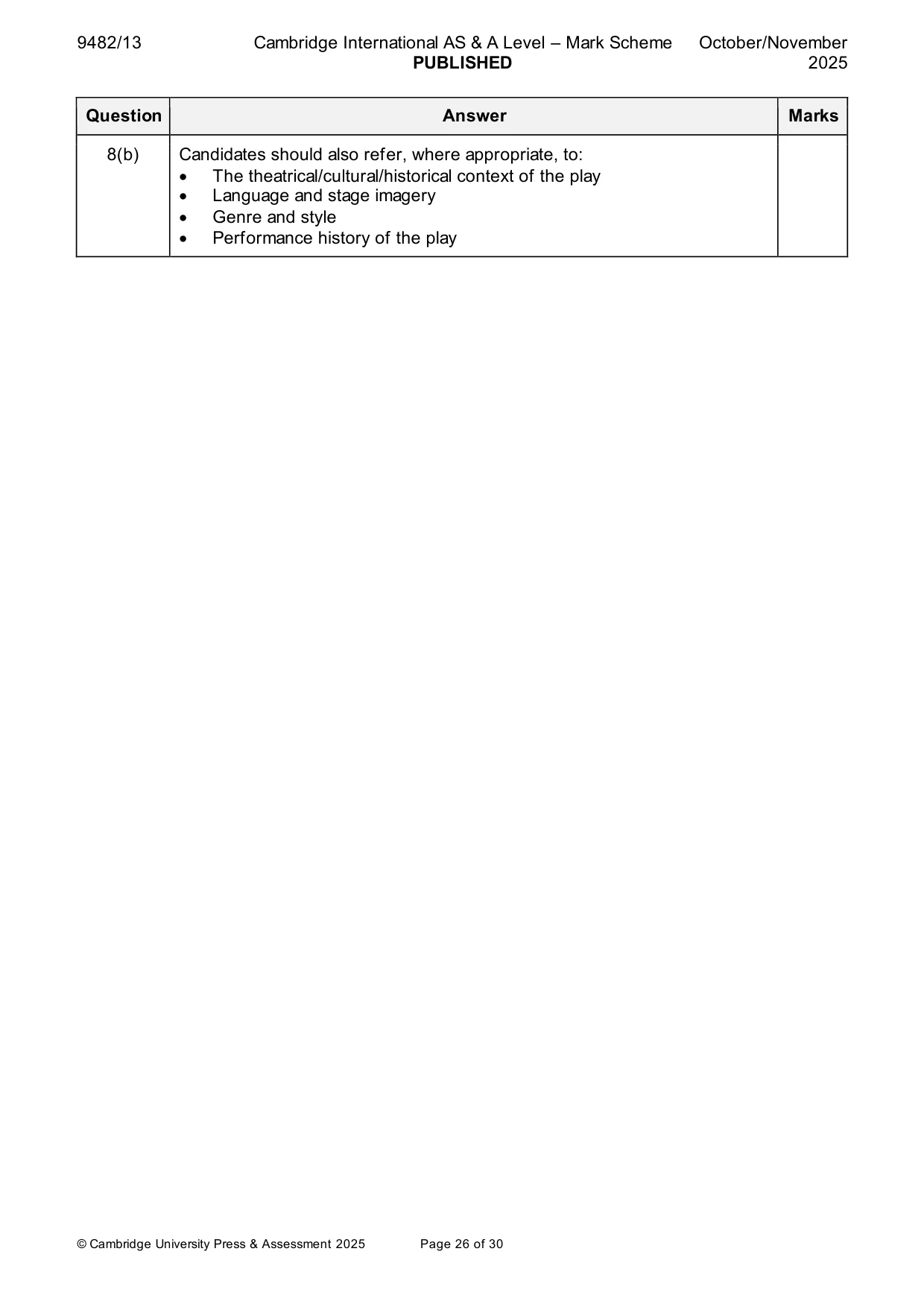
9482/13 Cambridge International AS & A Level – Mark Scheme PUBLISHED October/November 2025 © Cambridge University Press & Assessment 2025 Page 26 of 30 Question Answer Marks 8(b) Candidates should also refer, where appropriate, to: • The theatrical/cultural/historical context of the play • Language and stage imagery • Genre and style • Performance history of the play
Mark scheme, page 27
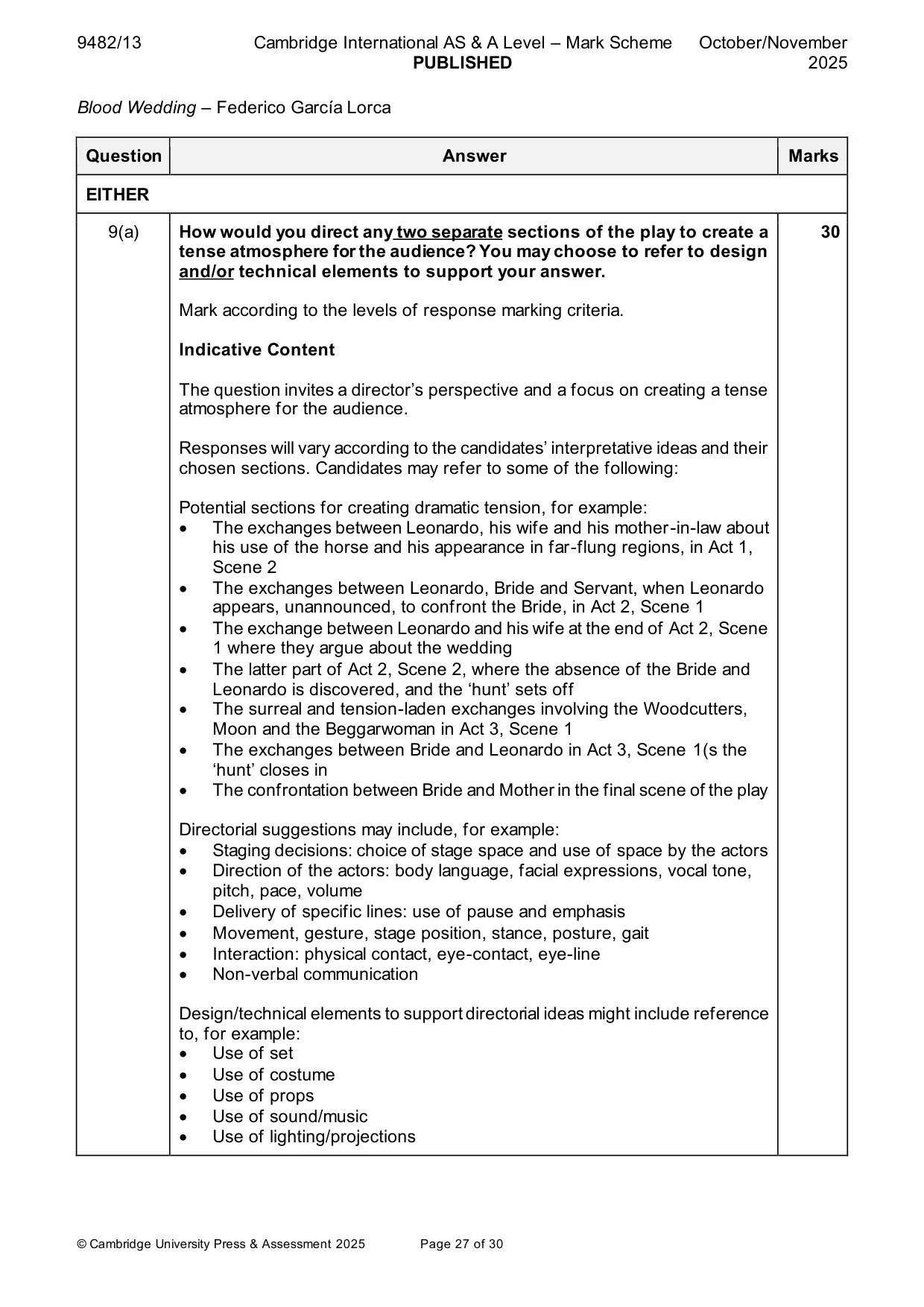
9482/13 Cambridge International AS & A Level – Mark Scheme PUBLISHED October/November 2025 © Cambridge University Press & Assessment 2025 Page 27 of 30 Blood Wedding – Federico García Lorca Question Answer Marks EITHER 9(a) How would you direct any two separate sections of the play to create a tense atmosphere for the audience? You may choose to refer to design and/or technical elements to support your answer. Mark according to the levels of response marking criteria. Indicative Content The question invites a director’s perspective and a focus on creating a tense atmosphere for the audience. Responses will vary according to the candidates’ interpretative ideas and their chosen sections. Candidates may refer to some of the following: Potential sections for creating dramatic tension, for example: • The exchanges between Leonardo, his wife and his mother-in-law about his use of the horse and his appearance in far-flung regions, in Act 1, Scene 2 • The exchanges between Leonardo, Bride and Servant, when Leonardo appears, unannounced, to confront the Bride, in Act 2, Scene 1 • The exchange between Leonardo and his wife at the end of Act 2, Scene 1 where they argue about the wedding • The latter part of Act 2, Scene 2, where the absence of the Bride and Leonardo is discovered, and the ‘hunt’ sets off • The surreal and tension-laden exchanges involving the Woodcutters, Moon and the Beggarwoman in Act 3, Scene 1 • The exchanges between Bride and Leonardo in Act 3, Scene 1(s the ‘hunt’ closes in • The confrontation between Bride and Mother in the final scene of the play Directorial suggestions may include, for example: • Staging decisions: choice of stage space and use of space by the actors • Direction of the actors: body language, facial expressions, vocal tone, pitch, pace, volume • Delivery of specific lines: use of pause and emphasis • Movement, gesture, stage position, stance, posture, gait • Interaction: physical contact, eye-contact, eye-line • Non-verbal communication Design/technical elements to support directorial ideas might include reference to, for example: • Use of set • Use of costume • Use of props • Use of sound/music • Use of lighting/projections 30
Mark scheme, page 28
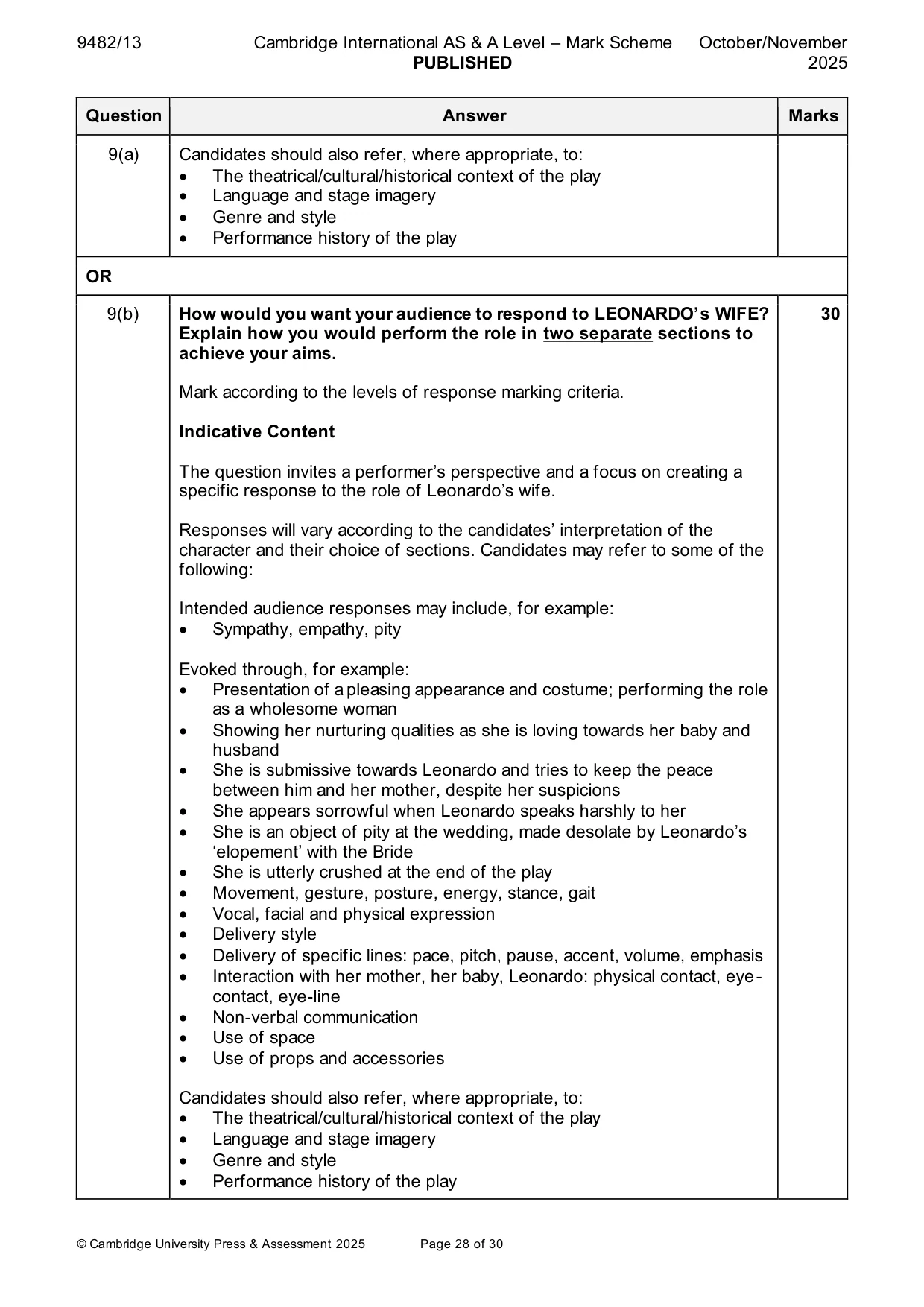
9482/13 Cambridge International AS & A Level – Mark Scheme PUBLISHED October/November 2025 © Cambridge University Press & Assessment 2025 Page 28 of 30 Question Answer Marks 9(a) Candidates should also refer, where appropriate, to: • The theatrical/cultural/historical context of the play • Language and stage imagery • Genre and style • Performance history of the play OR 9(b) How would you want your audience to respond to LEONARDO’s WIFE? Explain how you would perform the role in two separate sections to achieve your aims. Mark according to the levels of response marking criteria. Indicative Content The question invites a performer’s perspective and a focus on creating a specific response to the role of Leonardo’s wife. Responses will vary according to the candidates’ interpretation of the character and their choice of sections. Candidates may refer to some of the following: Intended audience responses may include, for example: • Sympathy, empathy, pity Evoked through, for example: • Presentation of a pleasing appearance and costume; performing the role as a wholesome woman • Showing her nurturing qualities as she is loving towards her baby and husband • She is submissive towards Leonardo and tries to keep the peace between him and her mother, despite her suspicions • She appears sorrowful when Leonardo speaks harshly to her • She is an object of pity at the wedding, made desolate by Leonardo’s ‘elopement’ with the Bride • She is utterly crushed at the end of the play • Movement, gesture, posture, energy, stance, gait • Vocal, facial and physical expression • Delivery style • Delivery of specific lines: pace, pitch, pause, accent, volume, emphasis • Interaction with her mother, her baby, Leonardo: physical contact, eye- contact, eye-line • Non-verbal communication • Use of space • Use of props and accessories Candidates should also refer, where appropriate, to: • The theatrical/cultural/historical context of the play • Language and stage imagery • Genre and style • Performance history of the play 30
Mark scheme, page 29
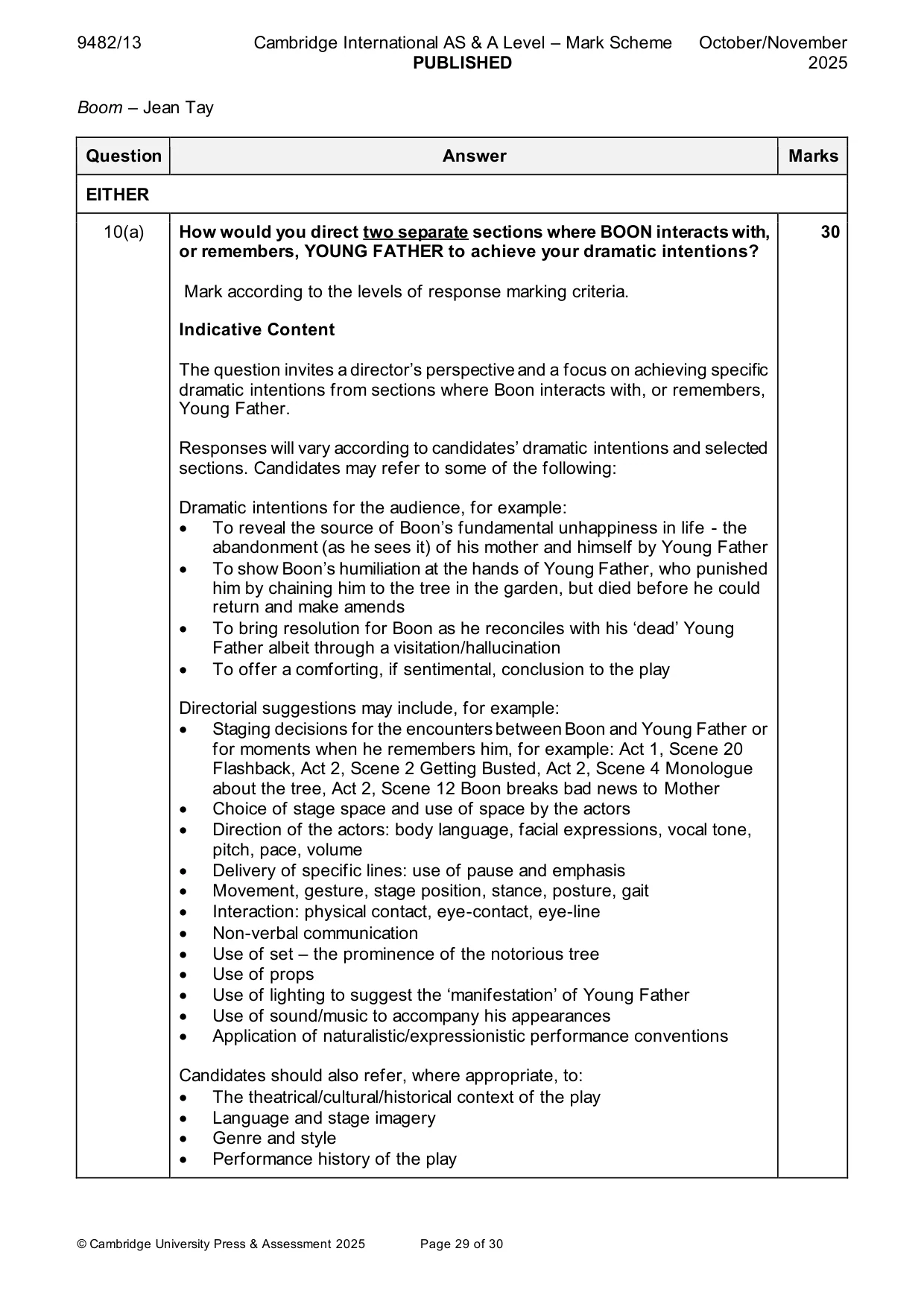
9482/13 Cambridge International AS & A Level – Mark Scheme PUBLISHED October/November 2025 © Cambridge University Press & Assessment 2025 Page 29 of 30 Boom – Jean Tay Question Answer Marks EITHER 10(a) How would you direct two separate sections where BOON interacts with, or remembers, YOUNG FATHER to achieve your dramatic intentions? Mark according to the levels of response marking criteria. Indicative Content The question invites a director’s perspective and a focus on achieving specific dramatic intentions from sections where Boon interacts with, or remembers, Young Father. Responses will vary according to candidates’ dramatic intentions and selected sections. Candidates may refer to some of the following: Dramatic intentions for the audience, for example: • To reveal the source of Boon’s fundamental unhappiness in life - the abandonment (as he sees it) of his mother and himself by Young Father • To show Boon’s humiliation at the hands of Young Father, who punished him by chaining him to the tree in the garden, but died before he could return and make amends • To bring resolution for Boon as he reconciles with his ‘dead’ Young Father albeit through a visitation/hallucination • To offer a comforting, if sentimental, conclusion to the play Directorial suggestions may include, for example: • Staging decisions for the encounters between Boon and Young Father or for moments when he remembers him, for example: Act 1, Scene 20 Flashback, Act 2, Scene 2 Getting Busted, Act 2, Scene 4 Monologue about the tree, Act 2, Scene 12 Boon breaks bad news to Mother • Choice of stage space and use of space by the actors • Direction of the actors: body language, facial expressions, vocal tone, pitch, pace, volume • Delivery of specific lines: use of pause and emphasis • Movement, gesture, stage position, stance, posture, gait • Interaction: physical contact, eye-contact, eye-line • Non-verbal communication • Use of set – the prominence of the notorious tree • Use of props • Use of lighting to suggest the ‘manifestation’ of Young Father • Use of sound/music to accompany his appearances • Application of naturalistic/expressionistic performance conventions Candidates should also refer, where appropriate, to: • The theatrical/cultural/historical context of the play • Language and stage imagery • Genre and style • Performance history of the play 30
Mark scheme, page 30
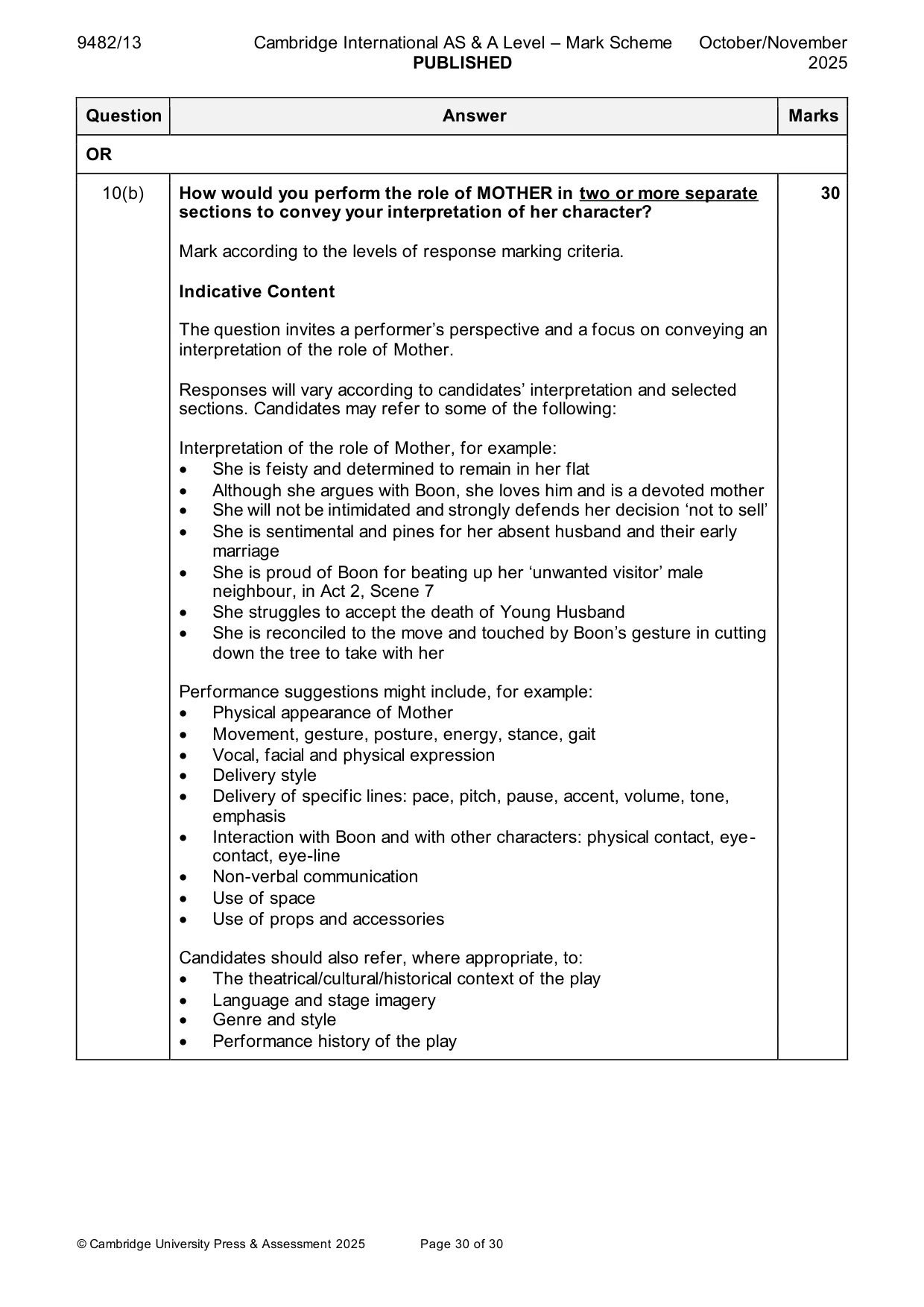
9482/13 Cambridge International AS & A Level – Mark Scheme PUBLISHED October/November 2025 © Cambridge University Press & Assessment 2025 Page 30 of 30 Question Answer Marks OR 10(b) How would you perform the role of MOTHER in two or more separate sections to convey your interpretation of her character? Mark according to the levels of response marking criteria. Indicative Content The question invites a performer’s perspective and a focus on conveying an interpretation of the role of Mother. Responses will vary according to candidates’ interpretation and selected sections. Candidates may refer to some of the following: Interpretation of the role of Mother, for example: • She is feisty and determined to remain in her flat • Although she argues with Boon, she loves him and is a devoted mother • She will not be intimidated and strongly defends her decision ‘not to sell’ • She is sentimental and pines for her absent husband and their early marriage • She is proud of Boon for beating up her ‘unwanted visitor’ male neighbour, in Act 2, Scene 7 • She struggles to accept the death of Young Husband • She is reconciled to the move and touched by Boon’s gesture in cutting down the tree to take with her Performance suggestions might include, for example: • Physical appearance of Mother • Movement, gesture, posture, energy, stance, gait • Vocal, facial and physical expression • Delivery style • Delivery of specific lines: pace, pitch, pause, accent, volume, tone, emphasis • Interaction with Boon and with other characters: physical contact, eye- contact, eye-line • Non-verbal communication • Use of space • Use of props and accessories Candidates should also refer, where appropriate, to: • The theatrical/cultural/historical context of the play • Language and stage imagery • Genre and style • Performance history of the play 30
What you needed in this session
Cambridge’s own grade thresholds for 2025 Oct/Nov, Paper 1 · Variant 3. A higher threshold means an easier paper — the bar moves with how the cohort did.