Cambridge A Level Drama 9482 — 2025 Oct/Nov Paper 1 · Variant 2
9482/12/O/N/25 · 60 marks · 120 min
The question paper and its mark scheme, free to read here and free to download. This is Cambridge’s own paper, exactly as it was sat.
Question paper8 pages


Mark scheme32 pages
Answers below. Sit the paper first if you are practising.
Paper as text
Question paper, page 1
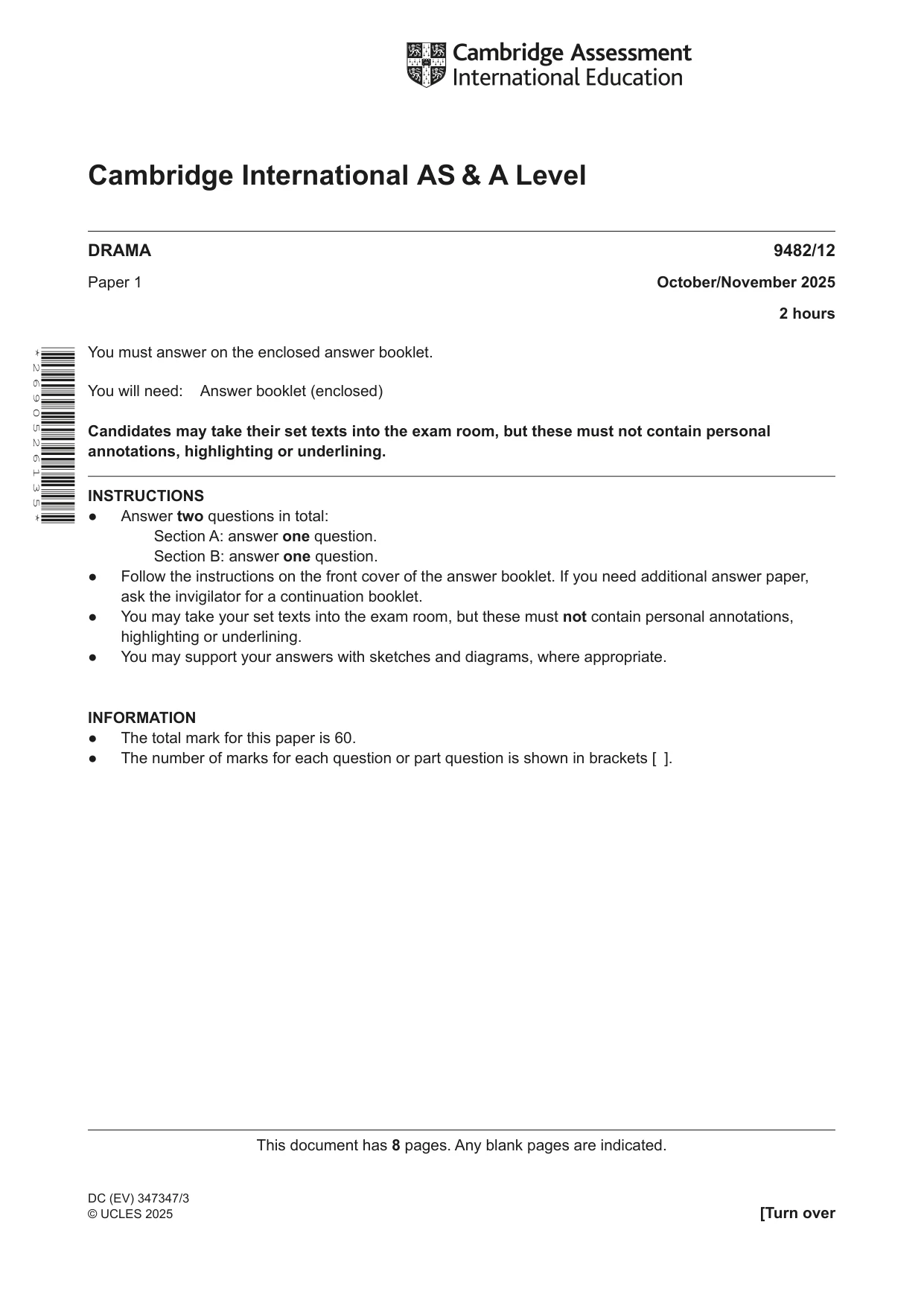
This document has 8 pages. Any blank pages are indicated. [Turn over Cambridge International AS & A Level DC (EV) 347347/3 © UCLES 2025 * 2 6 9 0 5 2 6 1 3 5 * DRAMA 9482/12 Paper 1 October/November 2025 2 hours You must answer on the enclosed answer booklet. You will need: Answer booklet (enclosed) Candidates may take their set texts into the exam room, but these must not contain personal annotations, highlighting or underlining. INSTRUCTIONS ● Answer two questions in total: Section A: answer one question. Section B: answer one question. ● Follow the instructions on the front cover of the answer booklet. If you need additional answer paper, ask the invigilator for a continuation booklet. ● You may take your set texts into the exam room, but these must not contain personal annotations, highlighting or underlining. ● You may support your answers with sketches and diagrams, where appropriate. INFORMATION ● The total mark for this paper is 60. ● The number of marks for each question or part question is shown in brackets [ ].
Question paper, page 2
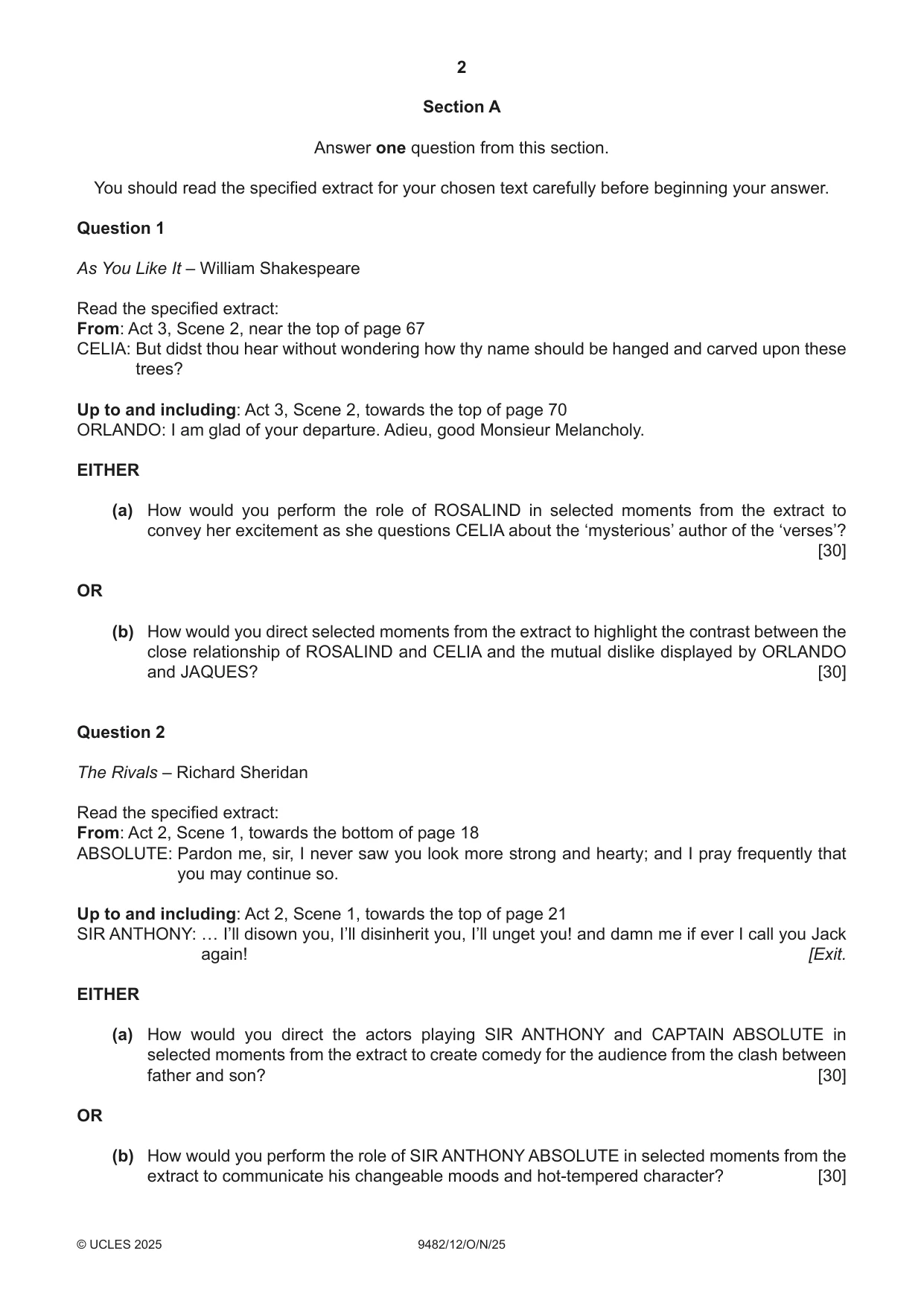
2 9482/12/O/N/25 © UCLES 2025 Section A Answer one question from this section. You should read the specified extract for your chosen text carefully before beginning your answer. Question 1 As You Like It – William Shakespeare Read the specified extract: From: Act 3, Scene 2, near the top of page 67 CELIA: But didst thou hear without wondering how thy name should be hanged and carved upon these trees? Up to and including: Act 3, Scene 2, towards the top of page 70 ORLANDO: I am glad of your departure. Adieu, good Monsieur Melancholy. EITHER (a) How would you perform the role of ROSALIND in selected moments from the extract to convey her excitement as she questions CELIA about the ‘mysterious’ author of the ‘verses’? [30] OR (b) How would you direct selected moments from the extract to highlight the contrast between the close relationship of ROSALIND and CELIA and the mutual dislike displayed by ORLANDO and JAQUES? [30] Question 2 The Rivals – Richard Sheridan Read the specified extract: From: Act 2, Scene 1, towards the bottom of page 18 ABSOLUTE: Pardon me, sir, I never saw you look more strong and hearty; and I pray frequently that you may continue so. Up to and including: Act 2, Scene 1, towards the top of page 21 SIR ANTHONY: … I’ll disown you, I’ll disinherit you, I’ll unget you! and damn me if ever I call you Jack again! [Exit. EITHER (a) How would you direct the actors playing SIR ANTHONY and CAPTAIN ABSOLUTE in selected moments from the extract to create comedy for the audience from the clash between father and son? [30] OR (b) How would you perform the role of SIR ANTHONY ABSOLUTE in selected moments from the extract to communicate his changeable moods and hot-tempered character? [30]
Question paper, page 3
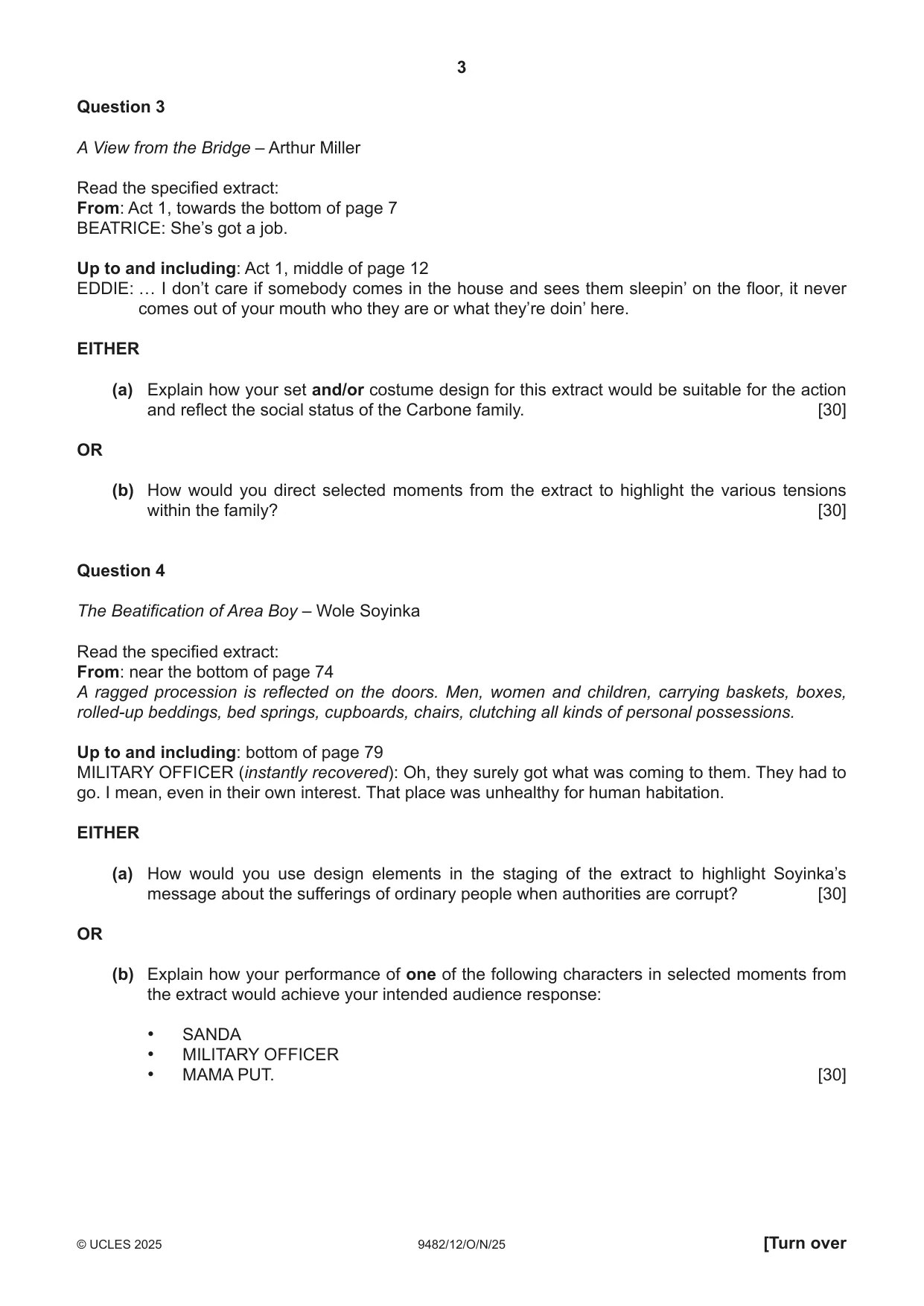
3 9482/12/O/N/25 © UCLES 2025 [Turn over Question 3 A View from the Bridge – Arthur Miller Read the specified extract: From: Act 1, towards the bottom of page 7 BEATRICE: She’s got a job. Up to and including: Act 1, middle of page 12 EDDIE: … I don’t care if somebody comes in the house and sees them sleepin’ on the floor, it never comes out of your mouth who they are or what they’re doin’ here. EITHER (a) Explain how your set and/or costume design for this extract would be suitable for the action and reflect the social status of the Carbone family. [30] OR (b) How would you direct selected moments from the extract to highlight the various tensions within the family? [30] Question 4 The Beatification of Area Boy – Wole Soyinka Read the specified extract: From: near the bottom of page 74 A ragged procession is reflected on the doors. Men, women and children, carrying baskets, boxes, rolled-up beddings, bed springs, cupboards, chairs, clutching all kinds of personal possessions. Up to and including: bottom of page 79 MILITARY OFFICER (instantly recovered): Oh, they surely got what was coming to them. They had to go. I mean, even in their own interest. That place was unhealthy for human habitation. EITHER (a) How would you use design elements in the staging of the extract to highlight Soyinka’s message about the sufferings of ordinary people when authorities are corrupt? [30] OR (b) Explain how your performance of one of the following characters in selected moments from the extract would achieve your intended audience response: • SANDA • MILITARY OFFICER • MAMA PUT. [30]
Question paper, page 4
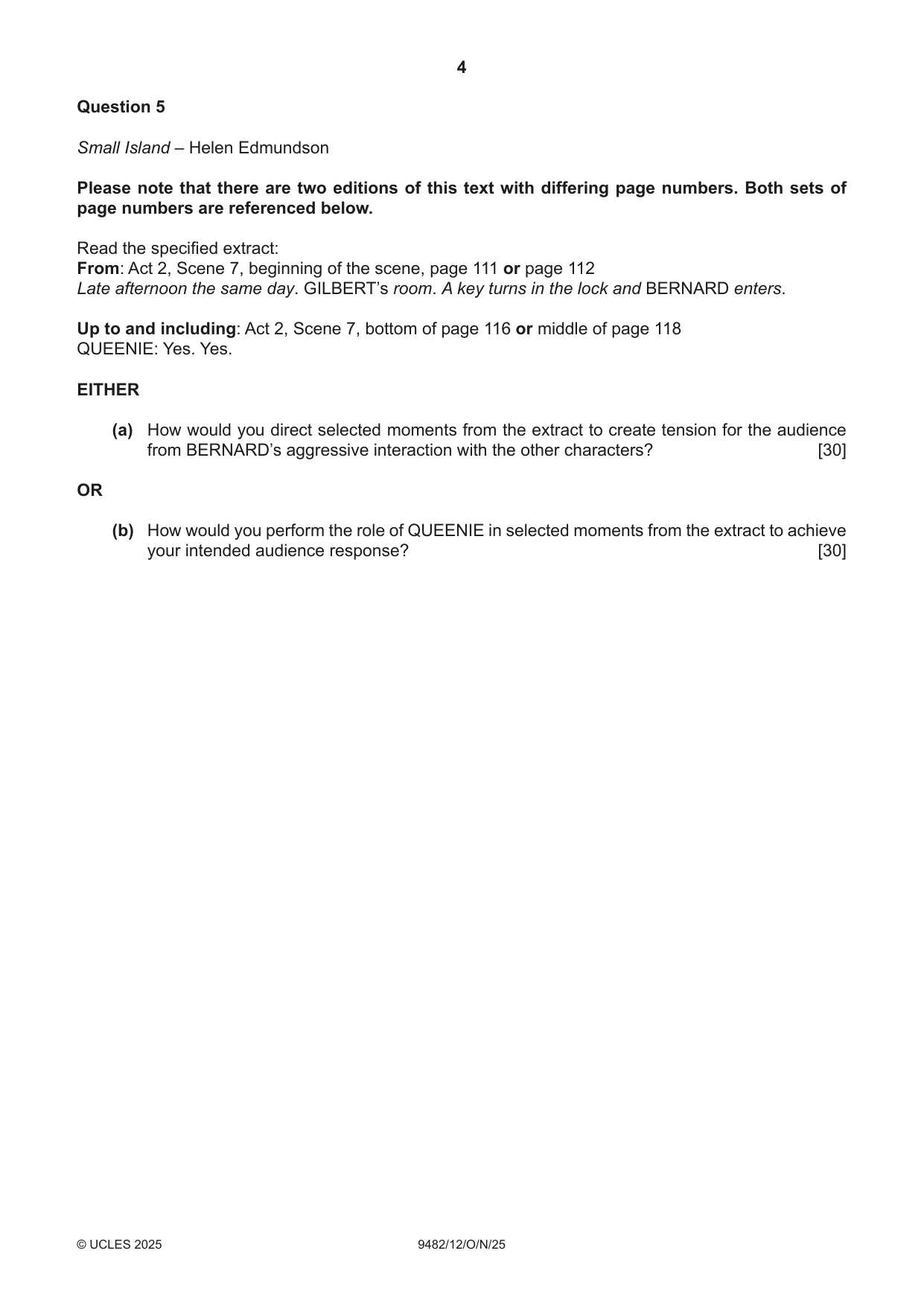
4 9482/12/O/N/25 © UCLES 2025 Question 5 Small Island – Helen Edmundson Please note that there are two editions of this text with differing page numbers. Both sets of page numbers are referenced below. Read the specified extract: From: Act 2, Scene 7, beginning of the scene, page 111 or page 112 Late afternoon the same day. GILBERT’s room. A key turns in the lock and BERNARD enters. Up to and including: Act 2, Scene 7, bottom of page 116 or middle of page 118 QUEENIE: Yes. Yes. EITHER (a) How would you direct selected moments from the extract to create tension for the audience from BERNARD’s aggressive interaction with the other characters? [30] OR (b) How would you perform the role of QUEENIE in selected moments from the extract to achieve your intended audience response? [30]
Question paper, page 5
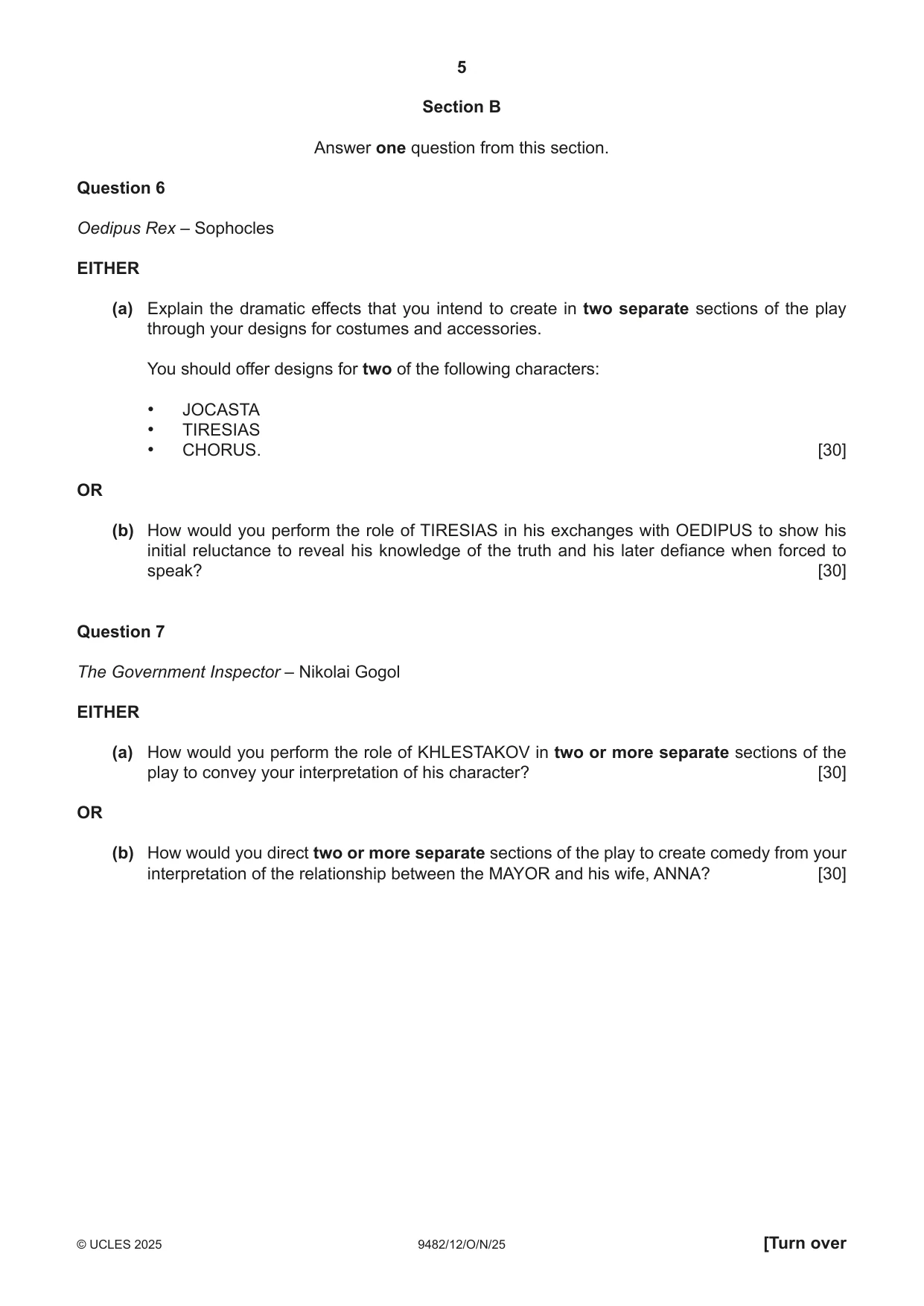
5 9482/12/O/N/25 © UCLES 2025 [Turn over Section B Answer one question from this section. Question 6 Oedipus Rex – Sophocles EITHER (a) Explain the dramatic effects that you intend to create in two separate sections of the play through your designs for costumes and accessories. You should offer designs for two of the following characters: • JOCASTA • TIRESIAS • CHORUS. [30] OR (b) How would you perform the role of TIRESIAS in his exchanges with OEDIPUS to show his initial reluctance to reveal his knowledge of the truth and his later defiance when forced to speak? [30] Question 7 The Government Inspector – Nikolai Gogol EITHER (a) How would you perform the role of KHLESTAKOV in two or more separate sections of the play to convey your interpretation of his character? [30] OR (b) How would you direct two or more separate sections of the play to create comedy from your interpretation of the relationship between the MAYOR and his wife, ANNA? [30]
Question paper, page 6
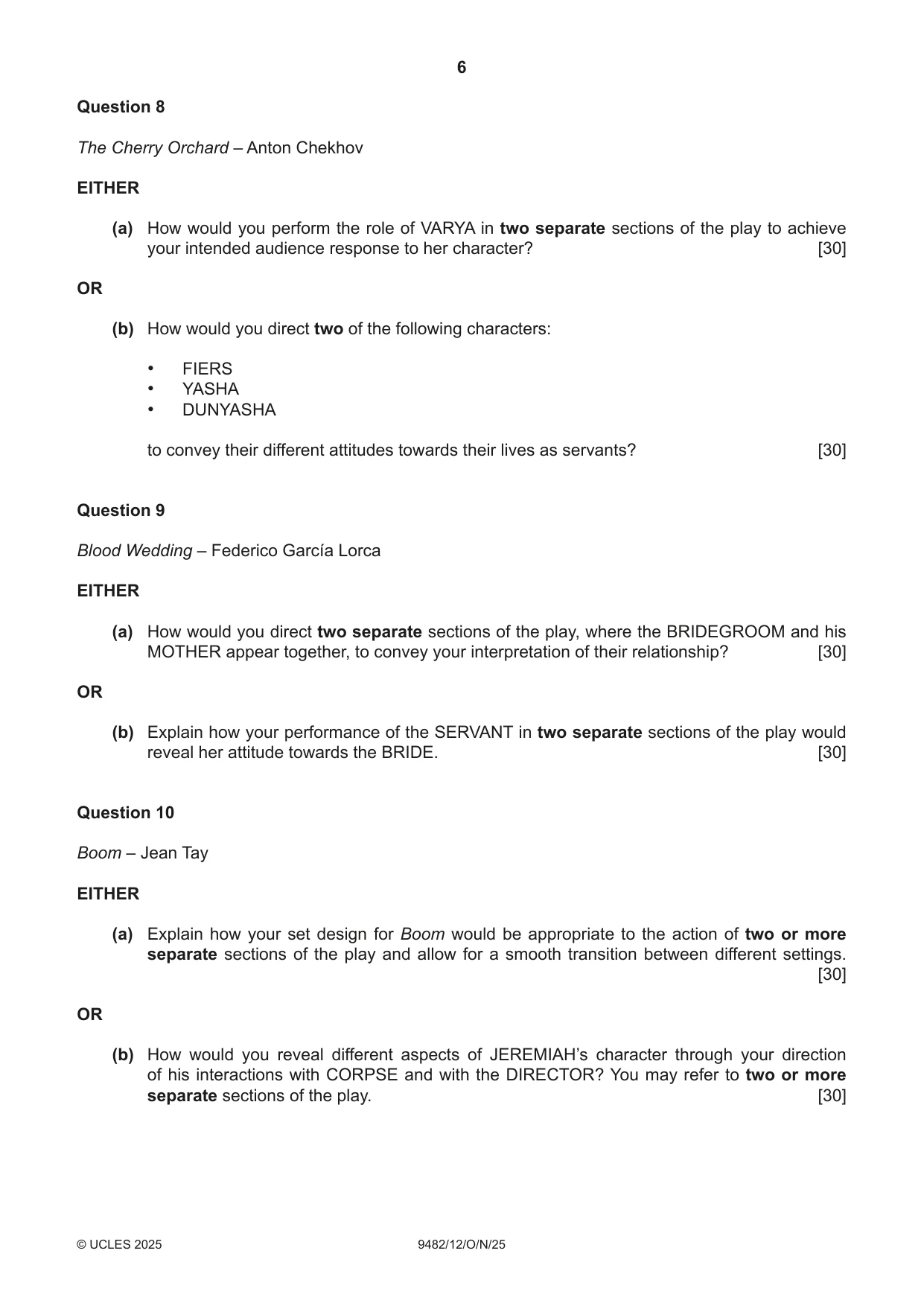
6 9482/12/O/N/25 © UCLES 2025 Question 8 The Cherry Orchard – Anton Chekhov EITHER (a) How would you perform the role of VARYA in two separate sections of the play to achieve your intended audience response to her character? [30] OR (b) How would you direct two of the following characters: • FIERS • YASHA • DUNYASHA to convey their different attitudes towards their lives as servants? [30] Question 9 Blood Wedding – Federico García Lorca EITHER (a) How would you direct two separate sections of the play, where the BRIDEGROOM and his MOTHER appear together, to convey your interpretation of their relationship? [30] OR (b) Explain how your performance of the SERVANT in two separate sections of the play would reveal her attitude towards the BRIDE. [30] Question 10 Boom – Jean Tay EITHER (a) Explain how your set design for Boom would be appropriate to the action of two or more separate sections of the play and allow for a smooth transition between different settings. [30] OR (b) How would you reveal different aspects of JEREMIAH’s character through your direction of his interactions with CORPSE and with the DIRECTOR? You may refer to two or more separate sections of the play. [30]
Question paper, page 7
7 9482/12/O/N/25 © UCLES 2025 BLANK PAGE
Question paper, page 8
8 9482/12/O/N/25 © UCLES 2025 Permission to reproduce items where third-party owned material protected by copyright is included has been sought and cleared where possible. Every reasonable effort has been made by the publisher (UCLES) to trace copyright holders, but if any items requiring clearance have unwittingly been included, the publisher will be pleased to make amends at the earliest possible opportunity. To avoid the issue of disclosure of answer-related information to candidates, all copyright acknowledgements are reproduced online in the Cambridge Assessment International Education Copyright Acknowledgements Booklet. This is produced for each series of examinations and is freely available to download at www.cambridgeinternational.org after the live examination series. Cambridge Assessment International Education is part of Cambridge Assessment. Cambridge Assessment is the brand name of the University of Cambridge Local Examinations Syndicate (UCLES), which is a department of the University of Cambridge. BLANK PAGE
Mark scheme, page 1
This document consists of 32 printed pages. © Cambridge University Press & Assessment 2025 [Turn over Cambridge International AS & A Level DRAMA 9482/12 Paper 1 Open-Book Written Examination October/November 2025 MARK SCHEME Maximum Mark: 60 Published This mark scheme is published as an aid to teachers and candidates, to indicate the requirements of the examination. It shows the basis on which Examiners were instructed to award marks. It does not indicate the details of the discussions that took place at an Examiners’ meeting before marking began, which would have considered the acceptability of alternative answers. Mark schemes should be read in conjunction with the question paper and the Principal Examiner Report for Teachers. Cambridge International will not enter into discussions about these mark schemes. Cambridge International is publishing the mark schemes for the October/November 2025 series for most Cambridge IGCSE, Cambridge International A and AS Level components, and some Cambridge O Level components.
Mark scheme, page 2
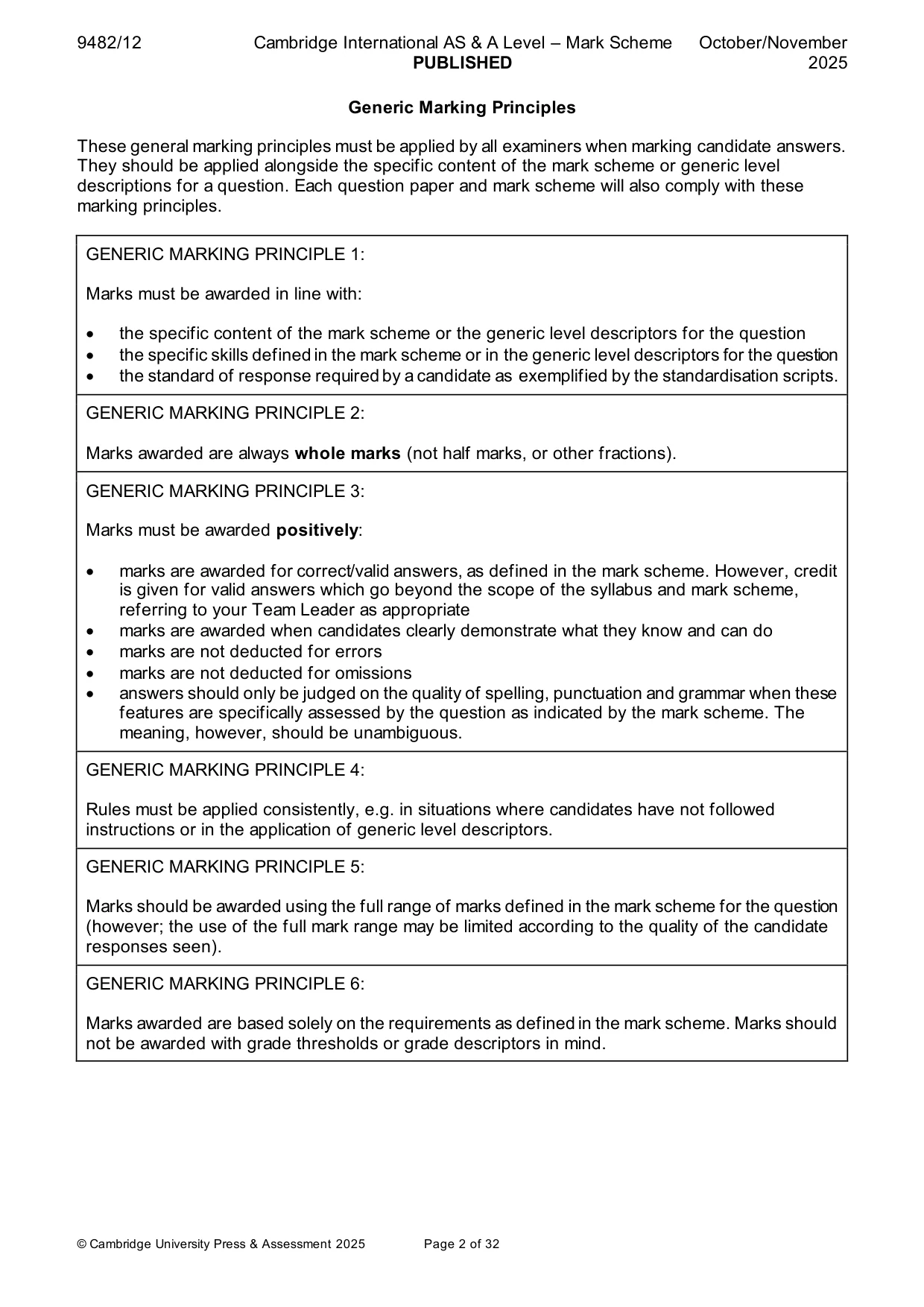
9482/12 Cambridge International AS & A Level – Mark Scheme PUBLISHED October/November 2025 © Cambridge University Press & Assessment 2025 Page 2 of 32 Generic Marking Principles These general marking principles must be applied by all examiners when marking candidate answers. They should be applied alongside the specific content of the mark scheme or generic level descriptions for a question. Each question paper and mark scheme will also comply with these marking principles. GENERIC MARKING PRINCIPLE 1: Marks must be awarded in line with: • the specific content of the mark scheme or the generic level descriptors for the question • the specific skills defined in the mark scheme or in the generic level descriptors for the question • the standard of response required by a candidate as exemplified by the standardisation scripts. GENERIC MARKING PRINCIPLE 2: Marks awarded are always whole marks (not half marks, or other fractions). GENERIC MARKING PRINCIPLE 3: Marks must be awarded positively: • marks are awarded for correct/valid answers, as defined in the mark scheme. However, credit is given for valid answers which go beyond the scope of the syllabus and mark scheme, referring to your Team Leader as appropriate • marks are awarded when candidates clearly demonstrate what they know and can do • marks are not deducted for errors • marks are not deducted for omissions • answers should only be judged on the quality of spelling, punctuation and grammar when these features are specifically assessed by the question as indicated by the mark scheme. The meaning, however, should be unambiguous. GENERIC MARKING PRINCIPLE 4: Rules must be applied consistently, e.g. in situations where candidates have not followed instructions or in the application of generic level descriptors. GENERIC MARKING PRINCIPLE 5: Marks should be awarded using the full range of marks defined in the mark scheme for the question (however; the use of the full mark range may be limited according to the quality of the candidate responses seen). GENERIC MARKING PRINCIPLE 6: Marks awarded are based solely on the requirements as defined in the mark scheme. Marks should not be awarded with grade thresholds or grade descriptors in mind.
Mark scheme, page 3
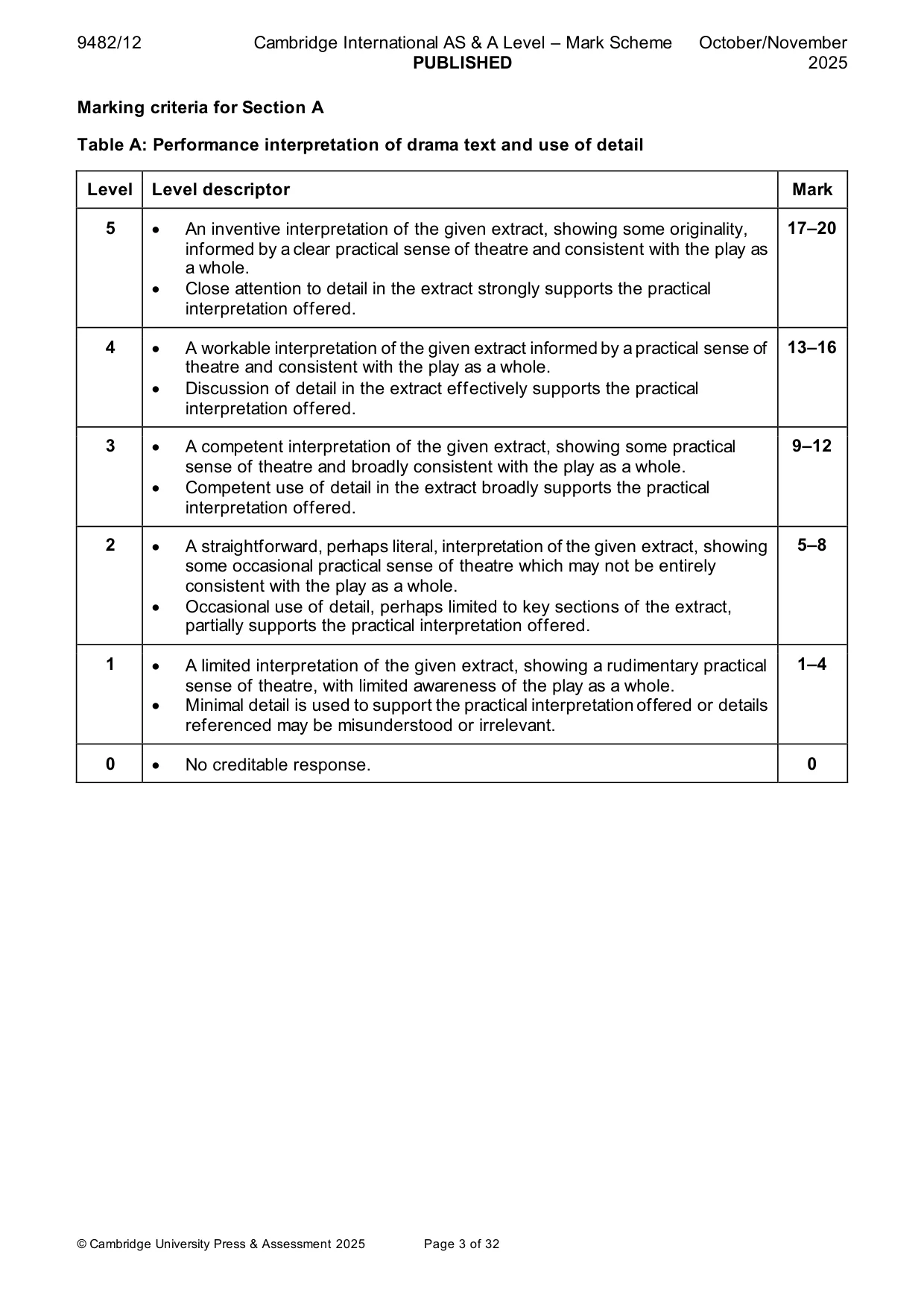
9482/12 Cambridge International AS & A Level – Mark Scheme PUBLISHED October/November 2025 © Cambridge University Press & Assessment 2025 Page 3 of 32 Marking criteria for Section A Table A: Performance interpretation of drama text and use of detail Level Level descriptor Mark 5 • An inventive interpretation of the given extract, showing some originality, informed by a clear practical sense of theatre and consistent with the play as a whole. • Close attention to detail in the extract strongly supports the practical interpretation offered. 17–20 4 • A workable interpretation of the given extract informed by a practical sense of theatre and consistent with the play as a whole. • Discussion of detail in the extract effectively supports the practical interpretation offered. 13–16 3 • A competent interpretation of the given extract, showing some practical sense of theatre and broadly consistent with the play as a whole. • Competent use of detail in the extract broadly supports the practical interpretation offered. 9–12 2 • A straightforward, perhaps literal, interpretation of the given extract, showing some occasional practical sense of theatre which may not be entirely consistent with the play as a whole. • Occasional use of detail, perhaps limited to key sections of the extract, partially supports the practical interpretation offered. 5–8 1 • A limited interpretation of the given extract, showing a rudimentary practical sense of theatre, with limited awareness of the play as a whole. • Minimal detail is used to support the practical interpretation offered or details referenced may be misunderstood or irrelevant. 1–4 0 • No creditable response. 0
Mark scheme, page 4
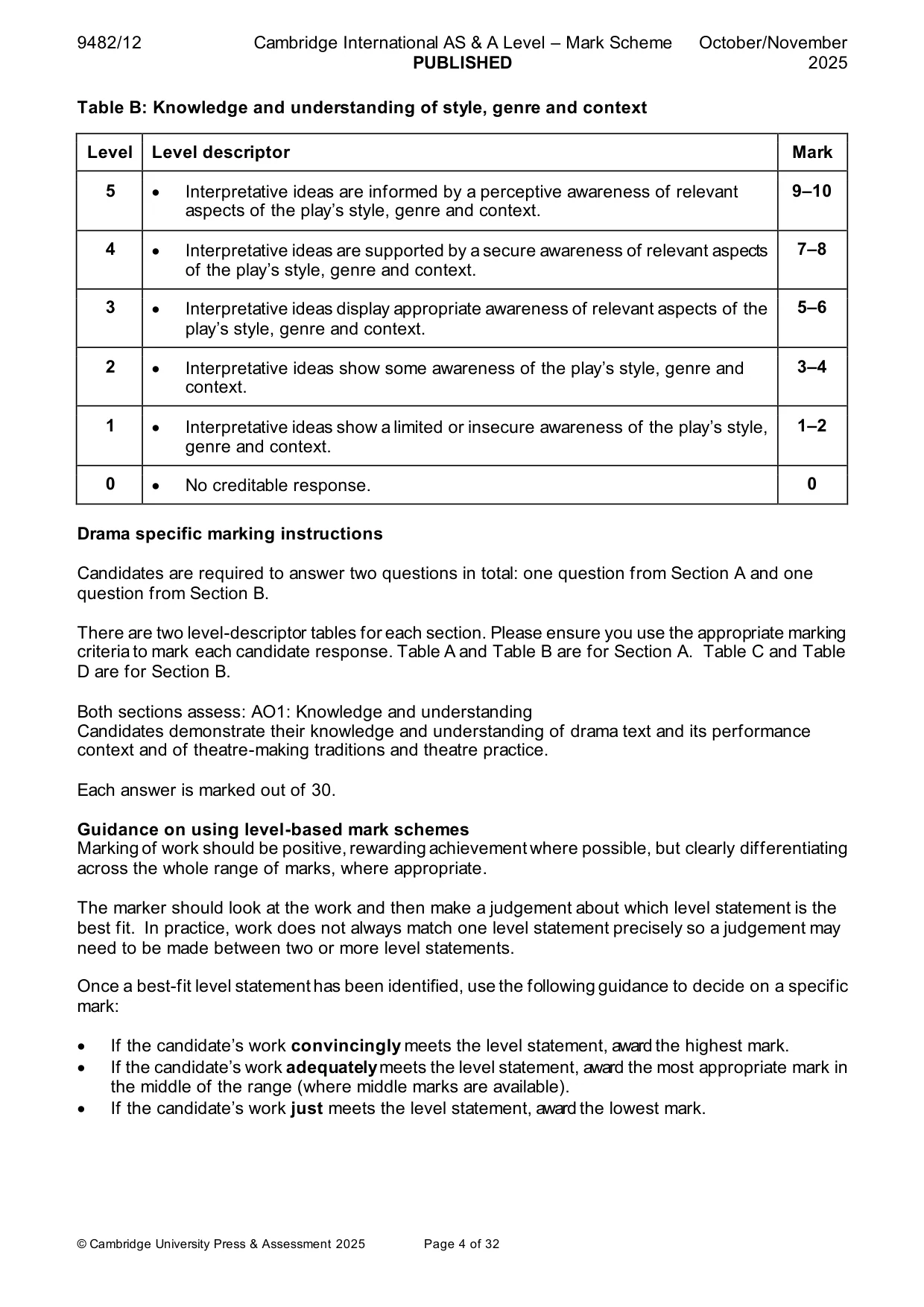
9482/12 Cambridge International AS & A Level – Mark Scheme PUBLISHED October/November 2025 © Cambridge University Press & Assessment 2025 Page 4 of 32 Table B: Knowledge and understanding of style, genre and context Level Level descriptor Mark 5 • Interpretative ideas are informed by a perceptive awareness of relevant aspects of the play’s style, genre and context. 9–10 4 • Interpretative ideas are supported by a secure awareness of relevant aspects of the play’s style, genre and context. 7–8 3 • Interpretative ideas display appropriate awareness of relevant aspects of the play’s style, genre and context. 5–6 2 • Interpretative ideas show some awareness of the play’s style, genre and context. 3–4 1 • Interpretative ideas show a limited or insecure awareness of the play’s style, genre and context. 1–2 0 • No creditable response. 0 Drama specific marking instructions Candidates are required to answer two questions in total: one question from Section A and one question from Section B. There are two level-descriptor tables for each section. Please ensure you use the appropriate marking criteria to mark each candidate response. Table A and Table B are for Section A. Table C and Table D are for Section B. Both sections assess: AO1: Knowledge and understanding Candidates demonstrate their knowledge and understanding of drama text and its performance context and of theatre-making traditions and theatre practice. Each answer is marked out of 30. Guidance on using level-based mark schemes Marking of work should be positive, rewarding achievement where possible, but clearly differentiating across the whole range of marks, where appropriate. The marker should look at the work and then make a judgement about which level statement is the best fit. In practice, work does not always match one level statement precisely so a judgement may need to be made between two or more level statements. Once a best-fit level statement has been identified, use the following guidance to decide on a specific mark: • If the candidate’s work convincingly meets the level statement, award the highest mark. • If the candidate’s work adequately meets the level statement, award the most appropriate mark in the middle of the range (where middle marks are available). • If the candidate’s work just meets the level statement, award the lowest mark.
Mark scheme, page 5
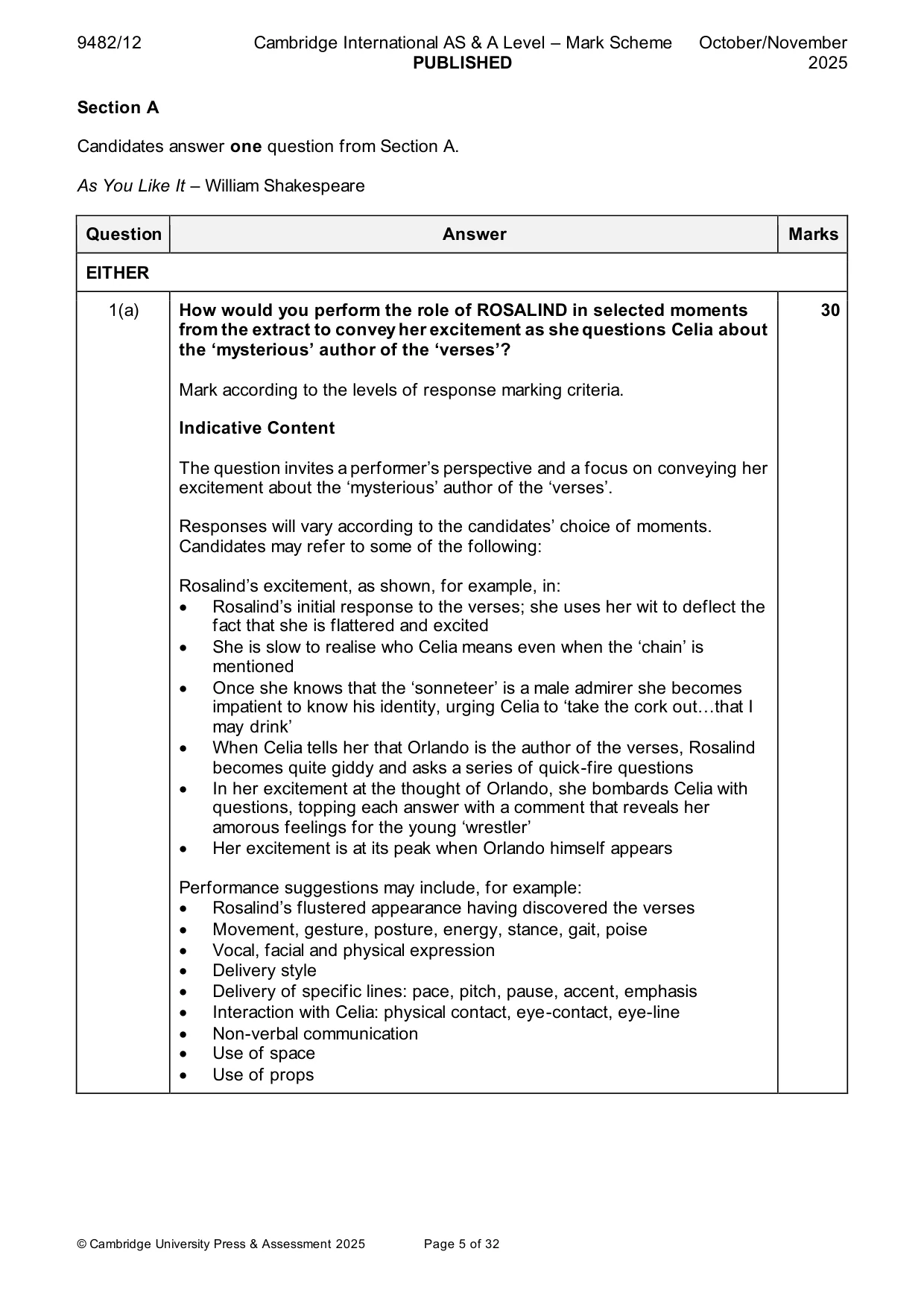
9482/12 Cambridge International AS & A Level – Mark Scheme PUBLISHED October/November 2025 © Cambridge University Press & Assessment 2025 Page 5 of 32 Section A Candidates answer one question from Section A. As You Like It – William Shakespeare Question Answer Marks EITHER 1(a) How would you perform the role of ROSALIND in selected moments from the extract to convey her excitement as she questions Celia about the ‘mysterious’ author of the ‘verses’? Mark according to the levels of response marking criteria. Indicative Content The question invites a performer’s perspective and a focus on conveying her excitement about the ‘mysterious’ author of the ‘verses’. Responses will vary according to the candidates’ choice of moments. Candidates may refer to some of the following: Rosalind’s excitement, as shown, for example, in: • Rosalind’s initial response to the verses; she uses her wit to deflect the fact that she is flattered and excited • She is slow to realise who Celia means even when the ‘chain’ is mentioned • Once she knows that the ‘sonneteer’ is a male admirer she becomes impatient to know his identity, urging Celia to ‘take the cork out…that I may drink’ • When Celia tells her that Orlando is the author of the verses, Rosalind becomes quite giddy and asks a series of quick-fire questions • In her excitement at the thought of Orlando, she bombards Celia with questions, topping each answer with a comment that reveals her amorous feelings for the young ‘wrestler’ • Her excitement is at its peak when Orlando himself appears Performance suggestions may include, for example: • Rosalind’s flustered appearance having discovered the verses • Movement, gesture, posture, energy, stance, gait, poise • Vocal, facial and physical expression • Delivery style • Delivery of specific lines: pace, pitch, pause, accent, emphasis • Interaction with Celia: physical contact, eye-contact, eye-line • Non-verbal communication • Use of space • Use of props 30
Mark scheme, page 6
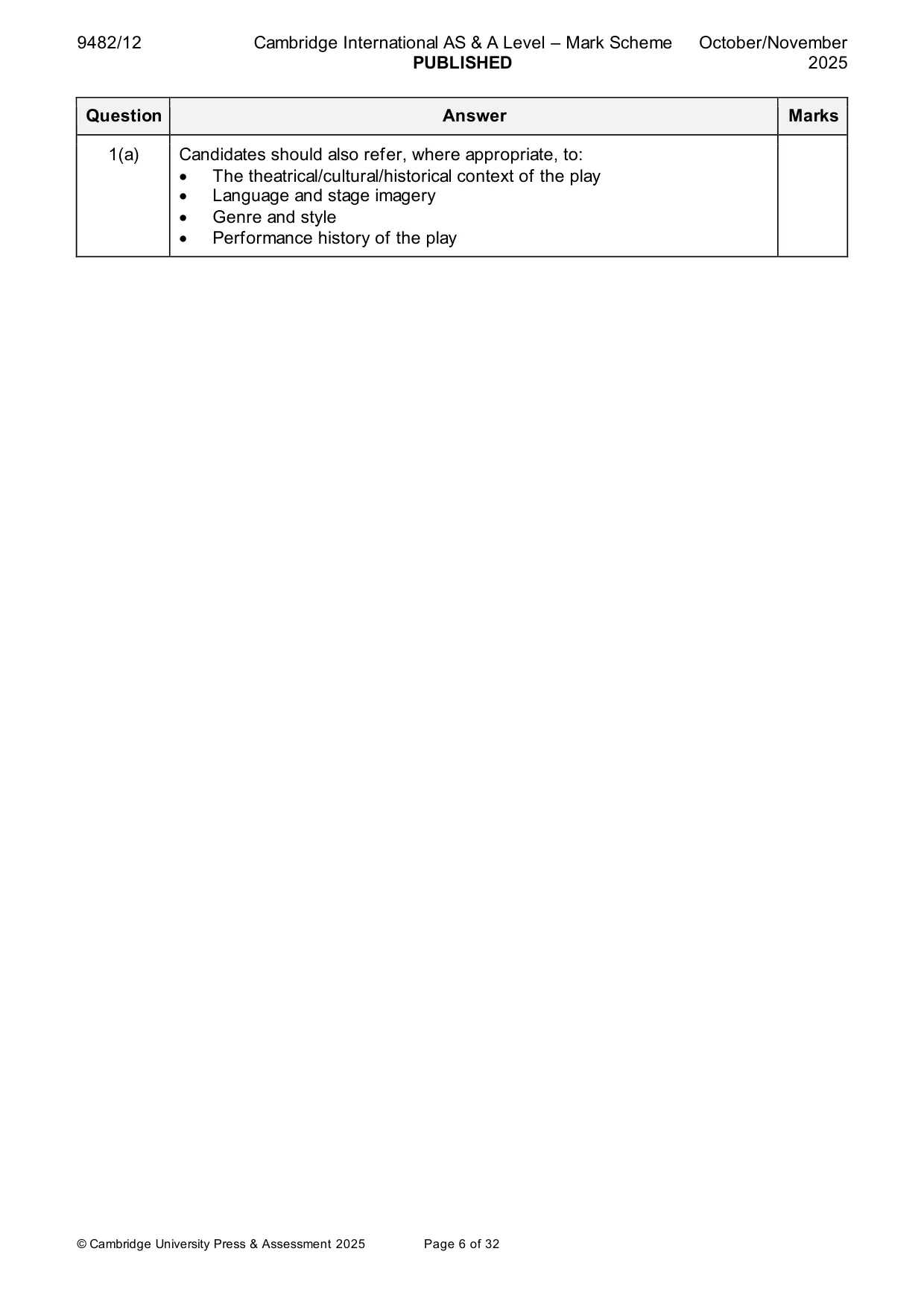
9482/12 Cambridge International AS & A Level – Mark Scheme PUBLISHED October/November 2025 © Cambridge University Press & Assessment 2025 Page 6 of 32 Question Answer Marks 1(a) Candidates should also refer, where appropriate, to: • The theatrical/cultural/historical context of the play • Language and stage imagery • Genre and style • Performance history of the play
Mark scheme, page 7
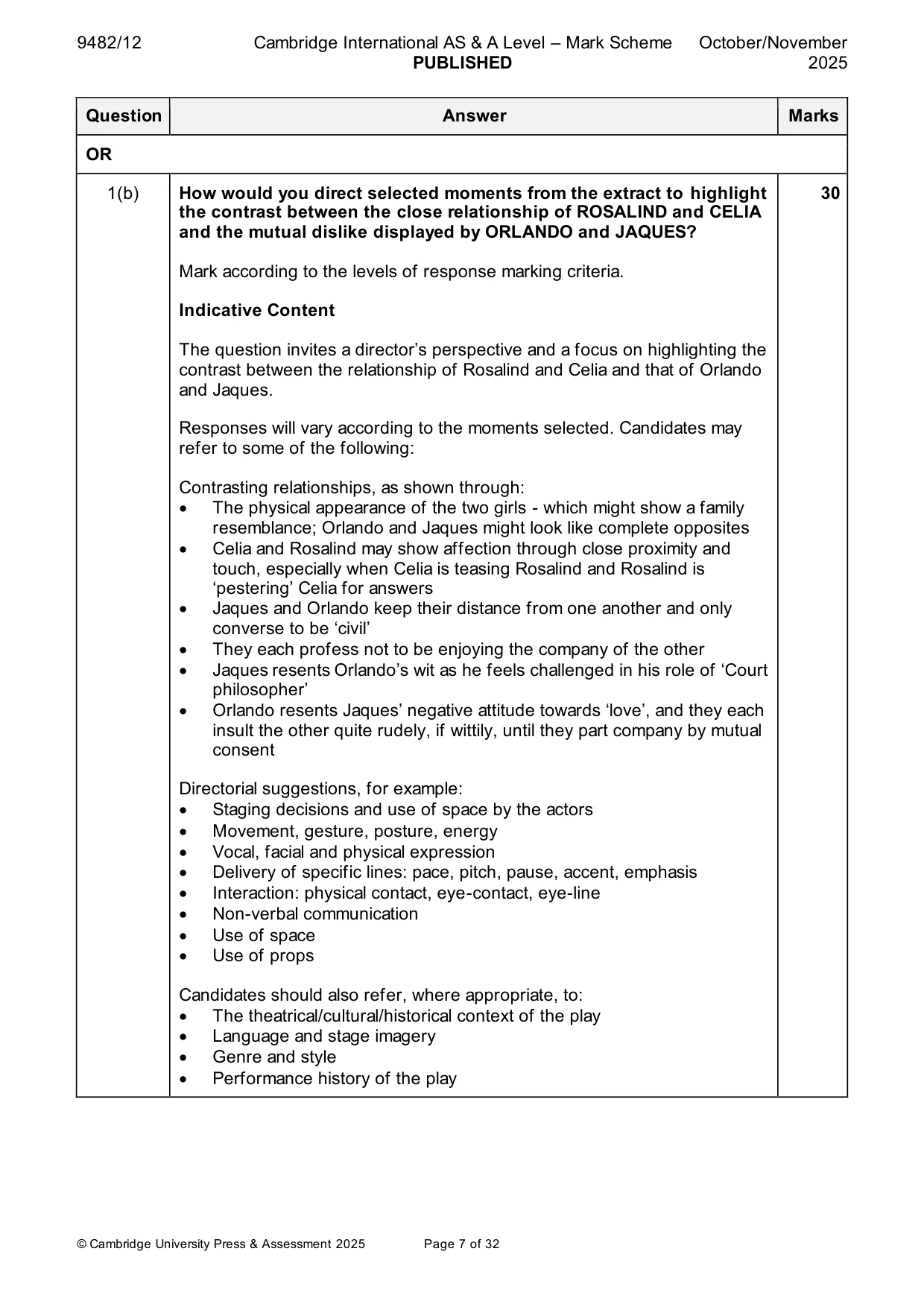
9482/12 Cambridge International AS & A Level – Mark Scheme PUBLISHED October/November 2025 © Cambridge University Press & Assessment 2025 Page 7 of 32 Question Answer Marks OR 1(b) How would you direct selected moments from the extract to highlight the contrast between the close relationship of ROSALIND and CELIA and the mutual dislike displayed by ORLANDO and JAQUES? Mark according to the levels of response marking criteria. Indicative Content The question invites a director’s perspective and a focus on highlighting the contrast between the relationship of Rosalind and Celia and that of Orlando and Jaques. Responses will vary according to the moments selected. Candidates may refer to some of the following: Contrasting relationships, as shown through: • The physical appearance of the two girls - which might show a family resemblance; Orlando and Jaques might look like complete opposites • Celia and Rosalind may show affection through close proximity and touch, especially when Celia is teasing Rosalind and Rosalind is ‘pestering’ Celia for answers • Jaques and Orlando keep their distance from one another and only converse to be ‘civil’ • They each profess not to be enjoying the company of the other • Jaques resents Orlando’s wit as he feels challenged in his role of ‘Court philosopher’ • Orlando resents Jaques’ negative attitude towards ‘love’, and they each insult the other quite rudely, if wittily, until they part company by mutual consent Directorial suggestions, for example: • Staging decisions and use of space by the actors • Movement, gesture, posture, energy • Vocal, facial and physical expression • Delivery of specific lines: pace, pitch, pause, accent, emphasis • Interaction: physical contact, eye-contact, eye-line • Non-verbal communication • Use of space • Use of props Candidates should also refer, where appropriate, to: • The theatrical/cultural/historical context of the play • Language and stage imagery • Genre and style • Performance history of the play 30
Mark scheme, page 8
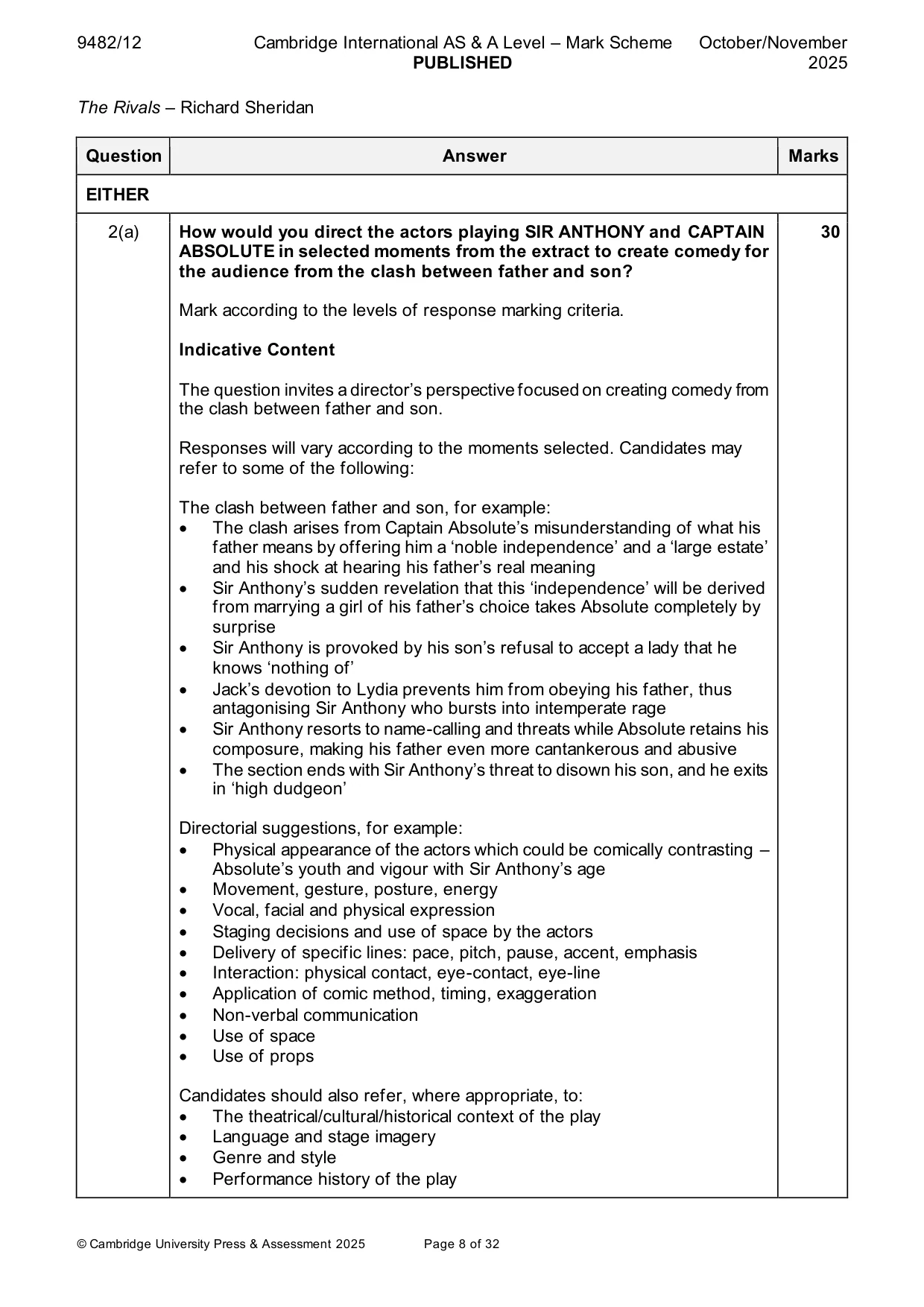
9482/12 Cambridge International AS & A Level – Mark Scheme PUBLISHED October/November 2025 © Cambridge University Press & Assessment 2025 Page 8 of 32 The Rivals – Richard Sheridan Question Answer Marks EITHER 2(a) How would you direct the actors playing SIR ANTHONY and CAPTAIN ABSOLUTE in selected moments from the extract to create comedy for the audience from the clash between father and son? Mark according to the levels of response marking criteria. Indicative Content The question invites a director’s perspective focused on creating comedy from the clash between father and son. Responses will vary according to the moments selected. Candidates may refer to some of the following: The clash between father and son, for example: • The clash arises from Captain Absolute’s misunderstanding of what his father means by offering him a ‘noble independence’ and a ‘large estate’ and his shock at hearing his father’s real meaning • Sir Anthony’s sudden revelation that this ‘independence’ will be derived from marrying a girl of his father’s choice takes Absolute completely by surprise • Sir Anthony is provoked by his son’s refusal to accept a lady that he knows ‘nothing of’ • Jack’s devotion to Lydia prevents him from obeying his father, thus antagonising Sir Anthony who bursts into intemperate rage • Sir Anthony resorts to name-calling and threats while Absolute retains his composure, making his father even more cantankerous and abusive • The section ends with Sir Anthony’s threat to disown his son, and he exits in ‘high dudgeon’ Directorial suggestions, for example: • Physical appearance of the actors which could be comically contrasting – Absolute’s youth and vigour with Sir Anthony’s age • Movement, gesture, posture, energy • Vocal, facial and physical expression • Staging decisions and use of space by the actors • Delivery of specific lines: pace, pitch, pause, accent, emphasis • Interaction: physical contact, eye-contact, eye-line • Application of comic method, timing, exaggeration • Non-verbal communication • Use of space • Use of props Candidates should also refer, where appropriate, to: • The theatrical/cultural/historical context of the play • Language and stage imagery • Genre and style • Performance history of the play 30
Mark scheme, page 9
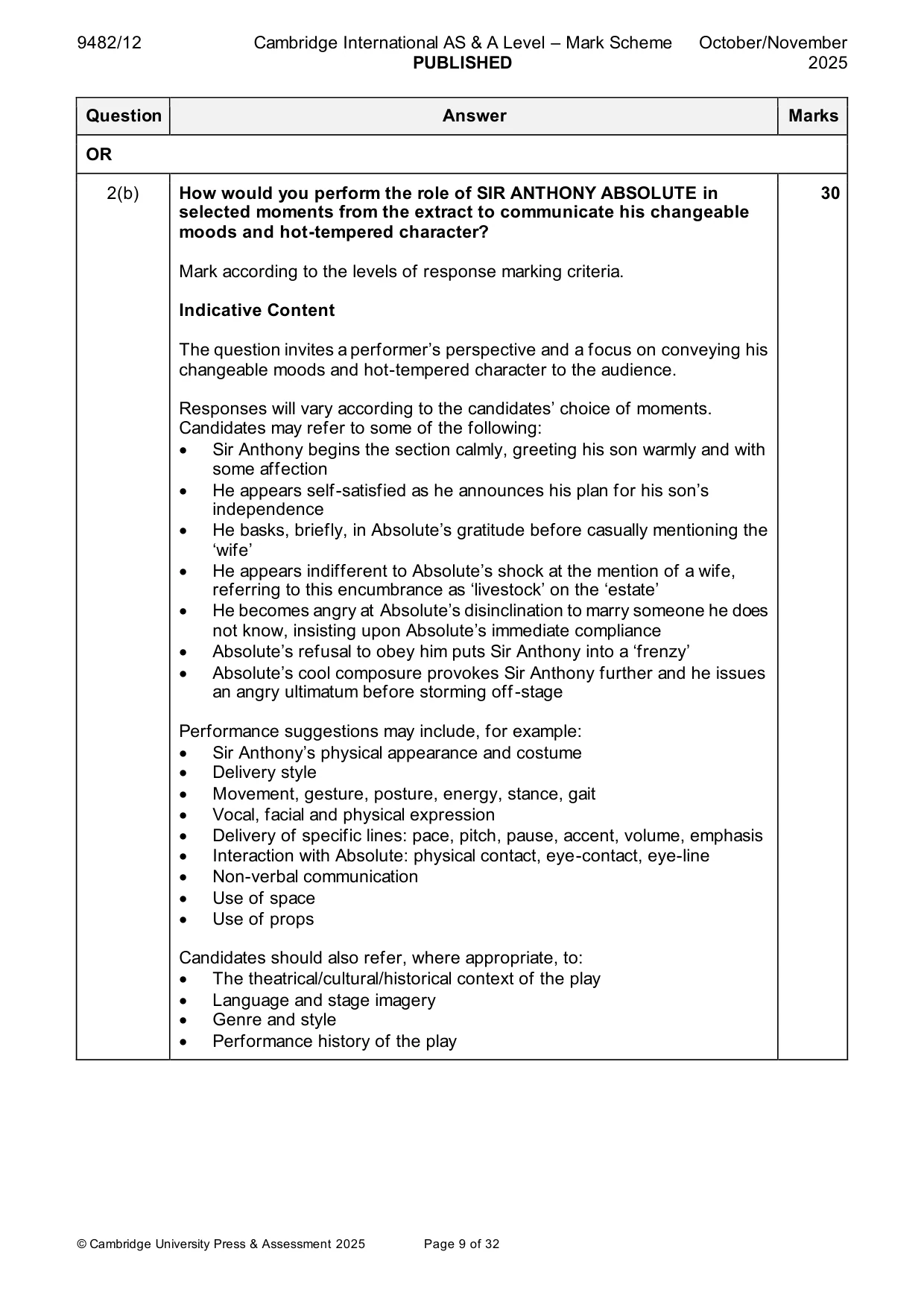
9482/12 Cambridge International AS & A Level – Mark Scheme PUBLISHED October/November 2025 © Cambridge University Press & Assessment 2025 Page 9 of 32 Question Answer Marks OR 2(b) How would you perform the role of SIR ANTHONY ABSOLUTE in selected moments from the extract to communicate his changeable moods and hot-tempered character? Mark according to the levels of response marking criteria. Indicative Content The question invites a performer’s perspective and a focus on conveying his changeable moods and hot-tempered character to the audience. Responses will vary according to the candidates’ choice of moments. Candidates may refer to some of the following: • Sir Anthony begins the section calmly, greeting his son warmly and with some affection • He appears self-satisfied as he announces his plan for his son’s independence • He basks, briefly, in Absolute’s gratitude before casually mentioning the ‘wife’ • He appears indifferent to Absolute’s shock at the mention of a wife, referring to this encumbrance as ‘livestock’ on the ‘estate’ • He becomes angry at Absolute’s disinclination to marry someone he does not know, insisting upon Absolute’s immediate compliance • Absolute’s refusal to obey him puts Sir Anthony into a ‘frenzy’ • Absolute’s cool composure provokes Sir Anthony further and he issues an angry ultimatum before storming off-stage Performance suggestions may include, for example: • Sir Anthony’s physical appearance and costume • Delivery style • Movement, gesture, posture, energy, stance, gait • Vocal, facial and physical expression • Delivery of specific lines: pace, pitch, pause, accent, volume, emphasis • Interaction with Absolute: physical contact, eye-contact, eye-line • Non-verbal communication • Use of space • Use of props Candidates should also refer, where appropriate, to: • The theatrical/cultural/historical context of the play • Language and stage imagery • Genre and style • Performance history of the play 30
Mark scheme, page 10
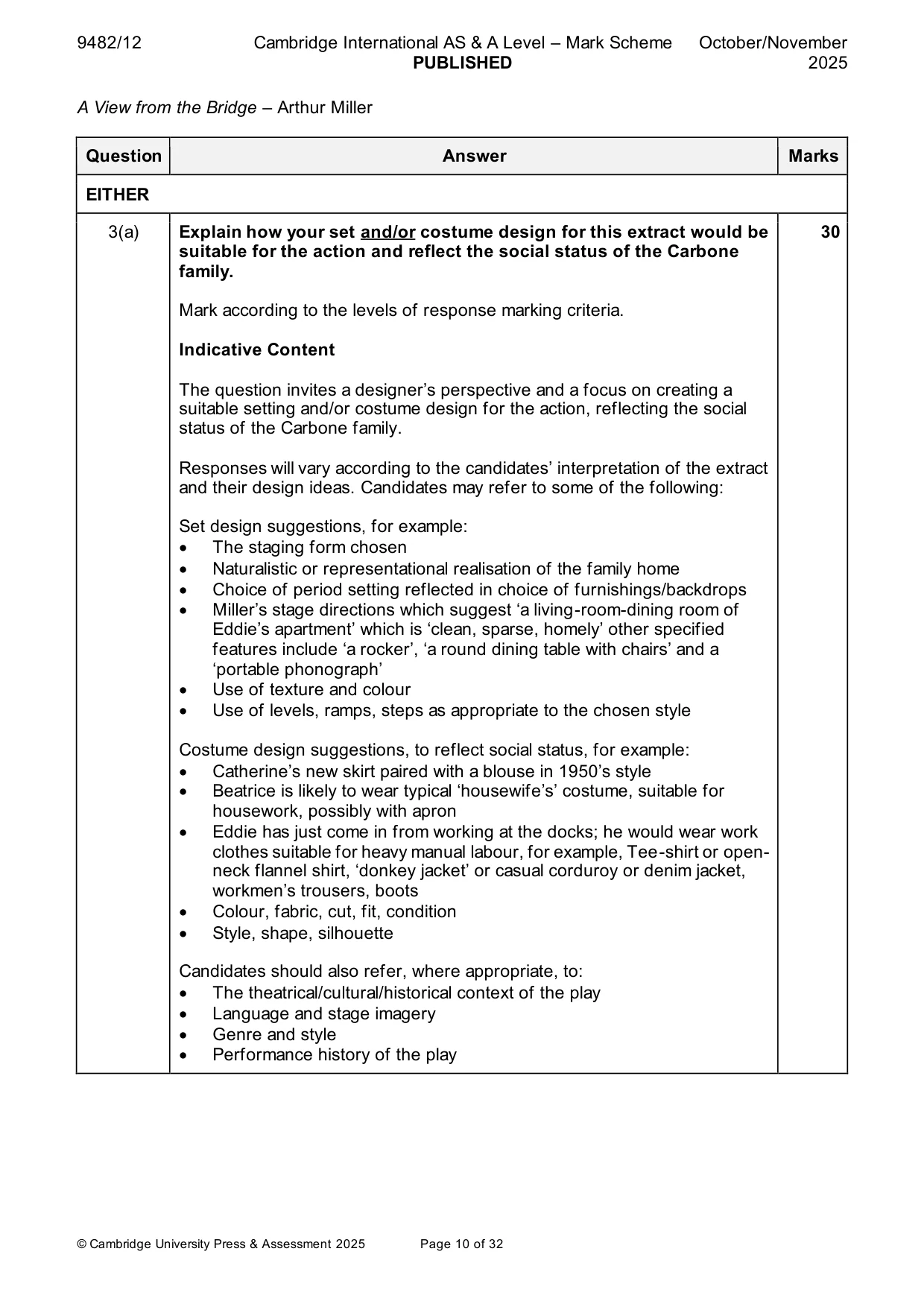
9482/12 Cambridge International AS & A Level – Mark Scheme PUBLISHED October/November 2025 © Cambridge University Press & Assessment 2025 Page 10 of 32 A View from the Bridge – Arthur Miller Question Answer Marks EITHER 3(a) Explain how your set and/or costume design for this extract would be suitable for the action and reflect the social status of the Carbone family. Mark according to the levels of response marking criteria. Indicative Content The question invites a designer’s perspective and a focus on creating a suitable setting and/or costume design for the action, reflecting the social status of the Carbone family. Responses will vary according to the candidates’ interpretation of the extract and their design ideas. Candidates may refer to some of the following: Set design suggestions, for example: • The staging form chosen • Naturalistic or representational realisation of the family home • Choice of period setting reflected in choice of furnishings/backdrops • Miller’s stage directions which suggest ‘a living-room-dining room of Eddie’s apartment’ which is ‘clean, sparse, homely’ other specified features include ‘a rocker’, ‘a round dining table with chairs’ and a ‘portable phonograph’ • Use of texture and colour • Use of levels, ramps, steps as appropriate to the chosen style Costume design suggestions, to reflect social status, for example: • Catherine’s new skirt paired with a blouse in 1950’s style • Beatrice is likely to wear typical ‘housewife’s’ costume, suitable for housework, possibly with apron • Eddie has just come in from working at the docks; he would wear work clothes suitable for heavy manual labour, for example, Tee-shirt or open- neck flannel shirt, ‘donkey jacket’ or casual corduroy or denim jacket, workmen’s trousers, boots • Colour, fabric, cut, fit, condition • Style, shape, silhouette Candidates should also refer, where appropriate, to: • The theatrical/cultural/historical context of the play • Language and stage imagery • Genre and style • Performance history of the play 30
Mark scheme, page 11
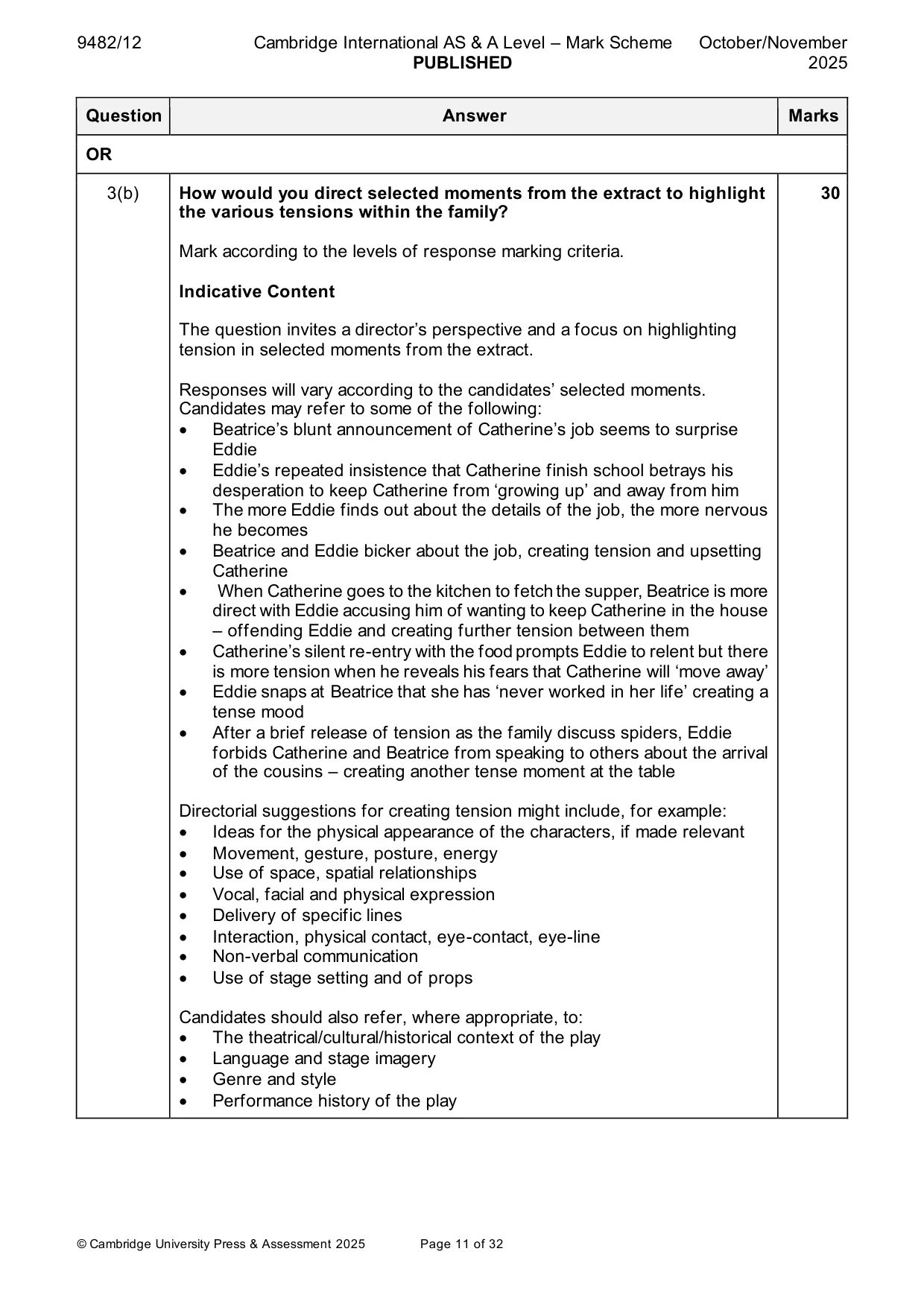
9482/12 Cambridge International AS & A Level – Mark Scheme PUBLISHED October/November 2025 © Cambridge University Press & Assessment 2025 Page 11 of 32 Question Answer Marks OR 3(b) How would you direct selected moments from the extract to highlight the various tensions within the family? Mark according to the levels of response marking criteria. Indicative Content The question invites a director’s perspective and a focus on highlighting tension in selected moments from the extract. Responses will vary according to the candidates’ selected moments. Candidates may refer to some of the following: • Beatrice’s blunt announcement of Catherine’s job seems to surprise Eddie • Eddie’s repeated insistence that Catherine finish school betrays his desperation to keep Catherine from ‘growing up’ and away from him • The more Eddie finds out about the details of the job, the more nervous he becomes • Beatrice and Eddie bicker about the job, creating tension and upsetting Catherine • When Catherine goes to the kitchen to fetch the supper, Beatrice is more direct with Eddie accusing him of wanting to keep Catherine in the house – offending Eddie and creating further tension between them • Catherine’s silent re-entry with the food prompts Eddie to relent but there is more tension when he reveals his fears that Catherine will ‘move away’ • Eddie snaps at Beatrice that she has ‘never worked in her life’ creating a tense mood • After a brief release of tension as the family discuss spiders, Eddie forbids Catherine and Beatrice from speaking to others about the arrival of the cousins – creating another tense moment at the table Directorial suggestions for creating tension might include, for example: • Ideas for the physical appearance of the characters, if made relevant • Movement, gesture, posture, energy • Use of space, spatial relationships • Vocal, facial and physical expression • Delivery of specific lines • Interaction, physical contact, eye-contact, eye-line • Non-verbal communication • Use of stage setting and of props Candidates should also refer, where appropriate, to: • The theatrical/cultural/historical context of the play • Language and stage imagery • Genre and style • Performance history of the play 30
Mark scheme, page 12
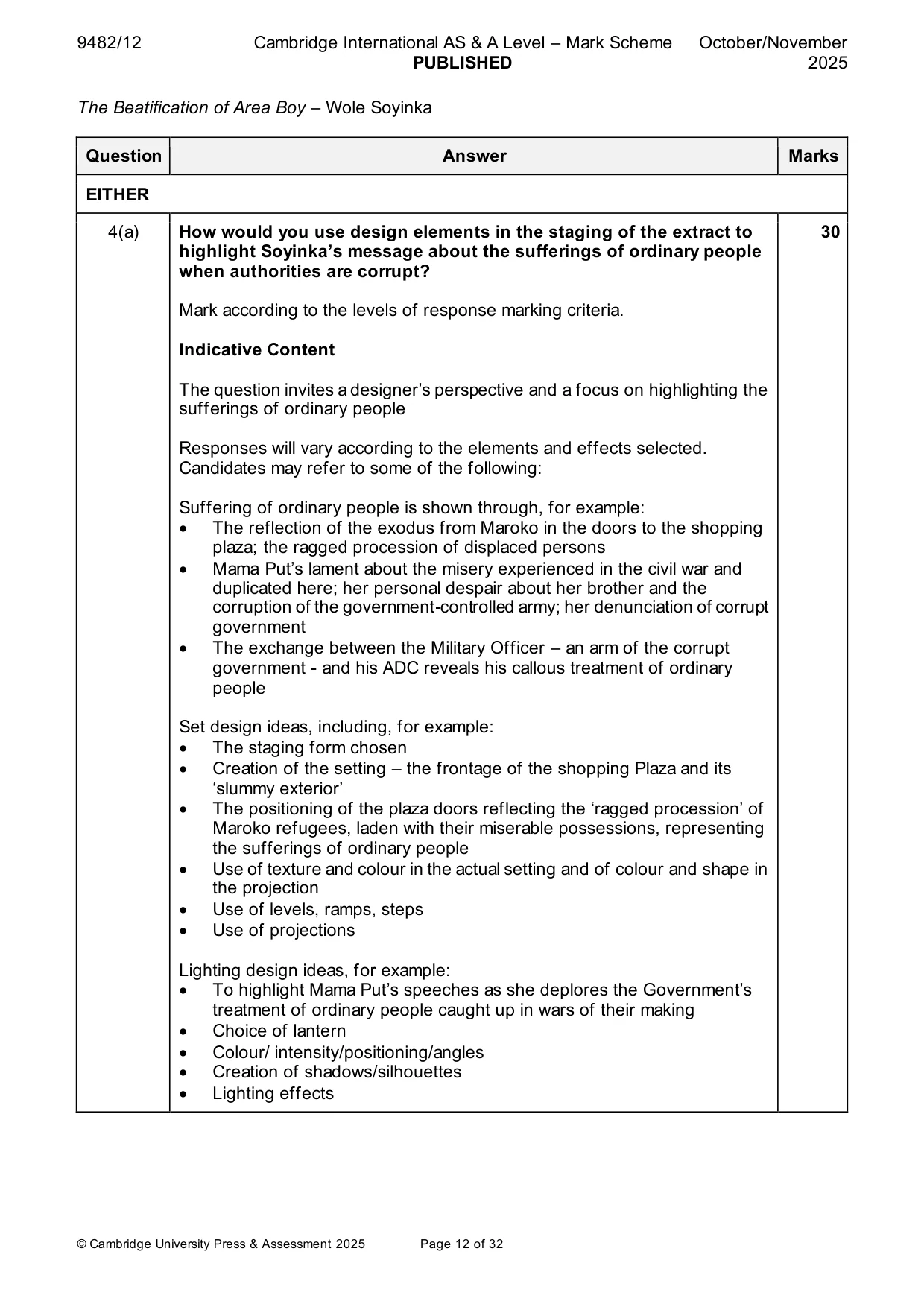
9482/12 Cambridge International AS & A Level – Mark Scheme PUBLISHED October/November 2025 © Cambridge University Press & Assessment 2025 Page 12 of 32 The Beatification of Area Boy – Wole Soyinka Question Answer Marks EITHER 4(a) How would you use design elements in the staging of the extract to highlight Soyinka’s message about the sufferings of ordinary people when authorities are corrupt? Mark according to the levels of response marking criteria. Indicative Content The question invites a designer’s perspective and a focus on highlighting the sufferings of ordinary people Responses will vary according to the elements and effects selected. Candidates may refer to some of the following: Suffering of ordinary people is shown through, for example: • The reflection of the exodus from Maroko in the doors to the shopping plaza; the ragged procession of displaced persons • Mama Put’s lament about the misery experienced in the civil war and duplicated here; her personal despair about her brother and the corruption of the government-controlled army; her denunciation of corrupt government • The exchange between the Military Officer – an arm of the corrupt government - and his ADC reveals his callous treatment of ordinary people Set design ideas, including, for example: • The staging form chosen • Creation of the setting – the frontage of the shopping Plaza and its ‘slummy exterior’ • The positioning of the plaza doors reflecting the ‘ragged procession’ of Maroko refugees, laden with their miserable possessions, representing the sufferings of ordinary people • Use of texture and colour in the actual setting and of colour and shape in the projection • Use of levels, ramps, steps • Use of projections Lighting design ideas, for example: • To highlight Mama Put’s speeches as she deplores the Government’s treatment of ordinary people caught up in wars of their making • Choice of lantern • Colour/ intensity/positioning/angles • Creation of shadows/silhouettes • Lighting effects 30
Mark scheme, page 13
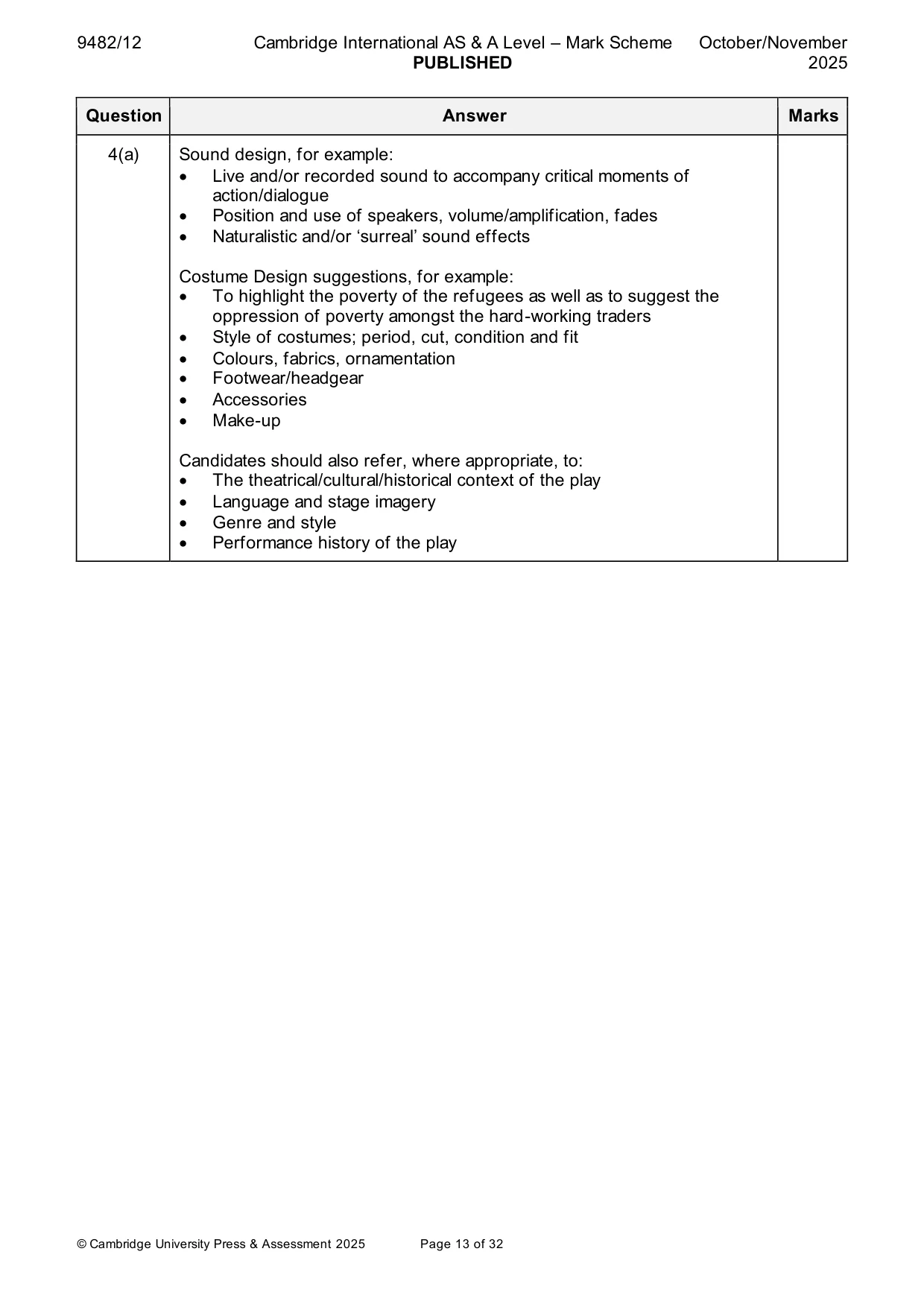
9482/12 Cambridge International AS & A Level – Mark Scheme PUBLISHED October/November 2025 © Cambridge University Press & Assessment 2025 Page 13 of 32 Question Answer Marks 4(a) Sound design, for example: • Live and/or recorded sound to accompany critical moments of action/dialogue • Position and use of speakers, volume/amplification, fades • Naturalistic and/or ‘surreal’ sound effects Costume Design suggestions, for example: • To highlight the poverty of the refugees as well as to suggest the oppression of poverty amongst the hard-working traders • Style of costumes; period, cut, condition and fit • Colours, fabrics, ornamentation • Footwear/headgear • Accessories • Make-up Candidates should also refer, where appropriate, to: • The theatrical/cultural/historical context of the play • Language and stage imagery • Genre and style • Performance history of the play
Mark scheme, page 14
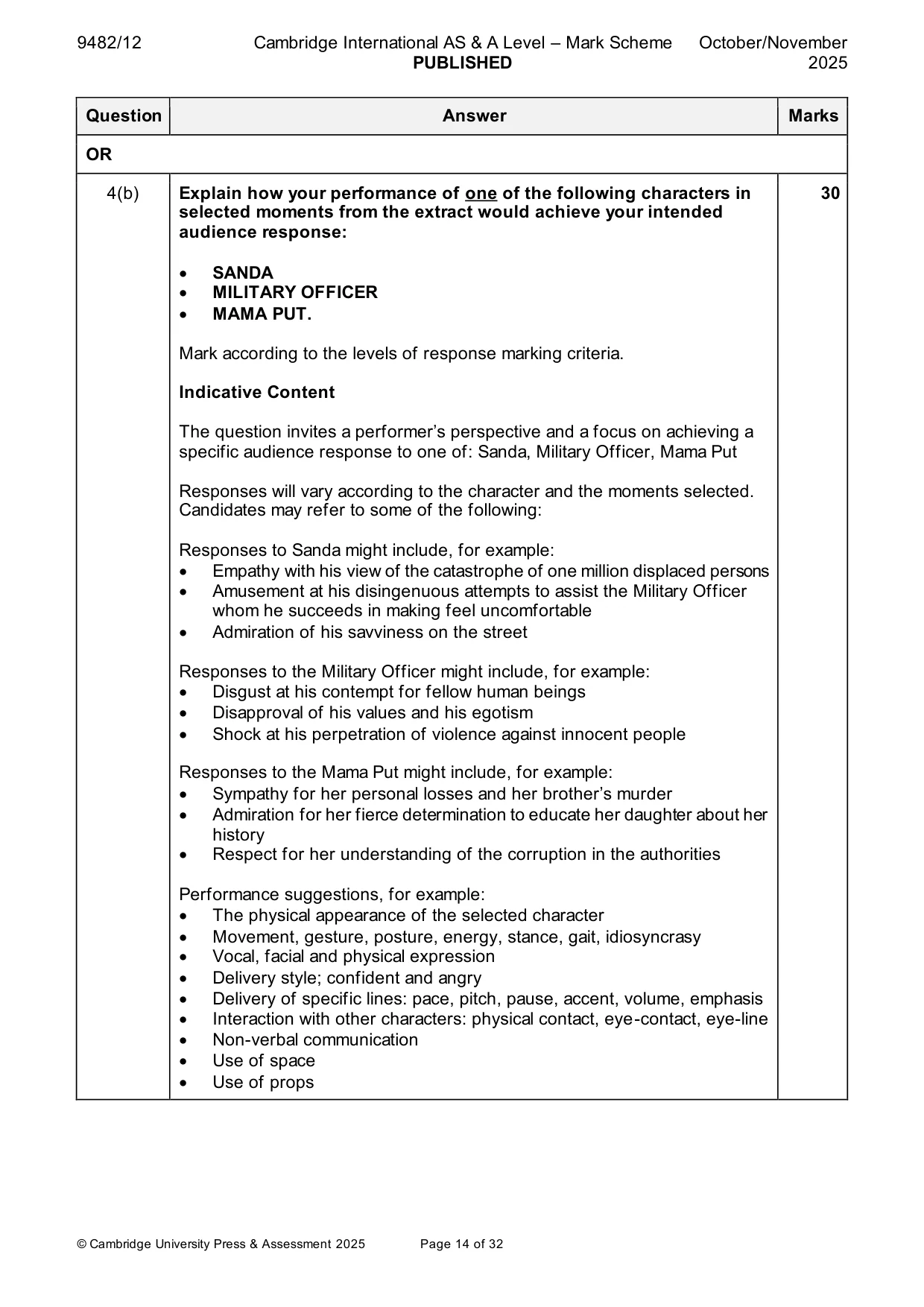
9482/12 Cambridge International AS & A Level – Mark Scheme PUBLISHED October/November 2025 © Cambridge University Press & Assessment 2025 Page 14 of 32 Question Answer Marks OR 4(b) Explain how your performance of one of the following characters in selected moments from the extract would achieve your intended audience response: • SANDA • MILITARY OFFICER • MAMA PUT. Mark according to the levels of response marking criteria. Indicative Content The question invites a performer’s perspective and a focus on achieving a specific audience response to one of: Sanda, Military Officer, Mama Put Responses will vary according to the character and the moments selected. Candidates may refer to some of the following: Responses to Sanda might include, for example: • Empathy with his view of the catastrophe of one million displaced persons • Amusement at his disingenuous attempts to assist the Military Officer whom he succeeds in making feel uncomfortable • Admiration of his savviness on the street Responses to the Military Officer might include, for example: • Disgust at his contempt for fellow human beings • Disapproval of his values and his egotism • Shock at his perpetration of violence against innocent people Responses to the Mama Put might include, for example: • Sympathy for her personal losses and her brother’s murder • Admiration for her fierce determination to educate her daughter about her history • Respect for her understanding of the corruption in the authorities Performance suggestions, for example: • The physical appearance of the selected character • Movement, gesture, posture, energy, stance, gait, idiosyncrasy • Vocal, facial and physical expression • Delivery style; confident and angry • Delivery of specific lines: pace, pitch, pause, accent, volume, emphasis • Interaction with other characters: physical contact, eye-contact, eye-line • Non-verbal communication • Use of space • Use of props 30
Mark scheme, page 15
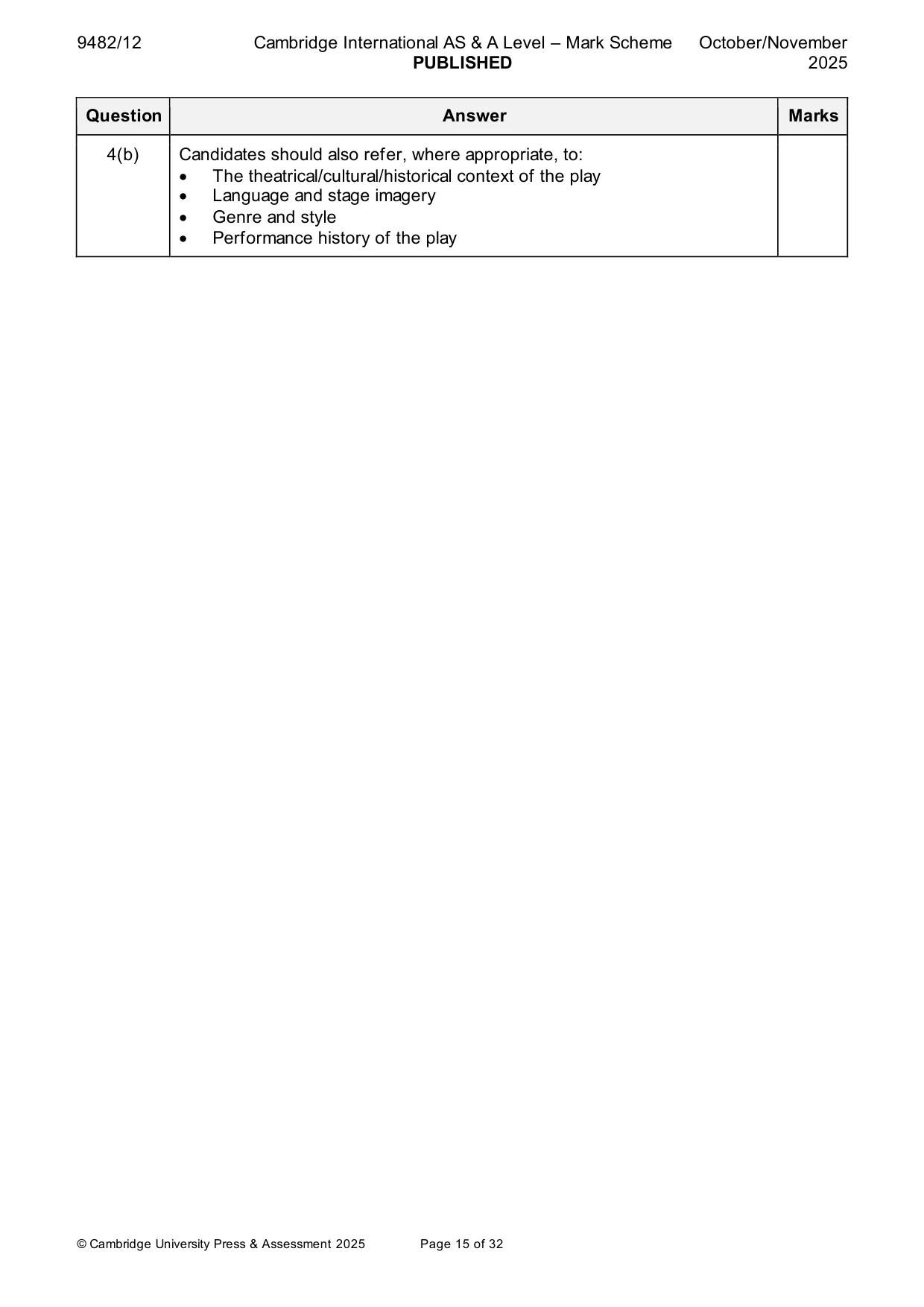
9482/12 Cambridge International AS & A Level – Mark Scheme PUBLISHED October/November 2025 © Cambridge University Press & Assessment 2025 Page 15 of 32 Question Answer Marks 4(b) Candidates should also refer, where appropriate, to: • The theatrical/cultural/historical context of the play • Language and stage imagery • Genre and style • Performance history of the play
Mark scheme, page 16
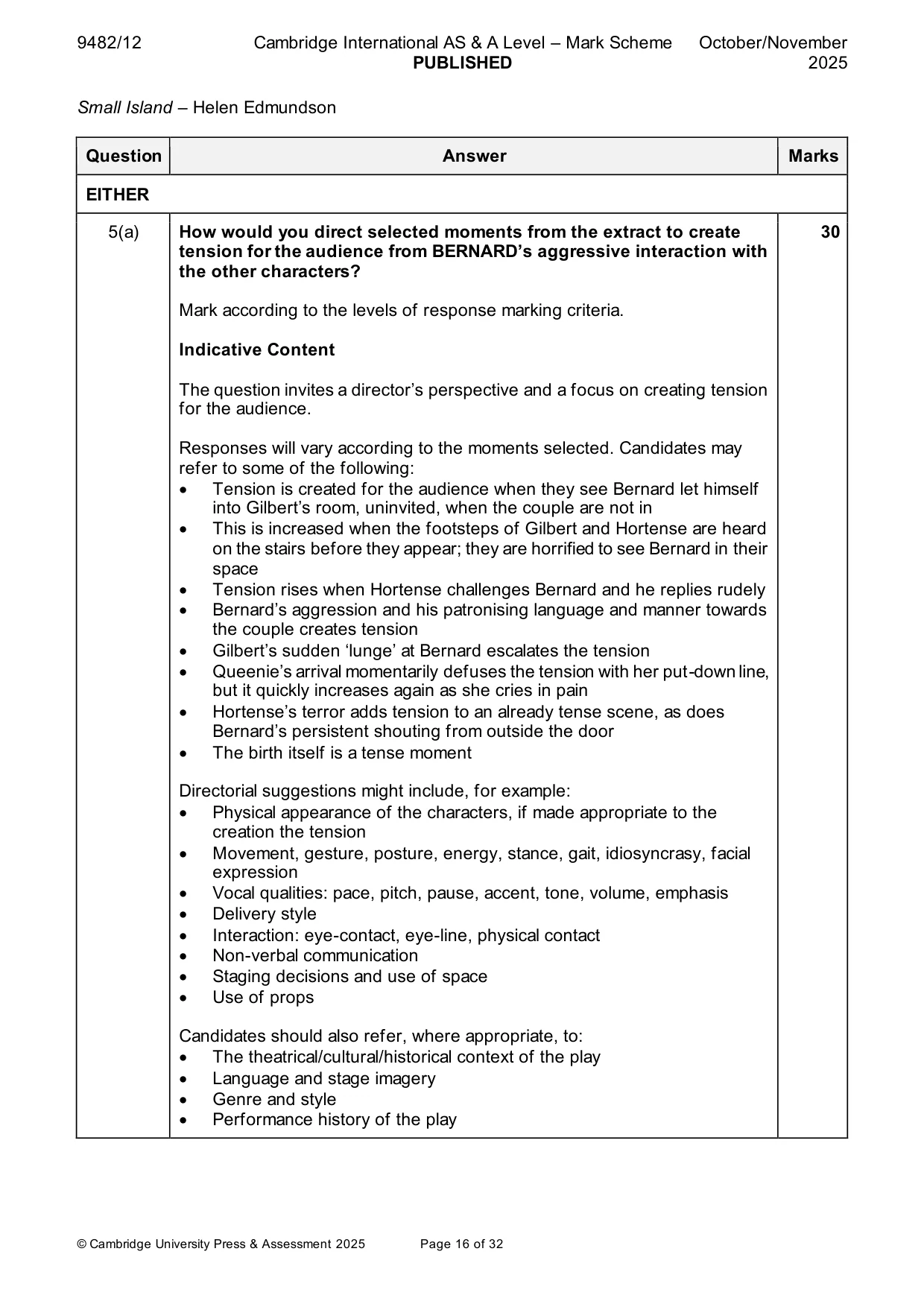
9482/12 Cambridge International AS & A Level – Mark Scheme PUBLISHED October/November 2025 © Cambridge University Press & Assessment 2025 Page 16 of 32 Small Island – Helen Edmundson Question Answer Marks EITHER 5(a) How would you direct selected moments from the extract to create tension for the audience from BERNARD’s aggressive interaction with the other characters? Mark according to the levels of response marking criteria. Indicative Content The question invites a director’s perspective and a focus on creating tension for the audience. Responses will vary according to the moments selected. Candidates may refer to some of the following: • Tension is created for the audience when they see Bernard let himself into Gilbert’s room, uninvited, when the couple are not in • This is increased when the footsteps of Gilbert and Hortense are heard on the stairs before they appear; they are horrified to see Bernard in their space • Tension rises when Hortense challenges Bernard and he replies rudely • Bernard’s aggression and his patronising language and manner towards the couple creates tension • Gilbert’s sudden ‘lunge’ at Bernard escalates the tension • Queenie’s arrival momentarily defuses the tension with her put-down line, but it quickly increases again as she cries in pain • Hortense’s terror adds tension to an already tense scene, as does Bernard’s persistent shouting from outside the door • The birth itself is a tense moment Directorial suggestions might include, for example: • Physical appearance of the characters, if made appropriate to the creation the tension • Movement, gesture, posture, energy, stance, gait, idiosyncrasy, facial expression • Vocal qualities: pace, pitch, pause, accent, tone, volume, emphasis • Delivery style • Interaction: eye-contact, eye-line, physical contact • Non-verbal communication • Staging decisions and use of space • Use of props Candidates should also refer, where appropriate, to: • The theatrical/cultural/historical context of the play • Language and stage imagery • Genre and style • Performance history of the play 30
Mark scheme, page 17
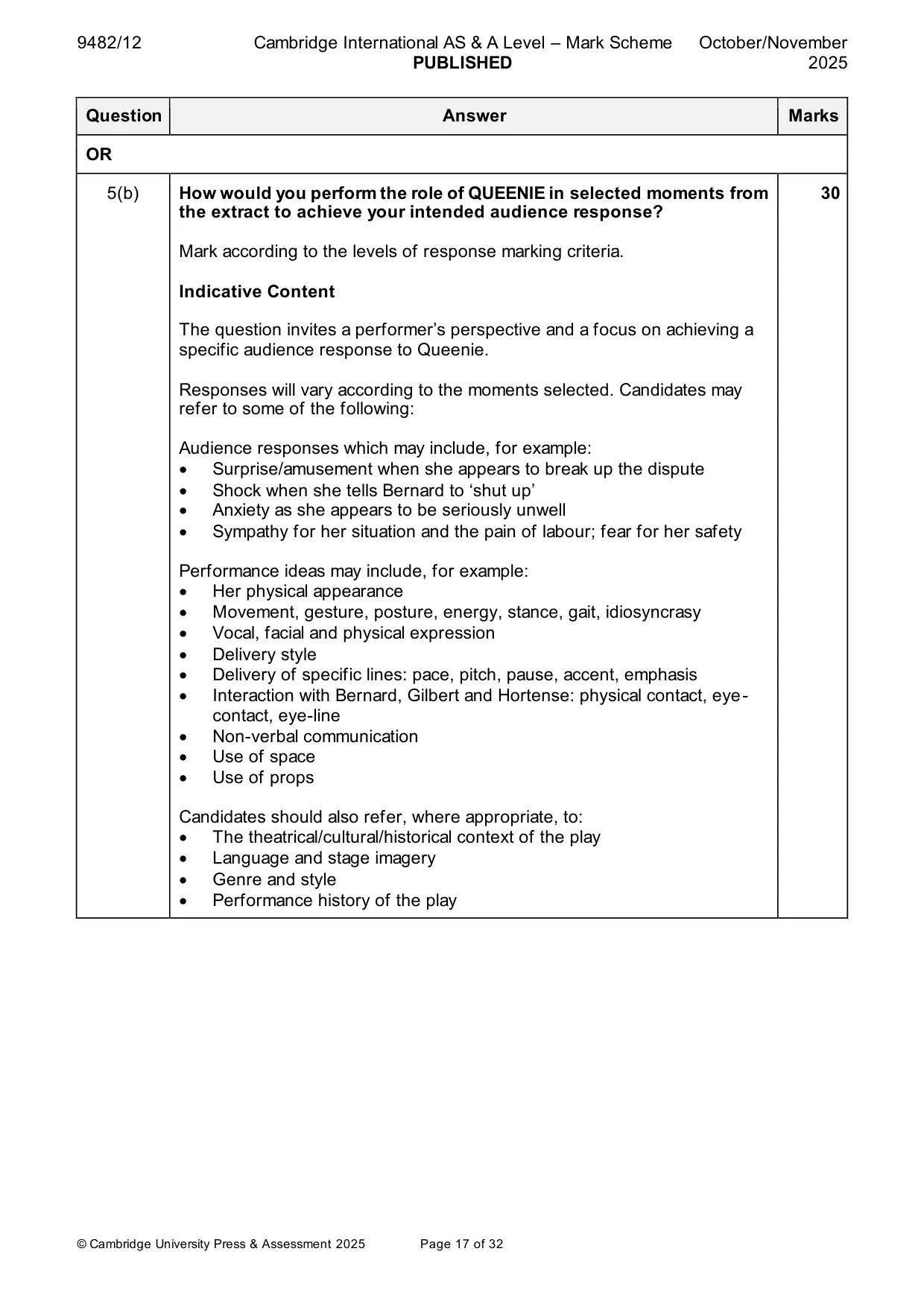
9482/12 Cambridge International AS & A Level – Mark Scheme PUBLISHED October/November 2025 © Cambridge University Press & Assessment 2025 Page 17 of 32 Question Answer Marks OR 5(b) How would you perform the role of QUEENIE in selected moments from the extract to achieve your intended audience response? Mark according to the levels of response marking criteria. Indicative Content The question invites a performer’s perspective and a focus on achieving a specific audience response to Queenie. Responses will vary according to the moments selected. Candidates may refer to some of the following: Audience responses which may include, for example: • Surprise/amusement when she appears to break up the dispute • Shock when she tells Bernard to ‘shut up’ • Anxiety as she appears to be seriously unwell • Sympathy for her situation and the pain of labour; fear for her safety Performance ideas may include, for example: • Her physical appearance • Movement, gesture, posture, energy, stance, gait, idiosyncrasy • Vocal, facial and physical expression • Delivery style • Delivery of specific lines: pace, pitch, pause, accent, emphasis • Interaction with Bernard, Gilbert and Hortense: physical contact, eye- contact, eye-line • Non-verbal communication • Use of space • Use of props Candidates should also refer, where appropriate, to: • The theatrical/cultural/historical context of the play • Language and stage imagery • Genre and style • Performance history of the play 30
Mark scheme, page 18
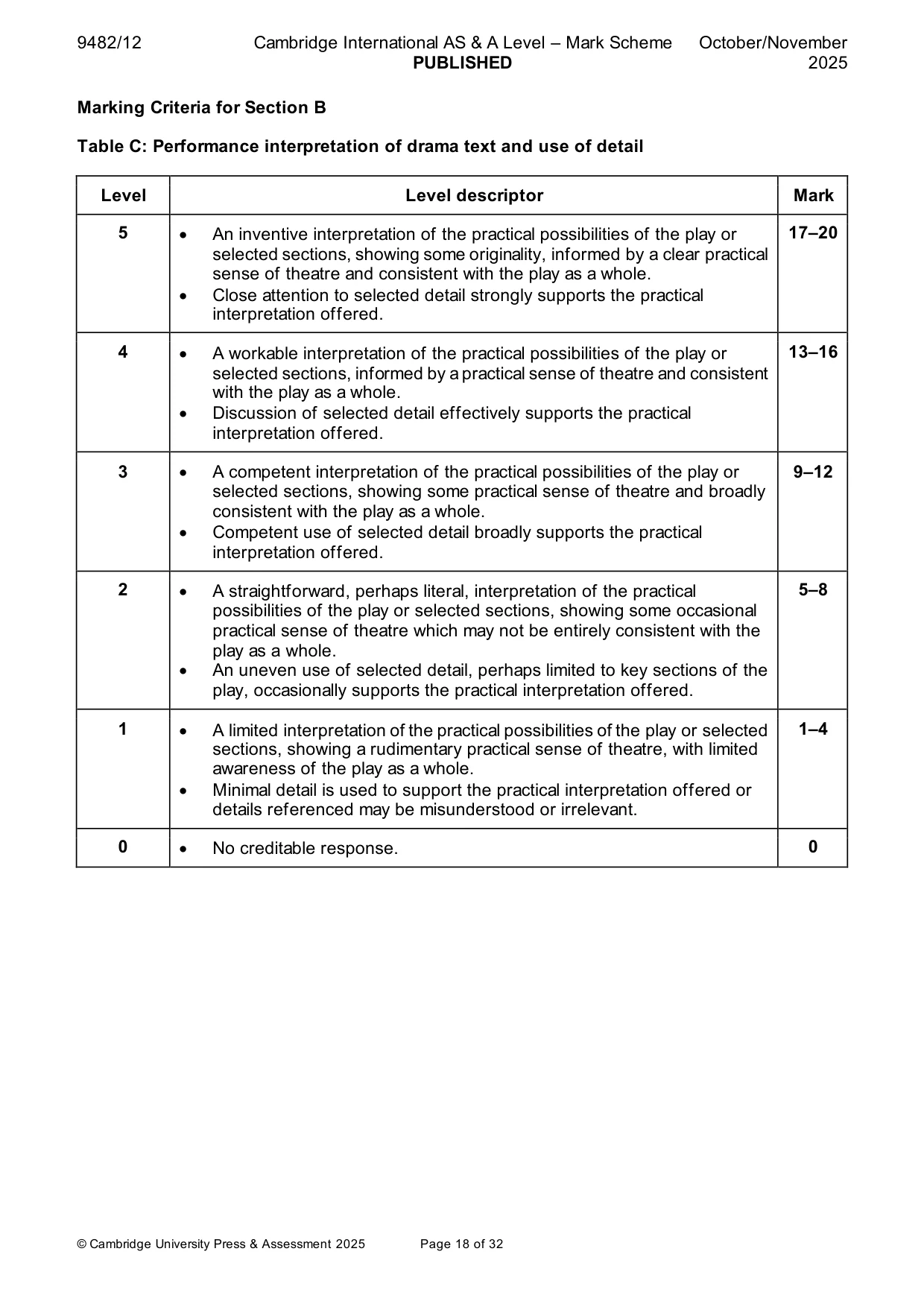
9482/12 Cambridge International AS & A Level – Mark Scheme PUBLISHED October/November 2025 © Cambridge University Press & Assessment 2025 Page 18 of 32 Marking Criteria for Section B Table C: Performance interpretation of drama text and use of detail Level Level descriptor Mark 5 • An inventive interpretation of the practical possibilities of the play or selected sections, showing some originality, informed by a clear practical sense of theatre and consistent with the play as a whole. • Close attention to selected detail strongly supports the practical interpretation offered. 17–20 4 • A workable interpretation of the practical possibilities of the play or selected sections, informed by a practical sense of theatre and consistent with the play as a whole. • Discussion of selected detail effectively supports the practical interpretation offered. 13–16 3 • A competent interpretation of the practical possibilities of the play or selected sections, showing some practical sense of theatre and broadly consistent with the play as a whole. • Competent use of selected detail broadly supports the practical interpretation offered. 9–12 2 • A straightforward, perhaps literal, interpretation of the practical possibilities of the play or selected sections, showing some occasional practical sense of theatre which may not be entirely consistent with the play as a whole. • An uneven use of selected detail, perhaps limited to key sections of the play, occasionally supports the practical interpretation offered. 5–8 1 • A limited interpretation of the practical possibilities of the play or selected sections, showing a rudimentary practical sense of theatre, with limited awareness of the play as a whole. • Minimal detail is used to support the practical interpretation offered or details referenced may be misunderstood or irrelevant. 1–4 0 • No creditable response. 0
Mark scheme, page 19
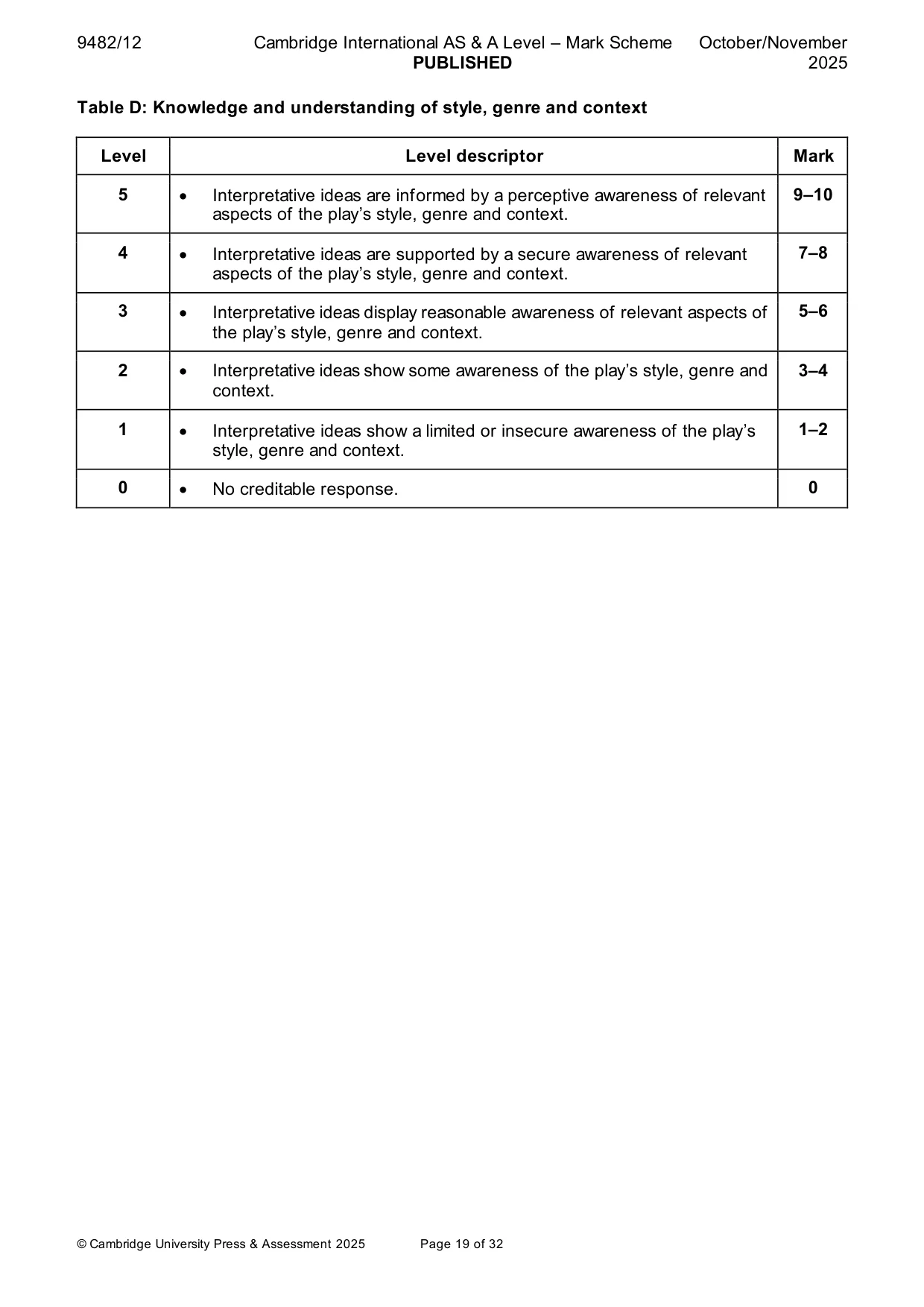
9482/12 Cambridge International AS & A Level – Mark Scheme PUBLISHED October/November 2025 © Cambridge University Press & Assessment 2025 Page 19 of 32 Table D: Knowledge and understanding of style, genre and context Level Level descriptor Mark 5 • Interpretative ideas are informed by a perceptive awareness of relevant aspects of the play’s style, genre and context. 9–10 4 • Interpretative ideas are supported by a secure awareness of relevant aspects of the play’s style, genre and context. 7–8 3 • Interpretative ideas display reasonable awareness of relevant aspects of the play’s style, genre and context. 5–6 2 • Interpretative ideas show some awareness of the play’s style, genre and context. 3–4 1 • Interpretative ideas show a limited or insecure awareness of the play’s style, genre and context. 1–2 0 • No creditable response. 0
Mark scheme, page 20
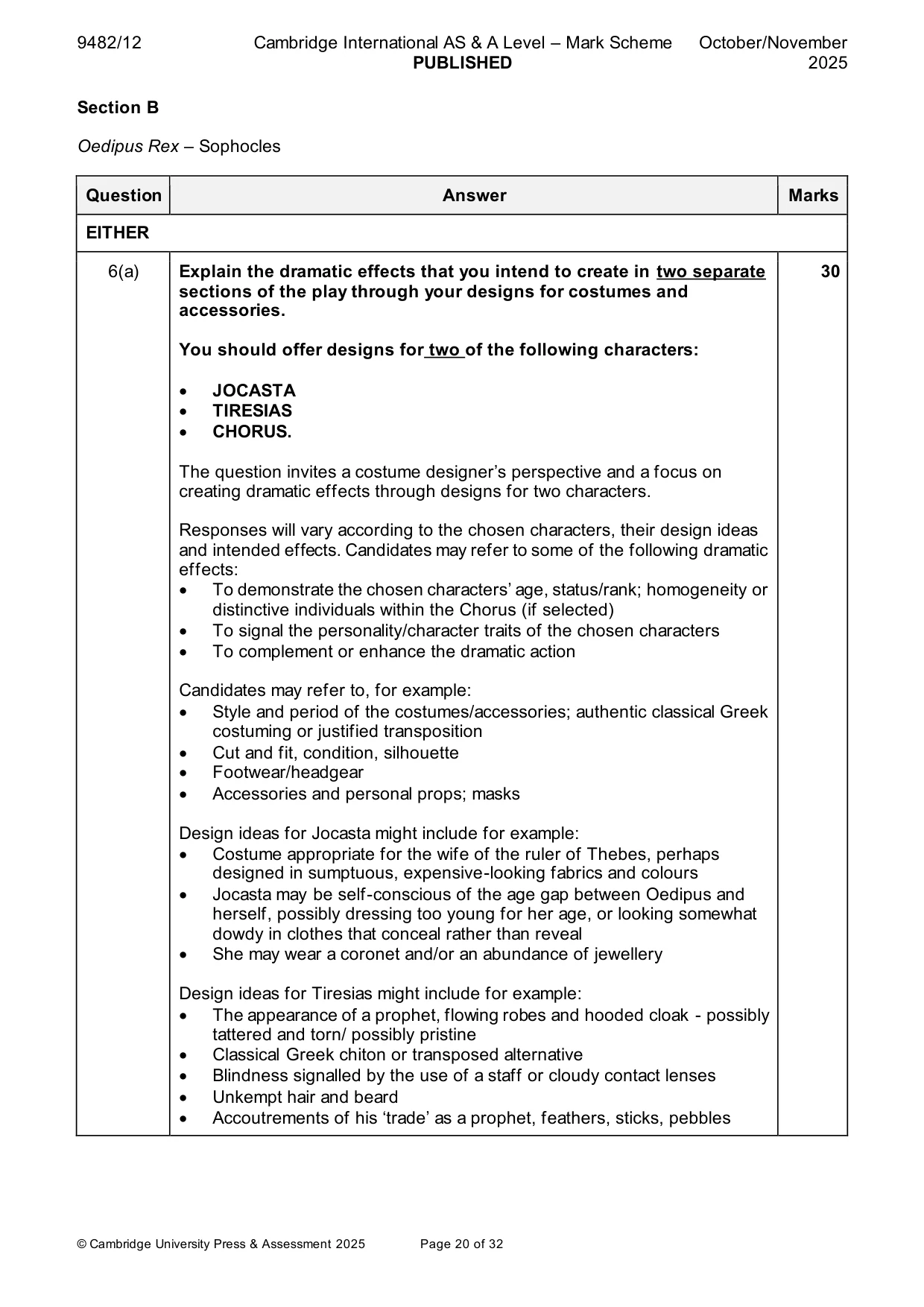
9482/12 Cambridge International AS & A Level – Mark Scheme PUBLISHED October/November 2025 © Cambridge University Press & Assessment 2025 Page 20 of 32 Section B Oedipus Rex – Sophocles Question Answer Marks EITHER 6(a) Explain the dramatic effects that you intend to create in two separate sections of the play through your designs for costumes and accessories. You should offer designs for two of the following characters: • JOCASTA • TIRESIAS • CHORUS. The question invites a costume designer’s perspective and a focus on creating dramatic effects through designs for two characters. Responses will vary according to the chosen characters, their design ideas and intended effects. Candidates may refer to some of the following dramatic effects: • To demonstrate the chosen characters’ age, status/rank; homogeneity or distinctive individuals within the Chorus (if selected) • To signal the personality/character traits of the chosen characters • To complement or enhance the dramatic action Candidates may refer to, for example: • Style and period of the costumes/accessories; authentic classical Greek costuming or justified transposition • Cut and fit, condition, silhouette • Footwear/headgear • Accessories and personal props; masks Design ideas for Jocasta might include for example: • Costume appropriate for the wife of the ruler of Thebes, perhaps designed in sumptuous, expensive-looking fabrics and colours • Jocasta may be self-conscious of the age gap between Oedipus and herself, possibly dressing too young for her age, or looking somewhat dowdy in clothes that conceal rather than reveal • She may wear a coronet and/or an abundance of jewellery Design ideas for Tiresias might include for example: • The appearance of a prophet, flowing robes and hooded cloak - possibly tattered and torn/ possibly pristine • Classical Greek chiton or transposed alternative • Blindness signalled by the use of a staff or cloudy contact lenses • Unkempt hair and beard • Accoutrements of his ‘trade’ as a prophet, feathers, sticks, pebbles 30
Mark scheme, page 21
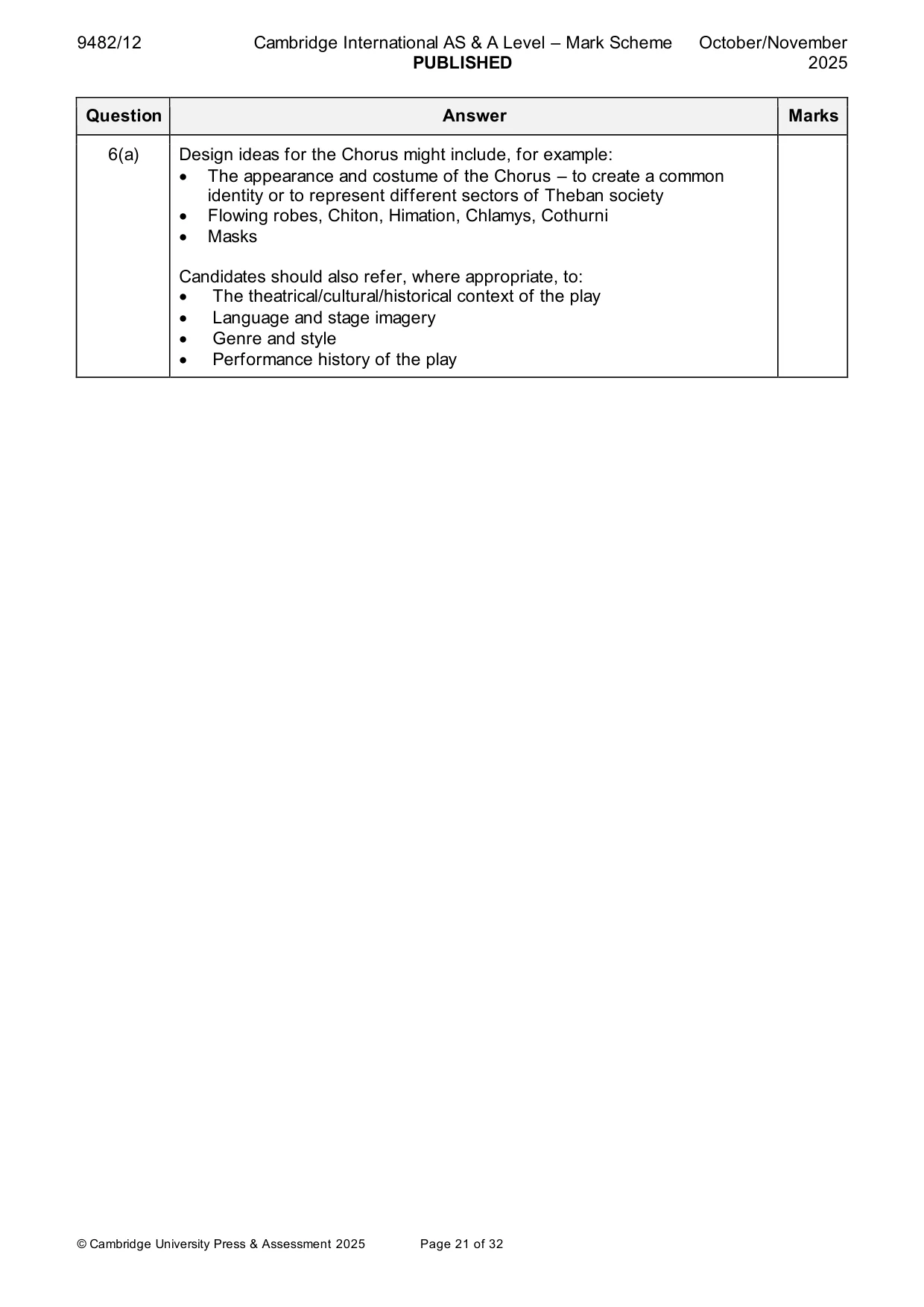
9482/12 Cambridge International AS & A Level – Mark Scheme PUBLISHED October/November 2025 © Cambridge University Press & Assessment 2025 Page 21 of 32 Question Answer Marks 6(a) Design ideas for the Chorus might include, for example: • The appearance and costume of the Chorus – to create a common identity or to represent different sectors of Theban society • Flowing robes, Chiton, Himation, Chlamys, Cothurni • Masks Candidates should also refer, where appropriate, to: • The theatrical/cultural/historical context of the play • Language and stage imagery • Genre and style • Performance history of the play
Mark scheme, page 22
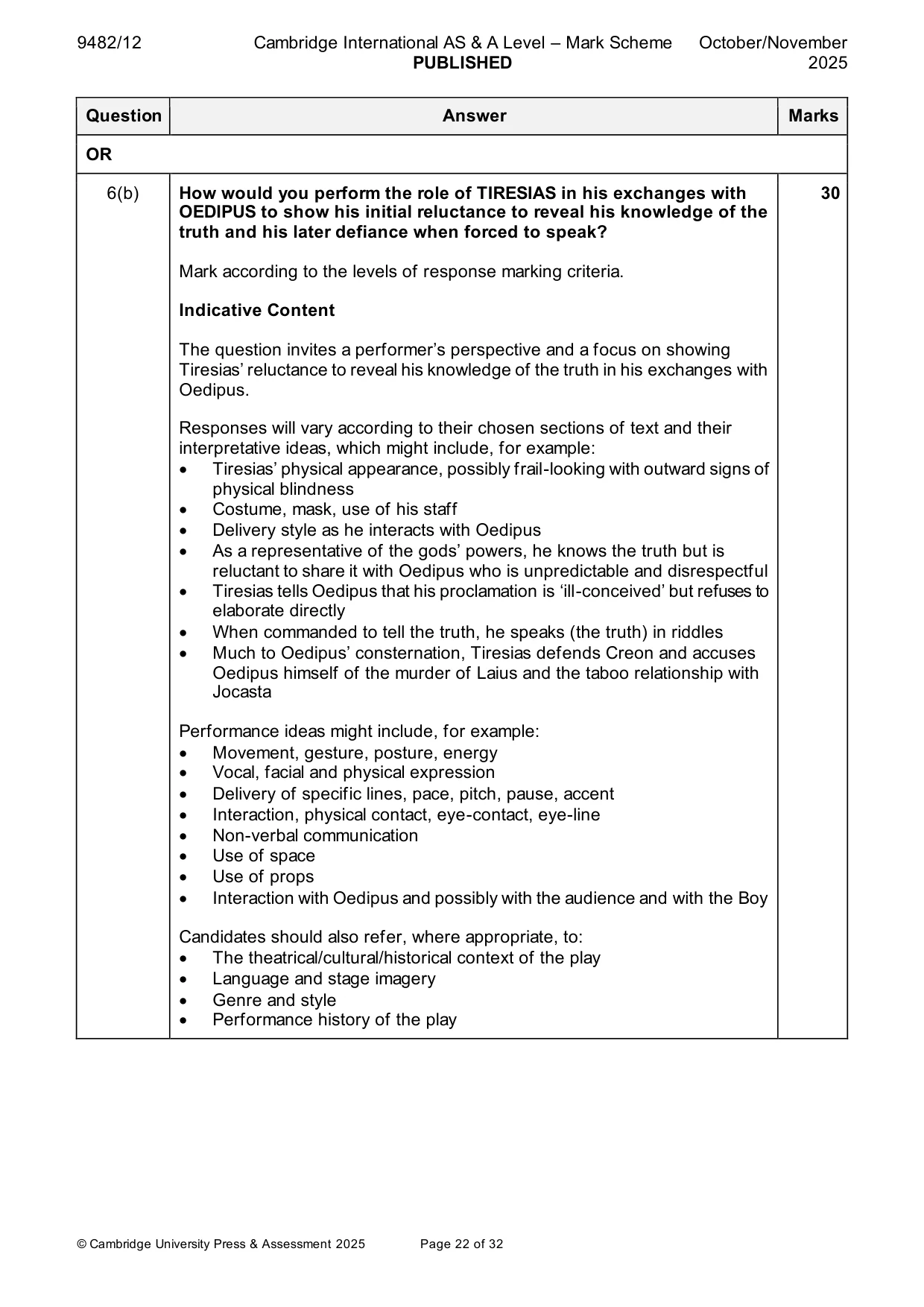
9482/12 Cambridge International AS & A Level – Mark Scheme PUBLISHED October/November 2025 © Cambridge University Press & Assessment 2025 Page 22 of 32 Question Answer Marks OR 6(b) How would you perform the role of TIRESIAS in his exchanges with OEDIPUS to show his initial reluctance to reveal his knowledge of the truth and his later defiance when forced to speak? Mark according to the levels of response marking criteria. Indicative Content The question invites a performer’s perspective and a focus on showing Tiresias’ reluctance to reveal his knowledge of the truth in his exchanges with Oedipus. Responses will vary according to their chosen sections of text and their interpretative ideas, which might include, for example: • Tiresias’ physical appearance, possibly frail-looking with outward signs of physical blindness • Costume, mask, use of his staff • Delivery style as he interacts with Oedipus • As a representative of the gods’ powers, he knows the truth but is reluctant to share it with Oedipus who is unpredictable and disrespectful • Tiresias tells Oedipus that his proclamation is ‘ill-conceived’ but refuses to elaborate directly • When commanded to tell the truth, he speaks (the truth) in riddles • Much to Oedipus’ consternation, Tiresias defends Creon and accuses Oedipus himself of the murder of Laius and the taboo relationship with Jocasta Performance ideas might include, for example: • Movement, gesture, posture, energy • Vocal, facial and physical expression • Delivery of specific lines, pace, pitch, pause, accent • Interaction, physical contact, eye-contact, eye-line • Non-verbal communication • Use of space • Use of props • Interaction with Oedipus and possibly with the audience and with the Boy Candidates should also refer, where appropriate, to: • The theatrical/cultural/historical context of the play • Language and stage imagery • Genre and style • Performance history of the play 30
Mark scheme, page 23
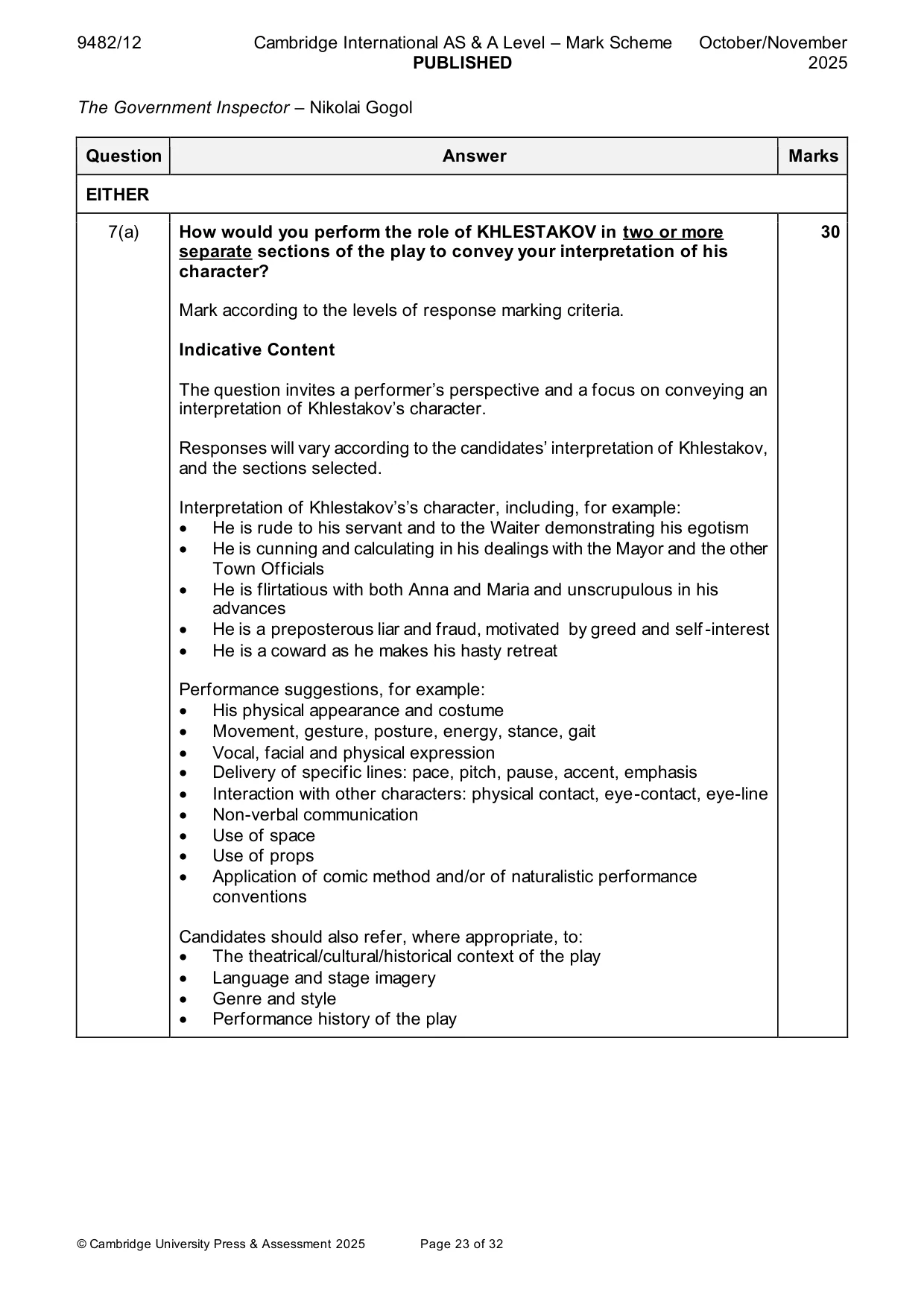
9482/12 Cambridge International AS & A Level – Mark Scheme PUBLISHED October/November 2025 © Cambridge University Press & Assessment 2025 Page 23 of 32 The Government Inspector – Nikolai Gogol Question Answer Marks EITHER 7(a) How would you perform the role of KHLESTAKOV in two or more separate sections of the play to convey your interpretation of his character? Mark according to the levels of response marking criteria. Indicative Content The question invites a performer’s perspective and a focus on conveying an interpretation of Khlestakov’s character. Responses will vary according to the candidates’ interpretation of Khlestakov, and the sections selected. Interpretation of Khlestakov’s’s character, including, for example: • He is rude to his servant and to the Waiter demonstrating his egotism • He is cunning and calculating in his dealings with the Mayor and the other Town Officials • He is flirtatious with both Anna and Maria and unscrupulous in his advances • He is a preposterous liar and fraud, motivated by greed and self -interest • He is a coward as he makes his hasty retreat Performance suggestions, for example: • His physical appearance and costume • Movement, gesture, posture, energy, stance, gait • Vocal, facial and physical expression • Delivery of specific lines: pace, pitch, pause, accent, emphasis • Interaction with other characters: physical contact, eye-contact, eye-line • Non-verbal communication • Use of space • Use of props • Application of comic method and/or of naturalistic performance conventions Candidates should also refer, where appropriate, to: • The theatrical/cultural/historical context of the play • Language and stage imagery • Genre and style • Performance history of the play 30
Mark scheme, page 24
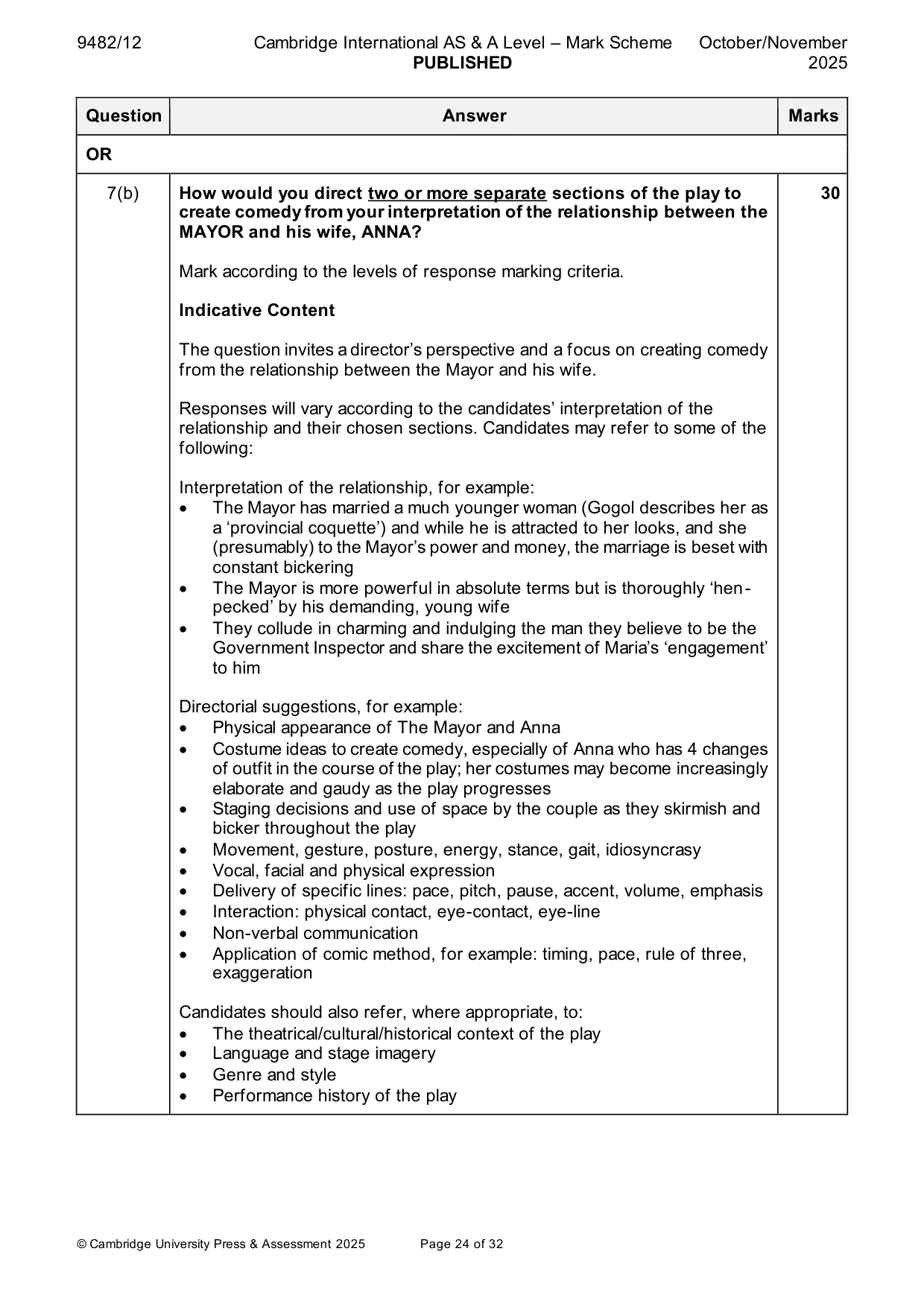
9482/12 Cambridge International AS & A Level – Mark Scheme PUBLISHED October/November 2025 © Cambridge University Press & Assessment 2025 Page 24 of 32 Question Answer Marks OR 7(b) How would you direct two or more separate sections of the play to create comedy from your interpretation of the relationship between the MAYOR and his wife, ANNA? Mark according to the levels of response marking criteria. Indicative Content The question invites a director’s perspective and a focus on creating comedy from the relationship between the Mayor and his wife. Responses will vary according to the candidates’ interpretation of the relationship and their chosen sections. Candidates may refer to some of the following: Interpretation of the relationship, for example: • The Mayor has married a much younger woman (Gogol describes her as a ‘provincial coquette’) and while he is attracted to her looks, and she (presumably) to the Mayor’s power and money, the marriage is beset with constant bickering • The Mayor is more powerful in absolute terms but is thoroughly ‘hen- pecked’ by his demanding, young wife • They collude in charming and indulging the man they believe to be the Government Inspector and share the excitement of Maria’s ‘engagement’ to him Directorial suggestions, for example: • Physical appearance of The Mayor and Anna • Costume ideas to create comedy, especially of Anna who has 4 changes of outfit in the course of the play; her costumes may become increasingly elaborate and gaudy as the play progresses • Staging decisions and use of space by the couple as they skirmish and bicker throughout the play • Movement, gesture, posture, energy, stance, gait, idiosyncrasy • Vocal, facial and physical expression • Delivery of specific lines: pace, pitch, pause, accent, volume, emphasis • Interaction: physical contact, eye-contact, eye-line • Non-verbal communication • Application of comic method, for example: timing, pace, rule of three, exaggeration Candidates should also refer, where appropriate, to: • The theatrical/cultural/historical context of the play • Language and stage imagery • Genre and style • Performance history of the play 30
Mark scheme, page 25
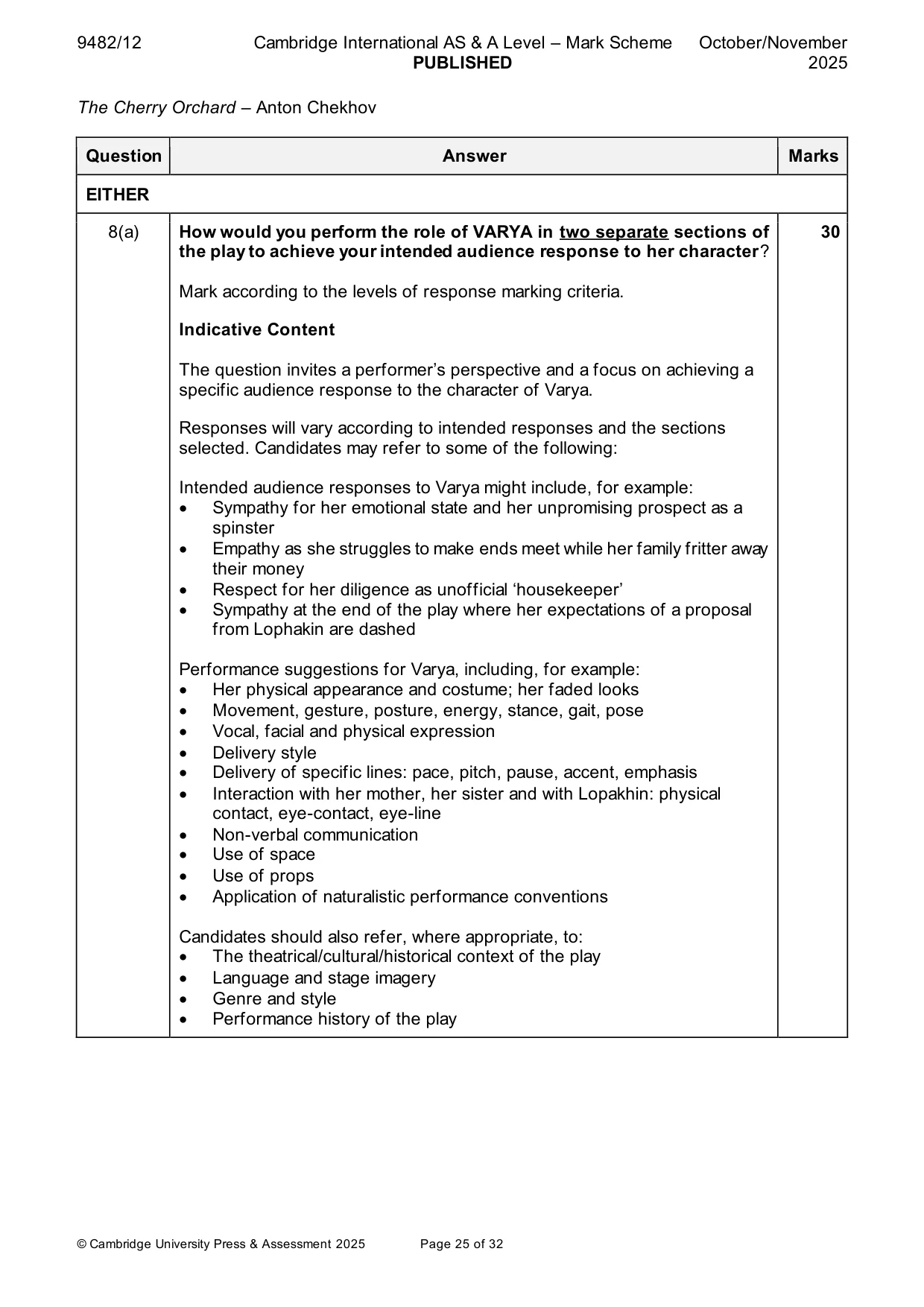
9482/12 Cambridge International AS & A Level – Mark Scheme PUBLISHED October/November 2025 © Cambridge University Press & Assessment 2025 Page 25 of 32 The Cherry Orchard – Anton Chekhov Question Answer Marks EITHER 8(a) How would you perform the role of VARYA in two separate sections of the play to achieve your intended audience response to her character? Mark according to the levels of response marking criteria. Indicative Content The question invites a performer’s perspective and a focus on achieving a specific audience response to the character of Varya. Responses will vary according to intended responses and the sections selected. Candidates may refer to some of the following: Intended audience responses to Varya might include, for example: • Sympathy for her emotional state and her unpromising prospect as a spinster • Empathy as she struggles to make ends meet while her family fritter away their money • Respect for her diligence as unofficial ‘housekeeper’ • Sympathy at the end of the play where her expectations of a proposal from Lophakin are dashed Performance suggestions for Varya, including, for example: • Her physical appearance and costume; her faded looks • Movement, gesture, posture, energy, stance, gait, pose • Vocal, facial and physical expression • Delivery style • Delivery of specific lines: pace, pitch, pause, accent, emphasis • Interaction with her mother, her sister and with Lopakhin: physical contact, eye-contact, eye-line • Non-verbal communication • Use of space • Use of props • Application of naturalistic performance conventions Candidates should also refer, where appropriate, to: • The theatrical/cultural/historical context of the play • Language and stage imagery • Genre and style • Performance history of the play 30
Mark scheme, page 26
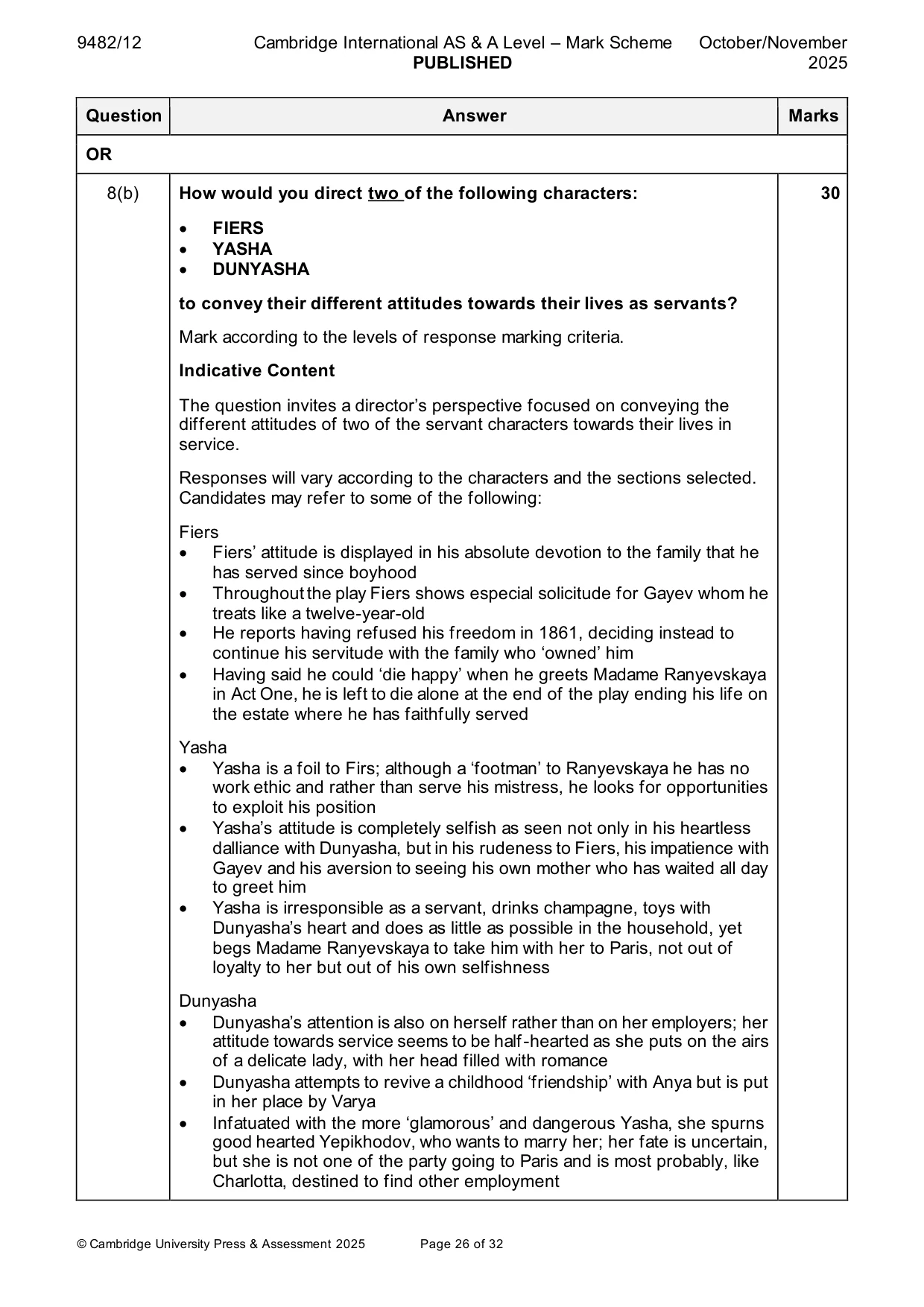
9482/12 Cambridge International AS & A Level – Mark Scheme PUBLISHED October/November 2025 © Cambridge University Press & Assessment 2025 Page 26 of 32 Question Answer Marks OR 8(b) How would you direct two of the following characters: • FIERS • YASHA • DUNYASHA to convey their different attitudes towards their lives as servants? Mark according to the levels of response marking criteria. Indicative Content The question invites a director’s perspective focused on conveying the different attitudes of two of the servant characters towards their lives in service. Responses will vary according to the characters and the sections selected. Candidates may refer to some of the following: Fiers • Fiers’ attitude is displayed in his absolute devotion to the family that he has served since boyhood • Throughout the play Fiers shows especial solicitude for Gayev whom he treats like a twelve-year-old • He reports having refused his freedom in 1861, deciding instead to continue his servitude with the family who ‘owned’ him • Having said he could ‘die happy’ when he greets Madame Ranyevskaya in Act One, he is left to die alone at the end of the play ending his life on the estate where he has faithfully served Yasha • Yasha is a foil to Firs; although a ‘footman’ to Ranyevskaya he has no work ethic and rather than serve his mistress, he looks for opportunities to exploit his position • Yasha’s attitude is completely selfish as seen not only in his heartless dalliance with Dunyasha, but in his rudeness to Fiers, his impatience with Gayev and his aversion to seeing his own mother who has waited all day to greet him • Yasha is irresponsible as a servant, drinks champagne, toys with Dunyasha’s heart and does as little as possible in the household, yet begs Madame Ranyevskaya to take him with her to Paris, not out of loyalty to her but out of his own selfishness Dunyasha • Dunyasha’s attention is also on herself rather than on her employers; her attitude towards service seems to be half-hearted as she puts on the airs of a delicate lady, with her head filled with romance • Dunyasha attempts to revive a childhood ‘friendship’ with Anya but is put in her place by Varya • Infatuated with the more ‘glamorous’ and dangerous Yasha, she spurns good hearted Yepikhodov, who wants to marry her; her fate is uncertain, but she is not one of the party going to Paris and is most probably, like Charlotta, destined to find other employment 30
Mark scheme, page 27
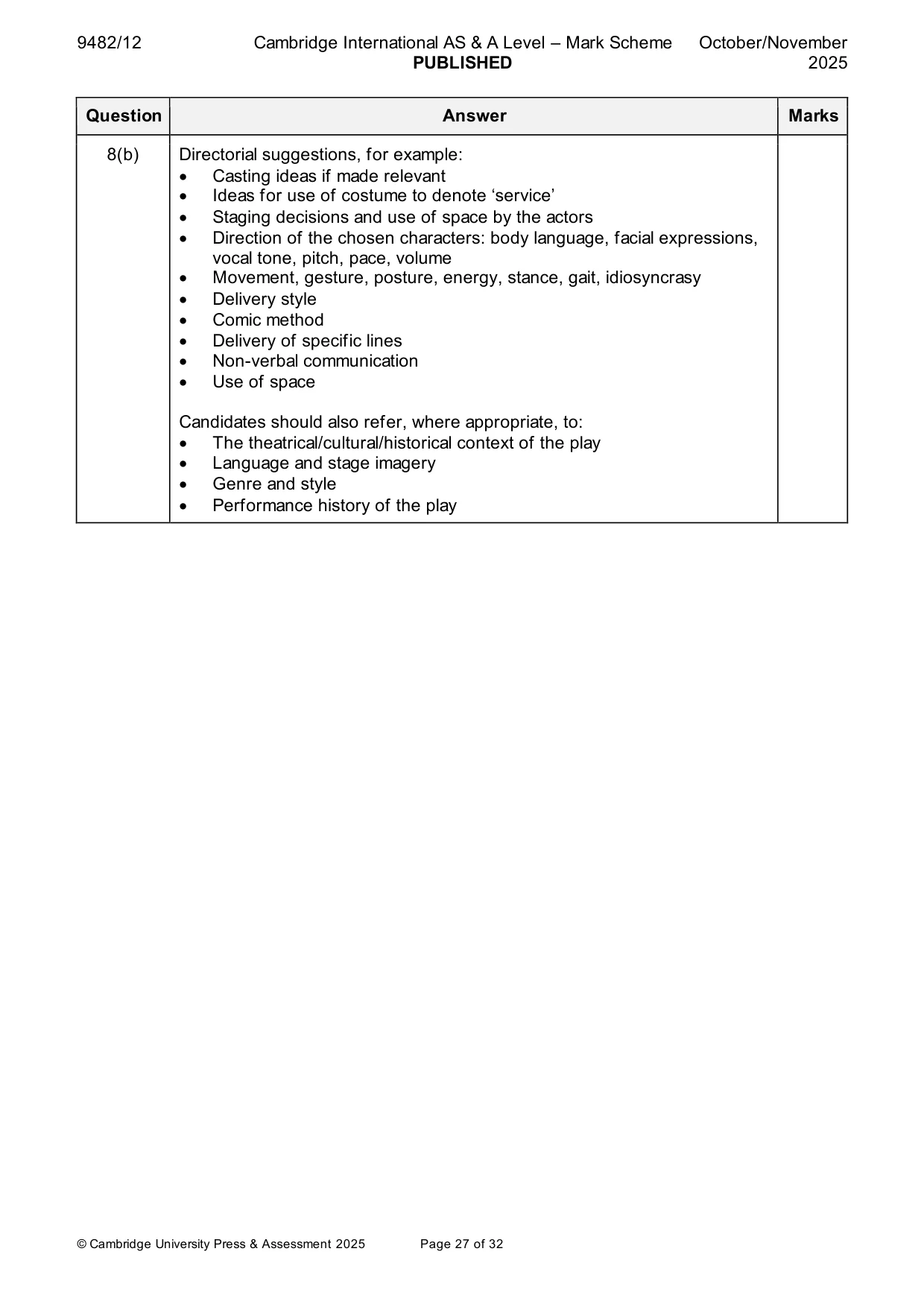
9482/12 Cambridge International AS & A Level – Mark Scheme PUBLISHED October/November 2025 © Cambridge University Press & Assessment 2025 Page 27 of 32 Question Answer Marks 8(b) Directorial suggestions, for example: • Casting ideas if made relevant • Ideas for use of costume to denote ‘service’ • Staging decisions and use of space by the actors • Direction of the chosen characters: body language, facial expressions, vocal tone, pitch, pace, volume • Movement, gesture, posture, energy, stance, gait, idiosyncrasy • Delivery style • Comic method • Delivery of specific lines • Non-verbal communication • Use of space Candidates should also refer, where appropriate, to: • The theatrical/cultural/historical context of the play • Language and stage imagery • Genre and style • Performance history of the play
Mark scheme, page 28
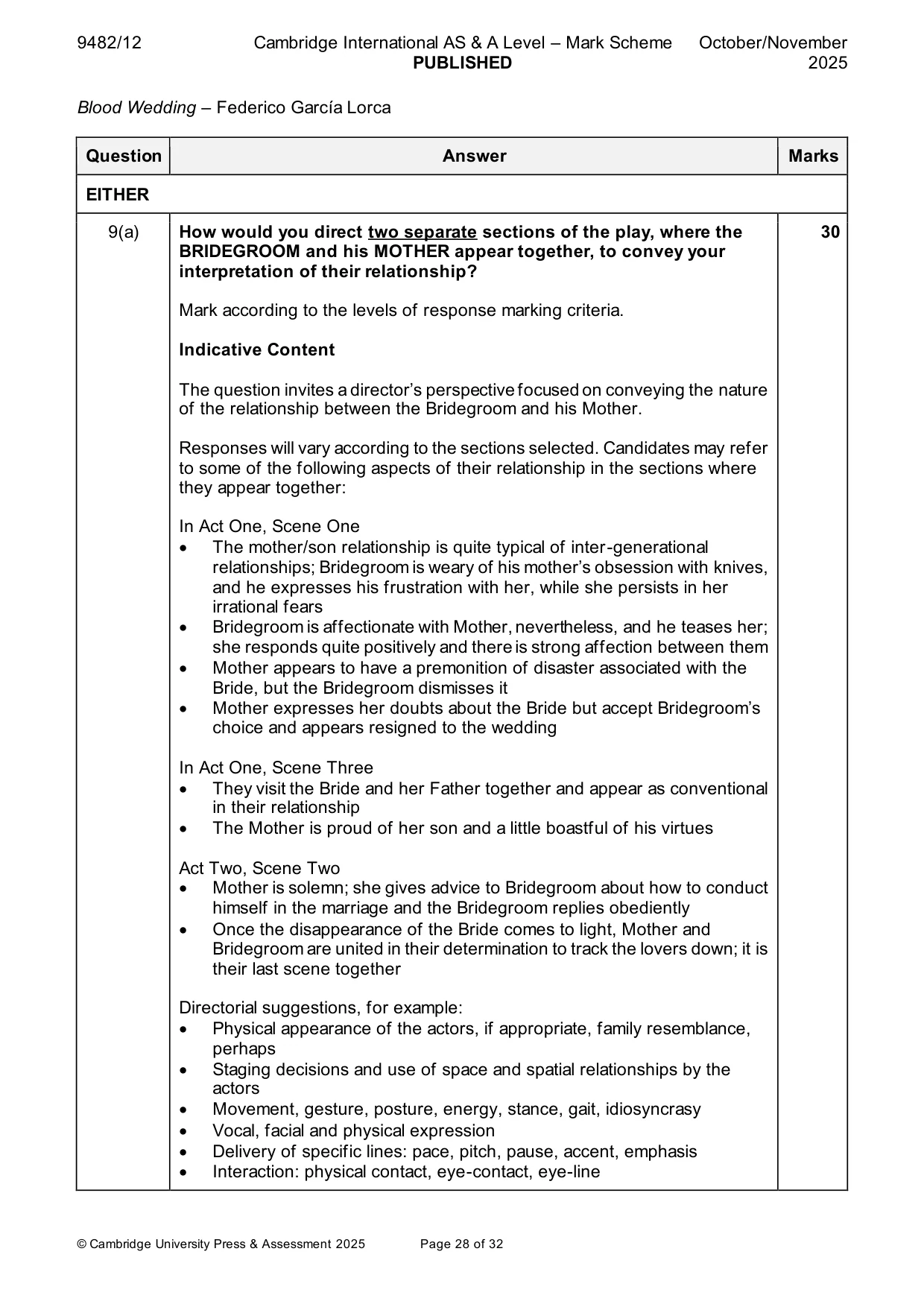
9482/12 Cambridge International AS & A Level – Mark Scheme PUBLISHED October/November 2025 © Cambridge University Press & Assessment 2025 Page 28 of 32 Blood Wedding – Federico García Lorca Question Answer Marks EITHER 9(a) How would you direct two separate sections of the play, where the BRIDEGROOM and his MOTHER appear together, to convey your interpretation of their relationship? Mark according to the levels of response marking criteria. Indicative Content The question invites a director’s perspective focused on conveying the nature of the relationship between the Bridegroom and his Mother. Responses will vary according to the sections selected. Candidates may refer to some of the following aspects of their relationship in the sections where they appear together: In Act One, Scene One • The mother/son relationship is quite typical of inter-generational relationships; Bridegroom is weary of his mother’s obsession with knives, and he expresses his frustration with her, while she persists in her irrational fears • Bridegroom is affectionate with Mother, nevertheless, and he teases her; she responds quite positively and there is strong affection between them • Mother appears to have a premonition of disaster associated with the Bride, but the Bridegroom dismisses it • Mother expresses her doubts about the Bride but accept Bridegroom’s choice and appears resigned to the wedding In Act One, Scene Three • They visit the Bride and her Father together and appear as conventional in their relationship • The Mother is proud of her son and a little boastful of his virtues Act Two, Scene Two • Mother is solemn; she gives advice to Bridegroom about how to conduct himself in the marriage and the Bridegroom replies obediently • Once the disappearance of the Bride comes to light, Mother and Bridegroom are united in their determination to track the lovers down; it is their last scene together Directorial suggestions, for example: • Physical appearance of the actors, if appropriate, family resemblance, perhaps • Staging decisions and use of space and spatial relationships by the actors • Movement, gesture, posture, energy, stance, gait, idiosyncrasy • Vocal, facial and physical expression • Delivery of specific lines: pace, pitch, pause, accent, emphasis • Interaction: physical contact, eye-contact, eye-line 30
Mark scheme, page 29
9482/12 Cambridge International AS & A Level – Mark Scheme PUBLISHED October/November 2025 © Cambridge University Press & Assessment 2025 Page 29 of 32 Question Answer Marks 9(a) • Non-verbal communication • Use of props Candidates should also refer, where appropriate, to: • The theatrical/cultural/historical context of the play • Language and stage imagery • Genre and style • Performance history of the play
Mark scheme, page 30
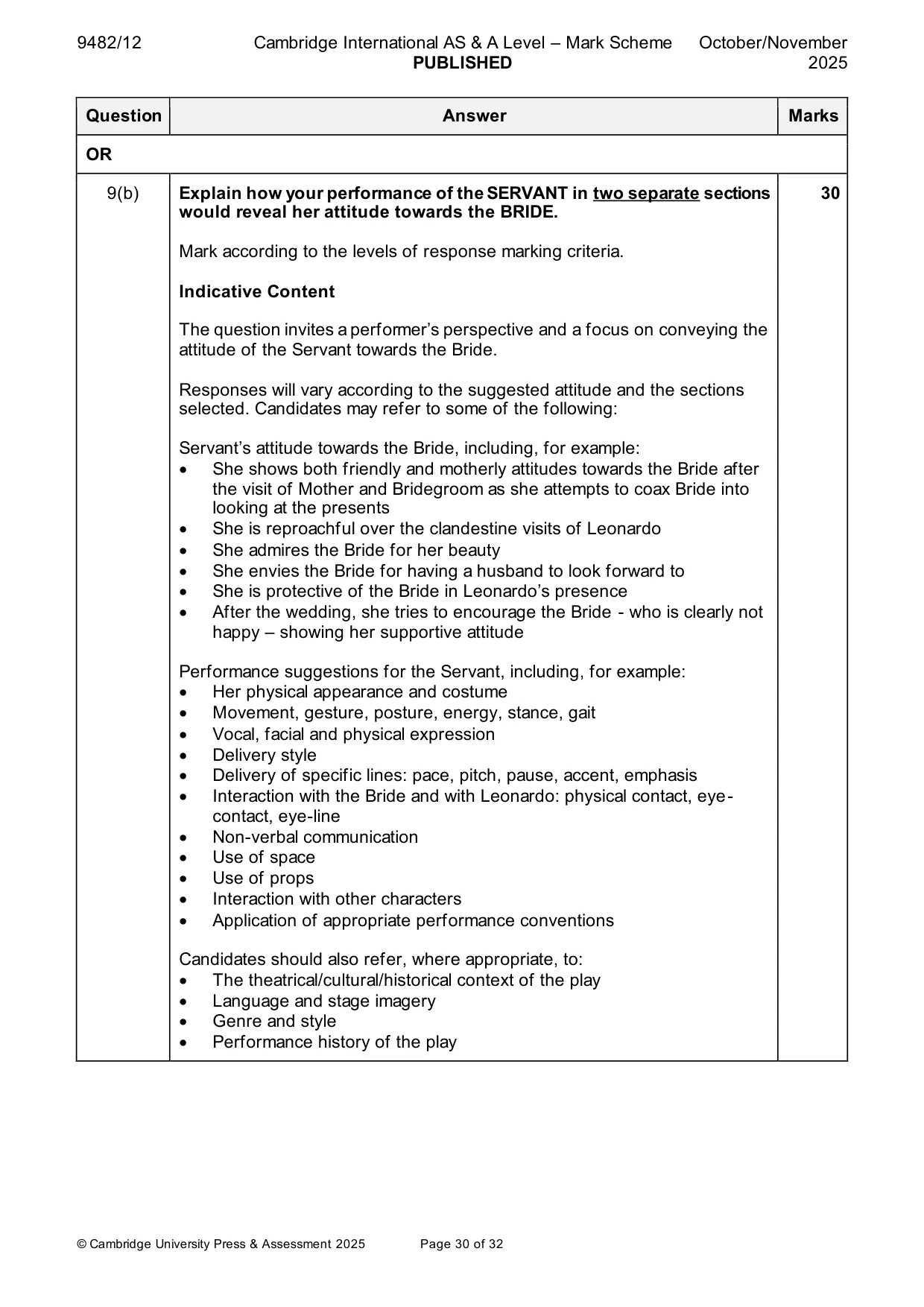
9482/12 Cambridge International AS & A Level – Mark Scheme PUBLISHED October/November 2025 © Cambridge University Press & Assessment 2025 Page 30 of 32 Question Answer Marks OR 9(b) Explain how your performance of the SERVANT in two separate sections would reveal her attitude towards the BRIDE. Mark according to the levels of response marking criteria. Indicative Content The question invites a performer’s perspective and a focus on conveying the attitude of the Servant towards the Bride. Responses will vary according to the suggested attitude and the sections selected. Candidates may refer to some of the following: Servant’s attitude towards the Bride, including, for example: • She shows both friendly and motherly attitudes towards the Bride after the visit of Mother and Bridegroom as she attempts to coax Bride into looking at the presents • She is reproachful over the clandestine visits of Leonardo • She admires the Bride for her beauty • She envies the Bride for having a husband to look forward to • She is protective of the Bride in Leonardo’s presence • After the wedding, she tries to encourage the Bride - who is clearly not happy – showing her supportive attitude Performance suggestions for the Servant, including, for example: • Her physical appearance and costume • Movement, gesture, posture, energy, stance, gait • Vocal, facial and physical expression • Delivery style • Delivery of specific lines: pace, pitch, pause, accent, emphasis • Interaction with the Bride and with Leonardo: physical contact, eye- contact, eye-line • Non-verbal communication • Use of space • Use of props • Interaction with other characters • Application of appropriate performance conventions Candidates should also refer, where appropriate, to: • The theatrical/cultural/historical context of the play • Language and stage imagery • Genre and style • Performance history of the play 30
Mark scheme, page 31
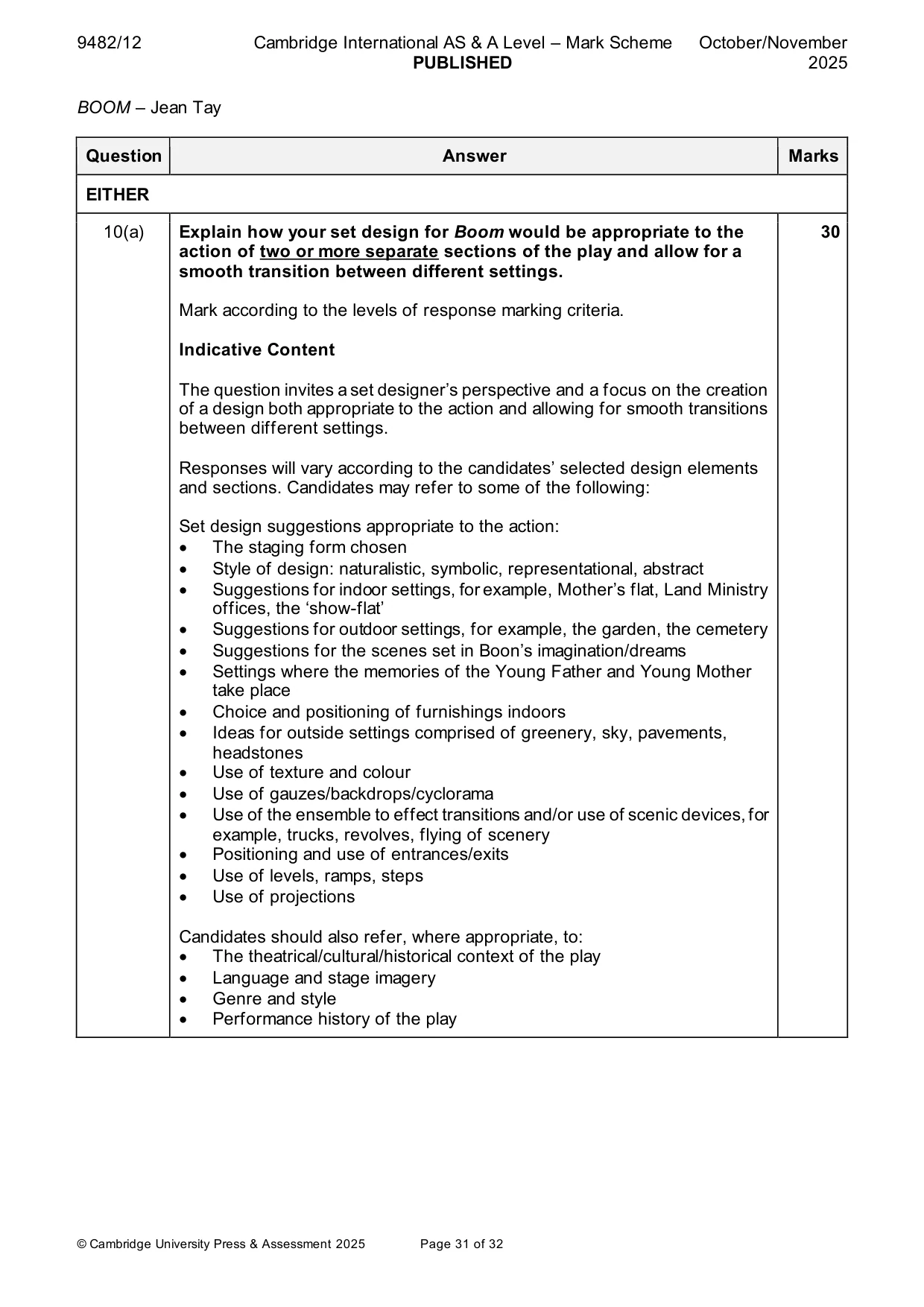
9482/12 Cambridge International AS & A Level – Mark Scheme PUBLISHED October/November 2025 © Cambridge University Press & Assessment 2025 Page 31 of 32 BOOM – Jean Tay Question Answer Marks EITHER 10(a) Explain how your set design for Boom would be appropriate to the action of two or more separate sections of the play and allow for a smooth transition between different settings. Mark according to the levels of response marking criteria. Indicative Content The question invites a set designer’s perspective and a focus on the creation of a design both appropriate to the action and allowing for smooth transitions between different settings. Responses will vary according to the candidates’ selected design elements and sections. Candidates may refer to some of the following: Set design suggestions appropriate to the action: • The staging form chosen • Style of design: naturalistic, symbolic, representational, abstract • Suggestions for indoor settings, for example, Mother’s flat, Land Ministry offices, the ‘show-flat’ • Suggestions for outdoor settings, for example, the garden, the cemetery • Suggestions for the scenes set in Boon’s imagination/dreams • Settings where the memories of the Young Father and Young Mother take place • Choice and positioning of furnishings indoors • Ideas for outside settings comprised of greenery, sky, pavements, headstones • Use of texture and colour • Use of gauzes/backdrops/cyclorama • Use of the ensemble to effect transitions and/or use of scenic devices, for example, trucks, revolves, flying of scenery • Positioning and use of entrances/exits • Use of levels, ramps, steps • Use of projections Candidates should also refer, where appropriate, to: • The theatrical/cultural/historical context of the play • Language and stage imagery • Genre and style • Performance history of the play 30
Mark scheme, page 32
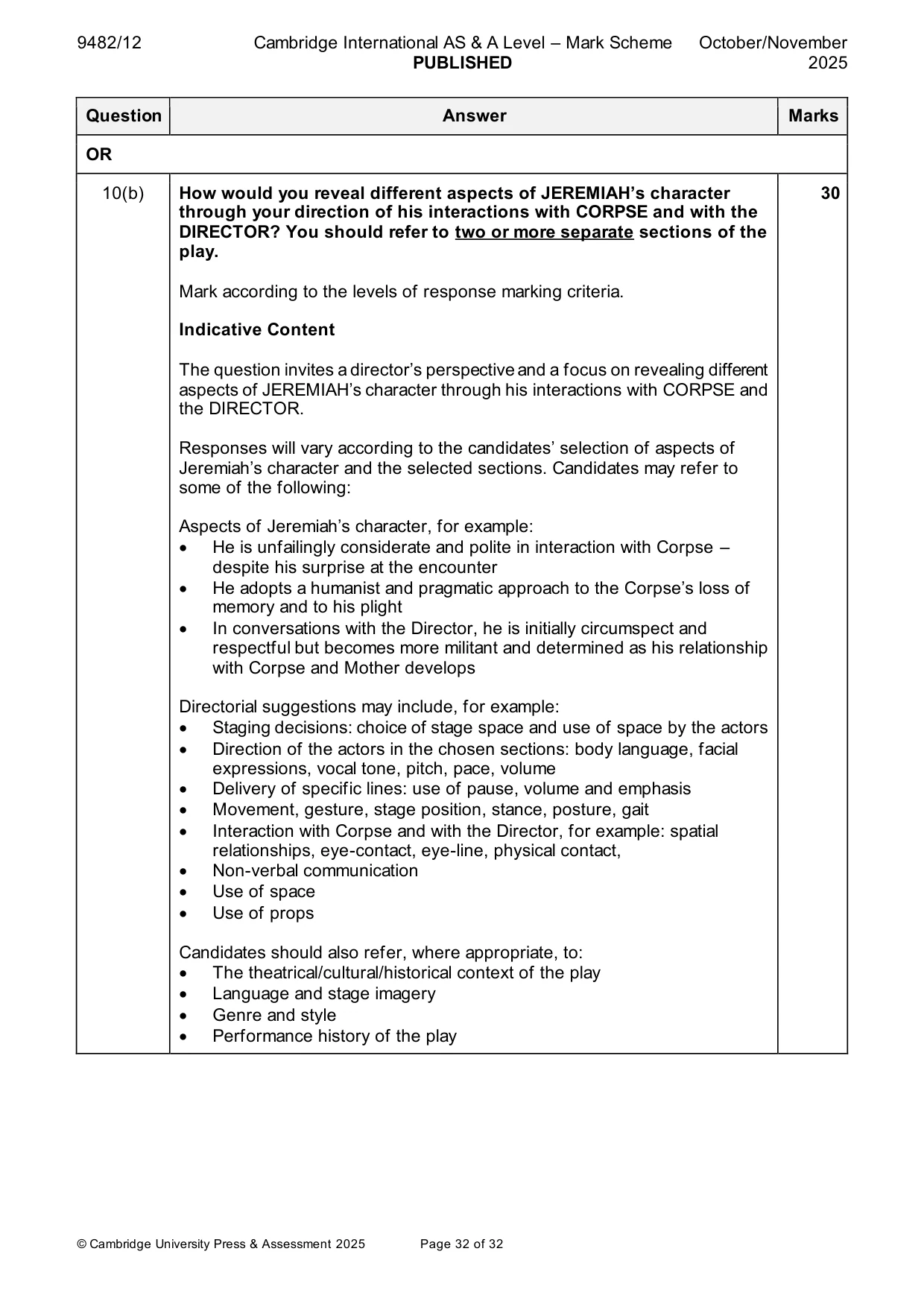
9482/12 Cambridge International AS & A Level – Mark Scheme PUBLISHED October/November 2025 © Cambridge University Press & Assessment 2025 Page 32 of 32 Question Answer Marks OR 10(b) How would you reveal different aspects of JEREMIAH’s character through your direction of his interactions with CORPSE and with the DIRECTOR? You should refer to two or more separate sections of the play. Mark according to the levels of response marking criteria. Indicative Content The question invites a director’s perspective and a focus on revealing different aspects of JEREMIAH’s character through his interactions with CORPSE and the DIRECTOR. Responses will vary according to the candidates’ selection of aspects of Jeremiah’s character and the selected sections. Candidates may refer to some of the following: Aspects of Jeremiah’s character, for example: • He is unfailingly considerate and polite in interaction with Corpse – despite his surprise at the encounter • He adopts a humanist and pragmatic approach to the Corpse’s loss of memory and to his plight • In conversations with the Director, he is initially circumspect and respectful but becomes more militant and determined as his relationship with Corpse and Mother develops Directorial suggestions may include, for example: • Staging decisions: choice of stage space and use of space by the actors • Direction of the actors in the chosen sections: body language, facial expressions, vocal tone, pitch, pace, volume • Delivery of specific lines: use of pause, volume and emphasis • Movement, gesture, stage position, stance, posture, gait • Interaction with Corpse and with the Director, for example: spatial relationships, eye-contact, eye-line, physical contact, • Non-verbal communication • Use of space • Use of props Candidates should also refer, where appropriate, to: • The theatrical/cultural/historical context of the play • Language and stage imagery • Genre and style • Performance history of the play 30
What you needed in this session
Cambridge’s own grade thresholds for 2025 Oct/Nov, Paper 1 · Variant 2. A higher threshold means an easier paper — the bar moves with how the cohort did.