Cambridge A Level Drama 9482 — 2024 Oct/Nov Paper 1 · Variant 3
9482/13/O/N/24 · 60 marks · 120 min
The question paper and its mark scheme, free to read here and free to download. This is Cambridge’s own paper, exactly as it was sat.
Question paper8 pages


Mark scheme26 pages
Answers below. Sit the paper first if you are practising.
Paper as text
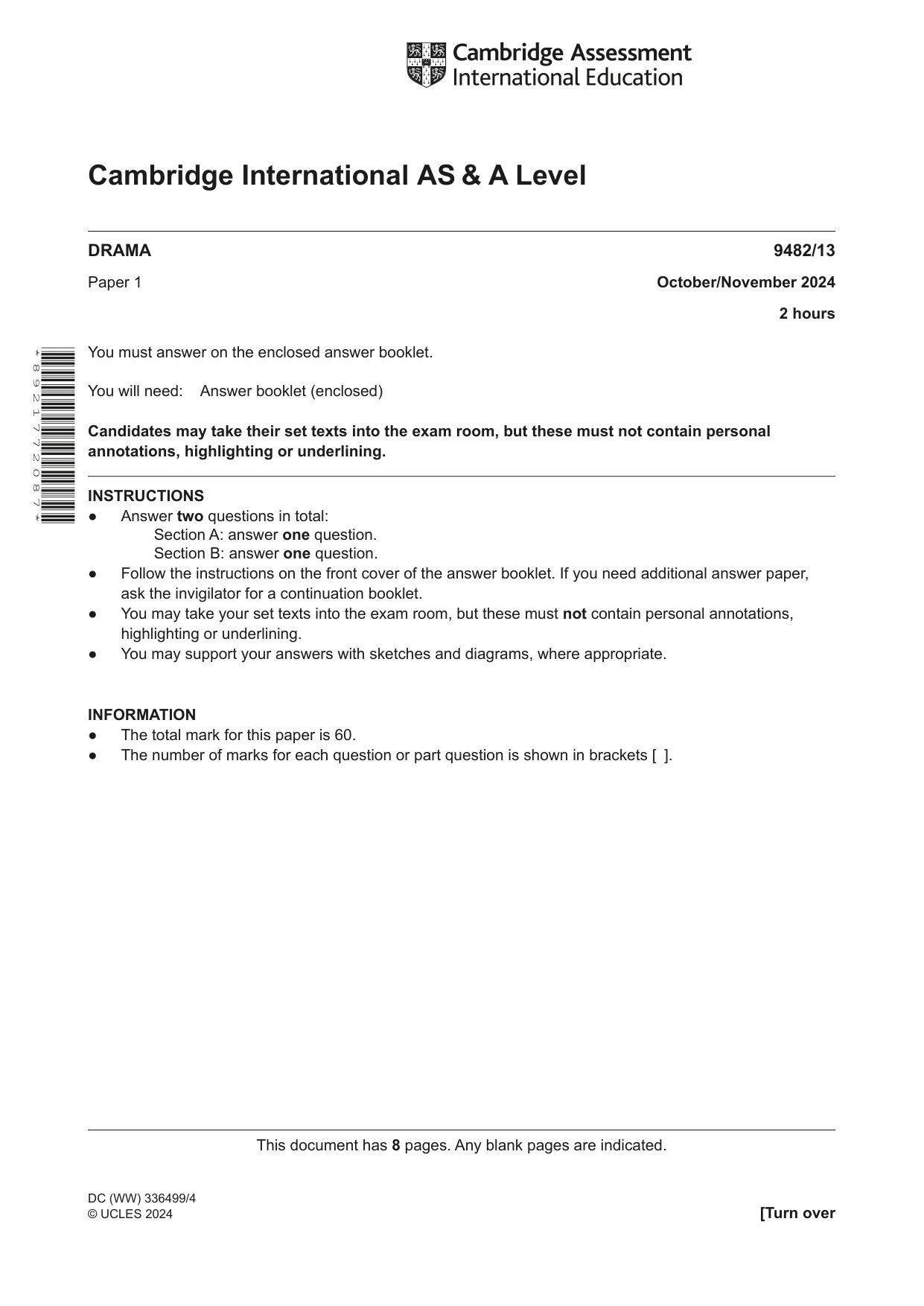
Question paper, page 1
[Turn over Cambridge International AS & A Level This document has 8 pages. Any blank pages are indicated. * 8 9 2 1 7 7 2 0 8 7 * DC (WW) 336499/4 © UCLES 2024 DRAMA 9482/13 Paper 1 October/November 2024 2 hours You must answer on the enclosed answer booklet. You will need: Answer booklet (enclosed) Candidates may take their set texts into the exam room, but these must not contain personal annotations, highlighting or underlining. INSTRUCTIONS ● Answer two questions in total: Section A: answer one question. Section B: answer one question. ● Follow the instructions on the front cover of the answer booklet. If you need additional answer paper, ask the invigilator for a continuation booklet. ● You may take your set texts into the exam room, but these must not contain personal annotations, highlighting or underlining. ● You may support your answers with sketches and diagrams, where appropriate. INFORMATION ● The total mark for this paper is 60. ● The number of marks for each question or part question is shown in brackets [ ].
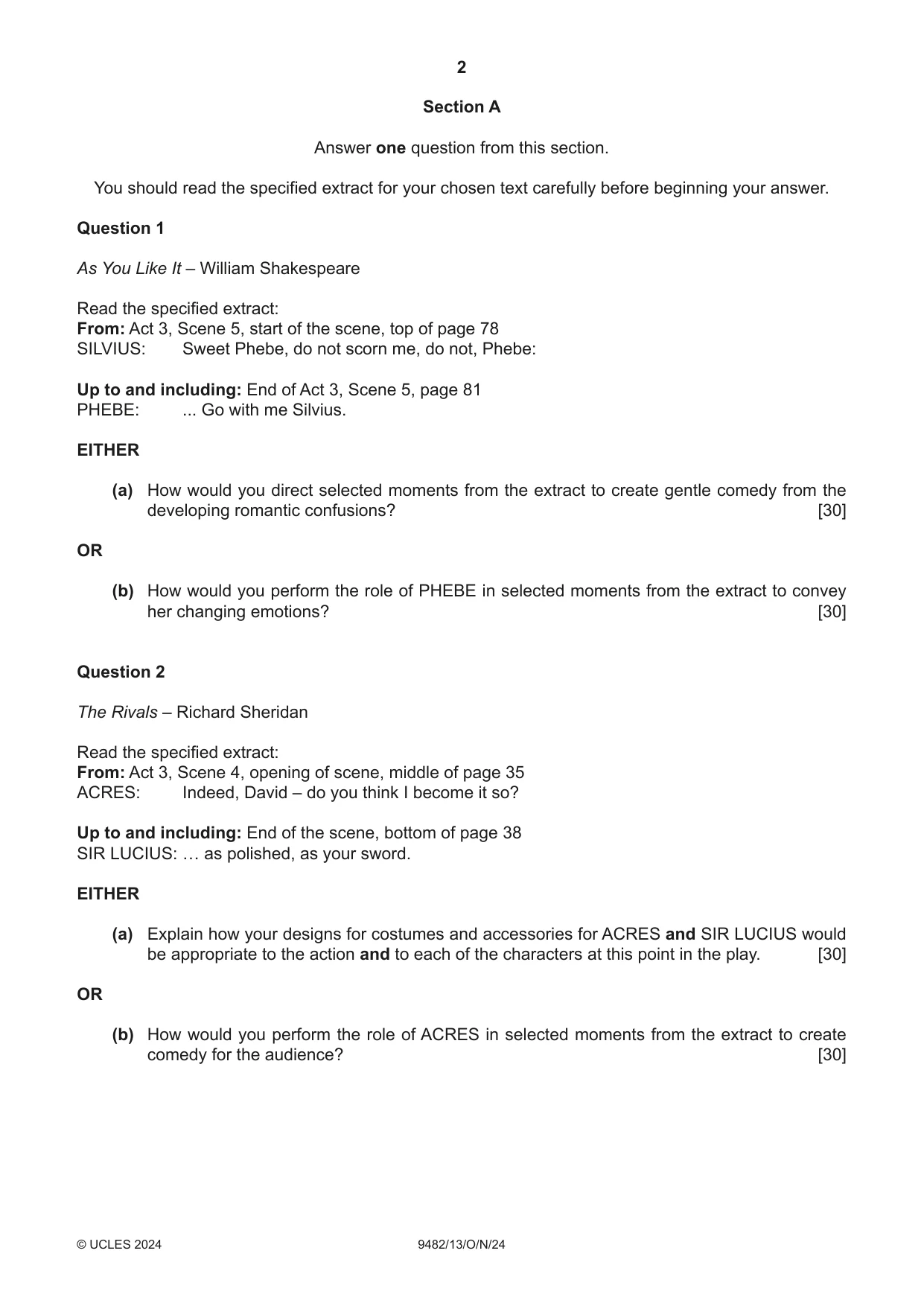
Question paper, page 2
2 9482/13/O/N/24 © UCLES 2024 Section A Answer one question from this section. You should read the specified extract for your chosen text carefully before beginning your answer. Question 1 As You Like It – William Shakespeare Read the specified extract: From: Act 3, Scene 5, start of the scene, top of page 78 SILVIUS: Sweet Phebe, do not scorn me, do not, Phebe: Up to and including: End of Act 3, Scene 5, page 81 PHEBE: ... Go with me Silvius. EITHER (a) How would you direct selected moments from the extract to create gentle comedy from the developing romantic confusions? [30] OR (b) How would you perform the role of PHEBE in selected moments from the extract to convey her changing emotions? [30] Question 2 The Rivals – Richard Sheridan Read the specified extract: From: Act 3, Scene 4, opening of scene, middle of page 35 ACRES: Indeed, David – do you think I become it so? Up to and including: End of the scene, bottom of page 38 SIR LUCIUS: … as polished, as your sword. EITHER (a) Explain how your designs for costumes and accessories for ACRES and SIR LUCIUS would be appropriate to the action and to each of the characters at this point in the play. [30] OR (b) How would you perform the role of ACRES in selected moments from the extract to create comedy for the audience? [30]
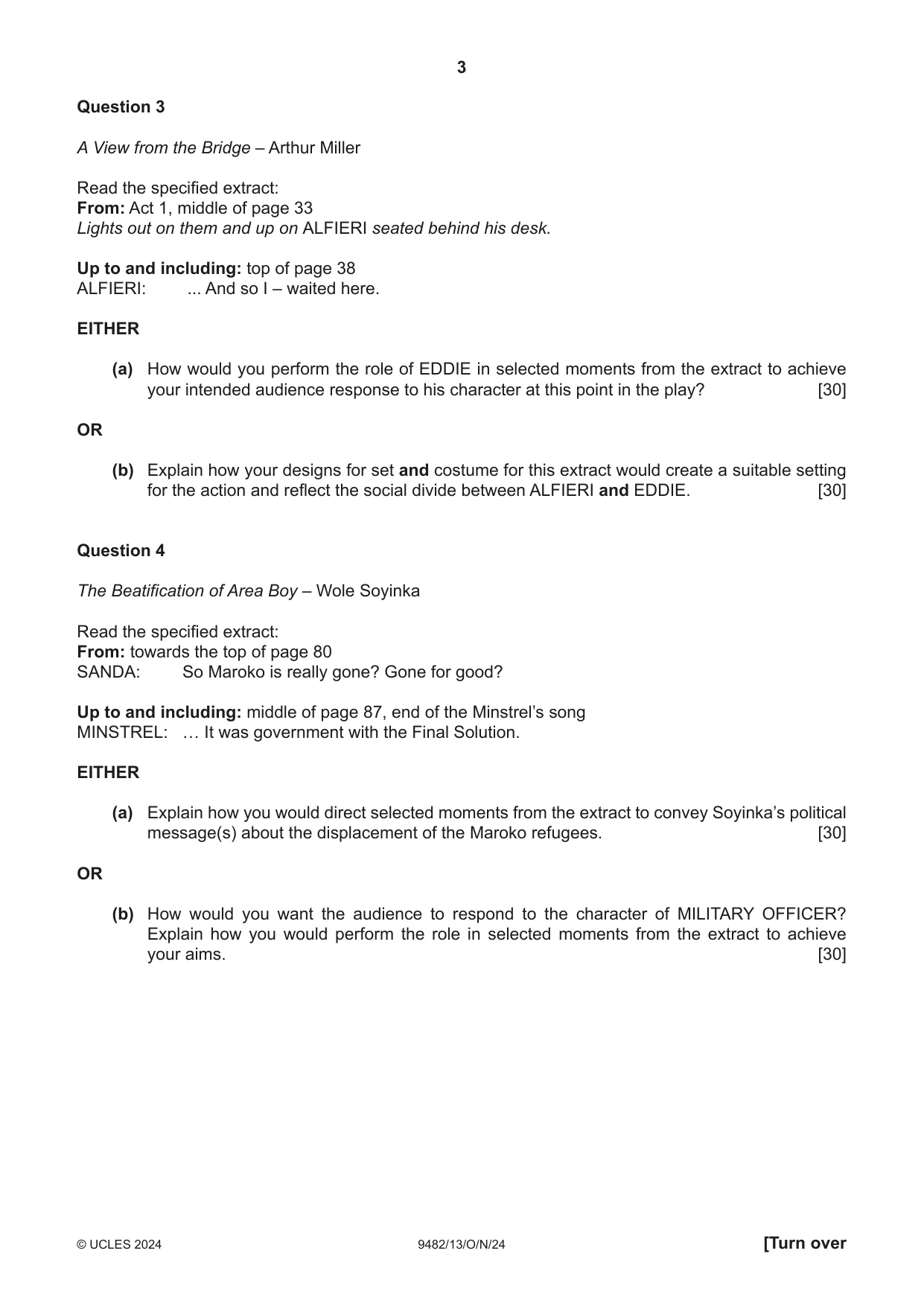
Question paper, page 3
3 9482/13/O/N/24 © UCLES 2024 [Turn over Question 3 A View from the Bridge – Arthur Miller Read the specified extract: From: Act 1, middle of page 33 Lights out on them and up on ALFIERI seated behind his desk. Up to and including: top of page 38 ALFIERI: ... And so I – waited here. EITHER (a) How would you perform the role of EDDIE in selected moments from the extract to achieve your intended audience response to his character at this point in the play? [30] OR (b) Explain how your designs for set and costume for this extract would create a suitable setting for the action and reflect the social divide between ALFIERI and EDDIE. [30] Question 4 The Beatification of Area Boy – Wole Soyinka Read the specified extract: From: towards the top of page 80 SANDA: So Maroko is really gone? Gone for good? Up to and including: middle of page 87, end of the Minstrel’s song MINSTREL: … It was government with the Final Solution. EITHER (a) Explain how you would direct selected moments from the extract to convey Soyinka’s political message(s) about the displacement of the Maroko refugees. [30] OR (b) How would you want the audience to respond to the character of MILITARY OFFICER? Explain how you would perform the role in selected moments from the extract to achieve your aims. [30]
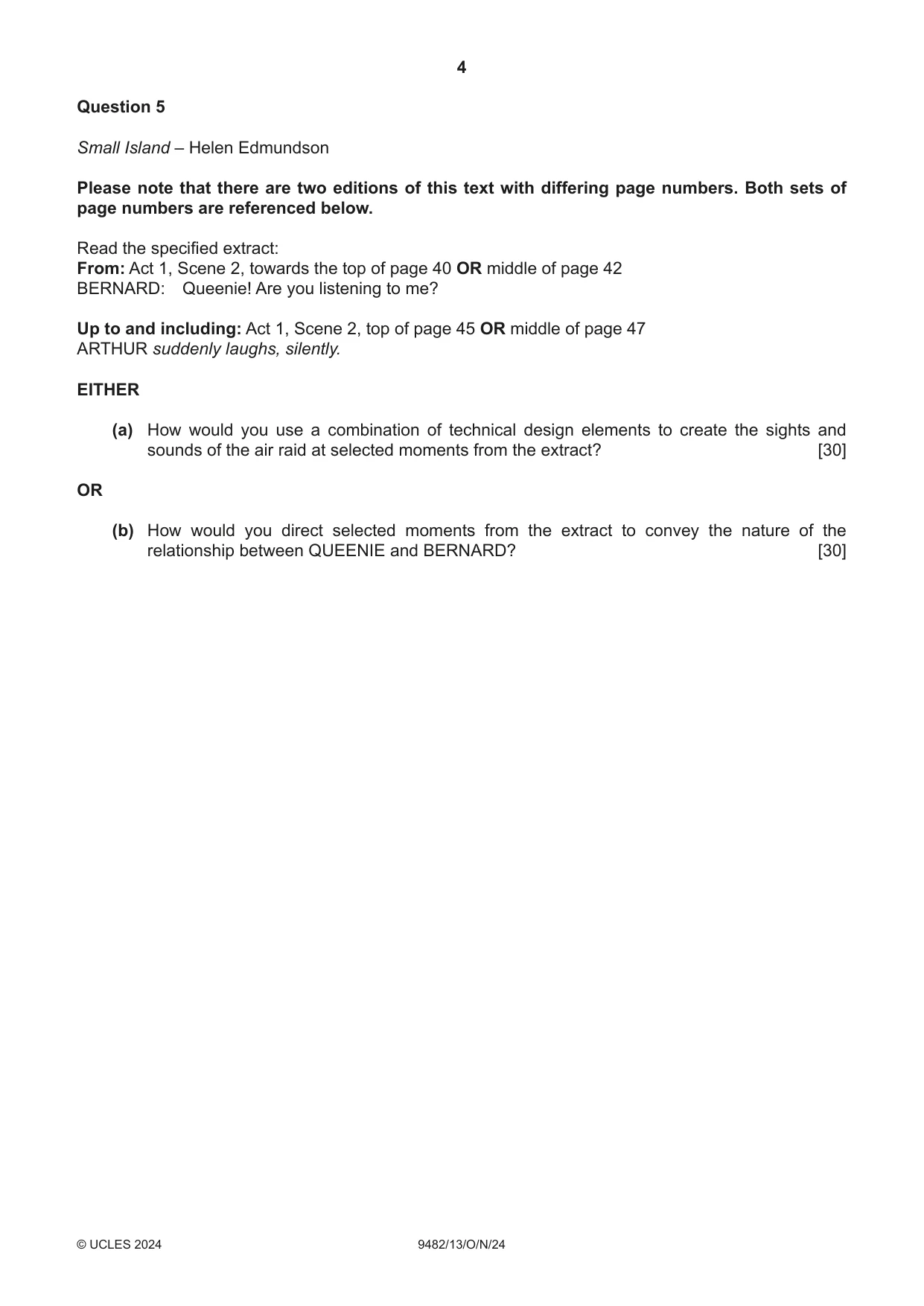
Question paper, page 4
4 9482/13/O/N/24 © UCLES 2024 Question 5 Small Island – Helen Edmundson Please note that there are two editions of this text with differing page numbers. Both sets of page numbers are referenced below. Read the specified extract: From: Act 1, Scene 2, towards the top of page 40 OR middle of page 42 BERNARD: Queenie! Are you listening to me? Up to and including: Act 1, Scene 2, top of page 45 OR middle of page 47 ARTHUR suddenly laughs, silently. EITHER (a) How would you use a combination of technical design elements to create the sights and sounds of the air raid at selected moments from the extract? [30] OR (b) How would you direct selected moments from the extract to convey the nature of the relationship between QUEENIE and BERNARD? [30]
Question paper, page 5
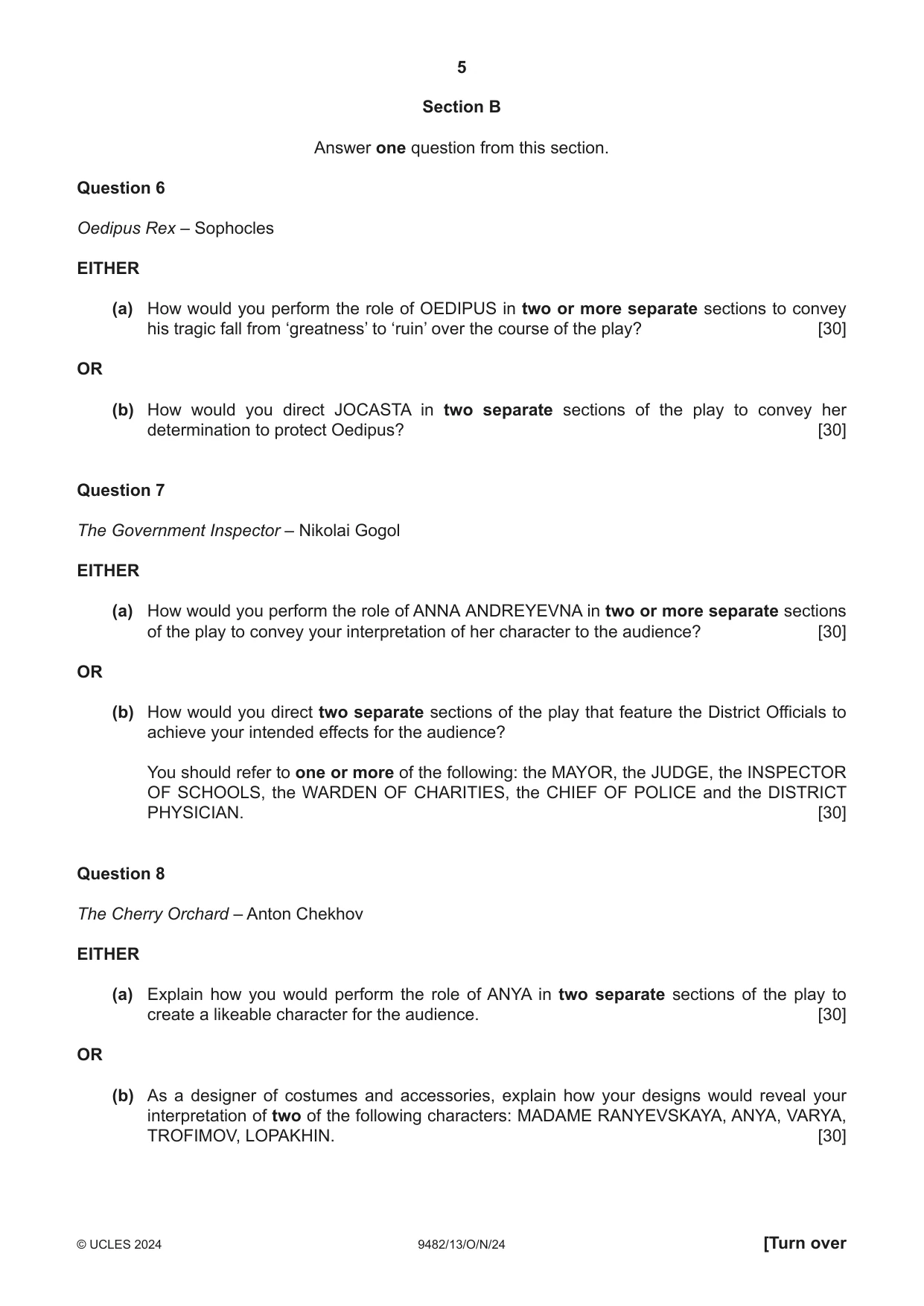
5 9482/13/O/N/24 © UCLES 2024 [Turn over Section B Answer one question from this section. Question 6 Oedipus Rex – Sophocles EITHER (a) How would you perform the role of OEDIPUS in two or more separate sections to convey his tragic fall from ‘greatness’ to ‘ruin’ over the course of the play? [30] OR (b) How would you direct JOCASTA in two separate sections of the play to convey her determination to protect Oedipus? [30] Question 7 The Government Inspector – Nikolai Gogol EITHER (a) How would you perform the role of ANNA ANDREYEVNA in two or more separate sections of the play to convey your interpretation of her character to the audience? [30] OR (b) How would you direct two separate sections of the play that feature the District Officials to achieve your intended effects for the audience? You should refer to one or more of the following: the MAYOR, the JUDGE, the INSPECTOR OF SCHOOLS, the WARDEN OF CHARITIES, the CHIEF OF POLICE and the DISTRICT PHYSICIAN. [30] Question 8 The Cherry Orchard – Anton Chekhov EITHER (a) Explain how you would perform the role of ANYA in two separate sections of the play to create a likeable character for the audience. [30] OR (b) As a designer of costumes and accessories, explain how your designs would reveal your interpretation of two of the following characters: MADAME RANYEVSKAYA, ANYA, VARYA, TROFIMOV, LOPAKHIN. [30]
Question paper, page 6
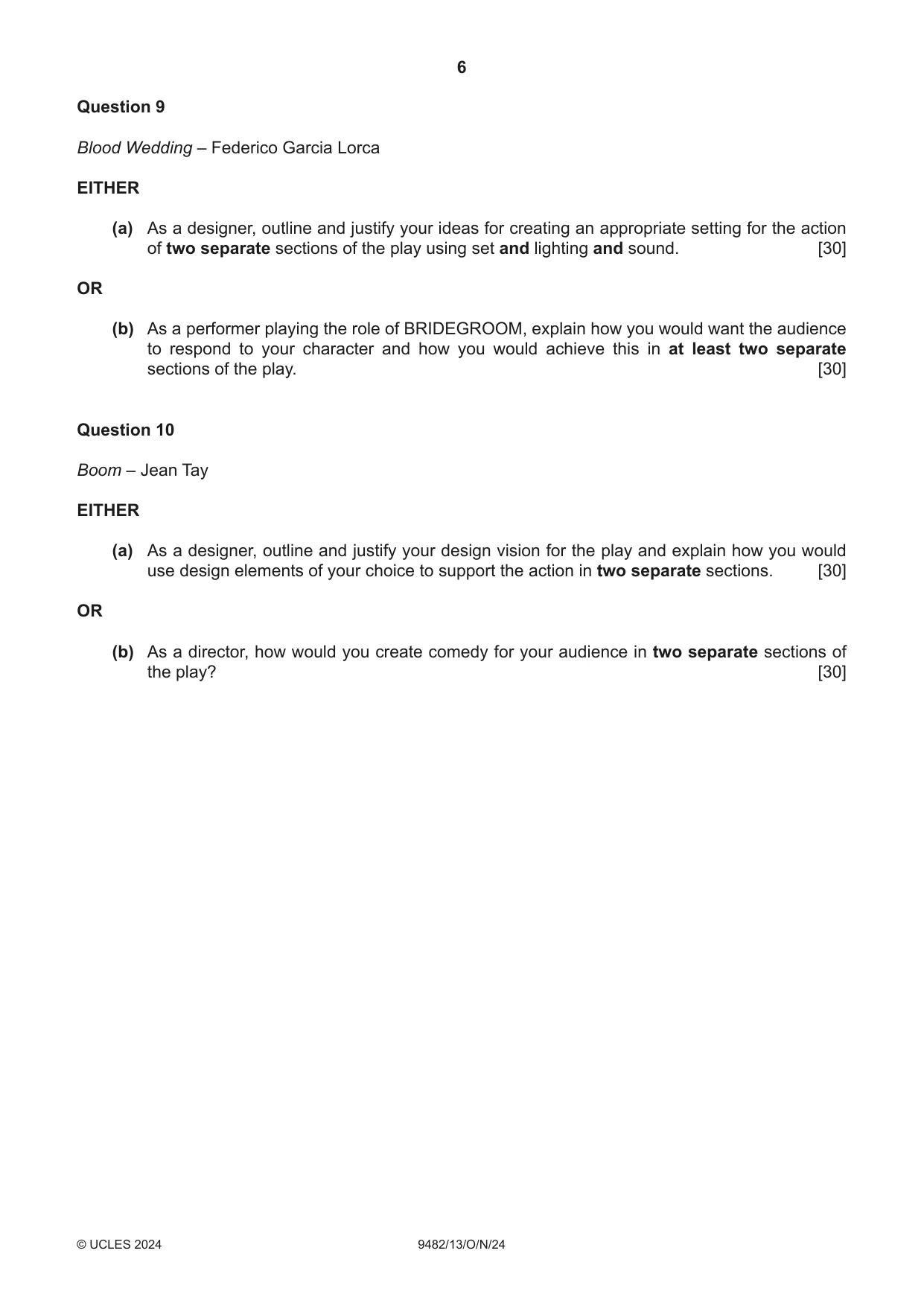
6 9482/13/O/N/24 © UCLES 2024 Question 9 Blood Wedding – Federico Garcia Lorca EITHER (a) As a designer, outline and justify your ideas for creating an appropriate setting for the action of two separate sections of the play using set and lighting and sound. [30] OR (b) As a performer playing the role of BRIDEGROOM, explain how you would want the audience to respond to your character and how you would achieve this in at least two separate sections of the play. [30] Question 10 Boom – Jean Tay EITHER (a) As a designer, outline and justify your design vision for the play and explain how you would use design elements of your choice to support the action in two separate sections. [30] OR (b) As a director, how would you create comedy for your audience in two separate sections of the play? [30]
Question paper, page 7
7 9482/13/O/N/24 © UCLES 2024 BLANK PAGE
Question paper, page 8
8 9482/13/O/N/24 © UCLES 2024 Permission to reproduce items where third-party owned material protected by copyright is included has been sought and cleared where possible. Every reasonable effort has been made by the publisher (UCLES) to trace copyright holders, but if any items requiring clearance have unwittingly been included, the publisher will be pleased to make amends at the earliest possible opportunity. To avoid the issue of disclosure of answer-related information to candidates, all copyright acknowledgements are reproduced online in the Cambridge Assessment International Education Copyright Acknowledgements Booklet. This is produced for each series of examinations and is freely available to download at www.cambridgeinternational.org after the live examination series. Cambridge Assessment International Education is part of Cambridge Assessment. Cambridge Assessment is the brand name of the University of Cambridge Local Examinations Syndicate (UCLES), which is a department of the University of Cambridge. BLANK PAGE
Mark scheme, page 1
This document consists of 26 printed pages. © Cambridge University Press & Assessment 2024 [Turn over Cambridge International AS & A Level DRAMA 9482/13 Paper 1 Open-Book Written Examination October/November 2024 MARK SCHEME Maximum Mark: 60 Published This mark scheme is published as an aid to teachers and candidates, to indicate the requirements of the examination. It shows the basis on which Examiners were instructed to award marks. It does not indicate the details of the discussions that took place at an Examiners’ meeting before marking began, which would have considered the acceptability of alternative answers. Mark schemes should be read in conjunction with the question paper and the Principal Examiner Report for Teachers. Cambridge International will not enter into discussions about these mark schemes. Cambridge International is publishing the mark schemes for the October/November 2024 series for most Cambridge IGCSE, Cambridge International A and AS Level components, and some Cambridge O Level components.
Mark scheme, page 2
9482/13 Cambridge International AS & A Level – Mark Scheme PUBLISHED October/November 2024 © Cambridge University Press & Assessment 2024 Page 2 of 26 Generic Marking Principles These general marking principles must be applied by all examiners when marking candidate answers. They should be applied alongside the specific content of the mark scheme or generic level descriptions for a question. Each question paper and mark scheme will also comply with these marking principles. GENERIC MARKING PRINCIPLE 1: Marks must be awarded in line with: • the specific content of the mark scheme or the generic level descriptors for the question • the specific skills defined in the mark scheme or in the generic level descriptors for the question • the standard of response required by a candidate as exemplified by the standardisation scripts. GENERIC MARKING PRINCIPLE 2: Marks awarded are always whole marks (not half marks, or other fractions). GENERIC MARKING PRINCIPLE 3: Marks must be awarded positively: • marks are awarded for correct/valid answers, as defined in the mark scheme. However, credit is given for valid answers which go beyond the scope of the syllabus and mark scheme, referring to your Team Leader as appropriate • marks are awarded when candidates clearly demonstrate what they know and can do • marks are not deducted for errors • marks are not deducted for omissions • answers should only be judged on the quality of spelling, punctuation and grammar when these features are specifically assessed by the question as indicated by the mark scheme. The meaning, however, should be unambiguous. GENERIC MARKING PRINCIPLE 4: Rules must be applied consistently, e.g. in situations where candidates have not followed instructions or in the application of generic level descriptors. GENERIC MARKING PRINCIPLE 5: Marks should be awarded using the full range of marks defined in the mark scheme for the question (however; the use of the full mark range may be limited according to the quality of the candidate responses seen). GENERIC MARKING PRINCIPLE 6: Marks awarded are based solely on the requirements as defined in the mark scheme. Marks should not be awarded with grade thresholds or grade descriptors in mind.
Mark scheme, page 3
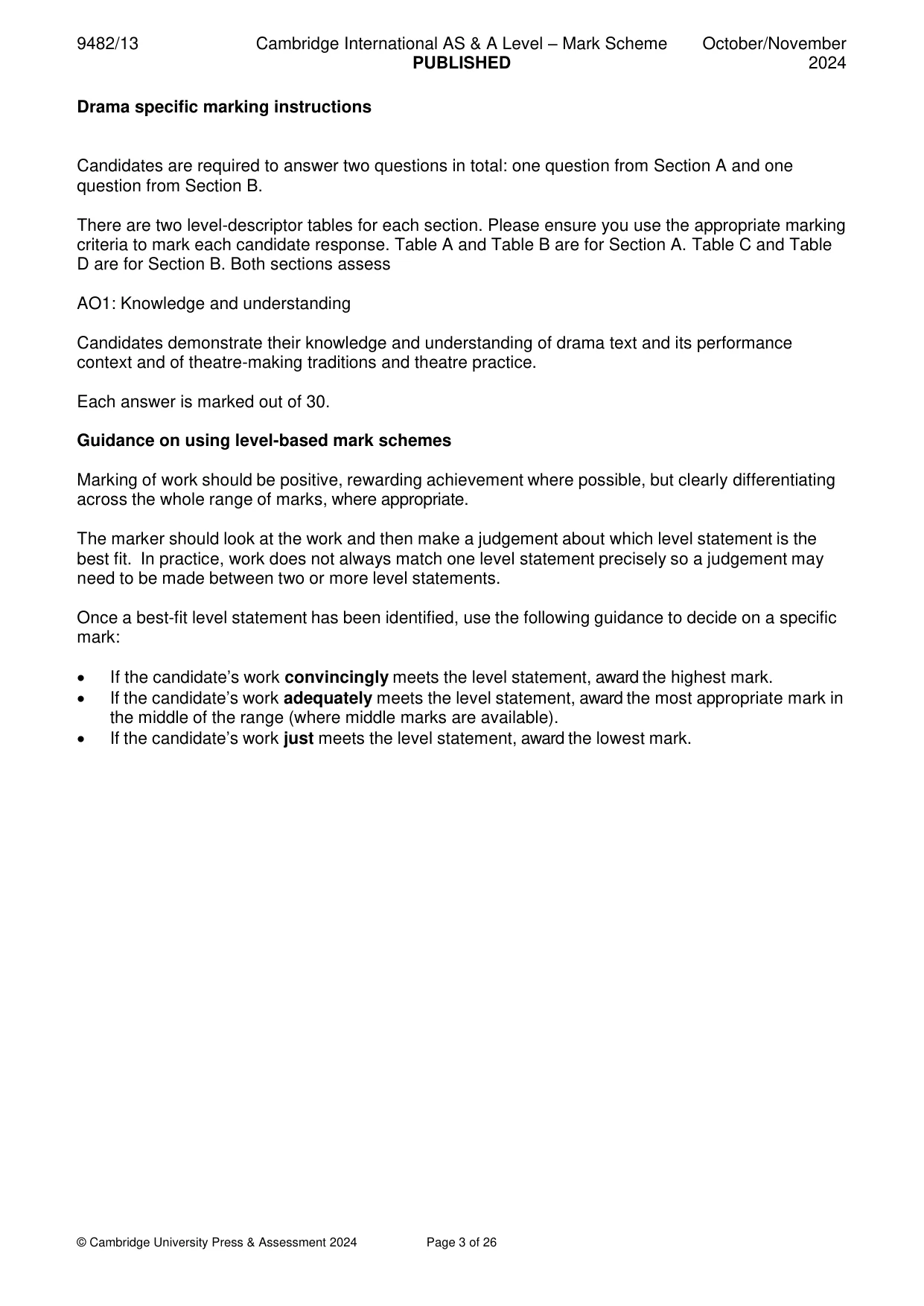
9482/13 Cambridge International AS & A Level – Mark Scheme PUBLISHED October/November 2024 © Cambridge University Press & Assessment 2024 Page 3 of 26 Drama specific marking instructions Candidates are required to answer two questions in total: one question from Section A and one question from Section B. There are two level-descriptor tables for each section. Please ensure you use the appropriate marking criteria to mark each candidate response. Table A and Table B are for Section A. Table C and Table D are for Section B. Both sections assess AO1: Knowledge and understanding Candidates demonstrate their knowledge and understanding of drama text and its performance context and of theatre-making traditions and theatre practice. Each answer is marked out of 30. Guidance on using level-based mark schemes Marking of work should be positive, rewarding achievement where possible, but clearly differentiating across the whole range of marks, where appropriate. The marker should look at the work and then make a judgement about which level statement is the best fit. In practice, work does not always match one level statement precisely so a judgement may need to be made between two or more level statements. Once a best-fit level statement has been identified, use the following guidance to decide on a specific mark: • If the candidate’s work convincingly meets the level statement, award the highest mark. • If the candidate’s work adequately meets the level statement, award the most appropriate mark in the middle of the range (where middle marks are available). • If the candidate’s work just meets the level statement, award the lowest mark.
Mark scheme, page 4
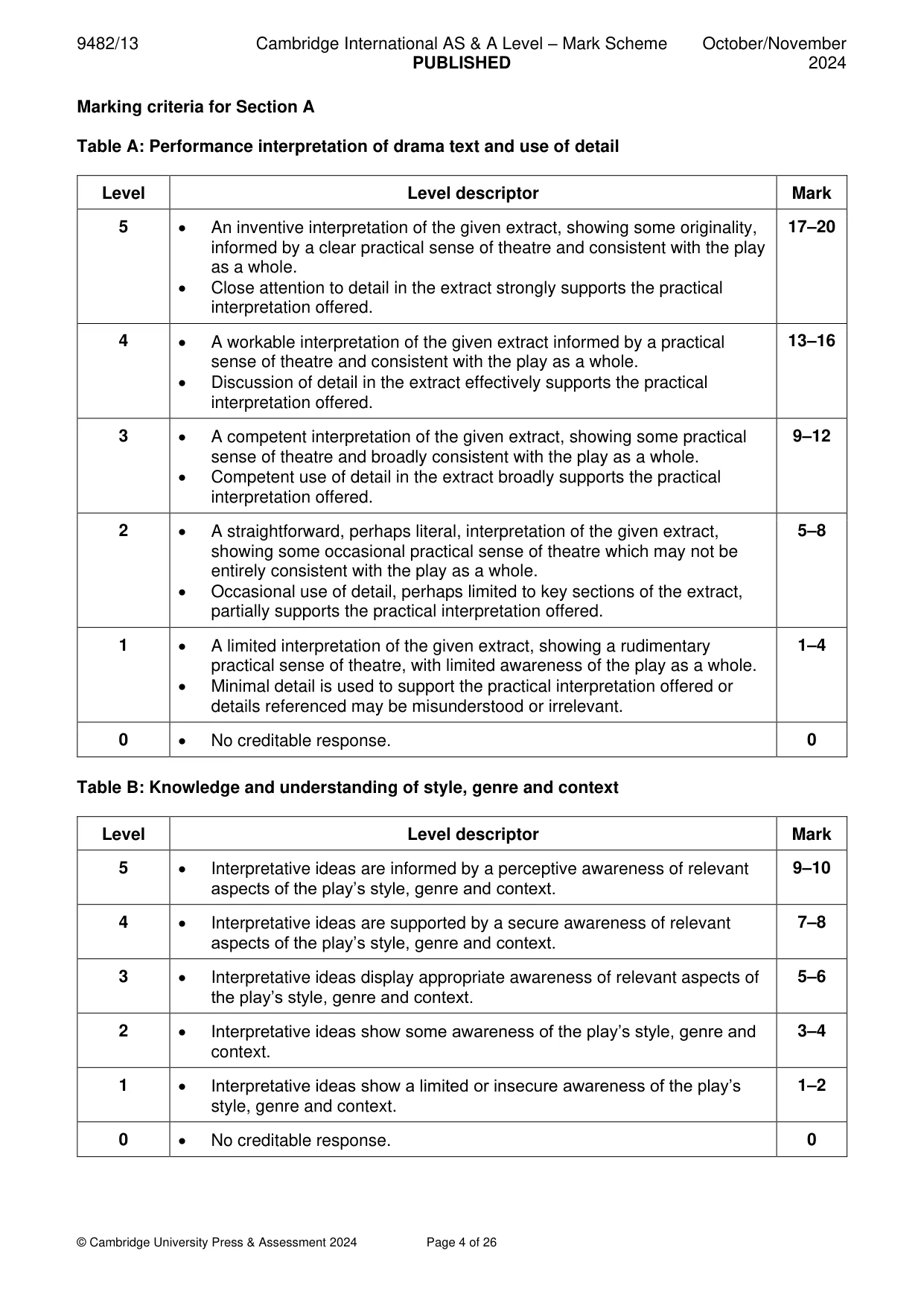
9482/13 Cambridge International AS & A Level – Mark Scheme PUBLISHED October/November 2024 © Cambridge University Press & Assessment 2024 Page 4 of 26 Marking criteria for Section A Table A: Performance interpretation of drama text and use of detail Level Level descriptor Mark 5 • An inventive interpretation of the given extract, showing some originality, informed by a clear practical sense of theatre and consistent with the play as a whole. • Close attention to detail in the extract strongly supports the practical interpretation offered. 17–20 4 • A workable interpretation of the given extract informed by a practical sense of theatre and consistent with the play as a whole. • Discussion of detail in the extract effectively supports the practical interpretation offered. 13–16 3 • A competent interpretation of the given extract, showing some practical sense of theatre and broadly consistent with the play as a whole. • Competent use of detail in the extract broadly supports the practical interpretation offered. 9–12 2 • A straightforward, perhaps literal, interpretation of the given extract, showing some occasional practical sense of theatre which may not be entirely consistent with the play as a whole. • Occasional use of detail, perhaps limited to key sections of the extract, partially supports the practical interpretation offered. 5–8 1 • A limited interpretation of the given extract, showing a rudimentary practical sense of theatre, with limited awareness of the play as a whole. • Minimal detail is used to support the practical interpretation offered or details referenced may be misunderstood or irrelevant. 1–4 0 • No creditable response. 0 Table B: Knowledge and understanding of style, genre and context Level Level descriptor Mark 5 • Interpretative ideas are informed by a perceptive awareness of relevant aspects of the play’s style, genre and context. 9–10 4 • Interpretative ideas are supported by a secure awareness of relevant aspects of the play’s style, genre and context. 7–8 3 • Interpretative ideas display appropriate awareness of relevant aspects of the play’s style, genre and context. 5–6 2 • Interpretative ideas show some awareness of the play’s style, genre and context. 3–4 1 • Interpretative ideas show a limited or insecure awareness of the play’s style, genre and context. 1–2 0 • No creditable response. 0
Mark scheme, page 5
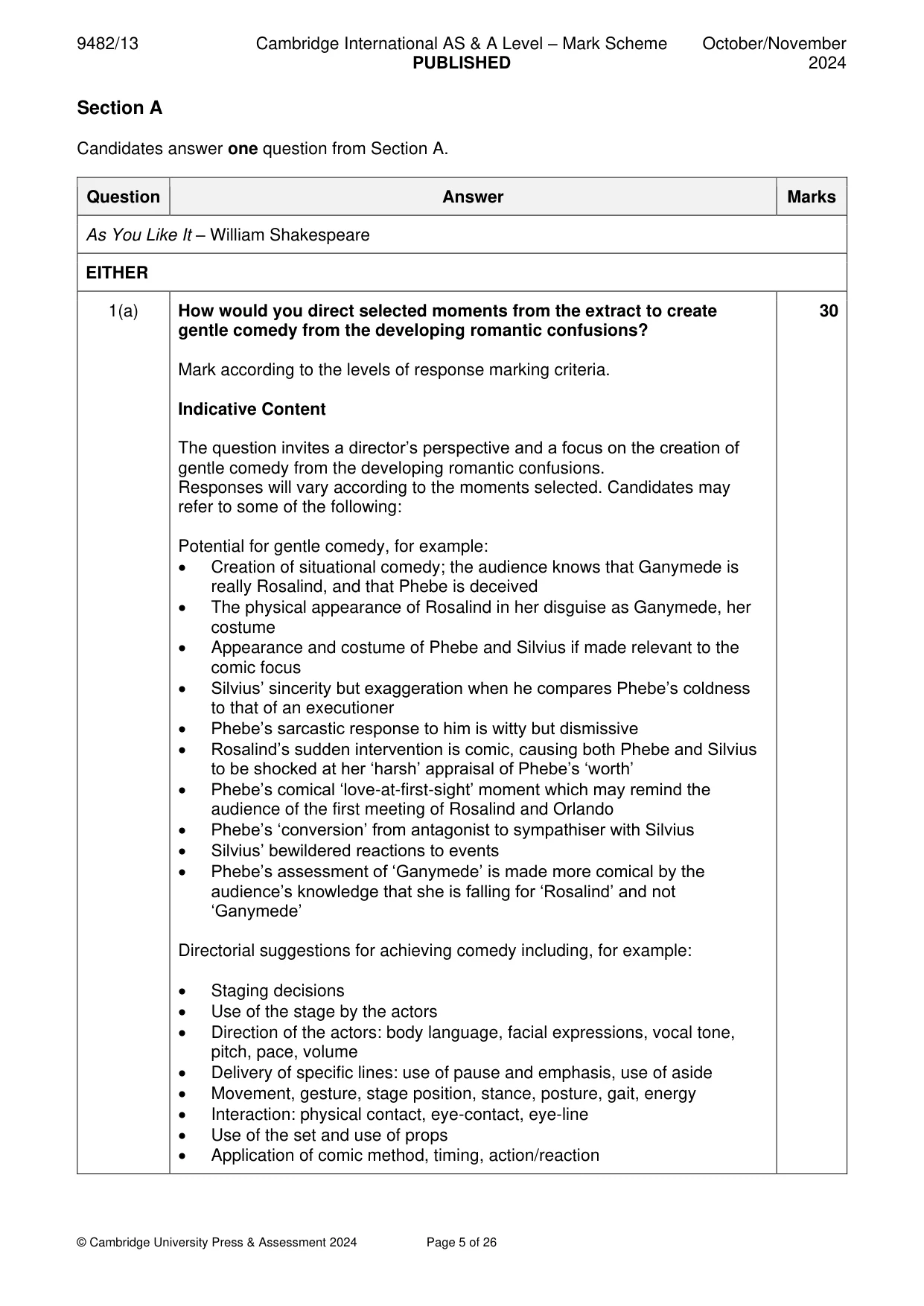
9482/13 Cambridge International AS & A Level – Mark Scheme PUBLISHED October/November 2024 © Cambridge University Press & Assessment 2024 Page 5 of 26 Section A Candidates answer one question from Section A. Question Answer Marks As You Like It – William Shakespeare EITHER 1(a) How would you direct selected moments from the extract to create gentle comedy from the developing romantic confusions? Mark according to the levels of response marking criteria. Indicative Content The question invites a director’s perspective and a focus on the creation of gentle comedy from the developing romantic confusions. Responses will vary according to the moments selected. Candidates may refer to some of the following: Potential for gentle comedy, for example: • Creation of situational comedy; the audience knows that Ganymede is really Rosalind, and that Phebe is deceived • The physical appearance of Rosalind in her disguise as Ganymede, her costume • Appearance and costume of Phebe and Silvius if made relevant to the comic focus • Silvius’ sincerity but exaggeration when he compares Phebe’s coldness to that of an executioner • Phebe’s sarcastic response to him is witty but dismissive • Rosalind’s sudden intervention is comic, causing both Phebe and Silvius to be shocked at her ‘harsh’ appraisal of Phebe’s ‘worth’ • Phebe’s comical ‘love-at-first-sight’ moment which may remind the audience of the first meeting of Rosalind and Orlando • Phebe’s ‘conversion’ from antagonist to sympathiser with Silvius • Silvius’ bewildered reactions to events • Phebe’s assessment of ‘Ganymede’ is made more comical by the audience’s knowledge that she is falling for ‘Rosalind’ and not ‘Ganymede’ Directorial suggestions for achieving comedy including, for example: • Staging decisions • Use of the stage by the actors • Direction of the actors: body language, facial expressions, vocal tone, pitch, pace, volume • Delivery of specific lines: use of pause and emphasis, use of aside • Movement, gesture, stage position, stance, posture, gait, energy • Interaction: physical contact, eye-contact, eye-line • Use of the set and use of props • Application of comic method, timing, action/reaction 30
Mark scheme, page 6
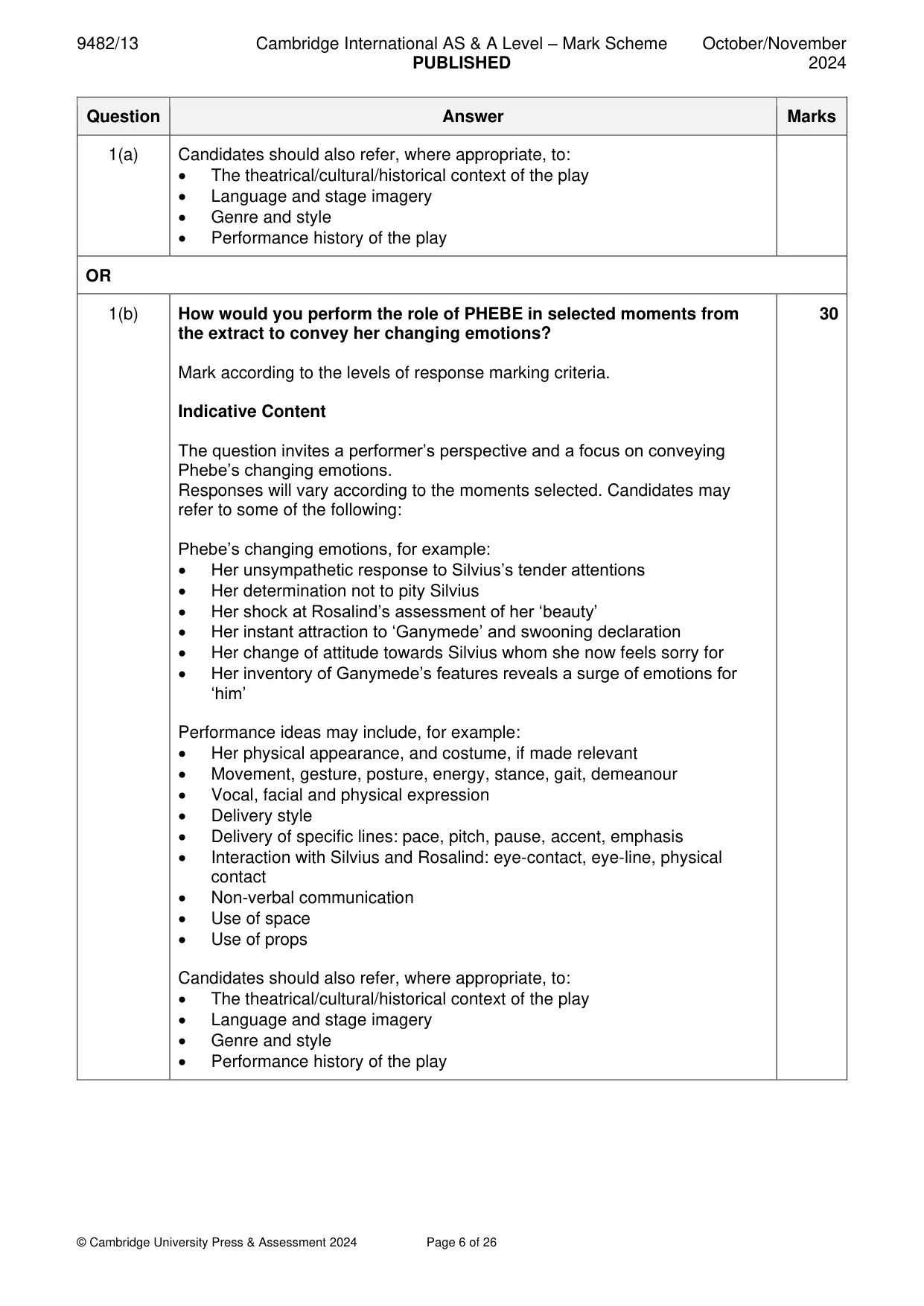
9482/13 Cambridge International AS & A Level – Mark Scheme PUBLISHED October/November 2024 © Cambridge University Press & Assessment 2024 Page 6 of 26 Question Answer Marks 1(a) Candidates should also refer, where appropriate, to: • The theatrical/cultural/historical context of the play • Language and stage imagery • Genre and style • Performance history of the play OR 1(b) How would you perform the role of PHEBE in selected moments from the extract to convey her changing emotions? Mark according to the levels of response marking criteria. Indicative Content The question invites a performer’s perspective and a focus on conveying Phebe’s changing emotions. Responses will vary according to the moments selected. Candidates may refer to some of the following: Phebe’s changing emotions, for example: • Her unsympathetic response to Silvius’s tender attentions • Her determination not to pity Silvius • Her shock at Rosalind’s assessment of her ‘beauty’ • Her instant attraction to ‘Ganymede’ and swooning declaration • Her change of attitude towards Silvius whom she now feels sorry for • Her inventory of Ganymede’s features reveals a surge of emotions for ‘him’ Performance ideas may include, for example: • Her physical appearance, and costume, if made relevant • Movement, gesture, posture, energy, stance, gait, demeanour • Vocal, facial and physical expression • Delivery style • Delivery of specific lines: pace, pitch, pause, accent, emphasis • Interaction with Silvius and Rosalind: eye-contact, eye-line, physical contact • Non-verbal communication • Use of space • Use of props Candidates should also refer, where appropriate, to: • The theatrical/cultural/historical context of the play • Language and stage imagery • Genre and style • Performance history of the play 30
Mark scheme, page 7
9482/13 Cambridge International AS & A Level – Mark Scheme PUBLISHED October/November 2024 © Cambridge University Press & Assessment 2024 Page 7 of 26 Question Answer Marks The Rivals – Richard Sheridan EITHER 2(a) Explain how your designs for costumes and accessories for ACRES and SIR LUCIUS would be appropriate to the action and to each of the characters, at this point in the play. Mark according to the levels of response marking criteria. Indicative Content The question invites a costume designer’s perspective and a focus on creating costumes and accessories appropriate to the action of the scene and to the characters of Acres and Sir Lucius. Responses will vary according to the design ideas for costumes and accessories. Candidates may refer to some of the following: • The extract occurs just after Acres has been ‘polished’, so his costume and wig may be outlandishly exaggerated • Sir Lucius is a middle-aged man aspiring to be considered young; he is a ‘ladies’ man’, perhaps reflected in his costume Costume Design suggestions, for example: • Style of costumes: Georgian period or justified transposition • Cut, fit and condition of the costumes • Colours, fabrics, ornamentation • Footwear/headgear/jewellery • For Acres: extravagant periwig, cravat, long coat/waistcoat, breeches and stockings, boots or low-cut leather shoes, high-collared shirt, ribboned cuffs, jacket with decorative buttons in velvet and/or satin materials • For Sir Lucius: attire appropriate for an Irish Baronet: traditionally costumed in green and/or a military style jacket and trousers as his name implies weaponry, tall-crowned hat, cape or coat • Accessories, cane/swordstick, gloves • Make-up, if included Candidates should also refer, where appropriate, to: • The theatrical/cultural/historical context of the play • Language and stage imagery • Genre and style • Performance history of the play 30
Mark scheme, page 8
9482/13 Cambridge International AS & A Level – Mark Scheme PUBLISHED October/November 2024 © Cambridge University Press & Assessment 2024 Page 8 of 26 Question Answer Marks OR 2(b) How would you perform the role of ACRES in selected moments from the extract to create comedy for the audience? Mark according to the levels of response marking criteria. Indicative Content The question invites a performer’s perspective and a focus on creating comedy for the audience through the performance of Acres. Responses will vary according to the moments selected. Candidates may refer to some of the following: Comedy created from, for example: • Acres’ pleasure as he revels in his ‘new look’ while the audience (and David) see a ridiculous spectacle • Acres’ obliviousness to David’s rude comments • Acres’ struggle to master the dancing steps, especially when crammed into uncomfortable clothes • His susceptibility to Sir Lucius’s encouragement to challenge Beverley to a duel • His ability to rouse himself into a passion • His comical objections to Sir Lucius’ dictation of the letter of challenge • Performance suggestions for Acres, including, for example: • Acres’ physical appearance and costume; he looks ludicrous and uncomfortable • Movement, gesture, posture, energy, stance, gait, pose • Vocal, facial and physical expression • Delivery style • Delivery of specific lines: pace, pitch, pause, accent, emphasis • Non-verbal communication • Use of space • Use of props • Interaction with David and with Sir Lucius: eye-contact, physical contact, spatial relationships • Interaction with the audience • Application of Georgian performance conventions Candidates should also refer, where appropriate, to: • The theatrical/cultural/historical context of the play • Language and stage imagery • Genre and style • Performance history of the play 30
Mark scheme, page 9
9482/13 Cambridge International AS & A Level – Mark Scheme PUBLISHED October/November 2024 © Cambridge University Press & Assessment 2024 Page 9 of 26 Question Answer Marks A View from the Bridge – Arthur Miller EITHER 3(a) How would you perform the role of EDDIE in selected moments from the extract to achieve your intended audience response to his character, at this point in the play? Mark according to the levels of response marking criteria. Indicative Content Responses will vary according to candidates’ intended response and choice of moments. Candidates may refer to some of the following responses: Responses to Eddie might include, for example: • Shock at his level of obsession with Rodolpho’s intentions • Amusement or dislike at his attempts to insinuate that Rodolpho ‘ain’t right’ • Sympathy for his helplessness • Respect for his determination not to denounce Rodolpho to the authorities • Pity for his inability to control his emotions • Performance suggestions may include, for example: • His physical appearance, strength and vigour; marked by his turmoil • Movement, gesture, posture, energy, stance, gait, idiosyncrasy • Vocal, facial and physical expression • Delivery style, both respectful and defiant • Delivery of specific lines: pace, pitch, pause, accent, volume, emphasis • Interaction with Alfieri, spatial relationship, eye-contact, eye-line • Non-verbal communication • Use of space • Use of props Candidates should also refer, where appropriate, to: • The theatrical/cultural/historical context of the play • Language and stage imagery • Genre and style • Performance history of the play 30
Mark scheme, page 10
9482/13 Cambridge International AS & A Level – Mark Scheme PUBLISHED October/November 2024 © Cambridge University Press & Assessment 2024 Page 10 of 26 Question Answer Marks OR 3(b) Explain how your designs for set and costume for this extract would create a suitable setting for the action and reflect the social divide between ALFIERI and EDDIE. Mark according to the levels of response marking criteria. Indicative Content The question invites a designer’s perspective and a focus on creating a suitable setting for the action and reflecting the social divide between the characters through the use of set and costume. Responses will vary according to the candidates’ interpretation of the extract and their design ideas. Candidates may refer to some of the following: Set design suggestions, for the creation of the setting, for example: • The staging form chosen • Composite setting or discrete settings for the Carbone home and Alfieri’s office • Naturalistic or representational realisation of Alfieri’s office • Transition from Eddie’s apartment to Alfieri’s office by means of scenic devices, such as trucks, or by a lighting cue • Choice of period setting as shown through the selection of furnishings and/or backdrops • Positioning of entrances/exits • Alfieri’s office as a discrete setting or part of a composite setting, which might include, for example: a large desk with a chair in expensive-looking dark wood, a desk lamp, telephone, paperweight, items such as decorative globe, family photographs in silver frames; ornate fireplace, filing cabinets, plush soft furnishings, comfortable chairs for clients • Use of texture and colour • Use of levels, ramps, steps • Use of gauzes/backdrops/cyclorama • Use of projections, if chosen • Use of lighting and/or sound to create the setting, if appropriate Costume design suggestions, to reflect the social divide, for example: • For Eddie, for example: Tee-shirt or open-neck flannel shirt, ‘donkey jacket’ or casual corduroy or denim jacket, workmen’s trousers and boots, flat cap or beanie • For Alfieri, for example: smart dark-coloured suit, shirt and tie or bow tie, waistcoat, tie pin, cufflinks, watch chain, coloured handkerchief in the breast pocket, button-hole flower, polished leather shoes, natty socks • Period and style • Colour, fabric, cut, fit, condition Candidates should also refer, where appropriate, to: • The theatrical/cultural/historical context of the play • Language and stage imagery • Genre and style • Performance history of the play 30
Mark scheme, page 11
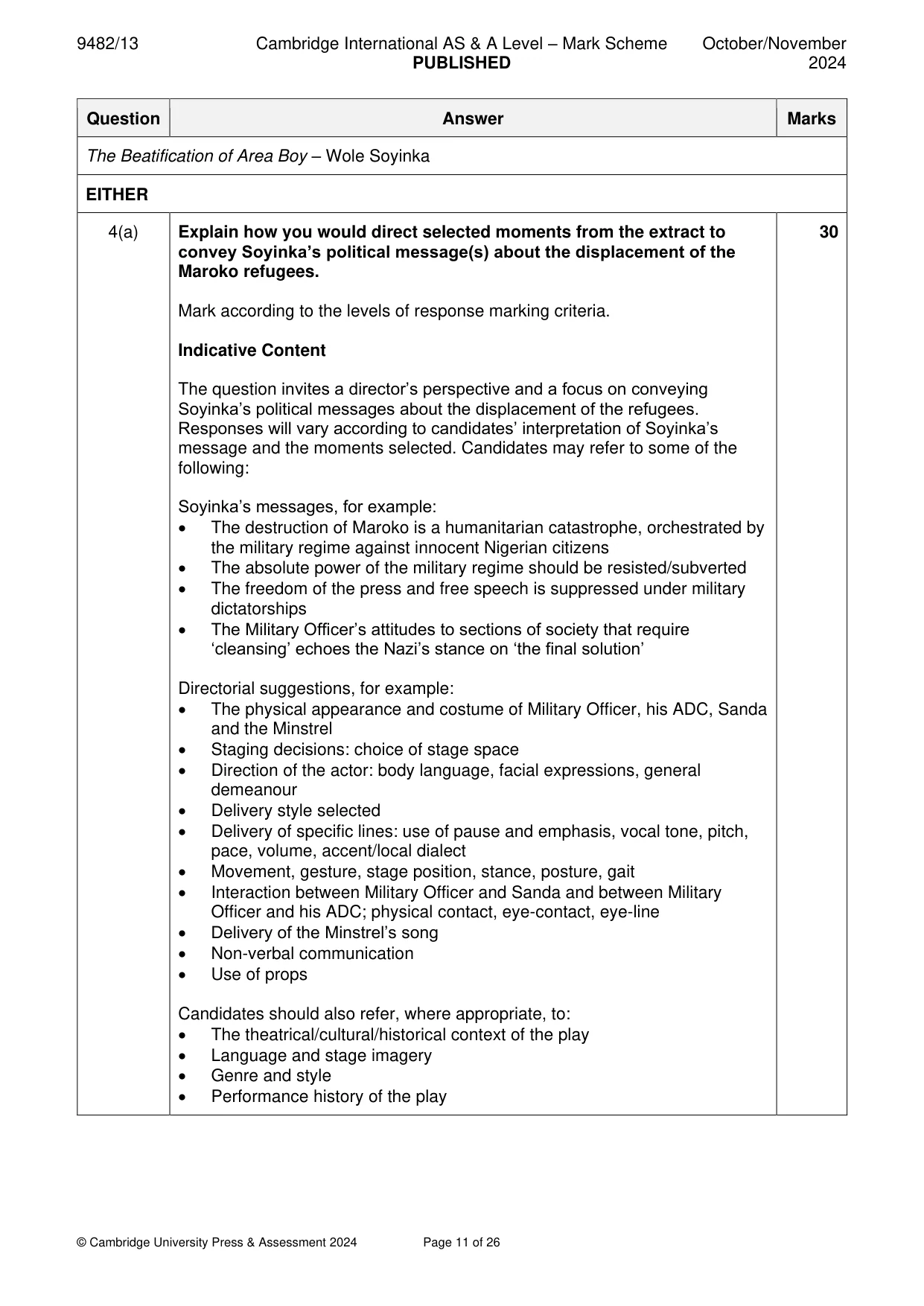
9482/13 Cambridge International AS & A Level – Mark Scheme PUBLISHED October/November 2024 © Cambridge University Press & Assessment 2024 Page 11 of 26 Question Answer Marks The Beatification of Area Boy – Wole Soyinka EITHER 4(a) Explain how you would direct selected moments from the extract to convey Soyinka’s political message(s) about the displacement of the Maroko refugees. Mark according to the levels of response marking criteria. Indicative Content The question invites a director’s perspective and a focus on conveying Soyinka’s political messages about the displacement of the refugees. Responses will vary according to candidates’ interpretation of Soyinka’s message and the moments selected. Candidates may refer to some of the following: Soyinka’s messages, for example: • The destruction of Maroko is a humanitarian catastrophe, orchestrated by the military regime against innocent Nigerian citizens • The absolute power of the military regime should be resisted/subverted • The freedom of the press and free speech is suppressed under military dictatorships • The Military Officer’s attitudes to sections of society that require ‘cleansing’ echoes the Nazi’s stance on ‘the final solution’ Directorial suggestions, for example: • The physical appearance and costume of Military Officer, his ADC, Sanda and the Minstrel • Staging decisions: choice of stage space • Direction of the actor: body language, facial expressions, general demeanour • Delivery style selected • Delivery of specific lines: use of pause and emphasis, vocal tone, pitch, pace, volume, accent/local dialect • Movement, gesture, stage position, stance, posture, gait • Interaction between Military Officer and Sanda and between Military Officer and his ADC; physical contact, eye-contact, eye-line • Delivery of the Minstrel’s song • Non-verbal communication • Use of props Candidates should also refer, where appropriate, to: • The theatrical/cultural/historical context of the play • Language and stage imagery • Genre and style • Performance history of the play 30
Mark scheme, page 12
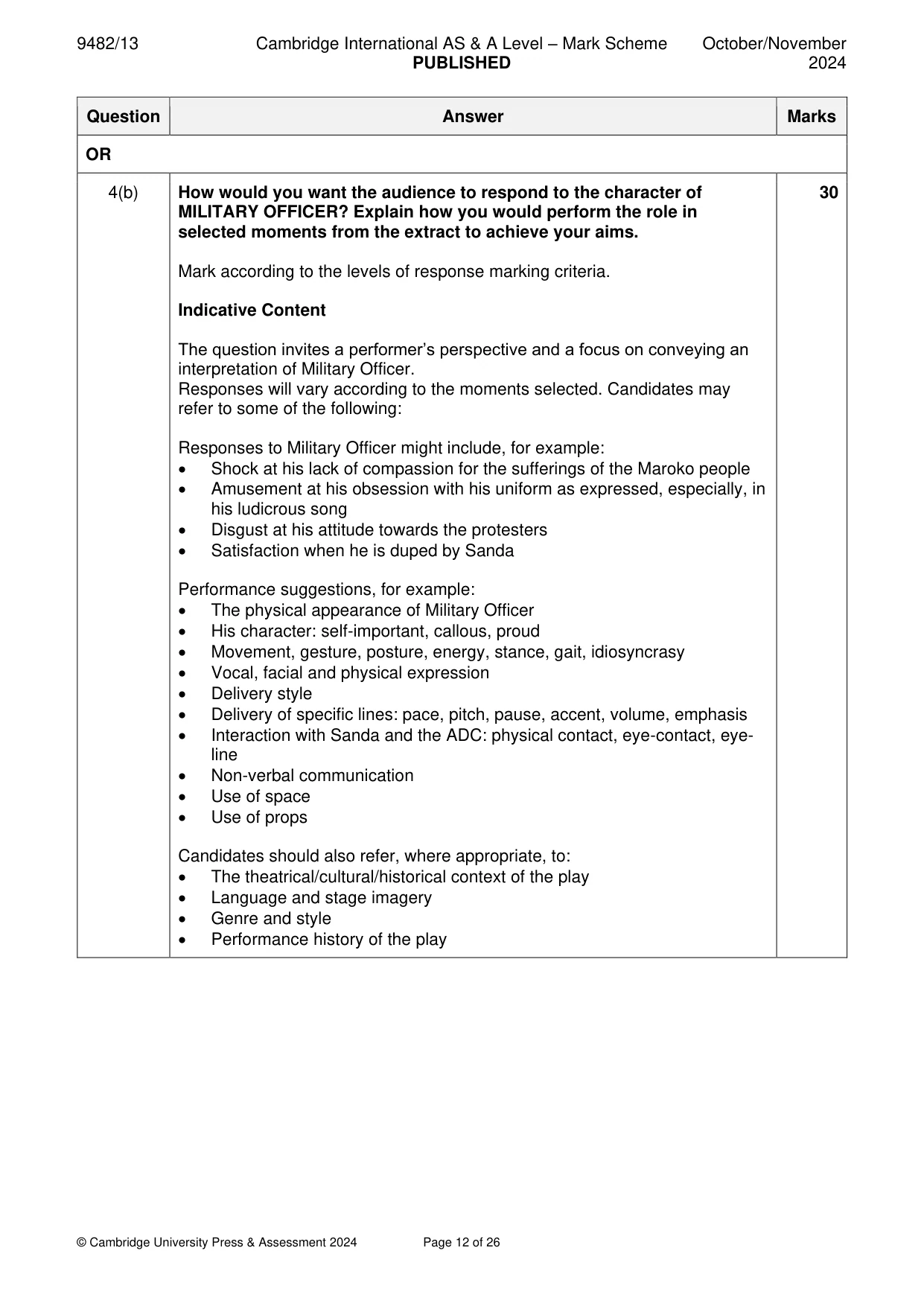
9482/13 Cambridge International AS & A Level – Mark Scheme PUBLISHED October/November 2024 © Cambridge University Press & Assessment 2024 Page 12 of 26 Question Answer Marks OR 4(b) How would you want the audience to respond to the character of MILITARY OFFICER? Explain how you would perform the role in selected moments from the extract to achieve your aims. Mark according to the levels of response marking criteria. Indicative Content The question invites a performer’s perspective and a focus on conveying an interpretation of Military Officer. Responses will vary according to the moments selected. Candidates may refer to some of the following: Responses to Military Officer might include, for example: • Shock at his lack of compassion for the sufferings of the Maroko people • Amusement at his obsession with his uniform as expressed, especially, in his ludicrous song • Disgust at his attitude towards the protesters • Satisfaction when he is duped by Sanda Performance suggestions, for example: • The physical appearance of Military Officer • His character: self-important, callous, proud • Movement, gesture, posture, energy, stance, gait, idiosyncrasy • Vocal, facial and physical expression • Delivery style • Delivery of specific lines: pace, pitch, pause, accent, volume, emphasis • Interaction with Sanda and the ADC: physical contact, eye-contact, eye- line • Non-verbal communication • Use of space • Use of props Candidates should also refer, where appropriate, to: • The theatrical/cultural/historical context of the play • Language and stage imagery • Genre and style • Performance history of the play 30
Mark scheme, page 13
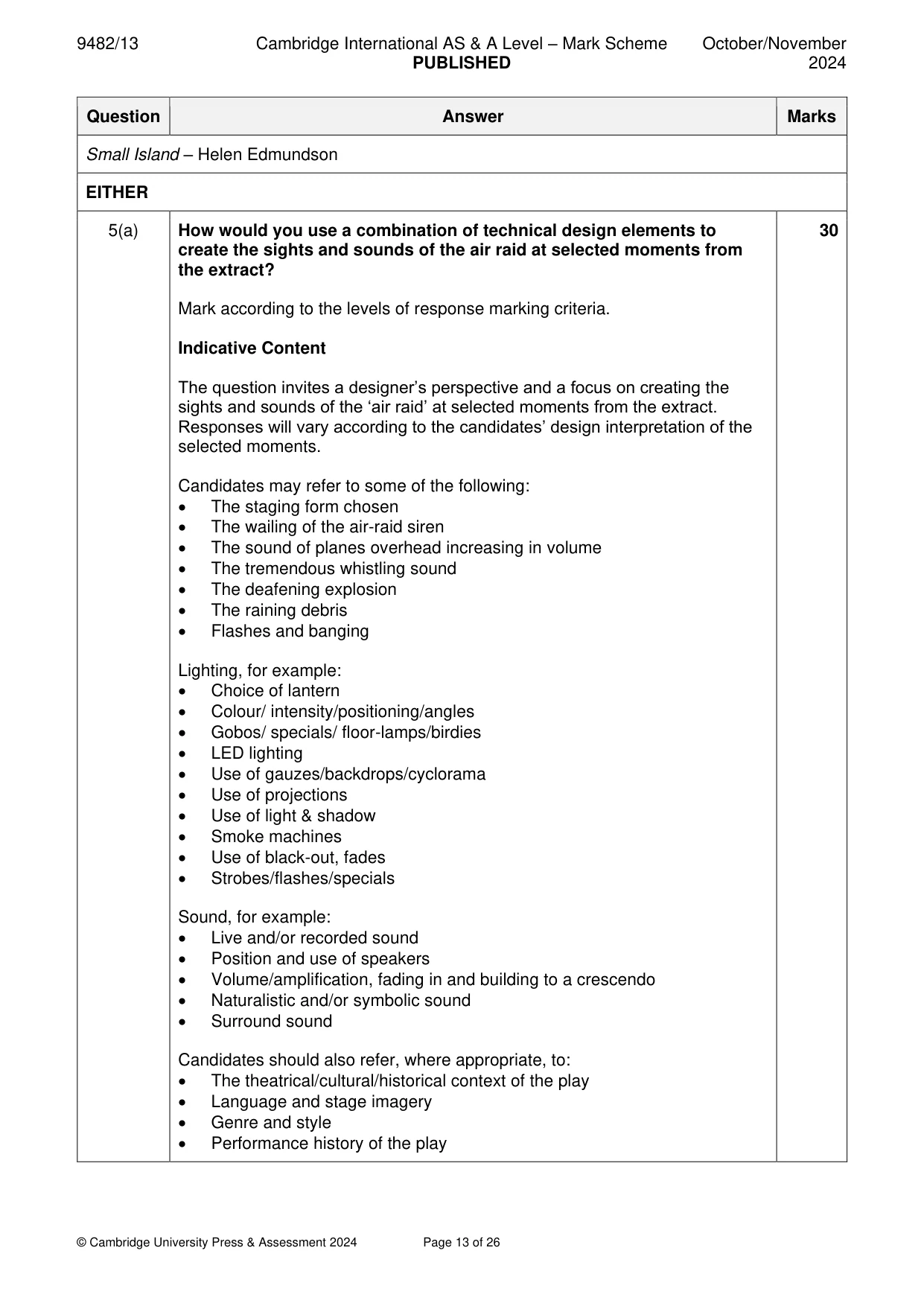
9482/13 Cambridge International AS & A Level – Mark Scheme PUBLISHED October/November 2024 © Cambridge University Press & Assessment 2024 Page 13 of 26 Question Answer Marks Small Island – Helen Edmundson EITHER 5(a) How would you use a combination of technical design elements to create the sights and sounds of the air raid at selected moments from the extract? Mark according to the levels of response marking criteria. Indicative Content The question invites a designer’s perspective and a focus on creating the sights and sounds of the ‘air raid’ at selected moments from the extract. Responses will vary according to the candidates’ design interpretation of the selected moments. Candidates may refer to some of the following: • The staging form chosen • The wailing of the air-raid siren • The sound of planes overhead increasing in volume • The tremendous whistling sound • The deafening explosion • The raining debris • Flashes and banging Lighting, for example: • Choice of lantern • Colour/ intensity/positioning/angles • Gobos/ specials/ floor-lamps/birdies • LED lighting • Use of gauzes/backdrops/cyclorama • Use of projections • Use of light & shadow • Smoke machines • Use of black-out, fades • Strobes/flashes/specials Sound, for example: • Live and/or recorded sound • Position and use of speakers • Volume/amplification, fading in and building to a crescendo • Naturalistic and/or symbolic sound • Surround sound Candidates should also refer, where appropriate, to: • The theatrical/cultural/historical context of the play • Language and stage imagery • Genre and style • Performance history of the play 30
Mark scheme, page 14
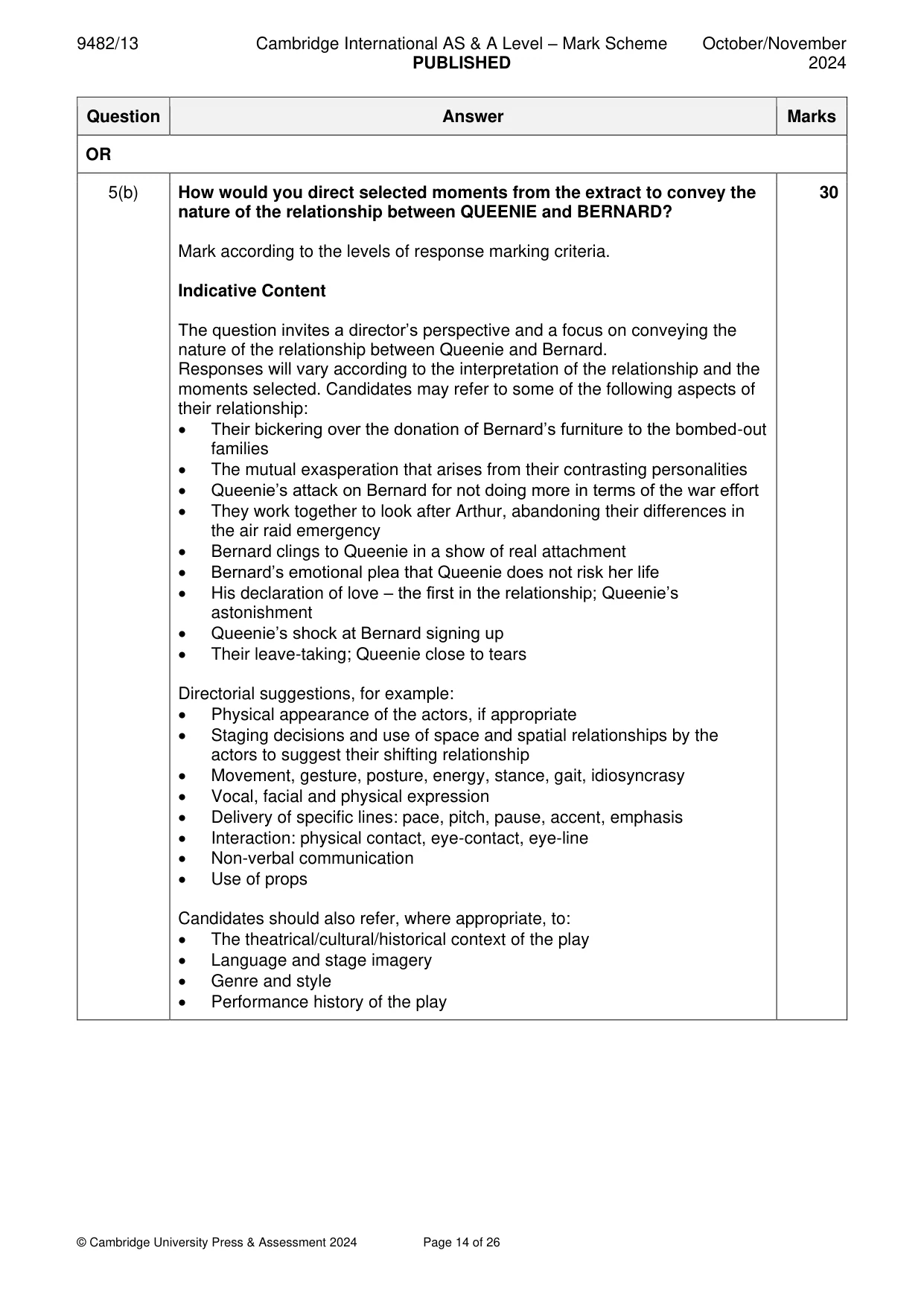
9482/13 Cambridge International AS & A Level – Mark Scheme PUBLISHED October/November 2024 © Cambridge University Press & Assessment 2024 Page 14 of 26 Question Answer Marks OR 5(b) How would you direct selected moments from the extract to convey the nature of the relationship between QUEENIE and BERNARD? Mark according to the levels of response marking criteria. Indicative Content The question invites a director’s perspective and a focus on conveying the nature of the relationship between Queenie and Bernard. Responses will vary according to the interpretation of the relationship and the moments selected. Candidates may refer to some of the following aspects of their relationship: • Their bickering over the donation of Bernard’s furniture to the bombed-out families • The mutual exasperation that arises from their contrasting personalities • Queenie’s attack on Bernard for not doing more in terms of the war effort • They work together to look after Arthur, abandoning their differences in the air raid emergency • Bernard clings to Queenie in a show of real attachment • Bernard’s emotional plea that Queenie does not risk her life • His declaration of love – the first in the relationship; Queenie’s astonishment • Queenie’s shock at Bernard signing up • Their leave-taking; Queenie close to tears Directorial suggestions, for example: • Physical appearance of the actors, if appropriate • Staging decisions and use of space and spatial relationships by the actors to suggest their shifting relationship • Movement, gesture, posture, energy, stance, gait, idiosyncrasy • Vocal, facial and physical expression • Delivery of specific lines: pace, pitch, pause, accent, emphasis • Interaction: physical contact, eye-contact, eye-line • Non-verbal communication • Use of props Candidates should also refer, where appropriate, to: • The theatrical/cultural/historical context of the play • Language and stage imagery • Genre and style • Performance history of the play 30
Mark scheme, page 15
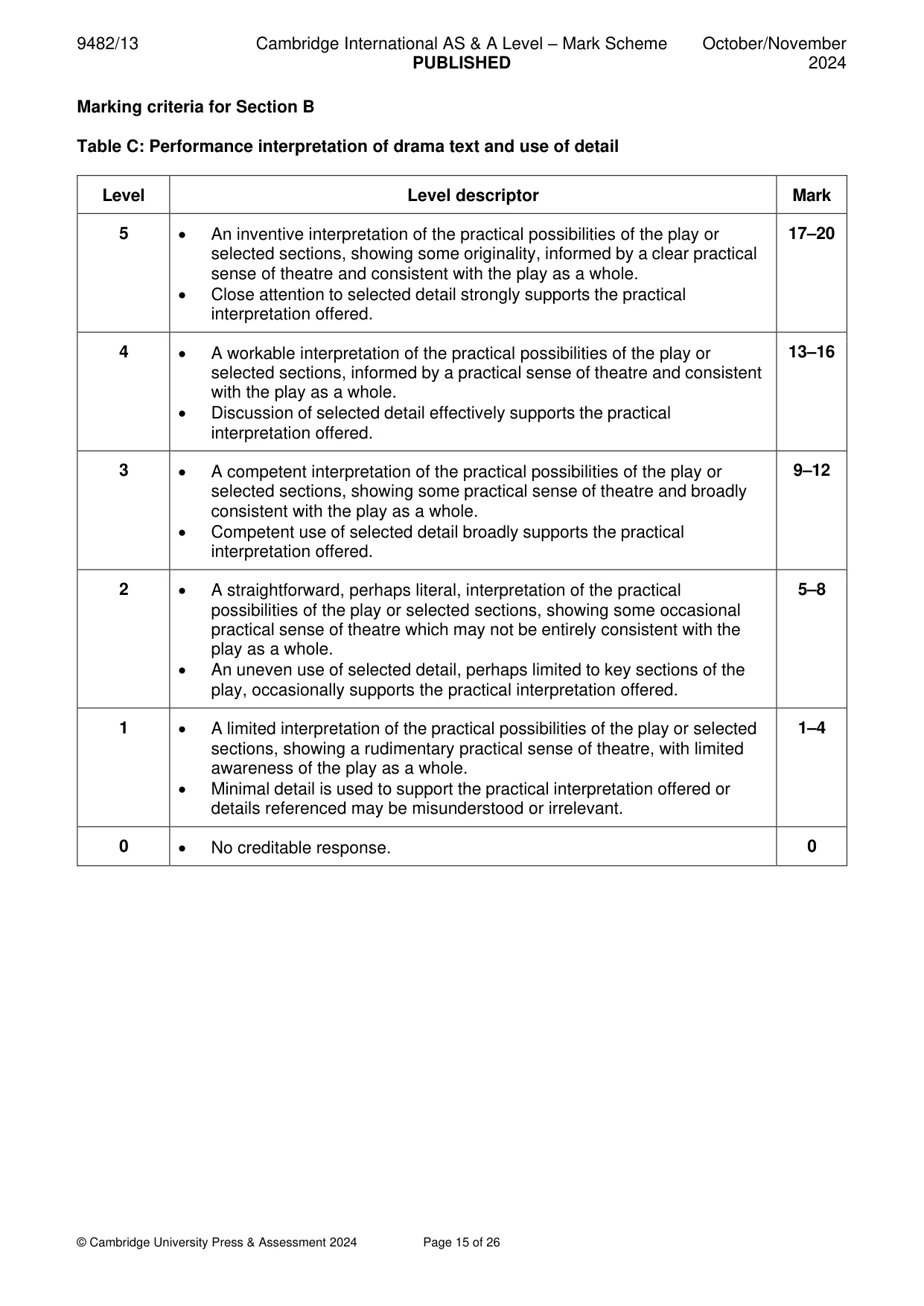
9482/13 Cambridge International AS & A Level – Mark Scheme PUBLISHED October/November 2024 © Cambridge University Press & Assessment 2024 Page 15 of 26 Marking criteria for Section B Table C: Performance interpretation of drama text and use of detail Level Level descriptor Mark 5 • An inventive interpretation of the practical possibilities of the play or selected sections, showing some originality, informed by a clear practical sense of theatre and consistent with the play as a whole. • Close attention to selected detail strongly supports the practical interpretation offered. 17–20 4 • A workable interpretation of the practical possibilities of the play or selected sections, informed by a practical sense of theatre and consistent with the play as a whole. • Discussion of selected detail effectively supports the practical interpretation offered. 13–16 3 • A competent interpretation of the practical possibilities of the play or selected sections, showing some practical sense of theatre and broadly consistent with the play as a whole. • Competent use of selected detail broadly supports the practical interpretation offered. 9–12 2 • A straightforward, perhaps literal, interpretation of the practical possibilities of the play or selected sections, showing some occasional practical sense of theatre which may not be entirely consistent with the play as a whole. • An uneven use of selected detail, perhaps limited to key sections of the play, occasionally supports the practical interpretation offered. 5–8 1 • A limited interpretation of the practical possibilities of the play or selected sections, showing a rudimentary practical sense of theatre, with limited awareness of the play as a whole. • Minimal detail is used to support the practical interpretation offered or details referenced may be misunderstood or irrelevant. 1–4 0 • No creditable response. 0
Mark scheme, page 16
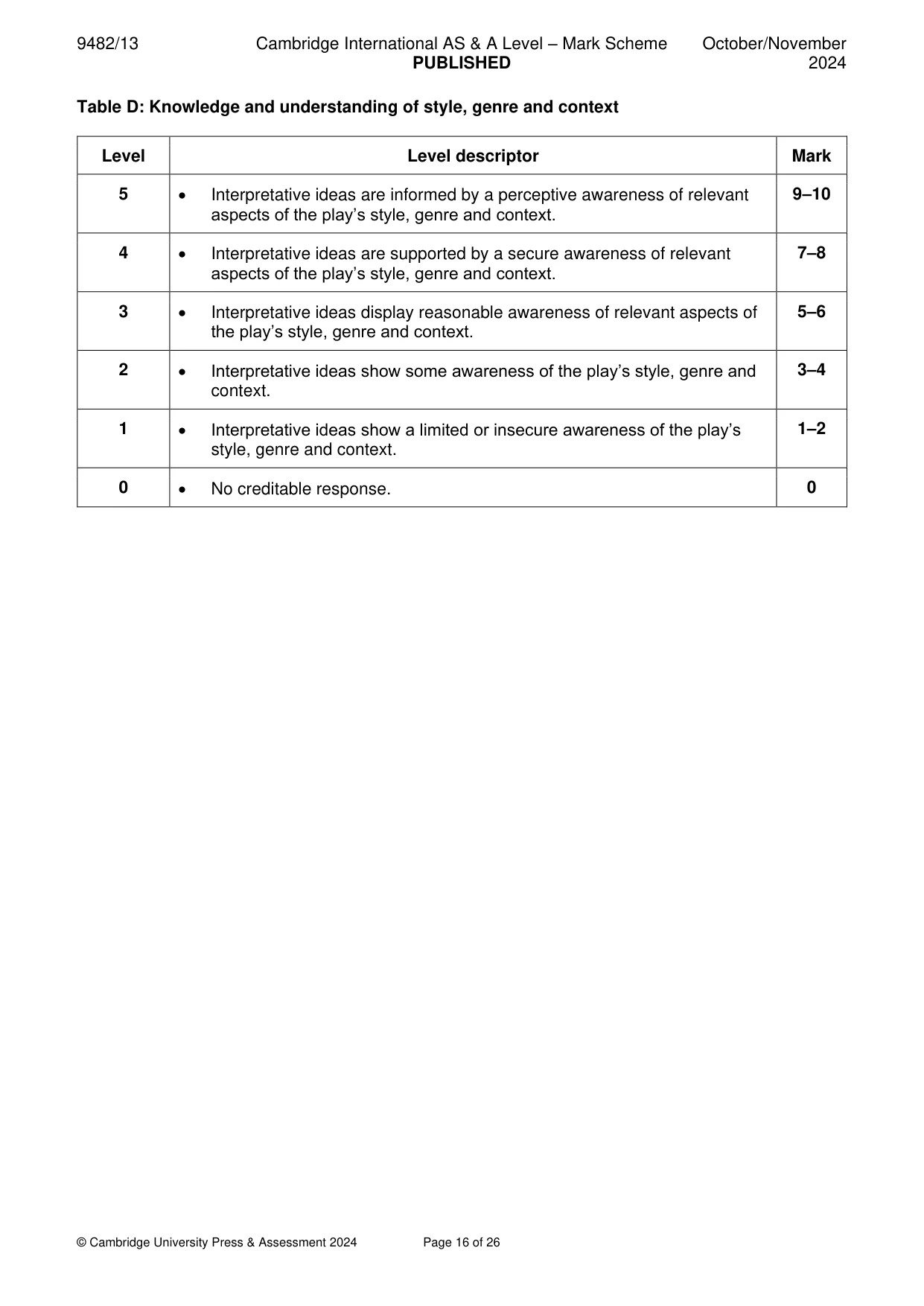
9482/13 Cambridge International AS & A Level – Mark Scheme PUBLISHED October/November 2024 © Cambridge University Press & Assessment 2024 Page 16 of 26 Table D: Knowledge and understanding of style, genre and context Level Level descriptor Mark 5 • Interpretative ideas are informed by a perceptive awareness of relevant aspects of the play’s style, genre and context. 9–10 4 • Interpretative ideas are supported by a secure awareness of relevant aspects of the play’s style, genre and context. 7–8 3 • Interpretative ideas display reasonable awareness of relevant aspects of the play’s style, genre and context. 5–6 2 • Interpretative ideas show some awareness of the play’s style, genre and context. 3–4 1 • Interpretative ideas show a limited or insecure awareness of the play’s style, genre and context. 1–2 0 • No creditable response. 0
Mark scheme, page 17
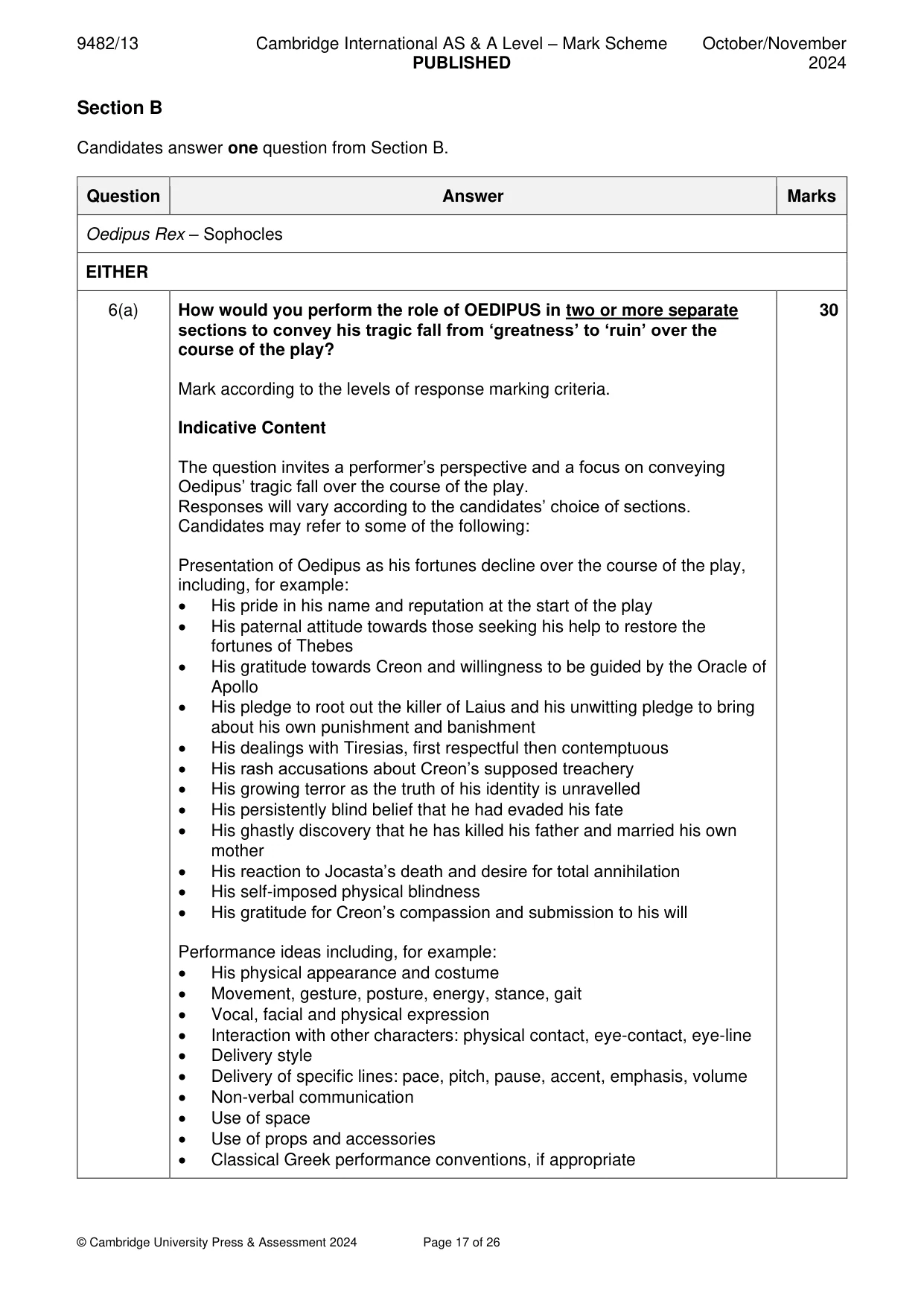
9482/13 Cambridge International AS & A Level – Mark Scheme PUBLISHED October/November 2024 © Cambridge University Press & Assessment 2024 Page 17 of 26 Section B Candidates answer one question from Section B. Question Answer Marks Oedipus Rex – Sophocles EITHER 6(a) How would you perform the role of OEDIPUS in two or more separate sections to convey his tragic fall from ‘greatness’ to ‘ruin’ over the course of the play? Mark according to the levels of response marking criteria. Indicative Content The question invites a performer’s perspective and a focus on conveying Oedipus’ tragic fall over the course of the play. Responses will vary according to the candidates’ choice of sections. Candidates may refer to some of the following: Presentation of Oedipus as his fortunes decline over the course of the play, including, for example: • His pride in his name and reputation at the start of the play • His paternal attitude towards those seeking his help to restore the fortunes of Thebes • His gratitude towards Creon and willingness to be guided by the Oracle of Apollo • His pledge to root out the killer of Laius and his unwitting pledge to bring about his own punishment and banishment • His dealings with Tiresias, first respectful then contemptuous • His rash accusations about Creon’s supposed treachery • His growing terror as the truth of his identity is unravelled • His persistently blind belief that he had evaded his fate • His ghastly discovery that he has killed his father and married his own mother • His reaction to Jocasta’s death and desire for total annihilation • His self-imposed physical blindness • His gratitude for Creon’s compassion and submission to his will Performance ideas including, for example: • His physical appearance and costume • Movement, gesture, posture, energy, stance, gait • Vocal, facial and physical expression • Interaction with other characters: physical contact, eye-contact, eye-line • Delivery style • Delivery of specific lines: pace, pitch, pause, accent, emphasis, volume • Non-verbal communication • Use of space • Use of props and accessories • Classical Greek performance conventions, if appropriate 30
Mark scheme, page 18
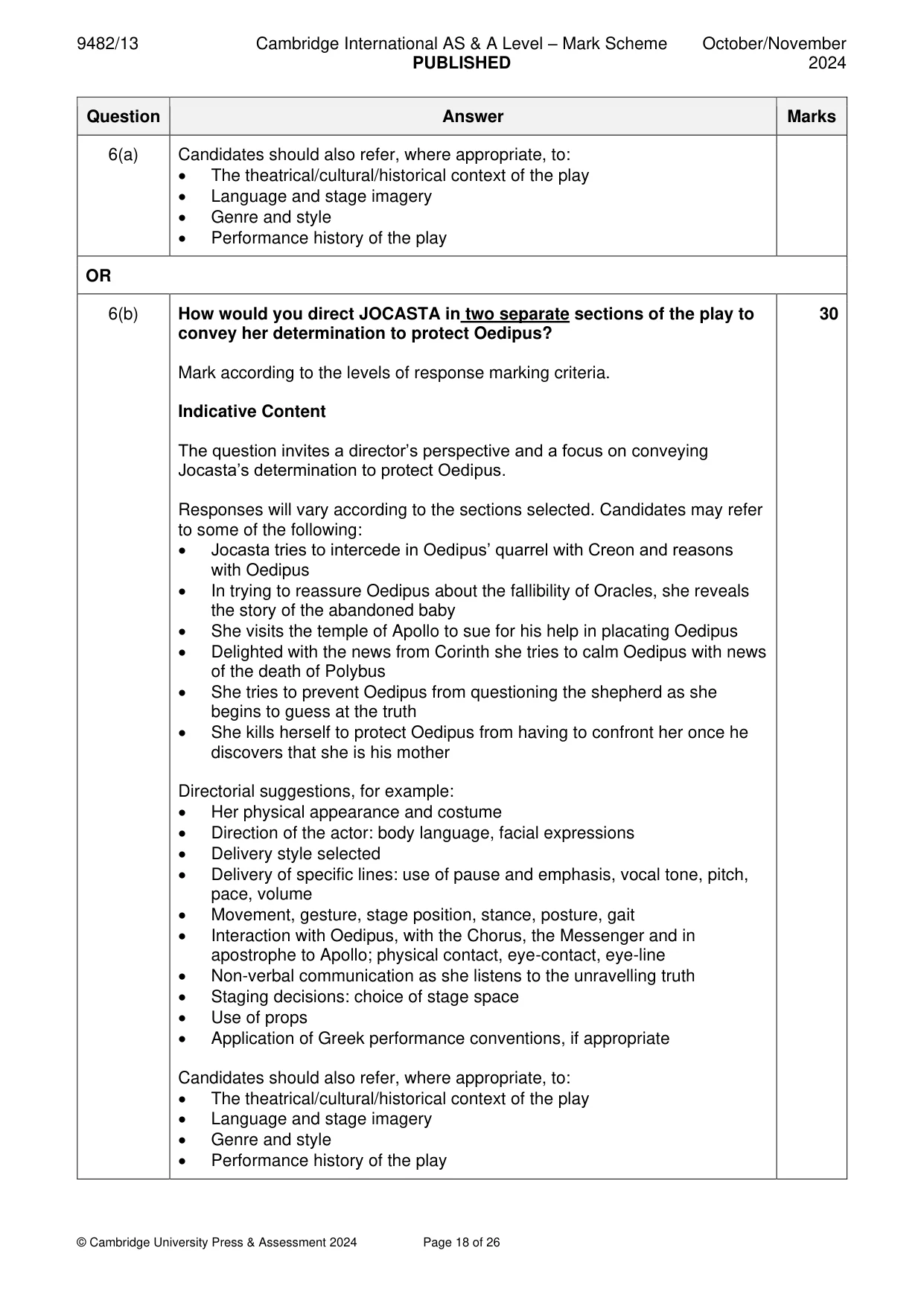
9482/13 Cambridge International AS & A Level – Mark Scheme PUBLISHED October/November 2024 © Cambridge University Press & Assessment 2024 Page 18 of 26 Question Answer Marks 6(a) Candidates should also refer, where appropriate, to: • The theatrical/cultural/historical context of the play • Language and stage imagery • Genre and style • Performance history of the play OR 6(b) How would you direct JOCASTA in two separate sections of the play to convey her determination to protect Oedipus? Mark according to the levels of response marking criteria. Indicative Content The question invites a director’s perspective and a focus on conveying Jocasta’s determination to protect Oedipus. Responses will vary according to the sections selected. Candidates may refer to some of the following: • Jocasta tries to intercede in Oedipus’ quarrel with Creon and reasons with Oedipus • In trying to reassure Oedipus about the fallibility of Oracles, she reveals the story of the abandoned baby • She visits the temple of Apollo to sue for his help in placating Oedipus • Delighted with the news from Corinth she tries to calm Oedipus with news of the death of Polybus • She tries to prevent Oedipus from questioning the shepherd as she begins to guess at the truth • She kills herself to protect Oedipus from having to confront her once he discovers that she is his mother Directorial suggestions, for example: • Her physical appearance and costume • Direction of the actor: body language, facial expressions • Delivery style selected • Delivery of specific lines: use of pause and emphasis, vocal tone, pitch, pace, volume • Movement, gesture, stage position, stance, posture, gait • Interaction with Oedipus, with the Chorus, the Messenger and in apostrophe to Apollo; physical contact, eye-contact, eye-line • Non-verbal communication as she listens to the unravelling truth • Staging decisions: choice of stage space • Use of props • Application of Greek performance conventions, if appropriate Candidates should also refer, where appropriate, to: • The theatrical/cultural/historical context of the play • Language and stage imagery • Genre and style • Performance history of the play 30
Mark scheme, page 19
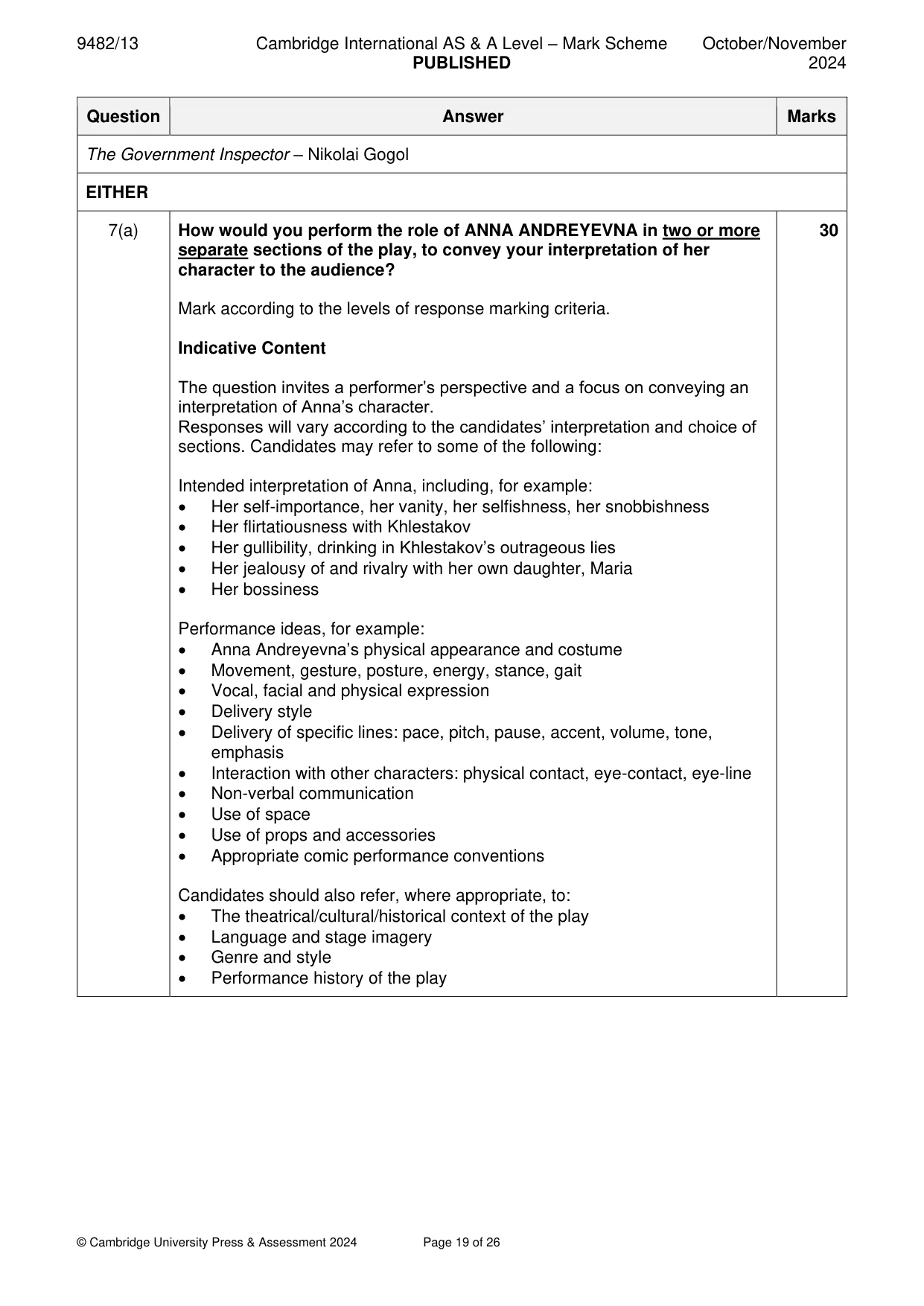
9482/13 Cambridge International AS & A Level – Mark Scheme PUBLISHED October/November 2024 © Cambridge University Press & Assessment 2024 Page 19 of 26 Question Answer Marks The Government Inspector – Nikolai Gogol EITHER 7(a) How would you perform the role of ANNA ANDREYEVNA in two or more separate sections of the play, to convey your interpretation of her character to the audience? Mark according to the levels of response marking criteria. Indicative Content The question invites a performer’s perspective and a focus on conveying an interpretation of Anna’s character. Responses will vary according to the candidates’ interpretation and choice of sections. Candidates may refer to some of the following: Intended interpretation of Anna, including, for example: • Her self-importance, her vanity, her selfishness, her snobbishness • Her flirtatiousness with Khlestakov • Her gullibility, drinking in Khlestakov’s outrageous lies • Her jealousy of and rivalry with her own daughter, Maria • Her bossiness Performance ideas, for example: • Anna Andreyevna’s physical appearance and costume • Movement, gesture, posture, energy, stance, gait • Vocal, facial and physical expression • Delivery style • Delivery of specific lines: pace, pitch, pause, accent, volume, tone, emphasis • Interaction with other characters: physical contact, eye-contact, eye-line • Non-verbal communication • Use of space • Use of props and accessories • Appropriate comic performance conventions Candidates should also refer, where appropriate, to: • The theatrical/cultural/historical context of the play • Language and stage imagery • Genre and style • Performance history of the play 30
Mark scheme, page 20
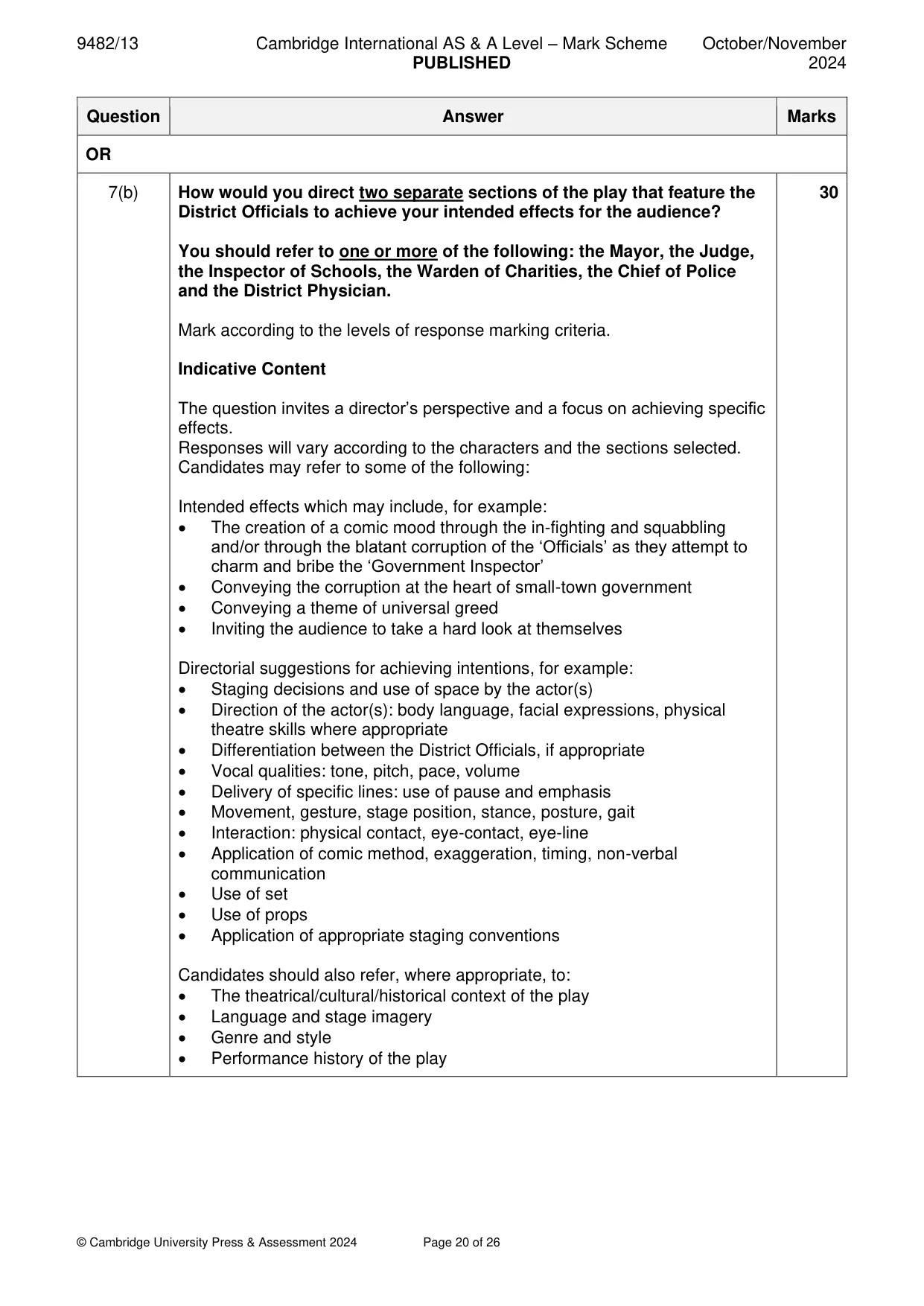
9482/13 Cambridge International AS & A Level – Mark Scheme PUBLISHED October/November 2024 © Cambridge University Press & Assessment 2024 Page 20 of 26 Question Answer Marks OR 7(b) How would you direct two separate sections of the play that feature the District Officials to achieve your intended effects for the audience? You should refer to one or more of the following: the Mayor, the Judge, the Inspector of Schools, the Warden of Charities, the Chief of Police and the District Physician. Mark according to the levels of response marking criteria. Indicative Content The question invites a director’s perspective and a focus on achieving specific effects. Responses will vary according to the characters and the sections selected. Candidates may refer to some of the following: Intended effects which may include, for example: • The creation of a comic mood through the in-fighting and squabbling and/or through the blatant corruption of the ‘Officials’ as they attempt to charm and bribe the ‘Government Inspector’ • Conveying the corruption at the heart of small-town government • Conveying a theme of universal greed • Inviting the audience to take a hard look at themselves Directorial suggestions for achieving intentions, for example: • Staging decisions and use of space by the actor(s) • Direction of the actor(s): body language, facial expressions, physical theatre skills where appropriate • Differentiation between the District Officials, if appropriate • Vocal qualities: tone, pitch, pace, volume • Delivery of specific lines: use of pause and emphasis • Movement, gesture, stage position, stance, posture, gait • Interaction: physical contact, eye-contact, eye-line • Application of comic method, exaggeration, timing, non-verbal communication • Use of set • Use of props • Application of appropriate staging conventions Candidates should also refer, where appropriate, to: • The theatrical/cultural/historical context of the play • Language and stage imagery • Genre and style • Performance history of the play 30
Mark scheme, page 21
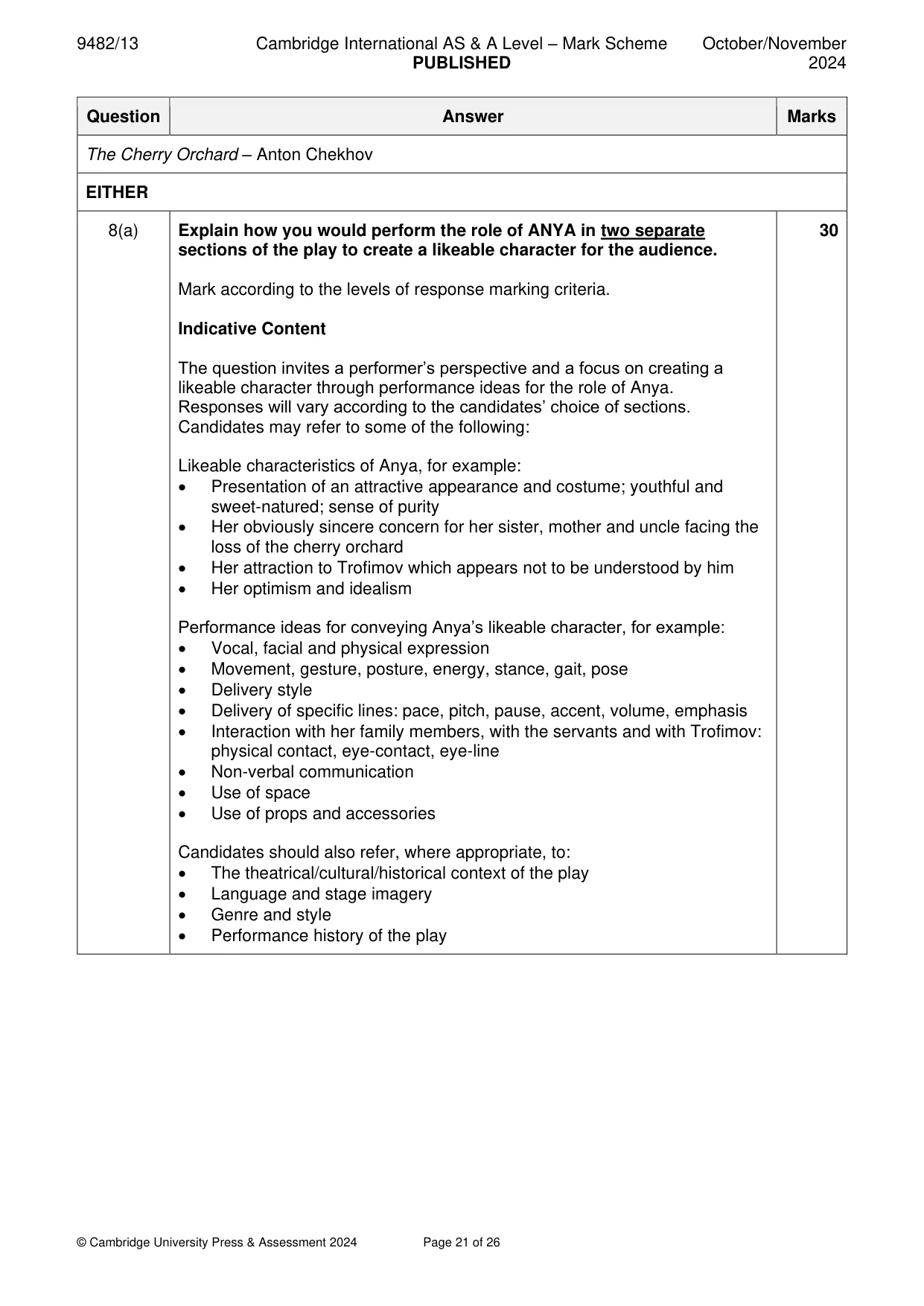
9482/13 Cambridge International AS & A Level – Mark Scheme PUBLISHED October/November 2024 © Cambridge University Press & Assessment 2024 Page 21 of 26 Question Answer Marks The Cherry Orchard – Anton Chekhov EITHER 8(a) Explain how you would perform the role of ANYA in two separate sections of the play to create a likeable character for the audience. Mark according to the levels of response marking criteria. Indicative Content The question invites a performer’s perspective and a focus on creating a likeable character through performance ideas for the role of Anya. Responses will vary according to the candidates’ choice of sections. Candidates may refer to some of the following: Likeable characteristics of Anya, for example: • Presentation of an attractive appearance and costume; youthful and sweet-natured; sense of purity • Her obviously sincere concern for her sister, mother and uncle facing the loss of the cherry orchard • Her attraction to Trofimov which appears not to be understood by him • Her optimism and idealism Performance ideas for conveying Anya’s likeable character, for example: • Vocal, facial and physical expression • Movement, gesture, posture, energy, stance, gait, pose • Delivery style • Delivery of specific lines: pace, pitch, pause, accent, volume, emphasis • Interaction with her family members, with the servants and with Trofimov: physical contact, eye-contact, eye-line • Non-verbal communication • Use of space • Use of props and accessories Candidates should also refer, where appropriate, to: • The theatrical/cultural/historical context of the play • Language and stage imagery • Genre and style • Performance history of the play 30
Mark scheme, page 22
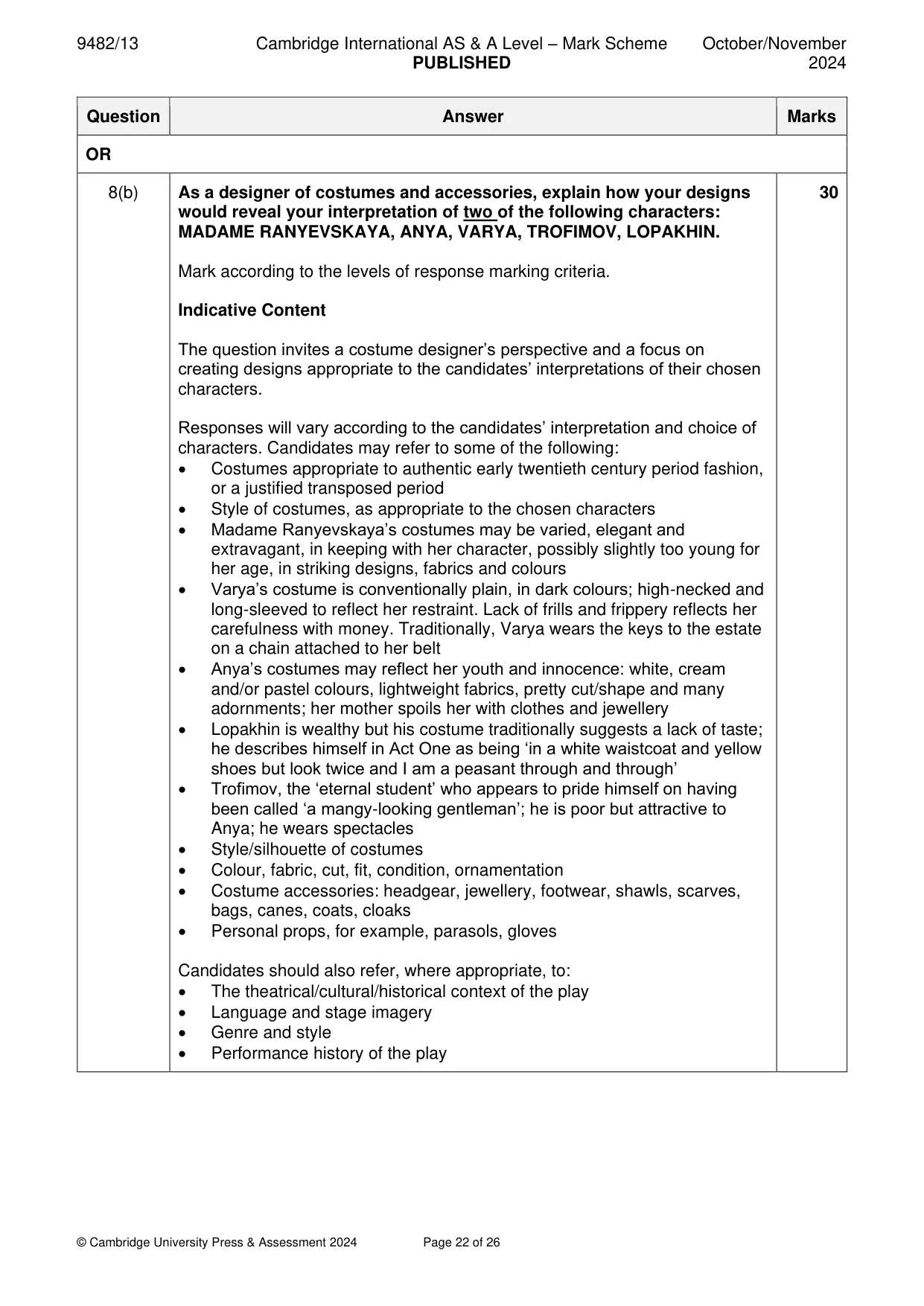
9482/13 Cambridge International AS & A Level – Mark Scheme PUBLISHED October/November 2024 © Cambridge University Press & Assessment 2024 Page 22 of 26 Question Answer Marks OR 8(b) As a designer of costumes and accessories, explain how your designs would reveal your interpretation of two of the following characters: MADAME RANYEVSKAYA, ANYA, VARYA, TROFIMOV, LOPAKHIN. Mark according to the levels of response marking criteria. Indicative Content The question invites a costume designer’s perspective and a focus on creating designs appropriate to the candidates’ interpretations of their chosen characters. Responses will vary according to the candidates’ interpretation and choice of characters. Candidates may refer to some of the following: • Costumes appropriate to authentic early twentieth century period fashion, or a justified transposed period • Style of costumes, as appropriate to the chosen characters • Madame Ranyevskaya’s costumes may be varied, elegant and extravagant, in keeping with her character, possibly slightly too young for her age, in striking designs, fabrics and colours • Varya’s costume is conventionally plain, in dark colours; high-necked and long-sleeved to reflect her restraint. Lack of frills and frippery reflects her carefulness with money. Traditionally, Varya wears the keys to the estate on a chain attached to her belt • Anya’s costumes may reflect her youth and innocence: white, cream and/or pastel colours, lightweight fabrics, pretty cut/shape and many adornments; her mother spoils her with clothes and jewellery • Lopakhin is wealthy but his costume traditionally suggests a lack of taste; he describes himself in Act One as being ‘in a white waistcoat and yellow shoes but look twice and I am a peasant through and through’ • Trofimov, the ‘eternal student’ who appears to pride himself on having been called ‘a mangy-looking gentleman’; he is poor but attractive to Anya; he wears spectacles • Style/silhouette of costumes • Colour, fabric, cut, fit, condition, ornamentation • Costume accessories: headgear, jewellery, footwear, shawls, scarves, bags, canes, coats, cloaks • Personal props, for example, parasols, gloves Candidates should also refer, where appropriate, to: • The theatrical/cultural/historical context of the play • Language and stage imagery • Genre and style • Performance history of the play 30
Mark scheme, page 23
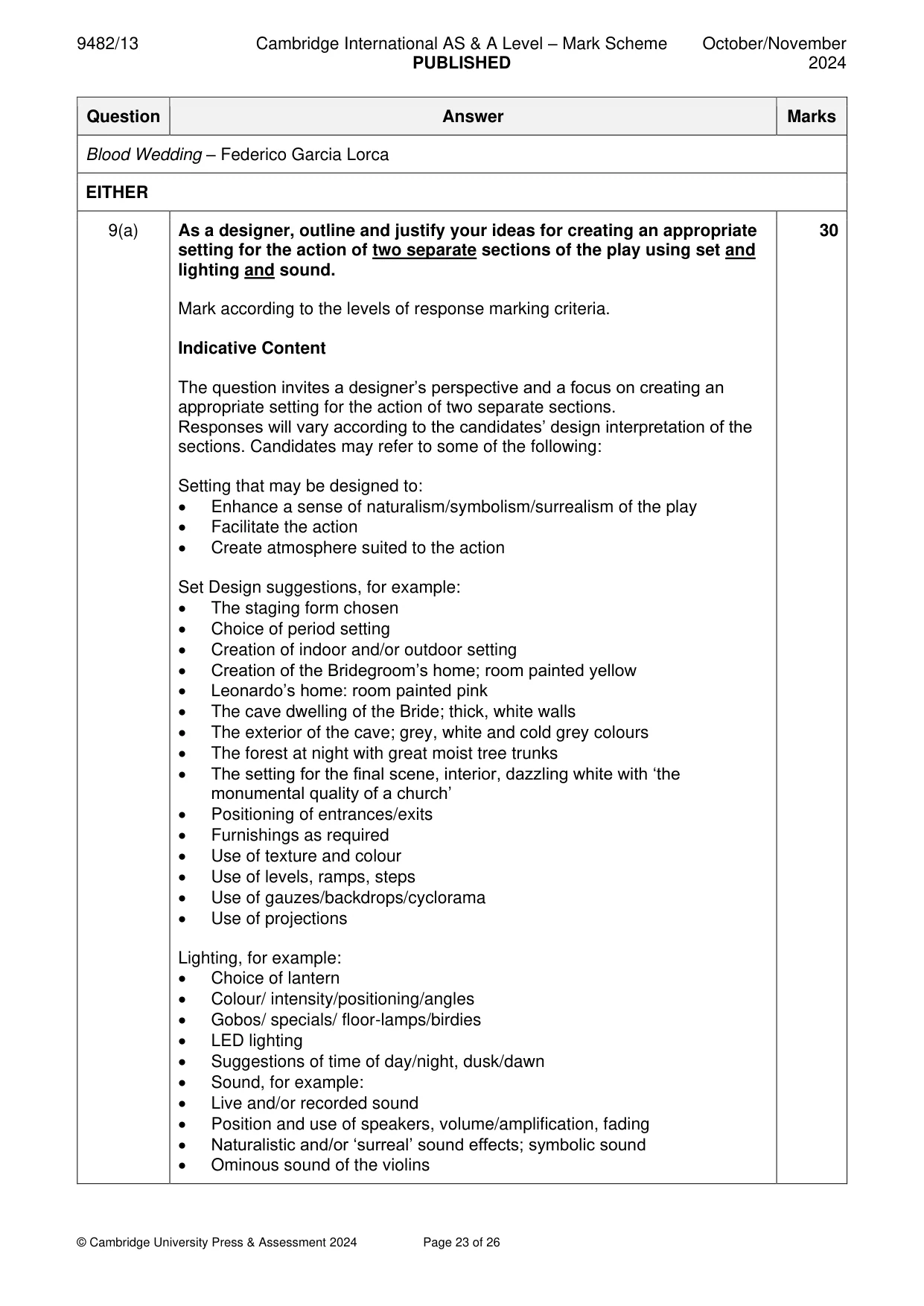
9482/13 Cambridge International AS & A Level – Mark Scheme PUBLISHED October/November 2024 © Cambridge University Press & Assessment 2024 Page 23 of 26 Question Answer Marks Blood Wedding – Federico Garcia Lorca EITHER 9(a) As a designer, outline and justify your ideas for creating an appropriate setting for the action of two separate sections of the play using set and lighting and sound. Mark according to the levels of response marking criteria. Indicative Content The question invites a designer’s perspective and a focus on creating an appropriate setting for the action of two separate sections. Responses will vary according to the candidates’ design interpretation of the sections. Candidates may refer to some of the following: Setting that may be designed to: • Enhance a sense of naturalism/symbolism/surrealism of the play • Facilitate the action • Create atmosphere suited to the action Set Design suggestions, for example: • The staging form chosen • Choice of period setting • Creation of indoor and/or outdoor setting • Creation of the Bridegroom’s home; room painted yellow • Leonardo’s home: room painted pink • The cave dwelling of the Bride; thick, white walls • The exterior of the cave; grey, white and cold grey colours • The forest at night with great moist tree trunks • The setting for the final scene, interior, dazzling white with ‘the monumental quality of a church’ • Positioning of entrances/exits • Furnishings as required • Use of texture and colour • Use of levels, ramps, steps • Use of gauzes/backdrops/cyclorama • Use of projections Lighting, for example: • Choice of lantern • Colour/ intensity/positioning/angles • Gobos/ specials/ floor-lamps/birdies • LED lighting • Suggestions of time of day/night, dusk/dawn • Sound, for example: • Live and/or recorded sound • Position and use of speakers, volume/amplification, fading • Naturalistic and/or ‘surreal’ sound effects; symbolic sound • Ominous sound of the violins 30
Mark scheme, page 24
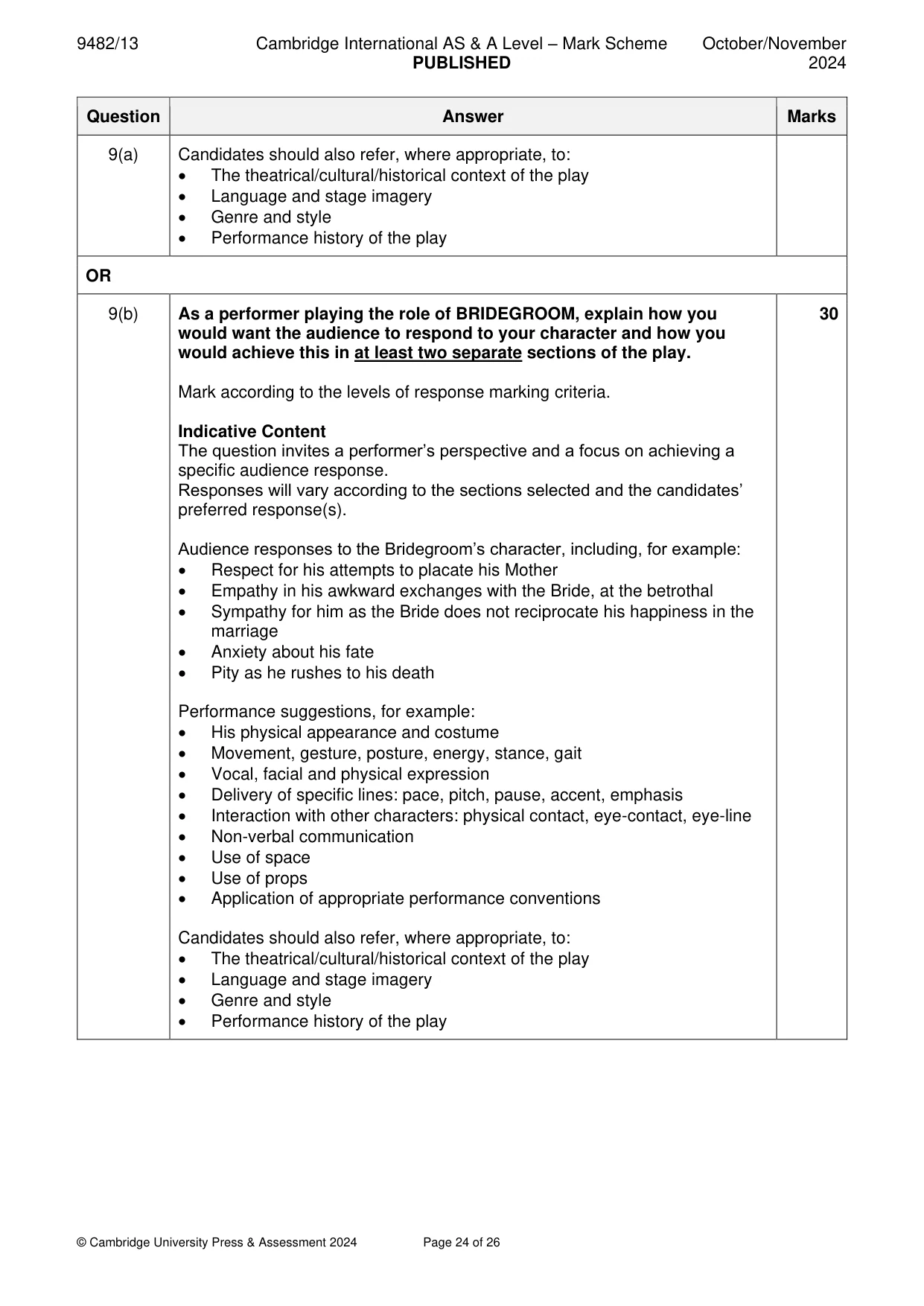
9482/13 Cambridge International AS & A Level – Mark Scheme PUBLISHED October/November 2024 © Cambridge University Press & Assessment 2024 Page 24 of 26 Question Answer Marks 9(a) Candidates should also refer, where appropriate, to: • The theatrical/cultural/historical context of the play • Language and stage imagery • Genre and style • Performance history of the play OR 9(b) As a performer playing the role of BRIDEGROOM, explain how you would want the audience to respond to your character and how you would achieve this in at least two separate sections of the play. Mark according to the levels of response marking criteria. Indicative Content The question invites a performer’s perspective and a focus on achieving a specific audience response. Responses will vary according to the sections selected and the candidates’ preferred response(s). Audience responses to the Bridegroom’s character, including, for example: • Respect for his attempts to placate his Mother • Empathy in his awkward exchanges with the Bride, at the betrothal • Sympathy for him as the Bride does not reciprocate his happiness in the marriage • Anxiety about his fate • Pity as he rushes to his death Performance suggestions, for example: • His physical appearance and costume • Movement, gesture, posture, energy, stance, gait • Vocal, facial and physical expression • Delivery of specific lines: pace, pitch, pause, accent, emphasis • Interaction with other characters: physical contact, eye-contact, eye-line • Non-verbal communication • Use of space • Use of props • Application of appropriate performance conventions Candidates should also refer, where appropriate, to: • The theatrical/cultural/historical context of the play • Language and stage imagery • Genre and style • Performance history of the play 30
Mark scheme, page 25
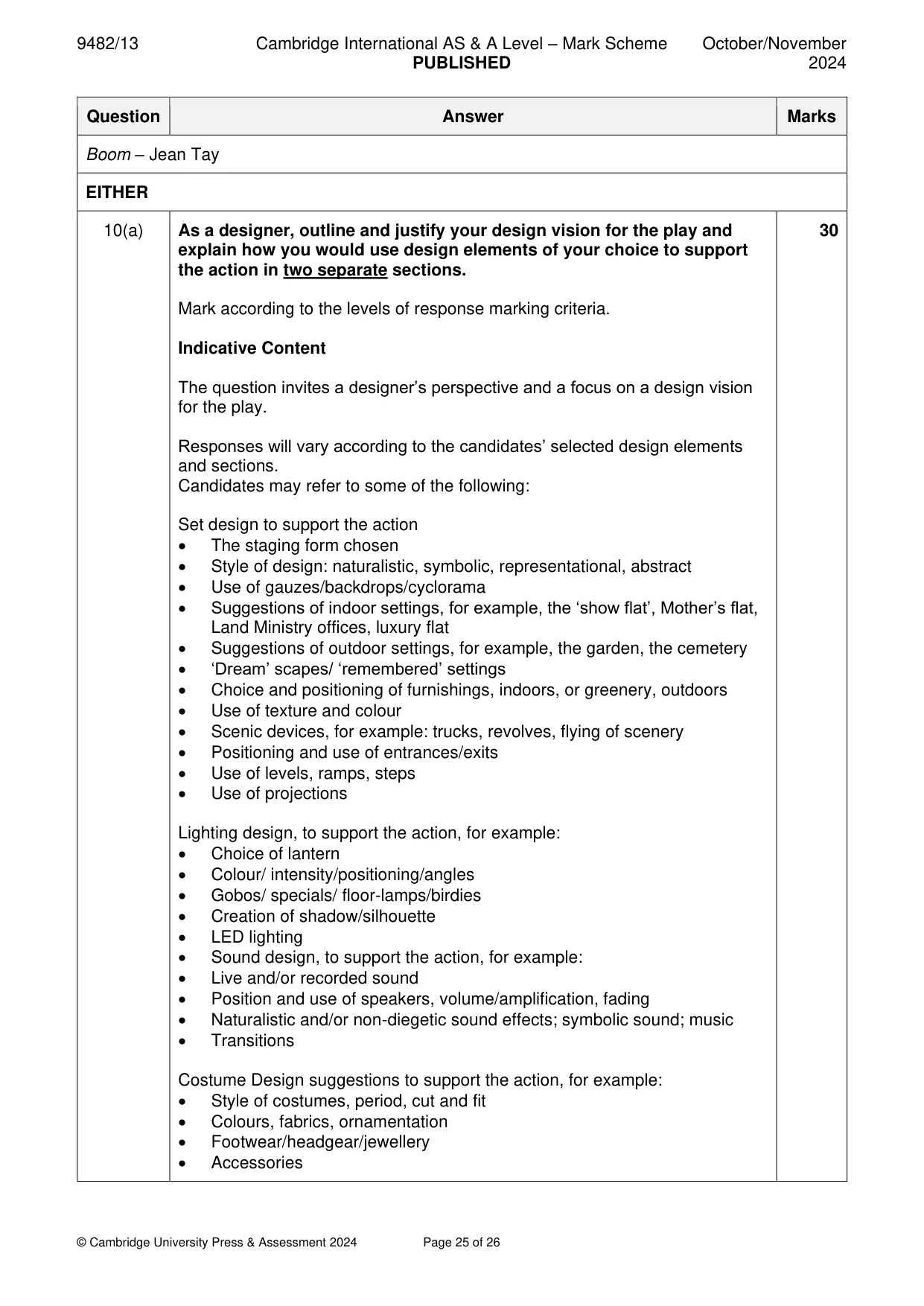
9482/13 Cambridge International AS & A Level – Mark Scheme PUBLISHED October/November 2024 © Cambridge University Press & Assessment 2024 Page 25 of 26 Question Answer Marks Boom – Jean Tay EITHER 10(a) As a designer, outline and justify your design vision for the play and explain how you would use design elements of your choice to support the action in two separate sections. Mark according to the levels of response marking criteria. Indicative Content The question invites a designer’s perspective and a focus on a design vision for the play. Responses will vary according to the candidates’ selected design elements and sections. Candidates may refer to some of the following: Set design to support the action • The staging form chosen • Style of design: naturalistic, symbolic, representational, abstract • Use of gauzes/backdrops/cyclorama • Suggestions of indoor settings, for example, the ‘show flat’, Mother’s flat, Land Ministry offices, luxury flat • Suggestions of outdoor settings, for example, the garden, the cemetery • ‘Dream’ scapes/ ‘remembered’ settings • Choice and positioning of furnishings, indoors, or greenery, outdoors • Use of texture and colour • Scenic devices, for example: trucks, revolves, flying of scenery • Positioning and use of entrances/exits • Use of levels, ramps, steps • Use of projections Lighting design, to support the action, for example: • Choice of lantern • Colour/ intensity/positioning/angles • Gobos/ specials/ floor-lamps/birdies • Creation of shadow/silhouette • LED lighting • Sound design, to support the action, for example: • Live and/or recorded sound • Position and use of speakers, volume/amplification, fading • Naturalistic and/or non-diegetic sound effects; symbolic sound; music • Transitions Costume Design suggestions to support the action, for example: • Style of costumes, period, cut and fit • Colours, fabrics, ornamentation • Footwear/headgear/jewellery • Accessories 30
Mark scheme, page 26
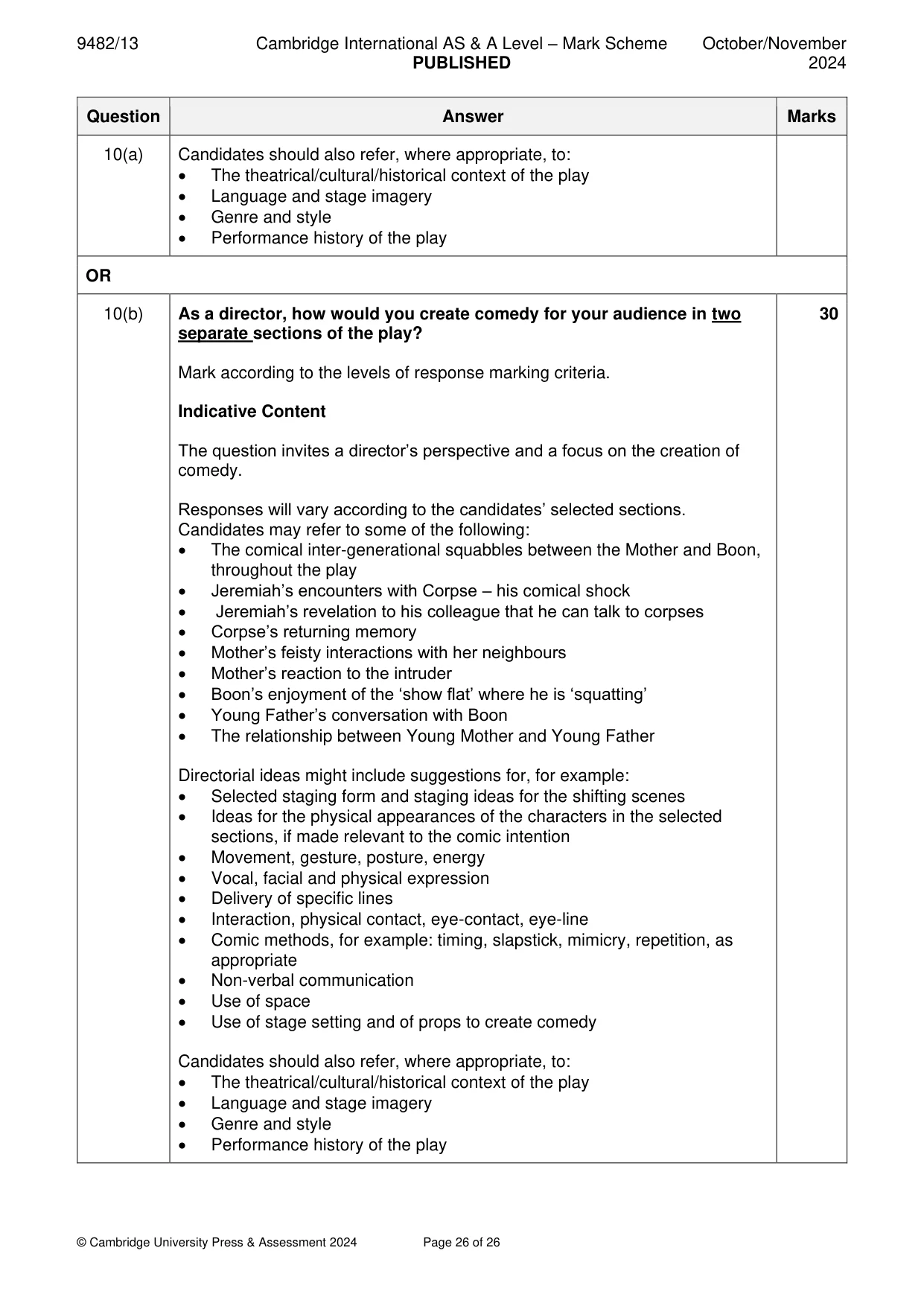
9482/13 Cambridge International AS & A Level – Mark Scheme PUBLISHED October/November 2024 © Cambridge University Press & Assessment 2024 Page 26 of 26 Question Answer Marks 10(a) Candidates should also refer, where appropriate, to: • The theatrical/cultural/historical context of the play • Language and stage imagery • Genre and style • Performance history of the play OR 10(b) As a director, how would you create comedy for your audience in two separate sections of the play? Mark according to the levels of response marking criteria. Indicative Content The question invites a director’s perspective and a focus on the creation of comedy. Responses will vary according to the candidates’ selected sections. Candidates may refer to some of the following: • The comical inter-generational squabbles between the Mother and Boon, throughout the play • Jeremiah’s encounters with Corpse – his comical shock • Jeremiah’s revelation to his colleague that he can talk to corpses • Corpse’s returning memory • Mother’s feisty interactions with her neighbours • Mother’s reaction to the intruder • Boon’s enjoyment of the ‘show flat’ where he is ‘squatting’ • Young Father’s conversation with Boon • The relationship between Young Mother and Young Father Directorial ideas might include suggestions for, for example: • Selected staging form and staging ideas for the shifting scenes • Ideas for the physical appearances of the characters in the selected sections, if made relevant to the comic intention • Movement, gesture, posture, energy • Vocal, facial and physical expression • Delivery of specific lines • Interaction, physical contact, eye-contact, eye-line • Comic methods, for example: timing, slapstick, mimicry, repetition, as appropriate • Non-verbal communication • Use of space • Use of stage setting and of props to create comedy Candidates should also refer, where appropriate, to: • The theatrical/cultural/historical context of the play • Language and stage imagery • Genre and style • Performance history of the play 30
What you needed in this session
Cambridge’s own grade thresholds for 2024 Oct/Nov, Paper 1 · Variant 3. A higher threshold means an easier paper — the bar moves with how the cohort did.