Cambridge A Level Drama 9482 — 2024 May/June Paper 1 · Variant 3
9482/13/M/J/24 · 60 marks · 120 min
The question paper and its mark scheme, free to read here and free to download. This is Cambridge’s own paper, exactly as it was sat.
Question paper8 pages


Mark scheme26 pages
Answers below. Sit the paper first if you are practising.
Paper as text
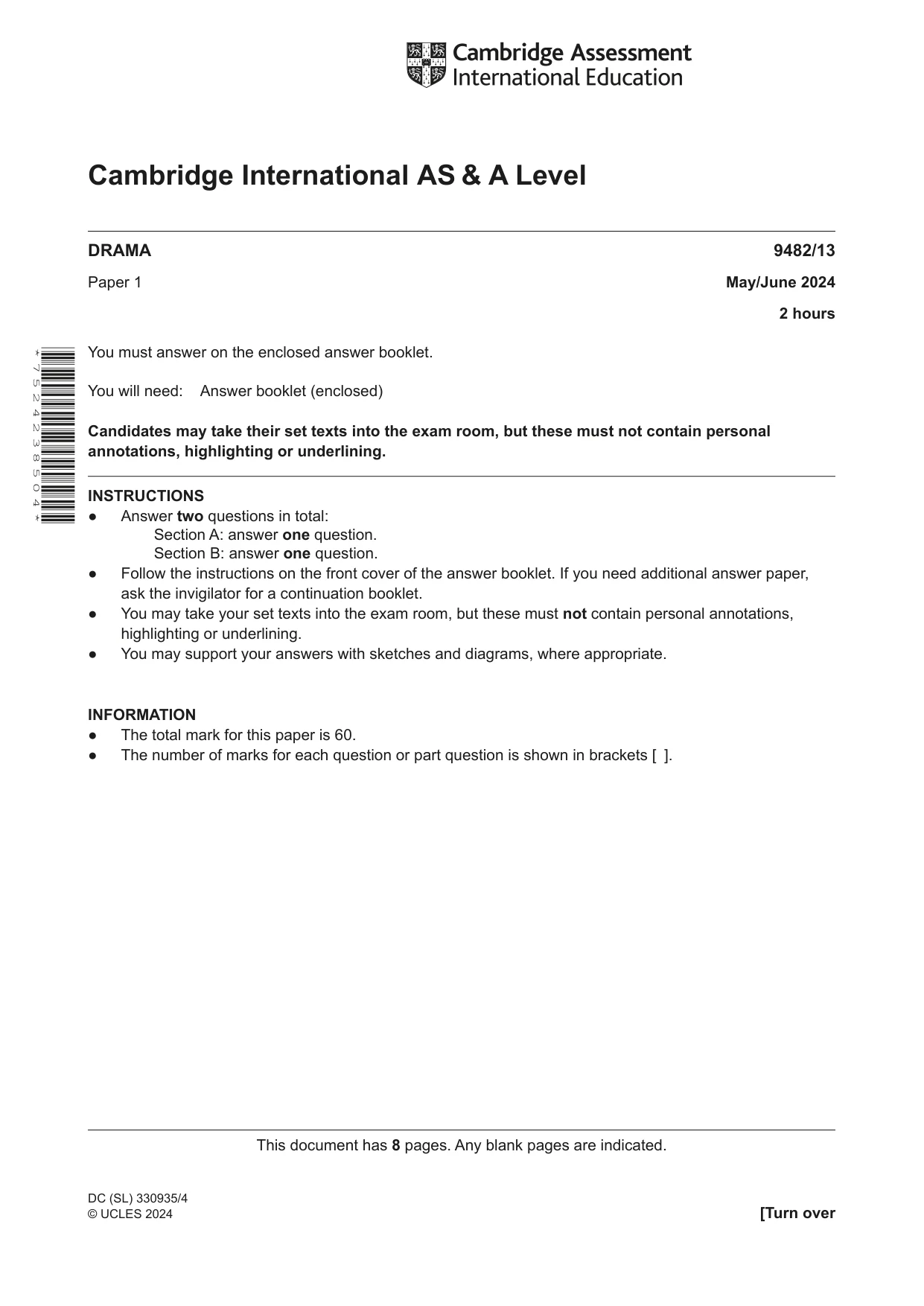
Question paper, page 1
This document has 8 pages. Any blank pages are indicated. [Turn over Cambridge International AS & A Level DRAMA 9482/13 Paper 1 May/June 2024 2 hours You must answer on the enclosed answer booklet. You will need: Answer booklet (enclosed) Candidates may take their set texts into the exam room, but these must not contain personal annotations, highlighting or underlining. INSTRUCTIONS ● Answer two questions in total: Section A: answer one question. Section B: answer one question. ● Follow the instructions on the front cover of the answer booklet. If you need additional answer paper, ask the invigilator for a continuation booklet. ● You may take your set texts into the exam room, but these must not contain personal annotations, highlighting or underlining. ● You may support your answers with sketches and diagrams, where appropriate. INFORMATION ● The total mark for this paper is 60. ● The number of marks for each question or part question is shown in brackets [ ]. * 7 5 2 4 2 3 8 5 0 4 * DC (SL) 330935/4 © UCLES 2024
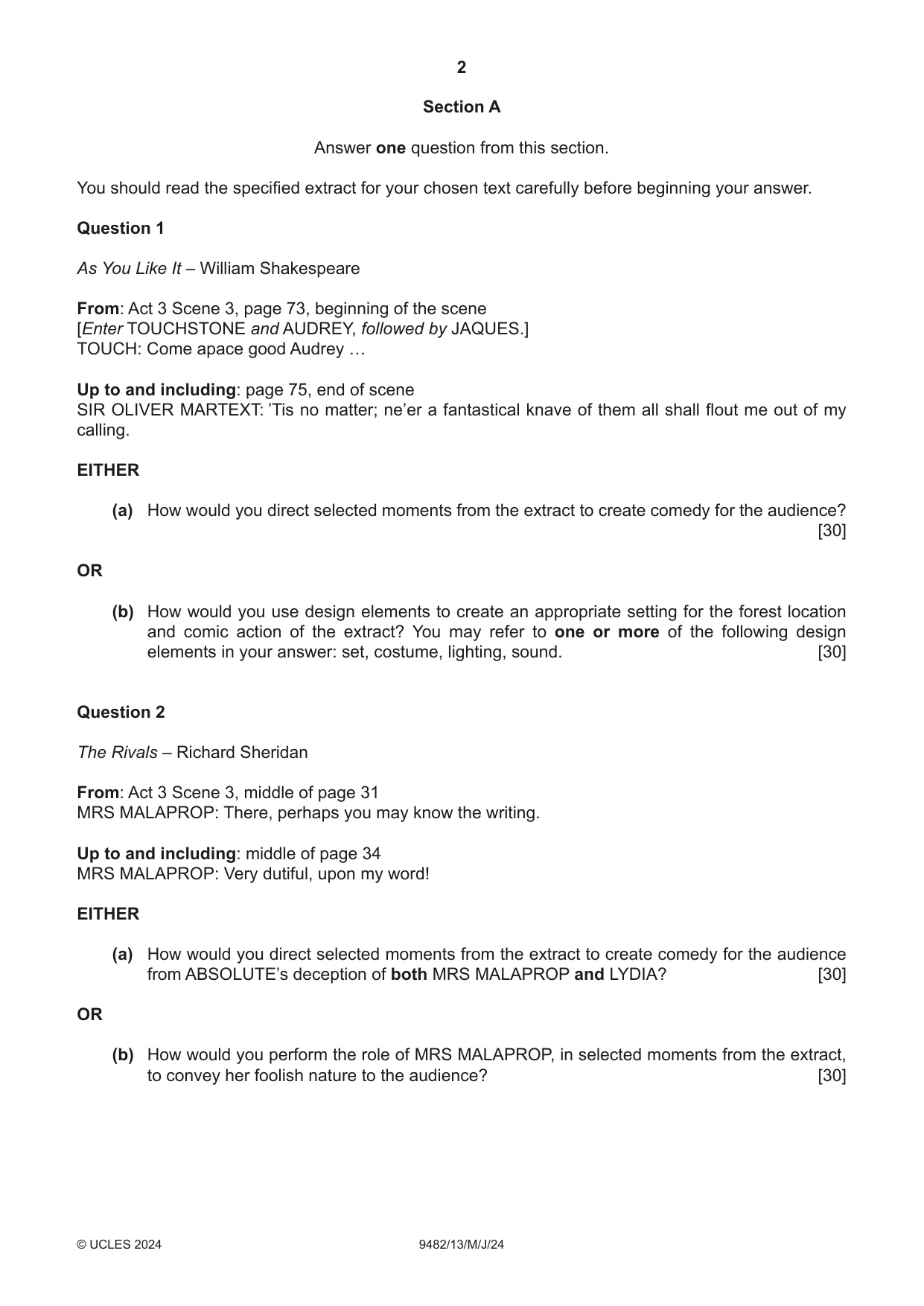
Question paper, page 2
2 9482/13/M/J/24 © UCLES 2024 Section A Answer one question from this section. You should read the specified extract for your chosen text carefully before beginning your answer. Question 1 As You Like It – William Shakespeare From: Act 3 Scene 3, page 73, beginning of the scene [Enter TOUCHSTONE and AUDREY, followed by JAQUES.] TOUCH: Come apace good Audrey … Up to and including: page 75, end of scene SIR OLIVER MARTEXT: ̓ Tis no matter; ne’er a fantastical knave of them all shall flout me out of my calling. EITHER (a) How would you direct selected moments from the extract to create comedy for the audience? [30] OR (b) How would you use design elements to create an appropriate setting for the forest location and comic action of the extract? You may refer to one or more of the following design elements in your answer: set, costume, lighting, sound. [30] Question 2 The Rivals – Richard Sheridan From: Act 3 Scene 3, middle of page 31 MRS MALAPROP: There, perhaps you may know the writing. Up to and including: middle of page 34 MRS MALAPROP: Very dutiful, upon my word! EITHER (a) How would you direct selected moments from the extract to create comedy for the audience from ABSOLUTE’s deception of both MRS MALAPROP and LYDIA? [30] OR (b) How would you perform the role of MRS MALAPROP, in selected moments from the extract, to convey her foolish nature to the audience? [30]
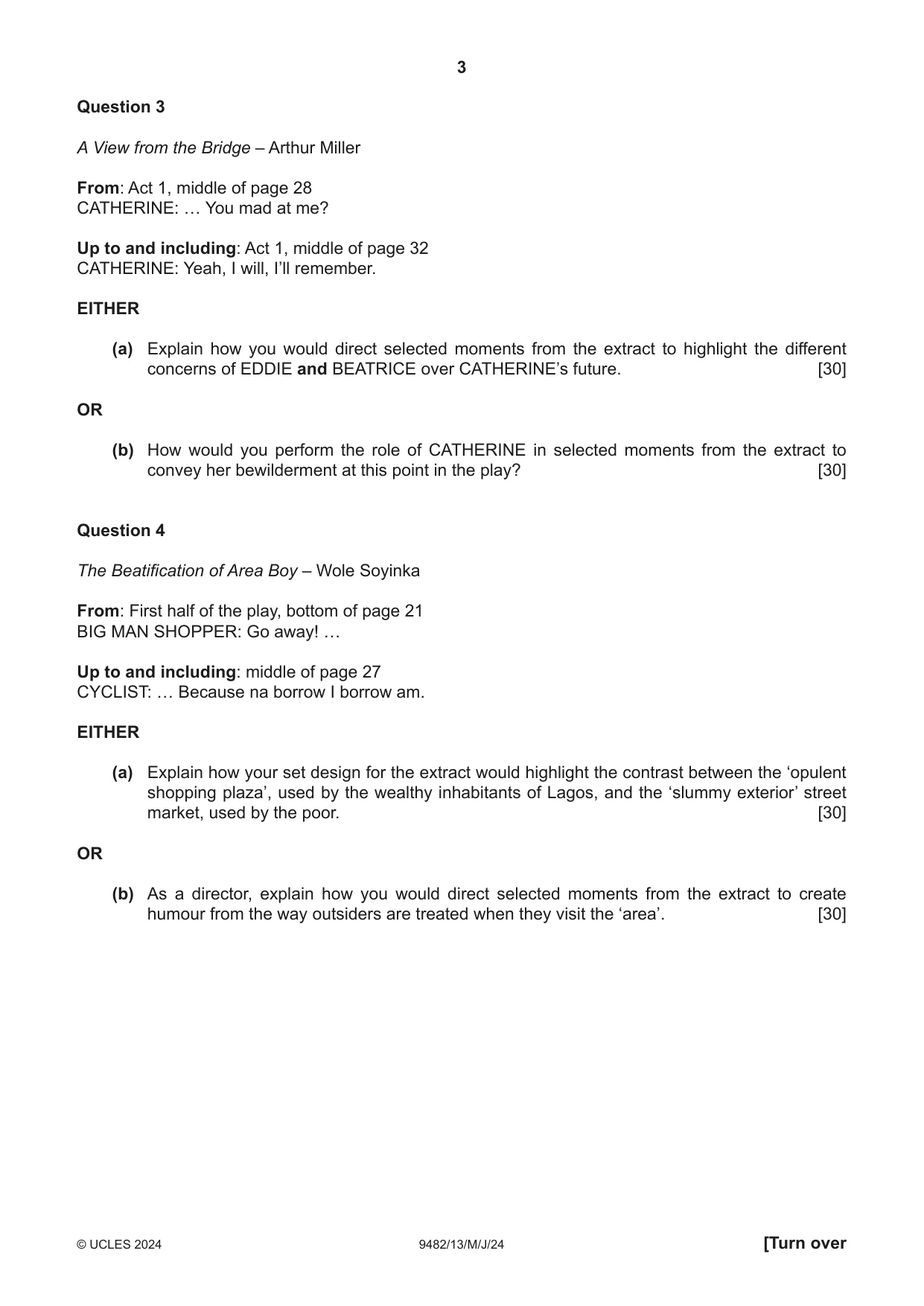
Question paper, page 3
3 9482/13/M/J/24 © UCLES 2024 [Turn over Question 3 A View from the Bridge – Arthur Miller From: Act 1, middle of page 28 CATHERINE: … You mad at me? Up to and including: Act 1, middle of page 32 CATHERINE: Yeah, I will, I’ll remember. EITHER (a) Explain how you would direct selected moments from the extract to highlight the different concerns of EDDIE and BEATRICE over CATHERINE’s future. [30] OR (b) How would you perform the role of CATHERINE in selected moments from the extract to convey her bewilderment at this point in the play? [30] Question 4 The Beatification of Area Boy – Wole Soyinka From: First half of the play, bottom of page 21 BIG MAN SHOPPER: Go away! … Up to and including: middle of page 27 CYCLIST: … Because na borrow I borrow am. EITHER (a) Explain how your set design for the extract would highlight the contrast between the ‘opulent shopping plaza’, used by the wealthy inhabitants of Lagos, and the ‘slummy exterior’ street market, used by the poor. [30] OR (b) As a director, explain how you would direct selected moments from the extract to create humour from the way outsiders are treated when they visit the ‘area’. [30]
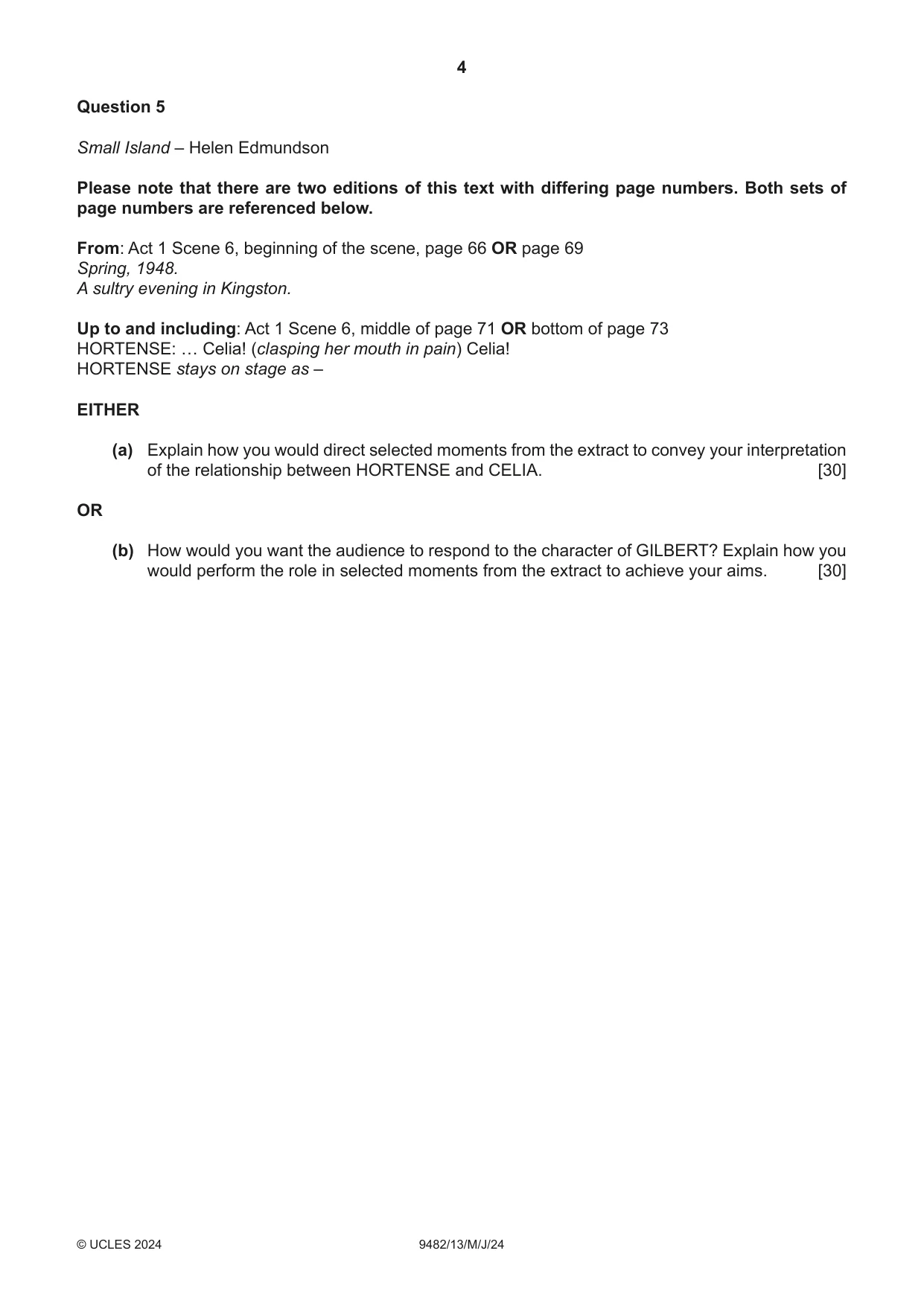
Question paper, page 4
4 9482/13/M/J/24 © UCLES 2024 Question 5 Small Island – Helen Edmundson Please note that there are two editions of this text with differing page numbers. Both sets of page numbers are referenced below. From: Act 1 Scene 6, beginning of the scene, page 66 OR page 69 Spring, 1948. A sultry evening in Kingston. Up to and including: Act 1 Scene 6, middle of page 71 OR bottom of page 73 HORTENSE: … Celia! (clasping her mouth in pain) Celia! HORTENSE stays on stage as – EITHER (a) Explain how you would direct selected moments from the extract to convey your interpretation of the relationship between HORTENSE and CELIA. [30] OR (b) How would you want the audience to respond to the character of GILBERT? Explain how you would perform the role in selected moments from the extract to achieve your aims. [30]
Question paper, page 5
5 9482/13/M/J/24 © UCLES 2024 [Turn over Section B Answer one question from this section. Question 6 Oedipus Rex – Sophocles EITHER (a) How would you direct the CHORUS in two separate sections of the play to achieve your intended effects for the audience? [30] OR (b) How would you perform the role of TIRESIAS in two separate sections from his scene of confrontation with OEDIPUS to convey his powers of prophecy to the audience? [30] Question 7 The Government Inspector – Nikolai Gogol EITHER (a) How would you direct the MAYOR in two or more separate sections of the play to create comedy from his ready acceptance of KHLESTAKOV’s incredible lies? [30] OR (b) As a set designer, explain how your designs for one section set in the MAYOR’s home and for one section set in KHLESTAKOV’s room at the inn would enhance the comedy for the audience. [30] Question 8 The Cherry Orchard – Anton Chekhov EITHER (a) Explain how you would perform the role of VARYA in two separate sections of the play to convey your interpretation of her character. [30] OR (b) How would you direct two of the minor characters, YEPIKHODOV, DUNYASHA, CHARLOTTA, FIRS, to create Chekhov’s style of comedy for the audience? You should refer to two or more sections of the play. [30]
Question paper, page 6
6 9482/13/M/J/24 © UCLES 2024 Question 9 Blood Wedding – Federico Garcia Lorca EITHER (a) How would you direct the actor playing LEONARDO in one section where he is interacting with the WIFE and one section where he is interacting with the BRIDE to convey his different feelings for the two women? [30] OR (b) As a performer playing the role of MOTHER, explain how you would want the audience to respond to your character and how you would achieve this in two or more separate sections of the play. [30] Question 10 Boom – Jean Tay EITHER (a) How would you direct two or more separate sections of interaction between BOON and MOTHER to convey the nature of their relationship? [30] OR (b) How would you perform the role of JEREMIAH in two or more separate sections of the play to convey your interpretation of his character to the audience? [30]
Question paper, page 7
7 9482/13/M/J/24 © UCLES 2024 BLANK PAGE
Question paper, page 8
8 9482/13/M/J/24 © UCLES 2024 Permission to reproduce items where third-party owned material protected by copyright is included has been sought and cleared where possible. Every reasonable effort has been made by the publisher (UCLES) to trace copyright holders, but if any items requiring clearance have unwittingly been included, the publisher will be pleased to make amends at the earliest possible opportunity. To avoid the issue of disclosure of answer-related information to candidates, all copyright acknowledgements are reproduced online in the Cambridge Assessment International Education Copyright Acknowledgements Booklet. This is produced for each series of examinations and is freely available to download at www.cambridgeinternational.org after the live examination series. Cambridge Assessment International Education is part of Cambridge Assessment. Cambridge Assessment is the brand name of the University of Cambridge Local Examinations Syndicate (UCLES), which is a department of the University of Cambridge. BLANK PAGE
Mark scheme, page 1
This document consists of 26 printed pages. © Cambridge University Press & Assessment 2024 [Turn over Cambridge International AS & A Level DRAMA 9482/13 Paper 1 Open-Book Written Examination May/June 2024 MARK SCHEME Maximum Mark: 60 Published This mark scheme is published as an aid to teachers and candidates, to indicate the requirements of the examination. It shows the basis on which Examiners were instructed to award marks. It does not indicate the details of the discussions that took place at an Examiners’ meeting before marking began, which would have considered the acceptability of alternative answers. Mark schemes should be read in conjunction with the question paper and the Principal Examiner Report for Teachers. Cambridge International will not enter into discussions about these mark schemes. Cambridge International is publishing the mark schemes for the May/June 2024 series for most Cambridge IGCSE, Cambridge International A and AS Level and Cambridge Pre-U components, and some Cambridge O Level components.
Mark scheme, page 2
9482/13 Cambridge International AS & A Level – Mark Scheme PUBLISHED May/June 2024 © Cambridge University Press & Assessment 2024 Page 2 of 26 Generic Marking Principles These general marking principles must be applied by all examiners when marking candidate answers. They should be applied alongside the specific content of the mark scheme or generic level descriptions for a question. Each question paper and mark scheme will also comply with these marking principles. GENERIC MARKING PRINCIPLE 1: Marks must be awarded in line with: the specific content of the mark scheme or the generic level descriptors for the question the specific skills defined in the mark scheme or in the generic level descriptors for the question the standard of response required by a candidate as exemplified by the standardisation scripts. GENERIC MARKING PRINCIPLE 2: Marks awarded are always whole marks (not half marks, or other fractions). GENERIC MARKING PRINCIPLE 3: Marks must be awarded positively: marks are awarded for correct/valid answers, as defined in the mark scheme. However, credit is given for valid answers which go beyond the scope of the syllabus and mark scheme, referring to your Team Leader as appropriate marks are awarded when candidates clearly demonstrate what they know and can do marks are not deducted for errors marks are not deducted for omissions answers should only be judged on the quality of spelling, punctuation and grammar when these features are specifically assessed by the question as indicated by the mark scheme. The meaning, however, should be unambiguous. GENERIC MARKING PRINCIPLE 4: Rules must be applied consistently, e.g. in situations where candidates have not followed instructions or in the application of generic level descriptors. GENERIC MARKING PRINCIPLE 5: Marks should be awarded using the full range of marks defined in the mark scheme for the question (however; the use of the full mark range may be limited according to the quality of the candidate responses seen). GENERIC MARKING PRINCIPLE 6: Marks awarded are based solely on the requirements as defined in the mark scheme. Marks should not be awarded with grade thresholds or grade descriptors in mind.
Mark scheme, page 3
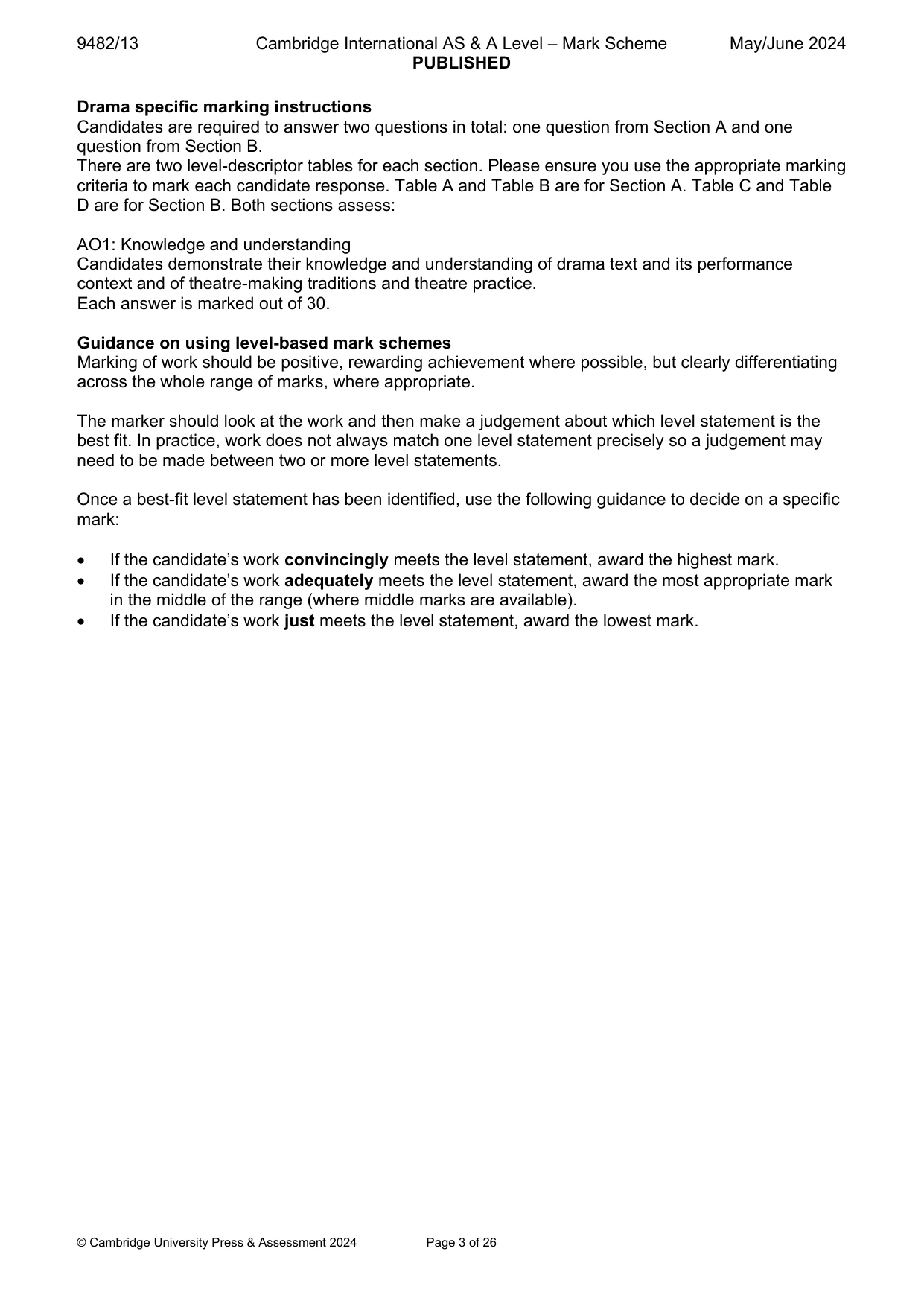
9482/13 Cambridge International AS & A Level – Mark Scheme PUBLISHED May/June 2024 © Cambridge University Press & Assessment 2024 Page 3 of 26 Drama specific marking instructions Candidates are required to answer two questions in total: one question from Section A and one question from Section B. There are two level-descriptor tables for each section. Please ensure you use the appropriate marking criteria to mark each candidate response. Table A and Table B are for Section A. Table C and Table D are for Section B. Both sections assess: AO1: Knowledge and understanding Candidates demonstrate their knowledge and understanding of drama text and its performance context and of theatre-making traditions and theatre practice. Each answer is marked out of 30. Guidance on using level-based mark schemes Marking of work should be positive, rewarding achievement where possible, but clearly differentiating across the whole range of marks, where appropriate. The marker should look at the work and then make a judgement about which level statement is the best fit. In practice, work does not always match one level statement precisely so a judgement may need to be made between two or more level statements. Once a best-fit level statement has been identified, use the following guidance to decide on a specific mark: If the candidate’s work convincingly meets the level statement, award the highest mark. If the candidate’s work adequately meets the level statement, award the most appropriate mark in the middle of the range (where middle marks are available). If the candidate’s work just meets the level statement, award the lowest mark.
Mark scheme, page 4
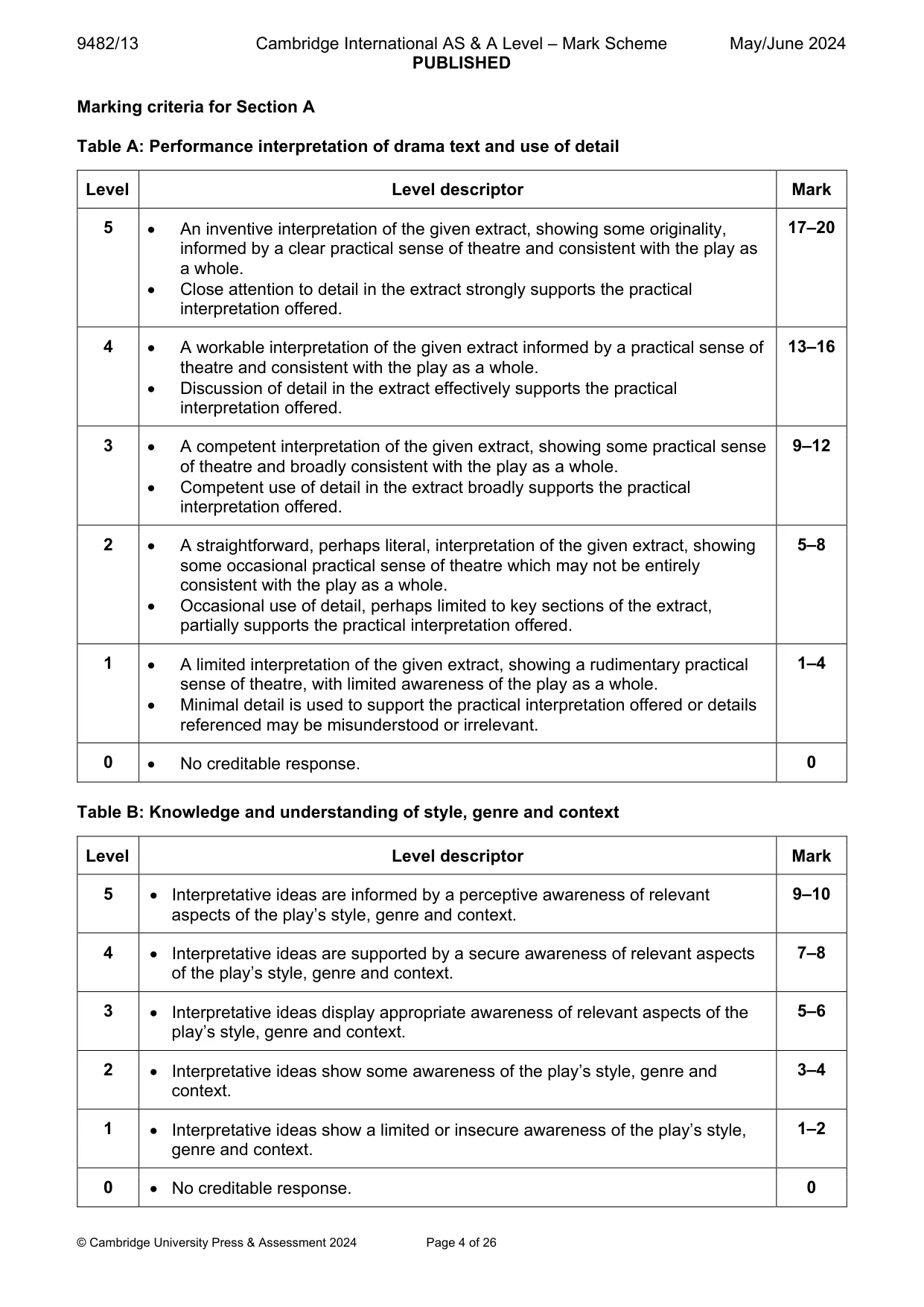
9482/13 Cambridge International AS & A Level – Mark Scheme PUBLISHED May/June 2024 © Cambridge University Press & Assessment 2024 Page 4 of 26 Marking criteria for Section A Table A: Performance interpretation of drama text and use of detail Level Level descriptor Mark 5 An inventive interpretation of the given extract, showing some originality, informed by a clear practical sense of theatre and consistent with the play as a whole. Close attention to detail in the extract strongly supports the practical interpretation offered. 17–20 4 A workable interpretation of the given extract informed by a practical sense of theatre and consistent with the play as a whole. Discussion of detail in the extract effectively supports the practical interpretation offered. 13–16 3 A competent interpretation of the given extract, showing some practical sense of theatre and broadly consistent with the play as a whole. Competent use of detail in the extract broadly supports the practical interpretation offered. 9–12 2 A straightforward, perhaps literal, interpretation of the given extract, showing some occasional practical sense of theatre which may not be entirely consistent with the play as a whole. Occasional use of detail, perhaps limited to key sections of the extract, partially supports the practical interpretation offered. 5–8 1 A limited interpretation of the given extract, showing a rudimentary practical sense of theatre, with limited awareness of the play as a whole. Minimal detail is used to support the practical interpretation offered or details referenced may be misunderstood or irrelevant. 1–4 0 No creditable response. 0 Table B: Knowledge and understanding of style, genre and context Level Level descriptor Mark 5 Interpretative ideas are informed by a perceptive awareness of relevant aspects of the play’s style, genre and context. 9–10 4 Interpretative ideas are supported by a secure awareness of relevant aspects of the play’s style, genre and context. 7–8 3 Interpretative ideas display appropriate awareness of relevant aspects of the play’s style, genre and context. 5–6 2 Interpretative ideas show some awareness of the play’s style, genre and context. 3–4 1 Interpretative ideas show a limited or insecure awareness of the play’s style, genre and context. 1–2 0 No creditable response. 0
Mark scheme, page 5
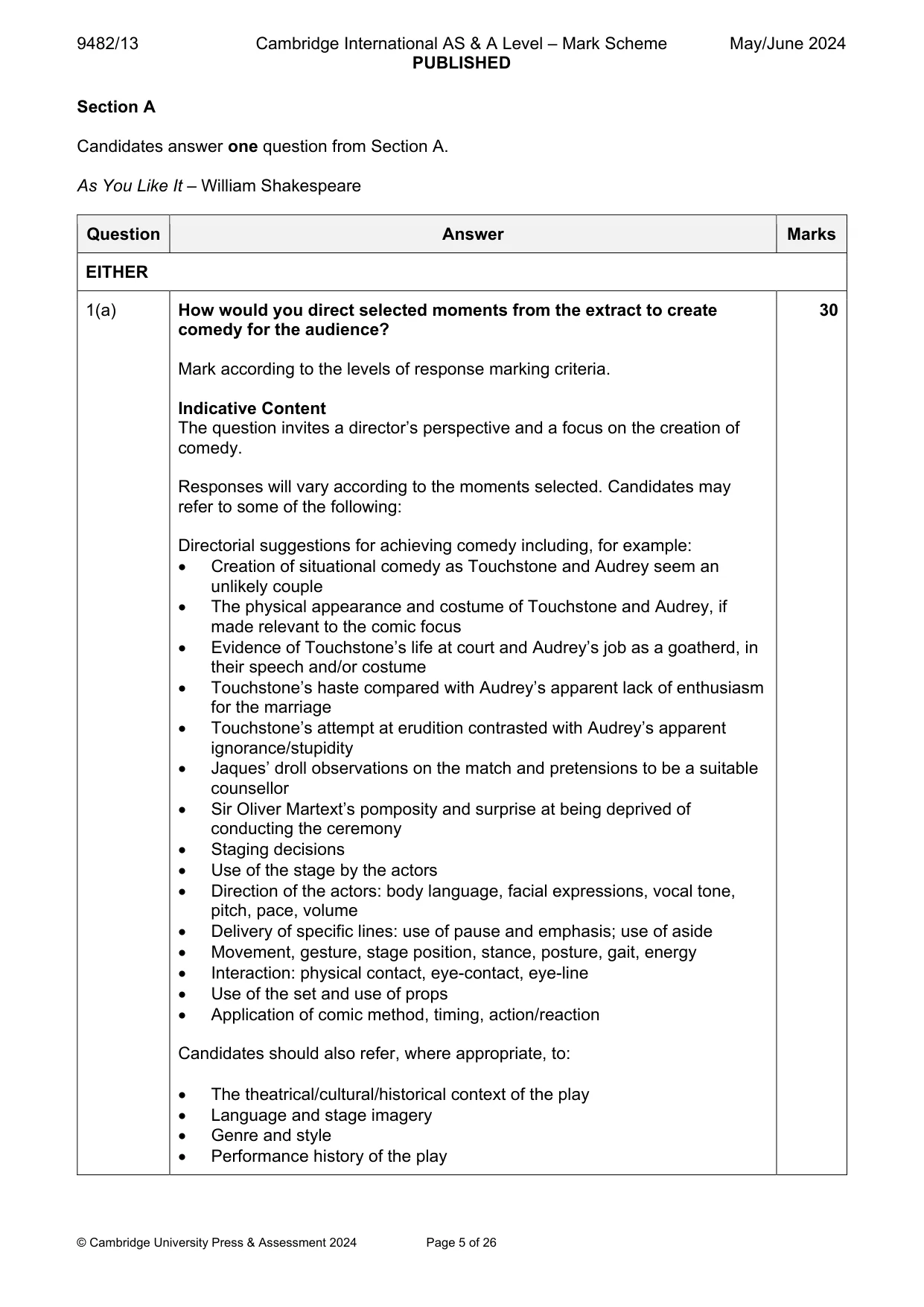
9482/13 Cambridge International AS & A Level – Mark Scheme PUBLISHED May/June 2024 © Cambridge University Press & Assessment 2024 Page 5 of 26 Section A Candidates answer one question from Section A. As You Like It – William Shakespeare Question Answer Marks EITHER 1(a) How would you direct selected moments from the extract to create comedy for the audience? Mark according to the levels of response marking criteria. Indicative Content The question invites a director’s perspective and a focus on the creation of comedy. Responses will vary according to the moments selected. Candidates may refer to some of the following: Directorial suggestions for achieving comedy including, for example: Creation of situational comedy as Touchstone and Audrey seem an unlikely couple The physical appearance and costume of Touchstone and Audrey, if made relevant to the comic focus Evidence of Touchstone’s life at court and Audrey’s job as a goatherd, in their speech and/or costume Touchstone’s haste compared with Audrey’s apparent lack of enthusiasm for the marriage Touchstone’s attempt at erudition contrasted with Audrey’s apparent ignorance/stupidity Jaques’ droll observations on the match and pretensions to be a suitable counsellor Sir Oliver Martext’s pomposity and surprise at being deprived of conducting the ceremony Staging decisions Use of the stage by the actors Direction of the actors: body language, facial expressions, vocal tone, pitch, pace, volume Delivery of specific lines: use of pause and emphasis; use of aside Movement, gesture, stage position, stance, posture, gait, energy Interaction: physical contact, eye-contact, eye-line Use of the set and use of props Application of comic method, timing, action/reaction Candidates should also refer, where appropriate, to: The theatrical/cultural/historical context of the play Language and stage imagery Genre and style Performance history of the play 30
Mark scheme, page 6
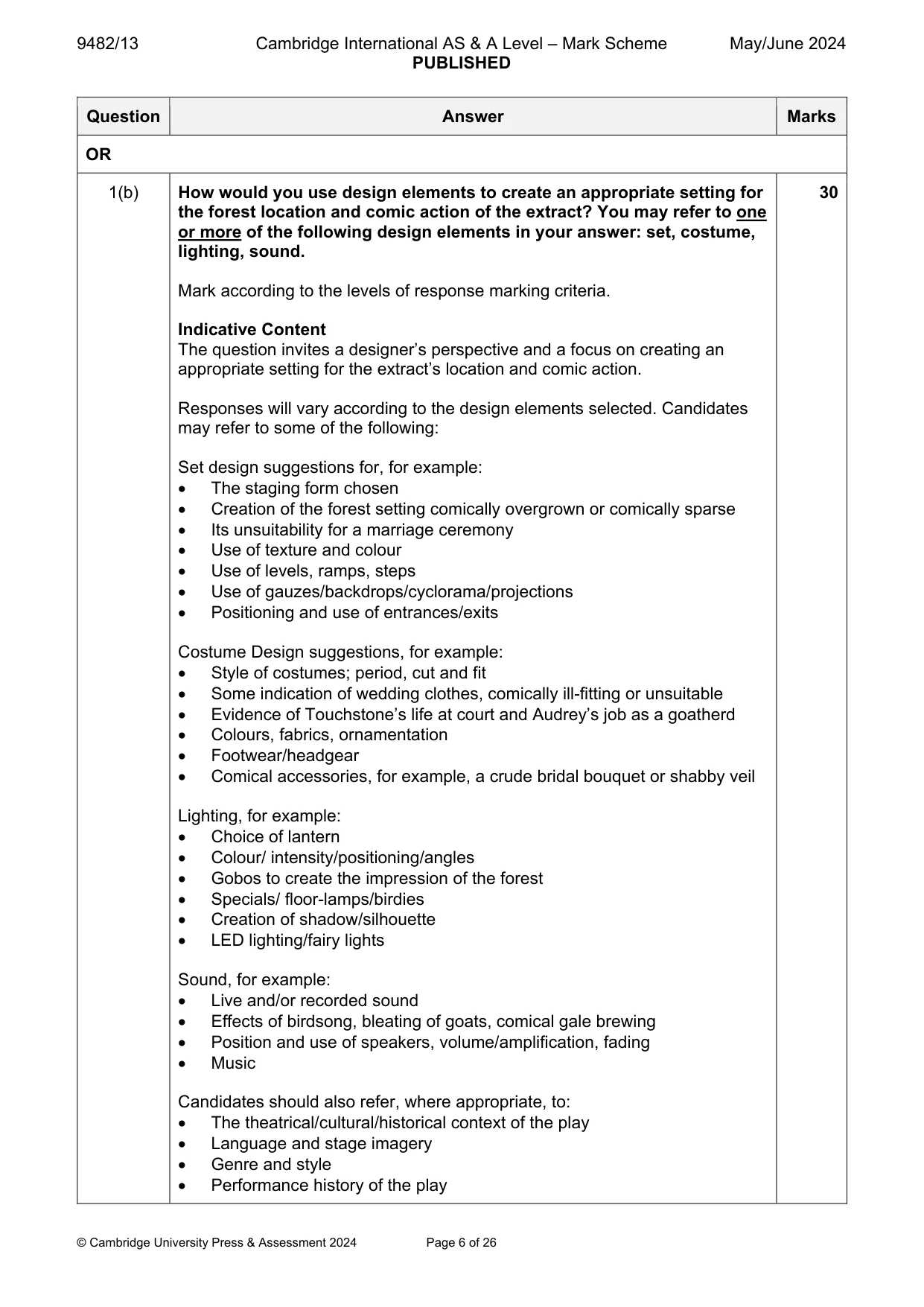
9482/13 Cambridge International AS & A Level – Mark Scheme PUBLISHED May/June 2024 © Cambridge University Press & Assessment 2024 Page 6 of 26 Question Answer Marks OR 1(b) How would you use design elements to create an appropriate setting for the forest location and comic action of the extract? You may refer to one or more of the following design elements in your answer: set, costume, lighting, sound. Mark according to the levels of response marking criteria. Indicative Content The question invites a designer’s perspective and a focus on creating an appropriate setting for the extract’s location and comic action. Responses will vary according to the design elements selected. Candidates may refer to some of the following: Set design suggestions for, for example: The staging form chosen Creation of the forest setting comically overgrown or comically sparse Its unsuitability for a marriage ceremony Use of texture and colour Use of levels, ramps, steps Use of gauzes/backdrops/cyclorama/projections Positioning and use of entrances/exits Costume Design suggestions, for example: Style of costumes; period, cut and fit Some indication of wedding clothes, comically ill-fitting or unsuitable Evidence of Touchstone’s life at court and Audrey’s job as a goatherd Colours, fabrics, ornamentation Footwear/headgear Comical accessories, for example, a crude bridal bouquet or shabby veil Lighting, for example: Choice of lantern Colour/ intensity/positioning/angles Gobos to create the impression of the forest Specials/ floor-lamps/birdies Creation of shadow/silhouette LED lighting/fairy lights Sound, for example: Live and/or recorded sound Effects of birdsong, bleating of goats, comical gale brewing Position and use of speakers, volume/amplification, fading Music Candidates should also refer, where appropriate, to: The theatrical/cultural/historical context of the play Language and stage imagery Genre and style Performance history of the play 30
Mark scheme, page 7
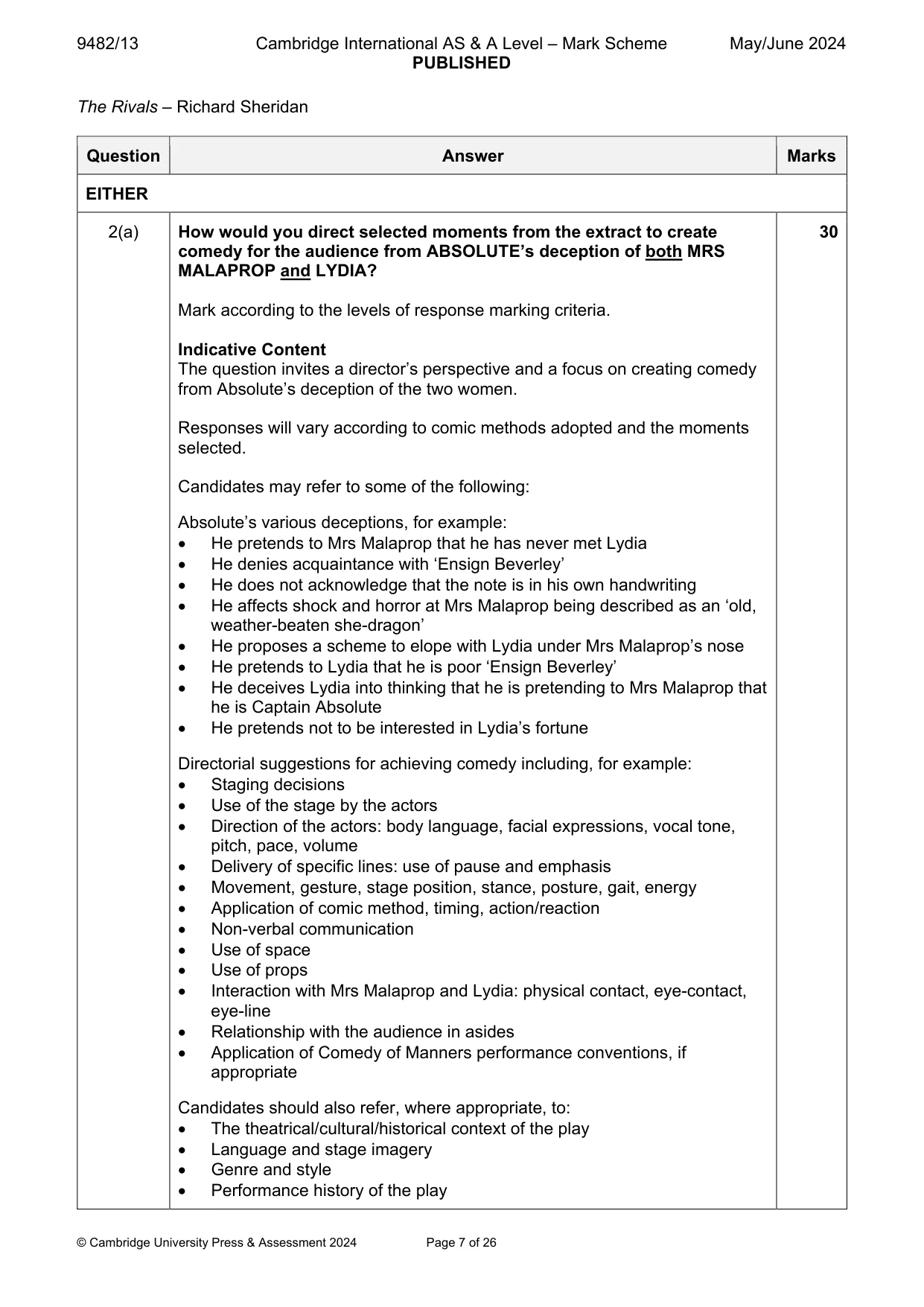
9482/13 Cambridge International AS & A Level – Mark Scheme PUBLISHED May/June 2024 © Cambridge University Press & Assessment 2024 Page 7 of 26 The Rivals – Richard Sheridan Question Answer Marks EITHER 2(a) How would you direct selected moments from the extract to create comedy for the audience from ABSOLUTE’s deception of both MRS MALAPROP and LYDIA? Mark according to the levels of response marking criteria. Indicative Content The question invites a director’s perspective and a focus on creating comedy from Absolute’s deception of the two women. Responses will vary according to comic methods adopted and the moments selected. Candidates may refer to some of the following: Absolute’s various deceptions, for example: He pretends to Mrs Malaprop that he has never met Lydia He denies acquaintance with ‘Ensign Beverley’ He does not acknowledge that the note is in his own handwriting He affects shock and horror at Mrs Malaprop being described as an ‘old, weather-beaten she-dragon’ He proposes a scheme to elope with Lydia under Mrs Malaprop’s nose He pretends to Lydia that he is poor ‘Ensign Beverley’ He deceives Lydia into thinking that he is pretending to Mrs Malaprop that he is Captain Absolute He pretends not to be interested in Lydia’s fortune Directorial suggestions for achieving comedy including, for example: Staging decisions Use of the stage by the actors Direction of the actors: body language, facial expressions, vocal tone, pitch, pace, volume Delivery of specific lines: use of pause and emphasis Movement, gesture, stage position, stance, posture, gait, energy Application of comic method, timing, action/reaction Non-verbal communication Use of space Use of props Interaction with Mrs Malaprop and Lydia: physical contact, eye-contact, eye-line Relationship with the audience in asides Application of Comedy of Manners performance conventions, if appropriate Candidates should also refer, where appropriate, to: The theatrical/cultural/historical context of the play Language and stage imagery Genre and style Performance history of the play 30
Mark scheme, page 8
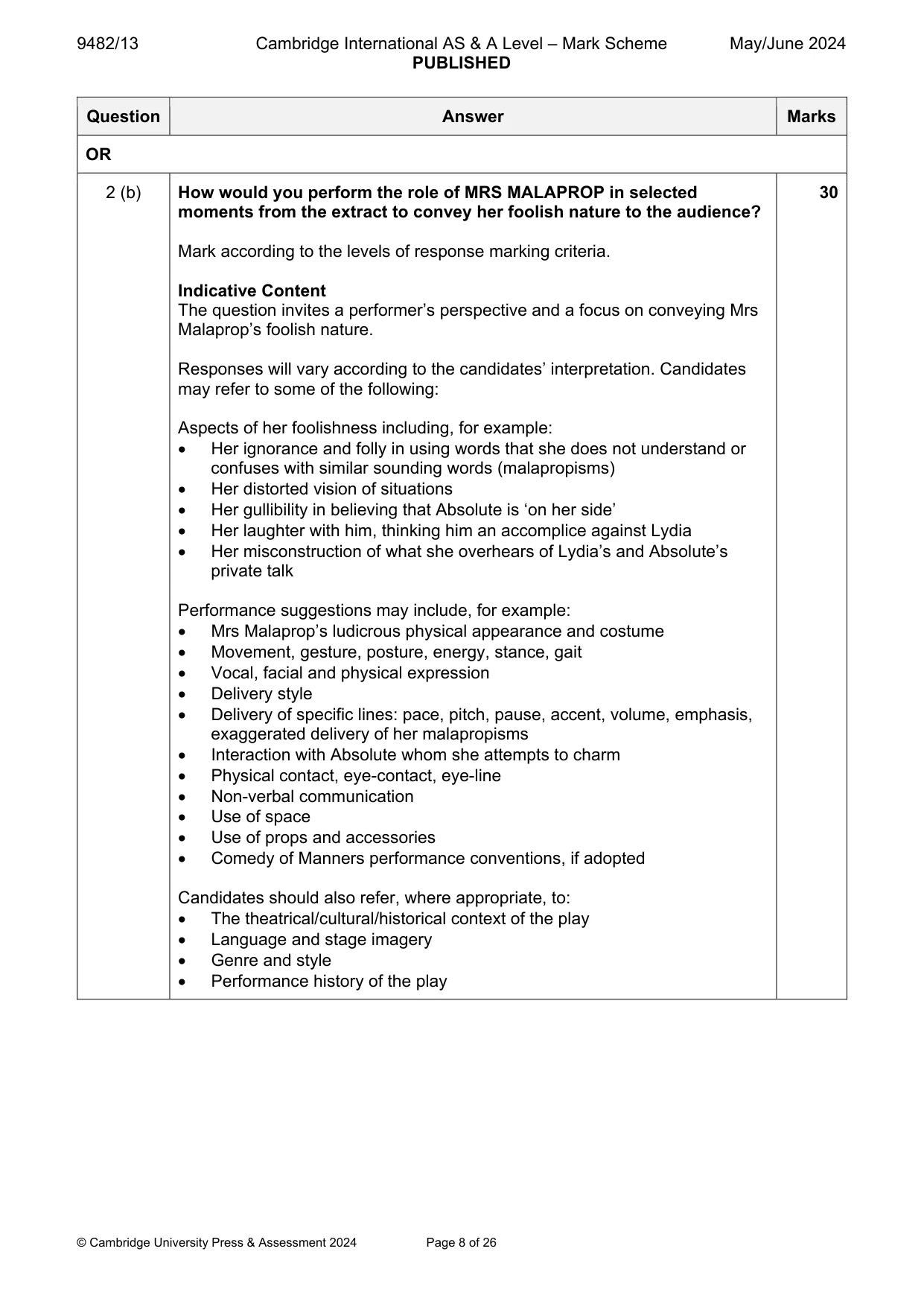
9482/13 Cambridge International AS & A Level – Mark Scheme PUBLISHED May/June 2024 © Cambridge University Press & Assessment 2024 Page 8 of 26 Question Answer Marks OR 2 (b) How would you perform the role of MRS MALAPROP in selected moments from the extract to convey her foolish nature to the audience? Mark according to the levels of response marking criteria. Indicative Content The question invites a performer’s perspective and a focus on conveying Mrs Malaprop’s foolish nature. Responses will vary according to the candidates’ interpretation. Candidates may refer to some of the following: Aspects of her foolishness including, for example: Her ignorance and folly in using words that she does not understand or confuses with similar sounding words (malapropisms) Her distorted vision of situations Her gullibility in believing that Absolute is ‘on her side’ Her laughter with him, thinking him an accomplice against Lydia Her misconstruction of what she overhears of Lydia’s and Absolute’s private talk Performance suggestions may include, for example: Mrs Malaprop’s ludicrous physical appearance and costume Movement, gesture, posture, energy, stance, gait Vocal, facial and physical expression Delivery style Delivery of specific lines: pace, pitch, pause, accent, volume, emphasis, exaggerated delivery of her malapropisms Interaction with Absolute whom she attempts to charm Physical contact, eye-contact, eye-line Non-verbal communication Use of space Use of props and accessories Comedy of Manners performance conventions, if adopted Candidates should also refer, where appropriate, to: The theatrical/cultural/historical context of the play Language and stage imagery Genre and style Performance history of the play 30
Mark scheme, page 9
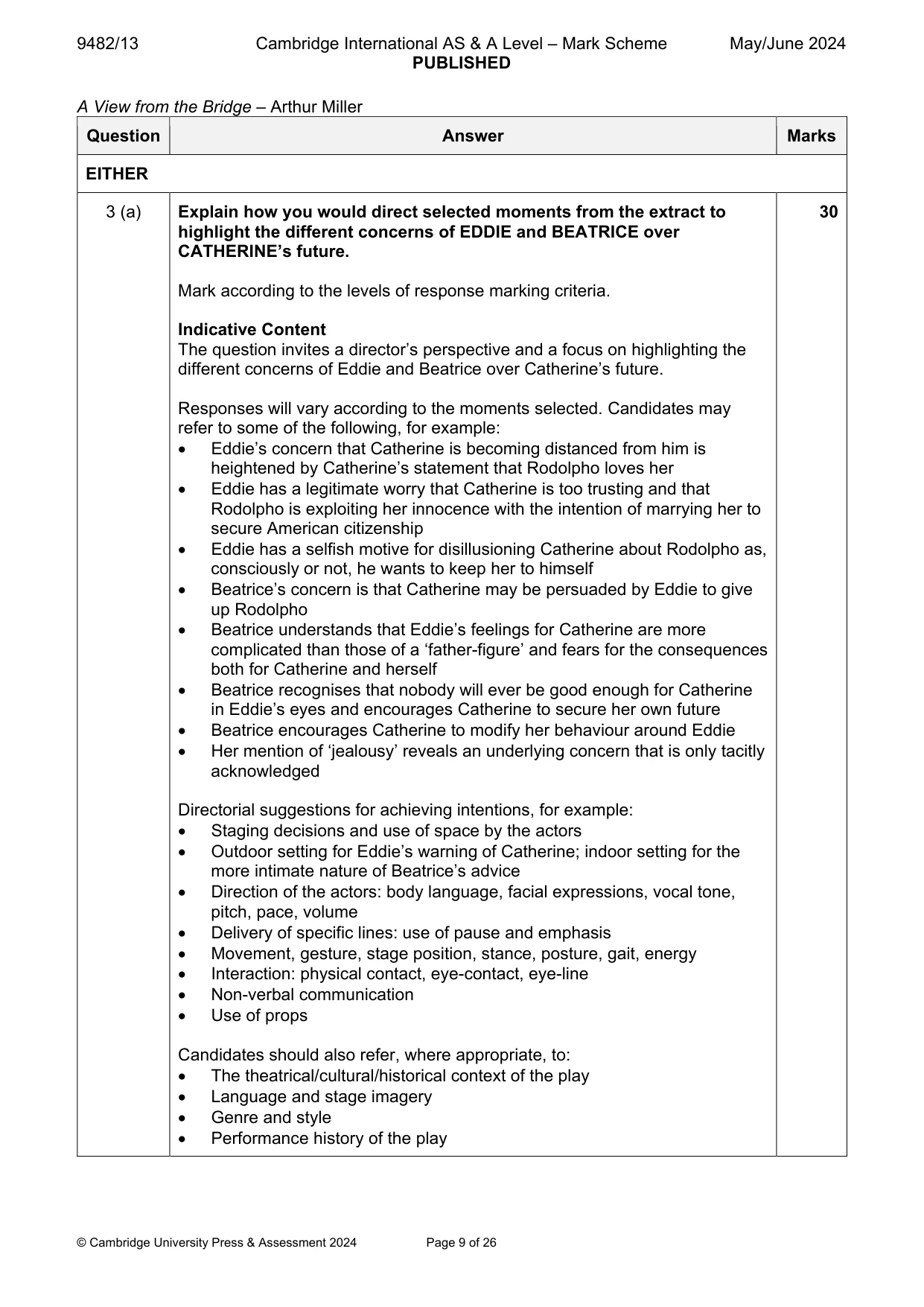
9482/13 Cambridge International AS & A Level – Mark Scheme PUBLISHED May/June 2024 © Cambridge University Press & Assessment 2024 Page 9 of 26 A View from the Bridge – Arthur Miller Question Answer Marks EITHER 3 (a) Explain how you would direct selected moments from the extract to highlight the different concerns of EDDIE and BEATRICE over CATHERINE’s future. Mark according to the levels of response marking criteria. Indicative Content The question invites a director’s perspective and a focus on highlighting the different concerns of Eddie and Beatrice over Catherine’s future. Responses will vary according to the moments selected. Candidates may refer to some of the following, for example: Eddie’s concern that Catherine is becoming distanced from him is heightened by Catherine’s statement that Rodolpho loves her Eddie has a legitimate worry that Catherine is too trusting and that Rodolpho is exploiting her innocence with the intention of marrying her to secure American citizenship Eddie has a selfish motive for disillusioning Catherine about Rodolpho as, consciously or not, he wants to keep her to himself Beatrice’s concern is that Catherine may be persuaded by Eddie to give up Rodolpho Beatrice understands that Eddie’s feelings for Catherine are more complicated than those of a ‘father-figure’ and fears for the consequences both for Catherine and herself Beatrice recognises that nobody will ever be good enough for Catherine in Eddie’s eyes and encourages Catherine to secure her own future Beatrice encourages Catherine to modify her behaviour around Eddie Her mention of ‘jealousy’ reveals an underlying concern that is only tacitly acknowledged Directorial suggestions for achieving intentions, for example: Staging decisions and use of space by the actors Outdoor setting for Eddie’s warning of Catherine; indoor setting for the more intimate nature of Beatrice’s advice Direction of the actors: body language, facial expressions, vocal tone, pitch, pace, volume Delivery of specific lines: use of pause and emphasis Movement, gesture, stage position, stance, posture, gait, energy Interaction: physical contact, eye-contact, eye-line Non-verbal communication Use of props Candidates should also refer, where appropriate, to: The theatrical/cultural/historical context of the play Language and stage imagery Genre and style Performance history of the play 30
Mark scheme, page 10
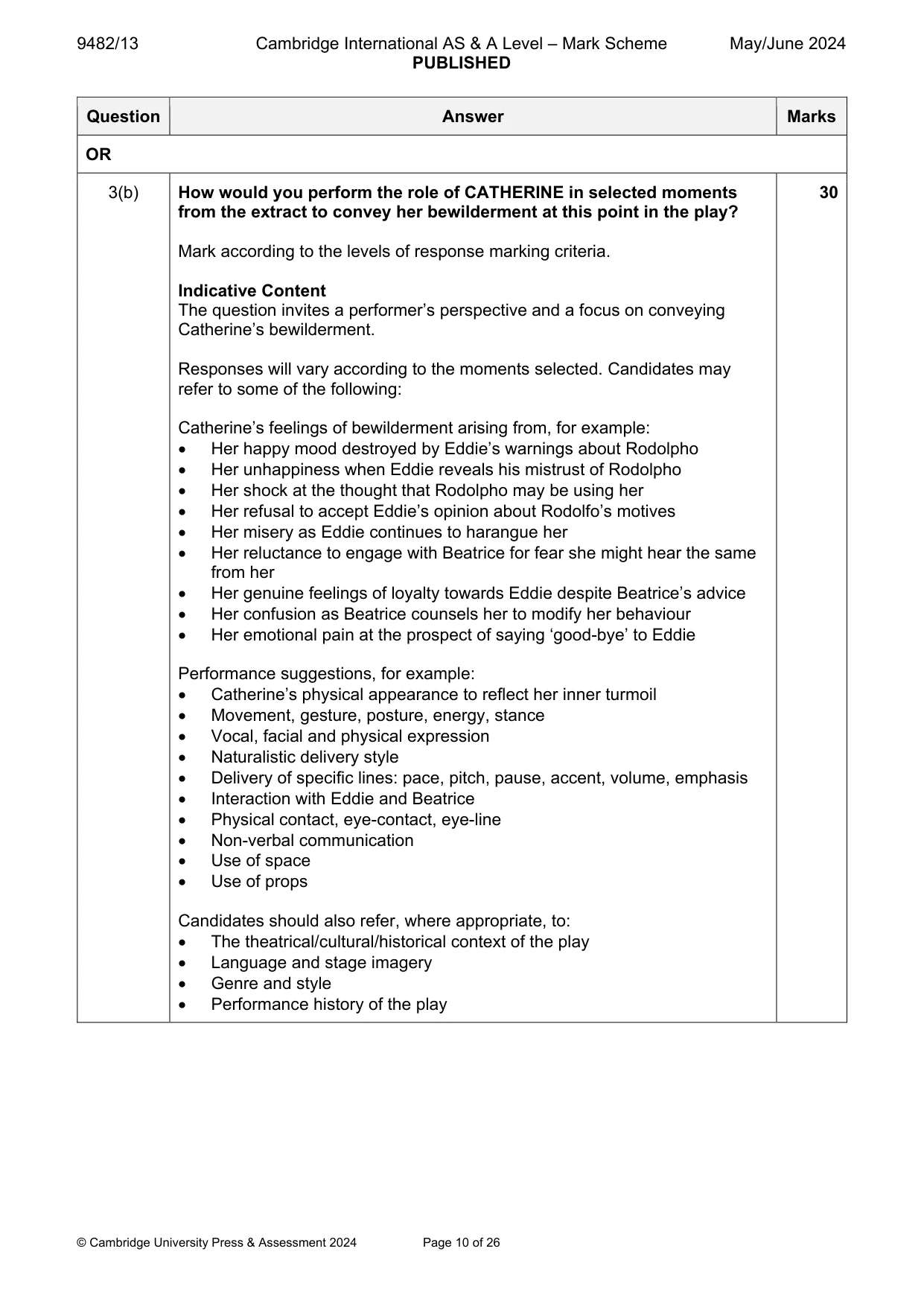
9482/13 Cambridge International AS & A Level – Mark Scheme PUBLISHED May/June 2024 © Cambridge University Press & Assessment 2024 Page 10 of 26 Question Answer Marks OR 3(b) How would you perform the role of CATHERINE in selected moments from the extract to convey her bewilderment at this point in the play? Mark according to the levels of response marking criteria. Indicative Content The question invites a performer’s perspective and a focus on conveying Catherine’s bewilderment. Responses will vary according to the moments selected. Candidates may refer to some of the following: Catherine’s feelings of bewilderment arising from, for example: Her happy mood destroyed by Eddie’s warnings about Rodolpho Her unhappiness when Eddie reveals his mistrust of Rodolpho Her shock at the thought that Rodolpho may be using her Her refusal to accept Eddie’s opinion about Rodolfo’s motives Her misery as Eddie continues to harangue her Her reluctance to engage with Beatrice for fear she might hear the same from her Her genuine feelings of loyalty towards Eddie despite Beatrice’s advice Her confusion as Beatrice counsels her to modify her behaviour Her emotional pain at the prospect of saying ‘good-bye’ to Eddie Performance suggestions, for example: Catherine’s physical appearance to reflect her inner turmoil Movement, gesture, posture, energy, stance Vocal, facial and physical expression Naturalistic delivery style Delivery of specific lines: pace, pitch, pause, accent, volume, emphasis Interaction with Eddie and Beatrice Physical contact, eye-contact, eye-line Non-verbal communication Use of space Use of props Candidates should also refer, where appropriate, to: The theatrical/cultural/historical context of the play Language and stage imagery Genre and style Performance history of the play 30
Mark scheme, page 11
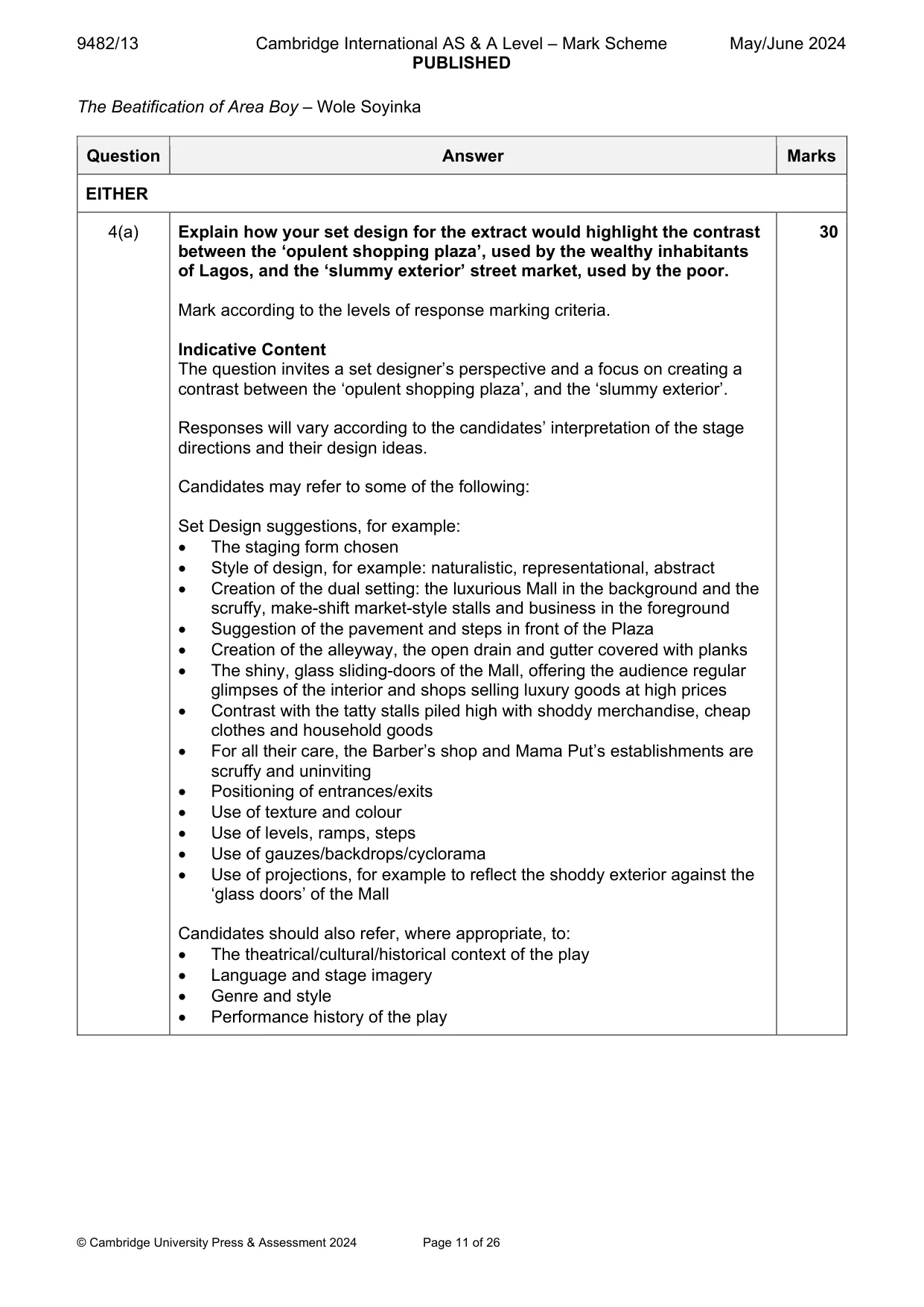
9482/13 Cambridge International AS & A Level – Mark Scheme PUBLISHED May/June 2024 © Cambridge University Press & Assessment 2024 Page 11 of 26 The Beatification of Area Boy – Wole Soyinka Question Answer Marks EITHER 4(a) Explain how your set design for the extract would highlight the contrast between the ‘opulent shopping plaza’, used by the wealthy inhabitants of Lagos, and the ‘slummy exterior’ street market, used by the poor. Mark according to the levels of response marking criteria. Indicative Content The question invites a set designer’s perspective and a focus on creating a contrast between the ‘opulent shopping plaza’, and the ‘slummy exterior’. Responses will vary according to the candidates’ interpretation of the stage directions and their design ideas. Candidates may refer to some of the following: Set Design suggestions, for example: The staging form chosen Style of design, for example: naturalistic, representational, abstract Creation of the dual setting: the luxurious Mall in the background and the scruffy, make-shift market-style stalls and business in the foreground Suggestion of the pavement and steps in front of the Plaza Creation of the alleyway, the open drain and gutter covered with planks The shiny, glass sliding-doors of the Mall, offering the audience regular glimpses of the interior and shops selling luxury goods at high prices Contrast with the tatty stalls piled high with shoddy merchandise, cheap clothes and household goods For all their care, the Barber’s shop and Mama Put’s establishments are scruffy and uninviting Positioning of entrances/exits Use of texture and colour Use of levels, ramps, steps Use of gauzes/backdrops/cyclorama Use of projections, for example to reflect the shoddy exterior against the ‘glass doors’ of the Mall Candidates should also refer, where appropriate, to: The theatrical/cultural/historical context of the play Language and stage imagery Genre and style Performance history of the play 30
Mark scheme, page 12
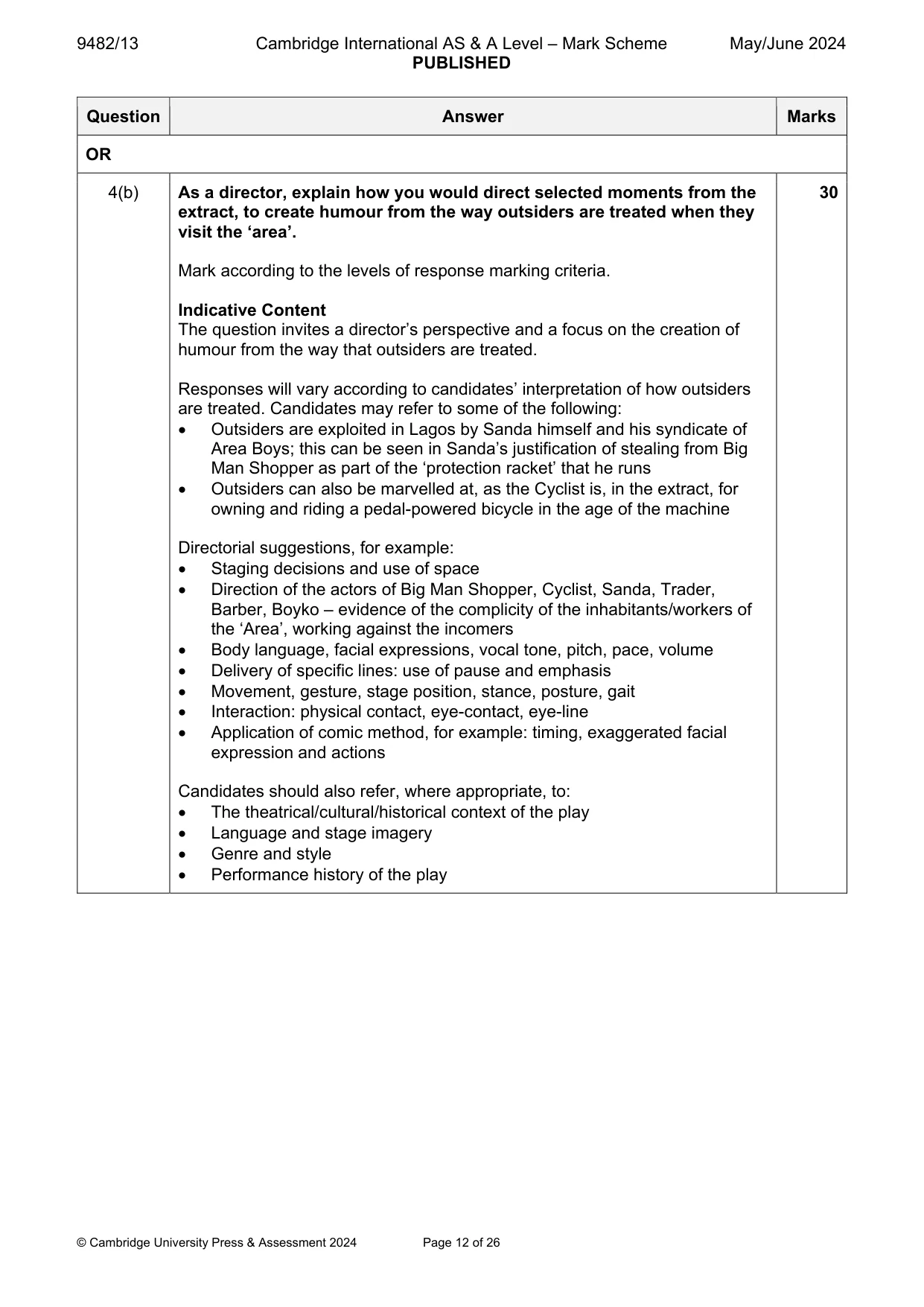
9482/13 Cambridge International AS & A Level – Mark Scheme PUBLISHED May/June 2024 © Cambridge University Press & Assessment 2024 Page 12 of 26 Question Answer Marks OR 4(b) As a director, explain how you would direct selected moments from the extract, to create humour from the way outsiders are treated when they visit the ‘area’. Mark according to the levels of response marking criteria. Indicative Content The question invites a director’s perspective and a focus on the creation of humour from the way that outsiders are treated. Responses will vary according to candidates’ interpretation of how outsiders are treated. Candidates may refer to some of the following: Outsiders are exploited in Lagos by Sanda himself and his syndicate of Area Boys; this can be seen in Sanda’s justification of stealing from Big Man Shopper as part of the ‘protection racket’ that he runs Outsiders can also be marvelled at, as the Cyclist is, in the extract, for owning and riding a pedal-powered bicycle in the age of the machine Directorial suggestions, for example: Staging decisions and use of space Direction of the actors of Big Man Shopper, Cyclist, Sanda, Trader, Barber, Boyko – evidence of the complicity of the inhabitants/workers of the ‘Area’, working against the incomers Body language, facial expressions, vocal tone, pitch, pace, volume Delivery of specific lines: use of pause and emphasis Movement, gesture, stage position, stance, posture, gait Interaction: physical contact, eye-contact, eye-line Application of comic method, for example: timing, exaggerated facial expression and actions Candidates should also refer, where appropriate, to: The theatrical/cultural/historical context of the play Language and stage imagery Genre and style Performance history of the play 30
Mark scheme, page 13
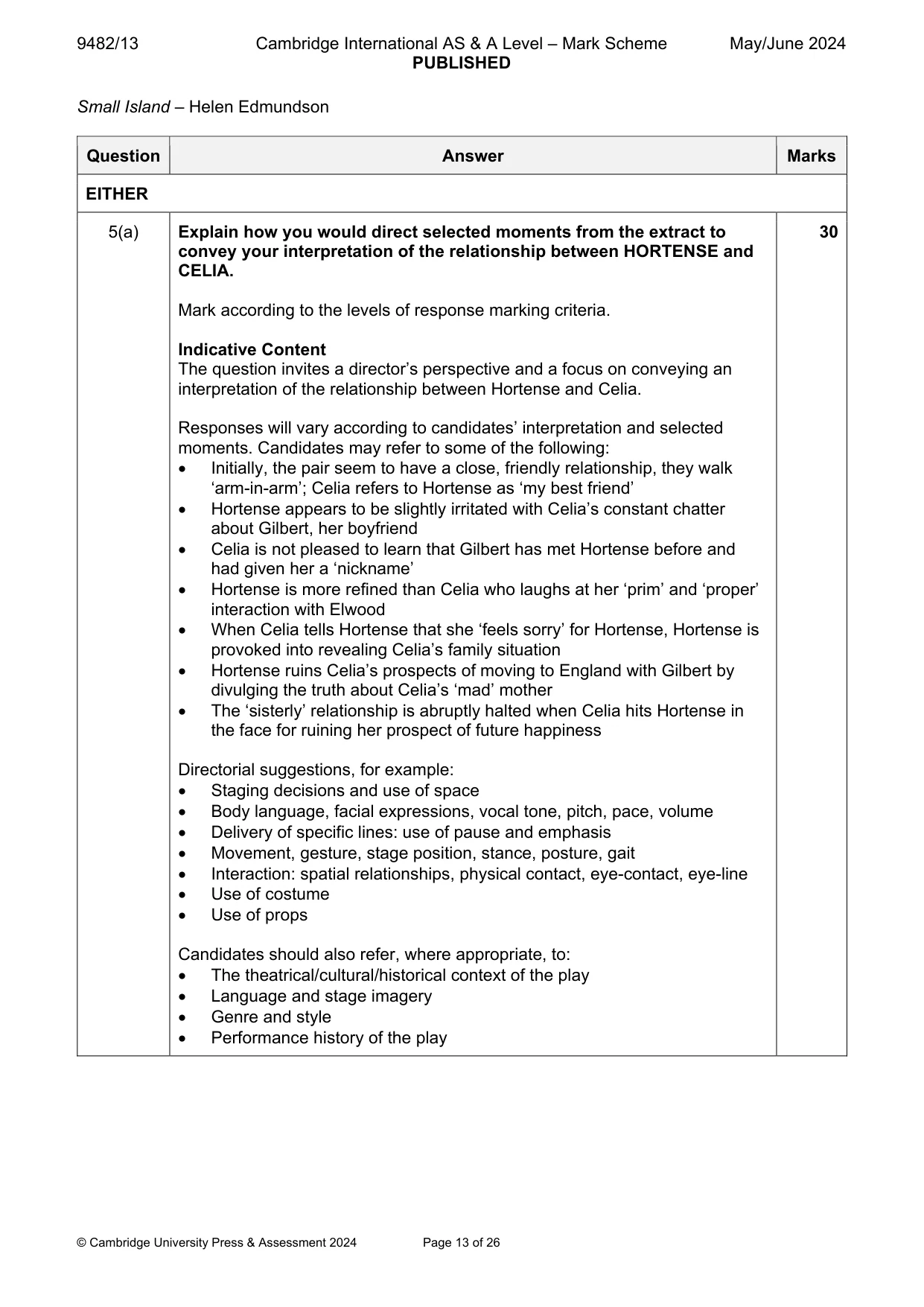
9482/13 Cambridge International AS & A Level – Mark Scheme PUBLISHED May/June 2024 © Cambridge University Press & Assessment 2024 Page 13 of 26 Small Island – Helen Edmundson Question Answer Marks EITHER 5(a) Explain how you would direct selected moments from the extract to convey your interpretation of the relationship between HORTENSE and CELIA. Mark according to the levels of response marking criteria. Indicative Content The question invites a director’s perspective and a focus on conveying an interpretation of the relationship between Hortense and Celia. Responses will vary according to candidates’ interpretation and selected moments. Candidates may refer to some of the following: Initially, the pair seem to have a close, friendly relationship, they walk ‘arm-in-arm’; Celia refers to Hortense as ‘my best friend’ Hortense appears to be slightly irritated with Celia’s constant chatter about Gilbert, her boyfriend Celia is not pleased to learn that Gilbert has met Hortense before and had given her a ‘nickname’ Hortense is more refined than Celia who laughs at her ‘prim’ and ‘proper’ interaction with Elwood When Celia tells Hortense that she ‘feels sorry’ for Hortense, Hortense is provoked into revealing Celia’s family situation Hortense ruins Celia’s prospects of moving to England with Gilbert by divulging the truth about Celia’s ‘mad’ mother The ‘sisterly’ relationship is abruptly halted when Celia hits Hortense in the face for ruining her prospect of future happiness Directorial suggestions, for example: Staging decisions and use of space Body language, facial expressions, vocal tone, pitch, pace, volume Delivery of specific lines: use of pause and emphasis Movement, gesture, stage position, stance, posture, gait Interaction: spatial relationships, physical contact, eye-contact, eye-line Use of costume Use of props Candidates should also refer, where appropriate, to: The theatrical/cultural/historical context of the play Language and stage imagery Genre and style Performance history of the play 30
Mark scheme, page 14
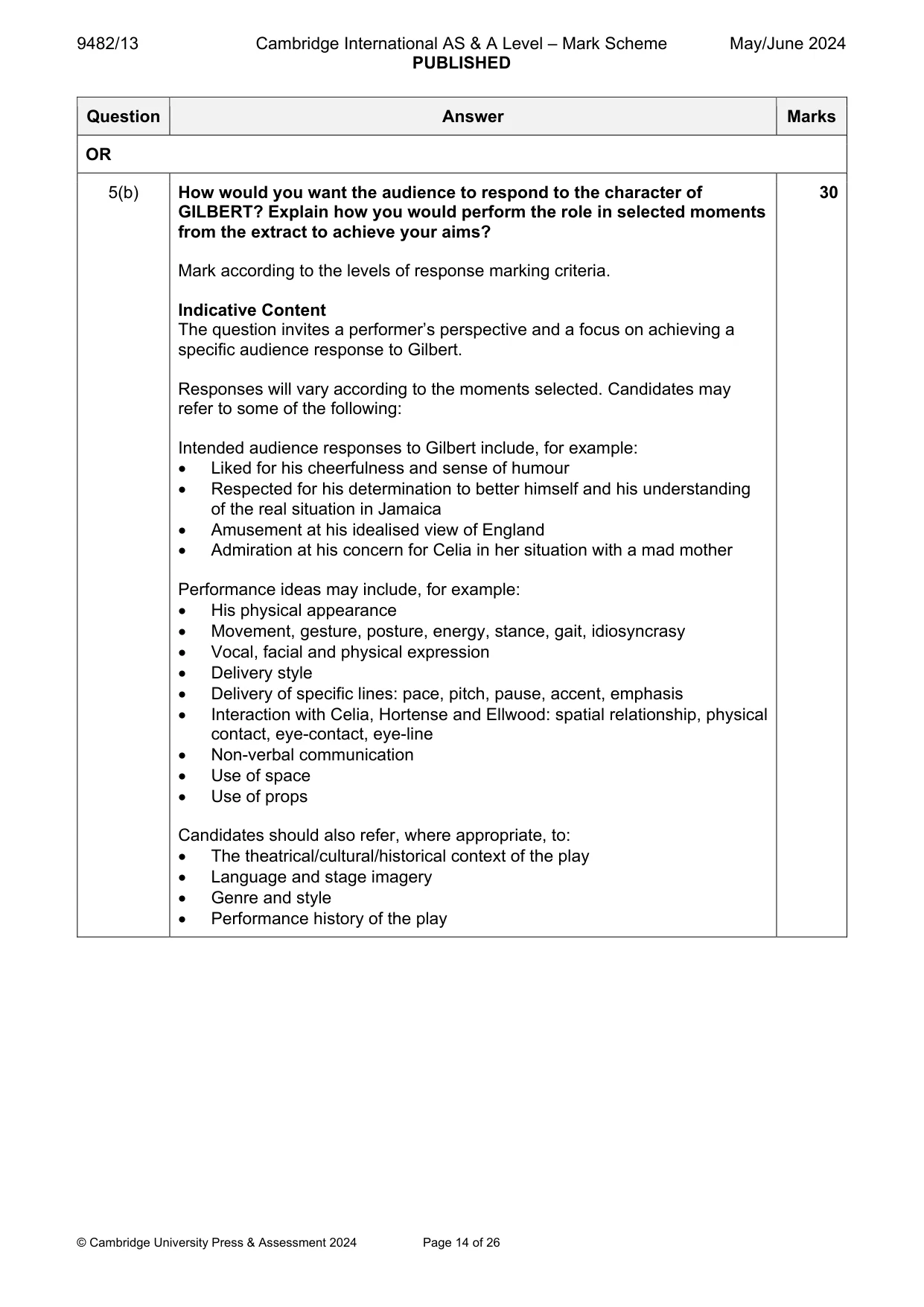
9482/13 Cambridge International AS & A Level – Mark Scheme PUBLISHED May/June 2024 © Cambridge University Press & Assessment 2024 Page 14 of 26 Question Answer Marks OR 5(b) How would you want the audience to respond to the character of GILBERT? Explain how you would perform the role in selected moments from the extract to achieve your aims? Mark according to the levels of response marking criteria. Indicative Content The question invites a performer’s perspective and a focus on achieving a specific audience response to Gilbert. Responses will vary according to the moments selected. Candidates may refer to some of the following: Intended audience responses to Gilbert include, for example: Liked for his cheerfulness and sense of humour Respected for his determination to better himself and his understanding of the real situation in Jamaica Amusement at his idealised view of England Admiration at his concern for Celia in her situation with a mad mother Performance ideas may include, for example: His physical appearance Movement, gesture, posture, energy, stance, gait, idiosyncrasy Vocal, facial and physical expression Delivery style Delivery of specific lines: pace, pitch, pause, accent, emphasis Interaction with Celia, Hortense and Ellwood: spatial relationship, physical contact, eye-contact, eye-line Non-verbal communication Use of space Use of props Candidates should also refer, where appropriate, to: The theatrical/cultural/historical context of the play Language and stage imagery Genre and style Performance history of the play 30
Mark scheme, page 15
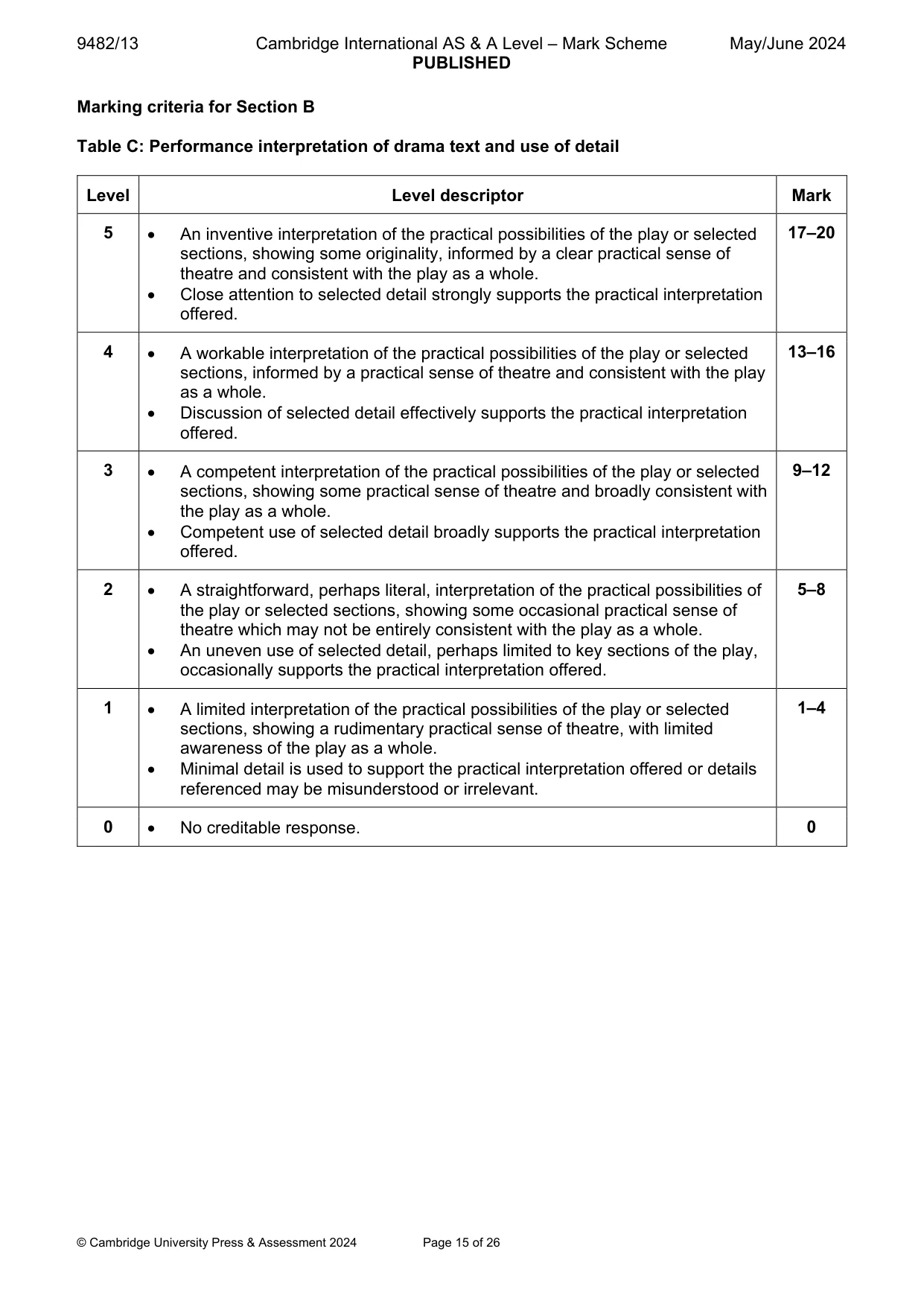
9482/13 Cambridge International AS & A Level – Mark Scheme PUBLISHED May/June 2024 © Cambridge University Press & Assessment 2024 Page 15 of 26 Marking criteria for Section B Table C: Performance interpretation of drama text and use of detail Level Level descriptor Mark 5 An inventive interpretation of the practical possibilities of the play or selected sections, showing some originality, informed by a clear practical sense of theatre and consistent with the play as a whole. Close attention to selected detail strongly supports the practical interpretation offered. 17–20 4 A workable interpretation of the practical possibilities of the play or selected sections, informed by a practical sense of theatre and consistent with the play as a whole. Discussion of selected detail effectively supports the practical interpretation offered. 13–16 3 A competent interpretation of the practical possibilities of the play or selected sections, showing some practical sense of theatre and broadly consistent with the play as a whole. Competent use of selected detail broadly supports the practical interpretation offered. 9–12 2 A straightforward, perhaps literal, interpretation of the practical possibilities of the play or selected sections, showing some occasional practical sense of theatre which may not be entirely consistent with the play as a whole. An uneven use of selected detail, perhaps limited to key sections of the play, occasionally supports the practical interpretation offered. 5–8 1 A limited interpretation of the practical possibilities of the play or selected sections, showing a rudimentary practical sense of theatre, with limited awareness of the play as a whole. Minimal detail is used to support the practical interpretation offered or details referenced may be misunderstood or irrelevant. 1–4 0 No creditable response. 0
Mark scheme, page 16
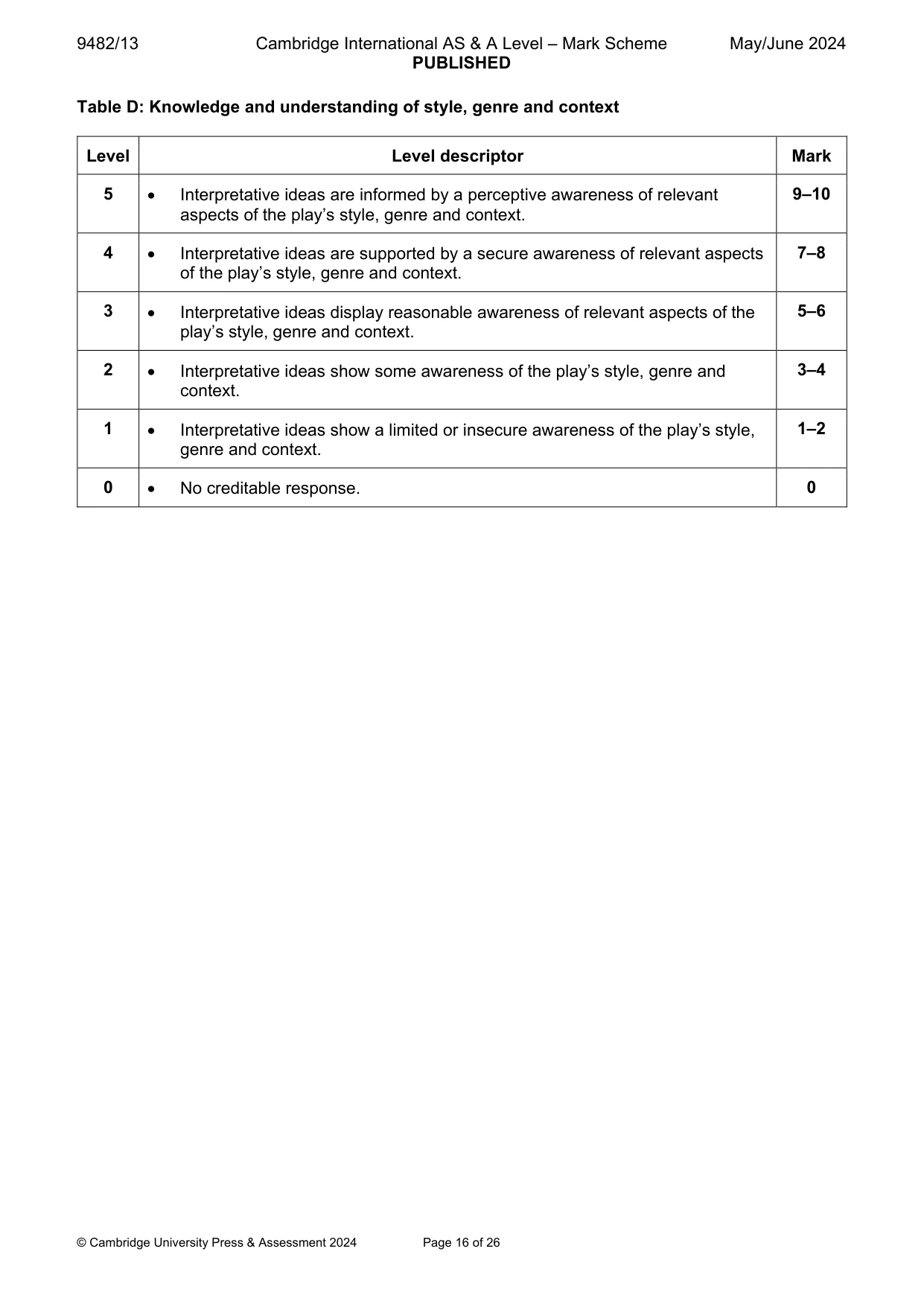
9482/13 Cambridge International AS & A Level – Mark Scheme PUBLISHED May/June 2024 © Cambridge University Press & Assessment 2024 Page 16 of 26 Table D: Knowledge and understanding of style, genre and context Level Level descriptor Mark 5 Interpretative ideas are informed by a perceptive awareness of relevant aspects of the play’s style, genre and context. 9–10 4 Interpretative ideas are supported by a secure awareness of relevant aspects of the play’s style, genre and context. 7–8 3 Interpretative ideas display reasonable awareness of relevant aspects of the play’s style, genre and context. 5–6 2 Interpretative ideas show some awareness of the play’s style, genre and context. 3–4 1 Interpretative ideas show a limited or insecure awareness of the play’s style, genre and context. 1–2 0 No creditable response. 0
Mark scheme, page 17
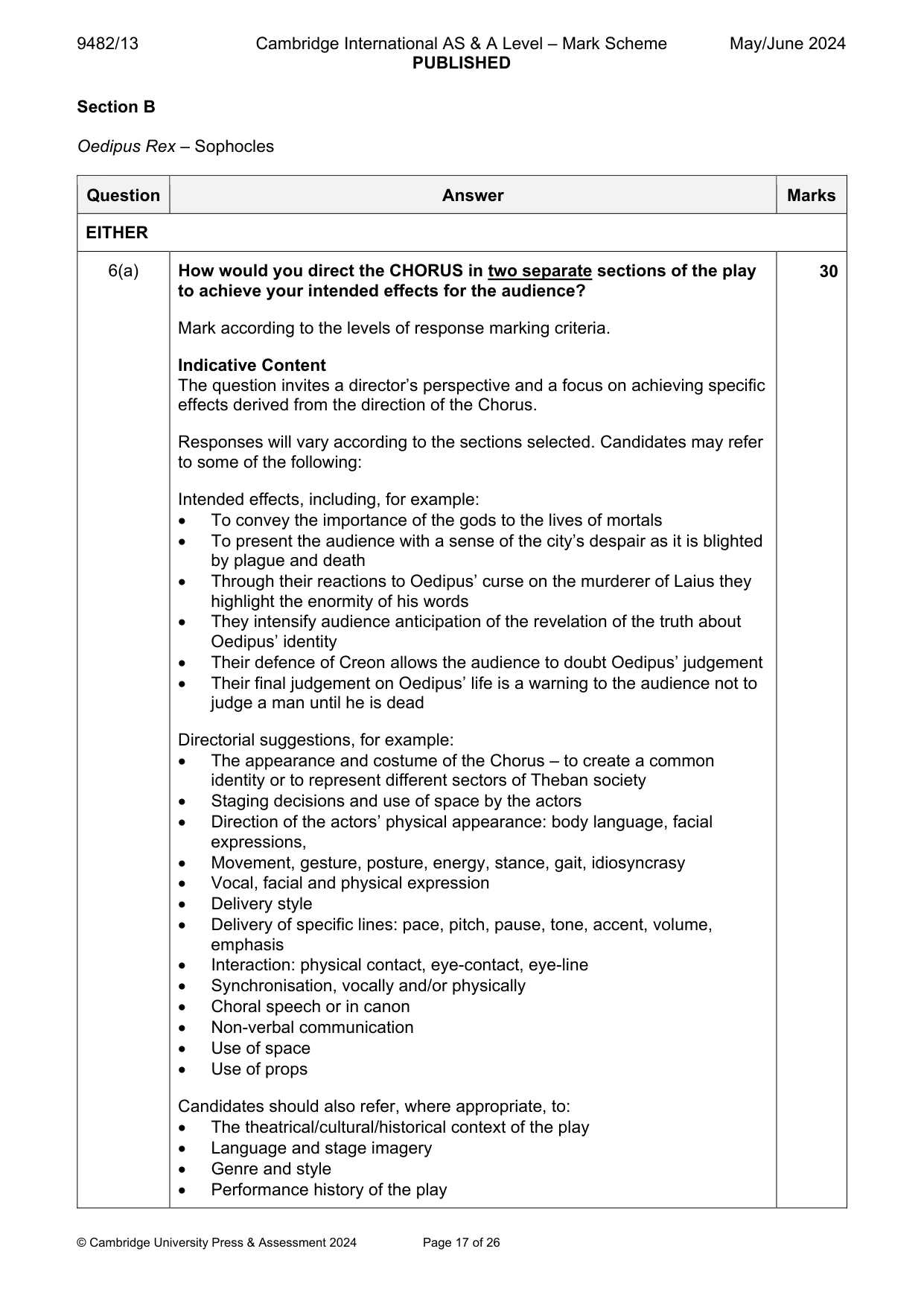
9482/13 Cambridge International AS & A Level – Mark Scheme PUBLISHED May/June 2024 © Cambridge University Press & Assessment 2024 Page 17 of 26 Section B Oedipus Rex – Sophocles Question Answer Marks EITHER 6(a) How would you direct the CHORUS in two separate sections of the play to achieve your intended effects for the audience? Mark according to the levels of response marking criteria. Indicative Content The question invites a director’s perspective and a focus on achieving specific effects derived from the direction of the Chorus. Responses will vary according to the sections selected. Candidates may refer to some of the following: Intended effects, including, for example: To convey the importance of the gods to the lives of mortals To present the audience with a sense of the city’s despair as it is blighted by plague and death Through their reactions to Oedipus’ curse on the murderer of Laius they highlight the enormity of his words They intensify audience anticipation of the revelation of the truth about Oedipus’ identity Their defence of Creon allows the audience to doubt Oedipus’ judgement Their final judgement on Oedipus’ life is a warning to the audience not to judge a man until he is dead Directorial suggestions, for example: The appearance and costume of the Chorus – to create a common identity or to represent different sectors of Theban society Staging decisions and use of space by the actors Direction of the actors’ physical appearance: body language, facial expressions, Movement, gesture, posture, energy, stance, gait, idiosyncrasy Vocal, facial and physical expression Delivery style Delivery of specific lines: pace, pitch, pause, tone, accent, volume, emphasis Interaction: physical contact, eye-contact, eye-line Synchronisation, vocally and/or physically Choral speech or in canon Non-verbal communication Use of space Use of props Candidates should also refer, where appropriate, to: The theatrical/cultural/historical context of the play Language and stage imagery Genre and style Performance history of the play 30
Mark scheme, page 18
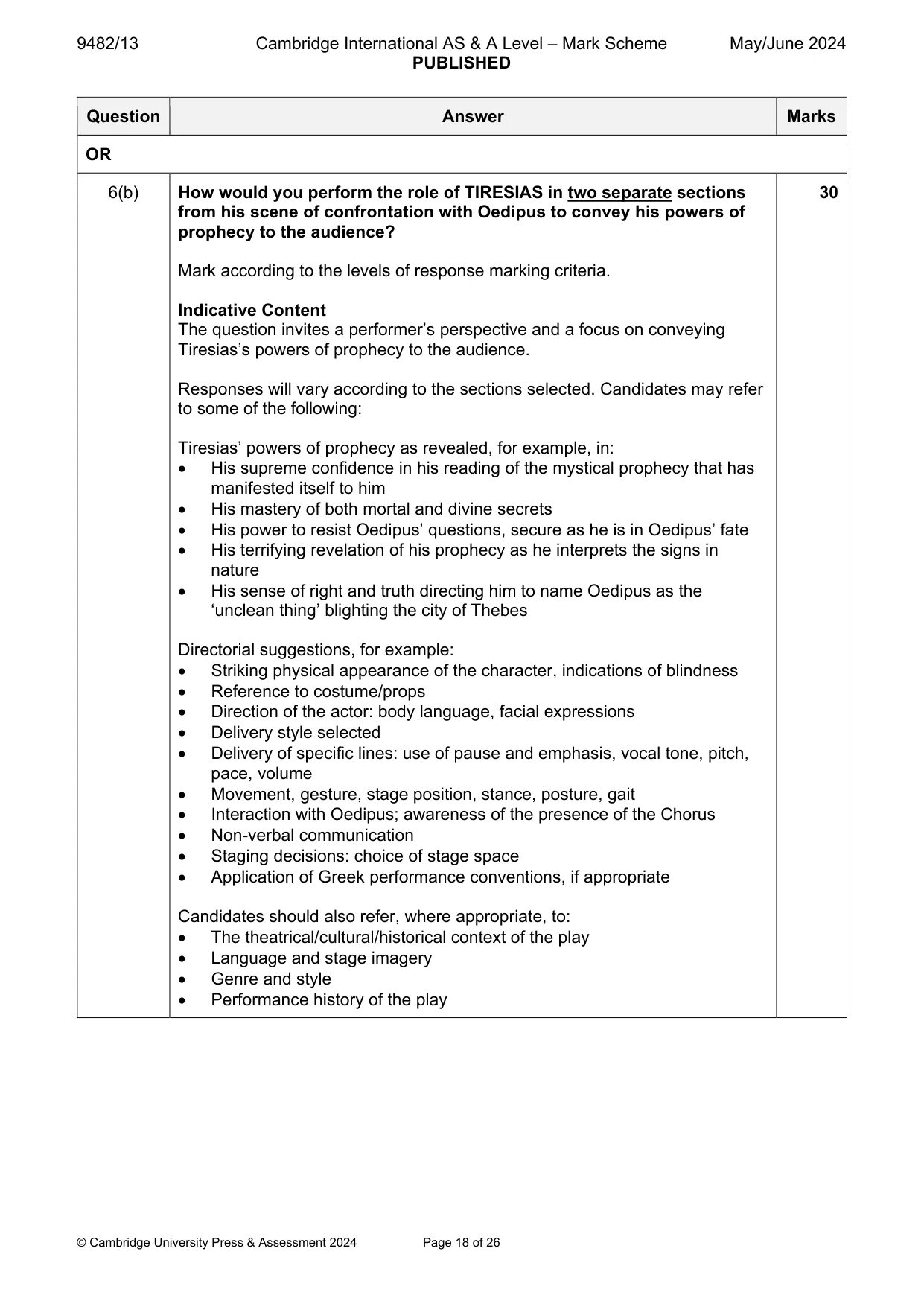
9482/13 Cambridge International AS & A Level – Mark Scheme PUBLISHED May/June 2024 © Cambridge University Press & Assessment 2024 Page 18 of 26 Question Answer Marks OR 6(b) How would you perform the role of TIRESIAS in two separate sections from his scene of confrontation with Oedipus to convey his powers of prophecy to the audience? Mark according to the levels of response marking criteria. Indicative Content The question invites a performer’s perspective and a focus on conveying Tiresias’s powers of prophecy to the audience. Responses will vary according to the sections selected. Candidates may refer to some of the following: Tiresias’ powers of prophecy as revealed, for example, in: His supreme confidence in his reading of the mystical prophecy that has manifested itself to him His mastery of both mortal and divine secrets His power to resist Oedipus’ questions, secure as he is in Oedipus’ fate His terrifying revelation of his prophecy as he interprets the signs in nature His sense of right and truth directing him to name Oedipus as the ‘unclean thing’ blighting the city of Thebes Directorial suggestions, for example: Striking physical appearance of the character, indications of blindness Reference to costume/props Direction of the actor: body language, facial expressions Delivery style selected Delivery of specific lines: use of pause and emphasis, vocal tone, pitch, pace, volume Movement, gesture, stage position, stance, posture, gait Interaction with Oedipus; awareness of the presence of the Chorus Non-verbal communication Staging decisions: choice of stage space Application of Greek performance conventions, if appropriate Candidates should also refer, where appropriate, to: The theatrical/cultural/historical context of the play Language and stage imagery Genre and style Performance history of the play 30
Mark scheme, page 19
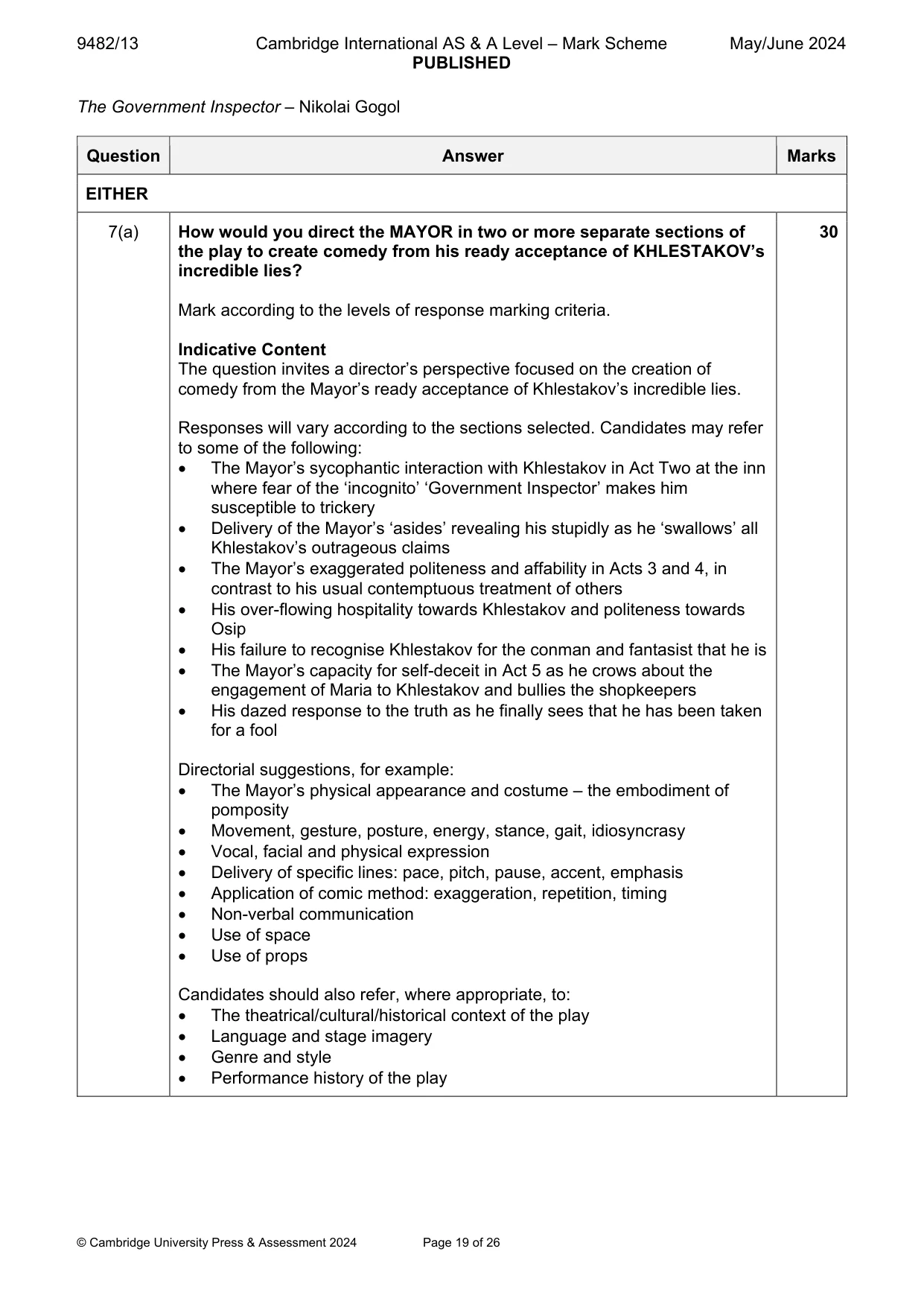
9482/13 Cambridge International AS & A Level – Mark Scheme PUBLISHED May/June 2024 © Cambridge University Press & Assessment 2024 Page 19 of 26 The Government Inspector – Nikolai Gogol Question Answer Marks EITHER 7(a) How would you direct the MAYOR in two or more separate sections of the play to create comedy from his ready acceptance of KHLESTAKOV’s incredible lies? Mark according to the levels of response marking criteria. Indicative Content The question invites a director’s perspective focused on the creation of comedy from the Mayor’s ready acceptance of Khlestakov’s incredible lies. Responses will vary according to the sections selected. Candidates may refer to some of the following: The Mayor’s sycophantic interaction with Khlestakov in Act Two at the inn where fear of the ‘incognito’ ‘Government Inspector’ makes him susceptible to trickery Delivery of the Mayor’s ‘asides’ revealing his stupidly as he ‘swallows’ all Khlestakov’s outrageous claims The Mayor’s exaggerated politeness and affability in Acts 3 and 4, in contrast to his usual contemptuous treatment of others His over-flowing hospitality towards Khlestakov and politeness towards Osip His failure to recognise Khlestakov for the conman and fantasist that he is The Mayor’s capacity for self-deceit in Act 5 as he crows about the engagement of Maria to Khlestakov and bullies the shopkeepers His dazed response to the truth as he finally sees that he has been taken for a fool Directorial suggestions, for example: The Mayor’s physical appearance and costume – the embodiment of pomposity Movement, gesture, posture, energy, stance, gait, idiosyncrasy Vocal, facial and physical expression Delivery of specific lines: pace, pitch, pause, accent, emphasis Application of comic method: exaggeration, repetition, timing Non-verbal communication Use of space Use of props Candidates should also refer, where appropriate, to: The theatrical/cultural/historical context of the play Language and stage imagery Genre and style Performance history of the play 30
Mark scheme, page 20
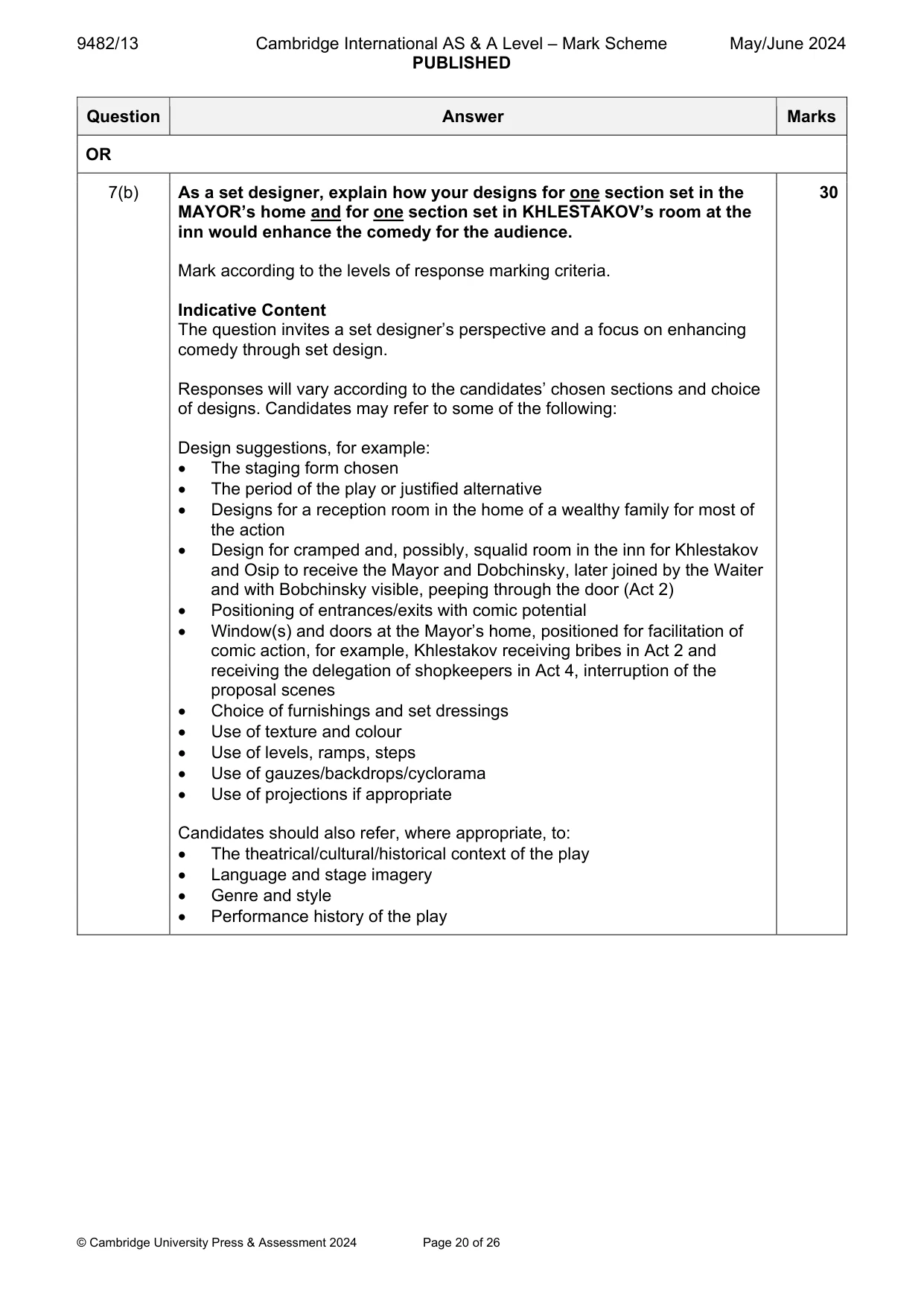
9482/13 Cambridge International AS & A Level – Mark Scheme PUBLISHED May/June 2024 © Cambridge University Press & Assessment 2024 Page 20 of 26 Question Answer Marks OR 7(b) As a set designer, explain how your designs for one section set in the MAYOR’s home and for one section set in KHLESTAKOV’s room at the inn would enhance the comedy for the audience. Mark according to the levels of response marking criteria. Indicative Content The question invites a set designer’s perspective and a focus on enhancing comedy through set design. Responses will vary according to the candidates’ chosen sections and choice of designs. Candidates may refer to some of the following: Design suggestions, for example: The staging form chosen The period of the play or justified alternative Designs for a reception room in the home of a wealthy family for most of the action Design for cramped and, possibly, squalid room in the inn for Khlestakov and Osip to receive the Mayor and Dobchinsky, later joined by the Waiter and with Bobchinsky visible, peeping through the door (Act 2) Positioning of entrances/exits with comic potential Window(s) and doors at the Mayor’s home, positioned for facilitation of comic action, for example, Khlestakov receiving bribes in Act 2 and receiving the delegation of shopkeepers in Act 4, interruption of the proposal scenes Choice of furnishings and set dressings Use of texture and colour Use of levels, ramps, steps Use of gauzes/backdrops/cyclorama Use of projections if appropriate Candidates should also refer, where appropriate, to: The theatrical/cultural/historical context of the play Language and stage imagery Genre and style Performance history of the play 30
Mark scheme, page 21
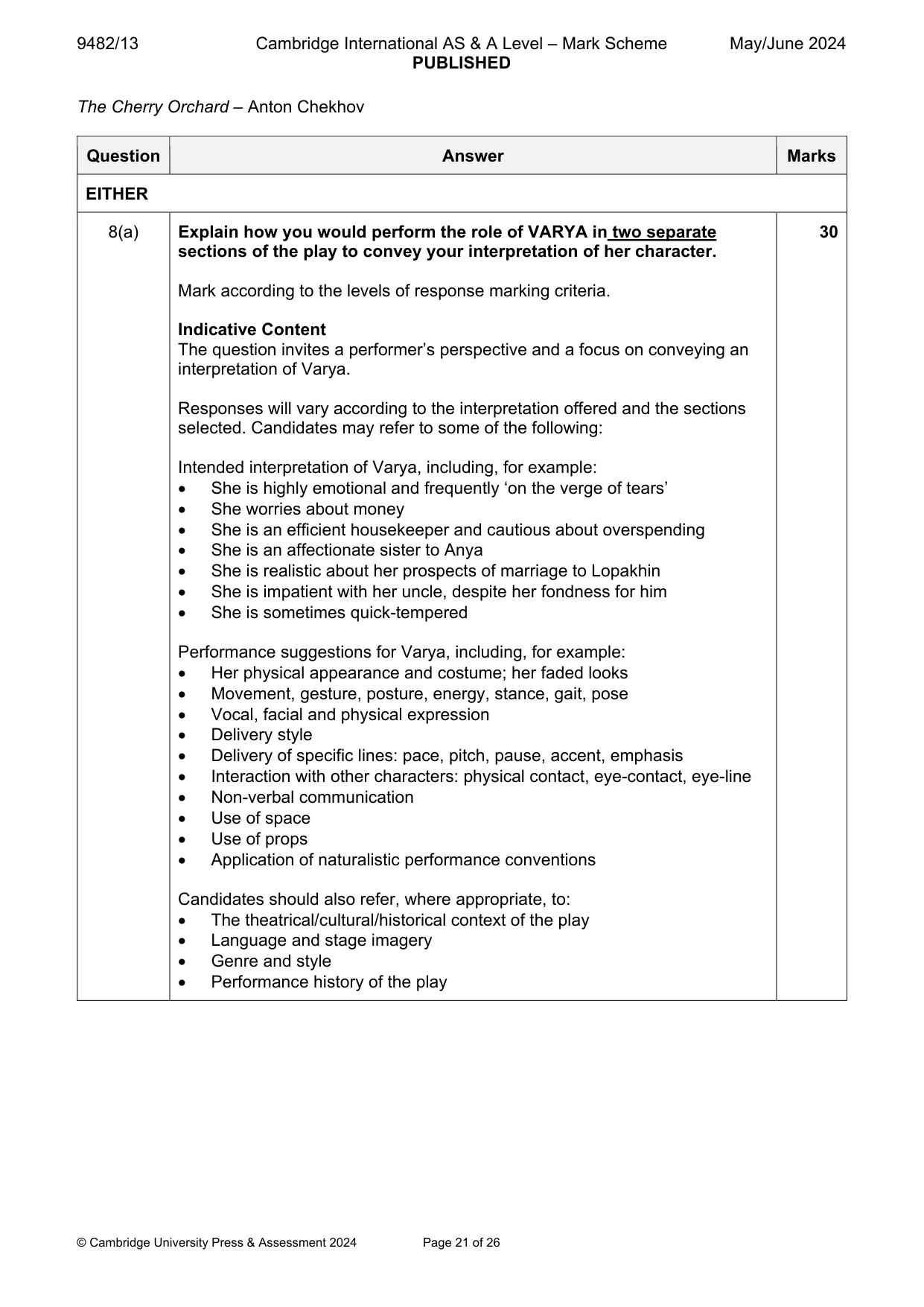
9482/13 Cambridge International AS & A Level – Mark Scheme PUBLISHED May/June 2024 © Cambridge University Press & Assessment 2024 Page 21 of 26 The Cherry Orchard – Anton Chekhov Question Answer Marks EITHER 8(a) Explain how you would perform the role of VARYA in two separate sections of the play to convey your interpretation of her character. Mark according to the levels of response marking criteria. Indicative Content The question invites a performer’s perspective and a focus on conveying an interpretation of Varya. Responses will vary according to the interpretation offered and the sections selected. Candidates may refer to some of the following: Intended interpretation of Varya, including, for example: She is highly emotional and frequently ‘on the verge of tears’ She worries about money She is an efficient housekeeper and cautious about overspending She is an affectionate sister to Anya She is realistic about her prospects of marriage to Lopakhin She is impatient with her uncle, despite her fondness for him She is sometimes quick-tempered Performance suggestions for Varya, including, for example: Her physical appearance and costume; her faded looks Movement, gesture, posture, energy, stance, gait, pose Vocal, facial and physical expression Delivery style Delivery of specific lines: pace, pitch, pause, accent, emphasis Interaction with other characters: physical contact, eye-contact, eye-line Non-verbal communication Use of space Use of props Application of naturalistic performance conventions Candidates should also refer, where appropriate, to: The theatrical/cultural/historical context of the play Language and stage imagery Genre and style Performance history of the play 30
Mark scheme, page 22
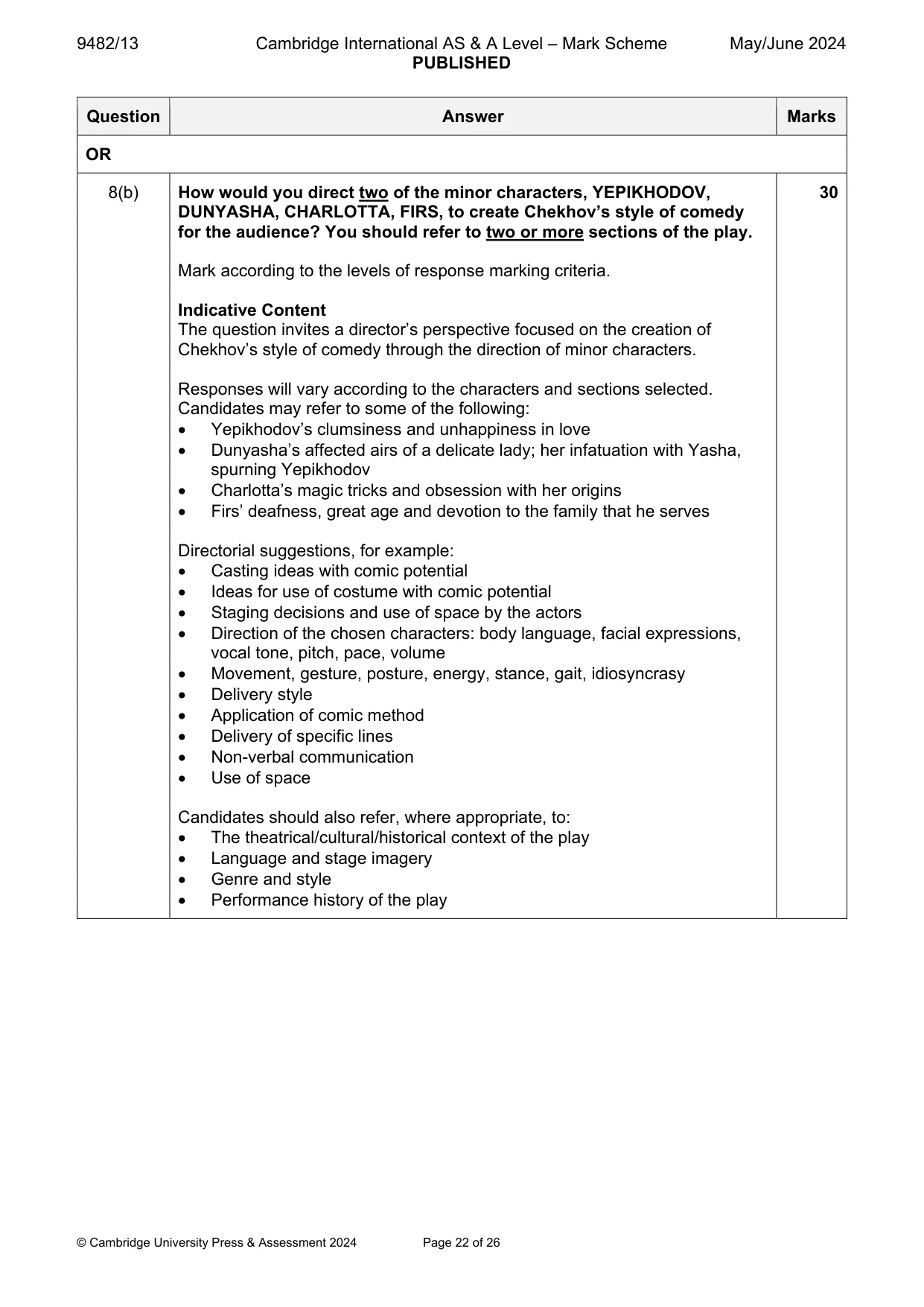
9482/13 Cambridge International AS & A Level – Mark Scheme PUBLISHED May/June 2024 © Cambridge University Press & Assessment 2024 Page 22 of 26 Question Answer Marks OR 8(b) How would you direct two of the minor characters, YEPIKHODOV, DUNYASHA, CHARLOTTA, FIRS, to create Chekhov’s style of comedy for the audience? You should refer to two or more sections of the play. Mark according to the levels of response marking criteria. Indicative Content The question invites a director’s perspective focused on the creation of Chekhov’s style of comedy through the direction of minor characters. Responses will vary according to the characters and sections selected. Candidates may refer to some of the following: Yepikhodov’s clumsiness and unhappiness in love Dunyasha’s affected airs of a delicate lady; her infatuation with Yasha, spurning Yepikhodov Charlotta’s magic tricks and obsession with her origins Firs’ deafness, great age and devotion to the family that he serves Directorial suggestions, for example: Casting ideas with comic potential Ideas for use of costume with comic potential Staging decisions and use of space by the actors Direction of the chosen characters: body language, facial expressions, vocal tone, pitch, pace, volume Movement, gesture, posture, energy, stance, gait, idiosyncrasy Delivery style Application of comic method Delivery of specific lines Non-verbal communication Use of space Candidates should also refer, where appropriate, to: The theatrical/cultural/historical context of the play Language and stage imagery Genre and style Performance history of the play 30
Mark scheme, page 23
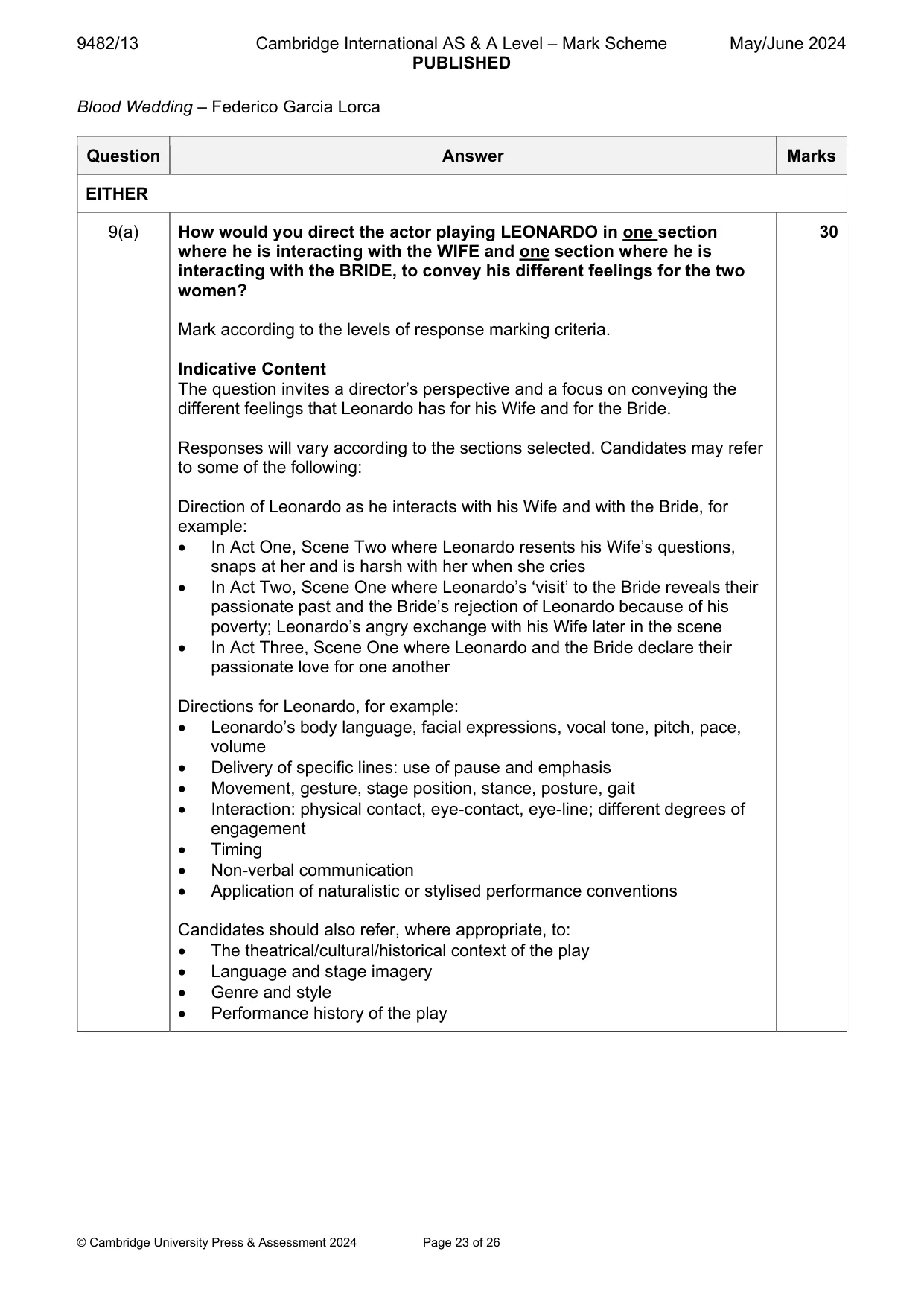
9482/13 Cambridge International AS & A Level – Mark Scheme PUBLISHED May/June 2024 © Cambridge University Press & Assessment 2024 Page 23 of 26 Blood Wedding – Federico Garcia Lorca Question Answer Marks EITHER 9(a) How would you direct the actor playing LEONARDO in one section where he is interacting with the WIFE and one section where he is interacting with the BRIDE, to convey his different feelings for the two women? Mark according to the levels of response marking criteria. Indicative Content The question invites a director’s perspective and a focus on conveying the different feelings that Leonardo has for his Wife and for the Bride. Responses will vary according to the sections selected. Candidates may refer to some of the following: Direction of Leonardo as he interacts with his Wife and with the Bride, for example: In Act One, Scene Two where Leonardo resents his Wife’s questions, snaps at her and is harsh with her when she cries In Act Two, Scene One where Leonardo’s ‘visit’ to the Bride reveals their passionate past and the Bride’s rejection of Leonardo because of his poverty; Leonardo’s angry exchange with his Wife later in the scene In Act Three, Scene One where Leonardo and the Bride declare their passionate love for one another Directions for Leonardo, for example: Leonardo’s body language, facial expressions, vocal tone, pitch, pace, volume Delivery of specific lines: use of pause and emphasis Movement, gesture, stage position, stance, posture, gait Interaction: physical contact, eye-contact, eye-line; different degrees of engagement Timing Non-verbal communication Application of naturalistic or stylised performance conventions Candidates should also refer, where appropriate, to: The theatrical/cultural/historical context of the play Language and stage imagery Genre and style Performance history of the play 30
Mark scheme, page 24
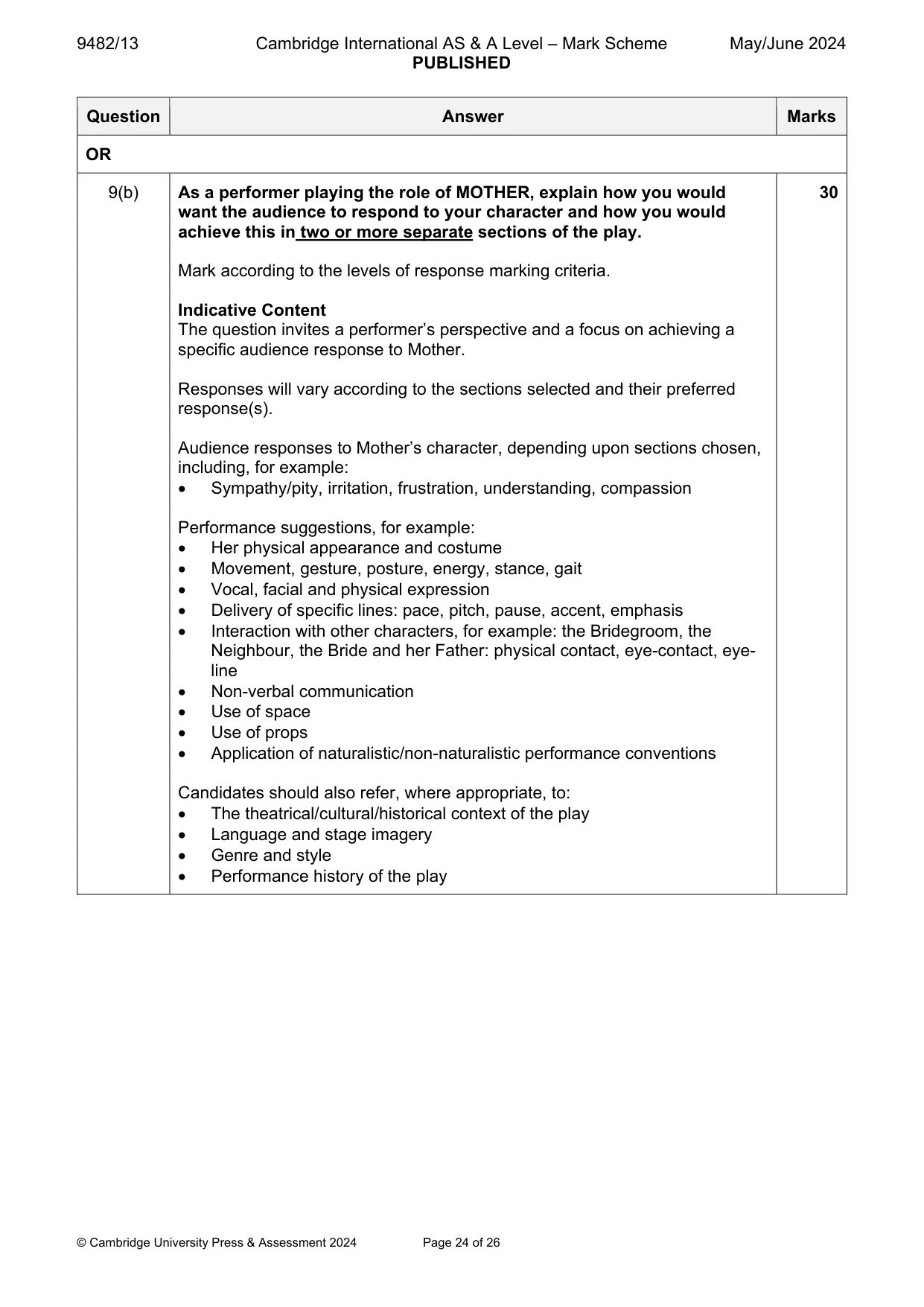
9482/13 Cambridge International AS & A Level – Mark Scheme PUBLISHED May/June 2024 © Cambridge University Press & Assessment 2024 Page 24 of 26 Question Answer Marks OR 9(b) As a performer playing the role of MOTHER, explain how you would want the audience to respond to your character and how you would achieve this in two or more separate sections of the play. Mark according to the levels of response marking criteria. Indicative Content The question invites a performer’s perspective and a focus on achieving a specific audience response to Mother. Responses will vary according to the sections selected and their preferred response(s). Audience responses to Mother’s character, depending upon sections chosen, including, for example: Sympathy/pity, irritation, frustration, understanding, compassion Performance suggestions, for example: Her physical appearance and costume Movement, gesture, posture, energy, stance, gait Vocal, facial and physical expression Delivery of specific lines: pace, pitch, pause, accent, emphasis Interaction with other characters, for example: the Bridegroom, the Neighbour, the Bride and her Father: physical contact, eye-contact, eye- line Non-verbal communication Use of space Use of props Application of naturalistic/non-naturalistic performance conventions Candidates should also refer, where appropriate, to: The theatrical/cultural/historical context of the play Language and stage imagery Genre and style Performance history of the play 30
Mark scheme, page 25
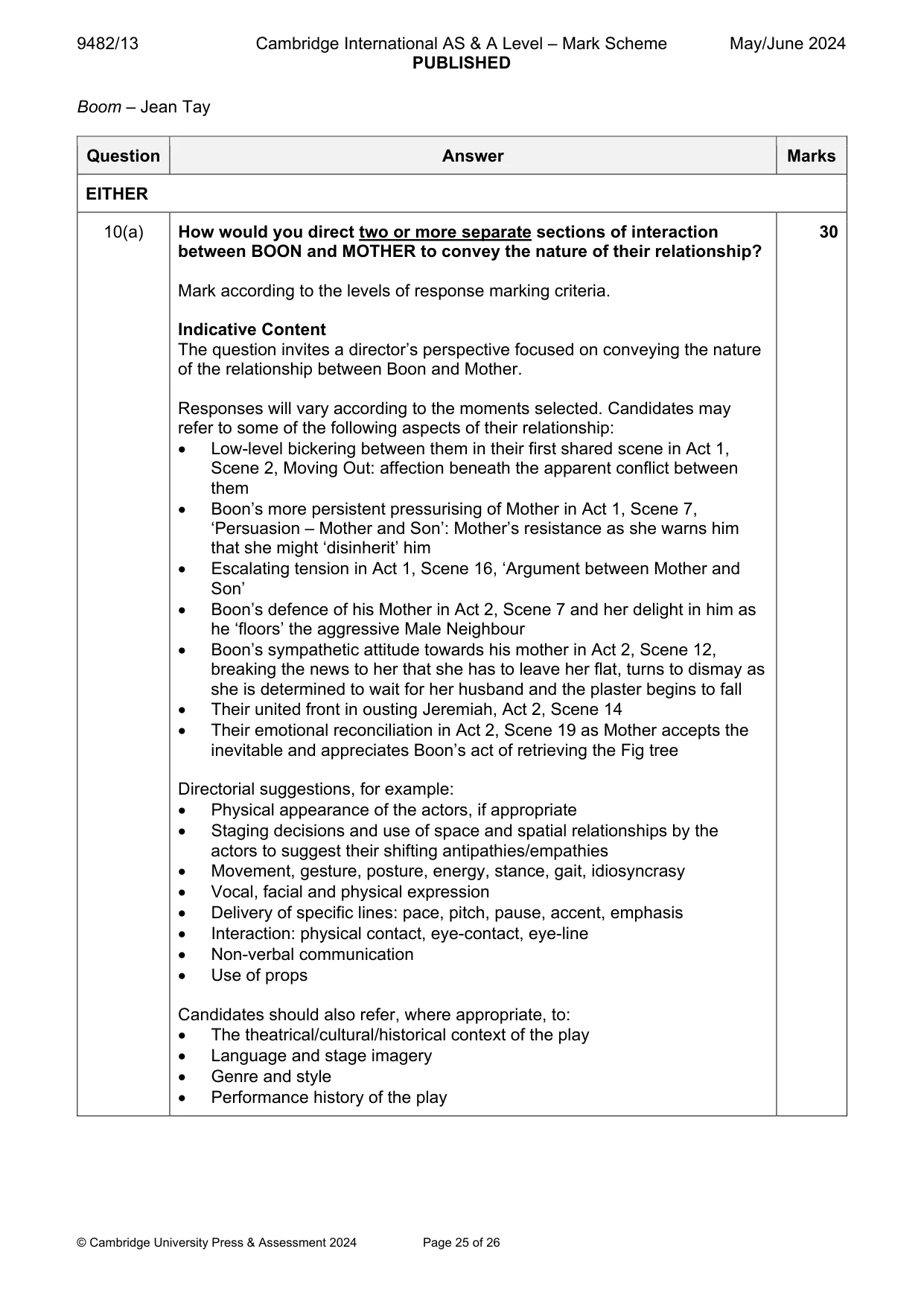
9482/13 Cambridge International AS & A Level – Mark Scheme PUBLISHED May/June 2024 © Cambridge University Press & Assessment 2024 Page 25 of 26 Boom – Jean Tay Question Answer Marks EITHER 10(a) How would you direct two or more separate sections of interaction between BOON and MOTHER to convey the nature of their relationship? Mark according to the levels of response marking criteria. Indicative Content The question invites a director’s perspective focused on conveying the nature of the relationship between Boon and Mother. Responses will vary according to the moments selected. Candidates may refer to some of the following aspects of their relationship: Low-level bickering between them in their first shared scene in Act 1, Scene 2, Moving Out: affection beneath the apparent conflict between them Boon’s more persistent pressurising of Mother in Act 1, Scene 7, ‘Persuasion – Mother and Son’: Mother’s resistance as she warns him that she might ‘disinherit’ him Escalating tension in Act 1, Scene 16, ‘Argument between Mother and Son’ Boon’s defence of his Mother in Act 2, Scene 7 and her delight in him as he ‘floors’ the aggressive Male Neighbour Boon’s sympathetic attitude towards his mother in Act 2, Scene 12, breaking the news to her that she has to leave her flat, turns to dismay as she is determined to wait for her husband and the plaster begins to fall Their united front in ousting Jeremiah, Act 2, Scene 14 Their emotional reconciliation in Act 2, Scene 19 as Mother accepts the inevitable and appreciates Boon’s act of retrieving the Fig tree Directorial suggestions, for example: Physical appearance of the actors, if appropriate Staging decisions and use of space and spatial relationships by the actors to suggest their shifting antipathies/empathies Movement, gesture, posture, energy, stance, gait, idiosyncrasy Vocal, facial and physical expression Delivery of specific lines: pace, pitch, pause, accent, emphasis Interaction: physical contact, eye-contact, eye-line Non-verbal communication Use of props Candidates should also refer, where appropriate, to: The theatrical/cultural/historical context of the play Language and stage imagery Genre and style Performance history of the play 30
Mark scheme, page 26
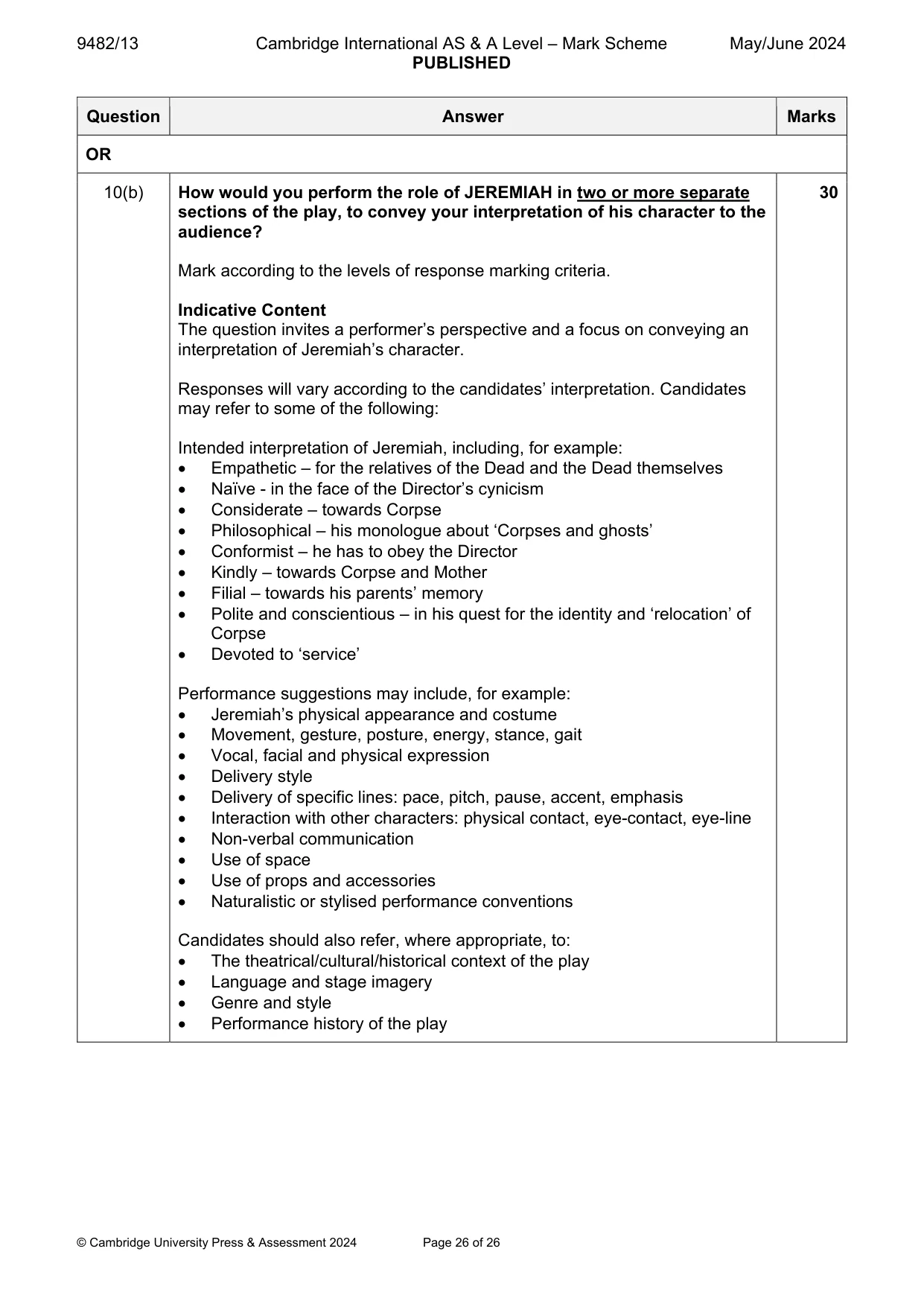
9482/13 Cambridge International AS & A Level – Mark Scheme PUBLISHED May/June 2024 © Cambridge University Press & Assessment 2024 Page 26 of 26 Question Answer Marks OR 10(b) How would you perform the role of JEREMIAH in two or more separate sections of the play, to convey your interpretation of his character to the audience? Mark according to the levels of response marking criteria. Indicative Content The question invites a performer’s perspective and a focus on conveying an interpretation of Jeremiah’s character. Responses will vary according to the candidates’ interpretation. Candidates may refer to some of the following: Intended interpretation of Jeremiah, including, for example: Empathetic – for the relatives of the Dead and the Dead themselves Naïve - in the face of the Director’s cynicism Considerate – towards Corpse Philosophical – his monologue about ‘Corpses and ghosts’ Conformist – he has to obey the Director Kindly – towards Corpse and Mother Filial – towards his parents’ memory Polite and conscientious – in his quest for the identity and ‘relocation’ of Corpse Devoted to ‘service’ Performance suggestions may include, for example: Jeremiah’s physical appearance and costume Movement, gesture, posture, energy, stance, gait Vocal, facial and physical expression Delivery style Delivery of specific lines: pace, pitch, pause, accent, emphasis Interaction with other characters: physical contact, eye-contact, eye-line Non-verbal communication Use of space Use of props and accessories Naturalistic or stylised performance conventions Candidates should also refer, where appropriate, to: The theatrical/cultural/historical context of the play Language and stage imagery Genre and style Performance history of the play 30
What you needed in this session
Cambridge’s own grade thresholds for 2024 May/June, Paper 1 · Variant 3. A higher threshold means an easier paper — the bar moves with how the cohort did.