Cambridge A Level Drama 9482 — 2022 May/June Paper 1 · Variant 3
9482/13/M/J/22 · 60 marks · ≈68 min
The question paper and its mark scheme, free to read here and free to download. This is Cambridge’s own paper, exactly as it was sat.
Question paper8 pages


Mark scheme28 pages
Answers below. Sit the paper first if you are practising.
Paper as text
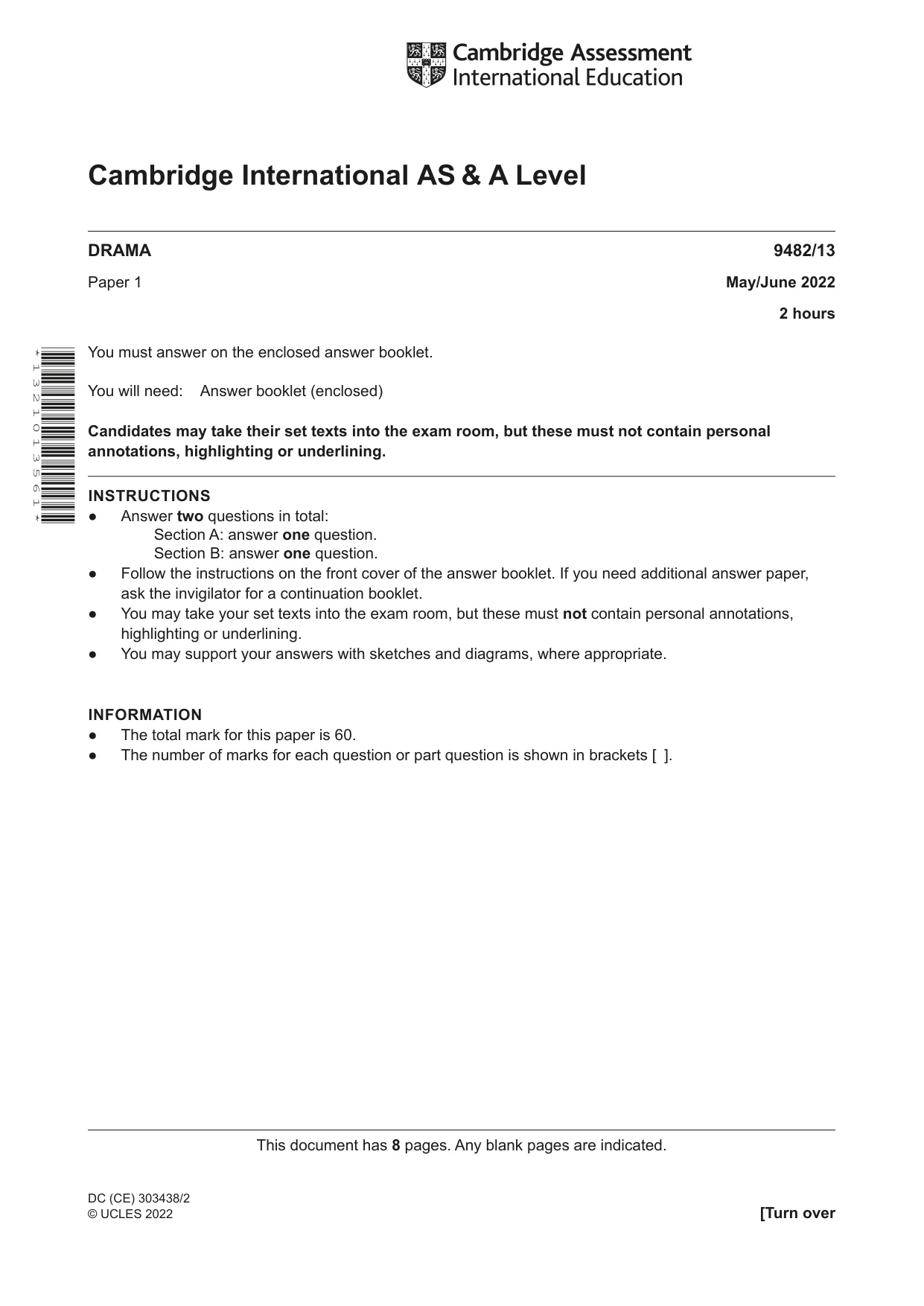
Question paper, page 1
This document has 8 pages. Any blank pages are indicated. [Turn over Cambridge International AS & A Level DC (CE) 303438/2 © UCLES 2022 DRAMA 9482/13 Paper 1 May/June 2022 2 hours You must answer on the enclosed answer booklet. You will need: Answer booklet (enclosed) Candidates may take their set texts into the exam room, but these must not contain personal annotations, highlighting or underlining. INSTRUCTIONS ● Answer two questions in total: Section A: answer one question. Section B: answer one question. ● Follow the instructions on the front cover of the answer booklet. If you need additional answer paper, ask the invigilator for a continuation booklet. ● You may take your set texts into the exam room, but these must not contain personal annotations, highlighting or underlining. ● You may support your answers with sketches and diagrams, where appropriate. INFORMATION ● The total mark for this paper is 60. ● The number of marks for each question or part question is shown in brackets [ ]. * 1 3 2 1 0 1 3 5 6 1 *
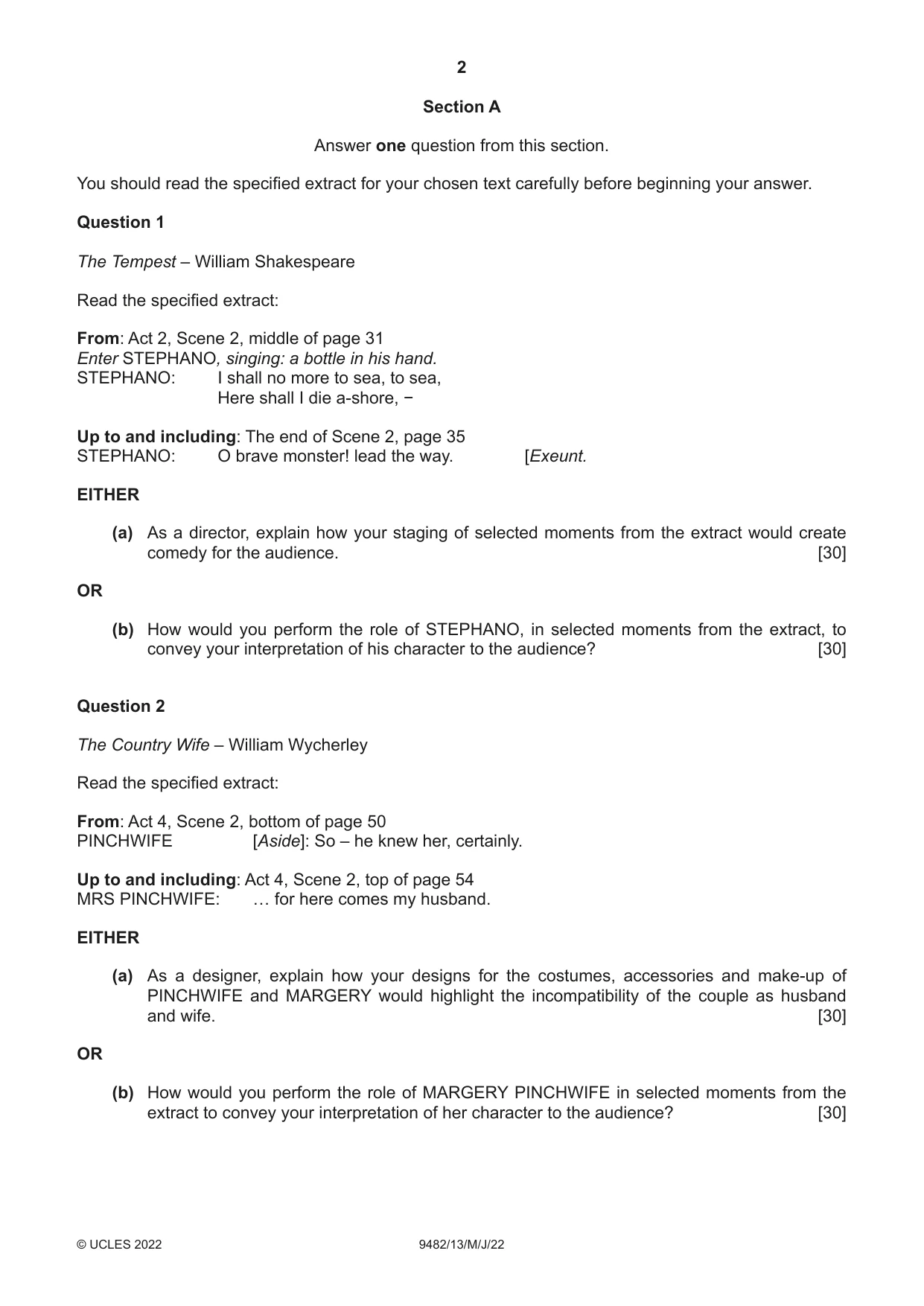
Question paper, page 2
2 9482/13/M/J/22 © UCLES 2022 Section A Answer one question from this section. You should read the specified extract for your chosen text carefully before beginning your answer. Question 1 The Tempest – William Shakespeare Read the specified extract: From: Act 2, Scene 2, middle of page 31 Enter STEPHANO, singing: a bottle in his hand. STEPHANO: I shall no more to sea, to sea, Here shall I die a-shore, − Up to and including: The end of Scene 2, page 35 STEPHANO: O brave monster! lead the way. [Exeunt. EITHER (a) As a director, explain how your staging of selected moments from the extract would create comedy for the audience. [30] OR (b) How would you perform the role of STEPHANO, in selected moments from the extract, to convey your interpretation of his character to the audience? [30] Question 2 The Country Wife – William Wycherley Read the specified extract: From: Act 4, Scene 2, bottom of page 50 PINCHWIFE [Aside]: So – he knew her, certainly. Up to and including: Act 4, Scene 2, top of page 54 MRS PINCHWIFE: … for here comes my husband. EITHER (a) As a designer, explain how your designs for the costumes, accessories and make-up of PINCHWIFE and MARGERY would highlight the incompatibility of the couple as husband and wife. [30] OR (b) How would you perform the role of MARGERY PINCHWIFE in selected moments from the extract to convey your interpretation of her character to the audience? [30]
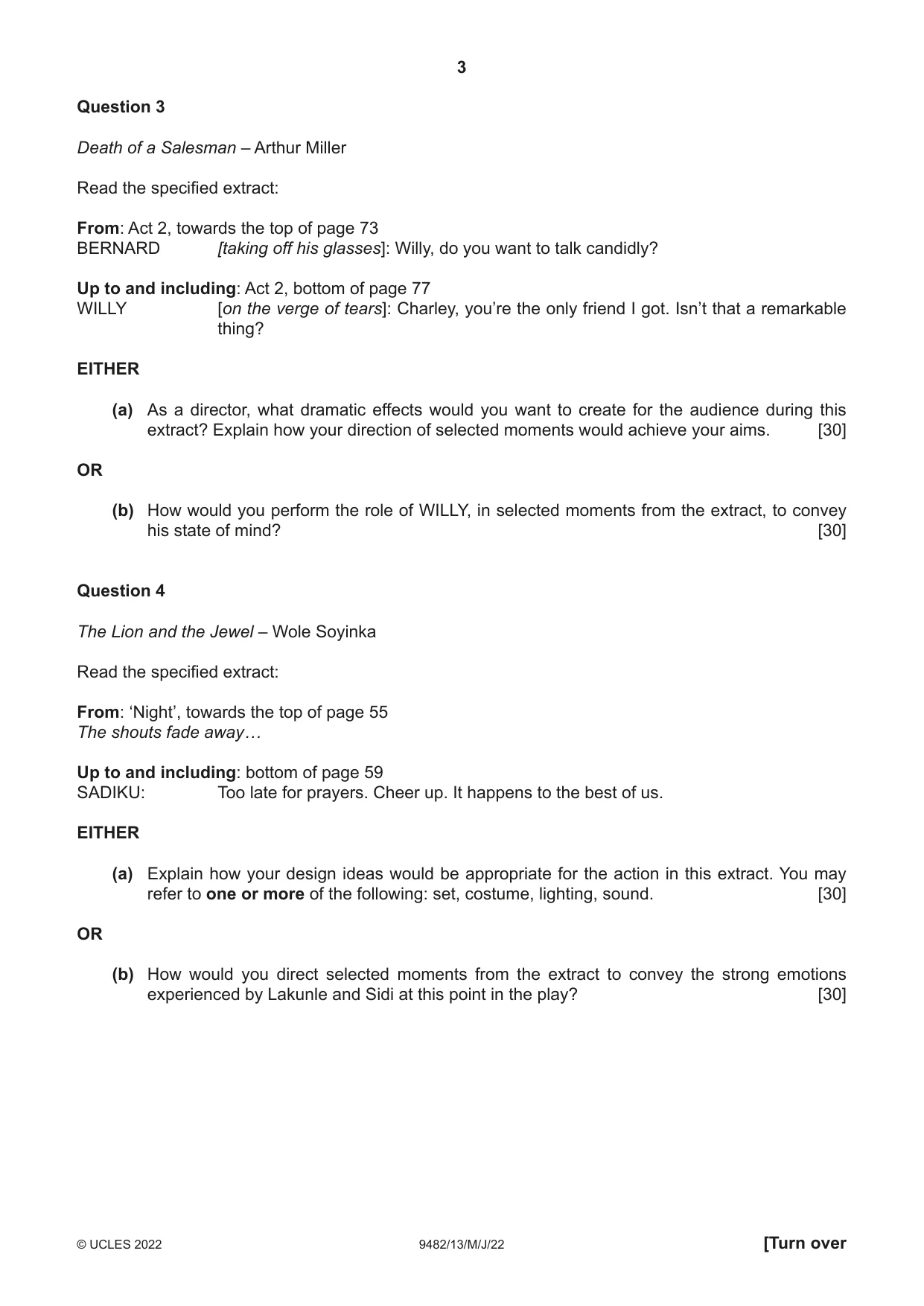
Question paper, page 3
3 9482/13/M/J/22 © UCLES 2022 [Turn over Question 3 Death of a Salesman – Arthur Miller Read the specified extract: From: Act 2, towards the top of page 73 BERNARD [taking off his glasses]: Willy, do you want to talk candidly? Up to and including: Act 2, bottom of page 77 WILLY [on the verge of tears]: Charley, you’re the only friend I got. Isn’t that a remarkable thing? EITHER (a) As a director, what dramatic effects would you want to create for the audience during this extract? Explain how your direction of selected moments would achieve your aims. [30] OR (b) How would you perform the role of WILLY, in selected moments from the extract, to convey his state of mind? [30] Question 4 The Lion and the Jewel – Wole Soyinka Read the specified extract: From: ‘Night’, towards the top of page 55 The shouts fade away… Up to and including: bottom of page 59 SADIKU: Too late for prayers. Cheer up. It happens to the best of us. EITHER (a) Explain how your design ideas would be appropriate for the action in this extract. You may refer to one or more of the following: set, costume, lighting, sound. [30] OR (b) How would you direct selected moments from the extract to convey the strong emotions experienced by Lakunle and Sidi at this point in the play? [30]
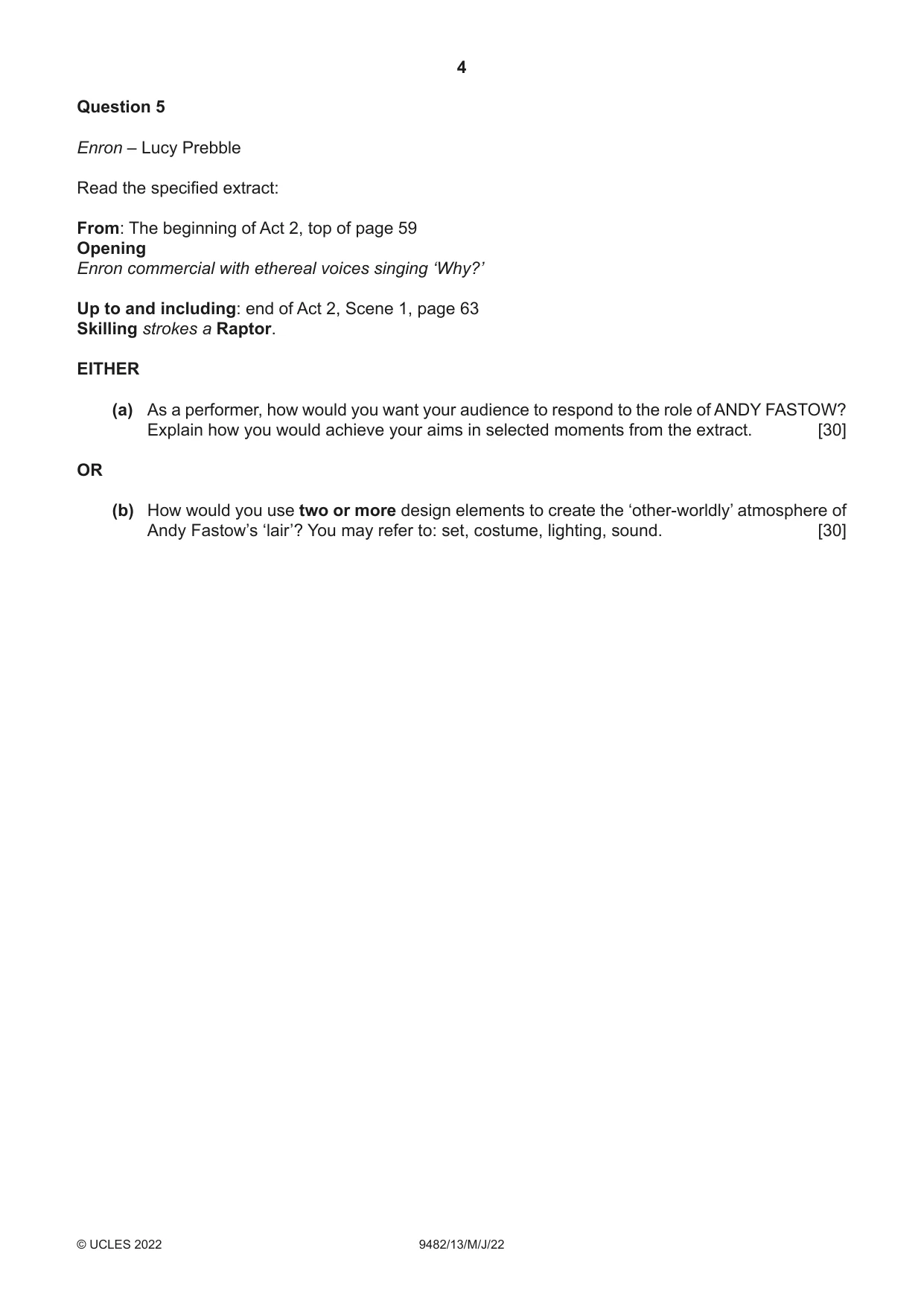
Question paper, page 4
4 9482/13/M/J/22 © UCLES 2022 Question 5 Enron – Lucy Prebble Read the specified extract: From: The beginning of Act 2, top of page 59 Opening Enron commercial with ethereal voices singing ‘Why?’ Up to and including: end of Act 2, Scene 1, page 63 Skilling strokes a Raptor. EITHER (a) As a performer, how would you want your audience to respond to the role of ANDY FASTOW? Explain how you would achieve your aims in selected moments from the extract. [30] OR (b) How would you use two or more design elements to create the ‘other-worldly’ atmosphere of Andy Fastow’s ‘lair’? You may refer to: set, costume, lighting, sound. [30]
Question paper, page 5
5 9482/13/M/J/22 © UCLES 2022 [Turn over Section B Answer one question from this section. Question 6 Medea – Euripides EITHER (a) As a costume designer, explain how your designs for the costumes, make-up and accessories of any two characters would contribute to the dramatic effectiveness of the performance in one or more sections of the play. [30] OR (b) Explain how you would perform the role of MEDEA in two or more separate sections of the play to demonstrate her volatile character to the audience. [30] Question 7 Tartuffe – Molière EITHER (a) Explain how you would perform the role of ELMIRE in two or more sections of the play to convey your interpretation of her character. [30] OR (b) Explain how your costume designs for two characters would contribute to the comic style of the production in one or more sections of the play. [30] Question 8 The Seagull – Anton Chekhov EITHER (a) How would you direct the actor playing TRIGORIN in one section where he is interacting with ARKADINA and one section where he is interacting with NINA, to convey the contrast in his feelings for the two women? [30] OR (b) As a performer, how would you want your audience to respond to the role of MASHA? Explain how you would achieve your aims in at least two sections of the play. [30]
Question paper, page 6
6 9482/13/M/J/22 © UCLES 2022 Question 9 The Curious Incident of the Dog in the Night-Time – Simon Stephens EITHER (a) How would you perform the role of MRS ALEXANDER in each of her appearances in the play to convey your interpretation of the character? [30] OR (b) How would you direct two or more sections of the play that include CHRISTOPHER and JUDY to convey the complexity of the mother-son relationship? [30] Question 10 Snow in Midsummer – Frances Ya-Chu Cowhig EITHER (a) How would you perform the role of DOU YI in two or more separate sections of the play to engage the sympathies of the audience? [30] OR (b) How would you direct the actor playing TIANYUN in two or more separate sections of the play to reveal different aspects of her character? [30]
Question paper, page 7
7 9482/13/M/J/22 © UCLES 2022 BLANK PAGE
Question paper, page 8
8 9482/13/M/J/22 © UCLES 2022 Permission to reproduce items where third-party owned material protected by copyright is included has been sought and cleared where possible. Every reasonable effort has been made by the publisher (UCLES) to trace copyright holders, but if any items requiring clearance have unwittingly been included, the publisher will be pleased to make amends at the earliest possible opportunity. To avoid the issue of disclosure of answer-related information to candidates, all copyright acknowledgements are reproduced online in the Cambridge Assessment International Education Copyright Acknowledgements Booklet. This is produced for each series of examinations and is freely available to download at www.cambridgeinternational.org after the live examination series. Cambridge Assessment International Education is part of Cambridge Assessment. Cambridge Assessment is the brand name of the University of Cambridge Local Examinations Syndicate (UCLES), which is a department of the University of Cambridge. BLANK PAGE
Mark scheme, page 1
This document consists of 28 printed pages. © UCLES 2022 [Turn over Cambridge International AS & A Level DRAMA 9482/13 Paper 1 Open-Book Written Examination May/June 2022 MARK SCHEME Maximum Mark: 60 Published This mark scheme is published as an aid to teachers and candidates, to indicate the requirements of the examination. It shows the basis on which Examiners were instructed to award marks. It does not indicate the details of the discussions that took place at an Examiners’ meeting before marking began, which would have considered the acceptability of alternative answers. Mark schemes should be read in conjunction with the question paper and the Principal Examiner Report for Teachers. Cambridge International will not enter into discussions about these mark schemes. Cambridge International is publishing the mark schemes for the May/June 2022 series for most Cambridge IGCSE, Cambridge International A and AS Level and Cambridge Pre-U components, and some Cambridge O Level components.
Mark scheme, page 2
9482/13 Cambridge International AS & A Level – Mark Scheme PUBLISHED May/June 2022 © UCLES 2022 Page 2 of 28 Generic Marking Principles These general marking principles must be applied by all examiners when marking candidate answers. They should be applied alongside the specific content of the mark scheme or generic level descriptors for a question. Each question paper and mark scheme will also comply with these marking principles. GENERIC MARKING PRINCIPLE 1: Marks must be awarded in line with: the specific content of the mark scheme or the generic level descriptors for the question the specific skills defined in the mark scheme or in the generic level descriptors for the question the standard of response required by a candidate as exemplified by the standardisation scripts. GENERIC MARKING PRINCIPLE 2: Marks awarded are always whole marks (not half marks, or other fractions). GENERIC MARKING PRINCIPLE 3: Marks must be awarded positively: marks are awarded for correct/valid answers, as defined in the mark scheme. However, credit is given for valid answers which go beyond the scope of the syllabus and mark scheme, referring to your Team Leader as appropriate marks are awarded when candidates clearly demonstrate what they know and can do marks are not deducted for errors marks are not deducted for omissions answers should only be judged on the quality of spelling, punctuation and grammar when these features are specifically assessed by the question as indicated by the mark scheme. The meaning, however, should be unambiguous. GENERIC MARKING PRINCIPLE 4: Rules must be applied consistently, e.g. in situations where candidates have not followed instructions or in the application of generic level descriptors. GENERIC MARKING PRINCIPLE 5: Marks should be awarded using the full range of marks defined in the mark scheme for the question (however; the use of the full mark range may be limited according to the quality of the candidate responses seen). GENERIC MARKING PRINCIPLE 6: Marks awarded are based solely on the requirements as defined in the mark scheme. Marks should not be awarded with grade thresholds or grade descriptors in mind.
Mark scheme, page 3
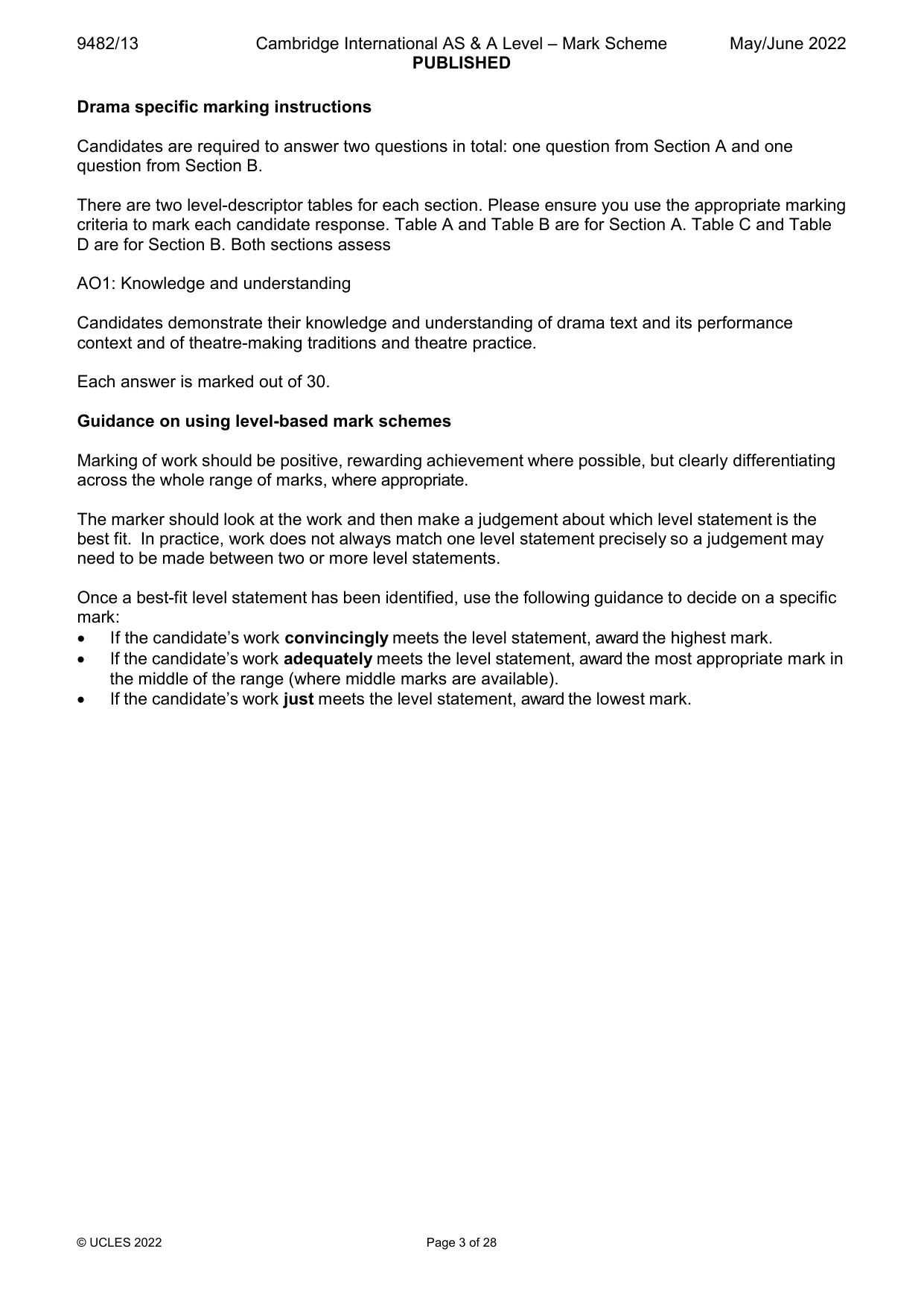
9482/13 Cambridge International AS & A Level – Mark Scheme PUBLISHED May/June 2022 © UCLES 2022 Page 3 of 28 Drama specific marking instructions Candidates are required to answer two questions in total: one question from Section A and one question from Section B. There are two level-descriptor tables for each section. Please ensure you use the appropriate marking criteria to mark each candidate response. Table A and Table B are for Section A. Table C and Table D are for Section B. Both sections assess AO1: Knowledge and understanding Candidates demonstrate their knowledge and understanding of drama text and its performance context and of theatre-making traditions and theatre practice. Each answer is marked out of 30. Guidance on using level-based mark schemes Marking of work should be positive, rewarding achievement where possible, but clearly differentiating across the whole range of marks, where appropriate. The marker should look at the work and then make a judgement about which level statement is the best fit. In practice, work does not always match one level statement precisely so a judgement may need to be made between two or more level statements. Once a best-fit level statement has been identified, use the following guidance to decide on a specific mark: If the candidate’s work convincingly meets the level statement, award the highest mark. If the candidate’s work adequately meets the level statement, award the most appropriate mark in the middle of the range (where middle marks are available). If the candidate’s work just meets the level statement, award the lowest mark.
Mark scheme, page 4
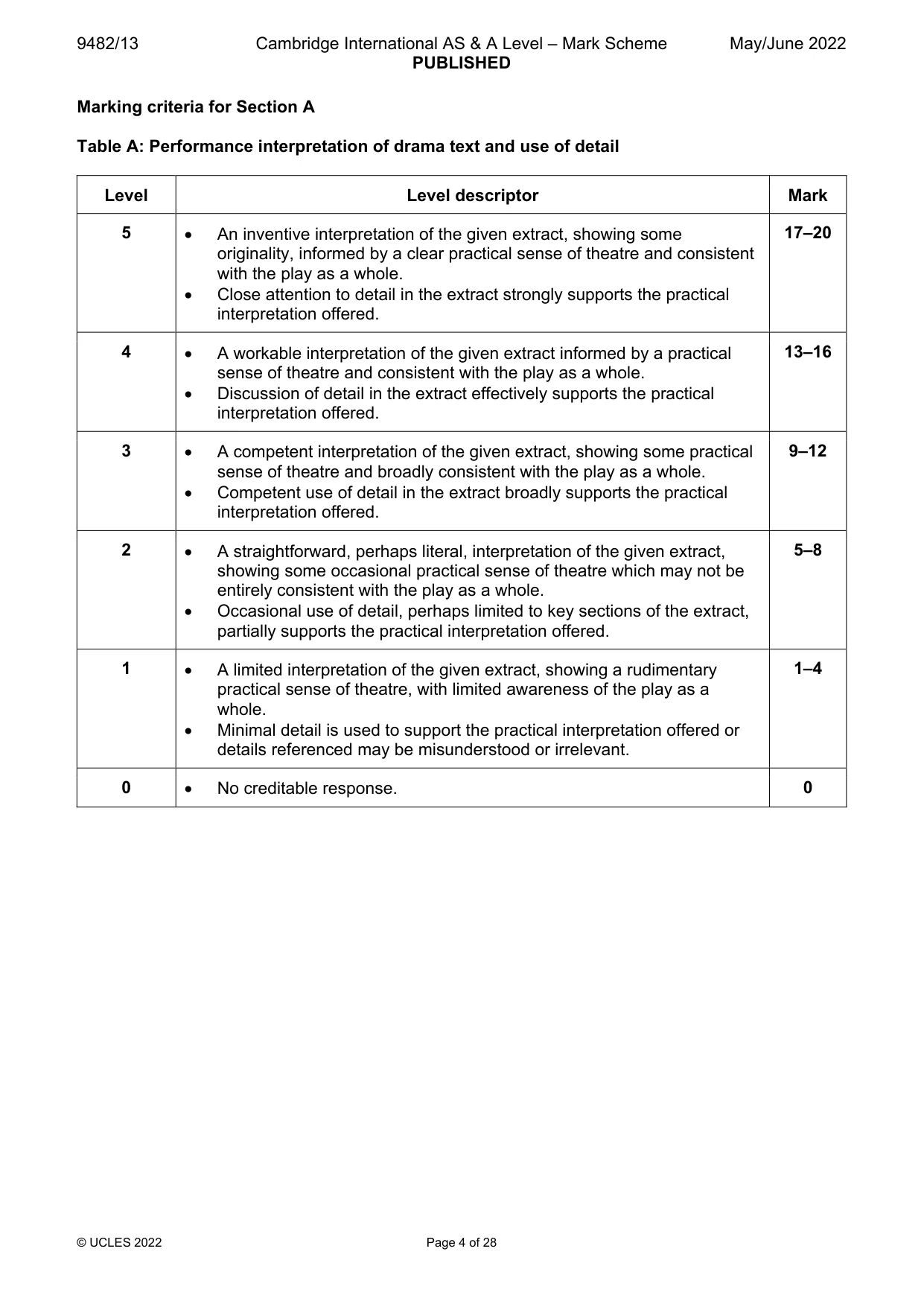
9482/13 Cambridge International AS & A Level – Mark Scheme PUBLISHED May/June 2022 © UCLES 2022 Page 4 of 28 Marking criteria for Section A Table A: Performance interpretation of drama text and use of detail Level Level descriptor Mark 5 An inventive interpretation of the given extract, showing some originality, informed by a clear practical sense of theatre and consistent with the play as a whole. Close attention to detail in the extract strongly supports the practical interpretation offered. 17–20 4 A workable interpretation of the given extract informed by a practical sense of theatre and consistent with the play as a whole. Discussion of detail in the extract effectively supports the practical interpretation offered. 13–16 3 A competent interpretation of the given extract, showing some practical sense of theatre and broadly consistent with the play as a whole. Competent use of detail in the extract broadly supports the practical interpretation offered. 9–12 2 A straightforward, perhaps literal, interpretation of the given extract, showing some occasional practical sense of theatre which may not be entirely consistent with the play as a whole. Occasional use of detail, perhaps limited to key sections of the extract, partially supports the practical interpretation offered. 5–8 1 A limited interpretation of the given extract, showing a rudimentary practical sense of theatre, with limited awareness of the play as a whole. Minimal detail is used to support the practical interpretation offered or details referenced may be misunderstood or irrelevant. 1–4 0 No creditable response. 0
Mark scheme, page 5
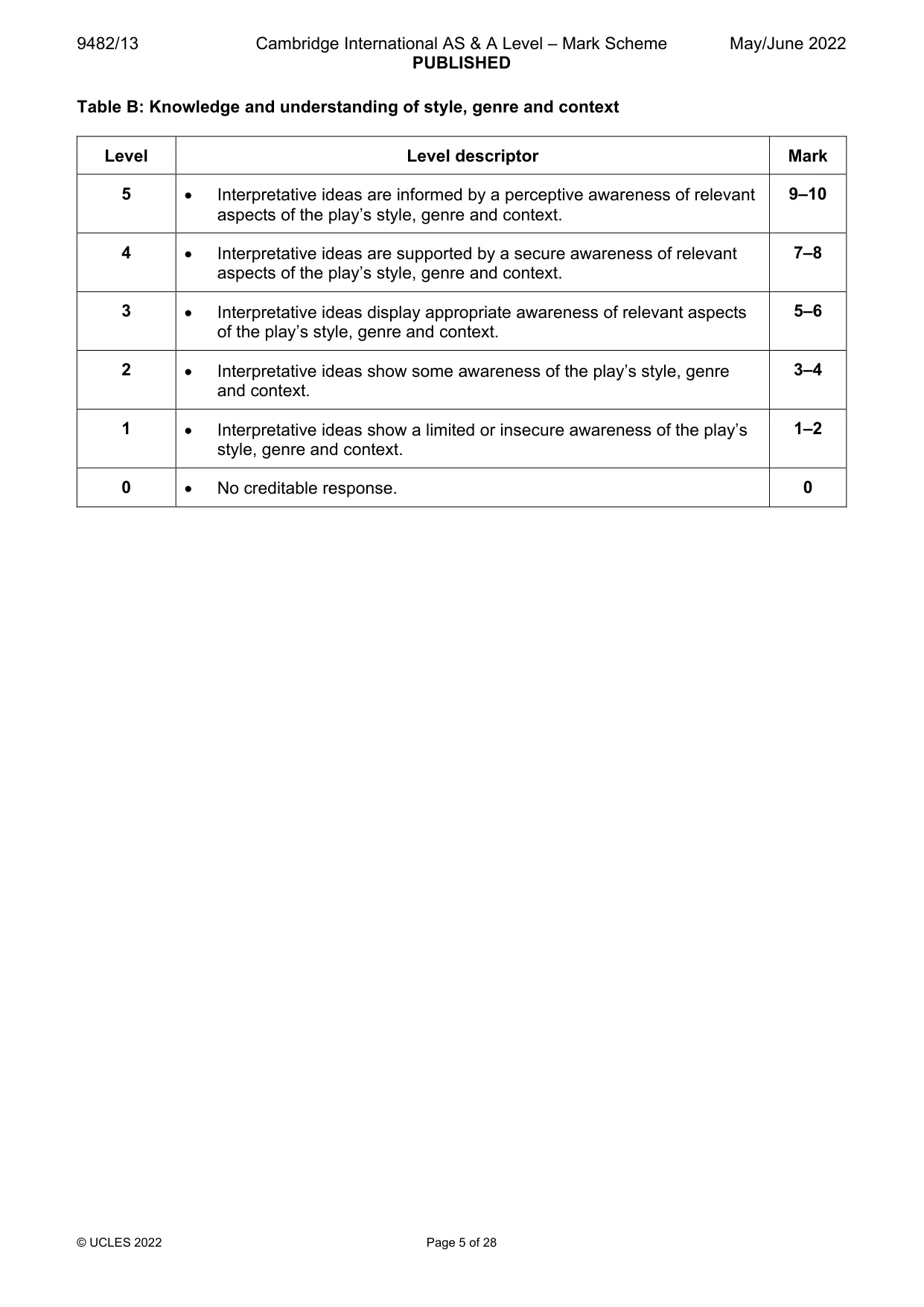
9482/13 Cambridge International AS & A Level – Mark Scheme PUBLISHED May/June 2022 © UCLES 2022 Page 5 of 28 Table B: Knowledge and understanding of style, genre and context Level Level descriptor Mark 5 Interpretative ideas are informed by a perceptive awareness of relevant aspects of the play’s style, genre and context. 9–10 4 Interpretative ideas are supported by a secure awareness of relevant aspects of the play’s style, genre and context. 7–8 3 Interpretative ideas display appropriate awareness of relevant aspects of the play’s style, genre and context. 5–6 2 Interpretative ideas show some awareness of the play’s style, genre and context. 3–4 1 Interpretative ideas show a limited or insecure awareness of the play’s style, genre and context. 1–2 0 No creditable response. 0
Mark scheme, page 6
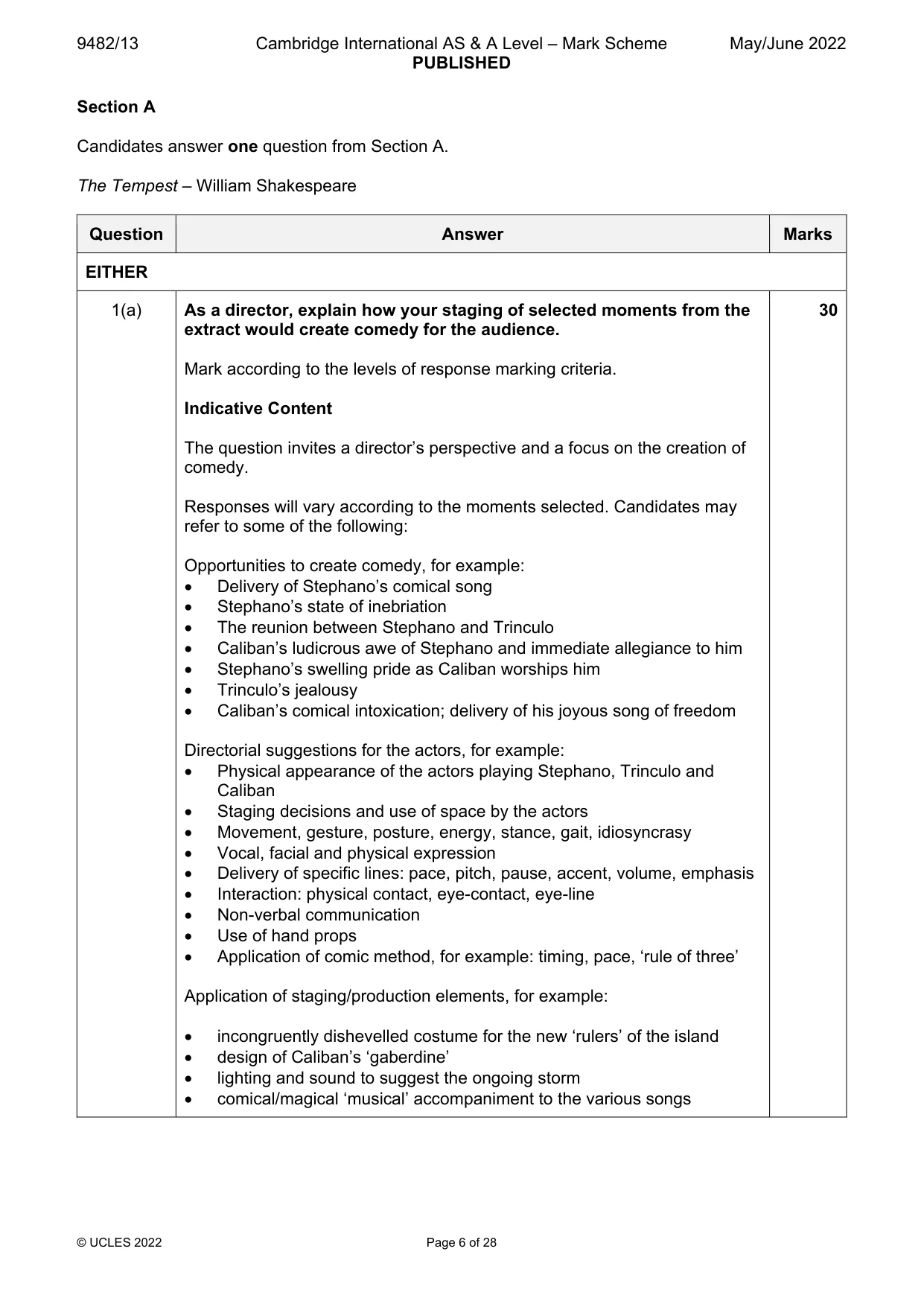
9482/13 Cambridge International AS & A Level – Mark Scheme PUBLISHED May/June 2022 © UCLES 2022 Page 6 of 28 Section A Candidates answer one question from Section A. The Tempest – William Shakespeare Question Answer Marks EITHER 1(a) As a director, explain how your staging of selected moments from the extract would create comedy for the audience. Mark according to the levels of response marking criteria. Indicative Content The question invites a director’s perspective and a focus on the creation of comedy. Responses will vary according to the moments selected. Candidates may refer to some of the following: Opportunities to create comedy, for example: Delivery of Stephano’s comical song Stephano’s state of inebriation The reunion between Stephano and Trinculo Caliban’s ludicrous awe of Stephano and immediate allegiance to him Stephano’s swelling pride as Caliban worships him Trinculo’s jealousy Caliban’s comical intoxication; delivery of his joyous song of freedom Directorial suggestions for the actors, for example: Physical appearance of the actors playing Stephano, Trinculo and Caliban Staging decisions and use of space by the actors Movement, gesture, posture, energy, stance, gait, idiosyncrasy Vocal, facial and physical expression Delivery of specific lines: pace, pitch, pause, accent, volume, emphasis Interaction: physical contact, eye-contact, eye-line Non-verbal communication Use of hand props Application of comic method, for example: timing, pace, ‘rule of three’ Application of staging/production elements, for example: incongruently dishevelled costume for the new ‘rulers’ of the island design of Caliban’s ‘gaberdine’ lighting and sound to suggest the ongoing storm comical/magical ‘musical’ accompaniment to the various songs 30
Mark scheme, page 7
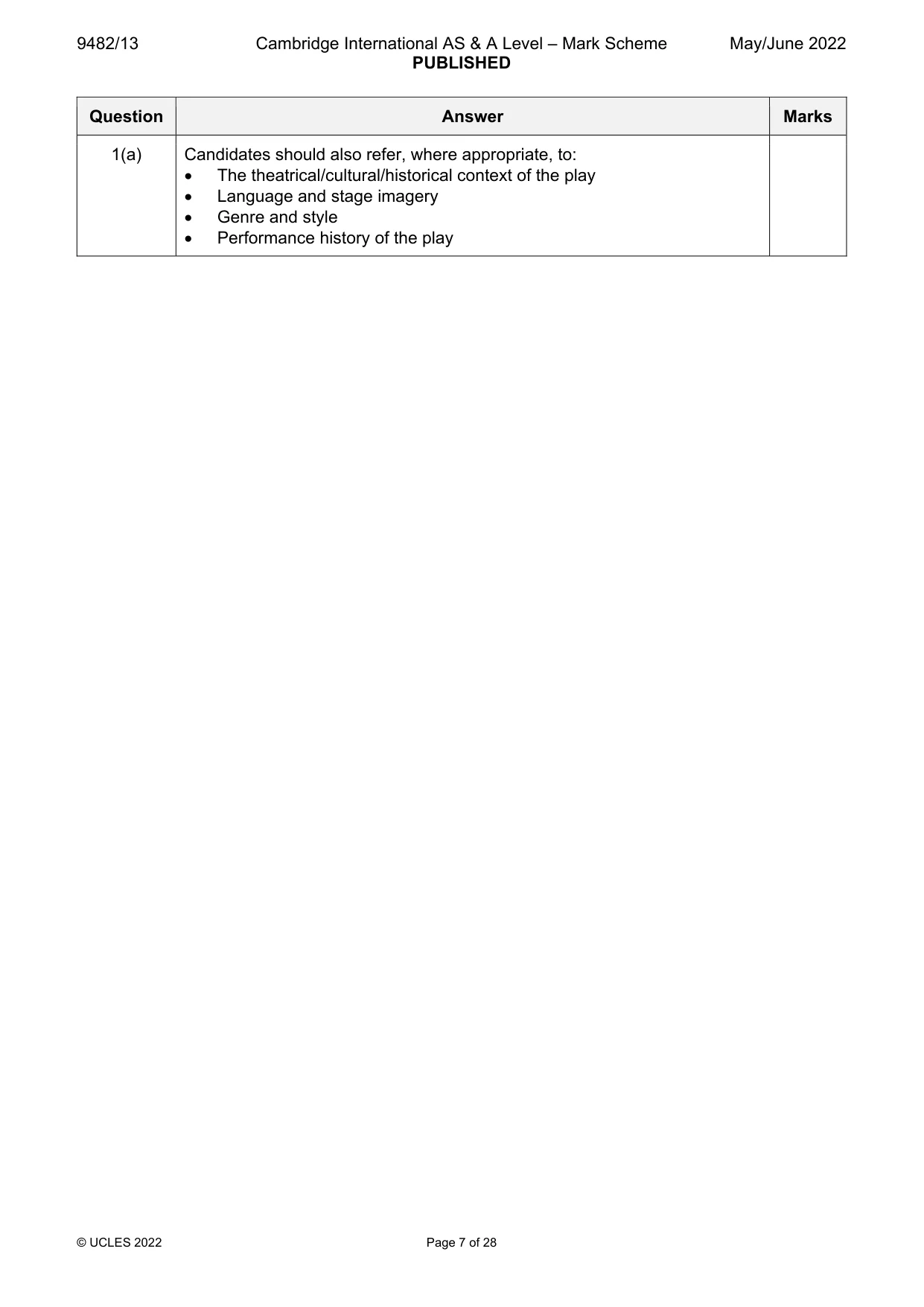
9482/13 Cambridge International AS & A Level – Mark Scheme PUBLISHED May/June 2022 © UCLES 2022 Page 7 of 28 Question Answer Marks 1(a) Candidates should also refer, where appropriate, to: The theatrical/cultural/historical context of the play Language and stage imagery Genre and style Performance history of the play
Mark scheme, page 8
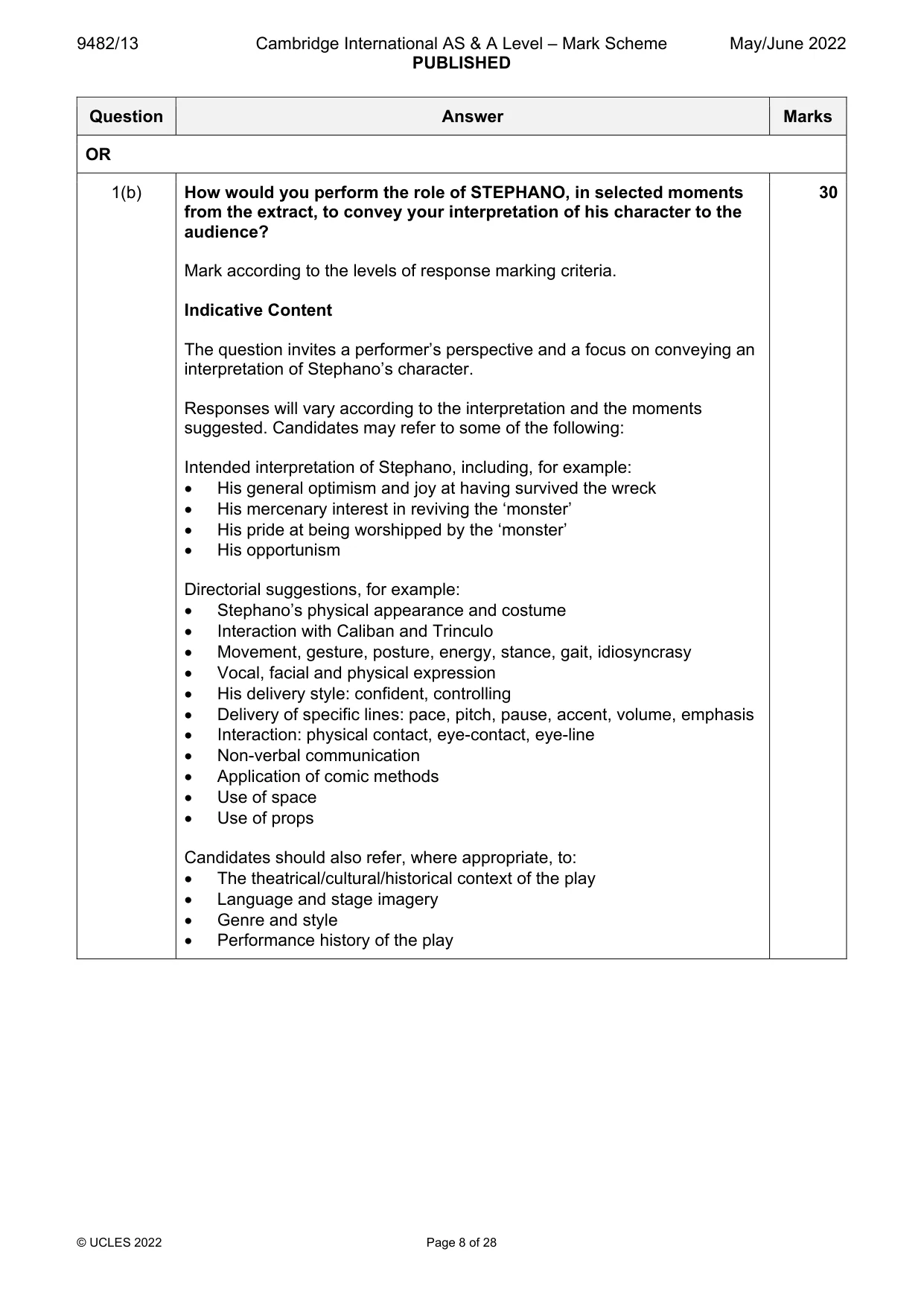
9482/13 Cambridge International AS & A Level – Mark Scheme PUBLISHED May/June 2022 © UCLES 2022 Page 8 of 28 Question Answer Marks OR 1(b) How would you perform the role of STEPHANO, in selected moments from the extract, to convey your interpretation of his character to the audience? Mark according to the levels of response marking criteria. Indicative Content The question invites a performer’s perspective and a focus on conveying an interpretation of Stephano’s character. Responses will vary according to the interpretation and the moments suggested. Candidates may refer to some of the following: Intended interpretation of Stephano, including, for example: His general optimism and joy at having survived the wreck His mercenary interest in reviving the ‘monster’ His pride at being worshipped by the ‘monster’ His opportunism Directorial suggestions, for example: Stephano’s physical appearance and costume Interaction with Caliban and Trinculo Movement, gesture, posture, energy, stance, gait, idiosyncrasy Vocal, facial and physical expression His delivery style: confident, controlling Delivery of specific lines: pace, pitch, pause, accent, volume, emphasis Interaction: physical contact, eye-contact, eye-line Non-verbal communication Application of comic methods Use of space Use of props Candidates should also refer, where appropriate, to: The theatrical/cultural/historical context of the play Language and stage imagery Genre and style Performance history of the play 30
Mark scheme, page 9
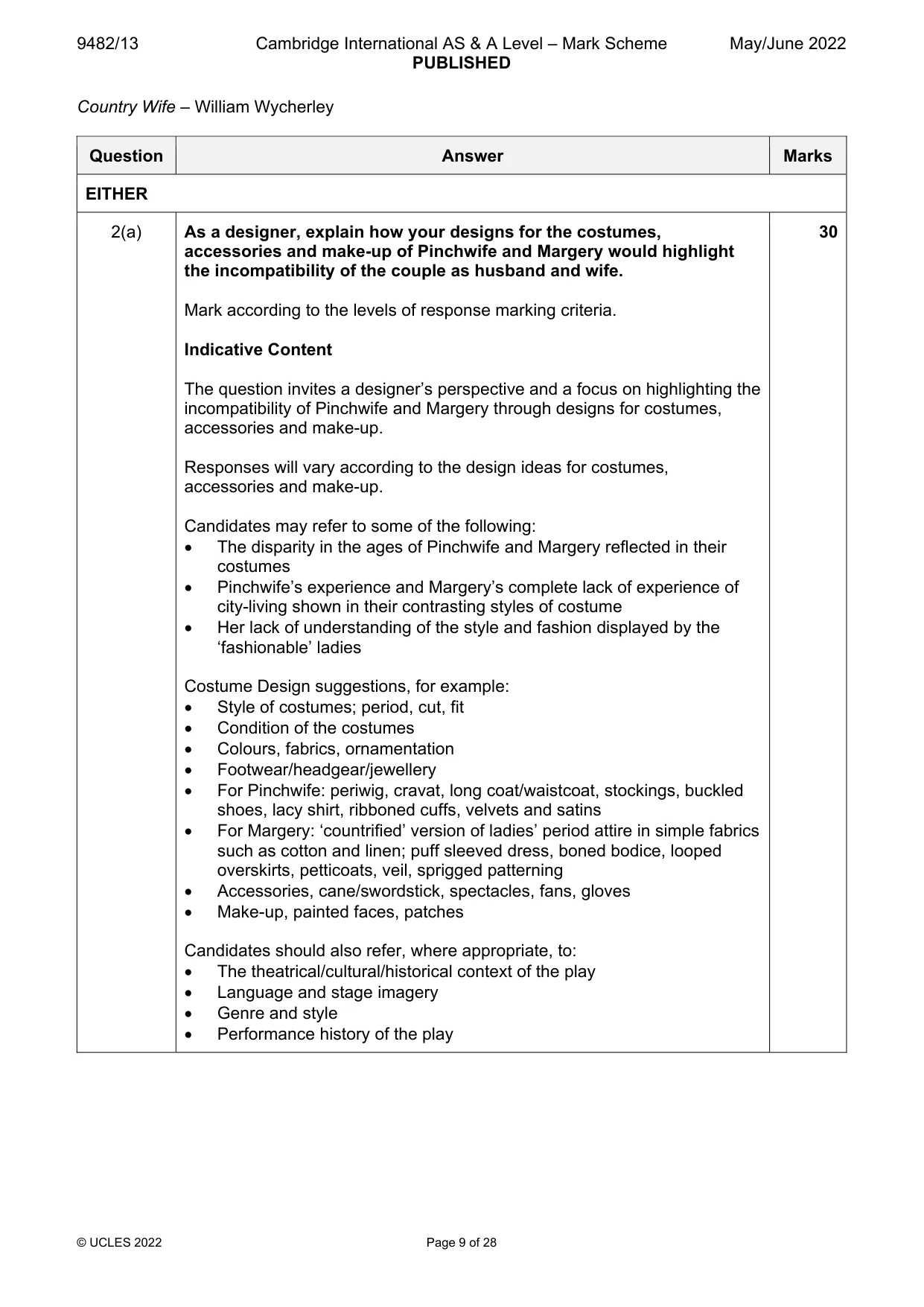
9482/13 Cambridge International AS & A Level – Mark Scheme PUBLISHED May/June 2022 © UCLES 2022 Page 9 of 28 Country Wife – William Wycherley Question Answer Marks EITHER 2(a) As a designer, explain how your designs for the costumes, accessories and make-up of Pinchwife and Margery would highlight the incompatibility of the couple as husband and wife. Mark according to the levels of response marking criteria. Indicative Content The question invites a designer’s perspective and a focus on highlighting the incompatibility of Pinchwife and Margery through designs for costumes, accessories and make-up. Responses will vary according to the design ideas for costumes, accessories and make-up. Candidates may refer to some of the following: The disparity in the ages of Pinchwife and Margery reflected in their costumes Pinchwife’s experience and Margery’s complete lack of experience of city-living shown in their contrasting styles of costume Her lack of understanding of the style and fashion displayed by the ‘fashionable’ ladies Costume Design suggestions, for example: Style of costumes; period, cut, fit Condition of the costumes Colours, fabrics, ornamentation Footwear/headgear/jewellery For Pinchwife: periwig, cravat, long coat/waistcoat, stockings, buckled shoes, lacy shirt, ribboned cuffs, velvets and satins For Margery: ‘countrified’ version of ladies’ period attire in simple fabrics such as cotton and linen; puff sleeved dress, boned bodice, looped overskirts, petticoats, veil, sprigged patterning Accessories, cane/swordstick, spectacles, fans, gloves Make-up, painted faces, patches Candidates should also refer, where appropriate, to: The theatrical/cultural/historical context of the play Language and stage imagery Genre and style Performance history of the play 30
Mark scheme, page 10
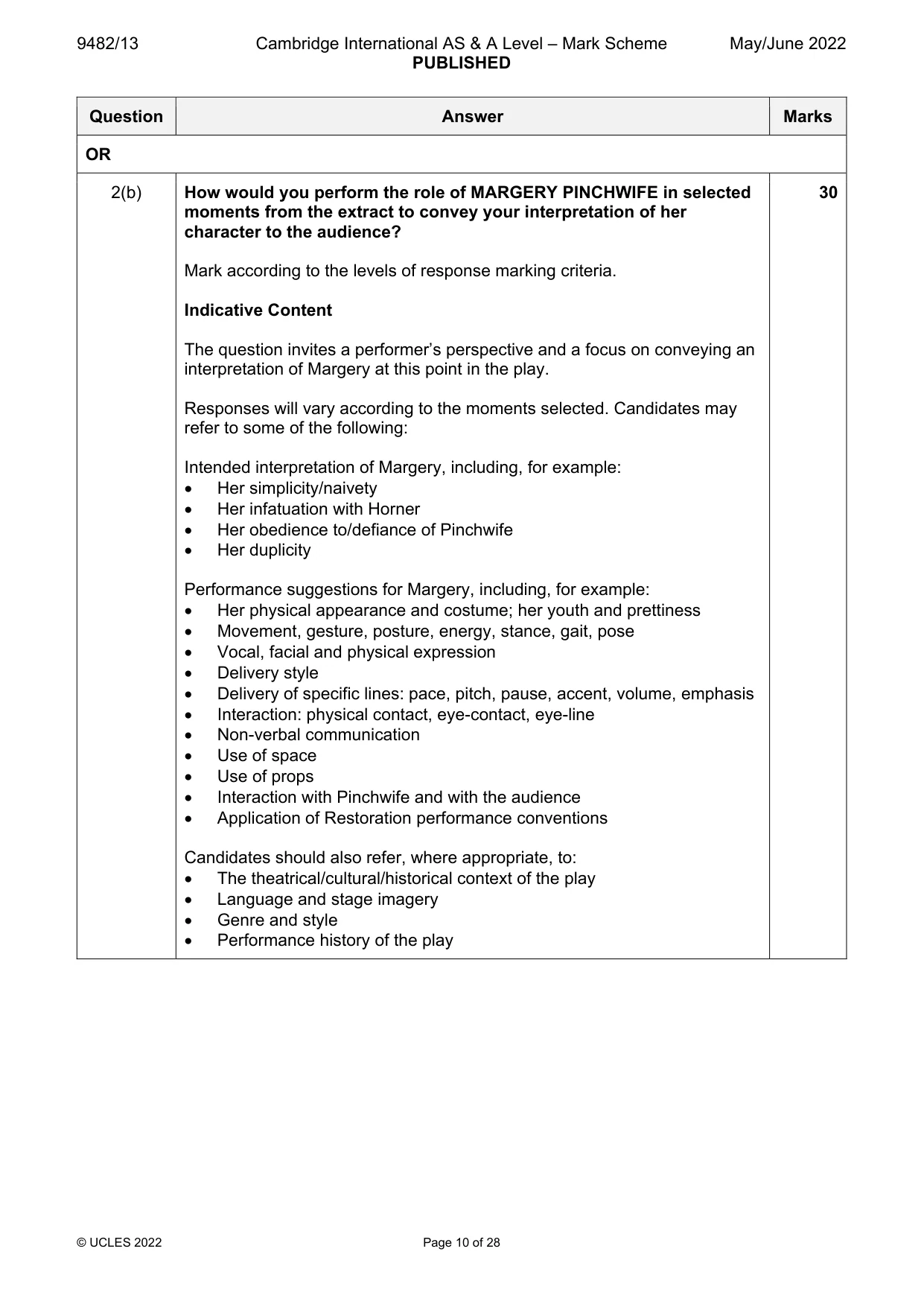
9482/13 Cambridge International AS & A Level – Mark Scheme PUBLISHED May/June 2022 © UCLES 2022 Page 10 of 28 Question Answer Marks OR 2(b) How would you perform the role of MARGERY PINCHWIFE in selected moments from the extract to convey your interpretation of her character to the audience? Mark according to the levels of response marking criteria. Indicative Content The question invites a performer’s perspective and a focus on conveying an interpretation of Margery at this point in the play. Responses will vary according to the moments selected. Candidates may refer to some of the following: Intended interpretation of Margery, including, for example: Her simplicity/naivety Her infatuation with Horner Her obedience to/defiance of Pinchwife Her duplicity Performance suggestions for Margery, including, for example: Her physical appearance and costume; her youth and prettiness Movement, gesture, posture, energy, stance, gait, pose Vocal, facial and physical expression Delivery style Delivery of specific lines: pace, pitch, pause, accent, volume, emphasis Interaction: physical contact, eye-contact, eye-line Non-verbal communication Use of space Use of props Interaction with Pinchwife and with the audience Application of Restoration performance conventions Candidates should also refer, where appropriate, to: The theatrical/cultural/historical context of the play Language and stage imagery Genre and style Performance history of the play 30
Mark scheme, page 11
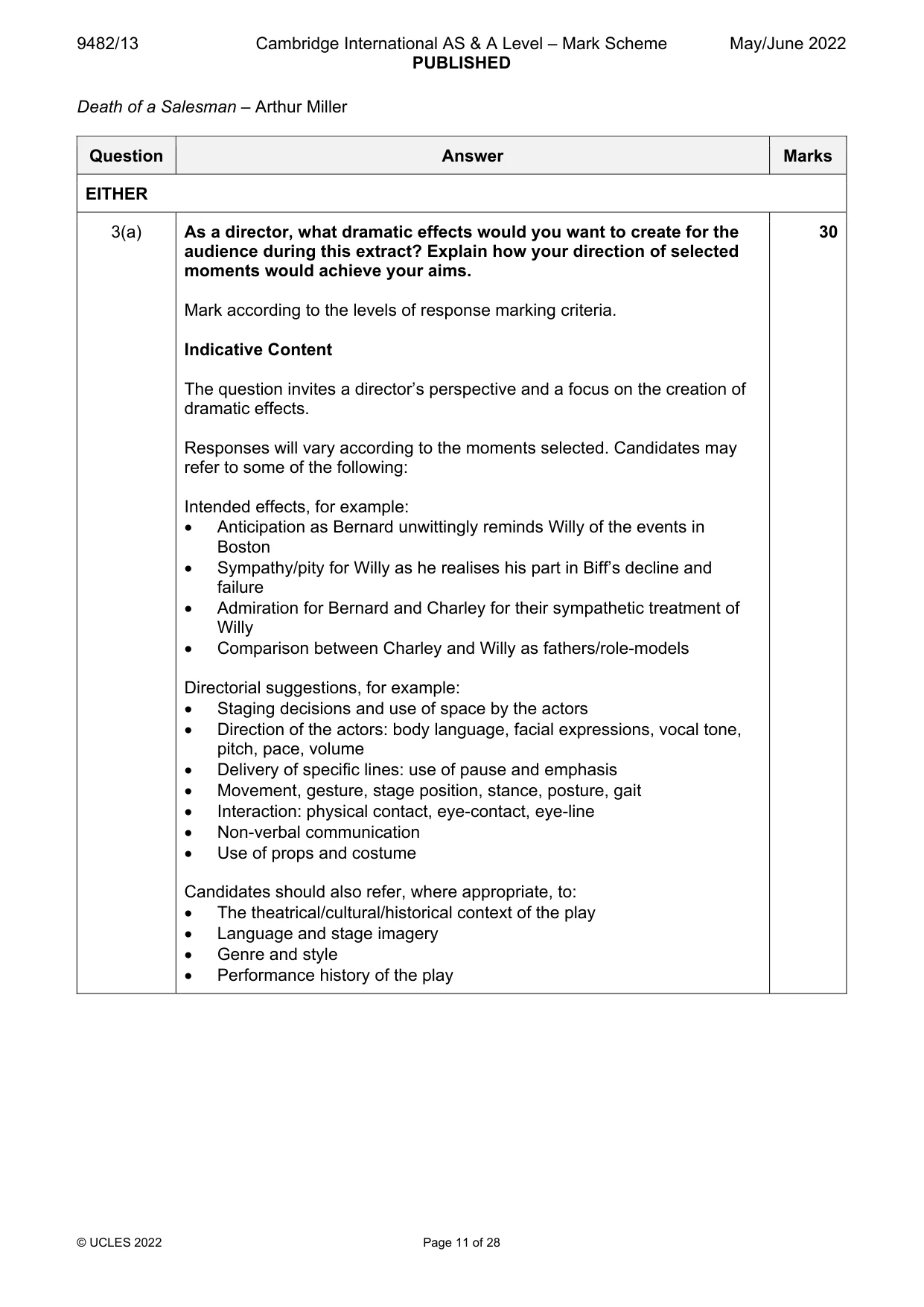
9482/13 Cambridge International AS & A Level – Mark Scheme PUBLISHED May/June 2022 © UCLES 2022 Page 11 of 28 Death of a Salesman – Arthur Miller Question Answer Marks EITHER 3(a) As a director, what dramatic effects would you want to create for the audience during this extract? Explain how your direction of selected moments would achieve your aims. Mark according to the levels of response marking criteria. Indicative Content The question invites a director’s perspective and a focus on the creation of dramatic effects. Responses will vary according to the moments selected. Candidates may refer to some of the following: Intended effects, for example: Anticipation as Bernard unwittingly reminds Willy of the events in Boston Sympathy/pity for Willy as he realises his part in Biff’s decline and failure Admiration for Bernard and Charley for their sympathetic treatment of Willy Comparison between Charley and Willy as fathers/role-models Directorial suggestions, for example: Staging decisions and use of space by the actors Direction of the actors: body language, facial expressions, vocal tone, pitch, pace, volume Delivery of specific lines: use of pause and emphasis Movement, gesture, stage position, stance, posture, gait Interaction: physical contact, eye-contact, eye-line Non-verbal communication Use of props and costume Candidates should also refer, where appropriate, to: The theatrical/cultural/historical context of the play Language and stage imagery Genre and style Performance history of the play 30
Mark scheme, page 12
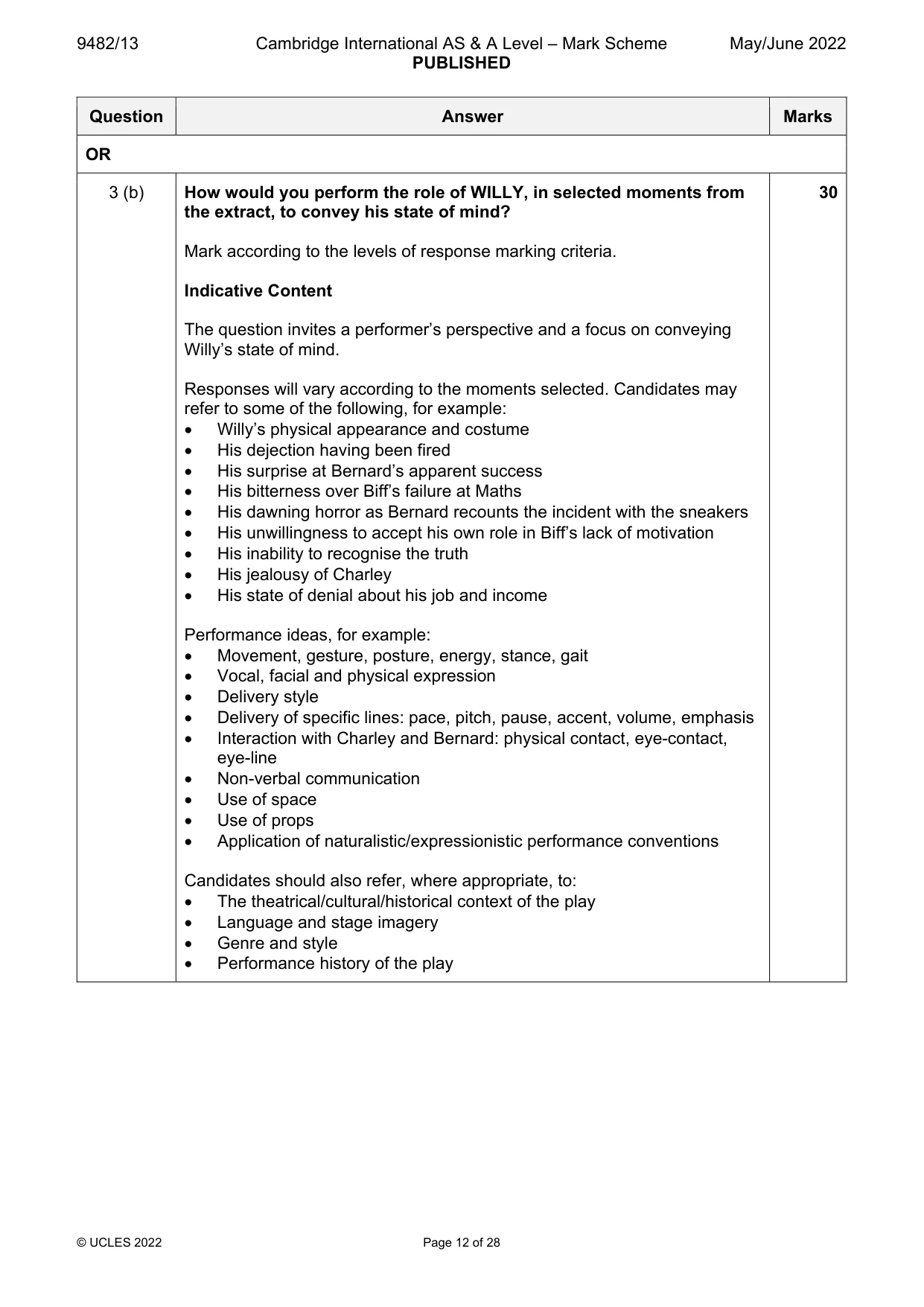
9482/13 Cambridge International AS & A Level – Mark Scheme PUBLISHED May/June 2022 © UCLES 2022 Page 12 of 28 Question Answer Marks OR 3 (b) How would you perform the role of WILLY, in selected moments from the extract, to convey his state of mind? Mark according to the levels of response marking criteria. Indicative Content The question invites a performer’s perspective and a focus on conveying Willy’s state of mind. Responses will vary according to the moments selected. Candidates may refer to some of the following, for example: Willy’s physical appearance and costume His dejection having been fired His surprise at Bernard’s apparent success His bitterness over Biff’s failure at Maths His dawning horror as Bernard recounts the incident with the sneakers His unwillingness to accept his own role in Biff’s lack of motivation His inability to recognise the truth His jealousy of Charley His state of denial about his job and income Performance ideas, for example: Movement, gesture, posture, energy, stance, gait Vocal, facial and physical expression Delivery style Delivery of specific lines: pace, pitch, pause, accent, volume, emphasis Interaction with Charley and Bernard: physical contact, eye-contact, eye-line Non-verbal communication Use of space Use of props Application of naturalistic/expressionistic performance conventions Candidates should also refer, where appropriate, to: The theatrical/cultural/historical context of the play Language and stage imagery Genre and style Performance history of the play 30
Mark scheme, page 13
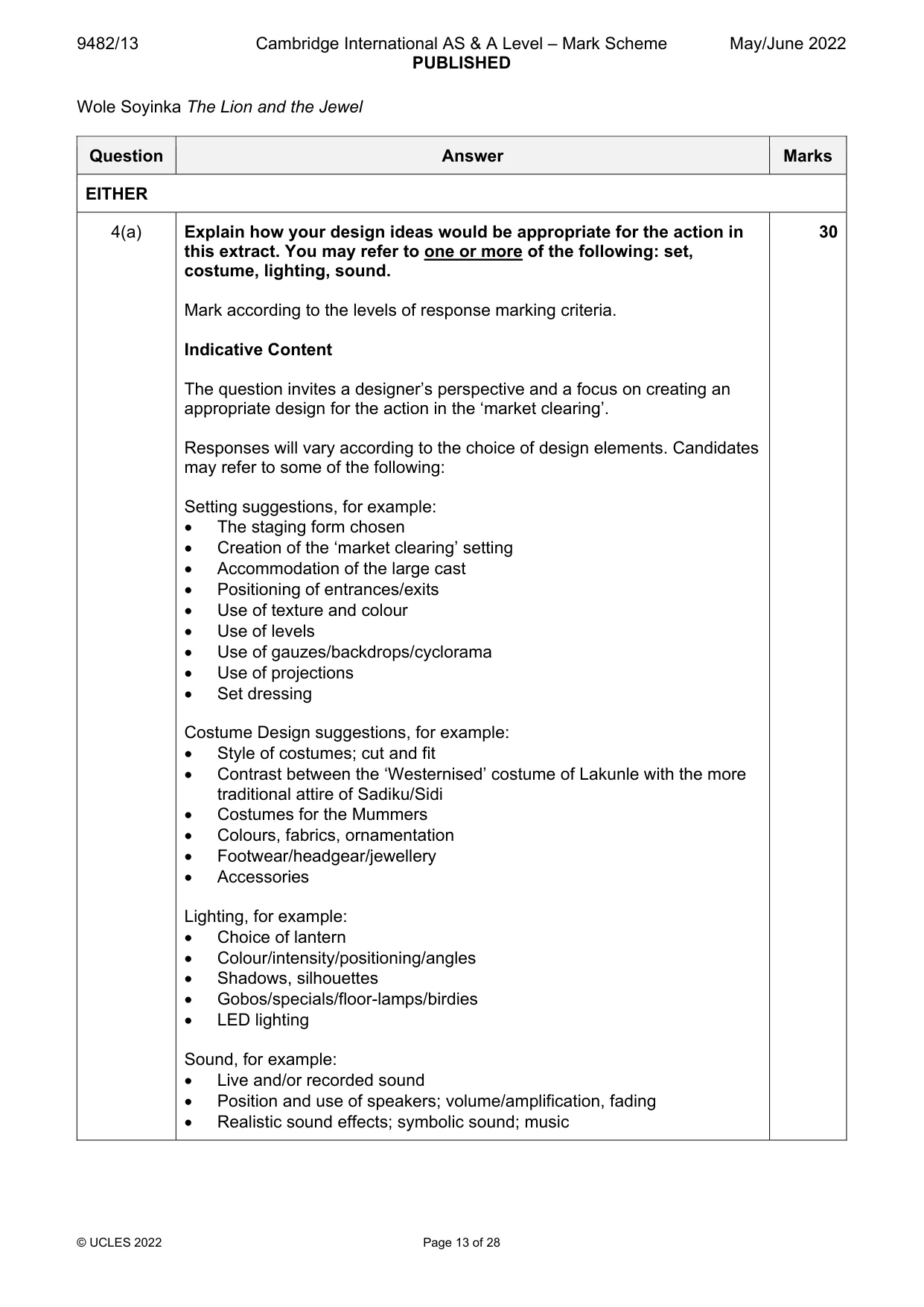
9482/13 Cambridge International AS & A Level – Mark Scheme PUBLISHED May/June 2022 © UCLES 2022 Page 13 of 28 Wole Soyinka The Lion and the Jewel Question Answer Marks EITHER 4(a) Explain how your design ideas would be appropriate for the action in this extract. You may refer to one or more of the following: set, costume, lighting, sound. Mark according to the levels of response marking criteria. Indicative Content The question invites a designer’s perspective and a focus on creating an appropriate design for the action in the ‘market clearing’. Responses will vary according to the choice of design elements. Candidates may refer to some of the following: Setting suggestions, for example: The staging form chosen Creation of the ‘market clearing’ setting Accommodation of the large cast Positioning of entrances/exits Use of texture and colour Use of levels Use of gauzes/backdrops/cyclorama Use of projections Set dressing Costume Design suggestions, for example: Style of costumes; cut and fit Contrast between the ‘Westernised’ costume of Lakunle with the more traditional attire of Sadiku/Sidi Costumes for the Mummers Colours, fabrics, ornamentation Footwear/headgear/jewellery Accessories Lighting, for example: Choice of lantern Colour/intensity/positioning/angles Shadows, silhouettes Gobos/specials/floor-lamps/birdies LED lighting Sound, for example: Live and/or recorded sound Position and use of speakers; volume/amplification, fading Realistic sound effects; symbolic sound; music 30
Mark scheme, page 14
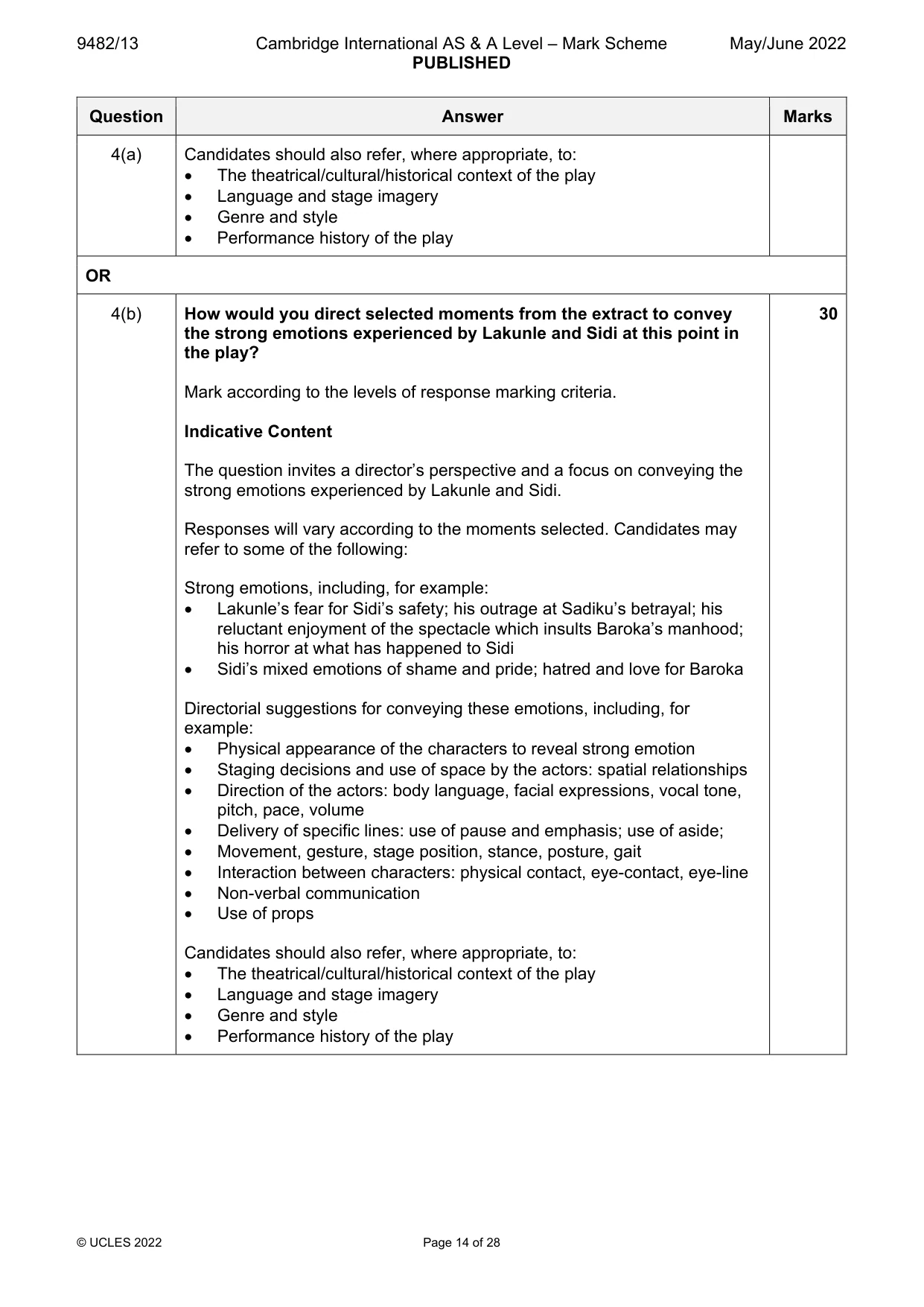
9482/13 Cambridge International AS & A Level – Mark Scheme PUBLISHED May/June 2022 © UCLES 2022 Page 14 of 28 Question Answer Marks 4(a) Candidates should also refer, where appropriate, to: The theatrical/cultural/historical context of the play Language and stage imagery Genre and style Performance history of the play OR 4(b) How would you direct selected moments from the extract to convey the strong emotions experienced by Lakunle and Sidi at this point in the play? Mark according to the levels of response marking criteria. Indicative Content The question invites a director’s perspective and a focus on conveying the strong emotions experienced by Lakunle and Sidi. Responses will vary according to the moments selected. Candidates may refer to some of the following: Strong emotions, including, for example: Lakunle’s fear for Sidi’s safety; his outrage at Sadiku’s betrayal; his reluctant enjoyment of the spectacle which insults Baroka’s manhood; his horror at what has happened to Sidi Sidi’s mixed emotions of shame and pride; hatred and love for Baroka Directorial suggestions for conveying these emotions, including, for example: Physical appearance of the characters to reveal strong emotion Staging decisions and use of space by the actors: spatial relationships Direction of the actors: body language, facial expressions, vocal tone, pitch, pace, volume Delivery of specific lines: use of pause and emphasis; use of aside; Movement, gesture, stage position, stance, posture, gait Interaction between characters: physical contact, eye-contact, eye-line Non-verbal communication Use of props Candidates should also refer, where appropriate, to: The theatrical/cultural/historical context of the play Language and stage imagery Genre and style Performance history of the play 30
Mark scheme, page 15
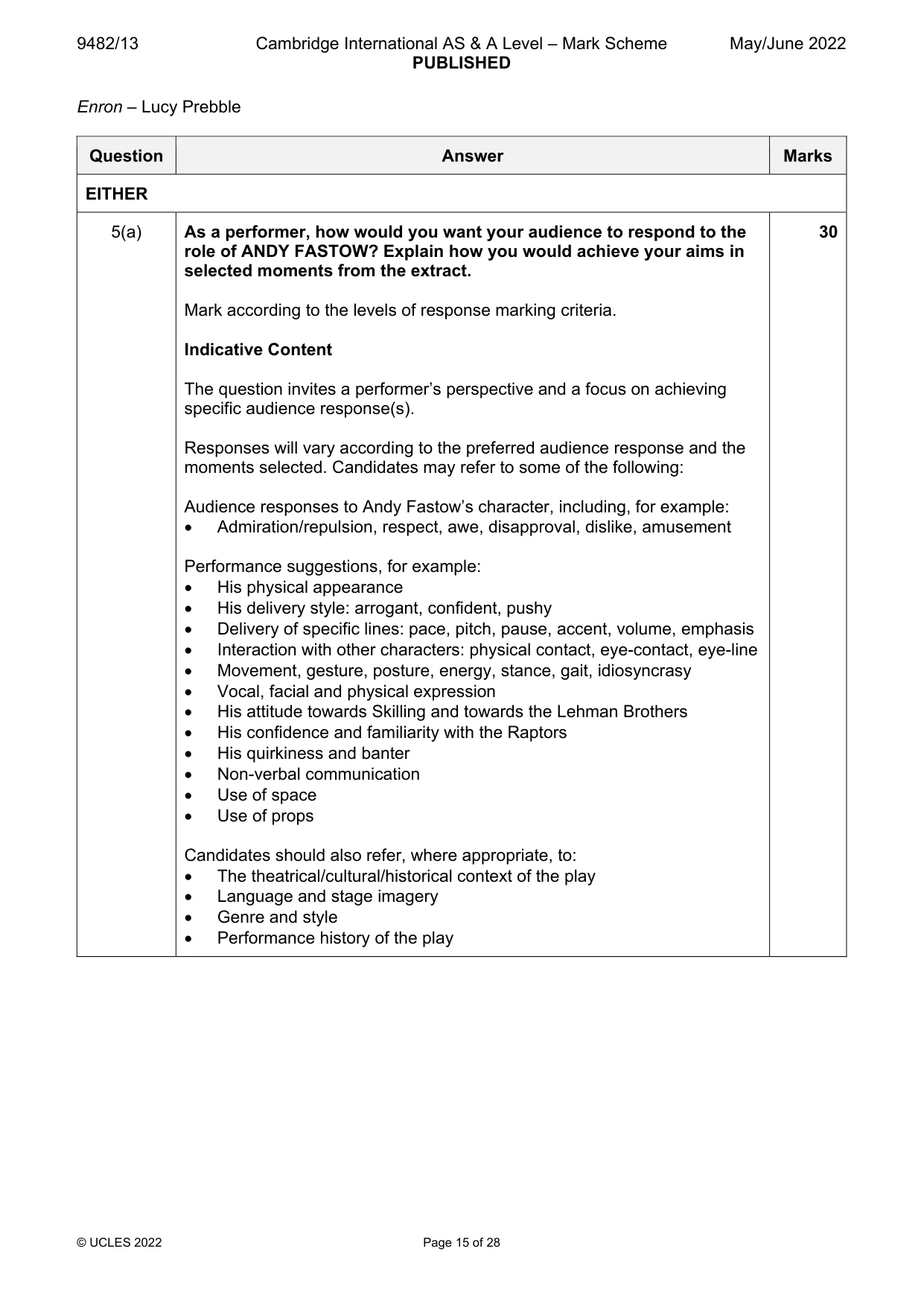
9482/13 Cambridge International AS & A Level – Mark Scheme PUBLISHED May/June 2022 © UCLES 2022 Page 15 of 28 Enron – Lucy Prebble Question Answer Marks EITHER 5(a) As a performer, how would you want your audience to respond to the role of ANDY FASTOW? Explain how you would achieve your aims in selected moments from the extract. Mark according to the levels of response marking criteria. Indicative Content The question invites a performer’s perspective and a focus on achieving specific audience response(s). Responses will vary according to the preferred audience response and the moments selected. Candidates may refer to some of the following: Audience responses to Andy Fastow’s character, including, for example: Admiration/repulsion, respect, awe, disapproval, dislike, amusement Performance suggestions, for example: His physical appearance His delivery style: arrogant, confident, pushy Delivery of specific lines: pace, pitch, pause, accent, volume, emphasis Interaction with other characters: physical contact, eye-contact, eye-line Movement, gesture, posture, energy, stance, gait, idiosyncrasy Vocal, facial and physical expression His attitude towards Skilling and towards the Lehman Brothers His confidence and familiarity with the Raptors His quirkiness and banter Non-verbal communication Use of space Use of props Candidates should also refer, where appropriate, to: The theatrical/cultural/historical context of the play Language and stage imagery Genre and style Performance history of the play 30
Mark scheme, page 16
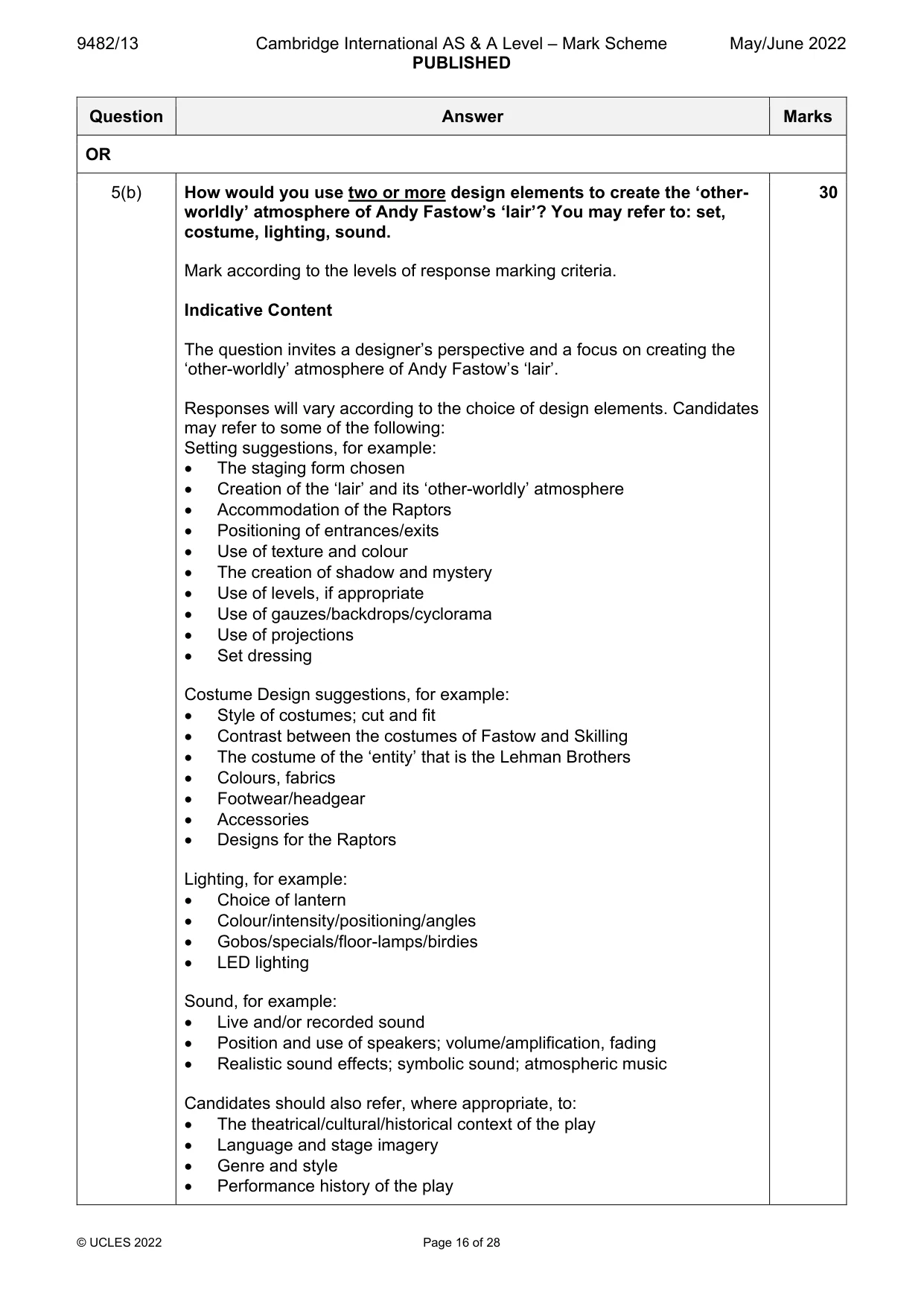
9482/13 Cambridge International AS & A Level – Mark Scheme PUBLISHED May/June 2022 © UCLES 2022 Page 16 of 28 Question Answer Marks OR 5(b) How would you use two or more design elements to create the ‘other- worldly’ atmosphere of Andy Fastow’s ‘lair’? You may refer to: set, costume, lighting, sound. Mark according to the levels of response marking criteria. Indicative Content The question invites a designer’s perspective and a focus on creating the ‘other-worldly’ atmosphere of Andy Fastow’s ‘lair’. Responses will vary according to the choice of design elements. Candidates may refer to some of the following: Setting suggestions, for example: The staging form chosen Creation of the ‘lair’ and its ‘other-worldly’ atmosphere Accommodation of the Raptors Positioning of entrances/exits Use of texture and colour The creation of shadow and mystery Use of levels, if appropriate Use of gauzes/backdrops/cyclorama Use of projections Set dressing Costume Design suggestions, for example: Style of costumes; cut and fit Contrast between the costumes of Fastow and Skilling The costume of the ‘entity’ that is the Lehman Brothers Colours, fabrics Footwear/headgear Accessories Designs for the Raptors Lighting, for example: Choice of lantern Colour/intensity/positioning/angles Gobos/specials/floor-lamps/birdies LED lighting Sound, for example: Live and/or recorded sound Position and use of speakers; volume/amplification, fading Realistic sound effects; symbolic sound; atmospheric music Candidates should also refer, where appropriate, to: The theatrical/cultural/historical context of the play Language and stage imagery Genre and style Performance history of the play 30
Mark scheme, page 17
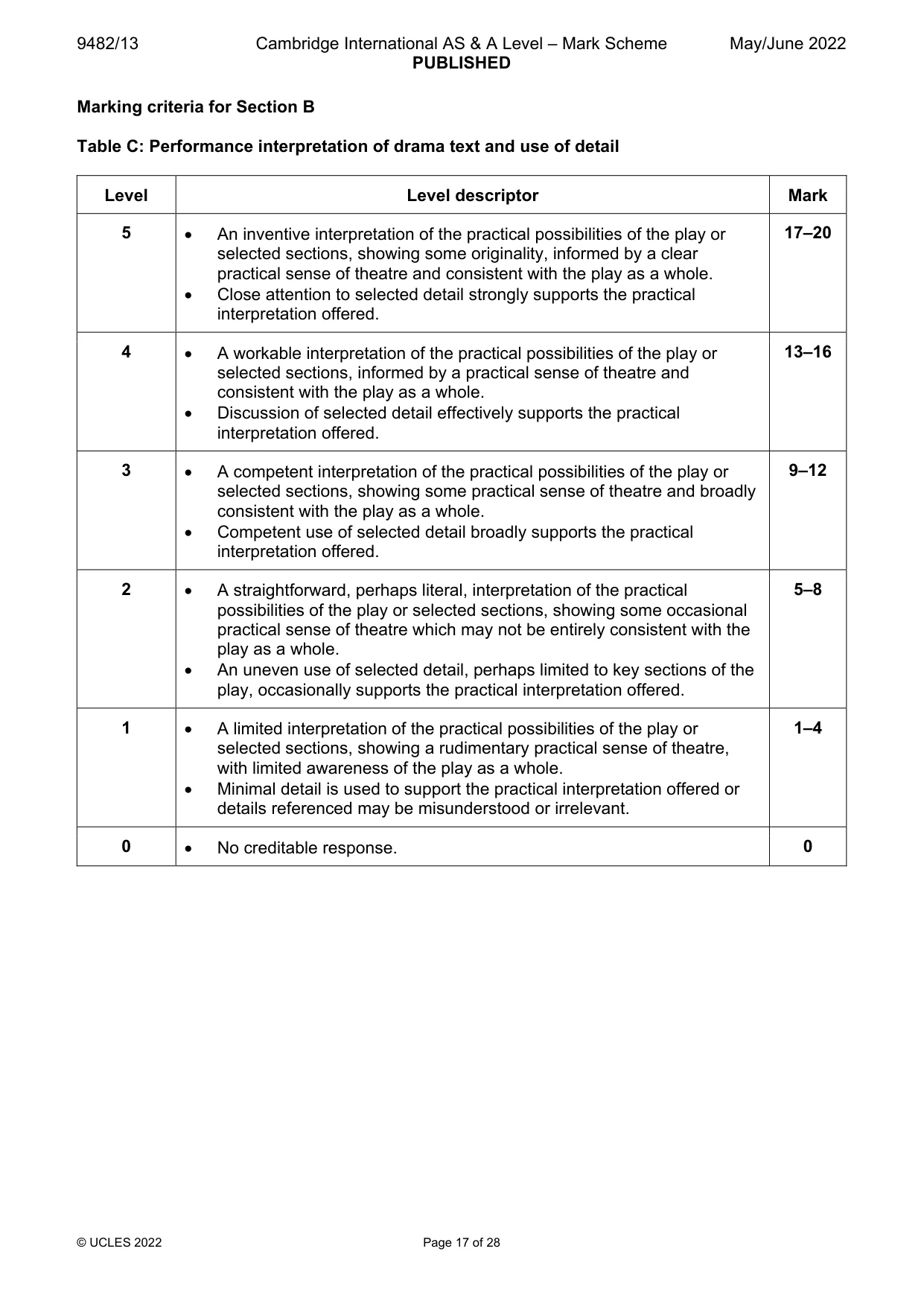
9482/13 Cambridge International AS & A Level – Mark Scheme PUBLISHED May/June 2022 © UCLES 2022 Page 17 of 28 Marking criteria for Section B Table C: Performance interpretation of drama text and use of detail Level Level descriptor Mark 5 An inventive interpretation of the practical possibilities of the play or selected sections, showing some originality, informed by a clear practical sense of theatre and consistent with the play as a whole. Close attention to selected detail strongly supports the practical interpretation offered. 17–20 4 A workable interpretation of the practical possibilities of the play or selected sections, informed by a practical sense of theatre and consistent with the play as a whole. Discussion of selected detail effectively supports the practical interpretation offered. 13–16 3 A competent interpretation of the practical possibilities of the play or selected sections, showing some practical sense of theatre and broadly consistent with the play as a whole. Competent use of selected detail broadly supports the practical interpretation offered. 9–12 2 A straightforward, perhaps literal, interpretation of the practical possibilities of the play or selected sections, showing some occasional practical sense of theatre which may not be entirely consistent with the play as a whole. An uneven use of selected detail, perhaps limited to key sections of the play, occasionally supports the practical interpretation offered. 5–8 1 A limited interpretation of the practical possibilities of the play or selected sections, showing a rudimentary practical sense of theatre, with limited awareness of the play as a whole. Minimal detail is used to support the practical interpretation offered or details referenced may be misunderstood or irrelevant. 1–4 0 No creditable response. 0
Mark scheme, page 18
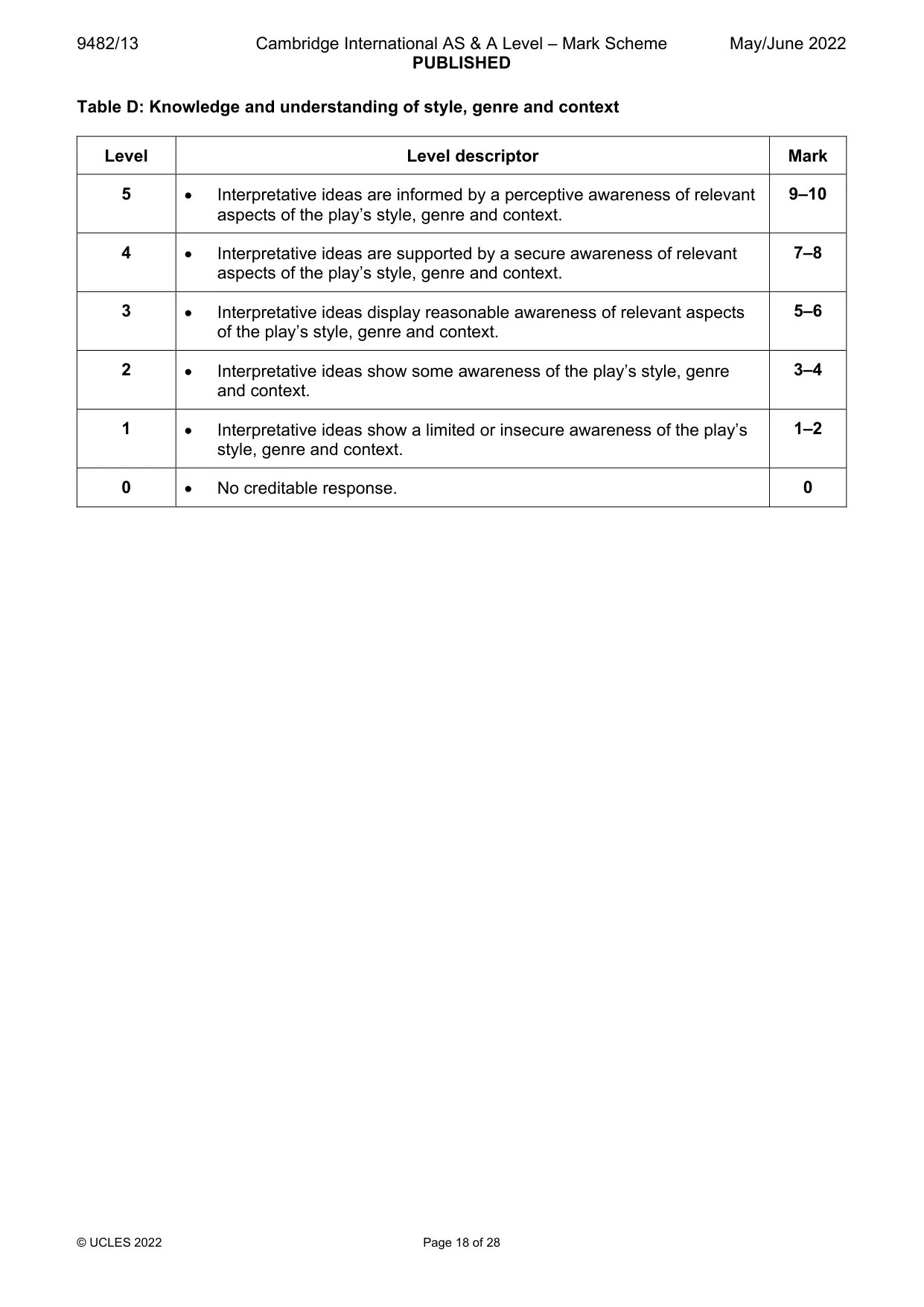
9482/13 Cambridge International AS & A Level – Mark Scheme PUBLISHED May/June 2022 © UCLES 2022 Page 18 of 28 Table D: Knowledge and understanding of style, genre and context Level Level descriptor Mark 5 Interpretative ideas are informed by a perceptive awareness of relevant aspects of the play’s style, genre and context. 9–10 4 Interpretative ideas are supported by a secure awareness of relevant aspects of the play’s style, genre and context. 7–8 3 Interpretative ideas display reasonable awareness of relevant aspects of the play’s style, genre and context. 5–6 2 Interpretative ideas show some awareness of the play’s style, genre and context. 3–4 1 Interpretative ideas show a limited or insecure awareness of the play’s style, genre and context. 1–2 0 No creditable response. 0
Mark scheme, page 19
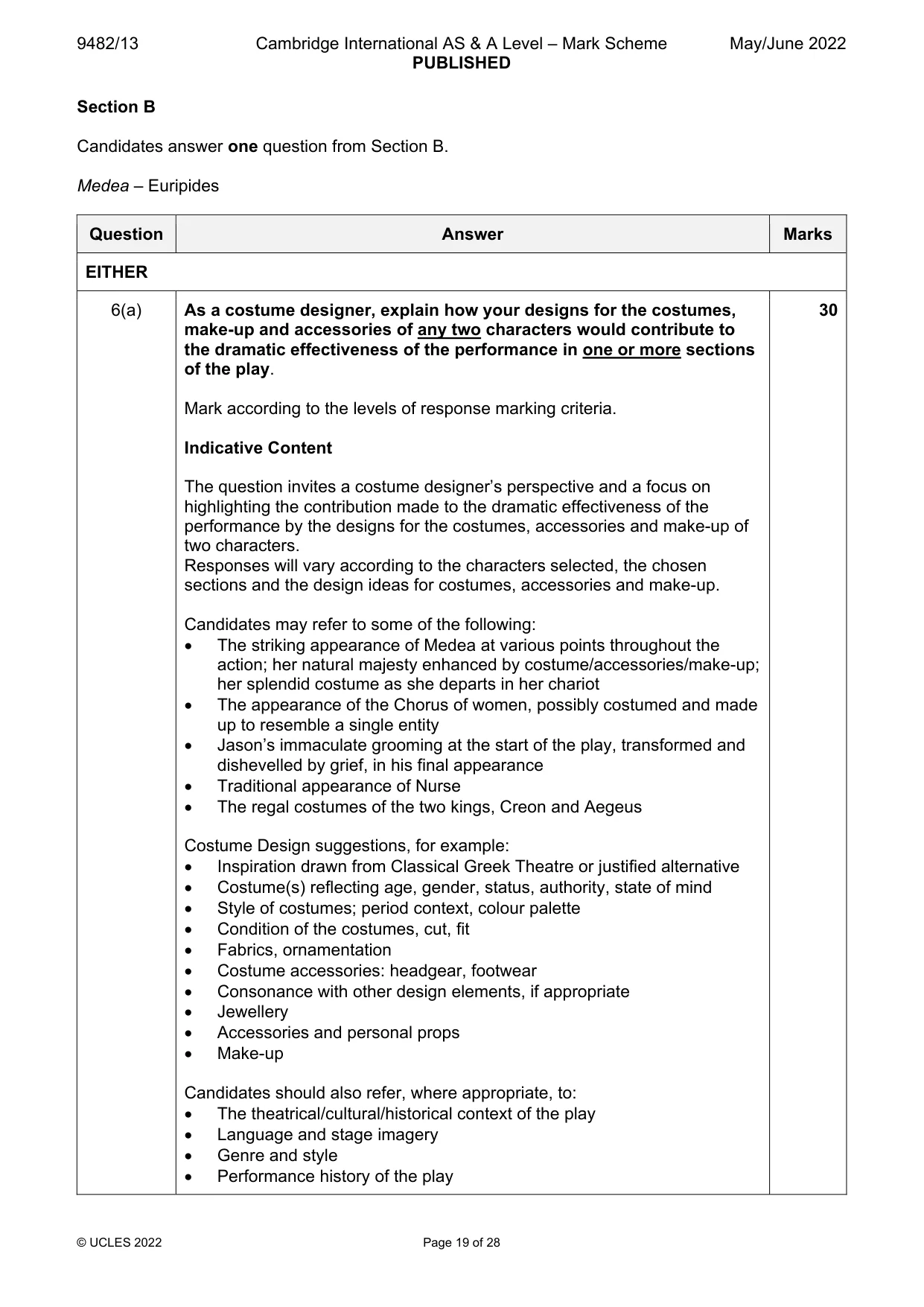
9482/13 Cambridge International AS & A Level – Mark Scheme PUBLISHED May/June 2022 © UCLES 2022 Page 19 of 28 Section B Candidates answer one question from Section B. Medea – Euripides Question Answer Marks EITHER 6(a) As a costume designer, explain how your designs for the costumes, make-up and accessories of any two characters would contribute to the dramatic effectiveness of the performance in one or more sections of the play. Mark according to the levels of response marking criteria. Indicative Content The question invites a costume designer’s perspective and a focus on highlighting the contribution made to the dramatic effectiveness of the performance by the designs for the costumes, accessories and make-up of two characters. Responses will vary according to the characters selected, the chosen sections and the design ideas for costumes, accessories and make-up. Candidates may refer to some of the following: The striking appearance of Medea at various points throughout the action; her natural majesty enhanced by costume/accessories/make-up; her splendid costume as she departs in her chariot The appearance of the Chorus of women, possibly costumed and made up to resemble a single entity Jason’s immaculate grooming at the start of the play, transformed and dishevelled by grief, in his final appearance Traditional appearance of Nurse The regal costumes of the two kings, Creon and Aegeus Costume Design suggestions, for example: Inspiration drawn from Classical Greek Theatre or justified alternative Costume(s) reflecting age, gender, status, authority, state of mind Style of costumes; period context, colour palette Condition of the costumes, cut, fit Fabrics, ornamentation Costume accessories: headgear, footwear Consonance with other design elements, if appropriate Jewellery Accessories and personal props Make-up Candidates should also refer, where appropriate, to: The theatrical/cultural/historical context of the play Language and stage imagery Genre and style Performance history of the play 30
Mark scheme, page 20
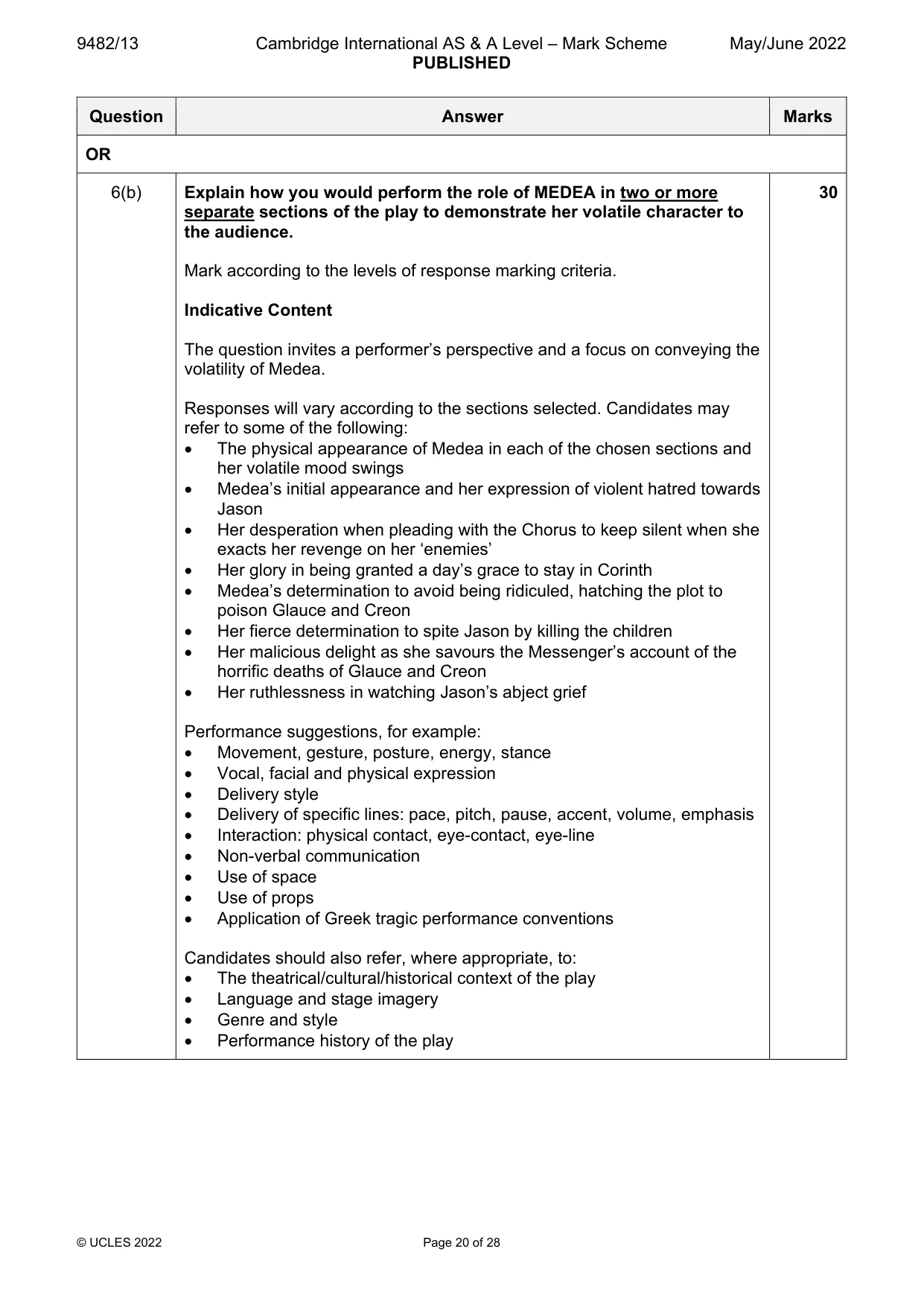
9482/13 Cambridge International AS & A Level – Mark Scheme PUBLISHED May/June 2022 © UCLES 2022 Page 20 of 28 Question Answer Marks OR 6(b) Explain how you would perform the role of MEDEA in two or more separate sections of the play to demonstrate her volatile character to the audience. Mark according to the levels of response marking criteria. Indicative Content The question invites a performer’s perspective and a focus on conveying the volatility of Medea. Responses will vary according to the sections selected. Candidates may refer to some of the following: The physical appearance of Medea in each of the chosen sections and her volatile mood swings Medea’s initial appearance and her expression of violent hatred towards Jason Her desperation when pleading with the Chorus to keep silent when she exacts her revenge on her ‘enemies’ Her glory in being granted a day’s grace to stay in Corinth Medea’s determination to avoid being ridiculed, hatching the plot to poison Glauce and Creon Her fierce determination to spite Jason by killing the children Her malicious delight as she savours the Messenger’s account of the horrific deaths of Glauce and Creon Her ruthlessness in watching Jason’s abject grief Performance suggestions, for example: Movement, gesture, posture, energy, stance Vocal, facial and physical expression Delivery style Delivery of specific lines: pace, pitch, pause, accent, volume, emphasis Interaction: physical contact, eye-contact, eye-line Non-verbal communication Use of space Use of props Application of Greek tragic performance conventions Candidates should also refer, where appropriate, to: The theatrical/cultural/historical context of the play Language and stage imagery Genre and style Performance history of the play 30
Mark scheme, page 21
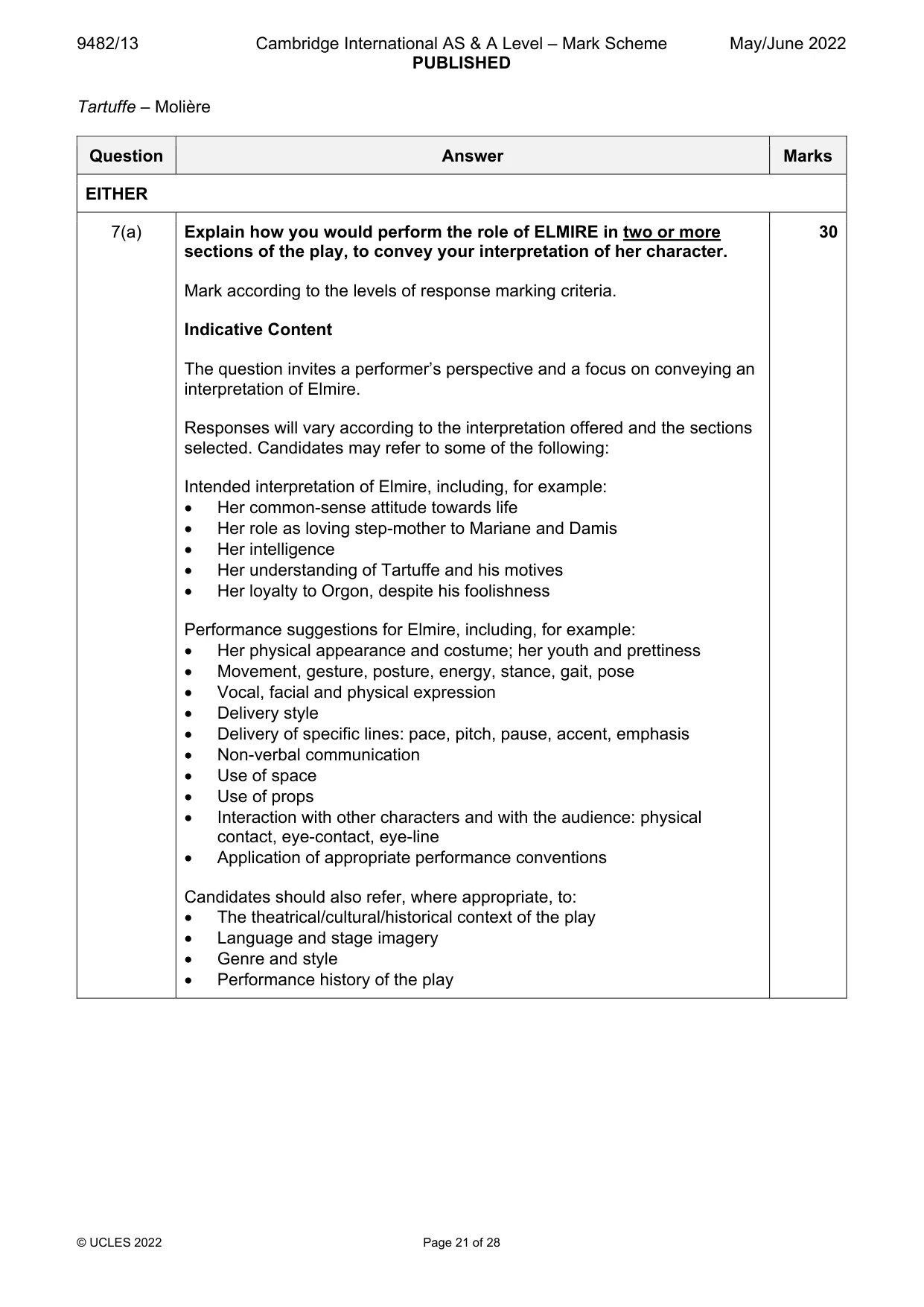
9482/13 Cambridge International AS & A Level – Mark Scheme PUBLISHED May/June 2022 © UCLES 2022 Page 21 of 28 Tartuffe – Molière Question Answer Marks EITHER 7(a) Explain how you would perform the role of ELMIRE in two or more sections of the play, to convey your interpretation of her character. Mark according to the levels of response marking criteria. Indicative Content The question invites a performer’s perspective and a focus on conveying an interpretation of Elmire. Responses will vary according to the interpretation offered and the sections selected. Candidates may refer to some of the following: Intended interpretation of Elmire, including, for example: Her common-sense attitude towards life Her role as loving step-mother to Mariane and Damis Her intelligence Her understanding of Tartuffe and his motives Her loyalty to Orgon, despite his foolishness Performance suggestions for Elmire, including, for example: Her physical appearance and costume; her youth and prettiness Movement, gesture, posture, energy, stance, gait, pose Vocal, facial and physical expression Delivery style Delivery of specific lines: pace, pitch, pause, accent, emphasis Non-verbal communication Use of space Use of props Interaction with other characters and with the audience: physical contact, eye-contact, eye-line Application of appropriate performance conventions Candidates should also refer, where appropriate, to: The theatrical/cultural/historical context of the play Language and stage imagery Genre and style Performance history of the play 30
Mark scheme, page 22
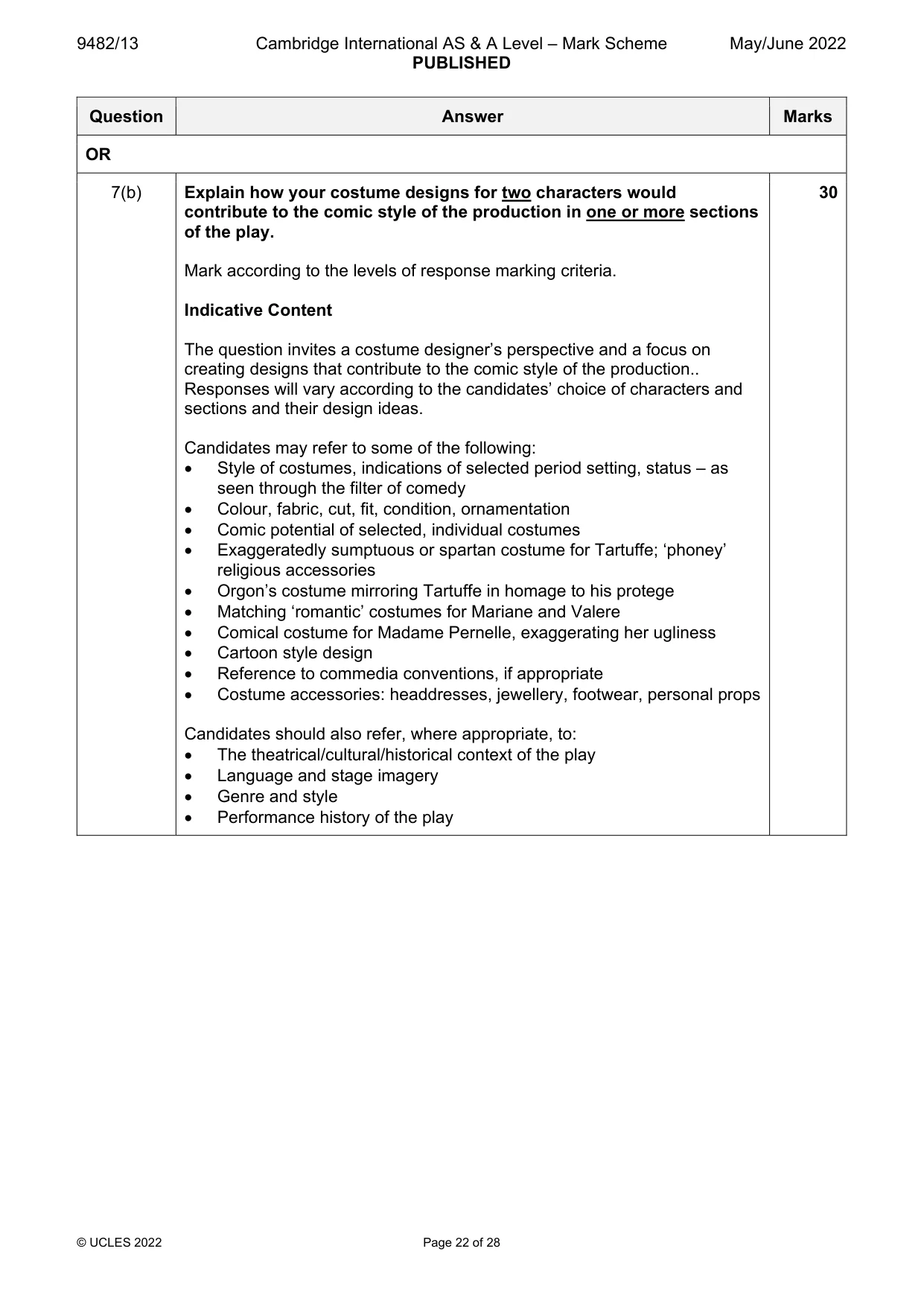
9482/13 Cambridge International AS & A Level – Mark Scheme PUBLISHED May/June 2022 © UCLES 2022 Page 22 of 28 Question Answer Marks OR 7(b) Explain how your costume designs for two characters would contribute to the comic style of the production in one or more sections of the play. Mark according to the levels of response marking criteria. Indicative Content The question invites a costume designer’s perspective and a focus on creating designs that contribute to the comic style of the production.. Responses will vary according to the candidates’ choice of characters and sections and their design ideas. Candidates may refer to some of the following: Style of costumes, indications of selected period setting, status – as seen through the filter of comedy Colour, fabric, cut, fit, condition, ornamentation Comic potential of selected, individual costumes Exaggeratedly sumptuous or spartan costume for Tartuffe; ‘phoney’ religious accessories Orgon’s costume mirroring Tartuffe in homage to his protege Matching ‘romantic’ costumes for Mariane and Valere Comical costume for Madame Pernelle, exaggerating her ugliness Cartoon style design Reference to commedia conventions, if appropriate Costume accessories: headdresses, jewellery, footwear, personal props Candidates should also refer, where appropriate, to: The theatrical/cultural/historical context of the play Language and stage imagery Genre and style Performance history of the play 30
Mark scheme, page 23
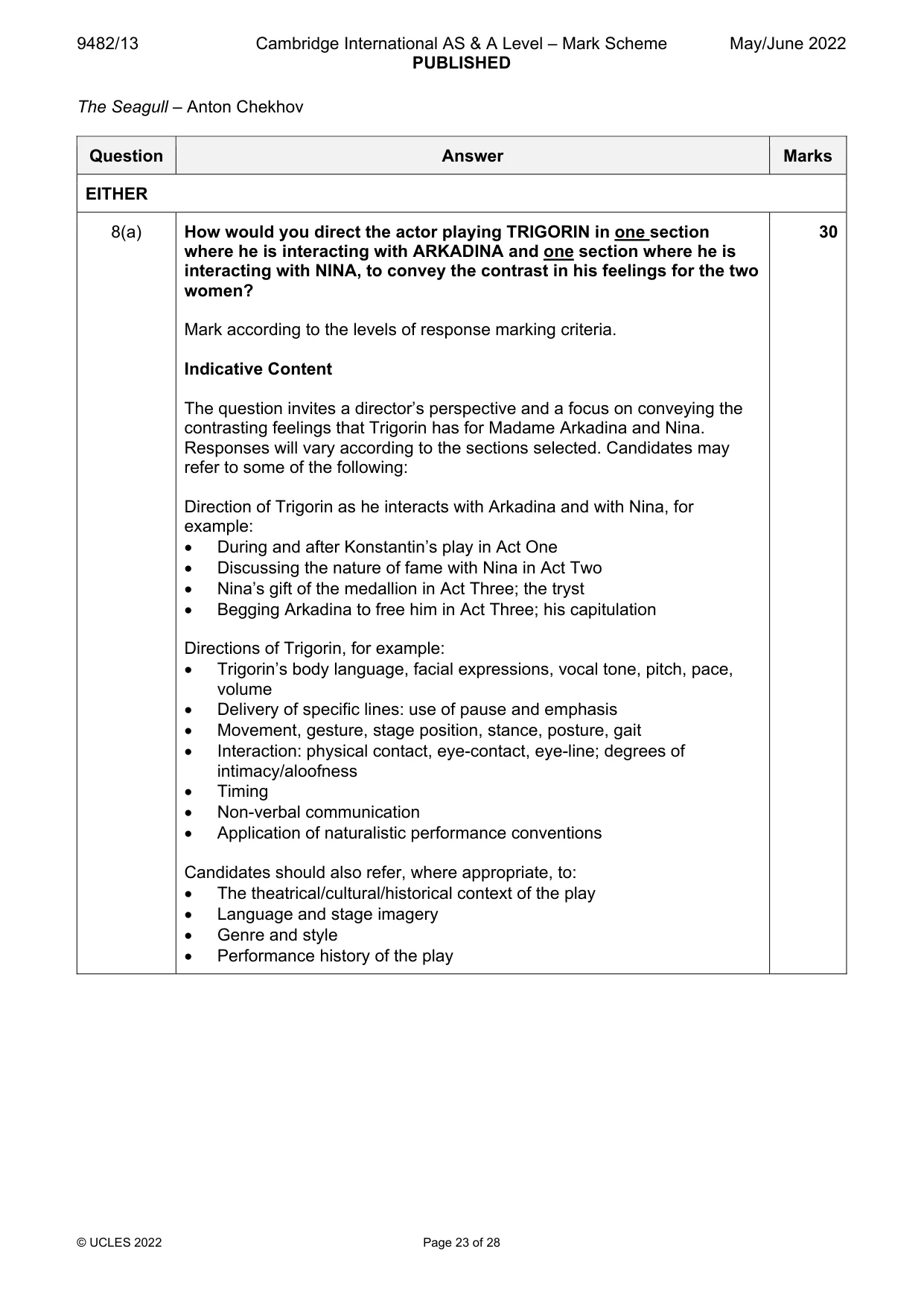
9482/13 Cambridge International AS & A Level – Mark Scheme PUBLISHED May/June 2022 © UCLES 2022 Page 23 of 28 The Seagull – Anton Chekhov Question Answer Marks EITHER 8(a) How would you direct the actor playing TRIGORIN in one section where he is interacting with ARKADINA and one section where he is interacting with NINA, to convey the contrast in his feelings for the two women? Mark according to the levels of response marking criteria. Indicative Content The question invites a director’s perspective and a focus on conveying the contrasting feelings that Trigorin has for Madame Arkadina and Nina. Responses will vary according to the sections selected. Candidates may refer to some of the following: Direction of Trigorin as he interacts with Arkadina and with Nina, for example: During and after Konstantin’s play in Act One Discussing the nature of fame with Nina in Act Two Nina’s gift of the medallion in Act Three; the tryst Begging Arkadina to free him in Act Three; his capitulation Directions of Trigorin, for example: Trigorin’s body language, facial expressions, vocal tone, pitch, pace, volume Delivery of specific lines: use of pause and emphasis Movement, gesture, stage position, stance, posture, gait Interaction: physical contact, eye-contact, eye-line; degrees of intimacy/aloofness Timing Non-verbal communication Application of naturalistic performance conventions Candidates should also refer, where appropriate, to: The theatrical/cultural/historical context of the play Language and stage imagery Genre and style Performance history of the play 30
Mark scheme, page 24
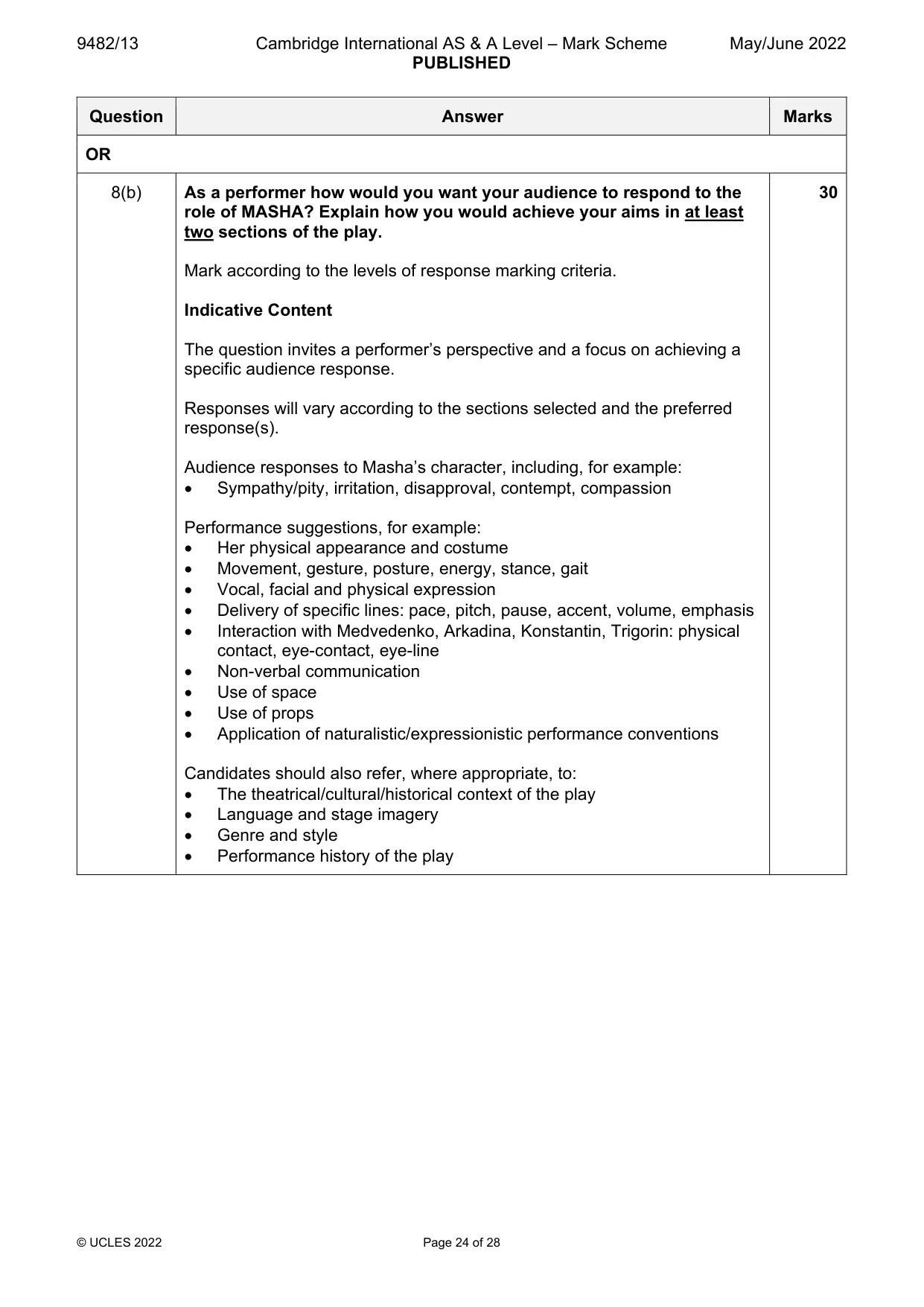
9482/13 Cambridge International AS & A Level – Mark Scheme PUBLISHED May/June 2022 © UCLES 2022 Page 24 of 28 Question Answer Marks OR 8(b) As a performer how would you want your audience to respond to the role of MASHA? Explain how you would achieve your aims in at least two sections of the play. Mark according to the levels of response marking criteria. Indicative Content The question invites a performer’s perspective and a focus on achieving a specific audience response. Responses will vary according to the sections selected and the preferred response(s). Audience responses to Masha’s character, including, for example: Sympathy/pity, irritation, disapproval, contempt, compassion Performance suggestions, for example: Her physical appearance and costume Movement, gesture, posture, energy, stance, gait Vocal, facial and physical expression Delivery of specific lines: pace, pitch, pause, accent, volume, emphasis Interaction with Medvedenko, Arkadina, Konstantin, Trigorin: physical contact, eye-contact, eye-line Non-verbal communication Use of space Use of props Application of naturalistic/expressionistic performance conventions Candidates should also refer, where appropriate, to: The theatrical/cultural/historical context of the play Language and stage imagery Genre and style Performance history of the play 30
Mark scheme, page 25
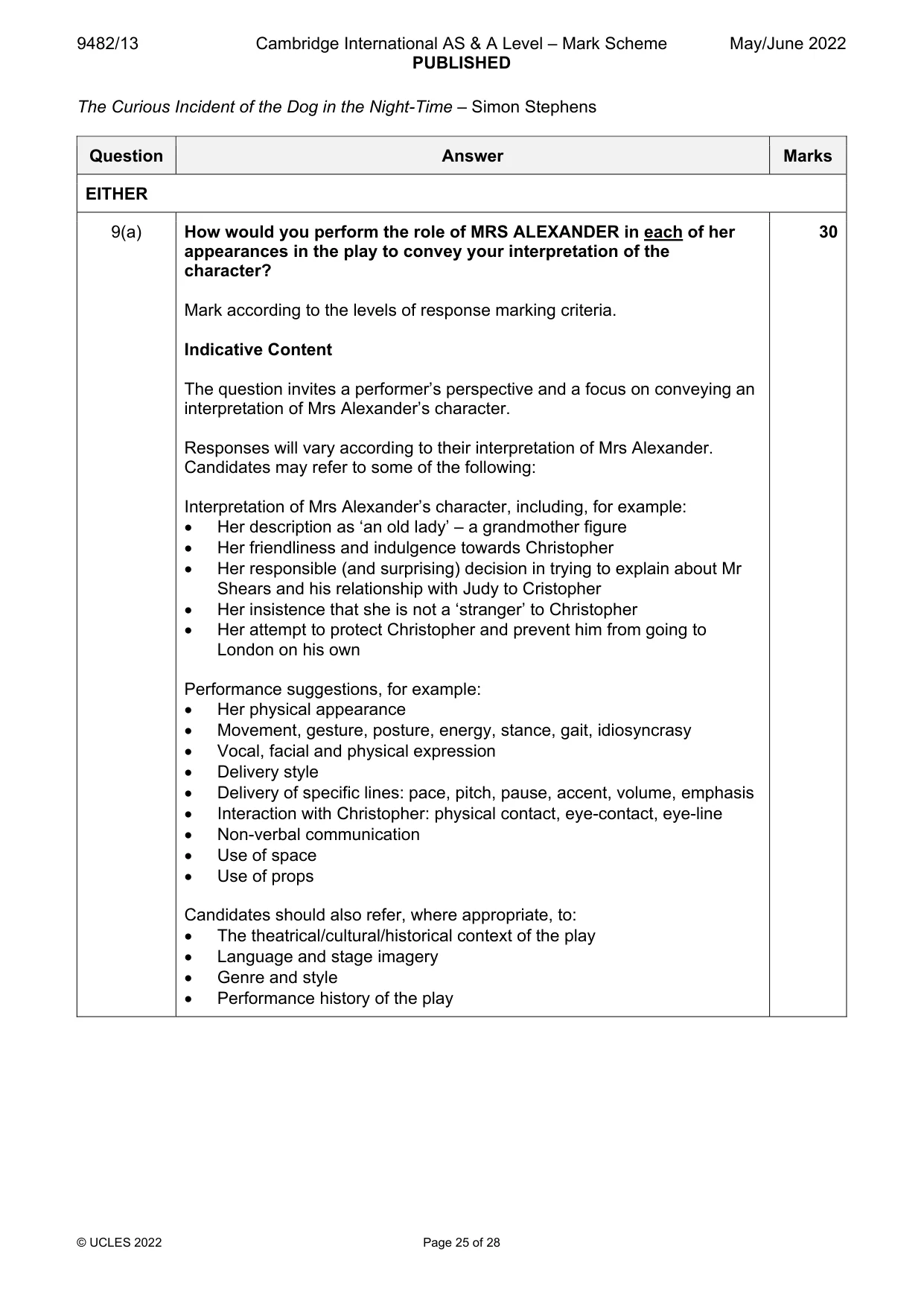
9482/13 Cambridge International AS & A Level – Mark Scheme PUBLISHED May/June 2022 © UCLES 2022 Page 25 of 28 The Curious Incident of the Dog in the Night-Time – Simon Stephens Question Answer Marks EITHER 9(a) How would you perform the role of MRS ALEXANDER in each of her appearances in the play to convey your interpretation of the character? Mark according to the levels of response marking criteria. Indicative Content The question invites a performer’s perspective and a focus on conveying an interpretation of Mrs Alexander’s character. Responses will vary according to their interpretation of Mrs Alexander. Candidates may refer to some of the following: Interpretation of Mrs Alexander’s character, including, for example: Her description as ‘an old lady’ – a grandmother figure Her friendliness and indulgence towards Christopher Her responsible (and surprising) decision in trying to explain about Mr Shears and his relationship with Judy to Cristopher Her insistence that she is not a ‘stranger’ to Christopher Her attempt to protect Christopher and prevent him from going to London on his own Performance suggestions, for example: Her physical appearance Movement, gesture, posture, energy, stance, gait, idiosyncrasy Vocal, facial and physical expression Delivery style Delivery of specific lines: pace, pitch, pause, accent, volume, emphasis Interaction with Christopher: physical contact, eye-contact, eye-line Non-verbal communication Use of space Use of props Candidates should also refer, where appropriate, to: The theatrical/cultural/historical context of the play Language and stage imagery Genre and style Performance history of the play 30
Mark scheme, page 26
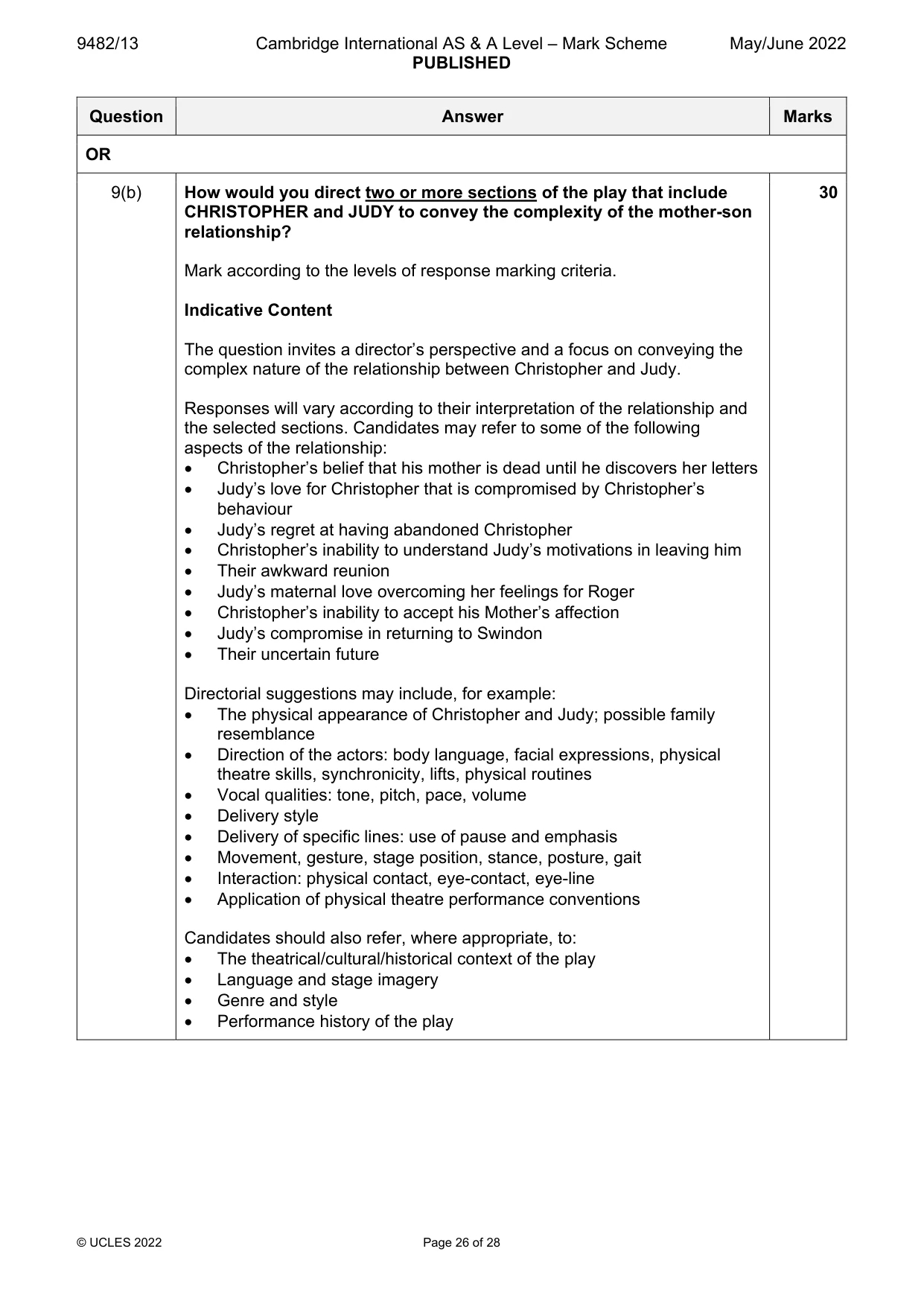
9482/13 Cambridge International AS & A Level – Mark Scheme PUBLISHED May/June 2022 © UCLES 2022 Page 26 of 28 Question Answer Marks OR 9(b) How would you direct two or more sections of the play that include CHRISTOPHER and JUDY to convey the complexity of the mother-son relationship? Mark according to the levels of response marking criteria. Indicative Content The question invites a director’s perspective and a focus on conveying the complex nature of the relationship between Christopher and Judy. Responses will vary according to their interpretation of the relationship and the selected sections. Candidates may refer to some of the following aspects of the relationship: Christopher’s belief that his mother is dead until he discovers her letters Judy’s love for Christopher that is compromised by Christopher’s behaviour Judy’s regret at having abandoned Christopher Christopher’s inability to understand Judy’s motivations in leaving him Their awkward reunion Judy’s maternal love overcoming her feelings for Roger Christopher’s inability to accept his Mother’s affection Judy’s compromise in returning to Swindon Their uncertain future Directorial suggestions may include, for example: The physical appearance of Christopher and Judy; possible family resemblance Direction of the actors: body language, facial expressions, physical theatre skills, synchronicity, lifts, physical routines Vocal qualities: tone, pitch, pace, volume Delivery style Delivery of specific lines: use of pause and emphasis Movement, gesture, stage position, stance, posture, gait Interaction: physical contact, eye-contact, eye-line Application of physical theatre performance conventions Candidates should also refer, where appropriate, to: The theatrical/cultural/historical context of the play Language and stage imagery Genre and style Performance history of the play 30
Mark scheme, page 27
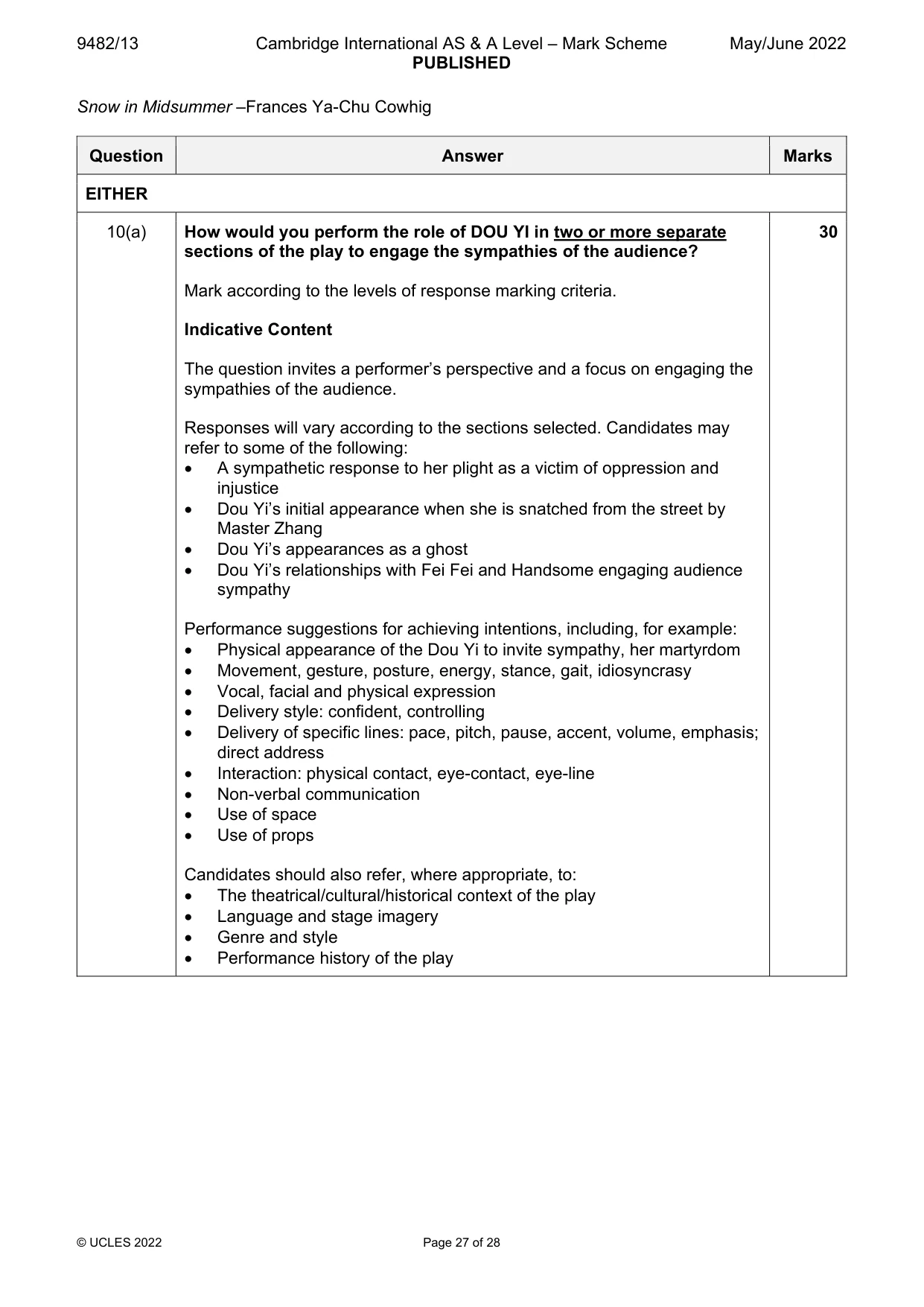
9482/13 Cambridge International AS & A Level – Mark Scheme PUBLISHED May/June 2022 © UCLES 2022 Page 27 of 28 Snow in Midsummer –Frances Ya-Chu Cowhig Question Answer Marks EITHER 10(a) How would you perform the role of DOU YI in two or more separate sections of the play to engage the sympathies of the audience? Mark according to the levels of response marking criteria. Indicative Content The question invites a performer’s perspective and a focus on engaging the sympathies of the audience. Responses will vary according to the sections selected. Candidates may refer to some of the following: A sympathetic response to her plight as a victim of oppression and injustice Dou Yi’s initial appearance when she is snatched from the street by Master Zhang Dou Yi’s appearances as a ghost Dou Yi’s relationships with Fei Fei and Handsome engaging audience sympathy Performance suggestions for achieving intentions, including, for example: Physical appearance of the Dou Yi to invite sympathy, her martyrdom Movement, gesture, posture, energy, stance, gait, idiosyncrasy Vocal, facial and physical expression Delivery style: confident, controlling Delivery of specific lines: pace, pitch, pause, accent, volume, emphasis; direct address Interaction: physical contact, eye-contact, eye-line Non-verbal communication Use of space Use of props Candidates should also refer, where appropriate, to: The theatrical/cultural/historical context of the play Language and stage imagery Genre and style Performance history of the play 30
Mark scheme, page 28
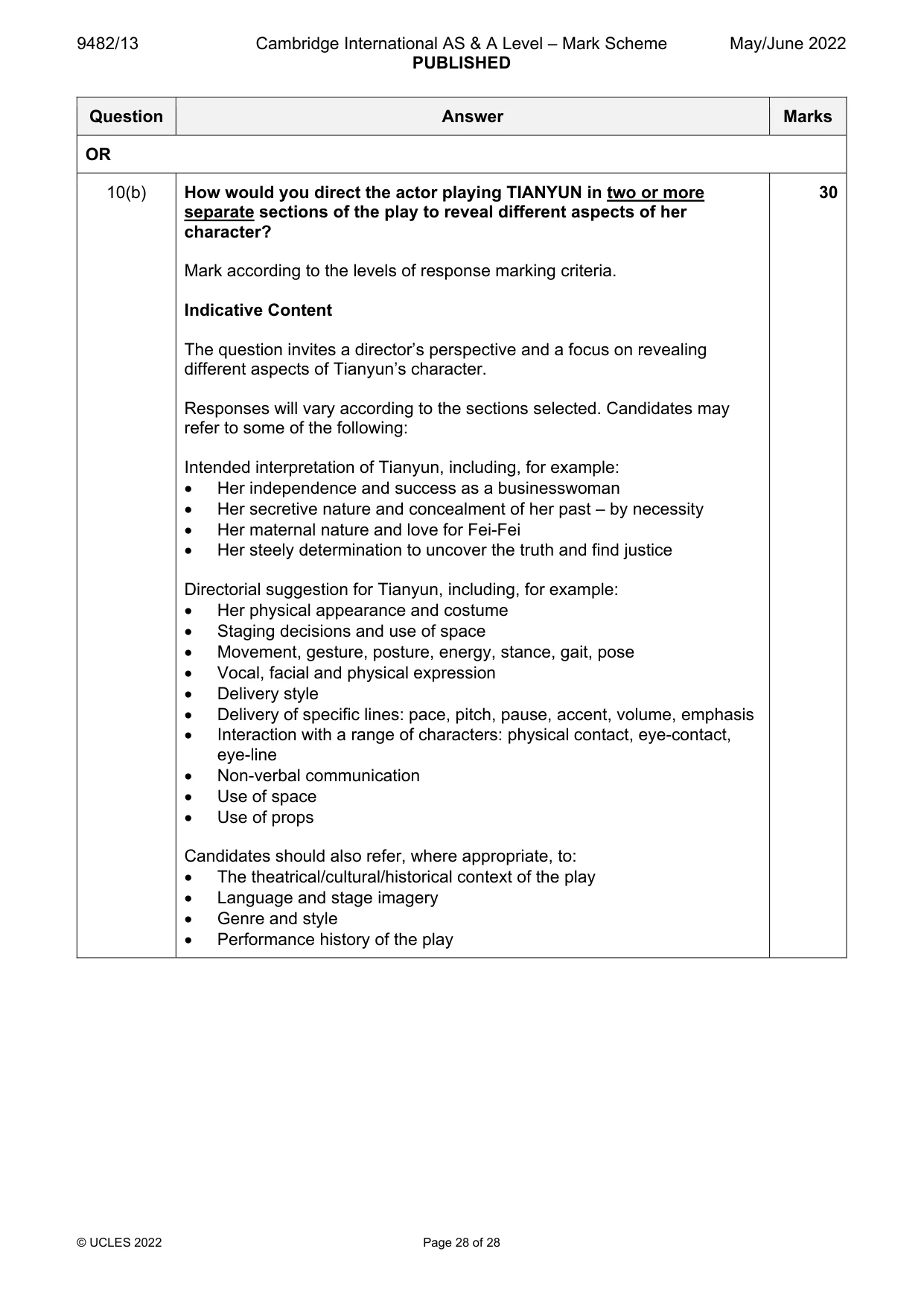
9482/13 Cambridge International AS & A Level – Mark Scheme PUBLISHED May/June 2022 © UCLES 2022 Page 28 of 28 Question Answer Marks OR 10(b) How would you direct the actor playing TIANYUN in two or more separate sections of the play to reveal different aspects of her character? Mark according to the levels of response marking criteria. Indicative Content The question invites a director’s perspective and a focus on revealing different aspects of Tianyun’s character. Responses will vary according to the sections selected. Candidates may refer to some of the following: Intended interpretation of Tianyun, including, for example: Her independence and success as a businesswoman Her secretive nature and concealment of her past – by necessity Her maternal nature and love for Fei-Fei Her steely determination to uncover the truth and find justice Directorial suggestion for Tianyun, including, for example: Her physical appearance and costume Staging decisions and use of space Movement, gesture, posture, energy, stance, gait, pose Vocal, facial and physical expression Delivery style Delivery of specific lines: pace, pitch, pause, accent, volume, emphasis Interaction with a range of characters: physical contact, eye-contact, eye-line Non-verbal communication Use of space Use of props Candidates should also refer, where appropriate, to: The theatrical/cultural/historical context of the play Language and stage imagery Genre and style Performance history of the play 30
What you needed in this session
Cambridge’s own grade thresholds for 2022 May/June, Paper 1 · Variant 3. A higher threshold means an easier paper — the bar moves with how the cohort did.