Cambridge A Level Drama 9482 — 2023 Oct/Nov Paper 1 · Variant 3
9482/13/O/N/23 · 60 marks · ≈68 min
The question paper and its mark scheme, free to read here and free to download. This is Cambridge’s own paper, exactly as it was sat.
Question paper8 pages


Mark scheme26 pages
Answers below. Sit the paper first if you are practising.
Paper as text
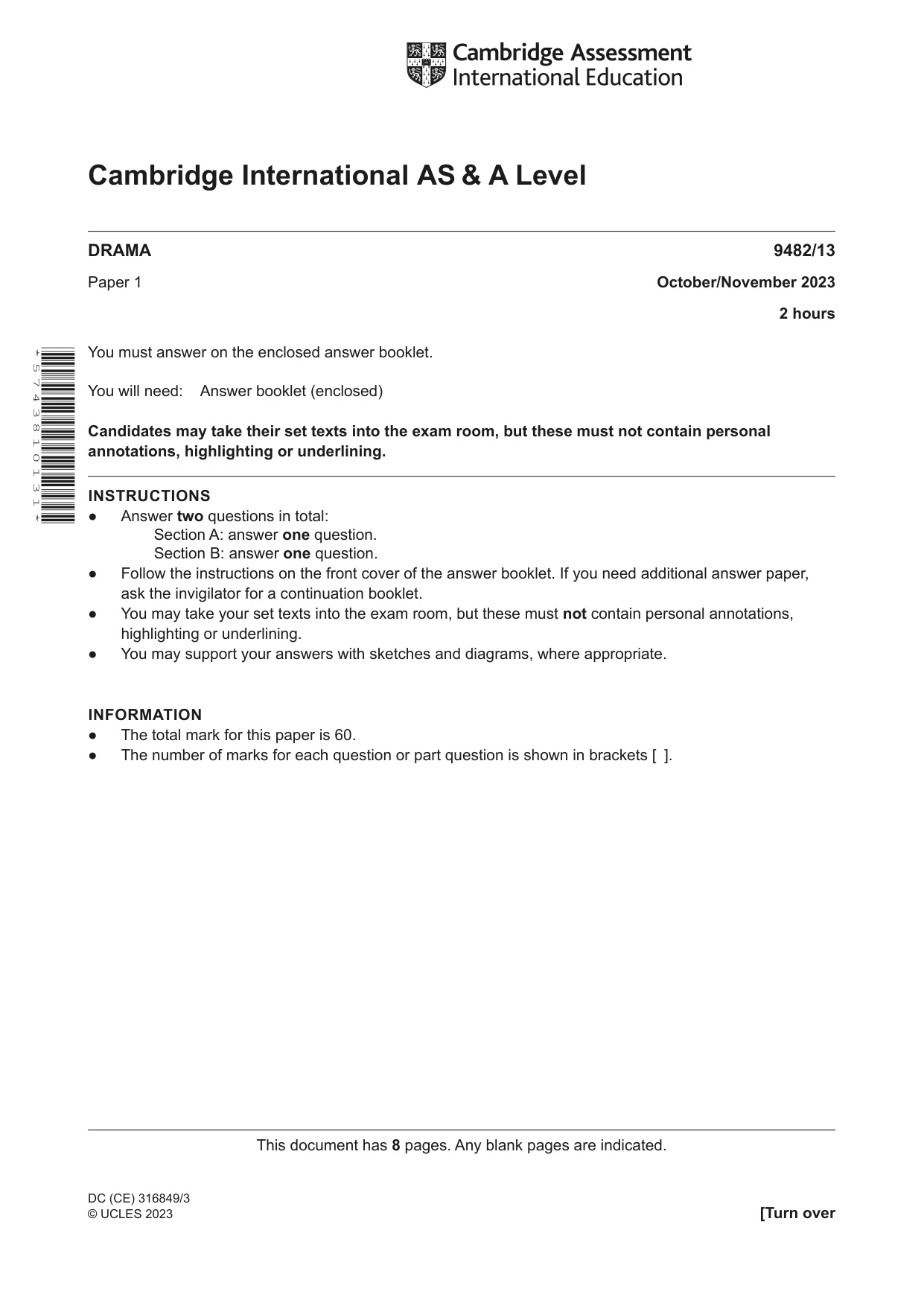
Question paper, page 1
This document has 8 pages. Any blank pages are indicated. [Turn over Cambridge International AS & A Level DC (CE) 316849/3 © UCLES 2023 DRAMA 9482/13 Paper 1 October/November 2023 2 hours You must answer on the enclosed answer booklet. You will need: Answer booklet (enclosed) Candidates may take their set texts into the exam room, but these must not contain personal annotations, highlighting or underlining. INSTRUCTIONS ● Answer two questions in total: Section A: answer one question. Section B: answer one question. ● Follow the instructions on the front cover of the answer booklet. If you need additional answer paper, ask the invigilator for a continuation booklet. ● You may take your set texts into the exam room, but these must not contain personal annotations, highlighting or underlining. ● You may support your answers with sketches and diagrams, where appropriate. INFORMATION ● The total mark for this paper is 60. ● The number of marks for each question or part question is shown in brackets [ ]. * 5 7 4 3 8 1 0 1 3 1 *
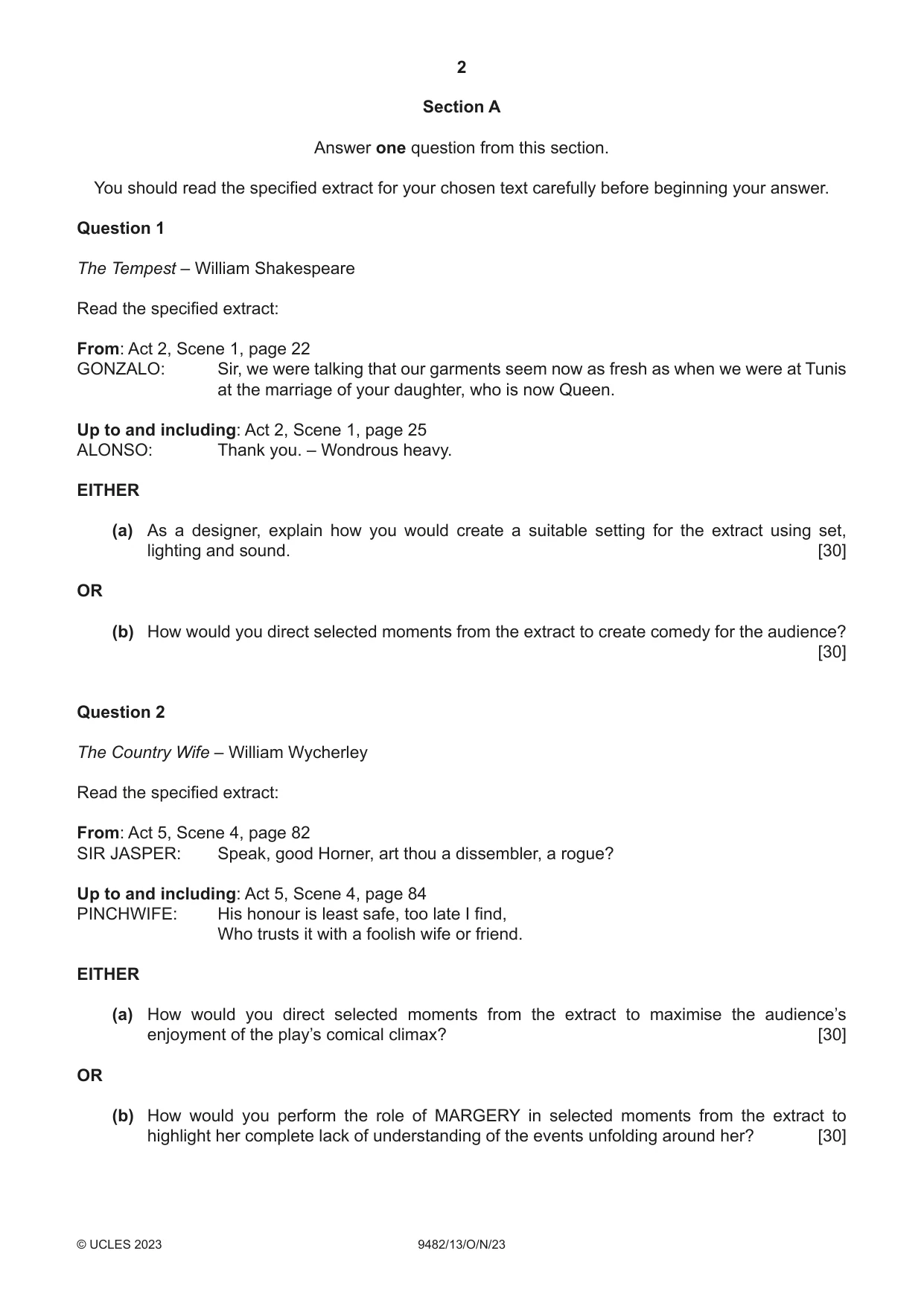
Question paper, page 2
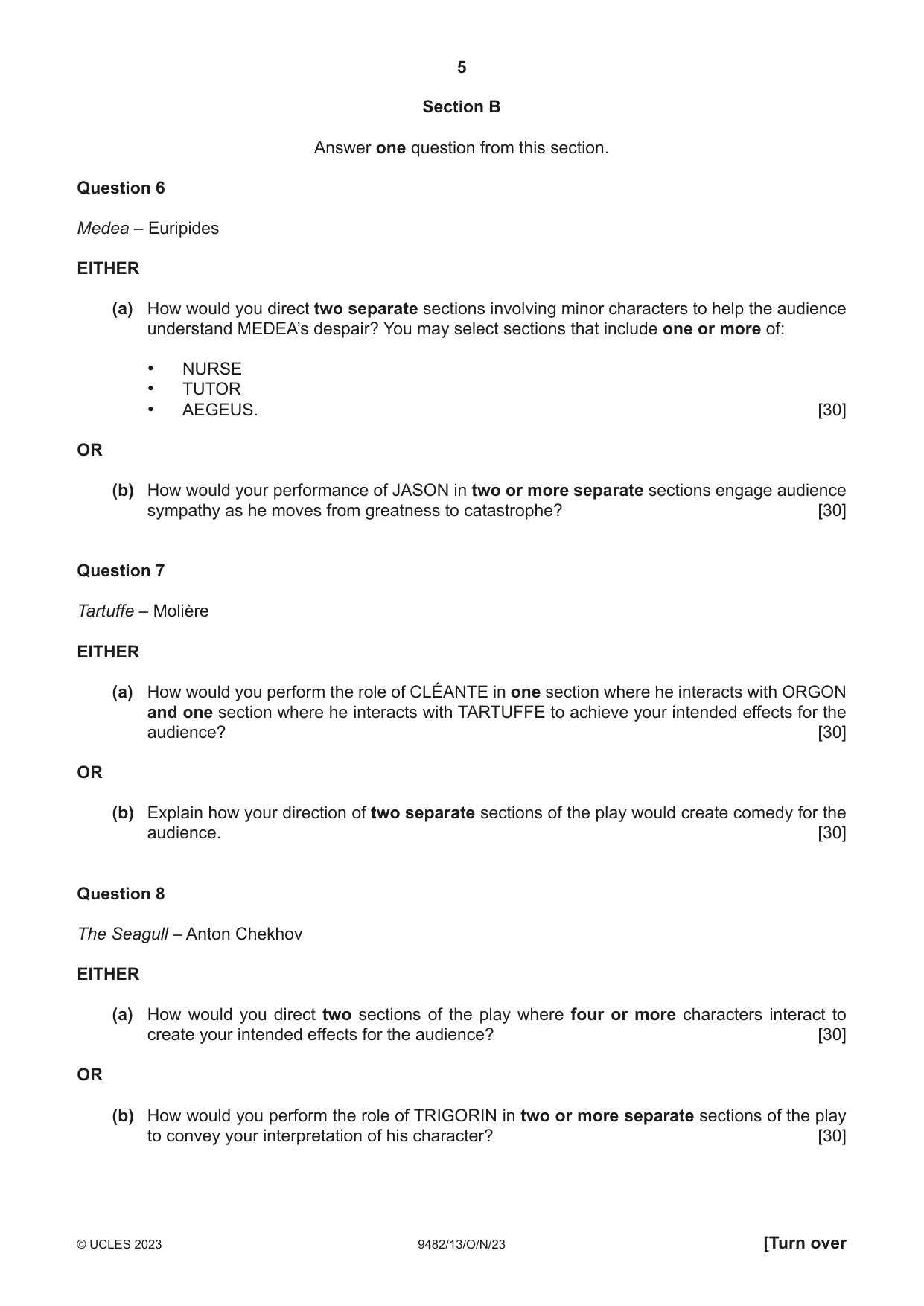
2 9482/13/O/N/23 © UCLES 2023 Section A Answer one question from this section. You should read the specified extract for your chosen text carefully before beginning your answer. Question 1 The Tempest – William Shakespeare Read the specified extract: From: Act 2, Scene 1, page 22 GONZALO: Sir, we were talking that our garments seem now as fresh as when we were at Tunis at the marriage of your daughter, who is now Queen. Up to and including: Act 2, Scene 1, page 25 ALONSO: Thank you. – Wondrous heavy. EITHER (a) As a designer, explain how you would create a suitable setting for the extract using set, lighting and sound. [30] OR (b) How would you direct selected moments from the extract to create comedy for the audience? [30] Question 2 The Country Wife – William Wycherley Read the specified extract: From: Act 5, Scene 4, page 82 SIR JASPER: Speak, good Horner, art thou a dissembler, a rogue? Up to and including: Act 5, Scene 4, page 84 PINCHWIFE: His honour is least safe, too late I find, Who trusts it with a foolish wife or friend. EITHER (a) How would you direct selected moments from the extract to maximise the audience’s enjoyment of the play’s comical climax? [30] OR (b) How would you perform the role of MARGERY in selected moments from the extract to highlight her complete lack of understanding of the events unfolding around her? [30]
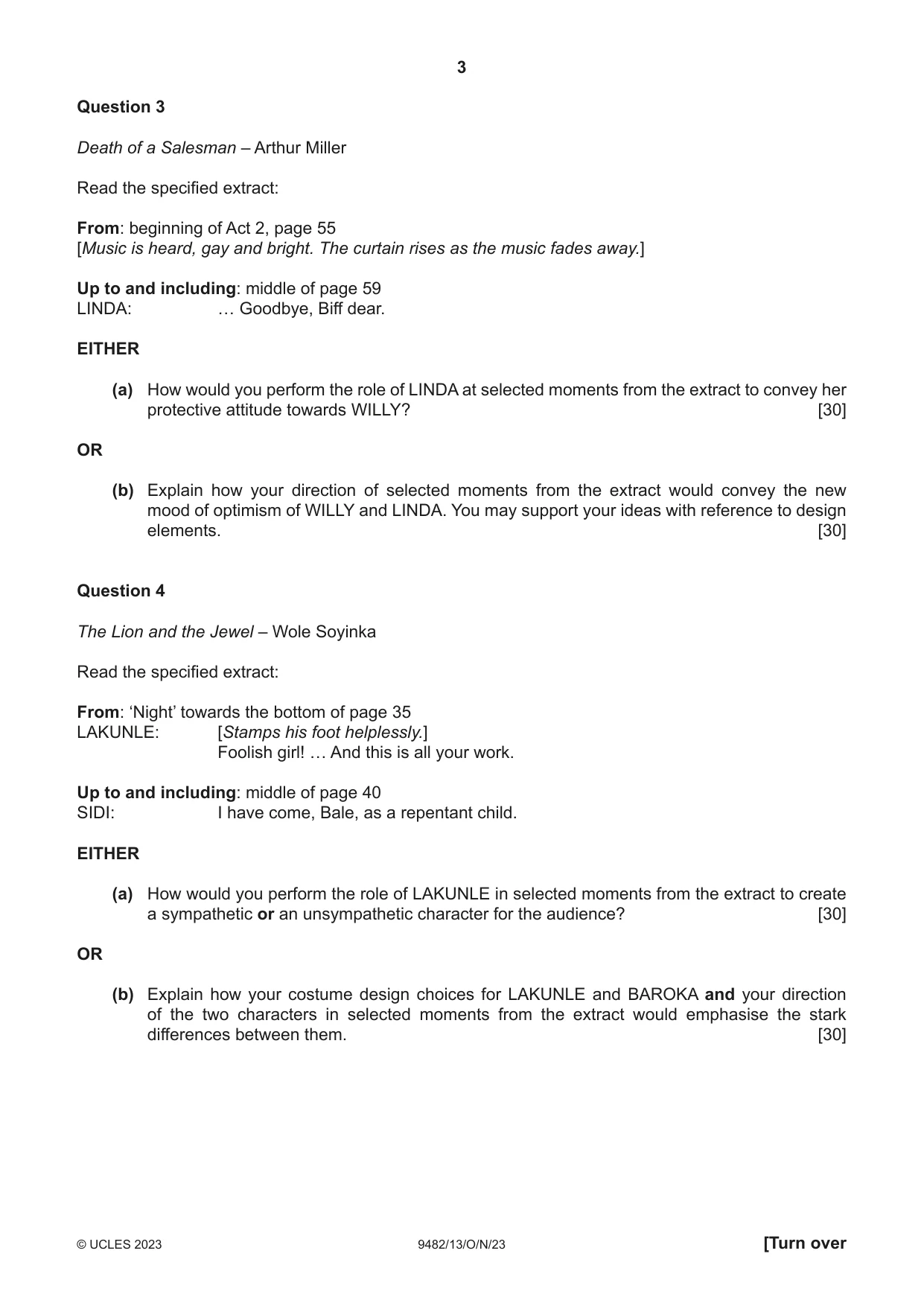
Question paper, page 3
3 9482/13/O/N/23 © UCLES 2023 [Turn over Question 3 Death of a Salesman – Arthur Miller Read the specified extract: From: beginning of Act 2, page 55 [Music is heard, gay and bright. The curtain rises as the music fades away.] Up to and including: middle of page 59 LINDA: … Goodbye, Biff dear. EITHER (a) How would you perform the role of LINDA at selected moments from the extract to convey her protective attitude towards WILLY? [30] OR (b) Explain how your direction of selected moments from the extract would convey the new mood of optimism of WILLY and LINDA. You may support your ideas with reference to design elements. [30] Question 4 The Lion and the Jewel – Wole Soyinka Read the specified extract: From: ‘Night’ towards the bottom of page 35 LAKUNLE: [Stamps his foot helplessly.] Foolish girl! … And this is all your work. Up to and including: middle of page 40 SIDI: I have come, Bale, as a repentant child. EITHER (a) How would you perform the role of LAKUNLE in selected moments from the extract to create a sympathetic or an unsympathetic character for the audience? [30] OR (b) Explain how your costume design choices for LAKUNLE and BAROKA and your direction of the two characters in selected moments from the extract would emphasise the stark differences between them. [30]
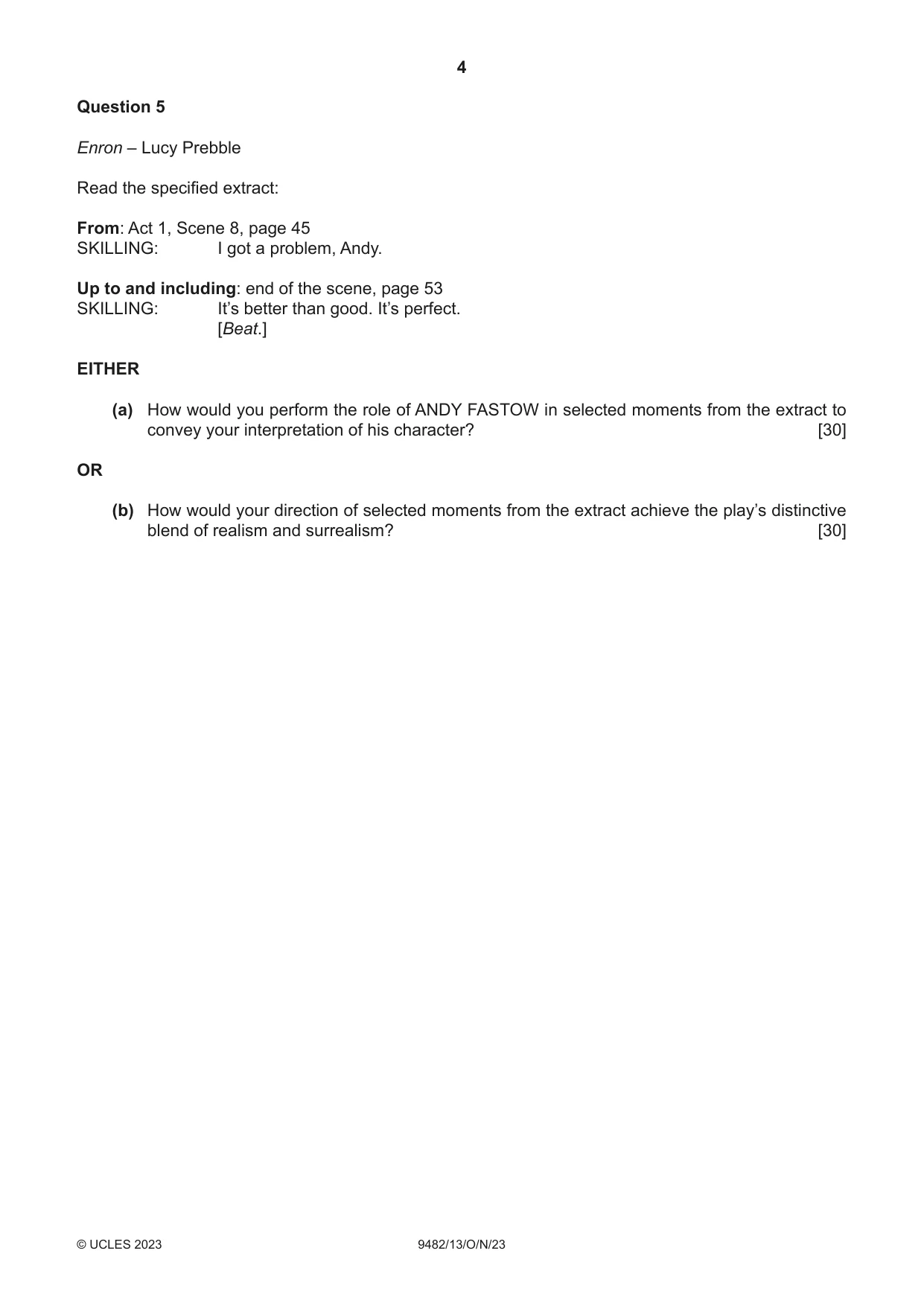
Question paper, page 4
4 9482/13/O/N/23 © UCLES 2023 Question 5 Enron – Lucy Prebble Read the specified extract: From: Act 1, Scene 8, page 45 SKILLING: I got a problem, Andy. Up to and including: end of the scene, page 53 SKILLING: It’s better than good. It’s perfect. [Beat.] EITHER (a) How would you perform the role of ANDY FASTOW in selected moments from the extract to convey your interpretation of his character? [30] OR (b) How would your direction of selected moments from the extract achieve the play’s distinctive blend of realism and surrealism? [30]
Question paper, page 5
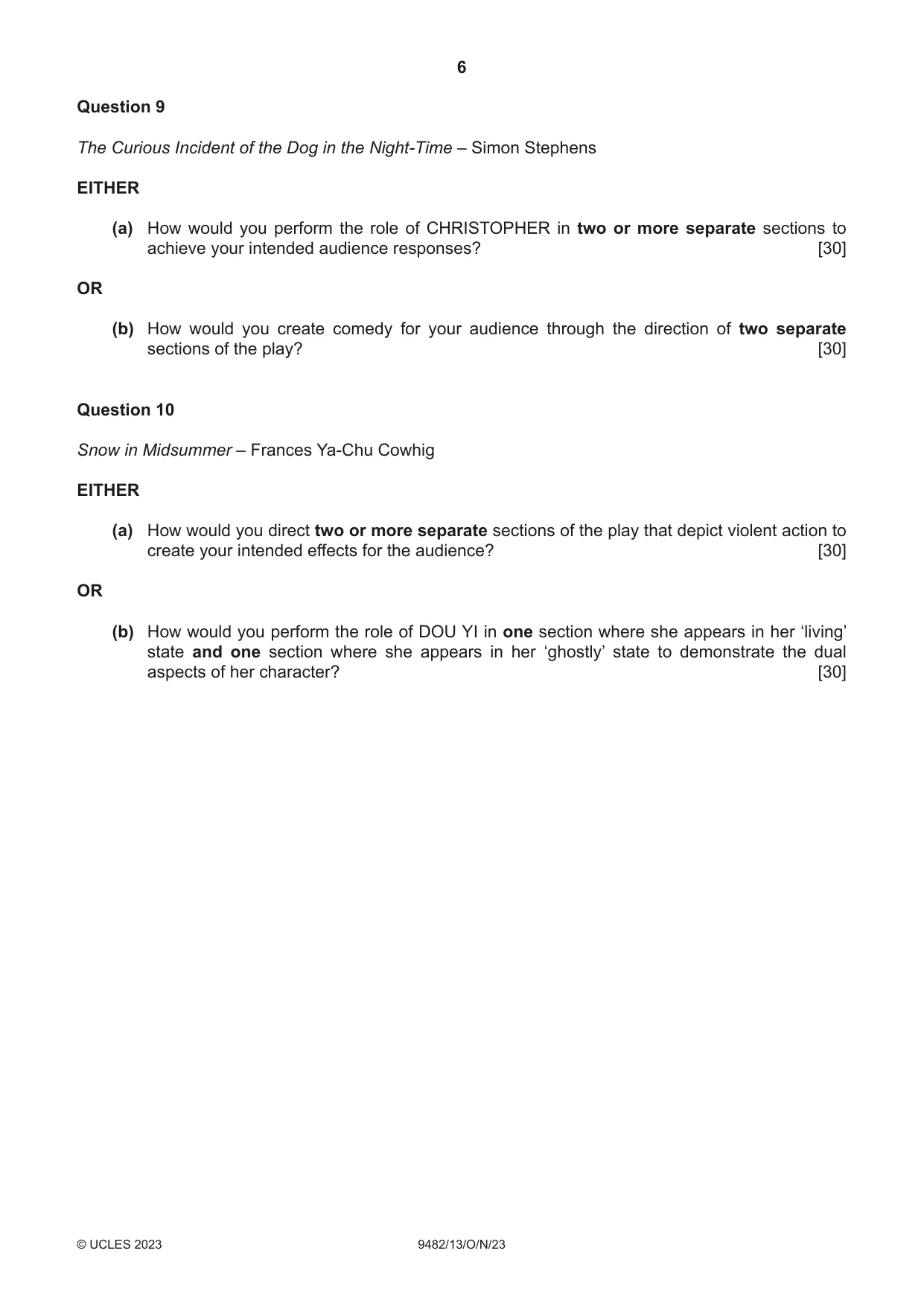
5 9482/13/O/N/23 © UCLES 2023 [Turn over Section B Answer one question from this section. Question 6 Medea – Euripides EITHER (a) How would you direct two separate sections involving minor characters to help the audience understand MEDEA’s despair? You may select sections that include one or more of: • NURSE • TUTOR • AEGEUS. [30] OR (b) How would your performance of JASON in two or more separate sections engage audience sympathy as he moves from greatness to catastrophe? [30] Question 7 Tartuffe – Molière EITHER (a) How would you perform the role of CLÉANTE in one section where he interacts with ORGON and one section where he interacts with TARTUFFE to achieve your intended effects for the audience? [30] OR (b) Explain how your direction of two separate sections of the play would create comedy for the audience. [30] Question 8 The Seagull – Anton Chekhov EITHER (a) How would you direct two sections of the play where four or more characters interact to create your intended effects for the audience? [30] OR (b) How would you perform the role of TRIGORIN in two or more separate sections of the play to convey your interpretation of his character? [30]
Question paper, page 6
6 9482/13/O/N/23 © UCLES 2023 Question 9 The Curious Incident of the Dog in the Night-Time – Simon Stephens EITHER (a) How would you perform the role of CHRISTOPHER in two or more separate sections to achieve your intended audience responses? [30] OR (b) How would you create comedy for your audience through the direction of two separate sections of the play? [30] Question 10 Snow in Midsummer – Frances Ya-Chu Cowhig EITHER (a) How would you direct two or more separate sections of the play that depict violent action to create your intended effects for the audience? [30] OR (b) How would you perform the role of DOU YI in one section where she appears in her ‘living’ state and one section where she appears in her ‘ghostly’ state to demonstrate the dual aspects of her character? [30]
Question paper, page 7
7 9482/13/O/N/23 © UCLES 2023 BLANK PAGE
Question paper, page 8
8 9482/13/O/N/23 © UCLES 2023 Permission to reproduce items where third-party owned material protected by copyright is included has been sought and cleared where possible. Every reasonable effort has been made by the publisher (UCLES) to trace copyright holders, but if any items requiring clearance have unwittingly been included, the publisher will be pleased to make amends at the earliest possible opportunity. To avoid the issue of disclosure of answer-related information to candidates, all copyright acknowledgements are reproduced online in the Cambridge Assessment International Education Copyright Acknowledgements Booklet. This is produced for each series of examinations and is freely available to download at www.cambridgeinternational.org after the live examination series. Cambridge Assessment International Education is part of Cambridge Assessment. Cambridge Assessment is the brand name of the University of Cambridge Local Examinations Syndicate (UCLES), which is a department of the University of Cambridge. BLANK PAGE
Mark scheme, page 1
This document consists of 26 printed pages. © UCLES 2023 [Turn over Cambridge International AS & A Level DRAMA 9482/13 Paper 1 Open-Book Written Examination October/November 2023 MARK SCHEME Maximum Mark: 60 Published This mark scheme is published as an aid to teachers and candidates, to indicate the requirements of the examination. It shows the basis on which Examiners were instructed to award marks. It does not indicate the details of the discussions that took place at an Examiners’ meeting before marking began, which would have considered the acceptability of alternative answers. Mark schemes should be read in conjunction with the question paper and the Principal Examiner Report for Teachers. Cambridge International will not enter into discussions about these mark schemes. Cambridge International is publishing the mark schemes for the October/November 2023 series for most Cambridge IGCSE, Cambridge International A and AS Level components, and some Cambridge O Level components.
Mark scheme, page 2
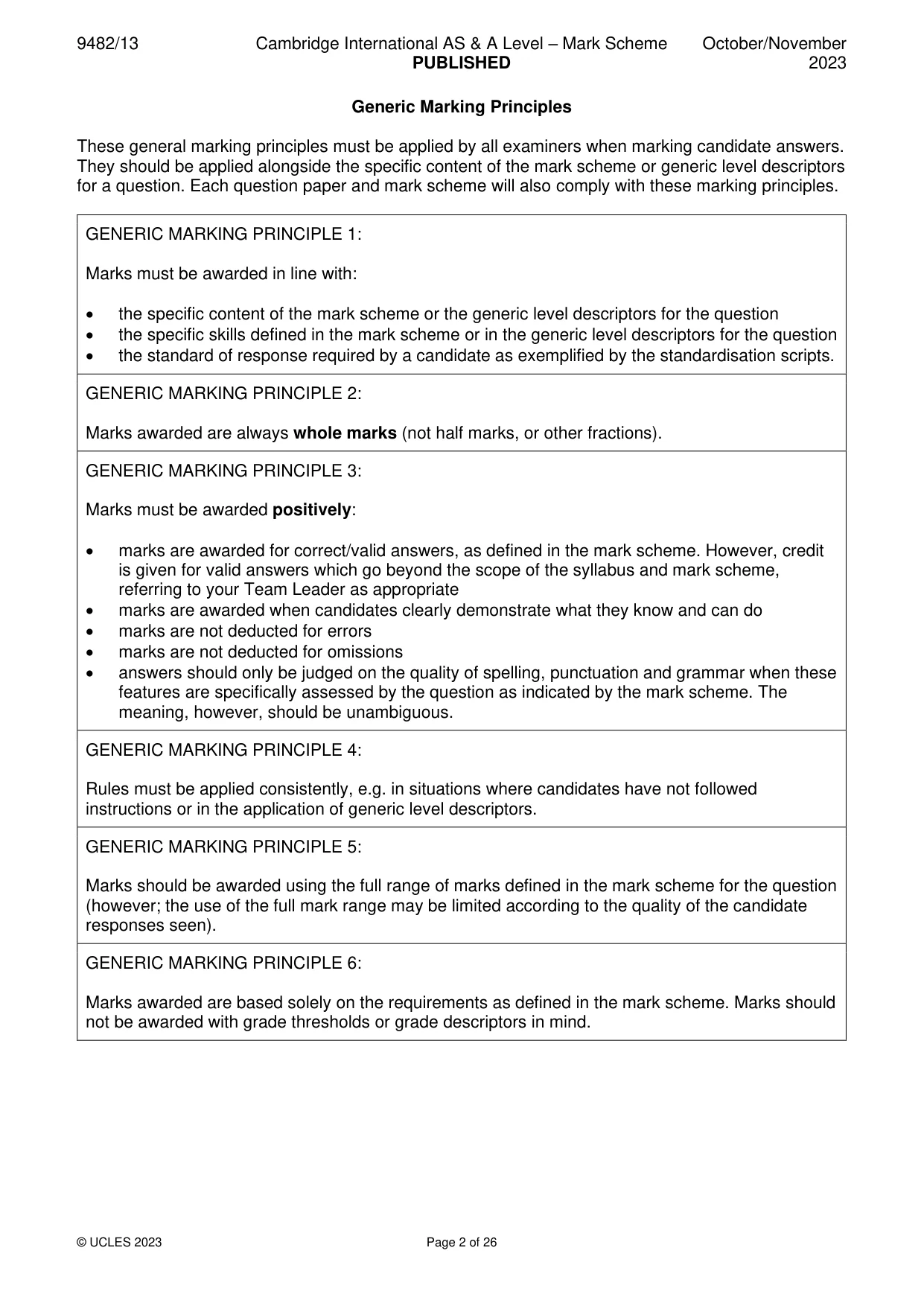
9482/13 Cambridge International AS & A Level – Mark Scheme PUBLISHED October/November 2023 © UCLES 2023 Page 2 of 26 Generic Marking Principles These general marking principles must be applied by all examiners when marking candidate answers. They should be applied alongside the specific content of the mark scheme or generic level descriptors for a question. Each question paper and mark scheme will also comply with these marking principles. GENERIC MARKING PRINCIPLE 1: Marks must be awarded in line with: • the specific content of the mark scheme or the generic level descriptors for the question • the specific skills defined in the mark scheme or in the generic level descriptors for the question • the standard of response required by a candidate as exemplified by the standardisation scripts. GENERIC MARKING PRINCIPLE 2: Marks awarded are always whole marks (not half marks, or other fractions). GENERIC MARKING PRINCIPLE 3: Marks must be awarded positively: • marks are awarded for correct/valid answers, as defined in the mark scheme. However, credit is given for valid answers which go beyond the scope of the syllabus and mark scheme, referring to your Team Leader as appropriate • marks are awarded when candidates clearly demonstrate what they know and can do • marks are not deducted for errors • marks are not deducted for omissions • answers should only be judged on the quality of spelling, punctuation and grammar when these features are specifically assessed by the question as indicated by the mark scheme. The meaning, however, should be unambiguous. GENERIC MARKING PRINCIPLE 4: Rules must be applied consistently, e.g. in situations where candidates have not followed instructions or in the application of generic level descriptors. GENERIC MARKING PRINCIPLE 5: Marks should be awarded using the full range of marks defined in the mark scheme for the question (however; the use of the full mark range may be limited according to the quality of the candidate responses seen). GENERIC MARKING PRINCIPLE 6: Marks awarded are based solely on the requirements as defined in the mark scheme. Marks should not be awarded with grade thresholds or grade descriptors in mind.
Mark scheme, page 3
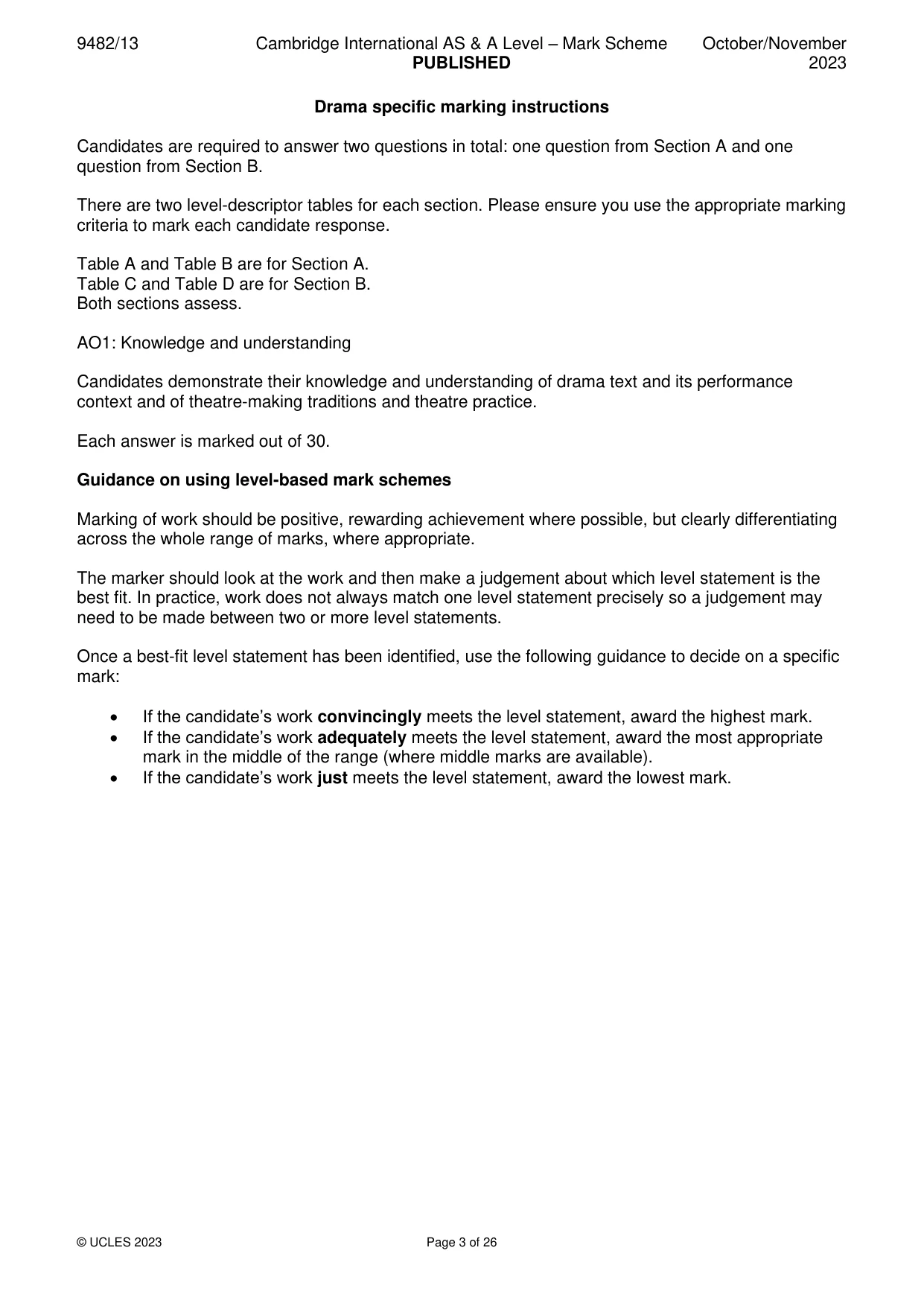
9482/13 Cambridge International AS & A Level – Mark Scheme PUBLISHED October/November 2023 © UCLES 2023 Page 3 of 26 Drama specific marking instructions Candidates are required to answer two questions in total: one question from Section A and one question from Section B. There are two level-descriptor tables for each section. Please ensure you use the appropriate marking criteria to mark each candidate response. Table A and Table B are for Section A. Table C and Table D are for Section B. Both sections assess. AO1: Knowledge and understanding Candidates demonstrate their knowledge and understanding of drama text and its performance context and of theatre-making traditions and theatre practice. Each answer is marked out of 30. Guidance on using level-based mark schemes Marking of work should be positive, rewarding achievement where possible, but clearly differentiating across the whole range of marks, where appropriate. The marker should look at the work and then make a judgement about which level statement is the best fit. In practice, work does not always match one level statement precisely so a judgement may need to be made between two or more level statements. Once a best-fit level statement has been identified, use the following guidance to decide on a specific mark: • If the candidate’s work convincingly meets the level statement, award the highest mark. • If the candidate’s work adequately meets the level statement, award the most appropriate mark in the middle of the range (where middle marks are available). • If the candidate’s work just meets the level statement, award the lowest mark.
Mark scheme, page 4
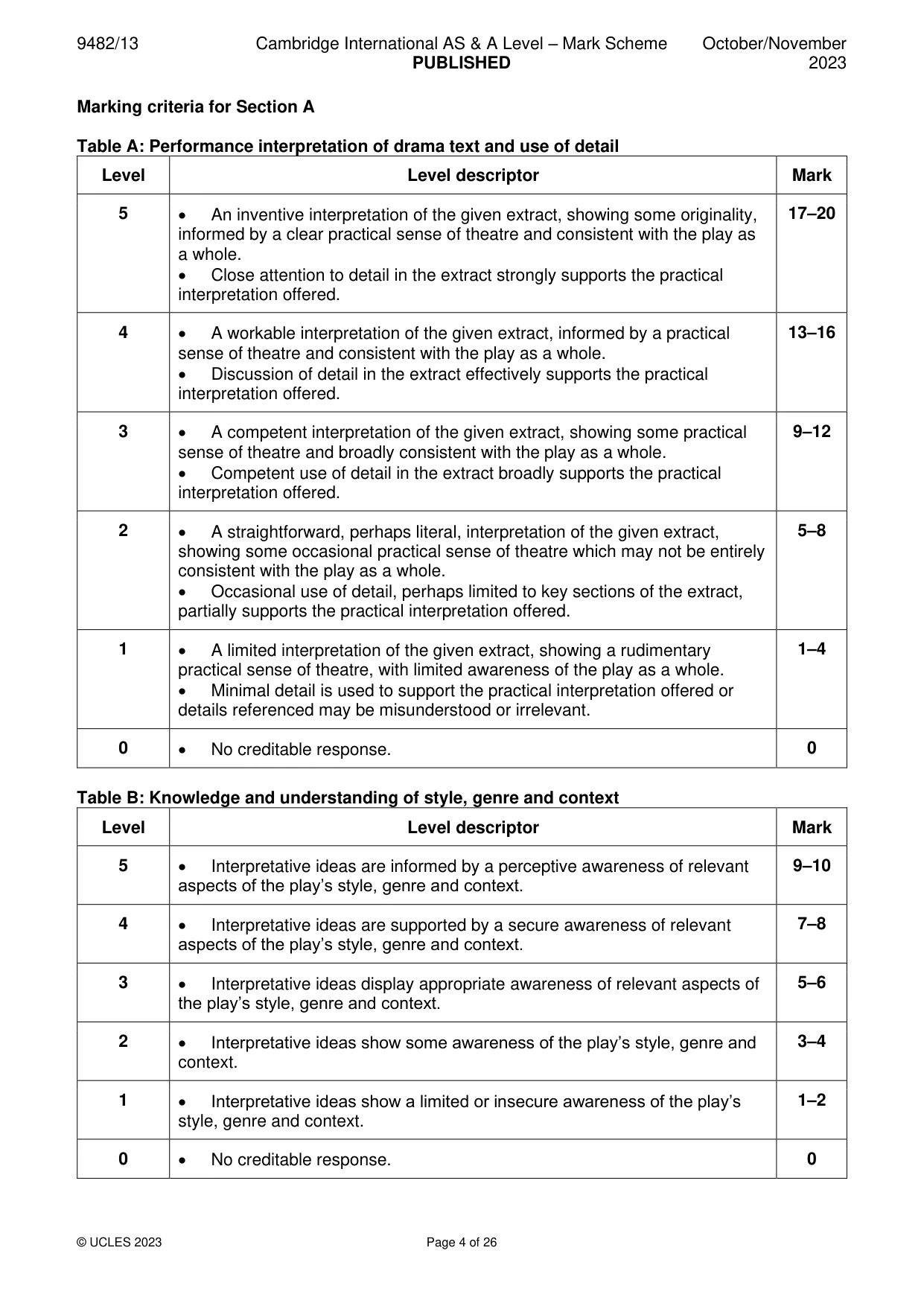
9482/13 Cambridge International AS & A Level – Mark Scheme PUBLISHED October/November 2023 © UCLES 2023 Page 4 of 26 Marking criteria for Section A Table A: Performance interpretation of drama text and use of detail Level Level descriptor Mark 5 • An inventive interpretation of the given extract, showing some originality, informed by a clear practical sense of theatre and consistent with the play as a whole. • Close attention to detail in the extract strongly supports the practical interpretation offered. 17–20 4 • A workable interpretation of the given extract, informed by a practical sense of theatre and consistent with the play as a whole. • Discussion of detail in the extract effectively supports the practical interpretation offered. 13–16 3 • A competent interpretation of the given extract, showing some practical sense of theatre and broadly consistent with the play as a whole. • Competent use of detail in the extract broadly supports the practical interpretation offered. 9–12 2 • A straightforward, perhaps literal, interpretation of the given extract, showing some occasional practical sense of theatre which may not be entirely consistent with the play as a whole. • Occasional use of detail, perhaps limited to key sections of the extract, partially supports the practical interpretation offered. 5–8 1 • A limited interpretation of the given extract, showing a rudimentary practical sense of theatre, with limited awareness of the play as a whole. • Minimal detail is used to support the practical interpretation offered or details referenced may be misunderstood or irrelevant. 1–4 0 • No creditable response. 0 Table B: Knowledge and understanding of style, genre and context Level Level descriptor Mark 5 • Interpretative ideas are informed by a perceptive awareness of relevant aspects of the play’s style, genre and context. 9–10 4 • Interpretative ideas are supported by a secure awareness of relevant aspects of the play’s style, genre and context. 7–8 3 • Interpretative ideas display appropriate awareness of relevant aspects of the play’s style, genre and context. 5–6 2 • Interpretative ideas show some awareness of the play’s style, genre and context. 3–4 1 • Interpretative ideas show a limited or insecure awareness of the play’s style, genre and context. 1–2 0 • No creditable response. 0
Mark scheme, page 5
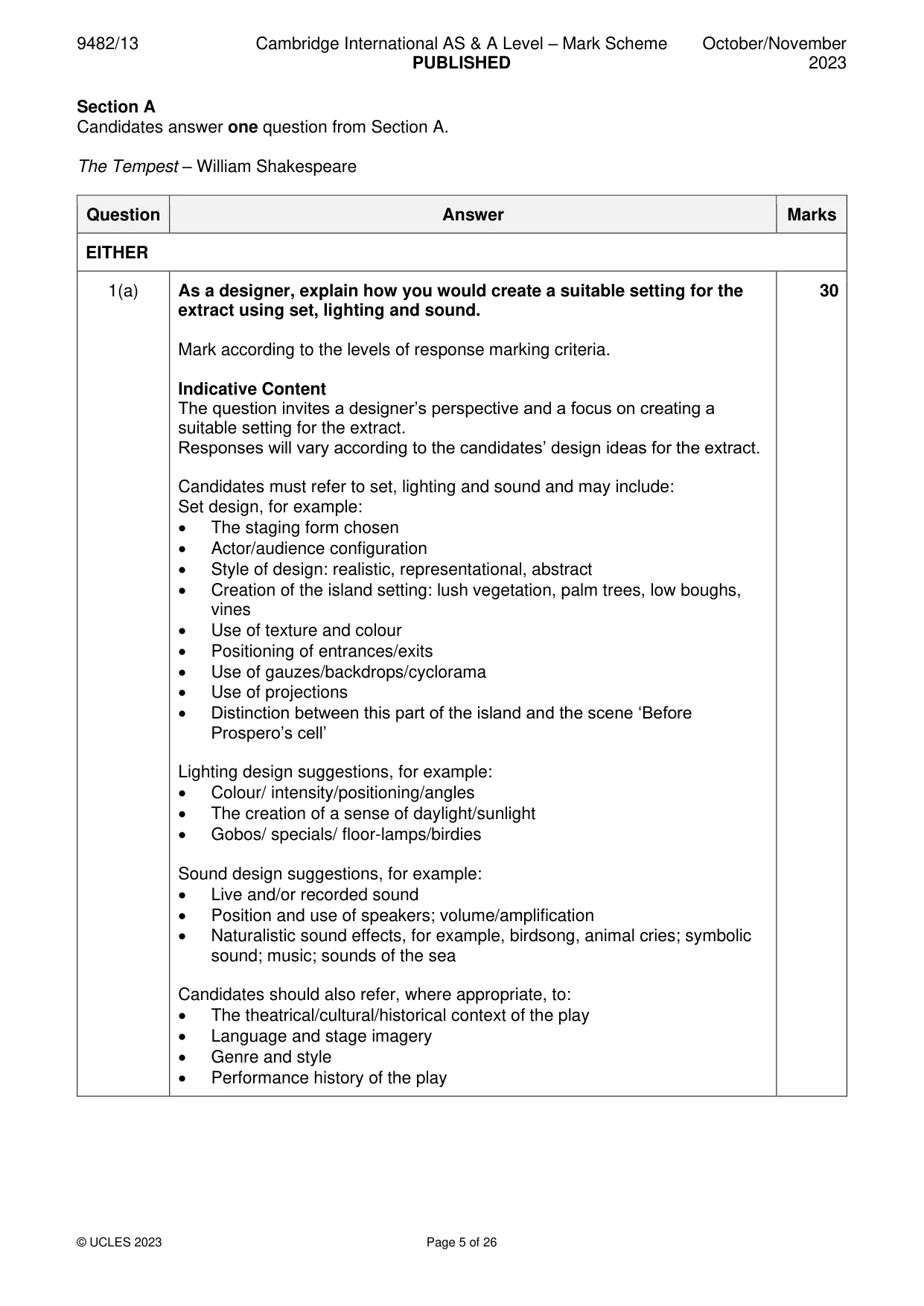
9482/13 Cambridge International AS & A Level – Mark Scheme PUBLISHED October/November 2023 © UCLES 2023 Page 5 of 26 Section A Candidates answer one question from Section A. The Tempest – William Shakespeare Question Answer Marks EITHER 1(a) As a designer, explain how you would create a suitable setting for the extract using set, lighting and sound. Mark according to the levels of response marking criteria. Indicative Content The question invites a designer’s perspective and a focus on creating a suitable setting for the extract. Responses will vary according to the candidates’ design ideas for the extract. Candidates must refer to set, lighting and sound and may include: Set design, for example: • The staging form chosen • Actor/audience configuration • Style of design: realistic, representational, abstract • Creation of the island setting: lush vegetation, palm trees, low boughs, vines • Use of texture and colour • Positioning of entrances/exits • Use of gauzes/backdrops/cyclorama • Use of projections • Distinction between this part of the island and the scene ‘Before Prospero’s cell’ Lighting design suggestions, for example: • Colour/ intensity/positioning/angles • The creation of a sense of daylight/sunlight • Gobos/ specials/ floor-lamps/birdies Sound design suggestions, for example: • Live and/or recorded sound • Position and use of speakers; volume/amplification • Naturalistic sound effects, for example, birdsong, animal cries; symbolic sound; music; sounds of the sea Candidates should also refer, where appropriate, to: • The theatrical/cultural/historical context of the play • Language and stage imagery • Genre and style • Performance history of the play 30
Mark scheme, page 6
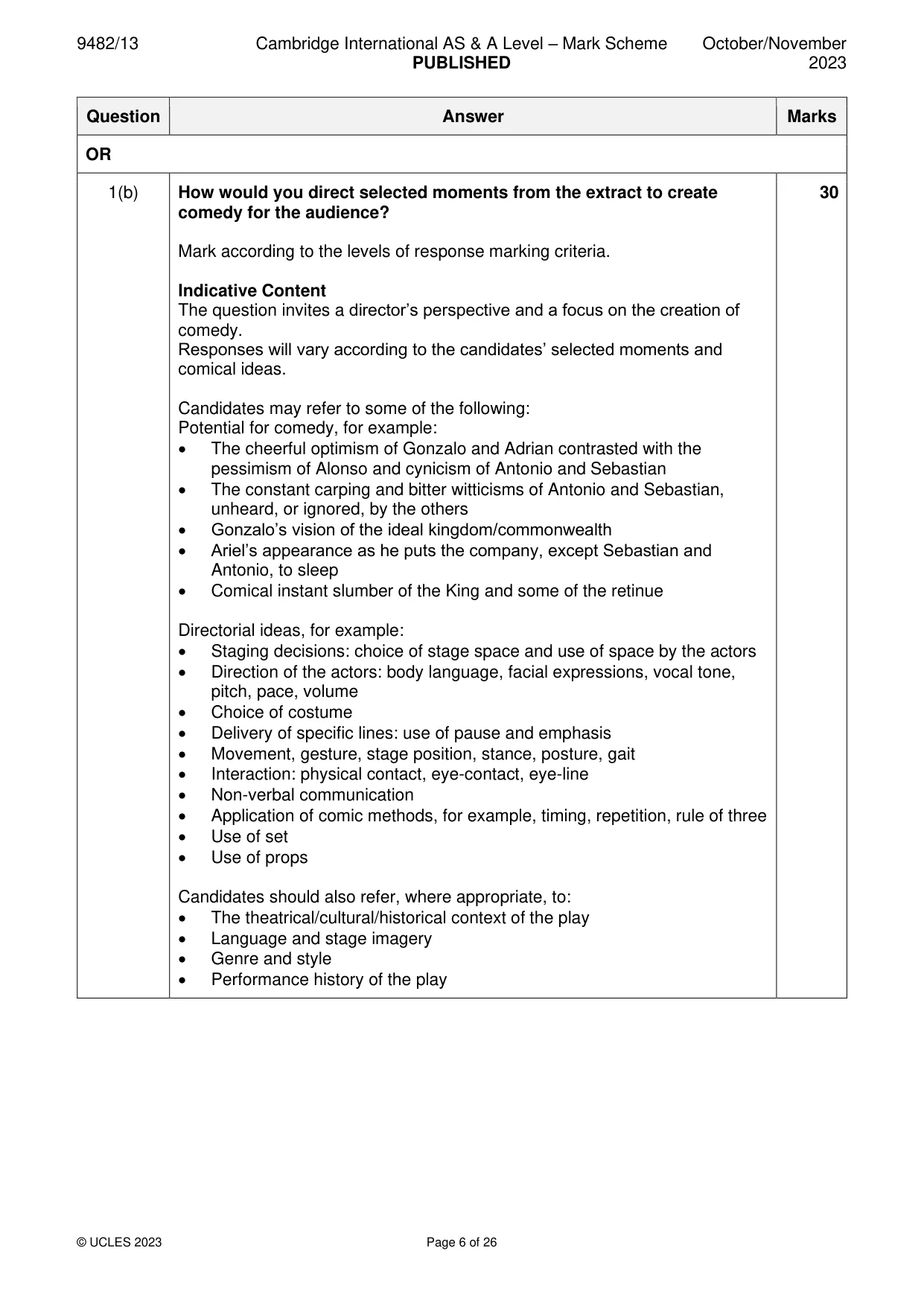
9482/13 Cambridge International AS & A Level – Mark Scheme PUBLISHED October/November 2023 © UCLES 2023 Page 6 of 26 Question Answer Marks OR 1(b) How would you direct selected moments from the extract to create comedy for the audience? Mark according to the levels of response marking criteria. Indicative Content The question invites a director’s perspective and a focus on the creation of comedy. Responses will vary according to the candidates’ selected moments and comical ideas. Candidates may refer to some of the following: Potential for comedy, for example: • The cheerful optimism of Gonzalo and Adrian contrasted with the pessimism of Alonso and cynicism of Antonio and Sebastian • The constant carping and bitter witticisms of Antonio and Sebastian, unheard, or ignored, by the others • Gonzalo’s vision of the ideal kingdom/commonwealth • Ariel’s appearance as he puts the company, except Sebastian and Antonio, to sleep • Comical instant slumber of the King and some of the retinue Directorial ideas, for example: • Staging decisions: choice of stage space and use of space by the actors • Direction of the actors: body language, facial expressions, vocal tone, pitch, pace, volume • Choice of costume • Delivery of specific lines: use of pause and emphasis • Movement, gesture, stage position, stance, posture, gait • Interaction: physical contact, eye-contact, eye-line • Non-verbal communication • Application of comic methods, for example, timing, repetition, rule of three • Use of set • Use of props Candidates should also refer, where appropriate, to: • The theatrical/cultural/historical context of the play • Language and stage imagery • Genre and style • Performance history of the play 30
Mark scheme, page 7
9482/13 Cambridge International AS & A Level – Mark Scheme PUBLISHED October/November 2023 © UCLES 2023 Page 7 of 26 The Country Wife – William Wycherley Question Answer Marks EITHER 2(a) How would you direct selected moments from the extract to maximise the audience’s enjoyment of the play’s comical climax? Mark according to the levels of response marking criteria. Indicative Content The question invites a director’s perspective and a focus on maximising the audience’s enjoyment of the comic climax. Responses will vary according to the moments selected and the ideas for creating comedy. Candidates may refer to some of the following: • Sir Jaspar’s direct accusation of Horner makes him, for once, lost for words • Lucy’s inventiveness saves the day although she attracts Sparkish’s wrath • Margery’s stupidity seems likely to expose the truth, but she is comically silenced • Lucy and Squeamish almost have to jump on Margery to prevent her from speaking the truth • Quack’s intervention leads to several amusing quips about the trustworthiness of doctors in general • The sequence of whispers has much comic potential for exaggerated facial expressions • ‘All’s well that ends well’ with many a cynical retort about marriage • Pinchwife and Margery are consigned to a future of marital misery Directorial suggestions may include, for example: • Staging decisions: choice of stage space and use of space by the actors • Direction of the actors: body language, facial expressions, vocal tone, pitch, pace, volume • Choice of costume, use of fans for the whispering sequences • Use of props • Delivery of specific lines: use of pause and emphasis • Movement, gesture, stage position, stance, posture, gait • Interaction: physical contact, eye-contact, eye-line • Non-verbal communication • Application of comic methods, for example, timing, repetition, rule of three Candidates should also refer, where appropriate, to: • The theatrical/cultural/historical context of the play • Language and stage imagery • Genre and style • Performance history of the play 30
Mark scheme, page 8
9482/13 Cambridge International AS & A Level – Mark Scheme PUBLISHED October/November 2023 © UCLES 2023 Page 8 of 26 Question Answer Marks OR 2(b) How would you perform the role of MARGERY in selected moments from the extract to highlight her complete lack of understanding of the events unfolding around her? Mark according to the levels of response marking criteria. Indicative Content The question invites a performer’s perspective and a focus on conveying Margery’s complete lack of understanding of events. Responses will vary according to the candidates’ interpretation. Candidates may refer to some of the following: Performance suggestions may include, for example: • Margery’s physical appearance and costume; dressed as Alithea • She is increasingly bewildered by the unfolding events, entirely focused on ‘marrying’ Horner and unaware of the secrets that she risks revealing • Movement, gesture, posture, energy, stance, gait • Vocal, facial and physical expression • Delivery style • Delivery of specific lines: pace, pitch, pause, accent, emphasis • Interaction with other characters; constantly trying to interject but being silenced by those ‘in the know’ • Physical contact, eye-contact, eye-line • Non-verbal communication • Use of space • Use of props and accessories • Restoration performance conventions, if adopted Candidates should also refer, where appropriate, to: • The theatrical/cultural/historical context of the play • Language and stage imagery • Genre and style • Performance history of the play 30
Mark scheme, page 9
9482/13 Cambridge International AS & A Level – Mark Scheme PUBLISHED October/November 2023 © UCLES 2023 Page 9 of 26 The Death of a Salesman – Arthur Miller Question Answer Marks EITHER 3(a) How would you perform the role of LINDA at selected moments from the extract to convey her protective attitude towards WILLY? Mark according to the levels of response marking criteria. Indicative Content The question invites a performer’s perspective and a focus on conveying Linda’s protective attitude towards Willy. Responses will vary according to the candidates’ choice of moments. Candidates may refer to some of the following: Linda’s protective attitude, including, for example: • Wifely indulgence of and understanding of Willy’s shortcomings • Genuine affection for him and appreciation of his efforts • Pride in his appearance and character • Love for him • Utterly supportive Performance suggestion for Linda, including, for example: • Her physical appearance and costume • Movement, gesture, posture, energy, stance, gait, pose • Vocal, facial and physical expression • Delivery style: calm and rational • Delivery of specific lines: pace, pitch, pause, accent, emphasis • Interaction with Willy: physical contact, eye-contact, eye-line • Non-verbal communication • Use of space • Use of props and accessories Candidates should also refer, where appropriate, to: • The theatrical/cultural/historical context of the play • Language and stage imagery • Genre and style • Performance history of the play 30
Mark scheme, page 10
9482/13 Cambridge International AS & A Level – Mark Scheme PUBLISHED October/November 2023 © UCLES 2023 Page 10 of 26 Question Answer Marks OR 3(b) Explain how your direction of selected moments from the extract would convey the new mood of optimism of WILLY and LINDA. You may support your ideas with reference to design elements. Mark according to the levels of response marking criteria. Indicative Content The question invites a director’s perspective focused on conveying a mood of optimism at this point in the play. Responses will vary according to the moment selected. Candidates may refer to some of the following sections: • The Act opens with music playing, ‘gay and bright’ • Willy is relaxed after a good night’s sleep • He speaks optimistically about Biff’s future • Willy makes plans for retirement in an idyllic spot in the countryside and Linda humours him • After a lapse in mood discussing the car and the fridge, Willy is cheered by the surprising prospect of dinner with his boys Directorial suggestions, for example: • Physical appearance of the actors playing Willy and Linda, both looking more relaxed than the night before • Staging decisions and use of space and spatial relationships by the actors to suggest their new optimism • Movement, gesture, posture, energy, stance • Vocal, facial and physical expression • Delivery of specific lines: pace, pitch, pause, accent, emphasis, volume • Interaction: physical contact, eye-contact, eye-line • Non-verbal communication • Use of props Design elements, for example: • Optimism expressed through brighter lighting • Use of ‘gay and bright’ music • Colourful/bright items of costume, not seen in Act One • Touches of colour in the set Candidates should also refer, where appropriate, to: • The theatrical/cultural/historical context of the play • Language and stage imagery • Genre and style • Performance history of the play 30
Mark scheme, page 11
9482/13 Cambridge International AS & A Level – Mark Scheme PUBLISHED October/November 2023 © UCLES 2023 Page 11 of 26 The Lion and the Jewel – Wole Soyinka Question Answer Marks EITHER 4(a) How would you perform the role of LAKUNLE in selected moments from the extract to create a sympathetic or an unsympathetic character for the audience? Mark according to the levels of response marking criteria. Indicative Content The question invites a performer’s perspective and a focus on creating a sympathetic or an unsympathetic character. Responses will vary according to their ideas about Lakunle in the moments selected. Intended interpretation of Lakunle as sympathetic, including, for example: • His horror at the thought of losing Sidi • His naivety in thinking Sidi might listen to him • His genuine belief that ‘city ways’ will enhance the lives of the villagers of Ilujinle • His compassion for Baroka who he does not want to think of as being mocked by Sidi • His belief in equality between men and women Intended interpretation of Lakunle as unsympathetic: • His rudeness to Sadiku; insulting and sexist • His patronising attitude: he calls her a mere ‘woman of the bush’ • His lecture about progress and humiliating suggestion that Sadiku joins his class of twelve-year-olds • The contradictions inherent in his vision for the future, incorporating both the benefits and iniquities of ‘civilisation’ Performance suggestions, for example: • Lakunle’s physical appearance • Movement, gesture, posture, energy, stance, gait • Vocal, facial and physical expression • Delivery style • Delivery of specific lines: pace, pitch, pause, accent, emphasis • Lakunle’s interaction with Sidi and Sadiku: physical contact, eye-contact, eye-line • Non-verbal communication • Use of space • Use of props Candidates should also refer, where appropriate, to: • The theatrical/cultural/historical context of the play • Language and stage imagery • Genre and style • Performance history of the play 30
Mark scheme, page 12
9482/13 Cambridge International AS & A Level – Mark Scheme PUBLISHED October/November 2023 © UCLES 2023 Page 12 of 26 Question Answer Marks OR 4(b) Explain how your costume design choices for LAKUNLE and BAROKA and your direction of the two characters in selected moments from the extract would emphasise the stark differences between them. Mark according to the levels of response marking criteria. Indicative Content The question invites a director’s perspective and a focus on highlighting the stark differences between the characters of Lakunle and Baroka. Responses will vary according to the moments selected. Candidates may refer to some of the following: • The contrast in appearance between the two men, for example, Lakunle could be slightly built, with unprepossessing, scholarly looks; Baroka is muscular and tall; a handsome man with self-possession, engaged in the ‘manly pursuit’ of wrestling • Contrasting costumes, for example, Lakunle looking slightly shabby in his worn/rumpled Westernised costume, suit, shirt and tie with formal, if aged leather shoes; Baroka is semi-naked, but his loincloth might be colourful; he might be bare footed • Lakunle’s tone with Sadiku is whining and self-pitying; he stamps his foot ‘helplessly’ and is unable to influence Sidi • Baroka speaks to Sidi during a bout of wrestling, he looks manly and speaks from his position of strength as Bale of the village Directorial suggestions for highlighting the differences, for example: • Staging decisions and use of space by each of the actors, emphasising the contrast between them • Direction of the actors: starkly different body language, facial expressions, vocal tone, pitch, pace, volume • Delivery of specific lines: use of pause and emphasis to highlight the difference between them • Movement, gesture, stage position, stance, posture, gait • Interaction: physical contact, eye-contact, eye-line Candidates should also refer, where appropriate, to: • The theatrical/cultural/historical context of the play • Language and stage imagery • Genre and style • Performance history of the play 30
Mark scheme, page 13
9482/13 Cambridge International AS & A Level – Mark Scheme PUBLISHED October/November 2023 © UCLES 2023 Page 13 of 26 Enron – Lucy Prebble Question Answer Marks EITHER 5(a) How would you perform the role of ANDY FASTOW in selected moments from the extract to convey your interpretation of his character? Mark according to the levels of response marking criteria. Indicative Content The question invites a performer’s perspective and a focus on conveying an interpretation of Fastow’s character. Responses will vary according to the candidates’ interpretation. Candidates may refer to some of the following: Intended interpretation of Fastow, including, for example: • His self-assurance • His admiration of Skilling and willingness to help him • His dubious ethics • His ambition • His inventiveness and ingenuity • His eccentricity Performance suggestions may include, for example: • Fastow’s physical appearance and costume • Movement, gesture, posture, energy, stance, gait • Vocal, facial and physical expression • Delivery style • Delivery of specific lines: pace, pitch, pause, accent, emphasis • Interaction with Skilling and Ken Lay; physical contact, eye-contact, eye- line • Non-verbal communication • Use of space • Use of props and accessories Candidates should also refer, where appropriate, to: • The theatrical/cultural/historical context of the play • Language and stage imagery • Genre and style • Performance history of the play 30
Mark scheme, page 14
9482/13 Cambridge International AS & A Level – Mark Scheme PUBLISHED October/November 2023 © UCLES 2023 Page 14 of 26 Question Answer Marks OR 5(b) How would your direction of selected moments from the extract achieve the play’s distinctive blend of realism and surrealism? Mark according to the levels of response marking criteria. Indicative Content The question invites a director’s perspective and a focus on achieving the blend of realism and surrealism that is a feature of this play. Responses will vary according to the moments selected. Candidates may refer to some of the following: • The delivery of the realistic dialogue • Realistic acting techniques during the exchanges between Fastow and Skilling • Fastow’s surreal demonstration of the ‘Russian doll’ effect with appropriate props and technical support • The appearance of Arthur Anderson and his ventriloquist’s dummy • The appearance of Ramsey and Hewitt as ‘Justice blindfolded’ • The appearance of the Board, comprised, largely, of Mice Directorial suggestions may include, for example: • Staging decisions and use of space within the extract • Direction of the characters within the respective duologues: body language, facial expressions, actions and reactions • Movement, gesture, stage position, stance, posture, gait • Interaction: physical contact, eye-contact, eye-line • Delivery of specific lines: pace, pitch, pause, accent, volume, emphasis • Use of costume • Use of props • Use of puppets/masks • Use of lighting/sound to support the surreal sections Candidates should also refer, where appropriate, to: • The theatrical/cultural/historical context of the play • Language and stage imagery • Genre and style • Performance history of the play 30
Mark scheme, page 15
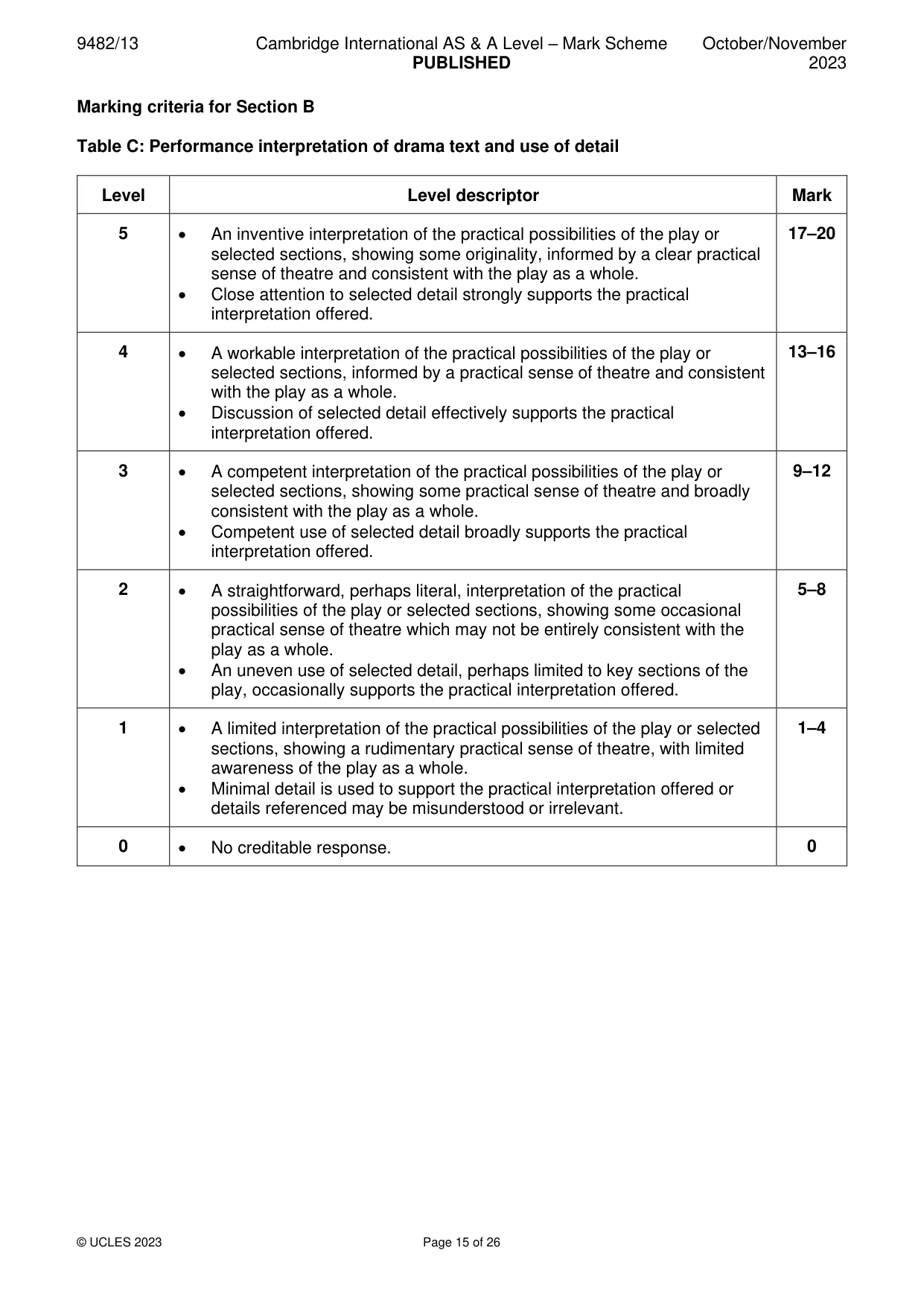
9482/13 Cambridge International AS & A Level – Mark Scheme PUBLISHED October/November 2023 © UCLES 2023 Page 15 of 26 Marking criteria for Section B Table C: Performance interpretation of drama text and use of detail Level Level descriptor Mark 5 • An inventive interpretation of the practical possibilities of the play or selected sections, showing some originality, informed by a clear practical sense of theatre and consistent with the play as a whole. • Close attention to selected detail strongly supports the practical interpretation offered. 17–20 4 • A workable interpretation of the practical possibilities of the play or selected sections, informed by a practical sense of theatre and consistent with the play as a whole. • Discussion of selected detail effectively supports the practical interpretation offered. 13–16 3 • A competent interpretation of the practical possibilities of the play or selected sections, showing some practical sense of theatre and broadly consistent with the play as a whole. • Competent use of selected detail broadly supports the practical interpretation offered. 9–12 2 • A straightforward, perhaps literal, interpretation of the practical possibilities of the play or selected sections, showing some occasional practical sense of theatre which may not be entirely consistent with the play as a whole. • An uneven use of selected detail, perhaps limited to key sections of the play, occasionally supports the practical interpretation offered. 5–8 1 • A limited interpretation of the practical possibilities of the play or selected sections, showing a rudimentary practical sense of theatre, with limited awareness of the play as a whole. • Minimal detail is used to support the practical interpretation offered or details referenced may be misunderstood or irrelevant. 1–4 0 • No creditable response. 0
Mark scheme, page 16
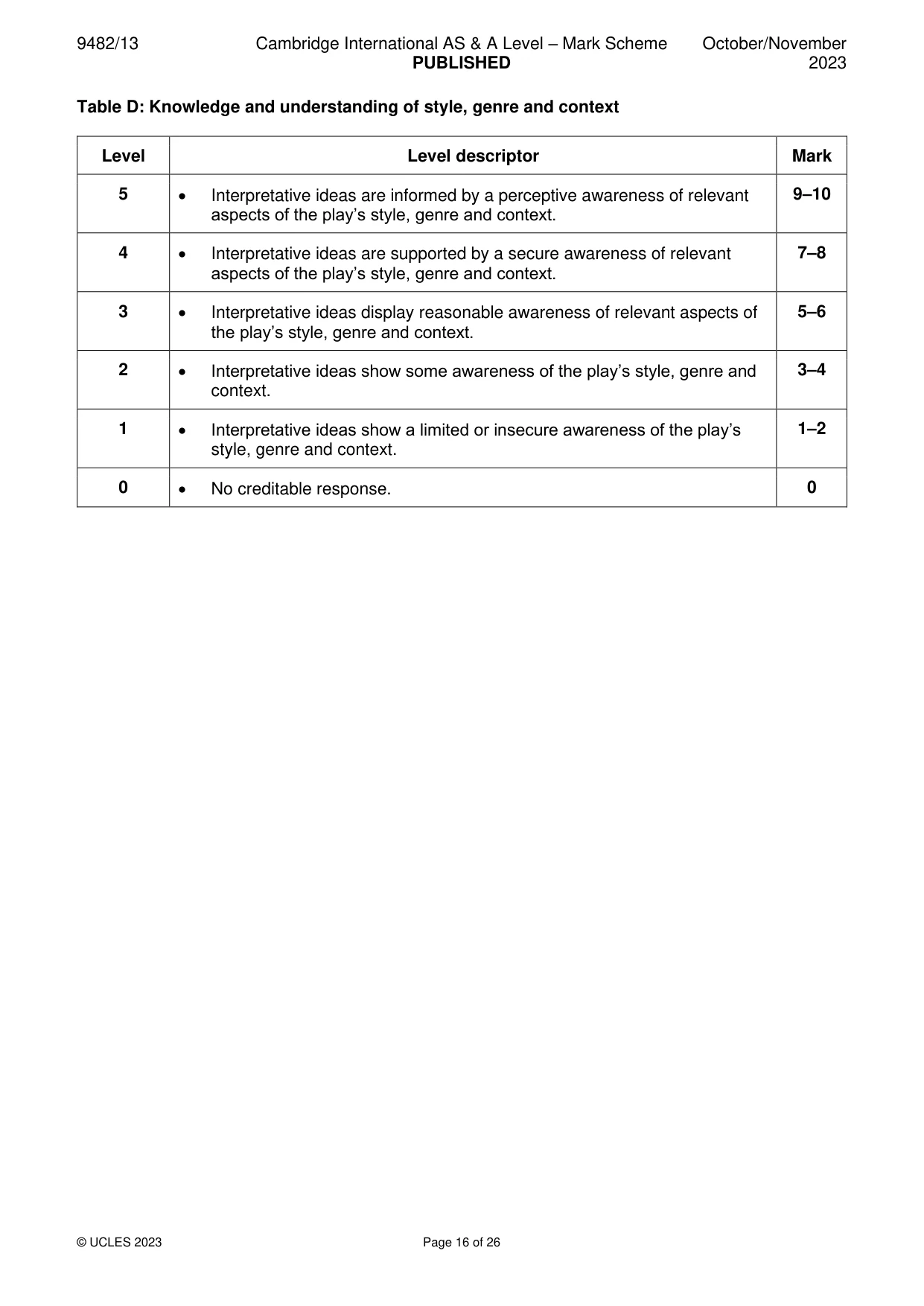
9482/13 Cambridge International AS & A Level – Mark Scheme PUBLISHED October/November 2023 © UCLES 2023 Page 16 of 26 Table D: Knowledge and understanding of style, genre and context Level Level descriptor Mark 5 • Interpretative ideas are informed by a perceptive awareness of relevant aspects of the play’s style, genre and context. 9–10 4 • Interpretative ideas are supported by a secure awareness of relevant aspects of the play’s style, genre and context. 7–8 3 • Interpretative ideas display reasonable awareness of relevant aspects of the play’s style, genre and context. 5–6 2 • Interpretative ideas show some awareness of the play’s style, genre and context. 3–4 1 • Interpretative ideas show a limited or insecure awareness of the play’s style, genre and context. 1–2 0 • No creditable response. 0
Mark scheme, page 17
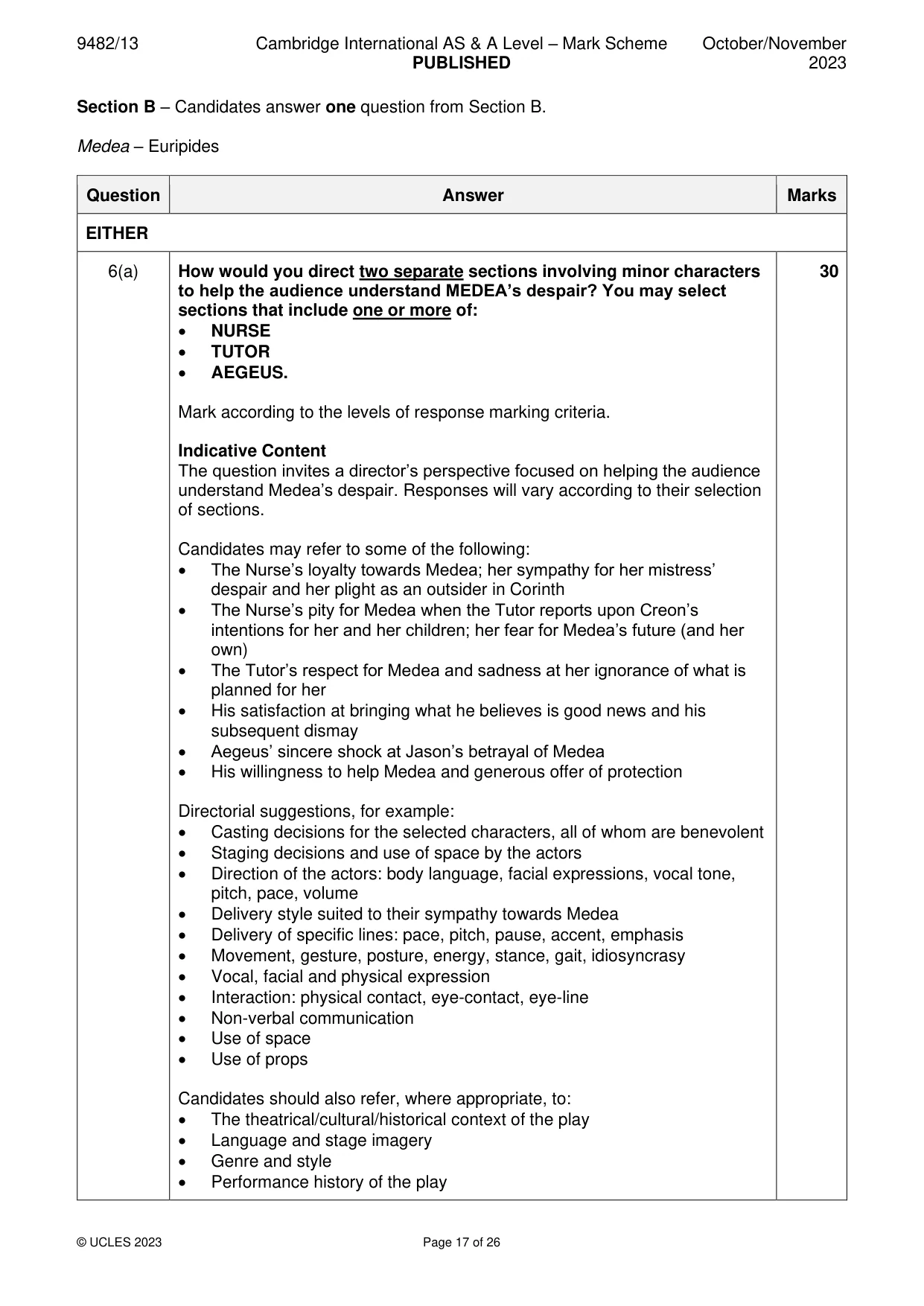
9482/13 Cambridge International AS & A Level – Mark Scheme PUBLISHED October/November 2023 © UCLES 2023 Page 17 of 26 Section B – Candidates answer one question from Section B. Medea – Euripides Question Answer Marks EITHER 6(a) How would you direct two separate sections involving minor characters to help the audience understand MEDEA’s despair? You may select sections that include one or more of: • NURSE • TUTOR • AEGEUS. Mark according to the levels of response marking criteria. Indicative Content The question invites a director’s perspective focused on helping the audience understand Medea’s despair. Responses will vary according to their selection of sections. Candidates may refer to some of the following: • The Nurse’s loyalty towards Medea; her sympathy for her mistress’ despair and her plight as an outsider in Corinth • The Nurse’s pity for Medea when the Tutor reports upon Creon’s intentions for her and her children; her fear for Medea’s future (and her own) • The Tutor’s respect for Medea and sadness at her ignorance of what is planned for her • His satisfaction at bringing what he believes is good news and his subsequent dismay • Aegeus’ sincere shock at Jason’s betrayal of Medea • His willingness to help Medea and generous offer of protection Directorial suggestions, for example: • Casting decisions for the selected characters, all of whom are benevolent • Staging decisions and use of space by the actors • Direction of the actors: body language, facial expressions, vocal tone, pitch, pace, volume • Delivery style suited to their sympathy towards Medea • Delivery of specific lines: pace, pitch, pause, accent, emphasis • Movement, gesture, posture, energy, stance, gait, idiosyncrasy • Vocal, facial and physical expression • Interaction: physical contact, eye-contact, eye-line • Non-verbal communication • Use of space • Use of props Candidates should also refer, where appropriate, to: • The theatrical/cultural/historical context of the play • Language and stage imagery • Genre and style • Performance history of the play 30
Mark scheme, page 18
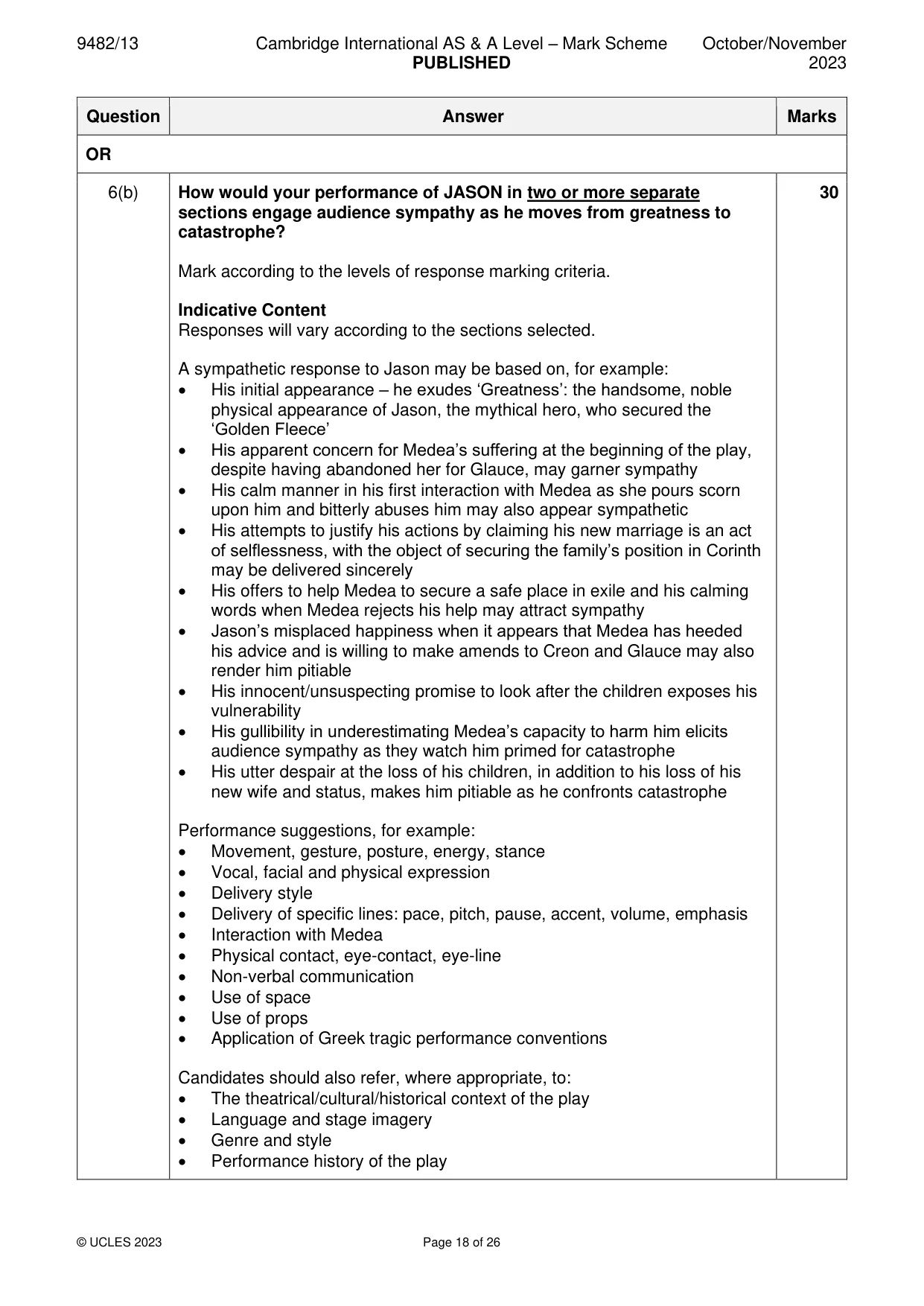
9482/13 Cambridge International AS & A Level – Mark Scheme PUBLISHED October/November 2023 © UCLES 2023 Page 18 of 26 Question Answer Marks OR 6(b) How would your performance of JASON in two or more separate sections engage audience sympathy as he moves from greatness to catastrophe? Mark according to the levels of response marking criteria. Indicative Content Responses will vary according to the sections selected. A sympathetic response to Jason may be based on, for example: • His initial appearance – he exudes ‘Greatness’: the handsome, noble physical appearance of Jason, the mythical hero, who secured the ‘Golden Fleece’ • His apparent concern for Medea’s suffering at the beginning of the play, despite having abandoned her for Glauce, may garner sympathy • His calm manner in his first interaction with Medea as she pours scorn upon him and bitterly abuses him may also appear sympathetic • His attempts to justify his actions by claiming his new marriage is an act of selflessness, with the object of securing the family’s position in Corinth may be delivered sincerely • His offers to help Medea to secure a safe place in exile and his calming words when Medea rejects his help may attract sympathy • Jason’s misplaced happiness when it appears that Medea has heeded his advice and is willing to make amends to Creon and Glauce may also render him pitiable • His innocent/unsuspecting promise to look after the children exposes his vulnerability • His gullibility in underestimating Medea’s capacity to harm him elicits audience sympathy as they watch him primed for catastrophe • His utter despair at the loss of his children, in addition to his loss of his new wife and status, makes him pitiable as he confronts catastrophe Performance suggestions, for example: • Movement, gesture, posture, energy, stance • Vocal, facial and physical expression • Delivery style • Delivery of specific lines: pace, pitch, pause, accent, volume, emphasis • Interaction with Medea • Physical contact, eye-contact, eye-line • Non-verbal communication • Use of space • Use of props • Application of Greek tragic performance conventions Candidates should also refer, where appropriate, to: • The theatrical/cultural/historical context of the play • Language and stage imagery • Genre and style • Performance history of the play 30
Mark scheme, page 19
9482/13 Cambridge International AS & A Level – Mark Scheme PUBLISHED October/November 2023 © UCLES 2023 Page 19 of 26 Tartuffe – Molière Question Answer Marks EITHER 7(a) How would you perform the role of CLÉANTE in one section where he interacts with ORGON and one section where he interacts with TARTUFFE to achieve your intended effects for the audience? Mark according to the levels of response marking criteria. Indicative Content The question invites a performer’s perspective and a focus on achieving intended effects for the audience. Responses will vary according to the candidates’ choice of effects and sections. Candidates may refer to some of the following effects: • The creation of respect for Cleante, the mature ‘voice of reason’ as he remonstrates with Orgon • Admiration for his defence of his sister’s and her family’s best interests in exchanges with both Orgon and Tartuffe • The creation of sympathy for him as he tries, unsuccessfully, to temper Tartuffe’s excesses • Amusement, as he tried to reason with Orgon, exposing Orgon’s stubborn and foolish character Performance suggestions may include, for example: • Cleante’s physical appearance and costume • Interaction with Orgon and Tartuffe • Physical contact, eye-contact, eye-line • Non-verbal communication • Delivery style • Delivery of specific lines: pace, pitch, pause, accent, emphasis • Movement, gesture, posture, energy, stance, gait, pose • Vocal, facial and physical expression • Use of space • Use of props and accessories Candidates should also refer, where appropriate, to: • The theatrical/cultural/historical context of the play • Language and stage imagery • Genre and style • Performance history of the play 30
Mark scheme, page 20
9482/13 Cambridge International AS & A Level – Mark Scheme PUBLISHED October/November 2023 © UCLES 2023 Page 20 of 26 Question Answer Marks OR 7(b) Explain how your direction of two separate sections of the play would create comedy for the audience. Mark according to the levels of response marking criteria. Indicative Content The question invites a director’s perspective and a focus on the creation of comedy. Responses will vary according to the candidates’ selected sections. Candidates may refer to some of the following sections, for example: • Dorine’s hilarious description of Elmire’s illness and Tartuffe’s ‘health’, when Orgon returns home after a brief absence • Tartuffe’s encounter with Dorine when he orders her to ‘cover up’ • Either of Tartuffe’s ‘assignations’ with Elmire, in each case, being overheard • Dorine’s intervention during Orgon’s discussion of his proposed match between Tartuffe and Mariane • Tartuffe’s evasion of blame after Damis’ ‘exposure’ of him to Orgon Directorial ideas might include suggestions for, for example: • Ideas for the physical appearance of characters in the chosen sections, if made relevant to the comedy focus • Movement, gesture, posture, energy • Use of space • Vocal, facial and physical expression • Delivery of specific lines • Interaction, physical contact, eye-contact, eye-line • Comic methods, for example: timing, slapstick, mimicry, repetition, exaggeration • Non-verbal communication • Audience involvement • Use of stage setting and of props to create comedy • Reference to commedia performance conventions, if appropriate Candidates should also refer, where appropriate, to: • The theatrical/cultural/historical context of the play • Language and stage imagery • Genre and style • Performance history of the play 30
Mark scheme, page 21
9482/13 Cambridge International AS & A Level – Mark Scheme PUBLISHED October/November 2023 © UCLES 2023 Page 21 of 26 The Seagull – Anton Chekhov Question Answer Marks EITHER 8(a) How would you direct two sections of the play where four or more characters interact to create your intended effects for the audience? Mark according to the levels of response marking criteria. Indicative Content The question invites a director’s perspective focused on creating intended effects for the audience from sections where four or more characters interact. Responses will vary according to the intended effects and sections selected. Intended effects may include, for example: • To depict the social microcosm of those who live on or visit Sorin’s estate • To offer a contrast between the country dwellers and the city folk • To highlight the love triangles and jealousies among the characters • To highlight the contrast between the younger and older generation • To create Chekhovian comedy from the interaction of different types of character Candidates may refer to some of the following sections: • The gathering at Konstantin’s play at the lakeside in Act One • The lazy afternoon spent on the croquet lawn in Act Two where Arkadina ‘holds court’ • The departure of Arkadina and Trigorin for Moscow • The ‘Celebrity guests’ return to visit Sorin Directorial suggestions, for example: • Physical appearance of the various actors if made relevant to the question focus • Staging decisions and use of space and spatial relationships by the actors • Movement, gesture, posture, energy, stance, gait, idiosyncrasy • Vocal, facial and physical expression • Delivery of specific lines: pace, pitch, pause, accent, volume, emphasis • Interaction: physical contact, eye-contact, eye-line • Non-verbal communication • Use of props Candidates should also refer, where appropriate, to: • The theatrical/cultural/historical context of the play • Language and stage imagery • Genre and style • Performance history of the play 30
Mark scheme, page 22
9482/13 Cambridge International AS & A Level – Mark Scheme PUBLISHED October/November 2023 © UCLES 2023 Page 22 of 26 Question Answer Marks OR 8(b) How would you perform the role of TRIGORIN in two or more separate sections of the play to convey your interpretation of his character? Mark according to the levels of response marking criteria. Indicative Content The question invites a performer’s perspective and a focus on conveying an interpretation of Trigorin’s character. Responses will vary according to the candidates’ interpretation of Trigorin and selection of sections. Candidates may refer to some of the following: Interpretation of Trigorin, for example: • A writer absorbed in his craft • A weak man, easily charmed by Nina and dominated by Arkadina • A heartless destroyer of Nina’s youth and life • A selfish man, unaware of other people’s feelings Performance suggestions, for example: • Trigorin’s physical appearance and costume • Movement, gesture, posture, energy, stance, gait • Vocal, facial and physical expression • Delivery style • Delivery of specific lines: pace, pitch, pause, accent, volume, emphasis • Interaction with other characters, Arkadina, Nina, Masha, Konstantin • Physical contact, eye-contact, eye-line • Non-verbal communication • Use of space • Use of props and accessories • Naturalistic performance conventions Candidates should also refer, where appropriate, to: • The theatrical/cultural/historical context of the play • Language and stage imagery • Genre and style • Performance history of the play 30
Mark scheme, page 23
9482/13 Cambridge International AS & A Level – Mark Scheme PUBLISHED October/November 2023 © UCLES 2023 Page 23 of 26 The Curious Incident of the Dog in the Night-Time – Simon Stephens Question Answer Marks EITHER 9(a) How would you perform the role of CHRISTOPHER in two or more separate sections to achieve your intended audience responses? Mark according to the levels of response marking criteria. Indicative Content The question invites a performer’s perspective and a focus on achieving specific audience responses to Christopher. Responses will vary according to the candidates’ intended responses and their choice of sections. Candidates may refer to some of the following responses: • Empathy for Christopher’s condition • Respect for his determination to solve the mystery of Wellington • Amusement at his often literal interpretation of the world; his exchanges with Mrs Alexander • Sympathy when he discovers Ed’s deceit • Admiration as he battles his phobias and travels to London • Concern for him when he reaches Judy’s and Roger’s flat • Delight at his reconciliation with Ed, his love for Sandy • Exhilaration at his success at the end of the play Performance ideas, for example: • Christopher’s physical appearance and costume • Movement, gesture, posture, energy, stance, gait • Vocal, facial and physical expression • Delivery style • Delivery of specific lines: pace, pitch, pause, accent, emphasis • Interaction with other characters, Ed, Judy, Siobhan, Mrs Alexander, Roger and the host of ensemble characters • Use of/lack of physical contact, eye-contact, eye-line • Non-verbal communication • Use of space • Use of props and accessories Candidates should also refer, where appropriate, to: • The theatrical/cultural/historical context of the play • Language and stage imagery • Genre and style • Performance history of the play 30
Mark scheme, page 24
9482/13 Cambridge International AS & A Level – Mark Scheme PUBLISHED October/November 2023 © UCLES 2023 Page 24 of 26 Question Answer Marks OR 9(b) How would you create comedy for your audience through your direction of two separate sections of the play? Mark according to the levels of response marking criteria. Indicative Content The question invites a director’s perspective and a focus on the creation of comedy. Responses will vary according to the sections selected. Candidates may refer to some of the following: • Christopher’s humorous encounters with various members of the Police force • Christopher’s interactions with Mrs Alexander • His conversations with Siobhan • Sections involving the Ensemble, for example, characters he encounters in Swindon town centre, at the Station and on the Underground, on the train Directorial suggestions, for example: • Staging decisions and use of space by the actors • Direction of the actors’ physical appearance: body language, facial expressions, • Movement, gesture, posture, energy, stance, gait, idiosyncrasy • Vocal, facial and physical expression • Delivery style • Delivery of specific lines: pace, pitch, pause, tone, accent, volume, emphasis • Interaction: physical contact, eye-contact, eye-line • Application of comic methods, for example, timing, repetition, rule of three, exaggeration; deadpan delivery • Comical characterisation by members of the Ensemble • Synchronisation, vocally and/or physically • Choral speech or in canon • Non-verbal communication • Use of space • Use of props Candidates should also refer, where appropriate, to: • The theatrical/cultural/historical context of the play • Language and stage imagery • Genre and style • Performance history of the play 30
Mark scheme, page 25
9482/13 Cambridge International AS & A Level – Mark Scheme PUBLISHED October/November 2023 © UCLES 2023 Page 25 of 26 Snow in Midsummer – Frances Ya-Chu Cowig Question Answer Marks EITHER 10(a) How would you direct two or more separate sections of the play that depict violent action to create your intended effects for the audience? Mark according to the levels of response marking criteria. Indicative Content The question invites a director’s perspective and a focus on creating intended effects in sections where violent action is depicted. Responses will vary according to the sections selected and the intended effects. Candidates may refer to some of the following sections: • The Prologue, where innocent Dou Yi is violently snatched by Master Zhang – a shocking start to the play for the audience • The execution of Dou Yi in Act One, Scene Nine – creation of tension and empathy for the innocent victim of a false accusation • The retrieval of Dou Yi’s heart in Act One, Scene 12 – shocking moment for the audience • The abduction of Dou Yi and shooting of Master Zhang – revelation of the truth to the audience, solving the mystery of the play • The death of Handsome in Act Two, Scene Seven – moving section of resolution Directorial suggestions, for example: • Physical appearance of the actors if made relevant to the intended effects • Staging decisions and use of space and spatial relationships by the actors • Movement, gesture, posture, energy, stance, gait, idiosyncrasy • Vocal, facial and physical expression • Delivery of specific lines: pace, pitch, pause, accent, volume, emphasis • Interaction: physical contact, eye-contact, eye-line • Non-verbal communication • Use of props • Use of costume Candidates should also refer, where appropriate, to: • The theatrical/cultural/historical context of the play • Language and stage imagery • Genre and style • Performance history of the play 30
Mark scheme, page 26
9482/13 Cambridge International AS & A Level – Mark Scheme PUBLISHED October/November 2023 © UCLES 2023 Page 26 of 26 Question Answer Marks OR 10(b) How would you perform the role of DOU YI in one section where she appears in her ‘living’ state and one section where she appears in her ‘ghostly’ state to demonstrate the dual aspects of her character? Mark according to the levels of response marking criteria. Indicative Content The question invites a performer’s perspective and a focus on demonstrating the dual aspects of Dou Yi’s character. Responses will vary according to the candidates’ choice of sections and their interpretation of Dou Yi. Candidates may refer to some of the following: • In her living state she appears as an innocent young widow in the Prologue before being snatched from the street by Master Zhang • The living Dou Yi refuses to sleep with the lecherous judge in exchange for her life • The execution scene of living Dou Yi reveals her belief in justice as well as the torture that she has received in prison to get a confession • Dou Yi’s appearances as a ghost reveal her to feel victimised, unremembered and dishonoured • The ghostly Dou Yi yearns for the truth and for someone to speak of her innocence • Dou Yi’s ghost forms touching relationships with the living, Fei-Fei and Tianyun, as well as with the dead, including Rocket and Handsome • The ghost of Dou-Yi is vindicated through the agency of her sister Fei-Fei and she finally gains peace • Dou Yi retreats to the underworld Performance suggestions for example: • Physical appearance of Dou Yi in both her states – the blooming young woman and the suffering spirit – invite sympathy • Movement, gesture, posture, energy, stance, gait, idiosyncrasy • Vocal, facial and physical expression • Delivery style • Delivery of specific lines: pace, pitch, pause, accent, volume, emphasis; direct address • Interaction with Master Zhang, Fei-Fei, Tianyun, Mother Cai, Rocket, Handsome, her fellow spirits: physical contact, eye-contact, eye-line • Non-verbal communication • Use of space • Use of props • Use of different costume to demonstrate the dual states Candidates should also refer, where appropriate, to: • The theatrical/cultural/historical context of the play • Language and stage imagery • Genre and style • Performance history of the play 30
What you needed in this session
Cambridge’s own grade thresholds for 2023 Oct/Nov, Paper 1 · Variant 3. A higher threshold means an easier paper — the bar moves with how the cohort did.