Cambridge A Level Drama 9482 — 2023 May/June Paper 1 · Variant 3
9482/13/M/J/23 · 60 marks · ≈68 min
The question paper and its mark scheme, free to read here and free to download. This is Cambridge’s own paper, exactly as it was sat.
Question paper8 pages


Mark scheme30 pages
Answers below. Sit the paper first if you are practising.
Paper as text
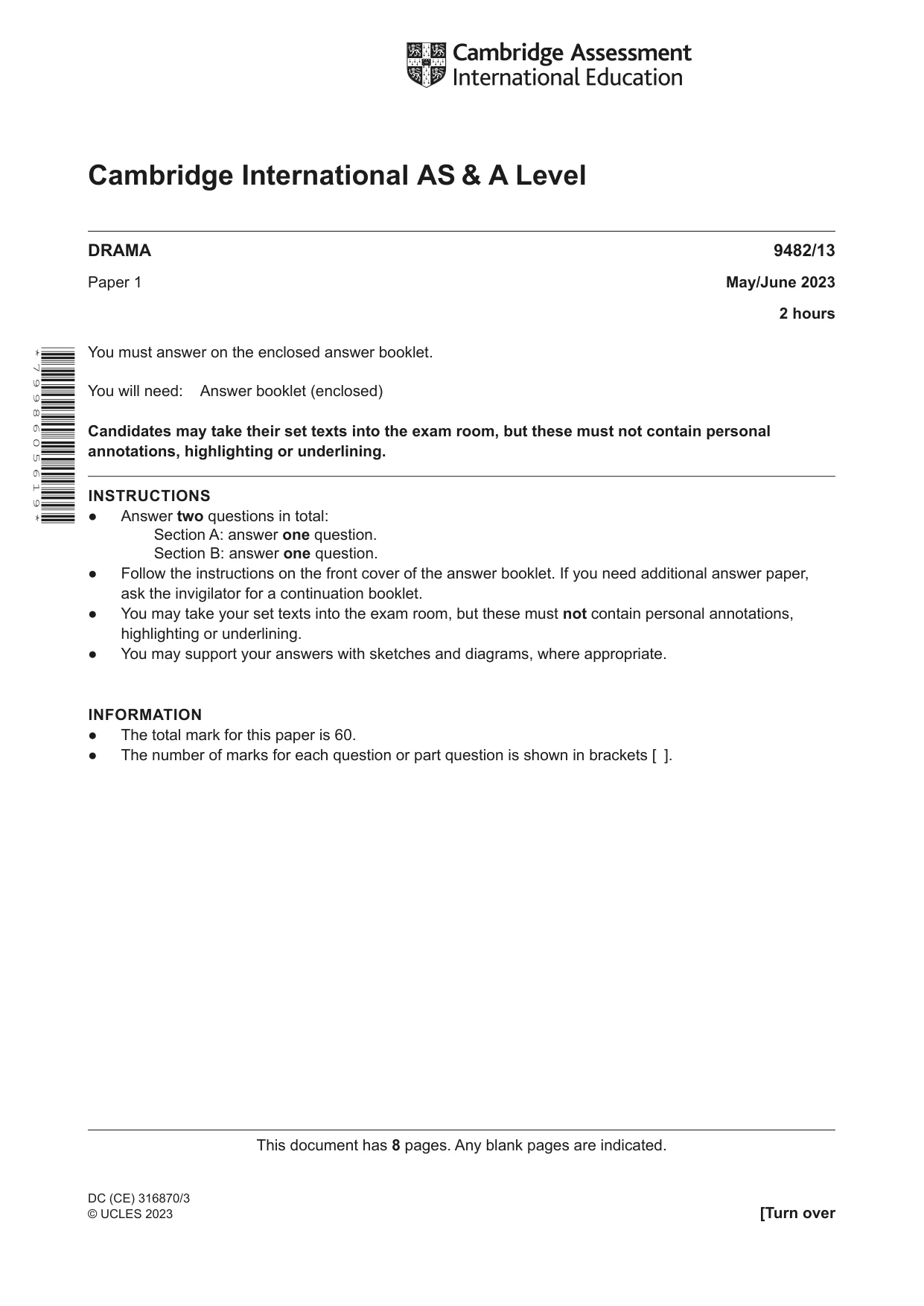
Question paper, page 1
This document has 8 pages. Any blank pages are indicated. [Turn over Cambridge International AS & A Level DC (CE) 316870/3 © UCLES 2023 DRAMA 9482/13 Paper 1 May/June 2023 2 hours You must answer on the enclosed answer booklet. You will need: Answer booklet (enclosed) Candidates may take their set texts into the exam room, but these must not contain personal annotations, highlighting or underlining. INSTRUCTIONS ● Answer two questions in total: Section A: answer one question. Section B: answer one question. ● Follow the instructions on the front cover of the answer booklet. If you need additional answer paper, ask the invigilator for a continuation booklet. ● You may take your set texts into the exam room, but these must not contain personal annotations, highlighting or underlining. ● You may support your answers with sketches and diagrams, where appropriate. INFORMATION ● The total mark for this paper is 60. ● The number of marks for each question or part question is shown in brackets [ ]. * 7 9 9 8 6 0 5 6 1 9 *
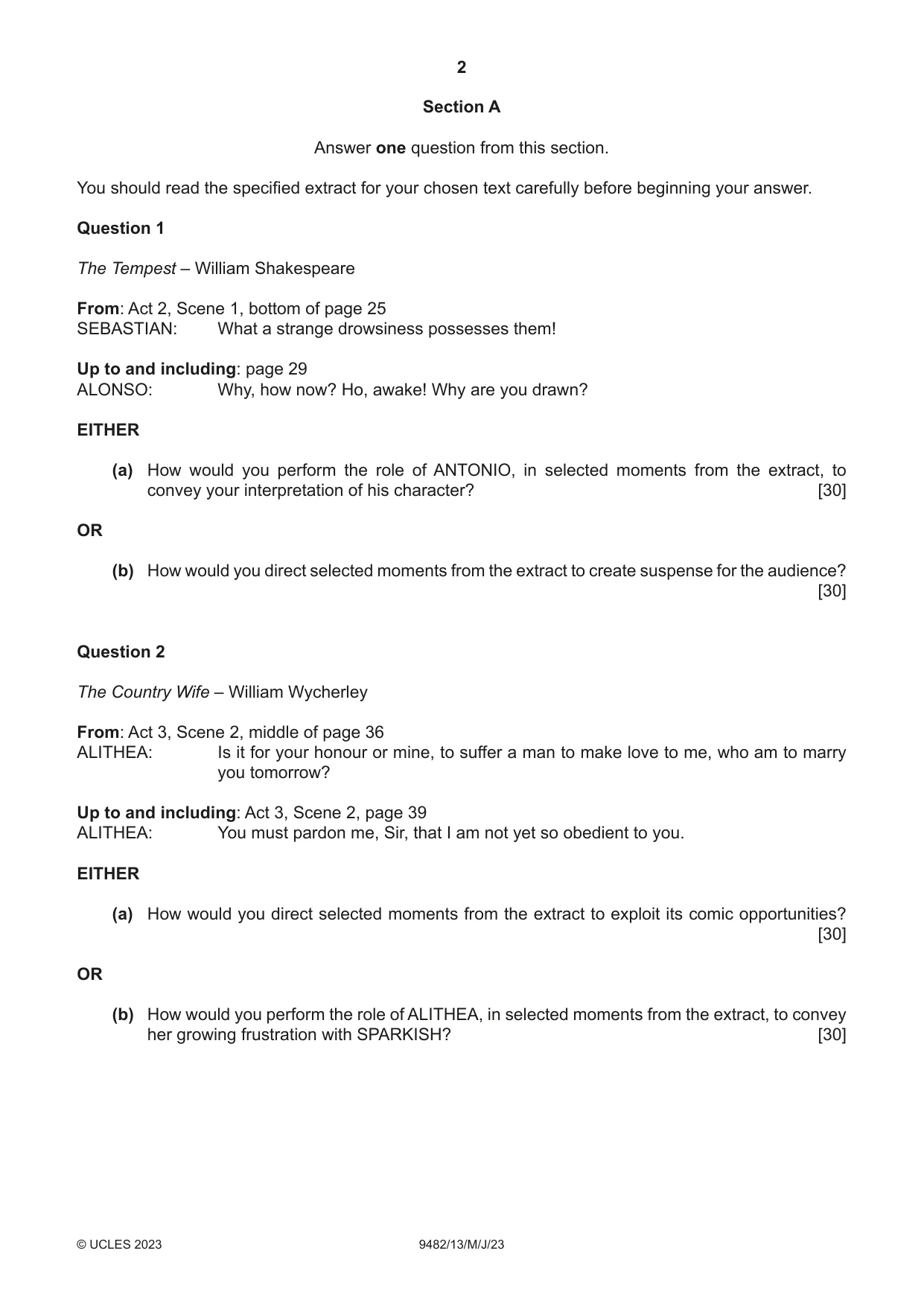
Question paper, page 2
2 9482/13/M/J/23 © UCLES 2023 Section A Answer one question from this section. You should read the specified extract for your chosen text carefully before beginning your answer. Question 1 The Tempest – William Shakespeare From: Act 2, Scene 1, bottom of page 25 SEBASTIAN: What a strange drowsiness possesses them! Up to and including: page 29 ALONSO: Why, how now? Ho, awake! Why are you drawn? EITHER (a) How would you perform the role of ANTONIO, in selected moments from the extract, to convey your interpretation of his character? [30] OR (b) How would you direct selected moments from the extract to create suspense for the audience? [30] Question 2 The Country Wife – William Wycherley From: Act 3, Scene 2, middle of page 36 ALITHEA: Is it for your honour or mine, to suffer a man to make love to me, who am to marry you tomorrow? Up to and including: Act 3, Scene 2, page 39 ALITHEA: You must pardon me, Sir, that I am not yet so obedient to you. EITHER (a) How would you direct selected moments from the extract to exploit its comic opportunities? [30] OR (b) How would you perform the role of ALITHEA, in selected moments from the extract, to convey her growing frustration with SPARKISH? [30]
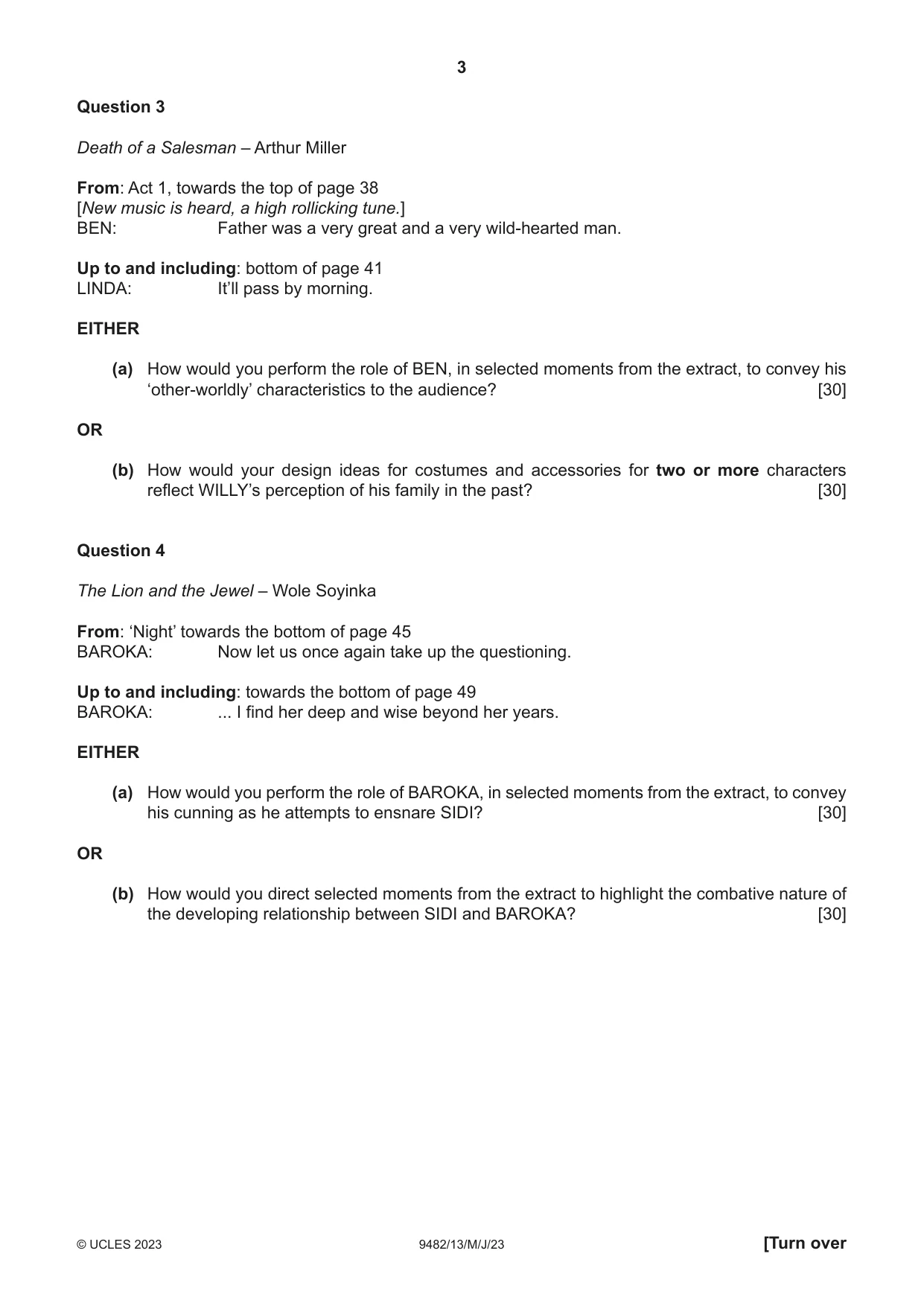
Question paper, page 3
3 9482/13/M/J/23 © UCLES 2023 [Turn over Question 3 Death of a Salesman – Arthur Miller From: Act 1, towards the top of page 38 [New music is heard, a high rollicking tune.] BEN: Father was a very great and a very wild-hearted man. Up to and including: bottom of page 41 LINDA: It’ll pass by morning. EITHER (a) How would you perform the role of BEN, in selected moments from the extract, to convey his ‘other-worldly’ characteristics to the audience? [30] OR (b) How would your design ideas for costumes and accessories for two or more characters reflect WILLY’s perception of his family in the past? [30] Question 4 The Lion and the Jewel – Wole Soyinka From: ‘Night’ towards the bottom of page 45 BAROKA: Now let us once again take up the questioning. Up to and including: towards the bottom of page 49 BAROKA: ... I find her deep and wise beyond her years. EITHER (a) How would you perform the role of BAROKA, in selected moments from the extract, to convey his cunning as he attempts to ensnare SIDI? [30] OR (b) How would you direct selected moments from the extract to highlight the combative nature of the developing relationship between SIDI and BAROKA? [30]
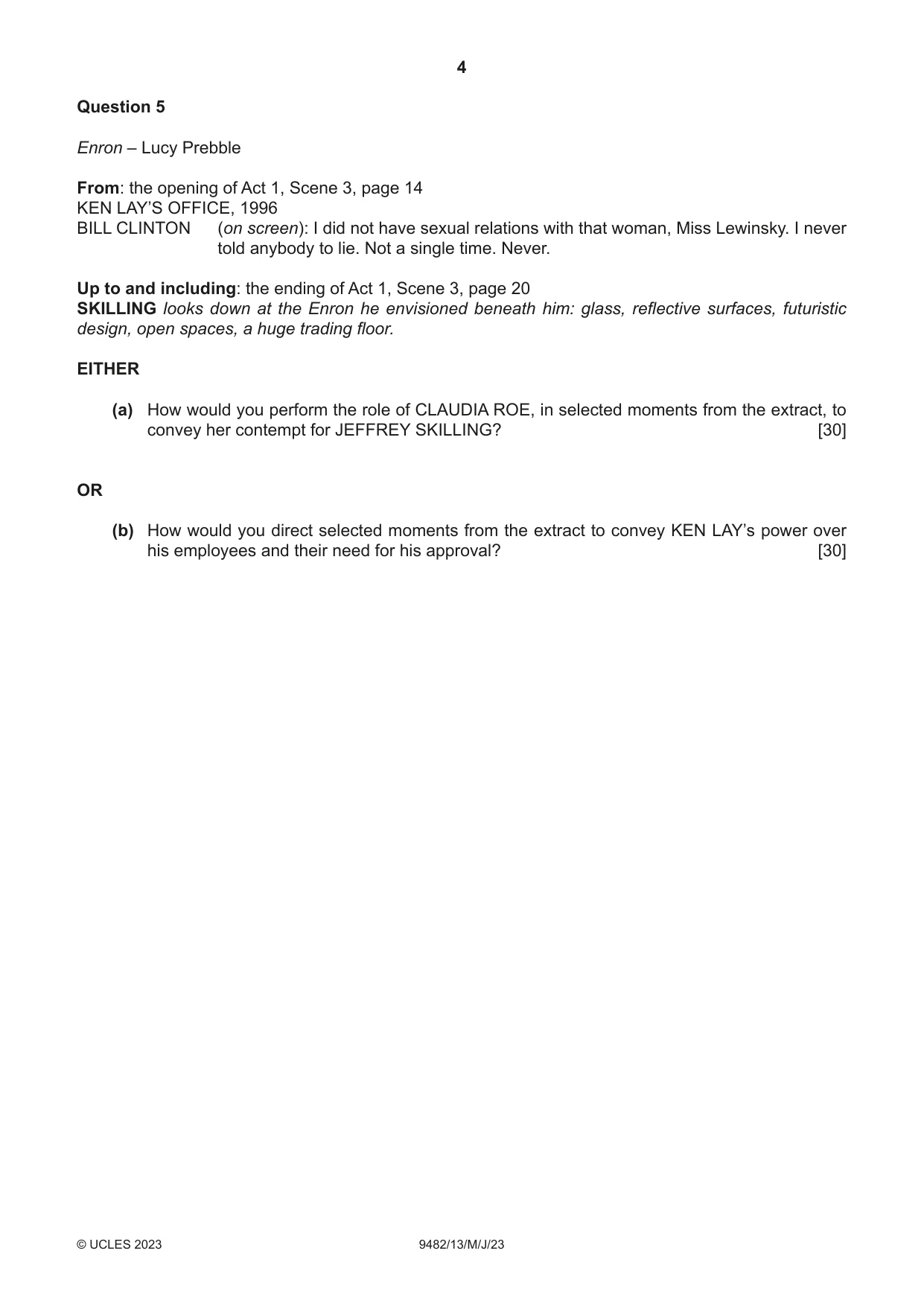
Question paper, page 4
4 9482/13/M/J/23 © UCLES 2023 Question 5 Enron – Lucy Prebble From: the opening of Act 1, Scene 3, page 14 KEN LAY’S OFFICE, 1996 BILL CLINTON (on screen): I did not have sexual relations with that woman, Miss Lewinsky. I never told anybody to lie. Not a single time. Never. Up to and including: the ending of Act 1, Scene 3, page 20 SKILLING looks down at the Enron he envisioned beneath him: glass, reflective surfaces, futuristic design, open spaces, a huge trading floor. EITHER (a) How would you perform the role of CLAUDIA ROE, in selected moments from the extract, to convey her contempt for JEFFREY SKILLING? [30] OR (b) How would you direct selected moments from the extract to convey KEN LAY’s power over his employees and their need for his approval? [30]
Question paper, page 5
5 9482/13/M/J/23 © UCLES 2023 [Turn over Section B Answer one question from this section. Question 6 Medea – Euripides EITHER (a) Explain how your staging of two separate sections of the play might horrify your audience. You may refer to your direction of the actors and/or your use of design elements. [30] OR (b) How would you perform MEDEA in her interaction with AEGEUS and in one section of interaction with JASON to highlight her bitterness and her instinct for self-preservation? [30] Question 7 Tartuffe – Molière EITHER (a) Explain how your performance of ORGON would highlight the absurdity of his character in two sections where he interacts with family members. [30] OR (b) How would you direct two sections of the play where DORINE challenges ORGON’s opinions or decisions to achieve your intended effects? [30] Question 8 The Seagull – Anton Chekhov EITHER (a) How would you direct ARKADINA and TRIGORIN, in two or more separate sections of the play where they appear together, to convey the nature of their relationship? [30] OR (b) How would you perform the role of MASHA, in two or more separate sections of the play, to convey her contrasting feelings for KONSTANTIN and MEDVEDENKO? [30]
Question paper, page 6
6 9482/13/M/J/23 © UCLES 2023 Question 9 The Curious Incident of the Dog in the Night-Time – Simon Stephens EITHER (a) How would you direct two separate sections of the play to show contrasting aspects of ED’s character? [30] OR (b) Explain your design vision for the play and how you would combine design elements of your choice to support the action in two separate sections. [30] Question 10 Snow in Midsummer – Frances Ya-Chu Cowhig EITHER (a) How would you perform the role of MADAM WONG, in two or more separate sections, to highlight the complexity of her character? [30] OR (b) How would you combine design elements of your choice to fulfil your design vision for the play and support the action in two separate sections? [30]
Question paper, page 7
7 9482/13/M/J/23 © UCLES 2023 BLANK PAGE
Question paper, page 8
8 9482/13/M/J/23 © UCLES 2023 Permission to reproduce items where third-party owned material protected by copyright is included has been sought and cleared where possible. Every reasonable effort has been made by the publisher (UCLES) to trace copyright holders, but if any items requiring clearance have unwittingly been included, the publisher will be pleased to make amends at the earliest possible opportunity. To avoid the issue of disclosure of answer-related information to candidates, all copyright acknowledgements are reproduced online in the Cambridge Assessment International Education Copyright Acknowledgements Booklet. This is produced for each series of examinations and is freely available to download at www.cambridgeinternational.org after the live examination series. Cambridge Assessment International Education is part of Cambridge Assessment. Cambridge Assessment is the brand name of the University of Cambridge Local Examinations Syndicate (UCLES), which is a department of the University of Cambridge. BLANK PAGE
Mark scheme, page 1
This document consists of 30 printed pages. © UCLES 2023 [Turn over Cambridge International AS & A Level DRAMA 9482/13 Paper 1 Open-Book Written Examination May/June 2023 MARK SCHEME Maximum Mark: 60 Published This mark scheme is published as an aid to teachers and candidates, to indicate the requirements of the examination. It shows the basis on which Examiners were instructed to award marks. It does not indicate the details of the discussions that took place at an Examiners’ meeting before marking began, which would have considered the acceptability of alternative answers. Mark schemes should be read in conjunction with the question paper and the Principal Examiner Report for Teachers. Cambridge International will not enter into discussions about these mark schemes. Cambridge International is publishing the mark schemes for the May/June 2023 series for most Cambridge IGCSE, Cambridge International A and AS Level and Cambridge Pre-U components, and some Cambridge O Level components.
Mark scheme, page 2
9482/13 Cambridge International AS & A Level – Mark Scheme PUBLISHED May/June 2023 © UCLES 2023 Page 2 of 30 Generic Marking Principles These general marking principles must be applied by all examiners when marking candidate answers. They should be applied alongside the specific content of the mark scheme or generic level descriptors for a question. Each question paper and mark scheme will also comply with these marking principles. GENERIC MARKING PRINCIPLE 1: Marks must be awarded in line with: the specific content of the mark scheme or the generic level descriptors for the question the specific skills defined in the mark scheme or in the generic level descriptors for the question the standard of response required by a candidate as exemplified by the standardisation scripts. GENERIC MARKING PRINCIPLE 2: Marks awarded are always whole marks (not half marks, or other fractions). GENERIC MARKING PRINCIPLE 3: Marks must be awarded positively: marks are awarded for correct/valid answers, as defined in the mark scheme. However, credit is given for valid answers which go beyond the scope of the syllabus and mark scheme, referring to your Team Leader as appropriate marks are awarded when candidates clearly demonstrate what they know and can do marks are not deducted for errors marks are not deducted for omissions answers should only be judged on the quality of spelling, punctuation and grammar when these features are specifically assessed by the question as indicated by the mark scheme. The meaning, however, should be unambiguous. GENERIC MARKING PRINCIPLE 4: Rules must be applied consistently, e.g. in situations where candidates have not followed instructions or in the application of generic level descriptors. GENERIC MARKING PRINCIPLE 5: Marks should be awarded using the full range of marks defined in the mark scheme for the question (however; the use of the full mark range may be limited according to the quality of the candidate responses seen). GENERIC MARKING PRINCIPLE 6: Marks awarded are based solely on the requirements as defined in the mark scheme. Marks should not be awarded with grade thresholds or grade descriptors in mind.
Mark scheme, page 3
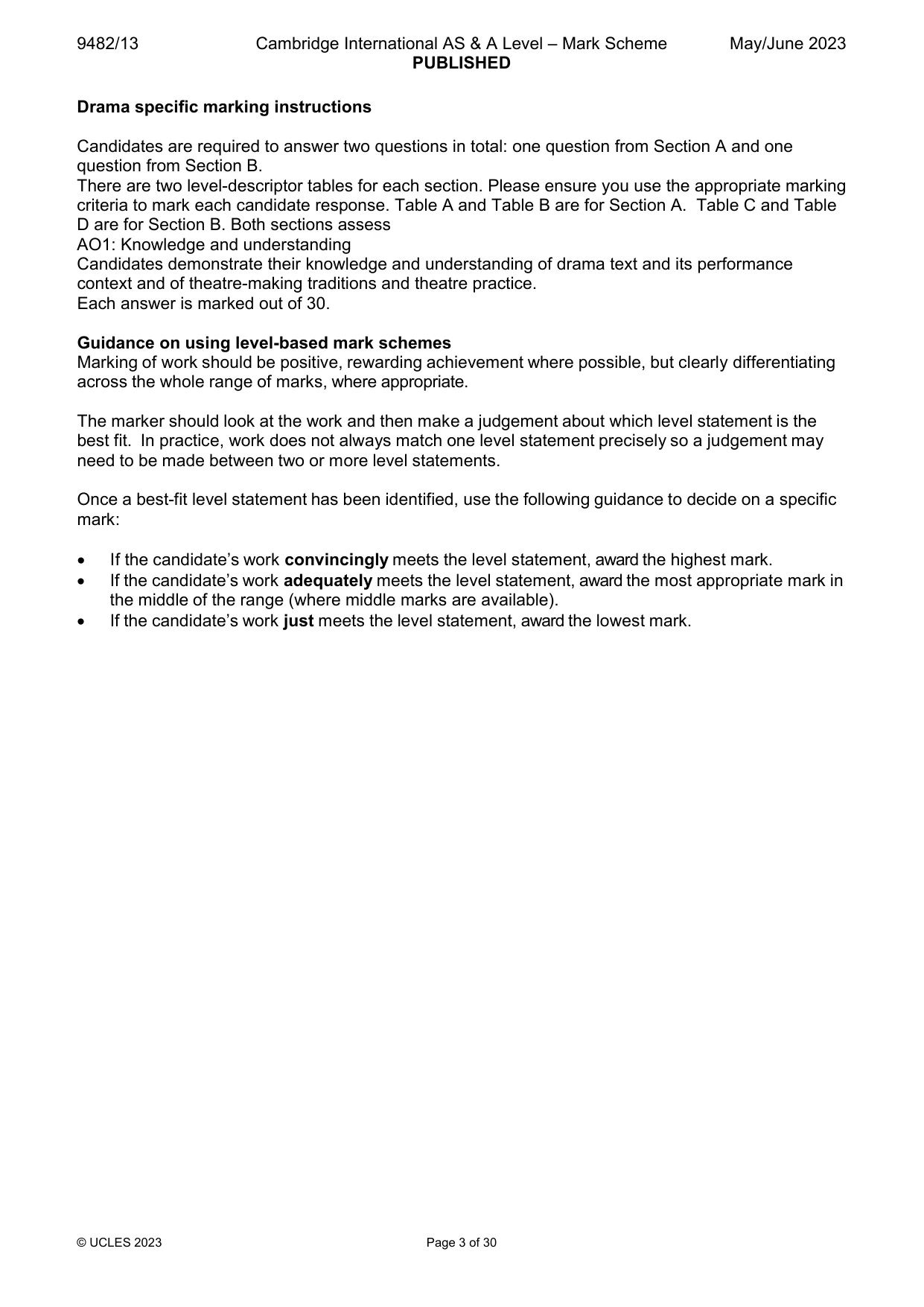
9482/13 Cambridge International AS & A Level – Mark Scheme PUBLISHED May/June 2023 © UCLES 2023 Page 3 of 30 Drama specific marking instructions Candidates are required to answer two questions in total: one question from Section A and one question from Section B. There are two level-descriptor tables for each section. Please ensure you use the appropriate marking criteria to mark each candidate response. Table A and Table B are for Section A. Table C and Table D are for Section B. Both sections assess AO1: Knowledge and understanding Candidates demonstrate their knowledge and understanding of drama text and its performance context and of theatre-making traditions and theatre practice. Each answer is marked out of 30. Guidance on using level-based mark schemes Marking of work should be positive, rewarding achievement where possible, but clearly differentiating across the whole range of marks, where appropriate. The marker should look at the work and then make a judgement about which level statement is the best fit. In practice, work does not always match one level statement precisely so a judgement may need to be made between two or more level statements. Once a best-fit level statement has been identified, use the following guidance to decide on a specific mark: If the candidate’s work convincingly meets the level statement, award the highest mark. If the candidate’s work adequately meets the level statement, award the most appropriate mark in the middle of the range (where middle marks are available). If the candidate’s work just meets the level statement, award the lowest mark.
Mark scheme, page 4
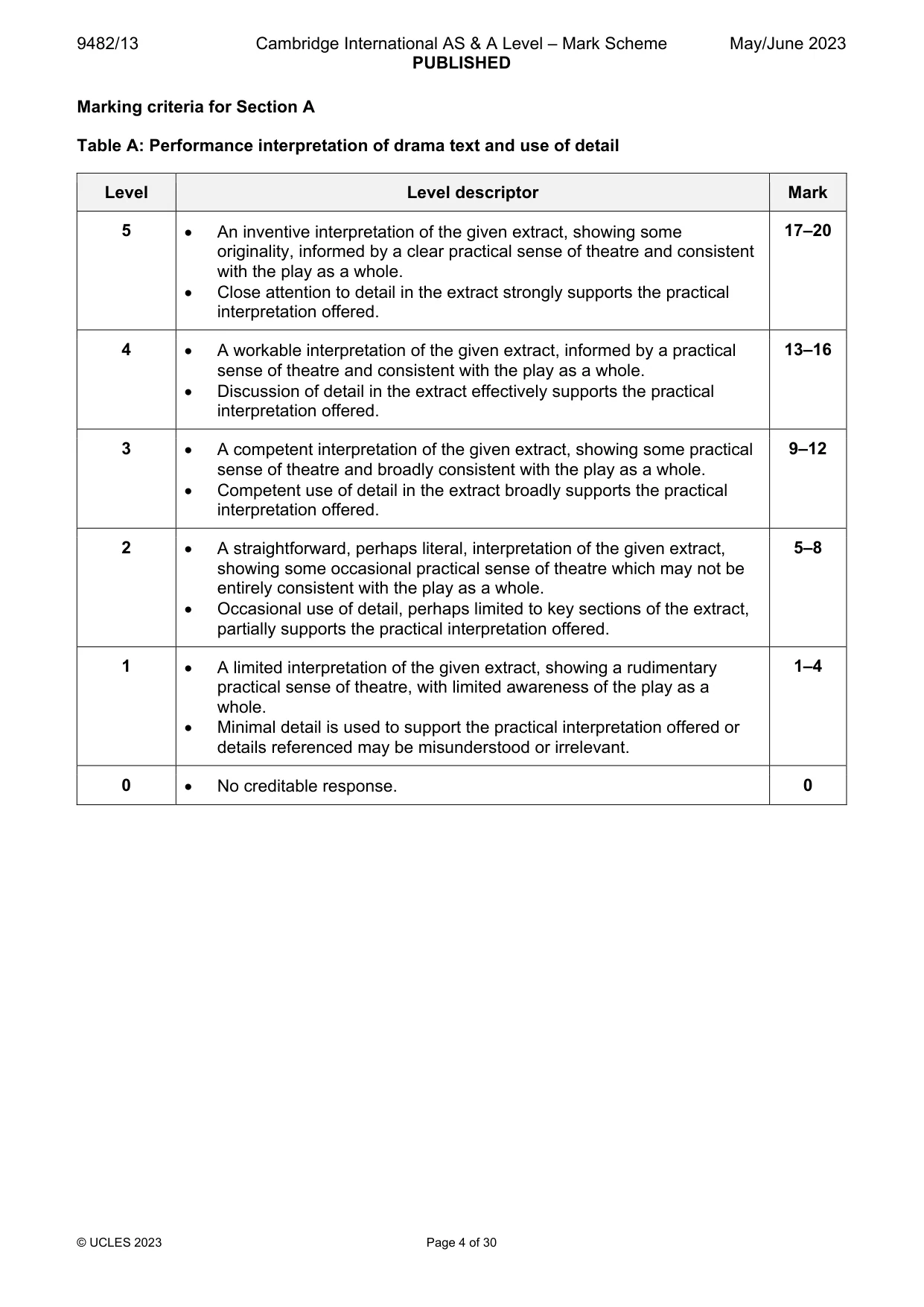
9482/13 Cambridge International AS & A Level – Mark Scheme PUBLISHED May/June 2023 © UCLES 2023 Page 4 of 30 Marking criteria for Section A Table A: Performance interpretation of drama text and use of detail Level Level descriptor Mark 5 An inventive interpretation of the given extract, showing some originality, informed by a clear practical sense of theatre and consistent with the play as a whole. Close attention to detail in the extract strongly supports the practical interpretation offered. 17–20 4 A workable interpretation of the given extract, informed by a practical sense of theatre and consistent with the play as a whole. Discussion of detail in the extract effectively supports the practical interpretation offered. 13–16 3 A competent interpretation of the given extract, showing some practical sense of theatre and broadly consistent with the play as a whole. Competent use of detail in the extract broadly supports the practical interpretation offered. 9–12 2 A straightforward, perhaps literal, interpretation of the given extract, showing some occasional practical sense of theatre which may not be entirely consistent with the play as a whole. Occasional use of detail, perhaps limited to key sections of the extract, partially supports the practical interpretation offered. 5–8 1 A limited interpretation of the given extract, showing a rudimentary practical sense of theatre, with limited awareness of the play as a whole. Minimal detail is used to support the practical interpretation offered or details referenced may be misunderstood or irrelevant. 1–4 0 No creditable response. 0
Mark scheme, page 5
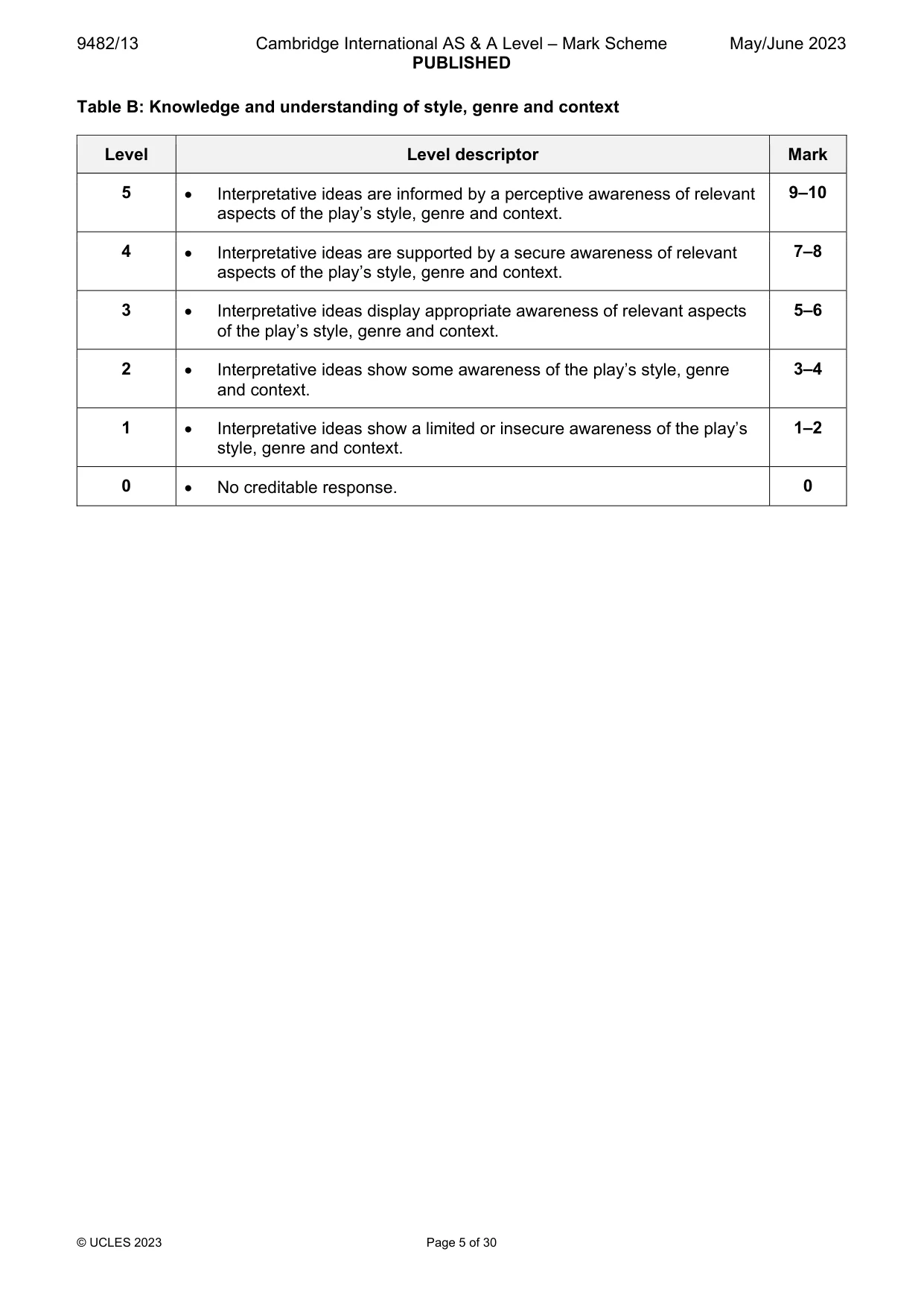
9482/13 Cambridge International AS & A Level – Mark Scheme PUBLISHED May/June 2023 © UCLES 2023 Page 5 of 30 Table B: Knowledge and understanding of style, genre and context Level Level descriptor Mark 5 Interpretative ideas are informed by a perceptive awareness of relevant aspects of the play’s style, genre and context. 9–10 4 Interpretative ideas are supported by a secure awareness of relevant aspects of the play’s style, genre and context. 7–8 3 Interpretative ideas display appropriate awareness of relevant aspects of the play’s style, genre and context. 5–6 2 Interpretative ideas show some awareness of the play’s style, genre and context. 3–4 1 Interpretative ideas show a limited or insecure awareness of the play’s style, genre and context. 1–2 0 No creditable response. 0
Mark scheme, page 6
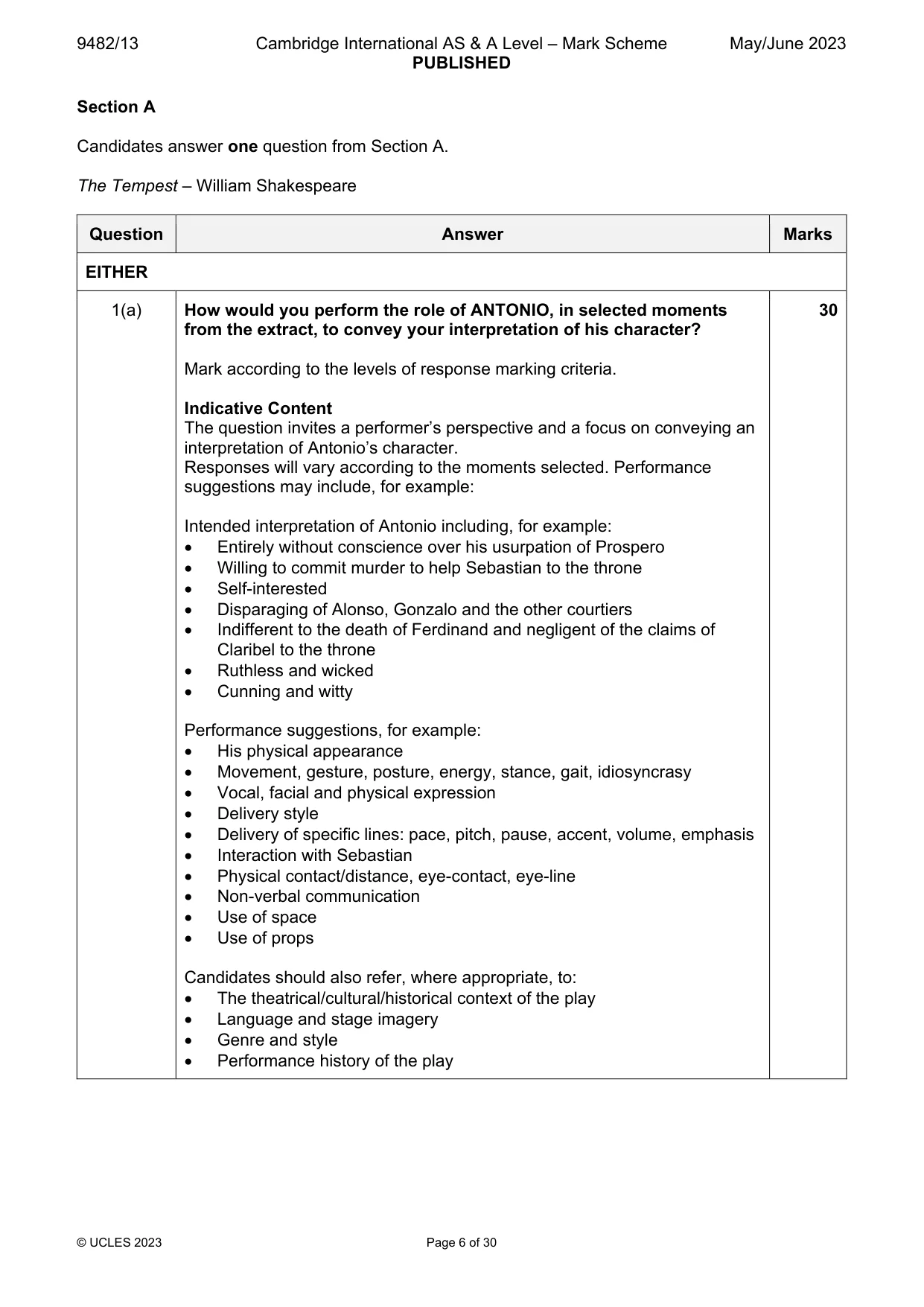
9482/13 Cambridge International AS & A Level – Mark Scheme PUBLISHED May/June 2023 © UCLES 2023 Page 6 of 30 Section A Candidates answer one question from Section A. The Tempest – William Shakespeare Question Answer Marks EITHER 1(a) How would you perform the role of ANTONIO, in selected moments from the extract, to convey your interpretation of his character? Mark according to the levels of response marking criteria. Indicative Content The question invites a performer’s perspective and a focus on conveying an interpretation of Antonio’s character. Responses will vary according to the moments selected. Performance suggestions may include, for example: Intended interpretation of Antonio including, for example: Entirely without conscience over his usurpation of Prospero Willing to commit murder to help Sebastian to the throne Self-interested Disparaging of Alonso, Gonzalo and the other courtiers Indifferent to the death of Ferdinand and negligent of the claims of Claribel to the throne Ruthless and wicked Cunning and witty Performance suggestions, for example: His physical appearance Movement, gesture, posture, energy, stance, gait, idiosyncrasy Vocal, facial and physical expression Delivery style Delivery of specific lines: pace, pitch, pause, accent, volume, emphasis Interaction with Sebastian Physical contact/distance, eye-contact, eye-line Non-verbal communication Use of space Use of props Candidates should also refer, where appropriate, to: The theatrical/cultural/historical context of the play Language and stage imagery Genre and style Performance history of the play 30
Mark scheme, page 7
9482/13 Cambridge International AS & A Level – Mark Scheme PUBLISHED May/June 2023 © UCLES 2023 Page 7 of 30 Question Answer Marks OR 1(b) How would you direct selected moments from the extract to create suspense for the audience? Mark according to the levels of response marking criteria. Indicative Content The question invites a director’s perspective and a focus on the creation of suspense. Responses will vary according to the moments selected. Candidates may refer to some of the following: Staging decisions; positioning of Antonio and Sebastian and of the king and his retinue, asleep Use of the stage by the actors as they collude about killing the king Direction of body language, facial expressions; vocal tone, pitch, pace, volume Delivery of specific lines: Antonio’s use of pause and emphasis as he tries to incite Sebastian to murder Sebastian’s responses and apparent reluctance to understand Antonio’s meaning The sudden appearance of Ariel as the villains withdraw to ‘talk apart’ causing anticipation and suspense for the audience Use of sounds or special lighting and/or effects when Ariel enters to create suspense The sudden awakening of Gonzalo and Alonso to see the villains with daggers drawn Movement, gesture, stage position, stance, posture, gait, energy Interaction: physical contact, eye-contact, eye-line Candidates should also refer, where appropriate, to: The theatrical/cultural/historical context of the play Language and stage imagery Genre and style Performance history of the play 30
Mark scheme, page 8
9482/13 Cambridge International AS & A Level – Mark Scheme PUBLISHED May/June 2023 © UCLES 2023 Page 8 of 30 The Country Wife – William Wycherley Question Answer Marks EITHER 2(a) How would you direct selected moments from the extract to exploit its comic opportunities? Mark according to the levels of response marking criteria. The question invites a director’s perspective and a focus on exploiting the comic opportunities presented by the extract. Indicative Content Potential sections for exploiting the comic opportunities for example: Sparkish’s stubborn reluctance to see that Harcourt is making advances on his bride-to-be before his very eyes His utter folly as Harcourt declares his love for Alithea both to him and to Alithea in his hearing His general stupidity as he refuses to understand Harcourt’s blatant courtship of Alithea Alithea’s increasing amazement at Harcourt’s audacity Her forthright attempts to make Sparkish see the truth Harcourt’s increasingly insulting manner with Sparkish who chooses to ignore his insults The pantomime style use of pointing at Sparkish while apparently criticising himself Potential for Harcourt involving the audience in his mockery of Sparkish Emphatic delivery of the most critical of his insults Directorial suggestions may include, for example: Staging decisions: choice of stage space and use of space by the actors Direction of the actors: body language, facial expressions, vocal tone, pitch, pace, volume Choice of costume, making Sparkish look ridiculous as an exaggerated ‘Fop’ Delivery of specific lines: use of pause and emphasis Movement, gesture, stage position, stance, posture, gait Interaction: physical contact, eye-contact, eye-line Non-verbal communication Use of set Use of props Candidates should also refer, where appropriate, to: The theatrical/cultural/historical context of the play Language and stage imagery Genre and style Performance history of the play 30
Mark scheme, page 9
9482/13 Cambridge International AS & A Level – Mark Scheme PUBLISHED May/June 2023 © UCLES 2023 Page 9 of 30 Question Answer Marks OR 2(b) How would you perform the role of ALITHEA in selected moments from the extract to convey her growing frustration with SPARKISH? Mark according to the levels of response marking criteria. Indicative Content The question invites a performer’s perspective and a focus on conveying Alithea’s growing frustration with Sparkish. Responses will vary according to the moments selected. Candidates may refer to some of the following: Alithea’s sense of duty to go ahead with the marriage, despite her gradual realisation of Sparkish’s unworthiness Her astonishment at Sparkish’s gullibility Her clear understanding of Harcourt’s motives and methods while Sparkish remains insensible to them She becomes infuriated with Sparkish’s basic stupidity Performance suggestions may include, for example: Alithea’s physical appearance and costume; her demure exterior becoming ruffled as the scene progresses Movement, gesture, posture, energy, stance, gait Vocal, facial and physical expression Delivery style Delivery of specific lines: pace, pitch, pause, accent, emphasis Interaction with Harcourt and Sparkish Physical contact, eye-contact, eye-line Non-verbal communication Use of space Use of props and accessories Restoration performance conventions, if adopted Candidates should also refer, where appropriate, to: The theatrical/cultural/historical context of the play Language and stage imagery Genre and style Performance history of the play 30
Mark scheme, page 10
9482/13 Cambridge International AS & A Level – Mark Scheme PUBLISHED May/June 2023 © UCLES 2023 Page 10 of 30 Death of a Salesman – Arthur Miller Question Answer Marks EITHER 3(a) How would you perform the role of BEN, in selected moments from the extract, to convey his ‘other-worldly’ characteristics to the audience? Mark according to the levels of response marking criteria. Indicative Content The question invites a performer’s perspective and a focus on conveying Ben’s ‘other-worldly’ characteristics to the audience. Responses will vary according to the moments selected. Candidates may refer to some of the following: Ben’s ‘other-worldly character, for example: His appearance, as described by Miller, ‘he has an aura of far-places about him’ He is introduced by distinctive music on each appearance He is always citing lack of time as an excuse to leave Willy He speaks in cliches and presents a caricature He is obsessed with riches and success and not interested in ‘ordinary life’ Performance suggestions, for example: Ben’s physical appearance and choice of costume Movement, gesture, posture, energy, stance Vocal, facial and physical expression Delivery style – spectral or exaggerated Delivery of specific lines: pace, pitch, pause, accent, volume, emphasis Interaction with Willy, Biff, Linda and Charley Physical contact, eye-contact, eye-line Non-verbal communication Use of space Use of props Candidates should also refer, where appropriate, to: The theatrical/cultural/historical context of the play Language and stage imagery Genre and style Performance history of the play 30
Mark scheme, page 11
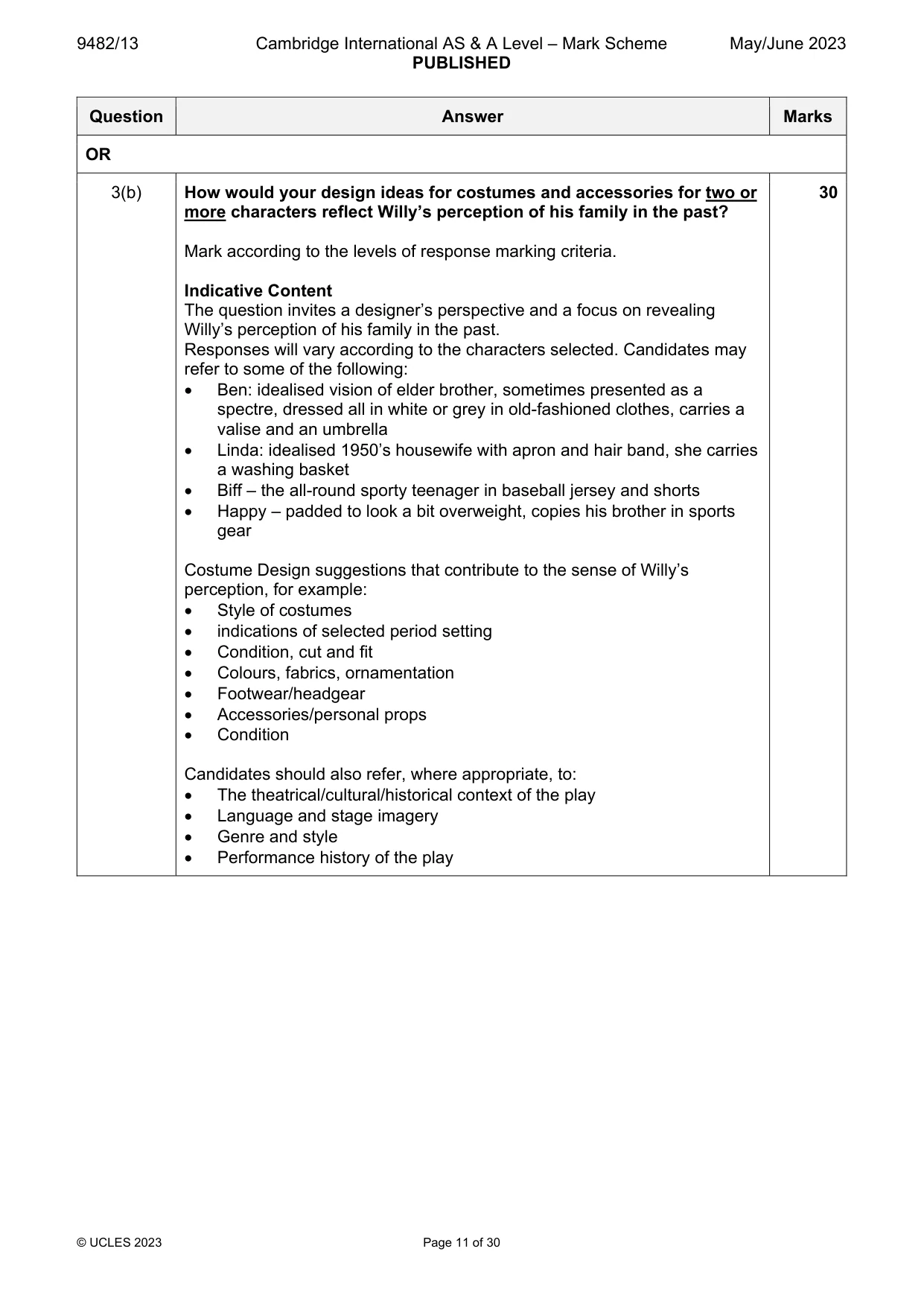
9482/13 Cambridge International AS & A Level – Mark Scheme PUBLISHED May/June 2023 © UCLES 2023 Page 11 of 30 Question Answer Marks OR 3(b) How would your design ideas for costumes and accessories for two or more characters reflect Willy’s perception of his family in the past? Mark according to the levels of response marking criteria. Indicative Content The question invites a designer’s perspective and a focus on revealing Willy’s perception of his family in the past. Responses will vary according to the characters selected. Candidates may refer to some of the following: Ben: idealised vision of elder brother, sometimes presented as a spectre, dressed all in white or grey in old-fashioned clothes, carries a valise and an umbrella Linda: idealised 1950’s housewife with apron and hair band, she carries a washing basket Biff – the all-round sporty teenager in baseball jersey and shorts Happy – padded to look a bit overweight, copies his brother in sports gear Costume Design suggestions that contribute to the sense of Willy’s perception, for example: Style of costumes indications of selected period setting Condition, cut and fit Colours, fabrics, ornamentation Footwear/headgear Accessories/personal props Condition Candidates should also refer, where appropriate, to: The theatrical/cultural/historical context of the play Language and stage imagery Genre and style Performance history of the play 30
Mark scheme, page 12
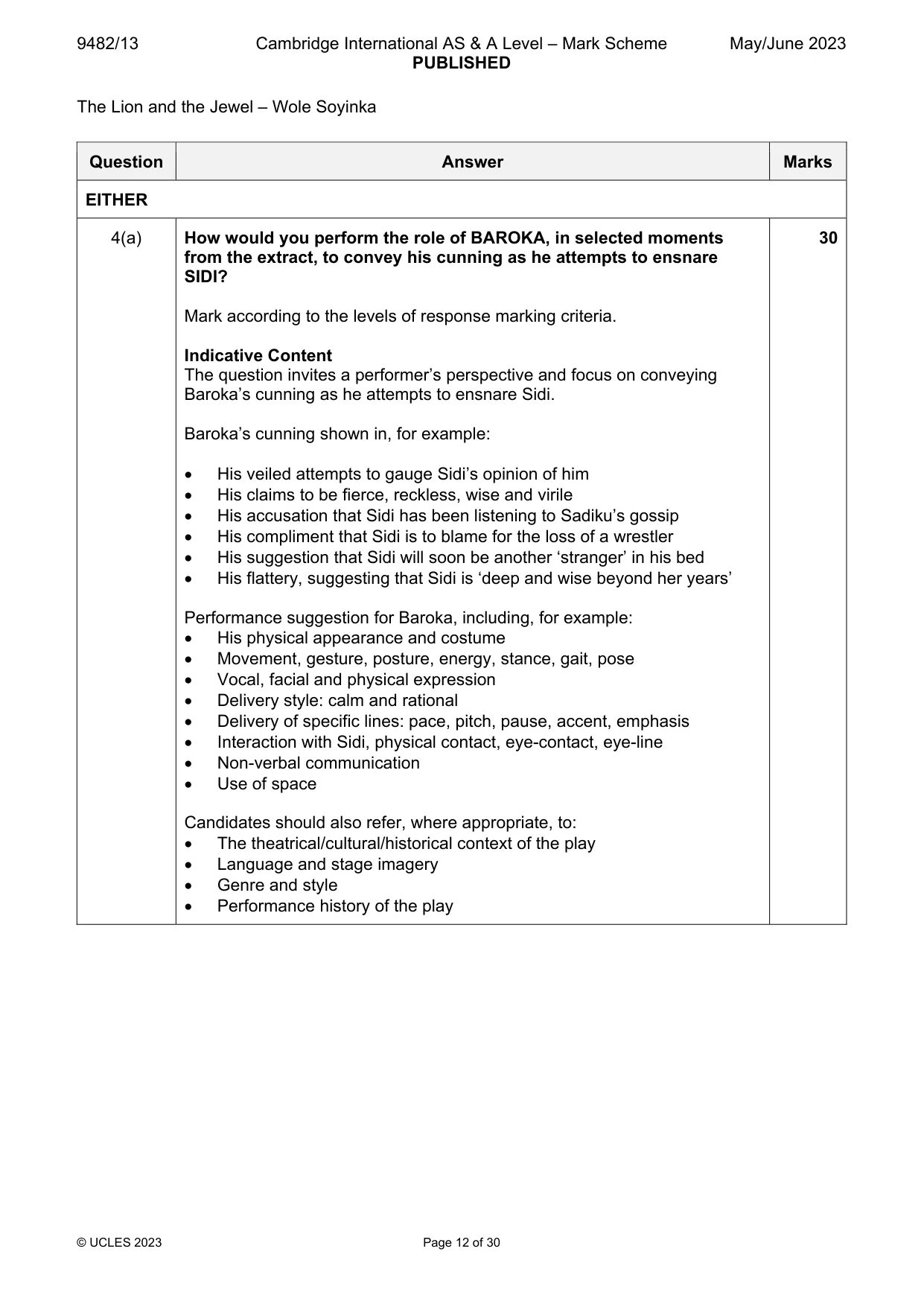
9482/13 Cambridge International AS & A Level – Mark Scheme PUBLISHED May/June 2023 © UCLES 2023 Page 12 of 30 The Lion and the Jewel – Wole Soyinka Question Answer Marks EITHER 4(a) How would you perform the role of BAROKA, in selected moments from the extract, to convey his cunning as he attempts to ensnare SIDI? Mark according to the levels of response marking criteria. Indicative Content The question invites a performer’s perspective and focus on conveying Baroka’s cunning as he attempts to ensnare Sidi. Baroka’s cunning shown in, for example: His veiled attempts to gauge Sidi’s opinion of him His claims to be fierce, reckless, wise and virile His accusation that Sidi has been listening to Sadiku’s gossip His compliment that Sidi is to blame for the loss of a wrestler His suggestion that Sidi will soon be another ‘stranger’ in his bed His flattery, suggesting that Sidi is ‘deep and wise beyond her years’ Performance suggestion for Baroka, including, for example: His physical appearance and costume Movement, gesture, posture, energy, stance, gait, pose Vocal, facial and physical expression Delivery style: calm and rational Delivery of specific lines: pace, pitch, pause, accent, emphasis Interaction with Sidi, physical contact, eye-contact, eye-line Non-verbal communication Use of space Candidates should also refer, where appropriate, to: The theatrical/cultural/historical context of the play Language and stage imagery Genre and style Performance history of the play 30
Mark scheme, page 13
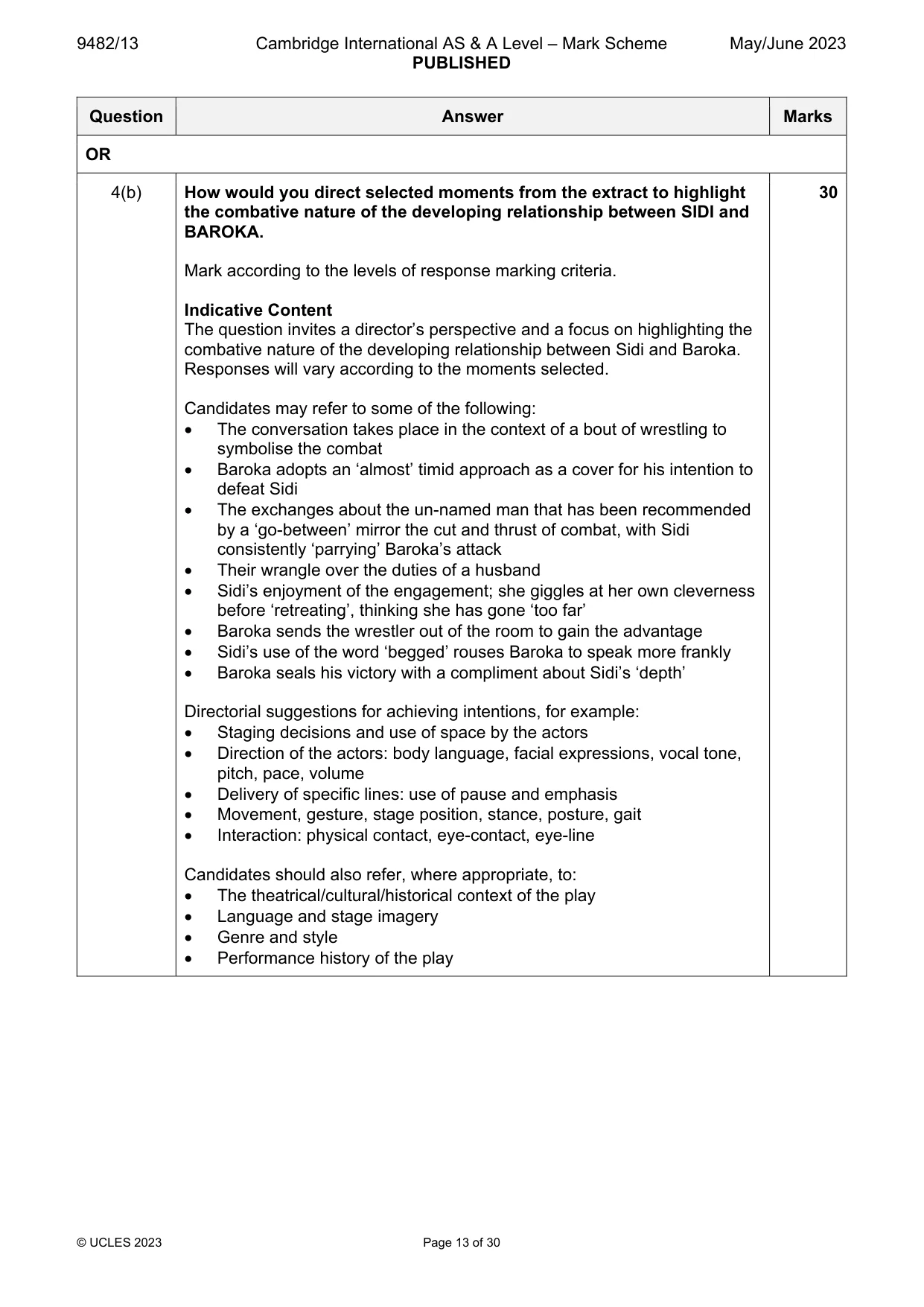
9482/13 Cambridge International AS & A Level – Mark Scheme PUBLISHED May/June 2023 © UCLES 2023 Page 13 of 30 Question Answer Marks OR 4(b) How would you direct selected moments from the extract to highlight the combative nature of the developing relationship between SIDI and BAROKA. Mark according to the levels of response marking criteria. Indicative Content The question invites a director’s perspective and a focus on highlighting the combative nature of the developing relationship between Sidi and Baroka. Responses will vary according to the moments selected. Candidates may refer to some of the following: The conversation takes place in the context of a bout of wrestling to symbolise the combat Baroka adopts an ‘almost’ timid approach as a cover for his intention to defeat Sidi The exchanges about the un-named man that has been recommended by a ‘go-between’ mirror the cut and thrust of combat, with Sidi consistently ‘parrying’ Baroka’s attack Their wrangle over the duties of a husband Sidi’s enjoyment of the engagement; she giggles at her own cleverness before ‘retreating’, thinking she has gone ‘too far’ Baroka sends the wrestler out of the room to gain the advantage Sidi’s use of the word ‘begged’ rouses Baroka to speak more frankly Baroka seals his victory with a compliment about Sidi’s ‘depth’ Directorial suggestions for achieving intentions, for example: Staging decisions and use of space by the actors Direction of the actors: body language, facial expressions, vocal tone, pitch, pace, volume Delivery of specific lines: use of pause and emphasis Movement, gesture, stage position, stance, posture, gait Interaction: physical contact, eye-contact, eye-line Candidates should also refer, where appropriate, to: The theatrical/cultural/historical context of the play Language and stage imagery Genre and style Performance history of the play 30
Mark scheme, page 14
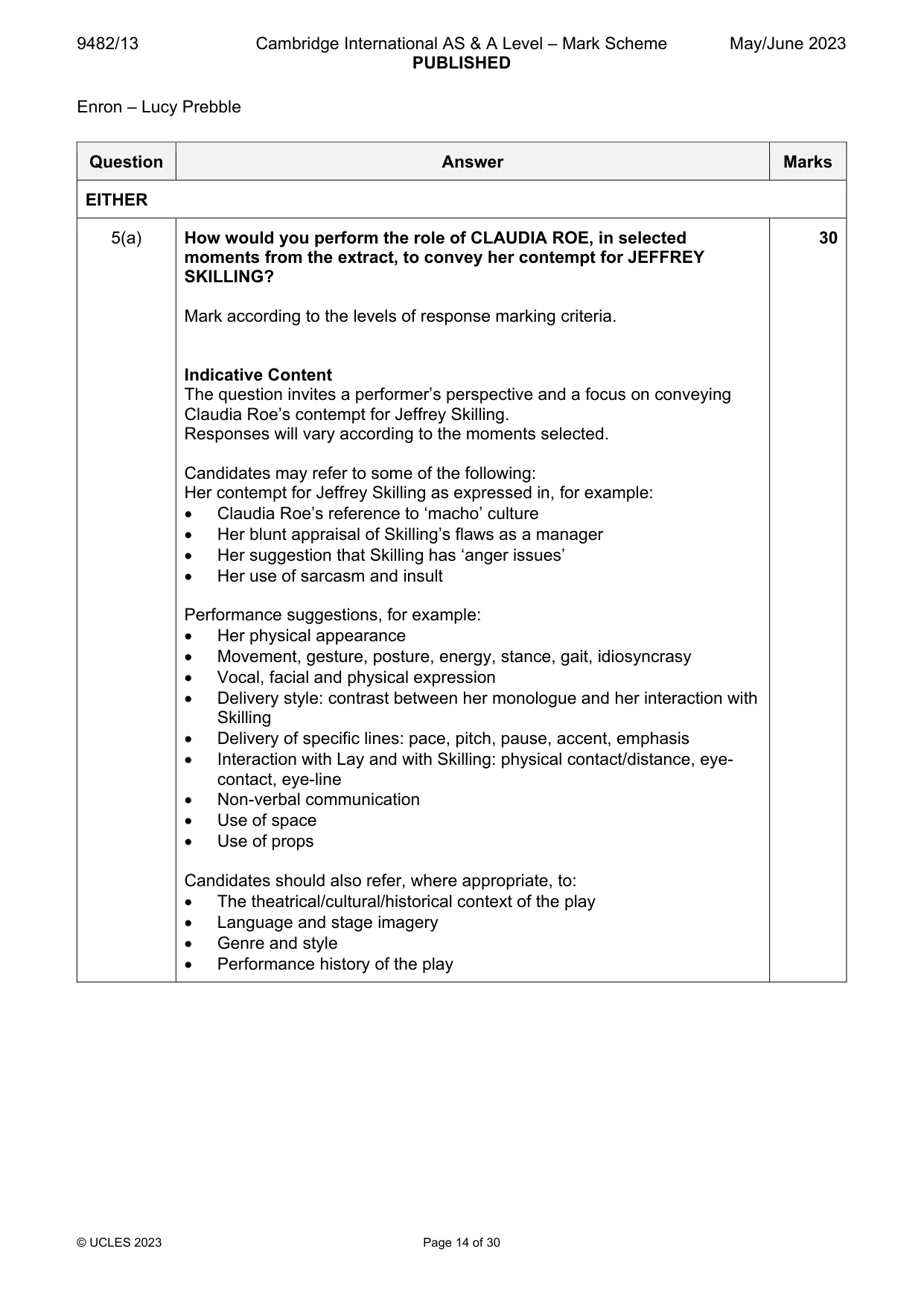
9482/13 Cambridge International AS & A Level – Mark Scheme PUBLISHED May/June 2023 © UCLES 2023 Page 14 of 30 Enron – Lucy Prebble Question Answer Marks EITHER 5(a) How would you perform the role of CLAUDIA ROE, in selected moments from the extract, to convey her contempt for JEFFREY SKILLING? Mark according to the levels of response marking criteria. Indicative Content The question invites a performer’s perspective and a focus on conveying Claudia Roe’s contempt for Jeffrey Skilling. Responses will vary according to the moments selected. Candidates may refer to some of the following: Her contempt for Jeffrey Skilling as expressed in, for example: Claudia Roe’s reference to ‘macho’ culture Her blunt appraisal of Skilling’s flaws as a manager Her suggestion that Skilling has ‘anger issues’ Her use of sarcasm and insult Performance suggestions, for example: Her physical appearance Movement, gesture, posture, energy, stance, gait, idiosyncrasy Vocal, facial and physical expression Delivery style: contrast between her monologue and her interaction with Skilling Delivery of specific lines: pace, pitch, pause, accent, emphasis Interaction with Lay and with Skilling: physical contact/distance, eye- contact, eye-line Non-verbal communication Use of space Use of props Candidates should also refer, where appropriate, to: The theatrical/cultural/historical context of the play Language and stage imagery Genre and style Performance history of the play 30
Mark scheme, page 15
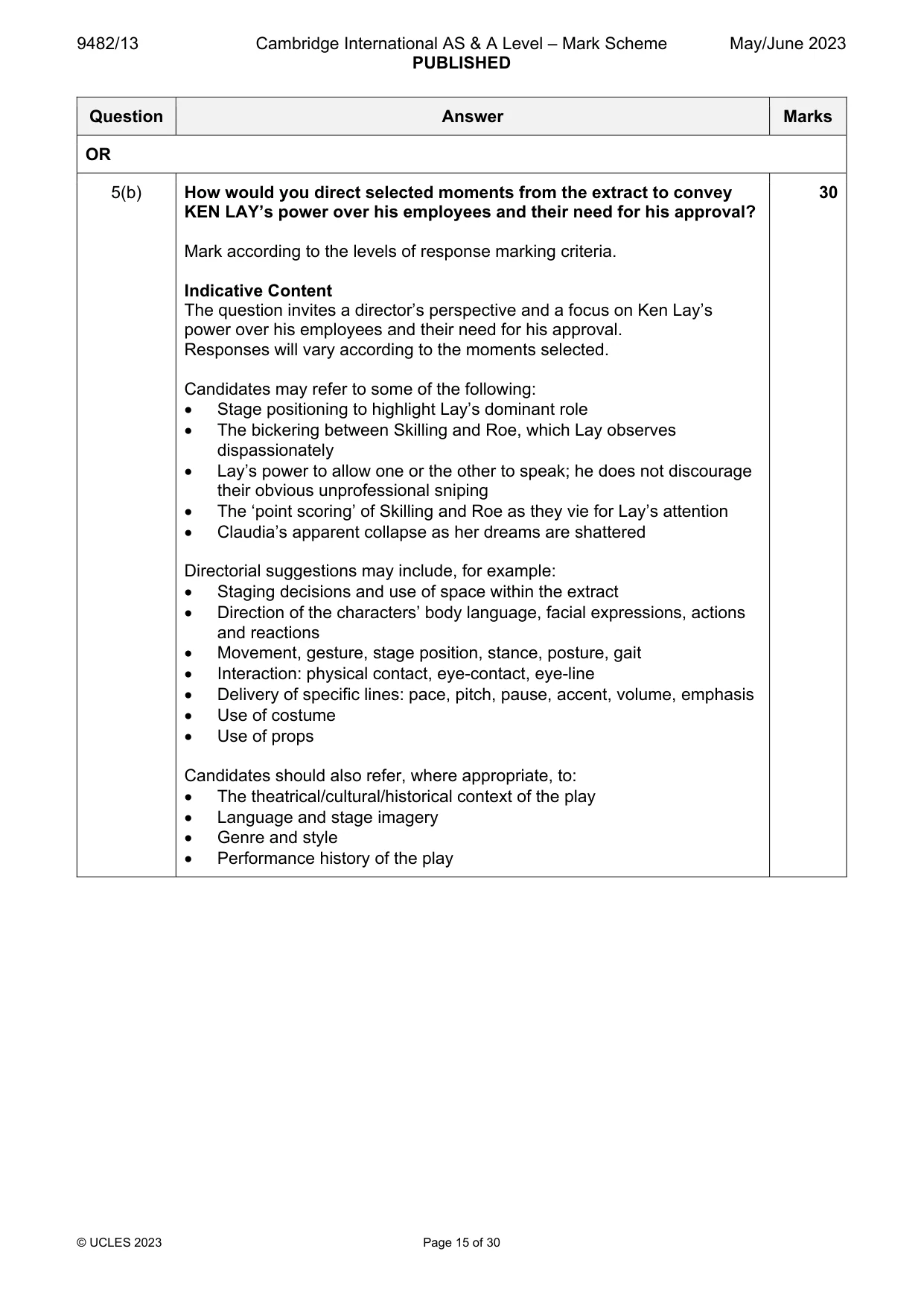
9482/13 Cambridge International AS & A Level – Mark Scheme PUBLISHED May/June 2023 © UCLES 2023 Page 15 of 30 Question Answer Marks OR 5(b) How would you direct selected moments from the extract to convey KEN LAY’s power over his employees and their need for his approval? Mark according to the levels of response marking criteria. Indicative Content The question invites a director’s perspective and a focus on Ken Lay’s power over his employees and their need for his approval. Responses will vary according to the moments selected. Candidates may refer to some of the following: Stage positioning to highlight Lay’s dominant role The bickering between Skilling and Roe, which Lay observes dispassionately Lay’s power to allow one or the other to speak; he does not discourage their obvious unprofessional sniping The ‘point scoring’ of Skilling and Roe as they vie for Lay’s attention Claudia’s apparent collapse as her dreams are shattered Directorial suggestions may include, for example: Staging decisions and use of space within the extract Direction of the characters’ body language, facial expressions, actions and reactions Movement, gesture, stage position, stance, posture, gait Interaction: physical contact, eye-contact, eye-line Delivery of specific lines: pace, pitch, pause, accent, volume, emphasis Use of costume Use of props Candidates should also refer, where appropriate, to: The theatrical/cultural/historical context of the play Language and stage imagery Genre and style Performance history of the play 30
Mark scheme, page 16
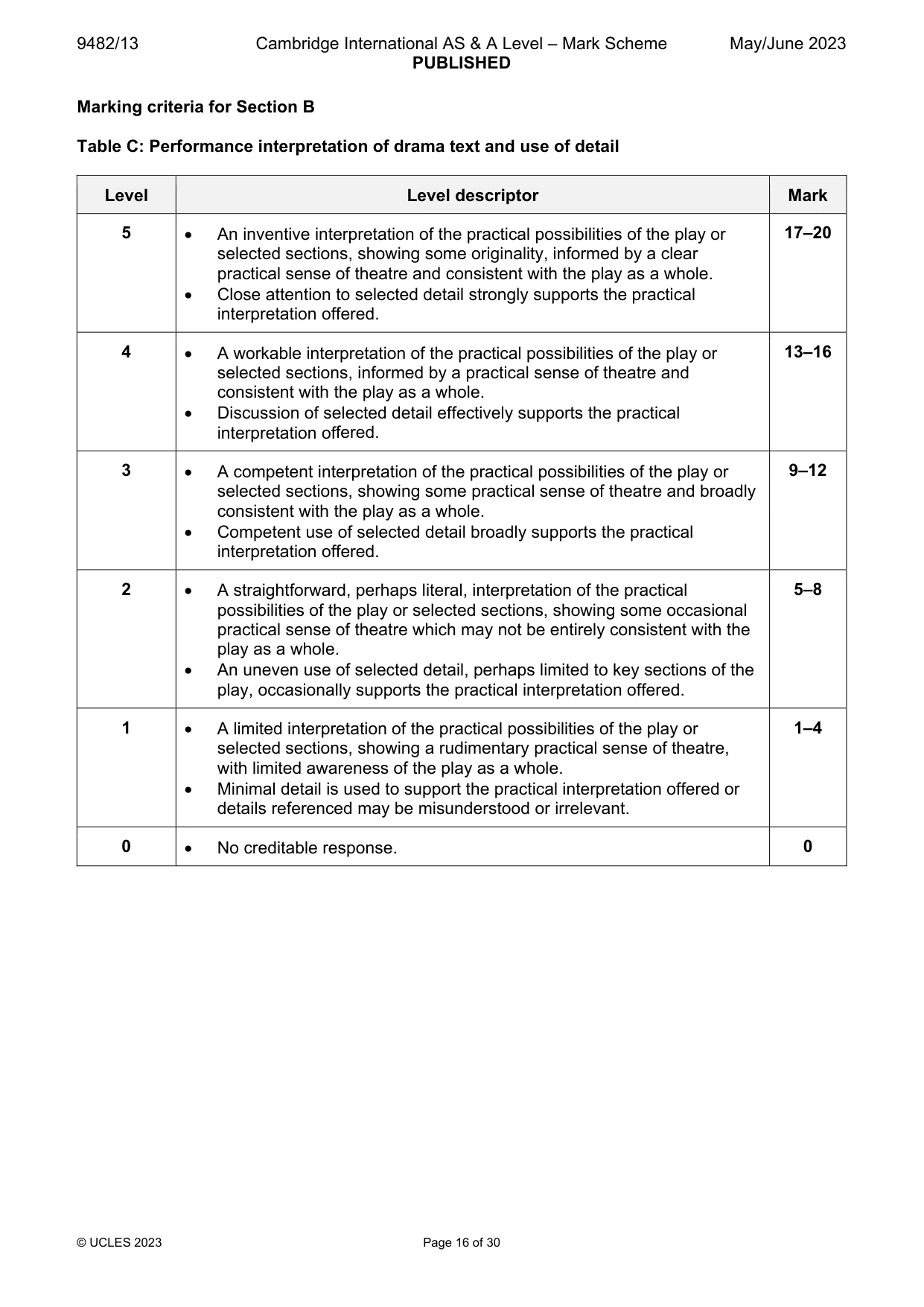
9482/13 Cambridge International AS & A Level – Mark Scheme PUBLISHED May/June 2023 © UCLES 2023 Page 16 of 30 Marking criteria for Section B Table C: Performance interpretation of drama text and use of detail Level Level descriptor Mark 5 An inventive interpretation of the practical possibilities of the play or selected sections, showing some originality, informed by a clear practical sense of theatre and consistent with the play as a whole. Close attention to selected detail strongly supports the practical interpretation offered. 17–20 4 A workable interpretation of the practical possibilities of the play or selected sections, informed by a practical sense of theatre and consistent with the play as a whole. Discussion of selected detail effectively supports the practical interpretation offered. 13–16 3 A competent interpretation of the practical possibilities of the play or selected sections, showing some practical sense of theatre and broadly consistent with the play as a whole. Competent use of selected detail broadly supports the practical interpretation offered. 9–12 2 A straightforward, perhaps literal, interpretation of the practical possibilities of the play or selected sections, showing some occasional practical sense of theatre which may not be entirely consistent with the play as a whole. An uneven use of selected detail, perhaps limited to key sections of the play, occasionally supports the practical interpretation offered. 5–8 1 A limited interpretation of the practical possibilities of the play or selected sections, showing a rudimentary practical sense of theatre, with limited awareness of the play as a whole. Minimal detail is used to support the practical interpretation offered or details referenced may be misunderstood or irrelevant. 1–4 0 No creditable response. 0
Mark scheme, page 17
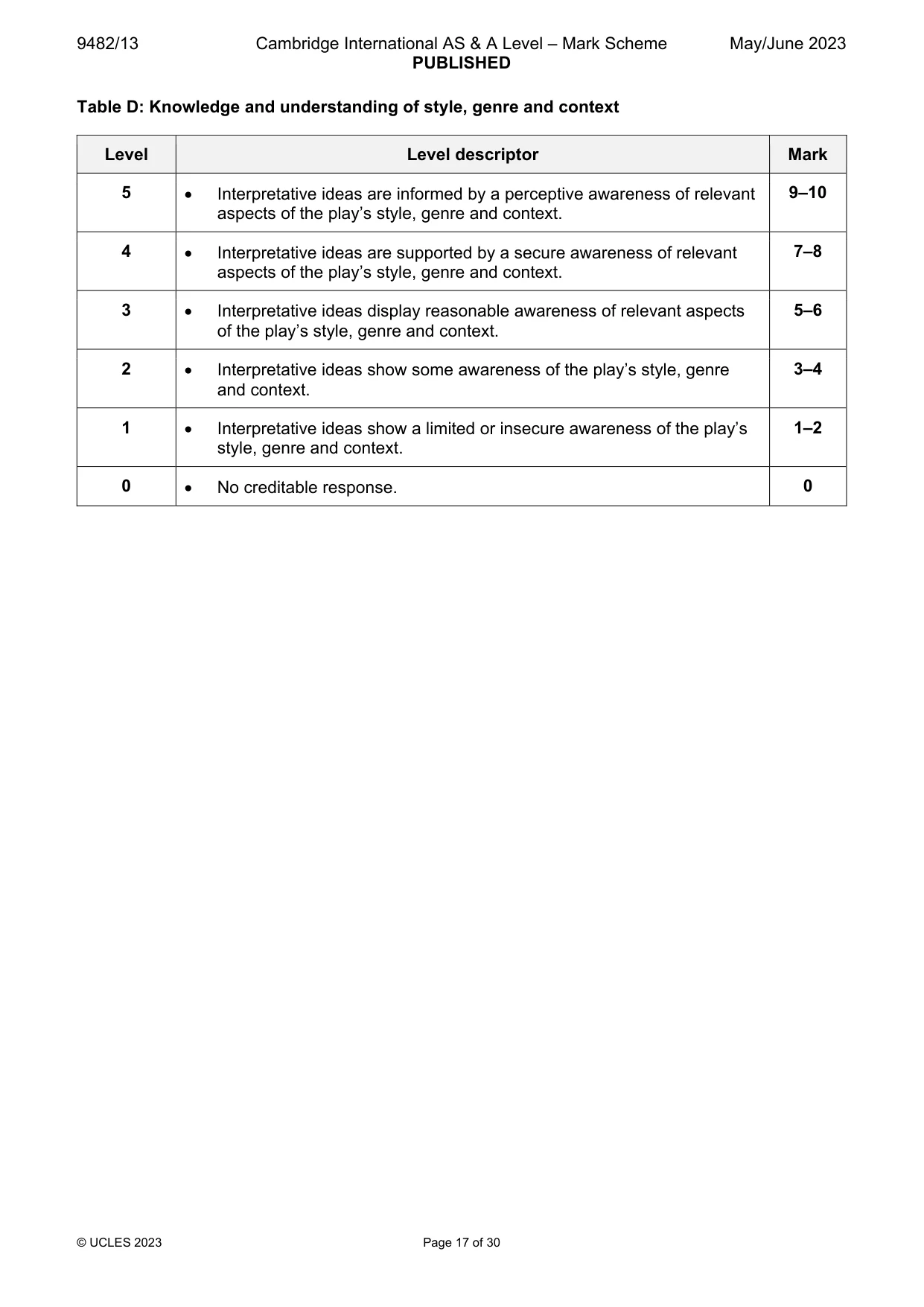
9482/13 Cambridge International AS & A Level – Mark Scheme PUBLISHED May/June 2023 © UCLES 2023 Page 17 of 30 Table D: Knowledge and understanding of style, genre and context Level Level descriptor Mark 5 Interpretative ideas are informed by a perceptive awareness of relevant aspects of the play’s style, genre and context. 9–10 4 Interpretative ideas are supported by a secure awareness of relevant aspects of the play’s style, genre and context. 7–8 3 Interpretative ideas display reasonable awareness of relevant aspects of the play’s style, genre and context. 5–6 2 Interpretative ideas show some awareness of the play’s style, genre and context. 3–4 1 Interpretative ideas show a limited or insecure awareness of the play’s style, genre and context. 1–2 0 No creditable response. 0
Mark scheme, page 18
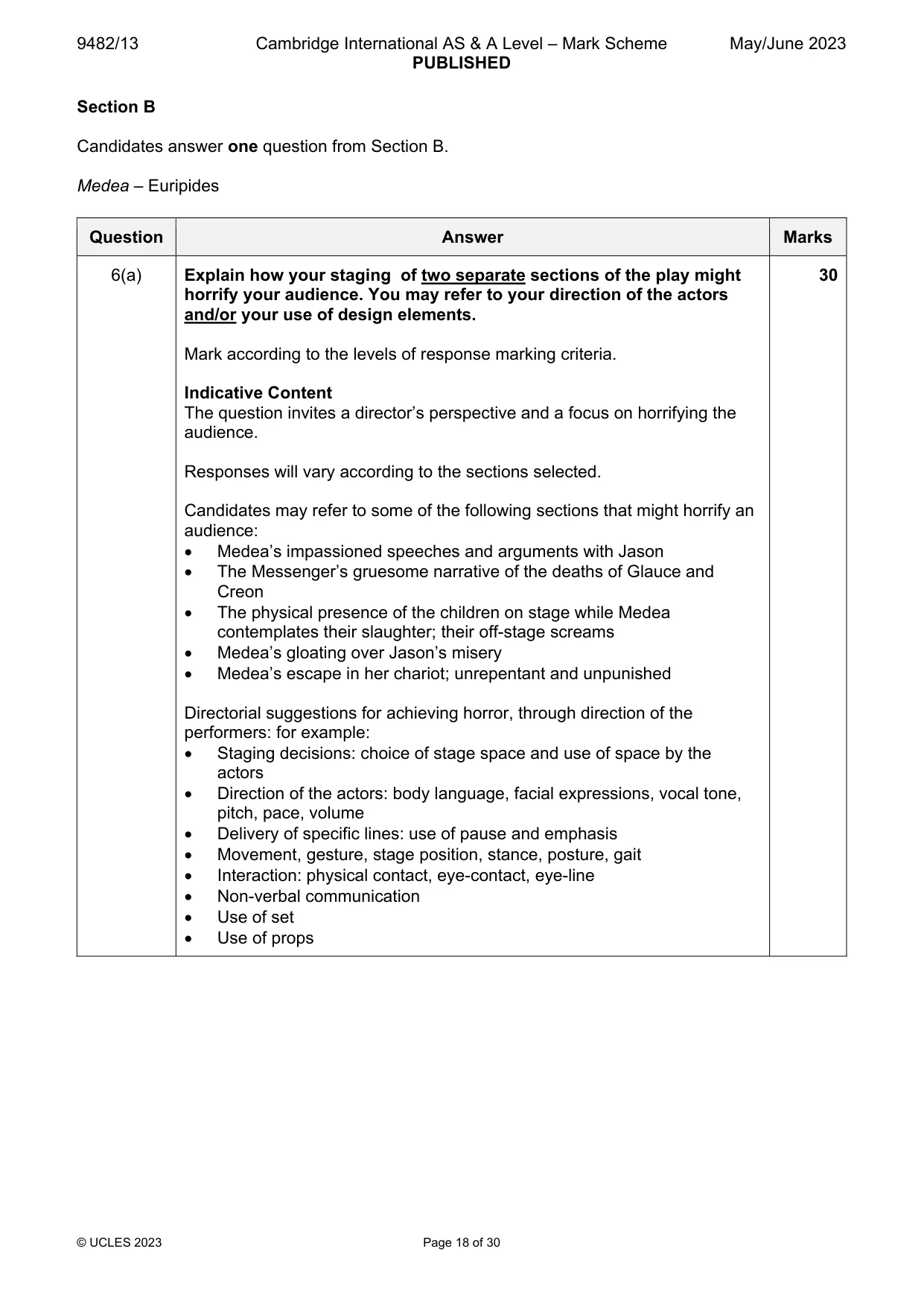
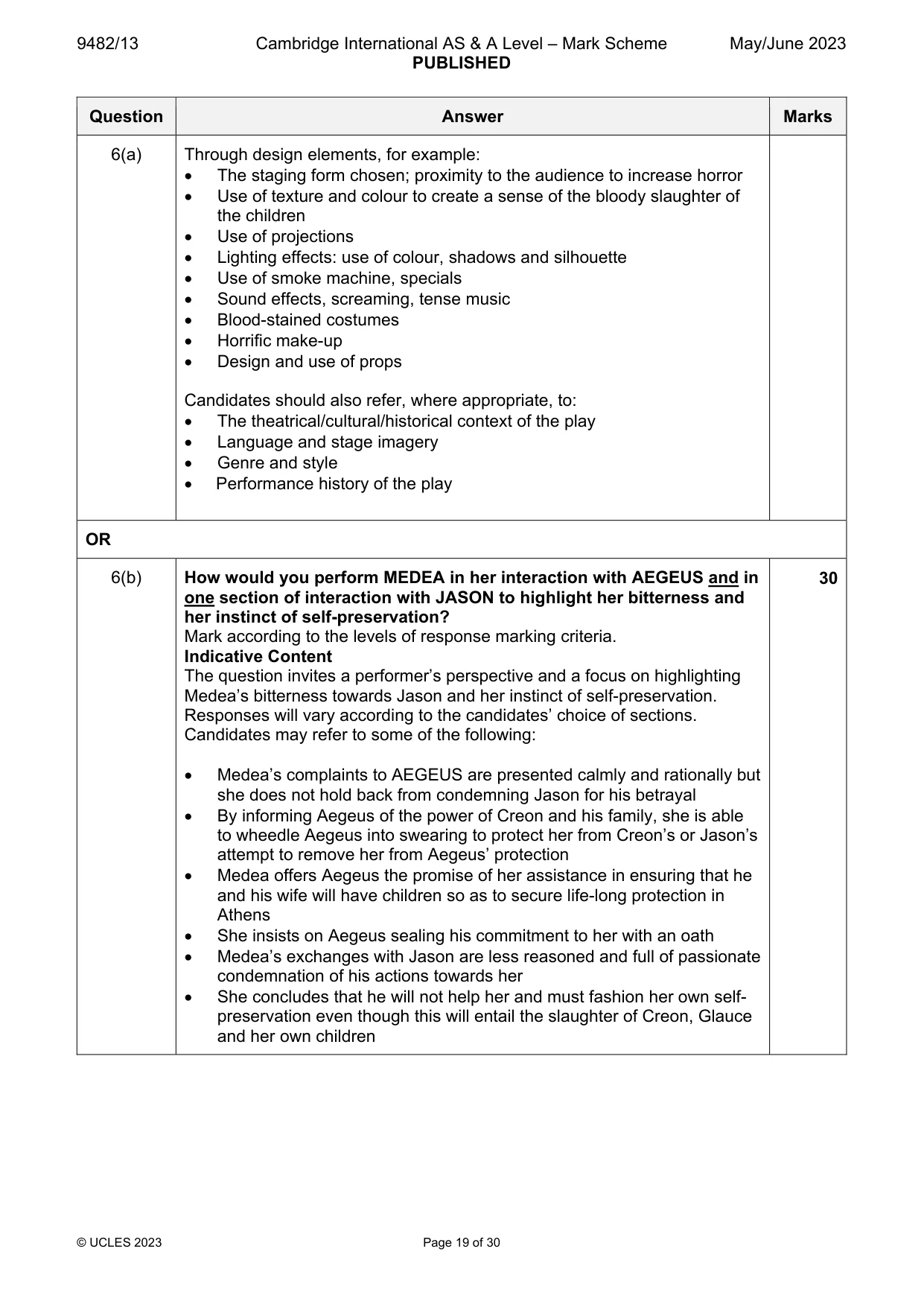
9482/13 Cambridge International AS & A Level – Mark Scheme PUBLISHED May/June 2023 © UCLES 2023 Page 18 of 30 Section B Candidates answer one question from Section B. Medea – Euripides Question Answer Marks 6(a) Explain how your staging of two separate sections of the play might horrify your audience. You may refer to your direction of the actors and/or your use of design elements. Mark according to the levels of response marking criteria. Indicative Content The question invites a director’s perspective and a focus on horrifying the audience. Responses will vary according to the sections selected. Candidates may refer to some of the following sections that might horrify an audience: Medea’s impassioned speeches and arguments with Jason The Messenger’s gruesome narrative of the deaths of Glauce and Creon The physical presence of the children on stage while Medea contemplates their slaughter; their off-stage screams Medea’s gloating over Jason’s misery Medea’s escape in her chariot; unrepentant and unpunished Directorial suggestions for achieving horror, through direction of the performers: for example: Staging decisions: choice of stage space and use of space by the actors Direction of the actors: body language, facial expressions, vocal tone, pitch, pace, volume Delivery of specific lines: use of pause and emphasis Movement, gesture, stage position, stance, posture, gait Interaction: physical contact, eye-contact, eye-line Non-verbal communication Use of set Use of props 30
Mark scheme, page 19
9482/13 Cambridge International AS & A Level – Mark Scheme PUBLISHED May/June 2023 © UCLES 2023 Page 19 of 30 Question Answer Marks 6(a) Through design elements, for example: The staging form chosen; proximity to the audience to increase horror Use of texture and colour to create a sense of the bloody slaughter of the children Use of projections Lighting effects: use of colour, shadows and silhouette Use of smoke machine, specials Sound effects, screaming, tense music Blood-stained costumes Horrific make-up Design and use of props Candidates should also refer, where appropriate, to: The theatrical/cultural/historical context of the play Language and stage imagery Genre and style Performance history of the play OR 6(b) How would you perform MEDEA in her interaction with AEGEUS and in one section of interaction with JASON to highlight her bitterness and her instinct of self-preservation? Mark according to the levels of response marking criteria. Indicative Content The question invites a performer’s perspective and a focus on highlighting Medea’s bitterness towards Jason and her instinct of self-preservation. Responses will vary according to the candidates’ choice of sections. Candidates may refer to some of the following: Medea’s complaints to AEGEUS are presented calmly and rationally but she does not hold back from condemning Jason for his betrayal By informing Aegeus of the power of Creon and his family, she is able to wheedle Aegeus into swearing to protect her from Creon’s or Jason’s attempt to remove her from Aegeus’ protection Medea offers Aegeus the promise of her assistance in ensuring that he and his wife will have children so as to secure life-long protection in Athens She insists on Aegeus sealing his commitment to her with an oath Medea’s exchanges with Jason are less reasoned and full of passionate condemnation of his actions towards her She concludes that he will not help her and must fashion her own self- preservation even though this will entail the slaughter of Creon, Glauce and her own children 30
Mark scheme, page 20
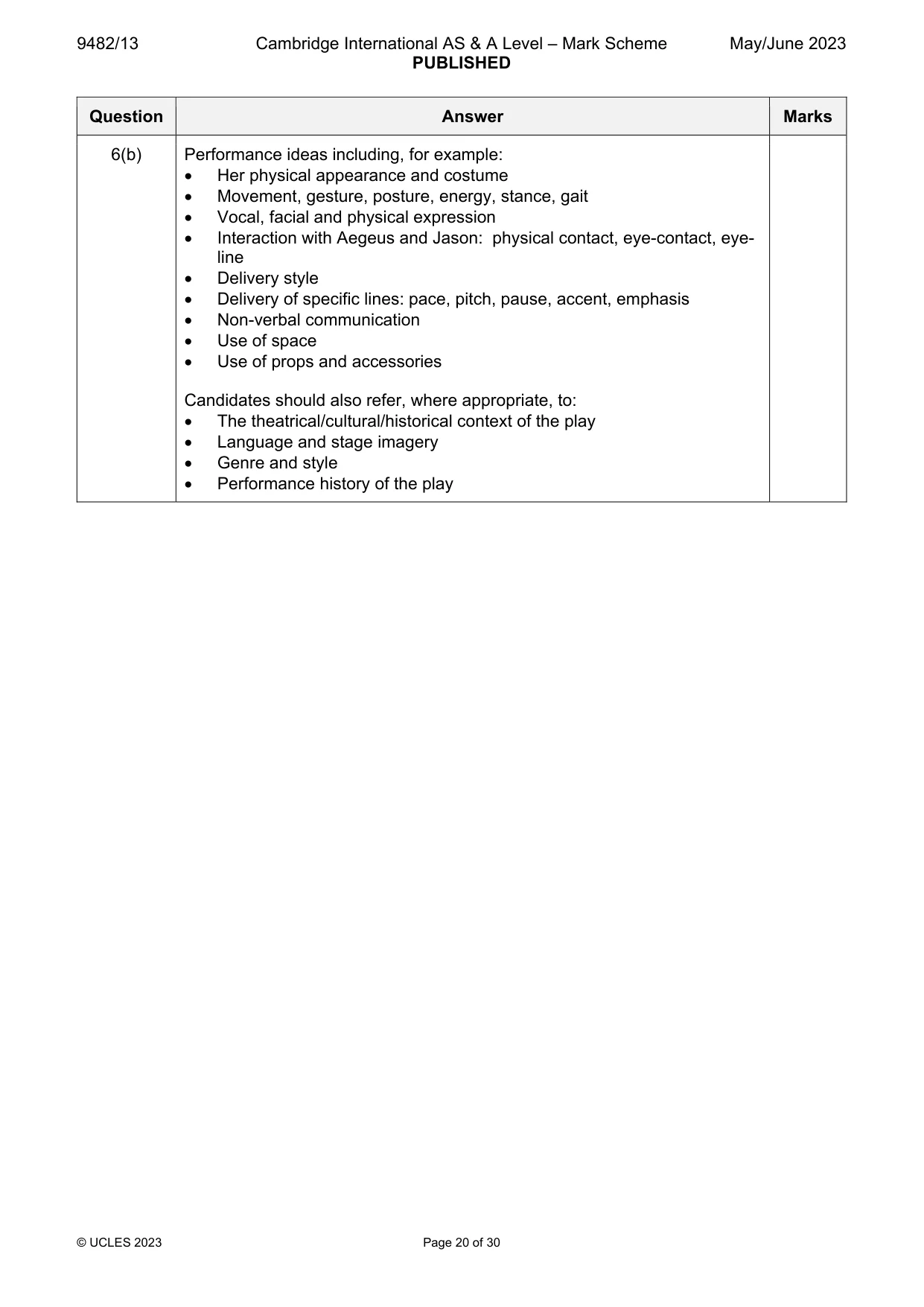
9482/13 Cambridge International AS & A Level – Mark Scheme PUBLISHED May/June 2023 © UCLES 2023 Page 20 of 30 Question Answer Marks 6(b) Performance ideas including, for example: Her physical appearance and costume Movement, gesture, posture, energy, stance, gait Vocal, facial and physical expression Interaction with Aegeus and Jason: physical contact, eye-contact, eye- line Delivery style Delivery of specific lines: pace, pitch, pause, accent, emphasis Non-verbal communication Use of space Use of props and accessories Candidates should also refer, where appropriate, to: The theatrical/cultural/historical context of the play Language and stage imagery Genre and style Performance history of the play
Mark scheme, page 21
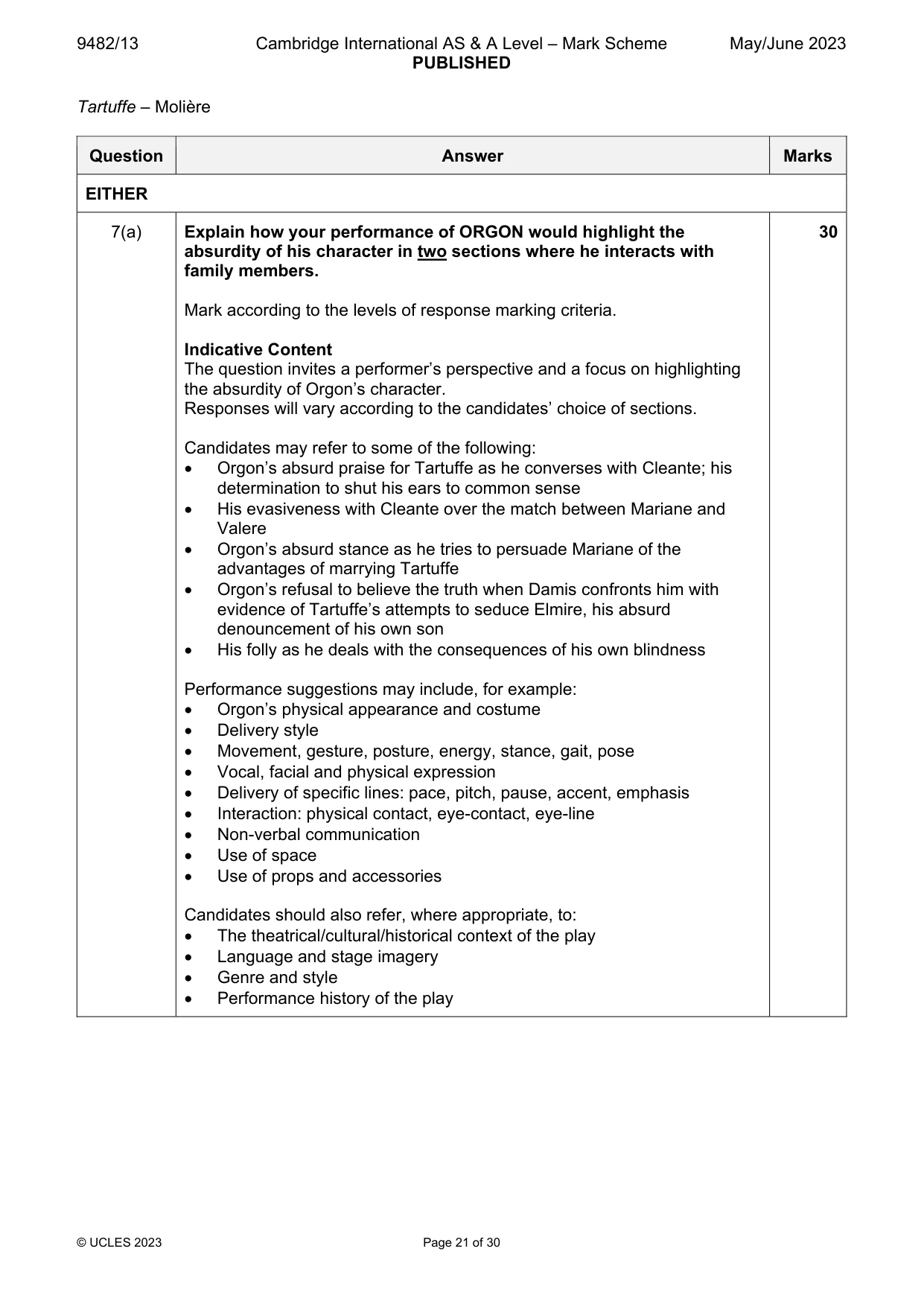
9482/13 Cambridge International AS & A Level – Mark Scheme PUBLISHED May/June 2023 © UCLES 2023 Page 21 of 30 Tartuffe – Molière Question Answer Marks EITHER 7(a) Explain how your performance of ORGON would highlight the absurdity of his character in two sections where he interacts with family members. Mark according to the levels of response marking criteria. Indicative Content The question invites a performer’s perspective and a focus on highlighting the absurdity of Orgon’s character. Responses will vary according to the candidates’ choice of sections. Candidates may refer to some of the following: Orgon’s absurd praise for Tartuffe as he converses with Cleante; his determination to shut his ears to common sense His evasiveness with Cleante over the match between Mariane and Valere Orgon’s absurd stance as he tries to persuade Mariane of the advantages of marrying Tartuffe Orgon’s refusal to believe the truth when Damis confronts him with evidence of Tartuffe’s attempts to seduce Elmire, his absurd denouncement of his own son His folly as he deals with the consequences of his own blindness Performance suggestions may include, for example: Orgon’s physical appearance and costume Delivery style Movement, gesture, posture, energy, stance, gait, pose Vocal, facial and physical expression Delivery of specific lines: pace, pitch, pause, accent, emphasis Interaction: physical contact, eye-contact, eye-line Non-verbal communication Use of space Use of props and accessories Candidates should also refer, where appropriate, to: The theatrical/cultural/historical context of the play Language and stage imagery Genre and style Performance history of the play 30
Mark scheme, page 22
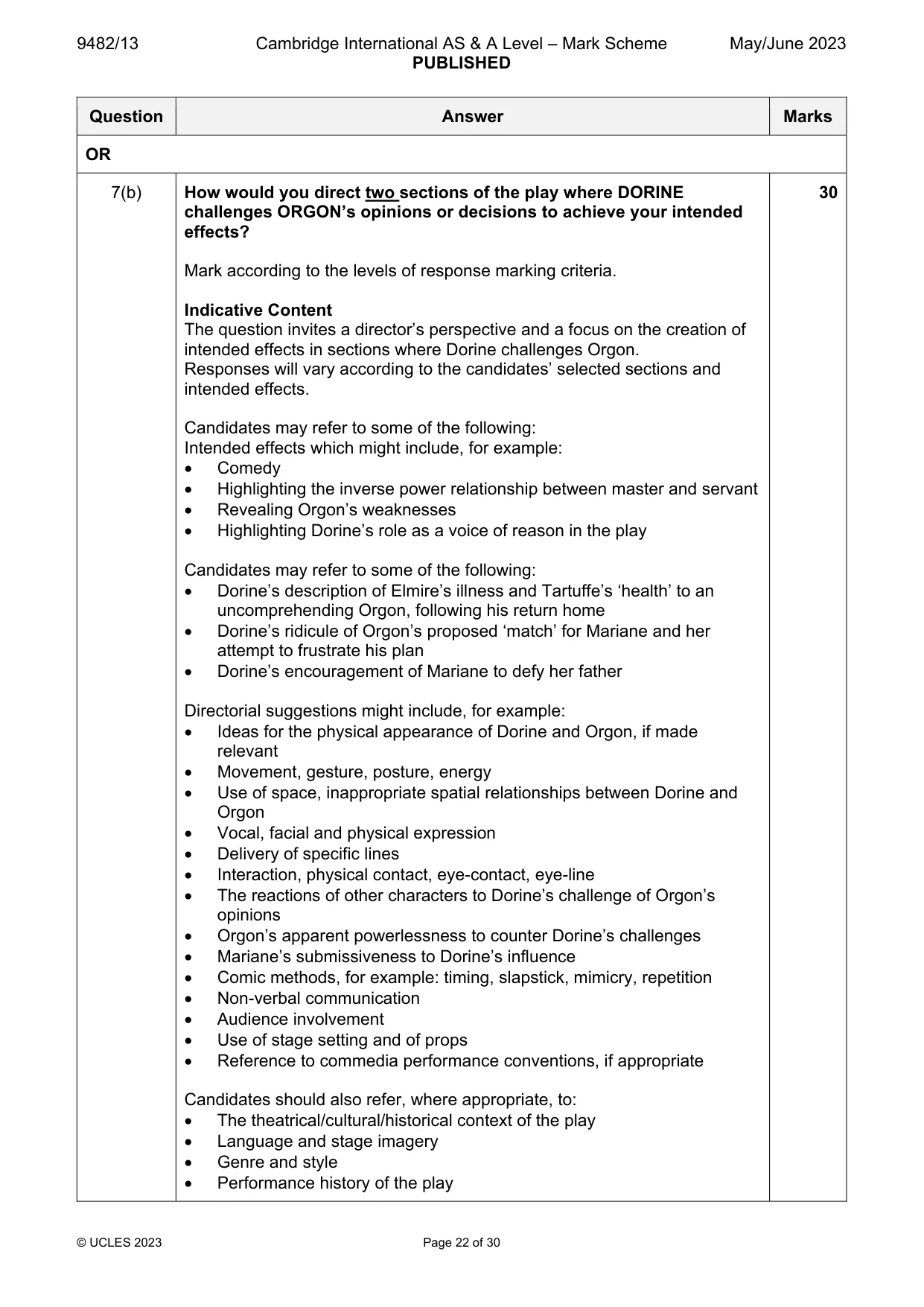
9482/13 Cambridge International AS & A Level – Mark Scheme PUBLISHED May/June 2023 © UCLES 2023 Page 22 of 30 Question Answer Marks OR 7(b) How would you direct two sections of the play where DORINE challenges ORGON’s opinions or decisions to achieve your intended effects? Mark according to the levels of response marking criteria. Indicative Content The question invites a director’s perspective and a focus on the creation of intended effects in sections where Dorine challenges Orgon. Responses will vary according to the candidates’ selected sections and intended effects. Candidates may refer to some of the following: Intended effects which might include, for example: Comedy Highlighting the inverse power relationship between master and servant Revealing Orgon’s weaknesses Highlighting Dorine’s role as a voice of reason in the play Candidates may refer to some of the following: Dorine’s description of Elmire’s illness and Tartuffe’s ‘health’ to an uncomprehending Orgon, following his return home Dorine’s ridicule of Orgon’s proposed ‘match’ for Mariane and her attempt to frustrate his plan Dorine’s encouragement of Mariane to defy her father Directorial suggestions might include, for example: Ideas for the physical appearance of Dorine and Orgon, if made relevant Movement, gesture, posture, energy Use of space, inappropriate spatial relationships between Dorine and Orgon Vocal, facial and physical expression Delivery of specific lines Interaction, physical contact, eye-contact, eye-line The reactions of other characters to Dorine’s challenge of Orgon’s opinions Orgon’s apparent powerlessness to counter Dorine’s challenges Mariane’s submissiveness to Dorine’s influence Comic methods, for example: timing, slapstick, mimicry, repetition Non-verbal communication Audience involvement Use of stage setting and of props Reference to commedia performance conventions, if appropriate Candidates should also refer, where appropriate, to: The theatrical/cultural/historical context of the play Language and stage imagery Genre and style Performance history of the play 30
Mark scheme, page 23
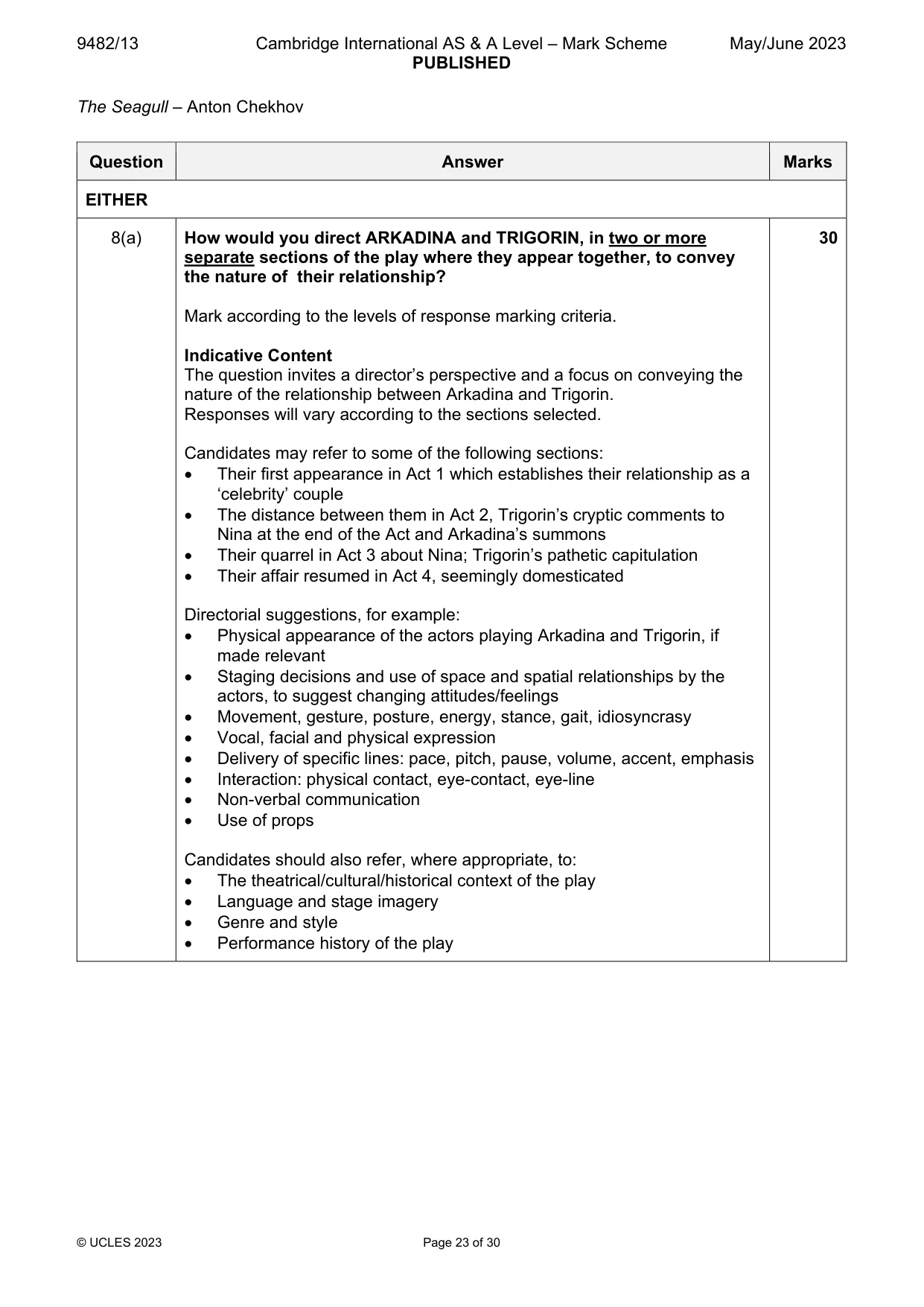
9482/13 Cambridge International AS & A Level – Mark Scheme PUBLISHED May/June 2023 © UCLES 2023 Page 23 of 30 The Seagull – Anton Chekhov Question Answer Marks EITHER 8(a) How would you direct ARKADINA and TRIGORIN, in two or more separate sections of the play where they appear together, to convey the nature of their relationship? Mark according to the levels of response marking criteria. Indicative Content The question invites a director’s perspective and a focus on conveying the nature of the relationship between Arkadina and Trigorin. Responses will vary according to the sections selected. Candidates may refer to some of the following sections: Their first appearance in Act 1 which establishes their relationship as a ‘celebrity’ couple The distance between them in Act 2, Trigorin’s cryptic comments to Nina at the end of the Act and Arkadina’s summons Their quarrel in Act 3 about Nina; Trigorin’s pathetic capitulation Their affair resumed in Act 4, seemingly domesticated Directorial suggestions, for example: Physical appearance of the actors playing Arkadina and Trigorin, if made relevant Staging decisions and use of space and spatial relationships by the actors, to suggest changing attitudes/feelings Movement, gesture, posture, energy, stance, gait, idiosyncrasy Vocal, facial and physical expression Delivery of specific lines: pace, pitch, pause, volume, accent, emphasis Interaction: physical contact, eye-contact, eye-line Non-verbal communication Use of props Candidates should also refer, where appropriate, to: The theatrical/cultural/historical context of the play Language and stage imagery Genre and style Performance history of the play 30
Mark scheme, page 24
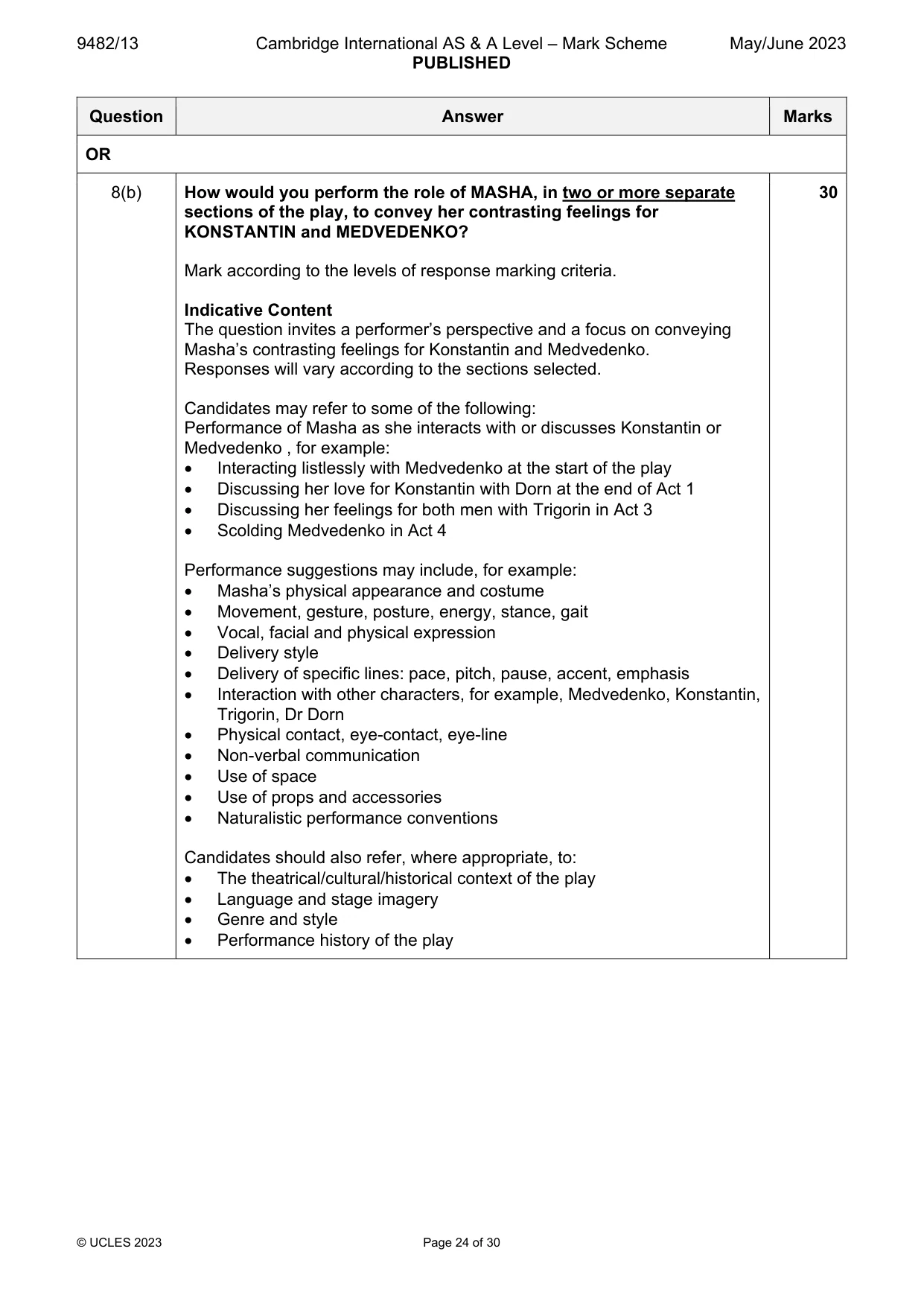
9482/13 Cambridge International AS & A Level – Mark Scheme PUBLISHED May/June 2023 © UCLES 2023 Page 24 of 30 Question Answer Marks OR 8(b) How would you perform the role of MASHA, in two or more separate sections of the play, to convey her contrasting feelings for KONSTANTIN and MEDVEDENKO? Mark according to the levels of response marking criteria. Indicative Content The question invites a performer’s perspective and a focus on conveying Masha’s contrasting feelings for Konstantin and Medvedenko. Responses will vary according to the sections selected. Candidates may refer to some of the following: Performance of Masha as she interacts with or discusses Konstantin or Medvedenko , for example: Interacting listlessly with Medvedenko at the start of the play Discussing her love for Konstantin with Dorn at the end of Act 1 Discussing her feelings for both men with Trigorin in Act 3 Scolding Medvedenko in Act 4 Performance suggestions may include, for example: Masha’s physical appearance and costume Movement, gesture, posture, energy, stance, gait Vocal, facial and physical expression Delivery style Delivery of specific lines: pace, pitch, pause, accent, emphasis Interaction with other characters, for example, Medvedenko, Konstantin, Trigorin, Dr Dorn Physical contact, eye-contact, eye-line Non-verbal communication Use of space Use of props and accessories Naturalistic performance conventions Candidates should also refer, where appropriate, to: The theatrical/cultural/historical context of the play Language and stage imagery Genre and style Performance history of the play 30
Mark scheme, page 25
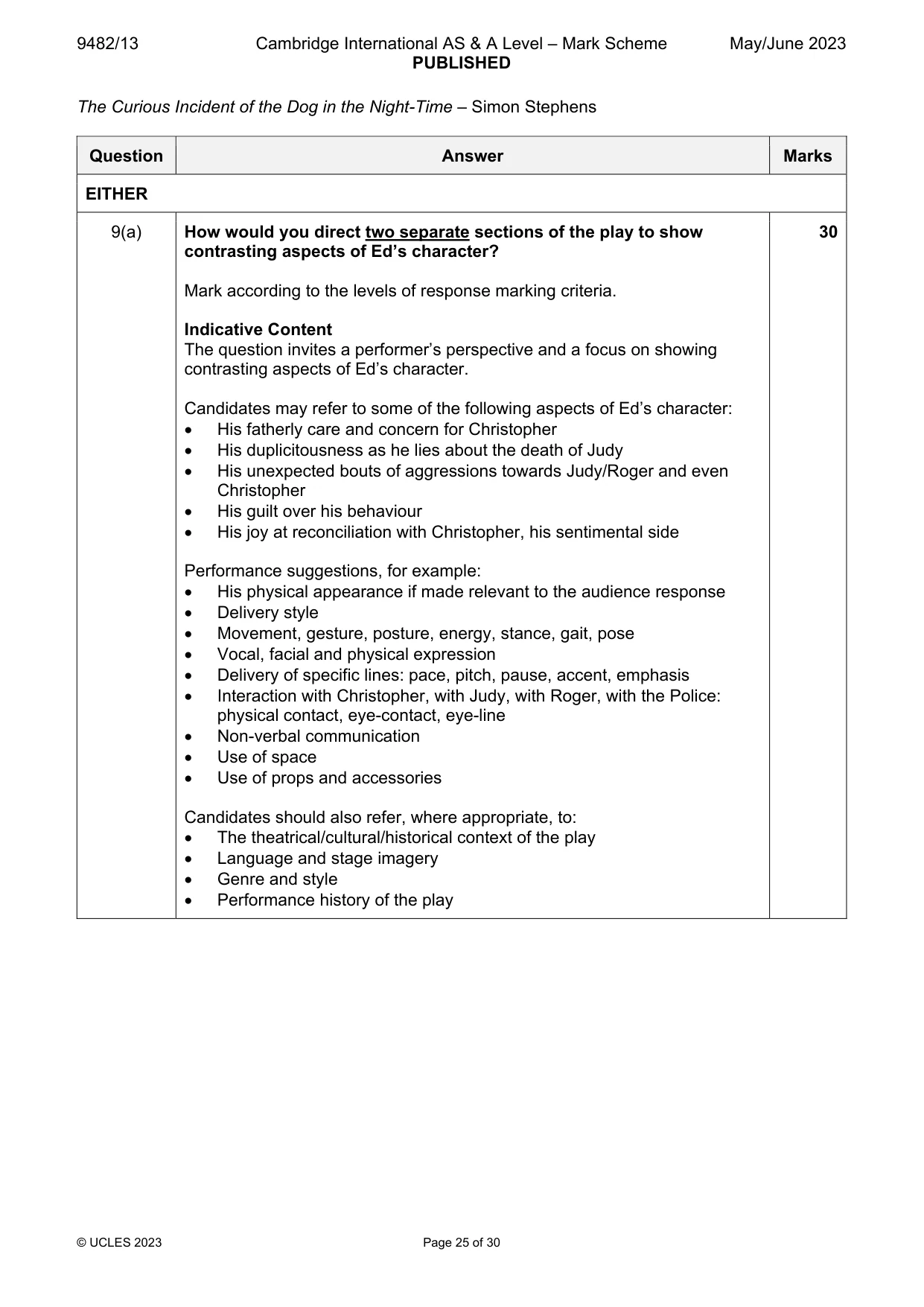
9482/13 Cambridge International AS & A Level – Mark Scheme PUBLISHED May/June 2023 © UCLES 2023 Page 25 of 30 The Curious Incident of the Dog in the Night-Time – Simon Stephens Question Answer Marks EITHER 9(a) How would you direct two separate sections of the play to show contrasting aspects of Ed’s character? Mark according to the levels of response marking criteria. Indicative Content The question invites a performer’s perspective and a focus on showing contrasting aspects of Ed’s character. Candidates may refer to some of the following aspects of Ed’s character: His fatherly care and concern for Christopher His duplicitousness as he lies about the death of Judy His unexpected bouts of aggressions towards Judy/Roger and even Christopher His guilt over his behaviour His joy at reconciliation with Christopher, his sentimental side Performance suggestions, for example: His physical appearance if made relevant to the audience response Delivery style Movement, gesture, posture, energy, stance, gait, pose Vocal, facial and physical expression Delivery of specific lines: pace, pitch, pause, accent, emphasis Interaction with Christopher, with Judy, with Roger, with the Police: physical contact, eye-contact, eye-line Non-verbal communication Use of space Use of props and accessories Candidates should also refer, where appropriate, to: The theatrical/cultural/historical context of the play Language and stage imagery Genre and style Performance history of the play 30
Mark scheme, page 26
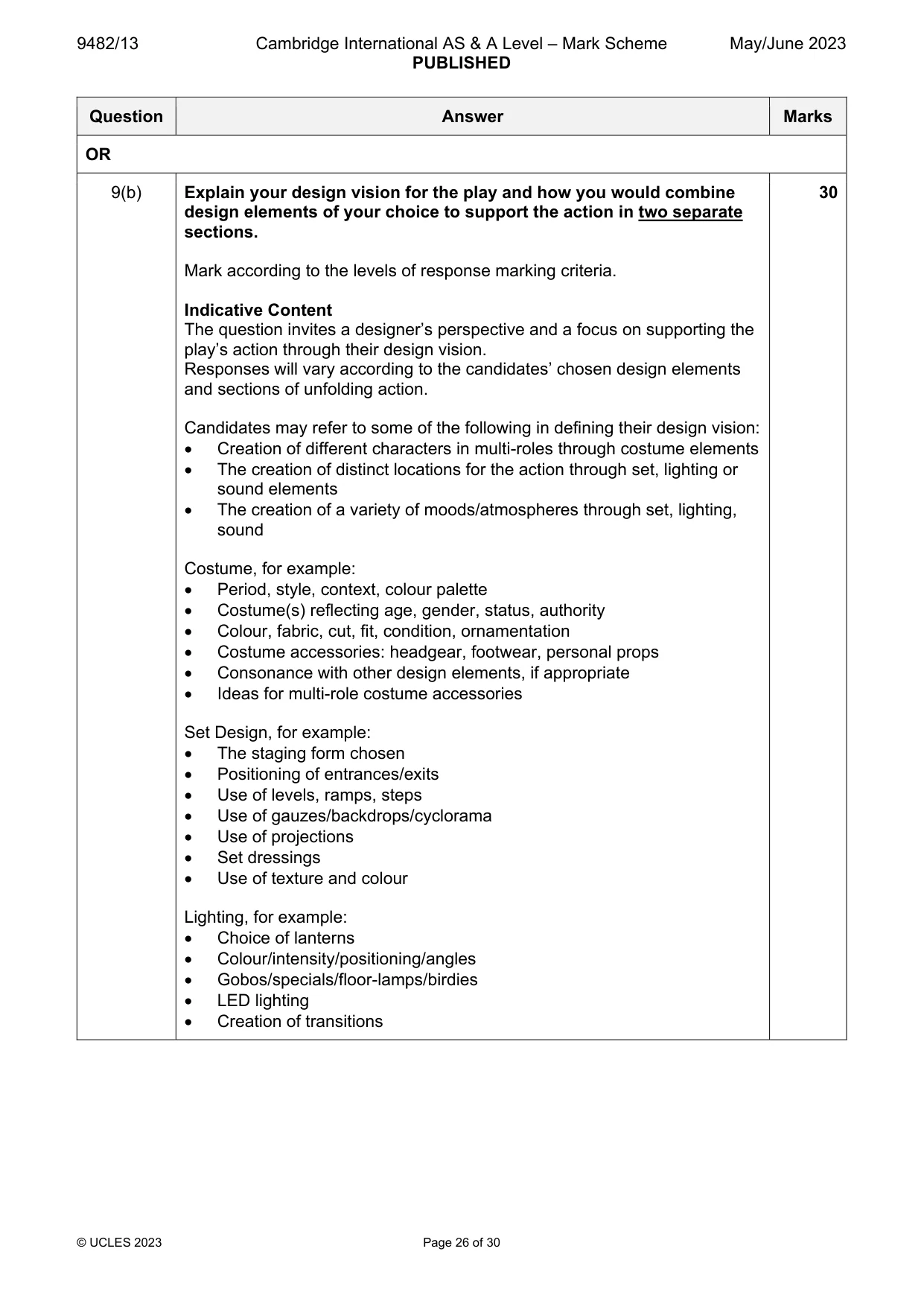
9482/13 Cambridge International AS & A Level – Mark Scheme PUBLISHED May/June 2023 © UCLES 2023 Page 26 of 30 Question Answer Marks OR 9(b) Explain your design vision for the play and how you would combine design elements of your choice to support the action in two separate sections. Mark according to the levels of response marking criteria. Indicative Content The question invites a designer’s perspective and a focus on supporting the play’s action through their design vision. Responses will vary according to the candidates’ chosen design elements and sections of unfolding action. Candidates may refer to some of the following in defining their design vision: Creation of different characters in multi-roles through costume elements The creation of distinct locations for the action through set, lighting or sound elements The creation of a variety of moods/atmospheres through set, lighting, sound Costume, for example: Period, style, context, colour palette Costume(s) reflecting age, gender, status, authority Colour, fabric, cut, fit, condition, ornamentation Costume accessories: headgear, footwear, personal props Consonance with other design elements, if appropriate Ideas for multi-role costume accessories Set Design, for example: The staging form chosen Positioning of entrances/exits Use of levels, ramps, steps Use of gauzes/backdrops/cyclorama Use of projections Set dressings Use of texture and colour Lighting, for example: Choice of lanterns Colour/intensity/positioning/angles Gobos/specials/floor-lamps/birdies LED lighting Creation of transitions 30
Mark scheme, page 27
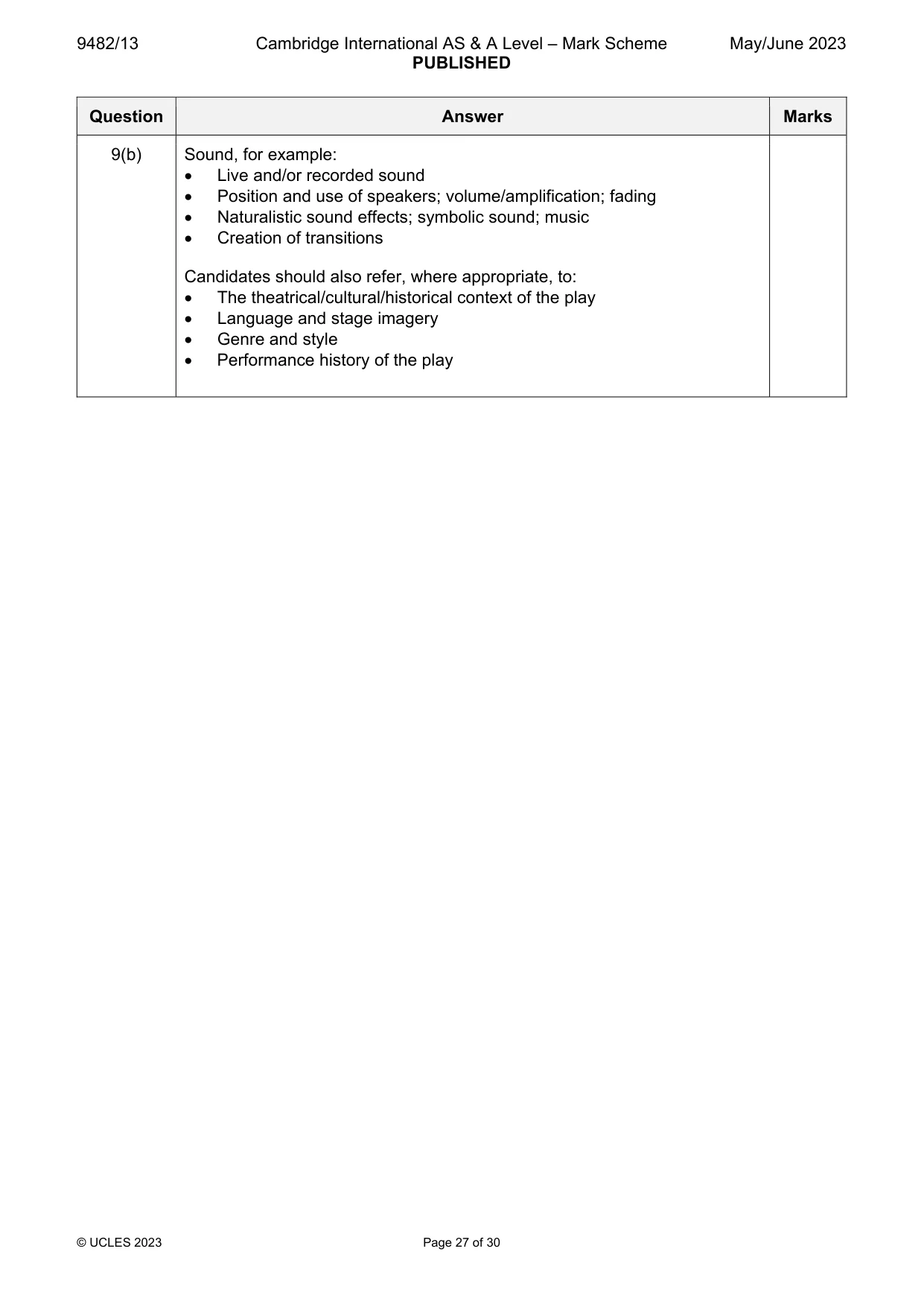
9482/13 Cambridge International AS & A Level – Mark Scheme PUBLISHED May/June 2023 © UCLES 2023 Page 27 of 30 Question Answer Marks 9(b) Sound, for example: Live and/or recorded sound Position and use of speakers; volume/amplification; fading Naturalistic sound effects; symbolic sound; music Creation of transitions Candidates should also refer, where appropriate, to: The theatrical/cultural/historical context of the play Language and stage imagery Genre and style Performance history of the play
Mark scheme, page 28
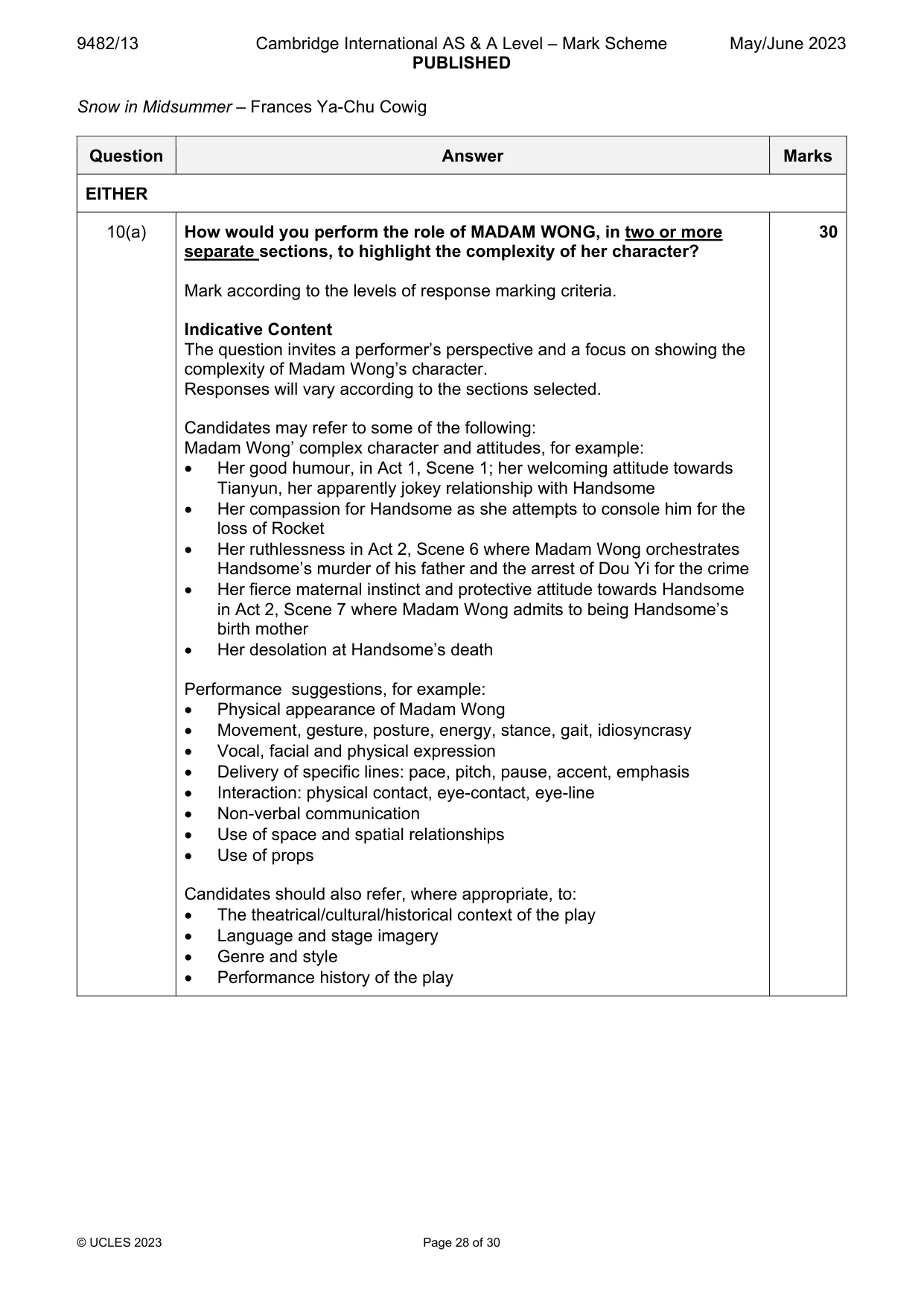
9482/13 Cambridge International AS & A Level – Mark Scheme PUBLISHED May/June 2023 © UCLES 2023 Page 28 of 30 Snow in Midsummer – Frances Ya-Chu Cowig Question Answer Marks EITHER 10(a) How would you perform the role of MADAM WONG, in two or more separate sections, to highlight the complexity of her character? Mark according to the levels of response marking criteria. Indicative Content The question invites a performer’s perspective and a focus on showing the complexity of Madam Wong’s character. Responses will vary according to the sections selected. Candidates may refer to some of the following: Madam Wong’ complex character and attitudes, for example: Her good humour, in Act 1, Scene 1; her welcoming attitude towards Tianyun, her apparently jokey relationship with Handsome Her compassion for Handsome as she attempts to console him for the loss of Rocket Her ruthlessness in Act 2, Scene 6 where Madam Wong orchestrates Handsome’s murder of his father and the arrest of Dou Yi for the crime Her fierce maternal instinct and protective attitude towards Handsome in Act 2, Scene 7 where Madam Wong admits to being Handsome’s birth mother Her desolation at Handsome’s death Performance suggestions, for example: Physical appearance of Madam Wong Movement, gesture, posture, energy, stance, gait, idiosyncrasy Vocal, facial and physical expression Delivery of specific lines: pace, pitch, pause, accent, emphasis Interaction: physical contact, eye-contact, eye-line Non-verbal communication Use of space and spatial relationships Use of props Candidates should also refer, where appropriate, to: The theatrical/cultural/historical context of the play Language and stage imagery Genre and style Performance history of the play 30
Mark scheme, page 29
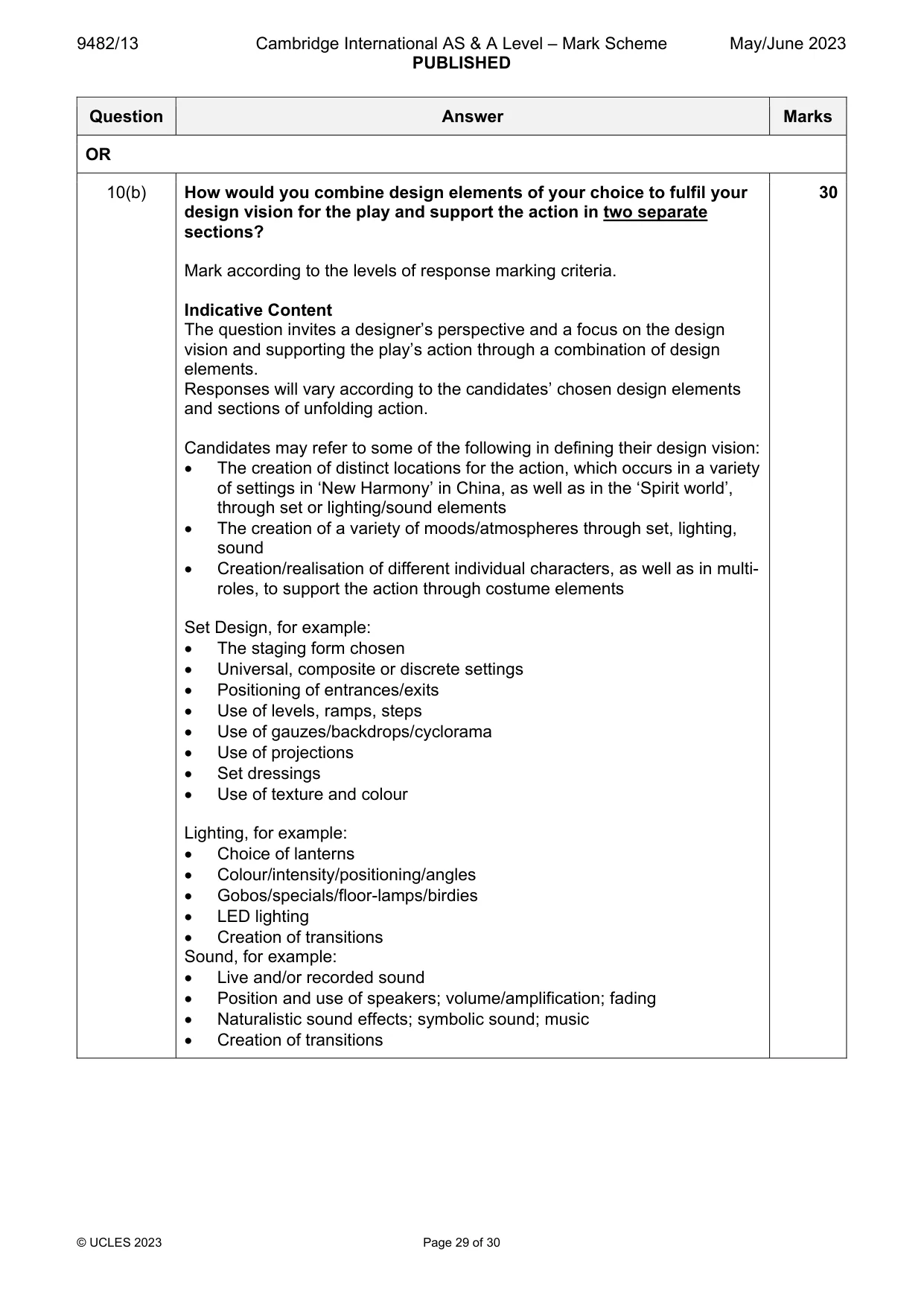
9482/13 Cambridge International AS & A Level – Mark Scheme PUBLISHED May/June 2023 © UCLES 2023 Page 29 of 30 Question Answer Marks OR 10(b) How would you combine design elements of your choice to fulfil your design vision for the play and support the action in two separate sections? Mark according to the levels of response marking criteria. Indicative Content The question invites a designer’s perspective and a focus on the design vision and supporting the play’s action through a combination of design elements. Responses will vary according to the candidates’ chosen design elements and sections of unfolding action. Candidates may refer to some of the following in defining their design vision: The creation of distinct locations for the action, which occurs in a variety of settings in ‘New Harmony’ in China, as well as in the ‘Spirit world’, through set or lighting/sound elements The creation of a variety of moods/atmospheres through set, lighting, sound Creation/realisation of different individual characters, as well as in multi- roles, to support the action through costume elements Set Design, for example: The staging form chosen Universal, composite or discrete settings Positioning of entrances/exits Use of levels, ramps, steps Use of gauzes/backdrops/cyclorama Use of projections Set dressings Use of texture and colour Lighting, for example: Choice of lanterns Colour/intensity/positioning/angles Gobos/specials/floor-lamps/birdies LED lighting Creation of transitions Sound, for example: Live and/or recorded sound Position and use of speakers; volume/amplification; fading Naturalistic sound effects; symbolic sound; music Creation of transitions 30
Mark scheme, page 30
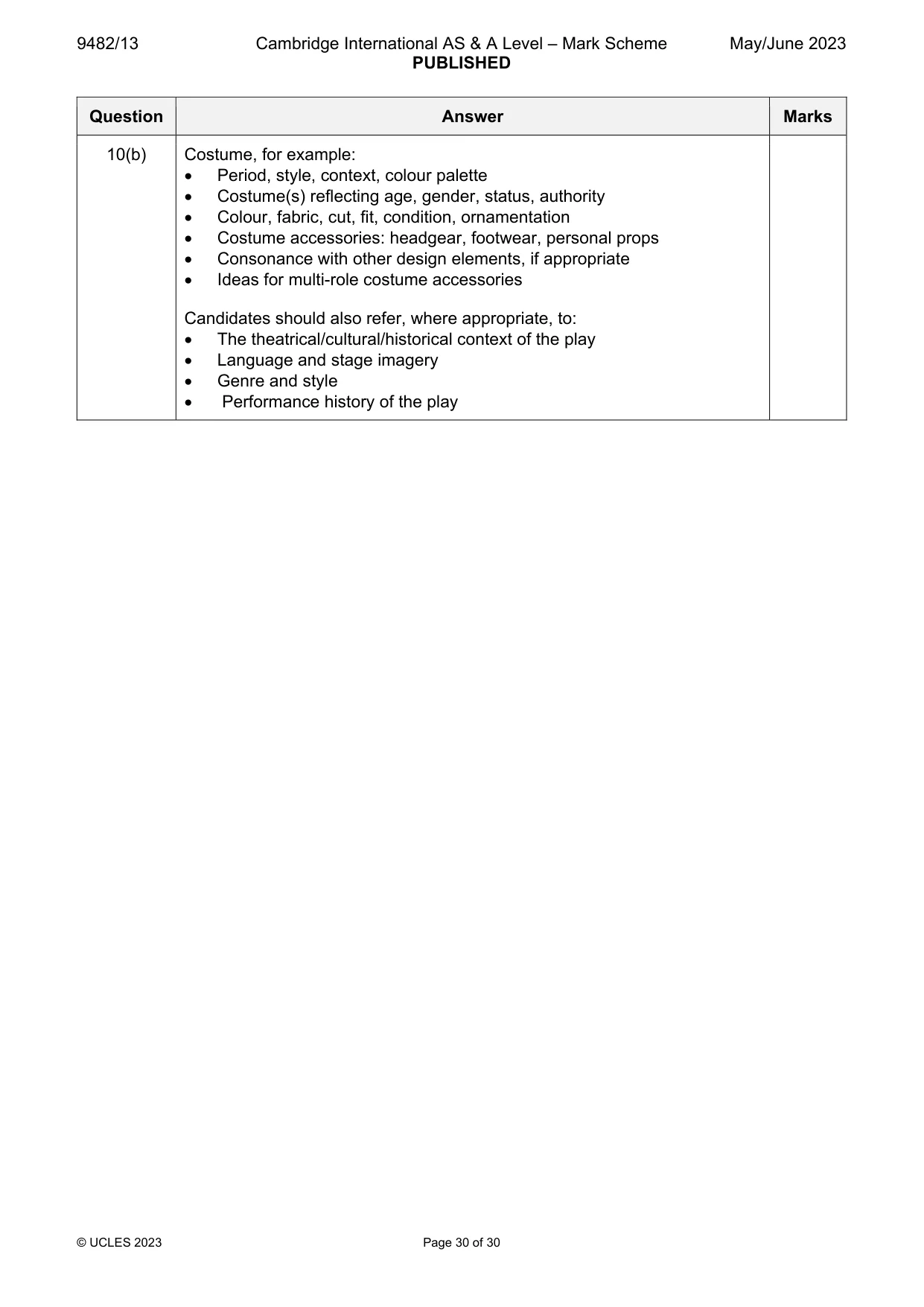
9482/13 Cambridge International AS & A Level – Mark Scheme PUBLISHED May/June 2023 © UCLES 2023 Page 30 of 30 Question Answer Marks 10(b) Costume, for example: Period, style, context, colour palette Costume(s) reflecting age, gender, status, authority Colour, fabric, cut, fit, condition, ornamentation Costume accessories: headgear, footwear, personal props Consonance with other design elements, if appropriate Ideas for multi-role costume accessories Candidates should also refer, where appropriate, to: The theatrical/cultural/historical context of the play Language and stage imagery Genre and style Performance history of the play
What you needed in this session
Cambridge’s own grade thresholds for 2023 May/June, Paper 1 · Variant 3. A higher threshold means an easier paper — the bar moves with how the cohort did.