Cambridge A Level Drama 9482 — 2025 May/June Paper 1 · Variant 3
9482/13/M/J/25 · 60 marks · 120 min
The question paper and its mark scheme, free to read here and free to download. This is Cambridge’s own paper, exactly as it was sat.
Question paper8 pages


Mark scheme27 pages
Answers below. Sit the paper first if you are practising.
Paper as text
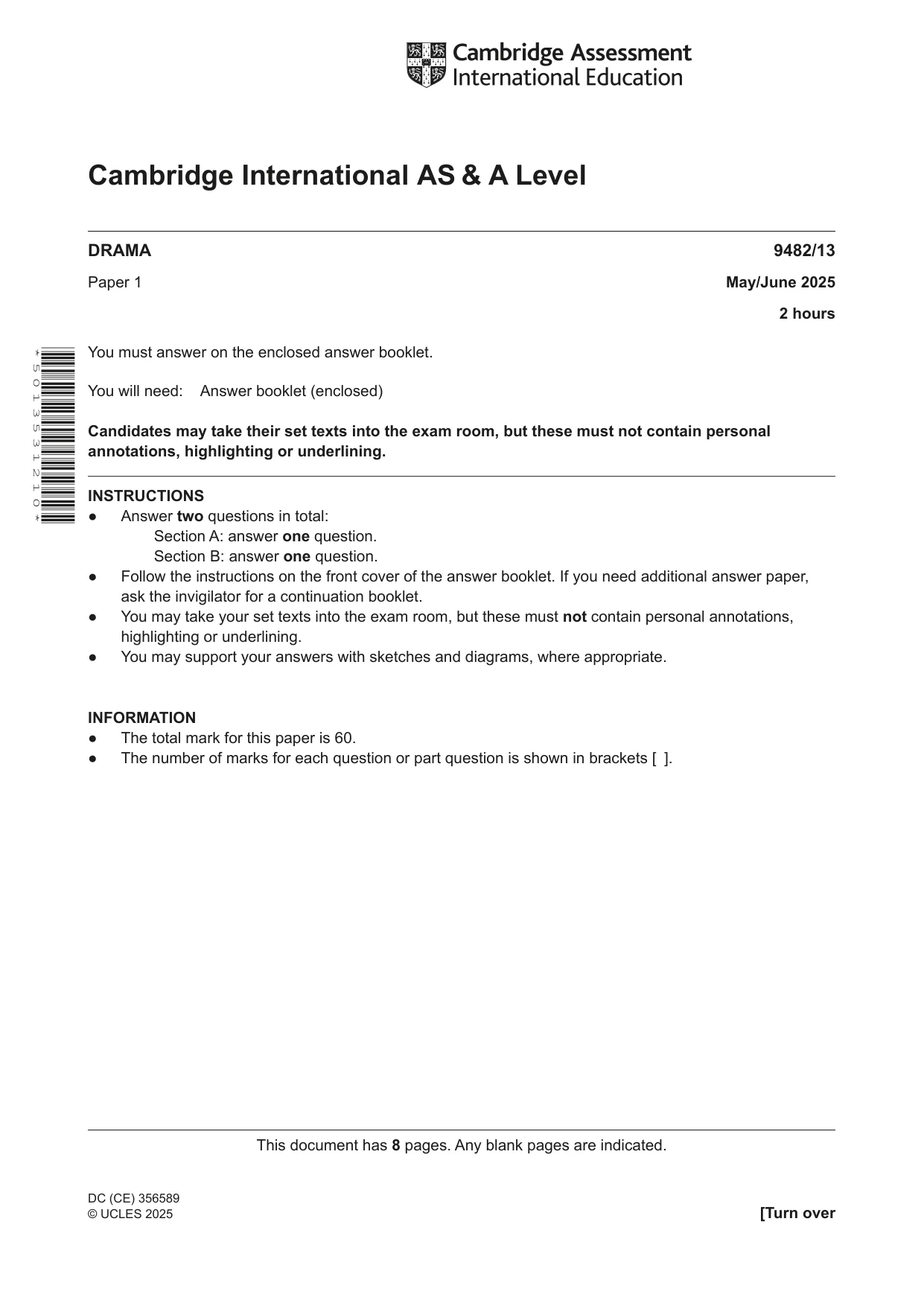
Question paper, page 1
This document has 8 pages. Any blank pages are indicated. [Turn over Cambridge International AS & A Level * 5 0 1 3 5 3 1 2 1 0 * DRAMA 9482/13 Paper 1 May/June 2025 2 hours You must answer on the enclosed answer booklet. You will need: Answer booklet (enclosed) Candidates may take their set texts into the exam room, but these must not contain personal annotations, highlighting or underlining. INSTRUCTIONS ● Answer two questions in total: Section A: answer one question. Section B: answer one question. ● Follow the instructions on the front cover of the answer booklet. If you need additional answer paper, ask the invigilator for a continuation booklet. ● You may take your set texts into the exam room, but these must not contain personal annotations, highlighting or underlining. ● You may support your answers with sketches and diagrams, where appropriate. INFORMATION ● The total mark for this paper is 60. ● The number of marks for each question or part question is shown in brackets [ ]. DC (CE) 356589 © UCLES 2025
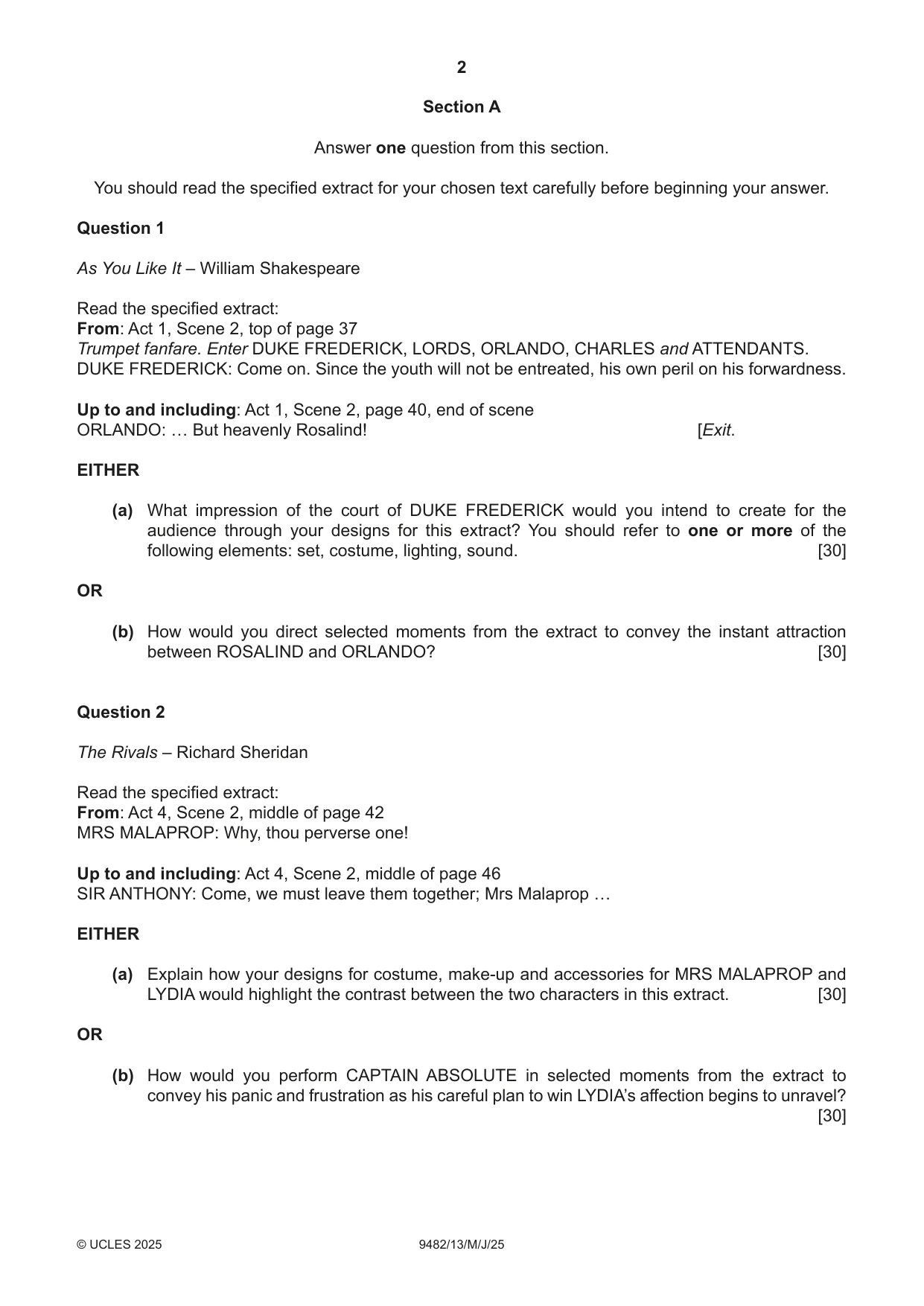
Question paper, page 2
2 9482/13/M/J/25 © UCLES 2025 Section A Answer one question from this section. You should read the specified extract for your chosen text carefully before beginning your answer. Question 1 As You Like It – William Shakespeare Read the specified extract: From: Act 1, Scene 2, top of page 37 Trumpet fanfare. Enter DUKE FREDERICK, LORDS, ORLANDO, CHARLES and ATTENDANTS. DUKE FREDERICK: Come on. Since the youth will not be entreated, his own peril on his forwardness. Up to and including: Act 1, Scene 2, page 40, end of scene ORLANDO: … But heavenly Rosalind! [Exit. EITHER (a) What impression of the court of DUKE FREDERICK would you intend to create for the audience through your designs for this extract? You should refer to one or more of the following elements: set, costume, lighting, sound. [30] OR (b) How would you direct selected moments from the extract to convey the instant attraction between ROSALIND and ORLANDO? [30] Question 2 The Rivals – Richard Sheridan Read the specified extract: From: Act 4, Scene 2, middle of page 42 MRS MALAPROP: Why, thou perverse one! Up to and including: Act 4, Scene 2, middle of page 46 SIR ANTHONY: Come, we must leave them together; Mrs Malaprop … EITHER (a) Explain how your designs for costume, make-up and accessories for MRS MALAPROP and LYDIA would highlight the contrast between the two characters in this extract. [30] OR (b) How would you perform CAPTAIN ABSOLUTE in selected moments from the extract to convey his panic and frustration as his careful plan to win LYDIA’s affection begins to unravel? [30]
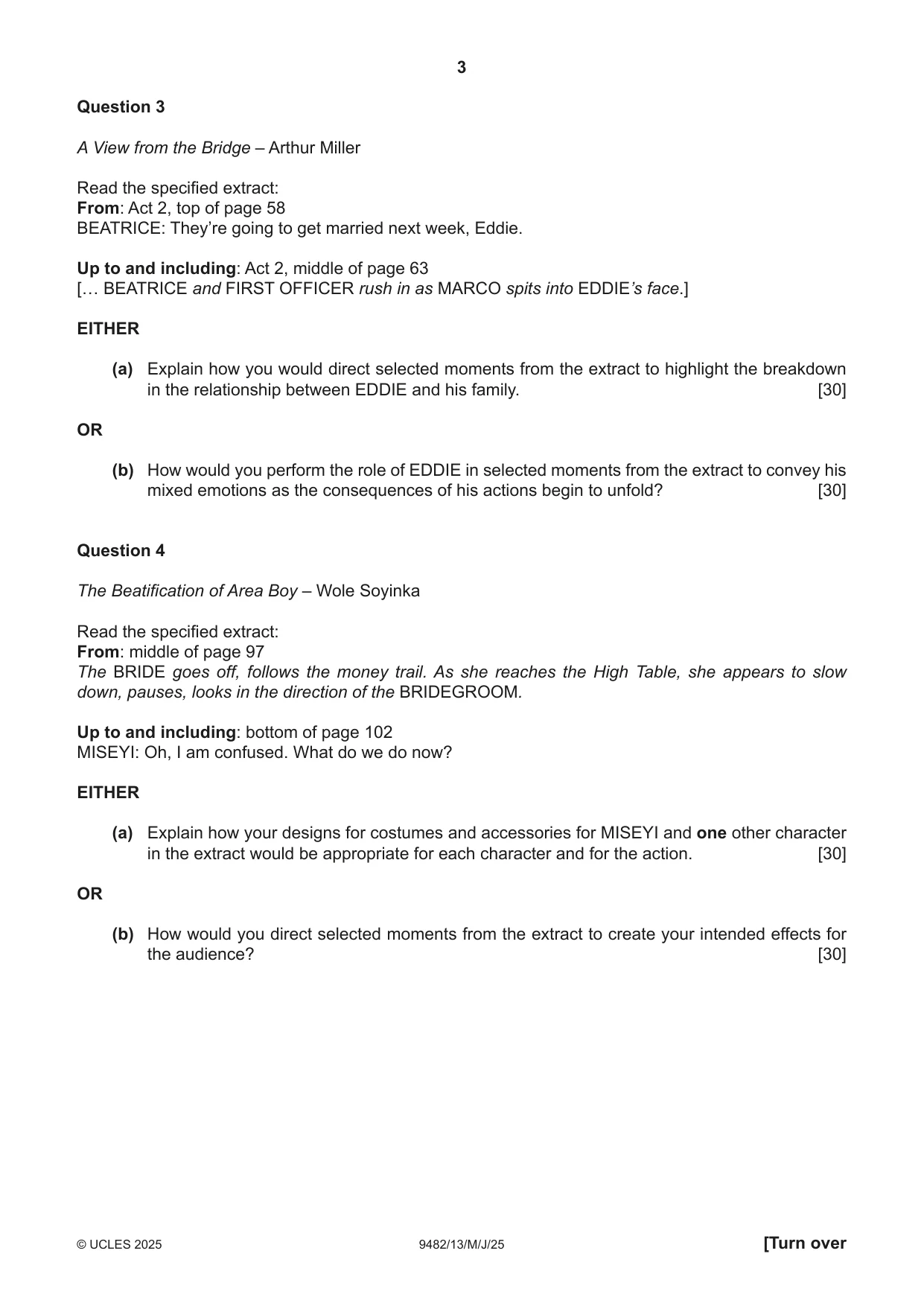
Question paper, page 3
3 9482/13/M/J/25 © UCLES 2025 [Turn over Question 3 A View from the Bridge – Arthur Miller Read the specified extract: From: Act 2, top of page 58 BEATRICE: They’re going to get married next week, Eddie. Up to and including: Act 2, middle of page 63 [… BEATRICE and FIRST OFFICER rush in as MARCO spits into EDDIE’s face.] EITHER (a) Explain how you would direct selected moments from the extract to highlight the breakdown in the relationship between EDDIE and his family. [30] OR (b) How would you perform the role of EDDIE in selected moments from the extract to convey his mixed emotions as the consequences of his actions begin to unfold? [30] Question 4 The Beatification of Area Boy – Wole Soyinka Read the specified extract: From: middle of page 97 The BRIDE goes off, follows the money trail. As she reaches the High Table, she appears to slow down, pauses, looks in the direction of the BRIDEGROOM. Up to and including: bottom of page 102 MISEYI: Oh, I am confused. What do we do now? EITHER (a) Explain how your designs for costumes and accessories for MISEYI and one other character in the extract would be appropriate for each character and for the action. [30] OR (b) How would you direct selected moments from the extract to create your intended effects for the audience? [30]
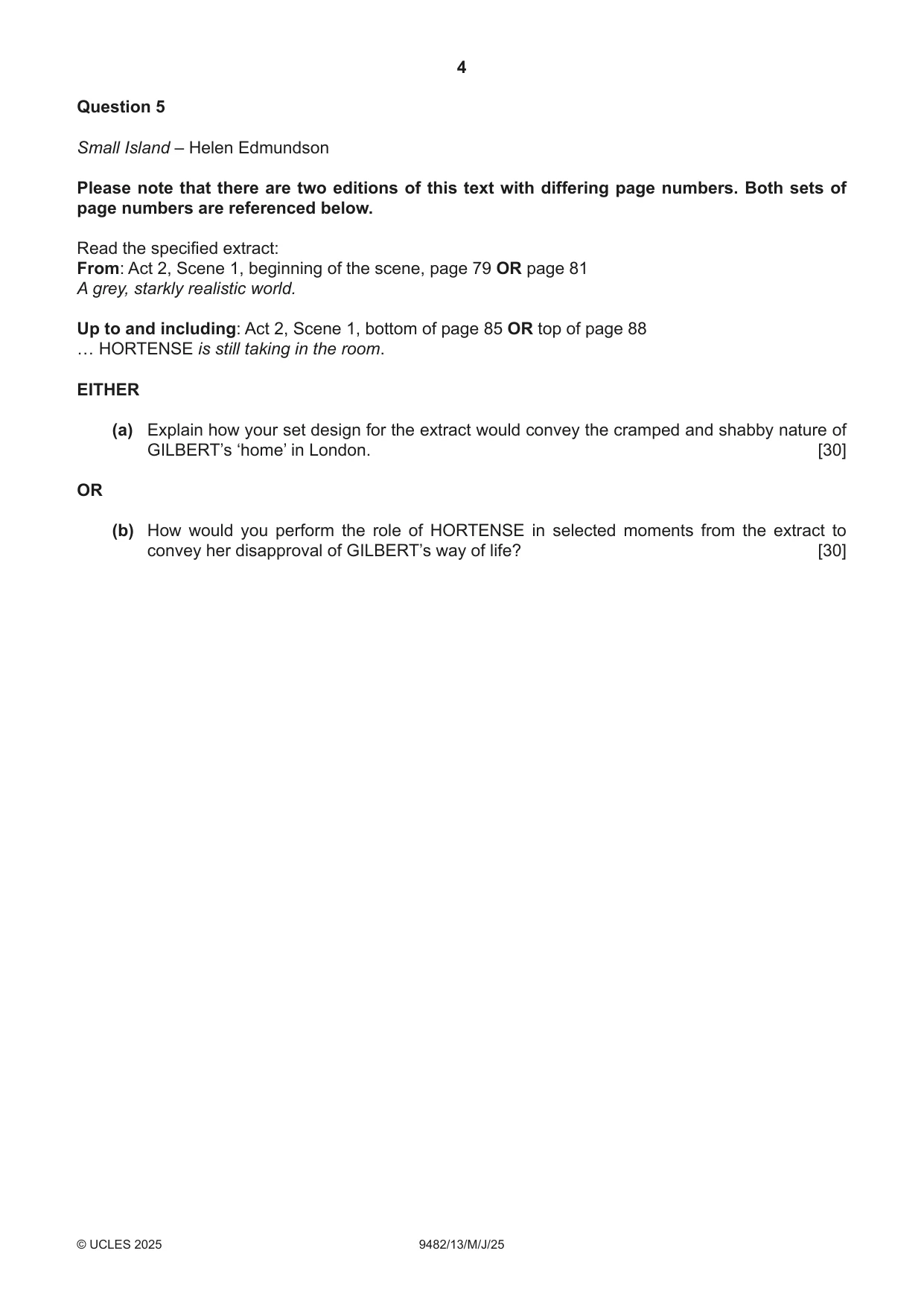
Question paper, page 4
4 9482/13/M/J/25 © UCLES 2025 Question 5 Small Island – Helen Edmundson Please note that there are two editions of this text with differing page numbers. Both sets of page numbers are referenced below. Read the specified extract: From: Act 2, Scene 1, beginning of the scene, page 79 OR page 81 A grey, starkly realistic world. Up to and including: Act 2, Scene 1, bottom of page 85 OR top of page 88 … HORTENSE is still taking in the room. EITHER (a) Explain how your set design for the extract would convey the cramped and shabby nature of GILBERT’s ‘home’ in London. [30] OR (b) How would you perform the role of HORTENSE in selected moments from the extract to convey her disapproval of GILBERT’s way of life? [30]
Question paper, page 5
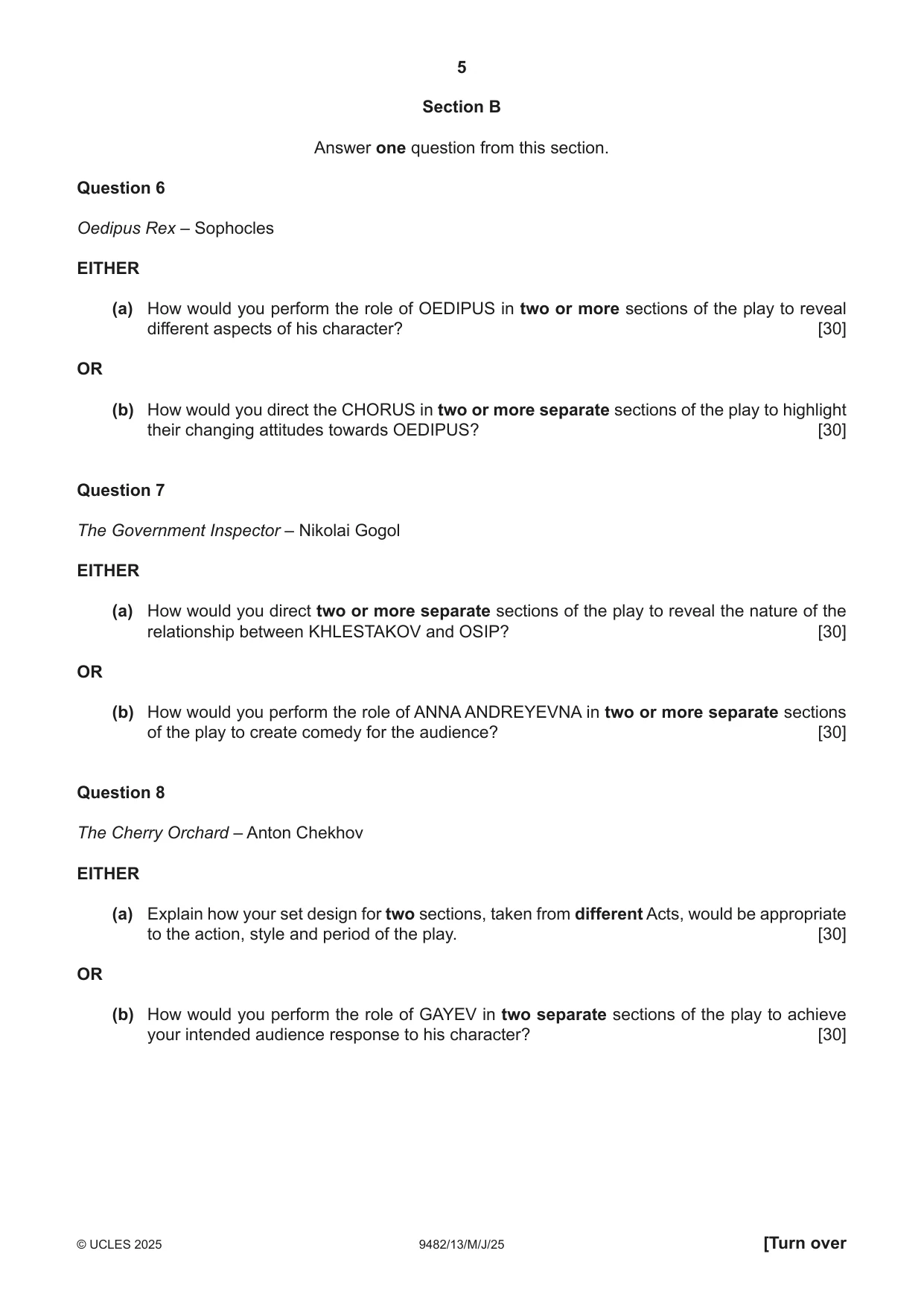
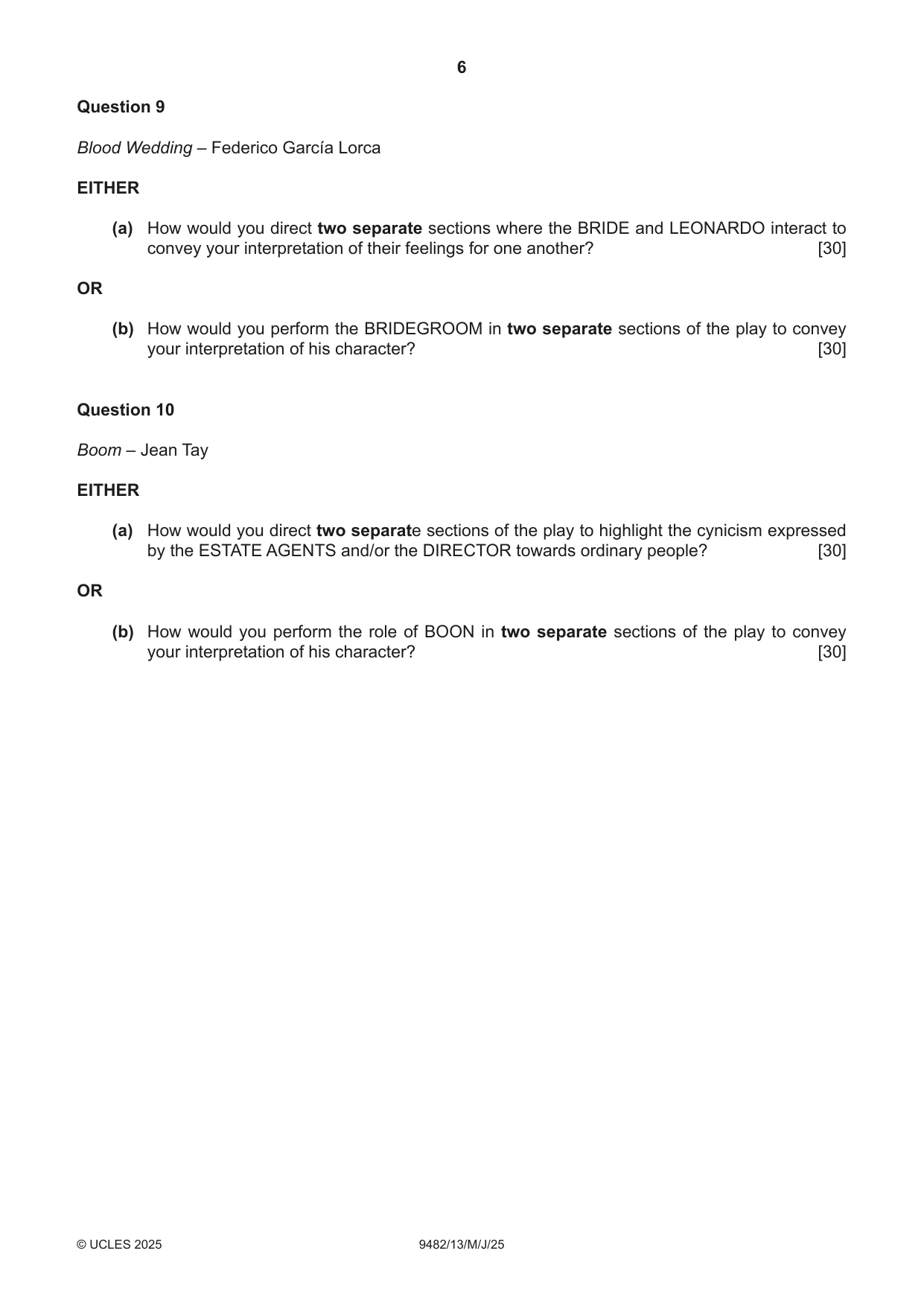
5 9482/13/M/J/25 © UCLES 2025 [Turn over Section B Answer one question from this section. Question 6 Oedipus Rex – Sophocles EITHER (a) How would you perform the role of OEDIPUS in two or more sections of the play to reveal different aspects of his character? [30] OR (b) How would you direct the CHORUS in two or more separate sections of the play to highlight their changing attitudes towards OEDIPUS? [30] Question 7 The Government Inspector – Nikolai Gogol EITHER (a) How would you direct two or more separate sections of the play to reveal the nature of the relationship between KHLESTAKOV and OSIP? [30] OR (b) How would you perform the role of ANNA ANDREYEVNA in two or more separate sections of the play to create comedy for the audience? [30] Question 8 The Cherry Orchard – Anton Chekhov EITHER (a) Explain how your set design for two sections, taken from different Acts, would be appropriate to the action, style and period of the play. [30] OR (b) How would you perform the role of GAYEV in two separate sections of the play to achieve your intended audience response to his character? [30]
Question paper, page 6
6 9482/13/M/J/25 © UCLES 2025 Question 9 Blood Wedding – Federico García Lorca EITHER (a) How would you direct two separate sections where the BRIDE and LEONARDO interact to convey your interpretation of their feelings for one another? [30] OR (b) How would you perform the BRIDEGROOM in two separate sections of the play to convey your interpretation of his character? [30] Question 10 Boom – Jean Tay EITHER (a) How would you direct two separate sections of the play to highlight the cynicism expressed by the ESTATE AGENTS and/or the DIRECTOR towards ordinary people? [30] OR (b) How would you perform the role of BOON in two separate sections of the play to convey your interpretation of his character? [30]
Question paper, page 7
7 9482/13/M/J/25 © UCLES 2025 BLANK PAGE
Question paper, page 8
8 9482/13/M/J/25 © UCLES 2025 Permission to reproduce items where third-party owned material protected by copyright is included has been sought and cleared where possible. Every reasonable effort has been made by the publisher (UCLES) to trace copyright holders, but if any items requiring clearance have unwittingly been included, the publisher will be pleased to make amends at the earliest possible opportunity. To avoid the issue of disclosure of answer-related information to candidates, all copyright acknowledgements are reproduced online in the Cambridge Assessment International Education Copyright Acknowledgements Booklet. This is produced for each series of examinations and is freely available to download at www.cambridgeinternational.org after the live examination series. Cambridge Assessment International Education is part of Cambridge Assessment. Cambridge Assessment is the brand name of the University of Cambridge Local Examinations Syndicate (UCLES), which is a department of the University of Cambridge. BLANK PAGE
Mark scheme, page 1
This document consists of 27 printed pages. © Cambridge University Press & Assessment 2025 [Turn over Cambridge International AS & A Level DRAMA 9482/13 Paper 1 Open-Book Written Examination May/June 2025 MARK SCHEME Maximum Mark: 60 Published This mark scheme is published as an aid to teachers and candidates, to indicate the requirements of the examination. It shows the basis on which Examiners were instructed to award marks. It does not indicate the details of the discussions that took place at an Examiners’ meeting before marking began, which would have considered the acceptability of alternative answers. Mark schemes should be read in conjunction with the question paper and the Principal Examiner Report for Teachers. Cambridge International will not enter into discussions about these mark schemes. Cambridge International is publishing the mark schemes for the May/June 2025 series for most Cambridge IGCSE, Cambridge International A and AS Level components, and some Cambridge O Level components.
Mark scheme, page 2
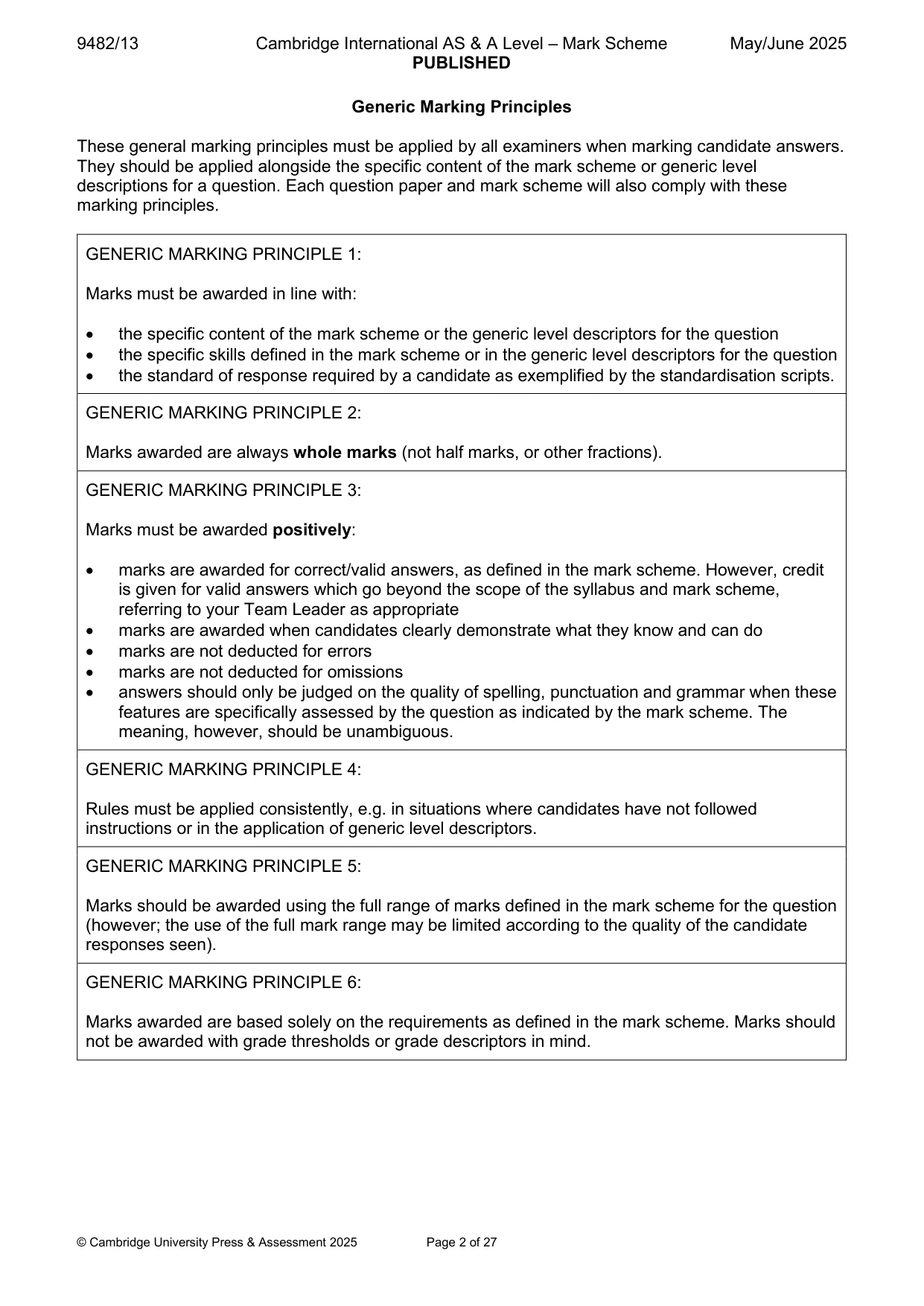
9482/13 Cambridge International AS & A Level – Mark Scheme PUBLISHED May/June 2025 © Cambridge University Press & Assessment 2025 Page 2 of 27 Generic Marking Principles These general marking principles must be applied by all examiners when marking candidate answers. They should be applied alongside the specific content of the mark scheme or generic level descriptions for a question. Each question paper and mark scheme will also comply with these marking principles. GENERIC MARKING PRINCIPLE 1: Marks must be awarded in line with: • the specific content of the mark scheme or the generic level descriptors for the question • the specific skills defined in the mark scheme or in the generic level descriptors for the question • the standard of response required by a candidate as exemplified by the standardisation scripts. GENERIC MARKING PRINCIPLE 2: Marks awarded are always whole marks (not half marks, or other fractions). GENERIC MARKING PRINCIPLE 3: Marks must be awarded positively: • marks are awarded for correct/valid answers, as defined in the mark scheme. However, credit is given for valid answers which go beyond the scope of the syllabus and mark scheme, referring to your Team Leader as appropriate • marks are awarded when candidates clearly demonstrate what they know and can do • marks are not deducted for errors • marks are not deducted for omissions • answers should only be judged on the quality of spelling, punctuation and grammar when these features are specifically assessed by the question as indicated by the mark scheme. The meaning, however, should be unambiguous. GENERIC MARKING PRINCIPLE 4: Rules must be applied consistently, e.g. in situations where candidates have not followed instructions or in the application of generic level descriptors. GENERIC MARKING PRINCIPLE 5: Marks should be awarded using the full range of marks defined in the mark scheme for the question (however; the use of the full mark range may be limited according to the quality of the candidate responses seen). GENERIC MARKING PRINCIPLE 6: Marks awarded are based solely on the requirements as defined in the mark scheme. Marks should not be awarded with grade thresholds or grade descriptors in mind.
Mark scheme, page 3
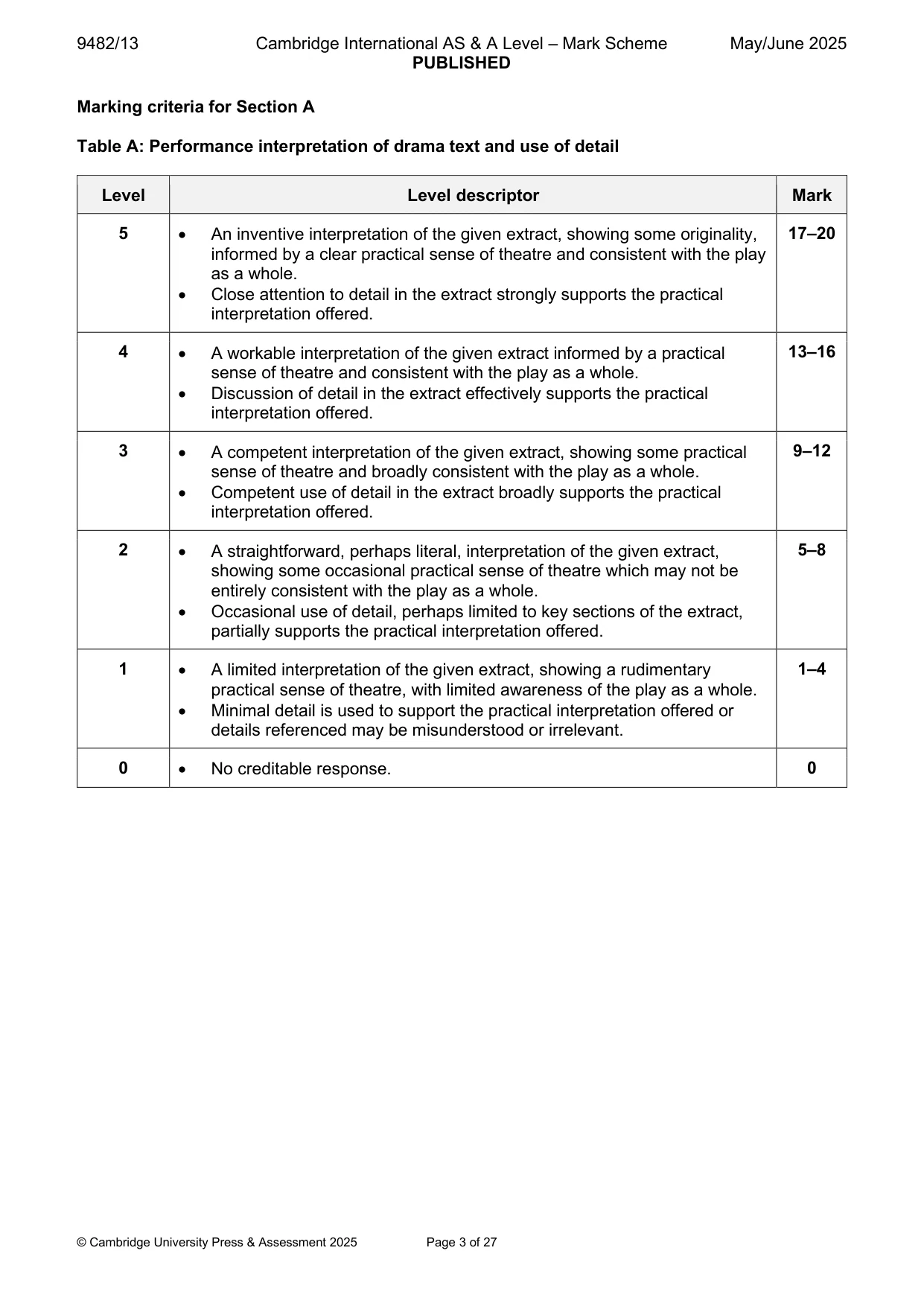
9482/13 Cambridge International AS & A Level – Mark Scheme PUBLISHED May/June 2025 © Cambridge University Press & Assessment 2025 Page 3 of 27 Marking criteria for Section A Table A: Performance interpretation of drama text and use of detail Level Level descriptor Mark 5 • An inventive interpretation of the given extract, showing some originality, informed by a clear practical sense of theatre and consistent with the play as a whole. • Close attention to detail in the extract strongly supports the practical interpretation offered. 17–20 4 • A workable interpretation of the given extract informed by a practical sense of theatre and consistent with the play as a whole. • Discussion of detail in the extract effectively supports the practical interpretation offered. 13–16 3 • A competent interpretation of the given extract, showing some practical sense of theatre and broadly consistent with the play as a whole. • Competent use of detail in the extract broadly supports the practical interpretation offered. 9–12 2 • A straightforward, perhaps literal, interpretation of the given extract, showing some occasional practical sense of theatre which may not be entirely consistent with the play as a whole. • Occasional use of detail, perhaps limited to key sections of the extract, partially supports the practical interpretation offered. 5–8 1 • A limited interpretation of the given extract, showing a rudimentary practical sense of theatre, with limited awareness of the play as a whole. • Minimal detail is used to support the practical interpretation offered or details referenced may be misunderstood or irrelevant. 1–4 0 • No creditable response. 0
Mark scheme, page 4
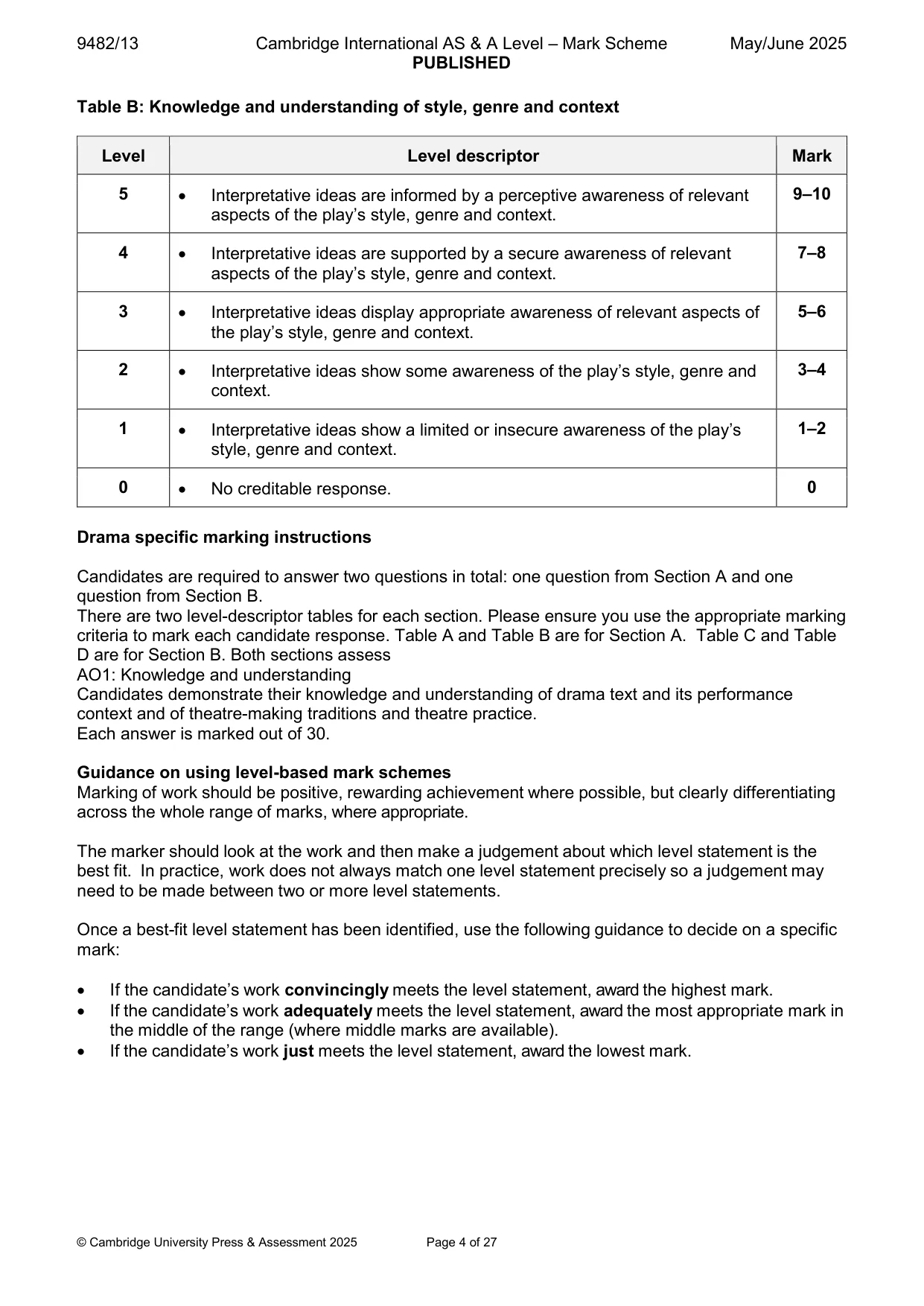
9482/13 Cambridge International AS & A Level – Mark Scheme PUBLISHED May/June 2025 © Cambridge University Press & Assessment 2025 Page 4 of 27 Table B: Knowledge and understanding of style, genre and context Level Level descriptor Mark 5 • Interpretative ideas are informed by a perceptive awareness of relevant aspects of the play’s style, genre and context. 9–10 4 • Interpretative ideas are supported by a secure awareness of relevant aspects of the play’s style, genre and context. 7–8 3 • Interpretative ideas display appropriate awareness of relevant aspects of the play’s style, genre and context. 5–6 2 • Interpretative ideas show some awareness of the play’s style, genre and context. 3–4 1 • Interpretative ideas show a limited or insecure awareness of the play’s style, genre and context. 1–2 0 • No creditable response. 0 Drama specific marking instructions Candidates are required to answer two questions in total: one question from Section A and one question from Section B. There are two level-descriptor tables for each section. Please ensure you use the appropriate marking criteria to mark each candidate response. Table A and Table B are for Section A. Table C and Table D are for Section B. Both sections assess AO1: Knowledge and understanding Candidates demonstrate their knowledge and understanding of drama text and its performance context and of theatre-making traditions and theatre practice. Each answer is marked out of 30. Guidance on using level-based mark schemes Marking of work should be positive, rewarding achievement where possible, but clearly differentiating across the whole range of marks, where appropriate. The marker should look at the work and then make a judgement about which level statement is the best fit. In practice, work does not always match one level statement precisely so a judgement may need to be made between two or more level statements. Once a best-fit level statement has been identified, use the following guidance to decide on a specific mark: • If the candidate’s work convincingly meets the level statement, award the highest mark. • If the candidate’s work adequately meets the level statement, award the most appropriate mark in the middle of the range (where middle marks are available). • If the candidate’s work just meets the level statement, award the lowest mark.
Mark scheme, page 5
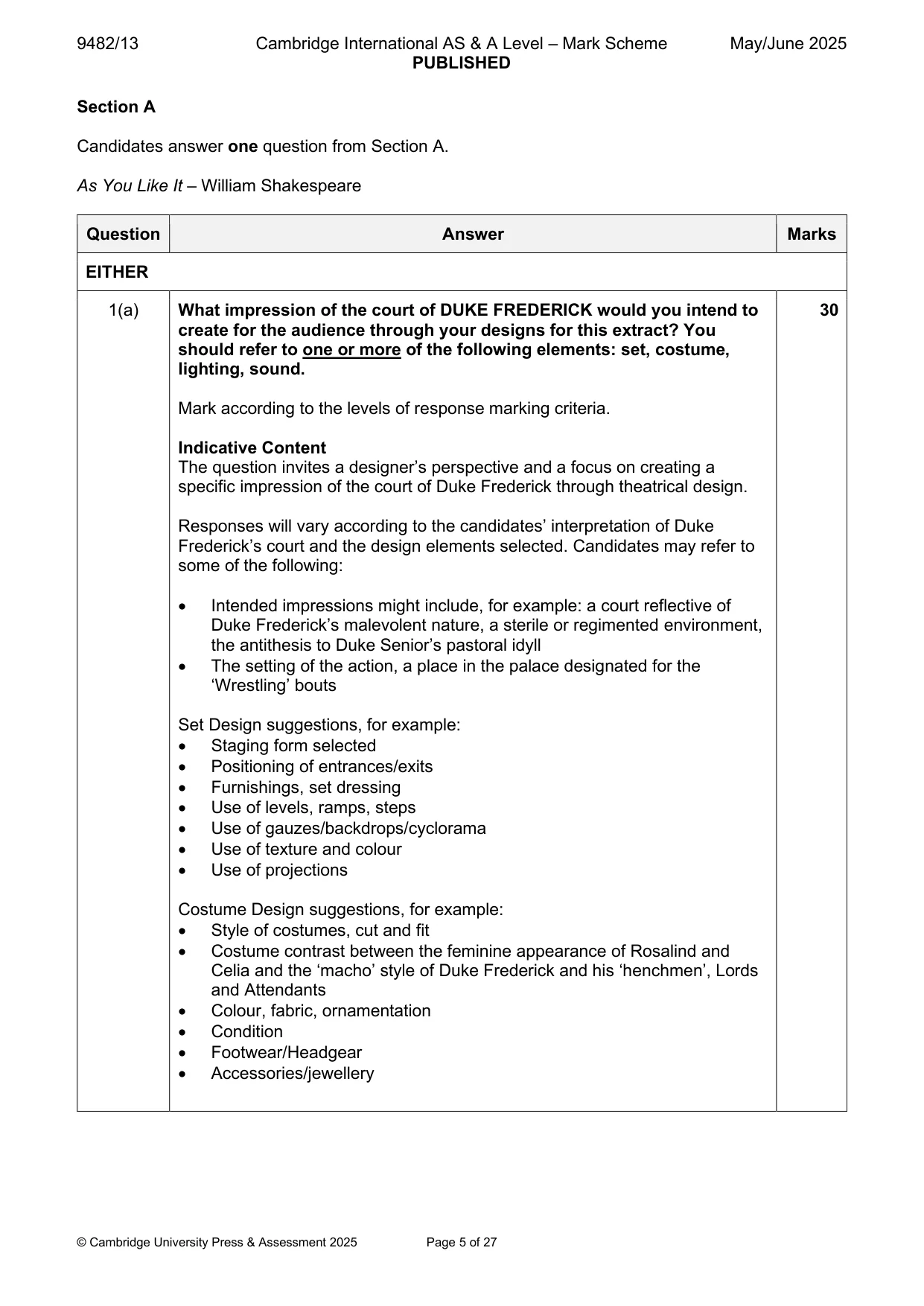
9482/13 Cambridge International AS & A Level – Mark Scheme PUBLISHED May/June 2025 © Cambridge University Press & Assessment 2025 Page 5 of 27 Section A Candidates answer one question from Section A. As You Like It – William Shakespeare Question Answer Marks EITHER 1(a) What impression of the court of DUKE FREDERICK would you intend to create for the audience through your designs for this extract? You should refer to one or more of the following elements: set, costume, lighting, sound. Mark according to the levels of response marking criteria. Indicative Content The question invites a designer’s perspective and a focus on creating a specific impression of the court of Duke Frederick through theatrical design. Responses will vary according to the candidates’ interpretation of Duke Frederick’s court and the design elements selected. Candidates may refer to some of the following: • Intended impressions might include, for example: a court reflective of Duke Frederick’s malevolent nature, a sterile or regimented environment, the antithesis to Duke Senior’s pastoral idyll • The setting of the action, a place in the palace designated for the ‘Wrestling’ bouts Set Design suggestions, for example: • Staging form selected • Positioning of entrances/exits • Furnishings, set dressing • Use of levels, ramps, steps • Use of gauzes/backdrops/cyclorama • Use of texture and colour • Use of projections Costume Design suggestions, for example: • Style of costumes, cut and fit • Costume contrast between the feminine appearance of Rosalind and Celia and the ‘macho’ style of Duke Frederick and his ‘henchmen’, Lords and Attendants • Colour, fabric, ornamentation • Condition • Footwear/Headgear • Accessories/jewellery 30
Mark scheme, page 6
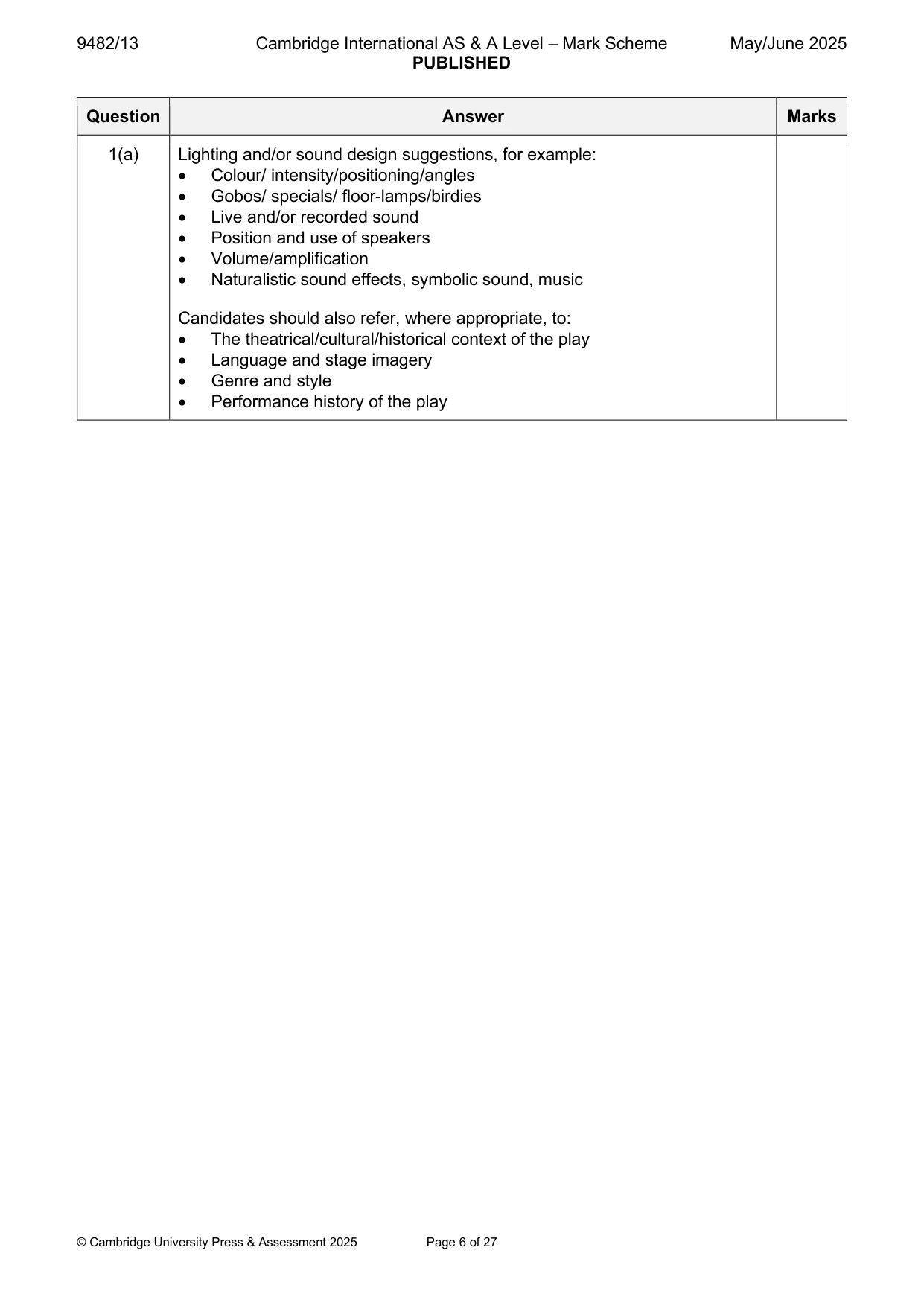
9482/13 Cambridge International AS & A Level – Mark Scheme PUBLISHED May/June 2025 © Cambridge University Press & Assessment 2025 Page 6 of 27 Question Answer Marks 1(a) Lighting and/or sound design suggestions, for example: • Colour/ intensity/positioning/angles • Gobos/ specials/ floor-lamps/birdies • Live and/or recorded sound • Position and use of speakers • Volume/amplification • Naturalistic sound effects, symbolic sound, music Candidates should also refer, where appropriate, to: • The theatrical/cultural/historical context of the play • Language and stage imagery • Genre and style • Performance history of the play
Mark scheme, page 7
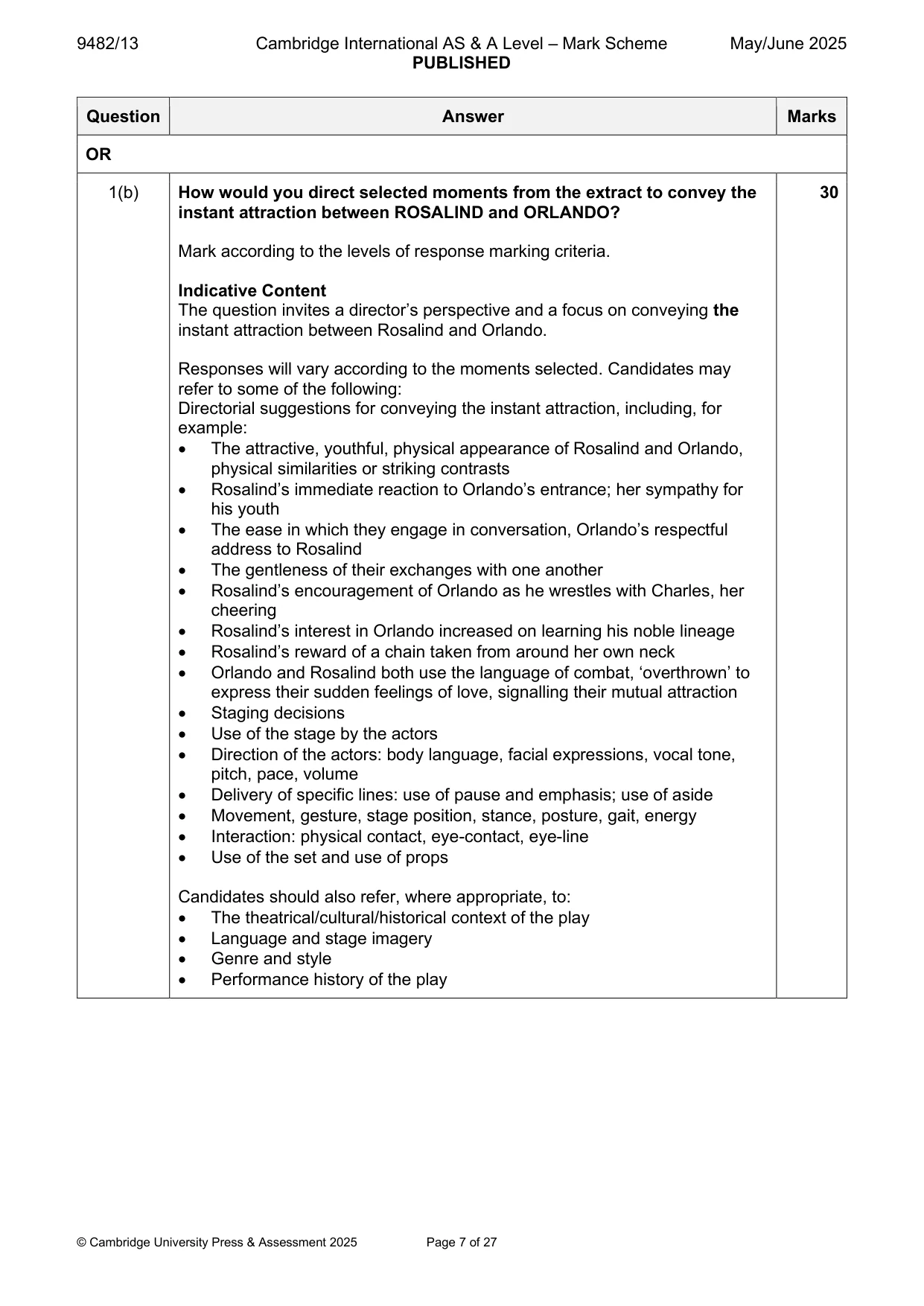
9482/13 Cambridge International AS & A Level – Mark Scheme PUBLISHED May/June 2025 © Cambridge University Press & Assessment 2025 Page 7 of 27 Question Answer Marks OR 1(b) How would you direct selected moments from the extract to convey the instant attraction between ROSALIND and ORLANDO? Mark according to the levels of response marking criteria. Indicative Content The question invites a director’s perspective and a focus on conveying the instant attraction between Rosalind and Orlando. Responses will vary according to the moments selected. Candidates may refer to some of the following: Directorial suggestions for conveying the instant attraction, including, for example: • The attractive, youthful, physical appearance of Rosalind and Orlando, physical similarities or striking contrasts • Rosalind’s immediate reaction to Orlando’s entrance; her sympathy for his youth • The ease in which they engage in conversation, Orlando’s respectful address to Rosalind • The gentleness of their exchanges with one another • Rosalind’s encouragement of Orlando as he wrestles with Charles, her cheering • Rosalind’s interest in Orlando increased on learning his noble lineage • Rosalind’s reward of a chain taken from around her own neck • Orlando and Rosalind both use the language of combat, ‘overthrown’ to express their sudden feelings of love, signalling their mutual attraction • Staging decisions • Use of the stage by the actors • Direction of the actors: body language, facial expressions, vocal tone, pitch, pace, volume • Delivery of specific lines: use of pause and emphasis; use of aside • Movement, gesture, stage position, stance, posture, gait, energy • Interaction: physical contact, eye-contact, eye-line • Use of the set and use of props Candidates should also refer, where appropriate, to: • The theatrical/cultural/historical context of the play • Language and stage imagery • Genre and style • Performance history of the play 30
Mark scheme, page 8
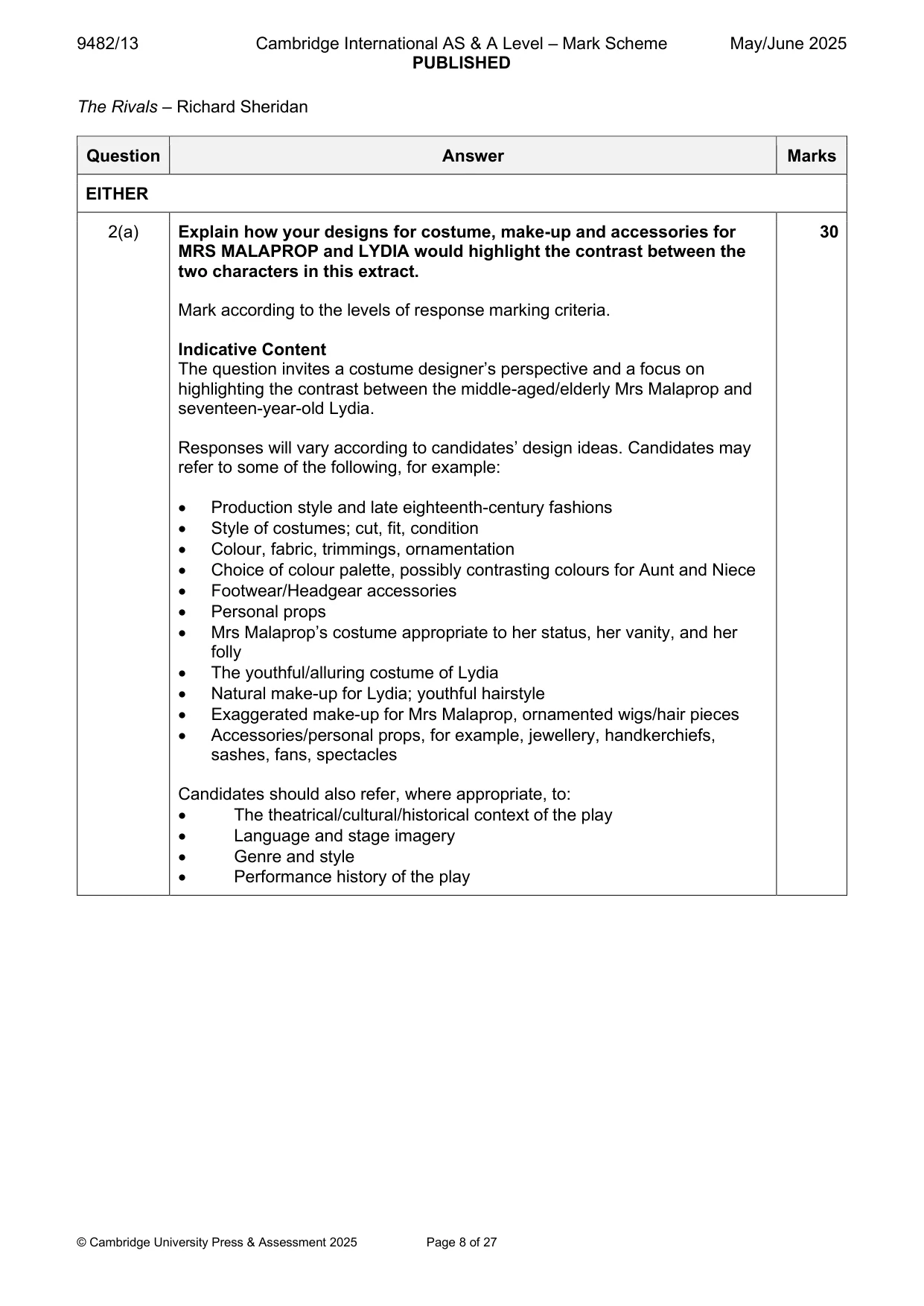
9482/13 Cambridge International AS & A Level – Mark Scheme PUBLISHED May/June 2025 © Cambridge University Press & Assessment 2025 Page 8 of 27 The Rivals – Richard Sheridan Question Answer Marks EITHER 2(a) Explain how your designs for costume, make-up and accessories for MRS MALAPROP and LYDIA would highlight the contrast between the two characters in this extract. Mark according to the levels of response marking criteria. Indicative Content The question invites a costume designer’s perspective and a focus on highlighting the contrast between the middle-aged/elderly Mrs Malaprop and seventeen-year-old Lydia. Responses will vary according to candidates’ design ideas. Candidates may refer to some of the following, for example: • Production style and late eighteenth-century fashions • Style of costumes; cut, fit, condition • Colour, fabric, trimmings, ornamentation • Choice of colour palette, possibly contrasting colours for Aunt and Niece • Footwear/Headgear accessories • Personal props • Mrs Malaprop’s costume appropriate to her status, her vanity, and her folly • The youthful/alluring costume of Lydia • Natural make-up for Lydia; youthful hairstyle • Exaggerated make-up for Mrs Malaprop, ornamented wigs/hair pieces • Accessories/personal props, for example, jewellery, handkerchiefs, sashes, fans, spectacles Candidates should also refer, where appropriate, to: • The theatrical/cultural/historical context of the play • Language and stage imagery • Genre and style • Performance history of the play 30
Mark scheme, page 9
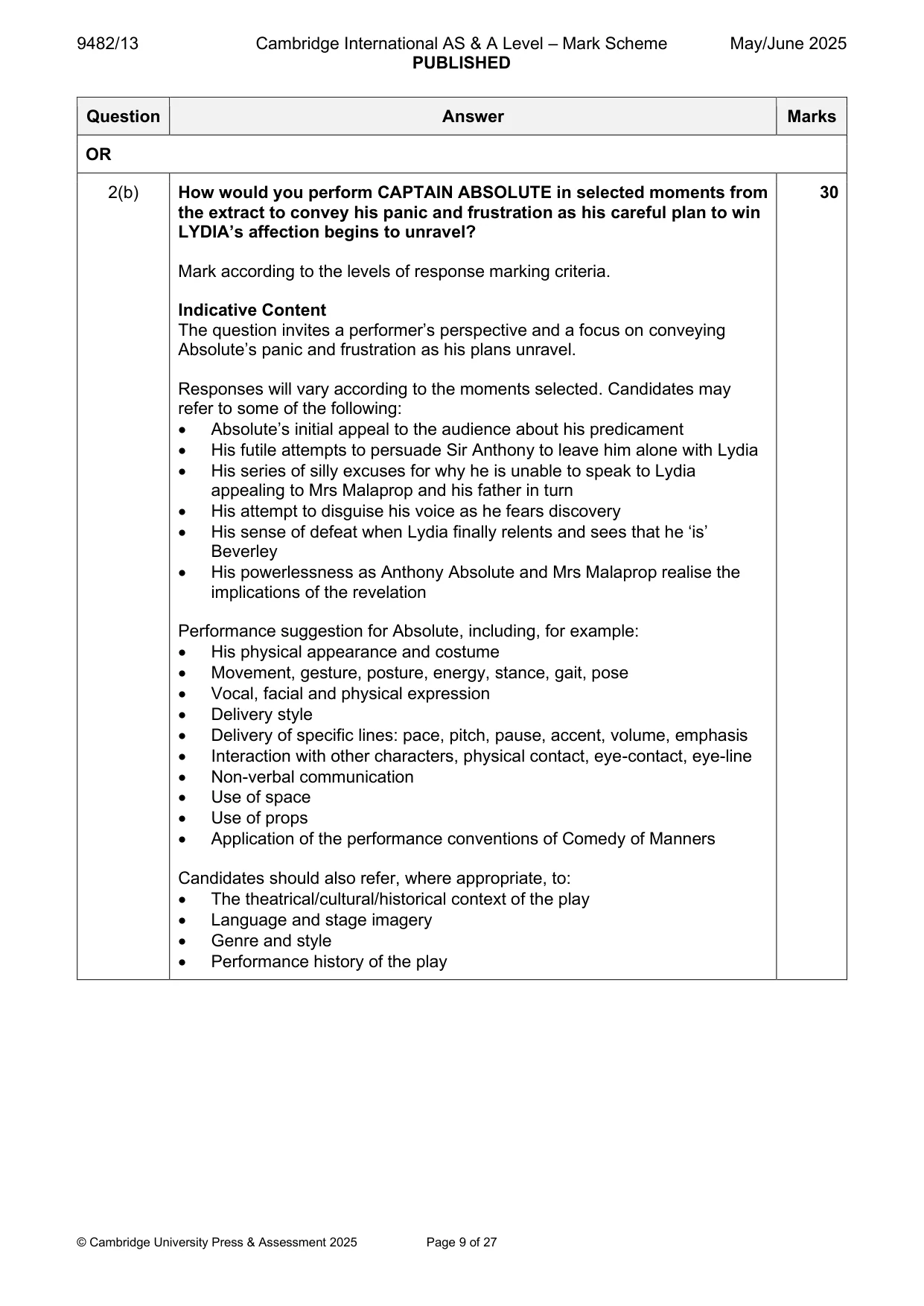
9482/13 Cambridge International AS & A Level – Mark Scheme PUBLISHED May/June 2025 © Cambridge University Press & Assessment 2025 Page 9 of 27 Question Answer Marks OR 2(b) How would you perform CAPTAIN ABSOLUTE in selected moments from the extract to convey his panic and frustration as his careful plan to win LYDIA’s affection begins to unravel? Mark according to the levels of response marking criteria. Indicative Content The question invites a performer’s perspective and a focus on conveying Absolute’s panic and frustration as his plans unravel. Responses will vary according to the moments selected. Candidates may refer to some of the following: • Absolute’s initial appeal to the audience about his predicament • His futile attempts to persuade Sir Anthony to leave him alone with Lydia • His series of silly excuses for why he is unable to speak to Lydia appealing to Mrs Malaprop and his father in turn • His attempt to disguise his voice as he fears discovery • His sense of defeat when Lydia finally relents and sees that he ‘is’ Beverley • His powerlessness as Anthony Absolute and Mrs Malaprop realise the implications of the revelation Performance suggestion for Absolute, including, for example: • His physical appearance and costume • Movement, gesture, posture, energy, stance, gait, pose • Vocal, facial and physical expression • Delivery style • Delivery of specific lines: pace, pitch, pause, accent, volume, emphasis • Interaction with other characters, physical contact, eye-contact, eye-line • Non-verbal communication • Use of space • Use of props • Application of the performance conventions of Comedy of Manners Candidates should also refer, where appropriate, to: • The theatrical/cultural/historical context of the play • Language and stage imagery • Genre and style • Performance history of the play 30
Mark scheme, page 10
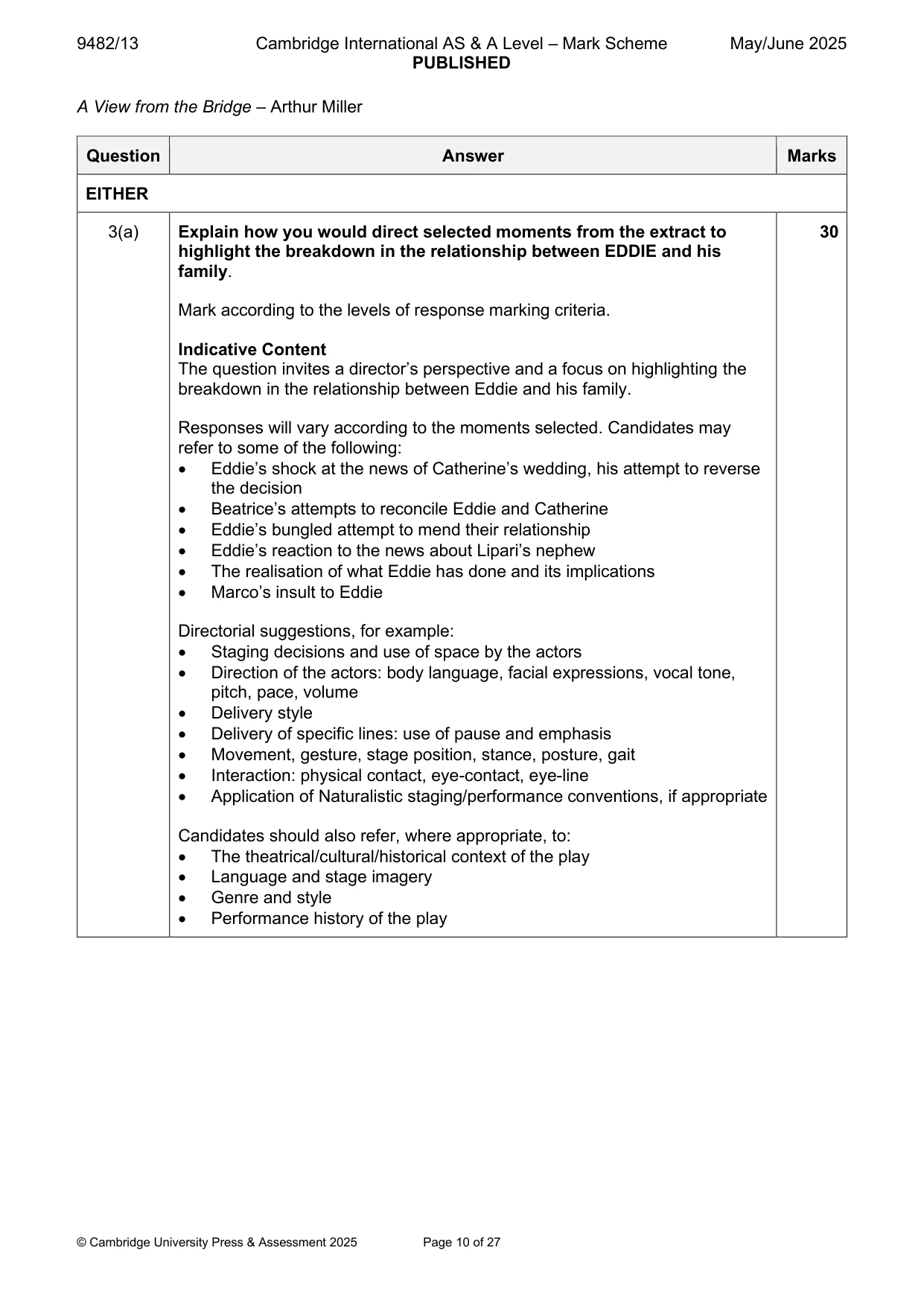
9482/13 Cambridge International AS & A Level – Mark Scheme PUBLISHED May/June 2025 © Cambridge University Press & Assessment 2025 Page 10 of 27 A View from the Bridge – Arthur Miller Question Answer Marks EITHER 3(a) Explain how you would direct selected moments from the extract to highlight the breakdown in the relationship between EDDIE and his family. Mark according to the levels of response marking criteria. Indicative Content The question invites a director’s perspective and a focus on highlighting the breakdown in the relationship between Eddie and his family. Responses will vary according to the moments selected. Candidates may refer to some of the following: • Eddie’s shock at the news of Catherine’s wedding, his attempt to reverse the decision • Beatrice’s attempts to reconcile Eddie and Catherine • Eddie’s bungled attempt to mend their relationship • Eddie’s reaction to the news about Lipari’s nephew • The realisation of what Eddie has done and its implications • Marco’s insult to Eddie Directorial suggestions, for example: • Staging decisions and use of space by the actors • Direction of the actors: body language, facial expressions, vocal tone, pitch, pace, volume • Delivery style • Delivery of specific lines: use of pause and emphasis • Movement, gesture, stage position, stance, posture, gait • Interaction: physical contact, eye-contact, eye-line • Application of Naturalistic staging/performance conventions, if appropriate Candidates should also refer, where appropriate, to: • The theatrical/cultural/historical context of the play • Language and stage imagery • Genre and style • Performance history of the play 30
Mark scheme, page 11
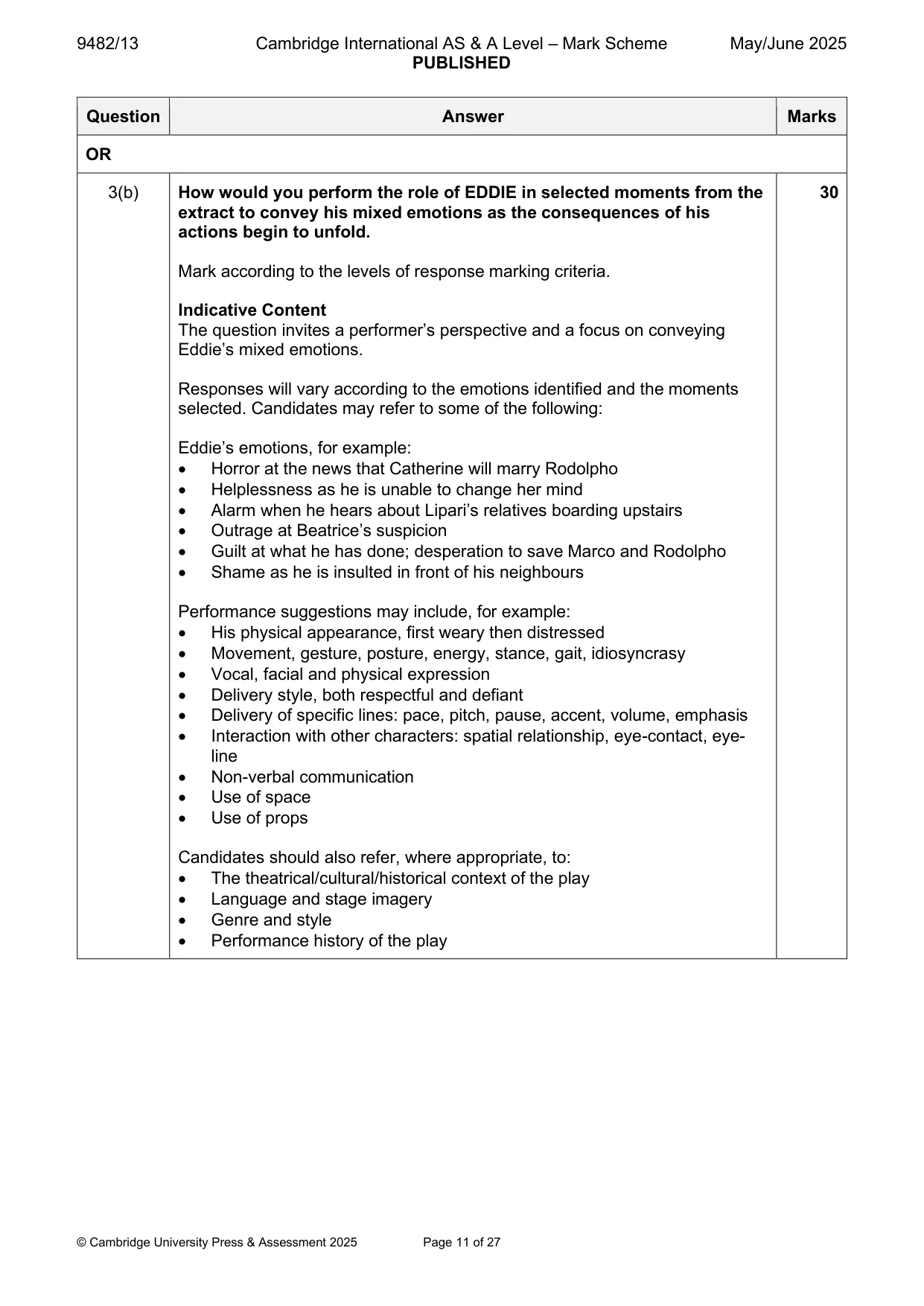
9482/13 Cambridge International AS & A Level – Mark Scheme PUBLISHED May/June 2025 © Cambridge University Press & Assessment 2025 Page 11 of 27 Question Answer Marks OR 3(b) How would you perform the role of EDDIE in selected moments from the extract to convey his mixed emotions as the consequences of his actions begin to unfold. Mark according to the levels of response marking criteria. Indicative Content The question invites a performer’s perspective and a focus on conveying Eddie’s mixed emotions. Responses will vary according to the emotions identified and the moments selected. Candidates may refer to some of the following: Eddie’s emotions, for example: • Horror at the news that Catherine will marry Rodolpho • Helplessness as he is unable to change her mind • Alarm when he hears about Lipari’s relatives boarding upstairs • Outrage at Beatrice’s suspicion • Guilt at what he has done; desperation to save Marco and Rodolpho • Shame as he is insulted in front of his neighbours Performance suggestions may include, for example: • His physical appearance, first weary then distressed • Movement, gesture, posture, energy, stance, gait, idiosyncrasy • Vocal, facial and physical expression • Delivery style, both respectful and defiant • Delivery of specific lines: pace, pitch, pause, accent, volume, emphasis • Interaction with other characters: spatial relationship, eye-contact, eye- line • Non-verbal communication • Use of space • Use of props Candidates should also refer, where appropriate, to: • The theatrical/cultural/historical context of the play • Language and stage imagery • Genre and style • Performance history of the play 30
Mark scheme, page 12
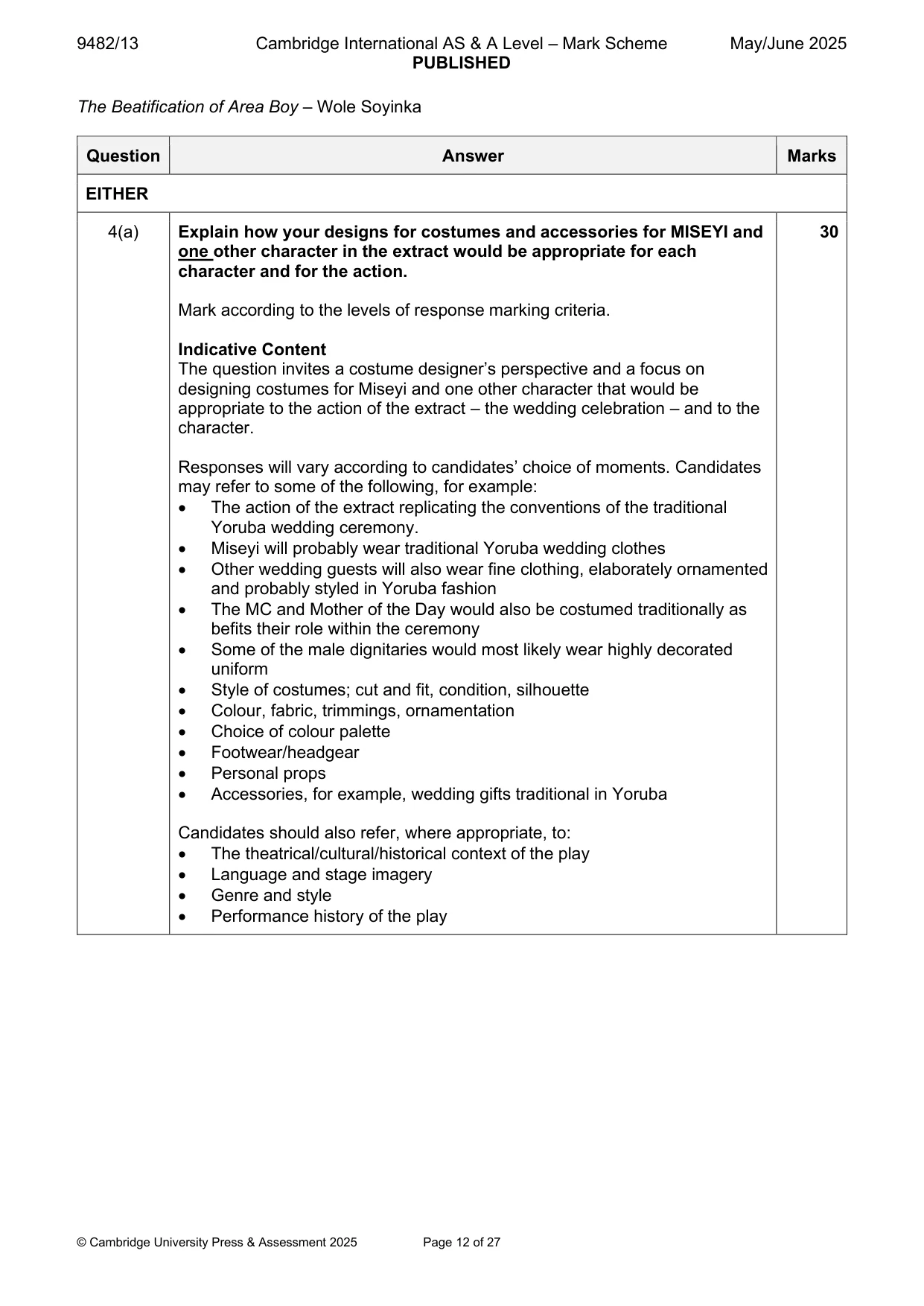
9482/13 Cambridge International AS & A Level – Mark Scheme PUBLISHED May/June 2025 © Cambridge University Press & Assessment 2025 Page 12 of 27 The Beatification of Area Boy – Wole Soyinka Question Answer Marks EITHER 4(a) Explain how your designs for costumes and accessories for MISEYI and one other character in the extract would be appropriate for each character and for the action. Mark according to the levels of response marking criteria. Indicative Content The question invites a costume designer’s perspective and a focus on designing costumes for Miseyi and one other character that would be appropriate to the action of the extract – the wedding celebration – and to the character. Responses will vary according to candidates’ choice of moments. Candidates may refer to some of the following, for example: • The action of the extract replicating the conventions of the traditional Yoruba wedding ceremony. • Miseyi will probably wear traditional Yoruba wedding clothes • Other wedding guests will also wear fine clothing, elaborately ornamented and probably styled in Yoruba fashion • The MC and Mother of the Day would also be costumed traditionally as befits their role within the ceremony • Some of the male dignitaries would most likely wear highly decorated uniform • Style of costumes; cut and fit, condition, silhouette • Colour, fabric, trimmings, ornamentation • Choice of colour palette • Footwear/headgear • Personal props • Accessories, for example, wedding gifts traditional in Yoruba Candidates should also refer, where appropriate, to: • The theatrical/cultural/historical context of the play • Language and stage imagery • Genre and style • Performance history of the play 30
Mark scheme, page 13
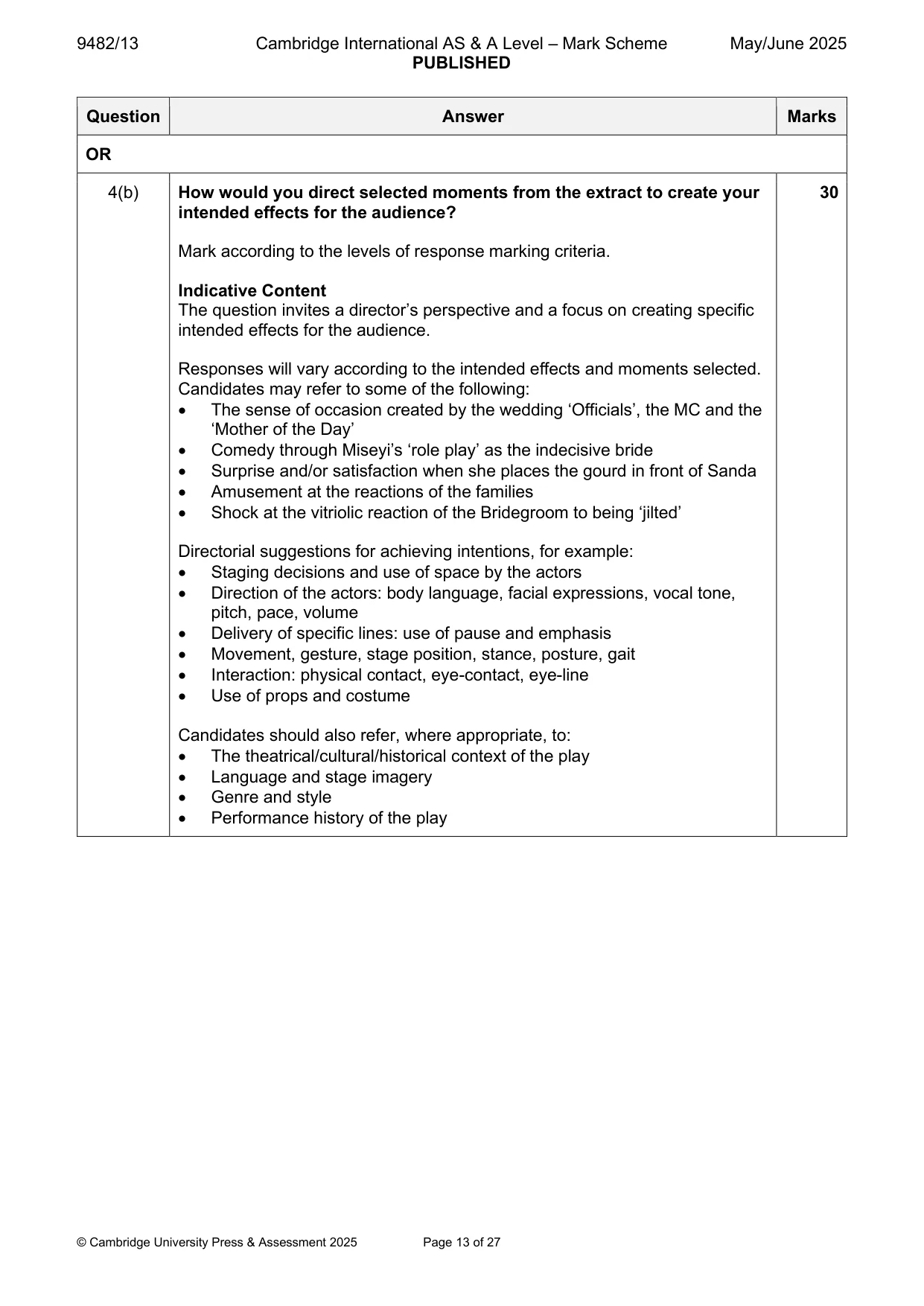
9482/13 Cambridge International AS & A Level – Mark Scheme PUBLISHED May/June 2025 © Cambridge University Press & Assessment 2025 Page 13 of 27 Question Answer Marks OR 4(b) How would you direct selected moments from the extract to create your intended effects for the audience? Mark according to the levels of response marking criteria. Indicative Content The question invites a director’s perspective and a focus on creating specific intended effects for the audience. Responses will vary according to the intended effects and moments selected. Candidates may refer to some of the following: • The sense of occasion created by the wedding ‘Officials’, the MC and the ‘Mother of the Day’ • Comedy through Miseyi’s ‘role play’ as the indecisive bride • Surprise and/or satisfaction when she places the gourd in front of Sanda • Amusement at the reactions of the families • Shock at the vitriolic reaction of the Bridegroom to being ‘jilted’ Directorial suggestions for achieving intentions, for example: • Staging decisions and use of space by the actors • Direction of the actors: body language, facial expressions, vocal tone, pitch, pace, volume • Delivery of specific lines: use of pause and emphasis • Movement, gesture, stage position, stance, posture, gait • Interaction: physical contact, eye-contact, eye-line • Use of props and costume Candidates should also refer, where appropriate, to: • The theatrical/cultural/historical context of the play • Language and stage imagery • Genre and style • Performance history of the play 30
Mark scheme, page 14
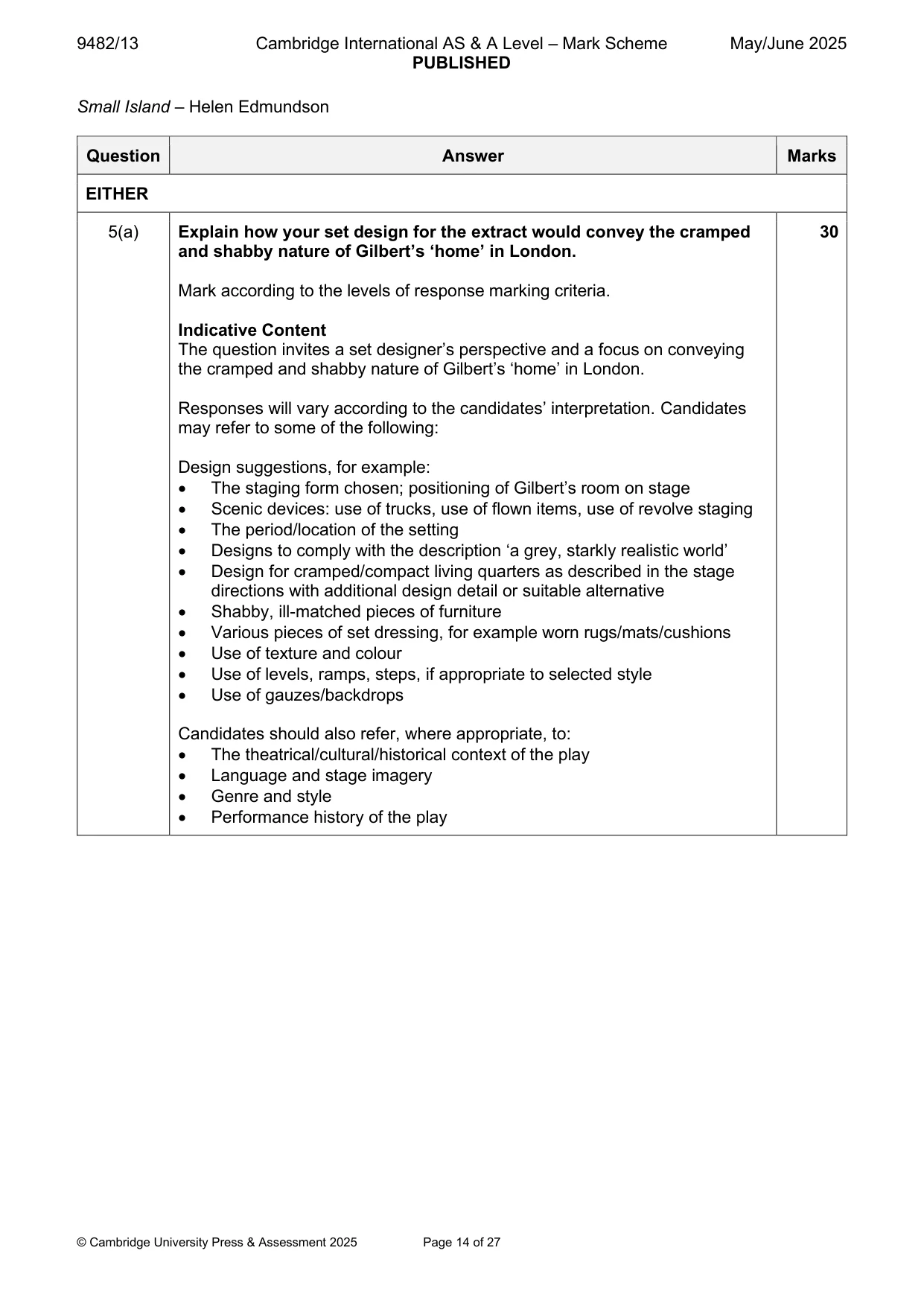
9482/13 Cambridge International AS & A Level – Mark Scheme PUBLISHED May/June 2025 © Cambridge University Press & Assessment 2025 Page 14 of 27 Small Island – Helen Edmundson Question Answer Marks EITHER 5(a) Explain how your set design for the extract would convey the cramped and shabby nature of Gilbert’s ‘home’ in London. Mark according to the levels of response marking criteria. Indicative Content The question invites a set designer’s perspective and a focus on conveying the cramped and shabby nature of Gilbert’s ‘home’ in London. Responses will vary according to the candidates’ interpretation. Candidates may refer to some of the following: Design suggestions, for example: • The staging form chosen; positioning of Gilbert’s room on stage • Scenic devices: use of trucks, use of flown items, use of revolve staging • The period/location of the setting • Designs to comply with the description ‘a grey, starkly realistic world’ • Design for cramped/compact living quarters as described in the stage directions with additional design detail or suitable alternative • Shabby, ill-matched pieces of furniture • Various pieces of set dressing, for example worn rugs/mats/cushions • Use of texture and colour • Use of levels, ramps, steps, if appropriate to selected style • Use of gauzes/backdrops Candidates should also refer, where appropriate, to: • The theatrical/cultural/historical context of the play • Language and stage imagery • Genre and style • Performance history of the play 30
Mark scheme, page 15
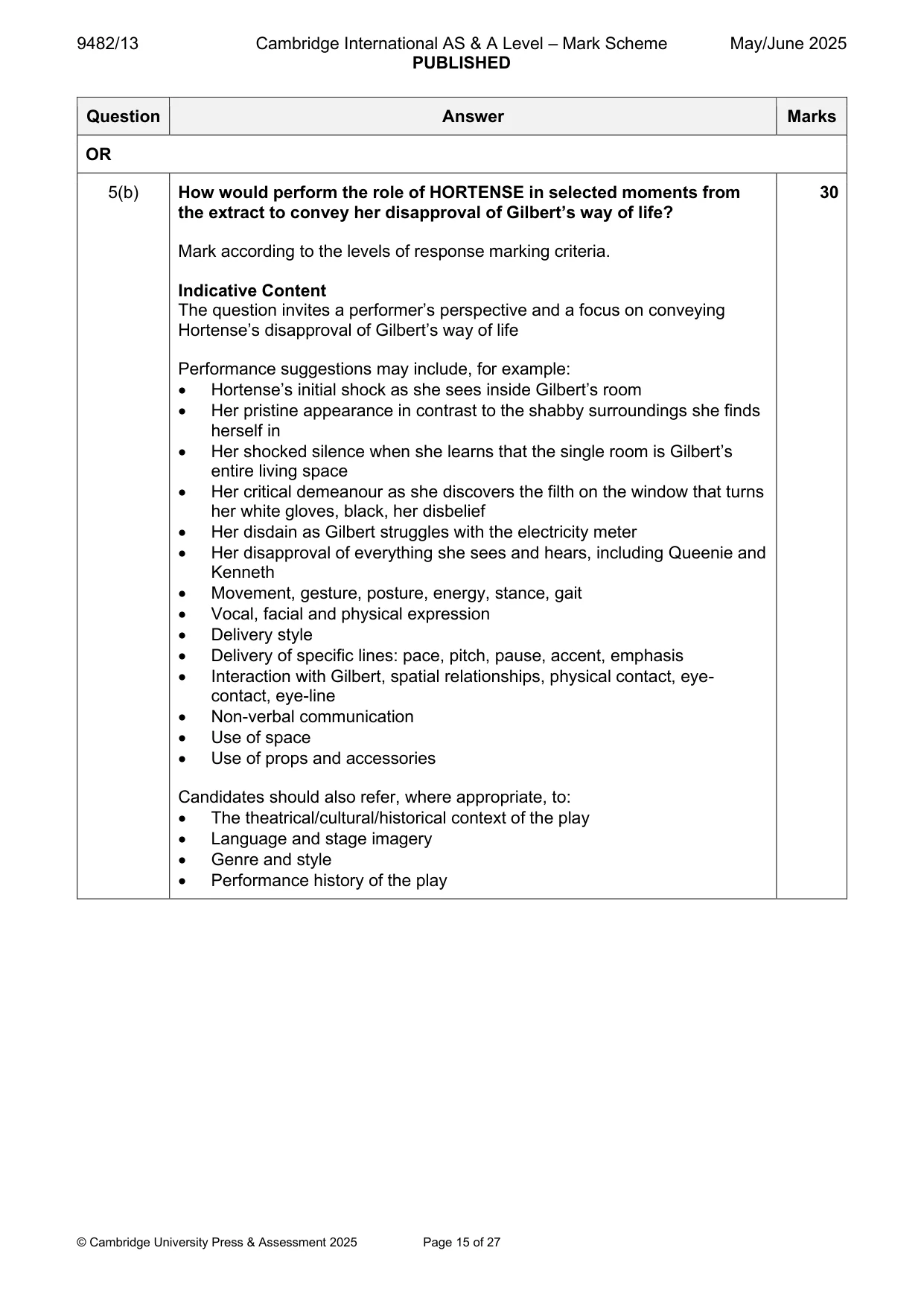
9482/13 Cambridge International AS & A Level – Mark Scheme PUBLISHED May/June 2025 © Cambridge University Press & Assessment 2025 Page 15 of 27 Question Answer Marks OR 5(b) How would perform the role of HORTENSE in selected moments from the extract to convey her disapproval of Gilbert’s way of life? Mark according to the levels of response marking criteria. Indicative Content The question invites a performer’s perspective and a focus on conveying Hortense’s disapproval of Gilbert’s way of life Performance suggestions may include, for example: • Hortense’s initial shock as she sees inside Gilbert’s room • Her pristine appearance in contrast to the shabby surroundings she finds herself in • Her shocked silence when she learns that the single room is Gilbert’s entire living space • Her critical demeanour as she discovers the filth on the window that turns her white gloves, black, her disbelief • Her disdain as Gilbert struggles with the electricity meter • Her disapproval of everything she sees and hears, including Queenie and Kenneth • Movement, gesture, posture, energy, stance, gait • Vocal, facial and physical expression • Delivery style • Delivery of specific lines: pace, pitch, pause, accent, emphasis • Interaction with Gilbert, spatial relationships, physical contact, eye- contact, eye-line • Non-verbal communication • Use of space • Use of props and accessories Candidates should also refer, where appropriate, to: • The theatrical/cultural/historical context of the play • Language and stage imagery • Genre and style • Performance history of the play 30
Mark scheme, page 16
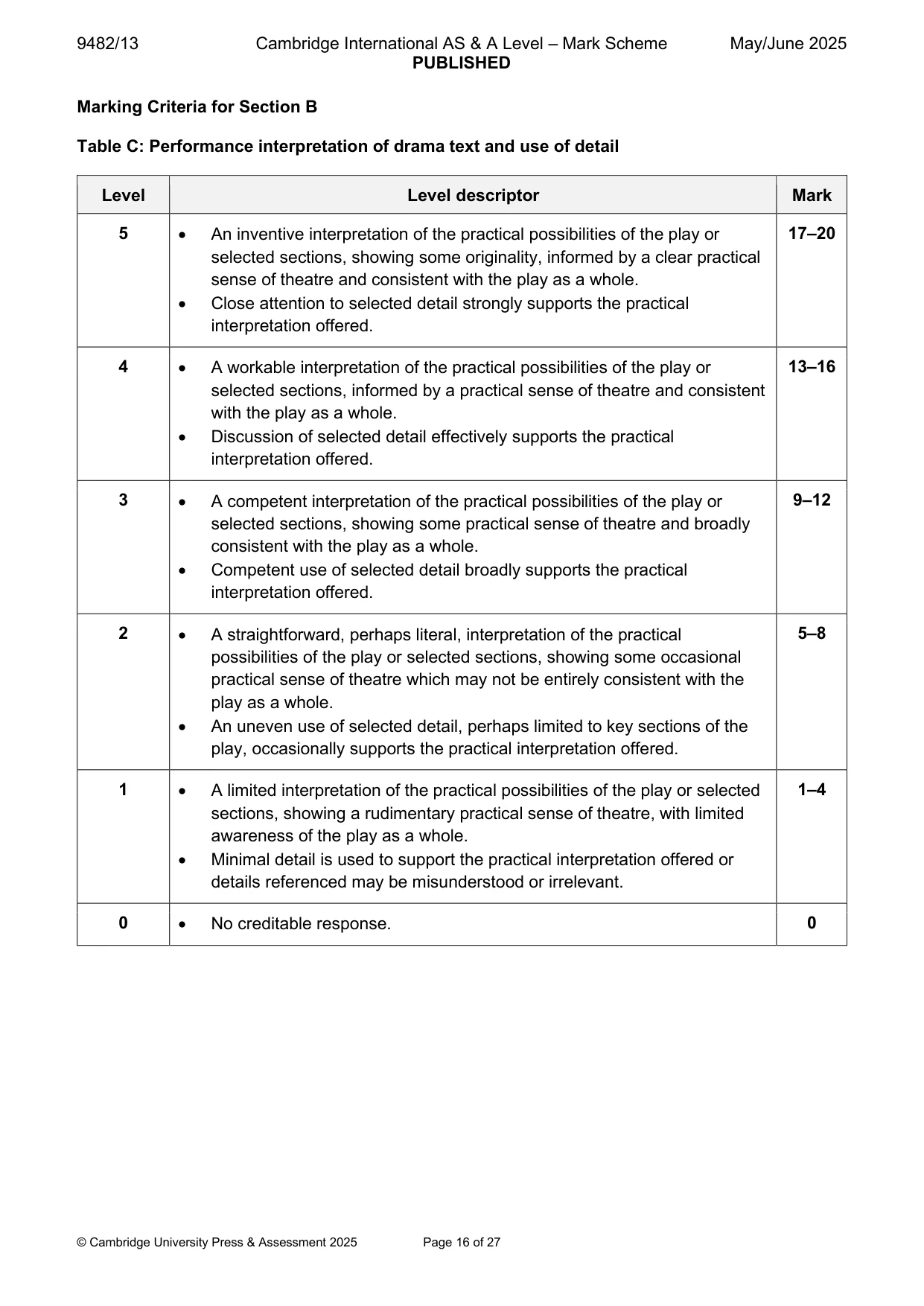
9482/13 Cambridge International AS & A Level – Mark Scheme PUBLISHED May/June 2025 © Cambridge University Press & Assessment 2025 Page 16 of 27 Marking Criteria for Section B Table C: Performance interpretation of drama text and use of detail Level Level descriptor Mark 5 • An inventive interpretation of the practical possibilities of the play or selected sections, showing some originality, informed by a clear practical sense of theatre and consistent with the play as a whole. • Close attention to selected detail strongly supports the practical interpretation offered. 17–20 4 • A workable interpretation of the practical possibilities of the play or selected sections, informed by a practical sense of theatre and consistent with the play as a whole. • Discussion of selected detail effectively supports the practical interpretation offered. 13–16 3 • A competent interpretation of the practical possibilities of the play or selected sections, showing some practical sense of theatre and broadly consistent with the play as a whole. • Competent use of selected detail broadly supports the practical interpretation offered. 9–12 2 • A straightforward, perhaps literal, interpretation of the practical possibilities of the play or selected sections, showing some occasional practical sense of theatre which may not be entirely consistent with the play as a whole. • An uneven use of selected detail, perhaps limited to key sections of the play, occasionally supports the practical interpretation offered. 5–8 1 • A limited interpretation of the practical possibilities of the play or selected sections, showing a rudimentary practical sense of theatre, with limited awareness of the play as a whole. • Minimal detail is used to support the practical interpretation offered or details referenced may be misunderstood or irrelevant. 1–4 0 • No creditable response. 0
Mark scheme, page 17
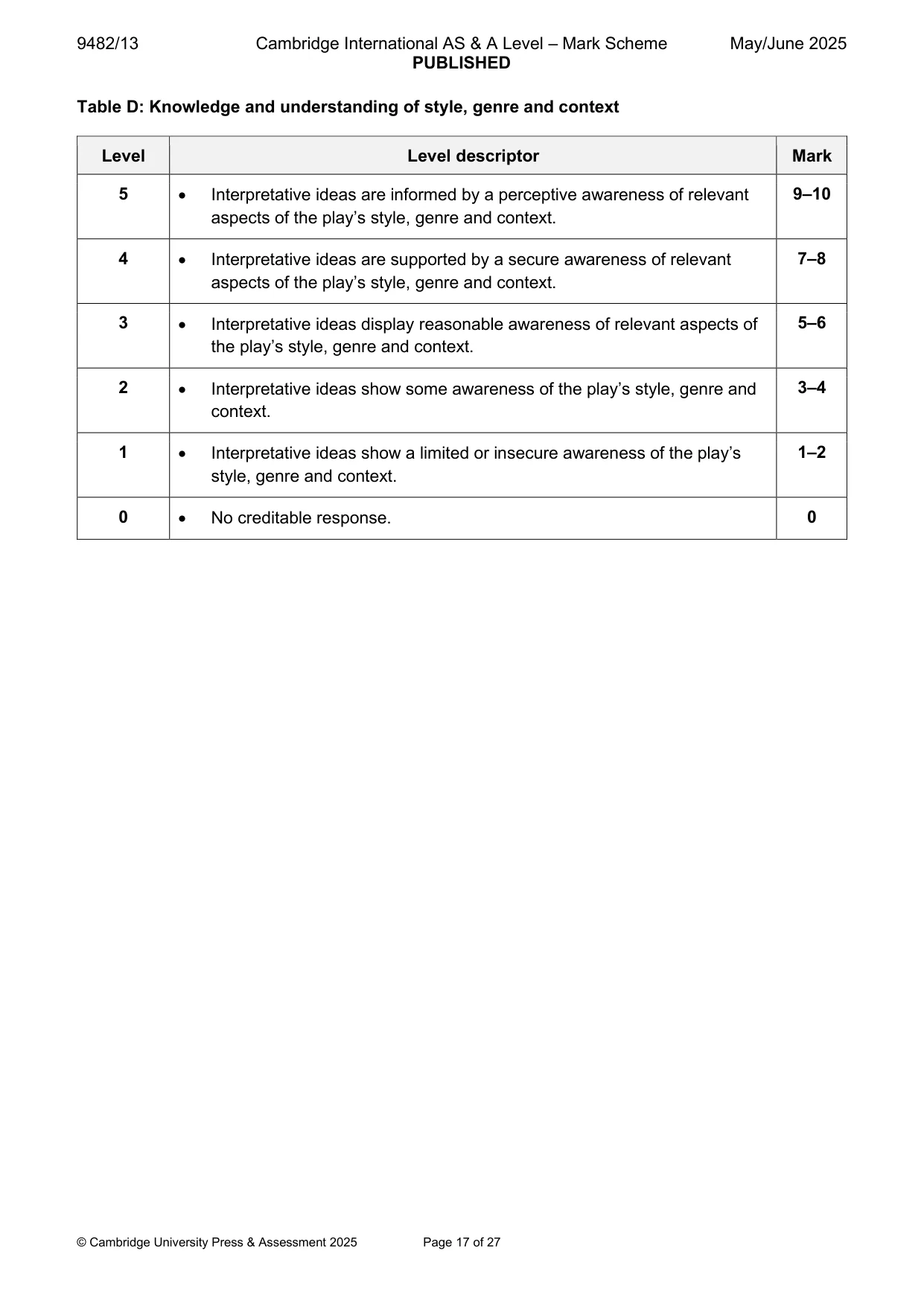
9482/13 Cambridge International AS & A Level – Mark Scheme PUBLISHED May/June 2025 © Cambridge University Press & Assessment 2025 Page 17 of 27 Table D: Knowledge and understanding of style, genre and context Level Level descriptor Mark 5 • Interpretative ideas are informed by a perceptive awareness of relevant aspects of the play’s style, genre and context. 9–10 4 • Interpretative ideas are supported by a secure awareness of relevant aspects of the play’s style, genre and context. 7–8 3 • Interpretative ideas display reasonable awareness of relevant aspects of the play’s style, genre and context. 5–6 2 • Interpretative ideas show some awareness of the play’s style, genre and context. 3–4 1 • Interpretative ideas show a limited or insecure awareness of the play’s style, genre and context. 1–2 0 • No creditable response. 0
Mark scheme, page 18
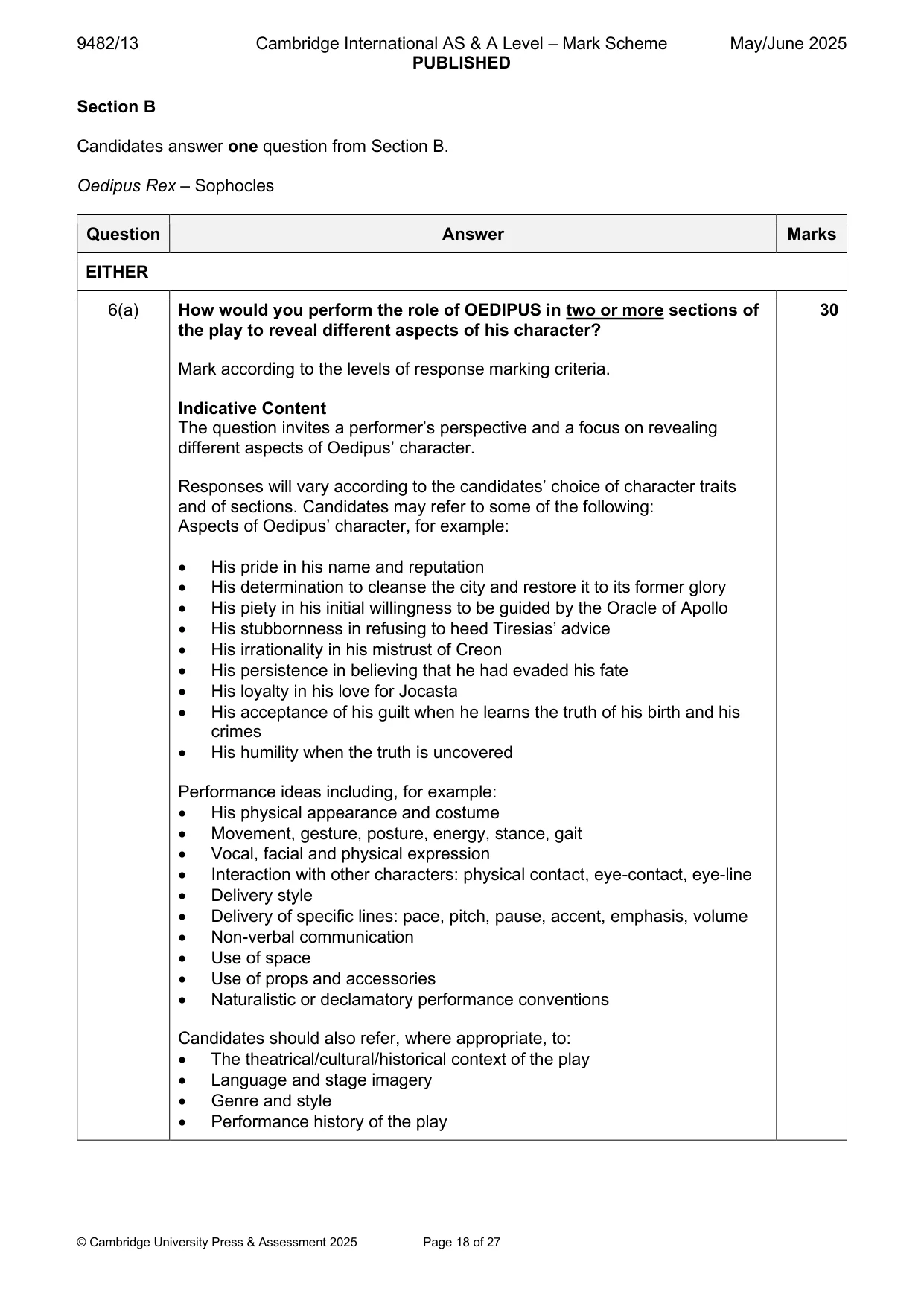
9482/13 Cambridge International AS & A Level – Mark Scheme PUBLISHED May/June 2025 © Cambridge University Press & Assessment 2025 Page 18 of 27 Section B Candidates answer one question from Section B. Oedipus Rex – Sophocles Question Answer Marks EITHER 6(a) How would you perform the role of OEDIPUS in two or more sections of the play to reveal different aspects of his character? Mark according to the levels of response marking criteria. Indicative Content The question invites a performer’s perspective and a focus on revealing different aspects of Oedipus’ character. Responses will vary according to the candidates’ choice of character traits and of sections. Candidates may refer to some of the following: Aspects of Oedipus’ character, for example: • His pride in his name and reputation • His determination to cleanse the city and restore it to its former glory • His piety in his initial willingness to be guided by the Oracle of Apollo • His stubbornness in refusing to heed Tiresias’ advice • His irrationality in his mistrust of Creon • His persistence in believing that he had evaded his fate • His loyalty in his love for Jocasta • His acceptance of his guilt when he learns the truth of his birth and his crimes • His humility when the truth is uncovered Performance ideas including, for example: • His physical appearance and costume • Movement, gesture, posture, energy, stance, gait • Vocal, facial and physical expression • Interaction with other characters: physical contact, eye-contact, eye-line • Delivery style • Delivery of specific lines: pace, pitch, pause, accent, emphasis, volume • Non-verbal communication • Use of space • Use of props and accessories • Naturalistic or declamatory performance conventions Candidates should also refer, where appropriate, to: • The theatrical/cultural/historical context of the play • Language and stage imagery • Genre and style • Performance history of the play 30
Mark scheme, page 19
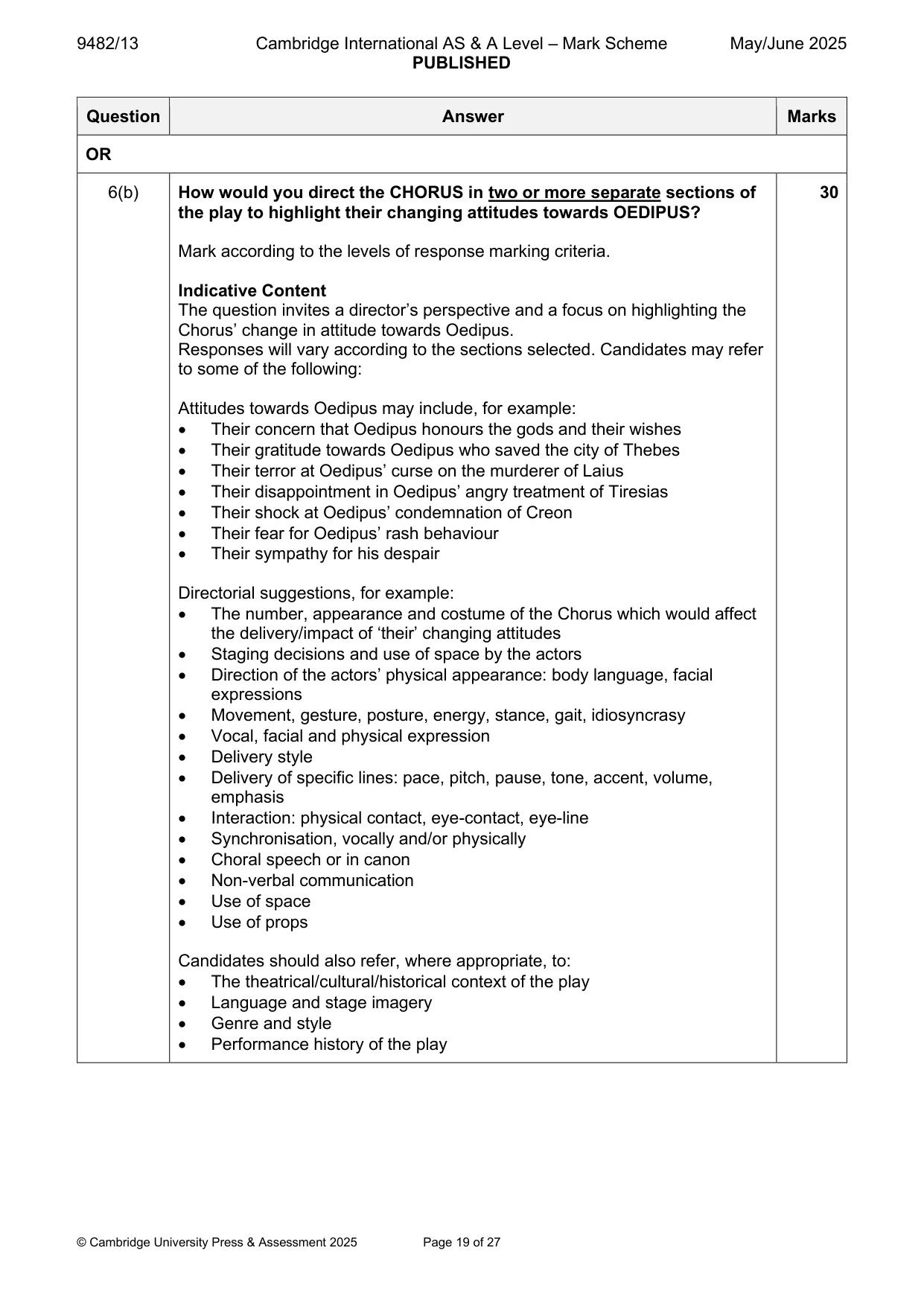
9482/13 Cambridge International AS & A Level – Mark Scheme PUBLISHED May/June 2025 © Cambridge University Press & Assessment 2025 Page 19 of 27 Question Answer Marks OR 6(b) How would you direct the CHORUS in two or more separate sections of the play to highlight their changing attitudes towards OEDIPUS? Mark according to the levels of response marking criteria. Indicative Content The question invites a director’s perspective and a focus on highlighting the Chorus’ change in attitude towards Oedipus. Responses will vary according to the sections selected. Candidates may refer to some of the following: Attitudes towards Oedipus may include, for example: • Their concern that Oedipus honours the gods and their wishes • Their gratitude towards Oedipus who saved the city of Thebes • Their terror at Oedipus’ curse on the murderer of Laius • Their disappointment in Oedipus’ angry treatment of Tiresias • Their shock at Oedipus’ condemnation of Creon • Their fear for Oedipus’ rash behaviour • Their sympathy for his despair Directorial suggestions, for example: • The number, appearance and costume of the Chorus which would affect the delivery/impact of ‘their’ changing attitudes • Staging decisions and use of space by the actors • Direction of the actors’ physical appearance: body language, facial expressions • Movement, gesture, posture, energy, stance, gait, idiosyncrasy • Vocal, facial and physical expression • Delivery style • Delivery of specific lines: pace, pitch, pause, tone, accent, volume, emphasis • Interaction: physical contact, eye-contact, eye-line • Synchronisation, vocally and/or physically • Choral speech or in canon • Non-verbal communication • Use of space • Use of props Candidates should also refer, where appropriate, to: • The theatrical/cultural/historical context of the play • Language and stage imagery • Genre and style • Performance history of the play 30
Mark scheme, page 20
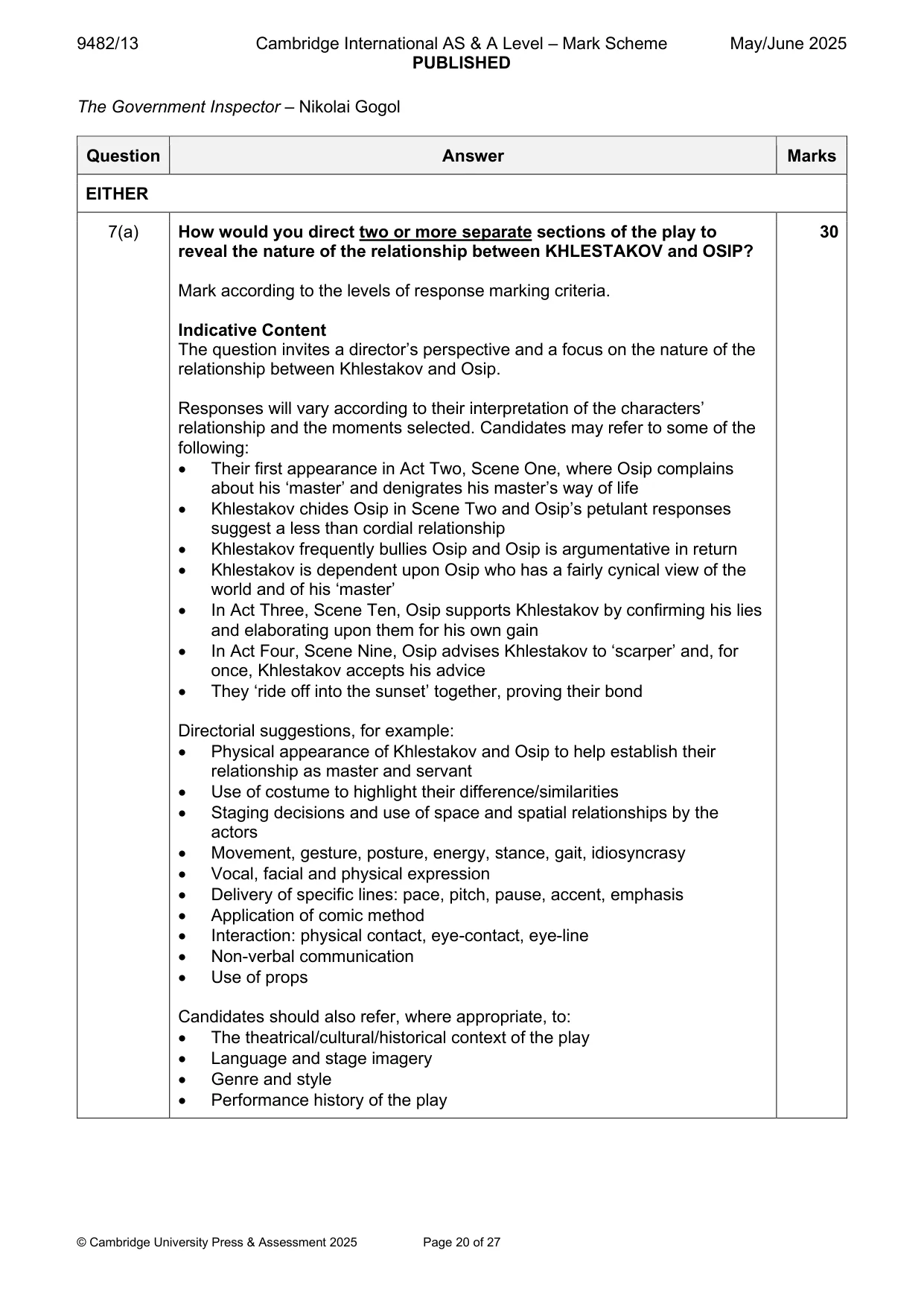
9482/13 Cambridge International AS & A Level – Mark Scheme PUBLISHED May/June 2025 © Cambridge University Press & Assessment 2025 Page 20 of 27 The Government Inspector – Nikolai Gogol Question Answer Marks EITHER 7(a) How would you direct two or more separate sections of the play to reveal the nature of the relationship between KHLESTAKOV and OSIP? Mark according to the levels of response marking criteria. Indicative Content The question invites a director’s perspective and a focus on the nature of the relationship between Khlestakov and Osip. Responses will vary according to their interpretation of the characters’ relationship and the moments selected. Candidates may refer to some of the following: • Their first appearance in Act Two, Scene One, where Osip complains about his ‘master’ and denigrates his master’s way of life • Khlestakov chides Osip in Scene Two and Osip’s petulant responses suggest a less than cordial relationship • Khlestakov frequently bullies Osip and Osip is argumentative in return • Khlestakov is dependent upon Osip who has a fairly cynical view of the world and of his ‘master’ • In Act Three, Scene Ten, Osip supports Khlestakov by confirming his lies and elaborating upon them for his own gain • In Act Four, Scene Nine, Osip advises Khlestakov to ‘scarper’ and, for once, Khlestakov accepts his advice • They ‘ride off into the sunset’ together, proving their bond Directorial suggestions, for example: • Physical appearance of Khlestakov and Osip to help establish their relationship as master and servant • Use of costume to highlight their difference/similarities • Staging decisions and use of space and spatial relationships by the actors • Movement, gesture, posture, energy, stance, gait, idiosyncrasy • Vocal, facial and physical expression • Delivery of specific lines: pace, pitch, pause, accent, emphasis • Application of comic method • Interaction: physical contact, eye-contact, eye-line • Non-verbal communication • Use of props Candidates should also refer, where appropriate, to: • The theatrical/cultural/historical context of the play • Language and stage imagery • Genre and style • Performance history of the play 30
Mark scheme, page 21
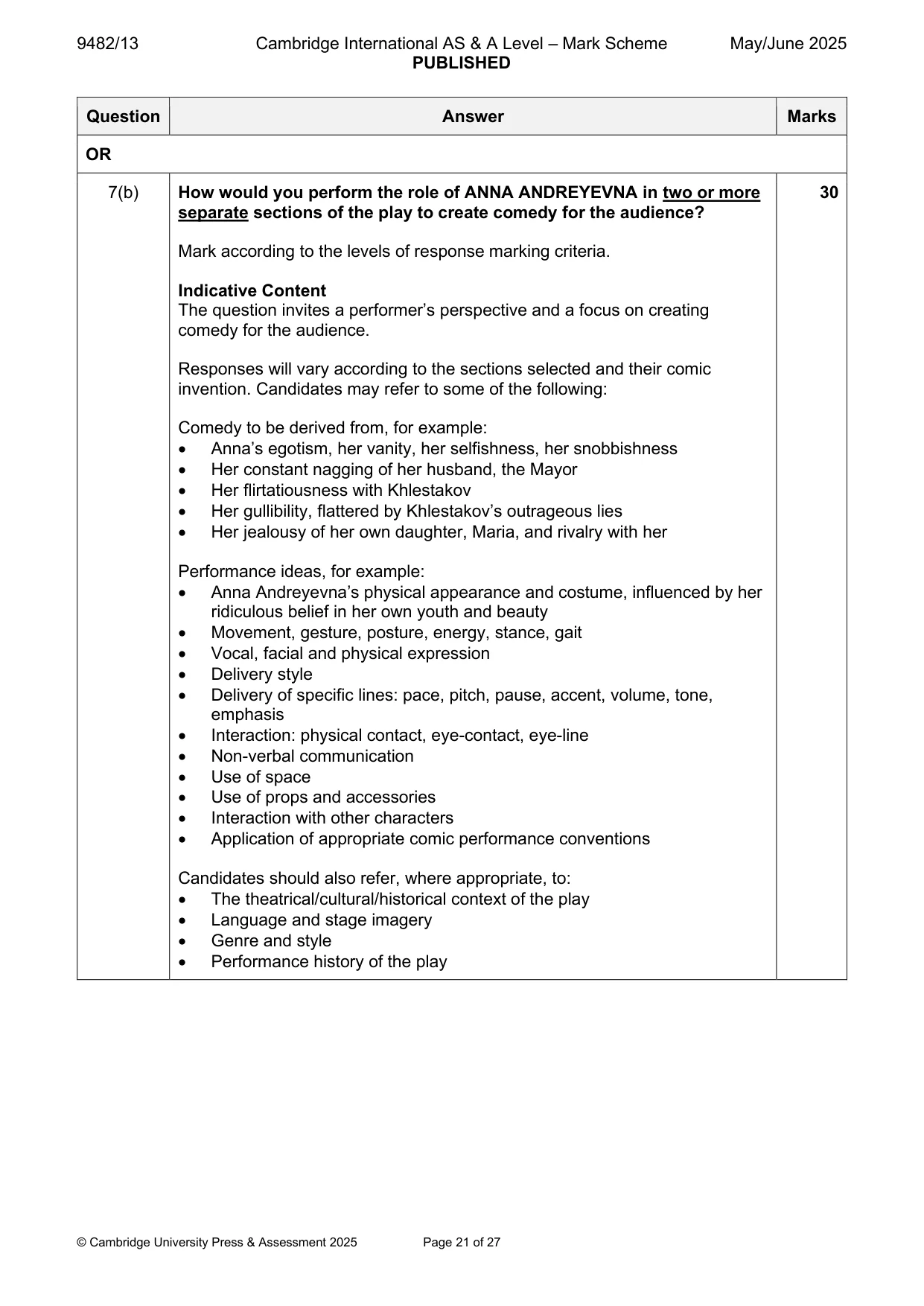
9482/13 Cambridge International AS & A Level – Mark Scheme PUBLISHED May/June 2025 © Cambridge University Press & Assessment 2025 Page 21 of 27 Question Answer Marks OR 7(b) How would you perform the role of ANNA ANDREYEVNA in two or more separate sections of the play to create comedy for the audience? Mark according to the levels of response marking criteria. Indicative Content The question invites a performer’s perspective and a focus on creating comedy for the audience. Responses will vary according to the sections selected and their comic invention. Candidates may refer to some of the following: Comedy to be derived from, for example: • Anna’s egotism, her vanity, her selfishness, her snobbishness • Her constant nagging of her husband, the Mayor • Her flirtatiousness with Khlestakov • Her gullibility, flattered by Khlestakov’s outrageous lies • Her jealousy of her own daughter, Maria, and rivalry with her Performance ideas, for example: • Anna Andreyevna’s physical appearance and costume, influenced by her ridiculous belief in her own youth and beauty • Movement, gesture, posture, energy, stance, gait • Vocal, facial and physical expression • Delivery style • Delivery of specific lines: pace, pitch, pause, accent, volume, tone, emphasis • Interaction: physical contact, eye-contact, eye-line • Non-verbal communication • Use of space • Use of props and accessories • Interaction with other characters • Application of appropriate comic performance conventions Candidates should also refer, where appropriate, to: • The theatrical/cultural/historical context of the play • Language and stage imagery • Genre and style • Performance history of the play 30
Mark scheme, page 22
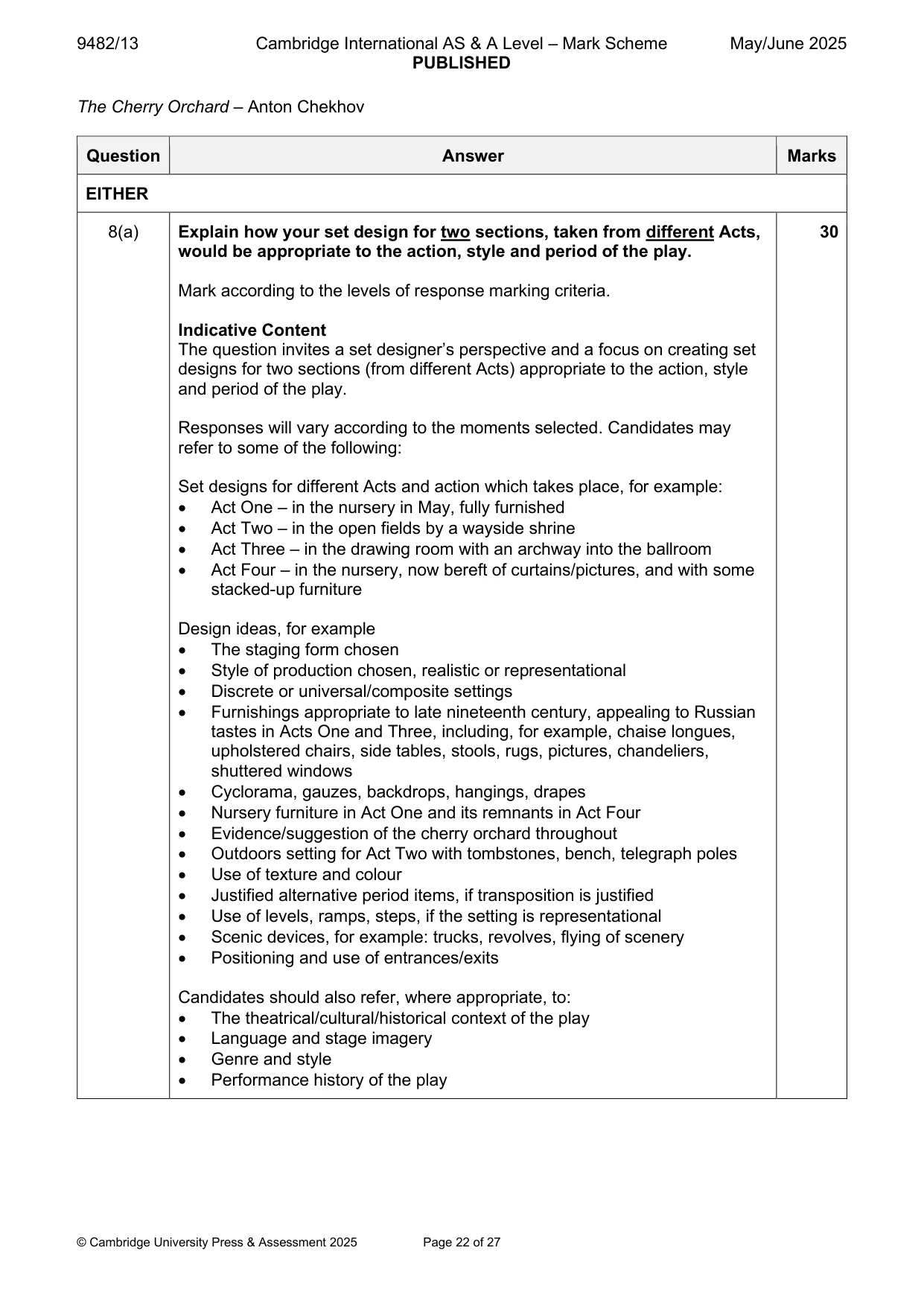
9482/13 Cambridge International AS & A Level – Mark Scheme PUBLISHED May/June 2025 © Cambridge University Press & Assessment 2025 Page 22 of 27 The Cherry Orchard – Anton Chekhov Question Answer Marks EITHER 8(a) Explain how your set design for two sections, taken from different Acts, would be appropriate to the action, style and period of the play. Mark according to the levels of response marking criteria. Indicative Content The question invites a set designer’s perspective and a focus on creating set designs for two sections (from different Acts) appropriate to the action, style and period of the play. Responses will vary according to the moments selected. Candidates may refer to some of the following: Set designs for different Acts and action which takes place, for example: • Act One – in the nursery in May, fully furnished • Act Two – in the open fields by a wayside shrine • Act Three – in the drawing room with an archway into the ballroom • Act Four – in the nursery, now bereft of curtains/pictures, and with some stacked-up furniture Design ideas, for example • The staging form chosen • Style of production chosen, realistic or representational • Discrete or universal/composite settings • Furnishings appropriate to late nineteenth century, appealing to Russian tastes in Acts One and Three, including, for example, chaise longues, upholstered chairs, side tables, stools, rugs, pictures, chandeliers, shuttered windows • Cyclorama, gauzes, backdrops, hangings, drapes • Nursery furniture in Act One and its remnants in Act Four • Evidence/suggestion of the cherry orchard throughout • Outdoors setting for Act Two with tombstones, bench, telegraph poles • Use of texture and colour • Justified alternative period items, if transposition is justified • Use of levels, ramps, steps, if the setting is representational • Scenic devices, for example: trucks, revolves, flying of scenery • Positioning and use of entrances/exits Candidates should also refer, where appropriate, to: • The theatrical/cultural/historical context of the play • Language and stage imagery • Genre and style • Performance history of the play 30
Mark scheme, page 23
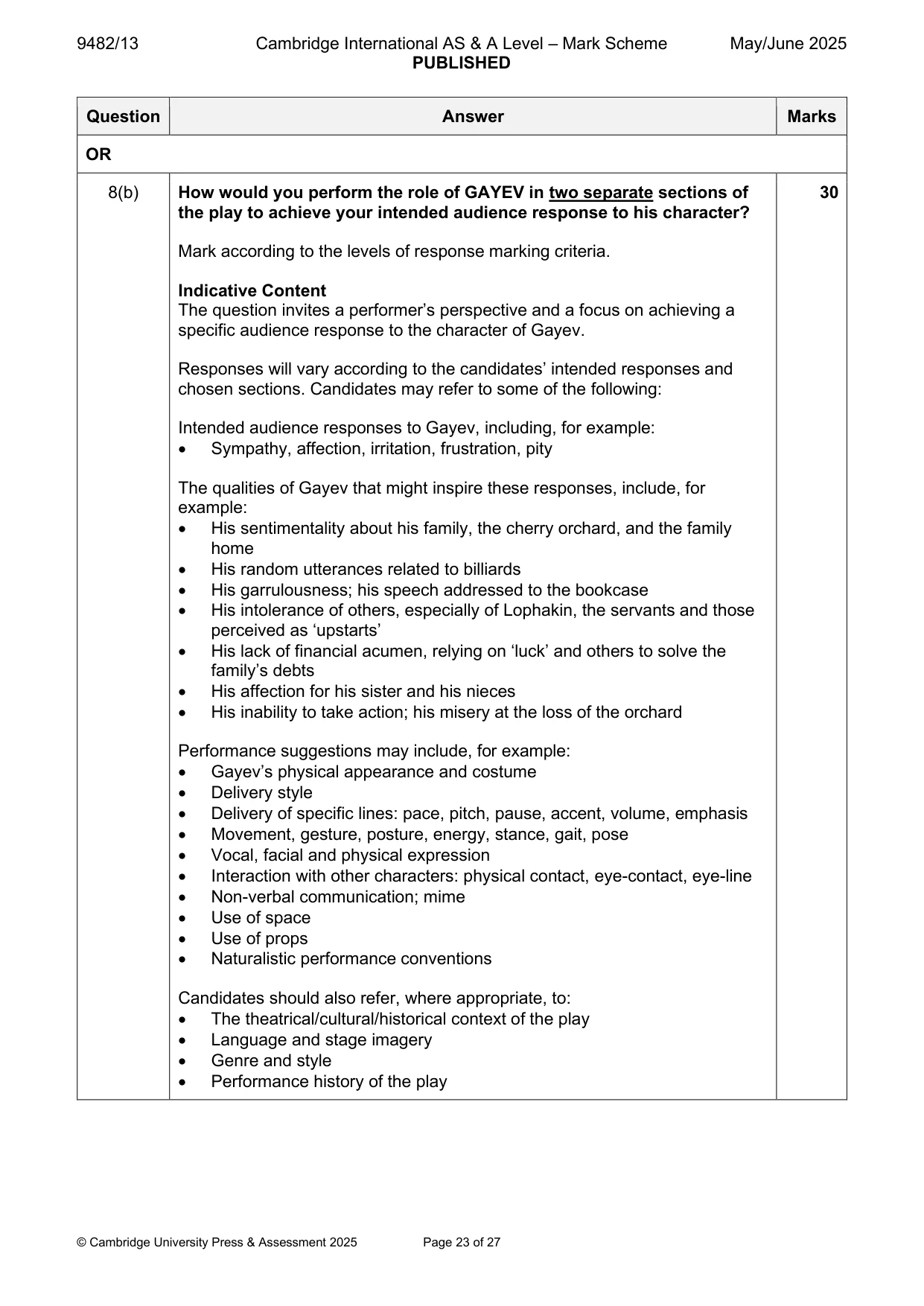
9482/13 Cambridge International AS & A Level – Mark Scheme PUBLISHED May/June 2025 © Cambridge University Press & Assessment 2025 Page 23 of 27 Question Answer Marks OR 8(b) How would you perform the role of GAYEV in two separate sections of the play to achieve your intended audience response to his character? Mark according to the levels of response marking criteria. Indicative Content The question invites a performer’s perspective and a focus on achieving a specific audience response to the character of Gayev. Responses will vary according to the candidates’ intended responses and chosen sections. Candidates may refer to some of the following: Intended audience responses to Gayev, including, for example: • Sympathy, affection, irritation, frustration, pity The qualities of Gayev that might inspire these responses, include, for example: • His sentimentality about his family, the cherry orchard, and the family home • His random utterances related to billiards • His garrulousness; his speech addressed to the bookcase • His intolerance of others, especially of Lophakin, the servants and those perceived as ‘upstarts’ • His lack of financial acumen, relying on ‘luck’ and others to solve the family’s debts • His affection for his sister and his nieces • His inability to take action; his misery at the loss of the orchard Performance suggestions may include, for example: • Gayev’s physical appearance and costume • Delivery style • Delivery of specific lines: pace, pitch, pause, accent, volume, emphasis • Movement, gesture, posture, energy, stance, gait, pose • Vocal, facial and physical expression • Interaction with other characters: physical contact, eye-contact, eye-line • Non-verbal communication; mime • Use of space • Use of props • Naturalistic performance conventions Candidates should also refer, where appropriate, to: • The theatrical/cultural/historical context of the play • Language and stage imagery • Genre and style • Performance history of the play 30
Mark scheme, page 24
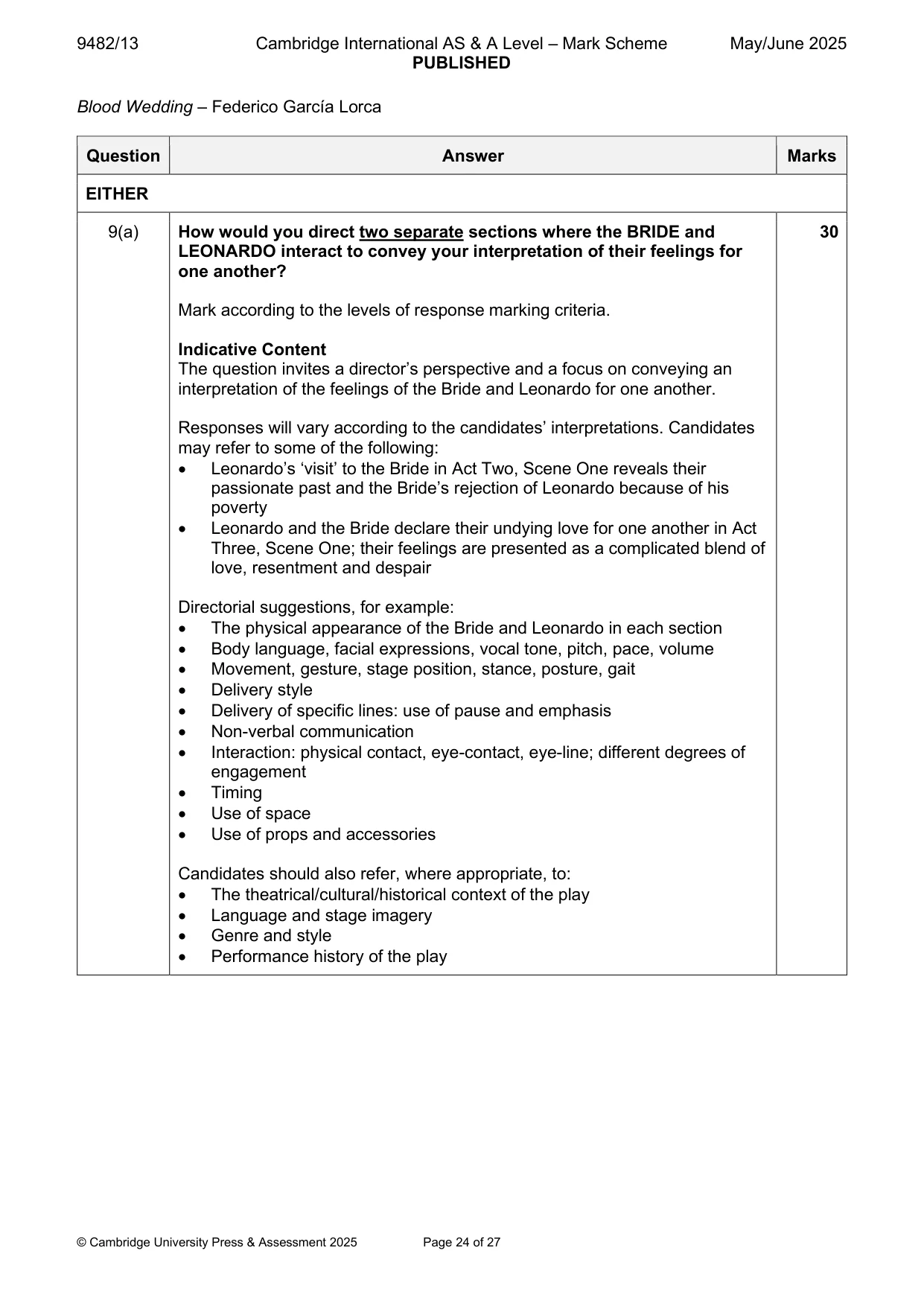
9482/13 Cambridge International AS & A Level – Mark Scheme PUBLISHED May/June 2025 © Cambridge University Press & Assessment 2025 Page 24 of 27 Blood Wedding – Federico García Lorca Question Answer Marks EITHER 9(a) How would you direct two separate sections where the BRIDE and LEONARDO interact to convey your interpretation of their feelings for one another? Mark according to the levels of response marking criteria. Indicative Content The question invites a director’s perspective and a focus on conveying an interpretation of the feelings of the Bride and Leonardo for one another. Responses will vary according to the candidates’ interpretations. Candidates may refer to some of the following: • Leonardo’s ‘visit’ to the Bride in Act Two, Scene One reveals their passionate past and the Bride’s rejection of Leonardo because of his poverty • Leonardo and the Bride declare their undying love for one another in Act Three, Scene One; their feelings are presented as a complicated blend of love, resentment and despair Directorial suggestions, for example: • The physical appearance of the Bride and Leonardo in each section • Body language, facial expressions, vocal tone, pitch, pace, volume • Movement, gesture, stage position, stance, posture, gait • Delivery style • Delivery of specific lines: use of pause and emphasis • Non-verbal communication • Interaction: physical contact, eye-contact, eye-line; different degrees of engagement • Timing • Use of space • Use of props and accessories Candidates should also refer, where appropriate, to: • The theatrical/cultural/historical context of the play • Language and stage imagery • Genre and style • Performance history of the play 30
Mark scheme, page 25
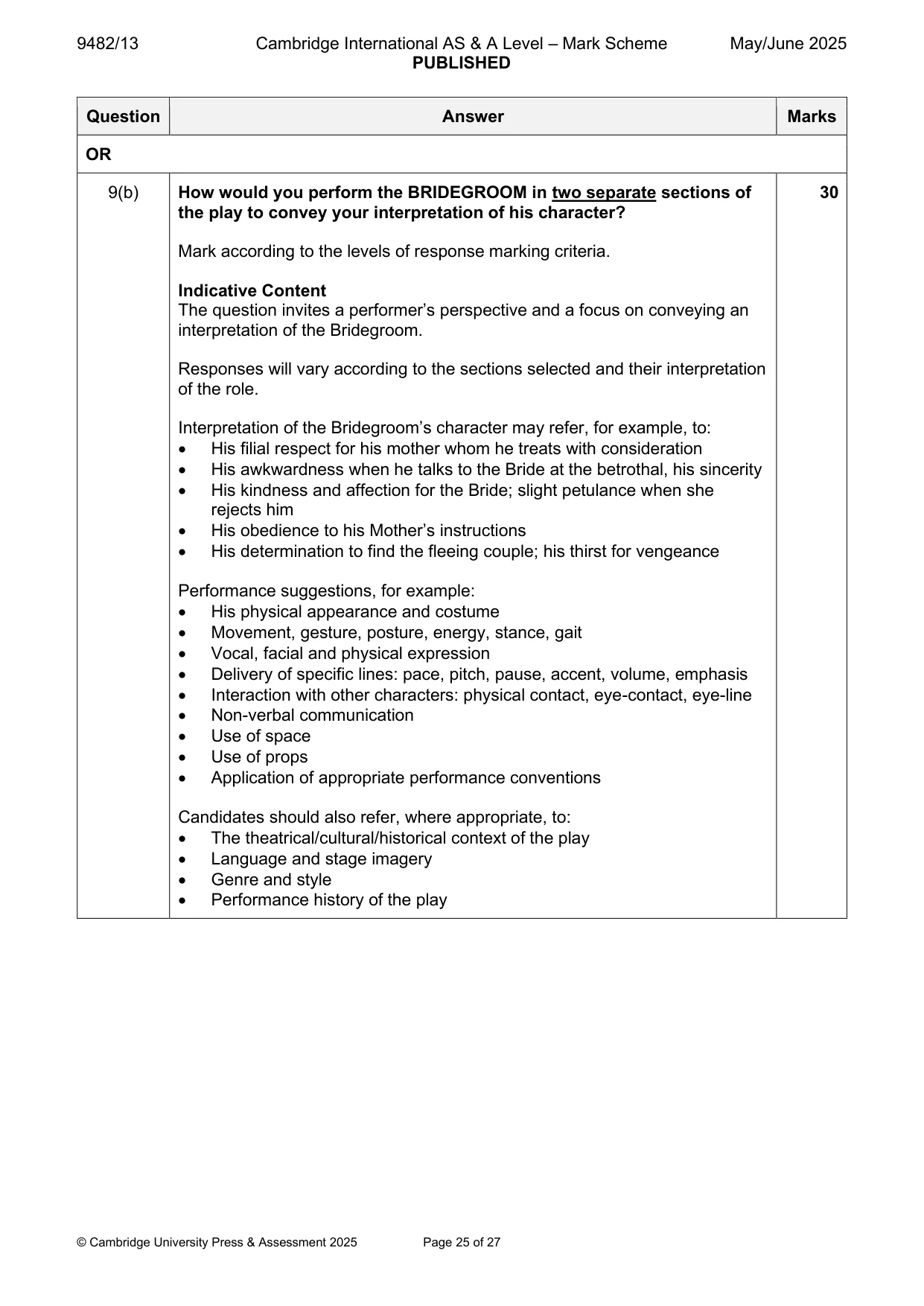
9482/13 Cambridge International AS & A Level – Mark Scheme PUBLISHED May/June 2025 © Cambridge University Press & Assessment 2025 Page 25 of 27 Question Answer Marks OR 9(b) How would you perform the BRIDEGROOM in two separate sections of the play to convey your interpretation of his character? Mark according to the levels of response marking criteria. Indicative Content The question invites a performer’s perspective and a focus on conveying an interpretation of the Bridegroom. Responses will vary according to the sections selected and their interpretation of the role. Interpretation of the Bridegroom’s character may refer, for example, to: • His filial respect for his mother whom he treats with consideration • His awkwardness when he talks to the Bride at the betrothal, his sincerity • His kindness and affection for the Bride; slight petulance when she rejects him • His obedience to his Mother’s instructions • His determination to find the fleeing couple; his thirst for vengeance Performance suggestions, for example: • His physical appearance and costume • Movement, gesture, posture, energy, stance, gait • Vocal, facial and physical expression • Delivery of specific lines: pace, pitch, pause, accent, volume, emphasis • Interaction with other characters: physical contact, eye-contact, eye-line • Non-verbal communication • Use of space • Use of props • Application of appropriate performance conventions Candidates should also refer, where appropriate, to: • The theatrical/cultural/historical context of the play • Language and stage imagery • Genre and style • Performance history of the play 30
Mark scheme, page 26
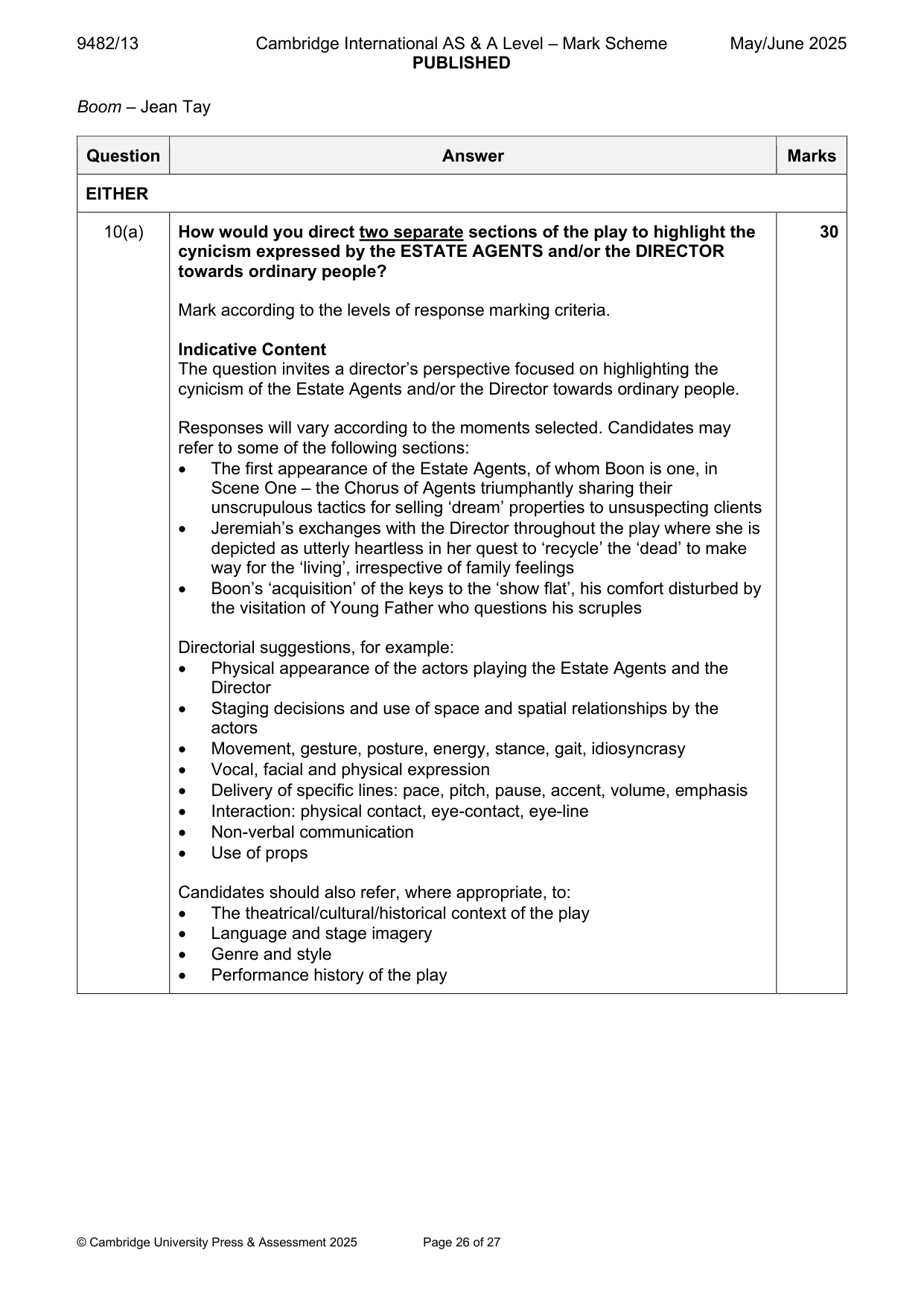
9482/13 Cambridge International AS & A Level – Mark Scheme PUBLISHED May/June 2025 © Cambridge University Press & Assessment 2025 Page 26 of 27 Boom – Jean Tay Question Answer Marks EITHER 10(a) How would you direct two separate sections of the play to highlight the cynicism expressed by the ESTATE AGENTS and/or the DIRECTOR towards ordinary people? Mark according to the levels of response marking criteria. Indicative Content The question invites a director’s perspective focused on highlighting the cynicism of the Estate Agents and/or the Director towards ordinary people. Responses will vary according to the moments selected. Candidates may refer to some of the following sections: • The first appearance of the Estate Agents, of whom Boon is one, in Scene One – the Chorus of Agents triumphantly sharing their unscrupulous tactics for selling ‘dream’ properties to unsuspecting clients • Jeremiah’s exchanges with the Director throughout the play where she is depicted as utterly heartless in her quest to ‘recycle’ the ‘dead’ to make way for the ‘living’, irrespective of family feelings • Boon’s ‘acquisition’ of the keys to the ‘show flat’, his comfort disturbed by the visitation of Young Father who questions his scruples Directorial suggestions, for example: • Physical appearance of the actors playing the Estate Agents and the Director • Staging decisions and use of space and spatial relationships by the actors • Movement, gesture, posture, energy, stance, gait, idiosyncrasy • Vocal, facial and physical expression • Delivery of specific lines: pace, pitch, pause, accent, volume, emphasis • Interaction: physical contact, eye-contact, eye-line • Non-verbal communication • Use of props Candidates should also refer, where appropriate, to: • The theatrical/cultural/historical context of the play • Language and stage imagery • Genre and style • Performance history of the play 30
Mark scheme, page 27
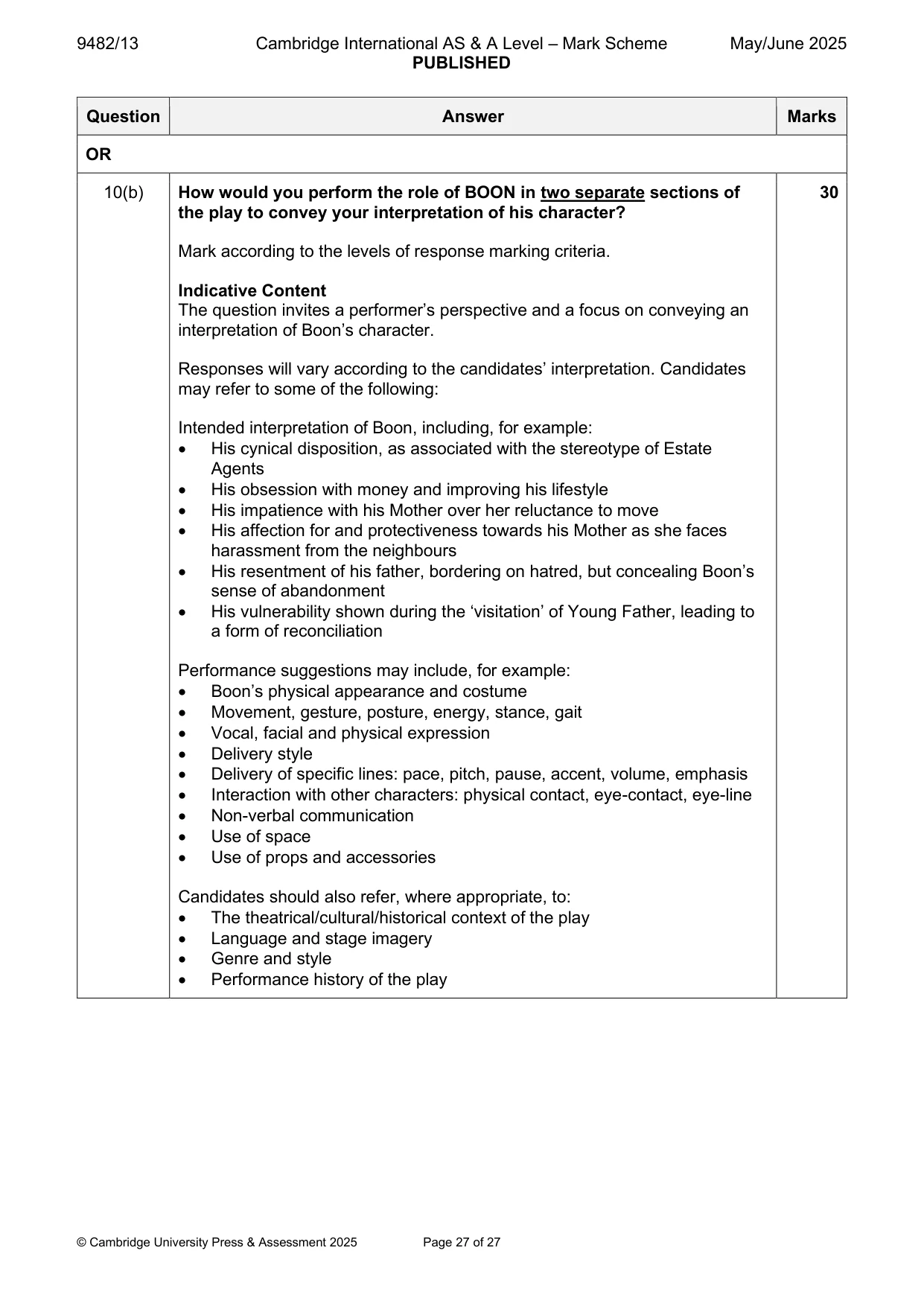
9482/13 Cambridge International AS & A Level – Mark Scheme PUBLISHED May/June 2025 © Cambridge University Press & Assessment 2025 Page 27 of 27 Question Answer Marks OR 10(b) How would you perform the role of BOON in two separate sections of the play to convey your interpretation of his character? Mark according to the levels of response marking criteria. Indicative Content The question invites a performer’s perspective and a focus on conveying an interpretation of Boon’s character. Responses will vary according to the candidates’ interpretation. Candidates may refer to some of the following: Intended interpretation of Boon, including, for example: • His cynical disposition, as associated with the stereotype of Estate Agents • His obsession with money and improving his lifestyle • His impatience with his Mother over her reluctance to move • His affection for and protectiveness towards his Mother as she faces harassment from the neighbours • His resentment of his father, bordering on hatred, but concealing Boon’s sense of abandonment • His vulnerability shown during the ‘visitation’ of Young Father, leading to a form of reconciliation Performance suggestions may include, for example: • Boon’s physical appearance and costume • Movement, gesture, posture, energy, stance, gait • Vocal, facial and physical expression • Delivery style • Delivery of specific lines: pace, pitch, pause, accent, volume, emphasis • Interaction with other characters: physical contact, eye-contact, eye-line • Non-verbal communication • Use of space • Use of props and accessories Candidates should also refer, where appropriate, to: • The theatrical/cultural/historical context of the play • Language and stage imagery • Genre and style • Performance history of the play 30
What you needed in this session
Cambridge’s own grade thresholds for 2025 May/June, Paper 1 · Variant 3. A higher threshold means an easier paper — the bar moves with how the cohort did.