Cambridge A Level Drama 9482 — 2025 May/June Paper 1 · Variant 1
9482/11/M/J/25 · 60 marks · 120 min
The question paper and its mark scheme, free to read here and free to download. This is Cambridge’s own paper, exactly as it was sat.
Question paper8 pages


Mark scheme28 pages
Answers below. Sit the paper first if you are practising.
Paper as text
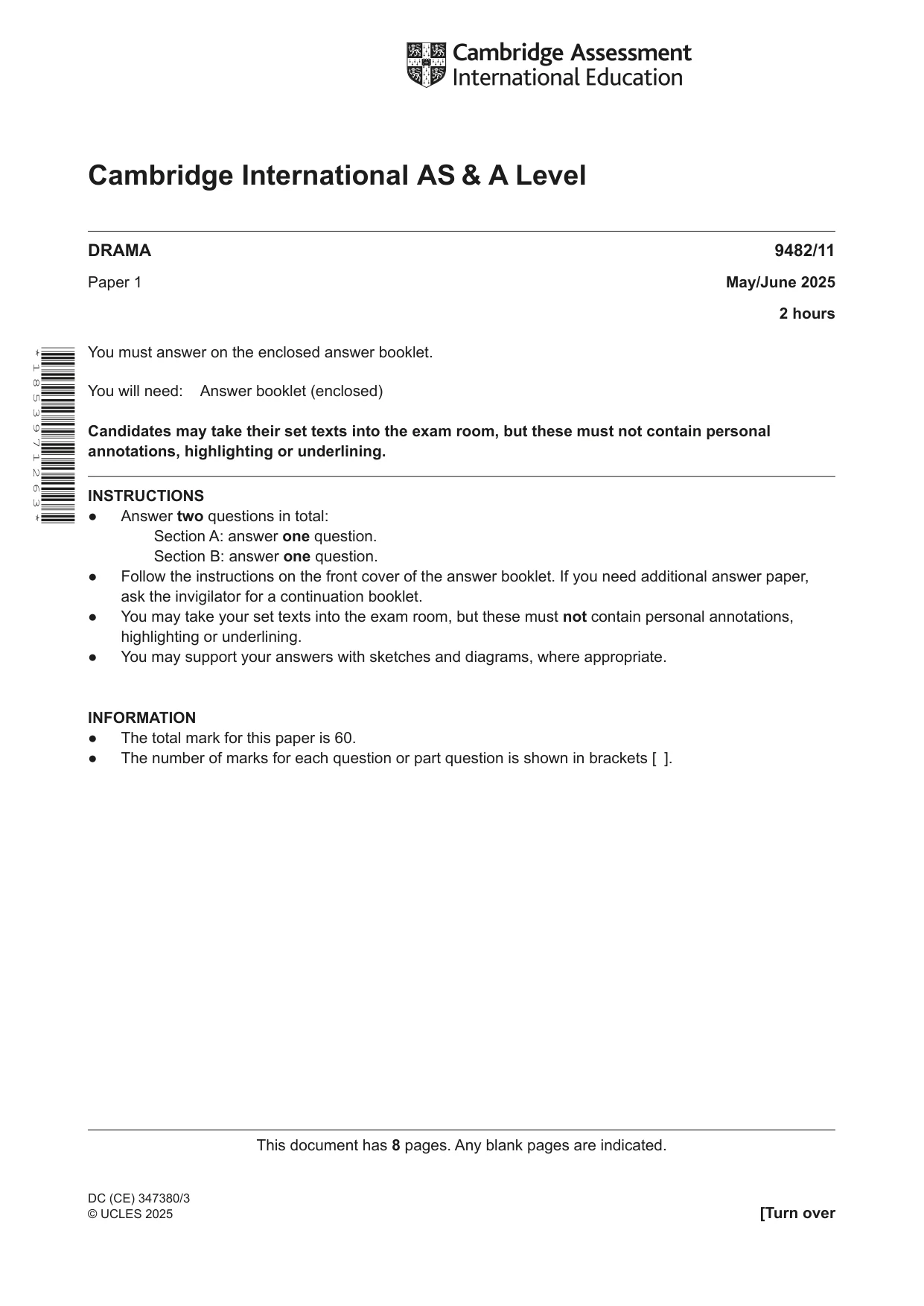
Question paper, page 1
This document has 8 pages. Any blank pages are indicated. [Turn over Cambridge International AS & A Level DC (CE) 347380/3 © UCLES 2025 * 1 8 5 3 9 7 1 2 6 3 * DRAMA 9482/11 Paper 1 May/June 2025 2 hours You must answer on the enclosed answer booklet. You will need: Answer booklet (enclosed) Candidates may take their set texts into the exam room, but these must not contain personal annotations, highlighting or underlining. INSTRUCTIONS ● Answer two questions in total: Section A: answer one question. Section B: answer one question. ● Follow the instructions on the front cover of the answer booklet. If you need additional answer paper, ask the invigilator for a continuation booklet. ● You may take your set texts into the exam room, but these must not contain personal annotations, highlighting or underlining. ● You may support your answers with sketches and diagrams, where appropriate. INFORMATION ● The total mark for this paper is 60. ● The number of marks for each question or part question is shown in brackets [ ].
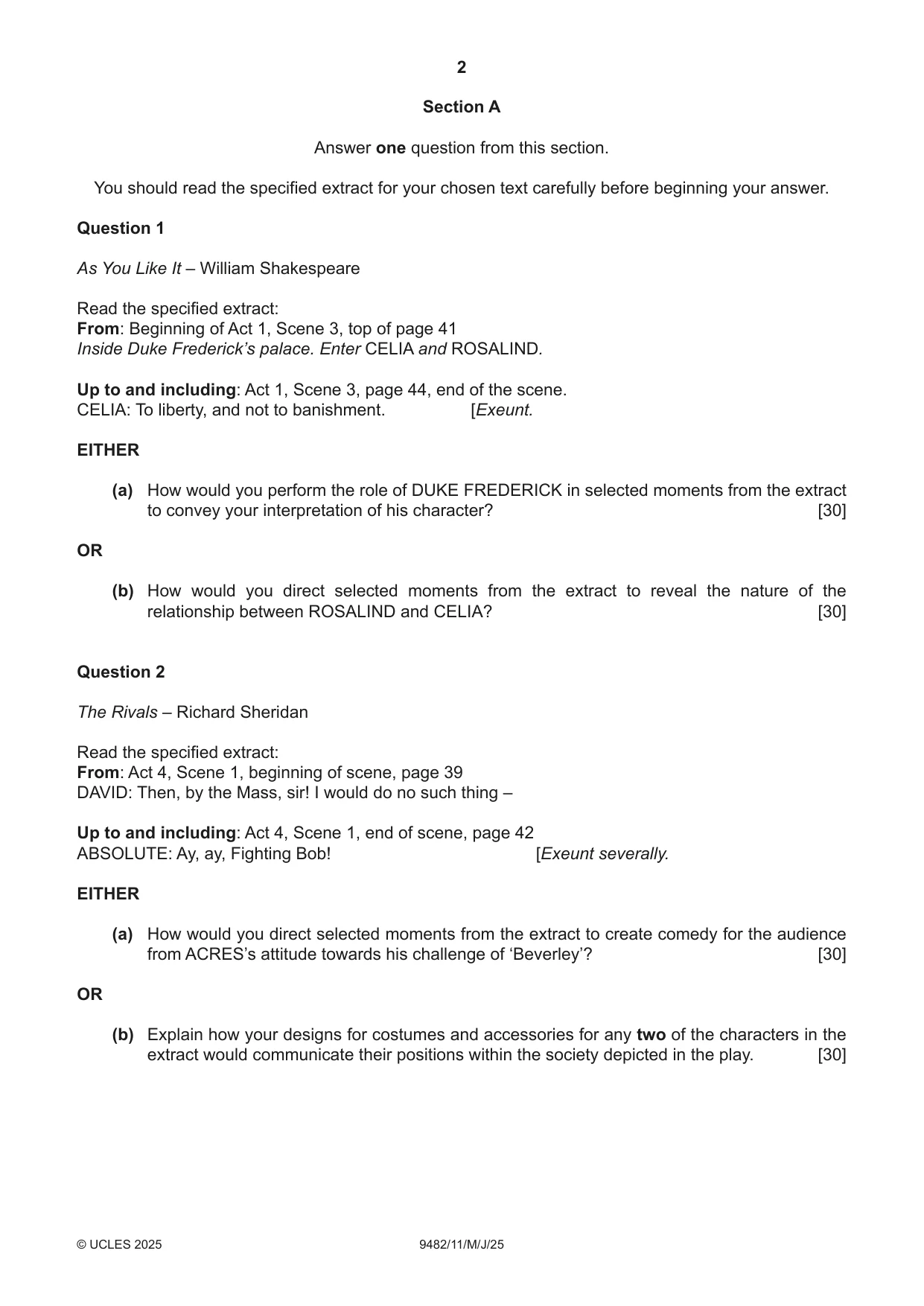
Question paper, page 2
2 9482/11/M/J/25 © UCLES 2025 Section A Answer one question from this section. You should read the specified extract for your chosen text carefully before beginning your answer. Question 1 As You Like It – William Shakespeare Read the specified extract: From: Beginning of Act 1, Scene 3, top of page 41 Inside Duke Frederick’s palace. Enter CELIA and ROSALIND. Up to and including: Act 1, Scene 3, page 44, end of the scene. CELIA: To liberty, and not to banishment. [Exeunt. EITHER (a) How would you perform the role of DUKE FREDERICK in selected moments from the extract to convey your interpretation of his character? [30] OR (b) How would you direct selected moments from the extract to reveal the nature of the relationship between ROSALIND and CELIA? [30] Question 2 The Rivals – Richard Sheridan Read the specified extract: From: Act 4, Scene 1, beginning of scene, page 39 DAVID: Then, by the Mass, sir! I would do no such thing – Up to and including: Act 4, Scene 1, end of scene, page 42 ABSOLUTE: Ay, ay, Fighting Bob! [Exeunt severally. EITHER (a) How would you direct selected moments from the extract to create comedy for the audience from ACRES’s attitude towards his challenge of ‘Beverley’? [30] OR (b) Explain how your designs for costumes and accessories for any two of the characters in the extract would communicate their positions within the society depicted in the play. [30]
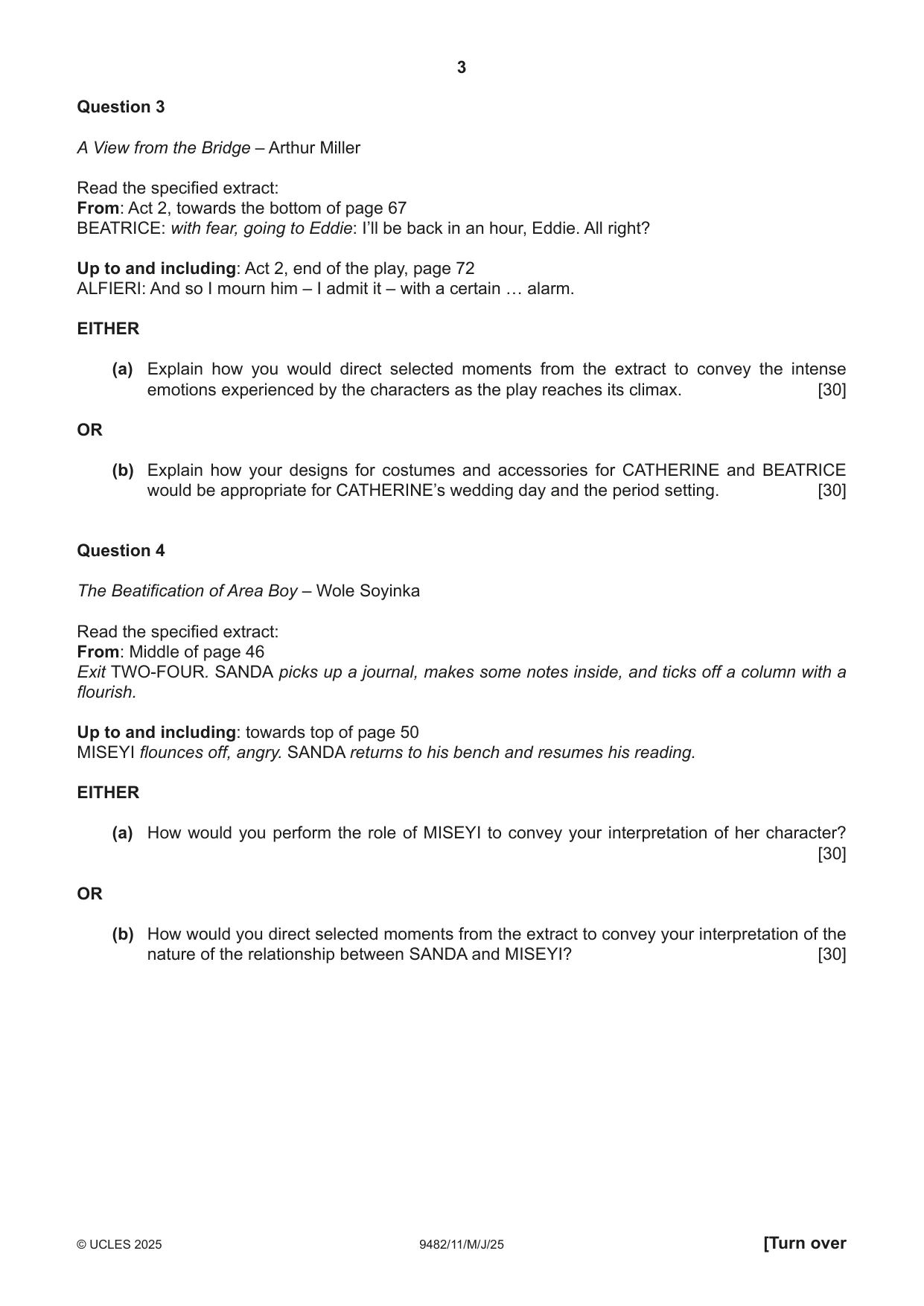
Question paper, page 3
3 9482/11/M/J/25 © UCLES 2025 [Turn over Question 3 A View from the Bridge – Arthur Miller Read the specified extract: From: Act 2, towards the bottom of page 67 BEATRICE: with fear, going to Eddie: I’ll be back in an hour, Eddie. All right? Up to and including: Act 2, end of the play, page 72 ALFIERI: And so I mourn him – I admit it – with a certain … alarm. EITHER (a) Explain how you would direct selected moments from the extract to convey the intense emotions experienced by the characters as the play reaches its climax. [30] OR (b) Explain how your designs for costumes and accessories for CATHERINE and BEATRICE would be appropriate for CATHERINE’s wedding day and the period setting. [30] Question 4 The Beatification of Area Boy – Wole Soyinka Read the specified extract: From: Middle of page 46 Exit TWO-FOUR. SANDA picks up a journal, makes some notes inside, and ticks off a column with a flourish. Up to and including: towards top of page 50 MISEYI flounces off, angry. SANDA returns to his bench and resumes his reading. EITHER (a) How would you perform the role of MISEYI to convey your interpretation of her character? [30] OR (b) How would you direct selected moments from the extract to convey your interpretation of the nature of the relationship between SANDA and MISEYI? [30]
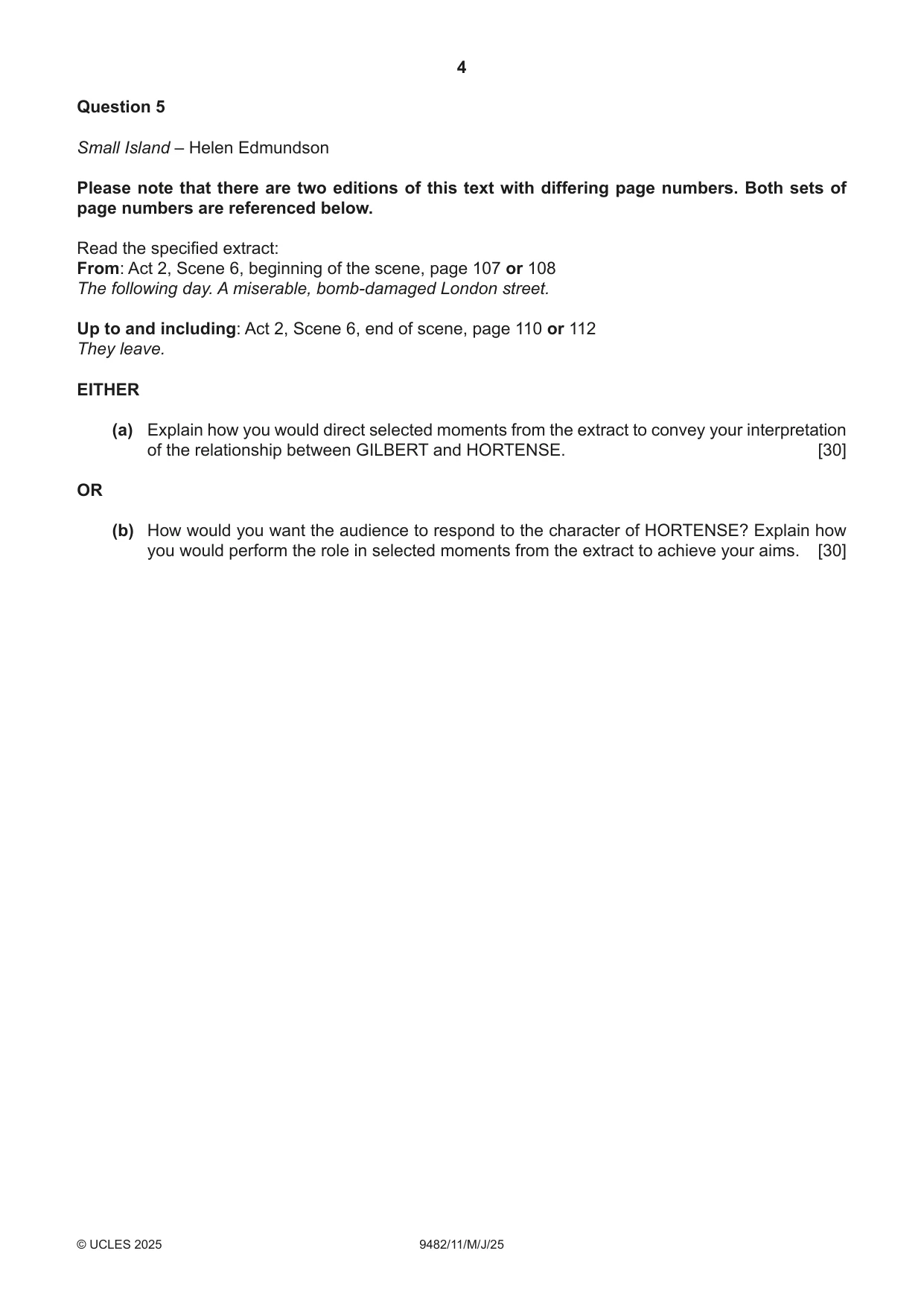
Question paper, page 4
4 9482/11/M/J/25 © UCLES 2025 Question 5 Small Island – Helen Edmundson Please note that there are two editions of this text with differing page numbers. Both sets of page numbers are referenced below. Read the specified extract: From: Act 2, Scene 6, beginning of the scene, page 107 or 108 The following day. A miserable, bomb-damaged London street. Up to and including: Act 2, Scene 6, end of scene, page 110 or 112 They leave. EITHER (a) Explain how you would direct selected moments from the extract to convey your interpretation of the relationship between GILBERT and HORTENSE. [30] OR (b) How would you want the audience to respond to the character of HORTENSE? Explain how you would perform the role in selected moments from the extract to achieve your aims. [30]
Question paper, page 5
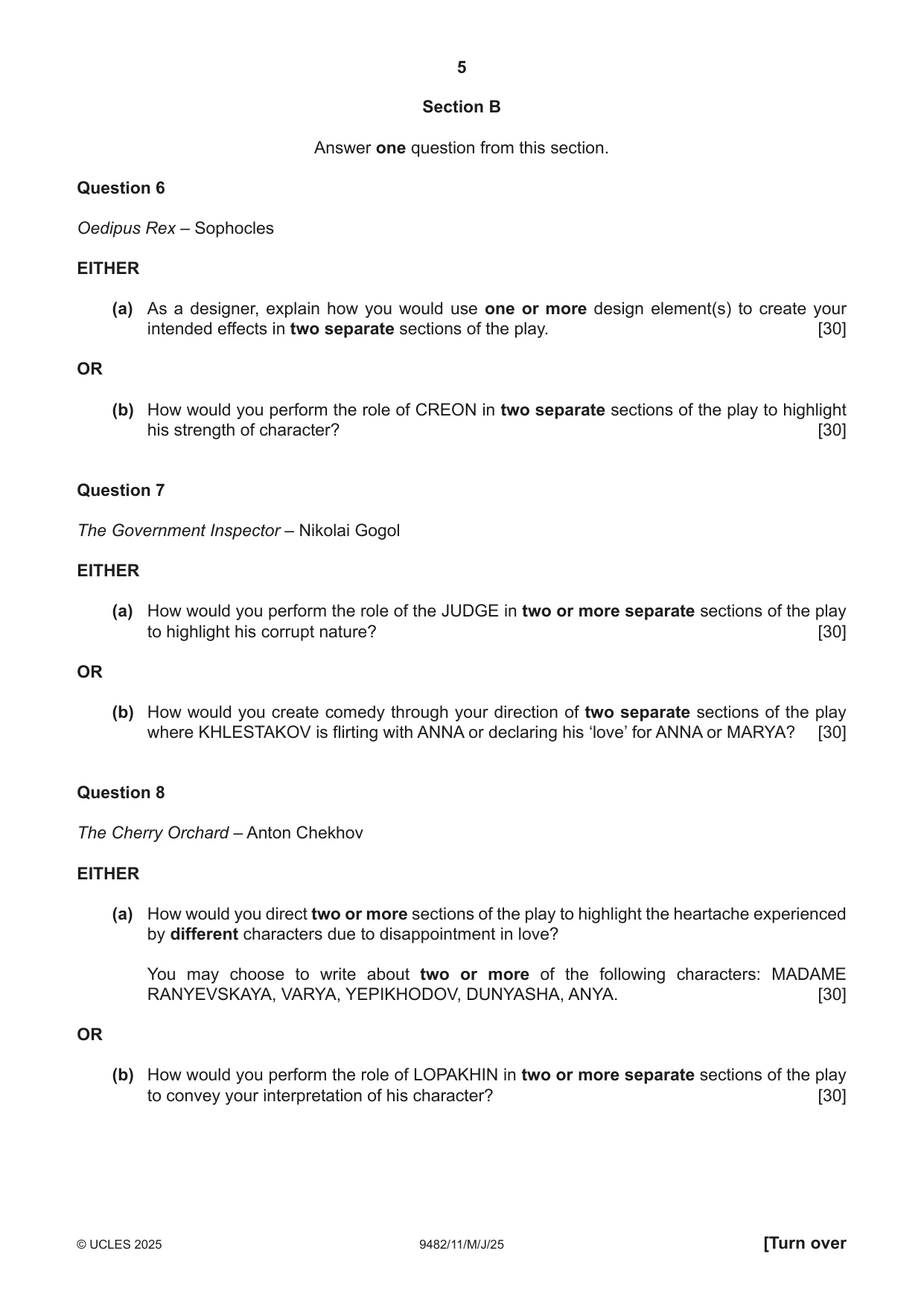
5 9482/11/M/J/25 © UCLES 2025 [Turn over Section B Answer one question from this section. Question 6 Oedipus Rex – Sophocles EITHER (a) As a designer, explain how you would use one or more design element(s) to create your intended effects in two separate sections of the play. [30] OR (b) How would you perform the role of CREON in two separate sections of the play to highlight his strength of character? [30] Question 7 The Government Inspector – Nikolai Gogol EITHER (a) How would you perform the role of the JUDGE in two or more separate sections of the play to highlight his corrupt nature? [30] OR (b) How would you create comedy through your direction of two separate sections of the play where KHLESTAKOV is flirting with ANNA or declaring his ‘love’ for ANNA or MARYA? [30] Question 8 The Cherry Orchard – Anton Chekhov EITHER (a) How would you direct two or more sections of the play to highlight the heartache experienced by different characters due to disappointment in love? You may choose to write about two or more of the following characters: MADAME RANYEVSKAYA, VARYA, YEPIKHODOV, DUNYASHA, ANYA. [30] OR (b) How would you perform the role of LOPAKHIN in two or more separate sections of the play to convey your interpretation of his character? [30]
Question paper, page 6
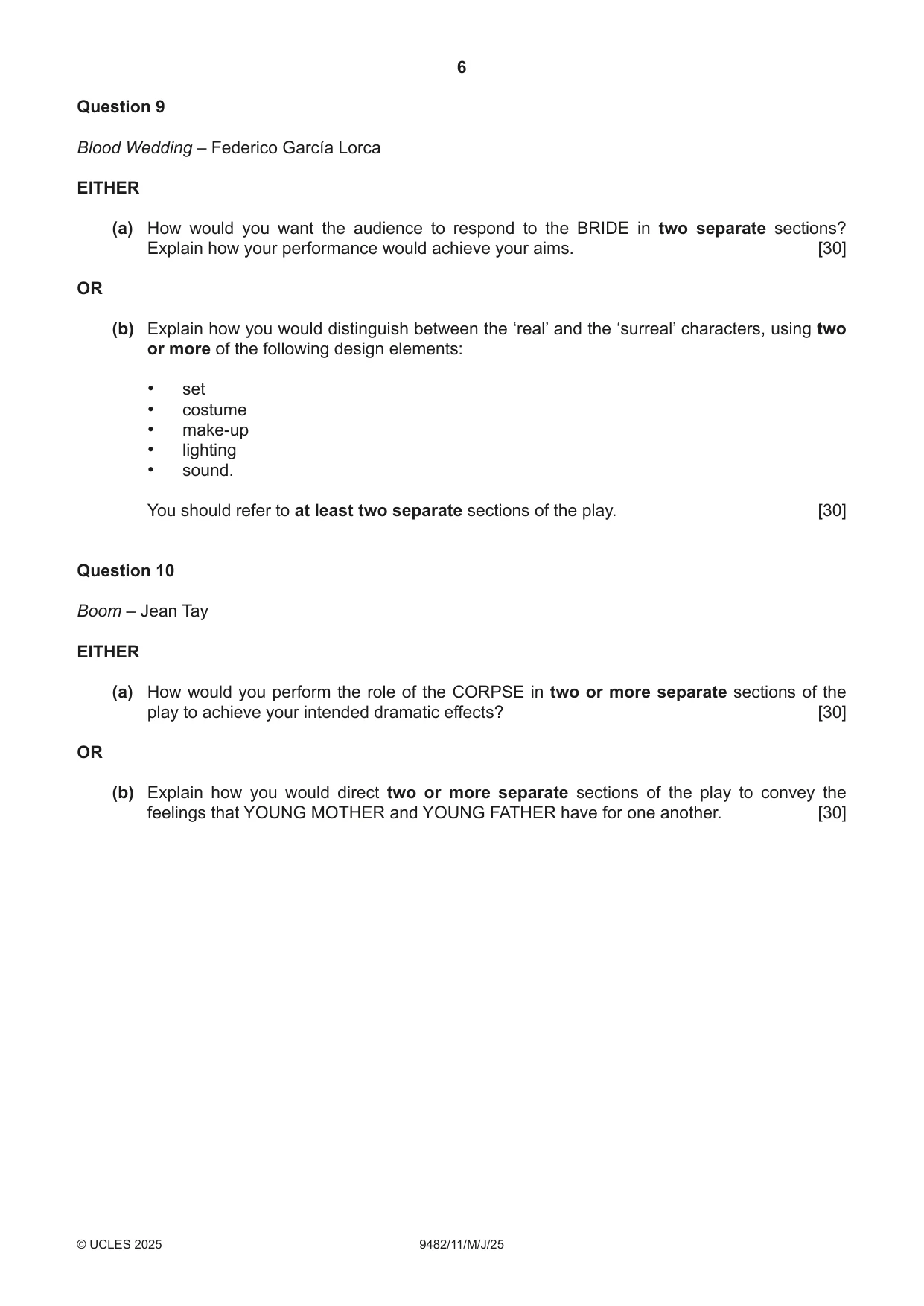
6 9482/11/M/J/25 © UCLES 2025 Question 9 Blood Wedding – Federico García Lorca EITHER (a) How would you want the audience to respond to the BRIDE in two separate sections? Explain how your performance would achieve your aims. [30] OR (b) Explain how you would distinguish between the ‘real’ and the ‘surreal’ characters, using two or more of the following design elements: • set • costume • make-up • lighting • sound. You should refer to at least two separate sections of the play. [30] Question 10 Boom – Jean Tay EITHER (a) How would you perform the role of the CORPSE in two or more separate sections of the play to achieve your intended dramatic effects? [30] OR (b) Explain how you would direct two or more separate sections of the play to convey the feelings that YOUNG MOTHER and YOUNG FATHER have for one another. [30]
Question paper, page 7
7 9482/11/M/J/25 © UCLES 2025 BLANK PAGE
Question paper, page 8
8 9482/11/M/J/25 © UCLES 2025 Permission to reproduce items where third-party owned material protected by copyright is included has been sought and cleared where possible. Every reasonable effort has been made by the publisher (UCLES) to trace copyright holders, but if any items requiring clearance have unwittingly been included, the publisher will be pleased to make amends at the earliest possible opportunity. To avoid the issue of disclosure of answer-related information to candidates, all copyright acknowledgements are reproduced online in the Cambridge Assessment International Education Copyright Acknowledgements Booklet. This is produced for each series of examinations and is freely available to download at www.cambridgeinternational.org after the live examination series. Cambridge Assessment International Education is part of Cambridge Assessment. Cambridge Assessment is the brand name of the University of Cambridge Local Examinations Syndicate (UCLES), which is a department of the University of Cambridge. BLANK PAGE
Mark scheme, page 1
This document consists of 28 printed pages. © Cambridge University Press & Assessment 2025 [Turn over Cambridge International AS & A Level DRAMA 9482/11 Paper 1 Open-Book Written Examination May/June 2025 MARK SCHEME Maximum Mark: 60 Published This mark scheme is published as an aid to teachers and candidates, to indicate the requirements of the examination. It shows the basis on which Examiners were instructed to award marks. It does not indicate the details of the discussions that took place at an Examiners’ meeting before marking began, which would have considered the acceptability of alternative answers. Mark schemes should be read in conjunction with the question paper and the Principal Examiner Report for Teachers. Cambridge International will not enter into discussions about these mark schemes. Cambridge International is publishing the mark schemes for the May/June 2025 series for most Cambridge IGCSE, Cambridge International A and AS Level components, and some Cambridge O Level components.
Mark scheme, page 2
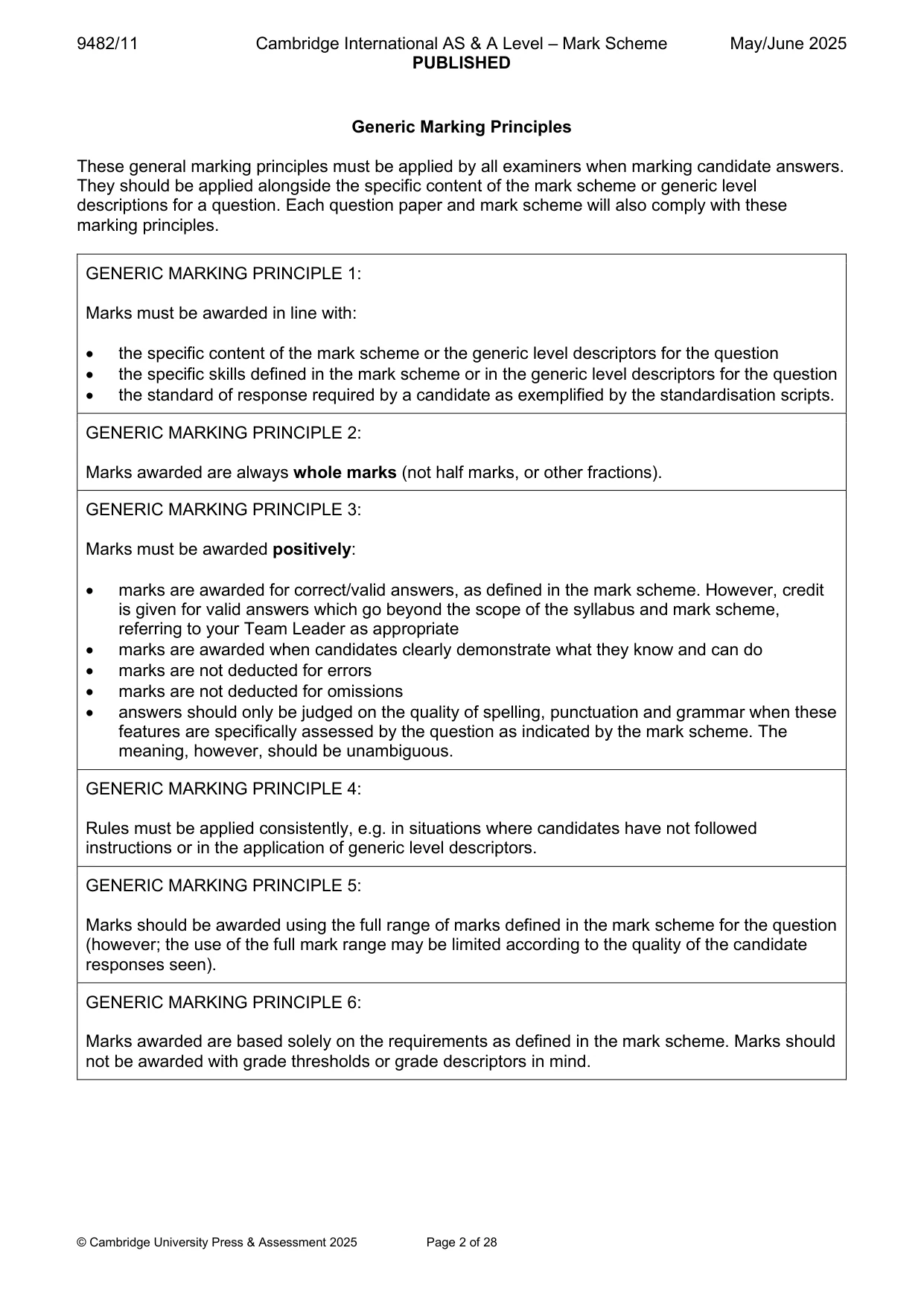
9482/11 Cambridge International AS & A Level – Mark Scheme PUBLISHED May/June 2025 © Cambridge University Press & Assessment 2025 Page 2 of 28 Generic Marking Principles These general marking principles must be applied by all examiners when marking candidate answers. They should be applied alongside the specific content of the mark scheme or generic level descriptions for a question. Each question paper and mark scheme will also comply with these marking principles. GENERIC MARKING PRINCIPLE 1: Marks must be awarded in line with: • the specific content of the mark scheme or the generic level descriptors for the question • the specific skills defined in the mark scheme or in the generic level descriptors for the question • the standard of response required by a candidate as exemplified by the standardisation scripts. GENERIC MARKING PRINCIPLE 2: Marks awarded are always whole marks (not half marks, or other fractions). GENERIC MARKING PRINCIPLE 3: Marks must be awarded positively: • marks are awarded for correct/valid answers, as defined in the mark scheme. However, credit is given for valid answers which go beyond the scope of the syllabus and mark scheme, referring to your Team Leader as appropriate • marks are awarded when candidates clearly demonstrate what they know and can do • marks are not deducted for errors • marks are not deducted for omissions • answers should only be judged on the quality of spelling, punctuation and grammar when these features are specifically assessed by the question as indicated by the mark scheme. The meaning, however, should be unambiguous. GENERIC MARKING PRINCIPLE 4: Rules must be applied consistently, e.g. in situations where candidates have not followed instructions or in the application of generic level descriptors. GENERIC MARKING PRINCIPLE 5: Marks should be awarded using the full range of marks defined in the mark scheme for the question (however; the use of the full mark range may be limited according to the quality of the candidate responses seen). GENERIC MARKING PRINCIPLE 6: Marks awarded are based solely on the requirements as defined in the mark scheme. Marks should not be awarded with grade thresholds or grade descriptors in mind.
Mark scheme, page 3
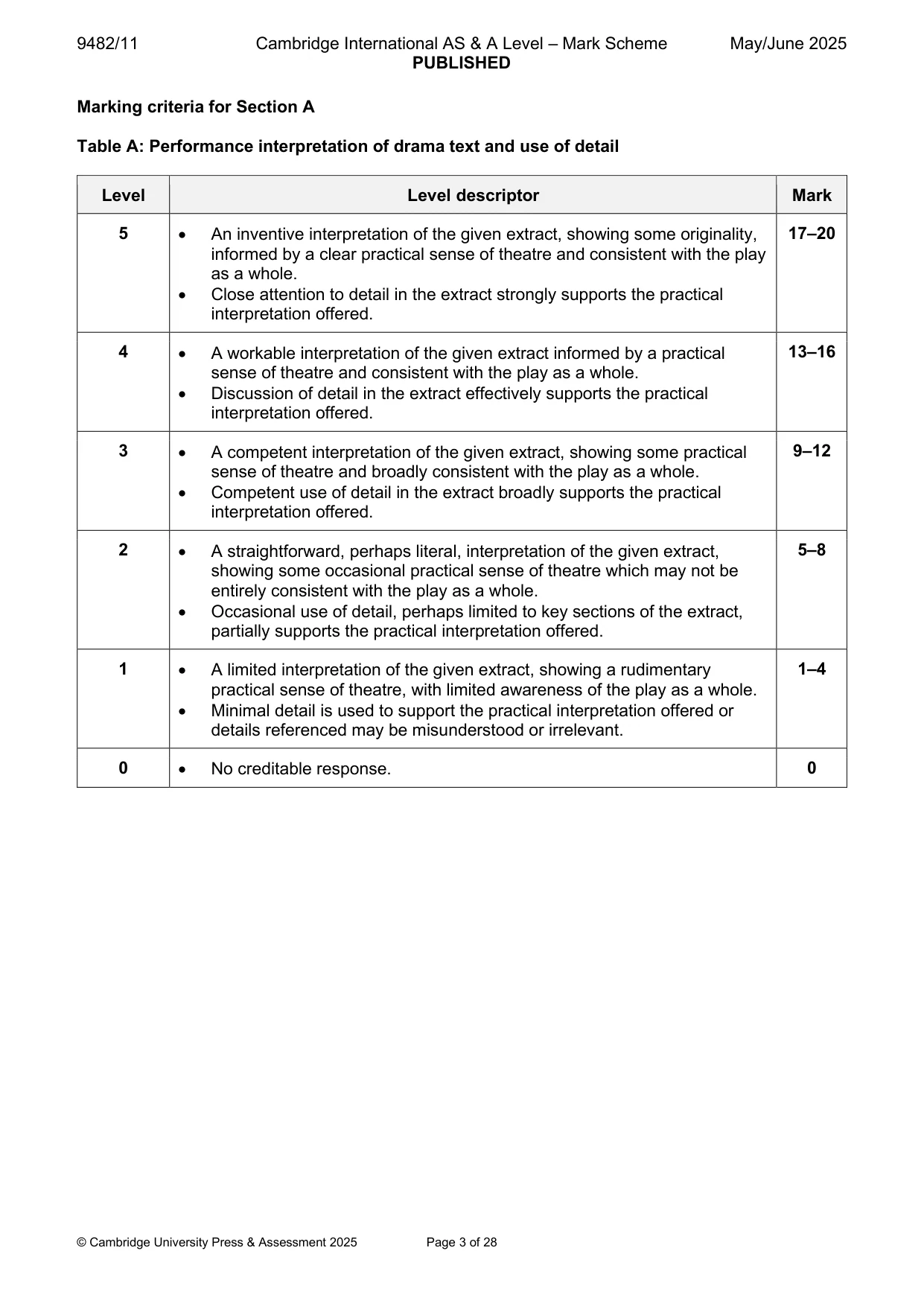
9482/11 Cambridge International AS & A Level – Mark Scheme PUBLISHED May/June 2025 © Cambridge University Press & Assessment 2025 Page 3 of 28 Marking criteria for Section A Table A: Performance interpretation of drama text and use of detail Level Level descriptor Mark 5 • An inventive interpretation of the given extract, showing some originality, informed by a clear practical sense of theatre and consistent with the play as a whole. • Close attention to detail in the extract strongly supports the practical interpretation offered. 17–20 4 • A workable interpretation of the given extract informed by a practical sense of theatre and consistent with the play as a whole. • Discussion of detail in the extract effectively supports the practical interpretation offered. 13–16 3 • A competent interpretation of the given extract, showing some practical sense of theatre and broadly consistent with the play as a whole. • Competent use of detail in the extract broadly supports the practical interpretation offered. 9–12 2 • A straightforward, perhaps literal, interpretation of the given extract, showing some occasional practical sense of theatre which may not be entirely consistent with the play as a whole. • Occasional use of detail, perhaps limited to key sections of the extract, partially supports the practical interpretation offered. 5–8 1 • A limited interpretation of the given extract, showing a rudimentary practical sense of theatre, with limited awareness of the play as a whole. • Minimal detail is used to support the practical interpretation offered or details referenced may be misunderstood or irrelevant. 1–4 0 • No creditable response. 0
Mark scheme, page 4
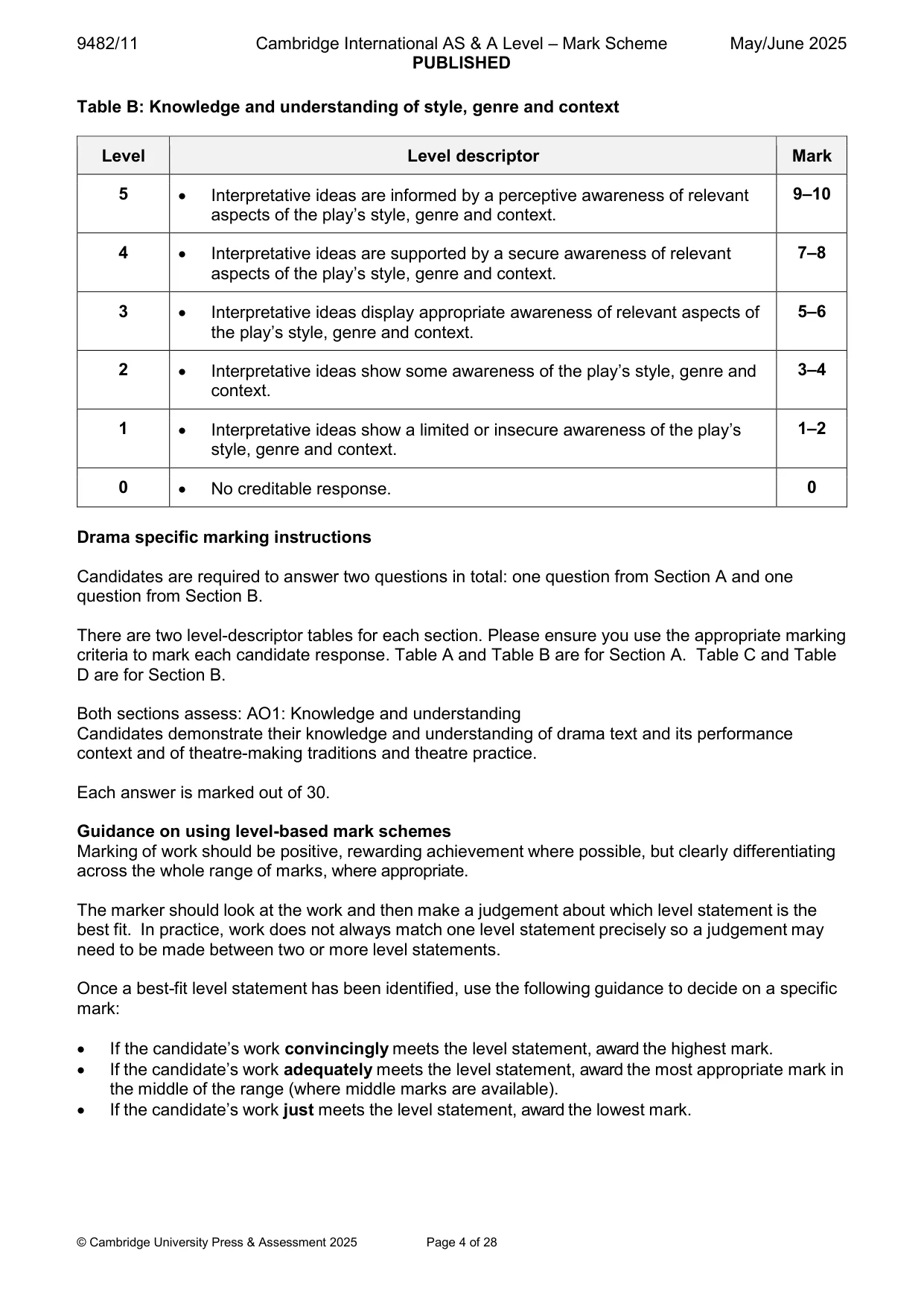
9482/11 Cambridge International AS & A Level – Mark Scheme PUBLISHED May/June 2025 © Cambridge University Press & Assessment 2025 Page 4 of 28 Table B: Knowledge and understanding of style, genre and context Level Level descriptor Mark 5 • Interpretative ideas are informed by a perceptive awareness of relevant aspects of the play’s style, genre and context. 9–10 4 • Interpretative ideas are supported by a secure awareness of relevant aspects of the play’s style, genre and context. 7–8 3 • Interpretative ideas display appropriate awareness of relevant aspects of the play’s style, genre and context. 5–6 2 • Interpretative ideas show some awareness of the play’s style, genre and context. 3–4 1 • Interpretative ideas show a limited or insecure awareness of the play’s style, genre and context. 1–2 0 • No creditable response. 0 Drama specific marking instructions Candidates are required to answer two questions in total: one question from Section A and one question from Section B. There are two level-descriptor tables for each section. Please ensure you use the appropriate marking criteria to mark each candidate response. Table A and Table B are for Section A. Table C and Table D are for Section B. Both sections assess: AO1: Knowledge and understanding Candidates demonstrate their knowledge and understanding of drama text and its performance context and of theatre-making traditions and theatre practice. Each answer is marked out of 30. Guidance on using level-based mark schemes Marking of work should be positive, rewarding achievement where possible, but clearly differentiating across the whole range of marks, where appropriate. The marker should look at the work and then make a judgement about which level statement is the best fit. In practice, work does not always match one level statement precisely so a judgement may need to be made between two or more level statements. Once a best-fit level statement has been identified, use the following guidance to decide on a specific mark: • If the candidate’s work convincingly meets the level statement, award the highest mark. • If the candidate’s work adequately meets the level statement, award the most appropriate mark in the middle of the range (where middle marks are available). • If the candidate’s work just meets the level statement, award the lowest mark.
Mark scheme, page 5
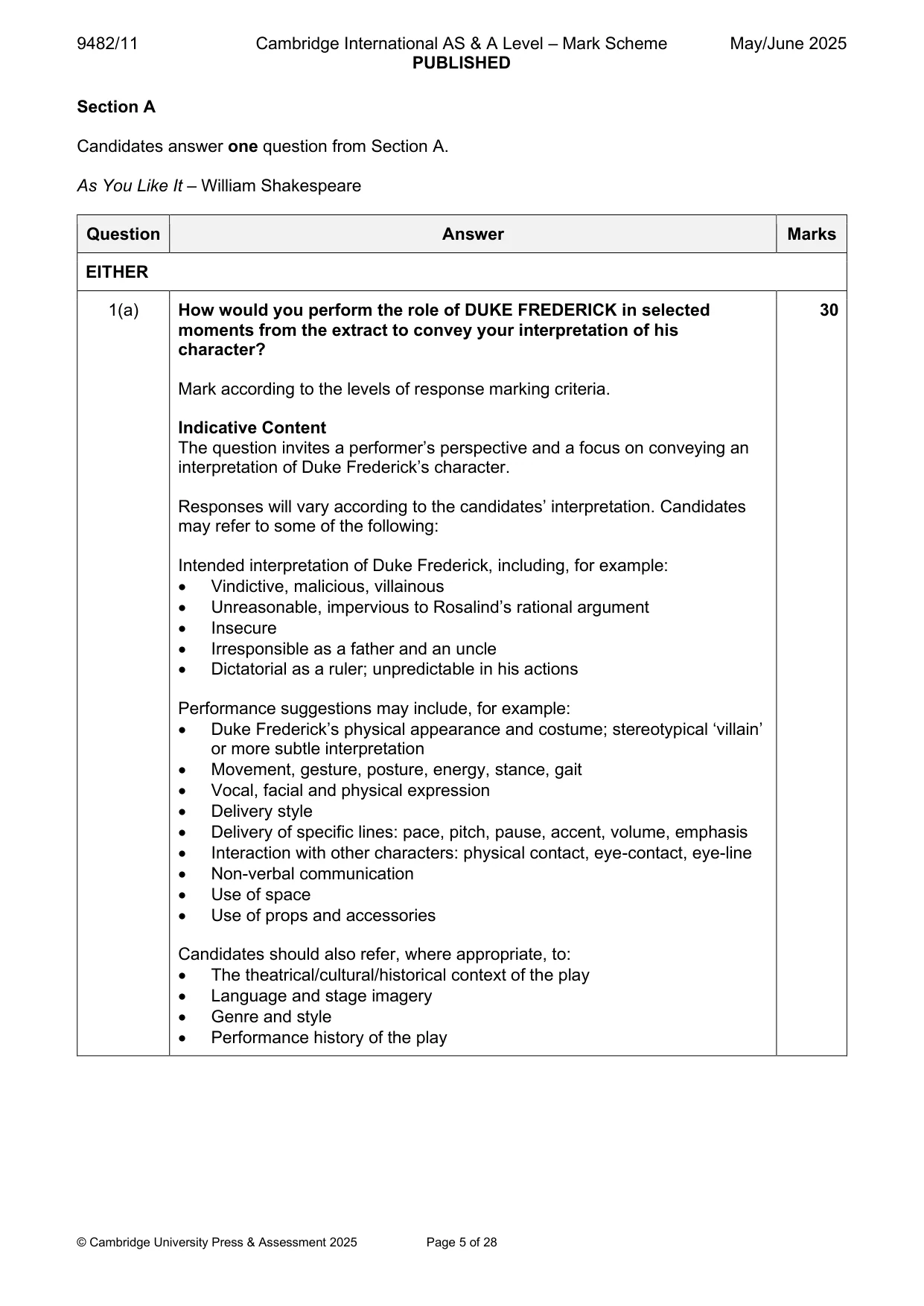
9482/11 Cambridge International AS & A Level – Mark Scheme PUBLISHED May/June 2025 © Cambridge University Press & Assessment 2025 Page 5 of 28 Section A Candidates answer one question from Section A. As You Like It – William Shakespeare Question Answer Marks EITHER 1(a) How would you perform the role of DUKE FREDERICK in selected moments from the extract to convey your interpretation of his character? Mark according to the levels of response marking criteria. Indicative Content The question invites a performer’s perspective and a focus on conveying an interpretation of Duke Frederick’s character. Responses will vary according to the candidates’ interpretation. Candidates may refer to some of the following: Intended interpretation of Duke Frederick, including, for example: • Vindictive, malicious, villainous • Unreasonable, impervious to Rosalind’s rational argument • Insecure • Irresponsible as a father and an uncle • Dictatorial as a ruler; unpredictable in his actions Performance suggestions may include, for example: • Duke Frederick’s physical appearance and costume; stereotypical ‘villain’ or more subtle interpretation • Movement, gesture, posture, energy, stance, gait • Vocal, facial and physical expression • Delivery style • Delivery of specific lines: pace, pitch, pause, accent, volume, emphasis • Interaction with other characters: physical contact, eye-contact, eye-line • Non-verbal communication • Use of space • Use of props and accessories Candidates should also refer, where appropriate, to: • The theatrical/cultural/historical context of the play • Language and stage imagery • Genre and style • Performance history of the play 30
Mark scheme, page 6
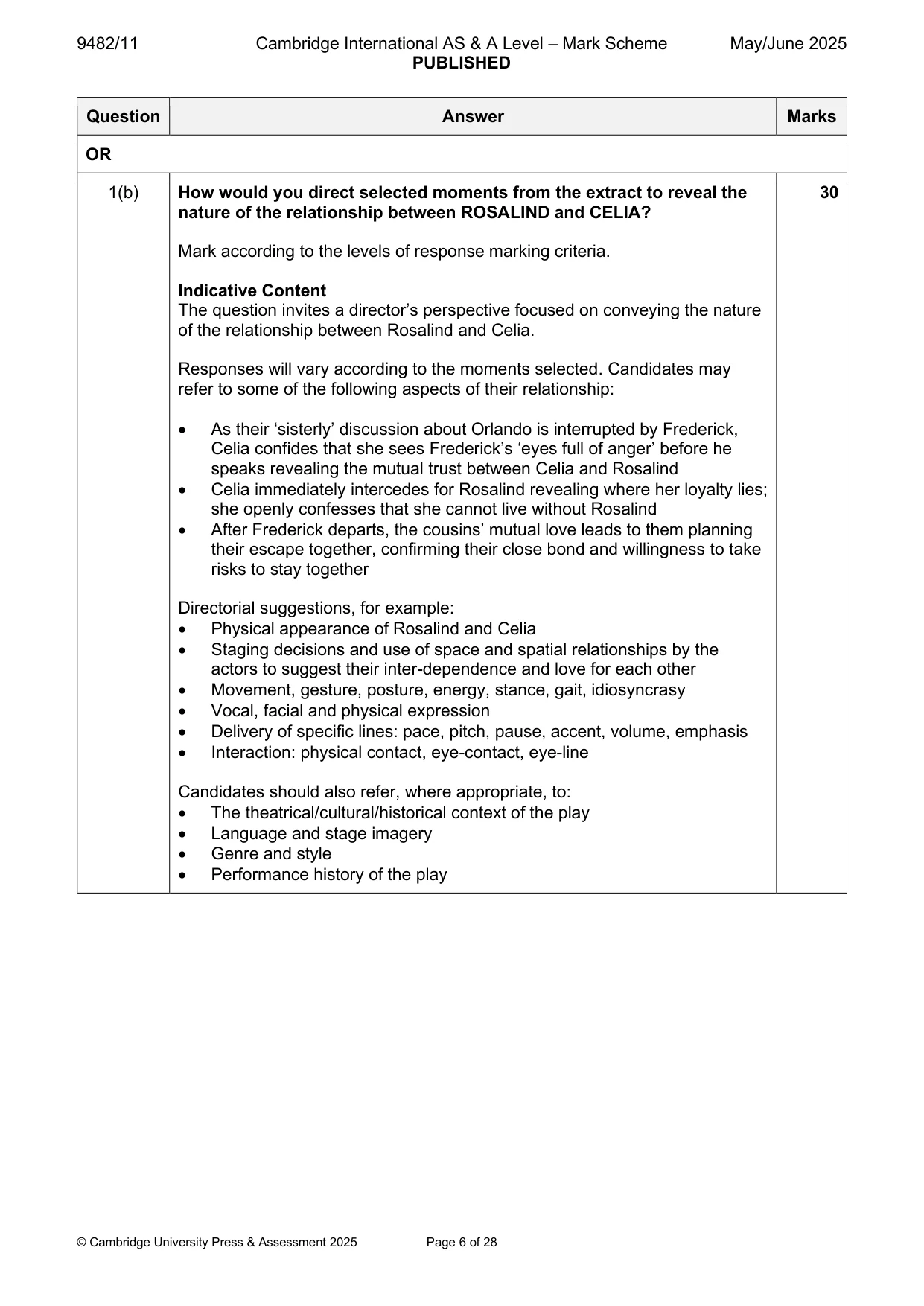
9482/11 Cambridge International AS & A Level – Mark Scheme PUBLISHED May/June 2025 © Cambridge University Press & Assessment 2025 Page 6 of 28 Question Answer Marks OR 1(b) How would you direct selected moments from the extract to reveal the nature of the relationship between ROSALIND and CELIA? Mark according to the levels of response marking criteria. Indicative Content The question invites a director’s perspective focused on conveying the nature of the relationship between Rosalind and Celia. Responses will vary according to the moments selected. Candidates may refer to some of the following aspects of their relationship: • As their ‘sisterly’ discussion about Orlando is interrupted by Frederick, Celia confides that she sees Frederick’s ‘eyes full of anger’ before he speaks revealing the mutual trust between Celia and Rosalind • Celia immediately intercedes for Rosalind revealing where her loyalty lies; she openly confesses that she cannot live without Rosalind • After Frederick departs, the cousins’ mutual love leads to them planning their escape together, confirming their close bond and willingness to take risks to stay together Directorial suggestions, for example: • Physical appearance of Rosalind and Celia • Staging decisions and use of space and spatial relationships by the actors to suggest their inter-dependence and love for each other • Movement, gesture, posture, energy, stance, gait, idiosyncrasy • Vocal, facial and physical expression • Delivery of specific lines: pace, pitch, pause, accent, volume, emphasis • Interaction: physical contact, eye-contact, eye-line Candidates should also refer, where appropriate, to: • The theatrical/cultural/historical context of the play • Language and stage imagery • Genre and style • Performance history of the play 30
Mark scheme, page 7
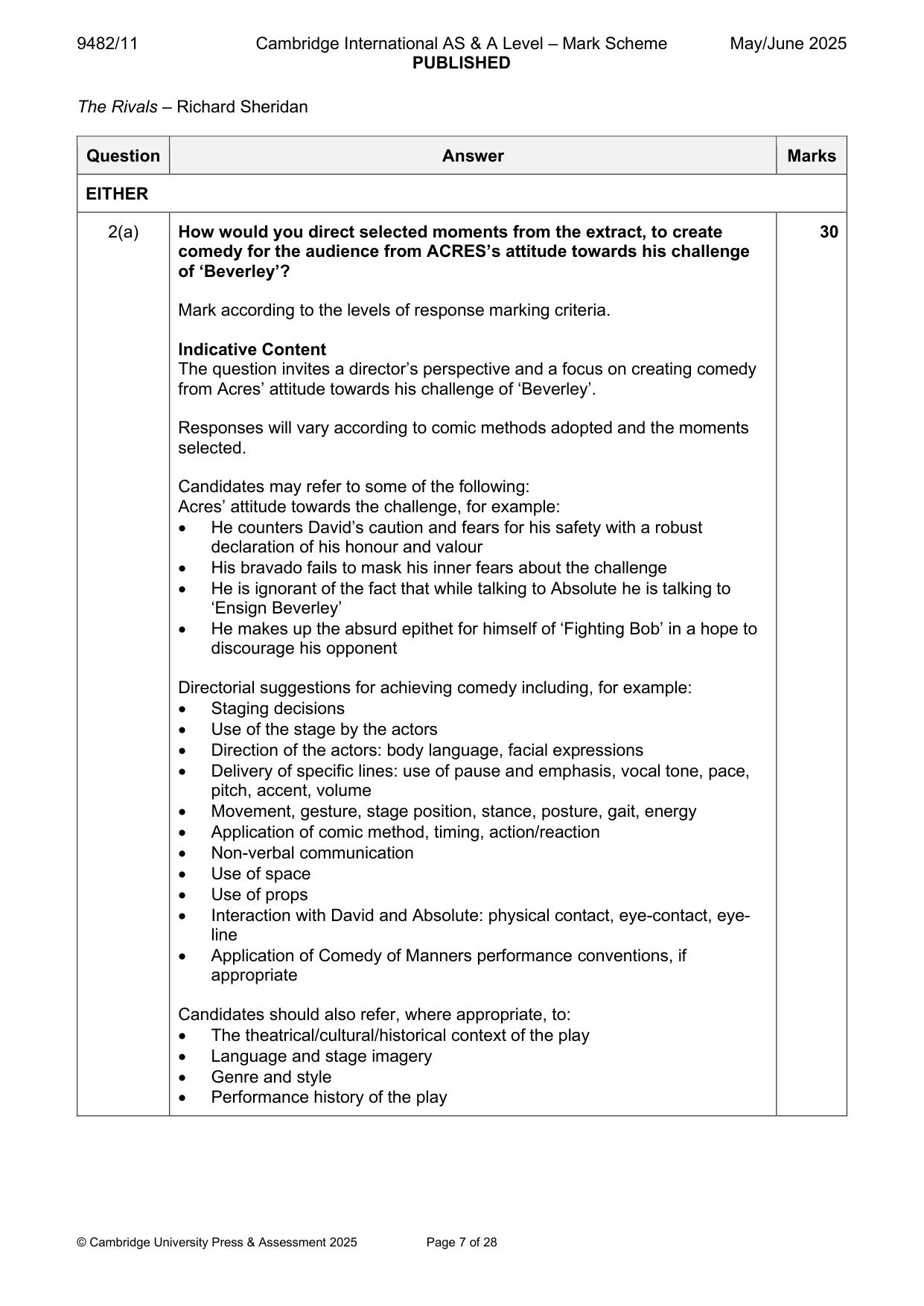
9482/11 Cambridge International AS & A Level – Mark Scheme PUBLISHED May/June 2025 © Cambridge University Press & Assessment 2025 Page 7 of 28 The Rivals – Richard Sheridan Question Answer Marks EITHER 2(a) How would you direct selected moments from the extract, to create comedy for the audience from ACRES’s attitude towards his challenge of ‘Beverley’? Mark according to the levels of response marking criteria. Indicative Content The question invites a director’s perspective and a focus on creating comedy from Acres’ attitude towards his challenge of ‘Beverley’. Responses will vary according to comic methods adopted and the moments selected. Candidates may refer to some of the following: Acres’ attitude towards the challenge, for example: • He counters David’s caution and fears for his safety with a robust declaration of his honour and valour • His bravado fails to mask his inner fears about the challenge • He is ignorant of the fact that while talking to Absolute he is talking to ‘Ensign Beverley’ • He makes up the absurd epithet for himself of ‘Fighting Bob’ in a hope to discourage his opponent Directorial suggestions for achieving comedy including, for example: • Staging decisions • Use of the stage by the actors • Direction of the actors: body language, facial expressions • Delivery of specific lines: use of pause and emphasis, vocal tone, pace, pitch, accent, volume • Movement, gesture, stage position, stance, posture, gait, energy • Application of comic method, timing, action/reaction • Non-verbal communication • Use of space • Use of props • Interaction with David and Absolute: physical contact, eye-contact, eye- line • Application of Comedy of Manners performance conventions, if appropriate Candidates should also refer, where appropriate, to: • The theatrical/cultural/historical context of the play • Language and stage imagery • Genre and style • Performance history of the play 30
Mark scheme, page 8
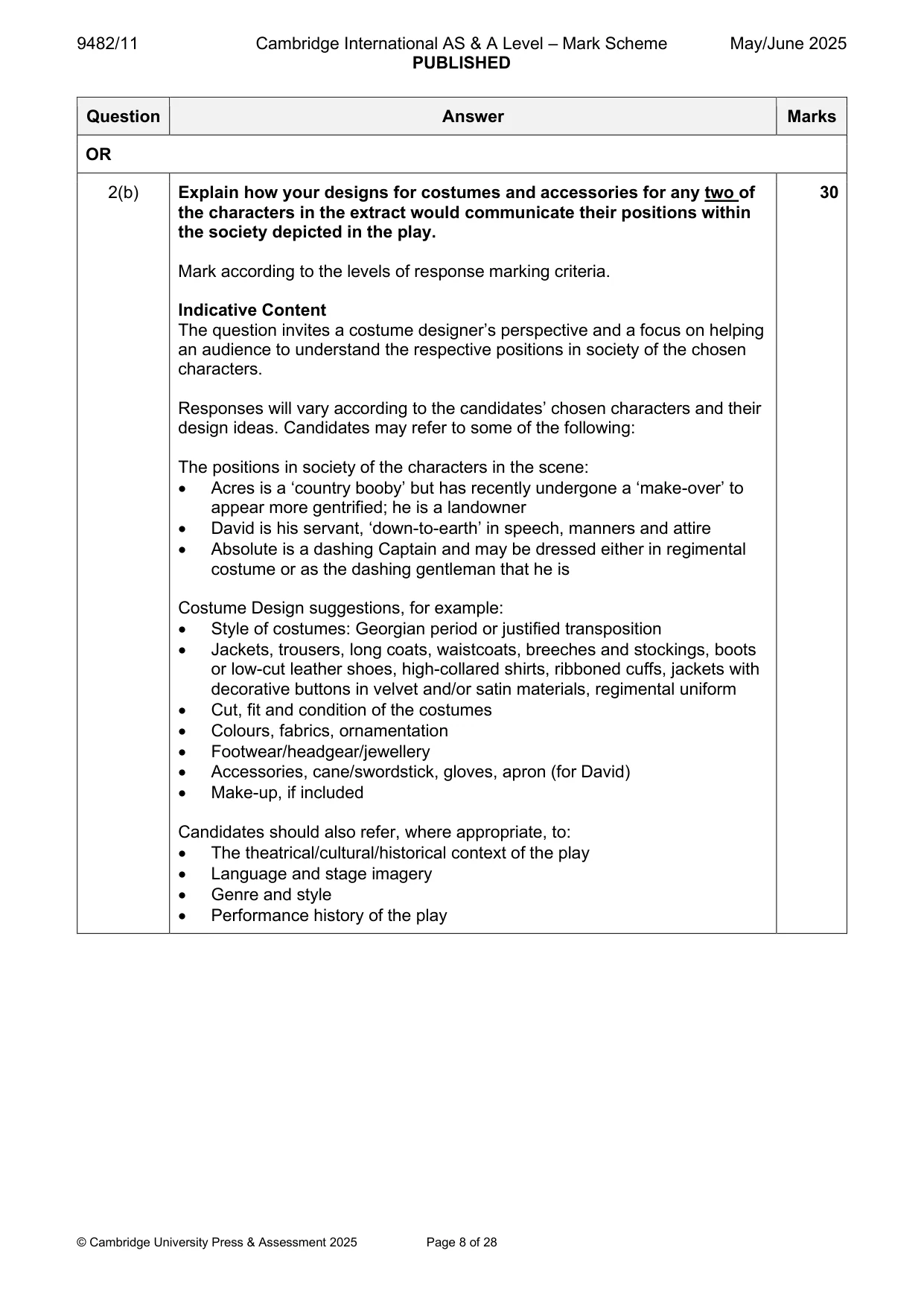
9482/11 Cambridge International AS & A Level – Mark Scheme PUBLISHED May/June 2025 © Cambridge University Press & Assessment 2025 Page 8 of 28 Question Answer Marks OR 2(b) Explain how your designs for costumes and accessories for any two of the characters in the extract would communicate their positions within the society depicted in the play. Mark according to the levels of response marking criteria. Indicative Content The question invites a costume designer’s perspective and a focus on helping an audience to understand the respective positions in society of the chosen characters. Responses will vary according to the candidates’ chosen characters and their design ideas. Candidates may refer to some of the following: The positions in society of the characters in the scene: • Acres is a ‘country booby’ but has recently undergone a ‘make-over’ to appear more gentrified; he is a landowner • David is his servant, ‘down-to-earth’ in speech, manners and attire • Absolute is a dashing Captain and may be dressed either in regimental costume or as the dashing gentleman that he is Costume Design suggestions, for example: • Style of costumes: Georgian period or justified transposition • Jackets, trousers, long coats, waistcoats, breeches and stockings, boots or low-cut leather shoes, high-collared shirts, ribboned cuffs, jackets with decorative buttons in velvet and/or satin materials, regimental uniform • Cut, fit and condition of the costumes • Colours, fabrics, ornamentation • Footwear/headgear/jewellery • Accessories, cane/swordstick, gloves, apron (for David) • Make-up, if included Candidates should also refer, where appropriate, to: • The theatrical/cultural/historical context of the play • Language and stage imagery • Genre and style • Performance history of the play 30
Mark scheme, page 9
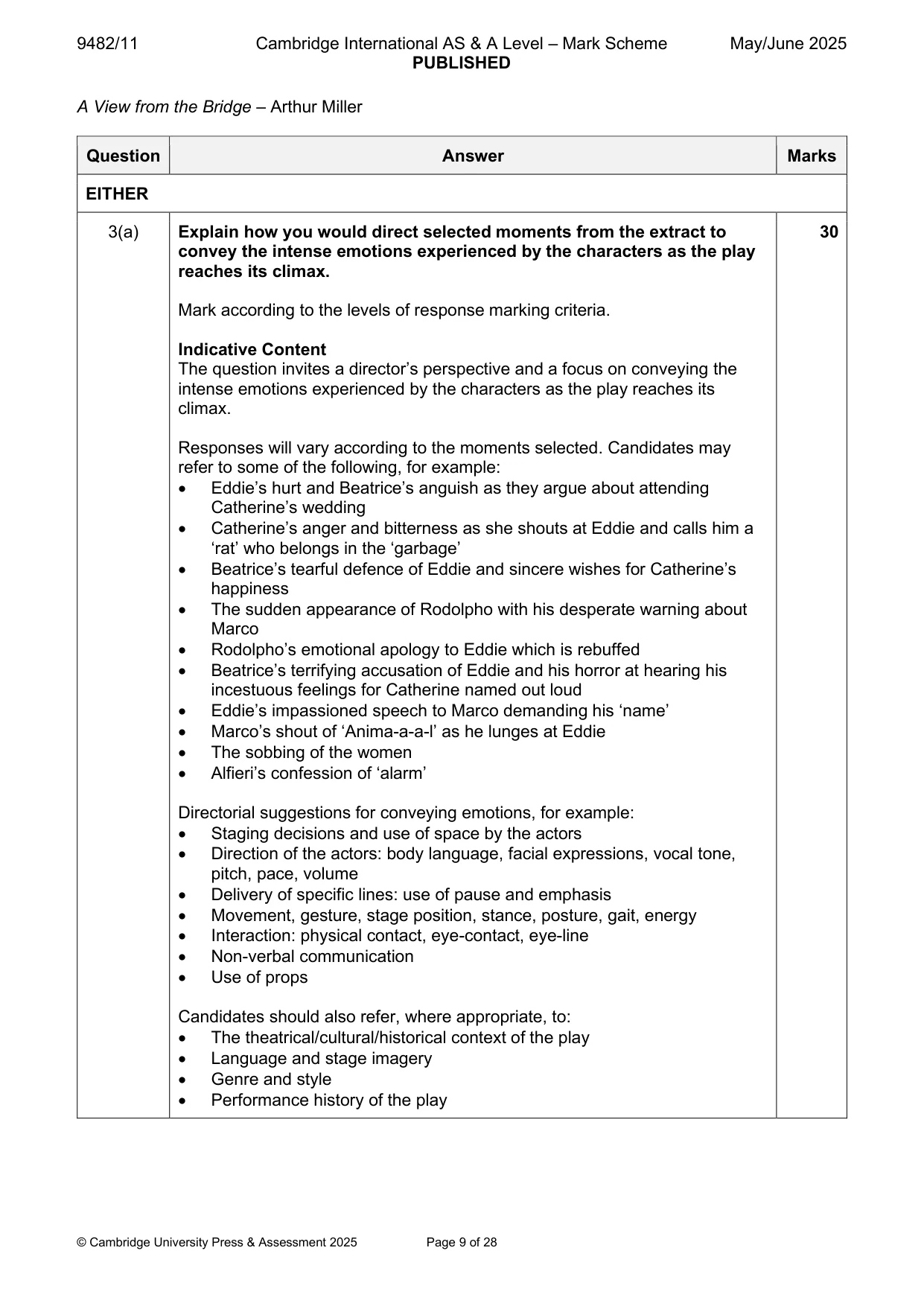
9482/11 Cambridge International AS & A Level – Mark Scheme PUBLISHED May/June 2025 © Cambridge University Press & Assessment 2025 Page 9 of 28 A View from the Bridge – Arthur Miller Question Answer Marks EITHER 3(a) Explain how you would direct selected moments from the extract to convey the intense emotions experienced by the characters as the play reaches its climax. Mark according to the levels of response marking criteria. Indicative Content The question invites a director’s perspective and a focus on conveying the intense emotions experienced by the characters as the play reaches its climax. Responses will vary according to the moments selected. Candidates may refer to some of the following, for example: • Eddie’s hurt and Beatrice’s anguish as they argue about attending Catherine’s wedding • Catherine’s anger and bitterness as she shouts at Eddie and calls him a ‘rat’ who belongs in the ‘garbage’ • Beatrice’s tearful defence of Eddie and sincere wishes for Catherine’s happiness • The sudden appearance of Rodolpho with his desperate warning about Marco • Rodolpho’s emotional apology to Eddie which is rebuffed • Beatrice’s terrifying accusation of Eddie and his horror at hearing his incestuous feelings for Catherine named out loud • Eddie’s impassioned speech to Marco demanding his ‘name’ • Marco’s shout of ‘Anima-a-a-l’ as he lunges at Eddie • The sobbing of the women • Alfieri’s confession of ‘alarm’ Directorial suggestions for conveying emotions, for example: • Staging decisions and use of space by the actors • Direction of the actors: body language, facial expressions, vocal tone, pitch, pace, volume • Delivery of specific lines: use of pause and emphasis • Movement, gesture, stage position, stance, posture, gait, energy • Interaction: physical contact, eye-contact, eye-line • Non-verbal communication • Use of props Candidates should also refer, where appropriate, to: • The theatrical/cultural/historical context of the play • Language and stage imagery • Genre and style • Performance history of the play 30
Mark scheme, page 10
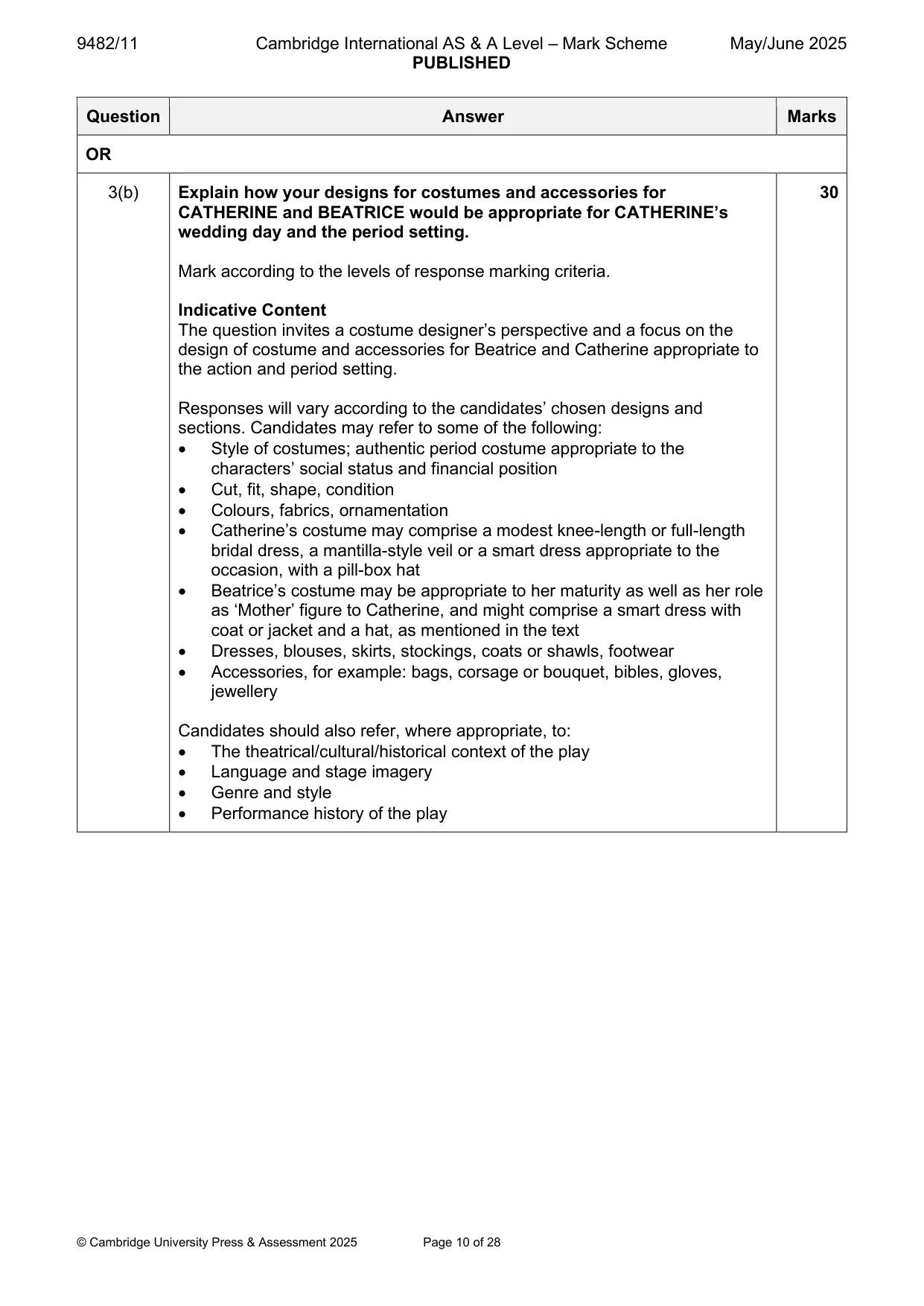
9482/11 Cambridge International AS & A Level – Mark Scheme PUBLISHED May/June 2025 © Cambridge University Press & Assessment 2025 Page 10 of 28 Question Answer Marks OR 3(b) Explain how your designs for costumes and accessories for CATHERINE and BEATRICE would be appropriate for CATHERINE’s wedding day and the period setting. Mark according to the levels of response marking criteria. Indicative Content The question invites a costume designer’s perspective and a focus on the design of costume and accessories for Beatrice and Catherine appropriate to the action and period setting. Responses will vary according to the candidates’ chosen designs and sections. Candidates may refer to some of the following: • Style of costumes; authentic period costume appropriate to the characters’ social status and financial position • Cut, fit, shape, condition • Colours, fabrics, ornamentation • Catherine’s costume may comprise a modest knee-length or full-length bridal dress, a mantilla-style veil or a smart dress appropriate to the occasion, with a pill-box hat • Beatrice’s costume may be appropriate to her maturity as well as her role as ‘Mother’ figure to Catherine, and might comprise a smart dress with coat or jacket and a hat, as mentioned in the text • Dresses, blouses, skirts, stockings, coats or shawls, footwear • Accessories, for example: bags, corsage or bouquet, bibles, gloves, jewellery Candidates should also refer, where appropriate, to: • The theatrical/cultural/historical context of the play • Language and stage imagery • Genre and style • Performance history of the play 30
Mark scheme, page 11
9482/11 Cambridge International AS & A Level – Mark Scheme PUBLISHED May/June 2025 © Cambridge University Press & Assessment 2025 Page 11 of 28 The Beatification of Area Boy – Wole Soyinka Question Answer Marks EITHER 4(a) How would you perform the role of MISEYI to convey your interpretation of her character? Mark according to the levels of response marking criteria. Indicative Content The question invites a performer’s perspective and a focus on conveying an interpretation of Miseyi. Responses will vary according to the interpretation of character and selected moments. Candidates may refer to some of the following: An interpretation of Miseyi, for example: • Briefly playful • Haughty and condescending • Challenging and confrontational • Dismissive of Sanda, snobbish about his chosen ‘profession’ Performance suggestions, for example: • Her physical appearance • Movement, gesture, posture, energy, stance, gait, idiosyncrasy • Vocal, facial and physical expression • Delivery style • Delivery of specific lines: pace, pitch, pause, accent, volume, emphasis • Interaction with a range of other characters: physical contact, eye- contact, eye-line • Non-verbal communication • Use of space • Use of props Candidates should also refer, where appropriate, to: • The theatrical/cultural/historical context of the play • Language and stage imagery • Genre and style • Performance history of the play 30
Mark scheme, page 12
9482/11 Cambridge International AS & A Level – Mark Scheme PUBLISHED May/June 2025 © Cambridge University Press & Assessment 2025 Page 12 of 28 Question Answer Marks OR 4(b) How would you direct selected moments from the extract to convey your interpretation of the nature of the relationship between SANDA and MISEYI? Mark according to the levels of response marking criteria. Indicative Content The question invites a director’s perspective and a focus on conveying an interpretation of the nature of the relationship between SANDA and MISEYI. Responses will vary according to candidates’ interpretation and selected moments. Candidates may refer to some of the following: • Sanda’s obvious admiration of Miseyi’s physical appearance; he compliments her • Miseyi is initially delighted to meet her ‘old flame’ but is scornful of his life choices and looks down on his chosen ‘profession’ • Both appear to relish their past relationship but the differences in their outlook on life appears to make them incompatible • Each of them appears to be disappointed in what the other has become Directorial suggestions, for example: • Staging decisions and use of space • Body language, facial expressions, vocal tone, pitch, pace, volume • Delivery of specific lines: use of pause and emphasis • Movement, gesture, stage position, stance, posture, gait • Interaction: spatial relationships, physical contact, eye-contact, eye-line Candidates should also refer, where appropriate, to: • The theatrical/cultural/historical context of the play • Language and stage imagery • Genre and style • Performance history of the play 30
Mark scheme, page 13
9482/11 Cambridge International AS & A Level – Mark Scheme PUBLISHED May/June 2025 © Cambridge University Press & Assessment 2025 Page 13 of 28 Small Island – Helen Edmundson Question Answer Marks EITHER 5(a) Explain how you would direct selected moments from the extract to convey your interpretation of the relationship between GILBERT and HORTENSE. Mark according to the levels of response marking criteria. Indicative Content The question invites a director’s perspective and a focus on conveying an interpretation of the relationship between Gilbert and Hortense. Responses will vary according to candidates’ interpretation and selected moments. Candidates may refer to some of the following: • Gilbert waits nervously showing his concern for Hortense • Hortense is flustered after her interview and appears to be irritated by Gilbert’s presence • In her state of humiliation, she rejects Gilbert’s support • Hortense takes a while to confess her shame at her experience suggesting a lack of full trust in him • Gilbert’s teasing lightens her mood briefly and there is the beginning of the developing relationship • Gilbert’s mixture of pragmatism, humour and idealism softens Hortense’s resistance to him • Gilbert’s gentle teasing relieves her despair, and the scene ends with a sense of hope and reconciliation within their relationship Directorial suggestions, for example: • Staging decisions and use of space • Body language, facial expressions • Delivery of specific lines: vocal tone, pitch, pace, volume, use of pause and emphasis • Movement, gesture, stage position, stance, posture, gait • Interaction: spatial relationships, physical contact, eye-contact, eye-line • Use of costume • Use of props Candidates should also refer, where appropriate, to: • The theatrical/cultural/historical context of the play • Language and stage imagery • Genre and style • Performance history of the play 30
Mark scheme, page 14
9482/11 Cambridge International AS & A Level – Mark Scheme PUBLISHED May/June 2025 © Cambridge University Press & Assessment 2025 Page 14 of 28 Question Answer Marks OR 5(b) How would you want the audience to respond to the character of HORTENSE? Explain how you would perform the role in selected moments from the extract to achieve your aims. Mark according to the levels of response marking criteria. Indicative Content The question invites a performer’s perspective and a focus on achieving a specific audience response to Hortense. Responses will vary according to the moments selected. Candidates may refer to some of the following: Intended audience responses to Hortense include, for example: • Sympathy for the ‘culture-shock’ that Hortense experiences and her humiliation in the education office • Respect for her sense of identity and determination to uphold her own standards even in the squalor/discrimination that she finds in London • Amusement at her overly serious approach to life • Admiration as she allows Gilbert to ‘cheer her up’ Performance ideas may include, for example: • Her physical appearance • Movement, gesture, posture, energy, stance, gait, idiosyncrasy • Vocal, facial and physical expression • Delivery style • Delivery of specific lines: pace, pitch, pause, accent, volume, emphasis • Interaction with Gilbert: spatial relationship, physical contact, eye-contact, eye-line • Non-verbal communication • Use of space • Use of props Candidates should also refer, where appropriate, to: • The theatrical/cultural/historical context of the play • Language and stage imagery • Genre and style • Performance history of the play 30
Mark scheme, page 15
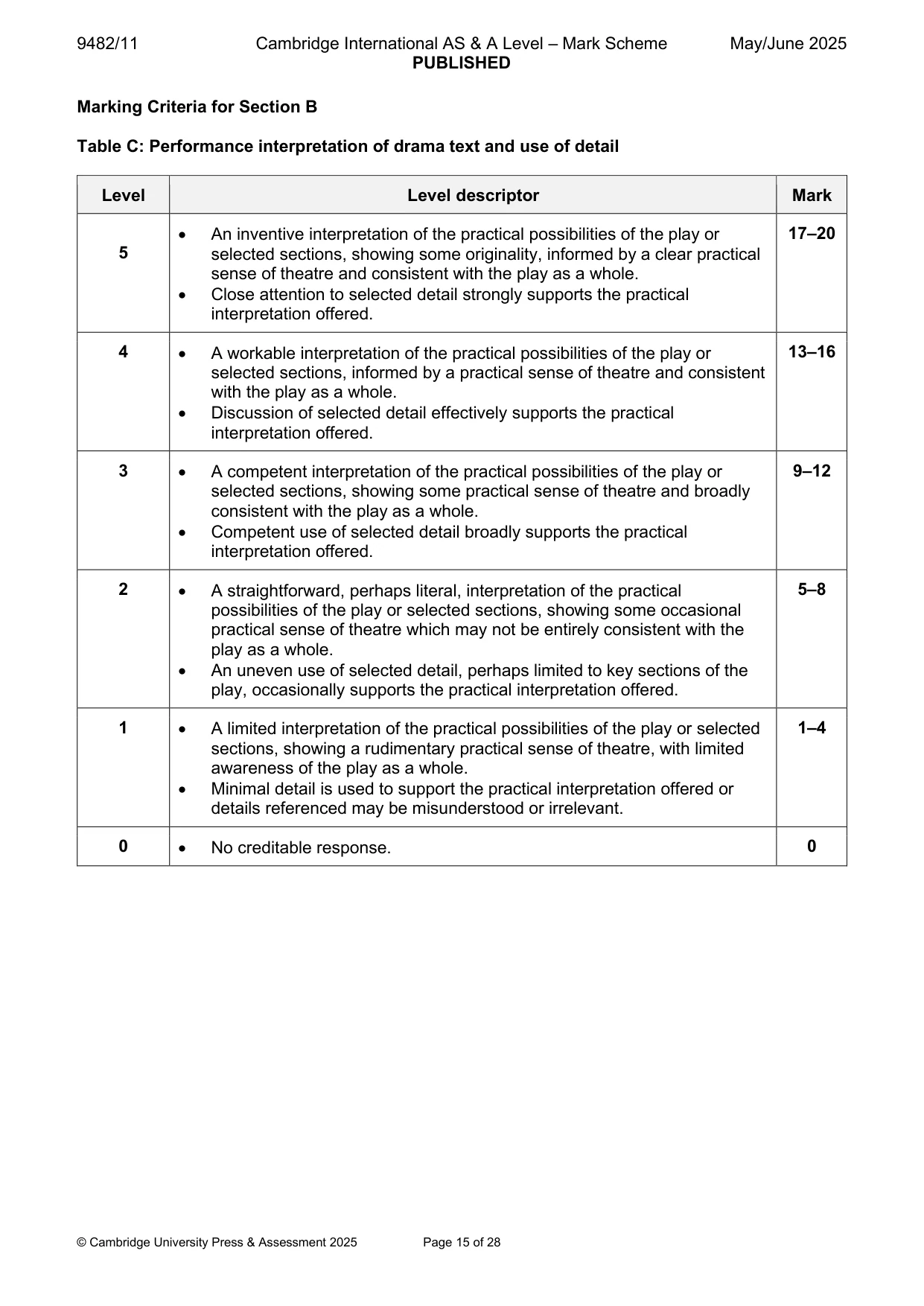
9482/11 Cambridge International AS & A Level – Mark Scheme PUBLISHED May/June 2025 © Cambridge University Press & Assessment 2025 Page 15 of 28 Marking Criteria for Section B Table C: Performance interpretation of drama text and use of detail Level Level descriptor Mark 5 • An inventive interpretation of the practical possibilities of the play or selected sections, showing some originality, informed by a clear practical sense of theatre and consistent with the play as a whole. • Close attention to selected detail strongly supports the practical interpretation offered. 17–20 4 • A workable interpretation of the practical possibilities of the play or selected sections, informed by a practical sense of theatre and consistent with the play as a whole. • Discussion of selected detail effectively supports the practical interpretation offered. 13–16 3 • A competent interpretation of the practical possibilities of the play or selected sections, showing some practical sense of theatre and broadly consistent with the play as a whole. • Competent use of selected detail broadly supports the practical interpretation offered. 9–12 2 • A straightforward, perhaps literal, interpretation of the practical possibilities of the play or selected sections, showing some occasional practical sense of theatre which may not be entirely consistent with the play as a whole. • An uneven use of selected detail, perhaps limited to key sections of the play, occasionally supports the practical interpretation offered. 5–8 1 • A limited interpretation of the practical possibilities of the play or selected sections, showing a rudimentary practical sense of theatre, with limited awareness of the play as a whole. • Minimal detail is used to support the practical interpretation offered or details referenced may be misunderstood or irrelevant. 1–4 0 • No creditable response. 0
Mark scheme, page 16
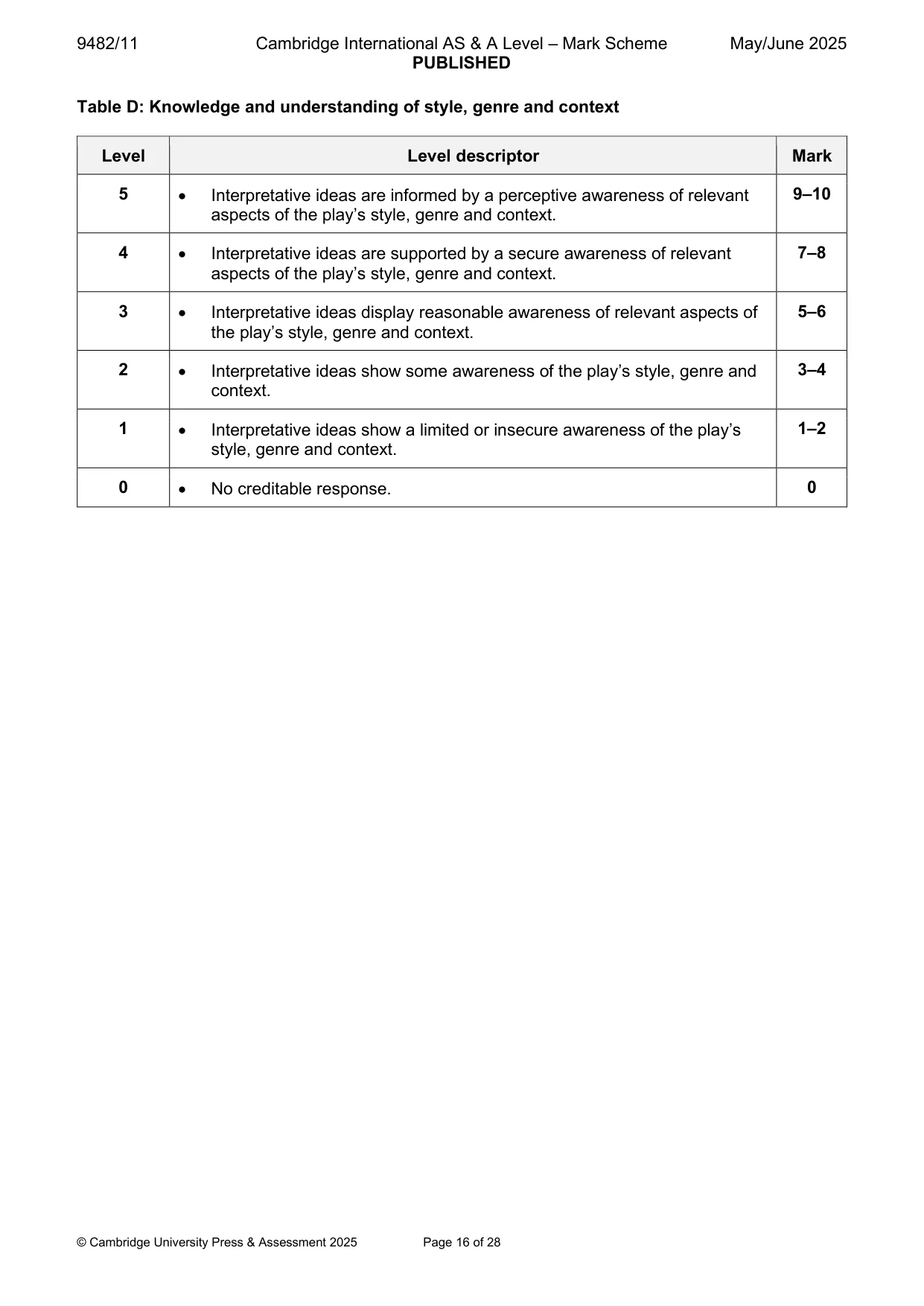
9482/11 Cambridge International AS & A Level – Mark Scheme PUBLISHED May/June 2025 © Cambridge University Press & Assessment 2025 Page 16 of 28 Table D: Knowledge and understanding of style, genre and context Level Level descriptor Mark 5 • Interpretative ideas are informed by a perceptive awareness of relevant aspects of the play’s style, genre and context. 9–10 4 • Interpretative ideas are supported by a secure awareness of relevant aspects of the play’s style, genre and context. 7–8 3 • Interpretative ideas display reasonable awareness of relevant aspects of the play’s style, genre and context. 5–6 2 • Interpretative ideas show some awareness of the play’s style, genre and context. 3–4 1 • Interpretative ideas show a limited or insecure awareness of the play’s style, genre and context. 1–2 0 • No creditable response. 0
Mark scheme, page 17
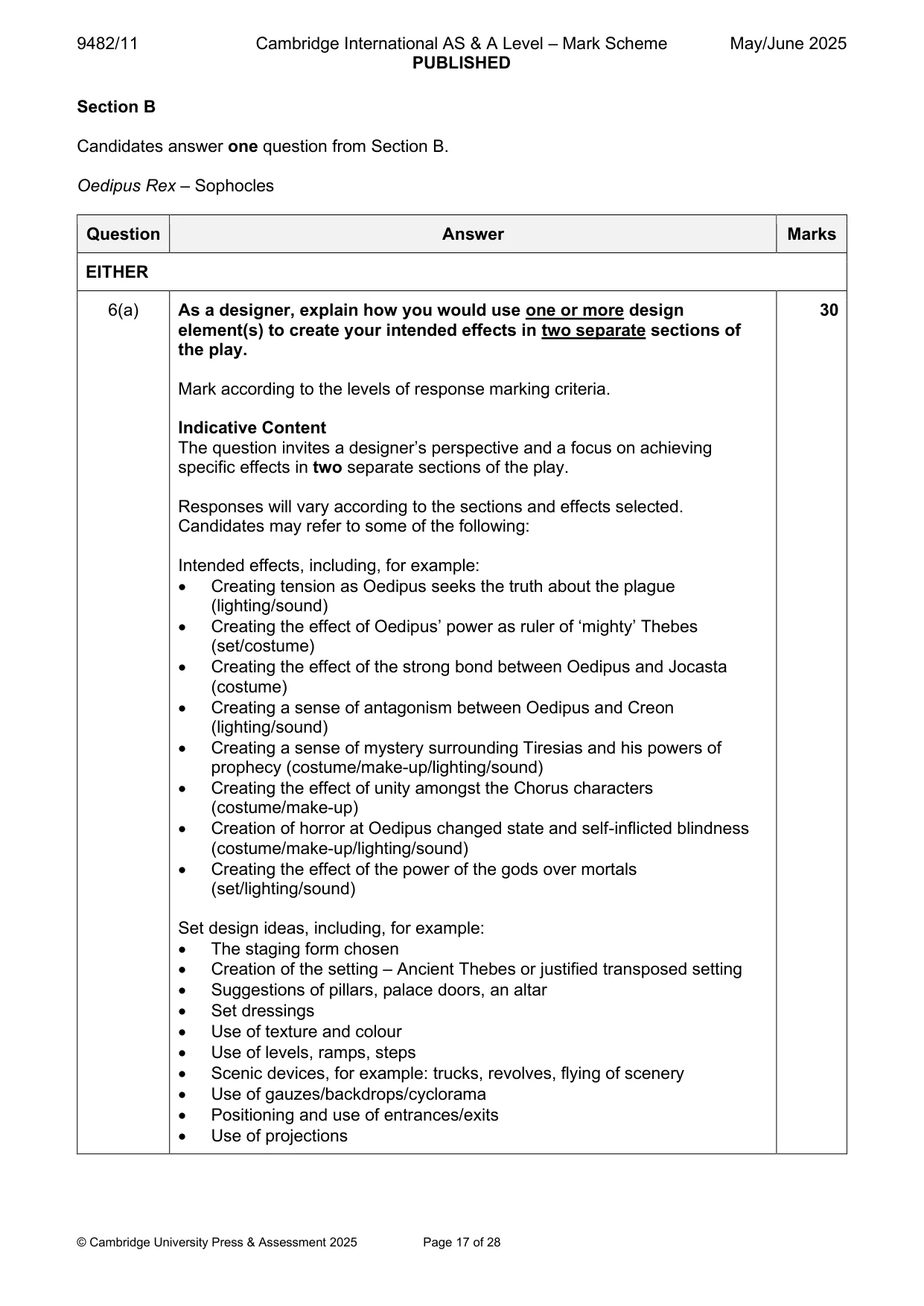
9482/11 Cambridge International AS & A Level – Mark Scheme PUBLISHED May/June 2025 © Cambridge University Press & Assessment 2025 Page 17 of 28 Section B Candidates answer one question from Section B. Oedipus Rex – Sophocles Question Answer Marks EITHER 6(a) As a designer, explain how you would use one or more design element(s) to create your intended effects in two separate sections of the play. Mark according to the levels of response marking criteria. Indicative Content The question invites a designer’s perspective and a focus on achieving specific effects in two separate sections of the play. Responses will vary according to the sections and effects selected. Candidates may refer to some of the following: Intended effects, including, for example: • Creating tension as Oedipus seeks the truth about the plague (lighting/sound) • Creating the effect of Oedipus’ power as ruler of ‘mighty’ Thebes (set/costume) • Creating the effect of the strong bond between Oedipus and Jocasta (costume) • Creating a sense of antagonism between Oedipus and Creon (lighting/sound) • Creating a sense of mystery surrounding Tiresias and his powers of prophecy (costume/make-up/lighting/sound) • Creating the effect of unity amongst the Chorus characters (costume/make-up) • Creation of horror at Oedipus changed state and self-inflicted blindness (costume/make-up/lighting/sound) • Creating the effect of the power of the gods over mortals (set/lighting/sound) Set design ideas, including, for example: • The staging form chosen • Creation of the setting – Ancient Thebes or justified transposed setting • Suggestions of pillars, palace doors, an altar • Set dressings • Use of texture and colour • Use of levels, ramps, steps • Scenic devices, for example: trucks, revolves, flying of scenery • Use of gauzes/backdrops/cyclorama • Positioning and use of entrances/exits • Use of projections 30
Mark scheme, page 18
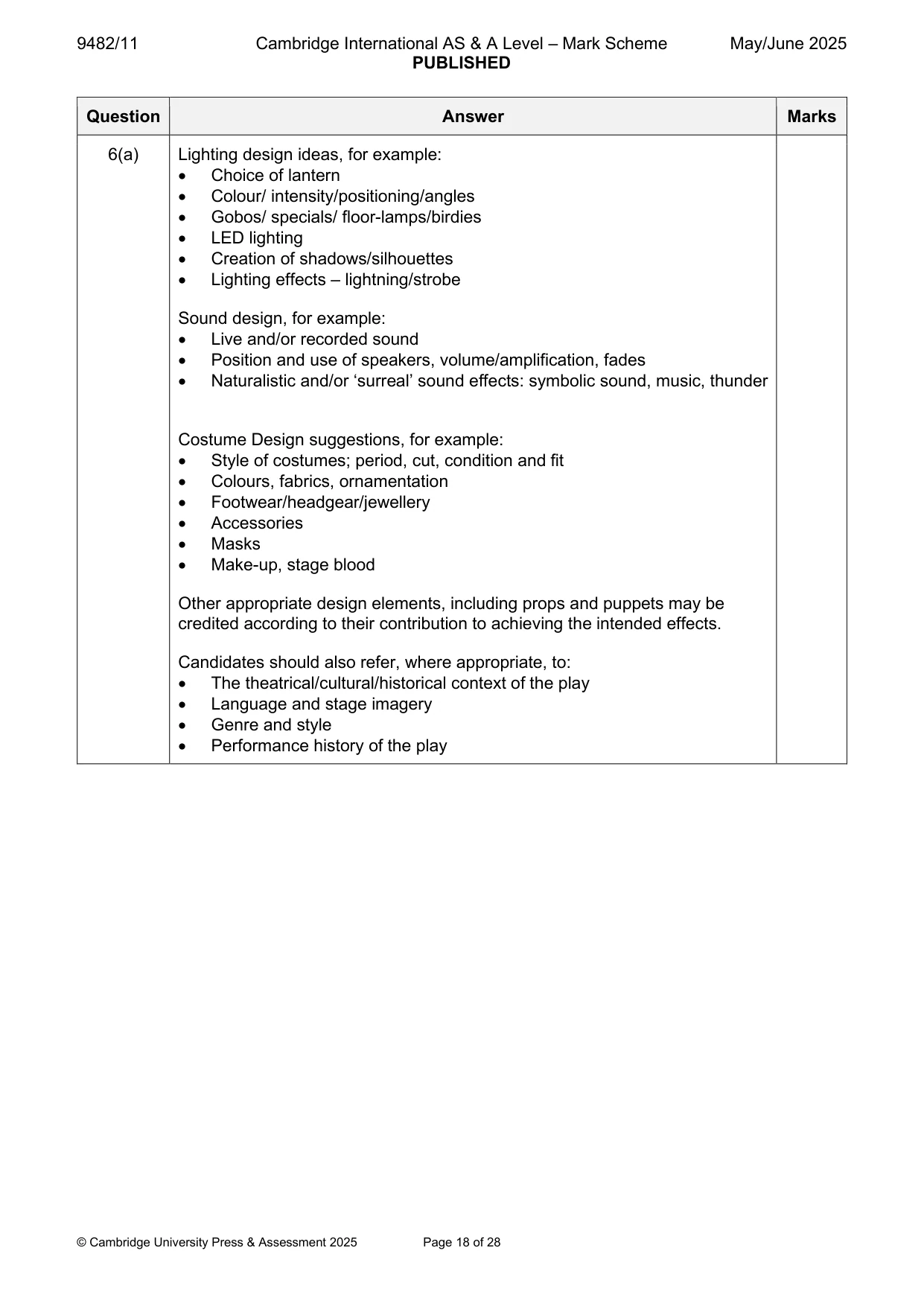
9482/11 Cambridge International AS & A Level – Mark Scheme PUBLISHED May/June 2025 © Cambridge University Press & Assessment 2025 Page 18 of 28 Question Answer Marks 6(a) Lighting design ideas, for example: • Choice of lantern • Colour/ intensity/positioning/angles • Gobos/ specials/ floor-lamps/birdies • LED lighting • Creation of shadows/silhouettes • Lighting effects – lightning/strobe Sound design, for example: • Live and/or recorded sound • Position and use of speakers, volume/amplification, fades • Naturalistic and/or ‘surreal’ sound effects: symbolic sound, music, thunder Costume Design suggestions, for example: • Style of costumes; period, cut, condition and fit • Colours, fabrics, ornamentation • Footwear/headgear/jewellery • Accessories • Masks • Make-up, stage blood Other appropriate design elements, including props and puppets may be credited according to their contribution to achieving the intended effects. Candidates should also refer, where appropriate, to: • The theatrical/cultural/historical context of the play • Language and stage imagery • Genre and style • Performance history of the play
Mark scheme, page 19
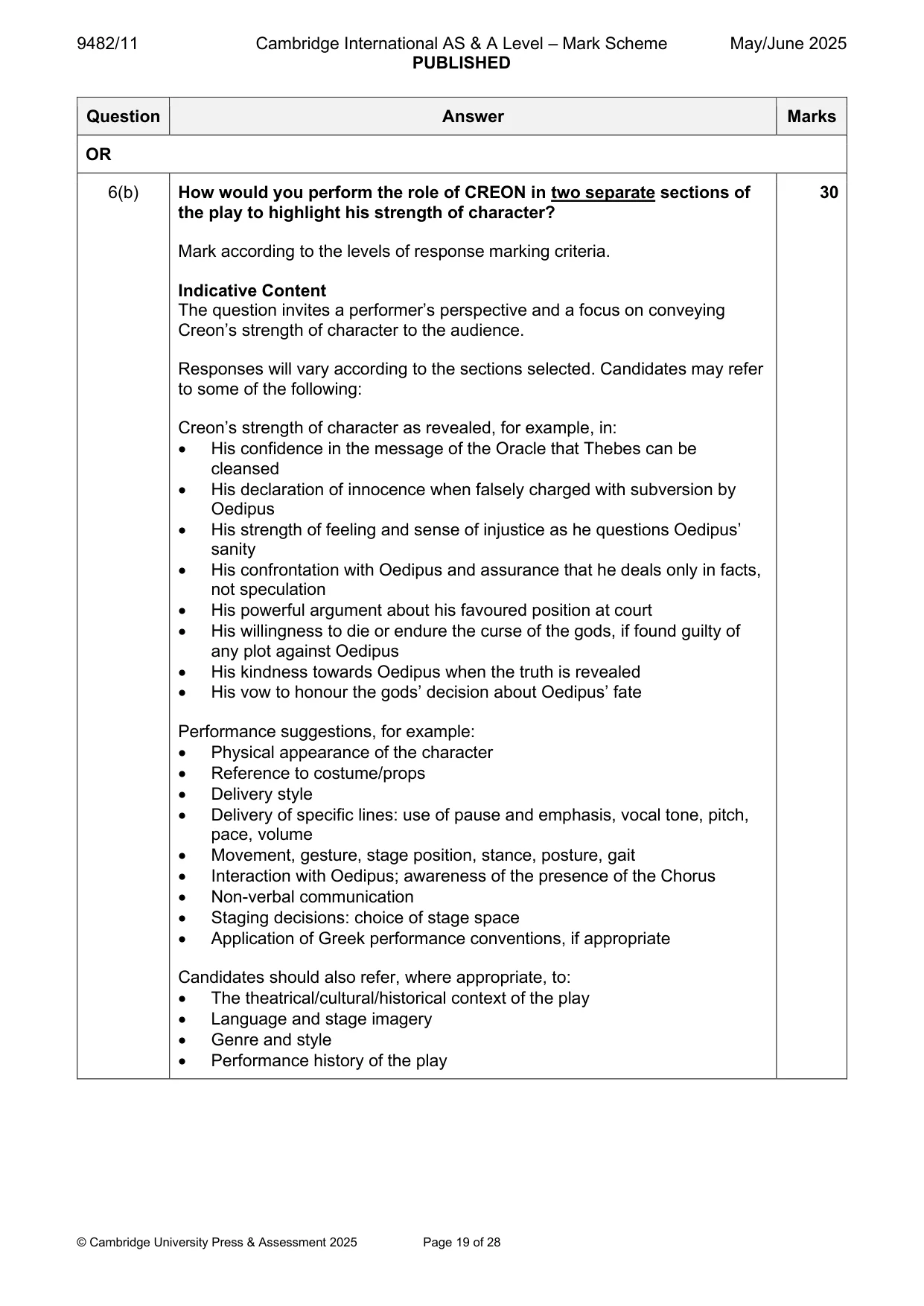
9482/11 Cambridge International AS & A Level – Mark Scheme PUBLISHED May/June 2025 © Cambridge University Press & Assessment 2025 Page 19 of 28 Question Answer Marks OR 6(b) How would you perform the role of CREON in two separate sections of the play to highlight his strength of character? Mark according to the levels of response marking criteria. Indicative Content The question invites a performer’s perspective and a focus on conveying Creon’s strength of character to the audience. Responses will vary according to the sections selected. Candidates may refer to some of the following: Creon’s strength of character as revealed, for example, in: • His confidence in the message of the Oracle that Thebes can be cleansed • His declaration of innocence when falsely charged with subversion by Oedipus • His strength of feeling and sense of injustice as he questions Oedipus’ sanity • His confrontation with Oedipus and assurance that he deals only in facts, not speculation • His powerful argument about his favoured position at court • His willingness to die or endure the curse of the gods, if found guilty of any plot against Oedipus • His kindness towards Oedipus when the truth is revealed • His vow to honour the gods’ decision about Oedipus’ fate Performance suggestions, for example: • Physical appearance of the character • Reference to costume/props • Delivery style • Delivery of specific lines: use of pause and emphasis, vocal tone, pitch, pace, volume • Movement, gesture, stage position, stance, posture, gait • Interaction with Oedipus; awareness of the presence of the Chorus • Non-verbal communication • Staging decisions: choice of stage space • Application of Greek performance conventions, if appropriate Candidates should also refer, where appropriate, to: • The theatrical/cultural/historical context of the play • Language and stage imagery • Genre and style • Performance history of the play 30
Mark scheme, page 20
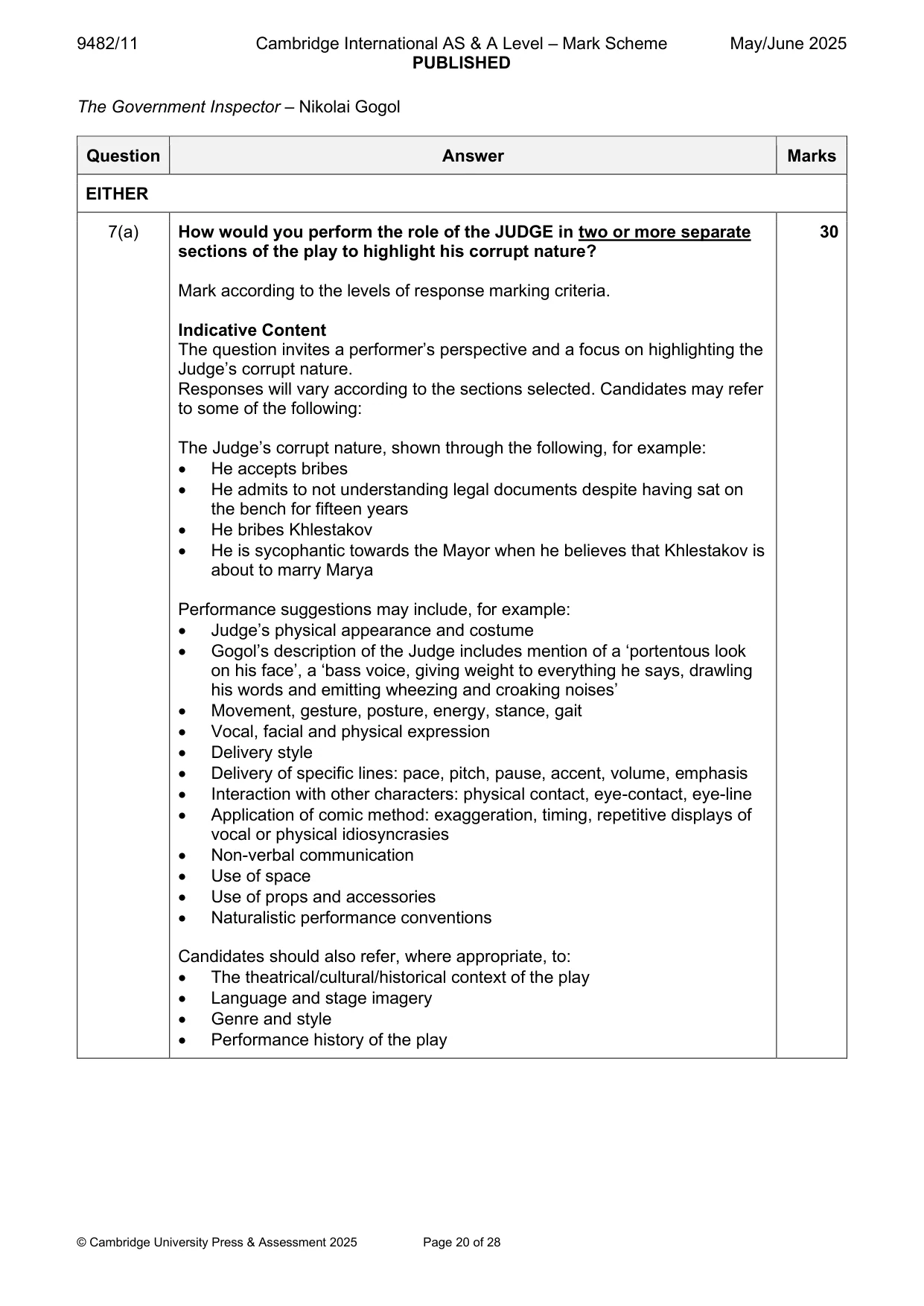
9482/11 Cambridge International AS & A Level – Mark Scheme PUBLISHED May/June 2025 © Cambridge University Press & Assessment 2025 Page 20 of 28 The Government Inspector – Nikolai Gogol Question Answer Marks EITHER 7(a) How would you perform the role of the JUDGE in two or more separate sections of the play to highlight his corrupt nature? Mark according to the levels of response marking criteria. Indicative Content The question invites a performer’s perspective and a focus on highlighting the Judge’s corrupt nature. Responses will vary according to the sections selected. Candidates may refer to some of the following: The Judge’s corrupt nature, shown through the following, for example: • He accepts bribes • He admits to not understanding legal documents despite having sat on the bench for fifteen years • He bribes Khlestakov • He is sycophantic towards the Mayor when he believes that Khlestakov is about to marry Marya Performance suggestions may include, for example: • Judge’s physical appearance and costume • Gogol’s description of the Judge includes mention of a ‘portentous look on his face’, a ‘bass voice, giving weight to everything he says, drawling his words and emitting wheezing and croaking noises’ • Movement, gesture, posture, energy, stance, gait • Vocal, facial and physical expression • Delivery style • Delivery of specific lines: pace, pitch, pause, accent, volume, emphasis • Interaction with other characters: physical contact, eye-contact, eye-line • Application of comic method: exaggeration, timing, repetitive displays of vocal or physical idiosyncrasies • Non-verbal communication • Use of space • Use of props and accessories • Naturalistic performance conventions Candidates should also refer, where appropriate, to: • The theatrical/cultural/historical context of the play • Language and stage imagery • Genre and style • Performance history of the play 30
Mark scheme, page 21
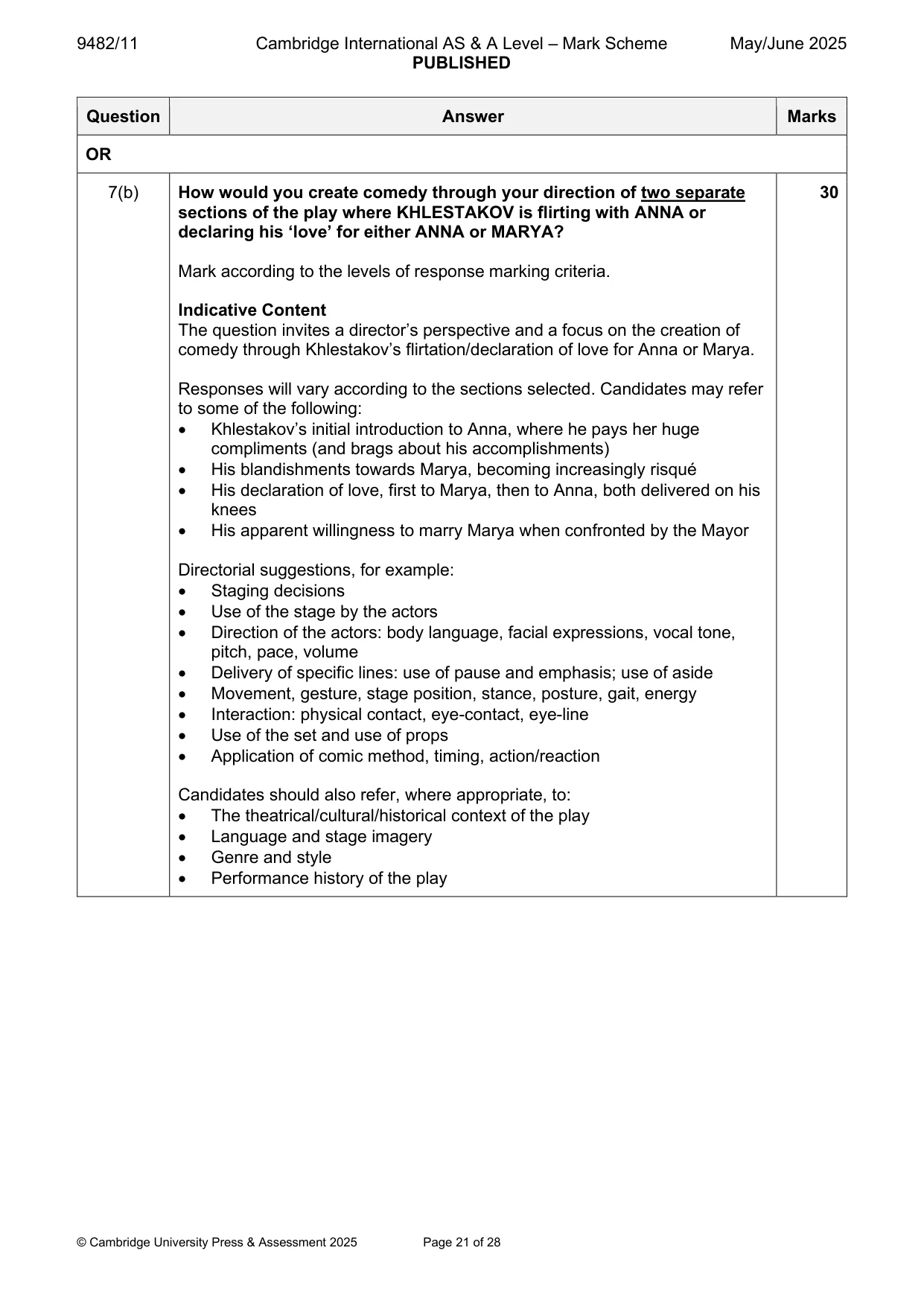
9482/11 Cambridge International AS & A Level – Mark Scheme PUBLISHED May/June 2025 © Cambridge University Press & Assessment 2025 Page 21 of 28 Question Answer Marks OR 7(b) How would you create comedy through your direction of two separate sections of the play where KHLESTAKOV is flirting with ANNA or declaring his ‘love’ for either ANNA or MARYA? Mark according to the levels of response marking criteria. Indicative Content The question invites a director’s perspective and a focus on the creation of comedy through Khlestakov’s flirtation/declaration of love for Anna or Marya. Responses will vary according to the sections selected. Candidates may refer to some of the following: • Khlestakov’s initial introduction to Anna, where he pays her huge compliments (and brags about his accomplishments) • His blandishments towards Marya, becoming increasingly risqué • His declaration of love, first to Marya, then to Anna, both delivered on his knees • His apparent willingness to marry Marya when confronted by the Mayor Directorial suggestions, for example: • Staging decisions • Use of the stage by the actors • Direction of the actors: body language, facial expressions, vocal tone, pitch, pace, volume • Delivery of specific lines: use of pause and emphasis; use of aside • Movement, gesture, stage position, stance, posture, gait, energy • Interaction: physical contact, eye-contact, eye-line • Use of the set and use of props • Application of comic method, timing, action/reaction Candidates should also refer, where appropriate, to: • The theatrical/cultural/historical context of the play • Language and stage imagery • Genre and style • Performance history of the play 30
Mark scheme, page 22
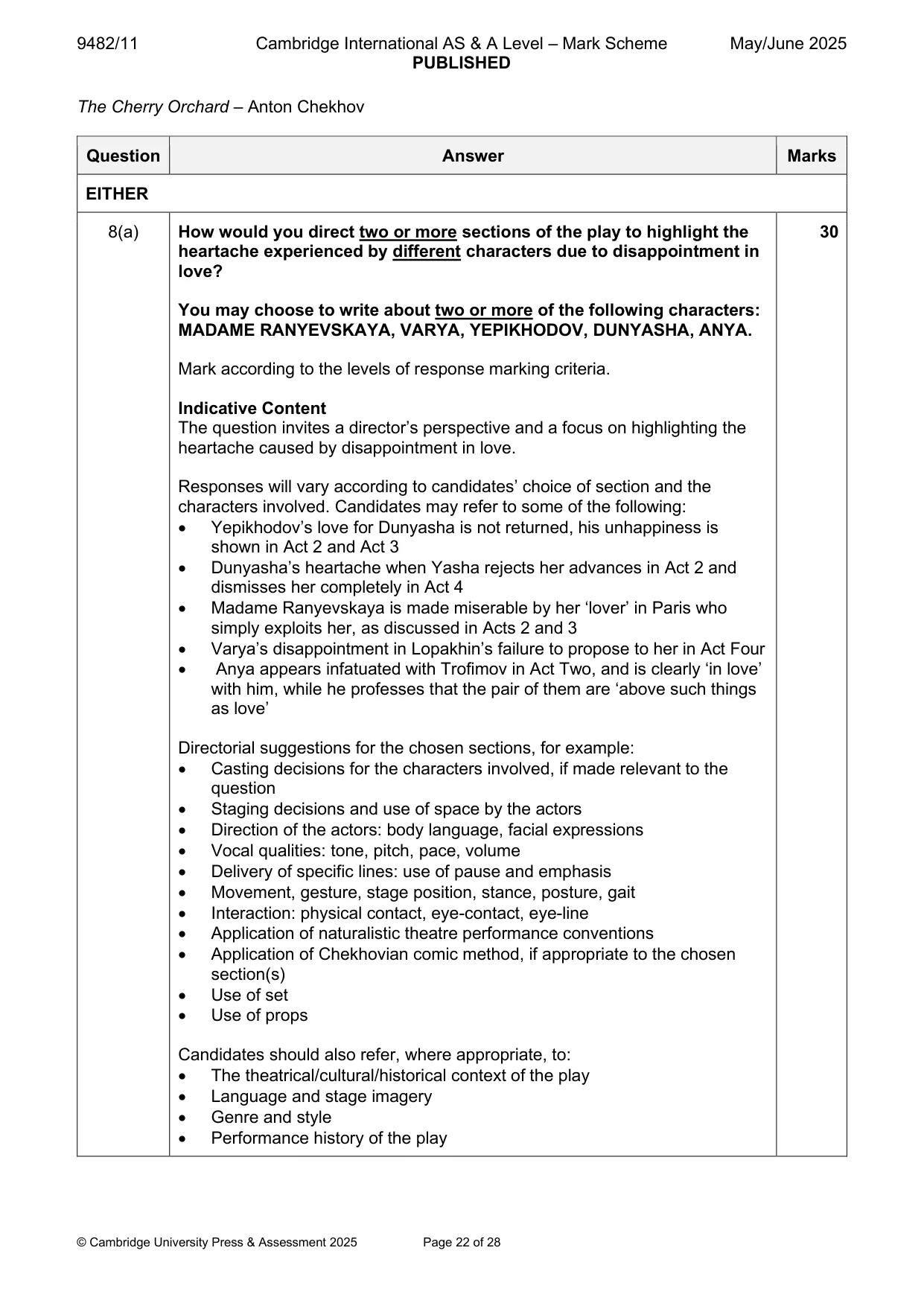
9482/11 Cambridge International AS & A Level – Mark Scheme PUBLISHED May/June 2025 © Cambridge University Press & Assessment 2025 Page 22 of 28 The Cherry Orchard – Anton Chekhov Question Answer Marks EITHER 8(a) How would you direct two or more sections of the play to highlight the heartache experienced by different characters due to disappointment in love? You may choose to write about two or more of the following characters: MADAME RANYEVSKAYA, VARYA, YEPIKHODOV, DUNYASHA, ANYA. Mark according to the levels of response marking criteria. Indicative Content The question invites a director’s perspective and a focus on highlighting the heartache caused by disappointment in love. Responses will vary according to candidates’ choice of section and the characters involved. Candidates may refer to some of the following: • Yepikhodov’s love for Dunyasha is not returned, his unhappiness is shown in Act 2 and Act 3 • Dunyasha’s heartache when Yasha rejects her advances in Act 2 and dismisses her completely in Act 4 • Madame Ranyevskaya is made miserable by her ‘lover’ in Paris who simply exploits her, as discussed in Acts 2 and 3 • Varya’s disappointment in Lopakhin’s failure to propose to her in Act Four • Anya appears infatuated with Trofimov in Act Two, and is clearly ‘in love’ with him, while he professes that the pair of them are ‘above such things as love’ Directorial suggestions for the chosen sections, for example: • Casting decisions for the characters involved, if made relevant to the question • Staging decisions and use of space by the actors • Direction of the actors: body language, facial expressions • Vocal qualities: tone, pitch, pace, volume • Delivery of specific lines: use of pause and emphasis • Movement, gesture, stage position, stance, posture, gait • Interaction: physical contact, eye-contact, eye-line • Application of naturalistic theatre performance conventions • Application of Chekhovian comic method, if appropriate to the chosen section(s) • Use of set • Use of props Candidates should also refer, where appropriate, to: • The theatrical/cultural/historical context of the play • Language and stage imagery • Genre and style • Performance history of the play 30
Mark scheme, page 23
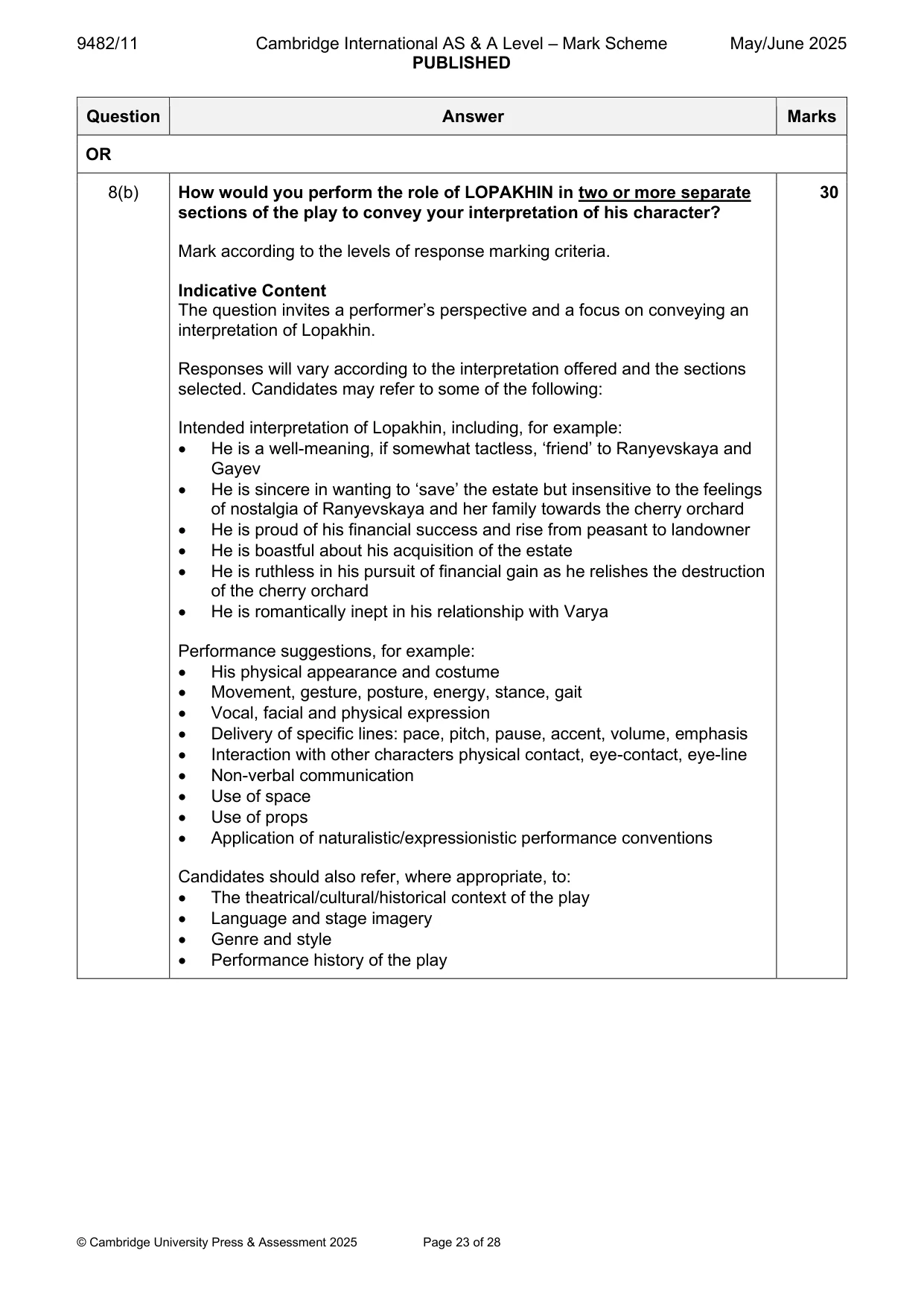
9482/11 Cambridge International AS & A Level – Mark Scheme PUBLISHED May/June 2025 © Cambridge University Press & Assessment 2025 Page 23 of 28 Question Answer Marks OR 8(b) How would you perform the role of LOPAKHIN in two or more separate sections of the play to convey your interpretation of his character? Mark according to the levels of response marking criteria. Indicative Content The question invites a performer’s perspective and a focus on conveying an interpretation of Lopakhin. Responses will vary according to the interpretation offered and the sections selected. Candidates may refer to some of the following: Intended interpretation of Lopakhin, including, for example: • He is a well-meaning, if somewhat tactless, ‘friend’ to Ranyevskaya and Gayev • He is sincere in wanting to ‘save’ the estate but insensitive to the feelings of nostalgia of Ranyevskaya and her family towards the cherry orchard • He is proud of his financial success and rise from peasant to landowner • He is boastful about his acquisition of the estate • He is ruthless in his pursuit of financial gain as he relishes the destruction of the cherry orchard • He is romantically inept in his relationship with Varya Performance suggestions, for example: • His physical appearance and costume • Movement, gesture, posture, energy, stance, gait • Vocal, facial and physical expression • Delivery of specific lines: pace, pitch, pause, accent, volume, emphasis • Interaction with other characters physical contact, eye-contact, eye-line • Non-verbal communication • Use of space • Use of props • Application of naturalistic/expressionistic performance conventions Candidates should also refer, where appropriate, to: • The theatrical/cultural/historical context of the play • Language and stage imagery • Genre and style • Performance history of the play 30
Mark scheme, page 24
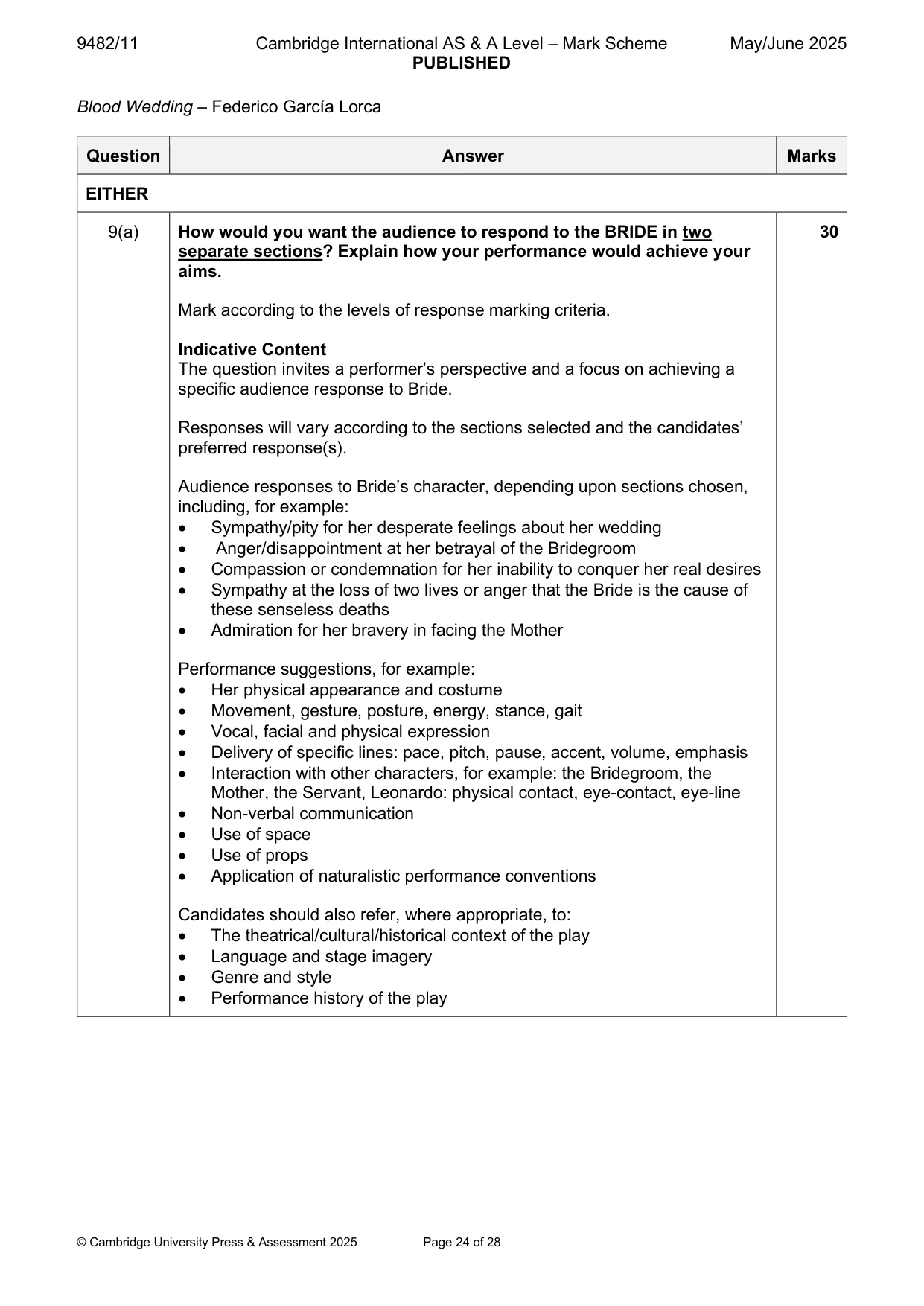
9482/11 Cambridge International AS & A Level – Mark Scheme PUBLISHED May/June 2025 © Cambridge University Press & Assessment 2025 Page 24 of 28 Blood Wedding – Federico García Lorca Question Answer Marks EITHER 9(a) How would you want the audience to respond to the BRIDE in two separate sections? Explain how your performance would achieve your aims. Mark according to the levels of response marking criteria. Indicative Content The question invites a performer’s perspective and a focus on achieving a specific audience response to Bride. Responses will vary according to the sections selected and the candidates’ preferred response(s). Audience responses to Bride’s character, depending upon sections chosen, including, for example: • Sympathy/pity for her desperate feelings about her wedding • Anger/disappointment at her betrayal of the Bridegroom • Compassion or condemnation for her inability to conquer her real desires • Sympathy at the loss of two lives or anger that the Bride is the cause of these senseless deaths • Admiration for her bravery in facing the Mother Performance suggestions, for example: • Her physical appearance and costume • Movement, gesture, posture, energy, stance, gait • Vocal, facial and physical expression • Delivery of specific lines: pace, pitch, pause, accent, volume, emphasis • Interaction with other characters, for example: the Bridegroom, the Mother, the Servant, Leonardo: physical contact, eye-contact, eye-line • Non-verbal communication • Use of space • Use of props • Application of naturalistic performance conventions Candidates should also refer, where appropriate, to: • The theatrical/cultural/historical context of the play • Language and stage imagery • Genre and style • Performance history of the play 30
Mark scheme, page 25
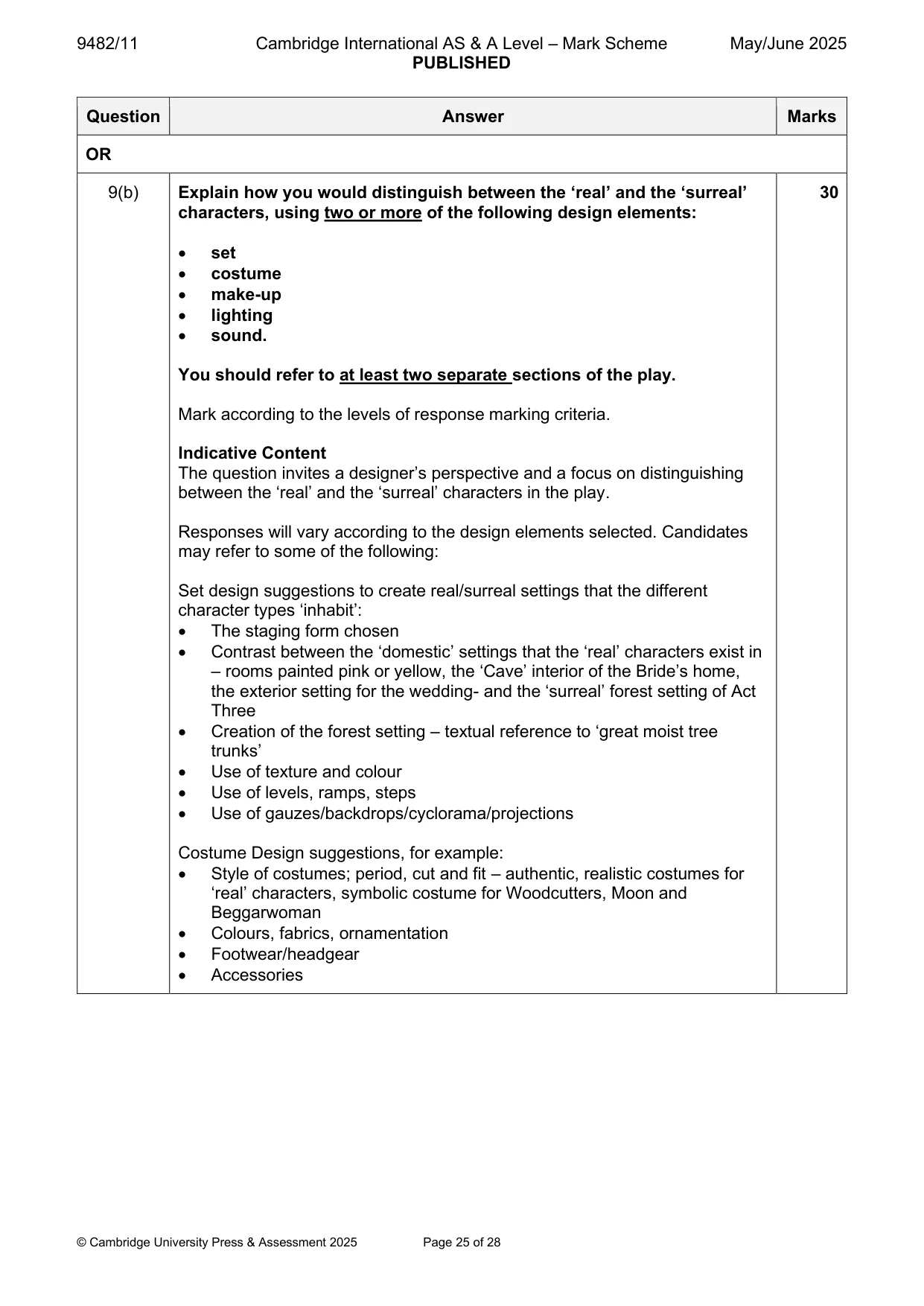
9482/11 Cambridge International AS & A Level – Mark Scheme PUBLISHED May/June 2025 © Cambridge University Press & Assessment 2025 Page 25 of 28 Question Answer Marks OR 9(b) Explain how you would distinguish between the ‘real’ and the ‘surreal’ characters, using two or more of the following design elements: • set • costume • make-up • lighting • sound. You should refer to at least two separate sections of the play. Mark according to the levels of response marking criteria. Indicative Content The question invites a designer’s perspective and a focus on distinguishing between the ‘real’ and the ‘surreal’ characters in the play. Responses will vary according to the design elements selected. Candidates may refer to some of the following: Set design suggestions to create real/surreal settings that the different character types ‘inhabit’: • The staging form chosen • Contrast between the ‘domestic’ settings that the ‘real’ characters exist in – rooms painted pink or yellow, the ‘Cave’ interior of the Bride’s home, the exterior setting for the wedding- and the ‘surreal’ forest setting of Act Three • Creation of the forest setting – textual reference to ‘great moist tree trunks’ • Use of texture and colour • Use of levels, ramps, steps • Use of gauzes/backdrops/cyclorama/projections Costume Design suggestions, for example: • Style of costumes; period, cut and fit – authentic, realistic costumes for ‘real’ characters, symbolic costume for Woodcutters, Moon and Beggarwoman • Colours, fabrics, ornamentation • Footwear/headgear • Accessories 30
Mark scheme, page 26
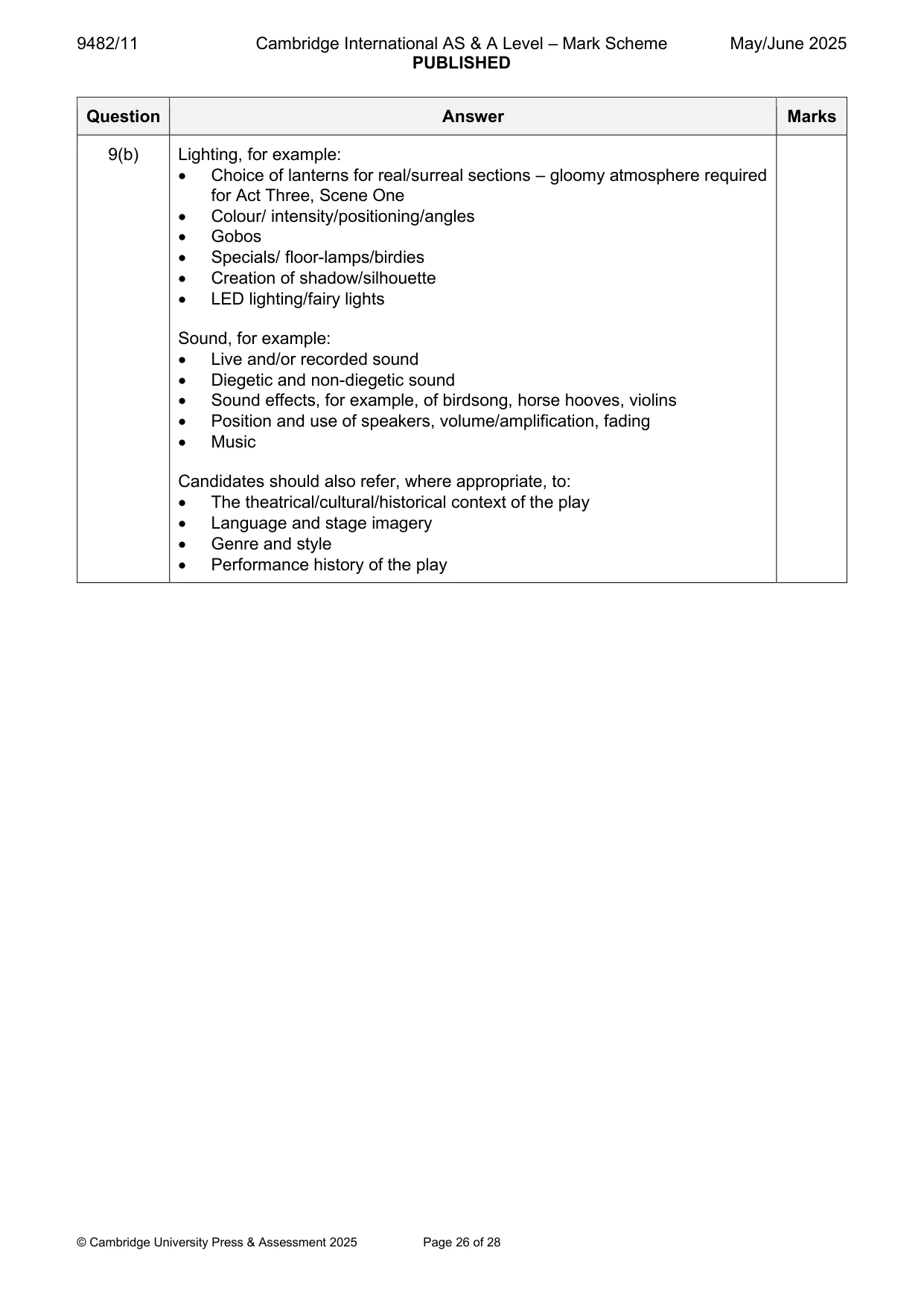
9482/11 Cambridge International AS & A Level – Mark Scheme PUBLISHED May/June 2025 © Cambridge University Press & Assessment 2025 Page 26 of 28 Question Answer Marks 9(b) Lighting, for example: • Choice of lanterns for real/surreal sections – gloomy atmosphere required for Act Three, Scene One • Colour/ intensity/positioning/angles • Gobos • Specials/ floor-lamps/birdies • Creation of shadow/silhouette • LED lighting/fairy lights Sound, for example: • Live and/or recorded sound • Diegetic and non-diegetic sound • Sound effects, for example, of birdsong, horse hooves, violins • Position and use of speakers, volume/amplification, fading • Music Candidates should also refer, where appropriate, to: • The theatrical/cultural/historical context of the play • Language and stage imagery • Genre and style • Performance history of the play
Mark scheme, page 27
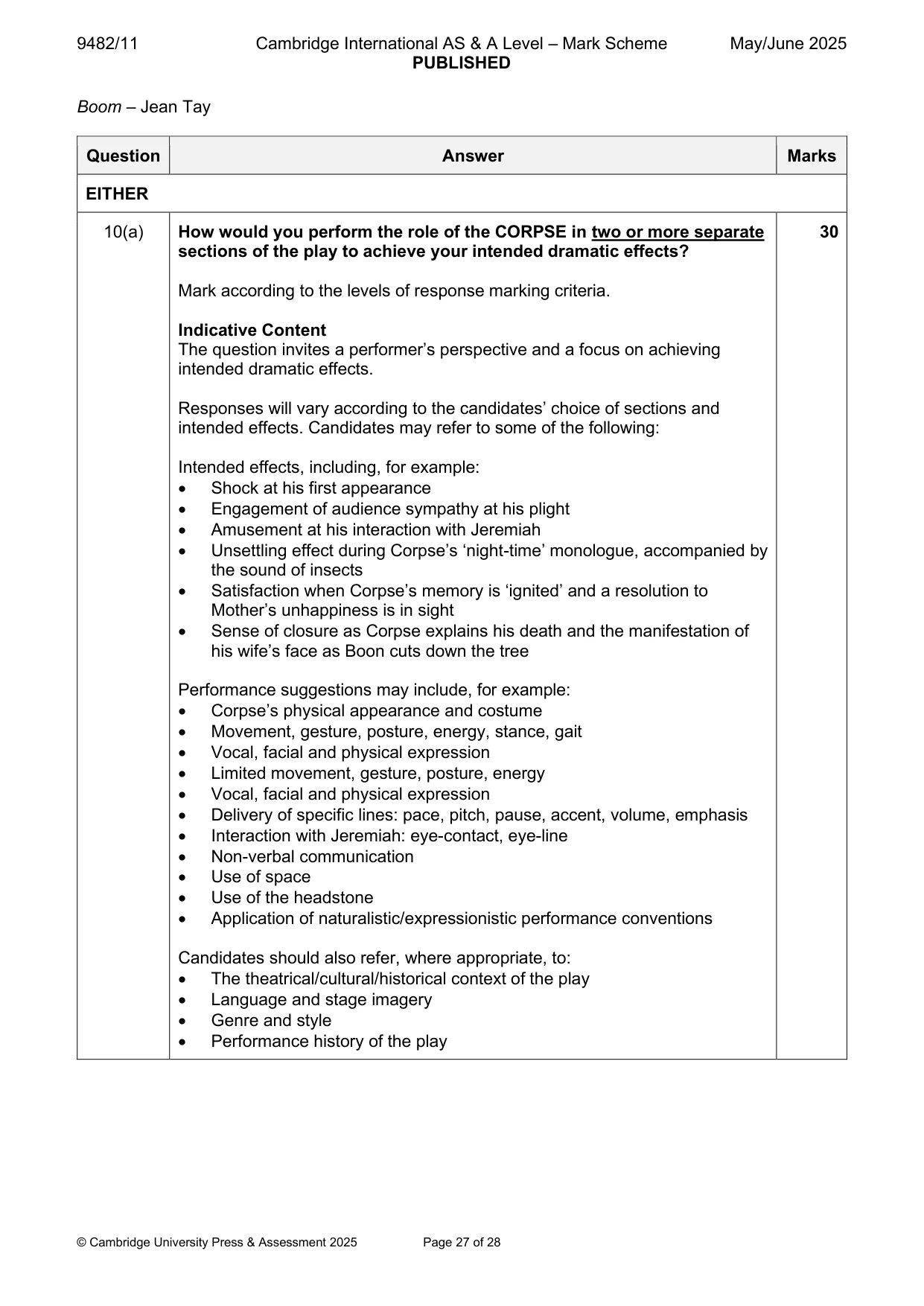
9482/11 Cambridge International AS & A Level – Mark Scheme PUBLISHED May/June 2025 © Cambridge University Press & Assessment 2025 Page 27 of 28 Boom – Jean Tay Question Answer Marks EITHER 10(a) How would you perform the role of the CORPSE in two or more separate sections of the play to achieve your intended dramatic effects? Mark according to the levels of response marking criteria. Indicative Content The question invites a performer’s perspective and a focus on achieving intended dramatic effects. Responses will vary according to the candidates’ choice of sections and intended effects. Candidates may refer to some of the following: Intended effects, including, for example: • Shock at his first appearance • Engagement of audience sympathy at his plight • Amusement at his interaction with Jeremiah • Unsettling effect during Corpse’s ‘night-time’ monologue, accompanied by the sound of insects • Satisfaction when Corpse’s memory is ‘ignited’ and a resolution to Mother’s unhappiness is in sight • Sense of closure as Corpse explains his death and the manifestation of his wife’s face as Boon cuts down the tree Performance suggestions may include, for example: • Corpse’s physical appearance and costume • Movement, gesture, posture, energy, stance, gait • Vocal, facial and physical expression • Limited movement, gesture, posture, energy • Vocal, facial and physical expression • Delivery of specific lines: pace, pitch, pause, accent, volume, emphasis • Interaction with Jeremiah: eye-contact, eye-line • Non-verbal communication • Use of space • Use of the headstone • Application of naturalistic/expressionistic performance conventions Candidates should also refer, where appropriate, to: • The theatrical/cultural/historical context of the play • Language and stage imagery • Genre and style • Performance history of the play 30
Mark scheme, page 28
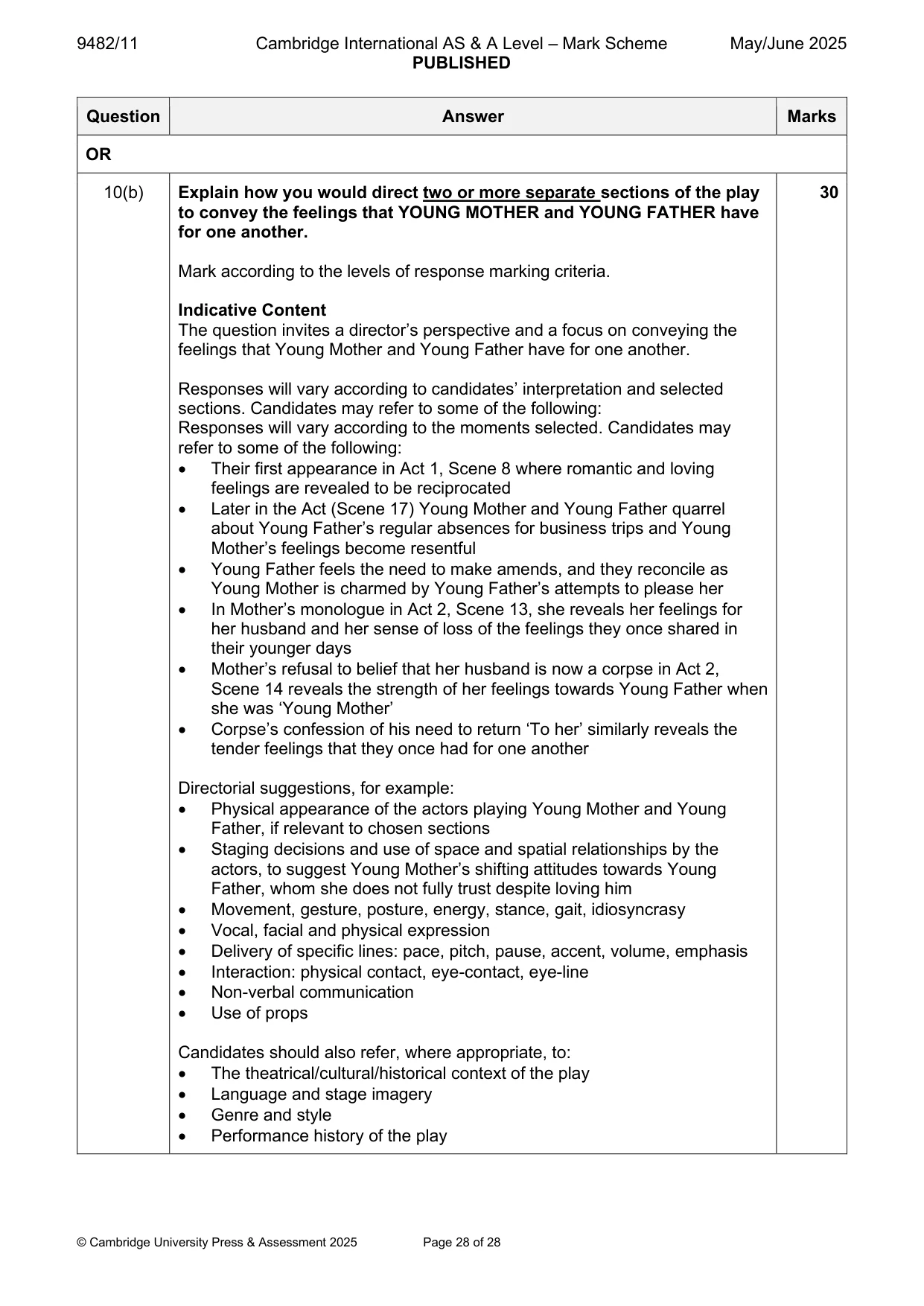
9482/11 Cambridge International AS & A Level – Mark Scheme PUBLISHED May/June 2025 © Cambridge University Press & Assessment 2025 Page 28 of 28 Question Answer Marks OR 10(b) Explain how you would direct two or more separate sections of the play to convey the feelings that YOUNG MOTHER and YOUNG FATHER have for one another. Mark according to the levels of response marking criteria. Indicative Content The question invites a director’s perspective and a focus on conveying the feelings that Young Mother and Young Father have for one another. Responses will vary according to candidates’ interpretation and selected sections. Candidates may refer to some of the following: Responses will vary according to the moments selected. Candidates may refer to some of the following: • Their first appearance in Act 1, Scene 8 where romantic and loving feelings are revealed to be reciprocated • Later in the Act (Scene 17) Young Mother and Young Father quarrel about Young Father’s regular absences for business trips and Young Mother’s feelings become resentful • Young Father feels the need to make amends, and they reconcile as Young Mother is charmed by Young Father’s attempts to please her • In Mother’s monologue in Act 2, Scene 13, she reveals her feelings for her husband and her sense of loss of the feelings they once shared in their younger days • Mother’s refusal to belief that her husband is now a corpse in Act 2, Scene 14 reveals the strength of her feelings towards Young Father when she was ‘Young Mother’ • Corpse’s confession of his need to return ‘To her’ similarly reveals the tender feelings that they once had for one another Directorial suggestions, for example: • Physical appearance of the actors playing Young Mother and Young Father, if relevant to chosen sections • Staging decisions and use of space and spatial relationships by the actors, to suggest Young Mother’s shifting attitudes towards Young Father, whom she does not fully trust despite loving him • Movement, gesture, posture, energy, stance, gait, idiosyncrasy • Vocal, facial and physical expression • Delivery of specific lines: pace, pitch, pause, accent, volume, emphasis • Interaction: physical contact, eye-contact, eye-line • Non-verbal communication • Use of props Candidates should also refer, where appropriate, to: • The theatrical/cultural/historical context of the play • Language and stage imagery • Genre and style • Performance history of the play 30
What you needed in this session
Cambridge’s own grade thresholds for 2025 May/June, Paper 1 · Variant 1. A higher threshold means an easier paper — the bar moves with how the cohort did.