Cambridge A Level Drama 9482 — 2024 Oct/Nov Paper 1 · Variant 2
9482/12/O/N/24 · 60 marks · 120 min
The question paper and its mark scheme, free to read here and free to download. This is Cambridge’s own paper, exactly as it was sat.
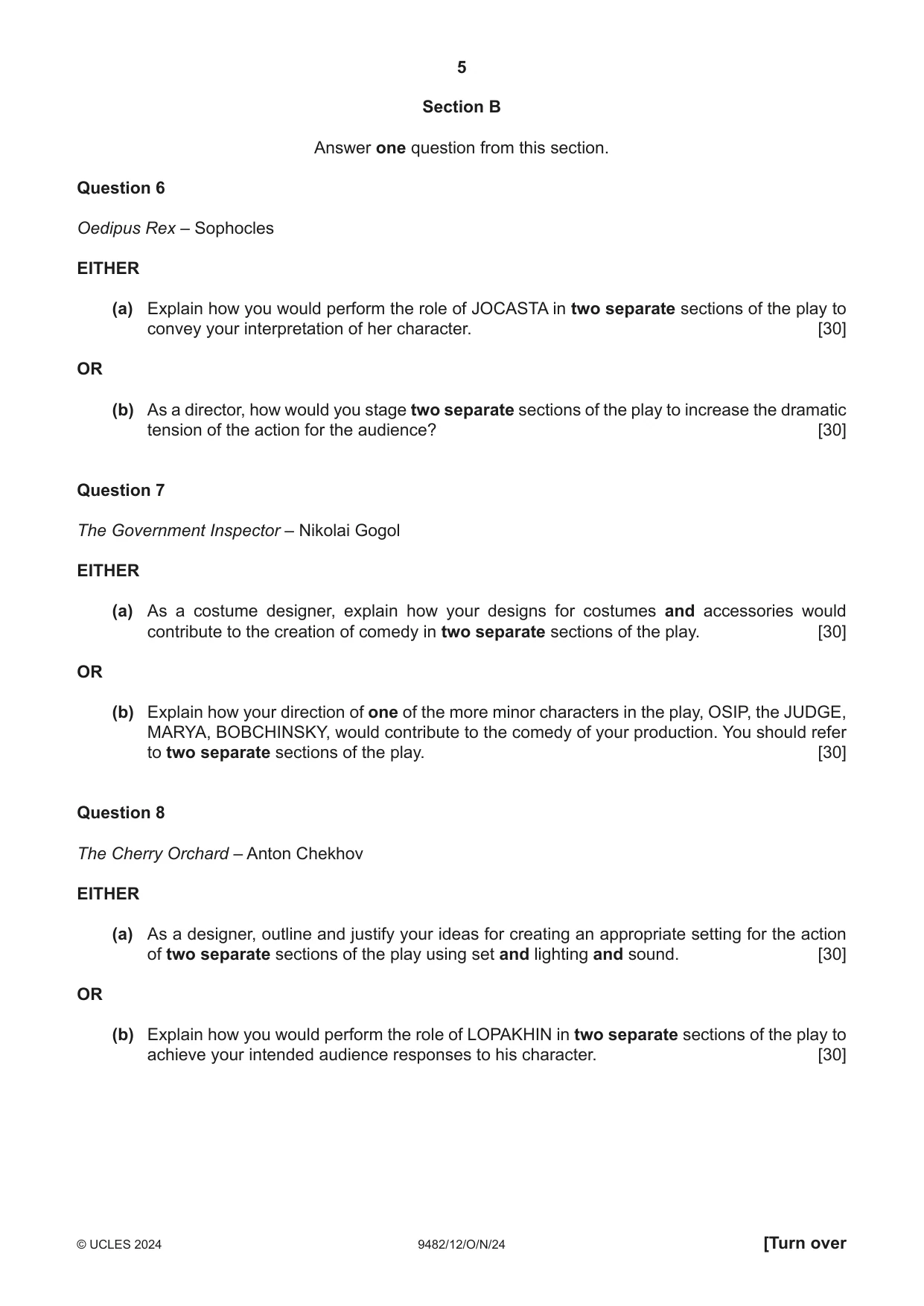
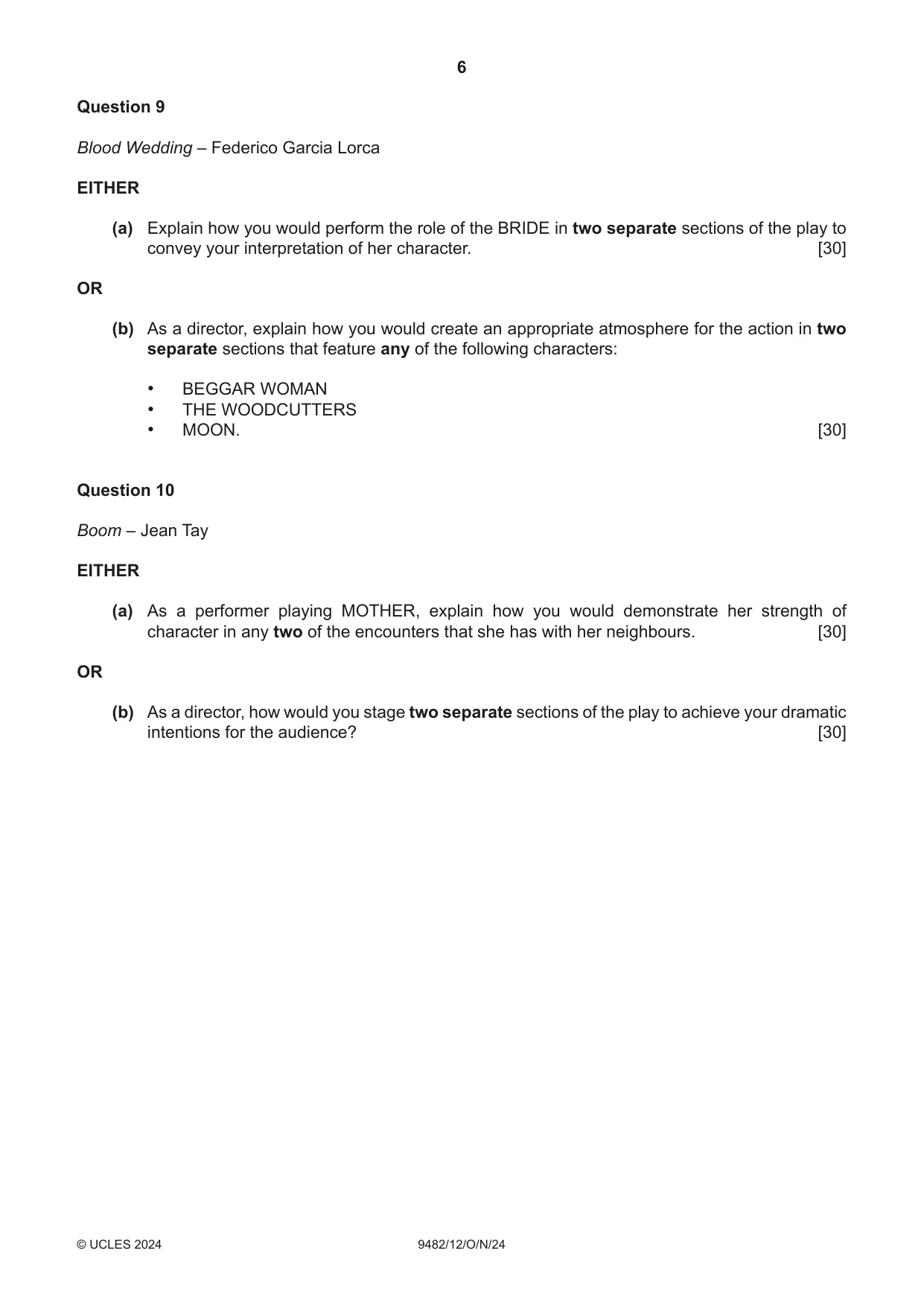
Question paper8 pages


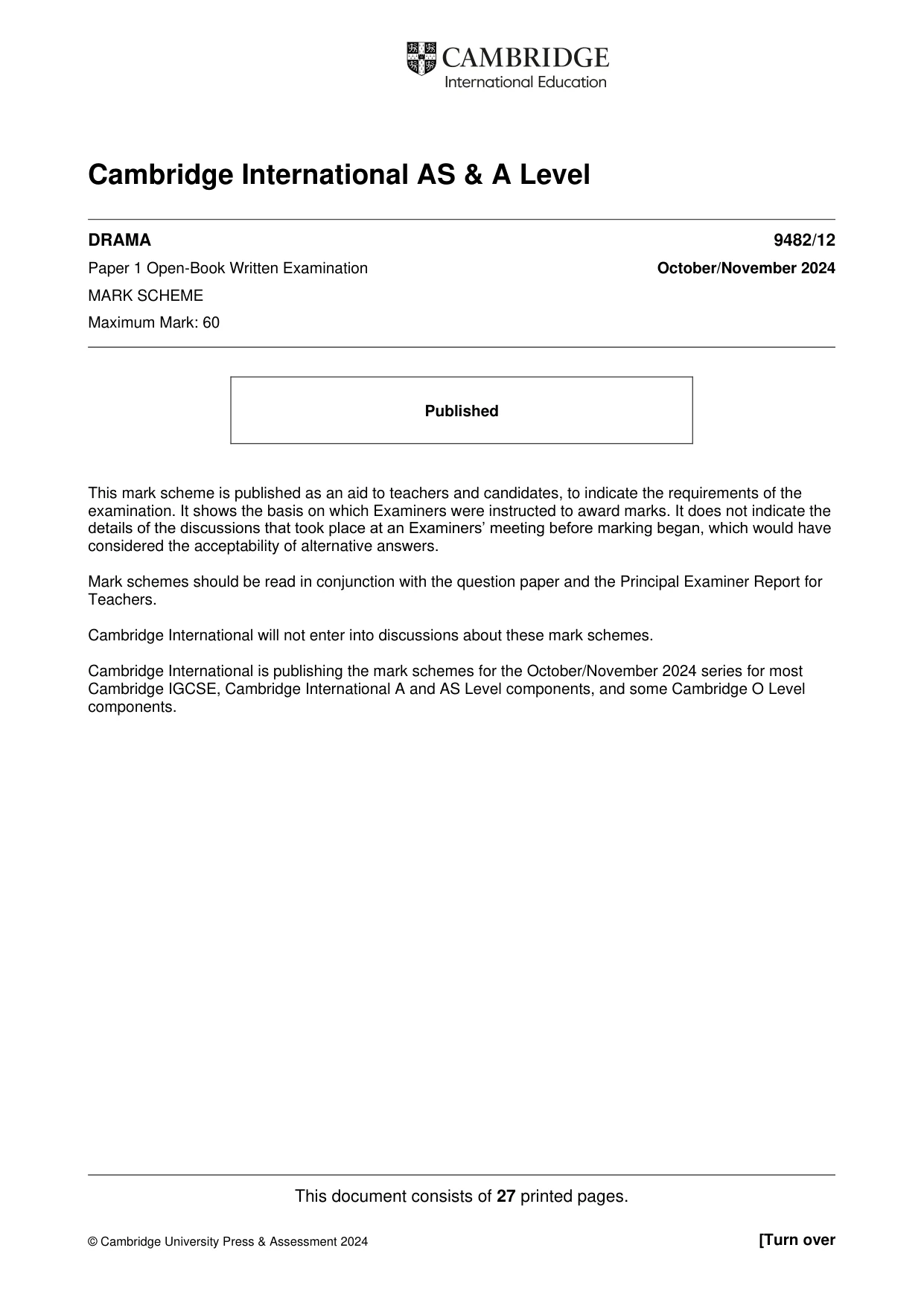
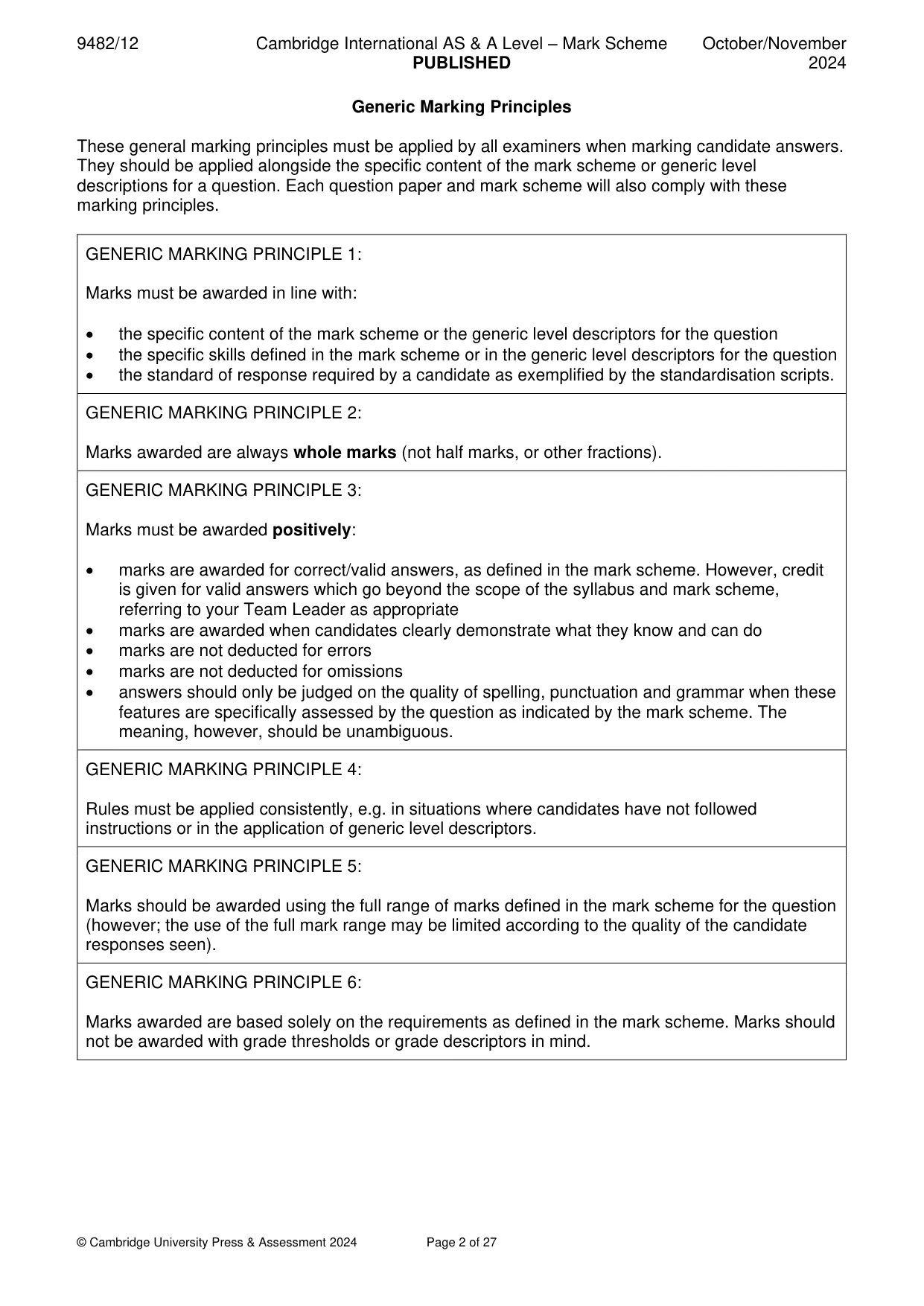
Mark scheme27 pages
Answers below. Sit the paper first if you are practising.
Paper as text
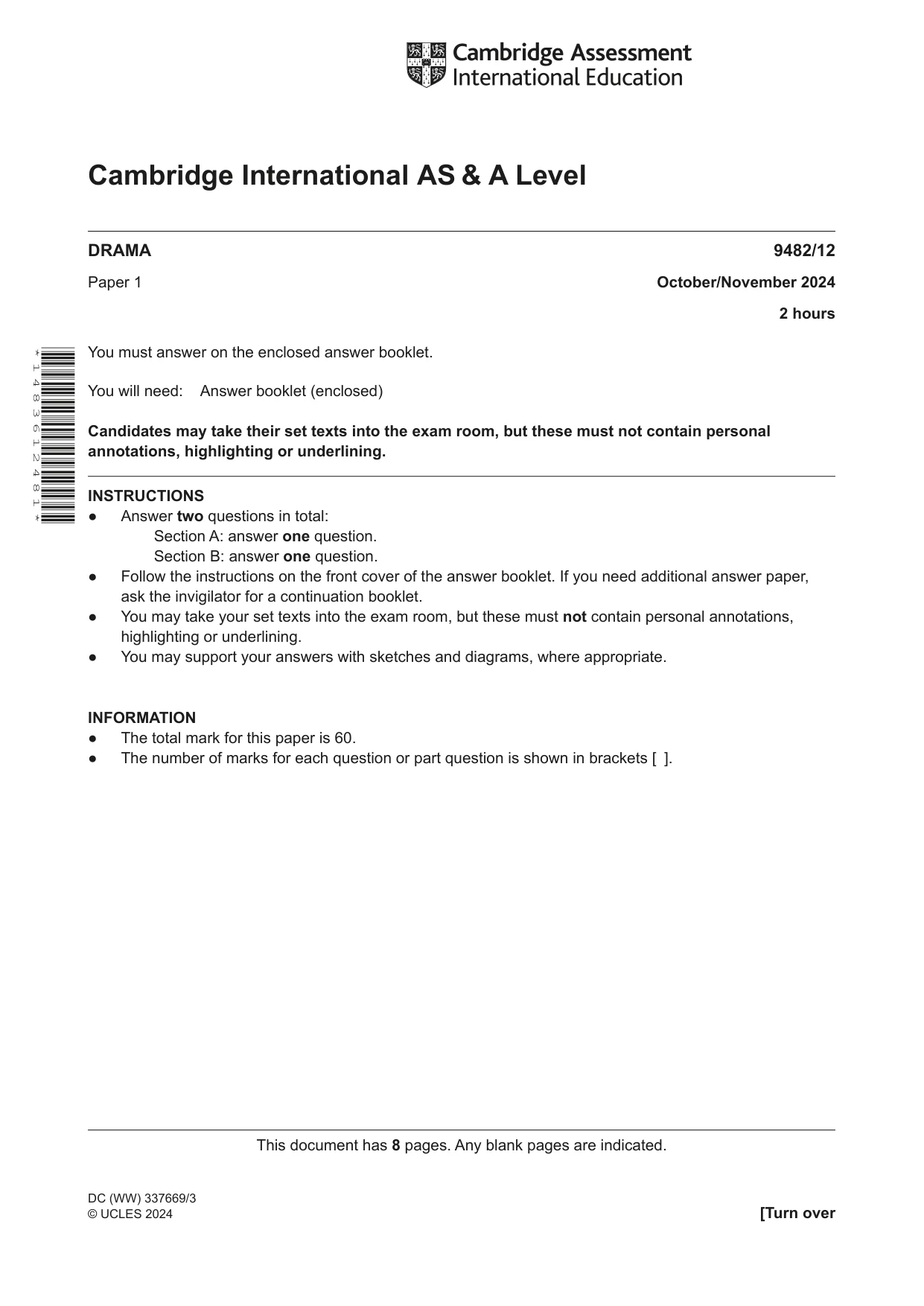
Question paper, page 1
[Turn over Cambridge International AS & A Level This document has 8 pages. Any blank pages are indicated. DC (WW) 337669/3 © UCLES 2024 DRAMA 9482/12 Paper 1 October/November 2024 2 hours You must answer on the enclosed answer booklet. You will need: Answer booklet (enclosed) Candidates may take their set texts into the exam room, but these must not contain personal annotations, highlighting or underlining. INSTRUCTIONS ● Answer two questions in total: Section A: answer one question. Section B: answer one question. ● Follow the instructions on the front cover of the answer booklet. If you need additional answer paper, ask the invigilator for a continuation booklet. ● You may take your set texts into the exam room, but these must not contain personal annotations, highlighting or underlining. ● You may support your answers with sketches and diagrams, where appropriate. INFORMATION ● The total mark for this paper is 60. ● The number of marks for each question or part question is shown in brackets [ ]. * 1 4 8 3 6 1 2 4 8 1 *
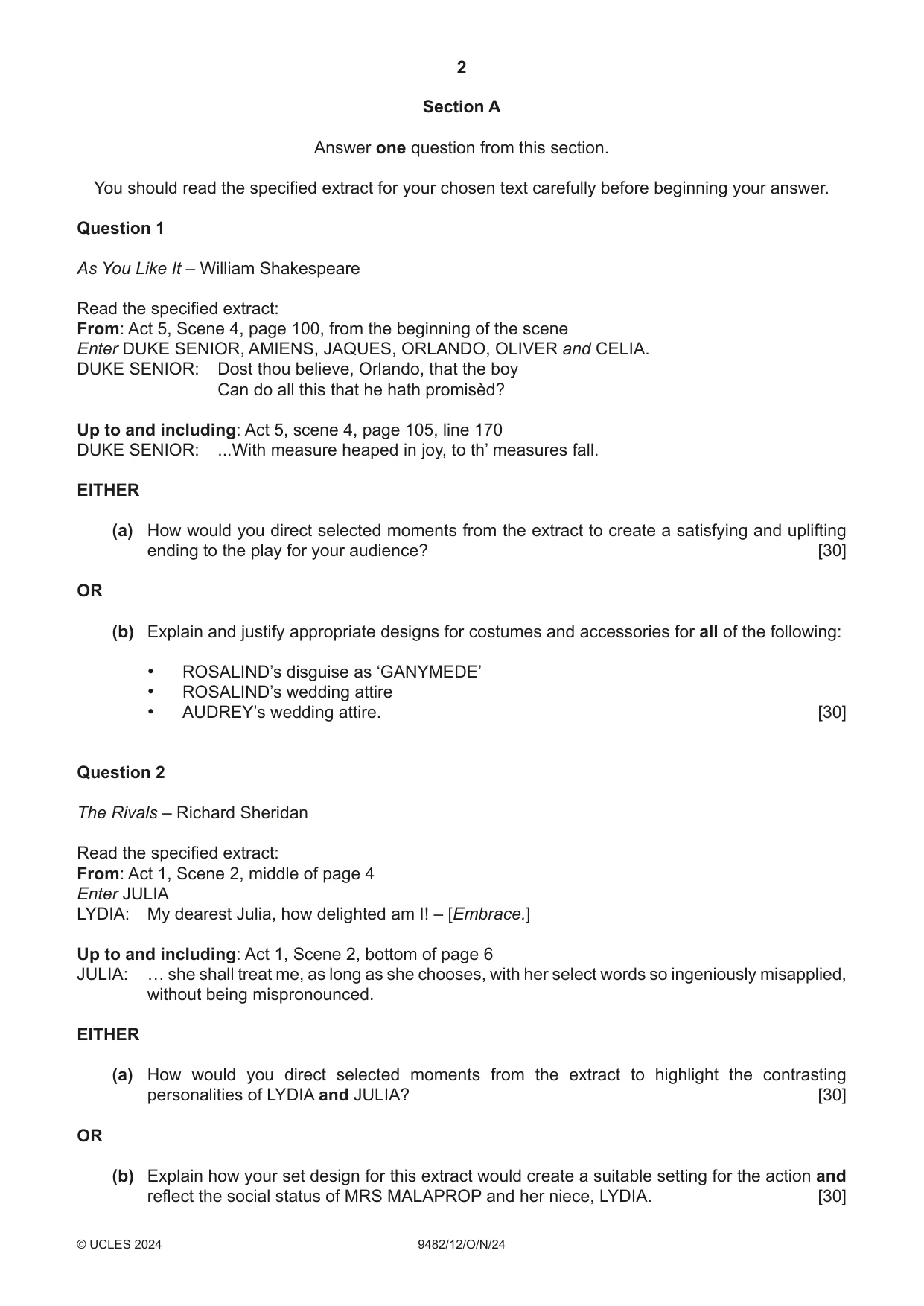
Question paper, page 2
2 9482/12/O/N/24 © UCLES 2024 Section A Answer one question from this section. You should read the specified extract for your chosen text carefully before beginning your answer. Question 1 As You Like It – William Shakespeare Read the specified extract: From: Act 5, Scene 4, page 100, from the beginning of the scene Enter DUKE SENIOR, AMIENS, JAQUES, ORLANDO, OLIVER and CELIA. DUKE SENIOR: Dost thou believe, Orlando, that the boy Can do all this that he hath promisèd? Up to and including: Act 5, scene 4, page 105, line 170 DUKE SENIOR: ...With measure heaped in joy, to th’ measures fall. EITHER (a) How would you direct selected moments from the extract to create a satisfying and uplifting ending to the play for your audience? [30] OR (b) Explain and justify appropriate designs for costumes and accessories for all of the following: • ROSALIND’s disguise as ‘GANYMEDE’ • ROSALIND’s wedding attire • AUDREY’s wedding attire. [30] Question 2 The Rivals – Richard Sheridan Read the specified extract: From: Act 1, Scene 2, middle of page 4 Enter JULIA LYDIA: My dearest Julia, how delighted am I! – [Embrace.] Up to and including: Act 1, Scene 2, bottom of page 6 JULIA: … she shall treat me, as long as she chooses, with her select words so ingeniously misapplied, without being mispronounced. EITHER (a) How would you direct selected moments from the extract to highlight the contrasting personalities of LYDIA and JULIA? [30] OR (b) Explain how your set design for this extract would create a suitable setting for the action and reflect the social status of MRS MALAPROP and her niece, LYDIA. [30]
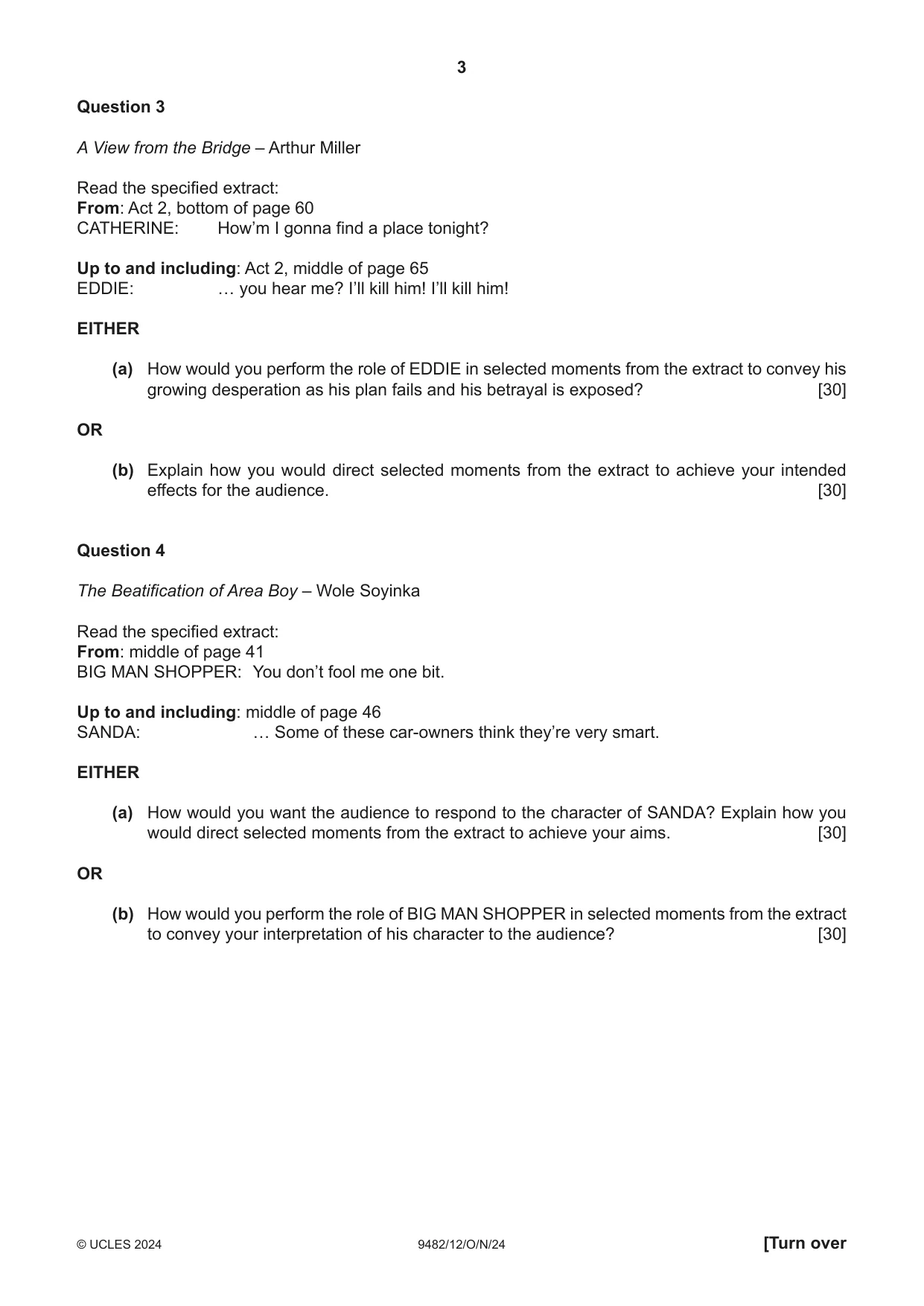
Question paper, page 3
3 9482/12/O/N/24 © UCLES 2024 [Turn over Question 3 A View from the Bridge – Arthur Miller Read the specified extract: From: Act 2, bottom of page 60 CATHERINE: How’m I gonna find a place tonight? Up to and including: Act 2, middle of page 65 EDDIE: … you hear me? I’ll kill him! I’ll kill him! EITHER (a) How would you perform the role of EDDIE in selected moments from the extract to convey his growing desperation as his plan fails and his betrayal is exposed? [30] OR (b) Explain how you would direct selected moments from the extract to achieve your intended effects for the audience. [30] Question 4 The Beatification of Area Boy – Wole Soyinka Read the specified extract: From: middle of page 41 BIG MAN SHOPPER: You don’t fool me one bit. Up to and including: middle of page 46 SANDA: … Some of these car-owners think they’re very smart. EITHER (a) How would you want the audience to respond to the character of SANDA? Explain how you would direct selected moments from the extract to achieve your aims. [30] OR (b) How would you perform the role of BIG MAN SHOPPER in selected moments from the extract to convey your interpretation of his character to the audience? [30]
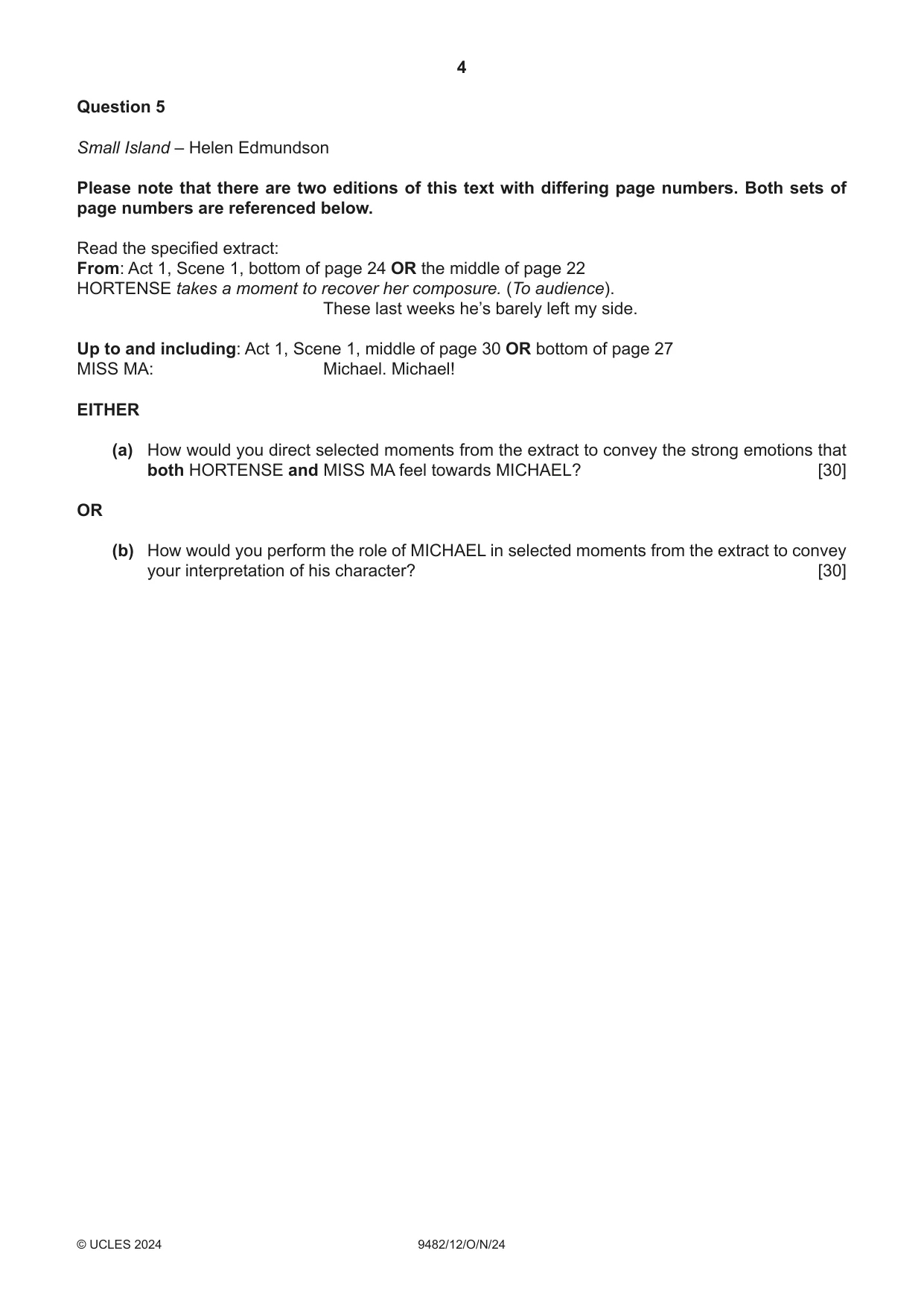
Question paper, page 4
4 9482/12/O/N/24 © UCLES 2024 Question 5 Small Island – Helen Edmundson Please note that there are two editions of this text with differing page numbers. Both sets of page numbers are referenced below. Read the specified extract: From: Act 1, Scene 1, bottom of page 24 OR the middle of page 22 HORTENSE takes a moment to recover her composure. (To audience). These last weeks he’s barely left my side. Up to and including: Act 1, Scene 1, middle of page 30 OR bottom of page 27 MISS MA: Michael. Michael! EITHER (a) How would you direct selected moments from the extract to convey the strong emotions that both HORTENSE and MISS MA feel towards MICHAEL? [30] OR (b) How would you perform the role of MICHAEL in selected moments from the extract to convey your interpretation of his character? [30]
Question paper, page 5
5 9482/12/O/N/24 © UCLES 2024 [Turn over Section B Answer one question from this section. Question 6 Oedipus Rex – Sophocles EITHER (a) Explain how you would perform the role of JOCASTA in two separate sections of the play to convey your interpretation of her character. [30] OR (b) As a director, how would you stage two separate sections of the play to increase the dramatic tension of the action for the audience? [30] Question 7 The Government Inspector – Nikolai Gogol EITHER (a) As a costume designer, explain how your designs for costumes and accessories would contribute to the creation of comedy in two separate sections of the play. [30] OR (b) Explain how your direction of one of the more minor characters in the play, OSIP, the JUDGE, MARYA, BOBCHINSKY, would contribute to the comedy of your production. You should refer to two separate sections of the play. [30] Question 8 The Cherry Orchard – Anton Chekhov EITHER (a) As a designer, outline and justify your ideas for creating an appropriate setting for the action of two separate sections of the play using set and lighting and sound. [30] OR (b) Explain how you would perform the role of LOPAKHIN in two separate sections of the play to achieve your intended audience responses to his character. [30]
Question paper, page 6
6 9482/12/O/N/24 © UCLES 2024 Question 9 Blood Wedding – Federico Garcia Lorca EITHER (a) Explain how you would perform the role of the BRIDE in two separate sections of the play to convey your interpretation of her character. [30] OR (b) As a director, explain how you would create an appropriate atmosphere for the action in two separate sections that feature any of the following characters: • BEGGAR WOMAN • THE WOODCUTTERS • MOON. [30] Question 10 Boom – Jean Tay EITHER (a) As a performer playing MOTHER, explain how you would demonstrate her strength of character in any two of the encounters that she has with her neighbours. [30] OR (b) As a director, how would you stage two separate sections of the play to achieve your dramatic intentions for the audience? [30]
Question paper, page 7
7 9482/12/O/N/24 © UCLES 2024 BLANK PAGE
Question paper, page 8
8 9482/12/O/N/24 © UCLES 2024 Permission to reproduce items where third-party owned material protected by copyright is included has been sought and cleared where possible. Every reasonable effort has been made by the publisher (UCLES) to trace copyright holders, but if any items requiring clearance have unwittingly been included, the publisher will be pleased to make amends at the earliest possible opportunity. To avoid the issue of disclosure of answer-related information to candidates, all copyright acknowledgements are reproduced online in the Cambridge Assessment International Education Copyright Acknowledgements Booklet. This is produced for each series of examinations and is freely available to download at www.cambridgeinternational.org after the live examination series. Cambridge Assessment International Education is part of Cambridge Assessment. Cambridge Assessment is the brand name of the University of Cambridge Local Examinations Syndicate (UCLES), which is a department of the University of Cambridge. BLANK PAGE
Mark scheme, page 1
This document consists of 27 printed pages. © Cambridge University Press & Assessment 2024 [Turn over Cambridge International AS & A Level DRAMA 9482/12 Paper 1 Open-Book Written Examination October/November 2024 MARK SCHEME Maximum Mark: 60 Published This mark scheme is published as an aid to teachers and candidates, to indicate the requirements of the examination. It shows the basis on which Examiners were instructed to award marks. It does not indicate the details of the discussions that took place at an Examiners’ meeting before marking began, which would have considered the acceptability of alternative answers. Mark schemes should be read in conjunction with the question paper and the Principal Examiner Report for Teachers. Cambridge International will not enter into discussions about these mark schemes. Cambridge International is publishing the mark schemes for the October/November 2024 series for most Cambridge IGCSE, Cambridge International A and AS Level components, and some Cambridge O Level components.
Mark scheme, page 2
9482/12 Cambridge International AS & A Level – Mark Scheme PUBLISHED October/November 2024 © Cambridge University Press & Assessment 2024 Page 2 of 27 Generic Marking Principles These general marking principles must be applied by all examiners when marking candidate answers. They should be applied alongside the specific content of the mark scheme or generic level descriptions for a question. Each question paper and mark scheme will also comply with these marking principles. GENERIC MARKING PRINCIPLE 1: Marks must be awarded in line with: • the specific content of the mark scheme or the generic level descriptors for the question • the specific skills defined in the mark scheme or in the generic level descriptors for the question • the standard of response required by a candidate as exemplified by the standardisation scripts. GENERIC MARKING PRINCIPLE 2: Marks awarded are always whole marks (not half marks, or other fractions). GENERIC MARKING PRINCIPLE 3: Marks must be awarded positively: • marks are awarded for correct/valid answers, as defined in the mark scheme. However, credit is given for valid answers which go beyond the scope of the syllabus and mark scheme, referring to your Team Leader as appropriate • marks are awarded when candidates clearly demonstrate what they know and can do • marks are not deducted for errors • marks are not deducted for omissions • answers should only be judged on the quality of spelling, punctuation and grammar when these features are specifically assessed by the question as indicated by the mark scheme. The meaning, however, should be unambiguous. GENERIC MARKING PRINCIPLE 4: Rules must be applied consistently, e.g. in situations where candidates have not followed instructions or in the application of generic level descriptors. GENERIC MARKING PRINCIPLE 5: Marks should be awarded using the full range of marks defined in the mark scheme for the question (however; the use of the full mark range may be limited according to the quality of the candidate responses seen). GENERIC MARKING PRINCIPLE 6: Marks awarded are based solely on the requirements as defined in the mark scheme. Marks should not be awarded with grade thresholds or grade descriptors in mind.
Mark scheme, page 3
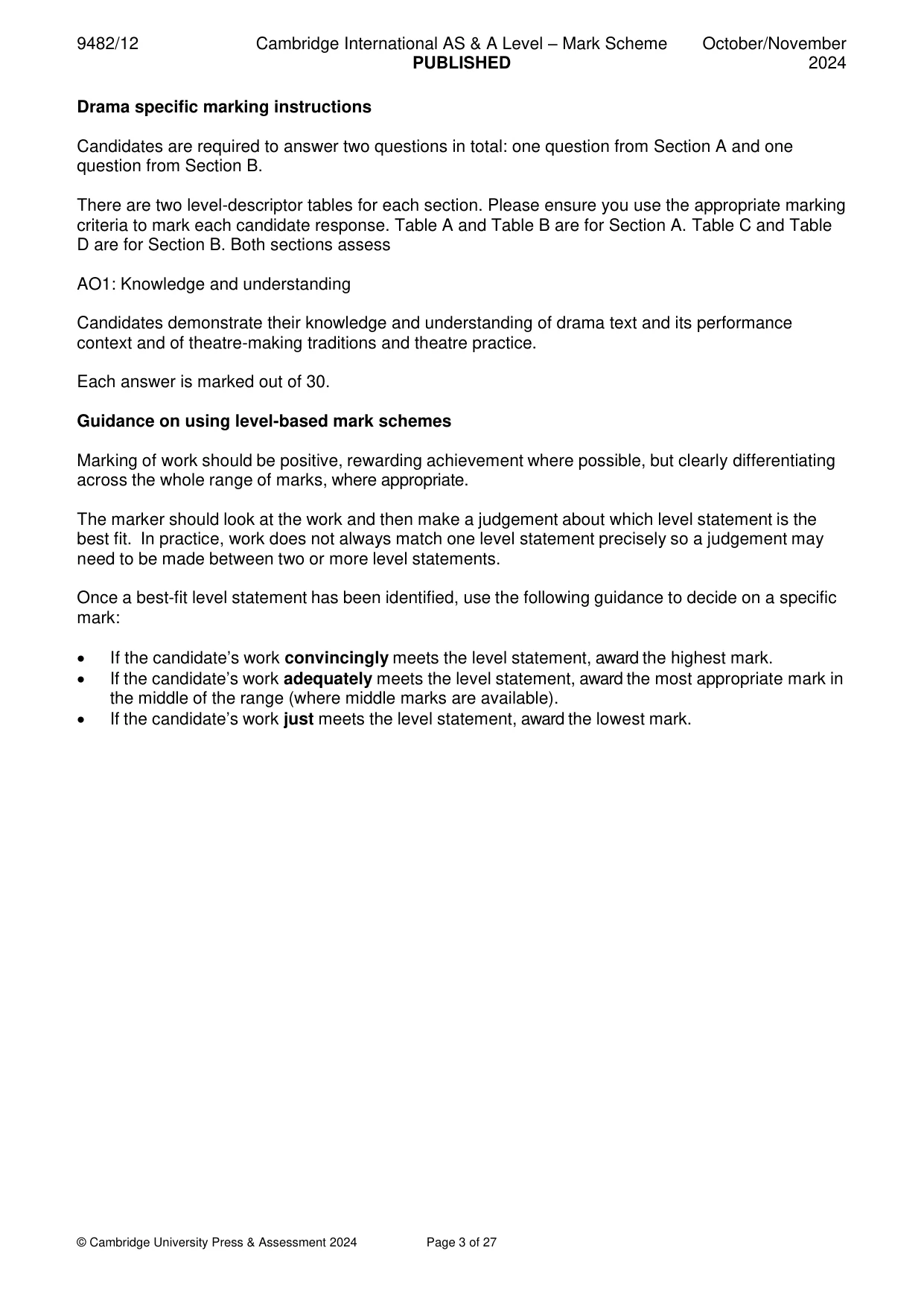
9482/12 Cambridge International AS & A Level – Mark Scheme PUBLISHED October/November 2024 © Cambridge University Press & Assessment 2024 Page 3 of 27 Drama specific marking instructions Candidates are required to answer two questions in total: one question from Section A and one question from Section B. There are two level-descriptor tables for each section. Please ensure you use the appropriate marking criteria to mark each candidate response. Table A and Table B are for Section A. Table C and Table D are for Section B. Both sections assess AO1: Knowledge and understanding Candidates demonstrate their knowledge and understanding of drama text and its performance context and of theatre-making traditions and theatre practice. Each answer is marked out of 30. Guidance on using level-based mark schemes Marking of work should be positive, rewarding achievement where possible, but clearly differentiating across the whole range of marks, where appropriate. The marker should look at the work and then make a judgement about which level statement is the best fit. In practice, work does not always match one level statement precisely so a judgement may need to be made between two or more level statements. Once a best-fit level statement has been identified, use the following guidance to decide on a specific mark: • If the candidate’s work convincingly meets the level statement, award the highest mark. • If the candidate’s work adequately meets the level statement, award the most appropriate mark in the middle of the range (where middle marks are available). • If the candidate’s work just meets the level statement, award the lowest mark.
Mark scheme, page 4
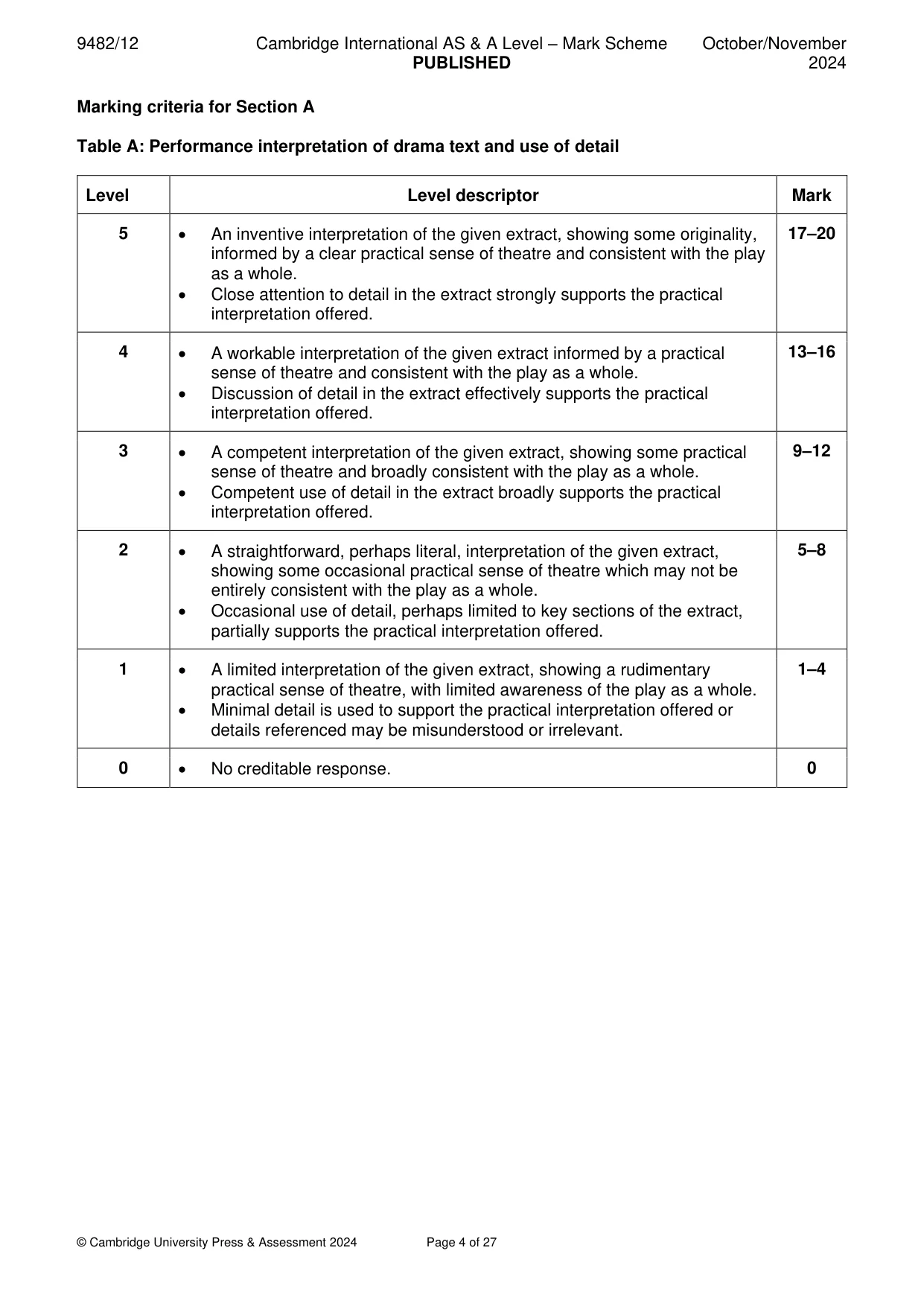
9482/12 Cambridge International AS & A Level – Mark Scheme PUBLISHED October/November 2024 © Cambridge University Press & Assessment 2024 Page 4 of 27 Marking criteria for Section A Table A: Performance interpretation of drama text and use of detail Level Level descriptor Mark 5 • An inventive interpretation of the given extract, showing some originality, informed by a clear practical sense of theatre and consistent with the play as a whole. • Close attention to detail in the extract strongly supports the practical interpretation offered. 17–20 4 • A workable interpretation of the given extract informed by a practical sense of theatre and consistent with the play as a whole. • Discussion of detail in the extract effectively supports the practical interpretation offered. 13–16 3 • A competent interpretation of the given extract, showing some practical sense of theatre and broadly consistent with the play as a whole. • Competent use of detail in the extract broadly supports the practical interpretation offered. 9–12 2 • A straightforward, perhaps literal, interpretation of the given extract, showing some occasional practical sense of theatre which may not be entirely consistent with the play as a whole. • Occasional use of detail, perhaps limited to key sections of the extract, partially supports the practical interpretation offered. 5–8 1 • A limited interpretation of the given extract, showing a rudimentary practical sense of theatre, with limited awareness of the play as a whole. • Minimal detail is used to support the practical interpretation offered or details referenced may be misunderstood or irrelevant. 1–4 0 • No creditable response. 0
Mark scheme, page 5
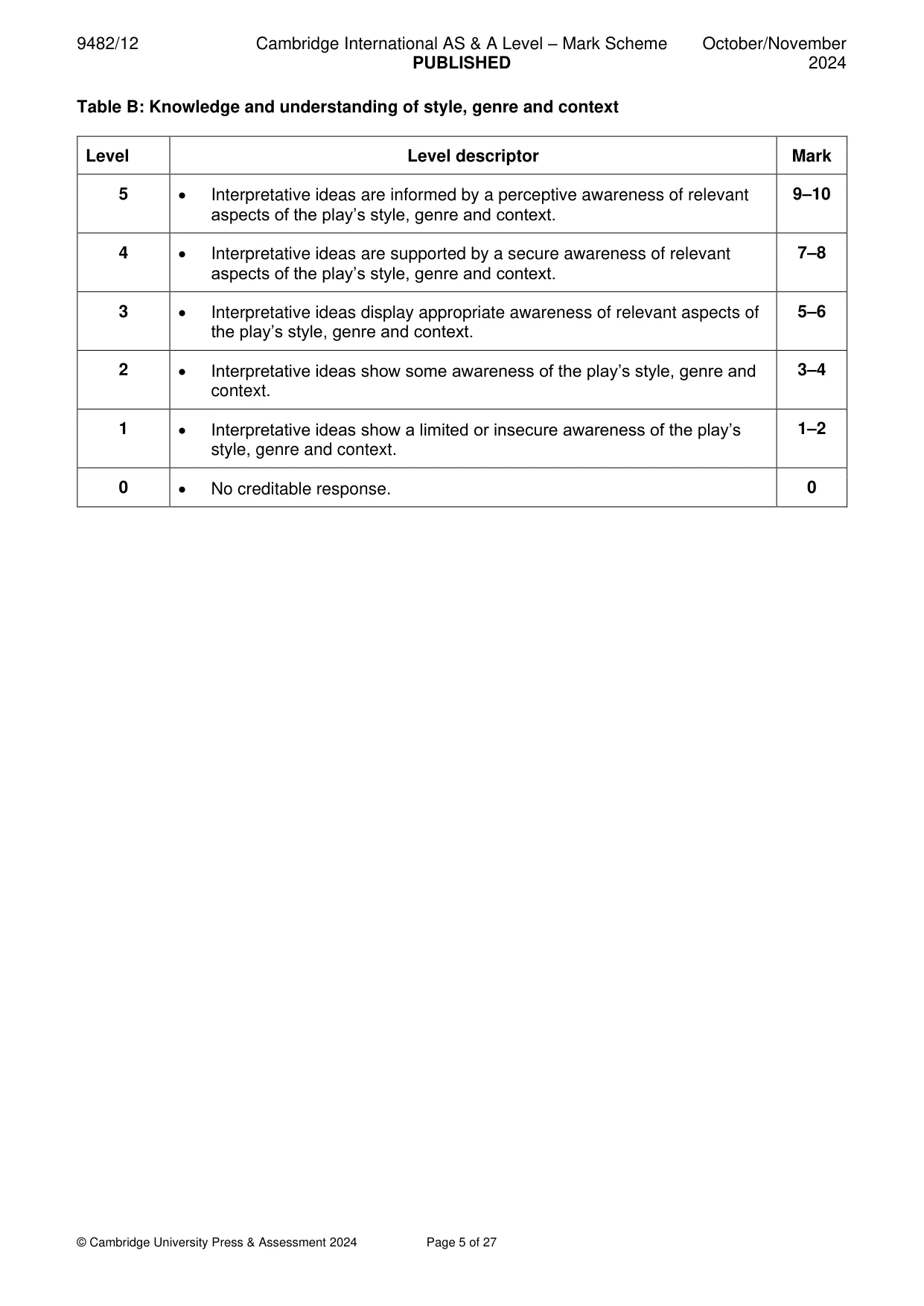
9482/12 Cambridge International AS & A Level – Mark Scheme PUBLISHED October/November 2024 © Cambridge University Press & Assessment 2024 Page 5 of 27 Table B: Knowledge and understanding of style, genre and context Level Level descriptor Mark 5 • Interpretative ideas are informed by a perceptive awareness of relevant aspects of the play’s style, genre and context. 9–10 4 • Interpretative ideas are supported by a secure awareness of relevant aspects of the play’s style, genre and context. 7–8 3 • Interpretative ideas display appropriate awareness of relevant aspects of the play’s style, genre and context. 5–6 2 • Interpretative ideas show some awareness of the play’s style, genre and context. 3–4 1 • Interpretative ideas show a limited or insecure awareness of the play’s style, genre and context. 1–2 0 • No creditable response. 0
Mark scheme, page 6
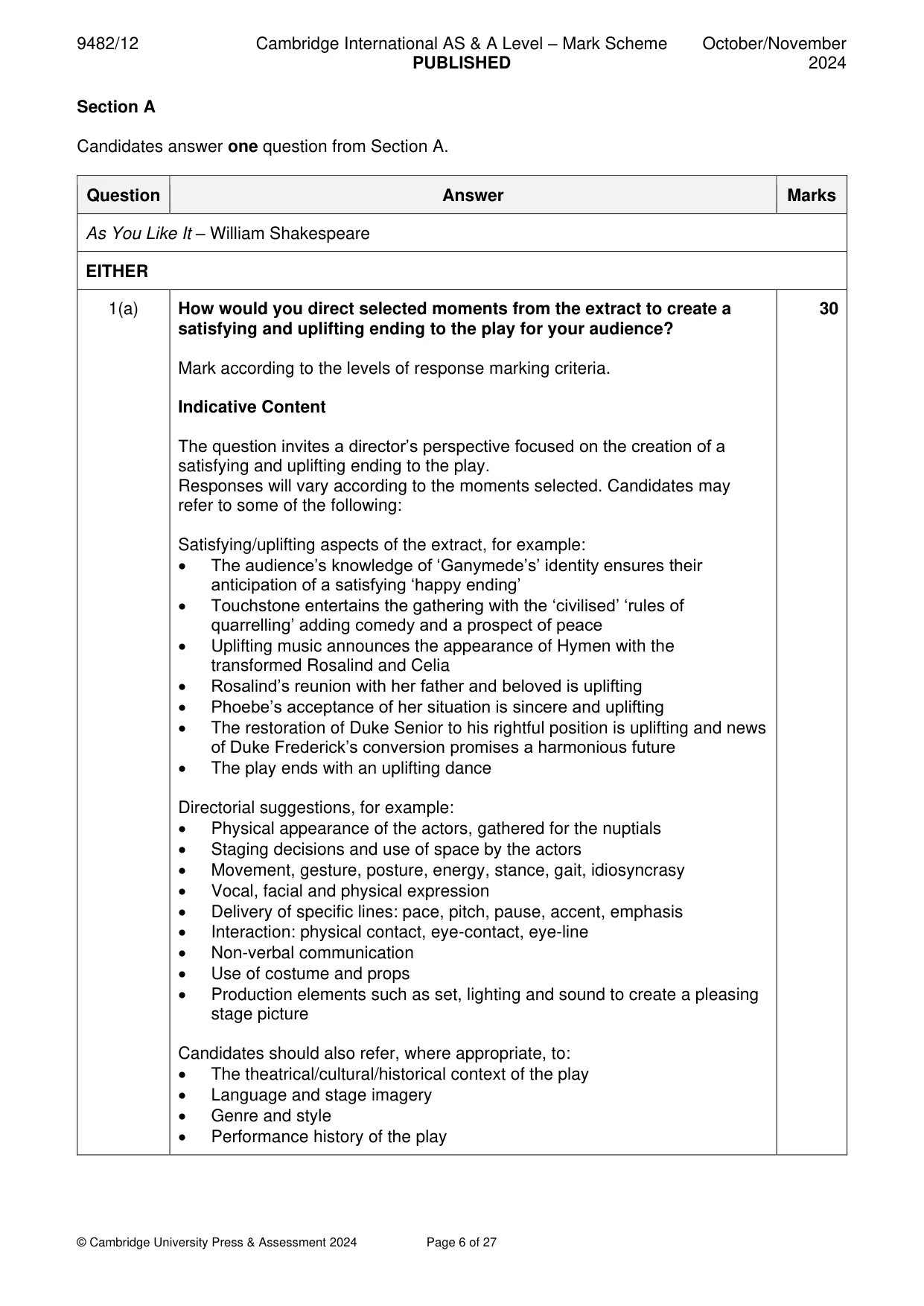
9482/12 Cambridge International AS & A Level – Mark Scheme PUBLISHED October/November 2024 © Cambridge University Press & Assessment 2024 Page 6 of 27 Section A Candidates answer one question from Section A. Question Answer Marks As You Like It – William Shakespeare EITHER 1(a) How would you direct selected moments from the extract to create a satisfying and uplifting ending to the play for your audience? Mark according to the levels of response marking criteria. Indicative Content The question invites a director’s perspective focused on the creation of a satisfying and uplifting ending to the play. Responses will vary according to the moments selected. Candidates may refer to some of the following: Satisfying/uplifting aspects of the extract, for example: • The audience’s knowledge of ‘Ganymede’s’ identity ensures their anticipation of a satisfying ‘happy ending’ • Touchstone entertains the gathering with the ‘civilised’ ‘rules of quarrelling’ adding comedy and a prospect of peace • Uplifting music announces the appearance of Hymen with the transformed Rosalind and Celia • Rosalind’s reunion with her father and beloved is uplifting • Phoebe’s acceptance of her situation is sincere and uplifting • The restoration of Duke Senior to his rightful position is uplifting and news of Duke Frederick’s conversion promises a harmonious future • The play ends with an uplifting dance Directorial suggestions, for example: • Physical appearance of the actors, gathered for the nuptials • Staging decisions and use of space by the actors • Movement, gesture, posture, energy, stance, gait, idiosyncrasy • Vocal, facial and physical expression • Delivery of specific lines: pace, pitch, pause, accent, emphasis • Interaction: physical contact, eye-contact, eye-line • Non-verbal communication • Use of costume and props • Production elements such as set, lighting and sound to create a pleasing stage picture Candidates should also refer, where appropriate, to: • The theatrical/cultural/historical context of the play • Language and stage imagery • Genre and style • Performance history of the play 30
Mark scheme, page 7
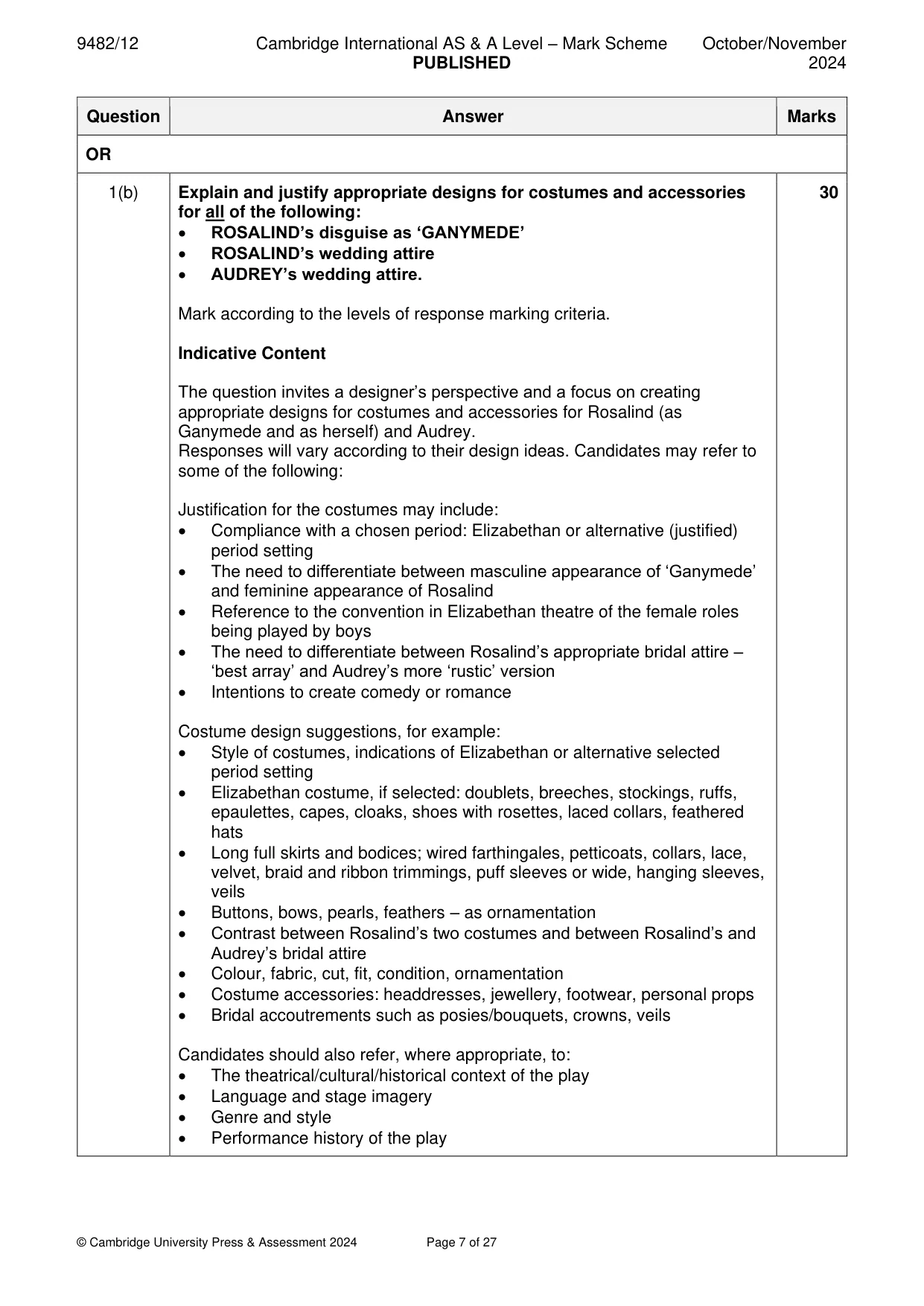
9482/12 Cambridge International AS & A Level – Mark Scheme PUBLISHED October/November 2024 © Cambridge University Press & Assessment 2024 Page 7 of 27 Question Answer Marks OR 1(b) Explain and justify appropriate designs for costumes and accessories for all of the following: • ROSALIND’s disguise as ‘GANYMEDE’ • ROSALIND’s wedding attire • AUDREY’s wedding attire. Mark according to the levels of response marking criteria. Indicative Content The question invites a designer’s perspective and a focus on creating appropriate designs for costumes and accessories for Rosalind (as Ganymede and as herself) and Audrey. Responses will vary according to their design ideas. Candidates may refer to some of the following: Justification for the costumes may include: • Compliance with a chosen period: Elizabethan or alternative (justified) period setting • The need to differentiate between masculine appearance of ‘Ganymede’ and feminine appearance of Rosalind • Reference to the convention in Elizabethan theatre of the female roles being played by boys • The need to differentiate between Rosalind’s appropriate bridal attire – ‘best array’ and Audrey’s more ‘rustic’ version • Intentions to create comedy or romance Costume design suggestions, for example: • Style of costumes, indications of Elizabethan or alternative selected period setting • Elizabethan costume, if selected: doublets, breeches, stockings, ruffs, epaulettes, capes, cloaks, shoes with rosettes, laced collars, feathered hats • Long full skirts and bodices; wired farthingales, petticoats, collars, lace, velvet, braid and ribbon trimmings, puff sleeves or wide, hanging sleeves, veils • Buttons, bows, pearls, feathers – as ornamentation • Contrast between Rosalind’s two costumes and between Rosalind’s and Audrey’s bridal attire • Colour, fabric, cut, fit, condition, ornamentation • Costume accessories: headdresses, jewellery, footwear, personal props • Bridal accoutrements such as posies/bouquets, crowns, veils Candidates should also refer, where appropriate, to: • The theatrical/cultural/historical context of the play • Language and stage imagery • Genre and style • Performance history of the play 30
Mark scheme, page 8
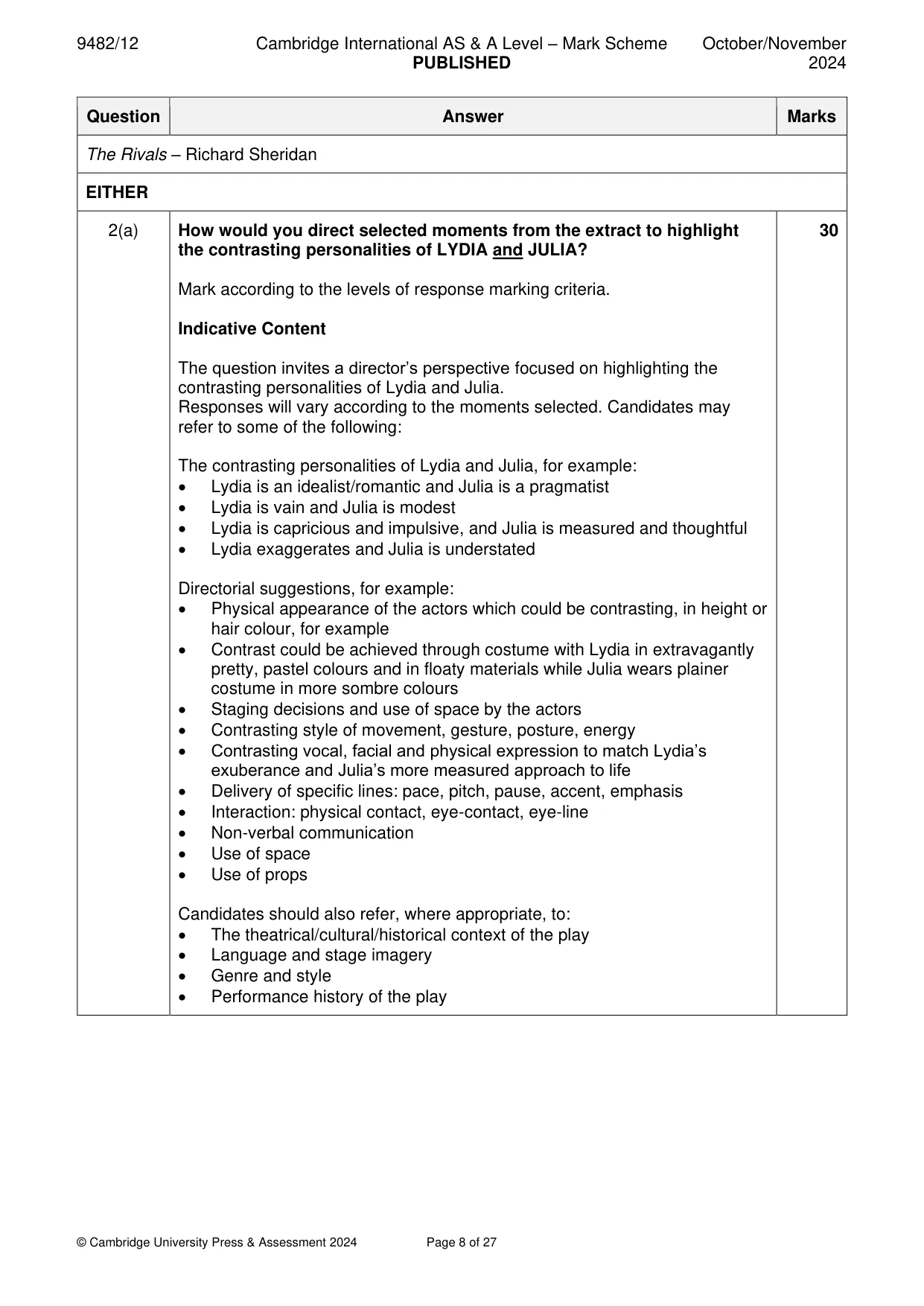
9482/12 Cambridge International AS & A Level – Mark Scheme PUBLISHED October/November 2024 © Cambridge University Press & Assessment 2024 Page 8 of 27 Question Answer Marks The Rivals – Richard Sheridan EITHER 2(a) How would you direct selected moments from the extract to highlight the contrasting personalities of LYDIA and JULIA? Mark according to the levels of response marking criteria. Indicative Content The question invites a director’s perspective focused on highlighting the contrasting personalities of Lydia and Julia. Responses will vary according to the moments selected. Candidates may refer to some of the following: The contrasting personalities of Lydia and Julia, for example: • Lydia is an idealist/romantic and Julia is a pragmatist • Lydia is vain and Julia is modest • Lydia is capricious and impulsive, and Julia is measured and thoughtful • Lydia exaggerates and Julia is understated Directorial suggestions, for example: • Physical appearance of the actors which could be contrasting, in height or hair colour, for example • Contrast could be achieved through costume with Lydia in extravagantly pretty, pastel colours and in floaty materials while Julia wears plainer costume in more sombre colours • Staging decisions and use of space by the actors • Contrasting style of movement, gesture, posture, energy • Contrasting vocal, facial and physical expression to match Lydia’s exuberance and Julia’s more measured approach to life • Delivery of specific lines: pace, pitch, pause, accent, emphasis • Interaction: physical contact, eye-contact, eye-line • Non-verbal communication • Use of space • Use of props Candidates should also refer, where appropriate, to: • The theatrical/cultural/historical context of the play • Language and stage imagery • Genre and style • Performance history of the play 30
Mark scheme, page 9
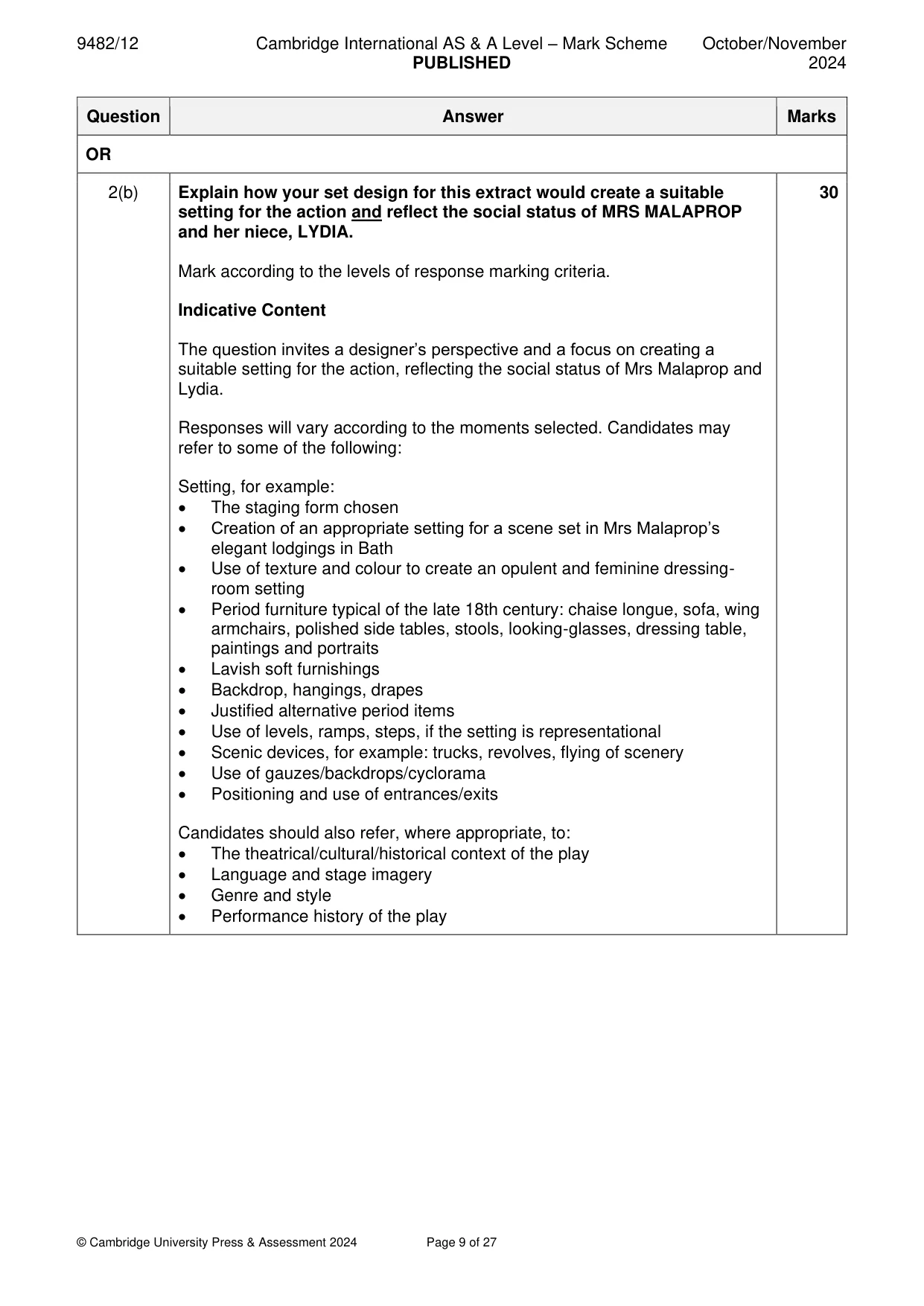
9482/12 Cambridge International AS & A Level – Mark Scheme PUBLISHED October/November 2024 © Cambridge University Press & Assessment 2024 Page 9 of 27 Question Answer Marks OR 2(b) Explain how your set design for this extract would create a suitable setting for the action and reflect the social status of MRS MALAPROP and her niece, LYDIA. Mark according to the levels of response marking criteria. Indicative Content The question invites a designer’s perspective and a focus on creating a suitable setting for the action, reflecting the social status of Mrs Malaprop and Lydia. Responses will vary according to the moments selected. Candidates may refer to some of the following: Setting, for example: • The staging form chosen • Creation of an appropriate setting for a scene set in Mrs Malaprop’s elegant lodgings in Bath • Use of texture and colour to create an opulent and feminine dressing- room setting • Period furniture typical of the late 18th century: chaise longue, sofa, wing armchairs, polished side tables, stools, looking-glasses, dressing table, paintings and portraits • Lavish soft furnishings • Backdrop, hangings, drapes • Justified alternative period items • Use of levels, ramps, steps, if the setting is representational • Scenic devices, for example: trucks, revolves, flying of scenery • Use of gauzes/backdrops/cyclorama • Positioning and use of entrances/exits Candidates should also refer, where appropriate, to: • The theatrical/cultural/historical context of the play • Language and stage imagery • Genre and style • Performance history of the play 30
Mark scheme, page 10
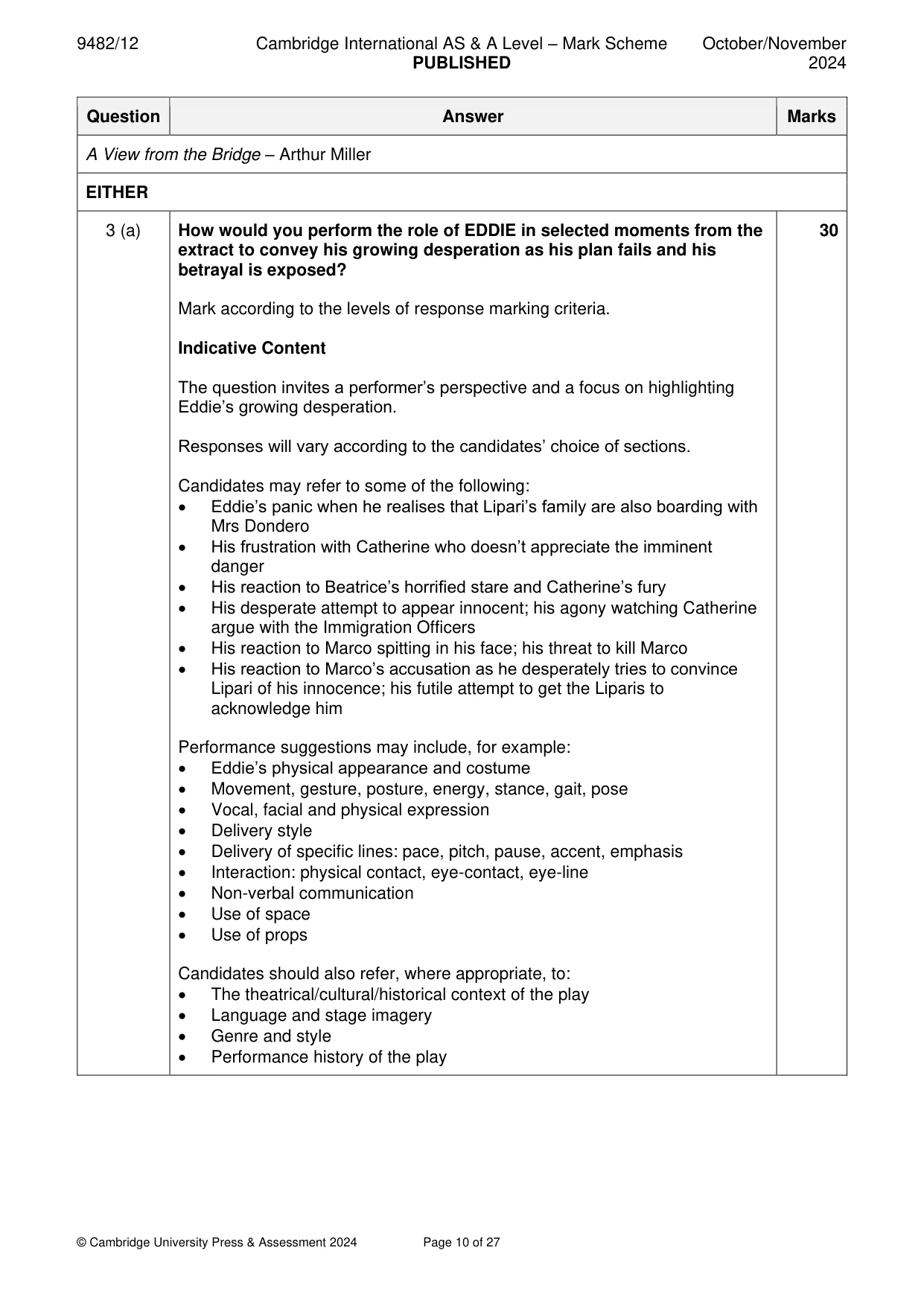
9482/12 Cambridge International AS & A Level – Mark Scheme PUBLISHED October/November 2024 © Cambridge University Press & Assessment 2024 Page 10 of 27 Question Answer Marks A View from the Bridge – Arthur Miller EITHER 3 (a) How would you perform the role of EDDIE in selected moments from the extract to convey his growing desperation as his plan fails and his betrayal is exposed? Mark according to the levels of response marking criteria. Indicative Content The question invites a performer’s perspective and a focus on highlighting Eddie’s growing desperation. Responses will vary according to the candidates’ choice of sections. Candidates may refer to some of the following: • Eddie’s panic when he realises that Lipari’s family are also boarding with Mrs Dondero • His frustration with Catherine who doesn’t appreciate the imminent danger • His reaction to Beatrice’s horrified stare and Catherine’s fury • His desperate attempt to appear innocent; his agony watching Catherine argue with the Immigration Officers • His reaction to Marco spitting in his face; his threat to kill Marco • His reaction to Marco’s accusation as he desperately tries to convince Lipari of his innocence; his futile attempt to get the Liparis to acknowledge him Performance suggestions may include, for example: • Eddie’s physical appearance and costume • Movement, gesture, posture, energy, stance, gait, pose • Vocal, facial and physical expression • Delivery style • Delivery of specific lines: pace, pitch, pause, accent, emphasis • Interaction: physical contact, eye-contact, eye-line • Non-verbal communication • Use of space • Use of props Candidates should also refer, where appropriate, to: • The theatrical/cultural/historical context of the play • Language and stage imagery • Genre and style • Performance history of the play 30
Mark scheme, page 11
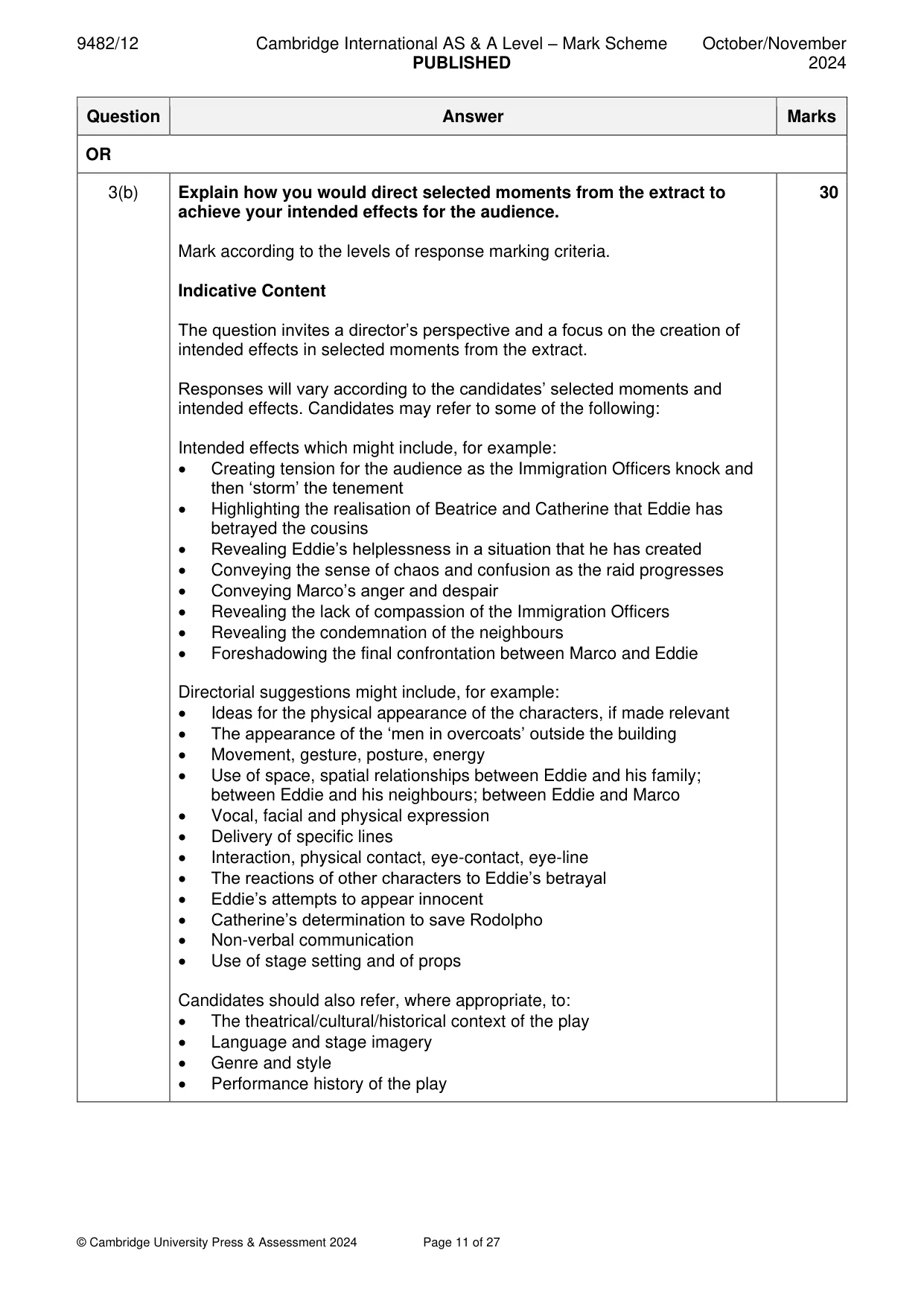
9482/12 Cambridge International AS & A Level – Mark Scheme PUBLISHED October/November 2024 © Cambridge University Press & Assessment 2024 Page 11 of 27 Question Answer Marks OR 3(b) Explain how you would direct selected moments from the extract to achieve your intended effects for the audience. Mark according to the levels of response marking criteria. Indicative Content The question invites a director’s perspective and a focus on the creation of intended effects in selected moments from the extract. Responses will vary according to the candidates’ selected moments and intended effects. Candidates may refer to some of the following: Intended effects which might include, for example: • Creating tension for the audience as the Immigration Officers knock and then ‘storm’ the tenement • Highlighting the realisation of Beatrice and Catherine that Eddie has betrayed the cousins • Revealing Eddie’s helplessness in a situation that he has created • Conveying the sense of chaos and confusion as the raid progresses • Conveying Marco’s anger and despair • Revealing the lack of compassion of the Immigration Officers • Revealing the condemnation of the neighbours • Foreshadowing the final confrontation between Marco and Eddie Directorial suggestions might include, for example: • Ideas for the physical appearance of the characters, if made relevant • The appearance of the ‘men in overcoats’ outside the building • Movement, gesture, posture, energy • Use of space, spatial relationships between Eddie and his family; between Eddie and his neighbours; between Eddie and Marco • Vocal, facial and physical expression • Delivery of specific lines • Interaction, physical contact, eye-contact, eye-line • The reactions of other characters to Eddie’s betrayal • Eddie’s attempts to appear innocent • Catherine’s determination to save Rodolpho • Non-verbal communication • Use of stage setting and of props Candidates should also refer, where appropriate, to: • The theatrical/cultural/historical context of the play • Language and stage imagery • Genre and style • Performance history of the play 30
Mark scheme, page 12
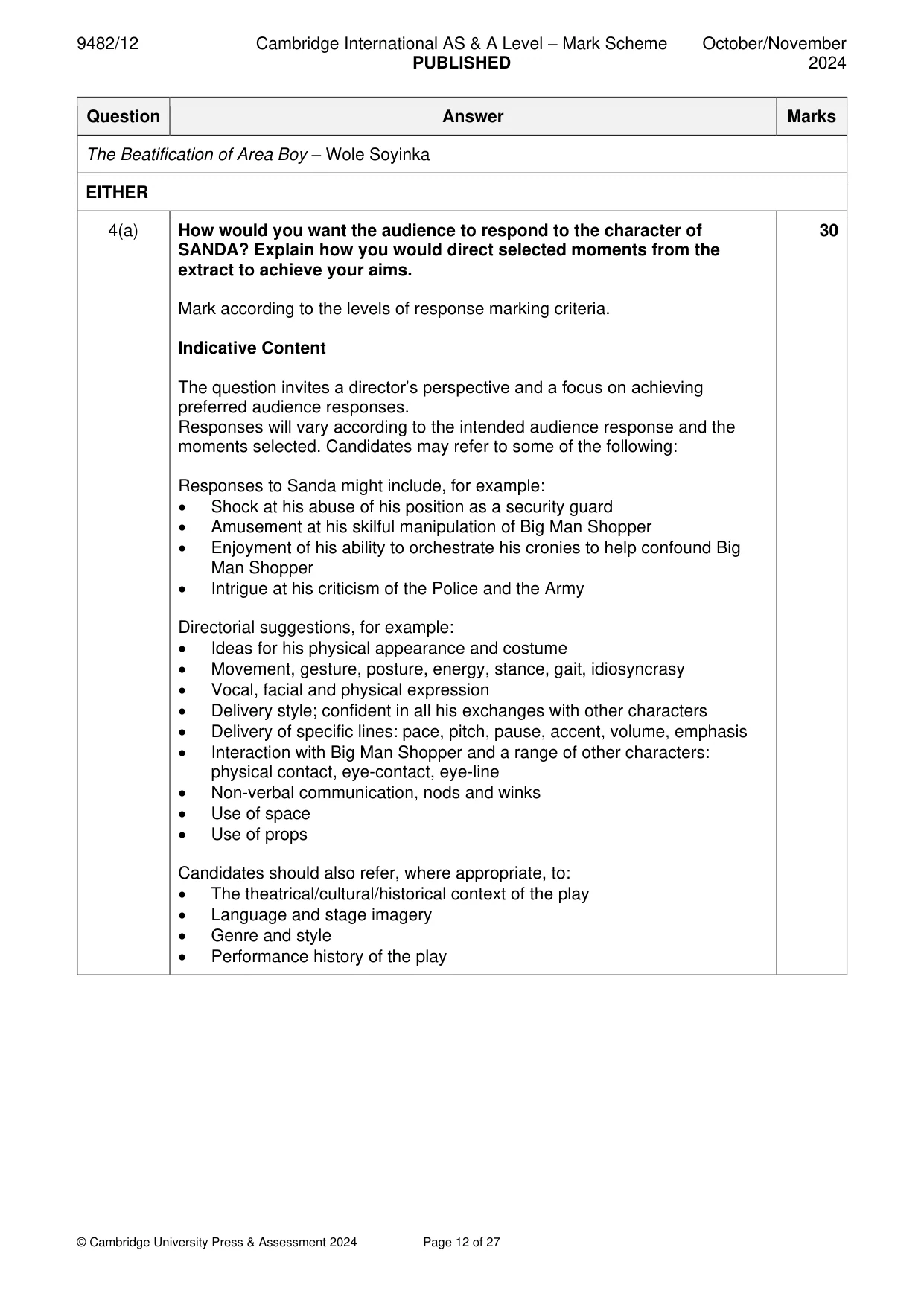
9482/12 Cambridge International AS & A Level – Mark Scheme PUBLISHED October/November 2024 © Cambridge University Press & Assessment 2024 Page 12 of 27 Question Answer Marks The Beatification of Area Boy – Wole Soyinka EITHER 4(a) How would you want the audience to respond to the character of SANDA? Explain how you would direct selected moments from the extract to achieve your aims. Mark according to the levels of response marking criteria. Indicative Content The question invites a director’s perspective and a focus on achieving preferred audience responses. Responses will vary according to the intended audience response and the moments selected. Candidates may refer to some of the following: Responses to Sanda might include, for example: • Shock at his abuse of his position as a security guard • Amusement at his skilful manipulation of Big Man Shopper • Enjoyment of his ability to orchestrate his cronies to help confound Big Man Shopper • Intrigue at his criticism of the Police and the Army Directorial suggestions, for example: • Ideas for his physical appearance and costume • Movement, gesture, posture, energy, stance, gait, idiosyncrasy • Vocal, facial and physical expression • Delivery style; confident in all his exchanges with other characters • Delivery of specific lines: pace, pitch, pause, accent, volume, emphasis • Interaction with Big Man Shopper and a range of other characters: physical contact, eye-contact, eye-line • Non-verbal communication, nods and winks • Use of space • Use of props Candidates should also refer, where appropriate, to: • The theatrical/cultural/historical context of the play • Language and stage imagery • Genre and style • Performance history of the play 30
Mark scheme, page 13
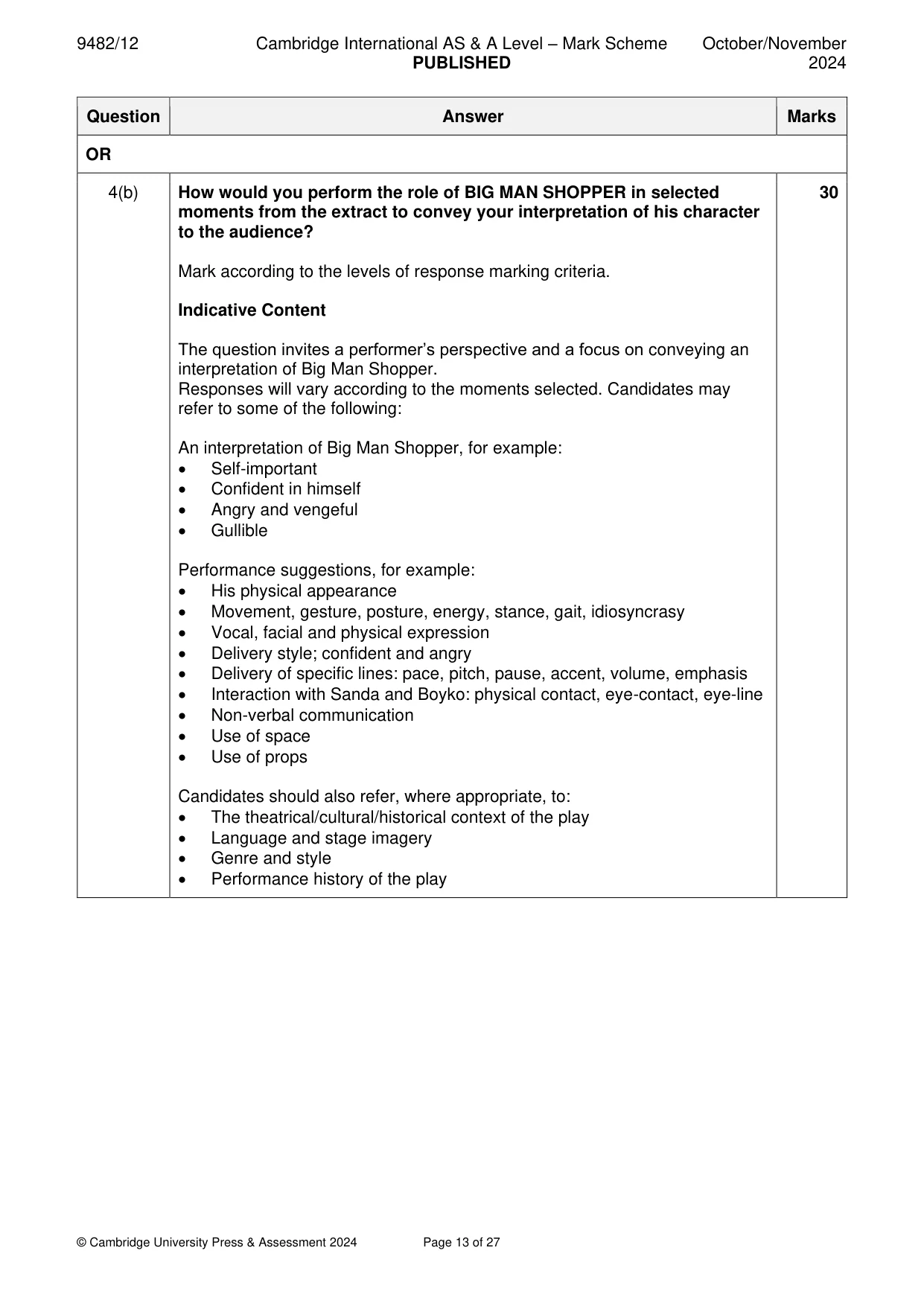
9482/12 Cambridge International AS & A Level – Mark Scheme PUBLISHED October/November 2024 © Cambridge University Press & Assessment 2024 Page 13 of 27 Question Answer Marks OR 4(b) How would you perform the role of BIG MAN SHOPPER in selected moments from the extract to convey your interpretation of his character to the audience? Mark according to the levels of response marking criteria. Indicative Content The question invites a performer’s perspective and a focus on conveying an interpretation of Big Man Shopper. Responses will vary according to the moments selected. Candidates may refer to some of the following: An interpretation of Big Man Shopper, for example: • Self-important • Confident in himself • Angry and vengeful • Gullible Performance suggestions, for example: • His physical appearance • Movement, gesture, posture, energy, stance, gait, idiosyncrasy • Vocal, facial and physical expression • Delivery style; confident and angry • Delivery of specific lines: pace, pitch, pause, accent, volume, emphasis • Interaction with Sanda and Boyko: physical contact, eye-contact, eye-line • Non-verbal communication • Use of space • Use of props Candidates should also refer, where appropriate, to: • The theatrical/cultural/historical context of the play • Language and stage imagery • Genre and style • Performance history of the play 30
Mark scheme, page 14
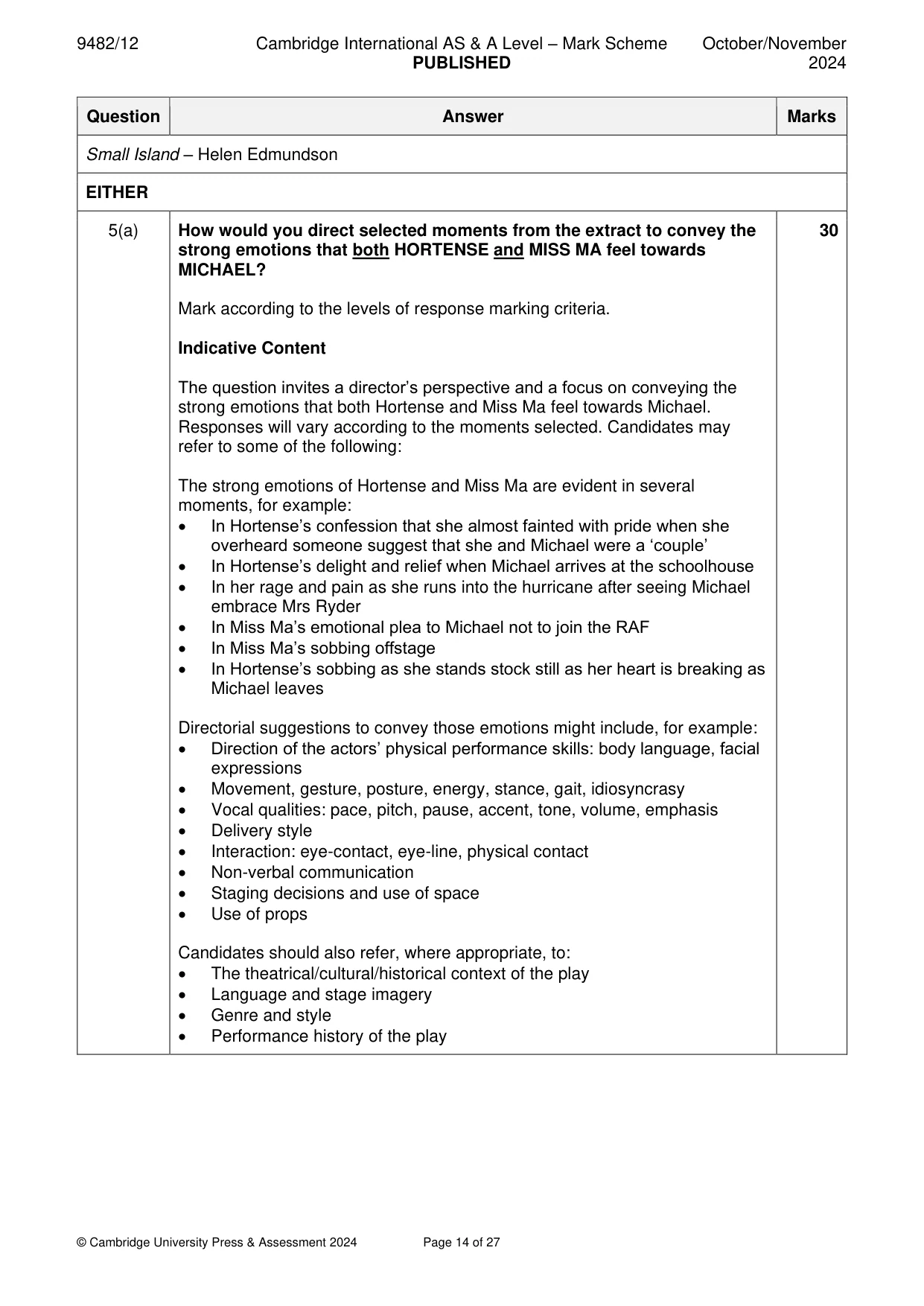
9482/12 Cambridge International AS & A Level – Mark Scheme PUBLISHED October/November 2024 © Cambridge University Press & Assessment 2024 Page 14 of 27 Question Answer Marks Small Island – Helen Edmundson EITHER 5(a) How would you direct selected moments from the extract to convey the strong emotions that both HORTENSE and MISS MA feel towards MICHAEL? Mark according to the levels of response marking criteria. Indicative Content The question invites a director’s perspective and a focus on conveying the strong emotions that both Hortense and Miss Ma feel towards Michael. Responses will vary according to the moments selected. Candidates may refer to some of the following: The strong emotions of Hortense and Miss Ma are evident in several moments, for example: • In Hortense’s confession that she almost fainted with pride when she overheard someone suggest that she and Michael were a ‘couple’ • In Hortense’s delight and relief when Michael arrives at the schoolhouse • In her rage and pain as she runs into the hurricane after seeing Michael embrace Mrs Ryder • In Miss Ma’s emotional plea to Michael not to join the RAF • In Miss Ma’s sobbing offstage • In Hortense’s sobbing as she stands stock still as her heart is breaking as Michael leaves Directorial suggestions to convey those emotions might include, for example: • Direction of the actors’ physical performance skills: body language, facial expressions • Movement, gesture, posture, energy, stance, gait, idiosyncrasy • Vocal qualities: pace, pitch, pause, accent, tone, volume, emphasis • Delivery style • Interaction: eye-contact, eye-line, physical contact • Non-verbal communication • Staging decisions and use of space • Use of props Candidates should also refer, where appropriate, to: • The theatrical/cultural/historical context of the play • Language and stage imagery • Genre and style • Performance history of the play 30
Mark scheme, page 15
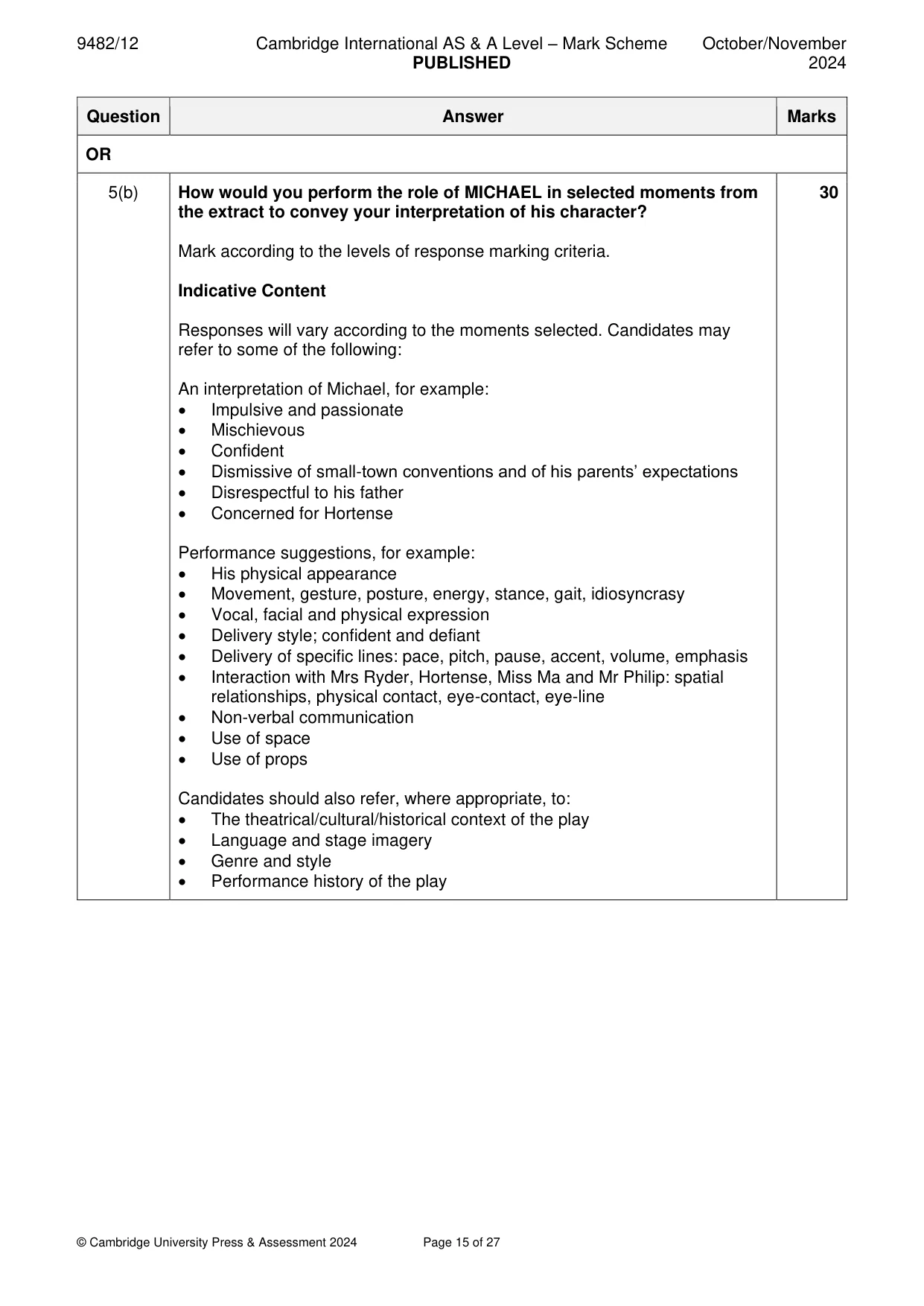
9482/12 Cambridge International AS & A Level – Mark Scheme PUBLISHED October/November 2024 © Cambridge University Press & Assessment 2024 Page 15 of 27 Question Answer Marks OR 5(b) How would you perform the role of MICHAEL in selected moments from the extract to convey your interpretation of his character? Mark according to the levels of response marking criteria. Indicative Content Responses will vary according to the moments selected. Candidates may refer to some of the following: An interpretation of Michael, for example: • Impulsive and passionate • Mischievous • Confident • Dismissive of small-town conventions and of his parents’ expectations • Disrespectful to his father • Concerned for Hortense Performance suggestions, for example: • His physical appearance • Movement, gesture, posture, energy, stance, gait, idiosyncrasy • Vocal, facial and physical expression • Delivery style; confident and defiant • Delivery of specific lines: pace, pitch, pause, accent, volume, emphasis • Interaction with Mrs Ryder, Hortense, Miss Ma and Mr Philip: spatial relationships, physical contact, eye-contact, eye-line • Non-verbal communication • Use of space • Use of props Candidates should also refer, where appropriate, to: • The theatrical/cultural/historical context of the play • Language and stage imagery • Genre and style • Performance history of the play 30
Mark scheme, page 16
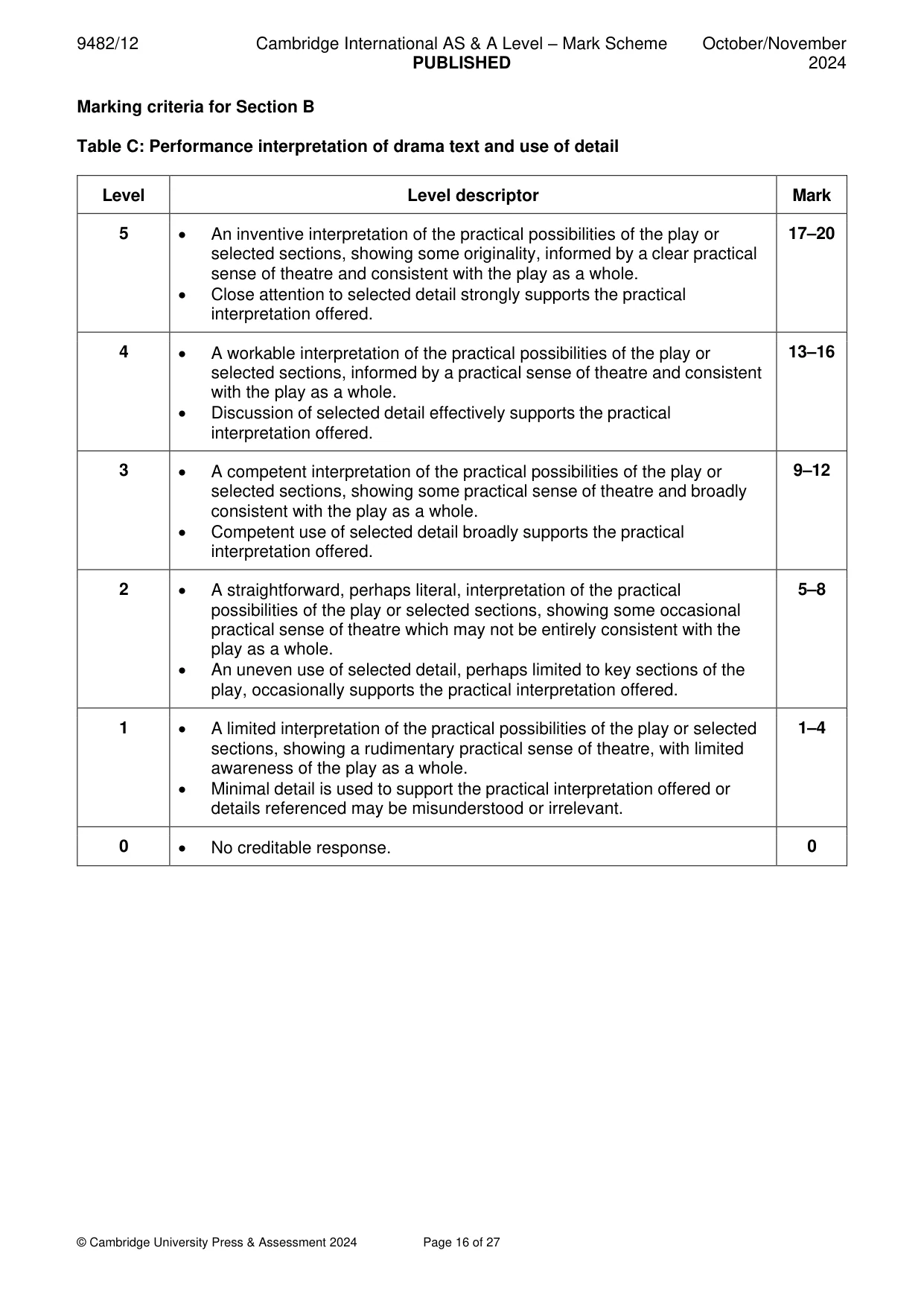
9482/12 Cambridge International AS & A Level – Mark Scheme PUBLISHED October/November 2024 © Cambridge University Press & Assessment 2024 Page 16 of 27 Marking criteria for Section B Table C: Performance interpretation of drama text and use of detail Level Level descriptor Mark 5 • An inventive interpretation of the practical possibilities of the play or selected sections, showing some originality, informed by a clear practical sense of theatre and consistent with the play as a whole. • Close attention to selected detail strongly supports the practical interpretation offered. 17–20 4 • A workable interpretation of the practical possibilities of the play or selected sections, informed by a practical sense of theatre and consistent with the play as a whole. • Discussion of selected detail effectively supports the practical interpretation offered. 13–16 3 • A competent interpretation of the practical possibilities of the play or selected sections, showing some practical sense of theatre and broadly consistent with the play as a whole. • Competent use of selected detail broadly supports the practical interpretation offered. 9–12 2 • A straightforward, perhaps literal, interpretation of the practical possibilities of the play or selected sections, showing some occasional practical sense of theatre which may not be entirely consistent with the play as a whole. • An uneven use of selected detail, perhaps limited to key sections of the play, occasionally supports the practical interpretation offered. 5–8 1 • A limited interpretation of the practical possibilities of the play or selected sections, showing a rudimentary practical sense of theatre, with limited awareness of the play as a whole. • Minimal detail is used to support the practical interpretation offered or details referenced may be misunderstood or irrelevant. 1–4 0 • No creditable response. 0
Mark scheme, page 17
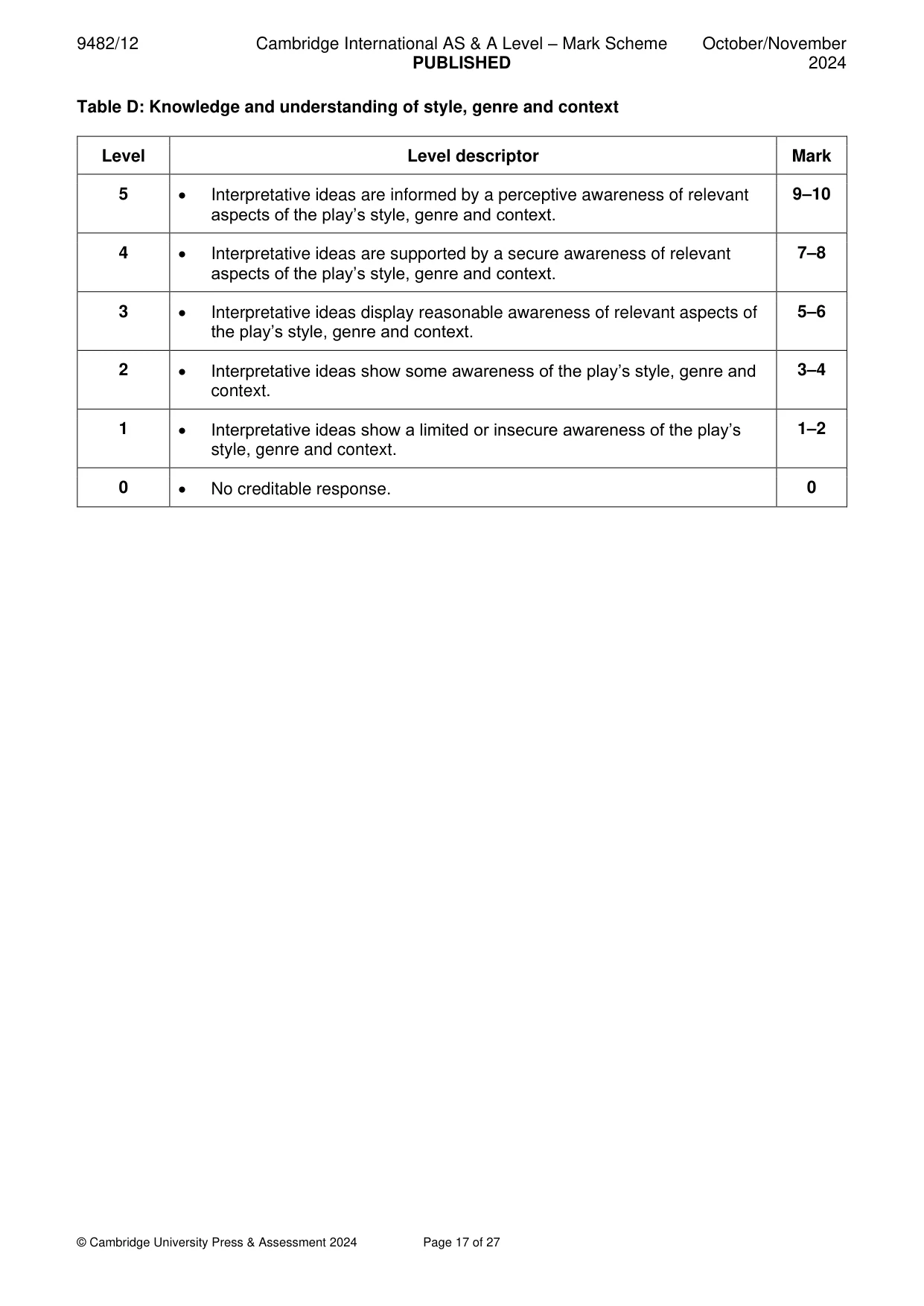
9482/12 Cambridge International AS & A Level – Mark Scheme PUBLISHED October/November 2024 © Cambridge University Press & Assessment 2024 Page 17 of 27 Table D: Knowledge and understanding of style, genre and context Level Level descriptor Mark 5 • Interpretative ideas are informed by a perceptive awareness of relevant aspects of the play’s style, genre and context. 9–10 4 • Interpretative ideas are supported by a secure awareness of relevant aspects of the play’s style, genre and context. 7–8 3 • Interpretative ideas display reasonable awareness of relevant aspects of the play’s style, genre and context. 5–6 2 • Interpretative ideas show some awareness of the play’s style, genre and context. 3–4 1 • Interpretative ideas show a limited or insecure awareness of the play’s style, genre and context. 1–2 0 • No creditable response. 0
Mark scheme, page 18
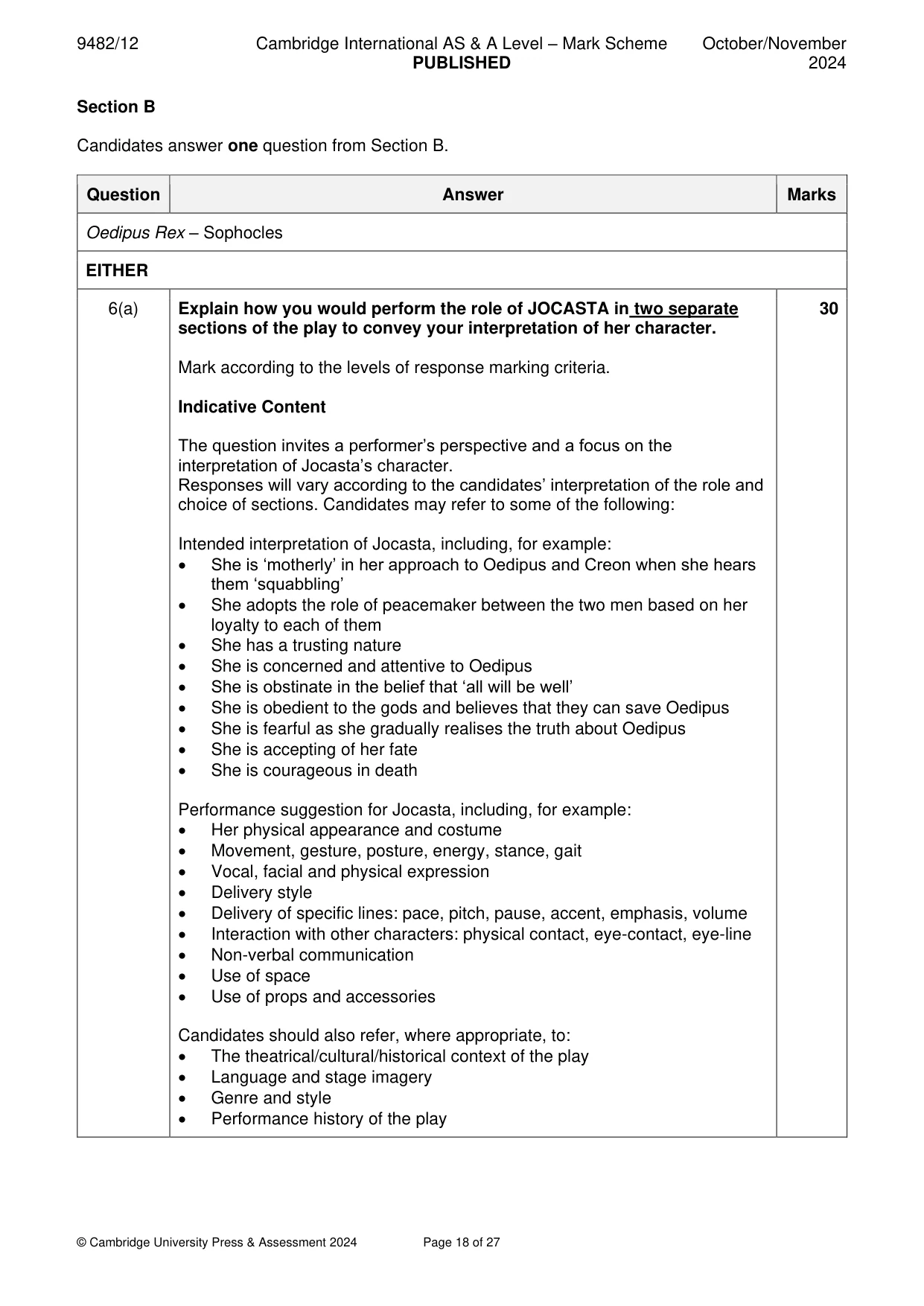
9482/12 Cambridge International AS & A Level – Mark Scheme PUBLISHED October/November 2024 © Cambridge University Press & Assessment 2024 Page 18 of 27 Section B Candidates answer one question from Section B. Question Answer Marks Oedipus Rex – Sophocles EITHER 6(a) Explain how you would perform the role of JOCASTA in two separate sections of the play to convey your interpretation of her character. Mark according to the levels of response marking criteria. Indicative Content The question invites a performer’s perspective and a focus on the interpretation of Jocasta’s character. Responses will vary according to the candidates’ interpretation of the role and choice of sections. Candidates may refer to some of the following: Intended interpretation of Jocasta, including, for example: • She is ‘motherly’ in her approach to Oedipus and Creon when she hears them ‘squabbling’ • She adopts the role of peacemaker between the two men based on her loyalty to each of them • She has a trusting nature • She is concerned and attentive to Oedipus • She is obstinate in the belief that ‘all will be well’ • She is obedient to the gods and believes that they can save Oedipus • She is fearful as she gradually realises the truth about Oedipus • She is accepting of her fate • She is courageous in death Performance suggestion for Jocasta, including, for example: • Her physical appearance and costume • Movement, gesture, posture, energy, stance, gait • Vocal, facial and physical expression • Delivery style • Delivery of specific lines: pace, pitch, pause, accent, emphasis, volume • Interaction with other characters: physical contact, eye-contact, eye-line • Non-verbal communication • Use of space • Use of props and accessories Candidates should also refer, where appropriate, to: • The theatrical/cultural/historical context of the play • Language and stage imagery • Genre and style • Performance history of the play 30
Mark scheme, page 19
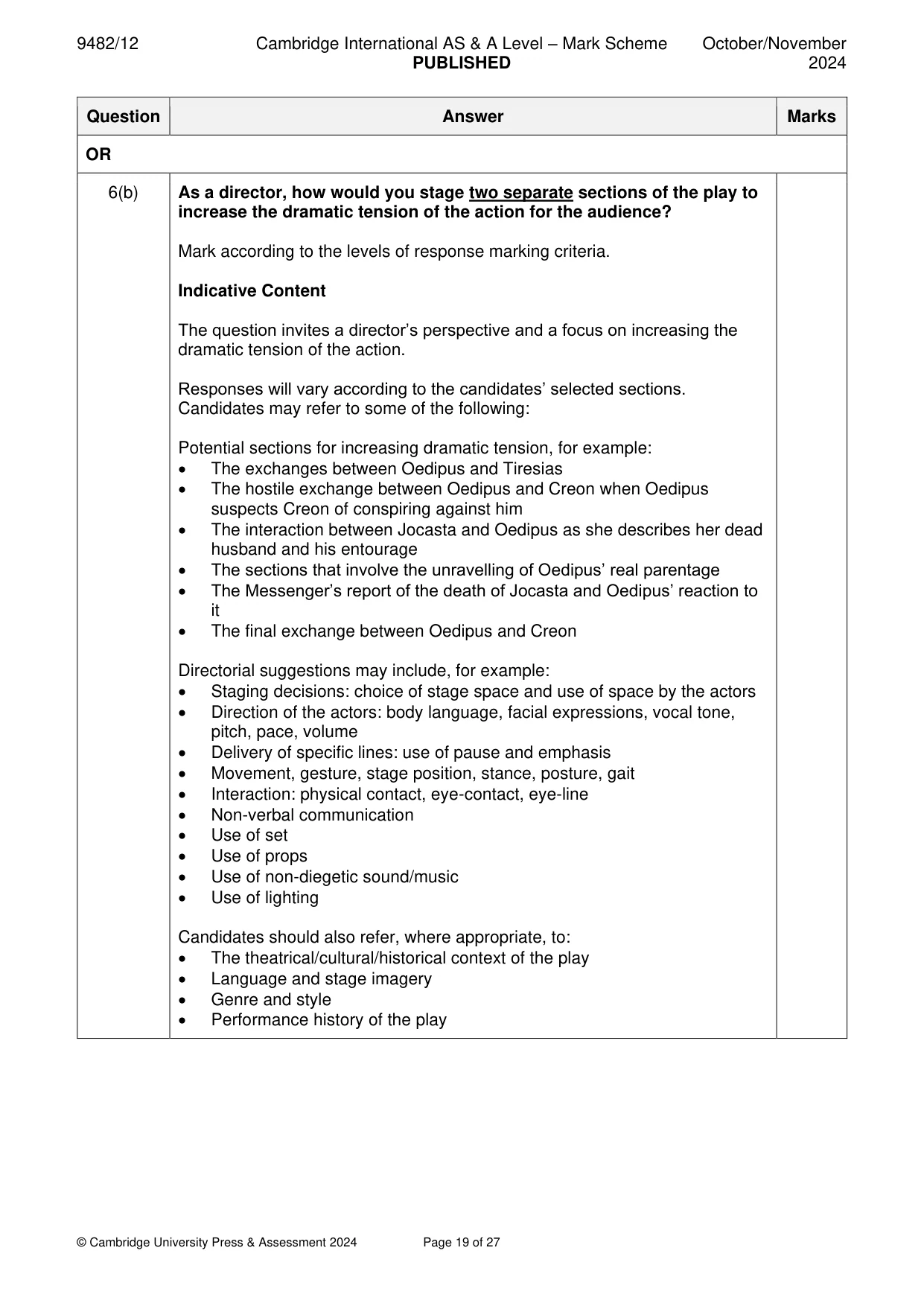
9482/12 Cambridge International AS & A Level – Mark Scheme PUBLISHED October/November 2024 © Cambridge University Press & Assessment 2024 Page 19 of 27 Question Answer Marks OR 6(b) As a director, how would you stage two separate sections of the play to increase the dramatic tension of the action for the audience? Mark according to the levels of response marking criteria. Indicative Content The question invites a director’s perspective and a focus on increasing the dramatic tension of the action. Responses will vary according to the candidates’ selected sections. Candidates may refer to some of the following: Potential sections for increasing dramatic tension, for example: • The exchanges between Oedipus and Tiresias • The hostile exchange between Oedipus and Creon when Oedipus suspects Creon of conspiring against him • The interaction between Jocasta and Oedipus as she describes her dead husband and his entourage • The sections that involve the unravelling of Oedipus’ real parentage • The Messenger’s report of the death of Jocasta and Oedipus’ reaction to it • The final exchange between Oedipus and Creon Directorial suggestions may include, for example: • Staging decisions: choice of stage space and use of space by the actors • Direction of the actors: body language, facial expressions, vocal tone, pitch, pace, volume • Delivery of specific lines: use of pause and emphasis • Movement, gesture, stage position, stance, posture, gait • Interaction: physical contact, eye-contact, eye-line • Non-verbal communication • Use of set • Use of props • Use of non-diegetic sound/music • Use of lighting Candidates should also refer, where appropriate, to: • The theatrical/cultural/historical context of the play • Language and stage imagery • Genre and style • Performance history of the play
Mark scheme, page 20
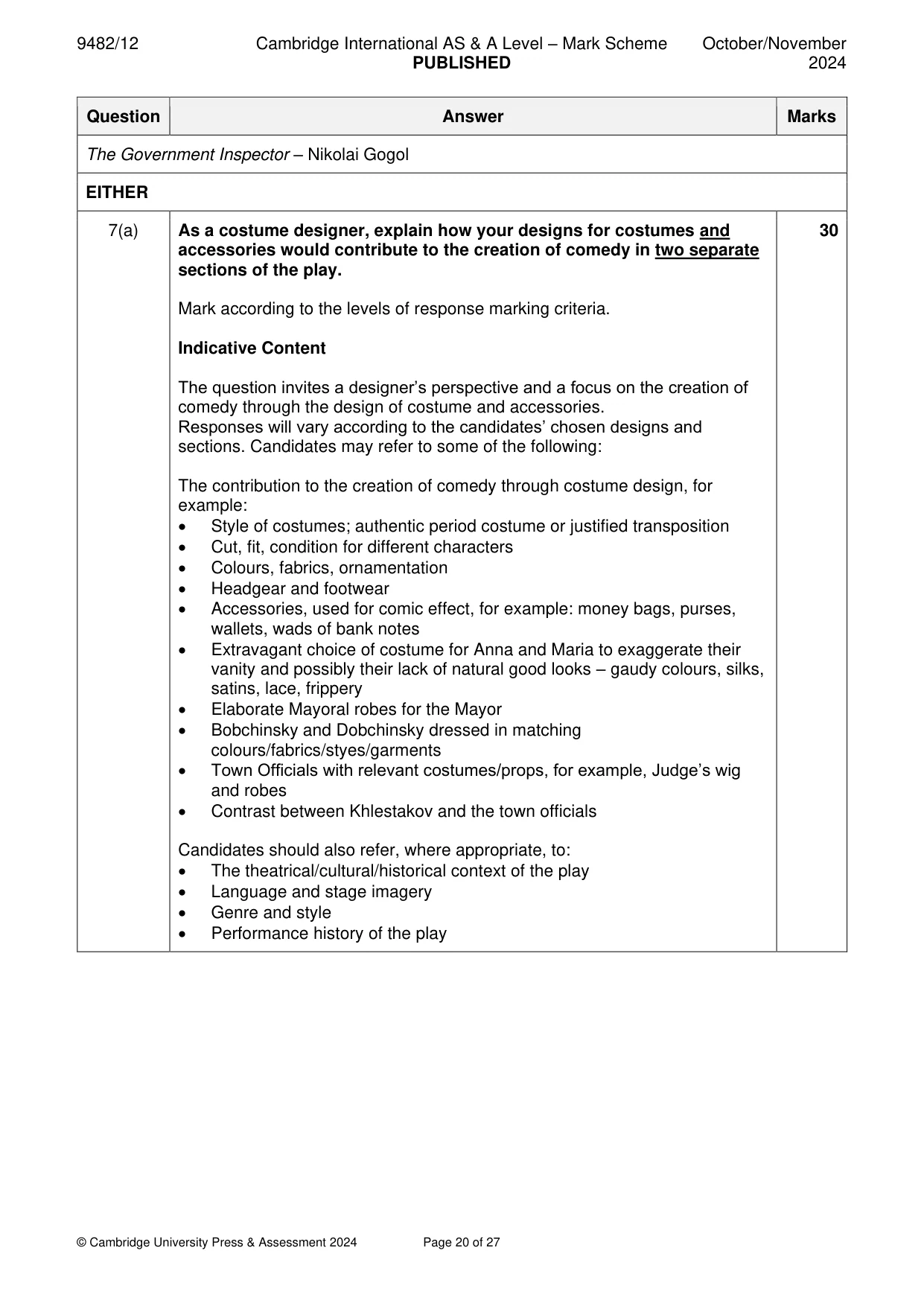
9482/12 Cambridge International AS & A Level – Mark Scheme PUBLISHED October/November 2024 © Cambridge University Press & Assessment 2024 Page 20 of 27 Question Answer Marks The Government Inspector – Nikolai Gogol EITHER 7(a) As a costume designer, explain how your designs for costumes and accessories would contribute to the creation of comedy in two separate sections of the play. Mark according to the levels of response marking criteria. Indicative Content The question invites a designer’s perspective and a focus on the creation of comedy through the design of costume and accessories. Responses will vary according to the candidates’ chosen designs and sections. Candidates may refer to some of the following: The contribution to the creation of comedy through costume design, for example: • Style of costumes; authentic period costume or justified transposition • Cut, fit, condition for different characters • Colours, fabrics, ornamentation • Headgear and footwear • Accessories, used for comic effect, for example: money bags, purses, wallets, wads of bank notes • Extravagant choice of costume for Anna and Maria to exaggerate their vanity and possibly their lack of natural good looks – gaudy colours, silks, satins, lace, frippery • Elaborate Mayoral robes for the Mayor • Bobchinsky and Dobchinsky dressed in matching colours/fabrics/styes/garments • Town Officials with relevant costumes/props, for example, Judge’s wig and robes • Contrast between Khlestakov and the town officials Candidates should also refer, where appropriate, to: • The theatrical/cultural/historical context of the play • Language and stage imagery • Genre and style • Performance history of the play 30
Mark scheme, page 21
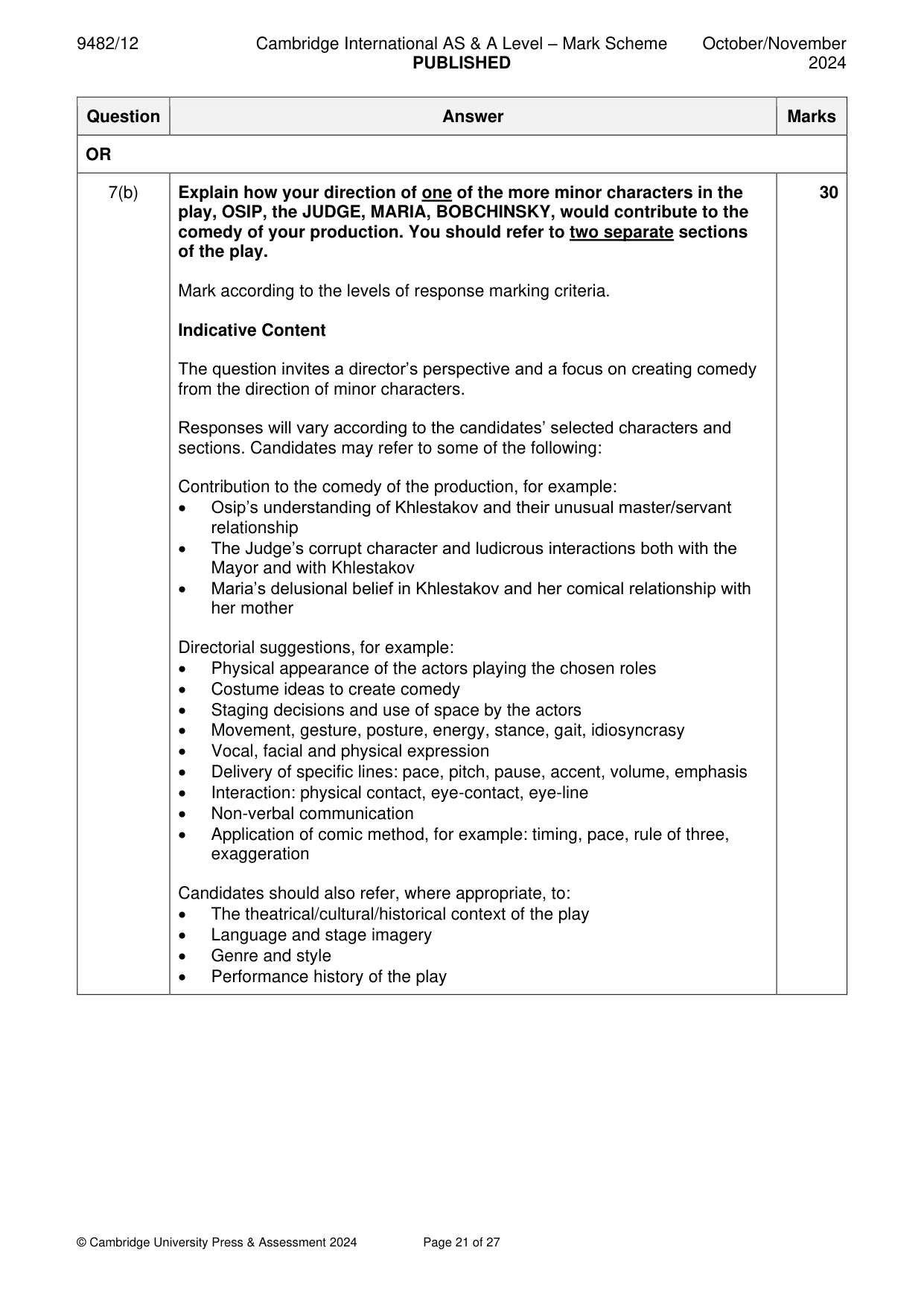
9482/12 Cambridge International AS & A Level – Mark Scheme PUBLISHED October/November 2024 © Cambridge University Press & Assessment 2024 Page 21 of 27 Question Answer Marks OR 7(b) Explain how your direction of one of the more minor characters in the play, OSIP, the JUDGE, MARIA, BOBCHINSKY, would contribute to the comedy of your production. You should refer to two separate sections of the play. Mark according to the levels of response marking criteria. Indicative Content The question invites a director’s perspective and a focus on creating comedy from the direction of minor characters. Responses will vary according to the candidates’ selected characters and sections. Candidates may refer to some of the following: Contribution to the comedy of the production, for example: • Osip’s understanding of Khlestakov and their unusual master/servant relationship • The Judge’s corrupt character and ludicrous interactions both with the Mayor and with Khlestakov • Maria’s delusional belief in Khlestakov and her comical relationship with her mother Directorial suggestions, for example: • Physical appearance of the actors playing the chosen roles • Costume ideas to create comedy • Staging decisions and use of space by the actors • Movement, gesture, posture, energy, stance, gait, idiosyncrasy • Vocal, facial and physical expression • Delivery of specific lines: pace, pitch, pause, accent, volume, emphasis • Interaction: physical contact, eye-contact, eye-line • Non-verbal communication • Application of comic method, for example: timing, pace, rule of three, exaggeration Candidates should also refer, where appropriate, to: • The theatrical/cultural/historical context of the play • Language and stage imagery • Genre and style • Performance history of the play 30
Mark scheme, page 22
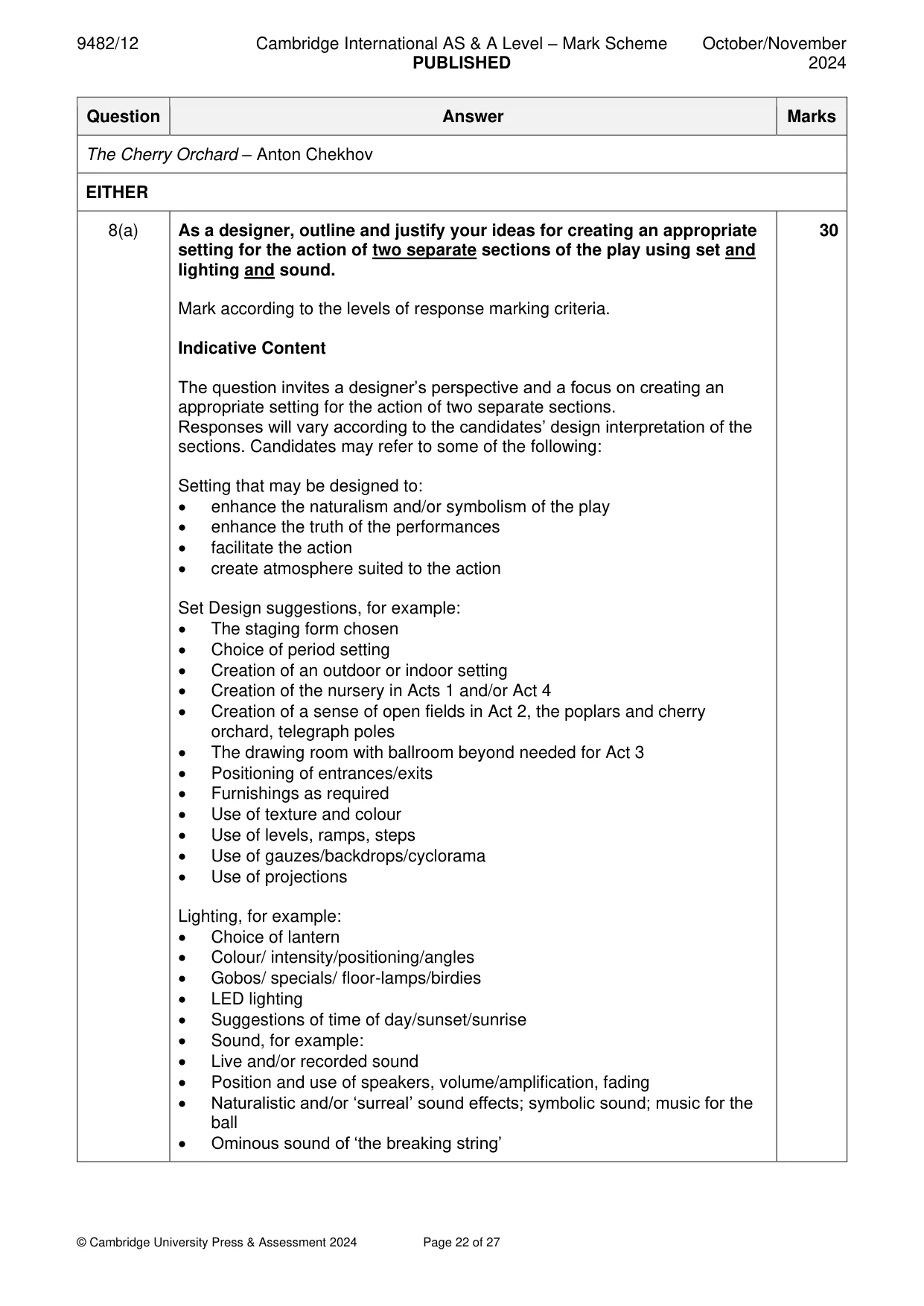
9482/12 Cambridge International AS & A Level – Mark Scheme PUBLISHED October/November 2024 © Cambridge University Press & Assessment 2024 Page 22 of 27 Question Answer Marks The Cherry Orchard – Anton Chekhov EITHER 8(a) As a designer, outline and justify your ideas for creating an appropriate setting for the action of two separate sections of the play using set and lighting and sound. Mark according to the levels of response marking criteria. Indicative Content The question invites a designer’s perspective and a focus on creating an appropriate setting for the action of two separate sections. Responses will vary according to the candidates’ design interpretation of the sections. Candidates may refer to some of the following: Setting that may be designed to: • enhance the naturalism and/or symbolism of the play • enhance the truth of the performances • facilitate the action • create atmosphere suited to the action Set Design suggestions, for example: • The staging form chosen • Choice of period setting • Creation of an outdoor or indoor setting • Creation of the nursery in Acts 1 and/or Act 4 • Creation of a sense of open fields in Act 2, the poplars and cherry orchard, telegraph poles • The drawing room with ballroom beyond needed for Act 3 • Positioning of entrances/exits • Furnishings as required • Use of texture and colour • Use of levels, ramps, steps • Use of gauzes/backdrops/cyclorama • Use of projections Lighting, for example: • Choice of lantern • Colour/ intensity/positioning/angles • Gobos/ specials/ floor-lamps/birdies • LED lighting • Suggestions of time of day/sunset/sunrise • Sound, for example: • Live and/or recorded sound • Position and use of speakers, volume/amplification, fading • Naturalistic and/or ‘surreal’ sound effects; symbolic sound; music for the ball • Ominous sound of ‘the breaking string’ 30
Mark scheme, page 23
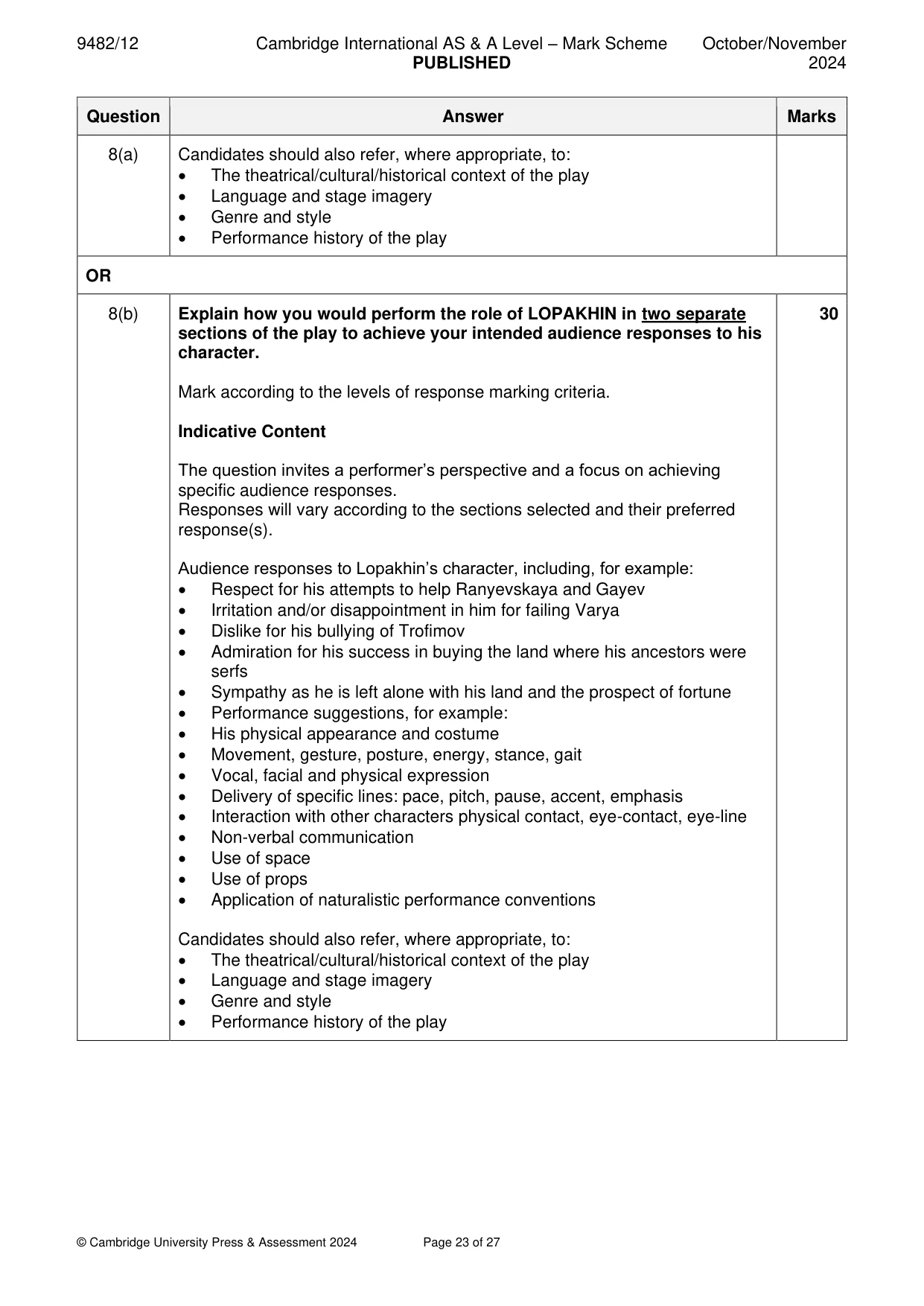
9482/12 Cambridge International AS & A Level – Mark Scheme PUBLISHED October/November 2024 © Cambridge University Press & Assessment 2024 Page 23 of 27 Question Answer Marks 8(a) Candidates should also refer, where appropriate, to: • The theatrical/cultural/historical context of the play • Language and stage imagery • Genre and style • Performance history of the play OR 8(b) Explain how you would perform the role of LOPAKHIN in two separate sections of the play to achieve your intended audience responses to his character. Mark according to the levels of response marking criteria. Indicative Content The question invites a performer’s perspective and a focus on achieving specific audience responses. Responses will vary according to the sections selected and their preferred response(s). Audience responses to Lopakhin’s character, including, for example: • Respect for his attempts to help Ranyevskaya and Gayev • Irritation and/or disappointment in him for failing Varya • Dislike for his bullying of Trofimov • Admiration for his success in buying the land where his ancestors were serfs • Sympathy as he is left alone with his land and the prospect of fortune • Performance suggestions, for example: • His physical appearance and costume • Movement, gesture, posture, energy, stance, gait • Vocal, facial and physical expression • Delivery of specific lines: pace, pitch, pause, accent, emphasis • Interaction with other characters physical contact, eye-contact, eye-line • Non-verbal communication • Use of space • Use of props • Application of naturalistic performance conventions Candidates should also refer, where appropriate, to: • The theatrical/cultural/historical context of the play • Language and stage imagery • Genre and style • Performance history of the play 30
Mark scheme, page 24
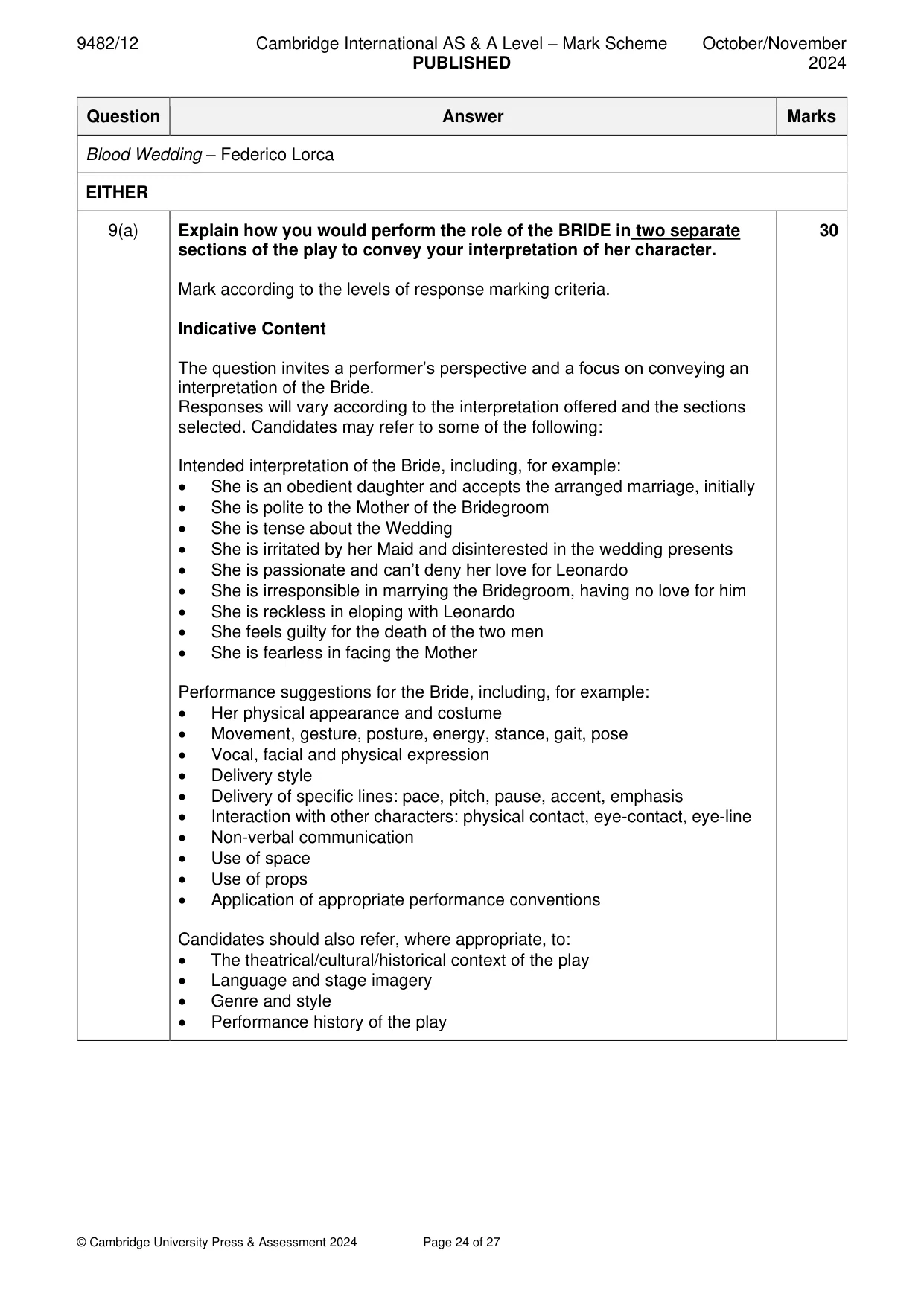
9482/12 Cambridge International AS & A Level – Mark Scheme PUBLISHED October/November 2024 © Cambridge University Press & Assessment 2024 Page 24 of 27 Question Answer Marks Blood Wedding – Federico Lorca EITHER 9(a) Explain how you would perform the role of the BRIDE in two separate sections of the play to convey your interpretation of her character. Mark according to the levels of response marking criteria. Indicative Content The question invites a performer’s perspective and a focus on conveying an interpretation of the Bride. Responses will vary according to the interpretation offered and the sections selected. Candidates may refer to some of the following: Intended interpretation of the Bride, including, for example: • She is an obedient daughter and accepts the arranged marriage, initially • She is polite to the Mother of the Bridegroom • She is tense about the Wedding • She is irritated by her Maid and disinterested in the wedding presents • She is passionate and can’t deny her love for Leonardo • She is irresponsible in marrying the Bridegroom, having no love for him • She is reckless in eloping with Leonardo • She feels guilty for the death of the two men • She is fearless in facing the Mother Performance suggestions for the Bride, including, for example: • Her physical appearance and costume • Movement, gesture, posture, energy, stance, gait, pose • Vocal, facial and physical expression • Delivery style • Delivery of specific lines: pace, pitch, pause, accent, emphasis • Interaction with other characters: physical contact, eye-contact, eye-line • Non-verbal communication • Use of space • Use of props • Application of appropriate performance conventions Candidates should also refer, where appropriate, to: • The theatrical/cultural/historical context of the play • Language and stage imagery • Genre and style • Performance history of the play 30
Mark scheme, page 25
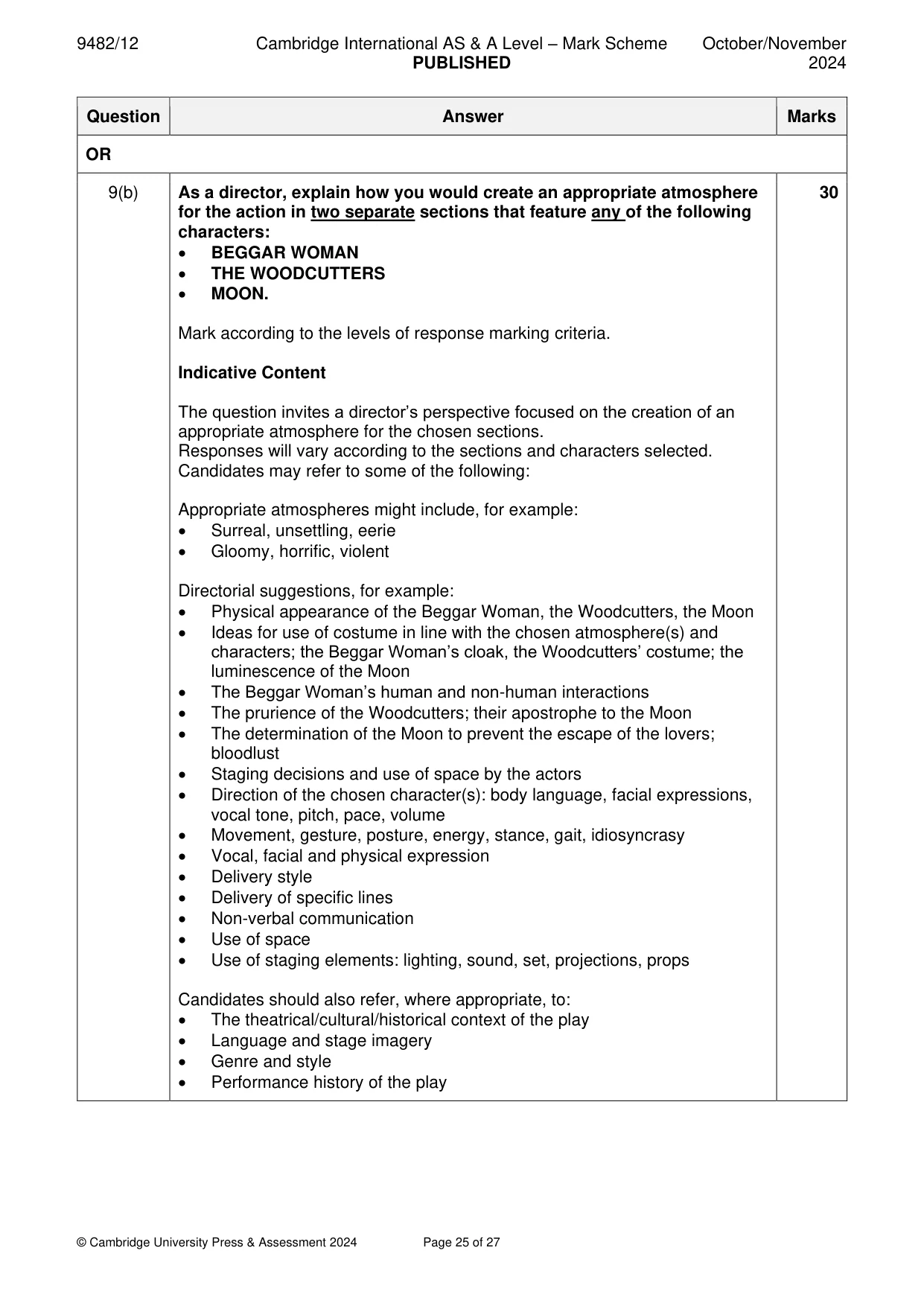
9482/12 Cambridge International AS & A Level – Mark Scheme PUBLISHED October/November 2024 © Cambridge University Press & Assessment 2024 Page 25 of 27 Question Answer Marks OR 9(b) As a director, explain how you would create an appropriate atmosphere for the action in two separate sections that feature any of the following characters: • BEGGAR WOMAN • THE WOODCUTTERS • MOON. Mark according to the levels of response marking criteria. Indicative Content The question invites a director’s perspective focused on the creation of an appropriate atmosphere for the chosen sections. Responses will vary according to the sections and characters selected. Candidates may refer to some of the following: Appropriate atmospheres might include, for example: • Surreal, unsettling, eerie • Gloomy, horrific, violent Directorial suggestions, for example: • Physical appearance of the Beggar Woman, the Woodcutters, the Moon • Ideas for use of costume in line with the chosen atmosphere(s) and characters; the Beggar Woman’s cloak, the Woodcutters’ costume; the luminescence of the Moon • The Beggar Woman’s human and non-human interactions • The prurience of the Woodcutters; their apostrophe to the Moon • The determination of the Moon to prevent the escape of the lovers; bloodlust • Staging decisions and use of space by the actors • Direction of the chosen character(s): body language, facial expressions, vocal tone, pitch, pace, volume • Movement, gesture, posture, energy, stance, gait, idiosyncrasy • Vocal, facial and physical expression • Delivery style • Delivery of specific lines • Non-verbal communication • Use of space • Use of staging elements: lighting, sound, set, projections, props Candidates should also refer, where appropriate, to: • The theatrical/cultural/historical context of the play • Language and stage imagery • Genre and style • Performance history of the play 30
Mark scheme, page 26
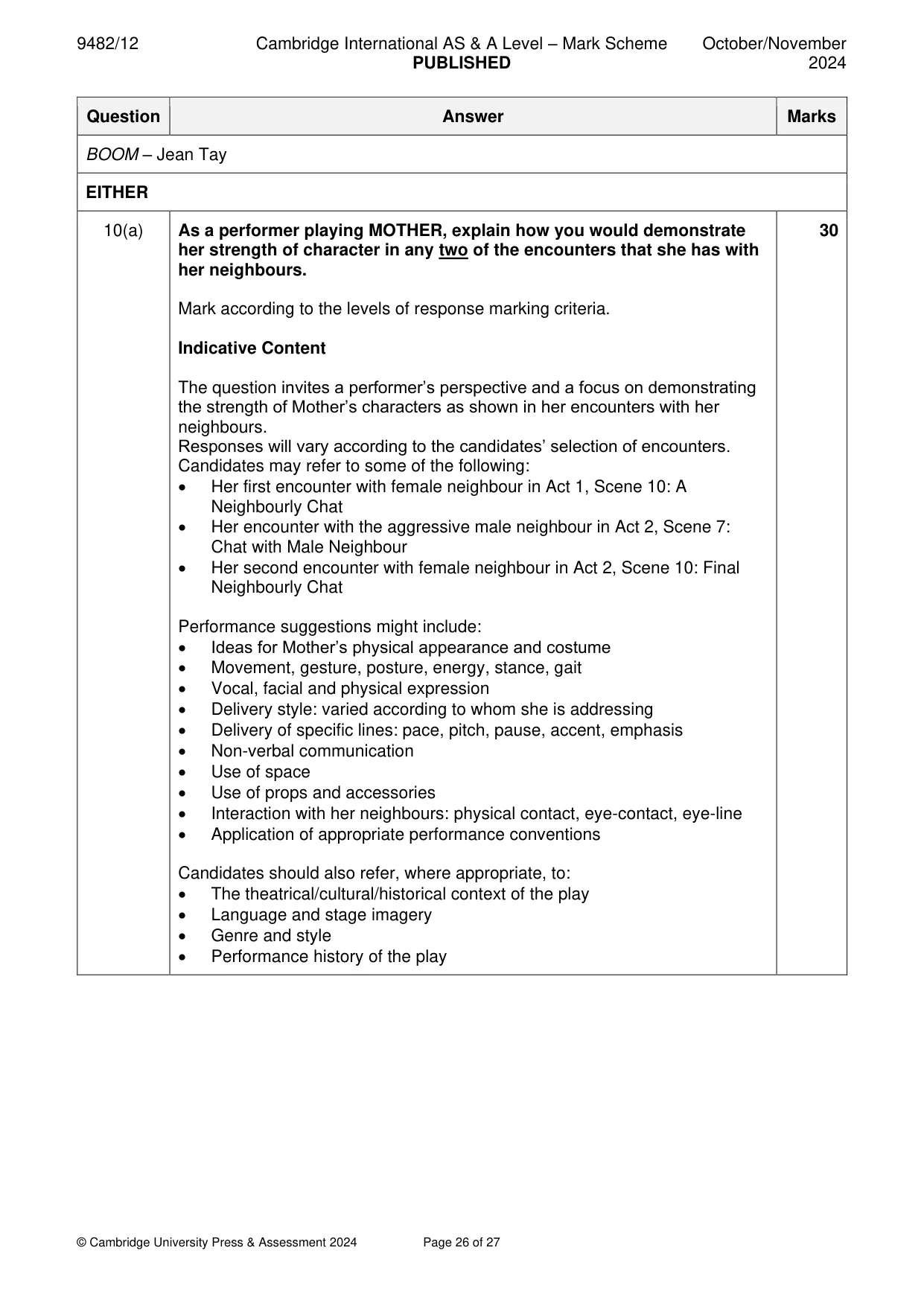
9482/12 Cambridge International AS & A Level – Mark Scheme PUBLISHED October/November 2024 © Cambridge University Press & Assessment 2024 Page 26 of 27 Question Answer Marks BOOM – Jean Tay EITHER 10(a) As a performer playing MOTHER, explain how you would demonstrate her strength of character in any two of the encounters that she has with her neighbours. Mark according to the levels of response marking criteria. Indicative Content The question invites a performer’s perspective and a focus on demonstrating the strength of Mother’s characters as shown in her encounters with her neighbours. Responses will vary according to the candidates’ selection of encounters. Candidates may refer to some of the following: • Her first encounter with female neighbour in Act 1, Scene 10: A Neighbourly Chat • Her encounter with the aggressive male neighbour in Act 2, Scene 7: Chat with Male Neighbour • Her second encounter with female neighbour in Act 2, Scene 10: Final Neighbourly Chat Performance suggestions might include: • Ideas for Mother’s physical appearance and costume • Movement, gesture, posture, energy, stance, gait • Vocal, facial and physical expression • Delivery style: varied according to whom she is addressing • Delivery of specific lines: pace, pitch, pause, accent, emphasis • Non-verbal communication • Use of space • Use of props and accessories • Interaction with her neighbours: physical contact, eye-contact, eye-line • Application of appropriate performance conventions Candidates should also refer, where appropriate, to: • The theatrical/cultural/historical context of the play • Language and stage imagery • Genre and style • Performance history of the play 30
Mark scheme, page 27
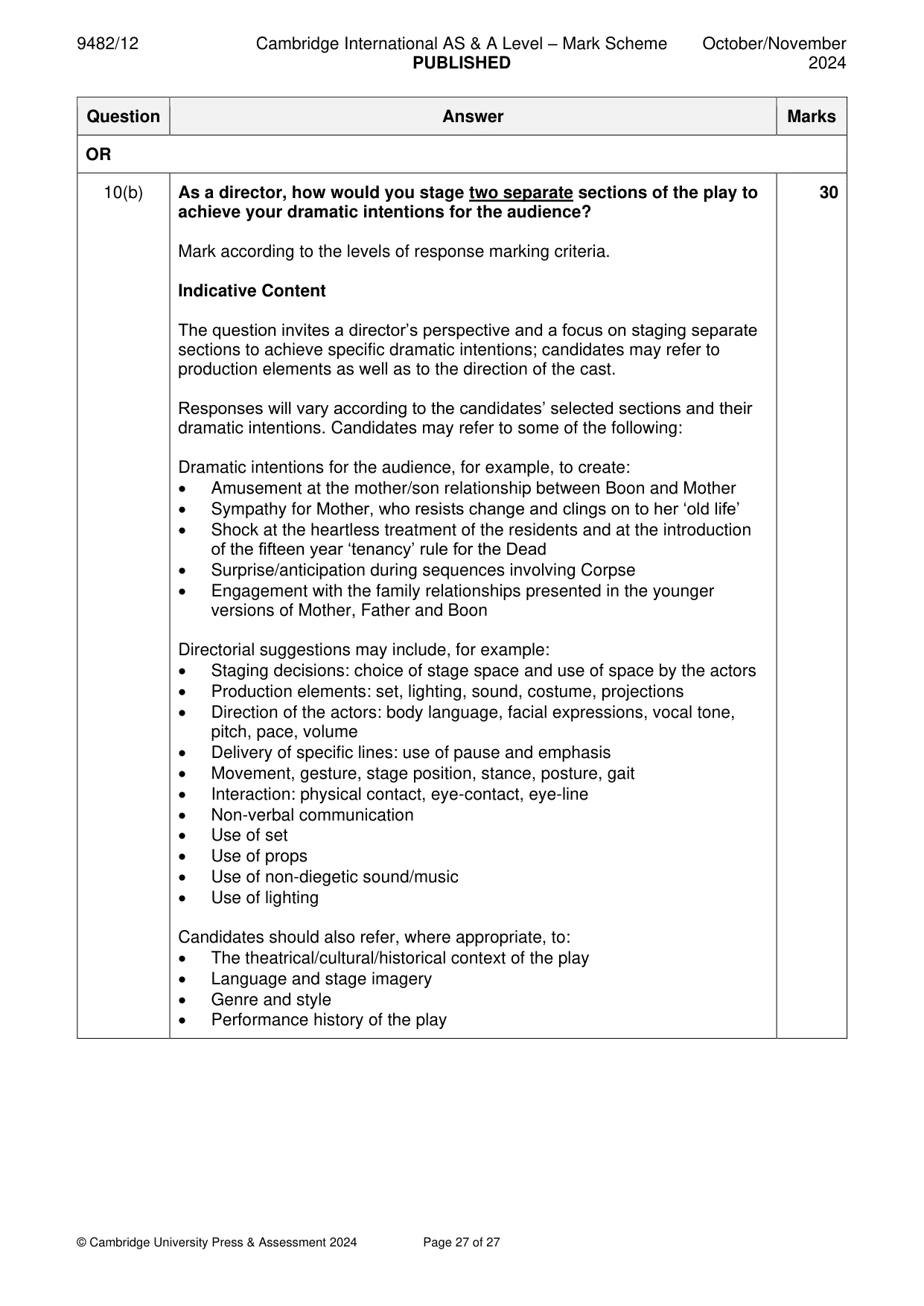
9482/12 Cambridge International AS & A Level – Mark Scheme PUBLISHED October/November 2024 © Cambridge University Press & Assessment 2024 Page 27 of 27 Question Answer Marks OR 10(b) As a director, how would you stage two separate sections of the play to achieve your dramatic intentions for the audience? Mark according to the levels of response marking criteria. Indicative Content The question invites a director’s perspective and a focus on staging separate sections to achieve specific dramatic intentions; candidates may refer to production elements as well as to the direction of the cast. Responses will vary according to the candidates’ selected sections and their dramatic intentions. Candidates may refer to some of the following: Dramatic intentions for the audience, for example, to create: • Amusement at the mother/son relationship between Boon and Mother • Sympathy for Mother, who resists change and clings on to her ‘old life’ • Shock at the heartless treatment of the residents and at the introduction of the fifteen year ‘tenancy’ rule for the Dead • Surprise/anticipation during sequences involving Corpse • Engagement with the family relationships presented in the younger versions of Mother, Father and Boon Directorial suggestions may include, for example: • Staging decisions: choice of stage space and use of space by the actors • Production elements: set, lighting, sound, costume, projections • Direction of the actors: body language, facial expressions, vocal tone, pitch, pace, volume • Delivery of specific lines: use of pause and emphasis • Movement, gesture, stage position, stance, posture, gait • Interaction: physical contact, eye-contact, eye-line • Non-verbal communication • Use of set • Use of props • Use of non-diegetic sound/music • Use of lighting Candidates should also refer, where appropriate, to: • The theatrical/cultural/historical context of the play • Language and stage imagery • Genre and style • Performance history of the play 30
What you needed in this session
Cambridge’s own grade thresholds for 2024 Oct/Nov, Paper 1 · Variant 2. A higher threshold means an easier paper — the bar moves with how the cohort did.