Cambridge A Level Drama 9482 — 2024 May/June Paper 1 · Variant 2
9482/12/M/J/24 · 60 marks · 120 min
The question paper and its mark scheme, free to read here and free to download. This is Cambridge’s own paper, exactly as it was sat.
Question paper8 pages
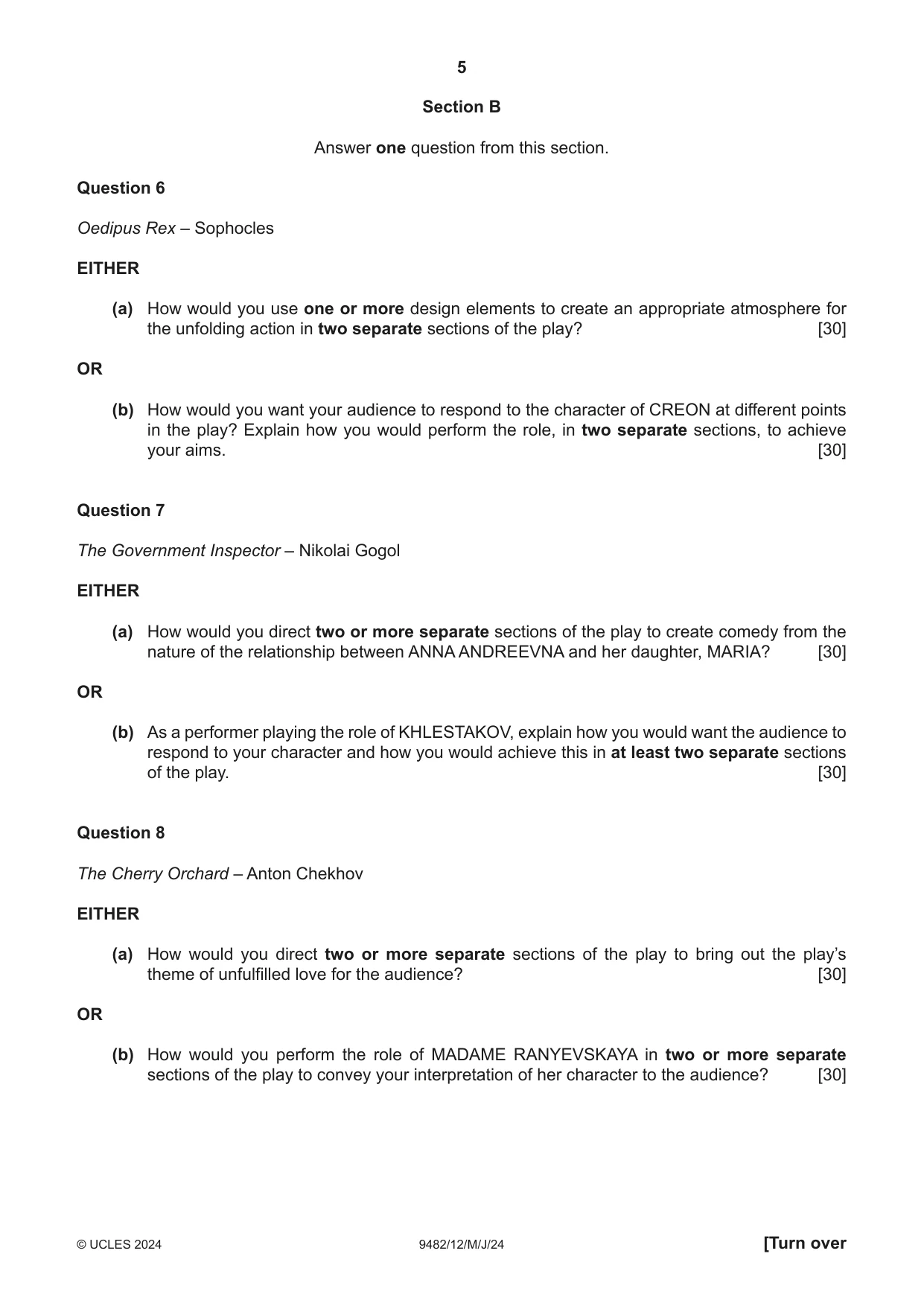
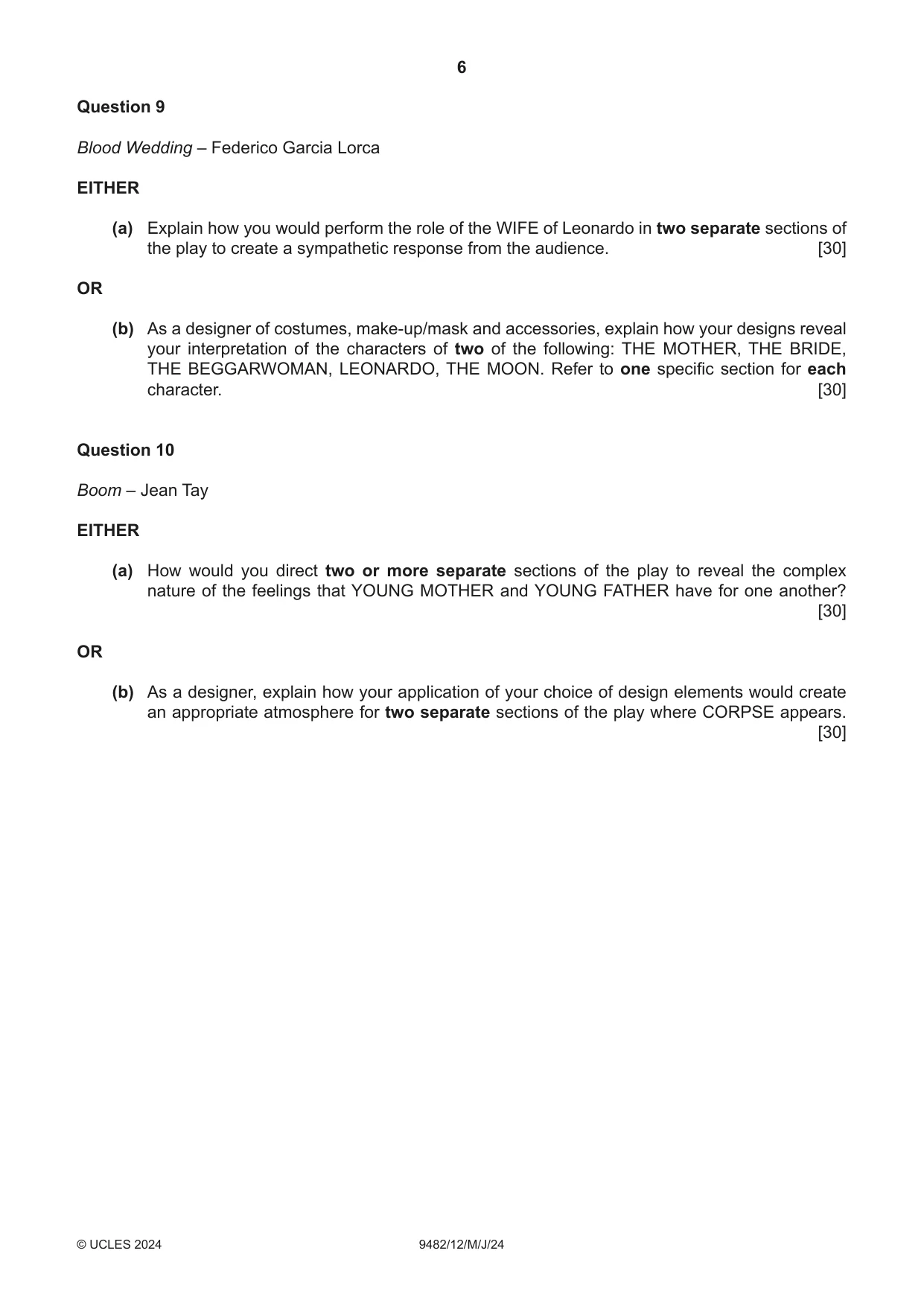


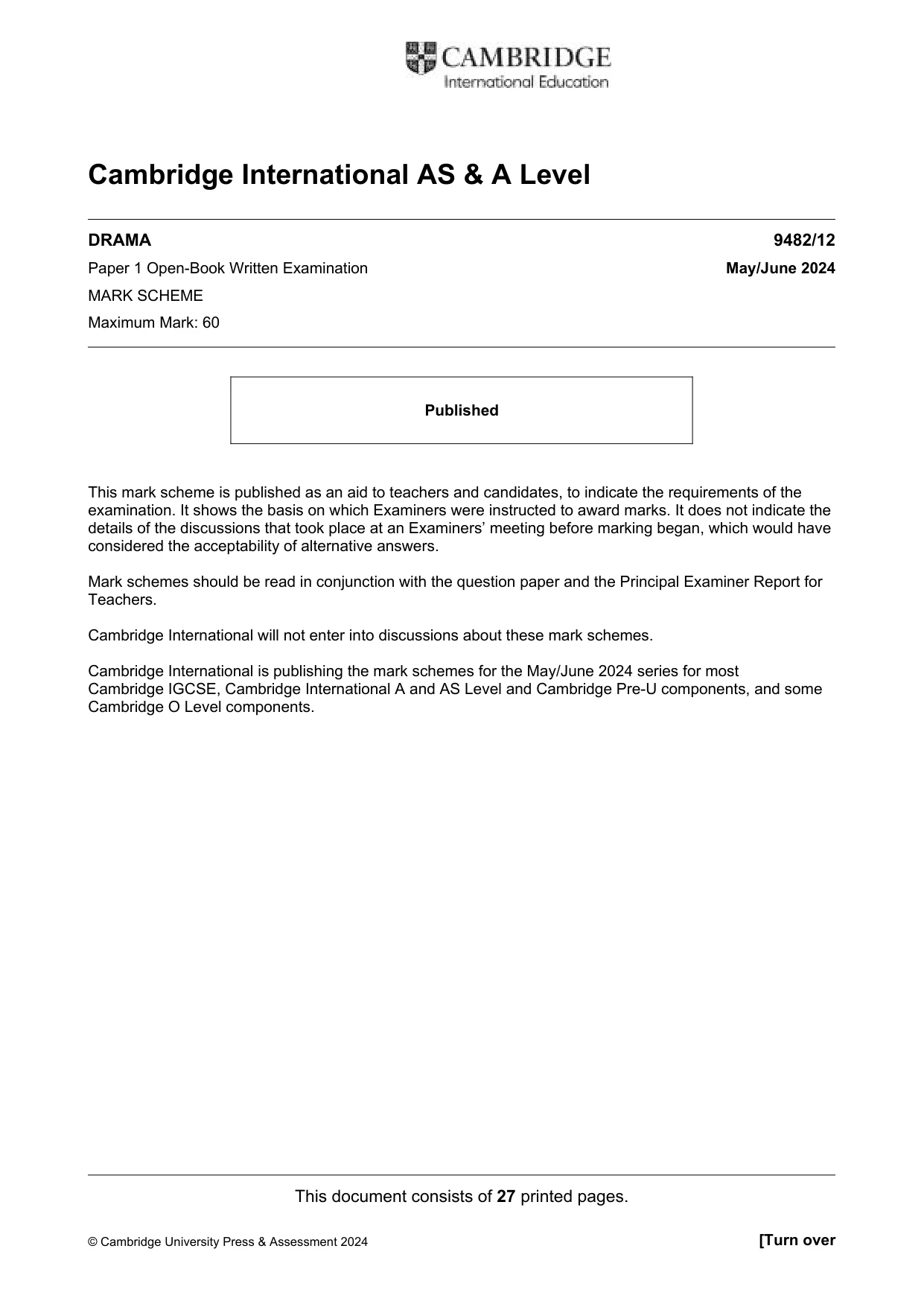
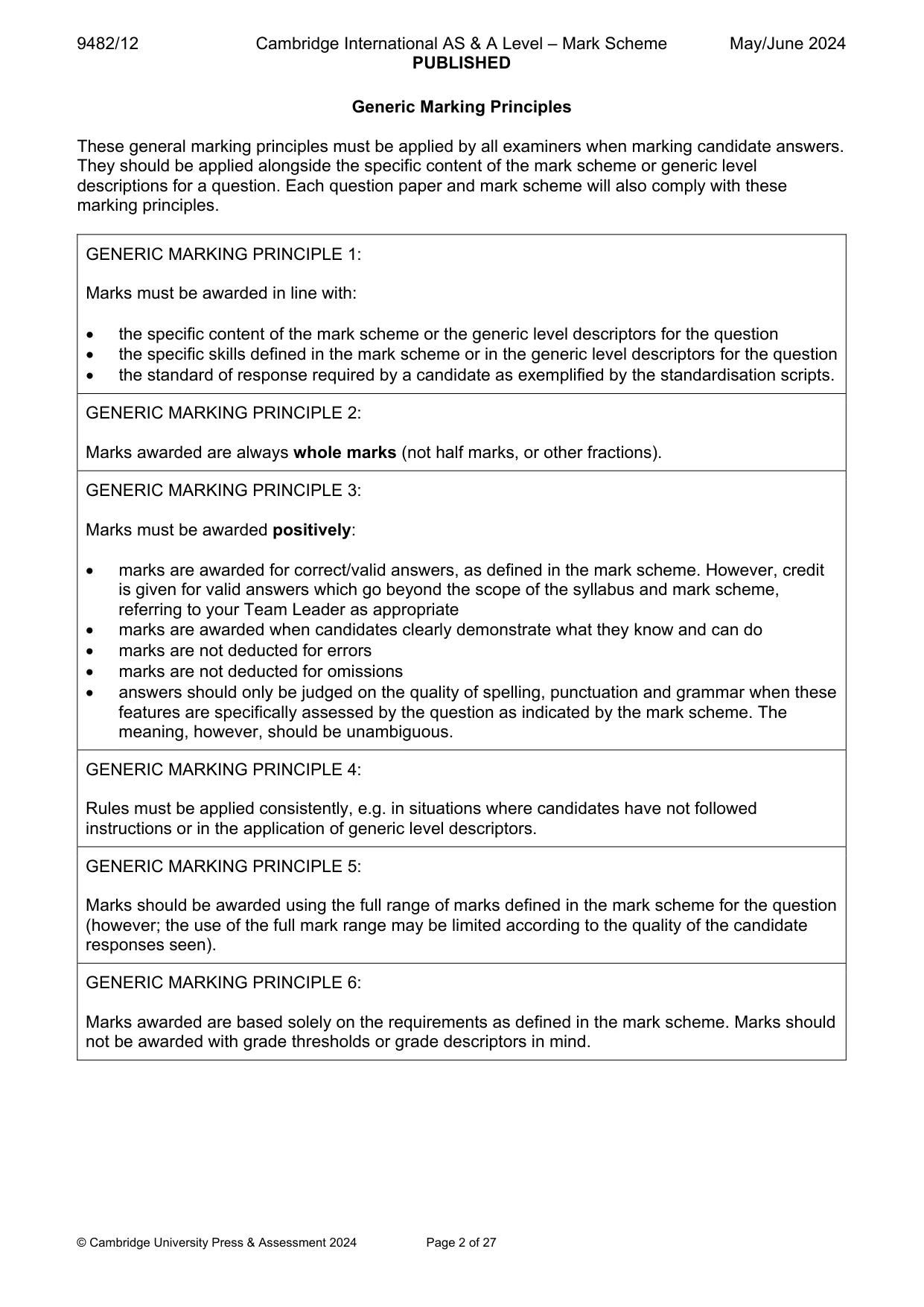
Mark scheme27 pages
Answers below. Sit the paper first if you are practising.
Paper as text
Question paper, page 1
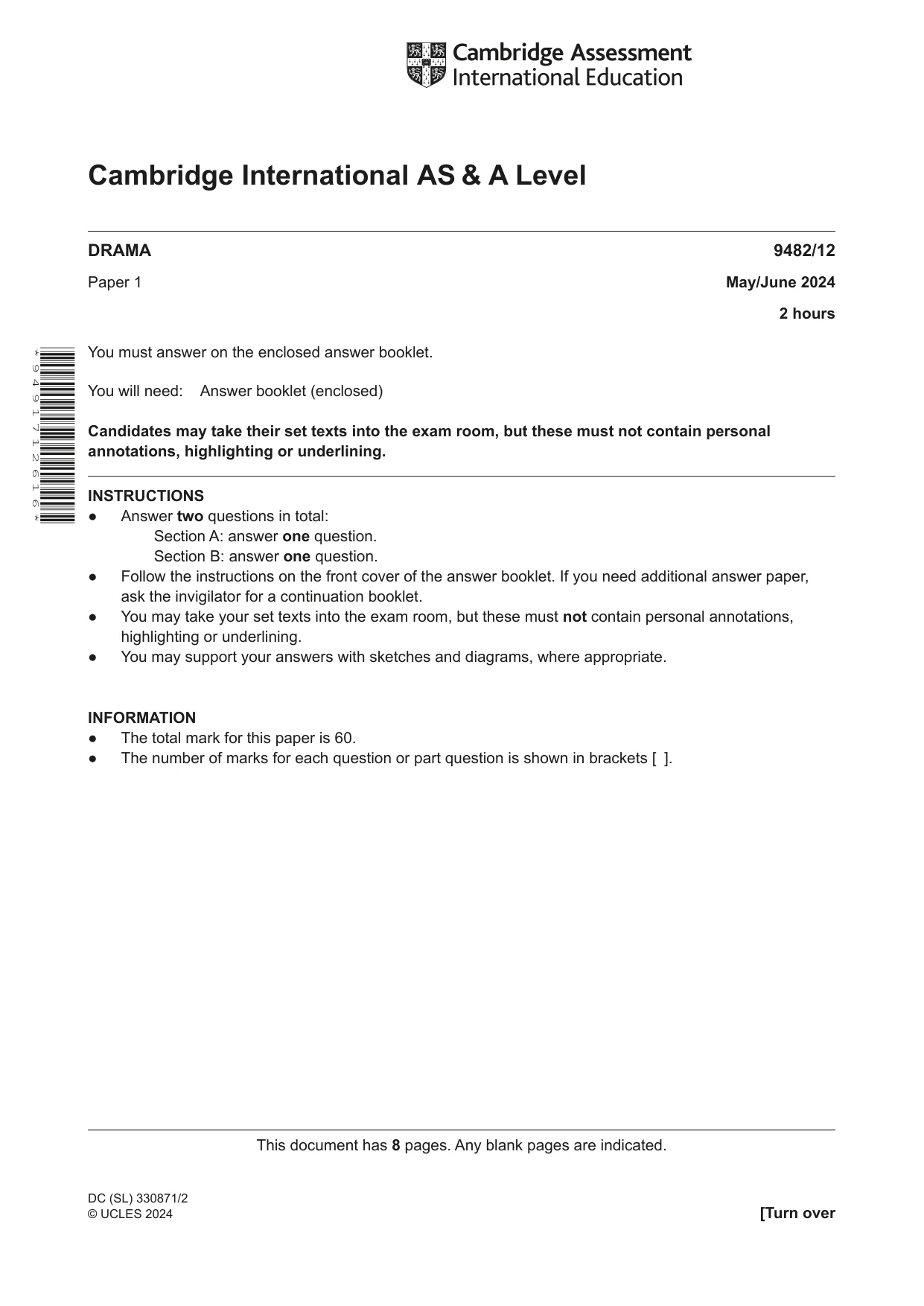
This document has 8 pages. Any blank pages are indicated. [Turn over Cambridge International AS & A Level DRAMA 9482/12 Paper 1 May/June 2024 2 hours You must answer on the enclosed answer booklet. You will need: Answer booklet (enclosed) Candidates may take their set texts into the exam room, but these must not contain personal annotations, highlighting or underlining. INSTRUCTIONS ● Answer two questions in total: Section A: answer one question. Section B: answer one question. ● Follow the instructions on the front cover of the answer booklet. If you need additional answer paper, ask the invigilator for a continuation booklet. ● You may take your set texts into the exam room, but these must not contain personal annotations, highlighting or underlining. ● You may support your answers with sketches and diagrams, where appropriate. INFORMATION ● The total mark for this paper is 60. ● The number of marks for each question or part question is shown in brackets [ ]. * 9 4 9 1 7 1 2 6 1 6 * DC (SL) 330871/2 © UCLES 2024
Question paper, page 2
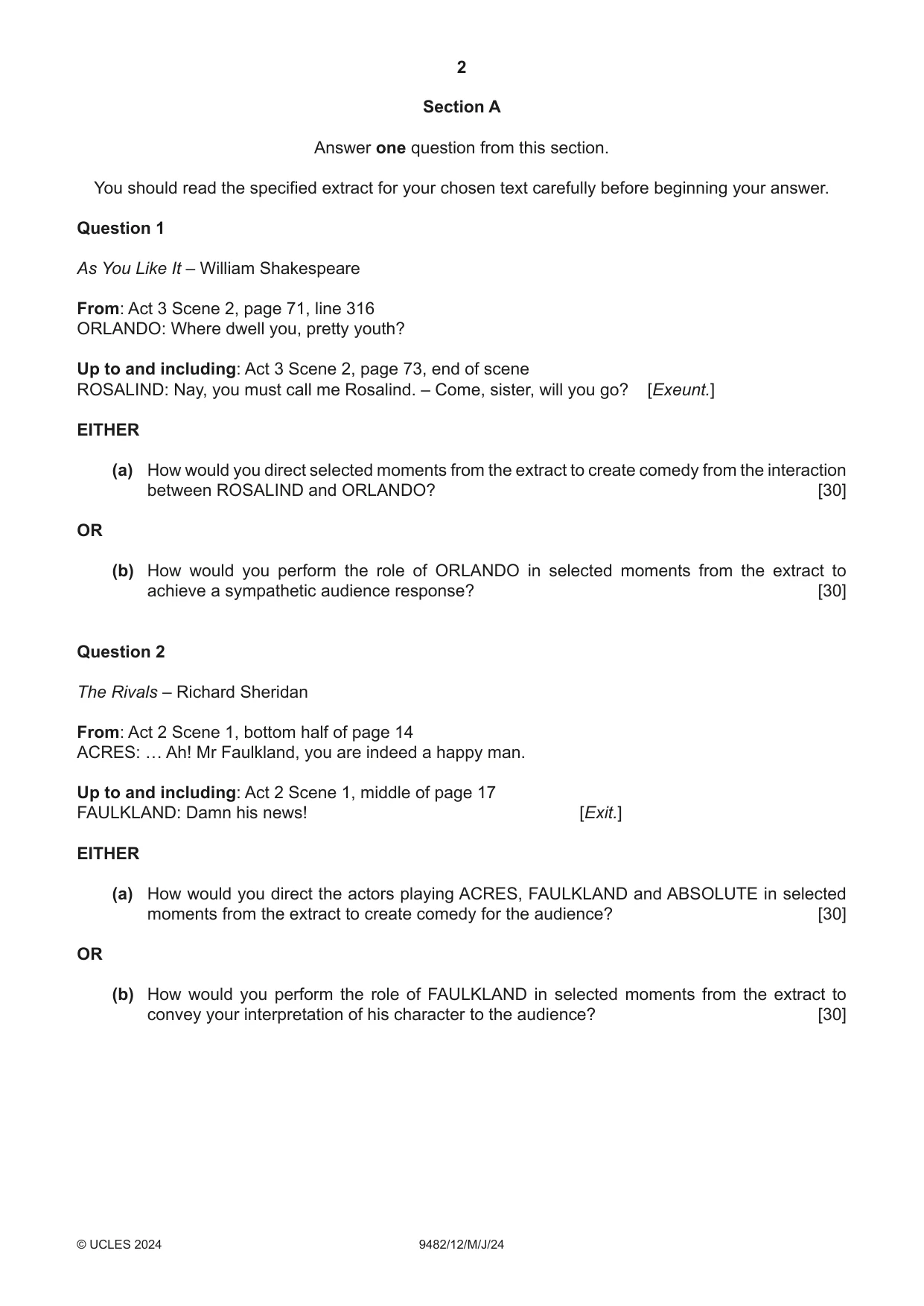
2 9482/12/M/J/24 © UCLES 2024 Section A Answer one question from this section. You should read the specified extract for your chosen text carefully before beginning your answer. Question 1 As You Like It – William Shakespeare From: Act 3 Scene 2, page 71, line 316 ORLANDO: Where dwell you, pretty youth? Up to and including: Act 3 Scene 2, page 73, end of scene ROSALIND: Nay, you must call me Rosalind. – Come, sister, will you go? [Exeunt.] EITHER (a) How would you direct selected moments from the extract to create comedy from the interaction between ROSALIND and ORLANDO? [30] OR (b) How would you perform the role of ORLANDO in selected moments from the extract to achieve a sympathetic audience response? [30] Question 2 The Rivals – Richard Sheridan From: Act 2 Scene 1, bottom half of page 14 ACRES: … Ah! Mr Faulkland, you are indeed a happy man. Up to and including: Act 2 Scene 1, middle of page 17 FAULKLAND: Damn his news! [Exit.] EITHER (a) How would you direct the actors playing ACRES, FAULKLAND and ABSOLUTE in selected moments from the extract to create comedy for the audience? [30] OR (b) How would you perform the role of FAULKLAND in selected moments from the extract to convey your interpretation of his character to the audience? [30]
Question paper, page 3
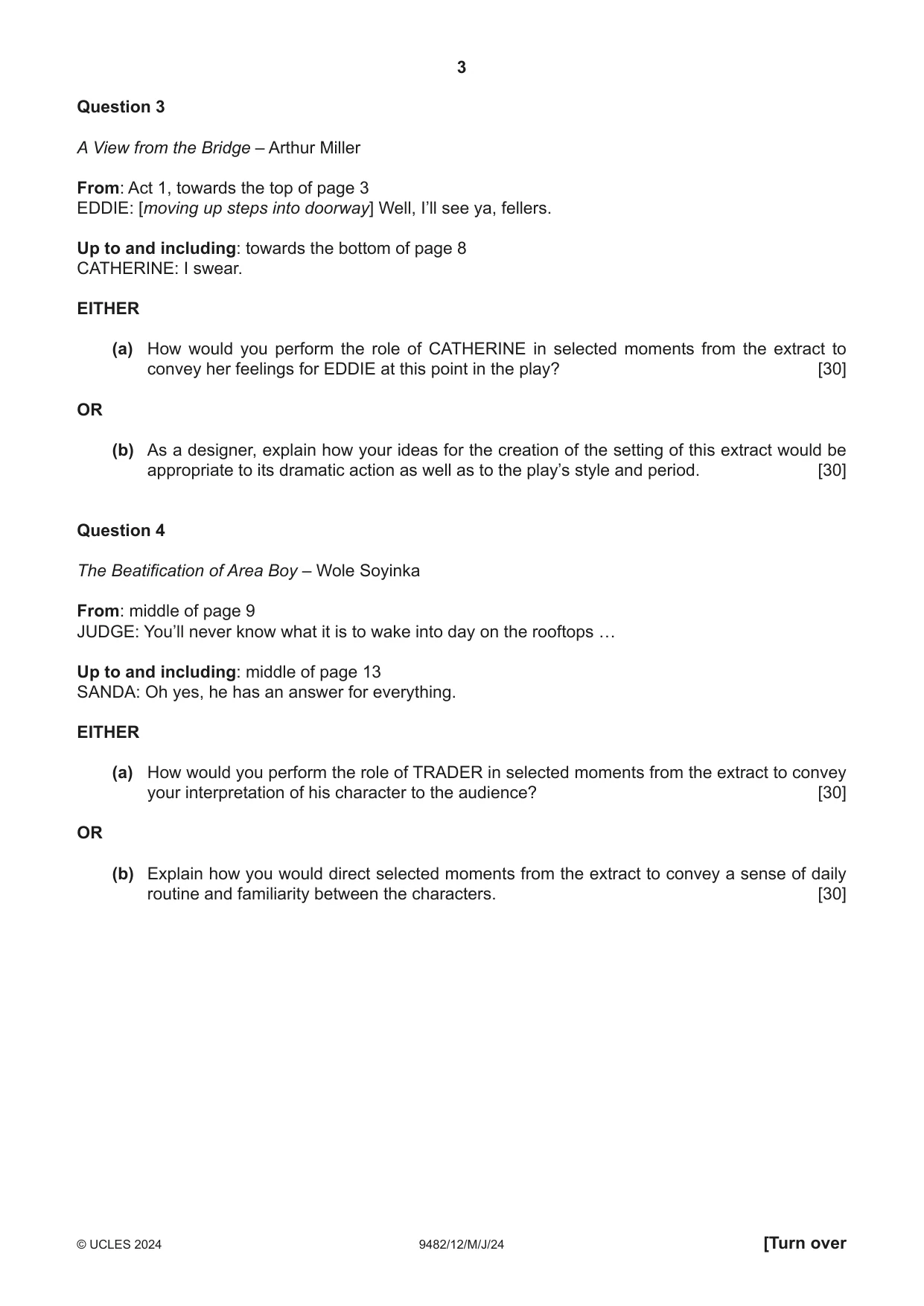
3 9482/12/M/J/24 © UCLES 2024 [Turn over Question 3 A View from the Bridge – Arthur Miller From: Act 1, towards the top of page 3 EDDIE: [moving up steps into doorway] Well, I’ll see ya, fellers. Up to and including: towards the bottom of page 8 CATHERINE: I swear. EITHER (a) How would you perform the role of CATHERINE in selected moments from the extract to convey her feelings for EDDIE at this point in the play? [30] OR (b) As a designer, explain how your ideas for the creation of the setting of this extract would be appropriate to its dramatic action as well as to the play’s style and period. [30] Question 4 The Beatification of Area Boy – Wole Soyinka From: middle of page 9 JUDGE: You’ll never know what it is to wake into day on the rooftops … Up to and including: middle of page 13 SANDA: Oh yes, he has an answer for everything. EITHER (a) How would you perform the role of TRADER in selected moments from the extract to convey your interpretation of his character to the audience? [30] OR (b) Explain how you would direct selected moments from the extract to convey a sense of daily routine and familiarity between the characters. [30]
Question paper, page 4
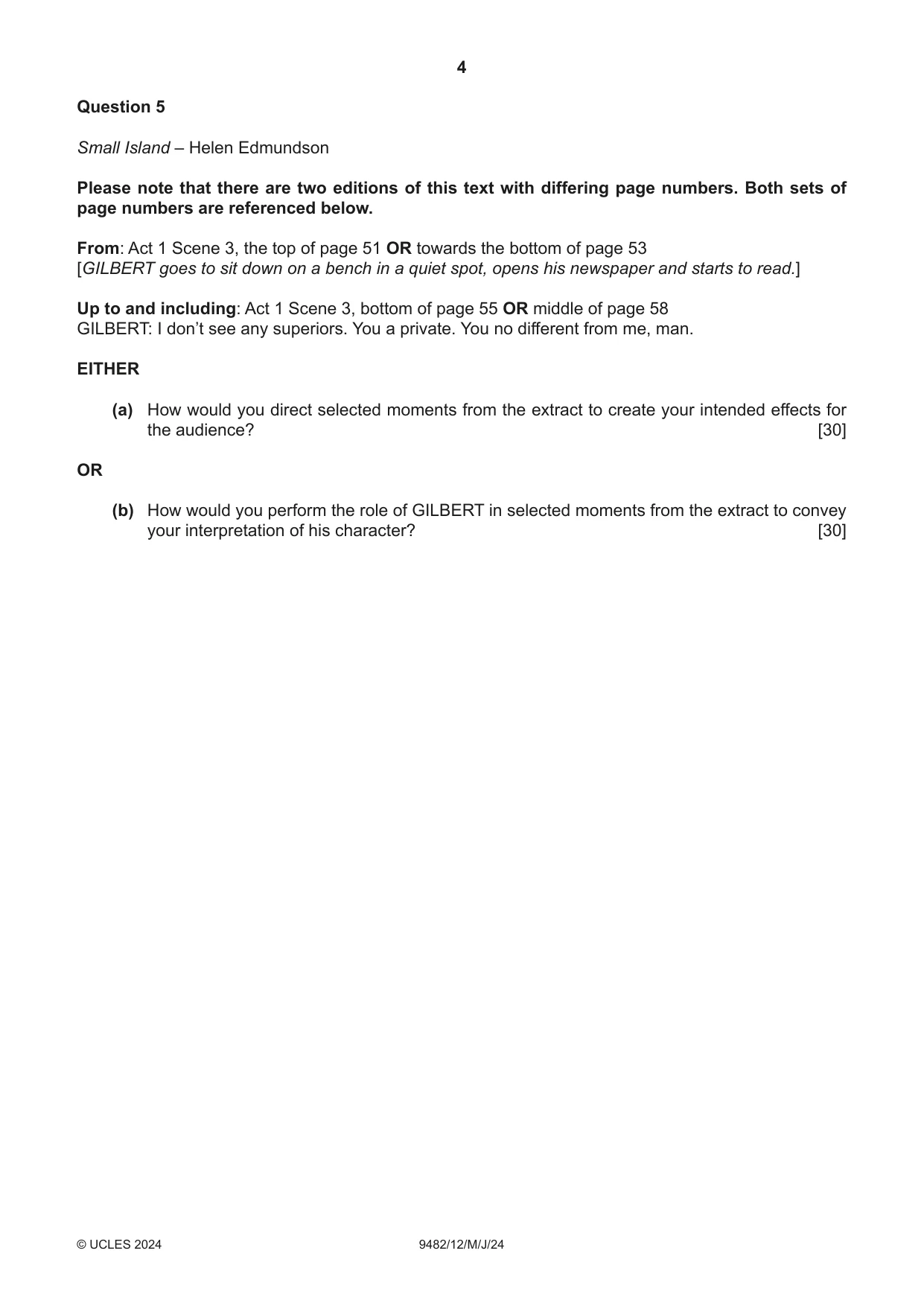
4 9482/12/M/J/24 © UCLES 2024 Question 5 Small Island – Helen Edmundson Please note that there are two editions of this text with differing page numbers. Both sets of page numbers are referenced below. From: Act 1 Scene 3, the top of page 51 OR towards the bottom of page 53 [GILBERT goes to sit down on a bench in a quiet spot, opens his newspaper and starts to read.] Up to and including: Act 1 Scene 3, bottom of page 55 OR middle of page 58 GILBERT: I don’t see any superiors. You a private. You no different from me, man. EITHER (a) How would you direct selected moments from the extract to create your intended effects for the audience? [30] OR (b) How would you perform the role of GILBERT in selected moments from the extract to convey your interpretation of his character? [30]
Question paper, page 5
5 9482/12/M/J/24 © UCLES 2024 [Turn over Section B Answer one question from this section. Question 6 Oedipus Rex – Sophocles EITHER (a) How would you use one or more design elements to create an appropriate atmosphere for the unfolding action in two separate sections of the play? [30] OR (b) How would you want your audience to respond to the character of CREON at different points in the play? Explain how you would perform the role, in two separate sections, to achieve your aims. [30] Question 7 The Government Inspector – Nikolai Gogol EITHER (a) How would you direct two or more separate sections of the play to create comedy from the nature of the relationship between ANNA ANDREEVNA and her daughter, MARIA? [30] OR (b) As a performer playing the role of KHLESTAKOV, explain how you would want the audience to respond to your character and how you would achieve this in at least two separate sections of the play. [30] Question 8 The Cherry Orchard – Anton Chekhov EITHER (a) How would you direct two or more separate sections of the play to bring out the play’s theme of unfulfilled love for the audience? [30] OR (b) How would you perform the role of MADAME RANYEVSKAYA in two or more separate sections of the play to convey your interpretation of her character to the audience? [30]
Question paper, page 6
6 9482/12/M/J/24 © UCLES 2024 Question 9 Blood Wedding – Federico Garcia Lorca EITHER (a) Explain how you would perform the role of the WIFE of Leonardo in two separate sections of the play to create a sympathetic response from the audience. [30] OR (b) As a designer of costumes, make-up/mask and accessories, explain how your designs reveal your interpretation of the characters of two of the following: THE MOTHER, THE BRIDE, THE BEGGARWOMAN, LEONARDO, THE MOON. Refer to one specific section for each character. [30] Question 10 Boom – Jean Tay EITHER (a) How would you direct two or more separate sections of the play to reveal the complex nature of the feelings that YOUNG MOTHER and YOUNG FATHER have for one another? [30] OR (b) As a designer, explain how your application of your choice of design elements would create an appropriate atmosphere for two separate sections of the play where CORPSE appears. [30]
Question paper, page 7
7 9482/12/M/J/24 © UCLES 2024 BLANK PAGE
Question paper, page 8
8 9482/12/M/J/24 © UCLES 2024 Permission to reproduce items where third-party owned material protected by copyright is included has been sought and cleared where possible. Every reasonable effort has been made by the publisher (UCLES) to trace copyright holders, but if any items requiring clearance have unwittingly been included, the publisher will be pleased to make amends at the earliest possible opportunity. To avoid the issue of disclosure of answer-related information to candidates, all copyright acknowledgements are reproduced online in the Cambridge Assessment International Education Copyright Acknowledgements Booklet. This is produced for each series of examinations and is freely available to download at www.cambridgeinternational.org after the live examination series. Cambridge Assessment International Education is part of Cambridge Assessment. Cambridge Assessment is the brand name of the University of Cambridge Local Examinations Syndicate (UCLES), which is a department of the University of Cambridge. BLANK PAGE
Mark scheme, page 1
This document consists of 27 printed pages. © Cambridge University Press & Assessment 2024 [Turn over Cambridge International AS & A Level DRAMA 9482/12 Paper 1 Open-Book Written Examination May/June 2024 MARK SCHEME Maximum Mark: 60 Published This mark scheme is published as an aid to teachers and candidates, to indicate the requirements of the examination. It shows the basis on which Examiners were instructed to award marks. It does not indicate the details of the discussions that took place at an Examiners’ meeting before marking began, which would have considered the acceptability of alternative answers. Mark schemes should be read in conjunction with the question paper and the Principal Examiner Report for Teachers. Cambridge International will not enter into discussions about these mark schemes. Cambridge International is publishing the mark schemes for the May/June 2024 series for most Cambridge IGCSE, Cambridge International A and AS Level and Cambridge Pre-U components, and some Cambridge O Level components.
Mark scheme, page 2
9482/12 Cambridge International AS & A Level – Mark Scheme PUBLISHED May/June 2024 © Cambridge University Press & Assessment 2024 Page 2 of 27 Generic Marking Principles These general marking principles must be applied by all examiners when marking candidate answers. They should be applied alongside the specific content of the mark scheme or generic level descriptions for a question. Each question paper and mark scheme will also comply with these marking principles. GENERIC MARKING PRINCIPLE 1: Marks must be awarded in line with: the specific content of the mark scheme or the generic level descriptors for the question the specific skills defined in the mark scheme or in the generic level descriptors for the question the standard of response required by a candidate as exemplified by the standardisation scripts. GENERIC MARKING PRINCIPLE 2: Marks awarded are always whole marks (not half marks, or other fractions). GENERIC MARKING PRINCIPLE 3: Marks must be awarded positively: marks are awarded for correct/valid answers, as defined in the mark scheme. However, credit is given for valid answers which go beyond the scope of the syllabus and mark scheme, referring to your Team Leader as appropriate marks are awarded when candidates clearly demonstrate what they know and can do marks are not deducted for errors marks are not deducted for omissions answers should only be judged on the quality of spelling, punctuation and grammar when these features are specifically assessed by the question as indicated by the mark scheme. The meaning, however, should be unambiguous. GENERIC MARKING PRINCIPLE 4: Rules must be applied consistently, e.g. in situations where candidates have not followed instructions or in the application of generic level descriptors. GENERIC MARKING PRINCIPLE 5: Marks should be awarded using the full range of marks defined in the mark scheme for the question (however; the use of the full mark range may be limited according to the quality of the candidate responses seen). GENERIC MARKING PRINCIPLE 6: Marks awarded are based solely on the requirements as defined in the mark scheme. Marks should not be awarded with grade thresholds or grade descriptors in mind.
Mark scheme, page 3
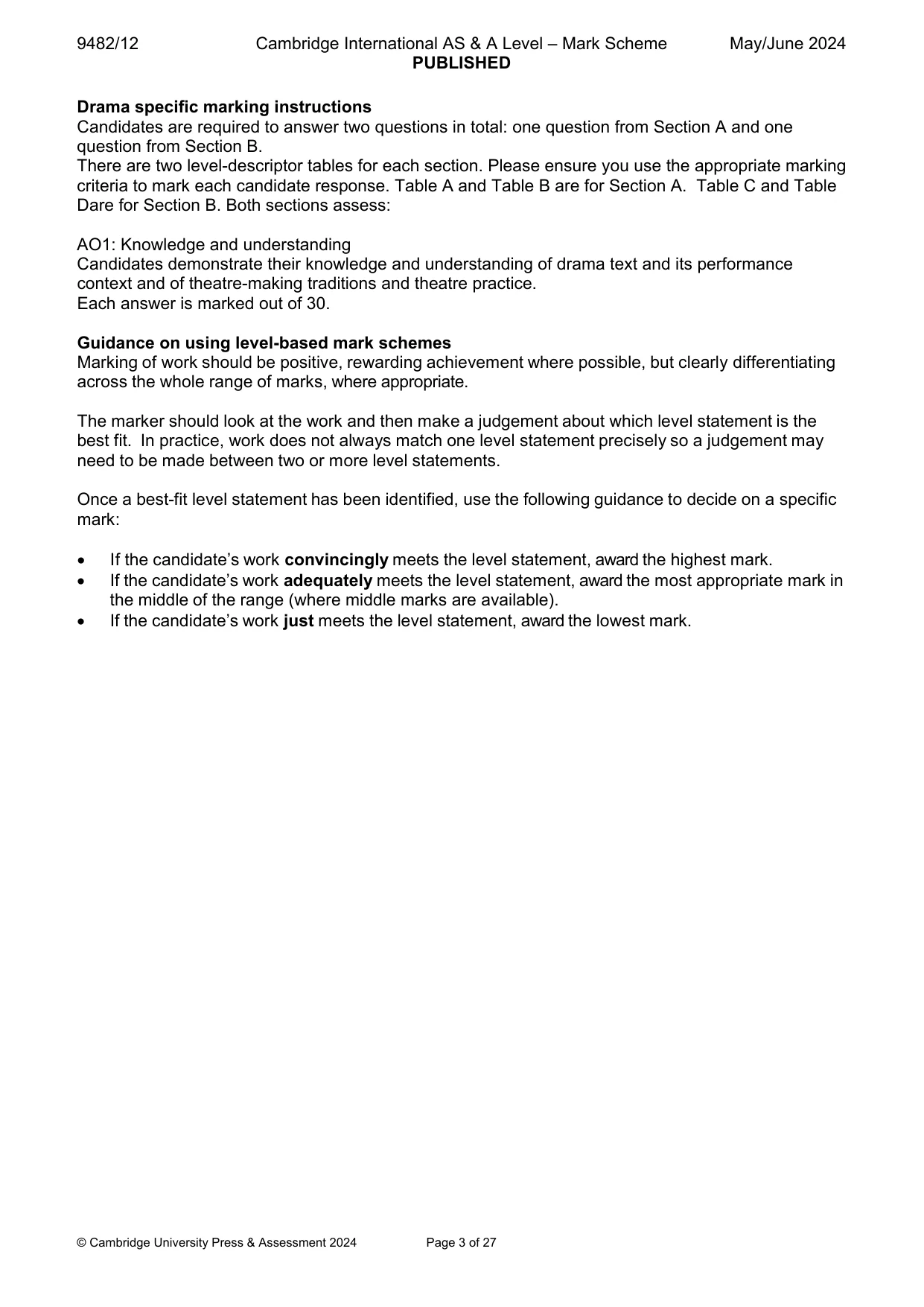
9482/12 Cambridge International AS & A Level – Mark Scheme PUBLISHED May/June 2024 © Cambridge University Press & Assessment 2024 Page 3 of 27 Drama specific marking instructions Candidates are required to answer two questions in total: one question from Section A and one question from Section B. There are two level-descriptor tables for each section. Please ensure you use the appropriate marking criteria to mark each candidate response. Table A and Table B are for Section A. Table C and Table Dare for Section B. Both sections assess: AO1: Knowledge and understanding Candidates demonstrate their knowledge and understanding of drama text and its performance context and of theatre-making traditions and theatre practice. Each answer is marked out of 30. Guidance on using level-based mark schemes Marking of work should be positive, rewarding achievement where possible, but clearly differentiating across the whole range of marks, where appropriate. The marker should look at the work and then make a judgement about which level statement is the best fit. In practice, work does not always match one level statement precisely so a judgement may need to be made between two or more level statements. Once a best-fit level statement has been identified, use the following guidance to decide on a specific mark: If the candidate’s work convincingly meets the level statement, award the highest mark. If the candidate’s work adequately meets the level statement, award the most appropriate mark in the middle of the range (where middle marks are available). If the candidate’s work just meets the level statement, award the lowest mark.
Mark scheme, page 4
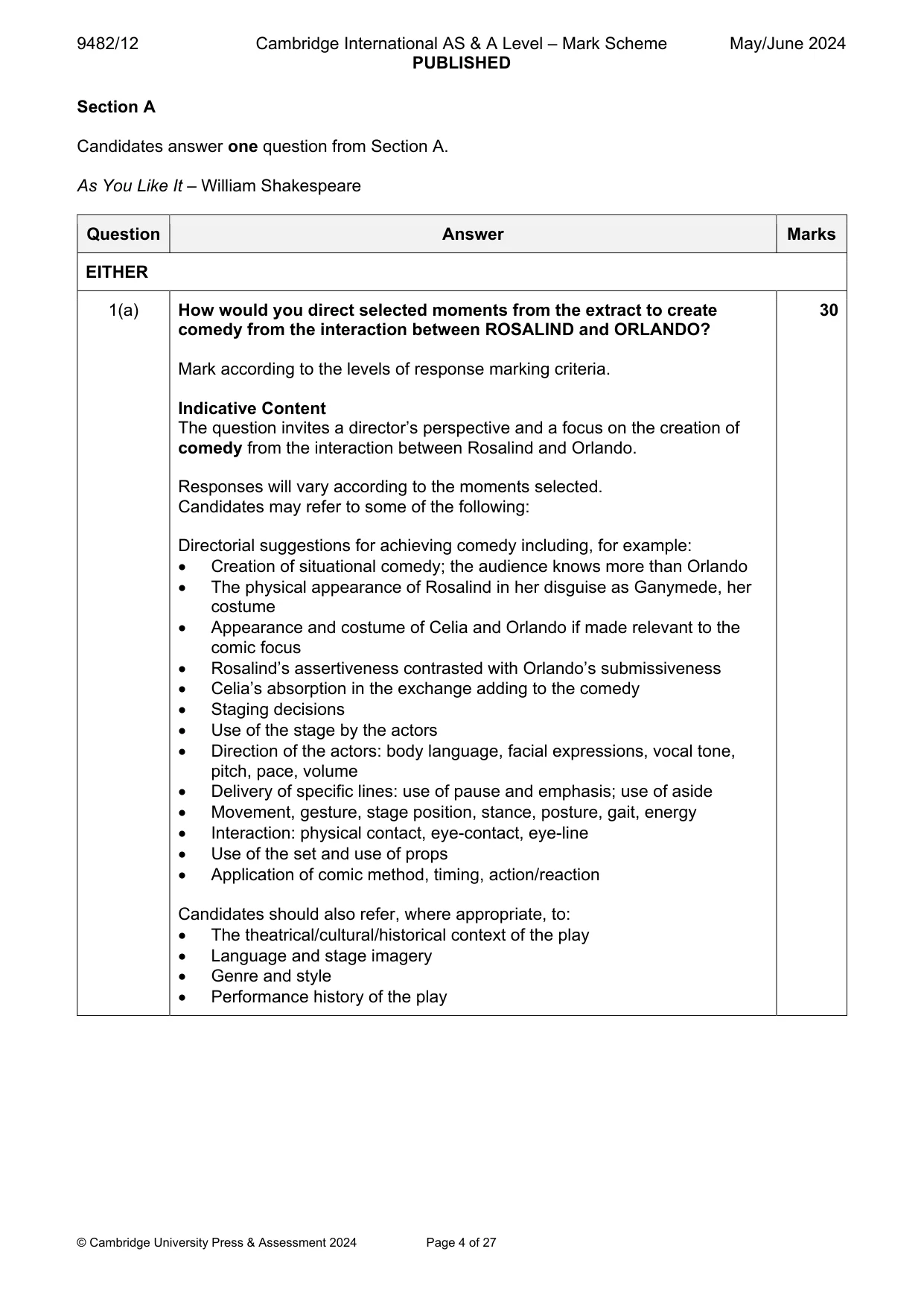
9482/12 Cambridge International AS & A Level – Mark Scheme PUBLISHED May/June 2024 © Cambridge University Press & Assessment 2024 Page 4 of 27 Section A Candidates answer one question from Section A. As You Like It – William Shakespeare Question Answer Marks EITHER 1(a) How would you direct selected moments from the extract to create comedy from the interaction between ROSALIND and ORLANDO? Mark according to the levels of response marking criteria. Indicative Content The question invites a director’s perspective and a focus on the creation of comedy from the interaction between Rosalind and Orlando. Responses will vary according to the moments selected. Candidates may refer to some of the following: Directorial suggestions for achieving comedy including, for example: Creation of situational comedy; the audience knows more than Orlando The physical appearance of Rosalind in her disguise as Ganymede, her costume Appearance and costume of Celia and Orlando if made relevant to the comic focus Rosalind’s assertiveness contrasted with Orlando’s submissiveness Celia’s absorption in the exchange adding to the comedy Staging decisions Use of the stage by the actors Direction of the actors: body language, facial expressions, vocal tone, pitch, pace, volume Delivery of specific lines: use of pause and emphasis; use of aside Movement, gesture, stage position, stance, posture, gait, energy Interaction: physical contact, eye-contact, eye-line Use of the set and use of props Application of comic method, timing, action/reaction Candidates should also refer, where appropriate, to: The theatrical/cultural/historical context of the play Language and stage imagery Genre and style Performance history of the play 30
Mark scheme, page 5
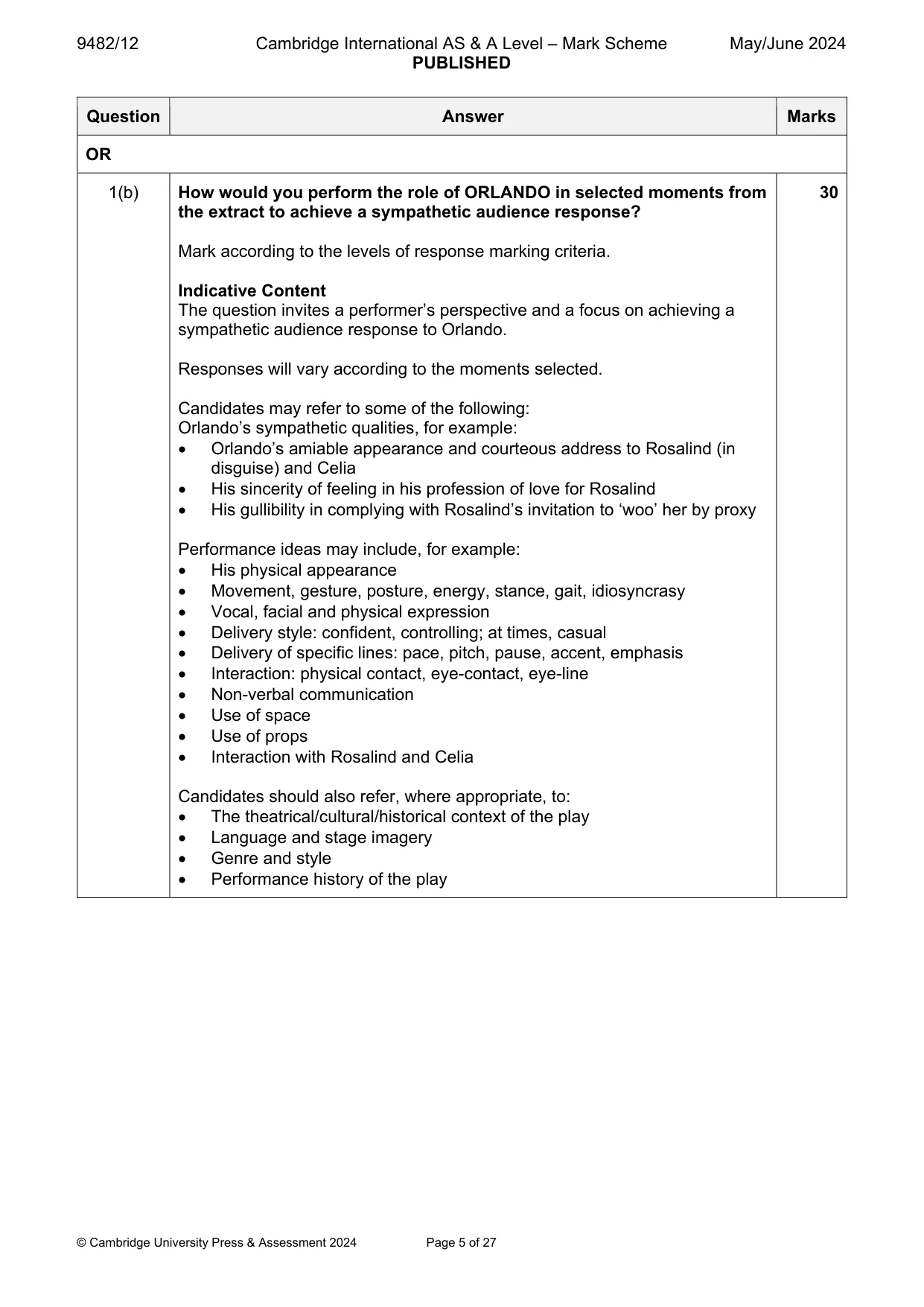
9482/12 Cambridge International AS & A Level – Mark Scheme PUBLISHED May/June 2024 © Cambridge University Press & Assessment 2024 Page 5 of 27 Question Answer Marks OR 1(b) How would you perform the role of ORLANDO in selected moments from the extract to achieve a sympathetic audience response? Mark according to the levels of response marking criteria. Indicative Content The question invites a performer’s perspective and a focus on achieving a sympathetic audience response to Orlando. Responses will vary according to the moments selected. Candidates may refer to some of the following: Orlando’s sympathetic qualities, for example: Orlando’s amiable appearance and courteous address to Rosalind (in disguise) and Celia His sincerity of feeling in his profession of love for Rosalind His gullibility in complying with Rosalind’s invitation to ‘woo’ her by proxy Performance ideas may include, for example: His physical appearance Movement, gesture, posture, energy, stance, gait, idiosyncrasy Vocal, facial and physical expression Delivery style: confident, controlling; at times, casual Delivery of specific lines: pace, pitch, pause, accent, emphasis Interaction: physical contact, eye-contact, eye-line Non-verbal communication Use of space Use of props Interaction with Rosalind and Celia Candidates should also refer, where appropriate, to: The theatrical/cultural/historical context of the play Language and stage imagery Genre and style Performance history of the play 30
Mark scheme, page 6
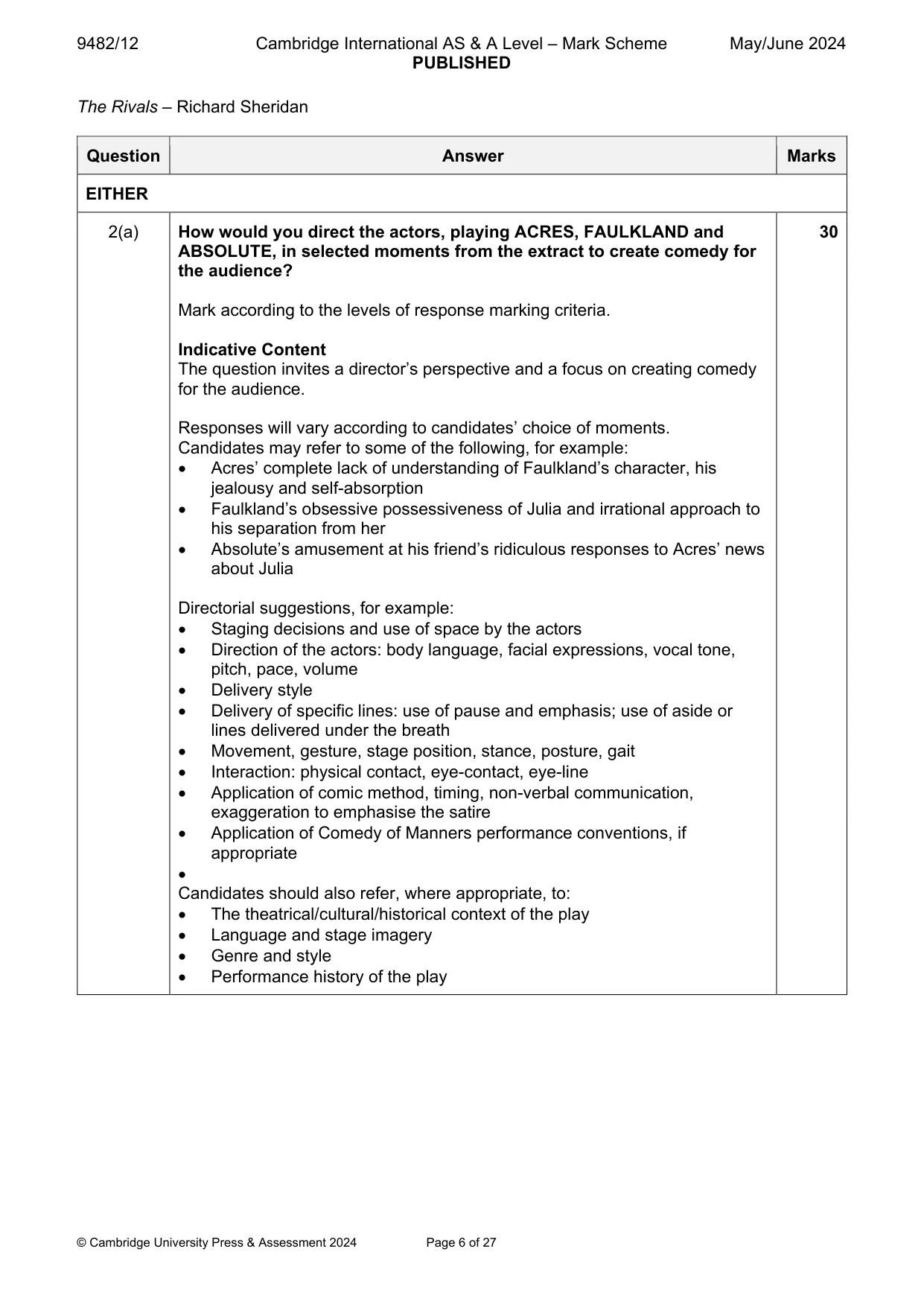
9482/12 Cambridge International AS & A Level – Mark Scheme PUBLISHED May/June 2024 © Cambridge University Press & Assessment 2024 Page 6 of 27 The Rivals – Richard Sheridan Question Answer Marks EITHER 2(a) How would you direct the actors, playing ACRES, FAULKLAND and ABSOLUTE, in selected moments from the extract to create comedy for the audience? Mark according to the levels of response marking criteria. Indicative Content The question invites a director’s perspective and a focus on creating comedy for the audience. Responses will vary according to candidates’ choice of moments. Candidates may refer to some of the following, for example: Acres’ complete lack of understanding of Faulkland’s character, his jealousy and self-absorption Faulkland’s obsessive possessiveness of Julia and irrational approach to his separation from her Absolute’s amusement at his friend’s ridiculous responses to Acres’ news about Julia Directorial suggestions, for example: Staging decisions and use of space by the actors Direction of the actors: body language, facial expressions, vocal tone, pitch, pace, volume Delivery style Delivery of specific lines: use of pause and emphasis; use of aside or lines delivered under the breath Movement, gesture, stage position, stance, posture, gait Interaction: physical contact, eye-contact, eye-line Application of comic method, timing, non-verbal communication, exaggeration to emphasise the satire Application of Comedy of Manners performance conventions, if appropriate Candidates should also refer, where appropriate, to: The theatrical/cultural/historical context of the play Language and stage imagery Genre and style Performance history of the play 30
Mark scheme, page 7
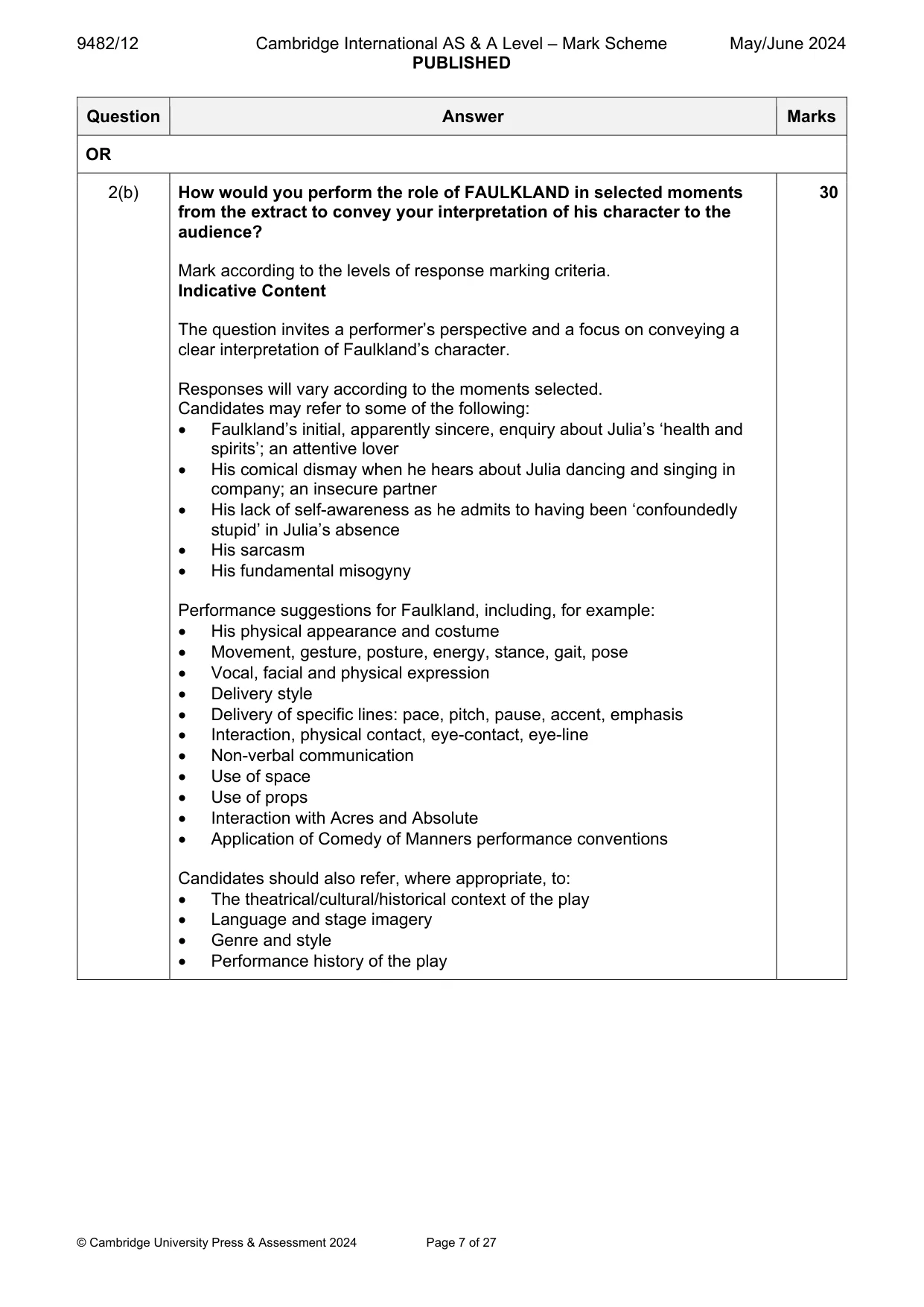
9482/12 Cambridge International AS & A Level – Mark Scheme PUBLISHED May/June 2024 © Cambridge University Press & Assessment 2024 Page 7 of 27 Question Answer Marks OR 2(b) How would you perform the role of FAULKLAND in selected moments from the extract to convey your interpretation of his character to the audience? Mark according to the levels of response marking criteria. Indicative Content The question invites a performer’s perspective and a focus on conveying a clear interpretation of Faulkland’s character. Responses will vary according to the moments selected. Candidates may refer to some of the following: Faulkland’s initial, apparently sincere, enquiry about Julia’s ‘health and spirits’; an attentive lover His comical dismay when he hears about Julia dancing and singing in company; an insecure partner His lack of self-awareness as he admits to having been ‘confoundedly stupid’ in Julia’s absence His sarcasm His fundamental misogyny Performance suggestions for Faulkland, including, for example: His physical appearance and costume Movement, gesture, posture, energy, stance, gait, pose Vocal, facial and physical expression Delivery style Delivery of specific lines: pace, pitch, pause, accent, emphasis Interaction, physical contact, eye-contact, eye-line Non-verbal communication Use of space Use of props Interaction with Acres and Absolute Application of Comedy of Manners performance conventions Candidates should also refer, where appropriate, to: The theatrical/cultural/historical context of the play Language and stage imagery Genre and style Performance history of the play 30
Mark scheme, page 8
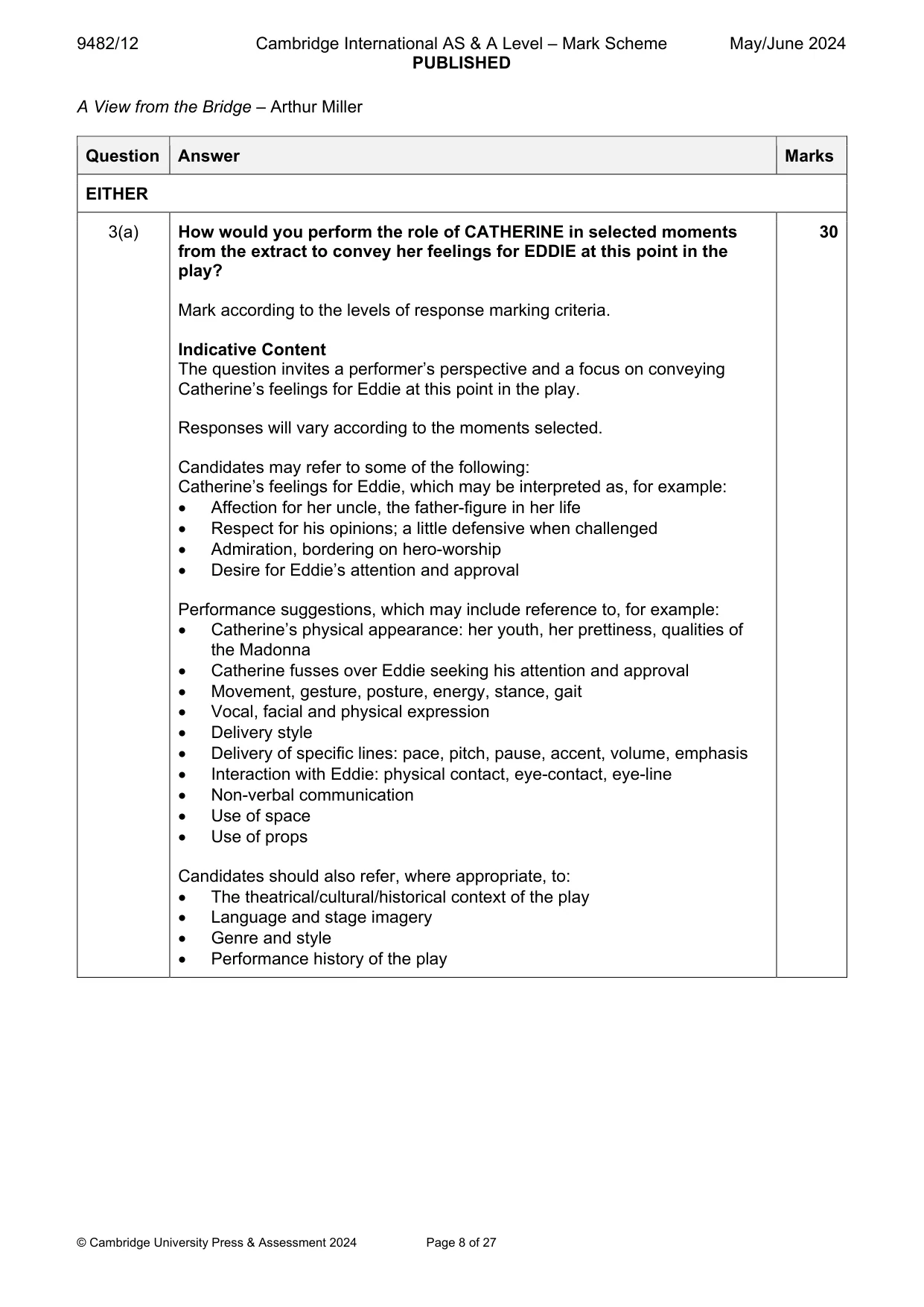
9482/12 Cambridge International AS & A Level – Mark Scheme PUBLISHED May/June 2024 © Cambridge University Press & Assessment 2024 Page 8 of 27 A View from the Bridge – Arthur Miller Question Answer Marks EITHER 3(a) How would you perform the role of CATHERINE in selected moments from the extract to convey her feelings for EDDIE at this point in the play? Mark according to the levels of response marking criteria. Indicative Content The question invites a performer’s perspective and a focus on conveying Catherine’s feelings for Eddie at this point in the play. Responses will vary according to the moments selected. Candidates may refer to some of the following: Catherine’s feelings for Eddie, which may be interpreted as, for example: Affection for her uncle, the father-figure in her life Respect for his opinions; a little defensive when challenged Admiration, bordering on hero-worship Desire for Eddie’s attention and approval Performance suggestions, which may include reference to, for example: Catherine’s physical appearance: her youth, her prettiness, qualities of the Madonna Catherine fusses over Eddie seeking his attention and approval Movement, gesture, posture, energy, stance, gait Vocal, facial and physical expression Delivery style Delivery of specific lines: pace, pitch, pause, accent, volume, emphasis Interaction with Eddie: physical contact, eye-contact, eye-line Non-verbal communication Use of space Use of props Candidates should also refer, where appropriate, to: The theatrical/cultural/historical context of the play Language and stage imagery Genre and style Performance history of the play 30
Mark scheme, page 9
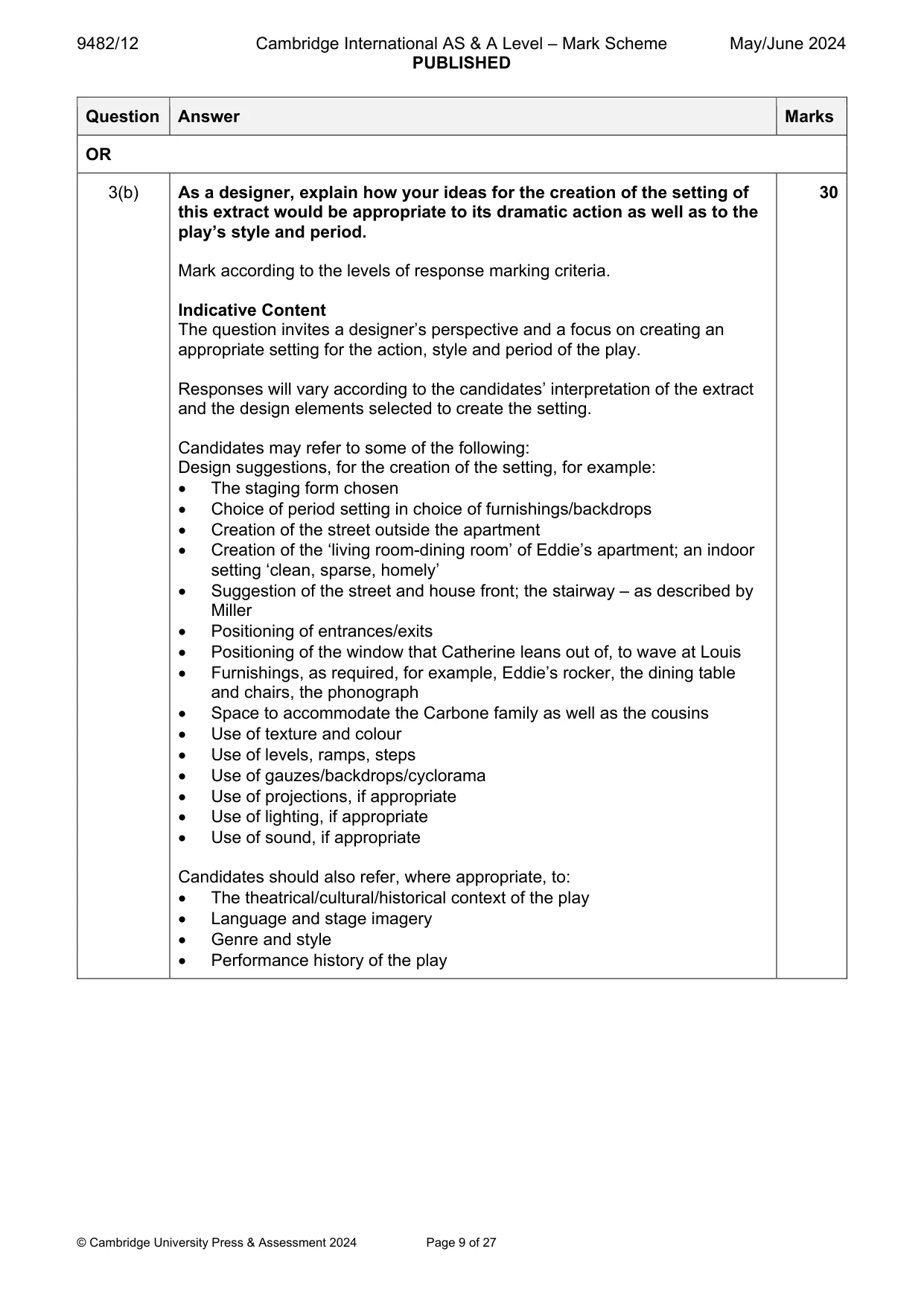
9482/12 Cambridge International AS & A Level – Mark Scheme PUBLISHED May/June 2024 © Cambridge University Press & Assessment 2024 Page 9 of 27 Question Answer Marks OR 3(b) As a designer, explain how your ideas for the creation of the setting of this extract would be appropriate to its dramatic action as well as to the play’s style and period. Mark according to the levels of response marking criteria. Indicative Content The question invites a designer’s perspective and a focus on creating an appropriate setting for the action, style and period of the play. Responses will vary according to the candidates’ interpretation of the extract and the design elements selected to create the setting. Candidates may refer to some of the following: Design suggestions, for the creation of the setting, for example: The staging form chosen Choice of period setting in choice of furnishings/backdrops Creation of the street outside the apartment Creation of the ‘living room-dining room’ of Eddie’s apartment; an indoor setting ‘clean, sparse, homely’ Suggestion of the street and house front; the stairway – as described by Miller Positioning of entrances/exits Positioning of the window that Catherine leans out of, to wave at Louis Furnishings, as required, for example, Eddie’s rocker, the dining table and chairs, the phonograph Space to accommodate the Carbone family as well as the cousins Use of texture and colour Use of levels, ramps, steps Use of gauzes/backdrops/cyclorama Use of projections, if appropriate Use of lighting, if appropriate Use of sound, if appropriate Candidates should also refer, where appropriate, to: The theatrical/cultural/historical context of the play Language and stage imagery Genre and style Performance history of the play 30
Mark scheme, page 10
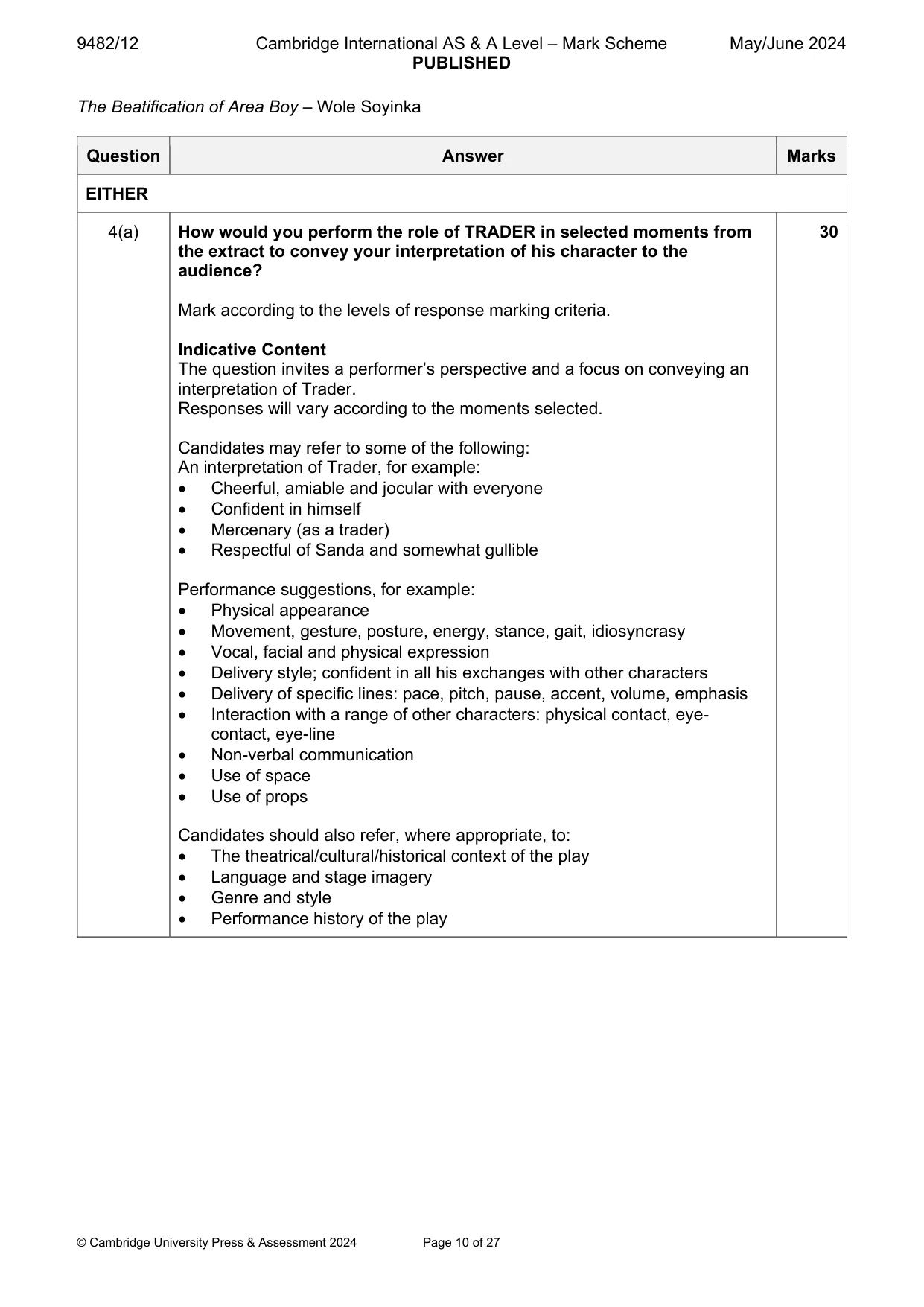
9482/12 Cambridge International AS & A Level – Mark Scheme PUBLISHED May/June 2024 © Cambridge University Press & Assessment 2024 Page 10 of 27 The Beatification of Area Boy – Wole Soyinka Question Answer Marks EITHER 4(a) How would you perform the role of TRADER in selected moments from the extract to convey your interpretation of his character to the audience? Mark according to the levels of response marking criteria. Indicative Content The question invites a performer’s perspective and a focus on conveying an interpretation of Trader. Responses will vary according to the moments selected. Candidates may refer to some of the following: An interpretation of Trader, for example: Cheerful, amiable and jocular with everyone Confident in himself Mercenary (as a trader) Respectful of Sanda and somewhat gullible Performance suggestions, for example: Physical appearance Movement, gesture, posture, energy, stance, gait, idiosyncrasy Vocal, facial and physical expression Delivery style; confident in all his exchanges with other characters Delivery of specific lines: pace, pitch, pause, accent, volume, emphasis Interaction with a range of other characters: physical contact, eye- contact, eye-line Non-verbal communication Use of space Use of props Candidates should also refer, where appropriate, to: The theatrical/cultural/historical context of the play Language and stage imagery Genre and style Performance history of the play 30
Mark scheme, page 11
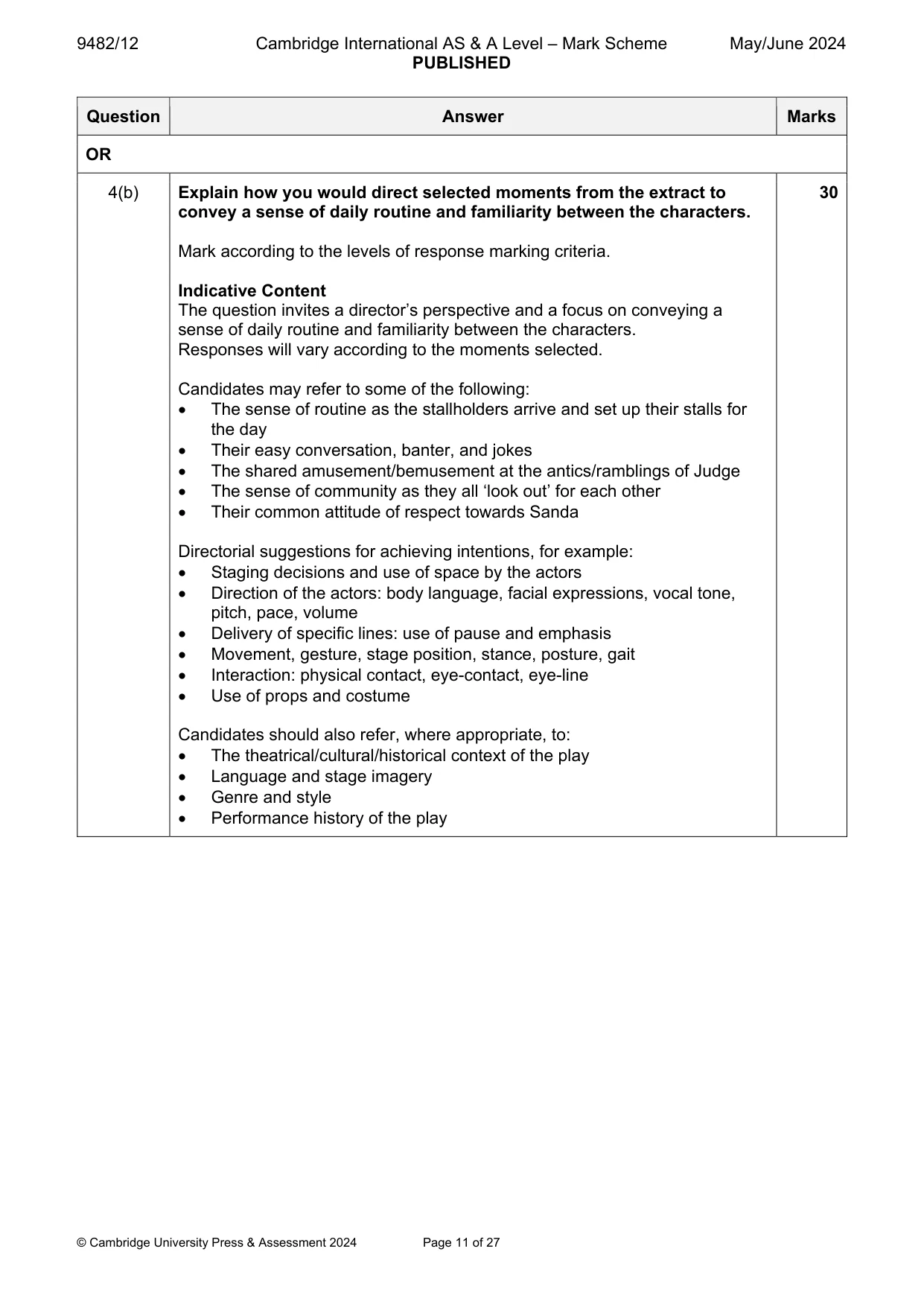
9482/12 Cambridge International AS & A Level – Mark Scheme PUBLISHED May/June 2024 © Cambridge University Press & Assessment 2024 Page 11 of 27 Question Answer Marks OR 4(b) Explain how you would direct selected moments from the extract to convey a sense of daily routine and familiarity between the characters. Mark according to the levels of response marking criteria. Indicative Content The question invites a director’s perspective and a focus on conveying a sense of daily routine and familiarity between the characters. Responses will vary according to the moments selected. Candidates may refer to some of the following: The sense of routine as the stallholders arrive and set up their stalls for the day Their easy conversation, banter, and jokes The shared amusement/bemusement at the antics/ramblings of Judge The sense of community as they all ‘look out’ for each other Their common attitude of respect towards Sanda Directorial suggestions for achieving intentions, for example: Staging decisions and use of space by the actors Direction of the actors: body language, facial expressions, vocal tone, pitch, pace, volume Delivery of specific lines: use of pause and emphasis Movement, gesture, stage position, stance, posture, gait Interaction: physical contact, eye-contact, eye-line Use of props and costume Candidates should also refer, where appropriate, to: The theatrical/cultural/historical context of the play Language and stage imagery Genre and style Performance history of the play 30
Mark scheme, page 12
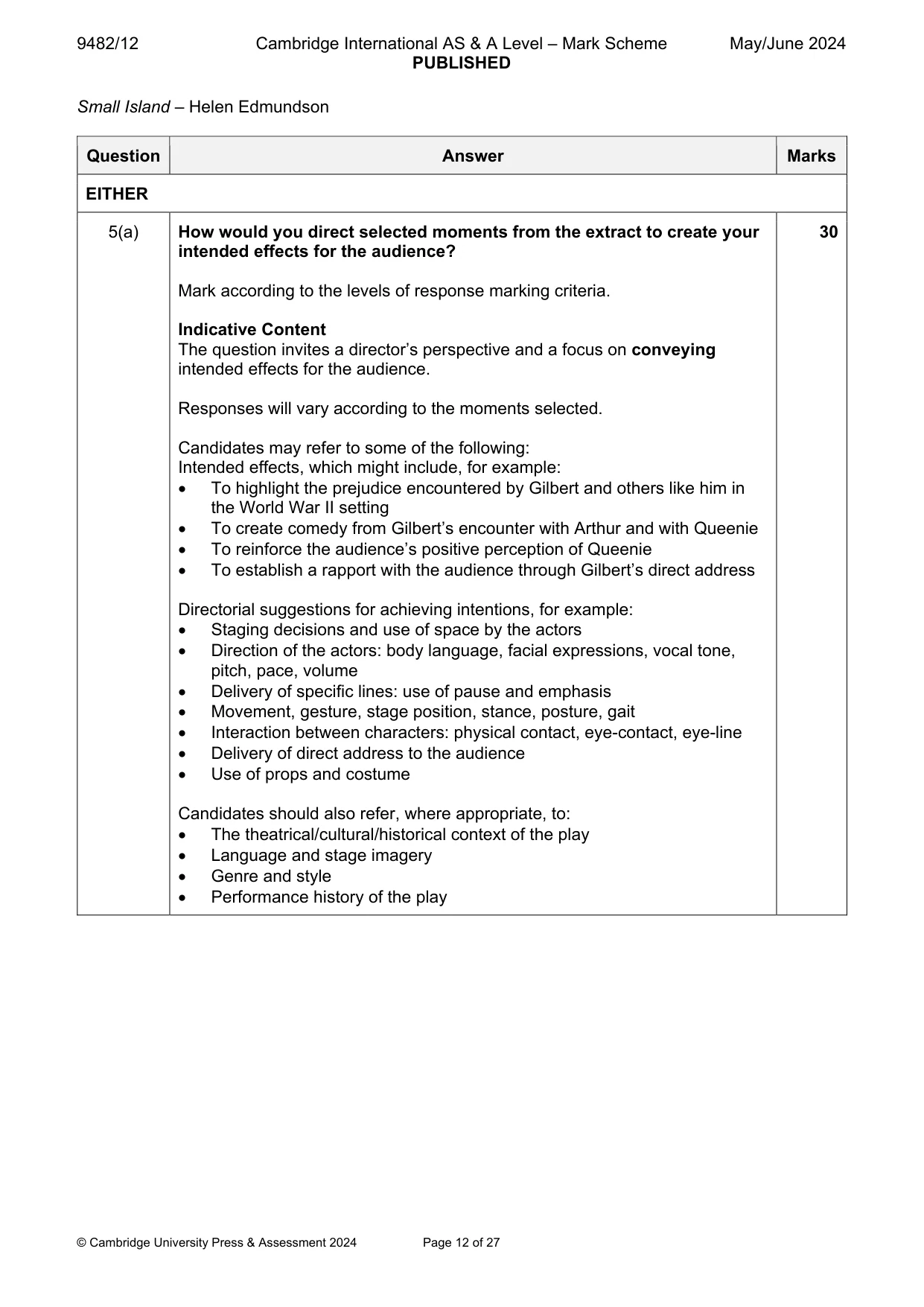
9482/12 Cambridge International AS & A Level – Mark Scheme PUBLISHED May/June 2024 © Cambridge University Press & Assessment 2024 Page 12 of 27 Small Island – Helen Edmundson Question Answer Marks EITHER 5(a) How would you direct selected moments from the extract to create your intended effects for the audience? Mark according to the levels of response marking criteria. Indicative Content The question invites a director’s perspective and a focus on conveying intended effects for the audience. Responses will vary according to the moments selected. Candidates may refer to some of the following: Intended effects, which might include, for example: To highlight the prejudice encountered by Gilbert and others like him in the World War II setting To create comedy from Gilbert’s encounter with Arthur and with Queenie To reinforce the audience’s positive perception of Queenie To establish a rapport with the audience through Gilbert’s direct address Directorial suggestions for achieving intentions, for example: Staging decisions and use of space by the actors Direction of the actors: body language, facial expressions, vocal tone, pitch, pace, volume Delivery of specific lines: use of pause and emphasis Movement, gesture, stage position, stance, posture, gait Interaction between characters: physical contact, eye-contact, eye-line Delivery of direct address to the audience Use of props and costume Candidates should also refer, where appropriate, to: The theatrical/cultural/historical context of the play Language and stage imagery Genre and style Performance history of the play 30
Mark scheme, page 13
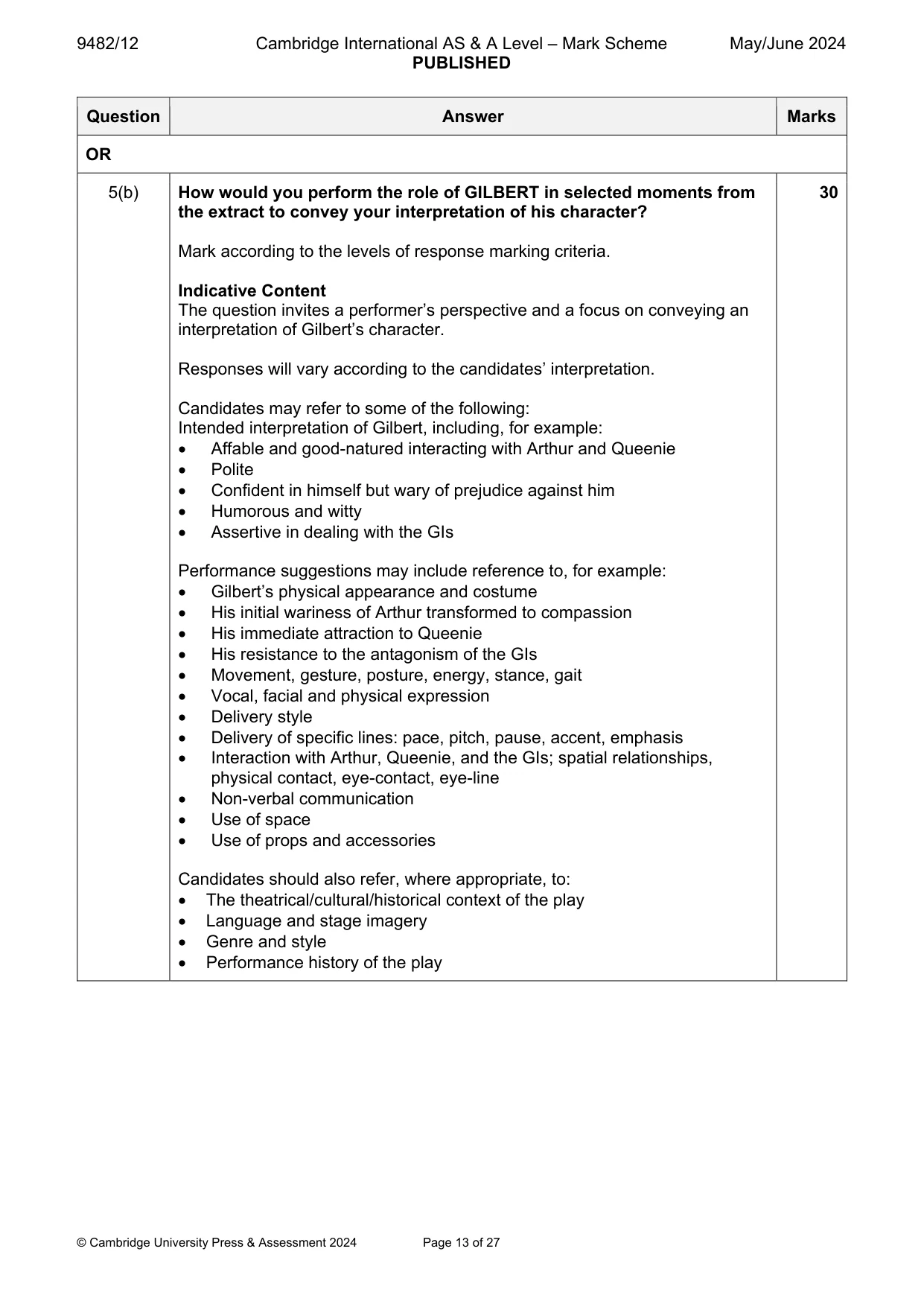
9482/12 Cambridge International AS & A Level – Mark Scheme PUBLISHED May/June 2024 © Cambridge University Press & Assessment 2024 Page 13 of 27 Question Answer Marks OR 5(b) How would you perform the role of GILBERT in selected moments from the extract to convey your interpretation of his character? Mark according to the levels of response marking criteria. Indicative Content The question invites a performer’s perspective and a focus on conveying an interpretation of Gilbert’s character. Responses will vary according to the candidates’ interpretation. Candidates may refer to some of the following: Intended interpretation of Gilbert, including, for example: Affable and good-natured interacting with Arthur and Queenie Polite Confident in himself but wary of prejudice against him Humorous and witty Assertive in dealing with the GIs Performance suggestions may include reference to, for example: Gilbert’s physical appearance and costume His initial wariness of Arthur transformed to compassion His immediate attraction to Queenie His resistance to the antagonism of the GIs Movement, gesture, posture, energy, stance, gait Vocal, facial and physical expression Delivery style Delivery of specific lines: pace, pitch, pause, accent, emphasis Interaction with Arthur, Queenie, and the GIs; spatial relationships, physical contact, eye-contact, eye-line Non-verbal communication Use of space Use of props and accessories Candidates should also refer, where appropriate, to: The theatrical/cultural/historical context of the play Language and stage imagery Genre and style Performance history of the play 30
Mark scheme, page 14
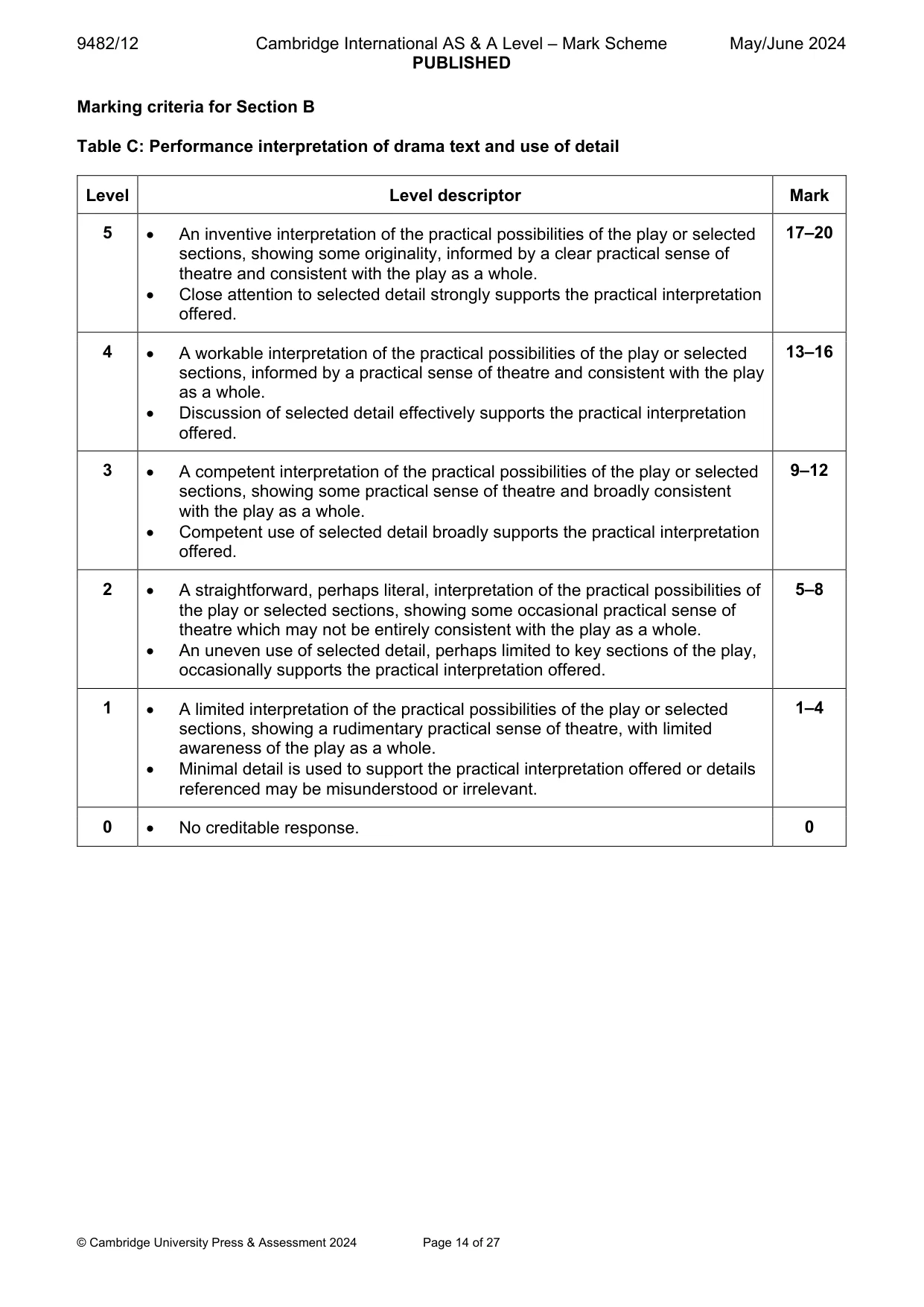
9482/12 Cambridge International AS & A Level – Mark Scheme PUBLISHED May/June 2024 © Cambridge University Press & Assessment 2024 Page 14 of 27 Marking criteria for Section B Table C: Performance interpretation of drama text and use of detail Level Level descriptor Mark 5 An inventive interpretation of the practical possibilities of the play or selected sections, showing some originality, informed by a clear practical sense of theatre and consistent with the play as a whole. Close attention to selected detail strongly supports the practical interpretation offered. 17–20 4 A workable interpretation of the practical possibilities of the play or selected sections, informed by a practical sense of theatre and consistent with the play as a whole. Discussion of selected detail effectively supports the practical interpretation offered. 13–16 3 A competent interpretation of the practical possibilities of the play or selected sections, showing some practical sense of theatre and broadly consistent with the play as a whole. Competent use of selected detail broadly supports the practical interpretation offered. 9–12 2 A straightforward, perhaps literal, interpretation of the practical possibilities of the play or selected sections, showing some occasional practical sense of theatre which may not be entirely consistent with the play as a whole. An uneven use of selected detail, perhaps limited to key sections of the play, occasionally supports the practical interpretation offered. 5–8 1 A limited interpretation of the practical possibilities of the play or selected sections, showing a rudimentary practical sense of theatre, with limited awareness of the play as a whole. Minimal detail is used to support the practical interpretation offered or details referenced may be misunderstood or irrelevant. 1–4 0 No creditable response. 0
Mark scheme, page 15
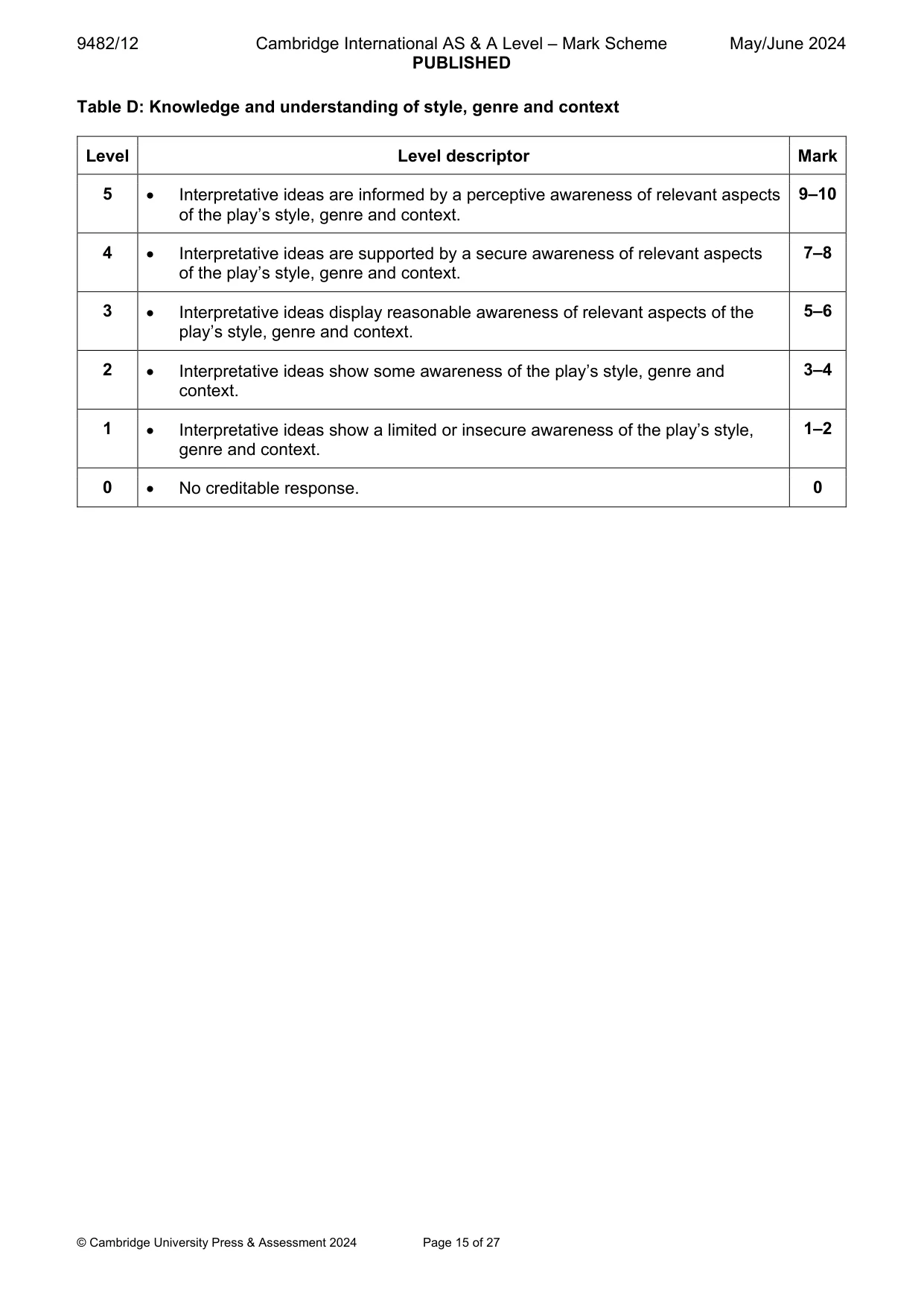
9482/12 Cambridge International AS & A Level – Mark Scheme PUBLISHED May/June 2024 © Cambridge University Press & Assessment 2024 Page 15 of 27 Table D: Knowledge and understanding of style, genre and context Level Level descriptor Mark 5 Interpretative ideas are informed by a perceptive awareness of relevant aspects of the play’s style, genre and context. 9–10 4 Interpretative ideas are supported by a secure awareness of relevant aspects of the play’s style, genre and context. 7–8 3 Interpretative ideas display reasonable awareness of relevant aspects of the play’s style, genre and context. 5–6 2 Interpretative ideas show some awareness of the play’s style, genre and context. 3–4 1 Interpretative ideas show a limited or insecure awareness of the play’s style, genre and context. 1–2 0 No creditable response. 0
Mark scheme, page 16
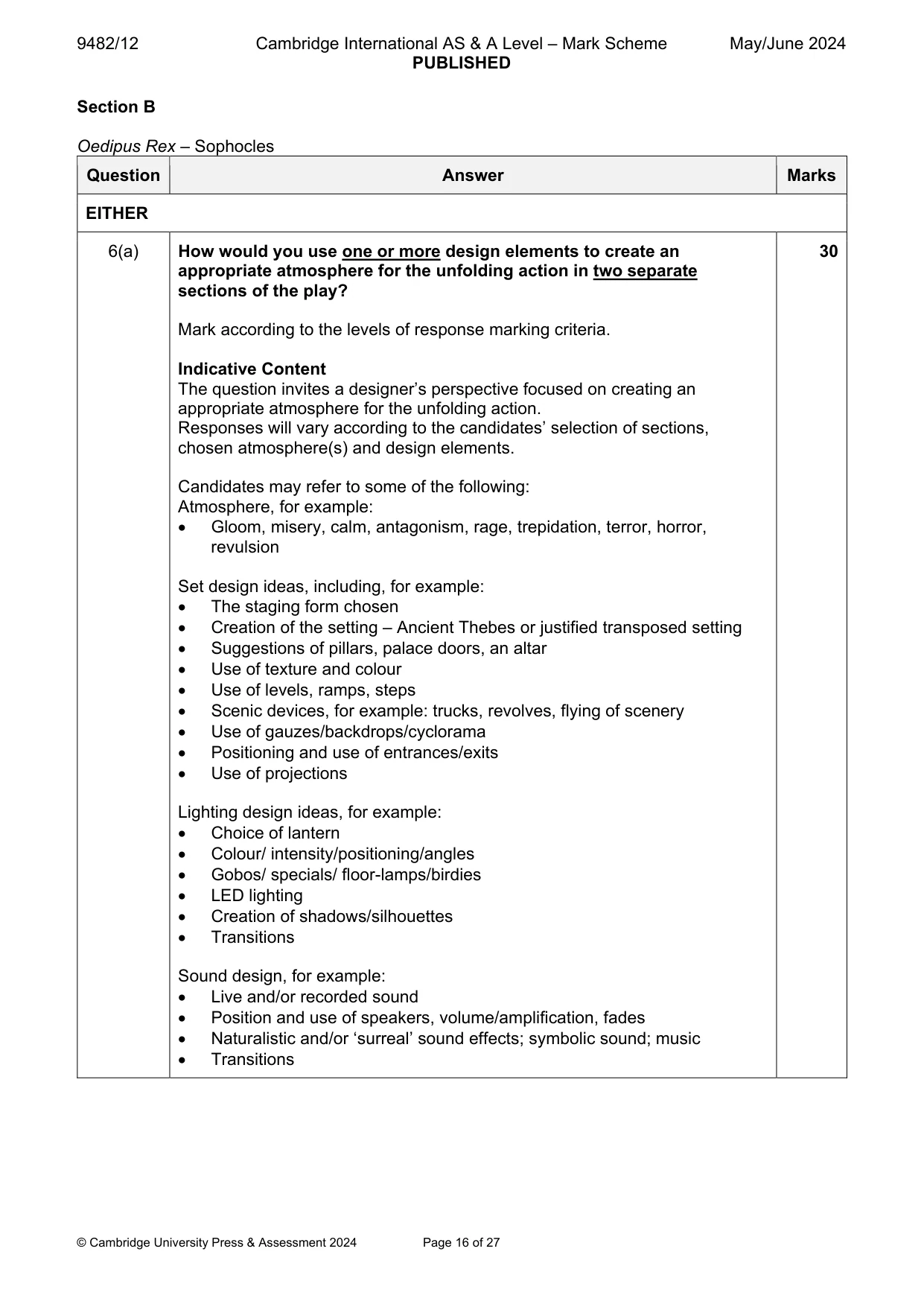
9482/12 Cambridge International AS & A Level – Mark Scheme PUBLISHED May/June 2024 © Cambridge University Press & Assessment 2024 Page 16 of 27 Section B Oedipus Rex – Sophocles Question Answer Marks EITHER 6(a) How would you use one or more design elements to create an appropriate atmosphere for the unfolding action in two separate sections of the play? Mark according to the levels of response marking criteria. Indicative Content The question invites a designer’s perspective focused on creating an appropriate atmosphere for the unfolding action. Responses will vary according to the candidates’ selection of sections, chosen atmosphere(s) and design elements. Candidates may refer to some of the following: Atmosphere, for example: Gloom, misery, calm, antagonism, rage, trepidation, terror, horror, revulsion Set design ideas, including, for example: The staging form chosen Creation of the setting – Ancient Thebes or justified transposed setting Suggestions of pillars, palace doors, an altar Use of texture and colour Use of levels, ramps, steps Scenic devices, for example: trucks, revolves, flying of scenery Use of gauzes/backdrops/cyclorama Positioning and use of entrances/exits Use of projections Lighting design ideas, for example: Choice of lantern Colour/ intensity/positioning/angles Gobos/ specials/ floor-lamps/birdies LED lighting Creation of shadows/silhouettes Transitions Sound design, for example: Live and/or recorded sound Position and use of speakers, volume/amplification, fades Naturalistic and/or ‘surreal’ sound effects; symbolic sound; music Transitions 30
Mark scheme, page 17
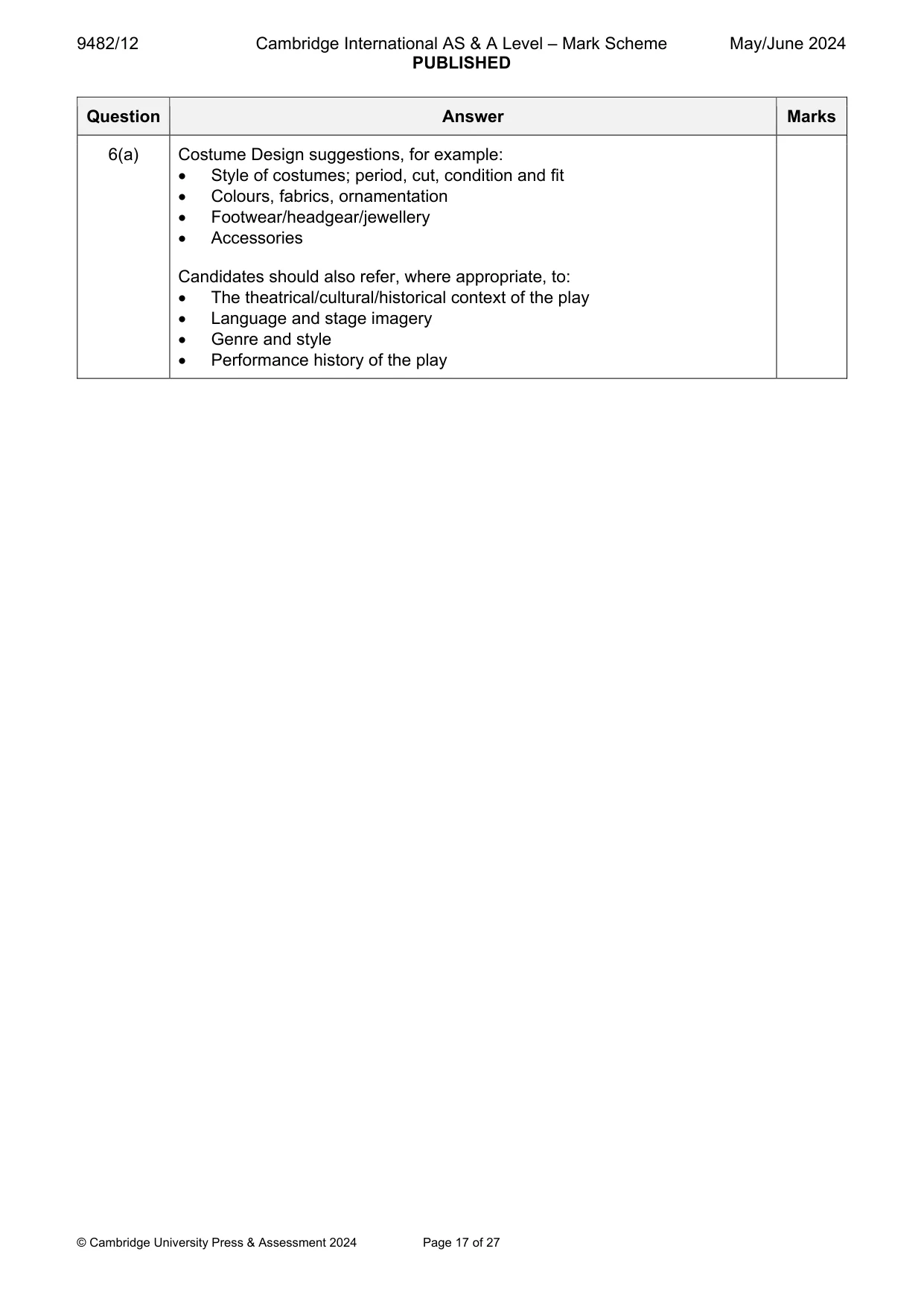
9482/12 Cambridge International AS & A Level – Mark Scheme PUBLISHED May/June 2024 © Cambridge University Press & Assessment 2024 Page 17 of 27 Question Answer Marks 6(a) Costume Design suggestions, for example: Style of costumes; period, cut, condition and fit Colours, fabrics, ornamentation Footwear/headgear/jewellery Accessories Candidates should also refer, where appropriate, to: The theatrical/cultural/historical context of the play Language and stage imagery Genre and style Performance history of the play
Mark scheme, page 18
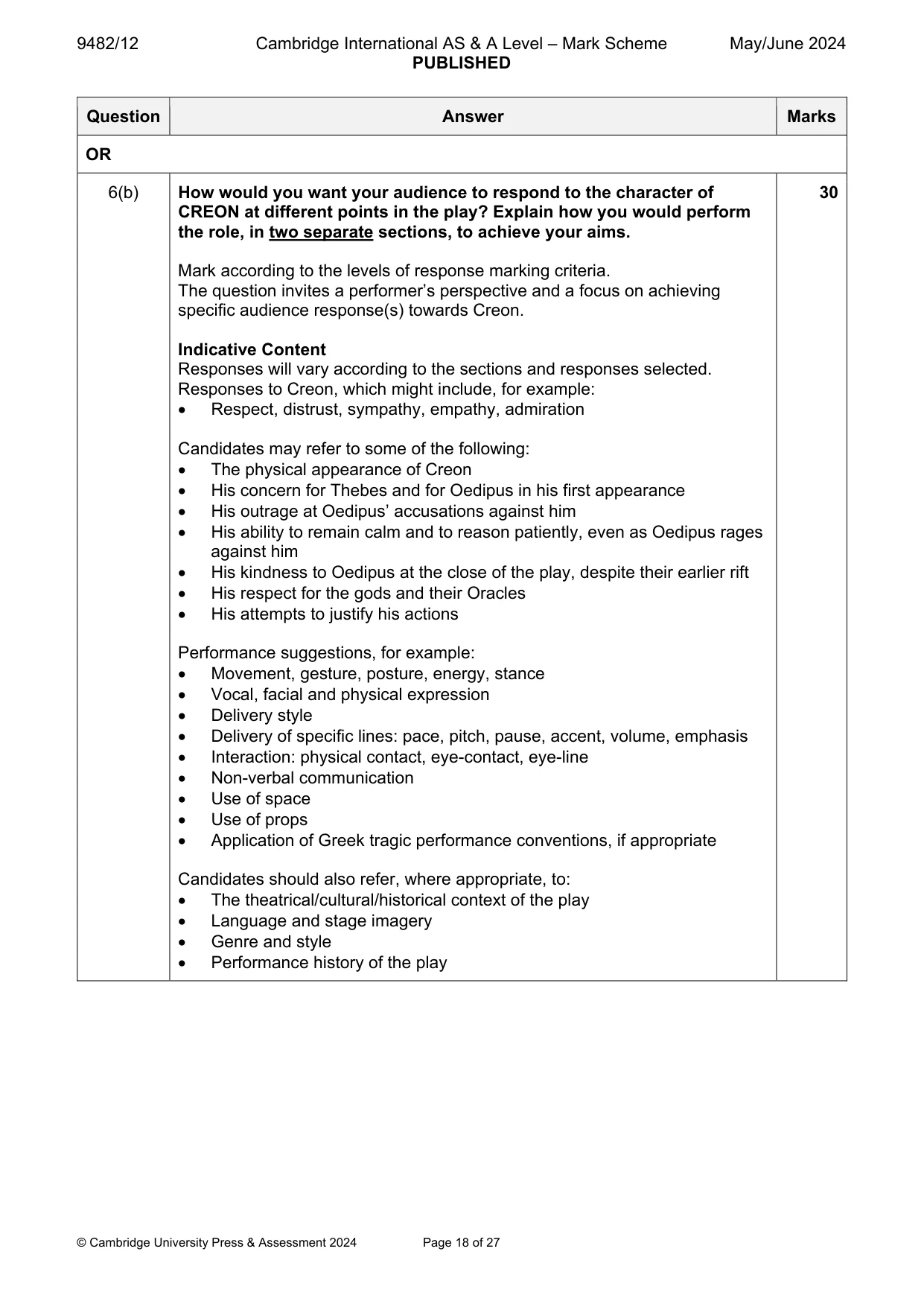
9482/12 Cambridge International AS & A Level – Mark Scheme PUBLISHED May/June 2024 © Cambridge University Press & Assessment 2024 Page 18 of 27 Question Answer Marks OR 6(b) How would you want your audience to respond to the character of CREON at different points in the play? Explain how you would perform the role, in two separate sections, to achieve your aims. Mark according to the levels of response marking criteria. The question invites a performer’s perspective and a focus on achieving specific audience response(s) towards Creon. Indicative Content Responses will vary according to the sections and responses selected. Responses to Creon, which might include, for example: Respect, distrust, sympathy, empathy, admiration Candidates may refer to some of the following: The physical appearance of Creon His concern for Thebes and for Oedipus in his first appearance His outrage at Oedipus’ accusations against him His ability to remain calm and to reason patiently, even as Oedipus rages against him His kindness to Oedipus at the close of the play, despite their earlier rift His respect for the gods and their Oracles His attempts to justify his actions Performance suggestions, for example: Movement, gesture, posture, energy, stance Vocal, facial and physical expression Delivery style Delivery of specific lines: pace, pitch, pause, accent, volume, emphasis Interaction: physical contact, eye-contact, eye-line Non-verbal communication Use of space Use of props Application of Greek tragic performance conventions, if appropriate Candidates should also refer, where appropriate, to: The theatrical/cultural/historical context of the play Language and stage imagery Genre and style Performance history of the play 30
Mark scheme, page 19
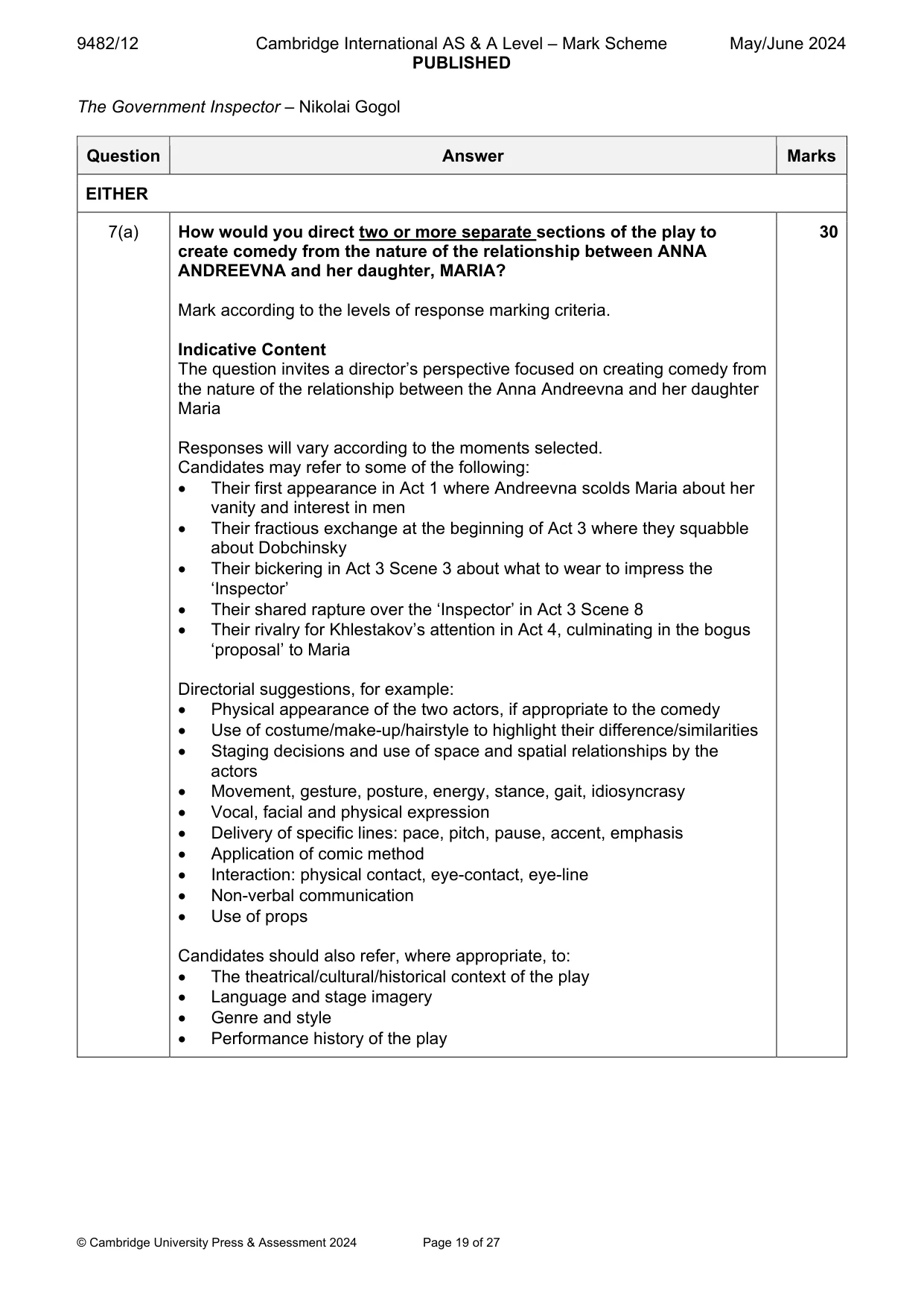
9482/12 Cambridge International AS & A Level – Mark Scheme PUBLISHED May/June 2024 © Cambridge University Press & Assessment 2024 Page 19 of 27 The Government Inspector – Nikolai Gogol Question Answer Marks EITHER 7(a) How would you direct two or more separate sections of the play to create comedy from the nature of the relationship between ANNA ANDREEVNA and her daughter, MARIA? Mark according to the levels of response marking criteria. Indicative Content The question invites a director’s perspective focused on creating comedy from the nature of the relationship between the Anna Andreevna and her daughter Maria Responses will vary according to the moments selected. Candidates may refer to some of the following: Their first appearance in Act 1 where Andreevna scolds Maria about her vanity and interest in men Their fractious exchange at the beginning of Act 3 where they squabble about Dobchinsky Their bickering in Act 3 Scene 3 about what to wear to impress the ‘Inspector’ Their shared rapture over the ‘Inspector’ in Act 3 Scene 8 Their rivalry for Khlestakov’s attention in Act 4, culminating in the bogus ‘proposal’ to Maria Directorial suggestions, for example: Physical appearance of the two actors, if appropriate to the comedy Use of costume/make-up/hairstyle to highlight their difference/similarities Staging decisions and use of space and spatial relationships by the actors Movement, gesture, posture, energy, stance, gait, idiosyncrasy Vocal, facial and physical expression Delivery of specific lines: pace, pitch, pause, accent, emphasis Application of comic method Interaction: physical contact, eye-contact, eye-line Non-verbal communication Use of props Candidates should also refer, where appropriate, to: The theatrical/cultural/historical context of the play Language and stage imagery Genre and style Performance history of the play 30
Mark scheme, page 20
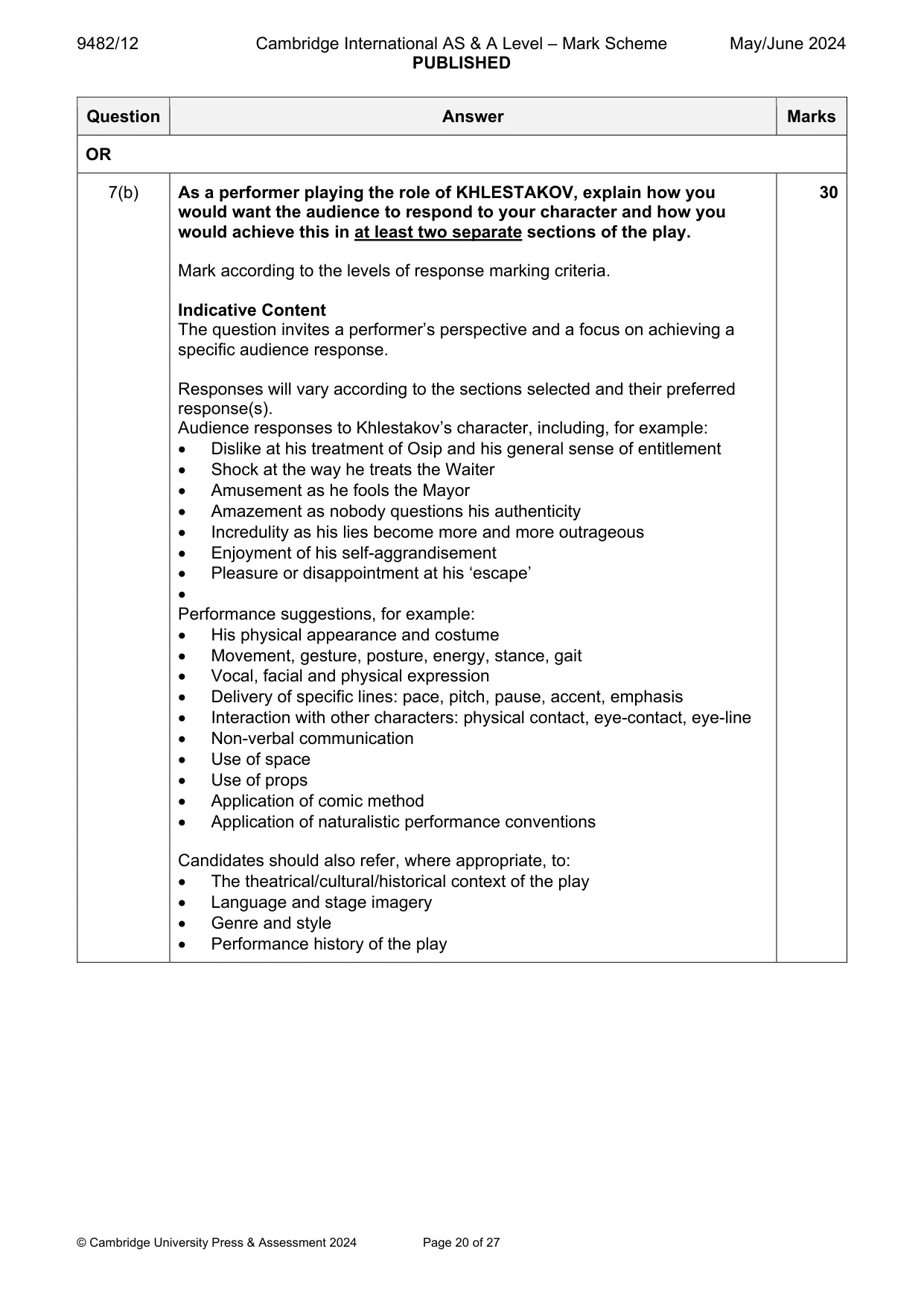
9482/12 Cambridge International AS & A Level – Mark Scheme PUBLISHED May/June 2024 © Cambridge University Press & Assessment 2024 Page 20 of 27 Question Answer Marks OR 7(b) As a performer playing the role of KHLESTAKOV, explain how you would want the audience to respond to your character and how you would achieve this in at least two separate sections of the play. Mark according to the levels of response marking criteria. Indicative Content The question invites a performer’s perspective and a focus on achieving a specific audience response. Responses will vary according to the sections selected and their preferred response(s). Audience responses to Khlestakov’s character, including, for example: Dislike at his treatment of Osip and his general sense of entitlement Shock at the way he treats the Waiter Amusement as he fools the Mayor Amazement as nobody questions his authenticity Incredulity as his lies become more and more outrageous Enjoyment of his self-aggrandisement Pleasure or disappointment at his ‘escape’ Performance suggestions, for example: His physical appearance and costume Movement, gesture, posture, energy, stance, gait Vocal, facial and physical expression Delivery of specific lines: pace, pitch, pause, accent, emphasis Interaction with other characters: physical contact, eye-contact, eye-line Non-verbal communication Use of space Use of props Application of comic method Application of naturalistic performance conventions Candidates should also refer, where appropriate, to: The theatrical/cultural/historical context of the play Language and stage imagery Genre and style Performance history of the play 30
Mark scheme, page 21
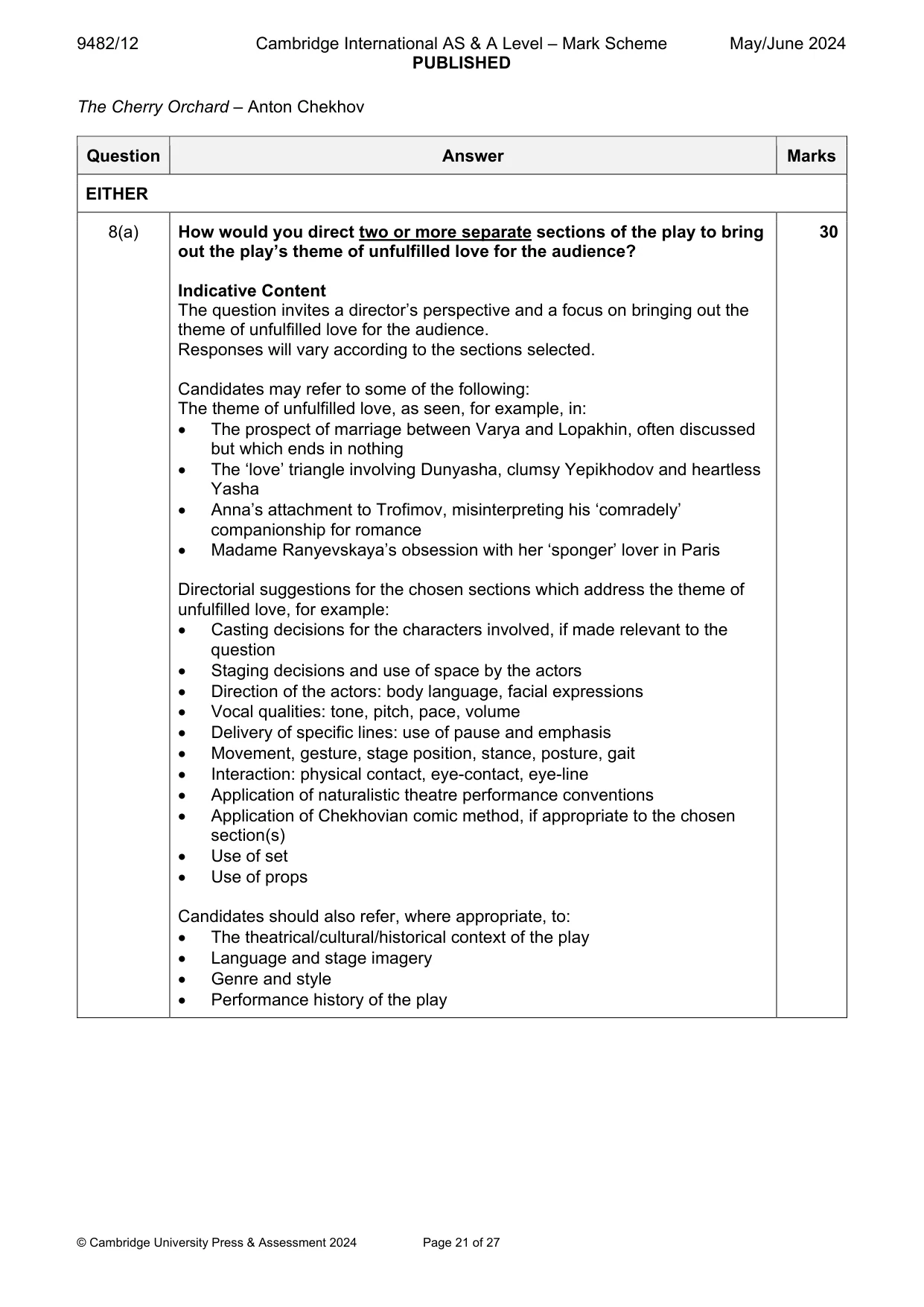
9482/12 Cambridge International AS & A Level – Mark Scheme PUBLISHED May/June 2024 © Cambridge University Press & Assessment 2024 Page 21 of 27 The Cherry Orchard – Anton Chekhov Question Answer Marks EITHER 8(a) How would you direct two or more separate sections of the play to bring out the play’s theme of unfulfilled love for the audience? Indicative Content The question invites a director’s perspective and a focus on bringing out the theme of unfulfilled love for the audience. Responses will vary according to the sections selected. Candidates may refer to some of the following: The theme of unfulfilled love, as seen, for example, in: The prospect of marriage between Varya and Lopakhin, often discussed but which ends in nothing The ‘love’ triangle involving Dunyasha, clumsy Yepikhodov and heartless Yasha Anna’s attachment to Trofimov, misinterpreting his ‘comradely’ companionship for romance Madame Ranyevskaya’s obsession with her ‘sponger’ lover in Paris Directorial suggestions for the chosen sections which address the theme of unfulfilled love, for example: Casting decisions for the characters involved, if made relevant to the question Staging decisions and use of space by the actors Direction of the actors: body language, facial expressions Vocal qualities: tone, pitch, pace, volume Delivery of specific lines: use of pause and emphasis Movement, gesture, stage position, stance, posture, gait Interaction: physical contact, eye-contact, eye-line Application of naturalistic theatre performance conventions Application of Chekhovian comic method, if appropriate to the chosen section(s) Use of set Use of props Candidates should also refer, where appropriate, to: The theatrical/cultural/historical context of the play Language and stage imagery Genre and style Performance history of the play 30
Mark scheme, page 22
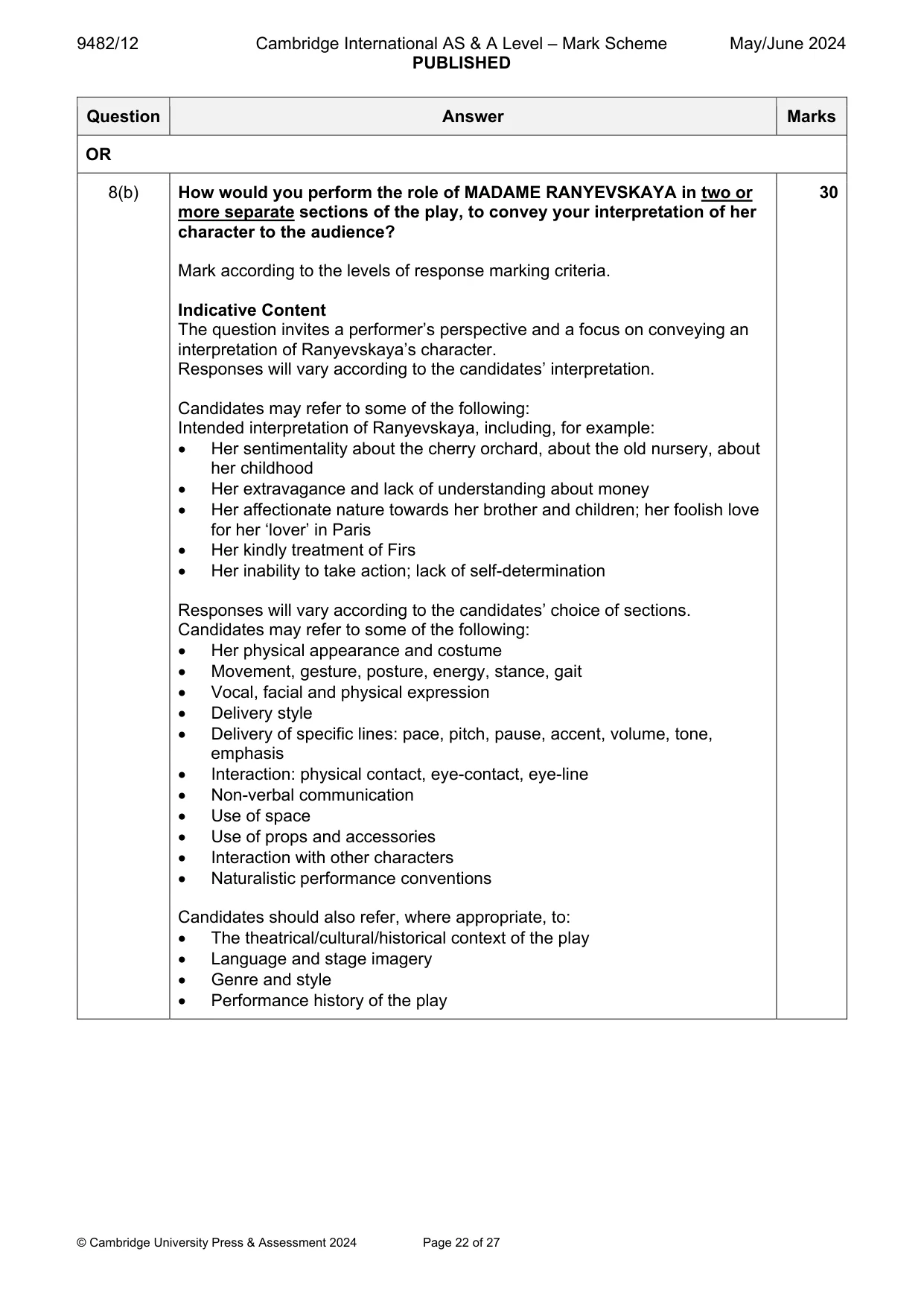
9482/12 Cambridge International AS & A Level – Mark Scheme PUBLISHED May/June 2024 © Cambridge University Press & Assessment 2024 Page 22 of 27 Question Answer Marks OR 8(b) How would you perform the role of MADAME RANYEVSKAYA in two or more separate sections of the play, to convey your interpretation of her character to the audience? Mark according to the levels of response marking criteria. Indicative Content The question invites a performer’s perspective and a focus on conveying an interpretation of Ranyevskaya’s character. Responses will vary according to the candidates’ interpretation. Candidates may refer to some of the following: Intended interpretation of Ranyevskaya, including, for example: Her sentimentality about the cherry orchard, about the old nursery, about her childhood Her extravagance and lack of understanding about money Her affectionate nature towards her brother and children; her foolish love for her ‘lover’ in Paris Her kindly treatment of Firs Her inability to take action; lack of self-determination Responses will vary according to the candidates’ choice of sections. Candidates may refer to some of the following: Her physical appearance and costume Movement, gesture, posture, energy, stance, gait Vocal, facial and physical expression Delivery style Delivery of specific lines: pace, pitch, pause, accent, volume, tone, emphasis Interaction: physical contact, eye-contact, eye-line Non-verbal communication Use of space Use of props and accessories Interaction with other characters Naturalistic performance conventions Candidates should also refer, where appropriate, to: The theatrical/cultural/historical context of the play Language and stage imagery Genre and style Performance history of the play 30
Mark scheme, page 23
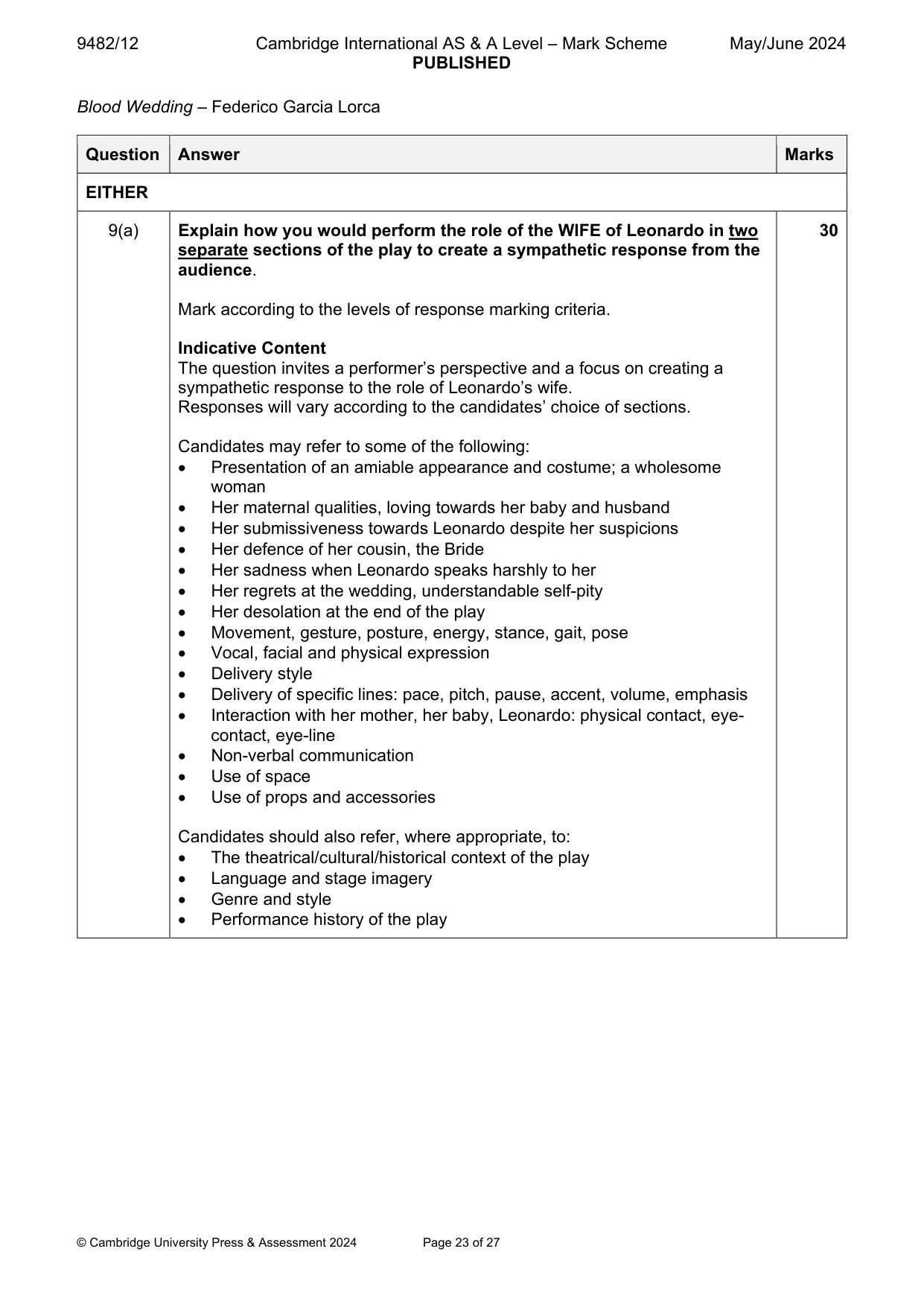
9482/12 Cambridge International AS & A Level – Mark Scheme PUBLISHED May/June 2024 © Cambridge University Press & Assessment 2024 Page 23 of 27 Blood Wedding – Federico Garcia Lorca Question Answer Marks EITHER 9(a) Explain how you would perform the role of the WIFE of Leonardo in two separate sections of the play to create a sympathetic response from the audience. Mark according to the levels of response marking criteria. Indicative Content The question invites a performer’s perspective and a focus on creating a sympathetic response to the role of Leonardo’s wife. Responses will vary according to the candidates’ choice of sections. Candidates may refer to some of the following: Presentation of an amiable appearance and costume; a wholesome woman Her maternal qualities, loving towards her baby and husband Her submissiveness towards Leonardo despite her suspicions Her defence of her cousin, the Bride Her sadness when Leonardo speaks harshly to her Her regrets at the wedding, understandable self-pity Her desolation at the end of the play Movement, gesture, posture, energy, stance, gait, pose Vocal, facial and physical expression Delivery style Delivery of specific lines: pace, pitch, pause, accent, volume, emphasis Interaction with her mother, her baby, Leonardo: physical contact, eye- contact, eye-line Non-verbal communication Use of space Use of props and accessories Candidates should also refer, where appropriate, to: The theatrical/cultural/historical context of the play Language and stage imagery Genre and style Performance history of the play 30
Mark scheme, page 24
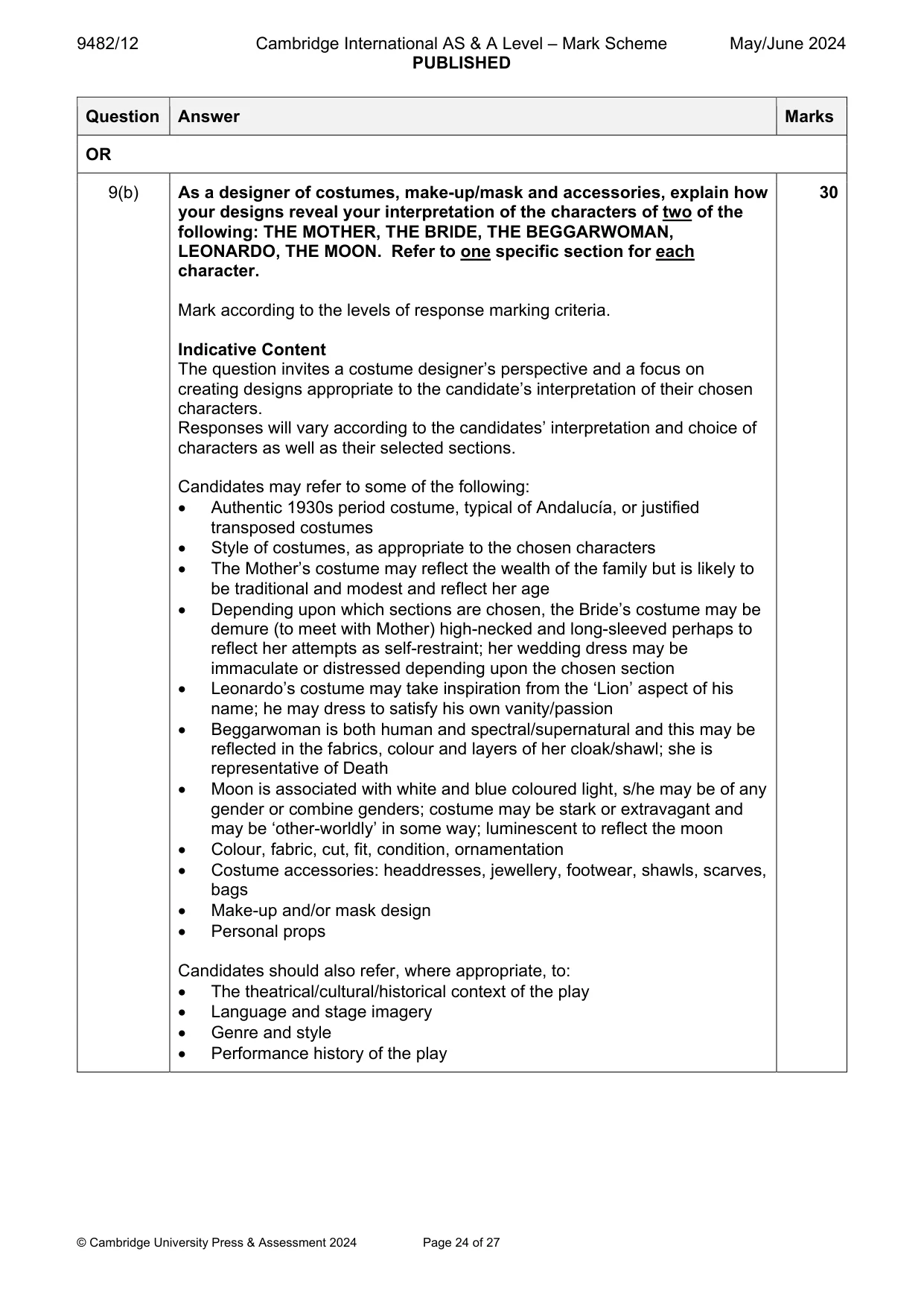
9482/12 Cambridge International AS & A Level – Mark Scheme PUBLISHED May/June 2024 © Cambridge University Press & Assessment 2024 Page 24 of 27 Question Answer Marks OR 9(b) As a designer of costumes, make-up/mask and accessories, explain how your designs reveal your interpretation of the characters of two of the following: THE MOTHER, THE BRIDE, THE BEGGARWOMAN, LEONARDO, THE MOON. Refer to one specific section for each character. Mark according to the levels of response marking criteria. Indicative Content The question invites a costume designer’s perspective and a focus on creating designs appropriate to the candidate’s interpretation of their chosen characters. Responses will vary according to the candidates’ interpretation and choice of characters as well as their selected sections. Candidates may refer to some of the following: Authentic 1930s period costume, typical of Andalucía, or justified transposed costumes Style of costumes, as appropriate to the chosen characters The Mother’s costume may reflect the wealth of the family but is likely to be traditional and modest and reflect her age Depending upon which sections are chosen, the Bride’s costume may be demure (to meet with Mother) high-necked and long-sleeved perhaps to reflect her attempts as self-restraint; her wedding dress may be immaculate or distressed depending upon the chosen section Leonardo’s costume may take inspiration from the ‘Lion’ aspect of his name; he may dress to satisfy his own vanity/passion Beggarwoman is both human and spectral/supernatural and this may be reflected in the fabrics, colour and layers of her cloak/shawl; she is representative of Death Moon is associated with white and blue coloured light, s/he may be of any gender or combine genders; costume may be stark or extravagant and may be ‘other-worldly’ in some way; luminescent to reflect the moon Colour, fabric, cut, fit, condition, ornamentation Costume accessories: headdresses, jewellery, footwear, shawls, scarves, bags Make-up and/or mask design Personal props Candidates should also refer, where appropriate, to: The theatrical/cultural/historical context of the play Language and stage imagery Genre and style Performance history of the play 30
Mark scheme, page 25
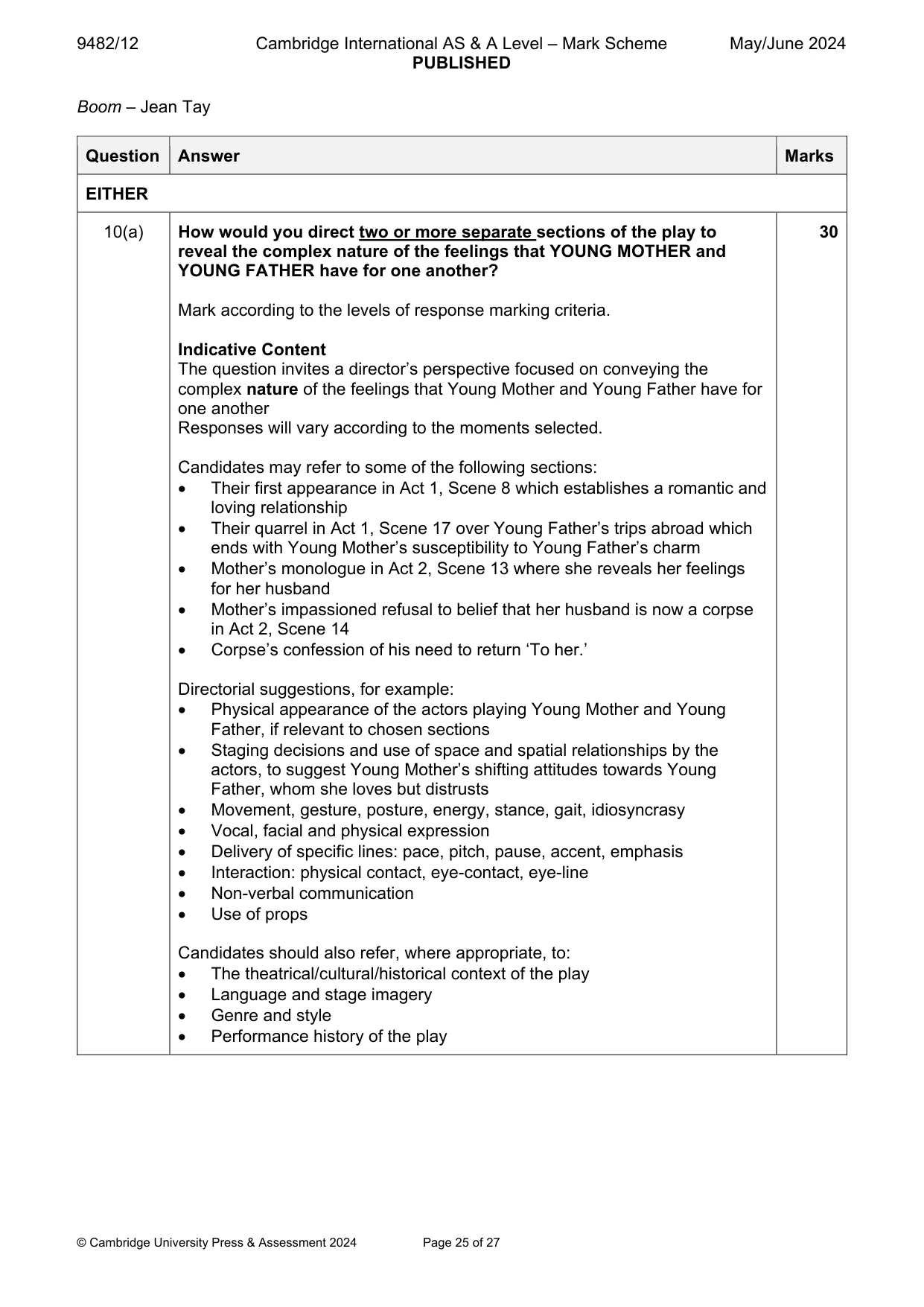
9482/12 Cambridge International AS & A Level – Mark Scheme PUBLISHED May/June 2024 © Cambridge University Press & Assessment 2024 Page 25 of 27 Boom – Jean Tay Question Answer Marks EITHER 10(a) How would you direct two or more separate sections of the play to reveal the complex nature of the feelings that YOUNG MOTHER and YOUNG FATHER have for one another? Mark according to the levels of response marking criteria. Indicative Content The question invites a director’s perspective focused on conveying the complex nature of the feelings that Young Mother and Young Father have for one another Responses will vary according to the moments selected. Candidates may refer to some of the following sections: Their first appearance in Act 1, Scene 8 which establishes a romantic and loving relationship Their quarrel in Act 1, Scene 17 over Young Father’s trips abroad which ends with Young Mother’s susceptibility to Young Father’s charm Mother’s monologue in Act 2, Scene 13 where she reveals her feelings for her husband Mother’s impassioned refusal to belief that her husband is now a corpse in Act 2, Scene 14 Corpse’s confession of his need to return ‘To her.’ Directorial suggestions, for example: Physical appearance of the actors playing Young Mother and Young Father, if relevant to chosen sections Staging decisions and use of space and spatial relationships by the actors, to suggest Young Mother’s shifting attitudes towards Young Father, whom she loves but distrusts Movement, gesture, posture, energy, stance, gait, idiosyncrasy Vocal, facial and physical expression Delivery of specific lines: pace, pitch, pause, accent, emphasis Interaction: physical contact, eye-contact, eye-line Non-verbal communication Use of props Candidates should also refer, where appropriate, to: The theatrical/cultural/historical context of the play Language and stage imagery Genre and style Performance history of the play 30
Mark scheme, page 26
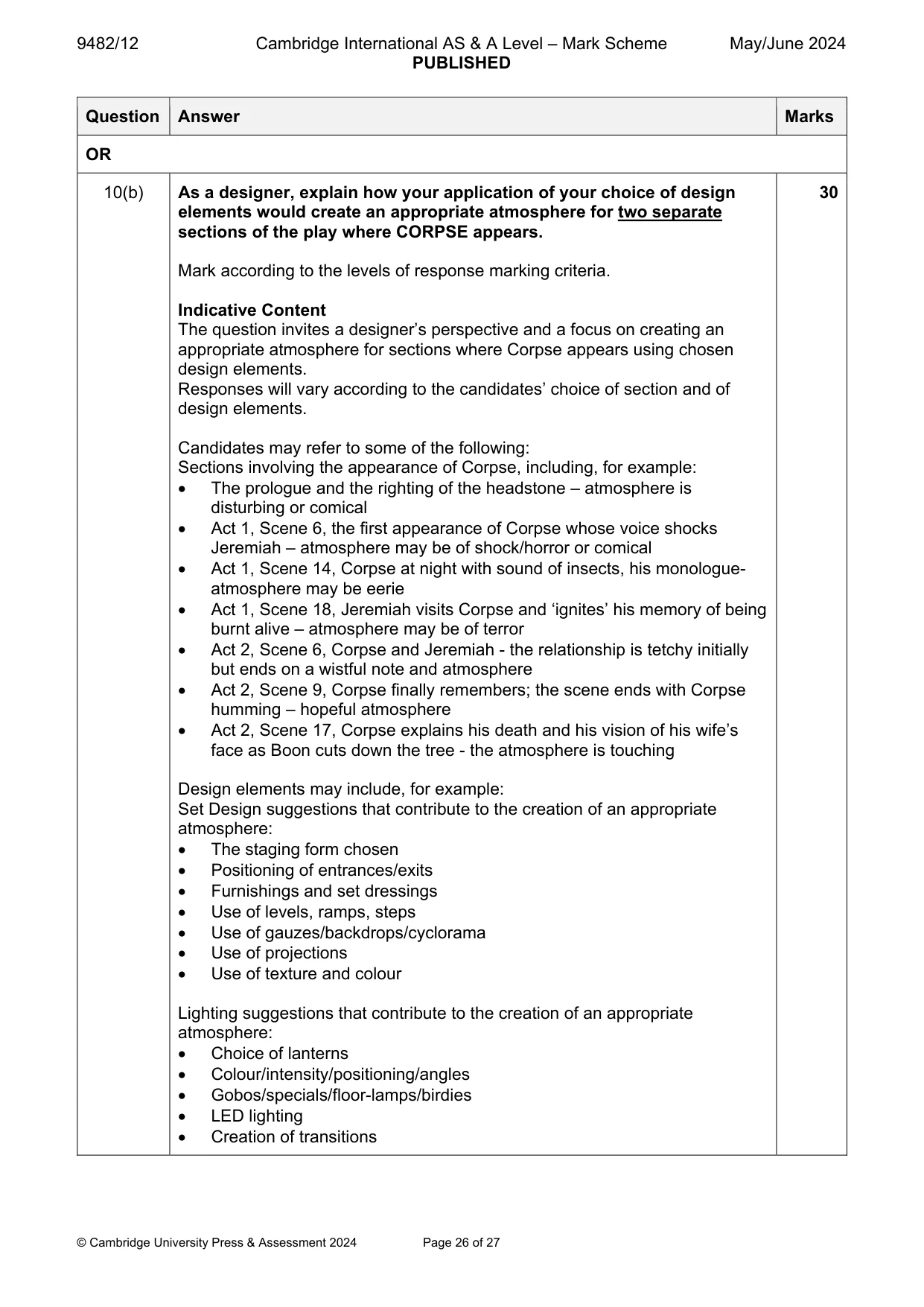
9482/12 Cambridge International AS & A Level – Mark Scheme PUBLISHED May/June 2024 © Cambridge University Press & Assessment 2024 Page 26 of 27 Question Answer Marks OR 10(b) As a designer, explain how your application of your choice of design elements would create an appropriate atmosphere for two separate sections of the play where CORPSE appears. Mark according to the levels of response marking criteria. Indicative Content The question invites a designer’s perspective and a focus on creating an appropriate atmosphere for sections where Corpse appears using chosen design elements. Responses will vary according to the candidates’ choice of section and of design elements. Candidates may refer to some of the following: Sections involving the appearance of Corpse, including, for example: The prologue and the righting of the headstone – atmosphere is disturbing or comical Act 1, Scene 6, the first appearance of Corpse whose voice shocks Jeremiah – atmosphere may be of shock/horror or comical Act 1, Scene 14, Corpse at night with sound of insects, his monologue- atmosphere may be eerie Act 1, Scene 18, Jeremiah visits Corpse and ‘ignites’ his memory of being burnt alive – atmosphere may be of terror Act 2, Scene 6, Corpse and Jeremiah - the relationship is tetchy initially but ends on a wistful note and atmosphere Act 2, Scene 9, Corpse finally remembers; the scene ends with Corpse humming – hopeful atmosphere Act 2, Scene 17, Corpse explains his death and his vision of his wife’s face as Boon cuts down the tree - the atmosphere is touching Design elements may include, for example: Set Design suggestions that contribute to the creation of an appropriate atmosphere: The staging form chosen Positioning of entrances/exits Furnishings and set dressings Use of levels, ramps, steps Use of gauzes/backdrops/cyclorama Use of projections Use of texture and colour Lighting suggestions that contribute to the creation of an appropriate atmosphere: Choice of lanterns Colour/intensity/positioning/angles Gobos/specials/floor-lamps/birdies LED lighting Creation of transitions 30
Mark scheme, page 27
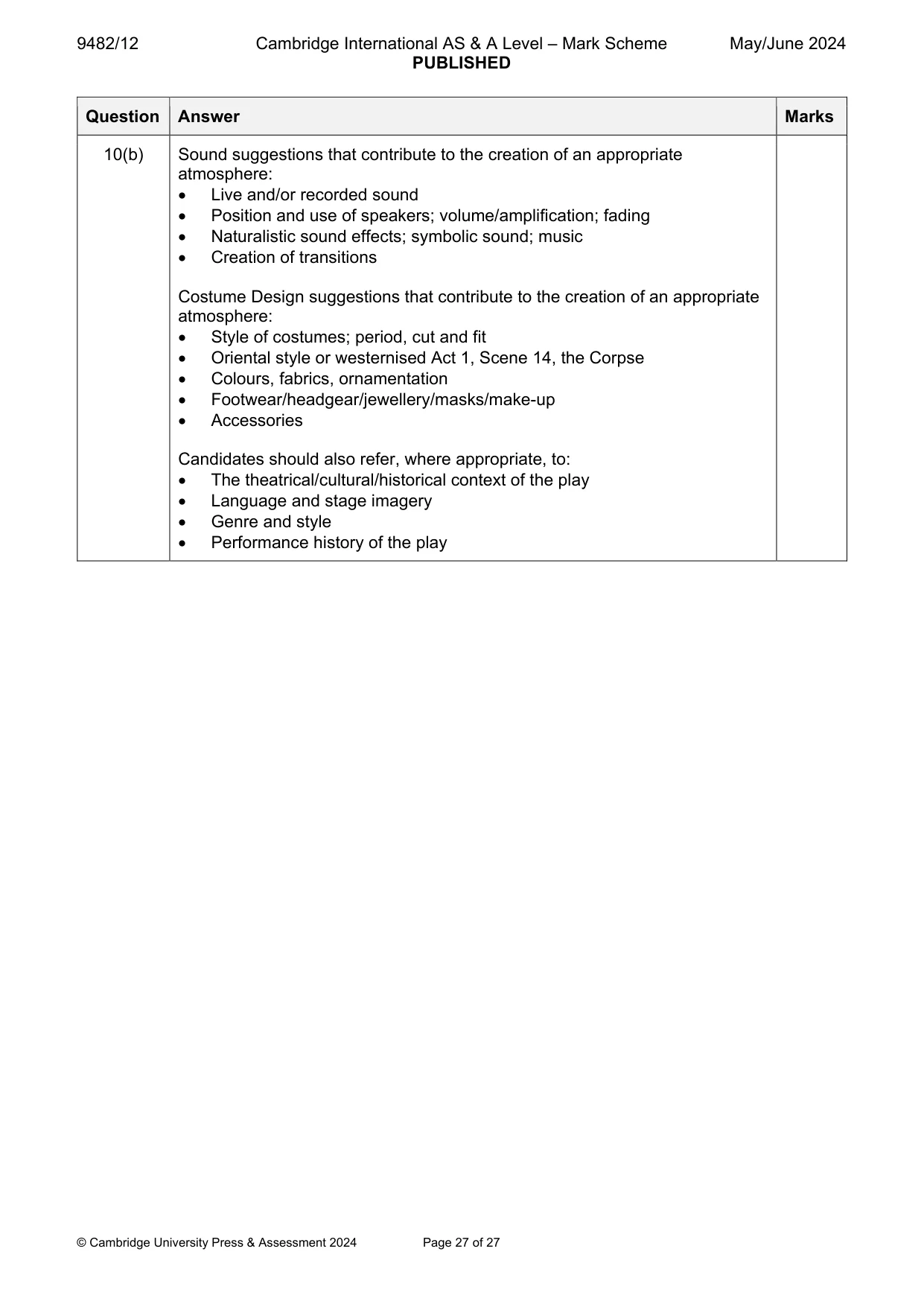
9482/12 Cambridge International AS & A Level – Mark Scheme PUBLISHED May/June 2024 © Cambridge University Press & Assessment 2024 Page 27 of 27 Question Answer Marks 10(b) Sound suggestions that contribute to the creation of an appropriate atmosphere: Live and/or recorded sound Position and use of speakers; volume/amplification; fading Naturalistic sound effects; symbolic sound; music Creation of transitions Costume Design suggestions that contribute to the creation of an appropriate atmosphere: Style of costumes; period, cut and fit Oriental style or westernised Act 1, Scene 14, the Corpse Colours, fabrics, ornamentation Footwear/headgear/jewellery/masks/make-up Accessories Candidates should also refer, where appropriate, to: The theatrical/cultural/historical context of the play Language and stage imagery Genre and style Performance history of the play
What you needed in this session
Cambridge’s own grade thresholds for 2024 May/June, Paper 1 · Variant 2. A higher threshold means an easier paper — the bar moves with how the cohort did.