Cambridge A Level Drama 9482 — 2023 Oct/Nov Paper 1 · Variant 2
9482/12/O/N/23 · 60 marks · ≈68 min
The question paper and its mark scheme, free to read here and free to download. This is Cambridge’s own paper, exactly as it was sat.
Question paper8 pages


Mark scheme28 pages
Answers below. Sit the paper first if you are practising.
Paper as text
Question paper, page 1
This document has 8 pages. Any blank pages are indicated. [Turn over Cambridge International AS & A Level DC (CE) 316847/1 © UCLES 2023 DRAMA 9482/12 Paper 1 October/November 2023 2 hours You must answer on the enclosed answer booklet. You will need: Answer booklet (enclosed) Candidates may take their set texts into the exam room, but these must not contain personal annotations, highlighting or underlining. INSTRUCTIONS ● Answer two questions in total: Section A: answer one question. Section B: answer one question. ● Follow the instructions on the front cover of the answer booklet. If you need additional answer paper, ask the invigilator for a continuation booklet. ● You may take your set texts into the exam room, but these must not contain personal annotations, highlighting or underlining. ● You may support your answers with sketches and diagrams, where appropriate. INFORMATION ● The total mark for this paper is 60. ● The number of marks for each question or part question is shown in brackets [ ]. * 3 7 6 8 1 0 5 5 5 5 *
Question paper, page 2
2 9482/12/O/N/23 © UCLES 2023 Section A Answer one question from this section. You should read the specified extract for your chosen text carefully before beginning your answer. Question 1 The Tempest – William Shakespeare Read the specified extract: From: Act 1, Scene 2, top of page 9 PROSPERO: Approach, my Ariel come. Up to and including: Act 1, Scene 2, towards the bottom of page 12 PROSPERO: … hence with diligence! [Exit ARIEL] EITHER (a) How would you perform the role of ARIEL in selected moments from the extract to convey his supernatural qualities? [30] OR (b) How would you direct selected moments from the extract to convey your interpretation of the relationship between PROSPERO and ARIEL? [30] Question 2 The Country Wife – William Wycherley Read the specified extract: From: Act 3, Scene 2, page 40 HORNER: How now, Pinchwife? Up to and including: Act 3, Scene 2, middle of page 42 HORNER: Did I not tell you I would raise his jealous gall? EITHER (a) How would you direct selected moments from the extract to create comedy from MARGERY’s unconvincing disguise? [30] OR (b) How would you perform the role of HORNER in selected moments from the extract to convey his mischievous enjoyment of tormenting PINCHWIFE? [30]
Question paper, page 3
3 9482/12/O/N/23 © UCLES 2023 [Turn over Question 3 Death of a Salesman – Arthur Miller Read the specified extract: From: Act 2, middle of page 86 [A single trumpet note jars the ear …] YOUNG BERNARD: [frantically] Mrs Loman, Mrs Loman! Up to and including: Act 2, towards the bottom of page 91 [They exit. Stanley looks towards the left.] EITHER (a) How would you perform the role of BIFF in selected moments from the extract to demonstrate his increasing sense of helplessness at the unfolding situation? [30] OR (b) How would you direct selected moments from the extract to convey the atmosphere of spiralling crisis as WILLY loses his grip on reality? [30] Question 4 The Lion and the Jewel – Wole Soyinka Read the specified extract: From: ‘Night’ towards the bottom of page 49 BAROKA: To think that once I thought, Sidi is the eye’s delight … Up to and including: towards the end of page 54 BAROKA: … [Sidi’s head falls slowly on the Bale’s shoulder. The Bale remains in his final body-weighted-down-by-burdens-of-state attitude …] EITHER (a) How would you perform the role of SIDI in selected moments from the extract to convey her changing attitude towards BAROKA as she falls under his ‘spell’? [30] OR (b) How would you direct selected moments from the extract to highlight the contrast between the age and experience of the powerful BALE and the youth and inexperience of the vulnerable SIDI? [30]
Question paper, page 4
4 9482/12/O/N/23 © UCLES 2023 Question 5 Enron – Lucy Prebble Read the specified extract: From: opening of Act 3, Scene 2, page 96 CIRCLE OF BLAME [Detritus litters the stage. Order must be restored. Trials/hearings.] SENATOR: These hearings are an attempt to investigate America’s largest corporate bankruptcy. Up to and including: end of Scene 3, page 102 COURT OFFICER: Jeffrey Skilling you have been found guilty of nineteen separate counts of securities fraud, wire fraud and insider trading. EITHER (a) How would you perform the role of ANDY FASTOW in selected moments from the extract to achieve your intended audience response? [30] OR (b) How would you direct selected moments from the extract to highlight the defendants’ differing attitudes towards their role in the collapse of Enron? You should refer to two or more of the following: LAY, FASTOW, RAMSAY & HEWITT, ARTHUR ANDERSEN, SKILLING. [30]
Question paper, page 5
5 9482/12/O/N/23 © UCLES 2023 [Turn over Section B Answer one question from this section. Question 6 Medea – Euripides EITHER (a) How would you direct the interaction between MEDEA and JASON in two separate sections of the play to help the audience understand the nature of their troubled relationship? [30] OR (b) How would you use design elements of your choice to create dramatic impact in two separate sections? [30] Question 7 Tartuffe – Molière EITHER (a) How would you perform the role of VALÈRE in two separate sections of the play to convey your interpretation of his character? [30] OR (b) As a designer, explain how your designs for set and/or costumes would contribute to the creation of comedy in two separate sections of the play. [30] Question 8 The Seagull – Anton Chekhov EITHER (a) How would you use one or more design elements to create an appropriate atmosphere for the unfolding action in two separate sections of the play? [30] OR (b) How would you perform the role of KONSTANTIN in two or more separate sections to convey his increasing unhappiness in the course of the play? [30]
Question paper, page 6
6 9482/12/O/N/23 © UCLES 2023 Question 9 The Curious Incident of the Dog in the Night-Time – Simon Stephens EITHER (a) How would you direct two sections where JUDY and ROGER appear together to reveal the nature of their relationship? [30] OR (b) How would you perform the role of MRS ALEXANDER in two separate sections of the play to convey her genuine concern for CHRISTOPHER? [30] Question 10 Snow in Midsummer – Frances Ya-Chu Cowhig EITHER (a) How would you perform the role of HANDSOME in two or more sections to convey the development of his character over the course of the play? [30] OR (b) Explain how your combination of two or more design elements would enhance the dramatic effectiveness of two sections of the play involving DOU YI. [30]
Question paper, page 7
7 9482/12/O/N/23 © UCLES 2023 BLANK PAGE
Question paper, page 8
8 9482/12/O/N/23 © UCLES 2023 Permission to reproduce items where third-party owned material protected by copyright is included has been sought and cleared where possible. Every reasonable effort has been made by the publisher (UCLES) to trace copyright holders, but if any items requiring clearance have unwittingly been included, the publisher will be pleased to make amends at the earliest possible opportunity. To avoid the issue of disclosure of answer-related information to candidates, all copyright acknowledgements are reproduced online in the Cambridge Assessment International Education Copyright Acknowledgements Booklet. This is produced for each series of examinations and is freely available to download at www.cambridgeinternational.org after the live examination series. Cambridge Assessment International Education is part of Cambridge Assessment. Cambridge Assessment is the brand name of the University of Cambridge Local Examinations Syndicate (UCLES), which is a department of the University of Cambridge. BLANK PAGE
Mark scheme, page 1
This document consists of 28 printed pages. © UCLES 2023 [Turn over Cambridge International AS & A Level DRAMA 9482/12 Paper 1 Open-Book Written Examination October/November 2023 MARK SCHEME Maximum Mark: 60 Published This mark scheme is published as an aid to teachers and candidates, to indicate the requirements of the examination. It shows the basis on which Examiners were instructed to award marks. It does not indicate the details of the discussions that took place at an Examiners’ meeting before marking began, which would have considered the acceptability of alternative answers. Mark schemes should be read in conjunction with the question paper and the Principal Examiner Report for Teachers. Cambridge International will not enter into discussions about these mark schemes. Cambridge International is publishing the mark schemes for the October/November 2023 series for most Cambridge IGCSE, Cambridge International A and AS Level components, and some Cambridge O Level components.
Mark scheme, page 2
9482/12 Cambridge International AS & A Level – Mark Scheme PUBLISHED October/November 2023 © UCLES 2023 Page 2 of 28 Generic Marking Principles These general marking principles must be applied by all examiners when marking candidate answers. They should be applied alongside the specific content of the mark scheme or generic level descriptors for a question. Each question paper and mark scheme will also comply with these marking principles. GENERIC MARKING PRINCIPLE 1: Marks must be awarded in line with: • the specific content of the mark scheme or the generic level descriptors for the question • the specific skills defined in the mark scheme or in the generic level descriptors for the question • the standard of response required by a candidate as exemplified by the standardisation scripts. GENERIC MARKING PRINCIPLE 2: Marks awarded are always whole marks (not half marks, or other fractions). GENERIC MARKING PRINCIPLE 3: Marks must be awarded positively: • marks are awarded for correct/valid answers, as defined in the mark scheme. However, credit is given for valid answers which go beyond the scope of the syllabus and mark scheme, referring to your Team Leader as appropriate • marks are awarded when candidates clearly demonstrate what they know and can do • marks are not deducted for errors • marks are not deducted for omissions • answers should only be judged on the quality of spelling, punctuation and grammar when these features are specifically assessed by the question as indicated by the mark scheme. The meaning, however, should be unambiguous. GENERIC MARKING PRINCIPLE 4: Rules must be applied consistently, e.g. in situations where candidates have not followed instructions or in the application of generic level descriptors. GENERIC MARKING PRINCIPLE 5: Marks should be awarded using the full range of marks defined in the mark scheme for the question (however; the use of the full mark range may be limited according to the quality of the candidate responses seen). GENERIC MARKING PRINCIPLE 6: Marks awarded are based solely on the requirements as defined in the mark scheme. Marks should not be awarded with grade thresholds or grade descriptors in mind.
Mark scheme, page 3
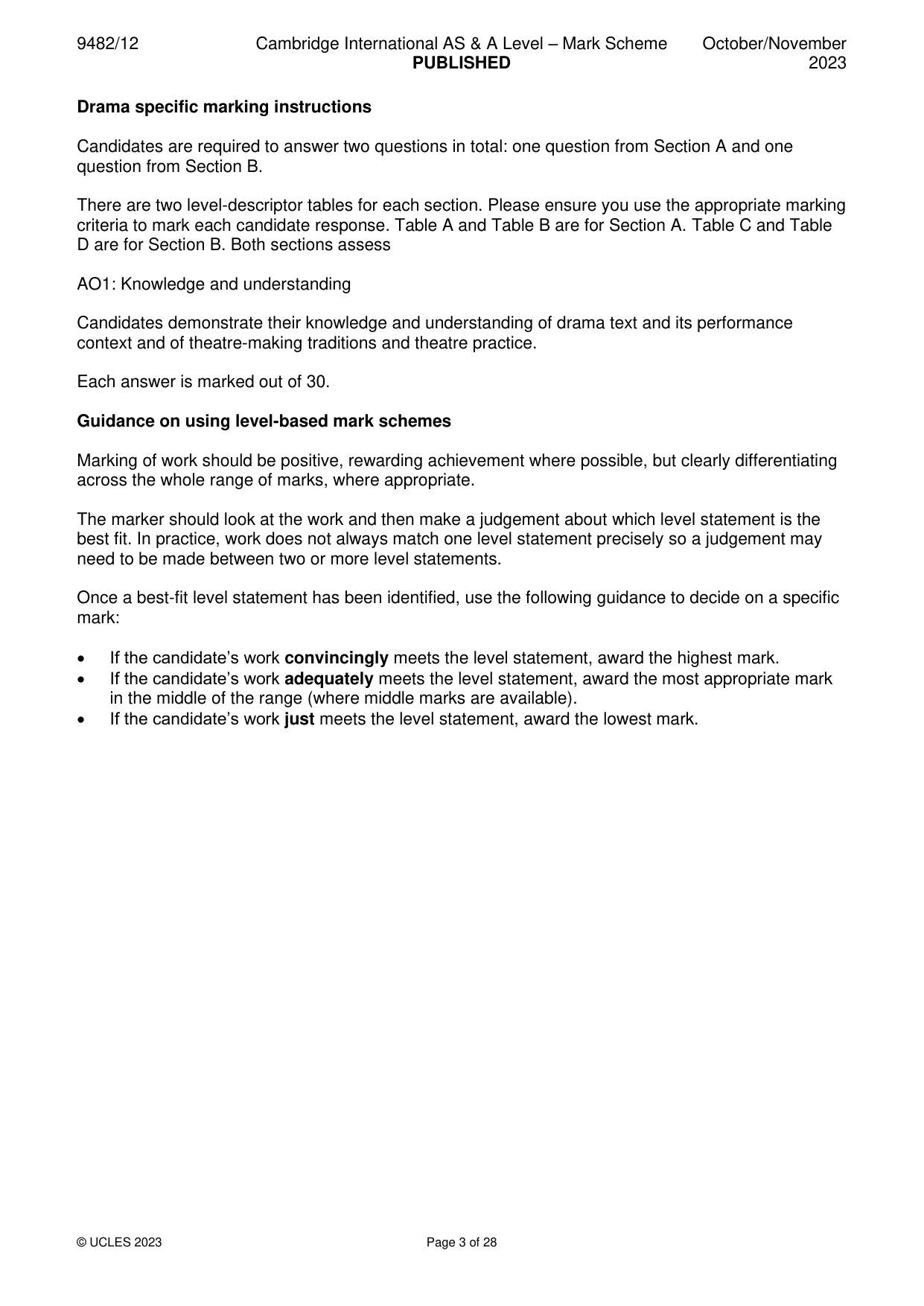
9482/12 Cambridge International AS & A Level – Mark Scheme PUBLISHED October/November 2023 © UCLES 2023 Page 3 of 28 Drama specific marking instructions Candidates are required to answer two questions in total: one question from Section A and one question from Section B. There are two level-descriptor tables for each section. Please ensure you use the appropriate marking criteria to mark each candidate response. Table A and Table B are for Section A. Table C and Table D are for Section B. Both sections assess AO1: Knowledge and understanding Candidates demonstrate their knowledge and understanding of drama text and its performance context and of theatre-making traditions and theatre practice. Each answer is marked out of 30. Guidance on using level-based mark schemes Marking of work should be positive, rewarding achievement where possible, but clearly differentiating across the whole range of marks, where appropriate. The marker should look at the work and then make a judgement about which level statement is the best fit. In practice, work does not always match one level statement precisely so a judgement may need to be made between two or more level statements. Once a best-fit level statement has been identified, use the following guidance to decide on a specific mark: • If the candidate’s work convincingly meets the level statement, award the highest mark. • If the candidate’s work adequately meets the level statement, award the most appropriate mark in the middle of the range (where middle marks are available). • If the candidate’s work just meets the level statement, award the lowest mark.
Mark scheme, page 4
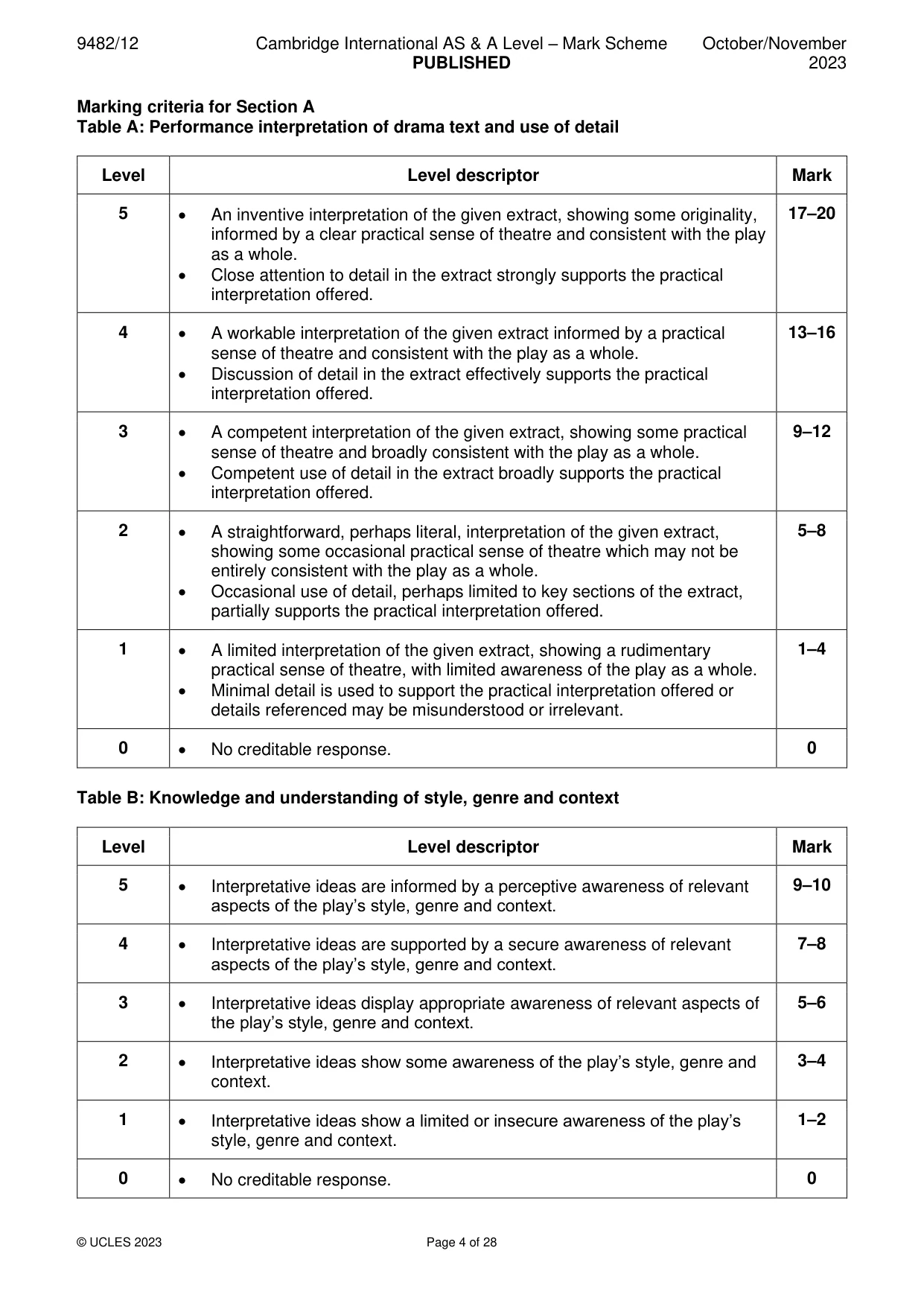
9482/12 Cambridge International AS & A Level – Mark Scheme PUBLISHED October/November 2023 © UCLES 2023 Page 4 of 28 Marking criteria for Section A Table A: Performance interpretation of drama text and use of detail Level Level descriptor Mark 5 • An inventive interpretation of the given extract, showing some originality, informed by a clear practical sense of theatre and consistent with the play as a whole. • Close attention to detail in the extract strongly supports the practical interpretation offered. 17–20 4 • A workable interpretation of the given extract informed by a practical sense of theatre and consistent with the play as a whole. • Discussion of detail in the extract effectively supports the practical interpretation offered. 13–16 3 • A competent interpretation of the given extract, showing some practical sense of theatre and broadly consistent with the play as a whole. • Competent use of detail in the extract broadly supports the practical interpretation offered. 9–12 2 • A straightforward, perhaps literal, interpretation of the given extract, showing some occasional practical sense of theatre which may not be entirely consistent with the play as a whole. • Occasional use of detail, perhaps limited to key sections of the extract, partially supports the practical interpretation offered. 5–8 1 • A limited interpretation of the given extract, showing a rudimentary practical sense of theatre, with limited awareness of the play as a whole. • Minimal detail is used to support the practical interpretation offered or details referenced may be misunderstood or irrelevant. 1–4 0 • No creditable response. 0 Table B: Knowledge and understanding of style, genre and context Level Level descriptor Mark 5 • Interpretative ideas are informed by a perceptive awareness of relevant aspects of the play’s style, genre and context. 9–10 4 • Interpretative ideas are supported by a secure awareness of relevant aspects of the play’s style, genre and context. 7–8 3 • Interpretative ideas display appropriate awareness of relevant aspects of the play’s style, genre and context. 5–6 2 • Interpretative ideas show some awareness of the play’s style, genre and context. 3–4 1 • Interpretative ideas show a limited or insecure awareness of the play’s style, genre and context. 1–2 0 • No creditable response. 0
Mark scheme, page 5
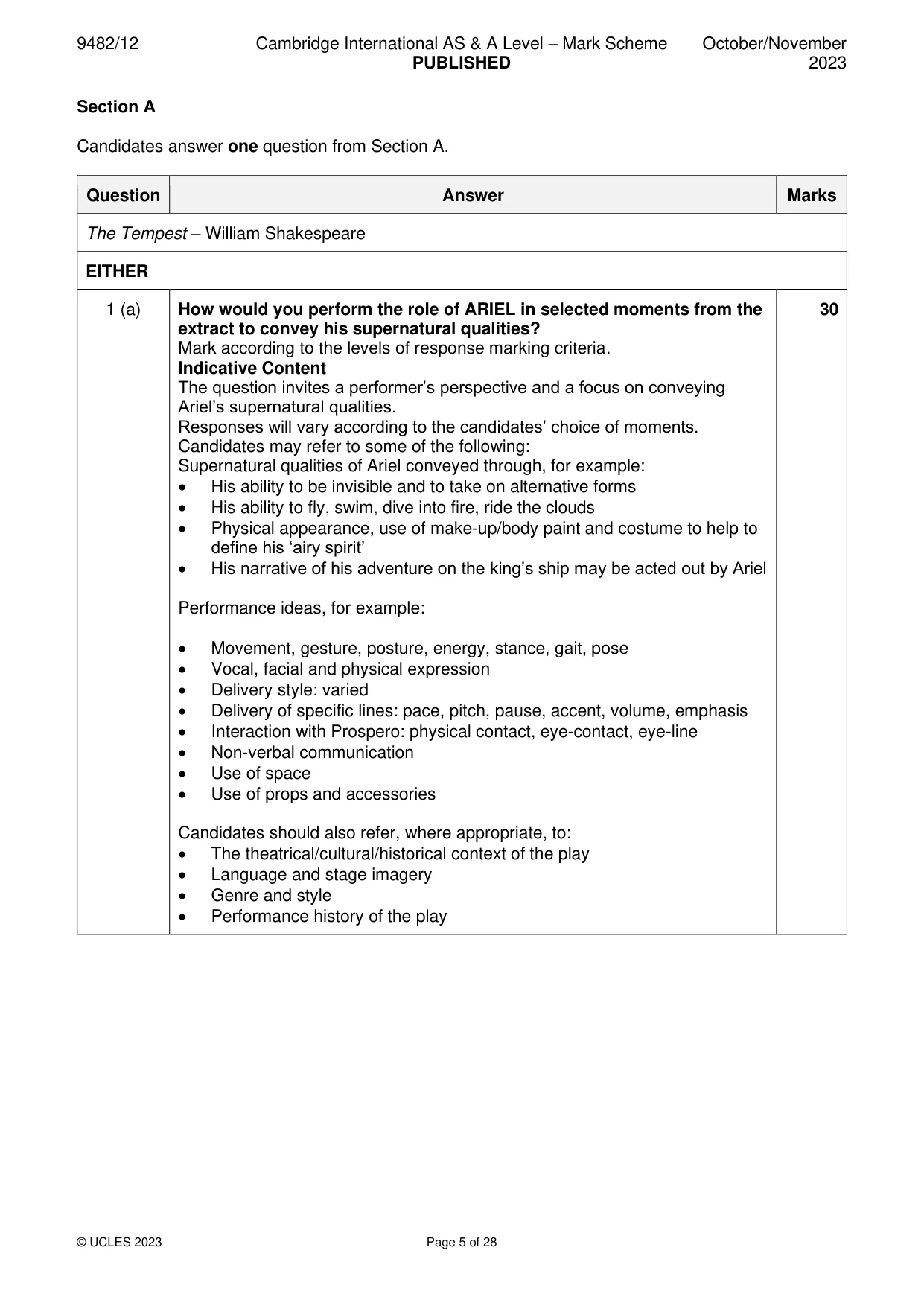
9482/12 Cambridge International AS & A Level – Mark Scheme PUBLISHED October/November 2023 © UCLES 2023 Page 5 of 28 Section A Candidates answer one question from Section A. Question Answer Marks The Tempest – William Shakespeare EITHER 1 (a) How would you perform the role of ARIEL in selected moments from the extract to convey his supernatural qualities? Mark according to the levels of response marking criteria. Indicative Content The question invites a performer’s perspective and a focus on conveying Ariel’s supernatural qualities. Responses will vary according to the candidates’ choice of moments. Candidates may refer to some of the following: Supernatural qualities of Ariel conveyed through, for example: • His ability to be invisible and to take on alternative forms • His ability to fly, swim, dive into fire, ride the clouds • Physical appearance, use of make-up/body paint and costume to help to define his ‘airy spirit’ • His narrative of his adventure on the king’s ship may be acted out by Ariel Performance ideas, for example: • Movement, gesture, posture, energy, stance, gait, pose • Vocal, facial and physical expression • Delivery style: varied • Delivery of specific lines: pace, pitch, pause, accent, volume, emphasis • Interaction with Prospero: physical contact, eye-contact, eye-line • Non-verbal communication • Use of space • Use of props and accessories Candidates should also refer, where appropriate, to: • The theatrical/cultural/historical context of the play • Language and stage imagery • Genre and style • Performance history of the play 30
Mark scheme, page 6
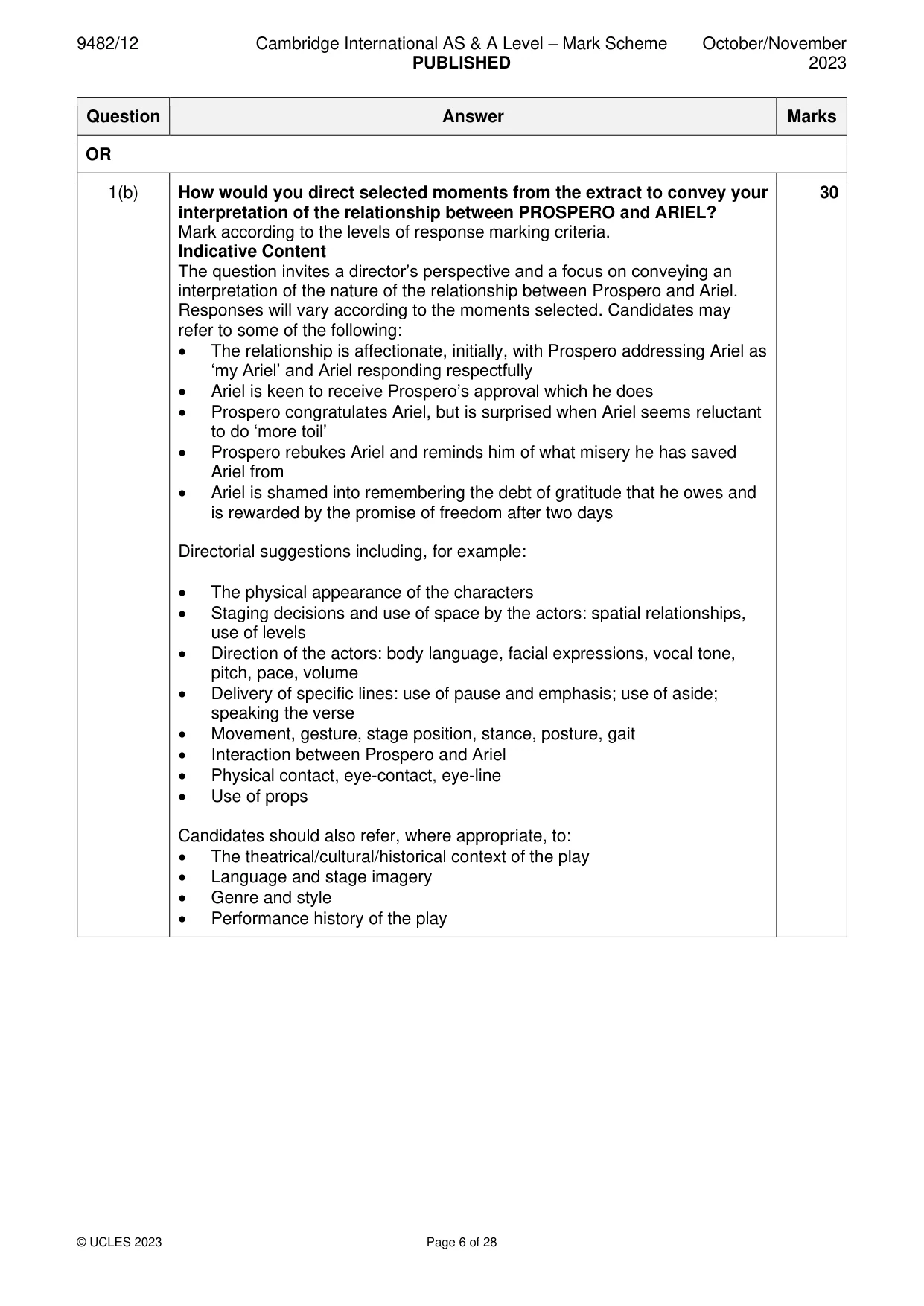
9482/12 Cambridge International AS & A Level – Mark Scheme PUBLISHED October/November 2023 © UCLES 2023 Page 6 of 28 Question Answer Marks OR 1(b) How would you direct selected moments from the extract to convey your interpretation of the relationship between PROSPERO and ARIEL? Mark according to the levels of response marking criteria. Indicative Content The question invites a director’s perspective and a focus on conveying an interpretation of the nature of the relationship between Prospero and Ariel. Responses will vary according to the moments selected. Candidates may refer to some of the following: • The relationship is affectionate, initially, with Prospero addressing Ariel as ‘my Ariel’ and Ariel responding respectfully • Ariel is keen to receive Prospero’s approval which he does • Prospero congratulates Ariel, but is surprised when Ariel seems reluctant to do ‘more toil’ • Prospero rebukes Ariel and reminds him of what misery he has saved Ariel from • Ariel is shamed into remembering the debt of gratitude that he owes and is rewarded by the promise of freedom after two days Directorial suggestions including, for example: • The physical appearance of the characters • Staging decisions and use of space by the actors: spatial relationships, use of levels • Direction of the actors: body language, facial expressions, vocal tone, pitch, pace, volume • Delivery of specific lines: use of pause and emphasis; use of aside; speaking the verse • Movement, gesture, stage position, stance, posture, gait • Interaction between Prospero and Ariel • Physical contact, eye-contact, eye-line • Use of props Candidates should also refer, where appropriate, to: • The theatrical/cultural/historical context of the play • Language and stage imagery • Genre and style • Performance history of the play 30
Mark scheme, page 7
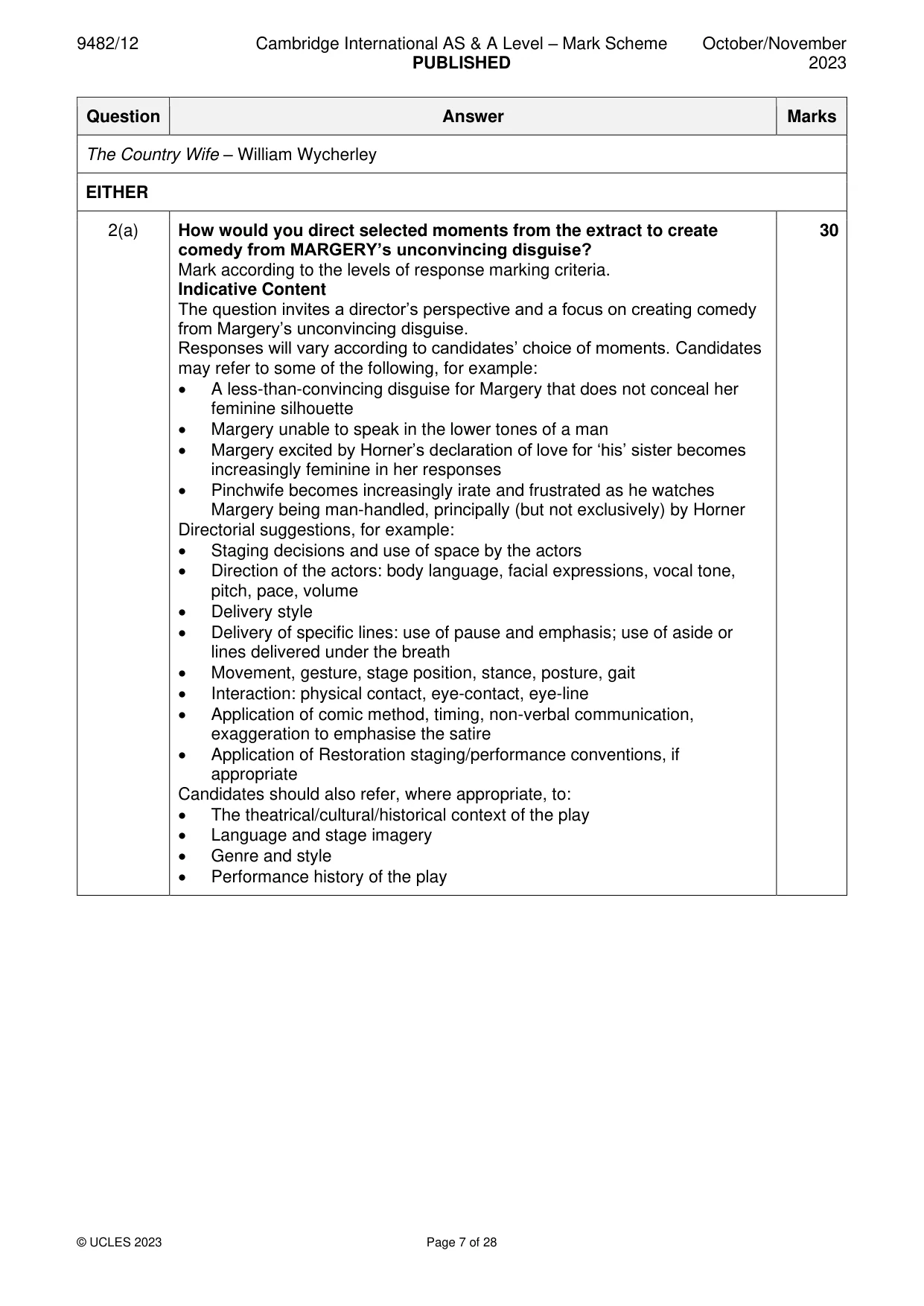
9482/12 Cambridge International AS & A Level – Mark Scheme PUBLISHED October/November 2023 © UCLES 2023 Page 7 of 28 Question Answer Marks The Country Wife – William Wycherley EITHER 2(a) How would you direct selected moments from the extract to create comedy from MARGERY’s unconvincing disguise? Mark according to the levels of response marking criteria. Indicative Content The question invites a director’s perspective and a focus on creating comedy from Margery’s unconvincing disguise. Responses will vary according to candidates’ choice of moments. Candidates may refer to some of the following, for example: • A less-than-convincing disguise for Margery that does not conceal her feminine silhouette • Margery unable to speak in the lower tones of a man • Margery excited by Horner’s declaration of love for ‘his’ sister becomes increasingly feminine in her responses • Pinchwife becomes increasingly irate and frustrated as he watches Margery being man-handled, principally (but not exclusively) by Horner Directorial suggestions, for example: • Staging decisions and use of space by the actors • Direction of the actors: body language, facial expressions, vocal tone, pitch, pace, volume • Delivery style • Delivery of specific lines: use of pause and emphasis; use of aside or lines delivered under the breath • Movement, gesture, stage position, stance, posture, gait • Interaction: physical contact, eye-contact, eye-line • Application of comic method, timing, non-verbal communication, exaggeration to emphasise the satire • Application of Restoration staging/performance conventions, if appropriate Candidates should also refer, where appropriate, to: • The theatrical/cultural/historical context of the play • Language and stage imagery • Genre and style • Performance history of the play 30
Mark scheme, page 8
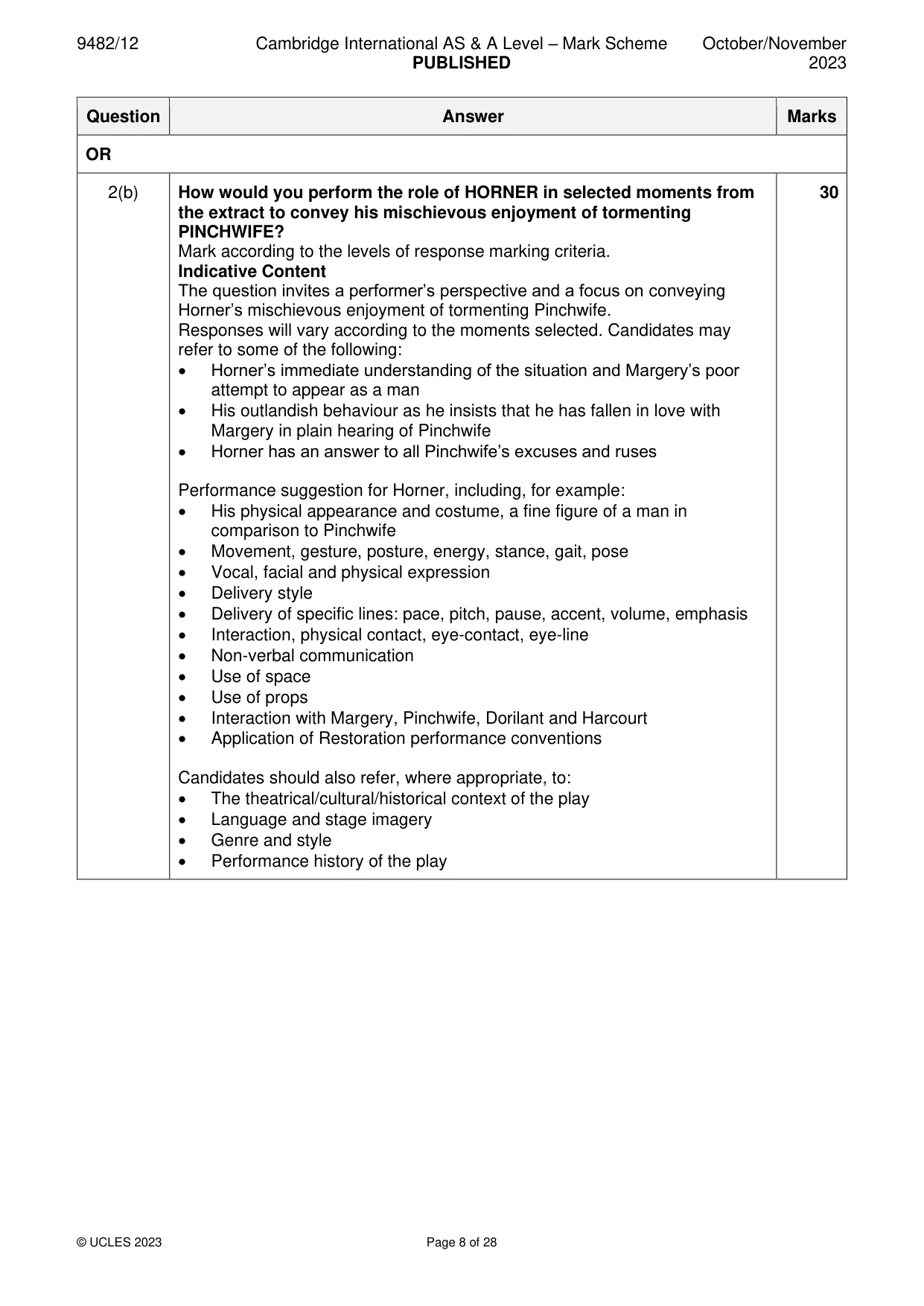
9482/12 Cambridge International AS & A Level – Mark Scheme PUBLISHED October/November 2023 © UCLES 2023 Page 8 of 28 Question Answer Marks OR 2(b) How would you perform the role of HORNER in selected moments from the extract to convey his mischievous enjoyment of tormenting PINCHWIFE? Mark according to the levels of response marking criteria. Indicative Content The question invites a performer’s perspective and a focus on conveying Horner’s mischievous enjoyment of tormenting Pinchwife. Responses will vary according to the moments selected. Candidates may refer to some of the following: • Horner’s immediate understanding of the situation and Margery’s poor attempt to appear as a man • His outlandish behaviour as he insists that he has fallen in love with Margery in plain hearing of Pinchwife • Horner has an answer to all Pinchwife’s excuses and ruses Performance suggestion for Horner, including, for example: • His physical appearance and costume, a fine figure of a man in comparison to Pinchwife • Movement, gesture, posture, energy, stance, gait, pose • Vocal, facial and physical expression • Delivery style • Delivery of specific lines: pace, pitch, pause, accent, volume, emphasis • Interaction, physical contact, eye-contact, eye-line • Non-verbal communication • Use of space • Use of props • Interaction with Margery, Pinchwife, Dorilant and Harcourt • Application of Restoration performance conventions Candidates should also refer, where appropriate, to: • The theatrical/cultural/historical context of the play • Language and stage imagery • Genre and style • Performance history of the play 30
Mark scheme, page 9
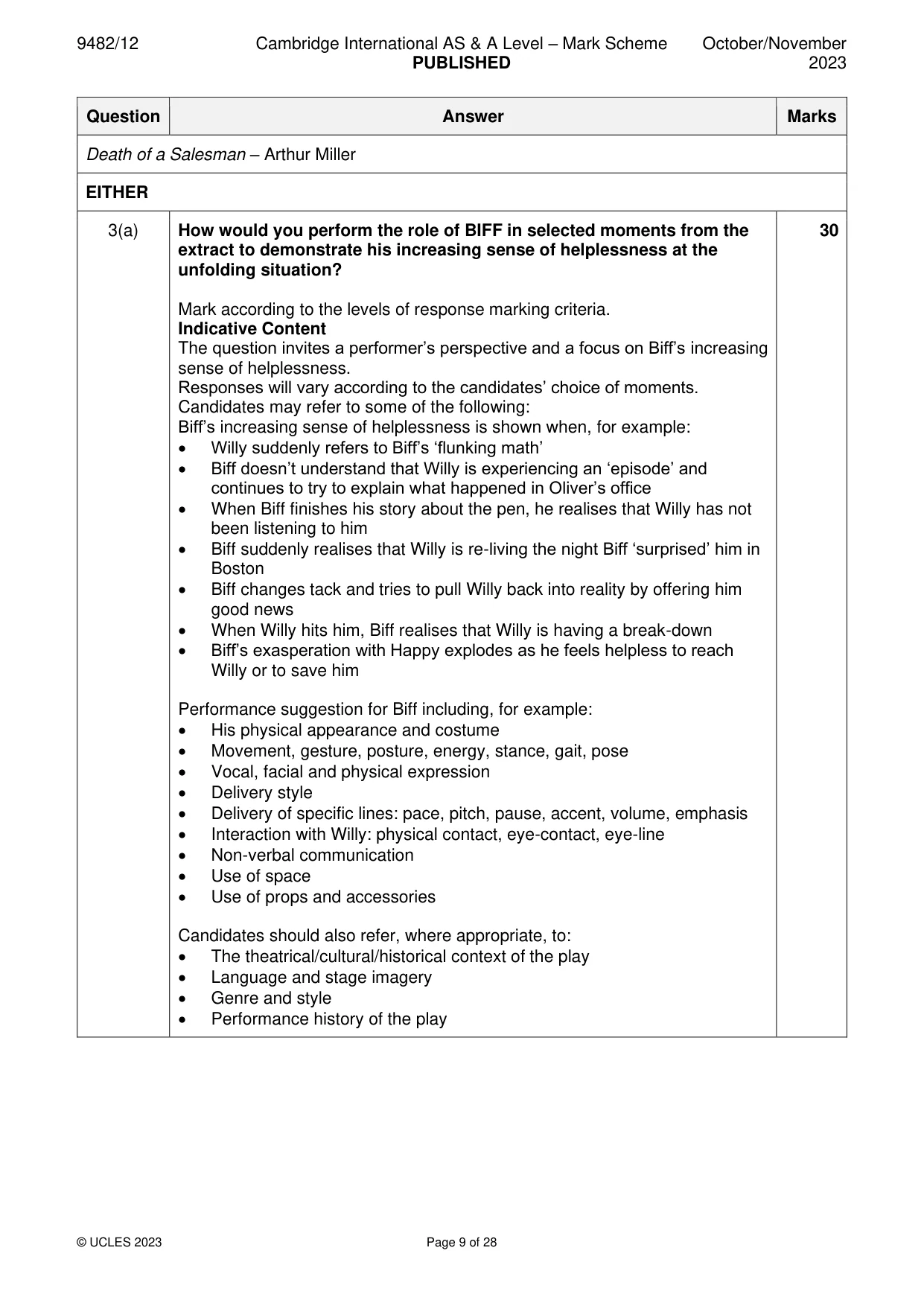
9482/12 Cambridge International AS & A Level – Mark Scheme PUBLISHED October/November 2023 © UCLES 2023 Page 9 of 28 Question Answer Marks Death of a Salesman – Arthur Miller EITHER 3(a) How would you perform the role of BIFF in selected moments from the extract to demonstrate his increasing sense of helplessness at the unfolding situation? Mark according to the levels of response marking criteria. Indicative Content The question invites a performer’s perspective and a focus on Biff’s increasing sense of helplessness. Responses will vary according to the candidates’ choice of moments. Candidates may refer to some of the following: Biff’s increasing sense of helplessness is shown when, for example: • Willy suddenly refers to Biff’s ‘flunking math’ • Biff doesn’t understand that Willy is experiencing an ‘episode’ and continues to try to explain what happened in Oliver’s office • When Biff finishes his story about the pen, he realises that Willy has not been listening to him • Biff suddenly realises that Willy is re-living the night Biff ‘surprised’ him in Boston • Biff changes tack and tries to pull Willy back into reality by offering him good news • When Willy hits him, Biff realises that Willy is having a break-down • Biff’s exasperation with Happy explodes as he feels helpless to reach Willy or to save him Performance suggestion for Biff including, for example: • His physical appearance and costume • Movement, gesture, posture, energy, stance, gait, pose • Vocal, facial and physical expression • Delivery style • Delivery of specific lines: pace, pitch, pause, accent, volume, emphasis • Interaction with Willy: physical contact, eye-contact, eye-line • Non-verbal communication • Use of space • Use of props and accessories Candidates should also refer, where appropriate, to: • The theatrical/cultural/historical context of the play • Language and stage imagery • Genre and style • Performance history of the play 30
Mark scheme, page 10
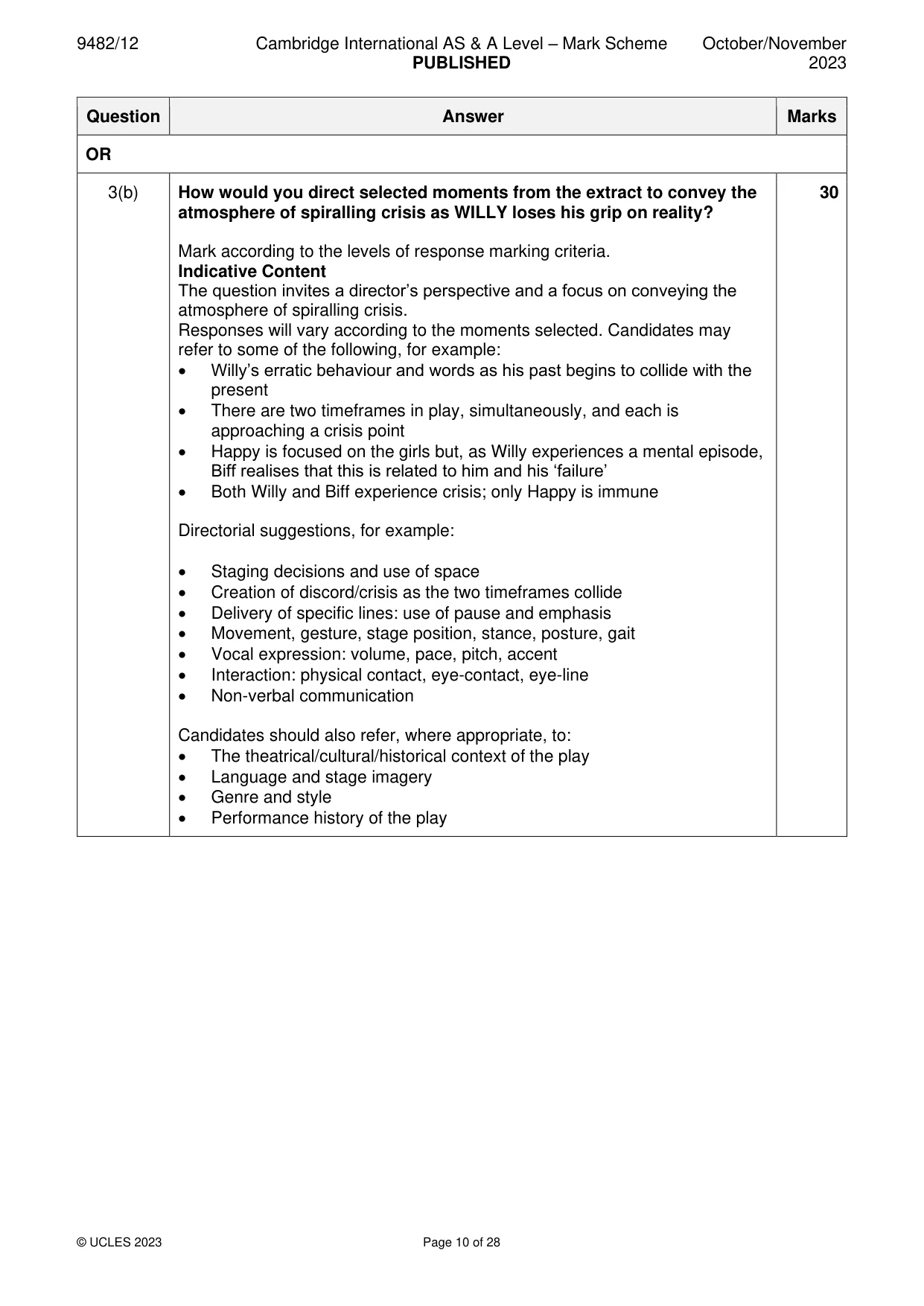
9482/12 Cambridge International AS & A Level – Mark Scheme PUBLISHED October/November 2023 © UCLES 2023 Page 10 of 28 Question Answer Marks OR 3(b) How would you direct selected moments from the extract to convey the atmosphere of spiralling crisis as WILLY loses his grip on reality? Mark according to the levels of response marking criteria. Indicative Content The question invites a director’s perspective and a focus on conveying the atmosphere of spiralling crisis. Responses will vary according to the moments selected. Candidates may refer to some of the following, for example: • Willy’s erratic behaviour and words as his past begins to collide with the present • There are two timeframes in play, simultaneously, and each is approaching a crisis point • Happy is focused on the girls but, as Willy experiences a mental episode, Biff realises that this is related to him and his ‘failure’ • Both Willy and Biff experience crisis; only Happy is immune Directorial suggestions, for example: • Staging decisions and use of space • Creation of discord/crisis as the two timeframes collide • Delivery of specific lines: use of pause and emphasis • Movement, gesture, stage position, stance, posture, gait • Vocal expression: volume, pace, pitch, accent • Interaction: physical contact, eye-contact, eye-line • Non-verbal communication Candidates should also refer, where appropriate, to: • The theatrical/cultural/historical context of the play • Language and stage imagery • Genre and style • Performance history of the play 30
Mark scheme, page 11
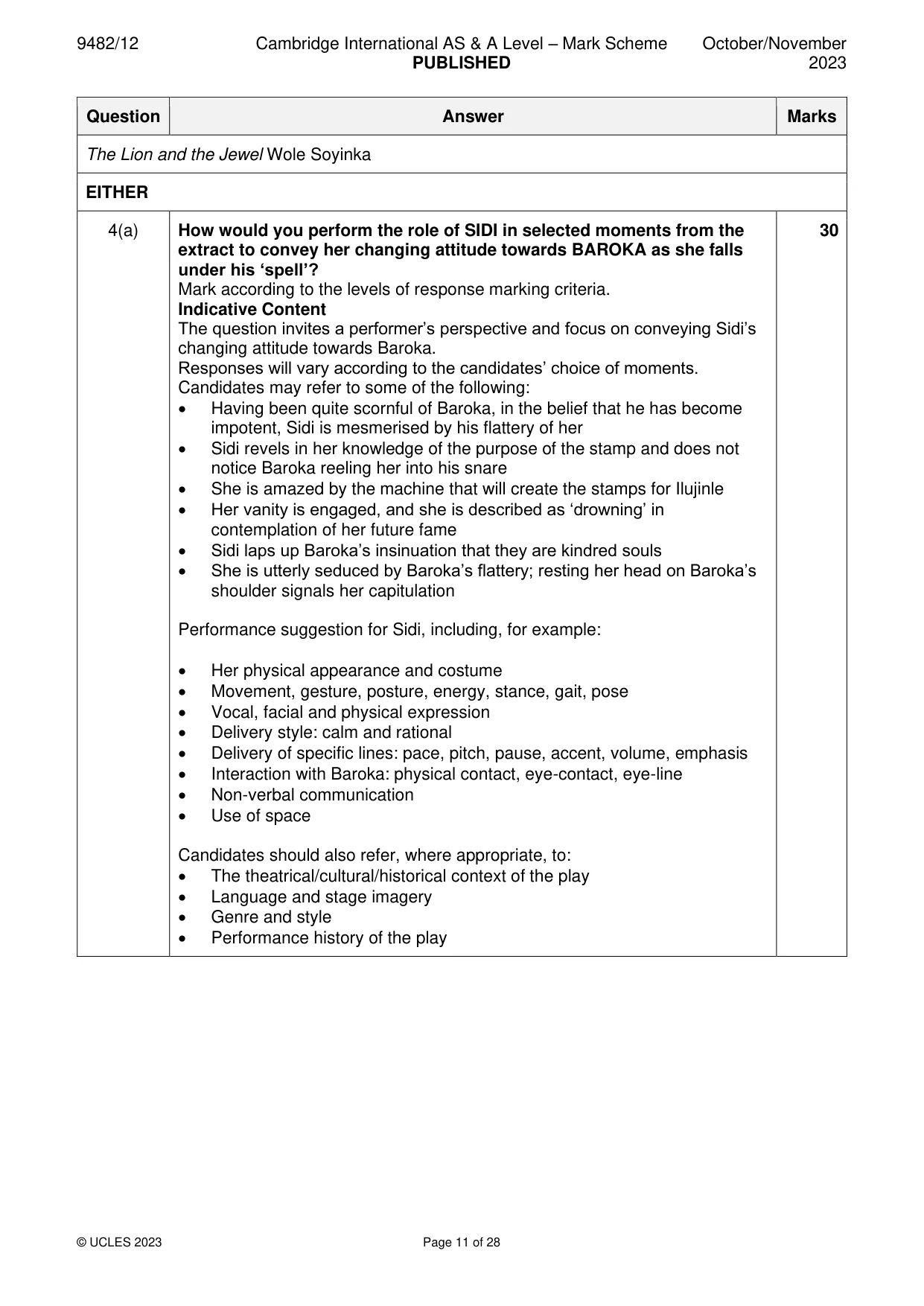
9482/12 Cambridge International AS & A Level – Mark Scheme PUBLISHED October/November 2023 © UCLES 2023 Page 11 of 28 Question Answer Marks The Lion and the Jewel Wole Soyinka EITHER 4(a) How would you perform the role of SIDI in selected moments from the extract to convey her changing attitude towards BAROKA as she falls under his ‘spell’? Mark according to the levels of response marking criteria. Indicative Content The question invites a performer’s perspective and focus on conveying Sidi’s changing attitude towards Baroka. Responses will vary according to the candidates’ choice of moments. Candidates may refer to some of the following: • Having been quite scornful of Baroka, in the belief that he has become impotent, Sidi is mesmerised by his flattery of her • Sidi revels in her knowledge of the purpose of the stamp and does not notice Baroka reeling her into his snare • She is amazed by the machine that will create the stamps for Ilujinle • Her vanity is engaged, and she is described as ‘drowning’ in contemplation of her future fame • Sidi laps up Baroka’s insinuation that they are kindred souls • She is utterly seduced by Baroka’s flattery; resting her head on Baroka’s shoulder signals her capitulation Performance suggestion for Sidi, including, for example: • Her physical appearance and costume • Movement, gesture, posture, energy, stance, gait, pose • Vocal, facial and physical expression • Delivery style: calm and rational • Delivery of specific lines: pace, pitch, pause, accent, volume, emphasis • Interaction with Baroka: physical contact, eye-contact, eye-line • Non-verbal communication • Use of space Candidates should also refer, where appropriate, to: • The theatrical/cultural/historical context of the play • Language and stage imagery • Genre and style • Performance history of the play 30
Mark scheme, page 12
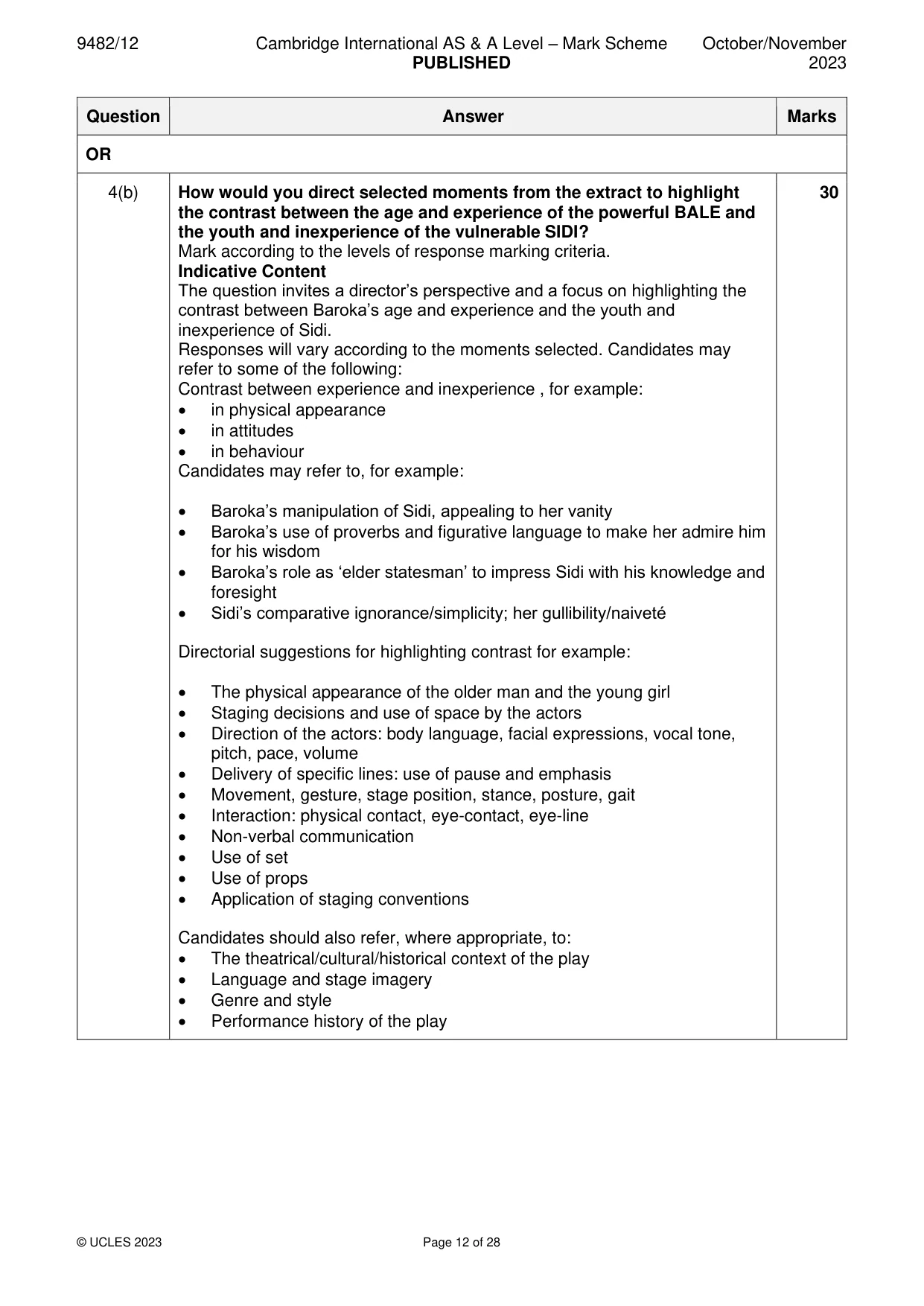
9482/12 Cambridge International AS & A Level – Mark Scheme PUBLISHED October/November 2023 © UCLES 2023 Page 12 of 28 Question Answer Marks OR 4(b) How would you direct selected moments from the extract to highlight the contrast between the age and experience of the powerful BALE and the youth and inexperience of the vulnerable SIDI? Mark according to the levels of response marking criteria. Indicative Content The question invites a director’s perspective and a focus on highlighting the contrast between Baroka’s age and experience and the youth and inexperience of Sidi. Responses will vary according to the moments selected. Candidates may refer to some of the following: Contrast between experience and inexperience , for example: • in physical appearance • in attitudes • in behaviour Candidates may refer to, for example: • Baroka’s manipulation of Sidi, appealing to her vanity • Baroka’s use of proverbs and figurative language to make her admire him for his wisdom • Baroka’s role as ‘elder statesman’ to impress Sidi with his knowledge and foresight • Sidi’s comparative ignorance/simplicity; her gullibility/naiveté Directorial suggestions for highlighting contrast for example: • The physical appearance of the older man and the young girl • Staging decisions and use of space by the actors • Direction of the actors: body language, facial expressions, vocal tone, pitch, pace, volume • Delivery of specific lines: use of pause and emphasis • Movement, gesture, stage position, stance, posture, gait • Interaction: physical contact, eye-contact, eye-line • Non-verbal communication • Use of set • Use of props • Application of staging conventions Candidates should also refer, where appropriate, to: • The theatrical/cultural/historical context of the play • Language and stage imagery • Genre and style • Performance history of the play 30
Mark scheme, page 13
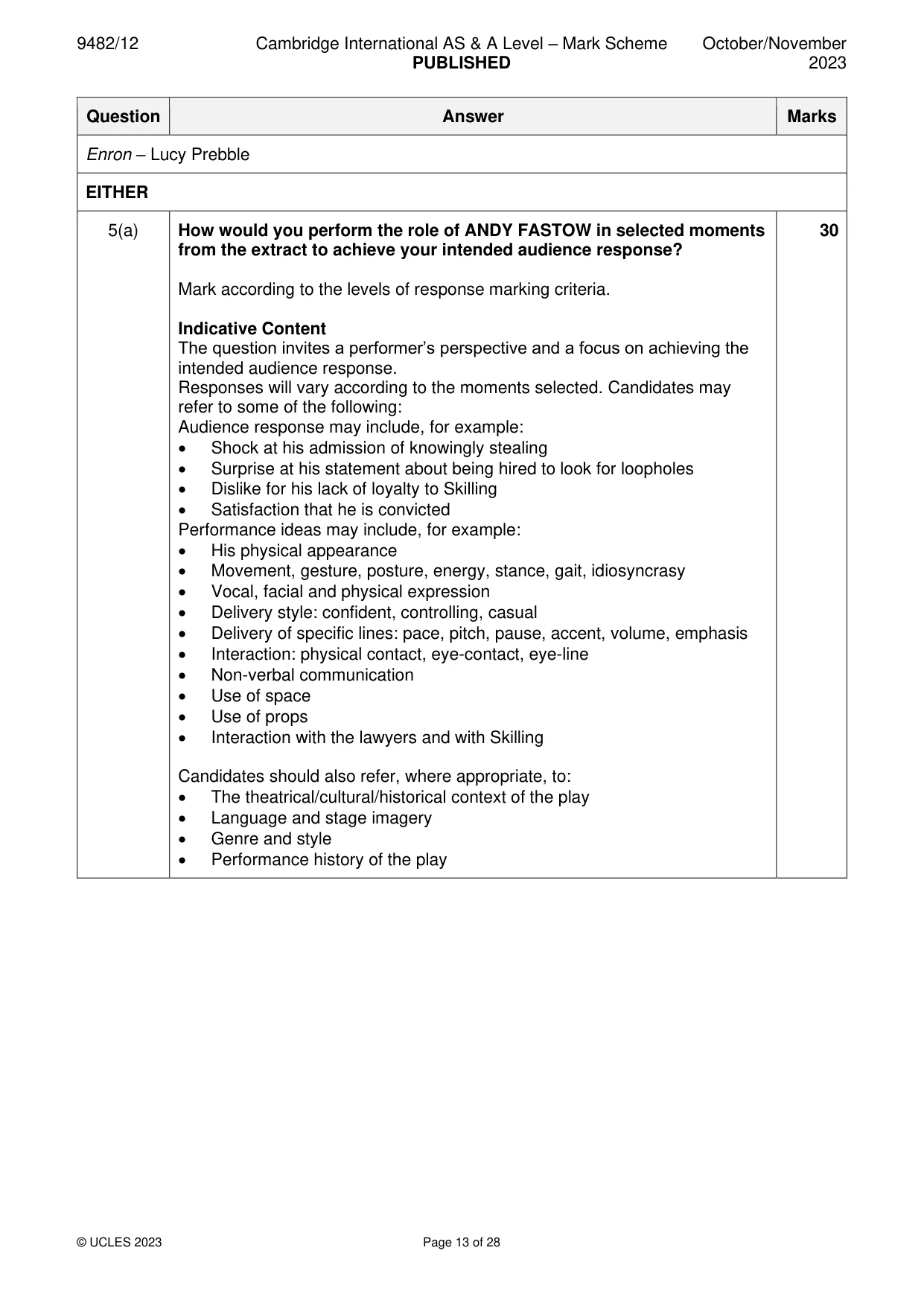
9482/12 Cambridge International AS & A Level – Mark Scheme PUBLISHED October/November 2023 © UCLES 2023 Page 13 of 28 Question Answer Marks Enron – Lucy Prebble EITHER 5(a) How would you perform the role of ANDY FASTOW in selected moments from the extract to achieve your intended audience response? Mark according to the levels of response marking criteria. Indicative Content The question invites a performer’s perspective and a focus on achieving the intended audience response. Responses will vary according to the moments selected. Candidates may refer to some of the following: Audience response may include, for example: • Shock at his admission of knowingly stealing • Surprise at his statement about being hired to look for loopholes • Dislike for his lack of loyalty to Skilling • Satisfaction that he is convicted Performance ideas may include, for example: • His physical appearance • Movement, gesture, posture, energy, stance, gait, idiosyncrasy • Vocal, facial and physical expression • Delivery style: confident, controlling, casual • Delivery of specific lines: pace, pitch, pause, accent, volume, emphasis • Interaction: physical contact, eye-contact, eye-line • Non-verbal communication • Use of space • Use of props • Interaction with the lawyers and with Skilling Candidates should also refer, where appropriate, to: • The theatrical/cultural/historical context of the play • Language and stage imagery • Genre and style • Performance history of the play 30
Mark scheme, page 14
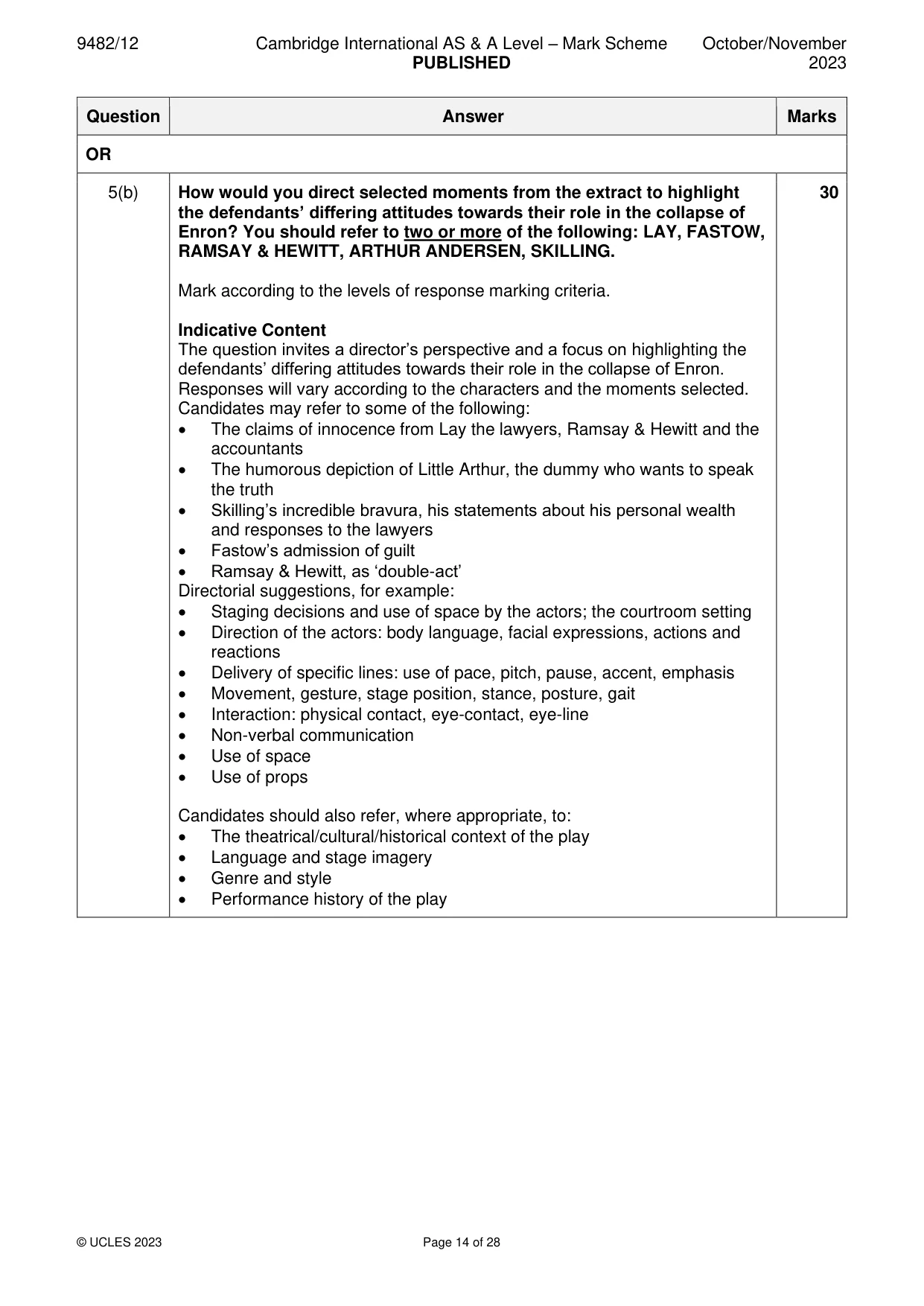
9482/12 Cambridge International AS & A Level – Mark Scheme PUBLISHED October/November 2023 © UCLES 2023 Page 14 of 28 Question Answer Marks OR 5(b) How would you direct selected moments from the extract to highlight the defendants’ differing attitudes towards their role in the collapse of Enron? You should refer to two or more of the following: LAY, FASTOW, RAMSAY & HEWITT, ARTHUR ANDERSEN, SKILLING. Mark according to the levels of response marking criteria. Indicative Content The question invites a director’s perspective and a focus on highlighting the defendants’ differing attitudes towards their role in the collapse of Enron. Responses will vary according to the characters and the moments selected. Candidates may refer to some of the following: • The claims of innocence from Lay the lawyers, Ramsay & Hewitt and the accountants • The humorous depiction of Little Arthur, the dummy who wants to speak the truth • Skilling’s incredible bravura, his statements about his personal wealth and responses to the lawyers • Fastow’s admission of guilt • Ramsay & Hewitt, as ‘double-act’ Directorial suggestions, for example: • Staging decisions and use of space by the actors; the courtroom setting • Direction of the actors: body language, facial expressions, actions and reactions • Delivery of specific lines: use of pace, pitch, pause, accent, emphasis • Movement, gesture, stage position, stance, posture, gait • Interaction: physical contact, eye-contact, eye-line • Non-verbal communication • Use of space • Use of props Candidates should also refer, where appropriate, to: • The theatrical/cultural/historical context of the play • Language and stage imagery • Genre and style • Performance history of the play 30
Mark scheme, page 15
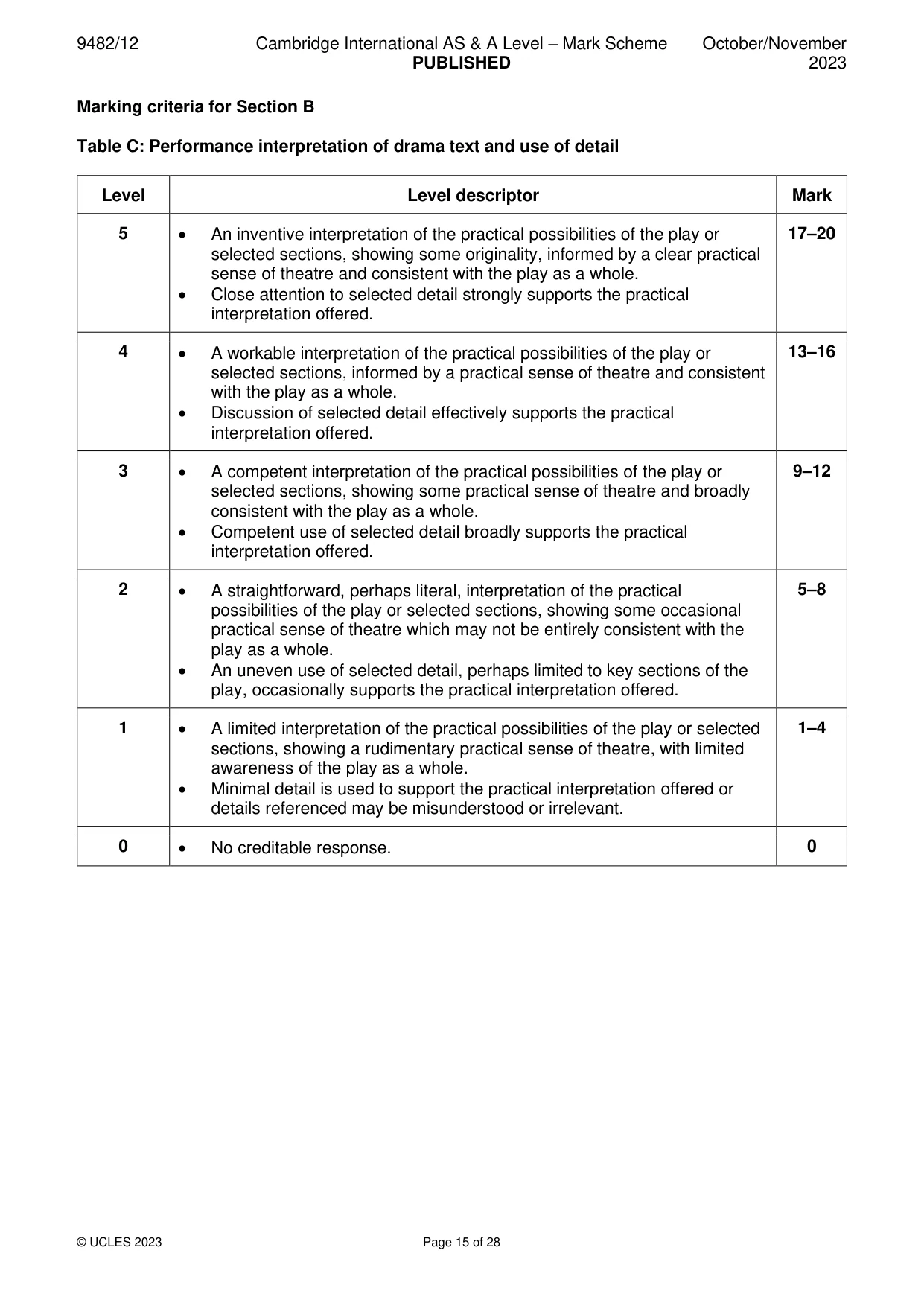
9482/12 Cambridge International AS & A Level – Mark Scheme PUBLISHED October/November 2023 © UCLES 2023 Page 15 of 28 Marking criteria for Section B Table C: Performance interpretation of drama text and use of detail Level Level descriptor Mark 5 • An inventive interpretation of the practical possibilities of the play or selected sections, showing some originality, informed by a clear practical sense of theatre and consistent with the play as a whole. • Close attention to selected detail strongly supports the practical interpretation offered. 17–20 4 • A workable interpretation of the practical possibilities of the play or selected sections, informed by a practical sense of theatre and consistent with the play as a whole. • Discussion of selected detail effectively supports the practical interpretation offered. 13–16 3 • A competent interpretation of the practical possibilities of the play or selected sections, showing some practical sense of theatre and broadly consistent with the play as a whole. • Competent use of selected detail broadly supports the practical interpretation offered. 9–12 2 • A straightforward, perhaps literal, interpretation of the practical possibilities of the play or selected sections, showing some occasional practical sense of theatre which may not be entirely consistent with the play as a whole. • An uneven use of selected detail, perhaps limited to key sections of the play, occasionally supports the practical interpretation offered. 5–8 1 • A limited interpretation of the practical possibilities of the play or selected sections, showing a rudimentary practical sense of theatre, with limited awareness of the play as a whole. • Minimal detail is used to support the practical interpretation offered or details referenced may be misunderstood or irrelevant. 1–4 0 • No creditable response. 0
Mark scheme, page 16
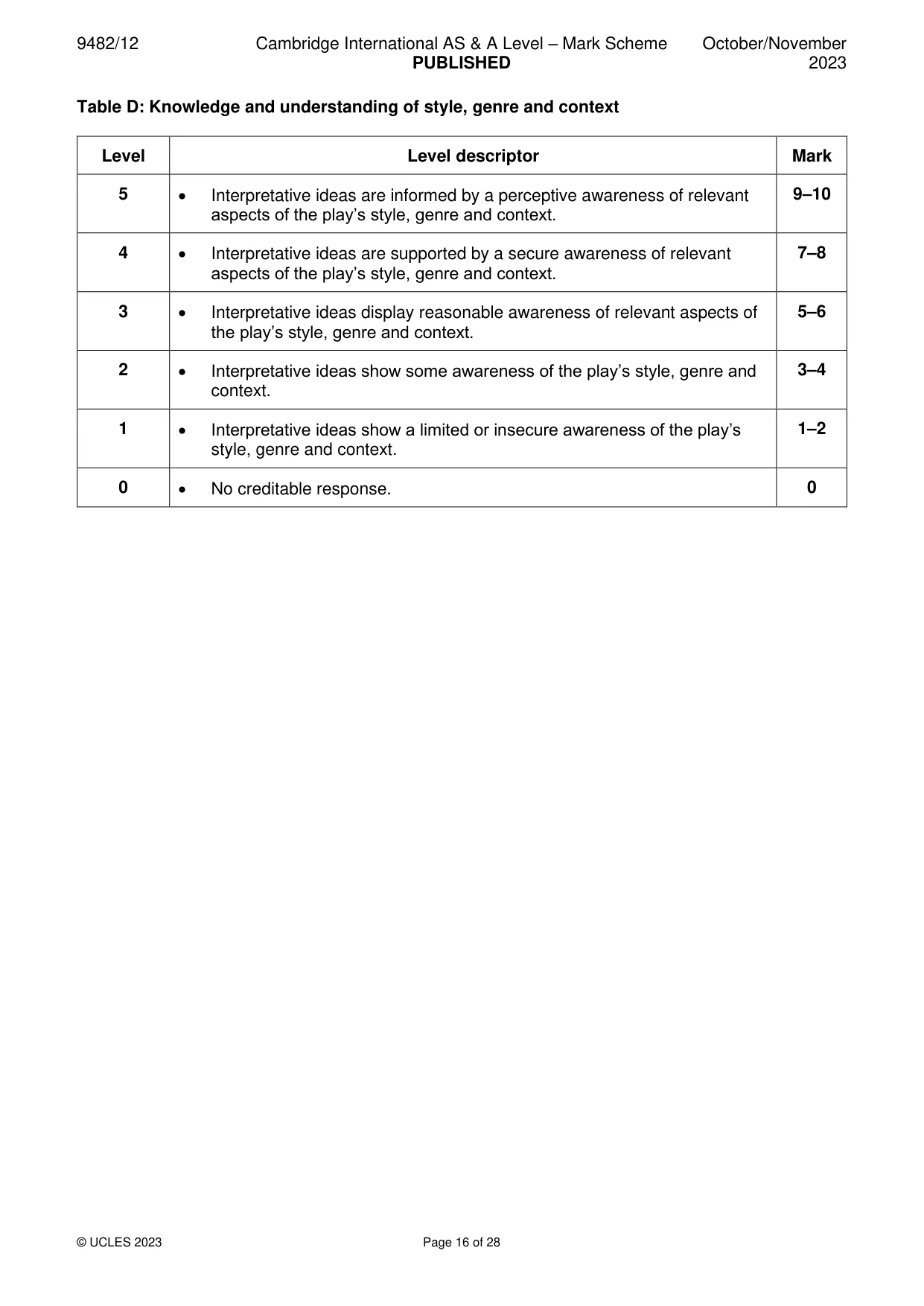
9482/12 Cambridge International AS & A Level – Mark Scheme PUBLISHED October/November 2023 © UCLES 2023 Page 16 of 28 Table D: Knowledge and understanding of style, genre and context Level Level descriptor Mark 5 • Interpretative ideas are informed by a perceptive awareness of relevant aspects of the play’s style, genre and context. 9–10 4 • Interpretative ideas are supported by a secure awareness of relevant aspects of the play’s style, genre and context. 7–8 3 • Interpretative ideas display reasonable awareness of relevant aspects of the play’s style, genre and context. 5–6 2 • Interpretative ideas show some awareness of the play’s style, genre and context. 3–4 1 • Interpretative ideas show a limited or insecure awareness of the play’s style, genre and context. 1–2 0 • No creditable response. 0
Mark scheme, page 17
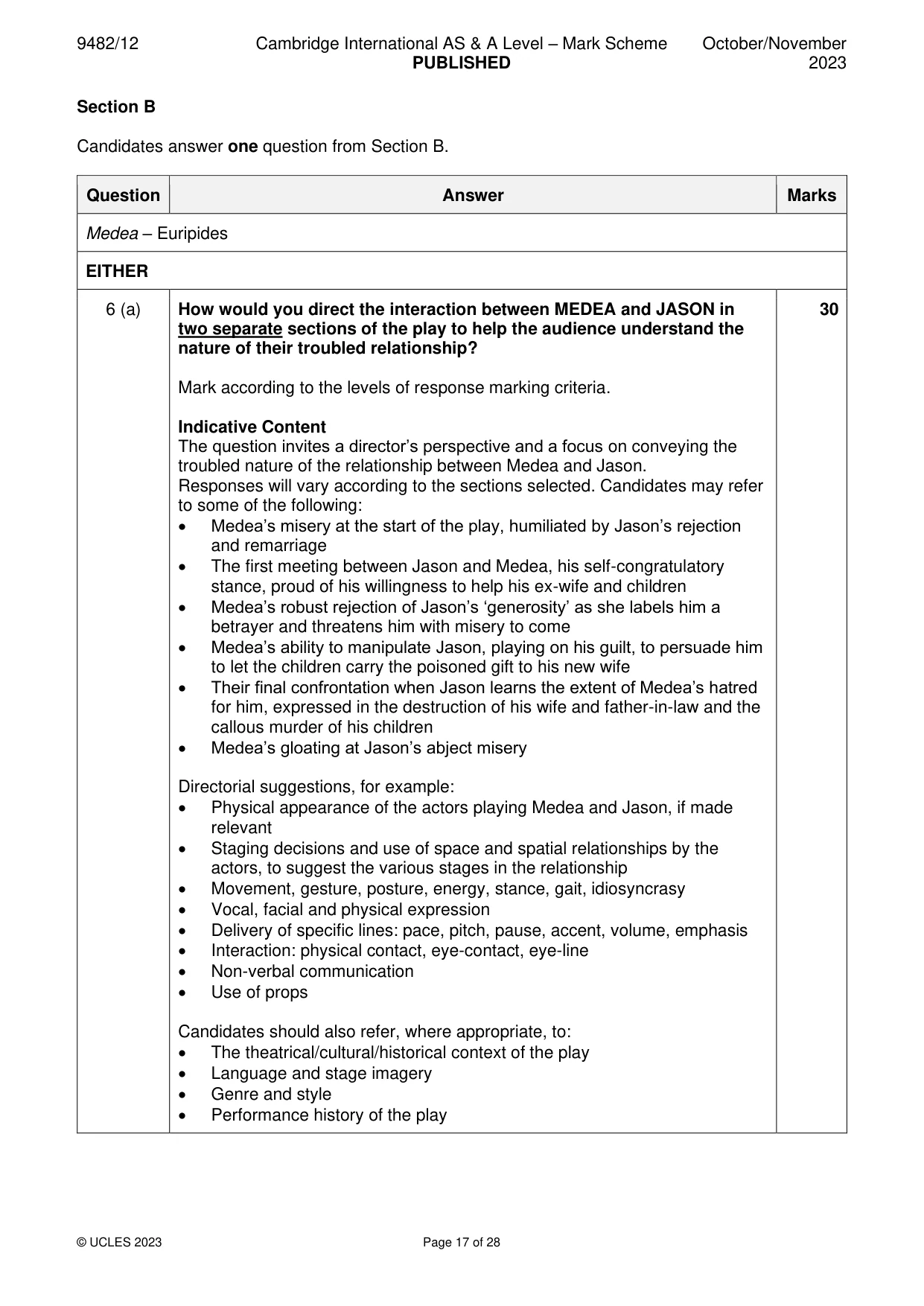
9482/12 Cambridge International AS & A Level – Mark Scheme PUBLISHED October/November 2023 © UCLES 2023 Page 17 of 28 Section B Candidates answer one question from Section B. Question Answer Marks Medea – Euripides EITHER 6 (a) How would you direct the interaction between MEDEA and JASON in two separate sections of the play to help the audience understand the nature of their troubled relationship? Mark according to the levels of response marking criteria. Indicative Content The question invites a director’s perspective and a focus on conveying the troubled nature of the relationship between Medea and Jason. Responses will vary according to the sections selected. Candidates may refer to some of the following: • Medea’s misery at the start of the play, humiliated by Jason’s rejection and remarriage • The first meeting between Jason and Medea, his self-congratulatory stance, proud of his willingness to help his ex-wife and children • Medea’s robust rejection of Jason’s ‘generosity’ as she labels him a betrayer and threatens him with misery to come • Medea’s ability to manipulate Jason, playing on his guilt, to persuade him to let the children carry the poisoned gift to his new wife • Their final confrontation when Jason learns the extent of Medea’s hatred for him, expressed in the destruction of his wife and father-in-law and the callous murder of his children • Medea’s gloating at Jason’s abject misery Directorial suggestions, for example: • Physical appearance of the actors playing Medea and Jason, if made relevant • Staging decisions and use of space and spatial relationships by the actors, to suggest the various stages in the relationship • Movement, gesture, posture, energy, stance, gait, idiosyncrasy • Vocal, facial and physical expression • Delivery of specific lines: pace, pitch, pause, accent, volume, emphasis • Interaction: physical contact, eye-contact, eye-line • Non-verbal communication • Use of props Candidates should also refer, where appropriate, to: • The theatrical/cultural/historical context of the play • Language and stage imagery • Genre and style • Performance history of the play 30
Mark scheme, page 18
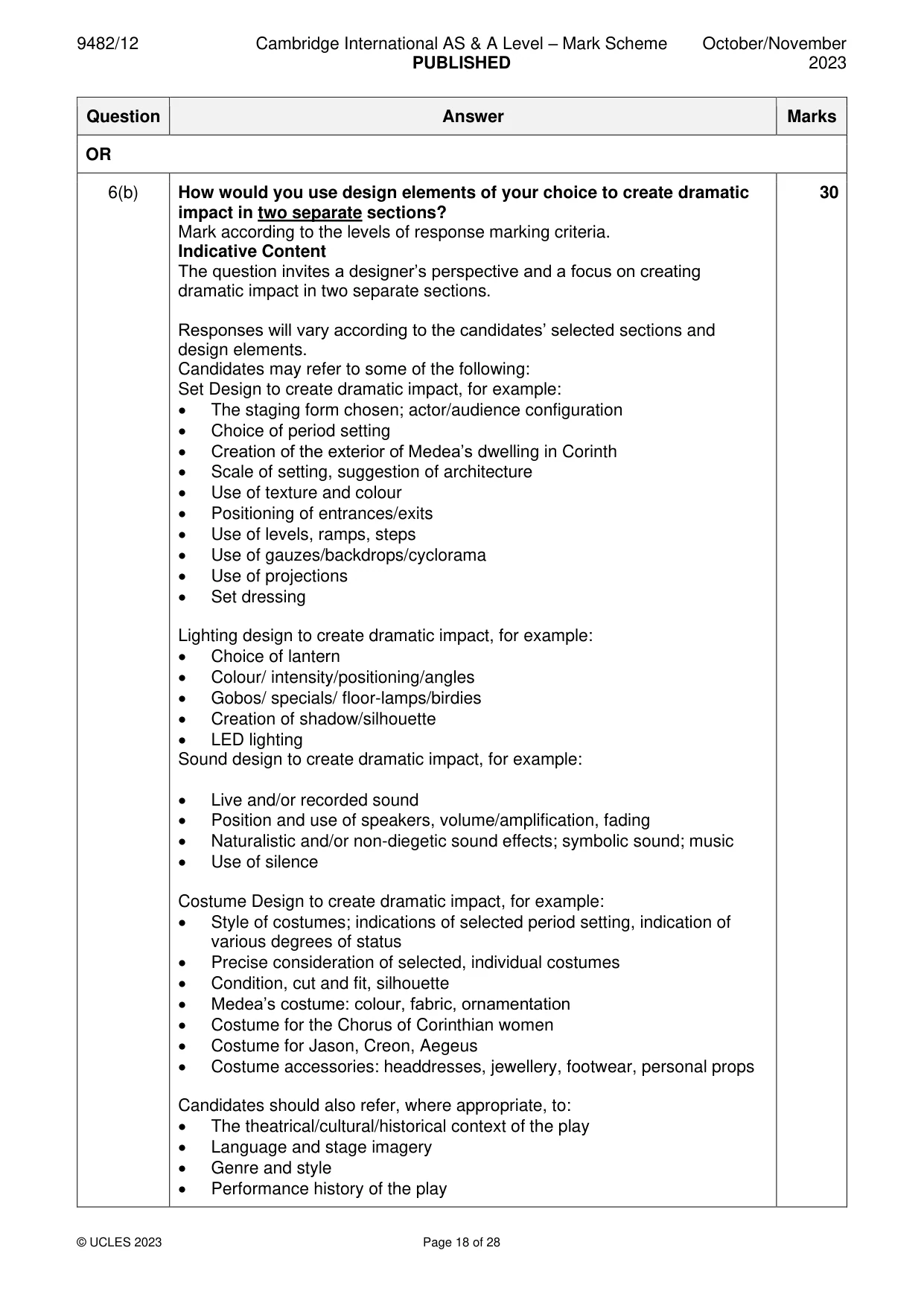
9482/12 Cambridge International AS & A Level – Mark Scheme PUBLISHED October/November 2023 © UCLES 2023 Page 18 of 28 Question Answer Marks OR 6(b) How would you use design elements of your choice to create dramatic impact in two separate sections? Mark according to the levels of response marking criteria. Indicative Content The question invites a designer’s perspective and a focus on creating dramatic impact in two separate sections. Responses will vary according to the candidates’ selected sections and design elements. Candidates may refer to some of the following: Set Design to create dramatic impact, for example: • The staging form chosen; actor/audience configuration • Choice of period setting • Creation of the exterior of Medea’s dwelling in Corinth • Scale of setting, suggestion of architecture • Use of texture and colour • Positioning of entrances/exits • Use of levels, ramps, steps • Use of gauzes/backdrops/cyclorama • Use of projections • Set dressing Lighting design to create dramatic impact, for example: • Choice of lantern • Colour/ intensity/positioning/angles • Gobos/ specials/ floor-lamps/birdies • Creation of shadow/silhouette • LED lighting Sound design to create dramatic impact, for example: • Live and/or recorded sound • Position and use of speakers, volume/amplification, fading • Naturalistic and/or non-diegetic sound effects; symbolic sound; music • Use of silence Costume Design to create dramatic impact, for example: • Style of costumes; indications of selected period setting, indication of various degrees of status • Precise consideration of selected, individual costumes • Condition, cut and fit, silhouette • Medea’s costume: colour, fabric, ornamentation • Costume for the Chorus of Corinthian women • Costume for Jason, Creon, Aegeus • Costume accessories: headdresses, jewellery, footwear, personal props Candidates should also refer, where appropriate, to: • The theatrical/cultural/historical context of the play • Language and stage imagery • Genre and style • Performance history of the play 30
Mark scheme, page 19
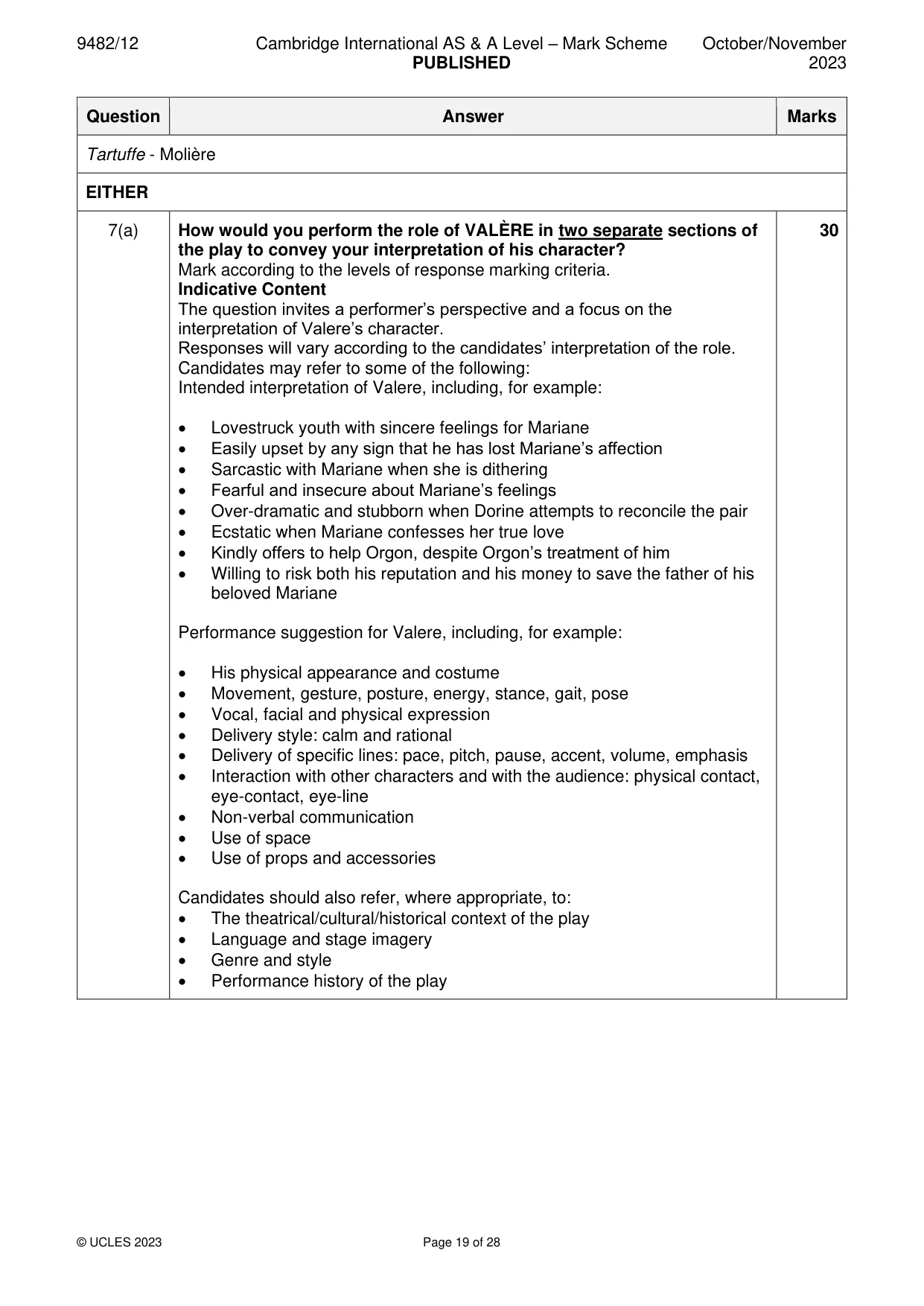
9482/12 Cambridge International AS & A Level – Mark Scheme PUBLISHED October/November 2023 © UCLES 2023 Page 19 of 28 Question Answer Marks Tartuffe - Molière EITHER 7(a) How would you perform the role of VALÈRE in two separate sections of the play to convey your interpretation of his character? Mark according to the levels of response marking criteria. Indicative Content The question invites a performer’s perspective and a focus on the interpretation of Valere’s character. Responses will vary according to the candidates’ interpretation of the role. Candidates may refer to some of the following: Intended interpretation of Valere, including, for example: • Lovestruck youth with sincere feelings for Mariane • Easily upset by any sign that he has lost Mariane’s affection • Sarcastic with Mariane when she is dithering • Fearful and insecure about Mariane’s feelings • Over-dramatic and stubborn when Dorine attempts to reconcile the pair • Ecstatic when Mariane confesses her true love • Kindly offers to help Orgon, despite Orgon’s treatment of him • Willing to risk both his reputation and his money to save the father of his beloved Mariane Performance suggestion for Valere, including, for example: • His physical appearance and costume • Movement, gesture, posture, energy, stance, gait, pose • Vocal, facial and physical expression • Delivery style: calm and rational • Delivery of specific lines: pace, pitch, pause, accent, volume, emphasis • Interaction with other characters and with the audience: physical contact, eye-contact, eye-line • Non-verbal communication • Use of space • Use of props and accessories Candidates should also refer, where appropriate, to: • The theatrical/cultural/historical context of the play • Language and stage imagery • Genre and style • Performance history of the play 30
Mark scheme, page 20
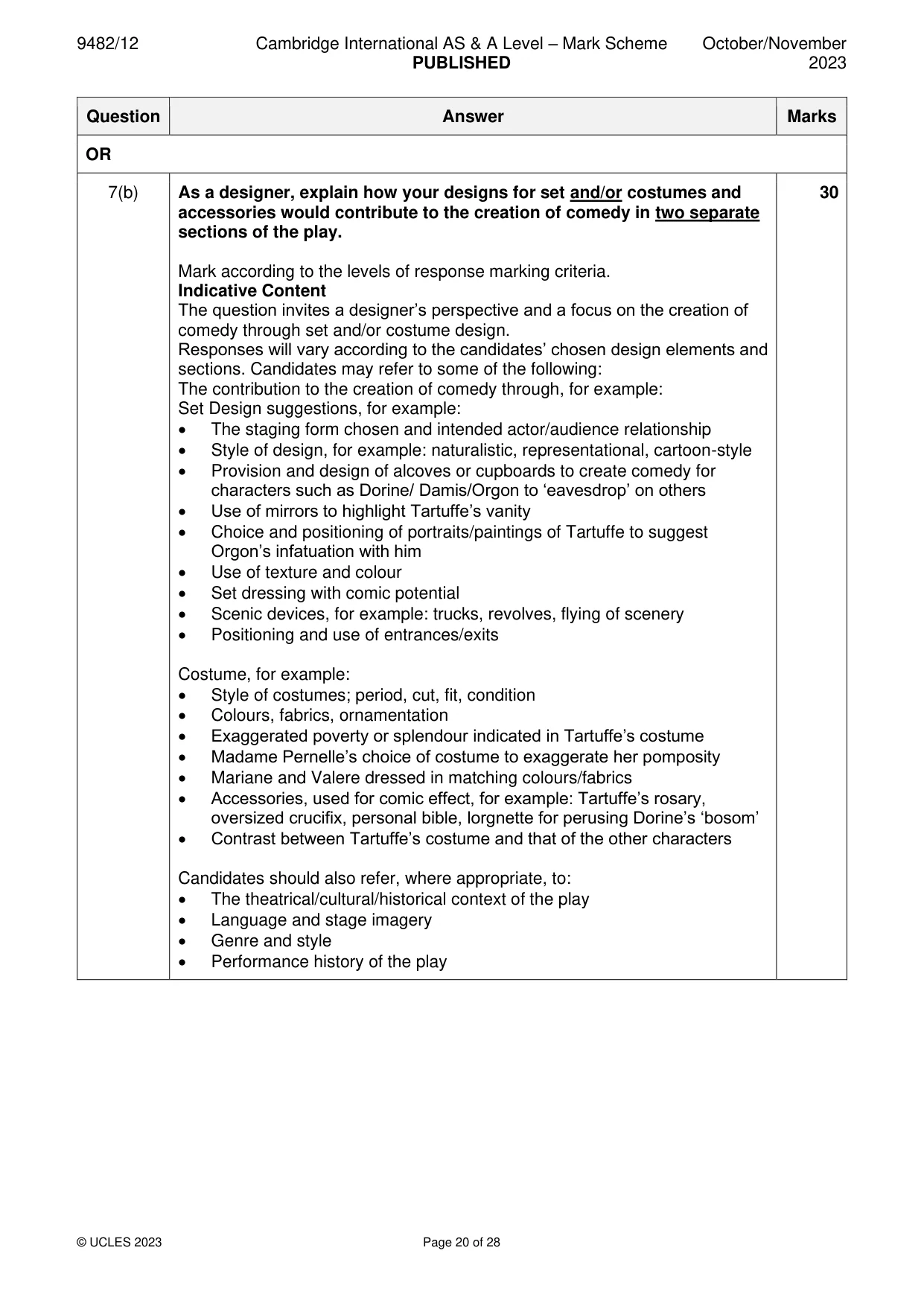
9482/12 Cambridge International AS & A Level – Mark Scheme PUBLISHED October/November 2023 © UCLES 2023 Page 20 of 28 Question Answer Marks OR 7(b) As a designer, explain how your designs for set and/or costumes and accessories would contribute to the creation of comedy in two separate sections of the play. Mark according to the levels of response marking criteria. Indicative Content The question invites a designer’s perspective and a focus on the creation of comedy through set and/or costume design. Responses will vary according to the candidates’ chosen design elements and sections. Candidates may refer to some of the following: The contribution to the creation of comedy through, for example: Set Design suggestions, for example: • The staging form chosen and intended actor/audience relationship • Style of design, for example: naturalistic, representational, cartoon-style • Provision and design of alcoves or cupboards to create comedy for characters such as Dorine/ Damis/Orgon to ‘eavesdrop’ on others • Use of mirrors to highlight Tartuffe’s vanity • Choice and positioning of portraits/paintings of Tartuffe to suggest Orgon’s infatuation with him • Use of texture and colour • Set dressing with comic potential • Scenic devices, for example: trucks, revolves, flying of scenery • Positioning and use of entrances/exits Costume, for example: • Style of costumes; period, cut, fit, condition • Colours, fabrics, ornamentation • Exaggerated poverty or splendour indicated in Tartuffe’s costume • Madame Pernelle’s choice of costume to exaggerate her pomposity • Mariane and Valere dressed in matching colours/fabrics • Accessories, used for comic effect, for example: Tartuffe’s rosary, oversized crucifix, personal bible, lorgnette for perusing Dorine’s ‘bosom’ • Contrast between Tartuffe’s costume and that of the other characters Candidates should also refer, where appropriate, to: • The theatrical/cultural/historical context of the play • Language and stage imagery • Genre and style • Performance history of the play 30
Mark scheme, page 21
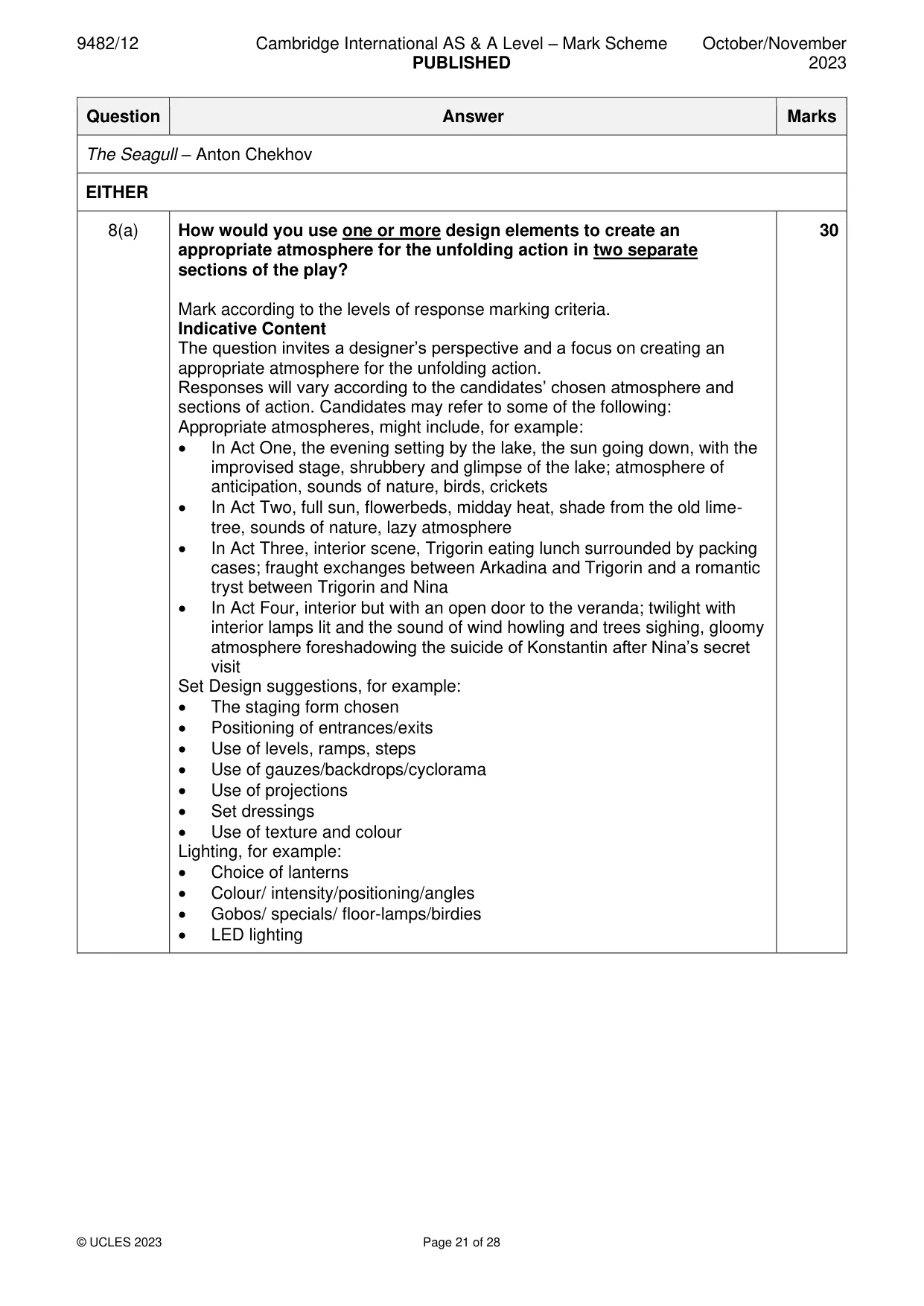
9482/12 Cambridge International AS & A Level – Mark Scheme PUBLISHED October/November 2023 © UCLES 2023 Page 21 of 28 Question Answer Marks The Seagull – Anton Chekhov EITHER 8(a) How would you use one or more design elements to create an appropriate atmosphere for the unfolding action in two separate sections of the play? Mark according to the levels of response marking criteria. Indicative Content The question invites a designer’s perspective and a focus on creating an appropriate atmosphere for the unfolding action. Responses will vary according to the candidates’ chosen atmosphere and sections of action. Candidates may refer to some of the following: Appropriate atmospheres, might include, for example: • In Act One, the evening setting by the lake, the sun going down, with the improvised stage, shrubbery and glimpse of the lake; atmosphere of anticipation, sounds of nature, birds, crickets • In Act Two, full sun, flowerbeds, midday heat, shade from the old lime- tree, sounds of nature, lazy atmosphere • In Act Three, interior scene, Trigorin eating lunch surrounded by packing cases; fraught exchanges between Arkadina and Trigorin and a romantic tryst between Trigorin and Nina • In Act Four, interior but with an open door to the veranda; twilight with interior lamps lit and the sound of wind howling and trees sighing, gloomy atmosphere foreshadowing the suicide of Konstantin after Nina’s secret visit Set Design suggestions, for example: • The staging form chosen • Positioning of entrances/exits • Use of levels, ramps, steps • Use of gauzes/backdrops/cyclorama • Use of projections • Set dressings • Use of texture and colour Lighting, for example: • Choice of lanterns • Colour/ intensity/positioning/angles • Gobos/ specials/ floor-lamps/birdies • LED lighting 30
Mark scheme, page 22
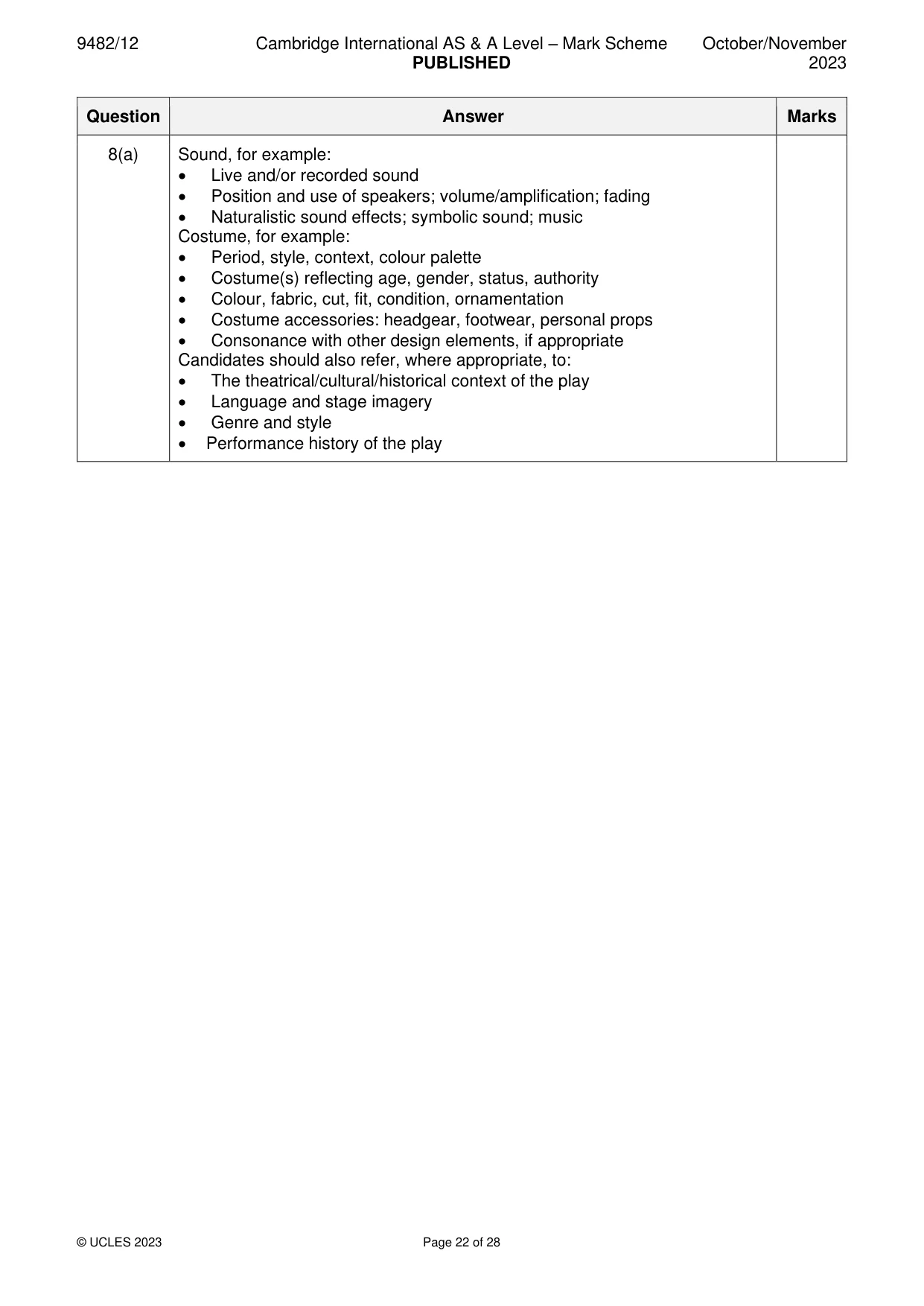
9482/12 Cambridge International AS & A Level – Mark Scheme PUBLISHED October/November 2023 © UCLES 2023 Page 22 of 28 Question Answer Marks 8(a) Sound, for example: • Live and/or recorded sound • Position and use of speakers; volume/amplification; fading • Naturalistic sound effects; symbolic sound; music Costume, for example: • Period, style, context, colour palette • Costume(s) reflecting age, gender, status, authority • Colour, fabric, cut, fit, condition, ornamentation • Costume accessories: headgear, footwear, personal props • Consonance with other design elements, if appropriate Candidates should also refer, where appropriate, to: • The theatrical/cultural/historical context of the play • Language and stage imagery • Genre and style • Performance history of the play
Mark scheme, page 23
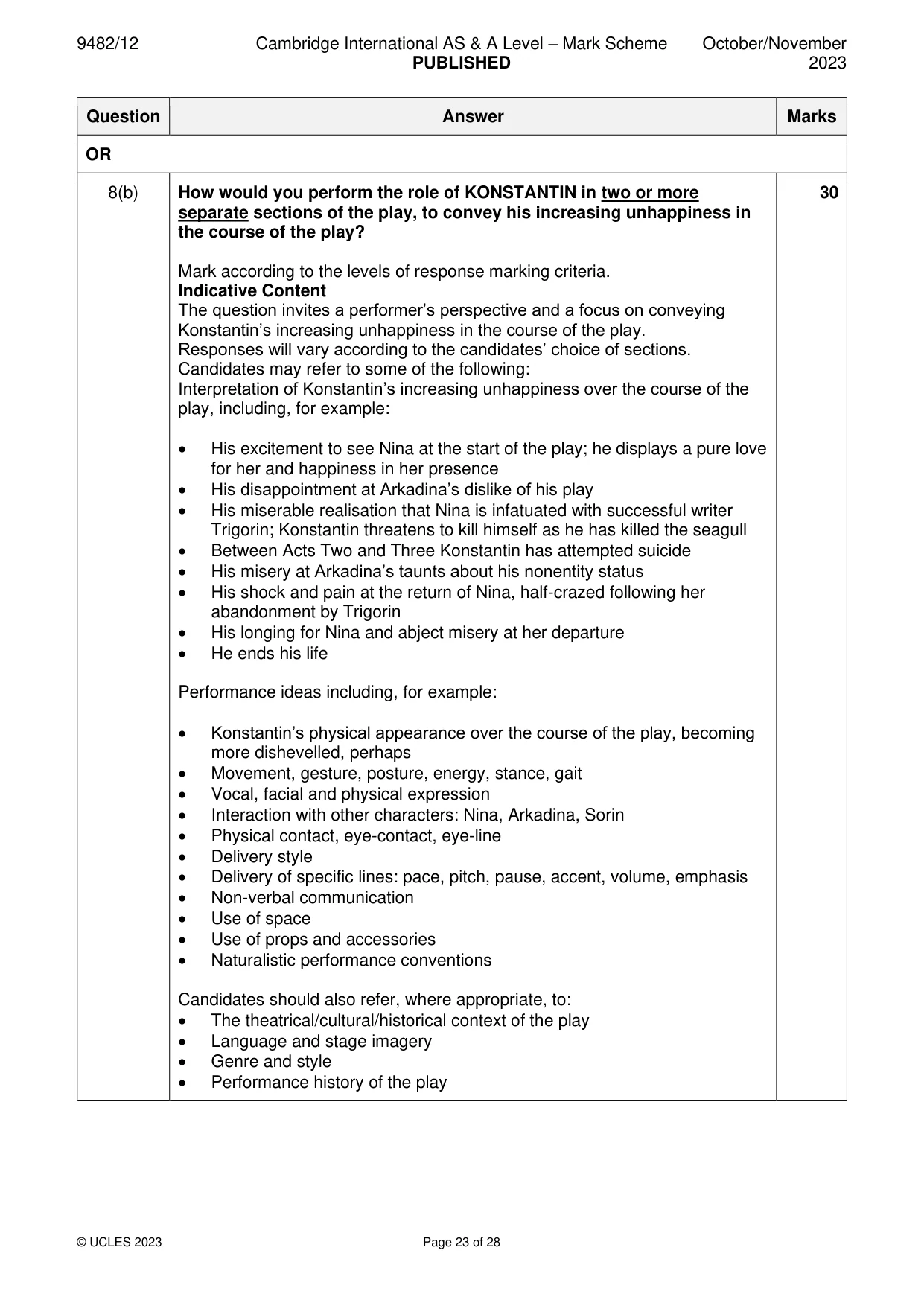
9482/12 Cambridge International AS & A Level – Mark Scheme PUBLISHED October/November 2023 © UCLES 2023 Page 23 of 28 Question Answer Marks OR 8(b) How would you perform the role of KONSTANTIN in two or more separate sections of the play, to convey his increasing unhappiness in the course of the play? Mark according to the levels of response marking criteria. Indicative Content The question invites a performer’s perspective and a focus on conveying Konstantin’s increasing unhappiness in the course of the play. Responses will vary according to the candidates’ choice of sections. Candidates may refer to some of the following: Interpretation of Konstantin’s increasing unhappiness over the course of the play, including, for example: • His excitement to see Nina at the start of the play; he displays a pure love for her and happiness in her presence • His disappointment at Arkadina’s dislike of his play • His miserable realisation that Nina is infatuated with successful writer Trigorin; Konstantin threatens to kill himself as he has killed the seagull • Between Acts Two and Three Konstantin has attempted suicide • His misery at Arkadina’s taunts about his nonentity status • His shock and pain at the return of Nina, half-crazed following her abandonment by Trigorin • His longing for Nina and abject misery at her departure • He ends his life Performance ideas including, for example: • Konstantin’s physical appearance over the course of the play, becoming more dishevelled, perhaps • Movement, gesture, posture, energy, stance, gait • Vocal, facial and physical expression • Interaction with other characters: Nina, Arkadina, Sorin • Physical contact, eye-contact, eye-line • Delivery style • Delivery of specific lines: pace, pitch, pause, accent, volume, emphasis • Non-verbal communication • Use of space • Use of props and accessories • Naturalistic performance conventions Candidates should also refer, where appropriate, to: • The theatrical/cultural/historical context of the play • Language and stage imagery • Genre and style • Performance history of the play 30
Mark scheme, page 24
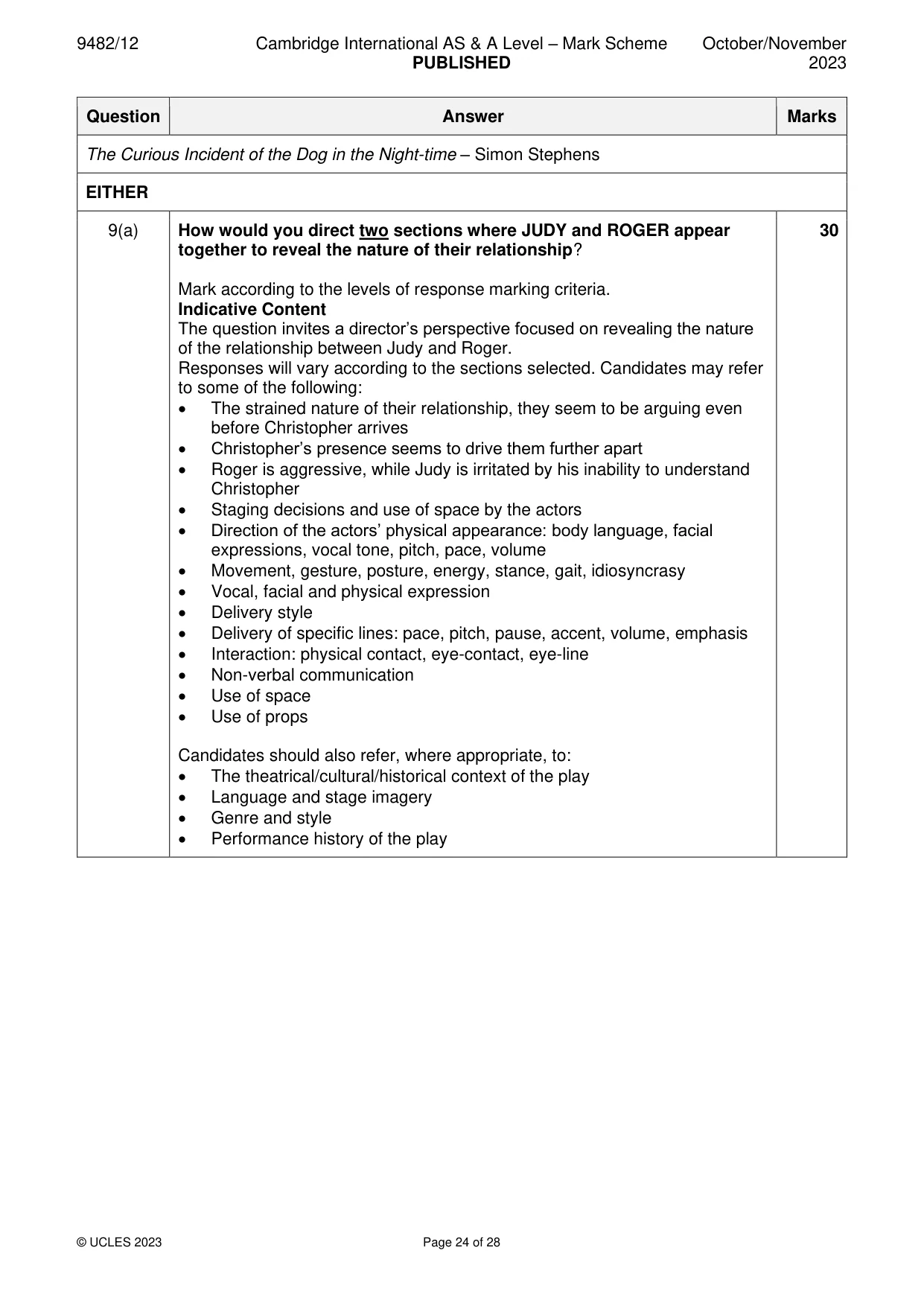
9482/12 Cambridge International AS & A Level – Mark Scheme PUBLISHED October/November 2023 © UCLES 2023 Page 24 of 28 Question Answer Marks The Curious Incident of the Dog in the Night-time – Simon Stephens EITHER 9(a) How would you direct two sections where JUDY and ROGER appear together to reveal the nature of their relationship? Mark according to the levels of response marking criteria. Indicative Content The question invites a director’s perspective focused on revealing the nature of the relationship between Judy and Roger. Responses will vary according to the sections selected. Candidates may refer to some of the following: • The strained nature of their relationship, they seem to be arguing even before Christopher arrives • Christopher’s presence seems to drive them further apart • Roger is aggressive, while Judy is irritated by his inability to understand Christopher • Staging decisions and use of space by the actors • Direction of the actors’ physical appearance: body language, facial expressions, vocal tone, pitch, pace, volume • Movement, gesture, posture, energy, stance, gait, idiosyncrasy • Vocal, facial and physical expression • Delivery style • Delivery of specific lines: pace, pitch, pause, accent, volume, emphasis • Interaction: physical contact, eye-contact, eye-line • Non-verbal communication • Use of space • Use of props Candidates should also refer, where appropriate, to: • The theatrical/cultural/historical context of the play • Language and stage imagery • Genre and style • Performance history of the play 30
Mark scheme, page 25
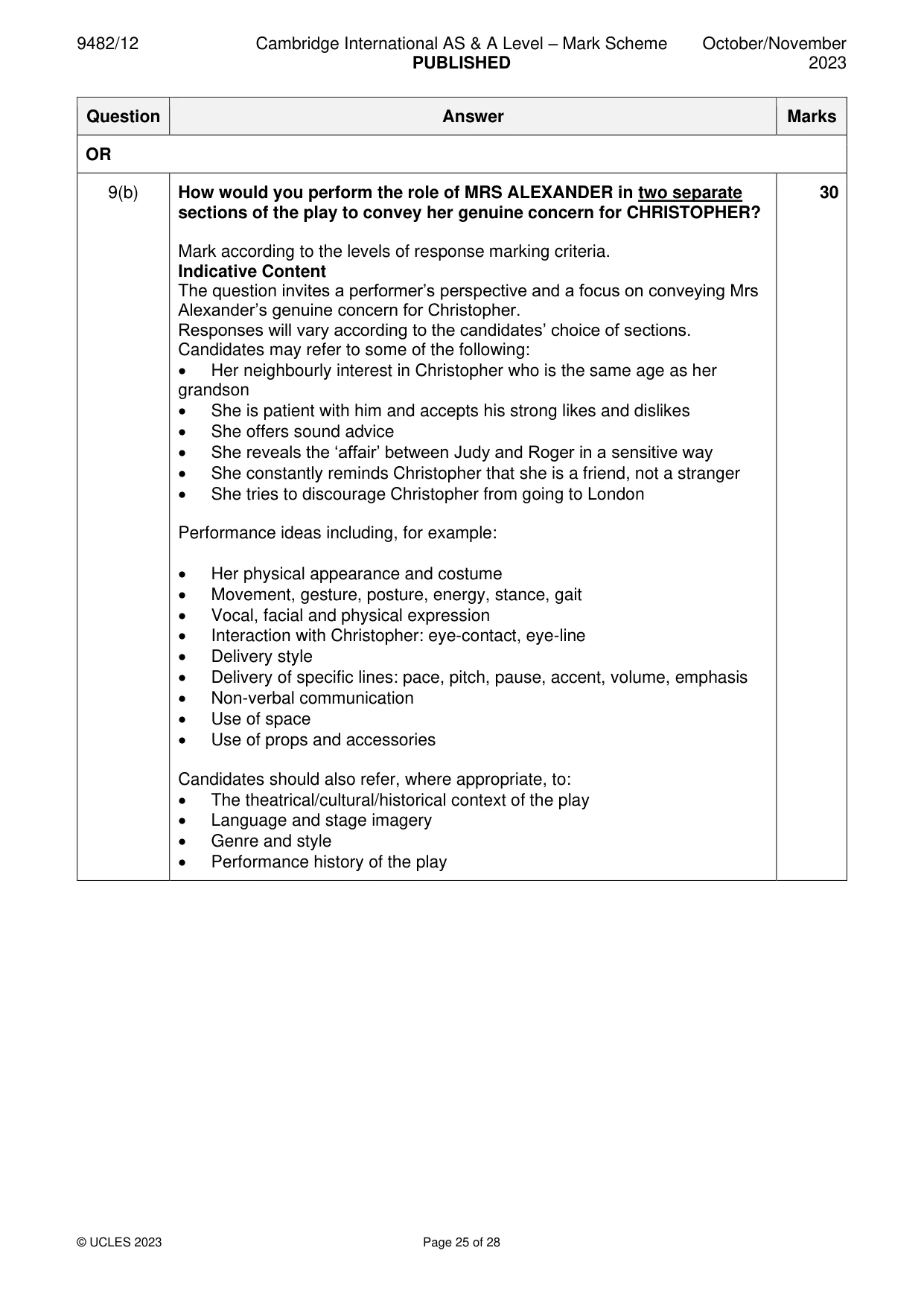
9482/12 Cambridge International AS & A Level – Mark Scheme PUBLISHED October/November 2023 © UCLES 2023 Page 25 of 28 Question Answer Marks OR 9(b) How would you perform the role of MRS ALEXANDER in two separate sections of the play to convey her genuine concern for CHRISTOPHER? Mark according to the levels of response marking criteria. Indicative Content The question invites a performer’s perspective and a focus on conveying Mrs Alexander’s genuine concern for Christopher. Responses will vary according to the candidates’ choice of sections. Candidates may refer to some of the following: • Her neighbourly interest in Christopher who is the same age as her grandson • She is patient with him and accepts his strong likes and dislikes • She offers sound advice • She reveals the ‘affair’ between Judy and Roger in a sensitive way • She constantly reminds Christopher that she is a friend, not a stranger • She tries to discourage Christopher from going to London Performance ideas including, for example: • Her physical appearance and costume • Movement, gesture, posture, energy, stance, gait • Vocal, facial and physical expression • Interaction with Christopher: eye-contact, eye-line • Delivery style • Delivery of specific lines: pace, pitch, pause, accent, volume, emphasis • Non-verbal communication • Use of space • Use of props and accessories Candidates should also refer, where appropriate, to: • The theatrical/cultural/historical context of the play • Language and stage imagery • Genre and style • Performance history of the play 30
Mark scheme, page 26
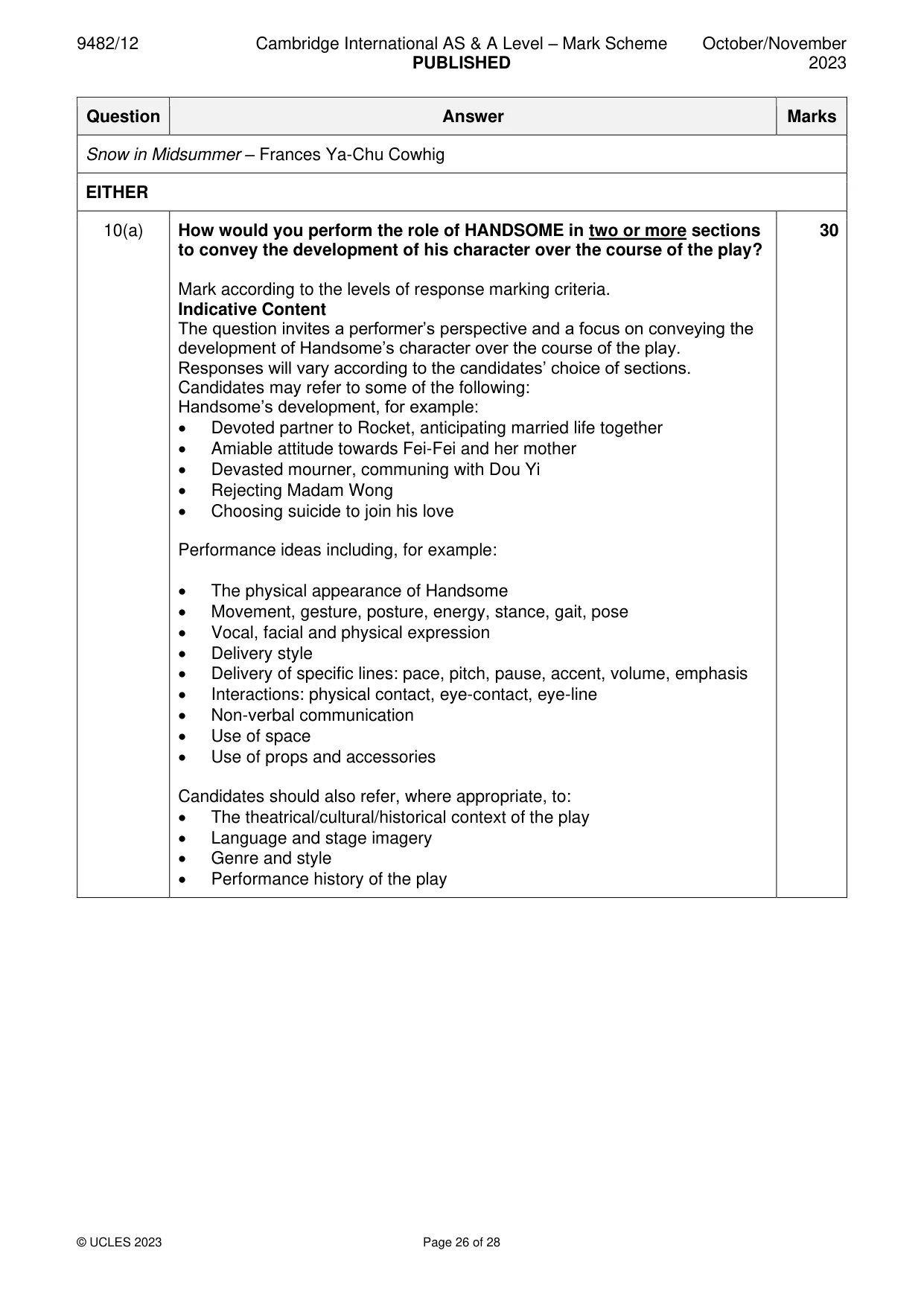
9482/12 Cambridge International AS & A Level – Mark Scheme PUBLISHED October/November 2023 © UCLES 2023 Page 26 of 28 Question Answer Marks Snow in Midsummer – Frances Ya-Chu Cowhig EITHER 10(a) How would you perform the role of HANDSOME in two or more sections to convey the development of his character over the course of the play? Mark according to the levels of response marking criteria. Indicative Content The question invites a performer’s perspective and a focus on conveying the development of Handsome’s character over the course of the play. Responses will vary according to the candidates’ choice of sections. Candidates may refer to some of the following: Handsome’s development, for example: • Devoted partner to Rocket, anticipating married life together • Amiable attitude towards Fei-Fei and her mother • Devasted mourner, communing with Dou Yi • Rejecting Madam Wong • Choosing suicide to join his love Performance ideas including, for example: • The physical appearance of Handsome • Movement, gesture, posture, energy, stance, gait, pose • Vocal, facial and physical expression • Delivery style • Delivery of specific lines: pace, pitch, pause, accent, volume, emphasis • Interactions: physical contact, eye-contact, eye-line • Non-verbal communication • Use of space • Use of props and accessories Candidates should also refer, where appropriate, to: • The theatrical/cultural/historical context of the play • Language and stage imagery • Genre and style • Performance history of the play 30
Mark scheme, page 27
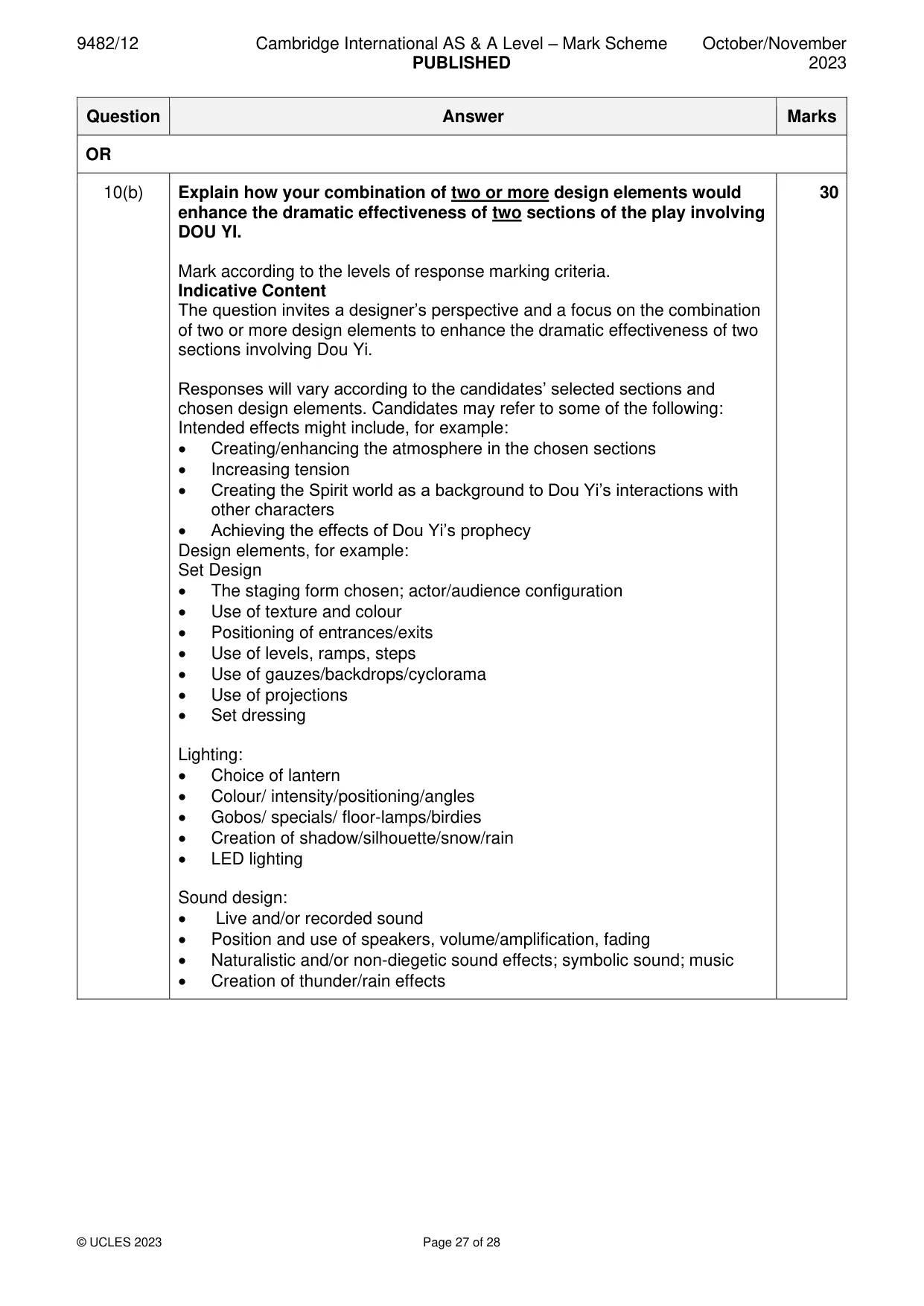
9482/12 Cambridge International AS & A Level – Mark Scheme PUBLISHED October/November 2023 © UCLES 2023 Page 27 of 28 Question Answer Marks OR 10(b) Explain how your combination of two or more design elements would enhance the dramatic effectiveness of two sections of the play involving DOU YI. Mark according to the levels of response marking criteria. Indicative Content The question invites a designer’s perspective and a focus on the combination of two or more design elements to enhance the dramatic effectiveness of two sections involving Dou Yi. Responses will vary according to the candidates’ selected sections and chosen design elements. Candidates may refer to some of the following: Intended effects might include, for example: • Creating/enhancing the atmosphere in the chosen sections • Increasing tension • Creating the Spirit world as a background to Dou Yi’s interactions with other characters • Achieving the effects of Dou Yi’s prophecy Design elements, for example: Set Design • The staging form chosen; actor/audience configuration • Use of texture and colour • Positioning of entrances/exits • Use of levels, ramps, steps • Use of gauzes/backdrops/cyclorama • Use of projections • Set dressing Lighting: • Choice of lantern • Colour/ intensity/positioning/angles • Gobos/ specials/ floor-lamps/birdies • Creation of shadow/silhouette/snow/rain • LED lighting Sound design: • Live and/or recorded sound • Position and use of speakers, volume/amplification, fading • Naturalistic and/or non-diegetic sound effects; symbolic sound; music • Creation of thunder/rain effects 30
Mark scheme, page 28
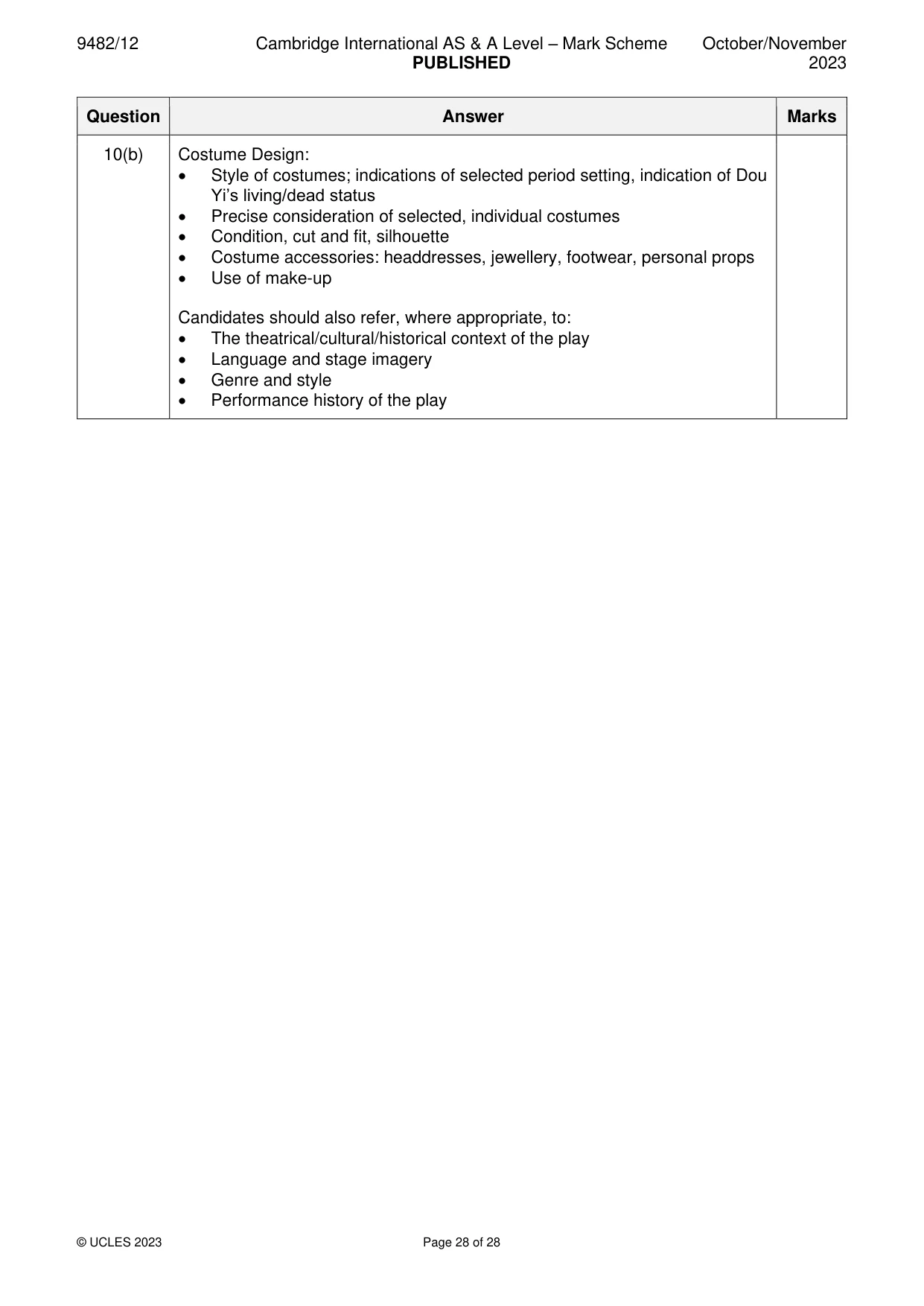
9482/12 Cambridge International AS & A Level – Mark Scheme PUBLISHED October/November 2023 © UCLES 2023 Page 28 of 28 Question Answer Marks 10(b) Costume Design: • Style of costumes; indications of selected period setting, indication of Dou Yi’s living/dead status • Precise consideration of selected, individual costumes • Condition, cut and fit, silhouette • Costume accessories: headdresses, jewellery, footwear, personal props • Use of make-up Candidates should also refer, where appropriate, to: • The theatrical/cultural/historical context of the play • Language and stage imagery • Genre and style • Performance history of the play
What you needed in this session
Cambridge’s own grade thresholds for 2023 Oct/Nov, Paper 1 · Variant 2. A higher threshold means an easier paper — the bar moves with how the cohort did.