Cambridge A Level Drama 9482 — 2023 May/June Paper 1 · Variant 1
9482/11/M/J/23 · 60 marks · ≈68 min
The question paper and its mark scheme, free to read here and free to download. This is Cambridge’s own paper, exactly as it was sat.
Question paper8 pages


Mark scheme27 pages
Answers below. Sit the paper first if you are practising.
Paper as text
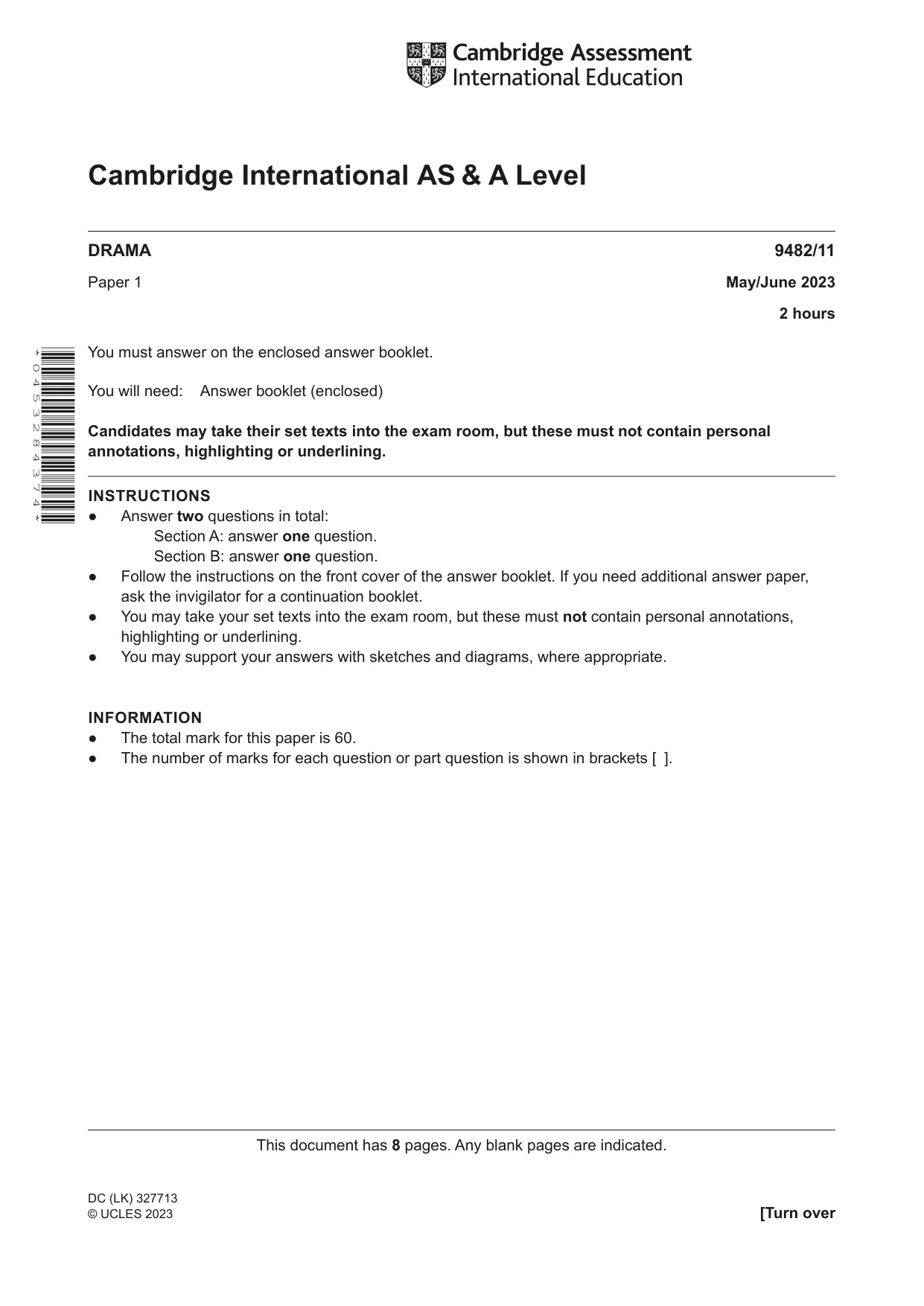
Question paper, page 1
This document has 8 pages. Any blank pages are indicated. [Turn over Cambridge International AS & A Level * 0 4 5 3 2 8 4 3 7 4 * DRAMA 9482/11 Paper 1 May/June 2023 2 hours You must answer on the enclosed answer booklet. You will need: Answer booklet (enclosed) Candidates may take their set texts into the exam room, but these must not contain personal annotations, highlighting or underlining. INSTRUCTIONS ● Answer two questions in total: Section A: answer one question. Section B: answer one question. ● Follow the instructions on the front cover of the answer booklet. If you need additional answer paper, ask the invigilator for a continuation booklet. ● You may take your set texts into the exam room, but these must not contain personal annotations, highlighting or underlining. ● You may support your answers with sketches and diagrams, where appropriate. INFORMATION ● The total mark for this paper is 60. ● The number of marks for each question or part question is shown in brackets [ ]. DC (LK) 327713 © UCLES 2023
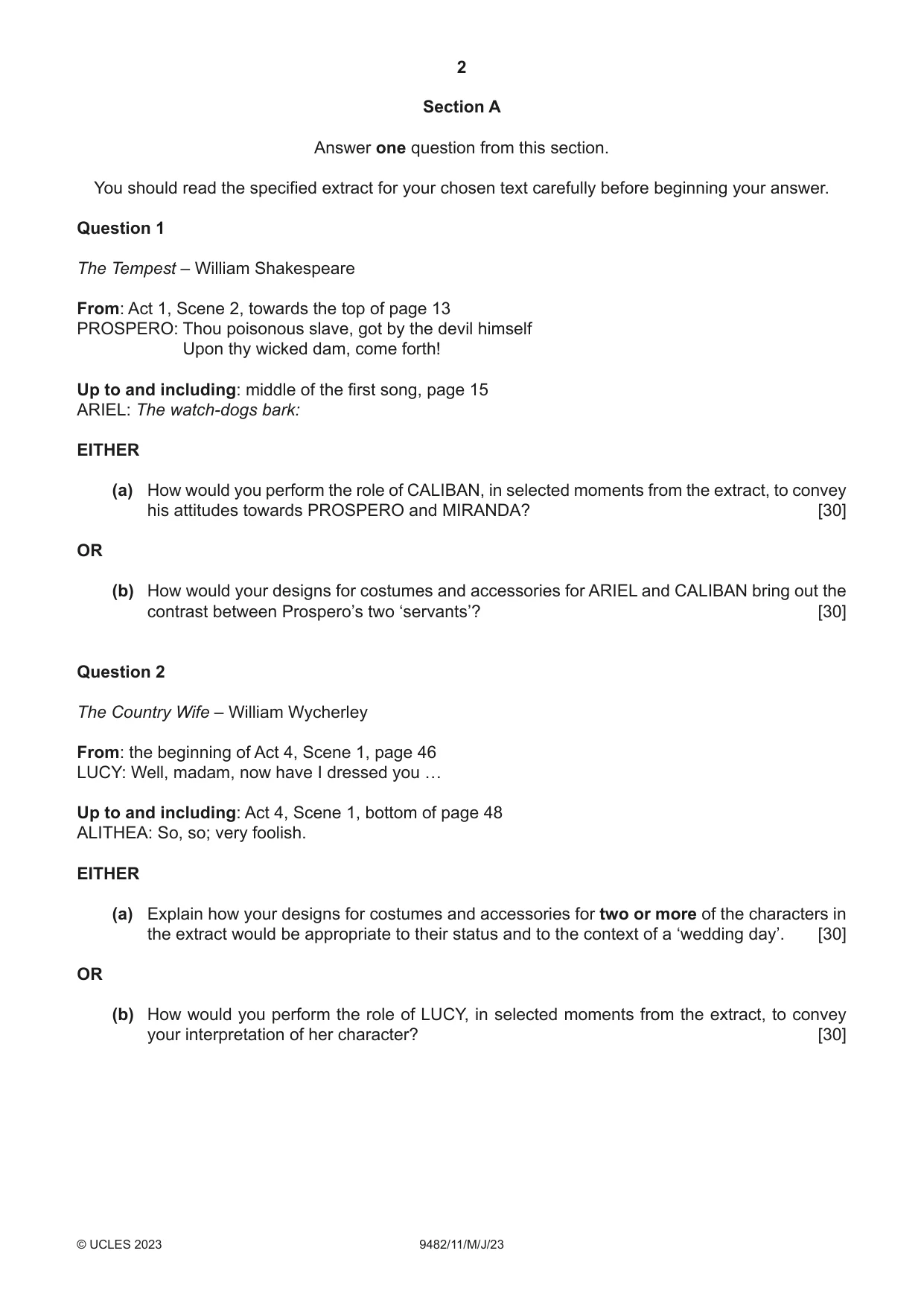
Question paper, page 2
2 9482/11/M/J/23 © UCLES 2023 Section A Answer one question from this section. You should read the specified extract for your chosen text carefully before beginning your answer. Question 1 The Tempest – William Shakespeare From: Act 1, Scene 2, towards the top of page 13 PROSPERO: Thou poisonous slave, got by the devil himself Upon thy wicked dam, come forth! Up to and including: middle of the first song, page 15 ARIEL: The watch‑dogs bark: EITHER (a) How would you perform the role of CALIBAN, in selected moments from the extract, to convey his attitudes towards PROSPERO and MIRANDA? [30] OR (b) How would your designs for costumes and accessories for ARIEL and CALIBAN bring out the contrast between Prospero’s two ‘servants’? [30] Question 2 The Country Wife – William Wycherley From: the beginning of Act 4, Scene 1, page 46 LUCY: Well, madam, now have I dressed you … Up to and including: Act 4, Scene 1, bottom of page 48 ALITHEA: So, so; very foolish. EITHER (a) Explain how your designs for costumes and accessories for two or more of the characters in the extract would be appropriate to their status and to the context of a ‘wedding day’. [30] OR (b) How would you perform the role of LUCY, in selected moments from the extract, to convey your interpretation of her character? [30]
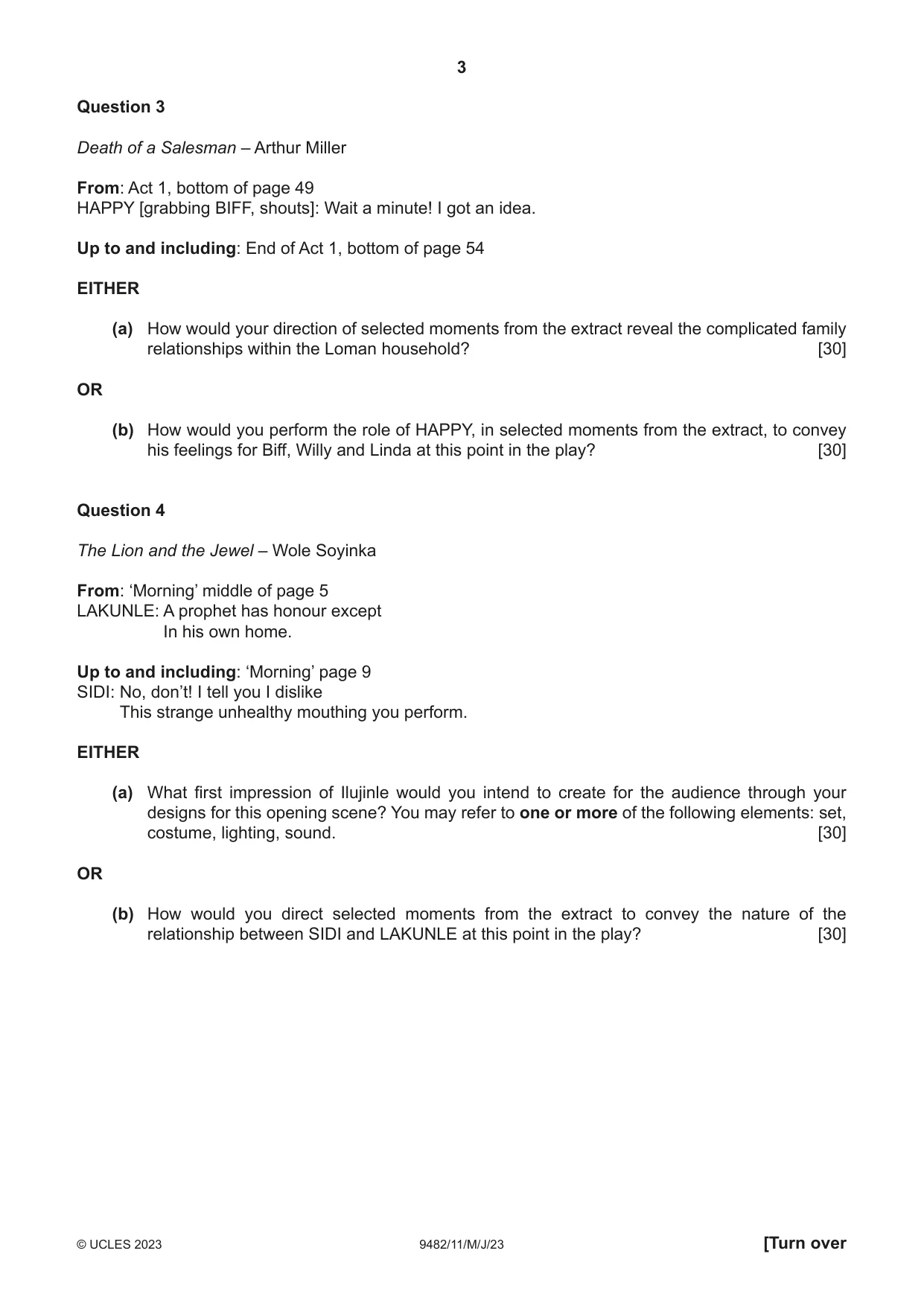
Question paper, page 3
3 9482/11/M/J/23 © UCLES 2023 [Turn over Question 3 Death of a Salesman – Arthur Miller From: Act 1, bottom of page 49 HAPPY [grabbing BIFF, shouts]: Wait a minute! I got an idea. Up to and including: End of Act 1, bottom of page 54 EITHER (a) How would your direction of selected moments from the extract reveal the complicated family relationships within the Loman household? [30] OR (b) How would you perform the role of HAPPY, in selected moments from the extract, to convey his feelings for Biff, Willy and Linda at this point in the play? [30] Question 4 The Lion and the Jewel – Wole Soyinka From: ‘Morning’ middle of page 5 LAKUNLE: A prophet has honour except In his own home. Up to and including: ‘Morning’ page 9 SIDI: No, don’t! I tell you I dislike This strange unhealthy mouthing you perform. EITHER (a) What first impression of Ilujinle would you intend to create for the audience through your designs for this opening scene? You may refer to one or more of the following elements: set, costume, lighting, sound. [30] OR (b) How would you direct selected moments from the extract to convey the nature of the relationship between SIDI and LAKUNLE at this point in the play? [30]
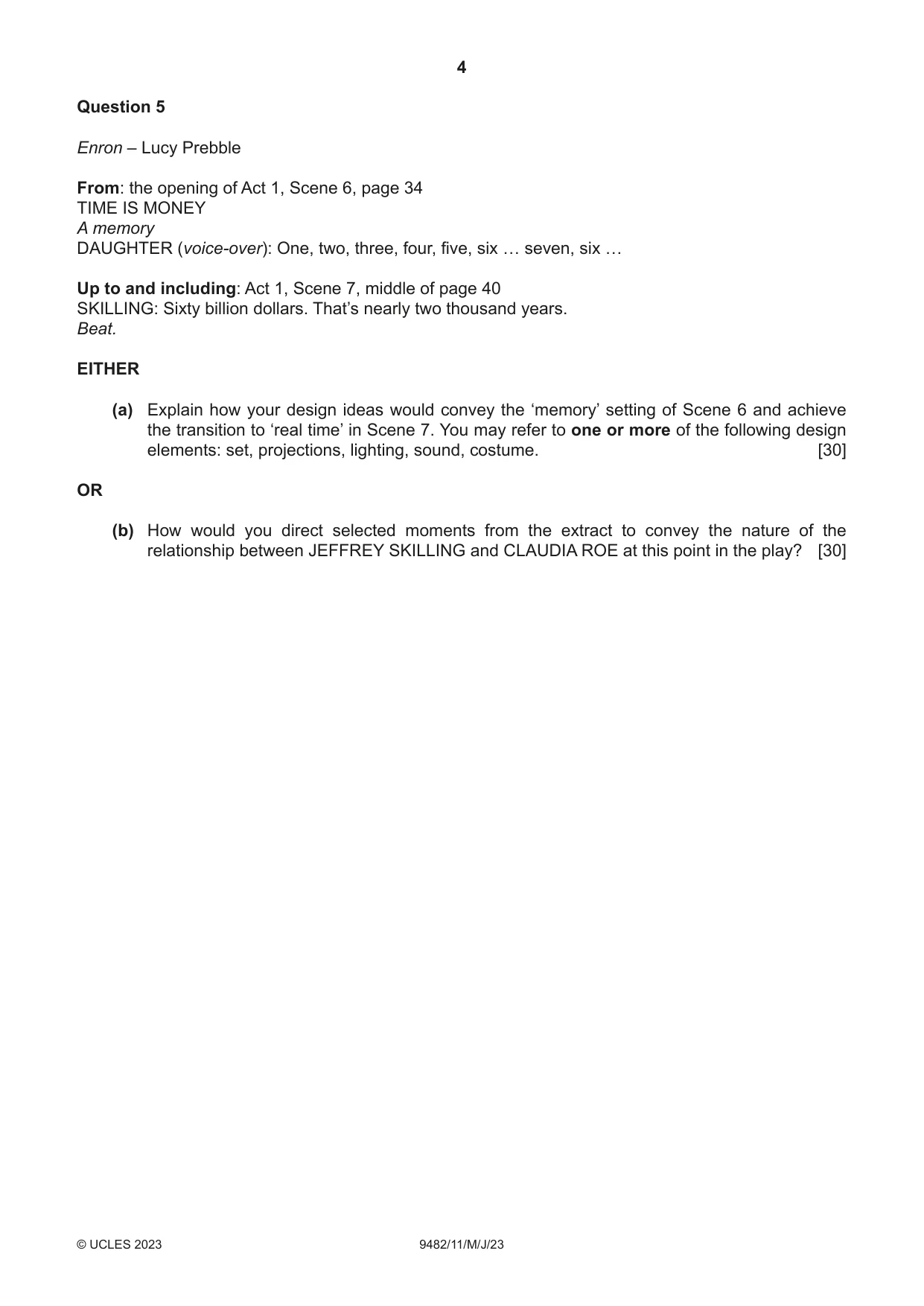
Question paper, page 4
4 9482/11/M/J/23 © UCLES 2023 Question 5 Enron – Lucy Prebble From: the opening of Act 1, Scene 6, page 34 TIME IS MONEY A memory DAUGHTER (voice‑over): One, two, three, four, five, six … seven, six … Up to and including: Act 1, Scene 7, middle of page 40 SKILLING: Sixty billion dollars. That’s nearly two thousand years. Beat. EITHER (a) Explain how your design ideas would convey the ‘memory’ setting of Scene 6 and achieve the transition to ‘real time’ in Scene 7. You may refer to one or more of the following design elements: set, projections, lighting, sound, costume. [30] OR (b) How would you direct selected moments from the extract to convey the nature of the relationship between JEFFREY SKILLING and CLAUDIA ROE at this point in the play? [30]
Question paper, page 5
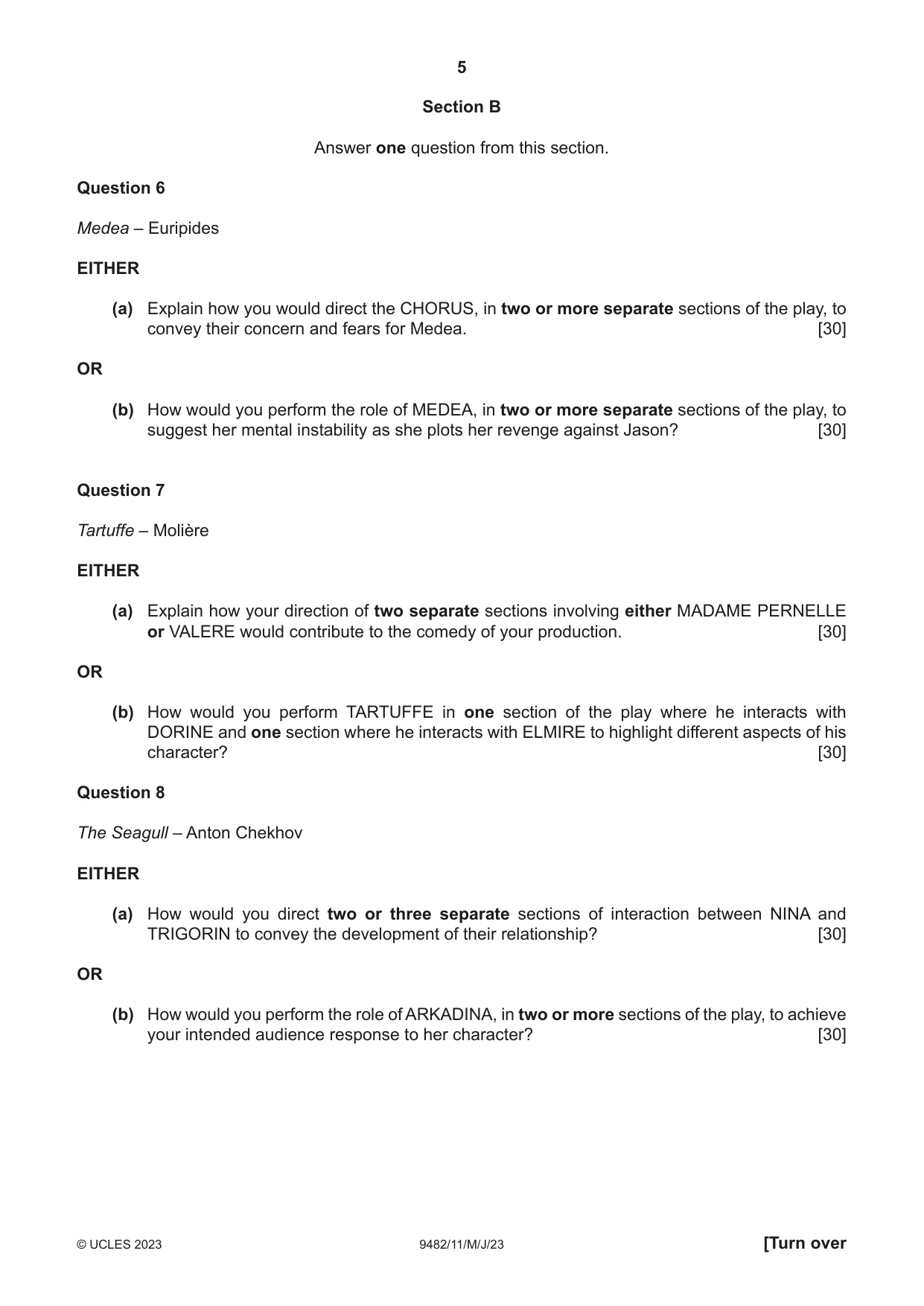
5 9482/11/M/J/23 © UCLES 2023 [Turn over Section B Answer one question from this section. Question 6 Medea – Euripides EITHER (a) Explain how you would direct the CHORUS, in two or more separate sections of the play, to convey their concern and fears for Medea. [30] OR (b) How would you perform the role of MEDEA, in two or more separate sections of the play, to suggest her mental instability as she plots her revenge against Jason? [30] Question 7 Tartuffe – Molière EITHER (a) Explain how your direction of two separate sections involving either MADAME PERNELLE or VALERE would contribute to the comedy of your production. [30] OR (b) How would you perform TARTUFFE in one section of the play where he interacts with DORINE and one section where he interacts with ELMIRE to highlight different aspects of his character? [30] Question 8 The Seagull – Anton Chekhov EITHER (a) How would you direct two or three separate sections of interaction between NINA and TRIGORIN to convey the development of their relationship? [30] OR (b) How would you perform the role of ARKADINA, in two or more sections of the play, to achieve your intended audience response to her character? [30]
Question paper, page 6
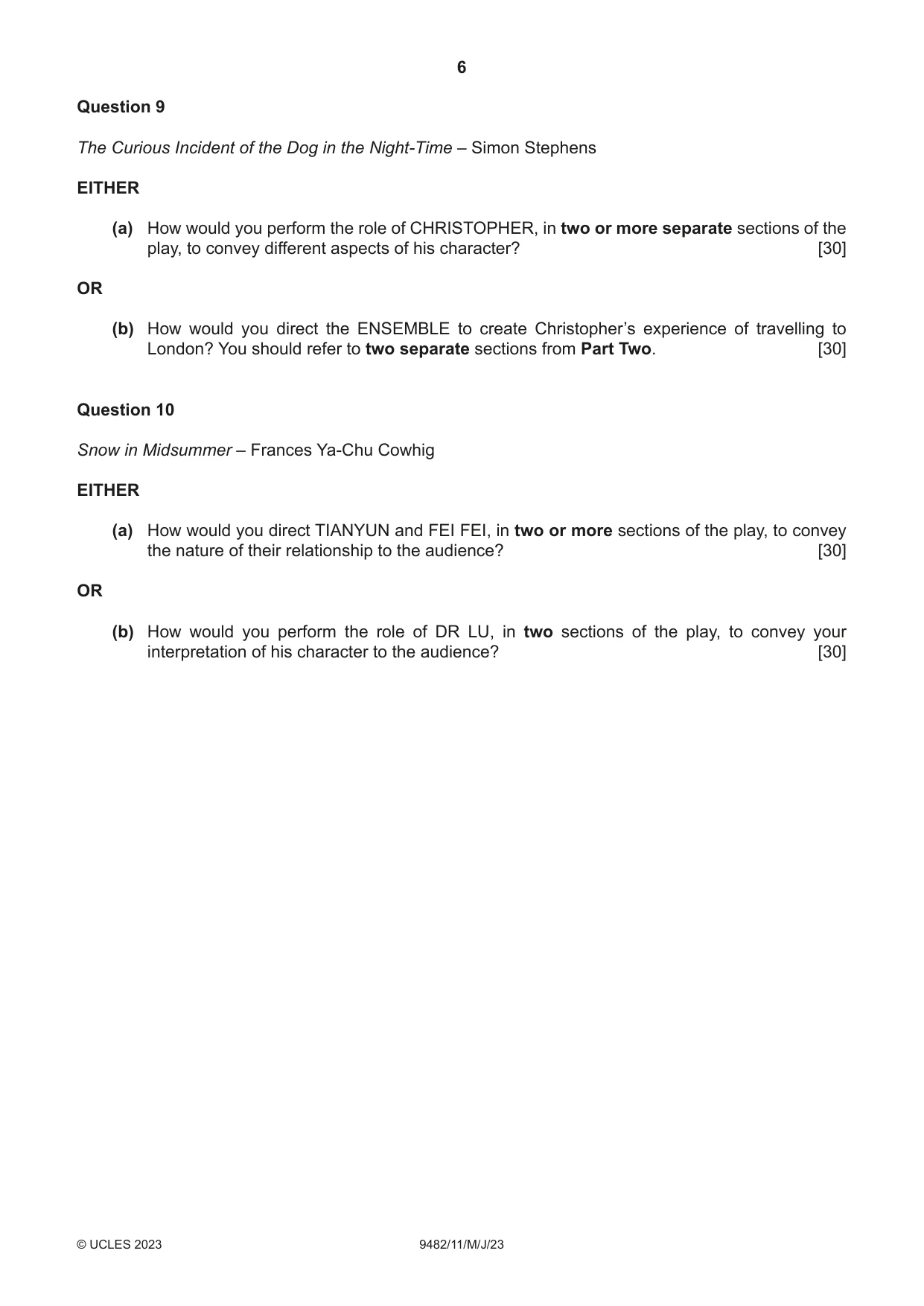
6 9482/11/M/J/23 © UCLES 2023 Question 9 The Curious Incident of the Dog in the Night‑Time – Simon Stephens EITHER (a) How would you perform the role of CHRISTOPHER, in two or more separate sections of the play, to convey different aspects of his character? [30] OR (b) How would you direct the ENSEMBLE to create Christopher’s experience of travelling to London? You should refer to two separate sections from Part Two. [30] Question 10 Snow in Midsummer – Frances Ya‑Chu Cowhig EITHER (a) How would you direct TIANYUN and FEI FEI, in two or more sections of the play, to convey the nature of their relationship to the audience? [30] OR (b) How would you perform the role of DR LU, in two sections of the play, to convey your interpretation of his character to the audience? [30]
Question paper, page 7
7 9482/11/M/J/23 © UCLES 2023 BLANK PAGE
Question paper, page 8
8 9482/11/M/J/23 © UCLES 2023 Permission to reproduce items where third‑party owned material protected by copyright is included has been sought and cleared where possible. Every reasonable effort has been made by the publisher (UCLES) to trace copyright holders, but if any items requiring clearance have unwittingly been included, the publisher will be pleased to make amends at the earliest possible opportunity. To avoid the issue of disclosure of answer‑related information to candidates, all copyright acknowledgements are reproduced online in the Cambridge Assessment International Education Copyright Acknowledgements Booklet. This is produced for each series of examinations and is freely available to download at www.cambridgeinternational.org after the live examination series. Cambridge Assessment International Education is part of Cambridge Assessment. Cambridge Assessment is the brand name of the University of Cambridge Local Examinations Syndicate (UCLES), which is a department of the University of Cambridge. BLANK PAGE
Mark scheme, page 1
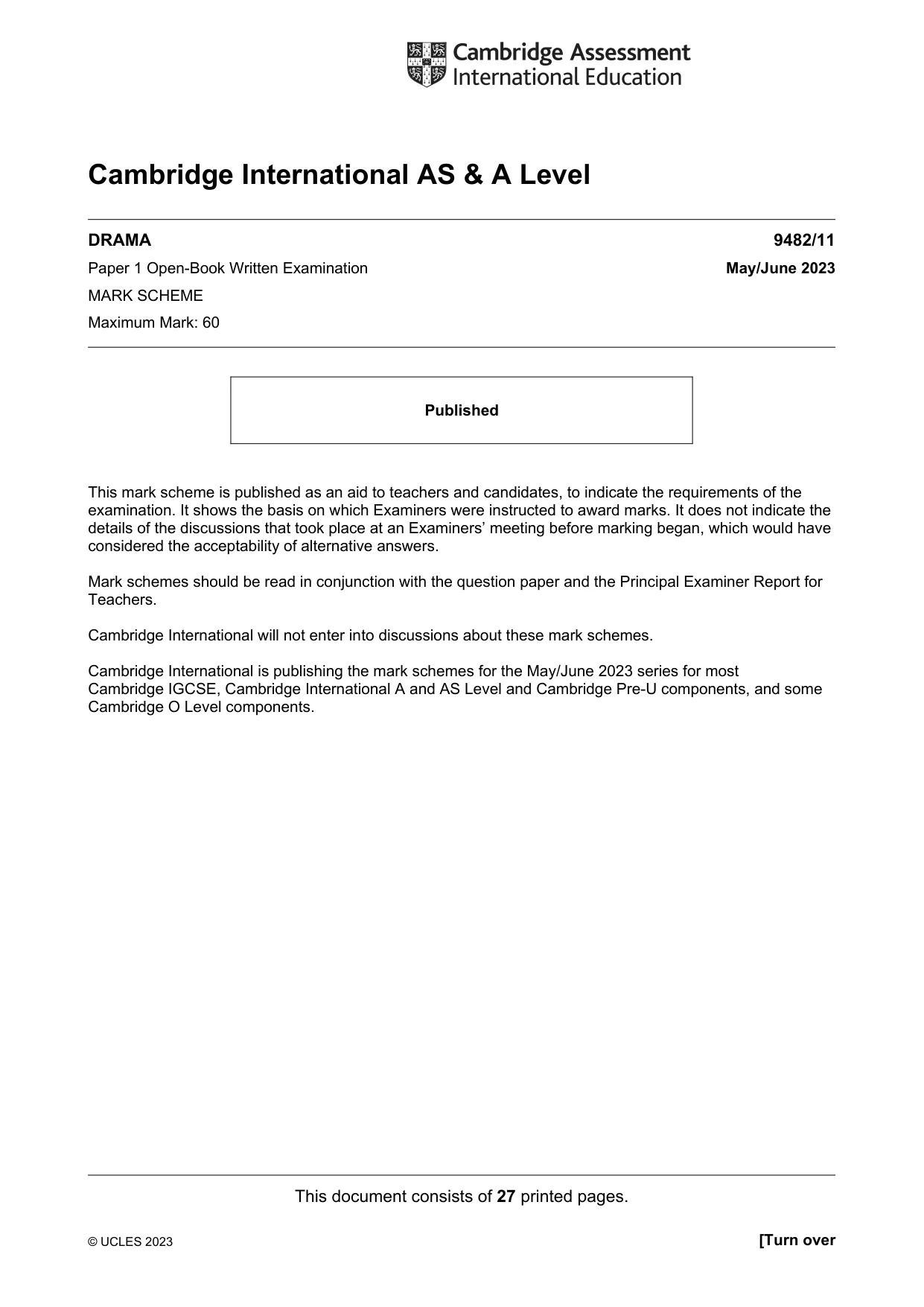
This document consists of 27 printed pages. © UCLES 2023 [Turn over Cambridge International AS & A Level DRAMA 9482/11 Paper 1 Open-Book Written Examination May/June 2023 MARK SCHEME Maximum Mark: 60 Published This mark scheme is published as an aid to teachers and candidates, to indicate the requirements of the examination. It shows the basis on which Examiners were instructed to award marks. It does not indicate the details of the discussions that took place at an Examiners’ meeting before marking began, which would have considered the acceptability of alternative answers. Mark schemes should be read in conjunction with the question paper and the Principal Examiner Report for Teachers. Cambridge International will not enter into discussions about these mark schemes. Cambridge International is publishing the mark schemes for the May/June 2023 series for most Cambridge IGCSE, Cambridge International A and AS Level and Cambridge Pre-U components, and some Cambridge O Level components.
Mark scheme, page 2
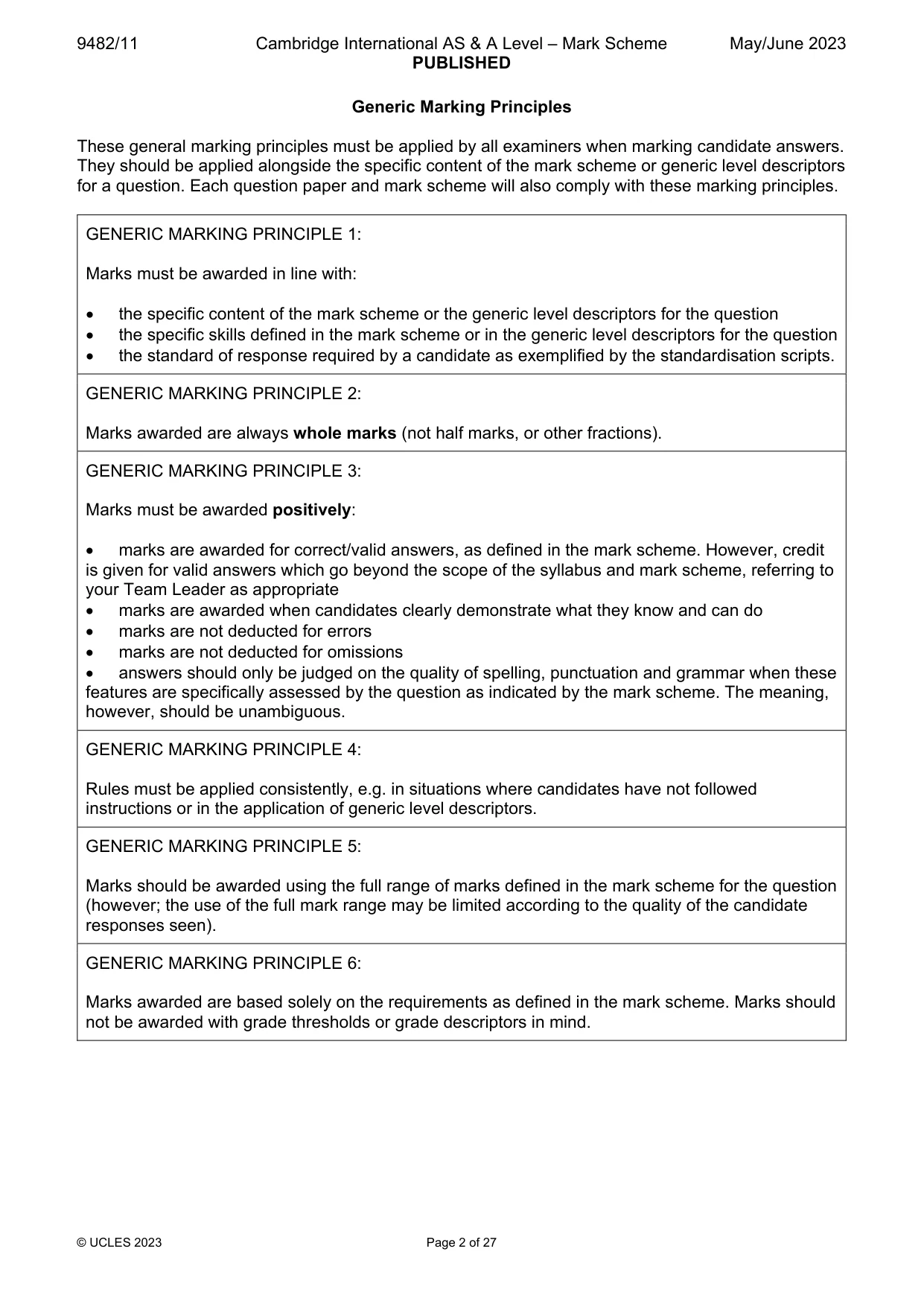
9482/11 Cambridge International AS & A Level – Mark Scheme PUBLISHED May/June 2023 © UCLES 2023 Page 2 of 27 Generic Marking Principles These general marking principles must be applied by all examiners when marking candidate answers. They should be applied alongside the specific content of the mark scheme or generic level descriptors for a question. Each question paper and mark scheme will also comply with these marking principles. GENERIC MARKING PRINCIPLE 1: Marks must be awarded in line with: the specific content of the mark scheme or the generic level descriptors for the question the specific skills defined in the mark scheme or in the generic level descriptors for the question the standard of response required by a candidate as exemplified by the standardisation scripts. GENERIC MARKING PRINCIPLE 2: Marks awarded are always whole marks (not half marks, or other fractions). GENERIC MARKING PRINCIPLE 3: Marks must be awarded positively: marks are awarded for correct/valid answers, as defined in the mark scheme. However, credit is given for valid answers which go beyond the scope of the syllabus and mark scheme, referring to your Team Leader as appropriate marks are awarded when candidates clearly demonstrate what they know and can do marks are not deducted for errors marks are not deducted for omissions answers should only be judged on the quality of spelling, punctuation and grammar when these features are specifically assessed by the question as indicated by the mark scheme. The meaning, however, should be unambiguous. GENERIC MARKING PRINCIPLE 4: Rules must be applied consistently, e.g. in situations where candidates have not followed instructions or in the application of generic level descriptors. GENERIC MARKING PRINCIPLE 5: Marks should be awarded using the full range of marks defined in the mark scheme for the question (however; the use of the full mark range may be limited according to the quality of the candidate responses seen). GENERIC MARKING PRINCIPLE 6: Marks awarded are based solely on the requirements as defined in the mark scheme. Marks should not be awarded with grade thresholds or grade descriptors in mind.
Mark scheme, page 3
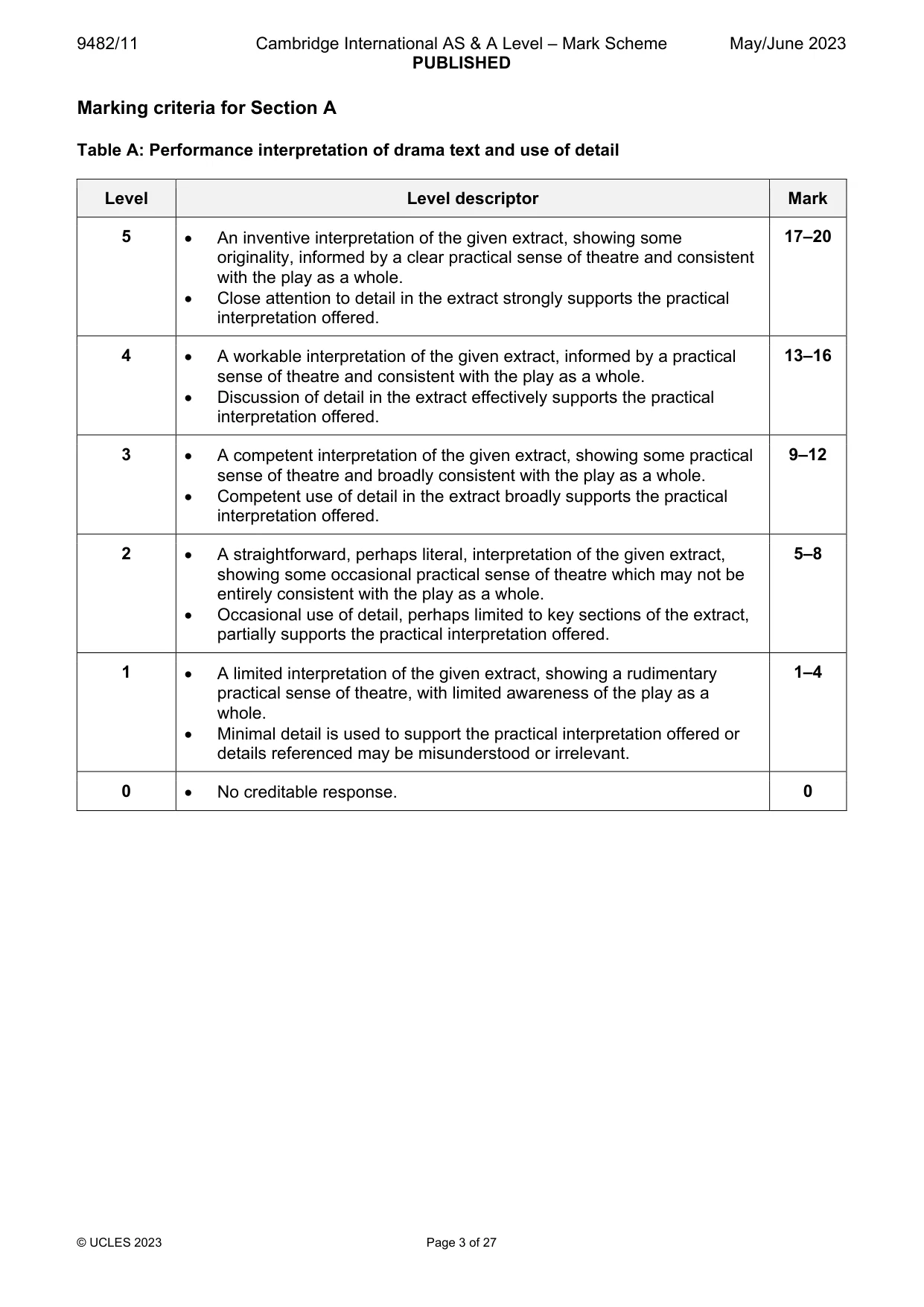
9482/11 Cambridge International AS & A Level – Mark Scheme PUBLISHED May/June 2023 © UCLES 2023 Page 3 of 27 Marking criteria for Section A Table A: Performance interpretation of drama text and use of detail Level Level descriptor Mark 5 An inventive interpretation of the given extract, showing some originality, informed by a clear practical sense of theatre and consistent with the play as a whole. Close attention to detail in the extract strongly supports the practical interpretation offered. 17–20 4 A workable interpretation of the given extract, informed by a practical sense of theatre and consistent with the play as a whole. Discussion of detail in the extract effectively supports the practical interpretation offered. 13–16 3 A competent interpretation of the given extract, showing some practical sense of theatre and broadly consistent with the play as a whole. Competent use of detail in the extract broadly supports the practical interpretation offered. 9–12 2 A straightforward, perhaps literal, interpretation of the given extract, showing some occasional practical sense of theatre which may not be entirely consistent with the play as a whole. Occasional use of detail, perhaps limited to key sections of the extract, partially supports the practical interpretation offered. 5–8 1 A limited interpretation of the given extract, showing a rudimentary practical sense of theatre, with limited awareness of the play as a whole. Minimal detail is used to support the practical interpretation offered or details referenced may be misunderstood or irrelevant. 1–4 0 No creditable response. 0
Mark scheme, page 4
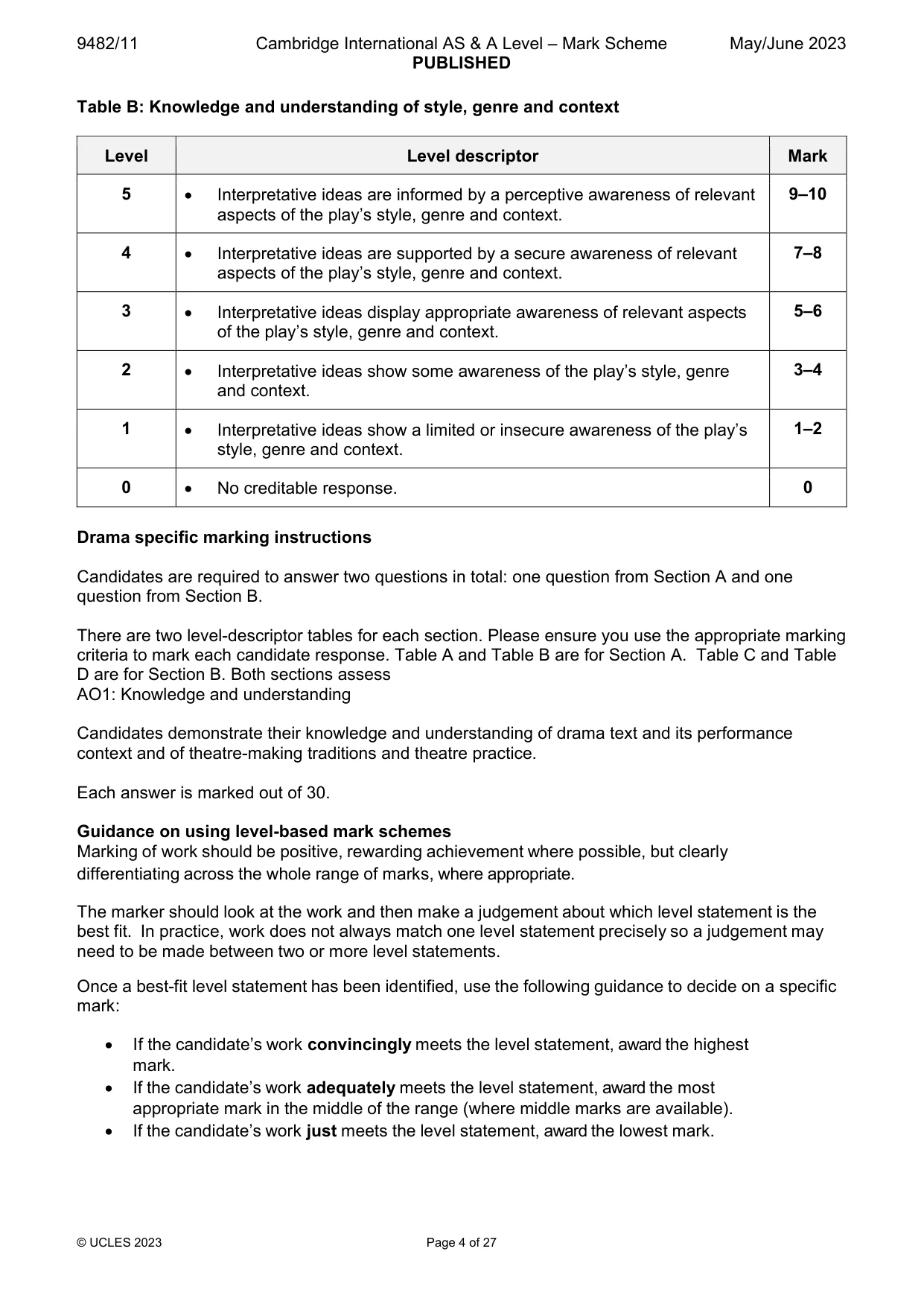
9482/11 Cambridge International AS & A Level – Mark Scheme PUBLISHED May/June 2023 © UCLES 2023 Page 4 of 27 Table B: Knowledge and understanding of style, genre and context Level Level descriptor Mark 5 Interpretative ideas are informed by a perceptive awareness of relevant aspects of the play’s style, genre and context. 9–10 4 Interpretative ideas are supported by a secure awareness of relevant aspects of the play’s style, genre and context. 7–8 3 Interpretative ideas display appropriate awareness of relevant aspects of the play’s style, genre and context. 5–6 2 Interpretative ideas show some awareness of the play’s style, genre and context. 3–4 1 Interpretative ideas show a limited or insecure awareness of the play’s style, genre and context. 1–2 0 No creditable response. 0 Drama specific marking instructions Candidates are required to answer two questions in total: one question from Section A and one question from Section B. There are two level-descriptor tables for each section. Please ensure you use the appropriate marking criteria to mark each candidate response. Table A and Table B are for Section A. Table C and Table D are for Section B. Both sections assess AO1: Knowledge and understanding Candidates demonstrate their knowledge and understanding of drama text and its performance context and of theatre-making traditions and theatre practice. Each answer is marked out of 30. Guidance on using level-based mark schemes Marking of work should be positive, rewarding achievement where possible, but clearly differentiating across the whole range of marks, where appropriate. The marker should look at the work and then make a judgement about which level statement is the best fit. In practice, work does not always match one level statement precisely so a judgement may need to be made between two or more level statements. Once a best-fit level statement has been identified, use the following guidance to decide on a specific mark: If the candidate’s work convincingly meets the level statement, award the highest mark. If the candidate’s work adequately meets the level statement, award the most appropriate mark in the middle of the range (where middle marks are available). If the candidate’s work just meets the level statement, award the lowest mark.
Mark scheme, page 5
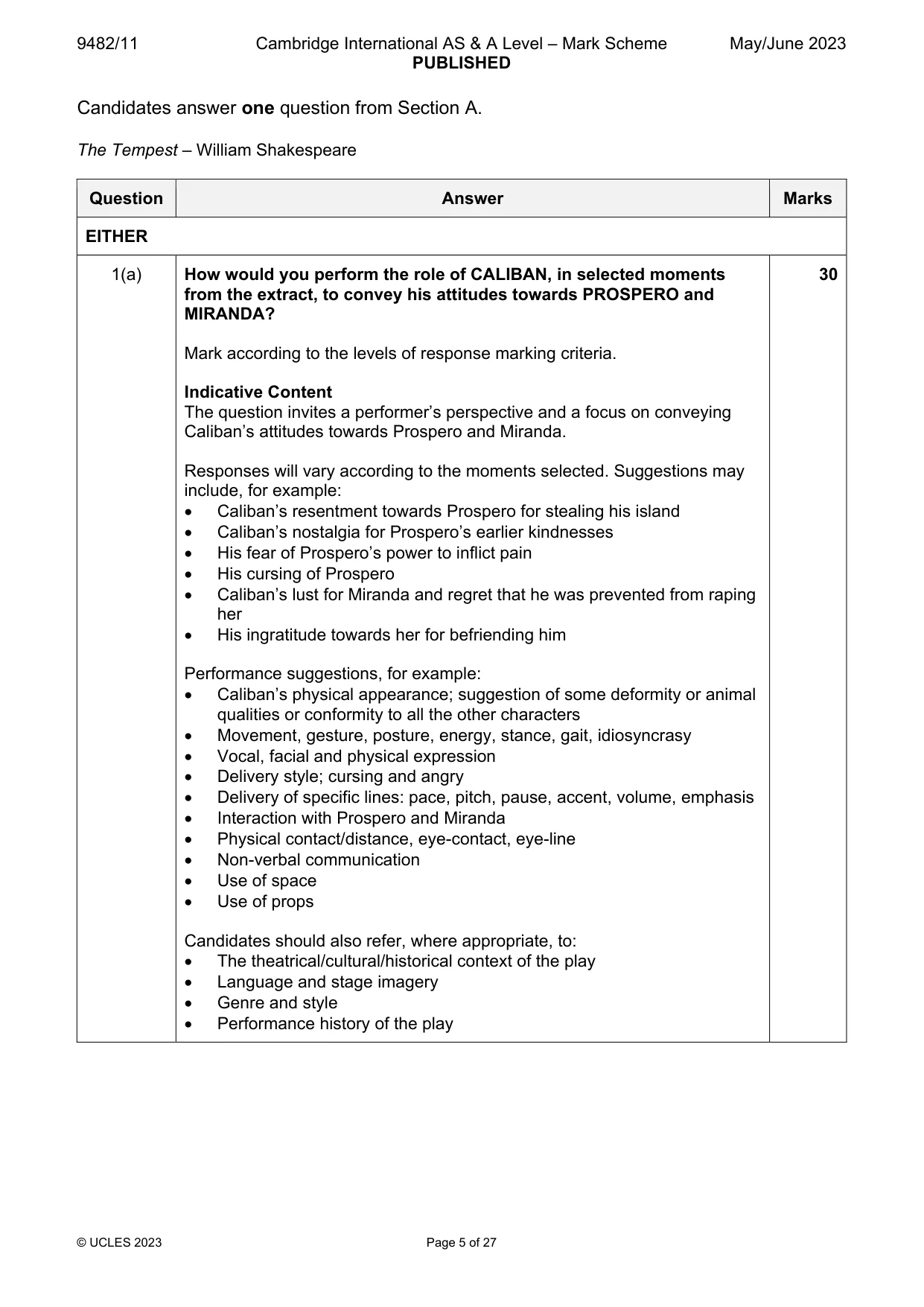
9482/11 Cambridge International AS & A Level – Mark Scheme PUBLISHED May/June 2023 © UCLES 2023 Page 5 of 27 Candidates answer one question from Section A. The Tempest – William Shakespeare Question Answer Marks EITHER 1(a) How would you perform the role of CALIBAN, in selected moments from the extract, to convey his attitudes towards PROSPERO and MIRANDA? Mark according to the levels of response marking criteria. Indicative Content The question invites a performer’s perspective and a focus on conveying Caliban’s attitudes towards Prospero and Miranda. Responses will vary according to the moments selected. Suggestions may include, for example: Caliban’s resentment towards Prospero for stealing his island Caliban’s nostalgia for Prospero’s earlier kindnesses His fear of Prospero’s power to inflict pain His cursing of Prospero Caliban’s lust for Miranda and regret that he was prevented from raping her His ingratitude towards her for befriending him Performance suggestions, for example: Caliban’s physical appearance; suggestion of some deformity or animal qualities or conformity to all the other characters Movement, gesture, posture, energy, stance, gait, idiosyncrasy Vocal, facial and physical expression Delivery style; cursing and angry Delivery of specific lines: pace, pitch, pause, accent, volume, emphasis Interaction with Prospero and Miranda Physical contact/distance, eye-contact, eye-line Non-verbal communication Use of space Use of props Candidates should also refer, where appropriate, to: The theatrical/cultural/historical context of the play Language and stage imagery Genre and style Performance history of the play 30
Mark scheme, page 6
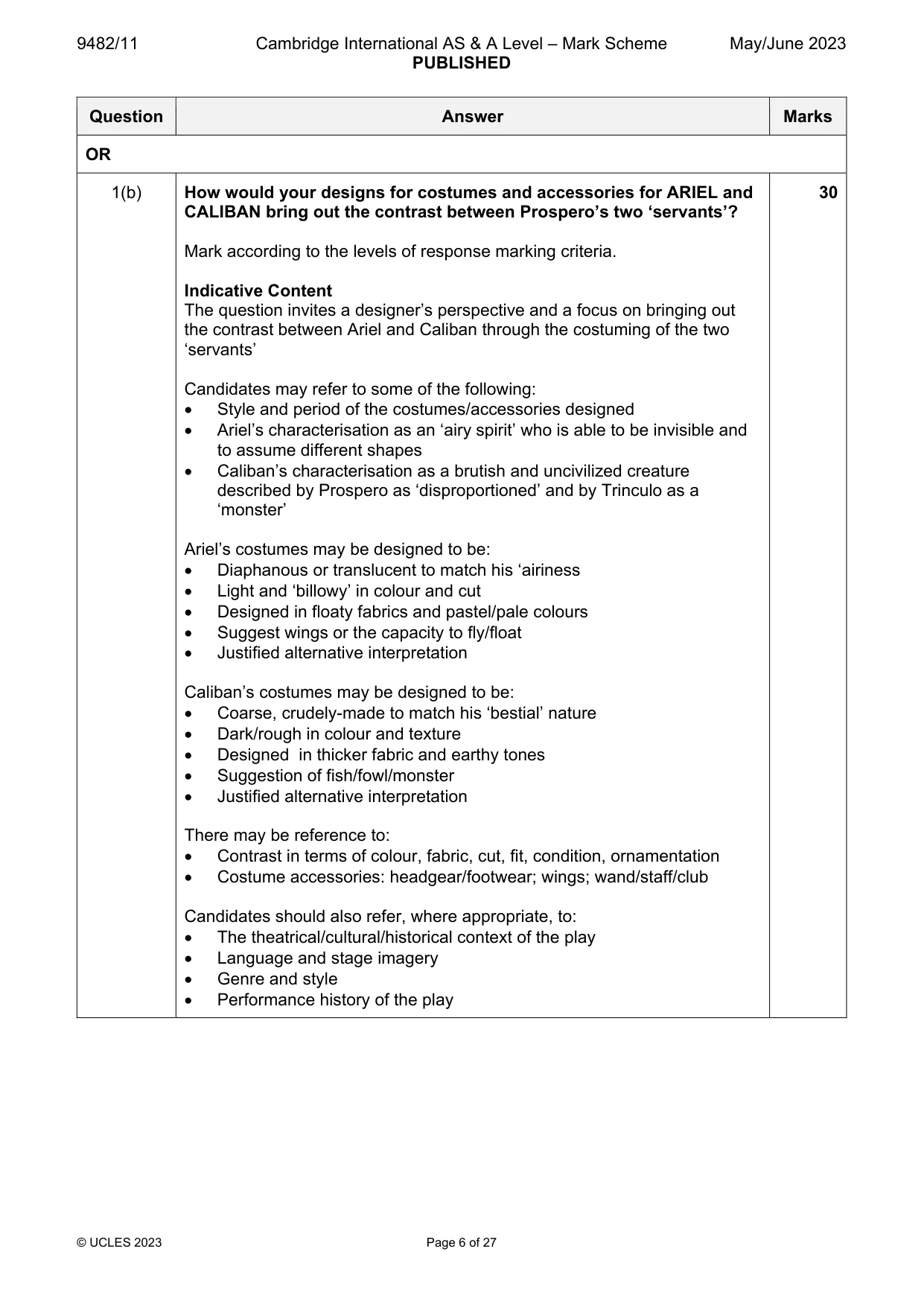
9482/11 Cambridge International AS & A Level – Mark Scheme PUBLISHED May/June 2023 © UCLES 2023 Page 6 of 27 Question Answer Marks OR 1(b) How would your designs for costumes and accessories for ARIEL and CALIBAN bring out the contrast between Prospero’s two ‘servants’? Mark according to the levels of response marking criteria. Indicative Content The question invites a designer’s perspective and a focus on bringing out the contrast between Ariel and Caliban through the costuming of the two ‘servants’ Candidates may refer to some of the following: Style and period of the costumes/accessories designed Ariel’s characterisation as an ‘airy spirit’ who is able to be invisible and to assume different shapes Caliban’s characterisation as a brutish and uncivilized creature described by Prospero as ‘disproportioned’ and by Trinculo as a ‘monster’ Ariel’s costumes may be designed to be: Diaphanous or translucent to match his ‘airiness Light and ‘billowy’ in colour and cut Designed in floaty fabrics and pastel/pale colours Suggest wings or the capacity to fly/float Justified alternative interpretation Caliban’s costumes may be designed to be: Coarse, crudely-made to match his ‘bestial’ nature Dark/rough in colour and texture Designed in thicker fabric and earthy tones Suggestion of fish/fowl/monster Justified alternative interpretation There may be reference to: Contrast in terms of colour, fabric, cut, fit, condition, ornamentation Costume accessories: headgear/footwear; wings; wand/staff/club Candidates should also refer, where appropriate, to: The theatrical/cultural/historical context of the play Language and stage imagery Genre and style Performance history of the play 30
Mark scheme, page 7
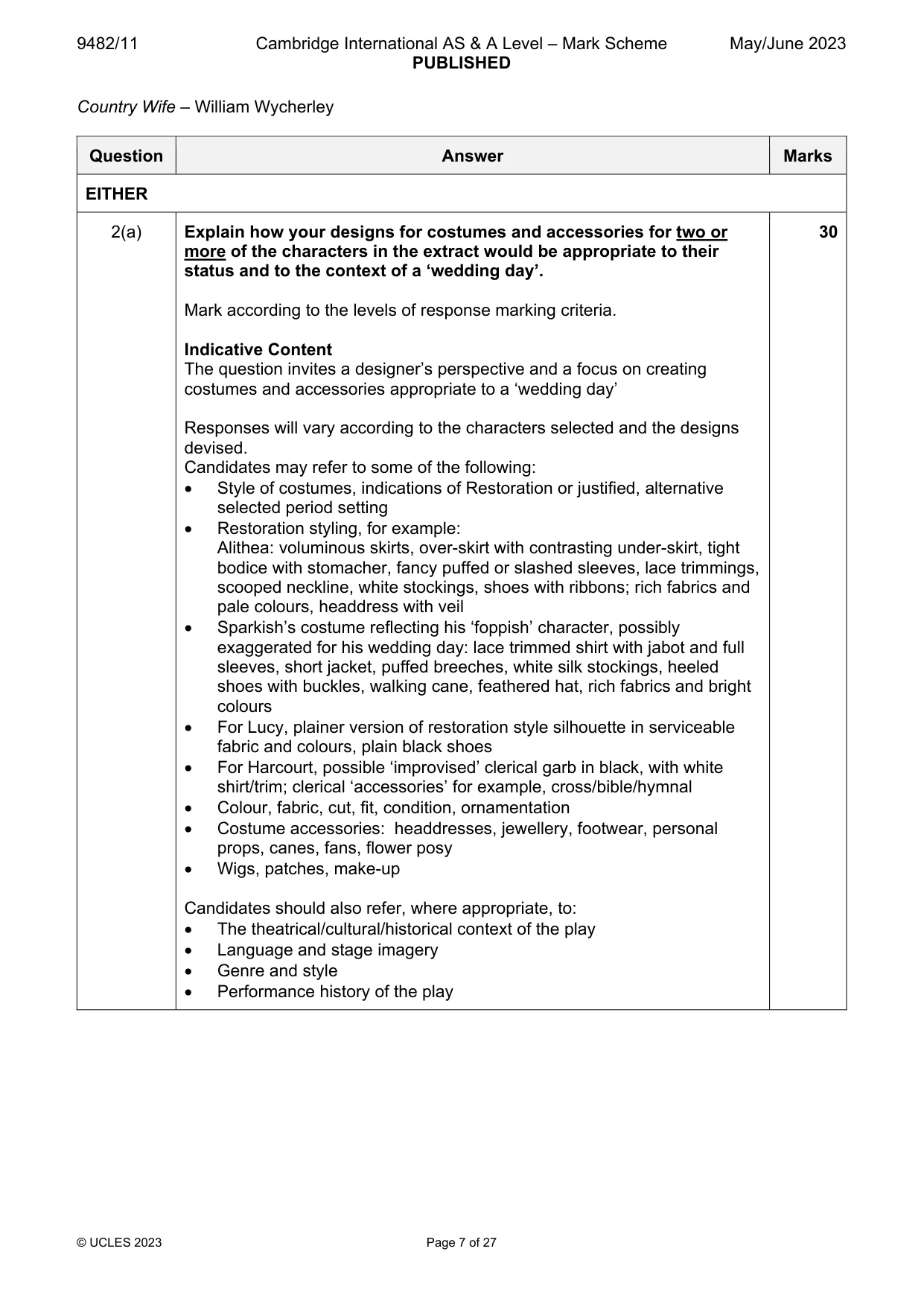
9482/11 Cambridge International AS & A Level – Mark Scheme PUBLISHED May/June 2023 © UCLES 2023 Page 7 of 27 Country Wife – William Wycherley Question Answer Marks EITHER 2(a) Explain how your designs for costumes and accessories for two or more of the characters in the extract would be appropriate to their status and to the context of a ‘wedding day’. Mark according to the levels of response marking criteria. Indicative Content The question invites a designer’s perspective and a focus on creating costumes and accessories appropriate to a ‘wedding day’ Responses will vary according to the characters selected and the designs devised. Candidates may refer to some of the following: Style of costumes, indications of Restoration or justified, alternative selected period setting Restoration styling, for example: Alithea: voluminous skirts, over-skirt with contrasting under-skirt, tight bodice with stomacher, fancy puffed or slashed sleeves, lace trimmings, scooped neckline, white stockings, shoes with ribbons; rich fabrics and pale colours, headdress with veil Sparkish’s costume reflecting his ‘foppish’ character, possibly exaggerated for his wedding day: lace trimmed shirt with jabot and full sleeves, short jacket, puffed breeches, white silk stockings, heeled shoes with buckles, walking cane, feathered hat, rich fabrics and bright colours For Lucy, plainer version of restoration style silhouette in serviceable fabric and colours, plain black shoes For Harcourt, possible ‘improvised’ clerical garb in black, with white shirt/trim; clerical ‘accessories’ for example, cross/bible/hymnal Colour, fabric, cut, fit, condition, ornamentation Costume accessories: headdresses, jewellery, footwear, personal props, canes, fans, flower posy Wigs, patches, make-up Candidates should also refer, where appropriate, to: The theatrical/cultural/historical context of the play Language and stage imagery Genre and style Performance history of the play 30
Mark scheme, page 8
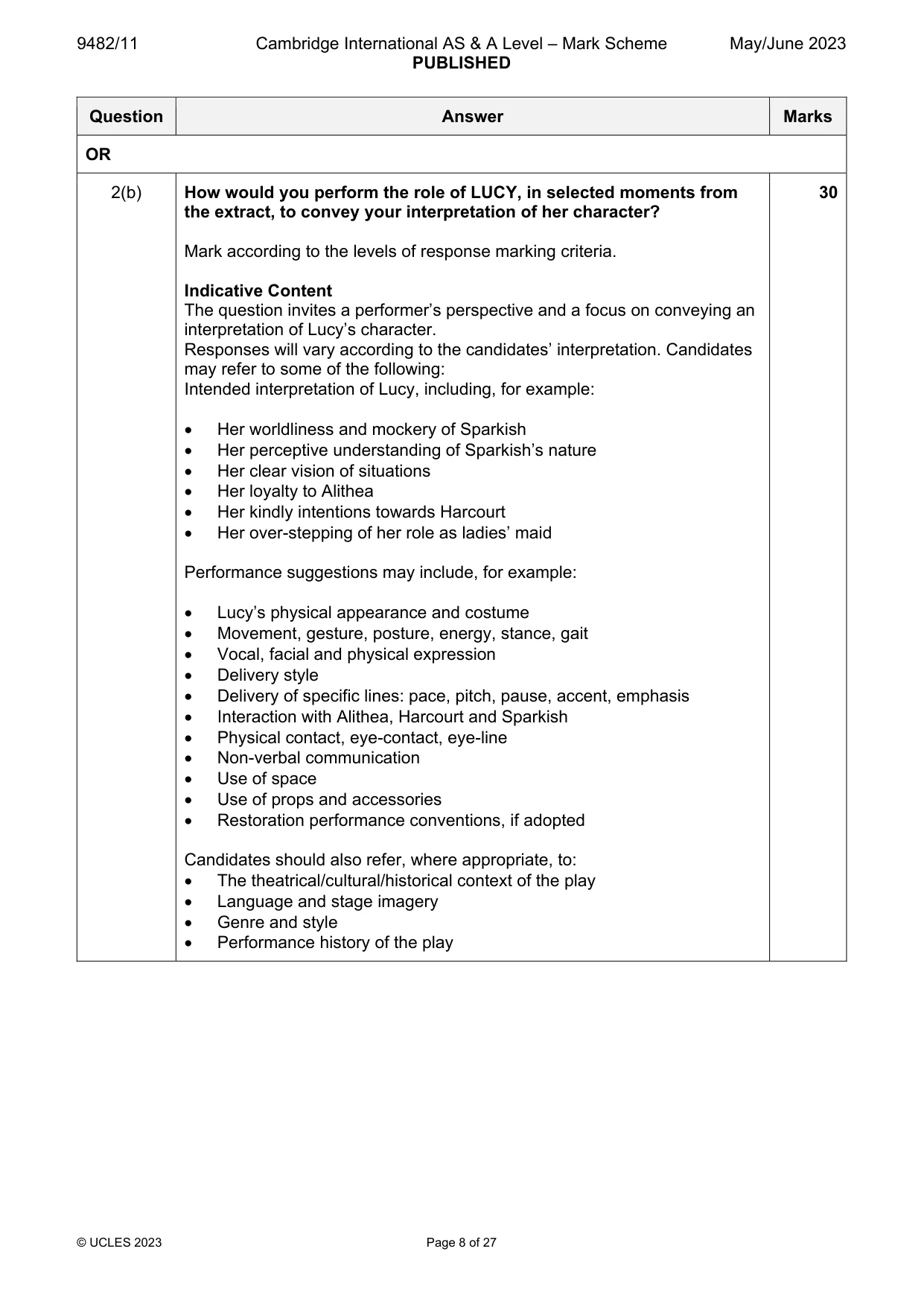
9482/11 Cambridge International AS & A Level – Mark Scheme PUBLISHED May/June 2023 © UCLES 2023 Page 8 of 27 Question Answer Marks OR 2(b) How would you perform the role of LUCY, in selected moments from the extract, to convey your interpretation of her character? Mark according to the levels of response marking criteria. Indicative Content The question invites a performer’s perspective and a focus on conveying an interpretation of Lucy’s character. Responses will vary according to the candidates’ interpretation. Candidates may refer to some of the following: Intended interpretation of Lucy, including, for example: Her worldliness and mockery of Sparkish Her perceptive understanding of Sparkish’s nature Her clear vision of situations Her loyalty to Alithea Her kindly intentions towards Harcourt Her over-stepping of her role as ladies’ maid Performance suggestions may include, for example: Lucy’s physical appearance and costume Movement, gesture, posture, energy, stance, gait Vocal, facial and physical expression Delivery style Delivery of specific lines: pace, pitch, pause, accent, emphasis Interaction with Alithea, Harcourt and Sparkish Physical contact, eye-contact, eye-line Non-verbal communication Use of space Use of props and accessories Restoration performance conventions, if adopted Candidates should also refer, where appropriate, to: The theatrical/cultural/historical context of the play Language and stage imagery Genre and style Performance history of the play 30
Mark scheme, page 9
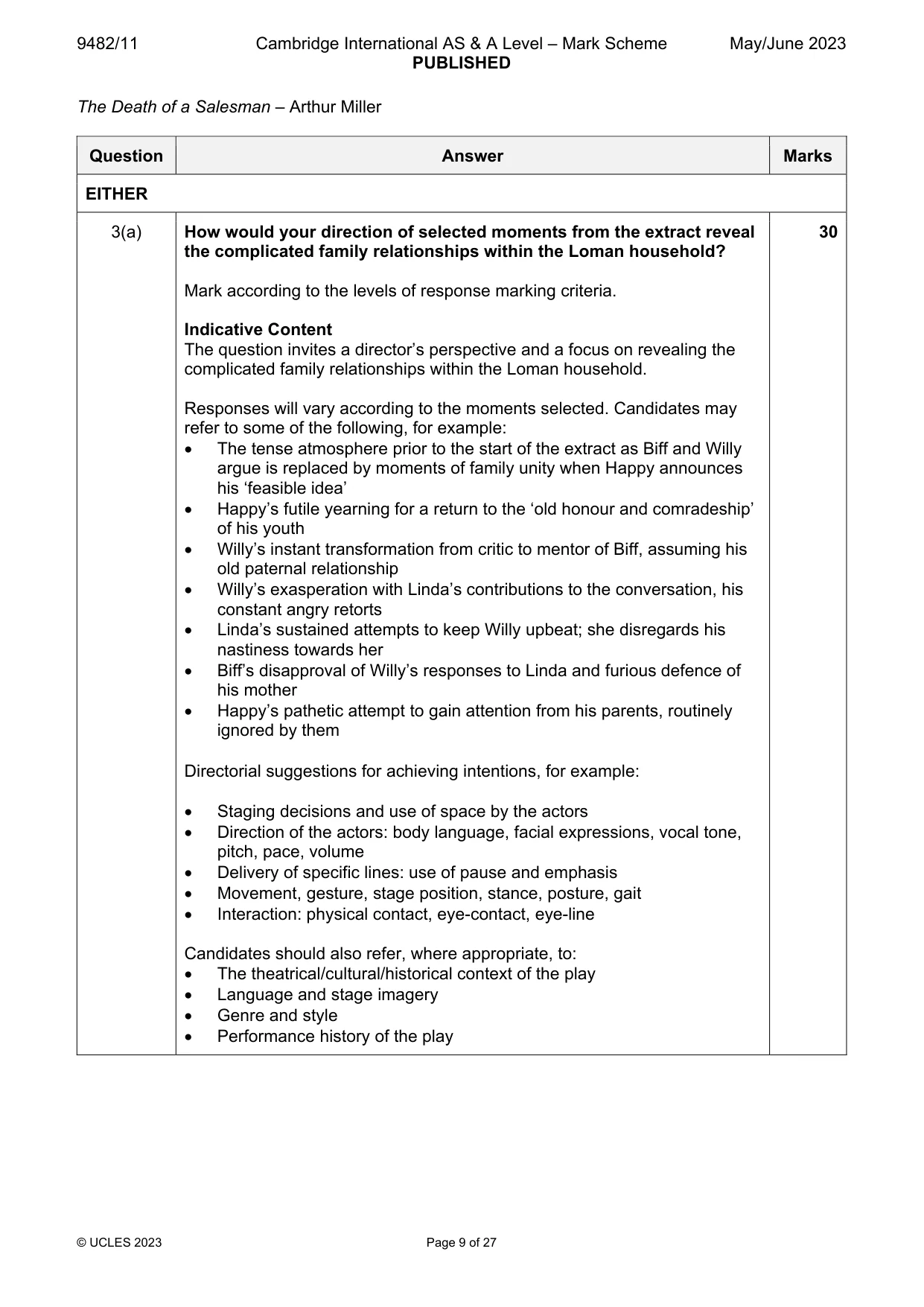
9482/11 Cambridge International AS & A Level – Mark Scheme PUBLISHED May/June 2023 © UCLES 2023 Page 9 of 27 The Death of a Salesman – Arthur Miller Question Answer Marks EITHER 3(a) How would your direction of selected moments from the extract reveal the complicated family relationships within the Loman household? Mark according to the levels of response marking criteria. Indicative Content The question invites a director’s perspective and a focus on revealing the complicated family relationships within the Loman household. Responses will vary according to the moments selected. Candidates may refer to some of the following, for example: The tense atmosphere prior to the start of the extract as Biff and Willy argue is replaced by moments of family unity when Happy announces his ‘feasible idea’ Happy’s futile yearning for a return to the ‘old honour and comradeship’ of his youth Willy’s instant transformation from critic to mentor of Biff, assuming his old paternal relationship Willy’s exasperation with Linda’s contributions to the conversation, his constant angry retorts Linda’s sustained attempts to keep Willy upbeat; she disregards his nastiness towards her Biff’s disapproval of Willy’s responses to Linda and furious defence of his mother Happy’s pathetic attempt to gain attention from his parents, routinely ignored by them Directorial suggestions for achieving intentions, for example: Staging decisions and use of space by the actors Direction of the actors: body language, facial expressions, vocal tone, pitch, pace, volume Delivery of specific lines: use of pause and emphasis Movement, gesture, stage position, stance, posture, gait Interaction: physical contact, eye-contact, eye-line Candidates should also refer, where appropriate, to: The theatrical/cultural/historical context of the play Language and stage imagery Genre and style Performance history of the play 30
Mark scheme, page 10
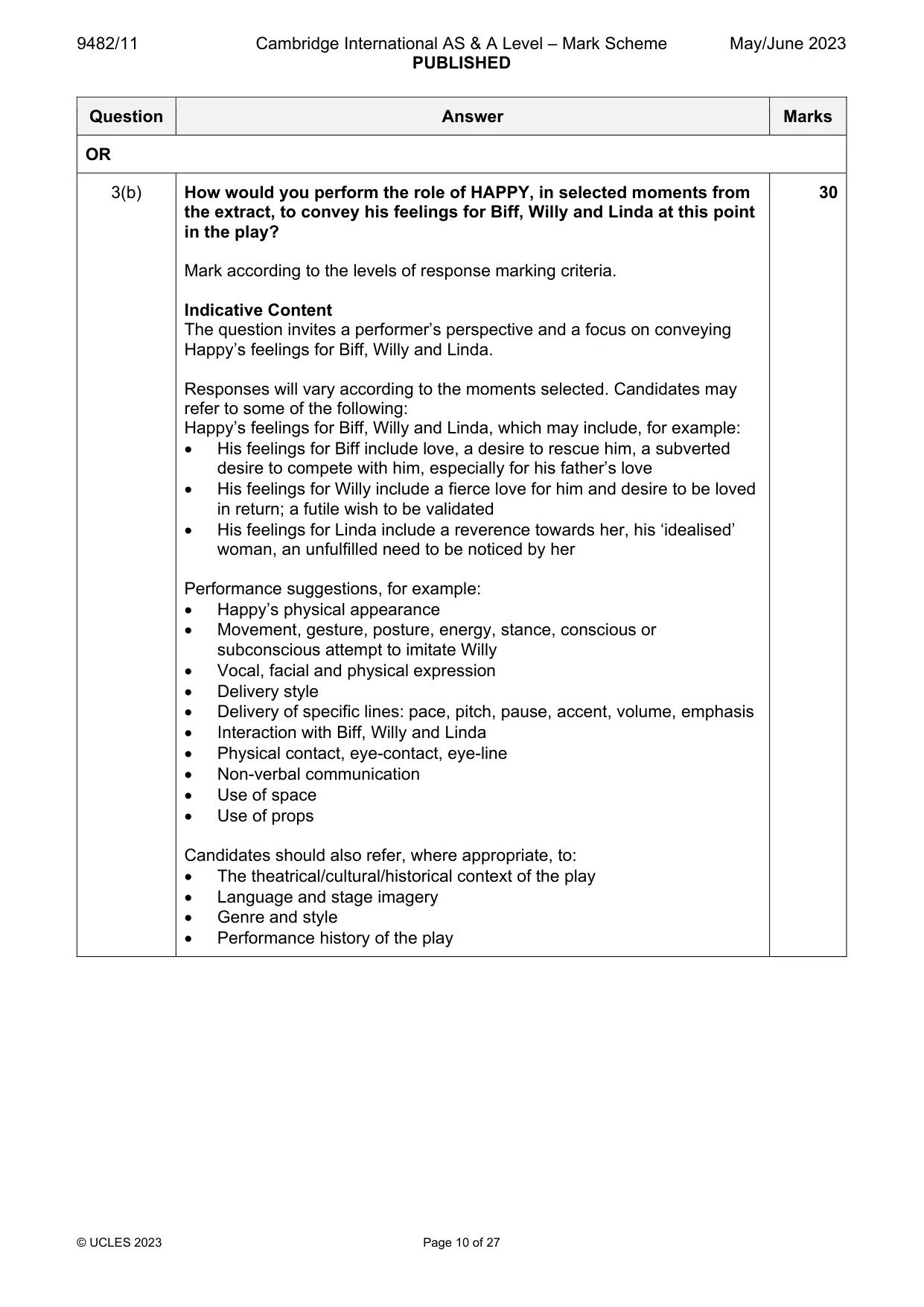
9482/11 Cambridge International AS & A Level – Mark Scheme PUBLISHED May/June 2023 © UCLES 2023 Page 10 of 27 Question Answer Marks OR 3(b) How would you perform the role of HAPPY, in selected moments from the extract, to convey his feelings for Biff, Willy and Linda at this point in the play? Mark according to the levels of response marking criteria. Indicative Content The question invites a performer’s perspective and a focus on conveying Happy’s feelings for Biff, Willy and Linda. Responses will vary according to the moments selected. Candidates may refer to some of the following: Happy’s feelings for Biff, Willy and Linda, which may include, for example: His feelings for Biff include love, a desire to rescue him, a subverted desire to compete with him, especially for his father’s love His feelings for Willy include a fierce love for him and desire to be loved in return; a futile wish to be validated His feelings for Linda include a reverence towards her, his ‘idealised’ woman, an unfulfilled need to be noticed by her Performance suggestions, for example: Happy’s physical appearance Movement, gesture, posture, energy, stance, conscious or subconscious attempt to imitate Willy Vocal, facial and physical expression Delivery style Delivery of specific lines: pace, pitch, pause, accent, volume, emphasis Interaction with Biff, Willy and Linda Physical contact, eye-contact, eye-line Non-verbal communication Use of space Use of props Candidates should also refer, where appropriate, to: The theatrical/cultural/historical context of the play Language and stage imagery Genre and style Performance history of the play 30
Mark scheme, page 11
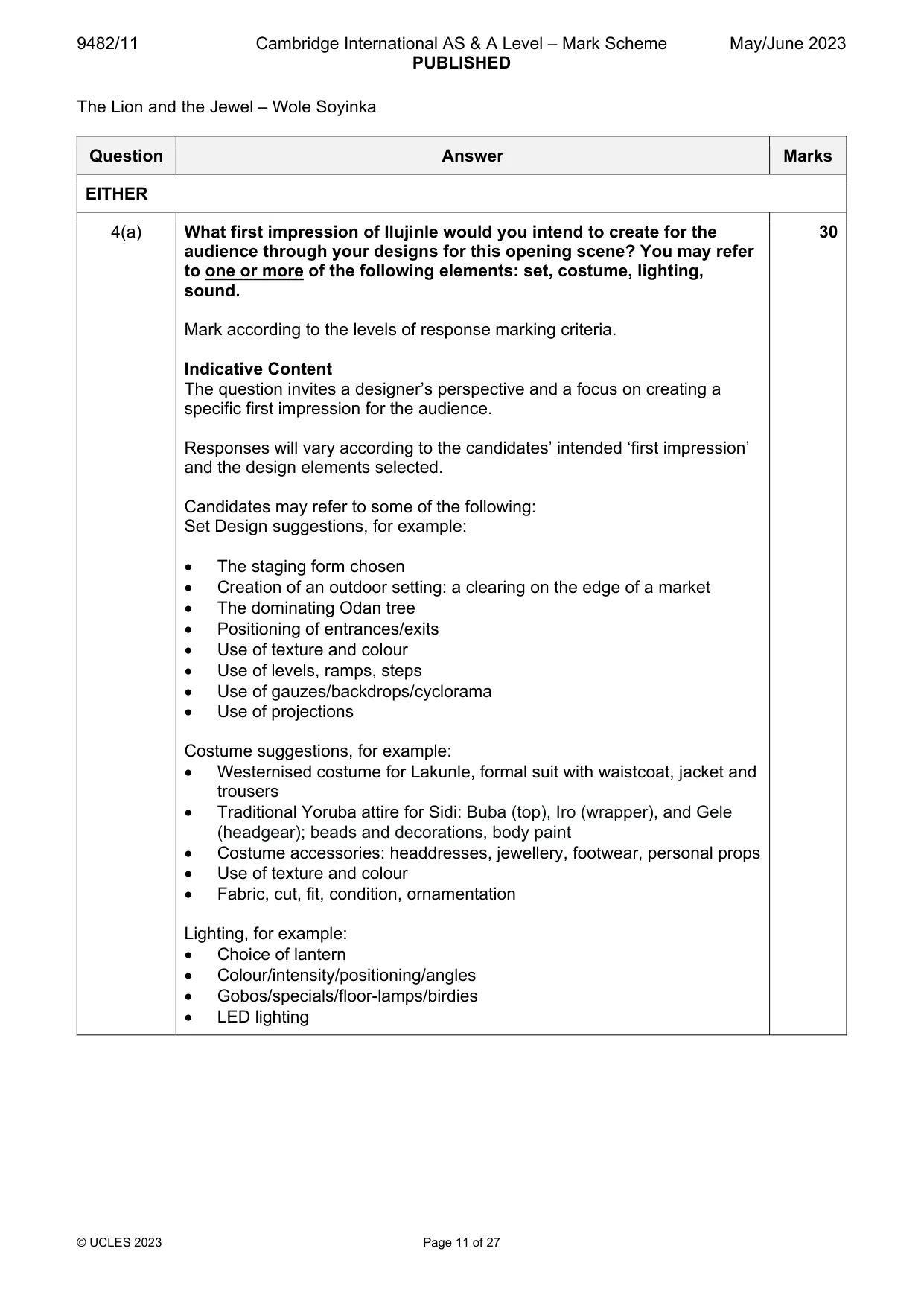
9482/11 Cambridge International AS & A Level – Mark Scheme PUBLISHED May/June 2023 © UCLES 2023 Page 11 of 27 The Lion and the Jewel – Wole Soyinka Question Answer Marks EITHER 4(a) What first impression of Ilujinle would you intend to create for the audience through your designs for this opening scene? You may refer to one or more of the following elements: set, costume, lighting, sound. Mark according to the levels of response marking criteria. Indicative Content The question invites a designer’s perspective and a focus on creating a specific first impression for the audience. Responses will vary according to the candidates’ intended ‘first impression’ and the design elements selected. Candidates may refer to some of the following: Set Design suggestions, for example: The staging form chosen Creation of an outdoor setting: a clearing on the edge of a market The dominating Odan tree Positioning of entrances/exits Use of texture and colour Use of levels, ramps, steps Use of gauzes/backdrops/cyclorama Use of projections Costume suggestions, for example: Westernised costume for Lakunle, formal suit with waistcoat, jacket and trousers Traditional Yoruba attire for Sidi: Buba (top), Iro (wrapper), and Gele (headgear); beads and decorations, body paint Costume accessories: headdresses, jewellery, footwear, personal props Use of texture and colour Fabric, cut, fit, condition, ornamentation Lighting, for example: Choice of lantern Colour/intensity/positioning/angles Gobos/specials/floor-lamps/birdies LED lighting 30
Mark scheme, page 12
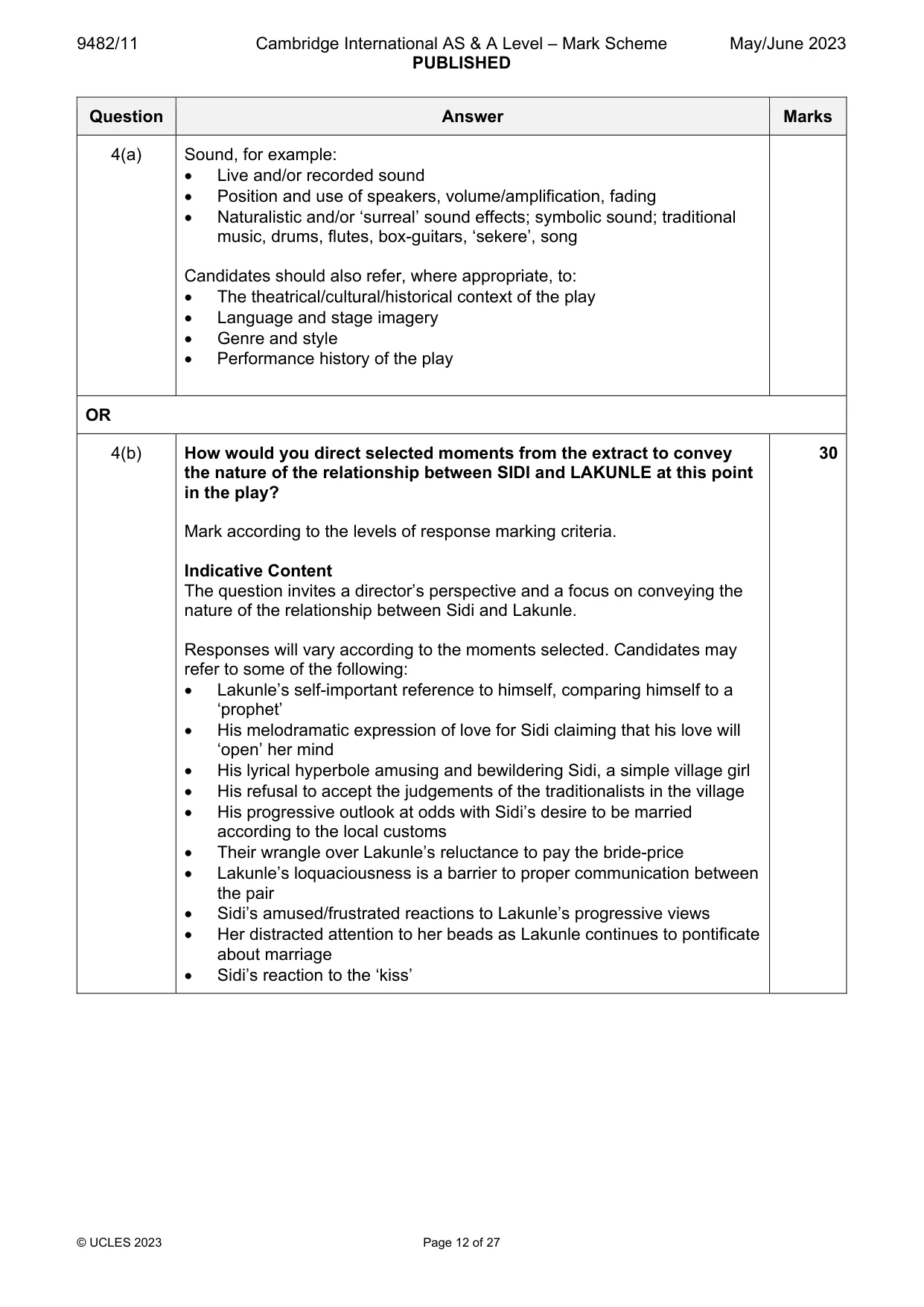
9482/11 Cambridge International AS & A Level – Mark Scheme PUBLISHED May/June 2023 © UCLES 2023 Page 12 of 27 Question Answer Marks 4(a) Sound, for example: Live and/or recorded sound Position and use of speakers, volume/amplification, fading Naturalistic and/or ‘surreal’ sound effects; symbolic sound; traditional music, drums, flutes, box-guitars, ‘sekere’, song Candidates should also refer, where appropriate, to: The theatrical/cultural/historical context of the play Language and stage imagery Genre and style Performance history of the play OR 4(b) How would you direct selected moments from the extract to convey the nature of the relationship between SIDI and LAKUNLE at this point in the play? Mark according to the levels of response marking criteria. Indicative Content The question invites a director’s perspective and a focus on conveying the nature of the relationship between Sidi and Lakunle. Responses will vary according to the moments selected. Candidates may refer to some of the following: Lakunle’s self-important reference to himself, comparing himself to a ‘prophet’ His melodramatic expression of love for Sidi claiming that his love will ‘open’ her mind His lyrical hyperbole amusing and bewildering Sidi, a simple village girl His refusal to accept the judgements of the traditionalists in the village His progressive outlook at odds with Sidi’s desire to be married according to the local customs Their wrangle over Lakunle’s reluctance to pay the bride-price Lakunle’s loquaciousness is a barrier to proper communication between the pair Sidi’s amused/frustrated reactions to Lakunle’s progressive views Her distracted attention to her beads as Lakunle continues to pontificate about marriage Sidi’s reaction to the ‘kiss’ 30
Mark scheme, page 13
9482/11 Cambridge International AS & A Level – Mark Scheme PUBLISHED May/June 2023 © UCLES 2023 Page 13 of 27 Question Answer Marks 4(b) Directorial suggestions, for example: Staging decisions and use of space by the actors Direction of the actors: body language, facial expressions, vocal tone, pitch, pace, volume Delivery of specific lines: use of pause and emphasis Movement, gesture, stage position, stance, posture, gait Interaction: physical contact, eye-contact, eye-line Candidates should also refer, where appropriate, to: The theatrical/cultural/historical context of the play Language and stage imagery Genre and style Performance history of the play
Mark scheme, page 14
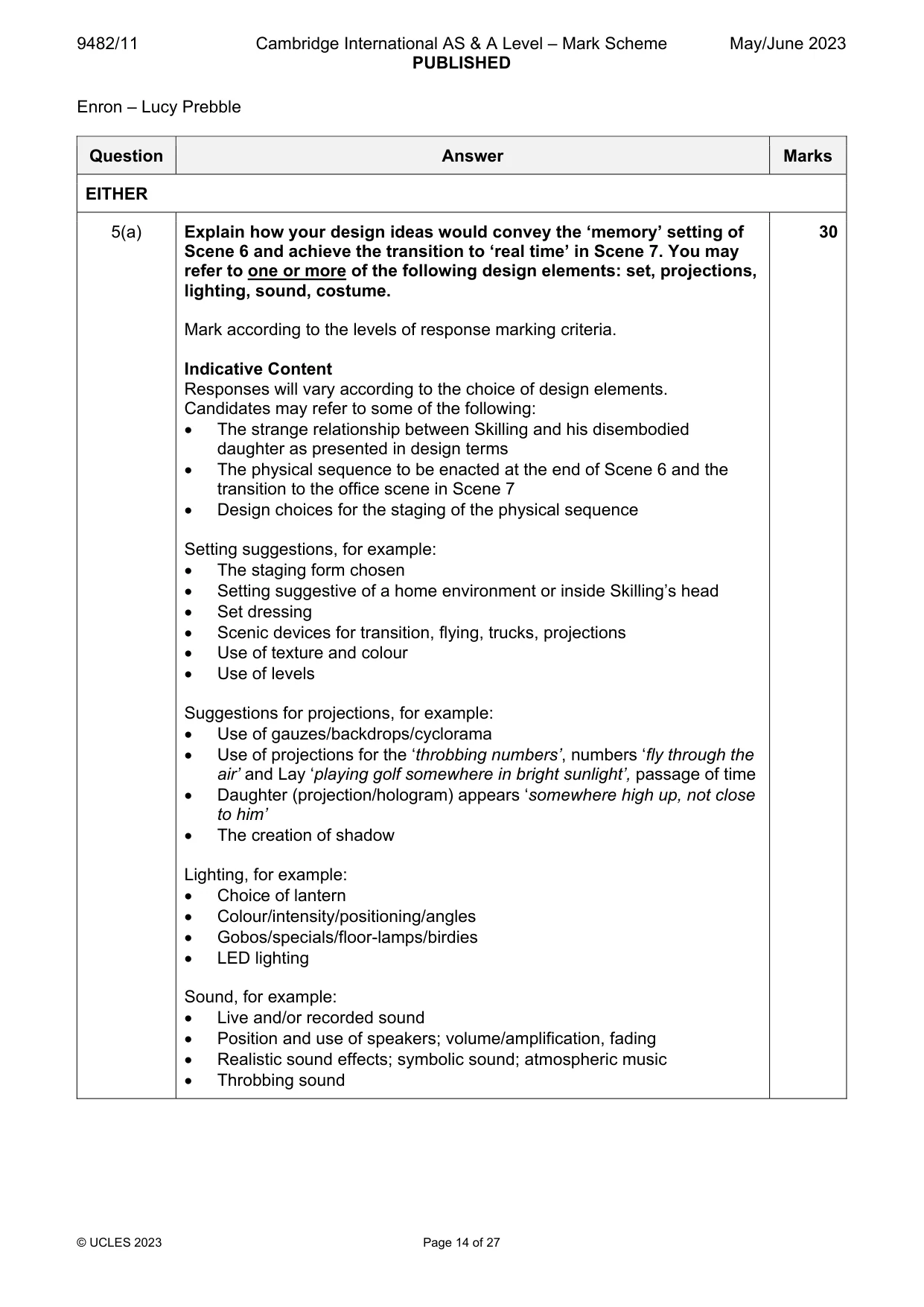
9482/11 Cambridge International AS & A Level – Mark Scheme PUBLISHED May/June 2023 © UCLES 2023 Page 14 of 27 Enron – Lucy Prebble Question Answer Marks EITHER 5(a) Explain how your design ideas would convey the ‘memory’ setting of Scene 6 and achieve the transition to ‘real time’ in Scene 7. You may refer to one or more of the following design elements: set, projections, lighting, sound, costume. Mark according to the levels of response marking criteria. Indicative Content Responses will vary according to the choice of design elements. Candidates may refer to some of the following: The strange relationship between Skilling and his disembodied daughter as presented in design terms The physical sequence to be enacted at the end of Scene 6 and the transition to the office scene in Scene 7 Design choices for the staging of the physical sequence Setting suggestions, for example: The staging form chosen Setting suggestive of a home environment or inside Skilling’s head Set dressing Scenic devices for transition, flying, trucks, projections Use of texture and colour Use of levels Suggestions for projections, for example: Use of gauzes/backdrops/cyclorama Use of projections for the ‘throbbing numbers’, numbers ‘fly through the air’ and Lay ‘playing golf somewhere in bright sunlight’, passage of time Daughter (projection/hologram) appears ‘somewhere high up, not close to him’ The creation of shadow Lighting, for example: Choice of lantern Colour/intensity/positioning/angles Gobos/specials/floor-lamps/birdies LED lighting Sound, for example: Live and/or recorded sound Position and use of speakers; volume/amplification, fading Realistic sound effects; symbolic sound; atmospheric music Throbbing sound 30
Mark scheme, page 15
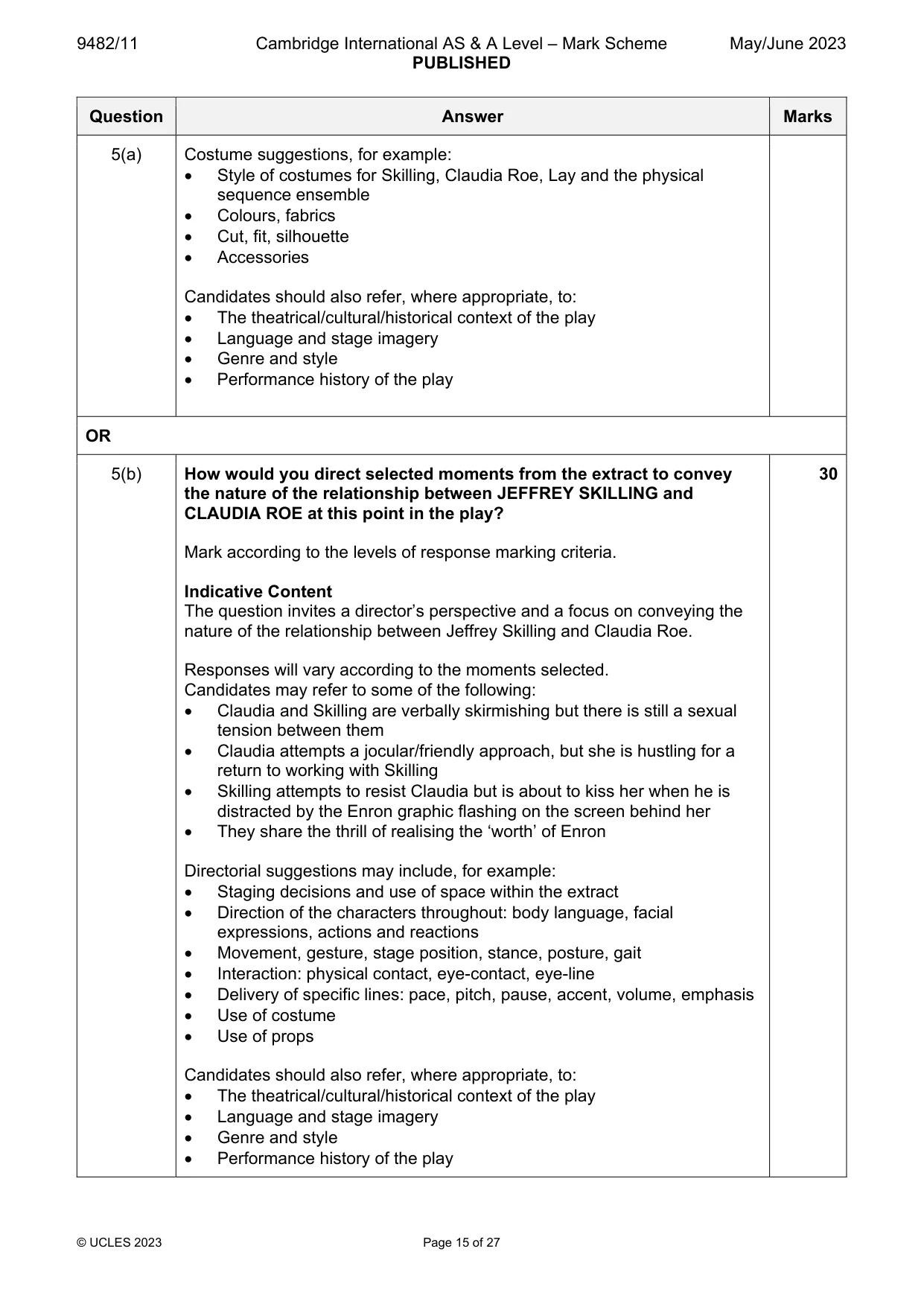
9482/11 Cambridge International AS & A Level – Mark Scheme PUBLISHED May/June 2023 © UCLES 2023 Page 15 of 27 Question Answer Marks 5(a) Costume suggestions, for example: Style of costumes for Skilling, Claudia Roe, Lay and the physical sequence ensemble Colours, fabrics Cut, fit, silhouette Accessories Candidates should also refer, where appropriate, to: The theatrical/cultural/historical context of the play Language and stage imagery Genre and style Performance history of the play OR 5(b) How would you direct selected moments from the extract to convey the nature of the relationship between JEFFREY SKILLING and CLAUDIA ROE at this point in the play? Mark according to the levels of response marking criteria. Indicative Content The question invites a director’s perspective and a focus on conveying the nature of the relationship between Jeffrey Skilling and Claudia Roe. Responses will vary according to the moments selected. Candidates may refer to some of the following: Claudia and Skilling are verbally skirmishing but there is still a sexual tension between them Claudia attempts a jocular/friendly approach, but she is hustling for a return to working with Skilling Skilling attempts to resist Claudia but is about to kiss her when he is distracted by the Enron graphic flashing on the screen behind her They share the thrill of realising the ‘worth’ of Enron Directorial suggestions may include, for example: Staging decisions and use of space within the extract Direction of the characters throughout: body language, facial expressions, actions and reactions Movement, gesture, stage position, stance, posture, gait Interaction: physical contact, eye-contact, eye-line Delivery of specific lines: pace, pitch, pause, accent, volume, emphasis Use of costume Use of props Candidates should also refer, where appropriate, to: The theatrical/cultural/historical context of the play Language and stage imagery Genre and style Performance history of the play 30
Mark scheme, page 16
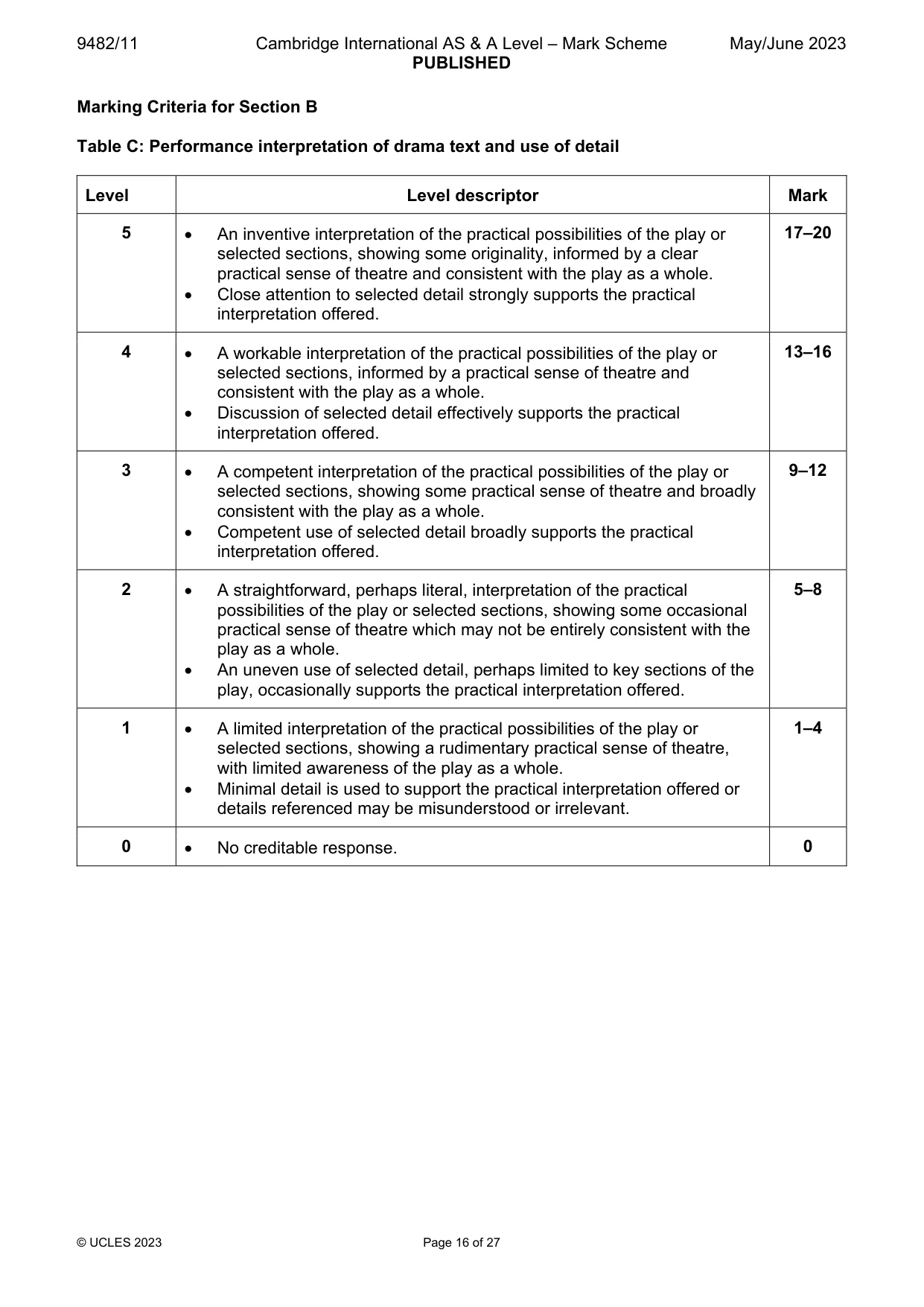
9482/11 Cambridge International AS & A Level – Mark Scheme PUBLISHED May/June 2023 © UCLES 2023 Page 16 of 27 Marking Criteria for Section B Table C: Performance interpretation of drama text and use of detail Level Level descriptor Mark 5 An inventive interpretation of the practical possibilities of the play or selected sections, showing some originality, informed by a clear practical sense of theatre and consistent with the play as a whole. Close attention to selected detail strongly supports the practical interpretation offered. 17–20 4 A workable interpretation of the practical possibilities of the play or selected sections, informed by a practical sense of theatre and consistent with the play as a whole. Discussion of selected detail effectively supports the practical interpretation offered. 13–16 3 A competent interpretation of the practical possibilities of the play or selected sections, showing some practical sense of theatre and broadly consistent with the play as a whole. Competent use of selected detail broadly supports the practical interpretation offered. 9–12 2 A straightforward, perhaps literal, interpretation of the practical possibilities of the play or selected sections, showing some occasional practical sense of theatre which may not be entirely consistent with the play as a whole. An uneven use of selected detail, perhaps limited to key sections of the play, occasionally supports the practical interpretation offered. 5–8 1 A limited interpretation of the practical possibilities of the play or selected sections, showing a rudimentary practical sense of theatre, with limited awareness of the play as a whole. Minimal detail is used to support the practical interpretation offered or details referenced may be misunderstood or irrelevant. 1–4 0 No creditable response. 0
Mark scheme, page 17
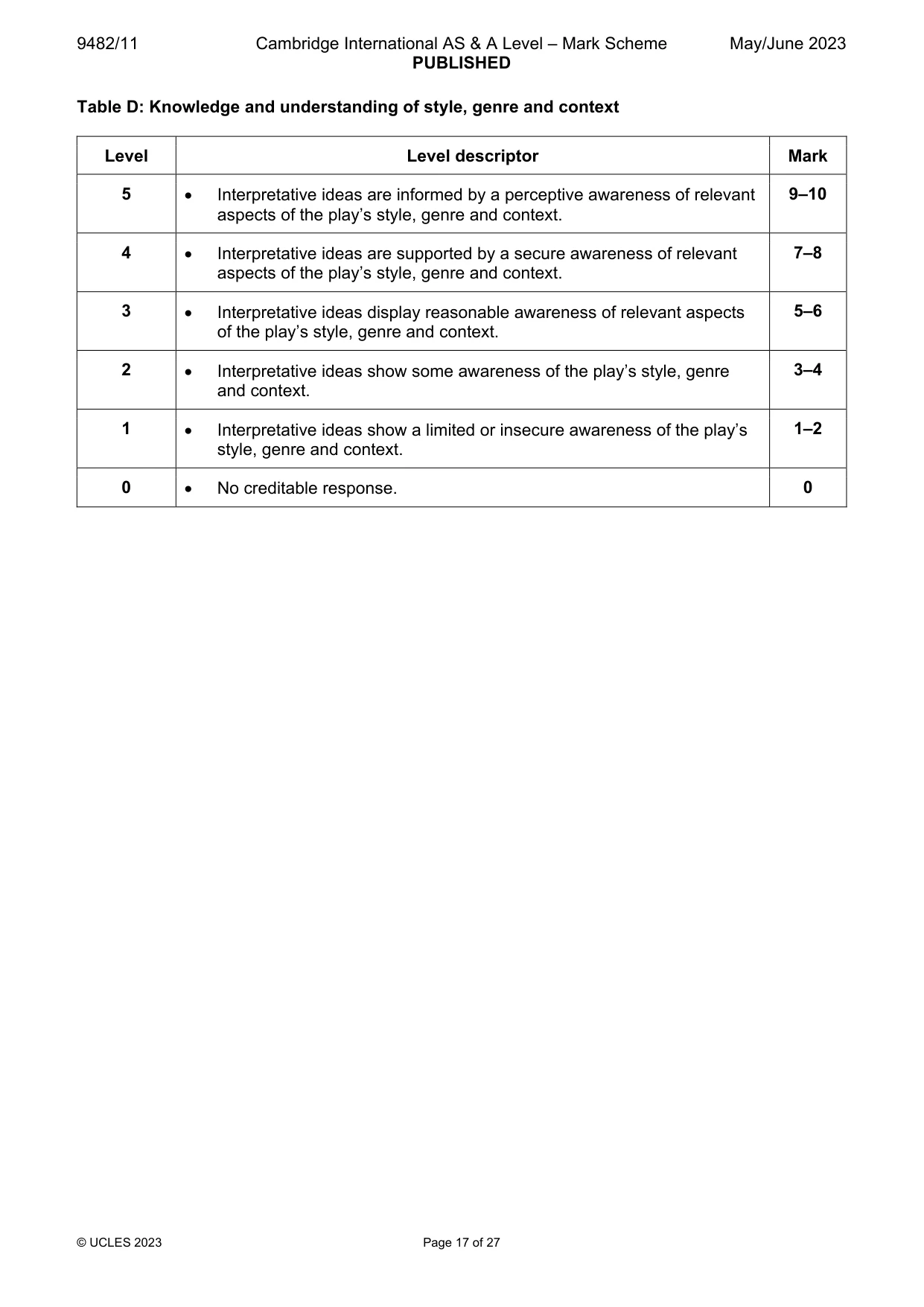
9482/11 Cambridge International AS & A Level – Mark Scheme PUBLISHED May/June 2023 © UCLES 2023 Page 17 of 27 Table D: Knowledge and understanding of style, genre and context Level Level descriptor Mark 5 Interpretative ideas are informed by a perceptive awareness of relevant aspects of the play’s style, genre and context. 9–10 4 Interpretative ideas are supported by a secure awareness of relevant aspects of the play’s style, genre and context. 7–8 3 Interpretative ideas display reasonable awareness of relevant aspects of the play’s style, genre and context. 5–6 2 Interpretative ideas show some awareness of the play’s style, genre and context. 3–4 1 Interpretative ideas show a limited or insecure awareness of the play’s style, genre and context. 1–2 0 No creditable response. 0
Mark scheme, page 18
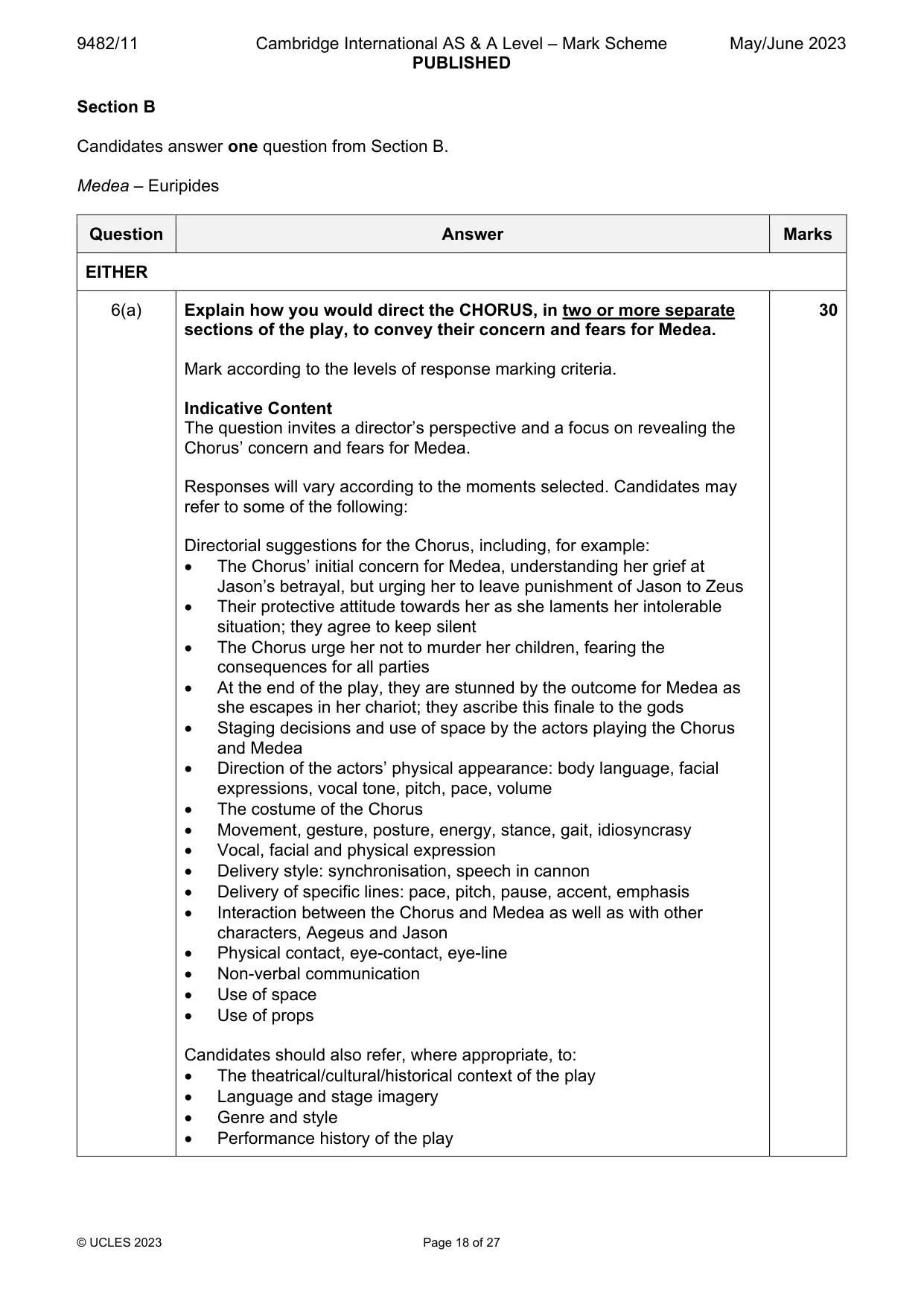
9482/11 Cambridge International AS & A Level – Mark Scheme PUBLISHED May/June 2023 © UCLES 2023 Page 18 of 27 Section B Candidates answer one question from Section B. Medea – Euripides Question Answer Marks EITHER 6(a) Explain how you would direct the CHORUS, in two or more separate sections of the play, to convey their concern and fears for Medea. Mark according to the levels of response marking criteria. Indicative Content The question invites a director’s perspective and a focus on revealing the Chorus’ concern and fears for Medea. Responses will vary according to the moments selected. Candidates may refer to some of the following: Directorial suggestions for the Chorus, including, for example: The Chorus’ initial concern for Medea, understanding her grief at Jason’s betrayal, but urging her to leave punishment of Jason to Zeus Their protective attitude towards her as she laments her intolerable situation; they agree to keep silent The Chorus urge her not to murder her children, fearing the consequences for all parties At the end of the play, they are stunned by the outcome for Medea as she escapes in her chariot; they ascribe this finale to the gods Staging decisions and use of space by the actors playing the Chorus and Medea Direction of the actors’ physical appearance: body language, facial expressions, vocal tone, pitch, pace, volume The costume of the Chorus Movement, gesture, posture, energy, stance, gait, idiosyncrasy Vocal, facial and physical expression Delivery style: synchronisation, speech in cannon Delivery of specific lines: pace, pitch, pause, accent, emphasis Interaction between the Chorus and Medea as well as with other characters, Aegeus and Jason Physical contact, eye-contact, eye-line Non-verbal communication Use of space Use of props Candidates should also refer, where appropriate, to: The theatrical/cultural/historical context of the play Language and stage imagery Genre and style Performance history of the play 30
Mark scheme, page 19
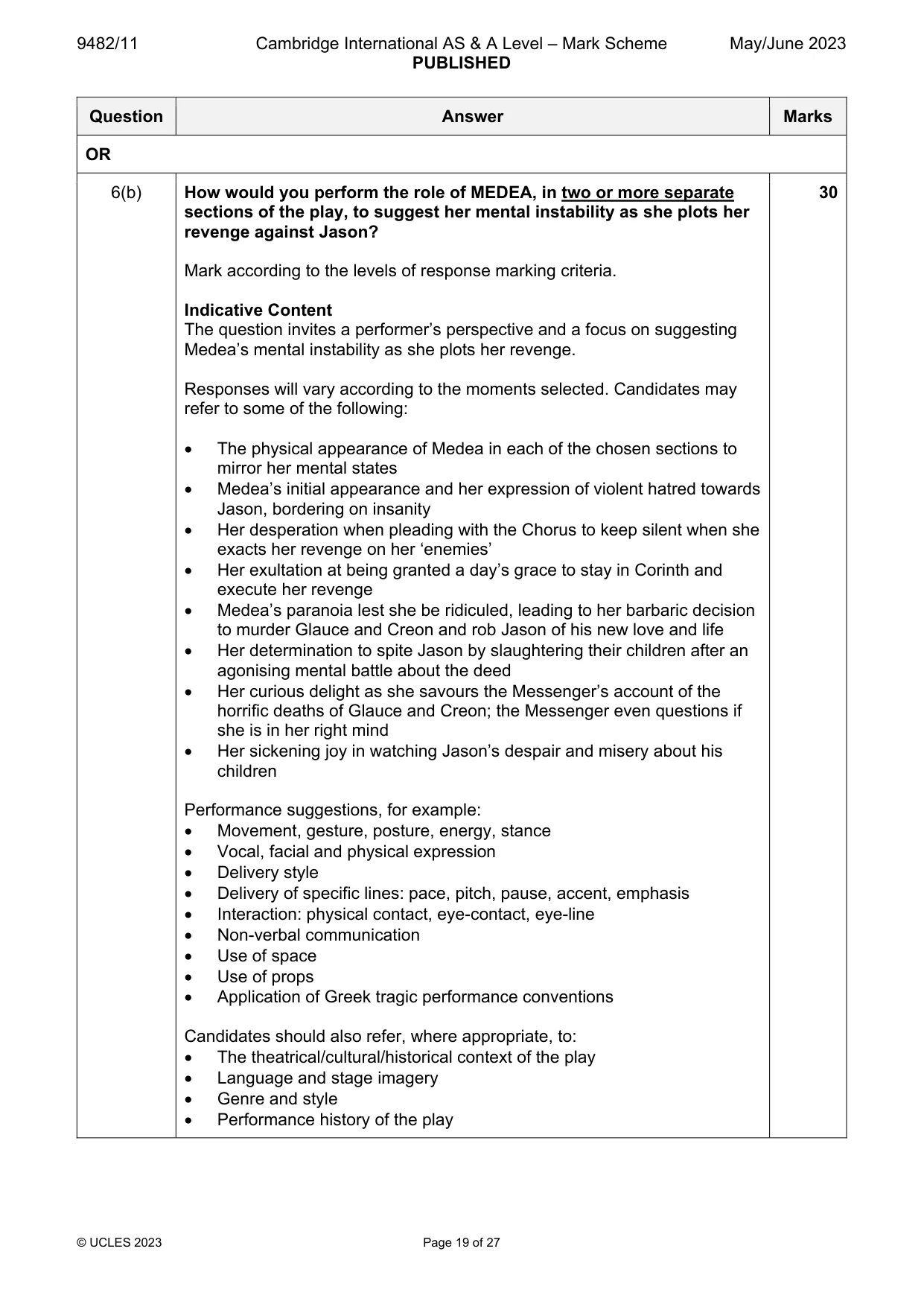
9482/11 Cambridge International AS & A Level – Mark Scheme PUBLISHED May/June 2023 © UCLES 2023 Page 19 of 27 Question Answer Marks OR 6(b) How would you perform the role of MEDEA, in two or more separate sections of the play, to suggest her mental instability as she plots her revenge against Jason? Mark according to the levels of response marking criteria. Indicative Content The question invites a performer’s perspective and a focus on suggesting Medea’s mental instability as she plots her revenge. Responses will vary according to the moments selected. Candidates may refer to some of the following: The physical appearance of Medea in each of the chosen sections to mirror her mental states Medea’s initial appearance and her expression of violent hatred towards Jason, bordering on insanity Her desperation when pleading with the Chorus to keep silent when she exacts her revenge on her ‘enemies’ Her exultation at being granted a day’s grace to stay in Corinth and execute her revenge Medea’s paranoia lest she be ridiculed, leading to her barbaric decision to murder Glauce and Creon and rob Jason of his new love and life Her determination to spite Jason by slaughtering their children after an agonising mental battle about the deed Her curious delight as she savours the Messenger’s account of the horrific deaths of Glauce and Creon; the Messenger even questions if she is in her right mind Her sickening joy in watching Jason’s despair and misery about his children Performance suggestions, for example: Movement, gesture, posture, energy, stance Vocal, facial and physical expression Delivery style Delivery of specific lines: pace, pitch, pause, accent, emphasis Interaction: physical contact, eye-contact, eye-line Non-verbal communication Use of space Use of props Application of Greek tragic performance conventions Candidates should also refer, where appropriate, to: The theatrical/cultural/historical context of the play Language and stage imagery Genre and style Performance history of the play 30
Mark scheme, page 20
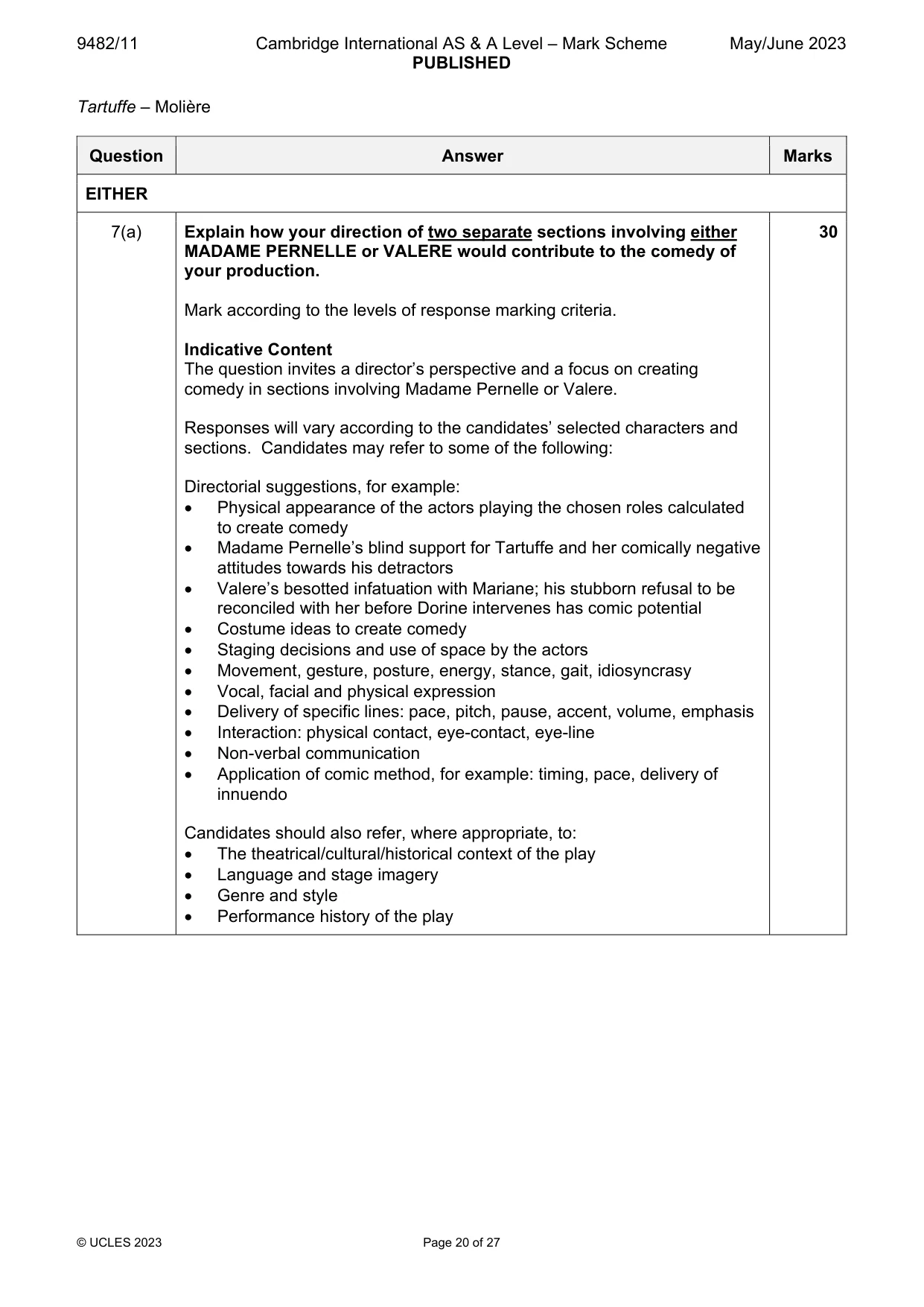
9482/11 Cambridge International AS & A Level – Mark Scheme PUBLISHED May/June 2023 © UCLES 2023 Page 20 of 27 Tartuffe – Molière Question Answer Marks EITHER 7(a) Explain how your direction of two separate sections involving either MADAME PERNELLE or VALERE would contribute to the comedy of your production. Mark according to the levels of response marking criteria. Indicative Content The question invites a director’s perspective and a focus on creating comedy in sections involving Madame Pernelle or Valere. Responses will vary according to the candidates’ selected characters and sections. Candidates may refer to some of the following: Directorial suggestions, for example: Physical appearance of the actors playing the chosen roles calculated to create comedy Madame Pernelle’s blind support for Tartuffe and her comically negative attitudes towards his detractors Valere’s besotted infatuation with Mariane; his stubborn refusal to be reconciled with her before Dorine intervenes has comic potential Costume ideas to create comedy Staging decisions and use of space by the actors Movement, gesture, posture, energy, stance, gait, idiosyncrasy Vocal, facial and physical expression Delivery of specific lines: pace, pitch, pause, accent, volume, emphasis Interaction: physical contact, eye-contact, eye-line Non-verbal communication Application of comic method, for example: timing, pace, delivery of innuendo Candidates should also refer, where appropriate, to: The theatrical/cultural/historical context of the play Language and stage imagery Genre and style Performance history of the play 30
Mark scheme, page 21
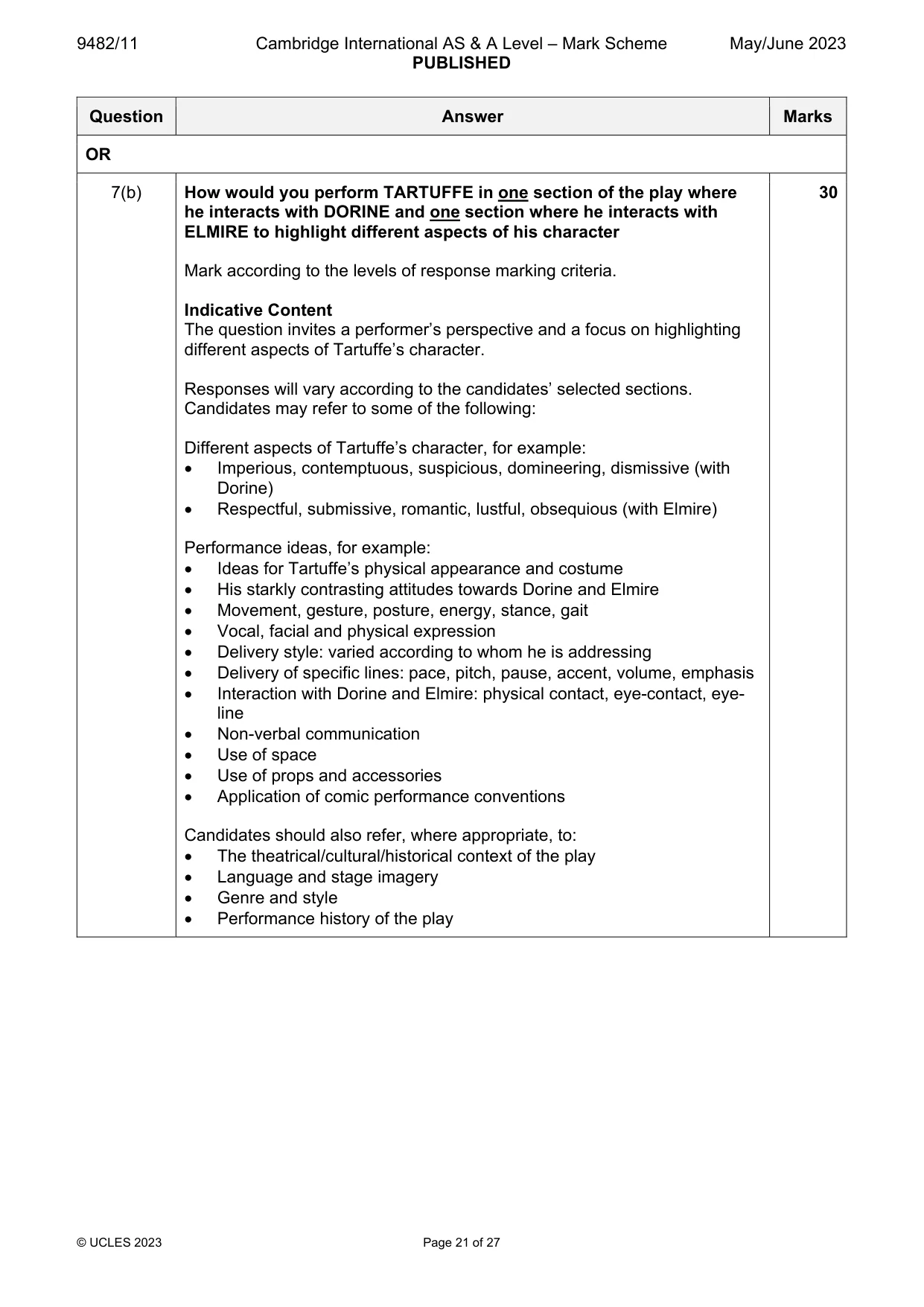
9482/11 Cambridge International AS & A Level – Mark Scheme PUBLISHED May/June 2023 © UCLES 2023 Page 21 of 27 Question Answer Marks OR 7(b) How would you perform TARTUFFE in one section of the play where he interacts with DORINE and one section where he interacts with ELMIRE to highlight different aspects of his character Mark according to the levels of response marking criteria. Indicative Content The question invites a performer’s perspective and a focus on highlighting different aspects of Tartuffe’s character. Responses will vary according to the candidates’ selected sections. Candidates may refer to some of the following: Different aspects of Tartuffe’s character, for example: Imperious, contemptuous, suspicious, domineering, dismissive (with Dorine) Respectful, submissive, romantic, lustful, obsequious (with Elmire) Performance ideas, for example: Ideas for Tartuffe’s physical appearance and costume His starkly contrasting attitudes towards Dorine and Elmire Movement, gesture, posture, energy, stance, gait Vocal, facial and physical expression Delivery style: varied according to whom he is addressing Delivery of specific lines: pace, pitch, pause, accent, volume, emphasis Interaction with Dorine and Elmire: physical contact, eye-contact, eye- line Non-verbal communication Use of space Use of props and accessories Application of comic performance conventions Candidates should also refer, where appropriate, to: The theatrical/cultural/historical context of the play Language and stage imagery Genre and style Performance history of the play 30
Mark scheme, page 22
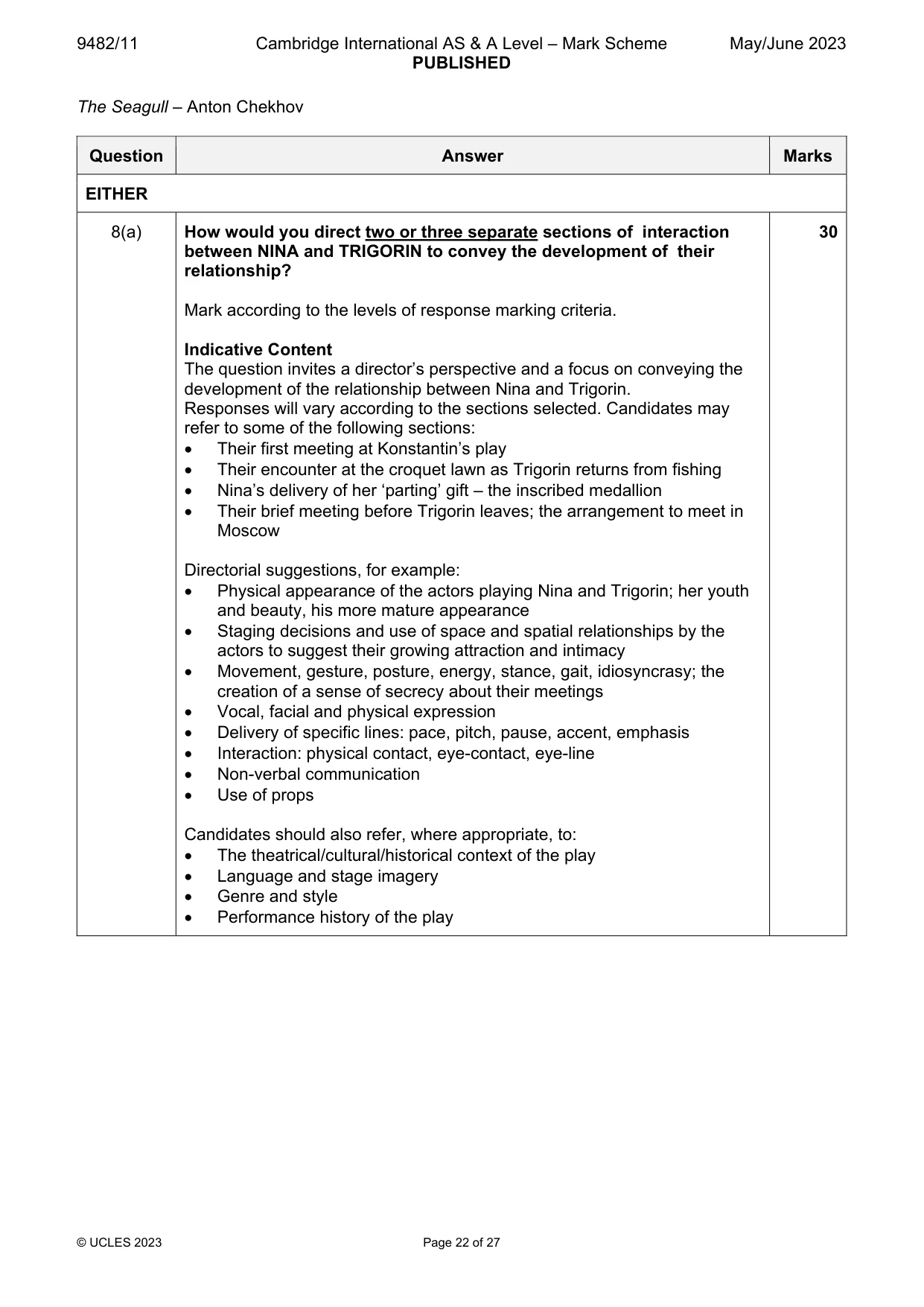
9482/11 Cambridge International AS & A Level – Mark Scheme PUBLISHED May/June 2023 © UCLES 2023 Page 22 of 27 The Seagull – Anton Chekhov Question Answer Marks EITHER 8(a) How would you direct two or three separate sections of interaction between NINA and TRIGORIN to convey the development of their relationship? Mark according to the levels of response marking criteria. Indicative Content The question invites a director’s perspective and a focus on conveying the development of the relationship between Nina and Trigorin. Responses will vary according to the sections selected. Candidates may refer to some of the following sections: Their first meeting at Konstantin’s play Their encounter at the croquet lawn as Trigorin returns from fishing Nina’s delivery of her ‘parting’ gift – the inscribed medallion Their brief meeting before Trigorin leaves; the arrangement to meet in Moscow Directorial suggestions, for example: Physical appearance of the actors playing Nina and Trigorin; her youth and beauty, his more mature appearance Staging decisions and use of space and spatial relationships by the actors to suggest their growing attraction and intimacy Movement, gesture, posture, energy, stance, gait, idiosyncrasy; the creation of a sense of secrecy about their meetings Vocal, facial and physical expression Delivery of specific lines: pace, pitch, pause, accent, emphasis Interaction: physical contact, eye-contact, eye-line Non-verbal communication Use of props Candidates should also refer, where appropriate, to: The theatrical/cultural/historical context of the play Language and stage imagery Genre and style Performance history of the play 30
Mark scheme, page 23
9482/11 Cambridge International AS & A Level – Mark Scheme PUBLISHED May/June 2023 © UCLES 2023 Page 23 of 27 Question Answer Marks OR 8(b) How would you perform the role of ARKADINA, in two or more sections of the play, to achieve your intended audience response to her character? Mark according to the levels of response marking criteria. Indicative Content The question invites a performer’s perspective and a focus on achieving a specific audience response to Arkadina. Responses will vary according to the candidates’ selection of sections and responses. Candidates may refer to some of the following: Audience responses to Arkadina, for example: Dislike of her selfish treatment of others; her stinginess Shock at her treatment of her own son Amusement at her vanity Pity when she is betrayed by Trigorin Sympathy at the end of the play Performance suggestions, for example: Arkadina’s physical appearance and costume Movement, gesture, posture, energy, stance, gait Vocal, facial and physical expression Delivery style Delivery of specific lines: pace, pitch, pause, accent, emphasis Interaction with other characters: physical contact, eye-contact, eye-line Non-verbal communication Use of space Use of props and accessories Naturalistic performance conventions Candidates should also refer, where appropriate, to: The theatrical/cultural/historical context of the play Language and stage imagery Genre and style Performance history of the play 30
Mark scheme, page 24
9482/11 Cambridge International AS & A Level – Mark Scheme PUBLISHED May/June 2023 © UCLES 2023 Page 24 of 27 The Curious Incident of the Dog in the Night-Time – Simon Stephens Question Answer Marks EITHER 9(a) How would you perform the role of CHRISTOPHER, in two or more separate sections of the play, to convey different aspects of his character? Mark according to the levels of response marking criteria. Indicative Content The question invites a performer’s perspective and a focus on highlighting different aspects of Christopher’s character. Responses will vary according to the candidates’ interpretation of Christopher’s character and the chosen sections. Candidates may refer to some of the following: Different aspects of Christopher’s character, for example: Intelligent, inquisitive, determined, ambitious, loyal, obsessive, literal- minded Wary of others, fixed ideas, fixed likes and dislikes, phobia about being touched Performance ideas, for example: Christopher’s physical appearance and costume Movement, gesture, posture, energy, stance, gait Vocal, facial and physical expression Delivery style Delivery of specific lines: pace, pitch, pause, accent, emphasis Interaction with other characters Use of/lack of physical contact, eye-contact, eye-line Non-verbal communication Use of space Use of props and accessories Candidates should also refer, where appropriate, to: The theatrical/cultural/historical context of the play Language and stage imagery Genre and style Performance history of the play 30
Mark scheme, page 25
9482/11 Cambridge International AS & A Level – Mark Scheme PUBLISHED May/June 2023 © UCLES 2023 Page 25 of 27 Question Answer Marks OR 9(b) How would you direct the ENSEMBLE to create Christopher’s experience of travelling to London? You should refer to two separate sections from Part Two Mark according to the levels of response marking criteria. Indicative Content The question invites a director’s perspective and a focus on the Ensemble’s creation of Christopher’s experience of travelling to London. Responses will vary according to the moments selected. Candidates may refer to some of the following: Christopher’s experience created by the ensemble, for example: His struggle with new technologies His encounters with a range of diverse fellow passengers His brushes with figures of authority His amazement at the crowds His panic when he loses Toby Directorial suggestions for the Ensemble, for example: Staging decisions and use of space by the actors Direction of the actors; body language, facial expressions, physical theatre skills, synchronicity, lifts, physical routines Characterisation of a variety of diverse roles that interact with Christopher Vocal qualities: tone, pitch, pace, volume Delivery of specific lines: use of pause and emphasis Movement, gesture, stage position, stance, posture, gait Interaction, physical contact, eye-contact, eye-line Application of comic method, if appropriate to the interpretation: timing, non-verbal communication Application of physical theatre performance conventions Candidates should also refer, where appropriate, to: The theatrical/cultural/historical context of the play Language and stage imagery Genre and style Performance history of the play 30
Mark scheme, page 26
9482/11 Cambridge International AS & A Level – Mark Scheme PUBLISHED May/June 2023 © UCLES 2023 Page 26 of 27 Snow in Midsummer – Frances Ya-Chu Cowig Question Answer Marks EITHER 10(a) How would you direct TIANYUN and FEI FEI, in two or more sections of the play, to convey the nature of their relationship to the audience? Mark according to the levels of response marking criteria. Indicative Content The question invites a director’s perspective and a focus on conveying the nature of the relationship between Tianyun and Fei Fei. Responses will vary according to the sections selected. Candidates may refer to some of the following sections: Their first appearance in Act 1, Scene 1, which establishes their relationship as Mother and Daughter Tianyun’s scepticism about Fei Fei’s superstitions Her shock at Fei Fei’s supernatural encounter with Dou Yi Her reluctant (but honoured) promise to help her honour the ghost of Dou Yi Their visit to the Temple, Tianyun’s shock when Fei-Fei claims Dou Yi as a sister and accuses her mother of causing the swarm of locusts their ultimate reconciliation in the final moments of the play Directorial suggestions, for example: Physical appearance of the actors playing Tianyun and Fei Fei, if made relevant to the question focus Staging decisions and use of space and spatial relationships by the actors Movement, gesture, posture, energy, stance, gait, idiosyncrasy Vocal, facial and physical expression Delivery of specific lines: pace, pitch, pause, accent, emphasis Interaction: physical contact, eye-contact, eye-line Non-verbal communication Use of props Candidates should also refer, where appropriate, to: The theatrical/cultural/historical context of the play Language and stage imagery Genre and style Performance history of the play 30
Mark scheme, page 27
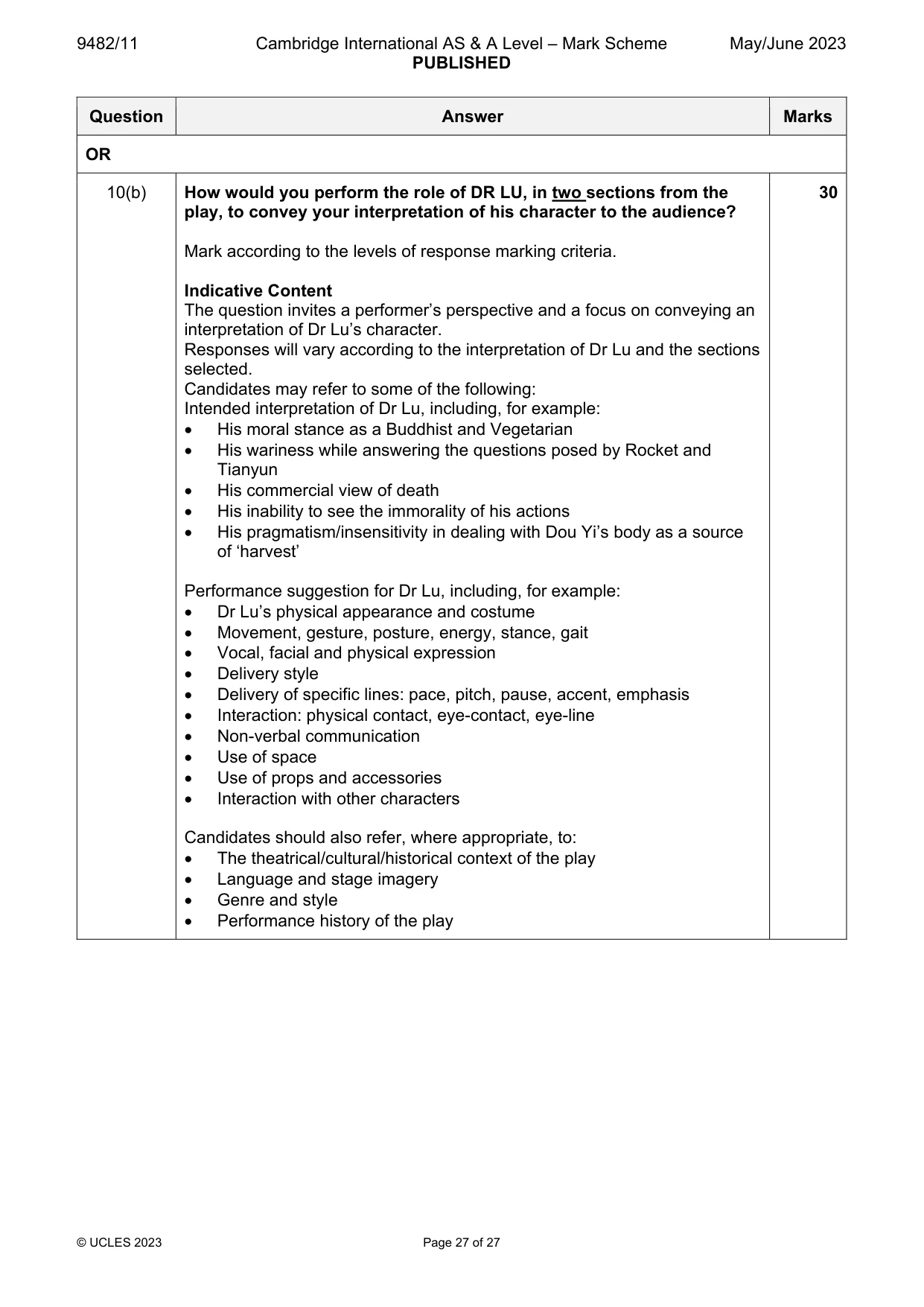
9482/11 Cambridge International AS & A Level – Mark Scheme PUBLISHED May/June 2023 © UCLES 2023 Page 27 of 27 Question Answer Marks OR 10(b) How would you perform the role of DR LU, in two sections from the play, to convey your interpretation of his character to the audience? Mark according to the levels of response marking criteria. Indicative Content The question invites a performer’s perspective and a focus on conveying an interpretation of Dr Lu’s character. Responses will vary according to the interpretation of Dr Lu and the sections selected. Candidates may refer to some of the following: Intended interpretation of Dr Lu, including, for example: His moral stance as a Buddhist and Vegetarian His wariness while answering the questions posed by Rocket and Tianyun His commercial view of death His inability to see the immorality of his actions His pragmatism/insensitivity in dealing with Dou Yi’s body as a source of ‘harvest’ Performance suggestion for Dr Lu, including, for example: Dr Lu’s physical appearance and costume Movement, gesture, posture, energy, stance, gait Vocal, facial and physical expression Delivery style Delivery of specific lines: pace, pitch, pause, accent, emphasis Interaction: physical contact, eye-contact, eye-line Non-verbal communication Use of space Use of props and accessories Interaction with other characters Candidates should also refer, where appropriate, to: The theatrical/cultural/historical context of the play Language and stage imagery Genre and style Performance history of the play 30
What you needed in this session
Cambridge’s own grade thresholds for 2023 May/June, Paper 1 · Variant 1. A higher threshold means an easier paper — the bar moves with how the cohort did.